FM 4-02.4 MEDICAL PLATOON LEADERS' HANDBOOK: TACTICS, TECHNIQUES, AND PROCEDURES (August 2001) - page 2
FM 4-02.4
division by establishing a command relationship of OPCON or attachment. The MEDCOM/brigade could
also choose to maintain only a support relationship of DS or GS to support the division. The division
surgeon and DSS (Force XXI) and the DMOC under Army of Excellence interface with corps medical units
according to the MEDCOM/brigade tactical standing operating procedures (TSOP). The DSS or DMOC
and other division staff elements must be prepared to integrate corps-level medical units/elements into the
medical, as well as the logistical, support structure. The MEDCOM/brigade will normally deploy a liaison
officer to the division to coordinate and synchronize corps CHS. Information concerning the organization,
functions, and responsibilities of the corps MEDCOM/brigade is found in FM 8-10.
a. Corps Medical Command and Medical Brigade. The corps MEDCOM and medical brigade
provide C2, including
Staff planning.
Supervision of operations.
Administration of the assigned and attached units.
b. Medical Logistics Battalion. The MEDLOG battalion is organic to the corps medical brigade.
The MEDLOG battalion provides C2 for assigned MEDLOG companies and the blood support detachment.
The MEDLOG battalion is responsible for receiving, storing, and distributing medical materiel; single and
multivision optical fabrication and repair; medical maintenance; blood and blood product collection,
manufacturing, and distribution; medical gas production and distribution; and building of medical
assemblages/push packages. The MEDLOG battalion will employ standard state-of-the-art MEDLOG
information management and communications systems, to include satellite links.
(1) Medical logistics company. The MEDLOG company provides Class VIII supplies, DS/
GS medical maintenance, and optical support. The MEDLOG company will use line-item requisitioning to
support customers and will have the capabilities of building and maintaining preconfigured push packages in
support of forward deployed medical units.
(2) Blood support detachment. The MEDLOG battalions blood support detachment serves
as the Armys blood supply unit (BSU). Blood and blood products will be stored and distributed under rigid
specifications and managed by standard automated systems. Air movement will be the mode of choice for
transporting blood and blood products. Army blood support in the AO will be the responsibility of the
supporting MEDLOG battalion. The MEDLOG battalions blood support detachment will collect,
manufacture, receive, store, and distribute blood and blood products on an area basis.
c.
Medical Evacuation Battalion. The headquarters and headquarters detachment, MEDEVAC
battalion serves as the central manager of ground and air evacuation assets in the corps. Its mission is to
provide C2 of ground and air MEDEVAC units within its AO. Information pertaining to the organization,
functions, and capabilities of this unit is discussed in FM 8-10-6; air ambulance operations in support of the
division are discussed in FMs 4-02.21, 8-10-3, and 8-10-26. A ground ambulance and one air ambulance
company are normally placed in support of a division. The air ambulance company provides aeromedical
evacuation on a DS basis. This company may be attached for support (less OPCON) to the division aviation
2-9
FM 4-02.4
brigade. Air ambulances will operate from the DSA and BSA, providing 24-hour immediate response
MEDEVAC capability.
d. Medical Detachment, Combat Stress Control. The CSC detachment provides DS to a divisions
maneuver brigades and GS/reinforcing support to the DSA, including corps units in those areas. The de-
tachment must function with its elements widely dispersed, some working in and for the supported division
and others working in the corps. For definitive guidance on the medical detachment, CSC, see FM 8-51.
e.
Veterinary Elements. The division will have corps veterinary team/personnel positioned at
Class I supply points. They may also be deployed to the division to monitor and evaluate zoonotic diseases
and environmental data, to include food exposed to NBC agents. Veterinary personnel will provide animal
care for military working dogs and may perform investigations and postmortem examination of reported
animal deaths. For additional information see FM 8-10-18.
f.
Preventive Medicine Elements. Corps PVNTMED team/personnel may be deployed into the
division when requested to augment division PVNTMED sections. Corps PVNTMED personnel provide
advice and consultation in the areas of environmental sanitation, epidemiology, and entomology, as well as
sanitary engineering services and pest management. Additional information pertaining to corps PVNTMED
units and their specific functions is discussed in FM 4-02.17.
g. Dental Services. In planning the concept of operations, unit-level dental support is dependent
upon corps-level area dental support assets in numbers sufficient enough to support the manpower
requirement criteria for operational dental care. Unit dental support relies on corps-level area dental
support units for assistance in providing operational care. Modules of area dental support units also
augment or reconstitute unit dental elements when required. Corps-level dental units provide dental
modules to reinforce or reconstitute the division dental modules when necessary and to operate field dental
clinics. See FM 4-02.19 for definitive information on dental services.
Section II. DIVISION SUPPORT COMMAND MEDICAL
UNITS AND ELEMENTS
2-8.
Division Support Command, L-Edition TOE (Army of Excellence/AirLand Battle)
The DISCOM is organized to provide the maximum amount of CSS within prescribed strength limitations
while providing the most effective and responsive support to tactical units in a combat environment. In
order to provide responsive support to the tactical commander, logistics, medical, and personnel services
support must be effectively organized and positioned as far forward as necessary to support the tactical plan.
Division-level CHS for the Army of Excellence division is coordinated and provided by the DISCOM
medical elements listed below:
Division medical operations center, DISCOM HHC, located in the DSA.
2-10
FM 4-02.4
Main support battalion.
Main support medical company, MSB, located in the DSA.
Forward support battalion.
Forward support medical company, FSB, located in the BSA.
a. Division Medical Operations Center. The DMOCs mission is to plan, coordinate, and
synchronize the divisions CHS with technical medical advice from the division surgeon. The division
surgeon and the DMOC chief have joint responsibilities for CHS operations in the division. Their staff
positions in the division and DISCOM require a close working relationship and coordination of their CHS
activities. The DMOC staff is responsible to the DISCOM commander for staff supervision of CHS within
the DISCOM. The division surgeon and DMOC chief will develop operating procedures that will enhance
the flow of information and facilitate the synchronization of CHS operations within the division. It is
imperative that the division surgeon and the DMOC chief work as a team. Both share equal responsibility
for planning and overseeing CHS operations. The DMOC is responsible for monitoring CHS activities
within the division area and keeping the DISCOM commander informed of the status of CHS. The division
surgeon is informed of the DISCOMs CHS status through reports prescribed by the TSOP. For definitive
information on the DMOC, see FMs 8-10-3 and 63-2.
b. Main Support Battalion. Information pertaining to the structure and operations of the MSB is
provided in FM 63-21. The DMOC will interface with elements of the MSB, as required and approved by
the DISCOM commander. The DMOC may interface with elements of the MSB through the DISCOM
support operations section. The interactions and coordination between the DMOC and the MSB are driven
by CHS requirements of the division and changes with the tactical situation. The chief, DMOC, and the
MSB commander must develop policies and procedures that clearly delineate responsibilities and coordi-
nation requirements for an effective working relationship. Tasking of the MSMC elements by the DISCOM
will be through command channels.
c.
Main Support Medical Company. The MSMC provides division- and unit-level CHS and
medical staff advice and assistance on an area basis to units operating in the DSA. Combat health support
operations are coordinated by the DISCOM DMOC medical operations branch through technical channels.
The DISCOM will task elements of the MSMC through command channels to provide division-level CHS.
The interface between the MSMC and the DMOC is essential for providing required division CHS. For
definitive information of the MSMC, see FMs 8-10-1, 8-10-3, and 63-21.
d. Forward Support Battalion. The DMOC will interface with elements of the FSB as re-
quired and approved by the DISCOM commander. The DMOC may interface with elements of the FSB
through the DISCOM support operations section. This interface between the DMOC and elements
of the FSB is driven by CHS requirements in the forward areas. This information will assist the DMOC
in planning, coordinating, and managing division medical elements and resources in support of the battle.
Communications and coordination between elements of the DMOC and the FSB are essential for
successful accomplishment of the DMOCs and FSBs CHS mission. For additional information, see
FM 63-20.
2-11
FM 4-02.4
e.
Forward Support Medical Company. The FSMC provides CHS for the brigade as well as area
medical support for the brigade rear. Combat health support operations are coordinated by the FSMC
commander and the FSB HSSO. The DISCOM tasks elements of the FSMC through command channels to
provide division-level CHS. The FSMC commander positions are documented 05A, AMEDD immaterial,
meaning any qualified AMEDD officer can assume command. When the FSMC commander is not a
physician, medical decisions and technical supervision of physicians is performed by the senior physician
assigned to the FSMC. The FSMC commander keeps the FSB commander informed on the CHS aspect of
FSB operations and the health of the command. He regularly attends FSB staff meetings to obtain
information to facilitate the execution of medical operations. He provides staff estimates and assists the FSB
and brigade staffs with development of the CHS plan. For additional information on the FSMC commander,
see FMs 8-10-1 and 63-20.
2-9.
Division Support Command, F-Edition TOE (Force XXI/Digitized Division)
The DISCOM is a multifunctional organization capable of providing, coordinating, and synchronizing
logistical support to the division. The DISCOMs mission of sustaining the divisions combat power is more
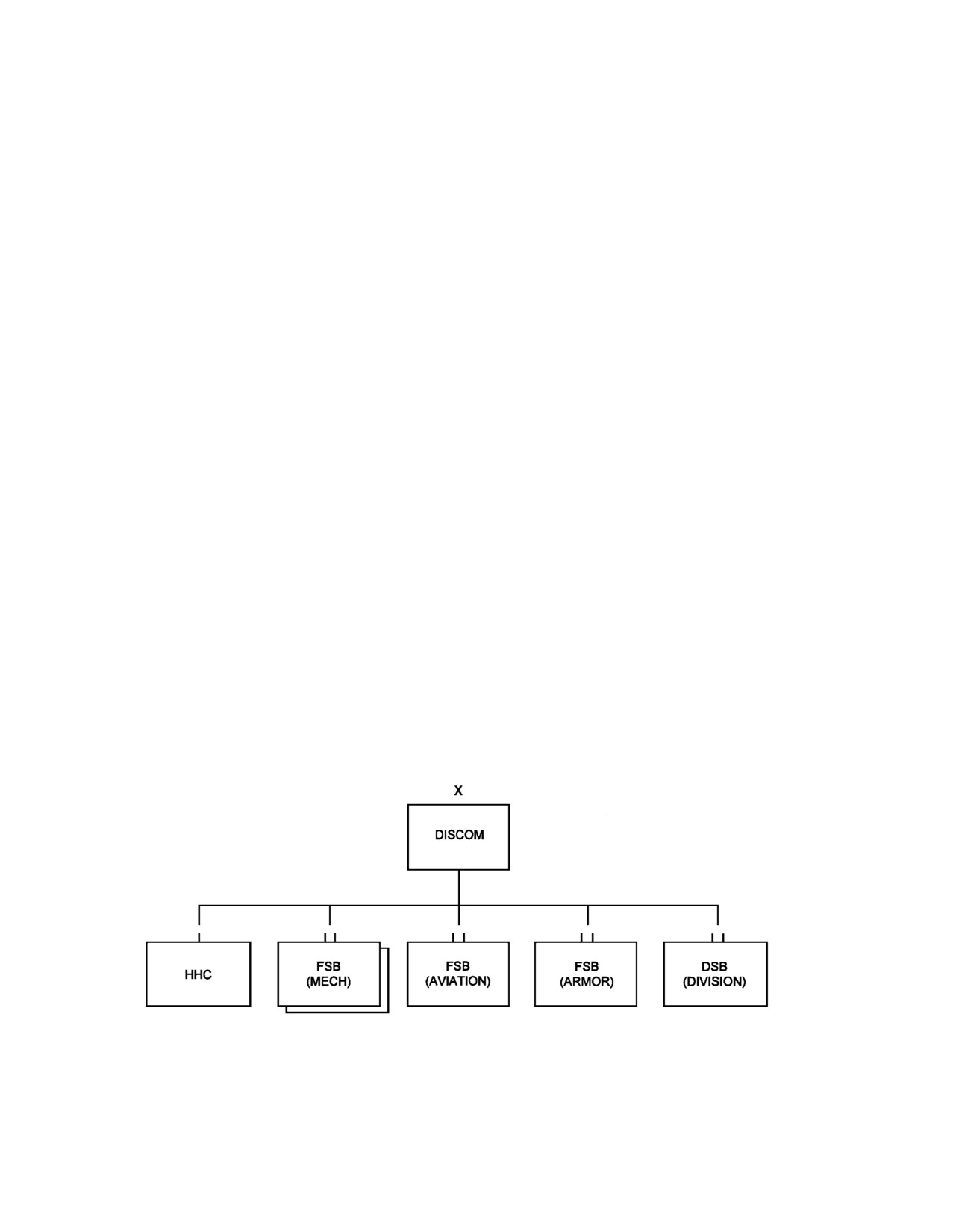
critical than ever. The DISCOM consists of an FSB, a division support battalion (DSB), a division aviation
support battalion, and the HHC. The DISCOM provides CSS for the division. It provides arming through
its Class V operations, fueling through Class III operations, repairing through its maintenance operations,
transportation through the truck company and the supply and transportation sections in the FSB, and
sustaining, through the provision of rations, individual equipment and medical support. The manning
function is provided by the personnel sections throughout the division. The DISCOM organization shown
in Figure 2-2 identifies DISCOM units in support of maneuver brigades and to the division.
Figure 2-2. Division support command organization, Force XXI.
2-12
FM 4-02.4
Division support command medical assets are organic to all of the subordinate battalions except for the
division aviation support battalion (DASB). These medical assets include
Medical operations branch, DISCOM headquarters.
Medical materiel management branch, DISCOM headquarters.
Division support battalion, CHS cell.
Division support medical company.
Forward support battalion, CHS cell.
Forward support medical company.
a. Medical Operations Branch (Division Support Command Headquarters). The medical
operations branch is assigned to the distribution management center (DMC). The DMC has four branches
plans branch, operations branch, procurement branch, and medical operations branch. The DMC provides
the division support operations the overall total asset visibility and the in-transit visibility of all commodities,
movements, and units within, assigned, or inbound to the division AO. The primary responsibility of the
medical operations branch is to assist with synchronization of the division CHS plan. The medical operations
branch works with the DSS and the DISCOM staff in assisting with the development of the division CHS
plan. This branch briefs the DISCOM commander and staff on CHS initiatives, as required. The medical
operations branch and the DSS plan and coordinate for the employment of division medical assets and
relocation of DISCOM CHS elements. The medical operations branch coordinates the CHS plan with
synchronization of the division CHS plan. This branch collects medical information of intelligence value
from reporting medical assets and forwards it to the appropriate division and DISCOM staff elements. The
medical operations branch coordinates the placement of DS corps medical assets with supported DISCOM
units, either in the DSA or BSA. The branch is responsible for
Briefing the DISCOM commander on the CHS planning and operations required.
Providing current information that will assist the DSS with development of staff estimates
and the division CHS plan.
Coordinating the attachment of corps medical units/elements with DISCOM units.
Providing information to the DSS on the DISCOM commanders intent for logistics and
CHS operations.
Coordinating the division CHS plan with all DISCOM staff elements.
Coordinating operations information with the DSS and making recommendations to
ensure synchronization of CHS activities in support of the division.
2-13
FM 4-02.4
Ensuring CHS information from the DSS is staffed to all DISCOM elements in a timely
manner.
Coordinating with the BSS, as required, for synchronization of division CHS.
b. Medical Materiel Management Branch. The MMMB is assigned to the general supply office
(GSO). The GSO coordinates and supervises the supply management for water and Classes I, II, III(B), and
III(P) supplies and recommends priorities for the allocation and other controls of supplies. The MMMB
provides advice on the receipt, storage, and distribution of supplies within its area of responsibility. This
office consists of a Class I branch, Classes II/III(P)/IV branch, Class III and water supply branch, Class V
branch, Class VIII branch (MMMB), and Class IX branch. The MMMB manages the Class VIII supply
system in the division. The branch coordinates and recommends the prioritization of medical supplies and
blood products. It also coordinates for the disposition of captured enemy medical materiel. Under the
technical control of the HSMO of the DSS, the MMMB monitors and coordinates Class VIII resupply for
division medical units/elements. Using the CHL functional module of the TMIP/MC4 system, the Theater
Army Medical Management Information System (TAMMIS), Joint Total Asset Visibility, Transportation
Coordinators Automated Information for Movement System II, and/or other automated logistics manage-
ment systems, the MMMB manages all Class VIII requisitions submitted from the division to the supporting
MEDLOG company. The MMMB maintains a record of the requisition until it is filled. The MMMB
coordinates shortfalls in throughput distribution with the DSS and division support operation section. The
MMMB may update priorities with the MEDLOG company to correct deficiencies in the delivery system.
The MMMB provides Class VIII situational understanding to the DISCOM staff and the DSS according to
the TSOP. For definitive information on division Class VIII resupply operations, see FMs 4-02.1, 4-02.21,
8-10-9, and 63-2-2. The MMMB, in coordination with the CHL cell of the DSS, manages the distribution
of blood and blood products for division medical units. It also coordinates through the DSS with the G5 for
disposition of captured enemy medical material.
c.
Division Support Battalion Health Services Support Officer. The HSSO is assigned to the
command section and is the medical plans and operations officer. The HSSO coordinates internal medical
support. He coordinates the schedules, locations, and capabilities of medical support with the DSMC. He
prepares and provides an area medical plan to the subordinate units. The HSSO is also responsible for
coordinating the placement of supporting corps medical elements attached to the DSB within the battalions
assigned area of the DSA. For additional information on the DSB HSSO, see FM 63-23-2.
d. Division Support Medical Company. The DSMC has the overall mission of providing Echelons I
and II CHS to units located in the DSA and division rear areas. It provides C2 for organic elements and
attached medical units. The DSMC is dependent on appropriate elements of the corps and division
for patient evacuation (including air ambulance), CHS operations planning, guidance, legal, finance, and
personnel and administrative services. It is also dependent on the headquarters and headquarters detach-
ment of the DSB for food service and religious support. The DSMC is organized into a company
headquarters, a treatment platoon, an ambulance platoon, an optometry section, a PVNTMED section, and
a MH section.
e.
Forward Support Battalion Combat Health Support Cell. The CHS cell is assigned to the
support operations section. It is staffed with a medical planner/HSSO who is the FSB commanders special
2-14
FM 4-02.4
staff officer for CHS and a member of the FSB battle staff and a medical operations NCO who is the
primary assistant to the HSSO. This cell is responsible for
Providing the CHS input for logistics preparation of the battlefield for the FSB.
Providing the CHS estimates and medical threat input for inclusion in the FSB com-
manders estimate.
Coordinating and synchronizing FSB medical operations for the supported brigade.
Coordinating the delivery of Class VIII supplies via logistics packages (LOGPAC).
Overseeing all FSB CHS planning activities to ensure such planning is synchronized
laterally and vertically.
Developing the CHS portion of the FSBs OPLAN in coordination with the FSB staff,
the FSMC commander, and the DISCOM medical operations branch.
Coordinating the placement of supporting corps medical elements attached to the FSB
within the BSA. Identifying CHS support requirements for the BSA including space requirements for the
FST (tents, equipment, vehicles, and trailers), the forward support MEDEVAC team (FSMT) (includes fuel
truck and forward area refueling equipment [FARE], aircraft parking, tents for billeting), and the supporting
corps ground ambulance teams and ambulances.
Coordinating communications access for supporting corps elements as required.
Coordinating through the BSS with the brigade S3 (Air) for current Army airspace
command and control (A2C2) information that is provided to the FSMT crews. Also provides a copy of the
brigade OPORD/OPLAN A2C2 annex that provides the air corridors for medical evacuation.
Coordinating CHS taskings from the DISCOM medical operations branch with the FSB
staff and the FSMC commander. Tasking may include area medical/dental, PVNTMED, CSC, and CHS
reinforcement, or reconstitution support.
Coordinating for the training and use of nonmedical personnel for patient decontamination
in the event of an NBC or weapons of mass destruction attack.
(See FM 8-10-7.)
Coordinating and synchronizing CHS requirements with the BSS and the DISCOM
medical operations branch.
Monitoring the status of the FSB and brigade medical elements via the medical situational
reporting on Force XXI Battle Command Brigade and Below (FBCB2).
Monitoring the status of division medical units/elements via medical reporting on CSSCS.
2-15
FM 4-02.4
Advising the FSB commander on CHS operations in the BSA and brigade rear.
Maintaining situational understanding of lateral and supporting medical units.
Submitting and forwarding status reports in accordance with DISCOM and brigade
TSOP.
f.
Forward Support Medical Company. The FSMC has the overall mission of providing Echelon I
and Echelon II CHS on a DS basis for the supported maneuver brigade. It provides C2 for organic elements
and attached medical units. The FSMC is dependent on appropriate elements of the corps, division,
brigade, and FSB for patient evacuation (including air ambulance), CHS operations planning and guidance,
and for legal, finance, and personnel and administrative services. It is also dependent on the head-
quarters and distribution company of the FSB for food service and religious support and the base support
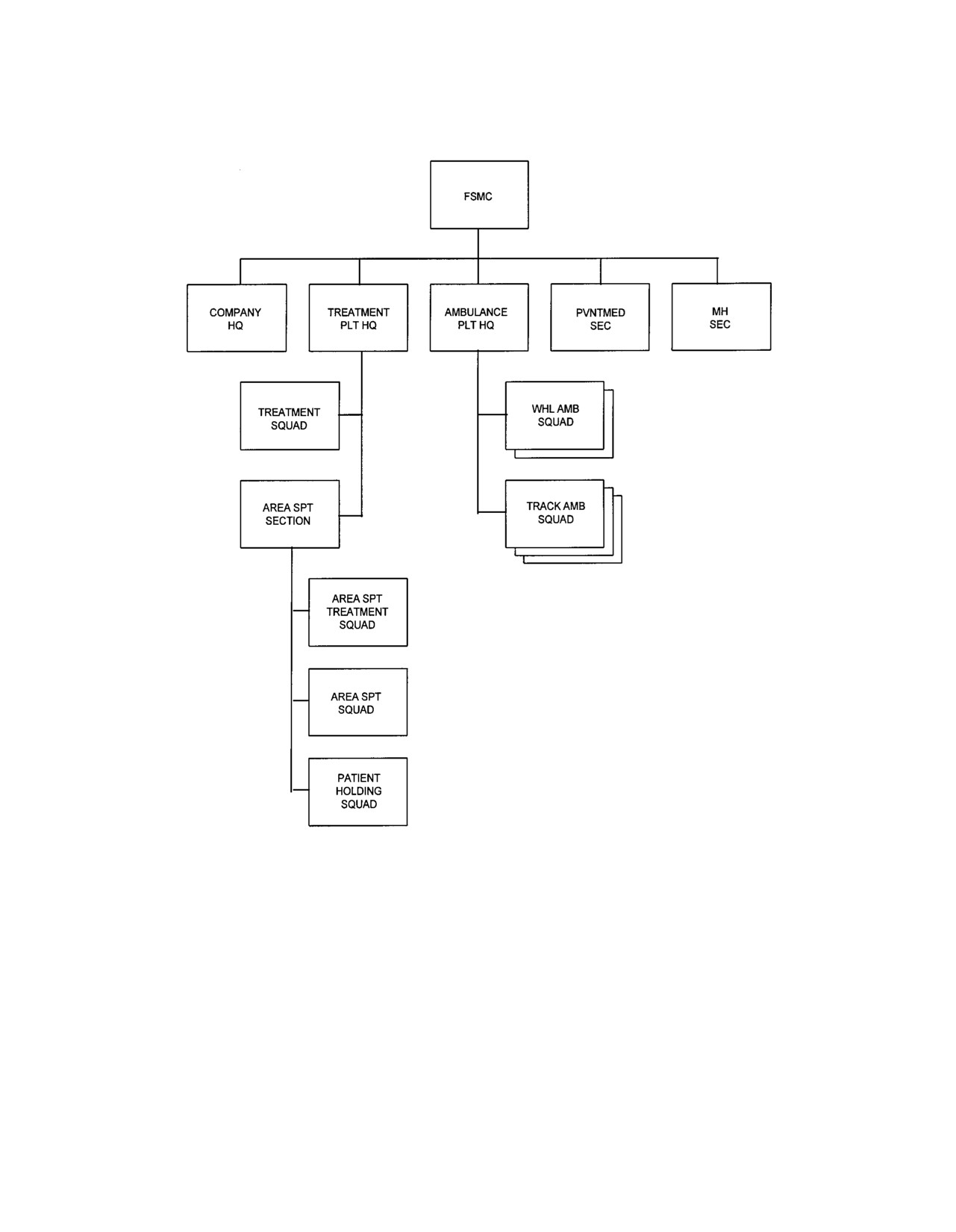
company for maintenance. The FSMC is organized into a company headquarters, a treatment platoon, an
ambulance platoon, a PVNTMED section, and a MH section (see Figure 2-3). For more detailed information
on the operations and functions of the medical company, see FM 8-10-1. The FSMC performs these
functions:
Treatment of patients with DNBI, battle fatigue (BF), and trauma injuries. It provides
routine sick call, triage of mass casualties, ATM, surgical resuscitation/stabilization (when the FST from
the corps is deployed/collocated with the FSMC), and preparation of patients incapable of returning to duty
for further evacuation.
Ground ambulance evacuation for patients from BAS and designated casualty collection
points (CCP).
Operational dental care (emergency and essential dental care).
Class VIII resupply and medical equipment maintenance for supported units.
Medical laboratory and radiology services commensurate with Echelon II/division-level
treatment.
Outpatient consultation services for patients referred from unit-level MTF.
Patient holding for up to 40 patients able to RTD within 72 hours.
Limited reinforcement and augmentation to supported maneuver battalion medical
platoons.
Coordination with the UMT for required religious support.
Preventive medicine consultation and support.
Combat stress control, to include management of BF and stress-related casualties.
2-16
FM 4-02.4
Figure 2-3. Forward support medical company.
Section III. BRIGADE HEADQUARTERS MEDICAL ASSETS
2-10. Brigade Surgeon, F-Edition TOE (Force XXI Digitized Division)
The brigade surgeon is an MC officer (Major, AOC 62B00). He is a special staff officer who plans and
coordinates brigade CHS activities with the brigade staff. The brigade surgeon is assigned to the HHC of
the maneuver brigade. The surgeon is responsible for the technical control of all medical activities in
2-17
FM 4-02.4
the command. The brigade surgeon oversees and coordinates CHS activities through the BSS and the
brigade S3. The brigade surgeon keeps the brigade commander informed on the status of CHS for brigade
operations and the health of the command. He provides input and obtains information to facilitate medical
planning. His specific duties in this area include
Ensuring implementation of the CHS section of the brigade TSOP.
Determining the allocation of medical resources within the brigade.
Supervising technical training of medical personnel and the CLS program within the brigade.
Determining procedures, techniques, and limitations in the conduct of routine medical care,
emergency medical treatment (EMT), and ATM.
Monitoring aeromedical and ground ambulance evacuation.
Monitoring the implementation of automated medical systems.
Informing the division surgeon on the brigades CHS situation.
Monitoring the health of the command and advising the commander on measures to counter
disease and injury threats.
Exercising technical supervision of subordinate battalion surgeons and PAs.
Providing consultation and mentoring for subordinate battalion surgeons, physicians, and PAs.
Providing the medical estimate and medical threat for inclusion in the commanders estimate.
Monitoring the command PVNTMED program (includes health assessment and medical
surveillance); see AR 40-5 and FM 4-02.17.
Ensuring field health records are maintained by primary care providers according to AR 40-66.
2-11. Brigade Surgeons Section, F-Edition TOE (Force XXI/Digitized Division)
The BSS is assigned to the HHC of the brigade and operates out of the brigade TOC. The section, in
coordination with the HSSO of the FSB support operations section and the FSMC commander, is responsible
for the development of the medical portion of the brigade OPLAN/OPORD and takes part in the brigade
planning process. The BSS staff is responsible to the brigade commander for staff supervision of CHS
within the brigade. The BSS is also responsible for coordinating GS and DS relationships of organic
medical units and medical units/elements whether under OPCON or attached to the brigade. The brigade
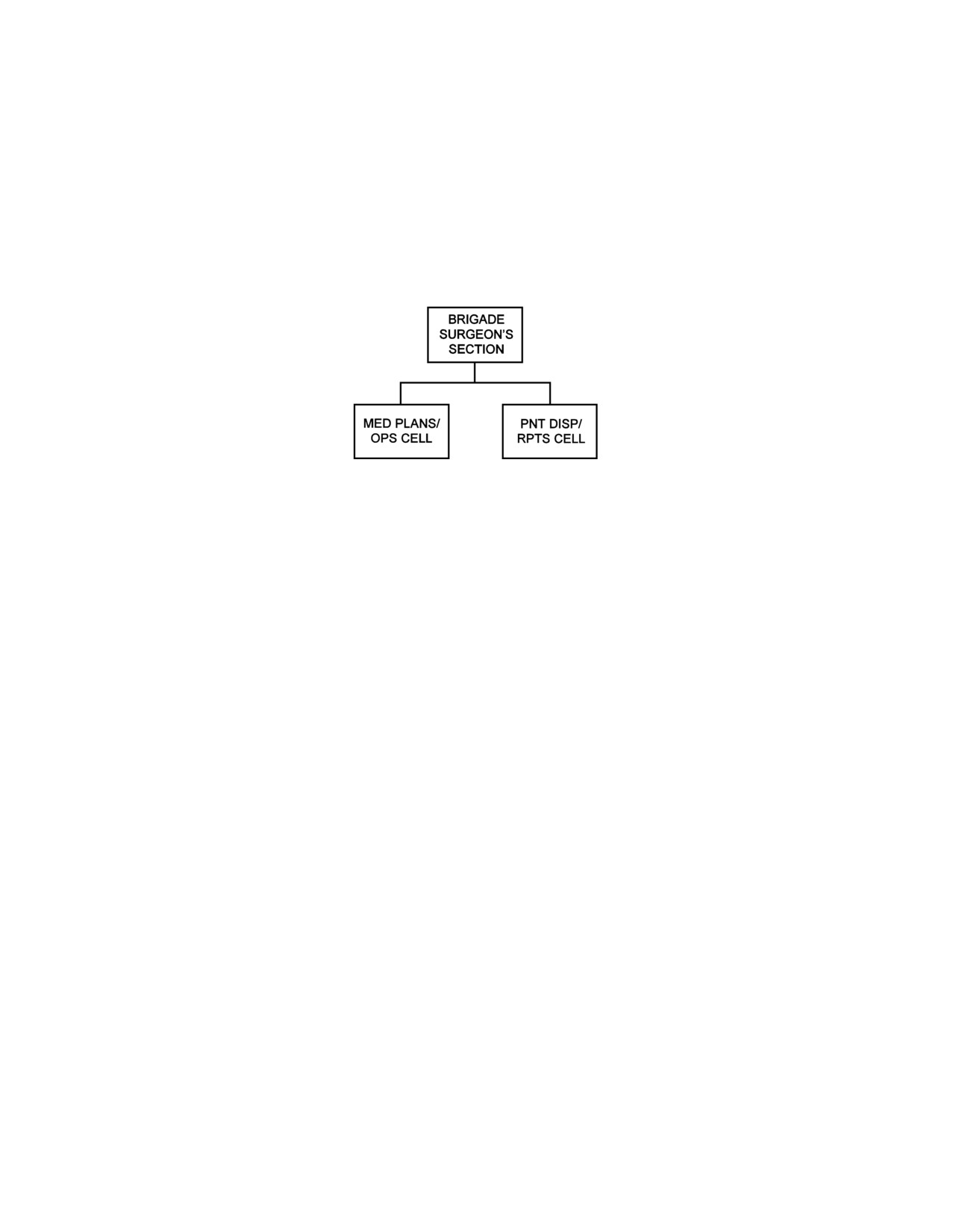
commander is updated as required on the status of CHS in the brigade. Figure 2-4 shows the typical
organization and staffing of the BSS. It consists of a medical plans and operations cell and a patient
2-18
FM 4-02.4
disposition and reports cell. The staff of the BSS assists the brigade surgeon in planning and conducting
brigade CHS operations.
Figure 2-4. Brigade surgeons section.
2-12. Brigade Surgeons, L-Edition TOE (Army of Excellence/AirLand Battle)
The FSMC commander positions are documented 05A, AMEDD immaterial, meaning any qualified
AMEDD officer can assume command. When the FSMC commander is not a physician, medical decisions
and technical supervision of physicians is performed by the senior physician/treatment platoon leader.
When a brigade surgeon is not assigned to the brigade headquarters, the treatment platoon leader, who is
always a physician, will perform the brigade surgeons duties. His duties and responsibilities as the brigade
surgeon require that he work closely with the FSMC commander and include, but are not limited to
Ensuring the implementation of the CHS section of the division TSOP.
Determining the allocation of CHS resources within the brigade.
Supervising the technical training of medical personnel and the CLS program within the
brigade.
Developing and monitoring the MEDEVAC plan (ground and air) which supports the brigades
maneuver plan.
Writing the CHS portion of brigade TSOP, OPLAN, and OPORD.
Monitoring requests for aeromedical evacuation from supported units.
Monitoring the health of the command and advising the commander on measures to counter
the medical threat.
Monitoring and advising units on their mild to moderate BF cases and determining the
capability to restore BF casualties within the brigades AO.
2-19
FM 4-02.4
Informing the division surgeon and the DMOC of the brigades CHS situation.
Supervising corps medical elements within the brigades AO when directed.
Exercising technical control over subordinate battalion surgeons.
Assuming technical supervision of PAs organic to subordinate units in the absence of their
assigned physicians.
Advising PAs assigned to artillery and engineer battalions, as required.
2-13. Armored Cavalry Regiment and Separate Brigade Surgeons (Army of Excellence)
The duties of the regimental surgeon and the separate brigade surgeon are the same as those identified in
paragraph 2-10.
2-14. Armored Cavalry Regiment Medical Troop
The mission of the ACR medical troop is to provide Echelons I and II medical care within the ACR. The
capabilities of this unit are to
Provide C2 of attached medical elements (including CHS planning; policies and procedures;
support operations; and MEDEVAC coordination for movement of patients within and out of the regiment
AO).
Advise the regiment commander and support squadron commander on the health of the
command and other CHS activities affecting the regiment.
Develop, prepare, and coordinate the CHS portion of OPLAN and OPORD.
Allocate medical resources (personnel and equipment) to all assigned and attached units of the
regiment.
Perform triage, initial resuscitation and stabilization, and preparation for further evacuation of
patients generated in the regiment rear area.
Provide ground evacuation for patients from Echelon I MTFs.
Employ treatment squads to perform reinforcement/augmentation to maneuver squadrons
medical platoons.
(These squads/teams are routinely placed OPCON to supported maneuver squadrons.
2-20
FM 4-02.4
They are normally attached to the squadron medical platoon under technical control of the squadron
surgeon.)
Provide CHL and medical equipment maintenance repair parts and support to the regiment on
an area support basis. (The regiment medical supply section maintains a 5-day stock of emergency push
packages and individual medical items. Emergency supply requests are sent to the supporting MEDLOG
battalion or the nearest medical unit.)
Provide dental support (including treatment of maxillofacial injuries; operational dental care
that includes emergency and essential dental treatment).
Provide laboratory service commensurate with the regiments Echelon II facility.
Perform patient holding for up to 40 patients awaiting evacuation or RTD within 72 hours.
Provide outpatient consultation services for patients referred from Echelon I MTFs.
Section IV. MEDICAL PLATOONS
(ARMY OF EXCELLENCE/AIRLAND BATTLE)
2-15. Assignment
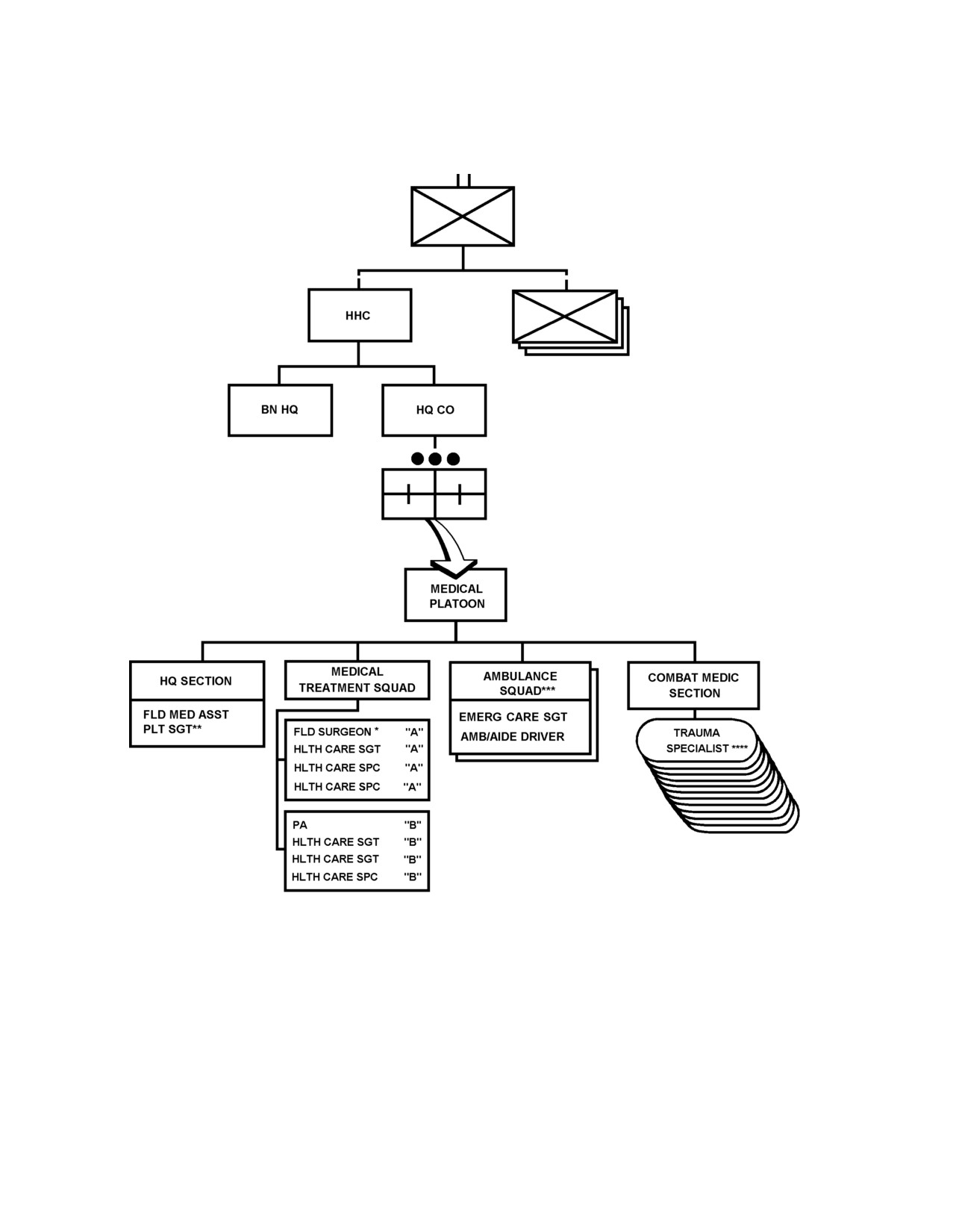
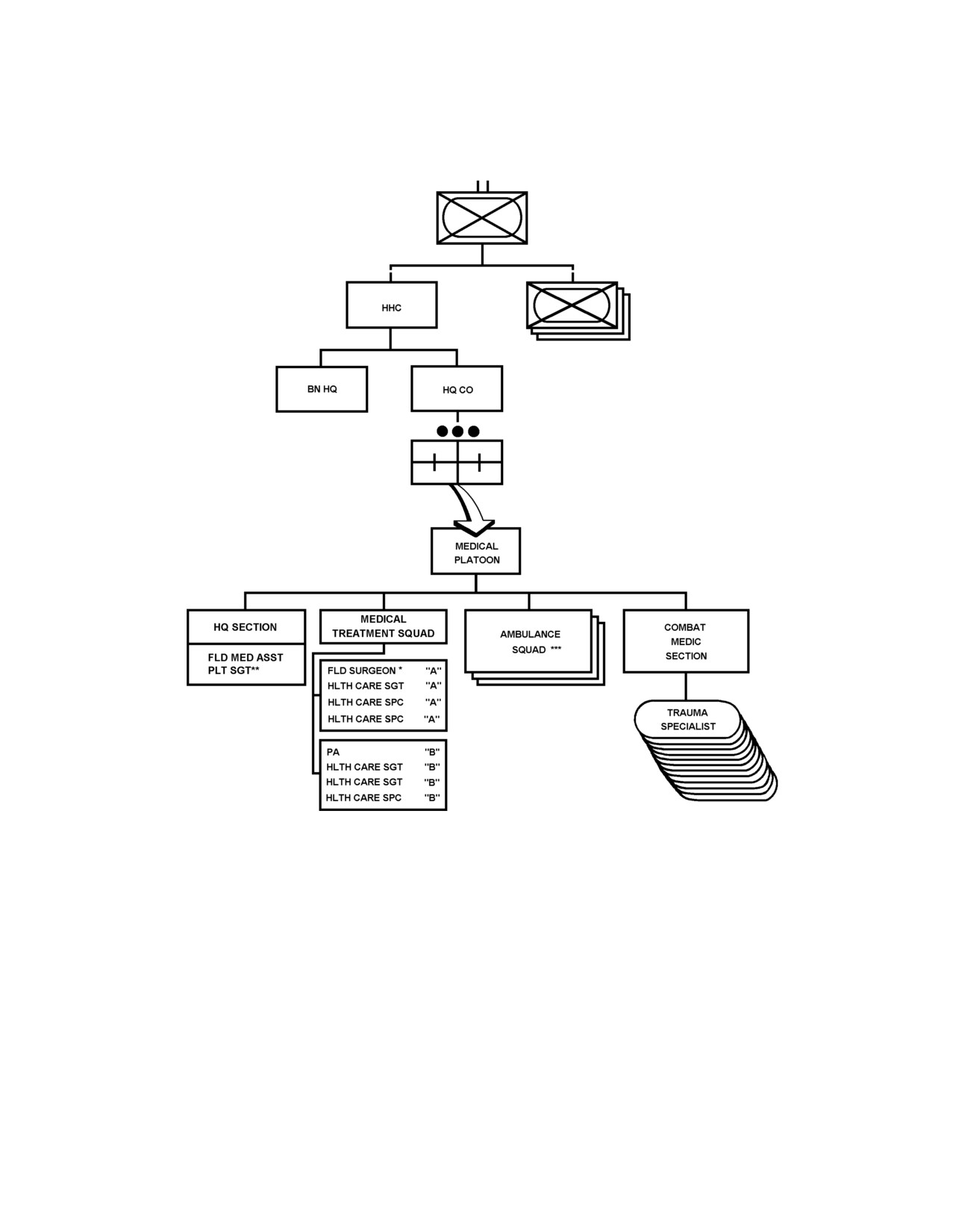
A medical platoon is organic to each combat battalion HHC. Under the Army of Excellence TOE,
the platoon is organized with a headquarters section, a treatment squad (two treatment teams), an ambulance
squad, and a combat medic section. The medical platoon is organized as shown in Figures 2-5
and 2-6.
NOTE
Mechanized infantry and armor units have four ambulance squads
consisting of two ambulance teams each assigned to their medical
platoon ambulance squads. Airborne and air assault medical platoons
have 12 trauma specialists assigned to their combat medic section,
while light infantry has 9 trauma specialists assigned to their combat
medic sections. The armor medical platoons have 3 trauma specialists
assigned to their combat medic section and the mechanized infantry
medical platoons have 3 health care SGTs (91W30) and 9 trauma
specialists (91W10) assigned to their combat medic section.
2-21
FM 4-02.4
ALSO BATTALION SURGEON
**
ALSO SERVES AS AMBULANCE SECTION SGT
***
4 AMBULANCE TEAMS
****
AIRBORNE BATTALIONS HAVE 12 TRAUMA SPECIALISTS ASSIGNED TO THE COMBAT
MEDIC SECTION AND AIR ASSAULT BATTALIONS HAVE 10 TRAUMA SPECIALISTS ASSIGNED
TO THE COMBAT MEDIC SECTION
A ALFA TREATMENT TEAM
B BRAVO TREATMENT TEAM
Figure 2-5. Medical platoon, headquarters and headquarters company light infantry battalion.
2-22
FM 4-02.4
ALSO BATTALION SURGEON
**
ALSO SERVES AS AMBULANCE SECTION SGT
***
MECHANIZED INFANTRY BATTALIONS HAVE 3 AMBULANCE SQUADS AND ARMOR BATTALIONS
HAVE 4 AMBULANCE SQUADS
A ALFA TREATMENT TEAM
B BRAVO TREATMENT TEAM
Figure 2-6. Medical platoon, mechanized infantry battalion.
2-23
FM 4-02.4
2-16. Battalion Surgeon/Medical Platoon Leader, L-Edition TOE
The battalion surgeon/medical platoon leader (MC, AOC 62B00) is the medical advisor to the battalion
commander and his staff. He is the supervising physician (operational medicine officer) of the medical
platoon treatment squad. This officer is responsible for all medical treatment provided by the platoon. His
responsibilities include
Planning and directing Echelon I CHS for the battalion.
Advising the battalion commander and his staff on the status of the health of the command.
Supervising the administration, discipline, maintenance of equipment, supply functions, organi-
zational training, and employment of assigned or attached personnel.
Examining, diagnosing, treating, and prescribing courses of treatment for patients, to include
ATM.
Coordinating the establishment and training of nonmedical personnel for patient decontami-
nation teams.
Training CLS.
Supervising the battalion MH/CSC program, to include training troop leaders in the preventive
aspect of stress on soldiers.
Supporting humanitarian assistance programs when directed.
Overseeing the common task training, continuing medical education, and clinical training of
subordinate medical personnel.
Monitoring the command PVNTMED program, to include health assessment and medical
surveillance; see AR 40-5 and FM 4-02.17.
Ensuring field health records are maintained by primary care providers according to AR 40-66.
2-17. Platoon Headquarters, L-Edition TOE
a. The headquarters section, under the direction of the battalion surgeon/medical platoon leader,
provides for the C3 and resupply for the platoon. The platoon headquarters is manned by the field medical
assistant and the platoon SGT. It is normally collocated with the treatment squad to form the BAS. The CP
includes the plans and operations functions performed by the field medical assistant. The platoon has access
to the battalion wire communication network for communications with all major elements of the battalion
and with supporting units. Wireless communications for this section consists of a tactical FM radio
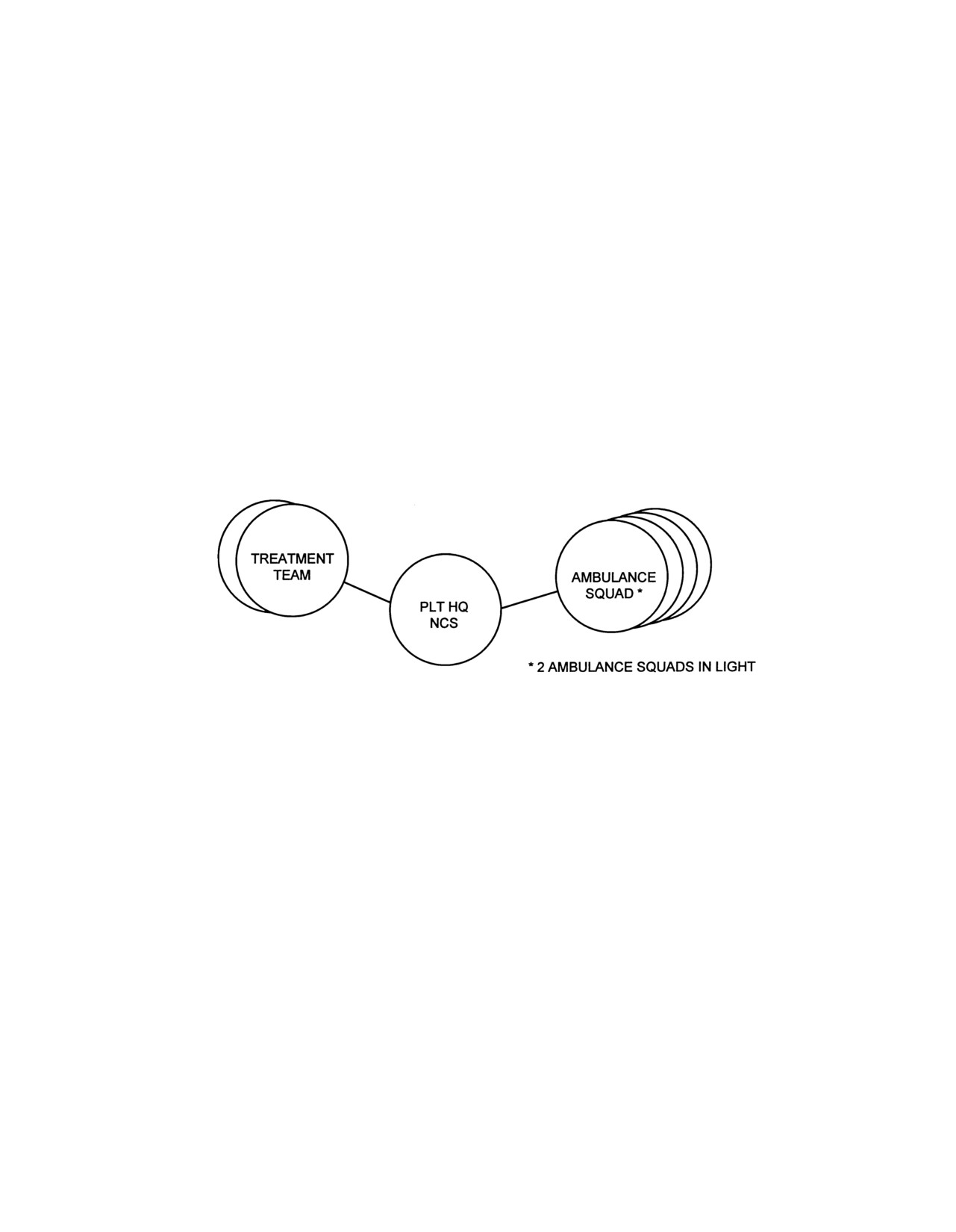
mounted in the platoon headquarters vehicle. The medical platoon employs an FM radio network for CHS
operations (Figure 2-7). The headquarters section serves as the net control station (NCS) for the platoon.
2-24
FM 4-02.4
b. The field medical assistant, an MS Corps officer, is the operations/readiness officer for the
platoon. He is the principal assistant to the battalion surgeon/medical platoon leader for operations,
administration, and logistics. The field medical assistant coordinates CHS operations with the battalion S3
and S4 and coordinates patient evacuation with the FSMC.
c.
The platoon SGT assists the platoon leader and supervises the operations of the platoon. He
also serves as the ambulance section SGT. This NCO prepares reports; requests general supplies as well as
medical supplies; advises on supply economy procedures; and maintains authorized stockage levels (ASL)
of expendable supplies. He supervises the activities and functions of the ambulance section, to include
operator maintenance of ambulances and equipment; OPSEC; and EMT.
Figure 2-7. Medical platoon operations net.
d. The PA performs general technical health care and administrative duties. The PA is ATM-
qualified and works under the clinical supervision of the medical officer. This officer serves as the medical
platoon leader in the absence of an assigned physician. He performs the following duties:
Establishes and operates a BAS or BAS minus (one treatment team).
Treats, within his ability, sick or injured patients. He refers those patients requiring
treatment beyond his capability to the supervising physician.
Provides initial resuscitation to wounded personnel, as required.
Conducts training for battalion personnel in first aid procedures (self-aid/buddy aid),
CLS, field sanitation, evacuation of the sick, injured, and wounded, and the medical aspects of injury
prevention. For additional information on the CLS Program, see Appendix C.
Assists in the conduct of the battalion preventive psychiatry program, to include training
troop leaders in the preventive aspects of stress on soldiers.
2-25
FM 4-02.4
Trains medical personnel in emergency medical procedures and, in the absence of a
physician, ensures common task training, continuing medical education, and clinical training of subordinate
medical personnel.
2-18. Treatment Squad, L-Edition TOE
The treatment squad is the basic medical treatment element of the BAS. It provides routine sick call
services, emergency medical care, triage, and ATM. This squad is staffed with an operational medicine
officer (primary care physician/battalion surgeon), a PA, two health care SGTs, and four health care
specialists. The squads physician and PA are trained in ATM procedures.
2-19. Battalion Aid Station/Treatment Squad Operations, L-Edition TOE
Battalion aid station is the generic term used in designating the unit-level/Echelon I MTF.
a. The treatment squad can split into two treatment teams and operate as two separate aid stations
(BAS minus), normally not to exceed 24 hours. In continuous operations, when operating for longer
periods, personnel efficiency and unit capability will tend to deteriorate. Each team employs treatment
vehicle(s) with two medical equipment sets (MES)one trauma field MES, and one sick call field MES.
b. For communications, each treatment team uses an FM tactical radio and is deployed in the
medical platoons operations net. However, under certain tactical conditions, the battalion S4 may require
BAS elements to use the S4 net.
c.
The BAS is under the tactical control of the battalion S4 and is normally deployed in the
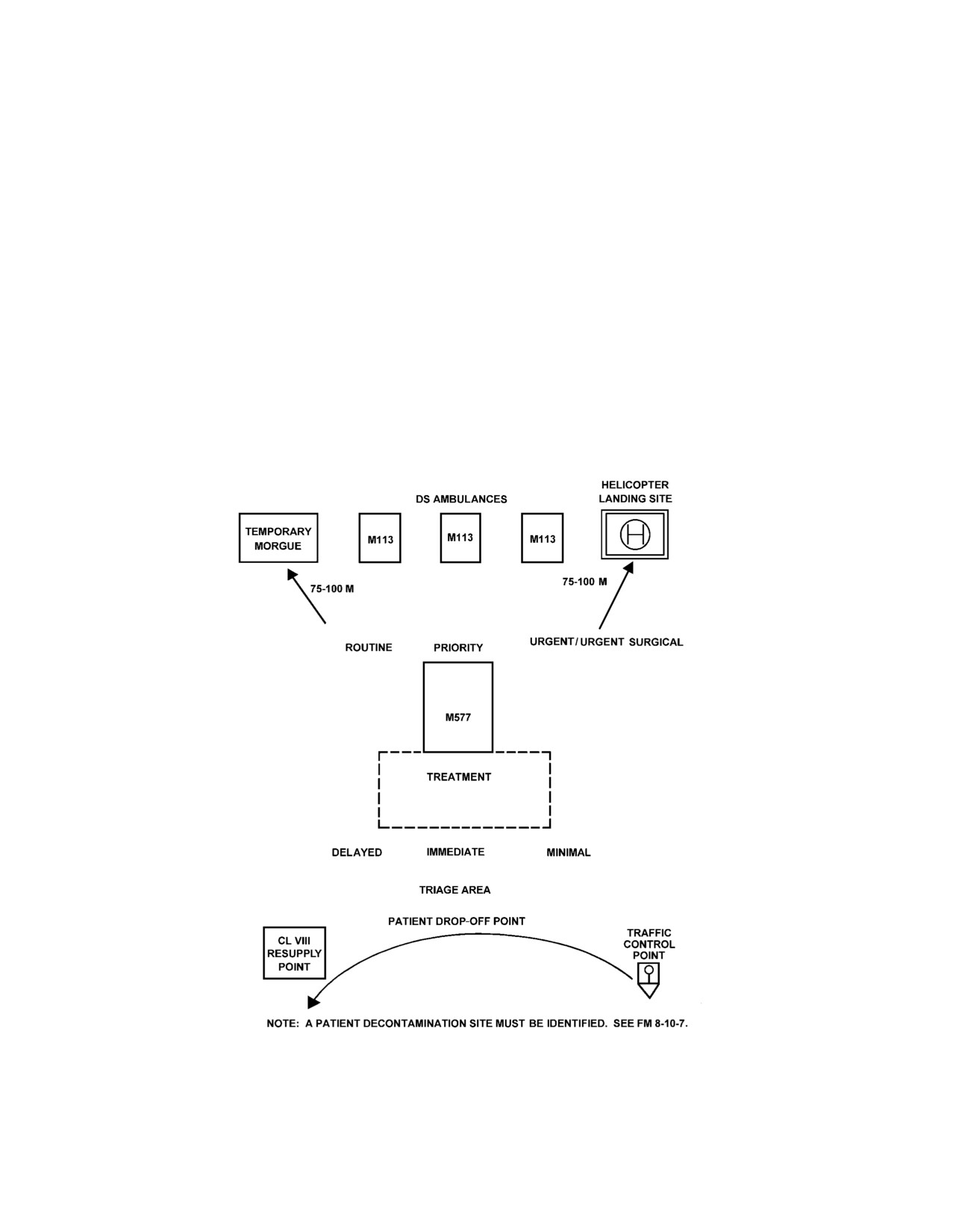
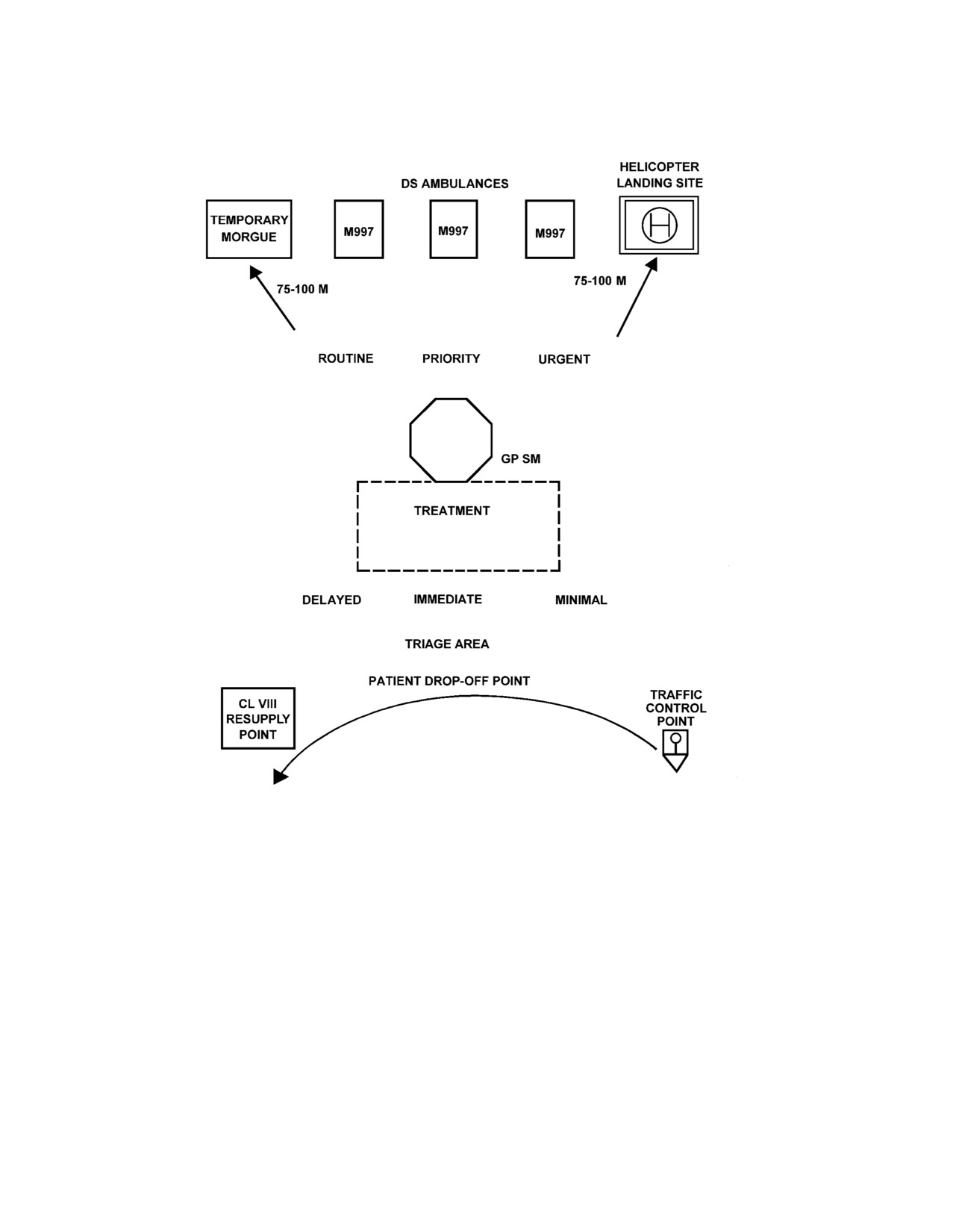
vicinity of combat trains (see Figures 2-8 and 2-9 for suggested layout of a BAS). To reduce ambulance
turnaround time in providing ATM to patients within 30 minutes of wounding, the BAS may split and place
its treatment teams as close to maneuvering companies as tactically feasible. The battalion S4 closely
coordinates locations for forward positioning CSS elements (including medical treatment elements) with the
battalion S3. This is to ensure that the location of these elements is known by commanders of maneuvering
forces. Coordination ensures that CSS elements are not placed in the way of friendly maneuvering forces,
in line of fires, or in areas subject to be overrun by rapidly advancing enemy forces. Treatment teams
situated close to (within 1,000 meters of) maneuvering companies in contact must be prepared to withdraw
to preplanned, alternate positions on short notice.
d. When maneuvering companies anticipate large numbers of casualties, augmentation of the
medical platoon with one or more treatment teams from the FSMC should be made. Augmenting treatment
teams are under the tactical control of the battalion S4; but are under the OPCON of the battalion surgeon/
medical platoon leader. A suggested scheme of employment is to place a team in close support of each
maneuvering company while locating one treatment team in the combat trains. Medical treatment facilities
should not be placed near targets of opportunity such as ammunition, petroleum, oils and lubricants (POL),
distribution points, or other targets that may be considered lucrative by the opposing force. Considerations
for the location of the BAS should include
2-26
FM 4-02.4
Tactical situation/commanders plan.
Expected areas of high casualty density.
Security.
Protection afforded by defilade.
Convergence of lines of drift.
Evacuation time and distance.
Accessible evacuation routes.
Figure 2-8. Layout of a battalion aid station (heavy).
2-27
FM 4-02.4
Figure 2-9. Layout of a battalion aid station (light).
Avoidance of likely target areas such as bridges, fording locations, road junctions, and
firing positions.
Solid ground with good drainage.
Near an open area suitable for helicopter landing.
Available communication means.
Additional space near this site for establishing a patient decontamination site if required.
2-28
FM 4-02.4
e.
At the BAS, patients requiring further evacuation to the rear are stabilized for movement.
Constant efforts are made to prevent unnecessary evacuation; patients with minor wounds or illnesses are
treated and RTD as soon as possible. Other functions of the BAS include
Receiving and recording patients.
Notifying the S1 of all patients processed through the BAS, giving identification and
disposition of patients.
Preparing Field Medical Cards (FMC) (Department of Defense [DD] Form 1380), as
required. See FM 8-10-6 for information on completion and disposition of the form.
Verifying information contained on the FMC of each patient evacuated to the BAS.
Requesting and monitoring MEDEVAC of patients.
Monitoring personnel, when necessary, for NBC contamination prior to medical
treatment.
Supervising patient decontamination and treating NBC patients (refer to FMs 8-10-7,
4-02.283, 8-284, and 8-285).
NOTE
Patient decontamination is performed by a pretrained team. This team
is composed of eight nonmedical personnel from supported units
working under the supervision of medical personnel. Patient decon-
tamination teams perform best when they train and exercise their
skills with the supporting BAS.
f.
Medical evacuation from the BAS is performed by ground ambulances from the FSMC and by
corps air ambulance teams.
g. Patient holding and food service is not available at the BAS. Therefore, only procedures
necessary to preserve life or limb, or enable a patient to be moved safely, are performed at the BAS.
h. Ammunition and individual weapons belonging to patients evacuated from the BAS are disposed
of as directed by command standing operating procedures (SOP)/policy. All excess equipment collected at
the BAS is disposed of by the battalion S4 or as directed by command SOP.
2-29
FM 4-02.4
NOTE
Patients will always retain their protective mask when evacuated to
the next echelon of care, as long as they are in the combat zone.
Based on the threat, they may retain the protective mask until
evacuated out of the theater.
i.
Patients requiring dental treatment are provided relief for dental pain, if required, then
evacuated to the supporting medical company where operational dental care (emergency and essential dental
treatment) is provided.
j.
Patients requiring optometry services initially report to the BAS. For those patients requiring
only routine replacement of spectacles, necessary information is obtained from the individual and forwarded
to the division optometry section. The required spectacles are fabricated and forwarded to the BAS for
issue to the patient. For optometry services other than routine repair or replacement of spectacles, patients
are transported to the optometry section, MSMC, located in the DSA.
2-20. Combat Medic Section, L-Edition TOE
To foster good interpersonal relations and morale of combat troops, every effort should be made to attach
the same trauma specialists to the same unit they habitually support each time the unit deploys. However,
during lulls in combat operations, they should return to the medical platoon for consultation and proficiency
training. Functions of trauma specialists are as follows:
Performs triage and EMT for the sick and wounded.
Arranges MEDEVAC for litter patients and directs ambulatory patients to CCP or to the
BAS.
Initiates a FMC for the sick and wounded and, as time permits, prepares a FMC on deceased
personnel.
Screens, evaluates, and treats, within his capabilities, those patients suffering minor illnesses
and injuries.
Keeps the company commander and the battalion surgeon/medical platoon leader informed on
matters pertaining to the health and welfare of the troops.
Manages Class VIII resupply for the units CLS.
Maintains sufficient quantities of medical supplies to support the tactical situation.
Serves as a member of the unit field sanitation team. In this capacity, he advises the
commander and supervises unit personnel on matters of personal hygiene and field sanitation (FM 21-10-1).
2-30
FM 4-02.4
2-21. Ambulance Squads, L-Edition TOE
a. Medical platoon ambulance squads provide evacuation within the battalion. Ambulance teams
provide medical evacuation and en route care from the soldiers point of injury or a CCP to the BAS. In
mass casualty situations, nonmedical vehicles may be used to assist in casualty evacuation (CASEVAC) as
directed by the commander. Plans for the use of nonmedical vehicles to perform CASEVAC should be
included in the battalions TSOP.
b. Under the modular medical system, the ambulance squad consists of two ambulance teams.
(1) The emergency care SGT
Performs triage and EMT procedures in the care and management of trauma
patients.
Assists in the care and management of BF patients.
Prepares patient for movement.
Provides patient care en route.
Maintains contact with supported units.
Collects casualties.
Performs NBC detection procedures.
(2) The ambulance/aide driver is trained in EMT procedures. He operates and maintains the
ambulance and all onboard equipment. He assists the aide/evacuation NCO in the care and handling of
patients.
c.
Specific duties of the ambulance team are to
Maintain contact with supported elements.
Find and collect the wounded.
Administer EMT as required.
Initiate or complete the FMC.
Evacuate litter patients to the BAS.
Direct or guide ambulatory patients to the BAS.
Perform triage when necessary.
2-31
FM 4-02.4
Provide Class VIII resupply to trauma specialists.
Serve as messengers within medical channels.
Maintain operational readiness of assigned vehicle.
d. The number of ambulance squads in a section varies and is based on the type of parent
organization. The infantry, airborne, and air assault maneuver battalions ambulance sections have two
ambulance squads; each is equipped with HMMWV ambulances. The mechanized infantry and the armored
battalions ambulance sections have four ambulance squads equipped with M-113 tracked ambulances.
2-22. Employment and Functions of the Ambulance Team, L-Edition TOE
a. The ambulance team is a mobile trauma specialist team. Its function is to collect, treat, and
evacuate the sick and wounded to the nearest treatment station or ambulance exchange point (AXP). For
communications, the ambulance team employs an FM tactical radio mounted on its assigned ambulance.
The team uses the medical platoons internal operations net; however, in certain circumstances it may
operate in the battalion administration/logistics net or as established by the battalion signal operating
instructions (SOI).
b. In the heavy maneuver battalions, the track ambulance team routinely deploys with the
maneuver company trains; however, it operates as far forward as the tactical situation permits and evacuates
patients from the point of injury, if possible. In the light maneuver battalion, the wheeled ambulance team is
either dispatched from the BAS, pre-positioned as close to the supported units as the tactical situation
permits, or positioned with the maneuver company trains. Ambulance teams operating in a companys AO
are normally under the tactical control of the company XO or 1SG, but remain under the technical and
OPCON of the medical platoon. An ambulance team from the BAS will habitually support the same
company. To become familiar with the specific terrain and battlefield situation, the team maintains contact
with the company during most combat operations.
c.
During static situations where the company is not in enemy contact or is in reserve, the team
returns to the BAS to serve as backup support for other elements in contact. However, during movement to
contact, the ambulance team immediately deploys to its regularly supported company. During combat
operations, the team may dismount (leaving the ambulance in the company trains area), find, treat, and
move patients to safety, and later evacuate them to the BAS. When moving patients to the ambulance
location, CCP, or company aid post, the team is normally assisted by nonmedical personnel.
2-23. Medical Evacuation, L-Edition TOE
a. Optimum patient care and treatment is dependent upon an evacuation system that provides a
continuous movement of patients. Medical evacuation is the process of moving patients from the point of
injury or illness to an MTF, while providing en route medical care, or between MTFs. Each stop in the
process is to provide medical treatment to enhance the patients early RTD or to stabilize him for further
2-32
FM 4-02.4
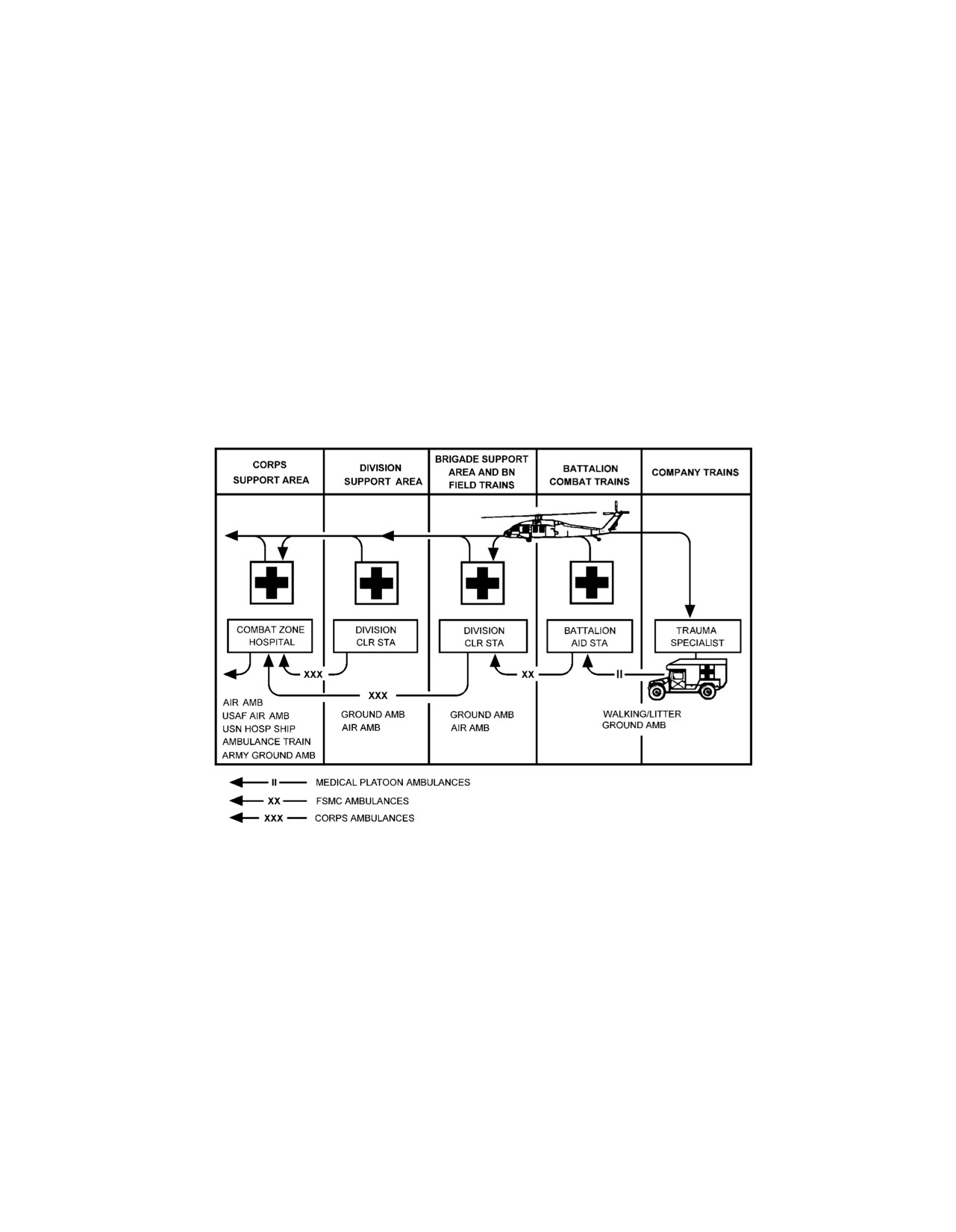
evacuation. The responsibility for patient evacuation rests with the echelon of CHS to which the patient is
to be evacuated (see Figure 2-10). Ambulances go forward, pick up patients, and move them to the
supporting MTFs.
(1) Ambulance teams of the medical platoon evacuate patients from the company aid post or
CCP to the BAS.
(2) Ambulance squads of the FSMC evacuate patients from the BAS to the division clearing
station.
Figure 2-10. Patient evacuation flow.
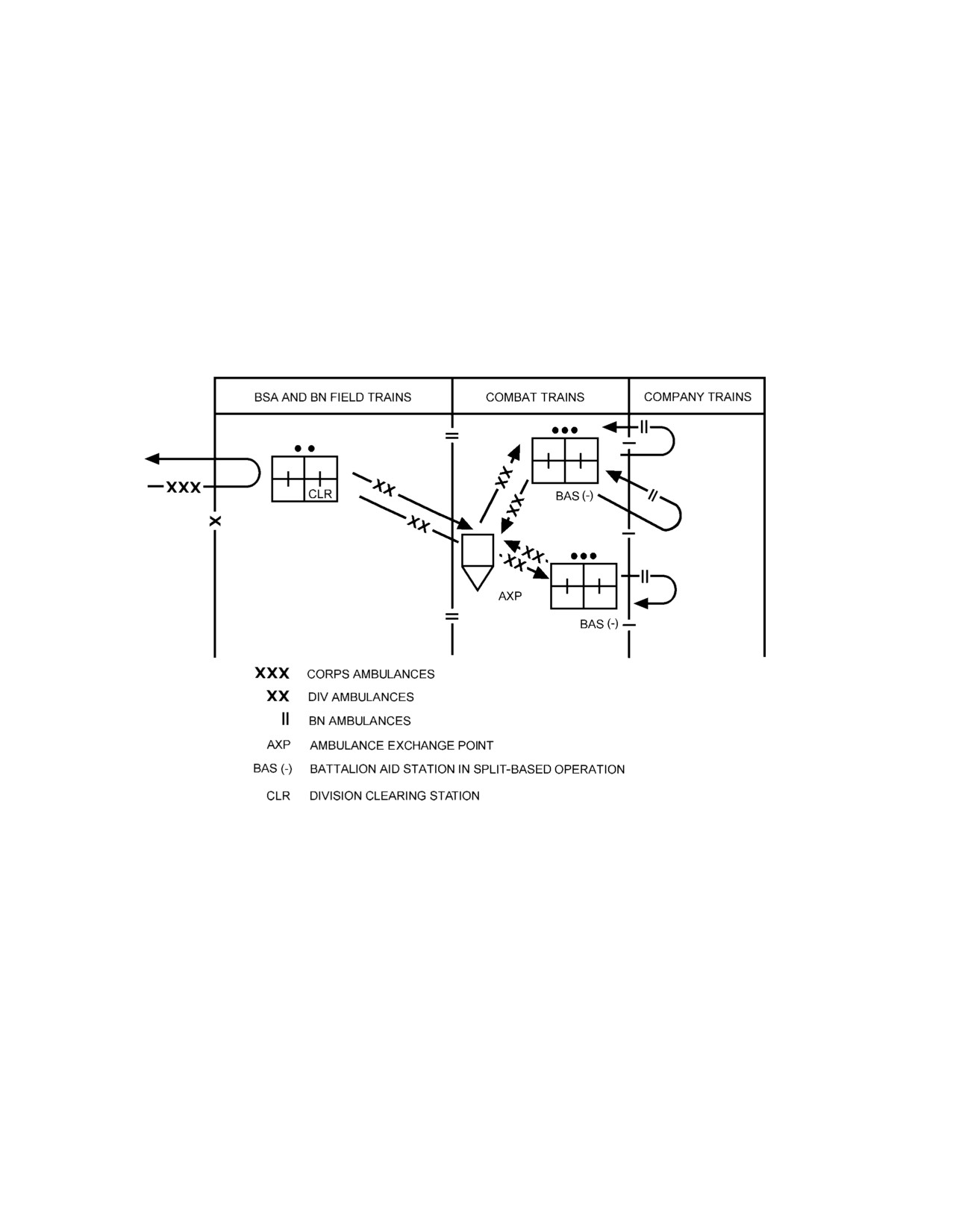
b. An ambulance shuttle system may be set up between the FSMC division clearing station and
the BAS. An AXP is established (Figure 2-11) so that ambulances are moving forward as others move
rearward; thus enabling a continuous rearward evacuation flow, while decreasing ambulance turnaround
time. Patients are evacuated no further to the rear than their conditions require.
c.
Aeromedical evacuation in the combat zone should be used to the maximum extent possible for
critically ill or wounded patients. See FMs 8-10-6 and 8-10-26 for additional information on aeromedical
evacuation. Refer to FM 8-10-6 for MEDEVAC request procedures. Normally, ground ambulances are
used to evacuate the minimally ill or wounded and those patients who cannot be evacuated by air. The
specific mode of evacuation is determined by the patients condition, aircraft/vehicle availability, the
2-33
FM 4-02.4
tactical situation, and weather conditions (METT-TC factors). When both air and ground ambulances are
used, specific factors are considered in determining which patients are to be evacuated by air and which are
to be evacuated by ground ambulances (see FM 8-10-6). Normally, the physician or PA treating the patient
(or the senior trauma specialist in their absence) makes this determination; it is based on the medical
condition of the patient. However, the goal is to get the trauma patient to the initial treatment/ATM element
within 30 minutes of wounding.
Figure 2-11. Ground ambulance shuttle system.
2-24. Evacuation and Disposition of Remains
a. The transportation and disposition of remains is a Quartermaster function. Air and ground
ambulance personnel do not clear the battlefield of remains nor do they carry remains in their dedicated
medical vehicles or aircraft. Medical units do not accept remains or provide temporary morgues in which
to hold remains for other units. Other units are responsible for evacuation of remains to mortuary affairs
collection points.
b. The only remains that medical units/elements handle are those of its own unit members or of
patients who are dead on arrival (DOA) or who died of wounds (DOW) while in their care. Whenever a
2-34
FM 4-02.4
medical unit/element establishes a temporary morgue, it should be out of sight of the triage and treatment
areas. The temporary morgue/holding area can be established behind a natural barrier, such as a stand of
trees or it can be shielded from the view of others by using either tents or tarpaulins.
2-25. Class VIII Resupply, L-Edition TOE
a. The medical platoon maintains a 2-day (48-hour) stockage of Class VIII supplies within its
MES. The following MES are authorized for the medical platoon treatment section and they include
Chemical Agent Patient Decontamination, National Stock Number (NSN) 6545-01-176-
4612 (1).
Chemical Agent Patient Treatment, NSN 6545-01-141-9469 (2).
Sick Call Field, NSN 6545-01-228-1886 *(2).
Trauma Field, NSN 6545-01-228-1667 *(2).
* Indicates the numbers of MES authorized for each treatment team.
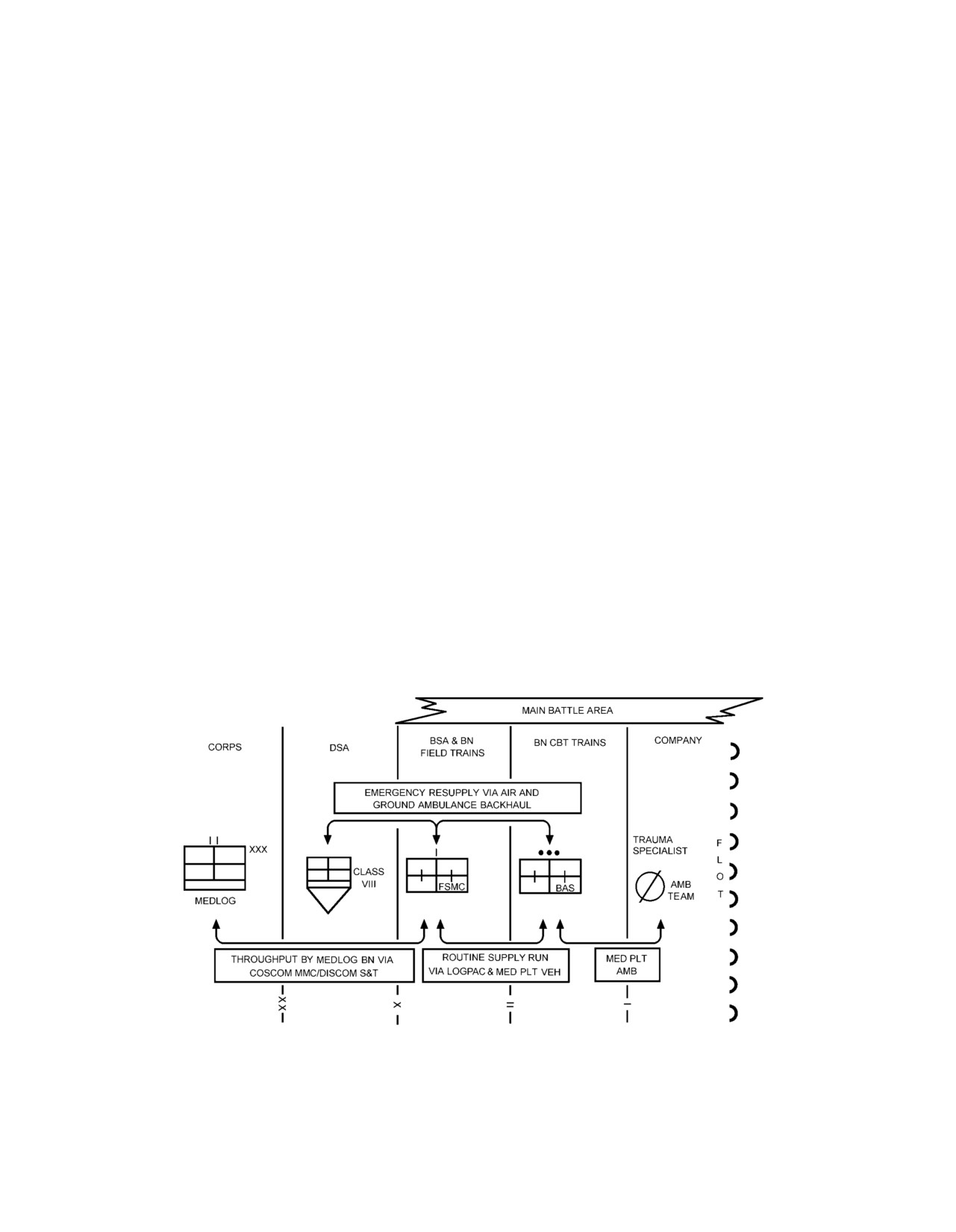
Normal medical resupply of the platoon is performed by the DMSO through LOGPACs, backhaul, or in
coordination with the movement control office(r) (MCO). Medical resupply may also be by preconfigured
Class VIII packages (push packages) throughput from the MEDLOG battalion located in the corps support
area (Figure 2-12).
Figure 2-12. Flow of Class VIII supplies.
2-35
FM 4-02.4
b. In a tactical environment, the emergency medical resupply (ambulance backhaul) system is
used. In this environment, medical supplies are obtained informally and as rapidly as possible, using any
available medical transportation assets. The medical platoon submits supply requests to the supporting
FSMC, who in turn fills requests and ships supplies forward. Request for items not available at the FSMC
are forwarded to the DMSO; the request is filled from division stocks and shipped to the requestor by the
most expedient means available. Air ambulances from corps and ground ambulances from the DISCOM
transport medical supplies directly to BAS. Class VIII resupply of trauma specialists are performed by
ambulances of the medical platoon. The trauma specialist can also be resupplied from the ambulance crew
from supplies onboard the ambulance.
Section V. MEDICAL PLATOONS, FORCE XXI/DIGITIZED DIVISION
2-26. Medical Platoon Assignment, F-Edition TOE
The medical platoon is organic to all maneuver battalions. In the armored battalions and mechanized
infantry battalions, the platoon is organized with a headquarters section, a treatment section, ambulance
squads, and a combat medic section.
NOTE
1. One 91W10 per armor company and one 91W30 and three
91W10s per mechanized infantry company.
2. One ambulance team per maneuver company supported.
The medical platoon receives Echelon II CHS from the supporting FSMC.
2-27. Platoon Headquarters, F-Edition TOE
The headquarters section, under the direction of the platoon leader, provides the C3 and logistics for the
platoon. The platoon headquarters is manned by the field medical assistant and the platoon SGT. It is
normally collocated with a treatment team/squad to form the BAS. The CP includes the plans and
operations functions performed by the field medical assistant. The platoon has access to the HHC and the
maneuver battalion wire communication network for communications with all major elements of supported
and supporting units. Wireless communications for this section consists of a tactical FM radio mounted in
the platoon headquarters vehicle. The medical platoon employs an FM radio network for CHS operations,
to include telemedicine and teleconsultation procedures. The headquarters section serves as the NCS for the
platoon. Each of the medical platoon vehicles have CSS functions for the FBCB2 system. The FBCB2 is a
hardware/software suite that digitizes C2 at brigade level and below. The FBCB2 concept provides a
seamless battle command capability for performance of missions throughout the operational continuum at
2-36
FM 4-02.4
the tactical level. The FBCB2 is the implementation of information age technology to provide increased
battlefield operational capabilities. The system, positioned on the ambulance and treatment vehicles, will
perform combat, CS, and CSS functions for the planning and execution of operations. The FBCB2
represents a major paradigm shift for the CSS and CHS communities. For the first time, the CSS
organizations are digitally linked to the platforms and organizations that they support and the CHS elements
are digitally linked to brigade and FSB medical elements. The FBCB2 provides a common operations
picture enabling CHS and CSS providers to maintain the operational tempo set by maneuver commanders
and to have near-time situational understanding of what is taking place on the battlefield.
2-28. Battalion Surgeon/Medical Platoon Leader, F-Edition TOE
The battalion surgeon/medical platoon leader (MC, AOC 62B) is a working physician on Treatment Team
Alpha. He is the medical advisor to the supported battalion commander and his staff. He is also the
supervising physician (field surgeon) of the medical platoons treatment teams. This officer is responsible
for all medical treatment provided by the platoon. His responsibilities include
Planning and directing CHS for the supported maneuver battalion.
Advising the supported maneuver battalion commander and his staff on CHS operations and
the medical threat.
Supervising the administration, discipline, maintenance of equipment, supply functions,
organizational training, and employment of assigned or attached personnel.
Examining, diagnosing, and treating (or prescribing courses of treatment) for patients, to
include telementoring (TMEN) and ATM.
Training CLS.
Supervising the battalion CSC program, to include individual and leader training on the
prevention of BF and other stress-related conditions.
Planning and conducting humanitarian assistance programs when directed.
Coordinating the medical evacuation of patients, as required.
The field medical assistant, an MS officer, is the operations/readiness officer for the platoon. He is the
principal assistant to the platoon leader for operations, administration, and logistics. The field medical
assistant coordinates CHS operations with the forward support company (FSC) support operations, the
supported TF S1 and S4, and MEDEVAC with the FSMC. The platoon SGT assists in supervising the
operations of the platoon. He also serves as the ambulance section SGT. Physician assistants are assigned
to the Bravo and Charlie treatment teams. The PA (AOC 65D) performs general technical health care and
administrative duties. He is ATM-qualified and works under the clinical supervision of the medical officer.
The PA performs the following duties:
2-37
FM 4-02.4
Establishes and conducts treatment team operations when deployed to other locations away
from the BAS.
Treats, within his ability, sick or injured patients. He refers those patients requiring treatment
beyond his capability to the supervising physician.
Provides ATM for wounded and injured patients.
Provides medical treatment for DNBI patients.
Conducts training for battalion personnel in first-aid procedures (self-aid, buddy aid, and
CLS), field sanitation, evacuation of the sick and wounded, and the medical aspects of injury prevention.
Assists in the conduct of the battalion CSC program, to include individual and leader training
on the prevention of BF and other stress-related conditions.
Trains medical personnel in EMT procedures.
2-29. Treatment Section, F-Edition TOE
The three treatment teams (Teams Alpha, Bravo, and Charlie) are the basic medical treatment elements of
the BAS. They provide Echelon I medical care and treatment. This includes sick call, EMT, ATM, and
triage for the management of mass casualty situations. Each treatment team is staffed with a primary care
physician or a PA, one health care SGT (E-5 or E-6) and two health care specialists (E-4 or E-3). The
physician, PA, and health care personnel are all trained in ATM procedures, commensurate with their
positions and skill levels.
2-30. Combat Medic Section, F-Edition TOE
Trauma specialists are allocated to mechanized infantry companies on the basis of one trauma specialist per
platoon and a senior health care SGT for each company. In armored units, the allocation is one health care
SGT and, normally, one ambulance team per company.
a. Trauma Specialist Location. The mechanized infantry platoon trauma specialist normally
locates with, or near, the element leader. When the platoon is moving on foot in the platoon column
formation, he positions himself near the element leader trailing the base squad forward of the second team.
This formation is the platoons primary movement formation. When the platoon is mounted, the trauma
specialist will normally ride in the same vehicle as the platoon SGT.
b. Health Care Sergeant. The company health care SGT or specialist with the armor company
normally collocates with the 1SG. When the company is engaged, he remains with the 1SG and provides
medical advice, as necessary. As the tactical situation allows, he will provide medical treatment and
prepare patients for MEDEVAC. The ambulance team supporting the company works in coordination with
2-38
FM 4-02.4
the trauma specialists supporting the platoons. When a casualty occurs in a tank or an armored fighting
vehicle, the ambulance team will move as close to the vehicle as possible, making full use of cover,
concealment, and defilade. Assisted, if possible, by the vehicles crew, they will extract the casualty from
the vehicle and administer EMT. They move the patient to the treatment team or to a CCP to await further
MEDEVAC. The company health care SGT normally remains with the company CP, but may be used
anywhere in the company, assisting the ambulance teams in some situations.
2-31. Ambulance Squads, F-Edition TOE
There are three ambulance squads assigned to the medical platoon. Each squad has two ambulance teams.
Armored ambulance teams have three emergency care personnel while wheeled ambulances have two
emergency care personnel. The platoon ambulances provide medical evacuation within the supported
maneuver battalion/TF. Ambulance teams provide medical evacuation and en route care from the soldiers
point of injury to the BAS. In mass casualty situations, nonmedical vehicles may be used to assist in
CASEVAC as directed by the supported commander. Plans for the use of nonmedical vehicles to perform
CASEVAC should be included in the maneuver battalions TSOP and OPORD.
2-32. Property Exchange
a. United States Army Medical Evacuation Operations. Whenever a patient is evacuated from
one MTF to another or is transferred from one ambulance to another, medical items of equipment (casualty
evacuation bags [cold weather-type bags], blankets, litters, and splints) remain with the patient. To prevent
rapid and unnecessary depletion of supplies and equipment, the receiving Army element exchanges like
property with the transferring element. This reciprocal procedure will be practiced to the fullest extent
possible through all phases of evacuation from the most forward element through the most rearward
hospital.
This subparagraph implements STANAG 2128 and QSTAGs 435 and 436.
b. Medical Property of Allied Nations (NATO and ABCA Armies). Medical property accom-
panying patients of allied nations will be returned at once, if possible. If it is not possible, like items will be
exchanged as in paragraph a above.
c.
Medical Property of Coalition Forces or Allied Nations Without Ratified Standardiza-
tion Agreements. Absence of a formal agreement, such as an Acquisition and Cross-Servicing Agreement,
medical property accompanying patients of coalition and allied forces without ratified STANAGs will be
returned to the parent nation as soon as practicable. Commanders should consult with their Staff Judge
Advocate early in the planning process to ensure appropriate policy and procedures are developed and
disseminated.
2-39
FM 4-02.4
Section VI. TREATMENT TEAMS, MEDICAL SECTIONS, AND
SPECIAL PURPOSE MEDICAL PLATOONS (ARMY OF EXCELLENCE/
AIRLAND BATTLE)
2-33. Combat Support Unit and Division Headquarters Treatment Team, L-Edition TOE
Treatment teams are organic to CS units and the division headquarters. With the exception of the combat
engineer battalion, a medical support element in the light division normally consists of one treatment team.
This treatment team is designed to provide Echelon I CHS for personnel of supported units. A treatment
team normally with two ambulance teams is relatively small in comparison to a medical platoon; therefore,
it will require augmentation from a supporting medical company in mass casualty situations.
2-34. Medical Section, Headquarters and Headquarters Battery, Division Artillery, L-Edition TOE
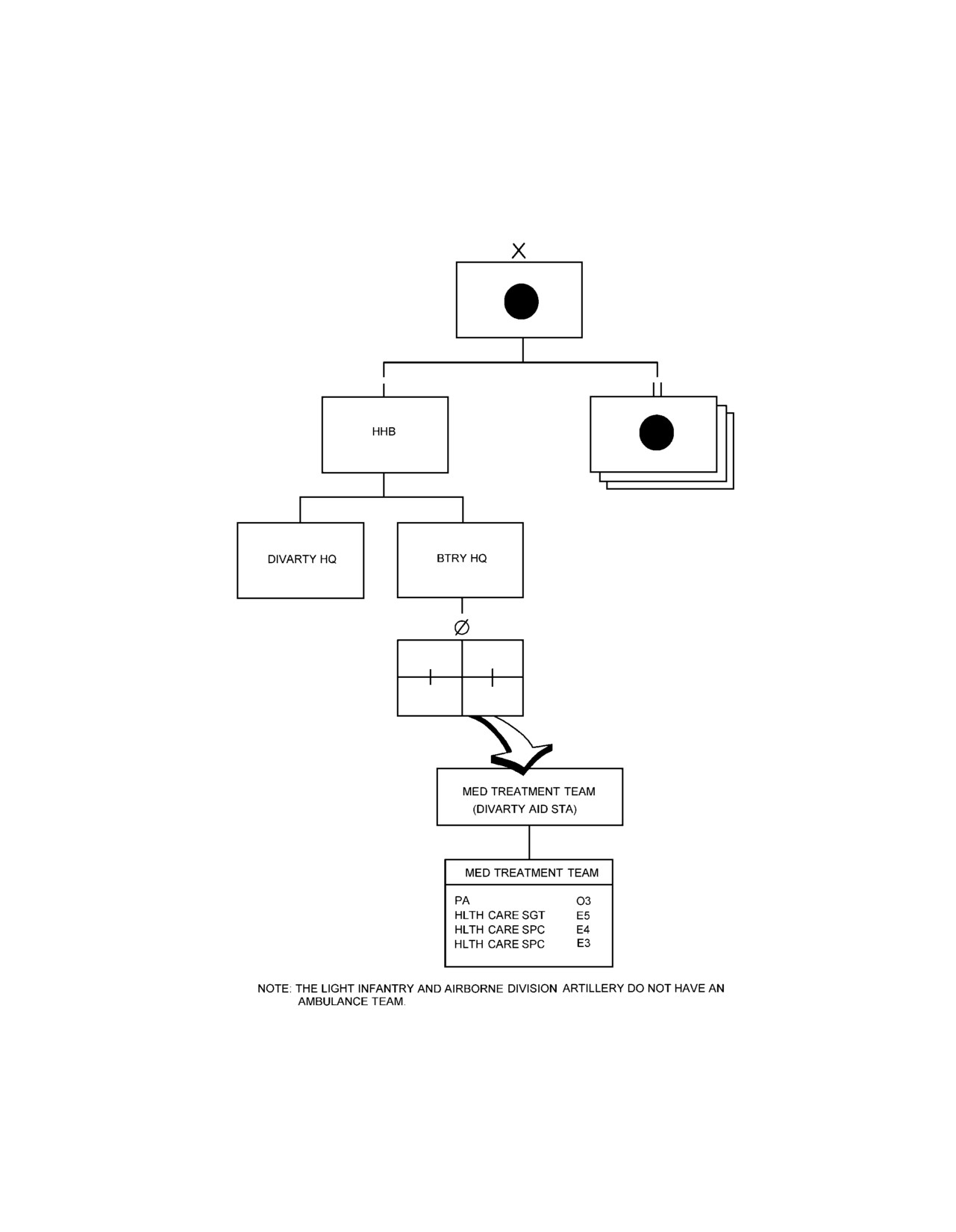
a. Organizations and Functions. The DIVARTY medical element includes a treatment team and
an ambulance team. It is organized as shown in Figure 2-13. Personnel staffing of this section includes a
PA, health care SGT, two health care specialists and an ambulance team.
(1) Division artillery physician assistant. The PA is the medical advisor to the DIVARTY
commander and his staff. The PA works under the supervision of a physician, normally the division
surgeon or treatment platoon leader of the MSMC. He coordinates with the division and brigade surgeons
to ensure that all PAs/medical element leaders in the subordinate FA battalions, are working under the
clinical supervision of a physician. Certain situations may require that the clinical supervision of PAs in FA
units be passed to the physician in charge of the nearest supporting MTF. Such requirements, however, are
coordinated through the division surgeon. The PA is responsible to the supervising physician for the
medical treatment provided by DIVARTY medical personnel (inclusive of medical personnel assigned to
FA battalions). His duties include
Operating the DIVARTY aid station.
Planning and directing unit Echelon I CHS for members of the DIVARTY
headquarters and FA battalions.
Arranging for Echelon II CHS.
Arranging for patient evacuation to the supporting medical company.
Supervising the administration and maintenance of equipment, the supply function,
technical training, and the employment of medical personnel.
Examining, diagnosing, and treating (or prescribing courses of treatment for)
patients, to include ATM for the trauma patient under the clinical supervision of a physician.
Coordinating patient evacuation.
2-40
FM 4-02.4
Figure 2-13. Medical section, headquarters and headquarters battery, division artillery.
2-41
FM 4-02.4
(2) Health care sergeant. The health care SGT assists the PA in accomplishing his duties; he
supervises personnel on the treatment and ambulance teams. He prepares reports, requests general and
medical supplies, maintains supply economy procedures, and maintains the ASL of expendable supplies.
This NCO also performs triage and assists with ATM procedures in the care of trauma and NBC-insulted
patients, and care and management of BF patients. He also performs routine patient care and NBC
detection procedures. His duties also include
Establishing and assisting with operating the DIVARTY aid station.
Maintaining the patient accountability/casualty reporting system.
Maintaining MES.
Conducting tactical and technical proficiency training for subordinate members of
the section.
Conducting sanitation inspections of troop living areas, food service areas, waste
disposal areas, and potable water distribution points and equipment.
Maintaining field health records of all patients seen according to AR 40-66.
(3) Health care specialists. These specialists assist the health care SGT in accomplishing his
duties. They perform triage and EMT. Their specific duties include
Erecting and breaking down field medical shelter systems, to include chemical/
biological protective shelters.
Performing patient care.
Initiating patient records (FMC).
Maintaining the patient daily disposition log.
Operating and maintaining assigned vehicle, tactical radio, and power generation
equipment.
(Also may serve as a member on the battery field sanitation team.)
b. Employment. The medical section establishes an aid station near the DIVARTY headquarters
and provides Echelon I CHS for members of the DIVARTY headquarters and headquarters battery (HHB).
(1) The section employs a treatment HMMWV, a cargo trailer, and two MESs (one trauma
treatment set and one general sick call set).
(2) For communications, the section employs a telephone set (TA 312/PT) and is deployed
in the HHB wire net. It employs an FM tactical radio and is deployed as designated by the DIVARTY SOI.
This section also has access to the supporting medical companys tactical operations net to request
Echelon II CHS.
2-42
FM 4-02.4
c.
Operations. The preceding paragraphs describe BAS operations; these are equally applicable
to the DIVARTY BAS. Figures 2-8 and 2-9 show suggested layouts of a BAS.
d. Medical Evacuation. The DIVARTY HHB, depending on the type, may have one ambulance
team to provide medical evacuation support. Those units assigned to the DIVARTY without an ambulance
team are dependent on the supporting medical company. Evacuation of patients to and from the DIVARTY
aid station is provided by the MSMC in the DSA.
e.
Class VIII Supplies. The medical section maintains a 2-day (48-hour) stock level of Class VIII
supplies for the HHB. Routine requests for medical supplies are submitted through command channels to
the DMSO that is assigned to the MSMC. Class VIII supplies may be picked up by the requesting unit or
forwarded to the DIVARTY BAS during routine ambulance runs. For emergency resupply procedures, see
paragraph 2-25.
f.
Property Exchange. See paragraph 2-32.
2-35. Treatment Team, Headquarters and Headquarters Battery, Field Artillery Battalion, L-Edition
TOE
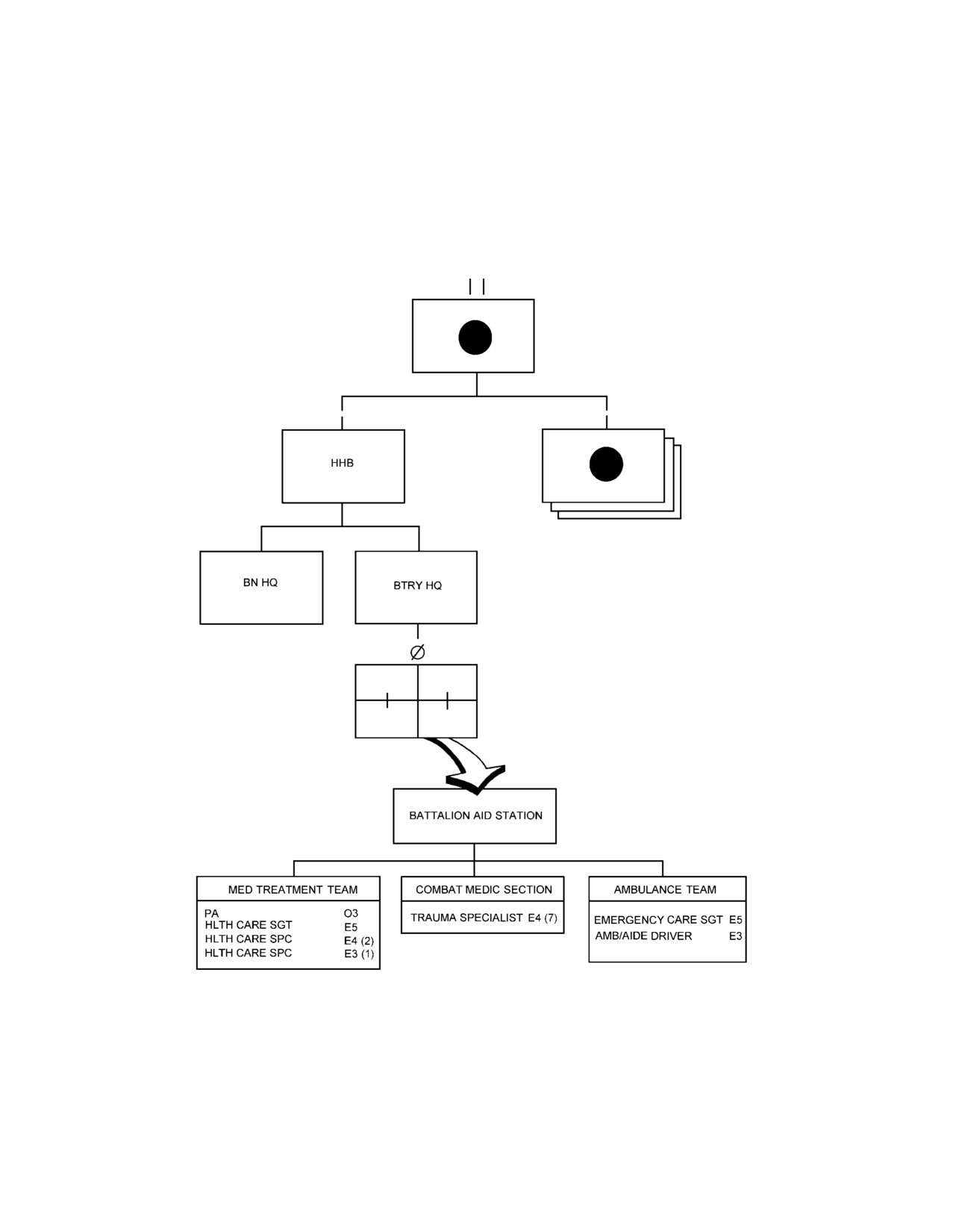
Organic to the HHB of the FA battalion is a treatment team, an ambulance team, and a combat medic
section. The treatment team operates the BAS and the ambulance team provides limited ground ambulance
medical evacuation support for the battalion. Trauma specialist from the combat medic section, are
deployed with each firing platoon and with the service battery. Medical elements of the HHB, FA battalion
are organized as shown in Figure 2-14. Personnel staffing for the treatment team include a PA, a health
care SGT, two health care specialists, MOS 91W20, and one health care specialist, MOS 91W10.
a. Physician Assistant. In the absence of a physician, the PA is the principal advisor to the
battalion commander and his staff in the areas of health and medical readiness. Working under the clinical
supervision of a physician, he is the primary medical care provider for the battalion and supervises all
activities of battalion medical personnel. The PA is trained in ATM procedures and as stated, works under
the clinical supervision of a medical officer. He is responsible to the supervising physician for all treatment
provided by medical personnel of the section. His specific duties include
Establishing and operating the BAS.
Planning and supervising Echelon I CHS and coordinating with the supporting medical
company for Echelon II CHS for the battalion.
Treating, within his ability, patients reporting to him.
Referring patients who require treatment beyond his capability to the supervising
physician.
Providing initial resuscitation (ATM) for the wounded.
Training medical personnel and CLSs in emergency medical procedures.
2-43
FM 4-02.4
Figure 2-14. Medical elements, headquarters and headquarters battery, field artillery battalion.
2-44
FM 4-02.4
b. Health Care Sergeant. This NCO assists the PA in accomplishing his duties. The specific
duties of this NCO are the same as those described for the health care SGT in the DIVARTY HHB (refer to
paragraph 2-34a[2]).
c.
Health Care Specialists. The duties and functions of these specialists are the same as those
discussed in paragraph 2-34a(3).
d. Trauma Specialists. Trauma specialists are allocated to a DS FA battalion on the basis of one
to each firing platoon and the service battery. The duties and functions of trauma specialists are described
in paragraph 2-20.
e.
Employment. The treatment team establishes a BAS near the battalion headquarters and
provides Echelon I CHS.
(1) The section employs a treatment HMMWV, a cargo trailer, and two MESs (one trauma
treatment set and one general sick call set).
(2) For communications, the section employs a telephone set (TA 312/PT) and is deployed
in the HHB wire communications net. It also employs an FM tactical radio and is deployed in the net
designated by the battalion SOI. This section also has access to the supporting medical companys tactical
operations net to request Echelon II CHS.
f.
Operations. Paragraphs 2-19 describes a BAS operation; these are equally applicable to the
FA BAS. Figures 2-8 and 2-9 show suggested layouts of a BAS.
g. Medical Evacuation. The HHB ambulance team evacuates patients to the BAS and to the
supporting medical company if Echelon II ground ambulance support is not available.
h. Property Exchange. See paragraph 2-32.
2-36. Medical Treatment Team, Headquarters and Headquarters Company, Division Aviation
Brigade/Combat Aviation Squadron, L-Edition TOE
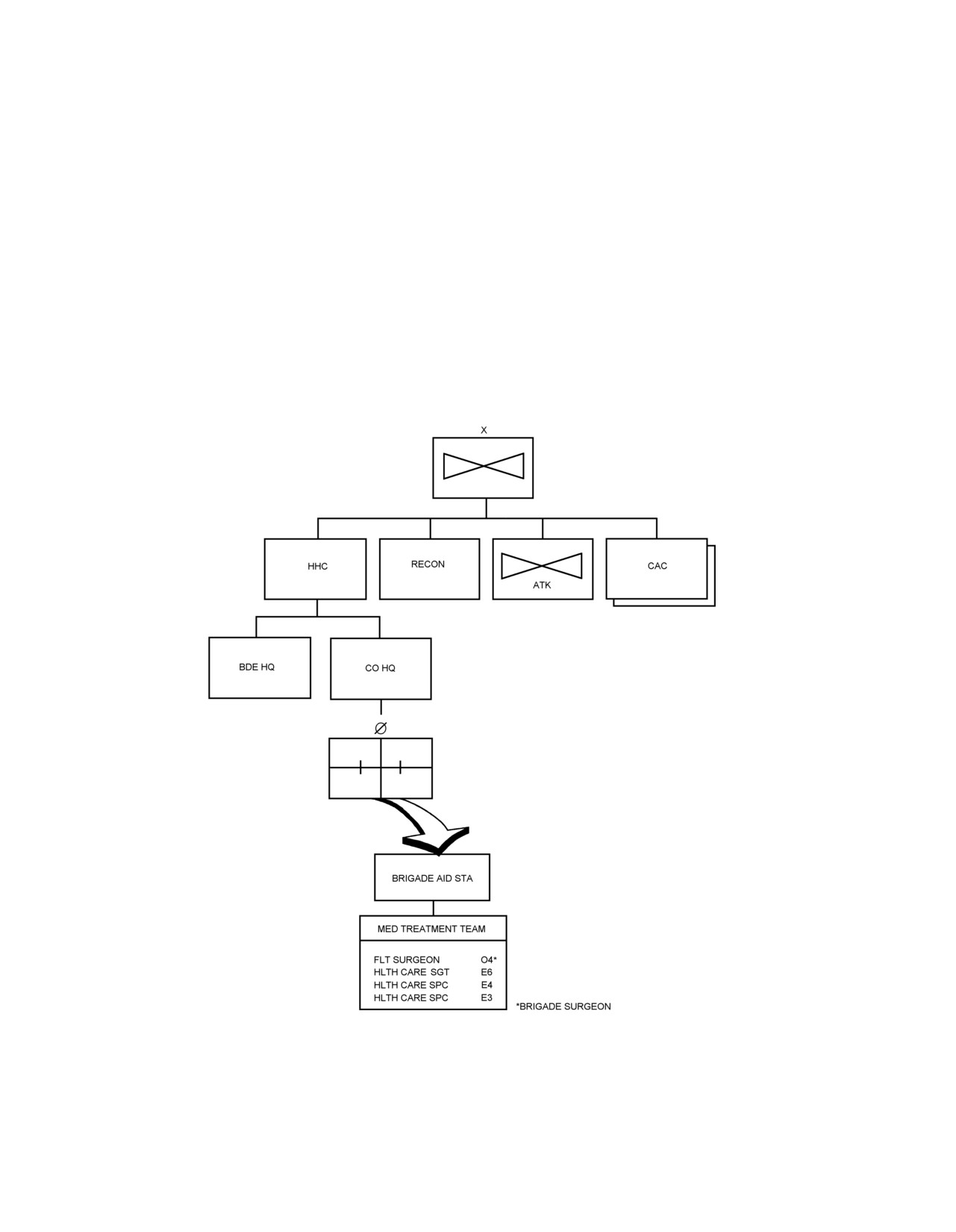
a. Organization and Functions. The division aviation brigade/combat aviation squadron medical
treatment team is organized as shown in Figure 2-15. Personnel staffing for this section include a flight
surgeon, a health care SGT, and two health care specialists. The flight surgeon (brigade surgeon) is the
medical advisor to the aviation brigade commander and his staff. He is the primary care physician of the
brigade. The flight surgeon is responsible for treatment provided by the medical treatment team (brigade
aid station). His duties include
Operating the brigade aid station.
Examining and determining the medical qualification for flying status of aviators within
the brigade headquarters, or aviators referred to him by units without a flight surgeon.
2-45
FM 4-02.4
Planning and directing Echelon I CHS for members of the brigade headquarters.
Coordinating for evacuation of patients to the division clearing station.
Coordinating for division CHS augmentation, as required..
Supervising the administration and maintenance of equipment, the supply function,
technical training, and the employment of medical personnel.
Examining, diagnosing, treating, and prescribing courses of treatment for patients, to
include ATM for trauma patients.
Figure 2-15. Medical treatment team, headquarters and headquarters company,
division aviation brigade.
2-46
FM 4-02.4
b. Operations. Paragraph 2-19 describes aid station operations; these are equally applicable to
the DIVARTY BAS. Figures 2-8 and 2-9 show suggested layouts of a BAS.
c.
Medical Evacuation. The brigade HHC medical section has no MEDEVAC assets. Evacuation
of patients is provided by the supporting medical company.
d. Class VIII Resupply. See paragraph 2-25.
e.
Property Exchange. See paragraph 2-32.
2-37. Medical Section, Headquarters and Headquarters Company, Attack Helicopter Battalion,
Division Aviation Brigade, L-Edition TOE
a. Organization and Functions. The attack helicopter battalion medical section is organized as
shown in Figure 2-16. Personnel staffing this section include a flight surgeon, a health care SGT, and two
health care specialists. For further explanation, see paragraph 2-36a.
b. Property Exchange. See paragraph 2-32.
2-38. Medical Platoon, Headquarters and Headquarters Troop, Reconnaissance Squadron, Division
Aviation Brigade, L-Edition TOE
a. Organization and Functions. The headquarters and headquarters troop (HHT) RECON
squadron, division aviation brigade medical section is organized as shown in Figure 2-17. The medical
section has a medical treatment squad, an ambulance squad, and a combat medic element.
(1) The patient treatment squad includes a flight surgeon (AOC 61N00), a PA, a section
SGT/health care SGT (MOS 91W30), two health care SGTs (MOS 91W20), and three health care specialists
(MOS 91W10).
(a) For flight surgeon responsibilities, see paragraph 2-36.
(b) The PA assists the flight surgeon in performance of his duties. He serves as the
aviation brigade flight surgeon in the absence of the flight surgeon. His duties include
Examining and determining the medical qualification for flying status of
aviators within the brigade headquarters; or aviators referred to his treatment section by units without a
flight surgeon.
Examining, diagnosing, treating, and prescribing courses of treatment for
patients, to include ATM for trauma patients.
Performing general technical health care and administrative duties (refer to
paragraph 2-17d).
2-47
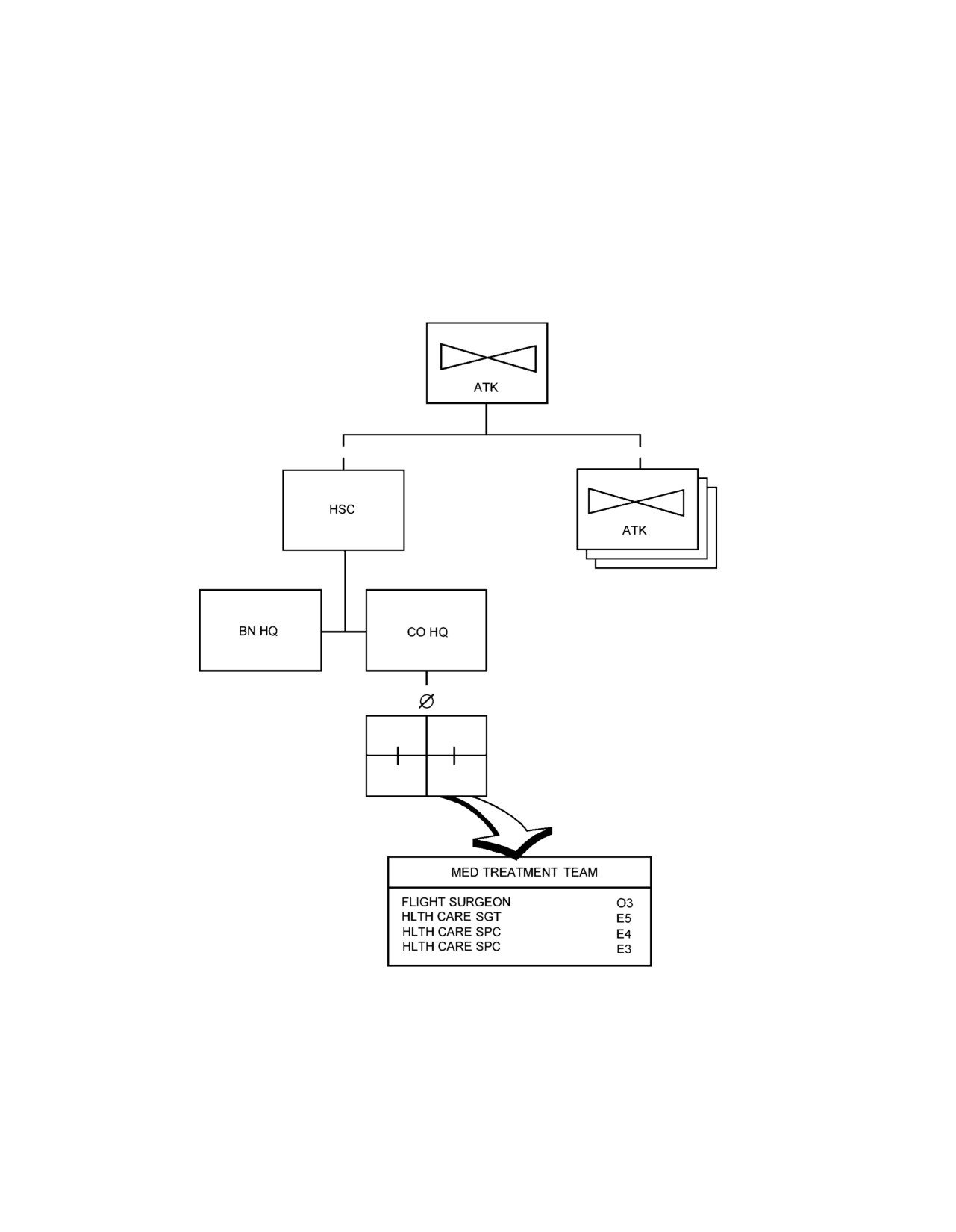
FM 4-02.4
Figure 2-16. Medical section, headquarters and headquarters company, attack helicopter battalion.
2-48
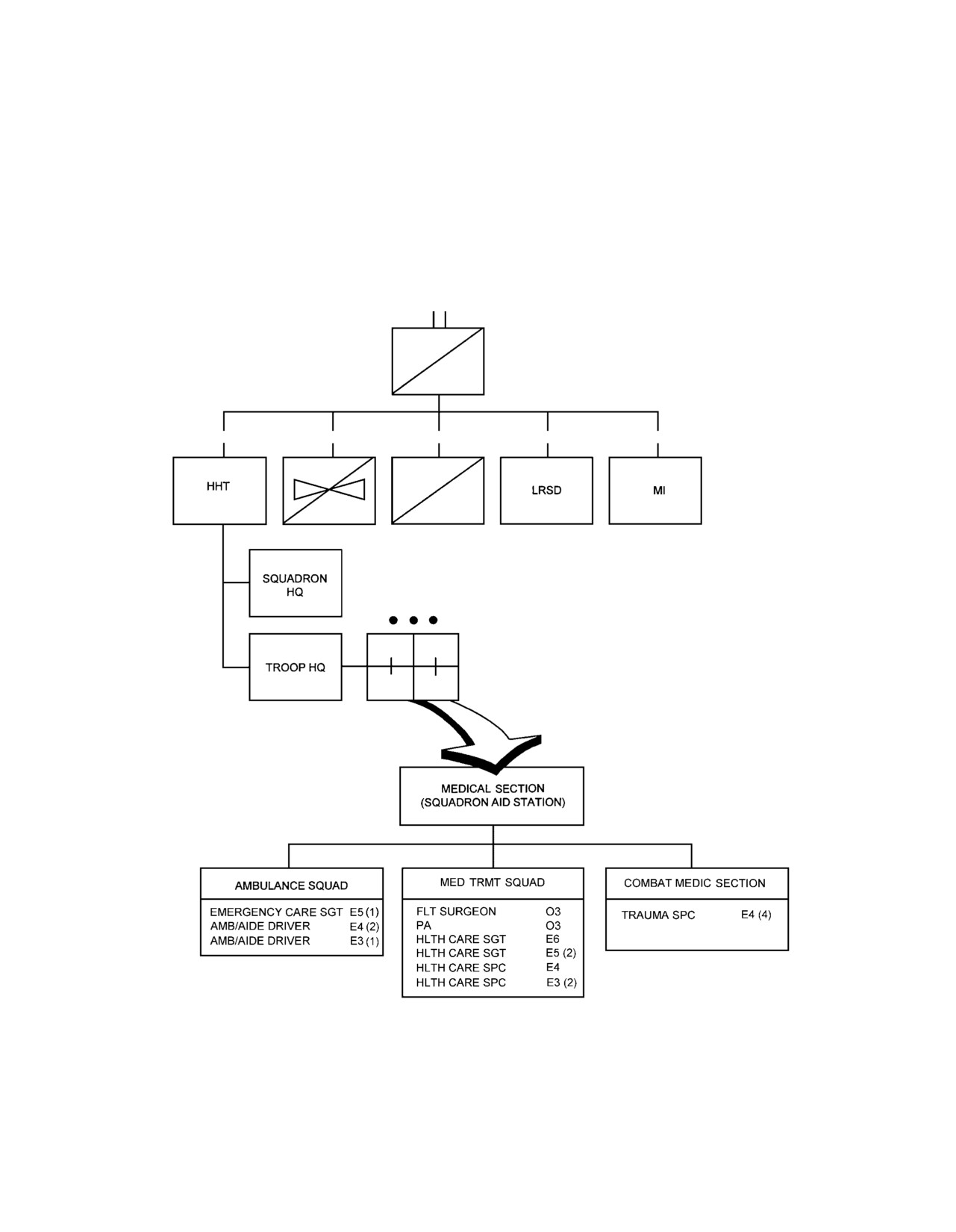
FM 4-02.4
Figure 2-17. Medical platoon, headquarters and headquarters troop reconnaissance squadron.
2-49