FM 4-02.4 MEDICAL PLATOON LEADERS' HANDBOOK: TACTICS, TECHNIQUES, AND PROCEDURES (August 2001) - page 4
FM 4-02.4
(b) Exploitation and pursuit. Medical evacuation support of exploitation and pursuit
operations resemble those discussed for the envelopment (paragraph 4-3a[2]). Since exploitation and
pursuit operations can rarely be planned in detail, evacuation operations must adhere to TSOP and innovative
C2. These actions are often characterized by
Fewer casualties
Decentralized operations.
Unsecured ground evacuation routes.
Exceptionally long distances for evacuation.
Increased reliance on convoys and air ambulances.
More difficult communications.
(c) Deliberate attack. The deliberate attack is based on a more detailed knowledge of
the threat disposition and likely actions. The brigades actions in contact will be more predictable than the
fluid situation found in the movement to contact, or exploitation or pursuit. Specific terrain and routes/
avenues of approach can be selected. Units can conduct at least a map RECON of their planned locations.
While there may be CHS requirements during the approach, the assault on the objective will produce the
greatest number of casualties. Some of the CHS considerations for the deliberate attack include
Higher percentage of casualties.
Casualties will be more concentrated in time and space.
Once the objective is secured, treatment teams can move to the objective
instead of evacuating patients from the objective to the treatment teams.
Use of air ambulance to overcome some obstacles may be required.
Higher likelihood of wounded EPW.
(8) At the BAS, patients requiring further evacuation to the rear are stabilized for movement.
Patient holding and food service are not available at the BAS; therefore, only procedures necessary to
preserve life or limb, or enable a patient to be moved safely are performed at the BAS. Evacuation from
the BAS or point of injury is performed by the FSMCs ambulance platoon and by the FSMT. Constant
effort should be made to prevent unnecessary evacuation; patients with minor wounds or illnesses are
treated and RTD as soon as possible. Patients with dental emergencies are evacuated to the FSMC for
treatment. Ammunition, hand grenades, and light antitank weapons are not evacuated from the forward
areas with a patient. Ambulatory patients may retain their rifle or pistol. Other weapons, such as machine
guns and those items identified above, are collected and given to the soldiers 1SG or turned in to the
battalion S4 for appropriate disposition according to command SOP/policy. All excess equipment collected
4-8
FM 4-02.4
at the BAS is turned in to the battalion S4 or as directed by command SOP. Patients will always retain their
protective mask. Other functions of the BAS include
Receiving and recording patients in the daily disposition log.
Preparing FMC as required (see FM 8-10-6 for definitive information on initiating
and completing a DD Form 1380).
Verifying information contained on the FMC of all patients evacuated to the BAS.
Requesting and monitoring MEDEVAC of patients.
Monitoring personnel, when necessary, for NBC contamination prior to medical
treatment.
Notifying the S1 of all patients processed through the BAS, giving identification
and disposition of patients.
Supervising patient decontamination and treating NBC patients (see FMs 8-9,
4-02.283, 8-284, and 8-285).
NOTE
Patient decontamination is performed by a pretrained decontamination
team. This team is composed of eight nonmedical personnel from
supported units that work under the supervision of medical personnel.
Patient decontamination teams perform best when they are trained and
are permitted to exercise their skills with the supporting BAS. For
definitive information on patient decontamination procedures, see FMs
8-10-1, 8-10-7, 4-02.283, 8-284, and 8-285.
b. Combat Health Support for the Defense. There are three forms of the defense: area defense,
mobile defense, and retrograde. The area defense concentrates on denying threat access to designated
terrain for a specific period of time, rather than on the outright destruction of the threat. The mobile
defense focuses on denying the threat force by allowing him to advance to a point where he is exposed to a
decisive counterattack by the striking force. The primary defeat mechanism, the counterattack, is
supplemented by the fires of the fixing force. The third form of defense is the retrograde. The retrograde
is an organized movement to the rear and away from the threat. The threat could force these operations or
a commander can execute them voluntarily. Delay, withdrawal, and retirement are the three forms of
retrograde operation.
(1) Combat health support provided for the defense may reflects lower casualty rates,
but threat actions and the maneuver of combat forces complicate forward area patient acquisition.
4-9
FM 4-02.4
Medical personnel are permitted much less time to reach the patient, complete vital EMT, and remove him
from the battle site. Increased casualties among exposed medical personnel further reduce the medical
treatment and evacuation capabilities. Heaviest patient workloads, including those produced by threat
artillery and NBC weapons, can be expected during the preparation or initial phase of the threat attack and
in the counterattack phase. The threat attack can disrupt ground and air routes and delay evacuation of
patients to and from treatment elements. The depth and dispersion of the defense create significant time and
distance problems for evacuation assets. Combat elements could be forced to withdraw while carrying their
remaining patients to the rear. The threat exercises the initiative early in the operation, which could
preclude accurate prediction of initial areas of casualty density. This makes the effective integration of air
assets into the MEDEVAC plan essential. The use of air ambulances must be coordinated with the FSMT,
normally positioned in the BSA under Force XXI and/or with either the aviation brigade or the BSA in AOE
divisions. See FM 8-10-26 for additional information on the air ambulance company and FSMT.
(2) The CHS requirements for retrogrades can vary widely depending upon the tactical plan,
the threat reaction, and the METT-TC factors. Firm rules that apply equally to all types of retrograde
operations are not feasible, but considerations include
Requirement for maximum security and secrecy in movement.
Influence of refugee movement conducted in friendly territory, which could impede
MEDEVAC missions.
Integration of evacuation routes and obstacle plans.
Difficulties in controlling and coordinating movements of the force that could
produce lucrative targets for the threat.
Movements at night or during periods of limited visibility.
Time and means available to remove patients from the battlefield.
In stable situations and in the advance, time is important only as it affects the physical well-being of the
wounded. In retrograde operations, time is more important. As available time decreases, CHS managers at
all echelons closely evaluate the capability to collect, treat, and evacuate all patients.
Medical evacuation routes required for the movement of troops and materiel. This
causes patient evacuation in retrograde movements to be more difficult than in any other type of operation.
The threat could disrupt C3. Successful MEDEVAC requires including ambulances on the priority list for
movement; providing for the transportation of the slightly wounded in cargo vehicles; and providing
guidance to subordinate commanders defining their responsibilities in collecting and evacuating patients.
Special emphasis must be placed on the triage of patients and consideration given to the type of transportation
assets available for evacuation.
Decisions concerning patients left behind. When the patient load exceeds the
means to move them, the tactical commander must make the decision as to whether patients are to be
4-10
FM 4-02.4
left behind. The medical staff officer keeps the tactical commander informed so that he can make timely
decisions. Medical personnel and supplies must be left with patients who cannot be evacuated.
(Refer to
FM 8-10 for additional information.) Every effort will be made to avoid this solution.
4-3.
Combat Health Support for Maneuver and Enabling Operations
a. Choices of Maneuver.
(1) Penetration. In this tactic, the attack passes through the threats principal defensive
position, ruptures it, and neutralizes or destroys the threat forces. Of all forms of offensive maneuver, the
penetration of main threat defenses normally produces the heaviest patient workload. The commanders
plan for the penetration normally has three phases.
Breaching the enemys main defensive position.
Widening the gap created to secure the flanks by enveloping one or both of the
newly exposed flanks.
Seizing the objective with its associated subsequent exploitation.
During breach operations, plans must be in place for clearing casualties off the battlefield since increased
number of casualties should be anticipated. Each company team requires an armored ambulance for
casualty evacuation. If the engineer company is the breaching force, it must have one armored ambulance
in DS. The BAS splints into two treatment teams, Alpha and Bravo, while dividing the two supporting
FSMC ambulances. The treatment teams pre-position with the TF prior to LD. Treatment Team Bravo
moves forward behind one of the company teams and is designated as the FAS. Treatment Team Alpha
(MAS) follows the TF formation. The AXP with a treatment team from the FSMC must be integrated into
the TF scheme of maneuver. Without the AXP, the TF medical elements will lose their ability to move as
patients collect at the FAS and MAS. The AXP moves forward with the TF combat trains. The TF combat
trains should move within 4 kilometers, but no more that 10 kilometers behind the lead elements of the TF.
Once the breach is completed, the FAS moves through the breach to the other side, while the MAS moves to
the position previously occupied by the FAS. The AXP moves forward to the position previously occupied
by the MAS. Patient acquisition starts slowly, but becomes more rapid as the attack progresses. Evacuation
routes lengthen as the operation progresses. Heavy preparatory fires which can evoke heavy return fire
often precede the penetration maneuver. These threat fires could modify the decision to place evacuation
assets as far forward as possible. The FSMC can reinforce the penetration force medical elements. Patient
evacuation could be slow and difficult due to a bottleneck at the penetration. Medical evacuation support
problems multiply when some combat units remain near the point of original penetration. This is done to
hold or widen the gap in threat defenses while the bulk of tactical combat forces exploit or pursue the threat.
Treatment elements are placed near each shoulder of the penetration; ground evacuation cannot take place
across an avenue of heavy combat traffic. Because of the heavy traffic, the area of the penetration is
normally a target for both conventional and NBC weapons. The trigger to push treatment team/BASs
through the penetration and where they will go must be identified in the OPORD.
4-11
FM 4-02.4
(2) Envelopment. In the envelopment, the main or enveloping attack passes around or over
the threats principal defensive positions. The purpose is to seize objectives which cut the threats escape
routes and subject him to destruction in place from flank to rear. Since the envelopment maneuver involves
no direct breach of the threats principal defensive positions, the MEDEVAC system is not confronted with
a heavy workload in the opening phase. However, ambulances are positioned well forward in all echelons
of CHS to quickly evacuate the patients generated by suddenly occurring contact. Medical treatment
facilities moving with their respective formations assist with clearing the battlefield to reduce delays in
treatment. After triage and treatment, the patients are evacuated to MTF in the rear by supporting ground
ambulances from the FSMC. When the isolated nature of the envelopment maneuver precludes prompt
evacuation, the patients are carried forward with the treatment element. This must be planned for in detail
and is an extreme measure when no other option is feasible. Expect an increase in mortality from wounds.
Again, nonmedical vehicles could be pressed into emergency use for this purpose. When patients must be
carried forward with the enveloping forces, CHS commanders use halts at assembly areas and phase lines to
arrange combat protection for ground ambulance convoys through unsecured areas. Further, the commander
should take advantage of friendly fires and suppression of threat air defenses to call for prearranged air
ambulance support missions, or emergency use of medium-lift helicopter backhaul capabilities.
(3) Infiltration.
(a) Infiltration is a choice of maneuver used during offensive operations. The division
can attack after infiltration or use it as a means of obtaining intelligence and harassing the threat. Though it
is not restricted to small units or dismounted actions, the division employs these techniques with a portion of
its units, in conjunction with offensive operations conducted by the remainder of its units.
(b) Combat health support of infiltration is restricted by the amount of medical
equipment, supplies, and transportation assets that can be introduced into the attack area. No deployment of
BAS treatment teams without their organic transportation should be attempted. Elements of unit-level CHS
should be accompanied by their organic vehicles, and ambulances should receive priority for deployment.
It may be necessary to man-carry enough BAS equipment into the attack area to provide EMT and ATM;
this, however, results in degrading mobility. When the element is committed without its ambulances,
patients are evacuated to the BAS by litter bearer teams. These litter teams must be designated and
equipped by the commanders in their orders. Noise, light, and litter discipline during evacuation in an
infiltration depends on how the casualty was wounded. Disease and nonbattle injury soldiers may not have
been noticed by the enemy. If the casualty is a battle injury, the enemy has already detected that element.
Once the enemy has detected and engaged the force, causing casualties, maximum allowable use of standard
and nonstandard evacuation platforms should be used. This will increase lift capabilities and save time and
soldiers lives. Patient evacuation from the BAS and medical resupply of the force may be provided by
litter bearers, depending upon distances and degree of secrecy required.
(c) When airborne and air assault forces are used, infiltrating elements can land
at various points within the threats rear area and proceed on foot to designated attack positions. As in
surface movement, the amount of medical equipment taken could be limited. In airborne operations, the
evacuation of patients will be by litter bearers or ground ambulances to collecting points or the BAS and
then by FSMC ambulances to the clearing station operated by the FSMC treatment platoon. In air assault
operations, the evacuation is by litter bearers to collecting points or the BAS and then by air ambulances
4-12
FM 4-02.4
to a clearing station. Once the combat element begins the assault on the objective, secrecy is no longer
important and its isolated location requires CHS characteristic to airborne and air assault operations until
ground linkup.
(4) Turning movement. A turning movement is a variation of the envelopment in which the
attacking force passes around or over the threats principal defense positions to secure objectives deep in the
threats rear; thus, forcing the threat to abandon his position or divert major forces to meet the threat. As
stated above, the turning movement is a variant to the envelopment in which the attacker attempts to avoid
the defense entirely; rather, the attacker seeks to secure key terrain deep in the threats rear and along his
LOC. Faced with a major threat to his rear, the threat is thus turned out of his defensive positions and
forced to attack rearward at a disadvantage. Medical evacuation support to the turning movement is
provided basically in the same manner as to the envelopment. As the operation is conducted in the threats
rear area, LOC and evacuation routes could be unsecured, resulting in delays in resupply and evacuation.
b. Enabling Operations.
(1) Passage of lines. This situation presents a challenge for the CHS planner. There will be
a number of MEDEVAC units using the same air and road networks. Coordination and synchronization are
essential if confusion and overevacuation are to be avoided. The medical units of the force manning the line
should provide area support to the force passing through. This allows continued mobility for the moving
force. The below information facilitates this coordination.
Radio frequencies and call signs.
Operation plans and TSOPs.
Location of MTFs.
Location of CCP and AXP.
Main supply route, forward arming and refueling points, and A2C2 data.
(2) Security operations. Security operations obtain information about the enemy and provide
reaction time, maneuver space, and protection to the main body. Security operations are characterized by
aggressive RECON to reduce terrain and enemy unknowns, to gain and maintain contact with the enemy to
ensure continuous information, and to provide early and accurate reporting of information to the protected
force. See FM 17-95 for definitive information on security operations. The discussion below focuses on
how CHS is provided for security operations. Security operations include the following missions: cover,
screen, guard, and area security.
(a) Cover. The covering forces are dependent upon organic resources found in the
maneuver battalion medical platoon for initial support. The level of command for the covering force
determines the responsibility for the subsequent evacuation plan. In a corps covering force, for example,
the corps CHS structure has the responsibility for establishing and operating the MEDEVAC system to
support the forward deployed corps forces. This is done to prevent the tactical combat force following the
4-13
FM 4-02.4
covering forces from becoming overloaded with patients prior to the hand off and passage of lines. The use
of CCPs, AXPs, and nonmedical transportation assets (casualty evacuation) to move the wounded is
essential. The covering force battle could be extremely violent. Patient loads will be high and the distance
to MTFs can be much longer than usual. The effectiveness of the MEDEVAC system depends upon the
forward positioning of a number of ground ambulances and the effective integration of corps air ambulances
into the evacuation plan.
(b) Screen. The primary purpose of a screen is to provide early warning to the main
body. Screen missions are defensive in nature and largely accomplished by establishing a series of
observation posts and conducting patrols to ensure adequate surveillance of the assigned sector. The screen
provides the protected force with the least protection of any security mission. Combat health support will
be provided by organic medical elements and ambulances teams deployed from the supporting medical
company.
(c) Advance, flank, and rear guards. A guard force accomplishes all the task of
a screening force. Additionally, a guard force prevents enemy ground observation of and direct fire against
the main body. A guard force reconnoiters, attacks, defends, and delays as necessary to accomplish
its mission. A guard force normally operates within the range of main body indirect-fire weapons. A guard
force is deployed over a narrower front than a screen to permit concentration of combat power. These
forces normally receive MEDEVAC support through the attachment of evacuation teams. The teams
evacuate patients to predesignated CCPs along a main axis of advance or to the nearest treatment element
providing area support. Employment of air ambulances provides a measure of agility and flexibility.
(d) Area security. Area security is a form of security that includes RECON and
security by designated personnel, airfields, unit convoys, facilities, MSR, LOC, equipment, and critical
points. Area security operations are conducted to deny the enemy the ability to influence actions in a
specific area or to deny the enemy use of an area for his own purpose. This may entail occupying and
establishing a 360-degree perimeter around the area being secured, or taking actions to destroy enemy
forces already present. The area to be secured may range from specific points (bridges, defiles) to areas
such as terrain features (ridgelines, hills) to large population centers and adjacent areas. Combat health
support will be provided by organic and attached medical elements. In area security, Echelon I CHS is
provided by organic or attached treatment teams. Echelon II CHS is provided by the supporting medical
company via DS and on an area support basis. Depending on the type of area security operations being
conducted, both air and ground ambulances may be employed.
(3) River crossing operations. The river barrier itself exerts decisive influence on the use of
medical units. An attack across a river line creates a CHS delivery problem comparable to that of the
amphibious assault. Combat health support elements cross as soon as combat operations permit. Early
crossing of treatment elements reduces turnaround time for all crossing equipment that is used to load
patients on the far shore. Maximum use of air ambulance assets is made to prevent excessive patient
buildup in far shore treatment facilities. Near shore MTFs are placed as far forward as assault operations
and protective considerations permit to reduce ambulance shuttle distances from off-loading points. For
detailed information on river crossing operations, refer to FM 90-13. Rescuing casualties in the water must
be considered by the TF medical planner.
4-14
FM 4-02.4
(4) Reconnaissance operations. The RECON in force is an attack to discover and test the
threats position and strength or to develop other intelligence. The tactical combat force usually probes with
multiple combat units of limited size, retaining sufficient reserves to quickly exploit known threat
weaknesses. Combat health support techniques follow those discussed above for a movement to contact.
Ambulances are positioned well forward and moved at night to enhance secrecy. The echeloning of
ambulances is an indication to the threat that an attack is imminent due to the forward placement of CHS.
Clearing stations are not established until a significant patient workload develops. Patients received at BASs
of reconnoitering units are evacuated to clearing stations as early as practical, or are carried forward with
the force until a suitable opportunity for evacuation presents itself. The maximum possible use of air
ambulance assets is made to cover extended distances and to overcome potentially unsecured ground
evacuation routes.
(5) Unified action. The majority of the operations occurring at the present time are joint,
interagency, or multinational operations. During the initial planning stages of the operations, the CHS
planner must determine who is responsible for providing MEDEVAC support to the force. The CHS
planner must also ensure that duplications in support do not exist; that guidelines are established as to
eligible beneficiaries; when individuals are to be returned to their own nations health care delivery system;
and what mechanisms exist for reimbursement of services. For additional information, refer to FM 8-42
and Joint Publication 4-02.
(6) Integrated warfare operations. Medical evacuation in an NBC environment is discussed
in FMs 8-10-6 and 8-10-7.
4-4.
Combat Health Support During Night Operations
The battalion surgeon and medical platoon members must anticipate that brigades do a substantial amount of
work at night or in limited visibility. They must ensure that the platoon TSOPs (see Appendix F for an
example of a TSOP) are available and used throughout the squadron for providing MEDEVAC and
treatment at night. Real-life trauma care at night will be enhanced by the ability to use white light (visible
light) at the earliest opportunity. Therefore, medical units/elements must establish standard procedures to
use white light without compromising the tactical environment. This means training to erect shelters as
soon as possible and routinely during hours of darkness. Personnel must understand that some shelters
block visible light, but that the same shelters glow when viewed through night vision goggles (NVG). In
some extremely mobile situations, ambulance/vehicles could be used to enclose patients and care providers,
thus allowing treatment to proceed under white light conditions.
a. Conducting Night Operations. Medical leaders must understand night operations technology
and their capabilities for conducting night operations. The brigade, battalion, and squadron surgeons should
know how to use both far infrared (IR) devices (and how their capabilities can enhance CHS operations at
night) such as the combat identification panel (CIP) and near IR devices, such as the BUDD light and the
Phoenix light. See the discussion below on IR and night vision devices. The surgeons need to know the
status and amount of equipment on-hand and to identify equipment needed. They must plan the SOPs and
METT-TC-specific techniques necessary to perform the CHS mission. For these types of operations, the
commander should be advised to consider
4-15
FM 4-02.4
Appropriating civilian buildings to reduce light and thermal signatures.
Lightproofing shelters.
Using nonvisible spectrum light in conjunction with night vision devices.
Reducing noise signature to a minimum.
In addition, units are susceptible to a night attack. This further slows logistics and CHS activities. Use of
chemical lights may be applicable. However, overuse of chemical lights degrades light discipline and
security. Chemical lights are visible from a distance of a kilometer or more. Possible techniques for
medical units/elements include
Chemical lights to light CP areas, thus eliminating generator noise and thermal signature.
Magnetic holders to allow placement of color chemical lights on vehicles.
Chemical lights to illuminate areas of vehicle engine compartment for night repairs.
Chemical light holders to regulate the amount and direction of light.
b. Combat Health Support Considerations.
(1) Light discipline requirements affect CHS operations much as they do supply and
maintenance operations. Medical units/elements will use additional fuel to run a vehicle-mounted night site.
Treatment operations require lightproof shelters. Patient acquisition is more difficult. Units should employ
some sort of casualty-marking system such as luminous tape.
(2) Limited visibility slows MEDEVAC. This requires additional ground ambulances to
compensate. In the offense, ambulances move forward with BASs. However, personnel have to accomplish
this movement carefully to avoid signaling the threat. Personnel use predesignated AXPs. Medical
evacuation by air ambulance is difficult and requires precise grid coordinates as well as prearranged signals
and frequencies. As in daylight, CHS operations conducted at night require active participation of all
involved units. Operational procedures must include near and far recognition, signaling, predetermined
marking of CCPs, routes, and MTFs. Maximum use of modern navigation tools, such as the GPS, IR, and
night vision devices, will enhance the ability of medical units/personnel to carry out CHS in support of night
missions. Night operating procedures must be routine and practiced as a part of routine operating
procedures. This is especially true for medical units/personnel since they have a 24-hour responsibility
under all conditions, not just combat operations.
c.
Infrared and Night Vision Devices.
(1) A far IR device, such as the CIP, is a quick fix device for friendly identification. The
thermal taped-covered CIP provides an aid in distinguishing friendly from threat vehicles when thermal
sights are used. Combat identification panels do not replace current acquisition, identification, or
4-16
FM 4-02.4
engagement procedures. They provide a device visible through thermal sights to increase situational
understanding and provide a safety net at the normal engagement range. These devices can be used to
further identify medical vehicle and units.
(2) Near IR devices that aid in C2 may be used for signaling and marking devices. The IR
beam is an effective means to increase situational understanding and combat effectiveness and improve
identification. These devices reduce the fratricide risk when used for marking obstacles, seized terrain, and
breached sites. Additionally, these lights are super signaling devices (that is, configuration of certain
patterns to indicate unit identification, turn on/off to signal accomplishment of a task, cross a phase line, and
signal from one ground position to another specific position, or from ground to air). They are also useful in
specialized units such as pathfinders for marking pickup, drop, or landing zones. These are excellent
devices for near recognition signaling to guide incoming evacuation vehicles.
(a) BUDD light. The BUDD light operates using active near IR light viewed through
image-intensifying devices. These image-intensifying devices are only effective during nighttime conditions.
Near IR devices can be directional or omni-directional and emit a steady pulse or codable pulse. The BUDD
light is a compact near IR source, using a standard 9-volt (BA-3090) battery as its power source. Both the
BUDD light and its power source will fit in the palm of your hand. The average life span of the battery
power for a BUDD light is 8 hours of continuous use. The near IR pulse emitted by the BUDD light is
similar to a strobe light and pulses every 2 seconds. It is invisible to the naked eye and thermal imagers.
The pulse is clearly visible out to 4 kilometers under optimal conditions when pointing the beam directly at
the viewer. The directional characteristic of the beam makes it possible to limit observation by an enemy.
If used to mark vehicles, care should be taken to minimize the light illuminating the vehicles surface. The
enemy has to have image-intensifying devices to see the lights directly; however, they may see the light
being reflected off of vehicles when the lights are employed in a directional mode. This device is most
effective for C2 purposes. The BUDD light is also very useful for dismounted operations at night.
(b) Phoenix light. The Phoenix light operates using active near IR light viewed through
image-intensifying devices. The Phoenix light can be used as a codable IR beacon. The light is powered by
a standard 9-volt (BA-3090) battery. The Phoenix light is ideal for use when positive identification at night
must be made out to 4 kilometers under optimal conditions. The IR beacon has a range equal to the BUDD
light. One advantage is the ability to code many beacons with different codes (sequence of flashes
including Morse codeup to 4 seconds), enabling anyone to be distinguished in a group. A programmed
sequence will repeat until canceled or when the battery expires (same as a BUDD light). Operating
instructions include connecting the battery to the Phoenix light. Using a metal object, a coin is best, make
connection across the two pins on top of the light. A microminiature red indicator flashes the sequence as
the code is entered. At the end of the 4-second memory, a green microminiature indicator will flash,
indicating the end of the input sequence. The Phoenix light is now emitting the desired code. To check the
code, make a connection across the pins. The green microminiature indicator will flash the code. To change
the code, disconnect the battery and repeat the instructions. The Phoenix light also can be used during
dismounted operations. The programming of a code can assist in distinguishing one unit from another. An
active Phoenix light or BUDD light can be covered or uncovered as necessary to ensure the light is visible
only when necessary
4-17
FM 4-02.4
(c) Night vision devices. There are numerous types of night vision devices in the Army
inventory but this subparagraph will focus on what the squadron medical platoon has on its TOE. Each
vehicle in the medical platoon will have two night vision devices. The wheeled vehicle driver will use
either the AN/PVS-7B (discussed below) or the drivers vision enhancer (DVE). The DVE is a thermal
imaging system capable of operating in degraded visibility conditions such as fog, dust, smoke, and
darkness. In conditions of reduced visibility, the DVE allows a vehicle to maintain speeds up to 55 to 60
percent of those attained during normal daylight operations. Unlike traditional night vision devices that
magnify ambient light, the DVE generates a picture based on very minute variances in temperature in the
surrounding environment. It gives the operator visibility to the horizon in total darkness and the ability to
recognize a 22-inch object at a distance of 360 feet. It can elevate 35 degrees, depress 5 degrees, and rotate
170 degrees in either direction. The DVE consists of a sensor module, display control module, positioning
module, wiring harness, and mounting equipment. A combat DVE and a tactical wheeled vehicle DVE will
be available. The ambulance and treatment vehicle drivers will use a DVE if available or continue to wear
NVG. The NVG (AN/PVS-7B, a hand-held, head-mounted, or helmet-mounted night vision system) enable
walking, driving, weapons firing, short-range surveillance, map reading, treatment of patients, and vehicle
maintenance in both moonlight and starlight. It has an IR projector that provides illumination at close
ranges and that can be used for signaling. There is a high light-level shutoff if the device is exposed to
damaging levels of bright light. There is a compass that attaches to the device and allows for reading an
azimuth through the goggles. This device has a weight of 1.5 pounds and operates on two AA batteries.
The ambulance and treatment vehicle when fielded will have IR headlights. These IR headlights can be
used for assisting drivers who wear NVG and for signaling. As with all lights, extreme caution must be
taken in tactical situations. The IR headlights are typically very bright to personnel wearing NVG.
d. Example Techniques for Using Chemical Lights for Marking and Signaling.
NOTE
Techniques are only limited to available equipment and imagination.
The METT-TC should always take precedence.
(1) For marking, chemical lights can be placed inside standard military short or long pickets
to mark routes and positions. The concave side of the picket contains the chemical light and the convex side
faces the most likely direction of enemy observation. This technique controls the direction of the light while
assisting with such things as MEDEVAC routes, supported unit collection points, AXP, or link-up point
identification.
(2) For signaling, tying a chemical light to a length of cord or string and twirling it overhead
in a circle is an unmistakable signal. This only needs to be used until recognition (radio) is established.
This technique makes use of widely available common supplies. It is especially useful for a unit guiding an
incoming ground or air ambulance.
(3) For marking casualty locations, for example, MOUT operations.
(4) For marking triage areas at the BAS to identify patient triage categories.
4-18
FM 4-02.4
APPENDIX A
THE GENEVA CONVENTIONS
A-1. Effects of Geneva Conventions on Combat Health Support
The conduct of armed hostilities on land is regulated by both written and unwritten law. This land warfare
law is derived from two principal sourcescustom and lawmaking treaties such as The Hague and Geneva
Conventions. The rights and duties set forth in these conventions are part of the supreme law of the land; a
violation of any one of them is a serious offense. The Geneva Conventions are four separate international
treaties, signed in 1949, and are respectively entitled:
a. Geneva Convention for the Amelioration of the Conditions of the Wounded and Sick in Armed
Forces in the Field (GWS).
b. Geneva Convention for the Amelioration of the Condition of Wounded, Sick, and Shipwrecked
Members of Armed Forces at Sea (GWS Sea).
c.
Geneva Convention Relative to the Treatment of Prisoners of War (GPW).
d. Geneva Convention Relative to the Protection of Civilian Persons in Time of War (GC).
See FMs 8-10 and 27-10 for definitive information on the Geneva Conventions and the laws associated with
land warfare.
A-2. Geneva Wounded and Sick
a. Custodial and medical responsibilities must be carried out for persons (military or civilian)
who are wounded as a result of military operations regardless of their nationality or legal status.
NOTE
Persons whose legal status is in doubt are accorded protection and
treatment as prisoners of war until their legal status is determined.
b. Collection and treatment of the sick and wounded are responsibilities of medical personnel.
The custodial and accounting functions are responsibilities of military police.
A-3. Identification and Protection of Medical Personnel under Geneva Wounded and Sick
Medical personnel who become captured are not considered prisoners of war but retained personnel.
a. Protected personnel include
A-1
FM 4-02.4
(1) Army Medical Department personnel exclusively engaged in the
Search for or collection, transport, or treatment of the wounded or sick.
Prevention of disease.
Administration of medical units and establishments (for example, this includes
personnel such as the office staff, ambulance drivers, cooks, and cleaners that form an integral part of the
unit or establishment).
Veterinary staff functions relating to the administration of medical units and
establishments.
(2) Non-AMEDD personnel who have received special medical training, if carrying out
their auxiliary medical duties when captured by the enemy are protected. Once in enemy hands, they
become prisoners of war when not doing medical work.
(3) Chaplains.
b. Each protected individual must
(1) Carry a special water-resistant, pocket-sized identity card (DD Form 1934) that
Bears the red cross on a white background (the distinctive emblem of the Geneva
Conventions).
Is worded in the national language of the issuing force.
Contains the surname and first name (at least), date of birth, rank, social security
number, protected capacity serving, photograph, signature, and/or fingerprints of carrier.
Is embossed with the stamp of the appropriate military authority (AR 640-3).
(2) Wear on the left arm a water-resistant armlet bearing the red cross emblem of the Geneva
Convention (DA Pamphlet [Pam] 27-1 and FM 27-10).
This paragraph implements STANAG 2454.
A-4. Identification of Medical Units, Facilities, and Vehicles under Geneva Wounded and Sick
a. Identify
(1) All medical units and facilities except veterinary units. Medical facilities also include the
nonpatient care areas, such as those for dining, maintenance, and administration.
A-2
FM 4-02.4
(2) Air and surface (ground and water) medical vehicles.
b. How:
(1) Display the distinctive flag of the Geneva Conventions (red cross on a white background)
over the unit/facility and in other places on the unit/facility as necessary to adequately identify it.
(The
other emblem recognized by terms of the Geneva Conventions is the red crescent. Emblems not recognized
by the Geneva Conventions but used by other countries, such as the red shield of David by Israel, should
also be respected.)
(2) Mark with the distinctive Geneva emblem (red cross on a white background).
(3) The GWS protects from attack any medical vehicle appropriately marked and exclusively
employed for the evacuation of the sick and wounded or for the transport of medical personnel and
equipment. The GWS prohibits the use of medical vehicles marked with the distinctive emblems for
transporting nonmedical troops and equipment.
This paragraph implements STANAG 2931.
A-5. Camouflage of the Geneva Emblem
The NATO STANAG 2931 provides for camouflage of the Geneva emblem on medical facilities where the
lack of camouflage might compromise tactical operations. Medical facilities on land, supporting forces of
other nations, will display or camouflage the Geneva emblem in accordance with national regulations and
procedures. When failure to camouflage would endanger or compromise tactical operations, the camouflage
of medical facilities may be ordered by a NATO commander of at least brigade level or equivalent. Such an
order is to be temporary and local in nature and countermanded as soon as the circumstances permit. It is
not envisaged that large, fixed medical facilities would be camouflaged. The STANAG defines medical
facilities as medical units, medical vehicles, and medical aircraft on the ground.
NOTE
Under tactical conditions, the need for concealment may outweigh the
needs for recognition (AR 750-1).
A-6. Defense of Self and Patients under Care
a. Protected personnel are
(1) Authorized to be armed with only individual small arms. (Army Regulation 71-32
provides the doctrine that governs what types of small arms medical personnel are authorized [limited to
A-3
FM 4-02.4
pistols or rifles, or authorized substitutes].) These small arms may only be used for defensive purposes.
The presence of machine guns, grenade launchers, booby traps, hand grenades, light antitank weapons, or
mines in or around a medical unit would seriously jeopardize its entitlement to protected status under the
GWS. The deliberate arming of a medical unit with such items could constitute an act harmful to the enemy
and cause the medical unit to lose its protected status under the Conventions. This conclusion is not altered
in the case of mines regardless of the method by which they are detonated, nor is it altered by the location of
the medical unit. If the local non-AMEDD commander situates a medical unit where enemy attacks may
imperil its safety, then that commander should provide adequate protection for the medical unit and its
personnel.
(2) Permitted to fire only when they or their patients are under direct attack in violation of
the GWS. Use of arms by AMEDD personnel for other than protection of themselves or their patients
violates the GWS provisions governing the protected status of AMEDD personnel and results in the loss of
protected status. Army Regulation 350-41 states the AMEDD personnel and non-AMEDD personnel in
medical units will not be required to train or qualify with weapons other than individual or small arms
weapons. However, AMEDD personnel attending training at NCO education system courses will receive
weapons instruction that is part of the curriculum. This will ensure that successful completion of the course
is not jeopardized by failure to attend the weapons training portion of the curriculum.
(3) Responsible for their own defense when operating at locations which preclude their
being incorporated within defensive perimeters of nonmedical units. In addition to relying on their special
status, medical units can provide for their defense by employing passive defense measures. Passive meas-
ures are those taken to reduce the probability of and to minimize the effects of damage caused by hostile
action. Examples of these measures are the preparation of individual fighting positions within the immediate
unit area; noise and light discipline; posting perimeter sentries; and channeling traffic in the unit area.
b. Protected personnel (under overall security defense plans) will NOT be required
To man or help man the perimeter defense of nonmedical units such as unit trains,
logistical areas, or base clusters.
To take offensive action against enemy troops.
To perform actions that will cause loss of protected status and result in inadequate care of
our sick and wounded prisoners of war. The platoon leader must clearly articulate this to all levels of
command. The misuse of CHS vehicles/equipment will void all protection granted under the Geneva
Conventions.
A-7. Geneva Prisoners of War
a. United States military forces are responsible for EPW from the moment of capture.
b. The echelon commander and medical unit commanders jointly exercise responsibilities for the
custody and treatment of the sick, injured, or wounded enemy personnel and detained civilian personnel.
A-4
FM 4-02.4
c.
The sick, injured, or wounded prisoners are treated and evacuated through normal medical
channels but are physically segregated from US and allied patients. Persons other than medical personnel
are provided by the echelon commander to guard them. Evacuation of these EPW patients from the combat
zone is initiated as soon as their medical conditions permit.
d. When intelligence indicates that large number of EPW may result from an operation, medical
units may require reinforcement to support the anticipated additional EPW patient workload. Procedures
for estimating the medical workload involved in the treatment and care of EPW patients are described in
FM 8-55.
e.
Enemy medical personnel are considered retained personnel rather than prisoners of war.
They are to be employed to the maximum extent possible in such CHS duties as caring for detained or EPW
patients, preferably those of their own armed forces. Captured medical supplies should be used in the care
of these patients.
A-8. Geneva Civilian Persons
a. When the US is the occupying power, US forces have the responsibility to ensure that all
civilian and refugee subsistence and health service needs are provided.
b. Sick or injured civilian persons resulting from military operations are provided initial medical
treatment, as required, in conformance with established theater policies; then, they are transferred to
appropriate civil control authorities as soon as possible. When such persons are evacuated, proper
accommodations must be provided, including satisfactory conditions of hygiene, health, safety, and nutrition
(Articles 49 and 55). In conditions of armed conflict and to the extent practicable, the Army must seek to
fulfill the above commitments, as well as to protect and assist civilians and refugees under its control.
A-9. Compliance with the Geneva Conventions
a. As the US is a signatory to the Geneva Conventions, all medical personnel should thoroughly
understand the provisions that apply to CHS activities. Violation of these Conventions can result in the loss
of the protection afforded by them or prosecution. Medical personnel should inform the tactical commander
of the consequences of violating the provisions of these Conventions.
b. The following acts are inconsistent with an individual or facility claiming protected status
under the Geneva Conventions:
Medical personnel are used to man or help man the perimeter of nonmedical facilities,
such as unit trains, logistics areas, or base clusters.
Medical personnel are used to man any offensive-type weapons or weapons systems.
Medical personnel are ordered to engage enemy forces other than in self-defense or in
the defense of patients and MTFs.
A-5
FM 4-02.4
Crew-served weapons are mounted on a medical vehicle.
Mines or booby traps are placed in and around medical units and facilities.
Hand grenades, light antitank weapons, grenade launchers, or any weapons other than
rifles and pistols are issued to a medical unit or its personnel.
The site of a medical unit is used as an observation post, a fuel dump, or an ammunition
storage site.
c.
Possible consequences of violations described in b above are
Loss of protected status for the medical unit and personnel.
Medical facilities attacked and destroyed by the enemy.
Medical personnel being considered prisoners of war rather than retained persons when
captured.
Combat health support capabilities decremented.
Prosecution for violations of the law of war.
d. Other examples of violations of the Geneva Conventions include
Making medical treatment decisions for the wounded and sick on any basis other than
medical priority, urgency, or severity of wounds.
Allowing the interrogation of enemy wounded or sick even though medically not
recommended.
Allowing anyone to mistreat, torture, kill, or in any way harm a wounded or sick enemy
soldier.
Marking nonmedical unit facilities and vehicles with the distinctive emblem, or making
any other unlawful use of this emblem.
Using medical vehicles marked with distinctive Geneva Conventions emblem for
transporting nonmedical troops, equipment, and supplies.
Using a medical vehicle as a TOC.
e.
Possible consequences of violations described in d above are
Criminal prosecution for war crimes.
A-6
FM 4-02.4
Medical personnel being considered prisoners of war rather than retained persons when
captured.
NOTE
The use of smoke and obscurants by medical personnel is not a
violation of the Geneva Conventions (see FMs 3-50 and 8-10-6 for
information on the use of smoke).
A-7
FM 4-02.4
APPENDIX B
MANAGEMENT OF INDIVIDUAL HEALTH RECORDS
IN THE FIELD
B-1. General
a. This appendix provides guidance on the maintenance of the soldiers individual health record
(HREC) and civilian employee medical records (CEMR) in the field. The governing regulation is
AR 40-66.
b. Health records are maintained by the MTF that provides primary care for the soldier.
c.
Unit commanders will ensure that HRECs are always available to AMEDD personnel who
require such records in the performance of their duties. Unit commanders will also ensure that the
information in the HRECs is kept private and confidential in accordance with law and regulations governing
patient records administration.
d. Health records located at an Echelon I MTFs are maintained by unit medical personnel. The
AMEDD officer-in-charge serves as the custodian of the HRECs and CEMRs. Army Medical Department
officers are in charge of the HRECs and CEMRs for the members of the units and civilian employees for
whom they supply primary medical care. They are also in charge of the HRECs, CEMRs, and the records
of other individuals that are receiving treatment from the MTF. Health records are important for the
conservation and improvement of the patients health. Therefore, AMEDD officers will ensure that all
pertinent information is promptly entered in the HREC/CEMR in their custody. If any such pertinent
information has been omitted, the AMEDD officer will take immediate action to obtain such information
from the proper authority and include it in the HREC/CEMR.
B-2. Health Records of Deployed Soldiers
a. Health Records. The HREC (DA Form 3444 or DA Form 8005 Series [Medical and Dental
Treatment Records]) of deployed soldiers and the CEMR of deployed civilians will not accompany them to
the combat area.
(1) The supporting MTF will initiate a DD Form 2766 (Adult Preventive and Chronic Care
Flowsheet), DD Form 2766C (Adult Prevention and Chronic Care Flowsheet [Continuation Sheet]), DD
Form 2795 (Pre-Deployment Health Assessment Questionnaire), and DD Form 2796 (Post-Deployment
Health Assessment Questionnaire). If an individual deploys, the DD Form 2766 and DD Form 2766C will
be photocopied prior to deployment and the copy will be kept in the medical record. The original DD Form
2766 and any DD Forms 2766C will accompany the individual to the field. The DD Form 2766 serves as
the treatment folder for the individual that is deployed; other forms, such as DD Form 2766C, DD Form
2795, DD Form 2796, and Standard Form (SF) Form 600 (Health RecordChronological Record of
Medical Care) will be filed on the fastener inside DD Form 2766. The photocopies of the DD Form 2766
and DD Form 2766C will be removed and shredded when the originals are placed back into the HREC or
CEMR. Forms that had been filed inside the DD Form 2766 folder will be removed and place in the HREC
or CEMR (in the regular treatment folder).
B-1
FM 4-02.4
(2) When processing individuals for deployment, the MTF and dental treatment facility
(DTF) will audit each individuals HREC or CEMR and record essential health and dental care information
on DD Form 2766. If a HREC or CEMR is not available, DD Form 2766 will be completed based on
individual interviews and any other locally available data. A HREC may not be available for most
Individual Ready Reserve, Individual Mobilization Augmentees, and retired personnel because these HREC
may remain on file at the Army Reserve-Personnel Command (AR-PERSCOM) or the Department of
Veterans Affairs.
(3) Upon notification of deployment, all military personnel will complete DD Form 2795.
(a) The individual being screened will fill out the section entitled Demographics on
page 1, and the section entitled Health Assessment on page 2. These sections are self-explanatory.
(b) The health assessment administrator will fill out the boxed area on page 1 entitled
Administrator Use Only, and will answer the users questions on filling out the form. The administrator will
document the deployment location as well as the completion date of the pre-deployment evaluation on DD
Form 2766, Block 11Pre-/Post-Deployment History. This does not apply to classified operations.
(c) The health care provider will fill out the section entitled Pre-Deployment Health
Provider Review on page 2.
(d) A copy of the form will be filed on the fastener inside the DD Form 2766 folder;
one copy will remain in the HREC, and the original form will be sent to the Army Medical Surveillance
Activity, ATTN: MCHB-TS-EDM/Deployment Surveillance, Building T-20, Room 213, 6825 16th Street
NW, Washington, DC 20307-5000.
(4) Department of Defense Directive (DODD) 6490.2 and Department of Defense Instruc-
tions (DODI) 6490.3 state that to the extent applicable, medical surveillance activities will include essential
DOD civilian and contractor personnel directly supporting deployed forces, consistent with plans established
under DODI 1400.32 and DODI 3020.37. If DD Form 2795 is used for civilians, a copy of the form will
be filed on the fastener inside the DD Form 2766 folder; one copy will remain in the CEMR, and the
original form will be sent to the Army Medical Surveillance Activity.
(5) If the deployed individual is taking part in a classified operation, the pre-deployment
evaluation (DD Form 2795) is still required, but the form will be maintained only in the personnel folder.
(6) The completed DD Form 2766 and a copy of any printout from an automated immuni-
zation tracking system will be provided to the individuals command, or to the individual if he or she is an
individual replacement, and then handed off to the MTF in the AO responsible for providing primary
medical care to that individual. That MTF will maintain the DD Form 2766 as an outpatient field file for
reference as needed. The MTF will ensure that the ABO/Rh blood type from a verified blood bank typing is
recorded in Block 10. The field file will consist of, in part, DD Form 2766, DD Form 2795, and possibly
DD Form 2766C, DD Form 2796, SF 600, SF 558 (Medical RecordEmergency Care and Treatment), SF
603 (Health RecordDental), or DD Form 1380. These forms will be filed on the fastener inside the DD
Form 2766. For detailed information on how to complete the DD Form 1380, see Appendix C, FM 8-10-6.
B-2
FM 4-02.4
(7) If DD Form 2766 is not available, the individuals field file may be managed as a drop
file (forms not attached) and integrated into the DD Form 2766 when it is available.
b. Forwarded Deployed Force. If time permits, follow guidance in a(1), (2), and (3) above. If
not, consolidate HREC in-country and process when time permits.
c.
Limited Contingency Operations. Retain the HREC at the MTF and DTF providing primary
care. If the servicing primary care facility closes, forward the HREC to the MTF or DTF indicated by the
servicing medical department activity (MEDDAC) and dental activity. If full mobilization occurs, follow
guidance in a(1), (2), and (3) above.
d. Units That Do Not Process Through a Mobilization Station. Units that do not process through
a mobilization station before deployment or otherwise do not have access to an MTF or DTF will follow the
procedures in b above.
B-3. Use of Field Files/DD Form 2766
a. If a members primary MTF changes, the field file/DD Form 2766 should be moved to the
gaining MTF.
b. If a member requires admission to the hospital, every attempt will be made to forward the field
file/DD Form 2766. The file will be returned to the members primary MTF if disposition is RTD.
B-4. Storage of Health Records and Civilian Employee Medical Records
Forward deployed (Echelon I and Echelon II) MTFs will secure field chest or field file containers in
quantities sufficient for the troop and civilian employee population supported. They will maintain the DD
Form 2766 for each individual receiving primary medical care from their MTF.
B-5. Establishment and Management of the Field File in the Operational Area
a. A DD Form 2766 and the medical records identified above will be maintained by medical
companies operating an Echelon II MTF or the medical platoon/section that operates an Echelon I MTF, or
will be handed off to the MTF providing their primary care.
b. Supported units will be required to provide the primary care MTF a battle roster of personnel
assigned. This roster should be provided when personnel assignment changes are made or upon request.
c.
The MTF, when possible, will attempt to ensure that the HREC or CEMR accompanies the
medically evacuated individual.
d. If an individuals primary MTF changes, the HREC or CEMR will be transferred to the
gaining MTF.
B-3
FM 4-02.4
e.
If an individual requires hospital admission, every attempt will be made to forward the HREC
or CEMR to the admitting hospital.
f.
When the MTF determines that an individual was evacuated without the DD Form 2766 and
other medical records in the file, then the individuals DD Form 2766 and other medical records are
forwarded to the medical C2 headquarters responsible for regulating patients out of the AO. The medical
C2 headquarters forwards the outpatient field file to the hospital where the patient was evacuated. The
hospital patient administration section will attach the file to the inpatient chart and the file is evacuated with
the patient out of the AO or theater.
B-6. Health Assessments after Deployment
a. All military personnel will complete DD Form 2796 prior to leaving the AO.
(1) The individual being screened will fill out the section entitled Demographics on page 1
and the section entitled Health Assessment on page 2. These sections are self-explanatory.
(2) The health assessment administrator will fill out the boxed area on page 1 entitled
Administrator Use Only and will answer the users questions on filling out the form. The administrator will
document the deployment location (if this information is missing) and the completion date of the post-
deployment evaluation on DD Form 2766, Block 11Pre-/Post-Deployment History. This does not apply
to classified operations.
(3) The health care provider will fill out the section entitled Post-Deployment Health Provider
Review on page 2.
b. If a situation does not allow this health screening prior to departure, the individuals commander
will ensure that the health assessment is completed and submitted to the local MTF commander within 30
days of the individuals return. The local MTF commander will ensure that a procedure is in place for
submitting the original DD Form 2796 to the Army Medical Surveillance Activity and for filing a copy in
the HREC.
c.
If the DD Form 2796 is completed prior to leaving the AO, a copy of the form will be filed in
the DD Form 2766 folder until it can be integrated into the HREC. The original DD Form 2796 will be
submitted to the Army Medical Surveillance Activity, ATTN: MCHB-TS-EDM/Deployment Surveillance,
Building T-20, Room 213, 6825 16th Street NW, Washington, DC 20307-5000.
d. The post-deployment assessment of Reserve Component personnel must be completed prior to
release from active duty if not completed before redeployment. Reserve Component personnel who have
been deployed will also complete DD Form 2697 (Report of Medical Assessment) according to AR 40-501.
Reserve Component personnel who are called to active duty but never actually deployed will only complete
DD Form 2697.
e.
If DD Form 2796 is used for civilians, the form will be completed prior to leaving the AO. If
a situation does not allow this health screening prior to departure, the individuals commander will ensure
B-4
FM 4-02.4
that the health assessment is completed within 30 days of the individuals return. If the DD Form 2796 is
completed prior to leaving the AO, a copy of the form will be filed in the DD Form 2766 folder until it can
be integrated into the CEMR. The local commander will ensure that a procedure is in place for submitting
the original DD Form 2796 to the Army Medical Surveillance Activity and for filing the copy in the CEMR.
f.
If the deployed individual is taking part in a classified operation, the post-deployment evaluation
(DD Form 2796) is still required, but the form will be maintained only in the personnel folder.
B-7. Field Record Administration after Hostilities Cease
a. Field files/DD Form 2766 will be integrated with the HREC or CEMR after demobilization at
the home station or at mobilization stations.
(1) On return to the MTF (post-deployment), forms, such as SF 600, will be removed from
the DD Form 2766 folder and placed with the other SF 600 in the medical record.
(2) DD Form 2795 and DD Form 2796 will be removed from the DD Form 2766 folder and
placed as shown in Figures 5-1, 5-2, or 7-1 of AR 40-66. If a previously photocopied DD Form 2795 is
contained in the record, only one of the DD Forms 2795 will be kept; the other will be removed and
shredded.
(3) The photocopies of the DD Form 2766 and DD Form 2766C will also be removed and
shredded when the originals are placed back into the record. Field files/DD Form 2766 will be forwarded
to AR-PERSCOM for those members whose HREC is maintained at AR-PERSCOM.
b. Each continental United States (CONUS) MTF must request records from AR-PERSCOM for
those members who remain on active duty and are assigned for support upon demobilization.
c.
Field files will be integrated with the HREC maintained at home station or mobilization
station. Field files will be forwarded to Army Reserve Personnel Center (ARPERCEN) for those members
whose HREC is maintained at ARPERCEN.
d. Each CONUS MTF must request records from ARPERCEN for those soldiers who remain on
active duty and are assigned for support upon demobilization.
B-5
FM 4-02.4
APPENDIX C
COMBAT LIFESAVER
C-1. Role of the Combat Lifesaver
a. Immediate far-forward first aid is essential on a widely dispersed and fluid battlefield to
prevent soldiers from dying of wounds. Medical personnel may not be able to reach and apply EMT to all
wounded soldiers at all points on the battlefield in a timely manner. The CLS is a nonmedical soldier
trained to provide advanced first aid/lifesaving procedures beyond the level of self-aid or buddy aid. The
CLS is not intended to take the place of medical personnel, but to slow deterioration of a wounded soldiers
condition until medical personnel arrive. Functioning as a CLS for the soldier is a secondary mission
undertaken only when the tactical situation permits. Even though this is secondary to his primary mission,
the CLS has proven to be very effective in saving wounded soldiers lives. The CLS program is implemented
according to AR 350-41.
b. The AirLand Battle doctrine was developed for a widely dispersed, rapidly moving battlefield.
As was determined for the AirLand Battle doctrine and applicable to the Force XXI doctrine, there are
constraints on the rapid acquisition of casualties and medical treatment. These constraints in many cases
limit the ability of medical personnel to provide immediate, far-forward medical treatment. The plan
developed to provide care for soldiers under AirLand Battlefield doctrine included the CLS. Under Force
XXI doctrine, the CLS is an intricate part of providing care for the wounded soldier.
c.
The CLS is a bridge between the self-aid/buddy aid training provided all soldiers and the
medical training given to the trauma specialist. The CLS is given additional first aid training and training in
selected medical tasks (such as initiating an intravenous infusion and providing limited care to a soldier
suffering from BF).
C-2. Training the Combat Lifesaver
A correspondence course has been developed for training both active duty and Reserve Component
personnel. The course is offered only in a group study mode and with training taking place at the unit level.
Classroom instruction is provided by qualified instructors selected by the battalion commander or battalion/
squadron surgeon. Testing is performed at the unit level using the written and performance tests furnished
in the correspondence course. Training and testing will be conducted according to the tasks, conditions,
and standards established by the Academy of Health Sciences, AMEDDC&S, and published in correspond-
ence course training materials. Students who successfully complete the written and performance tests will
receive promotion points and be certified as a CLS. The course consists of student subcourse texts, student
examination, and an instructors manual.
C-3. Administering the Combat Lifesaver Course
a. Equipment and Supplies. Arrange for equipment and supplies as early as possible. The
purchase of some items, such as intravenous infusion trainers and rescue breathing mannequins, may be
required. The local Training and Audiovisual Support Center may have these items available. Training
items will not be provided by either the Army Institute for Professional Development (AIPD) or the
Academy of Health Sciences, AMEDDC&S.
C-1
FM 4-02.4
b. Enrollment. Enrollment request should be sent to AIPD at least 6 weeks prior to beginning of
the course according to instructions found in DA Pam 350-59. To establish this group enrollment, AIPD
must receive the following:
(1) A request for training should be signed by the battalion commander or an LTC or higher
and identify the primary instructor (group leader). All instructors of the Combat Lifesaver Course (Course
Number: 081 F11) must meet the following criteria: hold a primary of MOS 91W or 18D, or be a licensed
paramedic (state or national), registered nurse, PA, or physician. These requirements reflect the level of
expertise necessary to resolve medical emergencies associated with the tasks to be taught.
(2) One DA Form 145 (Army Correspondence Course Enrollment Application) enrolling the
primary instructor in IS0826, along with a list of assistant instructors, if any, is included. The DA Form
145 should be signed by a responsible official who has the authority to requisition or acquire the necessary
medical supplies to support the training.
(3) A roster of students enrolling in IS0824 and IS0825 is provided. The roster must include
each students full name, rank, social security number, and component code. Ideally, no more than 15 to 20
students should be assigned to each group.
c.
Facilities. Facilities must be reserved well in advance. The facilities chosen should allow clear
observation of demonstrations and provide room for student practice. Handwashing devices are required.
d. Course Material. The course consists of two subcourses (shipped in one box), 40 credit hours
consisting of self-study materials and approximately 3 days of classroom instruction and testing materials.
Testing includes both proctored multiple-choice and performance examinations. Only one examination
response (IS0827) is returned to AIPD for grading upon completion of IS0824 and IS0825. This is a GO or
NO/GO course.
e.
Recertification. Combat lifesaver tasks are perishable skills. Combat lifesavers must be
recertified every 12 months on the performance-tested tasks in the CLS course. The printed material in the
correspondence course can be locally reproduced and used for sustainment training. Do not reenroll
soldiers requiring recertification. Unit instructors can accomplish this. The instructors guide also includes
a test appropriate to recertification. It is the responsibility of the S1, not the medical platoon leader, to
ensure that personnel matters concerning the CLS program are resolved.
f.
Program Managers. Program managers are not authorized to augment correspondence course
material, change the length of the course, or increase or delete items contained in the CLS aid bag.
g. Sustainment Training. To the extent needed to sustain skill proficiency, CLS will be exercised
during home station training activities (to include field-training exercises) and during deployment for
training (to include rotations through combat training centers).
h. Additional Information. For additional information, write to Student Service Division at the
Army Institute for Professional Development, US Army Training Support Center, Newport News, VA
23628-0001, or call DSN 927-3322/2127 or commercial 757-878-3322/2127.
C-2
FM 4-02.4
C-4. Combat Lifesaver Aid Bag
a. Each certified CLS will be issued a CLS aid bag. The aid bag will be packed in accordance
with the prescribed packing list and will be secured as a sensitive item (for example, weapon or night vision
devices) at unit level. The aid bags will be issued to the CLS only upon deployment (training and actual).
b. It is the responsibility of each CLS to ensure that
(1) His aid bag is stocked according to the prescribed packing list.
(2) All stocked items are serviceable.
(3) Items have not exceeded their expiration dates.
C-5. Class VIII Resupply of Combat Lifesaver Aid Bag
a. During garrison operations, Class VIII resupply of the CLS aid bags is conducted in the
following manner:
(1) Units with assigned medical personnel will request Class VIII resupply for CLS aid bags.
(2) Divisional, brigade, and regimental units without assigned medical personnel request
Class VIII support through the DMSO, brigade medical supply section, or regimental medical supply
section. Force XXI units will request Class VIII resupply from either the DSMC medical supply section or
the FSMC medical supply section.
(3) Nondivisional units request Class VIII support from the installation medical supply
activity, which is normally the medical supply office of the medical department activity or a US Army
medical center.
b. During field operations, resupply is accomplished in the same manner as during garrison
operations with two exceptions.
(1) Nondivisional units obtain resupply support from the nearest medical unit available.
(2) Emergency resupply is provided to all units by the nearest medical unit capable of doing
so.
c.
Field medical units maintain stocks of medical material with which to effect resupply of CLS
aid bags during field operations.
C-3
FM 4-02.4
APPENDIX D
INTERIM BRIGADE COMBAT TEAM
Section I. INFANTRY BATTALION MEDICAL PLATOON
D-1. Medical Platoon
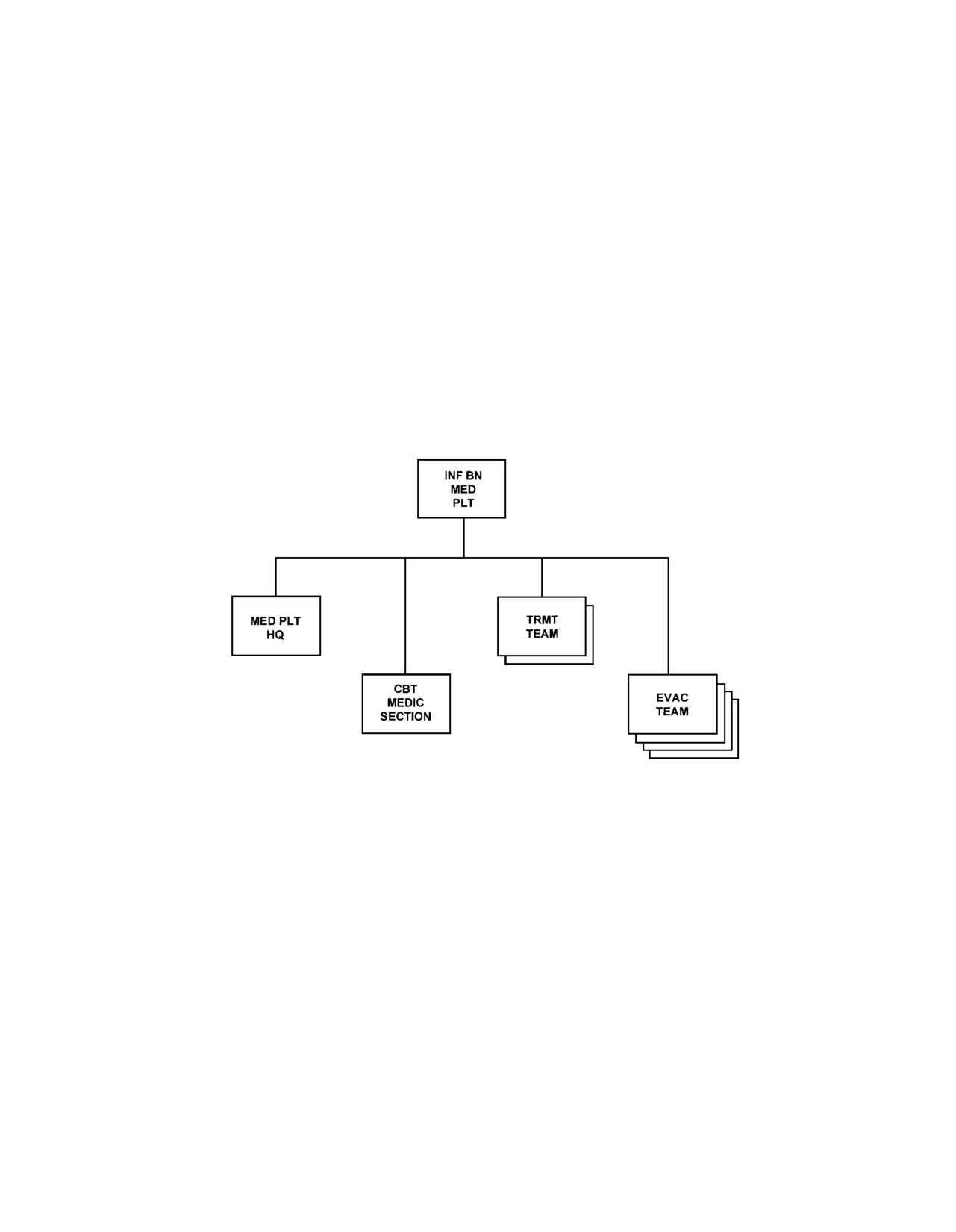
The medical platoon of the infantry battalion is organized with a headquarters section, a treatment squad, an
evacuation section, and a combat medic section (see Figure D-1). For more detailed information on the
functions and operations of the medical platoon, see Chapter 2, Sections IV and VI.
Figure D-1. Medical platoon infantry battalion.
a. Platoon Headquarters. The headquarters section operates under the direction of the medical
platoon leader/battalion surgeon who is responsible for overseeing platoon operations. The platoon
headquarters section is comprised of a field medical assistant and the platoon SGT. It is normally collocated
with a treatment team or a treatment squad to form the BAS. The CP includes the plans and operations
functions performed by the field medical assistant. The platoon has access to the infantry battalion HHC
wire communication network for communications with all major elements of the battalion. Wireless
communications for this section consists of a tactical FM radio mounted in the platoon headquarters vehicle.
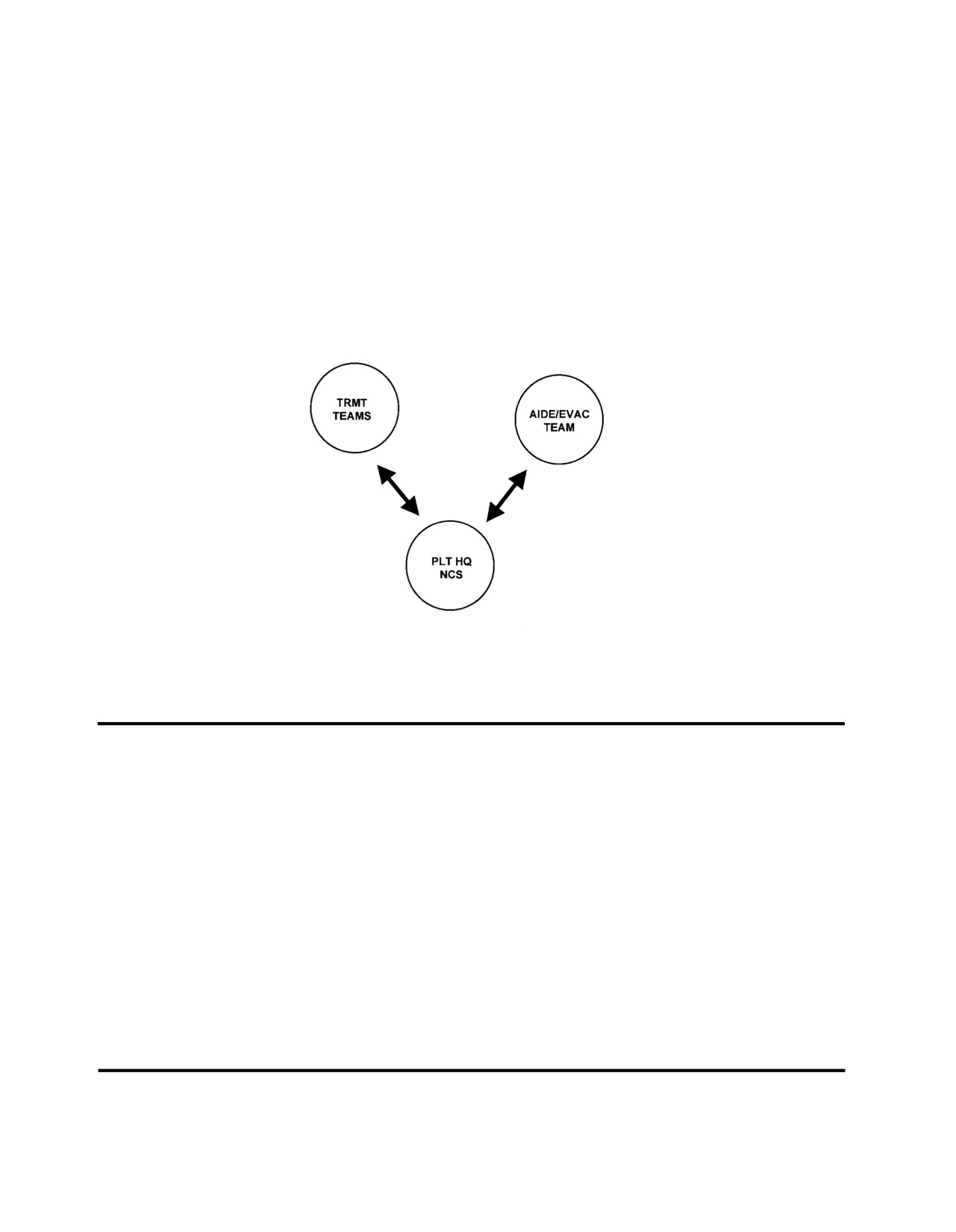
The medical platoon employs an FM radio network for CHS operations. The platoon headquarters section
serves as the NCS for the platoon (see Figure D-2). Table D-1 lists the information and communications
assets available to the platoon.
D-1
FM 4-02.4
(1) The field medical assistant, an MS officer, is the operations/readiness officer for the
platoon. He is the principal assistant to the platoon leader for operations, administration, and logistics. The
field medical assistant coordinates CHS operations with the infantry battalion S1 and S4, and MEDEVAC
with the brigade support medical company (BSMC).
(2) The platoon SGT assists in supervising the operations of the platoon. He also serves as
the evacuation section SGT.
Figure D-2. Medical platoon internal communications net.
Table D-1. Information and Communications Assets Available to the Infantry Battalion Medical Platoon
RADIO SETS
AN/VRC-89F
PLATOON HEADQUARTERS VEHICLE AND TREATMENT TEAM ALPHA (SURGEON) VEHICLE (1 EACH)
AN/VRC-88F
TREATMENT TEAM BRAVO
AN/VRC-90F
PLATOON AMBULANCE (1 EACH)
ROUTERS
COMPUTER SYSTEMS
TACTICAL LAN MC4 LAPTOPS FOR EACH TREATMENT AND AMBULANCE VEHICLE
LAN ROUTER
MC4 (DISMOUNTED, HAND-HELD)
PIC
READER/WRITER (1 EACH, TRAUMA SPECIALIST)
FBCB2, 1 IN EACH VEHICLE ASSIGNED TO THE MEDICAL PLATOON
OTHER SYSTEMS
FBCB2
MEDICAL PLATOON VEHICLE (1 EACH)
GPS
MEDICAL PLATOON VEHICLE (1 EACH)
EPLR
MEDICAL PLATOON VEHICLE (1 EACH)
BCIS
MEDICAL PLATOON VEHICLE (1 EACH)
DVE
MEDICAL PLATOON VEHICLE (1 EACH)
D-2
FM 4-02.4
b. Treatment Squad. The treatment squad consists of two treatment teams (Teams Alpha and
Bravo). They operate the BAS and provide Echelon I medical care and treatment. This includes sick call,
EMT, and ATM. Team Alpha is staffed with an operational medicine officer (primary care physician/
battalion surgeon), a health care SGT, and two health care specialists. Team Bravo is staffed with a PA, a
health care SGT, and two health care specialists. The physician, PA, and health care SGT and specialists
are trained to provide EMT and assist with ATM procedures, commensurate with their occupational
specialties. The treatment teams can operate for limited times in split-based operations in DS of battalion
units. The teams can also operate in split-based operations when the BAS must move to a new location.
One team remains at current location and continues to treat patients while the other team moves to the new
location and establishes patient care capabilities. Once the jump team has established a treatment capability
at the new location, the other team evacuates or returns to duty all patients and moves to the new location.
(1) The medical platoon leader is a working physician on Treatment Team Alpha. He is also
the battalion surgeon. In this role, he is a special staff officer and advisor to the battalion commander on
employment of the medical platoon and on the health of the battalion. He is also the supervising physician
(field surgeon) of the medical platoons treatment squad. This officer is responsible for all CHS provided
by the platoon. His responsibilities include
Planning and directing CHS for the infantry battalion. He does this in conjunction
with the battalion S1, who is the coordinating staff officer responsible to the commander for health and
welfare of the troops.
Advising the infantry battalion commander and his staff on CHS operations and the
medical threat.
Supervising the administration, discipline, maintenance of equipment, supply
functions, organizational training, and employment of medical platoon personnel.
Examining, diagnosing, treating, and prescribing courses of treatment for patients,
to include ATM.
Training CLS.
Supervising the battalion CSC program.
Planning and conducting humanitarian assistance programs, when directed.
Providing PVNTMED support for the battalion. Requesting PVNTMED support
from the brigade for PVNTMED requirements beyond his capabilities.
Planning and overseeing PVNTMED training for battalion personnel.
Advising the commander on the health of the battalion.
Supervising the training of unit field sanitation teams.
D-3
FM 4-02.4
(2) The PA performs patient health care and administrative duties. The PA is ATM-
qualified and works under the clinical supervision of the medical officer. The PA assumes the duties of the
battalion surgeon/medical platoon leader in his absence. He performs the following duties:
Establishes and conducts treatment team operations when deployed in split-based
operations.
Treats, within his ability, sick or injured patients. He refers those patients requiring
treatment beyond his capability to the supervising physician.
Provides EMT and ATM for wounded and DNBI patients.
Conducts training for battalion personnel in first aid procedures (self-aid, buddy
aid, and CLS), field sanitation, evacuation of the sick and wounded, and the medical aspects of injury
prevention.
Assists in the conduct of the battalion CSC program, to include individual and
leader training on the prevention of BF and other stress-related conditions.
Trains medical personnel in EMT procedures.
Advising the command on PVNTMED concerns and conducting PVNTMED
activities within the capabilities of medical platoon personnel. Assist in training unit field sanitation teams.
c.
Combat Medic Section. Trauma specialists are allocated to the companies of the infantry
battalion on the basis of one trauma specialist per platoon. The platoon trauma specialist normally locates
with, or near, the platoon leader or platoon SGT. When the platoon is moving on foot in the platoon
column formation, he positions himself near the element leader trailing the base squad forward of the
second team. When the platoon is mounted, the trauma specialist will normally ride in the same vehicle as
the platoon SGT. A health care SGT is allocated on the basis of one per infantry company. The company
health care SGT normally collocates with the 1SG. When the company is engaged, he remains with the
1SG and provides medical advice as necessary. As the tactical situation allows, he will manage the
company CCP, provide medical treatment, and prepare patients for MEDEVAC.
d. Evacuation Section. Medical platoon ambulances provide evacuation and en route care from
the soldiers point of injury or the companys CCP to the BAS. The ambulance team supporting the
company works in coordination with the trauma specialists supporting the platoons. When a casualty occurs
in a fighting vehicle, the evacuation team will move as close to the vehicle as possible, making full use of
cover, concealment, and defilade. Assisted, if possible by the vehicles crew, they will extract the casualty
from the vehicle and administer EMT. In mass casualty situations, nonmedical vehicles may be used to
assist in casualty evacuation as directed by the supported commander. Plans for the use of nonmedical
vehicles to perform casualty evacuation should be included in the infantry battalions TSOP and OPORD.
Patients are evacuated from the BAS to the BSMC by BSMC ground ambulances or FSMT aeromedical
evacuation aircraft. During entry operations, based on the current concept, air ambulances will not be
available for the first 96 hours.
D-4
FM 4-02.4
D-2. Medical Communications for Combat Casualty Care
a. The MC4 system will be a theater, automated CHS system, which will link commanders,
health care providers, and supporting elements, at all echelons, with integrated medical information. The
battalion will have one MC4 (dismounted) with two laptops and one server. The system will provide digital
enablers to connect, both vertically and horizontally, all ten CHS functional areas. When developed, the
MC4 system will receive, store, process, transmit, and report medical C2, medical surveillance, casualty
movement/tracking, medical treatment, medical understanding, and CHL data across all echelons of care.
This will be achieved through the integration of a suite of medical information systems linked through the
Army data telecommunications architecture. The MC4 system begins with the individual soldier and
continues throughout the health care continuum. The best way to visualize the MC4 system capability is as
a piece of the Army digital computer network where all ten CHS functional areas have been digitized and
this CHS information is available to specified commands, supported units, and their personnel. When fully
developed, not only will the MC4 system provide Army commanders with CHS information, but will
provide them with a seamless transition to the joint health service support environment.
b. The MC4 system will consist of three basic components: software, hardware, and telecom-
munications systems.
(1) Software system.
(a) The joint TMIP will provide GOTS/COTS software and interoperability standards
to support joint theater operations. The software provides an integrated medical information capability that
will support all echelons of care in a theater of operations with links to the sustaining base. Medical
capabilities provided by the software to support commanders in the theater will addressmedical C2
(including medical capability assessment, sustainability analysis, and medical intelligence); CHL (including
blood product management and medical maintenance management); patient evacuation; and health care
delivery.
(b) The MC4 system will support Army-unique requirements and any software needed
to interface with Army information systems such as CSSCS, GCSS-A, FBCB2, Warrior Programs, and the
Movement Tracking System.
(2) Hardware systems. The hardware will consist of COTS automation equipment supporting
the above software capabilities. Examples include, but are not limited to, computers, printers, networking
devices, and the PIC.
(3) Telecommunications systems. The MC4 system will rely on current and proposed Army
solutions for tactical, operational, and strategic telecommunications systems to transmit and receive digitized
medical information throughout the theater and back to the sustaining base. There will be no separate
AMEDD communication system. Telecommunications at brigade and below will be accomplished through
the tactical internet; above brigade level, telecommunications will be accomplished through the WIN
architecture. The MC4 system will include hardware or software required to interface with current and
emerging technologies supporting manual, wired, and wireless data transmission. At end-state, the MC4
system users will exchange data electronically via the WIN architecture. In the interim, commercial
D-5
FM 4-02.4
satellite and/or high frequency radio will be fielded to selected medical units (for example, MDT and so
forth) receiving the MC4 system to support high bandwidth requirements until the WIN architecture is fully
fielded. Personnel operating satellite assets are resourced in the MDT TOE and will be located with the
MDT.
(4) Patient treatment recording system. In the future under MC4, medical information about
each soldier will be entered into a local database maintained at the supporting BAS or troop medical clinic.
This information will include the soldiers immunization status, medical deployability status, and dental
deployability status. Until a digital patient record and the PIC are fully functional and fielded, and in
accordance with AR 40-66, a field medical record jacket, DD Form 2766, and its accompanying records
will be maintained by the soldiers primary care provider. See Appendix B for definitive information on
management of the individual health records in the field.
c.
When fielded, the MC4 system will be employed by the medical platoon in the conduct of its
mission. The medical platoon will employ FBCB2 and other communications enablers for preparing and
submitting daily patient feeder reports, transmitting medical surveillance information, requesting supplies,
and conducting other administrative activities (see Table D-1 for types of medical platoon communication
systems and enablers).
The medical platoon headquarters will employ an FM radio as the platoon NCS.
The treatment squad will employ FM radios and notebook computers to conduct treatment
team/squad communications. The notebook computers will be used to read and enter patient data on the
PIC; to conduct teleconsultation (TCON) and TMEN activities; provide patient flow/disposition information;
and DNBI information to the battalion S1 and higher echelon medical leadership. The physician will
provide TCON to the PA and receive TCON from the medical company or other medical activities out of
theater through the MDT. The notebooks will be linked to others through FM radios. The platoon
physician and PA will provide TMEN for ambulance personnel.
The evacuation section will employ FM radios and notebook computers to conduct
MEDEVAC communications. The notebook computers will be used to read and enter patient care
information on the PIC. They will also use this device to receive TMEN from the physician and PA. The
notebooks will be linked to the FM radios for communications operations.
The trauma specialists will employ a hand-held device for reading and entering patient
care information on the PIC.
D-3. Battalion Combat Health Support Planning
a. Planning Considerations. The battalion surgeon assisted by the field medical assistant and the
platoon SGT is responsible for the CHS plan for the infantry battalion. As operational requirements or the
mission changes, the CHS plan must be updated. The following factors should be considered:
Commanders information requirements.
D-6
FM 4-02.4
Results of the mission analysis.
Commanders intent.
Planning guidance.
Courses of actions.
Tactical plan.
Enemy.
Terrain.
Troops supported (unit and attached).
Weather.
Threat (including medical threat).
Operational conditions and constraints.
Civilian populace in the AO.
Medical personnel status.
Equipment status of the medical platoon.
Supply status including Class VIII.
Communications capability.
Nuclear, biological, and chemical defense (including radiation OEG).
Patient decontamination.
Medical platoons training status.
Unit field sanitation team training.
Unit personnel first aid training status, to include CLS.
Casualty estimates.
Medical evacuation requirements and capabilities.
D-7
FM 4-02.4
Nonmedical support requirements from the battalion.
Area support requirements.
Special operations support requirement.
Mass casualty operations in accordance with the TSOP.
Medical records and reports requirements.
Policy and procedure updates.
The foundation of the battalion CHS plan is the battalion commanders guidance and the brigade CHS plan.
b. Plans. See Chapter 3, paragraph 3-1.
c.
Operation Orders. See Chapter 3, paragraph 3-2.
d. Rehearsals. See Chapter 3, paragraph 3-3.
D-4. Combat Health Support During Night Operations
See Chapter 4, paragraph 4-4.
D-5. Combat Health Support Tactical Standing Operating Procedures
The battalion surgeon/medical platoon leader is responsible for the development of the CHS annex for the
battalion TSOP. The purpose of a TSOP is to establish routine protocols. The TSOP should not be
dependent upon METT-TC factors. If a specific decision is required each time, it should not be included in
the TSOP. The battalion TSOP is based on its higher headquarters TSOP and serves as the foundation for
subordinate units to develop their TSOP. The battalion CHS annex to the TSOP should be clear and
concise, yet provide sufficient detail of any procedural requirements. The CHS annex to the TSOP must
reflect procedural guidance that supports current mission and doctrinal requirements. The CHS annex to
the battalion TSOP should be maintained and reviewed at least every 6 months and revised as required.
Most importantly, the TSOP must be used during training and understood at all levels prior to deployment
or it has no real value.
D-8
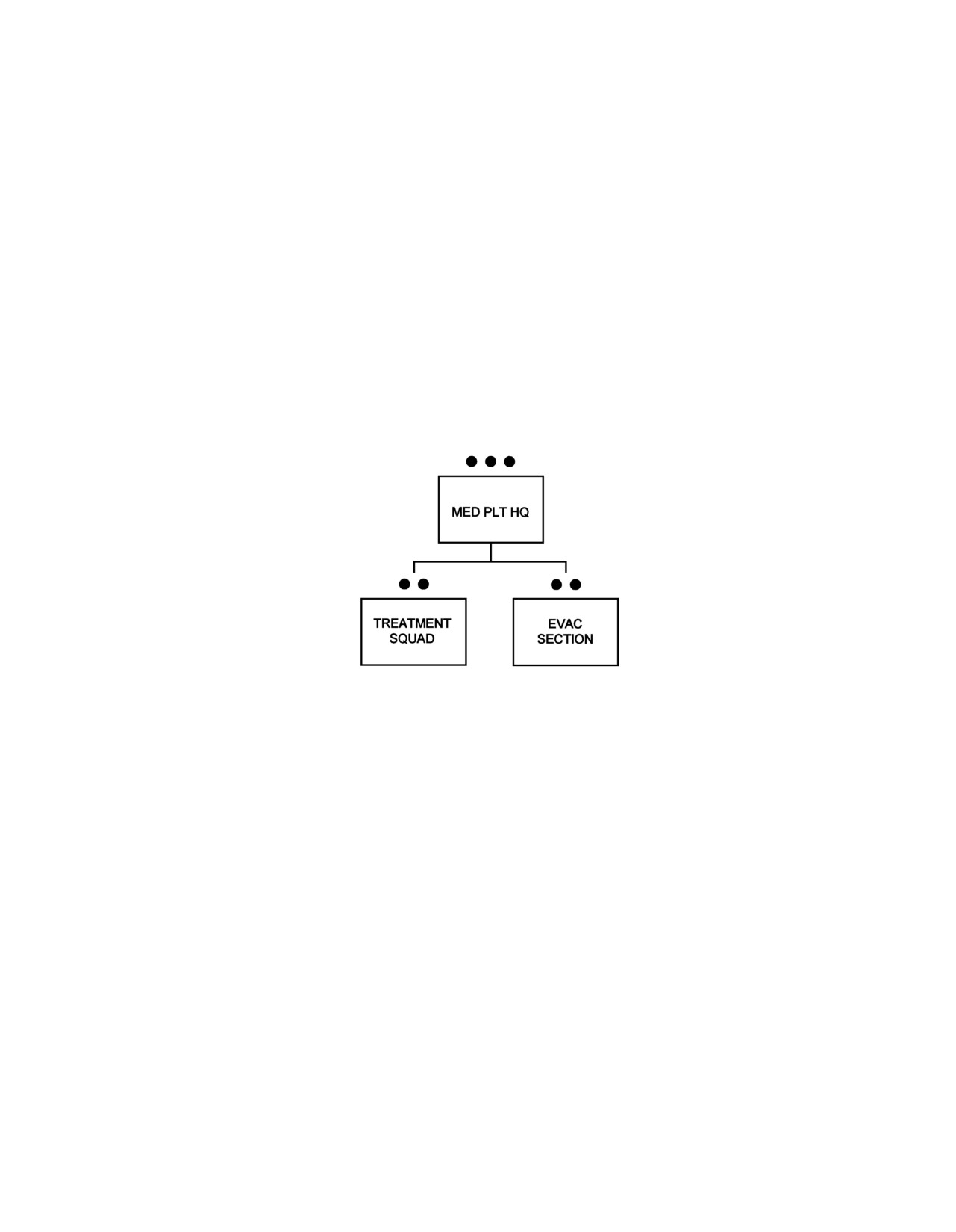
FM 4-02.4
Section II. RECONNAISSANCE, SURVEILLANCE, AND TARGET
ACQUISITION SQUADRON
D-6. Medical Platoon
The medical platoon of the RSTA squadron provides Echelon I CHS for the squadron. The platoon is
organized with a headquarters section, a treatment squad and an evacuation section (see Figure D-3). For
more detailed information on the functions and operations of the medical platoon, see Chapter 4.
Figure D-3. Medical platoon, reconnaissance, surveillance, and target acquisition squadron.
D-7. Platoon Headquarters
a. The platoon headquarters section, under the direction of the platoon leader/surgeon that is
assigned to the treatment squad, provides the C3 and logistics for the platoon. The platoon headquarters
section is comprised of a field medical assistant, the platoon SGT and a medical specialist. It is normally
collocated with a treatment team/squad to form the squadron aid station. The CP includes the plans and
operations functions performed by the field medical assistant. The platoon has access to the HHT and the
supported troop wire communication network for communications with all major elements of the squadron.
Wireless communications for this section consists of a tactical FM radio mounted in the platoon headquarters
vehicle. The medical platoon employs an FM radio network for CHS operations. The platoon headquarters
section serves as the NCS for the platoon. Table D-1 lists the information and communications assets
available to the platoon.
b. The medical platoon leader is a working physician on Treatment Team Alpha. He is the
medical advisor to the squadron commander and his staff. He is also the supervising physician (field
surgeon) of the medical platoons treatment teams. This officer is responsible for all medical treatment
provided by the platoon. His responsibilities include
D-9
FM 4-02.4
Planning and directing CHS for the RSTA squadron.
Advising the squadron commander and his staff on CHS operations and the medical
threat.
Supervising the administration, discipline, maintenance of equipment, supply functions,
organizational training, and employment of assigned or attached personnel.
Examining, diagnosing, treating, and prescribing courses of treatment for patients, to
include ATM.
Training the squadrons CLS.
Supervising the squadrons CSC program, to include individual and leader training on
the prevention of BF and other stress-related conditions.
Planning and conducting humanitarian assistance programs when directed.
Overseeing and coordinating the MEDEVAC of patients.
c.
The field medical assistant, an MS officer, is the operations/readiness officer for the platoon.
He is the principal assistant to the platoon leader for operations, administration, and logistics. The field
medical assistant coordinates CHS operations within the squadron and with supporting brigade or corps
medical elements. He coordinates MEDEVAC with the BSMC. The platoon SGT assists in supervising the
operations of the platoon. He also serves as the evacuation section SGT.
D-8. Treatment Squad
The treatment squad has two treatment teams (Teams Alpha and Bravo) that are the basic medical treatment
elements of the squadron aid station. They provide Echelon I medical care and treatment. This includes
sick call, EMT, ATM, and triage for the management of mass casualty situations. Team Alpha is staffed
with an operational medicine officer (primary care physician/squadron surgeon), a treatment squad leader
(E-6), a health care SGT (E-5), and one health care specialist (E-3). Team Bravo is staffed with a PA, a
health care SGT, and two health care specialists. The physician and PA are trained in ATM procedures,
commensurate with their occupational positions or specialties. The PA assumes the duties of the squadron
surgeon in his absence. The PA performs general technical health care and administrative duties. The PA
works under the clinical supervision of the medical officer. He performs the following duties:
Establishes and conducts treatment team operations when deployed to other locations away
from the squadron aid station.
Treats, within his ability, sick or injured patients. He refers those patients requiring treatment
beyond his capability to the supervising physician.
Provides EMT and ATM for wounded and DNBI patients.
D-10
FM 4-02.4
Conducts training for squadron personnel in first-aid procedures (self-aid, buddy aid, and
CLS), field sanitation, evacuation of the sick and wounded, and the medical aspects of injury prevention.
Assists in the conduct of the squadron CSC program, to include individual and leader training
on the prevention of BF and other stress-related conditions.
Trains medical personnel in EMT procedures.
D-9
Evacuation Section
The RSTA squadron evacuation section employs interim armored vehicle (IAV) ambulances and provide
MEDEVAC through DS or on an area support basis. Each RECON troop will normally have one
ambulance team in DS. There are three ambulance teams providing DS and one area support ambulance
team that is positioned with the squadron aid station. Each ambulance team consists of an aide/evacuation
NCO (E-5) and two ambulance aide/evacuation drivers (E-4 and E-3). Ambulance teams provide
MEDEVAC and en route care from either the soldiers point of injury or a CCP to the squadron aid station/
treatment team or brigade medical element providing area support. In mass casualty situations, nonmedical
vehicles may be used to assist in casualty evacuation as directed by the commander. Plans for the use of
nonmedical vehicles to perform casualty evacuation should be included in the RSTA squadron TSOP and
OPORD. The HHT and surveillance and target acquisition troop are provided Echelon I medical treatment
and MEDEVAC support on an area support basis by the area support ambulance team. They will also
operate dispersed throughout the RSTA squadron AO in support of RECON troops. These dispersed
ambulances will evacuate to the nearest supporting Echelon I MTFs based on the OPORD and according to
preplanned and coordinated area medical support responsibilities.
D-10. Squadron Combat Health Support Planning
a. The squadron surgeon, assisted by the field medical assistant and the platoon SGT, is
responsible for the CHS plan for the RSTA squadron. Squadron CHS operations involve all of the factors
that must be considered in the initial developmental stages of the squadron CHS plan. The CHS plan is
updated to meet tactical or CHS operations requirements. The following factors should be considered:
Information requirements (current task organization structure, medical troop strengths,
projected weather and environmental factors, and maintenance status of medical equipment).
Results of the mission analysis.
Commanders intent.
Planning guidance.
Courses of actions.
Tactical plan.
D-11
FM 4-02.4
Enemy.
Terrain.
Troops.
Weather.
Threat (including medical threat).
Operational conditions and constraints.
Civilian populace in the AO.
Medical personnel status.
Equipment status of the medical platoon.
Supply status including Class VIII.
Communications capability.
Nuclear, biological, and chemical defense including OEG.
Nuclear, biological, and chemical casualty considerations.
Training status.
Casualty estimates.
Medical evacuation requirements and capabilities.
Nonmedical support requirements from the squadron.
Area support requirements.
Special operations support requirement
Medical records and reports requirements.
Phases of operations.
Policy and procedure updates.
b.
The foundation of the squadron CHS plan is the squadron commanders guidance and the
brigade CHS plan.
D-12
FM 4-02.4
D-11. Squadron Operation Plans and Operation Orders
a. The brigade headquarters gives mission orders to the squadron headquarters. The medical
platoon may receive additional coordinating instructions from the BSS. These coordinating instructions are
normally transmitted in a force text e-mail message via the tactical LAN. As part of the mission analysis
and based on the squadron commanders intent and guidance, the medical platoon develops CHS estimates
for supporting squadron operations. An understanding of the squadron RECON troop time lines or battle
rhythm will assist the squadron medical platoon leader and field medical assistant in developing the CHS
input through the squadron S1 to the squadron OPLAN/OPORD.
b. Squadron COA development/analysis and wargaming are accomplished after mission analysis.
Course of action development and wargaming result in the production of the OPORD and the CHS annex.
c.
Once the RSTA squadron receives the brigade WARNO, it begins mission analysis. Based on
its analysis and the full brigade order that follows, the squadron determines its tactical plan. Part of
determining its plan is the placement of medical treatment elements (squadron aid station/treatment team).
The brigade CHS plan will include the plan for Echelon II support as well as any tasking of support to the
squadron medical platoon. The RSTA squadron medical platoon leader will assess the platoons adequacy
as part of the mission analysis. He will bring any shortfalls to the squadron commanders attention during
the mission analysis briefing. The platoon leader and/or the field medical assistant then participate in COA
development and wargaming to produce the squadron plan. When the commander approves the OPLAN, it
becomes the OPORD. The OPLAN and OPORD are developed by the S3 section, using input from each of
the staff elements, with the S1 being the staff coordinating element for CHS. The RSTA squadron CHS
plan is revised or updated based on mission analysis or changes in CHS requirements. The medical platoon
leader maintains current information on the following subject areas that include
Patient status board (for example, awaiting evacuation).
Dirty routes/patient decontamination sites.
Location of squadron aid station/treatment team and of BAS or other MTF providing
area medical support to RSTA squadron elements (current/projected).
Area medical support responsibilities.
D-12. Rehearsal
For successful implementation of the CHS annex of the RSTA squadron plan, the CHS plan must be
coordinated and synchronized with the squadron plan so that CHS requirements are met. To achieve
optimal synchronization, the CHS plan is rehearsed as an integral part of the combined arms plan at the
combined arms rehearsal. See Chapter 3 for definitive information on rehearsal.
D-13
FM 4-02.4
D-13. Combat Health Support for the Offense and the Defense
See Chapter 4 for definitive information on CHS for offensive and defensive operations.
D-14. Reconnaissance, Surveillance, and Target Acquisition Squadron Operations and Combat
Health Support
a. The unique mission of the RSTA squadron will cause it to deploy its troops over a very large
AO. These long distances will require careful planning and well-coordinated and aggressive CHS operations.
This squadron will rely heavily on first aid and CLSs.
b. Many RECON and counter-RECON missions will occur at night. Combat health support for
these missions must be planned in detail for limited visibility conditions. The acquisition and MEDEVAC
of a RSTA squadron casualty will require a team effort on the part of the troops, the medical platoon, and
the squadron staff. Often, trauma specialists will not be able to successfully execute this alone in the RSTA
squadron AO. In most cases, it will require a combined arms effort.
D-15. Combat Health Support During Night Operations
The squadron surgeon and medical platoon members must anticipate that the brigade does a substantial
amount of its work at night or in limited visibility. They must ensure that the platoon TSOP is available and
used throughout the squadron for providing MEDEVAC and treatment at night. See Chapter 4, paragraph
4-4, for definitive information of night operations.
Section III. OVERVIEW OF MEDICAL FORCE STRUCTURE IN
SUPPORT OF THE INTERIM BRIGADE
D-16. Combat Health Support for the Interim Brigade
a. Combat health support to the brigade is focused on the stabilization of wounds and injuries,
and early evacuation of casualties out of the brigades AO. Self-aid/buddy aid and the CLS is essential first
aid, and early initial medical treatment provided by the trauma specialist is critical for reducing the
morbidity and mortality rates. Additionally to reduce the morbidity and mortality rates, both EMT and
ATM are performed at the BAS and the BSMC to ensure appropriate treatment and to stabilize the wounded
or traumatized patient. After the initial first aid or medical treatment, an ambulance crew evacuates the
patient to the supporting Echelon I treatment team/BAS.
b. The BSMC of the brigade support battalion is capable of providing Echelon I area medical
support to BSA elements, back-up Echelon I support to forward maneuver battalions, and Echelon II CHS
to all elements of the brigade. The BSMC is normally augmented with a surgical capability provided by an
D-14
FM 4-02.4
attached corps FST. Casualties that cannot be returned to duty by the brigade medical assets will be
evacuated to a corps hospital or supporting MTF. After the first 96 hours of brigade operations, the brigade
may be augmented with a corps FSMT. When deployed forward to the BSA, the BSMC commander
coordinates the air ambulance teams evacuation missions.
c.
The BSMC, assisted by the support operations section, provides real-time tactical information
to the air ambulance crew about evacuation missions from the brigade combat team units/elements to
supporting brigade MTFs. When air ambulances operate forward of the BSA, they will execute the A2C2
plan through the maneuver brigade S3. The BSB support operations section provides planning and
coordination between aeromedical evacuation and the supported maneuver brigade. The brigade S3 provides
the A2C2 plan that includes the air corridors, air control points, and communications checkpoints. The
brigade S3 will provide updates as required. Air ambulances deployed to the BSA provide MEDEVAC
from forward areas (BAS) back to the BSA. Air ambulance evacuation from the point of injury will be
METT-TC dependent. Corps air ambulances may also evacuate from the BSA to supporting corps MTF.
Corps aeromedical elements will operate from BSA providing around the clock immediate response
evacuation aircraft. To accomplish this, elements must maintain a close tie with the A2C2 system in the
brigade. The brigade A2C2 element provides an airspace plan through the brigade OPORD/OPLAN A2C2
annex. The aircrew must also be familiar with the daily airspace control order and the airspace control
plan. These documents contain all ACM, to include free fire areas, no-fly fire areas, restricted operations
zones, and established and standard Army aircraft flight routes. These route and ACM change on a daily
basis and cannot be integrated into the brigade OPORD. The BSS will ensure all A2C2 information is
provided to corps aeromedical elements. The BSS does not generate A2C2 information, but does provide
A2C2 planning information to division A2C2 elements.
D-17. Brigade Surgeons Section
The BSS is assigned to the HHC of the brigade and operates out of the brigade TOC. It is the brigades
primary planning cell for CHS and works closely with the S3 and his staff in the planning process. The BSS
staff is responsible to the brigade commander for staff supervision of CHS within the brigade. The BSS is
also responsible for coordinating GS and DS relationships of organic medical units and medical units/
elements whether under OPCON or attached to the brigade. The BSS also will
Advise the brigade commander on the health of the command.
Monitor force health protection issues.
Provide basic sick call support to headquarters personnel.
Provide technical control/assistance to brigade medical personnel.
Advise/make recommendations on risk reduction.
Review/coordinate for either external support or augmentation.
D-15