FM 390.6 Brigade Combat Team (September 2010) - page 4
Chapter 6
For example, it could be broken into one overlay showing the basic operational graphics and boundaries,
one showing infiltration graphics, and one showing sensor locations and range fans. See FM 2-0 for more
information on the development of the ISR overlay.
ENEMY SITUATION TEMPLATE
6-33. The S-2 develops an enemy situation template for the operation that focuses on the enemy’s
reconnaissance and counterreconnaissance efforts. The S-2 designs the enemy situation template to aid in
planning friendly infiltration and survivability by identifying enemy actions that will impact friendly
reconnaissance efforts. It also includes enemy main body activities. This information keeps the
reconnaissance unit focused on the reconnaissance objective.
INTELLIGENCE, SURVEILLANCE, AND RECONNAISSANCE SYNCHRONIZATION MATRIX
6-34. The ISR synchronization matrix is used to plan and direct the collection effort. It may consist of a list
of available collection means, plus brief notes or reminders on current intelligence requirements and
specific information to collect. The S-2 section initially prepares the ISR synchronization matrix, which the
ISR working group completes, and the S-3 authorizes as part of the ISR plan. See FM 2-0 and FMI 2-01 for
information about development of the ISR synchronization matrix.
6-35. It is critical that as the BCT’s scheme of maneuver becomes refined (usually after wargaming) and
the planners reevaluate the ISR plan to determine if the plan needs any modification. The ISR plan tasks
assets or organizations across the brigade that conducts reconnaissance and surveillance. The S-3 maintains
a current status of reconnaissance assets’ availability, capability, vulnerability, and performance. This
assessment, coupled with the CCIR and time requirements focused on DP, drives the ISR plan.
6-36. The BCT S-3 consolidates ISR overlays from higher and adjacent headquarters, and subordinate
reconnaissance, combined arms, and fires battalions, along with any attached or supporting battalion-sized
external elements. He may also require smaller elements to submit reconnaissance or surveillance plans,
and sustainment battalions as well. The staff must quickly ensure both that the various ISR plans are
synchronized (for gaps and overlaps), and that the ISR plan and the BCT order remain synchronized. The
BCT commander and staff must be prepared to make adjustment decisions for reconnaissance assets to
account for the developing situation.
6-37. The BCT S-3, with S-2 and MI company support, assesses ISR integration and synchronization
continuously, monitoring for variances in actual coverage of NAI and targeted areas of interest (TAI) from
the plan, and looking for requirements for additional coverage. Anticipated DP are closely monitored using
the indicators for the CCIR supporting them, and CCIR are updated as some become irrelevant and new
ones are added for the developing situation.
RECONNAISSANCE IN STABILITY OPERATIONS
6-38. One of the purposes of reconnaissance during stability operations is to develop the intelligence
needed to address the issues driving an insurgency. Several factors are particularly important for
reconnaissance operations in stability operations. These include the following:
z
A focus on the local populace.
z
Collection occurring at all echelons.
z
Localized nature of insurgencies.
z
All Soldiers functioning as potential collectors.
z
Insurgent use of complex terrain.
6-39. Affecting intelligence synchronization is the requirement to work closely with U.S. Government
agencies, host nation security and intelligence organizations, and multinational intelligence organizations.
Operational-level reconnaissance planning drives the synchronization of these agencies’ and organizations’
efforts; however, coordination occurs at tactical echelons. Communication among collection managers and
collectors down to the battalion level is important. It can eliminate circular reporting and unnecessary
6-8
FM 3-90.6
14 September 2010
Reconnaissance Operations
duplicate work. External intelligence staffs and leaders may require integration into the BCT’s tactical
network to enable closer coordination.
6-40. Counterinsurgency (COIN) operations may require reorganization of BCT intelligence personnel.
Each company may require a company intelligence support team, which would include analysts. A
reconnaissance element is also essential. Linguists are a battle-winning asset, but like any other scarce
resource, commanders must allocate them carefully. During pre-deployment, the best use of linguists may
be to train Soldiers in basic language skills. BCT commanders and staffs may have to integrate contracted
civilian linguists into their operations and planning.
6-41. A BCT optimized for COIN operations may require political and cultural advisors. The current force
structure gives corps and division commanders a political advisor, and brigade and battalion commanders
an information engagement officer or cell. Lower echelon commanders must improvise. BCT leaders may
use culturally aware Soldiers organic to the unit to perform these functions. The position requires someone
with "p eople skills and a feel" for the environment. They help the commander shape the environment by
planning and assessing information engagement tasks.
SURVEILLANCE
6-42. The BCT integrates surveillance, to include higher and joint surveillance capabilities, into its ISR
plan. Conducting surveillance is systematically observing the airspace, surface, or subsurface areas, places,
persons, or things in the AO by visual, aural, electronic, photographic, or other means. Surveillance
activities include:
z
Orienting the surveillance asset on the NAI and/or the surveillance objective in a timely manner.
z
Reporting all information rapidly and accurately.
z
Completing the surveillance mission no later than the time specified in the order.
z
Answering the requirement that prompted the surveillance task.
6-43. Surveillance is distinct from reconnaissance. Often surveillance is passive and may be continuous.
Reconnaissance missions are typically shorter and use active means (such as maneuver). Additionally,
reconnaissance may involve fighting for information. Reconnaissance involves many tactics, techniques,
and procedures throughout the course of a mission. An extended period of surveillance may be one of
these. Commanders complement surveillance with frequent reconnaissance. Surveillance, in turn, increases
the efficiency of reconnaissance by focusing those missions while reducing the risk to Soldiers. The BCT
tasks surveillance responsibilities in the same manner as reconnaissance missions, using the ISR overlay
and tasking matrix.
6-44. National and joint wide-area and focused surveillance missions can provide valuable information to
the BCT. While national and joint surveillance systems focus on information requirements for combatant
commanders, they also provide information to all commanders in support of operations across the area of
operations. The systematic observation of geographic locations, persons, networks, or equipment is
assigned to Army intelligence, reconnaissance, and maneuver assets. Changes or anomalies detected during
surveillance missions can generate a reconnaissance mission to confirm or deny the change.
SECTION V - FORMS OF RECONNAISSANCE
6-45. There are four forms of reconnaissance: route, zone, area, and reconnaissance in force. The BCT
commander uses one of these forms to logically group specific information requirements and taskings into
missions for subordinate commanders. The four forms of reconnaissance refine the scope of the
commander’s mission further and give it a spatial relationship. The BCT, as part of division operations,
may be assigned reconnaissance missions. The CCIR and specified tasks dictated by higher HQ usually
refine the associated tasks listed below. The commander must think through the tasks that he wants his
reconnaissance and surveillance assets to conduct, and ensure that he task organizes appropriately. For
instance, if he wants them to conduct clearance of obstacles, reconnaissance elements might require
engineers and additional maneuver forces (because obstacles are generally overwatched by an enemy
force).
14 September 2010
FM 3-90.6
6-9
Chapter 6
ROUTE RECONNAISSANCE
6-46. A route reconnaissance is an operation focused on obtaining detailed information on a specific route
and all adjacent terrain from which the threat could influence the route. The route may be a road or trail or
other linear feature. Units conduct route reconnaissance to ensure the route is clear of obstacles and threat,
and that it will support planned movement. A route reconnaissance may be performed as part of an area or
zone reconnaissance. Typically, route reconnaissance missions are assigned to organizations below
battalion level, although a BCT could be assigned the primary mission of route reconnaissance of a main
route to be used by a larger force. As a brigade mission, the BCT may task organize similar to a movement
to contact mission (see Chapter 2).
ZONE RECONNAISSANCE
6-47. Zone reconnaissance is the directed effort to obtain detailed information concerning threat, terrain,
society, and infrastructure in accordance with the commander’s reconnaissance focus within a location
delineated by boundaries (i.e., a line of departure, lateral boundaries, and a limit of advance). A zone
reconnaissance is assigned when the enemy situation is vague or when information concerning cross-
country trafficability is desired. It is appropriate when previous knowledge of the terrain is limited or when
combat operations have altered the terrain. The reconnaissance may be threat-oriented, terrain-oriented,
society-oriented, infrastructure-oriented, or a combination. Additionally, the brigade commander may focus
the reconnaissance effort on a specific force, such as the enemy’s reserve. A terrain-focused zone
reconnaissance must include the identification of obstacles, both existing and reinforcing, as well as areas
of chemical, biological, radiological, and nuclear (CBRN) contamination. See FM 3-90 for the conduct of a
zone reconnaissance.
6-48. When higher headquarters assigns the BCT a zone reconnaissance, it may, based on its mission
analysis and identification of the subsequent specified and implied tasks, perform a combination of the
forms of reconnaissance to answer the higher commander’s information requirements. Therefore, even
though the brigade as a whole is performing a zone reconnaissance mission, its subordinate units could be
assigned a zone, area, or route reconnaissance mission.
6-49. A zone reconnaissance is organized with subordinate elements operating abreast of one another
within a portion of the zone as designated by graphic control measures. If the BCT commander expects to
find significant enemy forces within the zone, he considers attaching armored, mechanized, or aviation
forces to the reconnaissance elements to deal with the anticipated threat. If it is likely that reconnaissance
elements will encounter significant obstacles or mobility impediments, he may also augment them with
combat engineers. While reconnaissance missions are the specialty of the reconnaissance squadron, all
BCT combat units may perform this mission. The HBCT commander may use three balanced task forces
operating in adjacent zones, each with reconnaissance, tank, Infantry, and artillery company-sized units.
Unless augmented with wheeled transportation, IBCT commanders have limited capability to conduct
brigade-size zone reconnaissance except in very complex terrain with little depth that they can conduct on
foot.
AREA RECONNAISSANCE
6-50. An area reconnaissance is a directed effort to obtain detailed information concerning the terrain or
threat activity within a prescribed area. The BCT conducts area reconnaissance by maneuvering elements
through the area, or by establishing observation posts (OP) within or external to the area. The BCT may
conduct area reconnaissance as a primary mission for a higher headquarters, or may assign the mission to
its subordinate elements, in particular the reconnaissance squadron. See FM 3-90 for the conduct of area
reconnaissance.
6-51. When higher headquarters assigns the BCT an area reconnaissance, it may, based on its mission
analysis and the subsequent identification of specified and implied tasks, perform a combination of the
forms of reconnaissance to answer the higher commander’s information requirements. Its subordinate
battalion task forces could be assigned a zone, area, or route reconnaissance mission.
6-52. Forces conducting an area reconnaissance are organized according to the size, geography, physical
infrastructure, and social dynamics of the area to be reconnoitered; the time available for conducting the
6-10
FM 3-90.6
14 September 2010
Reconnaissance Operations
reconnaissance; and the capabilities of the organization performing the reconnaissance. The BCT may be
required to reconnoiter one large area or several smaller ones. In many cases, areas to be reconnoitered are
given to subordinate elements. Area reconnaissance proceeds faster than zone reconnaissance because the
effort is focused on a relatively smaller, specific piece of terrain or threat force. Mission analysis will
determine the task organization of various subordinate elements required to accomplish their specific
reconnaissance responsibilities. In many cases, JIIM elements (e.g., civil affairs teams) will be attachments
to reconnaissance forces.
RECONNAISSANCE IN FORCE
6-53. A BCT conducts a reconnaissance in force to discover or test enemy strengths, disposition, and
reaction capability or to obtain other information. It is conducted when the enemy is known to be operating
within an area and adequate intelligence cannot be obtained by other means. It is an aggressive
reconnaissance, conducted as an offensive operation in pursuit of clearly stated CCIR. It differs from other
reconnaissance operations because it is normally conducted only to gain information about the enemy and
not the terrain, and the risk of engagement with the enemy is expected. See FM 3-90 for discussion on the
conduct of a reconnaissance in force mission.
6-54. The BCT commander task organizes his subordinate units based upon mission analysis. If heavy
resistance is expected, a combined arms task force with an attached reconnaissance troop may act as the
main effort. Less resistance and more reconnaissance objectives may require a reconnaissance squadron
main effort with a tank or Infantry company attached. In complex terrain or against fortified defenses,
Infantry-heavy task forces may be required.
14 September 2010
FM 3-90.6
6-11
This page intentionally left blank.
Chapter 7
Fire Support in the Brigade Combat Team
Fire support of the Brigade Combat Team (BCT) includes lethal and nonlethal fires
that generate the commander’s desired effects. Lethal fire support comes from the
BCT’s organic indirect fires assets, Army artillery and aviation assets, and joint and
multinational artillery and aviation assets. Nonlethal fire support can come from a
wide range of military and civilian, joint and multinational partners. The BCT
commander and staff must exercise command and control over a diverse group of
assets from a wide range of sources in ways that will successfully integrate and
synchronize them with BCT operations. The BCT fires cell works closely with the
fires battalion on recommendations to the BCT commander on the command or
support relationships of any additional field artillery units supplementing the BCT.
SECTION I - BRIGADE COMBAT TEAM FIRE SUPPORT ORGANIZATION
FIRES CELL
7-1. The BCT fires cell and its elements integrate the fires warfighting function in BCT operations. It is
led by the brigade fire support officer and staffed by Soldiers who have expertise that is integral to the fires
warfighting function. It has resources to plan for future operations from the main command post (CP) and
to support current operations from the tactical command post (TAC CP) (when deployed). Additionally the
cell has the limited capability to provide coverage to the command group and the deputy command group
when deployed. Fires cell staff are assigned to the following elements within the fires cell of the main CP
and current operations cell of the TAC CP:
z
Lethal fires element (main CP).
z
Nonlethal fires element (main CP).
z
Air support element (Air Force tactical air control party ). The air support element operates from
the main CP with selected portions deployed with the TAC CP when the TAC CP is deployed.
z
TAC CP fires element. Selected personnel from the lethal and nonlethal fires elements deploy
with the TAC CP when the TAC CP is deployed, otherwise they are part of main CP fires cell.
7-2. All elements work from the main CP if the TAC CP is not deployed (Figure 7-1). Selected personnel
from the main CP’s lethal and nonlethal fires elements man the fires element of the TAC CP when the TAC
CP is deployed. The rest remain at the main CP. The BCT Air Force tactical air control party (TACP)
collocates with the fires cell in the main CP, but is sufficiently robust that a selected portion of it can be
deployed with the TAC CP. As mission variables (mission, enemy, terrain and weather, troops and support
available, time available, and civil considerations [METT-TC]) dictate, the fires cell in the main CP can be
augmented by other Army, Air Force, or joint resources and assets including those for information
engagement, civil affairs and related activities as needed.
14 September 2010
FM 3-90.6
7-1
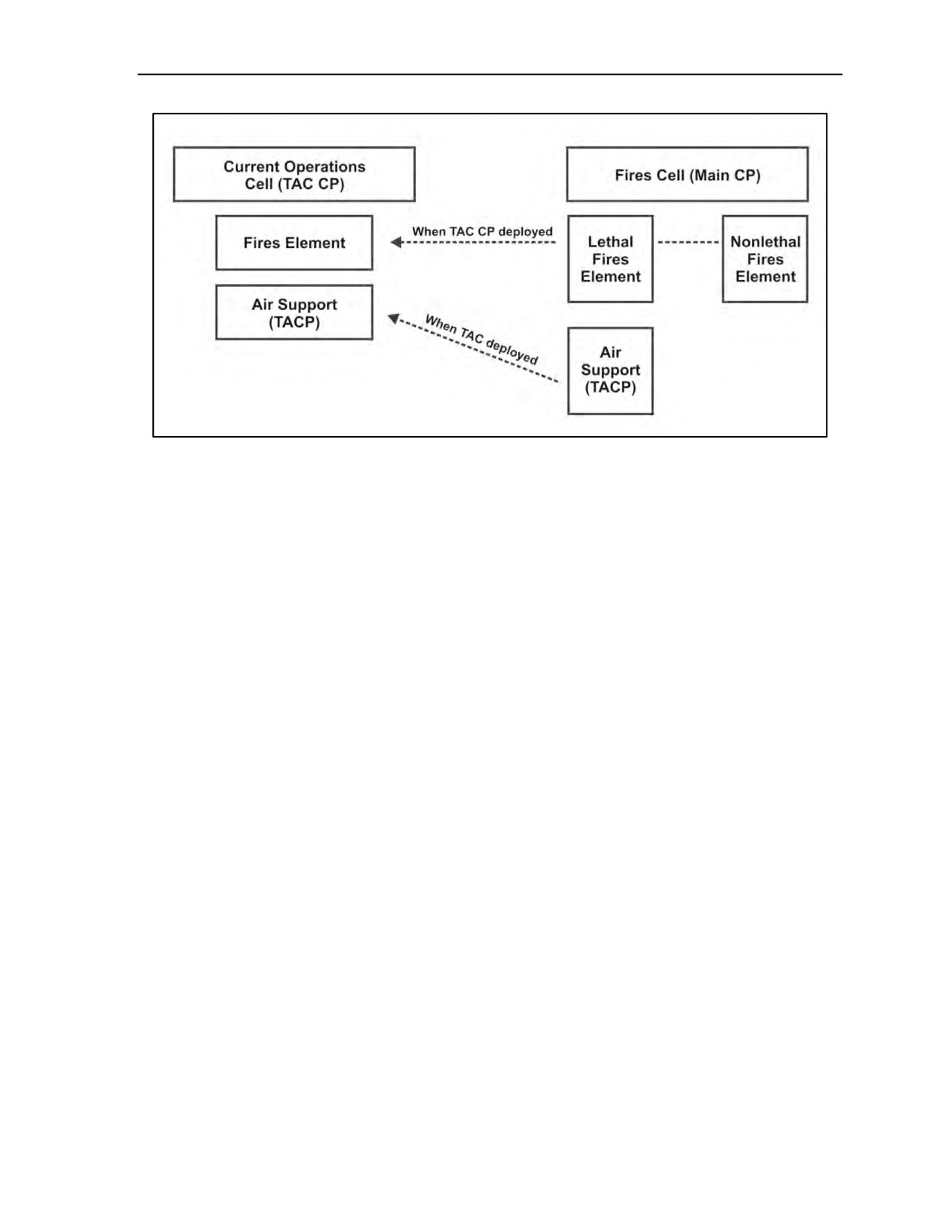
Chapter 7
Figure 7-1. BCT fires cell
7-3. The fires cell is the centerpiece of the BCT’s targeting architecture, focused on both lethal and
nonlethal target sets. The fires cell thus collaboratively plans, coordinates and synchronizes fire support,
aspects of information engagement (such as artillery and air delivered leaflets) and civil affairs in an
integrated fashion with the other warfighting functions to support BCT operations. The targeting working
group brings together representatives of all staff sections concerned with targeting. It synchronizes the
contributions of the entire staff to the work of the fires cell. The brigade operational law team is co-located
with the fires cell in order to provide legal review of plans, targeting and orders. The fires cell coordinates
and integrates joint fire support into the BCT commander’s concept of operations. Primary fires cell
functions include:
z
Planning, coordinating, and synchronizing fire support for BCT operations.
z
Working with the BCT staff to integrate lethal and nonlethal fires, including appropriate aspects
of information engagement and civil affairs operations, into the BCT targeting process.
z
Collaborating in the intelligence preparation of the battlefield (IPB) process.
z
Coordinating the tasking of sensors during development of the intelligence, surveillance, and
reconnaissance (ISR) plan with the BCT S-2, the military intelligence company commander (as
needed), and the reconnaissance squadron to acquire targets.
z
Participating in the BCT’s military decision-making process.
z
Briefing the BCT commander to get his approval of the concept for fire support.
z
Disseminating the approved concept to BCT fire support organizations, the fires battalion, the
division’s fires brigade, and the division and corps fires cells.
z
Participating in the BCT targeting process.
z
Ensuring battalion fires cells plan fires in accordance with the BCT commanders guidance for
current and future operations.
z
Preparing the fires paragraphs in the BCT operation order
(OPORD) that describe the
concept/scheme of fires to support BCT operations.
z
Managing the establishment of, and changes to, fire support coordination measures.
z
Coordinating maneuver space for the positioning of field artillery assets.
z
Coordinating clearance of lethal and nonlethal attack against targets (clearance of fires).
z
Coordinating assessment of effects generated by fires.
z
Coordinating requests for additional fire support to include joint fires.
z
Providing input to the BCT’s common operational picture to enhance situational understanding.
7-2
FM 3-90.6
14 September 2010
Fire Support in the Brigade Combat Team
INFORMATION OPERATIONS CELL
7-4. The information operations
(IO) cell focuses on information engagement, one of the Army’s
information tasks. It also helps synchronize the other elements of Army information tasks with the rest of
the staff. These include:
z
Command and control warfare (electronic warfare [EW]) with the brigade fire support officer,
brigade electronic warfare officer, and S-6.
z
Information protection (information assurance and computer network defense) with the S-6.
z
Operations security (including physical security of information systems) with the S-2 and S-3.
z
Military deception with the S-2 and S-3.
7-5. The IO cell is anchored on the S-7, S-9, and public affairs officers who plan, coordinate, integrate,
and synchronize all aspects of information engagement and civil affairs activities to support BCT
operations. The IO cell assists the brigade fire support officer to integrate information engagement
capabilities into the targeting process. They are part of the targeting working group that integrates
information engagement and civil affairs operations into the targeting process. The fires cells at battalion
level and fires support teams at company level, to include organic mortars and any additional fire support
allocated by the BCT fires cell, for delivery on time and on target. Together the BCT fires cell and the fires
cells of subordinate BCT organizations enable the BCT to control fires that protect the force and shape the
battlefield. See Chapter 8 for more information on the conduct of information engagement and civil-
military operations in support of BCT operations.
7-6. Planning information engagement and civil affairs operations requires integrating them with several
other processes including IPB and targeting. The executive officer (XO) synchronizes these activities
within the overall operation. The S-7, S-9, public affairs officer and brigade judge advocate develop
supporting tasks during course of action development and finalize them during course of action analysis.
During planning these tasks are discussed in terms of information engagement or civil-military operations
(CMO) tasks, measures, or activities.
TACTICAL AIR CONTROL PARTY
7-7. An Air Force tactical air control party (TACP) is collocated with the BCT headquarters (HQ). The
TACP is resourced to support both the BCT tactical command post and the BCT main command post. The
air liaison officer (ALO) advises the BCT commander and staff on air operations. The ALO leverages the
expertise of the BCT TACP with links to the division TACP to plan, coordinate, synchronize, and execute
air support operations. He also maintains situational awareness of the total air support and air support
effects picture.
7-8. TACP functions include:
z
Serving as the Air Force commander’s representative providing advice to the BCT commander
and staff on the capabilities, limitations, and employment of air support, airlift, and
reconnaissance.
z
Providing an Air Force coordination interface with the BCT fires section, air defense and
airspace management
(ADAM)/brigade aviation element
(BAE) section, and maneuver
battalions.
z
Coordinating activities through the Joint Air Request Net (JARN) and the advanced airlift
notification net.
z
Helping to synchronize air and surface fires and prepare the air support plan.
z
Providing direct liaison for local ADAM activities.
z
Integrating into the staff to facilitate planning air support for future operations, and providing
advice about the development and evaluation of close air support
(CAS), interdiction,
reconnaissance, and joint suppression of enemy air defenses (JSEAD) programs.
z
Providing terminal control for CAS and operating the Air Force air request net.
14 September 2010
FM 3-90.6
7-3
Chapter 7
JOINT FIRES STAFF AUGMENTATION
7-9. Joint augmentation is essential to BCT operations. In addition to the Air Force TACP, other joint
augmentation may include Naval surface fire support (NSFS) and U.S. Marine Corps (USMC) air or
artillery liaison officers.
COMBAT OBSERVATION AND LASING TEAMS
7-10. The combat observation and lasing team (COLT) is an observer team controlled at the brigade level,
capable of day and night target acquisition and that has both laser-range finding and laser-designating
capabilities. The brigade fire support officer is responsible for training the COLTs and for performing
precombat checks and mission briefings/rehearsals before employment. The BCT fires cell supervises the
planning and execution of COLT employment. COLTs can be used as independent observers to weight key
or vulnerable areas. Although originally conceived to interface with the Copperhead, a COLT can be used
with any munitions that require reflected laser energy for final ballistic guidance. The self-location and
target ranging capabilities of the Fire Support Sensor System (FS3) mounted with the M1200 Armored
Knight, which replaces the M707 Knight vehicle with the ground/vehicular laser locator designator or the
FS3, enables first-round fire for effect with conventional munitions.
FIRES BATTALION
7-11. The BCT’s organic fires battalion provides field artillery fires to the BCT and subordinate units in
priority, and for missions that may be assigned by the BCT commander. The fires battalion also provides
reactive counterfire against enemy mortar, cannon, and rocket elements in the BCT’s area of operations.
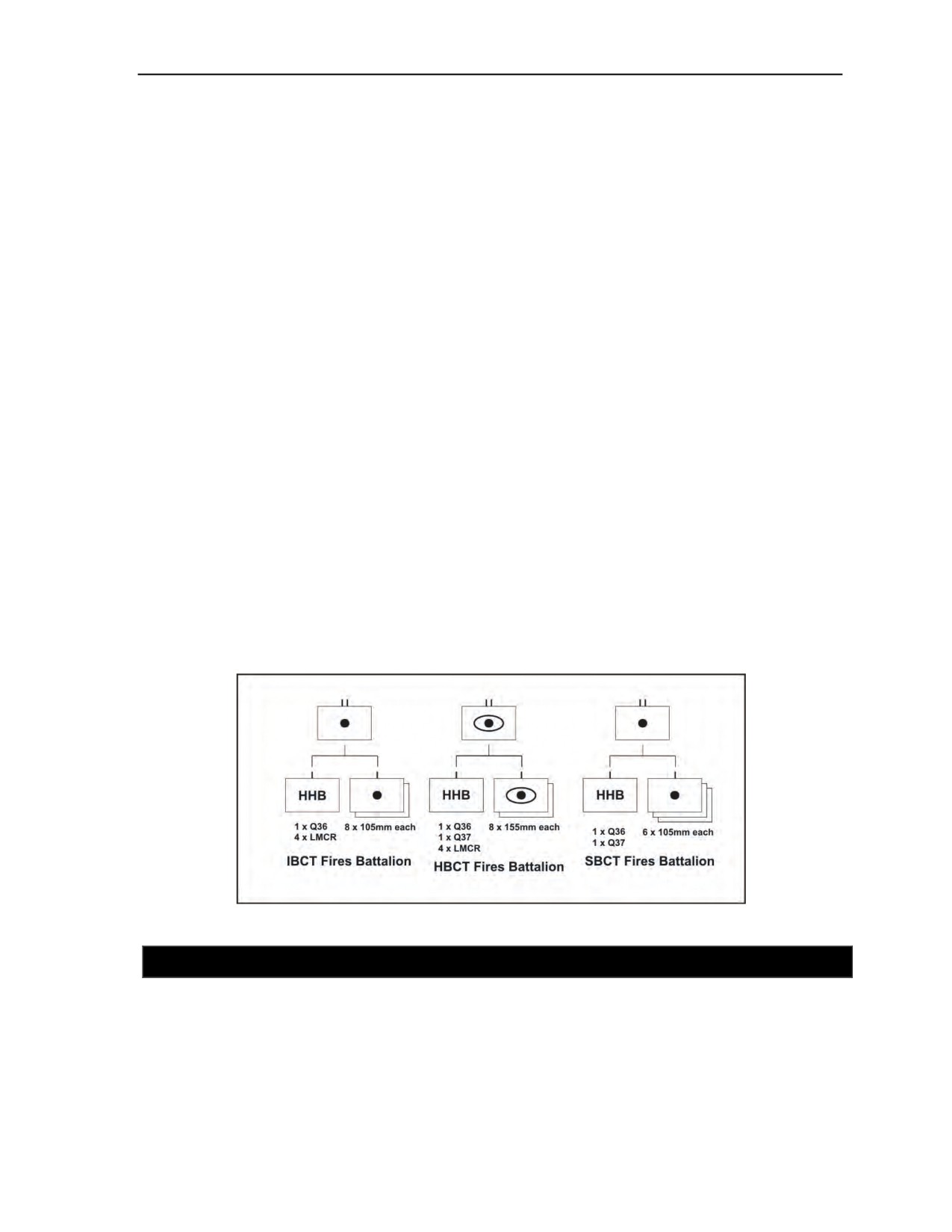
FM 3-09.21 provides a description of the field artillery battalion (Figure 7-2). The BCT’s fires battalion has
an established organic command relationship. However, the BCT commander may assign a support
relationship of direct support, reinforcing, general support, or general support-reinforcing. A BCT’s fires
battalion should be prepared to assume any assigned mission. This may include missions not normally
given to a field artillery unit (for example, base defense, patrolling, search and rescue, or flood relief). This
is most likely to occur during stability or civil support operations. Stability operations are discussed in
greater detail in Chapter 4 of this manual and in FM 3-07.
Figure 7-2. Fires battalions
SECTION II - FIRE SUPPORT PLANNING
7-12. Fire support planning follows the operations process described in FM 3-0. FM 6-20 (to be revised,
renumbered and renamed) provides a detailed overview of the fire support planning process. FM 6-20-40
and FM 6-20-50 include descriptions of BCT tactics, techniques, and procedures for fire support planning
and coordination.
7-13. Targeting is the process of selecting and prioritizing targets and matching the appropriate response to
them, considering operation requirements and capabilities
(Joint Publication
[JP]
3-0). Targeting is
7-4
FM 3-90.6
14 September 2010
Fire Support in the Brigade Combat Team
effective when its results support the commander's objectives. Units identify lethal and nonlethal targeting
options based on those objectives. Fire support planning is integrated with and supports the targeting
process described in FM 6-20-10 (to be revised and renumered). The targeting methodology process
follows the sequence of decide, detect, deliver, and assess.
DECIDE, DETECT, DELIVER, AND ASSESS PROCESS
DECIDE
7-14. The BCT commander and his entire staff play a significant role in the "decide" function. The decide
function provides the overall focus, identifies targeting requirements, and sets the initial priorities and
planning for specific reconnaissance activities. These activities support the "detect" function; the attack
methodology that supports the "deliver" function; and command and control
(C2), battle damage
assessment (BDA), and intelligence issues in the "assess" function. As part of the decide function, the BCT
should answer the following questions:
z
What targets should be acquired and attacked?
z
When and where are the targets likely to be found?
z
How long will the target remain once acquired?
z
Who or what can locate the targets?
z
What accuracy of target location will be required to attack the target?
z
What are the priorities for reconnaissance objectives and asset allocation?
z
What priority intelligence requirements (PIR) are necessary, and how and when (no later than
time/date) must the information be obtained, processed, and disseminated?
z
What is the risk to the environment or local cultural and historical resources?
z
When, where, how, and in what priority should the targets be attacked?
z
What are the effects criteria that must be achieved to attack the target successfully?
z
Who or what can attack the targets, and how should the attack be conducted (for example,
number/type of attack elements, ammunition) to maximize effects and resources based on
commander’s guidance?
z
What or who will obtain the BDA or other information the BCT needs to determine the success
or failure of each attack? Who must receive and process that information, how rapidly, and in
what format?
z
Who has the decision-making authority to determine success or failure, and how rapidly must
the decision be made and disseminated?
z
What actions will be required if an attack is unsuccessful and who has the authority to direct
those actions?
7-15. The BCT staff prepares several products as they work through the decide process. These products
must complement the commander’s scheme of maneuver and provide the basis for the concept of fires.
Typical fire support (FS) products include:
z
High-value target list (HVTL). The HVTL is a list of targets or assets essential for the enemy
commander to accomplish his mission. The loss of high-value targets (HVT) would be expected
to degrade important enemy functions seriously throughout the friendly commander’s area of
interest. The brigade fire support officer and S-7 identify HVTs during mission analysis and
course of action (COA) development.
z
High-payoff target list (HPTL). The HPTL is a by-phase, prioritized list of those HVTs that
must be acquired and successfully attacked for the success of the friendly commander’s mission.
Examples of high-payoff targets (HPT) are the enemy’s C2 nodes and intelligence collection
systems. The HPTL is a dynamic document that is continually refined during both planning and
execution based on the situation and the commander’s guidance. Usually, the HPTL is identified
through wargaming (Table 7-1).
14 September 2010
FM 3-90.6
7-5

Chapter 7
Table 7-1. Example of high payoff target list
Phase of the Operation: I - Isolate the Enemy Units
Priority
Category
HPT
1
Fire support
Insurgent mortars
2
Maneuver
Insurgent teams
3
Command and control
Insurgent cell phone
4
Command and control
Insurgent FM radio
z
Target selection standards (TSS). This matrix focuses on accuracy to establish criteria for
deciding when targets are located accurately enough to attack. Military intelligence
(MI)
analysts use TSS to determine targets from combat information and pass them to FS elements for
attack (Table 7-2).
Table 7-2. Example of target selection standards
HPT
Timeliness
Accuracy
Insurgent mortars
10 minutes
100 meters
Insurgent teams
30 minutes
100 meters
Placed/received within 12 km of Fustina
Insurgent cell phone
Within 2 hours of H-hour
airfield
Insurgent FM radio
20 minutes
150 meters
z
Attack guidance matrix. The commander must approve this matrix, which addresses the targets
or target sets to attack, how and when they will be attacked, and the desired effects that attacking
the target will generate (Table 7-3).
Table 7-3. Example of attack guidance matrix
HPT
When
How
Effect
Remarks
Insurgent
Use search and attack teams
I
FA
D
mortars
in restricted areas.
Insurgent
I
FA
N
Destroy C2.
teams
Insurgent cell
A
EA
EW
Disrupt service starting H-2.
phone
Insurgent FM
No jamming until H-3 to
A
EA
EW
radio
preserve intelligence.
Legend
When:
How:
Effects:
I = Immediate
FA = Field Artillery
S = Suppress
A = As acquired
EA = Electronic Attack
N = Neutralize
P = Planned
D = Destroy
EW (electronic warfare) = Jamming
z
Target synchronization matrix (TSM). The TSM combines data from the HPTL, the ISR plan,
and the attack guidance matrix (AGM). It lists HPT by category and the units responsible for
detecting them, attacking them, and assessing the effects of the attacks.
z
Sensor/attack matrix. This matrix is a targeting tool used to determine whether the critical
HVT can be acquired and attacked. The matrix enables war game participants to record their
assessments of the ability of sensor systems to acquire and attack HVT at a critical event or
phase of the battle.
z
Combat assessment requirements. The requirements for combat assessment are identified
during COA development. Combat assessment consists of BDA, munitions effectiveness
assessment, and re-attacks recommendations.
7-6
FM 3-90.6
14 September 2010

Fire Support in the Brigade Combat Team
z
Target nominations. These may include targets nominated for attack by higher HQ. These
include air interdiction, Army Tactical Missile Systems (ATACMS), and electronic attack.
7-16. Other BCT sections work with the brigade fire support officer and S-7 to prepare products that
complement fires and IO products. These products include:
z
ISR plan. The ISR Plan focuses primarily on answering CCIRs and then identifying HPT. The
ISR plan is prepared by the S-3 and coordinated with the S-2. It is a major contributor to the
detect and assess functions.
z
Decision support template (DST). The DST is a tool planners use to anticipate and synchronize
required friendly actions at critical junctures on the battlefield. It is one method the BCT uses to
tie target execution to the friendly scheme of maneuver.
Effects to be Generated by Attacking the Target
7-17. Based on the BCT commander’s guidance, the targeting working group recommends how each target
should be engaged in terms of the degree and duration of desired effects. The desired effects generated by
attacking the target should be clearly identified. Effect can be a standard term such as harass, suppress,
neutralize, or destroy; or it may be described in further detail such as the length of the effect (FM 6-20-10).
(See Table 7-4.)
Table 7-4. Examples of fire effects
Effect
FM 1-02 Definition
Example
Harass
Fires designed to disturb the rest of enemy
Random fires on enemy
troops, to curtail movement and, by the threat
defensive positions during
of losses, to lower morale.
periods of reduced visibility.
Suppress
Fires on or around a weapons system to
Fire directed at enemy air
degrade its performance below the level
defense systems to reduce
needed to fulfill its mission objectives.
threat to unmanned aircraft
systems.
Neutralize
Fires to render the target ineffective or
Preventing the enemy from
unusable for a temporary period.
using a bridge for vehicle
traffic for 4 hours.
Destroy
Fires to physically render the target
Killing 60% of the personnel in
permanently noncombat-effective or so
an enemy Infantry battalion
damaged that it cannot function unless it is
and seriously wounding
restored, reconstituted, or rebuilt.
another 20% of the personnel.
7-18. Fires planners must understand the differences between broad targeting objectives that support the
commander’s intent, and the detailed targeting objectives and effects determination required for the
execution of specific fire plans and programs. An overall objective of disrupting an enemy’s tempo
(commander’s goal) by blocking an enemy force for X-hours or until a certain time (tactical level effect)
can be achieved through the use of:
z
Fires to interdict the enemy’s route (tactical effect)—
Fires to deliver scatterable mines
(SCATMINE) at chokepoints; and fires to cause
avalanches (1st order direct physical effect) that block (2nd order indirect functional effect)
or obstruct routes.
Fires to damage bridges or crater highways (1st order direct physical effect) or otherwise
cut lines of communications that render a movement route unusable (2nd order indirect
functional effect).
z
Fires against a unit that disrupt/slow the unit’s movement (tactical effect). Destructive fires
against engineer, bridging, or fuel equipment (1st order direct physical effect).
z
Destructive fires against lead vehicles at chokepoints or key C2 vehicles (1st order direct
physical effect). Harassing fires (tactical task) that could create fear, havoc, and complications
(2nd order indirect behavioral effect) by destroying and damaging equipment, killing and
14 September 2010
FM 3-90.6
7-7
Chapter 7
wounding personnel, obscuring vision (1st order direct physical effect); and that could cause the
enemy to travel buttoned-up, at open column (2nd order indirect behavioral effect).
DETECT
7-19. The S-3, assisted by the S-2, is responsible for directing the ISR plan to detect HPT identified in the
decide function. Execution of detect functions must be timely and accurate. Based on the results and
effectiveness of the execution of detect functions, the products developed in the decide function may be
modified.
7-20. The detect function involves locating HPT accurately enough to engage them. Characteristics and
signatures of the relevant targets are determined and then compared to potential attack system requirements
to establish specific sensor requirements. The S-2 section works closely with the fires section to identify the
specific "w ho, what, when, and how" for target acquisition. Information needed for target detection is
expressed as PIRs and/or information requirements (IR) to support the attack of HPT and associated fire
support tasks. As target acquisition assets gather information, they report their findings back to the
commander and staff. Detection plans, priorities, and allocations change during execution based on METT-
TC. As part of the detect function, the BCT should answer the following questions:
z
Were the designated targets found at the anticipated locations, times, and conditions, and to the
required accuracies?
z
Are detect-related plans, units, and equipment performing as required? Are there any combat
loss or maintenance issues? Is detect information being processed and disseminated in a timely
manner?
z
Is the situation developing as anticipated (i.e., the threat characteristics main effort identification,
friendly/enemy success/failure)?
z
Have reconnaissance and surveillance activities identified new, unanticipated information that
must be considered?
z
Based on detect functions, are changes required to other decide, detect, deliver, and assess
(D3A) functions?
7-21. The information gathered from the multitude of collection assets must be processed to produce
targets meeting TSS. Moving HPT must be detected and tracked to maintain a current target location. The
brigade fire support officer and S-7 planners tell the S-2 the accuracy required and dwell time for a target to
be eligible for attack. To facilitate the hand-off of targets and tracking (as in reconnaissance handover), the
S-3 coordinates with higher and subordinate units to establish responsibilities.
7-22. The fires section assists the S-2 in the detect function by providing information from the field
artillery (FA) radars and observers to help complete the intelligence picture. Critical targets not attacked
must be tracked to ensure they are not lost. Tracking suspected targets expedites execution of the attack
guidance and keeps the targets in view while they are validated. The fires section monitors fire missions
and spot reports (SPOTREP) for targeting information.
DELIVER
7-23. The deliver function of the targeting process is based on the attack guidance and the selection of an
attack system or combination of systems. As part of the deliver function, the BCT should answer the
following questions:
z
Can/should designated targets be attacked as planned or are changes required?
z
Are the established attack guidance and effects criteria still valid and achievable?
z
Are lethal and nonlethal delivery systems performing as required? Are there any combat loss or
maintenance issues?
z
Are unanticipated delivery requirements manageable, or are there actual or potential
implications?
7-8
FM 3-90.6
14 September 2010
Fire Support in the Brigade Combat Team
z
Based on deliver factors (i.e., ammunition or weapon status), are changes required to other D3A
functions?
z
What effect will this have on the civilian infrastructure, civilian population, environment and
cultural and historical resources? What level of collateral damage is acceptable and who is
authorized to make that decision?
7-24. Successful attack of HPT requires the brigade fire support officer and S-7 to:
z
Determine if the planned attack system is available and is still the best system for attack.
Coordinate as necessary to use the attack system in a timely manner. (e.g., use of offensive
electronic warfare systems requires coordination with the electronic warfare officer, the signal
officer, the IO officer, and the S-2).
z
Deconflict and synchronize all attacks as necessary to gain maximum, synergistic effects with
minimum resource expenditure.
z
Ensure IO and EW, especially the destructive component, are properly incorporated into the
overall targeting plan.
z
Coordinate as required with higher, lower, and adjacent units, other services, allies, and the host
nation . This is particularly necessary to minimize the risk of fratricide.
z
Issue the call for fire to the appropriate executing unit(s).
z
Inform the S-2 of the target attack.
7-25. The deliver function involves engaging targets located within the TSS according to the guidance in
the AGM. This includes using both lethal and nonlethal attack systems. HPT that are located within the
TSS are tracked and engaged at the time designated in the OPORD/AGM. Other collection assets look at
HPT that are not located accurately enough or for targets within priority target sets. When one of these is
located within the TSS, its location is sent to the system that the AGM assigns to attack it. Not all HPT will
be identified accurately enough to be attacked before execution. Some target sets might not have very many
targets identified. Collection assets and the intelligence system develop information that locates or
describes potential targets accurately enough to engage them. The HPTL sets the priority in which they are
attacked. The attack of targets requires a number of tactical and technical decisions and actions. These
decisions determine the:
z
Time of attack.
z
Desired effects.
z
Attack system (s) or IO activity to be used.
7-26. Based on these decisions, technical decisions can be made using the following considerations as an
outline:
z
Delivery means (lethal and nonlethal).
z
Number and types of munitions or systems, tools, and techniques.
z
Unit to conduct the lethal/nonlethal attack.
z
Response time of the asset or unit to provide the effects.
ASSESS
7-27. The commander and staff assess the results of mission execution. Assessment occurs throughout the
operations process. Targets are attacked until the effects outlined in the AGM are achieved or until the
target is no longer within the TSS. If combat assessment reveals that the commander's guidance has not
been met, the detect and deliver functions of the targeting process must continue to focus on the targets
involved and make adjustments to the plan as necessary.
7-28. Assessment recommendations could result in changes to original decisions made during the decide
function. These changes must be provided to subordinate units as appropriate because they impact
continued execution of the plan. In the case of IO effects, the time it takes to achieve desired effects, or
impact the target or audience, might be lengthy. The assessment of these effects cannot be treated and
processed as rapidly as a lethal effect would be.
14 September 2010
FM 3-90.6
7-9
Chapter 7
7-29. The brigade fire support officer, S-7, and targeting working group must consider the following when
conducting combat assessment:
z
Impacts on achieving the commander’s intent if targets supporting a fire support task were
engaged but the desired effects or objectives were not achieved.
z
Whether or not BDA and measures of effectiveness can be objective enough to measure the
achievement of the commander’s intent.
z
The degree of accuracy of the assessment relies largely upon collection resources and their
quality as well as quantity.
7-30. Battle damage assessment begins with a micro-level examination of the damage or effect resulting
from attack of a specific target, and ends with macro-level conclusions regarding the functional outcomes
created in the target system. BDA is conducted in three phases:
z
The first phase examines the outcomes at the specific targeted elements.
z
The second phase estimates the functional consequences for the target system components.
z
The third phase projects results on the overall functioning of the target system and the
consequent changes in the enemy’s behavior.
Future Targeting and Re-Attack Nominations
7-31. The final phase of combat assessment is nominating future targets or re-attacks. In this phase, by
closely examining what was done
(battle damage assessment), and how it was done
(munitions
effectiveness assessment), a determination can be made as to whether the desired effects have been
generated by attacking this particular target with the selected means. If the desired effect was not achieved,
a determination must be made as to whether the same target should be re-attacked using the same means or
a different, perhaps more effective means. It might be possible that the desired effect simply cannot be
generated by re-attacking this particular target, and therefore, an entirely new target or set of targets must
be attacked to achieve the desired effect. This last activity both completes the targeting process and begins
it anew by linking effects actually generated with those desired at the beginning of the targeting cycle.
7-32. The effects of nonlethal attacks require continuous assessment. The S-7 is responsible for this
assessment and monitors reporting based on information requirements and requests for information from
higher headquarters. The S-7 uses the measures of effectiveness established during COA analysis to
maintain a continuous assessment. Based on this assessment, the S-7 decides whether to continue to engage
the target, to break off the attack, or to engage the target with another IO element. The S-7 bases his
decision on the extent to which continuing to engage the target will increase the likelihood of
accomplishing the IO objectives it supports, and the extent to which accomplishing the IO objectives will
contribute to completing the mission.
FIND, FIX, FINISH, EXPLOIT, ANALYZE, AND DISSEMINATE
7-33. FM 6-20-10 introduces a methodology for conducting non-lethal targeting: find, fix, finish, exploit,
analyze, and disseminate (F3EAD). F3EAD is a sub-process of D3A. It is a means of integrating lethal and
nonlethal elements into the planning cycle of the military decision-making process (MDMP) to ensure that
every effort is directed toward achieving the commander’s desired effect. F3EAD provides the maneuver
commander an additional tool to address certain targeting challenges, particularly those found in a
counterinsurgency environment:
z
Find. The target is identified and the target’s network is mapped and analyzed.
z
Fix. A specific location and time to engage the target are identified and the validity of the target
is confirmed.
z
Finish. This mirrors the deliver function of D3A when the action planned against the target is
initiated and completed. The finish step differs from the deliver function in D3A by the nature of
the means the commander will apply against identified target sets.
z
Exploit. The engaging unit takes the opportunity to gather additional information.
z
Analyze. The engaging unit determines the implications and relevance of the information.
z
Disseminate. The engaging unit publishes the results.
7-10
FM 3-90.6
14 September 2010
Fire Support in the Brigade Combat Team
TARGETING MEETINGS
PURPOSE OF TARGETING MEETINGS
7-34. Targeting meetings integrate the targeting process into other BCT processes. The purpose of a
targeting meeting is to focus and synchronize the unit's combat power and resources toward finding,
attacking, and assessing current HPT by using the D3A methodology. The meeting verifies and updates the
HPTL; verifies, updates, and modifies tasking of the collection assets for each HPT; allocates delivery
systems to engage each target; and confirms the assets tasked to assess the effects on the target(s) after the
attack. A successful targeting meeting requires preparation by participants, participation by all warfighting
function representatives, and the rapid development and dissemination of required products. Specific
objectives of targeting meetings include:
z
Verification and update of the HPTL.
z
Verification, update of, and re-tasking available collection assets for each HPT.
z
Allocation of delivery systems to engage each target.
z
Confirmation that assets are tasked to assess whether the desired effects have been achieved by
engaging the target.
z
Identification of target nominations for attack by division or joint assets.
z
Synchronization of lethal and nonlethal actions (including IO).
z
Synchronization of FS and IO assets to generate desired lethal and nonlethal effects.
TARGETING WORKING GROUP
7-35. The targeting working group is a grouping of predetermined staff representatives concerned with
targeting who meet to provide analysis, coordinate and synchronize the targeting process, and provide
recommendations to the targeting board. The targeting working group usually includes the staff primaries
or representatives of the following:
z
Brigade fire support officer (leads and plans/coordinates the working group).
z
BCT S-3 (alternate lead).
z
BCT S-2 representative.
z
BCT S-4 Sustainment cell representative.
z
BCT S-6 representative.
z
BCT S-7 representative.
z
BCT S-9 representative.
z
Engineer representative.
z
ADAM/BAE representative.
z
Electronic warfare representative.
z
Fires section targeting officers.
z
Tactical air control party representative.
z
Military information support operations (MISO) representative.
z
Civil affairs (CA) unit representative.
z
Brigade judge advocate representative.
z
Fires battalion S-3 and S-2 representatives.
z
Reinforcing field artillery liaison officer (LNO).
z
Naval surface fire support LNO.
z
Brigade provost marshal (PM), crime analyst, or military police representative.
14 September 2010
FM 3-90.6
7-11
Chapter 7
TARGETING BOARD
7-36. The targeting board is a temporary grouping of designated predetermined staff representatives with
decision authority to coordinate and synchronize the targeting process. The targeting board usually
includes:
z
BCT XO (chairs the board).
z
BCT S-3 (alternate chair).
z
BCT S-2.
z
BCT S-6.
z
BCT S-7.
z
BCT S-9.
z
Fire support coordinator.
z
Brigade fire support officer.
z
Engineer coordinator (ENCOORD).
z
ADAM/BAE officer.
z
Electronic Warfare officer.
z
Air liaison officer.
z
Fires cell targeting officers.
z
MISO team leader.
z
Civil affairs unit leader.
z
Brigade judge advocate.
z
Sustainment cell representative.
z
Fires battalion S-3 and S-2.
z
Reconnaissance squadron S-3, S-2, and fire support officer (FSO).
z
Maneuver battalion S-3, S-2, and FSO.
z
Brigade special troops battalion
(BSTB) and brigade support battalion (BSB) fire support
noncommissioned officers (FSNCO).
z
Military intelligence company (MICO) commander/collection manager.
z
Special operations forces (SOF) representative.
z
Reinforcing field artillery unit liaison officer.
z
Naval surface fire support LNO.
TARGETING RESPONSIBILITIES
Brigade Commander
7-37. The BCT commander’s intent focuses and drives the targeting process. He approves the
recommendations of the targeting working group.
Executive Officer
7-38. The BCT XO usually chairs the targeting board. Although the BCT commander must approve the
initial targeting products that accompany an operation plan
(OPLAN)/OPORD, the XO (or deputy
commanding officer) may be the approval authority for modifications to targeting products.
Brigade Combat Team Fire Support Officer
7-39. The brigade fire support officer finalizes the fires attack guidance formulated by the commander. His
specific targeting responsibilities include:
z
Leading the targeting working group in preparation for the targeting board.
z
Overseeing fires targeting execution.
7-12
FM 3-90.6
14 September 2010
Fire Support in the Brigade Combat Team
z
Ensuring all aspects of targeting are addressed and understood during the targeting process (i.e.,
task, purpose, location of sensor/back-up, fire mission thread, rehearsal, delivery asset, and
assessment).
z
Developing and updating the fire support tasks.
z
Consolidating target refinements and planned targets from subordinate units.
z
Establishing target refinement standards to facilitate completion of the FS plan.
z
Coordinating support for subordinate unit attack requirements.
z
Coordinating suppression of enemy air defenses (SEAD) and joint air attack team (JAAT).
z
Assessing Phase I BDA to determine if the desired effects were achieved.
z
Formulating the re-attack recommendation.
z
Ensuring target nominations are validated, processed, and updated to support the air tasking
order (ATO).
Brigade Combat Team S-2
7-40. The S-2 must work in concert with the entire staff to identify collection requirements and implement
the ISR plan. The S-2 determines collection requirements, develops the ISR matrix with input from the
staff representatives, and continues to work with the staff planners to develop the ISR plan. The S-2 also
identifies those reconnaissance and surveillance (to include MI discipline collection) assets which can
provide answers to the commander's targeting requirements. The S-2’s specific targeting responsibilities
include:
z
Providing weather effects on targeting operations.
z
Providing information about enemy capabilities and projected courses of action.
z
Providing IPB products to the targeting team.
z
Developing HVTs.
z
Determining which HPT can be acquired with organic assets.
z
Developing support requests for acquiring HPTs beyond the capabilities of organic assets.
z
Coordinating the collection and dissemination of targeting information with the fires section.
z
Advising the S-3 about BDA collection capabilities.
Brigade Combat Team S-3
7-41. The BCT S-3’s specific targeting responsibilities include:
z
Working with the S-2, S-7, and brigade fire support officer to prioritize the HPTL before
approval by the commander.
z
Developing and supervising implementation of the ISR plan.
z
Determining the targets to be attacked immediately and desired effects.
z
Providing a detailed interpretation of the commander’s concept of the operation.
z
Providing guidance about which targets are most important to the commander.
z
Deciding when and where targets should be attacked.
z
Periodically reassessing the HPTL, AGM, and BDA requirements with the brigade fire support
officer, S-7, and S-2.
z
Determining with the brigade fire support officer, S-7, and S-2 if desired effects have been
achieved and if additional attacks are required.
Brigade Combat Team S-7
7-42. The S-7 is responsible for the overall planning, preparation, execution and assessment of information
tasks for the BCT. His targeting responsibilities include:
z
Synchronizing appropriate aspects of information engagement with the fires, maneuver and other
warfighting functions.
z
Assessing enemy vulnerabilities, friendly capabilities, and friendly missions.
14 September 2010
FM 3-90.6
7-13
Chapter 7
z
Nominating information engagement-related targets for attack.
z
Briefing deception operations.
z
Providing operation security measures.
z
Synchronizing Army information tasks.
Brigade Combat Team S-9
7-43. The S-9’s targeting responsibilities include:
z
Providing advice on the affects of friendly actions on the civilian populace.
z
Producing input to the restricted target list.
z
Providing assessments of the effectiveness of CA activities.
z
Brigade judge advocate.
z
The brigade judge advocate’s targeting responsibilities include:
Providing advice on rules of engagement impacts on targeting.
Providing advice on law of war impacts on targeting.
Brigade Judge Advocate
7-44. The brigade judge advocate’s targeting responsibilities include:
z
Providing advice on rules of engagement impacts on targeting.
z
Providing advice on law of war impacts on targeting.
Targeting Officer
7-45. The targeting officers in the fires section facilitate the exchange of information between the BCT S-2
and subordinate fires sections. Their responsibilities include:
z
Helping the BCT S-3/S-2 develop ISR plans.
z
Developing, recommending, and disseminating the AGM.
z
Coordinating with the BCT S-2 for target acquisition (TA) coverage and processing of HPT.
z
Producing the TSS matrix for target acquisition assets supporting the BCT.
z
Managing target lists for planned fires.
z
Coordinating and distributing the restricted target list in coordination with division.
Air Liaison Officer
7-46. The ALO’s targeting actions include:
z
Monitoring execution of the ATO.
z
Advising the commander and staff about employment of air assets.
z
Receiving, coordinating, planning, prioritizing, and synchronizing immediate CAS requests.
z
Providing Air Force input to analysis and plans.
ADAM/BAE Officer
7-47. The ADAM/BAE officer’s targeting actions include:
z
Providing brigade airspace requirements and airspace control measures.
z
Deconflicting airspace user requirements with targeting requirements.
z
Providing the air defense plan.
z
Providing the air picture and early warning plans.
7-14
FM 3-90.6
14 September 2010
Fire Support in the Brigade Combat Team
Electronic Warfare Officer
7-48. The electronic warfare officer’s targeting responsibilities include:
z
Determining HPT to engage with electronic attack.
z
Recommending electronic warfare methods of target engagement.
z
Planning and coordinating tasking and requests to satisfy electronic attack requirements.
z
Assisting the S-2 with the electronic portion of IPB.
z
Identifying threat electronic attack capabilities and targets.
Senior Military Information Support Operations Non-Commissioned Officer
7-49. The MISO noncommissioned officers’ (NCO) targeting responsibilities include:
z
Identifying targets with MISO relevance and recommending their placement or removal from the
targeting list during the nomination process and selection board.
z
Coordinating MISO targeting with deception.
z
Coordinating with supporting MISO units.
z
Synchronizing BCT MISO with higher and lateral HQ.
z
Providing assessments of the effectiveness of MISO activities.
Engineer Coordinator
7-50. The ENCOORD’s targeting responsibilities include:
z
Providing advice on the use of scatterable mines.
z
Providing input to the restricted target list (including relevant environmental considerations).
z
Providing advice on the obstacle creating effects of indirect fires.
z
Effects of terrain as it relates to targeting.
Brigade Provost Marshal
7-51. The provost marshal’s targeting responsibilities include:
z
Providing advice on crime trends, patterns, and associations.
z
Coordinating and preparing warrants for target folders and packages.
z
Tracking and providing detainee disposition and reporting.
FREQUENCY AND TIMING OF TARGETING MEETINGS
7-52. The targeting meeting is a critical event in the BCT’s battle rhythm. It must be integrated effectively
into the BCT’s battle rhythm and nested within the higher HQ targeting cycle to ensure the results of the
targeting process focus, rather than disrupt operations. Thus, task organization changes, modifications to
the ISR plan, ATO nominations, and changes to the HPTL all must be made with full awareness of time
available to prepare and execute.
7-53. The timing of the targeting meeting is critical. While the timeline for brigade level targeting meetings
is usually 24 to 36 hours out, higher HQ assets and certain targeting decisions, such as ATO nominations
usually are based on a 72-hour cycle.
7-54. Experience in the BCT has shown the benefits of two targeting meetings daily at the main CP. A
preliminary meeting (the targeting working group) facilitated by the fire support officer ensures the targets
and objectives of nonlethal effects complement those of lethal effects, and that both meet the commander’s
guidance and intent. The brigade fire support officer and S-7 assess ongoing targeting efforts and ensure
target nominations to higher HQ are being processed in a timely manner. The second meeting (the targeting
board) is generally more formal than the first, is chaired by the XO, and has as its focus updating the
commander and gaining new guidance and approval of planned and proposed targeting actions in the next
24,
48 and 72 hours. Adequate time should be allowed for targeting meetings to present targeting
information and situation updates, and to provide recommendations and obtain decisions. Experience has
14 September 2010
FM 3-90.6
7-15
Chapter 7
shown that about 60 minutes is the norm. Those BCTs conducting two targeting meetings assign the
responsibility for nonlethal targeting to the deputy commanding officer (DCO), while the BCT XO retains
responsibility for lethal targeting.
PREPARING FOR THE TARGETING MEETING
7-55. Preparation and focus are keys to successful BCT targeting meetings. Each representative must come
to the meeting prepared to discuss available assets, capabilities, limitations and BDA requirements related
to their staff area. This means participants must conduct detailed prior coordination and be prepared to
provide input and/or information. This preparation must be focused around the commander’s intent and a
solid understanding of the current situation.
7-56. The BCT S-3 must be prepared to provide:
z
Current friendly situation.
z
Maneuver assets available.
z
Current combat power.
z
Requirements from higher HQ (including recent fragmentary orders or tasking).
z
Changes to the commander’s intent.
z
Changes to the task organization.
z
Planned operations.
z
Current ISR plan.
7-57. The BCT S-2 must be prepared to provide:
z
Current enemy situation.
z
Planned 3nemy COAs (situation template) tailored to the time period discussed.
z
Collection assets available and those the S-2 must request from higher HQ.
z
Weather and weather effects on operations.
7-58. The brigade fire support officer must be prepared to provide:
z
Changes to the fire support tasks.
z
Fire support assets available.
z
Proposed HPTL, TSS, AGM, and fire support tasks for the time period discussed.
z
Recommended changes to fire support coordination measures
(FSCM) for period
being
discussed.
z
Any changes to ammunition control or supply rates.
7-59. The S-7 must be prepared to provide:
z
Changes to the fire support tasks.
z
IO assets available.
z
Proposed HPTL, TSS, AGM, and fire support tasks for IO for the time period discussed.
7-60. The specific situation dictates the extent of the remaining targeting team members’ preparation. They
should be prepared to discuss in detail (within their own warfighting function) available assets and
capabilities, the integration of their assets into targeting decisions, and the capabilities and limitations of
enemy assets. The following tools should be available to facilitate the conduct of the targeting meeting:
HPTL, TSS, AGM, consolidated matrix (e.g., target synchronization matrix) or another product per
standard operating procedure (SOP), list of delivery assets, and list of collection assets.
7-61. The following tools should be available to facilitate targeting meetings:
z
TSM. The TSM visually illustrates the HPTs and is designed to list specific targets with
locations in each category. The matrix has entries to identify whether a target is covered by a
named area of interest (NAI); the specific detection, delivery, and assessment assets for each
target; and attack guidance. Once completed, the TSM serves as a basis for updating the AGM
and issuing a fragmentary order (FRAGO) at the conclusion of the meeting. In addition, it
facilitates the distribution of the target meeting’s results.
7-16
FM 3-90.6
14 September 2010
Fire Support in the Brigade Combat Team
z
Situation Template (SITEMP). The SITEMP identifies where specific targets are expected to
be found on the battlefield and ensures assets are properly placed to detect them.
z
List of potential detection and delivery assets. A list of all potential detection and delivery
assets available to the unit helps all attendees visualize which assets might be available for
detection and delivery. It is essential that staff members be prepared to discuss the potential
contribution for the particular assets within their area.
SECTION III - FIRE SUPPORT COORDINATION
7-62. Fire support coordination ensures the synchronization of fire support assets to match the right attack
means with the correct target to deliver the BCT commander’s desired effects at the precise time and
location needed to support BCT operations. To achieve the best possible synchronization of all fire support,
particularly in joint operations, the following guidelines for coordination are recommended:
z
Position indirect fire weapons systems and units to support the commander’s concept of
operations.
z
Coordinate use of naval surface fire support and planned and immediate CAS to achieve the
BCT commander’s intent and concept of operations.
z
Ensure that the brigade fire support officer, subordinate fire support officers and observers know
the exact locations of maneuver boundaries and other fire support coordination measures.
z
Position observers in redundancy where they can see their assigned targets and trigger points,
communicate with fire support assets, and respond to the maneuver commander.
z
Establish field artillery and mortar final protective fires and priority targets. Final protective fire
is an immediately available prearranged barrier of fire designed to impede enemy movement
across defensive lines or areas.
z
Plan field artillery illumination to facilitate direct fire during limited visibility.
z
Provide common survey to mortars.
z
Provide meteorological (met) data to mortars.
z
Use the fire support execution matrix to execute fire support and remain flexible to branches or
sequels to the current plan.
z
Coordinate with the fires battalion tactical operations center to develop the AGM using the
munitions effects database in the Advanced Field Artillery Tactical Data System (AFATDS).
Compute ammunition requirements needed for generating desired effects via the attack of
expected enemy target categories with fire support. Provide this assessment to the BCT
commander so that he can formulate his attack guidance. Also, compute ammunition
requirements and identify issues that require the BCT commander’s attention or additional
guidance, such as fire support tasks that may be unsupportable.
z
Disseminate target priorities to the BCT staff and through to the lowest levels of subordinate
maneuver units, fire support organizations and mortars.
z
Develop and disseminate field artillery-delivered SCATMINES safety boxes in coordination
with the BCT engineer coordinator and the S-3.
z
State the BCT commander’s attack guidance by defining how, when, and with what restrictions
the commander wants to attack different targets and identify the targeting priorities. The data
should be entered into the AFATDS database.
z
Require refinement by lower fire support echelons to be completed by an established cut-off
time.
z
Verify or correct target locations and trigger points during refinement.
z
Recommend the risk the BCT commander is willing to accept concerning delivery of indirect
fires for maneuver units in close contact. Calculate risk estimate distances.
z
Consider limiting the number of targets to 10 to 15 per maneuver battalion/squadron going
down, with no more than 45 to 60 for the entire BCT.
z
Use the fire support execution matrix to brief the fire support portion of the OPORD during the
combined arms rehearsal.
14 September 2010
FM 3-90.6
7-17
Chapter 7
z
During the combined arms rehearsal, rehearse the fire support portion of the OPORD directly
from the fire support execution matrix.
z
Conduct rehearsals with the actual Soldiers who will execute fire support tasks (e.g., the forward
observer who will initiate fires on a critical target rather than his company/troop fire support
officer).
z
Ensure methods for battle tracking and clearance of indirect fires are clearly understood by fires
cells and maneuver commanders.
z
Verify the range of Q-36, Q-37 and Q-48 radar, and field artillery and mortar delivery system
coverage based on the effects desired and appropriate shell/fuse combinations.
z
Prioritize requirements for Q-36, Q-37 and Q-48 radar and allocate radar zones to reflect the
developed SITEMP, protection priorities and the scheme of maneuver. Ensure radar zones are
within the coverage and trajectory arc of the radar systems. For details, see FM 3-09.21.
z
Explain fire support-related combat power in terms of the required effects to be generated for the
operation. The BCT and subordinate maneuver commanders then better understand fire support
contributions to the course of action scheme of maneuver. Useful information may also include:
Number and type of missions available/possible.
Battery/battalion/mortar volleys available by the type of ammunition and the effects
expected.
Minutes of obscurants available and allocation.
Minutes of illumination available and allocation.
Number of available SCATMINE by type, size, density, and safety zone.
CLEARANCE OF FIRES AND INFORMATION TASKS
7-63. Maneuver commanders clear fires. At the BCT level, the commander usually delegates the
responsibility for coordinating fires to the brigade fire support officer. The BCT accomplishes clearance of
fires in any of several ways:
z
Through a staff process.
z
Through control measures embedded in automated battle command systems.
z
Through active or passive recognition systems.
7-64. Clearance of fires ensures fires will attack enemy capabilities without resulting in casualties to
friendly forces and noncombatants. Similarly, clearance of effects ensures that any electronic attack
conducted by the BCT does not interfere with friendly or civilian operations. Even with automated systems,
clearance of fire support remains a command responsibility at every level, and commanders must assess the
risk and decide the extent of reliance on automated systems.
7-65. The brigade fire support officer and S-7 coordinate all fire support impacting in the BCT AO and
information tasks affecting the BCT. They ensure that fire support and the execution of information tasks
will not jeopardize troop safety, will interface with other FS and information tasks, and/or will not disrupt
adjacent unit operations.
RISK
7-66. The level of risk is directly related to the level of situational awareness. The BCT commander
determines the acceptable risk level when delegating clearance of fires to subordinate units. Units under
fire need immediate responsive FS and cannot wait for a multi-layered clearance process through higher
HQ to receive indirect fire.
SUPPRESSION OF ENEMY AIR DEFENSES
7-67. The effective employment of air assets gives the BCT commander a powerful source of fires.
Aviation assets enable the ground commander to influence operations quickly and to add depth to the
battlefield. The suppression of enemy air defenses allows the BCT to use these assets to its maximum
advantage. FM 3-01.4 provides additional detailed information.
7-18
FM 3-90.6
14 September 2010
Chapter 8
Augmenting Combat Power
The Brigade Combat Team (BCT) commander augments the BCT’s maneuver units
with lethal and nonlethal resources and units based on his assessment of the mission
variables and the BCT’s concept of operations (e.g., prioritizes the main effort).
Sections I through VIII discuss how these lethal and nonlethal assets protect and
support the BCT. Sections X and XI of this chapter provide a discussion of the
sources of external augmentation that could be made available to the BCT (e.g., close
air support [CAS], naval gunfire).
Within the Infantry Brigade Combat Team (IBCT) and Heavy Brigade Combat Team
(HBCT), the brigade special troops battalion (BSTB) contains the assigned BCT
elements that protect and/or support maneuver units. The Stryker Brigade Combat
Team (SBCT) does not have a BSTB. It controls its supporting units under its brigade
headquarters
(HQ). These units consist of the engineer company, the military
intelligence company (MICO), the brigade signal company, the military police (MP)
platoon, and the chemical, biological, radiological, and nuclear
(CBRN)
reconnaissance platoon. In the HBCT and IBCT the engineer company is organic to
the BSTB. In the SBCT, the engineer company is a separate company reporting to the
BCT HQ.
The BCT can expect to receive augmentation upon arrival in a new theater. These
augmenting units may come from a support brigade such as a sustainment or
maneuver enhancement brigade (MEB). For instance, an explosive ordnance disposal
(EOD) company will come from an EOD group. Based on the factors of mission,
enemy, terrain and weather, troops and support available, time available and civil
considerations (METT-TC), and the commander’s guidance, the BCT staff integrates
these assets into maneuver operations and organizations at all levels.
SECTION I - ENGINEERING OPERATIONS
8-1. Combat engineering performs essential mobility, countermobility, and survivability tasks for the
BCT as they support assured mobility, enhancing protection, enabling expeditionary logistics and support
to building capacity. It includes capabilities organic to and augmenting the BCT. It may be augmented at
times with general engineering support, but retains its focus on the integrated application of engineer
capabilities to support the combined arms unit’s freedom of maneuver and protection. See FM 3-34.22 for
more detailed information.
ENGINEER STAFF
8-2. The engineer staff within the BCT HQ includes the engineer coordinator (ENCOORD), an engineer
section, and a terrain team. The staff engineer section synchronizes BCT engineer planning and integrates it
into the BCT military decision-making process (MDMP). It operates as a part of the assured mobility
section with other mobility elements, providing support throughout the BCT area of operations (AO). The
ENCOORD uses the essential mobility survivability tasks format to communicate the BCT commander’s
priorities for his available engineering assets to subordinate units (FM 3-34). The staff engineer section is
capable of preparing executable engineer plans and orders that require minimal refinement by subordinate
14 September 2010
FM 3-90.6
8-1
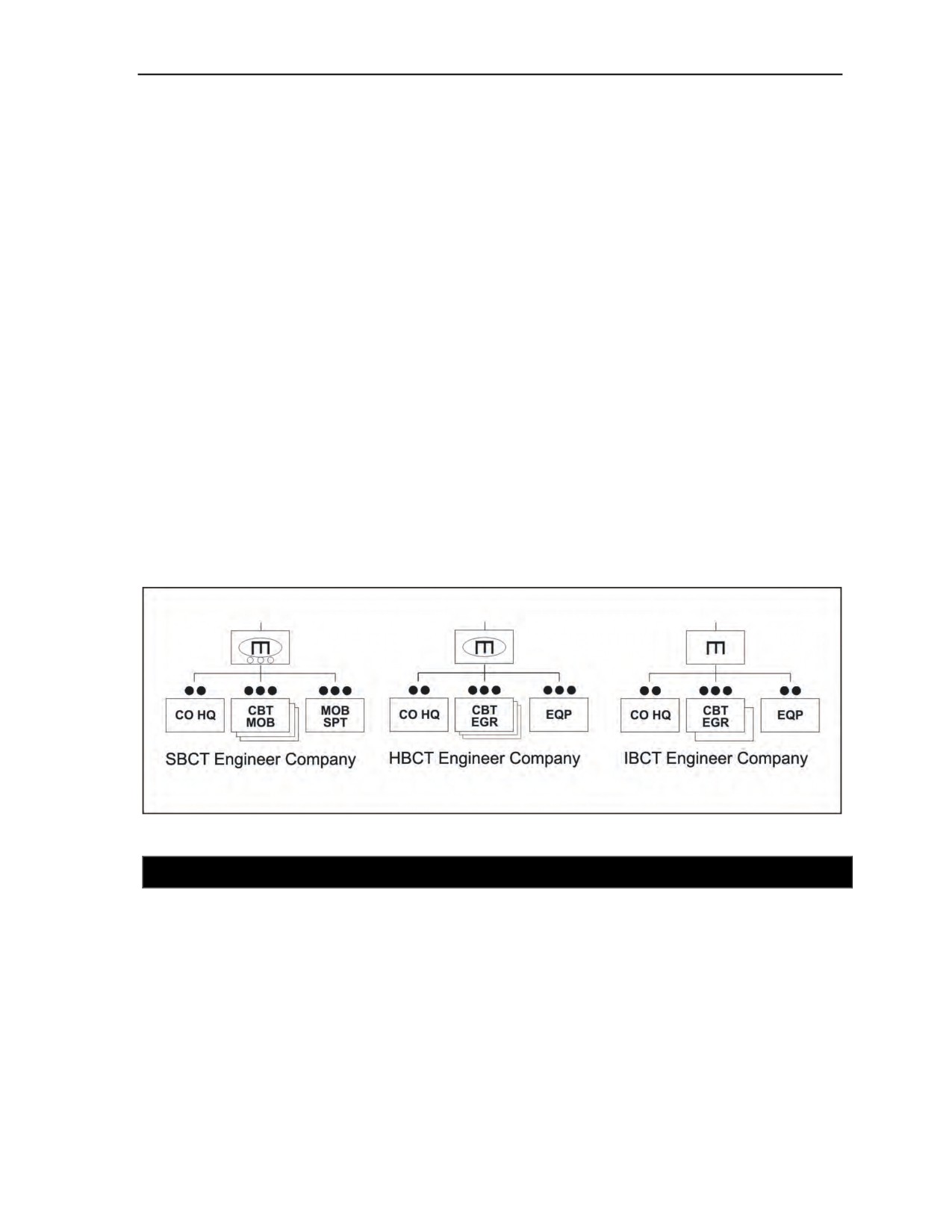
Chapter 8
units. This capability, coupled with digital dissemination of information, minimizes the need for time-
consuming engineering planning at battalion and company levels.
8-3. The staff engineer section task organizes and performs staff supervision for organic and augmented
engineer forces and any host nation, coalition, or contracted engineer support under BCT control. The
section digitally tracks, reports, analyzes, and disseminates all engineer and terrain-related information that
might influence BCT operations including an explosive hazards database. An obstacle database includes all
confirmed obstacles, mines, munitions, and unexploded ordnance (UXO) encountered by the force during
any action or operation. The section conducts tracking and database management in conjunction with EOD
elements operating within the BCT AO.
8-4. The terrain team is the focal point for geospatial information and products within the BCT. Using its
organic Digital Topographic Support System (DTSS), the terrain team provides the BCT with timely digital
terrain products and integrated terrain analysis. The team also enables the BCT to obtain other geospatial
products through reach back capabilities. The team provides the commander with a clear understanding of
the physical environment by enabling visualization of the terrain and explaining its impact on friendly and
enemy operations.
ENGINEER COMPANIES
8-5. Organic engineer companies in each of the BCTs provide assured mobility, enhance protection, and
enable logistics and increased engineer capacity. Their primary focus is on assured mobility for maneuver
elements. BCT engineer companies have very limited countermobility and survivability capabilities. They
rely heavily on the integration of scatterable mine systems and complex terrain to support temporary
defensive actions. BCTs require augmentation by engineer forces to support longer duration defensive
actions (FM 3-34 and FM 3-34.22). Each engineer company is organized slightly differently from any other
(Figure 8-1).
Figure 8-1. BCT engineer companies
SECTION II - MILITARY POLICE OPERATIONS
8-6. The BCT provost marshal (PM) serves as a special staff officer to the BCT commander, and provides
guidance and direction to the BCT MP platoon leader regarding MP operations. The PM is responsible for
planning, coordinating, and synchronizing MP assets and functions. The MP platoon organic to a BCT
consists of a platoon HQ and three MP squads. Each squad has four three-man teams and four vehicles (two
light trucks and two "G uardian" armored security vehicles). Higher HQ may provide additional MP assets
to augment each BCT. Depending upon METT-TC, the brigade could receive additional MP assets ranging
from platoon- to company-size units with relevant specialties
(e.g., military working dog teams,
investigators, traffic, physical security).
8-2
FM 3-90.6
14 September 2010
Augmenting Combat Power
MILITARY POLICE PLATOON CAPABILITIES
8-7. These organic MP platoons provide the minimum essential MP capabilities to support BCT
operations. The MP platoon is capable of performing prioritized tasks from within any of the MP functions.
MPs enable the BCT commander to achieve their objectives by providing a unique set of functional
capabilities. These capabilities support all joint functions and the Army warfighting functions. MPs
accomplish this through their own functions of law and order, police intelligence operations, internment
and resettlement, maneuver and mobility support, and area security. See FM
3-39 for additional
information.
LAW AND ORDER
8-8. MPs work to reduce the opportunity for criminal activity throughout an AO by assessing the local
conditions; conducting police engagement at all levels to include coordinating and maintaining liaison with
other DOD, host nation, joint, and multinational agencies; and developing coherent policing strategies. MP
units at all levels coordinate actions to identify and influence crime conducive conditions that might
promote random and organized criminal activity, or that have the potential to threaten a tactical line of
effort or a Soldier. MPs support and develop strategies to maintain order and enforce the rule of law across
the spectrum of operations.
8-9. Close coordination with host nation civilian police can enhance MP efforts at combating terrorism,
maintaining law and order, and controlling civilian populations. The law and order function also includes
major areas such as law enforcement, criminal investigations, host nation police training and support, and
support to U.S. Customs operations.
POLICE INTELLIGENCE OPERATIONS
8-10. Police intelligence operations is a military police function, integrated within all MP operations.
Police intelligence operations support MP operations through analysis, production, and dissemination of
information. This information was collected through police activities conducted to enhance situational
understanding, protection, civil control, and law enforcement (FM 3-39). This information, whether police,
criminal, or tactical in nature, is gathered during MP operations. Upon analysis, the information may
contribute to the commander’s critical information requirements (CCIR); intelligence-led, time-sensitive
operations; or policing strategies needed to forecast, anticipate, and preempt crime or related disruptive
activities to maintain order.
INTERNMENT AND RESETTLEMENT OPERATIONS
8-11. Military police conduct internment and resettlement operations to shelter, sustain, guard, protect, and
account for populations (detainees, dislocated civilians, or United States military prisoners) as a result of
military or civil conflict, natural or manmade disaster, or to facilitate criminal prosecution. Internment
involves detaining a population or group who pose some level of threat to military operations. Resettlement
involves the quartering of a population or group for their protection. These operations inherently control the
movement and activities of their specific population for imperative reasons of security, safety, or
intelligence gathering (FM 3-39.40).
MANEUVER AND MOBILITY SUPPORT
8-12. Maneuver and mobility support is a military police function conducted to support and preserve the
commander's freedom of movement and enhance the movement of friendly resources in all environments
(FM 3-39). The maneuver and mobility support operation aids and enhances the maneuver commander’s
freedom of movement and maneuver. MP units expedite the secure movement of theater resources to
ensure that commanders receive forces, supplies, and equipment needed to support the operational plan and
changing tactical situations.
14 September 2010
FM 3-90.6
8-3
Chapter 8
AREA SECURITY
8-13. Military police (MP) assist the brigade commander in addressing security and protection. The goal is
to enhance maneuver unit freedom, enabling the unit to conduct missions without placing unnecessary
requirements on BCT maneuver forces. Area security actions include reconnaissance, surveillance,
antiterrorism measures, and security of designated personnel, equipment, facilities, and critical points.
These actions also include convoy and route security.
ADDITIONAL MILITARY POLICE SUPPORT TO THE BCT
8-14. Any one of the five MP battlefield functions easily could require more than one MP platoon. It is
important to consider the factors of METT-TC when using MP support. During offensive operations, MP
assets primarily focus on: planning tasks that support movement of tactical forces throughout the AO;
providing support to sustainment forces moving supplies forward; taking control of detainees and DCs to
reduce degradation of combat forces.
8-15. In defensive operations, the primary focus for the MP force is to ensure movement of the
repositioning or counterattacking forces, provide area security, and support the evacuation of captured or
detained individuals. Military police can support stability operations through the five MP functions
discussed previously. The primary support they render is law and order. MPs can conduct policing
activities in support of civil security and civil control lines of effort. MPs can assist in establishing the rule
of law, and internment/resettlement operations focused on controlling and protecting detainees and
displaced civilians.
8-16. It is important that MP resources be synchronized and weighted in support of the brigade's main
effort. This helps to maximize MP resources allocated to the brigade. MP support might not be available or
adequate to perform all necessary MP battlefield functions simultaneously. Commanders must prioritize
those missions and designate other elements within the brigade to assist in their execution. When
augmented by supporting MP elements, the BCT must understand that not all MP units have similar
capabilities. For instance, an MP guard company has approximately 124 personnel; but since this unit is
specifically designed to guard facilities, prisoners, or critical assets at static locations, the unit is authorized
only nine vehicles. As a result, this unit cannot effectively conduct a mission requiring greater levels of
mobility.
SECTION III - AIR AND MISSILE DEFENSE OPERATIONS
8-17. The BCT does not have organic air defense artillery weapons systems. Air and missile defense
(AMD) support to the BCT may be limited. Units apply passive air defense measures and expect to use
their organic weapons systems for self-defense against enemy air threats. The BCT commander may
request additional air defense assets, if required.
8-18. The brigade does have an organic air defense and airspace management (ADAM)/brigade aviation
element (BAE) cell. The ADAM cell is equipped with an AMD workstation (AMDWS), an air defense
system integrator, and forward area air defense engagement operations workstation. The BAE is equipped
with a tactical airspace integration system (TAIS) workstation.
ADAM/BAE CAPABILITIES AND FUNCTIONS
8-19. Upon mission receipt, the ADAM cell conducts an assessment to determine if AMD augmentation
from higher HQ is required. The cell conducts continuous planning and coordination appropriate for the
augmented sensors that the brigade will deploy within its AO. The ADAM cell and tailored AMD
augmentation force provide the active air defense across the brigade's distributed force.
8-4
FM 3-90.6
14 September 2010
Augmenting Combat Power
8-20. The air defense element of the ADAM/BAE is the commander’s expert on organic active and passive
air defense operations. The ADAM cell:
z
Assists the S-2 in the development of the aerial intelligence preparation of the battlefield.
z
Analyzes and makes recommendations on the use of combined arms for air defense and the use
of passive air defense measures to protect the force from engagement or observation.
z
Participates in fires planning for suppression of enemy air defense (SEAD) and denial of
landing/drop zones (LZ/DZ).
8-21. The ADAM/BAE integrates into the joint tactical digital information link network for receiving of
and contributing to the aerial common operational picture (COP). The engagement and identification
authority for surface to air fires is the chain of control from the ADAM cell to the air defense artillery fire
coordination officer at the control and reporting center (CRC) or combined air operations cell.
8-22. The ADAM/BAE communicates the air defense warning and weapons control status (including
changes to the local air defense warning) to the BCT, and participates in early warning through electronic
means and visual reporting of unknown aircraft. The ADAM/BAE provides early warning and contributes
to airspace deconfliction between internal and external ground fires, organic unmanned aircraft systems,
(UAS) Army aviation, all other aircraft (military and civilian) and missiles to maximize all airspace users’
capabilities, while reducing risk of fratricide and collateral damage.
8-23. The BAE synchronizes Army aviation operations into the BCT scheme of maneuver, integrates
aviation into sustainment operations, and represents Army aviation during the MDMP. See FM 3-01.11for
more information on the ADAM/BAE cell.
COORDINATION AND INTEGRATION OF AIR AND MISSILE DEFENSE AUGMENTATION
8-24. The ADAM cell conducts a supporting METT-TC analysis. Upon completion of this initial analysis,
the BCT commander is briefed, and if required, approves the request for air defense augmentation from
higher. The BCT may be augmented with an Avenger unit depending on asset availability. A more likely
augmentation is the Sentinel radar system, which provides the local air picture and contributes to the aerial
COP. Coordination for deployment of the recommended AMD augmentation force runs concurrently with
the AMD METT-TC analysis. Depending upon force availability (exclusion area boundary AMD assets
already deployed in the AO, the ADAM cell identifies AMD augmentation force requirements and their
availability for rapid deployment. It then integrates this information into the AMD force composition
recommendation to the BCT commander. Upon approval from the BCT commander, the ADAM cell issues
a warning order (WARNO) to the selected AMD augmentation force, which is integrated into the BCT
deployment scheme.
8-25. The ADAM cell coordinates between the BCT staff and the AMD augmentation force commander to
relate the BCT commander’s intent. The cell provides the BCT commander’s defended asset list/critical
asset list to the AMD augmentation force commander. The cell provides the BCT commander and staff
with the aerial component of the overall COP. As the operation evolves, the cell works continuously with
the BCT staff to ensure the commander's intent is executed with respect to the aerial COP and defenses.
The cell continuously monitors the AMD situation and conducts continual METT-TC analysis to maintain
situational awareness of the third dimension in both friendly and enemy perspectives. The ADAM cell
merges into the integrated air defense system through cooperation with higher HQ’s air defense
coordinators
(e.g., joint air operations center, combined air operations center, and the battlefield
coordination detachment collocated with the United States Air Force (USAF) area air defense commander.
AIRSPACE MANAGEMENT AND CONTROL
8-26. The ADAM cell receives and distributes the relevant data from the airspace control order (ACO) and
air tasking order
(ATO), interpreting and displaying the procedural means of airspace control (e.g.,
corridors, restricted operations zones), and scheduled friendly air operations that can impact BCT
operations. In addition, the cell develops recommended airspace control means that support BCT operations
and forwards them to the airspace control authority (ACA) for approval and implementation. In all aviation
command and control (C2) actions, the ADAM cell coordinates existing and proposed means of airspace
14 September 2010
FM 3-90.6
8-5
Chapter 8
control with all elements of the BCT force employing aerial assets (e.g., Army aviation, friendly force
UAS, artillery).
8-27. The ADAM/BAE officer in charge (OIC) is the airspace C2 integrator for the S-3. When a BCT is
controlling an AO, the authority that the BCT has over Army airspace users is the same as the BCT’s
authority over ground units transiting its AO. BCTs controlling an AO have authority over all Army
airspace users in their AO, as well as joint aircraft in support of BCT operations (such as CAS). All Army
airspace users transiting a BCT AO are expected to coordinate with the BCT responsible for the AO they
are transiting. Usually, BCTs have the authority to coordinate directly with joint airspace control elements
that control airspace over the BCT (CRC/Airborne Warning and Control System) for the purpose of fires
coordination or immediate airspace coordination.
BRIGADE COMBAT TEAM AIRSPACE USERS
8-28. The airspace command and control (AC2) process maximizes the simultaneous use of airspace. At
decisive moments, commanders are able to exploit all available combat power—synchronized in time,
space, and purpose. The BCT has many users of airspace. The AC2 plan must be integrated, coordinated,
deconflicted, and disseminated with each of these users to ensure they do not interfere with each other.
MOVEMENT AND MANEUVER
8-29. Aviation units can maneuver rapidly to bring aerial firepower, agility, and shock effect at a decisive
place and time. Using aviation units to enhance reconnaissance, provide security, and conduct attacks
provides the ground force commander with positional advantage over his enemy, and increases the tempo
of operations.
8-30. Army special operations aviation units conduct operations throughout the range of military activity.
Special operations forces (SOF), due to their mission profile, often operate beyond the usual areas of troop
concentrations. Missions deep within enemy territory require the AC2 system to be capable of providing
the necessary restrictive operational environment control measures to avoid fratricide.
8-31. Airborne units are subject to many of the same considerations of AC2 as aviation and SOF. While in
the air movement phase of the operation, airborne forces require airspace control measures to provide entry
and exit routes for the aircraft that deliver forces to their predetermined locations. Airborne operations
require restricted operations areas to deconflict airspace from all other aircraft not directly involved in the
airborne operation. The ground phase of the operation requires substantial deconfliction of the operational
environment.
INTELLIGENCE
8-32. Maneuver commanders at all levels use aircraft and UAS to gather intelligence. UAS conduct
intelligence-collection and target-acquisition missions over the entire battlefield. Missions for UAS at
higher altitudes are included in the ATO/ACO. BCT UAS can be covered by the ATO/ACO. The BCT
ADAM/BAE cell must ensure that continuous coordination for the employment of BCT UAS is conducted
with higher headquarters. These missions are planned for inclusion in the ATO and the ACO. However,
because of their flexible, highly responsive nature, UAS assets are often tasked for immediate missions that
are not in the ATO or ACO. The ADAM/BAE cell at each BCT must resolve conflicts between UAS assets
and those of other airspace users. The S-2 provides the information required for coordinating intelligence
collection missions with the ADAM/BAE cell to synchronize these missions with other airspace
operational requirements, especially air defense forces.
FIRES
8-33. Field artillery uses airspace to deliver indirect fire support to maneuver forces across the entire area
of the distributed battlefield. These indirect fires can traverse the airspace from extremely low to very high
altitudes. All planned artillery fires are coordinated with other airspace users. However, not all targets can
be identified and fires deconflicted in advance. In the close battle, fires of an unplanned, immediate nature
in response to the actions of the maneuver forces, and the reaction by the enemy occur. Commanders
8-6
FM 3-90.6
14 September 2010
Augmenting Combat Power
should indentify the potential of fratricide in these instances and incorporate guidance to minimize and
control risk by implementing preventive measures.
SUSTAINMENT
8-34. Aero-medical evacuation and/or casualty evacuation
(CASEVAC) provides speed, range, and
flexibility to move patients directly to a medical treatment facility that is best equipped to treat the casualty.
Though the aviation brigade is responsible for command, control, and execution of the aero-medical
evacuation mission, the BCT ADAM/BAE cell should be ready to synchronize this mission with other
airspace users within the BCT AO. Refer to FM 4-02.2 for additional information on casualty evacuation
and medical evacuation.
PROTECTION
8-35. AMD units may be located throughout the combat zone area of operations to defend maneuver
forces, vital airfields, logistics elements, and other critical assets as prioritized by the commander. AMD
forces use both positive and procedural means of fire control for air battle C2. Close integration between
airspace control, other airspace users, and air defense C2 is imperative to ensure safe, unencumbered
passage of friendly aircraft while denying access to enemy aircraft and missiles.
OTHER AIRSPACE USERS
8-36. Other users of BCT airspace may include: Army tactical missile systems, close air support, host
nation aircraft, counter-fire artillery, routine aerial resupply missions, and the enemy’s fixed- and rotary-
wing aircraft, UAS, theater ballistic missiles, and missiles.
SECTION IV - CHEMICAL, BIOLOGICAL, RADIOLOGICAL, AND NUCLEAR
OPERATIONS
CBRN STAFF SECTION
8-37. The brigade CBRN staff section advises the commander on all CBRN matters. The chemical CBRN
section is responsible for collecting, consolidating, and distributing all CBRN reports from subordinate,
adjacent, and higher units. The chemical CBRN section inspects chemical CBRN equipment and trains
subordinate units on CBRN defensive tasks prior to deployment and in garrison. The BCT CBRN officer is
a member of the operations staff officer (S-3) plans and operations section and usually operates in the main
command post (CP).
8-38. The BCT CBRN officer acts as the liaison with any attached CBRN elements. He is required to
coordinate closely with the S-2 on the current and updated CBRN threat. Together they develop CBRN
named areas of interest (NAI). The CBRN officer coordinates with fire support and aviation personnel on
planned obscuration operations and advises them of hazard areas. He also coordinates with the logistics
staff officer (S-4) on CBRN logistics matters (e.g., mission-oriented protective posture [MOPP], protective
mask filters, fog oil), and to identify both "c lean" and "dirty" routes as well as contaminated casualty
collection points. The CBRN officer exercises staff supervision over the CBRN reconnaissance platoon in
the BSTB and synchronizes their activities with reconnaissance planning.
CBRN RECONNAISSANCE
8-39. The CBRN reconnaissance platoon informs the commander of chemical, biological, radiological, and
nuclear obstacles on the battlefield. The purpose of CBRN reconnaissance is to detect, identify, report, and
mark specific CBRN hazards. Additional information on CBRN reconnaissance can be found in FM 3-11.19.
CBRN RECONNAISSANCE IN THE OFFENSE
8-40. In the offense, maneuver elements must be able to maintain agility and get to the right place at the
right time. Enemy forces may use CBRN weapons to slow down or impede attacking friendly forces. Use
14 September 2010
FM 3-90.6
8-7
Chapter 8
of CBRN weapons can disrupt the tempo and momentum of the attack, allowing the enemy to regain the
initiative. Our forces employ CBRN reconnaissance to maintain the freedom of maneuver for combat
forces on axes of advance, main supply routes (MSR), and critical areas that the commander identified.
Since CBRN reconnaissance focuses on intelligence preparation of the battlefield (IPB) , it is integrated
into the intelligence, surveillance, and reconnaissance (ISR) plan. CBRN reconnaissance personnel are
responsible for covering specific NAIs for specific periods of time. In the offense, CBRN reconnaissance is
focused on operations that provide the commander with flexibility, retain freedom of maneuver, and
identify known or suspected areas of contamination.
CBRN RECONNAISSANCE IN THE DEFENSE
8-41. In the defense, as in the offense, CBRN reconnaissance focuses on IPB. In defensive operations,
however, CBRN assets should focus on ensuring freedom of movement along brigade routes of
reinforcement, forward and rearward mobility corridors, and other critical areas identified by the
commander. CBRN reconnaissance elements in the defense can conduct route reconnaissance, confirm or
deny suspected or known CBRN hazards at NAIs, perform reconnaissance as part of quartering party
operations, support counterattacking forces, and conduct CBRN surveillance of battle positions with
standoff detection.
SECTION V - MILITARY INTELLIGENCE COMPANY SUPPORT
8-42. The MICO mission is to conduct analysis, intelligence synchronization, full motion video, signals
intelligence (SIGINT and human intelligence (HUMINT) collection. MICO does this in support of the BCT
and its subordinate commands across the full spectrum of operations. The MICO provides analysis and
intelligence synchronization support to the BCT S-2. The MICO supports the BCT and its subordinate
commands through collection, analysis, and dissemination of intelligence information. It supports the BCT
S-2 in ISR synchronization and in maintaining a timely and accurate picture of the enemy situation. See
FM 2-19.4 for more detail on the activities of the MICO.
EMPLOYMENT AND PLANNING CONSIDERATIONS
8-43. During the brigade’s planning, the MICO commander, acting as the BCT intelligence collection
manager, assists the brigade S-2 with the development of the intelligence running estimate and all
intelligence products and deliverables needed to support the brigade orders process. These include but are
not limited to the mission analysis briefing, base operation order (OPORD) input, and annex B. When the
BCT commander approved the brigade order, the MICO commander produces the company OPORD In
addition to task organization considerations in FM 5-0, the MICO commander:
z
Provides seamless analytical support to the brigade S-2.
z
Assists with the synchronization of intelligence and electronic warfare (IEW) assets in the
brigade’s AO.
z
Reallocates and repositions company assets in response to changes in the brigade’s mission,
concept of operations, scheme of support, and threat.
z
Establishes logistics and security relationships with the brigade headquarters and headquarters
company (HHC) to sustain and protect the MICO personnel and equipment.
z
Integrates other attachments into company operations as directed in the brigade order.
8-44. The ISR requirements section and the situation and target development section, of the analysis and
integration platoon usually operate under the BCT S-2’s operational control
(OPCON). The tactical
unmanned aircraft system (TUAS) platoon and the ground collection platoon assets may be deployed
within the BCT’s AO under differing command and support relationships. The SBCT’s reconnaissance
squadron assets may deploy under differing command and support relationships that may also require
similar coordination and planning. These relationships may require the MICO commander to conduct
logistical and security coordination and planning with other brigade C2 elements.
8-45. Command relationships establish the degree of control and responsibility a commander has for the
forces operating under his or her control. Command relationships can be attached, under OPCON or tactical
8-8
FM 3-90.6
14 September 2010
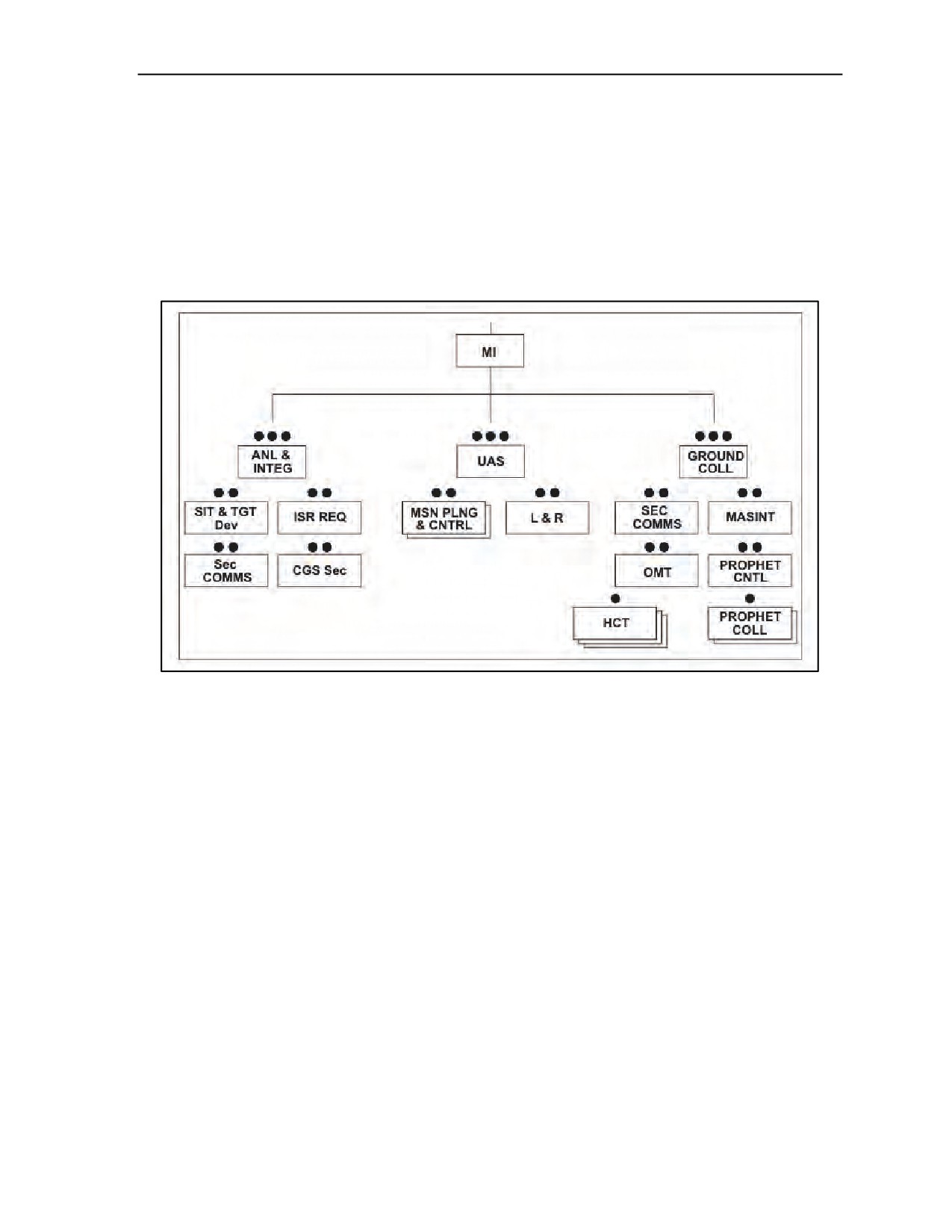
Augmenting Combat Power
control (TACON). HUMINT collection teams from the ground collection platoon may operate in direct
support of subordinate brigade elements in combat operations.
PERSONNEL AND EQUIPMENT
8-46. The organization of the MICO in the HBCT and IBCT is somewhat different than the organization of
the SBCT MICO. These companies contain a headquarters element, an analysis and integration platoon, a
TUAS platoon, and a ground collection platoon. They conduct ISR integration and intelligence production
in support of the brigade’s planning, preparation, and execution of multiple, simultaneous decisive actions
across the distributed AO (Figure 8-2).
Figure 8-2. Heavy and Infantry BCT military intelligence company
8-47. The SBCT MICO has an analysis platoon and an ISR integration platoon. It does not have a tactical
UAS platoon. The SBCT TUAS capability is found in the surveillance platoon of the reconnaissance
squadron.
COMPANY HEADQUARTERS
8-48. The MICO commander directs the employment of the company in accordance with assigned
missions and guidance from the brigade HQ. The MICO commander must position himself where he can
fulfill all of his command responsibilities best. This position could be in the brigade CP, or on site with a
HUMINT collection team. The commander’s location could also be at the reconnaissance squadron’s CP or
with a supported maneuver commander at a critical time and location on the battlefield. From any of these
locations, the MICO commander will conduct battlefield circulation, maintain situational awareness of all
teams’ positions, and perform required administrative functions.
8-49. The MICO CP usually is collocated with the brigade main tactical operations center (TOC) to
facilitate C2 of the company assets and to maximize BCT S-2 support. The MICO CP includes the
company headquarters element, the analysis and integration platoon, the TUAS platoon, and the ground
collection platoon. During brigade operations, the situation and target development section and ISR
requirements section are typically under OPCON of the BCT. Human intelligence collection teams of the
ground collection platoon may operate in direct support of a maneuver battalion, the reconnaissance
squadron, or even to their subordinate companies or troops.
14 September 2010
FM 3-90.6
8-9
Chapter 8
PLATOON HEADQUARTERS
8-50. The platoon headquarters usually is located where they can best C2 their platoon elements. All three
platoons--analysis and integration platoon, TUAS platoon, and ground collection platoon--usually are
collocated with the BCT S-2. Elements of the TUAS platoon and ground collection platoon could be
deployed anywhere in the AO.
ANALYSIS AND INTEGRATION PLATOON
8-51. The analysis and integration platoon provides the BCT S-2 analytical support. It consists of a
headquarters section, a situation and target development section, an ISR requirements section, a common
ground station section, and a satellite communications (SATCOM) )team. The ISR requirements section
and the situation and target development section collocate with the brigade main CP, and are OPCON to
the BCT S-2. They provide the BCT S-2 automated intelligence processing, analysis, and dissemination
capabilities as well as access to intelligence products of higher echelons.
TACTICAL UNMANNED AIRCRAFT SYSTEM PLATOON
8-52. The MICO in the HBCT and the IBCT, each have a TUAS platoon. In the SBCT, the surveillance
troop of the reconnaissance squadron has a TUAS platoon. The TUAS platoon consists of one mission
planning and control section, and one launch and recovery section. The platoon is equipped with four RQ-7
Shadow aircraft. The Shadow UAS enhances tactical level reconnaissance, surveillance, target acquisition,
and the commander’s battle damage assessment (BDA). All UAS missions are synchronized with the air
defense airspace management cell.
8-53. The RQ-7 Shadow is a small, lightweight TUAS. The system is comprised of air vehicles, modular
mission payloads, ground control stations, launch and recovery equipment, and communications
equipment. It carries enough supplies and spares for an initial 72 hours of operation. It is transportable in
two high-mobility multipurpose wheeled vehicles (HMMWV) with shelters, and two additional HMMWVs
with trailers as troop carriers.
8-54. The platoon includes three Shadow aircraft with a fourth aircraft as part of the issued equipment of
the maintenance section. The payload has a commercially available electro-optic and infrared camera, a
communications relay package module, and communications equipment for C2 and imagery dissemination.
Onboard global positioning system instrumentation provides navigation information.
GROUND COLLECTION PLATOON
8-55. The ground collection platoon contains a tactical HUMINT section and a Prophet control section.
The HUMINT section collects HUMINT through screening interrogations, debriefing contact operations,
and support to document and media exploitation activities. The HUMINT section coordinates and executes
HUMINT operations as directed by the brigade S-3 in coordination with the brigade S-2 and S-2X. The
Prophet control section coordinates and executes signals intelligence operations as directed by the brigade
S-3 in coordination with the brigade S-2. The HUMINT section contains human intelligence collection
teams that conduct source operations, write reports, and collect in support of their respective maneuver
unit’s intent and priority intelligence requirements (PIR). The human intelligence collection teams are
usually direct support to maneuver units in the area of operation. Each human intelligence collection team
is comprised of four team members and two interpreters. The operational management team manages the
teams, deconflicts sources, reports to the S-2X and justifies the use of the HCTs in the AO.
TROJAN SPIRIT LITE
8-56. The SATCOM team is responsible for integrating sensitive, compartmented information
(SCI)
communications into the existing network architecture using the TROJAN SPIRIT lite system. The
TROJAN SPIRIT lite, organic to the analysis and integration platoon, usually collocates with the BCT S-2
and the analysis and integration platoon during operations. The intelligence analysts assigned to the
TROJAN SPIRIT lite access the dedicated multilevel security, high-capacity communications link between
BCT CPs, theater, joint centers, national centers, and other intelligence organizations outside the BCT’s AO.
8-10
FM 3-90.6
14 September 2010
Augmenting Combat Power
They do this to pull intelligence products, receive and analyze routed direct downlinks, and access external
databases to fuse with organically collected information. The system also provides the opportunity for
secure, analytic collaboration externally to the BCT. The TROJAN SPIRIT lite also provides access to the
joint worldwide intelligence communications system through its joint deployable intelligence support
system.
BRIGADE WEATHER TEAM (USAF)
8-57. The brigade weather team of the USAF, when attached, provides the BCT with a weather prediction
and weather effects analysis capability. The brigade weather team:
z
Evaluates and applies operational weather squadron forecasts to specific brigade missions,
weapons systems, strategies, tactics, and applications; deploys with the brigade; and in general
provides both direct and indirect tailored customer support.
z
Provides meteorological support to brigade planning, training, deployment, employment, and
evaluation.
8-58. In addition to support to the S-2, the brigade weather team is the main source of weather support for
all brigade warfighting functions. As a member of the commander’s special staff, the staff weather officer
is responsible for coordinating operational weather squadron and service matters through the S-2. The staff
weather officer is the weather liaison between Army customers and the Air Force forecasting resources
developed at centralized (regional) production centers.
SECTION VI - INFORMATION ENGAGEMENT
8-59. Information engagement is the integrated employment of public affairs
(PA), MISO, combat
cameras, and leader and Soldier engagements to support both public information and diplomacy. This
section describes how the BCT and information-related augmentation units (e.g., tactical MISO teams)
accomplish information engagement. The S-7 coordinates information engagement with a staff
organization within the BCT dedicated to this role. The rest of the BCT staff coordinate other elements of
joint information operations such as:
z
Fires and command, control, communications, and computer operations staff elements
coordinate command and control warfare.
z
The command, control, communications, and computer operations section and the signal staff
officer (S-6) manage information protection.
z
Operations security (OPSEC) and military deception is an operations function
(S-3) with
intelligence support (S-2).
ORGANIZATION
8-60. Each BCT staff has a group of staff sections that contribute to information engagement (IE) activities
across the brigade. The lead staff section is the BCT S-7 who manages the information operations (IO) cell.
Other BCT elements that may contribute and collaborate on IE tasks are:
z
Public affairs.
z
MISO.
z
Civil affairs (CA) operations staff sections and teams.
z
Combat camera.
z
HUMINT collection teams.
z
Special operations liaison.
z
Criminal intelligence division liaison.
z
Host nation liaison and/or interpreter.
z
Contractor subject matter experts.
8-61. When so directed, these BCT elements form a working group to coordinate nonlethal operations. For
stability operations, information engagement staff may be supplemented by other officers out of the fires,
intelligence and/or sustainment staff elements. A smaller, but parallel staff organization for information
14 September 2010
FM 3-90.6
8-11
Chapter 8
engagement exists in most of the subordinate battalions of the BCT. In counterinsurgency operations,
company and even platoon HQ may organize a small element dedicated to coordinating information
engagement for their AOs. All echelons participate in collaborative, parallel, and multi-echelon planning
sessions within the information engagement working group. Staff officers coordinate information
engagement; leaders and Soldiers execute information engagement tasks.
ARMY INFORMATION TASKS
8-62. FM 3-0 directs how the Army conducts activities called IO at the joint level. The Army conducts
Army information tasks that reorganize joint IO responsibilities into:
z
Information engagement.
z
C2 warfare.
z
Information protection.
z
OPSEC.
z
Military deception.
PLANNING
ELEMENTS OF INFORMATION ENGAGEMENT
8-63. Information engagement supports the commander in achieving his end state through coordinating the
following:
z
Inform and educate internal and external publics.
z
Influence the behavior of target audiences.
8-64. Information engagement uses the following capabilities:
z
Leader engagement.
z
Soldier engagement.
z
Public affairs.
z
MISO.
z
COMCAM.
z
Strategic communications and defense support to public diplomacy.
LEADER AND SOLDIER ENGAGEMENT
8-65. Face-to-face interaction by leaders and Soldiers strongly influences the perceptions of the local
populace. Carried out with discipline and professionalism, day-to-day interaction of Soldiers with the local
populace among whom they operate has positive effects. Such interaction amplifies positive actions,
counters enemy propaganda, and increases goodwill and support for the friendly mission. Likewise,
meetings conducted by leaders with key communicators, civilian leaders, or others whose perceptions,
decisions, and actions will affect mission accomplishment can be critical to mission success. These
meetings provide the most convincing venue for conveying positive information, assuaging fears, inducing
cooperation, and refuting rumors, lies, and misinformation. Conducted with planning and preparation, both
activities often prove crucial in assessing the local situation, garnering local support for Army operations,
providing an opportunity for persuasion, and reducing friction and mistrust.
8-66. Soldier engagement includes tactical tasks such as:
z
Project a positive and stabilizing image to the population while on patrols or manning
checkpoints.
z
Assess the mood on the street among the population in the patrol report.
z
Pass written or oral messages to neighborhoods and businesses.
z
Collect information requirements related to information engagement.
z
Administer surveys to the local population.
8-12
FM 3-90.6
14 September 2010
Augmenting Combat Power
8-67. Leader engagement includes tactical tasks such as:
z
Talk with key contacts to discover local requirements and the power structures in place among
local society.
z
Establish points of contact between the leaders of each echelon of BCT forces and appropriate
levels of authority within the local leader network.
z
Negotiate with local leaders to gather information, pass on themes and messages, assess the
environment, and accomplish information engagement effects.
z
Manage relationships between the military and the diverse group of local leaders and the media
to accomplish the commander’s end state with respect to information engagement and popular
support.
z
Be the face of the U.S. military in the BCT AO (e.g., give press conferences, attend public
presentations, and accompany presence patrols).
PUBLIC AFFAIRS
8-68. PA is a commander’s responsibility to execute public information, command information, and
community engagement directed toward both the external and internal publics with interest in BCT
operations. PA proactively informs and educates internal and external publics through public information,
command information, and direct community engagement. Although all information engagement activities
are completely truthful, PA is unique. It has a statutory responsibility to factually and accurately inform
various publics without intent to propagandize or manipulate public opinion. Specifically, PA facilitates the
commander’s obligation to support informed U.S. citizenry, U.S. Government decision makers, and non-
U.S. audiences. Effective information engagement requires particular attention to clearly demarking this
unique role of PA by protecting its credibility. This requires care and consideration when synchronizing PA
with other information engagement activities. PA and other information engagement tasks are synchronized
to ensure consistency, command credibility, and OPSEC. The PA staff performs the following:
z
Advise and counsel the commander concerning PA.
z
Develop PA execution information.
z
Perform media facilitation.
z
Train the BCT on PA topics.
z
Coordinate community engagement.
z
Develop BCT communications strategies.
MILITARY INFORMATION SUPPORT OPERATIONS
8-69. MISO are planned operations that convey selected information and indicators to foreign audiences.
The purpose of MISO is to influence the audiences’ emotions, motives, objective reasoning, and ultimately
the behavior of foreign local governments, organizations, groups, and individuals in the BCT AO. The
MISO goal is to induce or reinforce local attitudes and behavior favorable to the BCT commander’s
objectives. Commanders focus MISO efforts on adversaries, their supporters, and their potential supporters.
They may integrate these capabilities into the operations process through information engagement and the
targeting process. Tactical MISO teams may be task-organized with BCT elements to perform information
engagement tasks.
COMBAT CAMERA
8-70. COMCAM is the acquisition and utilization of still and motion imagery in support of operations
involving the BCT. Such operations include combat, information, humanitarian, intelligence,
reconnaissance, engineering, legal, PA, and others. COMCAM teams generate still and video imagery in
support of BCT intelligence collection and information engagement activity. For example, COMCAM
teams can prepare products documenting Army tactical successes that counter enemy propaganda claiming
the opposite. It can provide targeted footage to media of BCT actions not observed by the civilian press.
14 September 2010
FM 3-90.6
8-13
Chapter 8
STRATEGIC COMMUNICATIONS AND DEFENSE SUPPORT TO PUBLIC DIPLOMACY
8-71. Strategic communications involves focused U.S. Government efforts to understand and engage key
audiences to create, strengthen, or preserve conditions favorable for the advancement of U.S. Government
interests, policies, and objectives. This is accomplished through the use of coordinated programs, plans,
themes, messages, and products synchronized with the actions of all instruments of national power (Joint
Publication [JP] 1-02). While U.S. leaders communicate some of this information directly through policy
and directives, they also shape the environment by providing access and information to the media. The
BCT commander supports strategic communications as required within his AO normally through public
affairs and leader engagement tasks.
8-72. Defense support to public diplomacy are those activities and measures taken by the BCT to support
and facilitate public diplomacy efforts of the U.S. Government representative. Defense support to public
diplomacy is a key military role in supporting the U.S. Government’s strategic communications program. It
includes peacetime military engagement activities conducted as part of combatant commanders’ theater
security cooperation plans. These higher headquarters requirements are often addressed using leader and
Soldier engagement, MISO, and PA tasks.
SECTION VII - CIVIL AFFAIRS ACTIVITIES
8-73. CA activities establish and maintain relations among U.S. military forces, host nation,
nongovernmental organizations (NGO), U.S. state department agencies, other U.S. Governmental agencies,
and the civilian population. Favorable relations among these participants facilitate BCT operations. CA
activities play a supporting role to information engagement and are a key element in stability operations.
Effective CA activity requires close cooperation with national, international, and local interagency partners.
These partners are not under military control. Many NGOs, for example, do not want to be too closely
associated with military forces because they need to preserve their perceived neutrality. Interagency
cooperation may involve a shared analysis of the problem building a consensus that allows synchronization
of military and interagency efforts. The military’s role is to provide protection, identify needs, facilitate CA
activity, and use improvements in social conditions as leverage to build networks and mobilize the
populace.
CIVIL AFFAIRS INTEGRATION INTO THE BRIGADE COMBAT
TEAM
8-74. The BCT CA staff officer (S-9) is responsible for CA activity planning. The S-9 usually conducts
collaborative planning as part of the information engagement working group or targeting working group.
The S-9 has a close working relationship with sustainment (including contracting) and engineer units
within the BCT for the conduct of CA projects. CA projects are usually tasks assigned to subordinate
commanders owning the AO. The BCT CA staff helps coordinate planning and support for these projects.
The BCT civil-military operations (CMO) also organizes the BCT civil-military operations center (CMOC).
8-75. Depending on the factors of METT-TC, the CA company HQ may participate in the BCT’s planning
processes if directed. Usually, the HQ is attached to the brigade for planning, operations, security, and
sustainment. CA teams often are attached to subordinate battalions to become their CA maneuver element
and their CMO staff element. Their role can include organizing battalion CMOCs.
CIVIL AFFAIRS UNITS
8-76. CA units are those units organized, trained and equipped to conduct CA operations. CA units provide
the commander with the means to shape his operational environment (OE) with regard to these significant
factors and to synchronize their actions with those of the military force. In addition, CA units perform
important liaison functions between the military force and the local civil authorities, international
organizations, and NGOs. A CA company may be attached to support a BCT (Figure 8-3).
z
CA personnel engage in a variety of CA operations in fulfillment of CA core tasks. CA elements
can assess the needs of civil authorities, act as an interface between civil authorities and the
military supporting agency, and as liaison to the civil populace. They can develop population
and resource control measures and coordinate with international support agencies.
8-14
FM 3-90.6
14 September 2010
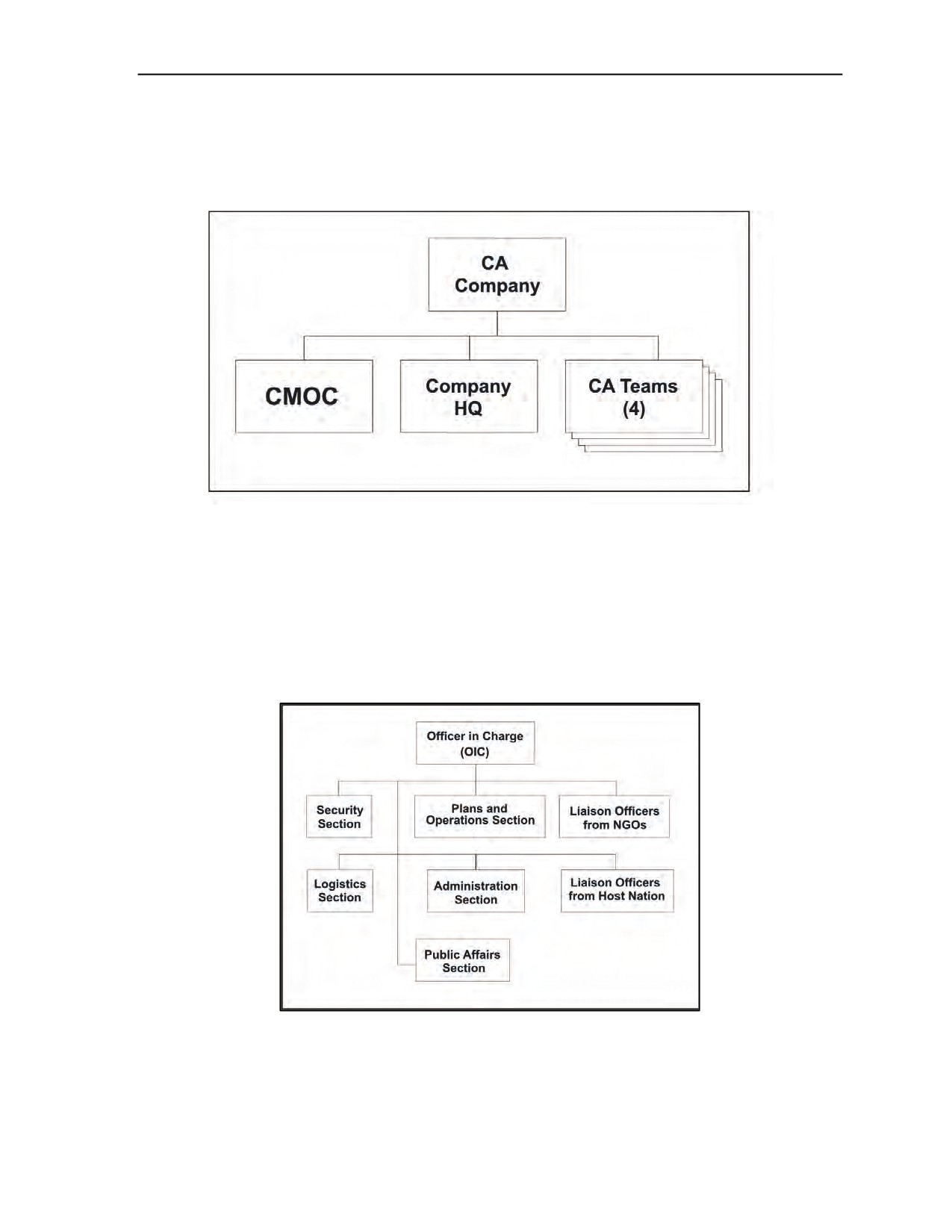
Augmenting Combat Power
z
CA unit personnel are regionally oriented and possess cultural and linguistic knowledge of the
countries in each region. With guidance from the commander on desired effects, CA personnel
have a wide variety of resources at their disposal to influence the AO. CA is a combat multiplier
in this sense. In addition, the civilian skills that reserve component CA units possess enable them
to assess and coordinate infrastructure activities. See FM 3-05.401 for more details.
Figure 8-3. Civil affairs company
CIVIL-MILITARY OPERATIONS CENTER
8-77. A CMOC is a coordination center that any commander establishes when required. CMOCs assist in
coordinating the activities of the commander’s military forces, other U.S. Government agencies, NGOs,
and other international organizations. There is an established CMOC structure, but its size and composition
are situation dependent (Figure 8-4). The CMOC serves as the primary center for synchronizing military
operations with the operations of nonmilitary organizations. During transition from military to civilian
control, the CMOC can serve as a source of operational continuity and a facilitator to the transition process.
Figure 8-4. Basic civil-military operations center structure
8-78. A CMOC has an OIC or a noncommissioned officer in charge (NCOIC) who is responsible for
overall management of CMOC operations. The BCT commander may assign his S-9 as the OIC if there is
no CA company in support. Depending on METT-TC, the OIC/NCOIC might be from an attached CA unit,
a senior civilian, or a foreign military officer.
14 September 2010
FM 3-90.6
8-15
Chapter 8
8-79. The CMOC typically has both civilian-related and military-related staff sections:
z
The public affairs branch handles media inquiries to coordinate the release of information to the
public with the information engagement staff officer
(S-7), and to synchronize CMOC
information with the BCT’s S-9 section.
z
The security branch manages the various aspects of security (physical, operations, personnel,
and information) inherent to CMOC operations.
z
Liaison officers or representatives are on-site CMOC contacts for both military and civilian
agencies and/organizations.
z
The plans and operations section maintains the current status of projects and routes used by CA
activities.
z
The logistics section maintains a database of all points of contact and host nation resources that
can be used for military or humanitarian purposes (e.g., facilities, transportation assets, goods,
services). Generally, this section tracks costs incurred by military forces and other agencies
participating in CA activities. It often includes a contracting officer element.
8-80. The administration section focuses on internal CMOC activities and personnel issues that include:
z
Maintaining access rosters and identification systems for the CMOC.
z
Conducting CMOC meetings, minutes, and scheduling.
z
Processing and archiving required reports.
z
Creating recognition documents and certificates.
z
Maintaining adequate levels of supplies for use in CMOC operations (e.g., office supplies, fuel,
batteries, and light bulbs).
z
Managing operator-level maintenance on vehicles, communications, and generator equipment.
8-81. The establishment of a CMOC must be a carefully considered balance between security and utility.
Facilities and information systems (INFOSYS) must be procured and sustained, and security provided for
personnel, equipment, and information. It can be located at a convenient local government facility centrally
located to CA requirements or on the edge of a friendly forces perimeter where it can be secured but is still
accessible to non-military personnel. The BCT HQ usually establishes at least one CMOC, and often each
battalion will establish a CMOC as well when it owns part of the AO. In some cases, company HQ may
establish a small CMOC to help conduct CA in their AO.
SECTION VIII - COMMAND AND CONTROL INFORMATION SYSTEMS
8-82. C2 information systems are more critical now than in the past due to increasing bandwidth
requirements at increasingly lower levels of the command. The BCT commander must consider the
reliability of communications in determining the level of acceptable risk when allocating network
operations elements during an operation. The correct placement of limited communications resources
provides the BCT with the capability to transfer great volumes of information at high rates of speed to all
the required recipients.
BRIGADE SIGNAL COMPANY
8-83. The brigade signal company is organic to the BCT and provides the primary communications support
to the brigade. The brigade signal company deploys, installs, operates, and maintains the C2 networks that
support brigade operations and integrate with external networks. The headquarters and network support
platoon and the network extension platoons are the operational arms of the company. They deploy and
operate the brigade transmission and switching systems to provide voice, data, and network installation and
management support:
8-84. The brigade signal company:
z
Provides reach back connectivity through the division HQ.
z
Provides range extension of the brigade’s communications services.
z
Provides network management.
z
Establishes CP voice and/or video capabilities.
z
Performs limited signal electronic maintenance.
8-16
FM 3-90.6
14 September 2010
Augmenting Combat Power
8-85. Each brigade signal company has two network extension platoons. Each platoon consists of a joint
network node section and an extension section. These elements enable the BCT with line of sight and
beyond line of sight connectivity to provide unclassified, secret, and top secret/sensitive compartmentalized
information (TS/SCI) voice and data, tactical network coverage, and command post support in the BCT
AO. Usually one network extension platoon is located at the BCT main CP and one at the brigade support
battalion (BSB) CP.
8-86. The brigade signal company, company HQ consists of the command section, the wireless network
extension team, and a small CP support team.
z
Command section. The command section consists of the company commander, first sergeant,
and supply NCO. The command section is responsible for the administration and logistics
support for the company.
z
Wireless network extension team. The wireless network extension team provides beyond line of
sight connectivity for the various CPs and command and control nodes.
z
CP support team. Generally the CP support team deploys with the BCT tactical command post
(TAC CP) to provide communications connectivity that is similar to, but on a lesser scale than,
the network extension that platoons provide to the main and BSB CPs.
NETWORK SYSTEMS PLANNING
8-87. The S-6 must conduct an electronic preparation of the battlefield
(EPB) early enough for the
commander to make informed decisions about assigning missions to reconnaissance and surveillance assets
and, subsequently, to maneuver forces. A risk analysis based on the recommended network architecture is
critical to the EPB.
8-88. The commander must incorporate the EPB into his decision-making process early enough to
understand the limitations in communications when planning the maneuver for his unit. The commander
must also indicate what his critical information requirements are in order for the S-6 to ensure
infrastructure support to that requirement. The S-6 refines the initial EPB as the commander decides what
risks he will accept in command, control, communications, and computer operations. The S-6 plans the area
of operations’ coverage with the available networks. The S-6 identifies any shortfalls in communications
coverage, and notifies the S-3 and commander. The commander's estimate of critical information
requirements determines the refinement of coverage.
8-89. Adapting the network systems plan to the priorities set by the commander requires close coordination
by the S-6 with other staff members and particularly with the executive officer (XO). The XO determines
the priority of information being passed, and the S-6 provides the transport path for that information. The
XO must ensure the S-6 is aware of the information priorities at all times, and the S-6 must ensure the XO
is aware of the system limitations and capabilities. The BCT commander expresses his standard operating
procedures for information management in the command information management plan, which the S-6
maintains.
8-90. The signal annex must provide clear understanding of the unit's communications architecture, and
how it will operate on the battlefield. A number of information presentation styles are effective: text,
preformatted templates, and matrixes. The annex must incorporate all communications resources. The way
to do this best is to provide the commander with a signal concept sketch. The graphic presentation provides
the commander with a clear and concise understanding of the communications plan. Critical elements
include concept of communications, command post locations, and tactical range extension locations. The
S-6 must capture information for the complete task organization to portray an accurate picture.
14 September 2010
FM 3-90.6
8-17
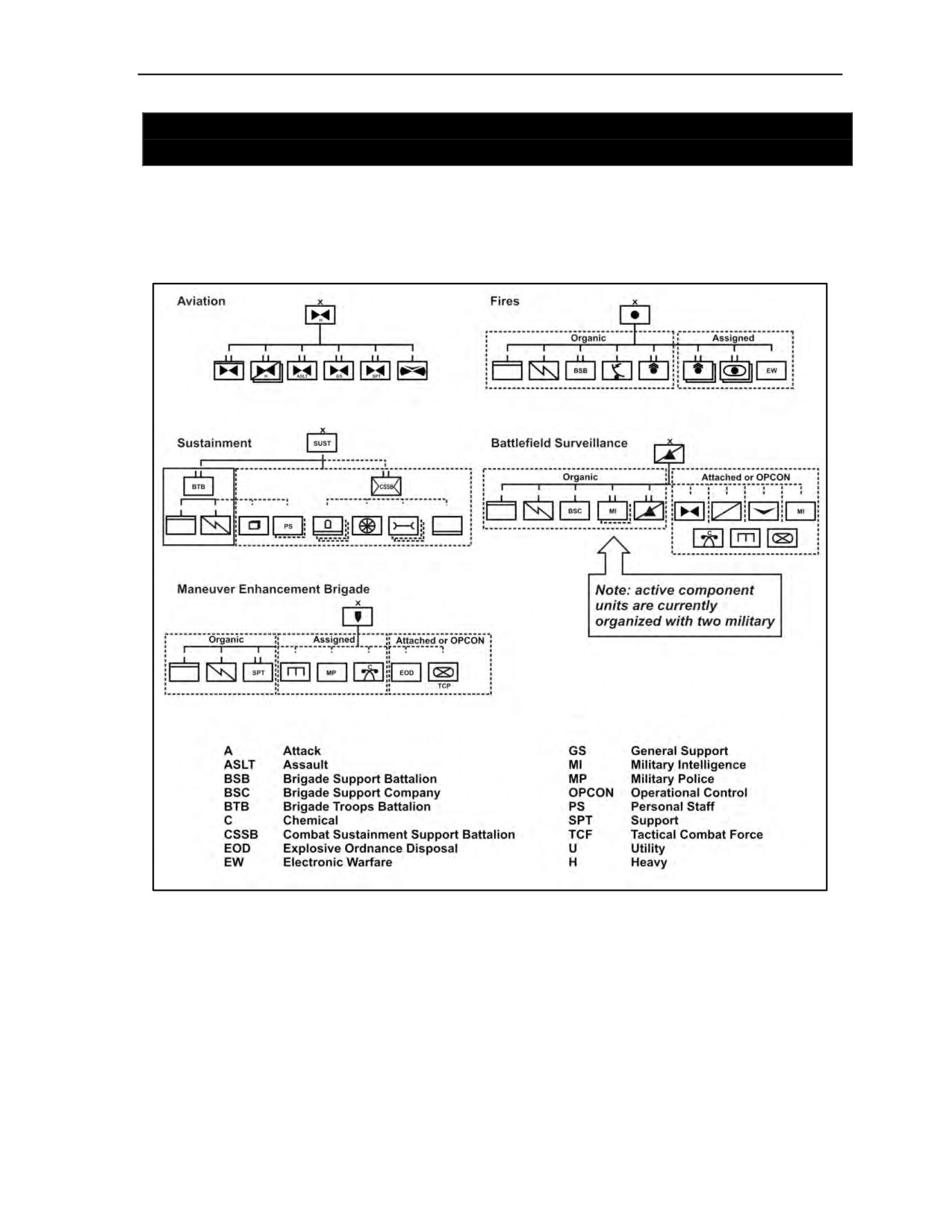
Chapter 8
SECTION IX - EXTERNAL AUGMENTATION TO THE BRIGADE COMBAT
TEAM
SUPPORT AND FUNCTIONAL BRIGADES
8-91. A mix of other brigade types supports the BCT and carries out specific tasks in support of echelons
above BCT. The five supporting brigade types are the battlefield surveillance brigade (BFSB), fires
brigade, combat aviation brigade, MEB, and sustainment brigade (Figure 8-5).
Figure 8-5. Support brigades
BATTLEFIELD SURVEILLANCE BRIGADE
8-92. The BFSB primarily conducts reconnaissance and surveillance (including MI discipline collection)
tasks. It can be assigned to support a division, corps, joint task force (JTF), other Service, or a multinational
force. The information it collects focuses on the enemy, terrain and weather, and civil considerations
factors of METT-TC to feed the COP. BFSB collection efforts focus on unassigned areas in a higher or
supported HQ’s AO. The supported commander assigns the BFSB an AO. The BFSB commander does not
control BCT reconnaissance and surveillance assets. Each BCT retains control of its organic collection
assets and collects information in its assigned AO.
8-18
FM 3-90.6
14 September 2010