FM 390.6 Brigade Combat Team (September 2010) - page 3
Defensive Operations
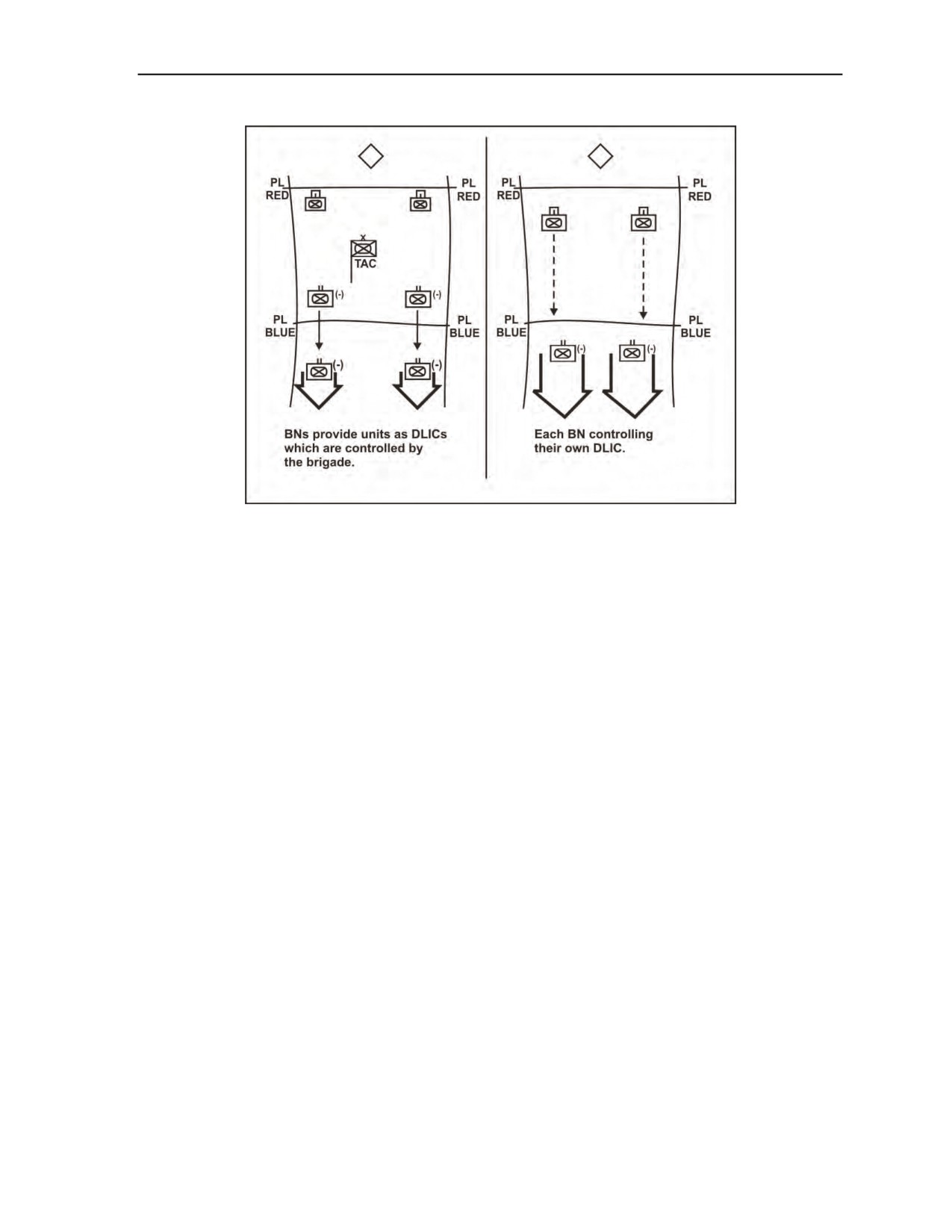
Figure 3-9. Method for organizing the detachment left in contact
3-126. The main body consists of all elements except the security force and reserve. The main body
withdraws along pre-designated routes to its final destination. The main body maintains all-around security
during the withdrawal and movement.
3-127. The reserve provides the BCT with the flexibility to deal with unexpected enemy actions. The
reserve may take limited offensive action such as spoiling attacks to disorganize or disrupt the enemy. It
can counter enemy attacks, reinforce threatened areas, and protect withdrawal routes.
3-128. The commander develops his vision of the battle based on withdrawing under enemy pressure. He
must determine the composition and strength of the security force, main body, and reserve. The commander
must clearly define how he intends to deceive the enemy by executing a withdrawal; how he intends to
disengage from the enemy (use of maneuver, fires, and obstacles); and the end state of the operation in
terms of time, location, and disposition of forces.
Disengagement
3-129. The security force remains in position and maintains a deception while the main body moves as
rapidly as possible rearward to intermediate or final positions. After the main body withdraws a safe
distance, the commander orders the security force to begin its rearward movement. Once the security force
begins moving, it assumes the duties of a rear guard. If the enemy is not pursuing the BCT, the security
force can move in a march column.
3-130. The main body moves rapidly on multiple routes to designated positions. It can occupy a series of
intermediate positions before completing the withdrawal. Usually sustainment units, along with their
convoy escorts, move first and precede combat units in the withdrawal movement formation. The staff
enforces the disciplined use of routes during the withdrawal. Despite confusion and enemy pressure,
subordinate units must follow specified routes and movement times.
Terminating the Withdrawal
3-131. Once the BCT successfully disengages from the enemy, it usually has the following options:
z
Rejoin the overall defense under favorable conditions.
z
Transition into a retirement.
14 September 2010
FM 3-90.6
3-27
Chapter 3
z
Continue moving away from the enemy and towards its next mission.
z
The higher HQ define the BCT’s next mission. Follow-on missions usually are planned as the
BCT is preparing for, or executing, the withdrawal.
RETIREMENT
3-132. A retirement is a retrograde operation in which a force that is not in contact with the enemy moves
to the rear in an organized manner. The BCT usually conducts a retirement to reposition for future
operations. The BCT usually organizes into security elements and a main body. The formation and number
of columns employed depend on the number of available routes and the potential for enemy interference.
The commander typically wants to move his major elements to the rear simultaneously. During a
retirement, the BCT usually moves to an assembly area to prepare for future operations. The elements of
the BCT move in accordance with established movement times and routes. Strict adherence to the
movement plan is essential to avoid congestion. The staff closely supervises the execution of the movement
plan. Sustainment and assets (units) not attached or organic to the maneuver battalions/CABs or separate
companies usually move to the rear first, followed by combat forces.
SECTION III - TRANSITIONS
3-133. During the planning for any operation, the BCT commander and staff must discern from the higher
HQ operations order (OPORD) what the potential follow-on missions are and begin to plan how they
intend to achieve them. Whether the BCT is concluding an offensive or defensive operation, it must pause
to consolidate and reorganize before the next operation. If required, the commander decides the best time
and location that facilitates future operations and provides protection. The BCT must maintain a high
degree of security when performing consolidation and reorganization activities.
CONSOLIDATION
3-134. Consolidation is the process of organizing and strengthening a newly occupied position. The BCT
might need to consolidate in order to reorganize, avoid culmination, prepare for an enemy counterattack, or
allow time for movement of adjacent units. Consolidation is planned for every mission. Actions during
consolidation include:
z
Maintain contact with the enemy and conduct reconnaissance.
z
Establish security consistent with the threat.
z
Eliminate pockets of enemy resistance.
z
Position forces to enable them to conduct a hasty defense by blocking possible enemy
counterattacks.
z
Clear obstacles or improve lanes to support friendly movement and reorganization activities.
z
Plan and prepare for future operations.
3-135. The BCT maintains contact with the enemy by redirecting reconnaissance and surveillance assets,
directing small-unit patrols, and possibly conducting limited objective attacks. In some situations, the BCT
might leave a small force to control key terrain or complete clearing the objective while the remainder of
the BCT transitions to a new mission.
REORGANIZATION
3-136. Reorganization refers to all measures taken to maintain the combat effectiveness of the BCT or
return it to a specified level of combat capability. All units undertake reorganization activities during
operations, as the situation allows, to maintain combat effectiveness. More extensive reorganization is
usually conducted after the BCT defeats an enemy attack. Reorganization tasks usually include:
z
Establish security consistent with the threat. This may include moving forces, adjusting
boundaries, changing task organization, and adjacent unit coordination.
z
Destroy or contain enemy forces that still threaten the BCT.
z
Replace or shift reconnaissance and surveillance assets, if needed.
3-28
FM 3-90.6
14 September 2010
Defensive Operations
z
Reestablish the BCT chain of command, key staff positions, and C2 facilities lost during the
battle.
z
Treat and evacuate casualties.
z
Redistribute ammunition, supplies, and equipment as necessary.
z
Conduct emergency resupply and refueling operations.
z
Recover and repair damaged equipment.
z
Send relevant logistics and battle reports by digital means and voice (if not digitally equipped).
z
Process enemy prisoners of war (EPW) and detainees as required.
z
Repair/emplace additional obstacles and improve/construct additional fighting positions.
z
Repair/restore critical routes within the BCT AO to assure mobility of the force.
z
Reposition C2 facilities, communications assets, logistics, and fire support assets for future
operations.
CONTINUING OPERATIONS
3-137. At the conclusion of an engagement, the BCT may continue the defense, or if ordered, transition to
offensive or stability operations. The BCT commander considers the higher commander’s concept of
operations, friendly capabilities, and the enemy situation when making this decision. All missions should
include plans for exploiting success or assuming a defense.
OFFENSE
3-138. Higher headquarters may order the BCT to conduct a hasty attack, movement to contact, or
participate in exploitation. In some cases, the defensive operation might immediately transition into a
pursuit. If reorganization is required, the BCT maintains pressure on the enemy through artillery, CAS,
and/or limited objective attacks.
STABILITY OPERATIONS
3-139. BCT commanders must ensure that transitions from defensive operations to stability operations
and vice versa are planned. For example, it may be tactically wise for commanders to plan a defensive
contingency with on-order offensive missions for certain stability operations that could deteriorate.
Subordinate commanders and leaders must be fully trained to recognize activities that would initiate this
transition. Commanders, staffs, and Soldiers must be aware that elements of the BCT could be conducting
offensive, defensive, and stability operations simultaneously within a small radius of each other. Actions in
one unit’s AO can affect a change in whatever type operation an adjacent unit is conducting. For example,
an offensive operation may result in displacing noncombatants to another section of the city, thus creating
stability operations for the unit in that AO.
14 September 2010
FM 3-90.6
3-29
This page intentionally left blank.
Chapter 4
Stability Operations
Stability operations are a fundamental aspect of Brigade Combat Team (BCT) full
spectrum operations. Stability operations focus activity on maintaining or
reestablishing a safe and secure environment, and on providing essential services,
emergency infrastructure reconstruction, and humanitarian relief. They lead to an end
state that, in support of a legitimate government, enables these activities to facilitate
other instruments of national power. Stability operations can be conducted
simultaneously with offensive or defensive operations, tasks, and activities in which
the needs of the population must be addressed immediately. In some situations,
stability operations may be the predominant activity in the BCT area of operations
(AO). The primary characteristic of stability operations is the focus on nonlethal
support, in conjunction with non-military organizations, for the civilian population
backed up by lethal and nonlethal security activity.
SECTION I - OVERVIEW
4-1. Stability operations encompass various military missions, tasks, and activities conducted outside the
United States in coordination with other instruments of national power to maintain or reestablish a safe and
secure environment, provide essential governmental services, emergency infrastructure reconstruction, and
humanitarian relief. Stability operations:
z
Leverage the coercive and constructive capabilities of the BCT to establish a safe and secure
environment.
z
Facilitate reconciliation among local or regional adversaries.
z
Establish political, legal, social, and economic institutions within the BCT AO.
z
Facilitate the transition of responsibility to a legitimate civilian authority.
RESPONSIBILITIES
4-2. The primary responsibility for providing basic civil functions rests with the host nation government
or civilian organizations. When this is not possible, the BCT establishes basic civil functions within its area
of operations and protects them until a civil authority can provide these services for the local populace. The
BCT performs specific functions in support of a broader effort by other government and nongovernment
organizations.
TASKS
4-3. The stability operations framework helps the BCT determine the required training and task
organization of forces prior to initial deployment, and serves as a guide to action in stability operations (FM
3-07). This framework encompasses the tasks that the BCT expects to perform during stability operations.
The tasks performed during stability operations may be framed as:
z
Initial response tasks. These tasks generally reflect activity executed to stabilize the area of
operations in a crisis state. The BCT typically performs initial response tasks during, or directly
after, a conflict or disaster in which the security situation prohibits the introduction of civilian
personnel. Initial response tasks aim to provide a secure environment that allows relief forces to
attend to the immediate humanitarian needs of the local population. They reduce the level of
violence and human suffering while creating conditions that enable other actors to participate
14 September 2010
FM 3-90.6
4-1
Chapter 4
safely in relief efforts. Examples of other actors are joint interagency, intergovernmental,
multinational (JIIM) agencies, nongovernmental organizations, and contractors.
z
Transformation tasks. These tasks represent the broad range of stabilization, reconstruction,
and capacity-building performed in a relatively secure environment. Transformation phase tasks
take place in either crisis or vulnerable states. These tasks aim to build host-nation capacity
across multiple sectors. While establishing conditions that facilitate broad unified action to
rebuild the host nation and its supporting institutions, these tasks are essential to ensuring the
continued stability of the environment.
z
Fostering sustainability tasks. These are tasks that encompass long-term efforts, which
capitalize on capacity building and reconstruction activities. Successful accomplishment of these
tasks establishes conditions that enable sustainable development. Usually military forces
perform fostering sustainability phase tasks only when the security environment is stable enough
to support efforts to implement the long-term programs that commit to the viability of the
institutions and economy of the host nation. Often military forces conduct these long-term
efforts to support broader, civilian-led efforts.
4-4. Stability operations consist of five primary tasks the BCT may be assigned to perform or support:
z
Establish civil security.
z
Establish civil control.
z
Restore essential services.
z
Provide support to governance.
z
Provide support to economic and infrastructure development.
SECTION II - BRIGADE COMBAT TEAM STABILITY TASKS
4-5. Success in stability operations depends on the commander’s ability to identify the tasks essential to
mission success from the wide range of possible stability tasks. Success also depends on prioritizing and
sequencing the execution of those tasks with available combat power, the diverse array of actors
participating, and the ability of the population in the AO to accept change. Stability operations require
commanders to demonstrate a knowledge of the local culture to determine which stability tasks are
essential to mission success. Essential stability tasks may not become clear until the BCT has occupied the
area and performed reconnaissance to identify local requirements.
4-6. The BCT may be directed to conduct any of the stability tasks, but may require augmentation to
perform them. Additionally, a description of the full list of primary stability tasks is provided since BCTs
may be required by their headquarters to execute these tasks as well. For more detail on stability tasks, see
FM 3-07.
ESTABLISH CIVIL SECURITY
4-7. Establishing a safe, secure, and stable environment for the local populace within the BCT area of
operations is a key to obtaining their support for the overall operation. Such an environment allows the
introduction of the civilian agencies and organizations whose efforts ensure long-term success. When the
people have confidence in the security sector providing for their safety, they offer the cooperation required
to control crime and subversive behavior, defeat insurgents, and limit the effects of adversaries. For
political and economic reform to be successful, people, commodities, and currency must be able to freely
flow throughout the region.
4-8. The BCT can conduct civil security tasks without significant augmentation. These tasks are
characterized by the use of area security, site exploitation operations, civil-military operations, and
information engagement tactics, techniques, and procedures (TTP) as described in other areas of this
manual.
4-2
FM 3-90.6
14 September 2010
Stability Operations
4-9.
Subcategory tasks the BCT might be directed to perform include:
z
Enforce cessation of hostilities, peace agreements, and other arrangements.
Enforce cease fires.
Supervise disengagement of belligerent forces.
Identify and neutralize potential adversaries.
Provide security for negotiations.
Protect and secure strategically important institutions
(such as government buildings;
medical and public health infrastructure; the central bank, national treasury, and integral
commercial banks; museums; and religious sites).
Protect and secure military depots, equipment, ammunition dumps, and means of
communications.
Identify, secure, protect, and coordinate the disposition of stockpiles of munitions and
chemical, biological, radiological, and nuclear (CBRN) materiel and precursors; facilities;
and adversaries with technical expertise.
Build local host nation capacity to protect civilian reconstruction and stabilization
personnel.
Build host nation capacity to protect infrastructure and public institutions.
Build host nation capacity to protect military infrastructure.
Protect host nation high risk personnel necessary for governance and security.
z
Clear explosive and CBRN hazards.
Conduct emergency clearing of mines, unexploded ordnance (UXO), and other explosive
hazards.
Map, survey, and mark mined areas, UXO, and other explosive hazards.
Remediate hazards remaining from the release of CBRN hazards and radiological fallout, as
well as provide decontamination support.
Create local host nation capacity to conduct de-mining.
Initiate a deliberate process to warn and alert the local population to dangers of UXO.
Note. The John Warner National Defense Authorization Act limits the assistance that military
forces may provide with respect to de-mining. The BCT may assist and train others in de-mining
techniques and procedures. However, no member of the armed forces—while providing
humanitarian de-mining assistance—will engage in the physical detection, lifting, or destroying
of landmines or other explosive remnants of war. The exception to this rule is if the member
does so for the concurrent purpose of supporting a U.S. military operation, such as route or area
clearance. Nor will any member provide such assistance as part of a military operation that does
not involve the armed forces.
ESTABLISH CIVIL CONTROL
4-10. Civil control regulates selected behavior and activities of individuals and groups. It reduces risk to
individuals or groups, and promotes security. Initial response tasks aim to develop interim enforcement
mechanisms for establishing rule of law. These tasks typically involve assessing and building indigenous
police, and penal capacity and capability. Transformation tasks focus on restoring the justice system and
processes for reconciliation. Fostering sustainability tasks serve to establish a legitimate, functioning justice
system founded on international norms. These conditions define success within the AO while reflecting the
end state needed to ensure the foundation for enduring stability and peace. The BCT should expect
substantial augmentation by civil affairs and military police elements to conduct this primary stability task
properly.
4-11. Subcategory tasks the BCT may be directed to perform include:
z
Establish public order and safety.
z
Establish interim criminal justice system.
14 September 2010
FM 3-90.6
4-3
Chapter 4
z
Support law enforcement and police reform.
z
Support judicial reform.
z
Support property dispute resolution processes.
z
Support legal system reform.
z
Support human rights initiatives.
z
Support corrections reform.
z
Support war crimes courts and tribunals.
z
Support public outreach and community rebuilding programs.
z
Determine disposition and constitution of national armed and intelligence services.
Implement a plan for disposition of local security forces, intelligence services, and other
local security institutions.
Identify future roles, missions, and structure for multinational forces in the BCT AO.
Evaluate senior officers and other individuals for past abuses and criminal activity.
Conduct security force assistance (includes training of host nation military and police
forces.
Build local host nation capacity to protect military infrastructure in the AO.
Establish security institutions in the AO.
Support military training and cooperation programs with host nation forces and services.
z
Disarmament, demobilization, and reintegration.
Negotiate arrangements with belligerents using leader engagement tasks. See Chapter 8 for
a discussion of leader engagement tasks.
Establish and enforce weapons control programs including collection and destruction.
Provide reassurances and incentives for disarmed factions.
Establish a monitoring program.
Establish internment camps for demobilization.
Ensure adequate health, food, and security for belligerents.
Disarm former combatants and belligerents.
Reduce availability of unauthorized weapons.
Ensure safety of quartered personnel and families.
Secure, store, and dispose of weapons.
Develop host nation arms control capacity.
Reintegrate former combatants and dislocated civilians into society.
Identify and separate extremists.
z
Conduct border control, boundary security, and freedom of movement.
Establish border control and boundary security.
Establish, disseminate, and enforce rules relevant to movement.
Dismantle roadblocks and establish checkpoints.
Ensure freedom of movement.
Train and equip border control and boundary security forces.
Position sustainment areas, bases, and facilities for protection and rapid movement.
z
Support identification.
Secure documents relating to personal identification, property ownership, court records,
voter registries, professional certificates, birth records, and driving licenses. See FM
3-90.15 for information on site exploitation.
Establish an identification program.
Ensure individuals have personal forms of identification.
Support the development of mechanisms for long-term dispute resolution over property
rights and family or group affiliations within the AO.
Ensure that host nation authorities are credentialed or uniformed as needed.
4-4
FM 3-90.6
14 September 2010
Stability Operations
z
Protect key personnel and facilities.
Protect government-sponsored civilian reconstruction and stabilization personnel.
Protect contractor and civilian reconstruction and stabilization personnel and resources in
the AO.
Provide emergency logistics support, as required.
Protect and secure places of religious worship and cultural sites.
Protect and secure critical infrastructure, natural resources, civil registries, and property
ownership documents.
RESTORE ESSENTIAL SERVICES
4-12. The activities associated with this primary stability task extend beyond simply restoring local civil
services and addressing the effects of humanitarian crises. While the BCT generally centers efforts on the
initial response tasks for immediate needs of the populace, other civilian agencies and organizations focus
on broader humanitarian issues. Normally, the BCT supports host nation and civilian relief agencies with
these efforts. However, when the host nation cannot perform its roles, the BCT may execute these tasks
directly. The BCT need not wait for large-scale projects that require complicated national-level efforts to
sustain them when the necessary infrastructure is not yet in place to support such an effort. The BCT and
other actors should begin ground level restoration efforts as soon as requirements in their AO surface that
can be addressed with the resources available and within the constraints of the current security
environment. The performance of this primary stability task is characterized by substantial interaction and
cooperation with a wide range of JIIM, nongovernmental organizations (NGO), and contractor elements.
The BCT engineer coordinator (ENCOORD) can coordinate the capabilities of the U.S. Army Corps of
Engineers (USACE) field force engineering to help in the restoration of essential services. Subcategory
tasks the BCT may be directed to perform include:
z
Provide essential civil services.
z
Perform tasks related to civilian dislocation.
z
Support famine prevention and emergency food relief programs.
z
Support shelter and relief programs other than food relief programs.
z
Support humanitarian de-mining.
z
Support public health programs.
z
Support education programs.
SUPPORT TO GOVERNANCE
4-13. When a legitimate and functional local government is present in the AO, the BCT operating in
support of local governance has a limited role. However, if the local government cannot adequately
perform its basic civil functions—for whatever the reason—some degree of military support to governance
may be necessary. A government’s legitimacy among its people is tied in part to its perceived ability to
provide these essential services. In extreme cases, the civil government may be completely dysfunctional or
absent altogether. In such cases, international law requires the military force to provide the basic civil
administration functions of the host nation government under the auspices of a transitional military
authority. FM 3-07 describes various aspects of transitional military authority, including its legal basis,
command responsibilities, organizing principles, guidelines, the role of courts, and claim processes.
Performing this primary stability task requires extensive civil affairs support.
4-14. Subcategory tasks the BCT may be directed to perform include:
z
Support transitional administrations.
z
Support development of local governance.
z
Support anticorruption initiatives.
z
Support elections.
14 September 2010
FM 3-90.6
4-5
Chapter 4
SUPPORT TO ECONOMIC AND INFRASTRUCTURE
DEVELOPMENT
4-15. The BCT owning an AO may be required to support local economic and infrastructure development.
This can require augmentation by civil affairs and financial management elements, and is characterized by
extensive interaction with JIIM organizations, NGOs, and contractors. Subcategory tasks the BCT may be
directed to perform include:
z
Support economic generation.
z
Support monetary institutions and programs.
z
Support national treasury operations.
z
Support public sector investment programs.
z
Support private sector development.
z
Protect natural resources and environment.
z
Support agricultural development programs.
z
Restore transportation infrastructure.
z
Restore telecommunications infrastructure.
z
Support general infrastructure reconstruction programs.
4-16. BCT-funded jobs programs are a common method to stimulate the local economy and to reduce
causes of local violence. Developing the public sector is usually managed by organizations such as the
United States Department of State (DOS) and the United States Agency for International Development.
Developing the private sector typically begins with employing large portions of the labor force. The
agricultural sector is a cornerstone of a viable market economy providing crops and livestock vital to local
markets. FM 3-07 gives a full discussion of the activities that may be performed or supported by the BCT if
the commander determines that these stability tasks are required.
SECTION III - CONSIDERATIONS FOR STABILITY OPERATIONS
4-17. The expeditionary capabilities of the BCT enable it to move promptly into any operational
environment. In an operational environment with unstable security conditions, where the host nation
government is unable to function effectively, the BCT may be the only substantial stabilizing presence. In
these conditions, the BCT is organized and prepared to perform all the tasks essential to establishing and
maintaining civil security and civil control, while providing the essential needs of the populace. In many
situations, local and international aid organizations will be present in the operational area but may have
limited access to the population. The BCT can significantly contribute to increasing the access of these aid
organizations, enabling them to provide essential humanitarian assistance to the civilian population. In turn,
this reduces a substantial logistic burden on the BCT, allowing it to focus on providing a safe, secure
environment.
4-18. Stability operations support the complete range of joint military operations, operational themes, and
the full spectrum of conflict. Many types of operations (e.g., counterinsurgency) rely extensively on
stability operations due to their focus on the population. However, the BCT may execute stability
operations throughout the spectrum of conflict whenever it is too dangerous for less armed and protected
forces to do so. This implies a level of combat readiness inherent to all stability activities against threats
ranging from civilian lawlessness to highly organized insurgents.
4-19. All stability tasks such as policing, intelligence, civil-military operations (CMO) and trash collection
involve working with other U.S. government agencies and host nation partners. Soldier training for these
operations is enhanced by briefings from the DOS, aid agencies, and the local police or fire departments.
Units use cultural advisors from those who come from that nation or culture to get advice concerning local
issues. Military operations create the environment for civilian agencies to achieve needed long-term
development and stabilization.
4-6
FM 3-90.6
14 September 2010
Stability Operations
LETHAL AND NONLETHAL ACTIONS
4-20. During full spectrum operations, a complementary relationship exists between the BCT’s lethal and
nonlethal actions. Every situation requires a different combination of violence and restraint. Nonlethal
actions are vital contributors to all operations but may be decisive in the execution of stability tasks.
Determining the appropriate combination of lethal and nonlethal actions necessary to accomplish the
mission is an important consideration for every commander. Nonlethal actions expand the options available
to commanders to achieve their objectives. Conditions may limit the conduct of lethal actions, and forces
must be organized appropriately to reflect this change in emphasis. At tactical levels, the line between
lethal and nonlethal activities can be blurred and expressed as rules of engagement or security force
assistance. Most stability tasks conducted by military forces have elements of both lethal and nonlethal
capabilities, and mission planning should consider this expectation.
4-21. BCTs have a potent combination of lethal and nonlethal capabilities. The mere presence of military
forces often influences human behavior, as demonstrating the potential for lethal action helps to maintain
order. Maintaining order is vital to establishing a safe, secure environment. Even though stability
operations emphasize nonlethal actions, the ability to engage potential adversaries with decisive lethal force
remains a sound deterrent and is often a key to success. The successful application of lethal capabilities in
stability operations requires a thorough understanding of when the escalation of force is necessary and
when it might be counterproductive. Rules of engagement and rules on the use of deadly force should be
continuously assessed to match conditions in the AO and reflect the commander’s intent for Soldier and
unit actions.
4-22. Public perception is a major consideration for the BCT. Every action in the public eye has
consequences, intended and often unintended. These consequences may be positive or negative to
achieving the commander’s end state. Planning takes these potential outcomes into account as much as
possible. The actions of Soldiers influence how the local populace perceives the military. Leaders manage
local perceptions, inform the populace about friendly intentions, and may need to explain their actions. This
is accomplished through information engagement, which is detailed in Chapter 8, Section VI of this
manual. Commanders use information engagement by leaders and Soldiers to inform, influence, and
persuade the populace within limits prescribed by international law. In this way, commanders enhance the
legitimacy of the operation and the credibility of friendly forces. Stability operations are conducted within
several constraints that BCT leaders must be aware of. The BCT operational law team compiles a list and
summary of rules, agreements, and other constraints relevant to the mission. The list below is not
comprehensive, but gives an example of the sources that may be referenced by BCT leaders in planning
and training stability tasks:
z
Codes of conduct.
z
The Hague and Geneva conventions.
z
United Nation mandates.
z
Status of forces agreements.
z
Multi-national agreements.
z
Contractor agreements.
4-23. One planning approach is to identify phases of the operation in terms of major objectives to achieve
along lines of effort such as establishing dominance, building local networks, and marginalizing the enemy.
Forces should easily transition between phases: forward to exploit successes, and backward to recover from
setbacks. Insurgents adapt their activities to friendly tactics, so the plan must be simple enough to survive
setbacks without collapsing.
WARFIGHTING FUNCTION CONSIDERATIONS
4-24. As the BCT commander develops his commander’s intent and concept of operations, he sets
priorities for each warfighting function. The following information describes some of the considerations the
BCT commander uses to set those priorities.
14 September 2010
FM 3-90.6
4-7
Chapter 4
MOVEMENT AND MANEUVER
4-25. If another unit is performing the mission before the BCT occupies its AO, a formal transfer of
authority or mission reassignment occurs as directed by the higher headquarters or coordinated between the
BCT commander and his counterpart. The incoming BCT assumes tactical responsibility for its assigned
base(s) and the AO at that time. Prior to transfer of authority or assumption of the mission, the unit to be
replaced retains command of the operations and may control the movements of the incoming BCT units as
provided for by the order. Once transfer of authority or mission change has occurred, the incoming BCT
exercises tactical control of departing elements for security and mission performance. Command
relationships must be established and coordinated before the incoming BCT begins to occupy its AO.
Establish Presence
4-26. Establishing the force’s presence in the AO is often the first requirement of stability operations. This
can require living in the AO close to the populace. Being on the ground establishes links with the local
populace. Through Soldier engagement, the populace begins to trust and relate to friendly forces. Driving
around in an armored convoy may degrade situational awareness (SA). It can make Soldiers targets and is
often more dangerous than moving on foot and remaining close to the populace.
4-27. Upon arrival in the AO, it may not be advisable to go straight for the main insurgent stronghold or to
try to take on villages that support insurgents. Start from secure areas and work gradually outwards. Extend
influence through local networks. First, win the confidence of a few villages, and then work with those with
whom they trade, intermarry, or do business. This tactic develops local allies, a mobilized populace, and
trusted networks.
4-28. Seek a victory early in the operation to demonstrate dominance of the AO. This does not require a
combat victory. Early combat without accurate situational understanding may create unnecessary collateral
damage and ill will. Instead, victories may involve using leader engagement to resolve a long-standing
issue or co-opt a key local leader. Achieving even a small early victory can set the tone for the mission and
help commanders seize the initiative.
Create Conditions for Small Unit Success
4-29. Commanders work stability problems collectively with subordinate leaders who own the ground in
their respective areas, sharing understanding and exploring possible solutions. Once leaders understand the
situation, seeking consensus helps subordinates understand the commander’s intent. Subordinates need to
exercise initiative and act based on the commander’s intent informed by whatever situational awareness
they have developed. Employing mission command is essential in this environment.
4-30. The brigade maintains the ability to conduct coordinated small-scale operations over great distances
quickly and securely. Due to the multiple and unique demands of these operations, supporting forces such
as engineers, logistics, and medical personnel must remain responsive and flexible. Task organization of
augmenting units will often change many times during the course of operations. The brigade must ensure
adequate support for its subordinate units and take active measures to create the conditions for its
subordinates to succeed.
Employ Quick Reaction Forces
4-31. The BCT normally establishes one or more quick reaction forces for the security of its checkpoints,
outposts, observation posts, and work sites, and to support patrols, meetings, and convoys in the AO.
Planning should also provide forces of appropriate size for a quick reaction force to separate local hostile
parties before potential violent situations grow out of control. The force must have the ability to respond
anywhere in the brigade area and be rapidly reinforced by augmentation and maneuver elements.
Modify Tactics as Conditions Evolve
4-32. External events can sometimes negate local advances achieved in stability operations. The BCT
commander and staff assess, consolidate, regain situational understanding, and prepare the BCT to expand
control and security again when the situation allows. A flexible, adaptive plan helps in such situations.
4-8
FM 3-90.6
14 September 2010
Stability Operations
Friendly forces may have to cede the initiative for a time; however, they must regain it as soon as the
situation allows.
4-33. Refine the plan implemented early in the operation through interaction with local partners. BCTs
should aim at dominating the whole AO and implementing solutions to systemic problems. BCTs
continuously assess results and adjust as needed. Achieving success means that, particularly late in the
operation, it may be necessary to negotiate with the enemy. Local people supporting stability operations
know the enemy’s leaders. Valid negotiating partners sometimes emerge as the operation progresses. Use
close interagency relationships to exploit opportunities to co-opt segments of the enemy with leader
engagement and stability task activity. This helps counteract the insurgency without alienating potential
local allies who have relatives or friends among insurgents.
4-34. More planning considerations for the movement and maneuver warfighting function can be found in
Chapter 5. Stability operations can also include offensive and defensive tasks, and the continuing activity of
reconnaissance and security operations.
INTELLIGENCE
4-35. Once the BCT occupies the AO, its next task is to build trusted networks. Over time, successful
trusted networks grow like roots into the populace. They displace enemy networks, which forces enemies
into the open, letting military forces seize the initiative and destroy the insurgents. Trusted networks are
diverse, including local allies, community leaders, and local security forces. Networks should also include
NGOs, other friendly or neutral nonstate actors in the AO, and the media. Building trusted networks begins
with conducting village and neighborhood surveys across the BCT AO to identify community needs. Then
follow through to meet them, build common interests, and mobilize popular support. This becomes the
main effort in stability operations. Actions that help build trusted networks support the stability effort.
Actions that undermine trust or disrupt these networks, even those that provide a short-term military
advantage, help the enemy.
4-36. Stability operations rely on an extensive understanding (i.e., past and current estimates) of immediate
and adjacent operational environments, including the people, demographics, infrastructure, topography,
economy, history, religion, and culture. Leaders must be aware of every village, road, field, population
group, tribal leader, and ancient grievance. If the precise area of operations has not yet been assigned,
commanders and staff study the general area until the precise destination is determined. During
premobilization and mobilization training, and reset/train Army forces generation (ARFORGEN) phases,
ensure leaders and staffs use the Secret Internet Protocol Router Network (SIPR) to immerse themselves
virtually in the AO into which the unit is deploying. Conducting simulations on actual terrain maps can
greatly enhance knowledge and understanding of the AO and potential enemy activity in it. Understand
factors in adjacent areas and the information environment that can influence the BCT AO.
4-37. Gain an understanding and seek insights of what motivates the local people and apply that
information and knowledge to mobilize them. A clear and detailed understanding of why and how
insurgents attract and recruit followers is critical to understanding the tactical circumstances. Insurgents are
adaptive, resourceful, and probably from the area. The local populace has known them since they were
young. The Soldiers of the BCT are the outsiders. Insurgents are not necessarily misled or naive; much of
their success may stem from bad government policies or host nation security forces that alienates the local
populace.
4-38. Threat mitigation during stability operations is intelligence driven, and units often develop much of
their own intelligence in relation to the amount they receive from higher headquarters
(HQ). BCT
commanders organize their assets to collect local information unavailable to higher sources of intelligence.
Augmentation for extra intelligence positions is normally not available, but staffs still must perform tasks
such as human mapping and local intelligence collection. Appendix A of FM 3-24.2 contains a detailed
explanation of the relevance of intelligence preparation of the battlefield (IPB) in counterinsurgency (COIN).
4-39. Linguists are a key asset, but like any other scarce resource, commanders must allocate them
carefully. During predeployment, the best use of linguists may be to train BCT Soldiers in basic language
skills.
14 September 2010
FM 3-90.6
4-9
Chapter 4
Civil Reconnaissance
4-40. An additional form of reconnaissance now recognized by the Army, and one that would be critical to
the successful execution of BCT stability operations (and civil support operations) is civil reconnaissance
(CR). CR is defined in FM 1-02 as A targeted, planned, and coordinated observation and evaluation of
those specific civil aspects of the environment. Civil reconnaissance focuses specifically on the civil
component, the elements of which are best represented by the mnemonic ASCOPE: areas, structures,
capabilities, organizations, people, and events. Civil reconnaissance can be conducted by civil affairs
personnel or by other forces, as required.‖ It differs from other reconnaissance in that it usually is not
targeted at a specific enemy; instead, it focuses on answering information requirements for civil situation
awareness.
4-41. When a mission analysis identifies information requirements (IR) that require CR, then a CR plan is
prepared in support of civil information management (CIM) that will provide the necessary situational
awareness for the civil component of the BCT’s common operating picture (COP). Most commonly, a CR
plan will be prepared by the BCT S-9, possibly in conjunction with a nonlethal working group, and with the
support of a civil affairs (CA) company. The integrator of the information, when attached to the BCT, is the
civil-military operations center (CMOC) section of the supporting CA company. However, the CR plan
itself is a BCT operation and must be coordinated through the S-3’s current operations and plans sections.
While CA units may be used as the primary collectors in a CR plan, other BCT organic and attached
elements may also be tasked to collect information. In addition, civil reconnaissance can by coordinated
and synchronized as a joint effort with JIIM elements.
4-42. Because civil situational awareness represents the terrain (i.e., the "p latform‖) on which stability
operations are implemented, it is important that CIM reporting be structured in a manner useful for
commanders and subordinate units. One effective method is the application of the civil considerations of
ASCOPE to each of the operational variables of politics, military, economic, social, information, and
infrastructure, plus physical environment and time (PMESII-PT) of a selected area. The S-2 and S-3 usually
cover the military component. Further information on civil reconnaissance is available in FM
3-05.40 (under revision) and FM 3-05.401. Another source is FM 3-24.2, Chapter 1, Sect. III (pages 1-8
through 1-16).
4-43. Appendix B in FM 3-24 contains a discussion of social network analysis and other analytical tools. It
can be useful for promoting situational understanding of the operational environment for stability
operations as well as COIN. FM 3-07, Appendix D, describes the State Department’s Interagency Conflict
Assessment Framework, a tool for assessing conflict situations systemically and collaboratively. It supports
U.S. Government interagency planning for conflict prevention, mitigation, and stabilization.
Fires
4-44. In stability operations, artillery units can perform such doctrinal roles as:
z
Quick reaction fire support for patrols and counterinsurgency operations.
z
Mortar and rocket counterfire.
z
Show of force fire missions.
z
Base security.
4-45. Artillery, and air and missile defense units and staff must also be prepared to execute tasks such as:
z
Information engagement.
z
Civil military operations.
z
Local, area, route, and convoy security.
z
Host nation security force training.
4-46. In some situations, the BCT may find it advantageous to develop fire bases across its AO to position
quick fire support for dangerous areas. For mutual security, these should be collocated with forward
operating bases of maneuver forces.
4-10
FM 3-90.6
14 September 2010
Stability Operations
4-47. Other planning considerations for fire support include:
z
Developing procedures for the rapid clearance of fires.
z
Increasing local security for firing positions of indirect weapons.
z
Enabling 360 degree firing capability in positions.
z
Coordinating with host nation officials and security forces in areas of operations.
z
Establishing communications with host nation forces and area control centers.
z
Understanding the restrictions on the use of dual-purpose improved conventional munitions and
area denial antipersonnel mine/remote antiarmor mine system.
z
Using illumination rounds to defuse belligerent’s night activities.
z
Using radars/artillery in a protection role for rapid targeting and suppression of indirect fire
attacks.
SUSTAINMENT
4-48. The capability of the brigade to sustain itself is a function of the theater’s maturity, the sustainment
structure, and the flow of forces into the AO. Sustainment for stability operations is unique and more
complex due to physically dispersed unit locations, lack of adequate infrastructure, nontraditional demands
by civil military operations, and the burden caused by displaced civilians. Planning considerations for
conducting sustainment in this type of environment include:
z
Flexibility to support varying task organizations.
z
Indigenous support through the use of contracting and local purchase of supplies, facilities,
utilities, services, labor/manpower, and transportation support systems.
z
Existing indigenous facilities such as roads, ports, airfields, and communications systems.
z
Development or improvement of the indigenous capabilities for self-support for the eventual
transfer of responsibilities to the host nation.
z
Economy of resources.
z
Availability and employment of health services.
z
Sustainment elements may provide support for coalition, governmental agencies, and civilians
when authorized by law.
z
Operational contract support is an effective force multiplier.
z
Increased consumption of classes I, III, IV, and VIII supplies.
z
Requirement to sustain internment/resettlement compounds, facilities, and camps.
4-49. Sustainment assets require hardening and reliable communications to reduce their vulnerability to
attack. Prepare Soldiers for local security requirements whose primary task is providing logistics support.
4-50. There is an emphasis on sustainment by air when the roads are unsecure in the AO. Maintain a close
working relationship between the BCT and brigade support battalion (BSB) S-4 staffs, and supporting
Army and Air Force air transportation elements.
4-51. BCT sustainment assets and their augmentations sustain not only the military forces, but also may
provide support for civil-military operations. Some considerations include:
z
In an AO with a low priority for resources, commanders focus on self-reliance, keeping work
projects small and sustainable, and prioritizing efforts.
z
Local leaders are helpful in prioritizing, as they know what matters most to them. Commanders
should be honest with them, discuss possible projects and options, and ask them to recommend
priorities.
z
Often commanders can find translators, building supplies, or expertise in the local area.
z
Locals might only require protection in completing their projects.
z
Negotiation and consultation can help mobilize their support and strengthen social cohesion.
z
Setting achievable goals is a key to making the situation work.
14 September 2010
FM 3-90.6
4-11
Chapter 4
PROTECTION
4-52. Protection of the force during stability operations is essential for success at all levels. Commanders
continually balance protection needs between military forces and civil populations. Frequent interaction
between U.S. forces and the local population make protection planning difficult and essential. Adversaries
often blend in with the local populace during stability operations and are difficult to identify, making
heightened levels of awareness the norm. The BCT implements survivability, operations security (OPSEC),
and antiterrorism tasks at all fixed locations to maximize protection. The close proximity of civilians and
Soldiers can also promote health issues (such as communicable disease) through close contact with local
civilians, detainees, or local foods. The protection of civil institutions, processes, and systems required to
reach the end state conditions of the stability operations strategy can often be the most decisive factor in
stability operations because its accomplishment is essential for long-term success. Civil areas typically
contain structured and prepared routes, roadways, and avenues that can canalize traffic. This can lead to
predictable friendly movement patterns that can easily be templated by the enemy. An additional planning
consideration during stability operations is to protect the force while using the minimum force consistent
with the approved rules of engagement (ROE). The escalation of force TTP must also be rehearsed and
flexible enough to change with the local threat conditions. Information engagement is a key protection
enabler during stability operations. Leaders and Soldiers engage the public to deliver friendly messages and
themes (matched by actions on the ground) to key leaders and population groups. Additional protection
considerations during stability operations include:
z
Reducing the UXO and mine threat in the AO.
z
Fratricide prevention and minimizing escalation of force incidents through combat, civilian, and
coalition identification measures.
z
Developing rapid and efficient personnel recovery techniques and drills.
z
Clear OPSEC procedures that account for the close proximity of civilians, NGO, and
contractors.
z
Disciplined information protection techniques to preserve access to computer networks.
z
Containment of toxic chemicals and materials present in the civilian environment.
z
Survivability requirements for static facilities, positions, or outposts.
4-53. The presence of any environmental contamination must be identified. The contamination may have
existed prior to U.S. forces operating in the area, yet may pose a direct threat to the population that they are
not prepared to handle. In this case, it may fall on the engineers, who are the Army’s proponent for the
environmental mission, to step in and assist as part of the tasks related to stability operations. An example
would be environmental contamination that threatens the water supply. It may also be that the
environmental contamination identified is directly related to or caused by the actions of U.S. forces. This
poses a liability for the U.S. and would need to be mitigated. Prior to U.S. forces occupying a base camp, or
within 30 days of occupation, an environmental baseline survey is to be conducted to identify the existence
and extent of environmental contamination in the area. This is to protect the health and well-being of
Soldiers and to help to limit liability issues for the U.S.
COMMAND AND CONTROL
4-54. Stability operations are difficult and may require unique skills by staff officers and noncommissioned
officers (NCO). Staff members may need to be reorganized to perform the specialized responsibilities for
information engagement and contracting tasks. Rank might not indicate the required talent. In stability
operations, a few Soldiers under a talented junior NCO doing the right things can succeed, while a larger
force doing the wrong things may fail.
4-55. A force optimized for stability operations should have cultural advisors. The current force structure
gives corps and division commanders a political or cultural advisor. The BCT commander should consider
selecting a political and cultural advisor as a major additional duty. This person may or may not be a
commissioned officer. The position requires someone with good interpersonal skills and an understanding
of the local environment. Commanders should not try to be their own cultural advisor. They must be fully
aware of the cultural dimension, but this is a different role. In addition, this position is not suitable for
intelligence professionals. They assist, but their task is to understand the environment. The cultural
4-12
FM 3-90.6
14 September 2010
Stability Operations
advisor’s job is to help understand and then shape the local conditions with key influencers in the area of
operations.
4-56. The omnipresence and global reach of today’s news media influences the conduct of military
operations more than ever before. Satellite receivers are common even in developing countries. Bloggers
and print, radio, and television reporters monitor and comment on everything military forces do. Insurgents
use terrorist tactics to produce images that they hope will influence public opinion both locally and
globally. The BCT should develop public affairs battle drills to respond to significant activity in its AO and
defeat an enemy’s advantage by getting information out to the local populace and world stage. BCT
commanders must routinely engage with local, friendly, adversary, and international media representatives.
4-57. Leaders must train Soldiers to consider how the global audience might perceive their actions.
Soldiers must assume that the media will publicize everything that they say or do. Treat the media as an
ally and resource. Assist reporters to meet their information requirements. This helps them portray military
actions favorably and reduces misinformation and information fratricide. Good relationships with non-
embedded media, especially host nation media, can dramatically increase the BCT’s situational awareness
as well.
4-58. The requirement to visit the sites of many ongoing stability tasks in an unsecure environment makes
aviation a key capability for battle command in stability operations. When aircraft are available, the BCT
commander prioritizes their use to accomplish this. The S-3, S-6, and brigade aviation element (BAE)
coordinate aerial command post capabilities.
ASSESSMENT OF STABILITY OPERATIONS
4-59. Continuous assessment is essential to stability operations. Leaders must develop measures of
effectiveness, change indicators during mission analysis, and continuously refine them as the operation
progresses. Leaders should base these measures and their indicators on mission analysis and course of
action (COA) criteria used during the military decision-making process (MDMP). Leaders can also use the
operational variables: political, military, economic, social, information, infrastructure plus physical
environment and time (PMESII-PT) (FM 3-0). Leaders should use them to develop an in-depth operational
picture. They must understand how the operation is changing, not just that it is starting or ending.
4-60. Typical measures of effectiveness and change indicators include the following:
z
Percentage of engagements initiated by friendly forces versus those initiated by insurgents.
z
Longevity of friendly local leaders in positions of authority.
z
Number and quality of tips on insurgent activity that originate spontaneously.
z
Economic activity at markets and shops.
z
Amount of tips or actionable information received from the civilian populace.
z
Number of requests filled for construction projects, services, or supplies.
z
Changes in indirect fire support.
z
Mean time between civic services failures (e.g., power outages).
z
Local crime statistics.
SECTION IV - INTERAGENCY, INTERGOVERNMENTAL, AND
NONGOVERNMENTAL ORGANIZATIONS
4-61. A BCT participating in stability operations works with a wide variety of organizations, especially as
the stability operations framework shifts from violent conflict toward normalization. Higher headquarters’
directives, Army regulations, U.S. law, host nation law, international treaties, and The Hague and Geneva
Conventions dictate and regulate the interaction between the BCT and various organizations. Participation
of these organizations requires forging a comprehensive approach, with a shared understanding and
appreciation for the intended end state. This approach is both the overall goal and the greatest challenge to
mission accomplishment. Many organizations cannot be compelled to work with the BCT, nor do they have
any incentive to do so. Therefore, the BCT must build strong relationships through cooperation and
14 September 2010
FM 3-90.6
4-13
Chapter 4
coordination. Table 4-1 summarizes some of the organizations the BCT may work within its AO. FM 3-07
provides additional information on interagency, intergovernmental, and nongovernmental organizations.
Table 4-1. Organizations a BCT may work within an AO
Interagency Organizations
Interagency organizations are U.S. government agencies and departments that work together to
achieve an objective (Joint Publication [JP] 3-0). Examples of such organizations are:
Department of State (DOS).
Department of Justice.
U.S. Agency for International Development.
Central Intelligence Agency.
Federal Bureau of Investigation.
Provincial reconstruction teams.
Intergovernmental Organizations
Intergovernmental organizations are created by a formal agreement (e.g., a treaty) between two or
more governments. The organization may be established on a global, regional, or functional basis for
wide-ranging or narrowly defined purposes. The purpose of these organizations is to protect and
promote national interests shared by member states (JP 3-08). Examples include:
United Nations.
European Union.
Treaty organizations such as the North Atlantic Treaty Organization (NATO).
Nongovernmental Organizations
Nongovernmental organizations are private, self-governing, not-for-profit organizations. They are
dedicated to an or all of the following: alleviating human suffering; and/or promoting education, health
care, economic development, environmental protection, human rights, and confliction resolution;
and/or encouraging the establishment of democratic institutions and civil society (also see JP 3-08).
Examples include:
The International Red Cross and Red Crescent Movement.
Relief organizations, such as Oxfam and World Vision.
Contractors
Contractors to various U.S. or other JIIM organizations support a wide array of stability tasks. Local
commanders, other Army headquarters, or interagency and intergovernmental organizations may
contract them to work on projects in the BCT AO. Civilian contractor organizations may require
security or sustainment. The rules for interaction, support, and authority must be clearly delineated
with contractor organization leaders and incorporated into BCT operating procedures and orders.
When working closely with the BCT, they may participate in a unit’s CMOC to enable better
coordination. Examples of contractors support include:
Maintaining facilities and services for military or host nation organizations.
Conducting civil support work, such as power generation, trash collection, providing water.
Providing transportation services.
Providing local security services.
Maintaining technical equipment for U.S. or host nation forces.
SECTION V - TRANSITIONS
4-62. Stability operations include transitions of authority and control among military forces, civilian
agencies and organizations, and the host nation. Each transition involves inherent risk. That risk is
amplified when the force must manage multiple transitions simultaneously, or when the force must conduct
a series of transitions quickly. Planning anticipates these transitions, and careful preparation and diligent
execution ensures they occur without incident. Transitions are identified as decisive points on lines of
effort. They typically mark a significant shift in effort and signify the gradual return to civilian oversight
and control of the host nation.
4-63. An unexpected change in conditions may require the BCT commander to direct an abrupt transition
between phases. In such cases, the overall composition of the force remains unchanged despite sudden
4-14
FM 3-90.6
14 September 2010
Stability Operations
changes in mission, task organization, and rules of engagement. Typically, the BCT task organization
evolves to meet changing conditions; however, transition planning must also account for changes in the
mission. Commanders attuned to sudden changes can better adapt their forces to dynamic conditions. They
continuously assess the situation and task-organize, and they cycle their forces to retain the initiative. They
strive to achieve changes in emphasis without incurring an operational pause.
PREPARING FOR HANDOVER
4-64. Planning for handover starts when the BCT assumes the stability mission. When a BCT conducting
stability operations is relieved, it is likely that the requirement for continuing stability operations will
continue. There will be a relief in place and transfer of authority, and the relieving unit will need as much
knowledge as the BCT can provide.
4-65. Folders, files, paper and/or digital information should be available for handover. Such information
includes lessons learned, details about the populace, village and patrol reports, updated maps, and
photographs—anything that will help newcomers master the environment. Computerized databases are
fine. If these are not available from the unit being relieved, the BCT should start handover folders in every
platoon and specialist squad immediately upon arrival. In addition, it should keep good back-ups and
ensure that a hard copy of key artifacts and documents exists. Handover folders reduce the loss of
momentum that occurs during any handover by ensuring that information on local conditions is relayed at
the lowest levels of command.
ENDING THE MISSION
4-66. As the end of the stability mission for the BCT approaches, the key leadership challenge becomes
keeping the Soldiers focused. They must not reduce their security. They must continue to monitor and
execute the many programs, projects, and operations. It is important to safeguard information concerning
transition activity. The local people know that Soldiers are leaving and probably have a good idea of the
generic transition plan. They have seen units come and go. However, details of the transition plan must be
protected; otherwise, the enemy might use the handover to undermine any progress made during the tour.
The BCT must help to ensure the follow-on unit’s success by maintaining operational security during the
handover.
SECTION VI - SECURITY FORCE ASSISTANCE
4-67. Army doctrine defines "security force assistance" (SFA) as the unified action taken to generate,
employ, and sustain local, host-nation, or regional security forces in support of a legitimate authority (FM
3-07). SFA is part of the FM 3-0 construct of full spectrum operations. BCTs conduct SFA across the
spectrum of conflict within any of the operational themes. Usually, SFA is part of a larger security sector
reform effort. SFA activity can support BCT civil security and civil control stability tasks. For more detail
on SFA for the BCT, see FM 3-07.1.
4-68. Because the BCT can operate in nonpermissive and permissive environments, it can conduct SFA
across the spectrum of conflict. It supports civilian, military, joint and multinational actors. Examples of the
range of possible support include movement security, sustainment, augmentation of reconstruction teams
and/or security for elections. BCTs conducting SFA may support foreign security force (FSF) development,
assist FSF operations, and support and assist the development of host nation institutions and infrastructure.
While providing this support to the host nation, the BCT remains capable of conducting full spectrum
operations simultaneously.
SECURITY FORCE ASSISTANCE FRAMEWORK
4-69. FM 3-07.1 describes the SFA framework as consisting of the mindset required of BCT units and
Soldiers, imperatives for success, inherent tasks and activities, and the three types of SFA. The following
paragraphs provide a short summary of each element in the framework.
14 September 2010
FM 3-90.6
4-15
Chapter 4
IMPERATIVES
4-70. The SFA imperatives are:
z
Understand the operational environment.
z
Provide effective leadership.
z
Building legitimacy.
z
Manage information.
z
Ensure unity of effort.
z
Sustain the effort.
4-71. These imperatives come from the historical record and recent experience and provide a focus for the
BCT to successfully conduct security force assistance.
TASKS
4-72. There are five SFA tasks:
z
Organize. All measures taken to assist foreign security forces to improve their organizational
structure, processes, institutions, and infrastructure.
z
Train. Assistance to foreign security forces to develop programs and institutions to train and
educate their forces based on their security environment. This also includes training the U.S.
trainers.
z
Equip. All efforts to assess and assist the foreign security forces with the procurement, fielding,
and sustainment of equipment.
z
Rebuild and build. Efforts undertaken to assess, rebuild, and build the existing capabilities and
capacities of foreign security forces and their supporting infrastructure.
z
Advise and assist. The BCT works with foreign security forces to improve their capability and
capacity.
TYPES OF SECURITY FORCE ASSISTANCE
4-73. BCT commanders use the three types of SFA—advising, partnering, or augmenting—to accomplish
the mission. The exact nature of a unit’s assigned mission, the operational variables, and the mission
variables drive modifications to headquarters and maneuver units. For example, a commander may need to
task one unit with advising, task another unit with partnering, and yet another unit with augmenting. In this
case, the unit tasked to advise would provide teams for the appropriate FSF. The unit that is partnering
could provide staff officers to assist the FSF headquarters. The third unit could provide squads to augment
FSF platoons. Tasked units request specialized support, sustainment, and medical support as required.
AUGMENTATION
4-74. The BCT receives augmentation, based on the requirements of the operational environment, with
enabling assets and capabilities to support distributed SFA. Any of the three BCTs, heavy, Infantry, or
Stryker, can support SFA. Based on the overall mission analysis, including an analysis of functions and
requirements, commanders and staffs determine how to task organize. No standard task organization exists
since conditions vary so widely. Because there is not standard task organization, there is also no
corresponding standard equipment list. Units must be prepared to generate mission essential equipment lists
and/or operational needs statements in support of the SFA mission. Force tailoring includes providing
BCTs with additional forces, personnel, or capabilities (e.g., the possibility of an embedded provincial
reconstruction team). Additional assets and capabilities can include command and control,
communications, sustainment, engineer, military police, and intelligence.
4-75. The military transition team is a key subordinate unit for the brigade conducting security force
assistance. The military transition team mission is to assist foreign security force military units. When the
brigade provides organic forces to form the basis for the brigade military transition team, the company team
is the foundation of a brigade military transition team. Additional personnel and assets augment the
company team. The BCT must facilitate the operations of military transition teams, such as protection,
transportation, sustainment, and communications.
4-16
FM 3-90.6
14 September 2010
Chapter 5
Security Operations
Security is an essential part of full spectrum operations. Although not an element of
full spectrum operations, security operations are inherent in offensive, defensive,
stability, and civil support operations. The ultimate goal of security operations is to
protect, prevent surprise, and reduce the unknowns in any situation (FM 3-90).
This chapter discusses the Brigade Combat Team’s (BCT) performance of security
operations. This chapter details the five forms of security operations. They are screen,
guard, cover, area security and local security.
SECTION I - OVERVIEW
PURPOSE
5-1. The purpose of security operations is to provide information that gives the main body commander the
reaction time and maneuver space needed to fight the enemy effectively. Generally, the BCT assigns
security missions to its reconnaissance squadron, but brigade-size security operations may require that all
subordinate elements participate. Units assigned security missions must provide information about the
enemy and terrain, prevent the main body from being surprised, and preserve the combat power of friendly
forces for decisive employment. Critical information includes the enemy’s size, composition, location,
direction, and rate of movement. Terrain information focuses on obstacles, avenues of approach, and key
terrain features that impact the movement of either force. The BCT and higher commander may assign
other CCIR.
5-2. The BCT performs security operations as part of full spectrum operations. While conducting
offensive or defensive actions, security operations are designed to provide early warning, protect the force
and enable the BCT commander to retain the initiative and freedom of maneuver. In stability and civil
support operations, security operations focus on protecting civilians, protecting the force, securing services,
and safeguarding relief/recovery operations and/or national building efforts. The nature of the security
mission, the organic composition of the security force, and the enemy situation determine what
augmentation the BCT needs. The BCT assigns security tasks or missions to its reconnaissance squadron;
sustained security tasks or missions usually require participation by the entire BCT. When the BCT assigns
a security task or mission to a subordinate element, the BCT ensures the subordinate element is task
organized and has been allocated the resources to meet mission requirements. Types of forces allocated
could include tank and mechanized Infantry units, reconnaissance units, engineer elements, attack
helicopter units, close air support (CAS) priority, and intelligence systems.
RECONNAISSANCE
5-3. Reconnaissance is inherent and continuous in all security operations. The focus of reconnaissance is
preventing the surprise of the protected force commander. Reconnaissance provides information that allows
the commander to make decisions regarding maneuver and fires, and provides reaction time to implement
those decisions. Unmanned aircraft systems (UAS) and ground scouts and sensors are synchronized to
maximize their complementary capabilities.
14 September 2010
FM 3-90.6
5-1
Chapter 5
COUNTERRECONNAISSANCE
5-4. Counterreconnaissance is also inherent in all security operations. Counterreconnaissance is the sum
of all actions taken at each echelon to counter enemy reconnaissance and surveillance efforts throughout
the area of operations (AO). Its purpose is to deny the enemy information about friendly operations and/or
to destroy or repel enemy reconnaissance elements. security forces operate either offensively or defensively
when executing counterreconnaissance. The BCT’s designated counterreconnaissance plan provides the
active and passive measures to defeat the enemy’s reconnaissance efforts and protect the friendly force
from observation.
SECTION II - FUNDAMENTALS AND PLANNING CONSIDERATIONS
FUNDAMENTALS OF SECURITY
5-5. Per FM 3-90, the five fundamentals for planning and performing successful security operations are:
z
Orient on the force, area, or facility to be protected.
z
Perform continuous reconnaissance.
z
Provide early and accurate warning.
z
Provide reaction time and maneuver space.
z
Maintain enemy contact.
PLANNING CONSIDERATIONS
5-6. Security operations are conducted to collect, analyze, and provide intelligence information to the
supported commander, enabling him time to plan, prepare, and/or deploy against expected or unexpected
enemy activities. These operations vary by the type of combat and types of terrain (open/rolling to
complex/urban) the BCT encounters.
ENGAGEMENT/DISPLACEMENT CRITERIA
5-7. Engagement criteria specify those circumstances (by unit/element) for initiating engagement with an
enemy force. Conversely, the security force commander’s understanding of what the BCT commander
requires (or expects the security force to destroy), and his understanding of the enemy’s most likely course
of action, enables him to identify the unit’s engagement criteria. This enables unit leaders to focus certain
weapons systems or to develop engagement areas and plan for the destruction of specified enemy elements
if encountered. Displacement criteria relates to engagement criteria. The BCT commander defines what
events, or triggers, cause the security force to reposition or hand off responsibilities. Examples of such
causes are a certain size force, or a specific enemy formation, or an element reaching a given point or
graphic control measure. security force commanders should use surveillance assets to assist in maintaining
contact and/or executing hand over to follow-on forces.
5-8. The security force commander determines:
z
Specified and implied tasks based upon higher commander’s guidance.
z
Critical security tasks to be performed by subordinate units.
z
Task organization for security, command and support relationships, and command and control
(C2) structure.
z
Actions on contact.
z
Potential branches and sequels to the operation.
z
Communications plan (architecture and required support).
z
Available intelligence and collection assets at the joint and national levels.
5-2
FM 3-90.6
14 September 2010
Security Operations
SECTION III - SCREEN
5-9. The primary purpose of a screen is to provide early warning to the main body. Based on the higher
commander’s intent and the unit’s capabilities, it might also destroy enemy reconnaissance, and impede
and harass the enemy main body with indirect and/or direct fires. Screen missions are defensive in nature
and largely accomplished by establishing a series of observation posts (OP) and conducting patrols to
ensure adequate surveillance of the assigned sector. The screen provides the protected force with the least
protection of any security mission. This mission is appropriate when operations have created extended
flanks, when gaps exist between major subordinate maneuver units that cannot be secured in force, or when
required to provide early warning over gaps that are not considered critical enough to require security in
greater strength. This permits the main body commander to maximize the security effort where contact is
expected.
5-10. The BCT usually conducts screen missions with just its organic assets. However, it may be
augmented with additional assets depending on the division commander’s intent, or on the mission enemy
terrain and weather, troops and support available, time available, and civil considerations (METT-TC).
Usually, the trace of the screen is established within the range of main body artillery. However, situations
can require operating beyond that range and may require locating artillery in direct support of the screening
unit.
5-11. Because a screen is defensive in nature, a screen may be performed for a stationary force to the front,
flank, or rear of the main body. A screen is performed for a moving force to the flank or rear of the main
body. A screen mission is not performed forward of a moving force. Zone reconnaissance is more suited for
operations forward of a moving force.
5-12. Displacement of the screen to subsequent OP positions is event-driven. The approach or detection by
an enemy force, relief by a friendly unit, or movement of the protected force dictates screen movement.
Displacing the screen, executed by well-rehearsed security drills performed at the platoon and
company/troop levels, provides security and maintains contact for the security force as it displaces. The
main body commander does not place a time requirement on the duration of the screen unless the intent is
to provide a higher level of security to the main body or to provide a tentative time frame for subordinate
unit planning purposes.
CRITICAL TASKS
5-13. A screen mission has certain critical tasks that guide planning. The level to which the unit can
achieve these critical tasks is dependent on the unit’s capabilities, the commander’s intent, and METT-TC.
To achieve the intent of a screen mission, units must complete the following critical tasks:
z
Maintain continuous surveillance of all avenues of approach that affect the main body’s mission
under all conditions. METT-TC may necessitate continuous monitoring of smaller avenues of
approach.
z
Destroy or repel all reconnaissance elements within capabilities (counterreconnaissance).
z
Locate the lead elements that indicate the enemy’s main attack.
z
Maintain contact with the enemy’s lead element while displacing and reporting its activities.
STATIONARY SCREEN
MAIN BODY COMMANDER’S GUIDANCE
5-14. The main body commander should provide the screening force commander with guidance
concerning:
z
Augmentation.
z
General trace of the screen and time at which the screen must be established.
z
Screened frontage.
z
Force to be screened.
14 September 2010
FM 3-90.6
5-3
Chapter 5
z
Rear boundary of the screening unit.
z
Possible follow-on missions.
Augmentation
5-15. Augmentation is any additional assets that the screening unit receives to conduct the mission. This
may include ground maneuver forces, aviation assets, artillery, air defense, engineers, or additional
logistical support. Augmentation can include an antiarmor platoon or company, a tank platoon, a
reconnaissance platoon, a sniper squad, an Infantry company, an engineer platoon, or additional UAS and
unmanned ground sensors (UGS).
Screen Trace and Timeline
5-16. A phase line (PL) placed along identifiable terrain graphically indicates the trace. Units should take
into consideration the amount of early warning, range of indirect fires, desired main body maneuver space,
and fields of observation. When screening forward of the BCT, this PL represents the forward line of own
troops (FLOT), and could be located along or close to a coordinated fire line. Placing screening units
beyond the trace line requires approval of higher headquarters, and usually requires modification of fire
support control measures.
Screened Frontage
5-17. The tasks required of a screening unit are minimal compared to other security missions. Therefore,
the screening unit may be assigned a wide frontage. The commander directs or requests augmentation if the
subordinate screening force is required to screen beyond its capabilities. Careful consideration must be
given when assigning UAS or ground-based sensors, as weather, station time, and terrain can affect the
augmentation’s ability to execute the mission. Units should use UAS and ground-based sensors to
complement ground forces and to provide extended depth, some width, and increased flexibility to the
operation.
Force to be Screened
5-18. The security force must understand the mission, purpose, and commander’s intent of the unit it is
screening. Knowing this information enables the screen force commander to better focus his elements and
enhances initiative during execution.
Rear Boundary of the Screening Unit
5-19. The rear limit of the screening unit is depicted as a boundary. Responsibility for the area between the
screened force and the screening unit rear boundary lies with the screened (main body) force. This
boundary reflects time and space requirements, clearly delineates terrain responsibilities, and provides
depth required by the screening unit. The boundary may also serve as a battle handover or reconnaissance
handover line to control passing responsibility for the enemy to the protected force.
Possible Follow-on Missions
5-20. To facilitate planning and future operations, the next likely mission the screening unit is to perform
should be defined with enough information to enable the commander to begin planning and preparing for it.
Providing this information also helps define the end state of the screen mission.
SCREENING UNIT COMMANDER’S CONSIDERATIONS
5-21. Given the higher commander’s guidance, the BCT commander considers several issues:
z
The initial screen.
z
Movement to occupy the screen.
z
Control of displacement to subsequent screen lines.
z
AOs for subordinate units.
5-4
FM 3-90.6
14 September 2010
Security Operations
z
Air and ground integration.
z
Surveillance and acquisition assets.
z
Fire planning.
z
Mobility, countermobility, and survivability.
z
Command and control.
z
Sustainment.
Initial Screen
5-22. The controlling headquarters establishes the initial screen. It is adjusted closer only with approval
from higher headquarters. Because the initial screen often represents the FLOT, it is considered a restrictive
control measure. Coordination is required to move beyond the initial screen to conduct aerial surveillance
or ground reconnaissance. If operations forward of the screen are required, an additional phase line should
be established to designate the screening unit’s limit of advance. Key considerations in locating the screen
are:
z
Range or responsiveness of indirect fire support.
z
Limits of detection from behind the screen line.
z
Requirements to observe specific named areas of interest (NAI) or targeted areas of interest
(TAI).
Movement to Occupy the Screen
5-23. Time and the enemy situation determine the method of occupying the screen. There are three primary
methods available to occupy the screen:
z
Zone reconnaissance.
z
Infiltration.
z
Tactical road march.
5-24. If the situation is vague, or if more information is required on the terrain between the main body and
the screen, and if time is available, the BCT can conduct zone reconnaissance to the screen lines. This
method identifies any enemy in the AO and familiarizes the unit with the terrain. It is time-consuming but
provides the most security.
5-25. If the enemy situation is vague, or if the enemy is known to be in the AO, and if the intent is not to
make contact with the enemy prior to occupying the screen, the screening unit should conduct infiltration to
get to the screen. Infiltration provides the optimum level of stealth; however, it is time-consuming and less
secure for the unit due to the reduction of flexibility in massing combat power. If there is an accurate
picture of the enemy situation or if time is short, the screening units may conduct tactical road marches to
positions just short of their screen lines.
Control of Displacement to Subsequent Screen Lines
5-26. The screening unit’s commander uses phase lines to control the operation. Since displacement to
subsequent positions is event-driven, subsequent phase lines serve to guide the unit commander’s initiative
during the mission. The plan should define the event criteria triggering displacement, and displacement
should be controlled at unit levels.
Area of Operations for Subordinate Units
5-27. The commander designates AOs for the subordinate units. Terrain responsibility for NAIs and TAIs
goes with the AO. Units usually are deployed with UAS and/or UGS, and Prophet systems positioned to
provide depth for the screening unit. Reduced depth is the trade-off when screening extends frontages.
When forced to do so, the commander may have to task UAS or sensors to monitor terrain. This terrain
should not be high-speed avenues of approach. Plans must include redundancy of coverage and compensate
for the absence of UAS
(e.g., in the case of adverse weather) by adjusting subordinate AOs or
augmentation.
14 September 2010
FM 3-90.6
5-5
Chapter 5
Air and Ground Integration
5-28. UASs can conduct surveillance forward, to the rear, or to the flanks of the screening units to add
depth and extend the capabilities of the ground screen. They can conduct surveillance along an exposed
flank of the screening unit; assist in patrolling gaps between units; augment surveillance of NAIs; and add
depth within the AO along subsequent screens. The concepts of battle or reconnaissance handover are used
within the unit as aerial and screening elements displace to subsequent lines or positions. This ensures that
the unit maintains contact with the enemy. The BCT or subordinate battalions can control external UAS
augmentation In either case, integrating air and ground assets greatly enhances the effectiveness of the
screen.
Surveillance Assets
5-29. The BCT should plan the integration of surveillance and target assets to provide the earliest possible
warning on the most likely enemy activity using its organic assets and/or external assets. The BCT can
request supporting Army and joint interagency, intergovernmental, and multinational (JIIM) assets through
its higher headquarters. These assets can provide initial acquisitions (e.g., Joint Surveillance Target Attack
Radar System [JSTARS] or Guardrail moving target indicator acquisition) that cue organic assets such as
UAS and ground observers to obtain more definitive intelligence and continue tracking the enemy. Units
also can plan these assets to cover the screening unit while it collapses the screen and is most vulnerable, or
to assist in regaining contact with the enemy if contact is lost. If the screening unit is screening extended
frontages, these assets can operate in an economy of force role by conducting periodic surveillance of areas
the enemy is less likely to use but still has the possibility of using. The sensors organic to the BCT can be
used under BCT control or tasked to subordinate units. In either case, integrating the sensors into the plan
greatly enhances the effectiveness of the screen.
Indirect Fire Planning
5-30. Indirect fire planning integrates artillery, rockets, mortars, aviation and close air support. Planning
starts with the BCT’s fire support plan, which includes assigned fires, support tasks. The planning must
consider the higher and BCT commanders’ intent for the screen. For example, the commander’s intent may
be to report and maintain contact only; or it may be to delay or to destroy specific elements of the enemy’s
formations. Targets should be planned on likely approaches at choke points or areas where the enemy must
slow down. The BCT should plan indirect and overwatching direct fires in conjunction with any obstacles
the screening unit emplaces. It should also plan engagement areas to focus fires at points along likely
enemy avenues of approach. This is where it is most possible to achieve the desired effects. It is critical that
the BCT clearly identifies what supporting artillery and munitions are available to the screening unit. Also
critical for the BCT to identify clearly are the command relationship, their tactical mission, the
communications/digital linkages, and artillery positioning plans.
Assured Mobility and Survivability
5-31. Engineers may augment subordinate screening units for specific tasks. Typical engineer tasks are
survivability and assured mobility of the screening force, which includes the emplacement of situational
obstacles. Situational obstacles are obstacles that the BCT plans, and possibly prepares, but does not
execute until specific criteria are met. Therefore, units may or may not execute situational obstacles
depending on the situation that develops during the battle. They are "b e prepared" obstacles and provide the
commander with flexibility for emplacing tactical obstacles based on battlefield development. In screen
operations, situational obstacles can be used to disrupt and delay the enemy (in conjunction with indirect
and direct fires), and to protect elements of the BCT.
Command and Control, and Sustainment
5-32. In most instances, both the tactical command post and main command post (CP) must be operational
to support C2 over extended distances and to maintain digital linkages with BCT headquarters (HQ) and its
subordinate elements. Initial and subsequent locations of the main CP must be integrated into the BCT’s
communications plan to ensure that continuous digital connectivity is maintained. Sustainment assets
should be prepared for operations extended in both time and space. Screening assets operating well forward
5-6
FM 3-90.6
14 September 2010
Security Operations
of, or to the flank of, the BCT may need support from the closest maneuver units. The need for this support
must be determined early in the planning process to allow the brigade sustainment battalion time to plan
and position assets to provide support to the extended BCT screening assets.
MOVING SCREEN
5-33. The same planning considerations discussed above apply to a moving screen. Emphasis may shift
since the main body is moving. The BCT might require the reconnaissance squadron or maneuver unit to
conduct moving flank screens and potentially screen the rear of the main body as it attacks. Screening the
rear of a moving force is essentially the same as a stationary screen. As the protected force moves, the
screening unit occupies a series of successive screens. Movement is regulated by the requirement to
maintain the time and distance factors desired by the main body commander. UAS or sensors may assume
the screen during movement of ground troops or work to extend the areas of coverage.
5-34. The moving flank screen poses additional considerations. The width of the screen frontage is not as
important as the force being protected and the enemy avenues of approach that might affect the main
body’s movement. The unit screens from the front of the lead combat element of the main body to the rear
of the protected elements (excluding front and rear security forces). The combat trains moves with the
screening unit, and the field trains moves with the brigade support battalion (BSB).
5-35. Command and control is challenging during a moving screen because the unit moves in one direction
and orients in another. Control measures must facilitate both orientations. For example, phase lines serve as
on-order unit boundaries and do not divide avenues of approach into the flank of the main body. The unit
plans not only for the advance and initial screen, but also for a screen in depth back to the main body.
5-36. The speed of the main body, distance to the objective, and the enemy situation determine movement
along the screen. Unit movement centers on a designated route of advance. This route is parallel to the axis
of advance of the protected force, and large enough to accommodate rapid movement of the unit and
facilitate occupation of the screen. The route must be kept clear to ensure rapid movement of the
augmenting, sustainment, and C2 assets. These elements should stay off the main route unless moving, or
travel on alternate routes.
SECTION IV - GUARD
5-37. A commander employs a guard when he expects enemy contact and requires additional security
beyond that provided by a screen. The multiple requirements of the guard mission often are performed
simultaneously over relatively large areas. The unit requests guidance on the priority of tasks. If the unit
determines that it cannot complete its assigned task after starting the guard, it must report this to the
commander and await further instructions.
5-38. The three types of guard operations are advance, flank, and rear guard. A commander can assign a
guard mission to protect either a stationary or a moving force. Guard tasks include:
z
Maintain contact with its main body and any other security forces operating on its flanks.
z
Destroy or fix the enemy force.
z
Maintain contact with enemy forces and report activity in the AO.
z
Maintain continuous surveillance of avenues of approach to the AO under all visibility
conditions.
z
Impede and harass the enemy within its capabilities while displacing.
z
Cause the enemy to deploy and then report its direction of travel.
z
Permit no enemy ground element to pass through the security area undetected and unreported.
z
Destroy or cause the withdrawal of all enemy reconnaissance patrols.
5-39. A guard force contains sufficient combat power to defeat, cause the withdrawal of, or fix the lead
elements of an enemy ground force before the enemy force can engage the main body with direct fire. This
is one of several ways in which a guard differs from a screen. A guard force routinely engages enemy
forces with direct and indirect fires. A screening unit, on the other hand, primarily uses indirect fires or
CAS to destroy enemy reconnaissance elements and slow the movement of other enemy forces. A guard
14 September 2010
FM 3-90.6
5-7
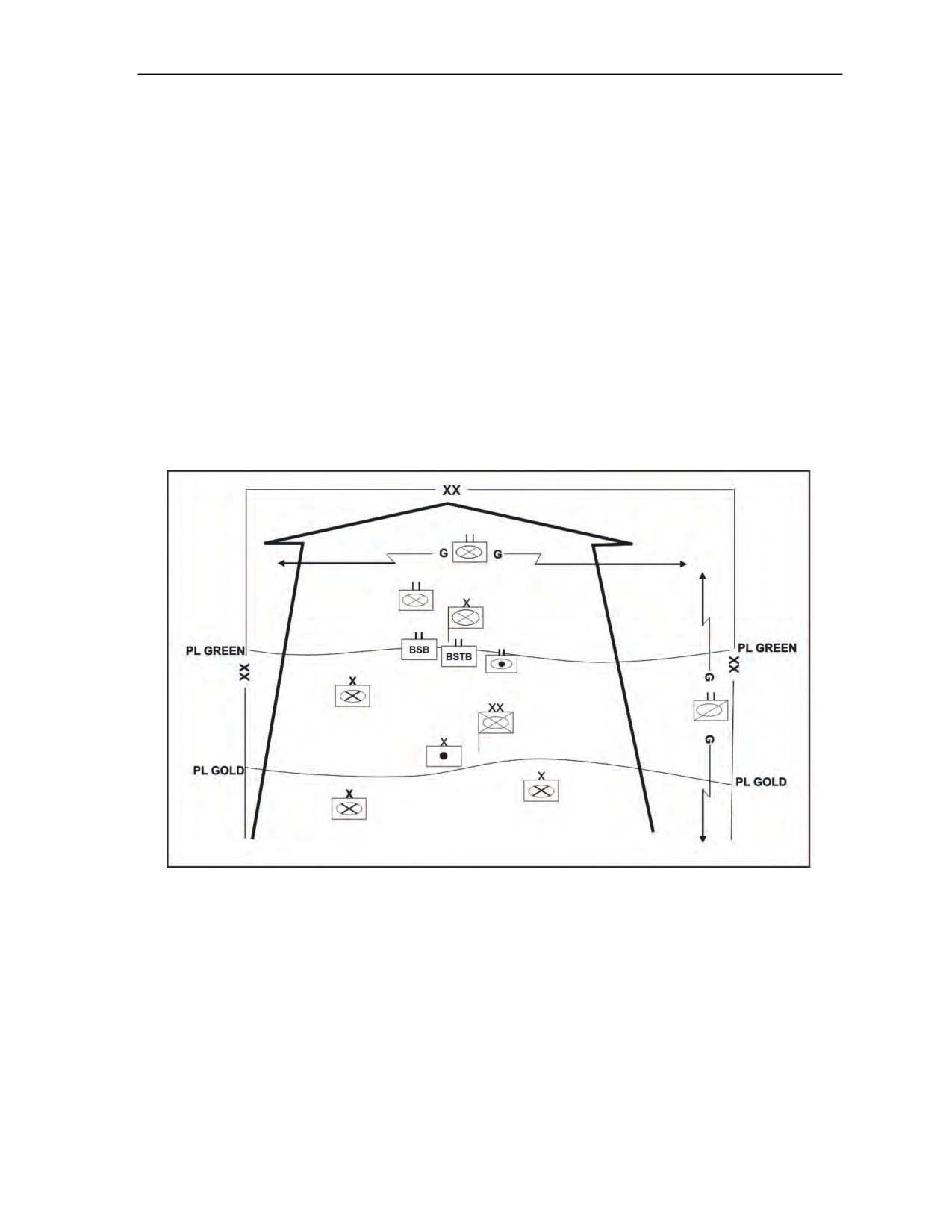
Chapter 5
force uses all means at its disposal to prevent the enemy from penetrating to a position where it could
observe and engage the main body. A guard force operates within the range of the main body’s indirect fire
systems and deploys over a narrower front than a screening force of comparable size to concentrate combat
power.
ADVANCE GUARD
5-40. An advance guard for a stationary force is defensive in nature. It defends or delays in accordance
with the main body commander’s intent. An advance guard for a moving force is offensive in nature. The
advance guard develops the situation so the main body can use its combat power to the greatest effect. The
main body’s combat power must not be consumed, reinforcing the advance guard. The full combat power
of the main body must be available immediately to defeat the main enemy force.
5-41. A BCT advance guard for a moving force usually conducts a movement to contact (Figure 5-1). It
task organizes and uses the graphics of a movement to contact. The advance guard conducts shaping
operations and is not the main effort or decisive operation for the higher headquarters. Ground subordinate
elements of an advance guard usually deploy abreast to cover the axis of advance or the main body’s AO.
The advance guard is responsible for clearing the axis of advance or the designated portions of the enemy
elements’ AO. This enables the main body to move unimpeded, prevents unnecessary delay of the main
body, and defers deployment of the main body for as long as possible.
Figure 5-1. HBCT as a division advance guard
FLANK GUARD
5-42. A flank guard protects an exposed flank of the main body. A flank guard is similar to a flank screen
except the commander plans defensive positions in addition to screen lines. The flank guard is responsible
for clearing the area from the supported main body to the flank guard’s designated positions. Usually this
area extends from the forward screen, along the flank of the formation, to either the front line trace of
troops or the rear of the moving formation, tying in with the rear guard.
5-8
FM 3-90.6
14 September 2010
Security Operations
REAR GUARD
5-43. The rear guard protects the exposed rear of the main body. This occurs during offensive operations
when the main body breaks contact with flanking forces or during a retrograde. The commander may
deploy a rear guard behind both moving and stationary main bodies. The rear guard for a moving force
displaces to successive battle positions along PLs or delay lines in depth as the main body moves. The
nature of enemy contact determines the exact movement method or combination of methods used in the
displacement (successive bounds, alternate bounds, and continuous marching).
SECTION V - COVER
COVERING FORCE
5-44. A covering force is a self-contained force capable of operating independently of the main body,
unlike a screening or guard force. A covering force, or portions of it, often becomes decisively engaged
with enemy forces. Therefore, the covering force must have sufficient combat power to engage the enemy
and accomplish its mission. A covering force develops the situation earlier than a screen or a guard force. It
fights longer and more often and defeats larger enemy forces.
5-45. The covering force’s distance forward of the main body depends on the intentions and instructions of
the main body commander; the terrain; the location and strength of the enemy; and the rates of march of
both the main body and the covering force. The width of the covering force area is the same as the AO of
the main body.
5-46. While a covering force provides more security than a screen or guard force, it also requires more
resources. Before assigning a cover mission, the higher commander must ensure that the BCT has sufficient
combat power to resource a covering force, while maintaining enough for the decisive operation. When the
commander lacks the resources to support both, he must assign his security force a less resource intensive
security mission; that is, either a screen or a guard.
DEFENSIVE COVERING FORCE
5-47. A defensive covering force prevents the enemy from attacking at the time, place, and combat strength
of his choosing. Defensive cover gains time for the main body enabling it to deploy, move, or prepare
defenses in the main battle area (MBA). It accomplishes this by disrupting the enemy’s attack, destroying
his initiative, and establishing the conditions for decisive operations. The covering force makes the enemy
deploy repeatedly to fight through the covering force and commit his reserve or follow-on forces to sustain
momentum (Figure 5-2).
14 September 2010
FM 3-90.6
5-9
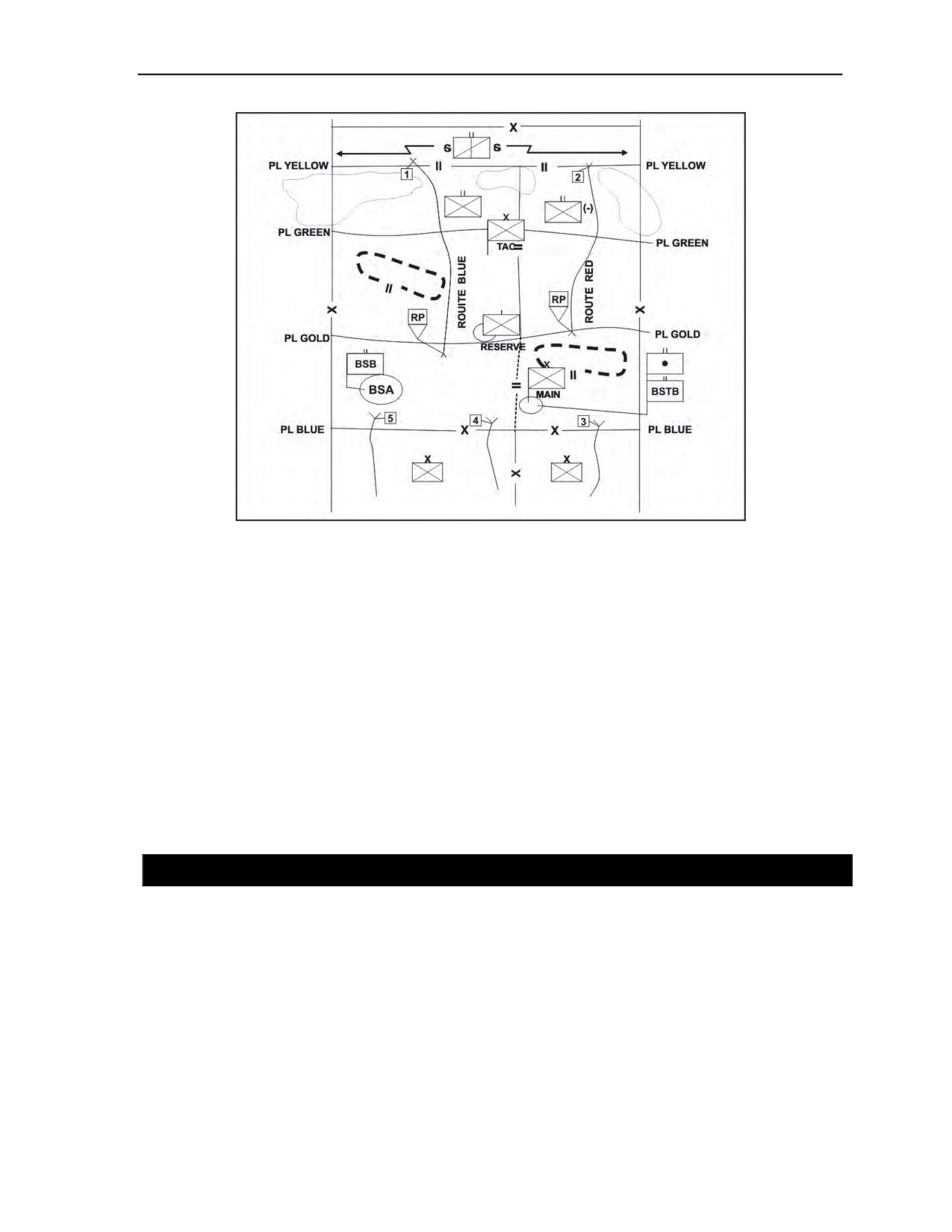
Chapter 5
Figure 5-2. Example of covering force plan
MISSION
5-48. A covering force accomplishes all the tasks of screening and guard forces. A covering force for a
stationary force performs a defensive mission, while a covering force for a moving force generally
conducts offensive actions. A covering force usually operates forward of the main body in the offense or
defense, or to the rear for a retrograde operation. Unusual circumstances could dictate a flank covering
force, but this is usually a screen or guard mission. An offensive covering force seizes the initiative early
for the main body commander enabling him to attack decisively. When the main body commander
perceives a significant enemy to one of his flanks, he usually establishes a flank covering force. That force
conducts its mission in much the same way as a flank guard performs its mission. The main differences
between the two missions are the scope of operations and the distance the covering force operates away
from the main body.
5-49. Just as in a flank guard, the flank covering force must clear the area between its route of advance and
the main body. It must also maintain contact with an element of the main body specified by the main body
commander. This element usually is part of the advance guard for the flank unit of the main body.
SECTION VI - SECURITY
AREA SCEURITY
5-50. Area security is a form of security that includes reconnaissance and security of designated personnel,
airfields, unit convoys, facilities, main supply routes, lines of communication, equipment, and critical
points. Area security operations are conducted to deny the enemy the ability to influence friendly actions in
a specific area, or to deny the enemy use of an area for its own purposes. This can entail establishing and
occupying a 360-degree perimeter around the area being secured, or taking actions to destroy enemy forces
already present in the area. The area to be secured can range from specific points (e.g., bridges, defiles) to
areas such as terrain features (e.g., ridgelines, hills) to large population centers and adjacent areas. Area
security requires a variety of shaping operations that include reconnaissance, defensive, offensive, stability,
and support tasks. Units can conduct area security in support of any military operation.
5-10
FM 3-90.6
14 September 2010
Security Operations
MISSION
5-51. An area security force neutralizes or defeats enemy operations in its assigned area. It screens,
reconnoiters, attacks, defends, and delays as necessary to accomplish its mission. Area security operations
may be offensive or defensive in nature. They focus on the enemy, the force being protected, a protected
asset, or any combination of these. Commanders may balance the level of security measures with the type
and level of threat posed in the specific area; however, all-around security is essential (Figure 5-3).
5-52. When conducting an area security mission, the area security force conducts reconnaissance and
security operations, and attacks, defends, and delays as necessary to accomplish its mission. Security forces
prevent enemy ground reconnaissance elements from directly observing friendly activities within the area
being secured. They prevent enemy ground maneuver forces from penetrating those defensive perimeters
established by the commander. The commander can have his elements employ a variety of techniques such
as OPs, battle positions, ambushes, and combat outposts to accomplish this security mission. His reserve
enables him to react to unforeseen contingencies. With available intelligence gathering capabilities, the
screening unit has the potential to be more offensive oriented conducting ambushes and preemptive strikes
with greater precision to maintain security, if such actions are within the BCT commander’s intent and
appropriate to the overall situation.
OTHER SUPPORT
5-53. The reconnaissance squadron or maneuver battalion may conduct, or task subordinate units to
conduct, the following in support of area security:
z
Area, route, or zone reconnaissance.
z
Screen.
z
Offensive and defensive tasks (within capability).
z
Convoy and route security.
z
High value asset security (including fixed site security and personal security detachments).
z
Combat outposts.
z
Patrols with host nation forces.
z
The unit conducts stability tasks to support long-term area security, such as:
Liaison/negotiation and establishment of civil-military operations centers.
Securing activities/projects for civil-military operations.
Compliance inspections.
Support presence operation (i.e., support company/platoon checkpoints, presence patrols).
z
Deliver supplies or render humanitarian aid.
z
React to civil disturbance.
z
Plan/react to media.
z
Leader and Soldier engagements with the local population.
14 September 2010
FM 3-90.6
5-11
Chapter 5
Figure 5-3. HBCT conducting area security
5-54. Mission variables determine the augmentation that a BCT might need to execute area security.
Particular consideration should be given to the need for the appropriate mix of reconnaissance, maneuver,
engineer, and artillery units. External augmentation can include elements of a maneuver enhancement
brigade, additional UAS, tactical human intelligence (HUMINT) and counterintelligence teams, civil
affairs teams and JIIM, nongovernmental, and contractor elements.
5-55. Focused intelligence preparation of the battlefield (IPB) is vital to supporting area security. The
factors of METT-TC and unit capability determine specific unit missions. Some influencing factors are:
z
The natural defensive characteristics of the terrain.
z
Existing roads and waterways for military lines of communication and civilian commerce.
z
The control of land and water areas and avenues of approach surrounding the area to be secured,
extending to a range beyond that of enemy artillery, rockets, and mortars.
z
The control of airspace.
z
The proximity to critical sites such as airfields, power generation plants, and civic buildings.
z
Sources external to the BCT AO causing instability in the local population.
5-56. Due to the possibility of commanders tying their forces to fixed installations or sites, these types of
security missions may become defensive in nature. This must be carefully balanced with the need for
offensive action. Early warning of enemy activity is paramount in area security missions and provides the
commander with time to react to any enemy. Maximum use of external collection assets can reduce the
requirements placed on BCT reconnaissance assets. Focused reconnaissance planning, dismounted/mounted
patrols, and aerial reconnaissance are essential to successful area security.
OTHER CONSIDERATIONS
5-57. Depth is provided using subsequent fighting positions and mobile reserves. The mobility and
firepower of armored forces enable these forces to rapidly traverse large areas and quickly mass and
destroy any enemy penetration. The size of the reserve depends on the tactical situation and available
forces. Immediate reaction to intelligence information or any type of attack is vital. This immediate
5-12
FM 3-90.6
14 September 2010
Security Operations
reaction to accurate and timely intelligence can enable destruction of enemy elements prior to an attack on
the area being secured. Reaction operations or commitments of the reserve are simple, planned, and
rehearsed under all the employment conditions possible.
BASE SECURITY
OBJECTIVE
5-58. The objective of base security is to maintain a secure position, defending in all directions. The
commander can employ base security when conducting the full spectrum of operations. The BCT
establishes base security when it must hold critical terrain in areas where the defense is not tied in with
adjacent units. The BCT can also form a perimeter and conduct base security when it has been bypassed
and isolated by the enemy and must defend in place.
5-59. Forward operating bases can be used to create a 360-degree defense for basing units inside urban
environments. These forward operating bases are considered a secure area and most would have guard
towers, indirect fire protection, and an infrastructure to support the unit. Many times the BCT houses its
support elements in the same forward operating base as the combat unit.
SUSTAINMENT ELEMENTS
5-60. Sustainment elements can support from inside the perimeter or from another location depending on
the mission and status of the BCT. Sustainment considerations are the type of transport available, the
weather, and the terrain. Sustainment assets inside the perimeter should be in a protected location from
which they can provide continuous support. The availability of drop zones (DZ) and landing zones (LZ)
protected from the enemy’s observation and fire is a main consideration in selecting and organizing the
location.
14 September 2010
FM 3-90.6
5-13
This page intentionally left blank.
Chapter 6
Reconnaissance Operations
"Reconnaissance operations are those operations undertaken to obtain, by visual
observation or other detection methods, information about the activities and resources
of an enemy or potential enemy, or to secure data concerning the meteorological,
hydrographical or geographical characteristics and the indigenous population of a
particular area" (FM 3-90). The Brigade Combat Team (BCT) uses its assigned
reconnaissance units and surveillance assets to collect information, while using
robust capabilities to translate that information into intelligence. This chapter
discusses the brigade combat team’s execution of reconnaissance operations. This
chapter also discusses the processes the staff undertakes to synchronize and integrate
information requirements, collection tasks, and available reconnaissance and military
intelligence
(MI) assets. These factors answer the information requirements that
support the commander’s understanding and visualization of the operation.
SECTION I - OVERVIEW
PURPOSE OF RECONNAISSANCE OPERATIONS IN THE BRIGADE
COMBAT TEAM
6-1. Brigade combat teams conduct reconnaissance operations. Through these operations, the BCT
obtains the information it needs to develop situational awareness (SA); and it enables the situational
understanding (SU) the commander needs to make decisions. The focus of this activity is to answer the
commander’s critical information requirements
(CCIR). Reconnaissance operations are planned and
executed early in the BCT’s decision-making process (e.g., during mission analysis).
6-2. Intelligence activities enable production of intelligence about the enemy, environment, and civil
considerations that the commander needs to make critical decisions. Intelligence products answer CCIR
and other information requirements (IR) developed during the operations process. Timely and accurate
intelligence encourages initiative, and can facilitate actions that could negate enemy superiority in
personnel, materiel or organization. Developing timely and accurate intelligence depends on aggressive and
continuous reconnaissance operations.
6-3. The BCT’s reconnaissance and surveillance activities are integrated across the intelligence and
maneuver warfighting functions. Reconnaissance is a combined arms operation that focuses on priority
intelligence requirements while answering the commander’s critical information requirements (FM 3-0).
The BCT commander and staff continuously plan, task, and employ reconnaissance forces and surveillance
systems.
6-4. Reconnaissance and surveillance activities (including MI discipline collection) support the BCT
conduct of full spectrum operations through four tasks:
z
ISR synchronization.
z
ISR integration.
z
Surveillance.
z
Reconnaissance.
6-5. The BCT’s intelligence activities collect, process, store, display, and disseminate information from a
multitude of collection sources. Although staff or technical "stovepipes‖ exist, access to distributed
databases is the primary source for obtaining information to produce intelligence. These databases of
14 September 2010
FM 3-90.6
6-1
Chapter 6
information exist in higher, lower, and adjacent units. ISR plans are nested from scout platoon through the
BCT and higher headquarters. Nesting ensures unity of focus and enables successful execution, layered
coverage, and retaining the initiative.
RECONNAISSANCE SQUADRON
6-6. The reconnaissance squadron is the main organization that the BCT commander has available for his
reconnaissance needs. Reconnaissance squadrons of the Heavy Brigade Combat Team (HBCT), Infantry
Brigade Combat Team (IBCT), and Stryker Brigade Combat Team (SBCT) are organized to conduct
reconnaissance and security missions throughout the BCT’s area of operations (AO). By leveraging
information technology and air/ground reconnaissance capabilities in complex terrain, the reconnaissance
squadron can develop the situation by focusing on all categories of threats in a designated AO. This enables
the BCT commander to maintain battlefield mobility and agility while choosing the time and place to
confront the enemy and the preferred method of engagement. The squadron commander has a variety of
tools to assist him in conducting reconnaissance and security missions within all spectrums of conflict. He
can task organize to optimize complementary effects while maximizing support throughout the BCT’s AO
(FM 3-20.96).
6-7. As the "eyes and ears" of the BCT commander, the squadron provides the combat information that
enables the BCT commander to develop SU, make better and quicker plans and decisions, and to visualize
and direct operations. The squadron progressively builds situational awareness in operational environments
that are characterized by combinations of traditional, irregular, disruptive or catastrophic threats or
challenges. The squadron employs unique combinations of reconnaissance and security capabilities to
successfully meet the information challenges intrinsic to the spectrum of conflict. The squadron’s
reconnaissance operations yield an extraordinarily high payoff in the areas of threat location, disposition,
and composition, early warning, protection, and munitions effectiveness. This preserves the BCT’s freedom
of maneuver and initiative over the enemy. Skillful reconnaissance operations allow the BCT commander
to shape the battlefield, ideally accepting or initiating combat at times and places of his choosing, and
applying combat power in a manner most likely to achieve his desired effects.
6-8. The squadron’s primary missions are:
z
Reconnaissance.
Zone reconnaissance.
Area reconnaissance.
Route reconnaissance.
z
Security.
Guard.
Screen.
Area security.
Local security.
SECTION II - INTELLIGENCE
6-9. To execute missions effectively, commanders and staff require intelligence about the enemy, terrain,
weather, and civil considerations. Intelligence assists commanders in visualizing the operational
environment, and assessing operations to achieve the desired end state. Intelligence supports protection by
alerting the commander to emerging threats and assisting in security operations. The BCT S-2 has the lead
for intelligence planning and synchronizing the execution of intelligence collection within the brigade. The
BCT MI company has a critical role in assisting the S-2 in acquiring and analyzing intelligence. Details
about the organization of the BCT MI company are provided in Chapter 8. FM 2-19.4 describes the
operations of the MI company.
6-2
FM 3-90.6
14 September 2010
Reconnaissance Operations
6-10. Details on the intelligence process are found in FM 2-0, FM 2-01.3, and FMI 2-01. Intelligence staff
elements in the BCT command posts and MI company, collaborating with lower, higher, and adjacent
intelligence staff, produce intelligence products using the intelligence process. These products include:
z
Intelligence preparation of the battlefield (IPB) reports and overlays.
z
Intelligence running estimate (reports and overlays).
z
ISR synchronization matrix and ISR synchronization tools (overlay and collection matrix.
z
ISR plan (this is a combined effort by the S-2 and S-3).
INTELLIGENCE PREPARATION OF THE BATTLEFIELD
6-11. Intelligence preparation of the battlefield (IPB) is a systematic and continuous process for analyzing
the threat and environment in a specific geographic area. It is a staff planning activity undertaken organized
by the S-2 and supported by the entire staff to define and understand the operational environment and the
advantages and disadvantages presented to friendly and threat forces. IPB supports each staff section’s
running estimates and the military decision-making process (MDMP). The S-2 uses IPB to describe the
environment in which the brigade is operating and the effects of the environment on brigade operations.
The IPB process supports the S-2 in determining threat capabilities, objectives, and courses of action
(COA). The S-2, supported by the Analysis and Integration Platoon, conducts IPB prior to and during the
brigade’s planning for an operation. FM 2-0 and FM 2-01.3 provide information on how to conduct IPB
6-12. One of the most significant contributions that intelligence personnel can accomplish is to accurately
predict future enemy COAs. Predictive intelligence enables the commander and staff to anticipate enemy
actions and develop corresponding plans or counteractions. Commanders must receive intelligence in time
to make an effective decision, create orders for subordinate units, and have them act on it. Commanders
develop and rely on their CCIR to focus collection of information supporting decision points (DP) in the
commander’s plan.
6-13. The process works best when the BCT staff, or the staffs of subordinate battalions, anticipates CCIR
well in advance. A proactive BCT S-2 will anticipate the commander’s priority intelligence requirements to
help drive the planning of reconnaissance operations. The S-2’s requirement management techniques focus
the collection, processing, and intelligence production on the critical needs of the commander. The
intelligence staff assists the commander with battlefield visualization by identifying feasible threat
capabilities; confirming or refuting the threat’s COAs; and providing accurate descriptions of the effects of
the operational environment on friendly and threat activities. In the BCT, tactical operations center (TOC),
the command and control (C2) digital systems enable a near-continuous assessment of the operations cycle.
The S-2’s role in IPB is a continuous activity to obtain information and produce intelligence essential to the
commander’s decision-making.
INTELLIGENCE RUNNING ESTIMATE
6-14. After developing threat COAs, the S-2 and MI company, supported by the rest of the BCT staff,
develop the intelligence running estimate. IPB products make up the basis of the intelligence estimate. The
intelligence running estimate:
z
Forms the basis for the facts and assumptions of the MDMP, driving various staff section
running estimates and the remaining steps in the MDMP.
z
Is a logical and orderly analysis of the terrain, weather, and civil considerations of the
operational environment and its effects on friendly and threat COAs, threat capabilities and
vulnerabilities, threat tactics, techniques and procedures (TTP), and the probability of adoption
of threat COAs.
z
Provides the best possible answer to the commander’s PIRs that are available at the time.
z
Is dynamic and changes constantly with the situation.
14 September 2010
FM 3-90.6
6-3
Chapter 6
6-15. The S-2 briefs the intelligence running estimate results to the brigade commander and staff. Upon
conclusion of the staff briefings, the commander states his intent for the operation, and provides additional
planning guidance to the staff. The commander’s guidance to the S-2 could include:
z
Additional threat COAs and objectives to consider.
z
Additions or deletions of threat decision points and high-value targets (HVT).
z
Approval or modification of recommended PIRs.
z
Specific instructions on priority for and allocation of reconnaissance and surveillance assets.
SECTION III - SUPPORT TO RECONNAISSANCE OPERATIONS
SYNCHRONIZATION
6-16. ISR synchronization is the task that:
z
Analyzes information requirements and intelligence gaps.
z
Evaluates available assets (internal and external).
z
Determines gaps in the use of those assets.
z
Recommends reconnaissance assets controlled by the organization to collect on CCIR, and
submits requests for information for adjacent and higher collection support.
6-17. The intelligence officer synchronizes the collection effort in coordination with the operations officer,
MI company officers, and other staff elements as required. This effort includes recommending tasks for
assets that the commander controls, and submitting requests for information to adjacent and higher echelon
units and organizations. See FM 2-0 for detailed information on the intelligence synchronization process.
6-18. The many sources of information available to the BCT must be synchronized with requirements to
collect relevant information, and then produce the intelligence the BCT requires. The result is a continuous
feed of information that enables the commander to maintain SA and make timely decisions. The BCT S-3
integrates the sensors and other capabilities of the BCT to accomplish this. The reconnaissance squadron’s
role is to obtain information for the BCT commander, answering his CCIR. This information gathering also
assists the BCT S-2 in confirming the intelligence estimate. Information from all the organic, adjacent,
higher and joint, interagency, intergovernmental, and multinational (JIIM) collection assets are integrated
to form the common operational picture (COP). The BCT S-2 takes this information, analyzes it, and gives
the BCT commander refined intelligence products with which to make decisions. The MI company
supports the BCT S-2 in synchronization, planning, and data analysis. MI company assets, such as
unmanned aircraft systems (UAS), Prophets, and human intelligence (HUMINT) collection teams (HCT),
may be task organized to subordinate battalions or other units within the BCT.
INTEGRATION
6-19. ISR integration is the task of assigning and controlling a unit’s reconnaissance assets (in terms of
space, time, and purpose) to collect and report information as a concerted and integrated portion of
operation plans and orders. This task ensures assignment of appropriate assets through a deliberate and
coordinated effort integrating reconnaissance activities into the operation.
INTEGRATED RECONNAISSANCE OPERATIONS
6-20. Reconnaissance operations are integrated between higher, lower, and adjacent units to ensure that
collection is complete but not redundant. ISR plans are collaborative efforts that support CCIR. Planning
includes coordinating reconnaissance handover from the higher headquarters (HQ) to the BCT, and from
the BCT to battalions (both reconnaissance squadron and maneuver). During planning and liaison with the
division, the BCT ensures that the width and depth of their assigned reconnaissance AO are suitable for its
reconnaissance and surveillance capabilities. The BCT develops named areas of interest (NAI) to assist in
focusing assets, either to discern enemy courses of action and disposition of forces, or to gain information
about the environment. Planners must ensure that plans are synchronized by taking into account the battle
rhythms of subordinate, adjacent, supporting, and higher headquarters. ISR working groups at each
6-4
FM 3-90.6
14 September 2010
Reconnaissance Operations
organization must synchronize their own requirements and schedules with others to avoid a duplication of
effort, and to ensure there are not gaps in surveillance.
SECTION IV - RECONNAISSANCE CONSIDERATIONS
COMMANDER’S RECONNAISSANCE DECISIONS
6-21. The BCT commander will be required to make several decisions relating to reconnaissance and
surveillance (including MI discipline collection). Based on the results of those decisions, different COAs
may be selected, including development of a new mission, a continuation of the current mission, and/or the
anticipation of transition into a new mission. Generally, these decisions are covered in the BCT standard
operating procedure (SOP), and usually are issued in the commander’s planning guidance. These decisions
include:
z
Commander’s intent for intelligence collection.
z
CCIR.
z
The degree of collaborative reconnaissance and surveillance planning between the BCT and
reconnaissance squadron staffs.
z
When to issue the ISR plan and with which order (warning order [WARNO] #2 or operation
order [OPORD]).
z
When to rest and refit reconnaissance assets.
COLLABORATIVE INTELLIGENCE, SURVEILLANCE, AND RECONNAISSANCE PLANNING
6-22. The BCT staff collaborates with the reconnaissance squadron in developing the BCT ISR plan. The
BCT commander decides to what degree he wants his primary collector, the reconnaissance squadron,
involved in BCT-level planning. He has three basic choices:
z
If reconnaissance squadron and BCT command posts (CP) are collocated or close to each other,
then squadron personnel can be involved easily.
z
If the reconnaissance squadron is executing an operation and its CP is located far from the BCT
main CP, member(s) of the reconnaissance squadron staff could move to the BCT main CP to
assist in planning and serve as a liaison officer(s) (LNO).
z
The reconnaissance squadron staff may participate collaboratively through a variety of FM radio
or Army Battle Command System (ABCS) methods.
ISSUING THE INTELLIGENCE, SURVEILLANCE, AND RECONNAISSANCE PLAN
6-23. The commander should decide when and how he wants to issue the ISR plan. After developing his
CCIR, the commander must decide how soon he wants reconnaissance assets to start collecting, and how
much (or little) synchronized planning he is willing to accept before reconnaissance execution. Factors that
affect this decision include current status/capability of the BCT collection assets; availability of non-BCT
collection assets to collect BCT IR; and level of integration required with the overall brigade scheme of
maneuver.
6-24. The commander should issue the ISR plan at the earliest occasion following completion of mission
analysis. This enables the BCT to begin the reconnaissance effort early to help refine planning for the BCT
scheme of maneuver. Other options include the following:
z
After COA approval. The commander delays the reconnaissance effort to ensure
synchronization with the scheme of maneuver. The commander uses this method when time
constraints do not require reconnaissance assets to be positioned early during planning.
z
Totally separate from a BCT order. The commander often uses this method during continuous
operations or after the higher HQ issues a WARNO for a follow-on mission. If the commander
issues the ISR plan prior to finalizing the BCT OPORD, it is more likely the ISR plan will
require fragmentary orders (FRAGO) to support the refined maneuver plan.
14 September 2010
FM 3-90.6
6-5
Chapter 6
RESTING AND REFITTING RECONNAISSANCE AND SURVEILLANCE ASSETS
6-25. The third decision the commander must make is when to rest and refit his reconnaissance and
surveillance assets. The commander must think this decision through early and build it into the overall
concept of operations. The BCT’s ISR plan must account for available troops to task at a given time.
Coordination with higher HQ is critical for the timing of the BCT battle rhythm as requests for alternate
reconnaissance and surveillance elements to provide necessary BCT coverage take time to coordinate. As
another option, the commander may have redundant means of coverage within the BCT to conduct a
reconnaissance handover with his primary collectors.
COMMANDER’S RECONNAISSANCE GUIDANCE
6-26. Reconnaissance must begin as early as possible, with more direct and early involvement by the
commander to focus his staff and subordinate units during the process. Guidance should be pushed forward
early and refined later. The BCT’s MDMP begins with the receipt of a new mission. Usually this new
mission is part of the initial WARNO from the division. The initial WARNO sent by the BCT should
provide the following information for reconnaissance planning to begin:
z
Division mission and concept of the operation.
z
Division commander’s intent.
z
BCT reconnaissance objective.
z
CCIR and other IR.
z
Focus, tempo, and engagement criteria.
z
Specified reconnaissance tasks.
INTELLIGENCE, SURVEILLANCE, AND RECONNAISSANCE
WORKING GROUP
6-27. The ISR working group is a temporary grouping of designated staff representatives who coordinate
and integrate intelligence collection, and reconnaissance and surveillance activity, and provide
recommendations to the commander. The ISR working group usually includes:
z
BCT executive officer (chairs the meeting).
z
BCT S-3 (alternate chair) or representative.
Engineer coordinator (ENCOORD) representative.
Air defense and airspace management (ADAM)/brigade aviation element (BAE) representative.
z
BCT S-2 or representative.
z
MI company commander/collection manager or representative.
z
Reconnaissance squadron S-3 and/or S-2 or representative.
z
S-2X or representative.
z
Brigade fire support officer or representative.
z
BCT S-7 or representative.
z
Command, control, communications, and computers cell representative.
z
BCT S-9 or representative.
z
CBRN officer.
z
Sustainment cell representative.
z
Subordinate unit representatives (if available).
z
Special operations forces (SOF) representative (if available).
6-28. The ISR working group applies ISR synchronization into other BCT processes. It allocates
reconnaissance assets to gather information for CCIR; verifies and updates the ISR tasking matrix; and
ensures support by each warfighting function for each reconnaissance asset. The ISR working group
meeting is a critical event that must be integrated effectively into the BCT’s battle rhythm to ensure the
collection effort provides focus to operations, rather than disrupting them. Preparation and focus are
6-6
FM 3-90.6
14 September 2010
Reconnaissance Operations
essential to a successful working group. Each representative must come to the meeting prepared to discuss
available assets, capabilities, limitations, and requirements related to his warfighting function. Planning the
working group’s battle rhythm is paramount to conducting effective reconnaissance operations. The
working group cycle should be scheduled to complement the higher headquarters’ battle rhythm and its
subsequent requirements and timelines.
6-29. The BCT S-3 (or representative) must be prepared to provide the following information:
z
Current friendly situation.
z
Reconnaissance assets available.
z
Requirements from higher HQ (including recent FRAGOs or taskings).
z
Changes to the commander’s intent.
z
Changes to the task organization.
z
Planned operations.
6-30. The BCT S-2 (or representative) must be prepared to provide the following:
z
Current enemy situation.
z
Current CCIR.
z
Current ISR plan.
z
Situational template tailored to the time period discussed.
z
Collection assets available and those the S-2 must request from higher HQ.
z
Weather and effects of weather on intelligence collection.
RECONNAISSANCE PLANNING CONSIDERATIONS
6-31. The ISR working group must consider several factors when developing the ISR plan:
z
The requirement for reconnaissance assets in follow-on missions (e.g., reconnaissance squadron
mission during close fight).
z
The amount of time BCT planners will have to refine the ISR plan during the execution of
current operations.
z
Modifications to the MDMP that might overlap ISR planning with COA development.
z
Risk the commander is willing to accept if reconnaissance activity is begun before the ISR plan
is fully integrated with the scheme of maneuver.
z
Use of dismounted reconnaissance assets to include insertion methods, movement once
committed, and extraction methods.
z
Locations of command and control nodes (e.g., proximity of the BCT command group and the
reconnaissance squadron CP).
z
Locations of fire support
(FS) assets
(e.g., positioned to support extended reconnaissance
elements).
z
Reconnaissance handover between the BCT and higher HQ assets, or between the
reconnaissance squadron and maneuver battalions.
z
Sustainment support to include casualty evacuation
(CASEVAC), resupply, and vehicle
recovery.
z
Counterreconnaissance plan.
INTELLIGENCE, SURVEILLANCE, AND RECONNAISSANCE PLAN
ATTACHMENTS
INTELLIGENCE, SURVEILLANCE, AND RECONNAISSANCE OVERLAY
6-32. The ISR overlay expresses the ISR plan in graphic form Subordinate reconnaissance units may
determine some of the control measures instead of the BCT. If so, the BCT must consolidate the control
measures into the overlay as soon as the unit completes its planning. If the overlay is transmitted over
digital systems it might need to be broken into component parts to speed transmission and reduce clutter.
14 September 2010
FM 3-90.6
6-7