FM 390.6 Brigade Combat Team (September 2010) - page 1
*FM 3-90.6
*Field Manual
Headquarters
Department of the Army
No. 3-90.6
Washington, DC, 14 September 2010
Brigade Combat Team
Contents
Page
PREFACE
vii
SUMMARY of CHANGES
viii
Chapter 1
INTRODUCTION
1-1
Section I - Role of the Brigade Combat Team
1-1
Operational Environment
1-1
Full spectrum Operations
1-4
Tactical Enabling Operations
1-6
Section II - Organization and Capabilities
1-6
Heavy Brigade Combat Team
1-7
Infantry Brigade Combat Team
1-10
Stryker Brigade Combat Team
1-12
Section III - Brigade Combat Team Command and Control
1-15
Brigade Combat Team Mission Command
1-15
Command and Control Organizations
1-18
Staff
1-20
Centers
1-21
Command Post Cells and Elements
1-22
Meetings, Working Groups, and Boards
1-24
Information Systems
1-25
Chapter 2
OFFENSIVE OPERATIONS
2-1
Section I - Fundamentals of a Brigade Combat Team Offense
2-1
Characteristics of the Offense
2-1
Sequence of Offensive Operations
2-2
Section II - Common Offensive Planning Considerations
2-3
Movement and Maneuver
2-3
Intelligence
2-3
Fires
2-4
Sustainment
2-4
Command and Control
2-4
DISTRIBUTION RESTRICTION: Approved for public release; distribution is unlimited.
*This publication supersedes FM 3-90.6, The Brigade Combat Team, 4 August 2006.
i
Contents
Protection
2-5
Section III - Forms of Maneuver
2-5
Envelopment
2-5
Turning Movement
2-5
Infiltration
2-6
Penetration
2-6
Frontal Attack
2-7
Section IV - Primary Offensive Tasks
2-8
Movement to Contact
2-8
Hasty and Deliberate Attacks
2-12
Exploitation and Pursuits
2-13
Special Purpose Attacks
2-14
Section V - Transitions
2-16
Section VI - Combat Formations
2-17
Column
2-17
Line
2-17
Echelon
2-17
Box
2-18
Wedge
2-18
Vee
2-18
Chapter 3
DEFENSIVE OPERATIONS
3-1
Section I - Fundamentals of a Brigade Combat Team Defense
3-1
Characteristics of the Defense
3-1
Common Planning Considerations
3-3
Common Control Measures
3-6
Section II - Primary Defensive Tasks
3-11
Area Defense
3-12
Mobile Defense
3-20
Retrograde Operations
3-21
Section III - Transitions
3-28
Consolidation
3-28
Reorganization
3-28
Continuing Operations
3-29
Chapter 4
STABILITY OPERATIONS
4-1
Section I - Overview
4-1
Responsibilities
4-1
Tasks
4-1
Section II - Brigade Combat Team Stability Tasks
4-2
Establish Civil Security
4-2
Establish Civil Control
4-3
Restore Essential Services
4-5
Support to Governance
4-5
Support to Economic and Infrastructure Development
4-6
Section III - Considerations for Stability Operations
4-6
Lethal and Nonlethal Actions
4-7
Warfighting Function Considerations
4-7
ii
FM 3-90.6
14 September 2010
Contents
Assessment of Stability Operations
4-13
Section IV - Interagency, Intergovernmental, and Nongovernmental
Organizations
4-13
Section V - Transitions
4-14
Preparing for Handover
4-15
Ending the Mission
4-15
Section VI - Security Force Assistance
4-15
Security Force Assistance Framework
4-15
Augmentation
4-16
Chapter 5
SECURITY OPERATIONS
5-1
Section I - Overview
5-1
Purpose
5-1
Reconnaissance
5-1
Counterreconnaissance
5-2
Section II - Fundamentals and Planning Considerations
5-2
Fundamentals of Security
5-2
Planning Considerations
5-2
Section III - Screen
5-3
Critical Tasks
5-3
Stationary Screen
5-3
Moving Screen
5-7
Section IV - Guard
5-7
Advance Guard
5-8
Flank Guard
5-8
Rear Guard
5-9
Section V - Cover
5-9
Covering Force
5-9
Section VI - Security
5-10
Area Sceurity
5-10
Base Security
5-13
Chapter 6
RECONNAISSANCE OPERATIONS
6-1
Section I - OVERVIEW
6-1
Purpose of Reconnaissance Operations in the Brigade Combat Team
6-1
Reconnaissance Squadron
6-2
Section II - Intelligence
6-2
Intelligence Preparation of the Battlefield
6-3
Intelligence Running Estimate
6-3
Section III - Support to Reconnaissance Operations
6-4
Synchronization
6-4
Integration
6-4
Section IV - Reconnaissance Considerations
6-5
Commander’s Reconnaissance Decisions
6-5
Commander’s Reconnaissance Guidance
6-6
Intelligence, Surveillance, and Reconnaissance Working Group
6-6
Intelligence, Surveillance, and Reconnaissance Plan Attachments
6-7
14 September 2010
FM 3-90.6
iii
Contents
Reconnaissance in Stability Operations
6-8
Surveillance
6-9
Section V - Forms of Reconnaissance
6-9
Chapter 7
FIRE SUPPORT IN THE BRIGADE COMBAT TEAM
7-1
Section I - Brigade Combat Team Fire Support Organization
7-1
Fires Cell
7-1
Information Operations Cell
7-3
Tactical Air Control Party
7-3
Joint Fires Staff Augmentation
7-4
Combat Observation and Lasing Teams
7-4
Fires Battalion
7-4
Section II - Fire Support Planning
7-4
Decide, Detect, Deliver, and Assess Process
7-5
Find, Fix, Finish, Exploit, Analyze, and Disseminate
7-10
Targeting Meetings
7-11
Section III - Fire Support Coordination
7-17
Clearance of Fires and Information Tasks
7-18
Suppression of Enemy Air Defenses
7-18
Chapter 8
AUGMENTING COMBAT POWER
8-1
Section I - Engineering Operations
8-1
Engineer Staff
8-1
Engineer Companies
8-2
Section II - Military Police Operations
8-2
Military Police Platoon Capabilities
8-3
Additional Military Police Support to the BCT
8-4
Section III - Air and Missile Defense Operations
8-4
ADAM/BAE Capabilities and Functions
8-4
Airspace Management and Control
8-5
Section IV - Chemical, Biological, Radiological, and Nuclear Operations . 8-7
CBRN Staff Section
8-7
CBRN Reconnaissance
8-7
Section V - Military Intelligence Company Support
8-8
Employment and Planning Considerations
8-8
Personnel and Equipment
8-9
Section VI - Information Engagement
8-11
Organization
8-11
Planning
8-12
Section VII - Civil Affairs Activities
8-14
Civil Affairs Integration into the Brigade Combat Team
8-14
Civil Affairs Units
8-14
Civil-Military Operations Center
8-15
Section VIII - Command and Control Information Systems
8-16
Brigade Signal Company
8-16
Network Systems Planning
8-17
Section IX - External Augmentation to the Brigade Combat Team
8-18
iv
FM 3-90.6
14 September 2010
Contents
Support and Functional Brigades
8-18
Other Brigades and Units
8-21
Section X - Key Joint Assets, Forces, and Considerations
8-22
Special Operations Forces
8-22
Air Force Support
8-23
Navy and Marine Forces
8-24
Section XI - Multinational Considerations
8-25
Chapter 9
SUSTAINMENT OPERATIONS
9-1
Section I - Brigade Combat Team Sustainment
9-1
Sustainment Brigades
9-1
Sustainment Functions
9-2
Sustainment Staff and Organizations
9-3
Sustainment Support Areas
9-4
Mission Tailoring of Sustainment Assets
9-8
Synchronization of Battle Rhythm and Sustainment Operations
9-8
Sustainment Reach Operations
9-10
Section II - Sustainment Planning
9-12
Operational Contract Support
9-12
Concept of Support
9-13
Supporting Offensive Operations
9-13
Supporting Defensive Operations
9-14
Supporting Stability Operations in a Hostile Environment
9-14
GLOSSARY
..........................................................................................................Glossary-1
REFERENCES
References-1
INDEX
................................................................................................................Index-1
Figures
Figure 1-1. Heavy, Infantry, and Stryker BCT organizations
1-7
Figure 1-2. Heavy Brigade Combat Team
1-7
Figure 1-3. Infantry Brigade Combat Team
1-10
Figure 1-4. Stryker Brigade Combat Team
1-13
Figure 1-5. BCT staff organization
1-21
Figure 1-6. Army Battle Command System
1-26
Figure 2-1. Example of a division conducting a turning movement
2-6
Figure 2-2. Example of two BCTs conducting a penetration
2-7
Figure 2-3. Example of a BCT frontal attack against a stationary enemy force
2-8
Figure 2-4. HBCT exploitation
2-13
Figure 2-5. SBCT conducting pursuit
2-14
Figure 2-6. Example of a raid
2-15
Figure 2-7. Example of an IBCT counterattack
2-16
Figure 3-1. Options for organizing the security area in a contiguous battlefield
3-7
14 September 2010
FM 3-90.6
v
Contents
Figure 3-2. Example of control measures used to coordinate defense by area of
operation
3-8
Figure 3-3. BCT security areas in a noncontiguous battlefield
3-10
Figure 3-4. Typical HBCT organization of a contiguous area defense
3-12
Figure 3-5. Example of an IBCT forward defense
3-14
Figure 3-6. Delay by alternate positions
3-23
Figure 3-7. Delay by subsequent positions
3-24
Figure 3-8. Types of withdrawals
3-26
Figure 3-9. Method for organizing the detachment left in contact
3-27
Figure 5-1. HBCT as a division advance guard
5-8
Figure 5-2. Example of covering force plan
5-10
Figure 5-3. HBCT conducting area security
5-12
Figure 7-1. BCT fires cell
7-2
Figure 7-2. Fires battalions
7-4
Figure 8-1. BCT engineer companies
8-2
Figure 8-2. Heavy and Infantry BCT military intelligence company
8-9
Figure 8-3. Civil affairs company
8-15
Figure 8-4. Basic civil-military operations center structure
8-15
Figure 8-5. Support brigades
8-18
Figure 9-1. Sustainment organizations supporting the BCT
9-2
Figure 9-2. Support unit locations
9-6
Figure 9-3. Digital sustainment reporting
9-10
Tables
Table 1-1. Operational variables
1-2
Table 3-1. Forms of retrograde operations
3-21
Table 3-2. Comparison of methods of delay
3-24
Table 4-1. Organizations a BCT may work within an AO
4-14
Table 7-1. Example of high payoff target list
7-6
Table 7-2. Example of target selection standards
7-6
Table 7-3. Example of attack guidance matrix
7-6
Table 7-4. Examples of fire effects
7-7
Table 9-1. BCT sustainment categories and elements
9-3
vi
FM 3-90.6
14 September 2010
Preface
Field manual 3-90.6 provides the commander and staff of the Brigade Combat Team (BCT) and subordinate
units with doctrine relevant to Army and joint operations. It applies to the Heavy Brigade Combat Team
(HBCT), the Infantry Brigade Combat Team (IBCT), and the Stryker Brigade Combat Team (SBCT). The
doctrine described in this manual applies across the full spectrum of military operations - offense, defense,
stability or civil support.
This publication:
z
Provides BCTs with a framework in which they can operate as part of a division or
independently as part of a joint task force.
z
Provides doctrine for BCT commanders, staffs, and their subordinate commanders and leaders
responsible for conducting major activities performed during operations.
z
Serves as an authoritative reference for personnel who -
Develop doctrine
(fundamental principles and tactics, techniques, and procedures),
materiel, and force structure.
Develop institution and unit training.
Develop unit tactical standard operating procedures for BCT operations.
z
Reflects and supports the Army operations doctrine found in FM 3-0, FM 5-0, and FM 6-0.
The proponent of this publication is the U.S. Army Training and Doctrine Command. The preparing agency is
the U.S. Army Maneuver Center of Excellence (MCoE), Fort Benning, Georgia. You may submit comments
and recommended changes in any of several ways—U.S. mail, e-mail, fax, or telephone—as long as you use or
follow the format of DA Form 2028, Recommended Changes to Publications and Blank Forms. Contact
information is as following:
E-mail:
BENN.CATD.DOCTRINE@CONUS.ARMY.MIL
Phone:
COM 706-545-7114 or DSN 835-7114
Fax:
COM 706-545-7500 or DSN 835-7500
U.S. mail:
Commander, MCoE
ATTN: ATZB-TDD
Fort Benning, GA 31905-5410
This publication applies to the Active Army, the Army National Guard (ARNG)/Army National Guard of the
United States (ARNGUS), and the United States Army Reserve (USAR), unless otherwise stated.
Unless otherwise stated in this publication, masculine nouns and pronouns do not refer exclusively to men.
14 September 2010
FM 3-90.6
vii
Summary of Changes
FM 3-90.6 has been revised based on doctrine and terminology changes in FM 3-0. In addition to doctrine
changes, technology and organizational revisions have been included.
Another major influence on the development of this manual is an effort by the Combined Arms Doctrine
Directorate, U.S. Army Combined Arms Center, to reengineer doctrine by:
z
Managing doctrine more effectively.
z
Reducing the number of field manuals in order to focus on critical combined arms publications.
z
Reducing the size of field manuals to facilitate ease of use, ease of maintenance, and clarity.
As a result, this field manual is considerably shorter than the previous edition. Information found in other
doctrinal publications is not repeated but appropriate references are included. Consequently, readers should be
familiar with the key field manuals that establish the foundation for the Army’s doctrine. These key field
manuals are:
z
FM 1-02.
z
FM 2-0.
z
FM 3-0.
z
FM 3-07.
z
FM 3-13.
z
FM 3-28.1.
z
FM 3-90.
z
FM 5-0.
z
FM 6-0.
z
FM 6-20.
z
FM 6-22.
z
FM 7-0.
z
FM 7-15.
The significant changes and updates in this new manual include:
z
Chapter 1 provides an overview of the role of the BCT, its organization and capabilities, and
command and control.
z
Chapter 2 describes the types of offensive operations the BCT conducts.
z
Chapter 3 includes some changes to terminology and focuses on how a BCT performs defensive
tasks.
z
Chapter 4 is devoted to stability operations emphasizing its comparable status to offensive and
defensive operations. It was restructured to comply with FM 3-0 and FM 3-07 doctrinal changes,
counterinsurgency doctrine in FM 3-24, and to include contemporary concepts based on recent
Southwest Asia experience.
z
Chapter 5 includes minor changes emphasizing a brigade viewpoint of security operations to
include an expanded section on area security.
z
Chapter 6 includes reconnaissance and surveillance considerations for the BCT. It focuses on
intelligence, surveillance, and reconnaissance (ISR) synchronization and integration within the
BCT.
z
Chapter 7 has been reorganized to conform to doctrinal changes in an upcoming FM that will
supersede FM 6-20.
viii
FM 3-90.6
14 September 2010
Summary of Changes
z
Chapter 8 covers organizations and activities formerly considered to be combat support, a
construct deleted by FM 3-0. It also includes how the BCT uses information engagement and
civil-military operations to shape the operational environment. It describes external elements that
typically support BCT operations. It also describes doctrinal changes to engineer and site
exploitation operations.
z
Chapter 9 focuses on the sustainment missions of internal BCT assets, as well as potential
augmentation. It also addresses sustainment planning considerations for offensive, defensive and
stability operations.
Appendixes, which the previous manual contained, have been deleted.
14 September 2010
FM 3-90.6
ix
Chapter 1
Introduction
Brigade Combat Team (BCT) is a modular organization that provides the division,
land component commander (LCC), or joint task force (JTF) commander with close
combat capabilities. BCTs are designed for operations encompassing the entire
spectrum of conflict. They fight battles and engagements by employing the tactical
advantages of a combined arms force structure. BCTs accomplish their missions by
integrating the actions of maneuver battalions, field artillery, aviation, engineer, air
and missile defense, close air support, and naval gunfire. The BCT’s reconnaissance
squadron and automated information systems give it information superiority over
threat forces. These assets enable the BCT to gather large amounts of information,
process it rapidly into intelligence, and disseminate it to decision-makers quickly.
This chapter describes the role of the BCT, and how it is organized.
SECTION I - ROLE OF THE BRIGADE COMBAT TEAM
1-1. Heavy, Infantry, and Stryker Brigade Combat Teams are the Army’s combat power building blocks
for maneuver, and the smallest combined arms units that can be committed independently. BCTs conduct
offensive, defensive, stability and civil support operations. Their core mission is to close with the enemy by
means of fire and maneuver to destroy or capture enemy forces, or to repel enemy attacks by fire, close
combat, and counterattack. The BCT can fight without augmentation, but it also can be tailored to meet the
precise needs of its missions. BCTs conduct expeditionary deployment and integrate the efforts of the
Army with military and civilian, joint and multinational partners.
1-2. BCTs often operate as part of a division. The division acts as a tactical headquarters that can control
up to six BCTs in high- or mid-intensity combat operations, plus a number of supporting functional
brigades. The division assigns the BCT its mission, area of operations, and supporting elements, and
coordinates its actions with other BCTs of the formation. The BCT might be required to detach subordinate
elements to other brigades attached or assigned to the division. Usually the division assigns augmentation
elements to the BCT. Fires brigades, battlefield surveillance brigades, maneuver enhancement brigades,
sustainment brigades, and aviation brigades can all support BCT operations.
OPERATIONAL ENVIRONMENT
1-3. The BCT’s unique capabilities (discussed in Section II below) enable strategic and operational
military planners to employ the BCT in a variety of conditions, circumstances, and influences. This
composite is the operational environment (OE) (FM 1-02). The OE includes all enemy, friendly, and
neutral systems across the spectrum of conflict. It also includes an understanding of the physical
environment, the state of governance, technology, local resources, and the culture of the local population
(FM 3-0).
1-4. The OE is fluid with continually changing coalitions, alliances, partnerships, and actors. Interagency
and joint operations will be required to deal with a wide and intricate range of players occupying the
environment. Science and technology, especially information technology, transportation technology, and
global economic activity influence the OE. Other trends affect the environment in which the BCT operates.
These include demographic changes, movement of populations to urban centers, the global proliferation of
electronics and wireless transmissions, climate change, natural disasters, and proliferation of weapons of
mass destruction and their effects (FM 3-0).
14 September 2010
FM 3-90.6
1-1

Chapter 1
OPERATIONAL VARIABLES
1-5. When the BCT is alerted for deployment, redeployment within a theater of operations, or assigned a
mission, its higher headquarters provides an analysis of the OE. That analysis includes the operational
variables defined in Table 1-1. As a set, these operational variables form the memory aid PMESII-PT. FM
3-0 provides a more detailed description of these operational variables.
Table 1-1. Operational variables
Variable
Description
P
Political
The distribution of responsibility and power at
all levels of governance.
M
Military
The military capabilities of all armed forces in a
given operational environment.
E
Economic
Individual and group behaviors related to
producing, distributing, and consuming
resources.
S
Social
Societies within the environment. A society is a
population whose members are subject to the
same political authority, occupy a common
territory, have a common culture, and share a
sense of identity.
I
Information
The aggregate of individuals, organizations and
systems that collect, process, disseminate, or
act on information.
I
Infrastructure
The basic facilities, services, and installations
needed to support the local population.
P
Physical Environment
Geography and manmade structures.
T
Time
Duration of an operation.
Source: FM 3-0
1-6. The operational variables describe aspects of the environment that are too broad for BCT tactical
mission tasks. The BCT commander and staff refine the information about the operational variables and
develop mission variables, focusing on those that provide mission-relevant information. Incorporating the
operational variables into the mission analysis enhances the BCT commander’s and the staff’s
understanding of the human aspects of the situation (e.g., language, culture, history, education, beliefs) that
a mission analysis might otherwise not fully consider. Mission variables are mission, enemy, terrain and
weather, troops and support available, time available, and civil considerations (METT-TC) (FM 3-0).
THREAT IN THE OPERATIONAL ENVIRONMENT
1-7. The BCT must be prepared to deploy anywhere in the world, and to operate against a wide range of
threats anywhere within the spectrum of conflict. Some threats come in the form of nation-states. This
could be a country or a coalition of countries. Threats can also come from entities that are not states,
including insurgents, terrorists, drug traffickers, and other criminal organizations. These non-state actors
may use force to further their own interests and threaten the interests of the U.S. or other nation-states.
Non-state threats can exist in isolation or in combination with other non-state or nation-state threats.
Enemy Forces
1-8. The dynamics of warfare between open and complex terrain tactical environments have changed.
Recent military operations emphatically demonstrate the value of integrated joint operations. Joint
attributes, such as superiority and naval supremacy, enable the BCT to deploy and maneuver freely. To
mass combat power, the enemy force needs to maneuver, and when it maneuvers, the enemy force exposes
itself to concentrated firepower delivered by joint fires. To avoid exposing his forces, the enemy
commander must move his mounted forces with far greater care, seeking cover in towns, villages, and
1-2
FM 3-90.6
14 September 2010
Introduction
broken ground. Generally, the difficulty of operating mechanized forces without air superiority limits the
enemy to dispersed, positional operations, and to limited, local counter attacks along concealed routes.
1-9. The US military operational concept features close cooperation between highly mobile forces on the
ground and air component elements. Because the enemy knows that Army and other air elements have
devastating effects against moving mechanized forces in open terrain, he prefers to operate in complex
terrain. He makes the best possible use of concealing and covering terrain to avoid exposure to air attack
and direct fire engagements. Thus, the BCT must optimize ground tactical formations for operations in
complex, rather than open, terrain.
1-10. In this century, the likelihood of having U.S. forces fighting in urban areas has increased. This is
partly because the enemy seeks asymmetric advantages, and partly because the rapid worldwide growth of
urbanization makes it difficult to avoid. It is also because of the strategic and operational value of
urbanized centers. Cities are vital national resources, and their prompt liberation or seizure can become a
political imperative. Moreover, clearing them might become a military, as well as a political, necessity
because cities provide sanctuary for vital war-supporting systems, from long-range missiles to command
and control (C2). Finally, adversary states or failed states might not choose to, or be able to, oppose U.S.
intervention with conventional forces and capabilities but might pursue their strategic aims
unconventionally in the challenging terrain of major urban centers. Although the conventional wisdom still
might be to defer clearing large urban complexes, strategic necessity often requires land combat forces to
enter and control cities.
Conventional Military Forces
1-11. Most of today’s conventional military forces have been equipped and organized to meet national
needs in regional settings against neighboring states. The U.S. military, with its superior technological,
organizational, and strategic capabilities, usually can dominate these regionally focused militaries.
However, an alliance of several of these smaller nations could produce a military force capable of
challenging the U.S. Army.
Unconventional Military Forces
1-12. Enemies of U.S. policy that do not have capabilities to match the U.S. military must use adaptive
methods to achieve their goals. These nations use creative tactics and new technologies to enable them to
challenge U.S. forces. Extra-national groups such as insurgents, terrorists, drug traffickers, and other
criminal organizations also use unconventional means to oppose U.S. efforts to constrain them.
Enemy Tactics, Techniques, and Procedures
1-13. Our enemy’s goal is to defeat the BCT’s ability to achieve and maintain situational awareness.
Towards this goal the enemy employs deception activities and electronic warfare to include:
z
Modifying their operations to create false battlefield presentations and reduce signatures through
deliberate and expedient means to frustrate intelligence preparation of the battlefield (IPB). The
enemy attempts to deceive the BCT by showing it exactly what it expects to see which
complicates the process of detecting and assessing threats.
z
Positioning decoys and deception minefields in locations where the BCT expects to see them and
emplacing real mines where the BCT does not anticipate them.
z
Masking the signatures of high-value systems. Differentiating between valid and invalid targets
consumes time and affects reconnaissance and surveillance capabilities through deception and
dispersion.
z
Masking the impact of effects by deception, tampering with indicators, or propaganda to degrade
our ability to properly assess the results of operations.
z
Exploiting our dependence on wireless networks, electronics, and computer networks by
launching electronic warfare attacks.
1-14. In complex terrain, opponents attempt to deploy undetected by BCT forces. They employ low-
signature weapons that are difficult to detect, making protection difficult. This raises the level of
14 September 2010
FM 3-90.6
1-3
Chapter 1
uncertainty for moving forces, slowing the pace of BCT maneuver, and thereby making the BCT more
vulnerable.
1-15. Enemies seek to complicate BCT targeting by deploying in close proximity to BCT forces, or
through shielding forces in cities, among civilian populations, or within landmarks and social or religious
structures.
1-16. Enemies conduct operations in a dispersed manner to degrade the BCT’s target acquisition and
reduce signature. In this operational environment, enemy planning tends to be centralized, and execution is
decentralized through coordinated operations. Target effects may be difficult to achieve due to dispersion
and signature reduction.
Enemy in Major Combat Operations
1-17. Enemy forces in major combat operations (MCO) oppose U.S. forces with a variety of means
including high-technology niche capabilities built into mechanized, motorized, and light Infantry forces.
Possible enemy equipment includes newer generation tanks and Infantry fighting vehicles, significant
numbers of antitank guided missile (ATGM) systems, rocket propelled grenades, man-portable air defense
(MANPADS) weapons, advanced fixed- and/or rotary-wing aviation assets, missiles, rockets, artillery,
mortars, mines, and advanced nonlethal capabilities. The enemy can field large numbers of Infantry and
robust military and civilian communications systems. In addition, they may possess weapons of mass
destruction. Enemy forces may be capable of long-term resistance using conventional formations such as
divisions and corps, as well as sustained unconventional operations and protracted warfare.
Enemy in Irregular Warfare
1-18. The threat during irregular warfare is likely to be from insurgents, guerrillas, or terrorists. These
enemies are highly motivated. They are capable of employing advanced communications and precision
weapons (e.g., guided mortar rounds, MANPADS missiles). In addition, they can use ground-based sensors
in varying combinations with conventional weapons, mines, and improvised explosive devices (IED). They
attempt to shape the information environment to their advantage through such activities as suicide attacks.
The threat executes these actions to attract high-profile media coverage or local publicity, and inflate
perceptions of insurgent capabilities. Assassinations, kidnappings, and other terrorist acts are common
techniques. This type of enemy makes it essential that the BCT uses information engagement with the local
population. Whenever possible, the BCT operates in support of host nation government forces, rather than
acting as the lead organization. This means task organizing with civil affairs (CA), military information
support operations
(MISO), and special operations forces (SOF) elements to restore law and order
alongside multi-national forces.
FULL SPECTRUM OPERATIONS
1-19. A BCT operates in a framework of full spectrum operations. FM 3-0 provides a discussion of full
spectrum operations, which includes offensive, defensive, and stability or civil support tasks conducted
simultaneously. The operational theme under which the joint force operates helps the BCT commander
determine the mix of full spectrum operations in which the BCT will participate.
1-20. Offensive operations are combat operations conducted to defeat and destroy enemy forces and seize
terrain, resources, and population centers. They impose the commander’s will on the enemy. In combat
operations, the offense is the decisive element of full spectrum operations. Chapter 2 describes how BCTs
conduct the following types of offensive operations:
z
Movement to contact.
z
Attack.
z
Exploitation.
z
Pursuit.
1-21. Defensive operations are combat operations conducted to defeat an enemy attack, gain time,
economize forces, and develop conditions favorable for offensive or stability operations. Defensive
operations can secure and protect areas in which forces conduct stability operations. Defensive operations
1-4
FM 3-90.6
14 September 2010
Introduction
counter enemy offensive operations. They defeat attacks by destroying as much of the attacking enemy as
possible. They also preserve control over land, resources, and populations. Defensive operations retain
terrain, guard populations, and protect critical capabilities against enemy attacks. Chapter 3 describes how
BCTs conduct, or participate as part of, the following defensive operations:
z
Mobile defense.
z
Area defense.
z
Retrograde.
1-22. Stability operations encompass various military missions, tasks, and activities conducted outside the
United States in coordination with other instruments of national power. The goals are to maintain or
reestablish a safe and secure environment, provide essential governmental services, emergency
infrastructure reconstruction, and humanitarian relief (Joint Publication [JP] 3-0). Forces can conduct
stability operations in support of a host nation or interim government, or as part of an occupation when no
government exists. Stability operations involve both coercive and constructive military actions. They help
to establish a safe and secure environment, and facilitate reconciliation among local or regional adversaries.
Stability operations also can help establish political, legal, social, and economic institutions and support the
transition to legitimate local governance. Chapter 4 describes how BCTs can perform, or assist in, the
following primary stability tasks:
z
Civil security.
z
Civil control.
z
Restoration of essential services.
z
Support to governance.
z
Support to economic and infrastructure development.
1-23. Civil support is Department of Defense support to U.S. civil authorities for domestic emergencies,
and for designated law enforcement and other activities (JP 1-02). Civil support includes operations that
address the consequences of natural or manmade disasters, accidents, terrorist attacks, and incidents in the
United States and its territories. Army forces conduct civil support operations when the size and scope of
events exceed the capabilities or capacities of domestic civilian agencies. The National Guard is suited to
conduct these missions; however, the scope and level of destruction may require states to request assistance
from Federal authorities. FM 3-28.1 provides more information about these operations.
1-24. BCTs can perform, or support, the following primary civil support tasks:
z
Provide support in response to disaster or terrorist attack.
z
Support civil law enforcement.
z
Provide other support as required.
1-25. The simultaneous conduct of full spectrum operations requires careful assessment, prior planning,
and unit preparation as commanders shift their combinations of full spectrum operations. This begins with
an assessment of the situation to determine which primary tasks are applicable, and the priority for each.
For example, a division assigns a BCT an area of operations and the tasks of eliminating any enemy
remnants, securing a dam, and conducting stability operations following a joint offensive phase. The BCT
commander determines that the brigade has an immediate primary stability task of establishing civil
security—to establish a safe and secure environment in its area of operation and to protect the dam.
Simultaneously, the BCT staff begins planning for the next phase in which civil control, and assisting the
local authorities with restoring essential services will become priorities while continuing to protect the dam.
Reconnaissance and security operations, joint information operations, and protection are continuous. The
commander assigns tasks to subordinates, modifies the BCT task organization, replenishes, and requests
additional resources if required. Depending on the length of operations, the higher headquarters may
establish unit training programs to prepare units for certain tasks.
1-26. When conditions change, commanders adjust the emphasis among the elements of full spectrum
operations in the concept of operations. When an operation is phased, these changes are included in the
plan. The relative weight given to each element varies with the actual or anticipated conditions. It is
reflected in tasks assigned to subordinates, resource allocation, and task organization. Full spectrum
14 September 2010
FM 3-90.6
1-5
Chapter 1
operations are not a phasing method. Commanders consider the concurrent conduct of each element—
offense, defense, stability and civil support—in every phase of an operation.
TACTICAL ENABLING OPERATIONS
1-27. The BCT conducts tactical enabling operations to assist the planning, preparation, and execution for
the four elements of full spectrum operations (offense, defense, stability, and civil support). Descriptions of
the following tactical enabling operations and special environments can be found in the associated
references:
z
Relief in place (FM 3-90).
z
Battle handover (FM 3-90).
z
Passage of lines (FM 3-90).
z
Linkup (FM 3-90).
z
Breaching (FM 3-34.22).
z
Gap crossing (FM 3-34.22).
z
Clearing (FM 3-34.22).
z
Troop movement (FM 3-90).
1-28. The BCT must train these operations to become proficient in their execution. The training and
evaluation of these operations should be integrated into field training exercises and other training activities
conducted by the BCT that focus on other forms of operations (e.g., offense, defense, stability, civil
support).
SECTION II - ORGANIZATION AND CAPABILITIES
1-29. The BCT is the Army’s largest
defined‖ combined arms organization as well as being the primary
close combat force. For combat operations, the ground component of joint task forces is built around the
BCT. The BCT includes units and capabilities from every warfighting function; they are task organized to
meet specific mission requirements. There are currently three types of BCTs. They are the Heavy Brigade
Combat Team (HBCT), the Infantry Brigade Combat Team (IBCT), and the Stryker Brigade Combat Team
(SBCT). This section describes the organization, capabilities, and limitations of each BCT type.
1-30. All BCTs include maneuver, fires, reconnaissance, sustainment, military intelligence, military police,
signal, and engineer capabilities (Figure 1-1). Higher commanders augment BCTs for a specific mission
with capabilities not organic to the BCT structure. Augmentation might include aviation, Armor, cannon or
rocket artillery, air defense, military police, civil affairs, military information support operations elements,
combat engineers, chemical, biological, radiological, and nuclear (CBRN), and/or additional information
systems assets. This organizational flexibility enables BCTs to function across the spectrum of conflict.
1-6
FM 3-90.6
14 September 2010
Introduction
Figure 1-1. Heavy, Infantry, and Stryker BCT organizations
HEAVY BRIGADE COMBAT TEAM
ORGANIZATION
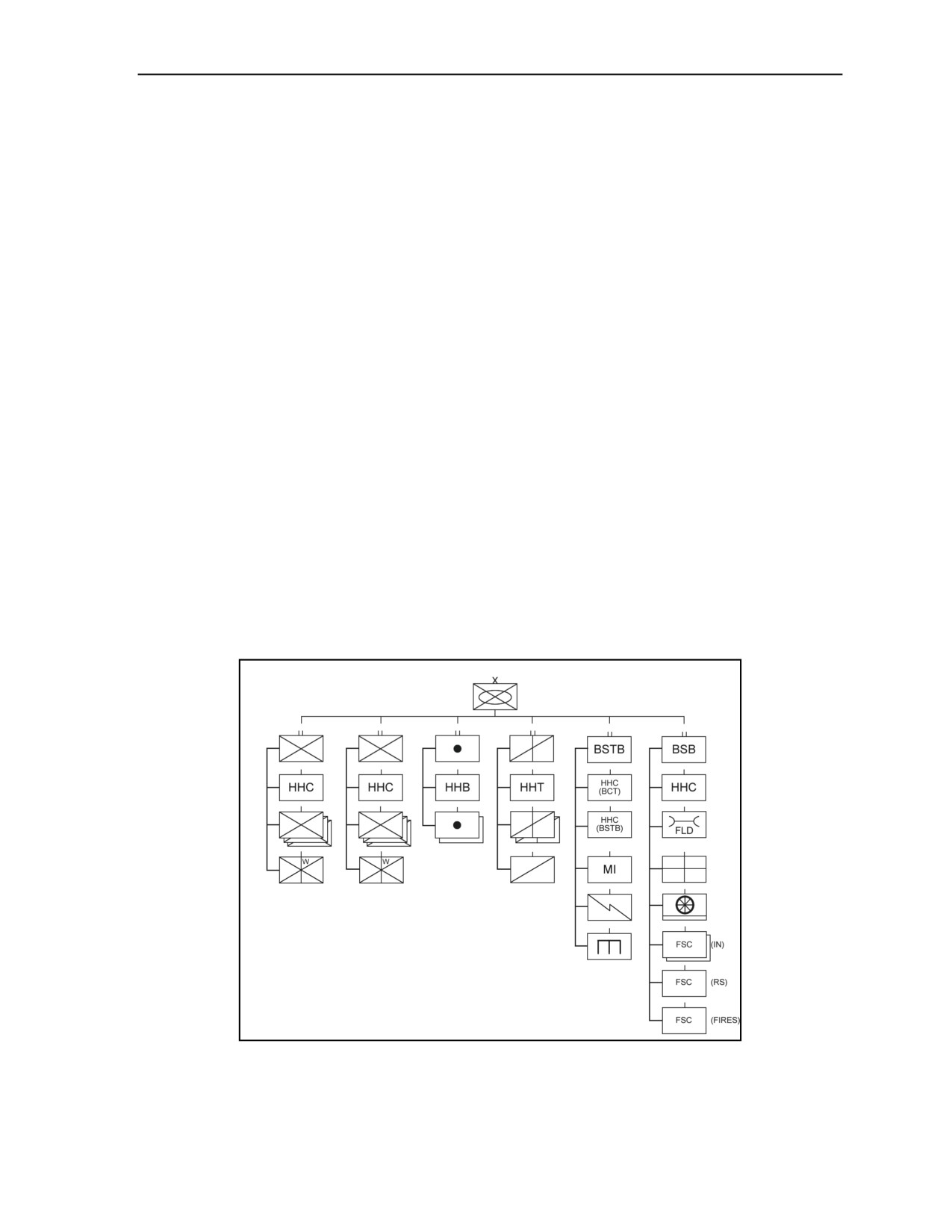
1-31. HBCTs are balanced combined arms units that execute operations with shock and speed (Figure 1-2).
Their main battle tanks, self-propelled artillery, and fighting vehicle-mounted Infantry provide tremendous
striking power. HBCTs require significant strategic airlift and sealift to deploy and sustain. Their fuel
consumption may limit operational reach. However, the HBCT’s unmatched tactical mobility and
firepower offset this. HBCTs include organic military intelligence, military police, artillery, signal,
engineer, CBRN, reconnaissance, and sustainment capabilities.
Figure 1-2. Heavy Brigade Combat Team
14 September 2010
FM 3-90.6
1-7
Chapter 1
Combined Arms Battalion
1-32. The combined arms battalion (CAB) is the HBCTs primary maneuver force. The CAB’s mission is to
close with, and destroy or defeat enemy forces within the full spectrum of modern combat operations. A
CAB maintains tactical flexibility within restricted terrain. It is organized in a "2-by-2" design, consisting
of two tank companies and two rifle companies. Companies fight as combined arms teams with support
from the CAB’s organic 120mm mortars, scout platoon, and sniper squad. Unlike battalions in the IBCT or
SBCT, the CAB has a countermine team transporting mine clearing blades and rollers for issue to the tank
companies. FM 3-90.5 provides the basic doctrinal principles, tactics, and techniques of employment,
organization, and tactical operations appropriate to the CAB.
Reconnaissance Squadron
1-33. The reconnaissance squadron’s fundamental role is to perform reconnaissance. As the
eyes and
ears‖ of the HBCT commander, the reconnaissance squadron provides the combat information that enables
the commander to develop situational understanding (SU), make better and quicker plans and decisions,
and visualize and direct operations to provide accurate and timely information across the area of operations
(AO). It also has the capability to defend itself against most threats. The reconnaissance squadron is
composed of four troops: one headquarters and headquarters troop (HHT) and three ground reconnaissance
troops equipped with M3 cavalry fighting vehicles (CFV) and armored wheeled vehicles. In large AOs,
aerial reconnaissance assets usually are attached or placed under operational control to the squadron to
extend its surveillance range. FM 3-20.96 provides the basic doctrinal principles, tactics, and techniques of
employment, organization, and tactical operations appropriate to the squadron.
Fires Battalion
1-34. The HBCT fires battalion provides responsive and accurate fire support including close supporting
fires and counterfire. The fires battalion has 16 self-propelled 155-mm howitzers (M109A6 Paladin) in two
8-gun batteries, each with two 4-gun firing platoons. The fires battalion has one AN/TPQ-36, one
AN/TPQ-37 counterfire radar and four AN/TPQ-48 lightweight countermortar radars (LCMR). See FM
3-09.70 for additional information on M109A6 Paladin howitzer operations.
Brigade Support Battalion
1-35. The brigade support battalion (BSB) is the organic sustainment unit of the HBCT. The BSB has four
forward support companies that provide support to each of the CABs, the field artillery (FA) battalion and
the reconnaissance squadron. These forward support companies provide each battalion commander with
dedicated logistics assets (less Class VIII organized specifically to meet the battalion’s requirements. The
BSB headquarters (HQ) has a distribution management section that receives requests, monitors incoming
supplies, and constructs, manages, and distributes configured loads. The BSB also has a supply and
distribution company, a field maintenance company, and a medical company assigned to ensure that the
HBCT could conduct self-sustained operations for 72 hours of combat.
Brigade Special Troops Battalion
1-36. The brigade special troops battalion (BSTB) provides command and control to the BCT headquarters
and headquarters company (HHC), engineer company, military intelligence company, brigade signal
company, military police platoon, and CBRN reconnaissance platoon of the HBCT. It also has a BSTB
HHC to provide administrative, logistic, and medical support to its organic and attached units. It is
responsible for the security of all BCT command posts (CP) and can, on order, plan, prepare, and execute
security missions for areas not assigned to other units in the Brigade area of operations. Its units can defeat
small local threats and, with augmentation or control of some of its organic units such as military police, it
can organize response forces to defeat threats that are more organized. FM 3-90.61 provides detailed
information on the organization and operations of the BSTB.
1-8
FM 3-90.6
14 September 2010
Introduction
Engineer Company
1-37. The engineer company has three combat engineer platoons and an equipment platoon that enhances
assured mobility to the BCT. In addition to limited general engineering tasks, they have the capability to
breach and cross obstacles, assist in the assault of fortified positions, emplace obstacles to protect friendly
forces, construct or enhance survivability positions, conduct route reconnaissance, and clear improvised
explosive devices. It does not have organic gap crossing capability. The engineers also have the mission to
maintain the environment for the area of operations.
Military Intelligence Company
1-38. The military intelligence company
(MICO) mission is to conduct analysis, intelligence
synchronization, full motion video, signals intelligence (SIGINT) and human intelligence (HUMINT)
collection in support of the BCT and its subordinate commands. The MICO provides analysis and
intelligence synchronization support to the BCT S-2. The MICO supports the BCT and its subordinate
commands through collection, analysis, and dissemination of intelligence information. It supports the BCT
S-2 in intelligence, surveillance, and reconnaissance (ISR) synchronization and in maintaining a timely and
accurate picture of the enemy situation.
Brigade Signal Company
1-39. The brigade signal company is organic to the HBCT and connects the unit to the global information
grid (GIG). The company has a headquarters and two network extension platoons. These platoons consist
of a joint network node (JNN) team, a high-capacity line of sight section, a data support team, a wireless
network extension team, and an enhanced position location reporting system (EPLRS) network manager
and gateway. Usually, one network extension support platoon is located at the BCT main CP, and one at the
BSB tactical operations center (TOC). The users supported by the HBCT signal company use the Army
Battle Command System (ABCS).
Heavy Brigade Combat Team Missions, Capabilities, and Limitations
1-40. The following paragraphs provide a discussion of the HBCT mission, its capabilities, and its
limitations.
Heavy BCT Mission
1-41. The HBCT mission is to fight and win engagements and battles in support of operational and
strategic objectives. The HBCT seizes enemy territory, destroys the enemy’s armed forces, and eliminates
his means of civil population control. The HBCT conducts sustained and large-scale actions in full
spectrum operations throughout the depth of the AO. Its combination of firepower, tactical mobility, and
organic reconnaissance assets make it invaluable to a higher headquarters commander in combat
operations.
Heavy BCT Capabilities
1-42. The HBCT’s capabilities include:
z
Increased firepower, tactical mobility, and protection compared to an IBCT or SBCT, enabling
rapid tactical movement, envelopments, and penetrations.
z
Conducting full spectrum operations.
z
Conducting screen, guard, and cover missions.
z
Combined arms integration down to battalion level enabling fighting and winning the close
fight.
z
Enhanced situational awareness, including a common operational picture (COP), down to
individual fighting vehicle level.
z
Enhanced linkages to joint forces, fires, and intelligence.
z
Robust organic sustainment.
14 September 2010
FM 3-90.6
1-9
Chapter 1
z
Accepting and integrating augmented units (e.g., cannon or rocket artillery, air defense, military
police, civil affairs, MISO elements, combat engineers).
z
Performing company-sized air assaults when augmented with lift assets.
z
The BSB has forward support companies for the combined arms and artillery battalions, and the
reconnaissance squadron.
z
BSTB provides command and control and sustainment support to brigade troops.
Heavy BCT Limitations
1-43. The HBCT’s operational limitations include:
z
Not rapidly deployable to theater or area of operations (unless deployed to pre-positioned
caches).
z
Limited capability to conduct forced entry or early entry operations.
z
High usage rate of consumable supplies, particularly class (CL) III, V, and IX.
z
Possesses no organic gap crossing or general engineering capability, and limited engineer
command and control capability.
INFANTRY BRIGADE COMBAT TEAM
ORGANIZATION
1-44. The IBCT is the Army’s lightest BCT, and is organized around dismounted Infantry, capable of
airborne or air assault operations (Figure 1-3). Each of the three types of IBCT (light Infantry, air assault,
or airborne) have the same basic organization. IBCTs require less strategic lift and logistical support than
other BCTs. When supported with intra-theater airlift, IBCTs have theater-wide operational reach. Organic
antitank, military intelligence, artillery, signal, engineer, reconnaissance, and sustainment elements enable
the IBCT commander to employ the force in combined arms formations. IBCTs are optimized for
operations in close terrain, such as swamps, woods, hilly and mountainous areas, and densely populated
areas.
Figure 1-3. Infantry Brigade Combat Team
1-10
FM 3-90.6
14 September 2010
Introduction
Infantry Battalion
1-45. Infantry battalions serve as the primary maneuver force for the brigade, and are organized with a
HHC, three rifle companies, and a weapons company. Each rifle company has three rifle platoons, a
weapons squad, and a 60mm mortar section. The HHC has a scout platoon, a sniper squad, and a platoon of
81mm and 120mm mortars. The weapons company has four wheeled assault platoons, each with three
ATGM vehicles. These platoons serve as the IBCT’s primary Armor killer providing standoff fires against
enemy armor. FM 3-21.20 provides the basic doctrinal principles, tactics, and techniques of employment,
organization, and tactical operations appropriate to an Infantry battalion.
Reconnaissance Squadron
1-46. The reconnaissance squadron of the IBCT is composed of four troops—an HHT, two mounted
reconnaissance troops, and one dismounted reconnaissance troop. The two mounted reconnaissance troops
are equipped with armored wheeled vehicles. The dismounted reconnaissance troop is easily deployable by
either fixed- or rotary-wing aircraft. FM 3-20.96 provides the basic doctrinal principles, tactics, and
techniques of employment, organization, and tactical operations specific to the squadron.
1-47. Each of the mounted reconnaissance troops includes three reconnaissance platoons, and a mortar
section. The reconnaissance platoons are organized with six armored wheeled vehicles. The mortar section
consists of two towed 120mm mortars and a fire direction center (FDC). The dismounted reconnaissance
troop includes a sniper squad and two dismounted reconnaissance platoons. The reconnaissance platoons
are organized into three sections with one Javelin in each platoon.
Fires Battalion
1-48. The IBCT fires battalion is organized to provide responsive and accurate fire support including close
supporting fires and counterfire. The fires battalion has 16 towed 105-mm howitzers (M119A2) in two
8-gun batteries, each with two 4-gun firing platoons. The fires battalion has 1 AN/TPQ-36 counterfire radar
and 4 AN/TPQ-48 LCMRs. FM 3-09.21 provides detailed information on the organization and tactics of
the fires battalion.
Brigade Support Battalion
1-49. The BSB is the organic sustainment unit of the IBCT assigned to ensure that the BCT can conduct
self-sustained operations for 72 hours of combat. It is organized as the HBCT BSB described above. The
BSB has dedicated troop transportation assets that provide the capability to mount two rifle companies on
trucks for a given operation. Each forward support company in a maneuver battalion also has dedicated
troop transportation assets that provide the capability to move one rifle company via trucks.
Brigade Special Troops Battalion
1-50. The IBCT BSTB is organized similarly and provides the same capabilities as the HBCT BSTB
described above. FM 3-90.61 provides detailed information on the organization and operations of the
BSTB.
INFANTRY BRIGADE COMBAT TEAM MISSION, CAPABILITIES, AND LIMITATIONS
1-51. The following paragraphs provide a discussion of the IBCT mission, its capabilities, and its
limitations.
Mission
1-52. The IBCT mission is to fight and win engagements and battles in support of operational and strategic
objectives. IBCTs can perform complementary missions to HBCTs and SBCTs in offensive operational
maneuver. They can be assigned missions such as reducing fortified areas, eliminating enemy force
remnants in restricted terrain, securing key facilities and activities, and beginning stability operations in the
wake of maneuvering forces. By design, IBCTs are more easily configured for static defensive missions.
The IBCT’s lack of heavy combat vehicles reduces their logistical footprint. This provides higher
14 September 2010
FM 3-90.6
1-11
Chapter 1
commanders greater flexibility in adapting various transportation modes to operationally and tactically
move or maneuver the BCT.
1-53. Airborne capable IBCTs conduct airborne assault-specific missions such as forcible entry operations,
airfield seizure, expanding an airhead line, and establishing a lodgment. Air assault, another recognized
form of forcible entry operation, is a capability common to every IBCT.
Capabilities
1-54. While IBCTs are optimized for offensive operations against conventional and unconventional forces
in rugged terrain, their design also makes them capable in complex terrain defense, urban combat, mobile
security missions, and stability operations. IBCTs are better suited for operations in restrictive and severely
restrictive terrain than the other types of BCTs. This is true whether the enemy is conventional or
unconventional and whether the mission is in support of operational maneuver or operations against
insurgents. The IBCT’s capabilities include:
z
Excellent strategic and operational deployment.
z
Capable of conducting forcible entry or early entry operations, including airborne assault, air
assault and amphibious operations (Joint Publication [JP] 3-18).
z
IBCT is transportable by Army aviation brigades (CH-47 and UH-60 helicopters).
z
Enhanced situational awareness, including a common operational picture, down to company
commander level (and platoon leaders assigned wheeled vehicles).
z
The BSB has forward support companies for the Infantry and artillery battalions, and the
reconnaissance squadron.
z
BSTB provides command and control and sustainment support to brigade troops.
z
Operations require less CL III, V, and IX resupply than HBCT and SBCT.
Limitations
1-55. Limitations of the IBCT include the following:
z
Does not have the organic firepower, tactical mobility, or inherent protection of the HBCT and
SBCT.
z
No organic gap crossing or general engineering capability, and limited engineer command and
control capability.
z
The two maneuver battalions of the IBCT move predominately by foot; organic vehicles can
transport only two rifle companies at a time.
STRYKER BRIGADE COMBAT TEAM
ORGANIZATION
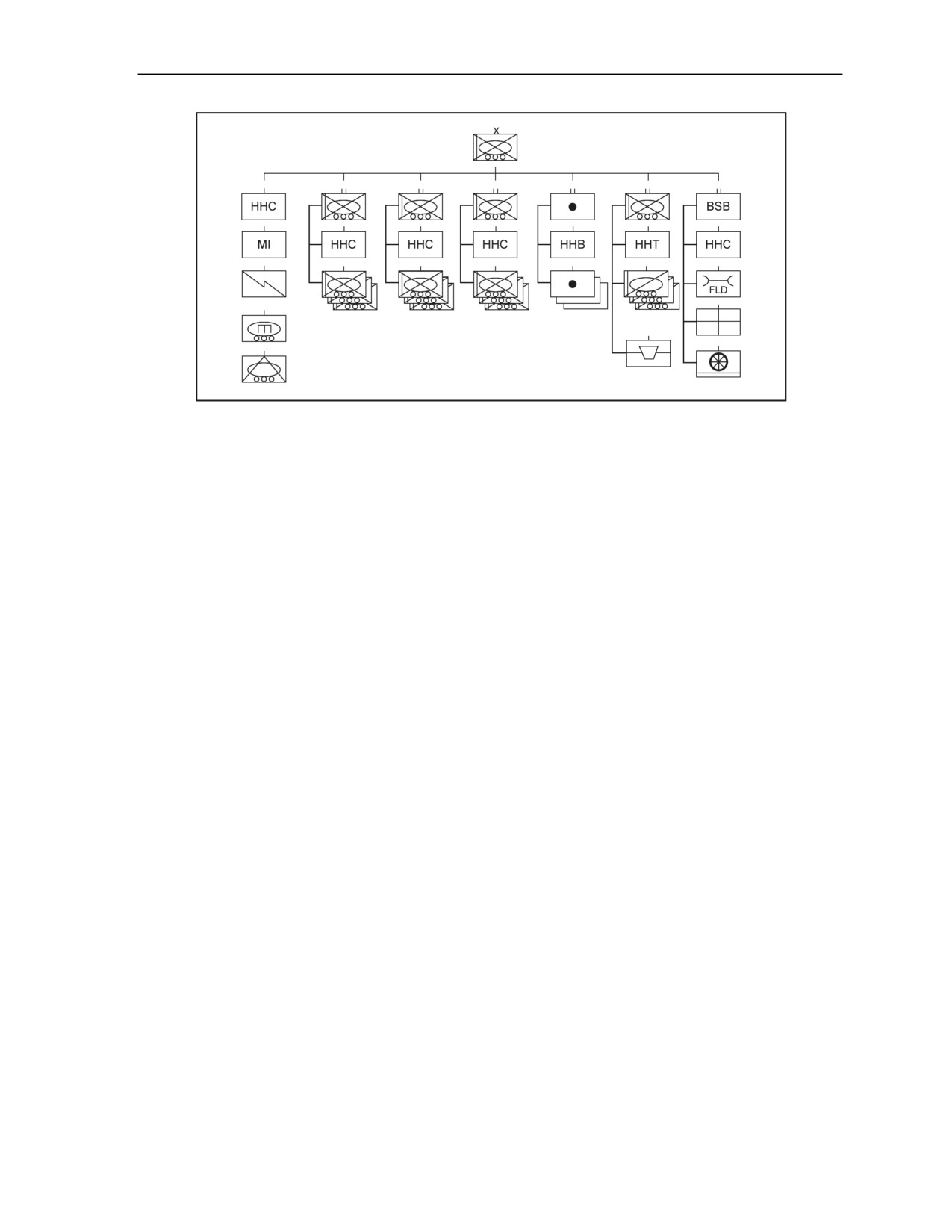
1-56. SBCTs balance combined arms capabilities with significant strategic and intra-theater mobility
(Figure 1-4). Designed around the Stryker wheeled armor combat system in several variants, the SBCT has
considerable operational reach. It is more deployable than the HBCT and has greater tactical mobility,
protection, and firepower than the IBCT. SBCTs fight primarily as a dismounted Infantry formation. The
SBCT includes military intelligence, signal, engineer, antitank, artillery, reconnaissance, and sustainment
elements. This design lets SBCTs commit combined arms elements down to company level in urban and
other complex terrain against a wide range of opponents (FM 3-0).
1-12
FM 3-90.6
14 September 2010
Introduction
Figure 1-4. Stryker Brigade Combat Team
Infantry Battalion
1-57. SBCT Infantry battalions are organized "3 -by-3"; that is, three rifle companies, each with three rifle
platoons. Each rifle company has a section of organic 120mm Stryker mortar carrier vehicles with 60mm
dismounted mortar capability, a mobile gun system (MGS) platoon with three MGS vehicles, and a sniper
team. The HHC also has a mortar platoon equipped with 120mm Stryker mortar carrier vehicles with
81mm mortar dismounted capability, a reconnaissance platoon, and two sniper squads. FM 3-21.21
provides the basic doctrinal principles, tactics, and techniques of employment, organization, and tactical
operations appropriate to the SBCT Infantry battalion.
Reconnaissance Squadron
1-58. The reconnaissance squadron of the SBCT is extremely mobile and can cover a very large area of
operations. The reconnaissance squadron is composed of five troops: one HHT, three reconnaissance troops
equipped with Stryker reconnaissance vehicles, and a surveillance troop. FM 3-20.96 provides the basic
doctrinal principles, tactics, and techniques of employment, organization, and tactical operations
appropriate to the squadron.
1-59. Each of the reconnaissance troops includes three reconnaissance platoons and a mortar section. The
three reconnaissance platoons contain four reconnaissance vehicles, each with a crew and a scout/HUMINT
team for dismounted reconnaissance. The mortar section consists of two 120mm self-propelled mortars and
an FDC.
1-60. The surveillance troop provides the squadron commander with a mix of specialized capabilities built
around aerial and ground sensors. The tactical unmanned aircraft systems (TUAS) platoon launches, flies,
recovers, and maintains the squadron’s aerial reconnaissance unmanned aircraft system (UAS) . The multi-
sensor ground platoon consists of ground-based radio signals interception and direction-finding teams (e.g.,
Prophet teams). It also has a dedicated communications terminal that transmits, reports, and receives voice,
data, digital, and imagery feeds from intelligence sources at every echelon, from reconnaissance squadron
through national level. The ground sensor platoon provides remotely emplaced unmanned monitoring
capabilities. The CBRN reconnaissance platoon has three M1135, nuclear, biological, and chemical
reconnaissance vehicle (NBCRV) Strykers to determine the presence and extent of CBRN contamination.
Fires Battalion
1-61. The SBCT fires battalion provides responsive and accurate fire support including close supporting
fires and counterfire to the elements of the SBCT. The fires battalion has 18 towed 155-mm howitzers
(M777A2) in three 6-gun batteries, each with two 3-gun firing platoons. The fires battalion has 1 AN/TPQ-36
and 1 AN/TPQ-37 counterfire radar and 5 AN/TPQ-48 LCMRs. FM 3-09.21 (which will be revised,
14 September 2010
FM 3-90.6
1-13
Chapter 1
renumbered, and renamed) provides detailed information on the organization and tactics of the fires
battalion.
Brigade Support Battalion
1-62. The BSB is the organic sustainment unit of the SBCT. It has four subordinate companies: a
distribution company, a forward maintenance company, a medical company, and a HHC. The BSB does not
have forward support companies and so must task organize to provide support to each maneuver unit in the
SBCT. Chapter 9 of this manual provides more detailed information on the organization and operations of
the BSB.
Antitank Company
1-63. The antitank company is the primary antiarmor force in the SBCT. The company consists of three
platoons each with three Stryker ATGM vehicles.
Engineer Company
1-64. The engineer company provides the SBCT with mobility support. It consists of three mobility
platoons and one mobility support platoon. It has limited organic gap crossing capability with four rapidly
emplaced bridge systems. The engineers also have the mission to maintain the environment in the area of
operations.
Brigade Signal Company
1-65. The brigade signal company is organic to the SBCT and connects the unit to the GIG. The company
has two network extension platoons and various signal support teams under the company headquarters. The
users supported by the SBCT signal company use ABCS.
Military Intelligence Company
1-66. The MICO consists of a headquarters section, an ISR integration platoon, an ISR analysis platoon,
and a tactical human intelligence platoon. The ISR analysis and ISR integration platoons are under the
operational control (OPCON) of the SBCT S-2; they also provide support to the development of the SBCT
COP, targeting effects, situation development, and IPB. They integrate and analyze across the other
warfighting functions’ reconnaissance and surveillance reporting to develop intelligence products in
response to priority intelligence requirements (PIR). The tactical HUMINT platoon provides the SBCT
with an organic capability to conduct HUMINT collection and counterintelligence activities.
STRYKER BRIGADE COMBAT TEAM MISSIONS, CAPABILITIES, AND LIMITATIONS
1-67. The following paragraphs provide a discussion of the SBCT mission, its capabilities, and its
limitations.
Mission
1-68. The SBCT mission is to fight and win engagements and battles in support of operational and strategic
objectives. Although the SBCT mainly uses its personnel and equipment to conduct operations other than
major combat, when augmented with appropriate heavy Armor capabilities and support, it can execute
missions across the full spectrum of conflict. When the SBCT participates in a major combat operation, it
does so as a subordinate element of a division or corps. As with any brigade, adjustments to task
organization might be required.
Capabilities
1-69. The SBCT is capable of conducting full spectrum operations, and it provides operational
commanders with increased operational and tactical flexibility. This flexibility is enabled by the SBCT’s
rapid deployment capability (i.e., by air in a matter of days) and by its significantly fewer sustainment
requirements (as compared to the HBCT). The SBCT key assets, besides its Soldiers, are its Stryker
vehicles and digital information systems
(INFOSYS). The Stryker vehicle provides the SBCT both
1-14
FM 3-90.6
14 September 2010
Introduction
operational and tactical mobility along with added protection and firepower (as compared to the IBCT),
while the SBCT’s INFOSYS provide enhanced situational awareness down to the vehicle/Soldier level.
The SBCT’s capabilities include:
z
Increased strategic and operational deployment capability compared to a HBCT.
z
Capability to conduct air assault forced entry or early entry operations.
z
Combined arms integration down to company level.
z
Enhanced situational awareness, including a COP, down to individual fighting vehicle level.
z
Dismount strength for close combat in urban and complex environments with three Infantry
battalions for maneuver (vs. only two in the HBCT and IBCT).
z
Limited organic gap crossing capability.
z
Lower usage rate of CL III supplies than the HBCT with nearly the same mobility.
z
Greater inherent protection than an IBCT.
z
Performing company-sized air assaults.
Limitations
1-70. Limitations of the SBCT include:
z
Less firepower or inherent protection than HBCTs.
z
Require more intra-theater aircraft to deploy than an IBCT.
z
The BSB does not have forward support companies for each maneuver battalion.
z
There is no BSTB for C2 of brigade troops.
SECTION III - BRIGADE COMBAT TEAM COMMAND AND CONTROL
1-71. Command and control (C2) is the exercise of authority and direction by a properly designated
commander over assigned and attached forces in the accomplishment of a mission:
z
Command is the authority that the BCT commander and subordinate commanders lawfully
exercise over subordinates by virtue of rank or assignment.
z
Control is the regulation of the BCT and the warfighting functions to accomplish the mission in
accordance with the commander’s intent.
1-72. The BCT commander performs C2 functions through a C2 system FM 6-0 provides a description of
the C2 system - the arrangement of Soldiers, information management, procedures, equipment and
facilities essential for the command to conduct operations. An effective C2 system is essential for the BCT
commander to conduct (plan, prepare, execute, and assess) operations that accomplish the in operations are
battle command and mission command. FM 3-0 provides detailed information on battle command and the
BCT commander’s role in the operations process. Mission command is the Army’s preferred means of
battle command.
BRIGADE COMBAT TEAM MISSION COMMAND
1-73. Mission command is the conduct of military operations through decentralized execution based on
mission orders. Mission command rests on the following four elements:
z
Commander’s intent.
z
Individual initiative.
z
Mission orders.
z
Resource allocation.
1-74. The BCT commander’s intent, formalized in the order and understood at company level, provides
subordinates with the broad idea behind the operation and allows them to act promptly as the situation
requires. Commanders focus their orders on the purpose of tasks and the operation as a whole rather than
on the details of how to perform assigned tasks. Orders and plans are as brief and simple as possible.
14 September 2010
FM 3-90.6
1-15
Chapter 1
1-75. Detailed command, in contrast to mission command, centralizes information and decision-making
authority. When detailed command is used, orders and plans are comprehensive and explicit. Detailed
orders may achieve a high degree of coordination in planning; however, after the operation has begun, they
leave little room for adjustment by subordinates and generally fail to remain relevant. Detailed command is
not suited for taking advantage of rapidly changing situations and is used by exception. Specific parts of
operations often require close coordination in both planning and execution. Examples of such operations
include deliberate attack, reliefs in place, passage of lines, air assaults, and major movements.
1-76. There are several considerations the BCT commander makes when he decides whether detailed
command is more appropriate. In addition to uncertainty about the situation and the complexity of the
operation, the effectiveness of his C2 system—particularly the experience level of his subordinate
commanders and staffs—and the amount of time available for planning and preparation are factors to
consider. FM 6-0 provides detailed information about mission command.
OPERATIONS PROCESS
1-77. During operations, the BCT commander balances his time and the staff’s time and resources among
four major activities in a continuous learning and adaptive cycle called the operations process. The
operations process consists of the major C2 activities performed during operations: planning, preparing,
executing, and continuously assessing the operation. The commander drives the operations process. FM 3-0
provides detailed information about the operations process. The operations process activities are sequential
but not discrete; all overlap and recur as circumstances demand. The commander drives the operations
process through battle command.
INTEGRATING PROCESSES AND CONTINUING ACTIVITIES
1-78. Throughout the operations process, the BCT commanders and staffs synchronize the warfighting
functions to accomplish missions. Commanders and staffs use several integrating processes to do this.
Where synchronization is the arrangement of action in time, space, and purpose, integration is combining
actions into a unified whole. Before commanders can effectively synchronize activities or events, they must
integrate activities of the staff. For example, synchronizing fires with movement and maneuver proves
difficult if one part of the staff develops the maneuver plan while another part of the staff independently
develops the fire plan.
1-79. Integrating processes combine members from across the staff to help synchronize operations. For
example, the military decision-making process (MDMP) fosters a shared understanding of the situation as it
develops a synchronized plan or order to accomplish a mission. The MDMP not only integrates the actions
of the commander, staff, subordinate commanders, and others but also integrates several processes such as
IPB, targeting, and airspace command and control (AC2). Commanders and staffs also integrate the
warfighting functions through CP cells, working groups, and boards, which are described later in this
section.
1-80. The following processes help integrate the staff efforts for particular functions:
z
Intelligence preparation of the battlefield. FM 2-01.3 provides information on IPB.
z
Intelligence, surveillance and reconnaissance synchronization and integration. FMI 2-01 provides
information on ISR synchronization.
z
Targeting. FM 6-20-10 provides information on the lethal and nonlethal targeting process.
z
Composite risk management. FM 5-19 provides information on risk management.
z
Knowledge management. FM 6-0 provides information on knowledge management.
z
Airspace command and control. FM 3-52 provides more information on airspace command and
control.
1-81. The following activities continue during all BCT operations. They are synchronized with each other
and integrated into the overall operation (FM 3-0):
z
Reconnaissance and security operations.
z
Protection.
z
Liaison and coordination.
1-16
FM 3-90.6
14 September 2010
Introduction
z
Terrain management.
z
Information management.
z
Airspace command and control.
Air-Ground Integration
1-82. Operations must be integrated so air and ground forces can simultaneously work in the operational
environment to achieve a common objective. Integration maximizes combat power through synergy of both
forces. The synchronization of aviation operations into the ground commander’s scheme of maneuver may
also require integration of other services or coalition partners. It may also require integration of attack
reconnaissance, assault, and cargo helicopters.
1-83. Aviation and ground units require effective synchronization and integration to conduct operations
successfully and minimize the potential for fratricide and civilian casualties. It continues through planning,
preparation, and execution of the operation. To ensure effective integration, commanders and staffs must
consider some fundamentals for air-ground integration. The following fundamentals provide the framework
for enhancing the effectiveness of both air and ground maneuver assets:
z
Understanding capabilities and limitations of each force.
z
Use of standard operating procedures (SOP).
z
Habitual relationships.
z
Regular training events.
z
Airspace command and control.
z
Maximizing and concentrating effects of available assets.
z
Employment methods.
z
Synchronization.
1-84. Synchronization is merging the air and ground fights into one with the goal of properly applying
aviation capabilities in accordance with the BCT commander’s intent. Synchronization ideally begins early
in the planning process with brigade aviation element (BAE) involvement. The BAE advises the BCT
commander on aviation capabilities and on how to best use aviation to support mission objectives. Of equal
importance is ensuring that the BAE/aviation liaison officer (LNO) passes along task and purpose for
aviation support, and continually provides updates as needed. Simply stated, ensuring the aviation brigade
and subordinate unit staffs fully understand the BCT scheme of maneuver and the commander’s intent is
critical to successful air-ground integration.
1-85. Employment of attack reconnaissance aviation with ground maneuver forces requires coordinated
force-oriented control measures and the close combat attack (CCA) call for fire. This allows aviation forces
to support ground maneuver with direct fires while minimizing fratricide risks. The BAE should ensure the
BCT is familiar with CCA procedures and marking techniques. FM 3-04.126 contains detailed information
about CCA and air-ground integration.
COMMAND POST OPERATIONS
1-86. The BCT commander organizes his staff into CPs. These CPs provide staff expertise,
communications, and information systems that work in concert to aid the commander in planning and
controlling operations. All CPs have the responsibility to conduct the five basic functions of information
management (IM):
z
Collect relevant information.
z
Process information from data to knowledge.
z
Store relevant information for timely retrieval to support C2.
z
Display relevant information tailored for the needs of the user.
z
Disseminate relevant information.
1-87. The BCT C2 system consists of the people and equipment in the CPs. The most important element of
the C2 system is the people—Soldiers who assist commanders and exercise control on their behalf.
Personnel dedicated to the C2 system include seconds in command, command sergeants major, and staffs.
14 September 2010
FM 3-90.6
1-17
Chapter 1
This section describes how the BCT organizes its CPs and their structure. It also describes how the BCT
commander cross functionally organizes the staff into CP cells and working groups.
COMMAND AND CONTROL ORGANIZATIONS
1-88. BCTs are structured to command and control their operations through two command groups and
three primary CPs:
z
Main CP.
z
Tactical command post (TAC CP).
z
BSB CP.
1-89. The BCT commander organizes these CPs and command groups by staff sections and staff cells.
Staff sections consist of groups of Soldiers by area of expertise (e.g., S-1, S-2, S-3). FM 6-0 provides
detailed information about the duties and responsibilities for each Soldier assigned to the BCT staff.
1-90. A cell is a grouping of personnel and equipment according to warfighting function or purpose usually
combining a relevant variety of subject matter experts. Organizing the staff among CPs, and into cells
within CPs, expands the commander’s ability to exercise C2 and makes the system more survivable.
Additional staff integration occurs through cross-functional working groups that meet to accomplish
specific objectives, typically for producing planning products or assessments. See paragraph 1-130 for
more information on BCT working groups.
1-91. Commanders determine the sequence, timing of the deployment or movement, initial locations, and
exact organization of CPs based on the situation. Each CP performs specific functions by design as well as
tasks the commander assigns. Activities common in all CPs include:
z
Maintains running estimates and the COP.
z
Controls operations.
z
Assesses operations.
z
Develops and disseminates orders.
z
Coordinates with higher, lower, and adjacent units.
z
Conducts knowledge management and information management. See FM 6-01.1 for more
information on KM and IM.
z
Performs CP administration.
z
Maintains local security.
BRIGADE COMBAT TEAM COMMAND GROUP
1-92. A command group consists of the commander and selected staff members who accompany
commanders and enable them to exercise C2 away from a CP. The BCT HQ can form two command
groups. They are organized based on the mission. Both are equipped to operate separately from the TAC
CP or main CP. Command groups give the commander and the deputy commanding officer (DCO) the
mobility and protection to move throughout the AO and to observe and direct BCT operations from
forward positions.
1-93. The command group led by the BCT commander consists of whomever he designates. This can
include the sergeant major (SGM) and representatives from the S-2, S-3, and fires sections. The command
group must have a dedicated security element whenever it departs the main CP. The commander positions
his command group near the most critical event, usually with or near the main effort.
1-94. The command group led by the DCO, if used, may include the assistant operations officer, assistant
intelligence officer, and a fire support officer. The DCO usually positions his command group with a
shaping effort or at a location designated by the BCT commander. The DCO must be able to communicate
with the BCT, the battalion commanders, and the CPs. The command group must also have a dedicated
security element whenever it departs the main CP.
1-18
FM 3-90.6
14 September 2010
Introduction
BRIGADE COMBAT TEAM MAIN COMMAND POST
1-95. The main CP is the unit’s principal CP for BCT C2, internally and externally. It includes
representatives of all staff sections and a full suite of INFOSYS to plan, prepare, execute, and assess
operations. It is larger in size and staffing, and less mobile than the TAC CP. The BCT executive officer
(XO) leads and provides staff supervision of the main CP.
1-96. Functions of the main CP include the following:
z
Synchronizing all aspects of decisive, shaping, and sustaining operations.
z
Monitoring the current fight.
z
Coordinating fires and effects.
z
Planning for future operations.
z
Monitoring and anticipating commander’s decision points and commander’s critical information
requirements (CCIR).
z
Coordinating with higher HQ, adjacent or lateral units and informing them of ongoing missions.
z
Supporting the commander’s SU through IM.
z
Planning, monitoring, and integrating airspace users.
z
Develop and implement safety and occupational health, risk management, and accident
prevention requirements, policies, and measures.
1-97. The BCT main CP is organized into staff sections, and functional and integrating CP cells to perform
specific functions. Commanders adjust their CP organization to fit the situation and their C2 concept for an
operation.
1-98. While the main CP can be configured to fit the situation, a typical structure is:
z
Current operations cell.
z
Plans cell.
z
Movement and maneuver cell.
z
Fires cell.
z
Intelligence cell.
z
Protection cell.
z
Sustainment cell.
1-99. Considerations for positioning the main CP include:
z
Where the enemy can least affect main CP operations.
z
Where the main CP can achieve the best communications (digital and voice).
z
Where the main CP can control operations best.
Note. In contiguous AOs, the BCT main CP locates behind battalion tactical operations centers
and the BCT TAC CP, and out of enemy medium artillery range, if practical. In noncontiguous
AOs, the BCT main CP usually locates within a subordinate battalion’s AO.
BRIGADE COMBAT TEAM TACTICAL COMMAND POST
1-100. The TAC CP is a C2 facility containing a tailored portion of the BCT HQ designed to control
portions of an operation for a limited time. The BCT commander employs the TAC CP as an extension of
the main CP to help control the execution of an operation or specific task, such as a river crossing, a
passage of lines, or an air assault operation. The BCT commander may employ the TAC CP to direct the
operations of units close to each other when direct command is necessary. This can occur for a relief in
place. The commander also can use it to control a special task force, or to control complex tasks such as
reception, staging, onward movement, and integration.
1-101. The TAC CP is fully mobile and usually is located near the decisive point of the operation. As a
rule, it includes only the Soldiers and equipment essential to the tasks assigned; however, it sometimes
requires augmentation for security. The TAC CP relies on the main CP for planning, detailed analysis, and
14 September 2010
FM 3-90.6
1-19
Chapter 1
coordination. The BCT XO or the operations officer (S-3) leads the TAC CP. When employed, TAC CP
functions include the following:
z
Control current operations.
z
Provide information to the COP.
z
Assess the progress of operations.
z
Assess the progress of higher and adjacent units.
z
Perform short-range planning.
z
Provide input to targeting and future operations planning.
z
Provide a facility for the commander to control operations, issue orders, and conduct rehearsals.
1-102. When the TAC CP is not used, the staff assigned to it reinforces the main CP. Unit SOP should
address the specifics for this, including procedures to quickly detach the TAC CP from the main CP.
BRIGADE SUPPORT BATTALION COMMAND POST
1-103. The BSB CP has a special role in controlling and coordinating the administrative and logistical
support for the BCT. The improvements in communications and INFOSYS means the BCT no longer has
to operate a rear CP collocated with the BSB CP. If necessary, BCT sustainment staff (S-1, S-4, and
surgeon), may locate portions of their sections with the BSB CP.
1-104. The BSB CP performs the following functions for the BCT:
z
Tracks the current battle so it may anticipate support requirements before units request them.
z
In contiguous operations, serves as units’ entry point to the BCT’s area of operations.
z
Monitors main supply routes (MSR) and controls sustainment vehicle traffic.
z
Coordinates the evacuation of casualties, equipment, and detainees.
z
Coordinates movement of personnel killed in action (KIA).
z
Coordinates with the sustainment brigade for resupply requirements.
z
Assists in operation of a detainee collection point.
z
Provides ad-hoc representation, as required or directed, to the main CP in support of the
sustainment cell.
STAFF
1-105. The staff assists the commander in planning, coordinating, and supervising operations. A staff
section is a grouping of staff members by area of expertise under the supervision of a coordinating,
personal, or special staff officer. Not all staff sections reside in one of the functional or integrating CP cells
discussed later in this chapter. Each staff section maintains its distinct organization. Staff sections operate
in different CP cells as required, and coordinate their activities in the various boards, working groups, and
meetings established in the unit’s battle rhythm (Figure 1-5). FM 6-0 and FM 5-0 provide details about the
types and responsibilities of special staff officers.
EXECUTIVE OFFICER
1-106. The XO is the commander’s principal staff officer and the command’s principal integrator. He
directs staff tasks, manages and oversees staff coordination and special staff officers, and ensures efficient
and prompt staff actions. He interacts with the commander’s personal staff officers, but he does not
necessarily oversee them. The XO usually remains at the main CP.
COORDINATING STAFF
1-107. Coordinating staff officers are the commander’s principal staff assistants. Collectively, through the
XO, they are accountable to their commander for all of their responsibilities. Coordinating staff officers
advise, plan, and coordinate actions within their areas of expertise. They also exercise planning and
supervisory authority over special staff sections as described in FM 5-0.
1-20
FM 3-90.6
14 September 2010
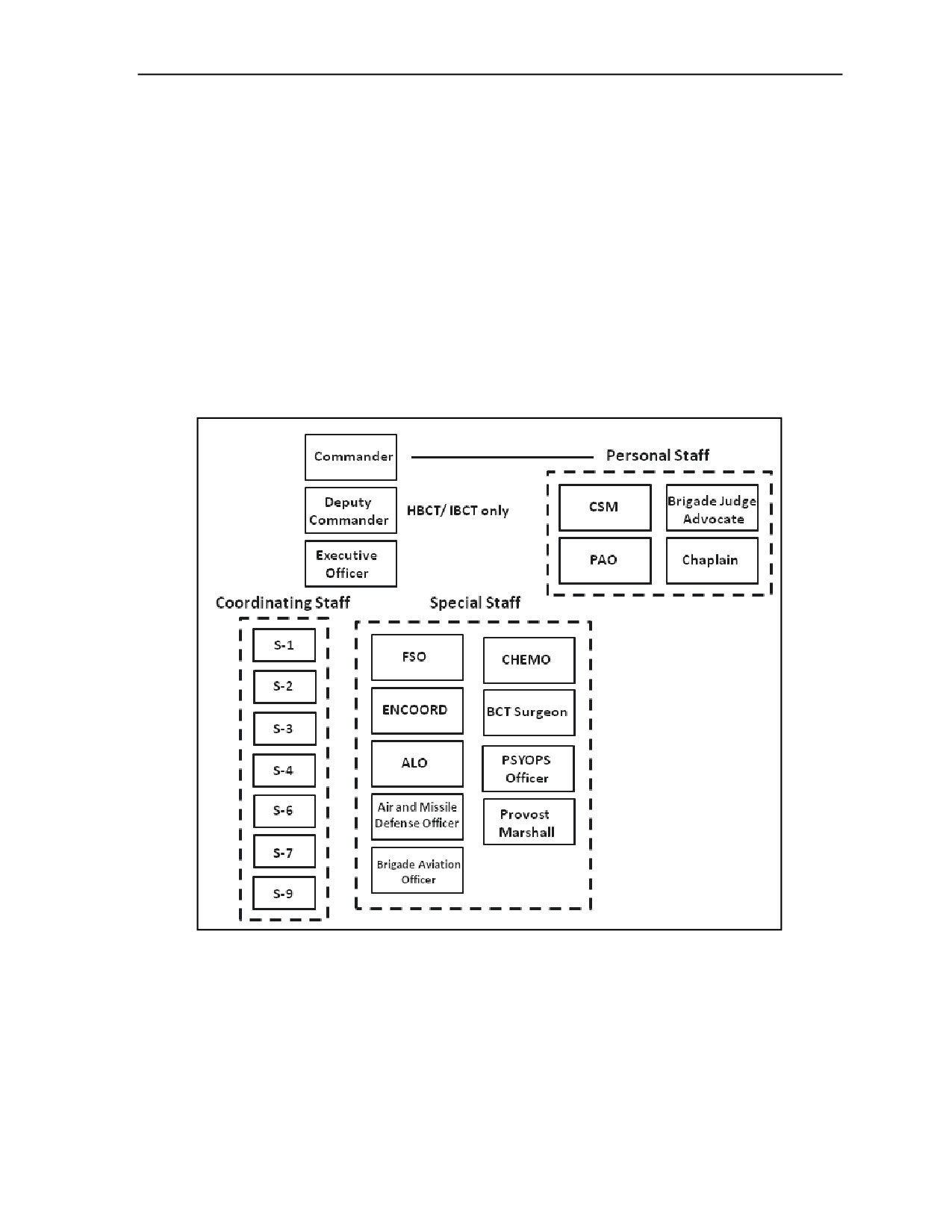
Introduction
PERSONAL STAFF
1-108. The personal staff sections advise the commander, provide input to orders and plans, and interface
and coordinate with entities external to the BCT headquarters. They perform special assignments as
directed by the commander. Personal staff officers generally work out of the main CP under the
commander’s immediate control.
SPECIAL STAFF
1-109. Special staff officers help commanders and other staff members perform their responsibilities. The
number of special staff officers and their duties vary. Special staff sections are organized according to
professional or technical responsibilities. The commander delegates planning and supervisory authority
over each special staff function to a coordinating staff officer. Although special staff sections may not be
integral to a coordinating staff section, there are usually areas of common interest and habitual association.
Special staff officers usually deal routinely with more than one coordinating staff officer. The members of
the special staff can change, depending on the situation and the capabilities available to the BCT
commander.
Figure 1-5. BCT staff organization
CENTERS
1-110. In addition to CPs, the BCT or its subordinate units may establish centers to assist with
coordinating operations. A center is a C2 facility with a supporting staff established for a specific purpose.
Centers are similar to CPs in that they are facilities with staff members, equipment, and a leadership
component. However, centers have a more narrow focus (for example, a civil-military operations center).
Centers usually are formed around a subordinate unit HQ. See Chapter 8 for an example of a civil-military
operations center’s (CMOC) responsibilities.
14 September 2010
FM 3-90.6
1-21
Chapter 1
COMMAND POST CELLS AND ELEMENTS
1-111. While each echelon and type of unit organizes CPs differently, two types of CP cells exist:
integrating and functional. Integrating cells group personnel and equipment to integrate the warfighting
functions according to planning horizon. Functional cells group personnel and equipment according to
warfighting function.
INTEGRATING CELLS
1-112. Cross-functional by design, integrating cells include the plans and current operations cells. The
integrating cells coordinate and synchronize forces and warfighting functions within a specified planning
horizon. A planning horizon is a point in time that commanders use to focus the organization’s planning
efforts to shape future events. The three planning horizons are long-range, mid-range, and short-range. Not
all echelons and types of units are resourced for all three integrating cells. The CAB, for example,
combines their planning and operations responsibilities in one operations cell. The BCT has a small,
dedicated planning cell. The BCT is not resourced for a future operations cell. Generally, the BCT focuses
on short and mid-range planning, which are associated with the plans cell and current operations cells,
respectively. Planning horizons are situation-dependent; they can range from hours and days to weeks and
months. As a rule, the higher the echelon, the more distant the planning horizon with which it is concerned.
PLANS CELL
1-113. The plans cell is responsible for planning operations for the mid- to long-range planning horizons.
It prepares for operations beyond the scope of the current order by developing plans, orders, branches, and
sequels using the MDMP. The plans cell also oversees military deception planning.
1-114. The plans cell consists of a core group of planners and analysts led by the plans officer. All staff
sections assist as required. While the BCT has a small, dedicated plans element, the majority of its staff
sections balance their efforts between the current operations and plans cells.
1-115. Upon completion of the initial operation order (OPORD), the plans cell normally develops plans
for the next operation or the next phase of the current operation. In addition, the plans cell also develops
solutions to complex problems resulting in orders, policies, and other coordinating or directive products
such as memorandums of agreement. In some situations, planning teams form to solve specific problems,
such as redeployment within the theater of operations. When planning is complete, these planning teams
dissolve.
CURRENT OPERATIONS CELL
1-116. The current operations cell is the focal point for all operational matters. It oversees execution of
the current operation. This involves assessing the current situation while regulating forces and warfighting
functions in accordance with the commander’s intent and concept of operations.
1-117. The current operations cell displays the COP and conducts shift change, assessment, and other
briefings as required. It provides information on the status of operations to all staff members and to higher,
lower, and adjacent units. The current operations cell has representatives from all staff sections, either
permanently or on call. From here, the XO guides the staff and supervises the activities of all cells and staff
sections in the main CP.
1-118. The operations officer (S-3) leads the current operations cell from the main CP, or from the TAC
CP when separated from the main CP. The movement and maneuver cell forms the core of the current
operations cell. Representatives from each staff section and liaison officers from subordinate and adjacent
units form the remainder of the cell.
FUNCTIONAL CELLS
1-119. Functional cells coordinate and synchronize forces and activities by warfighting function.
Functional cells within the BCT CP are movement and maneuver, intelligence, fires, sustainment,
command, control, communications, and computer operations (part of the C2 warfighting function), and
1-22
FM 3-90.6
14 September 2010
Introduction
protection. In the BCT, the protection cell function overlaps with fires, movement and maneuver, and C2
warfighting functions.
Movement and Maneuver Cell
1-120. The movement and maneuver cell coordinates activities and systems that move forces to achieve a
position of advantage in relation to the enemy. This includes tasks associated with employing forces in
combination with direct fire or fire potential (maneuver), force projection (movement) related to gaining a
positional advantage over an enemy, and mobility and countermobility. Elements of the operations,
aviation, and engineer staff sections form this cell. The unit’s operations officer (S-3) leads this cell. Staff
elements in the movement and maneuver cell also form the core of the current operations cell.
Intelligence Cell
1-121. The intelligence cell coordinates activities and systems that facilitate understanding of the enemy,
terrain and weather, and civil considerations. The intelligence cell requests, receives, and analyzes
information from all sources to produce and distribute intelligence products. This includes tasks associated
with the IPB and ISR synchronization and integration process. Most of the intelligence staff section resides
in this cell. The unit’s intelligence officer leads this cell.
Fires Cell
1-122. The fires cell coordinates activities and systems that provide collective and coordinated use of
Army indirect fires, joint fires, and C2 warfare through the targeting process. Elements of the fire support
(FS), electronic warfare, information engagement and intelligence staff sections make up this cell. The
BCT’s fire support officer leads this cell.
Air Defense and Airspace Management/Brigade Aviation Element Cell
1-123. The air defense and airspace management (ADAM)/BAE cell is composed of air defense artillery
and Army aviation staff members to coordinate airspace and aviation support issues with other cells. It
participates directly in the targeting process and AC2 continuing activity, and may be a part of most
working groups and meetings.
Protection Cell
1-124. The protection cell integrates and synchronizes protection tasks and their associated systems
throughout the operations process. The composite risk management process is the overarching process for
integrating protection into Army operations. Protection tasks and systems include air and missile defense,
personnel recovery, information protection, fratricide avoidance, operational area security, antiterrorism,
survivability, force health protection, CBRN operations, safety, operations security, and explosive ordnance
disposal. The protection cell coordinates with the network operations cell to facilitate the information
protection task. In the BCT, the S-3 supervises the protection cell.
1-125. Protection integration in the BCT may require commanders to designate a staff lead, as the
protection officer, who has the experience to integrate risk management and other integrating processes.
The executive officer, operations officer (S-3), or a sergeant major could accomplish these duties. Assistant
operations officers and other staff officers could be designated as the protection coordinators to facilitate
the integration of the twelve protection tasks into operations. In all cases, protection officers and
coordinators work with higher and lower echelons to nest protection activities with complementary and
reinforcing capabilities.
Sustainment Cell
1-126. The sustainment cell coordinates activities and systems that provide support and services to ensure
freedom of action, extend operational reach, and prolong endurance. It includes those tasks associated with
logistics, personnel services, and health service support. Elements of the following staff sections work in
the sustainment cell: personnel, logistics, financial management, and surgeon. The BCT S-4 leads this cell.
14 September 2010
FM 3-90.6
1-23
Chapter 1
Network Operations Cell
1-127. The network operations cell coordinates activities and systems that support communications and
information management. Network operations include network management, information dissemination
management, and information assurance. The majority of the signal staff section resides in this cell. The
BCT command, control, communications, and computer operations officer leads this cell.
MEETINGS, WORKING GROUPS, AND BOARDS
1-128. In addition to organizing the staff into CP cells and staff sections, the BCT commander may
establish meetings, working groups, and boards to integrate the staff and enhance planning and decision-
making within the HQ. He may also identify staff members to participate in the higher commander’s
working groups and boards. The commander establishes and maintains only those working groups and
boards required by the situation. The commander, assisted by the XO, establishes, modifies, and dissolves
working groups and boards as the situation evolves. The XO manages the timings of these events through
the unit’s battle rhythm.
1-129. Meetings, working groups, and boards form a major part of a unit’s battle rhythm. The XO
oversees the battle rhythm and working group scheduling. Each meeting, working group, or board should
be sequenced logically so that its outputs are available when needed. The XO balances the time required to
plan, prepare for, and hold meetings, working groups, and boards with other staff duties and
responsibilities. He also critically examines attendance requirements. Some staff sections and CP cells may
lack the personnel to attend all events. The XO and staff members constantly look for ways to combine
meetings, working groups, and boards, and eliminate those that are unproductive.
MEETINGS
1-130. Meetings are gatherings to present and exchange information. They may involve the staff, the
commander and staff, or the commander, subordinate commanders, and staff. Cell chiefs and staff section
representatives routinely meet to synchronize their activities. Usually meetings that involve the commander
end with the commander’s guidance. While numerous informal meetings occur daily within a HQ,
meetings commonly included in a unit’s battle rhythm and the cells responsible for them include:
z
Operations synchronization meeting (current operations cell).
z
Operations update and assessment briefing (current operations cell).
z
Intelligence, surveillance and reconnaissance synchronization meeting (intelligence cell).
z
Movement synchronization meeting (sustainment cell).
z
Shift change briefing (current operations cell).
WORKING GROUPS
1-131. A working group is a grouping of designated staff representatives who meet to provide analysis,
coordination, and recommendations for a particular purpose or function. Working groups are cross-
functional by design and synchronize contributions above the capability of cells and sections. For example,
the targeting working group brings together representatives of all staff elements concerned with targeting. It
synchronizes the contributions of all staff elements with the work of the fires cell. It also synchronizes fires
with current and future operations.
1-132. Typical working groups within the BCT and the lead cell or staff section include:
z
Plans working group (plans cell).
z
Assessment working group (plans cell).
z
Intelligence, surveillance, and reconnaissance working group
(current operations cell). See
Chapter 6 for more information.
z
Targeting working group (fires cell). See Chapter 7 for more information.
z
Information engagement working group (fires cell). See Chapter 8 for more information.
z
Electronic warfare working group (fires cell). See FM 3-36 for more information.
1-24
FM 3-90.6
14 September 2010
Introduction
z
Protection working group (protection cell).
z
Airspace command and control working group (ADAM/BAE cell). See Chapter 8 for more
information.
1-133. Working groups address a number of subjects depending on the situation and echelon. Battalion
and brigade HQ usually have fewer working groups than higher echelons. Working groups at battalion and
brigade are often less formal. Working groups may convene daily, weekly, or monthly depending on the
subject, situation, and echelon.
BOARDS
1-134. A board is a temporary grouping of selected staff representatives with delegated decision authority
for a particular purpose or function. Boards are similar to working groups. However, the commander
appoints boards to make or recommend a decision. A board is the appropriate forum when the process or
activity needing synchronization requires command approval. Typically, boards address targeting,
movements, and assessments.
INFORMATION SYSTEMS
1-135. INFOSYS, such as the ABCS, substantially enable mission command. They enable the BCT to
share the COP with subordinates to guide the exercise of initiative. The COP conveys the BCT
commander’s perspective and facilitates subordinates’ situational understanding. The following
information describes the various information systems that support the BCT commander’s command and
control system.
ARMY BATTLE COMMAND SYSTEM
1-136. The Army Battle Command System gives the BCT significant advantages in collecting technical
information, and distributing information and intelligence rapidly. The ABCS consists of ten core
battlefield automated systems plus common services and network management. Each system aids in
planning, coordinating, and executing operations by providing access to, and the passing of, information
from a horizontally integrated BCT C2 network. The systems that comprise ABCS are (Figure 1-6):
z
Tactical Battle Command (TBC). TBC consists of the Maneuver Control System (MCS) and
Command Post of the Future (CPOF).
z
Global Command and Control System-Army (GCCS-A).
z
All Source Analysis System (ASAS). ASAS will be replaced by the Distributed Common
Ground System-Army (DCGS-A).
z
Battle Command Sustainment Support System (BCS3).
z
Air and Missile Defense Workstation (AMDWS).
z
Advanced Field Artillery Tactical Data System (AFATDS).
z
Force XXI Battle Command-Brigade and Below (FBCB2).
z
Tactical Airspace Integration System (TAIS).
z
Digital Topographic Support System (DTSS).
z
Integrated Meteorological System (IMETS) .
z
Integrated System Control [ISYSCON (V) 4].
z
Battle Command Common Services (BCCS). The BCCS platform is a collection of server
hardware and software application that provides the core ABCS interoperability services and the
infrastructure necessary to employ enterprise-class services and an objective service-oriented
architecture. BCCS provides CPs at multiple echelons a localized network directory, access
control and other services to an expanding array of ABCS and non-ABCS systems (collaboration
servers, databases, file servers, websites, email, etc.) and networks that are operated either in a
standalone configuration or as part of the GIG.
14 September 2010
FM 3-90.6
1-25
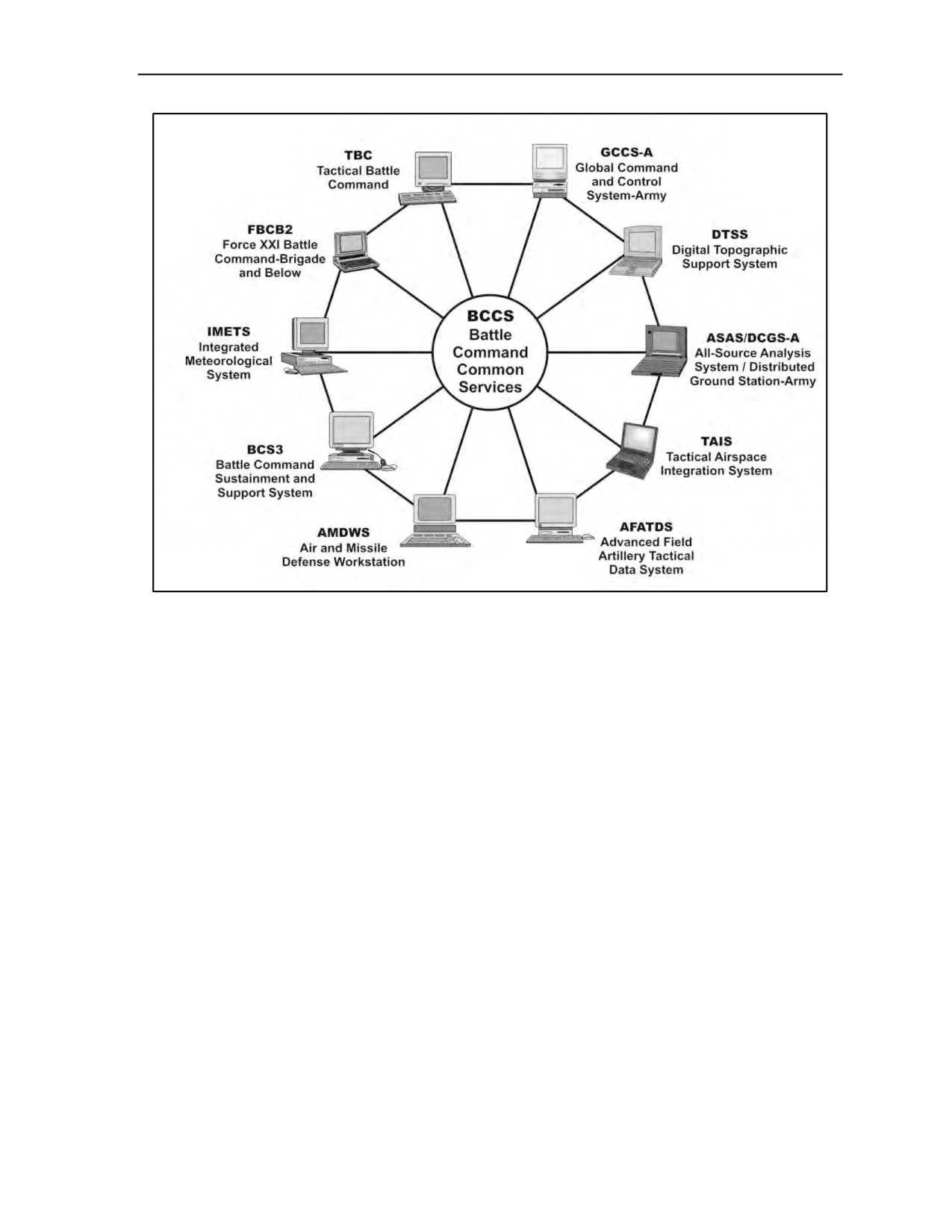
Chapter 1
Figure 1-6. Army Battle Command System
COMBAT NET RADIO AND TACTICAL RADIO SYSTEMS
1-137. The BCT uses combat net radios (CNR) primarily for voice C2 transmission and secondarily for
data transmission where other data capabilities do not exist. The CNR is designed primarily around the
single channel ground and airborne radio system
(SINCGARS), the single-channel tactical satellite
(TACSAT), and the high-frequency (HF) radio.
1-138. BCTs equipped with blue force tracker (BFT) are capable of communicating between platforms.
The BFT system is an L-band satellite communications (SATCOM) tracking and communications system
that enables the commander to "s ee" friendly forces, and provides the commander with the ability to send
and receive text messages. BFT is not ABCS-interoperable because it lacks the hardware encrypted secure
communications accreditation, which makes BFT noncompatible with EPLRS.
1-139. BCTs equipped with FBCB2-terrestial use the EPLRS to provide rapid, jam-resistant, secure data
transfer between FBCB2 systems. The EPLRS network provides the primary data and imagery
communications transmission system. It is employed in the combat platforms of the commander, executive
officer, first sergeant, platoon leaders, and platoon sergeants at the company and platoon level. The EPLRS
is an alternate data communications link (host-to-host) between C2 platforms at the brigade and battalion
levels. It is the primary data communications link between battalion C2 platforms and company/platoon
combat platforms. The EPLRS can be employed in wireless network extension platforms, and configured to
provide wireless network extension capability. FM 6-02.53 provides detailed information on the CNR and
tactical radio systems.
JOINT TACTICAL RADIO SYSTEM
1-140. The joint tactical radio system (JTRS) is the DOD radio of choice for future radio requirements.
JTRS will replace the near term digital radio (NTDR). The concept behind the JTRS family of radios is for
all services to migrate toward a common type of media among Soldiers, while concurrently out-pacing the
1-26
FM 3-90.6
14 September 2010
Introduction
growth rate of information exchange requirements, and eventually realizing a fully digitized operational
environment. JTRS lays the foundation for achieving network connectivity across the radio frequency (RF)
spectrum. The network will provide the means for low to ate digital information exchange, both vertically
and horizontally, between warfighting elements. In addition, it will enable connectivity to civil and national
authorities.
INTEGRATED SYSTEM CONTROL
1-141. The BCT and battalion S-6 sections use ISYSCON to provide communications system network
management, control, and planning. The ISYSCON, also known as the tactical internet management
system, provides network initialization, local area network management services, and an automated system
to support the CNR-based wide area network. ISYSCON features include mission plan management,
network planning and engineering, battlefield frequency spectrum management, tactical packet network
management, and wide area network management.
TRANSPORT SYSTEMS
Warfighter Information Network-Tactical Increment 1
1-142. With restructure of the Warfighter Information Network-Tactical (WIN-T) program, both the JNN
and WIN-T programs were combined, and JNN is now referred to as WIN-T increment 1 (Inc 1). WIN-T
Inc 1 is defined as providing "networking at-the-halt‖ and is further divided into two sub increments:
z
WIN-T Inc 1A. "E xtended networking at-the-halt"
z
WIN-T Inc 1B. "E nhanced networking at-the-halt"
1-143. The WIN-T Inc 1 suite of equipment is the network enabler fielded to provide timely, network-
enabled support to tactical modular formations. WIN-T Inc 1 provides BCT and battalion connectivity to
the GIG. The major components of WIN-T Inc 1 are the hub nodes (fixed, mobile, and tactical); the JNN at
corps, division, and brigade; and the CP node at battalion.
1-144. The JNN enables independent operations and direct termination into the theater network, GIG, or a
joint headquarters. The JNN facilitates the management of digital groups, trunks, and circuits. It provides
the means through which the communications resource at a node can be monitored, controlled, and
managed. The JNN capabilities include Ethernet switching, Internet protocol
(IP) routing, network
management, and network security services that include network intrusion detection. The JNN works with
existing terrestrial transport, high-capacity line-of-sight AN/TRC-190(V3), tropospheric scatter (AN/TRC-170),
secure mobile anti-jam reliable tactical-terminal (SMART-T [AN/TSC-154]), and the Trojan SPIRIT II
(AN/TSQ-190). FM 6-02.43 provides detailed information on the LandWarNet transport systems at corps
and below.
Brigade Subscriber Node
1-145. The brigade subscriber node (BSN) is fielded to the BCT as the bridge from MSE to JNN. It
provides mobile communications switches and transmission systems through the use of commercial
switches and routers. BSN voice subscriber services use a commercial private branch exchange (PBX),
which is a private telephone switchboard that allows both integrated service digital network (ISDN) and
analog service. Like MSE, individual telephone numbers are assigned to each user. All services are IP
automated systems, making the backbone transparent to the user.
14 September 2010
FM 3-90.6
1-27
This page intentionally left blank.
Chapter 2
Offensive Operations
The purpose of the offense is to defeat, destroy, or neutralize the enemy. While the
characteristics of offensive operations remain unchanged, the Brigade Combat
Team’s (BCT) unique capabilities enable it to conduct offensive operations with
greater precision and speed than that of past organizations. In past military
operations, U.S. ground forces spent precious lives, and consumed extraordinary
amounts of munitions and time to develop situations clearly. While costly, this clarity
enabled forces to formulate the best solution to the tactical problem. The sensors and
information systems (INFOSYS) within the BCT enable the commander to visualize
the battlefield better than his predecessors. However, sensors and INFOSYS do not
eliminate casualties or render the combined arms assault obsolete. They only enhance
the precision and lethality of operations.
SECTION I - FUNDAMENTALS OF A BRIGADE COMBAT TEAM OFFENSE
2-1. The brigade combat team conducts offensive operations to defeat and destroy enemy forces and seize
terrain, resources, and population centers. Their purpose is to impose United States (U.S.) will on the
enemy and achieve decisive victory. Effective offensive operations capitalize on accurate intelligence
regarding the enemy, terrain and weather, and civil considerations. Commanders maneuver their forces to
advantageous positions before making contact. In offensive operations, the commander seeks to throw
enemy forces off balance, overwhelm their capabilities, disrupt their defenses and ensure their defeat or
destruction by synchronizing and applying all elements of combat power (FM 3-0).
CHARACTERISTICS OF THE OFFENSE
2-2. Surprise, concentration, audacity, and tempo characterize successful offensive operations. BCT
commanders sustain the initiative by aggressively committing their forces against enemy weaknesses; BCT
attacks are force-oriented or terrain-oriented, and facilitate the defeat of the enemy or the continuation of
the attack. BCT commanders extend their attacks in time and space by engaging the enemy in depth, and
destroying key elements of the enemy force.
SURPRISE
2-3. Commanders achieve surprise by attacking the enemy at an unexpected time or place. The BCT has
several capabilities that enable the BCT to achieve surprise. First, the reconnaissance squadron can gain
accurate and timely information about the enemy. By visualizing and understanding the situation, the
commander can exploit enemy weaknesses and disrupt enemy movement. Second, the movement speed of
BCT units either mounted or by air, provides the BCT commander with the option to position combat
power rapidly; this limits the enemy's ability to react.
2-4. The BCT can use its increased information superiority capabilities to give the enemy a false sense of
the tactical environment, and possibly lower his defenses. Prior to actual offensive operations, the BCT can
use feints and demonstrations to divert the enemy’s attention, and tactically deceive him. The key to
successful deception is to show the enemy what he expects to see. Often, surprise is achieved by causing
the enemy to hesitate physically or in his decision-making. This enables the BCT to retain the initiative by
concentrating its forces and adjusting its tempo as the tactical situation requires.
14 September 2010
FM 3-90.6
2-1
Chapter 2
CONCENTRATION
2-5. Concentration is the massing of overwhelming effects of combat power to achieve a single purpose.
The digital communications and INFOSYS found at the company level enable the BCT to concentrate
combat power against the enemy quickly. To counter this, the enemy seeks close combat in urban or
severely restricted terrain. This terrain inhibits the standoff capability of our weapons systems, makes it
difficult to mass effects of combat power with precision, and may cause collateral damage. Using
information from higher headquarters (HQ) and joint interagency, intergovernmental, and multinational
(JIIM) reconnaissance and surveillance assets, the BCT can create an accurate representation of the terrain
and threat forces in its area of operations (AO). This enables the BCT commander to concentrate the BCT
reconnaissance efforts on his specific information requirements. This focused effort provides an enhanced
COP, which provides the commander and staff a greater situational understanding (SU) than in the past.
This SU enables the BCT to concentrate combat power at the decisive point to overwhelm the enemy.
AUDACITY
2-6. Audacity is a simple plan of action, boldly executed. Since digital capabilities such as Force XXI
Battle Command-Brigade and Below (FBCB2) enable the BCT commander to reduce the uncertainties
about friendly and enemy forces, the commander can act more boldly.
TEMPO
2-7. Tempo is the rate of military action. The digital communications and INFOSYS supporting
commanders within the BCT enable commanders to process information and disseminate decisions quicker,
and to act inside a threat commander’s decision cycle.
SEQUENCE OF OFFENSIVE OPERATIONS
2-8. The commander maneuvers his forces to gain positional advantage so he can seize, retain, and
exploit the initiative. He avoids the enemy’s defensive strength. He employs tactics that defeat the enemy
by attacking through a point of relative weakness, such as a flank, a gap between units, or the rear. For
more information on sequencing of offensive operations, refer to FM 3-90. Offensive operations typically
follow this sequence:
z
Moving from the assembly area to the line of departure (LD). The tactical situation and the
order in which the commander wants his subordinate units to arrive at their attack positions
govern the march formation.
z
Maneuvering from the line of departure to the probable line of deployment (PLD). Units
move rapidly through their attack positions and across the LD, which should be controlled by
friendly forces. The commander considers the mission, enemy, terrain and weather, troops and
support available, time available, and civil considerations
(METT-TC) when choosing the
combat formation that best balances firepower, tempo, security, and control.
z
Actions at the PLD, assault position. The attacking unit splits into one or more assault and
support forces as it reaches the PLD, if not already accomplished. All forces supporting the
assault should be set in their support by fire position before the assault force crosses the LD. The
assault force maneuvers against or around the enemy to take advantage of the support force’s
efforts to suppress targeted enemy positions.
z
Conducting the breach. As necessary, the BCT conducts combined arms breaching operations.
The preferred method of fighting through a defended obstacle is to employ an in-stride breach.
However, the commander must be prepared to conduct deliberate breaching operations. For
more information on breaching operations, refer to FM 3-34.22.
z
Assaulting the objective. The commander employs all means of fire support to destroy and
suppress the enemy, and sustain the momentum of the attack. Attacking units move as quickly as
possible onto and through the objective. Depending on the size and preparation of enemy forces,
it may be necessary to isolate and destroy portions of the enemy in sequence.
z
Consolidating on the objective. Immediately after a successful assault, the attacking unit seeks
to exploit its success. It may be necessary, though, to consolidate its gains. Consolidation can
2-2
FM 3-90.6
14 September 2010
Offensive Operations
vary from repositioning force and security elements on the objective, to a reorganization of the
attacking force, to the organization and detailed improvement of the position for defense.
z
Transition. After seizing the objective, the unit transitions to some other type of military
operation. This operation could be the exploitation or pursuit, or perhaps a defense. Transitions
(through branches and sequels) are addressed and planned prior to the offensive operation being
undertaken. Transition operations are discussed at the end of this chapter.
SECTION II - COMMON OFFENSIVE PLANNING CONSIDERATIONS
2-9. Understanding, visualizing, describing, and directing are aspects of leadership common to all
commanders. The BCT commander begins with a designated AO, identified mission, and assigned forces.
The commander develops and issues planning guidance based on his visualization in terms of the physical
means to accomplish the mission.
2-10. The following discussion uses the warfighting functions (movement and maneuver, intelligence,
fires, sustainment, command and control, and protection) as the framework for discussing planning
considerations that apply to all types and forms of tactical offensive operations. The commander
synchronizes the effects of all warfighting functions as part of the understand, visualize, describe, direct,
and assess process.
MOVEMENT AND MANEUVER
2-11. The commander conducts maneuver to avoid enemy strengths and to create opportunities that
increase the effects of his fires. He employs unexpected maneuvers, rapidly changing the tempo of ongoing
operations, avoiding observation, and using deceptive techniques and procedures. His security forces
prevent the enemy from discovering friendly dispositions, capabilities, and intentions, or interfering with
the preparations for the attack. He engages the defending enemy force from positions that place the
attacking force in a position of advantage with respect to the defending enemy force, such as engaging the
enemy from a flanking position. Finally, he maneuvers to close with and destroy the enemy by close
combat and shock effect.
INTELLIGENCE
2-12. The staff uses METT-TC factors in intelligence preparation of the battlefield (IPB) considerations
for offensive operations. Refer to FM 2-01.3 for more information. The staff considers the following when
conducting IPB:
z
Identify locations of threat/adversary forces, composition, disposition, strengths, and weaknesses
of the defending threat/adversary force and their likely intentions, especially where and in what
strength the threat/adversary will defend.
z
Determine locations of threat/adversary assembly areas, engagement areas, battle positions,
indirect-fire weapons system gaps and flanks, electronic warfare (EW) units, and air corridors.
z
Determine locations of areas for friendly and threat/adversary air assaults.
z
Examine the database to identify how the threat/adversary conducts defensive operations.
z
Determine if previous defensive operations are consistent with known threat/adversary doctrine
and established threat/adversary models.
z
Determine locations of threat/adversary command and control, reconnaissance, and surveillance
systems and the frequencies used by the information systems linking these systems.
z
Determine a list of intelligence requirements to determine when an enemy force is collapsing so
that either an exploitation or pursuit is warranted.
z
Determine forecasted weather effect limitations. Commanders need information about weather
conditions that affect mobility, concealment, and air operations for both friendly and
threat/adversary forces.
z
When determining threat/adversary courses of action
(COA), war-game as many of the
threat/adversary COAs as time permits.
14 September 2010
FM 3-90.6
2-3
///////////////////////////////////////