FM 390.6 Brigade Combat Team (September 2010) - page 2
Chapter 2
FIRES
2-13. Units plan and employ fires through a variety of methods and capabilities that attrit, delay, and
disrupt enemy forces, and enable friendly maneuver. Using preparatory, counterfire, suppression, and
nonlethal fires provides the commander with numerous options for gaining and maintaining fire superiority.
The commander uses his long-range artillery systems and air support to engage the enemy throughout the
depth of his positions.
2-14. When planning fires in the offense, units should consider the following:
z
Position indirect fire assets well forward to exploit weapons ranges and preclude untimely
displacement.
z
Plan fires for leading elements.
z
Plan fires for the neutralization of bypassed enemy combat forces.
z
Plan preparation fires, when required, to weaken the enemy's resistance. These fires disrupt,
destroy, or damage his defense.
z
Plan targets to protect assaulting troops by destroying, neutralizing, or suppressing enemy direct
fire weapons.
z
Plan fires against enemy reinforcements during the attack and to support friendly consolidations
once the objective has been seized.
2-15. The commander establishes his air defense priorities based on his concept of operations, scheme of
maneuver, aerial threat, and higher headquarters’ priorities. All members of the combined arms team
perform air defense operations; however, ground based air defense artillery units execute the majority of
the Army’s air defense tasks. Air defense assets are allocated to the BCT based on the factors of METT-
TC.
SUSTAINMENT
2-16. The objective of sustainment in offensive operations is to assist the commander in maintaining the
momentum. Key to successful offensive operations is the ability to anticipate the requirement to push
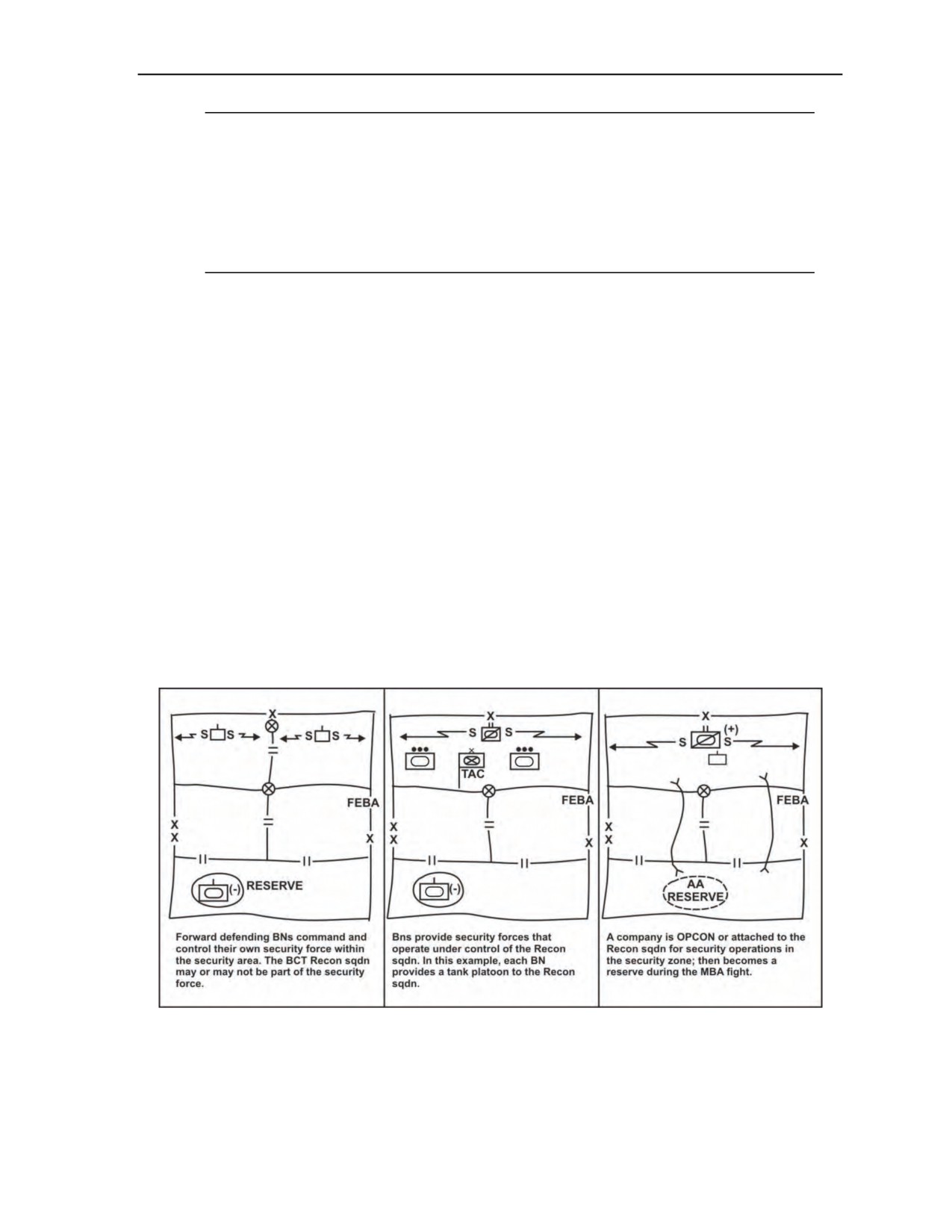
support forward through a wide dispersion of forces and along lengthy lines of communication (LOC).
During offensive operations, certain requirements present special challenges. The most important materiel
is typically fuel (Class III bulk) and ammunition (Class V), Class VII, movement control, and medical
evacuation. Commanders and staffs must consider establishing aerial resupply and forward logistics bases
to sustain operations.
COMMAND AND CONTROL
2-17. The commander and staff translate the unit’s assigned mission into specific objectives for all
subordinates, to include the reserve. All planning for offensive operations address the factors of METT-TC,
with special emphasis on:
z
Enemy positions, strengths, and capabilities.
z
Missions and objectives for each subordinate element and task and purpose for each warfighting
function.
z
Commander’s intent.
z
AOs for the use of each subordinate element with associated control graphics.
z
Consideration of time factors in the operation.
z
Scheme of maneuver.
z
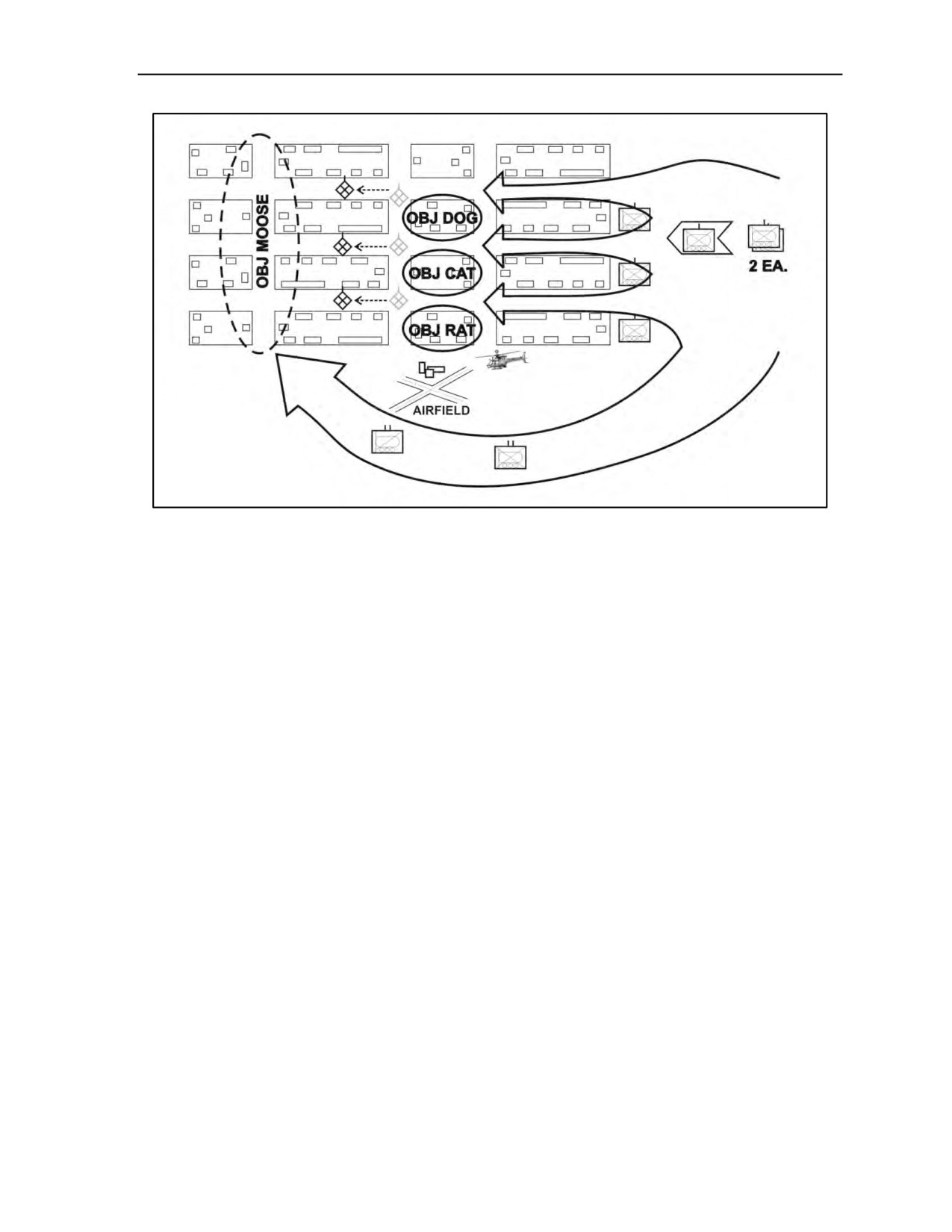
Special tasks required to accomplish the mission.
z
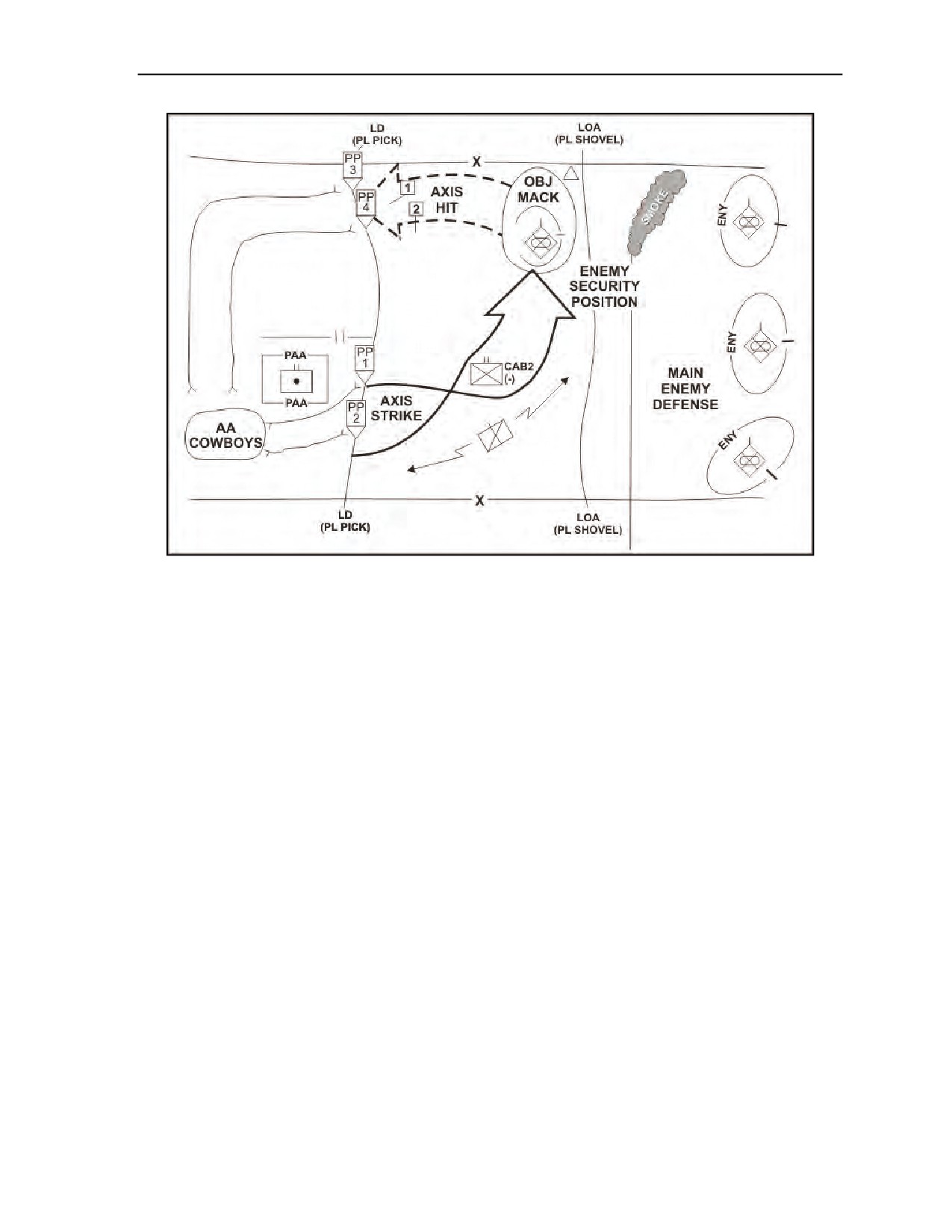
Tactical risk.
z
Options for accomplishing the mission.
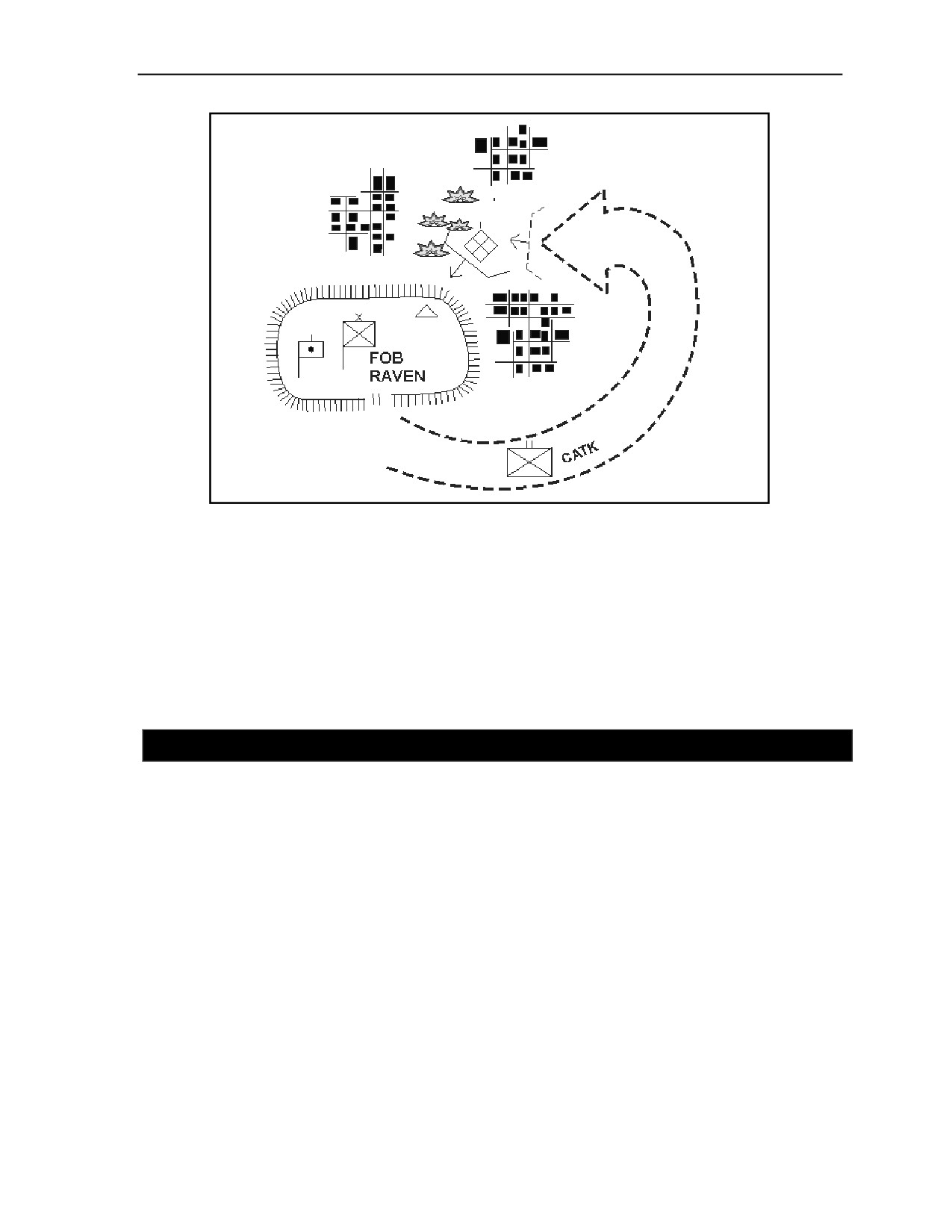
2-4
FM 3-90.6
14 September 2010
Offensive Operations
PROTECTION
2-18. In offensive operations, the protection cell conducts a risk assessment based on the commander’s
concept of the operation. This informs the commander of where he assumes risk as he maneuvers to engage
the enemy. The staff must recommend to the commander where to focus proactive measures to prevent and
deter the threat and mitigate the risk. The level of risk associated with each vulnerability helps to prioritize
the application of resources. Key resources to be protected in offensive operations include command posts,
lines of communication, and indirect fire assets.
SECTION III - FORMS OF MANEUVER
2-19. The BCT commander selects the form of maneuver based on his analysis of METT-TC. The
commander then synchronizes the contributions of all warfighting functions to the selected form of
maneuver. An operation may contain several forms of offensive maneuver, such as frontal attack to clear
enemy security forces, followed by a penetration to create a gap in enemy defenses, which in turn is
followed by an envelopment to destroy a counterattacking force. The paragraphs below summarize the
critical aspects of the forms of maneuver. See FM 3-90 for the characteristics and merits of the forms of
maneuver.
2-20. The five forms of maneuver are:
z
Envelopment.
z
Turning movement.
z
Infiltration.
z
Penetration.
z
Frontal attack.
Note: The BCT would normally perform envelopment or turning movement as part of a larger
force.
ENVELOPMENT
2-21. Envelopment seeks to avoid the principal enemy defenses by seizing objectives to the enemy rear to
destroy or defeat the enemy in his current positions. At the tactical level, envelopments focus on seizing
terrain, destroying specific enemy forces, and interdicting enemy withdrawal routes. In addition, at the
tactical level, airborne and air assault operations are vertical envelopments. During an envelopment, the
BCT avoids contacting the enemy where the enemy is protected most and has concentrated fires. The
reconnaissance squadron and other reconnaissance assets enable the BCT to develop the situation out of
contact. The BCT can then maneuver against the enemy on its own terms. Another option is for the BCT to
fix the enemy with one force and then attack the enemy with the remaining available force.
TURNING MOVEMENT
2-22. A turning movement is a form of maneuver in which the attacking force seeks to avoid the enemy’s
principle defensive positions by seizing objectives to the enemy rear. This causes the enemy to move out of
his current positions or divert major forces to meet the threat. This form of offensive maneuver frequently
transitions from the attack into an exploitation or pursuit. During a turning movement, the BCT could either
serve as a supporting attack, main attack, or reserve force. The division avoids the enemy’s principal
defensive positions by seizing objectives to the enemy rear, causing the enemy to abandon its prepared
defense or to divert major forces to meet the threat. This enables the division to fight the repositioning
enemy force on terms and conditions that are favorable to the division (Figure 2-1).
14 September 2010
FM 3-90.6
2-5
Chapter 2
Figure 2-1. Example of a division conducting a turning movement
INFILTRATION
2-23. An infiltration is a form of maneuver in which an attacking force conducts undetected movement
through, or into, an area occupied by enemy forces to occupy a position of advantage in the enemy rear
while exposing only small elements to enemy defensive fires. The BCT may use infiltration to reconnoiter
the enemy force or objective, to attack the enemy from an unexpected location, or to seize terrain to support
a future attack. The BCT usually infiltrates reconnaissance assets or Infantry to obtain information or to
support the attack by destroying vulnerable key targets or seizing key terrain. Each BCT has the ability to
conduct air or ground infiltration. The forces that are used range from reconnaissance to maneuver; and the
infiltration can be either mounted or dismounted, depending on specific BCT force structure.
PENETRATION
2-24. A penetration is a form of maneuver in which an attacking force seeks to breach enemy defenses on a
narrow front to disrupt the defensive system. The key to a successful penetration is the ability to mass
combat power and effects rapidly at the point of penetration, while maintaining surprise as to the exact
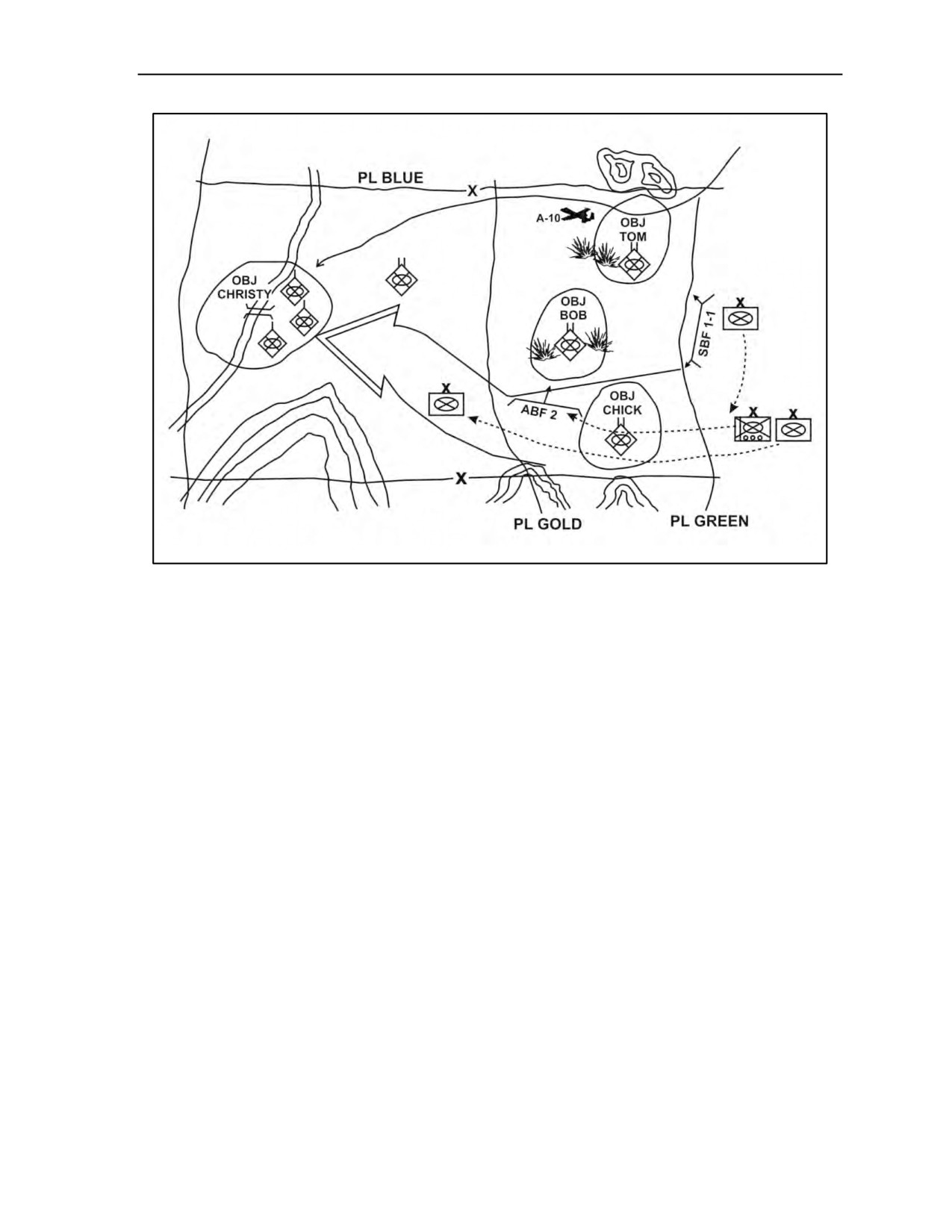
location of the penetration. In most cases, the BCT either attacks to create a gap, or attacks through a gap
made by another BCT. Figure 2-2 depicts a BCT conducting a frontal assault while a second BCT conducts
a deliberate attack.
2-6
FM 3-90.6
14 September 2010
Offensive Operations
Figure 2-2. Example of two BCTs conducting a penetration
FRONTAL ATTACK
2-25. A frontal attack is a form of maneuver in which an attacking force seeks to destroy a weaker enemy
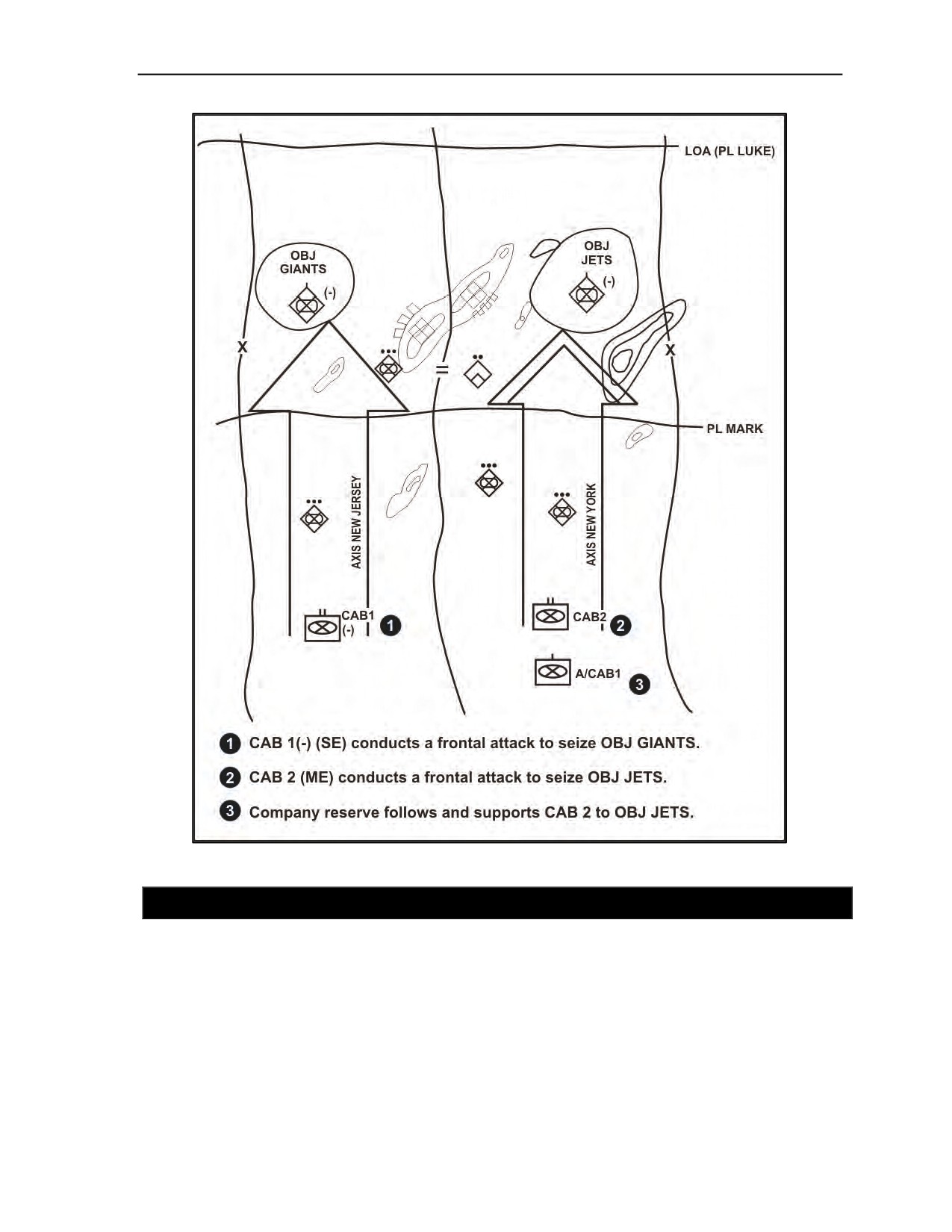
force or fix a larger enemy force in place over a broad front. The BCT can conduct a frontal attack against a
stationary enemy or a moving enemy force (Figure 2-3). Depending upon the terrain and enemy, this may
not be enough force to execute across a wide front. The IBCT and Heavy Brigade Combat Team (HBCT)
must be judicious when deciding to conduct a frontal attack, because they have only two
maneuver/combined arms battalions to execute this maneuver. The Stryker Brigade Combat Team (SBCT)
generally does not conduct frontal attacks.
14 September 2010
FM 3-90.6
2-7
Chapter 2
Figure 2-3. Example of a BCT frontal attack against a stationary enemy force
SECTION IV - PRIMARY OFFENSIVE TASKS
2-26. The BCT conducts, or participates in, movements to contact, attacks, exploitations, and pursuits. The
BCT may participate in a division pursuit or exploitation by conducting a movement to contact or attack.
The BCT’s reconnaissance squadron and reconnaissance assets do not negate the need to conduct the
traditional movement to contact. However, the BCT may modify the actual techniques used during
movement to contact to fit the capabilities found within the individual BCT.
MOVEMENT TO CONTACT
2-27. Movement to contact is an offensive operation designed to develop the situation and gain or
reestablish contact with the enemy. Units conduct a movement to contact when the tactical situation is
2-8
FM 3-90.6
14 September 2010
Offensive Operations
unclear or when contact with the enemy has been lost. The purpose is to establish or reestablish direct
contact with the enemy. A movement to contact creates favorable conditions for subsequent tactical
actions. During a movement to contact, the BCT commander uses his reconnaissance effort to develop the
situation, and maintain his freedom of action once contact has been gained. The BCT must also maintain
all-around security. The BCT may conduct a movement to contact as part of a higher unit’s mission, or the
BCT commander may direct a movement to contact any time during an operation. Movements to contact
include search and attack, and cordon and search operations.
2-28. The following are fundamentals of a movement to contact:
z
Focus all efforts on finding the enemy.
z
Make initial contact with organic or JIIM reconnaissance assets or organizations.
z
Task organize the BCT to make initial contact with the smallest mobile self-contained force to
avoid decisive engagement of the main body.
z
Plan to facilitate flexible response throughout the AO.
z
Maintain contact once contact is made.
ORGANIZATION OF A MOVEMENT TO CONTACT
2-29. The minimum components of a BCT movement to contact organization include security forces and a
main body.
Security Forces
2-30. Security forces consist of advance guard, flank and rear security elements.
Advance Guard
2-31. The advance guard is a self-contained force capable of operating independently of the main body.
Only maneuver battalions (i.e., combined arms battalion [CAB] or Infantry battalion) have sufficient
combat power to serve as an advance guard. Generally, the advance guard requires field artillery (FA), anti-
Armor, and engineer augmentation. In some cases, the division provides a covering force that moves ahead
of the BCT. When the division provides a covering force, the BCT commander uses an advance guard to
maintain contact with the covering force. The advance guard should remain within range of the main
body’s indirect fire weapons systems.
Flank and Rear Security
2-32. When adjacent units are not protecting the BCT's flanks or rear, forces providing a guard or screen
secure them. The BCT may use reconnaissance troops for flank security, or it may require the main body
forces to provide security.
Reconnaissance
2-33. The BCT staff develops its intelligence, surveillance, and reconnaissance (ISR) plan to ensure that
the appropriate combination of the reconnaissance squadron and other reconnaissance assets are available.
The BCT generally focuses its reconnaissance assets where it expects to make contact. Once contact is
made, the BCT uses its reconnaissance assets to determine the strength and disposition of enemy forces.
Main Body
2-34. Once the security forces make contact with the enemy, the BCT commander uses his main body in
one of four basic maneuver options.
z
Attack.
z
Defend and maintain contact.
z
Report and bypass.
z
Retrograde.
14 September 2010
FM 3-90.6
2-9
Chapter 2
2-35. The main body follows the advance guard and keeps enough distance between itself and the advance
guard to maintain flexibility. Depending on his visualization, answers to his commander’s critical
information requirements
(CCIR), and the fidelity of other information, the BCT commander may
designate a portion of the main body as the reserve.
SEARCH AND ATTACK
2-36. Search and attack is one technique for conducting a movement to contact. The BCT conducts this
form of movement to contact to destroy enemy forces, deny the enemy certain areas, protect the force, or
collect information. Light forces primarily conduct this form of movement to contact. However, heavy
forces often support this form of movement. Usually, when the enemy is operating as small, dispersed
elements, or when the task is to deny the enemy the ability to move within a given area. The battalion is the
echelon that usually conducts a search and attack. The BCT assists its subordinate battalions by ensuring
the availability of indirect fires and other support. The BCT may task its subordinate units to conduct the
following missions:
z
Locate enemy positions or habitually traveled routes.
z
Destroy enemy forces within its capability or fix and/or block the enemy until reinforcements
arrive.
z
Maintain surveillance of a larger enemy force until reinforcements arrive.
z
Search urban areas.
z
Secure military or civilian property or installations.
z
Eliminate enemy influence within the AO.
2-37. Commanders conduct search and attack operations by organizing their units into reconnaissance, fix,
and finish forces. Each of these forces has a specific task and purpose. The finish force is the main effort.
Some considerations for conducting search and attack operations include intelligence preparation of the
battlefield, task organization, isolation of enemy forces, supporting fires, and decentralized command and
control (C2).
Control measures
2-38. The commander establishes control measures that allow for decentralized actions and small-unit
initiative to the greatest extent possible. The minimum suggested control measures for a search and attack
are an AO, target reference points (TRP), objectives, checkpoints, and coordinating points. The commander
can use objectives and checkpoints to guide the movement of subordinate elements. Coordinating points
indicate a specific location for coordinating fires and movement between adjacent units. The commander
uses other control measures, such as phase lines, as necessary.
Intelligence Preparation of the Battlefield
2-39. IPB plays a significant role in the planning phase of search and attack missions. The IPB process
focuses on the force’s reconnaissance effort on likely enemy locations. The intelligence gained from IPB
facilitates the BCT’s conduct of successful operations through maneuver and fires.
Task Organization
2-40. In search and attack operations, the commander first task organizes the finish force. He then
anticipates the size of the enemy to ensure that the force has enough combat power to accomplish its
assigned task. The finish force may move at some distance behind the reconnaissance force, or it may be at
a pickup zone (PZ) and air assault to the objective once the enemy is located. The air assault technique is
dependent on the availability of landing zones (LZ) near the objective, weather, and availability of aircraft.
The S-2 must provide the commander with his estimate of how long it will take the enemy to displace, thus
helping to ensure that the finish force reaches the objective before the enemy can displace.
2-41. The size of the reconnaissance force depends on the degree of certainty associated with the enemy
template. The vaguer the situation is, the larger the reconnaissance force will be. The reconnaissance force
can consist of reconnaissance, Infantry, air, and electronic assets. It usually uses area reconnaissance
2-10
FM 3-90.6
14 September 2010
Offensive Operations
techniques to reconnoiter named areas of interest (NAI) identified by the S-2. The brigade fix-and-finish
plan must consider the possibility of the reconnaissance forces being compromised.
2-42. The BCT can rotate units through the reconnaissance, fix, and finish roles, but the main effort
remains with the finish force. Rotating roles may require a change in task organization and additional time
for rehearsal.
Isolate the Enemy
2-43. The fix force isolates the enemy once the reconnaissance force identifies it. It blocks both escape and
reinforcement routes. The fix force incorporates indirect fires into the fix plan. It also blocks routes that the
S-2 identified as possible escape routes or routes used to reinforce their positions.
Supporting Fires
2-44. Available fire support (FS) must provide flexible, rapid support throughout the area of operations.
This includes the ability to clear fires rapidly. To clear fires rapidly, units must track and report the
locations of the unit’s subordinate units. The capability must exist to mass fires quickly in support of the
main effort. Because of the uncertainty of the enemy situation, the commander avoids command or support
relationships that prevent shifting assets when necessary. Supporting fires should be flexible and
destructive. They should also enhance the ability of a highly mobile attack force to destroy an enemy force
located and fixed by other forces.
Decentralized Command and Control
2-45. The brigade commander provides the necessary control, but he permits decentralized actions and
small-unit initiative to the greatest extent possible within the framework of his intent and the operational
concept. This includes establishing the proper graphic control measures to control movement, and
synchronization of all brigade assets to enhance combat power.
CORDON AND SEARCH
2-46. Generally, the BCT commander delegates the cordon and search mission to a battalion (FM 3-06.20).
However, the BCT must shape and provide resources for the battalion to accomplish the mission.
Subordinate units should divide the built-up area to be searched into zones, and assign a search party to
each zone. Search parties consist of:
z
Security (or cordon) element-to encircle the area, to prevent entrance and exit, and to secure
open areas.
z
Search element-to conduct the search.
z
Reserve element-to assist either element, as required.
2-47. The BCT can provide the following assets to battalions conducting cordon and search missions:
z
Reconnaissance assets from the reconnaissance squadron and the military intelligence company
(MICO).
z
Mine detection and/or demolition support from attached engineer units.
z
Interrogation, translator, and/or human intelligence (HUMINT) support from the MICO.
z
Military information support operations (e.g., loudspeaker) and civil affairs (CA) support from
attached CA units.
z
Electronic warfare support (e.g., Prophet) from the MICO in IBCT/HBCT or reconnaissance
squadron in SBCT.
z
Liaison officers (LNO) to assist with host nation interaction.
z
Host nation security forces.
z
Military working dogs and evidence response teams from augmenting military police (MP)
units.
Establishing the Cordon
2-48. An effective cordon is critical to the success of the search effort. Although a battalion usually has
sufficient manpower to prevent the escape of individuals to be searched, the BCT may need to allocate
14 September 2010
FM 3-90.6
2-11
Chapter 2
forces to protect the battalions conducting the operation. The aviation brigade can provide attack
reconnaissance aircraft to support battalions that establish cordons. For further details concerning aviation
use in cordon and searches, refer to FM 3-04.126.
2-49. Deployment for the search should be rapid, especially if the enemy is still in the area to be searched.
Ideally, the entire area should be surrounded at once. SBCT Infantry battalions have the organic capability
to move quickly, but HBCT and IBCT battalions might need additional transport for Soldiers. The BCT
should consider the use of the aviation brigade for transport of Soldiers across long distances.
Conducting the Search
2-50. MISO, CA, and MP units are force multipliers when dealing with the populace. Aerial photographs
can provide information needed about the terrain. In larger towns or cities, the local police might have
detailed maps showing relative sizes and locations of buildings.
Capturing Personnel and Equipment
2-51. Commanders must carefully weigh the value of tactically questioning detainees at the point of
capture against the thorough questioning by trained interrogators at a safe haven. Although Soldiers on the
ground desire to gather and act on timely intelligence, there might be far-reaching damage to an ongoing
investigation by military intelligence
(MI) or host nation operations. Often MI and host nation
representatives can accompany units conducting cordon and search to provide advice to on-site
commanders.
2-52. Certain kinds of equipment (e.g., computers and cell phones) or evidence (biometrics or forensic
data) may not be exploited effectively at the point of capture. Instead, the BCT should arrange for the
collection and quick removal of captured material to MI and other technical experts with the capability to
handle exploitation properly.
HASTY AND DELIBERATE ATTACKS
HASTY ATTACK
2-53. Hasty attacks maximize agility, surprise, and initiative to seize opportunities to destroy the enemy or
seize the initiative. The BCT uses hasty attacks to:
z
Exploit a tactical opportunity.
z
Maintain the momentum.
z
Regain the initiative.
z
Prevent the enemy from regaining organization or balance.
z
Gain a favorable position that may be lost with time.
2-54. BCTs are capable of conducting more precise hasty attacks because of their inherent battle command
enablers such as the Army Battle Command System (ABCS). Rapidly attacking before the enemy can act
often leads to success even when the combat power ratio is not as favorable as desired. In choosing to
conduct a hasty attack, a commander is trading planning and preparation time for speed of execution.
Planning and preparation typically are less detailed for a hasty attack. The BCT can prepare to execute
hasty attacks by anticipating their occurrence and developing contingency plans. By assigning on-order or
be-prepared missions to subordinate units, the BCT is able to transition into hasty attacks better. Doing so
may require a CAB to go from a shaping role to a role as the decisive effort depending on its location
during the engagement. In such cases, support and sustainment operations may have to shift to support it.
This may require particular attention during the rehearsal phase.
DELIBERATE ATTACK
2-55. Deliberate attacks are highly synchronized operations characterized by detailed planning, precise
preparation, carefully coordinated fires, and violent execution. During shaping operations, BCT
commanders allow their reconnaissance effort time to prepare and develop sufficient intelligence to strike
2-12
FM 3-90.6
14 September 2010
Offensive Operations
the enemy at a vulnerable point with bold maneuver. Shaping operations also disrupt enemy defensive
preparations through aggressive patrolling, feints, limited-objective attacks, harassing indirect fires, air
strikes, and information engagement tasks. The fires battalion is positioned to provide maximum coverage
throughout the initial phases of the operation, and they are prepared to incapacitate the enemy’s ability to
conduct reconnaissance, conduct strike operations, communicate, and command. Usually, the BCT
maneuver/combined arms battalions conduct decisive operations. Fires are planned on all known and
potential enemy positions and to isolate the objective. Sustaining operations should be planned to enable
rapid resupply and movement. Execution of these operations might require bringing the brigade support
battalion
(BSB) or some of its crucial elements forward. The reserve is sized to defeat the enemy’s
counterattack forces. The commander should not constitute his reserve by weakening his decisive
operation.
EXPLOITATION AND PURSUITS
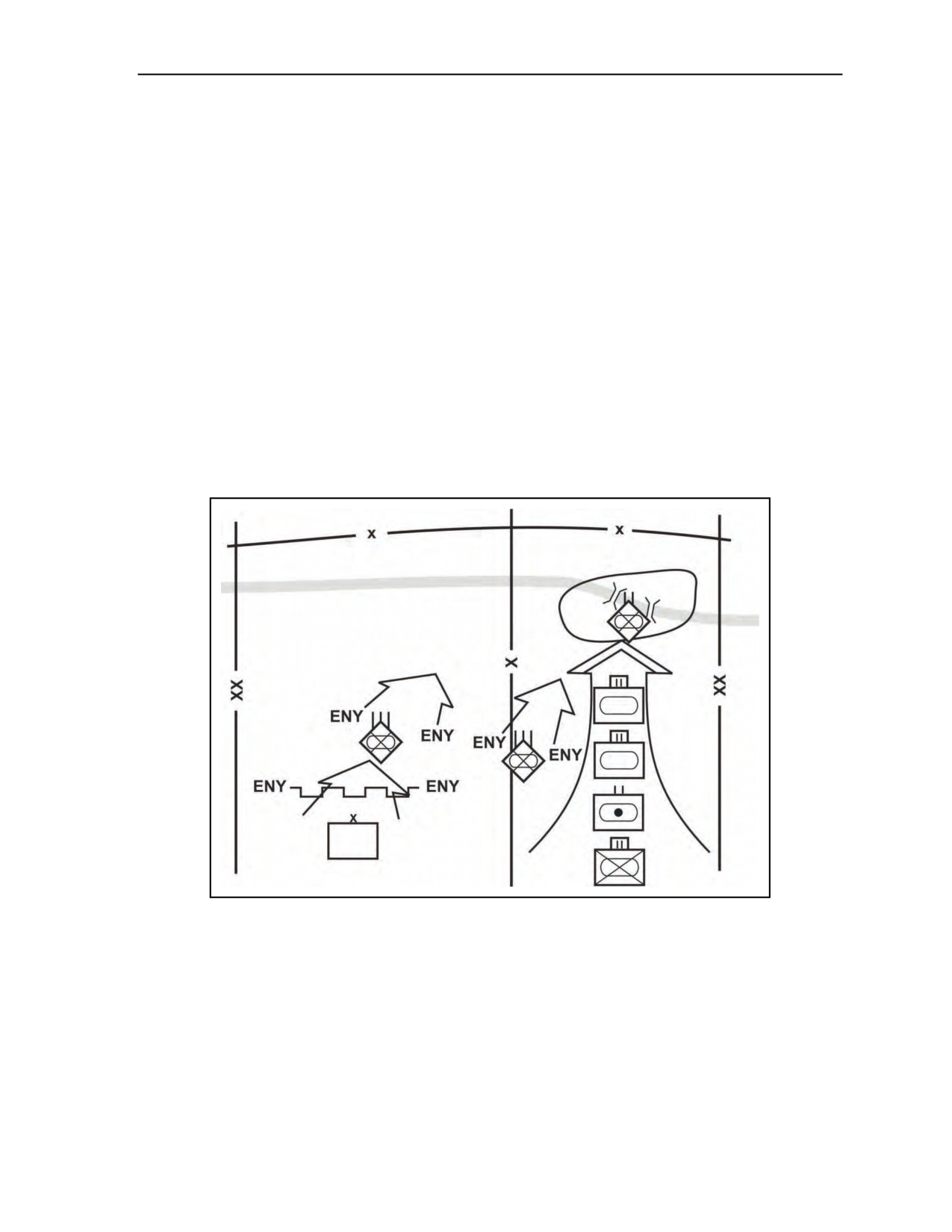
2-56. In an exploitation, the BCT attacks rapidly over a broad front to prevent the enemy from establishing
a defense, organizing an effective rear guard, withdrawing, or regaining balance (Figure 2-4). The BCT
commander orders pursuit when the enemy can no longer maintain his position and tries to escape. The
wheeled mobility of the SBCT, tracked mobility of HBCT, and air capability of the IBCT enable all BCTs
to move rapidly into position to conduct the pursuit (Figure 2-5). Successful exploitations and pursuits
typically are followed by the capture of enemy prisoners, members of armed groups, or detainees and the
BCT must prepare for their rapid disposition.
Figure 2-4. HBCT exploitation
14 September 2010
FM 3-90.6
2-13
Chapter 2
Figure 2-5. SBCT conducting pursuit
SPECIAL PURPOSE ATTACKS
2-57. The BCT can launch attacks with various purposes to achieve different results. The forms of attack
that a BCT may conduct are:
z
Raids.
z
Feints and demonstrations.
z
Counterattacks.
z
Spoiling attacks.
RAIDS
2-58. Raids are operations that involve swift penetration of hostile territory to secure information, to
confuse the enemy, or to destroy his installations. The BCT makes plans for the withdrawal of personnel at
the completion of the mission. The raiding force may operate within or outside of the BCT’s supporting
range and moves to its objective by infiltration. Once the raid mission is completed, the raiding force
quickly withdraws along a different route (Figure 2-6).
2-59. Raids usually are planned at BCT level and executed at battalion level. Battalions usually conduct
raids during limited visibility. The approach route should be different from the withdrawal route, which
security elements must ensure is open. The raiding force generally carries everything it requires to sustain
itself during the operation. If not, resupply is usually by aircraft. Factors that determine the amount of
logistics support that must accompany a raiding force include the:
z
Type and number of enemy vehicles and weapons.
z
Movement distance to the raid objective area.
z
Length of time the raid force is to remain in enemy territory.
z
Expected enemy resistance.
2-14
FM 3-90.6
14 September 2010
Offensive Operations
Figure 2-6. Example of a raid
FEINTS AND DEMONSTRATIONS
2-60. A feint is a form of attack used to deceive the enemy as to the location or time of the actual decisive
operation. Forces conducting a feint seek direct fire contact with the enemy but avoid decisive engagement.
Commanders use feints in conjunction with other military deception activities. They generally attempt to
deceive the enemy and induce him to move reserves and shift his FS to locations where they cannot
immediately impact the friendly decisive operation or take other actions not conducive to the enemy’s best
interests during the defense. A demonstration is a form of attack designed to deceive the enemy as to the
location or time of the decisive operation by a display of force. Forces conducting a demonstration do not
seek contact with the enemy. Both feints and demonstrations are always shaping operations.
Demonstrations may be conducted by many elements of the BCT, to include artillery and reconnaissance
units. Feints require more combat power and will usually require ground combat units for execution. The
BCT commander assigns the operation to the subordinate unit and approves plans to assess the effects
generated by it, which may support his operation.
COUNTERATTACKS
2-61. The commander might plan counterattacks as part of the BCT’s defensive plan, or the BCT might be
the counterattack force for the higher headquarters. The BCT must resource the counterattack force with
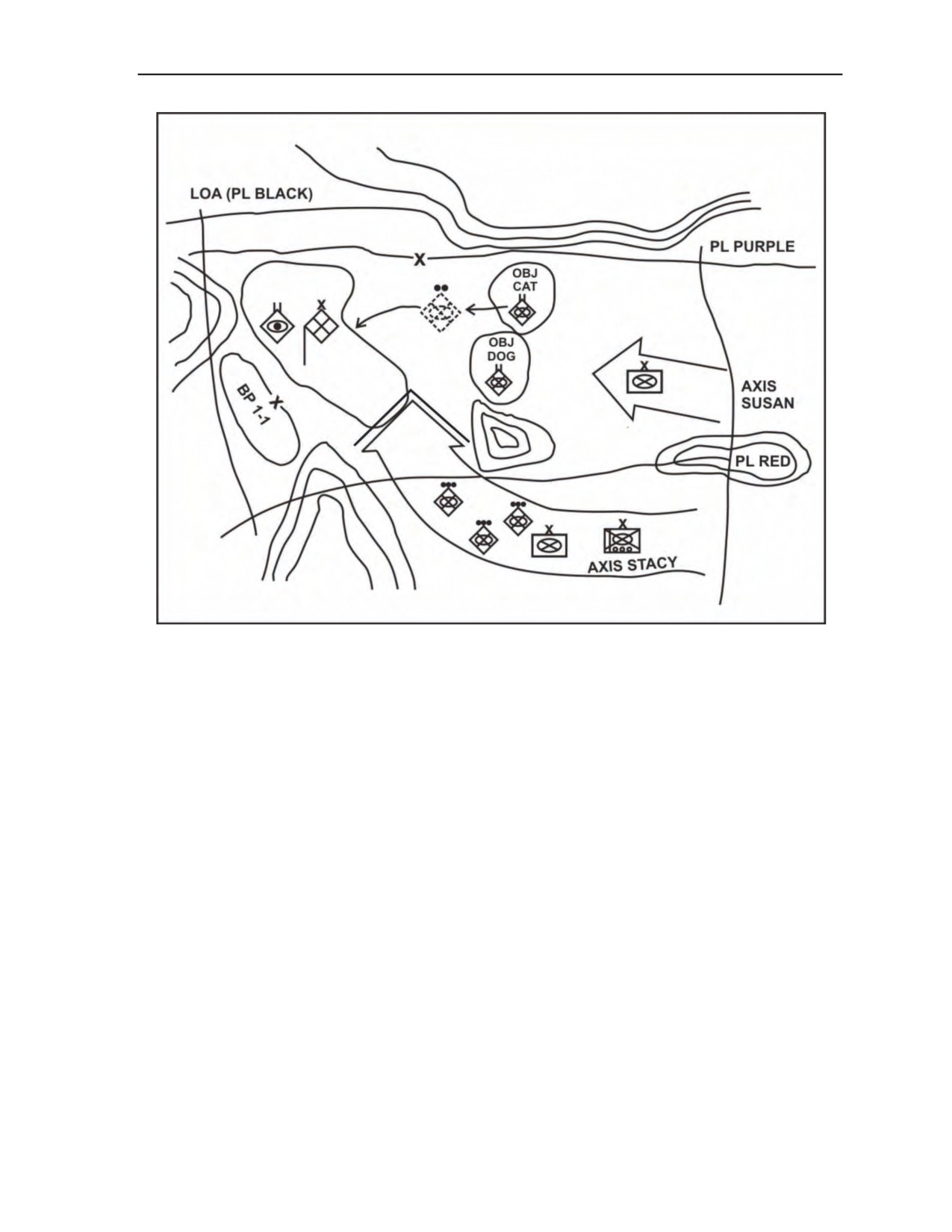
enough combat power and mobility to affect the enemy’s offensive operations. Figure 2-7 demonstrates a
counterattack by the BCT reserve using an attack by fire position to destroy an enemy force while
supported by organic artillery.
14 September 2010
FM 3-90.6
2-15
Chapter 2
Figure 2-7. Example of an IBCT counterattack
SPOILING ATTACKS
2-62. A spoiling attack is a form of attack that preempts or seriously impairs an enemy attack while the
enemy is in the process of planning or preparing to attack. The objective of a spoiling attack is to disrupt
the enemy’s offensive capabilities and timelines while destroying his personnel and equipment—not to
secure terrain and other physical objectives (FM 3-90). The BCT commander conducts a spoiling attack,
when required, during friendly defensive operations, to strike the enemy while he is in assembly areas or
attack positions, preparing for his own offensive operation, or has temporarily stopped. He employs organic
reconnaissance and fires elements, as well as JIIM reinforcing elements, to attack enemy assembly
positions in front of the friendly commander’s main line of resistance or battle positions.
SECTION V - TRANSITIONS
2-63. Offensive operations are halted when a complete victory is achieved, when a culminating point is
reached, or when a change of mission is received from higher headquarters. At this point, the commander
transitions his force from one operation to another.
2-64. Following a successful attack, a unit may transition to an exploitation. When possible the lead
attacking unit transitions to an exploitation and continues the attack. If this is not feasible, the commander
can pass fresh forces (follow and assume) into the lead.
2-65. In order to cut off and destroy enemy forces attempting to retrograde, the unit could transition to a
pursuit. The key to success in a pursuit is to apply continuous pressure on a retreating enemy in order to fix
the enemy and destroy him. Attacking forces will continue the attack based upon fragmentary orders as the
commander and staff readjusts maneuver and sustainment priorities to support the pursuit.
2-66. As offensive operations approach a culmination point, a commander could order a transition to a
defense. A commander can use two basic techniques when he transitions to the defense. The first technique
is for the leading elements to commit forces and push forward to claim enough ground to establish a
security area anchored on defensible terrain. The second technique is to establish a security area generally
along the unit’s final positions, moving the main body rearward to defensible terrain.
2-67. As offensive operations approach a culmination, or upon order from higher headquarters, a
commander could order a transition to a stability operation. These operations establish a safe, secure
2-16
FM 3-90.6
14 September 2010
Offensive Operations
environment that facilitates reconciliation among local or regional adversaries. Stability operations aim to
establish conditions that support the transition to legitimate host-nation governance, a functioning civil
society, and a viable market economy. For more information about stability operations, see chapter 4 of this
manual or FM 3-07.
SECTION VI - COMBAT FORMATIONS
2-68. The BCT uses six basic formations: column, line, echelon, box, wedge, and vee. The type of
formation the BCT commander selects is based on:
z
Planned actions on the objective.
z
The likelihood of enemy contact.
z
The type of enemy contact expected.
z
The terrain the BCT must cross.
z
The balance of speed, security, and flexibility required during movement.
2-69. The commander and staff must also determine when, where, and how the BCT transitions into
different movement formations based on the terrain and anticipated situation. The commander and all
subordinate units also maintain the flexibility to adapt to new formations based on changes in the terrain
and enemy situation. FM 3-90 illustrates various organizations using each of these formations.
COLUMN
2-70. The column formation is useful in restrictive terrain or when attacking on a narrow front. The
column formation:
z
Is the easiest formation to control.
z
Enables rapid movement, especially along roads and trails.
z
Provides a high-degree of security and firepower to the flanks.
z
Allows follow-on elements to assume the mission or support the lead element (depending on the
terrain).
z
Provides flexibility for maneuver to the flanks and forward, but is slow to deploy to the front.
z
Limits firepower forward.
z
Is vulnerable to piecemeal commitment of forces to the front.
LINE
2-71. The line formation is useful against a weak or shallow enemy defense, or when the situation requires
an advance over a broad front. The line formation:
z
Provides maximum firepower forward.
z
Covers a relatively wide front.
z
Facilitates the discovery of gaps, weak areas, and flanks in the enemy's disposition.
z
Provides less flexibility of maneuver than other formations.
z
Limits firepower to the flanks.
z
Requires wide maneuver space for employment and to maintain adequate dispersion.
z
Is difficult to control, especially in restricted terrain or during limited visibility.
ECHELON
2-72. The echelon formation is useful when a BCT flank is threatened, or when maneuvers and enemy
contact is expected in the direction of echelon. The echelon formation:
z
Enables concentration of firepower forward and to the flank in the direction of echelon.
z
Facilitates maneuver against a known enemy in the direction of echelon.
z
Allows flexibility in the direction of echelon.
14 September 2010
FM 3-90.6
2-17
Chapter 2
z
Transitions easily into a line or vee formation.
z
Is easy to control on open terrain but more difficult to control in restricted terrain.
z
Requires use of multiple routes or a wide maneuver area.
z
Reduces firepower, flexibility of maneuver, and security in the direction opposite of the echelon.
BOX
2-73. The box formation is useful when general information about the enemy is known, and the BCT
requires flexibility and depth in its attack. The diamond formation is a variation of the box formation. The
BCT uses box and diamond formations when it has four maneuver forces. Both the box and the diamond
formations:
z
Provide the best flexibility for maneuver.
z
Enable easy transition into all other formations.
z
Distribute firepower forward and to the flanks.
z
Are easy to control.
z
Provide all-around security.
z
Facilitate rapid movement.
z
Provide protection of accompanying maneuver enhancement and sustainment elements located
in the center of the formation.
WEDGE
2-74. The wedge formation is useful when attacking enemy forces that appear to the front and flank, or
when the situation warrants contact with minimal combat power followed by rapid development of the
situation. The wedge formation:
z
Enables easy transition into other formations.
z
Makes contact with minimal combat power forward.
z
Provides mutual support between battalions.
z
Provides maximum firepower forward and good firepower to the flanks.
z
Facilitates control and transition to the assault.
z
Is easy to control except in restrictive terrain or during limited visibility.
z
Requires sufficient space for lateral and in-depth dispersion.
VEE
2-75. The vee formation is useful in an advance against a known threat to the front. The vee formation:
z
Provides good firepower forward and to the flanks.
z
Changes easily to the line, wedge, or column formation.
z
Facilitates continued maneuver after contact is made against a relatively weak enemy.
z
Is difficult to control, especially in restricted terrain or during limited visibility.
z
Is difficult to reorient the formation.
2-18
FM 3-90.6
14 September 2010
Chapter 3
Defensive Operations
During joint operations when a Brigade Combat Team (BCT) is not maneuvering or
conducting offensive or stability operations, it conducts defensive operations.
Defensive operations are combat operations conducted to defeat an enemy attack,
gain time, economize forces, and develop conditions favorable for offensive or
stability operations. While the offense is the most decisive type of combat operation,
the defense is the stronger type (FM 3-90). Defensive operations are an inherent
element and mission throughout full spectrum operations, joint campaigns and
homeland security. The defense alone normally cannot achieve a decision. However,
it can create conditions for a counteroffensive operation that enables Army forces to
regain the initiative. In addition, defensive operations can establish a shield behind
which stability operations can progress.
Defensive operations counter enemy offensive operations. They defeat attacks,
destroying as much of the attacking enemy as possible. They also preserve control
over land, resources, and populations. Defensive operations retain terrain, guard
populations, and protect critical capabilities against enemy attacks (FM 3-0). This
chapter describes the application of defensive fundamentals to a BCT defense, the
primary defensive tasks, defensive planning considerations, and transitioning from
the defense to other types of operations.
SECTION I - FUNDAMENTALS OF A BRIGADE COMBAT TEAM DEFENSE
3-1. Successful defenses are aggressive. Defending commanders use all available means to disrupt enemy
forces. They disrupt attackers and isolate them from mutual support to defeat them in detail. Isolation
includes extensive use of command and control warfare. Defenders seek to increase their freedom of
maneuver while denying it to attackers. Defending commanders use every opportunity to transition to the
offense, even if only temporarily. As attackers’ losses increase, they falter and the initiative shifts to the
defenders. These situations are favorable for counterattacks. Counterattack opportunities rarely last long.
Defenders strike swiftly when the attackers reach their decisive point. Surprise and speed enable
counterattacking forces to seize the initiative and overwhelm the attackers.
CHARACTERISTICS OF THE DEFENSE
3-2. The BCT uses the preparation time available to create the strongest defense possible. The
commander and staff supervise the defensive preparations through inspections and rehearsals. Defensive
preparations include:
z
Designating a reserve.
z
Conducting rehearsals to include rehearsing the reserve and counterattack forces if operational
security allows.
z
Positioning forces in depth.
z
Reinforcing terrain with obstacles.
z
Designating, prioritizing, and preparing battle positions and survivability positions.
14 September 2010
FM 3-90.6
3-1
Chapter 3
RECONNAISSANCE AND SECURITY
3-3. Reconnaissance and security operations seek to confuse the enemy about the location of the BCT’s
main battle positions (BP), prevent enemy observation of preparations and positions, and keep the enemy
from delivering observed fire on the positions. They also force the attacking enemy to deploy prematurely.
They can offset the attacker’s inherent advantage of initiative regarding the time, place, plan, direction,
strength, and composition of his attack by forcing him to attack blindly into prepared defenses. The
commander must not permit enemy reconnaissance and surveillance assets to determine the precise
locations and strength of defensive positions, obstacles, engagement areas, and reserves. First, the BCT
conducts reconnaissance to gain and maintain contact with the enemy. Second, each echelon establishes a
security area forward of its main battle area (MBA). All units conduct aggressive reconnaissance and
security operations within their area of operations (AO) to seek out and repel or kill enemy reconnaissance
and other forces. Units implement operations security measures and information protection to deny the
enemy information about friendly dispositions (FM 3-90). See Chapter 5 for more information about
security operations.
DISRUPTION
3-4. The defending force conducts operations throughout the depth of the enemy’s formation in time and
space. By doing this, the defending force can destroy the enemy’s key units and assets, particularly his
command and control (C2), artillery and reserves, or disrupt the enemy’s timely introduction into battle at
the point of engagement. This enables the defending force to regain the initiative. It conducts spoiling
attacks to disrupt the enemy’s troop concentrations and attack preparations. The defending force uses its
reserve, the forces at hand, or a striking force to rapidly counterattack before the enemy can exploit his
success. It conducts command and control warfare to assist this process.
3-5. The BCT combines fires, countermobility obstacles including scatterable mines (SCATMINE),
defensive positions, and local counterattacks at all levels to disrupt the enemy’s attack and break his will to
continue offensive operations. Repositioning forces, aggressive local protection measures, and employment
of roadblocks, ambushes, checkpoints, and information engagement combine to disrupt the threat of
asymmetrical attack.
MASSING OVERWHELMING COMBAT POWER
3-6. The BCT must mass the effects of its combat power to overwhelm the enemy and regain the
initiative. To mass the effects of his forces in the area where he seeks a decision, the commander uses
economy of force measures in areas that do not involve his decisive operation. This decisive point can be a
geographical objective or an enemy force. In an area defense, defending units use engagement areas to
concentrate the effects of overwhelming combat power from mutually supporting positions. Another way
he can generate the effects of mass is by committing his reserve (FM 3-90).
3-7. The BCT commander gains situational understanding through the employment of integrated
reconnaissance and security operations that answer his information requirements. His situational
understanding enables him to shift the effects of fires and maneuver forces so that they repeatedly focus
and refocus to achieve decisive, destructive, and disruptive effects upon the enemy’s attack. The
commander must be audacious in achieving overwhelming combat power at the decisive point while
accepting risk, if necessary, in other areas.
FLEXIBILITY
3-8. The defender gains flexibility through sound preparation, disposition in depth, retention of reserves,
and effective C2. Contingency planning permits flexibility. Flexibility also requires that the commander
understand and visualize the battlefield to detect the enemy's concept of operations early. Intelligence
preparation of the battlefield (IPB) predicts the most likely and dangerous enemy courses of action (COA).
Aggressive reconnaissance, counterreconnaissance, and intelligence analysis confirm or deny those actions.
3-2
FM 3-90.6
14 September 2010
Defensive Operations
COMMON PLANNING CONSIDERATIONS
3-9. Common planning considerations apply to all types of defensive operations (i.e., area, mobile, and
retrograde) and focus on several key questions:
z
Where is the key and decisive terrain? How can the BCT use key and decisive terrain to
defeat/destroy the enemy? Answers to these questions help define the decisive point; that is,
where the BCT can best defeat and/or destroy the enemy.
z
What conditions must be set to get the enemy to go to the decisive point? This will define
shaping operations.
z
How will friendly forces and their capabilities combine to bring about synergistic effects? This
determines how the engagement area is prepared and how the employment of direct and indirect
fires and obstacles will be teamed and synchronized over time or by threat actions.
z
How will friendly intentions, plans, and actions be protected and/or portrayed to the enemy (e.g.,
counterreconnaissance fight and deception operations)?
z
Which defensive scheme of maneuver must friendly forces employ? This is answered by
analyzing the mission variables with special consideration to terrain, mission
(higher
commanders’ intents), and friendly troops.
ACHIEVE SITUATIONAL UNDERSTANDING
3-10. Upon receipt or anticipation of a new mission or a change in mission, the BCT commander makes an
initial assessment and develops or refines his situational understanding based upon the specific mission
variables or new mission. The outcome of his initial assessment includes:
z
Commander’s initial guidance.
z
Initial timeline.
z
Initial warning order.
3-11. As a part of developing or refining his situational understanding, the BCT commander conducts his
own assessment of the mission while his staff conducts its mission analysis. Higher headquarters (HQ) and
BCT IPB provide the BCT commander and staff with a clear understanding of how the higher commander
envisions the enemy will fight. Key products that help refine the BCT commander’s situational
understanding derived from mission analysis are:
z
Updated running estimates and products.
z
Initial IPB.
z
Enemy situational templates that address the enemy’s most likely and most dangerous COA.
z
Modified combined obstacle overlay (MCOO).
z
High-value targets (HVT).
INTELLIGENCE PREPARATION OF THE BATTLEFIELD
3-12. As with all tactical planning, IPB is a critical part of defensive planning. It helps the commander
define where to concentrate combat power, where to accept risk, and where to plan potential decisive
actions. To aid in the development of a flexible defensive plan, the IPB must present all feasible enemy
COAs. The essential areas of focus are:
z
Analyze terrain and weather. How will the enemy use the terrain to his advantage?
z
Determine enemy force size; strength; disposition; tactics, techniques, and procedures
(TTP)/patterns; morale; and likely COAs with associated defensive positions.
z
Determine enemy vulnerabilities and HVTs.
z
Determine impact of civilian population on BCT defensive operations.
14 September 2010
FM 3-90.6
3-3
Chapter 3
HOW AND WHERE TO DEFEAT THE ENEMY
3-13. The BCT commander and staff analyze their unit’s role in the higher HQ’s fight, and determine how
to conduct defensive operations to best achieve their higher commanders’ intent. The BCT commander and
staff base their determinations of how and where to defeat the enemy on:
z
An analysis of the enemy’s most likely and most dangerous COAs.
z
The location and ability to make use of key and decisive terrain.
z
The friendly forces and capabilities available.
z
The higher commanders’ intents (e.g., conditions at end state).
3-14. In an area defense, the BCT usually achieves success by drawing the enemy into a series of
engagement areas. While the enemy is in the engagement area, the BCT destroys it, largely by fires from
mutually supporting positions. Most of the defending force is committed to defending positions while the
rest is kept in reserve. Commanders use the reserve to maintain the integrity of the defense through
reinforcement or counterattack.
3-15. In a retrograde, the BCT achieves success by combining maneuver, fires, obstacles, avoidance of
decisive engagement, and operational security until conditions are right to achieve the desired effect. The
desired effect includes gaining time, shaping the battlefield for a higher echelon counterattack, withdrawal,
or retirement.
FORCES AND ASSETS AVAILABLE
3-16. The commander and staff analyze the forces and assets available, paying particular attention to the
engineer assets and fire support allocated by the higher HQ. The staff must define the engineer and fire
support allocation in terms of capability. For example, they define engineer capability in terms of the
number of obstacles of a specific effect and the number and type of fighting positions engineers can
emplace or create in the time available. Fire support analysis includes the number of targets to be engaged,
at what point in the battle they should be engaged, and with what expected result.
3-17. Proper task organization is essential for successful defensive operations. The BCT commander
allocates assets where needed to accomplish specific tasks. When developing task organization, the
commander must consider all tasks executed during an operation. Changes in task organization may be
required to accomplish different tasks during mission execution. Task organizations depend on mission
variables.
MANEUVER
3-18. The BCT can conduct defensive operations with units out of range and/or in mutual support of each
other. This requires a judicious effort by the BCT commander and his staff in determining the positioning
and priority of support assets/capabilities. During the terrain analysis, the commander and staff must look
closely for key and decisive terrain, engagement areas, choke points, intervisibility lines, and reverse slope
opportunities in order to take full advantage of the BCT’s capabilities to mass firepower in support of
defensive maneuver.
3-19. Once the BCT commander has assigned AOs to his maneuver units, he must determine any potential
gaps between units. The BCT should plan to cover these gaps with reconnaissance assets. The BCT must
plan local counterattacks to isolate and destroy any enemy that manages to penetrate through a gap in the
AO. The commander should also plan to reposition units not in contact to mass the effects of combat power
against an attacking enemy.
3-20. With the assignment of AOs, the BCT commander also identifies engagement areas where he intends
to contain or destroy the enemy force with the massed effect of all available weapons and supporting
systems. The commander determines the size and shape of the engagement area by the visibility of the
weapons systems in their firing positions and the maximum range of those weapons. The commander
designates engagement areas to cover each enemy avenue of approach (AA) into his position (FM 3-90).
3-21. The need for flexibility through the mobility of armored, mechanized, and motorized forces requires
the use of graphic control measures to assist in C2 during local counterattacks and repositioning of forces.
3-4
FM 3-90.6
14 September 2010
Defensive Operations
Specified routes, phase lines (PL), attack- and support-by-fire positions, BPs, engagement areas, target
reference points (TRP), and other fire control measures are required to synchronize maneuver effectively.
POSITIONING OF THE RESERVE
3-22. Positioning the reserve is critical to effective employment. The reserve requires adequate depth to
have a degree of protection and to prevent inadvertent commitment too early in the fight. However, the
reserve must be close enough that it can rapidly enter the fight when committed. The reserve can occupy
battle, blocking, or hide positions.
Fire Support
3-23. The following are considerations for the fire support plan:
z
Allocate initial priority of fires to the security force.
z
Plan targets along enemy reconnaissance mounted and dismounted AAs.
z
Engage approaching enemy formations at vulnerable points along their route of march with
indirect fires and close air support (CAS) if available.
z
Plan the transition of fires to the MBA fight.
z
Develop clear triggers to adjust fire support coordinating measures (FSCM) and priority of fires.
z
Ensure integration of fires in support of obstacle effects.
z
Ensure integration of fires with BCT counterattack plans and repositioning contingency plans.
z
Integrate the emplacement of SCATMINEs into the countermobility and counterattack plans.
Engineer Support
3-24. The priority of effort to transition from mobility to countermobility and survivability requires
detailed planning at the BCT level to ensure subordinate engineers have adequate time for troop leading
procedures. Engineer augmentation provides survivability support to the BCT. The engineer coordinator
(ENCOORD) and supporting combat engineer company commander are key in the development and
execution of engineer tasks. The following planning considerations apply to engineer support:
z
Position situational obstacles early and link them to natural and other manmade obstacles.
z
Plan multiple obstacle locations to support depth and flexibility in the defense. Ensure adequate
security for obstacle emplacement systems. Integrate triggers for the execution of situational and
reserve obstacles in the decision support template (DST).
z
Focus the countermobility effort to cause the enemy to maneuver into positions of vulnerability
where the BCT intends to kill them.
z
Ensure adequate mobility support for withdrawing security forces, the reserve, the counterattack
force, and the repositioning of MBA forces.
z
Ensure the integration of survivability priorities for critical systems and units through the
development and implementation of an execution matrix and timeline.
Protection Operations
3-25. Air and missile defense (AMD) support to the BCT may be limited. Units should expect to use their
organic weapons systems for self-defense against enemy air threats. Units should plan chemical, biological,
radiological, and nuclear (CBRN) reconnaissance at likely locations in anticipation of possible enemy
employment of CBRN agents and hazards. Use obscurants to support disengagement or movement of
forces. Assign sectors of fire to prevent fratricide.
Aviation Support
3-26. In defensive operations, the speed and mobility of aviation can help maximize concentration and
flexibility. During preparation for defensive operations, aviation units sometimes support the BCT
commander with aerial reconnaissance and fires.
14 September 2010
FM 3-90.6
3-5
Chapter 3
3-27. Attack reconnaissance helicopters routinely support security area operations and mass fires during
the MBA fight. Synchronization of aviation assets into the defensive plan is important to ensure aviation
assets are capable of massing fires and to prevent fratricide. If the BCT is augmented with aviation assets, it
must involve the direct fire planning processes of the supporting aviation unit, through its aviation liaison
officer (LNO) and the ADAM/BAE cell.
Sustainment Support
3-28. The BCT logistics staff officer (S-4) must ensure that the sustainment plan is fully coordinated with
the rest of the staff. He coordinates with the operations staff officer (S-3) to ensure that supply routes do
not interfere with maneuver or obstacle plans but still support the full depth of the defense. The S-4
coordinates with the CBRN officer to ensure there are appropriate routes for contaminated equipment. In
addition, the S-4 coordinates with the forward support company commander for the possible use of pre-
stocked classes of supply (class [CL] IV and V).
3-29. Enemy actions and the maneuver of combat forces complicate forward area medical operations.
Health service support (HSS) considerations for defensive operations include:
z
Medical personnel have much less time to reach the patient, complete vital emergency medical
treatment, and remove the patient from the battle site.
z
The enemy’s initial attack and the BCT’s counterattack produce the heaviest patient workload.
These are also the most likely times for enemy use of artillery and CBRN weapons.
z
The enemy attack can disrupt ground and air routes and delay evacuation of patients to and from
treatment elements.
z
The depth and dispersion of the defense create significant time-distance problems for evacuation
assets.
3-30. The enemy exercises the initiative early in the operation, which could preclude accurate prediction of
initial areas of casualty density. This fact makes effective integration of air assets into the medical
evacuation (MEDEVAC) plan essential.
CIVILIAN CONCERNS
3-31. Generally, the land component commander or the joint forces commander establishes rules of
engagement (ROE) to avoid civilian casualties and damage to medical facilities, historical and cultural
sites, and critical civilian infrastructure. These civil considerations are analyzed in terms of relevant areas,
structures, capabilities, organizations, people, and events. ROE might restrict use of cluster munitions,
mines, nonlethal gas, obscurants, and even mortar fires. The rules might prohibit firing into towns or in the
vicinity of refugees. The BCT should plan for protection and removal of civilians who enter battle areas.
COMMON CONTROL MEASURES
3-32. For an area or retrograde type of defense, the BCT organizes its defensive forces, areas, and actions
under a framework that includes a security area, an MBA, and a reserve. These categories describe for BCT
subordinate elements both a physical area and a tactical intent. BCT elements may transition from one part
of the framework to another during the operation, such as completing a security mission in the security area
and then moving to defend a BP in the MBA or occupying an assembly area and assuming a reserve role.
Mission, enemy, terrain and weather, troops and support available, time available, and civil considerations
(METT-TC) analysis influences the physical areas and tactical responsibilities for BCT elements within
this framework.
3-6
FM 3-90.6
14 September 2010
Defensive Operations
Note. This framework construct applies to an area defense and retrograde operations. BCTs do
not normally conduct a mobile defense. This is because of their inability to fight multiple
engagements throughout the width, depth, and height of the AO while simultaneously resourcing
striking, fixing, and reserve forces. Typically, the striking force in a mobile defense can consist
of one-half to two-thirds of the defender’s combat power. Division and smaller units generally
conduct an area defense or a delay as part of the fixing force as the commander shapes the
enemy’s penetration, or they attack as part of the striking force. Alternatively, they can
constitute a portion of the reserve (FM 3-90).
SECURITY AREA
3-33. The BCT establishes a security area to provide early warning and reaction time, deny enemy
reconnaissance efforts, and protect the MBA. Usually, the BCT executes the forward security mission as a
guard or screen. If the division attaches an additional maneuver battalion to the BCT, the battalion may
function as a BCT-controlled security force. Typically, there are two options for organizing the security
force (Figure 3-1):
z
Forward defending combined arms battalions (CAB) or Infantry battalions establish their own
security areas.
z
CABs or Infantry battalions provide security forces that operate with the reconnaissance
squadron under the BCT’s direct control.
3-34. The division commander defines the depth of the BCT’s security area. The BCT’s security area
extends from the forward edge of the battle area (FEBA) to the BCT’s forward boundary. Depth in the
security area provides the MBA forces more reaction time and allows the security force more area to
conduct reconnaissance and security tasks and to engage enemy forces. A very shallow security area may
require more forces and assets to provide the needed reaction time. The BCT commander must clearly
define the objective of the security area. He states the tasks of the security force in terms of time required or
expected to maintain security, expected results, disengagement and withdrawal criteria, and follow-on
tasks. He identifies specific AAs and named areas of interest (NAI) that the security force must focus on.
Security forces also assist the rearward passage of lines of any division and/or corps security forces at the
battle handover line (BHL).
Figure 3-1. Options for organizing the security area in a contiguous battlefield
3-35. The BCT conducts security operations outside the battalion AOs but within the outer boundary of the
brigade AO. Any maneuver unit (e.g., Infantry, Armor, and reconnaissance), engineer company, or military
police (MP) platoon within the BCT can be tasked to conduct security operations in the security area. The
BCT gives the unit that conducts security its boundaries to define its area or control measures as part of the
14 September 2010
FM 3-90.6
3-7
Chapter 3
overall security plan. Typically, the reconnaissance squadron conducts security operations when threat
contact is expected. The MP platoon can conduct security operations when threat contact is not expected.
3-36. Early warnings of pending enemy actions ensure the commander has time to react to any threat. The
intelligence staff officer
(S-2) analyzes likely routes and methods the enemy could use to conduct
reconnaissance. He templates likely locations and activities of enemy observation posts (OP), patrols
(mounted and dismounted), and other reconnaissance assets. NAIs are established at these locations to
focus counterreconnaissance activities. Security forces use OPs, combat outposts, patrols, sensors, target
acquisition radars, and aerial surveillance to locate high-payoff targets (HPT), and to confirm or deny the
commander’s critical information requirements (CCIR). This is a vital step in disrupting the enemy's plan
and getting inside his decision cycle. See Chapter 5 for a detailed discussion of security operations.
MAIN BATTLE AREA
3-37. The MBA is where the commander intends to defeat the enemy. The BCT’s MBA extends from the
FEBA to the forward battalion’s rear boundary. The commander selects his MBA based on the higher
commander’s concept of operations, IPB, results of initial reconnaissance and his own assessment of the
situation. The commander delegates responsibilities within the MBA by assigning operational areas and
establishing boundaries to and for subordinate battalions. If the commander does not assign operational
areas to subordinate battalions, the BCT is responsible for terrain management, security, clearance of fires,
and coordination of maneuver within the entire AO.
Area of Operations
3-38. An AO gives maneuver battalions (i.e., CAB or Infantry) freedom of maneuver and fire planning
within a specific area. Battalion AOs are situated against enemy brigade AAs. A battalion's AO must
provide adequate depth based on its assigned tasks, the terrain, and the anticipated size of the attacking
enemy force. To maintain security and a coherent defense, an AO generally requires continuous
coordination with flank units. BCT-assigned control measures such as PLs, coordinating points,
engagement areas, obstacle belts, and BPs can be used to coordinate battalion defenses within the MBA
(Figure 3-2). During defensive preparations, the BCT commander and staff use confirmation briefs,
backbriefs, inspections, and supervision to ensure battalion defenses are coordinated, and that unacceptable
gaps do not develop. FM 3-90 provides additional information on AOs. Operational areas, battle positions,
strongpoints, and combat outposts are all control measures that the commander can use to organize and
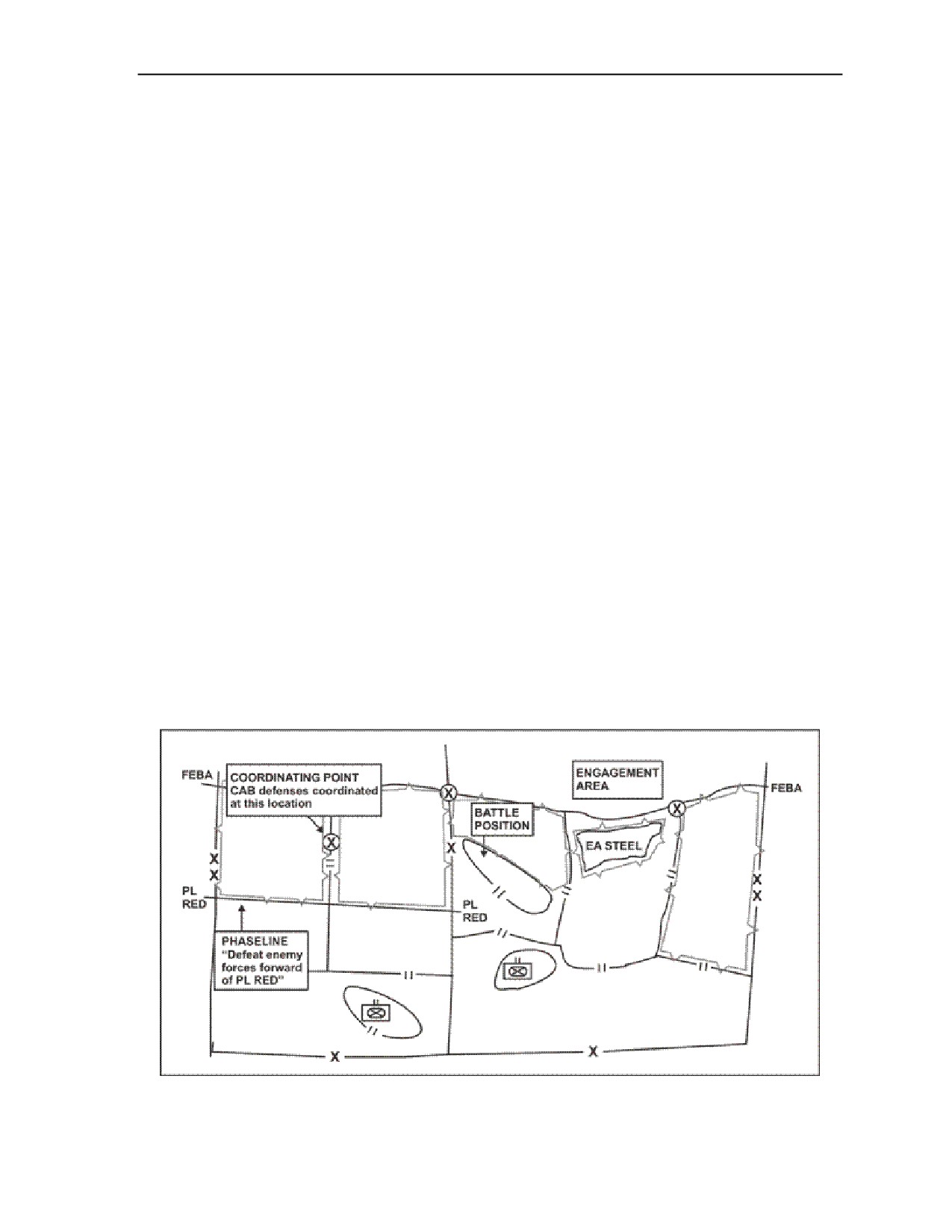
control his forces.
Figure 3-2. Example of control measures used to coordinate defense by area of operation
3-8
FM 3-90.6
14 September 2010
Defensive Operations
Battle Position
3-39. The BCT commander assigns a BP to a battalion when he wishes to control the battalion’s fires,
maneuver, and positioning. Usually, boundaries are assigned to provide space for the battalion security,
support, and sustainment elements that operate outside a BP. When the commander does not establish unit
boundaries, the BCT is responsible for fires, security, terrain management, and maneuver between positions
of adjacent battalions. The BP prescribes a primary direction of fire by the orientation of the position. The
commander defines when and under what conditions the battalion can displace from the BP or maneuver
outside it. In addition, the use of prepared or planned BPs, with the associated tasks of prepare or
reconnoiter, provides flexibility to rapidly concentrate forces, and adds depth to the defense. Construction
of BPs by the BCT requires engineer augmentation.
3-40. When the BCT commander assigns a BP, he considers the following:
z
The presence of well-defined enemy brigade-size AAs.
z
Selection of terrain that provides sufficient space for dispersion and depth of weapons systems,
supplementary and alternate positions, and flanking fires if possible.
z
Enemy capabilities.
z
Friendly capabilities.
Strongpoint
3-41. A strongpoint is a heavily fortified BP tied into a natural obstacle or restrictive terrain to create an
anchor for the defense. A strongpoint implies retention of terrain for the purpose of controlling key terrain
and/or blocking, fixing, or canalizing enemy forces. Strongpoints for armored or mechanized forces are
seldom used because they sacrifice the inherent mobility advantage of heavy forces. Before assigning a
strongpoint mission, the commander considers the following:
z
Loss of survivability and countermobility effort to other areas within the defense.
z
Potential for the defending force to be encircled or isolated by the attacking enemy.
z
Availability of sufficient time and resources to construct the position.
3-42. Defending units require permission from the higher HQ to withdraw from a strongpoint. Strongpoints
are prepared for all-around defense. Strongpoints require extensive engineer effort and resources. All
combat, maneuver enhancement, and sustainment assets within the strongpoint require fortified positions.
In addition, extensive protective and tactical obstacles are required to provide an all-around defense. A
strongpoint usually requires 24 hours of engineer effort by an engineer force equal in size to that of the
force defending the strongpoint. Organic BCT engineers lack certain equipment that make the creation of a
strongpoint possible within a reasonable amount of time.
Combat Outpost
3-43. A combat outpost is a reinforced OP that is capable of conducting limited defensive operations.
While the factors of METT-TC determine the size, location, and number of combat OPs established by a
unit, a reinforced platoon typically occupies a combat outpost. Both mounted and dismounted forces can
employ combat outposts. Combat OPs are usually located far enough in front of the protected force to
prevent enemy ground reconnaissance elements from observing the actions of the protected force.
Considerations for employing combat outposts include:
z
They allow security forces to operate in restrictive terrain that prevents mounted security forces
from covering the area.
z
They can be used when smaller OPs are in danger of being overrun by enemy forces infiltrating
the security area.
z
They enable a commander to extend the depth of his security area.
z
They should not seriously deplete the strength of the main body.
3-44. Forces who man combat OPs can conduct aggressive patrolling, engage and destroy enemy
reconnaissance elements, and engage the enemy main body prior to their extraction. The commander
should plan to extract his forces from the combat OP before the enemy has the opportunity to overrun them.
14 September 2010
FM 3-90.6
3-9
Chapter 3
NONCONTIGUOUS AREAS
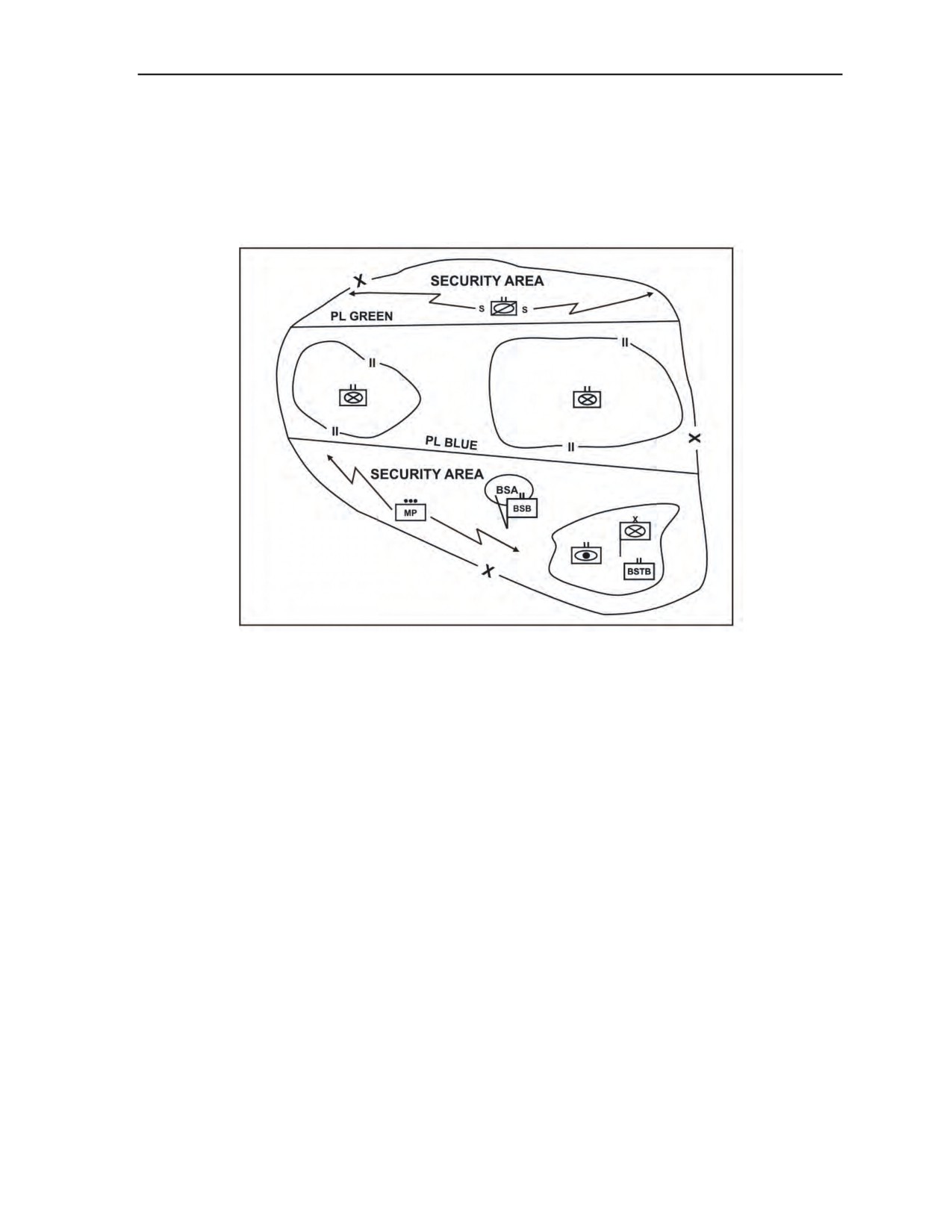
3-45. The BCT may not have assigned responsibility for all of its AO to its subordinate units. Subordinate
unit AOs may be contiguous or noncontiguous. A common boundary separates contiguous areas of
operations. Noncontiguous areas of operations do not share a common boundary (Figure 3-3). The concept
of operations provides procedural control of elements of the force. The BCT is responsible for controlling
the area between noncontiguous areas of operations and/or beyond contiguous areas of operations within its AO.
Figure 3-3. BCT security areas in a noncontiguous battlefield
RESERVE
3-46. The reserve is a force(s) withheld from action and committed at a decisive moment. The reserve
provides the BCT with the flexibility it needs to exploit success or deal with a tactical setback. The
maintenance of a reserve is essential for depth in a defense. The reserve is positioned to respond quickly to
unanticipated missions. A reserve maintains protection from enemy fires and detection by maximizing
covered and concealed positions, wide dispersion, and frequent repositioning.
3-47. A reserve usually occupies a BP with planning priorities to defend its position; alternately, the
reserve can use an assembly area. Maintaining and positioning a reserve is a key requirement for achieving
depth within the defense. The commander and staff determine the size and position of the reserve based on
the accuracy of knowledge about the enemy and the ability of the terrain to accommodate multiple enemy
COAs. When the BCT has good knowledge about the enemy and the enemy's maneuver options are
limited, the BCT can maintain a smaller reserve. If knowledge of the enemy is limited and the terrain
allows him multiple COAs, then the BCT needs a larger reserve positioned deeper in the AO. This gives
the BCT the required combat power and reaction time to commit the reserve effectively.
OBSTACLES
3-48. The BCT employs tactical obstacles to directly attack the enemy’s ability to move, mass, and
reinforce. Obstacles are force oriented combat multipliers and usually are covered by observation and direct
and/or indirect fires. Tactical obstacles are integrated into the scheme of maneuver and fires to produce
specific obstacle effects. Obstacles alone do not produce significant effects against the enemy; obstacles
must be integrated with fires to be effective. Fires and obstacles produce four distinct effects: disrupt, fix,
turn, and block. There are three types of tactical obstacles: directed, situational, and reserve.
3-10
FM 3-90.6
14 September 2010
Defensive Operations
Directed Obstacles
3-49. Directed obstacles are obstacles assigned by higher commanders as specified tasks to subordinate
units. Units plan, prepare, and execute obstacles during the preparation of the defense. The commander can
use directed obstacles or obstacle groups to achieve specific obstacle effects at key locations on the
battlefield. In this case, the staff plans the obstacle control measures and resources, as well as determines
measures and tasks to subordinates to integrate the directed obstacles with fires.
Situational Obstacles
3-50. Situational obstacles are obstacles the BCT plans and possibly prepares before an operation;
however, they do not execute these obstacles unless specific criteria are met. They are be prepared
obstacles and provide the commander flexibility for employing tactical obstacles based on battlefield
developments. The commander can use engineer forces to emplace tactical obstacles rapidly, but usually
uses SCATMINE systems instead. The BCT staff usually plans situational obstacles to enable the
commander to shift his countermobility effort rapidly to where he needs it the most, based on the situation.
Execution triggers for situational obstacles are integrated into the decision support template. Situational
obstacles must be well integrated with tactical plans to avoid fratricide.
Reserve Obstacles
3-51. Reserve obstacles are obstacles for which the commander restricts execution authority. These are on-
order obstacles. The commander specifies the unit(s) responsible for constructing, guarding, and executing
the obstacle. Examples of reserve obstacles include preparing a bridge for destruction or an obstacle to
close a lane. Units usually prepare reserve obstacles during the preparation phase. They execute the
obstacle only on command of the authorizing commander or when specific criteria are met.
FIRE CONTROL MEASURES
3-52. Chapter 7 discusses the common fire control measures that the BCT commander employs in all types
of operations, including the defense.
SECTION II - PRIMARY DEFENSIVE TASKS
3-53. There are three primary tasks in defensive operations: the area defense, the mobile defense, and the
retrograde. These three operations have significantly different concepts and pose significantly different
problems (FM 3-90). The BCT commander also must account for the capabilities and limitations of his unit
when planning and executing the defense. Although the names of these types of defensive operations
convey the overall aim of a selected defensive operation, each typically contains elements of the other and
combines static and mobile elements. The BCT’s higher headquarters, when it assigns a defensive mission,
will also designate the defensive task.
3-54. In an area defense, the BCT concentrates on denying enemy forces access to designated terrain for a
specific time limiting their freedom of maneuver and channeling them into killing areas. The BCT retains
terrain that the attacker must control in order to advance. The enemy force is drawn into a series of kill
zones where it is attacked from mutually supporting positions and destroyed, largely by fires. Most of the
defending force is committed to defending positions while the rest is kept in reserve
(Figure 3-4).
Commanders use the reserve to preserve the integrity of the defense through reinforcement or counterattack
(FM 3-0).
14 September 2010
FM 3-90.6
3-11
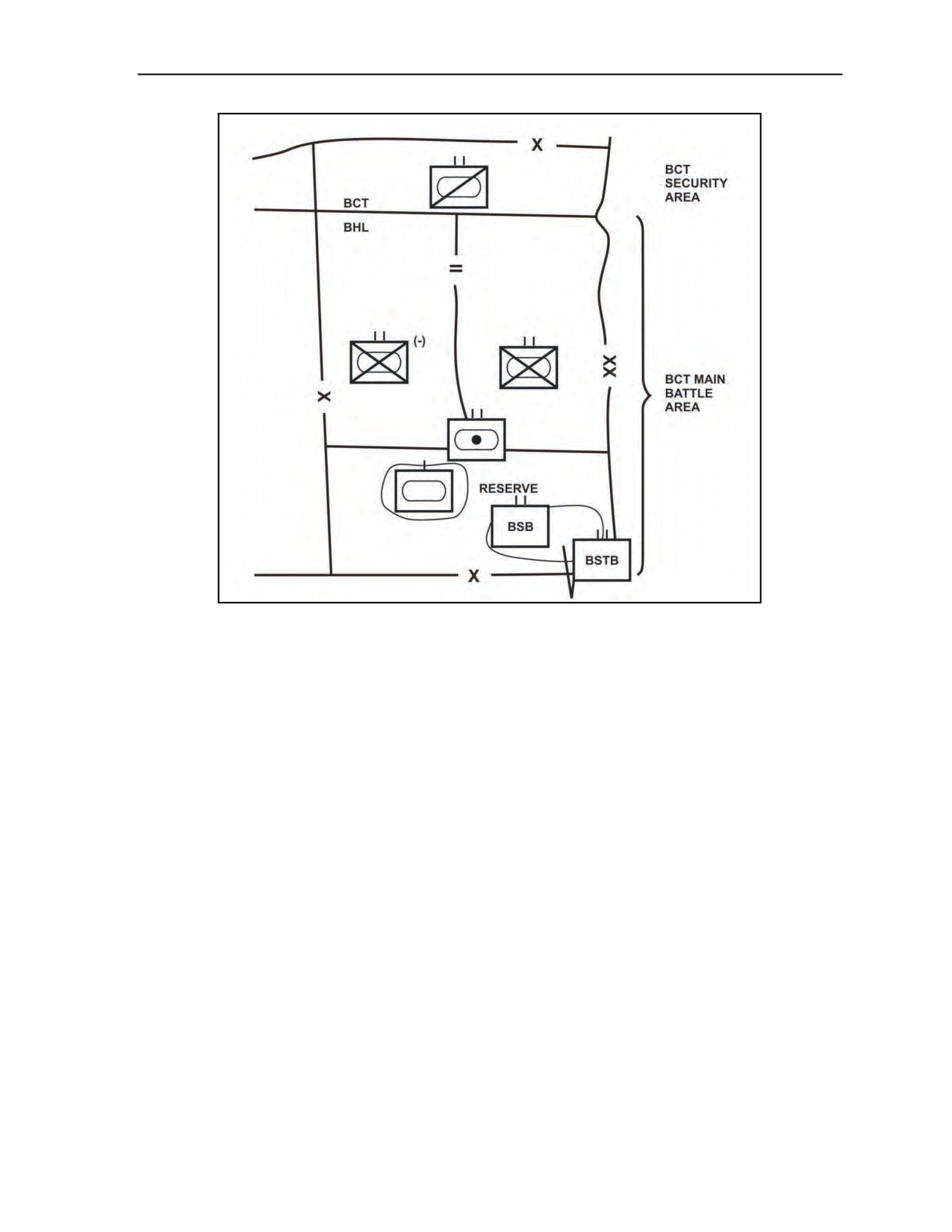
Chapter 3
Figure 3-4. Typical HBCT organization of a contiguous area defense
3-55. In a mobile defense, the defender withholds a large portion of available forces for use as a striking
force in a counterattack. Mobile defenses require enough depth to let enemy forces advance into a position
that exposes them to counterattack. The defense separates attacking forces from their support and disrupts
the enemy’s C2. As enemy forces extend themselves in the defended area, lose momentum and
organization, the defender surprises and overwhelms them with a powerful counterattack (FM 3-0).
Divisions and larger forces normally execute mobile defenses. BCTs can participate in a mobile defense as
either a fixing force or a striking force (FM 3-90).
AREA DEFENSE
3-56. An area defense concentrates on denying the enemy's access to designated terrain for a specific time
rather than on the outright destruction of the enemy. The keys to a successful area defense are:
z
Capability to concentrate effects.
z
Depth of the defensive area.
z
Security.
z
Ability to take full advantage of the terrain such as movement corridors, natural obstacles, and
choke points.
z
Flexibility of defensive operations.
z
Timely resumption of offensive actions.
SCHEME OF MANEUVER
3-57. The BCT arrays its forces in relationship to likely enemy COAs. The BCT allocates combat forces to
the main effort, shaping operation(s), and reserve. Allocations are based on the forces’ assigned tasks, the
terrain, and the size of enemy force that each avenue of approach can support (probable force ratio). The
commander accepts risk along less likely AAs to ensure that adequate combat power is available for more
3-12
FM 3-90.6
14 September 2010
Defensive Operations
critical efforts. In some cases, the commander must accept gaps within the defense, but must take measures
to maintain security within these risk areas. The BCT may use reconnaissance forces, surveillance assets,
security forces, patrols, or other economy of force missions for these areas. The BCT uses two forms of
defensive maneuver in an area defense: defense in depth and forward defense.
Defense in Depth
3-58. A defense in depth is the preferred form of maneuver for the Heavy Brigade Combat Team (HBCT)
and Stryker Brigade Combat Team (SBCT) because it reduces the risk of the attacking enemy force
quickly penetrating the defense. The enemy is unable to exploit a penetration because of additional
defensive positions employed in depth. The in depth defense provides more space and time to defeat the
enemy attack.
3-59. The BCT uses a defense in depth when:
z
The mission allows the BCT to fight throughout the depth of the AO.
z
The terrain does not favor a defense well forward, and there is better defensible terrain deeper in
the AO.
z
Sufficient depth is available in the AO.
z
Cover and concealment forward in the AO is limited.
z
Weapons of mass destruction might be used.
Forward Defense
3-60. The intent of a forward defense is to prevent enemy penetration of the defense. Due to its lack of
depth, a forward defense is the least preferred form of maneuver. Infantry Brigade Combat Teams (IBCT),
which have limited tactical mobility, normally conduct a forward defense. The BCT deploys the majority of
its combat power into forward defensive positions near the FEBA (Figure 3-5). The BCT fights to retain its
forward position; it may conduct counterattacks against enemy penetrations, or to destroy enemy forces in
forward engagement areas. Often, counterattacks are planned forward of the FEBA to defeat the enemy.
3-61. The BCT uses a forward defense when:
z
Terrain forward in the AO favors the defense.
z
Strong existing natural or manmade obstacles, such as a river or a rail line, are located forward
in the AO.
z
The assigned AO lacks depth due to the location of the area or facility to be protected. Cover and
concealment in the rear portion of the AO is limited.
z
Directed by higher HQ to retain or initially control forward terrain.
14 September 2010
FM 3-90.6
3-13
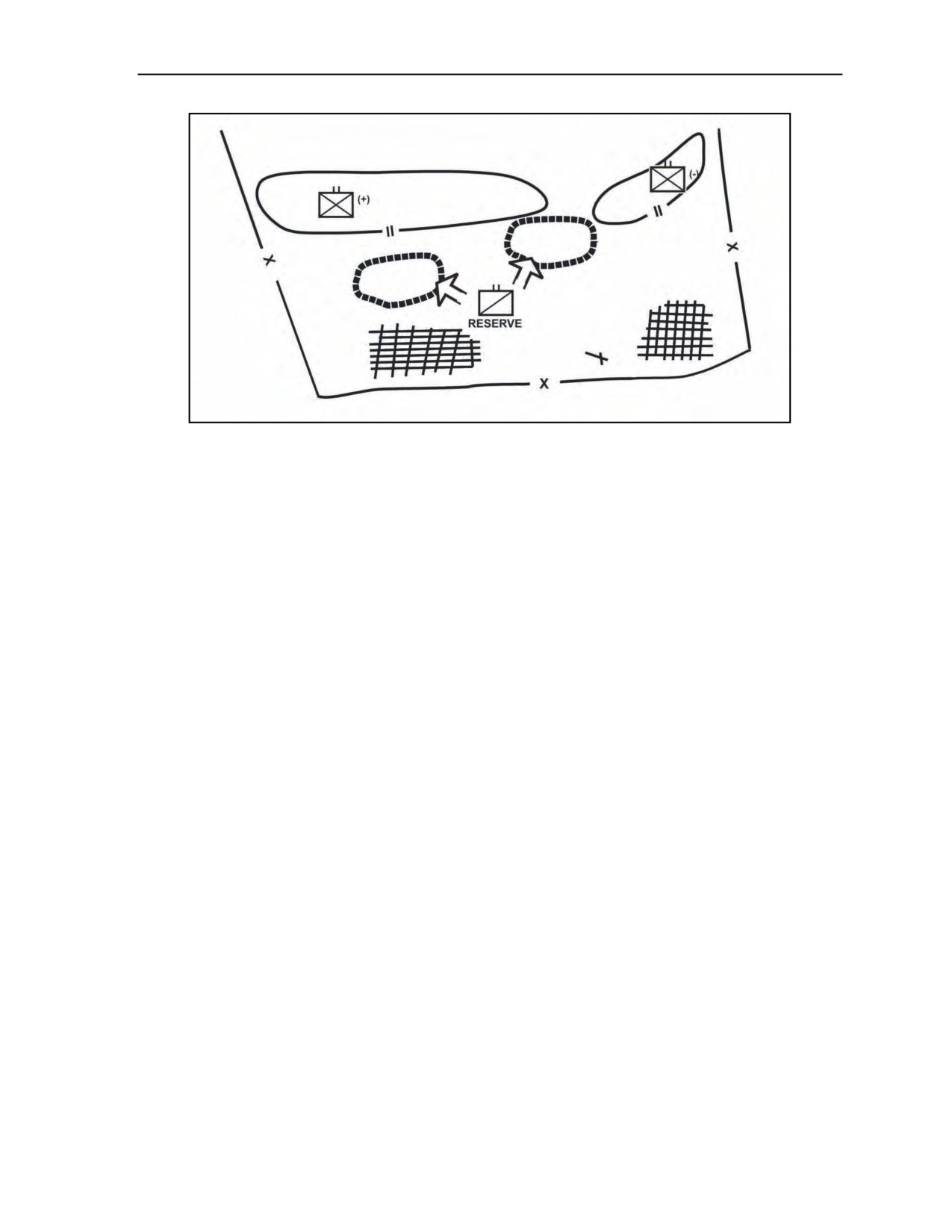
Chapter 3
Figure 3-5. Example of an IBCT forward defense
Reconnaissance and Surveillance Considerations
3-62. The BCT commander directs his reconnaissance and surveillance assets to determine the locations,
strengths, and probable intentions of the attacking enemy force before and throughout the defensive
operation. The commander places a high priority on early identification of the enemy’s main effort. He may
need to complement surveillance with combat actions that test enemy intentions. Fighting for information
can have two benefits—it can force the enemy to reveal his intentions and disrupt his preparations.
3-63. In the defense, reconnaissance operations overlap the unit’s planning and preparing phases. Leaders
performing reconnaissance tasks must understand that they often deploy before the commander fully
develops his plan and they must be responsive to changes in orientation and mission. The commander
ensures that his staff fully plans, prepares, and executes reconnaissance missions (FM 3-0).
PREPARING THE DEFENSE
3-64. The BCT uses the preparation time available to build the strongest defense possible and refining
counterattack plans. Commanders and staffs supervise and assess unit preparations while continuing to
maintain situational awareness of developments in the AO. Reconnaissance and security operations are
conducted aggressively while units occupy their assigned initial positions and rehearse their defensive
actions.
Establish Security
3-65. The first priority in the defense is to establish security. The commander may direct the establishment
of a forward security area. He often assigns this mission to the reconnaissance squadron. When defending
an extremely wide AO, the reconnaissance squadron establishes a screen. The commander should consider
the need to reinforce the reconnaissance and security capabilities of the squadron with tanks and other
assets. It is essential that all units maintain a high level of local security. Employment of patrols,
establishment of OPs, skillful use of unmanned aircraft systems (UAS) and sensors, and effective use of
the terrain to conceal dispositions are essential for effective security.
3-66. In addition to traditional operational security measures, the BCT commander must also consider the
potential threat to his defense that non-combatants with access to telephones (landline, wireless, and
satellite), digital cameras, and similar devices may present. Security measures, such as shutting down
telephone exchanges and cell phone towers, and preventing unauthorized personnel from moving in the
defensive area, may be required. The BCT should request guidance from higher HQ before implementing
any defensive measures that could affect the civil population.
3-14
FM 3-90.6
14 September 2010
Defensive Operations
Deception and Operational Security
3-67. As part of the defense, higher HQ may have created a deception operation and associated story to
protect the force, cause early committal of the enemy, and mislead the enemy as to the true intentions,
composition, and disposition of friendly forces. The BCT aids in the execution of the deception plan to:
z
Exploit enemy pre-battle force allocation and sustainment decisions.
z
Exploit the potential for favorable outcomes of protracted minor engagements and battles.
z
Lure the enemy into friendly territory exposing his flanks and rear to attacks.
z
Mask the aggressiveness of the sustaining and operational forces committed to the defense.
3-68. Defensive operations contain branches and sequels that give the commander preplanned
opportunities to exploit the situation. It is around these branches and sequels that deception potentials exist.
Specific deceptive actions the BCT commander can take to hasten exhaustion of the enemy offensive
include, but are not limited to:
z
Manipulating the SALUTE (size, activity, location, unit, time, and equipment) factors associated
with defensive dispositions.
z
Masking the conditions under which he will accept decisive battle.
z
Luring the enemy into a decisive battle, the outcome of which will facilitate branching or
sequencing to the offense.
z
Employing camouflage, decoys, false radio traffic, movement of forces, and the digging of false
positions and obstacles.
Occupation of Positions
3-69. As units move into their assigned AOs and occupy positions as directed by the BCT’s movement
plan, the BCT commander and staff monitor and resolve any problems with the reconnaissance squadron’s
or higher HQ’s reconnaissance and security efforts. The BCT also may have to make minor adjustments to
AOs, engagement areas, BPs, and other defensive coordination measures based on unanticipated METT-TC
conditions the occupying units encounter as they begin preparing the defense. The BCT should make only
critical changes to the defense plan because changes may mean the loss of time and wasted expenditure of
unrecoverable CL IV barrier and obstacle material.
3-70. Obstacle emplacement, particularly those directed by higher HQ and the BCT, should be closely
monitored to ensure that they are sited and completed in accordance with the obstacle plan. Units assigned
to close gaps or to execute engineer targets such as demolition of bridges or dams should also be closely
monitored to assure their readiness to execute their mission.
Rehearsals
3-71. If METT-TC permits, the BCT should rehearse its defense. To prepare for the defense, the
commander can use any of the five types of rehearsals. They are confirmation brief, backbrief, combined
arms rehearsal, support rehearsal, and battle drill (or standard operating procedure rehearsal). FM 6-0
provides additional information on these rehearsal types. During defensive operations, staffs address
counterreconnaissance, battle handover, and then other phases of the operation. The BCT commander also
should ensure that his enabling forces are completely integrated into the defensive scheme of maneuver.
Rehearsals provide a mechanism for ensuring this integration.
EXECUTING THE AREA DEFENSE
3-72. In an area defense, the BCT fights mainly from prepared, protected positions to concentrate combat
power effects against attempted enemy breakthroughs and flanking movements. The commander uses his
reserve to cover gaps between defensive positions, reinforce those positions as necessary, and counterattack
to seal penetrations or block enemy attempts at flanking movements.
3-73. The BCT area defense can be described in five steps:
z
Gain and maintain enemy contact.
z
Disrupt the enemy.
14 September 2010
FM 3-90.6
3-15
Chapter 3
z
Fix the enemy.
z
Maneuver.
z
Follow through.
Gain and Maintain Enemy Contact
3-74. Gaining and maintaining contact with the enemy in the face of his determined efforts to destroy
friendly reconnaissance and security assets is vital to the success of defensive operations. As the enemy’s
attack begins, the BCT’s first concerns are to identify committed enemy units’ positions and capabilities,
determine the enemy’s intent and direction of attack, and gain time to react. Initially, the commander
accomplishes these goals in the security area. The sources of this type of intelligence include
reconnaissance and security forces, engineer units, intelligence units, special operations forces, and aviation
elements. The commander ensures the distribution of a common operational picture (COP) throughout the
BCT during the battle to form a shared basis for subordinate commanders’ actions. The commander uses
the information available to him, in conjunction with his military judgment, to determine the point at which
the enemy is committed to a COA (FM 3-90).
Disrupt the Enemy
3-75. The commander executes his shaping operations to disrupt the enemy regardless of his location
within the AO. After making contact with the enemy, the commander seeks to disrupt the enemy’s plan, his
ability to control his forces, and his combined arms team. Ideally, the results of the commander’s shaping
operations should result in a disorganized enemy, forced to conduct a movement to contact against
prepared defenses. Once the process of disrupting the enemy begins, it continues throughout a defensive
operation.
3-76. The BCT uses indirect fires, CAS, attack helicopters, and other available lethal and nonlethal fires
during this phase of the battle to:
z
Support the security force’s delaying action.
z
Disrupt or limit the momentum of the enemy’s attack.
z
Destroy HPTs that support the decisive action of the striking force.
z
Divert the enemy’s attack.
z
Reduce the enemy’s combat power.
z
Separate enemy formations.
Fix the Enemy
3-77. The commander has several options to help him fix an attacking force. The commander can design
his shaping operations—such as securing the flanks and point of penetration—to fix the enemy and allow
friendly forces to execute decisive maneuver elsewhere. As discussed earlier in this chapter, combat
outposts and strong points can also deny enemy movement to or through a given location. A properly
executed military deception operation can constrain the enemy to a given COA.
3-78. The commander limits the options available to the enemy by using obstacles covered by fire to fix,
turn, block, or disrupt enemy activities. Properly executed obstacles are a result of the synthesis of top-
down and bottom-up obstacle planning and emplacement. Blocking forces can also affect enemy
movement. A blocking force can achieve its mission from a variety of positions depending on the factors of
METT-TC.
Maneuver
3-79. In an area defense, the decisive operation occurs in the MBA. This is where the effects of shaping
operations, coupled with sustaining operations, combine with the decisive operations of the MBA force to
defeat the enemy. The commander’s goal is to prevent the enemy’s further advance through a combination
of fires from prepared positions, obstacles, and mobile reserves.
3-80. Generating massed effects is especially critical to the commander conducting the defense of a large
area against an enemy with a significant advantage in combat power. The attacker has the ability to select
3-16
FM 3-90.6
14 September 2010
Defensive Operations
the point and time of the attack. Therefore, the attacking enemy can mass his forces at a specific point,
dramatically influencing the ratio of forces at the point of attack. An enemy three-to-one advantage in
overall combat power can easily turn into a local six-to-one or higher ratio. The defending commander
must quickly determine the intent of the enemy commander and the effects of terrain. This allows his units
and their weapons systems to use agility and flexibility to generate the effects of combat power against the
enemy at those points, and restore a more favorable force ratio.
Follow Through
3-81. The purpose of defensive operations is to retain terrain and create conditions for a counteroffensive
that regains the initiative. The area defense does this by causing the enemy to sustain unacceptable losses
short of his decisive objectives. A successful area defense allows the commander to transition to an attack.
An area defense could also result in a stalemate with both forces left in contact with each other. Finally, it
could result in the defender being overcome by the enemy attack and needing to transition to a retrograde
operation. Any decision to withdraw must take into account the current situation in adjacent defensive
areas. Only the commander who ordered the defense can designate a new FEBA or authorize a retrograde
operation.
3-82. During this follow-through period, time is critical. Unless the commander has a large, uncommitted
reserve prepared to quickly exploit or reverse the situation, he must reset his defense as well as maintain
contact with the enemy. Time is also critical to the enemy, because he will use it to reorganize, establish a
security area, and fortify his positions.
Security Area Engagement
3-83. When the tasks of the division’s security force mission are met, and the security force begins its
movement from the security area to the flanks of the division or rearward, the security force passes a final
enemy spot report (SPOTREP) to the BCT (via FM voice and digital), and the BCT assumes control of the
battle.
3-84. BCT security forces observe and maintain contact with the approaching enemy, report enemy
movements, avoid decisive engagement, and withdraw as lead enemy formations enter the BCT’s security
area. The commander can direct security forces to disrupt, delay, or destroy lead portions of the enemy
formations. The commander also can include his security forces as part of an effort to deceive the enemy as
to the actual location of the MBA. The commander must consider the follow-on missions of his security
forces, the potential for these forces to be over-run or isolated, and the overall impact their direct combat
achieves. To remain abreast of the situation and maintain mutual support, main battle forces eavesdrop on
the security force fight.
3-85. The BCT continues to disrupt the tempo of the approaching enemy formations to ensure these forces
are unable to restore any lost momentum. The commander usually maintains indirect fires and CAS on the
approaching enemy formations as they enter the MBA. The commander must clearly state his essential
tasks for fire support and essential tasks for mobility-survivability for this phase of the defense. In addition,
he must ensure his fire support systems remain responsive in order to weight their efforts to the MBA fight
as it develops. The commander orders the execution of situational obstacles that best support the MBA
engagement; controls occupation of defensive positions; and assesses the impact of fires against the enemy.
At this point, the commander’s major concerns are to identify the enemy’s main effort, determine the
direction of the attack, and gain time to react.
Battle Handover
3-86. The battle handover (BHO) is the transfer of responsibility for the battle from BCT security forces to
the BCT combat forces in the MBA. The BCT commander prescribes criteria for the handover. He
designates where forces will pass through, routes, contact points, and the BHL. The BHL is usually forward
of the FEBA, which is where elements of the passing unit are effectively over-watched by direct fires of the
forward combat elements. Battalions usually employ security forces in the area immediately behind the
BHL. Each maneuver battalion coordinates the BHO with the security force to their front. This
coordination overlaps the coordination for the passage of lines, and so the battalion should conduct the two
14 September 2010
FM 3-90.6
3-17
Chapter 3
simultaneously. To facilitate a rapid BHO, it is best to establish its coordination as standard operating
procedure (SOP). BHO coordination usually includes:
z
Establishing communications.
z
Providing updates on both friendly and enemy situations.
z
Coordinating passage.
z
Collocating C2.
z
Dispatching representatives to contact points and establishing liaison.
z
Recognition signals.
z
Status of obstacles and routes.
z
Fire support, air defense, and sustainment requirements.
z
Defining exact locations of contact points, lanes, and other control measures.
z
Assisting the security force when breaking enemy contact.
z
Coordinating and exchanging maneuver, obstacle, and fire plans.
z
ROE.
z
Civilian considerations (to include displaced persons).
3-87. While a line defines the BHO, events might force the security force to break contact forward of, or
behind the BHL, or in the gaps that develop between attacking enemy echelons. As security force elements
cross the BHL, each battalion directs its movements along designated routes through their battalion AO. As
needed, battalion security forces and fire support systems assist the passing force to break contact with the
enemy. Mass artillery, obscurants, CAS, and possibly situational obstacles are used to support the break in
contact. Commanders must closely coordinate control of fires to avoid fratricide and ensure effective fire
distribution during execution. Close coordination at all levels is essential to execute this process. The BHO
is completed when the passing unit is clear and the battalions have assumed control of the battle.
3-88. The entire security force should not withdraw automatically as soon as the first enemy units reach the
FEBA. The commander can leave in place security elements located in areas where the enemy has not
advanced. A single force in the security area can perform both reconnaissance and security functions. The
security force uses every opportunity for limited offensive action to delay and harass the enemy and to gain
information (FM 3-90).
3-89. The security force adjusts to the enemy’s advance and continues to conduct security operations as far
forward as possible. It continues to resist the enemy’s shaping operations, such as the enemy’s
reconnaissance effort, thereby upsetting his coordination and enabling the MBA commander to fight one
engagement (or battle) at a time. Doing this increases the chances for success even if the enemy attack
penetrates into the MBA in some areas. In some cases, the security force can attack the enemy force from
its rear, engage HPTs, or drive between echelons to isolate leading enemy units.
3-90. During BHO, each maneuver battalion in the MBA:
z
Assists passage of lines and disengagement.
z
Gains and maintains contact with enemy forces as the BHO occurs.
z
Continues to locate and destroy enemy reconnaissance and security elements to preclude
observation of the primary defensive positions.
z
Closes lanes, executes reserve obstacles, and/or emplaces situational obstacles in the security
area as the passing force withdraws.
MAIN BATTLE AREA ENGAGEMENT
3-91. All systems and units focus on fixing and destroying enemy forces that enter the MBA. Only through
decisive combat can the BCT defeat/destroy a determined enemy and complete its mission.
3-18
FM 3-90.6
14 September 2010
Defensive Operations
Maneuver
3-92. During the MBA engagement, the BCT shifts combat power and priority of fires to defeat the
enemy’s attack. This may require:
z
Adjusting subordinates' AOs and missions.
z
Repositioning forces.
z
Shifting the main effort.
z
Repeating commitment and reconstitution of a reserve.
z
Modifying the original plan.
3-93. Forward forces within the MBA usually have the mission to break the enemy’s momentum, reduce
his numerical advantage, and force the enemy into positions of vulnerability. The BCT masses combat
power at decisive times and locations to counter major enemy efforts and defeat enemy formations. The
BCT economizes and takes risks in less threatened areas, shifts fires, and maneuvers the reserve and/or
MBA forces to gain local fire superiority at critical locations. Obstacles, security forces, surveillance assets,
and fires can assist covering areas where risk is accepted. Often, the BCT must trade ground to gain the
time needed to concentrate forces, mass fires, and attrit the enemy. The commander must decide, and must
mass forces and fires swiftly, since periods that allow him to gain an advantage usually are brief.
Maintain Cohesion
3-94. The BCT must maintain a cohesive defense if the defense is to remain viable. The commander
ensures battalion movements do not uncover adjacent battalions or adjacent BCTs. Often, the BCT must
accept gaps in the defense. In such cases, the commander must take measures to cover these gaps and
detect enemy efforts towards these risk areas. The BCT commander and subordinate commanders use
security forces, surveillance assets, and patrols to maintain a cohesive defense.
3-95. Subordinate commanders cross talk and continually report their situation, enemy actions, and future
plans to the BCT commander. Subordinate commanders accomplish this via the digitally displayed COP.
The commander assesses individual battalion plans to ensure they are consistent with his scheme of
maneuver. Often, defending battalions must modify their defensive plans to protect and refuse their flanks
when necessary actions of an adjacent maneuver battalion/CAB create an assailable flank. The BCT
commander must ensure all battalion actions are coordinated and controlled to provide a cohesive defense.
Penetrations
3-96. Each battalion commander is responsible for controlling enemy advances within his assigned AO.
Battalion commanders must provide the BCT commander early warning and reaction time for potential
enemy penetrations. If a battalion is threatened with a penetration the BCT commander may take several
actions to counter the situation. In order of priority, he can do any or all of the following:
z
Maintain contact with the penetrating enemy force. Forward MBA forces may be able to
transition into a delay to maintain contact, or the commander may redirect reconnaissance assets,
security forces, and observers to locate and observe the enemy. The commander seeks to
determine the penetrating enemy force’s size, composition, direction of attack, and rate of
movement. Forces in contact also must adjust indirect fires and CAS against the enemy to
disrupt, delay, or divert his attack.
z
Take immediate actions to hold the shoulders of the penetration. This may require changing task
organization, adjusting adjacent maneuver battalion/CAB boundaries and tasks, executing
situational or reserve obstacles, or shifting priority of fires.
z
Move threatened sustainment units. Based on the enemy’s direction of attack, sustainment units
may need to move away from the penetration. These movements must be controlled to ensure
they do not interfere with counterattack plans or movements of combat forces.
z
Determine where and how to engage the penetrating enemy force. Based on the enemy’s size,
composition, and direction of attack the commander selects the best location to engage the
enemy. The reserve may counterattack into the enemy’s flank, or it may establish a defensive
position in depth to defeat or block the enemy. The staff establishes control measures for the
14 September 2010
FM 3-90.6
3-19
Chapter 3
reserve’s attack. The reserve can use an engagement area or objective to orient itself to a specific
location to engage the enemy. The reserve can use a BP as a position along defensible terrain.
When the situation is vague or the enemy has multiple AAs, the commander may establish an
AO for the reserve. This requires the reserve to locate, and move to intercept and engage the
enemy anywhere in the assigned AO. The commander and staff develop a concept of fires and
consider required adjustments to fire support coordinating measures. They also decide on the
commitment of directed, reserve, or situational obstacles to support the action. Traffic control is
especially critical. Sufficient routes must be designated for the reserve to use, and provisions
such as the use of MPs must be taken to ensure those routes remain clear.
z
Issue an order. If the operation is not well controlled, the situation could easily deteriorate into a
total force failure. The BCT commander must develop orders quickly, and issue them clearly,
concisely, and calmly. A simple, well thought-out plan, developed during the initial planning
process, greatly improves the ability of subordinates to react effectively.
3-97. The BCT commander must keep the division commander well informed of the BCT’s situation.
Potential enemy penetrations of the BCT’s AO are immediately addressed to the division commander.
Depending on the resources available, the division commander might reinforce the BCT with additional
fires, CAS, attack aviation, or maneuver forces.
Counterattack to an Enemy Penetration
3-98. The BCT conducts counterattacks to take advantage of an attacking enemy’s weakened condition by
striking against his flanks or rear, or to deny the enemy commander momentum and initiative. As the
enemy’s advance slows and weakens, he has fewer maneuver options. As a result, he could transition to a
hasty defense along the forward line of own troops (FLOT), or he could attempt to gain a foothold within
the brigade’s MBA from which he can defend.
3-99. This situation enables the BCT commander to seek decisive opportunities to counterattack the enemy
with all available force, and ultimately secure the initiative of the battle. Timing is critical to a
counterattack. Assuring the mobility of the counterattack force is critical. If committed too soon, the
counterattack force might not have the desired effect, or may not be available for a more dangerous
contingency. If committed too late, they might be ineffective. Once committed, counterattack forces can
penetrate the enemy’s flanks and attack the enemy's artillery and logistics areas; or penetrate the enemy’s
flanks and attack them from the rear. Both of these are decisive actions, and create concern for the enemy.
3-100. After a successful counterattack, and once minimum reorganization activities are completed, the
commander orders his forces to attack key enemy objectives in order to place the BCT in positions for
future operations. As the BCT reaches the objective of the attack, it consolidates and continues
reorganization that is more extensive. It then begins preparation to resume future offensive operations.
MOBILE DEFENSE
3-101. A mobile defense is a force oriented defensive action that focuses on the destruction of the enemy
rather than the retention of terrain. Terrain is traded to overextend the attacker and diminish his ability to
react to counterattacks. A mobile defense requires considerable depth. Divisions, Corps, or larger
formations normally conduct a mobile defense.
3-102. BCTs participating in a mobile defense usually function as a security force, a striking force, or as
part of a fixing force. The fixing force holds attacking enemy forces in position to help channel attacking
enemy forces into ambush areas, and to retain areas from which to launch the striking force. The striking
force is a dedicated counterattack force constituting the bulk of available combat power. The decisive
operation is a counterattack conducted by the striking force.
3-103. IBCTs usually are not used in the mobile defense due to their limited mobility. The SBCT can be
either the fixing or the striking force, but their lack of offensive Armor generally limits their employment
as part of the fixing force. Within a division mobile defense, HBCTs are usually the striking force, though
they are fully capable of being the fixing force. See FM 3-90 for additional information on mobile defenses.
3-20
FM 3-90.6
14 September 2010

Defensive Operations
RETROGRADE OPERATIONS
3-104. Retrograde operations are defensive, organized movements that direct troops away from an enemy
(Table 3-1). Forces use retrograde operations to protect an overwhelmed or weakened force, or to improve
an untenable tactical situation (FM 3-90). In either case, the BCT’s higher HQ must approve the operation.
Retrograde operations accomplish the following:
z
Resist, exhaust, and damage enemy forces, while avoiding becoming decisively engaged.
z
Draw the enemy into an unfavorable situation.
z
Gain time.
z
Preserve combat power.
z
Disengage from battle for use elsewhere in other missions.
z
Reposition forces or shorten lines of communication (LOC).
Table 3-1. Forms of retrograde operations
Operation
Intent
Threat Contact
Delay
Trade space for time.
In contact.
Withdrawal
Disengage force free unit for use elsewhere.
In contact.
Retirement
Move a force away from the threat.
Not in contact.
3-105. An integral part of successful retrograde operations is disciplined execution. Movement to the rear
may be seen as defeat or threat of isolation unless Soldiers have confidence in their leaders, and understand
the purpose of the operation and their role in it. Leaders must be present, display confidence in the plan, be
in control of the battlefield, and thoroughly brief Soldiers on their role in the overall operation. Leaders
must remind Soldiers that they are conducting combat operations that will free the unit for other operations,
while continuing to inflict casualties upon the enemy.
3-106. BCTs must preserve their freedom to maneuver. While a portion of the unit may become
decisively engaged, the commander cannot allow the entire unit to do so. He must develop contingencies
and be prepared to fight to free battalions or companies that can no longer extricate themselves.
DELAY
3-107. In a delay, the BCT trades space for time and inflicts maximum damage on the enemy while
attempting to avoid decisive engagement. Usually, inflicting damage is secondary to gaining time. The
BCT may execute a delay when it has insufficient combat power to attack or defend or when the higher
unit’s plan calls for drawing the enemy into an engagement area or area for a counterattack. Delays gain
time to:
z
Allow other friendly forces to establish a defense.
z
Cover a withdrawing force.
z
Function as an economy of force effort to enable other forces to counterattack.
3-108. The two types of delay missions are:
z
Delay within an AO. This mission is used to slow and defeat as much of the enemy as possible
without sacrificing the tactical integrity of the unit. It presents low risk to the unit.
z
Delay forward of a specific area or position for a specific period of time. This mission is used to
slow an enemy advance for a specific period of time, or defeat specified enemy formations
within an area to support the higher commander’s concept of operations. This can involve
engagement with all or part of the unit, and presents high risk to the unit.
Organization
3-109. The BCT usually organizes into a security force, main body, and reserve. The main body consists
of the majority of the BCT’s combat power, and usually deploys well forward within the AO. The security
force usually establishes a screen forward of the initial positions of the main body. The security force then
may be tasked to become the reserve when it is withdrawn from the security area. The reserve may have a
14 September 2010
FM 3-90.6
3-21
Chapter 3
mission to contain, or defeat enemy penetrations between delay positions, conduct limited objective
counterattacks, or assist other units to break contact. Sustainment assets tend to be widely dispersed and
often attached to the units they support.
Force the Enemy to Deploy and Maneuver
3-110. Commanders should select terrain that supports engagements at maximum weapons ranges. This
causes the enemy to take time-consuming measures to deploy, develop the situation, and maneuver to drive
the delaying force from its position. The delay must be sufficiently tenacious to make the enemy doubt the
nature of the friendly mission and leave it no choice but to deploy and maneuver.
Maintain a Mobility Advantage Over the Attacker
3-111. Maintaining a mobility advantage over the attacking enemy is essential to a successful delay. The
goal is to increase the BCT’s mobility while degrading the enemy’s ability to move. The BCT improves its
mobility by task organizing appropriate engineer assets within subordinate formations, using and rehearsing
multiple routes, displacing nonessential sustainment elements early in the operation, and having a rapid
casualty evacuation (CASEVAC) plan. Mobility operations facilitate this aspect of the scheme of maneuver
and enable the BCT to achieve this.
3-112. The BCT degrades the mobility of the enemy by destroying enemy disruption and security forces,
controlling dominant terrain, engaging at maximum ranges, extensive use of obstacles, and synchronized
effects of lethal and nonlethal effects.
Alternate and Subsequent Positions
3-113. In planning, the commander chooses to delay from either alternate positions or subsequent
positions. In a delay from alternate positions, two or more units in a single AO occupy delaying positions in
depth (Figure 3-6). As the first unit engages the enemy, the second occupies the next position in depth and
prepares to assume responsibility for the operation. The first force disengages and passes around or through
the second force. It then moves to the next position and prepares to reengage the enemy while the second
force takes up the fight.
3-22
FM 3-90.6
14 September 2010
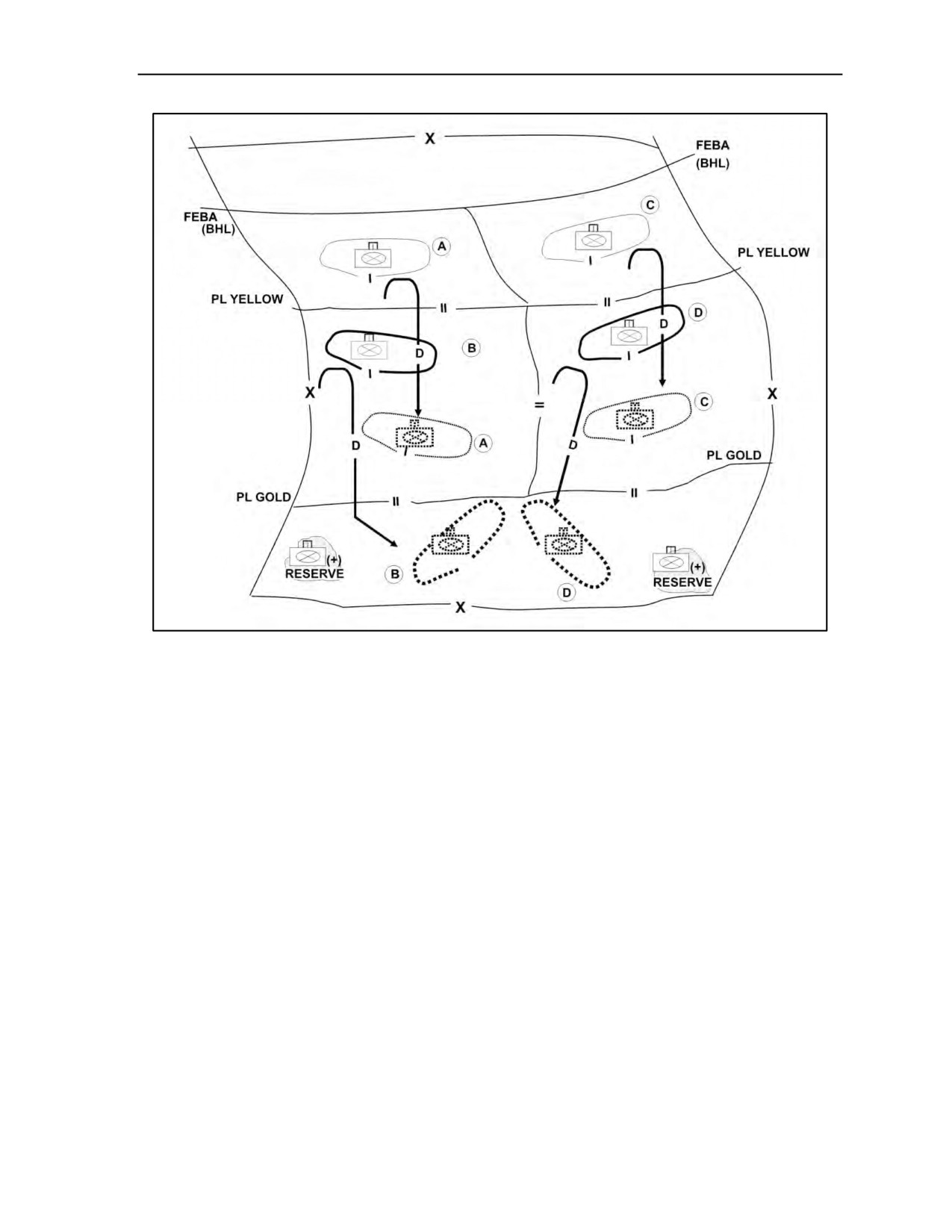
Defensive Operations
Figure 3-6. Delay by alternate positions
3-114. The BCT uses a delay from subsequent positions when the assigned AO is so wide that available
forces cannot occupy more than a single tier of positions across a front (Figure 3-7). In a delay from
subsequent positions, the majority of forces are arrayed along the same PL or series of BPs. There are no
forces in depth; only unoccupied positions. The forward forces delay the enemy from one PL, reposition to
the next PL, and then the same forces delay the enemy again.
14 September 2010
FM 3-90.6
3-23
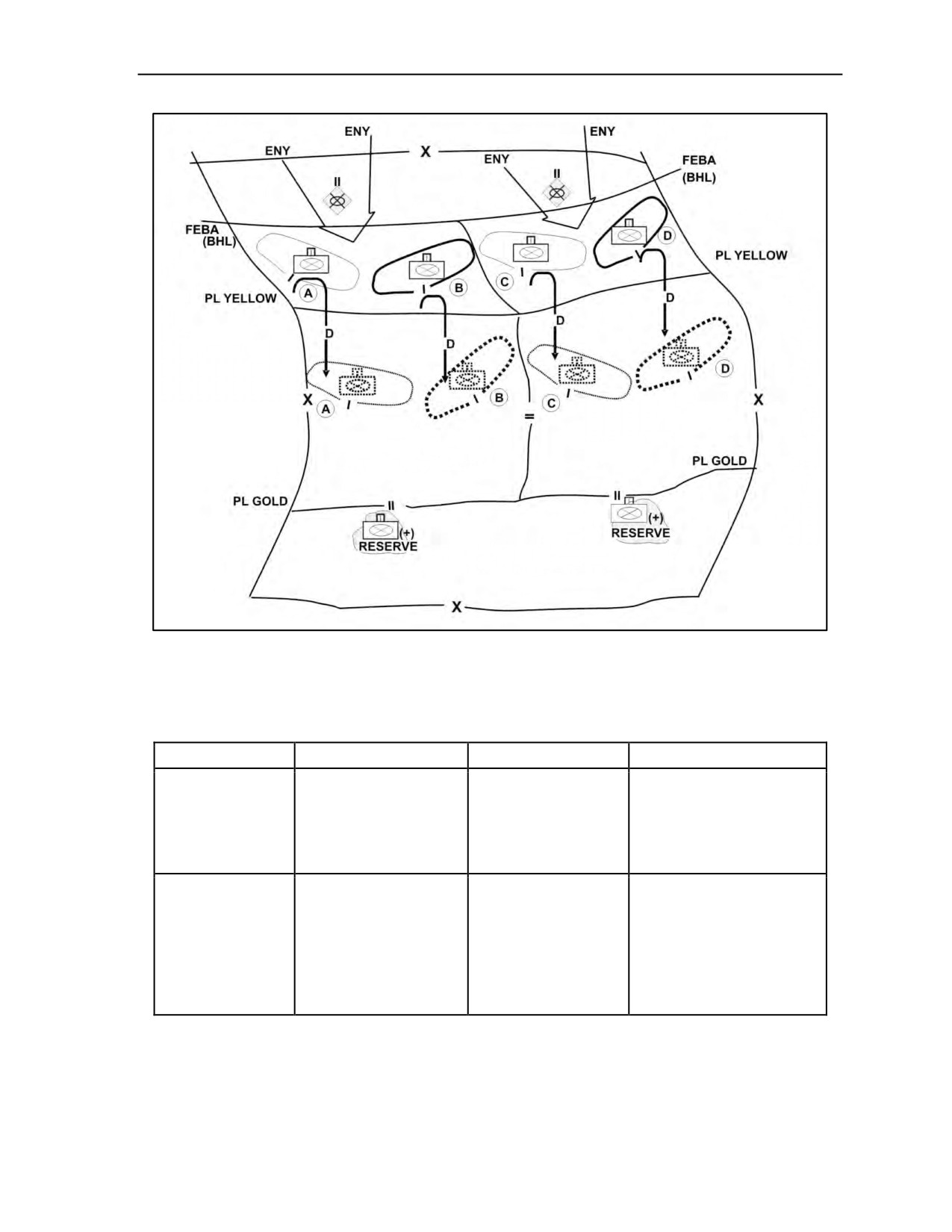
Chapter 3
Figure 3-7. Delay by subsequent positions
3-115. In both techniques, the delaying forces maintain contact with the enemy between delay positions.
Table 3-2 details the advantages and disadvantages of the two techniques.
Table 3-2. Comparison of methods of delay
Method Of Delay
Use When . . .
Advantages
Disadvantages
Limited depth to the delay
AO is wide.
Delay from
Masses fires of all
positions.
Forces available do
subsequent
available combat
Less time is available to
not allow themselves
positions.
elements.
prepare each position.
to be split.
Less flexibility.
Allows positioning in
Requires continuous
AO is narrow.
depth.
coordination.
Delay from
Forces are large
Allows more time for
Requires passage of
alternate
enough to be split
equipment and
lines.
positions.
Soldier
between different
Only part of the force is
positions.
maintenance.
engaged at one time.
More flexibility.
Controlling the Delay
3-116. The commander usually decentralizes execution of the delay to maneuver battalion/CAB level. He
must rely on his subordinate commanders to execute their mission and request help if and when they need
it. Subordinates displace once they meet previously established parameters. Units delaying within the BCT
3-24
FM 3-90.6
14 September 2010
Defensive Operations
must continuously coordinate movement and actions with units surrounding them. Displacements may be
preplanned events or time dependent. The commander closely controls the disposition of his forces to
maintain cohesion and control of the situation.
3-117. The BCT commander directs or allows delays from one position or PL to the next only after
considering the following:
z
What are the strengths, compositions, and dispositions of attacking enemy forces? Are elements
of the BCT threatened with decisive engagement or bypass?
z
What is the status of adjacent units? How does their status affect the BCT’s capability to
continue to delay?
z
Does the movement affect the cohesion of the BCT’s disposition? Are other movements
necessary to maintain cohesion? Do any sustainment assets need to reposition?
z
What is the condition of the delaying force in terms of troops, equipment, and morale?
z
How strong is this position in relation to other positions that may be occupied?
z
Is unit survivability or time key to the mission and higher commander’s intent?
Counterattacks
3-118. Whenever possible, the BCT takes any opportunity to seize the initiative, even if only temporarily.
By aggressively contesting the enemy’s initiative through offensive action, the BCT avoids passive
defensive patterns that favor the attacking enemy. Counterattacks disorganize the enemy, confuse the
enemy commander’s picture of the situation, and help prolong the delay. Counterattacks also affect the
enemy’s momentum.
Decisive Engagement
3-119. Friendly forces usually do not become decisively engaged. There are two exceptions to this. First,
when engagement is necessary to prevent the enemy from prematurely advancing across a piece of key
terrain. Second, when a part of the force must be risked to prevent jeopardizing the integrity of the whole
force.
3-120. If elements of the BCT are threatened with decisive engagement or have become decisively
engaged, the commander must take actions to support their disengagement. In order of priority, he can do
any of the following:
z
Allocate priority of all supporting fires to the threatened unit. This is the most rapid and
responsive means of increasing the unit’s combat power.
z
Reinforce the unit.
z
Conduct a counterattack to disengage the unit.
Terminating the Delay
3-121. A delay mission ends with another planned mission such as a defense, withdrawal, or attack. If the
enemy reaches his culmination point during the delay, the BCT can maintain contact while another force
counterattacks, withdraw to perform another mission, or transition to the offense. In all cases, the
commander must plan for the expected outcome of the delay based on the situation and the higher
commander’s plan.
WITHDRAWAL
3-122. The withdrawal is a planned operation in which a force in contact disengages from an enemy force.
Withdrawals may or may not be conducted under enemy pressure (Figure 3-8). The two types of
withdrawals are:
z
Assisted. The assisting force occupies positions to the rear of the withdrawing unit and prepares
to accept control of the situation. In addition, it can assist the withdrawing unit with route
reconnaissance, route maintenance, fire support, and sustainment. Both forces coordinate the
14 September 2010
FM 3-90.6
3-25
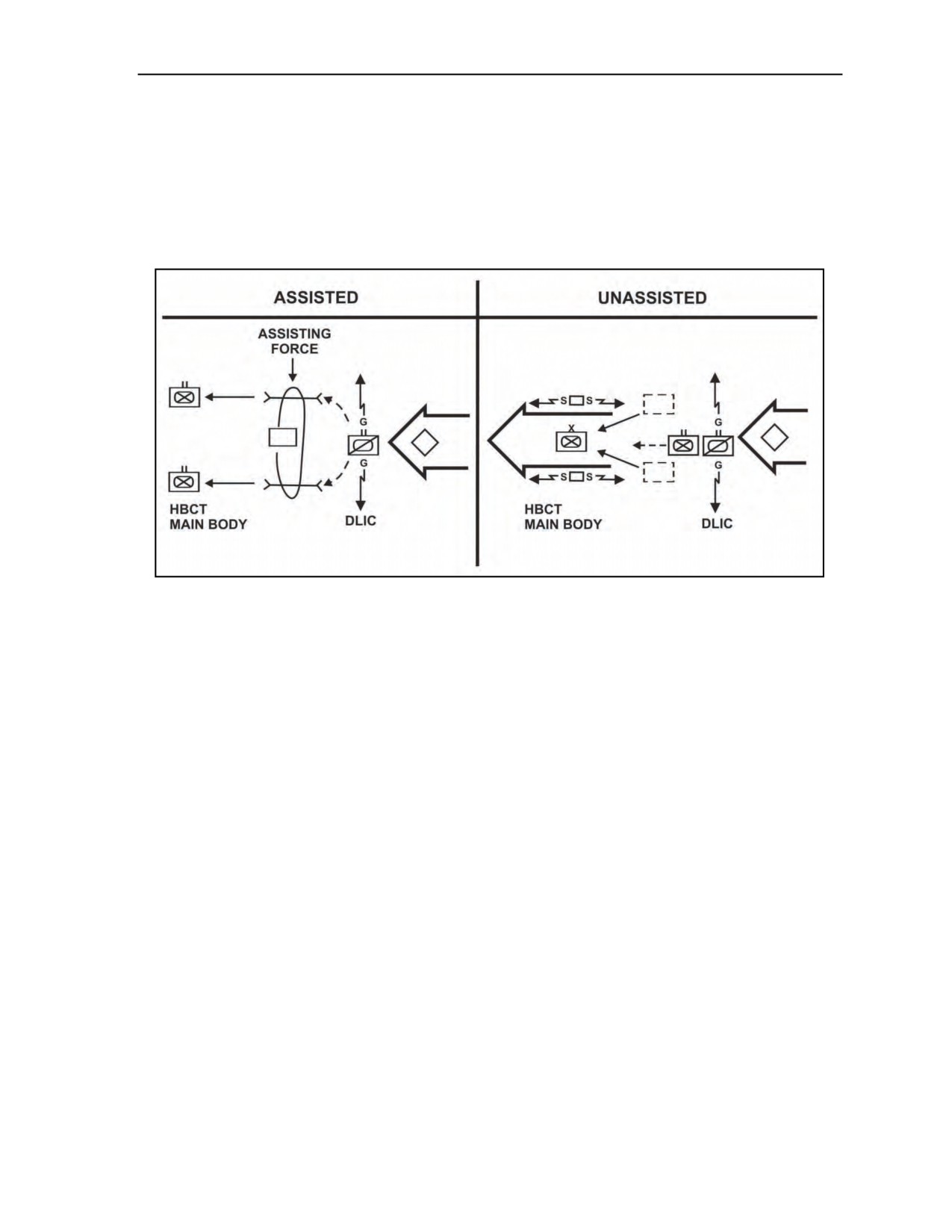
Chapter 3
withdrawal closely. Once plans are coordinated, the withdrawing unit delays to a BHL, conducts
a passage of lines, and moves to its final destination.
z
Unassisted. The withdrawing unit establishes routes and develops plans for the withdrawal, then
establishes a security force as the rear guard while the main body withdraws. Sustainment
elements usually withdraw first followed by combat forces. The BCT may establish a
detachment left in contact (DLIC) if withdrawing under enemy pressure. The DLIC’s goal is to
deceive the enemy as to the friendly movement. As the BCT withdraws, the DLIC disengages
from the enemy and follows the main body to its final destination.
Figure 3-8. Types of withdrawals
Organization
3-123. The BCT usually organizes into a security force, main body, and reserve. It can also organize a
DLIC or stay behind forces if required by the enemy situation. Usually, the reconnaissance squadron is the
security force; the maneuver battalions/CABs are the main body; and a maneuver company is the reserve.
3-124. The security force maintains contact with the enemy until ordered to disengage, or until another
force takes over the task. It simulates the continued presence of the main body. This requires allocation of
additional combat multipliers to a reconnaissance unit. When the BCT conducts withdrawal without enemy
pressure, the security force transitions into a rear guard because the most probable threat is a pursuing
enemy. When withdrawing under enemy pressure, the security force establishes or operates as a
detachment left in contact to provide a way to sequentially break contact with the enemy.
3-125. A DLIC is an element that is left in contact as part of the previously designated (usually rear)
security force, while the main body conducts its withdrawal. Its purpose is to remain behind to deceive the
enemy into believing the BCT is still in position while the majority of the BCT withdraws. The commander
must establish specific instructions about what to do if the enemy attacks and when and under what
circumstances to delay or withdraw. The BCT organizes a DLIC in one of three ways (Figure 3-9):
z
The reconnaissance squadron or a single maneuver battalion/CAB operates as the DLIC.
z
Each maneuver battalion/CAB provides forces for the DLIC mission, which then operates under
the BCT’s control.
z
Each maneuver battalion/CAB establishes and controls their individual DLIC.
3-26
FM 3-90.6
14 September 2010