FM 390.6 Brigade Combat Team (September 2010) - page 5
Augmenting Combat Power
FIRES BRIGADE
8-93. The fires brigade performs tasks previously executed by division artillery, field artillery brigades,
and corps artillery. The fires brigade conducts combined arms operations to provide fires in support of the
commander’s operational and tactical objectives. The fires brigade executes most Army and joint fires in
unassigned areas within the division AO. It also provides reinforcing fires in support of BCT operations. It
can use Army, and joint surface- and air-delivered fires as well as incorporating SOF, electronic warfare,
and AC2 elements. The fires brigade gives the supported commander a HQ to conduct strike, counterfire,
and reinforcing fires throughout the supported HQ’s AO.
8-94. Fires brigades have the ability to reconnoiter, detect, and attack targets, and to confirm the
effectiveness of their fires. They have networked intelligence, robust communications, and systems that
facilitate effective fires. The fires brigade can be a supported or supporting unit and provide and coordinate
joint lethal and nonlethal fires including electronic warfare. Fires brigades also have the necessary fires and
targeting structure to effectively execute the entire decide, detect, deliver, and assess process. The fires
brigade provides:
z
A field artillery HQ for the full complement of Army and joint lethal and nonlethal fires (if
augmented by AF tactical control party).
z
Close reinforcing fires, counterfire, UAS, and counterbattery radar coverage.
COMBAT AVIATION BRIGADE
8-95. The combat aviation brigade is the primary aviation force provider within the division. The role of
the aviation brigade is to support ground maneuver through aviation operations. The brigade can support
the BCT’s use of pure or task-organized units, and conduct multiple independent missions. Aviation
brigade missions include:
z
Reconnaissance.
z
Security.
z
Movement to contact.
z
Attack.
z
Air assault.
z
Air movement.
z
C2 support.
z
Aeromedical evacuation.
z
Aerial CASEVAC.
z
Personnel recovery.
8-96. The aviation brigade’s attack reconnaissance aircraft deploys to support the BCT commander’s
scheme of maneuver, and to extend the BCT’s operational environment significantly. Attack
reconnaissance aircraft can:
z
Assist in locating the threat.
z
Building and sharing the COP.
z
Enhancing force protection.
z
Enabling freedom of movement.
z
Facilitating unobstructed movement for air assault (AASLT) missions.
z
Securing routes for aerial/ground resupply.
z
Allowing the commander to focus combat power at the decisive point and time.
8-97. Sensor video recording capability can provide the BCT commander with excellent reconnaissance
and BDA information. FM 3-04.126 provides detailed information about attack reconnaissance operations
and planning.
8-98. The aviation brigade’s utility and heavy helicopter assets enable the maneuver commander to sustain
continuous offensive or defensive operations, and to conduct brigade level AASLTs. AASLT operations
extend the tactical reach of the maneuver commander, negate effects of terrain, seize key nodes, gain the
14 September 2010
FM 3-90.6
8-19
Chapter 8
advantage of surprise, and dislocate or isolate the enemy. Forward air reserve points (FARP) emplaced by
lift aircraft and ground assets enable aviation to support and sustain operations throughout the AO.
Additionally, heavy lift helicopters are capable of transporting internal and external cargo in a variety of
configurations to meet the BCT’s sustainment requirements. FM 3-04.113 and FM 90-4 provide detailed
information about AASLT operations, and utility and heavy helicopter planning.
8-99. Though not part of the aviation brigade, the BCT’s BAE is essential to incorporating aviation into the
ground commander’s scheme of maneuver. The BAE focuses on providing employment advice and initial
planning for aviation missions, UAS, airspace planning and coordination, and synchronization with the air
liaison officer and the BCT fire support officer. The BAE also coordinates directly with the aviation
brigade or the supporting aviation task force for detailed mission planning. Additionally, it advises the BCT
commander and staff on the status and availability of aviation assets, and their capabilities and limitations.
Refer to TC 1-400 for additional information about the roles of the BAE.
MANEUVER ENHANCEMENT BRIGADE
8-100. The MEB is a unique multifunctional C2 headquarters designed to perform maneuver support
operations for the echelon it supports. Maneuver support operations integrate the complimentary and
reinforcing capabilities of key protection, movement and maneuver, and sustainment functions, tasks,
organizations, and systems to enhance freedom of action. The MEB provides protection and mobility to
prevent or mitigate effects of hostile action against divisional forces. While the MEB has no direct existing
or preceding equivalent units/organizations in today’s force structure, it combines functions previously
performed by the division rear operations center, division engineer brigade, and other division-level
engineer, MP, and chemical assets. MEBs control terrain and potentially facilities and prevent or mitigate
hostile actions or weather effects on the protected force. A MEB is a combined arms organization that is
task-organized based on mission requirements. It has a combined arms staff and C2 capabilities that suit it
for many missions. These brigades typically control combinations of several different types of battalions
and separate companies such as MP, CBRN, CA, engineer, EOD, and MI. The MEB may also include
AMD units and a tactical combat force (TCF). A TCF is a combat unit that is assigned the mission of
defeating level III threats. It is equipped with appropriate tactial enablers and sustainment assets (JP 3-10).
8-101. The mission of the MEB is to conduct maneuver support operations, support area operations,
consequence management operations, and stability operations for the supported force. Each of the key tasks
that comprise the MEB mission consists of subordinate supporting tasks.
z
Conduct maneuver support operations includes these supporting tasks: perform mobility,
perform protection, and perform sustainment.
z
Conduct support area operations includes: conduct operational area security, conduct response
force operations, perform area damage control, conduct terrain management, perform fire
support coordination, and conduct airspace management.
z
Conduct consequence management includes: respond to CBRN incident, provide support to law
enforcement, and conduct post incident response operations.
z
Conduct stability operations includes: establish civil security, establish civil control, and restore
essential civil services.
8-102. Higher HQ can assign missions for assets assigned or attached to a MEB executed outside its AO,
such as CBRN defense and EOD assets. This requires careful coordination between the tasked unit, the
MEB HQ, and the BCT for which the mission occurs. The preferred method involves a division HQ cutting
a fragmentary order directing the MEB to provide, for example, an EOD capability in direct support of a
BCT for a specified period of time. The order authorizes direct liaison between the MEB and the BCT since
the MEB will coordinate numerous tactical and sustainment items with the BCT. These items can include
movement routes and times, link-up points and times, recognition measures, location of supply points,
maintenance collection points, medical facilities, and communications-electronics operating instructions.
Alternatively, the division could use the MEB as a force provider. The division could again task-organize
the MEB, and the BCT could issue a fragmentary order detaching an EOD team from the MEB and
attaching it to the BCT for the duration of the mission. See FM 3-90.31 for more information on the MEB.
8-20
FM 3-90.6
14 September 2010
Augmenting Combat Power
SUSTAINMENT BRIGADE
8-103. Sustainment brigades are subordinate units of the theater sustainment command. They consolidate
functions previously performed by corps and division support commands and area support groups into a
single echelon; and they provide C2 of the full range of logistics operations. Under certain factors of
METT-TC, a sustainment brigade could be placed OPCON to a division HQ for a specified operation such
as an exploitation or a pursuit operation. However, a division HQ does not routinely have a command
relationship with supporting sustainment brigades.
8-104. Sustainment brigades and their subordinate units are rarely assigned an AO. Their staffs are not
configured to perform the standard responsibilities of having an AO. Such responsibilities include:
z
Terrain management.
z
Movement control.
z
Clearance of fires.
z
Security operations.
z
Stability operations.
z
Personnel recovery.
z
Reconnaissance and surveillance (to include MI discipline collection).
z
Environmental management.
8-105. However, sustainment brigades have self-protection capabilities, and their commander can be
assigned base and base cluster commander responsibilities within an AO assigned to either a BCT or a
MEB.
8-106. The sustainment function consists of related tasks and systems that provide support and services to
ensure freedom of action, extend operational reach, and prolong endurance. It includes providing support to
BCTs operating in a specified AO. It encompasses the provisioning of personnel services, logistics, health
service support, and other support required to sustain combat power. All sustainment brigades have the
same general responsibilities: to conduct sustainment operations in an assigned support area. A sustainment
brigade supporting a division or joint task force provides sustainment and distribution support to its
supported units.
8-107. During operations, divisions establish a tempo of operations that balances combat and sustainment.
This combines mission staging operations and replenishment operations to sustain forces. Two types of
rapid replenishment operations complement mission staging operations: sustainment replenishment
operations and combat replenishment operations. The BCT S-4 and BSB commander and staff collaborate
directly with the supporting sustainment brigade to accomplish replenishment missions. See Chapter 9 for
information concerning BCT sustainment operations, and FMI 4-93.2 for more information about the
sustainment brigade.
OTHER BRIGADES AND UNITS
8-108. A mix of functional brigades and units also share the battlefield with the BCT. These functional
brigades usually are assigned or attached to theater-level commands. Examples include MP, engineer,
AMD, signal, medical, CBRN defense, and CA. Functional brigades may be attached or OPCON to the
Army Force HQ, normally a division. They may also be placed under OPCON of the joint force land
component commander. Normally theater-level C2 organizations will augment these functional brigades if
they are operating directly under a joint force commander (JFC) and not as part of theater Army.
8-109. Functional brigades may be allocated to a joint force land component, corps, or division to support
the force as a whole or to carry out a particular task. For example, in addition to a MEB, a division might
receive a MP brigade HQ and several MP battalions to control dislocated civilians and handle detainees.
EXPEDITIONARY SIGNAL BATTALION
8-110. An expeditionary signal battalion plans, engineers, installs, operates, maintains, and defends a
minimum of 30 command, control, communications, computers, and information technology nodes. This
14 September 2010
FM 3-90.6
8-21
Chapter 8
design supports combatant command, theater Army, JTF, and joint force land component commanders.
Additionally, it supports theater-level functional brigades and subordinate battalions regardless of their
location in a joint operations area (JOA). See FMI 6-02.45 for more information on expeditionary signal
battalions.
CIVIL AFFAIRS BRIGADE
8-111. The CA brigade functions as the regionally focused, expeditionary, operational-level CA capability
that supports the joint task force and its BCTs. It accomplishes its mission by attaching subordinate
elements to the BCT. A CA brigade’s capabilities include:
z
Serve as the BCT commander’s senior CA adviser.
z
Establish an operational-level CA operations center to support tactical civil-military operations
centers in the BCT AO, and facilitate collaboration across multiple brigade AOs.
z
Serve as a mechanism for CA coordination to produce focused civil inputs to the COP.
z
Plan, coordinate, and enable stability operations with the host nation, international organizations,
NGOs, and other government agencies that are focused on the regional to national levels of civil
governments. This serves as a CMO staff channel for BCT requirements.
z
Provide C2 for subordinate CA battalions and companies that support the BCT.
z
Provide cross-cultural communications, limited linguistic capability, and advice to the
commander on cultural influences in the area of responsibility.
z
Provide the capability to establish the core of a joint CMO task force that can support BCTs.
z
Provide the ability to assess, develop, obtain resourcing, and manage operational-level
humanitarian assistance, and stability operations spending implementation strategy.
(This
function requires a dedicated contracting officer and financial management officer.)
z
Provide provincial- to national-level civil liaison team capability.
z
Provide the civil-information management cell as the focal point for operational-level
consolidation and analysis of civil information; developing operational-level civil inputs to the
COP with the brigade CA operations center; and linking civil information to the appropriate
military and civil systems via geo-spatially referenced data.
z
Provide functional specialty cells able to perform an intermediate-level threat assessment to a
civil component of the environment at the sub-national level; assess mission planning
requirements; and develop, coordinate, and synchronize resources to meet the immediate need in
four of the six functional specialties: health and welfare, rule of law, infrastructure, and
governance.
8-112. See FM 3-05.40 for more information about CA.
SECTION X - KEY JOINT ASSETS, FORCES, AND CONSIDERATIONS
8-113. The BCT conducts integrated strike, maneuver, and IO with joint and interagency ground, space,
maritime, air, and SOF teams. Such teaming multiplies the combat power of each component enormously,
deprives the enemy of the freedom to focus his own efforts, overloads his planning and coordination
mechanisms, and compels him to expose his forces to new threats in the effort to evade others. This section
provides a discussion of possible military joint teams.
SPECIAL OPERATIONS FORCES
8-114. Past and ongoing operations have demonstrated that BCTs continue to work in the same tactical
space with SOF. In many situations, SOF precede the arrival of the BCTs in operational areas, and
constitute a valuable source of intelligence and networking, particularly within the context of irregular
warfare.
8-22
FM 3-90.6
14 September 2010
Augmenting Combat Power
8-115. The Department of Defense has designated the following as SOF:
z
U.S. Army (both active and reserve components). Special forces (SF), Ranger, Army special
operations aviation (RSOA), MISO, and CA (FM 3-05).
z
U.S. Navy (both active and reserve components). Sea-air-land team (SEAL), SEAL delivery
vehicle team, and special boat team units.
z
U.S. Air Force (both active and reserve components). Special operations (SO) flying (does not
include USAF rescue/combat search and rescue units), special tactics, combat weather, and
foreign internal defense (FID) units.
z
Conventional units conducting or supporting SO. Designated SOF are the force of choice for the
conduct of SO. However, under certain circumstances, conventional forces may be tasked to
conduct limited SO on a mission-specific, case-by-case basis (JP 3-05).
8-116. SOF primary tasks include unconventional warfare, foreign internal defense, special
reconnaissance, direct action, and counterterrorism. Other duties include combat search and rescue, security
assistance, peacekeeping, humanitarian assistance, humanitarian de-mining, counter-proliferation, MISO,
and counterdrug operations.
AIR FORCE SUPPORT
8-117. Air Force tactical air control parties (TACP) are provided to Army maneuver unit HQ from
battalion through corps. TACPs advise the commander and staff on the capabilities, limitations, and
employment of airpower. Each TACP is a primary point-of-contact to coordinate that echelon’s preplanned
and immediate air requests and to assist in coordinating air support missions (JP 3-09.3).
8-118. In the TACP, the air mobility liaison officer is the primary adviser on using airlift resources. This
officer is trained to control airlift assets in support of ground troops, and operate the airlift advance
notification and coordination net.
8-119. The air support operations center co-locates with the main CP when the senior fires cell is in the
corps HQ. The senior fires cell directs and monitors fires in the affected AO. The air support operations
center commander recommends the location based on the factors of METT-TC.
8-120. The TACP at the main CP is the Air Force element in the division. This TACP is organized as an
air execution cell capable of requesting and executing type 2 or 3 control of CAS missions. Manning
depends on the situation, but at a minimum, includes an air liaison officer (ALO) and a joint terminal attack
controller. Air Force weather and intelligence support may also be incorporated into this TACP.
8-121. The TACP element locates in or adjacent to the fires cell, and provides airpower advice and
execution support to the division. Specific air component planning and execution roles include the
following:
z
Execute airpower according to joint force air component commander’s guidance and the division
commander’s priority, timing, and desired effects within the division AO.
z
Inform the commander and staff of the capabilities and limitations of airpower.
z
Accomplish training and mission rehearsal under anticipated operational conditions with the
USAF and other Service counterparts.
z
Exercise OPCON or tactical control of all joint terminal attack controllers operating in the
division AO.
z
Plan, prepare for, execute, and assess airpower (e.g., CAS, air intelligence, and SEAD) operating
in the division AO out to the fire support coordination line.
z
Prioritize, coordinate, and deconflict airpower executing missions in the division AO according
to the division commander’s priorities.
z
Provide applicable updates to the COP for air assets tasked to support ground operations.
z
Prevent fratricide through situational awareness of the COP and fire support coordinating
measures (FSCM).
z
Ensure all subordinate TACPs and joint tactical air controllers know and understand joint
operations area (JOA) rules of engagement (ROE).
14 September 2010
FM 3-90.6
8-23
Chapter 8
z
Deconflict both air and ground assets by monitoring the COP of both friendly and enemy forces
reported by intelligence and collaborative tools linked to other C2 units.
z
Provide timely and efficient processing of air support requests through collaborative tools and
secure communications.
z
Provide fast reaction to immediate air support requests, control kill box operations, and integrate
and coordinate air support missions such as reconnaissance, electronic warfare, and airlift in the
division AO.
z
Forward battle damage assessment and aerial weapons effects reports to the air support
operations center (ASOC).
NAVY AND MARINE FORCES
8-122. Navy and Marine Corps forces can project massed offensive and defensive combat power from the
sea, at the time and place of their choosing. They can deter potential adversaries through the ability to
preempt or interdict aggressive action (Naval Doctrine Publication [NDP] 1).
8-123. The Marine air-ground task force (MAGTF) is a term the U.S. Marine Corps uses to describe the
principal organization for all missions across the spectrum of conflict. MAGTF is a balanced air-ground,
combined arms task organization of Marine Corps forces, structured to accomplish a specific mission,
under a single commander. A Marine expeditionary force (MEF) is the largest type of a MAGTF. Each
MEF consists of a division as the ground combat element, an aircraft wing as the aviation combat element,
and a logistics group as the logistics combat element (Marine Corps Doctrine Publication [MCDP] 3).
8-124. A Marine expeditionary brigade is capable of conducting missions across the spectrum of conflict
and varies in size. It is built around a reinforced Infantry regiment, a composite Marine aircraft group, and a
brigade service support group. The Marine expeditionary brigade is task-organized to meet the
requirements of a specific situation. It can function alone, as part of a JTF, or as the lead echelon of the
MEF.
8-125. A Marine expeditionary unit (MEU) is the smallest MAGTF. Each MEU is an expeditionary quick
reaction force, deployed and ready for immediate response to any crisis. Usually, the MEU is built around a
reinforced Marine Infantry battalion with a composite helicopter squadron as the aviation combat element,
a battalion-sized logistics combat element, and a command element.
8-126. Troop strength is about 2,200, commanded by a colonel, and is deployed from an amphibious
assault ship. It task organizes as:
z
The MEU’s command element , which includes the MEU commander and his supporting staff,
and provides C2. It includes specialized detachments for naval gunfire, reconnaissance,
surveillance, specialized communications, radio reconnaissance (signals intelligence), electronic
warfare, intelligence and counterintelligence, and PA missions. The overall strength is about 200
Marines and sailors.
z
The MEU’s ground combat element consists of the battalion landing team; an Infantry battalion
reinforced with an artillery battery, amphibious assault vehicle platoon, combat engineer
platoon, light armored reconnaissance company, tank platoon, reconnaissance platoon; and other
units as the mission and circumstances require. The total strength is approximately 1,200
members.
z
The MEU’s aviation combat element (ACE) is a Marine composite squadron (reinforced). It
consists of a medium/heavy helicopter squadron augmented with three other types of helicopters;
one detachment of amphibious flight-deck-capable jets; and a Marine air control group
detachment with air traffic control, direct air support, and antiaircraft assets.
z
The MEU’s logistics combat element (LCE) contains all the logistics specialists and equipment
necessary for the unit to support itself for 15 days in an austere expeditionary environment. It
includes service support, medical, dental, maintenance, transportation, explosive ordinance
disposal, MP, utilities production and distribution, bulk fuels, and other technical experts. It
consists of approximately 300 Marines and Sailors. This element may be referred to as the MEU
service support group.
8-24
FM 3-90.6
14 September 2010
Augmenting Combat Power
SECTION XI - MULTINATIONAL CONSIDERATIONS
8-127. In any large-scale operation, the BCT usually operates with multinational partners, either allied or
host nation. Many considerations associated with such coalitions exist at the operational level. Here, U.S.
commanders must overcome significant challenges in interoperability to integrate multinational forces
effectively within the joint campaign force structure and design. To the extent that multinational forces are
integrated into tactical operations at the division level and below, tactical commanders must also actively
work to ensure effective C2, communications, and information sharing. The multinational force and BCT
HQ may be required to exchange liaison elements, including information systems.
14 September 2010
FM 3-90.6
8-25
This page intentionally left blank.
Chapter 9
Sustainment Operations
The brigade support battalion (BSB) is the core of sustainment for the brigade
combat team (BCT). The BSB is organic to the BCT and consists of functional and
multifunctional companies assigned to provide support to the BCT. The BSB of the
Stryker Brigade Combat Team
(SBCT) task-organizes to provide support to
individual Infantry battalions. This chapter provides an overview of sustainment
operations within the BCT and sustainment planning considerations for BCT full
spectrum operations.
SECTION I - BRIGADE COMBAT TEAM SUSTAINMENT
9-1. BCTs are organized with the self-sustainment capability for up to 72 hours of combat. Beyond 72
hours, sustainment organizations at the division and corps levels are required to conduct replenishment of
the BCT’s combat loads. That replenishment is a function of the higher headquarters sustainment
brigade(s).
SUSTAINMENT BRIGADES
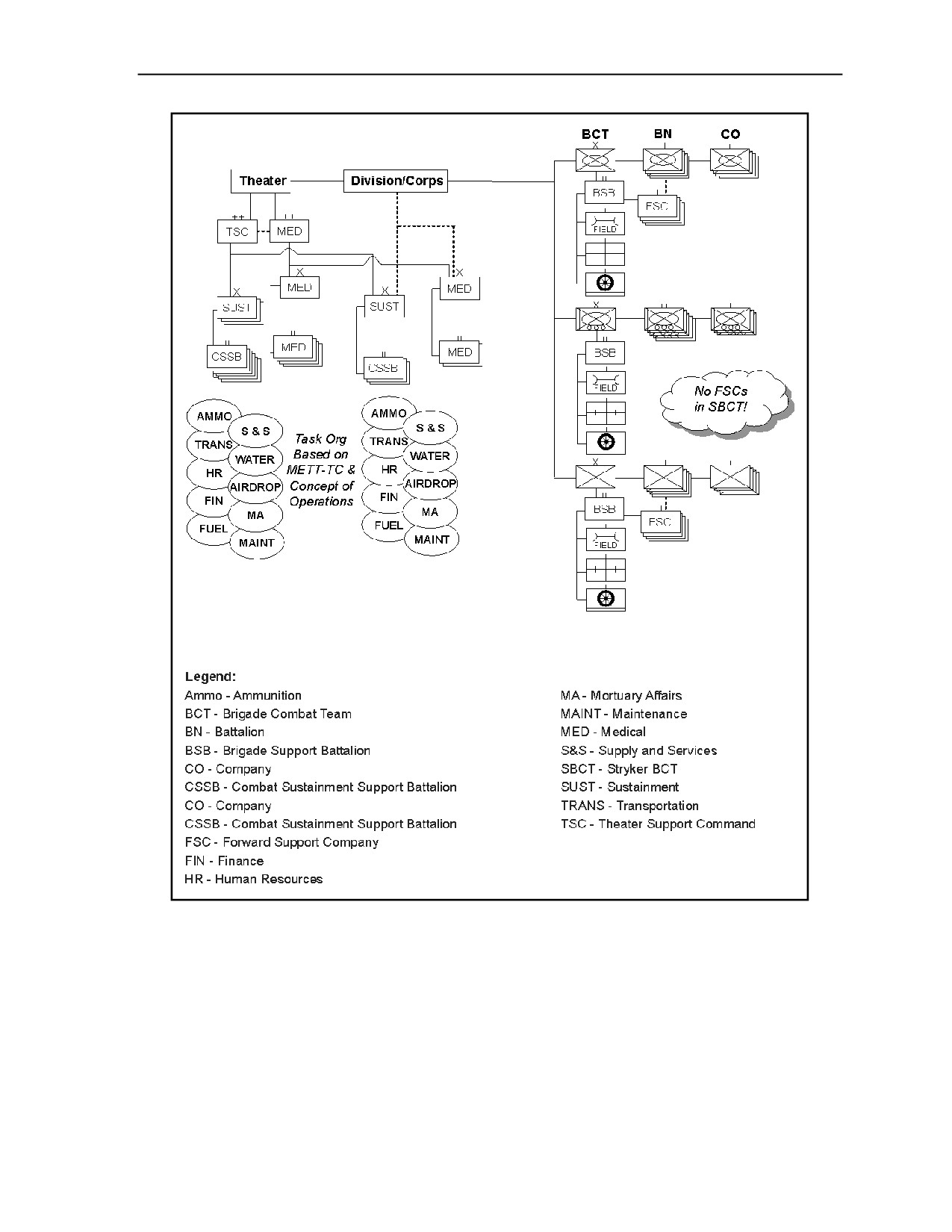
9-2. The sustainment brigade is a scalable, adjustable, networked brigade comprised of a headquarters,
and both functional and multifunctional subordinate sustainment units. The theater sustainment command
uses sustainment brigades to provide operational-level support to theater armies. All sustainment brigades
provide area support, although the specific tasks they are assigned may differ (Figure 9-1).
9-3. The combat sustainment support battalions of the sustainment brigade are the base organization from
which sustainment units are task-organized for various operations. The combat sustainment support
battalion subordinate elements consist of functional companies that provide supplies and services,
ammunition, fuel, transportation, and maintenance. Additionally, personnel and financial management units
can be assigned to, or administratively controlled by, the combat sustainment support battalions to perform
essential human resources and finance operations. The combat sustainment support battalions provide the
distribution link between theater aerial/sea ports of debarkation and the BCT’s BSB. The structure includes
cargo transfer and movement control assets, performing the function of transporting commodities to and
from the BCT BSB, and to/from repairing or storage facilities at the theater base. Its function is to ensure
and maintain the flow of replenishment using expeditionary support packages, including retrograde of
unserviceable components, end items and supplies.
9-4. Battalion medical platoons and the brigade support medical company provide health service support
and force health protection to BCTs. The theater Army has a medical command (deployment support)
(MEDCOM [DS]) for command and control of all medical units in a theater of operations at echelons
above brigade. The MEDCOM (DS) provides subordinate medical organizations that operate under the
medical brigade and/or multifunctional medical battalion. The medical brigade provides a scalable
expeditionary medical capability for assigned and attached medical organizations that are task-organized to
support BCTs and echelons above brigade. The multifunctional medical battalion also provides medical C2,
administrative assistance, logistical support, and technical supervision for assigned and attached companies
and detachments. The multifunctional medical battalion is assigned to the MEDCOM (DS) or medical
brigade. The combat support hospital is also a battalion-size element assigned to the MEDCOM (DS) or
medical brigade.
14 September 2010
FM 3-90.6
9-1
Chapter 9
Figure 9-1. Sustainment organizations supporting the BCT
SUSTAINMENT FUNCTIONS
9-5. The sustainment warfighting function provides support under three categories: logistics, personnel
services, and health service support. Table 9-1 provides the functional elements that are found in each of
the sustainment categories applicable to the BCT. The BCT’s organic sustainment capabilities require
augmentation to provide some of these functions and services.
9-2
FM 3-90.6
14 September 2010

Sustainment Operations
Table 9-1. BCT sustainment categories and elements
Logistics
Personnel Services
Health Service Support
Maintenance
Human resources support
Organic and area medical support
Transportation
Financial management
Behavioral
health/neuropsychiatric treatment
(treatment aspects)
Supply
Legal support
Hospitalization
Field services
Religious support
Dental care (treatment aspects)
Distribution
Clinical laboratory services
Contracting
Treatment of CBRN patients
General engineering support
Medical evacuation
Medical logistics
Source: FM 3-0
SUSTAINMENT STAFF AND ORGANIZATIONS
9-6. The following paragraphs provide additional information on the BCT sustainment staff and
organizations described in Chapter 1. It also describes the support that elements other than the BSB
provide.
BRIGADE COMBAT TEAM PERSONNEL AND ADMINISTRATION SECTION
9-7. The BCT personnel and administration section personnel staff officer
(S-1) is responsible for
planning, coordinating, and executing human resources support. He is responsible for manning the BCT
and subordinate units while maintaining personnel accountability of all personnel assigned and attached to
the BCT. The S-1 provides essential personnel services (awards, evaluations, ID cards, etc.), conducts
postal support, manages the casualty reporting system, and provides administrative support for BCT units.
The S-1 coordinates external human resources support through the higher headquarters (G-1) and the HR
operations branch within the supporting sustainment brigade. The S-1 section relies on automated
personnel systems for updating personnel management information. The S-1 coordinates Army command
interest programs along with coordinating financial management and legal support for the BCT. Although
the S-1 coordinates the staff efforts of the BCT chaplain and BCT surgeon, they generally receive their
guidance from the BCT executive officer (XO). The S-1 is also the staff point of contact for inspector
general and morale support activities. See FM
1-0 for additional information about S-1 roles and
responsibilities.
Brigade Combat Team Unit Ministry Team
9-8. The BCT unit ministry team (UMT) is responsible for organizing the efforts of UMTs that work for
subordinate commanders. The BCT UMT must ensure there is religious support to all Soldiers in the BCT
AO. Often, companies or detachments are attached to the BCT without UMT support. Members of other
services and authorized civilians may require area support. The BCT UMT is responsible for the
professional oversight of the battalion UMTs.
Brigade Combat Team Surgeon Section
9-9. The BCT surgeon is a special staff officer responsible for Army Health System (AHS) support in the
BCT. The BCT surgeon exercises technical control over medical activities in the BCT. He provides staff
oversight and supervision for AHS support and keeps the BCT commander informed of the health of the
command. The BCT surgeon’s section ensures timely planning, integration, and synchronization of AHS
support with the BCT maneuver plan. The BCT surgeon’s section coordinates with the brigade support
medical company; the battalion medical platoons and sections; the BSB medical operations section; and
other staff elements to ensure that Soldiers receive complete and comprehensive medical support.
14 September 2010
FM 3-90.6
9-3
Chapter 9
BRIGADE OPERATIONAL LAW TEAM
9-10. The BCT judge advocate is the special staff officer responsible for operational and administrative
law support to the BCT. He is the BCT commander’s personal legal advisor. The brigade operational law
team provides administrative legal services to BCT and battalion S-1s, and may provide legal advice on
host nation support (HNS) issues to the BCT logistics staff officer (S-4). The operational law team
members provide the BCT staff with immediate access to the legal expertise they need to prevail in an
increasingly complex and legally intensive operational environment.
BRIGADE COMBAT TEAM COMMUNICATIONS SECTION
9-11. The BCT communications section signal staff officer (S-6) is responsible for maintaining selected
components of the BCT’s command and control (C2) information system and network operations. The S-4
and S-6 must coordinate to ensure there are no gaps in the maintenance system for communications
security (COMSEC) equipment, computers, and other specialized equipment.
SUSTAINMENT SUPPORT AREAS
9-12. A support area is a designated area in which sustainment elements, some staff elements, and other
elements locate to support a unit. The BCT S-4, BCT S-3, and BSB S-3 coordinate the location of the BCT
sustainment support areas. The BCT S-3 coordinates with the BCT subordinate battalions to ensure that
they have adequate space to position their sustainment units. Types of support areas include:
z
Battalion and company trains.
z
Brigade support area (BSA).
TRAINS
9-13. Trains are a grouping of unit personnel, vehicles, and equipment to provide sustainment. It is the
basic sustainment tactical organization. Maneuver battalions use trains to array their subordinate
sustainment elements including their designated forward support company (FSC). Battalion trains usually
are under the control of the battalion S-4, assisted by the battalion S-1. The composition and location of
battalion trains varies depending on the number of units attached to, or augmenting, the battalion.
9-14. Battalion trains can be employed in two basic configurations: as unit trains in one location, or as
echeloned trains:
z
Unit trains at the battalion level are appropriate when the battalion is consolidated, during
reconstitution, and during major movements.
z
Echeloned trains can be organized into company trains, battalion combat trains, unit
maintenance collection point (UMCP), battalion aid station (BAS), or battalion field trains.
Company Trains
9-15. Company trains provide sustainment for a company during combat operations. Company trains
usually include the first sergeant, medical aid/evacuation teams, supply sergeant, and the armorer. Usually,
the forward support company provides a field maintenance team with capabilities for maintenance,
recovery, and limited combat spares. The supply sergeant can collocate in the combat trains if it facilitates
logistics package (LOGPAC) operations. The first sergeant usually directs movement and employment of
the company trains; although the company commander may assign the responsibility to the company XO.
Battalion Trains
9-16. Battalion trains consist of two types: combat trains and field trains.
Combat Trains
9-17. The combat trains usually consist of the forward support company and the battalion medical unit.
The UMCP should be positioned where recovery vehicles have access, or where major or difficult
maintenance is performed. Units must consider the mission enemy terrain and weather, troops and support
9-4
FM 3-90.6
14 September 2010
Sustainment Operations
available, time available, and civil considerations (METT-TC) when locating combat trains in a battalion
support area.
Field Trains
9-18. Field trains can be located in the BSA and include those assets not located with the combat trains.
The field trains can provide direct coordination between the battalion and the BSB. When organized, the
field trains usually consist of the elements of the forward support company, battalion headquarters and
headquarters company (HHC), battalion S-1, and battalion S-4. The field trains personnel facilitate the
coordination and movement of support from the BSB to the battalion.
Sustainment-Related Command Posts
9-19. The battalion commander may choose to create a combat trains command post (CTCP) or a field
trains command post (FTCP) to control administrative and sustainment support. Most of the time, the S-4 is
the officer in charge of the CTCP. If constituted, the FTCP could be led by the HHC commander. These
command posts (CP) can be organized to accomplish specific logistical tasks:
z
Situations that might dictate the need for a CTCP:
As part of a BSB forward logistics element operation.
During reception, staging, onward movement, and integration operations.
z
Situations that might dictate the need for a FTCP:
During periods of supply or resupply of major end items.
The sustainment elements of the battalion are no longer 100% mobile.
BRIGADE SUPPORT AREA
9-20. The BSA is the logistical, personnel, and administrative hub of the BCT. It consists of BSB, but
could also include a BCT alternate command post (if formed), battalion field trains, brigade special troops
battalion units, signal assets, and other sustainment units from higher headquarters
(HQ). The BCT
operations staff officer (S-3), with the BCT S-4 and the BSB, determines the location of the BSA. The BSA
should be located so that support to the BCT can be maintained, but does not interfere with the tactical
movement of BCT units, or with units that must pass through the BCT area. The BSA’s size varies with
terrain; however, an area 4 km to 7 km in diameter is a planning guide. Usually the BSA is on a main
supply route (MSR) and ideally is out of the range of the enemy’s medium artillery. The BSA should be
positioned away from the enemy’s likely avenues of approach and entry points into the BCT’s main battle
area (MBA). The BSB commander is responsible for the command and control of all units in the BSA for
security and terrain management
9-21. Usually the BCT S-4 coordinates the BCT main CP’s sustainment cell, which contains the BCT S-4,
BCT S-1, BCT surgeon section, and the BCT UMT. The BCT commander can create an alternate CPs for
sustainment, should the administrative and logistics presence in the main CP become too large. The brigade
special troops battalion CPs may be able to host the sustainment cell in the BSA if communications links
are adequate.
Locations for Support Areas
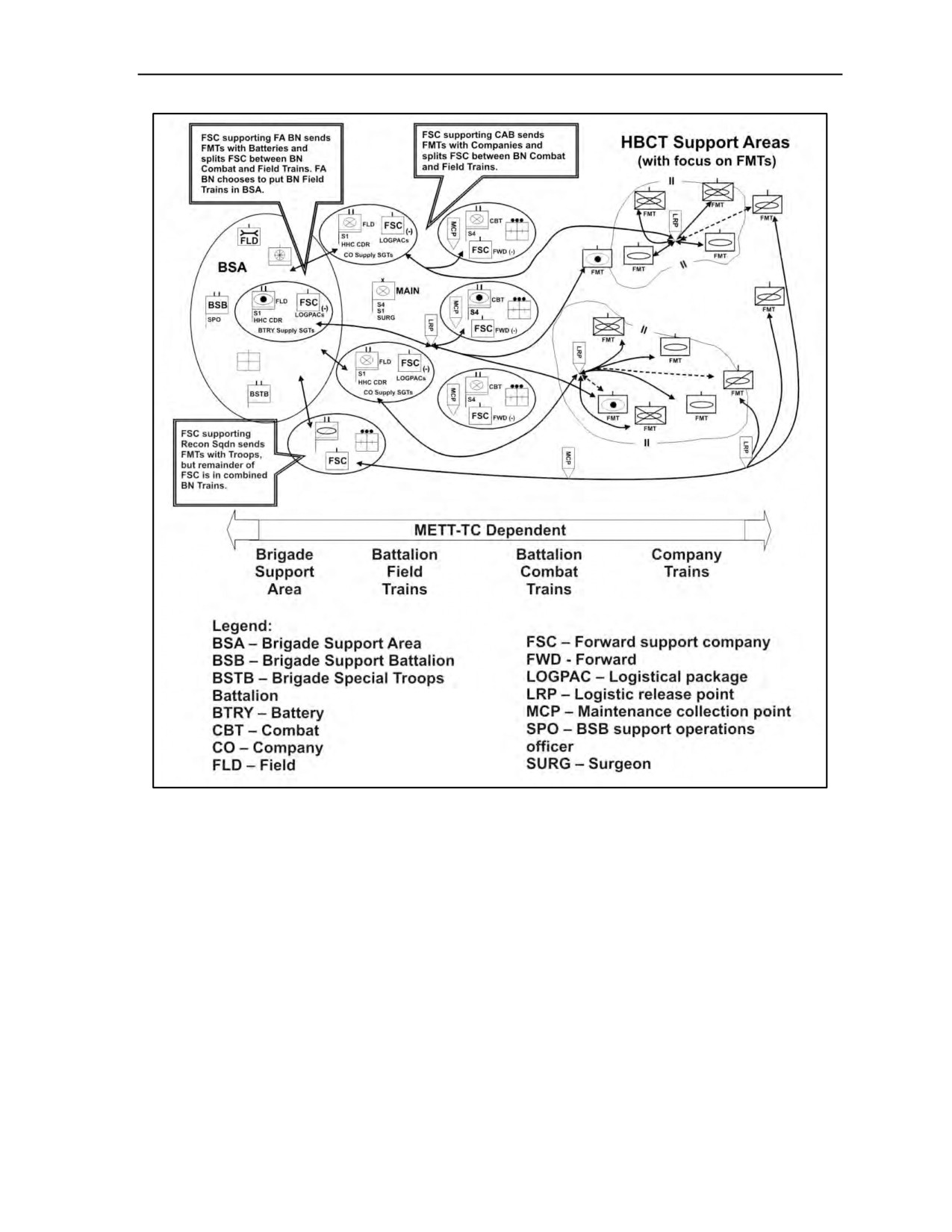
9-22. The trains should not be considered a permanent or stationary support area (Figure 9-2). The trains
must be mobile to support the battalion when it is moving, and should change locations frequently,
depending on available time and terrain. The trains changes locations for the following reasons:
z
Change of mission.
z
Change of unit AOs.
z
To avoid detection caused by heavy use or traffic in the area.
z
When area becomes worn by heavy use (e.g., wet and muddy conditions).
z
Security becomes lax or complacent due to familiarity.
14 September 2010
FM 3-90.6
9-5
Chapter 9
Figure 9-2. Support unit locations
9-23. All support areas have many similarities, including:
z
Cover and concealment (natural terrain or manmade structures).
z
Room for dispersion.
z
Level, firm ground to support vehicle traffic and sustainment operations.
z
Suitable helicopter landing site (remember to mark the landing site).
z
Good road or trail networks:
Good routes in and out of the area (preferably separate routes going in and going out).
Access to lateral routes.
Positioned along or good access to the MSR.
Positioned away from likely enemy avenues of approach.
Security of Support Areas
9-24. Sustainment elements must organize and prepare to defend themselves against ground or air attacks.
They often occupy areas that maneuver elements of the BCT have secured. The security of the trains at
9-6
FM 3-90.6
14 September 2010
Sustainment Operations
each echelon is the responsibility of the individual in charge of the trains. The best defense is to avoid
detection. The following activities help to ensure trains security:
z
Select good trains sites that use available cover, concealment, and camouflage.
z
Use movement and positioning discipline as well as noise and light discipline to prevent
detection.
z
Establish a perimeter defense.
z
Establish observation posts and patrols.
z
Position weapons (small arms, machine guns, and antitank weapons) for self-defense.
z
Plan mutually supporting positions to dominate likely avenues of approach.
z
Prepare a fire plan and make sector sketches.
z
Identify sectors of fires.
z
Emplace target reference points (TRP) to control fires and for use of indirect fires.
z
Integrate available combat vehicles within the trains (i.e., vehicles awaiting maintenance or
personnel) into the plan, and adjust the plan when vehicles depart.
z
Conduct rehearsals.
z
Establish rest plans.
z
Identify an alarm or warning system that would enable rapid execution of the defense plan
without further guidance; the alarm, warning system, and defense plan are usually included in
the standard operating procedure (SOP).
z
Designate a reaction force. Ensure the force is equipped to perform its mission. The ready
reaction force must be well rehearsed or briefed on—
Unit assembly.
Friendly and threat force recognition.
Actions on contact.
Supply Routes
9-25. The BCT S-4, in coordination with the BSB support operations officer and BCT S-3, select supply
routes between support areas. MSRs are routes designated within the BCT’s AO upon which the bulk of
sustainment traffic flows in support of operations. An MSR is selected based on the terrain, friendly
disposition, enemy situation, and scheme of maneuver. Alternate supply routes are planned in the event that
an MSR is interdicted by the enemy or becomes too congested. In the event of chemical, biological,
radiological, and nuclear (CBRN) contamination, either the primary or the alternate MSR can be designated
as the "d irty MSR‖ to handle contaminated traffic. Alternate supply routes should meet the same criteria as
the MSR. Military police (MP) may assist with regulating traffic, and engineer units, if available, could
maintain routes. Security of supply routes in a noncontiguous environment might require the BCT
commander to commit non-sustainment resources.
9-26. Route considerations include:
z
Location and planned scheme of maneuver for subordinate units.
z
Location and planned movements of other units moving through the BCT’s AO.
z
Route characteristics such as route classification, width, obstructions, steep slopes, sharp curves,
and type of roadway surface.
z
Two-way, all-weather trafficability.
z
Classification of bridges and culverts.
z
Requirements for traffic control such as at choke points, congested areas, confusing
intersections, or along built-up areas.
z
Number and locations of crossover routes from the MSR to alternate supply routes.
z
Requirements for repair, upgrade, or maintenance of the route, fording sites, and bridges.
z
Route vulnerabilities that must be protected. This can include bridges, fords, built-up areas, and
choke points.
14 September 2010
FM 3-90.6
9-7
Chapter 9
z
Enemy threats such as air attack, conventional and unconventional tactics, mines, ambushes, and
chemical strikes.
z
Known or likely locations of enemy penetrations, attacks, chemical strikes, or obstacles.
z
Known or potential civilian/refugee movements that must be controlled or monitored.
MISSION TAILORING OF SUSTAINMENT ASSETS
9-27. Sustainment operations can be tailored in response to changes in tactical requirements. In most cases,
the BSB will provide the supplies and services required by the supported unit at a specific point in time
(scheduled delivery). For example, a typical day may include distribution to a battalion level distribution
point for one customer cluster, to company/battery level for another customer cluster, and all the way to
platoon/team level for a third cluster, while the fourth cluster receives no delivery (due to low/no
requirements) that particular day.
9-28. Supported unit commanders coordinate through their S-3 and S-4 staffs, according to current unit
battle rhythm, to fix the time and place for replenishment operations at a temporarily established point.
Assets can be retasked if the situation demands. This approach, executed according to centralized
management, optimizes the employment of personnel.
SYNCHRONIZATION OF BATTLE RHYTHM AND SUSTAINMENT
OPERATIONS
9-29. Sustainment operations are fully integrated with the BCT battle rhythm through integrated planning
and oversight of ongoing operations. Sustainment and operational planning occurs simultaneously rather
than sequentially. Incremental adjustments to either the maneuver or sustainment plan during its execution
must be visible to all BCT elements. The sustainment synchronization matrix and sustainment report are
both used to initiate and maintain synchronization between operations and sustainment functions.
SITUATIONAL UNDERSTANDING
9-30. Situational understanding (SU) is the complete understanding by the BCT commander of the friendly
situation, the enemy situation (as described by current intelligence), and the sustainment situation using
advanced, seamless information technology. Key elements of SU are:
z
A common operational picture
(COP) that enables the BCT maneuver and sustainment
commanders, along with the S-4s and S-1s to view the same data in near real time fostering unity
of command and unity of effort.
z
An integrated, seamless information network bringing together in-transit visibility, unit
requirements, and COP in near real time and sharing the information across sustainment
functions and infrastructure while allowing the exchange of large volumes of information across
platforms.
z
Timely and accurate asset visibility information that enables the distribution of assets on time,
maintaining the critical confidence in the distribution system. Visibility begins at the point
where resources start their movement to the AO. In-transit visibility uses advanced automation,
information, and communications capabilities to track cargo and personnel while en route.
z
In addition to COP, liaison officers (LNO) often are embedded at the maneuver brigade staff to
pass current commander intent and mission changes to sustainment elements.
z
The BCT S-4 and S-1 contribute to the BCT commander’s SU by continually providing
assessments of BCT sustainment operations. These running estimates present recommendations
to mitigate threats and capitalize on opportunities.
FUSION OF SUSTAINMENT AND MANEUVER SITUATIONAL UNDERSTANDING
9-31. Effective sustainment operations by the BSB depend on a high level of SU and COP. SU enables the
BSB commander and staff to maintain visibility of current and projected requirements; to synchronize
movement and materiel management; and to maintain integrated visibility of transportation and supplies.
9-8
FM 3-90.6
14 September 2010
Sustainment Operations
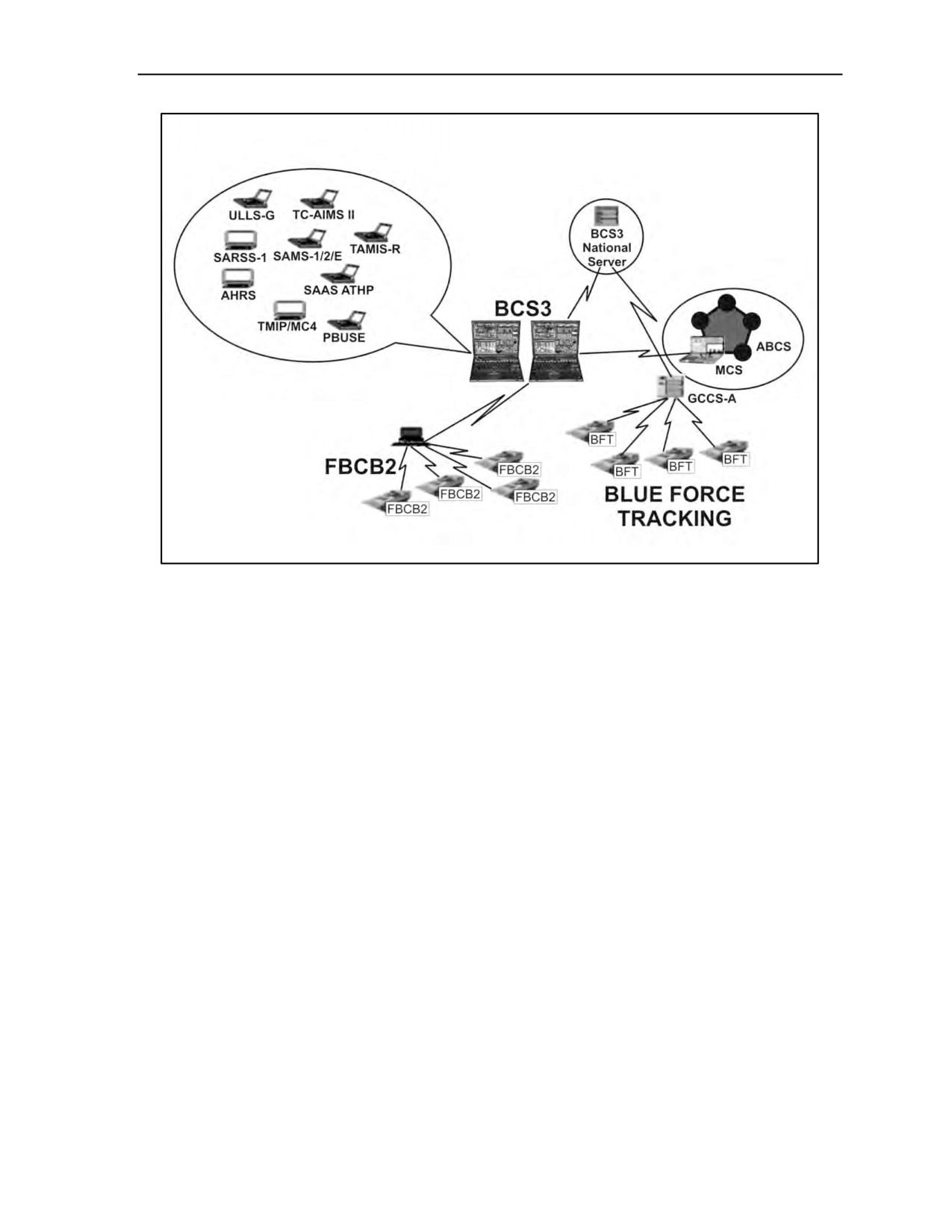
Battle Command Sustainment Support System (BCS3), Movement Tracking System , and Force XXI Battle
Command Brigade and Below (FBCB2) are some of the fielded systems that the BSB uses to ensure
effective SU and logistics support. These systems enable sustainment commanders and staffs to exercise
centralized C2, anticipate support requirements, and maximize battlefield distribution.
REPORTS
9-32. Accurately reporting the sustainment status is essential to keeping units combat ready. SOPs should
establish report formats, reporting times, and FM voice brevity codes to keep logistics nets manageable.
The FBCB2 system helps lower level commanders automate the sustainment data-gathering process. It
does this through logistics situation reports (LOGSITREP), personnel SITREPs, logistical call for support,
logistics task order messaging, situational awareness (SA), and task management. This functionality affects
the synchronization of all logistics support on the battlefield between the supported and the supporter.
9-33. At the BSB and BCT levels, BCS3 collects sustainment data from various logistics-related standard
Army management information systems throughout the BCT. These systems provide actionable logistics
information to support sustainment-related decisions. To assist planners, BCS3 has a simulation tool that
enables the user to project supply consumption for a given course of action by event or across time. To
assist in execution, BCS3 gives the commander the latest available status of critical weapons systems, fuel,
ammunition, and personnel. BCS3 also provides a map-centric view of inbound vehicles and/or cargo that
are equipped with movement tracking devices.
9-34. Although sustainment planners may have data available from BCS3 and FBCB2 logistics and
personnel status messages, they may need to use nonstandard text messages to identify equipment and
personnel issues. The sustainment staff must proactively identify and solve sustainment issues by:
z
Using FBCB2, BCS3 and other Army Battle Command Systems
(ABCS) to maintain
sustainment SA.
z
Working closely with higher HQ staff to resolve sustainment problems.
z
Recommending sustainment priorities that conform to mission requirements.
z
Recommending sustainment-related commander’s critical information requirement (CCIR).
z
Ensuring the commander is apprised of critical sustainment issues.
z
Coordinating as required with key automated system operators and managers to assure mission
focus and continuity of support.
9-35. The S-6 and the information systems technician must work together to ensure that FBCB2, BCS3 and
sustainment standard Army management information systems have interconnectivity. The BCT S-4, BCT
S-1, and BSB support operations officer must monitor the health of this system and implement alternate
means of reporting as necessary (Figure 9-3).
14 September 2010
FM 3-90.6
9-9
Chapter 9
Figure 9-3. Digital sustainment reporting
Medical Reporting
9-36. The Defense Health Information Management System (DHIMS) and Medical Communications for
Combat Casualty Care (MC4) support information management requirements for the BCT surgeon’s
section and the BCT medical units. The brigade surgeon’s section uses BCS3, FBCB2, and DHIMS/MC4
to support mission planning, coordination of orders and subordinate tasks, and to monitor/ensure execution
throughout the mission.
9-37. The DHIMS/MC4 is an automated system that links health care providers and medical support
providers, in all roles of care, with integrated medical information. The DHIMS/MC4 receives, stores,
processes, transmits, and reports medical C2, medical surveillance, casualty movement/tracking, medical
treatment, medical situational awareness, and medical logistics data across all roles of care.
SUSTAINMENT REACH OPERATIONS
9-38. Echelons above brigade (EAB) sustainment reach operations reinforce the BSB. Sustainment reach
operations mean using and positioning all-available sustainment assets and capabilities— from the national
sustainment base through the Soldier in the field—to support full spectrum operations. The goal of
sustainment reach is to reduce the amount of supplies and equipment in the AO in order to sustain combat
power more quickly. Reach operations include, but are not limited to, external sources of information and
intelligence, sustainment planning and analysis conducted outside the AO, telemedicine, and other
temporarily required capabilities. The BSB exploits regionally available resources through joint,
multinational, host nation, or contract sources for certain bulk supplies and services.
9-39. Operational contract support is potentially a critical part of sustainment reach operations. Because the
BCT is a requiring activity, the BCT commander and sustainment staff need to be familiar with operational
contract support requirements, roles, and responsibilities. Two key organizations responsible for
coordinating contracted support and for providing other national strategic operational contracting support
capabilities, are the Army field support brigade (AFSB) and the Army contracting support brigade (CSB).
9-10
FM 3-90.6
14 September 2010
Sustainment Operations
The AFSB is responsible for coordinating system support contract actions, and contract efforts related to
sustainment maintenance. The CSB is responsible for theater support contracting actions. Both the AFSB
and CSBs are subordinate commands of the United States Army Materiel Command. See FM 4-92, FMI
4-93.41, and JP 4-10 for more information.
9-40. The support operations officer is the principal staff officer for coordinating sustainment reach
operations for supported forces. The support operations section is the key interface between the supported
units and the source of support. The support operations officer advises the commander on support
requirements versus available support assets. Sustainment reach operations involve risk analysis. The
commander ultimately decides which support capabilities must be located within the AO and which must
be provided by a reach operation. METT-TC factors and command judgment determine this ratio. The
support operations officer also determines which reach resources can be directly coordinated and which
must be passed to the next higher support level for coordination. If resources must be contracted, the
support operations staff (external support) or the BCT S-4 (internal support) prepares an acquisition
package and submits it to the approving official(s). Once approved and funded, the support operations staff
passes the package to the supporting contracting officer who works within the context of the Army/joint
contracting framework for the operation.
9-41. The support operations officer continually updates sustainment reach requirements based on the
sustainment plan. Planning is the process of gathering data regarding pertinent battlefield components,
analyzing their impact on the sustainment estimate, and integrating them into tactical planning so that
support actions are synchronized with maneuver. It is a conscious effort to identify and assess those factors
that facilitate, inhibit, or deny support to combat forces. Using sustainment planning, the BSB commander
chooses from among a number of alternatives and recommends those that best support the maneuver
commander’s priorities and missions.
9-42. HNS is one of the more commonly used sources of sustainment reach support. Host nations provide
support to Army forces and organizations located in or transiting through host nation territory. This support
can include assistance in almost every aspect required to support military operations within the AO,
including both civil and military assistance. Planners must consider that HNS meets local, and not
necessarily U.S., standards. Commanders must consider additional support requirements generated by using
HNS. For example, HNS provision of potable water may mean bulk water from a desalinization plant, not
bottled water, which increases requirements for tankers and a distribution system. Using HNS should not
degrade required U.S. unilateral capability. A theater support command includes an HNS directorate. This
directorate exercises staff supervision over Army forces’ HNS functions, and recommends allocation of
resources to EAB support requirements.
9-43. When planning sustainment reach operations, commanders must conduct a thorough risk analysis of
the mission. Reach operations are vulnerable and highly susceptible to many factors, including U.S. Army
commanders’ distrust of non-U.S. support, changes to the political situation, direct or indirect terrorist
activity, local labor union activities, language differences, quality assurance/quality control challenges,
compatibility issues, and legal issues. Since reach operations involve DOD civilians, contractors, and joint
and multinational forces, protection operations become paramount to mission accomplishment. Single
individuals within an agency can carry out terrorist operations. For example, an employee working for a
contractor could contaminate food and water sources with small amounts of a biological agent. This could
be even more deadly than a truck packed with explosives. Commanders must implement countermeasures
to prevent reach operations from becoming an opportunity for terrorist action against U.S. forces.
9-44. Commanders must carefully weigh the benefits of reach operations against protection requirements,
especially when using reach assets that are not U.S. military forces. The ability and tendency of our
enemies to use asymmetrical force against U.S. forces increases the inherent risks of some reach
operations. If local hostilities escalate, support provided by civilians or contractors may be disrupted also.
Commanders must consider potential risks and develop detailed plans for compensating for sudden
variances in reach support. The limited size and capability of the BSB is further stressed by protection
requirements of the forward operating base (when positioned as a stand-alone base versus as part of a base
cluster) and during convoy operations.
14 September 2010
FM 3-90.6
9-11
Chapter 9
9-45. Protecting contractors and government civilians on the battlefield is the commander’s responsibility.
When contractors perform in potentially hostile areas, the supported military forces must protect their
operations and personnel. Contractors are subject to the same threat as Soldiers, but they cannot be required
to perform protection functions. Contracted personnel do retain the inherent right to self-defense.
Commanders should assess whether or not contractor support is vital enough to warrant a diversion of
forces to contractor security duties.
9-46. Units or activities requiring support in high-risk contingencies must carefully list the required
services and specify the working conditions so the contractors know what they are expected to deliver. The
cost of the contract may increase substantially if the contractor is asked to perform under dangerous
conditions. Additionally, contractors may be willing to accept more risk if the Army meets specified
security requirements such as escorting, training, or providing site security to ensure their safety.
Commanders must accept responsibility for the security of contractor personnel when they use contracted
support.
SECTION II - SUSTAINMENT PLANNING
9-47. The lead planner for sustainment in the BCT is the BCT S-4, assisted by the BCT S-1, the BCT
surgeon, and the BSB support operations officer. Representatives from these and other sections form a
sustainment planning cell at the BCT main CP to ensure sustainment plans are fully integrated into all
operations planning. The unit SOP should be the basis for sustainment operations, with planning conducted
to determine specific requirements and to prepare for contingencies. BCT and subordinate unit orders
should address only specific support requirements for the operation and any deviations from SOP.
9-48. Although the sustainment planners at the BCT main CP control and coordinate sustainment for
specific BCT operations, routine operations usually are planned in the BSA. The BCT S-1 may have
representatives at or near the BSB to handle various personnel functions (e.g., replacement or monitor
casualty operations). The BCT S-4 might choose to locate the property book or movement sections with the
BSB support operations section. The BSB commander and staff, along with their planning responsibilities
are also responsible for executing the BCT sustainment operations.
9-49. To provide effective support, sustainment planners and operators must understand the mission
statement, intent, and concept of the operation. These will lead to developing a concept of support that the
BCT operation order (OPORD) provides. The BCT S-4 is responsible for producing the sustainment
paragraph and annexes of the OPORD, which should include the following:
z
Commander’s priorities.
z
Class (CL) III/ V resupply during the mission, if necessary.
z
Movement criteria.
z
Type and quantities of support required.
z
Priority of support, by type and unit.
z
Sustainment overlay.
z
Supply routes.
z
Logistic release points.
z
Casualty evacuation points.
z
Maintenance collection points.
z
Operational contract support.
OPERATIONAL CONTRACT SUPPORT
9-50. Routine BCT S-4/BSB support operations contract support-related tasks include:
z
Planning. The BCT staff, in coordination with other BCT staff members, the support
sustainment command and supporting CSB, integrates contract support into tactical planning
actions based on their higher headquarters contract support integration plan and other policy
guidance.
9-12
FM 3-90.6
14 September 2010
Sustainment Operations
z
Developing in-theater requirements. Usually the BCT is a requiring activity for operational
contract support requests, such as locally purchased commodities and simple services. As such,
its logistics staff develops acquisition-ready requirement packets, detailing the required support,
for submission to the supporting contracting activity. The packets include a detailed performance
work statement for service requirements or detailed item descriptions for a commodity
requirement. In addition to the performance work statement, these packets include an
independent cost estimate and DA Form 3953, Purchase Request and Commitment, and letter of
justification per local command guidance. Finally, the BCT must be prepared to support an
acquisition review board, which approves and sets priorities on high demand and special
command interest contract support actions, again as required by local policy.
z
Assisting the contract management and contract quality control process. BCTs are
responsible for providing contracting officer representatives for all service contracts, and a
receiving official for commodity contracts. These unit-nominated individuals are critically
important to ensure that contractors provide the contracted service or item in accordance with the
stipulations of the contract.
z
Contract management. In coordination with the other BCT staff, supporting sustainment
command, CSB and AFSB, ensure that contractor personnel who perform services within the
BCT’s AO are properly supported as per the stipulation of the contract, and are integrated into
the local force protection/security plans in accordance with local command guidance.
9-51. BCT commanders requiring contracted supplies, services and other commercial support must identify
and provide personnel to serve as contracting office representative (COR) as required by the supporting
contracting officer(s). COR, as subject matter experts in the support provided by the contract, monitor
contractor performance within the scope of their delegation to ensure the BCT receives the support they
required in their statement of work. Contracting officers appoint, issue delegations to and manage the
contract administration work of COR. Only a contracting officer may appoint or relieve a COR of their
duties as a COR.
9-52. The remainder of this section provides a description of the concepts that apply to planning
sustainment support within the BCT. It also describes how the BCT organizes the sustainment staff and
organizations during full spectrum operations.
CONCEPT OF SUPPORT
9-53. The concept of support (paragraph 4 of an OPORD) establishes priorities of support (by phase or
before, during, and after) for the operation. The BCT commander sets these priorities for each level in his
intent statement and the concept of the operation. Priorities include such things as personnel replacements;
maintenance and evacuation, by unit and by system (aviation and surface systems would be given separate
priorities); fuel and/or ammunition; road network use by unit and/or commodity; and any resource subject
to competing demands or constraints.
9-54. To establish the concept of support, the BCT sustainment planners must know:
z
Subordinate units’ missions.
z
Times missions are to occur.
z
End states.
z
BCT scheme of movement and maneuver.
z
Timing of critical events.
SUPPORTING OFFENSIVE OPERATIONS
9-55. Sustainment in the offense is characterized by high-intensity operations that require anticipatory
support as far forward as possible. Commanders and staffs ensure adequate support for continuing the
momentum of the operation as they plan and synchronize offensive operations. Plans should include agile
and flexible sustainment capabilities to follow exploiting forces and continue support (FM 4-0).
14 September 2010
FM 3-90.6
9-13
Chapter 9
9-56. The following sustainment techniques and considerations apply to offensive planning:
z
Plan for dealing with threats to sustainment units from bypassed enemy forces in a fluid, non-
contiguous AO.
z
Recover damaged vehicles only to the main supply route for further recovery or evacuation.
z
Pre-stock essential supplies forward to minimize interruption to lines of communications.
z
Plan for increased consumption of petroleum, oils, and lubricants (POL).
z
Anticipate increasingly long lines of communications as the offensive moves forward.
z
Anticipate poor trafficability for sustainment vehicles across fought-over terrain.
z
Consider planned/pre-configured sustainment packages of essential items.
z
Plan for increased vehicular maintenance especially over rough terrain.
z
Maximize maintenance support teams well forward.
z
Request distribution at forward locations.
z
Increase use of meals-ready-to-eat (MRE).
z
Use captured enemy supplies and equipment, and particularly support vehicles and POL. Before
use, test for contamination.
z
Suspend most field service functions except airdrop and mortuary affairs.
z
Prepare thoroughly for casualty evacuation and mortuary affairs requirements.
z
Select potential/projected supply routes, logistic release points, and support areas based on map
reconnaissance.
z
Plan and coordinate enemy prisoner of war operations.
z
Plan replacement operations based on known/projected losses.
z
Consider the increasing distances and longer travel times for supply operations.
z
Ensure that sustainment preparations for the attack do not compromise tactical plans.
SUPPORTING DEFENSIVE OPERATIONS
9-57. The BCT commander positions sustainment assets to support the forces in the defense and survive.
Sustainment requirements in the defense depend on the type of defense. For example, increased quantities
of ammunition and decreased quantities of fuel characterize most area defensive operations. However, in a
mobile defense, fuel usage may be a critical part of support. Barrier and fortification materiel to support the
defense often has to move forward, placing increased demands on the transportation system (FM 4-0).
9-58. The following sustainment techniques and considerations apply to defensive planning:
z
Preposition ammunition, POL, and barrier materiel in centrally located position well forward.
z
Make plans to destroy those stocks if necessary.
z
Resupply during limited visibility to reduce the chance of enemy interference.
z
Plan to reorganize to reconstitute lost sustainment capability.
z
Use maintenance support teams in the unit maintenance collection point to reduce the need to
recover equipment to the brigade support area.
z
Consider and plan for the additional transportation requirements for movement of CL IV barrier
materiel, mines, and pre-positioned ammunition, plus the sustainment requirements of additional
engineer units assigned for preparation of the defense.
z
Plan for pre-positioning and controlling ammunition on occupied and prepared defensive
positions.
SUPPORTING STABILITY OPERATIONS IN A HOSTILE
ENVIRONMENT
9-59. Sustainment in stability operations involves supporting U.S. and multinational forces in a wide range
of missions. Stability operations range from long-term sustainment-focused operations in humanitarian and
civic assistance missions to major short-notice peace enforcement missions. Some stability operations may
9-14
FM 3-90.6
14 September 2010
Sustainment Operations
involve combat. Tailoring sustainment to the requirements of a stability operation is key to success of the
overall mission (FM 4-0). The sustainment techniques and considerations that are applicable to offensive
and defensive operations also apply to stability operations conducted in hostile environment. When these
operations are in urban areas, the following considerations may also apply:
z
Preconfigure resupply loads and push them forward at every opportunity.
z
Provide supplies to using units in required quantities as close as possible to the location where
those supplies are needed.
z
Protect supplies and sustainment elements from the effects of enemy fire.
z
Disperse and decentralize sustainment elements with proper emphasis on communications,
command and control, security, and proximity of MSR.
z
Plan for extensive use of carrying parties.
z
Plan for and use host country support and civil resources when practical.
z
Position support units as far forward as the tactical situation permits.
z
Plan for special equipment such as rope, grappling hooks, ladders, and hand tools.
14 September 2010
FM 3-90.6
9-15
This page intentionally left blank.
Glossary
AA
avenue of approach
AASLT
air assault
ABCS
Army Battle Command System
AC2
airspace command and control
ACA
airspace control authority
ACE
aviation combat element (USMC)
ACO
airspace control order
ADAM
air defense and airspace management
AFATDS
Advanced Field Artillery Tactical Data System
AFSB
Army field support brigade
AGM
attack guidance matrix
AHS
Army health system
ALO
air liaison officer
AMD
air and missile defense
AMDWS
air and missile defense workstation
AO
area of operations
ARFORGEN
Army forces generation
ASAS
All Source Analysis System
ASCOPE
areas, structures, capabilities organizations people, events
ASOC
air support operations center
ATACMS
Army Tactical Missile System
ATGM
antitank guided missile
ATO
air tasking order
BAE
brigade aviation element
BAS
battalion aid station
BCCS
Battle Command Common Services
BCS3
battle command sustainment support system
BCT
brigade combat team
BDA
battle damage assessment
BFSB
battlefield surveillance brigade
BFT
blue force tracker
BHL
battle handover line
BHO
battle handover
BOLT
brigade operational law team
BP
battle position
BSA
brigade support area
BSB
brigade support battalion
BSC
brigade combat company
14 September 2010
FM 3-90.6
Glossary-1
Glossary
BSTB
brigade special troops battalion
BTB
brigade troops battalion
C2
command and control
CA
civil affairs
CAB
combined arms battalion
CAS
close air support
CASEVAC
casualty evacuation
CBRN
chemical biological, radiological, and nuclear
CBT
combat
CCA
close combat attack
CCIR
commander's critical information requirement
CFV
cavalry fighting vehicle
CGS
common ground station
CHEMO
chemical officer
CIM
civil information management
CL
class
CMO
civil-military operations
CMOC
civil-military operations center
CNR
combat net radio
COA
course of action
COIN
counterinsurgency
COLT
combat observation and lasing team
COMCAM
combat camera
COMSEC
communication security
COP
common operational picture
COR
contracting office representative
CP
command post
CPOF
command post of the future
CR
civil reconnaissance
CRC
control and reporting center
CSB
contracting support brigade
CSSB
combat sustainment support battalion
CTCP
combat trains command post
D3A
decide detect, deliver, and assess
DCGS-A
Distributed Command Ground System-Army
DCO
deputy commanding officer
DHIMS
Defense Health Information Management System
DLIC
detachment left in contact
DOD
Department of Defense
DOS
Department of State
DP
decision point
Glossary-2
FM 3-90.6
14 September 2010
Glossary
DS
direct support
DST
decision support template
DTSS
Digital Topographic Support System
DZ
drop zone
EA
electronic attack
EAB
echelons above brigade
EGR
engineer
ENCOORD
engineer coordinator
EOD
explosive ordnance disposal
EPB
electronic preparation of the battlefield
EPLRS
enhanced position location and reporting system
EPW
enemy prisoner of war
EQP
equipment
EW
electronic warfare
F3EAD
find, fix, finish, exploit, analyze, and disseminate
FA
field artillery
FARP
forward air reserve point
FBCB2
Force XXI battle command brigade and below
FDC
fire direction center
FEBA
forward edge of the battle area
FID
foreign internal defense
FLD
field
FLOT
forward line of own troops
FM
field manual, frequency modulation
FMI
field manual interim
FMT
field maintenance team
FOB
forward operating base
FRAGO
fragmentary order
FS
fire support
FSC
forward support company
FSCL
fire support coordination line
FSCM
fire support coordinating measures
FSCOORD
fire support coordinator
FSF
foreign security force
FSNCO
fire support noncommissioned officer
FSO
fire support officer
FS3
fire support sensor system
FTCP
field trains command post
14 September 2010
FM 3-90.6
Glossary-3
Glossary
GCCS-A
Global Command and Control System - Army
GIG
global information grid
GS
general support
HBCT
Heavy Brigade Combat Team
HCT
human intelligence collection team
HF
high frequency
HHB
headquarters and headquarters battery
HHC
headquarters and headquarters company
HHT
headquarters and headquarters troop
HMMWV
high-mobility multipurpose wheeled vehicle
HNS
host nation support
HPT
high-payoff target
HPTL
high-payoff target list
HQ
headquarters
HR
human resources
HSS
health service support
HUMINT
human intelligence
HVT
high-value target
HVTL
high-value target list
IBCT
Infantry Brigade Combat Team
IE
information engagement
IED
improvised explosive device
IEW
intelligence and electronic warfare
IM
information management
IMETS
Integrated Meteorological System
INFOSYS
information system
INTEG
integration
IO
information operations
IP
internet protocol
IPB
intelligence preparation of the battlefield
IR
information requirement
ISDN
integrated service digital network
ISR
intelligence surveillance, and reconnaissance
ISYSCON
integrated system control
JAAT
joint air attack team
JARN
joint air request net
JFC
joint force commander
JIIM
joint interagency, intergovernmental, multinational
JNN
joint network node
JOA
joint operations area
JP
joint publication
Glossary-4
FM 3-90.6
14 September 2010
Glossary
JSEAD
joint suppression of enemy air defense
JSTARS
Joint Surveillance Target Attack Radar System
JTF
joint task force
JTRS
joint tactical radio system
KIA
killed in action
KM
knowledge management
LAN
local area network
LCC
land component commander
LCE
logistics combat element
LCMR
lightweight countermortar radars
LD
line of departure
LNO
liaison officer
LOA
limit of advance
LOC
line of communication
LOGPAC
logistics package
LOGSITREP
logistics situation report
LRP
logistics release point
LZ
landing zone
MA
mortuary affairs
MAGTF
Marine air-ground task force
MANPADS
man-portable air defense
MASINT
measurement and signatures intelligence
MBA
main battle area
MC4
medical communications for combat casualty care
MCDP
Marine Corps Doctrine Publication
MCO
major combat operations
MCoE
Maneuver Center of Excellence
MCOO
modified combined obstacle overlay
MCP
maintenance collection point
MCS
maneuver control system
MDMP
military decision-making process
MEB
maneuver enhancement brigade
MEDCOM
medical command
MEDEVAC
medical evacuation
MEF
Marine expeditionary force
METT-TC
(Army only) mission, enemy, terrain and weather, troops and support available,
time available, and civil considerations
MEU
Marine expeditionary unit
MGS
mobile gun system
MI
military intelligence
MICO
military intelligence company
MOB
mobility
14 September 2010
FM 3-90.6
Glossary-5
Glossary
MOPP
mission-oriented protective posture
MP
military police
MRE
meals-ready-to-eat
MSE
mobile subscriber equipment
MSR
main supply route
NAI
named area of interest
NATO
North Atlantic Treaty Organization
NBCRV
nuclear, biological, and chemical reconnaissance vehicle
NCO
noncommissioned officer
NCOIC
noncommissioned officer in charge
NDP
naval doctrine publication
NGO
nongovernmental organization
NSFS
naval surface fire support
NTDR
near term digital radio
OBJ
objective
OE
operational environment
OIC
officer in charge
OP
observation post
OPCON
operational control
OPLAN
operation plan
OPORD
operation order
OPSEC
operations security
PA
public affairs
PAA
position area for artillery
PAO
public affairs officer
PBX
priviate branch exchange
PIR
priority intelligence requirement
PL
phase line
PLD
probable line of departure
PM
provost marshal
PMESII-PT
politics, military, economic, social, information, infrastructure, plus physical
environment and time
POL
petroleum, oils, and lubricants
PP
passage point
PS
personal staff
PZ
pickup zone
RF
radio frequency
ROE
rules of engagement
RS
reconnaissance squadron
RSOA
Ranger, Army Special Operations Aviation
SA
situational awareness
SALUTE
size, activity, location, unit, time and equipment
Glossary-6
FM 3-90.6
14 September 2010
Glossary
SATCOM
satellite communications
SBCT
Stryker Brigade Combat Team
SCATMINE
scatterable mine
SCI
sensitive compartmented information
SEAD
suppression of enemy air defenses
SEAL
sea-air-land team
SF
special forces
SFA
security force assistance
SGM
sergeant major
SIGINT
signals intelligence
SINCGARS
single channel ground and airborne radio system
SIPR
Secret Internet Protocol Router Network
SIT
situation, situational
SITEMP
situation template
SMART-T
secure mobile antijam reliable tactical-terminal
SO
special operations
SOF
special operations forces
SOP
standard operating procedure
SPOTREP
spot report
SPT
support
SU
situational understanding
TA
target acquisition
TAC CP
tactical command post
TACON
tactical control
TACP
tactical air control party
TACSAT
single-channel tactical satellite
TAI
targeted area of interest
TAIS
Tactical Airspace Integration System
TBC
Tactical Battle Command
TCF
tactical combat force
TGT
target
TOC
tactical operations center
TRP
target reference point
TSC
Theater Support Command
TSM
target synchronization matrix
TSS
target selection standard
TTP
tactics techniques and procedures
TUAS
tactical unmanned aircraft system
UAS
unmanned aircraft system
UGS
unattended ground sensors
UMCP
unit maintenance collection point
14 September 2010
FM 3-90.6
Glossary-7
Glossary
UMT
unit ministry team
USACE
U.S. Army Corps of Engineers
USAF
United States Air Force
UXO
unexploded ordnance
WARNO
warning order
WIN-T
Warfighter Information Network-Tactical
XO
executive officer
Glossary-8
FM 3-90.6
14 September 2010
References
SOURCES USED
These are the sources quoted or paraphrased in this publication.
JOINT PUBLICATIONS
Joint Publications are available online: http://www.dtic.mil/doctrine/index.html.
JP 1-02, Department of Defense Dictionary of Military and Associated Terms, 12 April 2001.
JP 3-0, Joint Operations, 17 September 2006.
JP 3-05, Doctrine for Joint Special Operations, 17 December 2003.
JP 3-08, Interagency, Intergovernmental Organization and Nongovernmental Organization Coordination During
Joint Operations, 17 March 2006.
JP 3-09.3, Close Air Support, 8 July 2009.
JP 3-10, Joint Security Operations in Theater, 3 February 2010.
JP 3-18, Joint Forcible Entry Operatio
, 16 June 2008.
JP 4-10, Operational Contract Support, 17 October 2008.
ARMY PUBLICATIONS
FM 1-0, Human Resources Support, 6 April 2010.
FM 1-02, Operational Terms and Graphics, 21 September 2004.
FM 2-0, Intelligence, 23 March 2010.
FM 2-01.3, Intelligence Preparation of the Battlefield/Battlespac15 October 2009.
FM 2-19.4, Brigade Combat Team Intelligence Operati
, 25 November 2008.
FM 3-0, Operations, 27 February 2008.
FM 3-01.4, Multiservice Tactics, Techniques, and Procedures for Joint Suppression of Enemy Air Defenses and
Antiradiation Missiles, 28 May 2004.
FM 3-01.11, Air Defense Artillery Reference Handbo,23 October 2007.
FM 3-04.113, Utility and Cargo Helicopter Operati
, 7 December 2007.
FM 3-04.126, Attack Reconnaissance Helicopter Operation
16 February 2007.
FM 3-05, Army Special Operations Forces, 20 September 2006.
FM 3-05.40, Civil Affairs Operatio
, 29 September 2006.
FM 3-05.401, Civil Affairs Tactics, Techniques, and Proceduŗ5sJuly 2007.
FM 3-06.20, Cordon and SearchMulti- service Tactics, Techniques, a
Procedures for Cordon and Search
Operations, 25 April 2006.
FM 3-07, Stability Operations,6 October 2008.
FM 3-07.1, Security Force Assistance1 May 2009.
FM 3-09.21, Tactics, Techniques, and Procedures for the Field Artillery Batta2i2nMarch 2001.
FM 3-09.70, Tactics, Techniques, and Procedures fMr 109A6 Howitzer (Paladin) Operation
1 August 2000.
FM 3-13, Information Operations: Doctrine, Tactics, Techniques, and Procedu
28 November 2003.
FM 3-20.96, Reconnaissance and Cavalry Squadro
12 March 2010.
FM 3-21.20, The Infantry Battalion1 3 December 2006.
FM 3-21.21, The Stryker Brigade Combat Team Infantry Battaļi8nApril 2003.
FM 3-24, Counterinsurgency, 15 December 2006.
FM 3-24.2, Tactics in Counterinsurgency21 April 2009.
FM 3-28.1, Multiservice Tactics, Techniques and Procedures for Civil Support (CS) Operations,
3 December 2007.
FM 3-34, Engineer Operations, 2 April 2009.
FM 3-34.22, Engineer Operations - Brigade Combat Team and Be
11 February 2009.
FM 3-36, Electronic Warfare in Operations, 25 February 2009.
FM 3-39, Military Police Operatio
, 16 February 2010.
FM 3-39.40, Internment and Resettlement Operatio
, 12 February 2010.
14 September 2010
FM 3- 90.6
Reference- 1
Reference
FM 3-52, Army Airspace Command and Control in a Combat Z1
August 2002.
FM 3-90, Tactics, 4 July 2001.
FM 3-90.5, The Combined Arms Battalio
7 April 2008.
FM 3-90.31, Maneuver Enhancement Brigade Operation
26 February 2009.
FM 3-90.61, The Brigade Special Troops Battalio22 December 2006.
FM 4-0, Sustainment, 30 April 2009.
FM 4-02.2, Medical Evacuation,8 May 2007.
FM 4-92, Contracting Support Brigade12 February 2010.
FM 5-0, The Operations Process26 March 2010.
FM 5-19, Composite Risk Management21 August 2006.
FM 6-0, Mission Command: Command and Control of Army Forces, 11 August 2003.
FM 6-01.1, Knowledge Management Section29 August 2008.
FM 6-02.43, Signal Soldier’s Guide17 March 2009.
FM 6-02.53, Tactical Radio Operations5 August 2009.
FM 6-20, Fire Support in the Air- Land Bat1
7 May 1988.
FM 6-20-10, Tactics, Techniques and Procedures for the Targeting Proc8sM, ay 1996.
FM 6-20-40, Tactics, Techniques, and Procedures for Fire Support for Brigade Operations (Heavy),
5 January 1990.
FM 6-20-50, Tactics, Techniques, and Procedures for Fire Support for Brigade Operations (Light),
5 January 1990.
FM 6-22, Army Leadership Competent, Confident, and Agi1
2 October 1996.
FM 7-0, Training for Full Spectrum Operatio
12 December 2008.
FM 7-15, The Army Universal Task Lis2,7 February 2009.
FM 90-4, Air Assault Operations16 March 1987.
FMI 2-01, Intelligence, Surveillance, and Reconnaissance (ISR) Synchronizati
11 November 2008.
FMI 4-93.2, The Sustainment Brigad,4 February 2009.
FMI 4-93.41, Army Field Support Brigade Tactics, Techniques, and Procedures, 22 February 2007.
FMI 6-02.45, Signal Support to Theater Operations, 5 July 2007.
TC 1-400, Brigade Aviation Element Handbo
, 27 April 2006.
READINGS RECOMMENDED
These sources contain relevant supplemental information.
ARMY PUBLICATIONS
AR 190-8, Enemy Prisoners of War, Retained Personnel, Civilian Internees and Other Det
,
1 October 1997.
AR 27-1, Legal Services, Judge Advocate Legal Servi,3s0 September 1996.
AR 40-3, Medical, Dental, and Veterinary Car22 February 2008.
AR 40-400, Patient Administration, 27 January 2010.
FM 1, The Army, 14 June 2005.
FM 3-06, Urban Operations, 26 October 2006.
FM 3-06.11, Combined Arms Operations in Urban Terr,2n8 February 2002.
FM 3-07.31, Peace Operations Multi- Service Tactics, Techniques, and Procedures for Conducting Peace
Operation, 26 October 2003.
FM 3-09.32, JFIRE Multiservice Tactics, Techniques, and Procedures for the Joint Application of Firepower,
20 December 2007.
FM 3-09.34, Multiservice Tactics, Techniques, and Procedures for Kill Box Employ
4 August 2009.
FM 3-11, Multiservice Tactics, Techniques, and Procedur
for Nuclear, Biological, and Chemical Defense
Operations, 10 March 2003.
FM 3-11.19, Multiservice Tactics, Techniques, and Procedures for Nuclear, Biological, and Chemical
Reconnaissance, 30 July 2004.
FM 3-19.4, Military Police Leaders’ Handbook,4 March 2002.
FM 3-34.2, Combined- Arms Breaching Operation3,1 August 2000.
FM 3-34.210, Explosives Hazards Operations27 March 2007.
Reference- 2
FM 3- 90.6
14 September 2010
Reference
FM 3-34.400, General Engineering,9 December 2008.
FM 3-37, Protection, 30 September 2009.
FM 3-50.1, Army Personnel Recovery10 August 2005.
FM 3-52.1, Multiservice Tactics, Techniques, and Procedures for Airspace Cont22lMay 2009.
FM 3-52.2, TAGS Multiservice Tactics, Techniques and Procedures for the Theater Air Ground System,
10 April 2007.
FM 3-90.1, Tank and Mechanized Infantry Company Team, 9 December 2002.
FM 3-90.12, Combined Arms Gap- Crossing Operatio
1 July 2008.
FM 3-90.119, Combined Arms Improvised Explosive Defeat Operatio
21 September 2007.
FM 4-01.30, Movement Control,1 September 2003.
FM 4-02, Force Health Protection in a Global Environm
13 February 2003.
FM 4-02.1, Army Medical Logistics8 December 2009.
FM 4-02.4, Medical Platoon Leader’s Handbook Tactics, Techniques, and Procedu24s,August 2001.
FM 5-34, Engineer Field Data19 July 2005.
FM 6-22.5, Combat and Operational Stress Control Manual for Leaders and Sol
18 March 2009.
FM 8-42, Combat Health Support in Stability Operations and Support Operati27sOctober 1997.
FM 90-26, Airborne Operations, 18 December 1990.
FMI 2-01.301, Specific Tactics, Techniques, and Procedures and Applications for Intelligence Preparation of
the Battlefield, 31 March 2009.
JOINT PUBLICATIONS
JP 3-13, Information Operations, 13 February 2006.
JP 3-28, Civil Supporţ 14 September 2007.
JP 3-34, Joint Engineer Operations, 12 February 2007.
JP 3-57, Civil- Military Operatio
, 8 July 2008.
JP 3-63, Detainee Operatio
, 30 May 2008.
OTHER
DODD 5210.56, Use of Deadly Force and the Carrying of Firearms by DOD Personnel Engaged in Law
Enforcement and Security Duties, 1 November 2001.
DODD 5525.5, DOD Cooperation with Civilian Law Enforcement Officials, 15 January 1986.
DODD 2000.15, Support to Special Events, 21 November 1994.
Marine Corps Doctrine Publication [MCDP] 3, Expeditionary Operations, 16 April 1998.
Naval Doctrine Publication [NDP] 1, Naval Warfare, 28 March 1994.
GTA 19-07-001, Enemy Prisoner of War (EPW) Basic Comm
, 1 February 1989.
DEPARTMENT OF THE ARMY FORMS
DA Form 2028, Recommended Changes to Publications and Blank Forms.
DA Form 3953, Purchase Request and Commitment.
14 September 2010
FM 3- 90.6
Reference- 3