FM 3-11.34 MULTISERVICE PROCEDURES FOR NUCLEAR, BIOLOGICAL, AND CHEMICAL (NBC) DEFENSE OF THEATER FIXED SITES, PORTS, AND AIRFIELDS (SEPTEMBER 2000) - page 3

available; individuals remained in MOPP 4 for 1 hour and then went to a mask-only
configuration after each attack; and operational decontamination was not performed.
Table C-5. Vulnerability Assessment Tool (Example)
AO---SMALL BASE---SUMMER
BW Only
BW Only
CW + BW
CW + BW
Defensive
CW Only
(Covert
(Covert
(Covert
(Covert
Components
+TBM)
Only)
+TBM)
Only)
#
S
C
S
C
S
C
S
C
S
C
31
Y
B
N
9
N
42
0
75
8
86
4
37
7
36
5
32
Y
B
N
8
N
48
2
79
8
86
4
41
8
41
6
33
Y
B
N
8
Y
47
1
75
8
86
4
41
7
41
5
34
Y
B
N
7
N
47
10
75
9
86
4
30
32
41
19
35
Y
B
N
6
N
65
5
81
8
86
4
54
11
59
8
36
Y
B
N
6
Y
65
2
80
8
86
4
57
8
59
6
37
Y
B
N
5
N
63
13
82
8
86
4
39
34
55
19
38
Y
B
N
4
N
65
28
84
9
86
4
36
48
50
34
39
Y
B
N
3
N
79
7
83
8
86
4
69
12
70
8
C-14
Appendix D
FIXED SITE NBC DEFENSE PLANNING TOOLS
This appendix supports the discussion in Chapter III by further focusing NBC defense
considerations on fixed site operations. The format used is the standard OPORD format
with a brief statement as to the type of information that might be addressed. Because of
the multiple tenant activities normally found on a base or within a base cluster, it is
important that all tenants operate in concert and respond to NBC situations in a like
manner. Organizing the entire base NBC defense under one plan will help preclude some
tenants being protected and others “not getting the word.”
The following sections, Mission Templates (Section 1), Fixed Site NBC Defense
Planning (Section 2), and Fixed Site NBC Recon/Surveillance/Monitoring (Section 3) are
designed to stimulate thought as to the type of information to be included. The sections
are not intended to exclude the application of specific mission considerations not addressed
in this text.
1.
Mission Templates
NOTE: Once templates are filled out, they may contain classified data and must
be safeguarded accordingly.
a.
Mission templates provide a “road map” for planning, preparing, and
successfully executing operations. The NBC defense staff can use doctrinal templates and
checklists to plan NBC defense operations; to employ NBC reconnaissance, CB detection,
and decontamination assets; and to conduct battle management. This section provides
tools for developing OPORDs and employing NBC defense assets. Each template provides
the process for planning, preparing, and executing the chemical support mission from the
staff’s perspective. The boxes on the templates serve as memory aids and most tasks are
self-explanatory.
The staff templates chemical missions that support the following operating systems:
• Reconnaissance, surveillance, and intelligence. NBC reconnaissance and
biological detection support commander’s critical information requirements (CCIR)
collection efforts.
• Mobility and survivability. Avoidance, protection, and decontamination measures
directly support mobility and survivability efforts along with friendly smoke/CCD
operations.
• Command and control. Tracking and controlling the disposition of NBC defense
assets provides options for flexible NBC defense execution.
• Combat service support. Providing NBC protection, sustained C2, and sustained
combat support requires attention to details of mission resources. Limited resources equal
limited flexibility.
D-1
b.
The following pages provide base cluster/base commanders and staffs guidance
and mission templates for NBC defense operations, NBC reconnaissance, biological
detection, and decontamination operations.
2.
NBC IPB Template
a.
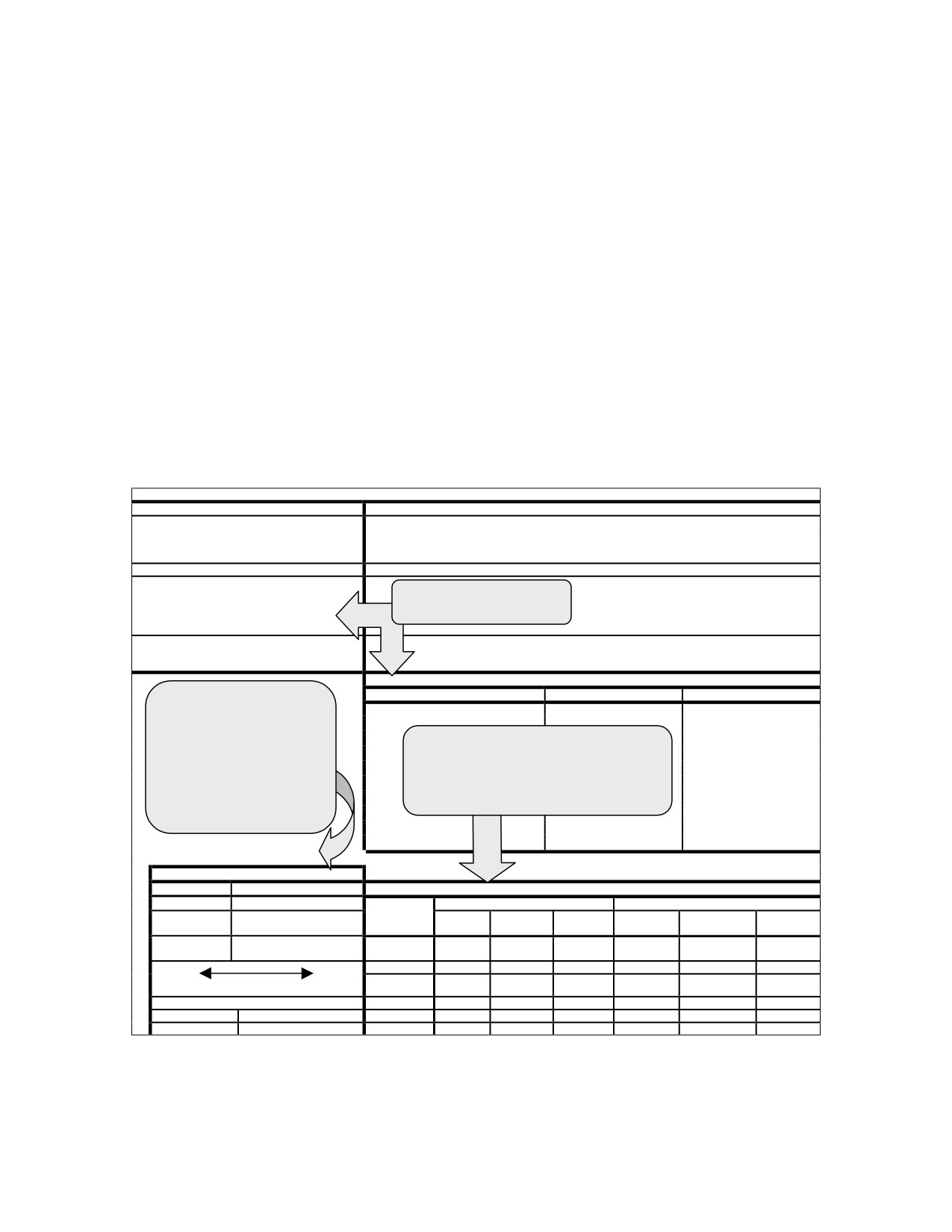
The NBC IPB template (Figure D-1) is used to evaluate the enemy’s ability to
employ NBC weapons against fixed site operations and to delineate the assets required to
mitigate NBC effects. This template is used to summarize what is known and not known
about the enemy’s NBC capabilities and to determine information required. With this
information, the staff can perform an NBC vulnerability assessment evaluating the impact
of an NBC attack on the base mission, site operations (some operations will be more
vulnerable to degradation than others), and individual mission performance factors.
Finally, the template provides a quick reference to the status of units attacked or in the
downwind hazard area of an NBC attack. Units are only posted to this status matrix when
they are at risk. When no longer at risk, they may be deleted from the matrix.
IPB PROCESS
IPB Activity
Description
Battlefield Environment (BE)
•
Weather
•
Terrain
•
AO
Effects of BE on Enemy COA
Threat Evaluation
•
NBC Capabilities
•
Chemical Agents
1) PERFORM IPB
•
Biological Agents
•
Enemy Intent
Information Gaps
•
Designated PIRs
•
Designated NAIs
R&S Plan
NAI
Asset
IR
2) ASSESS
VULNERABILITY
3) TRACK ASSET STATUS
& RECOMMEND
& REACT TO NBC
PROTECTION
Vulnerability to NBC
Analysis
Description
Friendly Forces At Risk
Mission
NBCWRS Update
Contamination Avoidance
Site
Unit/ UTM
EDM
CDM
NET
Clean
Contam
MOPP
Options
Personnel
Factors
RISK
1
2
3
4
5
Protection Recommended
Individual
Site Options
Figure D-1. NBC IPB Template Instructions
D-2

b.
Figure D-2 provides a blank NBC IPB template that may be enlarged and
reproduced for planning purposes.
IPB PROCESS
IPB Activity
Description
Battlefield Environment (BE)
•
Weather
•
Terrain
•
AO
Effects of BE on Enemy COA
Threat Evaluation
•
NBC Capabilities
•
Chemical Agents
•
Biological Agents
•
Enemy Intent
Information Gaps
•
Designated PIRs
•
Designated NAIs
Additional IPB/Threat Data
R&S Plan
NAI
Asset
IR
Vulnerability to NBC
Friendly Forces At Risk
Analysis
Description
Mission
NBCWRS Update
Contamination Avoidance
Site
Unit/UTM
EDM
CDM
NET
Clean
Contamination
MOPP
Options
Personnel
Factors
RISK
1
2
3
4
5
Protection Recommended
Individual
Site Options
Figure D-2. NBC IPB Template
3.
Site Survey NBC Defense Checklist
Table D-1 provides an example checklist to assist staffs and personnel assigned to
conduct site surveys that integrate NBC defense considerations.
D-3
Table D-1. Site Survey NBC Defense Checklist (Example)
1.
Determine the threat.
What is the actual threat at the location as agreed upon by the NBC personnel, security forces, and
intelligence? Use all available documents and specific discussions with intelligence personnel during
this evaluation.
What is the likelihood of enemy use of—
Specific NBC agents?
Conventional weapons, terrorism, and special forces operations?
If NBC weapons are likely to be used—
How are the agents likely to be delivered?
How many weapon systems will probably be used in any given attack?
What are the range, payload, accuracy, and likely burst characteristics (air, ground) of the weapon
system(s)?
What specific agents are likely to be used?
In what physical form (liquid, dusty, aerosol) will the agents probably be disseminated?
When is the enemy likely to employ NBC weapons (early on, nighttime, etc.)?
What contamination levels (g/m2, mg/m3, spores/m3, etc.) will probably exist at your location after an
attack?
What is the purity of the enemy’s agents?
Is there a shelf life associated with the enemy’s agent production (i.e., the agent(s) must be used within
6 months of production in order to be effective)?
Are the characteristics of the enemy’s agent the same as an American-made agent (i.e., does the enemy’s
VX have the same volatility rate, color change on M8 paper, etc.)?
In terms of conventional weapons, what are the probable weapons delivery systems (i.e., mortars,
rockets, surface-to-surface missiles, and man-portable surface-to-air missiles)?
What is the “hazard ring” associated with critical operating locations of the installation (to include
typical aircraft takeoff and landing patterns)? This “ring” provides insight into the amount of area
around the installation that must be secured from ground forces—the installation’s perimeter fence has
no tactical significance. Develop the hazard ring by drawing a line equaling threat weapon system
ranges from the critical airfield operating locations. In most cases, the “ring” will actually take the
shape of a large dog bone.
If a realistic threat, what are the range and accuracy of enemy sniper activities?
2.
Determine communication requirements.
What communications capabilities currently exist at the location?
Is there an installation-wide warning system?
Does a public announcement system exist and what are the areas of coverage?
Are there tapes for the public announcement system in all applicable languages?
Does the warning system have the capability to broadcast the siren sequences the base populace is used
to hearing?
D-4
Table D-1. Site Survey NBC Defense Checklist (Example)
(Continued)
Is the system set up so that a power loss or another problem in one sector does not adversely affect other
sectors?
Are there any known communications chokepoints (i.e., a single cable or switchboard that holds the wiring
for the majority of installation communication lines)?
If appropriate, what communications lines will be used to pass or receive hazard information from local
civil defense, air defense, or security notification systems?
Are GPSs coded?
3.
Determine facility requirements.
Are facilities available to house base C2 functions?
Do these facilities provide semihardened and/or filtration capabilities?
If so, how will deploying personnel learn how to operate the system(s)?
If so, are the filters operational and how many spares exist?
Do these facilities have an emergency escape capability?
Are adequate storage facilities available for base civil engineer equipment, CCA supplies, bulk stored
chemical warfare defense ensemble, and CCD materials?
Are sufficient facilities available to beddown deploying forces? If not, does the installation terrain allow
the rapid establishment of tent compounds (i.e., not swamp land)?
Have facilities been identified for use by NBC defense personnel?
Do sufficient personnel protection facilities (buildings, bunkers, etc., with splinter protection and overhead
cover) exist in the main work and rest and relief areas?
Do sufficient collective protection facilities exist for the entire base populace? If not, has available
collective protection space been allocated on a prioritized basis (i.e., direct sortie generators before support
personnel)?
4.
Determine utility requirements.
What power sources (110/220 VAC, etc.) are available at the deployed location?
Which facilities have serviceable, fixed generator systems as their source of backup power?
Are appropriate unit personnel trained in generator maintenance, start-up, and refueling requirements?
Does every section of the installation have adequate commercial power?
Are there main switches for turning on/off the utilities within each grid (quadrant) of the base?
Is the source of electrical power contained within the base perimeter or does it originate from an external
location power station (for example, three miles away)?
D-5
Table D-1. Site Survey NBC Defense Checklist (Example)
(Continued)
Which facilities have emergency lights?
Do adequate water supplies exist for drinking?
If not, will the deployed water purification capability support operations?
Do adequate water supplies exist for contamination control and firefighting activities?
Are water hydrants readily available and functional? If so, do our forces possess the tool(s) to use them?
Is the available water for contamination control operations primarily salt water?
Does a sufficient water-heating capability exist to support food preparation and personal cleanliness?
What water storage capabilities exist (tanks, flexible bladders, water buffaloes, etc.)?
Are sewer lines available and functional?
Do NBC defense personnel require additional generators in order to support critical mission operations?
5.
Determine air defense requirements.
Does the unit have an organic point air defense capability?
If not, is there another air defense unit (Army, HN) scheduled to deploy and assigned to protect the
installation?
Does the air defense unit possess both antiaircraft and antimissile capabilities?
In what air and missile defense sector is the installation located?
6.
Determine equipment requirements.
Is there an NBC equipment repair capability available in the local area (RADIACs, chemical detection,
etc.)?
Will there be equipment standardization issues with HN or other US military service personnel (filter
element swaps, batteries, etc.)?
Will there be equipment interoperability issues with HN or other US military service personnel (suit
removal, detection instrument units of measurement, etc.)?
Are “pre-positioned” assets available? If so, what are they and are they serviceable?
What will individuals do with their hand-carried CB IPE?
If appropriate, when is bulk-shipped CB IPE scheduled to arrive? What will the unit do with the CB IPE
once it arrives?
How will CB IPE be issued to hospital and CCA/TFA locations for resupply purposes?
How will disposal of contaminated IPE be handled?
D-6
Table D-1. Site Survey NBC Defense Checklist (Example)
(Continued)
7.
Determine contamination control requirements.
What C2 structure will govern contamination control operations?
How many contamination control units will exist and from which units will they be formed?
What is the concept of operations (CONOPS) for decontamination (i.e., weathering except when mission-
critical or decon everything)?
What decontamination equipment is currently available on site?
What decontaminants exist at the location (DS2, STB, solid chlorine, etc.)?
Where are the decontamination equipment and the decontaminants stored? How do you gain access to
them? Are they maintained properly?
Do facilities exist for aircraft decontamination (wash racks, spray system, etc.)?
Is water available for decontamination and is it salt or fresh water?
Are assets available to cover equipment when overhead cover is unavailable?
8.
Determine NBC detection requirements.
What NBC detection equipment is currently on site?
Exactly where are these assets stored?
Who has access to these assets and how do you contact them?
What NBC detection equipment is projected to deploy to the site?
Where are deploying equipment assets coming from?
When are equipment packages due to be delivered?
Will sufficient NBC detection instruments be present to ensure total mission coverage (i.e., stationary sites,
mobile reconnaissance teams, decontamination teams, instruments for CCA and TFA operations, and
instruments to place between contaminated and clean areas of the installation)?
What type and amounts of NBC detection equipment does the HN possess?
What are the HN’s NBC detection equipment capabilities and limitations?
How does the HN plan to use assigned NBC detection equipment assets?
What integration of HN and unit plans must be accomplished in relation to stationary NBC detection
equipment utilization to ensure 100 percent coverage?
How many decontamination teams does the host have? How many do you have?
D-7
Table D-1. Site Survey NBC Defense Checklist (Example)
(Continued)
Does each decontamination team possess sufficient NBC detection equipment?
How many people will be on each HN’s reconnaissance team?
What is the HN’s CONOPS for reconnaissance teams and does it conflict with your reconnaissance
CONOPS?
Do HN reconnaissance teams possess the types and amounts of NBC detection equipment (assets) to
effectively implement the appropriate CONOPS?
What communications capabilities exist for reconnaissance teams and with whom will they communicate?
How will NBC contamination be reported (i.e., positive, negative, or identification of specific agents,
category, and concentration level) when known?
How will reconnaissance teams be dispatched (automatic dispatch upon declaration of “alarm black” or only
when notified by C2?
What calibration and maintenance support exists for NBC detection equipment?
Are sufficient quantities of batteries available for NBC detection equipment?
9.
Determine NBC cell requirements.
Do sufficient quantities of appropriate maps exist for primary and alternate NBC cell operations? Are
digitized maps available for automated NBCWRS?
Who has primary and alternate responsibility for NBC cell operations and is there a tasking for the
exchange of NBC cell personnel?
What is the reporting channel for NBC cell reports?
What subcollection centers will exist in the surrounding area?
Who will provide weather information to the NBCCC and/or NBC cell functions?
Does the unit possess information that will enable NBC cell personnel to provide detailed CB plotting and
persistency calculations?
Does the unit have the proper forms for NBC warning and reporting?
10. Determine other military unit requirements.
Which units are presently assigned or scheduled to be deployed within your AO?
Do these units have NBC specialists assigned? If so, how many?
What are or will be these units’ NBC roles and missions in the area?
D-8
Table D-1. Site Survey NBC Defense Checklist (Example)
(Continued)
Do any of the units have a capability you can use but do not possess (such as biological detection through
the BIDS system, enhanced chemical detection through the use of the FOX, etc.)?
Do the units possess sufficient personnel and equipment to fulfill their mission requirements in relation to
how they directly impact your unit’s operations?
11. Determine CCA/TFA requirements.
If sufficient collective protection facilities do not exist, are unit procedures set up to utilize an on-base
CCA/TFA complex if possible before venturing off base?
What are the likely drawbacks to off-base CCA/TFA operations at the employment location?
At least for planning purposes, are suitable CCA/TFA locations in the surrounding area preidentified,
surveyed, and available at each major compass direction?
What installation facilities possess CB filtration systems? How many personnel can be supported by these
collective protection systems?
Are there areas within the confines of the installation perimeter that could serve as an on-base CCA/TFA?
If yes, are these areas already spoken for?
If yes, will logistical, communications, and transportation problems be insurmountable?
Do these sites have land line communications available?
Do these sites have multiple access routes?
Can security of the proposed TFA sites be reasonably assured to include security for routes to and from
TFA?
Are required signs and equipment available for installation CCA/TFA operations?
How will required equipment, to include replacement CB IPE, be transported to the CCA/TFA once the site
is selected and/or activated?
How will personnel be transported to the TFA? What are the security provisions for off-base CCAs?
Who will provide food, water, and other critical supplies to the CCA/TFA sites?
Where will the people required for installation CCA/TFA operations originate from? How and when will
they be trained? Will they be permanently assigned or simply report at a specified time?
Has the unit considered the requirement for CB IPE aeration and contaminated waste disposal sites as
part of its CCA/TFA planning activities?
Does the HN use warning signals that are contradictory to ours (for example, yellow means attack is
imminent)?
D-9
Table D-1. Site Survey NBC Defense Checklist (Example)
(Continued)
Does the HN or main operating base possess warning signals that the deploying forces are not used to
practicing with (for example, a special alarm for attacking ground forces, “alarm blue” versus “alarm red”
{Korea}, and “alarm green” {Korea})?
12. Determine biological detection requirements.
Are detectors employed in sufficient number for threat conditions?
Is a laboratory available for analysis of samples?
Are procedures in place for evacuation of suspect BW samples (i.e., escort personnel, chain of custody,
evacuation to CONUS)?
Are CLS assets integrated into the support plan?
Are detectors employed as an array and not as single systems?
Are detectors conducting monitoring when BW attack conditions are favorable?
Are procedures in place to notify supporting biodetection resources to increase their readiness level?
Are background monitoring regimens established?
Are key biological defense decision points integrated into the CONOPS, (i.e., masking, pretreatment)?
4.
Beddown Priorities Checklist
Table D-2 is a recommended priority list for NBC beddown operations. The NBC
defense planner implements these actions and determines the actual priorities based upon
guidance from the commander.
Table D-2. Recommended NBC Defense Site Setup (Beddown) Priorities Checklist
1. Develop warning and notification systems.
Attack warning and notification.
Aircraft and tactical ballistic missile.
Conventional and NBC weapons.
2. Develop attack response plans and checklists.
Preattack actions.
Dispersal and sheltering of assets.
Preparation for NBC contamination detection, protection, avoidance, and control.
Actions during the attack.
Activation of warning and notification.
Sheltering personnel and equipment.
Postattack actions.
Reconnaissance operations.
Repair, recovery, and contamination control operations.
D-10
Table D-2. Recommended NBC Defense Site Setup (Beddown) Priorities Checklist
(Continued)
3.
Recommend dispersal and shelter strategies for vital assets.
Weapons systems.
Base C2 centers.
C4I systems.
Critical maintenance facilities.
Collective protection facilities/areas.
Critical petroleum, oil, lubricants (POL) storage and distribution assets.
Munitions storage, assembly, and loading assets.
Critical utility generation and distribution systems.
Critical supply storage.
Fire/crash facilities and assets.
4.
Implement sheltering or relocation of nonvital assets.
Medical facilities.
Noncritical maintenance facilities.
Noncritical POL facilities.
Noncritical utility generation and distribution systems.
Noncritical supply storage.
Dining facilities.
Living areas.
Other facilities and assets.
5.
Request mutual support MOAs/MOUs with HN and allies.
6.
Familiarize NBC specialists with their assigned duties
NBCCC.
NBC reconnaissance.
Decontamination teams.
Open air CCTs.
Personnel protective SMTs.
7.
Establish NBC plotting/reporting system.
NBCCC.
NBC reconnaissance.
5.
NBC Reconnaissance Template
a.
The NBC Reconnaissance Template (Figure D-3) is used to summarize the
reconnaissance missions and organizations charged with hazard detection and monitoring
on a base, site, or base area of interest. The mission box lists missions assigned by the
base commander for conducting NBC reconnaissance. These assignments can be NBCRS
missions or survey and monitoring missions assigned to sector commanders or base tenant
activities. More specific base/base cluster NBC reconnaissance missions may include
medical treatment personnel collecting specimens from suspect NBC patients for analysis,
preventive medicine surveillance of drinking water sources and supplies, and veterinary
services surveillance of potential food supplies and government-owned animals. The C2 box
highlights the relationships between the NBC reconnaissance, surveillance, and survey
teams; their locations; and the named area of interest (NAI) they will operate in or against.
The communications box provides contact information and the sustainment box lists
D-11
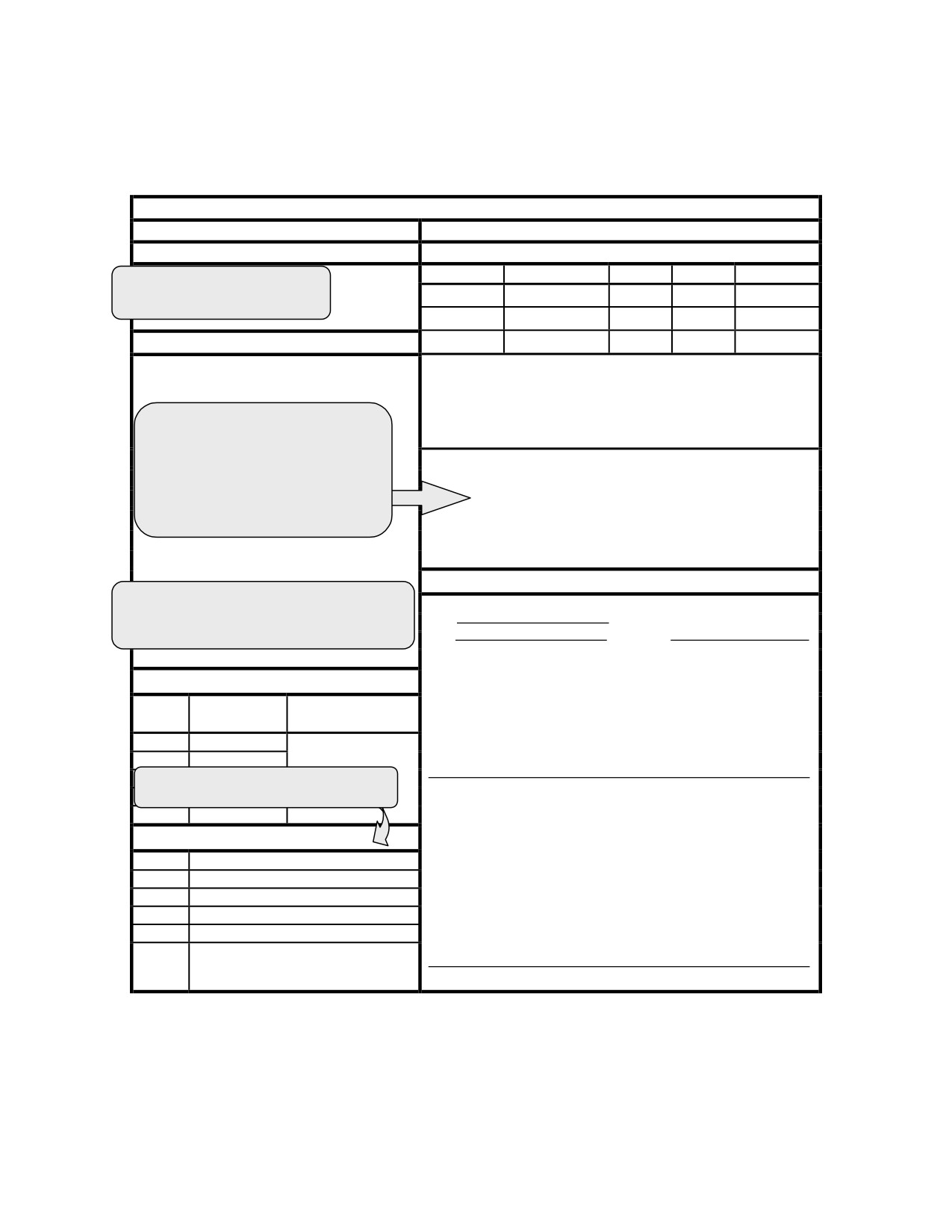
critical items required to perform reconnaissance operations. The site commander and
staff should study the NBC IPB and the NBC Reconnaissance Templates to ensure areas
potentially targeted by the enemy are covered in the base reconnaissance/collection plan.
NBC Reconnaissance Template
MISSION
COMMAND & CONTROL
Commander’s Intent
Command and Support Relationships
OPCON
ATTACHED
DS
GS
TACON
1)
RESTATE MSN &
CONDUCT IPB
Mission/Phase
Grid Coordinates:
_________________________________________________________________________
_________________________________________________________________________
_________________________________________________________________________
2) ID NAI AND TAI
NAIs:
3) ID SCHEME OF
MANEUVER
_________________________________________________________________________
_________________________________________________________________________
_________________________________________________________________________
4) FINALIZE R&S PLAN
_________________________________________________________________________
________________________________________________________________________
Sustainment
5)
SPECIFY SUSTAINMENT PLAN &
ISSUE ORDERS
Water
MOPP Gear ____________________________
Fuel
________
____________CAM Batteries_____
_
__________ _
Markers__________________________________________________________________
Medical Support _________________
Communications
___________________
NET
Call Signs &
Periods of Radio
Freqs
Listening Silence
Other:____________________________________________________________________
_________________________________________________________________________
_________________________________________________________________________
__________________________________________________
______
6) MONITOR EXECUTION
Decontamination Priorities:
_________________________________________________________________________
Reports
_________________________________________________________________________
_________________________________________________________________________
_________________________________________________________________________
_________________________________________________________________________
_________________________________________________________________________
_________________________________________________________________________
_________________________________________________________________________
________________
____
Figure D-3. NBC Reconnaissance Template Instructions
b.
Figure D-4 provides a blank template for planning purposes.
D-12
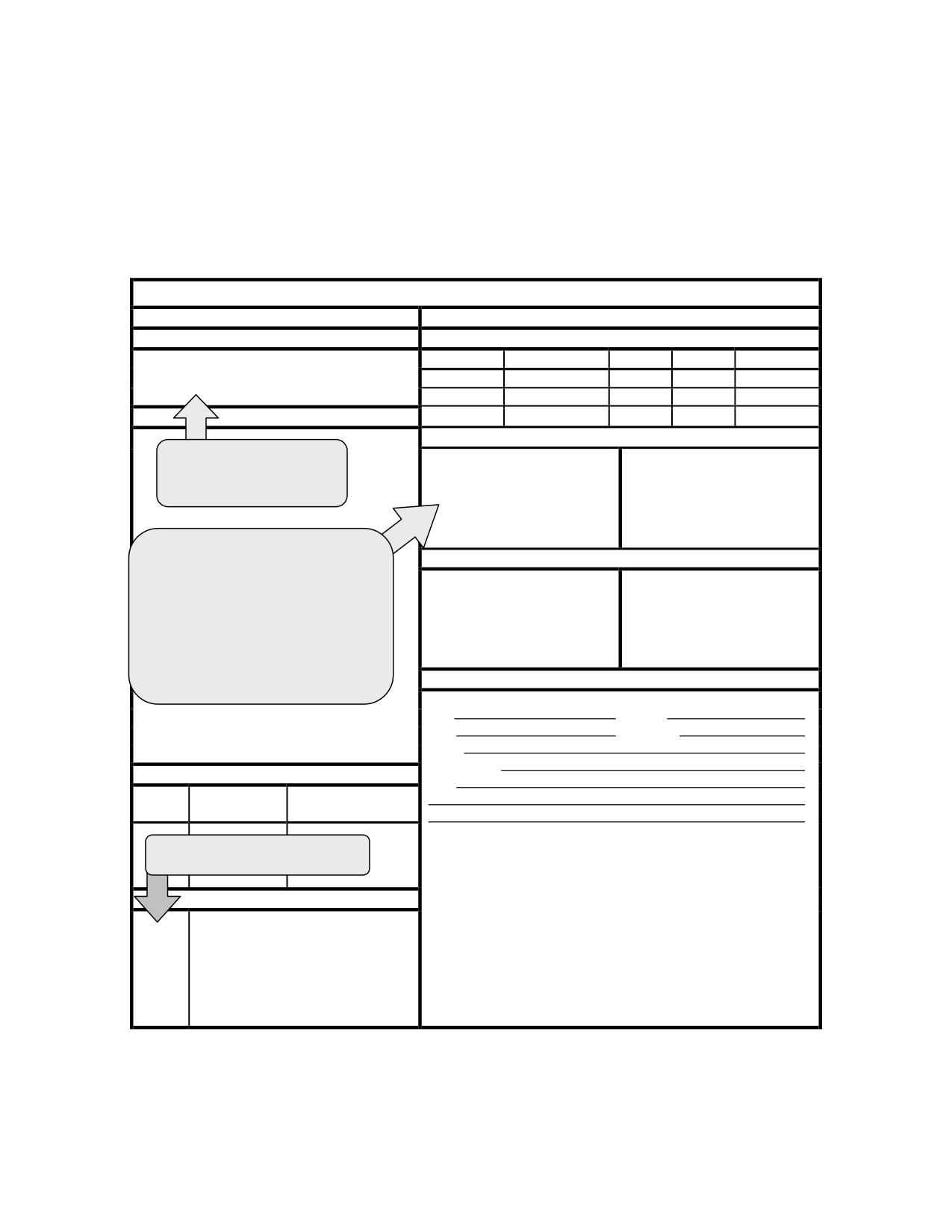
Reconnaissance Template except the mission block refers to the corps commander’s mission
for biodetection operations rather than the base commander’s intent and mission phases.
Additionally, the NAI and UTM grid coordinates are generally assigned by the corps and
coordinated with the base commander. Unique sustainment items such as BW detector
tickets and BIDS/LR-BSDS components are provided through the biological detection
company. Units conducting base logistics support operations may be tasked with providing
common supplies and maintenance activities.
Biodetection Template
MISSION
COMMAND & CONTROL
Commander’s Intent
Command and Support Relationships
OPCON
ATTACHED
DS
GS
TACON
Mission/Phase
NAI Taskings from R&S Plan
BIDS
LR-BSDS/Other
1) RESTATE MSN &
CONDUCT IPB
2) ID NAI
UTM Coordinates for Detectors
Type Detector
Location
3) SELECT DETECTION
AREAS FOR BIDS &
LR-BSDS
4) FINALIZE R&S PLAN
Sustainment
Water
MOPP Gear
Fuel
____________________
CAM Batteries______________
_
Markers____________________________________________________________
Medical Support___________________________________
Communications
Other:_________________________________________________
NET
Call Signs &
Periods of Radio
Freqs
Listening Silence
Decontamination Priorities:
6) MONITOR EXECUTION
_________________________________________________________________________
_________________________________________________________________________
_________________________________________________________________________
Reports
________5)__SPECIFY SUSTAINMENT_____________________
_________________________________________________________________________
_________________________________________________________________________
PLAN & ISSUE ORDERS
_________________________________________________________________________
_________________________________________________________________________
___________________________________________________ _____________________
_________________________________________________________________________
Figure D-5. Biodetection Template Instructions
D-14

b.
Figure D-6 provides a blank template for planning purposes.
Biodetection Template
MISSION
COMMAND & CONTROL
Commander’s Intent
Command and Support Relationships
OPCON
ATTACHED
DS
GS
TACON
Mission/Phase
NAI Taskings from R&S Plan
BIDS
LR-BSDS/Other
UTM Coordinates for Detectors
Type Detector
Location
Sustainment
Water
MOPP Gear
Fuel
____________________
CAM Batteries______________
_
Markers____________________________________________________________
Medical Support___________________________________
Communications
Other:_________________________________________________
NET
Call Signs &
Periods of Radio
Freqs
Listening Silence
Decontamination Priorities:
_________________________________________________________________________
_________________________________________________________________________
_________________________________________________________________________
Reports
_________________________________________________________________________
_________________________________________________________________________
_________________________________________________________________________
_________________________________________________________________________
_________________________________________________________________________
___________________________________________________ _____________________
_________________________________________________________________________
Figure D-6. Biodetection Template
7.
Detection Network Example
One of the advantages of fixed site operations is a comprehensive NBC detection
network can be developed that takes into account threat agents, anticipated delivery
systems, terrain, and historical weather conditions. Figure D-7 depicts a USAF example
NBC detection network using the “Dice 5” pattern, namely detectors are located along the
D-15
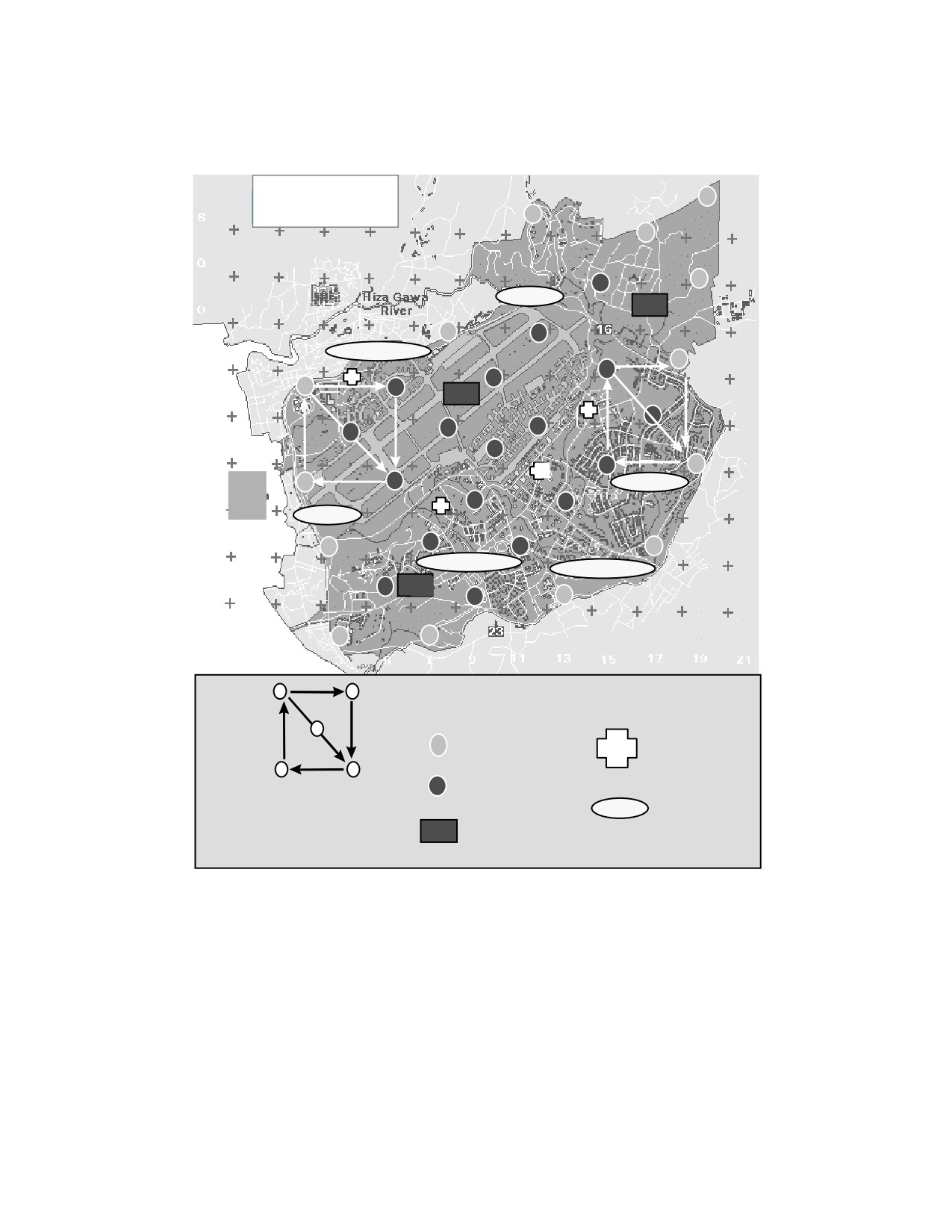
perimeter and throughout the interior of the fixed site. The “Dice 5” concept is applied
both to specific portions of the base and to the base as a whole.
Sample Detector
6
Placement Plan
4
5
X
7
A/C Decon
X
3
X
Personnel Decon
8
X
3
X
2
X
X
2
X
X
X
X
X
1
X
9
1
X
Trans Decon
4
X
X
A/C Decon
X
14
X
10
Personnel Decon
Personnel Decon
X
X
X
11
13
12
Detector Placement
Perimeter
X
Shelters
X
Interior
“DICE 5” Pattern
Decon
Detector Placement
Areas
X
Mobile
Figure D-7. Detection Network Example
8.
Decontamination Template
a.
The Decontamination Template (Figure D-8) helps assess decontamination
requirements based upon friendly IPB (i.e., how many targets can the enemy attack
simultaneously). Agent type and anticipated quantities drive decontamination
requirements and are quantified as “required throughput”. The C2 box lists priorities for
decontamination based upon the site commander’s assessment of critical activities that
require an immediate return to normal operations status. Additionally, this box specifies
decontamination site locations, link-up points, security requirements, and COA affecting
D-16
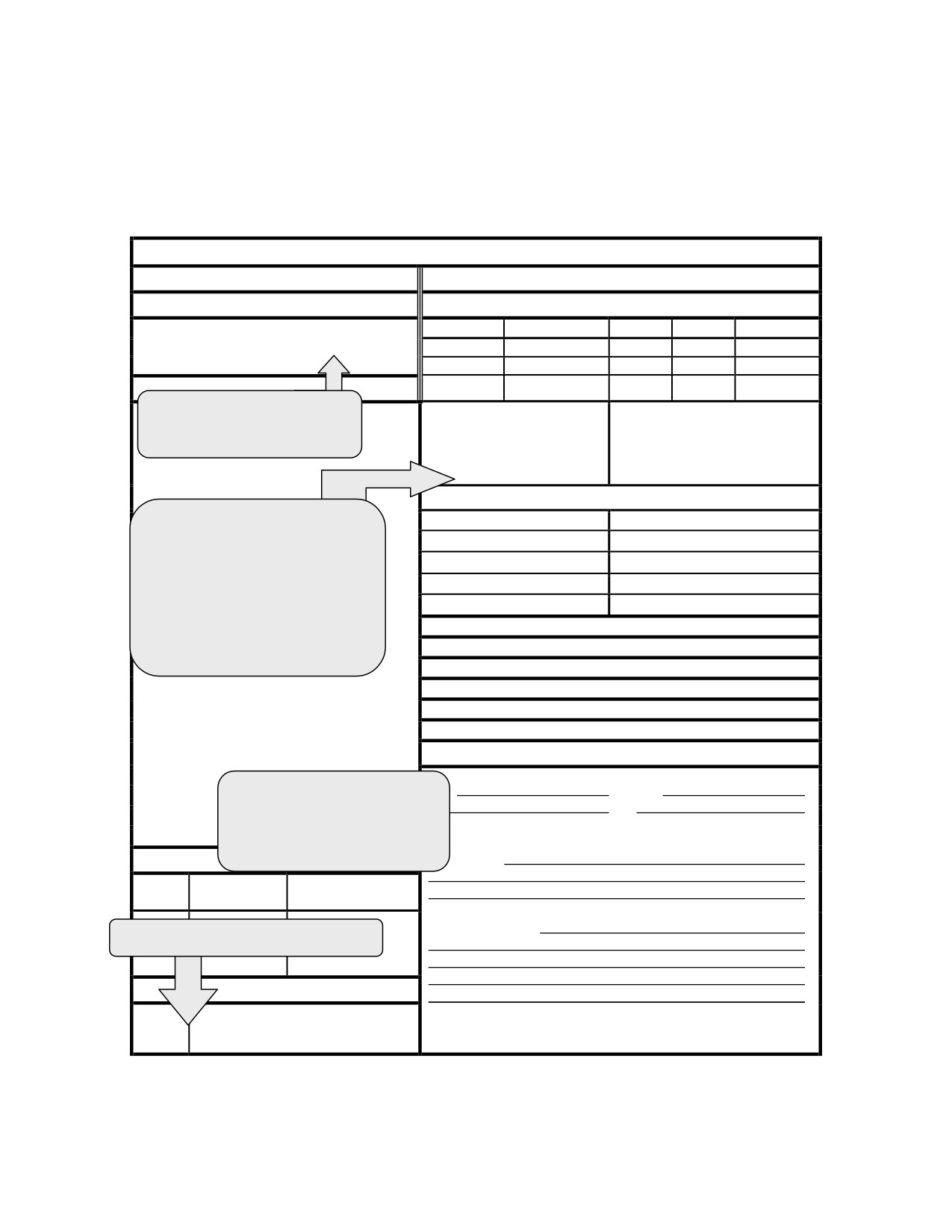
decontamination operations. Under the sustainment window, special attention is required
for site closure procedures. The decontamination site, once used, will remain a hazardous
materials site requiring remediation when base priorities permit. This template entry
should reflect the tentative plan for closure and remediation as well as confirm notification
of the responsible engineer activity.
Decontamination Template
MISSION
COMMAND & CONTROL
Commander’s Intent
Command and Support Relationships
OPCON
ATTACHED
DS
GS
TACON
Mission/Phase/COA
1) RESTATE MSN &
Priority Support (Units)
Priority Effort (Equipment Type)
CONDUCT IPB
UTM Coordinates
Decon Points
Linkup Points
2) ID CONCEPT OF OPN
FROM PRIMARY COA
3) SELECT DECON AND
LINKUP POINTS
Security:
Decon Unit CP:
4) FINALIZE PLAN
Throughput:
Dispersion:
Recovery:
Collective Protection:
Sustainment
5) SPECIFY
Water
MOPP Gear
Fuel
Other
SUSTAINMENT PLAN & Medical Support__________________________________________________________
________________________________________________________________________
CISSUE ORD
ERS
Decontaminants:
NET
Call Signs &
Periods of Radio
Freqs
Listening Silence
Site Closure Procedures:
6)
MONITOR EXECUTION
Reports
Figure D-8. Decontamination Template Instructions
D-17

b.
Figure D-9 provides a blank decontamination template for planning purposes.
Decontamination Template
MISSION
COMMAND & CONTROL
Commander’s Intent
Command and Support Relationships
OPCON
ATTACHED
DS
GS
TACON
Mission/Phase/COA
Priority Support (Units)
Priority Effort (Equipment Type)
UTM Coordinates
Decon Points
Linkup Points
Security:
Decon Unit CP:
Throughput:
Dispersion:
Recovery:
Collective Protection:
Sustainment
Water
MOPP Gear
Fuel
Other
Medical Support__________________________________________________________
________________________________________________________________________
Communications
Decontaminants:
NET
Call Signs &
Periods of Radio
Freqs
Listening Silence
Site Closure Procedures:
Reports
Figure D-9. Decontamination Template
D-18

9.
Fixed Site NBC Defense Planning
This section focuses on key portions of the military decision-making process requiring
extensive input from the operational NBC defense planner to ensure recommended COA
include appropriate NBC defense considerations. These NBC defense considerations,
framed within the context of mission analysis and COA development, will be comprised of
the NBC staff estimate and corresponding NBC defense plan. They include
recommendations such as mission support concept for COA, missions risks and
vulnerabilities, mitigation measures, task organization for NBC defense, tasks to tenant
and transient forces/units, HN and civilian considerations, and asset availability and
visibility.
a.
Mission Analysis. Mission analysis focuses the base commander and staff
planning throughout the decision-making process. Table D-3 exemplifies a typical mission
analysis process. These steps are not always conducted sequentially and many are
continuously or periodically reviewed and reassessed.
NOTE: To properly support the command, NBC defense planners must
understand not just the NBC defense mission but the overall fixed site mission
and intent.
Since numerous doctrinal references exist for the military decision-making process
and planning joint operations, the remaining discussion focuses on the NBC defense
aspects of the military decision-making process. Discussion of selected mission analysis
steps can be applied to NBC defense, smoke, and NBC recon annex development as well as
the basic OPLAN/OPORD.
Table D-3. Mission Analysis (Example)
Mission Analysis Steps
Analyze Higher Headquarters’ Order (Mission, Intent, Concept, Time Lines, Adjacent Units’
Step 1
Missions, Assigned AO)
Conduct Initial JIPB (Define the Operational Environment, Describe the Battle Space
Step 2
Effects, Evaluate the Adversary, Determine Most Probable/Most Dangerous Adversary COA)
Step 3
Determine Specified, Implied, and Essential Tasks
Step 4
Review Available Assets
Step 5
Determine Constraints
Step 6
Identify Critical Facts/Assumptions
Step 7
Conduct Risk Assessment
Step 8
Determine Initial CCIR
Step 9
Determine the Initial Reconnaissance Plan
Step 10
Plan Use of Available Time
Step 11
Write the Restated Mission
Step 12
Conduct a Mission Analysis Briefing
Step 13
Approve the Restated Mission
Step 14
Develop the Initial Commander’s Intent (What the Fixed Site Must Do To Succeed)
Step 15
Issue the Commander’s Guidance
Issue Warning Order (Restated Mission, Cdr’s Intent, AO, CCIR, Risk Guidance, Recon
Step 16
Requirements, Deception Guidance, Specific Priorities, Time Plan, Rehearsal Guidance)
Step17
Review Facts/Assumptions (Periodic Process)
D-19
(1)
Higher Mission and Intent (Step 1). Review the mission and intent for
NBC protection guidance and combat/combat support priorities that result in specified or
implied NBC defense tasks, such as exposure guidance or support priorities.
(2)
Conduct Initial JIPB (Step 2). Using the four-step JIPB process
discussed in Chapter II, NBC JIPB attempts to identify the enemy’s most likely and most
dangerous NBC COA (including TIM considerations) as it pertains to the friendly mission.
(3)
Determine Specified, Implied, and Essential Tasks (Step 3). Review
the plan/order for further specified or implied NBC defense tasks. If time is limited,
review only the basic plan, the intelligence annex, the NBC annex, the logistics annex, fire
support annex, air defense annex, rules of engagement annex, engineer annex, medical
annex and, if present, the civil affairs annex. Appendix A, Fixed Site NBC Defense Task
List, demonstrates the use of CJCSM 3500.04A to describe specific tasks and their implied
and supporting NBC collective tasks. This appendix can also be used to design the
commander’s NBC defense METL.
(4)
Review Available Assets (Step 4). Review the available assets (forces,
equipment, supplies, HN support) for capabilities to support identified tasks. Immediately
identify task organization or equipment/supply capability shortfalls to the appropriate
operations or logistics planner. Ensure type unit characteristics file is current for
deploying forces.
(5)
Determine Constraints (Step 5). Shortage of mission-essential assets is
an immediate constraint on operational capabilities. Other NBC defense constraints
include items such as levels and rates of supply, rates of usage, decon throughput
capability, environmental considerations, military and civilian NBC training readiness,
and HN NBC support requirements.
(6)
Identify Critical Facts/Assumptions (Step 6). Facts and assumptions
help shape COA development and analysis (see Table D-4). Although many facts available
from the higher command’s plan/order reduce time requirements, they do not eliminate
responsibility for subordinate staff planning and independent JIPB/analysis.
(7)
Conduct Risk Assessment (Step 7). Using charts similar to those found
in Appendix C, the NBC operational planner assesses the NBC risks. NBC vulnerability
analysis allows further detailed evaluation of risks and mitigation measures during COA
development.
(8)
Determine Initial CCIR (Step 8). The NBC defense staff offers NBC
CCIR for the commander’s consideration. CCIR include information for both friendly and
threat forces, and they are normally limited to less than 10 questions. Fixed site examples
include: “Will the enemy use persistent chemical agents on LOG BASE ALPHA?” and
“Will organic decon assets of the theater reserve force be available to support airbase
decontamination operations?” Remember, to determine good CCIR: ask only one question;
focus on a fact, event, or activity; and provide intelligence required to support a single
critical decision.
D-20
Table D-4. Factors Affecting NBC Defense Plans
Possible Facts/Assumptions Affecting NBC Defense Plans
• Higher Mission/Intent
• Command Mission/Intent
• NBC Mission/Intent
• Enemy NBC Weapons/Agents
• Enemy NBC Delivery Capabilities
• Enemy NBC Protection Capabilities
• Enemy NBC Protective Posture
• Enemy NBC Intent
• Terrain Considerations
• Weather Implications
• Task Organization
• NBC Defense Capabilities
• NBC Defense Training Status
• NBC Protection Capabilities
• NBC Protective Posture
• Unit Dispositions
• NBC Resupply Rates
• Available Time
• Required Time
• HN/Civilian Support Requirements
• HN/Civilian Capabilities/Limitations
• NBC Hardened Medical Facilities
• HN/Civilian NBC Equipment and Training Requirements
(9)
Determine the Initial Reconnaissance Plan (Step 9). Determine key
events or “triggers” for launching NBC recon or survey teams. Then prioritize use of
available NBC recon assets. Based on initial JIPB, identify likely NBC or TIM hazard
areas (these areas become NAI). Associate specific units/teams with specific NAI.
Subsequently, the intelligence officer will turn this initial plan into a recon and
surveillance (R&S) plan with specific mission taskings assigned by the operations officer.
Ensure unit taskings match unit capabilities. For example, units without special
hazardous materials training and equipment are not good candidates to perform TIM
reconnaissance.
(10) Plan Use of Available Time (Step 10). “Using available time” goes
beyond simple time management and synchronizing assets with execution requirements.
Overlay friendly timelines with projected enemy timelines to mitigate or exploit the visible
windows of risk or opportunity.
(11) Conduct a Mission Analysis Briefing (Steps 11-13). The commander is
briefed on the mission analysis products and recommended restated mission. Key input
from the NBC defense planner includes discussion of NBC and TIM hazards, their
associated risks, and critical mitigation measures.
(12) Develop the Initial Commander’s Intent (Step 14). During mission
analysis, the commander develops his intent. The intent statement includes the conditions
for success with respect to the adversary, the terrain, or the desired end state. For
example, from a fixed site perspective, intent may require specific OPTEMPO support
rates or sortie generation rates; therefore, NBC planning and priorities must support the
sustainment of these specified rates.
(13) Issue the Commander’s Guidance (Step 15). Key aspects of command
guidance for the NBC defense planner are CCIR, risk guidance, priorities of support
(avoidance, protection, decontamination, recon, and smoke), timelines, and rehearsals.
(14) Issue a Warning Order (Steps 16-17). Unless the NBC threat is
immediate, NBC guidance in nonchemical unit warning orders is generally restricted to
minimum protective posture or time-sensitive requirements such as initiating needed
medical immunizations and prophylaxis, preparation of medical treatment facilities to
D-21
receive NBC casualties, and/or preparation for decontamination operations. As the staff
begins COA development, they conduct a periodic review of facts and assumptions.
b.
Course of Action (COA) Decisions. Staffs develop, analyze (“wargame”),
compare, brief, and recommend a COA for the commander’s approval. The NBC defense
planner follows the same method when developing a COA for the fixed site NBC defense
plan. Each COA must meet the criteria of suitability (to accomplish the mission and meet
the commander’s guidance), feasibility (to accomplish the mission in terms of available
resources), acceptability (advantages gained justify the costs), distinguishability (each COA
significantly different from others), and completeness (answers who, what, where, when,
how, and why).
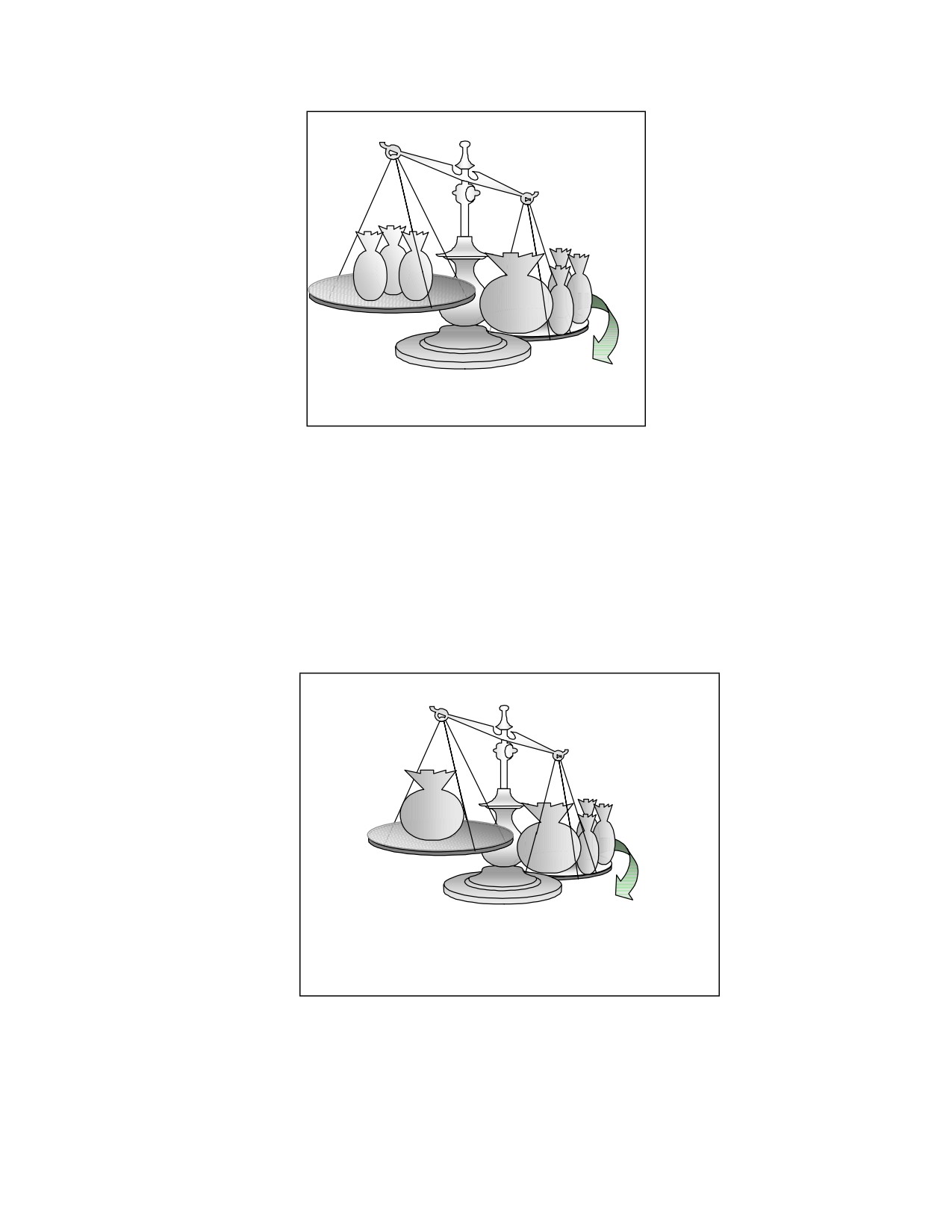
Before the staff conducts the COA decision brief, the NBC defense planner critiques
each COA included in the briefing. This critique addresses the ability of NBC defense
assets to support each COA (see Figure D-10). In addition to mission support, use the NBC
defense principles (avoidance, protection, and decontamination) to assess how well each
COA supports the fixed site NBC defense goals: NBC protection, sustained C2, and
sustained combat support.
As the primary staff analyzes relative combat power and support capabilities,
generates options, and arrays forces, the NBC staff officer analyzes each COA based on
current JIPB, risks, and vulnerability assessments (see Appendix C for more detailed
instructions). This approach produces threat-based NBC defense requirements and
recommends assignments to specific units/assets within the available force structure.
Unsupported requirements or unacceptable risks become disadvantages for later
comparison to other COAs. Unsupported mission support requirements are forwarded to
higher headquarters.
The end result is an NBC defense strategy (NBC defense estimate) for each viable
COA. Therefore, when the commander approves a COA, the basic NBC defense support
plan is completed with minimum delay.
c.
NBC Staff Estimate. The NBC staff estimate includes NBC defense
recommendations for each COA and the approach used to prepare COA recommendations.
The estimate follows this basic outline with emphasis on unique NBC defense
considerations of each item:
(1)
Mission.
(2)
Situation and considerations.
(a) Characteristics of the AO (weather, terrain, other such as TIM).
(b) Enemy forces (NBC capabilities, NBC intent, NBC COA).
D-22
High Probability of Success
Friendly
COA
• NBC Protection
• C2
• CS Sustainment
Figure D-10. NBC Defense Measures Support COA
(c)
Friendly forces (friendly COA, NBC risks and vulnerabilities of each
COA, NBC defense capabilities/limitations of each COA, NBC resource status, mitigation
requirements for each COA, and key considerations such as mission, NBC protection, C2,
and sustainment support for each COA).
(d) Assumptions.
(3)
Analysis (advantages/disadvantages of each COA using key
considerations).
Recommended
COA
Viable COA
but
Not the
Best
COA
2
COA
1
• NBC Protection
• C2
• CS Sustainment
Figure D-11. Best COA
(4)
Comparison (COA ranked by each consideration and with decision
matrix).
D-23
(5)
Recommendation and conclusions.
(a) Most supportable COA from NBC defense perspective (see Figure D-11).
(b) Issues, risks, vulnerabilities, and mitigation recommendations.
Once the commander selects the COA, the COA conclusions (issues, risks,
vulnerabilities, and mitigation) form the basis for the recommendations included in the
NBC defense plan.
d.
Fixed Site NBC Defense Plan. The fixed site NBC defense plan evolves from
mission analysis, COA decisions, the NBC estimate, and command guidance. The plan
addresses NBC hazard avoidance, protection, and decontamination. Depending on the
detail, it may consist of separate annexes for basic NBC defense; NBC reconnaissance,
surveillance, and monitoring; smoke operations; and/or restoration operations. The NBC
annexes require staff coordination since the NBC environment influences each staff
functional area. In some cases, duplicate instructions reinforce the overall plan. Using
tools and templates like those in Appendixes D and E, the basic plan/annex must address
the following items:
(1)
Enemy NBC Situation. Include enemy employment of TIM (including
sabotage and destruction, see Appendix G), smoke, flame, riot control agent considerations,
NBC capabilities, threat states, and employment risk windows if not addressed in the
intelligence annex.
(2)
Friendly NBC Situation. Include tenant and transient NBC defense
capabilities/locations with projected arrival and departure times for transients. Identify
NBC defense task organization, smoke, flame, and riot control agent guidance.
(3)
Mission. The fixed site NBC defense mission statement must answer who,
what, when, where, and why.
(4)
Execution. Critical subparagraphs must include the following:
(a) Commander’s Intent. Achievable/measurable criteria for success;
for example, priority to personnel protection and less than 15 percent decrease in sortie
generation.
(b) Scheme of NBC Defense Operations. Descriptive overview of how
NBC defense will be executed. Include smoke guidance or refer to smoke support annex.
(c)
Tasks to Subordinate NBC/Tenant Units. Detailed NBC defense
task assignments to each tenant unit, with execution guidance as required.
(d) HN Tasks. NBC defense training and protection guidance for
supporting HN personnel.
D-24
(e) Emergency Tasks to Area Transient Units. Emergency support
taskings to transient units in the base AO.
(f)
Rehearsals. Locations, times, required attendees, and special
requirements.
(g) Coordinating Instructions. Due to the multiservice/international
nature of fixed site operations, do not assume standing operating procedures (SOP)
remain valid. Develop interoperability agreements, as necessary, to include:
•
Minimum MOPP levels and flexibility guidance.
•
Contamination avoidance guidance.
•
Personnel safety criteria (USA troop safety criteria).
•
Operational exposure guidance.
•
Automatic masking/unmasking guidance (if different from unit SOP).
•
Reporting requirements (if different from unit SOP).
•
Actions before, during, and after NBC attack.
•
Identified observer units (if different from unit SOP).
•
NBC sample collection guidance and transfer points.
•
Location of potential NBC hazardous civilian/military facilities.
•
Instructions/procedures for civilian interaction/support.
•
Area NBC defense responsibilities.
(5)
Service Support. Use subparagraphs to address the following:
(a) Contaminated casualty collection points/procedures.
(b) Procedures for collecting, handling, and evacuating contaminated
remains.
(c)
Locations of consolidated NBC defense equipment.
(d) Locations of field expedient decon supplies/HN support.
(e) Decon/MOPP exchange points.
D-25
(f)
Decontamination priority of support (by unit) and effort (by
equipment within units).
(g) Special contamination control requirements.
(h) Retrograde contamination monitoring sites.
(i)
NBC equipment/supply controlled supply rates and prestock points.
(j)
Procedures for chemical defense equipment (CDE) early resupply
(“push”) packages.
(k) Patient decon augmentation support.
(l)
Patient decontamination.
(m) Treatment supplies.
(6)
Command and Signal. Use subparagraphs to address:
(a) Location of chemical staffs and supporting units.
(b) Warning signals/alarms.
(c)
NBCWRS instructions.
(d) CDM/effective downwind message (EDM)/STRIKEWARN
instructions.
(e) EMP protective measures.
e.
Deployment Planning. Operational planners use two fundamental products
for deployment planning: the Commander’s Task Organization and the TPFDL. Effective
command and staff communication regarding these products is essential. Otherwise,
entire units and unit sets of equipment could sit idle at an airport or seaport of
embarkation and not be available to support the mission. Once resources enter the
movement/logistics pipeline, the deployment system provides total asset visibility, even in
transit. The challenge is to quickly move tremendous tonnage and volumes of resources
through a strategic pipeline with finite throughput capacity. This is accomplished through
mission-focused task organization and TPFDL.
(1)
Task Organization. The commander task-organizes the force to
accomplish mission requirements; however, mission task organization and timelines are
impacted by available airlift and sealift deployment capabilities. The keys to force design
(task organization) are flexibility, balance, and mission focus. The JTF is organized to
achieve maximum effectiveness from each contributing component (i.e., USA, USN, USAF,
USMC, and USCG). Commanders determine the proper mix of force capabilities in order
D-26
to maintain flexible, effective, and efficient support to the mission. Task organization
decisions are always mission-focused; every deployed asset must support the mission.
Develop NBC defense deployment packages based on mission-essential tasks and
force capabilities. These packages are designed to support mission-specific NBC defense
tasks and provide flexible support to other “nonstandard” chemical unit tasks. The concept
entails providing economy of force while supporting mission execution and command
flexibility.
(2)
Time-Phased Force Deployment List. Once the commander
determines task organization and deployment priorities, the deployment sequence and
timelines for the task-organized units are established. The commander and supporting
movement control centers use time-phased force deployment data (TPFDD) to—
(a) Maximize transport throughput capacity based on command
established mission priorities.
(b) Resolve transportation conflicts based on mission priorities.
(c)
Synchronize force arrival with mission priorities/time requirements.
(d) Ensure appropriate NBC equipment is sourced for deployment.
NOTE: TPFDL priorities will change based on JIPB updates and changes. NBC
staff officers will closely monitor the deployment of NBC defense resources, to
include verifying their status on the TPFDL. Resources not appropriately
prioritized to mission requirements could arrive too late to support the mission.
Resources not prioritized or even listed would wait for movement indefinitely.
f.
NBC Annex. Use the NBC annex to clearly define the OPORD NBC defense
concept, facilitate mitigation measures to the anticipated threat (NBC weapons and TIM),
and provide details for base support planning and execution. The NBC annex may include
the following:
(1)
General.
(a) Standardize times throughout (time you’ve used throughout the order,
usually ZULU).
(b) List maps, charts, overlays, and relevant documents. May list map
sheet series and numbers.
(c)
Provide maps, charts, and overlays as required with annex. Maps are
normally requested through the intelligence section (S2/G2). Overlays should identify
decontamination points; IPE storage and exchange points; locations of field expedient
decontamination equipment such as firefighting equipment, pumps, and bulldozers;
evacuation routes and traffic control points; casualty collection points; and collective
protection shelters.
D-27
(2)
Situation: Enemy.
(a) Enemy capability, previous employment, delivery systems, and
location of stocks. Describe the enemy’s NBC agent capabilities, enemy order of battle,
when NBC weapons are likely to be used, delivery capabilities, and an assessment of where
NBC weapons are positioned (e.g., depots or forward deployed).
(b) Probability of employment. List circumstances or conditions
supporting enemy use of NBC weapons.
(c)
Threat to operations area. Determine the most likely delivery
means/agents per anticipated enemy objective(s). Identify fixed site sustainment
operations most susceptible to NBC attack.
(3)
Situation: Friendly.
(a) Unit NBC defense plans (units). Determine chemical, engineer,
air defense, or base defense units with missions that can prevent enemy reconnaissance,
protect against NBC delivery systems, or mitigate the effects of NBC attack.
(b) Decontamination and reconnaissance resources supporting
NBC defense. Include NBC reconnaissance and decontamination assets as well as
engineer, logistics, combat health support, or HN resources contributing to NBC defense.
(c)
Potential targets (military and civilian). Evaluate each for NBC
threats.
(d) Effects on civilian communities. Evaluate effects which may have
major implications for fixed sites relying heavily on civilian workers or commercial
operations such as POL supply or merchant marine operations.
(e) Detection/NBCWRS capability. Plan, announce, and conduct
NBCWRS rehearsals. Fixed sites often rely on general support NBC reconnaissance with
an area support mission. Additionally, rear area elements typically have fewer organic
NBC detection devices and less capable communications for local NBCWRS.
(f)
Attachments and detachments. List the base cluster/base
elements charged with specific NBC defense responsibilities.
(4)
Mission.
(a) Concise mission statement. Missions for chemical units
supporting fixed sites in a direct support (DS), OPCON, or TACON role should be
distinguished from those providing general support to fixed sites (most often in the
corps/echelons above corps (EAC) rear area or COMMZ).
D-28
(b) Purpose (avoidance, protection, decon, smoke). Maintain focus
on mission and goals: NBC protection, sustained C2, and sustained combat support.
(5)
Execution: Commander’s Intent. Specify how the commander wants
NBC defense to support mission objectives (e.g., criteria for success). This may be in
quantitative terms of sustained throughput or mission support capabilities (e.g., short
ton/day, sorties/hour) or specific measures for protecting the force. This may also include
command protection guidance (how much risk is the commander willing to take to
maintain site operations?) This is translated into terms such as 50 percent of the force will
be in MOPP2 at all times, or motorized smoke units will utilize smoke pots for self-
concealment.
(6)
Execution: CONOPS.
(a) Mission priorities (1st, 2d, etc.) Establish fixed site support
priorities consistent with the mission, commander’s intent, and guidance for protecting the
force. The base commander or staff should coordinate base NBC defense priorities with the
tenant, the tenant’s headquarters, and the higher headquarters.
(b) NBCWRS. Procedures must include warning every individual at
the fixed site.
(c)
Site decontamination concept. Plan/conduct decontamination
based on concentrated mission areas/sectors to avoid spreading contamination or waste.
Include specific guidance for waste/contamination control at each site.
(d) Base/site smoke concept. Integrate with the overall CCD plan
and/or refer to the smoke support appendix.
(e) Area(s) reconnaissance concept. Establish priorities for
reconnaissance based on the commander’s guidance, potential tenant mission impacts, and
most likely targets.
(f)
Area(s) detection concept. Provide detection employment guidance
for establishing threat-based detector arrays incorporating required base/cluster detection
assets.
(7)
Execution: Task to Subordinate Units.
(a) NBC training responsibility. Use either a centralized or
decentralized approach to ensure adequate training/rehearsals down to the individual
level.
(b) Decontamination tasks. Assign tasks for additional operational
decontamination support (MOPP exchange, vehicle spraydown, waste management, or
resupply assistance). Identify thorough decontamination support missions/requirements
as well.
D-29
(c)
Smoke tasks. Assign missions to support the smoke concept or refer
to the smoke support appendix.
(d) Reconnaissance tasks. Assign tasks to support NBC NAI and/or
refer to the NBC reconnaissance/surveillance/monitoring appendix. Develop the
reconnaissance plan to mutually support the detection plan.
(e) Detection tasks. Specify detection requirements based on threat
NBC employment windows or operations in the vicinity of TIM facilities/hazards.
Coordinate detection efforts to create a base/site detector array for maximum detector
coverage.
(f)
Additional tasks unique to specific units. Self-explanatory.
NOTE: Assign tasks per mission requirements/capabilities, not by whether units
are specifically chemical or nonchemical units. For example, USN construction
forces are not equipped for large area NBC reconnaissance; specialized USA and
USMC units with the NBCRS are best for that mission.
(8)
Execution: Coordinating Instructions.
(a) Coordination of taskings. Identify coordination requirements with
activities supporting NBC defense operations.
(b) Avoidance guidance (areas, food, water). Avoidance is less an
option for fixed sites than for mobile elements. Good operations security, especially
counterreconnaissance, is vital. This may be manifested by heightening physical security,
aggressive external and internal patrolling, or simply locating key activities in areas less
susceptible to enemy intelligence collection.
(c)
Dispersion, cover, and protection. Where dispersion is
impractical, greater emphasis must be placed on other protective measures such as CCD.
Maximize/prioritize use of NBC covers or general purpose covers.
(d) Sample collection. Samples taken from patients should be handled
IAW medical and intelligence annexes.
(e) MOPP protection guidance. Enforcing MOPP and protective
measures is more difficult when diverse tenants occupy the same site, especially
multiservice and multinational sites. The different tenants may have different MOPP
procedures. Achieving consistent masking and unmasking procedures will be a major
challenge. Simple inclusion of minimum MOPP as coordinating instruction may not be
sufficient. Identify conditions that cause MOPP levels to change (i.e., missile attack and
any prescribed MOPP response). IPE serviceability criteria should also be established or
reinforced in the OPORD. Plan, announce, and conduct rehearsals.
D-30
(f)
MOPP exchange sites. Fixed sites may establish consolidated
MOPP exchange locations for contaminated personnel. Focus on controlling contamination
and disposal of contaminated suits following exchange.
(g)
Link-up points. Units or personnel going through decontamination
report to a link-up point for traffic control, preliminary instructions, and controlled flow
through the site. The supporting decontamination element controls the link-up point.
Assign tasking for physical security support, if required.
(h) Operational exposure guidance. Identify the turn back dosage
(maximum radiation dosage a unit or individual is allowed) for radiation survey teams.
(i)
Troop safety criteria. Include guidance for NBC defense units
operating in nonstandard situations such as TIM threats.
(j)
Collective protection. Identify the location and priority of use for
collective protection facilities, except medical. Medical units have organic collective
protection systems. They will be employed based upon the threat in the AO.
(k) EMP/transient radiation effect on electronics guidance.
Identify known or anticipated EMP sources and actions to mitigate affects.
(l)
Medical protection. Refer to the medical annex for vaccine,
pretreatment, postexposure guidance, and medical facilities for contaminated casualties.
(9)
Service Support.
(a) Casualty handling. Specify base responsibilities/locations for NBC
casualty collection points and patient decontamination in the event of multiple-tenant
casualties. This is normally a single unit responsibility. Refer to the logistics annex for
graves registration guidance, and ensure graves registration personnel are familiar with
contaminated remains handling and decontamination procedures.
(b) Field expedient supplies. Identify location of materials or
equipment that can be diverted to emergency NBC defense. OPORD should task owning
units with providing support on order.
(c)
Distribution (how, where, what, when, who). Distribution plans,
especially those involving civilians, such as consolidated CDE storage with command
designated issue times or immediate individual issue to all base support personnel.
Address CDE issues such as uneven distribution of CAMs or other detectors throughout
the base. Require CDE asset reporting to obtain/maintain asset visibility.
(d) Maintenance. Address unique DS/GS NBC maintenance
requirements such as BIDS.
D-31
(e) POL. Specify NBC defense unit procedures for acquiring POL when
detached.
(f)
Consumption rates (each mission/task). Establish limits on
consumption, usually based upon replenishment capabilities.
(g) Resupply delivery (times, location, what, how much). Establish
whether supplies will be pushed all the way to the site or if picked up at offsite logistics
resupply points. Where possible, consolidate resupply requirements to conserve transport
resources.
(h) Prioritize Tasks for Support. Prioritize based upon mission,
commander’s intent, and command guidance.
(10) Command and Signal.
(a) Control procedures. Establish who controls NBC defense
operations and chemical units operating on or near the fixed site (e.g., site S3/G3). If
supporting only part of a site’s tenants, identify where other units obtain NBC defense
support.
(b) Frequencies and signal operating instructions designation.
Identify radio nets for supporting chemical units. Fixed sites will rely heavily on the
telephone for on-site communications.
(c)
CP locations. Identify controlling CP for chemical units and all fixed
site tenants’ CP.
(d) NBCWRS. Include network diagram, a simple sketch portraying
information flow requirements (up, down, and laterally) and any special/designated
frequency requirements. If tenants are not clear on standard NBC warnings/alarms, state
specific actions/reactions.
10. Fixed Site NBC Recon/Surveillance/Monitoring
a.
General. Same as NBC annex, except charts and overlays. Provide a graphic
overlay of the fixed site or base indicating high value targets, NBC surveillance and
monitoring locations, and NBC survey team routes.
b.
Situation: Enemy. Same as NBC annex.
c.
Situation: Friendly.
(1)
Base NBC reconnaissance, biodetection, and survey teams. List all
attached OPCON or TACON NBCRS elements, supporting biodetection teams, and NBC
survey teams with base or sector responsibilities.
D-32
(2)
Medical surveillance. Identify medical activities with capabilities for
identifying/treating NBC casualties or contamination. Medical units are authorized a high
density of CAMs by common CTA. Additionally, they have radiation safety specialists.
Medical units can provide limited NBC detection, water supply surveillance, and guidance
on exposed food supplies.
(3)
Potential targets. Reconnaissance, surveillance, and monitoring plans
should coincide with fixed site assessment of targeted base activities.
(4)
Attachments and detachments. NBCRS (FOX) teams and BIDS teams
may be attached, OPCON, or TACON to the base. TACON elements may be used for
specified tactical missions but may not be assigned other missions without approval of the
assigning headquarters.
d.
Mission. Same as NBC annex, except monitoring and survey party missions.
Identify monitoring and survey party missions assigned to tenant activities. May be
assigned by base defense sectors or by potential target areas.
e.
Execution: Commander’s Intent. Describes the desired end state. It is not a
summary of the CONOPS.
f.
Execution: CONOPS.
(1)
NBCRS priorities (1st, 2d, etc.) C2 should generally remain with one
base activity with the FOX teams placed TACON or OPCON to other tenants as necessary.
(2)
NBCWRS. Establish warning and reporting procedures for all designated
reconnaissance, surveillance, and monitoring activities. Once time-sensitive information is
collected, identify who needs that information first. Implement a warning and reporting
architecture that permits the rapid transmission of NBC surveillance findings to the
BDOC and to activities in downwind hazard areas.
(3)
Areas (reconnaissance, detection, monitoring). Specify areas (and
priorities) to be reconnoitered and monitored and the conditions that trigger these
operations (may be peak threat periods, after a suspected attack, or “on-order” (O/O)).
g.
Execution: Tasks To Subordinate Units.
(1)
General guidance. Provide unit/element task requirements such as
responsible NAI and periodic requirements. Assign O/O missions as required.
(2)
Specific guidance. Issue specific reconnaissance, surveillance, or
monitoring guidance by separate fragmentary order.
D-33
h.
Execution: Coordinating Instructions.
(1)
Rehearsals. Because of the numerous tenants on a base and various
mission priorities, orchestrating recon and surveillance will be a major challenge for large
fixed site commands. Rehearsals and team training will help eliminate problems.
(2)
MOPP protection. Specify protection levels for detection, monitoring,
and survey teams required to seek out contamination. Team protection levels are likely to
be higher than the remainder of the site.
(3)
Operational exposure guidance from commander. Radiation survey
teams and units operating in nuclear areas require operational exposure guidance to avoid
overexposing party personnel.
(4)
Contamination Avoidance Guidance. Initial guidance may be to locate
contamination boundaries only, leaving complete contamination measurement until a later
time.
(5)
Reports. Establish reporting requirements for R&S teams and monitoring
sites. Regularity of reports as well as reporting channels should be articulated. Reporting
channels may be different from normal chain of command. Base sector commanders are
likely to be responsible for all tenants within the sectors.
i.
Service Support. Same as NBC annex.
j.
Command and Signal.
(1)
Control procedures. The operations center staff reviews all
reconnaissance, surveillance, and survey reports and recommends courses of action to
mitigate NBC effects. Sector/tenant activities report to the base operations officer and
request decontamination, reconnaissance, or MOPP exchange support where these
functions are controlled by the base commander.
(2)
Communications. Same as NBC Defense Annex.
(3)
NBCWRS. Same as NBC Defense Annex.
D-34
Appendix E
FIXED SITE NBC DEFENSE EXECUTION TOOLS
Passive defense measures for fixed site NBC defense are responses to anticipated or
actual NBC attack and TIM. One of the most useful NBC defense tools resulting from the
planning process is a synchronization matrix for the execution of NBC defense tasks. It is
intended to help staffs track execution, not to issue orders.
1.
NBC Execution Matrix
An NBC execution matrix (Figure E-1) is provided as a basis to begin synchronizing
unit efforts in support of the NBC defense tasks. The matrix demonstrates a logic process
that must consider specific threat/mission scenarios. It is developed from OPORD taskings
and identifies specific events which must occur for mission success. This matrix should be
included in the OPLAN/OPORD as an appendix to the NBC annex.
a.
The matrix identifies tasks/events and supporting unit taskings from the
OPORD to support the example execution matrix.
b.
The example entries from the OPORD are only conceptual and should not be
construed as all-inclusive.
c.
Task/event entries and taskings must conform to mission-specific influences
such as threat, task organization, command guidance, unit capabilities, and the NBC
defense mission (decontamination, reconnaissance, smoke).
d.
Remarks are included and may address specific requirements and C2
information not included in the task/events columns.
2.
Blank Planning Matrix
A blank matrix for use in developing entries in support of NBC defense taskings is
provided as Figure E-2.
NOTE: Once template is filled out, it may contain classified data and must be
safeguarded accordingly.
E-1

ANNEX H
CB Support to OPORD 3-38-97
DTG 124030 Mar 97
MISSION: Operate PORTSMOUTH port terminal to receive equipment and supplies for JTF Barker and to
retrograde equipment as necessary. The 14th Chemical Company provides GS decontamination to the port; the
92d Chemical Company (-) provides GS NBCRS reconnaissance and DS smoke generator support.
Phase
A
B
C
D
E
Task/Event
Establish JTF Port
Offload Ops
Storage Ops
User Staging Ops
Inland
L
Ops
Clearance
I
Ops
N
E
NBC Threat
SCUD w/ persistent
SCUD w/
SCUD w/
Persistent
1
nerve & blister
persistent nerve &
persistent nerve &
agents along
blister
blister
LOC
Templated
Intelligence
Ship/MHE/Cargo
Contamination of
Contamination of
NAI 14, LOC
Threat
Agents and
contamination;
equip/supplies;
equip/supplies;
chokepoint
2
Saboteurs
personnel 2o; NAI 3
personnel 2o; NAI
personnel 2o; NAI
7
2,6
NBC
Moderate;
Moderate;
Limited
Moderate
Vulnerability
however, requires
however, requires
3
5-8 missiles to
5-8 missiles to
cover target area
cover target area
Decon Site
Use onboard and
Decon 36
Decon 37
Decon 38
Grid
dock pumps to
NK 415116
NK 409128
NK 410120
4
flush
Link-up Point
LU 36
LU 37
LU 38
5
Grid
NK 417112
NK 405127
NK 411118
Decon Support
Use onboard and
14th Cml Co
14th Cml Co (-)
14th Cml Co
dock pumps to
establishes and
provides decon
(-) provides
flush
mans site on
O/O; 2d priority
decon O/O;
6
receipt of
3rd priority
OPORD; 1st
priority msn
Smoke
Smoke Plt in DS to
Smoke Plt in DS
Smoke Plt in DS
7
Support
terminal OIC.
to terminal OIC.
to terminal OIC.
Visual/IR O/O
Visual/IR O/O
Visual/IR O/O
NBC Recon
Provide 2 FOX
Provide M21
O/O Recon
O/O Recon
O/O Recon
Support
systems for TIM
overwatch of
storage areas for
staging areas
NAI 14
8
and area recon
berthing areas 1
contaminated
victims NAI 2 and
and 3; O/O recon to
victims NAI 7
NAI 6
verify/define
Biodetection
Recommend
Request
BIDS/LR-BSDS
LR-BSDS
NAIs to the Corps
during high
9
G2
threat
periods from
NK 3612 to
NK 4620
10
MOPP
ZERO
ZERO
TBD
TBD
TBD
Remarks:
BDOC will recommend position for BIDS vicinity of wharf operations. Request BIDS/LRBSDS support from Corps
G3/Cml Officer if threat escalates.
14th Chemical Company establishes CP vicinity NK 4509.
O/O = On Order
92d Chemical Co (-) establishes CP vicinity NK 3612.
2o = Secondary
Figure E-1. Example NBC Execution Matrix
E-2
Appendix F
HOST NATION AND CIVILIAN CONSIDERATIONS
1.
Overview
Agreements and MOUs between the US and the HN government help establish and
maintain OCONUS fixed sites, ports, and airfields. These installations assist in the
implementation of US policy during peacetime, in humanitarian assistance operations, and
in sustaining the force during conflict. Once established, fixed site operations rely heavily
upon DOD civilians and non-DOD civilians (contractors, contract employees, and HN local
hires) to conduct day-to-day operational mission activities. DOD, non-DOD, and HN
civilians play vital roles in fixed site planning, operations, and operational mission
accomplishment, providing prompt and sustained support in times of peace and conflict.
Disruption in their functional capacity adversely impacts fixed site operations at critical
periods.
2.
Organization, Roles, and Responsibilities
a.
US Embassy. The US Ambassador is the senior US official to the HN and is
directly responsible to the President of the United States in carrying out US policy.
Embassy organization and duties of embassy officials support implementing US policy.
The US Ambassador and embassy staffs are direct links to the HN government and assist
in the acquisition of HN assets in support of fixed site operations. US embassies also
develop and maintain emergency action plans that should be considered during fixed site
planning. Embassy staffs maintain liaison with all elements of the HN to include
government, intelligence, influential citizens, labor, political leaders, populace, and
industry. As such, their offices provide expedient LOC with the HN government to
expedite approval for changes and additions to fixed site operations. These include
clearing political, economic, and religious obstacles which may arise; authorizing the use of
HN assets on a timely basis; and negotiating labor disputes.
b.
Fixed Sites. Bases may need personnel from the HN to perform immediate and
long-term functions such as laborers, stevedores, truck drivers, supply handlers,
equipment operators, mechanics, linguists, medical aides, computer operators, and
managers. These may be available from a HN labor pool. The HN may also provide
military or paramilitary units to support US forces by performing traffic control, convoy
escort, base security, and cargo and troop transport duties. However, HN support is highly
situational and heavily dependent upon operational capabilities of the HN supporting US
policies. Commanders, using civil affairs personnel, determine functional types and levels
of HN support that can be accepted with a high assurance the HN will meet its
commitments. For example, civil affairs personnel in conjunction with their counterparts
in the HN make the following determinations:
F-1
(1)
Is the labor force stable and adequate to provide needed resources for daily
operations and to fulfill surge requirements?
(2)
Is military security competent to quell spontaneous and organized actions
directed at the fixed site and toward US personnel and civilians?
(3)
Are translators competent to act as intermediaries with a high assurance
of communicating all positions correctly?
(4)
Is there a high assurance that HN personnel filling critical positions will
continue in the capacity during periods of instability?
(5)
Will the HN provide and sustain required resources?
HN planning factors also include considerations for training and equipment requirements
as discussed below.
c.
Fixed Site Commander. The fixed site commander is responsible for mission
readiness, maintaining physical security, and force protection of the fixed site.
(1)
Mission readiness of the fixed site. Key to fixed site mission readiness
in this vulnerable environment is ensuring the site’s personnel are organized, equipped,
and trained. They must be available even when subjected to acts of civil disorder,
terrorists activities, and/or employment of NBC weapons or TIM. This requires—
(a) Organization. Organize tenant units to support the base
cluster/base NBC defense plan. Integrate HN assets as available to complement base
cluster/base defense and minimize threat actions. Obtain additional support from
transient units not yet tasked with other missions.
•
Establish and maintain NBC emergency response SOP involving fixed
site assets and integrated HN assets. Fully commit, but do not overcommit, assets.
•
Organize ERT from all fixed site tenants to reduce the probability of
damage and minimize the effects from NBC weapons, TIM, or disasters.
•
Maximize use of available time through site preparation, task
organizing, assigning objectives and sectors, effective C2, and use of redundant LOC with
ERT and other response forces once engaged.
•
Know your key personnel and understand their availability in time of
crisis. Key personnel include supervisors, key technical staff, and linguists.
•
Establish HN security assets in a primary role, but provide for
planned backup from fixed site assets.
F-2
•
Establish a group of selected subject matter experts from fixed site
staff and tenant organizations to liaison with embassy staff and interface directly with HN
to increase NBC defense awareness, expedite support, and satisfy logistics requirements.
(b) Equipment. Establish mission-essential equipment requirements
for NBC defense. Allocate available supplies and equipment to support this requirement.
•
Determine types and quantities of supplies and equipment needed to
support the plan (e.g., decontaminants, IPE, chemical protective ensemble (CPE),
engineering, communication).
•
Determine what to issue, to whom, and when, and training required
when issued. This may include mission-essential US civilians, such as the ambassador and
his staff.
•
Determine the most suitable distribution method to support the NBC
defense plan (e.g., unit issue, consolidated location, and dispersed locations). Consider
storage requirements, hardening from effects of NBC hazards, fires, deterioration,
weathering effects, security requirements, availability, and the impact on the plan if
supplies and equipment are not available as needed.
•
Determine resupply activities.
(c)
Training. Specify and accomplish training objectives. Determine
training resource requirements and equipment/supply support.
•
Leader training. Train in NBC defense conditions supporting the
base cluster/base NBC defense plan. Focus training on NBC defense requirements and add
complexity and difficulty to METL training. Train in common NBC tasks and use
work/rest cycles. Ensure fluid replacement to sustain maximum NBC defense readiness
condition in stressful and lethal situations. Know the mission and evaluate the unit’s
capability to effectively respond.
•
Individual training. Train in common NBC tasks (individual
decontamination, masking, MOPP, NBC recognition, warning and reporting). Train to
support the NBC defense plan. Make training tasks progressively harder as personnel
training level/knowledge rises.
•
Collective training. NBC collective tasks are part of the unit training
plan or are derived from the METL. To save valuable training time and effort, determine
which tasks support more than one mission-essential task. Also, determine which
essential tasks must be trained in an NBC environment. Identify tasks that should not be
done in a contaminated environment; can be done by increasing MOPP; and must be done,
but execution rates in MOPP are unacceptable. These tasks become the focus whereby the
SOP describes how operations will be different under NBC conditions.
F-3
•
Train NBC defense teams to perform their NBC defense plan
functions. TTP differences in training, doctrine, and equipment may require training
adjustments. Working with HN and coalition forces requires consideration of challenges
such as equipment, material, manpower, language, doctrinal, political, and social
differences.
•
Rehearsals/drills. Rehearsals, drills, and exercises conducted
between joint, coalition, and HN forces create rapport and establish relationships. This
creates a degree of standardization and economy of resources, establishes understanding,
and focuses on common goals. This also strengthens and reinforces teamwork and
identifies problems that must be clarified/amended. To ensure interoperability under NBC
conditions, training should replicate conditions in an NBC environment. These rehearsals
and drills serve to answer questions such as: is the plan task-organized properly, does all
equipment function according to plan, who will conduct decontamination, who will conduct
survey, are mission assignments appropriate for the units’ capabilities, and is mission
support needed and available?
(d) Availability. Regardless of the environment, critical personnel must
be available to accomplish the mission. Radical changes can occur without adequate
warning (Iran takeover of the US embassy); therefore, plans must take into account items
such as—
•
Recall rosters. Tenant units establish and maintain rosters for
immediate notification of site personnel, contract civilians, and HN civilians. Rosters may
be selective based on need (e.g., surge operations, alert team response training, security
alerts). Enforce established response times to ensure critical functions are maintained.
•
Noncombatant evacuation operations (NEO) plans. The Department
of State (DOS) and the chief of mission (COM) (the US Ambassador to the HN) are
primarily responsible for NEO. The COM formulates NEO plans to evacuate
noncombatants and nonessential personnel from the HN. These plans should address
NEO under NBC conditions and may require DOD support issuing protective equipment
and instruction in its use. The establishment of NBC employment indicators that “trigger”
evacuation is critical.
•
Contingency plans to backfill. Selecting replacement personnel or
identifying returning personnel is key to maintaining or restoring full mission complement.
(e) Civil defense preparedness. Establish and maintain operational
and hardened collective protection shelters, mission-essential personnel designations,
noncombatant evacuation routes, personnel, and equipment staging areas.
(2)
Maintaining fixed site physical security and force protection. This
includes involvement of DOD/non-DOD civilians, HN civilians/international workers, and
the HN government. These personnel support the site’s ability to react, survive, repel,
recover, and continue the mission.
F-4
(3)
Noncombatants. Commanders must consider their responsibilities
toward all civilians authorized on site. Specific NBC defense considerations might include
requirements for continued NBC defense support and the availability of NBC protective
equipment and other medical or logistical support. The commander’s legal obligations
toward civilians are governed by the law of war, international agreements, federal
statutes, or contract provisions; therefore, commanders should seek specific legal advice
regarding these issues. Commanders should also seek guidance from higher headquarters
before providing NBC defense/humanitarian service to off-site civilians.
F-5