FM 3-11 MULTISERVICE TACTICS, TECHNIQUES, AND PROCEDURES FOR NUCLEAR, BIOLOGICAL, AND CHEMICAL DEFENSE OPERATIONS (MARCH 2003) - page 4
• Help subordinate units determine authorizations and forecast NBC
equipment needs to support training and war reserve stockage.
• Help logistics personnel cross-level NBCDE to obtain the best possible
overall readiness posture.
• Inspect the rotation of shelf-life items and load plans for NBC war
reserve stocks.
• Monitor and recommend input of NBC-related data into unit status
reports. Correct deficiencies if possible.
(6)
Logistics.
• Help logistics and maintenance personnel follow up on outstanding
requisitions and NBC equipment maintenance procedures and priorities.
• Conduct spot checks of subordinate unit NBC equipment on hand and on
requisition.
• Ensure subordinate units forecast sufficient funds to replace shortages,
expendables, and items consumed in training or deployments.
• Help develop plans that provide guidance on the rotation of forward pre-
positioned stocks of NBCDE and decontaminates.
• Develop plans for equipping and training mission-essential civilians.
(7)
Administration.
• Maintain the NBC annex to the brigade SOP.
• Maintain and update NBC-related publications.
• Maintain close contact with subordinate units and higher HQ. Keep
them abreast of NBC activities.
(8)
Field Operations.
• Receive, prepare, correlate, and disseminate information on enemy NBC
attacks.
• Consolidate the battalion’s radiation status. Report this information to
the division as required.
• Provide MOPP level recommendations that are appropriate for the
enemy threat and the tactical situation.
• Integrate the NBC threat analysis into the IPB process.
A-23
• Establish and operate the brigade NBC subcollection center. Coordinate
activities and reports with the appropriate HN territorial organization.
• Perform a vulnerability assessment.
• Recommend the employment of supporting NBC reconnaissance, smoke,
and decontamination assets.
• Report NBCDE and personnel shortfalls to the division NBC section.
• Provide NBC input to plans, orders, and SOPs.
• Plan for the brigade NBC staff personnel to assume the mission of the
division NBCC should the division NBCC become nonoperational.
c.
Battalion/Squadron. Battalion/squadron NBC personnel may consist of the NBC
officer, an NBC NCO, and an NBC specialist. (Note: A battalion staff officer can be
appointed as an additional duty NBC officer if an NBC specialist is not available.) The
battalion NBC section trains personnel and helps plan NBC operations. It also helps
subordinate unit NBC NCOs. It recommends to the logistics section the use of funds for
NBC equipment and supplies. It must periodically report authorizations and on-hand and
on-requisition statuses.
(1)
Intelligence.
• Provide technical assistance to the intelligence section for analysis of
NBC threat and indigenous TIM facilities and ensure that PIRs and
threat information are reflected in unit OPLANs and SOPs.
• Receive, relay, and disseminate information on enemy NBC attacks.
• Ensure that key personnel receive an appropriate, specific NBC threat
briefing pertaining to their mission. Also, ensure that other newly
assigned personnel receive an unclassified NBC threat briefing.
(2)
Personnel.
• Serve as the professional developer for subordinate NBC NCOs. Provide
appropriate military occupational specialty (MOS) related training for
subordinate NBC NCOs and monitor their assignments within the
organization.
• Ensure full use of subordinate NBC personnel. Promote the integration
of subordinate non-NBC personnel into NBC activities.
• Maintain the personnel status of NBC NCOs (arrivals, departures, and
projected assignments). Report the personnel status of NBC personnel to
the commander and higher HQ NBC section.
A-24
• Provide technical information to help the personnel section prepare
casualty forecasts.
(3)
Training.
• Coordinate and monitor battalion NBC defense training. Ensure the
integration of NBC defense training in all aspects of training.
• Assist in establishing and receiving the unit-level mission-essential task
list. Provide recommendations to ensure that battle tasks can be
performed under NBC conditions.
• Evaluate individual and collective NBC training. Determine training
needs and recommend the training that is required to correct
deficiencies.
• Project NBC training ammunition requirements in coordination with
training and logistics personnel.
• Train and supervise a crew from the battalion to conduct operational
decontamination.
(4)
Evaluation.
• Evaluate the unit’s ability to operate under NBC conditions.
• Use the results of unit drills, training and evaluations, and other
evaluations to improve NBC readiness.
(5)
Readiness.
• Monitor NBC equipment status.
• Determine authorizations and forecast NBC equipment needs to support
training and basic loads.
• Advise the logistics section on the shelf life and rotation of NBC stocks.
• Ensure that all contingency NBC equipment is included in unit load
plans.
(6)
Logistics.
• Coordinate with the logistics section and monitor the expenditure of
funds provided for NBCDE.
• Monitor outstanding requisitions and NBCDE maintenance.
• Forecast and monitor inventories of NBCDE as required by higher HQ in
coordination with unit NBC NCOs.
A-25
• Recommend the use of funds needed to replace shortages, expendables,
and items consumed in training based on authorizations contained in
appropriate publications.
• Conduct periodic NBC equipment inspections.
• Supervise the NBCDE calibration program. Integrate the unit’s
calibration program with the battalion’s calibration program.
(7)
Administration.
• Maintain the NBC annex to the battalion’s SOP.
• Maintain and update NBC-related publications.
• Maintain close contact with subordinate units and higher HQ. Keep
them abreast of NBC activities.
(8)
Field Operations.
• Receive, correlate, and disseminate information on NBC attacks.
• Consolidate subordinate units’ OEG and radiation status information.
Report this information to higher HQ as required.
• Perform MOPP analysis.
• Integrate the NBC threat analysis into the IPB process.
• Organize and establish, as required, a battalion NBC section. Coordinate
and supervise the activities of radiological survey and monitoring and
NBC detection teams.
• Recommend the use of supporting decontamination, NBC
reconnaissance, and smoke assets.
• Coordinate decontamination missions conducted with or without support
from a decontamination-specific unit.
• Report NBC equipment and personnel shortfalls to higher HQ.
9.
Battlefield Functions for Commanders
The following functions are designed to provide the user of the publication an
indication of NBC functions performed by various commanders and staff officers (Table A-
10). The list is not all-inclusive. Other functions may be identified for different staff officers
and commanders based on the current factors of METT-T and local SOPs. The level of
involvement in each function by the different elements will depend on the stated function.
A-26
This table implements STANAG 2353,
Evaluation of NBC Defense Capability
Table A-10. NBC Functions
FUNCTION
1. Identify, apply, or recommend collateral damage
FSE and
X
X
X
X
and individual safety constraints.
NBC
FSE, NBC,
2. Identify items to be included in the commander’s
and Staff
X
X
X
X
X
X
NBC guidance.
Judge
Advocate
3. Predict fallout and downwind vapor hazards and
their probable effects on operations.
NBC
4. Maintain and report cumulative radiation dose
Surgeon &
X
X
status.
NBC
Surgeon &
5. Recommend OEG and MOPP.
X
NBC
6. Maintain discipline, law, and order. The
fragmentation of units and C2 elements creates
X
Security
large numbers of stragglers.
7. Establish straggler-control points.
X
Security
Engineer
(ENGR) &
Rear Area
8. Supervise the preparation of area damage
X
X
Damage
control plans.
Control
Officer
(RADCO)
9. Maintain installation force protection plan.
X
NBC
10. Advise on the collateral impact of the use of
FSE &
X
X
nuclear weapons.
NBC
11. Advise on the impact of the enemy’s use of
NBC
X
X
NBC weapons on the civilian population.
12. Develop population center overlays used to
FSE
X
minimize/preclude damage to population centers.
A-27

Table A-10. NBC Functions (Continued)
FUNCTION
13. Develop a radiological and chemical monitoring
X
NBC
and survey plan.
14. Determine the effects of a unit’s radiation
Surgeon
X
X
exposure status (RES) on mission assignments.
& NBC
15. Be responsible for resupply of CP clothing.
X
16. Develop plans for handling mass casualties
Surgeon
(such as medical evacuation, andGRREG/hasty
X
X
X
X
X
&
burials) and replacements.
Chaplain
Base
Cluster,
17. Prepare area damage control plans.
X
X
RADCO,
& ENGR
18. Develop a target engagement priority list based
FSE &
X
X
on the commander’s guidance.
NBC
19. Establish procedures for rapid fire support
X
X
FSE
planning/execution within target nominal dwell times.
FSE &
20. Conduct an NBC vulnerability analysis.
X
X
NBC
21. Disseminate the Strike Warning (STRIKEWARN)
X
NBC
message and NBC 3 nuclear message.
22. Integrate NBC reconnaissance support into the
NBC
X
X
maneuver plan.
23. Apply the appropriate fire techniques/procedures
that facilitate the integration of obscurants into
FSE &
conventional fire support plans.
NBC
Signal
24. Determine OPSEC requirements.
X
X
(SIG)
25. Task-organize and employ intelligence-gathering
X
FSE
assets for timley engagement of targets.
26. Task appropriate agencies for poststrike
X
X
FSE
analysis.
FSE,
27. Prepare OPLANs that support battlespace
X
X
X
X
X
X
NBC, &
operations.
ENGR
28. Modify the administration and logistical plan
X
X
X
based on the operational situation.
A-28

Table A-10. NBC Functions (Continued)
FUNCTION
29. Determine the effects of the enemy’s use of
FSE &
X
X
X
X
X
X
NBC weapons on OPLANs.
NBC
30. Modify the tactical plan based on the operational
X
X
X
X
X
X
All
situation.
31. Plan and recommend requirements for NBC
NBC
units and their employment.
32. Prepare the smoke/NBC annex to plans, orders,
NBC
NBC estimates, and SOPs.
33. Plan EDM preparation and distribution.
NBC
X
34. Collate, evaluate, and distribute NBC
contamination and TIM release data and maintain
NBC
the NBC situation map.
35. Advise on NBC and TIM facility intelligence
NBC &
matters and countermeasures.
X
X
X
Surgeon
36. Advise on NBC intelligence matters and
NBC
countermeasures (for example, smoke).
X
37. Advise on the use of RCAs and herbicides in
NBC &
support of tactical operations.
Security
Surgeon
38. Support verifying enemy first use of CB warfare.
X
X
& NBC
39. Advise on clearing obstacles and hazards
ENGR
created by enemy NBC employment.
& NBC
40. Construct NBC shelters and use earthmoving
ENGR
equipment in NBC decontamination operations.
& NBC
Quarter-
master
(QM),
41. Locate uncontaminated water supplies
PVNT
MED, &
NBC
42. Maintain control on MSRs.
Security
X
A-29

Table A-10. NBC Functions (Continued)
FUNCTION
43. Advise the commander on protective measures
SIG &
against EMP effects on communications-electronics
NBC
(CE) equipment.
44. Plan for the use of helicopters for aerial radiation
NBC &
X
X
surveys, damage assessments, and biosurveillance.
FSE
45. Plan for the use and maintenance of collective
X
X
X
NBC
protective equipment (CPE).
46. Plan and supervise NBC detection, identification,
and marking operations; supervise crossing of
NBC &
contaminated areas; and estimate and calculate
Surgeon
NBC hazards.
47. Advise the commander and staff on current NBC
situations and threat; assess unit status; assess
FSE &
X
X
personnel hazards; prepare, calculate, and
NBC
disseminate NBC reports/STRIKEWARN.
48. Plan and superviseNBC detection, identification,
and marking operations, supervise crossing of
X
X
X
NBC
contaminated areas; and estimate and calculate
NBC and TIM release hazards..
49. Analyze the effects of weather and terrain on
X
NBC
NBC and smoke operations.
50. Plan, coordinate, supervise, conduct and control
NBC reconnaissance, NBCC, decontamination,
NBC &
X
smoke unit operations, and TIM accidents and
Surgeon
incidents.
51. Plan the intergration and employment of flame
NBC &
operations.
X
ENGR
52. Conduct missions and supervise operations
X
X
X
X
X
X
NBC
under NBC conditions.
53. Describe and estimate the effects of smoke and
NBC operations on the unit’s mission.
X
X
X
X
X
X
NBC
A-30

10. NBC Defense Assets
Different items of NBC defense equipment are routinely used. These items consist of
individual as well as CP systems and various detection and decontamination devices. Table
A-11 indicates potential NBC defense resources.
Table A-11. NBC Defense Equipment
INDIVIDUAL PROTECTION EQUIPMENT
DESCRIPTION
Nerve Agent Antidote Kit (NAAK)
The kit consists of an autoinjector with two chambers that
contain atropine and pralidoxime chloride. The
autoinjector provides both antidote agents through a
single injection. Atropine is injected first followed by the
pralidoxime.
Convulsant Antidote for Nerve Agent (CANA)
Diazepam autoinjector.
Automatic Injector
Pyridostigmine Bromide (PB) Tablets
Nerve Agent Pyridostigmine Pretreatment (NAPP). It is
an investigative new drug.
CP Cover, Helmet
CP helmet cover.
Suit, Chemical Protective: Battle Dress
Military standard CB protective overgarment.
Overgarment (BDO)
JSLIST
The suit replaces the current BDO. Washable up to six
times. Reduces heat stress.
Suit, Contamination Avoidance Liquid Protective
Inexpensive, lightweight, and disposable. Worn over the
(SCALP)
BDO or combat vehicle crewman (CVC) uniform if the
chemical protective undergarment (CPU) is worn.
TAP Apron
Impermeable butyl rubber apron.
CPU
Two-piece undergarment. The CPU and uniform
constitute MOPP1. Washable one time.
Gloves, CP Rubber
CP gloves.
Overboot, Black Vinyl (BVO)
CP overboot.
Overboot, Green Vinyl (GVO)
CP overboot.
Cover, Footwear, CP, Rubber
CP footwear covers.
All M40-, M42-, M45-, M48-Series Mask,
The mask protects the wearer against all known CB
Chemical-Biological Protective: Field
agents.
M17A2 Mask, Chemical-Biological Protective
The mask protects the wearer against all known CB
Field
agents.
DT-236 Dosimeter, Wristwatch
Tactical, gamma total dose instrument. Read by
AN/PDR-75 radiation detection, identification, and
computation (RADIAC) set.
A-31

Table A-11. NBC Defense Equipment (continued)
COLLECTIVE PROTECTIVE EQUIPMENT
DESCRIPTION
M20 Simplified Collective Protective Equipment
Room liner for preexisting structures with integral
(SCPE)
filtration and blower system.
M28 Simplified Collective Protective Equipment
Field deployable, inflatable collective protective liner
system for use inside temper tents.
Chemical-Biological Deployable Medical System
Provides CB protection for selected sections of the
(CB DEPMEDS)
DEPMEDS-equipped hospitals. Room liner for
preexisting structures with integral filtration and blower
system.
Chemical-Biological Protective Shelter (CBPS).
A soft shelter system that attaches to the rear of an
enhanced capabilities vehicle. Provides CB protection for
battalion aid stations and medical company treatment
facilities.
Fixed Installation Filters (FIF)
Provide protection against NBC materials in the
contained air inside buildings. Can be used continuously
or intermittently to complement the ventilation system.
DETECTION EQUIPMENT
DESCRIPTION
M8A1 Automatic Portable Alarm, Chemical
Point detector for nerve agent vapors.
Agent,
M22 Automatic Chemical Agent Alarm (ACAA)
Advanced point detector. Detects nerve and blister
agents. Will replace or complement the current M8A1.
CAM
Point detector for nerve and blister agent vapors.
M8 Chemical Agent Detection Paper
Paper detects nerve agents G and V and blister agent H.
M9 Chemical Agent Detection Paper
Paper provides nonspecific detection for nerve and
blister agents.
M18A2 Chemical Agent Detector Kit
Portable chemical agent detector kit. Detects nerve,
blister, blood, and choking agents in vapor or liquid form.
Primarily used by EOD units.
M256A1 Chemical Agent Detector Kit
Portable, disposable chemical agent detector kit used to
detect nerve, blood, or blister agent vapors.
M272 Water Testing Kit
Portable kit used to test for nerve, blood, and blister
agent concentrations in raw or treated water.
IM-93 Dosimeter
Tactical, self-indicating gamma total dose instrument.
Range 0 - 600 radiation absorbed dose (Rad).
AN/VDR-2 RADIAC Set
Lightweight, auto-ranging, portable RADIAC instrument.
Used for area surveys and personnel monitoring. Dose
rate range .01 millirads (mrad)/hour to10,000 rad/hour.
Dose range 1-1,000 rad.
AN/PDR-56 RADIAC Set
Portable scintillation instrument used to detect alpha
radiation.
AN/PDR-75 RADIAC Set AN/PDR-77 RADIAC
Reader for DT236 low-level RADIAC instrument.
Set
M21 RSCAAL
Standoff, automatic scanning, passive infrared sensor
that detects nerve and blister vapor clouds up to 5 km
range.
A-32

Table A-11. NBC Defense Equipment (Continued)
DECONTAMINATION MATERIAL
DESCRIPTION
M291 Skin Decontamination Kit, Individual
Individual decontamination kit for skin and personal
equipment.
M295 Decontamination Kit, Equipment
Kit replaces the M258A1/M280 decontamination kit for
larger items of personal equipment that the M291 cannot
accommodate.
Patient Decontamination, Medical Equipment Set
Nontoxic. Provides supplies and equipment for
and Chemical Patient, Medical Treatment Set
decontamination and medical treatment of NBC patients
at MTFs.
M11 Decontaminating Apparatus 1 1/3 Quart
Refillable DS2 decontaminant dispenser.
M12A1 Power-Driven Decontaminating
Vehicle-mounted, gasoline engine-driven
Apparatus (PDDA)
decontaminating device.
M13 Decontaminating Apparatus, Portable (DAP)
Nonrefillable, DS2 decontaminant application system.
M17 Power-Driven Decontaminating Apparatus,
Portable, lightweight, power-driven decontaminating
Lightweight
device.
M21/M22 Modular Decontaminating System
Portable, lightweight, decontaminating device.
(MDS),
Comprised of the M21 DS2 pumper/scrubber unit and
the M22 high-pressure washer unit. Replaces the M12A1
and M17 lightweight decontamination system (LDS) in
chemical units.
Detergent, General Purpose Liquid
Liquid soap used for decon
Detergent, Wetting Agent (Powder)
A dry substance is mixed with the calcium hypochlorite
when liquid detergent is unavailable to ensure complete
wetting of surfaces.
Decontaminating Agent, Supertropical Bleach
Standard military bleach-based CB decontaminant.
(STB)
Decontaminating Agent, Calcium Hypochlorite,
Nonstandard bleach decontaminant with a higher
High Test Hypochlorite (HTH)
chlorine content used in lieu of STB.
DS2
Standard military liquid CB decontaminant. Highly
corrosive to metal and may soften paint. DS2 will not
soften chemical agent resistant coating (CARC) paint.
Fuller’s Earth
Absorbent powder decontaminant.
MISCELLANEOUS
DESCRIPTION
AN/PP-1578/PD Charger, Dosimeter
Charger is used to zero (charge) the IM-93 dosimeter.
M41 Protection Assessment Test System (PATS)
Portable on-the-face seal verification device for the
M17A2, M40/M40A1, and MCU-2A/P-series protective
masks or any mask with a US standard external/internal
drinking tube installed.
Multipurpose Integrated Chemical Agent Alarm
Networking system for NBC detectors, sensors, and
(MICAD)
alarms. Automates the NBCWRS. Formats and transmits
NBC 1 and NBC 4 reports.
NBC Marking Set
Portable kit consisting of flags, stakes, crayons, and tape
to mark contaminated areas.
Joint Warning and Reporting Network (JWARN).
Software system which integrates data from NBC
detectors, meteorological (MET) sensors, global-
positioning system (GPS) receivers, etc. The system will
analyze information and compile and disseminate
appropriate reports
A-33
Appendix B
USN CBR CAPABILITIES
Naval forces must be prepared to conduct prompt, sustained, and decisive combat
operations in a CBR defense environment, both afloat and ashore. The CBR threat to Naval
forces extends across the spectrum of conflict from terrorist incidents during general peace
to regional low-level conflicts to general war. Naval responses to CBR events may vary
according to the unit’s assigned mission and employment. These Naval units will be divided
into broad warfare areas: shipboard CBR defense vessels, expeditionary warfare, Naval
installation, Naval aviation, and medical capabilities. See Tables B-1 through B-11 for
information on CBR assets available to Naval units, ashore and afloat.
1.
Shipboard CBR Defense
Actions are outlined in NWP 3-20.3, Surface Ship Survivability; NWP 3-02.1, Ship to
Shore Movement; Naval Ships Technical Manual (NSTM) 470, Shipboard BW/CW Defense;
and NTSM 070, Radiological Recovery of Ships. Shipboard CBR defense (CBRD)
capabilities are focused on the survivability of the unit and are conducted primarily by the
shipboard damage control organization. Threat analysis, hazard prediction, and message
reports are the responsibility of the ship’s operations department. The primary advisor to
the commanding officer for CBRD actions is the damage control assistant (DCA). The
damage control organization includes personnel assigned to damage control repair stations,
standoff detector operators, countermeasure wash down system operators, ventilation
control personnel, on-station monitors, survey teams, decontamination teams, and
personnel decontamination station operators coordinated through the damage control
center (DCC). Medical personnel are integrated into the shipboard CBRD organization.
Shipboard personnel may be required to conduct CBRD actions with a variety of routinely
embarked units, including Navy staffs, Naval aviation squadrons and detachments, USMC
units, Naval special warfare units, EOD personnel, elements of Naval beach groups (NBGs)
assault craft units, USCG law enforcement detachments, and US Army aviation units.
2.
Expeditionary Warfare CBRD
Expeditionary units include Naval construction forces (NCFs), amphibious
construction forces, elements of the NBG, expeditionary logistics support forces
(ELSF)/cargo handling battalions, Naval special warfare units, Naval fleet hospitals, EOD,
and Naval coastal warfare units. These units deploy with organic CBRD capabilities for
individual protection, self-decontamination, and limited equipment decontamination. Naval
coastal warfare (NCW) operations provide for protection of strategic shipping and Naval
vessels operating at a fixed location within the in-shore/coastal area, anchorages, and
harbors (from bare beaches to sophisticated port facilities) to ensure the uninterrupted flow
of strategic cargo and units to the combatant commander. Harbor defense is a resource-
intensive operation that requires a sustained presence and includes key functions such as
port security and FP. USCG port security units (PSUs) are integrated into NCW operations.
The NBG furnishes the Navy elements of the combined Navy and USMC landing force
support party (LFSP). Primarily a beach master unit (BMU), the NBG provides the
commander, amphibious task force (CATF) and the commander, landing force (CLF) with
beach traffic control; causeway construction; ship-to-shore bulk fuel systems installation
B-1

and management; limited construction capabilities; surfzone and beach salvage capability;
and a mobile C2 capability. The BMU facilitates the flow of troops, equipment, and supplies
across the beaches during an amphibious assault and aids in the evacuation of casualties,
refugees, and EPWs as required. In a larger scale operation, the NBG provides similar
services during a joint logistics over-the-shore (JLOTS) operation. The NBG elements and
construction battalion units integrate their CBRD plans with those of supported units.
3.
Naval Installations CBRD Actions
Planning for installation CBRD is the responsibility of the installation disaster
preparedness officer (DPO). The DPO prepares an installation plan to include preparation,
endurance, and recovery from a natural or man-made disaster, including a CBR event. The
DPO directs personnel capable of conducting radiation surveys and plotting chemical
contamination areas. The DPO ensures that personnel will be capable of functioning in a
contaminated environment using various detection equipment and protective gear. The
DPO directs emergency response teams, coordinates decontamination operations, assists in
the C2 operations center, and helps to establish CPSs.
4.
Naval Aviation CBRD
Actions are linked to the unit’s operating platform, either ship-based aviation or land-
based aviation.
5.
Navy Medical Capabilities
The primary responsibilities of the medical department representatives (MDRs) are to
triage and treat casualties; organize medical supplies; and conduct training in CBR
hazards, self-aid, and first aid. The MDR provides information to the cognizant commander
concerning potential CBR exposures and advises the DCA in recommending
decontamination procedures for CBR agents. The MDR is responsible for food/water
inspections and reports any unusual occurrences of disease/infection. The MDR also
distributes antidotes/medications in coordination with the DCA.
Table B-1. Navy Afloat CBR IPE
Equipment
Description
CP Garment
Smock and trousers
Protective Masks
MCU-2 A/P, MCU-2P
Medical Items
Atropine, 2-PAM Chloride, PB, CANA
Aircrew Protection
Mask AN/PV 23P (versions 1 through 4)
B-2

Table B-2. Navy Ashore CBR IPE
Equipment
Description
CP Garment
Smock and Trousers
Protective Masks
M-40, M-45, MCU-2P, MCU-2A/P
Medical Items
Atropine, 2-PAM Chloride, PB, CANA
Aircrew Protection
Mask AN/PV 23P (versions 1 through 4)
Table B-3. Navy Afloat Chemical Detection Equipment
Equipment
Description
Shipboard-mounted or portable unit that performs passive
infrared imaging detection to remotely identify nerve agent
AN/KAS-1A Chemical Warfare
clouds. Consists of a sensor unit, a pivot mount, a power
Directional Detector
conversion unit, a stowage case, a maintenance kit, an
overboard lanyard, and a foul-weather cover.
The CAPDS is a hard-installed, continuously operating
device that samples the ambient outside air and sounds an
Chemical Agent Point Detection
alarm when chemical nerve agents (vapors) are detected.
System (CAPDS)/Improved Point
Consists of two sensor units, one on either side of the ship.
Detection System (IPDS)
Detects only nerve agents. Being replaced by the IPDS. The
IPDS is a fixed-point detection system for chemical nerve
and blister agent vapor hazards.
Portable, disposable kit that can detect and identify nerve,
M256A1 Chemical Agent Detector
blister, or blood agents. Consists of 12 individually packaged
Kit
sampler/detectors, instruction cards, and a packet of M8
detector paper.
Chemically treated, dye-impregnated, perforated paper
issued in a book of 25 sheets with a color comparision chart
M8 Chemical Agent Detector Paper
on the inside front cover. Capable of detecting and identiying
nonpersistant (G) nerve agent, vesicants (H), and persistant
(V) nerve agents.
Chemically treated, dye-impregnated, adhesive backed
M9 Chemical Agent Detector Paper
paper, issued in 30-foot roll inside a cardboard box with a
metal cutter.
Test equipment consists of a handheld bellows pump and
hermetically sealed detector tubes containing silica gel
Civil Defense Draeger Tubes
mixed with reagent designed for specific gases. Used to test
for gases, including phosgene.
Shipboard Automatic Chemical
Agent Detection and Alarm
Shipboard alarm used to detect select CW agents.
(ACADA)
Table B-4. Navy Ashore Chemical Detection Equipment
Equipment
Description
Portable, disposable kit that can detect and identify nerve,
M256A1 Chemical Agent Detector
blister, or blood agents. Consists of 12 individually packaged
Kit
sampler/detectors, instruction cards, and a packet of M8
detector paper.
Chemically treated, dye-impregnated, perforated paper,
issued in a book of 25 sheets with a color comparision chart
M8 Chemical Agent Detector Paper
on the inside front cover. Capable of detecting and identiying
nonpersistant (G) nerve agents, vesicants (H), and
persistant (V) nerve agents.
B-3

Table B-4. Navy Ashore Chemical Detection Equipment (continued)
Equipment
Description
Chemically treated, dye-impregnated, adhesive backed
M9 Chemical Agent Detector Paper
paper, issued in a 30-foot roll inside a cardboard box with a
metal cutter.
Portable automated chemical detection system to detect
Shipboard ACADA
selected chemical agents.
Test equipment consists of a handheld bellows pump and
hermetically sealed detector tubes containing silica gel
Civil Defense Draeger Tubes
mixed with reagent designed for specific gases. Used to test
for gases, including phosgene.
Battery-operated, man-portable monitoring system designed
to detect nerve and blister agent vapors down to the lowest
CAM and Improved CAM
concentrations that affect personnel over a short period of
time.
Table B-5. Navy Afloat Biological Detection Equipment
Equipment
Description
The IBADS is a point detector used to monitor, detect,
IBADS
collect, and presumedly identify BW agents.
Table B-6. Navy Ashore Biological Detection Equipment
Equipment
Description
The M99 detects and presumedly identifies target biological
Detector System, Biological Agent:
agents. Provides communication equipment to alert the CP
Joint Portal Shield, M99
computer operator or HQ. Provides a method to collect
agent samples for laboratory confirmation analysis.
Table B-7. Navy Radiological Defense Detection Equipment
Equipment
Description
Portable, battery-operated, Geiger-Müeller-type-RADIAC
instrument that serves as the Navy’s standard low-range
AN/PDR-27 RADIAC Set
beta/gamma survey instrument. Comes with two probes and
measures gamma radiation on four scales, 0 to 0.5, 0 to 5, 0
to 50, and 0 to 500 milliroentgens/hour.
A pulsed (time-controlled) end window Geiger-Müeller type
RADIAC instrument that serves as the Navy’s standard high-
AN/PDR-43 RADIAC Set
range beta/gamma survey instrument. Measures gamma
radiation on four scales, 0 to 0.5, 0 to 5, 0 to 50, and 0 to
500 roentgens/hour and detects beta radiation.
A portable scintillation-type instrument used for the
detection of alpha radiation. The RADIAC indicates on a
AN/PDR-56 RADIAC Set
meter the rates per minute of alpha radiation in proportion to
the number of alpha particles adhering to the equipment
probe.
These RADIAC sets are the Navy’s standard fixed
instruments for measuring gamma radiation intensity and
AN/PDR-65 and AN/PDR-65A
providing dose information. Meaures gamma intensities to
RADIAC Sets
10,000 centigray per hour; records cumulative dose from 9
to 999 rads.
B-4

Table B-7. Navy Radiological Defense Detection Equipment (continued)
Equipment
Description
Digital, auto-ranging dose rate meter and dosimeter that
detects and measures gamma and beta radiation. Major
AN/VDR2 RADIAC Set
components are the RADIAC meter, probe, pouch with
strap, and converter receptacle.
High-range, non-self-reading dosimeter that consists of a
special phosphate glass housed in a moisture-proof plastic
DT-60C/PD Personnel Dosimeter
case measuring 1.5 inches in diameter. Designed to be
worn around the neck.
Designed to read the DT-60 personnel dosimeter. Will
operate satisfactory over a range of 0 to 200 roentgens in
CP-95A/PD Dosimeter Reader
10-roetgen steps, with 0 to 1000 roentgens in 20-roentgens
steps, with each 100 roentgens a major subdivision.
A pen-like, self-reading pocket dosimeter designed to read
gamma radiation exposure in the 0 to 600 roentgen range.
IM-143B/PD Pocket Dosimeter
Must be charged and zeroed prior to use with the PP-4276
detector charger.
Two-part set composed of the DT-236/PDR-75 individual
AN/PDR-75 RADIAC Set
wristwatch dosimeter for detection and the CP-696/PDR-75
(Wristwatch and Computer
computer indicator. Reading device for measuring individual
Indicator)
exposure of accumulated neutron-induced and gamma
radiation.
Table B-8. Navy Afloat Decontamination Equipment
Equipment
Description
M291 Individual Skin
Used to remove contamination from exposed skin and
Decontamination Kit
equipment.
Fire hoses
Used to support removal of contamination.
M295 Decontamination Kit,
Decontamination kit for larger items of personal equipment
Individual Equipment
than the M291 can accommodate. Nontoxic.
Installed water washdown system used to remove
Countermeasure Washdown System
contamination from external shipboard surfaces.
HTH
Decontaminant for chemical agents.
Personnel Decontamination Station
Used for shipboard decontamination of personnel.
Equipment
Table B-9. Navy Ashore Decontamination Equipment
Equipment
Description
Power-driven, skid-mounted, 500-gal capacity
M12 Decontaminating Apparatus
decontaminating apparatus used to mix and spray
decontaminant solutions.
Power-driven, portable, lightweight decontaminating system
M17 Decontamination Apparatus
designed to draw water from any source and deliver it at
high pressure and temperatures.
B-5

Table B-10. Navy Afloat Collective Protective Systems
Equipment
Description
CPS
Installed on ships during initial construction.
Selected Area Collective Protective
CP system backfit on ships for selected area protection.
System (SACPS)
Table B-11. Navy Ashore Collective Protective Systems
Equipment
Description
Lightweight, mobile, overpressure system that provides a
M20 SCPE
clean-air shelter from CB warfare agents and radioactive
particles.
CP system integrated into building designs for selected
M28 SCPE
area protection.
B-6
Appendix C
USMC NBC CAPABILITIES
The USMC must be prepared to conduct prompt, sustained, and decisive combat
operations in an NBC environment. An adversary’s NBC capabilities can have a profound
impact on US and multinational objectives, campaign plans, and supporting actions and,
therefore, must be taken into account in operational and tactical planning.
1.
USMC (Organization)
Introduction. Paragraph 1 addresses USMC NBC defense capabilities. Specifically,
the discussion addresses the Marine air-ground task force (MAGTF) and its ground and air
combat element’s (ACE) NBC defense capabilities. The NBC infrastructure and NBC unit
functions and responsibilities are also addressed.
a.
Marine Air-Ground Task Force.
(1)
Both the size and composition of a MAGTF and an NBC unit depend on
factors such as METT-T. To conduct effective NBC defense, the force requires a clear
understanding of the mission, command relationships, and available resources. Since the
USMC has a limited number of MOS-qualified NBC defense officers (MOS 5702) and
enlisted Marines (MOS 5711), they are assigned where they will have the greatest impact
on overall mission accomplishment. This means that positions on most NBC teams will not
be filled with NBC specialists. Therefore, the success of an NBC team relies on the
competency of the individual Marine. Individual Marines must hone their individual NBC
skills and their understanding of NBC defense operations. Their responses to NBC defense
operations must become conditioned responses. Based on this information, the MAGTF
commander considers the following while forming the MAGTF’s NBC defense:
• All NBC personnel and equipment organic to the units assigned to, or
under OPCON of, the MAGTF.
• Additional NBC equipment and personnel available from senior
agencies (e.g., JTF).
• The MAGTF’s command and support relationships.
• Echelons of command.
(2)
All echelons of command must supervise and reinforce the NBC defense
efforts of subordinate elements. Each commander in a MAGTF must prepare and
implement NBC defense measures while also ensuring that their subordinates can operate
in an NBC environment. To provide an adequate defense, the MAGTF commander
organizes NBC defense assets. Units at all levels must be capable of performing the
following essential operations:
• Detecting and identifying NBC agents and materials.
C-1
• Warning and reporting of NBC attacks and hazards.
• Performing individual and CP measures.
• Decontaminating personnel, equipment, and terrain as required.
• Administering first aid and following unit medical operations and
exposure guidance. Regardless of the unit’s size or mission, principles essential to NBC
defense remain constant; only the scope will vary.
b.
Principles. The following principles help to determine the structure of effective
NBC teams and units:
(1)
The lowest level of organization required to function as an independent unit
must possess the capability to survive and accomplish specialized tasks in an NBC
environment.
(2)
Higher units or formations must also be capable of accomplishing their own
mission as well as supporting subordinate units, if required.
(3)
Specific personnel must be designated and trained for specific NBC defense
responsibilities.
c.
NBC/Augmentation Teams.
(1)
NBC/augmentation teams and units are structured to support
subordinate commanders as much as possible while drawing as little as possible from the
supported commanders’ assets. For example, a battalion HQ maintains some level of NBC
decontamination capability. This may be in the form of personnel support or equipment
support.
(2)
A battalion commander can reinforce the decontamination efforts of one
subordinate commander by dispatching part of the headquarters and service (H&S)
company decontamination team or equipment assets rather than using the
decontamination team(s) of another line company unit. If a line company commander loses
the assigned decontamination team, the commander loses the only personnel used to
perform primary NBC duties and capabilities (immediate decontamination).
(3)
The framework for effective NBC defense operations is in place once the
MAGTF is fully deployed. Additional NBC defense organizations can be created using
appropriate command and support relationships. The creation of additional NBC defense
organizations should not change the defense mission of NBC organizations already in
existence.
d.
Control Centers. The NBCC forms the hub for all NBC defense operations. The
control center monitors and coordinates all NBC defense operations (see Figure C-1). It is
also responsible for collecting, collating, analyzing, and disseminating all NBC-related
information. NBC information may come from many different agencies or units. As a
general rule, NBC information gathering focuses on early warning of NBC attacks,
locations of contaminated areas, decontamination sites, and routes from contaminated
C-2

areas to decontamination sites. NBCCs supporting MAGTF operations may be located on
ships or ashore depending on operational planning and requirements. During
expeditionary operations, NBCCs must be prepared to coordinate closely with the
appropriate staff elements of a ship, amphibious ready group, or Naval task force in a high
NBC threat AO.
MAGTF
Commander
MAGTF Officer in
Charge NBCC
GCE
ACE
CSSE
H&S Unit
Commander
Commander
Commander
Commander
Officer in Charge
Officer in Charge
Officer in Charge
NBC Teams
GCE NBCC
ACE NBCC
CSSE NBCC
NBC Platoon
NBC Platoon
Figure C-1. NBC Centers
e.
Command Element. The command element coordinates reconnaissance/survey
operations, coordinates surveillance/monitoring operations, and coordinates and monitors
decontamination operations. It maintains close coordination with all intelligence assets in
order to exchange NBC reconnaissance/survey intelligence. The command element is also
responsible for collecting, collating, analyzing, and disseminating surveillance/monitoring
information. Many different units on the battlefield will be in a position to report NBC
activity; therefore, the command element must be prepared to establish an NBCC that is
capable of continuous operations.
f.
Ground Combat Element (GCE). The GCE company and battalion teams
organize as elements of their respective units. Since the threat of an NBC attack is equal to
all ground combat units, the GCE commander normally leaves all NBC assets with the
parent organization. The division NBC platoon is placed either in a GS or DS role, based on
the NBC threat and the unit’s ability to facilitate future operations. If augmentation is
required, the officer in charge of the GCE NBCC coordinates with the officer in charge of
the higher HQ NBCC. Augmentation provided is based on assets available and operational
priorities.
g.
Marine Division. The division operations section contains the NBC section.
Personnel required to staff an NBCC are drawn from this section. In addition to performing
control center functions at the division level, NBC personnel supervise overall NBC
operations. Although limited in its capability, this section also can perform NBC
reconnaissance. The division NBC section also provides the nucleus for a reinforced NBC
platoon. This unit—with personnel from division elements, combat engineers, and motor
C-3
transport augmentation—forms an NBC defense organization that can support a division’s
decontamination operations and support NBC readiness of the MAGTF’s GCE. A further
combination of personnel and equipment from the combat engineer battalion, the hygiene
equipment section, and the division NBC platoon creates a provisional unit that possesses
increased decontamination capabilities. If required, this provisional unit is task-organized
to provide support to the GCE.
h. Marine Regiment. The regiment’s NBC defense needs are met with as little
rearrangement of existing personnel and equipment as possible. The regimental
commander assigns the NBC officer as the officer in charge and task-organizes organic
assets. If additional assistance is required, the regimental commander requests
reinforcement from higher HQ.
(1)
NBC Officer and NBC NCO. Infantry and artillery regiments are staffed
with an NBC officer to assist the commander and the staff in NBC defense operations. An
NBC specialist is assigned to assist the NBC officer. Other NCOs may be assigned the
responsibilities of NBC NCOs as additional duties.
(2)
NBC Specialists. Infantry regiments have assigned NBC specialists by
table of organization (T/O). The composition and duties of the NBCC team parallel those of
the battalion NBC organization discussed below. However, the information processed at
this level is more voluminous and broader in scope.
(3)
Decontamination Capability. The regiment does not maintain a standing
decontamination team. NBC personnel of the regiment coordinate and supervise the
decontamination efforts within the regiment. The operational decontamination of the
regimental HQ is performed by the regimental HQ company decontamination team or other
designated personnel.
i.
Marine Battalion.
(1)
A unit’s NBC defense needs are met with as little rearrangement of
existing personnel and equipment as possible. Consolidation of NBC defense assets under
the cognizance of the battalion NBC officer is neither the recommended nor the preferred
method of supporting the battalion’s NBC defense requirements. The battalion NBC officer
advises the commander and coordinates the efforts, but the battalion NBC officer does not
exercise command authority.
(2)
Battalions are authorized an NBC specialist by T/O and, in some cases,
they are authorized an NBC officer. These personnel are assigned to the S3 section. If MOS-
qualified officers or enlisted Marines are not available to occupy NBC defense T/O billets,
other officers or enlisted Marines will be assigned NBC defense collateral duties.
(3)
The GCE NBCC collects, evaluates, collates, and disseminates
information concerning friendly and enemy NBC operations to the commander, his staff,
higher HQ, subordinate units, and supporting units. Specifically, the GCE NBCC plans the
employment of NBC detectors and sensors, disseminates tasks of the monitor/survey teams,
disseminates overall unit NBC defense guidance, and coordinates troop safety
considerations when friendly NBC operations are planned. It performs the computations
C-4
needed to convert basic NBC information into the required form, plots and displays NBC
information, and evaluates and disseminates NBC information.
(4)
Each battalion commander organizes and trains a GCE NBCC team. The
GCE NBCC is normally located within the combat operations center. This facilitates close
coordination with the operations section, intelligence section, and the fire support
coordination center.
(5)
Commanders and their staffs use the information collected and processed
by the GCE NBCC team to assist them in their decision-making process. This information
influences the tactical employment of monitor/survey teams and the conduct of operations
based on the existing level of contamination.
(6)
Generally, a battalion does not maintain a standing decontamination
team. Immediate decontamination is normally performed by company decontamination
teams, although decontamination efforts can be a coordinated effort that uses battalion HQ
and company equipment assets and teams. As the need for decontamination operations
increases, the battalion NBC officer’s mission is to coordinate the support requirements of
subordinate commanders and enhance their ability to perform their missions. The
battalion’s NBC SOPs structure the NBC defense organization to reinforce subordinate unit
capabilities and to avoid stripping them of their ability to perform decontamination
operations. The battalion NBC officer coordinates the employment of CSS NBC personnel
when reinforcing subordinate unit decontamination operations.
(7)
To meet the battalion’s surveillance requirements, the battalion
commander normally tasks subordinate unit monitor/survey teams with surveillance and
monitoring responsibilities. If this is impractical, part or all of the company monitor/survey
teams may be consolidated, and the battalion NBC officer is placed in charge of the teams.
Consolidation of NBC assets is the exception rather than the rule for meeting the needs of
the battalion’s NBC defense. Only under extreme circumstances should consolidation of
assets be considered. Senior commanders can also assign NBC teams to or place NBC
teams in GS or DS of the battalion commander.
j.
Marine Companies.
(1)
Company commanders coordinate the organization and training of NBC
defense teams and other NBC personnel with the battalion NBC personnel according to the
unit SOPs and directives issued from higher HQ. During actual NBC operations, NBC-
trained personnel can be assigned to full-time NBC defense duties, depending on their
regular duties. A generic organization consists of several monitor/survey teams and a
decontamination team.
(2)
Companies have chemical agent detector kits, radiological detection
equipment, and other protective and decontamination material listed in their tables of
equipment (T/Es).
(3)
During NBC operations, sentries and guards have the additional duties of
initiating the chemical attack alarm and participating in other chemical defense activities.
Each sentry must know how to sound the alarm to alert unit personnel to a CBR hazard.
C-5
(4)
The company-level NBC defense team consists of organic personnel
assigned the additional duty of NBC defense. Higher HQ SOPs dictate the team’s exact
composition. Generally, a company NBC defense team consist of the NBC officer, who
supervises NBC defense activities; the NBC NCO, who assists the NBC officer; personnel
trained to decontaminate unit equipment and supplies; monitors or operators trained to use
RADIAC meters and chemical detection kits as rated by unit T/Es; and ground survey
parties for survey meters authorized by T/Es. Survey parties consists of qualified ground
surveyors, drivers, radio operators, and security personnel as required.
(5)
The company NBC defense team(s) must be able to conduct NBC
reconnaissance; recognize NBC attacks and understand unit procedures to implement
warnings; detect CBR hazards; operate and perform operator’s maintenance on NBC
detection and sampling equipment; conduct NBC sampling surveys; collect samples of
suspected contamination and forward it to higher HQ; mark contaminated areas,
equipment, and supplies with standard marking signs; provide data for compilation of NBC
reports; perform monitor/survey functions; operate and perform operator’s maintenance on
NBC monitoring equipment; conduct NBC monitoring operations; monitor the effectiveness
of decontamination measures; provide data for completion of NBC reports; and perform
decontamination.
k.
Air Combat Element. The current structure of the Marine Aircraft Wing (MAW)
includes all the NBC officers and specialists required to sustain NBC defense operations.
Additional support, if required, is requested through the command element NBCC.
(1)
MAW HQ. The MAW Assistant Chief of Staff, G3 (operations and plans)
section contains the NBC personnel required to staff an ACE NBCC. This center is
normally located in the tactical air command center. These personnel perform overall NBC
defense planning, organization, and readiness for their units. The MAW does not have a
specialized NBC unit at the HQ level. However, the organization of NBC specialists and the
NBC tasks assigned to various units ensure there is a coordinated effort to accomplish all
NBC defense missions.
(2)
The Marine Aircraft Group (MAG) HQ. The MAG HQ consists of one NBC
officer and several NBC specialists.
(3)
Marine Squadron.
(a) NBC defense specialists are normally consolidated at the MAG level
except for the Marine Wing Support Squadron (MWSS). This allows for centralized control
of the maintenance of equipment, NBC warning and reporting, and NBC training. MWSSs
provide logistics support to their respective MAGs, to include limited NBC defense support.
(b) Each squadron will be capable of performing immediate and
operational decontamination of its personnel and equipment. If thorough decontamination
operations are necessary, each squadron should be prepared to augment the MWSS with
extra personnel to facilitate their support of squadron decontamination efforts.
(c)
If directed, each squadron will provide personnel to the MWSS in
support of airfield monitor/survey team operations.
C-6
(4)
Marine Wing Support Squadron. The MWSS NBC defense section has a
decontamination station supervisor for each type of detailed decontamination. It also has a
contamination control supervisor and an NBCC that may be attached to the ACE. It may be
necessary to obtain augmentation from the other squadrons within the group in order to
fully staff the control center.
(5)
Force Service Support Group
(a)
The Force Service Support Group (FSSG) G3 section contains an NBC
defense platoon. Elements of this platoon are used to form CSSE NBCCs; coordinate and
evaluate and, if necessary, augment any NBC defense operations conducted within the
FSSG AOR; and provide the nucleus of a reinforced platoon or provisional unit to support
MAGTF operations with deliberate decontamination support as directed by the MAGTF
command element.
(b) The FSSGs motor transport battalion has transport assets that can
support the NBC unit. The FSSG commander can augment the NBC platoon with engineers
and with other assets from the FSSG to form a reinforced platoon or provisional unit.
Engineer officers and enlisted hygiene equipment operators from the shower unit of the
engineer support battalion can be trained in NBC decontamination operations. In addition
to thorough decontamination operations, the reinforced platoon or unit can provide shower
operations; water purification; water point and NBC reconnaissance; water storage;
desalinization operations; generator, air-conditioning, and refrigeration maintenance; CPS
construction; and thorough decontamination operations.
2.
USMC Assets
With the primary exception of the chemical/biological initial response force (CBIRF)
and selected NBC reconnaissance platoons, the Marine Corps does not operate with
structured NBC defense units. USMC capabilities discussed in this appendix are based on
unit equipment and individual/collective training. Marines receive training in NBC
detection, protection, and decontamination operations. USMC NBC defense personnel
include warrant officers and NBC specialists who are responsible for manning NBCCs,
training units, and maintaining NBC equipment. Personnel-intensive tasks—such as unit
decontamination and NBC reconnaissance operations—are performed primarily by
additional duty Marines from within the unit. Nearly all NBCDE used by the Marine Corps
mirrors that of the other services in types, capabilities, and quantities authorized. Table C-
1 depicts specialized items of NBCDE unique to the Marine Corps.
C-7

Table C-1. USMC-Unique NBCDE
Individual Protection Equipment
Description
The aircrew protective clothing/equipment
consists of a respiratory assembly composed of
the MCK-3A/P mask with hood, facepiece,
ventilator, and intercom set; a helmet assembly for
Aircrew Protective Clothing/Equipment
use with the mask; underclothes; plastic
disposable footwear covers and cape; CP gloves
and cotton inserts; CP socks; and an aviator CB
protective suit liner.
The CPO is a two-piece suit consisting of a jacket
Chemical Protective Overgarment
with an integral hood and trousers. Can be
(CPO) (Saratoga Suit)
laundered four times. Provides 24-hour CB
protection post exposure.
CP Equipment
Description
The CP system is mobile and consists of a
Portable CP System
shelter, support kit, and filter. Accommodates 12
to 14 personnel.
Decontamination Equipment
Description
The apparatus is a power-driven, portable,
lightweight decontamination system designed to
M17-Series Decontamination Apparatus
draw water from any source and deliver it at high
(Multifuel)
pressure and temperatures; also can be converted
for diesel fuel operations.
a.
Chemical/Biological Incident Response Force. The CBIRF was established by
direction of the Commandant of the Marine Corps as a result of Presidential Decision
Directive 39 (PDD-39), which states that the US shall give the highest priority to
developing the capability to manage the consequences of NBC materials or weapons use by
terrorists.
(1)
Mission. When directed, the CBIRF forward deploys domestically or
overseas in order to provide FP and/or mitigation in the event of a WMD incident. The
CBIRF is prepared to respond to no-notice WMD incidents with a rapidly deployable Initial
Response Force (IRF) and a FOF if required. CBIRF also conducts FP training for fleet
units.
(2)
Organizational Structure. The CBIRF is composed of 350 to 375 USMC
and USN personnel and consists of 3 elements depicted in Figure C-2. In garrison, the
CBIRF is under the OPCON and administrative control (ADCON) of the 4th Marine
Expeditionary Brigade Antiterrorism (4th MEB/AT) who fall under the II Marine
Expeditionary Force (II MEF) and Marine Corps Forces, Atlantic (MARFORLANT). The
CBIRF is an incident response force that executes consequence management operations in
support of a combatant commander or lead federal agency. The CBIRF has limited organic
equipment decontamination capability but does not conduct DED or area decontamination
operations. Further, the majority of CBIRF personnel are trained in Level A and B
operations. Toxic industrial chemicals (TIC) and TIM are potential threats to US forces,
even OCONUS, since littoral areas include port and industrial complexes where storage
and manufacture of these materials are common. The CBIRF also has state-of-the-art
C-8

monitoring and detection equipment used to identify, sample, and analyze NBC hazards,
including TIC and TIM, as well as oxygen (O2) and lower explosive levels (LEL).
CBIRF CMD
Element
HQ & Service
Reaction Force
Company
Company
• Administrative
•
3 Reaction
• Intelligence
Platoons
• Operations
• Logistics
• Communications
• Medical
Figure C-2. USMC CBIRF Internal Organization
(3)
Organizational Structure (Command Element Capabilities). This element
provides C2 provides liaison teams to other agencies or commands, interfaces with local and
military commanders, coordinates all on-site CBIRF operations, establishes data/voice
reachback to scientific and medical advisors, and prepares CBR plume models.
(4)
Organizational Structure (Reaction Force Company Capabilities).
• Agent detection and identification.
• Sampling and collection.
• Monitoring of concentration and exposure levels.
• Decontamination for unit personnel.
• Decontamination for first responders.
• Casualty decontamination on scene.
• Victim search-area and confined spaces.
• Technical rescue and casualty extraction.
(5)
Organizational Structure (Medical Capabilities).
• Emergency medical care in contaminated area.
• Casualty triage and stabilization.
• Transfer into local emergency medical system.
C-9
(6)
Initial Response Force Capabilities.
• Eighty personnel on 1-hour alert status.
• Decontamination of 35 to 50 ambulatory casualties per hour.
• Decontamination of 20 to 35 nonambulatory casualties per hour.
(7)
Follow-on Force Capabilities.
• Decontamination of 125 to 150 ambulatory casualties per hour.
• Decontamination of 50 to 75 nonambulatory casualties per hour.
• Mobile laboratory.
b.
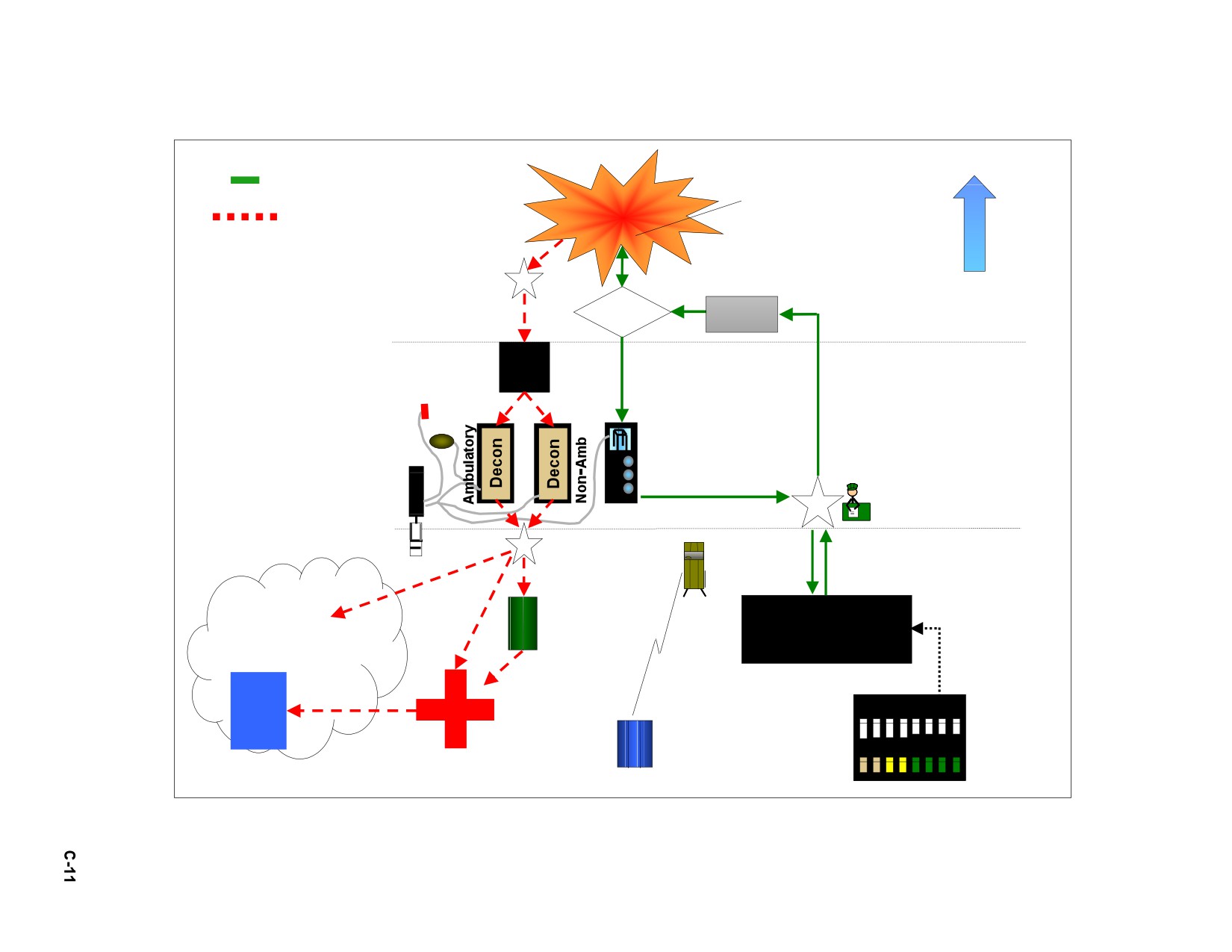
Incident Site. Organization of an incident site by the CBIRF is depicted in
Figure C-3.
C-10
CBIRF Personnel Flow
Initial
Rally Point
W
Casualty Flow
Incident Site
I
IRP
N
Hot Zone
D
Casualty
Assembly
Collection
A
Area
Point
Hot Zone
Coordinator
HZAA
Hot Zone
Decon
Triage
Water Source
HAZMAT Storage Bladder
Gross Decon /
Warm Zone
FP Decon Line
Decon Trailer
Entry/Exit
2/1
Point
B
Decon Check
Command
& Release Point
Cold Zone
Post (CP)
Casualties
Medical
Cold Zone
Checked
Casualty
CZAA
Assembly
& Released to
Evacuation
Area
Reconstitution
Community
Supplies
EMS
CBIRF
H
Consequence
Support
Management
Area
Center (CMC)
(remote)
(Civilian EMS/Hospitals)
(remote)
Figure C-3. Organization of an Incident Site
3.
USMC Staff Responsibilities in NBC Operations
To effectively defend against an NBC attack, commanders and staff officers require a
general knowledge of the characteristics, effects, and concept for employment and defense
against NBC munitions.
a.
As a staff officer, the MAGTF NBC defense officer has no authority over
subordinate commanders. NBC defense is part of all operations and NBC defense
operations are often conducted with the same assets that perform other tasks assigned to
subordinate commanders. Therefore, care must be taken when delegating authority to NBC
defense officers to ensure that their instructions and those of the commander and
operations officer do not conflict. Timeliness, accuracy, and efficiency of MAGTF command
and staff actions in an NBC environment depend on the staff’s state of preparedness. Staff
officers need to understand the characteristics and effects of NBC weapons as they relate to
the conduct of specific war-fighting functions. Staff considerations for NBC warfare must
become a routine concern in the planning and training phases of a MAGTF’s continuous
preparation for combat operations. Effective staff support in an NBC environment is
facilitated by—
(1)
Knowledge of general and special staff functions.
(2)
Knowledge of staff planning and command and staff NBC considerations.
(3)
Knowledge of NBC weapons, effects, and personnel and material
responses.
b.
The technical knowledge and skills required for NBC defense are provided by
personnel especially trained for NBC duties. These specialists form the nucleus (NBC
section) for NBC staff functions within the MAGTF. At each echelon of command, the NBC
officer and NCO assist and make recommendations to the appropriate staff officers.
C-12
Appendix D
USAF NBC DEFENSE CAPABILITIES
The USAF must be prepared to conduct prompt, sustained, and decisive combat
operations in NBC environments. An adversary’s NBC capabilities can have a
profound impact on US and multinational objectives, campaign plans, and
supporting actions and, therefore, must be taken into account in operational and
tactical planning.
1.
USAF (Organization)
This section addresses the AF structure and selected units for support of NBC defense
measures.
a.
AF NBC Defense Organization. The AF NBC defense specialists are primarily
located at all levels of the AF CE community. Additionally, there is some capability within
the AF medical community. AF NBC defense planners are located at the Air Force CE
Support Agency (AFCESA), at each major command (MAJCOM) in CE and medical staffs,
and in some numbered Air Force (NAF) staffs. These planners determine AF NBC defense
asset guidance and usage for both peace and wartime operations.
b.
Wing Operations Center. The wing operations center (WOC) is the top echelon of
AB NBCC defense operations and is lead by the senior AF commander. The primary focus
of the WOC is flight operations, AB security, and support to other forces of the AB. The
battle staff within the WOC consists of the installation commander and representatives
from the operations, logistics, support, medical groups, and additional staff sections. Other
personnel may be added or substituted as the base mission and situation dictate. The battle
staff supports the installation in assessing the situation, determining and prioritizing
mission-essential actions, and implementing the actions in priority sequence. In most cases,
this requires a team effort since all NBC decisions have a far-reaching impact and are best
made after consideration of all available information. The wing commander usually directs
the integration of all wartime functions from the WOC with direct links to other control
centers such as air defense, maintenance, and the SRC.
c.
Survival Recovery Center. The SRC is established specifically to direct all base
operability, survivability, and recovery operations. It is usually located with or near the
WOC battle staff area to allow close coordination of the recovery effort and permit the
battle staff easy viewing of SRC displays. In the SRC, the support group commanders and
their staffs form the nerve center for base recovery as they collect, analyze, prioritize,
display, and report information on the status of the base. Several control centers support
the SRC. Among these are the CE DCC, security forces, BDOC, services control center, and
centers for communications and medical support. These centers are responsible for
collecting information up and down the C2 chain and providing data to the WOC and SRC
to assist in planning and decision making. Supporting the support group commander are
representatives from each of these control centers. Also present in the SRC is a CE
readiness officer, who oversees the administration of the SRC and coordinates the activities
D-1
of the staff; an EOD representative, who coordinates the render safe procedures and bomb
removal/disposal of unexploded munitions on the AB; CE readiness personnel, who control
the NBC survey teams and advise the commander and battle staff on NBC defense matters
(to include designation of contaminated versus uncontaminated zones, MOPP
recommendations, and projected hazard duration); and a personnel representative, who
monitors personnel strength. Medical representatives in the SRC provide information on
medical treatment, NBC human health impacts (to include the impact of MOPP
declarations), work/rest cycles, and related HSS activities. The base CE (BCE) or a senior
designated representative serves as the senior advisor to the SRC commander on
engineering matters. Also in the SRC is the minimum operating strip (MOS) selection
team, which monitors damage assessment reports, plots airfield damage, and determines
possible MOS candidates.
d.
NBC Control Center. When operating in a postattack situation, some of the CE
readiness personnel in the SRC function in the NBCCC. The NBCCC—
• Obtains meteorological data from the most precise source.
• Receives reports of actual or suspected NBC attacks.
• Plots locations of NBC attacks and predicts areas of probable NBC
contamination through the use of automated hazard prediction tools and
simplified manual methods.
• Advises other bases and units of potential downwind NBC hazards.
• Develops and sends vertical and lateral NBC reports.
• Plots areas of NBC hazard after detailed monitoring is conducted.
• Advises the CE readiness personnel in the SRC.
e.
Readiness Flights. The NBC specialists within the AF are located within the CE
readiness flight of the CE squadron. The personnel in the CE readiness career field are
responsible for a wide range of functions, all directly involving the readiness status of the
CE squadron and the installation to which they are assigned. CE readiness is the
proponent for the installation disaster preparedness; nuclear, biological, chemical, and
conventional (NBCC) defense; and AB operability (passive defense) programs. CE readiness
is also the proponent for the CE squadron’s prime base engineer emergency force (BEEF)
program. As such, CE readiness personnel are responsible for various planning, training,
and equipage functions associated with assisting installation organizations prepare for and
recover from an enemy attack, natural disasters, and major accidents (to include hazardous
materials releases). CE readiness personnel maintain and operate specialized NBC defense
equipment, conduct training courses for selected members of the installation (shelter
management, disaster control group, etc.), and provide NBC defense training for all
installation personnel stationed in or deployable to medium- and high-threat areas. The
backbone of the CE readiness career field is the enlisted force because the officer is an
engineer who does not remain with the readiness flight. Rather, officers transition to
several assignments throughout the CE squadron.
D-2

2.
USAF Assets
NBC defense in the AF is focused on the three key areas of avoidance, protection, and
decontamination. All enlisted members receive training in basic NBC defense procedures
during basic military training. Additional training is provided by CE readiness flight
personnel on attack actions, warning and reporting, IPE, COLPRO, personal
decontamination, and contamination control procedures. Additionally, installations
designate personnel within their units to serve on special teams that support installation
NBC defense. These teams, known as shelter management teams (SMTs), CCTs, and
readiness support teams, provide the base with support in the areas of personnel
protection, NBC decontamination and detection, and survey operations. Table D-1 depicts
items of the NBCDE that are used by the AF.
Table D-1. NBCDE Assets (USAF)
CLOTHING ITEMS
DESCRIPTION
Aircrewman cape, CB-protective
Disposable, plastic polyethylene, 74” long.
Apron, TAP, cotton cloth, rubber coated
Rubber, synthetic overall. Toxicological agent-resistant.
Bag, CP equipment
Carryall bag.
Boots, TAP, butyl rubber: M2A1
TAP rubber boots.
Cover, helmet
CP helmet cover.
Coveralls, TAP, coated nylon, OD green
Butyl rubber coveralls.
Footwear cover, CP, rubber
CP, acid-, fire-, and jet-fuel-resistant.
Gloves, TAP, butyl rubber, type II
14” gauntlet, butyl rubber gloves.
Gloves, CP rubber, type I, butyl rubber
14” gauntlet, butyl rubber gloves.
The JSLIST is made of permeable materials and
designed to be worn as the primary CB-protective
overgarment over the duty uniform or as a duty
uniform over personal underwear. The suit is made
of a carbon bead material with an outer layer. The
outer layer is made of materials similar to the battle
JSLIST, improved CP overgarment
dress uniform (BDU) and is designed to repel water
and CB agents. The suit is a two-piece garment (coat
and trousers) with an integral hood that is compatible
with existing protective masks. The coat and trousers
are packaged, sized, and issued separately but are
worn together as an overgarment.
Oil-, chemical-, and fuel-resistant. For use with
Overshoes, black vinyl
combat boots.
Overshoes, green vinyl
Oil-resistant overall. For use with combat boots.
The fabric of the suit is made of two layers of cloth
Suit, aircrew, CP
with activated carbon spheres laminated between
CWU-66/77P
them. Comes in 24 sizes.
D-3

Table D-1. NBCDE Assets (USAF) (Continued)
CLOTHING ITEMS
DESCRIPTION
CP clothing. Level A suit is a chemical-resistant total
encapsulating suit. The operator wears a self-contained
Commercial protective suits
breathing apparatus (SCBA). Level B suit includes a
hooded chemical-resistant coverall designed to be worn
with either a respirator or SCBA.
Battle dress overgarment
Two-piece permeable garment.
Cotton drawers
White cotton undergarment (aircrew).
Cotton undershirt
White cotton undergarment (aircrew).
Glove inserts
White cotton glove inserts (aircrew).
Protective gloves, 7 mil butyl rubber
Butyl rubber aircrew gloves (sized).
Disposable footwear cover, overboot
Aircrew overboot (one size).
MASKS
DESCRIPTION
Aircrew NBC protective mask with oxygen,
Mask/filter manifold, MBU-19/P
communication, drinking tube, and integral hood
Aircrew NBC protective mask with oxygen and
Mask, MBU-13/P
communication capability
NBC-protective mask with dual clear eye lenses and
Mask, CB, M45A2
one voicemitter (front).
Facepiece consists of silicone rubber; a large, single,
Mask, MCU-2 A/P
clear urethane lens; nose cup; drinking tube; and two
voicemitters (front and side).
MASK-ASSOCIATED PARTS AND ITEMS
DESCRIPTION
Battery- and aircraft-powered blower assembly used
CQU -7/P blower and hose assembly
in conjunction with the MBU-19/P aircrew
protective mask
An adjustable suspension assembly for use with the
Suspension straps
MBU-19/P mask and CQU-7/P blower and hose
assembly. OD green.
A filter pack incorporating a CRU-60/P oxygen regulator
CRU-80/P filter assembly
and a filter pack containing the M13A2 filter set.
Grey, butyl rubber hood used in conjunction with the
HGU-41/P protective hood
MBU-13/P aircrew NBC mask.
Filter canister, C2A1/C2
Fits the M45, MCU-2A/P, and MBU-19/P masks.
Filter set, M13A2
Fits MBU-13/P mask.
Chemical-resistant rubber. Consists of a drawcord
Hood, M6A2
and shoulder straps, two eye and two air inlets,
and one speech diaphram outlet valve.
Chemical-resistant rubber. Consists of a drawcord and
Hood, MCU-2A/P (AF/USN)
underarm straps.
D-4

Table D-1. NBCDE Assets (USAF) (Continued)
DETECTORS
DESCRIPTION
Handheld immunochromatographic assays
A simple, disposable, antibody-mediated assay for
(DOD sampling kit)
identifying BW agents in suspect samples.
The M22 detects blister and nerve agents in the air as
vapors, inhalable aerosols, and vapors from the
surface of liquids. It has an audible alarm and visual
display when alarming the presence of chemical
Alarm, chemical agent, automatic, M22
agents. The M22 displays the agent as G or H series
and indicates concentration levels using an eight-digit
bar graph. The M22 may be connected to M42 remote
alarms for rapid notification of detection.
A portable, handheld instrument designed to
Chemical agent monitor
determine the hazard from nerve or blister agent
vapor present in the air.
Chemical agent detecting tubes capable of detecting
Chemical detection kit, M18A2
and identifying nerve, blister, blood, and choking agents
Handheld, manual detector designed to determine the
Detector kit, chemical agent, M256A1
hazard from nerve, blister, and blood agent vapors
present in the air.
Chemically treated paper capable of detecting and
Detector paper, chemical agent, M8
identifying nerve and blister agents in liquid form.
Chemically treated, dye-impregnated, adhesive-
backed paper issued in a 30-foot roll inside a cardboard
Detector Paper, Chemical M9
box with a metal cutter. Capable of detecting the
presence of nerve and blister contamination in liquid
form.
Self-reading pocket dosimeter designed to read gamma
Pocket dosimeter, IM 143B/PD
radiation exposure in the 0 to 600 roentgen range.
Digital RADIAC instrument that, depending on the
RADIAC set, ADM 300
probe used, measures and detects alpha, beta, x-ray,
neutron, and gamma radiation.
Portable chemical agent detector that provides an
indication of low, medium, and high concentrations of
nerve, blister, and blood agents. It has an audible
Chemical agent detector, M90
alarm and visual display when alarming the presence of
chemical agents. The M90 may be connected to its
own remote alarm in order to facilitate rapid
notification of detection.
3.
USAF Staff Responsibilities
This section addresses NBC defense responsibilities for key AB personnel/teams. The
commanders are key links to base readiness to ensure the preparedness of subordinate
units.
a.
Wing Commanders. Commanders are responsible for ensuring that the
installation possesses an effective NBC defense program for both peacetime and wartime
operations, to include in-place and deployed operations, as appropriate. This overall
responsibility includes aggressively monitoring training and equipage levels, exercise
results, and the status of all NBC defense-planning activities. Some specific responsibilities
include—
D-5
•
Assessing intelligence indicators and the operational situation to determine
when and to what extent NBC defense measures are required.
•
Establishing an NBC defense capability to include dedicated staff, specialized
equipment, IPE, comprehensive plans, and the required support
infrastructure (program reviews, assignment of additional duty personnel to
specialized teams, etc.).
•
Determining the impact NBC activities are likely to have on HN personnel
required to support mission operations. Develop feasible alternate planning
options should vulnerabilities exist.
•
Installing and maintaining an installation warning system, and working
through CE and communications organizations.
•
Ensuring that units, deployed and in place, possess the contamination control
and shelter management capabilities they need to meet mission
requirements.
•
Directing MOPP levels/variations and installation response actions based on
a balance of force survivability and mission continuation requirements. Use
split MOPP when appropriate.
•
Establishing an installation C2 network capable of effectively responding to
NBC attack situations. Oversee and direct appropriate activities from the
WOC.
b.
Group, Squadron, and Other Unit Commanders. Commanders should integrate
all facets of NBC defense into their existing combat organizations. They ensure that all unit
personnel have the necessary training and equipment to protect themselves and carry out
their missions. They should also designate appropriate personnel to perform special duties,
such as managing shelters and leading CCTs. Other responsibilities may include—
• Appointing a representative to manage and coordinate unit aspects of the
readiness program.
• Developing and implementing response procedures and checklists to support
local response plans, as well as war and contingency planning documents.
• Implementing MOPP directed by the installation commander.
• Identifying requirements and budgeting, obtaining, storing, and maintaining
unit DP operational and training equipment—including personal protection
items, detection equipment, contamination control materials, and shelter
supplies.
• Planning, managing, and operating the CPS program.
• Ensuring that deploying personnel are trained to conduct contamination
control operations and manage shelters if the deployed location’s joint
support plan requires it.
D-6
• Establishing unit control centers and identifying specialized team members,
as required.
• Establishing an NBC contamination control capability as applicable. As a
minimum, aircraft maintenance, transportation, CE, and medical activities
should have this capability.
• Supplementing shelter management, contamination control, and disaster
response force training on unit-specific procedures and equipment.
c.
Medical Staff. Medical staff provides patient care services, coordinates patient
evacuation plans, manages PVNTMED services, and ensures commanders have access to
appropriate medical information. Medical personnel also ensure that medical measures are
responsive to NBC defense needs and are integrated with nonmedical NBC defense
measures, to include preselection and health maintenance, health hazard monitoring,
sampling and analysis, health threat and risk assessment, and health hazard control and
mitigation. Other responsibilities include—
• Advising the commander on medical aspects of NBC defense.
• Providing comprehensive patient care services to the supported unit—
including diagnosis, treatment, exposure tracking and documentation, and
evacuation to higher echelons of medical care as required.
• Providing guidance on health and hygiene matters and providing self-aid and
buddy-care training to unit personnel.
• Collecting, analyzing, or shipping clinical samples for analysis of indicators of
NBC exposure.
• Administering vaccines, antibiotics, and other drugs or procedures necessary
to prevent or treat NBC casualties.
• Ensuring that public health officers monitor medical intelligence information,
conduct epidemiological studies, perform disease surveillance, determine
safety of food supplies, and advise on field sanitation.
• Ensuring that bioenvironmental engineers analyze environmental samples,
assist in operating automatic detection systems, determine potability of
water, advise on personal protective equipment (PPE), assess health risk
from threat agents and thermal stresses, and advise on waste management
and recovery activities.
d.
Shelter Management Teams. SMTs prepare shelters to provide the best possible
NBC protection, establish contamination control procedures to minimize the amount of
contamination entering the shelter, and operate automatic point detection systems.
4.
USAF Deployable NBC Defense Capabilities
There are a number of teams providing these capabilities. These teams are discussed
in the following paragraphs.
D-7
Note: Those units tasked with deploying must properly forecast for their mobility munitions
requirements as stated in AFI21-201.
a.
Nuclear, Biological, Chemical, and Conventional Threat Response Core Team,
Unit Type Code (UTC): 4F9DA. It provides limited NBCC defense supporting activities
ranging from smaller-scale contingency operations to a major theater of war (MTW) and
responses to major accidents and natural disasters for an AB with up to 1,200 personnel.
Its capabilities include preliminary risk/vulnerability assessments and threat analysis;
planning, detection, identification, warning, and reporting; decontamination; CCA; disaster
response equipment; technical data; roll-on/roll-off capability; and 463L pallets. Personnel
will deploy with their IPE, clothing, weapons, and ammunition.
b.
NBCC Threat Response Light Team, UTC: 4F9DB. It provides minimal NBCC
defense supporting activities ranging from smaller-scale contingency operations to an MTW
and responses to major accidents and natural disasters for an AB with up to 600 personnel.
Its capabilities include preliminary risk/vulnerability assessments and threat analysis;
planning, detection, identification, warning, and reporting; decontamination; CCA; disaster
response equipment; technical data; and 463L pallets. Personnel will deploy with their IPE,
clothing, weapons, and ammunition.
c.
NBCC Threat Response Sustainment Team, UTC: 4F9DC. It provides additive
technical expertise, support, and manpower to other 4F9D UTC’s in response to NBCC
defense and major accident and disaster response operations. Personnel skills include
detection, identification, warning, and reporting; decontamination; and contamination
control operations. It provides additive manpower supporting activities ranging from
smaller-scale contingency operations to an MTW. Personnel will deploy with their IPE,
clothing, weapons, and ammunition.
d.
Theater/Joint Task Force NBCC C2 Support Staff, UTC: 4F9DD. It provides a
full-spectrum threat response C2 element to support numbered Air Force, air component,
and JTF commanders with activities ranging from smaller-scale contingency operations to
an MTW. It provides situational analysis and advice on NBCC issues to the supported
commander and subordinate units and support for major accident and natural disaster
operations. Personnel will deploy with their IPE, clothing, weapons, and ammunition.
e.
CES NBCC Open-Air CCA Set, UTC: 4F9DH. It provides standardized open-air
CCA equipment to transition up to 1,200 personnel into a toxic-free rest and relief
environment. The UTC requires personnel augmentation (10 personnel) from the supported
unit for setup, maintenance, and operation.
f.
NBCC Threat Response Personnel Sustainment Team, UTC: 4F9DJ. It provides
a full-spectrum threat response manpower sustainment element (10 personnel [any AFS])
to support sustained operations in an NBCC environment and supports major accident and
natural disaster operations and recovery. The team members are trained in contamination
control, CCA operations, CPS operations, shelter team management, unit control center
operations, and NBC detection equipment operations. This team provides the deployed
commander with cadre of trained personnel to assist with the continuity of operations in all
contingency environments. The team operates under the management and direction of
3E9XX personnel to perform their assigned duties. The team is deployed in support of
D-8
UTCs 4F9DE, 4F9DG, 4F9DH, and 4F9DL. Personnel will deploy with their IPE, clothing,
weapons, and ammunition.
g.
USAF Joint Service Lightweight NBC Reconnaissance System (JSLNBCRS)
Sustainment Team, UTC: 4F9DK. It provides a 3-person team task qualified and certified
to extend operations of the 4F9DF JSLNBCRS for 24 hours. Personnel will deploy with
their IPE, clothing, weapons, and ammunition.
h. Wartime Medical Decontamination Team, UTC: FFGLA and FFGLB. It provides
medical decontamination personnel to support deployed Level II and higher medical units.
The personnel package consists of 19 personnel and is sufficient to staff a 12-hour shift. For
24-hour coverage, two personnel packages (38 personnel) are required for continuous
operations. The equipment package consists of three 463L pallets and is sufficient to
support 2 personnel packages for 30 days and decontaminate 500 patients (ambulatory and
nonambulatory) without resupply.
i.
Medical NBC Defense Team. It provides wing survivability through human
health protection by supporting medical facility operations. The team conducts NBC
surveillance and sampling and analysis for force health protection. The team leader also
advises on NBC and TIM health effects, MOPP levels, recovery activities, and human
health risk assessments.
j.
Biological Augmentation Team, UTC: FFBAT. It provides advanced diagnostic
identification capability for biological agents (whether they are naturally occurring or
induced) at the deployed location. Team members analyze samples and interpret results
using a nucleic acid-based testing platform. The two-member team deploys based on threat
assessments and may deploy along with other medical forces or individually, depending on
mission needs. It is equipped for 30 days without resupply. It is designed for laboratory
analysis and identification, not for collection, transportation, or long-term storage of
samples.
k.
Infectious Disease Team, UTC: FFHA2. It provides infectious disease support
and equipment to 25-bed or larger AF theater hospital (AFTH) facilities (generally centrally
located at one to three locations per theater). The 15-member team (consisting of one
infectious disease physician, a clinical nurse trained in infection control, six clinical nurses,
six medical technicians, and one public health technician) identifies, controls, and provides
treatment for infectious diseases in the deployed theater. The team provides public health
surveillance and specialized care for patients infected with BW agents or other infections
transmissible to other patients and personnel. The team identifies, confirms, and reports
use of BW agents. It provides consultation to PVNTMED teams and uses telemedicine
capabilities for consultation with the theater epidemiology team (UTC FFHA1), the BEEF
NBC team (UTC FFGL1), and CONUS-based medical and all biological and infectious
disease centers. It oversees operation of the six-bed patient isolation area.
l.
Infectious Disease Augmentation Team, UTC: FFHA5. It provides two personnel
to augment infectious disease and infection control support in the theater. Normally, it
deploys after UTC FFHA2 to AFTHs with more than 100 beds where a significant threat of
BW or infectious disease casualties exists. It augments the ability to identify, control, and
D-9
provide treatment for infectious diseases and BW agents in the theater. It provides
intratheater infectious disease consultation.
m. Theater Epidemiology Team, UTC: FFHA1. It provides theater-level PVNTMED
support to the AF component command or the JTF surgeon. It provides medical,
environmental, and occupational health threat assessments, and it provides support for
disease outbreak investigations. It recommends PVNTMED countermeasures and disease
surveillance systems. It requires base operating support. The team consists of six personnel
and equipment.
n. AF Radiation Assessment Team (AFRAT), UTCs: FFRA1, FFRA2, FFRA3. The
AFRAT nuclear incident response force (NIRF) teams are globally responsive specialty
assets that provide specialized field radiological monitoring and consequence management
support to the assigned theater medical authority. The team measures, analyzes, and
interprets radiological measurements in and around the affected area. The team’s
capabilities include radiological dose rate measurements, air concentrations, ground
deposition, and plume modeling. They provide expert guidance on the type and degree of
radiological hazard that deployed forces face. Based on these assessments,
recommendations are made to optimize FP in light of achieving mission objectives. Typical
deployment scenarios could include consequence management operations from nuclear
weapons accidents (broken arrows), nuclear reactor accidents (faded giants), and terrorist
use of radiological dispersion weapons or improvised nuclear devices or humanitarian
assistance operations to countries that have experienced a nuclear exchange.
o.
Aircrew Life Support (ALS) Aircrew CCA Processing Team, UTC: 9 ALCW.
Provides additive technical expertise, support, and manpower to aviation UTCs in support
of flight operations in an NBCC environment. Personnel skills include detection,
identification, warning and reporting, decontamination and contamination control
operations specifically targeted to aircrew. UTC provides 10 ALS personnel. Its personnel
will deploy with their IPE and clothing.
D-10
Appendix E
NBC THREAT CONDITIONS
The US armed forces, the civilian population, and US allies must contend with an
NBC and TIM threat that is global across the range of military operations. The
proliferation of NBC-capable nations in all contingency regions and the availability of TIM,
present additional hazard conditions thereby increasing the likelihood of US forces being
direct or inadvertent targets of an attack. These attacks may range from limited use in
MOOTW to planned targeting in support of military operations. As part of the threat
assessment, the NBC staff (in coordination with intelligence and operations officers) can
provide recommendations to the commander. The assessment could come in the form of a
recommendation to increase a unit’s NBC defense posture and the NBC threat status
assessment process described below, which provides a tool that outlines suggested actions
to be undertaken to implement increased unit readiness.
1.
NBC Threat Status
a.
Introduction. US forces may not have to carry NBCDE (such as MOPP) based on
the initial threat estimate. If the threat conditions were to change and indicators were
present to suggest the possible use of NBC agents by the threat forces, NBCDE would be
deployed forward, such as a forward air operating base, a division support area (DSA), or a
brigade support area (BSA). These stocks may be prepalletized for immediate deployment
by aircraft to the affected unit, if required. However, this decision must be made based on
available aircraft or other transportation systems. This could be done so the forces would
not have to carry the MOPP ensemble. The minimum NBC threat status can be set at an
MSC (i.e., division/separate brigade, group, wing, etc.) and is a flexible system determined
by the most current enemy situation, as depicted by the continuously updated IPB process.
This allows commanders to increase the threat status as conditions change in their AO.
However, the procedure used within the AO remains consistent with key reference
documents such as OPLANs, standing orders, combatant commander’s guidance, SOPs, etc.
Threat status governs the initial deployment of NBC assets (such as equipment or units)
and the positioning of those assets in the operational area. The NBC threat status serial
numbers are for planning purposes; the actual NBC threat status serial numbers used in a
theater of operation may vary from the information furnished in this appendix. For
example, these numbers may be substituted for a color code (example colors could include
serial 1 = white, serial 2 = yellow, serial 3 = red, serial 4 = black). It does, however, require
NBC personnel to stay abreast of the intelligence situation.
b.
Serial 1. The adversary does not possess any NBCDE, is not trained in NBC
defense or employment, and does not possess the capability to employ NBC warfare agents
or systems. Further, the adversary is not expected to gain access to such weapons, and if
they were able to gain these weapons, it is considered highly unlikely that the weapons
would be employed against US forces. Suggested guidance could include the following:
E-1
(1)
Under this status, a deploying force would not have to carry NBCDE nor
decontamination assets. However, protective masks should be carried.
(2)
NBC personnel should concentrate efforts on monitoring intelligence
information for NBC threat indicators.
c.
Serial 2. The adversary has an offensive NBC capability and has received
training in defense and employment techniques, but the assessment is no indication of the
use of NBC weapons in the immediate future. This indication may be based on whether
NBC munitions are dispersed or deployed or the stated objectives and intent of opposing
forces. Unit actions may include the following:
(1)
All personnel carry their individual defense equipment or CDE stockpiles
are identified and would be readily available for deployment to the operational area if the
threat status should increase.
(2)
Systems with NBC reconnaissance capability deploy to the area of
operations to provide a monitoring capability.
(3)
NBC personnel continue to concentrate their efforts on planning and
analysis for threat indicators.
d.
Serial 3. The adversary is equipped and trained in NBC defense and employment
techniques. NBC weapons and employment systems are readily available. NBC weapons
have been employed in other areas of the theater. Continued employment of NBC weapons
is considered probable in the immediate future. Indicators could be NBC munitions
deployed to either field storage sites or firing units, enemy troops wearing or carrying
protective equipment, NBC reconnaissance elements observed with conventional
reconnaissance units, and/or NBC decontamination elements moved forward. Unit actions
may include the following:
(1)
Unit NBCDE should be both prepalletized and located forward for easy
access or issued to the personnel responsible for use within the unit.
(2)
Individuals should be at MOPP O, MOPP 1, or MOPP 2.
(3)
Units should also erect CP shelters if the tactical situation permits.
Personnel and equipment should be kept under cover as much as possible to protect them
from contamination.
(4)
CDMs should be sent to subordinate units.
(5)
NBC defense units (decontamination and NBC reconnaissance assets)
should be deployed as part of the force structure.
(6)
Detection and monitoring (such as CAM) equipment should be issued to the
operators.
(7)
Units should fill M11 and M13 DAPs and mount on vehicles.
E-2