FM 3-0 OPERATIONS (FEBRUARY 2008) - page 4
Chapter 7
z
Physical isolation, which is difficult to achieve, but easier to assess. An isolated enemy loses
freedom of movement and access to support.
z
Psychological isolation, which, while difficult to assess, is a vital enabler of disintegration. The
most important indicators include the breakdown of enemy morale and the alienation of a
population from the enemy.
7-40. Isolation alone rarely defeats an enemy. However, it complements and reinforces other defeat
mechanisms’ effects. Offensive operations often focus on destroying personnel and equipment. They may
use maneuver to dislocate forces. However, these effects multiply when combined with isolating the enemy
from sources of physical and moral support.
Stability Mechanisms
7-41. Commanders use stability mechanisms to visualize how to employ the stability element of full
spectrum operations. A stability mechanism is the primary method through which friendly forces affect
civilians in order to attain conditions that support establishing a lasting, stable peace. As with defeat
mechanisms, combinations of stability mechanisms produce complementary and reinforcing effects that
accomplish the mission more effectively and efficiently than single mechanisms do alone. The four stability
mechanisms are—
z
Compel.
z
Control.
z
Influence.
z
Support.
7-42. Compel means to use, or threaten to use, lethal force to establish control and dominance, effect
behavioral change, or enforce compliance with mandates, agreements, or civil authority. The
appropriate and discriminate use of lethal force reinforces efforts to stabilize a situation, gain consent, or
ensure compliance. Conversely, misusing force can adversely affect an operation’s legitimacy. Legitimacy
is essential to producing effective compliance. Compliance depends on how the local populace and others
perceive the force’s ability to exercise lethal force to accomplish the mission.
7-43. In the context of stability mechanisms, control means to impose civil order. It includes securing
borders, routes, sensitive sites, population centers, and individuals. It also involves physically occupying
key terrain and facilities. Control includes activities related to disarmament, demobilization, and
reintegration, as well as security sector reform. (Chapter 3 discusses the security sector.)
7-44. *In the context of stability mechanisms, influence means to alter the opinions and attitudes of a
civilian population through inform and influence activities, presence, and conduct. It aims to change
behaviors through nonlethal means. Influence is as much a product of public perception as a measure of
success. It reflects the ability of friendly forces to operate within the cultural and societal norms of the local
populace while accomplishing the mission. Influence requires legitimacy. Developing legitimacy requires
time, patience, and coordinated, cooperative efforts across the operational area.
7-45. In the context of stability mechanisms, support means to establish, reinforce, or set the
conditions necessary for the other instruments of national power to function effectively. It requires
coordination and cooperation with civilian agencies as they assess the immediate needs of failed or failing
states and plan for, prepare for, or execute responses to them. In extreme circumstances, support may
require committing considerable resources for a protracted period. This commitment may involve
establishing or reestablishing the institutions required for normal life. These typically include a legitimate
civil authority, market economy, and criminal justice system supported by government institutions for
health, education, and civil service.
Using Defeat and Stability Mechanisms
7-46. Defeat and stability mechanisms complement center of gravity analysis. This analysis reveals the
intrinsic vulnerabilities of a given center of gravity. Defeat mechanisms describe ways to isolate or destroy
it. For example, a decisive point may be temporarily neutralized by dislocating it. The enemy may commit
significant combat power to regain that capability, presenting an opportunity to destroy committed enemy
7-8
FM 3-0, C1
22 February 2011
Operational Art
forces. By combining dislocation and destruction, the commander can effectively eliminate the capability.
Thus, the effect on the center of gravity is permanent, and friendly forces retain freedom of action and
initiative.
7-47. The approach reflects the commander’s visualization for applying combinations of defeat and
stability mechanisms. An effective approach, direct or indirect, focuses operations toward achieving the
end state.
DECISIVE POINTS
7-48. A decisive point is a geographic place, specific key event, critical factor, or function that, when acted
upon, allows commanders to gain a marked advantage over an adversary or contribute materially to
achieving success (JP 3-0). Decisive points are not centers of gravity; they are keys to attacking or
protecting them. Decisive points apply at both the operational and tactical levels. At the operational level,
they typically provide direct use against a center of gravity. At the tactical level, they tie directly to mission
accomplishment.
7-49. Some decisive points are geographic. Examples include port facilities, distribution networks and
nodes, and bases of operations. Specific events and elements of an enemy force may also be decisive
points. Examples of such events include commitment of the enemy operational reserve and reopening a
major oil refinery. A common characteristic of decisive points is their major importance to a center of
gravity. A decisive point’s importance requires the enemy to commit significant resources to defend it. The
loss of a decisive point weakens a center of gravity and may expose more decisive points.
7-50. Decisive points have a different character during operations dominated by stability or civil support.
These decisive points may be less tangible and more closely associated with important events and
conditions. For example, during operations after Hurricane Andrew in 1992, reopening schools was a
decisive point. Other examples include—
z
Repairing a vital water treatment facility.
z
Establishing a training academy for national security forces.
z
Securing an election.
z
Quantifiably reducing crime.
None of these examples is purely physical. Nonetheless, any may be vital to establishing conditions for
transitioning to civil authority. In an operation dominated by stability or civil support, this transition is
typically an end state condition.
7-51. Commanders identify the decisive points that offer the greatest advantage against centers of gravity.
Decisive points that enable commanders to seize, retain, or exploit the initiative are crucial. Controlling
them is essential to mission accomplishment. Enemy control of a decisive point may exhaust friendly
momentum, force early culmination, or allow an enemy counterattack. Decisive points shape the design of
operations. They help commanders select clearly decisive, attainable objectives that directly contribute to
achieving the end state.
LINES OF OPERATIONS AND LINES OF EFFORT
7-52. Lines of operations and lines of effort bridge the broad concept of operations across to discreet
tactical tasks. They link objectives to the end state. Continuous assessment gives commanders the
information required to revise and adjust lines of operations and effort. Subordinate commanders reallocate
resources accordingly.
7-53. Commanders may describe an operation along lines of operations, lines of effort, or a combination of
both. Irregular warfare, for example, typically requires a deliberate approach using lines of operations
complemented with lines of effort; the combination of them may change based on the conditions within the
operational area. An operational approach using both lines of operations and lines of effort reflects the
characteristics and advantages of each. With this approach, commanders synchronize and sequence actions,
deliberately creating complementary and reinforcing effects. The lines then converge on the well-defined,
commonly understood end state outlined in the commander’s intent.
22 February 2011
FM 3-0, C1
7-9
Chapter 7
Lines of Operations
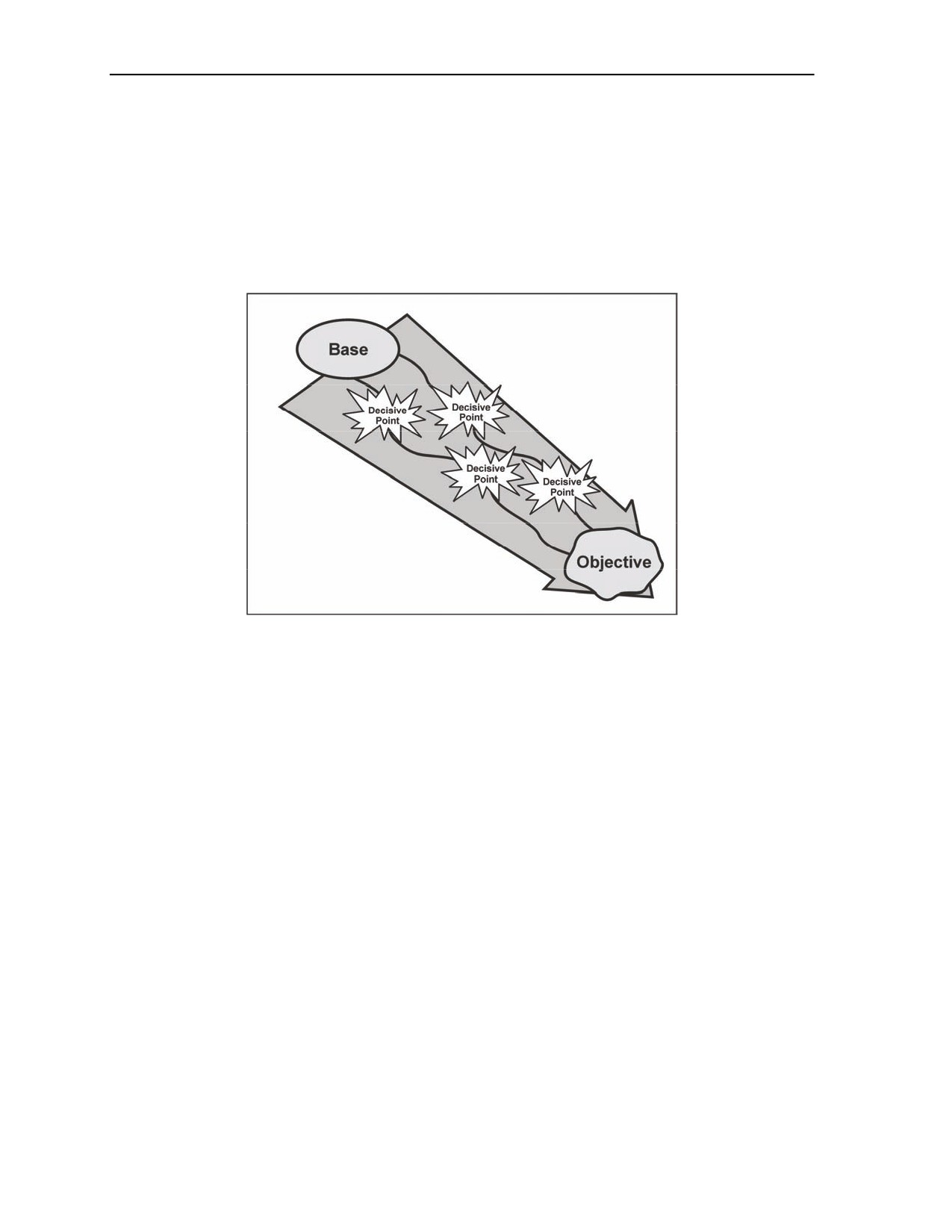
7-54. A line of operations is a line that defines the directional orientation of a force in time and space
in relation to the enemy and links the force with its base of operations and objectives. (See figure 7-4.)
Lines of operations connect a series of decisive points that lead to control of a geographic or force-oriented
objective. Operations designed using lines of operations generally consist of a series of actions executed
according to a well-defined sequence. Major combat operations are typically designed using lines of
operations. These lines tie offensive and defensive tasks to the geographic and positional references in the
operational area. Commanders synchronize activities along complementary lines of operations to achieve
the end state. Lines of operations may be either interior or exterior.
Figure 7-4. Example of a line of operations
7-55. A force operates on interior lines when its operations diverge from a central point. Interior lines
usually represent a central position, where a friendly force can reinforce or concentrate its elements faster
than the enemy force can reposition. With interior lines, friendly forces are closer to separate enemy forces
than the enemy forces are to one another. Interior lines allow an isolated force to mass combat power
against a specific portion of an enemy force by shifting capabilities more rapidly than the enemy can react.
7-56. A force operates on exterior lines when its operations converge on the enemy. Operations on
exterior lines offer opportunities to encircle and annihilate an enemy force. However, these operations
typically require a force stronger or more mobile than the enemy.
7-57. The relevance of interior and exterior lines depends on the time and space relationship between the
opposing forces. Although an enemy force may have interior lines with respect to the friendly force, this
advantage disappears if the friendly force is more agile and operates at a higher tempo. (Paragraph 7-71
defines tempo.) Conversely, if a smaller friendly force maneuvers to a position between larger but less agile
enemy forces, the friendly force can better defeat them in detail before they can react effectively.
Lines of Effort
7-58. A line of effort is a line that links multiple tasks and missions using the logic of purpose—cause
and effect—to focus efforts toward establishing operational and strategic conditions. Lines of effort
are essential to long-term planning when positional references to an enemy or adversary have little
relevance. In operations involving many nonmilitary factors, lines of effort may form the only way to link
tasks, effects, conditions, and the desired end state. Lines of effort help commanders visualize how military
capabilities can support the other instruments of national power. They prove particularly invaluable when
used to achieve unity of effort in operations involving multinational forces and civilian organizations,
where unity of command is elusive, if not impractical.
7-10
FM 3-0, C1
22 February 2011
Operational Art
7-59. Commanders use lines of effort to describe how they envision their operations establishing the more
intangible end state conditions. These lines of effort show how individual actions relate to each other and to
achieving the end state. Ideally, lines of effort combine the complementary, long-term effects of stability or
civil support tasks with the cyclic, short-term events typical of offensive or defensive tasks.
7-60. Commanders at all levels may use lines of effort to develop missions and tasks and to allocate
resources. Commanders may designate one line of effort as the decisive operation and others as shaping
operations. Commanders synchronize and sequence related actions along multiple lines of effort. Seeing
these relationships helps commanders assess progress toward achieving the end state as forces perform
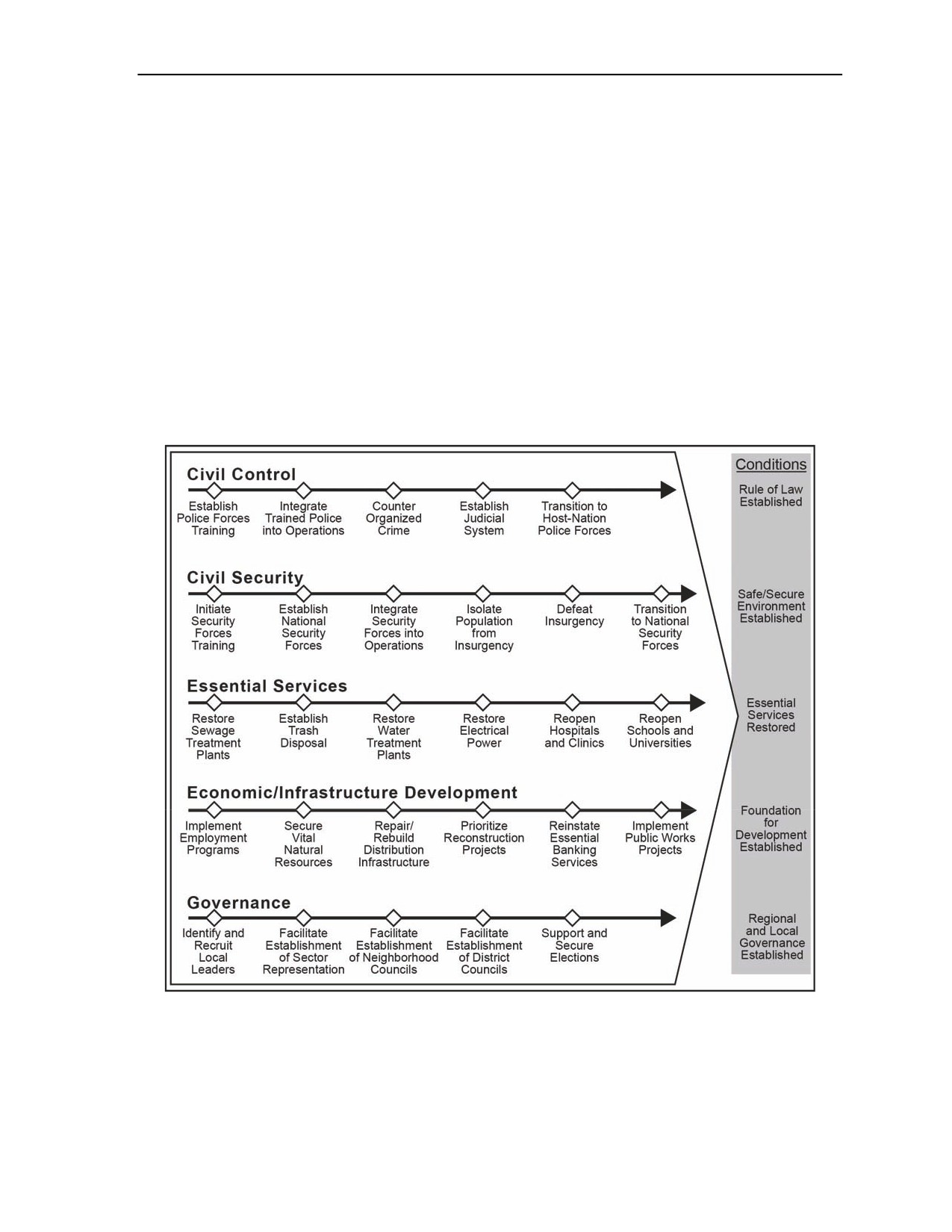
tasks and accomplish missions.
7-61. Commanders typically visualize stability and civil support operations along lines of effort. For
stability operations, commanders may consider linking primary stability tasks to their corresponding
Department of State post-conflict technical sectors. (See Chapter 3 for a discussion on stability tasks.)
These stability tasks link military actions with the broader interagency effort across the levels of war.
Figure 7-5 provides an example. A full array of lines of effort might include offensive and defensive lines,
as well as a line for inform and influence activities. Inform and influence activities typically produce effects
across multiple lines of effort.
Figure 7-5. Example of lines of effort (stability)
7-62. The five post-conflict technical sectors described in chapter 3 may become lines of effort, as
illustrated in figure
7-5. They provide a framework for analyzing an operational environment where
stability operations are the major focus. They identify the breadth and depth of relevant civilian agency
tasks and emphasize the relationships among them. Using them as lines of effort can help as Army forces in
collaborative interagency planning and dialog. Planning and dialog leads to developing lines of effort that
22 February 2011
FM 3-0, C1
7-11
Chapter 7
synchronize the effects of the instruments of national power. However, the sectors are not themselves lines
of effort and are not the default solution for every operation. During a civil support mission, lines of effort
normally portray support in response to a disaster or terrorist attack, support to law enforcement, and other
support as required.
7-63. As operations progress, commanders may modify the lines of effort after assessing conditions and
collaborating with multinational military and civilian partners. Lines of effort typically focus on integrating
the effects of military operations with those of other instruments of national power to support the broader
effort. Each operation, however, differs. Commanders develop and modify lines of effort to keep operations
focused on achieving the end state, even as the situation changes.
Combining Lines of Operations and Lines of Effort
7-64. Commanders use both lines of operations and lines of effort to connect objectives to a central,
unifying purpose. Lines of operations portray the more traditional links between objectives, decisive points,
and centers of gravity. However, lines of operations do not project the long-term plan beyond defeating
enemy forces and seizing terrain. Combining lines of operations and lines of effort allows commanders to
include nonmilitary activities in their long-term plan. This combination helps commanders incorporate
stability tasks that establish the end state conditions into the operation. It allows commanders to consider
the less tangible aspects of the operational environment where the other instruments of national power
dominate. Commanders can then visualize concurrent and post-conflict stability activities. Making these
connections relates the tasks and purposes of the elements of full spectrum operations with joint effects
identified in the long-term plan.
OPERATIONAL REACH
7-65. Operational reach is the distance and duration across which a unit can successfully employ military
capabilities
(JP
3-0). It reflects the ability to achieve success through a well-conceived operational
approach. Operational reach is a tether; it is a function of protection, sustainment, endurance, and relative
combat power. The limit of a unit’s operational reach is its culminating point. (See paragraph 7-85.) It
balances the natural tension between endurance, momentum, and protection. The following actions can
extend operational reach:
z
Forward positioning of forces, reserves, bases, and support capabilities along lines of operations.
z
Employing weapons systems with extended ranges, such as missiles.
z
Phasing an operation to focus limited resources.
z
Leveraging supply discipline, contracting, and host-nation support. Maximizing distribution
network efficiency.
z
Leveraging joint capabilities.
7-66. Endurance refers to the ability to employ combat power anywhere for protracted periods. It stems
from the ability to create, protect, and sustain a force, regardless of the distance from its base and the
austerity of the environment. Endurance involves anticipating requirements and making the most effective,
efficient use of available resources. Their endurance gives Army forces their campaign capability. It makes
permanent the changing effects of other capabilities.
7-67. Momentum comes from seizing the initiative and executing high-tempo operations that overwhelm
enemy resistance. Commanders control momentum by maintaining focus and pressure. They set a tempo
that prevents exhaustion and maintains sustainment. A sustainable tempo extends operational reach.
Commanders maintain momentum by anticipating and transitioning rapidly between primary tasks or—
when necessary—the elements of full spectrum operations. Sometimes commanders push the force to its
culminating point to take maximum advantage of an opportunity. For example, exploitations and pursuits
often involve pushing all available forces to the limit of their endurance to capitalize on momentum and
retain the initiative.
7-68. Protection is an important contributor to operational reach. Commanders anticipate how enemy
actions might disrupt operations and then determine the protection capabilities required to maintain
sufficient reach. Protection closely relates to endurance and momentum. It also contributes to the
7-12
FM 3-0, C1
22 February 2011
Operational Art
commander’s ability to extend operations in time and space. The protection warfighting function helps
commanders maintain the deploying force’s integrity and combat power.
7-69. An operational pause is a deliberate halt taken to extend operational reach or prevent
culmination. Commanders may execute an operational pause for several reasons. These may include the
force being close to culmination, the decisive operation failing, or the end state changing. In planning an
operation, commanders carefully balance initiative, momentum, reach, and culmination to avoid
unnecessary operational pauses. In protracted operations, however, they may have to execute operational
pauses to extend operational reach. Commanders carefully plan, prepare for, and execute these pauses to
prevent losing the initiative. During an operational pause, commanders retain the initiative by using
shaping operations to keep pressure on enemy forces. These shaping operations confuse the enemy while
friendly forces generate combat power for the decisive operation.
7-70. Commanders and staffs balance operational reach, direct and indirect approaches, and operational
pauses to ensure Army forces accomplish their missions before culminating. Commanders continually
strive to extend operational reach. They assess friendly and enemy force status, anticipate culmination, and
plan operational pauses if necessary. Commanders have studied and reflected on the challenge of
conducting and sustaining operations over long distances and times. History contains many examples of
operations hampered by inadequate operational reach. Achieving the desired end state requires forces with
the operational reach to establish and maintain the end state conditions.
TEMPO
7-71. Tempo is the relative speed and rhythm of military operations over time with respect to the
enemy. It reflects the rate of military action. Controlling tempo helps commanders keep the initiative
during combat operations or rapidly establish a sense of normalcy during humanitarian crises. During
operations dominated by the offense and defense, commanders normally seek to maintain a higher tempo
than the enemy; rapid tempo can overwhelm an enemy’s ability to counter friendly actions. During
operations dominated by stability and civil support, commanders act quickly to control events. By acting
faster than the situation deteriorates, commanders can change the dynamics of a crisis and restore stability.
The capability to act quickly enhances flexibility and operational adaptability across the spectrum of
conflict.
7-72. Commanders control tempo throughout the conduct of operations. First, they formulate operations
that stress the complementary and reinforcing effects of simultaneous and sequential operations. They
synchronize those operations in time and space to degrade enemy capabilities throughout the operational
area. Second, commanders avoid unnecessary engagements. This practice includes bypassing resistance
that appears at times and places commanders do not consider decisive. Third, through mission command
they enable subordinates to exercise initiative and act independently. Controlling tempo requires both
audacity and patience: audacity initiates the actions needed to develop a situation; patience allows a
situation to develop until the force can strike at the decisive time and place. Ultimately, the goal is
maintaining a tempo appropriate to retaining the initiative and achieving the end state.
7-73. Army forces expend more energy and resources when operating at a high tempo. Commanders assess
the force’s capacity to operate at a high tempo based on its performance and available resources. An
effective operational design varies tempo throughout an operation to increase endurance while maintaining
appropriate speed and momentum. There is more to tempo than speed. While speed can be important,
commanders balance speed with endurance.
SIMULTANEITY AND DEPTH
7-74. Simultaneity and depth extend operations in time and space. Simultaneity has two components. Both
depend on depth to attain lasting effects and maximum synergy. Simultaneous combinations of offensive,
defensive, and stability tasks overwhelm enemy forces and their will to resist while setting the conditions
for a lasting, stable peace. Simultaneous actions across the depth of the operational area place more
demands on enemy forces than enemy forces can effectively respond to them. Operations combining depth
and simultaneity achieve a synergy that paralyzes enemy forces. This prevents them from reacting
appropriately, inducing their early culmination. Similarly, stability or civil support tasks—executed in
22 February 2011
FM 3-0, C1
7-13
Chapter 7
depth with simultaneous defensive and offensive tasks when necessary—establish control of the situation
throughout the operational area.
7-75. Simultaneity also refers to the concurrent effects operations produce at the tactical, operational, and
strategic levels. Tactical commanders fight the battles and engagements that accomplish objectives in
accordance with the operational commander’s intent. Operational commanders set the conditions for
tactical success in battles within a campaign or major operation. These victories, in turn, create the
conditions that define the end state. Because of the complex interaction among the levels of war,
commanders cannot be concerned only with events at their respective echelon. Success requires them to
understand how their actions affect the operations of commanders at all other echelons.
7-76. Depth is the extension of operations in time, space, and resources. Operations in depth can disrupt
the enemy’s decision cycle. These operations contribute to protecting the force by destroying enemy
capabilities before the enemy can use them. Commanders balance their forces’ tempo to produce
simultaneous results throughout their operational area. To achieve simultaneity, commanders establish a
higher tempo to target enemy capabilities located at the limit of a force’s operational reach.
7-77. Simultaneity and depth are inherent in full spectrum operations. Army forces execute simultaneous
operations across vast areas. They force the enemy to react to numerous friendly actions—potential and
actual—throughout the operational area. Army forces use combined arms, advanced information systems,
and joint capabilities to increase the depth of their operations. The complementary effects produced by
executing simultaneous operations in depth overwhelm enemy forces, forcing them to respond piecemeal or
not at all.
7-78. Commanders extend the depth of operations through joint integration. When determining an
operation’s depth, commanders consider their own capabilities, as well as joint capabilities and limitations.
They use these capabilities to ensure actions executed at operational depth receive robust and uninterrupted
support. Commanders sequence and synchronize operations in time and space to achieve simultaneous
effects throughout the operational area.
PHASING AND TRANSITIONS
7-79. A phase is a planning and execution tool used to divide an operation in duration or activity. A
change in phase usually involves a change of mission, task organization, or rules of engagement.
Phasing helps in planning and controlling and may be indicated by time, distance, terrain, or an
event. The ability of Army forces to extend operations in time and space, coupled with a desire to dictate
tempo, often presents commanders with more objectives and decisive points than the force can engage
simultaneously. At both the operational and tactical levels, this situation may require commanders and
staffs to consider sequencing operations. Sequencing involves integrating capabilities and synchronizing
actions. This is accomplished through phasing.
7-80. Phasing is key to arranging complex operations. It describes how the commander envisions the
overall operation unfolding. It is the logical expression of the commander’s visualization in time. Within a
phase, a large portion of the force executes similar or mutually supporting activities. Achieving a specified
condition or set of conditions typically marks the end of a phase.
7-81. Simultaneity, depth, and tempo are vital to full spectrum operations. However, they cannot always be
attained to the degree desired. In such cases, commanders limit the number of objectives and decisive
points engaged simultaneously. They deliberately sequence certain actions to maintain tempo while
focusing combat power at the decisive point in time and space. Commanders combine simultaneous and
sequential operations to establish the end state conditions.
7-82. Phasing can extend operational reach. Only when the force lacks the capability to accomplish the
mission in a single action do commanders phase the operation. Each phase should strive to—
z
Focus effort.
z
Concentrate combat power in time and space at a decisive point.
z
Deliberately and logically accomplish its objectives.
7-14
FM 3-0, C1
22 February 2011
Operational Art
7-83. Transitions mark a change of focus between phases or between the ongoing operation and execution
of a branch or sequel. Shifting priorities between the elements of full spectrum operations—such as from
offense to stability—also involves a transition. Transitions require planning and preparation well before
their execution to maintain the momentum and tempo of operations. The force is vulnerable during
transitions, and commanders establish clear conditions for their execution. Transitions may create
unexpected opportunities; they may also make forces vulnerable to enemy threats.
7-84. An unexpected change in conditions may require commanders to direct an abrupt transition between
phases. In such cases, the overall composition of the force remains unchanged despite sudden changes in
mission, task organization, and rules of engagement. Typically, task organization evolves to meet changing
conditions; however, transition planning must also account for changes in mission. Commanders attuned to
sudden changes can better adapt their forces to dynamic conditions. They continuously assess the situation
and task-organize and cycle their forces to retain the initiative. They strive to achieve changes in emphasis
without incurring an operational pause.
CULMINATION
7-85. The culminating point is that point in time and space at which a force no longer possesses the
capability to continue its current form of operations. Culmination represents a decisive shift in relative
combat power. It is relevant to both attackers and defenders at each level of war. In the offense, the
culminating point occurs when the force cannot continue the attack and must assume a defensive posture or
execute an operational pause. In the defense, it occurs when the force can no longer defend itself and must
withdraw or risk destruction.
7-86. With stability, the culminating point is more difficult to identify. Three conditions can result in
culmination:
z
Being too dispersed to adequately control the situation.
z
Being unable to provide the necessary security.
z
Lacking required resources.
7-87. During civil support, culmination is unlikely. However, culmination may occur if forces must
respond to more catastrophic events than they can manage simultaneously. That situation results in
culmination due to exhaustion.
7-88. Culmination may be a planned event. In such cases, the concept of operations predicts which part of
the force will culminate, and the task organization includes additional forces to assume the mission.
Culmination is expected and measures are in place to mitigate it. Culmination is typically caused by direct
combat actions or higher echelon resourcing decisions. It relates to the force’s ability to generate and apply
combat power and is not a lasting condition. Tactical units may be reinforced or reconstituted to continue
operations.
RISK
7-89. Risk, uncertainty, and chance are inherent in all military operations. When commanders accept risk,
they create opportunities to seize, retain, and exploit the initiative and achieve decisive results. Risk is a
potent catalyst that fuels opportunity. The willingness to incur risk is often the key to exposing enemy
weaknesses that the enemy considers beyond friendly reach. Understanding risk requires calculated
assessments coupled with boldness and imagination. Successful commanders assess and mitigate risk
continuously throughout the operations process.
7-90. Inadequate planning and preparation recklessly risks forces. It is equally rash to delay action while
waiting for perfect intelligence and synchronization. Reasonably estimating and intentionally accepting risk
is fundamental to conducting operations and essential to mission command. Successfully applying military
force requires commanders who assess the risks, analyze and minimize the hazards, and execute a plan that
accounts for those hazards. Experienced commanders balance audacity and imagination with risk and
uncertainty to strike at a time and place and in a manner wholly unexpected by enemy forces. This is the
essence of surprise. It results from carefully considering and accepting risk. (FMs 3-90 and 6-0 discuss
tactical risk.)
22 February 2011
FM 3-0, C1
7-15
Chapter 7
7-91. Operational art balances risk and opportunity to create and maintain the conditions necessary to
seize, retain, and exploit the initiative and achieve decisive results. During execution, opportunity is
fleeting. The surest means to create opportunity is to accept risk while minimizing hazards to friendly
forces. A good operational approach considers risk and uncertainty equally with friction and chance. The
final plans and orders then provide the flexibility commanders need to take advantage of opportunity in
complex, dynamic environments.
SUMMARY
7-92. Operational art is a cognitive aspect of operations supported by design. While the character of
conflict changes with time, the violent and chaotic nature of warfare does not. The essence of military art
remains timeless. Operational art—the creative expression of informed vision to integrate ends, ways, and
means across the levels of war—is fundamental to the Army’s ability to seize, retain, and exploit the
initiative.
7-16
FM 3-0, C1
22 February 2011
Chapter 8
Strategic and Operational Reach
Army forces require strategic and operational reach to deploy and immediately con-
duct operations anywhere with little or no advanced notice. Contemporary operations
require Army forces that can deploy rapidly and conduct extended campaigns. These
operations require Soldiers and units with campaign and expeditionary capabilities.
Commanders and organizations require proficiency at force projection, protection,
and sustainment. Soldiers require an expeditionary mindset to prepare them for short-
notice deployments into uncertain, often austere environments. This chapter discusses
how strategic and operational reach affects deploying and employing Army forces. It
also addresses principles to maximize the effects of both factors. Strategic and opera-
tional reach depend on basing in and near the joint operations area.
STRATEGIC REACH
8-1. Strategic reach provides the capability to operate against complex, adaptive threats operating any-
where. The distance across which the Nation can project decisive military power is its strategic reach. This
multifaceted reach combines joint military capabilities—air, land, maritime, space, special operations, and
cyber—with those of the other instruments of national power. Land force capabilities complement those of
other Services. Army forces increase the joint force’s strategic reach by securing and operating bases far
from the United States. However, Army forces depend on joint-enabled force projection capabilities to de-
ploy and sustain them across intercontinental distances. In some cases, land forces use strategic lift to de-
ploy directly to an operational area. In many instances, land operations combine direct deployment with
movements from intermediate staging bases located outside the operational area. Access to bases and sup-
port depends upon the Nation’s diplomatic and economic power as well as its military capabilities.
OPERATIONAL MANEUVER FROM STRATEGIC DISTANCE
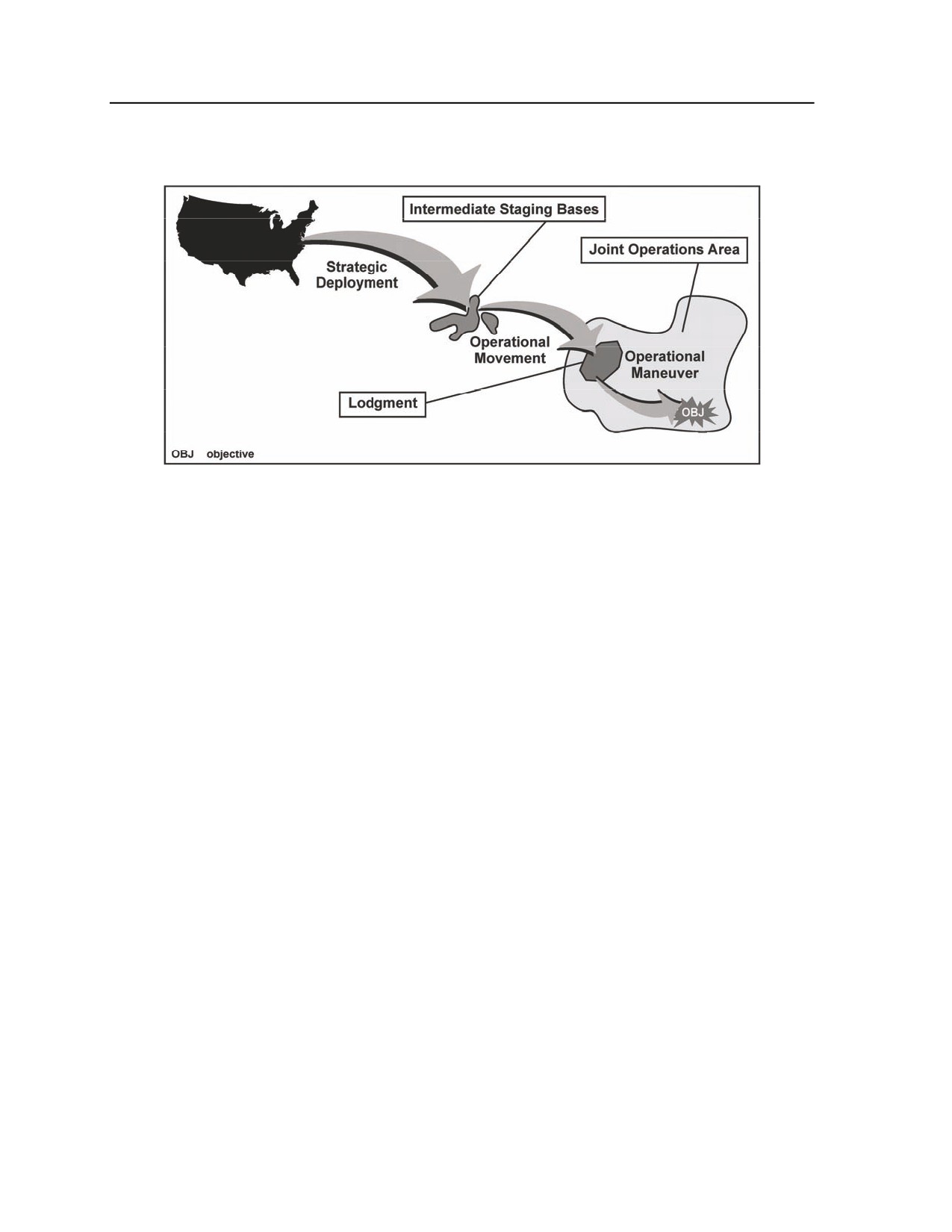
8-2. Operational maneuver from strategic distance combines global force projection with maneuver
against an operationally significant objective. (See figure 8-1, page 8-2.) It requires strategic reach that de-
ploys maneuverable landpower to an operational area in a position of advantage. It requires enough opera-
tional reach to execute operations decisively without an operational pause. It aims to avoid operational
pauses associated with various requirements. Then it can secure and defend a lodgment; develop a base;
and receive, stage, and build up forces. Success demands full integration of all available joint means. Thus,
it combines force projection with land maneuver to operational depth in an integrated, continuous opera-
tion.
8-3. The most difficult form of operational maneuver from strategic distance projects forces directly from
the United States into an operational area. Examples of this operational maneuver from strategic distance
include the 1942 invasion of North Africa and the 1992 intervention in Somalia. These operations involved
forces projected from the United States with near simultaneous employment. In many cases, operational
maneuver from strategic distance requires intermediate staging bases. From these bases, operational ma-
neuver develops using intratheater lift and Army maneuver capabilities. The availability of bases in a re-
gion extends the strategic reach of Army forces; bases near the operational area increase opportunities for
successful operational maneuver from strategic distance.
8-4. Today, joint forces combine strategic and operational reach in forcible and unopposed entry opera-
tions. These operations originate from outside the operational area, often using intermediate staging bases.
27 February 2008
FM 3-0
8-1
Chapter 8
Entry operations conducted across intercontinental distances capitalize on the U.S. dominance of the air
and sea. Exploiting these capabilities creates a dilemma for opponents.
Figure 8-1. Operational maneuver from strategic distance
EXPEDITIONARY CAMPAIGNS
8-5. Expeditionary campaigns are inherently joint operations founded in strategic reach. During crisis re-
sponse, joint force commanders rely on contingency expeditionary forces to respond promptly. The Army
provides ready forces able to operate in any environment—from urban areas to remote, rural regions. The
early introduction of credible, capable forces into the operational area is an important strategic factor. This
action may quickly convince a potential enemy that further aggression would be too costly. Initial-entry
forces need to be interoperable and flexible enough to contend with unforeseen circumstances. Immedi-
ately upon arrival, initial-entry forces require enough combat power to establish and protect lodgments and
begin simultaneous shaping operations. The ability to fight at the outset is crucial to successfully executing
the campaign plan. A tailored force able to dominate situations early enables the joint force commander to
seize, retain, and exploit the initiative.
8-6. Expeditionary forces are configured for immediate employment in austere conditions. They do not
depend on existing infrastructure; they adapt as the situation evolves. Commanders prepare to transition to
sustained operations, assimilate new capabilities into force packages for follow-on operations, or disperse
until otherwise required. As a result, the force composition varies throughout the campaign based on the
dominant element of full spectrum operations.
8-7. If campaign objectives are not achieved swiftly, the Army provides forces tailored with the combat
power and endurance needed for sustained, joint-enabled land operations. Endurance gives the force the
ability to employ combat power anywhere for protracted periods. It allows Army forces to preserve the
gains of initial operations and complements and reinforces efforts of the other instruments of national
power to achieve strategic objectives. It has strategic, operational, and tactical implications. Strategically,
endurance requires the Army to sustain the generation and rotation of forces sufficient to meet combatant
commanders’ requirements. At the operational level, endurance requires Army forces with enough opera-
tional reach to complement other joint capabilities throughout a campaign. Tactically, endurance is a func-
tion of sustainment and protection. Endurance gives Army forces their campaign capability.
EXPEDITIONARY ARMY FORCES
8-8. Expeditionary forces impose a distinct set of dynamics on Army forces. The Army depends on stra-
tegic deployment assets provided by U.S. Transportation Command. Combatant commanders establish
8-2
FM 3-0
27 February 2008
Strategic and Operational Reach
priorities to move forces into the operational area. That decision drives allocation of strategic lift and ulti-
mately determines how rapidly Army forces deploy. Although U.S. strategic lift assets exceed those of any
other nation, the available lift is rarely sufficient to deploy a large force at one time. Consequently, com-
manders carefully select elements of the force and the sequence in which they deploy to match operational
area conditions. This is force tailoring.
8-9. The range of possible employment options complicates training. Army forces cannot train for every
possible mission; they train for full spectrum operations with emphasis on the most likely mix of tasks.
When designated as an expeditionary force for specific missions, Army forces modify training and prepare
for that contingency. The volatile nature of crises requires Army forces to simultaneously train, deploy, and
execute. Commanders conduct operations with initial-entry forces while assembling and preparing follow-
on forces. Commanders carefully consider and accept risk to create opportunity. Such actions help them to
seize the initiative during deployment and in the early phases of an operation, even when the situation is
not fully developed. Balancing these dynamics is an art mastered through knowledge, experience, and
judgment.
8-10. The payoff for mastering expeditionary operations is mission accomplishment. Fast deploying and
expansible Army forces give joint force commanders the means to introduce operationally significant land
forces into a crisis on short notice. These expeditionary capabilities arm joint force commanders with a pre-
emptive ability to deter, shape, fight, and win. Rapidly deployed expeditionary force packages provide
immediate options for seizing or retaining the operational initiative. They complement and reinforce the
other Services with modular capability packages that can be swiftly tailored, deployed, and employed.
8-11. Expeditionary capability is more than the ability to deploy quickly. It requires deploying the right
mix Army forces to the right place at the right time. It provides joint force commanders with the ability to
deter an adversary or take decisive action if deterrence fails. Forward deployed units, forward positioned
capabilities, peacetime military engagement, and force projection—from anywhere in the world—all con-
tribute to expeditionary capabilities.
8-12. When deployed, every unit regardless of type generates combat power and contributes to the success
of the mission. From the operational and tactical perspectives, commanders ensure deployed Army forces
possess sufficient combat power to overwhelm any potential enemy. The art of expeditionary warfare bal-
ances the ability to mass the effects of lethal combat systems against the requirements to deploy, support,
and sustain units that use those systems. Commanders assemble force packages that maximize the lethality
of initial-entry forces. These packages remain consistent with both the mission and the requirement to pro-
ject, employ, and sustain the force. Commanders tailor follow-on forces to increase both the lethality and
operational reach of the entire force.
8-13. Deploying commanders integrate protection capabilities to ensure mission accomplishment and in-
crease the survivability of deployed Army forces. As with the other attributes, lift constraints and time
available complicate the situation. Survivability requires astutely assessing operational risk. In many opera-
tions, rapid offensive action to seize the initiative may better protect forces than massive defenses around
lodgments.
8-14. Generating and sustaining combat power is fundamental to expeditionary warfare. Commanders rec-
oncile competing requirements. Army forces must accomplish joint force commander-assigned missions,
yet they require adequate sustainment for operations extended in time and space. Commanders tailor force
packages to provide sufficient sustainment capability without amassing a significant sustainment footprint.
Wherever possible, commanders augment sustainment capacity with host-nation and contracted support.
FORCE PROJECTION
8-15. Force projection is the military component of power projection. It is a central element of the National
Military Strategy. Speed is paramount; force projection is a race between friendly forces and the enemy or
situation. The side that achieves an operational capability first can seize the initiative. Thus, it is not the
velocity of individual stages or transportation means that is decisive; it is a combat-ready force deployed to
an operational area before the enemy is ready or the situation deteriorates further.
27 February 2008
FM 3-0
8-3
Chapter 8
8-16. Commanders visualize force projection as one seamless operation. Deployment speed sets the initial
tempo of military activity in the operational area. Commanders understand how speed, sequence, and mix
of deploying forces affect their employment options. They see how their employment concept establishes
deployment requirements. Commanders prioritize the mix of forces on the time-phased force and deploy-
ment list to project forces into the operational area where and when required. Singular focus on the land
component, to the exclusion of complementary joint capabilities, may result in incorrect force sequencing.
Commanders exercise active and continuous command and control during force projection. They couple it
with detailed reverse-sequence planning. Thus, the right forces and the right support are available and
ready to conduct decisive operations when needed.
8-17. Force projection encompasses five processes: mobilization, deployment, employment, sustainment,
and redeployment. These processes occur in a continuous, overlapping, and repeating sequence throughout
an operation. Force projection operations are inherently joint. They require detailed planning and synchro-
nization. Sound, informed decisions made early on force projection may determine a campaign’s success.
8-18. Each process has its own criteria. Mobilization is the process of bringing the armed forces to a state
of readiness in response to a contingency. Deployment is the relocation of forces and materiel to a desired
operational area in response to a contingency. It has four supporting components: predeployment activities;
fort to port; port to port; and reception, staging, onward movement, and integration. Employment is the
conduct of operations to support a joint force commander. Sustainment involves providing and maintaining
personnel and materiel required to support a joint force commander. Redeployment is the return of forces
and materiel to the home or mobilization station. (JP 4-05 discusses mobilization. JP 3-0 discusses em-
ployment. JP 4-0 and FM 4-0 discuss sustainment. FMI 3-35 discusses deployment and redeployment of
brigade-sized and larger Army forces. FM 4-01.011 discusses deployment and redeployment of battalion-
sized and smaller Army forces.)
8-19. Reception, staging, onward movement, and integration focuses on reassembling deploying units and
quickly integrating them into the force. It is the critical link between deploying and employing forces. Ef-
fective reception, staging, onward movement, and integration establishes a smooth flow of personnel,
equipment, and materiel from ports of debarkation through employment as reassembled, mission-capable
forces. A deploying unit is most vulnerable between its arrival and operational employment, so protection
is vital.
8-20. Closing the force more rapidly can be achieved by increasing the allocation of strategic lift or by us-
ing pre-positioned equipment sets. (FMs 100-17-1 and 100-17-2 discuss pre-positioned operations.) Com-
batant commanders and Army Service component commands can also facilitate force projection through an-
ticipatory actions. Actions may include positioning equipment or troops in anticipated crisis areas, securing
access to ports and airfields, enhancing capabilities of regional forces, and protecting areas critical to force
projection.
ENTRY OPERATIONS
8-21. Whenever possible, Army forces seek an unopposed entry, either unassisted or assisted by the host
nation. An assisted entry requires host-nation cooperation. In an assisted entry, initial-entry forces are tai-
lored to deploy efficiently and transition quickly to follow-on operations. Reception, staging, onward
movement, and integration focuses on cooperating with the host nation to expedite moving units from ports
of debarkation to tactical assembly areas. In an unassisted entry, no secure facilities for deploying forces
exist. The joint force commander deploys balanced force packages with enough combat power to secure an
adequate lodgment and perform reception, staging, onward movement, and integration. Force sequencing
for an unassisted entry is similar to that of a forcible entry.
8-22. A forcible entry is the seizing and holding of a military lodgment in the face of armed opposition
(JP 3-18). Once the assault force seizes the lodgment, it normally defends to retain it while the joint force
commander rapidly deploys additional combat power by air and sea. When conditions are favorable, joint
force commanders may combine a forcible entry with other offensive operations in a coup de main. This
action can achieve the strategic objectives in a simultaneous major operation. The 1989 invasion of
8-4
FM 3-0
27 February 2008
Strategic and Operational Reach
Panama is an example of operational maneuver from strategic distance in a coup de main. (JP 3-18 con-
tains joint doctrine for forcible entry operations.)
8-23. A forcible entry operation can be by parachute, air, or amphibious assault. The Army’s parachute as-
sault and air assault forces provide a formidable forcible entry capability. Marine forces specialize in am-
phibious assault; they also conduct air assaults as part of amphibious operations. Special operations forces
play an important role in forcible entry; they conduct shaping operations in support of conventional forces
while executing their own missions. These capabilities permit joint force commanders to overwhelm en-
emy anti-access measures and quickly insert combat power. The entry force either resolves the situation or
secures a lodgment for delivery of larger forces by aircraft or ships. The three forms of forcible entry pro-
duce complementary and reinforcing effects that help joint force commanders to seize the initiative early in
a campaign.
8-24. Forcible entry operations are inherently complex and always joint. Often only hours separate the
alert from deployment. The demands of simultaneous deployment and employment create a distinct set of
dynamics. Operations are carefully planned and rehearsed in training areas and marshalling areas. Person-
nel and equipment are configured for employment upon arrival without reception, staging, onward move-
ment, and integration.
OPERATIONAL REACH
8-25. The challenge of conducting and sustaining operations over long distances has been studied and
theorized upon since the time of Sun Tzu. History is replete with examples of campaigns plagued with in-
adequate operational reach. To achieve the desired end state, forces must possess the necessary operational
reach to establish and maintain conditions that define success. (See paragraphs 6-74 through 6-79.)
8-26. Extending operational reach is a paramount concern for commanders. Commanders and staffs in-
crease operational reach through deliberate, focused operational design. Operational design balances the
natural tension between tempo, endurance, and risk to increase operational reach. A well-designed opera-
tion, executed skillfully, extends operational reach several ways, to include—
z
Setting the tempo of the operation for greater endurance.
z
Phasing the operation to assure its continuation.
z
Employing the support of other Service components to relieve land forces of tasks that detract
from the decisive operation.
BASING
8-27. A base is a locality from which operations are projected or supported (JP 1-02). The base includes
installations and facilities that provide sustainment. Bases may be joint or single Service areas. Command-
ers often designate a specific area as a base and assign responsibility for protection and terrain management
within the base to a single commander. Units located within the base are under the tactical control of the
base commander. Within large bases, controlling commanders may designate base clusters for mutual pro-
tection and command and control.
8-28. Strategic and operational reach initially depend upon basing in the area of responsibility and over-
flight rights. Both affect how much combat power can be generated in the operational area in a prescribed
period. The arrangement and location of forward bases (often in austere, rapidly emplaced configurations)
complement the ability of Army forces to conduct sustained, continuous combat operations to operational
depth. Though typically determined by diplomatic and political considerations, basing and overflight rights
are essential to the commander’s ability to maintain or extend operational reach.
8-29. Army forces typically rely on a mix of intermediate staging bases, lodgments (subsequently devel-
oped into bases), and forward operating bases to deploy and employ landpower simultaneously to
operational depth. These bases establish and maintain strategic reach for deploying forces and ensure suffi-
cient operational reach to extend operations in time and space.
27 February 2008
FM 3-0
8-5
Chapter 8
INTERMEDIATE STAGING BASES
8-30. An intermediate staging base is a tailorable, temporary location used for staging forces, sustainment
and/or extraction into and out of an operational area (JP 3-35). At the intermediate staging base, units are
unloaded from intertheater lift, reassembled and integrated with their equipment, and then moved by intra-
theater lift into the operational area. The theater army commander provides extensive support to Army
forces transiting the base. The combatant commander may designate the theater army commander to com-
mand the base or provide a headquarters suitable for the task. Intermediate staging bases are established
near, but normally not in, the operational area. They often are located in the supported combatant com-
mander’s area of responsibility. For land forces, intermediate staging bases may be located in the opera-
tional area. However, they are always established outside the range of enemy fires and beyond the enemy’s
political sphere of influence.
8-31. Ideally, secure bases will be available in the operational area, but conditions that compel deployment
may also negate the availability of a secure lodgment in the operational area. Under these circumstances, an
intermediate staging base may serve as the principal staging base for entry operations. In cases where the
force needs to secure a lodgment, an intermediate staging base may be critical to success.
8-32. Normally, intermediate staging bases exploit advantages of existing, developed capabilities, serving
as efficient transfer points from high-volume commercial carriers to various tactical, intratheater transport
means. However, these bases are transshipment points. Using them can increase handling requirements and
deployment times and may require infrastructure development to support further deployment. When decid-
ing whether to operate through an intermediate staging base, commanders carefully weigh advantages
gained by deploying through the base against operational risks, such as time, lift, and distance, associated
with its utilization.
LODGMENTS
8-33. A lodgment is a designated area in a hostile or potentially hostile territory that, when seized and held,
makes the continuous landing of troops and materiel possible and provides maneuver space for subsequent
operations (JP 3-18). Identifying and preparing the initial lodgment significantly influences the conduct of
an operation. Lodgments should expand to allow easy access to strategic sealift and airlift, offer adequate
space for storage, facilitate transshipment of supplies and equipment, and be accessible to multiple lines of
communications. Typically, deploying forces establish lodgments near key points of entry in the opera-
tional area that offer central access to air, land, and sea transportation hubs.
8-34. A lodgment rarely possesses the ideal characteristics desired to support ongoing operations. Improv-
ing the base capabilities may require early deployment of maintenance, engineering, or terminal operations
forces. Contracting, medical, legal, and financial management personnel who arrange access to host-nation
capabilities should be among the first to deploy. The requirement for adequate sustainment capability is es-
pecially critical in the operation’s early stages when building combat power is critical and forces are most
vulnerable. Identifying infrastructure requirements during mission analysis is essential to establishing the
lodgment and enhancing the responsiveness and sustainability of the force.
8-35. The time required to establish a lodgment depends on the extent and condition of the civil and mili-
tary infrastructure present in the operational area. In areas where extensive industrial facilities and distribu-
tion capabilities exist and are available, commanders can initiate operations without a significant pause. In
the absence of these capabilities, the force cannot begin operations until a sufficient base is established and
operational. In more austere environments, where initial entry and operations may be severely restricted,
acquisition, construction, and sustainment capabilities should arrive early in the deployment flow. This ar-
rival improves the lodgment, generates and moves forces and materiel into forward operating bases, and es-
tablishes operational-level sustainment capability to support the deployed force.
FORWARD OPERATING BASES
8-36. A forward operating base is an area used to support tactical operations without establishing full
support facilities. Such bases may be used for an extended time. During protracted operations, they may
8-6
FM 3-0
27 February 2008
Strategic and Operational Reach
be expanded and improved to establish a more permanent presence. The scale and complexity of the base,
however, directly relates to the size of the force required to maintain it. A large base with extensive
facilities requires a much larger security force than a smaller, austere base. Commanders weigh whether to
expand and improve a forward operating base against the type and number of forces available to secure it,
the expected length of the forward deployment, and the force’s sustainment requirements.
8-37. Forward operating bases extend and maintain the operational reach of Army forces, providing secure
locations from which to conduct and sustain operations. They not only enable extending operations in time
and space; they also contribute to the overall endurance of the force, an essential element of the Army’s
campaign capability. Forward operating bases allow forward-deployed forces to reduce operational risk,
maintain momentum, and avoid culmination.
8-38. Typically, forward operating bases are established adjacent to a regional distribution hub, such as a
large airfield (civilian or military), rail terminal, or major highway junction. This facilitates movement into
and out of the operational area while providing a secure location through which to distribute personnel,
equipment, and supplies. However, forward operating bases may be located in austere locations with
limited access to transportation infrastructure. In such cases, units will not likely maintain the base for
extended periods.
*SUPPORT AREAS
8-39. When lodgment or a forward operating base expands to include clusters of sustainment,
headquarters, and other supporting units, commanders may designate a support area. A support area is a
specific surface area designated by the echelon commander to facilitate the positioning, employment,
and protection of resources required to sustain, enable, and control tactical operations. Within a
support area, a designated unit such as a brigade combat team or maneuver enhancement brigade provides
area security, terrain management, movement control, mobility support, clearance of fires, and required
tactical combat forces. This allows sustainment units to focus on their primary function.
SUMMARY
8-40. The Nation requires joint forces with strategic and operational reach. Given the enormous distances
that separate the United States from regions in conflict, this imposes serious challenges for the Army. Even
within the United States, the distances between Army installations and major cities often span a significant
expanse. Above all, the Army must remain versatile, adapting not only to the particular requirements of
different areas of responsibility, but also to limitations in strategic and intratheater lift. Available lift will
never equal an ideal land force’s requirements. Joint force commanders need some landpower deployed
very rapidly and capable of seizing a lodgment. They also need follow-on land forces able to persevere for
months and years as the campaign progresses. Once deployed, Army commanders develop and protect
bases and lines of communications in austere areas. These house not only Soldiers but also joint and
multinational forces. With each base, Army forces extend their operational reach throughout the operational
area, using landpower to multiply the effectiveness of American military power.
22 February 2011
FM 3-0, C1
8-7
Appendix A
Principles of War and Operations
The nine principles of war represent the most important nonphysical factors that af-
fect the conduct of operations at the strategic, operational, and tactical levels. The
Army published its original principles of war after World War I. In the following
years, the Army adjusted the original principles modestly as they stood the tests of
analysis, experimentation, and practice. The principles of war are not a checklist.
While they are considered in all operations, they do not apply in the same way to
every situation. Rather, they summarize characteristics of successful operations. Their
greatest value lies in the education of the military professional. Applied to the study
of past campaigns, major operations, battles, and engagements, the principles of war
are powerful analysis tools. Joint doctrine adds three principles of operations to the
traditional nine principles of war.
OBJECTIVE
Direct every military operation toward a clearly defined, decisive, and attainable objective.
A-1. The principle of objective drives all military activity. At the operational and tactical levels, objective
ensures all actions contribute to the higher commander’s end state. When undertaking any mission, com-
manders should clearly understand the expected outcome and its impact. Combat power is limited; com-
manders never have enough to address every aspect of the situation. Objectives allow commanders to focus
combat power on the most important tasks. Clearly stated objectives also promote individual initiative.
These objectives clarify what subordinates need to accomplish by emphasizing the outcome rather than the
method. Commanders should avoid actions that do not contribute directly to achieving the objectives.
A-2. The purpose of military operations is to accomplish the military objectives that support achieving the
conflict’s overall political goals. In offensive and defensive operations, this involves destroying the enemy
and his will to fight. The objective of stability or civil support operations may be more difficult to define;
nonetheless, it too must be clear from the beginning. Objectives must contribute to the operation’s purpose
directly, quickly, and economically. Each tactical operation must contribute to achieving operational and
strategic objectives.
A-3. Military leaders cannot dissociate objective from the related joint principles of restraint and legiti-
macy, particularly in stability operations. The amount of force used to obtain the objective must be prudent
and appropriate to strategic aims. Means used to accomplish the military objective must not undermine the
local population’s willing acceptance of a lawfully constituted government. Without restraint or legitimacy,
support for military action deteriorates, and the objective becomes unobtainable.
OFFENSIVE
Seize, retain, and exploit the initiative.
A-4. As a principle of war, offensive is synonymous with initiative. The surest way to achieve decisive re-
sults is to seize, retain, and exploit the initiative. Seizing the initiative dictates the nature, scope, and tempo
of an operation. Seizing the initiative compels an enemy to react. Commanders use initiative to impose
their will on an enemy or adversary or to control a situation. Seizing, retaining, and exploiting the initiative
are all essential to maintain the freedom of action necessary to achieve success and exploit vulnerabilities.
It helps commanders respond effectively to rapidly changing situations and unexpected developments.
27 February 2008
FM 3-0
A-1
Appendix A
A-5. In combat operations, offensive action is the most effective and decisive way to achieve a clearly de-
fined objective. Offensive operations are the means by which a military force seizes and holds the initiative
while maintaining freedom of action and achieving decisive results. The importance of offensive action is
fundamentally true across all levels of war. Defensive operations shape for offensive operations by econo-
mizing forces and creating conditions suitable for counterattacks.
MASS
Concentrate the effects of combat power at the decisive place and time.
A-6. Commanders mass the effects of combat power in time and space to achieve both destructive and
constructive results. Massing in time applies the elements of combat power against multiple decisive points
simultaneously. Massing in space concentrates the effects of combat power against a single decisive point.
Both can overwhelm opponents or dominate a situation. Commanders select the method that best fits the
circumstances. Massed effects overwhelm the entire enemy or adversary force before it can react effec-
tively.
A-7. Army forces can mass lethal and nonlethal effects quickly and across large distances. This does not
imply that they accomplish their missions with massed fires alone. Swift and fluid maneuver based on situ-
ational understanding complements fires. Often, this combination in a single operation accomplishes what
formerly took an entire campaign.
A-8. In combat, commanders mass the effects of combat power against a combination of elements critical
to the enemy force to shatter its coherence. Some effects may be concentrated and vulnerable to operations
that mass in both time and space. Other effects may be spread throughout depth of the operational area,
vulnerable only to massing effects in time.
A-9. Mass applies equally in operations characterized by civil support or stability. Massing in a stability
or civil support operation includes providing the proper forces at the right time and place to alleviate suf-
fering and provide security. Commanders determine priorities among the elements of full spectrum opera-
tions and allocate the majority of their available forces to the most important tasks. They focus combat
power to produce significant results quickly in specific areas, sequentially if necessary, rather than dispers-
ing capabilities across wide areas and accomplishing less.
ECONOMY OF FORCE
Allocate minimum essential combat power to secondary efforts.
A-10. Economy of force is the reciprocal of mass. Commanders allocate only the minimum combat power
necessary to shaping and sustaining operations so they can mass combat power for the decisive operation.
This requires accepting prudent risk. Taking calculated risks is inherent in conflict. Commanders never
leave any unit without a purpose. When the time comes to execute, all units should have tasks to perform.
MANEUVER
Place the enemy in a disadvantageous position through the flexible application of combat power.
A-11. Maneuver concentrates and disperses combat power to keep the enemy at a disadvantage. It achieves
results that would otherwise be more costly. Effective maneuver keeps enemy forces off balance by mak-
ing them confront new problems and new dangers faster than they can counter them. Army forces gain and
preserve freedom of action, reduce vulnerability, and exploit success through maneuver. Maneuver is more
than just fire and movement. It includes the dynamic, flexible application of all the elements of combat
power. It requires flexibility in thought, plans, and operations. In operations dominated by stability or civil
support, commanders use maneuver to interpose Army forces between the population and threats to secu-
rity and to concentrate capabilities through movement.
A-2
FM 3-0
27 February 2008
Principles of War and Operations
UNITY OF COMMAND
For every objective, ensure unity of effort under one responsible commander.
A-12. Applying a force’s full combat power requires unity of command. Unity of command means that a
single commander directs and coordinates the actions of all forces toward a common objective. Cooperation
may produce coordination, but giving a single commander the required authority is the most effective way
to achieve unity of effort.
A-13. The joint, interagency, intergovernmental, and multinational nature of unified action creates situa-
tions where the commander does not directly control all organizations in the operational area. In the ab-
sence of command authority, commanders cooperate, negotiate, and build consensus to achieve unity of ef-
fort.
SECURITY
Never permit the enemy to acquire an unexpected advantage.
A-14. Security protects and preserves combat power. Security results from measures a command takes to
protect itself from surprise, interference, sabotage, annoyance, and threat surveillance and reconnaissance.
Military deception greatly enhances security.
SURPRISE
Strike the enemy at a time or place or in a manner for which he is unprepared.
A-15. Surprise is the reciprocal of security. It is a major contributor to achieving shock. It results from tak-
ing actions for which the enemy is unprepared. Surprise is a powerful but temporary combat multiplier. It
is not essential to take enemy forces completely unaware; it is only necessary that they become aware too
late to react effectively. Factors contributing to surprise include speed, operations security, and asymmetric
capabilities.
SIMPLICITY
Prepare clear, uncomplicated plans and clear, concise orders to ensure thorough understanding.
A-16. Plans and orders should be simple and direct. Simple plans and clear, concise orders reduce misun-
derstanding and confusion. The situation determines the degree of simplicity required. Simple plans exe-
cuted on time are better than detailed plans executed late. Commanders at all levels weigh potential bene-
fits of a complex concept of operations against the risk that subordinates will fail to understand or follow it.
Orders use clearly defined terms and graphics. Doing this conveys specific instructions to subordinates
with reduced chances for misinterpretation and confusion.
A-17. Multinational operations put a premium on simplicity. Differences in language, doctrine, and culture
complicate them. Simple plans and orders minimize the confusion inherent in this complex environment.
The same applies to operations involving interagency and nongovernmental organizations.
ADDITIONAL PRINCIPLES OF JOINT OPERATIONS
A-18. In addition to these nine principles, JP 3-0 adds three principles of operations—perseverance, legiti-
macy, and restraint. Together with the principles of war, these twelve make up the principles of joint opera-
tions.
PERSEVERANCE
Ensure the commitment necessary to attain the national strategic end state.
A-19. Commanders prepare for measured, protracted military operations in pursuit of the desired national
strategic end state. Some joint operations may require years to reach the desired end state. Resolving the
underlying causes of the crisis may be elusive, making it difficult to achieve conditions supporting the end
27 February 2008
FM 3-0
A-3
Appendix A
state. The patient, resolute, and persistent pursuit of national goals and objectives often is a requirement for
success. This will frequently involve diplomatic, informational, and economic measures to supplement
military efforts. In the end, the will of the American public, as expressed through their elected officials and
advised by expert military judgment, determines the duration and size of any military commitment.
A-20. Army forces’ endurance and commanders’ perseverance are necessary to accomplish long-term mis-
sions. A decisive offensive operation may swiftly create conditions for short-term success. However, pro-
tracted stability operations, executed simultaneously with defensive and offensive tasks, may be needed to
achieve the strategic end state. Commanders balance their desire to enter the operational area, accomplish
the mission quickly, and depart against broader requirements. These include the long-term commitment
needed to achieve national goals and objectives.
LEGITIMACY
Develop and maintain the will necessary to attain the national strategic end state.
A-21. For Army forces, legitimacy comes from three important factors. First, the operation or campaign
must be conducted under U.S. law. Second, the operation must be conducted according to international
laws and treaties recognized by the United States, particularly the law of war. Third, the campaign or op-
eration should develop or reinforce the authority and acceptance for the host-nation government by both
the governed and the international community. This last factor is frequently the decisive element.
A-22. Legitimacy is also based on the will of the American people to support the mission. The American
people’s perception of legitimacy is strengthened if obvious national or humanitarian interests are at stake.
Their perception also depends on their assurance that American lives are not being placed at risk needlessly
or carelessly.
A-23. Other interested audiences may include foreign nations, civil populations in and near the operational
area, and participating multinational forces. Committed forces must sustain the legitimacy of the operation
and of the host-nation government, where applicable. Security actions must balance with the need to main-
tain legitimacy. Commanders must consider all actions potentially competing for strategic and tactical re-
quirements. All actions must exhibit fairness in dealing with competing factions where appropriate. Le-
gitimacy depends on the level of consent to the force and to the host-nation government, the people’s
expectations, and the force’s credibility.
RESTRAINT
Limit collateral damage and prevent the unnecessary use of force.
A-24. Restraint requires careful and disciplined balancing of security, the conduct of military operations,
and the desired strategic end state. Excessive force antagonizes those friendly and neutral parties involved.
Hence, it damages the legitimacy of the organization that uses it while potentially enhancing the legitimacy
of any opposing party. The rules of engagement must be carefully matched to the strategic end state and the
situation. Commanders at all levels ensure their personnel are properly trained in rules of engagement and
quickly informed of any changes. Rules of engagement may vary according to national policy concerns but
should always be consistent with the inherent right of self-defense.
A-25. Restraint is best achieved when rules of engagement issued at the beginning of an operation address
a range of plausible situations. Commanders should consistently review and revise rules of engagement as
necessary. Additionally, commanders should carefully examine them to ensure that the lives and health of
Soldiers are not needlessly endangered. National concerns may lead to different rules of engagement for
multinational participants; commanders must be aware of national restrictions imposed on force partici-
pants.
A-4
FM 3-0
27 February 2008
Appendix B
Command and Support Relationships
Command and support relationships provide the basis for unity of command and
unity of effort in operations. Command relationships affect Army force generation,
force tailoring, and task organization. Commanders use Army support relationships
when task-organizing Army forces. All command and support relationships fall
within the framework of joint doctrine. JP 1 discusses joint command relationships
and authorities.
CHAIN OF COMMAND
B-1. The President and Secretary of Defense exercise authority and control of the armed forces through
two distinct branches of the chain of command as described in JP 1. (See figure B-1 [taken from JP 1],
page B-2.) One branch runs from the President, through the Secretary of Defense, to the combatant com-
manders for missions and forces assigned to combatant commands. The other branch runs from the Presi-
dent through the Secretary of Defense to the secretaries of the military departments. This branch is used for
purposes other than operational direction of forces assigned to the combatant commands. Each military de-
partment operates under the authority, direction, and control of the secretary of that military department.
These secretaries exercise authority through their respective Service chiefs over Service forces not as-
signed to combatant commanders. The Service chiefs, except as otherwise prescribed by law, perform their
duties under the authority, direction, and control of the secretaries to whom they are directly responsible.
B-2. The typical operational chain of command extends from the combatant commander to a joint task
force commander, then to a functional component commander or a Service component commander. Joint
task forces and functional component commands, such as a land component, comprise forces that are nor-
mally subordinate to a Service component command but have been placed under the operational control
(OPCON) of the joint task force, and subsequently to a functional component commander. Conversely, the
combatant commander may designate one of the Service component commanders as the joint task force
commander or as a functional component commander. In some cases, the combatant commander may not
establish a joint task force, retaining operational control over subordinate functional commands and Ser-
vice components directly.
B-3. Under joint doctrine, each joint force includes a Service component command that provides adminis-
trative and logistic support to Service forces under OPCON of that joint force. However, Army doctrine
distinguishes between the Army component of a combatant command and Army components of subordi-
nate joint forces. Under Army doctrine, Army Service component command (ASCC) refers to the Army
component assigned to a combatant command. There is only one ASCC within a combatant command’s
area of responsibility. The Army components of all other joint forces are called ARFORs. An ARFOR is
the Army Service component headquarters for a joint task force or a joint and multinational force. It
consists of the senior Army headquarters and its commander (when not designated as the joint force com-
mander) and all Army forces that the combatant commander subordinates to the joint task force or places
under the control of a multinational force commander. The ARFOR becomes the conduit for most Service-
related issues and administrative support. The Army Service component command may function as an
ARFOR headquarters when the combatant commander does not exercise command and control through
subordinate joint force commanders.
27 February 2008
FM 3-0
B-1

Appendix B
Figure B-1. Chain of command branches
B-4. The Secretary of the Army directs the flow of administrative control (ADCON). (See paragraphs
B-25 through B-27.) Administrative control for Army units within a combatant command normally extends
from the Secretary of the Army through the ASCC, through an ARFOR, and then to Army units assigned
or attached to an Army headquarters within that joint command. However, administrative control is not tied
to the operational chain of command. The Secretary of the Army may redirect some or all Service
B-2
FM 3-0
27 February 2008
Command and Support Relationships
responsibilities outside the normal ASCC channels. In similar fashion, the ASCC may distribute some ad-
ministrative responsibilities outside the ARFOR. Their primary considerations are the effectiveness of
Army forces and the care of Soldiers.
COMBATANT COMMANDS
B-5. The Unified Command Plan establishes combatant commanders’ missions and geographic responsi-
bilities. Combatant commanders directly link operational military forces to the Secretary of Defense and
the President. The Secretary of Defense deploys troops and exercises military power through the combatant
commands. Six combatant commands have areas of responsibility. They are the geographic combatant
commands. Each geographic combatant command has (or will have) an assigned ASCC. For doctrinal pur-
poses, these commands become “theater armies” to distinguish them from the similar organizations as-
signed to functional component commands. The geographic combatant commands and their theater armies
are—
z
U.S. Northern Command (U.S. Army, North—USARNORTH).
z
U.S. Southern Command (U.S. Army, South—USARSO).
z
U.S. Central Command (U.S. Army, Central—USARCENT).
z
U.S. European Command (U.S. Army, Europe—USAREUR).
z
U.S. Pacific Command (U.S. Army, Pacific—USARPAC).
z
U.S. Africa Command (U.S. Army, Africa—USARAF) implementation date pending.
In addition to these geographic combatant commands, U.S. Forces Korea is a subordinate unified command
of U.S. Pacific Command. It has a theater army also (Eighth Army—EUSA).
B-6. There are four functional combatant commands. Each has global responsibilities. Like the geo-
graphic combatant commands, each has an ASCC assigned. These organizations are not theater armies;
they are functional Service component commands. The functional combatant commands and their associ-
ated ASCCs are—
z
U.S. Joint Forces Command (U.S. Army Forces Command—FORSCOM).
z
U.S. Strategic Command (U.S. Army Space and Missile Defense Command/Army Strategic
Command—SMDC/ARSTRAT).
z
U.S. Special Operations Command (U.S. Army Special Operations Command—USASOC).
z
U.S. Transportation Command (Military Surface Deployment and Distribution Command—
SDDC).
JOINT TASK FORCES AND SERVICE COMPONENTS
B-7. Joint task forces are the organizations most often used by a combatant commander for contingencies.
Combatant commanders establish joint task forces and designate the joint force commanders for these com-
mands. Those commanders exercise OPCON of all U.S. forces through functional component commands,
Service components, subordinate joint task forces, or a combination of these. (See figure B-2 [taken from
JP 1], page B-4.) The senior Army officer assigned to a joint task force, other than the joint force com-
mander and members of the joint task force staff, becomes the ARFOR commander. The ARFOR com-
mander answers to the Secretary of the Army through the ASCC for most ADCON responsibilities.
27 February 2008
FM 3-0
B-3

Appendix B
Figure B-2. Joint task force organization options
B-8. Depending on the joint task force organization, the ARFOR commander may exercise OPCON of
some or all Army forces assigned to the task force. For example, an Army corps headquarters may become
a joint force land component within a large joint task force. (See figure B-3, which shows an example of a
joint task force organized into functional components.) The corps commander exercises OPCON of Army
divisions and tactical control (TACON) of Marine Corps forces within the land component. As the senior
Army headquarters, the corps becomes the ARFOR for not only the Army divisions but also all other Army
units within the joint task force, including those not under OPCON of the corps. This ensures that Service
responsibilities are fulfilled while giving the joint force commander maximum flexibility for employing the
joint force. Unless modified by the Secretary of the Army or the ASCC, Service responsibilities continue
through the ARFOR to the respective Army commanders. Army forces in figure B-3 are shaded to show
this relationship. The corps has OPCON of the Army divisions and TACON of the Marine division. The
corps does not have OPCON over the other Army units but does, as the ARFOR, exercise ADCON over
them. The corps also assists the ASCC in controlling Army support to other Services and to any multina-
tional forces as directed.
B-9. When an Army headquarters becomes the joint force land component as part of a joint task force,
Army units subordinated to it are normally under OPCON. Marine Corps forces made available to a joint
force land component command built around an Army headquarters are normally under TACON. The land
component commander makes recommendations to the joint force commander on properly using attached,
OPCON, or TACON assets; planning and coordinating land operations; and accomplishing such opera-
tional missions as assigned.
B-10. Navy and Coast Guard forces often operate under a joint force maritime component commander.
This commander makes recommendations to the joint force commander on proper use of assets attached or
under OPCON or TACON. Maritime component commanders also make recommendations concerning
planning and coordinating maritime operations and accomplishing such missions.
B-11. A joint force air component commander is normally designated the supported commander for the air
interdiction and counterair missions. The air component command is typically the headquarters with the
majority of air assets. Like the other functional component commanders, the air component commander
makes recommendations to the joint force commander on properly using assets attached or under OPCON
or TACON. The air component commander makes recommendations for planning and coordinating air op-
erations and accomplishing such missions. Additionally, the air component commander often has responsi-
bility for airspace control authority and area air defense.
B-12. The joint force commander may organize special operations forces and conventional forces together
as a joint special operations task force or a subordinate joint task force. Other functional components and
subordinate task forces—such as a joint logistic task force or joint psychological operations task force—
are established as required.
B-4
FM 3-0
27 February 2008
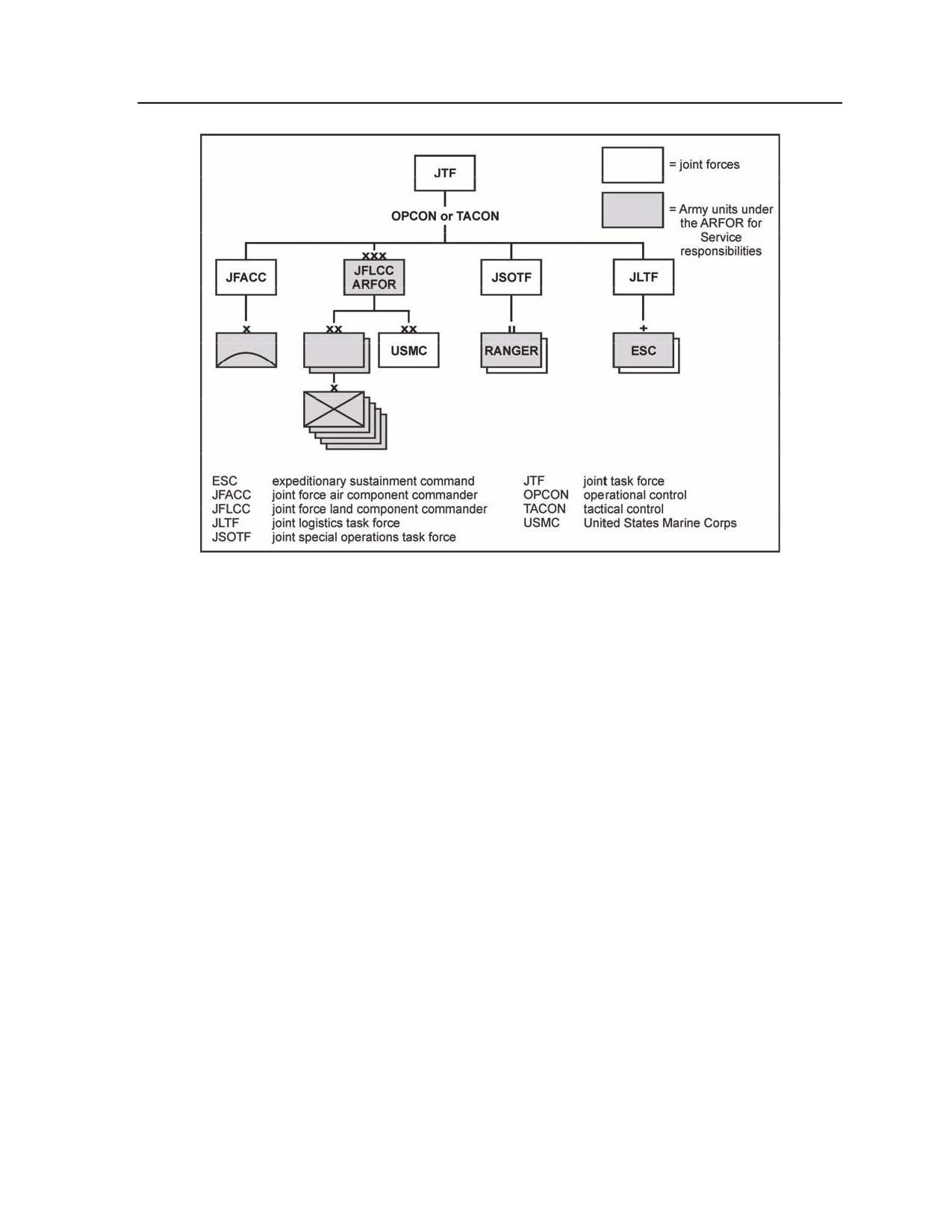
Command and Support Relationships
Figure B-3. Example of a joint task force showing an Army corps as joint force land
component commander with ARFOR responsibilities
JOINT COMMAND RELATIONSHIPS
B-13. JP 1 specifies and details four types of joint command relationships:
z
Combatant command (command authority) (COCOM).
z
Operational control.
z
Tactical control.
z
Support.
The following paragraphs summarize important provisions of these relationships. The glossary contains
complete definitions.
COMBATANT COMMAND (COMMAND AUTHORITY)
B-14. COCOM is the command authority over assigned forces vested only in commanders of combatant
commands or as directed by the President or the Secretary of Defense in the Unified Command Plan and
cannot be delegated or transferred. Title 10, U.S. Code, section 164 specifies it in law. Normally, the com-
batant commander exercises this authority through subordinate joint force commanders, Service compo-
nent, and functional component commanders. COCOM includes the directive authority for logistic matters
(or the authority to delegate it to a subordinate joint force commander for common support capabilities re-
quired to accomplish the subordinate’s mission).
27 February 2008
FM 3-0
B-5

Appendix B
OPERATIONAL CONTROL
B-15. OPCON is the authority to perform those functions of command over subordinate forces involving—
z
Organizing and employing commands and forces.
z
Assigning tasks.
z
Designating objectives.
z
Giving authoritative direction necessary to accomplish missions.
B-16. OPCON normally includes authority over all aspects of operations and joint training necessary to ac-
complish missions. It does not include directive authority for logistics or matters of administration, disci-
pline, internal organization, or unit training. The combatant commander must specifically delegate these
elements of COCOM. OPCON does include the authority to delineate functional responsibilities and opera-
tional areas of subordinate joint force commanders. In two instances, the Secretary of Defense may specify
adjustments to accommodate authorities beyond OPCON in an establishing directive: when transferring
forces between combatant commanders or when transferring members and/or organizations from the mili-
tary departments to a combatant command. Adjustments will be coordinated with the participating combat-
ant commanders. (JP 1 discusses operational control in detail.)
TACTICAL CONTROL
B-17. TACON is inherent in OPCON. It may be delegated to and exercised by commanders at any echelon
at or below the level of combatant command. TACON provides sufficient authority for controlling and di-
recting the application of force or tactical use of combat support assets within the assigned mission or task.
TACON does not provide organizational authority or authoritative direction for administrative and logistic
support; the commander of the parent unit continues to exercise these authorities unless otherwise specified
in the establishing directive. (JP 1 discusses tactical control in detail.)
SUPPORT
B-18. Support is a command authority in joint doctrine. A supported and supporting relationship is estab-
lished by a superior commander between subordinate commanders when one organization should aid, pro-
tect, complement, or sustain another force. Designating supporting relationships is important. It conveys
priorities to commanders and staffs planning or executing joint operations. Designating a support relation-
ship does not provide authority to organize and employ commands and forces, nor does it include authori-
tative direction for administrative and logistic support. Joint doctrine divides support into the categories
listed in table B-1.
Table B-1. Joint support categories
Category
Definition
That support which is given to the supported force as a whole and not to any
General support
particular subdivision thereof (JP 1-02).
That support which units render each other against an enemy, because of their
Mutual support
assigned tasks, their position relative to each other and to the enemy, and their
inherent capabilities (JP 1-02).
A mission requiring a force to support another specific force and authorizing it
Direct support
to answer directly to the supported force’s request for assistance (JP 3-09.1).
That action of the supporting force against targets or objectives which are
sufficiently near the supported force as to require detailed integration or
Close support
coordination of the supporting action with the fire, movement, or other actions of
the supported force (JP 1-02).
B-19. Support is, by design, somewhat vague but very flexible. Establishing authorities ensure both sup-
ported and supporting commanders understand the authority of supported commanders. Joint force com-
manders often establish supported and supporting relationships among components. For example, the
B-6
FM 3-0
27 February 2008
Command and Support Relationships
maritime component commander is normally the supported commander for sea control operations; the air
component commander is normally the supported commander for counterair operations. An Army head-
quarters designated as the land component may be the supporting force during some campaign phases and
the supported force in other phases.
B-20. The joint force commander may establish a support relationship between functional and Service
component commanders. Conducting operations across a large operational area often involves both the
land and air component commanders. The joint task force commander places the land component in gen-
eral support of the air component until the latter achieves air superiority. Conversely, within the land area
of operations, the land component commander becomes the supported commander and the air component
commander provides close support. A joint support relationship is not used when an Army commander
task-organizes Army forces in a supporting role. When task-organized to support another Army force,
Army forces use one of four Army support relationships. (See paragraphs B-35 through B-36.)
JOINT ASSIGNMENT AND ATTACHMENT
B-21. All forces under the jurisdiction of the secretaries of the military departments (with exception) are
assigned to combatant commands or the commander, U.S. Element North America Aerospace Defense
Command (known as USELEMNORAD). The exception exempts those forces necessary to carry out the
functions of the military departments as noted in Title 10, U.S. Code, section 162. The assignment of
forces to the combatant commands comes from the Secretary of Defense in the “Forces for Unified Com-
mands” memorandum. According to this memorandum and the Unified Command Plan, unless otherwise
directed by the President or the Secretary of Defense, all forces operating in the geographic area assigned
to a specific combatant commander are assigned or attached to that combatant commander. A force as-
signed or attached to a combatant command may be transferred from that command to another combatant
commander only when directed by the Secretary of Defense and approved by the President. The Secretary
of Defense specifies the command relationship the gaining commander will exercise (and the losing com-
mander will relinquish). Establishing authorities for subordinate unified commands and joint task forces
may direct the assignment or attachment of their forces to those subordinate commands and delegate the
command relationship as appropriate. (See JP 1.)
B-22. When the Secretary of Defense assigns Army forces to a combatant command, the transfer is either
permanent or the duration is unknown but very lengthy. The combatant commander exercises COCOM
over assigned forces. When the Secretary of Defense attaches Army units, this indicates that the transfer of
units is relatively temporary. Attached forces normally return to their parent combatant command at the
end of the deployment. The combatant commander exercises OPCON of the attached force. In either case,
the combatant commander normally exercises OPCON over Army forces through the ASCC until the com-
batant commander establishes a joint task force or functional component. At that time, the combatant com-
mander delegates OPCON to the joint task force commander. When the joint force commander establishes
any command relationship, the ASCC clearly specifies ADCON responsibilities for all affected Army com-
manders.
COORDINATING AUTHORITY
B-23. Coordinating authority is the authority delegated to a commander or individual for coordinating spe-
cific functions or activities involving forces of two or more military departments, two or more joint force
components, or two or more forces of the same Service. The commander or individual granted coordinat-
ing authority can require consultation between the agencies involved but does not have the authority to
compel agreement. In the event that essential agreement cannot be obtained, the matter shall be referred to
the appointing authority. Coordinating authority is a consultation relationship, not an authority through
which command may be exercised. Coordinating authority is more applicable to planning and similar ac-
tivities than to operations. (See JP 1.) For example, a joint security commander exercises coordinating au-
thority over area security operations within the joint security area. Commanders or leaders at any echelon
at or below combatant command may be delegated coordinating authority. These individuals may be as-
signed responsibilities established through a memorandum of agreement between military and nonmilitary
organizations.
27 February 2008
FM 3-0
B-7
Appendix B
DIRECT LIAISON AUTHORIZED
B-24. Direct liaison authorized is that authority granted by a commander (any level) to a subordinate to di-
rectly consult or coordinate an action with a command or agency within or outside of the granting com-
mand. Direct liaison authorized is more applicable to planning than operations and always carries with it
the requirement of keeping the commander granting direct liaison authorized informed. Direct liaison au-
thorized is a coordination relationship, not an authority through which command may be exercised (JP 1).
ADMINISTRATIVE CONTROL
B-25. Administrative control is direction or exercise of authority over subordinate or other organizations in
respect to administration and support, including organization of Service forces, control of resources and
equipment, personnel management, unit logistics, individual and unit training, readiness, mobilization, de-
mobilization, discipline, and other matters not included in the operational missions of the subordinate or
other organizations (JP 1). It is a Service authority, not a joint authority. It is exercised under the authority
of and is delegated by the Secretary of the Army. ADCON is synonymous with the Army’s Title 10 au-
thorities and responsibilities.
B-26. ADCON of Army forces involves the entire Army. Figure B-4 identifies major responsibilities of the
Department of the Army and illustrates their normal distribution between the Army generating force and
operating forces. The generating force consists of those Army organizations whose primary mission is to
generate and sustain the operational Army’s capabilities for employment by joint force commanders. Op-
erating forces consist of those forces whose primary missions are to participate in combat and the integral
supporting elements thereof (JP 1-02). Often, commanders in the operating force and commanders in the
generating force subdivide specific responsibilities. Army generating force capabilities and organizations
are linked to operating forces through co-location and reachback.
Figure B-4. Normal distribution of Army administrative control responsibilities
B-27. The ASCC is always the senior Army headquarters assigned to a combatant command. Its com-
mander exercises command authorities as assigned by the combatant commander and ADCON as dele-
gated by the Secretary of the Army. ADCON is the Army’s authority to administer and support Army
forces even while in a combatant command area of responsibility. COCOM is the basic authority for com-
mand and control of the same Army forces. The Army is obligated to meet the combatant commander’s re-
quirements for the operational forces. Essentially, ADCON directs the Army’s support of operational force
requirements. Unless modified by the Secretary of the Army, administrative responsibilities normally flow
B-8
FM 3-0
27 February 2008
Command and Support Relationships
from Department of the Army through the ASCC to those Army forces assigned or attached to that com-
batant command. ASCCs usually “share” ADCON for at least some administrative or support functions.
“Shared ADCON” refers to the internal allocation of Title 10, U.S. Code, section 3013(b) responsibilities
and functions. This is especially true for Reserve Component forces. Certain administrative functions, such
as pay, stay with the Reserve Component headquarters, even after unit mobilization. Shared ADCON also
applies to direct reporting units of the Army that typically perform single or unique functions. The direct
reporting unit, rather than the ASCC, typically manages individual and unit training for these units. The
Secretary of the Army directs shared ADCON.
ARMY COMMAND AND SUPPORT RELATIONSHIPS
B-28. Army command relationships are similar but not identical to joint command authorities and relation-
ships. Differences stem from the way Army forces task-organize internally and the need for a system of
support relationships between Army forces. Another important difference is the requirement for Army
commanders to handle the administrative support requirements that meet the needs of Soldiers. These dif-
ferences allow for flexible allocation of Army capabilities within various Army echelons. Army command
and support relationships are the basis for building Army task organizations. A task organization is a tem-
porary grouping of forces designed to accomplish a particular mission. Certain responsibilities are in-
herent in the Army’s command and support relationships.
ARMY COMMAND RELATIONSHIPS
B-29. Table B-2, page B-10, lists the Army command relationships. Command relationships define supe-
rior and subordinate relationships between unit commanders. By specifying a chain of command, command
relationships unify effort and give commanders the ability to employ subordinate forces with maximum
flexibility. Army command relationships identify the degree of control of the gaining Army commander.
The type of command relationship often relates to the expected longevity of the relationship between the
headquarters involved and quickly identifies the degree of support that the gaining and losing Army com-
manders provide.
B-30. Organic forces are those assigned to and forming an essential part of a military organization. Or-
ganic parts of a unit are those listed in its table of organization for the Army, Air Force, and Marine Corps,
and are assigned to the administrative organizations of the operating forces for the Navy (JP 1-02). Joint
command relationships do not include organic because a joint force commander is not responsible for the
organizational structure of units. That is a Service responsibility.
B-31. The Army establishes organic command relationships through organizational documents such as ta-
bles of organization and equipment and tables of distribution and allowances. If temporarily task-organized
with another headquarters, organic units return to the control of their organic headquarters after completing
the mission. To illustrate, within a brigade combat team (BCT), the entire brigade is organic. In contrast,
within most modular support brigades, there is a “base” of organic battalions and companies and a variable
mix of assigned and attached battalions and companies. (See appendix C.)
B-32. Army assigned units remain subordinate to the higher headquarters for extended periods, typically
years. Assignment is based on the needs of the Army and is formalized by orders rather than organizational
documents. Although force tailoring or task-organizing may temporarily detach units, they eventually re-
turn to their either their headquarters of assignment or their organic headquarters. Attached units are tem-
porarily subordinated to the gaining headquarters, and the period may be lengthy, often months or longer.
They
return to their parent headquarters (assigned or organic) when the reason for the attachment ends. The
Army headquarters that receives another Army unit through assignment or attachment assumes responsibil-
ity for the ADCON requirements, and particularly sustainment, that normally extend down to that echelon,
unless modified by directives or orders. For example, when an Army division commander attaches an en-
gineer battalion to a brigade combat team, the brigade commander assumes responsibility for the unit train-
ing, maintenance, resupply, and unit-level reporting for that battalion.
27 February 2008
FM 3-0
B-9

Appendix B
Table B-2. Command relationships
Then inherent responsibilities:
Can impose
Unless
If
Establish/
on gaining
Have
modified,
Are
Have
relation-
May be task-
maintain
unit further
command
ADCON
assigned
Provide
priorities
organized
communi-
command
ship is:
relation-
responsi-
position
liaison to:
establish-
by:1
cations
or support
ship with:
bility goes
or AO by:
ed by:
with:
relationship
through:
of:
Army HQ
Attached;
All organic
specified
OPCON;
forces
Organic
Organic
Organic
Organic HQ
in
N/A
N/A
TACON;
organized
HQ
HQ
organizing
GS; GSR;
with the HQ
document
R; DS
As
ASCC or
OPCON
As required
Combatant
Gaining
required
As required
Service-
Assigned
Gaining HQ
chain of
by OPCON
command
Army HQ
by
by OPCON
assigned
command
HQ
OPCON
HQ
Attached;
As
Unit to
OPCON;
Gaining
Gaining
Gaining
required
Gaining
Attached
Gaining unit
which
TACON;
unit
Army HQ
unit
by gaining
unit
attached
GS; GSR;
unit
R; DS
Parent unit
and gaining
As
As required
OPCON;
unit; gaining
Gaining
Parent
Gaining
required
by gaining
Gaining
TACON;
OPCON
unit may
unit
unit
unit
by gaining
unit and
unit
GS; GSR;
pass
unit
parent unit
R; DS
OPCON to
lower HQ1
As
As required
Gaining
Parent
Gaining
required
by gaining
Gaining
TACON;GS
TACON
Parent unit
unit
unit
unit
by gaining
unit and
unit
GSR; R; DS
unit
parent unit
Note: 1 In NATO, the gaining unit may not task-organize a multinational force. (See TACON.)
ADCON administrative control
HQ
headquarters
AO
area of operations
N/A
not applicable
ASCC
Army Service component command
NATO
North Atlantic Treaty Organization
DS
direct support
OPCON operational control
GS
general support
R
reinforcing
GSR
general support-reinforcing
TACON
tactical control
B-33. Army commanders normally place a unit OPCON or TACON to a gaining headquarters for a given
mission, lasting perhaps a few days. OPCON lets the gaining commander task-organize and direct forces.
TACON does not let the gaining commander task-organize the unit. Hence, TACON is the command rela-
tionship often used between Army, other Service, and multinational forces within a task organization, but
rarely between Army forces. Neither OPCON nor TACON affects ADCON responsibilities. To modify the
example used above, if the Army division commander placed the engineer battalion OPCON to the BCT,
the gaining brigade commander would not be responsible for the unit training, maintenance, resupply, and
unit-level reporting of the engineers. Those responsibilities would remain with the parent maneuver en-
hancement brigade.
B-34. The ASCC and ARFOR monitor changes in joint organization carefully and may adjust ADCON re-
sponsibilities based on the situation. For example, if a joint task force commander places an Army brigade
under TACON of a Marine division, the ARFOR may switch some or all unit ADCON responsibilities to
another Army headquarters, based on geography and ability to provide administration and support to that
Army force.
B-10
FM 3-0
27 February 2008

Command and Support Relationships
ARMY SUPPORT RELATIONSHIPS
B-35. Table B-3 lists Army support relationships. Army support relationships are not a command authority
and are more specific than the joint support relationships. Commanders establish support relationships
when subordination of one unit to another is inappropriate. They assign a support relationship when—
z
The support is more effective if a commander with the requisite technical and tactical expertise
controls the supporting unit, rather than the supported commander.
z
The echelon of the supporting unit is the same as or higher than that of the supported unit. For
example, the supporting unit may be a brigade, and the supported unit may be a battalion. It
would be inappropriate for the brigade to be subordinated to the battalion, hence the use of an
Army support relationship.
z
The supporting unit supports several units simultaneously. The requirement to set support priori-
ties to allocate resources to supported units exists. Assigning support relationships is one aspect
of mission command.
Table B-3. Army support relationships
Then inherent responsibilities:
Can
impose on
Are
If
Establish/
gaining
Have
May be
Receives
assigned
Have
relation-
maintain
unit
command
task-
sustain-
position or
Provide
priorities
communi-
further
ship is:
relation-
organized
ment
an area of
liaison to:
established
cations
command
ship with:
by:
from:
operations
by:
with:
or support
by:
relation-
ship by:
Parent unit;
Direct
Parent
Parent
Parent
Supported
Supported
Supported
supported
See note1
support1
unit
unit
unit
unit
unit
unit
unit
Parent unit;
Reinforced
Reinforc-
Parent
Parent
Parent
Reinforced
Reinforced
Not
reinforced
unit; then
ing
unit
unit
unit
unit
unit
applicable
unit
parent unit
General
Reinforced
Reinforced
Parent unit;
support-
Parent
Parent
Parent
unit and as
unit and as
then
Not
Parent unit
reinforc-
unit
unit
unit
required by
required by
reinforced
applicable
ing
parent unit
parent unit
unit
As
As required
General
Parent
Parent
Parent
Not
Parent unit
required by
by parent
Parent unit
support
unit
unit
unit
applicable
parent unit
unit
Note: 1 Commanders of units in direct support may further assign support relationships between their subordinate units
and elements of the supported unit after coordination with the supported commander.
B-36. Army support relationships allow supporting commanders to employ their units’ capabilities to
achieve results required by supported commanders. Support relationships are graduated from an exclusive
supported and supporting relationship between two units—as in direct support—to a broad level of support
extended to all units under the control of the higher headquarters—as in general support. Support relation-
ships do not alter ADCON. Commanders specify and change support relationships through task-
organizing.
OTHER RELATIONSHIPS
B-37. Several other relationships established by higher headquarters exist with units that are not in com-
mand or support relationships. (See table B-4, page B-12.) These relationships are limited or specialized to
a greater degree than the command and support relationships. These limited relationships are not used
when tailoring or task-organizing Army forces. Use of these specialized relationships helps clarify certain
aspects of OPCON or ADCON.
27 February 2008
FM 3-0
B-11

Appendix B
Table B-4. Other relationships
Relation-
Authority and
Operational use
Established by
ship
limitations
TRO allows the CCDR to
provide guidance on opera-
tional requirements and
training priorities, review
TRO is an authority
readiness reports, and
The CCDR identified in the
exercised by a combatant
review mobilization plans for
“Forces for Unified
commander over assigned
RC forces. TRO is not a
Commands” memorandum.
Training and
RC forces not on active
command relationship.
The CCDR normally dele-
readiness
duty. Through TRO, CCDRs
ARNG forces remain under
gates TRO to the ASCC.
oversight
shape RC training and
the command and control of
(For most RC forces, the
readiness. Upon mobili-
their respective State
CCDR is JFCOM and the
zation of the RC forces,
Adjutant Generals until
ASCC is FORSCOM.)
TRO is no longer applicable.
mobilized for Federal
service. USAR forces
remain under the command
and control of the USARC
until mobilized.
Allows planning and direct
The parent unit
collaboration between two
headquarters. This is a
Direct
units assigned to different
coordination relationship,
Limited to planning and
liaison
commands, often based on
not an authority through
coordination between units.
authorized1
anticipated tailoring and task
which command may be
organization changes.
exercised.
Informal relationship
Normally establishes infor-
between a theater army and
mation channels between
other Army units identified
Theater army and parent
the gaining theater army and
Aligned
for use in a specific
ASCC.
Army units that are likely to
geographic combatant
be committed to that area of
command.
responsibility.
Note: 1 See also paragraph B-24.
ARNG
Army National Guard
RC
Reserve Component
ASCC
Army Service component command
TRO
training and readiness oversight
CCDR
combatant commander
USAR
U.S. Army Reserve
FORSCOM U.S. Army Forces Command
USARC
U.S. Army Reserve Command
JFCOM Joint Forces Command
B-38. Training and readiness oversight is the authority that combatant commanders may exercise over as-
signed Reserve Component forces when not on active duty or when on active duty for training. As a matter
of Department of Defense policy, this authority includes: a. Providing guidance to Service component
commanders on operational requirements and priorities to be addressed in military department training and
readiness programs; b. Commenting on Service component program recommendations and budget re-
quests; c. Coordinating and approving participation by assigned Reserve Component forces in joint exer-
cises and other joint training when on active duty for training or performing inactive duty for training; d.
Obtaining and reviewing readiness and inspection reports on assigned Reserve Component forces; and e.
Coordinating and reviewing mobilization plans (including postmobilization training activities and deploy-
ability validation procedures) developed for assigned Reserve Component forces (JP 1).
B-39. Responsibilities for both training and readiness are inherent in ADCON and exercised by unit com-
manders for their units. Army National Guard forces are organized by the Department of the Army under
their respective states. These forces remain under command of the governor of that state until mobilized for
Federal service. U.S. Army Reserve forces are assigned to U.S. Army Reserve Command. For Army Na-
tional Guard units, the combatant commander normally exercises training and readiness oversight through
their ASCC; for most, this is U.S. Army Forces Command. The ASCC coordinates with the appropriate
State Adjutants General and Army National Guard divisions to refine mission-essential task lists for Army
National Guard units. The ASCC coordinates mission-essential task lists for Army Reserve units with the
U.S. Army Reserve Command. When Reserve Component units align with an expeditionary force package
during Army force generation, U.S. Army Forces Command establishes coordinating relationships as
B-12
FM 3-0
27 February 2008
Command and Support Relationships
required between Regular Army and Reserve Component units. When mobilized, Reserve Component
units are assigned or attached to their gaining headquarters. Most operating force ADCON responsibilities,
including unit training and readiness, shift to the gaining headquarters.
B-40. The shift to full spectrum operations and smaller, more versatile units affects how Regular Army
forces manage training and readiness. Army force packages for the combatant commanders combine forces
from many different parent organizations through Army force generation. The Army assigns or attaches
Regular Army forces to various Army headquarters based on factors such as stationing, unit history, and
habitual association of units in training. Different Army headquarters may share ADCON to optimize ad-
ministration and support. For example, U.S. Army Forces Command may attach a BCT to a division head-
quarters located on a different installation. That division commander has training and readiness responsi-
bilities for the BCT but does not control the training resources located at the BCT’s installation. The senior
Army commander on the BCT’s installation manages training resources such as ranges and simulation cen-
ters. At the direction of the Secretary of the Army, the commanders share ADCON responsibilities. If the
division headquarters deploys on an extended mission and the BCT remains, training and readiness respon-
sibilities for the BCT shift to another commander. Headquarters, Department of the Army or another ap-
propriate Army authority redistributes ADCON responsibilities for the BCT to a new headquarters. When
the BCT deploys to a geographic combatant command, ADCON passes to the gaining theater army unless
modified by the Secretary of the Army. (FMs 7-0 and 7-1 discuss training responsibilities.)
B-41. Alignment is informal relationship between a theater army and other Army units identified for use in
the area of responsibility of a specific geographic combatant command. Alignment helps focus unit exer-
cises and other training on a particular region. This may lead to establishment of direct liaison authorized
between the aligned unit and a different ASCC. Any modular Army force may find itself included in an
expeditionary force package heading to a different combatant command. Therefore, Army commanders
maintain a balance between regional focus and global capability.
REGULATORY AUTHORITIES
B-42. Regulations, policies, and other authoritative sources also direct and guide Army forces, Army com-
mands, direct reporting units, ASCCs, and other Army elements. The Army identifies technical matters,
such as network operations or contracting, and assigns responsibilities for them to an appropriate organiza-
tion. These organizations use technical channels established by regulation, policy, or directive. Command-
ers may also delegate authority for control of certain technical functions to staff officers or subordinate
commanders. (FM 6-0 discusses technical channels.)
B-43. The primary regulation governing the missions, functions, and command and staff relationships, in-
cluding ADCON, of the subordinate elements of the Department of the Army is AR 10-87. This regulation
prescribes the relationships and responsibilities among Army forces, Army commands, direct reporting
units, and ASCCs. It includes channels for technical supervision, advice, and support for specific functions
among various headquarters, agencies, and units. Other regulations and policies specify responsibilities in
accordance with Department of Defense directives and U.S. statutes.
27 February 2008
FM 3-0
B-13
Appendix C
The Army Modular Force
This appendix provides an overview of Army modular organizations. In 2003, the
Army implemented a fundamental shift toward a brigade-based force. The ongoing
transformation of the Army will result in stand-alone division and corps headquarters.
Brigade combat teams, modular support brigades, and functional brigades will be
pooled for use as part of expeditionary force packages that enhance the flexibility and
responsiveness of the Army. The combined arms brigade combat teams become the
centerpiece for Army maneuver. They will attach to a higher echelon headquarters—a
division, corps, or theater army—as part of a force-tailored formation based on op-
erational requirements.
BACKGROUND
C-1. Today’s operational environment requires responsive Army forces tailored to individual combatant
commanders’ needs. The highly integrated organization of the Army’s divisions in the late 1990’s made it
difficult to deploy divisional units apart from their divisional base and keep the rest of the division ready
for other missions. Coupled with the increasing need to employ land forces at the outset of a campaign, the
Army needed to reorganize around smaller, more versatile formations able to deploy more promptly.
C-2. No single, large fixed formation can support the diverse requirements of full spectrum operations. To
meet the requirements of the geographic combatant commanders, the Army has developed the capability to
rapidly tailor and task-organize expeditionary force packages. A force package may consist of any combi-
nation of light, medium, and heavy forces; it can blend Regular Army, Army National Guard, and U.S.
Army Reserve units and Soldiers.
C-3. The nature of modern land operations has changed in geography and time. In general, operations
have become increasingly distributed in space while more simultaneous in time. At the tactical and opera-
tional levels, subordinate units routinely operate in noncontiguous areas of operations. This contrasts
sharply with the contiguous and hierarchical arrangement of land forces in operations prevalent in the past.
More agile forces, improvements in command and control, and continuing integration of joint capabilities
at lower echelons all contribute to these changes.
C-4. The other prominent shift in capability came with the introduction and proliferation of satellite-based
communications and other advanced information systems for command and control. Command and control
of widely dispersed formations no longer entirely relies on terrestrial, line-of-sight communications. When
separated by hundreds of miles, today’s commanders can still communicate with subordinates and maintain
a common operational picture. The Army is only beginning to realize the benefits of these advances. It con-
tinues to leverage technology and reshape processes to best integrate new capabilities.
C-5. Tactical operations continue to evolve into distributed, noncontiguous forms. Army forces need ver-
satile and deployable headquarters suited for contingencies and protracted operations. The Army provides
the majority of land component command headquarters and joint task force headquarters for contingency
operations. The complexity of counterinsurgency campaigns, such as those in Afghanistan and Iraq, require
Army headquarters to function as joint and multinational platforms. While dealing with complex issues, the
headquarters deploy, evolve, and tailor their compositions as the campaign progresses. As recent natural
disasters showed, Army headquarters often provide the command and control element for Regular Army,
Army National Guard, and U.S. Army Reserve elements that respond to disasters of all types.
27 February 2008
FM 3-0
C-1
Appendix C
C-6. To meet joint requirements, the Army reorganized its operating forces beginning in 2003. Today, the
Army can provide land combat power tailored for any combination of offensive, defensive, and stability or
civil support operations as part of an interdependent joint force. Brigades are the principal tactical units for
conducting operations. To provide higher echelon command and control, the Army fields a mix of tactical
and operational headquarters able to function as land force, joint, multinational, and Service component
command headquarters. The headquarters mix is not a rigid hierarchy and does not require a standard array
of forces. Each headquarters provides a menu of capabilities to best match the combatant commander’s re-
quirements.
C-7. The combatant commanders’ requirements are determined by the National Military Strategy, the
Joint Strategic Capabilities Plan (as specified in the “Forces for” portions), and operational requirements.
The strategic Army role of providing forces to meet global requirements is called force generation. As part
of force generation, the Department of the Army establishes manning, training, and readiness cycles; as-
signs forces to headquarters; and manages modernization. Strategic organization establishes goals for force
generation cycles based on Regular Army, Army National Guard, and U.S. Army Reserve manning and
readiness cycles.
DIVISION ECHELON AND ABOVE
C-8. The Army of Excellence structure for headquarters and large formations has evolved into three
modular headquarters organizations. The Army Service component command focuses on combatant com-
mand-level landpower employment. It supports joint, interagency, intergovernmental, and multinational
forces within a combatant commander’s area of responsibility. The corps provides a headquarters that spe-
cializes in operations as a land component command headquarters, as a joint task force for contingencies,
or as an intermediate tactical headquarters within large groupings of land forces. The division is optimized
for tactical control of brigades during land operations. All three headquarters are modular entities designed
to use forces tailored for specified joint operations. All three are also stand-alone headquarters uncon-
strained by a fixed formation of subordinate units. While three types of modular headquarters exist, the
Army forces they control are organized for two broad echelons—theater and tactical. Each set consists
primarily of brigades.
THEATER ARMY HEADQUARTERS COMMANDS
C-9. The doctrinal name for the Army Service component command of a geographic combatant command
is theater army. The theater army is the primary vehicle for Army support to Army, joint, interagency, in-
tergovernmental, and multinational forces operating across the area of responsibility. When the combatant
commander acts as the joint force commander during major combat operations, the theater army may pro-
vide the land component commander and headquarters. In that case, it exercises operational control
(OPCON) over land forces deployed to a joint operations area. The theater army headquarters continues to
perform area of responsibility-wide functions in addition to its operational responsibilities. These functions
include reception, staging, onward movement, and integration; logistics over-the-shore operations; and se-
curity coordination. (Figure C-1 shows an example of a theater army headquarters organized as a land
component command.) When required, the theater army can provide a headquarters able to command and
control a joint task force for contingencies with other Service augmentation.
C-10. As the Army Service component command, the theater army exercises administrative control
(ADCON) over all Army forces in the area of responsibility unless modified by the Department of the
Army. This includes forces assigned, attached, or OPCON to the combatant command. The Army Service
component command provides Army support to designated theater-level forces. It also provides this sup-
port to joint, interagency, intergovernmental, and multinational elements as the combatant commander di-
rects. The Army Service component command integrates Army forces into execution of theater security
cooperation plans as well. It has several theater-level formations associated with it.
C-2
FM 3-0
27 February 2008
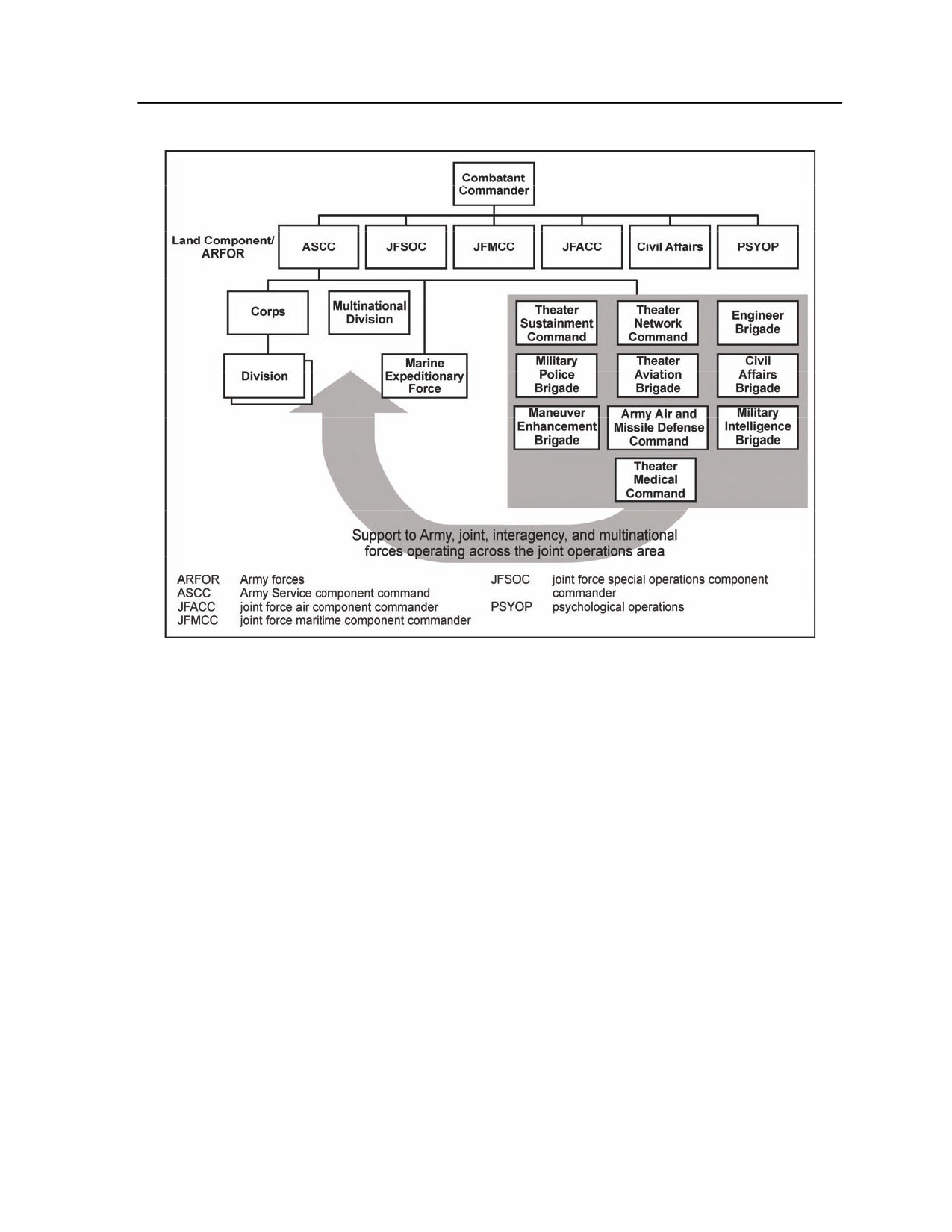
The Army Modular Force
Figure C-1. Example of theater army acting as a land component command while continuing
Army support
THEATER-LEVEL FORMATIONS
C-11. An array of theater-level forces may be assigned, attached, or OPCON to a theater army headquar-
ters. Each theater army headquarters normally has organizations providing theater-level capabilities aligned
with it or under its control. These organizations include—
z
Theater sustainment command.
z
Military intelligence brigade.
z
Theater network command or brigade.
z
Regionally focused civil affairs brigade or planning team.
z
Regionally focused medical command.
z
Regionally focused air and missile defense command.
C-12. When the theater army is the land component command for major combat operations, several func-
tional commands may augment it. These commands can include—
z
Engineer.
z
Military police.
z
Criminal investigation.
z
Aviation.
These commands consist of units from the Regular Army, Army National Guard, and U.S. Army Reserve.
27 February 2008
FM 3-0
C-3
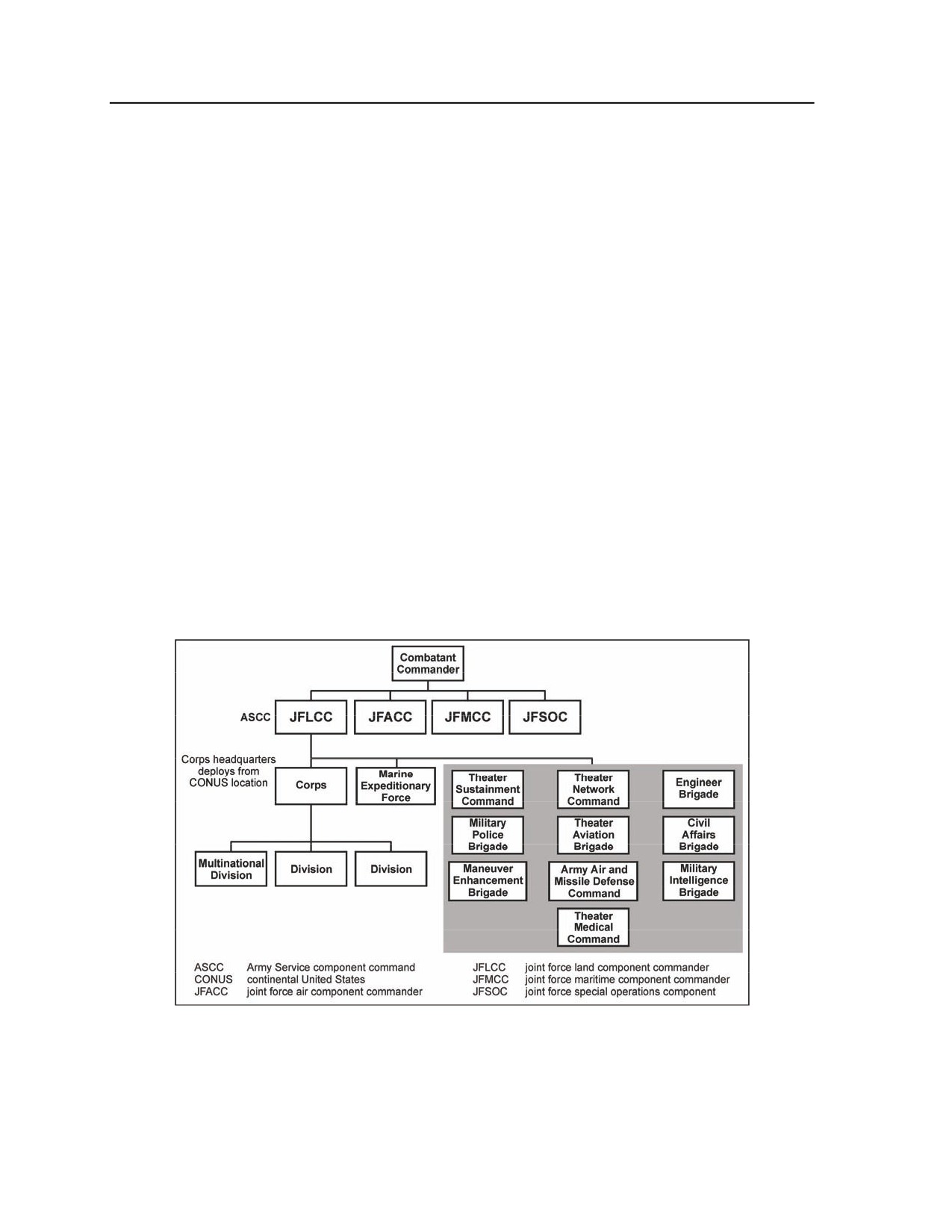
Appendix C
C-13. Several functional brigades are also available to support theater-level operations. They may be task-
organized under theater-level functional commands or be directly subordinate to the theater army. When
required, the theater army may task-organize functional brigades to corps or divisions. Examples of func-
tional brigades include the following:
z
Civil affairs.
z
Engineer.
z
Theater aviation.
z
Military police.
z
Chemical, biological, radiological, and nuclear.
z
Air and missile defense.
z
Medical.
CORPS
C-14. Large land forces require an intermediate echelon between the divisions that control brigade combat
teams (BCTs) and the theater army serving as the land component command. Other factors requiring an in-
termediate headquarters may include—
z
The mission’s complexity.
z
Multinational participation.
z
Span of control.
C-15. When required, a corps may become an intermediate tactical headquarters under the land component
command, with OPCON of multiple divisions (including multinational or Marine Corps formations) or
other large tactical formations. (See figure C-2.) The theater army headquarters tailors the corps headquar-
ters to meet mission requirements. The corps’ flexibility allows the Army to meet the needs of joint force
commanders for an intermediate land command while maintaining a set of headquarters for contingencies.
Figure C-2. Corps as an intermediate land force headquarters
C-16. The corps is also a primary candidate headquarters for joint operations. It can rapidly transition to ei-
ther a joint task force or land component command headquarters for contingency or protracted operations.
It can deploy to any area of responsibility to provide command and control for Army, joint, and
C-4
FM 3-0
27 February 2008
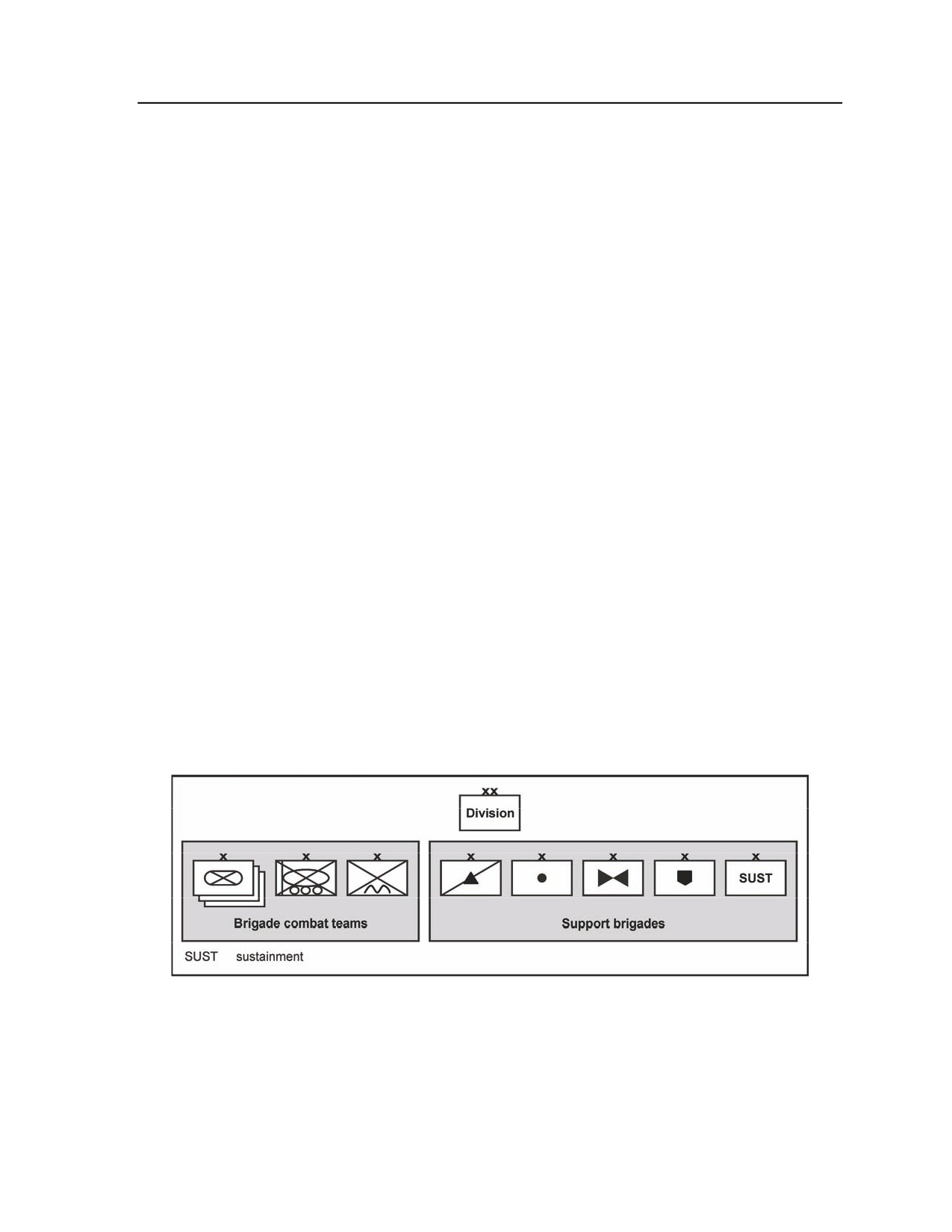
The Army Modular Force
multinational forces. The corps does not have any echelon-specific units other than the organic corps head-
quarters. It can control any mix of modular brigades and divisions, as well as other Service or multinational
forces. When used as a land component or as an intermediate tactical headquarters, the corps may also be
designated as the ARFOR, with ADCON responsibility for all Army forces subordinate to the joint task
force. (Appendix B discusses ARFOR and ADCON responsibilities.)
C-17. When directed, a corps trains as a joint headquarters for contingency operations. With minimum
joint augmentation, this headquarters can initiate operations as a joint task force or land component com-
mand for contingencies. For sustained operations in this role, a corps is augmented according to an appro-
priate joint manning document. The corps can also serve as a deployable base for a multinational headquar-
ters directing protracted operations.
DIVISION
C-18. Divisions are the Army’s primary tactical warfighting headquarters. Their principal task is directing
subordinate brigade operations. Divisions are not fixed formations. They exercise command and control
over any mix of brigades and do not have any organic forces beyond their headquarters elements. Their or-
ganic structure includes communications network, life support, and command post elements. These provide
significant flexibility. With appropriate joint augmentation, a division can be the joint task force or land
component command headquarters for small contingencies. The headquarters staff has a functional organi-
zation. It also includes organic joint network capability and liaison teams.
C-19. Divisions can control up to six BCTs in major combat operations. They can control more BCTs in
protracted stability operations. A division force package may include any mix of heavy, infantry, and
Stryker BCTs. In addition to BCTs, each division controls a tailored array of modular support brigades and
functional brigades.
C-20. Division headquarters normally have four BCTs attached for training and readiness purposes. How-
ever, these brigades may or may not deploy with the division as part of an expeditionary force package.
Since divisions have no organic structure beyond the headquarters, all types of brigades may not be present
in an operation. In some operations, divisions may control multiple support brigades of the same type.
They may also control functional groups, battalions, or separate companies; however, these are normally
task-organized to a brigade. The important point is that division organizations vary for each operation.
However, for major combat operations, divisions should have at least one of each type of support brigade
attached or OPCON to it. (Figures C-3 and C-4, page C-6, illustrate two possible division organizations.
Many more combinations are possible.)
Figure C-3. Example of tailored divisions in offensive operations
27 February 2008
FM 3-0
C-5
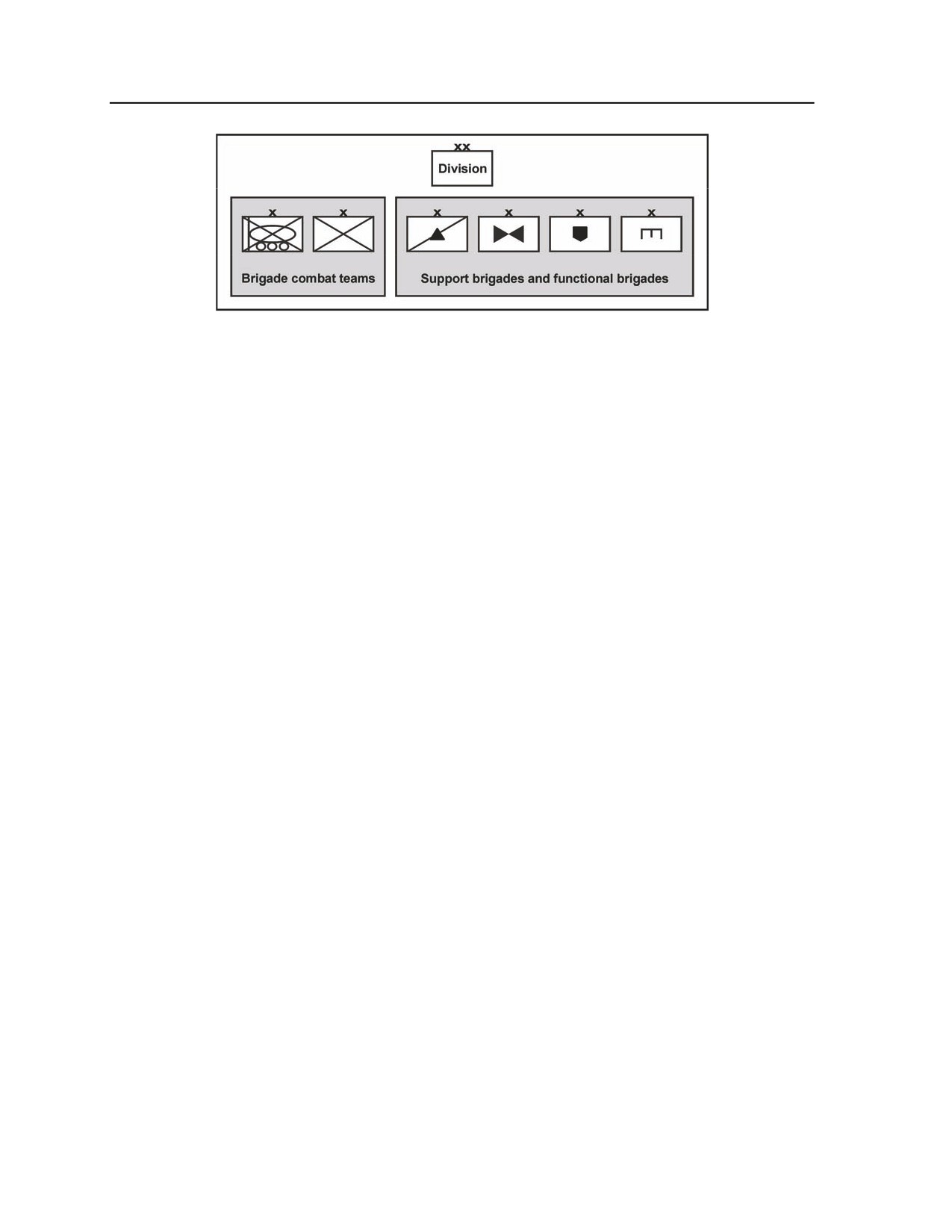
Appendix C
Figure C-4. Example of tailored divisions in defensive operations
BRIGADE COMBAT TEAMS
C-21. As combined arms organizations, BCTs form the basic building block of the Army’s tactical forma-
tions. They are the principal means of executing engagements. Three standardized BCT designs exist:
heavy, infantry, and Stryker. Battalion-sized maneuver, fires, reconnaissance, and sustainment units are or-
ganic to BCTs.
C-22. BCTs are modular organizations. They begin as a cohesive combined arms team that can be further
task-organized. Commands often augment them for a specific mission with capabilities not organic to the
BCT structure. Augmentation might include lift or attack aviation, armor, cannon or rocket artillery, air de-
fense, military police, civil affairs, psychological operations elements, combat engineers, or additional in-
formation systems assets. This organizational flexibility allows BCTs to function across the spectrum of
conflict.
C-23. The Army plans to convert BCTs to very advanced combined arms formations equipped with the
family of future combat systems. These highly modernized brigades will consist of three combined arms
battalions, a non-line-of-sight cannon battalion, reconnaissance surveillance and target acquisition squad-
ron, brigade support battalion, brigade intelligence and communications company, and a headquarters com-
pany. The brigade combat teams equipped with future combat systems will improve the strategic and op-
erational reach of ground combat formations without sacrificing lethality or survivability. Well before the
future combat systems brigades join the operating forces, the Army will field some advanced systems to
the current force.
HEAVY BRIGADE COMBAT TEAM
C-24. Heavy BCTs are balanced combined arms units that execute operations with shock and speed. (See
figure C-5.) Their main battle tanks, self-propelled artillery, and fighting vehicle-mounted infantry provide
tremendous striking power. Heavy BCTs require significant strategic air- and sealift to deploy and sustain.
Their fuel consumption may limit operational reach. However, this is offset by the heavy BCT’s un-
matched tactical mobility and firepower. Heavy BCTs include organic military intelligence, artillery, sig-
nal, engineer, reconnaissance, and sustainment capabilities.
INFANTRY BRIGADE COMBAT TEAM
C-25. The infantry BCT requires less strategic lift than other BCTs. (See figure C-6.) When supported with
intratheater airlift, infantry BCTs have theaterwide operational reach. The infantry Soldier is the center-
piece of the infantry BCT. Organic antitank, military intelligence, artillery, signal, engineer, reconnais-
sance, and sustainment elements allow the infantry BCT commander to employ the force in combined arms
formations. Infantry BCTs work best for operations in close terrain and densely populated areas. They are
easier to sustain than the other BCTs. Selected infantry BCTs include special-purpose capabilities for air-
borne or air assault operations.
C-6
FM 3-0
27 February 2008
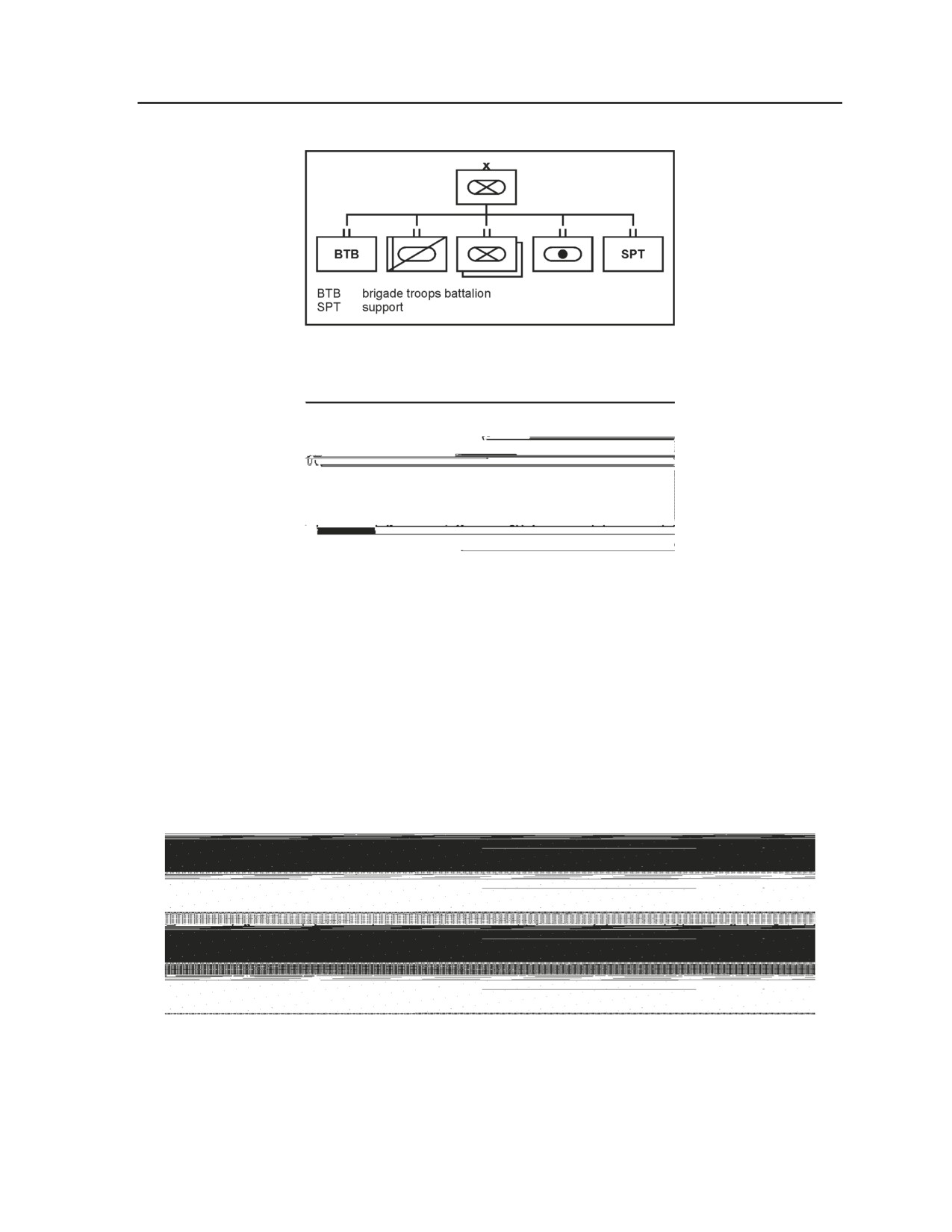
The Army Modular Force
Figure C-5. Heavy brigade combat team
Figure C-6. Infantry brigade combat team
STRYKER BRIGADE COMBAT TEAM
C-26. The Stryker BCT balances combined arms capabilities with significant strategic and intratheater mo-
bility. (See figure C-7.) Designed around the Stryker wheeled armored combat system in several variants,
the Stryker BCT has considerable operational reach. It is more deployable than the heavy BCT and has
greater tactical mobility, protection, and firepower than the infantry BCT. Stryker BCTs have excellent dis-
mounted capability. The Stryker BCT includes military intelligence, signal, engineer, antitank, artillery, re-
connaissance, and sustainment elements. This design lets Stryker BCTs commit combined arms elements
down to company level in urban and other complex terrain against a wide range of opponents.
Figure C-7. Stryker brigade combat team
27 February 2008
FM 3-0
C-7
Appendix C
MODULAR SUPPORT BRIGADES
C-27. Five types of modular support brigades complement the BCTs: the battlefield surveillance brigade,
fires brigade, combat aviation brigade, maneuver enhancement brigade, and sustainment brigade. These
brigades provide multifunctional capabilities to deployed forces. More than one type of support brigade
may be task-organized to a division or corps (except for sustainment brigades, which provide general or di-
rect support to a division or corps). In turn, commands may make these brigades available to other Service
components of the joint force. Support brigades have the organic expertise to command and control various
unit types. Theater armies tailor them by adding functional battalions to or subtracting them from the or-
ganic command and control headquarters. The signal and maintenance capabilities of a support brigade
headquarters also allows the higher headquarters to task-organize them to a corps, headquarters of another
Service, or joint headquarters.
C-28. The number and type of subordinate units vary among the different types of brigades. Four types of
support brigades operate as part of a division-sized expeditionary force: the battlefield surveillance brigade,
fires brigade, combat aviation brigade, and maneuver enhancement brigade. They are normally assigned,
attached, or placed OPCON to a division. Normally, the theater army attaches the sustainment brigade to
the theater sustainment command. This brigade provides either general or direct support to forces under the
divisions. For a major combat operation, the higher headquarters normally task-organizes one of each type
of the five support brigades to a division headquarters.
BATTLEFIELD SURVEILLANCE BRIGADE
C-29. The battlefield surveillance brigade has military intelligence, reconnaissance and surveillance, and
requisite sustainment and communications capabilities. (See figure C-8.) The headquarters and headquar-
ters company provides command and control of brigade operations. The military intelligence battalion pro-
vides unmanned aircraft systems, signals intelligence, human intelligence, and counterintelligence capabili-
ties. The reconnaissance and surveillance battalion provides reconnaissance and surveillance capabilities,
including mounted scout platoons and mobile long-range surveillance teams. The brigade support company
provides sustainment for the brigade. The network company provides a communications backbone. This al-
lows the battlefield surveillance brigade to communicate throughout the division area of operations as well
as with support assets associated with Army Service component command- and national-level intelligence
agencies. Battlefield surveillance brigades can be tailored for the mission before deployment or task-
organized by the higher headquarters once deployed. Typical augmentation includes—
z
Ground reconnaissance.
z
Manned and unmanned Army aviation assets.
z
Military intelligence assets, including human intelligence, aerial exploitation, and other national-
level assets.
z
Armored, infantry, and combined arms units.
C-30. The battlefield surveillance brigade conducts intelligence, surveillance, and reconnaissance (ISR)
operations. This capability lets the division commander focus combat power, execute current operations,
and prepare for future operations simultaneously. Battlefield surveillance brigades are not designed to con-
duct guard or cover operations. Those operations may entail fighting to develop the tactical situation; they
require a BCT or aviation brigade.
C-8
FM 3-0
27 February 2008