FM 3-0 OPERATIONS (FEBRUARY 2008) - page 2
The Continuum of Operations
insurgencies underway in one area at the same time. Counterinsurgency becomes more complex in these
situations.
2-56. While each insurgency is distinct, similarities among them exist. Insurgencies occur more often in
states with a lack of national cohesion or with weak, inefficient, unstable, or unpopular governments.
Internal conflicts may be racial, cultural, religious, or ideological. Additional factors, such as corruption
and external agitation, may also fuel an insurgency. Successful insurgencies develop a unifying leadership
and organization and an attractive vision of the future. Usually only insurgencies able to attract widespread,
popular support pose a real threat to state authority.
2-57. Most operations in counterinsurgencies occur at the small-unit level—squad, platoon, or company.
However, larger operations also occur. Commanders prepare with a consistent, long-range plan to defeat an
insurgency. They carefully assess the negative effects of violence on the populace and strictly adhere to the
rules of engagement. Operations reflect and promote the host-nation government’s authority, thus
undermining insurgent attempts to establish an alternative authority. Such operations also reduce the
tendency of the population to view the insurgents as an occupying force.
2-58. Larger units, such as brigades and divisions, provide direction and consistency to Army operations in
their areas of operations and mass resources and forces to make operations more effective. They also
respond to any threat large enough to imperil the smaller units distributed throughout the areas of
operations. Lower echelons can then operate across larger areas (against rural insurgencies) or among
greater populations (against urban insurgencies).
Combating Terrorism
2-59. Combating terrorism is actions, including antiterrorism and counterterrorism, taken to oppose
terrorism throughout the entire threat spectrum (JP 3-26). Terrorism is the calculated use of unlawful
violence or threat of unlawful violence to inculcate fear;
[it is] intended to coerce or to intimidate
governments or societies in the pursuit of goals that are generally political, religious, or ideological
(JP 3-07.2). An enemy who cannot defeat conventional Army forces may resort to terrorism. Terrorist
attacks can create disproportionate effects on conventional forces. Their effect on societies can be even
greater. Terrorist tactics may range from individual assassinations to employing weapons of mass
destruction.
Counterterrorism
2-60. Counterterrorism is actions taken directly against terrorist networks and indirectly to influence and
render global and regional environments inhospitable to terrorist networks (JP 3-26). Special operations
forces conduct counterterrorism. This can include strikes and raids against terrorist organizations and
facilities outside the United States and its territories. Although counterterrorism is a specified mission for
selected special operations forces, conventional Army forces may also contribute. Commanders who
employ conventional forces against terrorists are conducting offensive operations, not counterterrorism
operations.
Antiterrorism
2-61. Antiterrorism is defensive measures used to reduce the vulnerability of individuals and property to
terrorist acts, to include limited response and containment by local military and civilian forces (JP 3-07.2).
It is a protection task. All forces consider antiterrorism during all operations. Commanders take the security
measures to accomplish the mission and protect their forces against terrorism. They make every reasonable
effort to minimize their forces’ vulnerability to violence and hostage taking. Typical antiterrorism actions
include—
z
Completing unit and installation threat and vulnerability assessments.
z
Training in antiterrorism awareness.
z
Establishing special reaction teams and protective services at installations and bases.
z
Ensuring that antiterrorism measures protect personnel, physical assets, and information,
including high-risk personnel and designated critical assets.
22 February 2011
FM 3-0, C1
2-11
Chapter 2
z
Establishing civil-military partnerships for weapons of mass destruction crises and consequence
management.
z
Developing terrorist threat and incident response plans that include managing the force
protection condition system.
z
Establishing appropriate policies based on the threat and force protection condition system.
(JP 3-07.2 contains doctrine for antiterrorism.)
Unconventional Warfare
2-62. Unconventional warfare is a broad spectrum of military and paramilitary operations, normally of
long duration, predominantly conducted through, with, or by indigenous or surrogate forces who are
organized, trained, equipped, supported, and directed in varying degrees by an external source. It includes,
but is not limited to, guerrilla warfare, subversion, sabotage, intelligence activities, and unconventional
assisted recovery (JP 3-05). Within the U.S. military, conduct of unconventional warfare is a highly
specialized special operations force mission. Special operations forces may conduct unconventional
warfare as part of a separate operation or within a campaign. During Operation Enduring Freedom, special
operations forces and other government agencies conducted unconventional warfare within the joint
campaign to topple the Taliban regime.
2-63. Conventional Army forces may support unconventional warfare. For example, during Operation Iraqi
Freedom, conventional forces supported Joint Task Force-North by securing bases in the joint special
operations area.
(JP
3-05 contains doctrine on unconventional warfare conducted by Army special
operations forces.)
MAJOR COMBAT OPERATIONS
2-64. *Major combat operations differ from the other operational themes due to the extreme violence
inherent in their conduct. Major combat operations employ all available combat power (directly and
indirectly) to destroy an enemy’s military capability, thereby decisively altering the military conditions
within the operational environment. Major combat operations dominate campaigns during general war.
Combat between large formations characterizes these operations. Major combat operations conducted by
U.S. forces are always joint operations, although an Army headquarters may form the base of a joint force
headquarters. These operations typically entail high tempo, high resource consumption, and numerous
casualties. Joint doctrine does not specify types of operations unique to major combat operations. However,
the joint force may conduct—
z
Forcible entry operations (see paragraph Error! Reference source not found.).
z
Air operations to gain and maintain air supremacy.
z
Naval operations to eliminate threats to movement of forces and resources.
z
Space operations to ensure space supremacy.
z
Land operations to seize and control enemy population, military, and manufacturing areas.
z
Joint conventional and unconventional operations in combination to overthrow a hostile regime.
2-65. Major combat operations usually involve intense combat between the uniformed armed forces of
nation-states. Hybrid threats may have the capability to engage in major combat, although their capacity to
wage protracted major combat operations will be less than that of a developed nation-state. Even then,
major combat operations tend to blur with other operational themes. Within the theater of war, other joint
task forces may conduct counterinsurgency and limited intervention. For example, in Vietnam both the
United States and North Vietnam deployed their national armed forces. Although major battles occurred,
the United States characterized much of the war as counterinsurgency operations.
2-66. Civil wars, particularly within a developed nation, often include major combat operations. The
American Civil War, the Russian Revolution, and Yugoslavia’s collapse all involved recurring,
high-intensity clashes between armies. Even in less developed regions, civil war leads to massive casualties
among combatants and noncombatants alike. Insurgencies can develop into civil wars, particularly when
external powers back both the government and the insurgents.
2-12
FM 3-0, C1
22 February 2011
The Continuum of Operations
2-67. Not all major combat operations are protracted. Joint operations may capitalize on superior military
capability to quickly overwhelm a weaker enemy. Examples include the following:
z
The coup de main in Panama in 1989.
z
The forcible entry of Grenada in 1983.
z
The major combat operations against Iraq in 1991 and 2003.
2-68. Successful major combat operations defeat or destroy the enemy’s armed forces and seize terrain.
Commanders assess them in terms of numbers of military units destroyed or rendered combat ineffective,
the level of enemy resolve, and the terrain objectives seized or secured. Major combat operations are the
operational theme for which doctrine, including the principles of war, was originally developed.
SUMMARY
2-69. Commanders use the spectrum of conflict to describe the level of violence in terms of an ascending
scale marked by graduated steps. Army forces operate anywhere across the spectrum of conflict, from
peacetime military engagement in areas of stable peace to major combat operations during general war. In
each case, the objective aims to establish conditions that advance U.S. goals. The operational themes group
types of military operations according to common characteristics. Operational themes establish a taxonomy
for understanding the many kinds of joint operations and the relationships among them. Commanders
convey the overall character of a major operation, including the principles that govern it, by its operational
theme. The operational theme varies during a campaign or major operation. Although many tactical
activities apply to all, different themes demand different approaches.
22 February 2011
FM 3-0, C1
2-13
Chapter 3
Full Spectrum Operations
The foundations for Army operations are contained in its operational concept—full
spectrum operations. The goal of full spectrum operations is to apply landpower as
part of unified action to defeat the enemy on land and establish conditions that
achieve the joint force commander’s end state. The complexity of today’s operational
environments requires commanders to combine offensive, defensive, and stability or
civil support tasks to reach this goal. Commanders direct the application of full
spectrum operations to seize, retain, and exploit the initiative and achieve decisive
results.
THE OPERATIONAL CONCEPT
3-1. The Army’s operational concept is the core of its doctrine. All Soldiers must uniformly know and
understand the operational concept. The operational concept frames how Army forces, operating as part of
a joint force, conduct operations. It describes how Army forces adapt to meet the distinct requirements of
land operations. The concept is broad enough to describe operations now and in the near future. It is
flexible enough to apply in any situation worldwide.
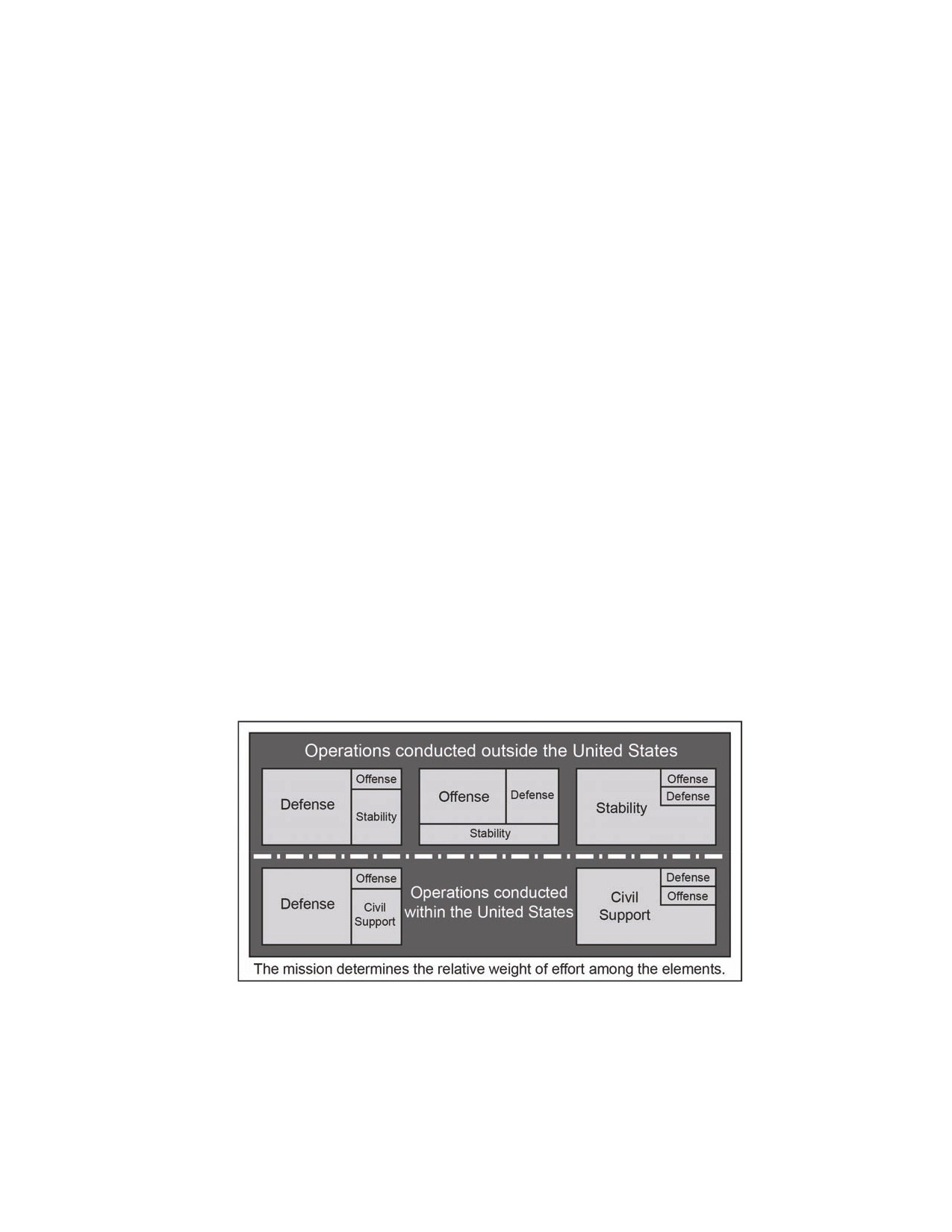
3-2. The Army’s operational concept is full spectrum operations: Army forces combine offensive,
defensive, and stability or civil support operations simultaneously as part of an interdependent joint
force to seize, retain, and exploit the initiative, accepting prudent risk to create opportunities to
achieve decisive results. They employ synchronized action—lethal and nonlethal—proportional to
the mission and informed by a thorough understanding of all variables of the operational
environment. Mission command that conveys intent and an appreciation of all aspects of the situation
guides the adaptive use of Army forces. (See figure 3-1 and chapter 5.)
Figure 3-1. Full spectrum operations—the Army’s operational concept
3-3. Full spectrum operations require continuous, simultaneous combinations of offensive, defensive, and
stability or civil support tasks. In all operations, commanders seek to seize, retain, and exploit the initiative
while synchronizing their actions to achieve the best effects possible. Operations conducted outside the
United States and its territories simultaneously combine three elements—offense, defense, and stability.
Within the United States and its territories, operations combine the elements of civil support, defense, and
22 February 2011
FM 3-0, C1
3-1
Chapter 3
offense to support civil authority. Army forces operate using mutually supporting lethal and nonlethal
capabilities.
3-4. Army forces use offensive and defensive operations to defeat the enemy on land. They
simultaneously execute stability or civil support operations to interact with the populace and civil
authorities. In most domestic operations, Army forces perform only civil support tasks. However, an
extreme emergency, such as an attack by a hostile foreign power, may require simultaneous combinations
of offensive, defensive, and civil support tasks. Stability tasks typically dominate peace operations,
peacetime military engagement, and some limited interventions. For example, foreign humanitarian
assistance operations involve primarily stability tasks with minor defensive tasks and no offensive element.
3-5. Full spectrum operations begin with the commander’s concept of operations. This single, unifying
idea provides direction for the entire operation. Based on a specific idea of how to accomplish the mission,
commanders refine the concept of operations during planning. They adjust it throughout the operation as
subordinates develop the situation or conditions change. Often, subordinates acting on the higher
commander’s intent develop the situation in ways that exploit unforeseen opportunities. Mission command
requires commanders to convey a clear commander’s intent and concept of operations. This becomes
essential in full spectrum operations, where the complexity and chaos of ground operations often compel
subordinate commanders to make difficult decisions in unforeseen circumstances. Therefore, mission
command is an essential complement to full spectrum operations. (Chapter 5 discusses mission command.)
3-6. No set formula exists for applying landpower. Each campaign and major operation requires an
original design and flexible execution. Army forces must be able to operate as part of a joint or
multinational force anywhere across the spectrum of conflict. They also must vary combinations of the
elements of full spectrum operations appropriate to the situation. The concept of operations combines and
weights these elements as the situation requires.
3-7. Full spectrum operations involve continuous interaction between friendly forces and multiple groups
in the operational area. In addition to enemy forces and the local populace, Soldiers work with
multinational partners, adversaries, civil authorities, business leaders, and other civilian agencies. This
interaction has a simple concept but complex application. For example, enemies and adversaries may
consist of multiple competing elements. Civil authorities range from strategic-level leaders to local
government officials to religious leaders. Populations may include people of differing tribes, ethnic groups,
and nationalities. Within the United States and its territories, the roles and responsibilities of Army forces
and civil authorities substantially differ from their roles and responsibilities overseas. For that reason,
Army forces conduct civil support operations domestically and stability operations overseas, even though
stability and civil support operations have many similarities.
3-8. The operational concept addresses more than combat between armed opponents. Army forces
conduct operations amid populations. This requires Army forces to defeat the enemy and simultaneously
shape civil conditions. Offensive and defensive tasks defeat enemy forces; stability tasks shape civil
conditions. Winning battles and engagements is important but alone may not be decisive. Shaping civil
conditions (in concert with civilian organizations, civil authorities, and multinational forces) is just as
important to campaign success. In many joint operations, stability or civil support often prove more
important than the offense and defense.
3-9. The emphasis on different elements of full spectrum operations changes with echelon, time, and
location. In an operation dominated by stability, part of the force might be conducting simultaneous
offensive and defensive tasks. Within the United States, civil support operations may be the only activity
actually conducted. In short, no single element is always more important than the others. Rather,
simultaneous combinations of the elements, which commanders constantly adapt to conditions, are the key
to successful land operations.
3-10. Operations today require versatile, adaptive units and tough, flexible leadership. These qualities
develop first and foremost from training that prepares individuals and units for challenging operational
environments. Managing training for full spectrum operations challenges leaders at all echelons. Training
for offensive and defensive tasks develops discipline, endurance, unit cohesion, and tolerance for
uncertainty. It prepares Soldiers and units to address ambiguities and complexities inherent in stability and
civil support operations as well. However, operational experience demonstrates that forces trained
3-2
FM 3-0, C1
22 February 2011
Full Spectrum Operations
exclusively for offensive and defensive tasks are not as proficient at stability tasks as those trained
specifically for stability are. For maximum effectiveness, stability and civil support tasks require dedicated
training, similar to training for offensive and defensive tasks. Likewise, forces involved in protracted
stability or civil support operations require intensive training to regain proficiency in offensive or defensive
tasks before engaging in large-scale combat operations. Effective training reflects a balance among the
elements of full spectrum operations that produces and sustains proficiency in all of them. Commanders
adjust their emphasis by developing their core mission-essential task list. (FM 7-0 discusses training
management.)
INITIATIVE
3-11. All Army operations aim to seize, retain, and exploit the initiative and achieve decisive results.
Operational initiative is setting or dictating the terms of action throughout an operation. Initiative
gives all operations the spirit, if not the form, of the offense. It originates in the principle of the offensive.
The principle of the offensive goes beyond attacking. It embodies seizing, retaining, and exploiting the
initiative as the surest way to achieve decisive results. It requires positive action to change both information
and the situation on the ground. Risk and opportunity are intrinsic in seizing the initiative. To seize the
initiative, commanders evaluate and accept prudent risks. Opportunities never last long. Unless
commanders willingly accept risk and then act, the enemy will likely close the window of opportunity and
exploit friendly inaction. Once Army forces seize the initiative, they exploit the created opportunities.
Initiative requires constant effort to control tempo while maintaining freedom of action. The offensive
mindset, with its focus on initiative, is central to the Army’s operational concept and guides all leaders in
the performance of their duty. It emphasizes opportunity created by action through full spectrum
operations, whether offensive, defensive, stability, or civil support.
3-12. In combat operations, commanders force the enemy to respond to friendly action. In the offense, it is
about taking the fight to the enemy and never allowing enemy forces to recover from the initial shock of the
attack. In the defense, it is about preventing the enemy from achieving success and then counterattacking to
seize the initiative. The object is not just to kill enemy personnel and destroy their equipment. Combat
operations aim to force the enemy to react continuously and finally to be driven into untenable positions.
Retaining the initiative pressures enemy commanders into abandoning their preferred options, accepting too
much risk, or making costly mistakes. As enemy mistakes occur, friendly forces seize opportunities and
create new avenues for an exploitation. The ultimate goal is to break the enemy’s will through relentless
pressure.
3-13. In stability and civil support operations, initiative is about improving civil conditions and applying
combat power to prevent the situation from deteriorating. Commanders identify nonmilitary but critical
objectives to achieving the end state. Such objectives may include efforts to ensure effective governance,
reconstruction projects that promote social well-being, and consistent actions to improve public safety. All
of these contribute to retaining and exploiting the initiative in stability operations. An enemy insurgent, for
example, cannot allow stability efforts to succeed without serious consequences and must react. As the
enemy reacts, Army forces maintain the initiative by modifying their own lethal and nonlethal actions,
forcing the enemy to change plans and remain on the defensive. Army forces retain the initiative by
anticipating both enemy actions and civil requirements and by acting positively to address them. In civil
support, Army forces take action to restore normalcy. Soldiers work closely with their civilian counterparts
to remedy the conditions threatening lives, property, and domestic order. In some situations, rapid and
determined action by Army forces becomes the stimulus that prompts a demoralized civilian community to
begin recovery.
3-14. Seizing, retaining, and exploiting the initiative depends on individual initiative—the willingness to
act in the absence of orders, when existing orders no longer fit the situation, or when unforeseen
opportunities or threats arise. Military history contains many instances where a subordinate’s action or
inaction significantly affected the tactical, operational, or even strategic situation. When opportunity
occurs, it is often fleeting. Subordinate leaders need to act quickly, even as they report the situation to their
commanders. Individual initiative is a key component of mission command. Full spectrum operations
depend on subordinate commanders exercising individual initiative and higher commanders giving them
the authority to do so. (Chapter 5 discusses mission command.)
22 February 2011
FM 3-0, C1
3-3
Chapter 3
SIMULTANEITY AND SYNCHRONIZATION
3-15. Simultaneously executing the elements of full spectrum operations requires the synchronized
application of combat power. Synchronization is the arrangement of military actions in time, space, and
purpose to produce maximum relative combat power at a decisive place and time (JP 2-0). It is the ability
to execute multiple related and mutually supporting tasks in different locations at the same time, producing
greater effects than executing each in isolation. Synchronization is a means, not an end. Commanders
balance it with agility and initiative; they never surrender the initiative for the sake of synchronization.
Rather, they synchronize activities to best facilitate mission accomplishment. Excessive synchronization
can lead to over control, which limits the initiative of subordinates.
3-16. Simultaneity means doing multiple things at the same time. It requires the ability to conduct
operations in depth and to integrate them so that their timing multiplies their effectiveness. Commanders
consider their entire area of operations, the enemy, information activities necessary to shape the operational
environment, and civil conditions. Then they mount simultaneous operations that immobilize, suppress, or
shock the enemy. Such actions nullify the enemy’s ability to conduct synchronized, mutually supporting
actions. Army forces increase the depth of their operations through combined arms, advanced information
systems, and joint capabilities. Because Army forces conduct operations across large areas, the enemy faces
many potential friendly actions. Executing operations in depth is equally important in stability operations;
commanders act to keep threats from operating outside the reach of friendly forces. In civil support
operations and some stability operations, depth includes conducting operations that reach all citizens in the
area of operations, bringing relief as well as hope. (Chapter 6 discusses depth at the operational level.)
LETHAL AND NONLETHAL ACTIONS
3-17. An inherent, complementary relationship exists between using lethal force and applying military
capabilities for nonlethal purposes. Though each situation requires a different mix of violence and
constraint, lethal and nonlethal actions used together complement each other and create dilemmas for
opponents. Lethal actions are critical to accomplishing offensive and defensive missions. However,
nonlethal actions are also important contributors to full spectrum operations, regardless of which element
dominates. Finding ways to accomplish the mission with an appropriate mix of lethal and nonlethal force
remains an important consideration for every commander. Commanders analyze the situation carefully to
achieve a balance between lethal and nonlethal actions.
Lethal Actions
3-18. Offensive and defensive operations place a premium on employing the lethal effects of combat
power against the enemy. In these operations, speed, surprise, and shock are vital considerations.
Historically, the side better able to combine them defeats its opponent rapidly while incurring fewer losses.
Such victories create opportunities for an exploitation. In some operations, the effects of speed, surprise,
and shock are enough to collapse organized resistance. Such a collapse occurred in the offensive phase of
Operation Iraqi Freedom in 2003.
3-19. Speed is swiftness of action. It allows a force to act before the enemy is ready or before the situation
deteriorates further. Speed requires being able to adjust operations quickly to dynamic conditions. It
increases opportunities to exploit momentary tactical advantages and expand them to retain and exploit the
initiative. Wherever possible, Army forces exploit their advantages in command and control, tactical
mobility, and joint capabilities to operate at a higher tempo than the enemy. Delegating decisionmaking
authority to subordinates through mission command allows commanders to increase the speed of
decisionmaking and execution in most situations. Rapid friendly action may surprise the enemy and create
opportunities.
3-20. Surprise is achieved by acting at a time, acting in a place, or using methods to which the enemy
cannot effectively react or does not expect. Speed contributes to surprise. So does executing operations
simultaneously and in depth. Exploiting advantages gained through security, military deception, and
aggressive intelligence, surveillance, and reconnaissance operations contributes to surprise. Surprise is
essential when executing offensive missions that complement stability operations (such as a raid). It
mitigates the effectiveness of enemy early warning networks within the local populace.
3-4
FM 3-0, C1
22 February 2011
Full Spectrum Operations
3-21. Shock results from applying overwhelming violence. Combat power applied with enough speed and
magnitude to overwhelm the enemy produces it. Shock slows and disrupts enemy operations. Usually
transient, but while it lasts, shock may paralyze the enemy’s ability to fight. Sometimes the psychological
effects of threatening to use overwhelming violence can also produce shock. Shock is often greater when
created with asymmetric means. Joint forces create opportunities to increase it by using capabilities against
which the enemy has limited defense. Surprise and speed magnify the effects of shock.
Nonlethal Actions
3-22. Army forces employ a variety of nonlethal means in stability and civil support operations. Stability
operations often involve using military capabilities to perform such tasks as restoring essential services.
Civil support operations are characterized by providing constructive support to civil authorities. However,
demonstrating the potential for lethal action (by actions such as increased military presence in an area)
often contributes to maintaining order during stability and some civil support operations. Other examples
include such actions as pre-assault warnings and payments for collateral damage.
3-23. Friendly and enemy forces continuously struggle for information advantages while conducting
operations in the physical domains. Friendly information actions shape the operational environment by
attacking the enemy’s command and control system, defending against electronic attacks, and protecting
friendly information. Increasingly sophisticated capabilities allow Army forces to identify, disrupt, and
exploit enemy communications (including networks). These actions may keep the enemy from massing
combat power effectively or synchronizing combined arms operations. Commanders may use
electromagnetic means alone or with maneuver and lethal fires.
3-24. Nonlethal actions in combat include a wide range of intelligence-gathering, disruptive, and other
activities. Effective maneuver and fires require timely, accurate intelligence and effective mission
command networks and systems. The threat of detection often compels the enemy to limit or cease
operations. This inaction allows friendly forces to seize the initiative. Interference with enemy command
and control through nonlethal means can also limit enemy effectiveness and increase its exposure to attack.
3-25. The United States continues to develop nonlethal weapons that allow commanders to apply force
without killing or crippling an enemy. These weapons provide options in situations that restrict the use of
lethal force or when enemy fighters intermix with noncombatants. Furthermore, nonlethal means can
mitigate the indirect effects on noncombatants of lethal actions directed against the enemy.
3-26. Stability and civil support operations emphasize nonlethal, constructive actions by Soldiers working
among noncombatants. Civil affairs personnel have a major role. In stability operations, they work with and
through host-nation agencies and other civilian organizations to enhance the host-nation government’s
legitimacy. Commanders use inform and influence activities shaped by intelligence to inform, influence,
and persuade the local populace within limits prescribed by U.S. law. They also integrate inform and
influence activities with stability tasks to counter false and distorted information and propaganda.
3-27. Nonlethal, constructive actions can persuade the local populace to withhold support from the enemy
and provide information to friendly forces. Loss of popular support presents the enemy with two bad
choices: stay and risk capture or depart and risk exposure to lethal actions in less populated areas.
Commanders focus on managing the local populace’s expectations and countering rumors. However, they
recognize that their Soldiers’ actions, positive and negative, most strongly sway the populace’s perception
of Army forces.
3-28. The moral advantage provided by the presence of well-trained, well-equipped, and well-led forces
can be a potent nonlethal capability. It creates fear and doubt in the minds of the enemy and may deter
adversaries. This effect is important in many stability-dominated operations. Even though stability
operations emphasize nonlethal actions, the ability to engage potential enemies with decisive lethal force
remains a sound deterrent. Enemy commanders may curtail their activities and avoid combat if they
perceive Army forces as highly capable and willing to use precise, lethal force. This permits Army forces to
extend the scope and tempo of nonlethal actions.
22 February 2011
FM 3-0, C1
3-5

Chapter 3
THE ELEMENTS OF FULL SPECTRUM OPERATIONS
3-29. Full spectrum operations require simultaneous combinations of four elements—offense, defense, and
stability or civil support. Figure 3-2 lists the elements of full spectrum operations, the primary tasks
associated with them, and the purposes of each element. Each primary task has numerous associated
subordinate tasks. When combined with who (unit), when (time), where (location), and why (purpose), the
primary tasks become mission statements.
Offensive Operations
Defensive Operations
Primary Tasks:
Primary Tasks:
• Movement to contact
• Mobile defense
• Attack
• Area defense
• Exploitation
• Retrograde
• Pursuit
Purposes:
Purposes:
• Dislocate, isolate, disrupt, and destroy enemy forces
• Deter or defeat enemy offensive operations
• Seize key terrain
• Gain time
• Deprive the enemy of resources
• Achieve economy of force
• Develop intelligence
• Retain key terrain
• Deceive and divert the enemy
• Protect the populace, critical assets, and
• Create a secure environment for stability operations
infrastructure
• Develop intelligence
Stability Operations
Civil Support Operations
Primary Tasks:
Primary Tasks:
• Civil security (including security force assistance)
• Provide support for domestic disasters
• Civil control
• Provide support for domestic chemical, biological,
• Restore essential services
radiological, nuclear, and high-yield explosives
incidents
• Support to governance
• Provide support for domestic civilian law
• Support to economic and infrastructure development
enforcement agencies
• Provide other designated support
Purposes:
Purposes:
• Provide a secure environment
• Save lives
• Secure land areas
• Restore essential services
• Meet the critical needs of the populace
• Maintain or restore law and order
• Gain support for host-nation government
• Protect infrastructure and property
• Shape the environment for interagency and host-
• Maintain or restore local government
nation success
• Shape the environment for interagency success
*Figure 3-2. The elements of full spectrum operations
OFFENSIVE OPERATIONS
3-30. Offensive operations are combat operations conducted to defeat and destroy enemy forces and
seize terrain, resources, and population centers. They impose the commander’s will on the enemy. In
combat operations, the offense is the decisive element of full spectrum operations. Against a capable,
adaptive enemy, the offense is the most direct and sure means of seizing, retaining, and exploiting the
initiative to achieve decisive results. Executing offensive operations compels the enemy to react, creating
or revealing weaknesses that the attacking force can exploit. Successful offensive operations place
tremendous pressure on defenders, creating a cycle of deterioration that can lead to the enemy’s
disintegration. This was the case in early 2003 in Iraq, when coalition operations led to the collapse of the
Iraqi military and ultimately the Baathist regime of Saddam Hussein.
3-31. While strategic, operational, or tactical considerations may require defending, defeating an enemy at
any level eventually requires shifting to the offense. Even in the defense, seizing and retaining the initiative
requires executing offensive operations at some point. The more fluid the battle, the truer this is.
3-6
FM 3-0, C1
22 February 2011
Full Spectrum Operations
3-32. Effective offensive operations capitalize on accurate intelligence regarding the enemy, terrain and
weather, and civil considerations. Commanders maneuver their forces to advantageous positions before
making contact. However, commanders may shape conditions by deliberately making contact to develop
the situation and mislead the enemy. In the offense, the decisive operation is a sudden, shattering action
against an enemy weakness that capitalizes on speed, surprise, and shock. If that operation does not destroy
the enemy, operations continue until enemy forces disintegrate or retreat to where they no longer pose a
threat. (Chapter 5 discusses decisive, shaping, and sustaining operations.)
Primary Offensive Tasks
3-33. At the operational level, offensive operations defeat enemy forces that control important areas or
contest the host-nation government’s authority. The joint force conducts operations throughout its
operational area. Army forces attack using ground and air maneuver to accomplish objectives that conclude
the campaign or move it to a subsequent phase. In expeditionary campaigns and major operations,
operational maneuver includes deploying land forces to positions that facilitate joint force offensive action.
U.S. forces can conduct operational-level offensives in counterinsurgency to eliminate insurgent
sanctuaries. Counterinsurgencies usually combine offensive and stability tasks to achieve decisive results.
3-34. In offensive operations, a force often transitions from one offensive task to another without pausing.
For example, an attack can lead to an exploitation and then pursuit, or to an exploitation followed by
another attack as enemy forces rally. Army forces perform the following primary offensive tasks. (FM 3-90
discusses them in detail.)
Movement to Contact
3-35. A movement to contact develops the situation and establishes or regains contact. It also sets
favorable conditions for subsequent tactical actions. Forces executing this task seek to make contact with
the smallest friendly force feasible. On contact, the commander has five options: attack, defend, bypass,
delay, or withdraw. Movements to contact include search and attack and cordon and search operations.
Attack
3-36. An attack destroys or defeats enemy forces, seizes and secures terrain, or both. Attacks require
maneuver supported by direct and indirect fires. They may be either decisive or shaping operations. Attacks
may be hasty or deliberate, depending on the time available for planning and preparation. Commanders
execute hasty attacks when the situation calls for immediate action with available forces and minimal
preparation. They conduct deliberate attacks when they have more time to plan and prepare. Success
depends on skillfully massing the effects of all the elements of combat power.
Exploitation
3-37. An exploitation rapidly follows a successful attack and disorganizes the enemy in depth.
Exploitations seek to expand an attack to the point where enemy forces have no alternatives but to
surrender or flee. Commanders of exploiting forces receive the greatest possible latitude to accomplish their
missions. They lead with great aggressiveness, initiative, and boldness. Exploitations may be local or
major. Local exploitations take advantage of tactical opportunities, foreseen or unforeseen. Division and
higher headquarters normally conduct major exploitations using mobile forces to transform tactical success
into a pursuit.
Pursuit
3-38. A pursuit is designed to catch or cut off a hostile force attempting to escape with the aim of
destroying it. Pursuits often follow successful exploitations. However, they can develop at any point when
enemy forces start to disintegrate or disengage. Pursuits occur when the enemy fails to organize a defense
and attempts to disengage. If it becomes apparent that enemy resistance has broken down entirely and
enemy forces are fleeing, a force can transition to a pursuit from any type of offensive or defensive
operation. Pursuits require speed and decentralized control.
22 February 2011
FM 3-0, C1
3-7
Chapter 3
Purposes of Offensive Operations
3-39. Seizing, retaining, and exploiting the initiative is the essence of the offense. Offensive operations
seek to throw enemy forces off balance, overwhelm their capabilities, disrupt their defenses, and ensure
their defeat or destruction by synchronizing and applying all the elements of combat power. The offensive
operation ends when it destroys or defeats the enemy, reaches a limit of advance, or approaches
culmination. Army forces conclude an offense in one of four ways: consolidating gains through stability
operations, resuming the attack, transitioning to the defense, or preparing for future operations. Army
forces conduct offensive operations for the following purposes. (FM 3-90 discusses these purposes in
detail.)
Dislocate, Isolate, Disrupt, and Destroy Enemy Forces
3-40. Well-executed offensive operations dislocate, isolate, disrupt, and destroy enemy forces. If
destruction is not feasible, offensive operations compel enemy forces to retreat. Offensive maneuver seeks
to place the enemy at a positional disadvantage. This allows friendly forces to mass overwhelming effects
while defeating parts of the enemy force in detail before the enemy can escape or get reinforcements. When
required, friendly forces close with and destroy the enemy in close combat. Ultimately, the enemy
surrenders, retreats in disorder, or is eliminated altogether.
Seize Key Terrain
3-41. Offensive maneuver may seize terrain that provides the attacker with a decisive advantage. The
enemy either retreats or risks defeat or destruction. If enemy forces retreat or attempt to retake the key
terrain, they are exposed to fires and further friendly maneuver.
Deprive the Enemy of Resources
3-42. At the operational level, offensive operations may seize control of major population centers, seats of
government, production facilities, and transportation infrastructure. Losing these resources greatly reduces
the enemy’s ability to resist. In some cases, Army forces secure population centers or infrastructure and
prevent irregular forces from using them as a base or benefitting from the resources that they develop.
Develop Intelligence
3-43. Enemy deception, concealment, and security may prevent friendly forces from developing necessary
intelligence. Commanders conduct some offensive operations to develop the situation and discover the
enemy’s intent, disposition, and capabilities.
Deceive and Divert the Enemy
3-44. Offensive operations distract enemy intelligence, surveillance, and reconnaissance. They may cause
the enemy to shift reserves away from the friendly decisive operation.
Create a Secure Environment for Stability Operations
3-45. Stability operations cannot occur if significant enemy forces directly threaten or attack the local
populace. Offensive operations destroy or isolate the enemy so stability operations can proceed. Offensive
operations against insurgents help keep them off balance. These actions may force insurgents to defend
their bases, thus keeping them from attacking.
DEFENSIVE OPERATIONS
3-46. Defensive operations are combat operations conducted to defeat an enemy attack, gain time,
economize forces, and develop conditions favorable for offensive or stability operations. The defense
alone normally cannot achieve a decision. However, it can set conditions for a counteroffensive operation
that lets Army forces regain the initiative. Defensive operations can also establish a shield behind which
stability operations can progress. Defensive operations counter enemy offensive operations. They defeat
attacks, destroying as much of the attacking enemy as possible. They also preserve control over land,
3-8
FM 3-0, C1
22 February 2011
Full Spectrum Operations
resources, and populations. Defensive operations retain terrain, guard populations, and protect critical
capabilities against enemy attacks. Commanders can use defensive operations to gain time and economize
forces so offensive tasks can be executed elsewhere.
3-47. Successful defensive operations share the following characteristics: preparation, security, disruption,
massed effects, and flexibility. Successful defenses are aggressive. Commanders use all available means to
disrupt enemy forces. They disrupt attackers and isolate them from mutual support to defeat them in detail.
Isolation includes extensive use of cyber/electromagnetic activities. Defenders seek to increase their
freedom of maneuver while denying it to attackers. Defending commanders use every opportunity to
transition to the offense, even if temporarily. As attackers’ losses increase, they falter and the initiative
shifts to the defenders. These situations are favorable for counterattacks. Counterattack opportunities rarely
last long; defenders strike swiftly when the attackers culminate. Surprise and speed complement shock and
allow counterattacking forces to seize the initiative and overwhelm the attackers.
3-48. Conditions may not support immediate offensive operations during force projection. In those cases,
initial-entry forces defend while the joint force builds combat power. Initial-entry forces should include
enough combat power to deter, attack, or defend successfully.
Primary Defensive Tasks
3-49. At the operational level, an enemy offensive may compel joint forces to conduct major defensive
operations. Such operations may require defeating or preventing attacks across international borders,
defeating conventional attacks, or halting an insurgent movement’s mobilization. Operational defenses may
be executed anywhere in the operational area. The following primary tasks are associated with the defense.
Defending commanders combine these tasks to fit the situation. (FM 3-90 discusses them in detail.)
Mobile Defense
3-50. In a mobile defense, the defender withholds a large portion of available forces for use as a striking
force in a counterattack. Mobile defenses require enough depth to let enemy forces advance into a position
that exposes them to counterattack. The defense separates attacking forces from their support and disrupts
the enemy’s command and control. As enemy forces extend themselves in the defended area and lose
momentum and organization, the defender surprises and overwhelms them with a powerful counterattack.
Area Defense
3-51. In an area defense, the defender concentrates on denying enemy forces access to designated terrain
for a specific time, limiting their freedom of maneuver and channeling them into killing areas. The
defender retains terrain that the attacker must control in order to advance. Friendly forces draw the enemy
force into a series of kill zones where they attack and destroy the enemy from mutually supporting
positions, largely by fires. Commanders commit most of the defending force to defending positions while
keeping the rest in reserve. They use the reserve to preserve the integrity of the defense through
reinforcement or counterattack.
Retrograde
3-52. Retrograde involves organized movement away from the enemy. This includes delays, withdrawals,
and retirements. Retrograde operations gain time, preserve forces, place the enemy in unfavorable
positions, or avoid combat under undesirable conditions.
Mobile and Static Elements in the Defense
3-53. All three primary defensive tasks use mobile and static elements. In mobile defenses, static positions
help control the depth and breadth of the enemy penetration and retain ground from which to launch
counterattacks. In area defenses, commanders closely integrate mobile patrols, security forces, sensors, and
reserves to cover gaps among defensive positions. In retrograde operations, some units conduct area or
mobile defenses along with security operations to protect other units executing carefully controlled
maneuver or movement rearward. Mobile elements maneuver constantly to confuse the enemy and prevent
22 February 2011
FM 3-0, C1
3-9
Chapter 3
an enemy exploitation. Static elements fix, disrupt, turn, or block the attackers and gain time for other
forces to pull back.
Purposes of Defensive Operations
3-54. Defending forces await the enemy’s attack and counter it. Waiting for the attack is not a passive
activity. Commanders conduct aggressive security operations and intelligence, surveillance, and
reconnaissance. Such actions locate enemy forces and deny them information. Defenders engage enemy
forces with fires, spoiling attacks, and security operations to weaken them before they reach the main battle
area. Commanders use combined arms and joint capabilities to attack enemy vulnerabilities and seize the
initiative. Army forces conduct defensive operations for the following purposes. (FM 3-90 discusses these
purposes in detail.)
Deter or Defeat Enemy Offensive Operations
3-55. The primary purpose of the defense is to deter or defeat enemy offensive operations. Successful
defenses stall enemy actions and create opportunities to seize the initiative. Defensive operations may deter
potential aggressors if they believe that breaking the friendly defense would be too costly.
Gain Time
3-56. Commanders may conduct a defense to gain time. Such defensive operations succeed by slowing or
halting an attack while allowing friendly reserves enough time to reinforce the defense. Delaying actions
trade space for time to improve defenses, expose enemy forces to joint attack, and prepare counterattacks.
Achieve Economy of Force
3-57. The defense is also used to achieve economy of force. Astute use of terrain, depth, and security
operations allows friendly forces to minimize resources used defensively. This allows commanders to
concentrate combat power for offensive operations.
Retain Key Terrain
3-58. The mission of many defensive operations is to retain key terrain. Units use mobile and area defense
to prevent enemy forces from occupying key terrain. Control of key terrain can sway the outcome of the
battle or engagement, depending on which side controls it. In operations dominated by stability tasks,
friendly bases become key terrain.
Protect the Populace, Critical Assets, and Infrastructure
3-59. Defense of the local populace and vital assets supports stability operations and allows Army forces to
receive greater support from the host nation. Army forces protect military and civilian areas that are
important to success and provide indirect support to operations worldwide. Achieving this purpose begins
with defenses around lodgments and bases, ensuring freedom of action. This protection especially applies
to counterinsurgency operations where some facilities have significant economic and political value as
opposed to tactical military importance.
Develop Intelligence
3-60. As with the offense, defensive operations may develop intelligence. The more successful the defense,
the more Army forces learn about the enemy. Forces may conduct a particular phase or task within a
defense (for example, a covering force mission) to satisfy commander’s critical information requirements
about the enemy’s direction of attack and main effort.
STABILITY OPERATIONS
3-61. Stability operations is an overarching term encompassing various military missions, tasks, and
activities conducted outside the United States in coordination with other instruments of national power to
maintain or reestablish a safe and secure environment, provide essential governmental services, emergency
3-10
FM 3-0, C1
22 February 2011
Full Spectrum Operations
infrastructure reconstruction, and humanitarian relief (JP 3-0). Forces can conduct stability operations to
support a host-nation or interim government or as part of an occupation when no government exists.
Stability operations involve both coercive and constructive military actions. They help to establish a safe
and secure environment and facilitate reconciliation among local or regional adversaries. Stability
operations can also help establish political, legal, social, and economic institutions and support the
transition to legitimate local governance. Stability operations must maintain the initiative by pursuing
objectives that resolve the causes of instability. (See paragraphs 3-11 through 3-14.) Stability operations
cannot succeed if they only react to enemy initiatives.
3-62. Stability operations require transparency and credibility. Transparency and credibility enhance
coordination, integration, and synchronization among host-nation elements, other government agencies,
and Army forces. The degree to which the host nation cooperates is fundamental. Commanders publicize
their mandate and intentions. Within the limits of operations security, they make the populace aware of the
techniques used to provide security and control. Actions on the ground reinforced by a clear and consistent
message produce transparency. This transparency reinforces credibility. Credibility reflects the populace’s
assessment of whether the force can accomplish the mission. Army forces require the structure, resources,
and rules of engagement appropriate to accomplishing the mission and discharging their duties swiftly and
firmly. They must leave no doubt as to their capability and intentions.
3-63. Civil affairs activities enhance the relationship between military forces and civil authorities in areas
with military forces. They involve applying civil affairs functional specialty skills to areas normally under
the responsibility of civil government. These operations involve establishing, maintaining, influencing, or
exploiting relations between military forces and all levels of host-nation government agencies. These
activities are fundamental to executing stability tasks. Civil affairs personnel, other Army forces, personnel
from other government agencies, or a combination of all three perform these tasks.
3-64. Civil affairs units and personnel develop detailed civil considerations assessments. These include
information about infrastructure, civilian institutions, and the attitudes and activities of civilian leaders,
populations, and organizations. These assessments may reveal that a viable host-nation government does
not exist or is incapable of performing its functions. In such cases, Army forces may support or exercise
governmental authority until the host nation establishes a host-nation civil authority.
(JP
3-57 and
FMs 3-05.40 and 3-05.401 contain civil affairs doctrine.)
Primary Stability Tasks
3-65. Army forces perform five primary stability tasks. (FM 3-07 discusses these tasks in detail.) The
combination of tasks conducted during stability operations depends on the situation. In some operations,
the host nation can meet most or all of the population’s requirements. In those cases, Army forces work
with and through host-nation authorities. Commanders use civil affairs activities to mitigate how the
military presence affects the populace and vice versa. Conversely, Army forces operating in a failed state
may need to support the well-being of the local populace. That situation requires Army forces to work with
civilian agencies to restore basic capabilities. Again, civil affairs activities prove essential in establishing
trust between Army forces and civilian organizations required for effective, working relationships.
3-66. Stability operations may be necessary to develop host-nation capacities for security and control of
security forces, a viable market economy, the rule of law, and an effective government. Army forces
develop these capabilities by working with the host nation. They aim to build a stable, civil situation
sustainable by host-nation assets without Army forces. Security, the health of the local economy, and the
capability of self-government interrelate. Without security, the local economy falters. A functioning
economy provides employment and reduces the dependence of the population on the military for
necessities. Security and economic stability precede an effective and stable government.
3-67. Stability operations require the absence of major threats to friendly forces and the populace. As
offensive operations clear areas of hostile forces, part of the force secures critical infrastructure and
populated areas. Establishing civil security and essential services are implied tasks for commanders during
any combat operation. Commanders should act to minimize and relieve civilian suffering. However, if a
unit becomes decisively engaged in combat operations, stability tasks should not divert it from its mission.
22 February 2011
FM 3-0, C1
3-11
Chapter 3
3-68. Commanders plan to minimize the effects of combat on the populace. They promptly inform their
higher headquarters of civilian requirements and conditions that require attention. As units establish civil
security, the force returns territory to civil authorities’ control when feasible. Transitions to civil authority
require coordinating and integrating civilian and military efforts. Unified action is crucial. Properly
focused, effectively executed stability tasks prevent population centers from degenerating into civil unrest
and becoming recruiting areas for opposition movements or insurgencies.
Civil Security
3-69. Civil security involves protecting the populace from external and internal threats. Ideally, Army
forces defeat external threats posed by enemy forces that can attack population centers. Simultaneously,
they assist host-nation police and security elements as the host nation maintains internal security against
terrorists, criminals, and small, hostile groups. In some situations, no adequate host-nation capability for
civil security exists. Then, Army forces provide most civil security while developing host-nation
capabilities. For the other stability tasks to work effectively, civil security is required. As soon as the
host-nation security forces can safely perform this task, Army forces transition civil security
responsibilities to them.
3-70. *Army doctrine defines security force assistance as the unified action to generate, employ, and
sustain local, host-nation, or regional security forces in support of a legitimate authority (FM 3-07).
Security force assistance is a stability task conducted across the spectrum of conflict or in any of the
operational themes. Normally, it comprises a part of a larger security sector reform effort; however,
security force assistance is not tied to reform but to building partner capacity.
3-71. *Three general situations exist in which security force assistance may occur: an internally focused
bilateral relationship, an externally focused bilateral relationship, and a multilateral relationship.
Consequently, security force assistance supports the appropriate partner’s plans. When security force
assistance supports a host nation, it also supports that host nation’s strategy. If security force assistance
supports a host nation’s externally focused efforts, it must support the host nation’s national security
strategy. Security force assistance may support regional security forces, such as those of the African Union
or the Organization of American States. In these cases, security force assistance supports that
organization’s plans. (See FM 3-07.1 for details on security force assistance.)
Civil Control
3-72. Civil control regulates selected behavior and activities of individuals and groups. This control
reduces risk to individuals or groups and promotes security. Civil control channels the population’s
activities to allow provision of security and essential services while coexisting with a military force
conducting operations. A curfew is an example of civil control.
Restore Essential Services
3-73. Army forces establish or restore the most basic services and protect them until a civil authority or the
host nation can provide them. Normally, Army forces support civilian and host-nation agencies. When the
host nation cannot perform its role, Army forces may provide the basics directly. Essential services include
the following:
z
Providing emergency medical care and rescue.
z
Preventing epidemic disease.
z
Providing food and water.
z
Providing emergency shelter.
z
Providing basic sanitation (sewage and garbage disposal).
Support to Governance
3-74. Stability operations establish conditions that enable actions by civilian and host-nation agencies to
succeed. By establishing security and control, stability operations provide a foundation for transitioning
authority to civilian agencies and eventually to the host nation. Once this transition is complete,
3-12
FM 3-0, C1
22 February 2011
Full Spectrum Operations
commanders focus on transferring control to a legitimate civil authority according to the desired end state.
Support to governance includes the following:
z
Developing and supporting host-nation control of public activities, the rule of law, and civil
administration.
z
Maintaining security, control, and essential services through host-nation agencies. This includes
training and equipping host-nation security forces and police.
z
Supporting host-nation efforts to normalize the succession of power (elections and appointment
of officials).
Support to Economic and Infrastructure Development
3-75. Support to economic and infrastructure development helps a host nation develop capability and
capacity in these areas. It may involve direct and indirect military assistance to national, regional, and local
entities.
Purposes of Stability Operations
3-76. Although Army forces focus on achieving the military end state, they ultimately need to establish
conditions where the other instruments of national power are preeminent. Stability operations focus on
creating those conditions. Paragraphs 3-77 through 3-81 discuss the purposes of stability operations. (See
FM 3-07 for a discussion on stability operations.)
Provide a Secure Environment
3-77. A key stability task is providing a safe, secure environment. This involves isolating enemy fighters
from the local populace and protecting the population. By providing security and helping host-nation
authorities control civilians, Army forces begin separating the enemy from the general population. Inform
and influence activities complement physical isolation by persuading the populace to support an acceptable,
legitimate host-nation government. This isolates the enemy politically and economically.
Secure Land Areas
3-78. Effective stability operations, together with host-nation capabilities, help secure land areas. Areas of
population unrest often divert forces that may be urgently needed elsewhere. In contrast, stable areas may
support bases and infrastructure for friendly forces, allowing a commitment of forces elsewhere.
Meet the Critical Needs of the Populace
3-79. Often, stability operations must meet the critical needs of the populace. Army forces can provide
essential services until the host-nation government or other agencies can do so.
Gain Support for Host-Nation Government
3-80. Successful stability operations ultimately depend on the legitimacy of the host-nation government—
its acceptance by the populace as the governing body. All stability operations are conducted with that aim.
Shape the Environment for Interagency and Host-Nation Success
3-81. Stability operations shape the environment for interagency and host-nation success. They do this by
providing the security and control necessary for host-nation and interagency elements to function, and
supporting them in other key functions.
Stability Operations and Department of State Post-Conflict Technical Sectors
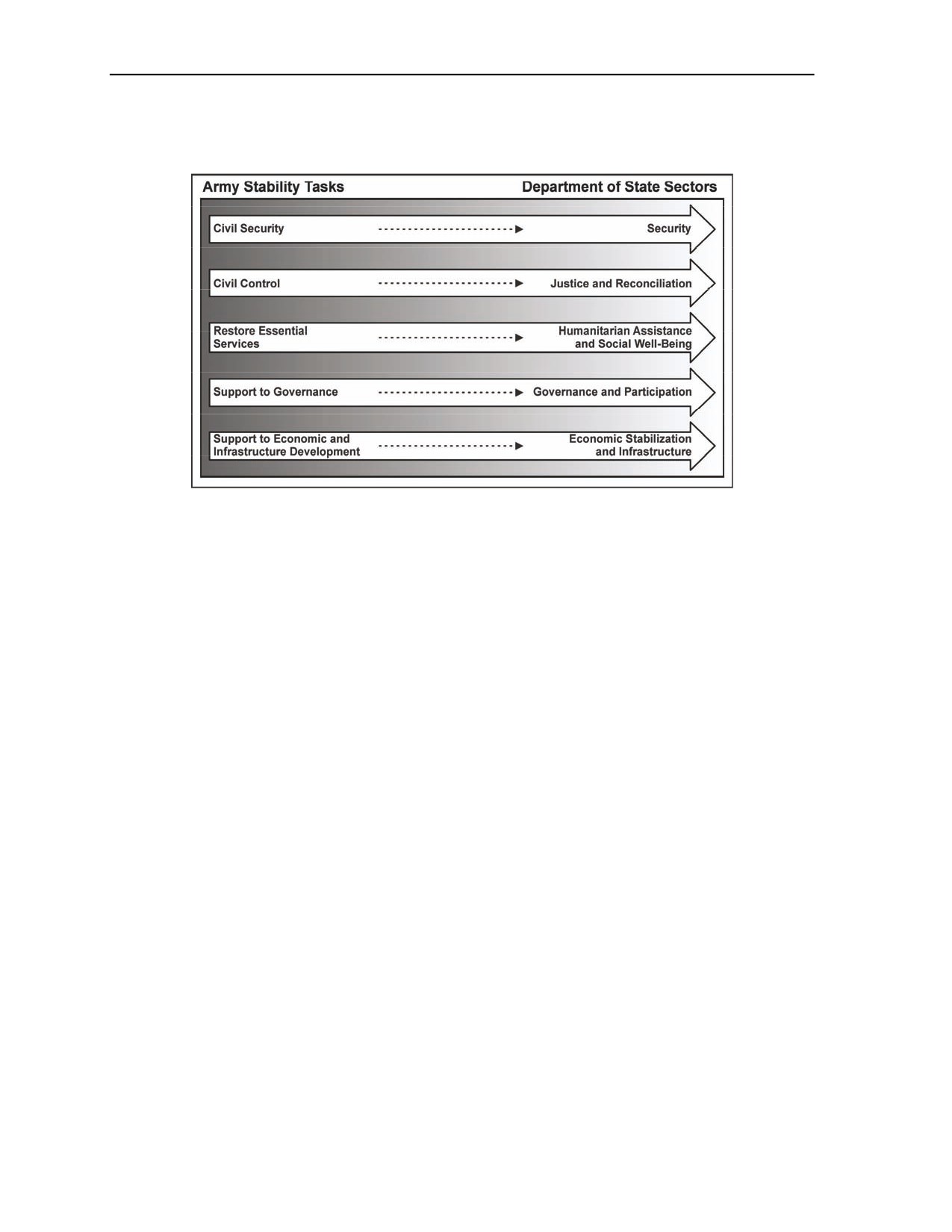
3-82. The stability tasks are linked to the Department of State post-conflict reconstruction and stabilization
technical sectors. Normally, Army forces act to support host-nation and other civilian agencies. However,
when the host nation cannot provide basic government functions, Army forces may be required to do so
22 February 2011
FM 3-0, C1
3-13
Chapter 3
directly. The Department of State organizes conditions related to post-conflict stability into five sectors.
(See figure 3-3.) Paragraphs 3-83 through 3-89 discuss the Army stability tasks that support these sectors.
Figure 3-3. Stability tasks and Department of State technical sectors
Security
3-83. Army forces conduct operations to establish and maintain a safe and secure environment, whenever
possible together with host-nation forces. They provide public order and safety and protect individuals,
infrastructure, and institutions. Typically, offensive, defensive, and stability tasks all support this sector.
Civil security and civil control are associated stability tasks. Initially, Army forces have the lead for this
sector. Army operations should complement and be concurrent with other agencies’ actions. Army forces
hand over responsibility to host-nation agencies and assume a supporting role as these agencies develop the
needed capabilities.
3-84. The first aim in the security sector is to limit adversaries’ influence and isolate the populace from the
enemy. Army forces use several methods to isolate the enemy. Isolation in some stability operations is
indirect; it aims to redirect, compel, and influence the populace away from supporting adversaries and
toward supporting the host-nation government. Concurrently, Army forces secure the support of
populations in unstable areas. If the enemy poses a significant military threat, forces engaged in stability
operations defend themselves and the populace from attacks. Army forces may conduct offensive
operations to physically isolate, defeat, or destroy forces that threaten the stability mission. Security is the
foremost condition; it underpins all other sectors.
Justice and Reconciliation
3-85. Establishing public order and safety and providing for social reconciliation are this sector’s
objectives. The host nation aims to establish self-sustaining public law and order that operates according to
internationally recognized standards and respects human rights and freedoms.
Humanitarian Assistance and Social Well-Being
3-86. Army forces work to reduce human suffering, disease, and privation. This sector includes programs
conducted to relieve or reduce the results of conditions that seriously threaten life or that can result in great
damage to or loss of property. These conditions may be endemic or result from natural or manmade
disasters.
3-14
FM 3-0, C1
22 February 2011
Full Spectrum Operations
Governance and Participation
3-87. This sector focuses on restoring or creating effective government institutions. These efforts involve
strengthening host-nation governance and rebuilding government infrastructure. This sector also requires
developing institutions that achieve sustainable peace and security, foster a sense of confidence, and
support conditions for economic reconstruction. Army forces mainly strive to create an environment
conducive to stable governance. Civilian agencies oversee areas such as the following:
z
Reestablishing the administrative framework.
z
Supporting development of a national constitution.
z
Supporting political reform.
z
Reforming or establishing fair taxation.
Economic Stabilization and Infrastructure
3-88. Infrastructure restoration begins with meeting the needs of the populace. It continues by restoring
economic production and distribution. Army forces meet the basic needs of the populace by reconstituting
the following:
z
Power.
z
Transportation.
z
Communications.
z
Health and sanitation.
z
Firefighting.
z
Mortuary services.
z
Environmental control.
3-89. Once the basic infrastructure functions, efforts shift to stabilizing the economy. Economic
stabilization consists of the following:
z
Restoring employment opportunities.
z
Initiating market reform.
z
Mobilizing domestic and foreign investment.
z
Supervising monetary reform and rebuilding public structures.
Use of Force in Stability Operations
3-90. When using force, precision is as important in stability missions as applying massed, overwhelming
force is in offensive and defensive operations. Commanders at every level emphasize that in stability
operations, violence not precisely applied is counterproductive. Speed, surprise, and shock are vital
considerations in lethal actions; perseverance, legitimacy, and constraint are vital considerations in stability
and civil support operations.
3-91. The presence of armed Soldiers operating among the local populace causes tension. Discipline and
strict adherence to the rules of engagement are essential but not sufficient to reassure the population. In
addressing the populace’s apprehension, commanders balance protecting the force, defeating enemy forces,
and taking constructive action throughout the area of operations. They also stress cultural awareness in
training and preparing for operations. Cultural awareness makes Soldiers more effective when operating in
a foreign population and allows them to use local culture to enhance the effectiveness of their operations.
3-92. In peace operations, commanders emphasize impartiality in the use of force in addition to credibility
and transparency. Impartiality is not neutrality. Impartiality does not imply that Army forces treat all sides
equally. Commanders use force against threats in accordance with the rules of engagement. Fair treatment
of the local populace improves the prospects for lasting peace, stability, and security.
CIVIL SUPPORT OPERATIONS
3-93. Civil support is Department of Defense support to US civil authorities for domestic emergencies, and
for designated law enforcement and other activities (JP 3-28). Civil support includes operations that address
22 February 2011
FM 3-0, C1
3-15
Chapter 3
the consequences of natural or manmade disasters, accidents, terrorist attacks, and incidents in the United
States and its territories. Army forces conduct civil support operations when the size and scope of events
exceed the capabilities or capacities of domestic civilian agencies. Usually the Army National Guard is the
first military force to respond on behalf of state authorities. In this capacity, it functions under authority of
Title 32, United States Code, or while serving on state active duty. The National Guard is suited to
accomplish these missions; however, the scope and level of destruction may require states to request
assistance from Federal authorities.
(FM 3-28 provides a more complete overview of civil support
operations.)
*Primary Civil Support Tasks
3-94. U.S. law carefully limits actions that military forces, particularly Regular Army units, can conduct in
the United States and its territories. The Posse Comitatus Act, for example, prohibits Soldiers on Federal
active duty from enforcing the law outside of Federal military installations. Because the Posse Comitatus
Act does not apply to state National Guard forces, Soldiers under state control have law enforcement
authorities that Regular Army and Army Reserve units do not have. (FM 3-28 provides extensive
discussion on legal considerations for civil support.)
3-95. The operational environment within the United States differs so much from that outside the United
States that civil support operations have become their own element of full spectrum operations. The
purposes of civil support and stability operations are similar, but operational variables will radically differ.
For example, units conduct civil support operations to support Federal and state agencies. These agencies
are trained, resourced, and equipped more extensively than similar agencies involved in stability operations
overseas. In civil support operations, the military is not in charge; civilians from these agencies set the
priorities and Army forces coordinate and synchronize their efforts closely with them. Another example
occurs with multinational participation. In stability operations, multinational participation is typical; in civil
support operations, it is the exception.
3-96. Army civil support operations consist of four primary tasks:
z
Provide support for domestic disasters.
z
Provide support for domestic chemical, biological, radiological, nuclear, and high-yield
explosives (CBRNE) incidents.
z
Provide support for domestic civilian law enforcement agencies.
z
Provide other designated support.
*Provide Support for Domestic Disasters
3-97. Policies issued by the Federal government provide a comprehensive, tiered approach for disaster
response and govern the support Army forces provide in response to natural and manmade disasters. In the
event of disaster, Army forces support civil authorities with essential services, including—
z
Emergency route clearance.
z
Search and rescue support.
z
Emergency medical care and medical evacuation.
z
Support to medical agencies to detect and prevent serious diseases.
z
Distribution of food and water
z
Emergency shelter construction and support.
z
Sanitation support (sewage and garbage disposal).
z
Delivery of personnel and supplies to severely affected areas.
3-98. Any major disaster will reduce the state and local governments’ capacities. Army forces support
Federal and state officials to help restore and return control of local services to civil authorities as rapidly
as possible. When tasked, Army forces may provide additional support to government agencies at all levels
until they can carry out their responsibilities without Army assistance. This support includes
communications support, surveillance, critical infrastructure protection, and logistic assistance. In dire
situations, and as authorized by law, Army forces may enforce the law (see paragraphs 3-102 and 3-103).
3-16
FM 3-0, C1
22 February 2011
Full Spectrum Operations
*Provide Support for Domestic Chemical, Biological, Radiological, Nuclear, and High-Yield Explosives
Incidents
3-99. The most dangerous threats to the homeland come from terrorist groups armed with weapons of mass
destruction (WMD). After an attack with WMD, Federal, military, and state National Guard forces provide
specialized capabilities and general-purpose forces to support response and recovery operations in the event
of an attack involving CBRNE. These incidents combine disaster response and support to civilian law
enforcement within a deadly operational environment.
3-100. Not every biological threat is from terrorists, or even manmade. A pandemic occurs when a new
disease emerges for which people have little or no immunity and for which no vaccine immediately exists.
“Pandemic influenza” refers to an influenza virus that infects humans across a large area and proves very
difficult to contain. The word “pandemic” confuses many people, particularly those who equate it with
mass casualties. Influenza outbreaks are always serious because the virus may mutate into something more
lethal as it spreads. Army support to pandemic response is both internal and external. Internally, Army
installations take all applicable force health protection measures to maintain the combat readiness of the
force. Externally, Army forces respond to lead Federal and state agencies requests for support in dealing
with the disease.
3-101. Other outbreaks of infectious disease may prove more serious than a contagious influenza. These
include animal diseases, such as hoof-and-mouth disease, and crop infestations caused by fungus, bacteria,
or viruses. In these incidents, the Army provides support when requested by government agencies such as
the Department of Agriculture. Although technically not pandemics, these incidents could entail significant
support from the Department of Defense and National Guard.
*Provide Support for Domestic Civilian Law Enforcement Agencies
3-102. This task applies to the use of military assets to support any civilian agency charged with enforcing
the laws within the United States and its territories. Army forces support civilian law enforcement under
Constitutional and statutory restrictions and corresponding directives and regulations. When authorized and
directed, Army forces provide support to Federal, state, and local law enforcement officers. The governor
of each state may call out the National Guard of that state to enforce laws. In extreme cases, and when
directed by the President, Federal military forces maintain law and order. Army leaders must understand
the statutes governing the use of military assets for civilian law enforcement. By understanding these
statutes, Soldiers can avoid violating laws while accomplishing desired objectives.
3-103. Support may be direct or indirect. Direct support requires Soldiers to enforce the law (apprehend,
arrest, stop and search, and so on). Normally, the National Guard Soldiers acting under State authority
rather than Regular Army or U.S. Army Reserve Soldiers provide direct support. Except in extraordinary
circumstances, the Posse Comitatus Act prevents Federal troops, to include National Guard troops in
Federal status, from providing anything other than indirect support. Indirect support tasks Soldiers to
provide assistance and equipment to civilian law enforcement officers, but grants them no authority to
enforce the law. Since 2001, the importance of indirect support to civilian law enforcement agencies by
Federal and National Guard military forces has increased commensurate with critical requirements for
homeland security. The missions that Army forces may receive include—
z
Support border security with equipment and personnel.
z
Support counterdrug efforts at the national and state level.
z
Provide law enforcement support in the aftermath of a disaster.
z
Provide support to civilian law enforcement during a civil disturbance.
z
Provide equipment and training to civilian law enforcement officers.
z
Augment airport security measures.
*Provide Other Designated Support
3-104. This task includes pre-planned, routine, and periodic support not related to disasters or
emergencies. Most often, this support applies to major public events and consists of participatory support,
special transportation, and additional security. These events are national special security events such as the
Olympics, an inauguration, or a state funeral. Some missions may involve specific support requested by a
22 February 2011
FM 3-0, C1
3-17
Chapter 3
Federal or state agency to augment their capabilities due to labor shortages or a sudden increase in
demands. Such support may extend to augment critical government services by Soldiers as authorized by
the President and directed by the Secretary of Defense. Missions may include—
z
Participation in major public sporting events.
z
Critical infrastructure protection.
z
Wildland firefighting.
z
Providing military equipment and Soldiers to community events.
Purposes of Civil Support Tasks
3-105. Army forces execute civil support tasks to save lives, restore essential services, maintain or restore
law and order, protect infrastructure and property, maintain or restore local government, and shape the
environment for interagency success.
Save Lives
3-106. The first priority in civil support operations is to save lives. Immediately following a manmade or
natural disaster, the first military forces to arrive focus on rescue, evacuation, and consequence
management.
Restore Essential Services
3-107. In any major disaster, citizens suffer and may die because it disrupts most, if not all, essential
services. This disruption leads to tremendous suffering and the spread of disease. Restoring essential
services is crucial to saving lives over the long term and providing the first step to recovery.
Maintain or Restore Law and Order
3-108. When authorized, Army forces assist Federal, state, and local authorities with law enforcement.
Often the Army provides support under crisis conditions when events overwhelm civil capacity. In other
cases, the Army provides personnel and equipment to support ongoing law enforcement activities, such as
control of U.S. borders. In all instances, Army forces use lethal force in accordance with rules for the use of
force and only as a last resort.
Protect Infrastructure and Property
3-109. In the aftermath of a disaster or civil disturbance, Army forces frequently secure public and private
property. This allows civilian law enforcement to focus on dealing with criminal behavior.
Maintain or Restore Local Government
3-110. In a disaster, local government may be unable to carry out its normal functions. Army forces
provide essential services and communications support to local government officials until they can resume
their normal functions.
Shape the Environment for Interagency Success
3-111. Success in civil support operations is measured by the success of civilian officials in carrying out
their responsibilities. Civil support helps government officials meet their responsibilities to the public,
ultimately without assistance from military forces.
Civil Support Operations and Homeland Security
3-112. Army forces conduct civil support operations as part of homeland security. Homeland security
provides the Nation with strategic flexibility by protecting its citizens, critical assets, and infrastructure
from conventional and unconventional threats. It includes three missions. (JP 3-28 discusses these missions
in detail.)
3-18
FM 3-0, C1
22 February 2011
Full Spectrum Operations
Homeland Defense
3-113. Homeland defense protects the United States from direct attack or a threat by hostile armed forces.
In the event of such an attack, Army forces under joint command conduct offensive and defensive
operations against the enemy while providing civil support to Federal authorities. A defensive task
routinely conducted in homeland defense protects critical assets and key infrastructure during crises. The
ability to conduct offensive operations, though maintained primarily as a potential, is also present.
Civil Support
3-114. Civil support includes the key tasks of providing support in response to disaster and supporting
law enforcement (as discussed in paragraphs 3-97 and 3-102). Unless the United States is attacked, Army
forces conduct civil support operations exclusive of the offense and defense.
Emergency Preparedness Planning
3-115. In emergency preparedness planning, the Department of Homeland Security examines a wide
range of threats and plans for manmade and natural disasters and incidents. The Department of Defense
supports emergency preparedness planning. When necessary, these plans are executed as civil support
operations.
COMBINING THE ELEMENTS OF FULL SPECTRUM OPERATIONS
3-116. Within the concept of operations, the proportion and role of offensive, defensive, and stability or
civil support tasks vary based on several factors. Changes in the nature of the operation, the tactics used,
and where the environment falls on the spectrum of conflict affect the mix and focus. Some combinations
may be sequential, such as a mobile defense followed by a counteroffensive, but many occur
simultaneously. During major combat operations, a division may attack in one area, defend in another, and
focus on stability tasks in a third. Offensive and defensive operations may be complemented with stability
tasks and vice versa at any point of a campaign. Simultaneous combinations are also present in operational
themes dominated by stability. A peace operation, for example, may include a mix of several elements. One
force may conduct a raid against hostile forces (offense), while a second secures an important airport
(defense), and a third provides sanitary and secure facilities to dislocated civilians (stability). In homeland
security, civil support is often the only element executed, although forces may plan for defense.
3-117. Differing combinations of the elements of full spectrum operations generally characterize each
operational theme. The combinations vary according to the conditions and requirements for each phase of a
campaign or major operation. Commanders determine the weight of effort by considering the primary tasks
and purposes for each element within the operational theme and which will be decisive. This allows
commanders to translate their design into tactical actions. (FM 5-0 discusses design.)
3-118. Conducting full spectrum operations involves more than simultaneous execution of all its
elements. It requires commanders and staffs to consider their units’ capabilities and capacities relative to
each element. Commanders consider their missions, decide which tactics to use, and balance the elements
of full spectrum operations while preparing their concept of operations. They determine which tasks the
force can accomplish simultaneously, if phasing is required, what additional resources it may need, and
how to transition from one element to another. At the operational level, this requires looking beyond the
current operation and prioritizing each element for the next phase or sequel.
3-119. The transition between elements of full spectrum operations requires careful assessment, prior
planning, and unit preparation as commanders shift their combinations of full spectrum operations.
Commanders first assess the situation to determine which primary tasks are applicable and the priority for
each. For example, a division assigns a brigade combat team an area of operations and the tasks of
eliminating any enemy remnants, securing a dam, and conducting stability operations following a joint
offensive phase. The brigade commander determines that the brigade will conduct three tasks: (1) conduct
an area defense of the dam, (2) control the civil population in the area while excluding all civilians from the
area of the dam, and (3) conduct movements to contact in various objective areas, specifically search and
attack operations. Simultaneously, the brigade staff begins planning for the next phase in which civil
security, civil control, and assisting the local authorities with essential services will become priorities,
22 February 2011
FM 3-0, C1
3-19
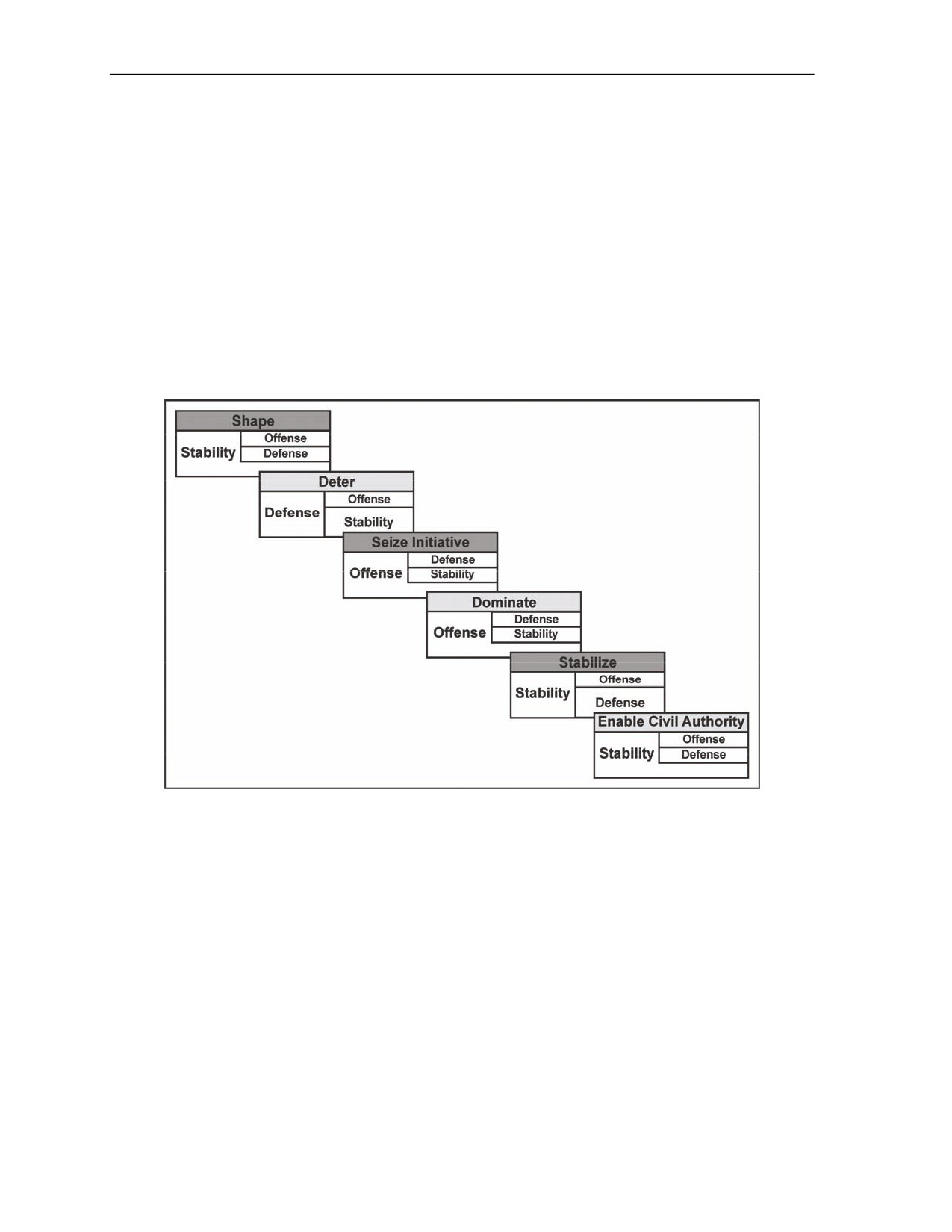
Chapter 3
while continuing to defend the dam. Reconnaissance and surveillance, inform and influence activities, area
and route security operations, and protection are continuous. The commander assigns tasks to subordinates,
modifies the brigade task organization, replenishes, and requests additional resources if required.
Depending on the length of operations, the higher headquarters may establish unit training programs to
prepare units for certain tasks.
3-120. When conditions change, commanders adjust the combination of the elements of full spectrum
operations in the concept of operations. When an operation is phased, these changes are included in the
plan. The relative weight given to each element varies with the actual or anticipated conditions. It is
reflected in tasks assigned to subordinates, resource allocation, and task organization. Full spectrum
operations is not a phasing method. Commanders consider the concurrent conduct of each element—
offense, defense, and stability or civil support—in every phase of an operation. Figure 3-4 (based on a
similar figure in JP 3-0) illustrates combinations and weighting of the elements of full spectrum operations
across the phases of a campaign. The phases are examples. An actual campaign may name and array phases
differently. (JP 3-0 discusses the campaign phases.)
Figure 3-4. Example of combining the elements of full spectrum operations in a notional
campaign
3-121. Seizing, retaining, and exploiting the initiative requires commanders to interpret developments and
shift the weight of effort throughout their operations to achieve decisive results. As they do this, the forces
and priorities they assign to each element of full spectrum operations change. Throughout an operation,
commanders constantly adapt and perform many tasks simultaneously. Commanders change tactics, modify
their mission command methods, change task organization, and adjust the weight placed on each element of
full spectrum operations to keep the force focused on accomplishing the mission. They base these decisions
on the situation, available resources, and the force’s ability to execute multiple, diverse tasks.
Commanders’ assessments should consider the progress of ongoing operations, changes in the situation,
and how the rules of engagement affect the force’s effectiveness in each element. Commanders not only
assess how well a current operation is accomplishing the mission but also how its conduct is shaping the
situation for subsequent missions.
3-122. Applying tactical and operational art in full spectrum operations involves knowing when and if
simultaneous combinations are appropriate and feasible. Every operation does not require offensive tasks;
stability or civil support may be the only elements executed. Nonetheless, commanders and staffs always
3-20
FM 3-0, C1
22 February 2011
Full Spectrum Operations
consider each element of full spectrum operations and its relevance to the situation. An element may be
unnecessary, but it is the commander who determines that. Not every echelon or unit necessarily executes
simultaneous full spectrum operations. Division and higher echelon operations normally combine three
elements simultaneously. Brigade combat teams may focus exclusively on a single element when attacking
or defending, shifting priority to another element as the plan or situation requires. Battalion and smaller
units often execute the elements sequentially based on their capabilities and the situation. However,
simultaneous execution of offensive, defensive, and stability tasks at lower echelons often occurs in
irregular warfare and peace operations. Sometimes the force available lacks resources for executing
simultaneous combinations of offensive, defensive, and stability tasks. In these cases, commanders inform
the higher headquarters of the requirement for additional forces. Regardless of the situation, commanders
assess the risk to units and mission accomplishment. Combining elements of full spectrum operations
requires the following:
z
A clear concept of operations that establishes the role of each element and how it contributes to
accomplishing the mission.
z
Flexible mission command networks and systems.
z
Clear situational understanding.
z
Aggressive intelligence gathering and analysis.
z
Aggressive security operations.
z
Units that can quickly change their task organization.
z
An ability to respond quickly.
z
Responsive sustainment.
z
Combat power applied through combined arms, including applicable joint capabilities. (See
chapter 4.)
SUMMARY
3-123. The Army’s operational concept, full spectrum operations, describes how Army forces conduct
operations. The complex nature of the operational environment requires commanders to simultaneously
combine offensive, defensive, and stability or civil support tasks to accomplish missions domestically and
abroad. Each element of full spectrum operations includes a basic set of tasks and related purposes.
Commanders direct the application of full spectrum operations to seize, retain, and exploit the initiative and
achieve decisive results.
22 February 2011
FM 3-0, C1
3-21
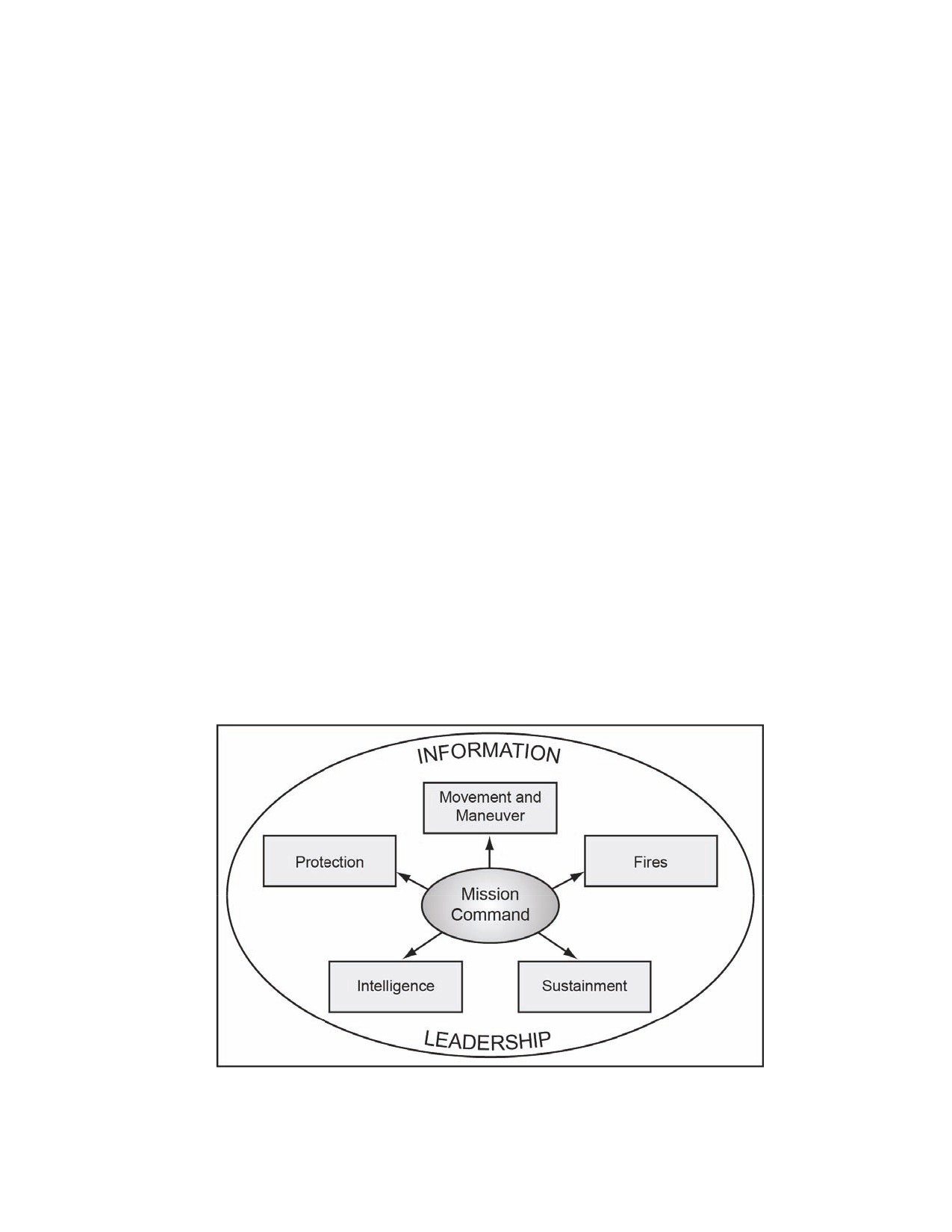
Chapter 4
Combat Power
This chapter discusses combat power and how Army forces use the warfighting
functions to generate combat power. The eight elements of combat power include the
six warfighting functions—mission command, movement and maneuver, intelligence,
fires, sustainment, and protection—multiplied by leadership and complemented by
information. This chapter introduces mission command, which replaces the former
term command and control. Commanders use combined arms to increase the effects
of combat power through complementary and reinforcing capabilities. Army forces
achieve combined arms through force tailoring, task organization, and mutual
support.
THE ELEMENTS OF COMBAT POWER
4-1. Full spectrum operations require continuously generating and applying combat power, often for
extended periods. Combat power is the total means of destructive, constructive, and information
capabilities that a military unit or formation can apply at a given time. Army forces generate combat
power by converting potential into effective action.
4-2.
*Commanders conceptualize capabilities in terms of combat power. Combat power has eight
elements: leadership, information, mission command, movement and maneuver, intelligence, fires,
sustainment, and protection. Commanders apply leadership and information through, and multiply the
effects of, the other six elements of combat power. The Army collectively describes these six—mission
command, movement and maneuver, intelligence, fires, sustainment, and protection—as the warfighting
functions. Commanders apply combat power through the warfighting functions using leadership and
information. (See figure 4-1.)
Figure 4-1. The elements of combat power
22 February 2011
FM 3-0, C1
4-1
Chapter 4
4-3. Commanders ensure Army forces have enough potential combat power to combine the elements of
full spectrum operations in ways appropriate to conditions. Every unit—regardless of type—either
generates or maintains combat power. All contribute to operations. Ultimately, Army forces combine
elements of combat power to defeat the enemy and master situations.
4-4. Commanders balance the ability to mass lethal and nonlethal actions with the need to deploy and
sustain the units that produce those actions. They balance accomplishing the mission quickly with being
able to project and sustain the force. Generating and maintaining combat power throughout an operation is
essential to success. Commanders tailor force packages to maximize the capability of the initial-entry force.
Follow-on units increase endurance and ability to operate in depth. Many factors contribute to generating
combat power:
z
Employing reserves.
z
Focusing joint support.
z
Rotating committed forces.
z
Staging sustainment assets to preserve momentum and synchronization.
4-5. Commanders achieve success by applying superior combat power. Combat power is not a numerical
value. Planners can estimate it but not quantify it. Combat power is always relative. It has meaning only in
relation to conditions and enemy capabilities. It is relevant solely at the point in time and space where
applied. In addition, how an enemy generates and applies combat power may fundamentally differ from
that of Army forces. Planners take an inordinate risk when they assume that enemy capabilities mirror those
of friendly capabilities. Before an operation, combat power is unrealized potential. Through leadership,
commanders transform this potential information to integrate and enhance action. Commanders also apply
information through the warfighting functions to shape the operational environment and complement
action. Combat power becomes decisive when applied by skilled commanders leading well-trained Soldiers
and units.
LEADERSHIP
4-6. Commanders apply leadership through the warfighting functions. Leadership is the multiplying and
unifying element of combat power. Confident, competent, and informed leadership intensifies the
effectiveness of all other elements of combat power by formulating sound operational ideas and assuring
discipline and motivation in the force. Good leaders inspire and elicit success. Effective leadership can
compensate for deficiencies in all the warfighting functions because it is the most dynamic element of
combat power. The opposite is also true; poor leadership can negate advantages in warfighting capabilities.
The Army defines leadership as the process of influencing people by providing purpose, direction, and
motivation, while operating to accomplish the mission and improve the organization (FM 6-22). An Army
leader, by virtue of assumed role or assigned responsibility, inspires and influences people to accomplish
organizational goals. Army leaders motivate people to pursue actions, focus thinking, and shape decisions
for the greater good of the organization. They instill in Soldiers the will to win. Army doctrine describes
essential leadership attributes (character, presence, and intellect) and competencies (lead, develop, and
achieve). These attributes and competencies mature through lifelong learning. (FM 6-22 contains Army
leadership doctrine.)
4-7. Leaders influence not only Soldiers but other people as well. Commanders embrace their leadership
skills when dealing with civilians in any conflict or disaster. Face-to-face contact with people in the area of
operations encourages cooperation between civilians and Soldiers. Army leaders work with members of
other Services and civilian organizations. These leaders strive for the willing cooperation of multinational
military and civilian partners. The Army requires self-aware, adaptive leaders who can both defeat the
enemy in combat and master complexities of operations dominated by stability or civil support.
4-8. Leadership in today’s operational environment is often the difference between success and failure.
Leaders provide purpose, direction, and motivation in all operations. Through training and by example,
leaders develop cultural awareness in Soldiers. This characteristic improves Soldiers’ ability to cope with
the ambiguities of complex environments. Leadership ensures Soldiers understand the purpose of
operations and use their full capabilities. In every operation, Army leaders clarify purpose and mission,
4-2
FM 3-0, C1
22 February 2011
Combat Power
direct operations, and set the example for courage and competence. They hold their Soldiers to the Army
Values and ensure their Soldiers comply with the law of war.
INFORMATION
4-9. Information is a powerful tool in the operational environment. Information has become as important
as lethal action in determining the outcome of operations. Every engagement, battle, and major operation
requires complementary inform and influence activities to inform a global audience, to influence audiences,
and to affect morale within the operational area. It also requires cyber/electromagnetic activities as a
weapon against enemy command and control information systems and other cyber capabilities.
Commanders use information to understand, visualize, describe, and direct the warfighting functions. They
also depend on data and information to increase the effectiveness of the warfighting functions.
4-10. Since information shapes the perceptions of the civilian population, it also shapes much of the
operational environment. All parties in a conflict—enemy forces, adversaries, and neutral and friendly
populations—use information to convey their message to various audiences. Information is critical in
stability operations where the population influences its success. The five stability tasks are essential for
success. Without complementary inform and influence activities that explain these actions to the
population, success may prove unattainable. Information must be proactive as well as reactive. An enemy
adeptly manipulates information and combines message and action effectively. Countering enemy
messages with factual and effective friendly messages can influence civilians as much as the physical
actions of Soldiers can. The effects of each warfighting function should complement information objectives
(the message) while information objectives stay consistent with Soldiers’ actions.
4-11. The joint force continues to modernize information systems. These improvements provide leaders
with the information necessary to enhance and focus the warfighting functions. Leadership based on
relevant information enables the commander, at all levels, to make informed decisions on how best to apply
combat power. Ultimately, this creates opportunities to achieve decisive results. The computer-displayed
common operational picture is one example. It provides commanders with improved situational awareness
by merging a lot of information into displays that Soldiers can understand at a glance. Information
disseminated by information systems allows leaders to make better decisions quickly. The common
operational picture lets Army forces use lethal and nonlethal actions more effectively than the enemy can.
For example, accurate intelligence disseminated quickly by information systems allows friendly forces to
maneuver around enemy engagement areas while massing the effects of combat power at the decisive place
and time. This reduces friendly casualties and may allow a small force to defeat a larger enemy force.
WARFIGHTING FUNCTIONS
4-12. Commanders use the warfighting functions to help them exercise command and to help them and
their staffs exercise control. A warfighting function is a group of tasks and systems
(people,
organizations, information, and processes) united by a common purpose that commanders use to
accomplish missions and training objectives. Decisive, shaping, and sustaining operations combine all
the warfighting functions to generate combat power. Additionally, all warfighting functions possess
scalable capabilities to mass lethal and nonlethal effects. No warfighting function is exclusively decisive,
shaping, or sustaining. The Army’s warfighting functions are fundamentally linked to the joint functions.
*MISSION COMMAND
4-13. The mission command warfighting function develops and integrates those activities enabling a
commander to balance the art of command and the science of control. Formerly described as the
command and control warfighting function, this function adapts and captures what the Army has learned in
a decade of war. These lessons include—
z
The changing roles and responsibilities of leaders in distributed and increasingly decentralized
operations.
z
The requirement for leaders at every echelon to co-create the context for operations.
22 February 2011
FM 3-0, C1
4-3
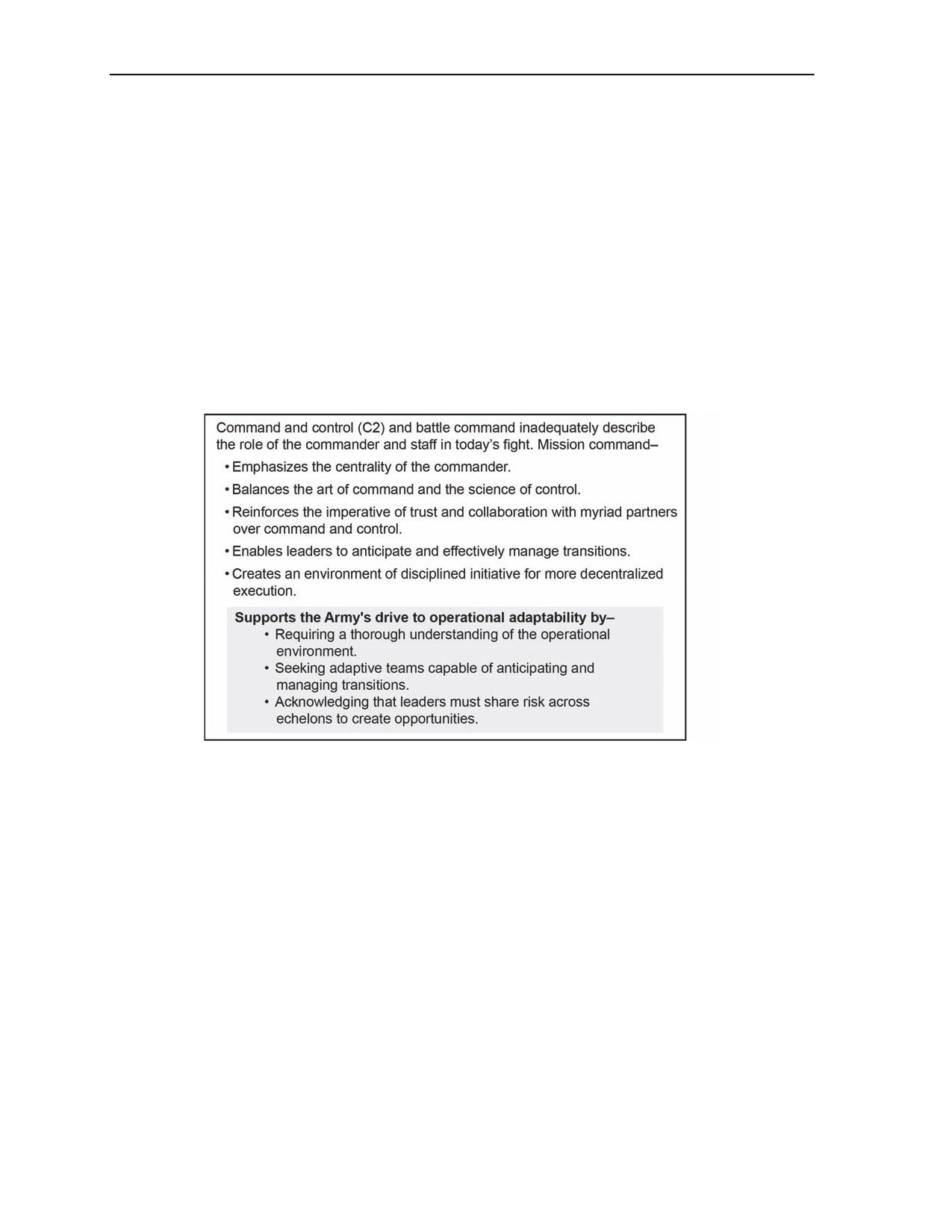
Chapter 4
z
The importance of teaming and collaborating with joint, international, interagency, and
multinational partners.
z
The need for leaders to anticipate and manage transitions during the course of a campaign.
(Chapter
5 defines mission command as an activity and discusses the commander’s role in mission
command.)
*Why Mission Command
4-14. The Army changed from command and control (C2) to mission command and eliminated the term
battle command. This philosophical shift emphasizes the commanders rather than the systems that they
employ. (See figure 4-2.) Army C2 and battle command did not adequately address the increasing need for
commanders to frame and reframe an environment of ill-structured problems. Framing these problems
enables commanders to gain the context of operations by continuously challenging assumptions both before
and during execution. Additionally, the old terms inadequately addressed the role of the commander in
building teams with joint, interagency, intergovernmental, and multinational partners.
*Figure 4-2. Why mission command?
4-15. Mission command magnifies leadership in land operations. It illuminates the leader’s responsibility
to understand, visualize, describe, direct, lead, and assess. It provides commanders and staff with a
philosophy for operating in an uncertain environment as opposed to trying to create certainty and imposing
order and control over a situation. Mission command recognizes that leaders command not only U.S. forces
but also diverse international, nongovernmental, and host-nation partners.
4-16. Mission command supports an adaptable Army in operations. An adaptable Army starts with leaders
able to adapt. Confronting hybrid threats—combinations of regular, irregular, terrorist, and criminal
groups—in a complex operational environment requires such leaders. These Soldiers not only accept but
also seek and embrace operational adaptability as an imperative. Mission command enables an
operationally adaptive force that has both the authority and resources to operate effectively at all levels,
under clear mission orders. Mission command enables operational adaptability in the Army. It requires a
thorough understanding of the operational environment, seeks adaptive teams capable of anticipating and
managing transitions, and acknowledges that leaders must share risk across echelons to create
opportunities.
4-17. Mission command emphasizes the critical contributions of leaders at every echelon. It establishes a
mindset among leaders that the best understanding comes from the bottom up, not from the top down.
Mission command emphasizes the importance and common operating assessment of context. It highlights
4-4
FM 3-0, C1
22 February 2011
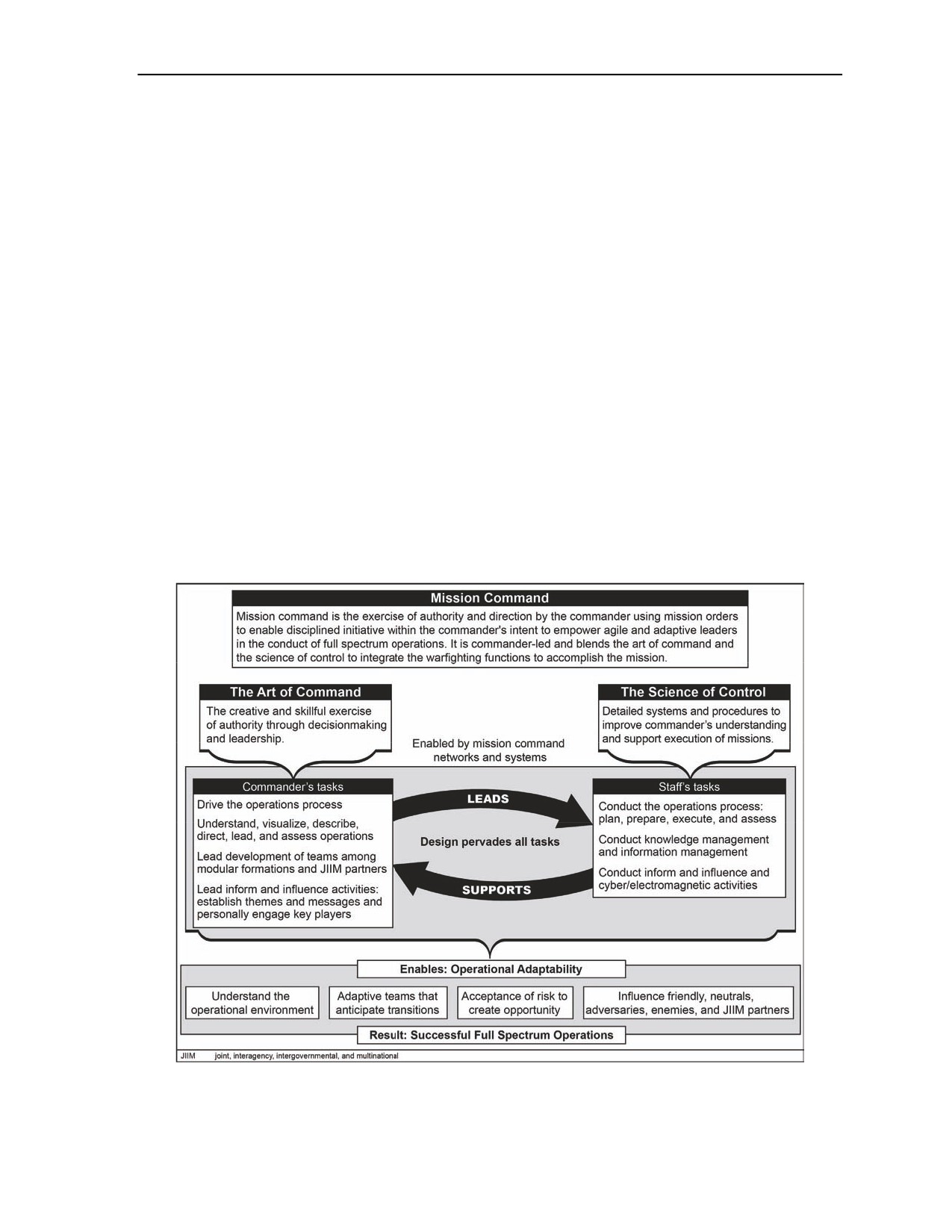
Combat Power
how commanders—through disciplined initiative within the commander’s intent—transition among
offensive, defensive, and stability operations and between centralized and decentralized operations.
4-18. The Army has adopted mission command as the overarching term for both the warfighting function
and the philosophy of command. Mission command guides leaders how to think about what Soldiers do to
conduct successful operations on land. By emphasizing people as the driving force behind the development
of technology, mission command adapts technology to human needs, not humans to technological
restrictions. Understanding people, and influencing humans to achieve success in complex operations, is
fundamental to how the commander exercises the art of command.
*Mission Command Tasks
4-19. The commander is the central figure in mission command, essential to integrating the capabilities of
the warfighting functions to accomplish the mission. Mission command invokes the greatest possible
freedom of action to subordinates. It enables subordinates to develop the situation, adapt, and act decisively
through disciplined initiative in dynamic conditions within the commander’s intent. Mission command
focuses on empowering subordinate leaders and sharing information to facilitate decentralized execution.
4-20. The art of command is the creative and skillful exercise of authority through decisionmaking and
leadership. Through the art of command, the commander has four tasks in mission command (see
figure 4-3). They are:
z
Drive the operations process.
z
Understand, visualize, describe, direct, lead, and assess.
z
Develop teams among modular formations and joint, interagency, intergovernmental, and
multinational partners.
z
Lead inform and influence activities.
*Figure 4-3. Mission command
22 February 2011
FM 3-0, C1
4-5
Chapter 4
4-21. The commander leads the staff’s tasks under the science of control. The science of control consists of
systems and procedures to improve the commander’s understanding and support accomplishing missions.
The three staff tasks are:
z
Conduct the operations process: plan, prepare, execute, and assess.
z
Conduct knowledge management and information management.
z
Conduct inform and influence and cyber/electromagnetic activities.
As much as the commander leads the staff’s tasks, the staff tasks fully support the commander in executing
the commander’s tasks.
4-22. Mission command networks and systems is the coordinated application of personnel, networks,
procedures, equipment and facilities, knowledge management, and information management systems
essential for the commander to conduct operations. These networks and systems enable the art of
command and science of control. Design provides a cognitive tool to help commanders anticipate change
and coordinate applications appropriately. It pervades all tasks and assists the commander to lead adaptive,
innovative efforts. Design provides the commander and staff with a methodology to better understand
complex, ill-structured problems.
4-23. Successful mission command, supported by design, fosters operational adaptability and a greater
understanding of the operational environment. Operational adaptability is the ability to shape conditions
and respond effectively to a changing operational environment with appropriate, flexible, and timely
actions. Operational adaptability reflects a quality that Army leaders and forces exhibit through critical
thinking, their comfort with ambiguity and uncertainty, their willingness to accept prudent risk, and their
ability to rapidly adjust while continuously assessing the situation. Commanders enable operationally
adaptive forces through flexibility, collaborative planning, and decentralized execution. Operational
adaptability results in teams that—
z
Understand the operational environment.
z
Adapt and anticipate transitions.
z
Accept risks to create opportunities.
z
Influence friendly, neutrals, adversaries, enemies, and joint, interagency, intergovernmental, and
multinational partners.
The ultimate outcome is successful full spectrum operations.
4-24. Understand the operational environment: Command is an individual and personal function. It blends
imaginative problem solving, motivational and communications skills, and a thorough understanding of the
dynamics of operations. Command during operations requires understanding the complex, dynamic
relationships among friendly forces, enemies, and the environment, including the populace. This
understanding helps commanders visualize and describe their commander’s intent and develop focused
planning guidance.
4-25. Adapt and anticipate transitions: Operational adaptability enables leaders to transition continuously
between fundamentally different operations. Major combat operations may evolve to irregular warfare or
peace operations. Units may transition from offensive to defensive operations or from defensive to stability
operations. Transitions often involve transferring responsibilities to other organizations or authorities, such
as from U.S. forces to partner forces, civil authorities, or international organizations. Commanders identify
potential transitions during planning and account for them throughout execution. Assessment ensures that
commanders measure progress toward such transitions and take appropriate actions to prepare for and
execute them.
4-26. Accept risks to create opportunities: Operational adaptability assists commanders to create training
and organizational climates that promote calculated, disciplined risk-taking focused on winning rather than
preventing defeat. A key aspect of mission command includes identifying risks, deciding how much risk to
accept, and minimizing the effects of accepted risk by establishing control measures to mitigate those risks.
The staff helps the commander identify risks and offers recommendations to mitigate those risks. (See
FM 5-19 for doctrine on composite risk management.) Ultimately, the willingness to take prudent risks
rests with the commander. However, commanders must be careful not to decentralize all risks. Through
4-6
FM 3-0, C1
22 February 2011
Combat Power
collaboration and dialog, commanders at all levels identify where risk exists and at what level of command
risk will be mitigated.
4-27. The commander considers how to establish conditions for success in full spectrum operations, protect
the force, and shape the operational environment. War gaming enables commanders and staffs to complete
a risk assessment for each course of action. They then propose appropriate control measures. They
continually assess the risk of adverse reactions from the population and media. Staff officers develop ways
to mitigate those risks. Commanders discuss these risks with subordinate leaders. Commanders and
subordinates determine what risks the higher commander will accept and what risk will remain with the
subordinate commander. Commanders then allocate resources as deemed appropriate to mitigate risks.
4-28. Influence friendly, neutrals, adversaries, enemies, and joint, interagency, intergovernmental, and
multinational partners: Commanders personally use inform and influence activities to guide actors to make
decisions that support the commander’s objectives. Commanders directly shape the themes and messages
designed to inform domestic audiences and influence foreign friendly, neutral, adversary, and enemy
populations. Commanders ensure that themes and messages synchronize with actions to support operations
and achieve the desired end state. Commanders consider how their units’ actions will affect the
environment and influence perceptions among relevant groups. Commanders assume that their enemies and
adversaries can adeptly use the information environment. They expect the enemy to actively and
aggressively engage in the information environment to gain an operational advantage. The enemy attempts
to confuse the general population, distort facts to support their position, or use other means including
intimidation and propaganda.
4-29. Subsequent chapters provide greater detail on the taxonomy of mission command. Chapter 5
discusses the art of command and the role of the commander in mission command. Chapter 6 discusses the
science of control. It discusses the systems and procedures that support the commander to drive the
commander’s tasks and integrate the warfighting functions.
MOVEMENT AND MANEUVER
4-30. The movement and maneuver warfighting function is the related tasks and systems that move
forces to achieve a position of advantage in relation to the enemy. Direct fire is inherent in maneuver, as
is close combat. This function includes tasks associated with force projection related to gaining a positional
advantage over an enemy. One example is moving forces to execute a large-scale air or airborne assault.
Another is deploying forces to intermediate staging bases in preparation for an offensive operation.
Maneuver is the employment of forces in the operational area through movement in combination with fires
to achieve a position of advantage in respect to the enemy in order to accomplish the mission (JP 3-0).
Commanders use maneuver for massing the effects of combat power to achieve surprise, shock, and
momentum. Effective maneuver requires close coordination with fires. Movement is necessary to disperse
and displace the force as a whole or in part when maneuvering. Both tactical and operational maneuver
require logistic support. The movement and maneuver warfighting function includes the following tasks:
z
Deploy.
z
Move.
z
Maneuver.
z
Employ direct fires.
z
Occupy an area.
z
Conduct mobility and countermobility operations.
z
Employ battlefield obscuration.
The movement and maneuver warfighting function does not include administrative movements of
personnel and materiel. These movements fall under the sustainment warfighting function. FM 3-90
discusses maneuver and tactical movement. FM 3-35 discusses force projection.
INTELLIGENCE
4-31. The intelligence warfighting function is the related tasks and systems that facilitate
understanding of the operational environment, enemy, terrain, and civil considerations. It includes
22 February 2011
FM 3-0, C1
4-7
Chapter 4
tasks associated with intelligence, surveillance, and reconnaissance operations. The commander drives the
intelligence warfighting function. Intelligence is more than just collection. It is a continuous process that
involves analyzing information from all sources and conducting operations to develop the situation. The
intelligence warfighting function includes the following tasks:
z
Support to force generation.
z
Support to situational understanding.
z
Provide intelligence support to targeting and information capabilities.
z
Conduct intelligence, surveillance, and reconnaissance.
*Intelligence, Surveillance, and Reconnaissance
4-32. Knowledge of the operational environment precludes all effective action, whether in the information
or physical domains. Knowledge about the operational environment requires aggressive and continuous
surveillance and reconnaissance to acquire information. Information collected from multiple sources and
analyzed becomes intelligence that provides answers to commanders’ information requirements concerning
the enemy and other adversaries, climate, weather, terrain, and population. Developing these requirements
is the function of intelligence, reconnaissance, and surveillance (ISR). Intelligence, surveillance, and
reconnaissance is an activity that synchronizes and integrates the planning and operation of sensors,
assets, and processing, exploitation, and dissemination systems in direct support of current and
future operations. This is an integrated intelligence and operations function. For Army forces, this
activity is a combined arms operation that focuses on priority intelligence requirements while
answering the commander’s critical information requirements. (JP 2-01 contains ISR doctrine.)
Through ISR, commanders and staffs continuously plan, task, and employ collection assets and forces.
These Soldiers collect, process, and disseminate timely and accurate information, combat information, and
intelligence to satisfy the commander’s critical information requirements (CCIRs) and other intelligence
requirements. When necessary, ISR assets may focus on special requirements, such as information required
for personnel recovery operations. It supports full spectrum operations through four tasks:
z
ISR synchronization.
z
ISR integration.
z
Surveillance.
z
Reconnaissance.
4-33. ISR synchronization considers all assets—both internal and external to the organization. It identifies
information gaps and the most appropriate assets for collecting information to fill them. It also assigns the
most efficient means to process the information into intelligence and disseminate it. ISR integration tasks
assets to collect on requirements that intelligence reach or requests for information cannot answer or that
commanders consider critical. Commanders integrate assets into a single ISR plan that capitalizes on each
asset’s capabilities. Commanders also synchronize and coordinate surveillance and reconnaissance
missions and employ other units for ISR within the scheme of maneuver. Effectively synchronizing ISR
with the overall plan positions ISR assets to continue to collect information, reconstitute for branches or
sequels, or shift priorities throughout the operation.
*Intelligence, Surveillance, and Reconnaissance Synchronization
4-34. Intelligence, surveillance, and reconnaissance synchronization is the task that accomplishes the
following: analyzes information requirements and intelligence gaps; evaluates available assets
internal and external to the organization; determines gaps in the use of those assets; recommends
intelligence, surveillance, and reconnaissance assets controlled by the organization to collect on the
commander’s critical information requirements; and submits requests for information for adjacent
and higher collection support. This task ensures that ISR, intelligence reach, and requests for information
result in successful reporting, production, and dissemination of information, combat information, and
intelligence to support decisionmaking.
4-35. The intelligence officer, with the operations officer and other staff elements, synchronizes the entire
collection effort. This effort includes recommending tasking for assets the commander controls and
submitting requests for information to adjacent and higher echelon units and organizations. When these
4-8
FM 3-0, C1
22 February 2011
Combat Power
sources do not answer the CCIR and other requirements, ISR synchronization uses intelligence reach to
obtain the information.
4-36. ISR synchronization includes screening subordinate and adjacent unit requests for information
concerning the enemy, terrain and weather, and civil considerations. When intelligence reach and requests
for information do not satisfy a requirement, ISR synchronization develops specific information
requirements to facilitate ISR integration. (FM 2-0 discusses intelligence reach.)
4-37. Commanders use ISR synchronization to assess ISR asset reporting. ISR synchronization includes
continually identifying new and partially filled intelligence gaps. It also provides recommendations to the
operations officer for tasking ISR assets.
*Intelligence, Surveillance, and Reconnaissance Integration
4-38. Intelligence, surveillance, and reconnaissance integration is the task of assigning and controlling
a unit’s intelligence, surveillance, and reconnaissance assets (in terms of space, time, and purpose) to
collect and report information as a concerted and integrated portion of operation plans and orders.
This task ensures planners assign the best ISR assets through a deliberate and coordinated effort of the
entire staff across all warfighting functions by integrating ISR into the operation.
4-39. The operations officer, with input from the intelligence officer, develops tasks based on specific
information requirements (developed as part of ISR synchronization). Specific information requirements
facilitate tasking by matching requirements to assets. The operations officer assigns tasks based on the
latest time that information is of value and the capabilities and limitations of available ISR assets. Then the
operations officer identifies, prioritizes, and validates intelligence requirements. The staff develops and
synchronizes the ISR plan with the overall operation. During ISR integration, the entire staff participates as
responsibility for the ISR plan transitions from the intelligence officer to the operations officer. ISR
integration is vital in controlling limited ISR assets. During ISR integration, the staff recommends
redundancy and mix as appropriate. ISR synchronization and integration result in an effort focused on
answering the commander’s requirements through ISR tasks translated into orders.
*Surveillance
4-40. Surveillance is the systematic observation of aerospace, surface, or subsurface areas, places, persons,
or things, by visual, aural, electronic, photographic, or other means
(JP
3-0). Surveillance involves
observing an area to collect information.
4-41. Wide-area and focused surveillance missions provide valuable information. National and joint
surveillance systems focus on information requirements for combatant commanders. They also provide
information to all Services for operations across the area of responsibility. The systematic observation of
geographic locations, persons, networks, or equipment is assigned to Army intelligence, reconnaissance,
and maneuver assets. Changes or anomalies detected during surveillance missions can develop
reconnaissance to confirm or deny the change.
*Reconnaissance
4-42. Reconnaissance is a mission undertaken to obtain, by visual observation or other detection methods,
information about the activities and resources of an enemy or adversary, or to secure data concerning the
meteorological, hydrographic, or geographic characteristics of a particular area (JP 2-0).
4-43. Units performing reconnaissance collect information to confirm or deny current intelligence or
predictions. This information may concern the terrain, weather, and population characteristics of a
particular area as well the enemy. Reconnaissance normally precedes execution of the overall operation and
extends throughout the area of operations. It begins as early as the situation, political direction, and rules of
engagement permit. Reconnaissance can locate mobile enemy command and control assets—such as
command posts, communications nodes, and satellite terminals—for neutralization, attack, or destruction.
Reconnaissance can detect patterns of behavior exhibited by people in the objective area. Commanders at
all echelons incorporate reconnaissance into their operations.
22 February 2011
FM 3-0, C1
4-9
Chapter 4
*Soldier Surveillance and Reconnaissance
4-44. Surveillance is distinct from reconnaissance. Often surveillance is passive and may be continuous;
reconnaissance missions are typically shorter and use active means (such as maneuver). Additionally,
reconnaissance may involve fighting for information. Sometimes these operations are deliberate, as in a
reconnaissance in force; however, the purpose of reconnaissance is to collect information, not initiate
combat. Reconnaissance involves many tactics, techniques, and procedures throughout the course of a
mission. An extended period of surveillance may be one of these. Commanders complement surveillance
with frequent reconnaissance. Surveillance, in turn, increases the efficiency of reconnaissance by focusing
those missions while reducing the risk to Soldiers.
4-45. The Soldier is an indispensable source for much of what the intelligence commanders need. Every
Soldier is a sensor. Observations and experiences of Soldiers—who often work with the local populace—
provide depth and context to information gathered through surveillance and reconnaissance. Commanders
train all Soldiers to report their observations, even when not assigned a surveillance or reconnaissance
mission. Commanders and staffs emphasize integrating information gathered from Soldiers into
intelligence production.
FIRES
4-46. The fires warfighting function is the related tasks and systems that provide collective and
coordinated use of Army indirect fires and joint fires through the targeting process. It includes tasks
associated with integrating and synchronizing the effects of these fires with the effects of other warfighting
functions. Commanders integrate these tasks into the concept of operations during planning and adjust them
based on the targeting guidance. Fires normally contribute to the overall effect of maneuver, but
commanders may use them separately for decisive and shaping operations. The fires warfighting function
includes the following tasks:
z
Decide surface targets.
z
Detect and locate surface targets.
z
Provide fire support.
z
Assess effectiveness.
z
Integrate and synchronize cyber/electromagnetic activities.
SUSTAINMENT
4-47. The sustainment warfighting function is the related tasks and systems that provide support and
services to ensure freedom of action, extend operational reach, and prolong endurance. The
endurance of Army forces is primarily a function of their sustainment. Sustainment determines the depth
and duration of Army operations. It is essential to retaining and exploiting the initiative. Sustainment
provides the support for logistics, personnel services, and health service (excluding force health protection,
which is a component of the protection warfighting function) necessary to maintain operations until
mission accomplishment. Internment, resettlement, and detainee operations fall under the sustainment
warfighting function and include elements of all three major subfunctions. FM
4-0 describes the
sustainment warfighting function, and FM 4-02 discusses the Army Health System.
Logistics
4-48. Logistics is the planning and executing the movement and support of forces. It includes those aspects
of military operations that deal with: a. design and development, acquisition, storage, movement,
distribution, maintenance, evacuation, and disposition of materiel; b. movement, evacuation, and
hospitalization of personnel; c. acquisition or construction, maintenance, operation, and disposition of
facilities; and d. acquisition or furnishing of services (JP 4-0). Although joint doctrine defines it as science,
logistics involves both military art and science. Knowing when and how to accept risk, prioritizing myriad
requirements, and balancing limited resources all require military art. Logistics integrates strategic,
operational, and tactical support of deployed forces while scheduling the mobilization and deployment of
additional forces and materiel. Logistics includes—
4-10
FM 3-0, C1
22 February 2011
Combat Power
z
Maintenance.
z
Transportation.
z
Supply.
z
Field services.
z
Distribution.
z
Contracting.
z
General engineering support.
Personnel Services
4-49. Personnel services are those sustainment functions related to Soldiers’ welfare, readiness, and quality
of life. Personnel services complement logistics by planning for and coordinating efforts that provide and
sustain personnel. Personnel services include—
z
Human resources support.
z
Financial management.
z
Legal support.
z
Religious support.
z
Band support.
Health Service Support
4-50. The Army Health System is a component of the Military Health System that oversees operational
management of the health service support and force health protection missions. The Army Health System
includes all mission support services by the Army Medical Department to support health service support
and force health protection mission requirements for the Army. Health service support is part of the
sustainment warfighting function while force health protection is a part of the protection warfighting
function. (Paragraph 4-53 also discusses force health protection.)
4-51. The health service support mission focuses on the mental and physical well-being of Soldiers and, as
directed, other personnel. This mission consists of three elements: casualty care, medical evacuation, and
medical logistics. Casualty care encompasses Army Medical Department functions to include—
z
Organic and area medical support.
z
Hospitalization (to include treatment of chemical, biological, radiological, and nuclear patients).
z
Dental treatment.
z
Behavioral health and neuropsychiatric treatment.
z
Clinical laboratory services.
z
Medical evacuation (to include en route care and medical regulating).
z
Medical logistics (to include blood and blood products).
Health service support closely relates to force health protection. (See paragraph 4-53.)
PROTECTION
4-52. The protection warfighting function is the related tasks and systems that preserve the force so
the commander can apply maximum combat power. Preserving the force includes protecting personnel
(combatants and noncombatants), physical assets, and information of the United States and multinational
military and civilian partners. The protection warfighting function facilitates the commander’s ability to
maintain the force’s integrity and combat power. Protection determines the degree to which potential
threats can disrupt operations and then counters or mitigates those threats. Emphasis on protection increases
during preparation and continues throughout execution. Protection is a continuing activity; it integrates all
protection capabilities to safeguard bases, secure routes, and protect forces. The protection warfighting
function includes the following tasks:
z
Air and missile defense.
z
Personnel recovery.
22 February 2011
FM 3-0, C1
4-11
Chapter 4
z
Information protection.
z
Fratricide avoidance.
z
Operational area security.
z
Antiterrorism.
z
Survivability.
z
Force health protection.
z
Chemical, biological, radiological, and nuclear operations.
z
Safety.
z
Operations security.
z
Explosive ordnance disposal.
4-53. The force health protection mission under the protection warfighting function includes all measures
to mitigate health threats and to promote, improve, or conserve the mental and physical well-being of
Soldiers. These measures enable a healthy and fit force, prevent injury and illness, and protect the force
from health hazards. The measures include the prevention aspects of several Army Medical Department
functions, including the following:
z
Preventive medicine, including—
Medical surveillance.
Occupational and environmental health surveillance.
Health risk communication.
z
Veterinary services, including—
Food inspection.
Animal care.
Prevention of zoonotic diseases (those transmitted from animals to humans, such as plague
or rabies).
z
Combat and operational stress control (to include behavioral health, warrior resiliency training,
and combat operational stress reactions).
z
Dental services (preventive dentistry).
z
Laboratory services (area medical laboratory support).
COMBINED ARMS
4-54. Applying combat power depends on combined arms to achieve its full destructive, disruptive,
informational, and constructive potential. Combined arms is the synchronized and simultaneous
application of the elements of combat power to achieve an effect greater than if each element of
combat power was used separately or sequentially. Combined arms merges leadership, information, and
each of the warfighting functions and their supporting systems. Used destructively, combined arms
integrates different capabilities so that counteracting one makes the enemy vulnerable to another. Used
constructively, combined arms multiplies the effectiveness and the efficiency of Army capabilities used in
stability or civil support.
4-55. Combined arms uses the capabilities of each warfighting function and information in complementary
and reinforcing capabilities. Complementary capabilities protect the weaknesses of one system or
organization with the capabilities of a different warfighting function. For example, commanders use
artillery
(fires) to suppress an enemy bunker complex pinning down an infantry unit (movement and
maneuver). The infantry unit then closes with and destroys the enemy. In this example, the fires
warfighting function complements the maneuver warfighting function. Reinforcing capabilities combine
similar systems or capabilities within the same warfighting function to increase the function’s overall
capabilities. In urban operations, for example, infantry, aviation, and armor (movement and maneuver)
often operate close to each other. This combination reinforces the protection, maneuver, and direct fire
capabilities of each. The infantry protects tanks from enemy infantry and antitank systems; tanks provide
protection and firepower for the infantry. Attack helicopters maneuver freely above buildings to fire from
positions of advantage, while other aircraft help sustain the ground elements. Together, these capabilities
4-12
FM 3-0, C1
22 February 2011
Combat Power
form a lethal team built on movement and maneuver. In another example, multiple artillery units routinely
mass fires to support a committed artillery battalion (reinforcement). Joint capabilities—such as close air
support and special operations forces—can complement or reinforce Army capabilities.
4-56. Army forces are familiar with combined arms operations. Unified actions—those integrating the
capabilities of joint forces with those of multinational military and civilian organizations—have become
typical as well. This integration requires careful preparation. Successful unified action requires training and
exchange of liaison at every level.
4-57. Combined arms multiplies Army forces’ effectiveness in all operations. Units operating without
support of other capabilities generate less combat power and may not accomplish their mission. Employing
combined arms requires highly trained Soldiers, skilled leadership, effective staff work, and integrated
information systems. Commanders synchronize combined arms to apply the effects of combat power to the
best advantage. The sequence and simultaneity of combined arms actions vary with both the operational or
tactical design and in execution. Typically, ISR activities begin soon after receipt of mission and continue
throughout preparation and execution. They do not cease after mission accomplishment but continue as
needed. Sustainment and protection are conducted constantly but may peak before and after execution.
Maneuver and fires complement each other continuously but sometimes precede each other. For example,
the commander conducts preparatory lethal fires combined with electronic warfare to isolate and destroy
enemy forces on an objective before maneuver forces make contact. Another example is the shifting of fires
beyond the immediate vicinity of maneuver units during a pursuit.
4-58. Units achieve combined arms through organizational design and temporary reorganization (tailored
and task-organized forces). For example, units organic to brigade combat teams perform all warfighting
functions. However, the capabilities organic to the brigade combat team do not include Army aviation, air
and missile defense, and Army special operations forces. When required, commanders add these
capabilities through force tailoring and task organization. Higher echelons achieve combined arms
capabilities by tailoring and task-organizing different brigades and battalions under corps or division
headquarters. For example, a division force commander may reinforce four or five brigade combat teams
with any number of the modular support brigades and functional brigades.
4-59. Hybrid threats require a combined arms approach emphasizing small-unit capabilities. Hybrid threats
also require a mix of forces different from conventional warfare to address the fundamental differences
between them. Requirements that characterize counterinsurgency in general, and civil security and civil
control in particular, vary significantly among tactical areas of operations. This situation requires releasing
intelligence, civil affairs, and information assets typically held at higher headquarters to brigade combat
teams and often to battalion task forces or lower. Liaison officers and adjacent unit coordination are
essential to integrating and synchronizing Army operations with those of other organizations. Higher
headquarters may need to reinforce the mission command capabilities of their subordinates to improve
coordination between them and the various organizations in their areas of operations.
FORCE TAILORING
4-60. Force tailoring is the process of determining the right mix of forces and the sequence of their
deployment in support of a joint force commander. It involves selecting the right force structure for a
joint operation from available units within a combatant command or from the Army force pool.
Commanders then sequence selected forces into the operational area as part of force projection. Joint force
commanders request and receive forces for each campaign phase, adjusting the quantity and Service
component of forces to match the weight of effort required. Army Service component commanders tailor
Army forces to meet land force requirements determined by joint force commanders. Army Service
component commanders also recommend forces and a deployment sequence to meet those requirements.
Force tailoring is continuous. As new forces rotate into the operational area, forces with excess capabilities
return to the supporting combatant and Army Service component commands.
TASK-ORGANIZING
4-61. Task-organizing is the act of designing an operating force, support staff, or logistic package of
specific size and composition to meet a unique task or mission. Characteristics to examine when
22 February 2011
FM 3-0, C1
4-13
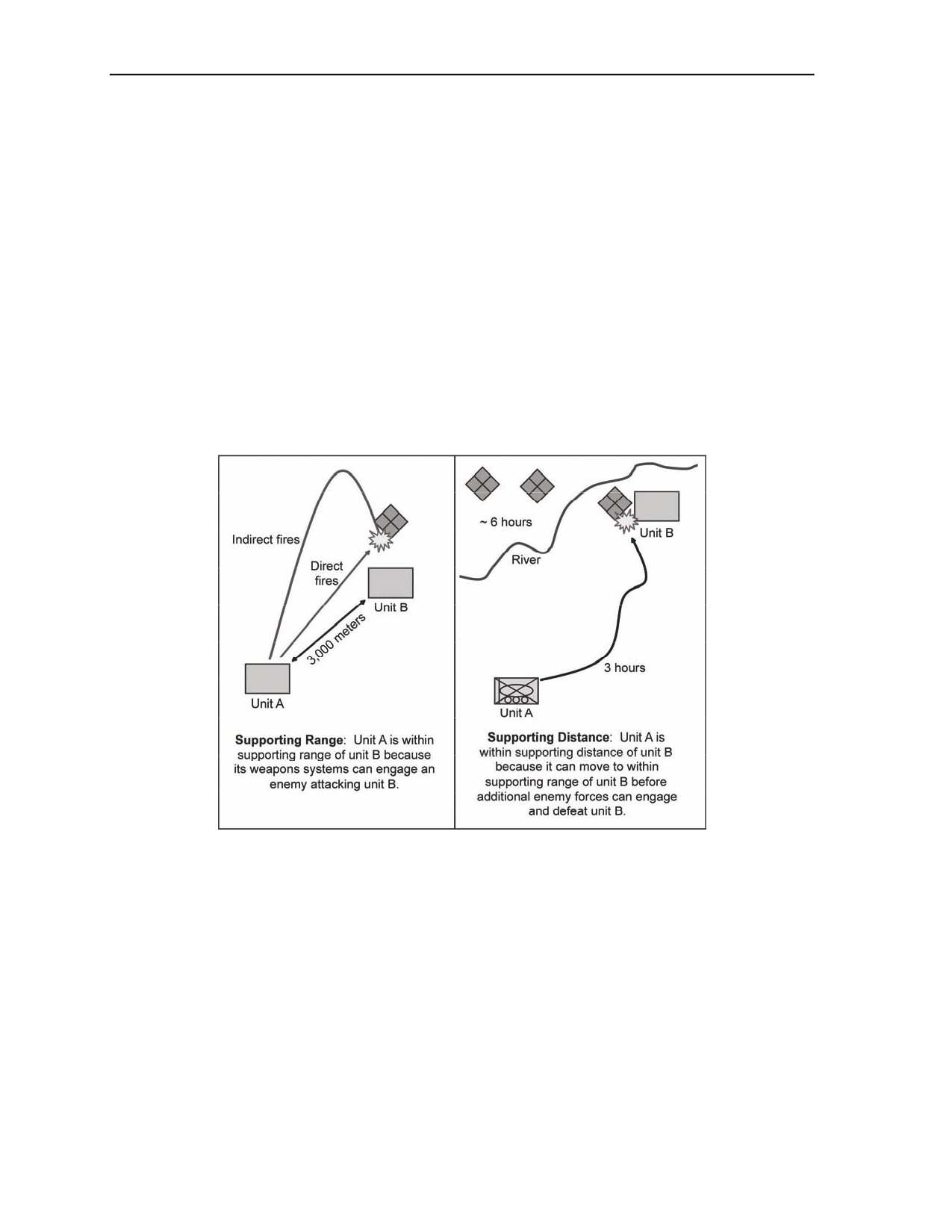
Chapter 4
task-organizing the force include, but are not limited to: training, experience, equipage,
sustainability, operating environment, enemy threat, and mobility. For Army forces, it includes
allocating available assets to subordinate commanders and establishing their command and support
relationships. Task-organizing occurs within a tailored force package as commanders organize groups of
units for specific missions. It continues as commanders reorganize units for subsequent missions. The
ability of Army forces to task-organize gives them extraordinary agility. It lets operational and tactical
commanders configure their units to best use available resources. It also allows Army forces to match unit
capabilities rapidly to the priority assigned to offensive, defensive, and stability or civil support tasks.
MUTUAL SUPPORT
4-62. Commanders consider mutual support when task-organizing forces, assigning areas of operations,
and positioning units. Mutual support is that support which units render each other against an enemy,
because of their assigned tasks, their position relative to each other and to the enemy, and their inherent
capabilities
(JP 3-31). In Army doctrine, mutual support is a planning consideration related to force
disposition, not a command relationship. (See appendix B.) Mutual support has two aspects—supporting
range and supporting distance. (See figure 4-4.) Understanding mutual support and accepting risk during
operations are fundamental to the art of tactics.
Figure 4-4. Examples of supporting range and supporting distance
4-63. Supporting range is the distance one unit may be geographically separated from a second unit
yet remain within the maximum range of the second unit’s weapons systems. It depends on available
weapons systems and is normally the maximum range of the supporting unit’s indirect fire weapons. For
small units (such as squads, sections, and platoons), it is the distance between two units that their direct
fires can cover effectively. Visibility may limit supporting range. If one unit cannot effectively or safely
fire to support another, the first may not be in supporting range even though its weapons have the required
range.
4-64. Supporting distance is the distance between two units that can be traveled in time for one to
come to the aid of the other and prevent its defeat by an enemy or ensure it regains control of a civil
situation. The following factors affect supporting distance:
z
Terrain and mobility.
z
Distance.
4-14
FM 3-0, C1
22 February 2011
Combat Power
z
Enemy capabilities.
z
Friendly capabilities.
z
Reaction time.
When friendly forces are static, supporting range equals supporting distance.
4-65. The command and control capabilities of supported and supporting units affect supporting distance
and supporting range. Units may locate within supporting distance, but if the supported unit cannot
communicate with the supporting unit, the supporting unit may not be able to affect the operation’s
outcome. In such cases, the units are not within supporting distance, regardless of their proximity to each
other. If the units share a common operational picture, the situation may differ greatly. Relative proximity
may be less important than both units’ ability to coordinate their maneuver and fires. To exploit the
advantage of supporting distance, the units have to synchronize their maneuver and fires more effectively
than the enemy can. Otherwise, the enemy can defeat both units in detail.
4-66. Commanders also consider supporting distance in operations dominated by stability or civil support.
Units maintain mutual support when one unit can draw on another’s capabilities. An interdependent joint
force may make proximity less significant than available capability. For example, Air Force assets may be
able to move a preventive medicine detachment from an intermediate staging base to an operational area
threatened by an epidemic. An additional treatment capability might be moved to the operational area based
on the threat to Soldiers and the populace.
4-67. Improved access to joint capabilities gives commanders additional means to achieve mutual support.
Those capabilities can extend the operating distances between Army units. Army commanders can
substitute joint capabilities for mutual support between subordinate forces. Doing this multiplies supporting
distance many times over. Army forces can then extend operations over greater areas at a higher tempo.
Joint capabilities are especially useful when subordinate units operate in noncontiguous areas of operations
that place units beyond a supporting range or supporting distance. However, depending on them entails
accepting risk.
SUMMARY
4-68. The elements of combat power consist of six warfighting functions tied together by leadership and
enhanced by information. The commander is at the hub of mission command and essential to integrating
the capabilities of all warfighting functions to accomplish the mission through combined arms action.
Combined arms generates more combat power than employing arms individually. Army forces are
organized for combined arms using force tailoring and task organization. Mutual support used in
complementary and reinforcing combinations also multiples the effects of combat power.
22 February 2011
FM 3-0, C1
4-15
Chapter 5
The Commander and Mission Command
This chapter discusses how commanders apply the art of command to synthesize and
apply this knowledge from all levels across the command. The commander uses
design to permeate all aspects of mission command. The commander drives four
primary tasks: drive the operations process; understand, visualize, describe, direct,
lead, and assess operations; develop teams; and lead inform and influence activities.
*ART OF COMMAND
5-1. Command is the authority that a commander in the armed forces lawfully exercises over subordinates
by virtue of rank or assignment. Command includes the authority and responsibility for effectively using
available resources and for planning the employment of, organizing, directing, coordinating, and
controlling military forces for the accomplishment of assigned missions. It also includes responsibility for
health, welfare, morale, and discipline of assigned personnel (JP 1). Leaders who command authority strive
to do so with firmness, care, and skill.
5-2. Command is considered more art than science because it depends on actions only humans can
perform. The art of command is the creative and skillful exercise of authority through decisionmaking and
leadership. Enabled by mission command networks and systems, commanders synthesize knowledge from
all levels—higher, lower, and lateral—and apply this knowledge across all levels of command. Those in
command have authority, decisionmaking skills, and leadership abilities.
5-3. Authority refers to the right and power to judge, act, or command. It includes responsibility,
accountability, and delegation. Commanders rely on their education, experience, knowledge, and judgment
in applying authority as they decide (plan how to achieve the end state) and lead (direct their forces during
preparation and execution). The authority of command provides the basis for control.
5-4. Decisionmaking refers to selecting a course of action as the one most favorable to accomplish the
mission. Commanders apply knowledge to the situation thus translating their visualization into action.
Decisionmaking includes knowing whether to decide or not, then when and what to decide, and finally,
understanding the consequences. Commanders use understanding, visualization, description, and direction
to determine and communicate their desired end state.
5-5. Leadership refers to influencing people by providing purpose, direction, and motivation, while
operating to accomplish the mission and improve the organization. Commanders lead through a
combination of personal example, persuasion, and compulsion. (FM 6-22 discusses leadership.)
DESIGN
5-6. Through collaboration and dialog, commanders use design for visualizing and describing complex
operations, and then continually reassessing the situation. Design is a methodology for applying critical and
creative thinking to understand, visualize, and describe complex, ill-structured problems and develop
approaches to solve them (FM 5-0). Commanders who use design possess a greater understanding of the
operational environment. With this greater understanding, the commander can provide a clear commander’s
intent and concept of operations. Such clarity enables subordinate units and commanders to make the effort
to take initiative. Mission command requires commanders convey a clear commander’s intent and concept
of operations.
5-7. Design underpins the commander’s tasks in leading innovative, adaptive work and guiding planning,
preparation, execution, and assessment in operations. Design requires agile, versatile leaders. Throughout
operations, commanders, subordinate commanders, staffs, and other partners collaborate and dialog
22 February 2011
FM 3-0, C1
5-1
Chapter 5
actively, sharing and questioning information, perceptions, and ideas to better understand situations and
make decisions. Effective collaboration includes continuous dialog that leads to increased understanding of
the situation, including the current problems.
5-8. Three distinct elements collectively produce a design concept. Together, they constitute an
organizational learning methodology that corresponds to three questions that must be answered to produce
an actionable design concept to guide planning:
z
Framing the operational environment—what is the context in which design will be applied?
z
Framing the problem—what problem is the design intended to address?
z
Considering operational approaches—what broad, general approach may solve the problem?
5-9. Depending on the situation—to include the complexity of the problem—commanders conduct design
before, in parallel with, or after the military decisionmaking process (MDMP). When faced with an
ill-structured problem or when developing initial plans for extended operations, commanders often initiate
design before the MDMP. This sequence helps them better understand the operational environment, frame
the problem, and develop an operational approach to guide more detailed planning.
5-10. When commanders conduct design in parallel with the MDMP, members of the staff conduct mission
analysis as the commander and other staff members engage in design activities. Knowledge products—such
as results from intelligence preparation of the battlefield and running estimates—help inform the design
team about the operational environment. Commanders may direct some staff members to focus their
mission analysis on certain areas.
5-11. In time-constrained conditions requiring immediate action or if the problem is well structured,
commanders may conduct the MDMP and publish an operation order without conducting design. As time
becomes available during execution, commanders may then initiate design to help refine their commander’s
visualization and the initial plan developed using the MDMP. However, even if commanders do not
conduct design at the outset of planning, they continually assess during execution for changes in the
operational environment that may require them to reframe the problem. (See FM 5-0 for a detailed
discussion on design.)
THE ROLE OF THE COMMANDER IN MISSION COMMAND
5-12. *Mission command is the exercise of authority and direction by the commander using mission
orders to enable disciplined initiative within the commander’s intent to empower agile and adaptive
leaders in the conduct of full spectrum operations. It is commander-led and blends the art of
command and the science of control to integrate the warfighting functions to accomplish the mission.
(See Chapter 4 for the definition of mission command as a warfighting function and all of its components.)
The role of the commander in mission command is to direct and lead from the beginning of planning
throughout execution, and to assess continually. Successful mission command requires the commander’s
presence and personal leadership. To ensure mission accomplishment in full spectrum operations, the
commander—
z
Drives the operations process.
z
Understands, visualizes, describes, directs, leads, and assesses operations.
z
Develops teams among modular formations and joint, interagency, intergovernmental, and
multinational partners.
z
Leads inform and influence activities. (Chapter 6 has a more detailed discussion of inform and
influence activities.)
*DRIVE THE OPERATIONS PROCESS
5-13. Commanders drive the operations process (see figure 5-1). While staffs perform essential functions
that amplify the effectiveness of operations, commanders play the central role in the operations process.
Commanders blend the art of command and the science of control. Guided by their experience, knowledge,
education, intelligence, and intuition, commanders apply leadership to translate decisions into action.
(Chapter 6 discusses the operations process.)
5-2
FM 3-0, C1
22 February 2011