FM 3-0 OPERATIONS (FEBRUARY 2008) - page 5
The Army Modular Force
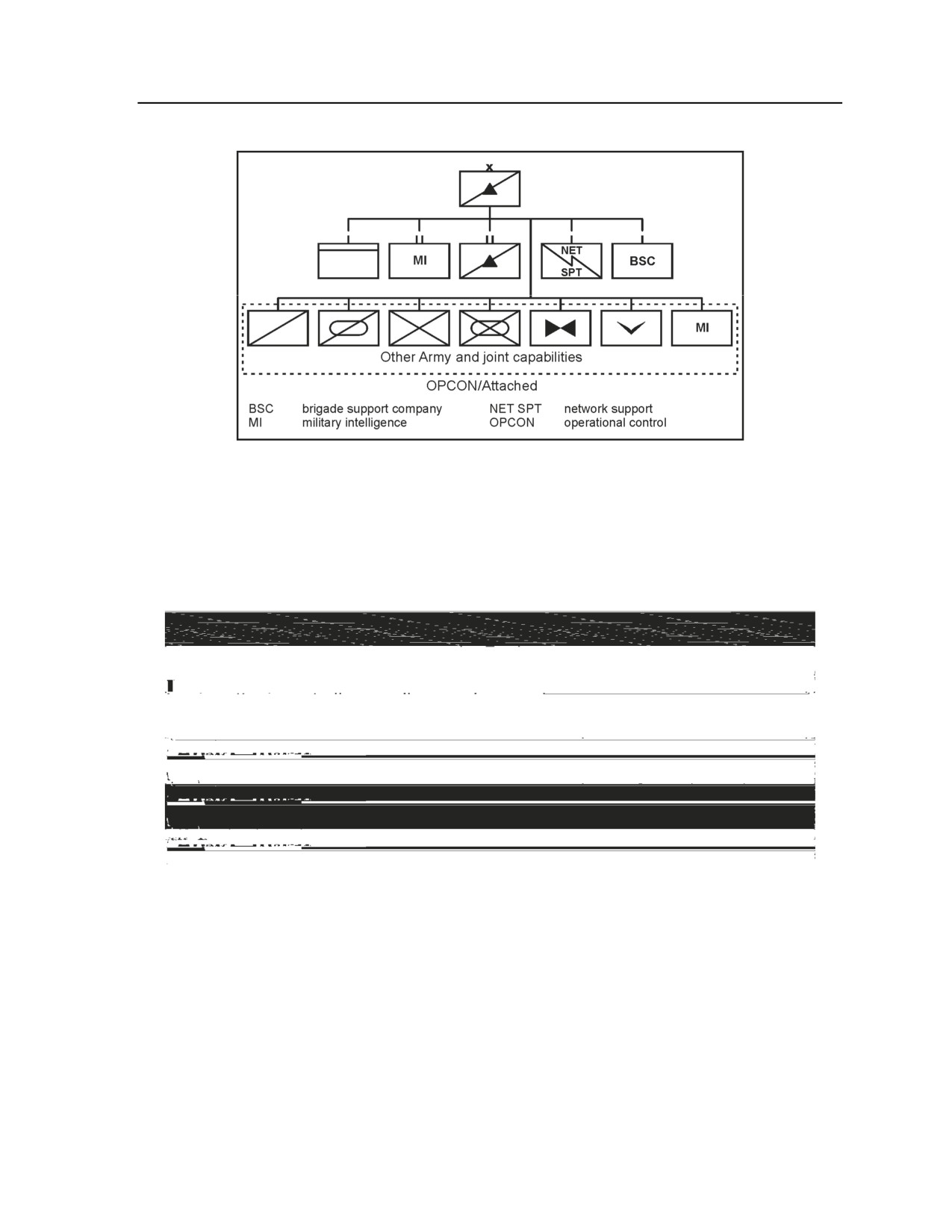
Figure C-8. Battlefield surveillance brigade
FIRES BRIGADE
C-31. Fires brigades are normally assigned, attached, or OPCON to a division. However, they may be
OPCON to a task force, land component command, or other Service or functional component. (See figure
C-9.) Fires brigades are task-organized based on their assigned tasks.
Figure C-9. Fires brigade
C-32. Organic fires brigade assets include a Multiple Launch Rocket System battalion, headquarters bat-
tery, and target acquisition battery. Brigades may be task-organized with additional Multiple Launch
Rocket System and cannon battalions, counterfire radars, and joint information operations assets. The bri-
gade’s higher headquarters usually assigns the brigade missions in terms of target sets to engage, target
priorities, or effects to achieve. The situation may also require the brigade to control joint fires assets.
C-33. A fires brigade’s primary task is conducting strike operations. This task requires placing ISR and
electronic attack capabilities OPCON to the brigade headquarters. Alternatively, the battlefield surveillance
brigade can retain control of ISR assets and provide targeting information to the fires brigade through a
support relationship.
27 February 2008
FM 3-0
C-9

Appendix C
C-34. Fires brigades perform the following tasks:
z
Conduct strike operations.
z
Support BCTs and other brigades.
z
Conduct joint missions separate from the division.
z
Conduct fire support missions for the division and brigades, including counterfire and attacks on
specific targets in the division’s area of operations.
COMBAT AVIATION BRIGADE
C-35. Most of the Army’s aviation combat power resides in multifunctional combat aviation brigades.
These organizations can be task-organized based on the mission. They include various types of organiza-
tions, with manned and unmanned systems. Combat aviation brigades are organized to support divisions,
BCTs, and support brigades. (See figure C-10.) They specialize in providing combat capabilities to multi-
ple BCTs. However, they can be task-organized to support a theater army or corps acting as a joint task
force or land component command.
Figure C-10. Combat aviation brigade
C-36. Based on priorities and missions, a combat aviation brigade coordinates operational details directly
with supported organizations. Combat aviation brigades typically conduct the following missions:
z
Attack.
z
Reconnaissance.
z
Security.
z
Movement to contact.
z
Air assault.
z
Air movement.
z
Aerial casualty evacuation.
z
Personnel recovery.
z
Command and control support.
SUSTAINMENT BRIGADE
C-37. Sustainment brigades normally have a command relationship with a theater sustainment command
and provide general or direct support to divisions and brigades. In major combat operations, the sustain-
ment brigade may be under OPCON of or provide direct support to a division. Sustainment brigades have a
flexible organization designed to be task-organized to meet mission requirements. (See figure C-11.) They
have a command and staff structure able to control operational- or tactical-level sustainment.
C-10
FM 3-0
27 February 2008
The Army Modular Force
Figure C-11. Sustainment brigade
C-38. The higher headquarters usually reinforces the sustainment brigade with several different modular
sustainment elements. The types and quantities of these attachments depend on the mission and the num-
ber, size, and type of organizations requiring support.
C-39. A sustainment brigade’s only organic unit is its brigade troops battalion. This battalion provides
command and control for assigned and attached personnel and units. It directs sustainment operations for
the brigade headquarters.
MANEUVER ENHANCEMENT BRIGADE
C-40. Maneuver enhancement brigades command and control forces that provide protection and other sup-
port to the force. They are tailored with the capabilities required for each operation. More than one brigade
may be assigned to a division or corps. (See figure C-12.) Commands may also attach these brigades di-
rectly to the theater army to serve in the theater army area of operations or joint security area.
Figure C-12. Maneuver enhancement brigade
C-41. Maneuver enhancement brigades are designed to control the following types of organizations:
z
Engineer.
z
Military police.
z
Chemical, biological, radiological, and nuclear.
z
Civil affairs.
27 February 2008
FM 3-0
C-11
Appendix C
z
Air and missile defense.
z
Explosive ordnance disposal.
z
Tactical combat force (when given an area security mission).
C-42. Typical missions for maneuver enhancement brigades are to—
z
Conduct area security operations.
z
Construct, maintain, and sustain lines of communications.
z
Provide mobility and countermobility support.
z
Provide vertical, runway, and road construction.
z
Conduct chemical, biological, radiological, and nuclear defense throughout the area of opera-
tions.
z
Conduct limited offensive and defensive tasks.
z
Conduct some stability tasks.
z
Conduct consequence management operations.
C-43. Maneuver enhancement brigades are organized and trained to conduct selected area security mis-
sions, including route and convoy security operations. They are not designed to screen, guard, or cover. A
maneuver enhancement brigade may be assigned a support area encompassing the supporting and sustain-
ment organizations and main supply routes of the supported command, typically a division. This mission
does not supplant unit local security responsibilities. Units remain responsible for self-protection against
level I threats. (JP 3-10 and FM 3-90 discuss area security and protection, including threat levels and tacti-
cal combat forces. FMI 3-0.1 discusses support areas.)
C-44. Maneuver enhancement brigades can employ a maneuver battalion as a tactical combat force when
the situation requires. With a tactical combat force, the brigade executes limited offensive and defensive
tasks against level II or III threats. Tactical combat forces may include not only ground maneuver but also
aviation and fires assets. However, commanders should employ a BCT when the situation requires a tacti-
cal combat force of two or more ground maneuver battalions.
FUNCTIONAL BRIGADES
C-45. Functional brigades, like the modular support brigades, have a modular subordinate structure that
may vary considerably among brigades of the same type. Unlike the modular support brigades, functional
brigades typically operate under theater army control and depend on theater-level elements for signal and
other support. The theater army may task-organize them to corps or division headquarters. Types of func-
tional brigades include—
z
Engineer.
z
Military police.
z
Chemical, biological, radiological, and nuclear.
z
Air and missile defense.
z
Signal.
z
Explosive ordnance disposal.
z
Medical.
z
Intelligence.
MODULAR ARMY FORCES CONTROLLED BY OTHER SERVICES
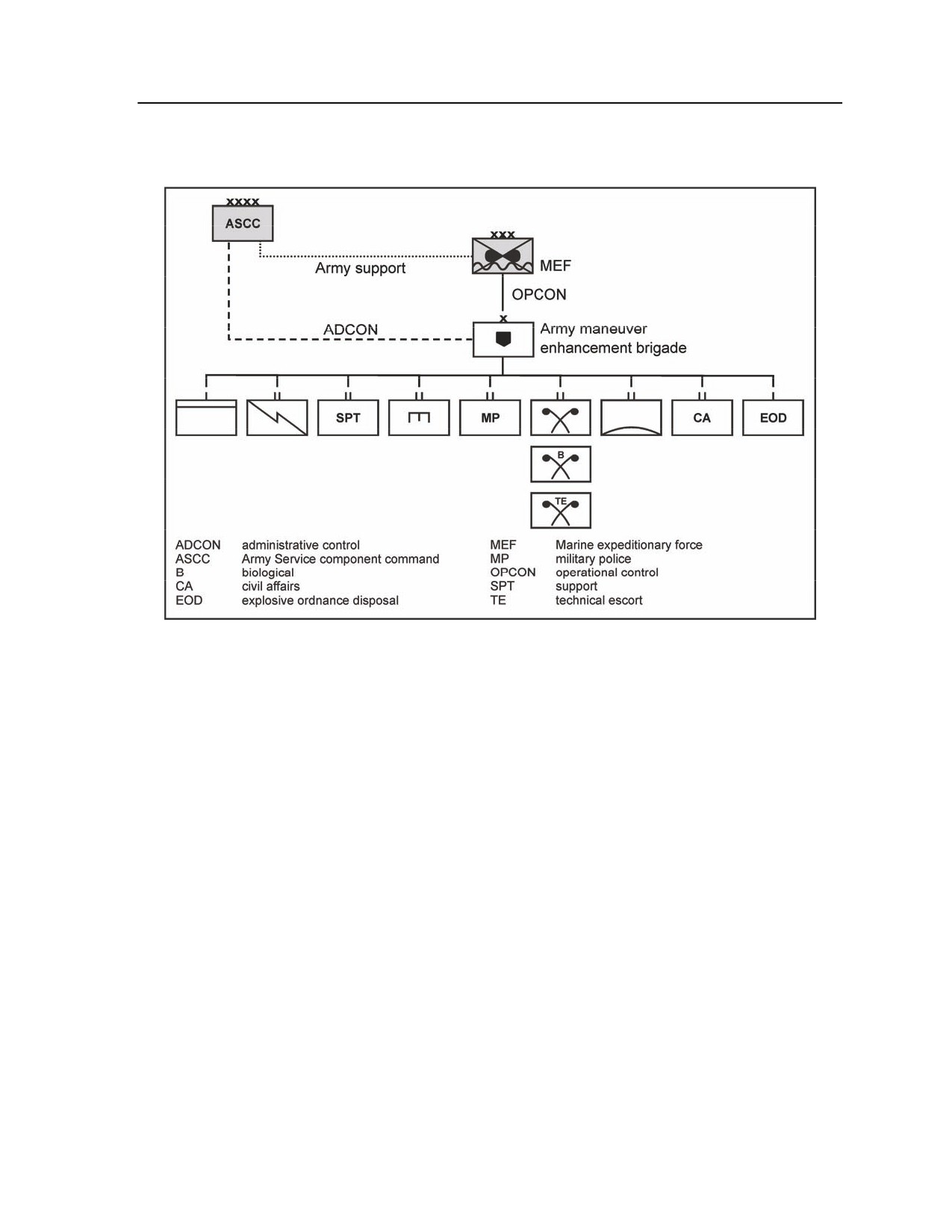
C-46. Other Service headquarters may control modular Army brigades directly. A division or corps head-
quarters is not necessary. Figure C-13 illustrates a maneuver enhancement brigade OPCON to a Marine
expeditionary force. The theater army, with its assigned commands, continues to exercise ADCON over the
brigade. The theater army also provides Army capabilities, such as network operations, in support of the
Marine expeditionary force. Other examples include placing fires brigade equipped with a Multiple Launch
C-12
FM 3-0
27 February 2008
The Army Modular Force
Rocket System OPCON to the joint force air component commander or a tailored sustainment brigade in
general or direct support to a joint special operations task force.
Figure C-13. Maneuver enhancement brigade OPCON to a Marine expeditionary force
27 February 2008
FM 3-0
C-13
This page intentionally left blank.
Appendix D
The Role of Doctrine and Summary of Changes
This appendix discusses the role of doctrine in full spectrum operations and describes
the major doctrinal changes contained in this manual.
THE ROLE OF DOCTRINE
D-1. Army doctrine is a body of thought on how Army forces intend to operate as an integral part of a
joint force. Doctrine focuses on how to think—not what to think. It establishes the following:
z
How the Army views the nature of operations.
z
Fundamentals by which Army forces conduct operations.
z
Methods by which commanders exercise command and control.
D-2. Doctrine is a guide to action, not a set of fixed rules. It combines history, an understanding of the
operational environment, and assumptions about future conditions to help leaders think about how best to
accomplish missions. Doctrine is consistent with human nature and broad enough to provide a guide for
unexpected situations. It is also based upon the values and ethics of the Service and the Nation; it is codi-
fied by law and regulations and applied in the context of operations in the field. It provides an authoritative
guide for leaders and Soldiers but requires original applications that adapt it to circumstances. Doctrine
should foster initiative and creative thinking.
D-3. Doctrine establishes a common frame of reference including intellectual tools that Army leaders use
to solve military problems. It is a menu of practical options based on experience. By establishing common
approaches to military tasks, doctrine promotes mutual understanding and enhances effectiveness. It facili-
tates communication among Soldiers and contributes to a shared professional culture. By establishing a
commonly understood set of terms and symbols, doctrine facilitates rapid dissemination of orders and fos-
ters collaborative synchronization among units. It establishes the foundation for curricula in the Army Edu-
cation System.
D-4. Army doctrine forms the basis for training and leader development standards and support products.
Training standards provide performance baselines to evaluate how well a task is executed. Together, doc-
trine, training, and resources form the key to Army readiness. Doctrine consists of—
z
Fundamental principles.
z
Tactics, techniques, and procedures.
z
Terms and symbols.
FUNDAMENTAL PRINCIPLES
D-5. Fundamental principles provide the foundation upon which Army forces guide their actions. They
foster the initiative needed for leaders to become adaptive, creative problem solvers. These principles re-
flect the Army’s collective wisdom regarding past, present, and future operations. They provide a basis for
incorporating new ideas, technologies, and organizational designs. Principles apply at all levels of war.
TACTICS, TECHNIQUES, AND PROCEDURES
D-6. Principles alone are not enough to guide operations. Tactics, techniques, and procedures provide ad-
ditional detail and more specific guidance, based on evolving knowledge and experience. Tactics, tech-
niques, and procedures support and implement fundamental principles, linking them with associated
27 February 2008
FM 3-0
D-1
Appendix D
applications. The “how to” of tactics, techniques, and procedures includes descriptive and prescriptive
methods and processes. Tactics, techniques, and procedures apply at the operational and tactical levels.
D-7. Tactics is the employment and ordered arrangement of forces in relation to each other (CJCSI
5120.02A). Effective tactics translate combat power into decisive results. Primarily descriptive, tactics vary
with terrain and other circumstances; they change frequently as the enemy reacts and friendly forces ex-
plore new approaches. Applying tactics usually entails acting under time constraints with incomplete in-
formation. Tactics always require judgment. For example, a commander may choose to suppress an enemy
with fires delivered by the majority of the force while maneuvering a small element to envelop the enemy’s
position. In a general sense, tactics concerns the application of the various primary tasks associated with
those elements of full spectrum operations discussed in FM 3-0. (When revised, FM 3-07 will detail tacti-
cal tasks associated with stability operations. A field manual addressing the primary civil support tasks is
under development. FM 3-90 will address the primary tasks for offensive and defensive operations.)
D-8. Employing a tactic usually requires using and integrating several techniques and procedures. Tech-
niques are nonprescriptive ways or methods used to perform missions, functions, or tasks
(CJCSI
5120.02A). They are the primary means of conveying the lessons learned that units gain in operations.
Commanders base the decision to use a given technique on their assessment of the situation.
D-9. Procedures are standard, detailed steps that prescribe how to perform specific tasks
(CJCSI
5120.02A). They normally consist of a series of steps in a set order. Procedures are prescriptive; regardless
of circumstances, they are executed in the same manner. Techniques and procedures are the lowest level of
doctrine. They are often based on equipment and are specific to particular types of units.
TERMS AND SYMBOLS
D-10. Doctrine provides a common language for professionals to communicate with one another. Terms
with commonly understood definitions comprise a major part of that language. Symbols are the language’s
graphic representations. Establishing and using words and symbols with common military meanings en-
hances communication among professionals. It makes a common understanding of doctrine possible. Defi-
nitions for military terms are established in joint publications, field manuals, and field manuals-interim.
The field manual or field manual-interim that establishes an Army term’s definition is the proponent publi-
cation for that term. Terms are listed in JP 1-02 and FM 1-02. FM 1-02 is also the proponent field manual
for symbols. Symbols are always prescriptive. Effective command and control requires terms and symbols
that are commonly understood, regardless of Service.
EFFECTS AND ARMY DOCTRINE
D-11. Army forces conduct operations according to Army doctrine. The methods that joint force headquar-
ters use to analyze an operational environment, develop plans, or assess operations do not change this. Dur-
ing operations, joint force headquarters provide direction to senior Army headquarters. Army headquarters
then perform the military decisonmaking process (MDMP) to develop its own plan or order. (FM 5-0 de-
scribes the MDMP.)
D-12. Army forces do not use the joint systems analysis of the operational environment, effects-based ap-
proach to planning, or effects assessment. These planning and assessment methods are intended for use at
the strategic and operational levels by properly resourced joint staffs. However, joint interdependence re-
quires Army leaders and staffs to understand joint doctrine that addresses these methods when participating
in joint operation planning or assessment or commanding joint forces. (JPs 3-0 and 5-0 establish this doc-
trine.)
D-13. Describing and assessing operations in terms of effects does not fundamentally change Army doc-
trine. Army operations remain purpose based and conditions focused. The fundamentals of full spectrum
operations and mission command include the idea of focusing efforts toward establishing conditions that
define the end state. Achieving success in operations requires commanders to gauge their progress continu-
ally. Assessing whether tasks are properly executed cannot accomplish this alone. Rather, commanders
D-2
FM 3-0
27 February 2008
The Role of Doctrine and Summary of Changes
assess an operation’s progress by evaluating how well the results of executing various tasks contribute to
creating end state conditions.
SUMMARY OF MAJOR CHANGES
D-14. The following paragraphs summarize the major doctrinal changes made by this field manual.
CHAPTER 1 - THE OPERATIONAL ENVIRONMENT
D-15. Chapter 1 makes the following changes:
z
Replaces the dimensions of the operational environment with the variables established in JP 3-0
(political, military, economic, social, information, infrastructure) plus physical environment and
time (PMESII-PT). Together, these make up the operational variables. The factors of a specific
situation bounded by assignment of a mission remain mission, enemy, terrain and weather,
troops and support available, time available, civil considerations (METT-TC). Together, these
are called the mission variables.
z
Lists areas of joint interdependence.
z
Incorporates the Soldier’s Rules established in AR 350-1.
CHAPTER 2 - THE CONTINUUM OF OPERATIONS
D-16. Chapter 2 makes the following changes:
z
Establishes the spectrum of conflict as a way to describe the level of violence in the operational
environment.
z
Establishes operational themes as a means to describe the character of the predominant major
operation within a land force commander’s area of operations. The operational themes also pro-
vide a framework for categorizing the various types of operations described in joint doctrine.
CHAPTER 3 - FULL SPECTRUM OPERATIONS
D-17. Chapter 3 makes the following changes:
z
States the Army’s operational concept and describes its place in doctrine.
z
Describes the Army’s role in homeland security.
z
Changes the approach to stability operations. Stability operations are considered coequal with
offensive and defensive operations. They are now discussed in terms of five tactical tasks.
z
Rescinds support operations as a type of operation. Establishes civil support operations as an
element of full spectrum operations conducted only in the United States and its territories.
z
Uses lethal and nonlethal as broad descriptions of actions. Rescinds the terms kinetic and
nonkinetic.
CHAPTER 4 - COMBAT POWER
D-18. Chapter 4 makes the following changes:
z
Replaces the battlefield operating systems with the warfighting functions (movement and
maneuver, intelligence, fires, sustainment, command and control, and protection).
z
Retains the fundamental of combat power but changes the elements of combat power to the
six warfighting functions tied together by leadership and information.
z
Rescinds the terms combat arms, combat support, and combat service support. Uses the appro-
priate warfighting function to describe unit types and functions.
z
Rescinds the tenets of operations. The warfighting functions and elements of combat power per-
form the function of this fundamental.
27 February 2008
FM 3-0
D-3
Appendix D
CHAPTER 5 - COMMAND AND CONTROL
D-19. Chapter 5 makes the following changes:
z
Modifies the definition of command for the Army. The definition now includes leadership.
z
Prescribes a new definition of battle command.
z
Prescribes a new definition of commander’s visualization.
z
Prescribes a new definition of commander’s intent.
z
Adds understand to the commander’s role in battle command (described in FM 3-0 [2001] as
visualize, describe, direct, assess, and lead).
z
Rescinds the operational framework construct, including its subordinate constructs of battle-
space and battlefield organization. (Area of operations is retained.) Retains decisive, shaping,
and sustaining operations (formerly the purpose-based battlefield organization) and main ef-
fort as ways commanders describe subordinates’ actions in the concept of operations.
z
Prescribes the term unassigned area to designate areas between noncontiguous areas of opera-
tions or beyond contiguous areas of operations. The higher headquarters is responsible for con-
trolling unassigned areas in its area of operations.
z
Rescinds the terms deep, close, and rear areas. Uses close combat to describe operations in
what used to be called the close area.
z
Eliminates linear and nonlinear as ways to describe the array of forces on the ground. Army
doctrine now describes force arrays as occupying either contiguous or noncontiguous areas of
operations.
z
Describes how the operations process includes several integrating processes and continuing
activities that commanders and staffs synchronize throughout operations.
z
Replaces the term criteria of success with the joint terms measure of effectiveness and meas-
ure of performance.
CHAPTER 6 - OPERATIONAL ART
D-20. Chapter 6 makes the following changes:
z
Introduces problem framing as fundamental to operational art.
z
Incorporates risk as an element of operational design.
z
Prescribes the terms defeat mechanism and stability mechanism. Establishes individual defeat
and stability mechanisms.
z
Prescribes the term line of effort to replace the term logical line of operations.
CHAPTER 7 - INFORMATION SUPERIORITY
D-21. Chapter 7 makes the following changes:
z
Adds knowledge management as a contributor to information superiority.
z
Prescribes the following terms:
Intelligence, surveillance, and reconnaissance (ISR).
ISR integration.
ISR synchronization.
Command and control warfare.
Information engagement.
z
Describes how Army forces uses five information tasks to shape the operational environment:
Information engagement.
Command and control warfare.
Information protection.
Operations security.
D-4
FM 3-0
27 February 2008
The Role of Doctrine and Summary of Changes
Military deception.
z
Adopts the term situational awareness.
CHAPTER 8 - STRATEGIC AND OPERATIONAL REACH
D-22. Chapter 8 describes the strategic and operational reach (formerly known as strategic responsiveness)
that have been developed since FM 3-0 (2001) was published.
APPENDIX A - PRINCIPLES OF WAR AND OPERATIONS
D-23. Appendix A adds the following joint principles of operations to the principles of war: perseverance,
legitimacy, and restraint.
APPENDIX B - COMMAND AND SUPPORT RELATIONSHIPS
D-24. Appendix B discusses administrative control and how it applies to tailored and task-organized Army
forces. It also explains how headquarters share administrative control.
APPENDIX C - THE ARMY MODULAR FORCE
D-25. Appendix C describes the modular organizations developed since FM 3-0 (2001) was published.
TERMS AND DEFINITIONS
D-26. The following tables list changes to terms for which FM 3-0 is the proponent field manual. Army
terms that also have a joint definition are followed by (Army). Terms for which the Army and Marine
Corps have agreed on a common definition are followed by (Army/Marine Corps). The tables do not show
changed terms when the changes are minor, for example, changing the term from plural to singular.
Table D-1. New Army terms
Army positive control
enemy
intelligence, surveil-
movement and
lance, and reconnais-
maneuver warfighting
Army procedural
fires warfighting
sance synchroni-
function
control
function
zation
operational theme
civil support1
forward operating
intelligence
base
protection warfighting
combat power (Army)
warfighting function
function
graphic control
command and control
irregular warfare
measure
situational awareness
warfare
knowledge
influence2
stability mechanism
command and control
management
warfighting function
information
support (Army)
landpower
engagement
compel
supporter
line of effort3
information protection
defeat mechanism
sustainment
line of operations
intelligence, surveil-
warfighting function
disintegrate
(Army)
lance, and reconnais-
unassigned area
dislocate
sance integration
warfighting function
Notes:
1 Replaces support operations and uses the joint definition
2 Adds a second definition to an existing term.
with Army primary tasks.
3 Replaces logical line of operations.
27 February 2008
FM 3-0
D-5

Appendix D
Table D-2. Modified Army definitions
assessment (Army)
culminating point
intelligence, surveil-
preparation
(Army)
lance, and reconnais-
battle command
running estimate
sance
decisive operation
close combat
situational
isolate3
defensive operations
understanding
combined arms
main effort
destroy3
stability operations4
commander’s intent
mission command
(Army)
essential element of
supporting distance
friendly information
mission orders
commander’s
supporting range
visualization
force tailoring
neutral
sustaining operation
common operational
full spectrum
offensive operations
task-organizing5
picture
operations
operations process
tempo (Army/Marine
concept of operations
information
phase (Army/Marine
Corps)
(Army)
management
Corps)
urban operations
control (Army)1, 2
initiative (individual)
planning
control measure
initiative (operational)
Notes:
1 New definition for use in command and control context.
4 The Army uses the joint definition and assigns Army-
2 Added second definition for use as a stability mecha-
specific tasks to this element of full spectrum operations.
nism.
5 Army definition added to joint definition as an adden-
3 New definition for use in operational art context.
dum.
Table D-3. Rescinded Army definitions
agility1
combat service
offensive information
rear area
support2
operations (Army)
assigned forces1
subordinates’
combat support2
operational fires1
initiative5
asymmetry1
deep area
operational
support operations6
battlefield
framework
organization
defensive information
versatility1
operations (Army)
operational picture
battlespace
logical lines of
force protection
protection (Army)4
operations7
close area
(Army)3
combat arms
Notes:
1 Army doctrine will follow joint definitions and common
4 Replaced by protection warfighting function.
English usage.
5 Replaced by individual initiative.
2 Army doctrine will not use this term; joint doctrine will
6 Replaced by civil support operations.
continue to use this term.
7 Replaced by lines of effort.
3 Activities incorporated into the protection warfighting
function.
D-6
FM 3-0
27 February 2008
The Role of Doctrine and Summary of Changes
ADDENDUM TO THE ROLE OF DOCTRINE AND SUMMARY OF
CHANGES
SUMMARY OF MAJOR CHANGES
D-27. The following paragraphs summarize the major doctrinal changes made by this field manual from the
2008 version.
Chapter 1 - The Operational Environment
D-28. Chapter 1 adds a discussion of hybrid threats.
Chapter 2 - The Continuum of Operations
D-29. Chapter 2 makes the following changes:
z
Eliminates graphics to illustrate the continuum of operations.
z
Expands and clarifies the discussion of major combat operations.
Chapter 3 - Full Spectrum Operations
D-30. Chapter 3 makes the following changes:
z
Moves the discussion of mission command from the section within the operational concept to
chapters 4, 5, and 6 to consolidate and emphasize mission command.
z
Adds the discussion of stability operations now includes security force assistance.
z
Modifies the discussion of civil support tasks from three tasks to four.
Chapter 4 - Combat Power
D-31. Chapter 4 makes the following changes:
z
Replaces the command and control warfighting function with mission command warfighting
function.
z
Introduces the four commander’s tasks of mission command: drive the operations process;
understand, visualize, describe, direct, lead, and assess operations; develop teams among
modular formations and joint, interagency, intergovernmental, and multinational partners; and
lead inform and influence activities.
z
Introduces the three staff tasks of mission command: conduct the operations process, conduct
knowledge management and information management, and conduct inform and influence and
cyber/electromagnetic activities.
z
Adds integrate and synchronize cyber/electromagnetic activities as a fires warfighting task.
z
Modifies the discussion of health service support under the sustainment warfighting function.
z
Adds health risk communication as a measure under force health protection in the protection
warfighting function.
Chapter 5 - The Commander and Mission Command
D-32. Chapter 5 makes the following changes:
z
Changes the title of the chapter to The Commander and Mission Command.
z
Moves the discussions of control and the operations process to chapter 6.
z
Describes how design assists the commander in better understanding the operational
environment.
z
Prescribes a new definition for mission command.
z
Discusses the four commander’s tasks of mission command.
22 February 2011
FM 3-0, C1
D-7
Appendix D
z
Describes how building teams enables commanders to shape operations before, during, and after
operations.
z
Rescinds the term battle command.
z
Rescinds the term command and control warfare and the discussion of command and control
warfare.
z
Describes how the commander uses assessment in operations.
Chapter 6 - The Science of Control
D-33. Chapter 6 is a new chapter. It makes the following changes:
z
Changes the title of the chapter to The Science of Control.
z
Describes the three staff tasks of mission command.
z
Eliminates the five information tasks and replaces them with the task of inform and influence
and cyber/electromagnetic activities. The joint construct of information operations focuses on
adversaries and is based on capabilities. The previous version of FM 3-0, Operations, and the
2003 FM 3-13, Information Operations, used a similar definition and construct. In 2008, FM 3-0
revised how the Army viewed information operations using five information tasks located in
separate warfighting functions. This change accounts for the difference between land operations
and those conducted in the other domains. For example, the joint construct of information
operations had nothing that focused the efforts of multiple contributors on getting out effective
messages to friendly or neutral audiences, which are now accounted in the task of inform and
influence activities. The new construct also recognizes the growing importance of a new
function that addresses the cyber/electromagnetic arena. As an interim measure, responsibility
for integration and synchronization of cyber/electromagnetic activities resides in the electronic
warfare element of the fires warfighting function. The concepts and functions of cyber/
electromagnetic activities will mature and be refined.
z
Rescinds the term psychological operations and replaces the term with military information
support operations.
Chapter 7 - Information Superiority (Deleted)
D-34. Chapter 7, Information Superiority, is deleted. Discussion of inform and influence and cyber/
electromagnetic activities is moved to chapter 6.
Chapter 7 - Operational Art
D-35. Chapter 7 (previously chapter 6) makes the following changes:
z
Introduces design as a methodology that supports the application of operational art.
z
Modifies the definition of operational approach to align with FM 5-0.
z
Replaces elements of operational design with elements of operational art.
Chapter 8 - Strategic and Operational Reach
D-36. Chapter 8 adds a discussion of and defines support area.
Appendix A - Principles of War and Operations
Appendix B - Command and Support Relationships
Appendix C - The Army Modular Force
D-8
FM 3-0, C1
22 February 2011

The Role of Doctrine and Summary of Changes
TERMS AND DEFINITIONS
D-37. Table D-4 lists changes to terms for which Change 1 of FM 3-0 is the proponent field manual.
*Table D-4. Army terms for change 1
New terms
Modified terms
Rescinded terms
approach
control3
battle command
hybrid threat
direct approach
command and control warfare6
inform and influence activities
indirect approach
command and control warfighting
mission command networks and
mission command
function7
systems1
operational approach4
information engagement
mission command warfighting
operations process3
information protection
function2
information system
relevant information3
operational adaptability
running estimate4
persistent conflict
support area5
Notes:
1 Replaces command and control warfare.
5 FM 3-0 is now proponent instead of FMI 3-0.1.
2 Replaces command and control warfighting function.
6 Replaced by mission command warfare.
3 Modified definition for use in mission command context.
7 Replaced by mission command warfighting function.
4 FM 5-0 is now proponent.
22 February 2011
FM 3-0, C1
D-9
Source Notes
These are the sources used, quoted, or paraphrased in this publication. They are listed
by page number. Where material appears in a paragraph, both page and paragraph
number are listed.
xi
“Stability operations are a core…”: DODD 3000.05, Military Support for Stability, Security,
Transition, and Reconstruction (SSTR) Operations (Washington, DC: Department of Defense,
28 Nov 2005), paragraph 4.1 (page 2).
1-15
“War is thus an act…”: Carl von Clausewitz, On War, Michael Howard and Peter Paret, eds.
(Princeton: Princeton University Press, 1984), 75 (hereafter cited as Clausewitz).
1-17
“Everything in war…”: Clausewitz, 119, 120.
1-19
para 1-90. AR 350-1, Army Training and Leader Development (Washington DC:
Headquarters, Department of the Army, 3 Aug 2007), 80-81. Paragraph 4-18b establishes the
10 Jan 2008).
7-6
para 7-30. “the hub of all power…”: Clausewitz, 595-596.
22 February 2011
FM 3-0, C1
Source Notes-1
This page intentionally left blank.
Glossary
The glossary lists acronyms and terms with Army, multi-Service, or joint definitions,
and other selected terms. Where Army and joint definitions are different, (Army)
follows the term. Terms for which FM 3-0 is the proponent manual (the authority) are
marked with an asterisk (*). The proponent manual for other terms is listed in
parentheses after the definition.
SECTION I - ACRONYMS AND ABBREVIATIONS
ADCON
administrative control
AR
Army regulation
ARFOR
See ARFOR under terms.
ASCC
Army Service component command
BCT
brigade combat team
CBRNE
chemical, biological, radiological, nuclear, and high-yield explosives
CCIR
commander’s critical information requirement
CJCSI
Chairman of the Joint Chiefs of Staff instruction
COCOM
combatant command (command authority)
DA
Department of the Army
DODI
Department of Defense instruction
EEFI
essential element of friendly information
FFIR
friendly force information requirement
FM
field manual
ISR
intelligence, surveillance, and reconnaissance
JP
joint publication
MDMP
military decisonmaking process
METT-TC
See METT-TC under terms.
NATO
North Atlantic Treaty Organization
OPCON
operational control
PIR
priority intelligence requirement
PMESII-PT
See PMESII-PT under terms.
TACON
tactical control
U.S.
United States
WMD
weapons of mass destruction
22 February 2011
FM 3-0, C1
Glossary-1
Glossary
SECTION II - TERMS
administrative control
(joint) Direction or exercise of authority over subordinate or other organizations in respect to
administration and support, including organization of Service forces, control of resources and
equipment, personnel management, unit logistics, individual and unit training, readiness, mobilization,
demobilization, discipline, and other matters not included in the operational missions of the
subordinate or other organizations. (JP 1)
adversary
(joint) A party acknowledged as potentially hostile to a friendly party and against which the use of
force may be envisaged. (JP 3-0)
alliance
(joint) The relationship that results from a formal agreement (for example, treaty) between two or more
nations for broad, long-term objectives that further the common interests of the members. (JP 3-0)
antiterrorism
(joint) Defensive measures used to reduce the vulnerability of individuals and property to terrorist acts,
to include limited response and containment by local military and civilian forces. (JP 3-07.2)
*approach
The manner in which a commander contends with a center of gravity.
area of influence
(joint) A geographical area wherein a commander is directly capable of influencing operations by
maneuver or fire support systems normally under the commander’s command or control. (JP 3-16)
area of interest
(joint) area of concern to the commander, including the area of influence, areas adjacent thereto, and
extending into enemy territory to the objectives of current or planned operations. This area also
includes areas occupied by enemy forces who could jeopardize the accomplishment of the mission.
(JP 2-03)
*ARFOR
The Army Service component headquarters for a joint task force or a joint and multinational force.
*Army positive control
A technique of regulating forces that involves commanders and leaders actively assessing, deciding,
and directing them.
*Army procedural control
A technique of regulating forces that relies on a combination of orders, regulations, policies, and
doctrine (including tactics, techniques, and procedures).
*assessment
(Army) The continuous monitoring and evaluation of the current situation, particularly the enemy, and
progress of an operation.
base
(joint) A locality from which operations are projected or supported. (JP 4-0)
*battle
A set of related engagements that lasts longer and involves larger forces than an engagement.
campaign
(joint) A series of related major operations aimed at achieving strategic and operational objectives
within a given time and space. (JP 5-0)
Glossary-2
FM 3-0, C1
22 February 2011
Glossary
center of gravity
(joint) The source of power that provides moral or physical strength, freedom of action, or will to act.
(JP 3-0)
civil considerations
The influence of manmade infrastructure, civilian institutions, and attitudes and activities of the
civilian leaders, populations, and organizations within an area of operations on the conduct of military
operations. (FM 6-0)
civil support
(joint) Department of Defense support to US civil authorities for domestic emergencies, and for
designated law enforcement and other activities. (JP 3-28)
*close combat
Warfare carried out on land in a direct-fire fight, supported by direct, indirect, and air-delivered fires.
coalition
(joint) An ad hoc arrangement between two or more nations for common action. (JP 5-0)
coalition action
(joint) A multinational action outside the bounds of established alliances, usually for single occasions
or longer cooperation in a narrow sector of common interest. (JP 5-0)
combat camera
(joint) The acquisition and utilization of still and motion imagery in support of operational and
planning requirements across the range of military operations and during joint exercises. (JP 3-61)
combating terrorism
(joint ) Actions, including antiterrorism and counterterrorism, taken to oppose terrorism throughout the
entire threat spectrum. (JP 3-26)
*combat power
(Army) The total means of destructive, constructive, and information capabilities that a military
unit/formation can apply at a given time. Army forces generate combat power by converting potential
into effective action.
*combined arms
The synchronized and simultaneous application of the elements of combat power to achieve an effect
greater than if each element of combat power was used separately or sequentially.
command
(joint) The authority that a commander in the armed forces lawfully exercises over subordinates by
virtue of rank or assignment. Command includes the authority and responsibility for effectively using
available resources and for planning the employment of, organizing, directing, coordinating, and
controlling military forces for the accomplishment of assigned missions. It also includes responsibility
for health, welfare, morale, and discipline of assigned personnel. (JP 1)
commander’s critical information requirement
(joint) An information requirement identified by the commander as being critical to facilitating timely
decision-making. The two key elements are friendly force information requirements and priority
intelligence requirements. (JP 3-0)
*commander’s intent
(Army) A clear, concise statement of what the force must do and the conditions the force must
establish with respect to the enemy, terrain, and civil considerations that represent the desired end
state.
*commander’s visualization
The mental process of developing situational understanding, determining a desired end state, and
envisioning the broad sequence of events by which the force will achieve that end state.
22 February 2011
FM 3-0, C1
Glossary-3
Glossary
*common operational picture
(Army) A single display of relevant information within a commander’s area of interest tailored to the
user’s requirements and based on common data and information shared by more than one command.
*compel
To use, or threaten to use, lethal force to establish control and dominance, effect behavioral change, or
enforce compliance with mandates, agreements, or civil authority.
*concept of operations
(Army) A statement that directs the manner in which subordinate units cooperate to accomplish the
mission and establishes the sequence of actions the force will use to achieve the end state. It is
normally expressed in terms of decisive, shaping, and sustaining operations.
consequence management
(joint) Actions taken to maintain or restore essential services and manage and mitigate problems
resulting from disasters and catastrophes, including natural, man-made, or terrorist incidents. (JP 3-28)
contractor
A person or business that provides products or services for monetary compensation. A contractor
furnishes supplies and services or performs work at a certain price or rate based on the terms of a
contract. (FM 3-100.21)
*control
(Army)*1. In the context of mission command, control is the regulation of forces and warfighting
functions to accomplish the mission in accordance with the commander’s intent. (FM 3-0) 2. A tactical
mission task that requires the commander to maintain physical influence over a specified area to
prevent its use by an enemy. (FM 3-90) 3. An action taken to eliminate a hazard or reduce its risk. (FM
5-19) *4. In the context of stability mechanisms, to impose civil order. (FM 3-0) [See JP 1-02 for joint
definitions.]
*control measure
A means of regulating forces or warfighting functions.
counterdrug activities
(joint) Those measures taken to detect, interdict, disrupt, or curtail any activity that is reasonably
related to illicit drug trafficking. This includes, but is not limited to, measures taken to detect, interdict,
disrupt, or curtail activities related to substances, materiel, weapons, or resources used to finance,
support, secure, cultivate, process, or transport illegal drugs. (JP 3-07.4)
counterinsurgency
(joint) Comprehensive civilian and military efforts taken to defeat an insurgency and to address any
core grievances. (JP 3-24)
counterterrorism
(joint) Actions taken directly against terrorist networks and indirectly to influence and render global
and regional environments inhospitable to terrorist networks. (JP 3-26)
*culminating point
(Army) That point in time and space at which a force no longer possesses the capability to continue its
current form of operations.
cyberspace
(joint) A global domain within the information environment consisting of the interdependent network
of information technology infrastructures, including the Internet, telecommunications networks,
computer systems, and embedded processors and controllers. (JP 1-02)
*decisive operation
The operation that directly accomplishes the mission. It determines the outcome of a major operation,
battle, or engagement. The decisive operation is the focal point around which commanders design the
entire operation.
Glossary-4
FM 3-0, C1
22 February 2011
Glossary
decisive point
(joint) A geographic place, specific key event, critical factor, or function that, when acted upon, allows
commanders to gain a marked advantage over an adversary or contribute materially to achieving
success. (JP 3-0) [Note: In this context, adversary also refers to enemies.]
*defeat mechanism
The method through which friendly forces accomplish their mission against enemy opposition.
*defensive operations
Combat operations conducted to defeat an enemy attack, gain time, economize forces, and develop
conditions favorable for offensive or stability operations.
*depth
(Army) The extension of operations in time, space, and resources.
design
A methodology for applying critical and creative thinking to understand, visualize, and describe
complex, ill-structured problems and develop approaches to solve them. (FM 5-0)
*destroy
In the context of defeat mechanisms, to apply lethal combat power on an enemy capability so that it
can no longer perform any function and cannot be restored to a usable condition without being entirely
rebuilt.
*direct approach
The manner in which a commander attacks the enemy’s center of gravity or principal strength by
applying combat power directly against it.
direct liaison authorized
(joint) That authority granted by a commander (any level) to a subordinate to directly consult or
coordinate an action with a command or agency within or outside of the granting command. Direct
liaison authorized is more applicable to planning than operations and always carries with it the
requirement of keeping the commander granting direct liaison authorized informed. Direct liaison
authorized is a coordination relationship, not an authority through which command may be exercised.
(JP 1)
*disintegrate
To disrupt the enemy’s command and control system, degrading the ability to conduct operations while
leading to a rapid collapse of the enemy’s capabilities or will to fight.
*dislocate
To employ forces to obtain significant positional advantage, rendering the enemy’s dispositions less
valuable, perhaps even irrelevant.
electromagnetic spectrum
(joint) The range of frequencies of electromagnetic radiation from zero to infinity. It is divided into 26
alphabetically designated bands. (JP 3-13.1)
electronic attack
(joint) A division of electronic warfare involving the use of electromagnetic energy, directed energy, or
antiradiation weapons to attack personnel, facilities, or equipment with the intent of degrading,
neutralizing, or destroying enemy combat capability and is considered a form of fires. (JP 3-13.1)
electronic protection
(joint) A division of electronic warfare involving actions taken to protect personnel, facilities, and
equipment from any effects of friendly or enemy use of the electromagnetic spectrum that degrade,
neutralize, or destroy friendly combat capability. (JP 3-13.1)
22 February 2011
FM 3-0, C1
Glossary-5
Glossary
electronic warfare
(joint) Any military action involving the use of electromagnetic and directed energy to control the
electromagnetic spectrum or to attack the enemy. Electronic warfare consists of three divisions:
electronic attack, electronic protection, and electronic warfare support. (JP 3-13.1)
electronic warfare support
(joint) A division of electronic warfare involving actions tasked by, or under the direct control of, an
operational commander to search for, intercept, identify, and locate or localize sources of intentional
and unintentional radiated electromagnetic energy for the purpose of immediate threat recognition,
targeting, planning, and conduct of future operations. (JP 3-13.1)
end state
(joint) The set of required conditions that defines achievement of the commander’s objectives. (JP 3-0)
*enemy
A party identified as hostile against which the use of force is authorized.
engagement
(joint) A tactical conflict, usually between opposing, lower echelon maneuver forces. (JP 1-02)
*essential element of friendly information
(Army) A critical aspect of a friendly operation that, if known by the enemy, would subsequently
compromise, lead to failure, or limit success of the operation and therefore should be protected from
enemy detection.
*execution
Putting a plan into action by applying combat power to accomplish the mission and using situational
understanding to assess progress and make execution and adjustment decisions.
*exterior lines
A force operates on exterior lines when its operations converge on the enemy.
*fires warfighting function
The related tasks and systems that provide collective and coordinated use of Army indirect fires and
joint fires through the targeting process.
*force tailoring
The process of determining the right mix of forces and the sequence of their deployment in support of
a joint force commander.
forcible entry
(joint) The seizing and holding of a military lodgment in the face of armed opposition. (JP 3-18)
foreign humanitarian assistance
(joint) Department of Defense activities, normally in support of the United States Agency for
International Development or Department of State, conducted outside the United States, its territories,
and possessions to relieve or reduce human suffering, disease, hunger, or privation. (JP 3-29)
foreign internal defense
(joint) The participation by civilian and military agencies of a government in any of the action
programs taken by another government or other designated organization to free and protect its society
from subversion, lawlessness, and insurgency. (JP 3-22)
*forward operating base
(Army) An area used to support tactical operations without establishing full support facilities.
friendly force information requirement
(joint) Information the commander and staff need to understand the status of friendly force and
supporting capabilities. (JP 3-0)
Glossary-6
FM 3-0, C1
22 February 2011
Glossary
*full spectrum operations
The Army’s operational concept: Army forces combine offensive, defensive, and stability or civil
support operations simultaneously as part of an interdependent joint force to seize, retain, and exploit
the initiative, accepting prudent risk to create opportunities to achieve decisive results. They employ
synchronized action—lethal and nonlethal—proportional to the mission and informed by a thorough
understanding of all variables of the operational environment. Mission command that conveys intent
and an appreciation of all aspects of the situation guides the adaptive use of Army forces.
*graphic control measure
A symbol used on maps and displays to regulate forces and warfighting functions.
*hybrid threat
A hybrid threat is the diverse and dynamic combination of regular forces, irregular forces, and/or
criminal elements all unified to achieve mutually benefitting effects.
*indirect approach
The manner in which a commander attacks the enemy’s center of gravity by applying combat power
against a series of decisive points while avoiding enemy strength.
*individual initiative
The willingness to act in the absence of orders, when existing orders no longer fit the situation, or
when unforeseen opportunities or threats arise.
*influence
In the context of stability mechanisms, to alter the opinions and attitudes of a civilian population
through inform and influence activities, presence, and conduct.
*inform and influence activities
The integrating activities within the mission command warfighting function which ensure themes and
messages designed to inform domestic audiences and influence foreign friendly, neutral, adversary,
and enemy populations are synchronized with actions to support full spectrum operations. Inform and
influence activities incorporate components and enablers expanding the commander’s ability to use
other resources to inform and influence.
information environment
(joint) The aggregate of individuals, organizations, and systems that collect, process, disseminate, or
act on information. (JP 3-13)
*information management
(Army) The science of using procedures and information systems to collect, process, store, display,
disseminate, and protect knowledge products, data, and information.
insurgency
(joint) The organized movement of subversion and violence by a group or movement that seeks to
overthrow or force change of a governing authority. Insurgency can also refer to the group itself.
(JP 3-24)
*intelligence, surveillance, and reconnaissance
(Army) An activity that synchronizes and integrates the planning and operation of sensors, assets, and
processing, exploitation, and dissemination systems in direct support of current and future operations.
This is an integrated intelligence and operations function. For Army forces, this activity is a combined
arms operation that focuses on priority intelligence requirements while answering the commander’s
critical information requirements.
*intelligence, surveillance, and reconnaissance integration
The task of assigning and controlling a unit’s intelligence, surveillance, and reconnaissance assets (in
terms of space, time, and purpose) to collect and report information as a concerted and integrated
portion of operation plans and orders.
22 February 2011
FM 3-0, C1
Glossary-7
Glossary
*intelligence, surveillance, and reconnaissance synchronization
The task that accomplishes the following: analyzes information requirements and intelligence gaps;
evaluates available assets internal and external to the organization; determines gaps in the use of those
assets; recommends intelligence, surveillance, and reconnaissance assets controlled by the organization
to collect on the commander’s critical information requirements; and submits requests for information
for adjacent and higher collection support.
*intelligence warfighting function
The related tasks and systems that facilitate understanding of the operational environment, enemy,
terrain, and civil considerations.
interagency coordination
(joint) Within the context of Department of Defense involvement, the coordination that occurs between
elements of Department of Defense, and engaged US Government agencies for the purpose of
achieving an objective. (JP 3-0)
intergovernmental organization
(joint) An organization created by a formal agreement (for example, a treaty) between two or more
governments. It may be established on a global, regional, or functional basis for wide-ranging or
narrowly defined purposes. Formed to protect and promote national interests shared by member states.
(JP 3-08)
*interior lines
A force operates on interior lines when its operations diverge from a central point.
intermediate staging base
(joint) A tailorable, temporary location used for staging forces, sustainment and/or extraction into and
out of an operational area. (JP 3-35)
intuitive decisionmaking
The act of reaching a conclusion which emphasizes pattern recognition based on knowledge, judgment,
experience, education, intelligence, boldness, perception, and character. This approach focuses on
assessment of the situation vice comparison of multiple options. (FM 6-0)
*irregular warfare
(Army) A violent struggle among state and nonstate actors for legitimacy and influence over a
population.
*isolate
In the context of defeat mechanisms, to deny an enemy or adversary access to capabilities that enable
the exercise of coercion, influence, potential advantage, and freedom of action.
joint combined exchange training
(joint) A program conducted overseas to fulfill US forces training requirements and at the same time
exchange the sharing of skills between US forces and host nation counterparts. Training activities are
designed to improve US and host nation capabilities. (JP 3-05)
*knowledge management
The art of creating, organizing, applying, and transferring knowledge to facilitate situational
understanding and decisionmaking.
*landpower
The ability—by threat, force, or occupation—to gain, sustain, and exploit control over land, resources,
and people.
law of war
(joint) That part of international law that regulates the conduct of armed hostilities. (JP 1-02)
Glossary-8
FM 3-0, C1
22 February 2011
Glossary
leadership
The process of influencing people by providing purpose, direction, and motivation, while operating to
accomplish the mission and improve the organization. (FM 6-22)
*line of effort
A line that links multiple tasks and missions using the logic of purpose—cause and effect—to focus
efforts toward establishing operational and strategic conditions.
*line of operations
(Army) A line that defines the directional orientation of a force in time and space in relation to the
enemy and links the force with its base of operations and objectives.
lodgment
(joint) A designated area in a hostile or potentially hostile territory that, when seized and held, makes
the continuous landing of troops and materiel possible and provides maneuver space for subsequent
operations. (JP 3-18)
logistics
(joint) The planning and executing the movement and support of forces. It includes those aspects of
military operations that deal with: a. design and development, acquisition, storage, movement,
distribution, maintenance, evacuation, and disposition of materiel; b. movement, evacuation, and
hospitalization of personnel; c. acquisition or construction, maintenance, operation, and disposition of
facilities; and d. acquisition or furnishing of services. (JP 4-0)
*main effort
The designated subordinate unit whose mission at a given point in time is most critical to overall
mission success. It is usually weighted with the preponderance of combat power.
major operation
(joint) A series of tactical actions (battles, engagements, strikes) conducted by combat forces of a
single or several Services, coordinated in time and place, to achieve strategic or operational objectives
in an operational area. These actions are conducted simultaneously or sequentially in accordance with
a common plan and are controlled by a single commander. For noncombat operations, a reference to
the relative size and scope of a military operation. (JP 3-0)
maneuver
(joint) The employment of forces in the operational area through movement in combination with fires
to achieve a position of advantage in respect to the enemy in order to accomplish the mission. (JP 3-0)
measure of effectiveness
(joint) A criterion used to assess changes in system behavior, capability, or operational environment
that is tied to measuring the attainment of an end state, achievement of an objective, or creation of an
effect. (JP 3-0)
measure of performance
(joint) A criterion used to assess friendly actions that is tied to measuring task accomplishment.
(JP 3-0)
METT-TC
A memory aid used in two contexts: 1. In the context of information management, the major subject
categories into which relevant information is grouped for military operations: mission, enemy, terrain
and weather, troops and support available, time available, civil considerations. (FM 6-0) 2. In the
context of tactics, major variables considered during mission analysis (mission variables). (FM 3-90)
military deception
(joint)Those actions executed to deliberately mislead adversary decision makers as to friendly military
capabilities, intentions, and operations, thereby causing the adversary to take specific actions (or
inactions) that will contribute to the accomplishment of the friendly mission. (JP 3-13.4)
22 February 2011
FM 3-0, C1
Glossary-9
Glossary
mission
(joint) task, together with the purpose, that clearly indicates the action to be taken and the reason
therefore. (JP 3-0)
*mission command
(Army) The exercise of authority and direction by the commander using mission orders to enable
disciplined initiative within the commander’s intent to empower agile and adaptive leaders in the
conduct of full spectrum operations. It is commander-led and blends the art of command and the
science of control to integrate the warfighting functions to accomplish the mission.
*mission command networks and systems
The coordinated application of personnel, networks, procedures, equipment and facilities, knowledge
management, and information management systems essential for the commander to conduct
operations.
*mission command warfighting function
Develops and integrates those activities enabling a commander to balance the art of command and the
science of control.
*mission orders
A technique for developing orders that emphasizes to subordinates the results to be attained, not how
they are to achieve them. It provides maximum freedom of action in determining how to best
accomplish assigned missions.
*movement and maneuver warfighing function
The related tasks and systems that move forces to achieve a position of advantage in relation to the
enemy.
multinational operations
(joint) A collective term to describe military actions conducted by forces of two or more nations,
usually undertaken within the structure of a coalition or alliance. (JP 3-16)
mutual support
(joint) That support which units render each other against an enemy, because of their assigned tasks,
their position relative to each other and to the enemy, and their inherent capabilities. (JP 3-31)
*neutral
(Army) A party identified as neither supporting nor opposing friendly or enemy forces.
noncombatant evacuation operations
(joint) Operations directed by the Department of State or other appropriate authority, in conjunction
with the Department of Defense, whereby noncombatants are evacuated from foreign countries when
their lives are endangered by war, civil unrest, or natural disaster to safe havens or to the United States.
(JP 3-0)
nongovernmental organization
(joint) A private, self-governing, not-for-profit organization dedicated to alleviating human suffering;
and/or promoting education, health care, economic development, environmental protection, human
rights, and conflict resolution; and/or encouraging the establishment of democratic institutions and
civil society. (JP 3-08)
*offensive operations
Combat operations conducted to defeat and destroy enemy forces and seize terrain, resources, and
population centers. They impose the commander’s will on the enemy.
operating forces
(joint) Those forces whose primary missions are to participate in combat and the integral supporting
elements thereof. (JP 1-02)
Glossary-10
FM 3-0, C1
22 February 2011
Glossary
*operational adaptability
The ability to shape conditions and respond effectively to changing threats and situations with
appropriate, flexible, and timely actions.
operational approach
A broad conceptualization of the general actions that will produce the conditions that define the
desired end state. (FM 5-0)
operational art
(joint) The application of creative imagination by commanders and staffs—supported by their skill,
knowledge, and experience—to design strategies, campaigns, and major operations and organize and
employ military forces. Operational art integrates ends, ways, and means across the levels of war.
(JP 3-0)
operational concept
See full spectrum operations.
operational environment
(joint) A composite of the conditions, circumstances, and influences that affect the employment of
capabilities and bear on the decisions of the commander. (JP 3-0)
*operational initiative
The setting or dictating the terms of action throughout an operation.
*operational pause
(Army) A deliberate halt taken to extend operational reach or prevent culmination.
operational reach
(joint) The distance and duration across which a unit can successfully employ military capabilities.
(JP 3-0)
*operational theme
The character of the dominant major operation being conducted at any time within a land force
commander’s area of operations. The operational theme helps convey the nature of the major operation
to the force to facilitate common understanding of how the commander broadly intends to operate.
*operations process
The major mission command activities performed during operations: planning, preparing, executing,
and continuously assessing the operation. The commander drives the operations process through
leadership.
organic
(joint) Those assigned to and forming an essential part of a military organization. Organic parts of a
unit are those listed in its table of organization for the Army, Air Force, and Marine Corps, and are
assigned to the administrative organizations of the operating forces for the Navy. (JP 1-02)
other government agency
(joint) Within the context of interagency coordination, a non Department of Defense agency of the
United States Government. (JP 1)
peace building
(joint) Stability actions, predominately diplomatic and economic, that strengthen and rebuild
governmental infrastructure and institutions in order to avoid a relapse into conflict. (JP 3-07.3)
peace enforcement
(joint) The application of military force, or the threat of its use, normally pursuant to international
authorization, to compel compliance with resolutions or sanctions designed to maintain or restore
peace and order. (JP 3-07.3)
22 February 2011
FM 3-0, C1
Glossary-11
Glossary
peacekeeping
(joint) Military operations undertaken with the consent of all major parties to a dispute, designed to
monitor and facilitate implementation of an agreement (cease fire, truce, or other such agreement) and
support diplomatic efforts to reach a long-term political settlement. (JP 3-07.3)
peacemaking
(joint) The process of diplomacy, mediation, negotiation, or other forms of peaceful settlements that
arranges an end to a dispute and resolves issues that led to it. (JP 3-0)
peace operations
(joint) A broad term that encompasses multiagency and multinational crisis response and limited
contingency operations involving all instruments of national power with military missions to contain
conflict, redress the peace, and shape the environment to support reconciliation and rebuilding and
facilitate the transition to legitimate governance. Peace operations include peacekeeping, peace
enforcement, peacemaking, peace building, and conflict prevention efforts. (JP 3-07.3)
*peacetime military engagement
All military activities that involve other nations and are intended to shape the security environment in
peacetime. It includes programs and exercises that the United States military conducts with other
nations to shape the international environment, improve mutual understanding, and improve
interoperability with treaty partners or potential coalition partners. Peacetime military engagement
activities are designed to support a combatant commander’s objectives within the theater security
cooperation plan.
*persistent conflict
The protracted confrontation among state, nonstate, and individual actors that are increasingly willing
to use violence to achieve their political and ideological ends.
*phase
(Army/Marine Corps) A planning and execution tool used to divide an operation in duration or
activity. A change in phase usually involves a change of mission, task organization, or rules of
engagement. Phasing helps in planning and controlling and may be indicated by time, distance, terrain,
or an event.
*planning
The process by which commanders (and the staff, if available) translate the commander’s visualization
into a specific course of action for preparation and execution, focusing on the expected results.
*PMESII-PT
A memory aid for the varibles used to describe the operational environment: political, military,
economic, social, information, infrastructure, physical environment, time (operational variables).
*preparation
Activities performed by units to improve their ability to execute an operation. Preparation includes, but
is not limited to, plan refinement; rehearsals; intelligence, surveillance, and reconnaissance;
coordination; inspections; and movement.
priority intelligence requirement
(joint) An intelligence requirement, stated as a priority for intelligence support, that the commander
and staff need to understand the adversary or the operational environment. (JP 2-0) [Note: In this con-
text, adversary also refers to enemies.]
procedures
(joint) Standard, detailed steps that describe how to perform specific tasks. (CJCSI 5120.02)
*protection warfighting function
The related tasks and systems that preserve the force so the commander can apply maximum combat
power.
Glossary-12
FM 3-0, C1
22 February 2011
Glossary
raid
(joint) An operation to temporarily seize an area in order to secure information, confuse an adversary,
capture personnel or equipment, or to destroy a capability. It ends with a planned withdrawal upon
completion of the assigned mission. (JP 3-0) [Note: In this context, adversary also refers to enemies.]
reconnaissance
(joint) A mission undertaken to obtain, by visual observation or other detection methods, information
about the activities and resources of an enemy or adversary, or to secure data concerning the
meteorological, hydrographic, or geographic characteristics of a particular area. (JP 2-0)
recovery operations
(joint) Operations conducted to search for, locate, identify, recover, and return isolated personnel,
human remains, sensitive equipment, or items critical to national security. (JP 3-50)
*relevant information
All information of importance to commanders and staffs in the exercise of mission command.
rules of engagement
(joint) Directives issued by competent military authority that delineate the circumstances and
limitations under which United States forces will initiate and/or continue combat engagement with
other forces encountered. (JP 1-04)
running estimate
The continuous assessment of the current situation used to determine if the current operation is
proceeding according to the commander’s intent and if planned future operations are supportable.
(FM 5-0)
sanction enforcement
(joint) Operations that employ coercive measures to interdict the movement of certain types of
designated items into or out of a nation or specified area. (JP 3-0)
*shaping operation
An operation at any echelon that creates and preserves conditions for the success of the decisive
operation.
security force assistance
(Army) The unified action to generate, employ, and sustain local, host-nation, or regional security
forces in support of a legitimate authority. (FM 3-07)
show of force
(joint) An operation designed to demonstrate US resolve that involves increased visibility of US
deployed forces in an attempt to defuse a specific situation that, if allowed to continue, may be
detrimental to US interests or national objectives. (JP 3-0)
*situational awareness
Immediate knowledge of the conditions of the operation, constrained geographically and in time.
*situational understanding
The product of applying analysis and judgment to relevant information to determine the relationships
among the mission variables to facilitate decisionmaking.
*stability mechanism
The primary method through which friendly forces affect civilians in order to attain conditions that
support establishing a lasting, stable peace.
stability operations
(joint) An overarching term encompassing various military missions, tasks, and activities conducted
outside the United States in coordination with other instruments of national power to maintain or
reestablish a safe and secure environment, provide essential governmental services, emergency
infrastructure reconstruction, and humanitarian relief. (JP 3-0)
22 February 2011
FM 3-0, C1
Glossary-13
Glossary
strategic level of war
(joint) The level of war at which a nation, often as a member of a group of nations, determines national
or multinational (alliance or coalition) strategic security objectives and guidance, and develops and
uses national resources to achieve these objectives. Activities at this level establish national and
multinational military objectives; sequence initiatives; define limits and assess risks for the use of
military and other instruments of national power; develop global plans or theater war plans to achieve
those objectives; and provide military forces and other capabilities in accordance with strategic plans.
(JP 3-0)
strategy
(joint) A prudent idea or set of ideas for employing the instruments of national power in a
synchronized and integrated fashion to achieve theater, national, and/or multinational objectives.
(JP 3-0)
strike
(joint) An attack to damage or destroy an objective or a capability. (JP 3-0)
*support
(joint) The action of a force that aids, protects, complements, or sustains another force in accordance
with a directive requiring such action. (JP 1) *(Army) In the context of stability mechanisms, to
establish, reinforce, or set the conditions necessary for the other instruments of national power to
function effectively.
*support area
A specific surface area designated by the echelon commander to facilitate the positioning,
employment, and protection of resources required to sustain, enable, and control tactical operations.
*supporter
A party who sympathizes with friendly forces and who may or may not provide material assistance to
them.
*supporting distance
The distance between two units that can be traveled in time for one to come to the aid of the other and
prevent its defeat by an enemy or ensure it regains control of a civil situation.
*supporting range
The distance one unit may be geographically separated from a second unit yet remain within the
maximum range of the second unit’s weapons systems.
surveillance
(joint) The systematic observation of aerospace, surface, or subsurface areas, places, persons, or things,
by visual, aural, electronic, photographic, or other means. (JP 3-0)
*sustaining operation
An operation at any echelon that enables the decisive operation or shaping operations by generating
and maintaining combat power.
*sustainment warfighting function
The related tasks and systems that provide support and services to ensure freedom of action, extend
operational reach, and prolong endurance.
synchronization
(joint) The arrangement of military actions in time, space, and purpose to produce maximum relative
combat power at a decisive place and time. (JP 2-0)
tactics
(joint) The employment and ordered arrangement of forces in relation to each other. (CJCSI 5120.02)
*task organization
(Army) A temporary grouping of forces designed to accomplish a particular mission.
Glossary-14
FM 3-0, C1
22 February 2011
Glossary
*task-organizing
(Army) The act of designing an operating force, support staff, or logistic package of specific size and
composition to meet a unique task or mission. Characteristics to examine when task-organizing the
force include, but are not limited to: training, experience, equipage, sustainability, operating
environment, enemy threat, and mobility. For Army forces, it includes allocating available assets to
subordinate commanders and establishing their command and support relationships.
techniques
(joint) Nonprescriptive ways or methods used to perform missions, functions, or tasks.
(CJCSI 5120.02)
*tempo
The relative speed and rhythm of military operations over time with respect to the enemy.
terrorism
(joint) The calculated use of unlawful violence or threat of unlawful violence to inculcate fear; [these
acts are] intended to coerce or to intimidate governments or societies in the pursuit of goals that are
generally political, religious, or ideological. (JP 3-07.2)
training and readiness oversight
(joint) The authority that combatant commanders may exercise over assigned Reserve Component
forces when not on active duty or when on active duty for training. As a matter of Department of
Defense policy, this authority includes: a. Providing guidance to Service component commanders on
operational requirements and priorities to be addressed in Military Department training and readiness
programs; b. Commenting on Service component program recommendations and budget requests; c.
Coordinating and approving participation by assigned Reserve Component forces in joint exercises and
other joint training when on active duty for training or performing inactive duty for training; d.
Obtaining and reviewing readiness and inspection reports on assigned Reserve Component forces; and
e. Coordinating and reviewing mobilization plans (including post-mobilization training activities and
deployability validation procedures) developed for assigned Reserve Component forces. (JP 1)
*unassigned area
The area between noncontiguous areas of operations or beyond contiguous areas of operations. The
higher headquarters is responsible for controlling unassigned areas within its area of operations.
unconventional warfare
(joint) A broad spectrum of military and paramilitary operations, normally of long duration,
predominantly conducted through, with, or by indigenous or surrogate forces who are organized,
trained, equipped, supported, and directed in varying degrees by an external source. It includes, but is
not limited to, guerrilla warfare, subversion, sabotage, intelligence activities, and unconventional
assisted recovery. (JP 3-05)
unified action
(joint) The synchronization, coordination, and/or integration of the activities of governmental and
nongovernmental entities with military operations to achieve unity of effort. (JP 1)
*urban operation
A military operation conducted where manmade construction and high population density are the
dominant features.
*warfighting function
A group of tasks and systems (people, organizations, information, and processes) united by a common
purpose that commanders use to accomplish missions and training objectives.
22 February 2011
FM 3-0, C1
Glossary-15
This page intentionally left blank.
References
Field manuals and selected joint publications are listed by new number followed by
old number.
REQUIRED PUBLICATIONS
These documents must be available to intended users of this publication.
FM 1-02 (101-5-1). Operational Terms and Graphics. 21 September 2004.
JP 1-02. Department of Defense Dictionary of Military and Associated Terms. 8 November 2010.
RELATED PUBLICATIONS
These documents contain relevant supplemental information.
JOINT AND DEPARTMENT OF DEFENSE PUBLICATIONS
Most joint publications are available online: <http://www.dtic.mil/doctrine/new_pubs/jointpub.htm >.
CJCSI 5120.02. Joint Doctrine Development System. 4 December 2009.
DODI 3000.05. Stability Operations. 16 September 2009.
JP 1. Doctrine for the Armed Forces of the United States. 14 May 2007.
JP 1-04. Legal Support to Military Operations. 1 March 2007.
JP 2-0. Joint Intelligence. 22 June 2007.
JP 2-01. Joint and National Intelligence Support to Military Operations. 7 October 2004.
JP 2-03. Geospatial Intelligence Support to Joint Operations. 22 March 2007.
JP 3-0. Joint Operations. 17 September 2006.
JP 3-05. Doctrine for Joint Special Operations. 17 December 2003.
JP 3-06. Joint Urban Operations. 8 November 2009.
JP 3-07.2. Antiterrorism. 24 November 2010.
JP 3-07.3. Peace Operations. 17 October 2007.
JP 3-07.4. Joint Counterdrug Operations. 13 June 2007.
JP 3-08. Interagency, Intergovernmental Organization, and Nongovernmental Organization
Coordination During Joint Operations (2 volumes). 17 March 2006.
JP 3-09.3. Close Air Support. 8 July 2009.
JP 3-10. Joint Security Operations in Theater. 3 February 2010.
JP 3-13. Information Operations. 13 February 2006.
JP 3-13.1. Electronic Warfare. 25 January 2007.
JP 3-13.4. Military Deception. 13 July 2006.
JP 3-16. Multinational Operations. 7 March 2007.
JP 3-18. Joint Forcible Entry Operations. 16 June 2008.
JP 3-22. Foreign Internal Defense. 12 July 2010.
JP 3-24. Counterinsurgency Operations. 5 October 2009.
JP 3-26. Counterterrorism. 13 November 2009.
JP 3-28. Civil Support. 14 September 2007.
22 February 2011
FM 3-0, C1
References-1
References
JP 3-29. Foreign Humanitarian Assistance. 17 March 2009.
JP 3-31. Command and Control for Joint Land Operations. 29 June 2010.
JP 3-35. Deployment and Redeployment Operations. 7 May 2007.
JP 3-40. Combating Weapons of Mass Destruction. 10 June 2009.
JP 3-41. Chemical, Biological, Radiological, Nuclear, and High-Yield Explosives Consequence
Management. 2 October 2006.
JP 3-50. Personnel Recovery. 5 January 2007.
JP 3-57. Civil-Military Operations. 8 July 2008.
JP 3-61. Public Affairs. 25 August 2010.
JP 3-68. Noncombatant Evacuation Operations. 22 January 2007.
JP 4-0. Joint Logistics. 18 July 2008.
JP 4-05. Joint Mobilization Planning. 22 March 2010.
JP 5-0. Joint Operation Planning. 26 December 2006.
JP 6-0. Joint Communications System. 10 June 2010.
ARMY PUBLICATIONS
Most Army doctrinal publications are available online: <http://www.apd.army.mil/ >. Army regulations
are produced only in electronic media and available at the same link.
AR 10-87. Army Commands, Army Service Component Commands, and Direct Reporting Units.
4 September 2007.
AR 12-1. Security Assistance, Training, and Export Policy. 23 July 2010.
AR 34-1. Multinational Force Compatibility. 6 January 2004.
AR 350-1. Army Training and Leader Development. 18 December 2009.
FM 2-0 (34-1). Intelligence. 23 March 2010.
FM 3-05.30/MCRP 3-40.6. Psychological Operations. 15 April 2005.
FM 3-05.40 (41-10). Civil Affairs Operations. 29 September 2006.
FM 3-05.202 (31-20-3). Special Forces Foreign Internal Defense Operations. 2 February 2007.
FM 3-05.401. Civil Affairs Tactics, Techniques, and Procedures. 5 July 2007.
FM 3-06. Urban Operations. 26 October 2006.
FM 3-07. Stability Operations. 6 October 2008.
FM 3-07.1. Security Force Operations. 1 May 2009.
FM 3-13 (100-6). Information Operations: Doctrine, Tactics, Techniques, and Procedures.
28 November 2003.
FM 3-16. The Army in Multinational Operations. 20 May 2010.
FM 3-24. Counterinsurgency. 15 December 2006.
FM 3-28. Civil Support Operations. 20 August 2010.
FM 3-35. Army Deployment and Redeployment. 21 April 2010.
FM 3-35.1. Army Pre-Positioned Operations. 1 July 2008.
FM 3-36. Electronic Warfare in Operations. 25 February 2009.
FM 3-50.1. Army Personnel Recovery. 10 August 2005.
FM 3-60. The Targeting Process. 26 November 2010.
FM 3-61.1. Public Affairs, Tactics, Techniques and Procedures. 1 October 2000.
FM 3-90. Tactics. 4 July 2001.
FM 3-100.21 (100-21). Contractors on the Battlefield. 3 January 2003.
FM 4-0. Sustainment. 30 April 2009.
References-2
FM 3-0, C1
22 February 2011
References
FM 4-02. Force Health Protection in a Global Environment. 13 February 2003.
FM 5-0. The Operations Process. 26 March 2010.
FM 5-19 (100-14). Composite Risk Management. 21 August 2006.
FM 6-0. Mission Command: Command and Control of Army Forces. 11 August 2003.
FM 6-01.1. Knowledge Management Section. 29 August 2008.
FM 6-02.40. Visual Information Operations. 10 March 2009.
FM 6-02.70. Army Electromagnetic Spectrum Operations. 20 May 2010.
FM 6-02.71. Network Operations. 14 July 2009.
FM 6-22 (22-100). Army Leadership. 12 October 2006.
FM 7-0. Training for Full Spectrum Operations. 23 February 2011.
FM 27-10. The Law of Land Warfare. 18 July 1956.
FM 46-1. Public Affairs Operations. 30 May 1997.
OTHER PUBLICATIONS
National Military Strategy of the United States of America. Washington, DC: U.S. Government
Printing Office, 2004.
Title 10, United States Code, Armed Forces.
Section 162, Combatant Commands: Assigned Forces; Chain of Command.
Section 164, Commanders of Combatant Commands: Assignment; Powers and Duties.
Title 32, United States Code, National Guard.
von Steuben, Baron Friedrich Wilhelm. Regulations for the Order and Discipline of the Troops of the
United States. Philadelphia: Styner and Cist, 1779.
WEB SITES
United Nations Department of Public Information Nongovernmental Organization Web site.
SOURCES USED
These sources are quoted or paraphrased in this publication.
Clausewitz, Carl von. On War. Edited by Michael Howard and Peter Paret. Princeton: Princeton
University Press, 1984.
Gates, Robert M. (Secretary of Defense). “Landon Lecture.” Speech given at Kansas State University,
Manhattan, Kansas, 26 November 2007.
28 December 2010).
Tsouras, Peter G., ed. The Greenhill Dictionary of Military Quotations. London: Greenhill, 2000.
PRESCRIBED FORMS
None
REFERENCED FORMS
DA Form 2028. Recommended Changes to Publications and Blank Forms.
22 February 2011
FM 3-0, C1
References-3