FM 6-22 Army Leadership: Competent, Confident, and Agile (OCTOBER 2006) - page 4
Chapter 12
for long-term success even as they often contend with mid-term and immediate issues and crises. With that
perspective and limited stabilization in their duty positions, strategic leaders seldom see their ideas come to
fruition during their tenure.
12-8. To create powerful organizations and institutions capable of adapting and self-renew, strategic
leaders and their staffs develop networks of knowledgeable individuals in organizations and agencies that
can positively influence their own organizations. Through continuous assessments, strategic leaders seek to
understand the personal strengths and weaknesses of the main players on a particular issue. Strategic
leaders adeptly read other people while disciplining their own actions and reactions. Armed with improved
knowledge of others, self-control, and established networks, strategic leaders influence external events by
providing quality leadership, timely and relevant information, and access to the right people and agencies.
LEADING
Leadership is understanding people and involving them to help you do a job. That takes
all of the good characteristics, like integrity, dedication of purpose, selflessness,
knowledge, skill, implacability, as well as determination not to accept failure.
Admiral Arleigh A. Burke
Naval Leadership: Voices of Experience (1987)
12-9. When leading at the highest levels of the Army, the DOD, and the national security establishment,
military, and Army civilian strategic leaders face highly complex demands from inside and outside the
Army. The constantly changing world challenges their decision-making abilities. Despite the challenges,
strategic leaders personally tell the Army story, make long-range decisions, and shape the Army culture to
influence the force and its strategic partners within and outside the United States. They plan for
contingencies across spectrum of conflicts and allocate resources to prepare for them, while constantly
assessing emerging threats and the force’s readiness. Steadily improving the Army, strategic leaders
develop their successors, spearhead force changes, and optimize systems and operations while minimizing
risk.
LEADS OTHERS
12-10. Strategic leaders act to influence both their organization and the external environment. Like direct
and organizational leaders, strategic leaders lead by example and exert indirect leadership by
communicating, inspiring, and motivating.
12-11. As noted earlier, strategic leaders develop the wisdom and reference framework to identify the
information relevant to the situation. They also use their interpersonal abilities to develop a network of
knowledgeable people in those organizations that can influence their own. They encourage staff members
to develop similar networks. Through these formal and informal networks, strategic leaders actively seek
information relevant to their organizations as well as subject matter experts who can assist them and their
staffs. Using their networks, strategic leaders can call on the Nation’s best minds and information sources
because they may face situations where nothing less will suffice.
Providing Vision, Motivation, and Inspiration
A tremendous amount of work has been done to prepare the Army for the next century,
but the job is not finished—and never will be. Change is a journey, not a destination….
General Gordon R. Sullivan Chief of Staff, Army (1991-1995)
Speech to the International Strategic Management Conference (1995)
12-12. The ability to provide clear vision is vital to the strategic leader, but forming a vision is pointless
until the leader shares it with a broad audience, gains widespread support, and uses it as a compass to guide
the organization. For the vision to provide purpose, direction, and motivation, the strategic leader must
personally commit to it, gain commitment from the organization as a whole, and persistently pursue the
goals and objectives that will spread the vision throughout the organization and make it a reality.
12-13. At the strategic level, leaders must ensure that their vision is clear to avoid confusion across joint
and multinational forces. This allows each of them to turn an operational concept into their plans of action.
On 14 November 1990, General Norman Schwarzkopf, Commander of U.S. Central Command, called 22
12-2
FM 6-22
12 October 2006
Strategic Leadership
of his top commanders to Dhahran, Saudi Arabia to provide his vision and concept for Operation Desert
Storm. The result was an example of clarity and simplicity.
From Vision to Victory
GEN H. Norman Schwarzkopf knew that this 14 November 1990 briefing was
probably his most important during the planning phase for Desert Storm. He wanted
to ensure that no one would leave with questions about the mission ahead.
He laid out his analysis of Iraq’s forces: their force strength, their willingness to use
chemical weapons, along with their weaknesses. He emphasized the strengths of his
own forces and then revealed his vision. He laid out several objectives including
destroying the Iraqi’s capability as an effective fighting force. His message was
clear—“destroy the Republican Guard.”
One of Schwarzkopf’s subordinate commanders reported in a later interview that it
was “a mission that even privates could understand and one upon which they could
all concentrate their efforts.”
What had begun as a close-hold planning process was communicated horizontally
and vertically so that each commander from division level and up heard the concept
of operations from Schwarzkopf himself.
Schwarzkopf was pleased the President and Secretary of Defense gave him full
authority to carry out his mission. In return, he stayed out of his commanders’ way,
allowing them to focus on their jobs and not be distracted by higher headquarters.
In mid-January 1991 when President Bush gave word to begin the operation, those
tasked with carrying out the orders knew what their commander expected. The
mission succeeded in driving the Iraqi occupying forces out, liberating Kuwait. Air
superiority was gained and maintained, and much of Saddam Hussein’s
infrastructure and command and control were defeated during the conflict. Stability in
the Gulf Region was regained, and the Republican Guard never fully recovered its
fighting capability.
12-14. Strategic leaders identify trends, opportunities, and threats that could affect the Army’s future and
move vigorously to mobilize the talent that will help create strategic vision. In 1991, Army Chief of Staff
General Gordon R. Sullivan formed a study group of two dozen people to help construct his vision for the
future Army. In this process, General Sullivan considered authorship less important than shared vision:
Once a vision has been articulated and the process of buy-in has begun, the vision must
be continually interpreted. In some cases, the vision may be immediately understandable
at every level. In other cases, it must be translated—put into more appropriate
language—for each part of the organization. In still other cases, it may be possible to
find symbols that come to represent the vision.
12-15. Strategic leaders are open to ideas from many sources, not just their own organizations. One such
vision with long-term strategic and broad societal consequences was the integration of women into the
armed forces.
Combat Power from a Good Idea
In
1941, as the American military was preparing for war, Congresswoman Edith
Nourse Rogers correctly anticipated a manpower shortage in industry and in the
armed forces as the military expanded. To meet growing needs, she proposed
creating a Women’s Army Auxiliary Corps
(WAAC) of
25,000 women to fill
administrative jobs, freeing men for service with combat units.
12 October 2006
FM 6-22
12-3
Chapter 12
After the United States entered the war, it became clear that the effort was on target
but needed further expansion. Consequently, Congresswoman Rogers introduced
another bill for
150,000 additional WAAC women. Although the bill met stiff
opposition in some congressional quarters, a version of it passed. Eventually the
Women’s Army Corps was born and accepted as a major force multiplier.
Congresswoman Rogers’ vision of how to best satisfy the need for additional military
personnel for a global war effort, significantly contributed to winning WWII and
opened the door for employing the tremendous capabilities of female Soldiers.
12-16. The Army’s institutional values-based culture affirms the importance of individuals and
organizational quality through high standards, leader development, and lifelong learning initiatives. By
committing to broad-based leader development, the Army often redefines what it means to be a Soldier.
Army strategic leaders have consistently implemented changes to improve Soldier appearance together
with performance standards. Introducing height and weight standards, raising physical fitness standards,
embracing technology, and deglamorizing alcohol and tobacco have all contributed to fundamental changes
in the Army’s institutional culture.
EXTENDS INFLUENCE
12-17. Whether by nuance or overt presentation, strategic leaders vigorously and constantly represent the
Army and its people by talking about what it is doing, and where it is going. Their audience is the Army
itself, the Nation, and the rest of the world. There is a powerful responsibility to explain things to the
American people, who support their Army with the essential resources of money and people. Whether
working with federal agencies, the media, other countries’ militaries, other Services, or their own
organizations, strategic leaders rely increasingly on writing and public speaking to reinforce the Army’s
central messages.
12-18. Throughout the United States’ history, strategic leaders have determined and reinforced the
message that speaks to the soul of this Nation and unifies the armed forces. In 1973, Army leaders at all
levels embraced “The Big Five” as a primary transformation message. It focused on the weapons systems
that would help change the conscript Army into a professional volunteer force capable of dominating the
Soviet threat. The Big Five included a new tank, an Infantry fighting vehicle, an advanced attack
helicopter, a new utility helicopter, and an air defense system. Those programs soon yielded the M1
Abrams tank, the M2/M3 Bradley IFV, the AH-64 Apache, the UH-60 Blackhawk helicopter, and the
Patriot missile system.
12-19. These modernization initiatives were more than just newer and better hardware; they improved
concepts and doctrine on how to fight and win against a massive Soviet-style force. Soldiers experienced
these improvements during schooling and in the field. The synergism of new equipment, new ideas, and
good leadership ultimately resulted in the Army of Excellence.
12-20. Strategic leaders use focused messages to extend influence and to gain public support during crisis
and war. An example of extending influence beyond the Army’s sphere was Operation Desert Shield.
During the deployment phase, strategic leaders decided to invite local reporters to the theater of war to
focus reporting on mobilized Reserve Component units from local communities. The reporting focus had
several positive effects. It conveyed the Army’s deployment story to the citizens of hometown America,
which resulted in a flood of mail from countless citizens to their deployed Soldiers. The most significant
effect was soon felt by all Soldiers—a renewed pride in themselves and the Army.
12-21. Using Gulf War experiences, the Army’s strategic leaders were able to improve their sharing of
the Army’s story during Operation Enduring Freedom and Operation Iraqi Freedom. Embedded reporters
better informed the public about military culture while also giving the American people and the world a
picture of the accomplishments of the Army during all phases of operations.
12-22. Often, strategic leadership beyond the traditional chain of command occurs when sending a
symbolic message. Joshua Chamberlain’s greatest contribution to our Nation may not have been at
Gettysburg but at Appomattox. Then a major general, Chamberlain was chosen to command the parade at
12-4
FM 6-22
12 October 2006
Strategic Leadership
which General Lee’s Army of Northern Virginia laid down their arms and colors. General Grant had
directed a simple ceremony to recognize the Union victory without humiliating the Confederates.
Chamberlain sensed the need for something even greater. Instead of gloating as the vanquished army
passed, he directed his bugler to sound the commands for attention and present arms. His units came to
attention and rendered a salute in respect. That act of military honor symbolized the beginning of a new era
of respect, reconciliation, and reconstruction. It also highlighted a brilliant but humble leader, brave in
battle and respectful in peace.
Negotiating Within and Beyond National Boundaries
12-23. Strategic leaders must often rely on negotiating skills to obtain the cooperation and support
necessary to accomplish a mission or meet the command’s needs. The North Atlantic Treaty Organization
(NATO) provides many good examples. When NATO sent national contingents as part of the
implementation force (IFOR) to Bosnia in response to the Dayton Peace Accords of 1995, all contingents
had specific national operational limitations imposed on them. All contingent commanders maintained
direct lines to their national governments to clarify situations immediately that may have exceeded those
limits. Based on these political and cultural boundaries, NATO strategic leaders had to negotiate plans and
actions that ordinarily would have required issuing simple orders. In the spirit of cooperation, commanders
had to interpret all requirements to the satisfaction of one or more foreign governments.
12-24. The IFOR experience taught that successful negotiating requires a wide range of interpersonal
skills. To resolve conflicting views, strategic leaders visualize several possible end states, while
maintaining a clear idea of the best end state from the national command’s perspective. Sometimes
strategic leaders must also use tact to justify standing firm on nonnegotiable points while still
communicating respect for other participants.
12-25. A successful negotiator must be particularly skilled in active listening. Other essential personal
characteristics include good judgment and mental agility. Negotiators must be able to diagnose unspoken
agendas and detach themselves from the negotiation process. Successful negotiating also involves
communicating a clear position on all issues while conveying a willingness to bargain on negotiable
portions. This requires recognizing what is acceptable to all concerned parties and working towards a
common goal.
12-26. To reach acceptable consensus, strategic leaders often circulate proposals early so that further
negotiations can focus on critical issues and solutions. Confident in their abilities, strategic leaders do not
claim every good idea. Their commitment to selfless service enables them to subordinate the need for
personal recognition to finding positive solutions that produce the greatest good for their organization, the
Army, and the Nation.
Building Strategic Consensus
12-27. Strategic leaders are skilled at reaching consensus and building coalitions. They may apply these
skills to tasks—such as designing combatant commands, joint task forces, and policy working-groups—or
determine the direction of a major command or the Army as an institution. Strategic leaders routinely bring
designated people together for missions lasting from a few months to years. Using peer leadership rather
than strict positional authority, strategic leaders carefully monitor progress toward a visualized end state.
They focus on the health of the relationships necessary to achieve it. Interpersonal contact sets the tone for
professional relations: strategic leaders must be tactful.
12-28. General Dwight D. Eisenhower’s creation of Supreme Headquarters Allied Expeditionary Force
(SHAEF) during World War II is an inspiring example of coalition building and sustaining fragile
relationships. General Eisenhower exercised his authority through an integrated command and staff
structure that respected the contributions of all nations involved. To underscore the united team spirit,
sections within SHAEF had chiefs of one nationality and deputies of another.
12-29. Across the Atlantic Ocean, General George C. Marshall, the Army Chief of Staff, also had to seek
strategic consensus with demanding peers, such as Admiral Ernest J. King, Commander in Chief, U.S.
Fleet and Chief of Naval Operations. General Marshall expended great personal energy ensuring that inter-
Service feuding at the top did not dilute the U.S. war effort. Admiral King, a forceful leader with strong
12 October 2006
FM 6-22
12-5
Chapter 12
and often differing views, responded in kind. Because of their ability to find consensus, President Franklin
D. Roosevelt had few issues of major consequence to resolve once he had issued a decision and guidance.
LEADS BY EXAMPLE
When I am faced with a decision—picking somebody for a post, or choosing a course of
action—I dredge up every scrap of knowledge I can. I call in people. I phone them. I
read whatever I can get my hands on. I use my intellect to inform my instinct. I then use
my instinct to test all this data. “Hey, instinct, does this sound right? Does it smell right,
feel right, fit right?”
General Colin Powell
Chairman, Joint Chiefs of Staff (1989-1993)
12-30. Strategic leaders have great conceptual resources, including an intellectual network to share
thoughts and plan for the institution to have continued success and well-being. Decisions made by strategic
leaders—whether combatant commanders deploying forces or service chiefs initiating budget programs—
often result in a major commitment of resources. Once in motion these are expensive and tough to reverse.
Therefore, strategic leaders rely on timely feedback throughout the decision-making process to avoid
making a final decision based on inadequate or faulty information. Their purpose, direction, and motivation
flow down while information and recommendations surface from below. Strategic leaders leverage the
processes of the DOD, Joint Staff, and Army strategic planning systems to provide purpose and direction to
subordinate leaders. These systems include—
z
The Joint Strategic Planning System.
z
The Joint Operation Planning and Execution System.
z
The Planning, Programming, and Budgeting System.
12-31. No matter how many systems are involved or how complex they are, providing motivation for
mission accomplishment remains a primary responsibility of the strategic leader. Since strategic leaders are
constantly involved in planning and because decisions at their level are often complex and depend on
numerous variables, there can be a temptation to overanalyze. Their conscientiousness, knowledge,
competence, judgment, and agility help them know when to decide. A strategic leader’s decision at a
critical moment in wartime can rapidly alter the course of an entire campaign.
Leading and Inspiring Institutional Change
If you don’t like change, you’re going to like irrelevance even less.
General Eric Shinseki
Chief of Staff, Army (1999-2003)
12-32. To fulfill its mission, the Army must be able to deal with inevitable change. The Army’s strategic
leadership recognizes that as an institution, the Army is in a nearly constant state of flux: processing and
integrating new people, new missions, new technologies, new equipment, and new information. The
challenge for the strategic leaders is to create grounded future-oriented change.
12-33. Strategic leaders lead change by—
z
Identifying the force capabilities necessary to accomplish the National Military Strategy.
z
Assigning strategic and operational missions, including priorities for allocating resources.
z
Preparing plans for using military forces across the full spectrum of operations.
z
Creating, resourcing, and sustaining organizational systems, including:
Conducting force modernization programs.
Requisite personnel and equipment resources.
Essential command, control, communications, computers, and intelligence systems.
z
Developing and improving doctrine as well as the training methods supporting it.
z
Planning for the second- and third-order effects of change.
z
Maintaining an effective leader development program and other human resource initiatives.
12-6
FM 6-22
12 October 2006
Strategic Leadership
12-34. Strategic leaders accept change in proactive, not in reactive fashion. They anticipate change even
as they shield their organizations from unimportant and bothersome influences. The history of the post-
Vietnam volunteer Army illustrates how strategic leaders can effectively shape change to improve the
institution while continuing to deal with routine operations and requirements.
Change after Vietnam
The Army began seeking only volunteers in the early 1970s. Transforming to an all-
volunteer force required a multitude of doctrinal, personnel, and training initiatives
that took years to mature. While transforming, the Army tackled societal changes,
such as drug abuse, racial tensions, and a sagging economy. Simultaneous with
changes in the personnel arena, new equipment, weapons, vehicles, and uniforms
further enhanced capabilities and readiness.
With vision, confidence, and personal example, the Army’s strategic leaders
succeeded in overhauling Army doctrine to create an environment that improved
training at all levels. New training management doctrine and the Combat Training
Center programs provided a solid foundation for uniformly understood warfighting.
All these changes required ambitious, long-range plans and aggressive leader
actions. The result was the Army of Desert Storm, a force greatly different from the
force of fifteen years earlier. The Army’s transformation did not happen by accident.
The blueprint for change came from the minds of strategic leaders who had taken the
lessons of the past and combined them with a vision for the future. It was then put
into reality and ultimately battlefield victory—by the hard work of direct and
organizational leaders, as well as all member of the Army team.
12-35. Generally, strategic leaders know that institutional change requires influence grounded in
commitment rather than forced compliance. Commitment must be reinforced consistently throughout the
multiple levels of the organization. While all levels of leaders lead change, strategic level leaders make the
most-sweeping changes and ones that focus on the most distant horizon. Strategic leaders guide their
organizations through eight distinct steps if their initiatives for change are to make lasting progress. The
critical steps of the leading change process are:
z
Demonstrate a sense of urgency by showing both the benefits and necessity for change.
z
Form guiding coalitions to work the process of change from concept through implementation.
z
With the guiding coalitions and groups, develop a vision of the future and strategy for making it
a reality.
z
Clearly communicate the future vision throughout the institution or organization; change is most
effective when all members embrace it.
z
Empower subordinates at all levels to pursue widespread, parallel efforts.
z
Plan for short-term successes to validate key programs and keep the vision credible.
z
Consolidate the successful programs to produce further change.
z
Ensure that the change is culturally preserved.
12-36. The result is an institution that constantly prepares for and shapes the future environment.
Strategic leaders seek to sustain the Army as that kind of institution.
Displaying Confidence in Adverse Conditions—Dealing with Uncertainty and Ambiguity
Difficulties mastered are opportunities won.
Sir Winston Churchill
Prime Minister of Great Britain, WW II
12-37. Strategic leaders operate in an environment of increased volatility, complexity, and ambiguity.
Since change may arrive unexpectedly, strategic leaders prepare intellectually for a range of threats and
scenarios. Planning and foresight cannot predict or influence all future events, strategic leaders work
12 October 2006
FM 6-22
12-7
Chapter 12
carefully to shape the future with the means available to them through the diplomatic, informational,
military, and economic instruments of national power, as well as their character, competence, and
confidence.
12-38. Strategic leaders best deal with complexity by embracing it. This means they expand their frame of
reference to fit a situation rather than reducing a situation to fit their preconceptions. Because of their sense
of duty, competence, intellectual capacity, and wise judgment, they tolerate ambiguity, as they will never
have all the information they want. Instead, strategic leaders carefully analyze events and decide when to
make a decision, realizing that they must innovate and accept some risk. Once they make decisions,
strategic leaders explain them to their organization, the Army, and the Nation.
12-39. In addition to demonstrating the agility required to handle competing demands, strategic leaders
understand complex cause-and-effect relationships and anticipate the second- and third-order effects of
their decisions throughout the organization. Some second- and third-order effects are desirable and leaders
can purposely pursue specific actions to achieve them. While the highly volatile nature of the strategic
environment may tempt some strategic leaders to concentrate mainly on the short term, they cannot allow
the crisis of the moment to absorb them. They must remain focused on their responsibility to shape an
organization or policies that will perform successfully over the next ten to twenty years.
COMMUNICATES
12-40. Communication at the strategic level is very encompassing. It involves a wide array of staffs and
many functional and operational components interacting with each other, as well as with external agencies.
These complex, information-sharing relationships require strategic leaders to employ comprehensive
communications skills when representing their organizations. One prominent difference between strategic
leaders and leaders at other levels is the greater emphasis on symbolic communication. The example that
strategic leaders set—their words, decisions, and their actions—have meaning beyond their immediate
consequences, more than those of direct and organizational leaders.
12-41. Strategic leaders must identify those actions that transmit messages and carefully use their
positions of prominence and authority to convey them to the right target audiences. Strategic leaders
generally send messages of a broader scope that support traditions, the Army Values, or a particular
program. The broad scope also helps strategic leaders indicate their priorities and direction. To influence
those audiences, strategic leaders must simultaneously convey professional integrity and confidence in the
message to earn general trust. As General George C. Marshall noted, strategic leaders become experts in
the art of persuasion.
12-42. To achieve the desired effect, strategic leaders commit to a few common, powerful, and consistent
messages, which they repeat in different forms and settings. They devise and follow a communications
campaign plan—written or conceptual—outlining how to deal with each target group. When preparing to
address a specific audience, strategic leaders determine its composition and agenda beforehand so they
know how best to reach its members. They carefully assess the impact of the message in the categories of
medium, frequency, specific words, and the general environment. It is essential to ensure the message is
going to all the right groups with the desired effect.
12-43. One form of communication strategic leaders must use effectively to persuade individuals, rather
than groups, is dialogue. Dialogue is conversation that takes the forms of advocacy and inquiry. Advocacy
seeks to advance a position, and inquiry looks to find out more about another’s position or perspective.
Dialogue that blends the two has greater value for leaders who must deal with issues, which are more
complex than personal experience. To advocate a view, leaders make reasoning explicit, invite others to
consider the view, encourage others to provide different views, and explore how views differ. When
inquiring into another’s view, leaders should voice their assumptions and seek to identify what evidence or
support exists for the other view. Open dialogue can help overcome reluctance to consider different points
of view.
12-8
FM 6-22
12 October 2006
Strategic Leadership
DEVELOPING
12-44. Strategic leaders make institutional investments with a long-term focus. Their fundamental goal is
to leave the Army better than they found it. This effort calls for the courage to experiment and innovate.
Developing the institution, its organizations, and people involves an ongoing tradeoff between operating
today and building for tomorrow. Strategic leaders apply wisdom and a refined frame of reference to
understand what traditions should remain stable and which long-standing methods need to evolve. Most
importantly, strategic leaders set the conditions for long-term success of the organization by developing
subordinates who can take the institution to its next level of capability.
CREATES A POSITIVE ENVIRONMENT TO POSITION THE INSTITUTION FOR THE FUTURE
A good soldier, whether he leads a platoon or an army, is expected to look backward as
well as forward; but he must think only forward.
General Douglas MacArthur
Graduation Speech at the United States Military Academy (17 June 1933)
12-45. The Nation expects military professionals as individuals and the Army as an institution to learn
from the experience of others, apply that learning to understanding the present, and prepare for the future.
Such learning requires both individual and institutional commitments. Strategic leaders, by personal
example and critical resourcing decisions, sustain the culture and policies that encourage both the
individual and the Army to learn and evolve.
12-46. Like organizational and direct leaders, strategic leaders must model character with all their actions.
Only experience can validate the Army Values. Subordinates will know of the Army Values after seeing
those around them actually live by them.
12-47. Strategic leaders ensure the Army Values and the Warrior Ethos remain fundamental to the
Army’s institutional culture. The culture affects how they act in relation to each other and towards outside
agencies, as well as how they approach the mission. A solid and values-based culture helps define the
boundaries of acceptable behavior, ranging from how to wear the uniform to how to interact appropriately
with foreign cultures. It helps determine how people approach problems, make judgments, determine right
from wrong, and establish proper priorities. Culture shapes Army customs and traditions through doctrine,
policies, and regulations, and the philosophy that guides the institution. Professional journals, historical
works, ceremonies—even the folklore of the organization—all contain evidence of the Army’s institutional
culture.
12-48. A healthy culture is a powerful motivational tool. Strategic leaders leverage it to guide and inspire
large and diverse organizations. They use the institutional culture to support vision, accomplish the
mission, and improve the organization. A cohesive culture molds the organization’s morale, reinforcing an
ethical climate solidly resting on the Army Values.
12-49. Strategic leaders promote learning by emplacing systems for studying the force and future
environments. They resource a structure that constantly reflects on how the Army fights and what success
requires. It requires constantly assessing the culture and deliberately encouraging creativity and learning.
12-50. Strategic leaders focus research and development efforts on achieving joint, interagency, and
multinational synergy for success. They also coordinate time lines and budgets so that compatible and
mutually supporting systems are fielded together.
12-51. Strategic leaders are also concerned that evolving forces have optimal capability over time. They
prepare plans to integrate new equipment and concepts into the force as soon as components are available
rather than waiting for all elements of a system to be ready before fielding it. Rehearsing the integration of
systems or their separate components is often done during especially designed exercises to gain early
feedback. The Louisiana Maneuvers in 1941 taught the Army what mechanized warfare would look like
and how to prepare for it. The success of U.S. mechanized warfare validated most of the lessons learned. A
study bearing the same name 50 years later advanced the conceptual Force XXI recreating the 4th Infantry
Division as the first digitized division. Strategic leaders commissioned these forward-looking projects
because the Army is dedicated to learning about operations in new environments and against evolving
12 October 2006
FM 6-22
12-9
Chapter 12
threats. The Louisiana Maneuvers can be seen as strategic counterparts to the rehearsals conducted at lower
levels by direct and organizational leaders prior to an upcoming mission.
12-52. Strategic leaders are at the forefront of making the Army a lifelong learning organization,
embracing the entire Army—Regular Army and Reserve Components as well as Army civilians. Modern
strategic leaders must use the constantly evolving information technology and distributed learning, thus
turning many institutions into classrooms without walls. The overarching goal is to provide the right
education and training and to incorporate the best ideas rapidly into doctrine that ultimately improve and
refine operational readiness.
PREPARES SELF WITH STRATEGIC ORIENTATION
12-53. All self-aware Army leaders build a personal frame of reference from schooling, experience, self-
study, and assessment while reflecting on current events, history, and geography. Strategic leaders create a
comprehensive frame of reference that encompasses their entire organization and places it in the strategic
environment. To construct a useful framework, strategic leaders are open to new experiences and to
comments from others including subordinates. Strategic leaders are reflective, thoughtful, and unafraid to
rethink past experiences in order to learn from them. They are comfortable with the abstractions and
concepts common in the operational and strategic environments. They try to understand the circumstances
surrounding them, their organization, and the Nation.
12-54. Much like intelligence analysts, strategic leaders look at events and see patterns to determine when
to intervene or act. A strategic leader’s broad frame of reference helps identify the information most
relevant to a strategic situation and find the heart of a matter without distraction. Cognizant strategic
leaders with comprehensive frames of reference, and the wisdom that comes from experience and mental
agility, are equipped to deal with events with complex causes. They can envision creative and innovative
solutions.
12-55. A well-developed frame of reference also gives strategic leaders a thorough knowledge of
organizational subsystems and their interacting processes. Cognizant of the interactive relationships among
systems, strategic leaders foresee the possible effects of one system as it could affect the actions in others.
That vision helps them anticipate and prevent potential problems.
Expanding Knowledge in Cultural and Geopolitical Areas—Mastering Strategic Art
The crucial military difference (apart from levels of innate ability) between Washington
and the commanders who opposed him was that they were sure they knew all the
answers, while Washington tried every day and every hour to learn.
James Thomas Flexner
George Washington in the American Revolution (1968)
12-56. Strategic leaders create their work on a broad canvas that requires broad technical skills and
mastery of strategic art. Broadly defined, strategic art is the skillful formulation, coordination, and
application of ends, ways, and means to promote and defend the national interest. Masters of the strategic
art competently integrate the three roles performed by the complete strategist:
z
Strategic leader.
z
Strategic practitioner.
z
Strategic theorist.
12-57. Using their understanding of the systems within their own organizations, strategic leaders work
through the complexity and uncertainty of the strategic environment and translate abstract concepts into
concrete actions. Proficiency in the science of leadership theory, programs, schedules, and systems, helps
organizational leaders succeed. For strategic leaders, the intangible qualities of leadership draw on their
long and varied experience to produce a rare art.
12-58. By reconciling political and economic constraints with the Army’s needs, strategic leaders
navigate to move the force forward using a combination of strategy and budget processes. They spend a
great deal of time obtaining and allocating resources and determining conceptual directions, especially
12-10
FM 6-22
12 October 2006
Strategic Leadership
those judged critical for future strategic positioning and others necessary to prevent readiness shortfalls.
They also oversee the Army’s responsibilities under Title 10 of the United States Code.
12-59. Strategic leaders focus not so much on internal processes, but as to how the organization fits into
DOD and the international arena. They ask broad questions, such as—
z
What are the relationships among external organizations?
z
What are the broad political and social systems in which the organization and the Army must
operate?
12-60. Because of the complex reporting and coordinating relationships, strategic leaders must fully
understand their roles, the boundaries of these roles, and the expectations of other departments and
agencies. Understanding those interdependencies outside the Army helps strategic leaders do the right
thing for the programs, systems, and people within the Army as well as for the Nation.
12-61. A strategic and institutional challenge occurred in the summer of 1990. While the Army was in the
midst of the most precisely planned force drawdown in its history, Army Chief of Staff Carl Vuono had to
halt the process to meet a crisis in the Persian Gulf. On short notice, General Vuono was required to call
up, mobilize, and deploy the forces necessary to meet the immediate Gulf crisis while retaining adequate
capabilities in other theaters. After the successful completion of Operation Desert Shield and Operation
Desert Storm, he then redeployed the Third U.S. Army in 1991, demobilized the activated reserves, and
resumed downsizing the Army to the smallest active force since the 1930s. By doing so without a major
degradation of readiness, General Carl Vuono demonstrated mastery of the technical component of the
strategic art.
Self-Awareness and Recognition of Impact on Others—Drawing on Conceptual Abilities
From an intellectual standpoint, Princeton was a world-shaking experience. It
fundamentally changed my approach to life. The basic thrust of the curriculum was to
give students an appreciation of how complex and diverse various political systems and
issues are
The bottom line was that answers had to be sought in terms of the shifting
relationships of groups and individuals, that politics pervades all human activity, a truth
not to be condemned but appreciated and put to use.
Admiral William J. Crowe
Chairman, Joint Chiefs of Staff (1985-1989)
12-62. Strategic leaders, more so than direct and organizational leaders, draw on their self-awareness and
conceptual abilities to comprehend and manage their more complex environments. Their environmental
challenges include national security, theater strategies, operating in the strategic and theater contexts, and
helping vast, complex organizations evolve. The variety and scope of strategic leaders’ concerns demand
the application of more sophisticated concepts and wisdom beyond pure knowledge.
DEVELOPS LEADERS
Certainly one of the reasons for [General] Marshall’s success as a leader was not only
his personal determination to learn but also his desire to share the knowledge he gained
with his associates and subordinates, regardless of rank. He did this eagerly and
willingly, without thought of personal glory, for the benefit of a common cause.
Edgar F. Puryear, Jr.
Nineteen Stars: A Study in Leadership (1971)
12-63. Strategic leaders develop subordinates through coaching, through providing policies and
resources, and sharing the benefit of their perspective and experience
(mentoring). To bridge the
knowledge gap between organizational and strategic leaders, experienced strategic leaders can help
newcomers by introducing important players and pointing out the critical places and activities. Strategic
leaders become enablers as they underwrite the learning, efforts, projects, and ideas of rising leaders.
Through developing others, strategic leaders help build a team of leaders prepared to fill critical positions
in the future.
12 October 2006
FM 6-22
12-11
Chapter 12
Counseling, Coaching, and Mentoring
12-64. More than a matter of following formats and structured sessions, mentoring by strategic leaders
means giving the right people an intellectual boost so that they make the leap to successfully operating and
creatively thinking at the highest levels.
12-65. Since few formal leader development programs exist beyond the senior service colleges, strategic
leaders pay special attention to their subordinates’ self-development. Leaders coach them on what to study,
where to focus attention, whom to study as examples, and how to proceed along their career path. To
impart their wisdom beyond coaching and mentoring, leaders speak to audiences at service schools about
what happens at their level and share their perspectives with those who have not yet reached the highest
levels of Army leadership. Today’s subordinates will become the next generation of strategic leaders.
Building Team Skills and Processes
12-66. Given a more rapid transfer speed for all types of information, today’s strategic leaders often have
less time to assess situations, make plans, prepare an appropriate response, and execute for success. A
world strategic environment in constant flux has increased the importance of building courageous, honest,
and competent staffs and command teams.
12-67. Strategic leaders mold staffs and organizational teams, able to package concise, unbiased
information and build networks across organizational lines. It is because strategic leaders make so many
wide-ranging and interrelated decisions that they must be able to rely on imaginative staff members and
subordinate leaders who comprehend the environment, foresee consequences of various courses of action,
and identify crucial information.
12-68. Because they must be able to compensate for their own weaknesses, strategic leaders cannot afford
to have staffs that blindly agree with everything they say. Strategic leaders encourage staffs to participate
in open dialogue with them, discuss alternative points of view, and explore all facts, assumptions, and
implications. Such dialogue assists strategic leaders in fully assessing all aspects of an issue and helps
clarify their vision, intent, and guidance. As strategic leaders build and use effective staffs, they continually
seek honest and competent people: Soldiers and civilians of all diverse backgrounds.
Assessing Developmental Needs and Foster Job Development
12-69. What strategic leaders do for individuals they mentor, they also seek to provide for the force at
large. By committing money to select programs and projects or investing additional time and resources to
specific actions, strategic leaders can set priorities. Ultimately, the Soldiers and civilians who develop
those ideas become trusted assets themselves. Strategic leaders can choose wisely the ideas that bridge the
gap between today and tomorrow and skillfully determine how best to resource critical ideas and people.
12-70. Living with time and budget constraints, strategic leaders must make difficult decisions about how
much institutional development suffices. They can calculate how much time it will take to develop and
nourish the Army’s leaders and ideas for the future. They balance today’s operational requirements against
tomorrow’s force structure and leadership needs. Their goal is to develop a core of Army leaders with the
relevant competencies to steer the force into the future.
12-71. Programs like Training with Industry, advanced civil schooling, and foreign area officer education
complement the training and education available in the Army’s schools and contribute to shaping the
people who will shape the Army’s future. Strategic leaders develop the institution by using available Army
resources. They skillfully complement this effort with resources offered by other Services or the public
sector.
12-72. After the Vietnam War, the Army’s leadership acknowledged that investing in officer
development was so critically important that new courses were developed to revitalize the professional
education for the force. Establishing the Training and Doctrine Command revived Army doctrine as a
central intellectual pillar of the service. The Goldwater-Nichols Act of 1986 provided similar attention and
increased emphasis on professional joint education and doctrine.
12-12
FM 6-22
12 October 2006
Strategic Leadership
12-73. Likewise, there has been a huge investment in developing professional Army noncommissioned
officer (NCOs). In 1973, the Army established the U.S. Army Sergeants Major Academy. This school
became the pinnacle of formal military schooling for Army NCOs.
12-74. Complementary to military education systems for officers, warrant officers and NCOs, the civilian
education system is the Army’s program for developing Army civilian leaders. It continues throughout an
individual’s career as a lifelong learning initiative. The civilian education system provides a progressive,
sequential, and competency-based leader development educational program beginning at entry level and
continuing through managerial level. Senior service college is the apex of a civilian’s leader development
education and prepares civilians for positions that require an understanding of complex policy and
operational challenges and increased knowledge of the national security mission. The Defense Leadership
and Management Program is a comprehensive program of education and development for senior DOD
civilian leaders with a DOD-wide perspective; substantive knowledge of the national security mission; a
shared understanding, trust, and sense of mission with military counterparts; and strong leadership and
management skills. Together, these programs provide Army civilians the requisite educational
development opportunities, paralleling that of their counterpart in uniform.
ACHIEVING
Continuity and change are important in the life and vitality of any organization…. We
achieve a healthy balance [by] maintaining continuity and creating change.
General John A. Wickham, Jr.
Chief of Staff, Army (1983-1987)
12-75. The National Security Strategy and National Military Strategy guide strategic leaders as they
develop visions for their organizations. Strategic leaders must define for their diverse organizations what
success means when executing to pursue their vision. They monitor progress and results by drawing on
personal observations, organized review and analysis, strategic management plans, and informal
discussions with Soldiers and Army civilians.
PROVIDING DIRECTION, GUIDANCE, AND CLEAR VISION
12-76. When providing direction, giving guidance, and setting priorities, strategic leaders must judge
realistically what the future may hold. They incorporate new ideas, new technologies, and new capabilities.
From a mixture of ideas, facts, conjecture, and personal experience, they create an image of what their
organizations need to be and where it must go to get desired results.
12-77. The strategic leader’s vision provides the ultimate sense of purpose, direction, and motivation for
everyone in the organization. It is the starting point for developing specific goals and plans, a yardstick for
measuring organizational accomplishment, and a check on organizational values. A shared vision
throughout the organization is important for attaining commitment to change. A strategic leader’s vision
for the organization may have a time horizon of years, or even decades.
12-78. Strategic leaders seek to keep their vision consistent with the external environment, alliance goals,
the National Security Strategy, National Defense Strategy, and National Military Strategy. Subordinate
leaders align their visions and intent with their strategic leader’s vision. A strategic leader’s vision is in
everything from small actions to formal written policy statements.
12-79. Regularly published concept papers creatively array future technologies and force structure against
emerging threats. While no one can see in minute detail what the future force will look like exactly, the
papers provide a snapshot for future options.
STRATEGIC PLANNING AND EXECUTION
12-80. Strategic-level plans must balance competing demands across the vast structure of DOD. The
fundamental requirements for strategic-level planning are the same as planning at the direct and
organizational levels. At all levels, leaders establish realistic priorities and communicate decisions. What
adds complexity at the strategic level is the sheer number of players and resource factors that can influence
the organization.
12 October 2006
FM 6-22
12-13
Chapter 12
12-81. The following example shows how General Colin Powell, Chairman of the Joint Chiefs, applied
strategic planning, critical thinking, and culturally sensitive decision making to determine a proportionate
military response to prevent a coup attempt.
Strategic Planning and Execution
At the end of November 1989, 1,000 rebels seized two Filipino air bases in an
attempt to overthrow the government of the Philippines. There were rumors of a
plotted coup to end Philippine President Corazon Aquino’s rule. Already, rebel
aircraft from the captured airfields had bombed and strafed the presidential palace.
President Aquino requested that the United States help suppress the coup attempt
by destroying the captured airfields. Vice President Dan Quayle and Deputy
Secretary of State Lawrence Eagleburger favored U.S. military intervention to
support the Philippine government. As the principal military advisor to the President,
Joint Chiefs of Staff Chairman General Colin Powell was asked to recommend an
appropriate response to President Aquino’s urgent request.
GEN Powell applied critical thinking to evaluate the request for U.S. military power in
support of a foreign government. He first asked about the purpose of the proposed
intervention. The State Department and White House responded that the United
States needed to demonstrate support for President Aquino and keep her in power.
Powell then asked about the purpose of bombing the airfields. To prevent aircraft
from supporting the coup was the reply. Once GEN Powell understood the political
goal, he formulated a military response to support it.
The chairman recommended to the White House that American combat jets initially
fly menacing “dry-runs” over the captured airfields. The purpose would be to prevent
takeoffs from the airfields by intimidating the rebel pilots rather than destroying
aircraft and valuable facilities. President George Bush quickly approved the course of
action.
GEN Powell’s graduated and proportionate response achieved the desired political
goal: it deterred the rebel pilots from supporting the coup attempt, undermining
enemy unity of effort. The coup failed.
By understanding the political goal, GEN Powell was able to recommend a course of
action that applied a measured military response to what was, from the United
States’ perspective, a primarily diplomatic problem. By electing to conduct a show of
force rather than an all-out attack, success was achieved without unnecessary
casualties and damage to the Philippine infrastructure.
12-82. The shift from Cold War to regional conflicts and the War on Terrorism within a
decade
demonstrates that the character of war is continuously changing. Strategic leaders must therefore constantly
seek current information about the shifting strategic environment to determine what sort of force to
prepare.
12-83. Questions strategic leaders must consider are:
z
Where is the next threat?
z
Will we have allies or contend alone?
z
What will our national and military goals be?
z
What will the exit strategy be?
12-84. Strategic leaders must be able to address the technological, leadership, and ethical considerations
associated with conducting missions on an asymmetrical battlefield and typified by operations in Iraq and
Afghanistan after the collapse of the original power structure. Strategic leaders will find themselves more
than ever at the center of the tension between traditional warfare and the newer kinds of multiparty conflict
emerging outside the industrialized world.
12-14
FM 6-22
12 October 2006
Strategic Leadership
Allocating the Right Resources
12-85. Because lives are precious and materiel is scarce, strategic leaders must make tough decisions
about priorities. Strategic Army priorities focus on projecting Landpower: the ability—by threat, force, or
occupation—to promptly gain, sustain, and exploit control over land, resources, and people (see FM 1).
12-86. When planning for tomorrow, strategic leaders consistently call on their understanding and
knowledge of the budgetary process to determine which combat, combat support, and combat service
support technologies will provide the leap-ahead capability commensurate with the cost. Visionary Army
leaders of the 1970s and 1980s realized that superior night-fighting systems and greater standoff ranges
would expose fewer Soldiers to danger, yet kill more of the enemy. Those leaders committed the necessary
money to developing and procuring these and other superior systems and ancillary equipment. Operation
Desert Storm ultimately validated their vision and decisions when U.S. tanks destroyed Soviet-style armor
before it could close within its own maximum effective range.
Leveraging Joint, Interagency, and Multinational Assets
12-87. Strategic leaders oversee the relationship between their organizations, as part of the Nation’s total
defense force, and the national policy apparatus. Among their continuous duties, strategic leaders—
z
Provide military counsel in national policy forums.
z
Interpret national policy guidelines and directions.
z
Plan for and maintain the military capability required to implement national policy.
z
Present the organization’s resource requirements.
z
Develop strategies to support national objectives.
z
Bridge the gap between political decisions made as part of national strategy and the individuals
and organizations that must carry out those decisions.
12-88. Just as direct and organizational leaders consider their sister units and support agencies, strategic
leaders consider and work with other Services and government agencies. Consider that most of the Army’s
four-star billets today are joint or multinational. Almost half of the lieutenant generals hold similar
positions on the Joint Staff, with the DOD, or in combatant commands. While the remaining strategic
leaders are assigned to nominally single service organizations (Forces Command, Training and Doctrine
Command, Army Materiel Command), they frequently work outside Army channels. In addition, many
Army civilian strategic leaders hold positions that require a well-rounded joint perspective.
12-89. The complexity of joint and multinational requirements is two-fold. First, communication is more
complicated because of different interests, cultures, and languages of multinational participants. Even the
cultures and jargon of the other Services can differ. Second, subordinates may not be subordinate in the
same sense as they are in a purely Army organization. Strategic leaders and their forces may fall under
international operational control but retain their allegiances and lines of authority to their own national
commanders. United Nations and NATO commands, such as IFOR, as well as cooperative arrangements
between NATO or multinational forces in Operations Enduring Freedom and Iraqi Freedom, are examples
of these complex arrangements.
Operating and Succeeding in a Multicultural Context
12-90. Creating a third culture is often critical for success in the international environment—a hybrid
culture that bridges the gap between partners in multinational operations. Strategic leaders take time to
learn about their partners’ cultures—including political, social, and economic aspects. Cultural sensitivity
and geopolitical awareness are critical tools for getting things done beyond the traditional chain of
command.
12-91. When the Army’s immediate needs conflict with the objectives of other agencies, strategic leaders
should work to reconcile the differences. Continued disagreement can impair the Army’s ability to serve
the Nation. Consequently, strategic leaders must devise Army courses of action that reflect national policy
objectives and take into account the interests of other organizations and agencies.
12 October 2006
FM 6-22
12-15
Chapter 12
Leveraging Technology
12-92. Leveraging superior U.S. technology has given strategic leaders advantages in force projection,
command and control, and the generation of overwhelming combat power. Leveraging technology has
increased the tempo of operations, the speed of maneuver, the precision of firepower, and the pace at which
critical information is processed. Well-managed information technology enhances not only communication,
but also situational understanding. Operation Iraqi Freedom in
2003 clearly demonstrated this
technological synergism when U.S. forces rapidly defeated Iraq’s conventionally employed military.
12-93. Part of leveraging emerging technology includes envisioning desired future capabilities that could
be exploited with a particular technology. Another aspect is rethinking the shape and composition of
organizations to take advantage of new processes previously not available.
ACCOMPLISHES MISSIONS CONSISTENTLY AND ETHICALLY
12-94. To be able to put strategic vision, concepts, and plans into reality, strategic leaders must employ
reliable feedback systems to monitor progress and adherence to values and ethics. They have to find ways
to assess many environmental elements to determine the successfulness of policies, operations, or a
transformational vision. Like leaders at other levels, they must assess themselves; their leadership style,
strengths, and weaknesses; and their fields of excellence. Other assessment efforts involve understanding
the will and opinions of the American people, expressed partly through law, policy, their leaders, and the
media.
12-95. To gain a complete picture, strategic leaders cast a wide net to assess their own organizations.
They develop performance indicators to signal how well they are communicating to all levels of command
and how well established systems and processes are balancing the imperatives of doctrine, organization,
training, materiel, leadership and education, personnel, and facilities. Assessment starts early in each
operation and continues through successful conclusion. They may include monitoring such diverse areas as
resource use, development of subordinates, efficiency, effects of stress and fatigue, morale, ethical
considerations, and mission accomplishment.
12-96. Strategic leaders routinely deal with diversity, complexity, ambiguity, rapid change, uncertainty,
and conflicting policies. They are responsible for developing well-reasoned positions and provide their
views and advice to the Nation’s highest leaders. For the good of the Army and the Nation, strategic
leaders seek to determine what is important now and what will be important in the future.
12-97. General Gordon Sullivan signaled the Army’s commitment to learn today’s lessons and apply
them for visionary concepts of the future when he assigned General Frederick Franks, Jr., V Corps
(commander during Operation Desert Storm) as the commanding general of the U.S. Army Training and
Doctrine Command. In his guidance to General Franks, General Sullivan specified—
You will be informing us and, in turn, teaching us how to think about war in this
proclaimed “New World Order,” Goldwater-Nichols era in which we are living. What
we think about doctrine, organizations, equipment, and training in the future must be the
result of a vigorous and informed discussion amongst seasoned professionals.
12-98. The professionals General Sullivan implied are none other than the competent leaders who serve at
all levels of our Army.
12-16
FM 6-22
12 October 2006
Appendix A
Leader Attributes and Core Leader Competencies
A-1. The core leader competencies stem directly from the Army definition of leadership:
Leadership is influencing people by providing purpose, motivation, and direction while
operating to accomplish the mission and improve the organization.
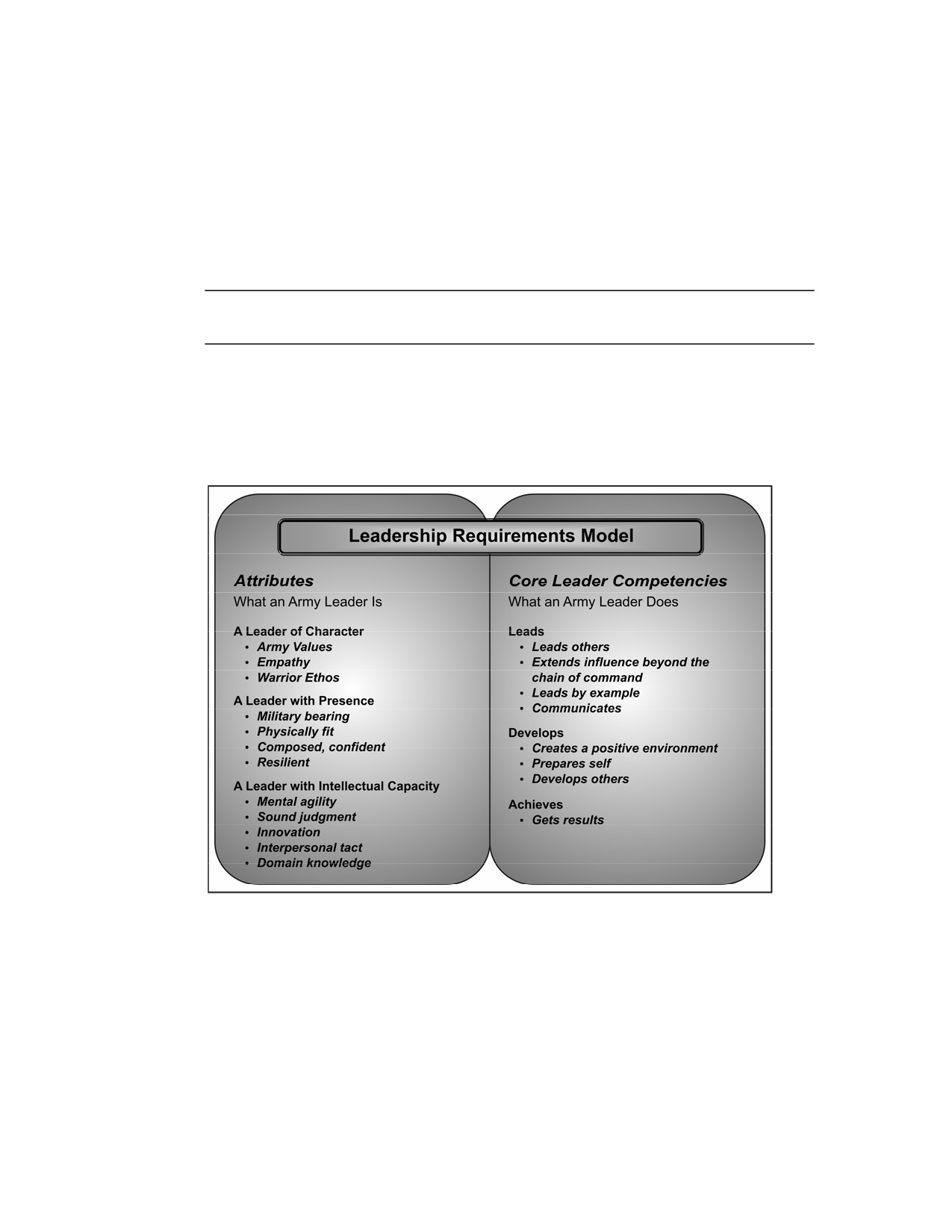
A-2. The definition contains three basic goals: to lead others, to develop the organization and its
individual members, and to accomplish the mission. These goals are extensions of the Army’s strategic
goal of remaining relevant and ready through effective leadership. The leadership requirements model
outlines the attributes and competencies Army leaders develop to meet these goals. (See figure A-1.)
Figure A-1. The Army leadership requirements model
CORE LEADER COMPETENCIES
A-3. The core leader competencies emphasize the roles, functions, and activities of what leaders do. The
following discussions and figures provide additional detail on component categories and actions that help
convey what each competency involves. The action-based competencies do not include attributes of
character (for example, enthusiasm, cooperativeness, flexibility), which are described separately.
12 October 2006
FM 6-22
A-1
Appendix A
LEADS
A-4. Leading is all about influencing others. Leaders and commanders set goals and establish a vision,
and then must motivate or influence others to pursue the goals. Leaders influence others in one of two
ways. Either the leader and followers communicate directly, or the leader provides an example through
everyday actions. The key to effective communication is to come to a common or shared understanding.
Leading by example is a powerful way to influence others and is the reason leadership starts with a
foundation of the Army Values and the Warrior Ethos. Serving as a role model requires a leader to display
character, confidence, and competence to inspire others to succeed. Influencing outside the normal chain of
command is a new way to view leadership responsibilities. Leaders have many occasions in joint,
interagency, intergovernmental, and multinational situations to lead through diplomacy, negotiation,
conflict resolution, and consensus building. To support these functions, leaders need to build trust inside
and outside the traditional lines of authority and need to understand their sphere, means, and limits of
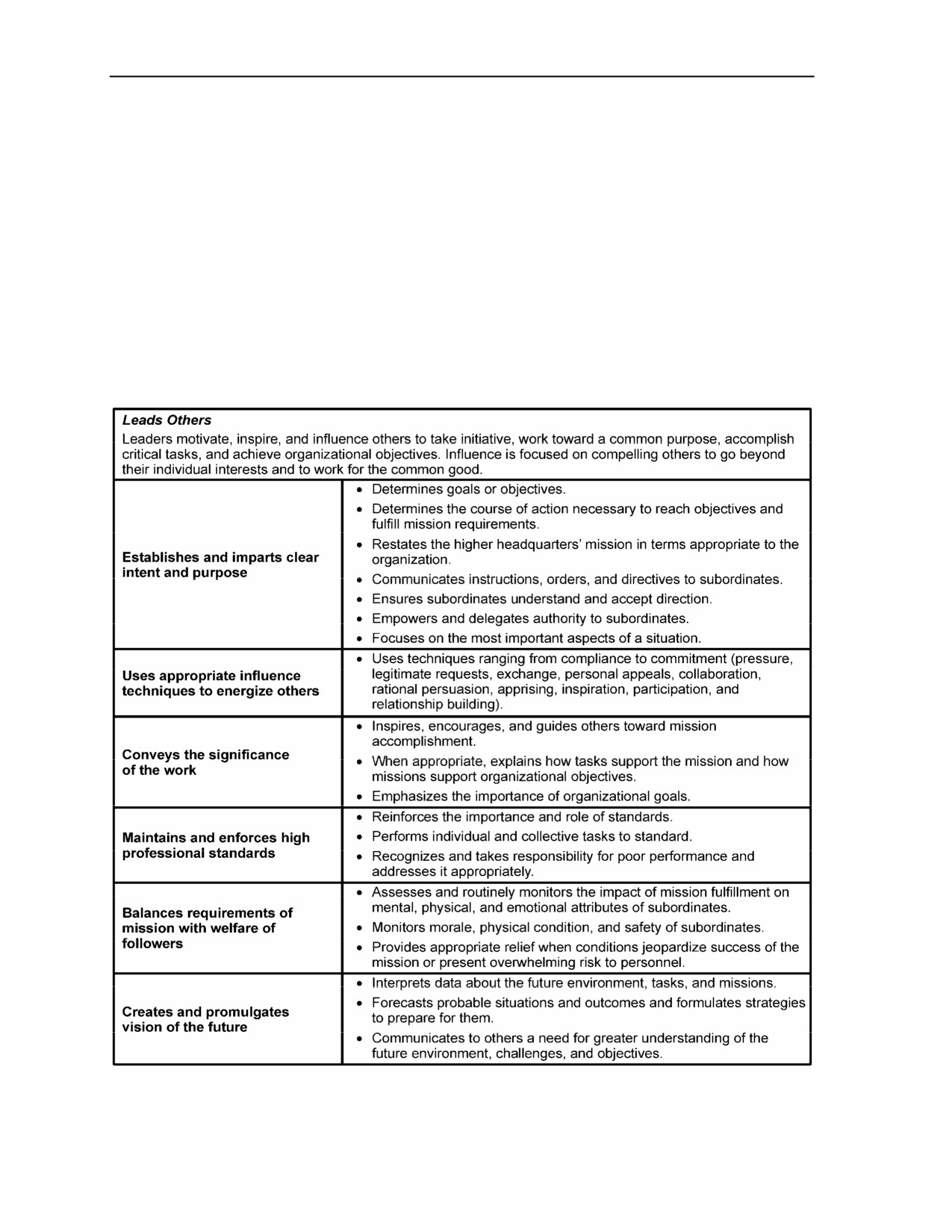
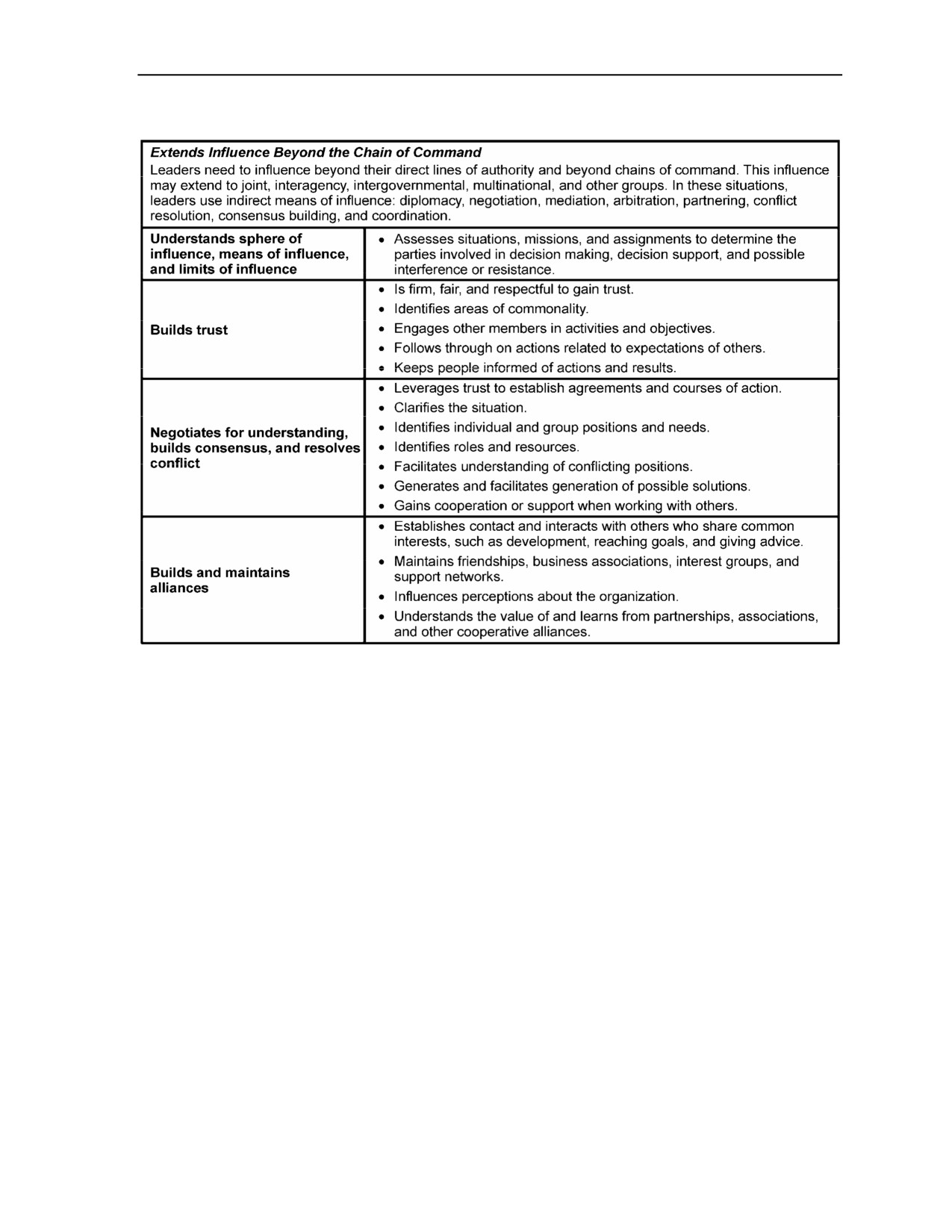
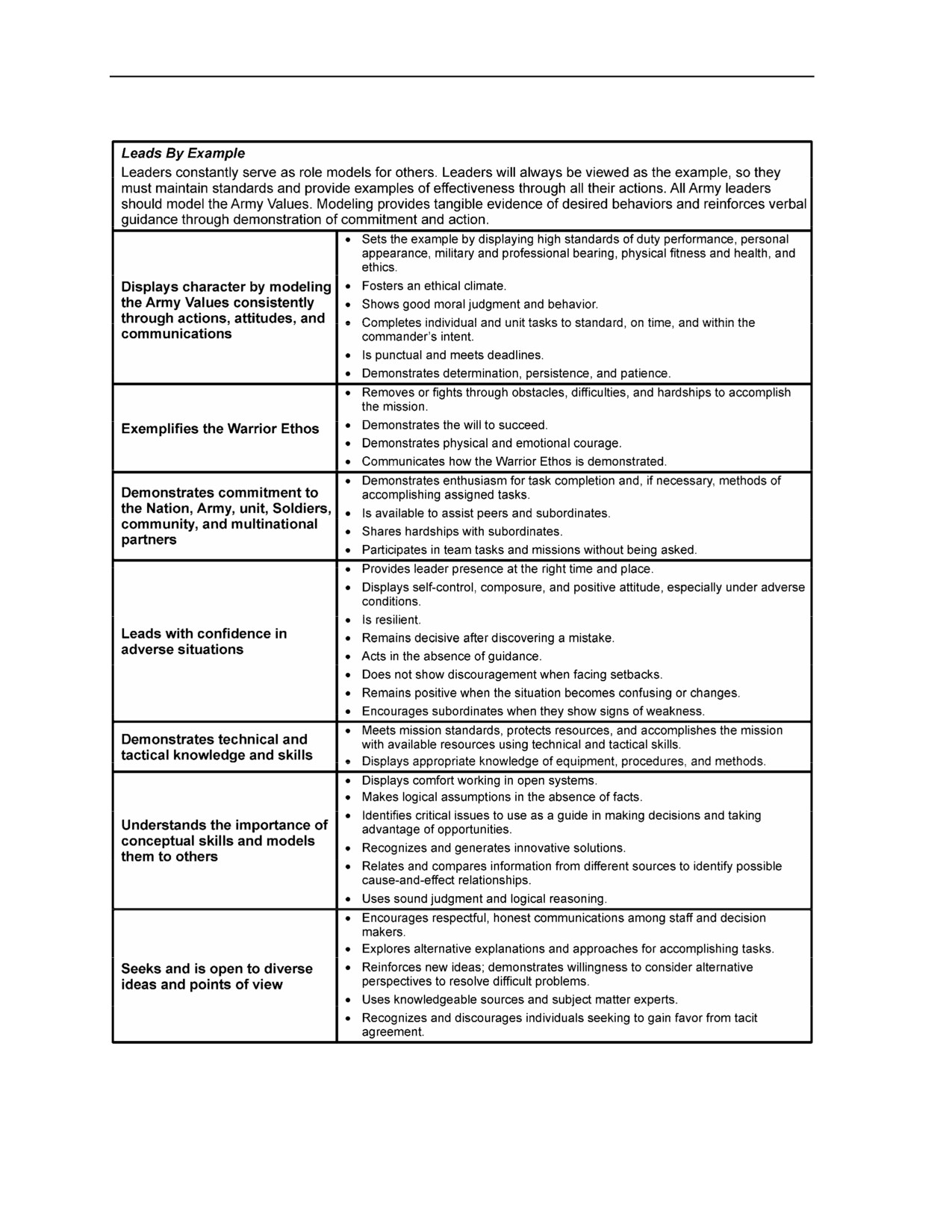
influence. (Figures A-2 through A-5 identify the first four competencies and associated components and
actions.)
Figure A-2. Competency of leads others and associated components and actions
A-2
FM 6-22
12 October 2006
Leader Attributes and Core Leader Competencies
Figure A-3. Competency of extends influence beyond the chain of command and associated
components and actions
12 October 2006
FM 6-22
A-3
Appendix A
Figure A-4. Competency of leads by example and associated components and actions
A-4
FM 6-22
12 October 2006
Leader Attributes and Core Leader Competencies
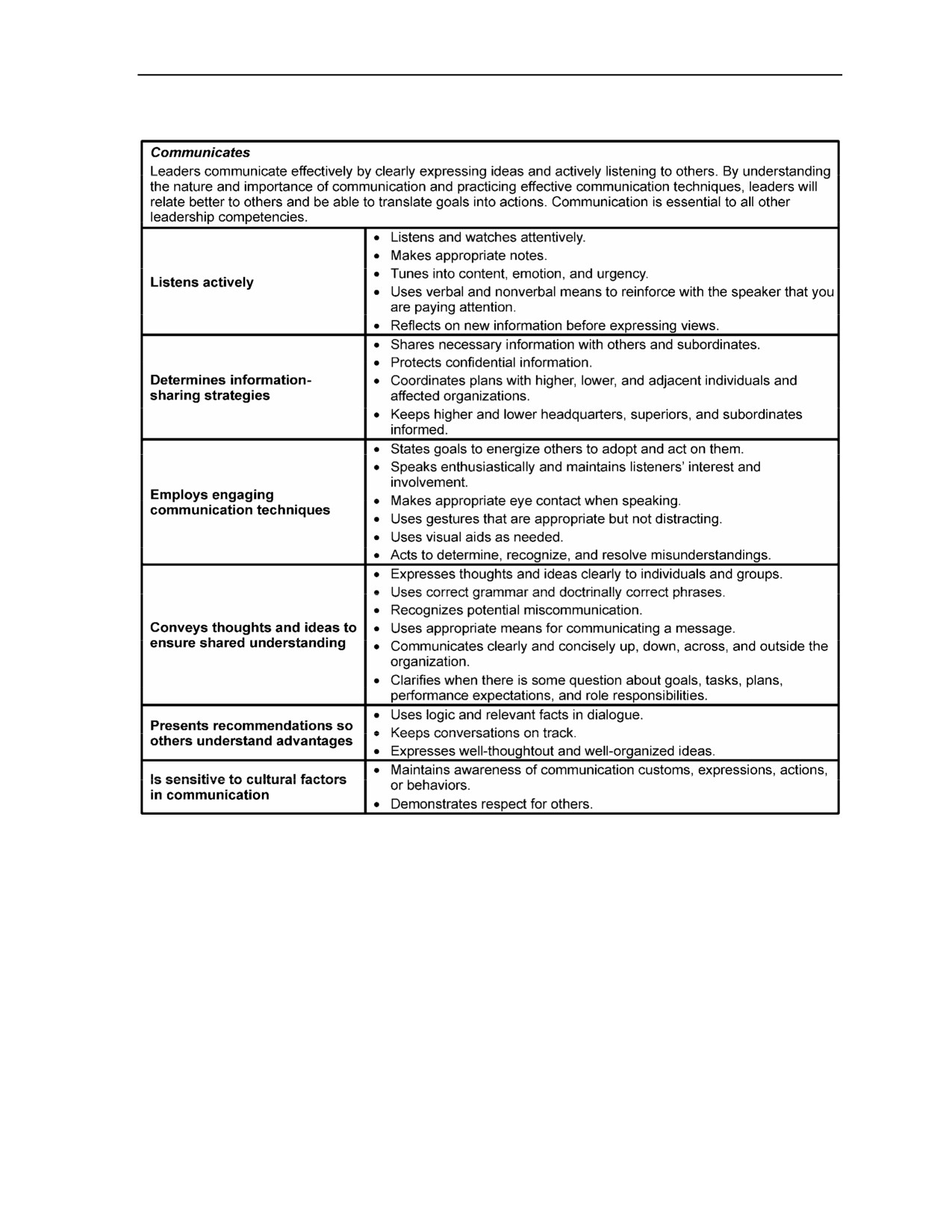
Figure A-5. Competency of communicates and associated components and actions
DEVELOPS
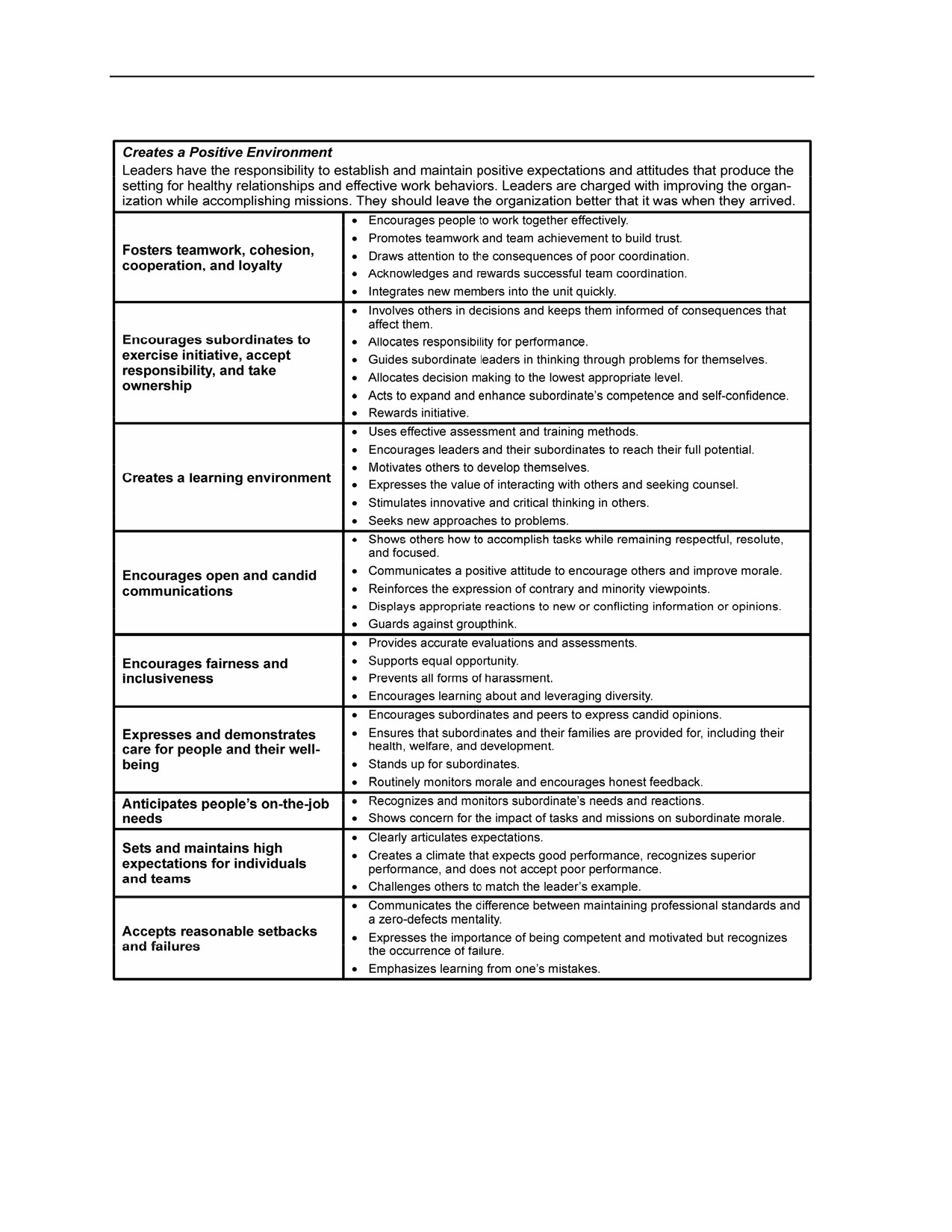
A-5. Developing the organization, the second category, involves three competencies: creating a positive
environment in which the organization can flourish, preparing oneself, and developing other leaders. The
environment is shaped by leaders taking actions to foster working together, encouraging initiative and
personal acknowledgment of responsibility, setting and maintaining realistic expectations, and
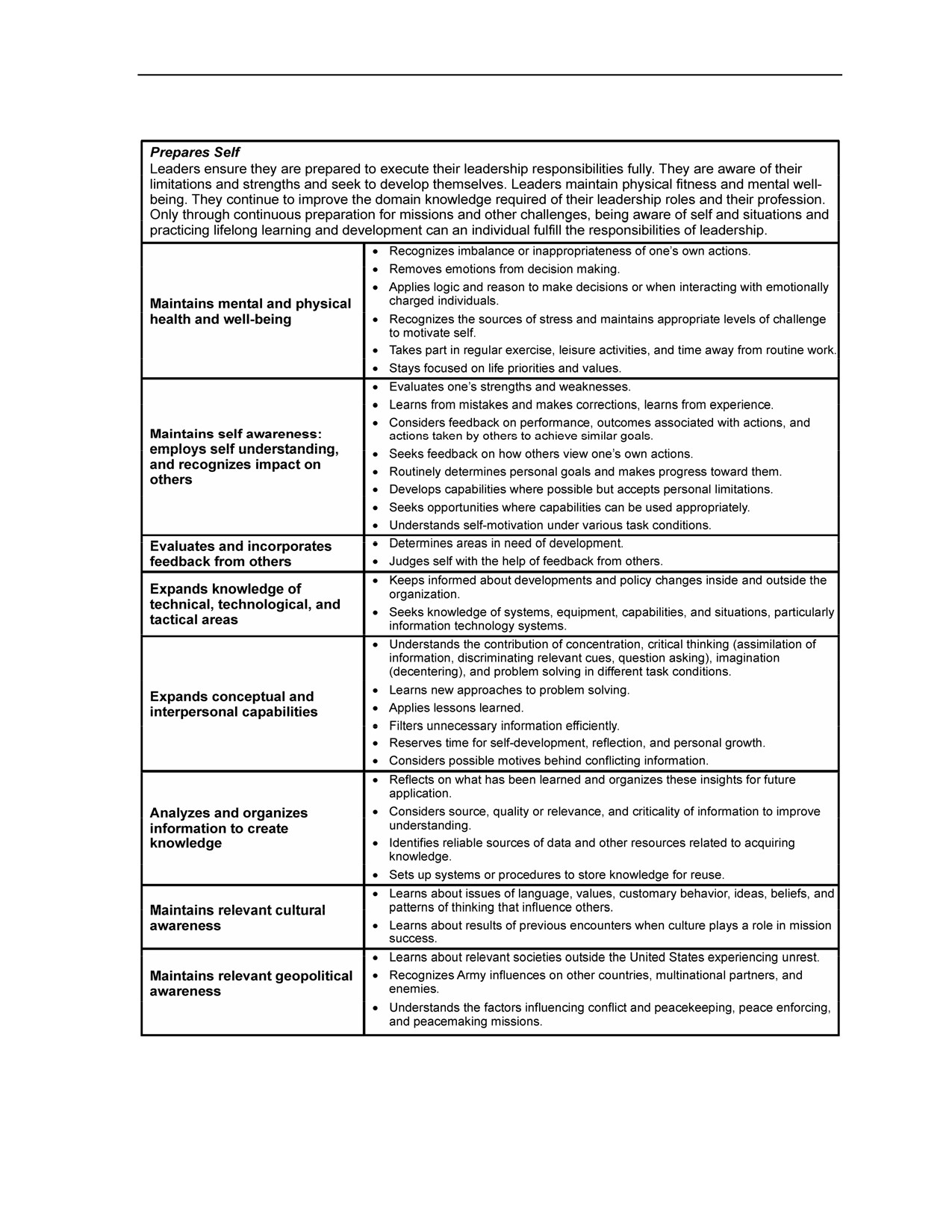
demonstrating care for people—the number one resource of leaders. Preparing self involves getting set for
mission accomplishment, expanding and maintaining knowledge in such dynamic topic areas as cultural
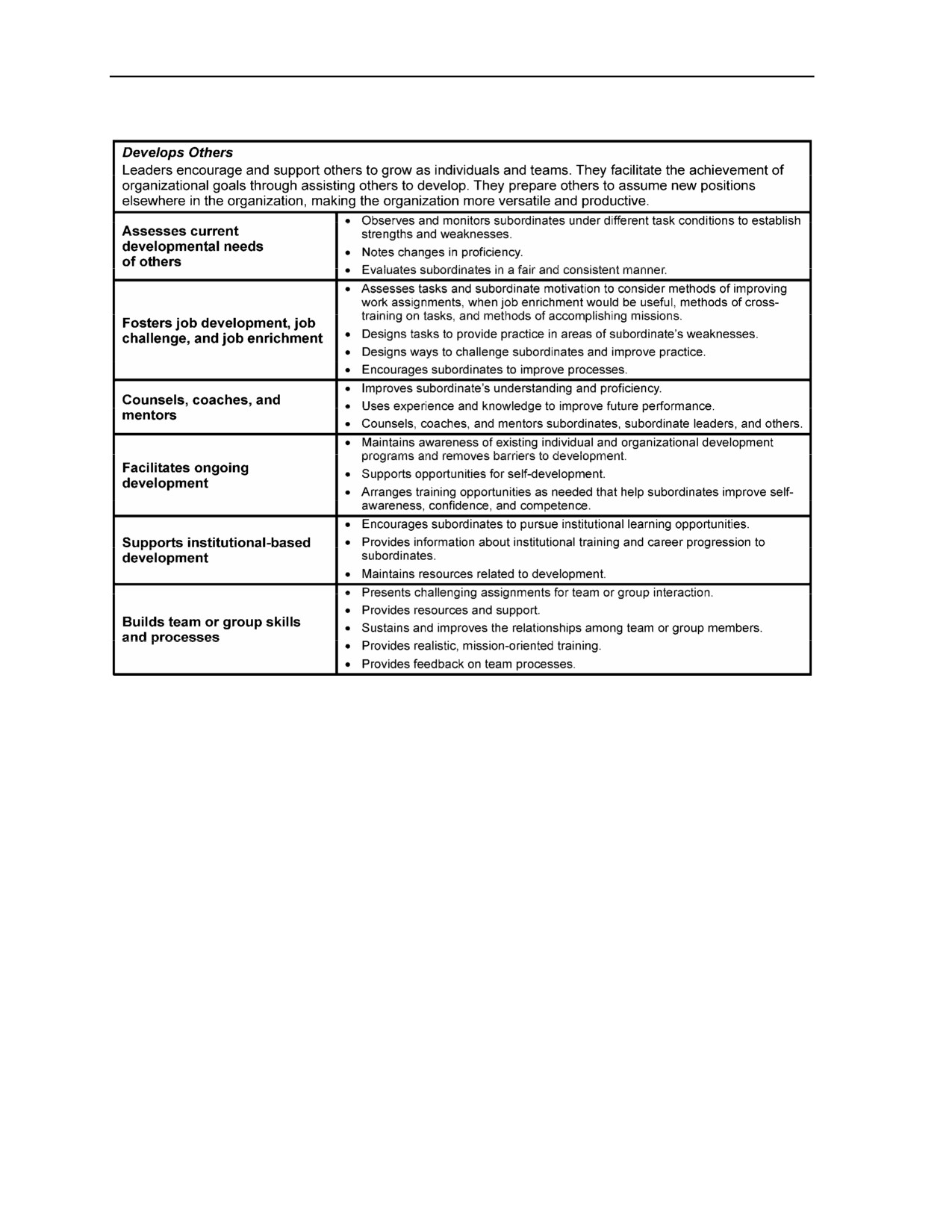
and geopolitical affairs, and being self-aware. Developing others is a directed responsibility of
commanders. Leaders develop others through coaching, counseling, and mentoring—each with a different
set of implied processes. Leaders also build teams and organizations through direct interaction, resource
management, and providing for future capabilities. (Figures A-6 through A-8 [pages A-6 through A-8]
identify the three developmental competencies and associated components and actions.)
12 October 2006
FM 6-22
A-5
Appendix A
Figure A-6. Competency of creates a positive environment and associated components and
actions
A-6
FM 6-22
12 October 2006
Leader Attributes and Core Leader Competencies
Figure A-7. Competency of prepares self and associated components and actions
12 October 2006
FM 6-22
A-7
Appendix A
Figure A-8. Competency of develops others and associated components and actions
ACHIEVES
A-6. Achieving is the third competency goal. Ultimately, leaders exist to accomplish those endeavors that
the Army has prescribed for them. Getting results, accomplishing the mission, and fulfilling goals and
objectives are all ways to say that leaders exist at the discretion of the organization to achieve something of
value. Leaders get results through the influence they provide in direction and priorities. They develop and
execute plans and must consistently accomplish goals to a high ethical standard. (Figure A-9 identifies the
eighth core leader competency and associated components and actions.)
A-8
FM 6-22
12 October 2006
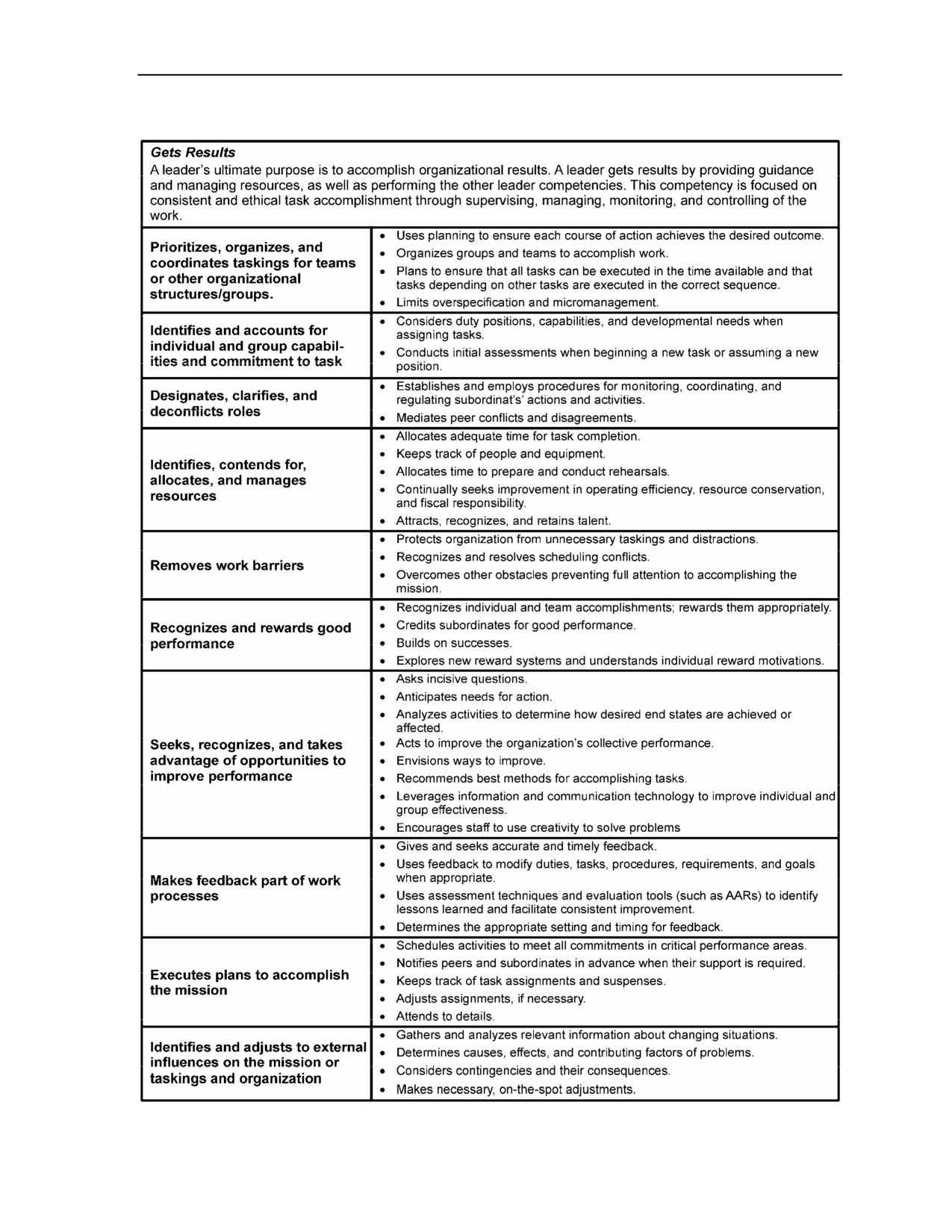
Leader Attributes and Core Leader Competencies
Figure A-9. Competency of gets results and associated components and actions
12 October 2006
FM 6-22
A-9
Appendix A
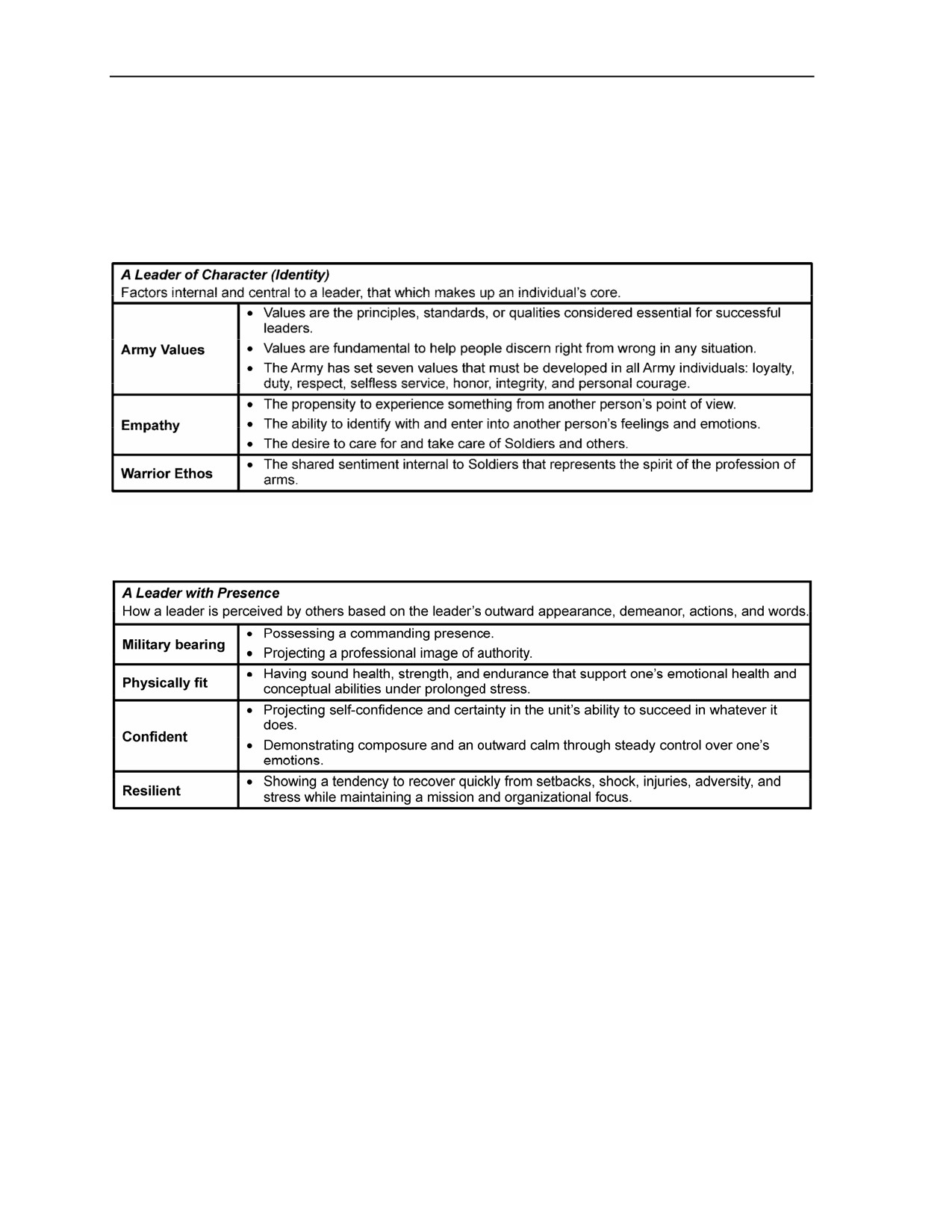
ATTRIBUTES
A-7. The core leader competencies are complemented by attributes that distinguish high performing
leaders of character. Attributes are characteristics that are an inherent part of an individual’s total core,
physical, and intellectual aspects. Attributes shape how an individual behaves in their environment.
Attributes for Army leaders are aligned to identity, presence, and intellectual capacity. (See figures A-10
through A-12.)
Figure A-10. Attributes associated with a leader of character (identity)
Figure A-11. Attributes associated with a leader with presence
A-10
FM 6-22
12 October 2006
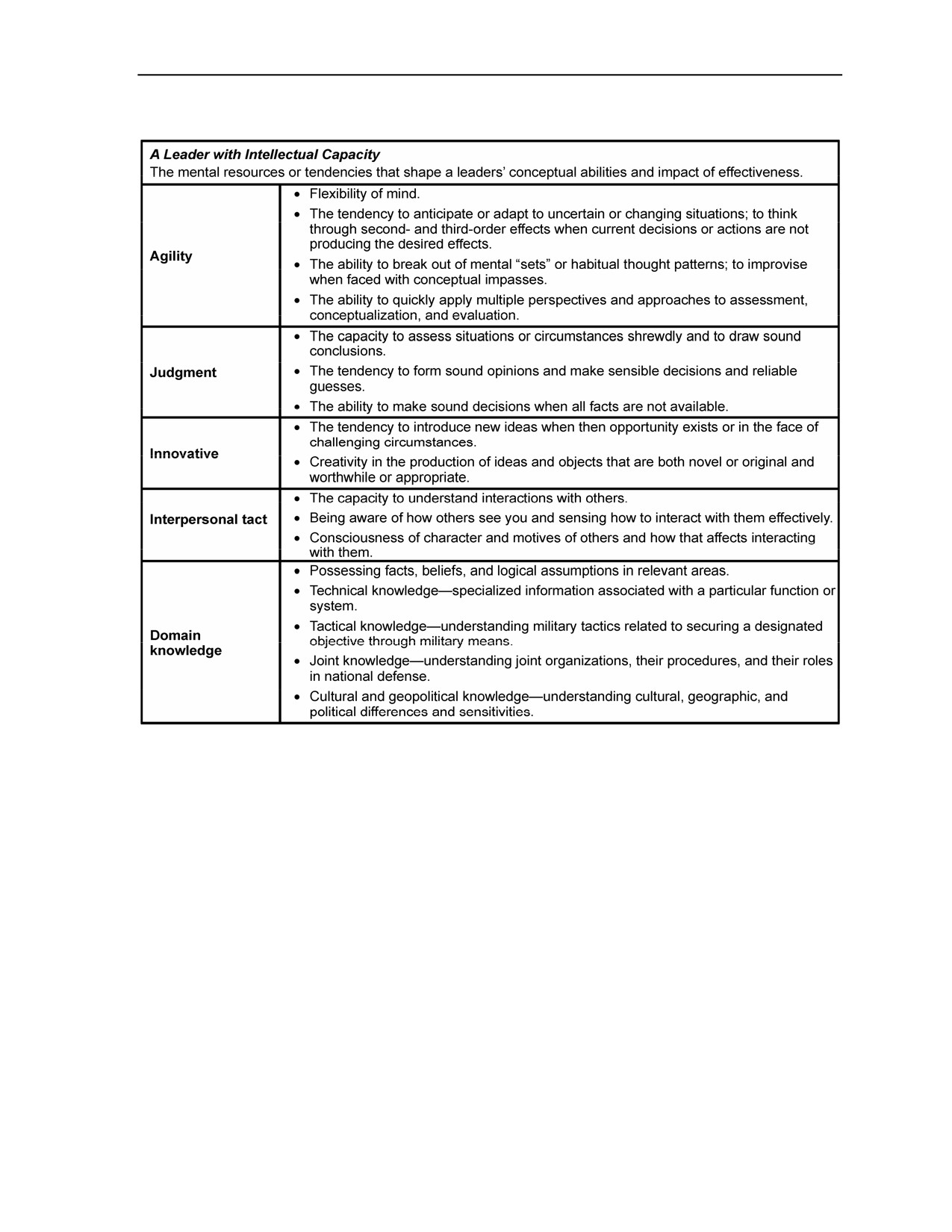
Leader Attributes and Core Leader Competencies
Figure A-12. Attributes associated with a leader with intellectual capacity
12 October 2006
FM 6-22
A-11
Appendix B
Counseling
B-1. Counseling is the process used by leaders to review with a subordinate the subordinate’s
demonstrated performance and potential (Part Three, Chapter 8).
B-2. Counseling is one of the most important leadership development responsibilities for Army leaders.
The Army’s future and the legacy of today’s Army leaders rests on the shoulders of those they help prepare
for greater responsibility.
TYPES OF DEVELOPMENTAL COUNSELING
B-3. Developmental counseling is categorized by the purpose of the session. The three major categories
of developmental counseling are—
z
Event counseling.
z
Performance counseling.
z
Professional growth counseling.
EVENT COUNSELING
B-4. Event-oriented counseling involves a specific event or situation. It may precede events such as
appearing before a promotion board or attending training. It can also follow events such as noteworthy
duty performance, a problem with performance or mission accomplishment, or a personal issue. Examples
of event-oriented counseling include—
z
Instances of superior or substandard performance.
z
Reception and integration counseling.
z
Crisis counseling.
z
Referral counseling.
z
Promotion counseling.
z
Separation counseling.
Counseling for Specific Instances
B-5. Sometimes counseling is tied to specific instances of superior or substandard duty performance. The
leader uses the counseling session to convey to the subordinate whether or not the performance met the
standard and what the subordinate did right or wrong. Successful counseling for specific performance
occurs as close to the event as possible. Leaders should counsel subordinates for exceptional as well as
substandard duty performance. The key is to strike a balance between the two. To maintain an appropriate
balance, leaders keep track of counseling for exceptional versus substandard performance.
B-6. Although good leaders attempt to balance their counseling emphasis, leaders should always counsel
subordinates who do not meet the standard. If the Soldier or civilian’s performance is unsatisfactory
because of a lack of knowledge or ability, leader and subordinate can develop a plan for improvement.
Corrective training helps ensure that the subordinate knows and consistently achieves the standard.
B-7. When counseling a subordinate for a specific performance, take the following actions:
z
Explain the purpose of the counseling—what was expected, and how the subordinate failed to
meet the standard.
z
Address the specific unacceptable behavior or action—do not attack the person’s character.
z
Explain the effect of the behavior, action, or performance on the rest of the organization.
12 October 2006
FM 6-22
B-1
Appendix B
z
Actively listen to the subordinate’s response.
z
Remain neutral.
z
Teach the subordinate how to meet the standard.
z
Be prepared to do some personal counseling, since a failure to meet the standard may be related
to or be the result of an unresolved personal problem.
z
Explain to the subordinate how an individual development plan will improve performance and
identify specific responsibilities in implementing the plan. Continue to assess and follow up on
the subordinate’s progress. Adjust the plan as necessary.
Reception and Integration Counseling
B-8. Caring and empathic Army leaders should counsel all new team members when they join the
organization. Reception and integration counseling serves two important purposes:
z
It identifies and helps alleviate any problems or concerns that new members may have, including
any issues resulting from the new duty assignment.
z
It familiarizes new team members with the organizational standards and how they fit into the
team. It clarifies roles and assignments and sends the message that the chain of command cares.
B-9. Reception and integration counseling should among others include the following discussion points:
z
Chain of command familiarization.
z
Organizational standards.
z
Security and safety issues.
z
Noncommissioned officer (NCO) support channel (who is in it and how it is used).
z
On- and off-duty conduct.
z
Personnel/personal affairs/initial and special clothing issue.
z
Organizational history, structure, and mission.
z
Soldier programs within the organization, such as Soldier of the Month/Quarter/Year, and
educational and training opportunities.
z
Off limits and danger areas.
z
Functions and locations of support activities.
z
On- and off-post recreational, educational, cultural, and historical opportunities.
z
Foreign nation or host nation orientation.
z
Other areas the individual should be aware of as determined by the leader.
Crisis Counseling
B-10. Crisis counseling includes getting a Soldier or employee through a period of shock after receiving
negative news, such as the notification of the death of a loved one. It focuses on the subordinate’s
immediate short-term needs. Leaders may assist the subordinate by listening and providing appropriate
assistance. Assisting can also mean referring the subordinate to a support activity or coordinating for
external agency support, such as obtaining emergency funding for a flight ticket or putting them in contact
with a chaplain.
Referral Counseling
B-11. Referral counseling helps subordinates work through a personal situation. It may or may not follow
crisis counseling. Referral counseling aims at preventing a problem from becoming unmanageable if the
empathic Army leader succeeds in identifying the problem in time and involves appropriate resources, such
as Army Community Services, a chaplain, or an alcohol and drug counselor. (Figure B-4 lists support
activities.)
B-2
FM 6-22
12 October 2006
Counseling
Promotion Counseling
B-12. Army leaders must conduct promotion counseling for all specialists and sergeants who are eligible
for advancement without waivers but not recommended for promotion to the next higher grade. Army
regulations require that Soldiers within this category receive initial (event-oriented) counseling when they
attain full promotion eligibility and then periodic (performance/personal growth) counseling thereafter.
Adverse Separation Counseling
B-13. Adverse separation counseling may involve informing the Soldier of the administrative actions
available to the commander in the event substandard performance continues and of the consequences
associated with those administrative actions (see AR 635-200).
B-14. Developmental counseling may not apply when an individual has engaged in serious acts of
misconduct. In those situations, leaders should refer the matter to the commander and the servicing staff
judge advocate. When rehabilitative efforts fail, counseling with a view towards separation is required. It is
an administrative prerequisite to many administrative discharges, while sending a final warning to the
Soldier: improve performance or face discharge. In many situations, it is advisable to involve the chain of
command as soon as it is determined that adverse separation counseling might be required. A unit first
sergeant or the commander should inform the Soldier of the notification requirements outlined in AR 635-
200.
PERFORMANCE COUNSELING
B-15. During performance counseling, leaders conduct a review of a subordinate’s duty performance over
a certain period. Simultaneously, leader and subordinate jointly establish performance objectives and
standards for the next period. Rather than dwelling on the past, focus on the future: the subordinate’s
strengths, areas of improvement, and potential.
B-16. Performance counseling is required under the officer, NCO, and Army civilian evaluation reporting
systems. The officer evaluation report (OER) (DA Form 67-9) process requires periodic performance
counseling as part of the OER Support Form requirements. Mandatory, face-to-face performance
counseling between the rater and the rated NCO is required under the noncommissioned officer evaluation
reporting system. (See AR 623-3). Performance evaluation for civilian employees also includes both of
these requirements.
B-17. Counseling at the beginning of and during the evaluation period ensures the subordinate’s personal
involvement in the evaluation process. Performance counseling communicates standards and is an
opportunity for leaders to establish and clarify the expected values, attributes, and competencies. The OER
support form’s coverage of leader attributes and competencies is an excellent tool for leader performance
counseling. For lieutenants and junior warrant officers, the major performance objectives on the OER
Support Form (DA Form 67-9-1) are used as the basis for determining the developmental tasks on the
Developmental Support Form (DA Form 67-9-1A). Quarterly face-to-face performance and developmental
counseling is required for these junior officers as outlined in AR
623-3. Army leaders ensure that
performance objectives and standards are focused and tied to the organization’s objectives and the
individual’s professional development. They should also echo the objectives on the leader’s support form
as a team member’s performance contributes to mission accomplishment.
PROFESSIONAL GROWTH COUNSELING
B-18. Professional growth counseling includes planning for the accomplishment of individual and
professional goals. During the counseling, leader and subordinate conduct a review to identify and discuss
the subordinate’s strengths and weaknesses and to create an individual development plan that builds upon
those strengths and compensates for (or eliminates) weaknesses.
B-19. As part of professional growth counseling, leader and subordinate may choose to develop a
“pathway to success” with short- and long-term goals and objectives. The discussion of the pathway
includes opportunities for civilian or military schooling, future duty assignments, special programs, and
12 October 2006
FM 6-22
B-3
Appendix B
reenlistment options. An individual development plan is a requirement for all Soldiers and Army civilians
as every person’s needs and interests are different.
B-20. Career field counseling is required for lieutenants and captains before they are considered for
promotion to major. Raters and senior raters in conjunction with the rated officer need to determine where
the officer’s skills and talents best fit the needs of the Army. The rated officer’s preference and abilities
(both performance and intellectual) must be considered. The rater and senior rater should discuss career
field designation with the officer prior to making a recommendation on the rated officer’s OER.
B-21. While these categories can help organize and focus counseling sessions, they should not be viewed
as separate or exhaustive. For example, a counseling session that focuses on resolving a problem may also
address improving duty performance. A session focused on performance often includes a discussion on
opportunities for professional growth. Regardless of the topic of the counseling session, leaders should
follow a basic format to prepare for and conduct it. The Developmental Counseling Form, DA Form 4856,
discussed at the end of this appendix provides a useful framework to prepare for almost any type of
counseling. Use it to help mentally organize the relevant issues to cover during counseling sessions.
THE LEADER AS A COUNSELOR
B-22. To be effective, developmental counseling must be a shared effort. Leaders assist their subordinates
in identifying strengths and weaknesses and creating plans of action. Once an individual development plan
is agreed upon, they support their Soldiers and civilians throughout the plan implementation and continued
assessment. To achieve success, subordinates must be forthright in their commitment to improve and
candid in their own assessments and goal setting.
B-23. Army leaders evaluate Army civilians using procedures prescribed under civilian personnel policies.
DA Form 4856 is appropriate to counsel Army civilians on professional growth and career goals. DA Form
4856 is not adequate to address civilian counseling concerning Army civilian misconduct or poor
performance. The servicing Civilian Personnel Office can provide guidance for such situations.
B-24. Caring and empathic Army leaders conduct counseling to help subordinates become better team
members, maintain or improve performance, and prepare for the future. While it is not easy to address
every possible counseling situation, leader self-awareness and an adaptable counseling style focusing on
key characteristics will enhance personal effectiveness as a counselor. These key characteristics include—
z
Purpose: Clearly define the purpose of the counseling.
z
Flexibility: Fit the counseling style to the character of each subordinate and to the relationship
desired.
z
Respect: View subordinates as unique, complex individuals, each with a distinct set of values,
beliefs, and attitudes.
z
Communication: Establish open, two-way communication with subordinates using spoken
language, nonverbal actions, gestures, and body language. Effective counselors listen more than
they speak.
z
Support: Encourage subordinates through actions while guiding them through their problems.
THE QUALITIES OF THE COUNSELOR
B-25. Army leaders must demonstrate certain qualities to be effective counselors. These qualities include
respect for subordinates, self-awareness and cultural awareness, empathy, and credibility.
B-26. One challenging aspect of counseling is selecting the proper approach to a specific situation. To
counsel effectively, the technique used must fit the situation, leader capabilities, and subordinate
expectations. Sometimes, leaders may only need to give information or listen, while in other situations a
subordinate’s improvement may call for just a brief word of praise. Difficult circumstances may require
structured counseling followed by definite actions, such as referrals to outside experts and agencies.
B-27. Self-aware Army leaders consistently develop and improve their own counseling abilities. They do
so by studying human behavior, learning the kinds of problems that affect their followers, and developing
B-4
FM 6-22
12 October 2006
Counseling
their interpersonal skills. The techniques needed to provide effective counseling vary from person to
person and session to session. However, general skills that leaders will need in almost every situation
include active listening, responding, and questioning.
ACTIVE LISTENING
B-28. Active listening helps communicate reception of the subordinate’s message verbally and
nonverbally. To capture the message fully, leaders listen to what is said and observe the subordinate’s
manners. Key elements of active listening include—
z
Eye contact. Maintaining eye contact without staring helps show sincere interest. Occasional
breaks of eye contact are normal and acceptable, while excessive breaks, paper shuffling, and
clock-watching may be perceived as a lack of interest or concern.
z
Body posture. Being relaxed and comfortable will help put the subordinate at ease. However, a
too-relaxed position or slouching may be interpreted as a lack of interest.
z
Head nods. Occasionally head nodding indicates paying attention and encourages the
subordinate to continue.
z
Facial expressions. Keep facial expressions natural and relaxed to signal a sincere interest.
z
Verbal expressions. Refrain from talking too much and avoid interrupting. Let the subordinate
do the talking, while keeping the discussion on the counseling subject.
B-29. Active listening implies listening thoughtfully and deliberately to capture the nuances of the
subordinate’s language. Stay alert for common themes. A subordinate’s opening and closing statements as
well as recurring references may indicate his priorities. Inconsistencies and gaps may indicate an avoidance
of the real issue. Certain inconsistencies may suggest additional questions by the counselor.
B-30. Pay attention to the subordinate’s gestures to understand the complete message. By watching the
subordinate’s actions, leaders identify the emotions behind the words. Not all actions are proof of a
subordinate’s feelings but they should be considered. Nonverbal indicators of a subordinate’s attitude
include—
z
Boredom. Drumming on the table, doodling, clicking a ballpoint pen, or resting the head in the
palm of the hand.
z
Self-confidence. Standing tall, leaning back with hands behind the head, and maintaining steady
eye contact.
z
Defensiveness. Pushing deeply into a chair, glaring at the leader, and making sarcastic
comments as well as crossing or folding arms in front of the chest.
z
Frustration. Rubbing eyes, pulling on an ear, taking short breaths, wringing the hands, or
frequently changing total body position.
z
Interest, friendliness, and openness. Moving toward the leader while sitting.
z
Anxiety. Sitting on the edge of the chair with arms uncrossed and hands open.
B-31. Leaders consider each indicator carefully. Although each may reveal something about the
subordinate, do not judge too quickly. When unsure look for reinforcing indicators or check with the
subordinate to understand the behavior, determine what is underlying it, and allow the subordinate to take
responsibility.
RESPONDING
B-32. A leader responds verbally and nonverbally to show understanding of the subordinate. Verbal
responses consist of summarizing, interpreting, and clarifying the subordinate’s message. Nonverbal
responses include eye contact and occasional gestures such as a head nod.
QUESTIONING
B-33. Although focused questioning is an important skill, counselors should use it with caution. Too many
questions can aggravate the power differential between a leader and a subordinate and place the
12 October 2006
FM 6-22
B-5
Appendix B
subordinate in a passive mode. The subordinate may also react to excessive questioning as an intrusion of
privacy and become defensive. During a leadership development review, ask questions to obtain
information or to get the subordinate to think deeper about a particular situation. Questions should evoke
more than a yes or no answer. Well-posed questions deepen understanding, encourage further explanation,
and help the subordinate perceive the counseling session as a constructive experience.
COUNSELING ERRORS
B-34. Dominating the counseling by talking too much, giving unnecessary or inappropriate advice, not
truly listening, and projecting personal likes, dislikes, biases, and prejudices all interfere with effective
counseling. Competent leaders avoid rash judgments, stereotyping, losing emotional control, inflexible
counseling methods, or improper follow-up.
B-35. To improve leader counseling skills, follow these general guidelines:
z
To help resolve the problem or improve performance, determine the subordinate’s role in the
situation and what the subordinate has done.
z
Draw conclusions based on more factors than the subordinate’s statement.
z
Try to understand what the subordinate says and feels; listen to what is said and how it is said
z
Display empathy when discussing the problem.
z
When asking questions, be sure the information is needed.
z
Keep the conversation open-ended and avoid interrupting.
z
Give the subordinate your full attention.
z
Be receptive to the subordinate’s emotions, without feeling responsible to save the subordinate
from hurting.
z
Encourage the subordinate to take the initiative and to speak aloud.
z
Avoid interrogating.
z
Keep personal experiences out of the counseling session, unless you believe your experiences
will really help.
z
Listen more and talk less.
z
Remain objective.
z
Avoid confirming a subordinate’s prejudices.
z
Help the subordinates help themselves.
z
Know what information to keep confidential and what to present to the chain of command, if
necessary.
ACCEPTING LIMITATIONS
B-36. Army leaders cannot help everyone in every situation. Recognize personal limitations and seek
outside assistance, when required. When necessary, refer a subordinate to the agency more qualified to
help.
B-37. The agency list in figure B-1 assists in solving problems. Although it is generally in an individual’s
best interest to begin by seeking help from their first-line leaders, caring leaders should respect an
individual’s preference to contact any of these agencies on their own.
B-6
FM 6-22
12 October 2006
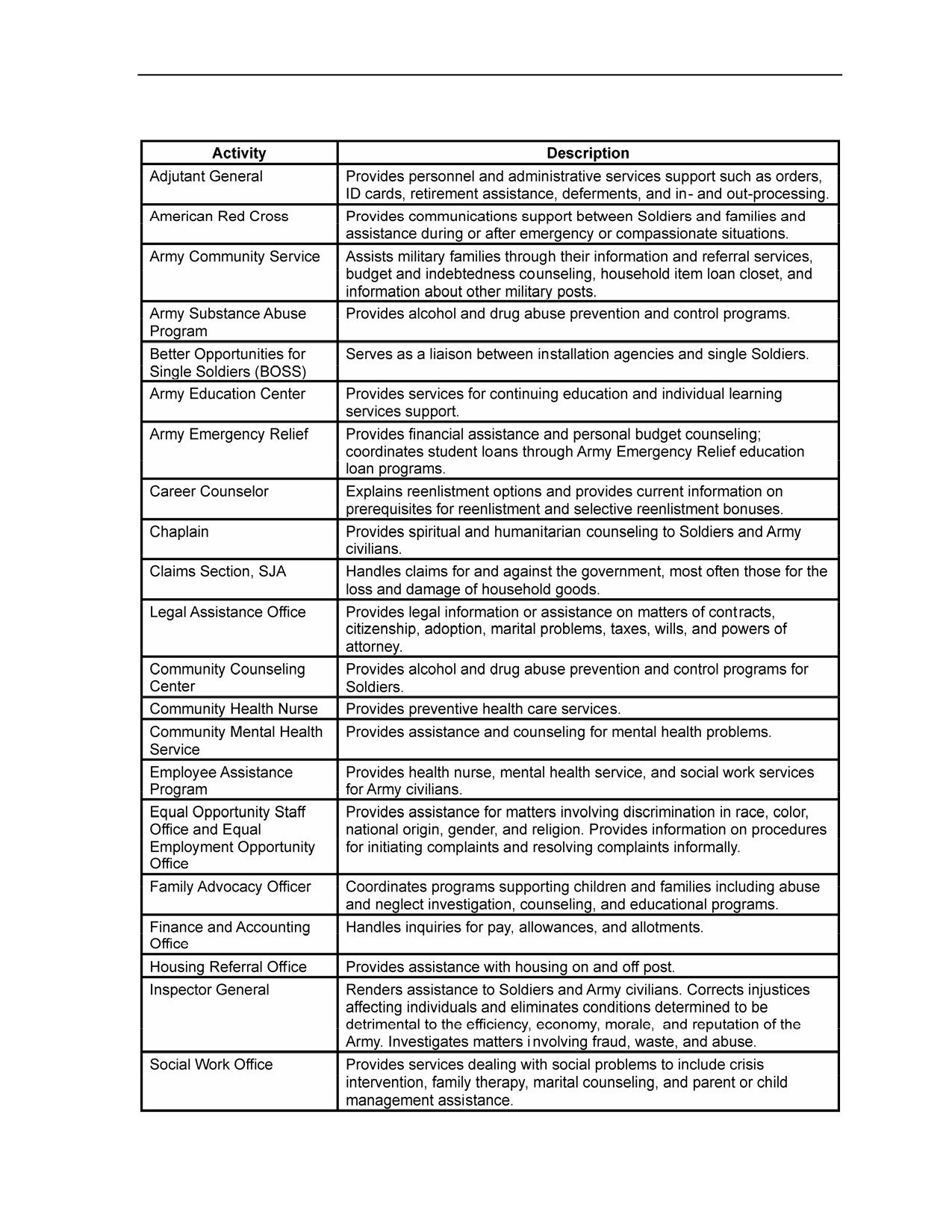
Counseling
Figure B-1. Support activities
12 October 2006
FM 6-22
B-7
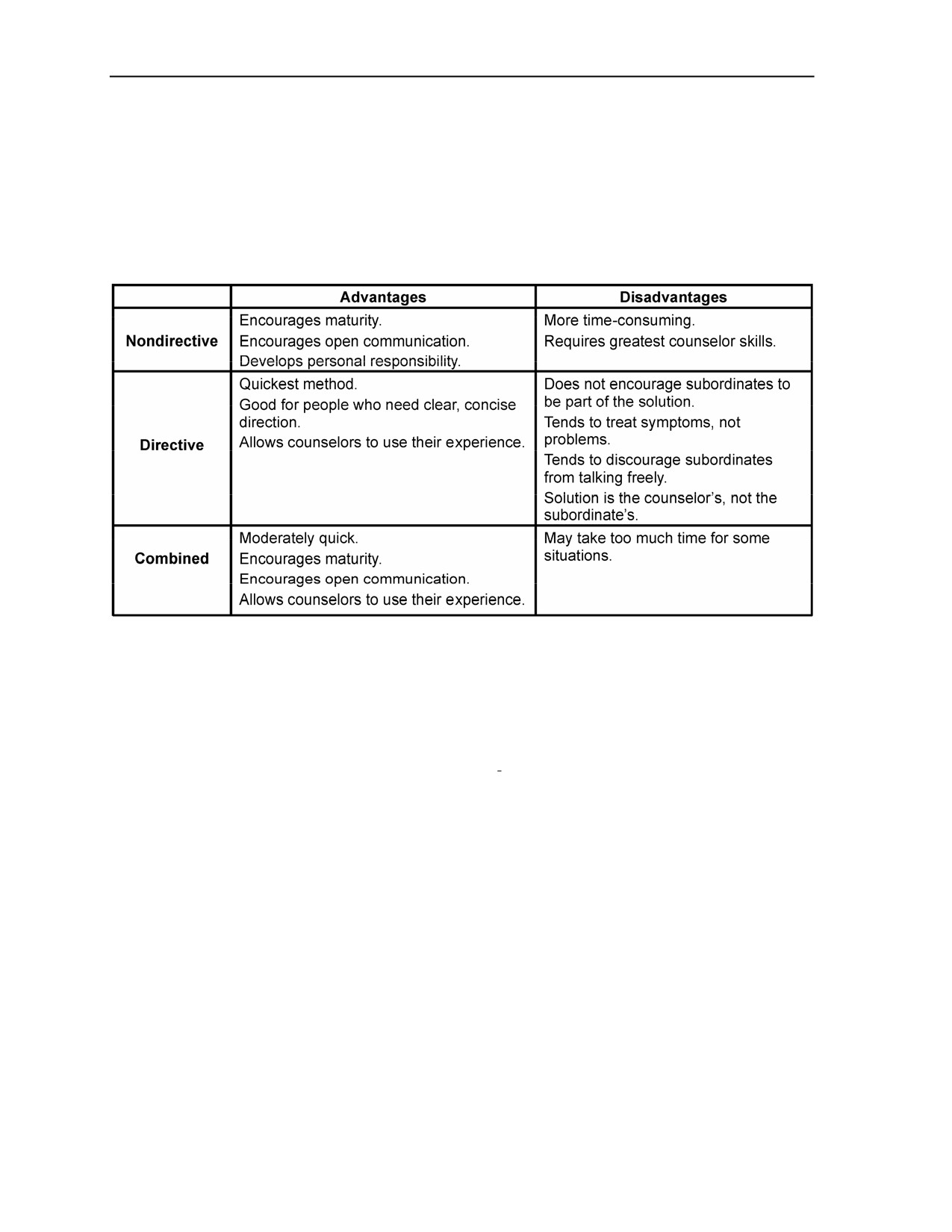
Appendix B
ADAPTIVE APPROACHES TO COUNSELING
B-38. An effective leader approaches each subordinate as an individual. Different people and different
situations require different counseling approaches. Three approaches to counseling include nondirective,
directive, and combined
(see Part Three, Chapter
8 for more). These approaches differ in specific
techniques, but all fit the definition of counseling and contribute to its overall purpose. The major
difference between the approaches is the degree to which the subordinate participates and interacts during a
counseling session. Figure B-2 identifies the advantages and disadvantages of each approach.
Figure B-2. Counseling approach summary chart
COUNSELING TECHNIQUES
B-39. The Army leader can select from several techniques when counseling subordinates. These techniques
may cause subordinates to change behavior and improve upon their performance. Counseling techniques
leaders may explore during the nondirective or combined approaches include—
z
Suggesting alternatives. Discuss alternative actions that the subordinate may take. Leader and
subordinate together decide which course of action is most appropriate.
z
Recommending. Recommend one course of action, but leave the decision to accept it to the
subordinate.
z
Persuading. Persuade the subordinate that a given course of action is best, but leave the final
decision to the subordinate. Successful persuasion depends on the leader’s credibility, the
subordinate’s willingness to listen, and mutual trust.
z
Advising. Advise the subordinate that a given course of action is best. This is the strongest form
of influence not involving a command.
B-40. Techniques to use during the directive approach to counseling include—
z
Corrective training. Teach and assist the subordinate in attaining and maintaining the required
standard. A subordinate completes corrective training when the standard is consistently attained.
z
Commanding. Order the subordinate to take a given course of action in clear, precise words.
The subordinate understands the order and will face consequences for failing to carry it out.
B-8
FM 6-22
12 October 2006
Counseling
THE FOUR-STAGE COUNSELING PROCESS
B-41. Effective Army leaders make use of a four-stage counseling process:
z
Identify the need for counseling.
z
Prepare for counseling.
z
Conduct counseling.
z
Follow-up.
STAGE 1: IDENTIFY THE NEED FOR COUNSELING
B-42. Usually organizational policies—such as counseling associated with an evaluation or command
directed counseling—focus a counseling session. However, leaders may also conduct developmental
counseling whenever the need arises for focused, two-way communication aimed at subordinate’s
development. Developing subordinates consists of observing the subordinate’s performance, comparing it
to the standard, and then providing feedback to the subordinate in the form of counseling.
STAGE 2: PREPARE FOR COUNSELING
B-43. Successful counseling requires preparation in the following seven areas:
z
Select a suitable place.
z
Schedule the time.
z
Notify the subordinate well in advance.
z
Organize information.
z
Outline the counseling session components.
z
Plan the counseling strategy.
z
Establish the right atmosphere.
Select a Suitable Place
B-44. Conduct the counseling in an environment that minimizes interruptions and is free from distracting
sights and sounds.
Schedule the Time
B-45. When possible, counsel a subordinate during the duty day. Counseling after duty hours may be
rushed or perceived as unfavorable. Select a time free from competition with other activities. Consider that
important events occurring after the session could distract a subordinate from concentrating on the
counseling. The scheduled time for counseling should also be appropriate for the complexity of the issue at
hand. Generally, counseling sessions should last less than an hour.
Notify the Subordinate Well in Advance
B-46. Counseling is a subordinate-centered, two-person effort for which the subordinate must have
adequate time to prepare. The person to be counseled should know why, where, and when the counseling
takes place. Counseling tied to a specific event should happen as closely to the event as possible. For
performance or professional development counseling, subordinates may need at least a week or more to
prepare or review specific documents and resources, including evaluation support forms or counseling
records.
Organize Information
B-47. The counselor should review all pertinent information, including the purpose of the counseling,
facts, and observations about the person to be counseled, identification of possible problems, and main
points of discussion. The counselor can outline a possible plan of action with clear obtainable goals as a
basis for the final plan development between counselor and the Soldier or civilian.
12 October 2006
FM 6-22
B-9
Appendix B
Outline the Components of the Counseling Session
B-48. Using the available information, determine the focus and specific topics of the counseling session.
Note what prompted the counseling requirement, aims, and counselor role. Identify possible key comments
and questions to keep the counseling session subordinate-centered and which can help guide the
subordinate through the session’s stages. As subordinates may be unpredictable during counseling, a
written outline can help keep the session on track and enhances the chance for focused success.
Counseling Outline
Type of counseling: Initial NCOER counseling for SFC Taylor, a recently promoted
new arrival to the unit.
Place and time: The platoon office, 1500 hours, 9 October.
Time to notify the subordinate: Notify SFC Taylor one week in advance of the
counseling session.
Subordinate preparation: Instruct SFC Taylor to put together a list of goals and
objectives he would like to complete over the next 90 to 180 days. Review the
values, attributes, and competencies of FM 6-22.
Counselor preparation:
Review the NCO Counseling Checklist/Record
Update or review SFC Taylor’s duty description and fill out the rating chain and duty
description on the working copy of the NCOER.
Review each of the values and responsibilities in Part IV of the NCOER and the
values, attributes, and competencies in FM 6-22. Think of how each applies to SFC
Taylor’s duties as platoon sergeant.
Review the actions necessary for a success or excellence rating in each value and
responsibility.
Make notes in blank spaces on relevant parts of the NCOER to assist in counseling.
Role as a counselor: Help SFC Taylor to understand the expectations and
standards associated with the platoon sergeant position. Assist SFC Taylor in
developing the values, attributes, and competencies that enable him to achieve his
performance objectives consistent with those of the platoon and company. Resolve
any aspects of the job that SFC Taylor does not clearly understand.
Session outline: Complete an outline following the counseling session components
listed in figure B-4 and based on the draft duty description on the NCOER. This
should happen two to three days prior to the actual counseling session.
Figure B-3. Example of a counseling outline
Plan the Counseling Strategy
B-49. There are many different approaches to counseling. The directive, nondirective, and combined
approaches offer a variety of options that can suit any subordinates and situation (see figure B-3 and Part
Three, Chapter 8).
B-10
FM 6-22
12 October 2006
Counseling
Establish the Right Atmosphere
B-50. The right atmosphere promotes open, two-way communication between a leader and subordinate. To
establish a more relaxed atmosphere, offer the subordinate a seat or a cup of coffee. If appropriate, choose
to sit in a chair facing the subordinate since a desk can act as a barrier.
B-51. Some situations require more formal settings. During counseling to correct substandard performance,
leaders seated behind a desk may direct the subordinate to remain standing. This reinforces the leader’s
role and authority and underscores the severity of the situation.
Example Counseling Session
Open the Session
• To establish a relaxed environment for an open exchange, explain to SFC Taylor
that the more one discusses and comprehends the importance of the Army
Values, leader attributes, and competencies, the easier it is to develop and
incorporate them for success into an individual leadership style.
• State the purpose of the counseling session and stress that the initial counseling
is based on what SFC Taylor needs to do to be a successful platoon sergeant in
the unit. Come to an agreement on the duty description and the specific
performance requirements. Discuss related values, competencies, and the
standards for success. Explain that subsequent counseling will address his
developmental needs as well as how well he is meeting the jointly agreed upon
performance objectives. Urge a thorough self-assessment during the next quarter
to identify his developmental needs.
• Ensure that SFC Taylor knows the rating chain and resolve any questions he has
about his duty position and associated responsibilities. Discuss the close team
relationship that must exist between a platoon leader and a platoon sergeant,
including the importance of honest, two-way communication.
Discuss the Issue
• Jointly review the duty description as spelled out in the NCOER, including all
associated responsibilities, such as maintenance, training, and taking care of
Soldiers. Relate the responsibilities to leader competencies, attributes, and
values. Revise the duty description, if necessary. Highlight areas of special
emphasis and additional duties.
• Clearly discuss the meaning of value and responsibility on the NCOER. Discuss
the values, attributes, and competencies as outlined in FM 6-22. Ask focused
questions to identify if he relates these items to his role as a platoon sergeant.
• Explain to SFC Taylor that the leader’s character, presence, and intellect are the
basis for competent leadership and that development of the desired leader
attributes requires that Army leaders adopt them through consistent self-
awareness and lifelong learning. Emphasize that the plan of action to accomplish
major performance objectives must encompass the appropriate values, attributes,
and competencies. Underscore that the development of the leader’s character
can never be separate from the overall plan.
Assist in Developing a Plan of Action (During the Counseling Session)
• Ask SFC Taylor to identify tasks that will facilitate the accomplishment of the
agreed-upon performance objectives. Describe each by using the values,
responsibilities, and competencies found on the NCOER and in FM 6-22.
• Discuss how each value, responsibility, and competency applies to the platoon
sergeant position. Discuss specific examples of success and excellence in each
12 October 2006
FM 6-22
B-11
Appendix B
value and responsibility block. Ask SFC Taylor for suggestions to make the goals
objective, specific, and measurable.
• Ensure that SFC Taylor leaves the counseling session with at least one example
of a success or excellence bullet statement as well as sample bullet statements
for each value and responsibility. Discuss SFC Taylor’s promotion goals and ask
him what he considers his strengths and weaknesses. Obtain copies of the last
two master sergeant selection board results and match his goals and objectives.
Close the Session
• Verify SFC Taylor understands the duty description and performance objectives.
• Stress the importance of teamwork and two-way communication.
• Ensure SFC Taylor understands that you expect him to assist in your
development as a platoon leader—both of you have the role of teacher and
coach.
• Remind SFC Taylor to perform a self-assessment during the next quarter.
• Set a tentative date during the next quarter for the follow-up counseling.
Notes on Strategy
• Offer to answer any questions SFC Taylor may have.
• Expect SFC Taylor to be uncomfortable with the terms and development process
and respond in a way that encourages participation throughout the session
Figure B-4. Example of a counseling session
STAGE 3: CONDUCT THE COUNSELING SESSION
B-52. Caring Army leaders use a balanced mix of formal and informal counseling and learn to take
advantage of everyday events to provide subordinates with feedback. Counseling opportunities often
appear when leaders encounter subordinates in their daily activities in the field, motor pool, barracks, and
wherever else Soldiers and civilians perform their duties. Even during ad-hoc counseling, leaders should
address the four basic components of a counseling session:
z
Opening the session.
z
Discussing the issues.
z
Developing a plan of action.
z
Recording and closing the session.
Open the Session
B-53. In the session opening, the leader counselor states the purpose and establishes a subordinate-centered
setting. The counselor establishes an atmosphere of shared purpose by inviting the subordinate to speak.
An appropriate purpose statement might be “SFC Taylor, the purpose of this counseling is to discuss your
duty performance over the past month and to create a plan to enhance performance and attain performance
goals.” If applicable, start the counseling session by reviewing the status of the current plan of action.
Discuss the Issues
B-54. Leader and counseled individual should attempt to develop a mutual and clear understanding of the
counseling issues. Use active listening and invite the subordinate to do most of the talking. Respond and
ask questions without dominating the conversation but help the subordinate better understand the subject of
the counseling session: duty performance, a problem situation and its impact, or potential areas for growth.
B-12
FM 6-22
12 October 2006
Counseling
B-55. To reduce the perception of bias or early judgment, both leader and subordinate should provide
examples or cite specific observations. When the issue is substandard performance, the leader must be clear
why the performance did not meet the standard. During the discussion, the leader must clearly establish
what the subordinate must do to meet the standard in the future. It is very important that the leader frames
the issue at hand as substandard performance and prevents the subordinate from labeling the issue as an
unreasonable standard. An exception would be when the leader considers the current standard as negotiable
or is willing to alter the conditions under which the subordinate can meet the standard.
Develop a Plan of Action
B-56. A plan of action identifies a method and pathway for achieving a desired result. It specifies what the
subordinate must do to reach agreed-upon goals set during the counseling session. The plan of action must
be specific, showing the subordinate how to modify or maintain his or her behavior. Example: “PFC
Miller, next week you’ll attend the map reading class with 1st Platoon. After the class, SGT Dixon will
personally coach you through the land navigation course. He will help you develop your skills with the
compass. After observing you going through the course with SGT Dixon, I will meet with you again to
determine if you still need additional training.”
Record and Close the Session
B-57. Although requirements to record counseling sessions vary, a leader always benefits from
documenting the main points of a counseling session, even the informal ones. Documentation serves as a
ready reference for the agreed-upon plan of action and helps the leader track the subordinate’s
accomplishments, improvements, personal preferences, or problems. A good record of counseling enables
the leader to make proper recommendations for professional development, schools, promotions, and
evaluation reports.
B-58. Army regulations require specific written records of counseling for certain personnel actions, such as
barring a Soldier from reenlisting, processing an administrative separation, or placing a Soldier in the
overweight program. When a Soldier faces involuntary separation, the leader must maintain accurate
counseling records. Documentation of substandard actions often conveys a strong message to subordinates
that a further slip in performance or discipline could require more severe action or punishment.
B-59. When closing the counseling session, summarize the key points and ask if the subordinate
understands and agrees with the proposed plan of action. With the subordinate present, establish any
follow-up measures necessary to support the successful implementation of the plan of action. Follow-up
measures may include providing the subordinate with specific resources and time, periodic assessments of
the plan, and additional referrals. If possible, schedule future meetings before dismissing the subordinate.
STAGE 4: FOLLOW-UP
Leader Responsibilities
B-60. The counseling process does not end with the initial counseling session. It continues throughout the
implementation of the plan of action, consistent with the observed results. Sometimes, the initial plan of
action will require modification to meet its goals. Leaders must consistently support their subordinates in
implementing the plan of action by teaching, coaching, mentoring, or providing additional time, referrals,
and other appropriate resources. Additional measures may include more focused follow-up counseling,
informing the chain of command, and taking more severe corrective measures.
Assess the Plan of Action
B-61. During assessment, the leader and the subordinate jointly determine if the desired results were
achieved. They should determine the date for their initial assessment during the initial counseling session.
The plan of action assessment provides useful information for future follow-up counseling sessions.
12 October 2006
FM 6-22
B-13
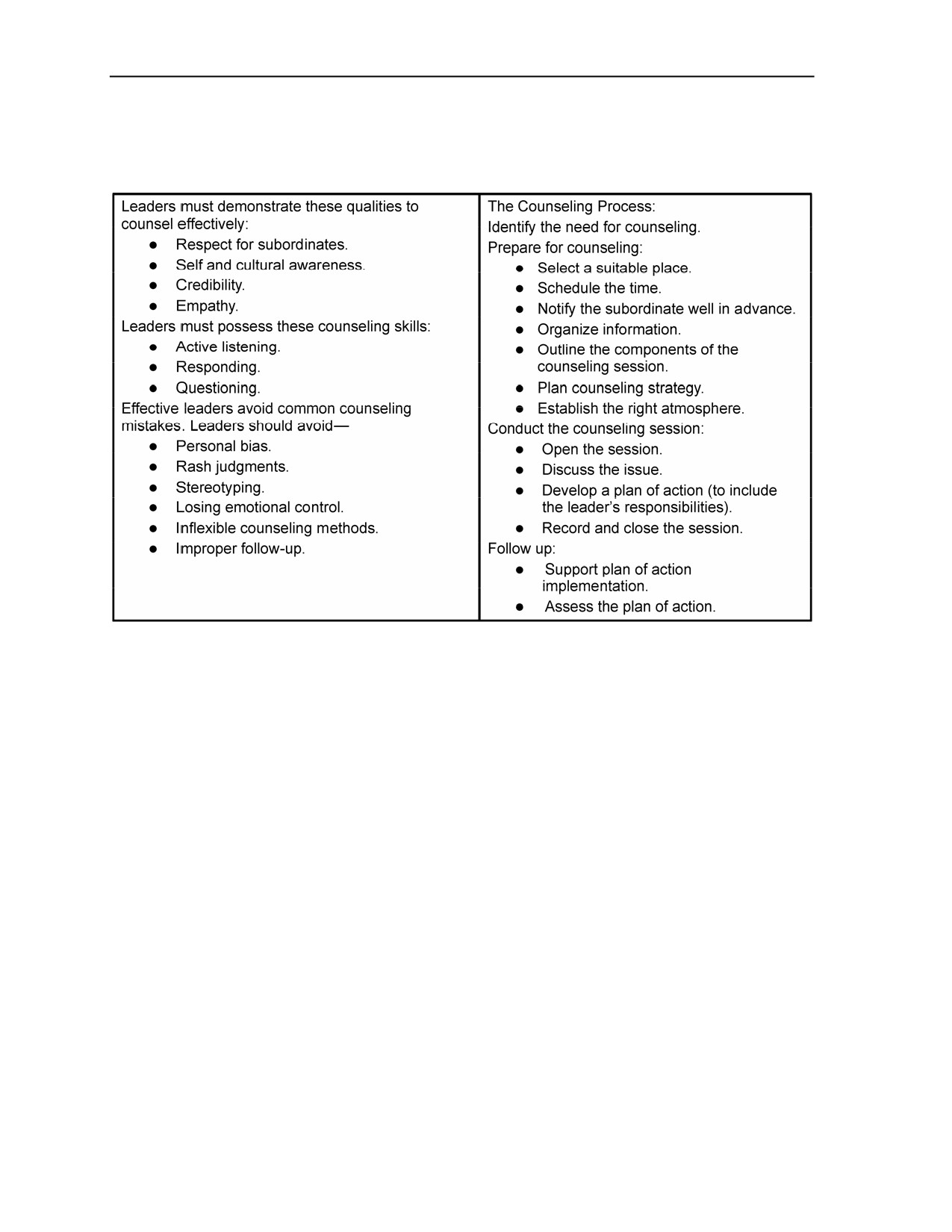
Appendix B
SUMMARY—THE COUNSELING PROCESS AT A GLANCE
B-62. Use figure B-5 as a quick reference whenever counseling Soldiers or civilian team members.
Figure B-5. A summary of counseling
THE DEVELOPMENTAL COUNSELING FORM
B-63. The Developmental Counseling Form (DA Form 4856) is designed to help Army leaders conduct
and record counseling sessions. Figures B-6 and B-7 show a completed DA Form 4856 documenting the
counseling of a young Soldier with financial problems. Although derogatory, it is still developmental
counseling. Leaders must decide when counseling, additional training, rehabilitation, reassignment, or
other developmental options have been exhausted. Figures B-8 and B-9 show a routine
performance/professional growth counseling for a unit first sergeant. Figures B-10 and B-11 show a blank
form with instructions on how to complete each block.
B-14
FM 6-22
12 October 2006
Source Notes
These are sources quoted or paraphrased in this publication. They are listed by page number. Quotations are
identified by the first few word of the quote. Where a quote is embedded within a paragraph, the paragraph
number is listed. Boldface indicates the title of historical vignettes.
PART ONE THE BASIS OF LEADERSHIP
Chapter 2: The Foundations of Army Leadership
2-1
“When we assumed…”: Trevor Royle, A Dictionary of Military Quotations (New York: Simon and
Schuster, 1989), 63 (hereafter referred to as Royle).
2-2
Oath of Enlistment: DD Form 4, Enlistment/Reenlistment Document Armed Forces of the United
States, 10 USC 502.
2-2
Oath of Office: DA Form 71, Oath of Office-Military Personnel; 5 USC 3331. The oath administered
to commissioned officers includes the words, “I [full name], having been appointed a [rank] in the
United States Army
”
2-3
“When you are commanding…”: H. A. DeWeerd, ed., Selected Speeches and Statements of General of
the Army George C. Marshall (Washington, DC: Infantry Journal Press, 1945), 176.
2-3
“Just as the diamond…”: The Chiefs of Staff, United States Army: On Leadership and the Profession
of Arms (Washington, DC: The Information Management Support Center, 24 March 1997), 10
(hereafter referred to as Chiefs of Staff 1997).
2-5
Colonel Chamberlain at Gettysburg: John J. Pullen, The Twentieth Maine (1957; reprint, Dayton,
OH: Press of Morningside Bookshop, 1980), 114-125.
Chapter 3: Leadership Roles, Leadership Levels, and Leader Teams
3-2
3-11: Incorporates 10 USC 3583 Requirement of Exemplary Service and the Army Values.
3-3
NCO Vision: The Army Noncommissioned Officer Guide, FM 7-22.7 (Headquarters, Department of
the Army, 2002) (hereafter referred to as NCO Guide).
3-4
3-22: James B. Gunlicks, Acting Director of Training, SUBJECT: “Army Training and Leader
Development Panel-Civilian (ATLDP-CIV), Implementation Process Action Team (IPAT)
Implementation Plan-ACTION MEMORANDUM,” memorandum for Chief of Staff, Army, 28 May
2003.
3-5
“NCOs like to make…”: Dennis Steele, “Broadening the Picture Calls for Turning Leadership Styles,”
Army Magazine 39, no. 12 (December 1989): 39.
3-9
3-54 Team Structures. Frederic J. Brown, “Vertical Command Teams,” IDA Document D-2728
(Alexandria, VA: Institute for Defense Analyses, 2002), l-1.
3-10
Shared Leadership Solves Logistics Challenges: John Pike,
“Operation Enduring Freedom-
Afghanistan,”
Global
Security
Web
site
(7
March
2005):
3-12
Stepping Up to Lead: Ann Scott Tyson, “Anaconda: A War Story,” Christian Science Monitor (1
Perez Didn’t Join the Army to Be a Hero,” Time Magazine
(1 September
2002):
“Interview with U.S. Army Soldiers who Participated in Operation Anaconda,” United States
Department of Defense Web site (7 March 2002): <http://www.defenselink.mil/Transcripts/Transcript.
aspx?TranscriptID=2914>.
PART TWO THE ARMY LEADER: PERSON OF CHARACTER, PRESENCE, AND INTELLECT
Chapter 4: Leader Character
4-1
“Just as fire tempers…”: Margaret Chase Smith, speech to graduating women naval officers at Naval
Station, Newport, RI (Skowhegan, ME: Margaret Chase Smith Library, 1952).
4-2
Soldier Shows Character and Discipline: TRADOC Pam 525-100-4, Leadership and Command on
the Battlefield: Noncommissioned Officer Corps (Fort Monroe, VA, 1994), 26.
12 October 2006
FM 6-22
Source Notes-1