FM 6-22 Army Leadership: Competent, Confident, and Agile (OCTOBER 2006) - page 2
Chapter 4
and civilians with reasonable comforts and rest periods to maintain good morale and mission effectiveness.
When a unit or organization suffers injuries or death, empathetic Army leaders can help ease the trauma
and suffering in the organization to restore full readiness as quickly as possible.
4-44. Modern Army leaders recognize that empathy also includes nourishing a close relationship between
the Army and Army families. To build a strong and ready force, Army leaders at all levels promote self-
sufficient and healthy families. Empathy for families includes allowing Soldiers recovery time from
difficult missions, protecting leave periods, permitting critical appointments, as well as supporting events
that allow information exchange and family teambuilding.
4-45. The requirement for leader empathy extends beyond civilians, Soldiers, and their families. Within
the larger operational environment, leader empathy may be helpful when dealing with local populations
and prisoners of war. Providing the local population within an area of operations with the necessities of life
often turns an initially hostile disposition into one of cooperation.
THE WARRIOR ETHOS
4-46. General Eric Shinseki, former Army Chief of Staff, described the need for a common Warrior Ethos
with emphasis on the uniformed members of the Army team:
Every organization has an internal culture and ethos. A true warrior ethos must
underpin the Army’s enduring traditions and values…. Soldiers imbued with an ethically
grounded warrior ethos clearly symbolize the Army’s unwavering commitment to the
nation we serve. The Army has always embraced this ethos but the demands of
Transformation will require a renewed effort to ensure that all Soldiers truly understand
and embody this warrior ethos.
4-47. The Warrior Ethos refers to the professional attitudes and beliefs that characterize the American
Soldier. It echoes through the precepts of the Code of Conduct and reflects a Soldier’s selfless commitment
to the Nation, mission, unit, and fellow Soldiers. The Warrior Ethos was developed and sustained through
discipline, commitment to the Army Values, and pride in the Army’s heritage. Lived by Soldiers and
supported by dedicated Army civilians, a strong Warrior Ethos is the foundation for the winning spirit that
permeates the institution.
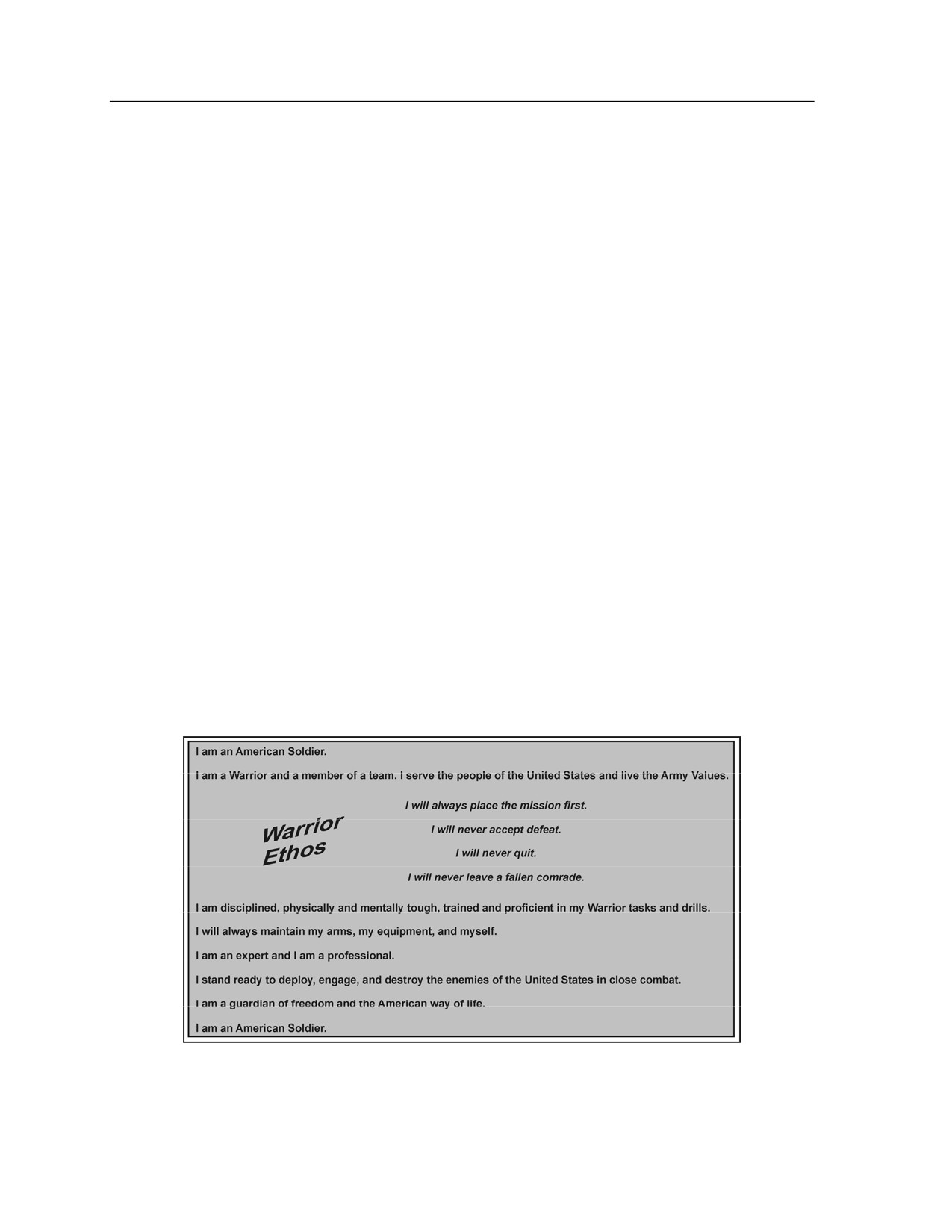
4-48. U.S Army Soldiers embrace the Warrior Ethos as defined in the Soldier’s Creed. (See figure 4-1.)
Figure 4-1. The Soldier’s Creed
4-10
FM 6-22
12 October 2006
Leader Character
4-49. The Warrior Ethos is more than persevering in war. It fuels the fire to fight through any demanding
conditions—no matter the time or effort required. It is one thing to make a snap decision to risk one’s life
for a brief period. It is quite another to sustain the will to win when the situation looks hopeless and shows
no indication of getting better, when being away from home and family is already a profound hardship.
The Soldier who jumps on a grenade to save comrades is courageous without question—that action
requires great mental and physical courage. Pursuing victory over extended periods with multiple
deployments requires this deep moral courage, one that focuses on the mission.
Wars may be fought with weapons, but they are won by men. It is the spirit of the men
who follow and of the man who leads that gains the victory.
General George S. Patton
Cavalry Journal (1933)
4-50. The actions of all who have fought courageously in wars past exemplify the essence of the Army’s
Warrior Ethos. Developed through discipline, commitment to the Army Values, and knowledge of the
Army’s proud heritage, the Warrior Ethos makes clear that military service is much more than just another
job. It is about the warrior’s total commitment. It is the Soldiers’ absolute faith in themselves and their
comrades that makes the Army invariably persuasive in peace and invincible in war. The Warrior Ethos
forges victory from the chaos of battle. It fortifies all leaders and their people to overcome fear, hunger,
deprivation, and fatigue. The Army wins because it fights hard and with purpose. It fights hard because it
trains hard. Tough training is the path to winning at the lowest cost in human sacrifice.
4-51. The Warrior Ethos is a component of character. It shapes and guides what a Soldier does. It is linked
tightly to the Army Values such as personal courage, loyalty to comrades, and dedication to duty. During
the Korean War, one leader displayed these traits and surpassed traditional bounds of rank to lead his
Soldiers.
Task Force Kingston
LT Joseph Kingston, a boyish-looking platoon leader in K Company, 3d Battalion,
32d Infantry, was commanding the lead element for his battalion’s move northward.
The terrain was mountainous in that part of Korea, the weather bitterly cold—the
temperature often below zero—and the cornered enemy still dangerous.
LT Kingston inched his way forward, the battalion gradually adding elements to his
force. Soon, he had anti-aircraft jeeps mounted with quad .50 caliber machine guns,
a tank, a squad (later a platoon) of engineers, and an artillery forward observer under
his control. Some of the new attachments were commanded by lieutenants who
outranked him, as did the tactical air controller—a captain. LT Kingston remained in
command, and battalion headquarters began referring to his growing force as, “Task
Force Kingston.”
Bogged down in Yongsong-ni with casualties mounting, Task Force Kingston
received reinforcements that brought its strength to nearly
300. 1LT Kingston’s
battalion commander wanted him to remain in command, even though he pushed
forward several more officers who outranked LT Kingston. One of the attached units
was a rifle company, commanded by a captain. Nonetheless, the cooperative
command arrangement worked—because LT Kingston was a very competent leader.
Despite tough fighting, the force advanced. Hit while leading an assault on one
enemy stronghold, Kingston managed to toss a grenade, just as a North Korean
soldier fired a shot that glanced off his helmet. The Lieutenant’s resilience and
personal courage inspired every Soldier from the wide array of units under his
control.
Task Force Kingston succeeded in battle because of a competent young leader who
inspired his people by demonstrating many attributes common to the Warrior Ethos
and the Army Values that the Army currently espouses.
12 October 2006
FM 6-22
4-11
Chapter 4
4-52. The Warrior Ethos requires unrelenting and consistent determination to do what is right and to do it
with pride across the spectrum of conflicts. Understanding what is right requires respect for both comrades
and all people involved in complex missions, such as stability and reconstruction operations. Ambiguous
situations, such as when to use lethal or nonlethal force, are a test for the leader’s judgment and discipline.
The Warrior Ethos helps create a collective commitment to win with honor.
4-53. The Warrior Ethos is crucial but also perishable. Consequently, the Army must continually affirm,
develop, and sustain it. The martial ethic connects American warriors of today with those whose sacrifices
have sustained our very existence since America’s founding. The Army’s continuing drive to be the best, to
triumph over all adversity, and to remain focused on mission accomplishment, does more than preserve the
Army’s institutional culture—it sustains the Nation.
4-54. Actions that safeguard and sustain the Nation occur everywhere there are Soldiers and civilian
members of the Army team. All that tireless motivation comes in part from the cohesion that springs from
the Warrior Ethos. Soldiers fight for each other and their loyalty runs front to rear as well as left to right.
Mutual support is a defining characteristic of Army culture, present regardless of time or place.
CHARACTER DEVELOPMENT
4-55. People join the Army as Soldiers and Army civilians with their character, pre-shaped by their
background, beliefs, education, and experience. An Army leader’s job would be simpler if merely checking
the team member’s personal values against the Army Values and developing a simple plan to align them
sufficed. Reality is much different. Becoming a person of character and a leader of character is a career-
long process involving day-to-day experience, education, self-development, developmental counseling,
coaching, and mentoring. While individuals are responsible for their own character development, leaders
are responsible for encouraging, supporting, and assessing the efforts of their people. Leaders of character
can develop only through continual study, reflection, experience, and feedback. Leaders hold themselves
and subordinates to the highest standards. The standards and values then spread throughout the team, unit,
or organization and ultimately throughout the Army.
4-56. Doing the right thing is good. Doing the right thing for the right reason and with the right goal is
better. People of character must possess the desire to act ethically in all situations. One of the Army
leader’s primary responsibilities is to maintain an ethical climate that supports development of such
character. When an organization’s ethical climate nurtures ethical behavior, people will, over time, think,
feel, and act ethically. They will internalize the aspects of sound character.
CHARACTER AND BELIEFS
4-57. Beliefs matter because they help people understand their experiences. Those experiences provide a
start point for what to do in everyday situations. Beliefs are convictions people hold as true. Values are
deep-seated personal beliefs that shape a person’s behavior. Values and beliefs are central to character.
4-58. Army leaders should recognize the role beliefs play in preparing Soldiers for battle. Soldiers often
fight and win against tremendous odds when they are convinced of the beliefs for which they are fighting.
Commitment to such beliefs as justice, liberty, and freedom can be essential ingredients in creating and
sustaining the will to fight and prevail. Warrior Ethos is another special case of beliefs.
4-59. Beliefs derive from upbringing, culture, religious backgrounds, and traditions. As a result, different
moral beliefs have, and will, continue to be shaped by diverse religious and philosophical traditions. Army
leaders serve a Nation that protects the fundamental principle that people are free to choose their own
beliefs. America’s strength derives and benefits from that diversity. Effective leaders are careful not to
require their people to violate their beliefs by ordering or encouraging illegal or unethical actions.
4-60. America’s Constitution reflects fundamental national principles. One of these principles is the
guarantee of freedom of religion. The Army places a high value on the rights of its Soldiers to observe
tenets of their respective religious faiths while respecting individual differences in moral background and
personal conviction. While religious beliefs and practices remain a decision of individual conscience,
Army leaders are responsible for ensuring their Soldiers and civilians have the opportunity to practice their
4-12
FM 6-22
12 October 2006
Leader Character
religion. Commanders, in accordance with regulatory guidance, normally approve requests for
accommodation of religious practices unless they will have an adverse impact on unit readiness, individual
readiness, unit cohesion, morale, discipline, safety, and/or health. At the same time, no leader may apply
undue influence, coerce, or harass subordinates with reference to matters of religion. Chaplains are staff
officers with specialized training and specific responsibilities for ensuring the free exercise of religion and
are available to advise and assist Army leaders at every level.
4-61. A common theme expressed by American prisoners of war during the Korean and Vietnam wars was
the importance of beliefs instilled by a common American culture. Those beliefs helped them to withstand
torture and the hardships of captivity.
He Never Gave In
In a park in Alexandria, Virginia is the life size statue of an American Soldier with two
small Vietnamese children. Near them is a wall with the names of
65 other
Alexandrians who died during the Vietnam conflict.
This memorial came almost forty years after CPT Humbert “Rocky” Versace, a
prisoner of war, was executed by his captors in North Vietnam. It honors a man who
never gave up his beliefs during extreme hardships and never gave in to the enemy,
even in the face of death.
CPT Versace was a West Point graduate assigned to the military assistance advisory
group as an intelligence advisor during October 1963.
While accompanying a Civilian Irregular Defense Group engaged in combat
operations in the An Xuyen Province, Versace and two fellow Special Forces
Soldiers, LT Nick Rowe and SFC Dan Pitzer, were attacked by a Viet Cong main
force battalion. Versace, shot in the leg and back, was taken prisoner along with the
others.
They were forced to walk barefoot a long distance, deep into the jungle. Once there,
Versace assumed the position of senior prisoner and demanded the captors treat
them as prisoners, not war criminals. They locked him in an isolation box, beaten and
interrogated. He tried to escape four times, once crawling through the surrounding
swamp until he was recaptured. He garnered most of the attention of the Viet Cong
so that life was tolerable for his fellow prisoners. He was their role model.
He refused to violate the Code of Conduct, giving the enemy only information
required by the Geneva Convention which he would recite repeatedly, chapter and
verse.
When other Soldiers would operate in those remote areas, they heard stories of
Versace’s ordeal from local rice farmers. Versace spoke fluent Vietnamese and
French and would resist his captors loudly enough that local villagers could hear him.
They reported seeing him led through the area bare footed, with a rope around his
neck, hands tied, and head swollen and yellow from jaundice. His hair had turned
white from the physical stress. The rice farmers spoke of his strength and character
and his commitment to his God and his country.
On 26 September 26 1965, after two years in captivity, he was executed in retaliation
for three Viet Cong killed in Da Nang. For his bravery, Versace was awarded the
Medal of Honor and inducted into the Ranger Hall of Fame at Fort Benning.
Versace’s remains were never found, but a tombstone bearing his name stands
above an empty grave in Arlington cemetery. The statue across town is a tribute to
who Captain Versace was. Ironically, he was just weeks from leaving the Army and
studying to become a missionary before being captured. He wanted to return to
Vietnam and help the orphaned children. Most of all, he will be remembered as
someone with strong character and beliefs who never gave in.
12 October 2006
FM 6-22
4-13
Chapter 4
CHARACTER AND ETHICS
4-62. Adhering to the principles that the Army Values embody is essential to upholding high ethical
standards of behavior. Unethical behavior quickly destroys organizational morale and cohesion—it
undermines the trust and confidence essential to teamwork and mission accomplishment. Consistently
doing the right thing forges strong character in individuals and expands to create a culture of trust
throughout the organization.
4-63. Ethics are concerned with how a person should behave. Values represent the beliefs that a person
has. The seven Army Values represent a set of common beliefs that leaders are expected to uphold and
reinforce by their actions. The translation from desirable ethics to internal values to actual behavior
involves choices.
4-64. Ethical conduct must reflect genuine values and beliefs. Soldiers and Army civilians adhere to the
Army Values because they want to live ethically and profess the values because they know what is right.
Adopting good values and making ethical choices are essential to produce leaders of character.
4-65. In combat, ethical choices are not always easy. The right thing may not only be unpopular, but
dangerous as well. Complex and dangerous situations often reveal who is a leader of character and who is
not. Consider the actions of Warrant Officer Thompson at My Lai, Vietnam.
Warrant Officer Thompson at My Lai, Vietnam
On 16 March 1968, WO1 Hugh C. Thompson, Jr. and his two-man helicopter crew
were on a reconnaissance mission over the village of My Lai, Republic of Vietnam.
WO1 Thompson watched in horror as he saw an American Soldier shoot an injured
Vietnamese child. Minutes later, he observed more Soldiers advancing on a number
of civilians in a ditch. Suspecting possible reprisal shootings, WO1 Thompson landed
his helicopter and questioned a young officer about what was happening. Told that
the ground combat action was none of his business, WO1 Thompson took off and
continued to circle the embattled area.
When it became apparent to Thompson that the American troops had now begun
firing on more unarmed civilians, he landed his helicopter between the Soldiers and a
group of ten villagers headed towards a homemade bomb shelter. Thompson
ordered his gunner to train his weapon on the approaching Soldiers and to fire if
necessary. Then he personally coaxed the civilians out of the shelter and airlifted
them to safety.
WO1 Thompson’s immediate radio reports about what was happening triggered a
cease-fire order that ultimately saved the lives of many more villagers. Thompson’s
willingness to place himself in physical danger to do the ethically and morally right
thing was a sterling example of personal and moral courage.
4-66. WO1 Thompson’s choices prevented further atrocities on the ground and demonstrated that duty-
conscious Americans ultimately enforce moral standards of decency. Soldiers must have the personal and
moral courage to block criminal behavior and to protect noncombatants.
4-67. Army leaders must consistently focus on shaping ethics-based organizational climates in which
subordinates and organizations can achieve their full potential. To reach their goal, leaders can use tools
such as the Ethical Climate Assessment Survey (GTA 22-6-1) to assess ethical aspects of their own
character and actions, the workplace, and the external environment. Once they have done a climate
assessment, leaders prepare and follow a plan of action. The plan of action focuses on solving ethical
problems within the leader’s span of influence, while the higher headquarters is informed of ethical
problems that cannot be changed at the subordinate unit’s level.
4-14
FM 6-22
12 October 2006
Leader Character
ETHICAL REASONING
4-68. To be an ethical leader requires more than knowing Army’s values. Leaders must be able to apply
them to find moral solutions to diverse problems. Ethical reasoning occurs both as an informal process
natural to thinking and as an integral part of the formal Army problem solving model (described in Chapter
2, FM 5-0). Ethical considerations occur naturally during all steps of the formal process from identifying
the problem through making and implementing the decision. The model specifically states that ethics are
explicit considerations when selecting screening criteria, when conducting analysis, and during the
comparison of possible solutions.
4-69. Ethical choices may be between right and wrong, shades of gray, or two rights. Some problems
center on an ethical dilemma requiring special consideration of what is most ethical. Leaders use multiple
perspectives to think about an ethical problem, applying all three perspectives to determine the most ethical
choice. One perspective comes from the view that desirable virtues such as courage, justice, and
benevolence define ethical outcomes. A second perspective comes from the set of agreed-upon values or
rules, such as the Army Values or rights established by the Constitution. A third perspective bases the
consequences of the decision on whatever produces the greatest good for the greatest number is most
favorable.
4-70. True to the oath they take, Army leaders are expected do the right things for the right reasons all the
time. That is why followers count on their leaders to be more than just technically and tactically proficient.
They rely on them to make good decisions that are also ethical. Determining what is right and ethical can
be a difficult task.
4-71. Ethical dilemmas are nothing new for military leaders. Although it often seems critical to gain timely
and valuable intelligence from insurgent detainees or enemy prisoners, what measures are appropriate to
obtain vital information from the enemy that could save lives? Vaguely understood instructions from
higher headquarters could present one reason why subordinates sometimes push the limits past the
framework of what is legal, believing they are doing their duty. Nothing could be more dangerous from an
ethical perspective, and nothing could do more harm to the reputation of the Army and its mission. If legal
limits are clearly in question, the Army Values bind everyone involved, regardless of rank, to do something
about it. Army leaders have a responsibility and the duty to research relevant orders, rules, and regulations
and to demand clarification of orders that could lead to criminal misinterpretation or abuse. Ultimately,
Army leaders must accept the consequences of their actions.
4-72. Keep in mind that ethical reasoning is very complex in practice. The process to resolve ethical
dilemmas involves critical thinking based on the Army Values. No formula will work every time. By
embracing the Army Values to govern personal actions, understanding regulations and orders, learning
from experiences, and applying multiple perspectives of ethics, leaders will be prepared to face tough calls
in life.
ETHICAL ORDERS
4-73. Making the right choice and acting on it when faced with an ethical question can be difficult.
Sometimes it means standing firm and disagreeing with the boss on ethical grounds. These occasions test
character. Situations in which a leader thinks an illegal order is issued can be the most difficult.
4-74. Under normal circumstances, a leader executes a superior leader’s decision with energy and
enthusiasm. The only exception would be illegal orders, which a leader has a duty to disobey. If a Soldier
perceives that an order is illegal, that Soldier should be sure the details of the order and its original intent
are fully understood. The Soldier should seek immediate clarification from the person who gave it before
proceeding.
4-75. If the question is more complex, seek legal counsel. If it requires an immediate decision, as may
happen in the heat of combat, make the best judgment possible based on the Army Values, personal
experience, critical thinking, and previous study and reflection. There is a risk when a leader disobeys what
may be an illegal order, and it may be the most difficult decision that Soldier ever makes. Nonetheless, that
is what competent, confident, and ethical leaders should do.
12 October 2006
FM 6-22
4-15
Chapter 4
4-76. While a leader may not be completely prepared for the complex situations, spending time to reflect
on the Army Values, studying, and honing personal leadership competencies will help. Talk to superiors,
particularly those who have done the same.
4-77. Living the Army Values and acting ethically is not just for generals and colonels. There are ethical
decisions made every day in military units and in offices on Army installations across the world. They
include decisions that can directly affect the lives of Soldiers in the field, innocent noncombatants, Army
civilians, as well as American taxpayers. It is up to all Army leaders to make value-based, ethical choices
for the good of the Army and the Nation. Army leaders should have the strength of character to make the
right choices.
4-16
FM 6-22
12 October 2006
Chapter 5
Leader Presence
…[L]eadership is not a natural trait, something inherited like the color of eyes or hair.
Actually, leadership is a skill that can be studied, learned, and perfected by practice.
The Noncom’s Guide (1962)
5-1. The impression that a leader makes on others contributes to the success in leading them. How others
perceive a leader depends on the leader’s outward appearance, demeanor, actions, and words.
5-2. Followers need a way to size up their leaders, dependent on leaders being where Soldiers and
civilians are. Organizational and strategic level leaders who are willing to go everywhere, including where
the conditions are the most severe, illustrate through their presence that they care. There is no greater
inspiration than leaders who routinely share in team hardships and dangers. Moving to where duties are
performed allows the leader to have firsthand knowledge of the real conditions Soldiers and civilians face.
Soldiers and civilians who see or hear from the boss appreciate knowing that their unit has an important
part to play.
5-3. Presence is not just a matter of the leader showing up; it involves the image that the leader projects.
Presence is conveyed through actions, words, and the manner in which leaders carry themselves. A
reputation is conveyed by the respect that others show, how they refer to the leader, and respond to the
leader’s guidance. Presence is a critical attribute that leaders need to understand. A leader’s effectiveness is
dramatically enhanced by understanding and developing the following areas:
z
Military bearing: projecting a commanding presence, a professional image of authority.
z
Physical fitness: having sound health, strength, and endurance, which sustain emotional health
and conceptual abilities under prolonged stress.
z
Confidence: projecting self-confidence and certainty in the unit’s ability to succeed in whatever
it does; able to demonstrate composure and outward calm through steady control over emotion.
z
Resilience: showing a tendency to recover quickly from setbacks, shock, injuries, adversity, and
stress while maintaining a mission and organizational focus.
5-4. Physical characteristics—military and professional bearing, health and physical fitness—can and
must be continuously developed in order to establish presence. Army leaders represent the institution and
government and should always maintain an appropriate level of physical fitness and professional bearing.
MILITARY AND PROFESSIONAL BEARING
Our quality soldiers should look as good as they are.
Julius W. Gates
Sergeant Major of the Army (1987-1991)
5-5. Pride in self starts with pride in appearance. Army leaders are expected to look and act like
professionals. They must know how to wear the appropriate uniform or civilian attire and do so with pride.
Soldiers seen in public with their jackets unbuttoned and ties undone do not send a message of pride and
professionalism. Instead, they let down their unit and fellow Soldiers in the eyes of the American people.
Meeting prescribed height and weight standards is another integral part of the professional role. How
leaders carry themselves when displaying military courtesy and appearance sends a clear signal: I am proud
of my uniform, my unit, and my country.
5-6. Skillful use of professional bearing—fitness, courtesy, and proper military appearance—can also aid
in overcoming difficult situations. A professional presents a decent appearance because it commands
respect. Professionals must be competent as well. They look good because they are good.
12 October 2006
FM 6-22
5-1
Chapter 5
HEALTH FITNESS
5-7. Disease remains a potent enemy on modern battlefields. Staying healthy and physically fit is
important to protect Soldiers from disease and strengthen them to deal with the psychological impact of
combat. A Soldier is similar to a complex combat system. Just as a tank requires good maintenance and
fuel at regular intervals, a Soldier needs exercise, sufficient sleep, and adequate food and water for peak
performance.
5-8. Health fitness is everything done to maintain good health. It includes undergoing routine physical
exams; practicing good dental hygiene, personal grooming, and cleanliness; keeping immunizations
current; as well as considering mental stresses. Healthy and hygiene-conscious Soldiers perform better in
extreme operational environments. One sick crewmember on a well-trained flight crew represents a weak
link in the chain and makes the entire aircraft more vulnerable and less lethal. Health fitness also includes
avoiding things that can degrade personal health, such as substance abuse, obesity, and smoking.
PHYSICAL FITNESS
…I am obliged to sweat them tonight, sir, so that I can save their blood tomorrow.
Thomas J. “Stonewall” Jackson
Confederate Civil War General (1861-1863)
5-9. Unit readiness begins with physically fit Soldiers and leaders, for combat drains physically,
mentally, and emotionally. Physical fitness, while crucial for success in battle, is important for all members
of the Army team, not just Soldiers. Physically fit people feel more competent and confident, handle stress
better, work longer and harder, and recover faster. These attributes provide valuable payoffs in any
environment.
5-10. The physical demands of leadership, prolonged deployments, and continuous operations can erode
more than physical attributes. Physical fitness and adequate rest support cognitive functioning and
emotional stability, both essential for sound leadership. Soldiers must be prepared for deprivation; it is
difficult to maintain high levels of fitness during fast-paced, demanding operations. If not physically fit
before deployment, the effects of additional stress compromise mental and emotional fitness as well.
Combat operations in difficult terrain, extreme climates, and high altitude require extensive physical pre-
conditioning; once in the area of operations there must be continued efforts to sustain physical readiness.
5-11. Preparedness for operational missions must be a primary focus of the unit’s physical fitness program.
Fitness programs that merely emphasize top scores on the Army physical fitness test do not prepare
Soldiers for the strenuous demands of actual combat. The forward-looking leader develops a balanced
physical fitness program that enables Soldiers to execute the unit’s mission-essential task list. (FM 7-0
discusses the integration of Soldier, leader, and collective training based on the mission-essential task list).
5-12. Ultimately, the physical fitness requirements for Army leaders have significant impact on their
personal performance and health. Since leaders’ decisions affect their organizations’ combat effectiveness,
health, and safety, it is an ethical as well as a practical imperative for leaders to remain healthy and fit.
CONFIDENCE
5-13. Confidence is the faith that leaders place in their abilities to act properly in any situation, even under
stress and with little information. Leaders who know their own capabilities and believe in themselves are
confident. Self-confidence grows from professional competence. Too much confidence can be as
detrimental as too little confidence. Both extremes impede learning and adaptability. Bluster—
loudmouthed bragging or self-promotion—is not confidence. Truly confident leaders do not need to
advertise their gift because their actions prove their abilities.
5-14. Confidence is important for leaders and teams. The confidence of a good leader is contagious and
quickly permeates the entire organization, especially in dire situations. In combat, confident leaders help
Soldiers control doubt while reducing team anxiety. Combined with strong will and self-discipline,
confidence spurs leaders to do what must be done in circumstances where it would be easier to do nothing.
5-2
FM 6-22
12 October 2006
Leader Presence
RESILIENCE
5-15. Resilient leaders can recover quickly from setbacks, shock, injuries, adversity, and stress while
maintaining their mission and organizational focus. Their resilience rests on will, the inner drive that
compels them to keep going, even when exhausted, hungry, afraid, cold, and wet. Resilience helps leaders
and their organizations to carry difficult missions to their conclusion.
5-16. Resilience and the will to succeed are not sufficient to carry the day during adversity. Competence
and knowledge guide the energies of a strong will to pursue courses of action that lead to success and
victory in battle. The leader’s premier task is to instill resilience and a winning spirit in subordinates. That
begins with tough and realistic training.
5-17. Resilience is essential when pursuing mission accomplishment. No matter what the working
conditions are, a strong personal attitude helps prevail over any adverse external conditions. All members
of the Army—active, reserve, or civilian—will experience situations when it would seem easier to quit
rather than finish the task. During those times, everyone needs an inner source of energy to press on to
mission completion. When things go badly, a leader must draw on inner reserves to persevere.
5-18. The following story of a U.S. military police company in action illustrates how individuals and
leaders showed resilience and discipline when faced with the shock of an ambush by a superior number of
insurgents during routine convoy operations.
Mission First—Never Quit!
When SGT Leigh Ann Hester and members of her Kentucky National Guard military
police company set out for a routine convoy escort mission in March 2005, she did
not know what challenges awaited her and her team.
SGT Hester was the vehicle commander riding in the second HMMWV behind a
convoy of 26 supply vehicles when her squad leader, SSG Timothy Nein, observed
the convoy under attack and moved to contact.
When she arrived at the ambush location, she saw the lead vehicle had been hit with
a rocket-propelled grenade. A group of about 50 insurgents seemed determined to
inflict devastating damage on the now stopped convoy. She immediately joined the
fight and engaged the enemy with well-aimed fires from her rifle and grenade
launcher. The intense engagement lasted over 45 minutes. When the firing finally
subsided, 27 insurgents lay dead, six were wounded, and one was captured.
Despite the initially overwhelming odds and battlefield clutter, SGT Hester and her
Soldiers persevered. They effectively quelled the attack, allowing the supply convoy
to continue safely to their destination. Throughout the situational chaos, SGT Hester
and her comrades had remained resilient, focused, and professional. The fearless
response by Hester and SSG Nein had helped the Soldiers overcome the initial
shock of the ambush and instilled the necessary confidence and courage to complete
the mission successfully.
For Hester’s military police company, the countless hours on small arms ranges and
practicing urban warfare and convoy operations had paid off.
Well-rehearsed battle drills became second nature. She and her fellow Soldiers were
able to live the words, “Mission first—never quit.”
For her actions, SGT Hester earned the Silver Star. She is the first female Soldier
since World War II to receive this award. SSG Nein and SPC Jason Mike also won
the Silver Star; several other unit members were awarded Bronze Stars for valor.
12 October 2006
FM 6-22
5-3
Chapter 6
Leader Intelligence
6-1. An Army leader’s intelligence draws on the mental tendencies and resources that shape conceptual
abilities, which are applied to one’s duties and responsibilities. Conceptual abilities enable sound judgment
before implementing concepts and plans. They help one think creatively and reason analytically, critically,
ethically, and with cultural sensitivity to consider unintended as well as intended consequences. Like a
chess player trying to anticipate an opponent’s moves three or four turns in advance (action-reaction-
counteraction), leaders must think through what they expect to occur because of a decision. Some decisions
may set off a chain of events. Therefore, leaders must attempt to anticipate the second- and third-order
effects of their actions. Even lower-level leaders’ actions may have effects well beyond what they expect.
6-2. The conceptual components affecting the Army leader’s intelligence include—
z
Agility.
z
Judgment.
z
Innovation.
z
Interpersonal tact.
z
Domain knowledge.
MENTAL AGILITY
It is not genius which reveals to me suddenly and secretly what I should do in
circumstances unexpected by others; it is thought and meditation.
Napoleon Bonaparte
French general (1789-1804) and Emperor of France (1804-1814)
6-3. Mental agility is a flexibility of mind, a tendency to anticipate or adapt to uncertain or changing
situations. Agility assists thinking through second- and third-order effects when current decisions or
actions are not producing the desired effects. It helps break from habitual thought patterns, to improvise
when faced with conceptual impasses, and quickly apply multiple perspectives to consider new approaches
or solutions.
6-4. Mental agility is important in military leadership because great militaries adapt to fight the enemy,
not the plan. Agile leaders stay ahead of changing environments and incomplete planning to preempt
problems. In the operational sense, agility also shows in the ability to create ad hoc and tactically creative
units that adapt to changing situations. They can alter their behavior to ease transitioning from full-scale
maneuver war to stability operations in urban areas.
6-5. The basis for mental agility is the ability to reason critically while keeping an open mind to multiple
possibilities until reaching the most sensible solution. Critical thinking is a thought process that aims to
find truth in situations where direct observation is insufficient, impossible, or impractical. It allows
thinking through and solving problems and is central to decision making. Critical thinking is the key to
understanding changing situations, finding causes, arriving at justifiable conclusions, making good
judgments, and learning from experience.
6-6. Critical thinking implies examining a problem in depth, from multiple points of view, and not
settling for the first answer that comes to mind. Army leaders need this ability because many of the choices
they face require more than one solution. The first and most important step in finding an appropriate
solution is to isolate the main problem. Sometimes determining the real problem presents a huge hurdle; at
other times, one has to sort through distracting multiple problems to get to the real issue.
12 October 2006
FM 6-22
6-1
Chapter 6
6-7. A leader’s mental agility in quickly isolating a problem and identifying solutions allows the use of
initiative to adjust to change during operations. Agility and initiative do not appear magically. The leader
must instill them within all subordinates by creating a climate that encourages team participation.
Identifying honest mistakes in training makes subordinates more likely to develop their own initiative.
6-8. Modern Army training and education focuses on improving leader agility and small unit initiative.
Combat deployments in Grenada, Panama, Kosovo, Somalia, Afghanistan, and Iraq have emphasized the
demands on mental agility and tactical initiative down to the level of the individual Soldier. Contemporary
operational environments call for more agile junior officers and noncommissioned officers, able to lead
effectively small and versatile units across the spectrum of conflicts.
SOUND JUDGMENT
Judgment comes from experience and experience comes from bad judgments.
General of the Army Omar N. Bradley
Address at the U.S. Army War College (1971)
6-9. Judgment goes hand in hand with agility. Judgment requires having a capacity to assess situations or
circumstances shrewdly and to draw feasible conclusions. Good judgment enables the leader to form sound
opinions and to make sensible decisions and reliable guesses. Good judgment on a consistent basis is
important for successful Army leaders and much of it comes from experience. Leaders acquire experience
through trial and error and by watching the experiences of others. Learning from others can occur through
mentoring and coaching by superiors, peers, and even some subordinates (see Part Three for more
information). Another method of expanding experience is self-development by reading biographies and
autobiographies of notable men and women to learn from their successes and failures. The histories of
successful people offer ageless insights, wisdom, and methods that might be adaptable to the current
environment or situation.
6-10. Often, leaders must juggle facts, questionable data, and gut-level feelings to arrive at a quality
decision. Good judgment helps to make the best decision for the situation at hand. It is a key attribute of
the art of command and the transformation of knowledge into understanding and quality execution. FM 6-0
discusses how leaders convert data and information into knowledge and understanding.
6-11. Good judgment contributes to an ability to determine possible courses of action and decide what
action to take. Before choosing the course of action, consider the consequences and think methodically.
Some sources that aid judgment are senior leaders’ intents, the desired outcome, rules, laws, regulations,
experience, and values. Good judgment includes the ability to size up subordinates, peers, and the enemy
for strengths, weaknesses, and to create appropriate solutions and action. Like agility, it is a critical part of
problem solving and decision making.
INNOVATION
6-12. Innovation describes the Army leader’s ability to introduce something new for the first time when
needed or an opportunity exists. Being innovative includes creativity in the production of ideas that are
original and worthwhile.
6-13. Sometimes a new problem presents itself or an old problem requires a new solution. Army leaders
should seize such opportunities to think creatively and to innovate. The key concept for creative thinking is
developing new ideas and ways to challenge subordinates with new approaches and ideas. It also involves
devising new ways for their Soldiers and civilians to accomplish tasks and missions. Creative thinking
includes using adaptive approaches
(drawing from previous similar circumstances) or innovative
approaches (coming up with a completely new idea).
6-14. All leaders can and must think creatively to adapt to new environments. A unit deployed for stability
operations may find itself isolated on a small secure compound with limited athletic facilities and without
much room to run. This situation would require its leaders to devise reliable ways to maintain their
Soldiers’ physical fitness. Innovative solutions might include weight training, games, stationary runs,
aerobics, treadmills, and other fitness drills.
6-2
FM 6-22
12 October 2006
Leader Intelligence
6-15. Innovative leaders prevent complacency by finding new ways to challenge subordinates with
forward-looking approaches and ideas. To be innovators, leaders learn to rely on intuition, experience,
knowledge, and input from subordinates. Innovative leaders reinforce team building by making everybody
responsible for, and stakeholders in, the innovation process.
INTERPERSONAL TACT
6-16. Effectively interacting with others depends on knowing what others perceive. It also relies on
accepting the character, reactions, and motives of oneself and others. Interpersonal tact combines these
skills, along with recognizing diversity and displaying self-control, balance, and stability in all situations.
RECOGNIZING DIVERSITY
6-17. Soldiers, civilians, and contractors originate from vastly different backgrounds and are shaped by
schooling, race, gender, religion, as well as a host of other influences. Personal perspectives can even vary
within societal groups. People should avoid snap conclusions based on stereotypes. It is better to
understand individuals by acknowledging their differences, qualifications, contributions, and potential.
6-18. Joining the Army as Soldiers and civilians, subordinates agreed to accept the Army’s culture. This
initial bond holds them together. Army leaders further strengthen the team effort by creating an
environment where subordinates know they are valued for their talents, contributions, and differences. A
leader’s job is not to make everyone the same; it is to take advantage of the different capabilities and
talents brought to the team. The biggest challenge is to put each member in the right place to build the best
possible team.
6-19. Army leaders should keep an open mind about cultural diversity. It is important, because it is
unknown how the talents of certain individuals or groups will contribute to mission accomplishment.
During World War II, U.S. Marines from the Navajo nation formed a group of radio communications
specialists called the Navajo Code Talkers. The code talkers used their native language—a unique talent—
to handle command radio traffic. Using the Navajo code significantly contributed to successful ground
operations because the best Japanese code breakers could not decipher their messages.
SELF-CONTROL
…[A]n officer or noncommissioned officer who loses his temper and flies into a tantrum
has failed to obtain his first triumph in discipline.
Noncommissioned Officer’s Manual (1917)
6-20. Good leaders control their emotions. Instead of hysterics or showing no emotion at all, leaders
should display the right amount of sensitivity and passion to tap into subordinates’ emotions. Maintaining
self-control inspires calm confidence in the team. Self-control encourages feedback from subordinates that
can expand understanding of what is really happening. Self-control in combat is especially important for
Army leaders. Leaders who lose their self-control cannot expect those who follow them to maintain theirs.
Self-Control
A leader’s emotional state is often transferred to subordinates. A battalion staff team
at the National Training Center demonstrates how short tempers, fatigue, and stress
can have a devastating effect.
During the first week of force-on-force operations MAJ Jones* had been under a lot
of stress and had gotten little sleep. MAJ Jones had earned a reputation for a short
temper, but nothing prepared the staff for what happened next.
MAJ Jones had snapped, causing a commotion outside: “You need to get your
lieutenants under control; I let that idiot Smith use my HMMWV but told him to be
back here by 1400. Now I’ll miss the brigade rehearsal. Who does he think he is?”
12 October 2006
FM 6-22
6-3
Chapter 6
A fellow major tried to calm the situation down by offering to give MAJ Jones a ride to
the rehearsal. “No! I want MY HMMWV! When that idiot gets back I want him
standing right here,” kicking his heel into the desert sand. “No food, no water, he
better be waiting for me when I get back.”
The “idiot” had been at the brigade headquarters picking up the next operation order
so the staff could start mission planning. He had also stopped to re-fuel MAJ Jones’s
HMMWV so he would not run out of fuel on the way to the rehearsal. He was doing
his job.
MAJ Jones was obviously overstressed by the situation, his job, and the demanding
pace of the operations, just like everyone else on the battalion staff. His failure to
control his anger and maintain his professional bearing cost him the respect and
loyalty of many of his fellow officers and enlisted Soldiers. It also planted a seed of
doubt about how he would perform under real combat conditions.
Leaders do not have the luxury of being able to lose their temper, be unprofessional,
or berate subordinate leaders. Every action is noticed and although some Soldiers
dismissed the incident, some carried the memory throughout their career. MAJ
Jones’s blunder served Soldiers differently that day. Some saw the effects of stress
and its impacts and some saw something they never wanted to become.
*names have been changed
EMOTIONAL FACTORS
…[A]nyone can get angry—that is easy… but to [get angry with] the right person, to the
right extent, at the right time, for the right reason, and in the right way is no longer
something easy that anyone can do.
Aristotle
Greek philosopher and tutor to Alexander the Great
6-21. An Army leader’s self-control, balance, and stability greatly influence his ability to interact with
others. People are human beings with hopes, fears, concerns, and dreams. Understanding that motivation
and endurance are sparked by emotional energy is a powerful leadership tool. Giving constructive feedback
will help mobilize the team’s emotional energies to accomplish difficult missions during tough times.
6-22. Self-control, balance, and stability also assist making the right ethical choices. (Chapter 4 covers
ethical reasoning.) An ethical leader successfully applies ethical principles to decision making and retains
self-control. Leaders cannot be at the mercy of emotion. It is critical for leaders to remain calm under
pressure and expend energy on things they can positively influence and not worry about things they cannot
affect.
6-23. Emotionally mature and competent leaders are also aware of their own strengths and weaknesses.
They spend their energy on self-improvement, while immature leaders usually waste their energy denying
that there is anything wrong or analyzing the shortcomings of others. Mature, less defensive leaders benefit
from feedback in ways that immature people cannot.
BALANCE
6-24. Emotionally balanced leaders are able to display the right emotion for a given situation and can read
others’ emotional state. They draw on their experience and provide their subordinates the proper
perspective on unfolding events. They have a range of attitudes, from relaxed to intense, with which to
approach diverse situations. They know how to choose the one appropriate for the circumstances. Balanced
leaders know how to convey that things are urgent without throwing the entire organization into chaos.
They are able to encourage their people to continue the mission, even in the toughest of moments.
6-4
FM 6-22
12 October 2006
Leader Intelligence
STABILITY
6-25. Effective leaders are steady, levelheaded when under pressure and fatigued, and calm in the face of
danger. These characteristics stabilize their subordinates who are always looking to their leader’s example:
z
Model the emotions for subordinates to display.
z
Do not give in to the temptation to do what personally feels good.
z
If under great stress, it might feel better to vent—but will that help the organization?
z
If subordinates are to be calm and rational under pressure, leaders must display the same
stability.
6-26. Brigadier General Thomas J. Jackson’s actions during the Civil War’s First Battle of Bull Run serve
as a vivid example of how one leader’s self-control under fire can stabilize an uncertain situation and
ultimately turn the tide in battle.
He Stood Like a Stone Wall
At a crucial juncture in the First Battle of Bull Run, the Confederate line was being
beaten back from Matthews Hill by Union forces. Confederate BG Thomas J.
Jackson and his 2,000-man brigade of Virginians, hearing the sounds of battle to the
left of their position, pressed on to the action. Despite a painful shrapnel wound,
General Jackson calmly placed his men in a defensive position on Henry Hill and
assured them that all was well.
As men of the broken regiments flowed past, one of their officers, BG Barnard E. Bee
exclaimed to Jackson, “General, they are driving us!”
Calmly looking toward the direction of the enemy, BG Jackson replied, “Sir, we will
give them the bayonet.”
Impressed by BG Jackson’s confidence, stability, and self-control, BG Bee rode off
towards what was left of the officers and men of his brigade. As he rode into the
throng, he gestured with his sword toward Henry Hill and shouted, “Look, men! There
is Jackson standing like a stone wall! Let us determine to die here, and we will
conquer! Follow me!”
Bee would later be mortally wounded, but the Confederate line stabilized. The
nickname he gave to BG Jackson would live on in American history.
DOMAIN KNOWLEDGE
6-27. Domain knowledge requires possessing facts, beliefs, and logical assumptions in many areas.
Tactical knowledge is an understanding of military tactics related to securing a designated objective
through military means. Technical knowledge consists of the specialized information associated with a
particular function or system. Joint knowledge is an understanding of joint organizations, their procedures,
and their roles in national defense. Cultural and geopolitical knowledge is awareness of cultural,
geographic, and political differences and sensitivities.
TACTICAL KNOWLEDGE
The commander must decide how he will fight the battle before it begins. He must then
decide how he will use the military effort at his disposal to force the battle to swing the
way he wishes it to go; he must make the enemy dance to his tune from the beginning,
and never vice versa.
Field Marshal Viscount Montgomery
Memoirs (1958)
12 October 2006
FM 6-22
6-5
Chapter 6
Doctrine
6-28. Army leaders know doctrine, tactics, techniques, and procedures. Their tactical knowledge allows
them to effectively employ individuals, teams, and larger organizations together with the activities of
systems (combat multipliers) to fight and win engagements and battles or to achieve other objectives.
While direct leaders usually fight current battles, organizational leaders focus deeper in time, space, and
events. This includes a geopolitical dimension.
6-29. Tactics is the art and science of employing available means to win battles and engagements. The
science of tactics encompasses capabilities, techniques, and procedures that can be codified. The art
includes the creative and flexible array of means to accomplish assigned missions, decision making when
facing an intelligent enemy, and the effects of combat on Soldiers. FM 3-90 addresses tactics. FM 71-100
addresses divisional organizations, tactics, and techniques. FM 100-15 contains the same information for
corps. FM 100-7 discusses the Army in theater operations.
Fieldcraft
6-30. Fieldcraft describes the skills Soldiers require to sustain themselves in the field. Proficiency in
fieldcraft reduces the likelihood of casualties. Understanding and excelling at fieldcraft sets conditions for
mission success. Likewise, the requirement that Army leaders make sure their Soldiers take care of
themselves and provide them with the means to do so also sets conditions for success.
6-31. STP 21-1-SMCT, Soldier’s Manual of Common Tasks, lists the individual skills all Soldiers must
know to operate effectively in the field. Those skills include everything from staying healthy to digging
fighting positions. Some military occupational specialties require proficiency in additional fieldcraft skills.
They are listed in Soldiers’ manuals for these specialties.
6-32. Army leaders gain proficiency in fieldcraft through formal training, study, and practice. Although
easily learned, fieldcraft skills are often neglected during training exercises. That is why during peacetime
exercises, leaders must strictly enforce tactical discipline and make sure their Soldiers practice fieldcraft to
keep them from becoming casualties in wartime. The Army’s Combat Training Centers set the right
example on how to conduct realistic training in an environment that enforces tactical and fieldcraft
discipline. During Combat Training Center rotations, skilled observers and controllers assess appropriate
training casualties and make recommendations to reinforce the appropriate fieldcraft standards.
Tactical Proficiency
6-33. While practicing tactical abilities is generally challenging, competent leaders try to replicate actual
operational conditions during battle-focused training (see FM 7-0). Unfortunately, Army leaders cannot
always take their entire unit to the field for full-scale maneuvers. They must therefore learn to achieve
maximum readiness by training parts of a scenario or a unit on the ground, while exercising larger echelons
with simulations. Despite distracters and limitations, readiness-focused leaders train for war as realistically
as possible. FM 7-0 and FM 7-1 discuss training principles and techniques.
TECHNICAL KNOWLEDGE
Knowing Equipment
6-34. Technical knowledge relates to equipment, weapons, and systems—everything from a gun sight to
the computer that tracks personnel actions. Since direct leaders are closer to their equipment than
organizational and strategic leaders, they have a greater need to know how it works and how to use it.
Direct leaders are usually the experts called upon to solve problems with equipment. They figure out how
to make it work better, how to apply it, how to fix it, and even how to modify it. If they do not know the
specifics, they will know who knows how to solve issues with it. Subordinates expect their first-line
leaders to know the equipment and be experts in all the applicable technical skills. That is why sergeants,
junior officers, warrant officers, wage grade employees, and journeymen are the Army’s technical experts
and teachers.
6-6
FM 6-22
12 October 2006
Leader Intelligence
Operating Equipment
6-35. Military and civilian leaders know how to operate their organizations’ equipment and ensure their
people do as well. They often set an example with a hands-on approach. When new equipment arrives,
direct leaders learn how to use it and train their subordinates to do the same. Once individuals are trained,
teams, and in turn, whole units train together. Army leaders know understanding equipment strengths and
weaknesses are critical. Adapting to these factors is necessary to achieve success in combat.
Employing Equipment
6-36. Direct, organizational, and strategic level leaders need to know what functional value the equipment
has for their operations and how to employ the equipment in their units and organizations. At higher levels,
the requirement for technical knowledge shifts from understanding how to operate single items of
equipment to how to employ entire systems. Higher-level leaders have a responsibility to keep alert to
future capabilities and the impact that fielding will have on their organizations. Some organizational and
strategic level leaders have general oversight responsibility for the development of new systems; they
should have knowledge of the major features and required capabilities. Their interests are in knowing the
technical aspects of how systems affect doctrine, organizational design, training, related materiel,
personnel, and facilities. They must ensure that organizations are provided with all necessary resources to
properly field, train, maintain, operate, inventory, and turn-in equipment.
JOINT KNOWLEDGE
6-37. Joint warfare is team warfare. The 1986 Goldwater-Nichols legislation mandated a higher level of
cooperation among America’s military Services, based on experiences drawn from previous deployments.
Since then, Army leaders from the most junior field leader to the generals serving at the strategic level have
embraced the importance of joint warfare. Leaders acquire joint knowledge through formal training in the
Joint Professional Military Education program and assignments in joint organizations and staffs. Army
leaders acknowledge all Services bring certain strengths and limitations to the battlefield. Only the close
cooperation of all Services can assure swift mission accomplishment in the complex operational
environments our militaries face.
CULTURAL AND GEOPOLITICAL KNOWLEDGE
If you can wear Arab kit when with the tribes you will acquire their trust and intimacy to
a degree impossible in uniform.
T.E. Lawrence
Twenty-Seven-Articles (1917)
6-38. Culture consists of shared beliefs, values, and assumptions about what is important. Army leaders
are mindful of cultural factors in three contexts:
z
Sensitive to the different backgrounds of team members to best leverage their talents.
z
Aware of the culture of the country in which the organization is operating.
z
Consider and evaluate the possible implications of partners’ customs, traditions, doctrinal
principles, and operational methods when working with forces of another nation.
6-39. Understanding the culture of adversaries and of the country in which the organization is operating is
just as important as understanding the culture of a Soldier’s own country and organization. Contemporary
operational environments, which place smaller units into more culturally complex situations with
continuous media coverage, require even greater cultural and geopolitical awareness from every Army
leader. Consequently, be aware of current events—particularly those in areas where America has national
interests. Before deploying, ensure that Soldiers and the organization are properly prepared to deal with the
population of particular areas—either as partners, neutrals, or adversaries. The more that is known about
them, including their language, the better off the organization will be.
6-40. Understanding other cultures applies to full spectrum operations, not only stability and
reconstruction operations. For example, different tactics may be employed against an adversary who
considers surrender a dishonor worse than death, as compared to those for whom surrender remains an
12 October 2006
FM 6-22
6-7
Chapter 6
honorable option. Likewise, if the organization is operating as part of a multinational team, how well
leaders understand partners’ capabilities and limitations will affect how well the team accomplishes its
mission.
6-41. Cultural understanding is crucial to the success of multinational operations. Army leaders take the
time to learn the customs and traditions as well as the operational procedures and doctrine of their partners.
To be able to operate successfully in a multinational setting, U.S. leaders must be aware of any differences
in doctrinal terminology and the interpretation of orders and instructions. They must learn how and why
others think and act as they do. In multinational forces, effective leaders often create a “third culture” by
adopting practices from several cultures to create a common operating basis.
6-42. Besides overcoming language barriers, working in a multicultural environment requires leaders to
keep plans and orders as simple as possible to prevent misunderstandings and unnecessary losses.
Dedicated liaison teams and linguists provide a cultural bridge between partners to mitigate some
differences, but they cannot eliminate all of them. FM 3-16 provides information on working in a
multinational context.
6-43. Cultural awareness played a major role in the peaceful capture of Najaf during Operation Iraqi
Freedom in April 2003.
No Slack Soldiers Take a Knee
The Soldiers of LTC Christopher Hughes’ 2nd Battalion, 327th Infantry were tired
following several weeks of battling insurgents on their journey to Najaf. It was early
April 2003 and elements from the 101st Airborne Division were taking part in a bigger
effort to secure the holy city on the road to Baghdad.
The 2-327th had served in Vietnam and one of their finest had been killed just days
before rotating to the states. In his honor, and based on his favorite saying “cut the
enemy no slack,” the battalion now called themselves “No Slack.”
Their leader, LTC Hughes, was no stranger to Muslim customs, learning all he could
while investigating the bombing of the USS Cole and serving on a joint antiterrorism
task force. Still, he took the opportunity to learn more about the Shiite people and the
grand Ali Mosque in the city where he and his Soldiers were headed. Earlier that
month, on the 54-hour drive out of Kuwait, Hughes had listened while his Iraqi-
American translator explained the importance of the Ayatollah Ali Sistani, the years
he spent imprisoned under Saddam Hussein, and how Shiites considered the gold-
domed Mosque as a most holy site.
When Hughes and his Soldiers approached the mosque to ask Sistani to issue a
fatwa
(religious decree) allowing the Americans to go on to Baghdad without
resistance, they met an angry crowd.
Hundreds of people protected the entrance to the mosque, concerned that the
Americans had come to destroy it. They chanted “In city yes—in city OK. Mosque
no!” Hughes had to act quickly to dispel their fears. At first, he pointed his weapon to
the ground. No one noticed.
Next, he commanded his troops to take a knee. Some gave him a questioning
glance, but still obeyed without hesitation. They trusted their leader. Many Iraqis in
the crowd joined them; LTC Hughes went a step further. He told his Soldiers to smile.
The Iraqis smiled back. The anger in the crowd was defused. A universal language of
goodwill spread, and Hughes was able to have his Soldiers get up and walk away.
As he turned to leave, Hughes put his right hand on his chest in a traditional Islamic
gesture, “Peace be with you,” he said, “Have a nice day.” The fatwa was issued,
Baghdad was taken, and unnecessary conflict was avoided.
6-8
FM 6-22
12 October 2006
Leader Intelligence
Understanding the mixture of cultures and with an adaptability that makes the
American Soldier unique, these combat-hardened warriors allowed diplomacy and
respect for others to rule the day.
6-44. Cultural awareness and geopolitical knowledge are important factors when Army leaders are
challenged to extend influence beyond their traditional chain of command. There is more about this
important topic in Chapter 7.
12 October 2006
FM 6-22
6-9
PART THREE
Competency-Based Leadership for Direct
Through Strategic Levels
In short, Army leaders in this century need to be pentathletes, multi-skilled leaders who
can thrive in uncertain and complex operating environments... innovative and adaptive
leaders who are expert in the art and science of the profession of arms.
The Army needs leaders who are decisive, innovative, adaptive, culturally astute,
effective communicators and dedicated to life-long learning.
Dr. Francis J. Harvey
Secretary of the Army
Speech for U.S. Army Command and General Staff College graduation (2005)
Leaders serve to provide purpose, direction and motivation. Army leaders work hard
to lead people, to develop themselves, their subordinates, and organizations, and to
achieve mission accomplishment across the spectrum of conflicts.
For leadership to be effective in the operational environment, it is important to
consider the impact of its dimensions on the members of the organization. Weather
and terrain, combined with the day-night cycle, form the basis for all operations. This
basic environment is influenced by technology, affecting the application of firepower,
maneuver, protection and leadership. A combination of the psychological impact of
mortal danger, weapons effects, difficult terrain, and the presence of enemy forces
can create chaos and confusion, turning simple tactical and operational plans into
the most challenging endeavors.
Continuously building and refining values and attributes, as well as acquiring
professional knowledge, is only part of becoming a competent leader. Leadership
succeeds when the leader effectively acts and applies the core leader competencies
and their subsets. As one moves from direct leadership positions to the
organizational and strategic leader levels, those competencies take on different
nuances and complexities.
As a direct leader, an example of leading would be providing mission intent. At the
organizational level the leader might provide a vision and empower others, while at
the strategic level the same leader would lead change and shape an entire
insititution for future success. A more thorough discussion of the challenges of
leading across different organizational levels and how the core leader competencies
are adapted to meet these challenges is found in Chapters 11 and 12.
12 October 2006
FM 6-22
7-1
This page intentionally left blank.
Chapter 7
Leading
The American soldier…demands professional competence in his leaders. In battle, he
wants to know that the job is going to be done right, with no unnecessary casualties. The
noncommissioned officer wearing the chevron is supposed to be the best soldier in the
platoon and he is supposed to know how to perform all the duties expected of him. The
American soldier expects his sergeant to be able to teach him how to do his job. And he
expects even more from his officers.
Omar N. Bradley
General of the Army (1950-1953)
7-1. Army leaders apply character, presence, intellect, and abilities to the core leader competencies while
guiding others toward a common goal and mission accomplishment. Direct leaders influence others person-
to-person, such as a team leader who instructs, recognizes achievement, and encourages hard work.
Organizational and strategic leaders influence those in their sphere of influence, including immediate
subordinates and staffs, but often guide their organizations using indirect means of influence. At the direct
level, a platoon leader knows what a battalion commander wants done, not because the lieutenant was
briefed personally, but because the lieutenant understands the commander’s intent two levels up. The intent
creates a critical link between the organizational and direct leadership levels. At all levels, leaders take
advantage of formal and informal processes (see Chapter 3) to extend influence beyond the traditional
chain of command.
7-2. The leading category of the core leader competencies includes four competencies. (See Appendix A
for descriptions and examples of the core leader competencies.) Two competencies focus on who is being
led and with what degree of authority and influence: leads others and extends influence beyond the
chain of command. The other leading competencies address two ways by which leaders to convey
influence: leads by example and communicates.
z
Leads others involves influencing Soldiers or Army civilians in the leader’s unit or
organization. This competency has a number of components including setting clear direction,
enforcing standards, and balancing the care of followers against mission requirements so they
are a productive resource. Leading within an established chain of command with rules,
procedures, and norms differs from leading outside an established organization or across
commands.
z
Extends influence beyond the chain of command requires the ability to operate in an
environment, encompassing higher and lower command structures, and using one’s influence
outside the traditional chain of command. This includes connecting with joint, allied, and
multinational partners, as well as local nationals, and civilian-led governmental or
nongovernmental agencies. In this area, leaders often must operate without designated authority
or while their authority is not recognized by others.
z
Leads by example is essential to leading effectively over the course of time. Whether they
intend to or not, leaders provide an example that others consider and use in what they do. This
competency reminds every leader to serve as a role model. What leaders do should be grounded
in the Army Values and imbued with the Warrior Ethos.
z
Communicates ensures that leaders attain a clear understanding of what needs to be done and
why within their organization. This competency deals with maintaining clear focus on the
team’s efforts to achieve goals and tasks for mission accomplishment. It helps build consensus
and is a critical tool for successful operations in diverse multinational settings. Successful
leaders refine their communicating abilities by developing advanced oral, written, and listening
12 October 2006
FM 6-22
7-3
Chapter 7
skills. Commanders use clear and concise mission orders and other standard forms of
communication to convey their decisions to subordinates.
LEADS OTHERS
7-3. Former Army Chief of Staff Creighton W. Abrams once said,
The Army is people; its readiness to fight depends upon the readiness of its people,
individually and as units. We improve our readiness and foster a ready state of mind by
training, motivating and supporting our people, and by giving them a sense of
participation in the Army’s important endeavors.
7-4. All of the Army’s core leader competencies, especially leading others, involve influence. Army
leaders can draw on a variety of techniques to influence others. These range from obtaining compliance to
building a commitment to achieve. Compliance is the act of conforming to a specific requirement or
demand. Commitment is willing dedication or allegiance to a cause or organization. Resistance is the
opposite of compliance and commitment. There are many techniques for influencing others to comply or
commit, and leaders can use one or more of them to fit to the specifics of any situation.
COMPLIANCE AND COMMITMENT
7-5. Compliance-focused influence is based primarily on the leader’s authority. Giving a direct order to a
follower is one approach to obtain compliance during a task. Compliance is appropriate for short-term,
immediate requirements and for situations where little risk can be tolerated. Compliance techniques are
also appropriate for leaders to use with others who are relatively unfamiliar with their tasks or unwilling or
unable to commit fully to the request. If something needs to be done with little time for delay, and there is
not a great need for a subordinate to understand why the request is made, then compliance is an acceptable
approach. Compliance-focused influence is not particularly effective when a leader’s greatest aim is to
create initiative and high esteem within the team.
7-6. Commitment-focused influence generally produces longer lasting and broader effects. Whereas
compliance only changes a follower’s behavior, commitment reaches deeper—changing attitudes and
beliefs, as well as behavior. For example, when a leader builds responsibility among followers, they will
likely demonstrate more initiative, personal involvement, and creativity. Commitment grows from an
individual’s desire to gain a sense of control and develop self-worth by contributing to the organization.
Depending on the objective of the influence, leaders can strengthen commitment by reinforcing followers’
identification with the Nation (loyalty), the Army (professionalism), the unit or organization (selfless
service), the leadership in a unit (respect), and to the job (duty).
Influence Techniques
7-7. Leaders use several specific techniques for influence that fall along a continuum between compliance
and commitment. The ten techniques described below seek different degrees of compliance or commitment
ranging from pressure at the compliance end to relations building at the commitment end.
7-8. Pressure is applied when leaders use explicit demands to achieve compliance, such as establishing
task completion deadlines with negative consequences imposed for unmet completion. Indirect pressure
includes persistent reminders of the request and frequent checking. This technique should be used
infrequently since it tends to trigger resentment from followers, especially if the leader-exerted pressure
becomes too severe. When followers perceive that pressures are not mission related but originate from their
leader’s attempt to please superiors for personal recognition, resentment can quickly undermine an
organization’s morale, cohesion, and quality of performance. Pressure is a good choice when the stakes are
high, time is short, and previous attempts at achieving commitment have not been successful.
7-9. Legitimate requests occur when leaders refer to their source of authority to establish the basis for a
request. In the military, certain jobs must be done regardless of circumstances when subordinate leaders
receive legitimate orders from higher headquarters. Reference to one’s position suggests to those who are
being influenced that there is the potential for official action if the request is not completed.
7-4
FM 6-22
12 October 2006
Leader Intelligence
7-10. Exchange is an influence technique that leaders use when they make an offer to provide some
desired item or action in trade for compliance with a request. The exchange technique requires that the
leaders control certain resources or rewards that are valued by those being influenced. A four-day pass as
reward for excelling during a maintenance inspection is an example of an exchange influence technique.
7-11. Personal appeals occur when the leader asks the follower to comply with a request based on
friendship or loyalty. This might often be useful in a difficult situation when mutual trust is the key to
success. The leader appeals to the follower by highlighting the subordinate leader’s special talents and
professional trust to strengthen him prior to taking on a tough mission. An S3 might ask a staff officer to
brief at an important commander’s conference if the S3 knows the staff officer will do the best job and
convey the commander’s intent.
7-12. Collaboration occurs when the leader cooperates in providing assistance or resources to carry out a
directive or request. The leader makes the choice more attractive by being prepared to step in and resolve
any problems. A major planning effort prior to a deployment for humanitarian assistance would require
possible collaboration with joint, interagency, or multinational agencies.
7-13. Rational persuasion requires the leader to provide evidence, logical arguments, or explanations
showing how a request is relevant to the goal. This is often the first approach to gaining compliance or
commitment from followers and is likely to be effective if the leader is recognized as an expert in the
specialty area in which the influence occurs. Leaders often draw from their own experience to give reasons
that some task can be readily accomplished because the leader has tried it and done it.
7-14. Apprising happens when the leader explains why a request will benefit a follower, such as giving
them greater satisfaction in their work or performing a task a certain way that will save half the time. In
contrast to the exchange technique, the benefits are out of the control of the leader. A commander may use
the apprising technique to inform a newly assigned noncommissioned officer that serving in an operational
staff position, prior to serving as a platoon sergeant, could provide him with invaluable experience. The
commander points out that the additional knowledge may help the NCO achieve higher performance than
his peers and possibly lead to an accelerated promotion to first sergeant.
7-15. Inspiration occurs when the leader fires up enthusiasm for a request by arousing strong emotions to
build conviction. A leader may stress to a fellow officer that without help, the safety of the team may be at
risk. By appropriately stressing the results of stronger commitment, a unit leader can inspire followers to
surpass minimal standards and reach elite performance status.
7-16. Participation occurs when the leader asks a follower to take part in planning how to address a
problem or meet an objective. Active participation leads to an increased sense of worth and recognition. It
provides value to the effort and builds commitment to execute the commitment. Invitation to get involved
is critical when senior leaders try to institutionalize a vision for long-term change. By involving key leaders
of all levels during the planning phases, senior leaders ensure that their followers take stock in the vision.
These subordinates will later be able to pursue critical intermediate and long-term objectives, even after
senior leaders have moved on.
7-17. Relationship building is a technique in which leaders build positive rapport and a relationship of
mutual trust, making followers more willing to support requests. Examples include, showing personal
interest in a follower’s well-being, offering praise, and understanding a follower’s perspective. This
technique is best used over time. It is unrealistic to expect it can be applied hastily when it has not been
previously used. With time, this approach can be a consistently effective way to gain commitment from
followers.
Putting Influence Techniques to Work
7-18. To succeed and create true commitment, influencing techniques should be perceived as authentic and
sincere. Positive influence comes from leaders who do what is right for the Army, the mission, the team,
and each individual Soldier. Negative influence—real and perceived—emanates from leaders who
primarily focus on personal gain and lack self-awareness. Even honorable intentions, if wrongly perceived
12 October 2006
FM 6-22
7-5
Chapter 7
by followers as self-serving, will yield mere compliance. False perception may trigger unintended side
effects such as resentment of the leader and the deterioration of unit cohesion.
7-19. The critical nature of the mission also determines which influence technique or combination of
techniques is appropriate. When a situation is urgent and greater risk is involved, eliciting follower
compliance may be desirable. Direct-level leaders often use compliance techniques to coordinate team
activities in an expedient manner. In comparison, organizational leaders typically pursue a longer-term
focus and use indirect influence to build strong commitment.
7-20. When influencing their followers, Army leaders should consider that—
z
The objectives for the use of influence should be in line with the Army Values, ethics, the
Uniform Code of Military Justice, the Warrior Ethos, and the Civilian Creed.
z
Various influence techniques can be used to obtain compliance and commitment.
z
Compliance-seeking influence focuses on meeting and accounting for specific task demands.
z
Commitment-encouraging influence emphasizes empowerment and long-lasting trust.
PROVIDING PURPOSE, MOTIVATION, AND INSPIRATION
7-21. Leaders influence others to achieve some purpose. To be successful at exerting influence Army
leaders have an end or goal in mind. Sometimes the goal will be very specific, like reducing the number of
training accidents by one-half over a period of six months. Many goals are less distinct and measurable
than this example, but are still valid and meaningful. A leader may decide that unit morale needs to be
improved and may set that as a goal for others to join to support.
7-22. Purpose provides what the leader wants done, while motivation and inspiration provide the
energizing force to see that the purpose is addressed and has the strength to mobilize and sustain effort to
get the job done. Motivation and inspiration address the needs of the individual and team. Indirect needs—
like job satisfaction, sense of accomplishment, group belonging, and pride—typically have broader
reaching effects than formal rewards and punishment, like promotions or nonjudicial actions.
7-23. Besides purpose and motivation, leader influence also consists of direction. Direction deals with how
a goal, task, or mission is to be achieved. Subordinates do not need to receive guidance on the details of
execution in all situations. The skilled leader will know when to provide detailed guidance and when to
focus only on purpose, motivation, or inspiration.
7-24. Mission command conveys purpose without providing excessive, detailed direction. Mission
command is the conduct of military operations through decentralized execution based on mission orders for
effective mission accomplishment. Successful mission command rests on four elements:
z
Commander’s intent.
z
Subordinates’ initiative.
z
Mission orders.
z
Resource allocation.
7-25. Mission command is a basis for Army planning (as described in FM 5-0) and is thoroughly explained
in FM 6-0.
Providing Purpose
7-26. Leaders in command positions use commander’s intent to convey purpose. The commander’s intent
is a clear, concise statement of what the force must do and the conditions the force must meet to succeed
with respect to the enemy, terrain, and desired end state (FM 3-0). When leading in other than command
positions or in a nontactical application, leaders also establish tasks and the conditions for successful
accomplishment. For leader situations other than command and for Army civilian leaders, enemy and
terrain may be substituted by factors such as goals or organizational obstacles. Leaders communicate
purpose with implied or explicit instructions so that others may exercise initiative while maintaining focus.
This is important for situations when unanticipated opportunities arise or the original solution no longer
7-6
FM 6-22
12 October 2006
Leader Intelligence
applies. While direct and organizational level leaders provide purpose or intent, strategic leaders usually
provide long-term vision or conceptual models.
Motivating and Inspiring
7-27. Motivation is the reason for doing something or the level of enthusiasm for doing it. Motivation
comes from an inner desire to put effort into meeting a need. People have a range of needs. They include
basics, such as survival and security and advanced needs, such as belonging and a sense of
accomplishment. Awareness of one’s own needs is most acute when needs go unfulfilled.
7-28. Army leaders use the knowledge of what motivates others to influence those they lead. Knowing
one’s Soldiers and others who may be influenced, gives leaders insight into guiding the team to higher
levels of performance. Understanding how motivation works provides insight into why people may take
action and how strongly they are driven to act.
7-29. While it is difficult to know others’ needs, it helps to consider three parts that define motivation:
z
Arousal: A need or desire for something that is unfulfilled or below expectations.
z
Direction: Goals or other guides that direct the course of effort and behavior.
z
Intensity: The amount of effort that is applied to meet a need or reach a goal.
7-30. The arousal, direction, and intensity of motivation produce at least four things that contribute directly
to effective task performance. Motivation focuses attention on issues, goals, task procedures, or other
aspects of what needs to be done. Motivation produces effort that dictates how hard one tries. Motivation
generates persistence in terms of how long one tries. The fourth product of motivation is task strategies
that define how a task is performed—the knowledge and skills used to reach a particular goal. Knowing
better ways to perform a task can improve performance and lead to success in reaching a desired goal.
7-31. Motivation is based on the individual and the situation. Individuals contribute job knowledge and
ability, personality and mood, and beliefs and values. The situation is the physical environment, task
procedures and standards, rewards and reinforcements, social norms, and organization climate and culture.
Leaders can improve individual motivation by influencing the individual and the situation. The influence
techniques operate on different parts of motivation.
7-32. Self-efficacy is the confidence in one’s ability to succeed at a task or reach a goal. Leaders can
improve others’ motivation by enhancing their self-efficacy by developing necessary knowledge and skills.
Certain knowledge and skills may contribute to working smarter and just working harder or longer. An
example is learning a more effective way to perform a task without reducing the quality of work.
7-33. Emotional inspiration is another way that a leader can enhance motivation. Providing an inspirational
vision of future goals can increase the inner desire of a subordinate to achieve that vision. Leaders can
inspire through the images when speaking. Inspirational images energize the team to go beyond satisfying
individual interests and exceed expectations. Combat and life-threatening situations cause enough arousal
as a natural response that leaders in these situations do not need to energize. Instead, they need to moderate
too much arousal by providing a steady and calming influence and focus. Creating the right level of
emotional arousal takes a careful balancing act. Training under severe and stressful conditions allows
individuals the chance to experience different levels of arousal.
7-34. Leaders can encourage subordinates to set goals on their own and to set goals together. When goals
are accepted they help to focus attention and action, increase the effort that is expended and persistence
even in the face of failure, and develop strategies to help in goal accomplishment.
7-35. Positive reinforcement in the form of incentives (for example, monetary rewards or time off) as well
as internal rewards (for example, praise and recognition) can enhance motivation. Punishment can be used
when there is an immediate need to discontinue dangerous or otherwise undesirable behavior. Punishment
can also send a clear message to others in the unit about behavioral expectations and the consequences of
violating those expectations. In this way, a leader can shape the social norms of a unit. One caution is that
punishment should be used sparingly and only in extreme cases because it can lead to resentment.
12 October 2006
FM 6-22
7-7
Chapter 7
7-36. Effective leaders leverage the values and shared goals of those within their sphere of influence in
order to motivate others. Leaders encourage others to reflect on their commitments such as the shared goals
in this unit. Additionally, there are often shared values within an organization that form the basis of
individual commitments (for example, personal courage, honor, and loyalty). Letting others know how a
particular task is related to a larger mission, objective, or goal is often an effective motivational technique.
7-37. Individuals can be motivated by the duties they perform. Generally, if someone enjoys performing a
task and is internally motivated, the simple acknowledgment of a job well done may be enough to sustain
performance. No other rewards or incentives are necessary to motivate continued work on the task. In this
case, task enjoyment provides the internal reward that motivates a Soldier to complete a task.
7-38. People often want to be given the opportunity to be responsible for their own work and to be
creative—they want to be empowered. Empower subordinates by training them to do a job and providing
them with necessary task strategies; give them the necessary resources, authority and clear intent; and then
step aside to let them accomplish the mission. Empowering subordinates is a forceful statement of trust and
one of the best ways of developing them as leaders. It is important to point out that being empowered also
implies accepting the responsibility for the freedom to act and create.
7-39. Effective motivation is achieved when the team or organization wants to succeed. Motivation
involves using words and examples to inspire subordinates to accomplish the mission. It grows from
people’s confidence in themselves, their unit, and their leaders. That confidence develops through tough
and realistic training as well as consistent and fair leadership. Motivation also springs from the person’s
faith in the organization’s larger missions, a sense of being a part of the bigger picture.
Building and Sustaining Morale
There is a soul to an army as well as to the individual man, and no general can
accomplish the full work of his army unless he commands the soul of his men as well as
their bodies and legs.
General William T. Sherman
Letter to General Ulysses S. Grant
7-40. Military historians describing great armies often focus on weapons and equipment, training, and the
National cause. They may mention numbers or other factors that can be analyzed, measured, and
compared. Many historians also place great emphasis on one critical factor that cannot be easily measured:
the emotional element called morale.
7-41. Morale is the human dimension’s most important intangible element. It is a measure of how people
feel about themselves, their team, and their leaders. High morale comes from good leadership, shared
effort, and mutual respect. An emotional bond springs from the Warrior Ethos, common values like loyalty,
and a belief that the Army will care for Soldiers’ families. High morale results in a cohesive team striving
to achieve common goals. Competent leaders know that morale—the essential human element—holds the
team together and keeps it going in the face of the terrifying and dispiriting things that occur in war.
7-42. Captain Audie Murphy, Medal of Honor recipient and most decorated Soldier of World War II, puts
morale in the following simple words:
You have a comradeship … a rapport that you'll never have again, not in our society,
anyway. I suppose it comes from having nothing to gain except the end of the war.
There's no competitiveness, no money values. You trust the man on your left and on your
right with your life, while, as a civilian, you might not trust either one of them with ten
cents.
7-43. One unit that represented the Army’s expectations of enduring high morale was Easy Company,
506th Parachute Infantry Regiment, 101st Airborne Division. Major Richard Winters commanded the
company from the Normandy Invasion to the defeat of Germany in 1945. In a recorded interview, he
stressed that good morale results from mutual respect between leaders and followers—the leader living
with his men and knowing them. He emphasized that good leaders must be prepared to give to the people
they lead—in every way. They should never take from the people they lead.
7-8
FM 6-22
12 October 2006
Leader Intelligence
7-44. Without a doubt, Easy Company’s high morale grew from a strong mutual trust in most of their
leaders and the many friendships forged during training and actual combat. The unit knew its commander
would go to bat for them to maintain a balance between combat readiness and the need for recovery and
relaxation. Easy Company’s example shows that commanders can build morale by carefully balancing hard
work and sacrifice in combat with appropriate recognition and rewards. The rewards can be simple things,
such as a good night’s sleep away from the front, warm meals, phone calls home, and movies. Rewards can
also include extended leave periods and morale, welfare, and recreation sponsored trips.
7-45. Leaders can furthermore boost morale in the face of extreme danger by providing their Soldiers the
force protection means and support for successful operations. Units with high morale are usually more
effective in combat and deal with hardships and losses better. It does not come as a surprise that these units
conduct reunions and maintain close friendships for decades after they have served together in combat. A
message scribbled by an Army aviator in distress during the Somalia operations in 1993 reminds us that
exceptional morale is always present in our Army’s Soldiers and well-led units. When Chief Warrant
Officer Mike Durant was injured and held captive by Somali guerillas in October 1993, he wrote his wife:
NSDQ = Night Stalkers Don’t Quit!
Motto of the 160th Special Operations
Aviation Regiment, “The Night Stalkers”
ENFORCING STANDARDS
7-46. To lead others and gauge if a job has been done correctly, the Army has established standards for
military activities. Standards are formal, detailed instructions that can be described, measured, and
achieved. They provide a mark for performance to assess how a specific task has been executed. To use
standards effectively, leaders know, communicate, and enforce high but realistic standards. Good leaders
explain the standards that apply to their organizations, but give subordinates the authority to enforce them.
7-47. When enforcing standards for unit activities, leaders must remain aware that not everything can be a
number one priority. Striving for excellence in every area, regardless of how trivial, would work an
organization too hard. Leaders must prioritize the tasks without allowing other tasks to drop below
established standards. True professionals make sure the standard fits the task’s importance.
7-48. A leader’s ultimate goal is to train the organization to the standards that ensure success in its wartime
mission. The leader’s daily work includes setting the intermediate goals to prepare the organization to
reach the standards. To be successful at this, leaders use the Army training management cycle. The training
management process is used to set appropriate training goals and to plan, resource, execute, and evaluate
training accordingly (see FM 7-0 for more detail).
Performing Checks and Inspections
7-49. Proper supervision is essential to ensuring mission accomplishment to standard. It is an integral part
of caring for Soldiers. The better they know their unit and subordinates, the more they can strike a balance
for finding the details. Training subordinates for independent action is vital. To foster independence and
initiative, direct leaders give instructions and clear mission intent. Then they allow subordinates to get the
work done without constantly looking over their shoulders.
7-50. Accomplishing the unit’s real-world mission is critically important. This requires that units and
individuals are fully prepared. It is why leaders check things—conducting pre-operation checks and formal
inspections (FM 6-0). Thorough inspections ensure that Soldiers, units, and systems are as fully capable
and ready to execute the mission as time and resources permit.
7-51. Focused checking minimizes the chance of neglect or mistakes that may derail a mission or cause
unnecessary casualties. Checking also gives leaders a chance to see and recognize subordinates who are
doing things right or to make on-the-spot corrections when necessary. For example, a platoon sergeant
delegates to the platoon’s squad leaders the authority to get their squads ready for a tactical road march.
The platoon sergeant oversees the activity but does not personally intervene unless errors, sloppy work, or
lapses in performance occur. The platoon sergeant is mainly present to answer questions or resolve
12 October 2006
FM 6-22
7-9
Chapter 7
problems that the squad leaders cannot handle. This type of supervision ensures that the squads are
prepared to meet standards, while giving the squad leaders the authority and confidence to do their job.
Instilling Discipline
7-52. Leaders who consistently enforce standards are simultaneously instilling discipline that will pay-off
in critical situations. Disciplined people take the right action, even if they do not feel like it. True discipline
demands habitual and reasoned obedience, an obedience that preserves initiative and works, even when the
leader is not around or when chaos and uncertainty abound.
7-53. Discipline does not mean barking orders and demanding instant responses. A good leader gradually
instills discipline by training to standard, using rewards and punishment judiciously, instilling confidence,
building trust among team members, and ensuring that Soldiers and civilians have necessary technical and
tactical expertise. Confidence, trust, and team effort are crucial for success in operational settings.
7-54. Individual and collective discipline generally carries the day when organizations are faced with
complex and dangerous situations. It usually begins with the resilience, competence, and discipline of one
individual who recognizes the need to inspire others to follow an example, turning a negative situation into
success. One such event during Operation Iraqi Freedom showed how discipline during training could
make the difference during wartime.
One Man Can Make a Difference
When SFC Paul Smith started his day at the Baghdad Airport on 4 April 2003, he
was focused on building a holding pen for enemy prisoners. Before the day was over,
he had given his life and saved as many as 100 others in the process.
SFC Smith was a combat engineer assigned to Bravo Company, 11th Engineer
Battalion in support of Task Force 2-7 Infantry. Smith, whose call sign was “Sapper
7,” was well liked by his Soldiers. He was a taskmaster and his experience in Desert
Storm taught him to train tirelessly and to standard. He was the acting platoon leader
when 50-100 of Saddam’s well-trained Republican Guard attacked him and his men.
Three of his Soldiers were seriously wounded and Smith helped evacuate them to a
nearby aid station that was also threatened by the attackers. He organized a hasty
defense. He told one of his Soldiers “we are in a world of hurt.”
Selflessly, Smith took over a .50 caliber machine gun in an exposed position. He fired
over 300 rounds at the enemy before his gun fell silent. SFC Smith was the only
member of his unit to die that day. For his discipline and courage under fire, he
received the first Medal of Honor awarded during Operation Iraqi Freedom.
7-55. Soldiers have overcome treacherous ambush situations throughout history. Like Sergeant First Class
Paul Smith, all possessed the unique ability to persevere in adversity. That ability is deeply rooted in
confidence in themselves, their friends, their leaders, their equipment, and their training. Most importantly,
Soldiers endure because they have discipline and are resilient.
BALANCING MISSION AND WELFARE OF SOLDIERS
Leading and caring are essential to readiness and excellence
General John A. Wickham, Jr.
Chief of Staff, Army (1983-1987)
7-56. Consideration of the needs of Soldiers and civilians is a basic function of all Army leaders. Having
genuine concern for the well-being of followers goes hand-in-hand with motivation, inspiration, and
influence. Soldiers and civilians will be more willing to go the extra mile for leaders who they know look
out for them. Sending Soldiers or civilians in harm’s way to accomplish the mission seems to contradict all
the emphasis on taking care of people. How can a leader truly care for comrades and send them on
7-10
FM 6-22
12 October 2006
Leader Intelligence
missions that might get them killed? Similarly, when asking junior officers and NCOs to define what
leaders do, the most common response is, “Take care of Soldiers.”
7-57. Taking care of Soldiers entails creating a disciplined environment where they can learn and grow. It
means holding them to high standards when training and preparing them to do their jobs so they can
succeed in peace and win in war. Taking care of Soldiers, treating them fairly, refusing to cut corners,
sharing hardships, and setting a personal example are crucial.
7-58. Taking care of Soldiers also means demanding that Soldiers do their duty—even at risk to their lives.
Preparing Soldiers for the brutal realities of actual combat is a direct leader’s most important duty. It does
not mean coddling or making training easy or comfortable. Training neglect of that kind can get Soldiers
killed. Training must be rigorous and simulate combat as much as possible, while keeping safety in mind.
Leaders use risk management to ensure safety standards are appropriate. During wartime operations, unit
leaders must also recognize the need to provide Soldiers with reasonable comforts to bolster morale and
maintain long-term combat effectiveness. Comfort always takes second seat to the mission.
7-59. Taking care of others means finding out a Soldier’s personal state on a particular day or their attitude
about a particular task. The three attributes of a leader—character, presence, and intellectual capacity—can
be applied as a leader’s mental checklist to check on the welfare and readiness of Soldiers and civilians
alike. It is up to the leader to provide the encouragement to push through to task completion or, when relief
is required, to prevent unacceptable risk or harm and find other means to accomplish the task.
7-60. Many leaders connect at a personal level with their followers so they will be able to anticipate and
understand the individual’s circumstances and needs. As discussed previously in the chapter, building
relationships is one way to gain influence and commitment from followers. Knowing others is the basis
that many successful leaders use to treat personnel well. It includes everything from making sure a Soldier
has time for an annual dental exam, to finding out about a person’s preferred hobbies and pastimes.
Leaders should provide an adequate family support and readiness network that assures Soldiers’ families
will be taken care of, whether the Soldier is working at home station or deployed.
EXTENDS INFLUENCE BEYOND THE CHAIN OF COMMAND
7-61. While Army leaders traditionally exert influence within their unit and its established chain of
command, multiskilled leaders must also be capable of extending influence to others beyond the chain of
command. Extending influence is the second leader competency. In today’s politically and culturally
charged operational environments, even direct leaders may work closely with joint, interagency, and
multinational forces, the media, local civilians, political leaders, police forces, and nongovernmental
agencies. Extending influence requires special awareness about the differences in how influence works.
7-62. When extending influence beyond the traditional chain, leaders often have to influence without
authority designated or implied by rank or position. Civilian and military leaders often find themselves in
situations where they must build informal teams to accomplish organizational tasks.
7-63. A unique aspect of extending influence is that those who are targets of influence outside the chain
may not even recognize or willingly accept the authority that an Army leader has. Often informal teams
must be created in situations where there are no official chains of authority. In some cases, it may require
leaders to establish their credentials and capability for leading others. At other times, leaders may need to
interact as a persuasive force but not from an obvious position and attitude of power.
7-64. The key element of extending influence and building teams is the creation of a common vision
among prospective team members. At times leaders may need to interact with others as a persuasive
influence but not from an obvious position and attitude of power.
7-65. Leading without authority requires adaptation to the environment and cultural sensitivities of the
given situation. Leaders require cultural knowledge to understand different social customs and belief
systems and to address issues in those contexts. When conducting peace operations, for example, even
small unit leaders and civilian negotiators must understand that their interaction with locals and their
leaders can have dramatic impacts on the overall theater strategy. The manner in which a unit conducts
12 October 2006
FM 6-22
7-11
Chapter 7
house-to-house searches for insurgents can influence the local population’s acceptance of authority, or
become a recruiting incentive for the insurgency.
7-66. Extending influence includes the following competency subsets:
z
Building trust outside lines of military command authority.
z
Understanding the sphere, means, and limits of influence.
z
Negotiating, consensus building, and conflict resolution.
BUILDING TRUST OUTSIDE LINES OF AUTHORITY
7-67. Forming effective, cohesive teams is often the first challenge of a leader working outside a
traditional command structure. These teams usually have to be formed from disparate groups who are
unfamiliar with military and Army customs and culture. Without some measure of trust, nothing will work
as well. To establish trust, the leader will have to identify areas of common interests and goals. Trust
between two people or two groups is based largely on being able to anticipate what the others understand
and how they will respond in various situations. Keeping others informed also builds trust. Cementing and
sustaining trust depends on following through on commitments.
7-68. Successful teams develop an infectious winner’s attitude. Problems are challenges rather than
obstacles. Cohesive teams accomplish missions much more efficiently than a loose group of individuals.
While developing seamless teams is ideal, sometimes it will not be practical to bring disparate groups
together.
7-69. Building alliances is similar to building teams; the difference being that in alliances the groups
maintain greater independence. Trust is a common ingredient in effective alliances. Alliances are groomed
over time by establishing contact with others, growing friendships, and identifying common interests.
7-70. Whether operating in focused teams or in looser alliances, training and working together builds
collective competence and mutual trust. A mutual trust relationship will ultimately permeate the entire
organization, embracing every single member, regardless of gender, race, social origin, religion or if
permanently assigned or temporarily attached.
7-71. The requirements for building trust and cohesion are valid for relationships extending beyond the
organization and the chain of command. They apply when working with task-organized organizations;
joint, interagency, and multinational forces; and noncombatants. If a special operations team promises
critical air support and medical supplies to indigenous multinational forces for an upcoming operation, the
personal reputation of the leader, and trust in the United States as a respected, supportive nation, can be at
stake.
UNDERSTANDING SPHERE, MEANS, AND LIMITS OF INFLUENCE
7-72. When operating with an established command structure and common procedures, the provisions and
limits of roles and responsibilities are readily apparent. When leading outside an established organization,
assessing the parties involved becomes another part of the operation. Identifying who is who, what role
they have, over whom they have authority or influence, and how they are likely to respond to the Army
leader’s influence are all important considerations. Sometimes this is viewed as understanding the limits to
the Army’s or the leader’s influence.
7-73. Spanning the boundaries of disparate groups or organizations is a task that requires special attention.
The key to influence outside the chain of command is to learn about the people and organizations. By
understanding their interests and desires, the leader will know what influence techniques are most likely to
work. Leaders can learn some of the art of dealing with disparate interests from business operations that
deal with coordinating opposing parties with different interests.
NEGOTIATING, BUILDING CONSENSUS, AND RESOLVING CONFLICTS
7-74. While operating outside the chain of command, leaders often have to resolve conflicts between
Army interests and local populations or others. Conflict resolution identifies differences and similarities
7-12
FM 6-22
12 October 2006
Leader Intelligence
among the stances of the various groups. Differences are further analyzed to understand what is behind the
difference. Proposals are made for re-interpreting the differences or negotiating compromise to reach
common understanding or shared goals. Trust, understanding, and knowing the right influence technique
for the situation are the determining factors in negotiating, consensus building, and conflict resolution.
LEADS BY EXAMPLE
DISPLAYING CHARACTER
7-75. Leaders set an example whether they know it or not. Countless times leaders operate on instinct that
has grown from what they have seen in the past. What leaders see others do sets the stage for what they
may do in the future. A leader of sound character will exhibit that character at all times. Modeling these
attributes of character defines the leaders to the people with whom they interact. A leader of character does
not have to worry about being seen at the wrong moment doing the wrong thing.
7-76. Living by the Army Values and the Warrior Ethos best displays character and leading by example. It
means putting the organization and subordinates above personal self-interest, career, and comfort. For the
Army leader, it requires putting the lives of others above a personal desire for self-preservation.
Leading with Confidence in Adverse Conditions
7-77. A leader who projects confidence is an inspiration to followers. Soldiers will follow leaders who are
comfortable with their own abilities and will question the leader who shows doubt.
7-78. Displaying confidence and composure when things are not going well can be a challenge for anyone,
but is important for the leader to lead others through a grave situation. Confidence is a key component of
leader presence. A leader who shows hesitation in the face of setbacks can trigger a chain reaction among
others. A leader who is over-confident in difficult situations may lack the proper degree of care or concern.
7-79. Leading with confidence requires a heightened self-awareness and ability to master emotions.
Developing the ability to remain confident no matter what the situation involves—
z
Having prior opportunities to experience reactions to severe situations.
z
Maintaining a positive outlook when a situation becomes confusing or changes.
z
Remaining decisive after mistakes have been discovered.
z
Encouraging others when they show signs of weakness.
Displaying Moral Courage
7-80. Projecting confidence in combat and other situations requires physical and moral courage. While
physical courage allows infantrymen to defend their ground, even when the enemy has broken the line of
defense and ammunition runs critically short, moral courage empowers leaders to stand firm on values,
principles, and convictions in the same situation. Leaders who take full responsibility for their decisions
and actions display moral courage. Morally courageous leaders are willing to critically look inside
themselves, consider new ideas, and change what caused failure.
7-81. Moral courage in day-to-day peacetime operations is as important as momentary physical courage in
combat. Consider a civilian test board director who has the responsibility to determine whether a new piece
of military equipment performs to the established specifications. Knowing that a failed test may cause the
possibility of personal pressure and command resistance from the program management office, a morally
courageous tester will be prepared to endure that pressure and remain objective and fair in test procedures
and conclusions. Moral courage is fundamental to living the Army Values of integrity and honor, whether a
civilian or military team member.
12 October 2006
FM 6-22
7-13
Chapter 7
DEMONSTRATING COMPETENCE
7-82. It does not take long for followers to become suspicious of a leader who acts confident but does not
have the competence to back it up. Having the appropriate levels of domain knowledge is vital to prepare
competent leaders who can in turn display confidence through their attitudes, actions, and words.
7-83. When examining the majority of small unit military operations, many often were uncertain until
competent and confident leaders made the difference. At the right time, the competent leaders apply the
decisive characteristics to influence the tactical or operational situation. Their personal presence and
indirect influences help mobilize the will and morale in their people to achieve final victory.
7-84. Leading by example demands that leaders stay aware of how their guidance and plans are executed.
Direct and organizational leaders cannot remain in safe, dry headquarters, designing complex plans without
examining what their Soldiers and civilians are experiencing. They must have courage to get out to where
the action is, whether the battlefield or the shop floor. Good leaders connect with their followers by sharing
hardships and communicating openly to clearly see and feel what goes on from a subordinate’s perspective.
7-85. Military leaders at all levels must remember that graphics on a map symbolize human Soldiers, often
fighting at very close range. To verify that a plan can succeed, true warrior leaders lead from the front and
share the experiences of their Soldiers. Seeing and feeling the plan transform into action empowers the
leader to better assess the situation and influence the execution by their immediate presence. Leaders who
stay at a safe distance from the front risk destroying their Soldiers’ trust and confidence. Similar concerns
apply for civilian leaders when operating under difficult conditions, such as 24/7 maintenance operations
or dangerous supply missions in support of deployed military forces. Just like their counterparts in
uniform, they must ask themselves: Would I readily do what I’m asking my workers to do?
7-86. General Patton made it clear that leading from the front and making plans with a clear understanding
of the frontline situation were keys to success. In his General Orders to the 3rd Army of 6 March 1944, he
stipulated:
The Commanding General or his Chief of Staff (never both at once) and one member of
each of the General Staff sections, the Signal, Medical, Ordnance, Engineer, and
Quartermaster sections, should visit the front daily. To save duplication, the Chief of
Staff will designate the sector each is to visit.
The function of these Staff officers is to observe, not to meddle. In addition to their own
specialty, they must observe and report anything of military importance. …Remember,
too, that your primary mission as a leader is to see with your own eyes and be seen by
your troops while engaged in personal reconnaissance.
COMMUNICATES
7-87. Competent leadership that gets results depends on good communication. Although communication is
usually viewed as a process of providing information, communication as a competency must ensure that
there is more than the simple transmission of information. Communication needs to achieve a new
understanding. Communication must create new or better awareness. Communicating critical information
in a clear fashion is an important skill to reach a shared understanding of issues and solutions. It is
conveying thoughts, presenting recommendations, bridging cultural sensitivities and reaching consensus.
Leaders cannot lead, supervise, build teams, counsel, coach, or mentor without the ability to communicate
clearly.
LISTENING ACTIVELY
7-88. An important form of two-way communication to reach a shared understanding is active listening.
Although the most important purpose of listening is to comprehend the sender’s thoughts, listeners should
provide an occasional indication to the speaker that they are still attentive. Active listening involves
avoiding interruption and keeping mental or written notes of important points or items for clarification.
7-14
FM 6-22
12 October 2006
Leader Intelligence
Good listeners will be aware of the content of the message, but also the urgency and emotion of how it is
spoken.
7-89. It is critical to remain aware of barriers to listening. Do not formulate a response while it prevents
hearing what the other person is saying. Do not allow distraction by anger, disagreement with the speaker,
or other things to impede. These barriers prevent hearing and absorbing what is said.
STATING GOALS FOR ACTION
7-90. The basis for expressing clear goals for action resides in the leader’s vision and how well that vision
is explained. Before stating goals, objectives, and required tasks for the team, unit, or organization, it is
important for the leader to visualize a desired end state. Once the goals are clear, leaders communicate
them in a way that motivates them to understand the message and to accept and act on the message.
7-91. Speaking to engage listeners can improve by being aware of what styles of communication energize
the leader when the leader is the listener. The speaker should be open to cues that listeners give and adapt
to ensure that his message is received. The speaker needs to be alert to recognize and resolve
misunderstandings. Since success or failure of any communication is the leader’s responsibility, it is
important to ensure the message has been received. Leaders can use backbriefs or ask a few focused
questions to do so.
ENSURING SHARED UNDERSTANDING
7-92. Competent leaders know themselves, the mission, and the message. They owe it to their organization
and their subordinates to share information that directly applies to their duties. They should also provide
information that provides context for what needs to be done. Generous sharing of information also
provides information that may be useful in the future.
7-93. Leaders keep their organizations informed because it builds trust. Shared information helps relieve
stress and control rumors. Timely information exchange allows team members to determine what needs to
be done to accomplish the mission and adjust to changing circumstances. Informing subordinates of a
decision, and the overall reasons for it, shows they are appreciated members of the team and conveys that
support and input are needed. Good information flow also ensures the next leader in the chain can be
sufficiently prepared to take over, if required. Subordinates must clearly understand the leader’s vision. In
a tactical setting, all leaders must fully understand their commanders’ intent two levels up.
7-94. Leaders use a variety of means to share information: face-to-face talks, written and verbal orders,
estimates and plans, published memos, electronic mail, websites, and newsletters. When communicating to
share information, the leader must acknowledge two critical factors:
z
A leader is responsible for making sure the team understands the message.
z
A leader must ensure that communication is not limited to the traditional chain of command but
often includes lateral and vertical support networks.
7-95. When checking the information flow for shared understanding, a team leader should carefully listen
to what supervisors, platoon sergeants, platoon leaders, and company commanders say. A platoon sergeant
who usually passes the message through squad leaders or section chiefs should watch and listen to the
troops to verify that the critical information makes it to where it will ultimately be translated into action.
7-96. Communicating also flows from bottom to top. Leaders find out what their people are thinking,
saying, and doing by listening. Good leaders keep a finger on the pulse of their organizations by getting out
to coach, to listen, and to clarify. They then pass relevant observations to their superiors who can assist
with planning and decision making.
7-97. Often, leaders communicate more effectively with informal networks than directly with superiors.
Sometimes that produces the desired results but can lead to misunderstandings and false judgments. To run
an effective organization and achieve mission accomplishment without excessive conflict, leaders must
figure out how to reach their superiors when necessary and to build a relationship of mutual trust. First,
leaders must assess how the boss communicates and how information is received. Some use direct and
12 October 2006
FM 6-22
7-15
Chapter 7
personal contact while others may be more comfortable with weekly meetings, electronic mail, or
memoranda. Knowing the boss’s intent, priorities, and thought processes enhance organizational
effectiveness and success. A leader who communicates well with superiors minimizes friction and
improves the overall organizational climate.
7-98. To prepare organizations for inevitable communication challenges, leaders create training situations
where they are forced to act with minimum guidance or only the commander’s intent. Leaders provide
formal or informal feedback to highlight the things subordinates did well, what they could have done
better, and what they should do differently next time to improve information sharing and processing.
7-99. Open communication does more than share information. It shows that leaders care about those they
work with. Competent and confident leaders encourage open dialogue, listen actively to all perspectives,
and ensure that others can voice forthright and honest opinions, without fear of negative consequences.
7-16
FM 6-22
12 October 2006
Chapter 8
Developing
8-1. Good leaders strive to leave an organization better than they found it and expect other leaders
throughout the Army do the same. Leaders can create a positive organizational climate, prepare themselves
to do well in their own duties, and help others to perform well. Good leaders look ahead and prepare
talented Soldiers and civilians to assume positions with greater leadership responsibility in their own
organization and in future assignments. They also work on their own development to prepare for new
challenges.
8-2. To have future focus and maintain balance in the present, Army leaders set priorities and weigh
competing demands. They carefully steer their organizations’ efforts to address short- and long-term goals,
while continuing to meet requirements that could contribute directly to achieving those goals. Accounting
for the other demands that vie for an organization’s time and resources, a leader’s job becomes quite
difficult. Guidance from higher headquarters may help, but leaders have to make the tough calls to keep a
healthy balance.
8-3. Developing people and the organization with a long-term perspective requires the following:
z
The leader must create a positive environment that fosters teamwork, promotes cohesion, and
encourages initiative and acceptance of responsibility. A leader should also maintain a healthy
balance between caring for people and focusing on the mission.
z
The leader must seek self-improvement. To master the profession at every level, a leader must
make a full commitment to lifelong learning. Self-improvement leads to new skills necessary to
adapt to changes in the leadership environment. Self-improvement requires self-awareness.
z
The leader must invest adequate time and effort to develop individual subordinates and build
effective teams. Success demands a fine balance of teaching, counseling, coaching, and
mentoring.
CREATES A POSITIVE ENVIRONMENT
8-4. Climate and culture describe the environment in which a leader leads. Culture refers to the
environment of the Army as an institution and of major elements or communities within it. While strategic
leaders maintain the Army’s institutional culture, climate refers to the environment of units and
organizations, primarily shaped by organizational and direct leaders.
8-5. Taking care of people and maximizing their performance is influenced by how well the leader shapes
the organization’s climate. Climate is how members feel about the organization and comes from shared
perceptions and attitudes about the unit’s daily functioning. These things have a great impact on their
motivation and the trust they feel for their team and their leaders. Climate is generally a short-term
experience, depending on a network of the personalities in a small organization. The organization’s climate
changes as people come and go. When a Soldier says, “My last platoon sergeant was pretty good, but this
new one is great,” the Soldier is pinpointing one of the many elements that affect an organization’s climate.
8-6. Culture is a longer lasting and more complex set of shared expectations than climate. While climate
is a reflection about how people think and feel about their organization right now, culture consists of the
shared attitudes, values, goals, and practices that characterize the larger institution over time. It is deeply
rooted in long-held beliefs, customs, and practices. Leaders must establish a climate consistent with the
culture of the enduring institution. They also use the culture to let their people know they are part of
something bigger than just themselves, that they have responsibilities not only to the people around them
but also to those who have gone before and those who will come after.
12 October 2006
FM 6-22
8-1
Chapter 8
8-7. Soldiers draw strength from knowing they are part of a long-standing tradition. Most meaningful
traditions have their roots in the institution’s culture. Many of the Army’s everyday customs and traditions
exist to remind Soldiers they are the latest addition to a long line of Soldiers. Army culture and traditions
connect Soldiers to the past and to the future. The uniforms, the music played during official ceremonies,
the way Soldiers salute, military titles, the organization’s history, and the Army Values all are reminders of
a place in history. This sense of belonging lives in many veterans long after they have left the service. For
most, service to the Nation remains the single most significant experience of their lives.
8-8. Soldiers join the Army to become part of a values and tradition based culture. While the Army
Values help deepen existing personal values, such as family bonds, work ethic, and integrity, it is tradition
that ties Soldiers and their families into military culture. Unit history is an important factor for that
bonding, since Soldiers want to belong to organizations with distinguished service records. Unit names,
such as the Big Red One, Old Ironsides, All Americans, and Spearhead carry an extensive history. To
sustain tradition, leaders must teach Soldiers the history that surrounds unit crests, military greetings,
awards, decorations, and badges. Through leading by example, teaching, and upholding traditions, leaders
ensure that the Army’s culture becomes an integral part of every member of the Army team and adds
purpose to their lives.
SETTING THE CONDITIONS FOR POSITIVE CLIMATE
8-9. Climate and culture are the context in which leaders and followers interact. Each element has an
effect on the other. Research in military, government, and business organizations shows that a positive
environment leads to workers who feel better about themselves, have stronger commitments, and produce
better work. If leaders set the tone for a positive climate, others will respond in kind.
8-10. Good leaders are concerned with establishing a climate that can be characterized as fair, inclusive,
and ethical. Fairness means that treatment is equitable and no one gets preferential treatment for arbitrary
reasons. Inclusive means that everyone, regardless of any difference, is integrated into the organization.
Ethical means that actions throughout the organization conform to the Army Values and moral principles.
Fairness and Inclusiveness
8-11. A leader who uses the same set of policies and the same viewpoint in treatment of others is on the
right path to building a positive climate. Although leaders should be consistent and fair in how they treat
others, not everyone will be treated exactly alike. People have different capabilities and different needs, so
leaders should consider some differences while ignoring irrelevant differences. Leaders need to judge
certain situations according to what is important in each case. While not everyone will receive the same
treatment, fair leaders will use the same set of principles and values to avoid arbitrary treatment of others.
8-12. All leaders are responsible for adhering to equal opportunity policies and preventing all forms of
harassment. Creating a positive climate begins with encouraging diversity and inclusiveness.
Open and Candid Communications
8-13. Through the example they set and the leadership actions they take, good leaders will encourage open
communications and candid observations. A leader who is as interested in getting others’ input in
advocating a position needs to encourage an environment where others feel free to contribute. An open and
candid environment is a key ingredient in creating a unit that is poised to recognize and adapt to change.
Approachable leaders show respect for others’ opinions, even when it may represent contrary viewpoints
or viewpoints out of the mainstream of thought. Some leaders specifically recognize others to provide a
critical viewpoint to guard against groupthink. An open leader does not demean others and encourages
input and feedback. A positive leader also remains calm and objective when receiving potentially bad
news.
Learning Environment
8-14. The Army, as a learning organization, harnesses the experience of its people and organizations to
improve the way it operates. Based on their experiences, learning organizations adopt new techniques and
procedures that get the job done more efficiently or effectively. Likewise, they discard techniques and
8-2
FM 6-22
12 October 2006
Developing
procedures that have outlived their purpose. Learning organizations create a climate that values and
supports learning in its leaders and people. Opportunities for training and education are actively identified
and supported. Leaders have direct impact on creating a climate that values learning across everyone’s
entire Army career. This corresponds to the same goal as lifelong learning.
Lifelong learning is the individual lifelong choice to actively and overtly pursue knowledge, the
comprehension of ideas, and the expansion of depth in any area in order to progress beyond a
known state of development and competency (FM 7-0).
8-15. Leaders who learn look at their experience and find better ways of doing things. It takes courage to
create a learning environment. Leaders dedicated to a learning environment cannot be afraid to challenge
how they and their organizations operate. When leaders question, “why do we do it this way” and find out
the only reason is, “because we’ve always done it that way”, it is time for a closer look at this process.
Teams that have found a way that works may not be doing things the best way. Unless leaders are willing
to question how things operate now, no one will ever know what can be done.
8-16. Leaders who make it a priority to improve their Soldiers and civilians, and the way the teams work,
lead a learning organization. They use effective assessment and training methods, encourage others to
reach their full potential, motivate others to develop themselves, and help others obtain training and
education. An upbeat climate encourages Soldiers and civilians to recognize the need for organizational
change and supports a willing attitude of learning to deal with change.
Assessing Climate
8-17. Some very definite actions and attitudes can determine climate. The members’ collective sense of the
group—its organizational climate—is directly attributable to the leader’s values, skills, and actions. Army
leaders shape the climate of the organization, no matter what the size. Conducted within 90 days of taking
company command, Command Climate Surveys assist leaders in understanding the unit’s climate. (See DA
Pam 600-69 for information.) Answering the following questions can help assess organizational climate:
z
Are clear priorities and goals set?
z
Does a system of recognition, rewards, and punishments exist? Does it work?
z
Do leaders know what they are doing?
z
Do leaders have the courage to admit when they are wrong?
z
Do leaders actively seek input from subordinates?
z
Do leaders act on the feedback they have provided?
z
In the absence of orders, do junior leaders have authority to make decisions when they are
consistent with the commander’s intent or guidance?
z
Do leaders perceive high levels of internal stress and negative competition in the organization?
If so, what are the options to change that situation?
z
Do leaders lead by example and serve as good role models?
z
Is leader behavior consistent with the Army Values?
z
Do leaders lead from the front, sharing hardship when things get rough?
z
Do leaders talk to the organization on a regular basis and keep people informed?
8-18. The leader’s behavior has significant impact on the organizational climate. Army leaders who do the
right things for the right reasons will create a healthy organizational climate. Leader behavior signals to
every member of the organization what is or is not tolerated.
Dealing with Ethics and Climate
8-19. A leader is the ethical standard-bearer for the organization, responsible for building an ethical
climate that demands and rewards behavior consistent with the Army Values. Other staff specialists—the
chaplain, staff judge advocate, inspector general, and equal employment opportunity specialist—assist in
12 October 2006
FM 6-22
8-3
Chapter 8
shaping and assessing the organization’s ethical climate. Regardless of all the available expert help, the
ultimate responsibility to create and maintain an ethical climate rests with the leader.
8-20. Setting a good ethical example does not necessarily mean subordinates will follow it. Some may feel
that circumstance justifies unethical behavior. Therefore, the leader must constantly monitor the
organization’s ethical climate and take prompt action to correct any discrepancies between the climate and
the standard. To effectively monitor organizational climates, leaders can use a periodic Ethical Climate
Assessment Survey combined with a focused leader plan of action as follows:
z
Begin the plan of action by assessing the unit. Observe, interact, and gather feedback from
others, or conduct formal assessments of the workplace.
z
Analyze gathered information to identify what needs improvement. After identifying what needs
improvement, begin developing courses of action to make the improvements.
z
Develop a plan of action. First, develop and consider several possible courses of action to
correct identified weaknesses. Gather important information, assess the limitations and risks
associated with the various courses, identify available key personnel and resources, and verify
facts and assumptions. Attempt to predict the outcome for each possible course of action. Based
on predictions, select several leader actions to deal with target issues.
z
Execute the plan of action by educating, training, or counseling subordinates; instituting new
policies or procedures; and revising or enforcing proper systems of rewards and punishment.
The organization moves towards excellence by improving substandard or weak areas and
maintaining conditions that meet or exceed the standard. Finally, periodically reassess the unit to
identify new matters of concern or to evaluate the effectiveness of the leader actions.
8-21. Use this process for many areas of interest and concern within the organization. It is important for
subordinates to have confidence in the organization’s ethical environment because much of what is
necessary in war goes against the grain of societal values that individuals bring into the Army. A Soldier’s
conscience may say it is wrong to take human life while the mission calls for exactly that. A strong ethical
climate helps Soldiers define their duty, preventing a conflict of values that may sap a Soldier’s will to
fight at tremendous peril to the entire team.
SGT York
Initially a conscientious objector from the Tennessee hills, Alvin C. York was drafted
after America’s entry into World War I and assigned to the 328th Infantry Regiment of
the 82d Division, the “All Americans.”
PVT York, a devout Christian, told his commander, CPT E. C. B. Danforth, that he
would bear arms against the enemy—but did not believe in killing. Recognizing PVT
York as a good Soldier and potential leader but unable to sway him from his
convictions, CPT Danforth consulted his battalion commander, MAJ George E.
Buxton, on how to handle the situation.
MAJ Buxton, a religious man with excellent knowledge of the Bible, had CPT
Danforth bring PVT York to him. The major and PVT York talked at length about the
Scriptures, God’s teachings, about right and wrong, and just wars. Then MAJ Buxton
sent PVT York home on leave to ponder and pray over the dilemma.
The battalion commander had promised to release York from the Army if he decided
that he could not serve his country without sacrificing his integrity.
After two weeks of reflection and soul-searching, PVT York returned to his unit. He
had reconciled his personal values with those of the Army. PVT York’s decision
would have great consequences for both himself and his unit.
In the morning hours of 8 October 1918 in France’s Argonne Forest, now CPL York,
after winning his stripes during combat in the Lorraine, would demonstrate the
character and heroism that would become part of American military history.
8-4
FM 6-22
12 October 2006
Developing
CPL York’s battalion was moving across a valley to seize a German-held rail point
when a German infantry battalion, hidden on a wooded ridge overlooking the valley,
opened with machine gun fire. The Americans sought cover and the attack stalled.
CPL York’s platoon, reduced to 16 men, was sent to flank the enemy guns. They
advanced through the woods, surprising a group of some 25 Germans. The shocked
enemy troops offered only token resistance as several hidden machine guns swept
the clearing with fire. The Germans immediately dropped to the ground unharmed,
while nine Americans, including the platoon leader and two other corporals, fell from
the hail of bullets. CPL York was the only unwounded American leader remaining.
CPL York found his platoon trapped and under fire within 25 yards of enemy machine
gun pits. Instead of panicking, he began firing into the nearest enemy position, aware
that the Germans would have to expose themselves to aim at him. An expert
marksman, CPL York was able to hit every enemy who lifted his head over the
parapet.
After CPL York shot more than a dozen, six Germans decided to charge with fixed
bayonets. As the Germans ran toward him, CPL York, drawing on the instincts of a
Tennessee hunter, shot the last man in the German group first, so the others would
not know that they were under fire. York then shot all the assaulting Germans,
moving his fire up to the front of the column. Finally, he again turned his attention to
the machine gun pits. In between shots, he called at the Germans to surrender.
Although it seemed ludicrous for a lone Soldier to call on a well-entrenched enemy to
surrender, the opposing German battalion commander, who had seen over 20 of his
Soldiers killed, advanced and offered to surrender to CPL York if he ceased firing.
CPL York faced a daunting task. His platoon, with merely seven unwounded
Soldiers, was isolated behind enemy lines with several dozen prisoners. When one
American reminded York that the platoon’s predicament was hopeless, he told him to
be quiet.
CPL York soon moved the prisoners and his platoon toward American lines,
encountering other German positions also forcing their surrender. By the time the
platoon reached the edge of the valley they left just a few hours before, the hill was
clear of all German machine guns. The suppressive fires on the Americans
substantially reduced, the advance could continue.
CPL York returned to American lines with 132 prisoners and 35 German machine
guns out of action. After delivering the prisoners, he returned to his unit. U.S.
Intelligence officers later questioned the prisoners to learn that one determined
American Soldier, armed with only a rifle and pistol, had defeated an entire German
battalion.
For his heroic actions, CPL York was promoted to sergeant and awarded the Medal
of Honor. His character, physical courage, competence, and leadership enabled him
to destroy the morale and effectiveness of an entire enemy infantry battalion.
8-22. From a simply disciplinary perspective, Captain Danforth and Major Buxton could easily have
ordered Private York to do his duty under threat of courts martial, or they might even have assigned him a
duty away from the fighting. Instead, these two leaders appropriately addressed the Soldier’s ethical
concerns. Major Buxton, in particular, established the appropriate ethical climate when he showed that he,
too, had wrestled with the very questions that troubled Private York. The climate the leaders created
demonstrated that every person’s beliefs were important and would be considered. Major Buxton
established that a Soldier’s duties could be consistent with the ethical framework established by his
spiritual beliefs.
12 October 2006
FM 6-22
8-5
Chapter 8
BUILDING TEAMWORK AND COHESION
8-23. Teamwork and cohesion are measures of climate. Willingness to engage in teamwork is the opposite
of selfishness. Selfless service is a requirement for effective teamwork. To operate effectively, teams, units,
and organizations need to work together for common Army Values and task and mission objectives.
Leaders encourage others to work together, while promoting group pride in accomplishments. Teamwork
is based on commitment to the group, which in turn is built on trust. Trust is based on expecting that others
will act for the team and keep its interests ahead of their own. Leaders have to do the hard work of dealing
with breaches in trust, poor team coordination, and outright conflicts. Leaders should take special care in
quickly integrating new members into the team with this commitment in mind.
8-24. Leaders can shape teams to be cohesive by setting and maintaining high standards. Positive climate
exists where good, consistent performance is the norm. This is very different from a climate where
perfectionism is the expectation. Team members should feel that a concentrated, honest effort is
appreciated even when the results are incomplete. They should feel that their leader recognizes value in
every opportunity as a means to learn and to get better.
8-25. Good leaders recognize that reasonable setbacks and failures occur whether the team does everything
right or not. Leaders should express the importance of being competent and motivated, but understand that
weaknesses exist. Mistakes create opportunities to learn something that may not have been brought to
mind.
8-26. Soldiers and Army civilians expect to be held to high but realistic standards. In the end, they feel
better about themselves when they accomplish their tasks successfully. They gain confidence in leaders
who help them achieve standards and lose confidence in leaders who do not know the standards or who fail
to demand quality performance.
ENCOURAGING INITIATIVE
8-27. One of the greatest challenges for a leader is to encourage subordinates to exercise initiative.
Soldiers and civilians who are not in leadership positions are often reluctant to recognize that a situation
calls for them to accept responsibility and step forward. This could involve speaking up when the Soldier
has technical knowledge or situational information that his commander does not.
8-28. Climate is largely determined by the degree to which initiative and input is encouraged from anyone
with an understanding of the relevancy of the point. Leaders can set the conditions for initiative by guiding
others in thinking through problems for themselves. They can build confidence in the Soldier’s, or Army
civilian’s, competence and ability to solve problems.
DEMONSTRATING CARE FOR PEOPLE
8-29. The care that leaders show for others affects climate. Leaders who have the well-being of their
subordinates in mind create greater trust. Leaders who respect those they work with will likely be shown
respect in return. Respect and care can be demonstrated by simple actions such as listening patiently or
ensuring that Soldiers or civilians who are deploying have their families’ needs addressed. Regular sensing
of morale and actively seeking honest feedback about the health of the organization also indicate care.
PREPARES SELF
8-30. To prepare for increasingly more demanding operational environments, Army leaders must invest
more time on self-study and self-development than before. Besides becoming multiskilled, Army leaders
have to balance the demands of diplomat and warrior. Acquiring these capabilities to succeed across the
spectrum of conflicts is challenging, but critical. In no other profession is the cost of being unprepared as
unforgiving, often resulting in mission failure and unnecessary casualties.
BEING PREPARED FOR EXPECTED AND UNEXPECTED CHALLENGES
8-31. Successful self-development concentrates on the key components of the leader: character, presence,
and intellect. While continuously refining their ability to apply and model the Army Values, Army leaders
know that in the physical arena, they must maintain high levels of fitness and health, not only to earn
8-6
FM 6-22
12 October 2006