FM 6-22 Army Leadership: Competent, Confident, and Agile (OCTOBER 2006) - page 3
Developing
continuously the respect of subordinates, peers, and superiors, but also to withstand the stresses of leading
and maintaining their ability to think clearly.
8-32. While physical self-development is important, leaders must also exploit every available opportunity
to sharpen their intellectual capacity and knowledge in relevant domains. As addressed in Chapter 6, the
conceptual components affecting the Army leader’s intelligence include agility, judgment, innovation,
interpersonal tact, and domain knowledge. A developed intellect helps the leader think creatively and
reason analytically, critically, ethically, and with cultural sensitivity.
8-33. When faced with diverse operational settings, a leader draws on intellectual capacity, critical
thinking abilities, and applicable domain knowledge. Leaders create these capabilities by frequently
studying doctrine, tactics, techniques, and procedures, and by putting the information into context with
personal experiences, military history, and geopolitical awareness. Here, self-development should include
taking the time to learn languages, customs, belief systems, motivational factors, operational principles,
and the doctrine of multinational partners and those of potential adversaries. Leaders can gain additional
language skills and geopolitical awareness by seeking language schooling and assignments in specific
regions of interest.
8-34. Self-development is continuous and must be pursued during both institutional and operational
assignments. Successful self-development begins with the motivated individual, supplemented by a
concerted team effort. Part of that team effort is quality feedback from multiple sources, including peers,
subordinates, and superiors. Trust-based mentorship can also help focus self-development efforts to
achieve specific professional objectives. It is important to understand that this feedback leads to
establishing self-development goals and self-improvement courses of action. These courses of action are
designed to improve performance by enhancing previously acquired skills, knowledge, behaviors, and
experience. They further determine the potential for progressively more complex and higher-level
assignments.
8-35. Generally, self-development for junior leaders is more structured and focused. The focus broadens as
individuals identify their own strengths and weaknesses, determine individual needs, and become more
independent. While knowledge and perspective increase with age, experience, institutional training, and
operational assignments, goal-oriented self-development actions can greatly accelerate and broaden skills
and knowledge. Soldiers and civilians can expect their leaders to assist in their self-development.
8-36. Civilian and military education is another important part of self-development. Army leaders never
stop learning and seek out education and training opportunities beyond what is offered in required
schooling or during duty assignments. To prepare for future responsibilities, Army leaders should explore
off-duty education, such as available college courses that teach additional skills and broaden perspectives
on life, as well as distributed learning courses on management principles or specific leadership topics.
8-37. Leaders are challenged to develop themselves and assist subordinates to acquire the individual
attributes, intellectual capacities, and competencies to become the future leaders of the Army. To achieve
leadership success in increasingly more complex tactical, operational, and strategic environments, leaders
need to expand professional, domain knowledge and develop a keen sense of self-awareness.
EXPANDING KNOWLEDGE
8-38. Leaders prepare themselves for leadership positions through lifelong learning. Lifelong learning
involves study and reflection to acquire new knowledge and to learn how to apply it when needed. Some
leaders readily pick up strategies about how to learn new information faster and more thoroughly.
Becoming a better learner involves several purposeful steps:
z
Plan the approach to use to learn.
z
Focus on specific, achievable learning goals.
z
Set aside time to study.
z
Organize new information as it is encountered.
z
Track how learning is proceeding.
12 October 2006
FM 6-22
8-7
Chapter 8
8-39. Good learners will focus on new information, what it means in relation to other information, and
how it might be applied. To solidify new knowledge, try to apply it and experience what it means. Leaders
need to develop and extend knowledge of tactics and operational art, technical equipment and systems,
diverse cultures, and geopolitical situations. (Chapter 6 describes these domains.)
DEVELOPING SELF-AWARENESS
8-40. Self-awareness is a component of preparing self. It is being prepared, being actively engaged in a
situation and interacting with others. Self-awareness has the potential to help all leaders become better
adjusted and more effective. Self-awareness is relevant for contemporary operations requiring cultural
sensitivity and for a leader’s adaptability to inevitable environmental change.
8-41. Self-awareness enables leaders to recognize their strengths and weaknesses across a range of
environments and progressively leverage strengths to correct these weaknesses. To be self-aware, leaders
must be able to formulate accurate self-perceptions, gather feedback on others’ perceptions, and change
their self-concept as appropriate. Being truly self-aware ultimately requires leaders to develop a clear,
honest picture of their capabilities and limitations.
Self-awareness is being aware of oneself, including one’s traits, feelings, and behaviors.
8-42. As a given situation changes, so must a leader’s assessment of abilities and limitations in order to
adapt. Every leader has the ability to be self-aware. Competent leaders understand the importance of self-
awareness and work to develop it.
8-43. In contrast, leaders who lack self-awareness are often seen as arrogant and disconnected from their
subordinates. They may be technically competent but lack of awareness as to how they are seen by
subordinates. This may also obstruct learning and adaptability, which in turn, keeps them from creating a
positive work climate and a more effective organization. Self-aware leaders understand the variety of
Soldiers and civilians on their team. They sense how others react to their actions, decisions, and image.
8-44. Self-aware leaders are open to feedback and actively seek it. A leader’s goal in obtaining feedback is
to develop an accurate self-perception by understanding other people’s perceptions. Many leaders have
successfully used a multisource assessment and feedback method to gain insight. A multisource assessment
is a formal measure of peer, subordinate, superior, and self-impressions of a single individual. It may
provide critical feedback and insights that are otherwise not apparent.
8-45. The Army’s after-action review (AAR) process is a well-used awareness tool. Its purpose is to help
units and individuals identify their strengths and weaknesses. A productive self-review occurs when one
examines his or her self and becomes conscious of one’s own behavior and interactions with others.
8-46. Leaders should also seek out others to help them make sense of their experiences. Talking with
coaches, friends, or other trusted individuals can provide valuable information. Most, but not all Army
leaders, find a mentor whom they trust to provide honest feedback and encouragement.
8-47. It is important to realize that feedback does not have to be gathered in formal counseling, survey, or
sensing sessions. Some of the best feedback comes from simply sitting down and informally talking with
Soldiers and civilians. Many commanders have gained valuable information about themselves from merely
eating a meal in the dining facility with a group of Soldiers and asking about unit climate and training.
8-48. Self-aware leaders analyze themselves and ask hard questions about experiences, events, and their
actions. They should examine their own behavior seriously. Competent and confident leaders make sense
of their experience and use it to learn more about themselves. Journals and AARs are valuable tools to help
gain an understanding of one’s past experiences and reactions to the changes in the environment. Self-
critique can be as simple as posing questions about one’s own behavior, knowledge, or feelings. It can be
as formal as answering a structured set of questions about a high profile event. Critical questions include—
z
What happened?
z
How did I react?
8-8
FM 6-22
12 October 2006
Developing
z
How did others react and why?
z
What did I learn about myself based on what I did and how I felt?
z
How will I apply what I learned?
8-49. In the rapidly changing environment of both the current and future force, leaders are faced with
unfamiliar and uncertain situations. For any leader, self-awareness is a critical factor in making accurate
assessments of the changes in the environment and their personal capabilities and limitations to operate in
that environment. Self-awareness helps leaders translate prior training to a new environment and seek out
new information when the situation requires. Self-aware leaders are better informed and able to determine
what needs to be learned and what assistance they need to seek out to handle a given situation.
8-50. Adjusting one’s thoughts, feelings, and actions based on self-awareness is called self-regulation. It is
the proactive and logical follow-up to self-awareness. When leaders determine a gap from actual “self” to
desired “self,” they should take steps to close the gap. Leaders can seek new perspectives about themselves
and turn those perspectives into a leadership advantage. Because leaders cannot afford to stop learning,
they seek to improve and grow. Becoming more self-aware is not something that happens automatically.
Competent and confident leaders seek input and improvements over the entire span of their careers.
DEVELOPS OTHERS
…[G]ood NCOs are not just born—they are groomed and grown through a lot of hard
work and strong leadership by senior NCOs.
William A. Connelly
Sergeant Major of the Army (1979-1983)
8-51. Leader development is a deliberate, continuous, sequential, and progressive process grounded in the
Army Values. It grows Soldiers and civilians into competent and confident leaders capable of directing
teams and organizations to execute decisive action. Leader development is achieved through the lifelong
synthesis of the knowledge, skills, and experiences gained through institutional training and education,
organizational training, operational experience, and self-development.
8-52. Leader development takes into consideration that military leaders are inherently Soldiers first and
must be technically and tactically proficient as well as adaptive to change. Army training and leader
development therefore centers on creating trained and ready units, led by competent and confident leaders.
The concept acknowledges an important interaction that trains Soldiers now and develops leaders for the
future.
8-53. The three core domains that shape the critical learning experiences throughout Soldiers’ and leaders’
careers are—
z
Institutional training.
z
Training, education, and job experience gained during operational assignments.
z
Self-development.
8-54. These three domains interact by using feedback and assessment from various sources and methods.
Although leader development aims at producing competent leadership at all levels, it recognizes small unit
leaders must reach an early proficiency to operate in widely dispersed areas in combined arms teams. The
Army increasingly requires proficient small unit leaders capable of operating in widely dispersed areas
and/or integrated with joint, multinational, special operations forces as well as nongovernmental agencies.
These leaders must be self-aware and adaptive, comfortable with ambiguity, able to anticipate possible
second- and third-order effects, and be multifunctional to exploit combined arms integration.
8-55. To that end, the Army leverages leader development education (professional military education and
the Civilian Education System), ensuring the best mix of experiences and operational assignments
supported by resident and distributed education. The effort requires improved individual assessment and
feedback and increased development efforts at the organizational level in the form of mentoring, coaching,
and counseling, as well as picking the right talent for specific job assignments. The purpose of the
increased developments efforts is to instill in all Soldiers and leaders the desire and drive to update their
12 October 2006
FM 6-22
8-9
Chapter 8
professional knowledge and competencies, thus improving current and future Army leaders’ abilities to
master the challenges of full spectrum operations.
8-56. Leader development also requires organizational support. A commander or other designated leader
has the responsibility to develop others for better performance in their current and future positions. There
are specific actions that leaders can take to personalize leader development in their organization.
ASSESSING DEVELOPMENTAL NEEDS
8-57. The first step in developing others is to understand how they may be developed best; what areas are
already strong and what areas should be stronger. Leaders who know their subordinates will have an idea
where to encourage them to develop. New subordinates can be observed under different task conditions to
identify strengths and weaknesses to see how quickly they pick up new information and skills.
8-58. Leaders often conduct an initial assessment before they take over a new position. They ask
themselves questions: how competent are new subordinates? what is expected in the new job? Leaders
review the organization’s standing operating procedure and any regulations that apply as well as status
reports and recent inspection results. They meet with the outgoing leader and ask for an assessment and
meet with key people outside the organization. Leaders listen carefully as everyone sees things through
personal filters. .They reflect and realize initial that their impressions may still be off base. Good leaders
update in-depth assessments with assumption of new duty positions since a thorough assessment assists in
implementing changes gradually and systematically without causing damaging organizational turmoil.
8-59. To objectively assess subordinates, leaders do the following:
z
Observe and record subordinates’ performance in the core leader competencies.
z
Determine if the performances meet, exceed, or fall below expected standards.
z
Tell subordinates what was observed and give an opportunity to comment.
z
Help subordinates develop an individual development plan (IDP) to improve performance.
8-60. Good leaders provide honest feedback to others, discussing strengths and areas for improvement.
Effective assessment results in an IDP designed to correct weaknesses and sustain strengths. Here is what
is required to move from planning to results:
z
Design the individual development plan together, but let the subordinate take the lead.
z
Agree on the required actions to improve leader performance in the core leader competencies.
Subordinates must buy into this plan if it is going to work.
z
Review the plan frequently, check progress, and modify the plan if necessary.
DEVELOPING ON THE JOB
8-61. The best development opportunities often occur on the job. Leaders who have an eye for developing
others will encourage growth in current roles and positions. How a leader assigns tasks and duties can
serve as a way to direct individual Soldiers or civilians to extend their capabilities. The Army civilian
intern program is an excellent example of this type of training. Feedback from a leader during routine duty
assignments can also direct subordinates to areas where they can focus their development. Some leaders
constantly seek new ways to re-define duties or enrich a job to prepare subordinates for additional
responsibilities in their current position or next assignment. Cross training on tasks provides dual benefits
of building a more robust team and expanding the skill set of team members. Challenging subordinates
with different job duties is a good way to keep them interested in routine work.
SUPPORTING PROFESSIONAL AND PERSONAL GROWTH
8-62. Preparing self and subordinates to lead aims at the goal of developing multiskilled leaders—leader
pentathletes. The adaptable leader will more readily comprehend the challenges of a constantly evolving
strategic environment, demanding not only warfighting skills, but also creativity and a degree of diplomacy
combined with multicultural sensitivity. To achieve this balance, the Army creates positive learning
environments at all levels to support its lifelong learning strategy.
8-10
FM 6-22
12 October 2006
Developing
8-63. As a lifelong learning institution, the Army addresses the differences between operations today and
in the future and continuously develops enhanced training and leader development capabilities. Army
leaders who look at their experiences and learn from them will find better ways of doing things. It takes
openness and imagination to create an effective organizational learning environment. Do not be afraid to
make mistakes. Instead, stay positive and learn from those mistakes. Leaders must remain confident in their
own and their subordinates’ ability to make learning the profession of arms a lifelong commitment. This
attitude will allow growth into new responsibilities and adapt to inevitable changes. French military
theorist Ardant Du Picq stressed the importance of learning:
The instruments of battle are valuable only if one knows how to use them….
8-64. Leaders who have the interest of others and the organization in mind will fully support available
developmental opportunities, nominate and encourage subordinates for those opportunities, help remove
barriers to capitalize on opportunities, and see that the new knowledge and skills can be reinforced once
they are back on the job.
HELPING PEOPLE LEARN
8-65. In any developmental relationship, the leader can adopt special ways to help others learn. It is the
leader’s responsibility to help subordinates to learn. Certain instructions clearly help people learn. Explain
why a subject is important. Leaders show how it will help individuals and the organization perform better
and actively involve subordinates in the learning process. For instance, never try to teach someone how to
drive a vehicle with classroom instruction alone. Ultimately, the person has to get behind the wheel. To
keep things interesting, keep lectures to a minimum and maximize hands-on training.
8-66. Learning from actual experience is not always possible. Leaders cannot have every experience in
training. They substitute for that by taking advantage of what others have learned and getting the benefit
without having the personal experience. Leaders should also share their experiences with subordinates
during counseling, coaching, and mentoring, such as combat veterans sharing experiences with Soldiers
who have not been to war.
COUNSELING, COACHING AND MENTORING
Soldiers learn to be good leaders from good leaders.
Richard A. Kidd
Sergeant Major of the Army (1991-1995)
8-67. Leaders have three principal ways of developing others. They can provide others with knowledge
and feedback through counseling, coaching, and mentoring:
z
Counseling—occurs when a leader, who serves as a subordinate’s designated rater, reviews with
the subordinate his demonstrated performance and potential, often in relation to a programmed
performance evaluation.
z
Coaching—the guidance of another’s person’s development in new or existing skills during the
practice of those skills.
z
Mentoring—a leader with greater experience than the one receiving the mentoring provides
guidance and advice; it is a future-oriented developmental activity focused on growing in the
profession.
Counseling
8-68. Counseling is central to leader development. Leaders who serve as designated raters have to prepare
their subordinates to be better Soldiers or civilians. Good counseling focuses on the subordinate’s
performance and problems with an eye toward tomorrow’s plans and solutions. The subordinate is
expected to be an active participant who seeks constructive feedback. Counseling cannot be an occasional
event but should be part of a comprehensive program to develop subordinates. With effective counseling,
no evaluation report—positive or negative—should be a surprise. A consistent counseling program
includes all subordinates, not just the people thought to have the most potential.
12 October 2006
FM 6-22
8-11
Chapter 8
Counseling is the process used by leaders to review with a subordinate the subordinate’s
demonstrated performance and potential.
8-69. During counseling, subordinates are not passive listeners but active participants in the process.
Counseling uses a standard format to help mentally organize and isolate relevant issues before, during, and
after the counseling session. During counseling, leaders assist subordinates to identify strengths and
weaknesses and create plans of action. To make the plans work, leaders actively support their subordinates
throughout the implementation and assessment processes. (See Appendix B for a detailed discussion on
counseling.) Subordinates invest themselves in the process by being forthright in their willingness to
improve and being candid in their assessment and goal setting.
8-70. The three types of counseling are—
z
Event counseling.
z
Performance counseling.
z
Professional growth counseling.
Event Counseling
8-71. Event counseling covers a specific event or situation. It may precede events such as going to a
promotion board or attending a school. It may also follow events such as an exceptional duty performance,
a performance problem, or a personal problem. Event counseling is also recommended for reception into a
unit or organization, for crises, and for transition from a unit or separation from the Army.
Performance Counseling
8-72. Performance counseling is the review of a subordinate’s duty performance during a specified period.
The leader and the subordinate jointly establish performance objectives and clear standards for the next
counseling period. The counseling focuses on the subordinate’s strengths, areas to improve, and potential.
Effective counseling includes providing specific examples of strengths and areas needing improvement and
providing guidance on how subordinates can improve their performance. Performance counseling is
required under the officer, noncommissioned officer (NCO), and Army civilian evaluation reporting
systems.
Professional Growth Counseling
8-73. Professional growth counseling includes planning for the accomplishment of individual and
professional goals. It has a developmental orientation and assists subordinates in identifying and achieving
organizational and individual goals. Professional growth counseling includes a review to identify and
discuss the subordinate’s strengths and weaknesses and the creation of an IDP. The plan builds on existing
strengths to overcome weaknesses.
8-74. A part of professional growth counseling is a discussion characterized as a “pathway to success.” It
establishes short- and long-term goals for the subordinate. These goals may include opportunities for
civilian or military schooling, future duty assignments, special programs, or reenlistment options. Leaders
help develop specific courses of action tailored to each individual. For example, during required career
field counseling for lieutenants and captains, raters and senior raters, together with the rated officer,
determine how the rated officer’s skills and talents best fit the needs of the Army. They allow special
consideration to the rated officer’s preferences and abilities.
Approaches to Counseling
8-75. Inexperienced leaders are sometimes uncomfortable when confronting a subordinate who is not
performing to standard. Counseling is not about leader comfort; it is about correcting the performance or
developing the character of a subordinate. To be effective counselors, Army leaders must demonstrate
certain qualities: respect for subordinates, self-awareness, cultural awareness, empathy, and credibility.
8-76. One challenging aspect of counseling is selecting the proper approach for a specific situation. To
counsel effectively, the technique used must fit the situation. Some cases may only require giving
8-12
FM 6-22
12 October 2006
Developing
information or listening. A subordinate’s improvement may call for just a brief word of praise. Other
situations may require structured counseling followed by specific plans for actions. An effective leader
approaches each subordinate as an individual. Counseling includes nondirective, directive, and combined
approaches. The major difference between the approaches is the degree to which the subordinate
participates and interacts during a counseling session.
8-77. The nondirective approach is preferred for most counseling sessions. Leaders use their
experiences, insight and judgment to assist subordinates in developing solutions. Leaders partially structure
this type of counseling by telling the subordinate about the counseling process and explaining expectations.
8-78. The directive approach works best to correct simple problems, make on-the-spot corrections, and
correct aspects of duty performance. When using the directive style, the leader does most of the talking and
tells the subordinate what to do and when to do it. In contrast to the nondirective approach, the leader
directs a course of action for the subordinate.
8-79. In the combined approach, the leader uses techniques from both the directive and nondirective
approaches, adjusting them to articulate what is best for the subordinate. The combined approach
emphasizes the subordinate’s planning and decision-making responsibilities.
Coaching
8-80. While a mentor or counselor generally has more experience than the person being supported does,
coaching relies primarily on teaching and guiding to bring out and enhance the capabilities already present.
From its original meaning, coaching refers to the function of helping someone through a set of tasks. Those
being coached may, or may not, have appreciated their potential. The coach helps them understand their
current level of performance and instructs them how to reach the next level of knowledge and skill.
8-81. When compared to counseling and mentoring, coaching is a development technique that tends to be
used for a skill and task-specific orientation. Coaches should possess considerable knowledge in the
specific area in which they coach others.
8-82. An important aspect of coaching is identifying and planning for short- and long-term goals. The
coach and the person being coached discuss strengths, weaknesses, and courses of action to sustain or
improve. Coaches use the following guidelines:
z
Focus Goals: This requires the coach to identify the purpose of the coaching session.
Expectations of both the person being coached and the coach need to be discussed. The coach
communicates to the individual the developmental tasks for the coaching session, which can
incorporate the results of the individual’s multisource assessment and feedback survey.
z
Clarify the Leader’s Self-Awareness: The coach works directly with the leader to define both
strengths and developmental needs. During this session, the coach and the leader communicate
perceived strengths, developmental needs, and focus areas to improve leader performance. Both
the coach and the individual agree on areas of developmental needs.
z
Uncover Potential: The coach facilitates self-awareness of the leader’s potential and the
leader’s developmental needs by guiding the discussion with questions. The coach actively
listens to how the leader perceives his potential. The aim is to encourage the free flow of ideas.
The coach also assesses the leader’s readiness to change and incorporates this into the coaching
session.
z
Eliminate Developmental Barriers: The coach identifies developmental needs with the leader
and communicates those areas that may hinder self-development. It is during this step that the
coach helps the individual determine how to overcome barriers to development and how to
implement an effective individual development plan to improve the leader’s overall
performance. The coach helps the leader identify potential sources of support for implementing
an action plan.
z
Develop Action Plans and Commitment: The coach and the individual develop an action plan
defining specific actions that can improve the leader’s performance within a given period. The
coach utilizes a developmental action guide to communicate those self-directed activities the
leader can accomplish on his own to improve his performance within a particular competency.
12 October 2006
FM 6-22
8-13
Chapter 8
z
Follow-Up: After the initial coaching session, there should be a follow up as part of a larger
transition. After the initial coaching, participants should be solicited for their feedback
concerning the effectiveness of the assessment, the usefulness of the information they received,
and their progress towards implementing their IDP. The responsibility for follow-up coaching,
further IDP development, and IDP execution is usually the responsibility of the unit chain of
command. Leaders in the chain of command who provide coaching have a profound impact on
the development of their subordinate leaders. They are the role models and present subordinates
with additional information and incentives for self-development. Leaders who coach provide
frequent informal feedback and timely, proactive, formal counseling to regularly inspire and
improve their subordinates.
Mentoring
8-83. Future battlefield environments will place additional pressures on developing leaders at a rapid pace.
To help these leaders acquire the requisite abilities, the Army relies on a leader development system that
compresses and accelerates development of professional expertise, maturity, and conceptual and team
building skills. Mentoring is a developmental tool that can effectively support many of these learning
objectives. It is a combat multiplier because it boosts positive leadership behaviors on a voluntary basis.
8-84. It is usually unnecessary for leaders to have the same occupational or educational background as
those they are coaching or counseling. In comparison, mentors generally specialize in the same specific
area as those being mentored. Mentors have likely experienced what their protégés and mentees are
experiencing, or are going to experience. Consequently, mentoring relationships tend to be occupation
and/or domain specific, with the mentor having expertise in the particular areas they are assisting in, but
without the requirement to have the same background. Mentoring focuses primarily on developing a less
experienced leader for the future.
Mentorship is the voluntary developmental relationship that exists between a person of greater
experience and a person of lesser experience that is characterized by mutual trust and respect
(AR 600-100).
8-85. The focus of mentorship is the voluntary mentoring that goes beyond the chain of command.
Mentorship is generally characterized by the following:
z
Mentoring takes place when the mentor provides a less experienced leader with advice and
counsel over time to help with professional and personal growth.
z
The developing leader often initiates the relationship and seeks counsel from the mentor. The
mentor takes the initiative to check on the well-being and development of that person.
z
Mentorship affects both personal development (maturity, interpersonal, and communication
skills) as well as professional development (technical and tactical knowledge and career path
knowledge).
z
Mentorship helps the Army maintain a highly competent set of leaders.
z
The strength of the mentoring relationship is based on mutual trust and respect. The mentored
carefully consider assessment, feedback, and guidance; these considerations become valuable
for the growth that occurs.
8-86. Contrary to common belief, mentoring relationships are not confined to the superior-subordinate
relationship. They may also be found between peers and notably between senior NCOs and junior officers.
This relationship can occur across many levels of rank. In many circumstances, this relationship extends
past the point where one or the other has left the chain of command.
8-87. Supportive mentoring occurs when a mentor does not outrank the person being mentored, but has
more extensive knowledge and experience. Early in their careers, young officers are paired with senior
experienced NCOs. The relationship that frequently comes from this experience tends to be instrumental in
the young officer’s development. Often, officers will recognize that the noncommissioned officer in their
first or second assignment was a critical mentor with a major impact on their development.
8-14
FM 6-22
12 October 2006
Developing
8-88. Individuals must be active participants in their developmental process. They must not wait for a
mentor to choose them but have responsibility to be proactive in their own development. Every Army
officer, NCO, Soldier, and civilian should identify specific personal strengths, weaknesses, and areas in
need of improvement. Each individual should then determine a developmental plan to correct these
deficiencies. Some strategies that may be used are to—
z
Ask questions and pay attention to experts.
z
Read and study.
z
Watch those in leadership positions.
z
Find educational opportunities (civilian, military, and correspondence).
z
Seek and engage in new and varied opportunities.
8-89. Soldiers can increase their chances of being mentored by actively seeking performance feedback and
by adopting an attitude of lifelong learning. These self-development actions help set the stage for
mentoring opportunities. Soldiers who seek feedback to focus their development, coupled with dedicated,
well-informed mentors, will be the foundation for embedding the concepts of lifelong learning, self-
development, and adaptability into the Army’s culture.
8-90. While mentoring is generally associated with improving duty-related performance and growth, it
does not exclude a spiritual dimension. A chaplain or other spiritually trained or enlightened individual
may play a significant role in helping individuals cope with stress and find better professional balance and
purpose.
BUILDING TEAM SKILLS AND PROCESSES
The cohesion that matters on the battlefield is that which is developed at the company,
platoon, and squad levels….
General Edward C. Meyer
Chief of Staff, Army (1979-1983)
8-91. The national cause, the purpose of the mission, and many other concerns may not be visible from the
Soldier’s perspective on the battlefield. Regardless of larger issues, Soldiers perform for the other people in
the squad or section, for others on the team or crew, for the person on their right or left. It is a fundamental
truth, born from the Warrior Ethos. Soldiers get the job done because they do not want to let their friends
down. Similarly, Army civilians feel part of the installation and organizational team and want to be
winners.
8-92. Developing close teams takes hard work, patience, and interpersonal skill on the part of the leader. It
is a worthwhile investment because good teams complete missions on time with given resources and a
minimum of wasted effort. In combat, cohesive teams are the most effective and take the fewest casualties.
Characteristics of Teams
8-93. The hallmarks of close teams include—
z
Trusting each other and being able to predict what each other will do.
z
Working together to accomplish the mission.
z
Executing tasks thoroughly and quickly.
z
Meeting and exceeding the standard.
z
Thriving on demanding challenges.
z
Learning from their experiences and developing pride in their accomplishments.
8-94. The Army as a team includes many members who are not Soldiers. The contributions made by
countless Army civilians, contractors, and multinational personnel in critical support missions during
Operation Desert Storm, the Balkans, and the War on Terrorism are often forgotten. In today’s logistic-
heavy operational environments, many military objectives could not be achieved without the dedicated
support of the Army’s hard-working civilian team members.
12 October 2006
FM 6-22
8-15
Chapter 8
8-95. Within a larger team, smaller teams may be at different stages of development. For instance,
members of First Squad may be accustomed to working together. They trust one another and accomplish
the mission, usually exceeding the standard without wasted effort. Second Squad in the same platoon just
received three new Soldiers and a team leader from another company. As a team, Second Squad is less
mature and it will take them some time to get up to the level of First Squad. Second Squad’s new team
members have to learn how things work. First, they have to feel like members of the team. Subsequently,
they must learn the standards and the climate of their new unit and demonstrate competence before other
members really accept them. Finally, they must practice working together. Leaders can best oversee the
integration process if they know what to expect.
8-96. Competent leaders are sensitive to the characteristics of the team and its individual members. Teams
develop differently and the boundaries between stages are not hard and fast. The results can help determine
what to expect of the team and what is needed to improve its capabilities.
Stages of Team Building
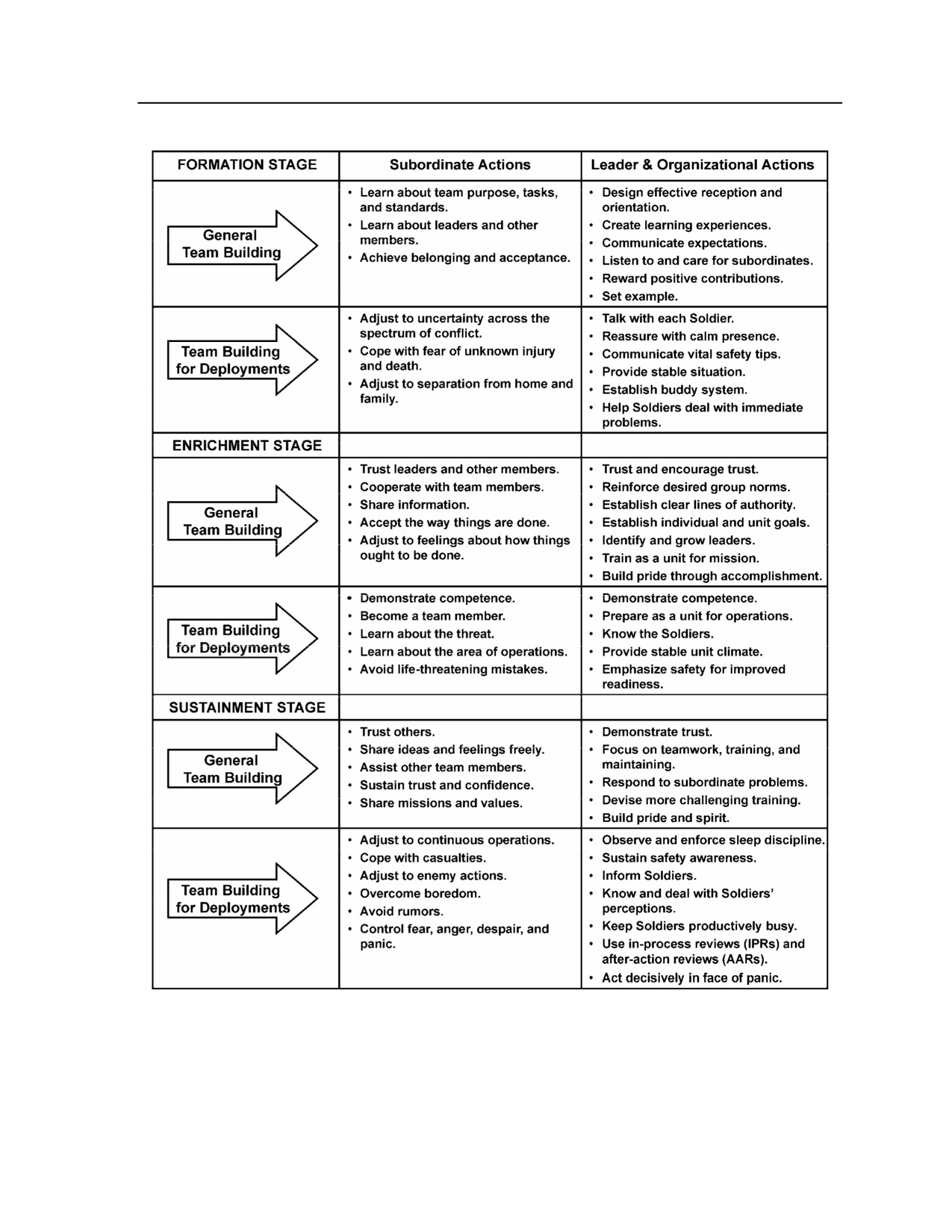
8-97. Figure 8-1 lists actions that pull a team together. Teams do not come together by accident. Leaders
must guide them through three developmental stages:
z
Formation.
z
Enrichment.
z
Sustainment.
Formation Stage
8-98. Teams work best when new members quickly feel a part of the team. The two critical steps of the
formation stage—reception and orientation—are dramatically different in peace and war. In combat, a
good sponsorship process can literally make the difference between life and death for new arrivals and to
the entire team.
8-99. Reception is the leader’s welcome to the organization. Time permitting; it should include a
handshake and personal introduction. The orientation stage begins with meeting other team members,
learning the layout of the workplace, learning the schedule, and generally getting to know the environment.
In combat, leaders may not have much time to spend with new members. In this case, a sponsor is assigned
to new arrivals. That person will help them get oriented until they “know the ropes.”
8-100. In combat, Army leaders have countless things to worry about and the mental state of new arrivals
might seem low on the list. If Soldiers cannot fight, the unit will suffer needless casualties and may
ultimately fail to complete the mission.
8-101. Discipline and shared hardships pull people together in powerful ways. SGT Alvin C. York
described cohesion in this clear and simple way:
The war brings out the worst in you. It turns you into a mad, fightin’ animal, but it also
brings out something else, something I jes don’t know how to describe, a sort of
tenderness and love for the fellows fightin’ with you.
8-16
FM 6-22
12 October 2006
Developing
Figure 8-1. Stages of team building
Enrichment Stage
8-102. New teams and new team members gradually move from questioning everything to trusting
themselves, their peers, and their leaders. Leaders learn to trust by listening, following up on what they
12 October 2006
FM 6-22
8-17
Chapter 8
hear, establishing clear lines of authority, and setting standards. By far the most important thing a leader
does to strengthen the team is training. Training takes a group of individuals and molds them into a team
while preparing them to accomplish their missions. Training occurs during all three stages of team
building, but is particularly important during enrichment. It is at this point that the team is building
collective proficiency.
Sustainment Stage
8-103. During this stage, members identify with “their team.” They own it, have pride in it, and want the
team to succeed. At this stage, team members will do what is necessary without being told. Every new
mission gives the leader a chance to strengthen the bonds and challenge the team to reach for new heights
of accomplishment. The leader develops his subordinates because he knows they will be tomorrow’s team
leaders. The team should continuously train so that it maintains proficiency in the collective and individual
tasks it must perform to accomplish its missions.
8-18
FM 6-22
12 October 2006
Chapter 9
Achieving
9-1. Leadership builds effective organizations. Effectiveness is most directly related to the core leader
competency of getting results. From the definition of leadership, achieving is focused on accomplishing
the mission. Mission accomplishment is a goal that must co-exist with an extended perspective towards
maintaining and building up the organization’s capability for the future. Achieving begins in the short term
by setting objectives. In the long term, achieving based on clear vision requires getting results in pursuit of
those objectives. Getting results is focused on structuring what needs to be done so results are consistently
produced. This competency focuses on the organization of how to achieve those results.
9-2. Getting results embraces all actions to get the job done on time and to standard:
z
Providing direction, guidance, and clear priorities involves guiding teams in what needs to be
done and how.
z
Developing and executing plans for mission and task accomplishment involves anticipating how
to carry out what needs to be done, managing the resources used to get it done, and conducting
the necessary actions.
z
Accomplishing missions consistently and ethically involves using monitoring to identify
strengths and correct weaknesses in organizational, group, and individual performance.
PROVIDING DIRECTION, GUIDANCE, AND PRIORITIES
It is in the minds of the commanders that the issue of battle is really decided.
Sir Basil H. Liddell Hart
Thoughts on War (1944)
9-3. As leaders operate in larger organizations, their purpose, direction, guidance, and priorities typically
become forward-looking and wider in application. Direct level leaders and small unit commanders usually
operate with less time for formal planning than organizational and strategic level leaders. Although leaders
use different techniques for guidance depending on the amounts of time and staff available, the basics are
the same. The leader provides guidance so subordinates and others understand the goals and priorities.
9-4. Whether operating with an infantry squad, a finance section, or an engineer team, leaders will match
their teams, units, or organizations to the work required. Most work is defined by standard operating
procedures and tasks assigned to groups. As new tasks develop and priorities change, assignments will
differ. In higher-level positions, commanders and directors have others to help perform these assignment
and prioritization functions. Higher-level organizations also have procedures such as running estimates and
the military decisionmaking process to define and synchronize planning activities (see FM 5-0).
9-5. Leaders should provide guidance from both near-term and long-term perspectives. Good leaders
make thoughtful trade-offs between providing too much or too little guidance. A near-term focus is based
on critical actions that must be accomplished immediately. In contrast, by delegating as much as possible,
leaders prepare others to handle future tasks competently and are available for higher-level coordination.
9-6. When tasks are difficult, adaptive leaders identify and account for the capabilities of the team. Some
tasks will be routine and will require little clarification from the leader, while others will present new
challenges for the knowledge and experience that the team has. When a new task is undertaken for the first
time working with a new group, leaders are alert to group organization, their capabilities, and their
commitment to the task.
12 October 2006
FM 6-22
9-1
Chapter 9
9-7. Leaders should provide frequent feedback as an embedded, natural part of the work. While it is
important to have set periods for developmental performance counseling, it is also important to provide
feedback on a regular basis. Making feedback part of the normal performance of work is a technique
leaders use to guide how duties are accomplished.
9-8. Often the most challenging of the leader’s jobs is to identify and clarify conflicts in followers’ roles
and responsibilities. Good communication techniques with brief backs are useful for identifying conflicts.
Role differences may arise during execution and should be resolved by the leader as they occur.
9-9. Good guidance depends on understanding how tasks are progressing, so the leader knows if and
when to provide clarification. Most workers have a desire to demonstrate competence in their work, so
leaders need to be careful that they do not reduce this drive.
DEVELOPING AND EXECUTING PLANS
A plan is a proposal for executing a command decision or project. Planning is the means
by which the leader or commander envisions a desired outcome and lays out effective
ways of achieving it. In the plan, the leader communicates his vision, intent and decisions
and focuses his subordinates on the results he expects to achieve.
FM 3-0
9-10. In daily peacetime or combat training and operations, a leader’s primary responsibility is to help the
organization function effectively. The unit must accomplish the mission despite any surrounding chaos.
This all begins with a well thought out plan and thorough preparation.
PLANNING
9-11. Leaders use planning to ensure that an approach for reaching goals will be practical. Planning
reduces confusion, builds subordinates’ confidence in themselves and their organization, and allows
flexibility to adjust to changing situations. Good planning boosts shared understanding and ensures that a
mission is accomplished with a minimum of wasted effort and fewer casualties in combat. FM 6-0
discusses the different types of plans in more detail.
Considering Intended and Unintended Consequences
9-12. Plans and the actions taken in those plans will most likely have unintended, as well as intended,
consequences. Leaders should think through what they can expect to happen because of a plan or course of
action. Some decisions may set off a chain of events that are contrary to the desired effects. Intended
consequences are the anticipated results of a leader’s decisions and actions. Unintended consequences arise
from unplanned events that affect the organization or accomplishment of the mission. Intended and
unintended consequences can best be addressed during wargaming and rehearsals that are critical during
planning. The aim of wargaming and rehearsals is to reduce the unintended consequences to as few as
possible.
9-13. Even lower-level leaders’ actions may have effects well beyond what they expect. Consider the case
of a sergeant whose team is operating a roadblock as part of peace enforcement. Early one morning, a
truckload of civilians appears racing toward the roadblock. In the half-light, the noncommissioned officer
(NCO) in charge of the checkpoint cannot tell if the objects in the passengers’ hands are weapons or
harmless farm tools—while the driver seems intent on proceeding without stopping. In the space of a few
seconds, the NCO must decide whether to order the team to fire on the truck.
9-14. If the sergeant orders the team to fire to force the truck to stop, that decision can easily have
international and strategic consequences. If any innocent civilians are killed, chances are good the chain of
command and the outside world will know about the incident in a few short hours. The decision is tough
for another reason: If the sergeant does not order the team to fire and the civilians turn out to be armed
insurgents, the team may suffer unnecessary casualties.
9-2
FM 6-22
12 October 2006
Achieving
9-15. Ultimately, the sergeant must act as the leader in charge. Leaders who think through the
consequences of possible actions and understand the commander’s intent, mission priorities, and rules of
engagement are usually prepared to take the right steps. The intended consequences are obvious in the
roadblock example: to control access of people and to eliminate entry of explosives, weapons, and
contraband.
9-16. Thinking ahead about intended consequences and beyond to unintended consequences serves to
sharpen what is important in the planning process. In this checkpoint example, the intended consequences
of conducting an effective and secure operation might be foiled if vehicle drivers are not properly warned
of the checkpoint. Are there signs in the appropriate language to demand a slow approach speed? Are there
speed bumps to force a slow-go approach? Is the traffic properly funneled to prevent a bypass or escape? If
these and other measures are not considered and implemented, the unintended consequences could include
accidentally engaging vehicles carrying innocent civilians because of possible driver reactions that might
be misinterpreted as hostile behavior.
9-17. Sometimes consequences are not direct and immediate. These types of consequences are referred to
as second- and third-order effects. These effects can be intended or unintended. In the checkpoint example,
the second-order effect of setting up a checkpoint may be to reduce the amount of civilian traffic in the
area. The third-order effect may be to slow down the restoration of commerce in the area or the checkpoint
may provide insurgents a target where local civilians gather at predictable periods during the day. An
unintended consequence of the NCO’s decision to fire on a speeding truckload of civilians may cause a
second-order effect of local outrage. A possible third-order effect is it may cause an international incident.
However, second- and third-order effects should not be the basis for hindering initiative or doing the right
thing.
Reverse Planning
9-18. Reverse planning is a specific technique used to ensure that a concept leads to the intended end state.
It begins with the goal or desired mission outcome in mind. The start point is the question: “Where do I
want to end up?” From there, think and work the plan backwards to the current situation. While following
the thought process from projected goal to current position, establish the basics steps along the way and
determine the who, what, when, where, and why to accomplish the goal.
9-19. While planning, leaders consider the amount of time needed to coordinate and conduct each step. For
instance, a tank platoon sergeant whose platoon has to spend part of a field exercise on the firing range
might have to arrange for refueling at the range. No one explicitly said to refuel at the range, but the
platoon sergeant knows it needs to happen, given the heavy fuel consumption of M1A2 tanks.
Consequently, the platoon sergeant must think through the steps from the last to the first: (1) when the
refueling must be complete, (2) how long the refueling will take, (3) how long it takes the refueling unit to
get set up, and (4) when the refueling vehicles must report to the range.
9-20. After determining what must happen on the way to the goal, leaders put the tasks in logical
sequence, set clear priorities, and determine a realistic time line. They examine all steps required in the
order they will occur and if time permits solicit input from subordinates. Experienced subordinates can
often provide a valuable reality check for the plan. Subordinates’ input also shows their part-ownership of
the plan. Positively contributing builds trust while boosting their self-confidence and will to succeed.
PREPARING
9-21. Preparation complements planning. Doctrinally, preparation for combat includes plan refinement,
rehearsals, reconnaissance, coordination, inspections, and movement. See FM 3-0 and FM 6-0 for more
information. In all cases, preparation includes detailed coordination with other organizations involved or
affected by the operation or project. In the case of a nontactical requirement, preparation may include
ensuring the necessary facilities (for example, hospitals, labs, maintenance shops) and other resources (for
example, firefighters, police, and other first responders) are available to support the mission.
12 October 2006
FM 6-22
9-3
Chapter 9
9-22. A rehearsal is a critical element of preparation. It allows everyone involved in a mission to develop a
mental picture of responsibilities and what should happen. It helps the team synchronize operations at
times and places critical to successful mission accomplishment. FM 6-0 features a detailed appendix on
rehearsals. Rehearsing key combat actions allows subordinates to see how things are supposed to work and
builds confidence in the plan. Even a simple walk-through helps leaders visualize who is supposed to be at
a specific location to perform a coordinated action at a certain time. Leaders can see how things might
unfold, what might go wrong, and how the plan could change to adjust for intended or unintended
consequences.
EXECUTING
…[A] good plan violently executed now is better than a perfect plan next week.
General George S. Patton, Jr.
War As I Knew It (1947)
9-23. Successful execution of a plan is based on all the work that has gone before. Executing for success
requires situational understanding, supervising task completion, assessing progress, and implementing
required execution or adjustment decisions (FM 6-0).
9-24. Executing in combat means putting a plan into action by applying combat power to accomplish the
mission and using situational understanding to assess progress and make execution and adjustment
decisions. In combat, leaders strive to effectively integrate and synchronize all elements of the joint and
combined arms team as well as nonmilitary assets. The goal is to assign specific tasks or objectives to the
most capable organization and empowering its leaders to execute and exercise initiative within the given
intent.
9-25. Planning execution involves awareness of whether critical tasks are being accomplished on the way
to mission completion. Good leaders know which of the most important parts of the mission to check.
Knowing from actual experience what makes missions difficult or unsuccessful aids in tracking mission
progress. Guiding progress toward mission accomplishment involves scheduling activities, tracking tasks
and suspenses, alerting others when their support will be required, and making adjustments as required.
Adapting to Changes
9-26. Competent and realistic leaders also keep in mind that friction and uncertainty can and will always
affect plans; generally, no plan survives initial contact with the enemy. The leader must therefore be
prepared to replace portions of the original plan with new ideas and initiatives. Leaders must have the
confidence and resilience to fight through setbacks, staying focused on the intent two levels up and the
mission. Leaders preserve freedom of action by adapting to changing situations. They should be in a
position to keep their people mission-focused, motivated, and able to react with agility to changes while
influencing the team to accomplish the mission as envisioned in the plan.
9-27. Adjustments are needed when facing obstacles that were not anticipated. In increasingly busy times,
leaders need to provide an environment in which subordinates can focus and accomplish critical tasks.
Minimizing and preventing distractions allows subordinates to pay full attention to mission
accomplishment. Leaders need to ensure that additional taskings are within the capabilities of the unit or
organization. If they are not, the leader needs to seek relief by going to superiors and clarify the impact that
the additional workload has on the unit. Experienced leaders anticipate cyclical workloads and schedule
accordingly. Competent leaders will make good decisions about when to press Soldiers and civilians and
when to ease back and narrow focus on the one or two most important tasks if performance is in decline.
9-28. Leaders constantly scan what is going on in the work environment and the mission. With this
awareness of the situation, the leader will recognize when the situation has changed or when the plan is not
achieving the desired effects. If the situation changes significantly, leaders will consider options for
proceeding, including the review of any contingencies that were developed to deal with new circumstances.
Leaders make on-the-spot adjustments in the course of action to keep moving toward designated goals.
9-4
FM 6-22
12 October 2006
Achieving
Managing Resources
9-29. A main responsibility of leaders—whether officers, NCOs, or Army civilians—is to accomplish the
assigned mission, which includes making the best use of available resources. Some Army leaders specialize
in managing single categories of resources, such as ammunition, food, personnel, and finances, but all
leaders have an interest in overseeing that all categories of resources are provided and used wisely by their
teams.
9-30. Managing resources consists of multiple steps that require different approaches and even different
skills. In many cases, Army leaders need to acquire needed resources for themselves or others. Resources
can take the form of money, materiel, personnel, and time. The acquisition process can be a relatively
straightforward process of putting in a request through proper channels. Other times a leader may need to
be more creative and resourceful. In such cases, the effective use of influence tactics (see Chapter 7) will
likely be instrumental in successfully acquiring needed resources.
9-31. After resources have been acquired, leaders are responsible for allocating them in an impartial
manner that recognizes different needs and priorities. A leader may have multiple requests for limited
resources and will need to make decisions about the best distribution of resources. Doing so in a way that
recognizes and resolves potential ethical dilemmas requires a firm grounding in the Army Values (see
Chapter 4). Ultimately, a leader must decide how to best allocate resources in ways to meet the Army’s
mission. Leaders need to deal openly and honestly with their allocation decisions and be prepared to handle
reactions from those who may feel that their requests were not handled fairly or effectively.
9-32. Leaders should evaluate if the limited resources were used wisely and effectively. Do the resources
advance the mission of the Army and the organization? Conversely, were the resources squandered or used
in ways that did not enhance the effectiveness of the individual, unit, or the Army as a whole? In cases in
which resources were not used wisely, a leader should follow this evaluation with appropriate counseling
for those who are accountable for the resources in question.
ACCOMPLISHING MISSIONS
…[S]chools and their training offer better ways to do things, but only through experience
are we able to capitalize on this learning. The process of profiting from mistakes
becomes a milestone in learning to become a more efficient soldier.
William G. Bainbridge
Sergeant Major of the Army (1975-1979)
9-33. A critical element of getting results is adopting measures that support a capability for consistent
accomplishment. Achieving consistent results hinges on doing all the right things addressed by the other
competencies—having a clear vision, taking care of people, setting the right example, building up the
organization, encouraging leader growth, and so on. Consistent performance can be achieved by using
techniques to—
z
Monitor collective performance.
z
Reinforce good performance.
z
Implement systems to improve performance.
MONITORING PERFORMANCE
9-34. The ability to assess a situation accurately and reliably against desired outcomes, established values,
and ethical standards is a critical tool for leaders to achieve consistent results and mission success.
Assessment occurs continually during planning, preparation, and execution; it is not solely an after-the-fact
evaluation. Accurate assessment requires instinct and intuition based on experience and learning. It also
demands a feel for the reliability and validity of information and its sources. Periodic assessment is
necessary to determine organizational weaknesses and prevent mishaps. Accurately determining causes is
essential to training management, developing subordinate leadership, and initiating quality improvements.
12 October 2006
FM 6-22
9-5
Chapter 9
Assessment Techniques
9-35. There are many different ways to gather information for assessment purposes. These include asking
team members questions to find out if information is getting to them, meeting people to inquire if tasks and
objectives are appropriate, and checking for plan synchronization. Assessing can also involve researching
and analyzing electronic databases. No matter which techniques the leader explores, it is important that
information be verified as accurate.
9-36. Although staff and key subordinates manage and process information for organizational and strategic
leaders, this does not relieve them from the responsibility of analyzing information as part of the decision-
making process. Often, leaders draw information from various sources to be able to compare the
information and create a multidimensional picture. Often, leaders accomplish this by sending out liaison
officers thoroughly familiar with their commander’s intent as their eyes and ears.
9-37. While personal presence and the eyes and ears deliver much useful information, leaders can also
exploit technologies for the purpose of timely assessment. In the world of digital command and control,
commanders can set various command and control systems to monitor the status of key units, selected
enemy parameters, and critical planning and execution time lines. They may establish prompts in the
information systems that warn of selected critical events. Information systems may provide alerts about low
fuel levels in maneuver units, tight management time lines among aviation crews, or massing enemy
artillery. Management information systems in institutional settings may track the amount of email or new
documents created.
9-38. It is sometimes dangerous to be too analytical when dealing with automated information or limited
amounts of time. When analyzing information, leaders should guard against rigidity, impatience, or
overconfidence that may bias their analysis.
Designing an Effective Assessment System
9-39. The first step in designing an effective assessment system is to determine the purpose of the
assessment. While purposes vary, most fall into one of the following categories:
z
Evaluate progress toward organizational goals, such as using an emergency deployment
readiness exercise to check unit readiness or monitoring progress of units through stages of
reception, staging, onward movement, and integration.
z
Evaluate the efficiency of a system: the ratio of the resources expended to the results gained,
such as comparing the amount of time spent performing maintenance to the organization’s
readiness rate.
z
Evaluate the effectiveness of a system: the quality of the results it produces, such as analyzing
the variation in Bradley gunnery scores.
z
Compare the relative efficiency or effectiveness against standards.
z
Compare the behavior of individuals in a group with the prescribed standards, such as Army
physical fitness test or gunnery scores.
z
Evaluate systems supporting the organization, such as following up “no pay dues” to see what
the NCO support channel did about them.
9-40. While systems and leader proxies can greatly assist in assessing organizational performance, the
leader remains central by spot-checking people, performance, equipment, and resources. Leaders adopt
best business practices, use performance indicators to check things, and ensure the organization meets
standards while moving toward the goals the leader has established.
9-41. While assessing, good leaders find opportunities to engage in impromptu coaching. Junior leaders
can learn spot-checking by watching experienced first sergeants or command sergeants major observe daily
training or conduct uniform inspections. Pay attention to how these experienced leaders’ eyes sweep across
Soldiers, weapons, and equipment and note discrepancies and successes. It demonstrates how experience
makes supervising, inspecting, and correcting becomes a routine part of daily duties.
9-6
FM 6-22
12 October 2006
Achieving
REINFORCING GOOD PERFORMANCE
9-42. To accomplish missions consistently leaders need to maintain motivation among the team. One of
the best ways to do this is to recognize and reward good performance. Leaders who recognize individual
and team accomplishments will shape positive motivation and actions for the future. Recognizing
individuals and teams in front of superiors and others gives those contributors an increased sense of worth.
Soldiers and civilians who feel their contributions are valued are encouraged to sustain and improve
performance.
9-43. Leaders should not overlook giving credit to subordinates. Sharing credit has enormous payoffs in
terms of building trust and motivation for future actions. A leader who understands how individuals feel
about team accomplishments will have a better basis for motivating individuals based on their interests.
IMPROVING ORGANIZATIONAL PERFORMANCE
9-44. High performing units are learning organizations that take advantage of opportunities to improve
performance. Leaders need to encourage a performance improvement mindset that allows for conformity
but goes beyond meeting standards to strive for increased efficiencies and effectiveness. Several actions
are characteristic of performance improvement:
z
Ask incisive questions about how tasks can be performed better.
z
Anticipate the need for change and action.
z
Analyze activities to determine how desired end states are achieved or affected.
z
Identify ways to improve unit or organizational procedures.
z
Consider how information and communication technologies can improve effectiveness.
z
Model critical and creative thinking and encourage it from others.
9-45. Too often, leaders unknowingly discourage ideas. As a result, subordinates become less inclined to
approach leaders with new ideas for doing business. From their viewpoint leaders respond to subordinates’
ideas with reactions about what is and is not desired. This can be perceived as closed-mindedness and
under-appreciation of the Soldier’s or civilian’s insight. “We’ve tried that before.” “There’s no budget for
that.” “You’ve misunderstood my request.” “Don’t rock the boat.” These phrases can kill initiative and
discourage others from even thinking about changes to improve the organization. Leaders need to
encourage a climate of reflection about the organization and encourage ideas for improvement. The
concept of lifelong learning applies equally to the collective organization as well as to the individual.
COMPETENCIES APPLIED FOR SUCCESS
The American people expect only one thing from us: That we will win. What you have
done is no more than they expect. You have won.
General Gordon Sullivan
Vice Chief of Staff of the Army
Addressing the Third Army staff following the Operation Desert Storm victory (1991)
9-46. Army history has many examples of units succeeding in accomplishing their mission consistently
and ethically because of competent, multiskilled leaders. Achieving results consistently and ethically does
not merely pertain to combat or military leadership. Competent military and civilian leaders pursue
excellence wherever and whenever possible.
9-47. Competent leaders ensure that all organization members know the important roles they play every
day. They look for everyday examples occurring under ordinary circumstances: how a Soldier digs a
fighting position, prepares for guard duty, fixes a radio, or lays an artillery battery; or how an Army
civilian improves maintenance procedures, processes critical combat supplies, and supports the families of
deploying service members. Competent leaders know each of these people is contributing in an important
way to the Army mission. They appreciate the fact that to accomplish the Army’s mission with consistency
and ethics, it requires a collection of countless teams, performing countless small tasks to standard every
day.
12 October 2006
FM 6-22
9-7
Chapter 9
9-48. Competent leaders are also realists. They understand that excellence in leadership does not mean
perfection. On the contrary, competent leaders allow subordinates room to learn from their mistakes as well
as their successes. In an open and positive work climate, people excel to improve and accept calculated
risks to learn. It is the best way to improve the force and the only way to develop confident leaders for the
future. Competent and confident leaders tolerate honest mistakes that do not result from negligence,
because achieving organizational excellence is not a game to reach perfection. It involves trying, learning,
trying again, and getting better each time. However, even the best efforts and good intentions cannot take
away an individual’s responsibility for their own actions.
9-49. At the end of the day or a career, Soldier and Army civilian leaders can look back confidently that
their efforts have created an Army of consistent excellence. Whether they commanded an invasion force of
thousands or supervised a technical support section of three people, they made a positive difference.
Achieving Success and Leadership Excellence
GEN Matthew B. Ridgway successfully led the 82d Airborne Division and XVIII
Airborne Corps during World War II. He later commanded the Eighth (U.S.) Army
during the Korean War. GEN Ridgway exemplified the qualities of the competent and
multiskilled Army leader. His knowledge of American Soldiers, other Services, allies,
foreign cultures, and the overall strategic situation led him to certain expectations.
Those expectations gave him a baseline from which to assess his command once he
arrived in theater. He continually visited units throughout the Eighth Army area,
talked with Soldiers and their commanders, assessed command climate, and took
action to mold attitudes with clear intent, supreme confidence, and unyielding tactical
discipline.
GEN Ridgway constantly sought to develop and mentor subordinate commanders
and their staffs by sharing his thoughts and expectations of combat leadership. He
frequently visited the frontlines to feel the pulse of the fighting forces, shared their
hardships, and demanded they be taken care of. He took care of his troops by
pushing the logistic systems to provide creature comforts as well as war supplies. He
eliminated the skepticism of purpose, gave Soldiers cause to fight, and helped them
gain confidence by winning small victories. GEN Ridgway led by example.
His actions during four months in command of the Eighth Army prior to his
appointment as United Nations Supreme Commander bring to life the leader’s
competencies. He left a legacy that leaders can operate within the spheres of all
levels of leadership to accomplish their mission consistently and ethically.
9-8
FM 6-22
12 October 2006
Chapter 10
Influences on Leadership
10-1. Each day as a leader brings new challenges. Some of these challenges are predictable based on
experiences. Some are unpredictable, surfacing because of a situation or place in time in which Soldiers
find themselves. Leaders must be prepared to face the effects of stress, fear in combat, external influences
from the media, the geopolitical climate, and the impact of changing technology.
10-2. Some of these factors are mitigated through awareness, proper training, and open and frank
discussion. The Army must consider these external influences and plan accordingly. An effective leader
recognizes the tools needed to adapt in changing situations. (See paragraph 10-48 for further discussion.)
CHALLENGES OF THE OPERATING ENVIRONMENT
The role of leadership is to turn challenges into opportunities.
General Dennis J. Reimer
Chief of Staff, Army (1995-1999)
ADAPTING TO EVOLVING THREATS
10-3. America’s Army of the
21st century must adapt to constantly evolving threats while taking
advantage of the latest technological innovations and adjusting to societal changes. As part of the United
States Armed Forces, the Army is guided by a broader National Military Strategy outlining how to—
z
Protect the United States.
z
Prevent conflict and surprise attacks.
z
Prevail against adversaries threatening our homeland, deployed forces, or allies and friends.
10-4. The National Military Strategy also sets priorities for success and changes with each administration
and addresses new challenges our country faces. The uncertain nature of the threat will always have major
impact on Army leadership. For the Army, a new era began in 1989 with the fall of the Berlin Wall and the
subsequent collapse of the Soviet Union. Since 11 September 2001, the War on Terrorism has become
America’s main effort and long-term security focus. In addition to adapting to evolving issues, U.S. forces
must also remain capable to conduct full spectrum operations. This mandates that the Army, as an essential
component of America’s war effort, be fully capable of seamless shifts across the spectrum of conflict.
This blurring of the lines between war and peace make the challenges that leaders face constant and
unpredictable.
10-5. Agility and adaptability at all leadership levels of Army organizations are becoming more important
to address situations that cannot be fully anticipated. In the new operational environment, the importance of
direct leaders— noncommissioned officers and junior officers—making the right decisions in stressful
situations has taken on a new significance. Decisions and actions taken by direct-level leaders—the
sergeants and lieutenants carrying out the missions—can easily have major strategic-level and political
implications.
10-6. U.S. forces in Afghanistan and Iraq have experienced many situations requiring a balanced
application of tactical and diplomatic measures. In most of these tactical confrontations, junior leaders
ensure mission accomplishment by reacting appropriately and within the bounds of their commanders’
intent.
12 October 2006
FM 6-22
10-1
Chapter 10
THE INFLUENCE OF THE MEDIA
10-7. Another influence on leadership is the media. The media can be both an asset and impediment to the
leader. Embedded media, like those during Operation Iraqi Freedom, can tell the story from the Soldier’s
perspective to an anxious Nation back home. The media can provide real-time information, sometimes
unfiltered and raw, which the enemy could exploit as a means to change the regional political climate.
10-8. Leaders must ensure subordinate leaders and Soldiers are trained to deal with the media and
understand the long-term effects of specific stories and images. The morale of those serving and the Nation
may be affected if the overall view presented by the media is overly negative or that military actions are in
vain. These can adversely impact recruiting, retention, and the treatment of veterans for years to follow.
Leaders can counter-act negatives by using media opportunities to explain how the Army mission serves
national interests and how Soldiers dedicate themselves to accomplishing the mission.
MULTICOMPONENT AND JOINT ENVIRONMENT
10-9. Soldiers find themselves serving with members of other Services, the Reserve Components, and
other countries’ forces more than ever before. Understanding the unique cultures and subcultures of these
various groups can be essential to success in a volatile and changing world.
10-10. Leaders must be aware that while most of the policies and regulations for Soldiers apply across the
board, specific differences apply in the promotion, pay, benefit, and retirement systems of the Reserve
Components. Knowledge of the differences is essential for effectively employing all components.
10-11. Within the Army, leaders should recognize the existence of subcultures such as the special
operations, law enforcement, medical, and branch-specific communities. Members of these subcultures
cross components and Services during their careers for specific assignments. Consequently, leaders
involved in conducting operations need to understand how members of these specialized units train and
work. Often, they approach missions from a different perspective and sometimes use unconventional
methods to accomplish them. Special operations forces usually operate in small, independent teams and
frequently interface with local civilians and members of other governmental agencies. For operational
reasons, they may not be required to disclose routine information about their units like conventional forces.
Logisticians and operations planners may need innovative solutions to provide special operations forces
autonomy while allowing the joint task force or other commanders to maintain visibility and control over
these assets and to provide the special operators the logistical support necessary.
10-12. Other subcultures, such as law enforcement, follow norms established by their branches and share
experiences developed through specific assignments and schools. These functional subcultures can be
useful as a means to exchange knowledge and provide corporate solutions when the Army needs answers
from subject matter experts.
THE GEOPOLITICAL SITUATION
10-13. Though the world continues to become more connected by technology and economic growth, it
remains very diverse and divided by religions, cultures, living conditions, education, and health. Within the
political sphere of influence, maintaining our presence in foreign countries through a careful mix of
diplomatic and military arrangements remains an important challenge. Leaders must be aware that the
balance between diplomacy and military power is fragile. Army leaders must consistently consider the
impact on local civilians, as well as on cultural and religious treasures, prior to committing firepower.
10-14. Tomorrow’s leaders will be expected to operate in many different environments worldwide. While
most Soldiers speak English as their first language, continued deployments and global interaction will
require an understanding of other languages and cultures. Forecasts predict the Chinese, Hindu, Arabic,
and Spanish languages will gain speakers in the years to come. Leaders will need to become multilingual
and study the cultures and histories of other regions of interest. A vehicle for gaining this knowledge of the
geopolitical situation is technology.
10-2
FM 6-22
12 October 2006
Influences on Leadership
CHANGING WITH TECHNOLOGY
10-15. While the stresses of combat have been constant for centuries, another aspect of the human
dimension has assumed increasing importance: the effect of rapid technological advances on organizations
and people. Although military leaders have always dealt with the effect of technological changes, these
changes are different from before. It is forcing the Army and its leaders to rethink and redesign itself.
10-16. Modern Army leaders must stay abreast of technological advances and learn about their
applications, advantages, and requirements. Together with technical specialists, leaders can make
technology work for the warrior. The right technology, properly integrated, will increase operational
effectiveness, battlefield survivability, and lethality.
10-17. Technological challenges facing the Army leadership include—
z
Learning the strengths and vulnerabilities of different technologies that support the team and its
mission.
z
Thinking through how the organization will operate with other organizations that are less or
more technologically complex, such as operating with joint, inter-Service, and multinational
forces.
z
Considering the effect of technology on the time available to analyze problems, make a decision,
and act. Events happen faster today, and the stress encountered as an Army leader is
correspondingly greater.
z
Leveraging technology to influence virtual teams given the increasing availability and necessity
to use reach-back and split-based operations.
Virtual team refers to any team whose interactions are mediated by time, distance, or
technology.
10-18. Technology can also lead to operational issues. A growing reliance on the new global positioning
system (GPS) navigation technology since the Desert Storm era decreased emphasis on manual land
navigation skills in training, thus rendering forces more vulnerable if the technology fails or is wrongly
programmed. Part of the leadership challenge became to determine how to exploit GPS technology while
guarding against its weaknesses. The answer was improved training. It included reintroducing essential
back-up land navigation training, emphasizing the availability of adequate battery supplies, and detailed
instructions on the maintenance and operation of the GPS receiver equipment.
10-19. Leaders not on-site with the Soldiers must not discount the fear the Soldiers may be experiencing.
A leader who does not share the same risks could easily fall into the trap of making a decision that could
prove unworkable given the psychological state of the Soldiers. Army leaders with command and control
over a distributed or virtual team should ask for detailed input from the Soldiers or subordinate
commanders who are closer to the action and can provide the most accurate information about the
situation.
10-20. Technology is changing the leadership environment in many aspects, especially the amount of
information available for decision makers. Although advances in electronic data processing allow the
modern leader to handle large amounts of information easier than ever before, a possible second-order
effect of enhanced technology is information overload.
10-21. Too much information is as bad as not enough. Leaders must be able to sift through the
information provided to them, analyze and synthesize it, and forward only the important data up the chain
of command. Senior leaders rely on their subordinates to process information for them, isolating critical
information to expedite decisions. Leaders owe it to their subordinates to design information gathering and
reporting procedures that do not create more work for already stretched staffs and units.
10-22. Army leaders and staffs have always needed to determine mission-critical information, prioritize
incoming reports, and process them quickly. The volume of information provided by current technology
makes this ability even more critical. The answer lies in the agile and adaptable human mind. Sometimes a
12 October 2006
FM 6-22
10-3
Chapter 10
nontechnological approach can divert the flood of technological help into channels the leader and staff can
capably manage. For example, a well-understood commander’s intent and thought-through commander’s
critical information requirements will help free leaders from nonessential information overload. The Army
concept of mission command is even more important in an environment of information overload. Mission
command delegates most decisions to lower echelons in order to free higher echelons for critical decisions
only they can make. Army leaders should continue to resist the lure of centralized decision making even
though they have more information available to them than ever before.
SYNCHRONIZING SYSTEMS
10-23. Today’s Army leaders require systems understanding and more technical and tactical knowledge
than ever before. Leaders must be aware of the fine line between a healthy questioning of new systems’
capabilities and an unreasonable hostility that rejects the advantages technology offers. The adaptable
leader remains aware of the capabilities and shortcomings of advanced technology and ensures
subordinates do as well.
10-24. All leaders must consider systems in their organization—how they work together, how using one
affects the others, and how to get the best performance from the whole. They must think beyond their own
organizations and consider how the actions of their organization can influence other organizations and the
team as a whole.
10-25. Technology is also changing battlefield dispersal and the speed of operations. Instant global
communications are accelerating the pace of military actions. GPS and night vision capabilities mean the
Army can fight at night and during periods of limited visibility—conditions that used to slow things down.
Additionally, nonlinear operations make it more difficult for commanders to determine critical points on
the battlefield. (FM 3-0 discusses continuous operations.)
10-26. Modern technology has also increased the number and complexity of skills the Army requires.
Army leaders must carefully manage low-density occupational specialties and ensure critical positions are
filled with properly trained people who maintain proficiency in these perishable high-tech skills. Army
leaders must balance leadership, personnel management, and training management to ensure their
organizations are assigned people with the appropriate specialty training and that the entire organization
stays continuously trained, certified, and ready.
STRESS IN COMBAT
All men are frightened. The more intelligent they are, the more they are frightened. The
courageous man is the man who forces himself, in spite of his fear, to carry on.
General George S. Patton, Jr.
War As I Knew It (1947)
10-27. Combat is sudden, intense, and life threatening. It is the Soldier’s job to kill in combat.
Unfortunately, combat operations may involve the accidental killing of innocent men, women, and
children. Soldiers are unsure how they will perform in combat until that moment comes. The stresses
experienced in combat and even the stress preparing for, waiting for, and supporting combat can be
substantial.
10-28. Leaders must understand this human dimension and anticipate Soldiers’ reactions to stress. It takes
mental discipline and resilience to overcome the plan going wrong, Soldiers becoming wounded or dying,
and the enemy attacking unexpectedly.
10-29. When preparing for war, leaders must thoroughly condition their Soldiers to deal with combat
stress during all phases of operations—mobilization, deployment, sustainment, and redeployment. (See FM
6-22.5 for more on combat stress and FM 3-0 for descriptions of specific deployment phases.) The most
potent countermeasures to confront combat stress and to reduce psychological breakdown in combat are—
z
Admit that fear exists when in combat.
z
Ensure communication lines are open between leaders and subordinates.
z
Do not assume unnecessary risks.
10-4
FM 6-22
12 October 2006
Influences on Leadership
z
Provide good, caring leadership.
z
Treat combat stress reactions as combat injuries.
z
Recognize the limits of a Soldier’s endurance.
z
Openly discuss moral implications of behavior in combat.
z
Reward and recognize Soldiers and their families for personal sacrifices.
10-30. Units are stabilized during mobilization and in preparation for deployment. Stabilization allows
leaders and Soldiers to build a trust relationship while the unit undergoes rigorous combat skills
certification or theater-specific training. Confidence in leaders, comrades, training, and equipment are key
factors for combat success.
10-31. During initial deployment, units should be eased into the mission. A daytime operation could
precede a night raid, for example. Training and drill can continue while leaders deepen a personable leader-
to-led relationship with their Soldiers based on trust and not fear of rank and duty position.
10-32. During sustaining operations, units at all levels should discuss and absorb critical operations
experiences and help individuals cope with initial combat stress. Soldiers can be encouraged to reveal their
true feelings within their circle of warrior comrades. If the unit suffered casualties, leaders should openly
discuss their status. In this phase, it is important to keep people informed about wounded and evacuated
team members and to weigh the unit’s losses and successes. Memorial services should be held to honor the
fallen. Soldiers and leaders who do not succeed during operations should be retrained, counseled, or
reassigned. The unit should be allocated appropriate rest periods between missions. Ensure Soldiers with
serious issues have access to mental health professionals if necessary.
10-33. When preparing to redeploy, Soldiers should talk about their experiences. Leaders and
commanders should be available first and refer or bring in backup like psychologists or chaplains when
needed. During this phase, leaders must emphasize that Soldiers have an obligation to remain disciplined,
just as they were during deployment. Soldiers must participate in provided reintegration screening and
counseling. Leaders should stress that it is acceptable, and not shameful, to seek appropriate psychological
help.
10-34. Once returned to their home station, organizations and units generally remain stabilized to further
share common experiences before the individuals are released to new assignments. This can be difficult for
returning Reserve Component forces that are often released very soon after redeployment.
10-35. When possible, Soldiers should have unfettered access to medical experts and chaplains to
continue their physical and psychological recovery. Experts helping and treating the psychologically
wounded must work hand-in-hand with the unit chain of command to stress the importance of maintaining
good order and discipline. Aggressive or criminal behavior to compensate for wartime experiences is not
tolerated.
10-36. The Army has implemented a comprehensive mental health recovery plan for all returning
Soldiers to counter post-traumatic stress disorder. Sound leadership, unit cohesion, and close camaraderie
are essential to assure expeditious psychological recovery from combat experiences.
OVERCOMING FEAR IN BATTLE
Sure I was scared, but under the circumstances, I’d have been crazy not to be
scared….There’s nothing wrong with fear. Without fear, you can’t have acts of courage.
Sergeant Theresa Kristek
Operation Just Cause, Panama (1989)
10-37. Leaders need to understand that danger and fear will always be a part of their job. Battling the
effects of fear does not mean denying them. It means recognizing fear and effectively dealing with it. Fear
is overcome by understanding the situation and acting with foresight and purpose to overcome it. Army
leaders must expect fear to take hold when setbacks occur, the unit fails to complete a mission, or there are
casualties. Fear can paralyze a Soldier. Strong leaders share the same risks with their Soldiers, but use
competence and extensive training to gain their Soldiers’ trust and loyalty. The sights and sounds of the
12 October 2006
FM 6-22
10-5
Chapter 10
modern battlefield are terrifying. So is fear of the unknown. Soldiers who see their friends killed or
wounded suddenly have a greater burden—they become aware of their own mortality.
10-38. Combat leadership is a different type of leadership where leaders must know their profession, their
Soldiers, and the tools of war. Direct leaders have to be strong tacticians and be able to make decisions and
motivate Soldiers under horrific conditions. They must be able to execute critical warrior tasks and drills
amidst noise, dust, explosions, confusion, and screams of the wounded and dying. They have to know how
to motivate their Soldiers in the face of adversity.
10-39. One leader who exhibited all these traits and helped his men overcome the fear of battle was
Lieutenant Rick Rescorla.
A Fearless Leader—Twice a Hero
One of the “young Soldiers” who fought with LTC Harold Moore at the well-known
battle of Ia Drang, Vietnam, in late 1965 was LT Cyril Richard “Rick” Rescorla. He
was British, the epitome of a warrior, already battle-hardened by time spent in
Cyprus and Rhodesia at the age of 24. Rescorla came to America to join the fight in
Vietnam.
LTC Moore called him the best platoon leader he ever saw. His troops loved him for
his spirit and fearlessness. The night after an entire company of the 2nd Battalion,
7th Cavalry was virtually annihilated at Landing Zone X-Ray, Rescorla’s company
was ordered to replace them on the perimeter at the foot of the Chu Pong ridge.
That night, the young lieutenant did all the right things to prepare his Soldiers for
battle: studied the terrain, relocated foxholes, laid booby traps, and repositioned
weapons. The best thing he did was display confidence.
Sometime after midnight, he started singing a slow Cornish mining tune: “Going Up
Cambourne Hill Coming Down.” One of his sergeants remembers Rescorla stopping
by his foxhole to check on him and analyze his fields of fire.
“We all thought we were going to die that night,” the sergeant said, “and he gave us
our courage back. I figured if he’s walking around singing, the least I can do is stop
trembling.”
The next morning Bravo Company defended against four assaults, killing over 200
enemy soldiers while sustaining only a few injuries. However, their task was not
done. The next day when the battalion marched into a vicious ambush, Rescorla’s
men were called on to rescue them. Once again, the lieutenant arrived under fire and
immediately lifted the spirits of weary Soldiers who thought they were finished.
Rescorla left Vietnam and returned to civilian life. He finished out his career in the
Army Reserve, achieving the rank of colonel. He was the vice president for corporate
security at Morgan Stanley Dean Witter & Company on 11 September 2001, the day
a jet plowed into the World Trade Center.
Once again, Rescorla was cool under pressure. His military leadership experience
served him well as he led his company’s nearly 2,700 employees to safety. As the
employees left the building, Rescorla remained inside searching for stragglers,
determined to leave no one behind. He was last seen near the stairwell of the tenth
floor, reassuring everyone that they would be all right. It is rumored that he sang his
Cornish song again and led everyone in renditions of “God Bless America.”
Rescorla called his wife and told her she had made his life. One of his last phone
calls before he died was to an old friend from Vietnam, Dan Hill.
“Typical Rescorla,” Hill recalled. “Incredible under fire.”
10-6
FM 6-22
12 October 2006
Influences on Leadership
10-40. What carries Soldiers through the terrible challenges of combat and operating in support under
hazardous conditions is good preparation, planning, and rigorous training. Realistic training developed
around critical tasks and battle drills is a primary source for the resilience and confidence to win along with
the ability to gut it out when things get tough, even when things look hopeless. It is leader competence,
confidence, agility, courage, and resilience that help units persevere and find workable solutions to the
toughest problems. The Warrior Ethos and resilience mobilize the ability to forge victory out of the chaos
of battle to overcome fear, hunger, deprivation, and fatigue and to accomplish the mission no matter what
the odds.
THE WARRIOR MINDSET
10-41. It is important for Soldiers to acquire and maintain a warrior mindset when serving in harm’s way.
Resilience and the Warrior Ethos apply in more situations than those requiring physical courage.
Sometimes leaders will have to carry on for long periods in very difficult situations. The difficulties
Soldiers face may not only be ones of physical danger, but of great physical, emotional, and mental strain.
10-42. An essential part of the warrior mindset is discipline. Discipline holds a team together, while
resilience, the Warrior Ethos, competence, and confidence motivate Soldiers to continue the mission
against all odds. Raw physical courage causes Soldiers to charge a machine gun but resilience, discipline,
and confidence backed by professional competence help them fight on when they are hopelessly
outnumbered and living under appalling conditions.
STRESS IN TRAINING
War makes extremely heavy demands on the soldier’s strength and nerves. For this
reason, make heavy demands on your men in peacetime.
Field Marshall Erwin Rommel
Infantry Attacks (1937)
10-43. As Erwin Rommel wrote in 1937, it is still valid for the complex combat environment of the War
on Terrorism: Training to high standards—using scenarios that closely resemble the stresses and effects of
the real battlefield—is essential to victory and survival in combat.
10-44. Merely creating a situation for subordinates and having them react does not induce the kind of
stress required for combat training. A meaningful and productive mission with detailed constraints and
limitations and high standards of performance induces a basic level of stress. To reach a higher level of
reality, leaders must add unanticipated conditions to the basic stress levels of training to create a
demanding learning environment.
DEALING WITH THE STRESS OF CHANGE
10-45. Since the end of the Cold War, the Army has gone through many changes—dramatic decreases in
the number of Soldiers and Army civilians in all components, changes in assignment policies, base
closings, new organizational structures, and a host of other shifts that put stress on Soldiers, Army
civilians, and their families. Despite the Army’s reduced personnel strength, deployments to conduct
stability operations and to fight the spread of terrorism have increased considerably. While adapting to the
changes, Army leaders continuously have to sustain the force and prepare the Soldiers of all components
for the stresses of combat.
10-46. To succeed in an environment of continuous change, Army leaders emphasize the constants of the
Army Values, teamwork, and discipline while helping their people anticipate change, adapt to change, and
seek new ways to improve. Competent leadership implies managing change, adapting, and making it work
for the entire team. Leaders determine what requires change. Often, it is better to build on what already
exists to limit stress.
10-47. Stress will be a major part of the leadership environment, both in peace and war. Major sources of
stress include an ever-changing geopolitical situation, combat stress and related fears, the rapid pace of
12 October 2006
FM 6-22
10-7
Chapter 10
change, and the increasing complexity of technology. A leader’s character and professional competence are
important factors in mitigating stress for the organization and achieving mission accomplishment, despite
environmental pressures and changes. When dealing with these factors, adaptability is essential to success.
TOOLS FOR ADAPTABILITY
10-48. Adaptability is an individual’s ability to recognize changes in the environment, identify the critical
elements of the new situation, and trigger changes accordingly to meet new requirements.
Adaptability is an effective change in behavior in response to an altered situation.
10-49. Adaptable leaders scan the environment, derive the key characteristics of the situation, and are
aware of what it will take to perform in the changed environment. Leaders must be particularly observant
for evidence that the environment has changed in unexpected ways. They recognize that they face highly
adaptive adversaries, and operate within dynamic, ever-changing environments. Sometimes what happens
in the same environment changes suddenly and unexpectedly from a calm, relatively safe operation to a
direct fire situation. Other times environments differ (from a combat deployment to a humanitarian one)
and adaptation is required for mind-sets and instincts to change.
10-50. Highly adaptable leaders are comfortable entering unfamiliar environments. They have the proper
frame of mind for operating under mission command orders in any organization (see FM 6-0). Successful
mission command results from subordinate leaders at all echelons exercising disciplined initiative within
the higher commander’s intent. All adaptable leaders can quickly assess the situation and determine the
skills needed to deal with it. If the skills they learned in the past are not sufficient for success in the new
environment, adaptable leaders seek to apply new or modified skills and applicable competencies.
10-51. Adaptive leadership includes being an agent of change. This means helping other members of the
organization, especially key leaders, to recognize that an environment is changing and building consensus
as change is occurring. As this consensus is built, adaptive leaders can work to influence the course of the
organization. Depending on the immediacy of the problem, adaptive leaders may use several different
methods for influencing their organization. These can range from “crisis action meetings” (when time is
very short) to publishing white papers or other “thought pieces” that convey the need for change (when
more time is available).
10-52. Leaders lacking adaptability enter all situations in the same manner and often expect their
experience in one job to carry them to the next. Consequently, they may use ill-fitting or outdated
strategies. Failure to adapt may result in poor performance in the new environment or outright
organizational failure.
10-53. Deciding when to adapt is as important as determining how to adapt. Adaptation does not produce
certainty that change will improve results. Sometimes, persistence on a given course of action may have
merit over change.
Nothing in the world can take the place of persistence. Talent will not…. Genius will not
…. Education will not …. Persistence and determination alone are omnipotent. The
slogan “press on” has solved and always will solve the problems of the human race.
Calvin Coolidge
President of the United States (1923-1929)
10-54. Adaptable leaders are comfortable with ambiguity. They are flexible and innovative—ready to
face the challenges at hand with the resources available. The adaptable leader is most likely a passionate
learner, able to handle multiple demands, shifting priorities and rapid change smoothly. Adaptable leaders
see each change thrust upon them as an opportunity rather than a liability.
10-8
FM 6-22
12 October 2006
Influences on Leadership
10-55. Adaptability has two key components:
z
The ability of a leader to identify the essential elements critical for performance in each new
situation.
z
The ability of a leader to change his practices or his unit by quickly capitalizing on strengths and
minimizing weaknesses.
10-56. Like self-awareness, adaptability takes effort. To become adaptable, leaders must challenge their
previously held ideas and assumptions by seeking out situations that are novel and unfamiliar. Leaders who
remain safely inside their comfort zone provided by their current level of education, training, and
experience will never learn to recognize change or understand the inevitable changes in their environment.
Adaptability is encouraged by a collection of thought habits. These include open-mindedness, ability to
consider multiple perspectives, not jumping to conclusions about what a situation is or what it means,
willingness to take risks, and being resilient to setbacks. To become more adaptable, leaders should—
z
Learn to adapt by adapting. Leaders must go beyond what they are comfortable with and must
get used to experiencing the unfamiliar through diverse and dynamic challenges. For example,
the Army’s best training uses thinking like an enemy to help leaders recognize and accept that
no plan survives contact with the enemy. This encourages adaptive thinking. Adaptive training
involves variety, particularly in training that may have become routine.
z
Lead across cultures. Leaders must actively seek out diverse relationships and situations.
Today’s joint, interagency, and multinational assignments offer challenging opportunities to
interact across cultures and gain insight into people who think and act differently than most
Soldiers or average U.S. citizens. Leaders can grow in their capacity for adaptability by seizing
such opportunities rather than avoiding them.
z
Seek challenges. Leaders must seek out and engage in assignments that involve major changes
in the operational environment. Leaders can be specialists, but their base of experience should
still be broad. As the breadth of experience accumulates, so does the capacity to adapt. Leaders
who are exposed to change and embrace new challenges will learn the value of adaptation. They
carry forward the skills to develop adaptable Soldiers, civilians, units, and organizations.
10-57. While adaptability is an important tool, leaders at all levels must leverage their cognitive abilities
to counteract the challenges of the operational environment through logical problem solving processes. FM
5-0 discusses these in detail.
12 October 2006
FM 6-22
10-9
PART FOUR
Leading at Organizational and Strategic Levels
All professional Army leaders consistently prepare themselves for greater
responsibilities while mastering core leader competencies. By the time they become
organizational and strategic leaders, they should be multiskilled leaders who can
comfortably operate at all levels of leadership and apply their vast experiences and
knowledge for success across the spectrum of conflicts. They oversee continuous
transformation of the Army and respond to evolving operational environments. They
also mentor and develop the leadership of the future force.
Chapter 11
Organizational Leadership
11-1. Whether they fight for key terrain in combat or work to achieve readiness in peacetime training,
organizational leaders must be able to translate complex concepts into understandable operational and
tactical plans and decisive action. Organizational leaders develop the programs and plans, and synchronize
the appropriate systems allowing Soldiers in small units to turn tactical and operational models into action.
11-2. Through leadership by example, a wide range of knowledge, and the application of leader
competencies, organizational leaders build teams of teams with discipline, cohesion, trust, and proficiency.
They focus their organizations down to the lowest level on the mission ahead by disseminating a clear
intent, sound operational concepts, and a systematic approach to execution.
LEADING
11-3. Successful organizational leadership tends to build on direct leader experiences. Because they lead
complex organizations, such as task forces, brigade combat teams, divisions, and corps, organizational
leaders often apply elements of direct, organizational, and strategic leadership simultaneously. Highly
accelerated operating tempos, compressed training cycles, contingency operations, and continual
deployment cycles mandate leader agility. The modern organizational level leader must carefully extend
his influence beyond the traditional chain of command by balancing his role of warrior with that of a
diplomat in uniform.
LEADS OTHERS
The American soldier demonstrated that, properly equipped, trained and led, he has no
superior among all of the armies in the world.
Lt. General Lucian K Truscott
Commanding General, 5th Army, World War II
11-4. Modern organizational leaders are multiskilled, multipurpose leaders. They have developed a strong
background in doctrine, tactics, techniques, and procedures, as well as an appreciation for the geopolitical
consequences of their application. From their personal experience at the operational and tactical levels,
they have grown the instincts, intuition, and knowledge that form the understanding of the interrelation of
12 October 2006
FM 6-22
11-1
Chapter 11
tactical and operational processes
(FM 3-0). Their refined tactical skills allow them to understand,
integrate, and synchronize the activities of multiple systems, bringing all resources and systems to bear
across the spectrum of conflicts.
11-5. Given the increased size of their organizations, organizational leaders influence more often indirectly
than in person. They rely more heavily on developing subordinates and empowering them to execute their
assigned responsibilities and missions. They should be able to visualize the larger impact on the
organization and mission when making decisions. Soldiers and subordinate leaders, in turn, look to their
organizational leaders to set achievable standards, to provide clear intent, and to provide the necessary
resources.
11-6. Decisions and actions by organizational leaders have far greater consequences for more people over
a longer time than those of direct leaders. Because the connections between action and effect are
sometimes more remote and difficult to see, organizational leaders spend more time than direct leaders
thinking and reflecting about what they are doing and how they are doing it. Organizational leaders
develop clear concepts for operations as well as policies and procedures to control and monitor their
execution.
EXTENDS INFLUENCE BEYOND THE CHAIN OF COMMAND
11-7. While organizational leaders primarily exert direct influence through their chain of command and
staff, they extend influence beyond their chain of command and organization by other means. These
include persuasion, empowerment, motivation, negotiation, conflict resolution, bargaining, advocacy, and
diplomacy. They often apply various skills when serving as military negotiators, consensus builders, and
operational diplomats in joint, interagency, and multinational assignments. Chiefs of special directorates
within and outside the Army also need these skills. As leaders, they affect the operational situation in their
area of operations by extending influence through local leaders such as police chiefs, mayors, and tribal
elders. Numerous experiences during Operation Iraqi Freedom have shown that the organizational leader,
when effectively balancing the functions of combat leader and military diplomat, can set the stage for
military, political, and social stability in assigned areas.
Leveraging Joint, Interagency, and Multinational Capabilities
11-8. Brigade combat teams, task forces, and battalions often participate in joint and multinational
operations. Consequently, organizational leaders and their staffs must understand joint procedures and
concerns, just as much as Army procedures and concerns. Additionally, corps or divisions may control
forces of other nations. This means that corps, division, and even brigade combat team headquarters and
below may have liaison officers from other nations. In some cases, U.S. staffs may have members of other
nations permanently assigned, creating a multinational staff.
11-9. Today’s operations present all Army leaders, particularly organizational leaders, with a nonlinear,
dynamic environment. These varied conditions create an information-intense environment, challenging
leaders to synchronize their efforts beyond the traditional military chain. Today’s mission complexities
might demand the full integration and cooperation of nonmilitary and nongovernmental agencies to
accomplish missions.
Negotiating, Building Consensus and Resolving Conflicts
11-10. Leaders often must leverage negotiating skills to obtain the cooperation and support necessary to
accomplish a mission beyond the traditional chain of command. During complex operations, different joint,
interagency, and multinational contingents might operate under specific restraints by their national or
organizational chains. This can result in important negotiations and conflict resolution versus a simpler
process of merely issuing binding orders.
11-11. Successful negotiating involves communicating a clear position on relevant issues and integrating
understanding of motives while conveying a willingness to bargain on other issues. This requires
recognizing what is acceptable to the negotiating parties and achieving a workable compromise. Good
negotiators visualize several possible end states while maintaining a clear idea of the optimal end state
from the parent command’s perspective.
11-2
FM 6-22
12 October 2006
Organizational Leadership
11-12. In joint and multinational operations, leaders often have to create consensus by carefully
persuading others about the validity of the U.S. position. They must convince others that the United States
fully understands and respects their interests and concerns. The art of persuasion is an important method of
extending influence. Working through controversy in a positive and open way helps overcome resistance to
an idea or plan and build support. Proactively involving partners frees communications with them and
places value on their opinions. Openness to discussing one’s position and a positive attitude toward a
dissenting view often diffuses conflict, increases mutual trust, and saves time.
LEADS BY EXAMPLE
If you are the leader, your people expect you to create their future. They look into your
eyes, and they expect to see strength and vision. To be successful, you must inspire and
motivate those who are following you. When they look into your eyes, they must see that
you are with them.
General Gordon R. Sullivan
Hope is Not a Method (1996)
11-13. Army operations since the Cold War ended have shown all organizations must be capable of
adapting to rapidly changing situations. It is often the ability to make quality decisions quickly and execute
them within the enemy’s decision cycle that determines who wins a sudden engagement or battle.
11-14. The Army’s organizational leaders play a critical part when it comes to maintaining focus on
fighting the enemy and not the plan. They are at the forefront of adapting to changes in the operational
environment and exploiting emerging opportunities by applying a combination of intuition, analytical
problem solving, systems integration, and leadership by example—as close to the action as feasible.
11-15. To see and feel the situation at hand and exert leadership by personal presence and example,
organizational leaders position themselves as closely as possible to the front with all necessary means to
maintain contact with critical combat elements and headquarters. The V Corps forward headquarters used
by Lieutenant General William S. Wallace during Operation Iraqi Freedom was a compact, mobile
command and control element that facilitated the effective leading of many complex organizations from the
front. It consisted of approximately eighty key personnel, three command and control vehicles, and ten
support vehicles. The general’s forward headquarters was sufficiently mobile to enable him and key staff
members to see and feel the battlespace and to maintain close contact with organizations in critical fights.
11-16. Proximity to the front provides today’s organizational commanders with the required awareness to
apply quick creative thinking in collaboration with subordinate leaders. It facilitates adjustments for
deficiencies in planning and shortens reaction time when applying sound tactical and operational solutions
to changing battlefield realities. In some areas of operation during Operation Iraqi Freedom, creative
organizational leadership was instrumental in achieving a swift transition from mechanized warfare to
stability operations centering on urban areas. Transition efforts mandated creating ad-hoc organizations,
integrating new equipment and technologies, as well as adjusting the rules of engagement.
11-17. Organizational leaders represent the critical link to collecting, recording, and exploring the tactical
and operational lessons learned. They ultimately direct the integration of critical experiences and new
concepts into doctrine and future training. They leverage Army schools and combat training centers to
coach and mentor subordinate leaders to spread innovative solutions within organizations and the Army at
large. Organizational leaders actively coach and mentor subordinate leaders for their future leadership
roles.
COMMUNICATES
Too often we place the burden of comprehension on those above or below us— assuming
both the existence of a common language and a motivation.
General Edward C. Meyer
Chief of Staff, Army (1979-1983)
12 October 2006
FM 6-22
11-3
Chapter 11
Ensuring Shared Understanding
11-18. Organizational leaders know themselves, the mission, and the message. They owe it to their
organization and their subordinates to share as much information as possible. An open, two-way exchange
of information reinforces sharing team values and signals constructive input is appreciated.
11-19. Communicating openly and clearly with superiors is important but critically important for
organizational leaders. Understanding the superior’s intent, priorities, and thought processes makes it
easier to anticipate future planning and resource priorities. Understanding the azimuth of the higher
headquarters reduces the amount of course corrections at the lower levels, thus minimizing friction and
maintaining a stable organizational climate.
Leveraging the Staff as a Communications Tool
11-20. Organizational leaders constantly need to understand what is happening within their organization,
developing laterally and unfolding within the next two higher echelons. Networking between staffs gives
organizational leaders a broader picture of the overall operational environment and its dimensions.
Coordination allows leaders to constantly interact and share thoughts, ideas, and priorities through multiple
channels, creating a more complete picture. With reliable information, staffs can productively assist in
turning policies, concepts, plans, and programs into achievable results and quality products.
11-21. By interacting with the next-higher staff, organizational leaders better understand the superior’s
priorities and impending shifts. This helps set the conditions for their own requirements and changes.
Constantly sensing, observing, talking, questioning, and actively listening helps organizational leaders
better identify and solve potential problems or to avoid them. It allows them to anticipate decisions and put
their outfit in the best possible position in time and space to appropriately respond and execute.
Using Persuasion to Build Teams and Consensus
11-22. Persuasion is an important method of communication for organizational leaders. Well-developed
skills of persuasion and openness to working through controversy in a positive way help organizational
leaders overcome resistance and build support. These characteristics are important in dealing with other
organizational leaders, multinational partners, and in the socio-political arena. By reducing grounds for
misunderstanding, persuasion reduces wasted time in overcoming unimportant issues. It also ensures
involvement of others, opens communication with them, and places value on their opinions—all critical
team-building actions. Openness to discussing one’s position and a positive attitude toward a dissenting
view often defuses tension and saves time. By demonstrating these traits, organizational leaders also
provide an example that subordinates can use in self-development.
11-23. In some circumstances, persuasion may be inappropriate. In combat, all leaders must often make
decisions quickly, requiring a more direct style when leading and deciding on courses of action.
DEVELOPING
11-24. Comparatively, organizational leaders take a long-term approach to developing the entire
organization. They prepare their organizations for the next quarter, next year, or even five years from now.
The responsibility to determine how our Army fights the next war lies with today’s Army leaders,
especially those at the organizational and strategic levels. Leaders at the organizational level rely more on
indirect leadership methods, which can make developing, leading, and achieving more difficult.
CREATES A POSITIVE ENVIRONMENT
It is not enough to fight. It is the spirit which we bring to the fight that decides the issue.
It is morale that wins the victory.
General of the Army George C. Marshall
Chief of Staff, Army (1939-1945)
11-25. An organization’s climate springs from its leader’s attitudes, actions, and priorities. These are
engrained through choices, policies, and programs. Once in an organizational leadership position, the
leader determines the organizational climate by assessing the organization from the bottom up. Once this
11-4
FM 6-22
12 October 2006
Organizational Leadership
assessment is done, the leader can provide clear guidance and focus (purpose, direction, and motivation) to
move the organization towards the desired end state.
11-26. A climate that promotes the Army Values and fosters the Warrior Ethos encourages learning,
promotes creativity and performance, and establishes cohesion. The foundation for a positive environment
is a healthy ethical climate, although that alone is insufficient. Characteristics of successful organizational
climates include a clear, widely known purpose; well-trained and confident Soldiers; disciplined, cohesive
teams; and trusted, competent leaders.
11-27. To create such a climate, organizational leaders recognize mistakes as opportunities to learn,
create cohesive teams, and reward leaders of character and competence with increasing responsibilities.
Organizational leaders value honest feedback and constantly use all available means to maintain a feel for
the organization within the contemporary operational environment. Special staff members who may be
good sources for quality feedback include equal opportunity advisors, chaplains, medical officers and legal
advisors. The organizational leader’s feedback methods include town hall meetings, surveys, and councils.
PREPARES SELF
11-28. Leadership begins at the top, and so does developing. Organizational leaders keep a focus on
where the organization needs to go and what all leaders must be capable of accomplishing. As visible role
models, they continually develop themselves and actively counsel their subordinate leaders in professional
growth. At the organizational level, commanders ensure that systems and conditions are in place for
objective feedback, counseling, and mentoring for all the organization’s members.
11-29. Self-aware organizational leaders who know their organizations generally achieve high quality
results. Confident and competent organizational leaders do not shy away from asking their closest
subordinates to give them informal feedback. This includes feedback about their leadership behaviors in
critical training situations. It is all part of an open assessment and feedback effort. When they are part of
official after-action reviews (AARs), organizational leaders should also invite subordinates to comment on
how the leaders could have made things better. That is important since errors by organizational leaders are
spotted easily and can often affect those they lead. Consequently, admitting, analyzing, and learning from
these errors add value to the training. For the Army’s organizational leaders—just like for leaders at other
levels—reflecting, learning, and applying corrective actions in peacetime is critical for effectiveness in
crisis.
11-30. While basic leader competencies stay the same across levels, moving from direct leader positions
to the organizational level requires a shift in approach. Professional military education and Civilian
Education System are designed to facilitate the transition in the scope and breadth of responsibilities.
Leaders need to become accustomed to rely on less direct means of direction, control, and monitoring.
11-31. Developing as a leader does not only mean acquiring more skill, it also requires letting go of
certain things. The demands on leaders vary at different levels. What may occupy a great deal of a leader’s
time at a lower level (for example, face-to-face supervision of Soldiers) may involve less time at higher
levels. Certain technical skills that are vital for a direct leader may be of little importance to a strategic
leader who needs to spend most of the time on strategic, system-wide leadership issues. As a result, leaders
emphasize some skills less as the focus of leadership changes.
DEVELOPS OTHERS
11-32. One important organizational leader responsibility is to create an environment that enables and
supports people within the organization to learn from their experiences and those of others. Operational
leaders know they bear major responsibility for training the leadership of tomorrow’s Army. They rely on
an environment that leverages three sources of learning available throughout a Soldier and Army civilian’s
career: institutional training, education and training in operational assignments, and self-development
through various procedures such as multisource assessment and feedback. To strengthen learning in
organizations, organizational leaders can make four interdependent avenues available for lifelong learning:
assignment oriented training, simulations, learning centers, and virtual training.
12 October 2006
FM 6-22
11-5
Chapter 11
11-33. Effective organizational leaders develop leaders at all levels within their organization.
Organizational leaders determine the potential of others. This takes special awareness of others and
flexibility to build on strengths and address weaknesses. Developing others at this level is challenging. The
organizational leader has to balance the criticality of the job, and who would do the best job, with the
developmental needs of all subordinates.
11-34. Another consideration that organizational leaders take into account is how individuals learn and
what they need to learn. Learning by trial and error and by making mistakes may be okay for some leaders,
but others need to experience more successes than failures to develop self-confidence and initiative.
Building Team Skills and Processes
When a team outgrows individual performance and learns team confidence, excellence
becomes a reality.
Joe Paterno
Head Coach, Penn State football
11-35. Organizational leaders recognize that the Army is a team, as well as a team of teams. As such, it is
comprised of numerous functional organizations. These organizations are designed to perform necessary
tasks and missions that in unison produce the effort of all Army components. At the mid-range, strategic
leaders influence organizational leaders. As leaders of leaders, organizational leaders, in turn, influence
subordinate leaders to achieve organizational goals.
11-36. Generally, organizational leaders rely on others to follow and execute their intent. Turning a
battlefield vision or training goal into reality takes the combined efforts of many teams inside and outside
of the organization. Organizational leaders build solid, effective teams by developing and training them.
11-37. Subordinates work hard and fight tenaciously when they are well trained and sense that they are
part of a first-rate team. Collective confidence comes from succeeding under challenging and stressful
conditions, beginning in training. Sense of belonging derives from experiencing technical and tactical
proficiency—first as individuals and later collectively. That proficiency expresses itself in the confidence
team members have in their peers and their leaders. Ultimately, cohesive teams combine into a network—a
team of teams. Effective organizations work in synchronized fashion with teams to complete tasks and
missions.
Encouraging Initiative and Acceptance of Responsibility
Never tell people how to do things. Tell them what to do and they will surprise you with
their ingenuity.
General George S. Patton, Jr.
War As I Knew It (1947)
11-38. Since missions for larger organizations are more complex and involve many parallel efforts,
leaders at higher levels must encourage subordinate initiative. Effective organizational leaders must
delegate authority and support their subordinates’ decisions while holding them accountable for their
actions.
11-39. Successful delegation of authority involves convincing subordinates that they are empowered and
have the freedom to act independently. Empowered subordinates understand that they bear more than the
responsibility to get the job done. They have the authority to operate as they see fit, within the limits of
commander’s intent, assigned missions, task organization, and available resources. This helps them lead
their people with determination.
11-40. Since delegation is a critical factor for success at the organizational level of leadership, leaders
must know the character of their subordinates. Ultimate success may be in the hands of a properly
empowered subordinate. Organizational leaders must know the resident talent within the organization and
prepare subordinates to assume the critical roles when necessary. To empower the diverse elements within
a larger organization, organizational leaders must also exploit the value of a creative staff composed of
competent and trustworthy subordinates.
11-6
FM 6-22
12 October 2006
Organizational Leadership
Choosing Talented Staff Leaders
11-41. A high-performing staff begins with putting the right people in the right positions. Organizational
leaders are usually limited to find the right talents within their organization’s resources. Nonetheless, they
have choices on how to use good people. They thoughtfully select them from the entire organization—
officers, noncommissioned officers and civilians who can think creatively. Organizational leaders make
time to evaluate the staff and develop them to full capability with focused training. They avoid
micromanaging the staff while trusting and empowering them to think creatively and provide truthful
answers and feasible options.
11-42. One of the most important decisions for a commander is to select the right chief of staff or civilian
deputy. By definition, the chief of staff or deputy is the principal assistant for directing, coordinating,
supervising, and training the staff except in areas the commander reserves for himself. The chief of staff or
deputy is a leader who has the respect of the team and can take charge of the staff, focus it, inspire it, and
move it to achieve results in the absence of a commander. Although staff sections work as equals, it
requires good chief of staff leadership to make them function as a cohesive team. (FM 6-0 discusses the
role of the chief of staff.)
11-43. As leaders progress in their careers and the span of authority increases, incorporating subordinates
in assessments and obtaining objective feedback from them becomes more important. Two proven
techniques that involve subordinates in assessing are:
z
In-process reviews.
z
After-action reviews.
In-Process Review
11-44. An in-process review (IPR) is a quality control checkpoint on the path to mission accomplishment.
Assessment begins with forming a picture of the organization’s performance as early as possible. Leaders
anticipate in which areas the organization might have trouble and focus attention there. Once the
organization begins a mission, successive IPRs evaluate performance and give timely feedback. Leaders
can use IPRs for major plans and operations as well as day-to-day events.
11-45. While IPRs are formal procedures, leaders should also consider informal methods of gathering
feedback. Asking trusted subordinates for their candid input on leadership behaviors is another way leaders
can assess their organization. Today’s Soldiers are becoming tactically and technically knowledgeable at
such a rapid pace that their feedback should not be discounted.
After-Action Review
11-46. AARs fulfill a similar role at the end of a mission. The AAR is a structured review process that
allows participating Soldiers, leaders, and units to discover what happened during an event, why it
happened, and how to do it better next time. Army leaders use AARs as opportunities to develop
subordinates. When subordinates share in identifying reasons for success and failure, they become owners
of how things are done. AARs also give invaluable opportunities to hear what is on subordinates’ minds.
11-47. The key for meaningful AARs is for leaders to base reviews on accurate observations and exact
recording of those observations. When evaluating a ten-day field exercise, good notes are essential to recall
everything that happened. When recording observations, it is also helpful to look at things in a systematic
way. Leaders can use a specific event or focus on an operating system to record observations. Most
importantly, leaders must see things first-hand and not neglect tasks that call for subjective judgment such
as unit cohesion, discipline, and morale. (FM 7-0 and FM 7-1 discuss training assessment.)
11-48. Inquisitive leaders who conduct regular assessments of themselves and their organizations hold
their organizations to the highest standards. Open-minded reflection and corrective action in peacetime is
critical for effective performance in crisis. Consider the 100-hour ground war of Operation Desert Storm. It
was won before it was executed through hard work in countless field exercises, on ranges, and at the
combat training centers. The continuous assessment process helped organizational leaders to translate
critical peacetime lessons into decisive operations in war.
12 October 2006
FM 6-22
11-7
Chapter 11
ACHIEVING
11-49. To get consistent results, organizational leaders have to be competent in planning, preparing,
executing, and assessing. While leaders can continuously emphasize teamwork and cooperation, they also
understand healthy competition can be an effective motivator. They must provide clear focus with their
intent, so subordinates accomplish the mission, no matter what happens to the original plan.
Providing Direction, Guidance and Clear Priorities in Timely Manner
The key is not to make quick decisions, but to make timely decisions.
General Colin Powell
Chairman, Joint Chiefs of Staff (1989-1993)
11-50. Organizational leaders are far more likely than direct leaders to be required to provide guidance
and make decisions with incomplete information. Part of the organizational leaders’ analysis must be to
determine whether they have to decide at all, which decisions to make themselves, and which ones to push
down to lower levels. While determining the right course of action, they consider possible second- and
third-order effects and project far into the future—months or even years.
Accomplishing Missions Consistently
11-51. During operations, organizational leaders integrate and synchronize all available joint,
interagency, and multinational resources. They assign specific tasks to accomplish the mission and
empower their subordinates to execute within the given intent. The core strength for successfully executing
the larger operational requirement centers on the leader’s vision and the team’s confidence and
professionalism.
11-52. While a single leader in isolation can make good decisions, the organizational leader needs a
creative staff to make quality decisions in an environment where operational momentum dominates a 24/7
cycle and decisions project into the future. In the complex operational environments faced today,
organizational leaders must be able to rely on a creative and trustworthy staff to help acquire and filter
huge amounts of information, monitor vital resources, synchronize systems, and assess operational
progress and success.
11-53. Today’s organizational leaders deal with a tremendous amount of information. Analysis and
synthesis are essential to effective decision-making and program development. Analysis breaks a problem
into its component parts. Synthesis assembles complex and disorganized data into a solution.
11-54. Good information management helps filter relevant information to enable organizational leaders
and staffs to exercise effective command and control. Information management uses procedures and
information systems to collect, process, store, display, and disseminate information. (FM 3-0 discusses
information management. FM 6-0 discusses relevant information.)
11-55. Organizational leaders analyze systems and results to improve the organization and its processes.
Performance indicators and standards for systems assist in analysis. Once organizational leaders complete
an assessment and identify problems, they can develop appropriate solutions to address the problems.
MASTERING RESOURCES AND SYSTEMS
11-56. Organizational leaders must be masters of resourcing. Resources—including time, equipment,
facilities, budgets, and people—are required to achieve organizational goals. Organizational leaders
aggressively manage and prioritize the resources at their disposal to ensure optimal readiness of the
organization. A leader’s job is more difficult when unanticipated events such as emergency deployment
shift priorities.
11-57. Organizational leaders are good stewards of their people’s time and energy, as well as their own.
They do not waste resources but skillfully evaluate objectives, anticipate resource requirements, and
efficiently allocate what is available. They balance available resources with organizational requirements
and distribute them in a way that best achieves organizational goals in combat or peacetime.
11-8
FM 6-22
12 October 2006
Organizational Leadership
11-58. For example, in the early phases of an operation, airfields and supply routes to an area are often
austere or nonexistent. Innovative logisticians coordinate available airlift, time-phasing cargo destined for
forward operating bases. What takes priority? Bullets, food, water, fuel, personnel replacements, or mail?
A good organizational leader will base prioritization decisions on multiple information sources: the
warfighters’ assessments, input from supporting units, personal situation assessments, and the
commander’s intent.
11-59. Because of the more indirect nature of their influence, organizational leaders continuously assess
interrelated systems and design longer-term plans to accomplish missions. They must continuously sharpen
their abilities to assess and balance their environments, organization, and people. Organizational leaders
determine the cause and effect of shortcomings and translate these new understandings into workable plans
and programs. They then allow subordinate leaders latitude to execute and get the job done.
11-60. Leaders who reach the organizational level must have developed a comprehensive systems
perspective. This allows them to balance doctrine, organization, training, materiel, leadership and
education, personnel, and facilities. Together with the Army Values and the Warrior Ethos, these systems
provide the framework for influencing people and organizations at all levels. They are the foundation for
conducting a wide variety of operations and continually improving the organization and the force.
Understanding and Synchronizing Systems
11-61. All leaders, especially organizational leaders, apply a systems perspective to shape and employ
their organizations. The ability to understand and effectively leverage systems is critical to achieving
organizational goals, objectives, and tasks. Organizational leadership, combined with effective information
and systems management, can effectively generate combat power through superior logistics.
Leveraging the Logistics System to Increase Combat Power
During Operation Desert Shield (1990), a contingent of Army civilians deployed to a
combat theater depot to provide critical warfighting supplies and operational
equipment to the Third U.S. Army.
Two senior Army civilian leaders, the depot’s deputy director of maintenance and the
chief of the vehicle branch, confronted a critical issue: generating additional combat
power. They had to devise a plan to replace the standard M1 tanks of several
arriving units with upgraded M1A1s featuring greater firepower, better armor, and an
advanced nuclear, biological, and chemical protective system. However, simple
fielding was not enough. The civilian maintenance teams had to perform semiannual
and annual maintenance checks, incorporate critical modifications such as applying
additional armor, and repaint the tanks in desert camouflage patterns.
While some peacetime fieldings may take 18 to 24 months to complete, the two
logistic leaders set an ambitious goal of 6 months. The team clearly understood the
systems and resources that needed to be mobilized to get the job done to standard.
Despite some initial skepticism, they completed the project in 2 months.
Success for the civilian logistic organization was solidly based on clear intent, firm
objectives, systems knowledge, innovation, and leadership by example. Through a
concerted effort, all critical combat units of Operation Desert Storm crossed the line
of departure with confidence in the reliability and lethality of their weapons systems.
Synchronizing Tactical Systems
11-62. Organizational leaders must be masters of tactical and operational synchronization. They must
arrange activities in time, space, and purpose to mass maximum relative combat power or organizational
effort at a decisive point and time. Through synchronization, organizational leaders focus warfighting
12 October 2006
FM 6-22
11-9
Chapter 11
functions to mass the effects of combat power at the chosen place and time to overwhelm an enemy or to
dominate a situation. The warfighting functions are—
z
Intelligence.
z
Movement and maneuver.
z
Fire support.
z
Protection.
z
Sustainment.
z
Command and control.
11-63. Organizational leaders at corps and above further synchronize by applying the complementary and
reinforcing effects of all joint military and nonmilitary assets to overwhelm opponents at one or more
decisive points. Effective synchronization requires leaders to pull together technical, interpersonal, and
conceptual abilities and apply them to warfighting goals, objectives, and tasks.
11-64. The operational skill of synchronizing a series of tactical and operational events is demanding and
far-reaching. The following example shows the complexity of an operation that synchronized joint,
multinational, and civilian support assets for an evacuation operation for Americans and foreign nationals.
Joint and Multinational Synchronization
during Operation Assured Response
For Operation Assured Response in Liberia, forces from the Republic of Georgia,
Italy, and Germany joined with U.S. special operations, Air Force, Navy, and Marine
forces to conduct a noncombatant evacuation operation. In early 1996, gunmen had
filled the streets of Monrovia, Liberia as the country split into armed factions intent on
seizing power. The situation worsened as faction members took hostages.
On 9 April 1996, President Clinton ordered the U.S. military to evacuate Americans
and designated third party foreign nationals. In rapid response, the Army deployed
special forces, an airborne company, signal augmentation, and a medical section as
part of a special operations task force from Special Operations Command-Europe.
Army forces entered Monrovia’s Mamba Point embassy district where they
established security for international relief agencies headquartered there. Additional
Army forces reinforced Marine guards at the American embassy and secured the
central evacuee assembly collection point. Navy helicopters then flew the evacuees
to Sierra Leone.
The combined capabilities of the Army, other Services, and multinational troops
evacuated U.S. and foreign citizens from 73 countries from Liberia demonstrating the
effectiveness and importance of synchronized joint, multinational operations.
Assessing to Ensure Mission Success and Organizational Improvement
11-65. Assessing situations reliably—and looking at the state of the organizations and their component
elements—is critical for organizational leaders to achieve consistent results and mission success. Accurate
assessment requires their instincts and intuitions based on the reliability of information and their sources.
Quality organizational assessment can determine weaknesses and force focused improvements.
11-66. In addition to designing effective assessment systems, organizational leaders set achievable and
measurable assessment standards. Assisted by their staffs, the chain of command, and other trusted
advisors, leaders ensure that these are met. To get it right, organizational leaders ask:
z
What is the standard?
z
Does the standard make sense to all concerned?
z
Did we meet it?
z
What system measures it?
11-10
FM 6-22
12 October 2006
Organizational Leadership
z
Who is responsible for the system?
z
How do we reinforce or correct our findings?
11-67. Because their decisions can have wide-ranging effects, leaders must be more sensitive how their
actions affect the organization’s climate. The ability to discern and predict second- and third-order effects
helps organizational leaders assess the health of the organizational climate and provide constructive
feedback to subordinates.
11-68. Attempting to predict second- and third-order effects may result in identifying resource
requirements and changes to organizations and procedures. For instance, when the Army Chief of Staff
approves a new military occupational specialty code for the Army, the consequences are wide-ranging.
Second-order effects may mean specialized schooling, a revised promotion system for different career
patterns, and requirements for more doctrinal and training material to support new specialties. Third-order
effects include resource needs for training material and additional instructor positions at the appropriate
training centers and schools. All leaders are responsible for anticipating the consequences of any action.
Thorough planning and staff analysis can help, but anticipation also requires imagination, vision, and an
appreciation of other people, talents, and organizations.
12 October 2006
FM 6-22
11-11
Chapter 12
Strategic Leadership
Final decisions are made not at the front by those who are there, but many miles away by
those who can but guess at the possibilities and potentialities.
General Douglas MacArthur
Reminiscences (1964)
12-1. This chapter covers strategic leadership and puts the role of the strategic leader in perspective for all
those who support strategic leaders. To support strategic leaders effectively—general and some senior field
grade officers as well as senior Army civilians—one must fully understand the distinct environment in
which these leaders work and the special considerations it requires.
12-2. Strategic leaders are the Army’s ultimate multiskilled pentathletes. They represent a finely balanced
combination of high-level thinkers, accomplished warfighters, and geopolitical military experts. Strategic
leaders simultaneously sustain the Army’s culture, envision the future force, and convey that vision to a
wide audience. They often personally spearhead institutional change. Their leadership scope is enormous,
typically responsible for influencing several thousand to hundreds of thousands of Soldiers and civilians.
12-3. To maintain focus, strategic leaders survey the environment outside the Army today to understand
the context for the institution’s future roles better. They use their knowledge of the current force to anchor
their vision of the future force in reality-grounded analysis. Strategic leaders apply additional knowledge,
experience, techniques, and skills beyond those required by direct and organizational leaders. In a strategic
environment of extreme complexity, ambiguity, and volatility, strategic leaders must think in multiple time
periods and apply more adaptability and agility to manage change. In addition to accepting harsher
consequences for their actions, strategic leaders extend influence in an environment where they interact
with many high level leaders over whom they have minimal formal authority or no authority at all.
12-4. Strategic leaders are experts in their own fields of warfighting and leading large organizations, and
have to be comfortable in the departmental and political environments of the Nation’s decision making.
They have to deal competently with the public sector, the executive branch, and the legislature. America’s
complex national security environment requires an in-depth knowledge of the diplomatic, informational,
military, and economic instruments of national power, as well as the interrelationships among them.
Leaders not only know themselves and their own organizations, but also understand a host of different
players, rules, and conditions.
12-5. Strategic leaders are keenly aware of the complexities of the national and international security
environment. Their decisions take into account factors such as congressional hearings, Army budget
constraints, Reserve Component issues, new systems acquisition, Army civilian programs, research,
development, contracting, and inter-service cooperation. Strategic leaders process information from these
areas quickly while assessing alternatives. Then they formulate practical decisions and garner support.
Highly developed interpersonal abilities are essential to building consensus between civilian and military
policy makers on national and international levels.
12-6. Strategic leaders need to understand organizational, national, and world politics. They operate in
intricate networks of overlapping and sometimes competing constituencies. They participate in and shape
endeavors extending beyond their span of responsibility. As institutional leaders, they represent their
organizations to Soldiers, Army civilians, citizens, public officials, and the media, as well as to other
Services and nations. Communicating effectively with different audiences is vital to any institution’s
success.
12-7. While direct and organizational leaders have a more near- and mid-term focus, strategic leaders must
concentrate on the future. They spend much of their time looking toward long-term goals and positioning
12 October 2006
FM 6-22
12-1