FM 4-20.103 AIRDROP OF SUPPLIES AND EQUIPMENT: RIGGING CONTAINERS (September 2005) - page 4
FM 4-20.103/MCRP 4-11.3C/TO 13C7-1-11
EQUIPMENT REQUIRED
9-12. Use the equipment listed in Table 9-1 to rig the load shown in Figure 9
8.
Table 9-1. Equipment Required for Rigging an A-22 Container Load for Low-Velocity Airdrop
National Stock
Item
Quantity
Number
8040002738713
Adhesive, paste, 1gallon
As required
1670005873421
Bag, cargo, A22
1
4030006788562
Clevis, suspension, 3/4-inch (medium)
1
4020002402146
Cord, nylon, type III
As required
1670007533928
Pad, energydissipating material, honeycomb
2 sheets
1670010653755
Parachute, cargo, G12E
1
Plyw ood:
5530001284981
3/4- by 48- by 96-inch
1 sheet
(locally fabricated skid board)
or
5530009145118
1- by 48- by 96-inch
1 sheet
7510002666710
Tape, masking, 2-inch
As required
8310011024478
Thread, cotton, ticket number 8/7
As required
Webbing:
8305002682411
Cotton, 1/4-inch, type I
As required
8305000825752
Nylon, tubular, 1/2-inch
As required
SECTION II - RIGGING A-22 LOADS FOR HIGH-VELOCITY AIRDROP
DESCRIPTION OF LOAD
9-13. A typical load is rigged for high-velocity airdrop using the A-22 cargo bag.
Typical loads include rations, repair parts, water cans, and other small items.
Items may be dropped in their original package or repacked for greater
protection. See Chapter 2 for aircraft capabilities and limitations.
PREPARING ITEMS AND SKID BOARD
9-14. Refer to Paragraph 9-2 to prepare the items. Use 1-inch thick plywood to
prepare a skid board according to Paragraph 9-3.
9-10
2 September 2005
FM 4-20.103/MCRP 4-11.3C/TO 13C7-1-11
POSITIONING HONEYCOMB
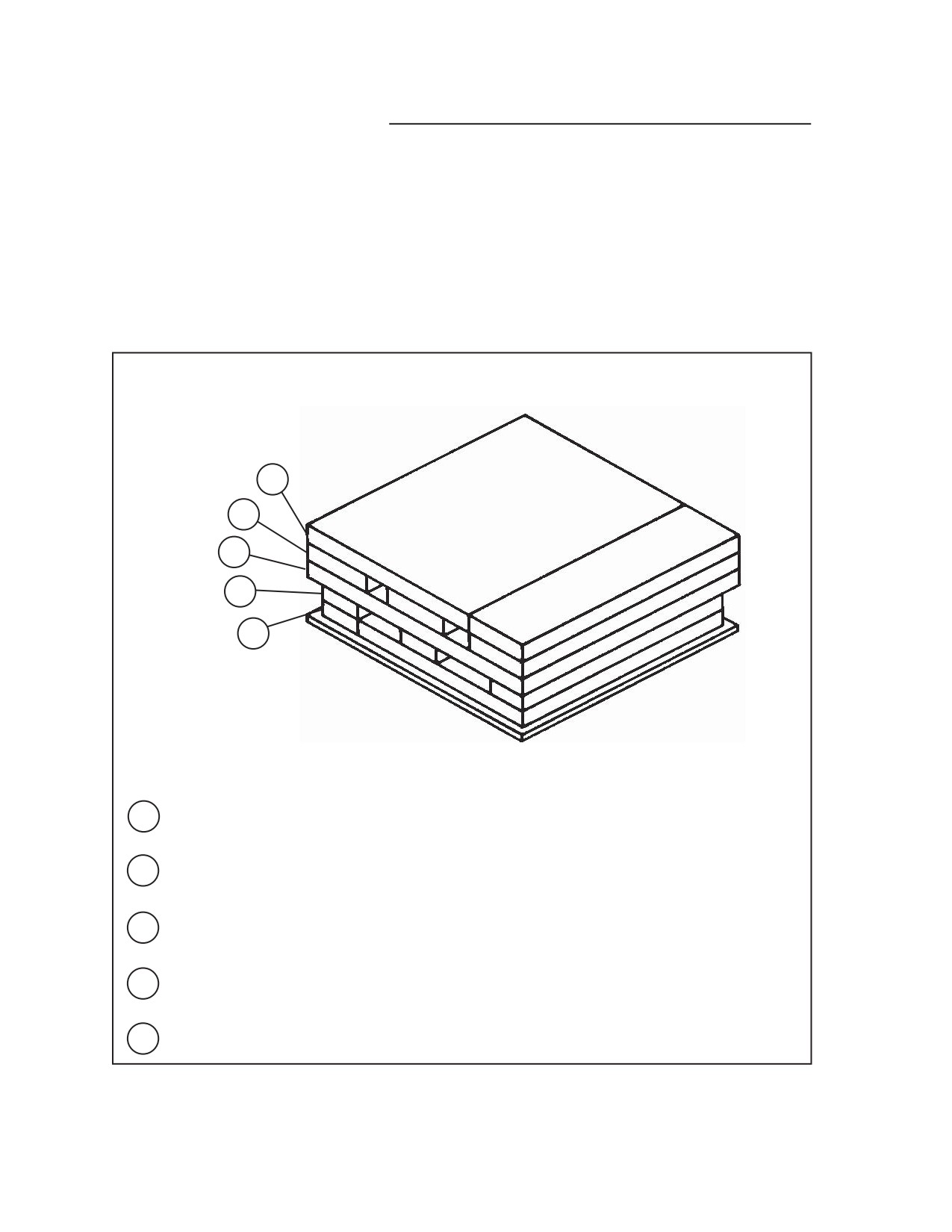
9-15. Use Table 9-2 to determine the number and size of honeycomb layers.
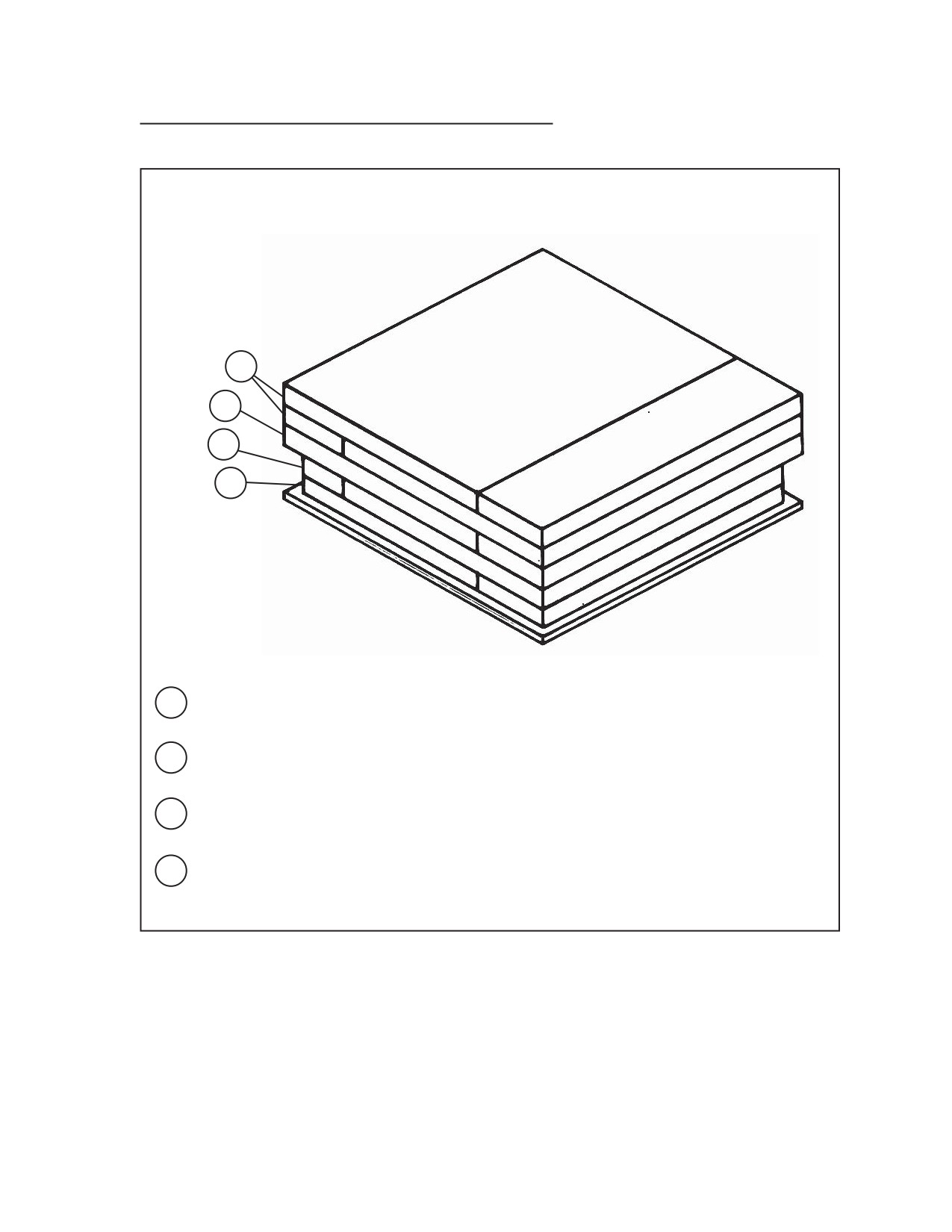
Honeycomb layers should be glued together; however, the stack does not have
to be glued to the skid board. See Figure 9-9 for loads weighing less than 1,100
pounds. See Figure 9-10 for loads weighing more than 1,100 pounds.
NOTE: The maximum width of the top three layers of honeycomb is 48 inches.
Table 9-2. Honeycomb Sizes for High-Velocity A-22 Loads
Weight of Load
Length
Width
Layer Number
Pieces
(Pounds)
(Inches)
(Inches)
501 - 1,100
1
1
44
36
1
44
8
2
3
44
8
3
1
48
36
1
48
12
4
3
48
12
5
1
48
36
1
48
12
1,100 - 2,200
1
1
44
36
1
44
8
2
1
44
36
1
44
8
3
1
48
36
1
48
12
4
1
48
36
1
48
12
5
1
48
36
1
48
12
NOTE: On loads weighing 1,000 to 1,100 pounds, either stack formation
may b e
used.
CAUTION
Loads over 1,300 pounds will not have full energy
absorption on impact.
2 September 2005
9-11
FM 4-20.103/MCRP 4-11.3C/TO 13C7-1-11
RIGGING CONTAINER
9-16. Rig the container according to Paragraphs 9-5 through 9-9.
INSTALLING PARACHUTE
9-17. Install the 26-foot high-velocity parachute according to Chapter 8.
NOTE: This drawing is not drawn to scale.
5
4
3
2
1
1 Center a 36- by 44-inch and an 8- by 44-inch piece of honeycomb side by side on the skid
board. Make sure the layer is 2 inches in from all sides.
2 Cut three 8- by 44-inch pieces of honeycomb. Center one piece on top of the first layer of
honeycomb. Place one piece of honeycomb even with each side edge.
3 Center a 36- by 48-inch and a 12- by 48-inch piece of honeycomb side by side on top of
the second layer of honeycomb.
4 Cut three 12- by 48-inch pieces of honeycomb. Center one piece on top of the third layer
of honeycomb. Place one piece of honeycomb even with each side edge.
5 Repeat step 3 for the fifth layer of honeycomb.
Figure 9-9. Honeycomb Positioned for Load Weighing Less than 1,100 Pounds
9-12
2 September 2005
FM 4-20.103/MCRP 4-11.3C/TO 13C7-1-11
NOTE: This drawing is not drawn to scale.
4
3
2
1
1 Center a 36- by 44-inch and an 8- by 44-inch piece of honeycomb side by side on the skid
board. Make sure the layer is 2 inches from all sides.
2 Repeat step 1 and alternate the pieces of honeycomb from the second layer of honey
comb.
3 Center a 36- by 48-inch and a 12- by 48-inch piece of honeycomb side by side on top of
the second layer of honeycomb.
4 Repeat step 3 and alternate the pieces of honeycomb for the fourth and fifth layers of
honeycomb.
Figure 9-10. Honeycomb Positioned for Load Weighing More than 1,100 Pounds
2 September 2005
9-13
FM 4-20.103/MCRP 4-11.3C/TO 13C7-1-11
MARKING RIGGED LOAD
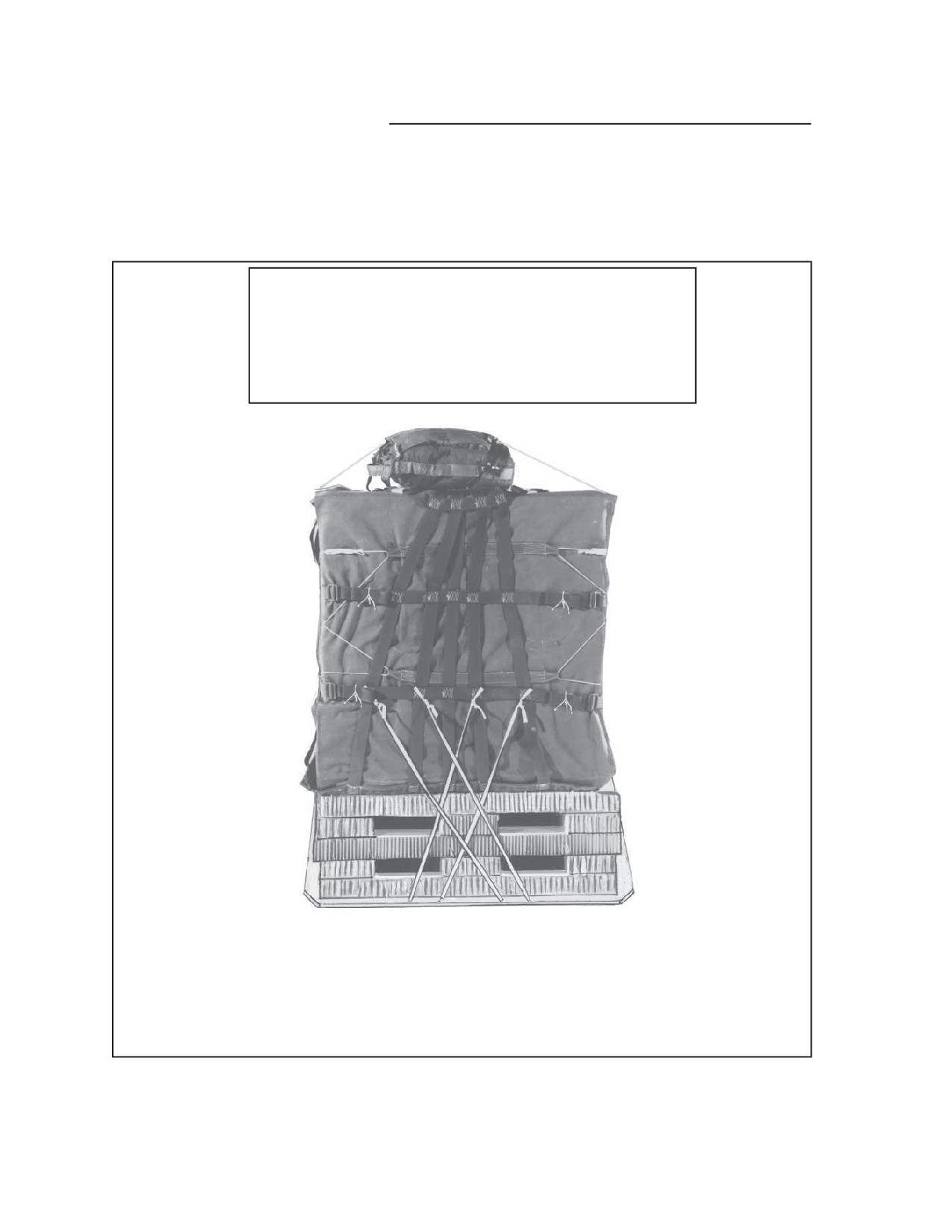
9-18. Mark the rigged load according to Chapter 1. Compute the rigged load
data.
CAUTION
Make the final rigger inspection required by FM 4-20.102/
NAVSEA SS400-AB-MMO-010/TO 13C7-1-5 and AR 59-
4/OPNAVINST 4630.24C/AFJ 13-210(I)/MCO 13480.1B
before the load leaves the ri
gging site.
RIGGING LOAD DATA (without parachute)
26-foot, high-velocity parachute
501 - 1,100 pounds
NOTE: This container may weigh up to 2,200 pounds using the honeycomb stack
formation given in Figure 9-10.
Figure 9-11. A-22 Container Load Weighing Less than 1,100
Pounds Rigged for High-Velocity Airdrop
9-14
2 September 2005
FM 4-20.103/MCRP 4-11.3C/TO 13C7-1-11
EQUIPMENT REQUIRED
9-19. Use the equipment listed in Table 9-3 to rig the load shown in Figure
9-11.
Table 9-3. Equipment Required for Rigging an A-22 Container Load Weighing
Less Than 1,100 Pounds for High-Velocity Airdrop
National Stock
Item
Quantity
Number
8040-00-273-8713
Adhesive, paste, 1-gallon
As required
1670-00-587-3421
Bag, cargo, A22
1
4030-00-678-8562
Clevis, suspension, 3/4-inch (medium)
1
4020-00-240-2146
Cord, nylon, type III
As required
1670-00-753-3928
Pad, energy-dissipating material, honeycomb
2 sheets
1670-00-872-6109
Parachute, high-velocity, 26-foot
1
Plyw ood:
5530-00-128-4981
3/4- by 48- by 96-inch
1 sheet
(locally fabricated skid board)
or
5530-00-914-5118
1- by 48- by 96-inch
1 sheet
7510-00-266-6710
Tape, masking, 2-inch
As required
8310-01-102-4478
Thread, cotton, ticket number 8/7
As required
Webbing:
8305-00-268-2411
Cotton, 1/4-inch, type I
As required
8305-00-082-5752
Nylon, tubular, 1/2-inch
As required
SECTION III - RIGGING DOUBLE A-22 CARGO BAG LOADS FOR LOW
VELOCITY AIRDROP
DESCRIPTION OF LOAD
9-20. A typical load is rigged for low-velocity airdrop using a double A-22
container. The double container is made by using two A-22 cargo bags. The
cover is optional. The weight limitation of the load is 900 to 2,200 pounds,
excluding the weight of the parachute. The load is rigged with one G-12E cargo
parachute with a 68-inch diameter pilot parachute. See Chapter 2 for aircraft
capabilities and limitations.
2 September 2005
9-15
FM 4-20.103/MCRP 4-11.3C/TO 13C7-1-11
PREPARING SKID BOARD
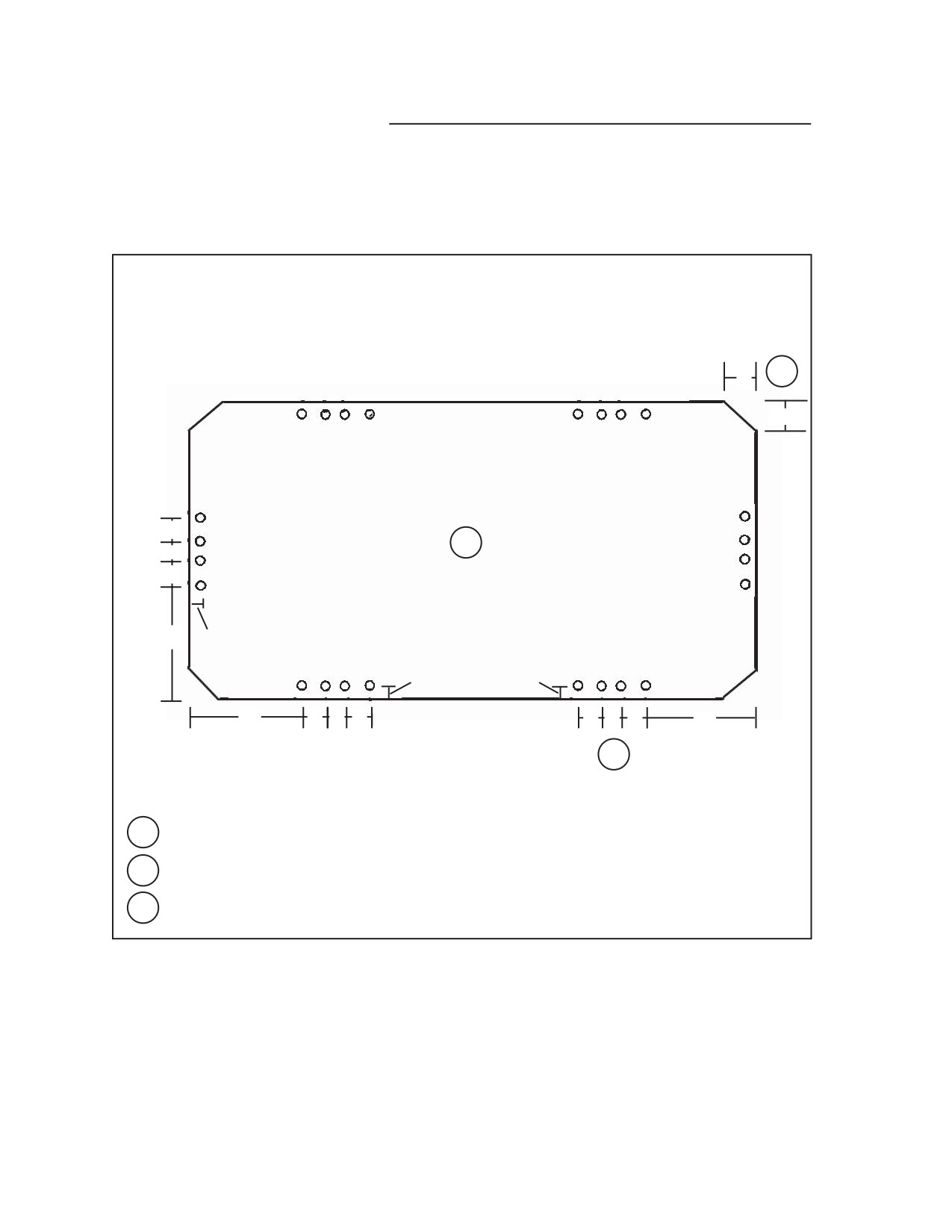
9-21. Prepare the skid board as shown in Figure 9-12.
NOTES:
1. This drawing is not drawn to scale.
2. All dimensions are given in inches.
3. Use only AC grade plywood for skid boards.
3
3
3
5
1
2
5
18
2
2
2
18
5
2
5
5
2
5
18
2
1 Place a 3/4- or 1- by 48- by 96-inch sheet of plywood on a flat surface.
2 Drill twenty-four 1/2-inch holes on each side as shown above.
3 Measure 3 inches in from each corner of the skid board and make a diagonal cut.
Figure 9-12. Skid Board Prepared for a Double A-22 Load
9-16
2 September 2005
FM 4-20.103/MCRP 4-11.3C/TO 13C7-1-11
PREPARING SKID BOARD TIES AND POSITIONING HONEYCOMB
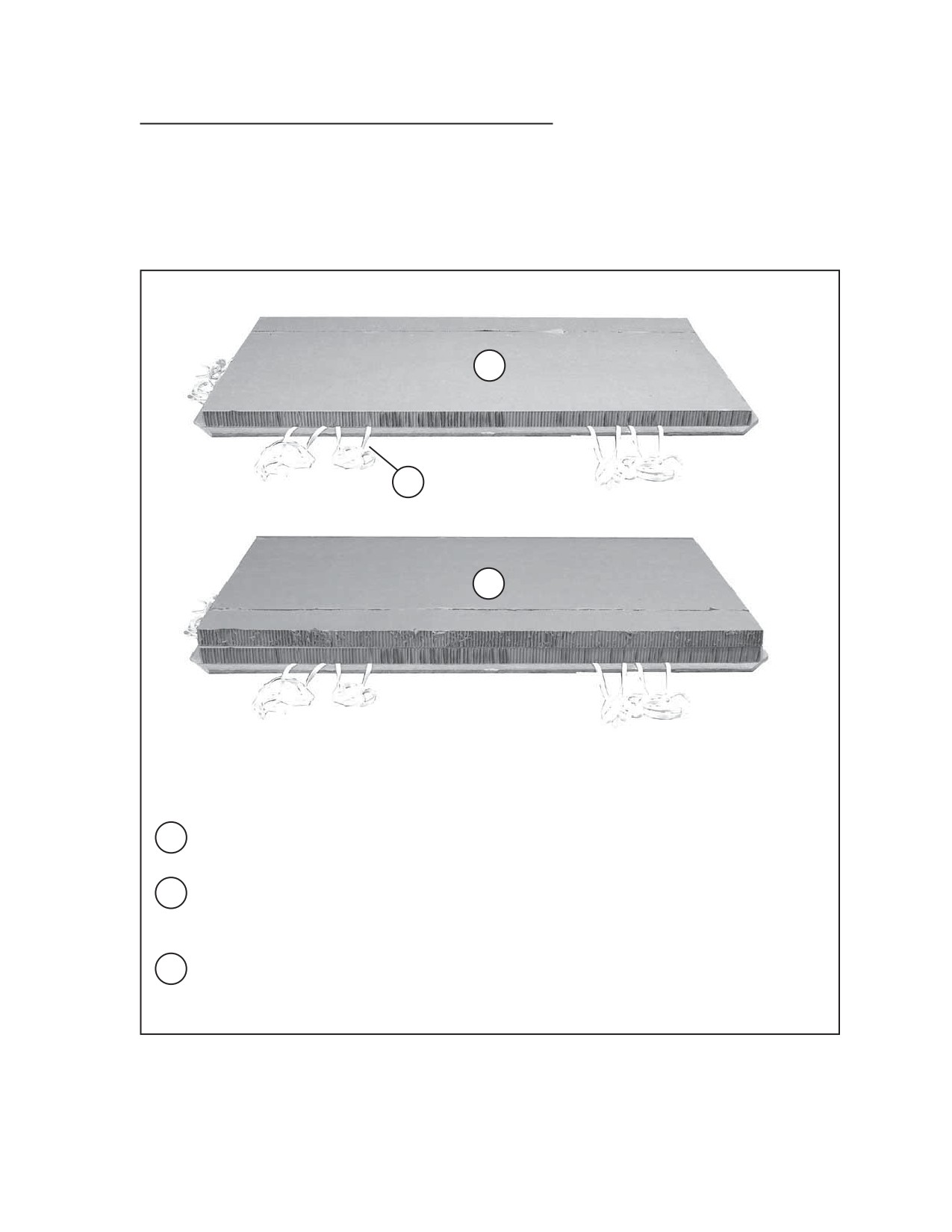
9-22. Prepare the skid board ties and position the honeycomb on the skid board
as shown in Figure 9-13.
2
1
3
1
Cut twelve 8-foot lengths of 1/2-inch tubular nylon webbing. Route skid board ties in
accordance with Figure 9-1, steps 4 and 5. Repeat for all six sets of holes.
2
Determine the size of honeycomb needed according to the size of the load. Cut and
center the honeycomb on the skid board. Make sure the honeycomb is 2 inches from all
sides.
3 Cut and center a second layer of honeycomb. If more than one sheet of honeycomb is
required, alternate the pieces of honeycomb.
Figure 9-13. Skid Board Ties Prepared and Honeycomb Positioned
2 September 2005
9-17
FM 4-20.103/MCRP 4-11.3C/TO 13C7-1-11
POSITIONING A-22 SLING ASSEMBLIES
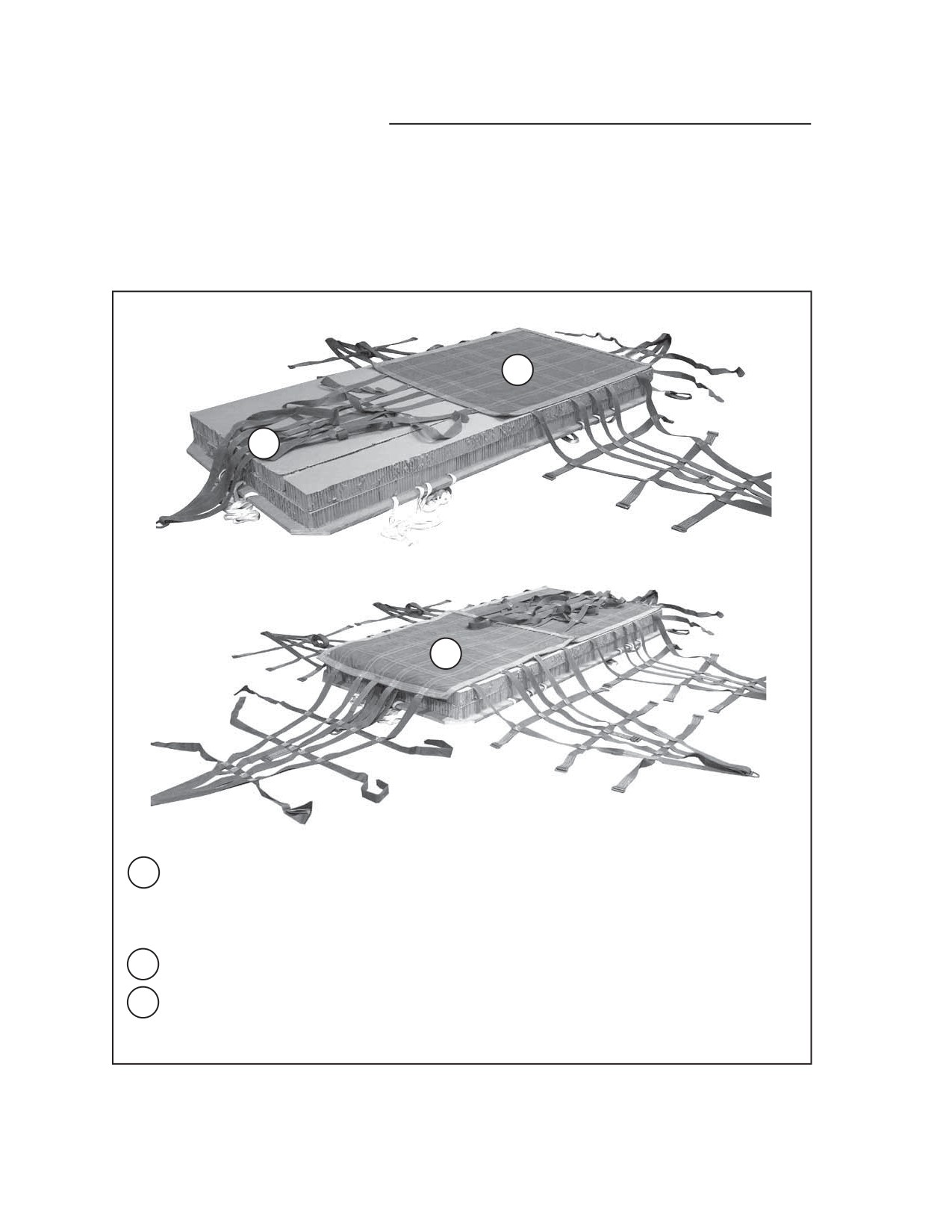
9-23. Position two A-22 sling assemblies on the double A-22 load as shown in
Figure 9-14.
FRONT
1
2
REAR
3
1
Place one A-22 sling assembly toward the front of the layer of honeycomb. Extend all
lateral straps and support webbing. Make sure the support web D-ring at the rear
extends off the load and that the friction adapter on the front support web extends to
the front of the load.
2
Fold and place all lateral straps on top of the rear support web.
3 Place the second A-22 sling assembly to the rear. Position it in the same manner as the
front assembly. Make sure the D-ring on the front support web extends off the load and
the friction adapter on the rear support web extends to the rear of the load.
Figure 9-14. Sling Assemblies Positioned
9-18
2 September 2005
FM 4-20.103/MCRP 4-11.3C/TO 13C7-1-11
4
5
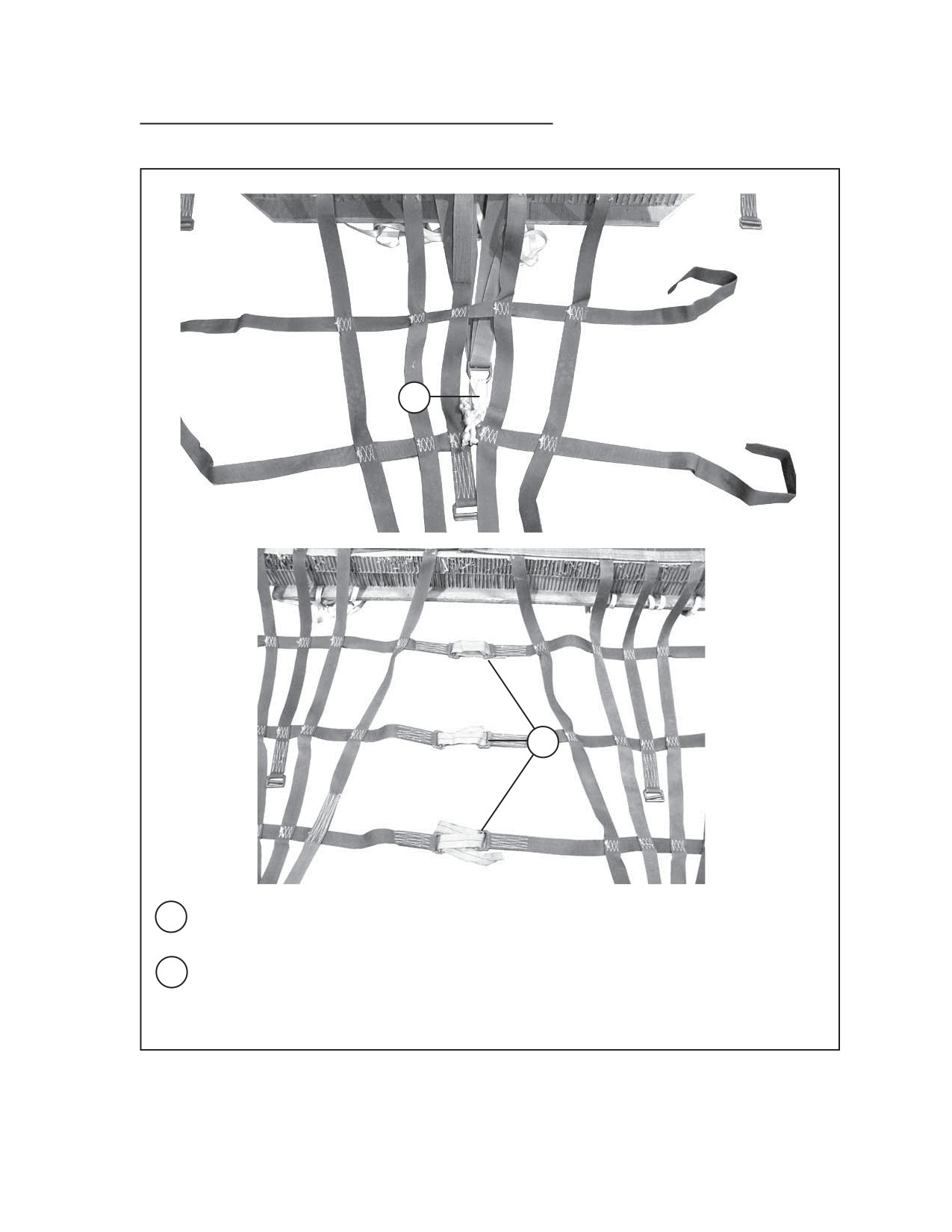
4 Use a length of type VIII nylon webbing to tie the support web D-ring exposed at the
front and rear of the load to the other A-22 sling assembly as shown.
5 Cut six lengths of type VIII nylon webbing. Route one length through each set of
friction adapters at the midsection of the load as shown. Do not apply tension at this
time.
Figure 9-14. Sling Assemblies Positioned (Continued)
2 September 2005
9-19
FM 4-20.103/MCRP 4-11.3C/TO 13C7-1-11
POSITIONING COVERS
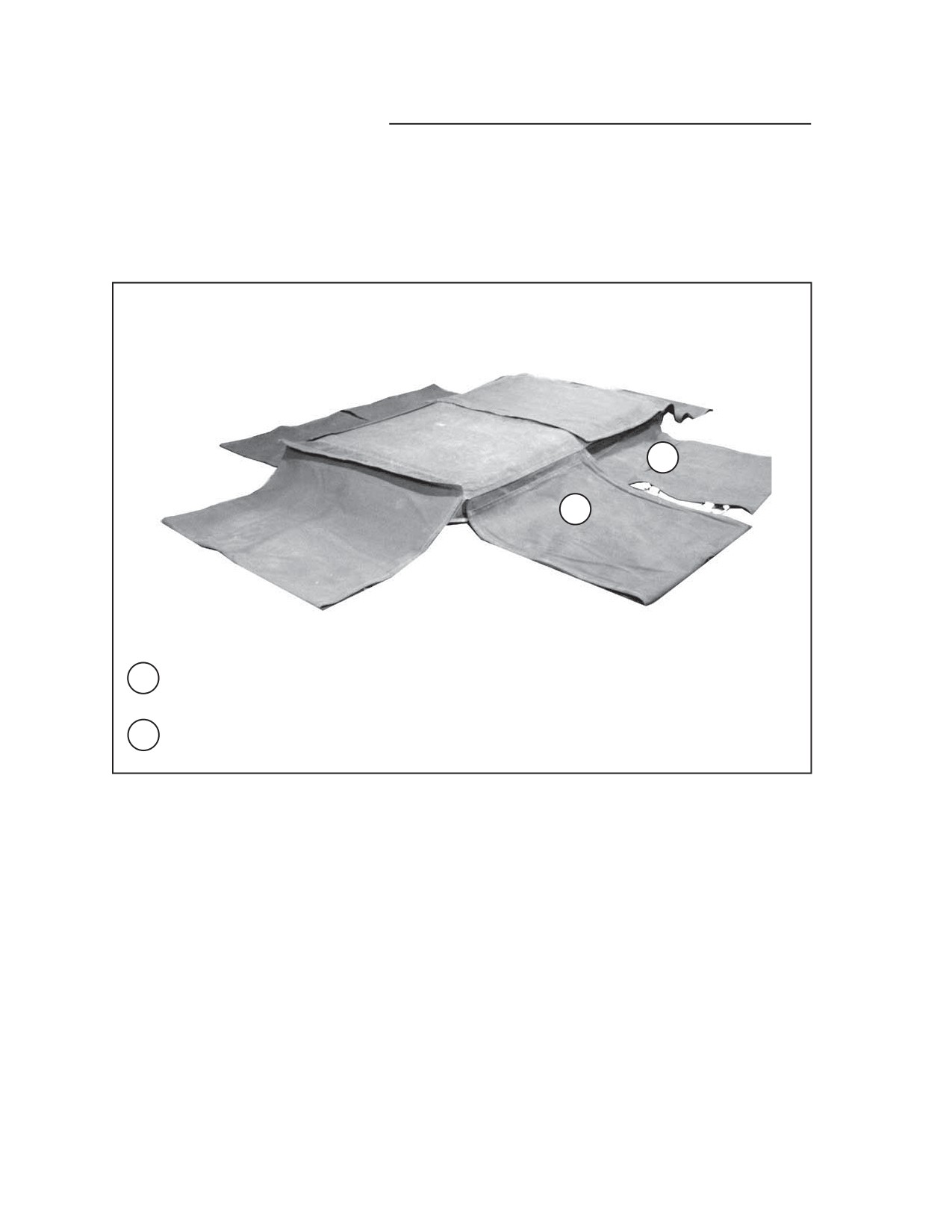
9-24. Use two A-22 cargo bag covers when rigging this load, if needed. Position
the covers as shown in Figure 9-15.
1
2
1 Place the first cover to the front in the same manner as sling assemblies. Fold the rear
excess even with the layer of honeycomb.
2 Repeat step 1 for the second cover but position the cover to the rear of the skid board.
Figure 9-15. Covers Positioned
9-20
2 September 2005
FM 4-20.103/MCRP 4-11.3C/TO 13C7-1-11
POSITIONING LOAD AND CLOSING BAG COVERS
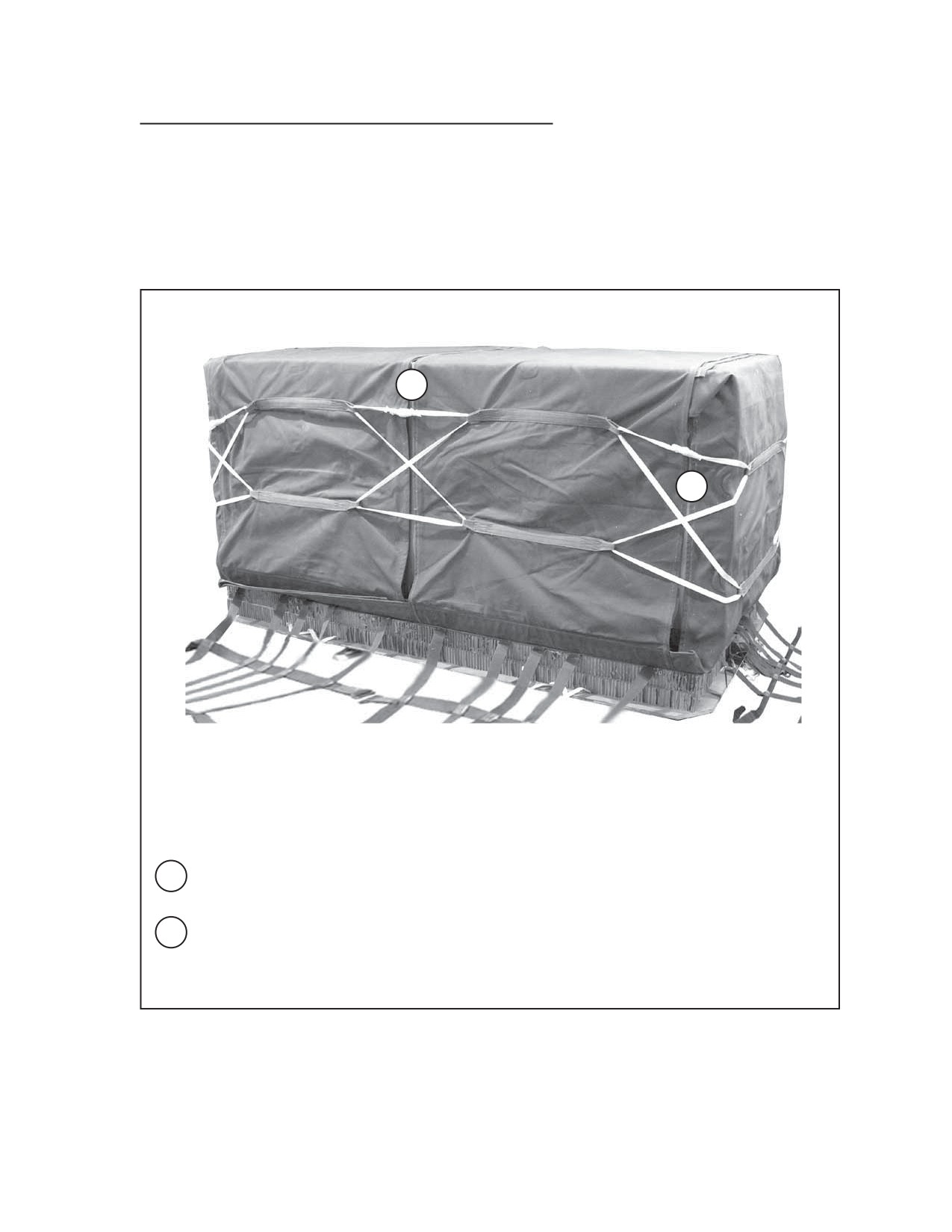
9-25. Center the load so that the weight of the load is evenly distributed. Use
honeycomb and cellulose wadding to protect the items. Use cord, tape or steel
strapping to keep the load from shifting. Close the bag as shown in Figure 9
16.
1
2
1 Fold the bag covers over the front and rear first, then the sides over the top. Fold under
the excess side covers.
2 Use six lengths of 1/2-inch tubular nylon webbing to lace the bag closed. Pull the
webbing tight and tie the running ends in a surgeon’s knot and bow knot. Tape the
excess and knot. Leave one running end slightly exposed to allow rapid derigging.
Figure 9-16. A-22 Cargo Bag Covers Closed
2 September 2005
9-21
FM 4-20.103/MCRP 4-11.3C/TO 13C7-1-11
SECURING TIE-DOWN STRAPS
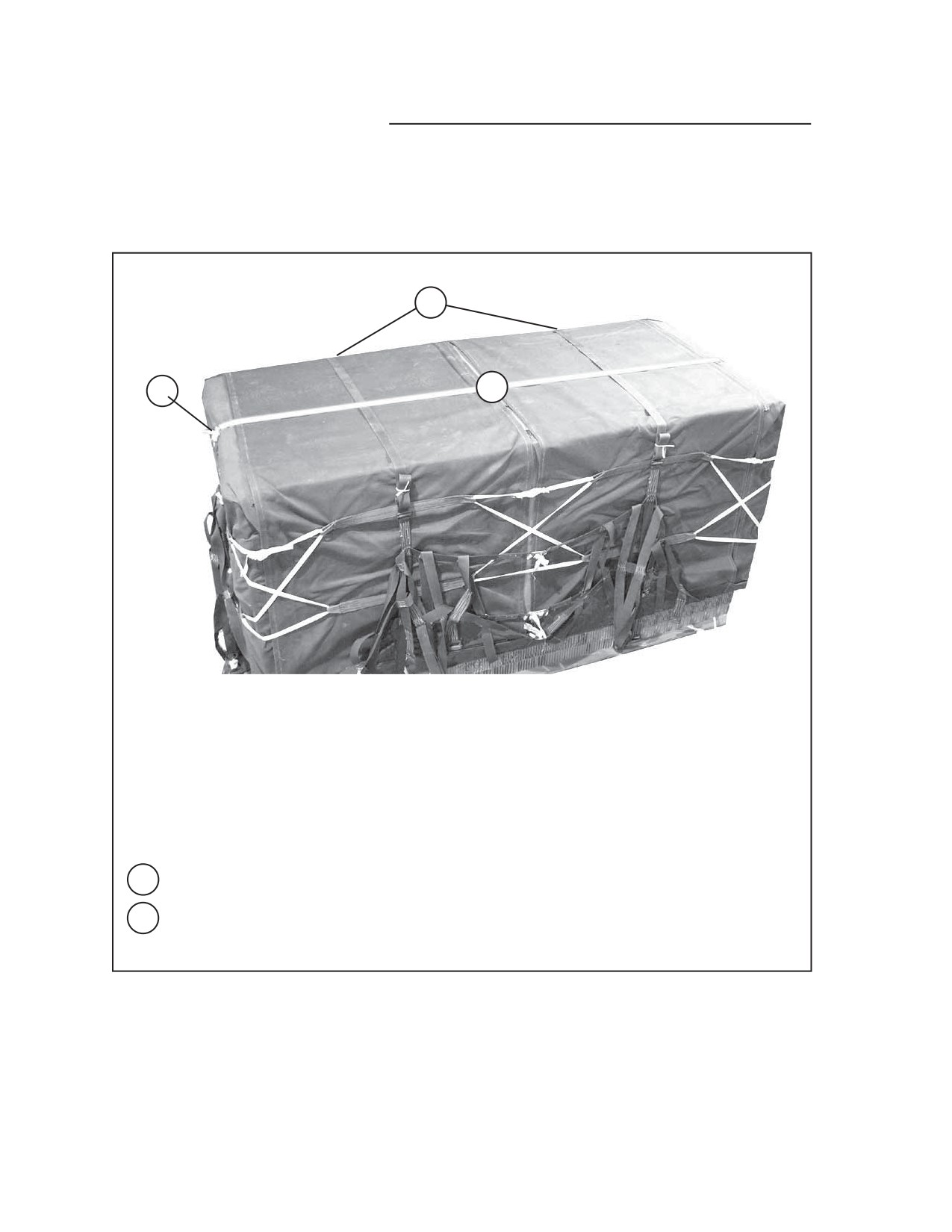
9-26. Secure the tie-down straps as shown in Figure 9-17.
1
FRONT
2
2
REAR
1 Run the side tie-down straps through the friction adapters. Apply tension to the straps.
2 Route a length of type VIII nylon webbing from the front friction adapter to the rear
friction adapter. Apply tension and make an overhand knot in the running ends.
Figure 9-17. Tie-Down Straps Secured
9-22
2 September 2005
FM 4-20.103/MCRP 4-11.3C/TO 13C7-1-11
SECURING LATERAL STRAPS
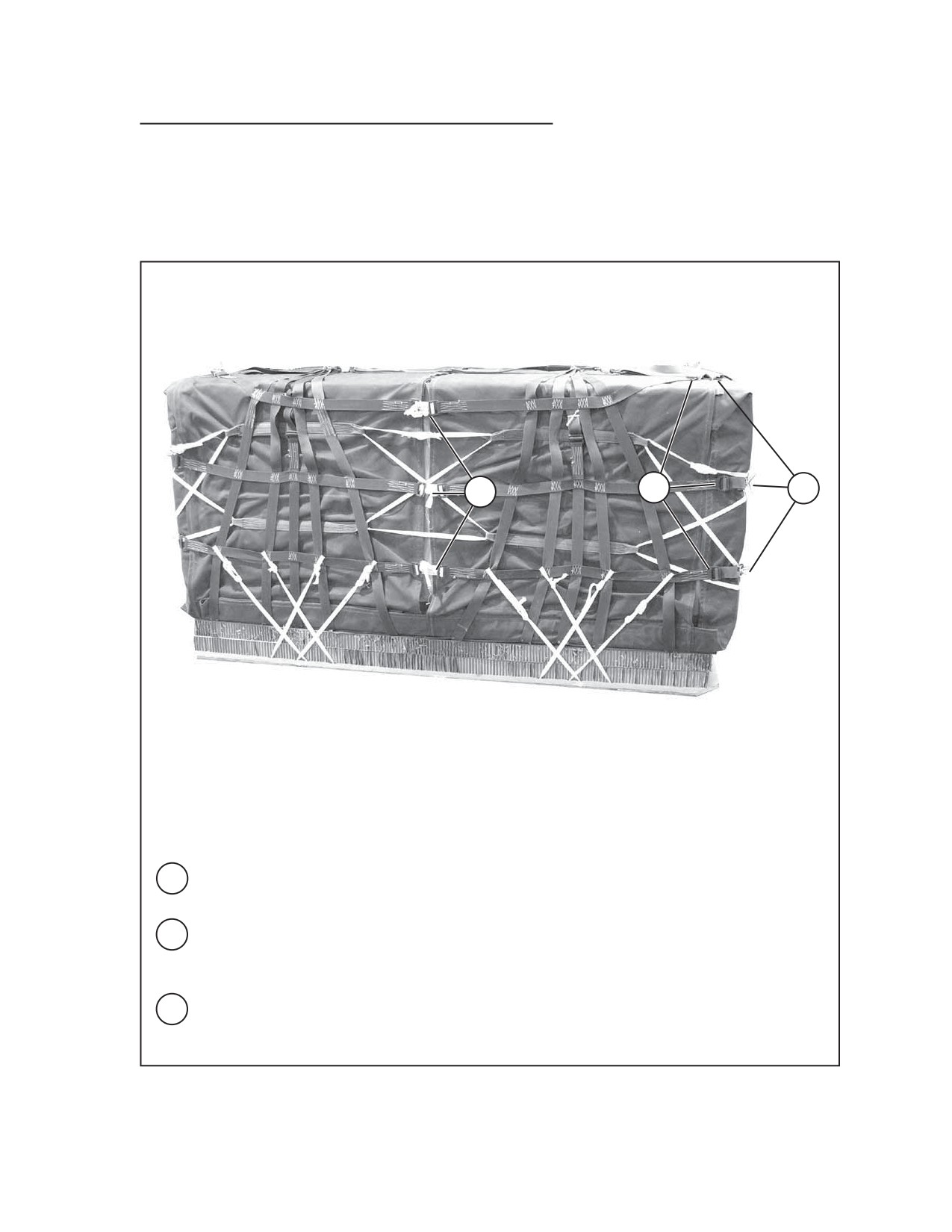
9-27. Secure the lateral straps as shown in Figure 9-18.
1
3
2
1
Lay the remaining portions of the sling assemblies over the load. Route the lateral
straps through the friction adapters.
2
Tighten the center friction adapter and type VIII nylon webbing (Figure 9-13) so that
the middle suspension web on each container is vertical. Install a knot in the running
ends of the type VIII nylon webbing about 3 inches from the friction adapters.
3 Apply equal tension on the remaining lateral straps. Fold the excess and tape or tie it
in place as shown in Figure 1-3.
Figure 9-18. Lateral Straps Secured
2 September 2005
9-23
FM 4-20.103/MCRP 4-11.3C/TO 13C7-1-11
SECURING SKID BOARD TIES
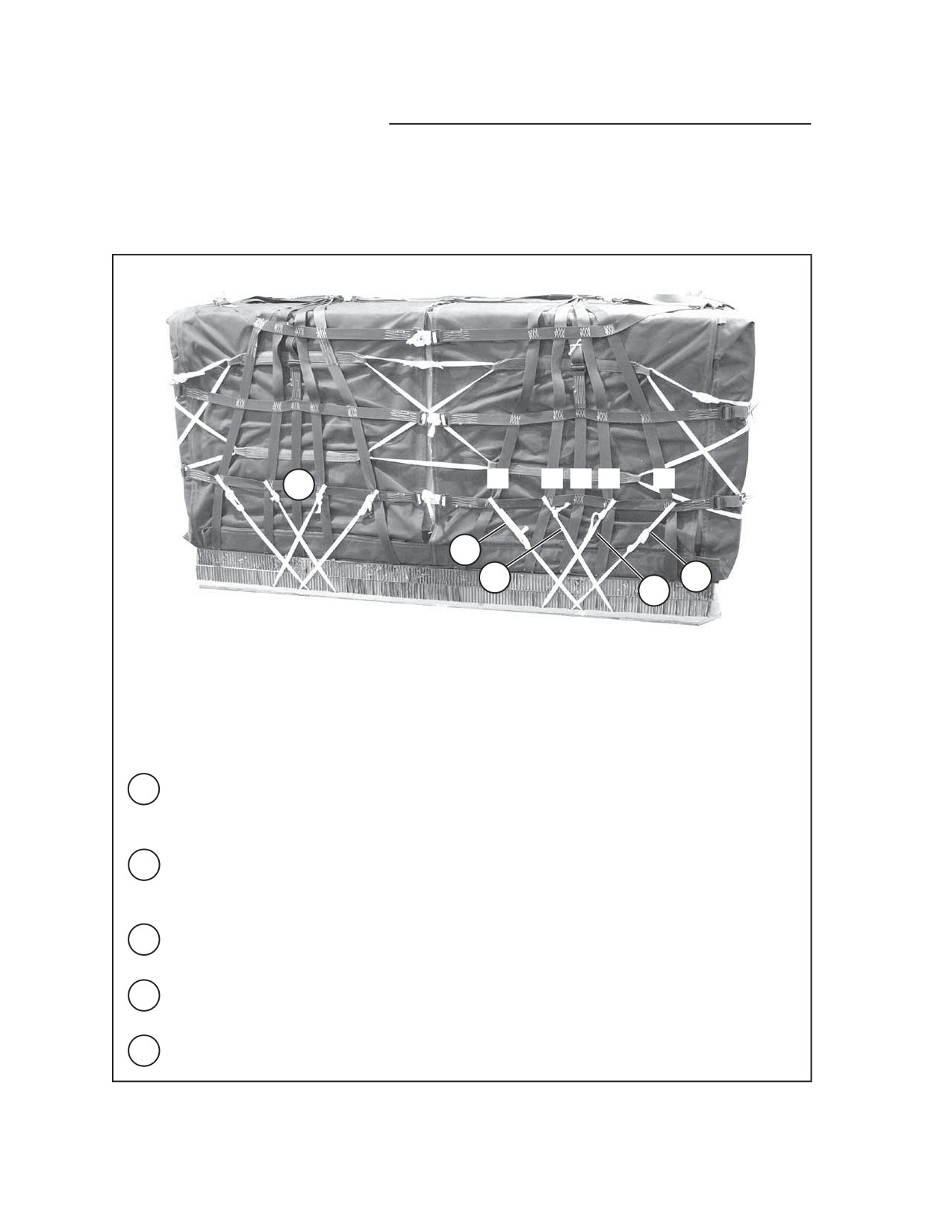
9-28. Secure the skid board ties as shown in Figure 9-19.
1
2
3
4
5
5
4
3
2
1
A B C D
1 Starting at the front right side, take tie-down A and diagonally tie it around the inter
section of the lower lateral straps and fourth support web. Use three half-hitch knots
and an overhand knot in the running end.
2 Route tie-down B around the fifth support web and lower lateral strap intersection
diagonally. Pull the excess slack out and tie it with a trucker’s hitch knot and an
overhand knot in the running end.
3 Repeat step 1 for tie-down D and secure it to the second intersection on the lower lateral
strap.
4 Repeat step 2 for tie-down C and secure it to the first intersection on the lower lateral
strap.
5 Repeat steps 1 through 4 for the other five sets of tie-downs.
Figure 9-19. Skid Board Ties Secured
9-24
2 September 2005
FM 4-20.103/MCRP 4-11.3C/TO 13C7-1-11
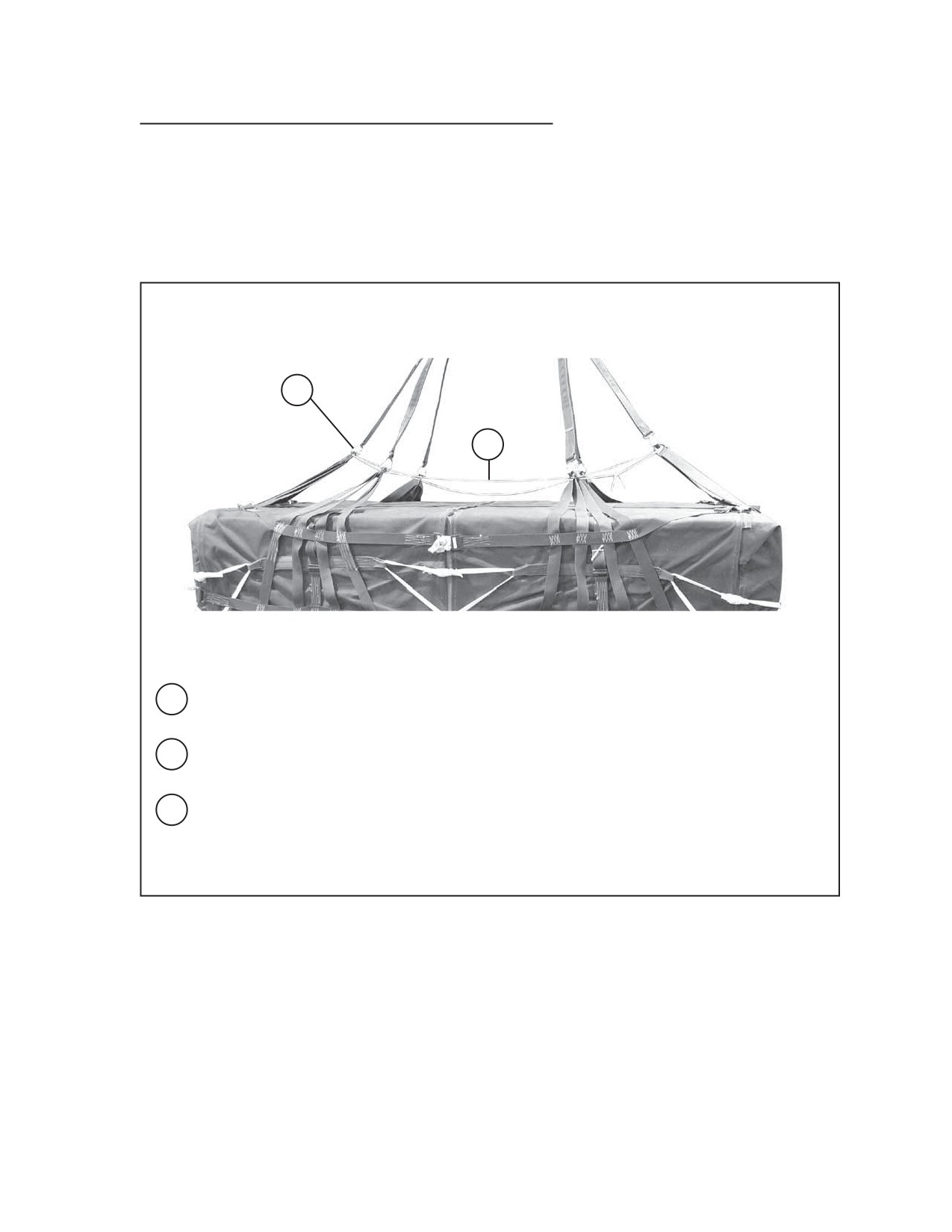
INSTALLING SUSPENSION SLINGS
9-29. Install suspension slings using six suspension webs, two 3/4-inch cargo
suspension clevises, and two 3-foot (2-loop), type XXVI nylon webbing slings as
shown in Figure 9-20.
1
3
1
Attach one suspension web to each of the six D-rings. Route the snap hook from outside
to inside. Wrap each hook with masking tape.
2
Place a 3-foot sling on each clevis. Bolt the three suspension webs at the front of the
load to one clevis. Repeat step for the rear set. (not shown)
3 Route a length of type III nylon cord through the six D-rings as shown above. Tie the
ends together with a surgeon’s knot and locking knot. Make sure the tie has excess to
allow suspension sling movement.
Figure 9-20. Suspension Slings Installed
2 September 2005
9-25
FM 4-20.103/MCRP 4-11.3C/TO 13C7-1-11
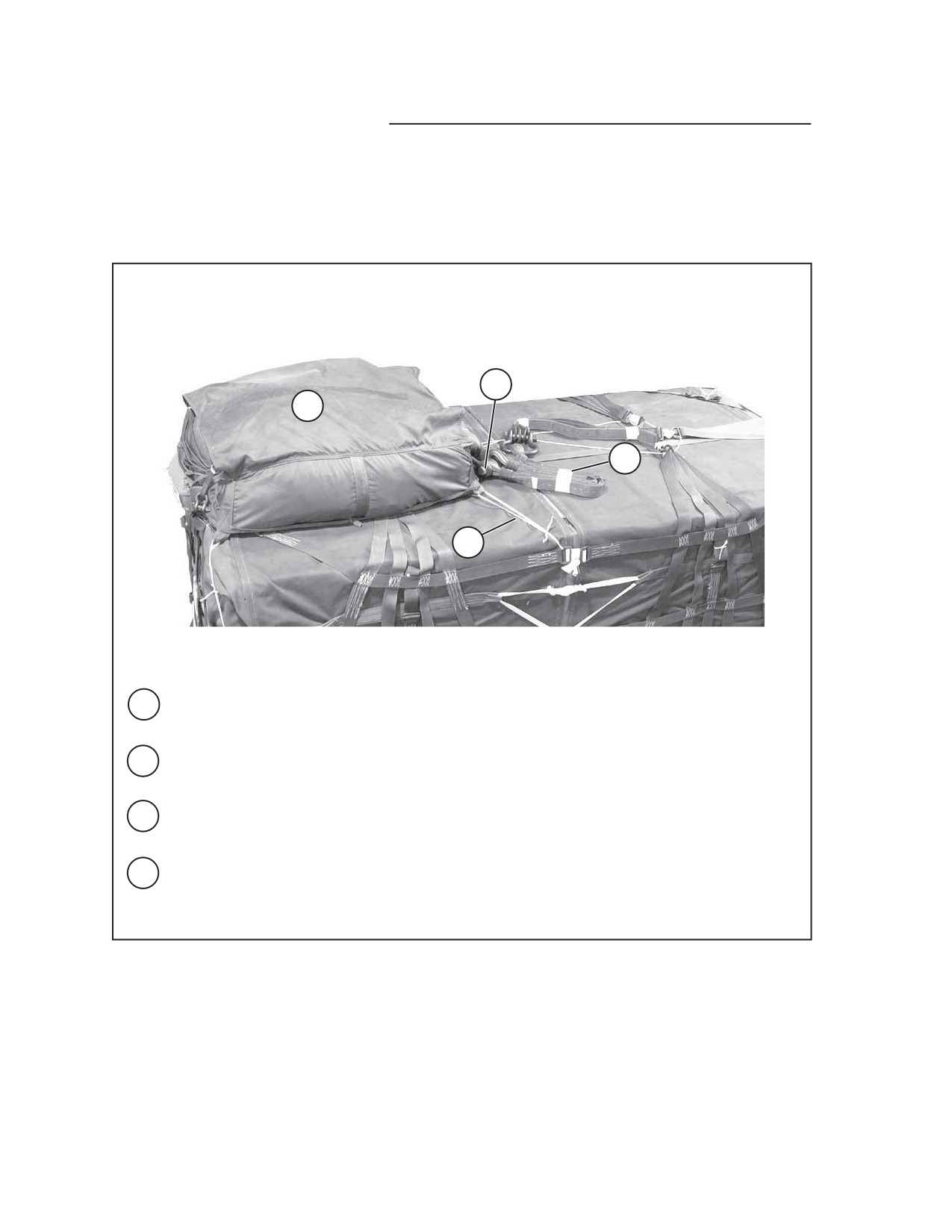
INSTALLING PARACHUTE
9-30. Install a G-12E cargo parachute as shown in Figure 9-21.
3
1
4
2
1
Place a G-12E cargo parachute on the load with the riser compartment up and the
bridle toward the front of the load. Position the parachute on the front of the load.
2
Tie each corner of the parachute to the sling assembly using type I, 1/4-inch cotton
webbing.
3
Bolt the two 3-foot slings to the parachute’s cargo suspension clevis. Make sure the
risers from the parachute are not removed form the clevis.
4 Fold the tape the excess sling with masking tape.
Figure 9-21. G-12E Cargo Parachute Installed
9-26
2 September 2005
FM 4-20.103/MCRP 4-11.3C/TO 13C7-1-11
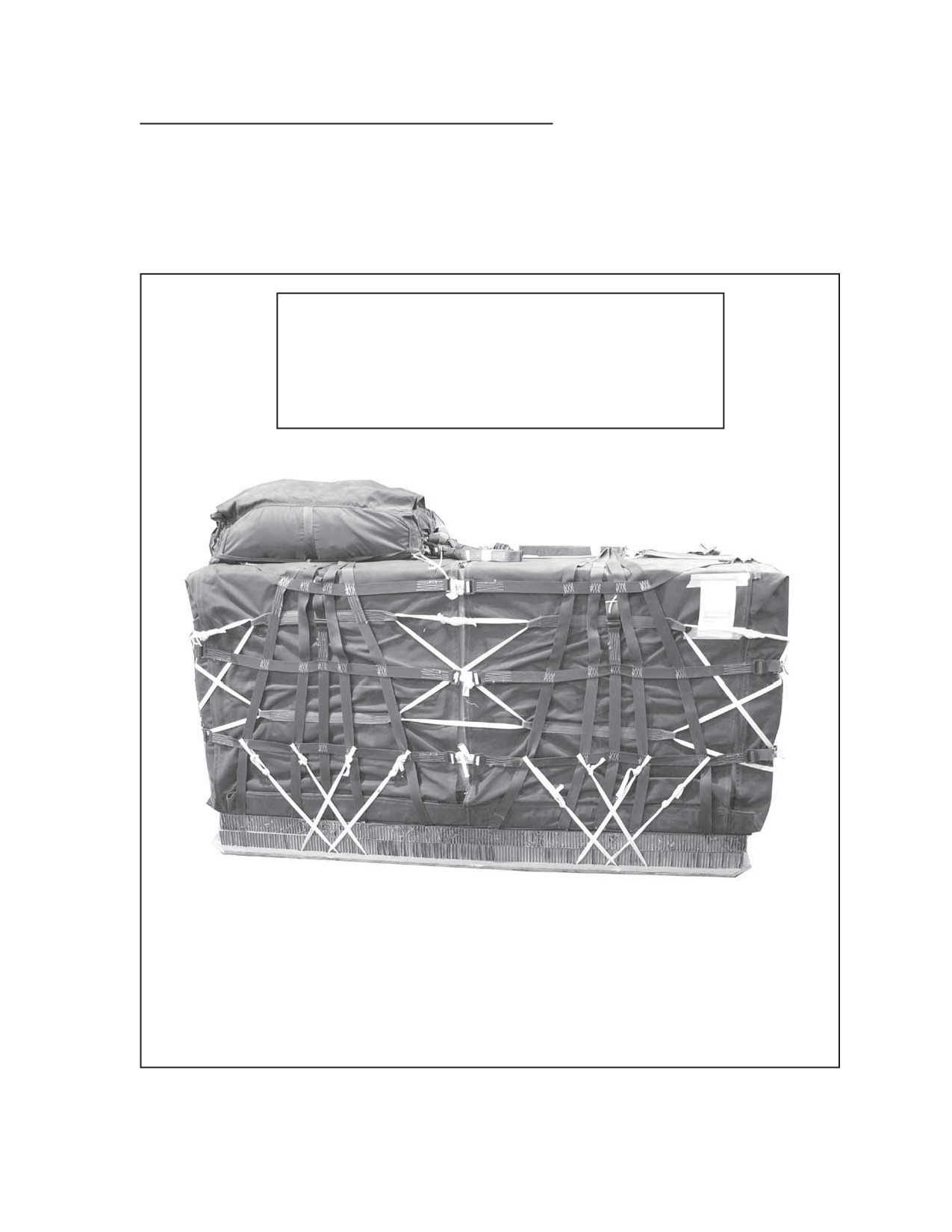
MARKING RIGGED LOAD
9-31. Mark the rigged load according to Paragraph 1-5. Compute the rigged
load data.
CAUTION
Make the final rigger inspection required by FM 4-20.102/
NAVSEA SS400-AB-MMO-010/TO 13C7-1-5 and AR 59-
4/OPNAVINST 4630.24C/AFJ 13-210(I)/MCO 13480.1B
before the load leaves the ri
gging site.
RIGGING LOAD DATA (without parachute)
G-12E cargo parachute
900 - 2,200 pounds
Figure 9-22. Double A-22 Cargo Bag Rigged for Low-Velocity Airdrop
2 September 2005
9-27
FM 4-20.103/MCRP 4-11.3C/TO 13C7-1-11
EQUIPMENT REQUIRED
9-32. Use the equipment listed in Table 9-4 to rig the load shown in Figure 9
22.
Table 9-4. Equipment Required for Rigging Double A-22 Cargo Bag for Low-Velocity Airdrop
National Stock
Item
Quantity
Number
1670-00-587-3421
Bag, cargo, A22
2
4030-00-678-8562
Clevis, suspension, 3/4-inch (medium)
2
4020-00-240-2146
Cord, nylon, type III
As required
1670-00-753-3928
Pad, energy-dissipating material, honeycomb
As required
Parachute
1670-01-065-3755
Cargo, G12E
1
1670-00-216-7297
Pilot, 68-inch diameter
1
Plyw ood:
5530-00-128-4981
3/4- by 48- by 96-inch
1 sheet
(locally fabricated skid board)
or
5530-00-914-5118
1- by 48- by 96-inch
1 sheet
1670-01-062-6301
Sling, cargo, airdrop, 3-foot (2-loop),
2
type XXVI nylon webbin g
1670-00-368-7486
Strap, webbing, restraint (shear strap), 60-inch
1
7510-00-266-6710
Tape, masking, 2-inch
As required
8310-01-102-4478
Thread, cotton, ticket number 8/7
As required
Webbing:
8305-00-268-2411
Cotton, 1/4-inch, type I
As required
Nylon:
8305-00-082-5752
Tubular, 1/2-inch
As required
8305-00-263-3591
Type VIII, NT
As reruired
SECTION IV - RIGGING STRETCH A-22 CARGO BAG LOADS FOR LOW
VELOCITY AIRDROP
DESCRIPTION OF LOAD
9-33. A typical load is rigged for low-velocity airdrop using a stretch A-22
container. The stretch container is made by using two A-22 cargo bags. The
cover is optional. The weight limitation of the load is 675 to 2,200 pounds,
excluding the weight of the parachute. The load is rigged with one G-12E cargo
parachute with a 68-inch diameter pilot parachute. See Chapter 2 for aircraft
capabilities and limitations.
9-28
2 September 2005
FM 4-20.103/MCRP 4-11.3C/TO 13C7-1-11
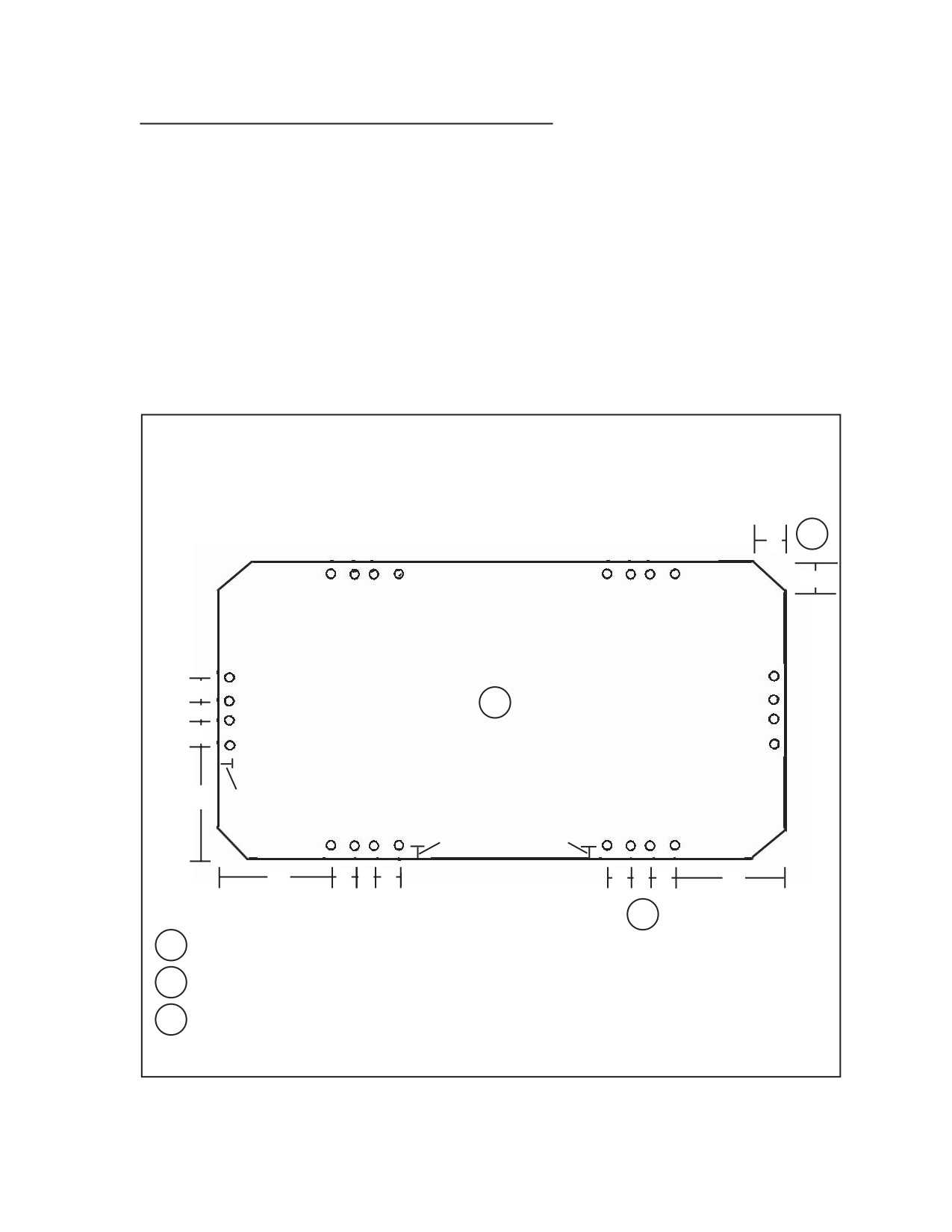
PREPARING SKID BOARD
9-34. Prepare a skid board as shown in Figure 9-23.
PREPARING SKID BOARD TIES AND POSITIONING HONEYCOMB
9-35. Prepare skid board ties and position the honeycomb on the skid board as
shown in Figure 9-13.
NOTES:
1. This drawing is not drawn to scale.
2. All dimensions are given in inches.
3. Use only AC grade plywood for skid boards.
3
3
3
5
1
2
5
18
2
2
2
18
5
2
5
5
2
5
18
2
1 Place a 3/4- or 1- by 48- by 72-inch sheet of plywood on a flat surface.
2 Drill twenty-four 1/2-inch holes on each side as shown above.
3 Measure 3 inches in from each corner of the skid board and make a diagonal cut.
Figure 9-23. Skid Board Prepared for a Stretch A-22 Load
2 September 2005
9-29
FM 4-20.103/MCRP 4-11.3C/TO 13C7-1-11
POSITIONING A-22 SLING ASSEMBLIES
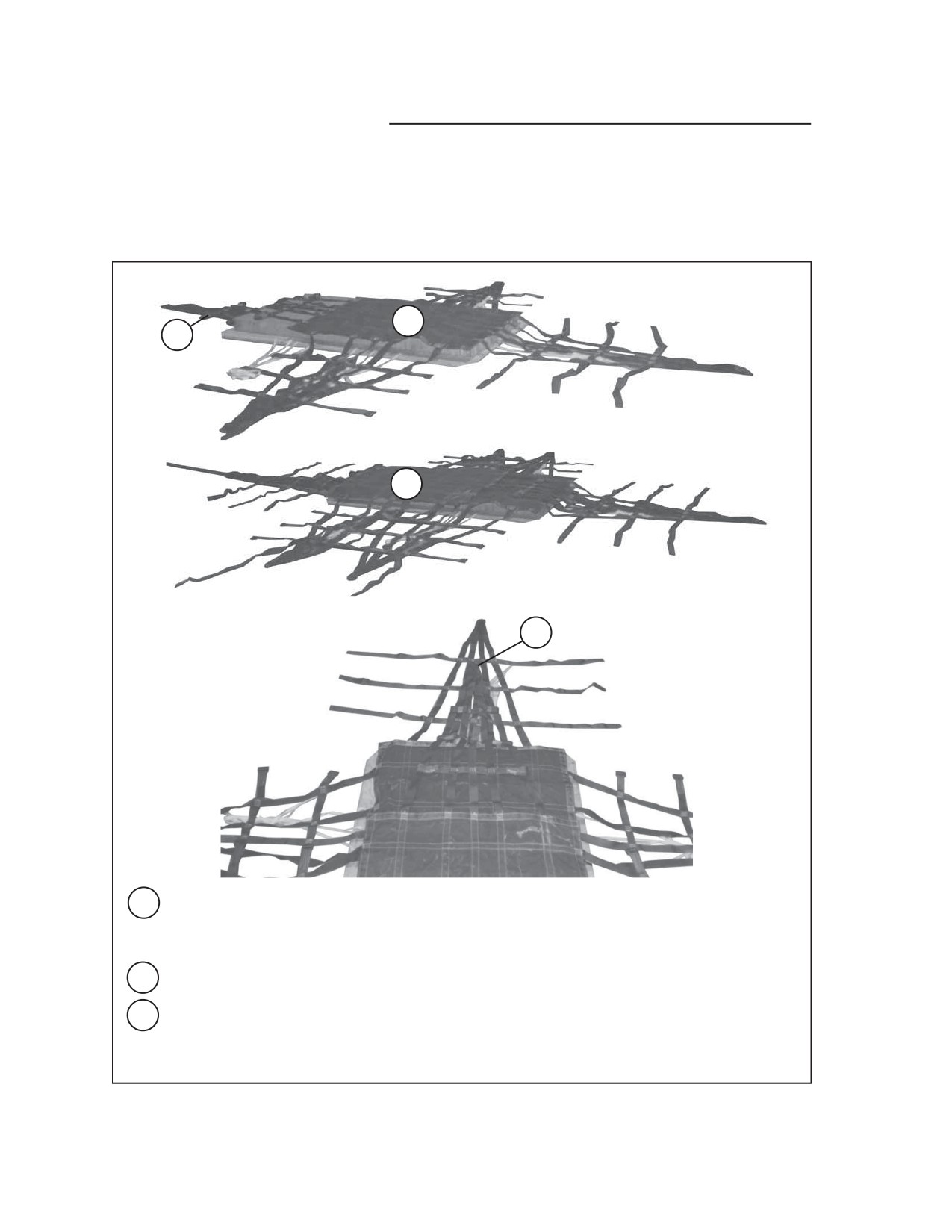
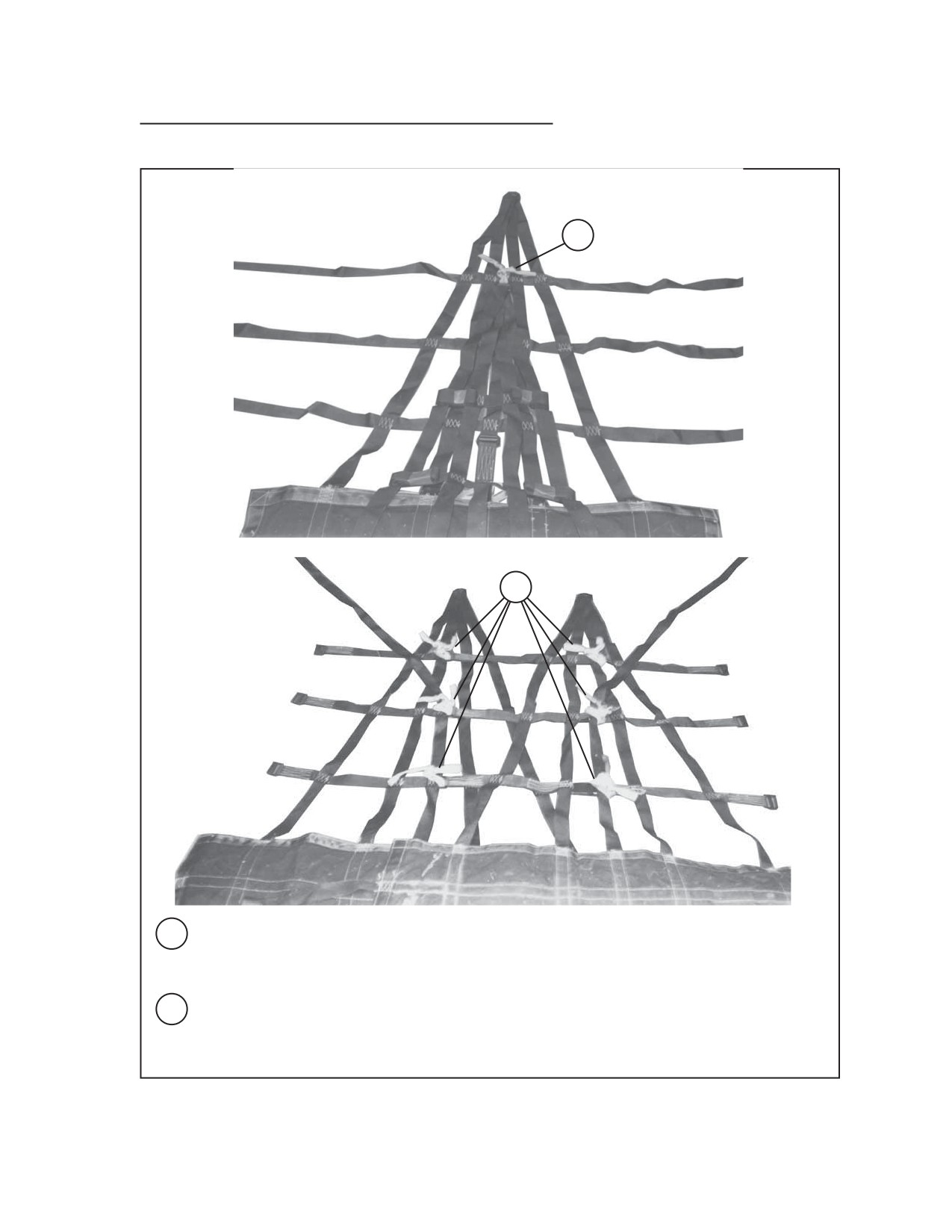
9-36. Position two A-22 sling assemblies on the stretch A-22 load as shown in
Figure 9-24.
1
2
3
3
1 Place one A-22 sling assembly toward the front of the layer of honeycomb. Extend all
lateral straps and support webbing. Make sure the support web D-ring at the rear
extends off the load.
2 Fold and place all lateral straps on top of the rear support web and secure with tape.
3 Place a second A-22 sling assembly to the rear. Position it in the same manner as the
front assembly. Make sure the D-ring on the front support web extends off the load and
reaches the front lateral strap of the other A-22 sling assembly as shown.
Figure 9-24. A-22 Sling Assemblies Positioned
9-30
2 September 2005
FM 4-20.103/MCRP 4-11.3C/TO 13C7-1-11
4
5
4 Use a length of type VIII nylon webbing or two turns of 1-inch tubular nylon webbing to
tie the support web D-rings exposed at the front and rear of the load to the top lateral
strap of the other A-22 sling assembly as shown.
5 Use a length of type VIII nylon webbing or two turns of 1-inch tubular nylon webbing to
tie the friction adapters diagonally around the intersection of the short tie-down strap
and the corresponding lateral strap of the other sling assembly as shown.
Figure 9-24. A-22 Sling Assemblies Positioned (Continued)
2 September 2005
9-31
FM 4-20.103/MCRP 4-11.3C/TO 13C7-1-11
POSITIONING COVERS
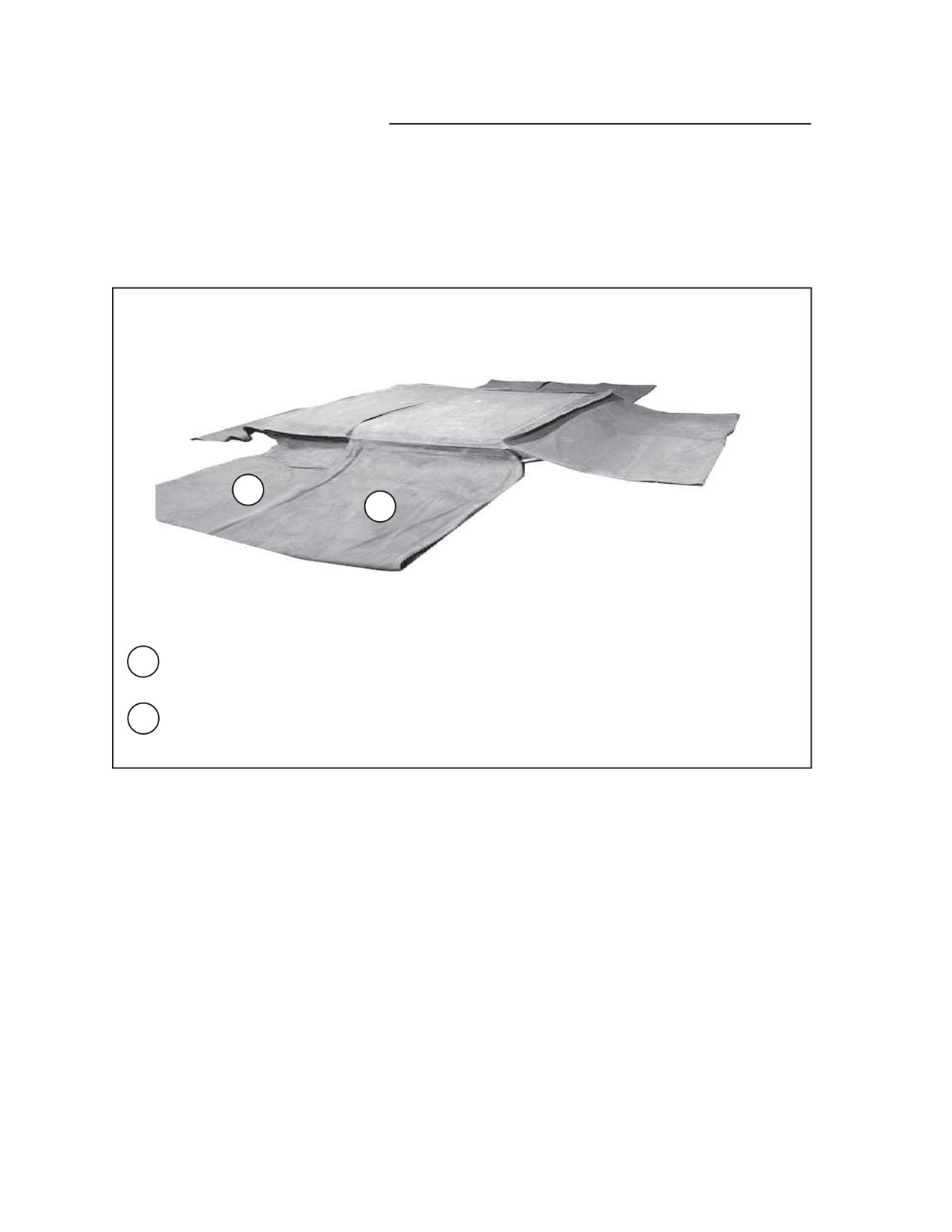
9-37. Use two A-22 cargo bag covers when rigging this load, if needed. Position
the covers as shown in Figure 9-25.
2
1
1 Place the first cover to the front in the same manner as sling assemblies. Fold the rear
excess even with the layer of honeycomb.
2 Repeat step 1 for the second cover but position the cover to the rear of the skid board.
Figure 9-25. Covers Positioned
9-32
2 September 2005
FM 4-20.103/MCRP 4-11.3C/TO 13C7-1-11
POSITIONING LOAD AND CLOSING BAG COVERS
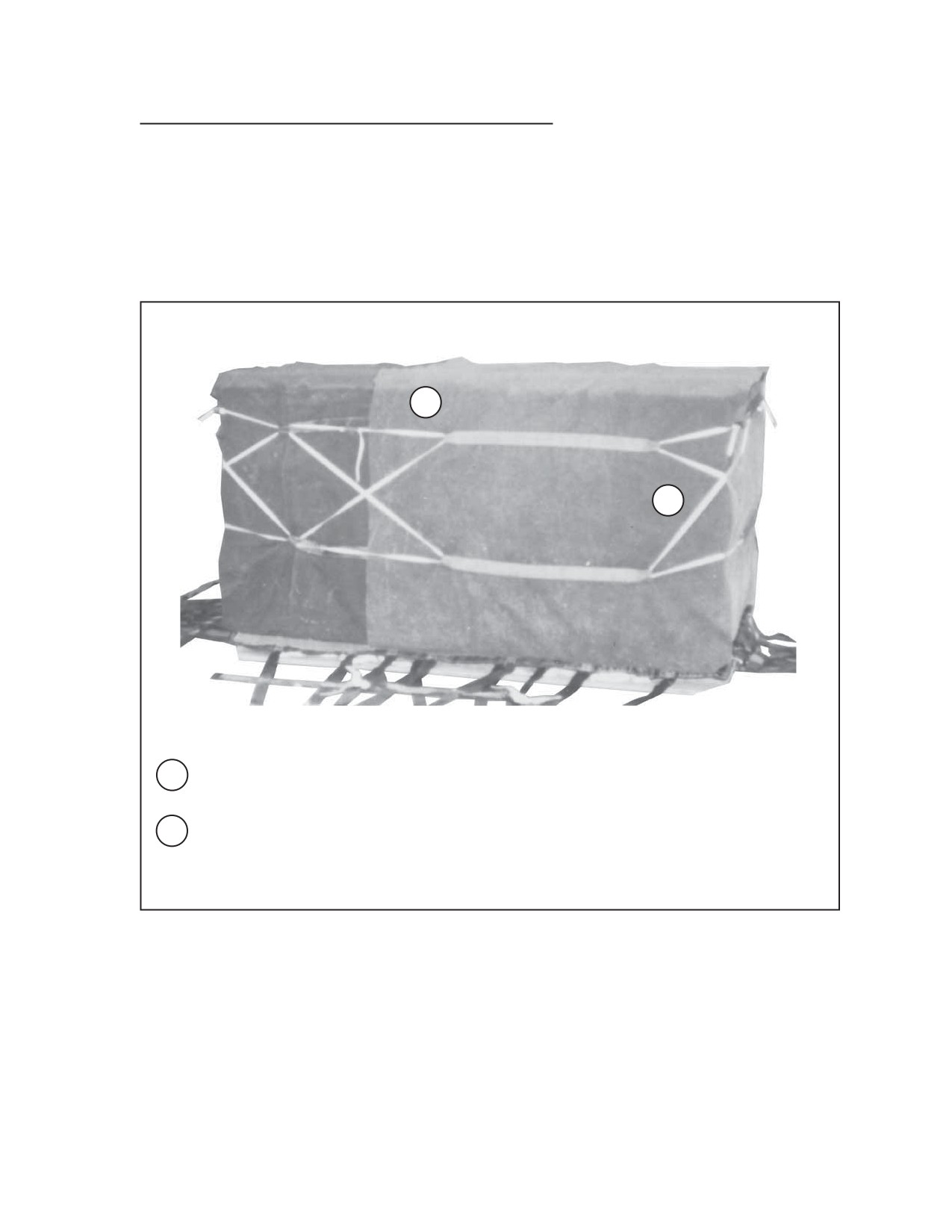
9-38. Center the load so that the weight of the load is evenly distributed. Use
honeycomb and cellulose wadding to protect the items. Use cord, rope or steel
strapping to keep the load from shifting. Close the bag as shown in Figure 9
26.
1
2
1 Fold the bag covers over the front and rear first, then the sides over the top. Fold under
the excess side covers.
2 Use six lengths of 1/2-inch tubular nylon webbing to lace the bag closed. Pull the
webbing tight and tie the running ends in a surgeon’s knot and bow knot. Tape the
excess and knot. Leave one running end slightly exposed to allow rapid derigging.
Figure 9-26. A-22 Cargo Bag Covers Closed
2 September 2005
9-33
FM 4-20.103/MCRP 4-11.3C/TO 13C7-1-11
SECURING TIE-DOWN STRAPS
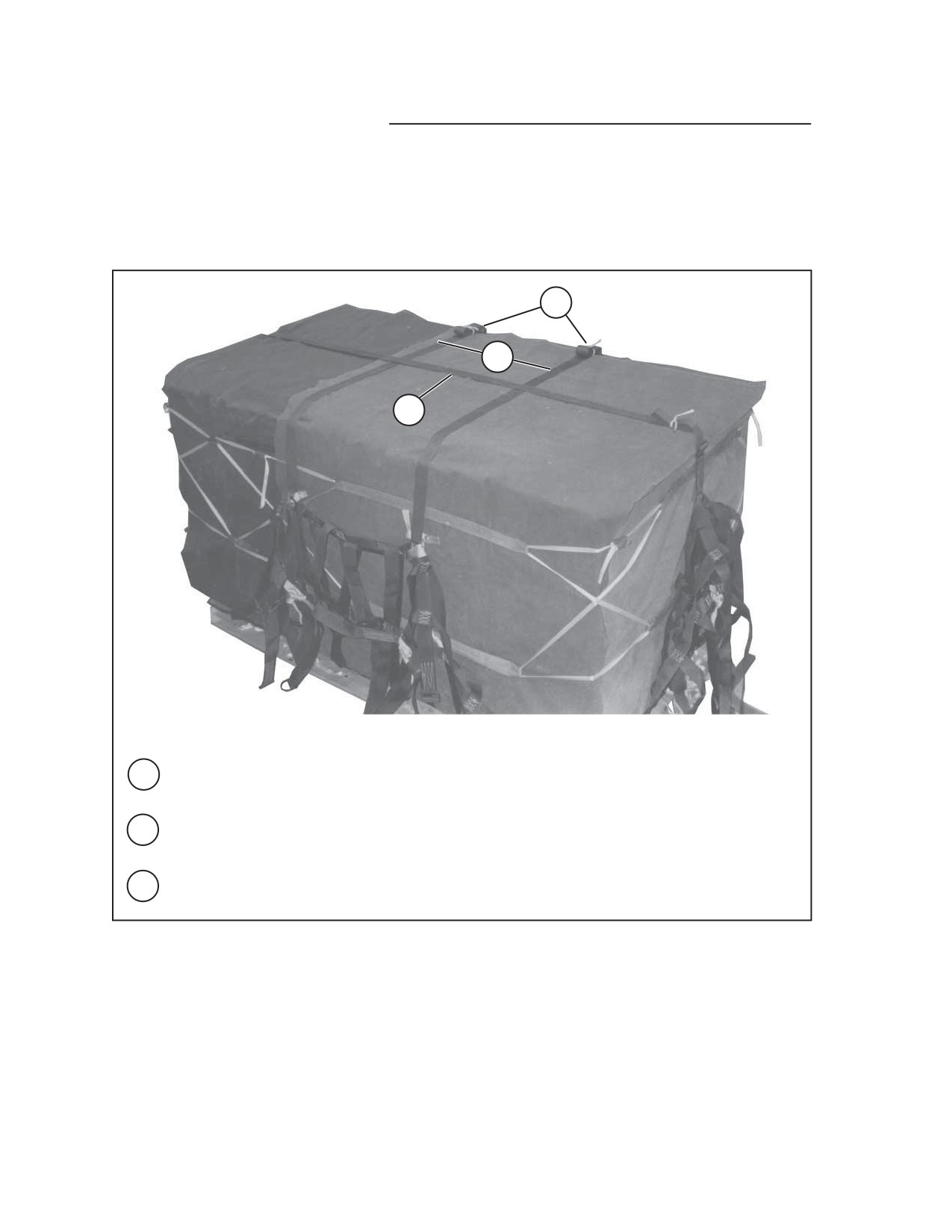
9-39. Secure the tie-down straps as shown in Figure 9-27.
3
1
2
1
Run the side short tie-down straps through the friction adapters. Apply tension to the
straps.
2
If necessary, attach a 60-inch nylon webbing strap to either the front or rear long tie-
down straps. Route the running end through the friction adapter on the opposite end.
3 Fold the excess on the tie-down straps. Tape or tie it as shown in Figure 1-3.
Figure 9-27. Tie-down Straps Secured
9-34
2 September 2005
FM 4-20.103/MCRP 4-11.3C/TO 13C7-1-11
SECURING LATERAL STRAPS
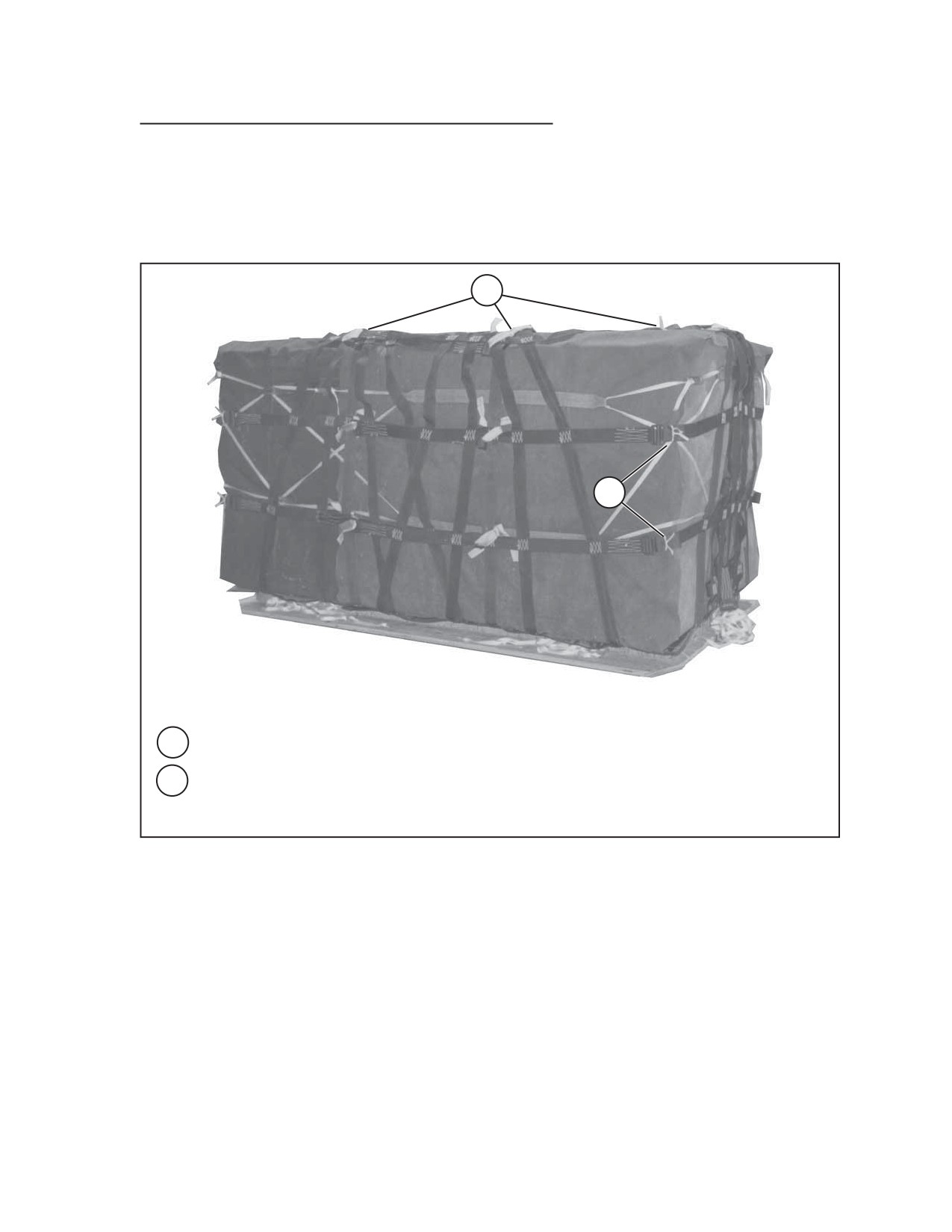
9-40. Secure the lateral straps as shown in Figure 9-28.
1
2
1 Lay the remaining portion of the sling assemblies over the load.
2 Route the lateral straps through the friction adapters and apply equal tension. Fold the
excess and tie it in place as shown in Figure 1-3.
Figure 9-28. Lateral Straps Secured
2 September 2005
9-35
FM 4-20.103/MCRP 4-11.3C/TO 13C7-1-11
SECURING SKID BOARD TIES
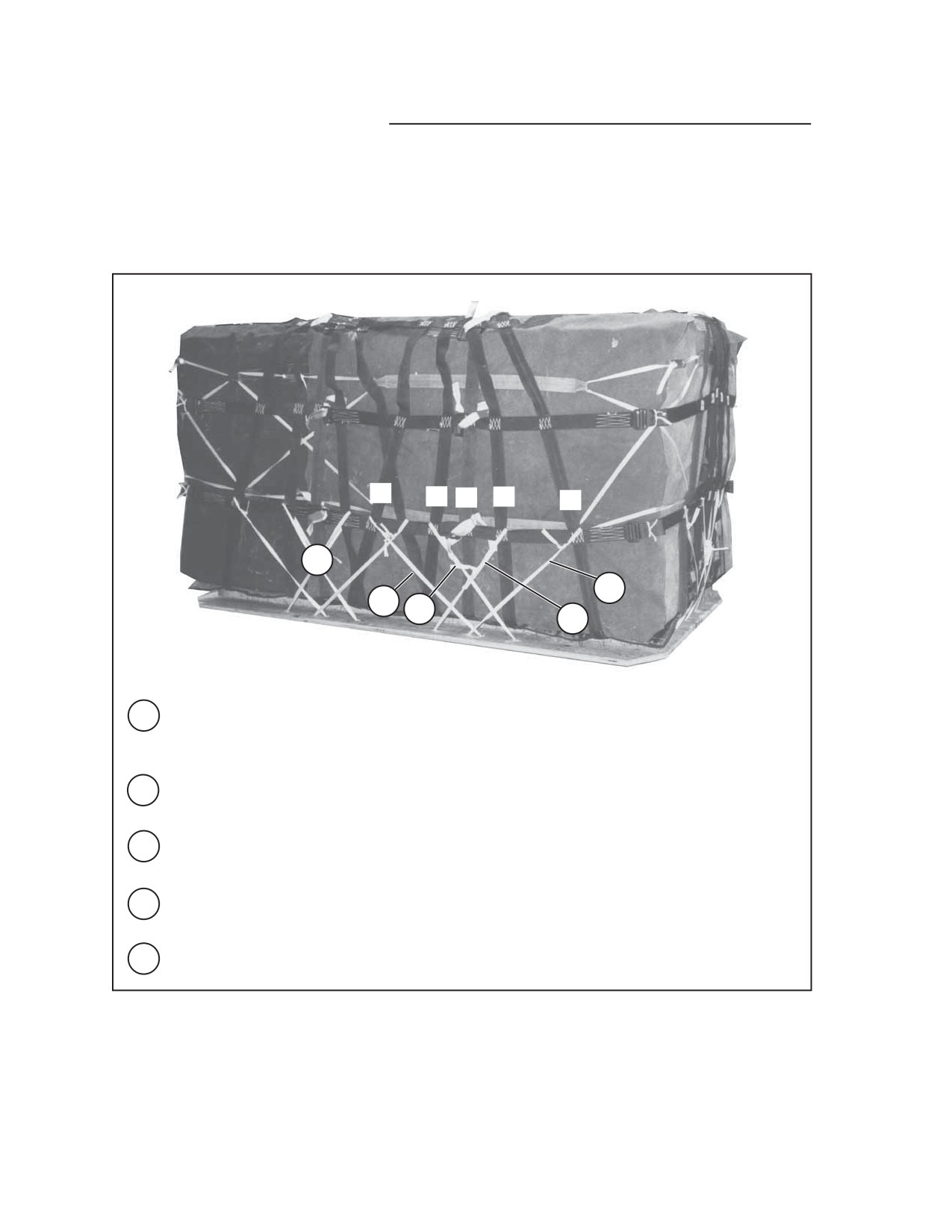
9-41. Secure the skid board ties as shown in Figure 9-29.
1
2
3
4
5
5
2
4
3
1
A
B
C
D
1 Starting at the front right side, take tie-down A and diagonally tie it around the inter
section of the lower lateral strap and fourth support web. Use three half-hitch knots
and an overhand knot in the running end.
2 Route tie-down B around the fifth support web and lower lateral strap intersection
diagonally. Pull the excess slack out and tie it with a trucker’s hitch knot.
3 Repeat step 1 for tie-down D and secure it to the second intersection on the lower lateral
strap.
4 Repeat step 2 for tie-down C and secure it to the first intersection on the lower lateral
strap.
5 Repeat steps 1 through 4 for the other five sets of tie-downs.
Figure 9-29. Skid Board Ties Secured
9-36
2 September 2005
FM 4-20.103/MCRP 4-11.3C/TO 13C7-1-11
INSTALLING SUSPENSION SLINGS
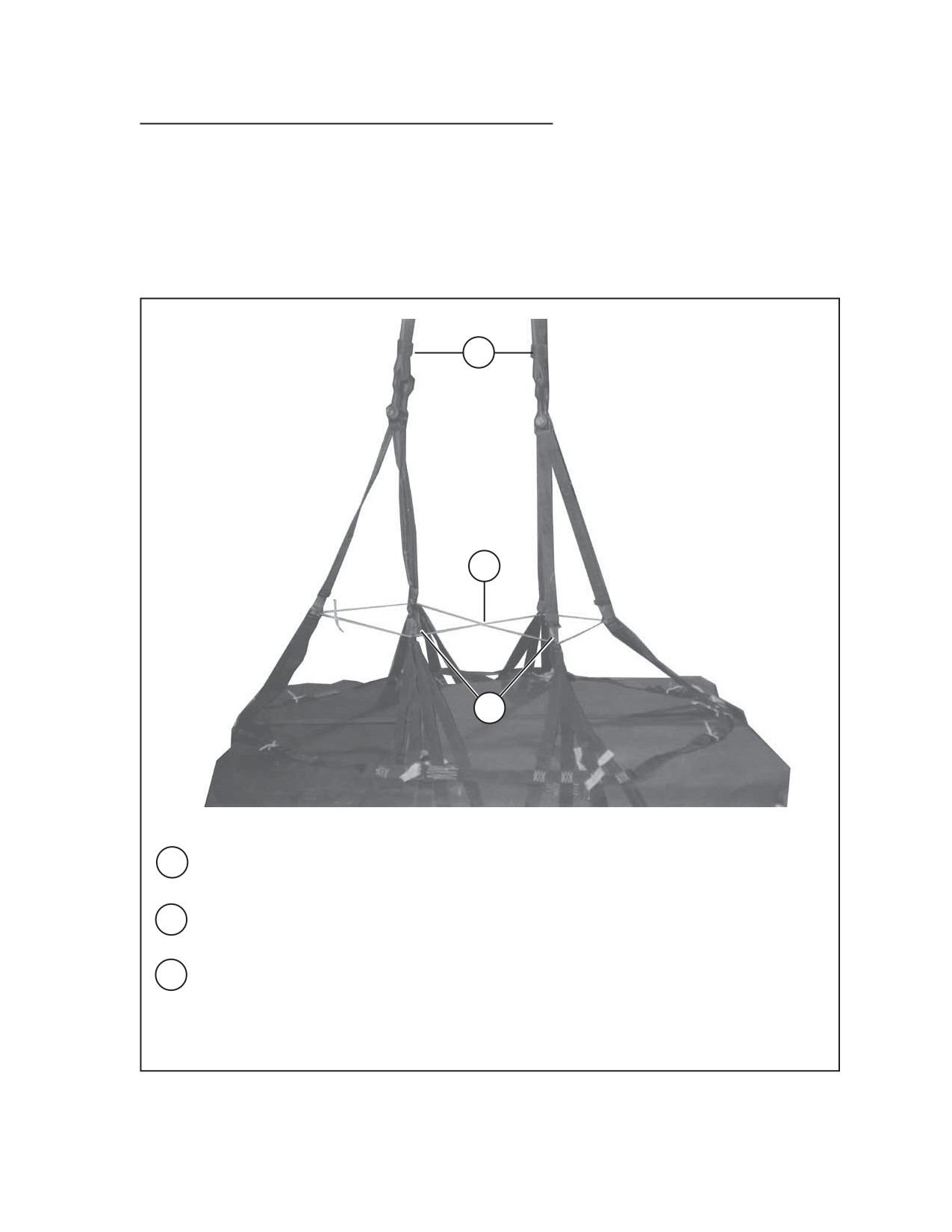
9-42. Install suspension slings using six suspension webs, two 3/4-inch cargo
suspension clevises, and two 3-foot (2-loop), type XXVI nylon webbing slings as
shown in Figure 9-30.
2
3
1
1
Attach one suspension web to each of the six D-rings. Route the snap hook from outside
to inside. Wrap each hook with masking tape.
2
Place a 3-foot sling on each clevis. Bolt the three suspension webs at the front of the
load to one clevis. Repeat step for the rear set.
3 Route a length of type III nylon cord through the six D-rings as shown above. Tie the
ends together. Make sure the tie has excess to allow suspension sling movement.
NOTE: After positioning the type III nylon cord, fold and tape the excess with masking
tape (not shown).
Figure 9-30. Suspension Slings Installed
2 September 2005
9-37
FM 4-20.103/MCRP 4-11.3C/TO 13C7-1-11
INSTALLING PARACHUTE
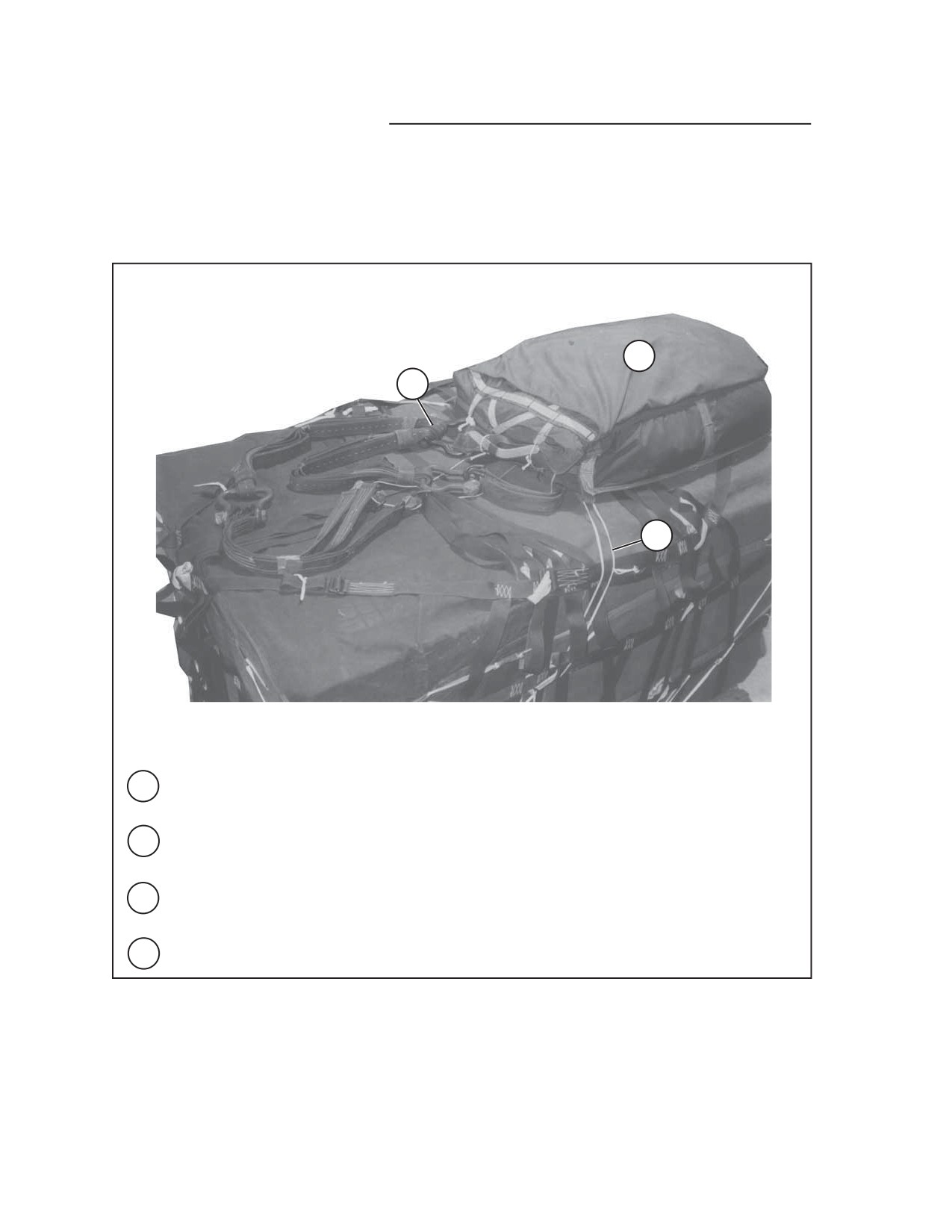
9-43. Install a G-12E cargo parachute as shown in Figure 9-31.
1
3
2
1
Place a G-12E cargo parachute on the load with the riser compartment up and the
bridle toward the front of the load. Position the parachute on the front of the load.
2
Tie each corner of the parachute to the sling assembly using type I, 1/4-inch cotton
webbing.
3
Bolt the two 3-foot slings to the parachute’s cargo suspension clevis. Make sure the
risers from the parachute are not removed from the clevis.
4 Fold and tape the excess sling with masking tape (not shown).
Figure 9-31. G-12E Cargo Parachute Installed
9-38
2 September 2005
FM 4-20.103/MCRP 4-11.3C/TO 13C7-1-11
MARKING RIGGED LOAD
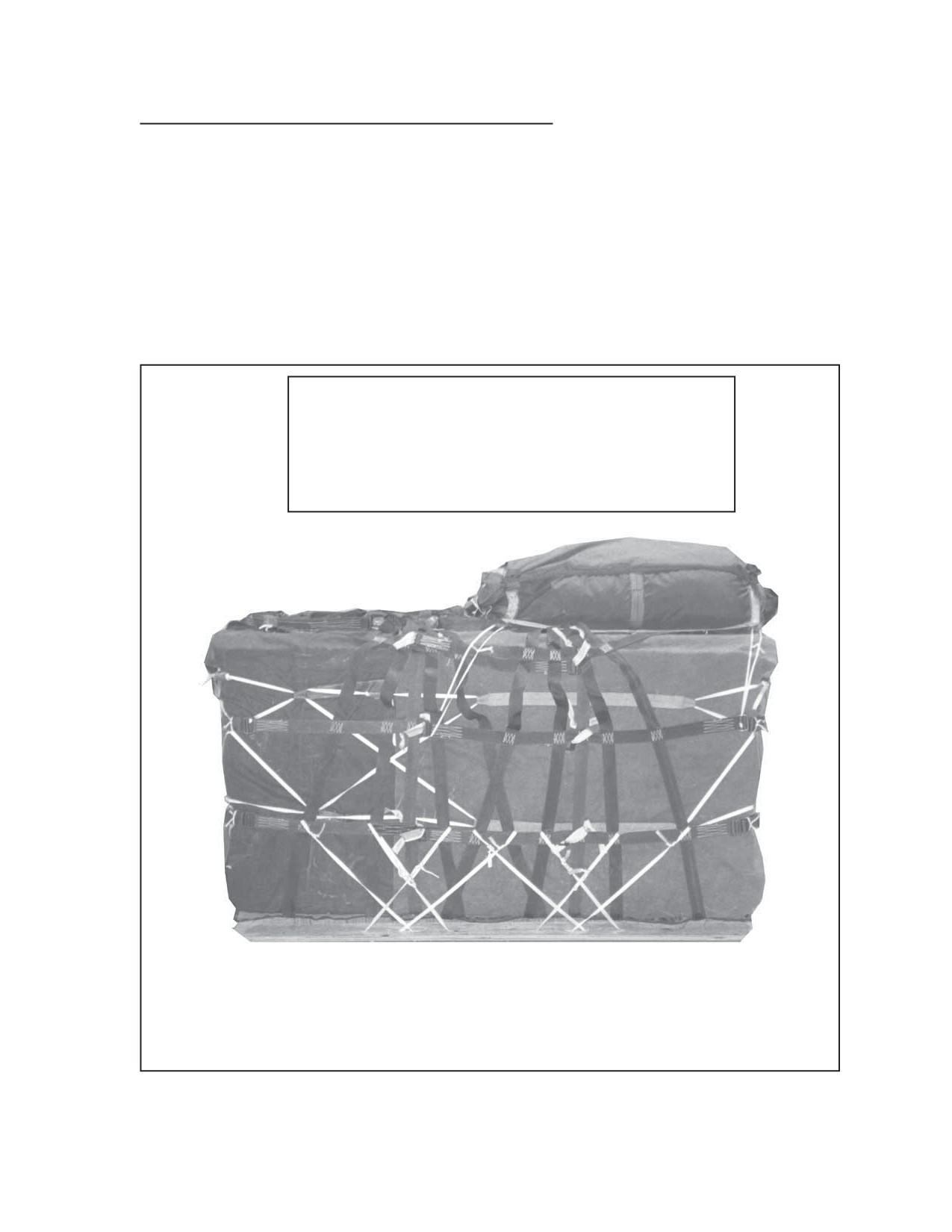
9-44. Mark the rigged load according to Chapter 1. Compute the rigged load
data.
EQUIPMENT REQUIRED
9-45. Use the equipment listed in Table 9-5 to rig the load shown in Figure 9
33.
CAUTION
Make the final rigger inspection required by FM 4-20.102/
NAVSEA SS400-AB-MMO-010/TO 13C7-1-5 and AR 59-
4/OPNAVINST 4630.24C/AFJ 13-210(I)/MCO 13480.1B
before the load leaves the ri
gging site.
RIGGING LOAD DATA (without parachute)
G-12E cargo parachute
675 - 2,200 pounds
Figure 9-32. Stretch A-22 Cargo Bag Rigged for Low-Velocity Airdrop
2 September 2005
9-39
FM 4-20.103/MCRP 4-11.3C/TO 13C7-1-11
Table 9-5. Equipment for Rigging Stretch A-22 Cargo Bag for Low-Velocity Airdrop
National Stock
Item
Quantity
Number
1670-00-587-3421
Bag, cargo, A-22
2
4030-00-678-8562
Clevis, suspension, 3/4-inch (medium)
2
4020-00-240-2146
Cord, nylon, type III
As required
1670-00-753-3928
Pad, energy-dissipating material, honeycomb
As required
Parachute
1670-01-065-3755
Cargo, G-12E
1
1670-00-216-7297
Pilot, 68-inch diameter
1
Ply wood:
5530-00-128-4981
3/4- by 48- by 96-inch
1 sheet
(locally fabricated skid board)
or
5530-00-914-5118
1- by 48- by 96-inch
1 sheet
1670-01-062-6301
Sling, cargo, airdrop, 3-foot (2-loop),
2
type XXVI nylon webbing
1670-00-368-7486
Strap, w ebbing, restraint (shear strap), 60-inch
1
7510-00-266-6710
Tape, masking, 2-inch
As required
8310-01-102-4478
Thread, cotton, ticket number 8/7
As required
Webbing:
8305-00-268-2411
Cotton, 1/4-inch, type I
As required
Nylon:
8305-00-082-5752
Tubular, 1/2-inch
As required
8305-00-263-3591
Type VIII, NT
As required
or
8305-00-268-2455
Tubular, 1-in, OD
As required
9-40
2 September 2005
FM 4-20.103/MCRP 4-11.3C/TO 13C7-1-11
Chapter 10
Rigging Petroleum Products
CAUTION
Make sure all petroleum products are packaged in POP
standard drums and cans.
DESCRIPTION OF LOAD
10-1. This chapter shows how to rig sample loads of petroleum products. They
will be rigged in an A-22 cargo bag. This chapter will show how to position the
load only. The container is rigged as a typical A-22 load and the parachute is
installed by normal procedures.
PREPARING SKID BOARD AND POSITIONING HONEYCOMB
10-2. Prepare the skid board and position the honeycomb according to
Chapter 9.
POSITIONING CONTAINER
10-3. Center the sling assembly on the honeycomb stack. If desired, a cover
may be used.
POSITIONING LOAD
10-4. Position the load as follows:
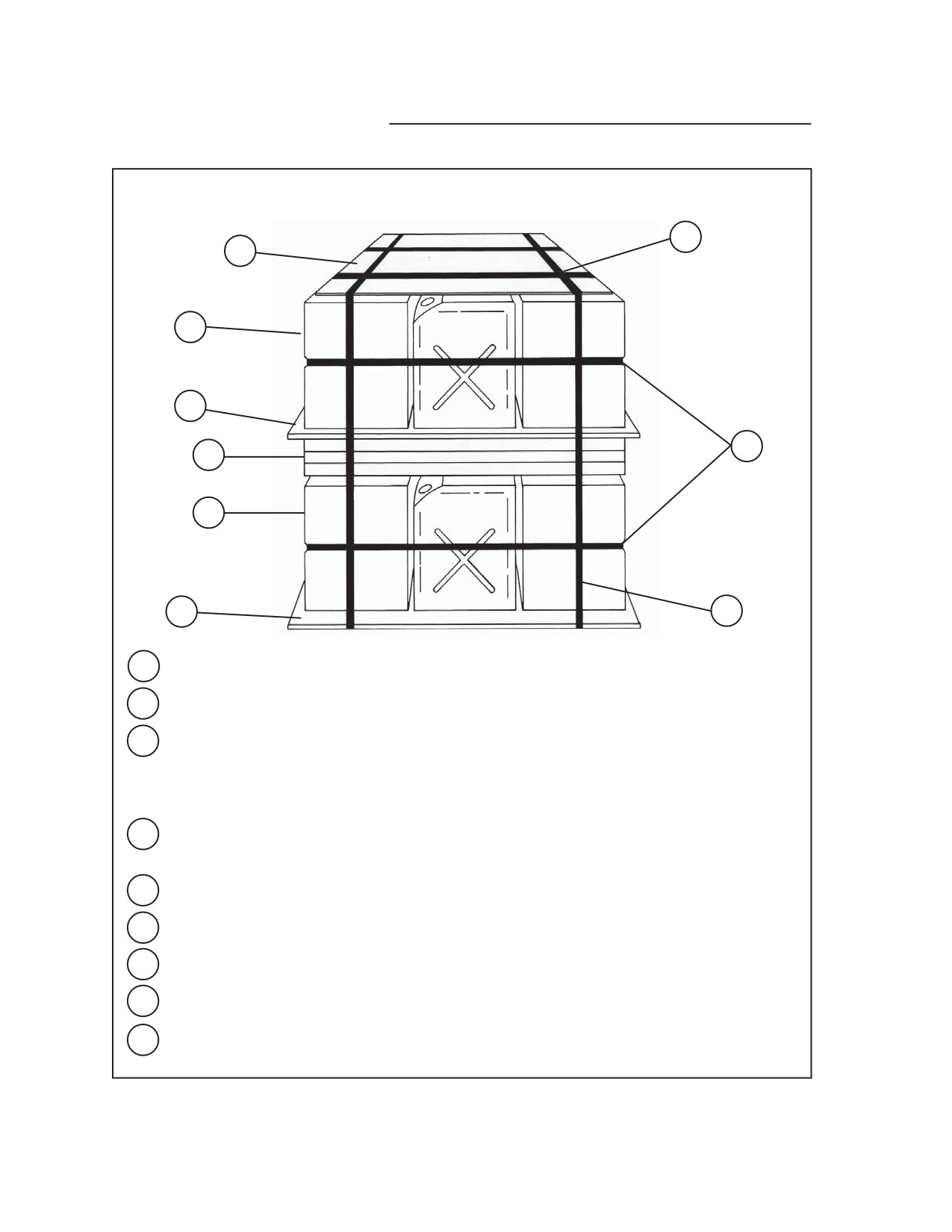
a. Use Figure 10-1 to position cases of oil.
b. Use Figure 10-2 to position 5-gallon drums.
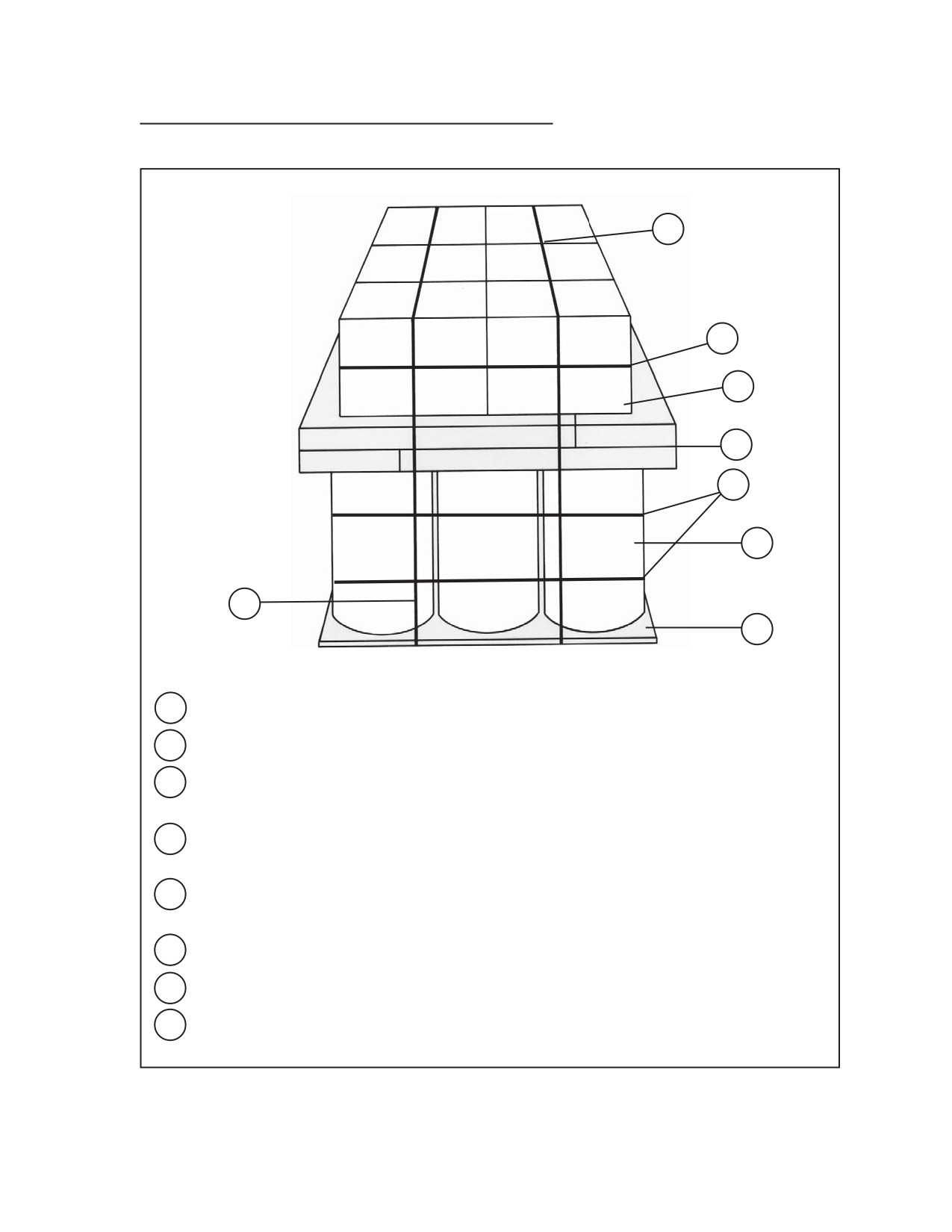
c. Use Figure 10-3 to position 5-gallon fuel cans.
d. Use Figure 10-4 to position 30-gallon grease drums and cases of oil.
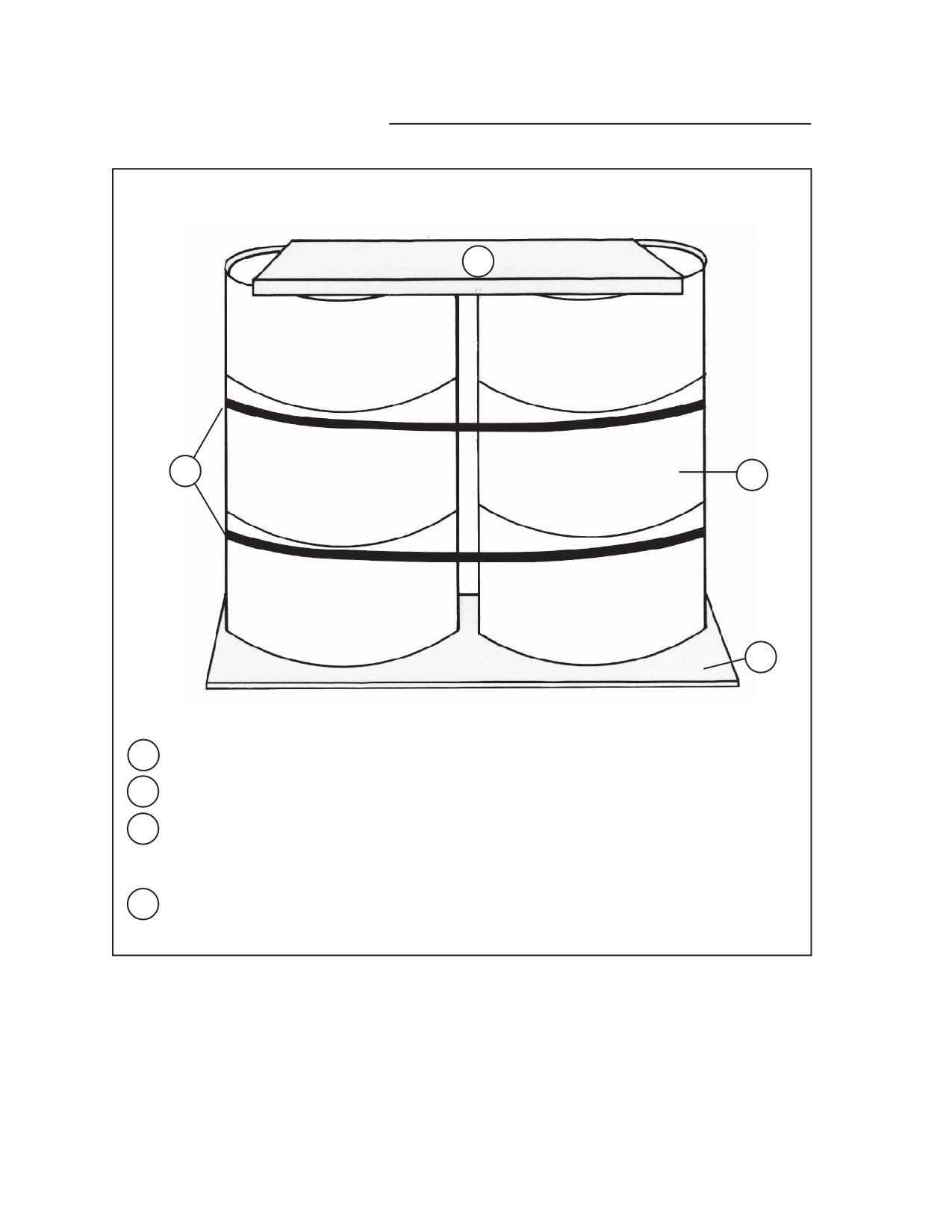
e. Use Figure 10-5 to position 55-gallon drums.
NOTES:
1. These procedures can be used to rig similar loads.
2. The load may consist of drums of oil, grease, fuel, or a combination.
2 September 2005
10-1
FM 4-20.103/MCRP 4-11.3C/TO 13C7-1-11
SECURING CONTAINER AND INSTALLING PARACHUTE
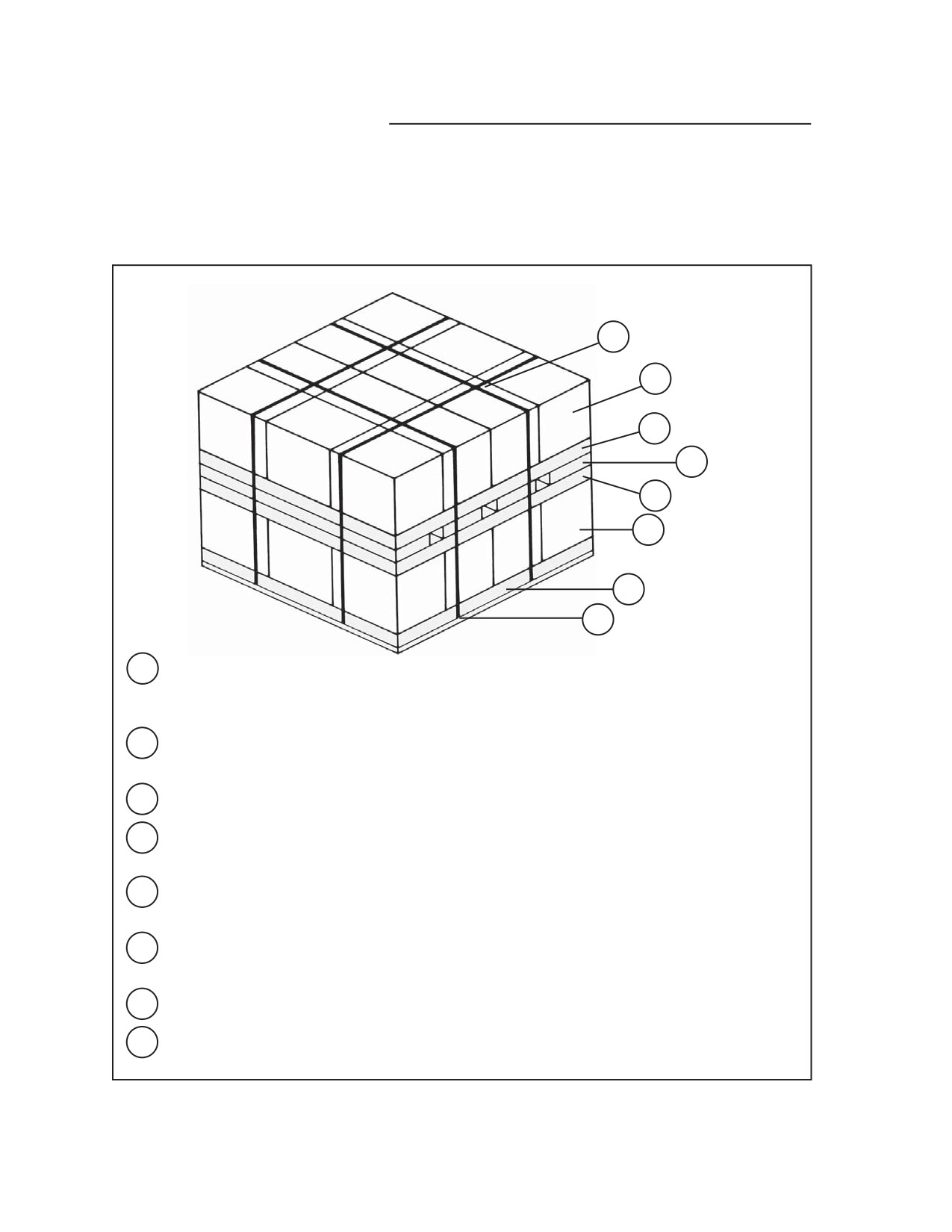
10-5. Secure the container according to Figures 9-4 through 9-7. Install a
G-12E cargo parachute according to Chapter 8.
NOTE: This drawing is not drawn to scale.
8
7
6
5
4
3
2
1
1
Use four 20-foot lengths of steel strapping. Lay two lengths side to side on top of the
container. Lay the other two lengths front to rear on top of the container. Adjust each
length so that it is 8 inches from the edge.
2
Center a 36- by 48-inch and a 12- by 48-inch piece of honeycomb side by side on top of
the container.
3
Place 12 cases of oil on top of the honeycomb.
4
Form the second layer of honeycomb as described in step 2 except alternate the pieces of
honeycomb.
5
Evenly space four 8- by 48-inch pieces of honeycomb on top of the second layer of honey
comb.
6
Form the fourth layer of honeycomb as described in step 2 except alternate the pieces of
honeycomb.
7
Position 12 cases of oil on top of the honeycomb.
8
Bind the steel strapping over the top of the load. Use four seals to secure each piece of
steel strapping. Cut off excess if necessary.
Figure 10-1. Cases of Oil Rigged
10-2
2 September 2005
FM 4-20.103/MCRP 4-11.3C/TO 13C7-1-11
EQUIPMENT REQUIRED
10-6. Use the equipment listed in Table 10-1 to rig the petroleum products.
However, the equipment will vary from load to load.
NOTE: This drawing is not drawn to scale.
9
8
6
5
4
7
3
2
1
1
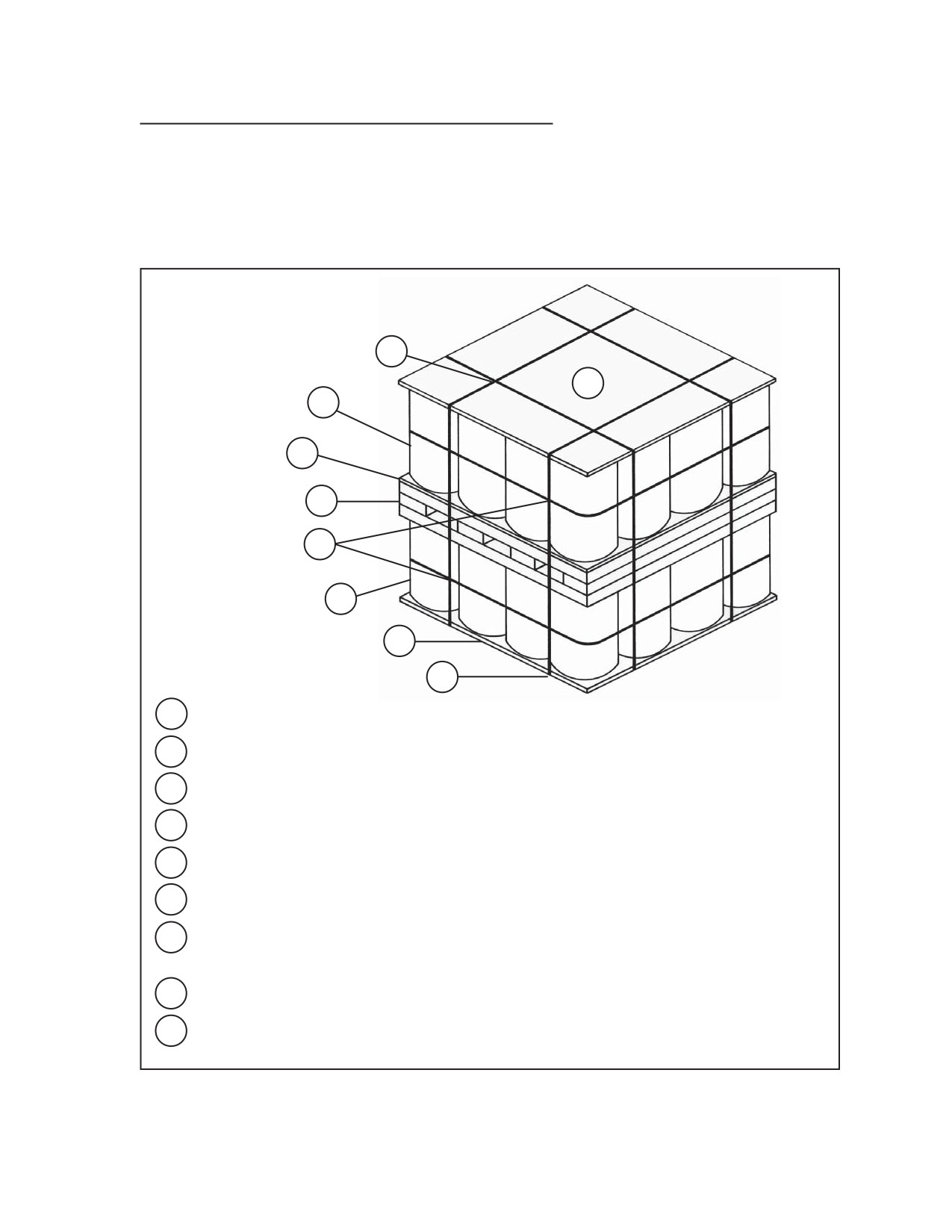
Repeat step 1 of Figure 10-1.
2
Center a 3/4- by 48- by 48-inch piece of plywood on top of the container.
3
Place sixteen 5-gallon drums on top of the plywood.
4
Repeat steps 4 through 6 of Figure 10-1 to form three layers of honeycomb.
5
Place a 3/4- by 48- by 48-inch piece of plywood on top of the honeycomb.
6
Position sixteen 5-gallon drums on top of the plywood.
7
Wrap a length of steel strapping around each layer of drums. Bind the strapping in
place.
8
Place a 3/4- by 45- by 45-inch piece of plywood on top of the load.
9
Bind the steel strapping over the top of the load. Use four seals to secure each piece of
steel strapping. Cut off excess if necessary. Pad the 5-gallon drums as necessary.
Figure 10-2. Five-Gallon Drums Rigged
2 September 2005
10-3
FM 4-20.103/MCRP 4-11.3C/TO 13C7-1-11
NOTE: This drawing is not drawn to scale.
9
8
6
5
7
4
3
2
1
1 Repeat step 1 of Figure 10-1.
2 Center a 3/4- by 48- by 48-inch piece of plywood on top of the container.
3 Position 21 cans on top of the plywood (three rows wide and seven in each row). Wrap
every other can with cellulose wadding or cardboard sheets.
NOTE: Make sure the 5-gallon cans are filled not more than 1-inch below filler threads.
4 Position three layers of honeycomb. Use a 36- by 48-inch and a 12- by 48-inch piece of
honeycomb in each layer. Alternate the pieces of honeycomb in each layer.
5 Lay a 3/4- by 48- by 48-inch piece of plywood on top of the honeycomb layers.
6 Repeat step 3.
7 Wrap a length of steel strapping around each layer of cans. Bind the stapping in place.
8 Place a 3/4- by 44- by 44-inch piece of plywood on top of the load.
9 Bind the steel strapping over the top of the load. Use four seals to secure each piece of
steel strapping. Cut off excess if necessary. Pad the 5-gallon cans as necessary.
Figure 10-3. Five-Gallon Fuel Cans Rigged
10-4
2 September 2005
FM 4-20.103/MCRP 4-11.3C/TO 13C7-1-11
NOTE: This drawing is not drawn to scale.
8
7
6
5
4
3
1
2
1
Repeat step 1 of Figure 10-1.
2
Center a 3/4- by 48- by 48-inch piece of plywood on top of the container.
3
Place nine 30-gallon drums on top of the plywood. Pad the 30-gallon drums as
necessary.
4
Evenly space two 18-foot lengths of steel strapping around the drums. Bind the
strapping in place.
5
Position two layers of honeycomb. Use a 36- by 48-inch and a 12- by 48-inch piece of
honeycomb in each layer. Alternate the pieces of honeycomb in each layer.
6
Place six cases of oil on top of honeycomb.
7
Wrap a length of steel strapping around the cases. Bind the strapping in place.
8 Bind the steel strapping over the top of the load. Use four seals to secure each piece of
steel strapping. Cut off excess if necessary.
Figure 10-4. Thirty-Gallon Grease Drums and Cases of Oil Rigged
2 September 2005
10-5
FM 4-20.103/MCRP 4-11.3C/TO 13C7-1-11
NOTE: This drawing is not drawn to scale.
4
3
2
1
1 Center a 3/4- by 48- by 48-inch piece of plywood on top of the container.
2 Place four 55-gallon drums on top of the plywood.
3 Wrap two 16-foot lengths of 1/2-inch tubular nylon webbing around the drums. Make
sure each length is just above the grooves on the drums. Secure each length of webbing
together using a trucker’s hitch knot.
4 Center a 3/4- by 36- by 36-inch piece of plywood on top of the load.
Figure 10-5. Fifty-Five Gallon Drums Rigged
10-6
2 September 2005
FM 4-20.103/MCRP 4-11.3C/TO 13C7-1-11
Table 10-1. Equipment Required for Rigging Petroleum Products in an A-22 Cargo Bag
National Stock
Item
Quantity
Number
8040-00-273-8713
Adhesive, paste, 1-gallon
As required
1670-00-587-3421
Bag, cargo, A-22
1
4020-00-240-2146
Cord, nylon, type III
As required
8135-00-664-6958
Cushioning material, packaging, cellulose
As required
wadding
1670-00-753-3928
Pad, energy-dissipating material, honeycomb
As required
Parachute
1670-00-065-3755
G-12E
1
1670-00-872-6109
High-velocity, 26-foot
1
Ply wood:
5530-00-129-7777
1/2- by 48- by 96-inch
As required
5530-00-128-4981
3/4- by 48- by 96-inch
As required
1670-00-883-1654
Skid, cargo bag, platform, ply wood
1
8135-00-283-0667
Strapping, steel, 5/8-inch
As required
7510-00-266-6710
Tape, masking, 2-inch
As required
8310-01-102-4478
Thread, cotton, ticket number 8/7
As required
Webbing:
8305-00-268-2411
Cotton, 1/4-inch, type I
As required
8305-00-082-5752
Nylon, tubular, 1/2-inch
As required
2 September 2005
10-7
FM 4-20.103/MCRP 4-11.3C/TO 13C7-1-11
Chapter 11
Rigging Specific Double A-22 Loads
SECTION I - RIGGING SNOWMOBILE
DESCRIPTION OF LOAD
11-1. The snowmobile is rigged in a double A-22 cargo bag for low-velocity
airdrop. The load requires one G-12E cargo parachute equipped with a 68-inch
pilot parachute. The snowmobile is 118 inches in length, reducible to 104 inches.
Its width is 36 inches. The height of the snowmobile is 49 inches, reducible to
47 inches. Twenty cases of rations are rigged with the snowmobile.
PREPARING SKID BOARD
11-2. Prepare the standard double A-22 skid board as shown in Figures 9-12
and 9-13. Form two honeycomb layers using one 36- by 92-inch and one 8- by
92-inch piece of honeycomb to form each layer. Alternate the pieces of honeycomb
in each layer.
POSITIONING CONTAINER
11-3. Position two A-22 cargo bags as shown in Figures 9-14 and 9-15.
POSITIONING HONEYCOMB
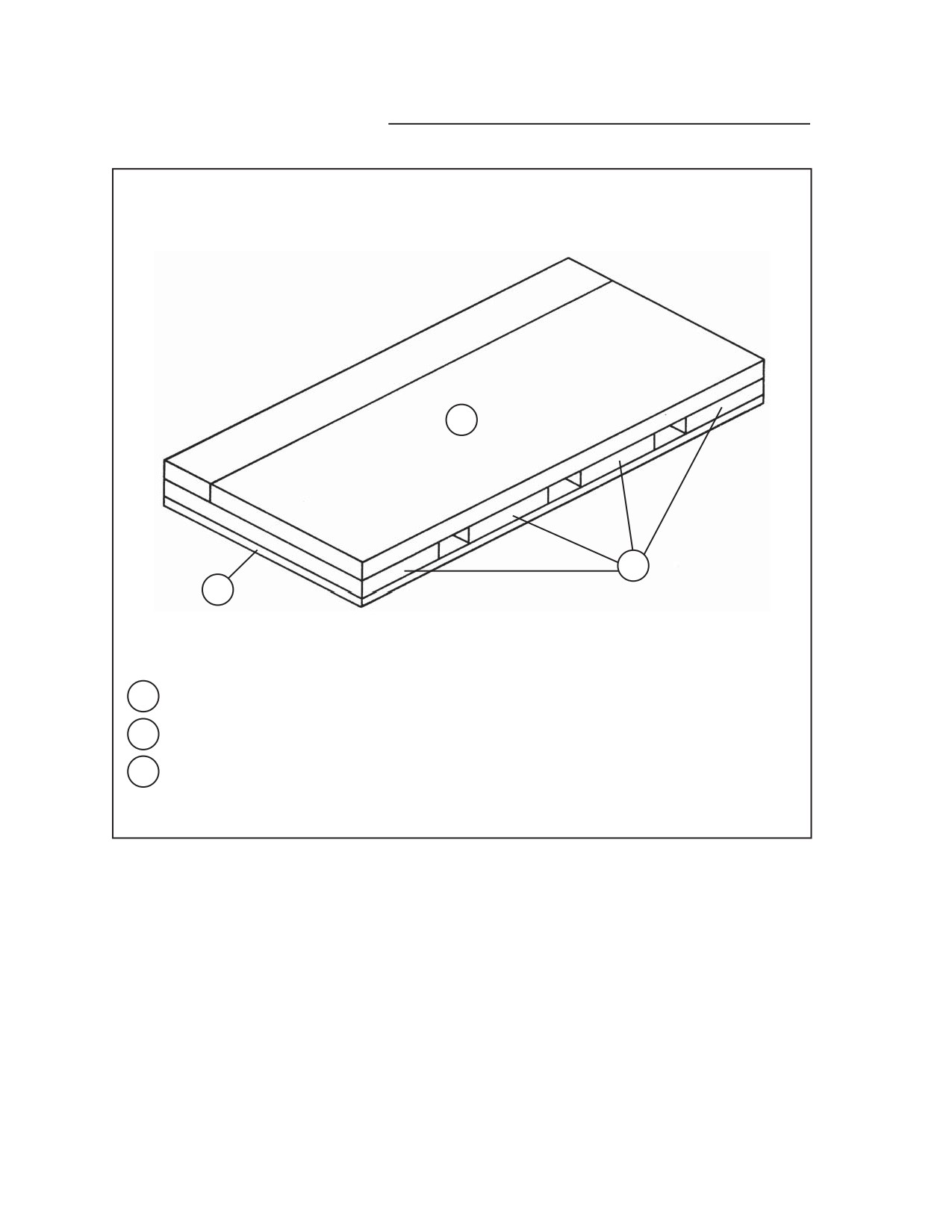
11-4. Position the honeycomb as shown in Figure 11-1.
NOTE: Various models of snowmobiles differ slightly and may require a modification
to procedures.
2 September 2005
11-1
FM 4-20.103/MCRP 4-11.3C/TO 13C7-1-11
NOTE: This drawing is not drawn to scale.
3
2
1
1
Center a 3/4- by 48- by 96-inch piece of plywood on top of the cover.
2
Evenly space four 18- by 48-inch pieces of honeycomb on top of the plywood.
3 Place a 36- by 96-inch and a 12- by 96-inch piece of honeycomb on top of the first layer of
honeycomb.
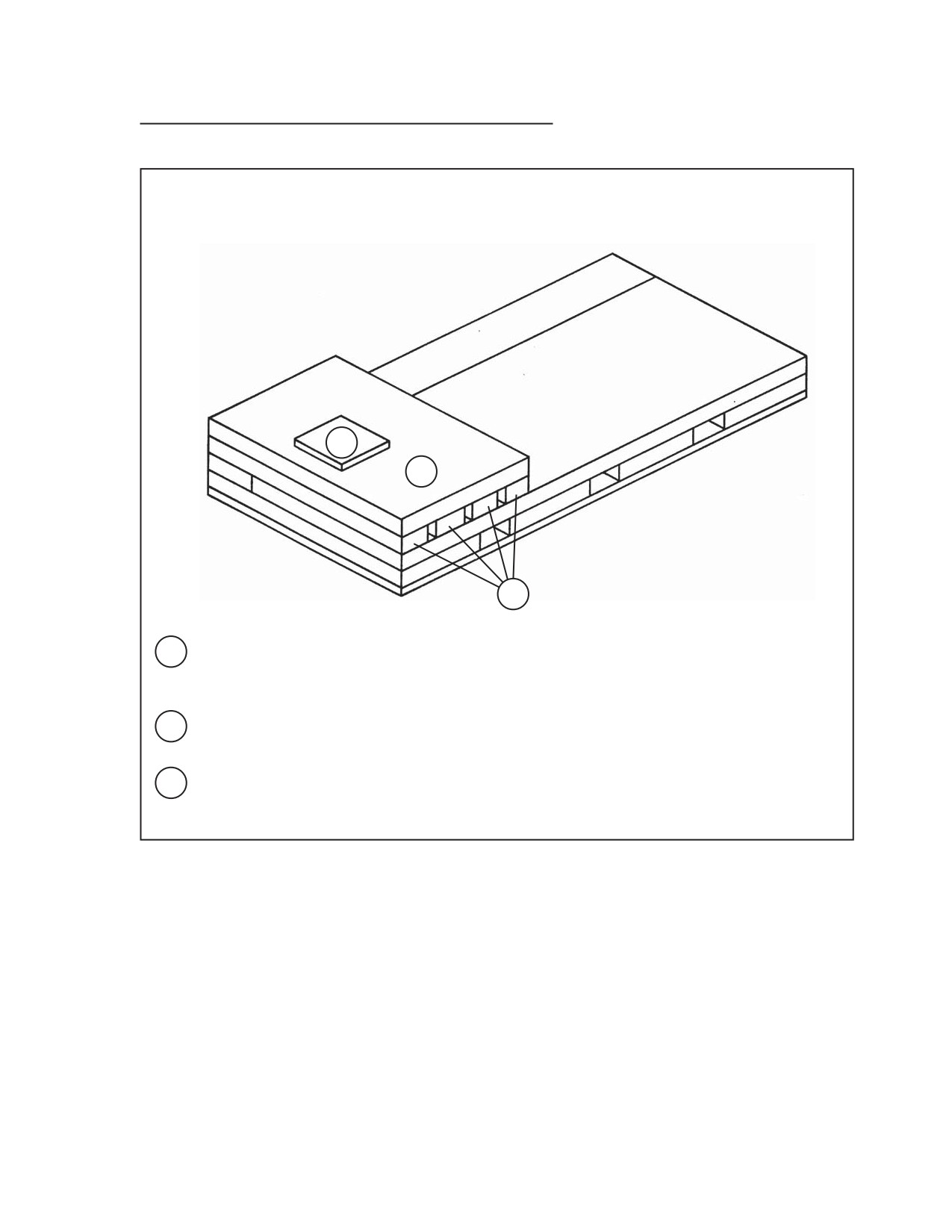
Figure 11-1. Honeycomb Positioned
11-2
2 September 2005
FM 4-20.103/MCRP 4-11.3C/TO 13C7-1-11
NOTE: This drawing is not drawn to scale.
6
5
4
4
Cut four 6- by 48-inch pieces of honeycomb. Place one piece flush with the rear edge of
the second layer of honeycomb. Place the remaining three pieces 2 inches apart from
each other.
5
Place a 30- by 48-inch piece of honeycomb flush with the rear edge of the third layer of
honeycomb.
6 Center a 3/4- by 12- by 12-inch piece of plywood 8 inches from the rear on top of the
fourth layer of honeycomb.
Figure 11-1. Honeycomb Positioned (Continued)
2 September 2005
11-3