FM 4-20.103 AIRDROP OF SUPPLIES AND EQUIPMENT: RIGGING CONTAINERS (September 2005) - page 2
FM 4-20.103/MCRP 4-11.3C/TO 13C7-1-11
2
4
3
1
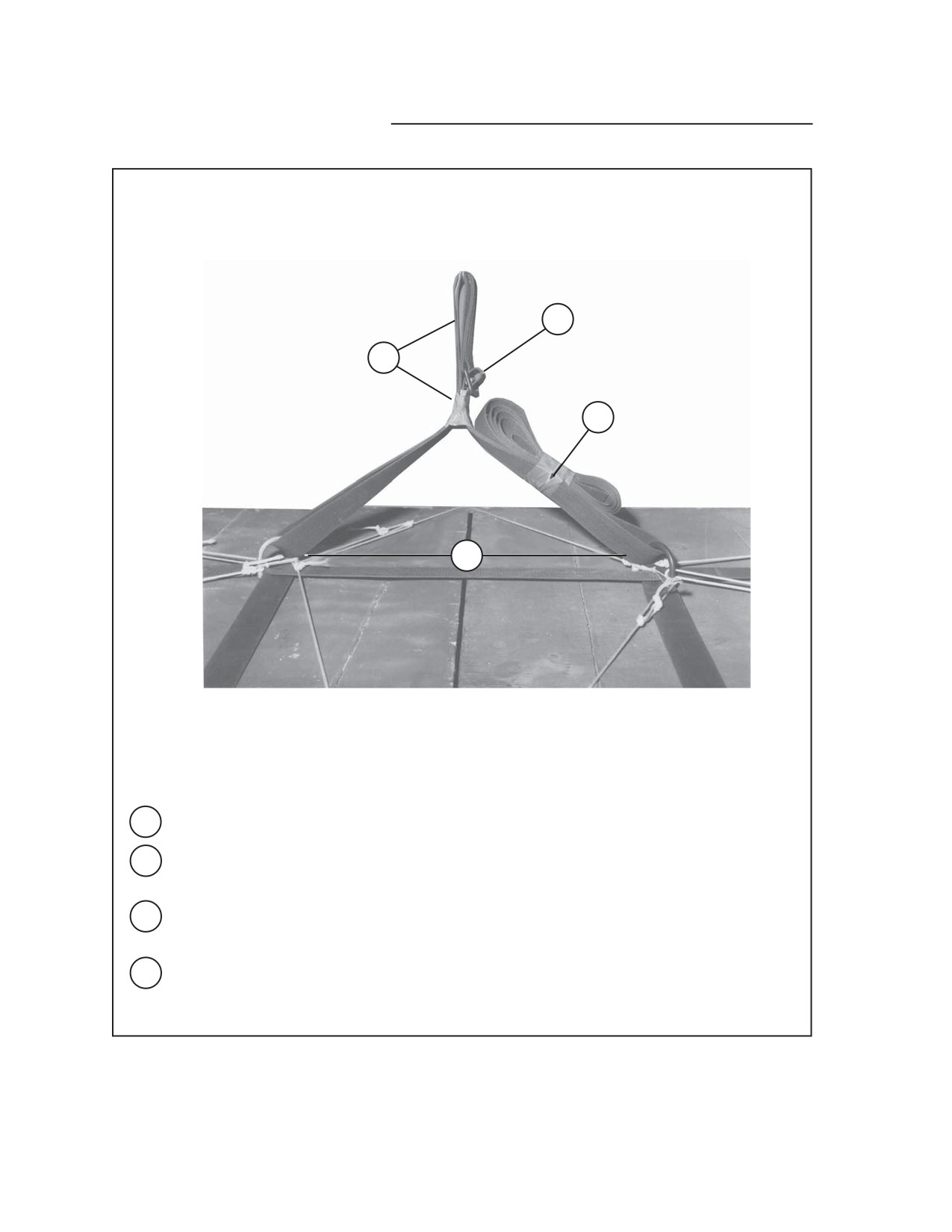
1 Pass the free end of an A-7A strap through the two D-rings on top of the load.
2 Fasten the strap with the friction adapter. Pull the end of the strap through the friction
adapter until the double length of the strap is 24 inches long.
3 Fold the excess strap. Secure the folds to the strap with tape or type I, 1/4-inch cotton
webbing.
4
Pull the two plies of the strap upward. Form a 6-inch loop in the center of the strap and
tape the plies of the strap together below the loop.
Figure 3-7. One 15-Foot Cargo Extraction Parachute Installed
3-14
2 September 2005
FM 4-20.103/MCRP 4-11.3C/TO 13C7-1-11
6
5
7
5
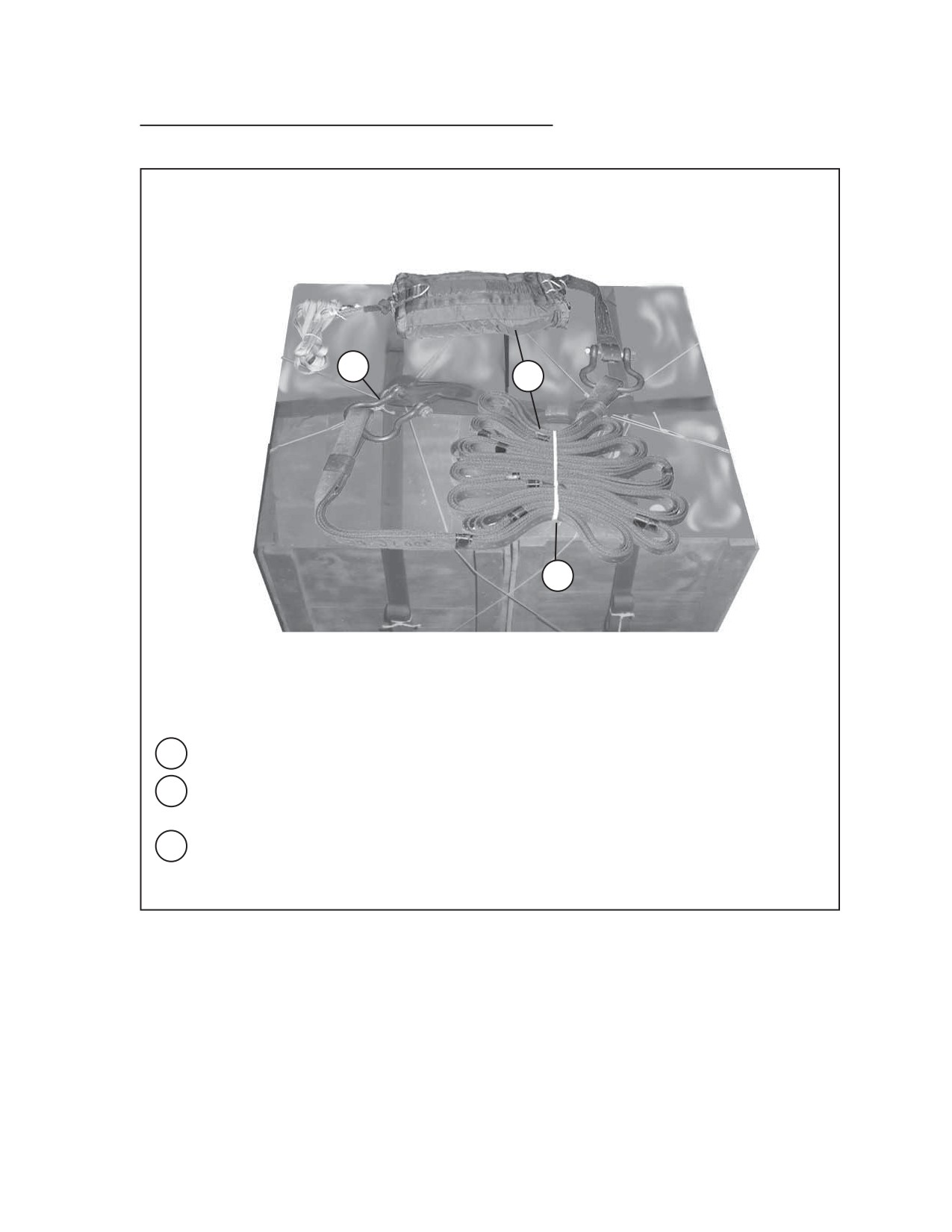
Place the modified 15-foot cargo parachute and the 20-foot sling on top of the load.
6
Place the loop formed in step 4 on the bolt of the cargo suspension clevis on the end of
the 20-foot sling. Replace the nut.
7 Fold the 20-foot sling and tie the fold in place with suitable lengths of type I, 1/4-inch
cotton webbing.
Figure 3-7. One 15-Foot Cargo Extraction Parachute Installed (Continued)
2 September 2005
3-15
FM 4-20.103/MCRP 4-11.3C/TO 13C7-1-11
9
8
10
11
8
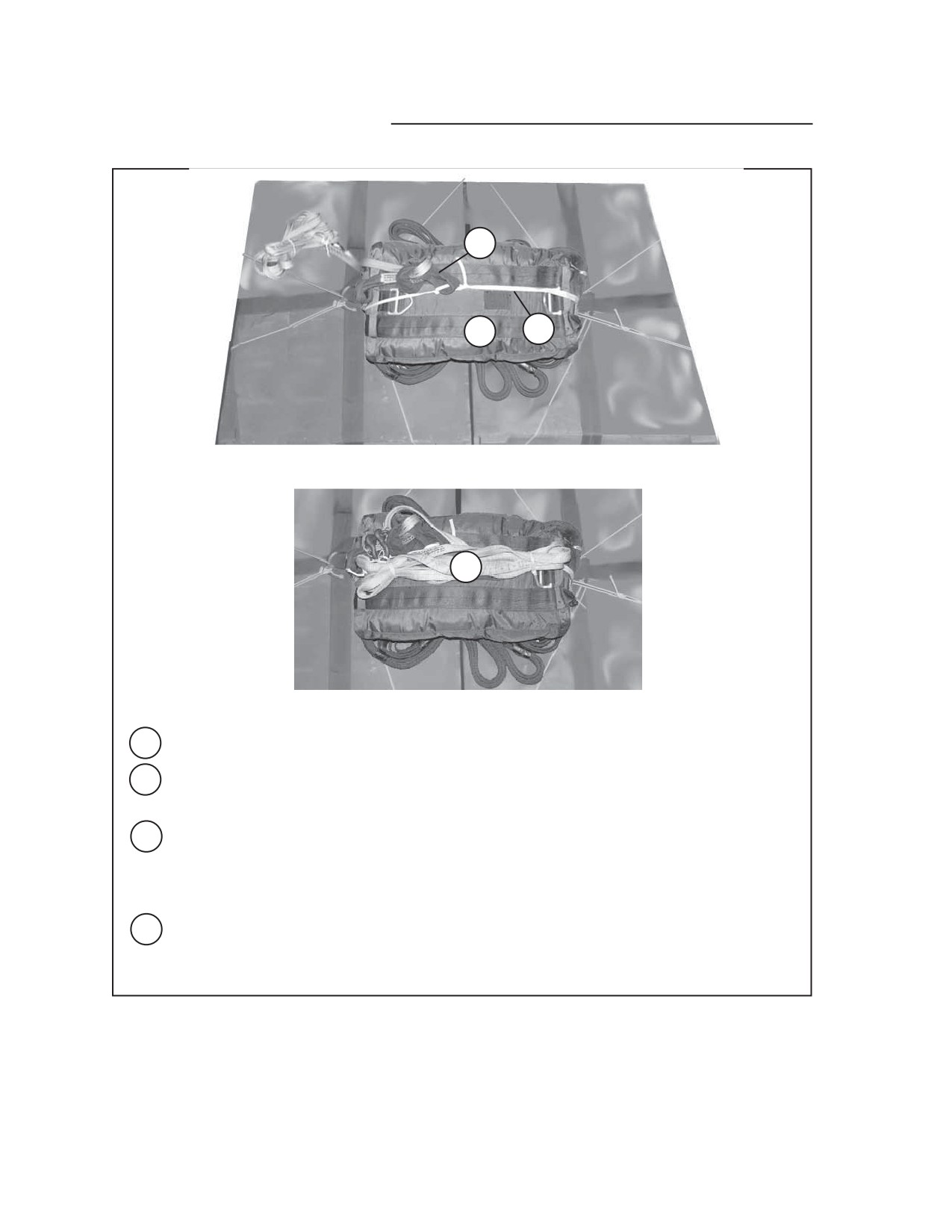
Center the sling and the parachute on the load.
9
Form a 3-inch diameter loop in the static line by tying an overhand knot approximately
12 inches up from the deployment bag main strap attaching loop.
Tie one end of a length of type I, 1/4-inch cotton webbing to a convenient point on the
10
load on the top of the load. Route the free end of the cotton webbing through the retain-
ing loop, through the loop in static line and around a convenient point on the load.
Form a trucker’s hitch knot to secure the parachute.
11 Attach a 2-inch retainer band to each bent V-ring and S-fold the static line to the bent
V-rings.
Figure 3-7. One 15-Foot Cargo Extraction Parachute Installed (Continued)
3-16
2 September 2005
FM 4-20.103/MCRP 4-11.3C/TO 13C7-1-11
MODIFYING THE T-10 PARACHUTE
3-5. The T-10 personnel parachute may be used as the recovery parachute on
container loads weighing at least 90 pounds but not more than 500 pounds.
However, the T-10 parachute must be modified to be used on container loads.
Prepare the T-10 parachute as described below:
a. Inspect the parachute according to TM 10-1670-293-23&P/TO 14D1-2-
467-2.
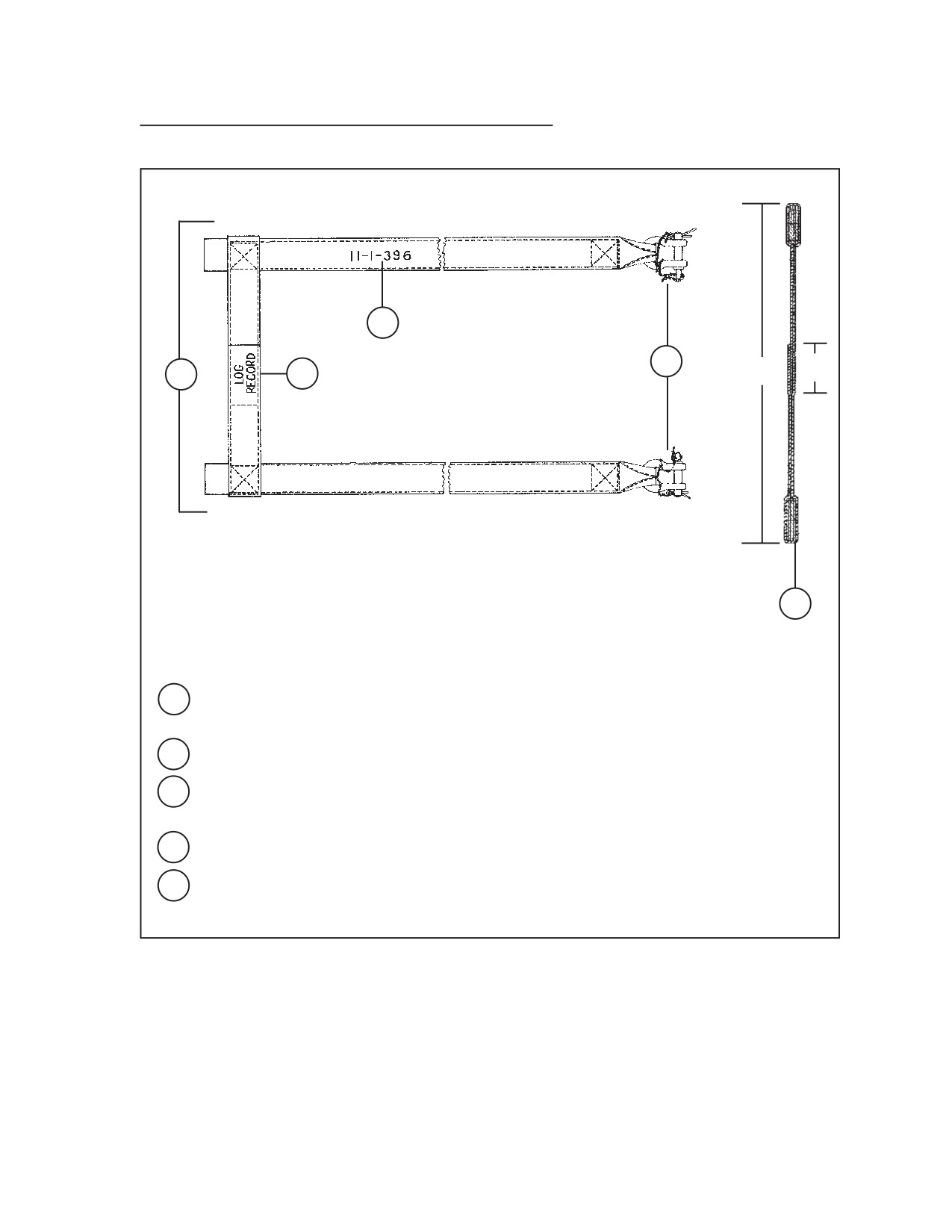
b. Construct the riser harness as shown in Figure 3-8.
c. Modify the deployment bag and universal static line (USL) as shown in
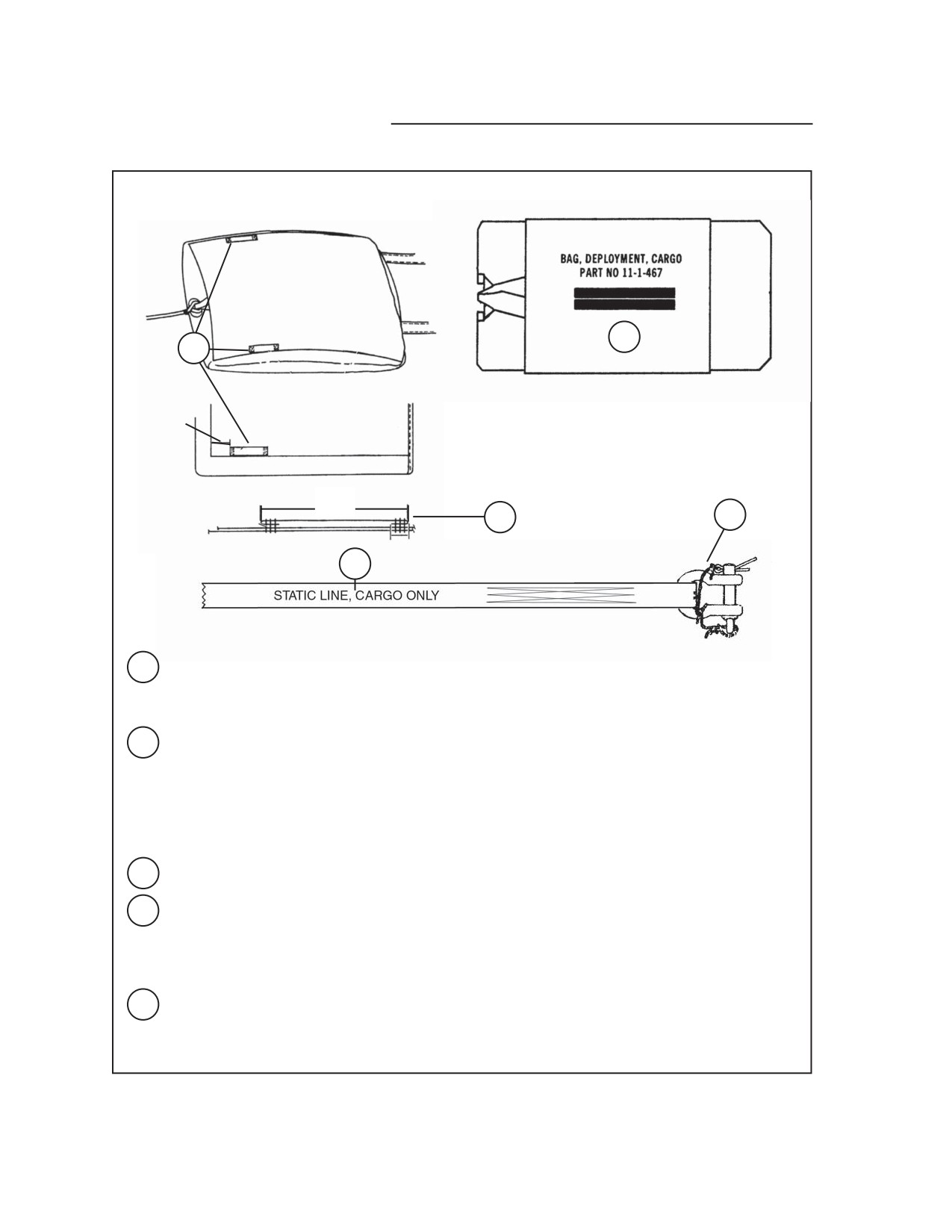
Figure 3-9.
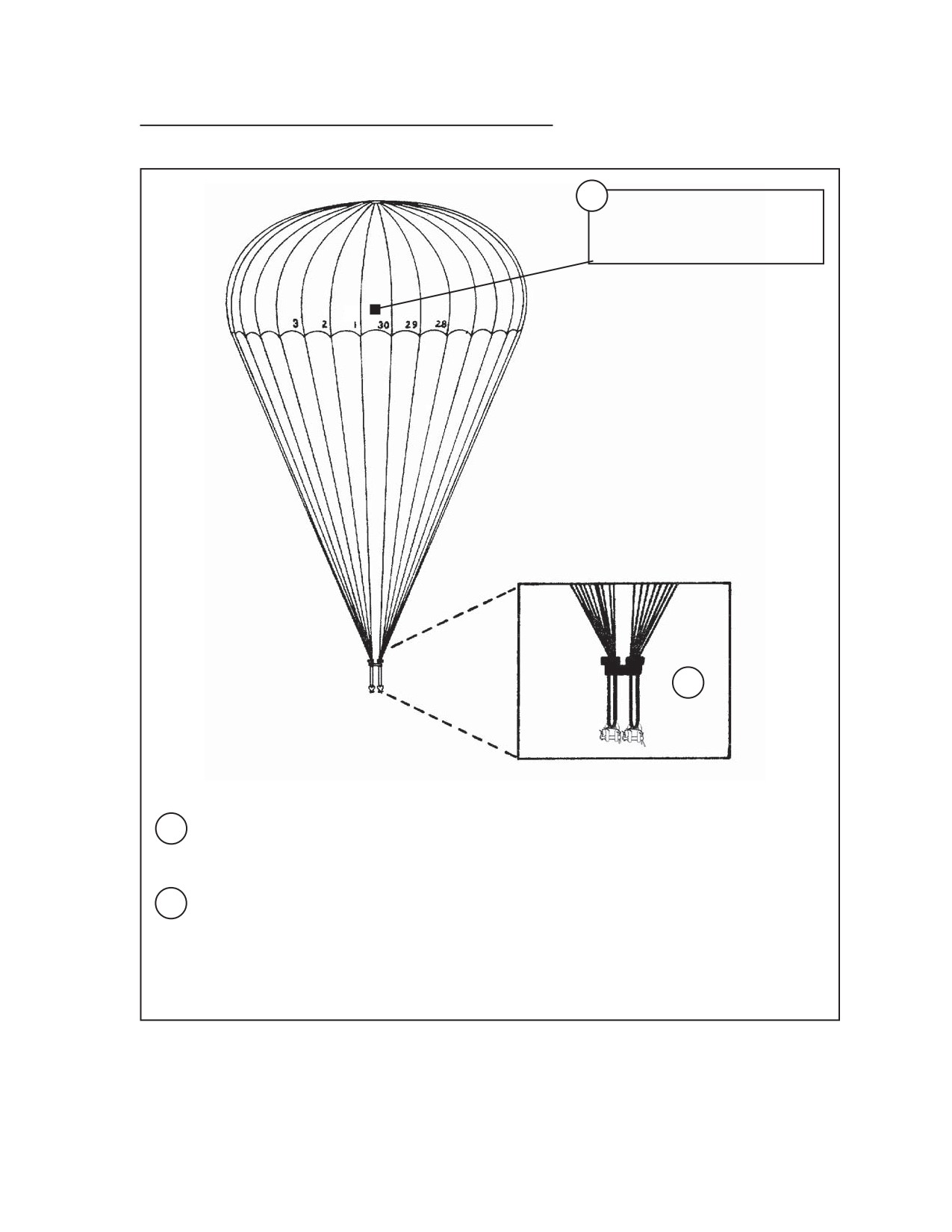
d. Modify the canopy and attach the risers as shown in Figure 3-10.
e. Pack the parachute according to TM 10-1670-293-23&P/TO 14D1-2-467-
2.
f.
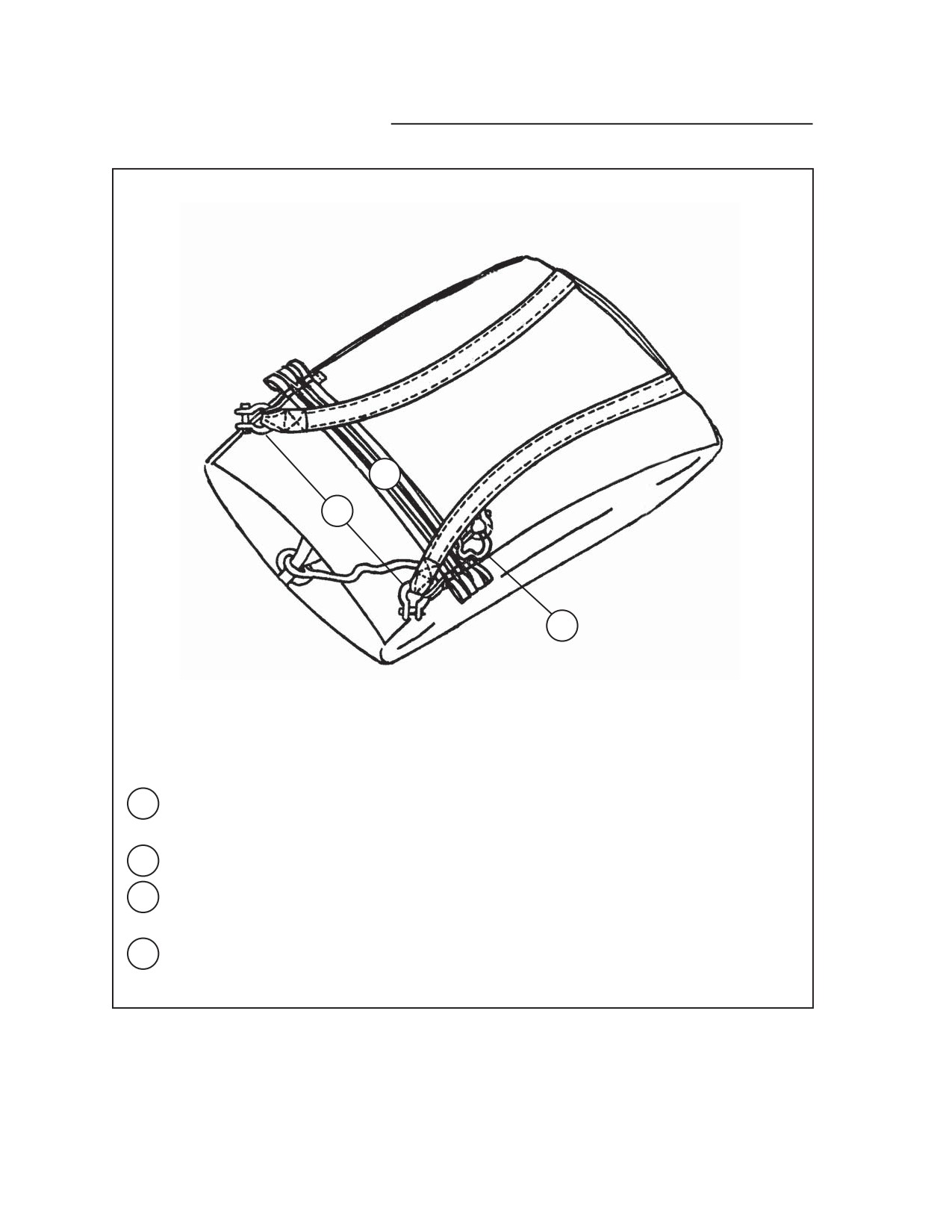
Fold and secure the static line as shown in Figure 3-11.
g. Required equipment to modify the T-10 parachute is shown in Table
3-2.
2 September 2005
3-17
FM 4-20.103/MCRP 4-11.3C/TO 13C7-1-11
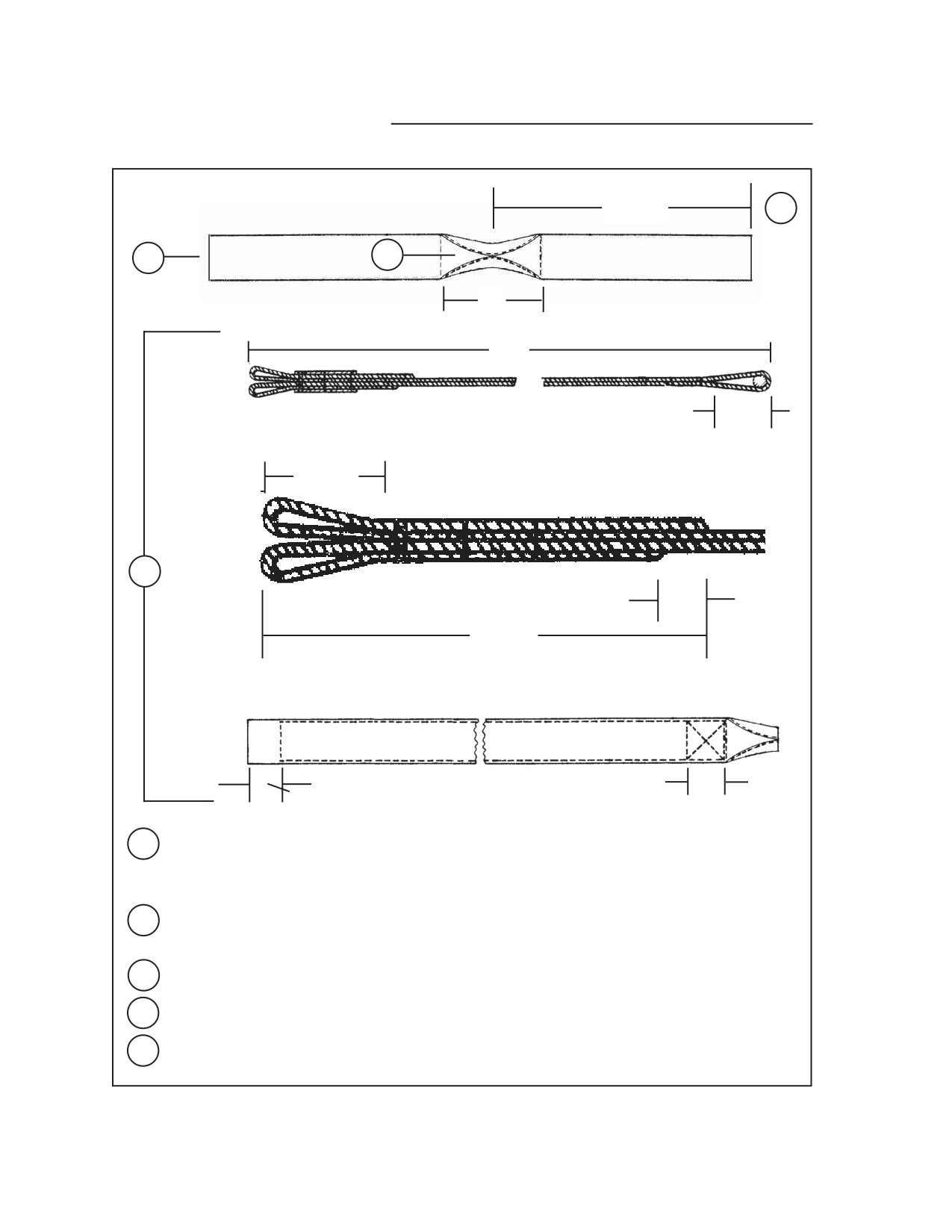
NOTES:
1.
All dimensions are in inches.
2. This drawing is not drawn to scale.
35 1/2
2
1
3
4
30
2
1 1/4
4
1/2
6 1/2
1 1/2
1 1/4
1 Construct a T-10 cargo parachute riser as shown above using a 72-inch piece of type
VIII nylon webbing and size 3 nylon thread. All stitching is 1/8-inch from the edge and
7 to 11 stitches per inch.
2 Mark the type VIII nylon webbing at 35 1/2 inches. Roll 2 inches of the webbing edges
in to the center of the webbing width on either side of the mark.
3 Secure each rolled edge with a 4-inch long row of stitching.
4 Fabricate the riser according to the dimensions above.
5 Repeat steps 1 and 4.
Figure 3-8. T-10 Cargo Riser Assembly Constructed
3-18
2 September 2005
FM 4-20.103/MCRP 4-11.3C/TO 13C7-1-11
NOTES: 1. All dimensions are in inches.
2. This drawing is not drawn to scale.
10
9
15
2
7
8
6
6 Construct the spreader web using a 34-inch piece of type VIII nylon webbing and size 3
nylon thread as shown in the diagram above.
7 Form the T-10 cargo parachute riser assembly as shown in the diagram above.
8 Attach a log record book pocket in the center of the spreader web. Attach the prepared
log record book to the spreader web pocket.
9 Attach two G-14 clevises to the riser assembly.
10 Stencil part number on riser assembly using strata blue parachute ink.
Figure 3-8. T-10 Cargo Riser Assembly Constructed (Continued)
2 September 2005
3-19
FM 4-20.103/MCRP 4-11.3C/TO 13C7-1-11
NOTES:
1.
All dimensions are in inches.
2. This drawing is not drawn to scale.
1
5
3
4
5
3
2
1 Cover or black out the data block on the deployment bag flap. Stencil on the bag flap
with strata blue parachute ink as close to the original lettering the following: BAG,
DEPLOYMENT, CARGO. PART NO 11-1-467, as shown above.
2 On the USL, stencil STATIC LINE, CARGO, 1 inch below the stitching on G-14 clevis
attaching loop. The lettering must be done with 1/2-inch high lettering using strata
blue parachute ink.
NOTE: The USL extension must also be stenciled in accordance with step 2 for the C
17 aircraft.
3 Attach a G-14 clevis to the USL.
4 Cut a 5-inch length of 1-inch type II cotton webbing and wax the ends (not shown).
NOTE: If 1-inch type II cotton webbing is not available, 1-inch type III nylon webbing
may be substituted.
5 Make a 1/2-inch turn-under on each end of the webbing and position the webbing as
shown with the turn-ends facing down. Secure the strap by making three rows of
stitching across each strap end according to TM 10-1670-276-23&P/ TO 13C5-29-2 and
TM 10-1670-201-23/TO 13C-1-41/NAVAIR 13-1-17.
Figure 3-9. T-10 Cargo Deployment Bag and USL Modified
3-20
2 September 2005
FM 4-20.103/MCRP 4-11.3C/TO 13C7-1-11
NOTE: This drawing is not drawn to scale.
1
CANOPY, CARGO, NYLON
PART NUMBER 11-1-466
2
1 Cover or black out the data block, except serial number, on gore numbers 1 and 15 of
the parachute canopy. Stencil on the canopy as close as possible to the original lettering
the following, CANOPY, CARGO, NYLON, PART NUMBER 11-1-466.
2 Remove the personnel harness from the T-10 parachute and attach the riser harness
using L-bar connector links. Attach suspension lines 1 through 8 to the left front riser
loop. Attach suspension lines 9 through 15 to the left rear riser loop. Attach suspension
lines 16 through 22 to the right rear riser loop. Attach suspension lines 23 through 30
to the right front riser loop.
Figure 3-10. T-10 Cargo Parachute Modified
2 September 2005
3-21
FM 4-20.103/MCRP 4-11.3C/TO 13C7-1-11
NOTE: This drawing is not drawn to scale.
1
3
2
1
Fold the static line across the deployment bag. Secure the folds to the top retainer
straps with retainer bands.
2
Secure the static line clevis with a retainer band or ticket number 8/4 cotton thread.
3
Secure each G-14 clevis attached to the riser harness to the retainer straps with ticket
number 8/4 cotton thread to store the parachute.
4 When installing the parachute on the load, secure the parachute to convenient points on
the load as shown in Figure 3-7, steps 9 and 10.
Figure 3-11. T-10 Cargo Parachute Static Line and Risers Secured
3-22
2 September 2005
FM 4-20.103/MCRP 4-11.3C/TO 13C7-1-11
Table 3-2. Equipment Required For Modifying The T-10 Parachute
National Stock
Item
Quantity
Number
1670-01-476-3131
Bag, deployment
1
1670-01-247-7151
Canopy, 35-ft diam, T-10
1
1670-00-568-0323
Band, retainer
As required
4030-00-678-8560
Shackle, 3/8-in diam (G-14 clevis)
2
1670-01-476-3068
Static line, personnel (15-foot USL)
1
1670-01-476-3130
Static line, extension (5-foot USL)
1
8310-00-917-3944
Thread, cotton, ticket number 8/4
As required
8310-00-917-3945
Thread, cotton, ticket number 8/7
As required
8310-00-267-3027
Thread, nylon, size 3, olive drab
As required
(OD
)
or
As required
8310-00-248-9714
Thread nylon, size 3, natural (NT)
Webbing:
As required
8305-00-268-2411
Cotton, 1/4-inch, type I
As required
8305-00-281-3315
Cotton, 1-inch, type II
or
As required
8305-01-062-7050
Nylon, 1-inch, type III
As required
8305-00-261-8585
Nylon, type VIII, OD
or
As required
8305-00-263-3591
Nylon, type VIII, NT
2 September 2005
3-23
FM 4-20.103/MCRP 4-11.3C/TO 13C7-1-11
Chapter 4
Rigging Typical A-7A Containers
SECTION I - LOW-VELOCITY AIRDROP FROM PARATROOP DOOR
DESCRIPTION OF LOAD
4-1. Typical loads are rigged for low-velocity airdrop from a paratroop door of
an aircraft. Typical loads may include rations, small equipment, water cans, or
other supplies. Items should be padded and/or placed in boxes to prevent damage
during airdrop. This load must not exceed 500 pounds, excluding the weight of
the parachute. The minimum weight will vary according to the parachute. The
maximum dimensions for this load is 48- by 30- by 66-inches including parachute.
When the load is dropped, the largest dimension will be placed in an upright
position in the door. The parachute will be on top or on the side located inside
the aircraft. When the weight of the load exceeds 350-pounds, three trained
designated pushers will assist the jumpmaster in pushing the load out.
POSITIONING STRAPS
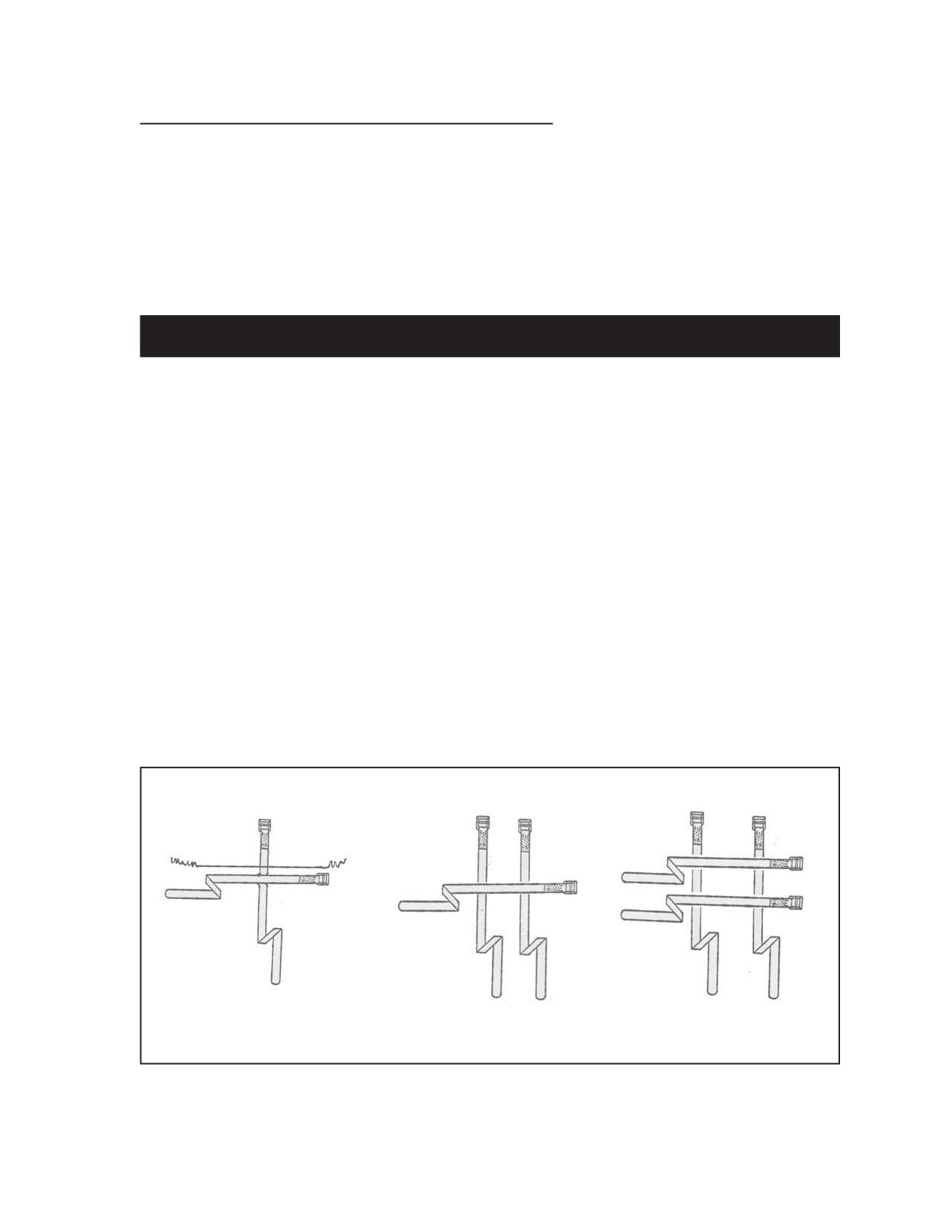
4-2. Position straps as shown in Figure 4-1. When two straps are used, a piece
of type III nylon cord needs to be placed parallel to the bottom strap. When
positioning straps, make sure the oversized portion of the metal frame on the
friction adapter is up.
NOTE: These drawings are not drawn to scale.
Two-Strap Load
Three-Strap Load
Four-Strap Load
Figure 4-1. A-7A Straps Positioned
2 September 2005
4-1
FM 4-20.103/MCRP 4-11.3C/TO 13C7-1-11
POSITIONING LOAD AND SECURING STRAPS
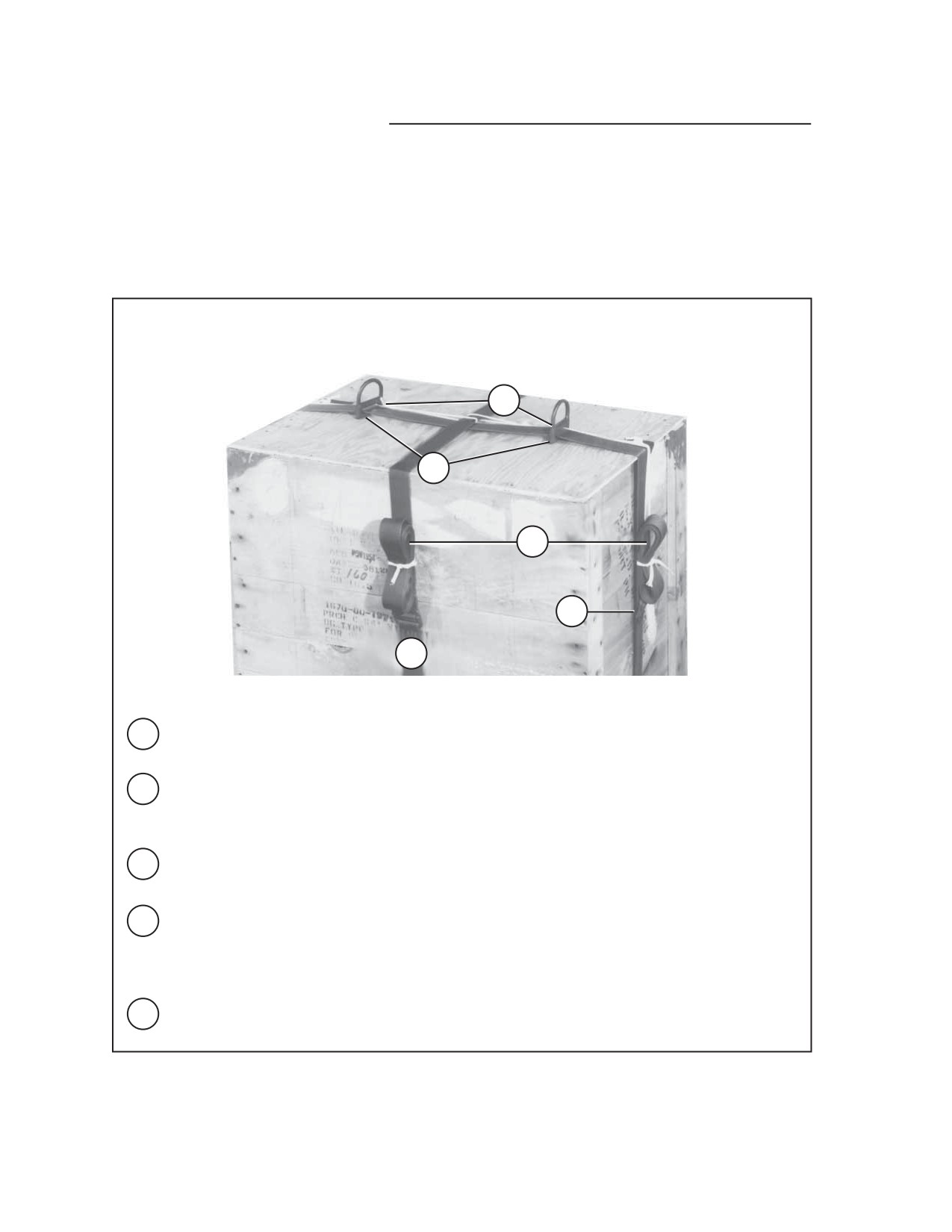
4-3. Center the equipment on the straps. If needed, honeycomb can be placed
under the equipment. Secure the straps as shown in Figure 4-2 for a two-strap
load, Figure 4-3 for a three-strap load, and Figure 4-4 for a four-strap load.
4
1
5
2
3
1
Using the strap with the type III nylon cord beside it, route the strap through the
rectangular portion of the two D-rings.
2
Route the strap with D-rings on it over the load and route it through the friction
adapter. Center the D-rings on top of the load 12 inches apart, and apply tension to the
strap.
3
Route the other strap over the load and route it through the friction adapter. Apply
tension to the strap.
4
Route one end of the type III nylon cord over the top of the load. Tie a knot around the
first D-ring and tie the running end of the type III nylon cord to the other D-ring.
Repeat step for the other side. Tie knots in the running ends and trim the excess to 2
inches.
5 S-fold the excess webbing. Secure it with one turn single, type I, 1/4-inch cotton web
bing using a surgeon’s knot and locking knot.
Figure 4-2. Two-Strap Load Positioned and Secured
4-2
2 September 2005
FM 4-20.103/MCRP 4-11.3C/TO 13C7-1-11
1
3
4
2
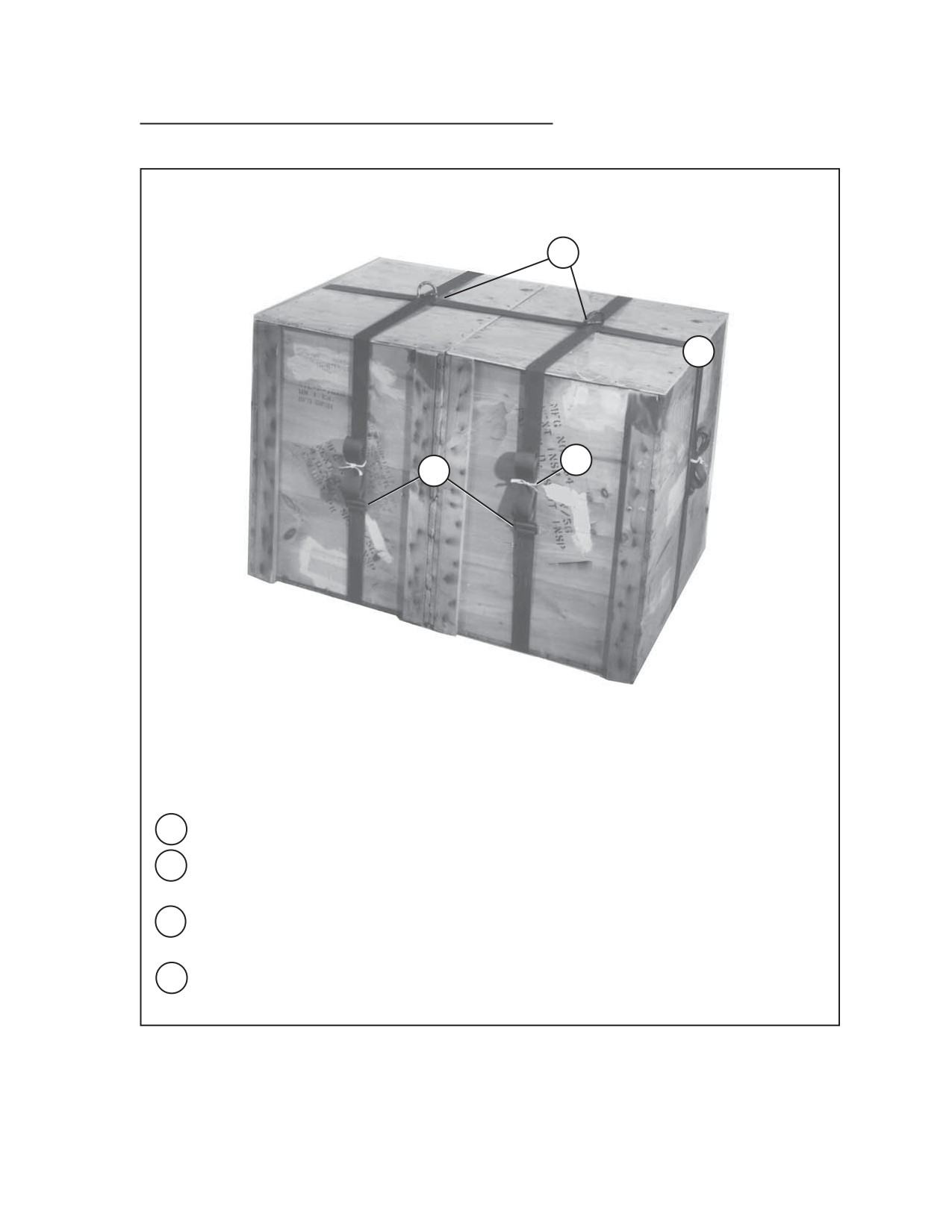
1 Route each parallel strap through the rectangular portion of a D-ring.
2 Route the two straps with D-rings over the load and through the friction adapters.
Center the D-ring on top of the load and apply tension.
3 Route the third strap through the rectangular portion of each D-ring, through the
friction adapter and apply tension.
4
S-fold the excess webbing. Secure it with one turn single, type I, 1/4-inch cotton web-
bing using a surgeon’s knot and locking knot.
Figure 4-3. Three-Strap Load Positioned and Secured
2 September 2005
4-3
FM 4-20.103/MCRP 4-11.3C/TO 13C7-1-11
1
2
4
1
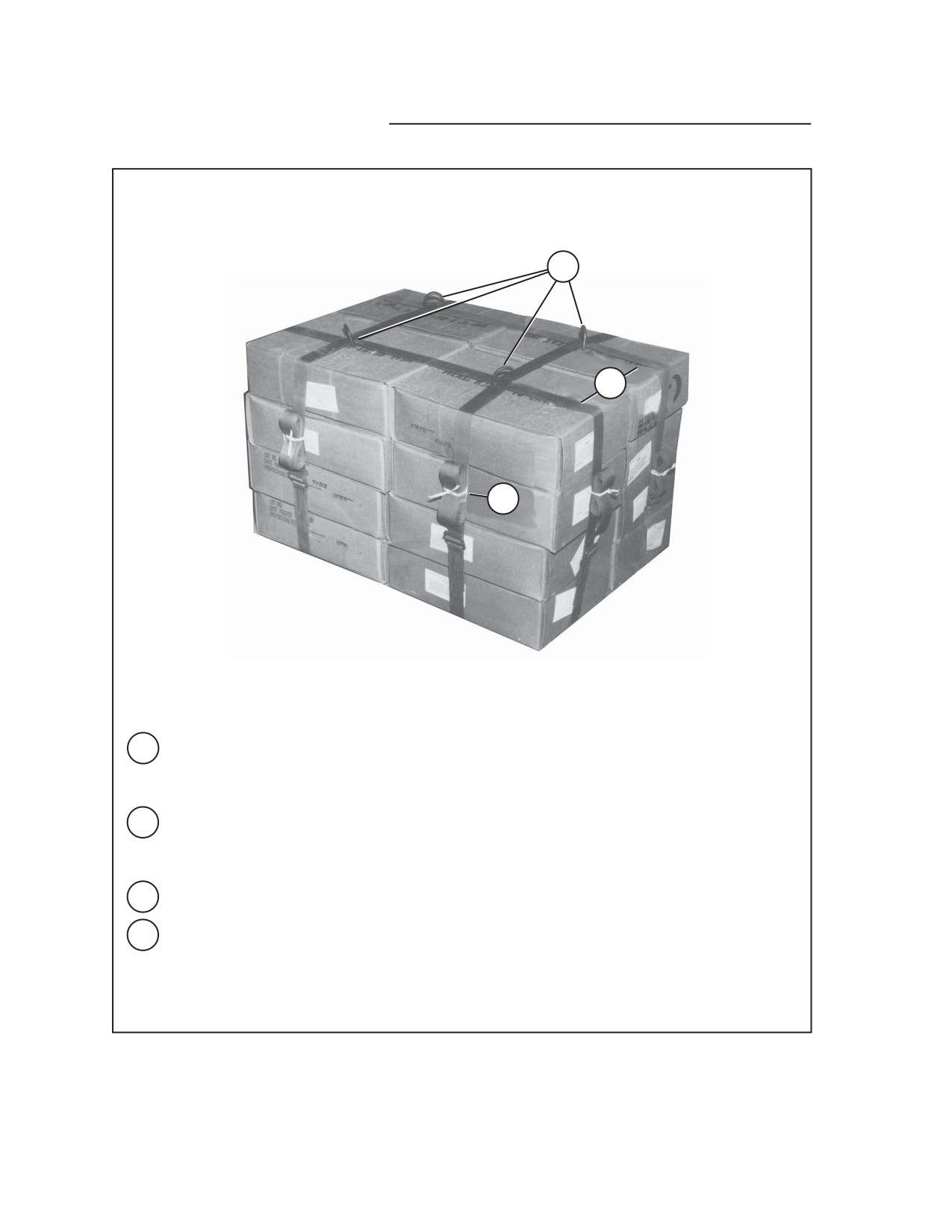
Using two straps and four D-rings, route each strap through the rectangular portion of
two D-rings and route the straps over the load and through the friction adapters.
Ensure the D-rings are on top of the load.
2
Using two additional straps for the sides, route one strap through the rectangular
portion of the rear set of D-rings and through the friction adapters. Repeat with other
strap through front set of D-rings.
3
Apply tension to all straps ensuring the D-rings stay in place.
4 S-fold the excess webbing. Secure it with one turn single, type I, 1/4-inch cotton web
bing using a surgeon’s knot and locking knot.
NOTE: Loads may need to be supported with either a piece of honeycomb or plywood
to prevent boxes from collapsing.
Figure 4-4. Four-Strap Load Positioned and Secured
4-4
2 September 2005
FM 4-20.103/MCRP 4-11.3C/TO 13C7-1-11
INSTALLING PARACHUTE
4-4. Install a 68-inch parachute, T-10 modified cargo, or G-14 cargo parachute
on the load according to Chapter 3.
MARKING RIGGED LOAD
4-5. Mark the rigged load according to Paragraph 1-5. Compute the rigged
load data for for two-, three-, and four-strap loads as shown in Figure 4-5.
EQUIPMENT REQUIRED
4-6. Use the equipment listed in Table 4-1 to rig a four-strap load for low-
velocity airdrop as shown in Figure 4-5.
Table 4-1. Equipment Required For Rigging the Four-Strap A-7A Load For Low-Velocity
Paratroop Door Airdrop
National Stock
Item
Quantity
Number
4020-00-240-2146
Cord, nylon, type III
As required
8135-00-664-6958
Cushioning material, packaging, cellulose
As required
waddin g
1670-00-753-3928
Pad, energy-dissipating material, honeycomb
As required
1670-00-999-2658
Parachute, cargo, G-14
1
1670-00-251-1153
Sling assembly, cargo airdrop, A-7A
1
7510-00-266-6710
Tape, masking, 2-inch
As required
Webbing:
8305-00-268-2411
Cotton, 1/4-inch, type I
As required
8305-00-082-5752
Nylon, tubular, 1/2-inch
As requried
2 September 2005
4-5
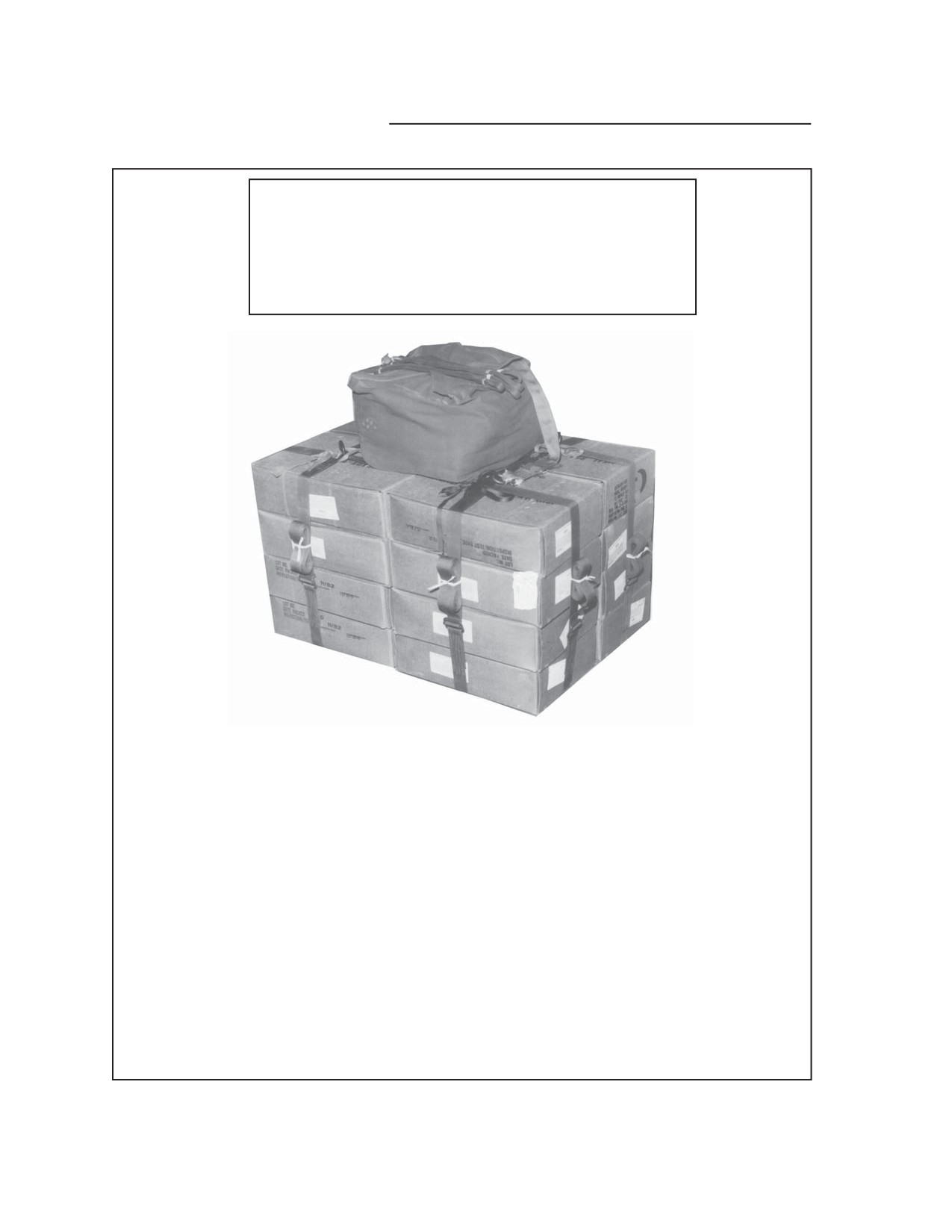
FM 4-20.103/MCRP 4-11.3C/TO 13C7-1-11
CAUTION
Make the final rigger inspection required by FM 4-20.102/
NAVSEA SS400-AB-MMO-010/TO 13C7-1-5 and AR 59-
4/OPNAVINST 4630.24C/AFJ 13-210(I)/MCO 13480.1B
before the load leaves the ri
gging site.
RIGGING LOAD DATA WITHOUT PARACHUTE
Two-strap with one 68-inch parachute
30 - 50 pounds
with three 68-inch parachutes
51 - 200 pounds
with one T-10 modified parachute
90 - 300 pounds
with one G-14 cargo parachute
200 - 300 pounds
Three-strap with one 68-inch parachute
30 - 50 pounds
with three 68-inch parachutes
51 - 200 pounds
with one T-10 modified parachute
90 - 400 pounds
with one G-14 cargo parachute
200 - 400 pounds
Four-strap with one 68-inch parachute
30 - 50 pounds
with three 68-inch parachutes
51 - 200 pounds
with one T-10 modified parachute
90 - 500 pounds
with one G-14 cargo parachute (shown)
200 - 500 pounds
Figure 4-5. Typical Four-Strap Load Rigged for Low-Velocity Paratroop Door Airdrop
4-6
2 September 2005
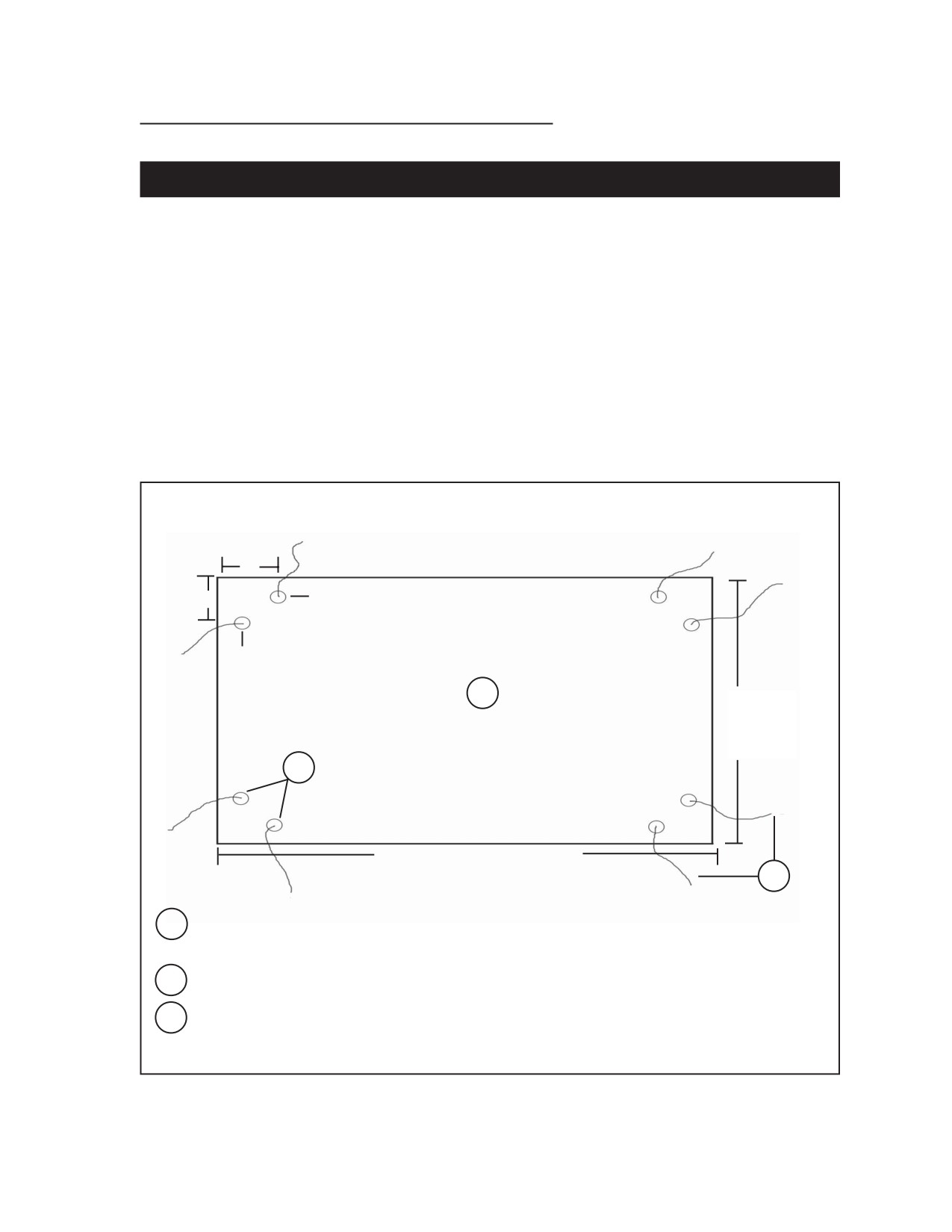
FM 4-20.103/MCRP 4-11.3C/TO 13C7-1-11
SECTION II - LOW-VELOCITY AIRDROP FROM RAMP
DESCRIPTION OF LOAD
4-7. A-7A containers can be rigged to be dropped off the ramp of an aircraft.
The load is rigged the same as paratroop door drops but it must have a skid
board attached. The skid board must project 2 inches beyond the C-130 aircraft’s
inboard roller channel. The minimum width of the skidboard for C-130 aircraft
must be at least 42-inches. However, the skid board must be 48 inches wide for
the C-17 and 48-inches wide for the C-130 when the CVRS is used. The weight
range for ramp drops is 200 to 500 pounds without the weight of the parachute.
The T-10 modified cargo or G-14 cargo parachute is the only parachute used on
low-velocity ramp drops. Table 3-1 gives the weight ranges.
PREPARING SKID BOARD
4-8. Prepare the skid board as shown in Figure 4-6.
NOTES:
1. This drawing is not drawn to scale.
2. All dimensions are given in inches.
3
1
3
1
1
Length
will
vary
2
At least 42-inches wide
3
1 Place a 1/2- or 3/4-inch piece of plywood on a flat surface. Size will vary depending on
load.
2 Drill eight 1/2-inch holes as shown above.
3 Pass a length of type III nylon cord through each set of holes. The length of the cord
will vary according to the height of the load. If the type III nylon cord is not available,
use 1/2-inch tubular nylon webbing.
Figure 4-6. Skid Board Prepared
2 September 2005
4-7
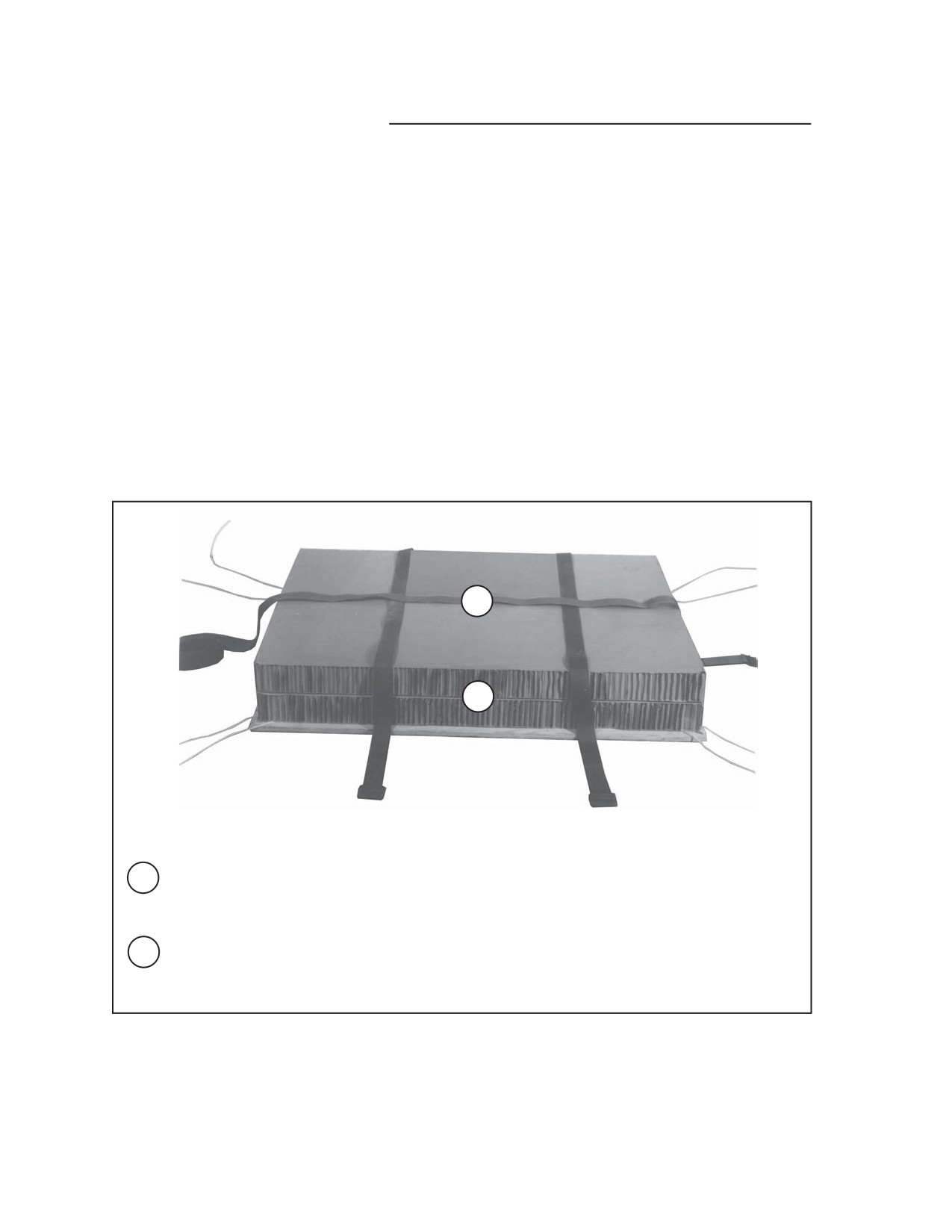
FM 4-20.103/MCRP 4-11.3C/TO 13C7-1-11
PLACING HONEYCOMB AND POSITIONING STRAPS
4-9. Place the honeycomb on the skid board as shown in Figure 4-7. Position
the straps as shown in Section I of this chapter.
POSITIONING LOAD AND SECURING STRAPS
4-10. Position the load and secure the straps as shown in Section I of this
chapter.
SECURING SKID BOARD
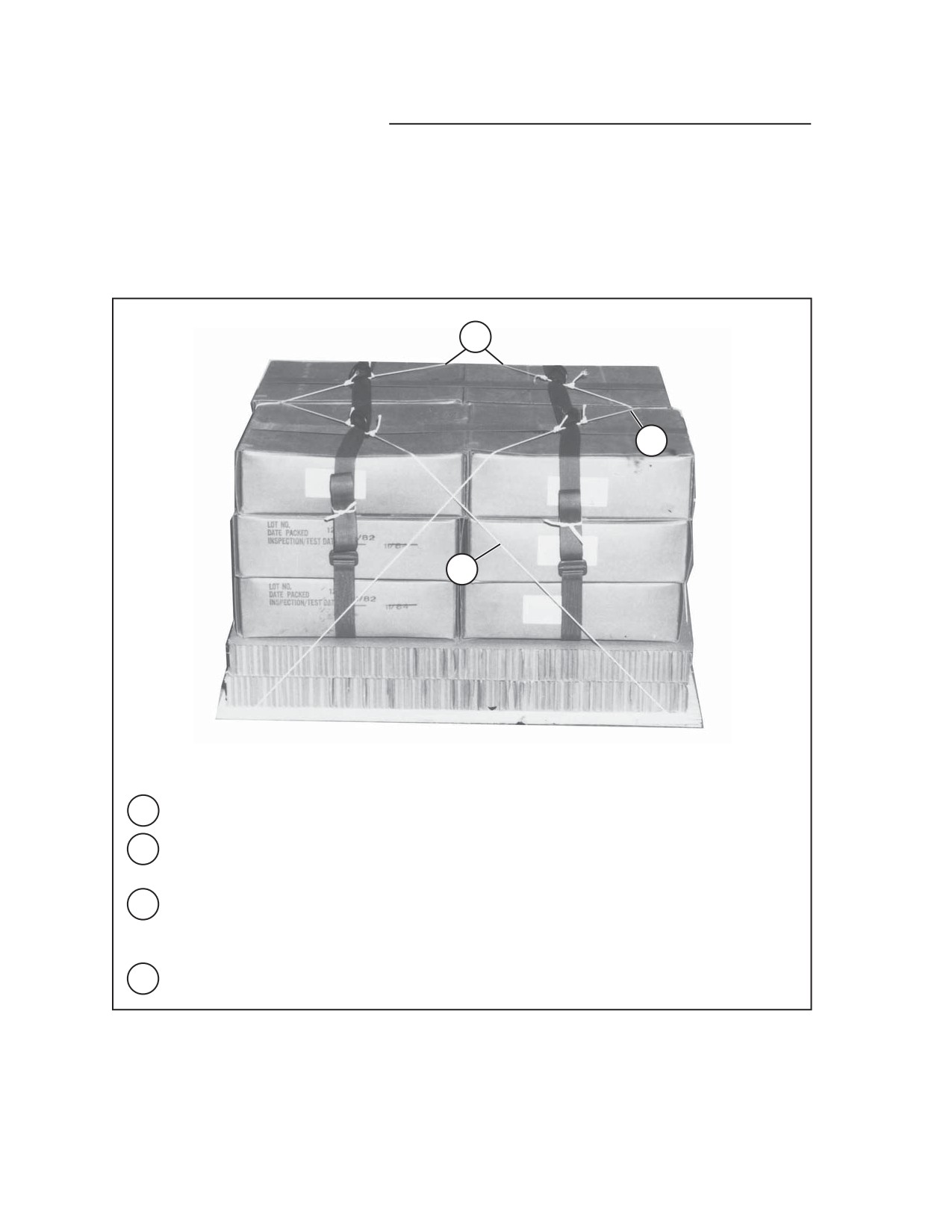
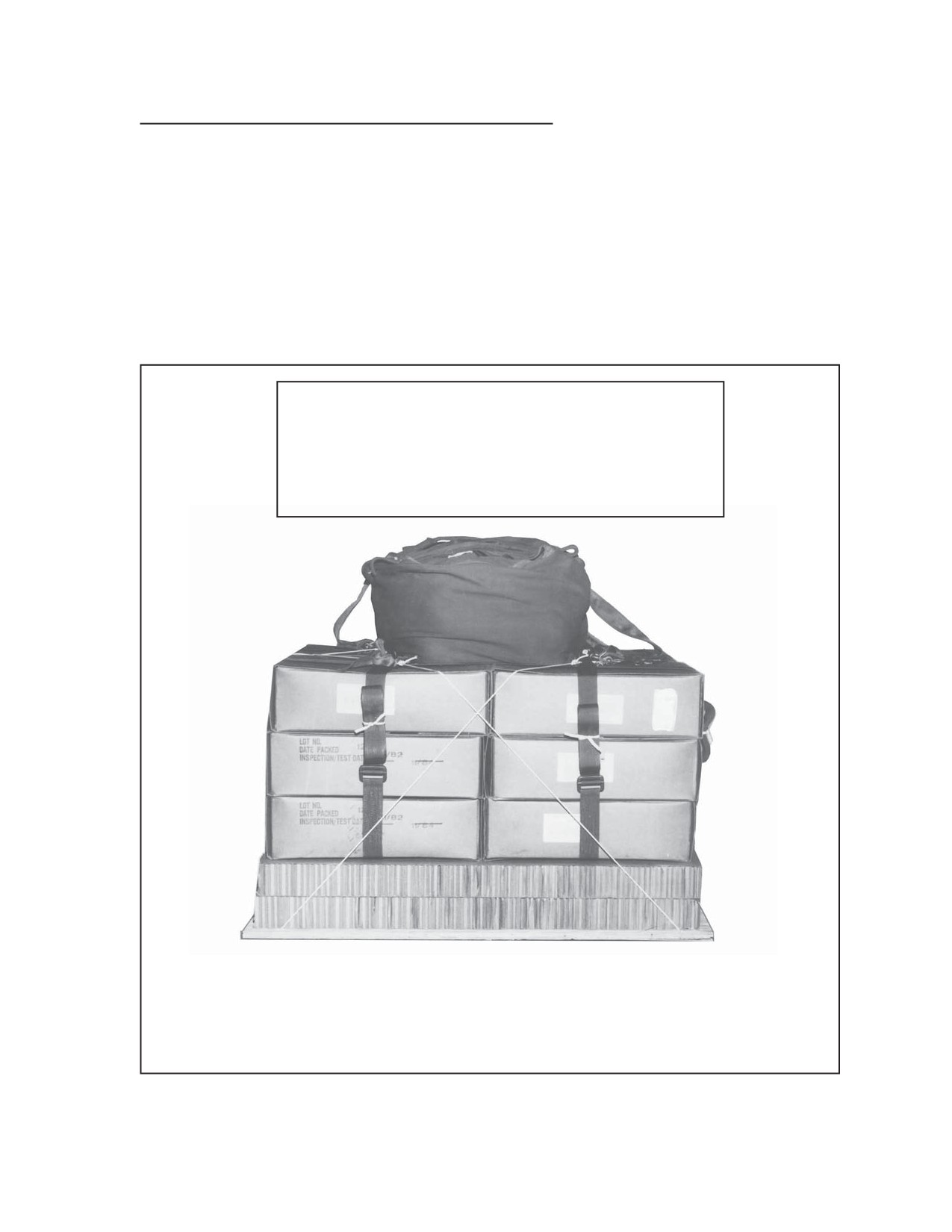
4-11. Secure the skid board to a three-strap load as shown in Figure 4-8.
Adapt
the procedures in Figure 4-8 for a two-strap load. Secure the
skid board to a
four-strap load as shown in Figure 4-9.
2
1
1 Cut two pieces of honeycomb at least the size of the base of the load. Honeycomb may
be omitted if cushioning is not needed. Center the honeycomb on the skid board. Glue
the honeycomb to the skid board, if needed.
2 Position straps as described in Section I of this chapter. The straps may be positioned
under the honeycomb, if desired. The three-strap load is shown in this figure.
Figure 4-7. Honeycomb Placed and Straps Positioned
4-8
2 September 2005
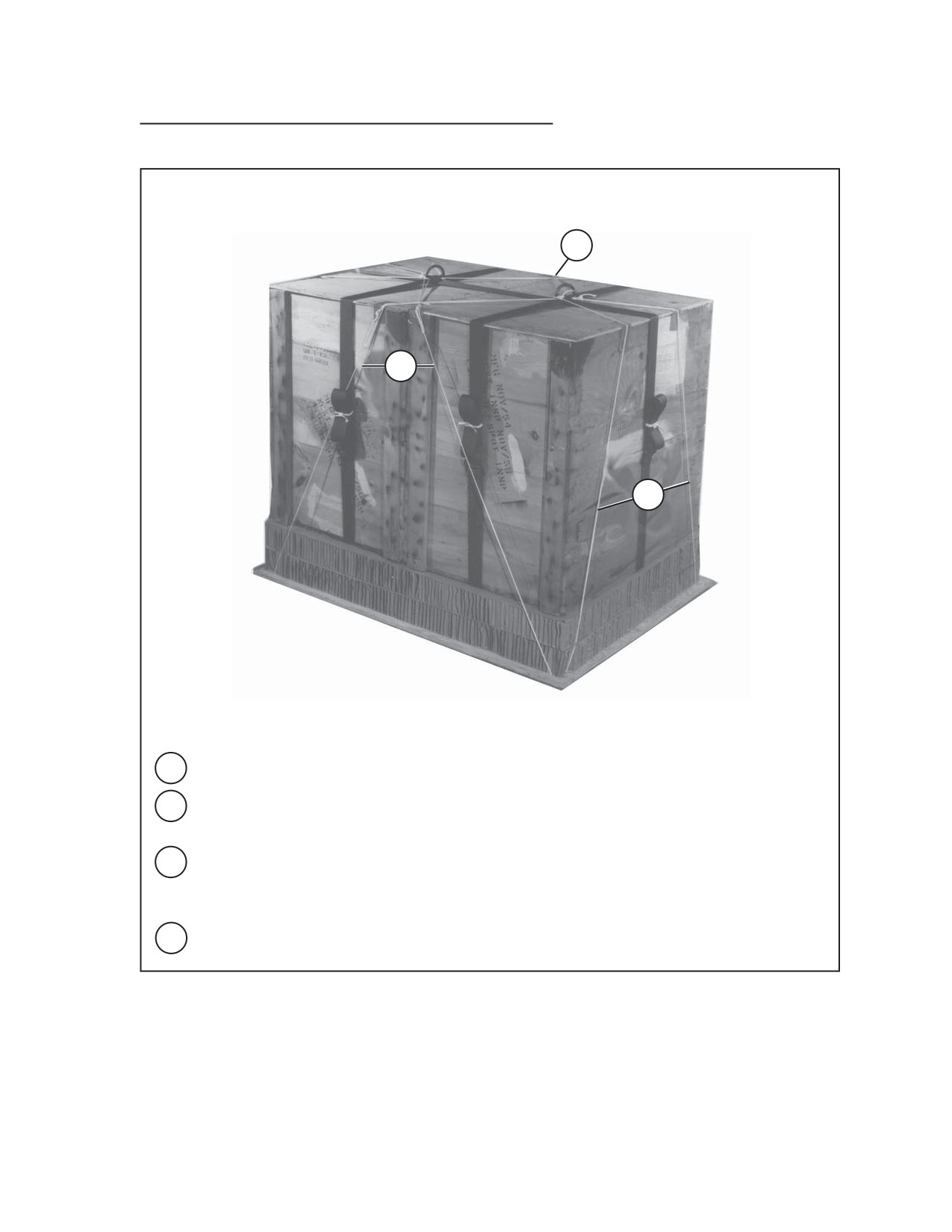
FM 4-20.103/MCRP 4-11.3C/TO 13C7-1-11
4
3
2
1
Secure the load as shown in Figure 4-3.
2
Tie the two lengths of type III nylon cord on the right side of the skid board to the D-
ring on top right side of the load. Repeat for the left side.
3
Tie the front right length of type III nylon cord to the D-ring on the top left side of the
load using a trucker’s hitch knot and an overhand knot in the running end. Repeat for
the front left length of cord.
4 Repeat step 3 for the rear side of the load.
Figure 4-8. Skid Board Secured To Three-Strap Load
2 September 2005
4-9
FM 4-20.103/MCRP 4-11.3C/TO 13C7-1-11
INSTALLING PARACHUTE
4-12. Install a T-10 modified cargo or a G-14 cargo parachute on the load
according to Chapter 3.
4
2
3
1
Secure the load as shown in Figure 4-4.
2
Tie the front right length of type III nylon cord to the rear right D-ring. Tie the rear
right length of cord to the front right D-ring. Repeat for left side.
3
On the front of the skid board, cross the right length of cord over to the front left D-ring.
Tie it with a trucker’s hitch knot with a knot in the running end. Repeat for the left
side length of cord using the right front D-ring.
4 Repeat for the rear lengths of cord.
Figure 4-9. Skid Board Secured To Four-Strap Load
4-10
2 September 2005
FM 4-20.103/MCRP 4-11.3C/TO 13C7-1-11
MARKING RIGGED LOAD
4-13. Mark the rigged load according to Paragraph 1-5. Compute the rigged
load data.
EQUIPMENT REQUIRED
4-14. Use the equipment listed in Table 4-2 to rig a four-strap load for low-
velocity ramp airdrop as shown in Figure 4-10.
CAUTION
Make the final rigger inspection required by FM 4-20.102/
NAVSEA SS400-AB-MMO-010/TO 13C7-1-5 and AR 59-
4/OPNAVINST 4630.24C/AFJ 13-210(I)/MCO 13480.1B
before the load leaves the ri
gging site.
RIGGING LOAD DATA
Weight (without parachute)
200 - 500 pounds
Parachute (shown)
G-14 cargo
Figure 4-10. Four-Strap A-7A Load Rigged for Low-Velocity Ramp Airdrop
2 September 2005
4-11
FM 4-20.103/MCRP 4-11.3C/TO 13C7-1-11
Table 4-2. Equpment Required for Rigging the Four-Strap A-7A
Load for Low-Velocity Ramp Airdrop
National Stock
Item
Quantity
Number
4020-00-240-2146
Cord, nylon, type III
As required
8135-00-664-6958
Cushioning material, packaging, cellulose
As required
wadding
1670-00-753-3928
Pad, energy-dissipating material, honeycom b
As required
1670-00-999-2658
Parachute, cargo, G-14
1
Plyw ood:
5530-00-129-7777
1/2- by 48- by 96-inch
1 sheet
or
5530-00-128-4981
3/4- by 48- by 96-inch
1 sheet
1670-00-251-1153
Sling assembly, cargo airdrop, A-7A
1
7510-00-266-6710
Tape, masking, 2-inch
As required
Webbing:
8305-00-268-2411
Cotton, 1/4-inch, type I
As required
8305-00-082-5752
Nylon, tubular, 1/2-inch
As requried
SECTION III - HIGH-VELOCITY AIRDROP
DESCRIPTION OF LOAD
4-15. An A-7A load rigged for high-velocity airdrop is rigged in a similar manner
to low-velocity. Three layers of honeycomb and a skid board are required for
paratroop door or ramp drop. This load must not exceed 500 pounds, excluding
the weight of the parachute.
PREPARING DROP ITEMS
4-16. Place items in a container so that the A-7A straps can hold the items
safely together during exit and descent. Items dropped at high-velocity will
impact at a high rate of speed; therefore, sensitive items cannot be dropped
using this method.
PREPARING SKID BOARD
4-17. Prepare the skid board in the same manner as in Section II of this chapter.
The skid board will be at least the size of the base of the load for airdrop from
the paratroop doors. When the load is being airdropped from the C-130 aircraft’s
cargo ramp, the skid board will be at least 42 inches wide, but must be
48
inches wide when using the C-17 or C-130 aircraft’s CVRS. Route the skid
board ties in the same manner as in Section II of this chapter.
4-12
2 September 2005
FM 4-20.103/MCRP 4-11.3C/TO 13C7-1-11
PLACING HONEYCOMB
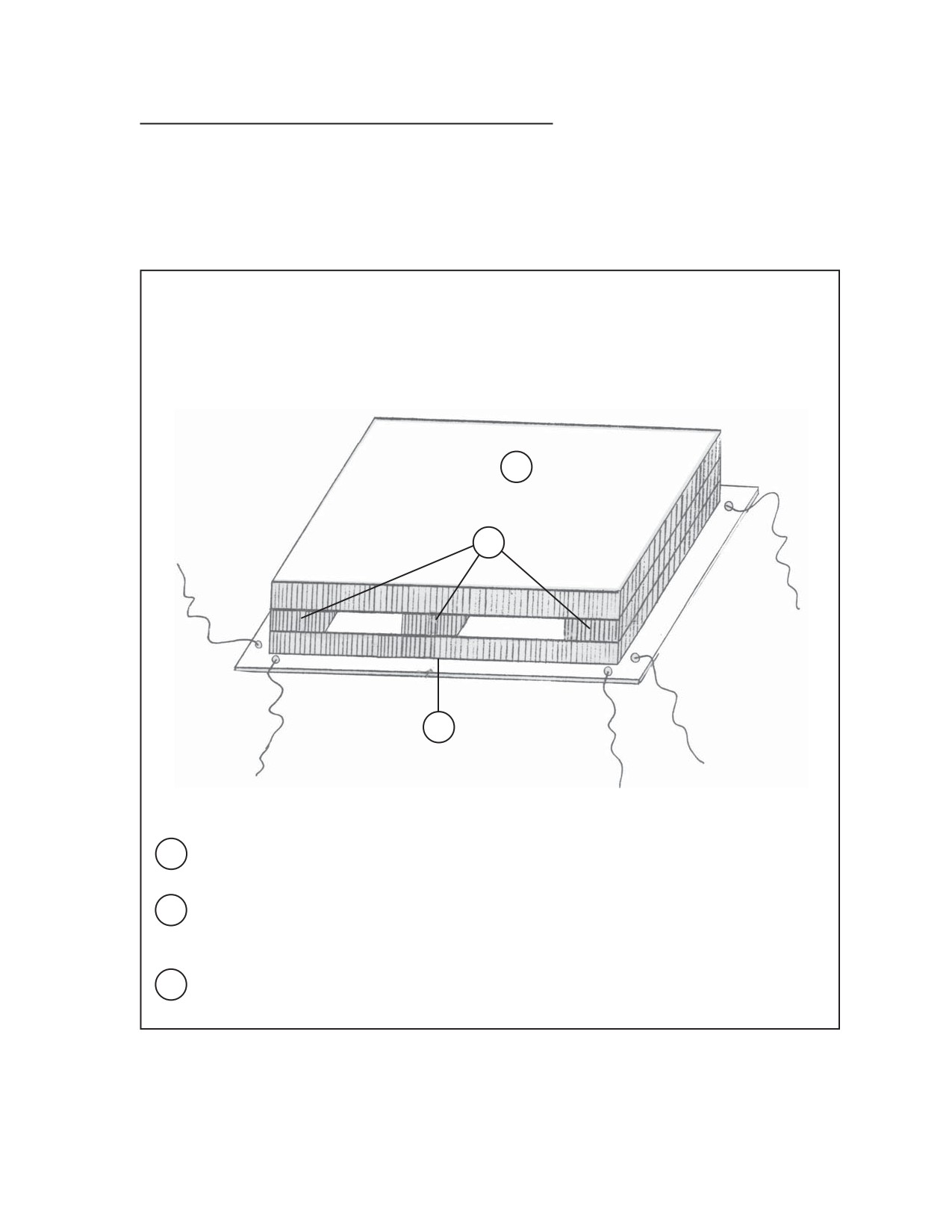
4-18. Place honeycomb as shown in Figure 4-11.
NOTES:
1. This drawing is not drawn to scale.
2. All dimensions are given in inches.
3
2
1
1
Cut one piece of honeycomb at least the size of the base of the load and center it on the
load.
2
Cut three pieces of honeycomb 3 inches wide and the length of the honeycomb cut in
step 1. Glue one piece centered on top of the first layer of honeycomb. Glue the other
pieces of honeycomb flush with each side edge.
3 Cut and glue another piece of honeycomb the same size as in step 1 and place it on top
of the second layer of honeycomb.
Figure 4-11. Honeycomb Placed
2 September 2005
4-13
FM 4-20.103/MCRP 4-11.3C/TO 13C7-1-11
SECURING STRAPS
4-19. Secure the straps according to Section I of this chapter.
SECURING SKID BOARD
4-20. Secure the skid board to the load as shown in Section II of this chapter.
INSTALLING PARACHUTE
4-21. Install the parachute on the load according to Chapter 3.
MARKING RIGGED LOAD
4-22. Mark the rigged load according to Paragraph 1-5. Compute the rigged
load data.
EQUIPMENT REQUIRED
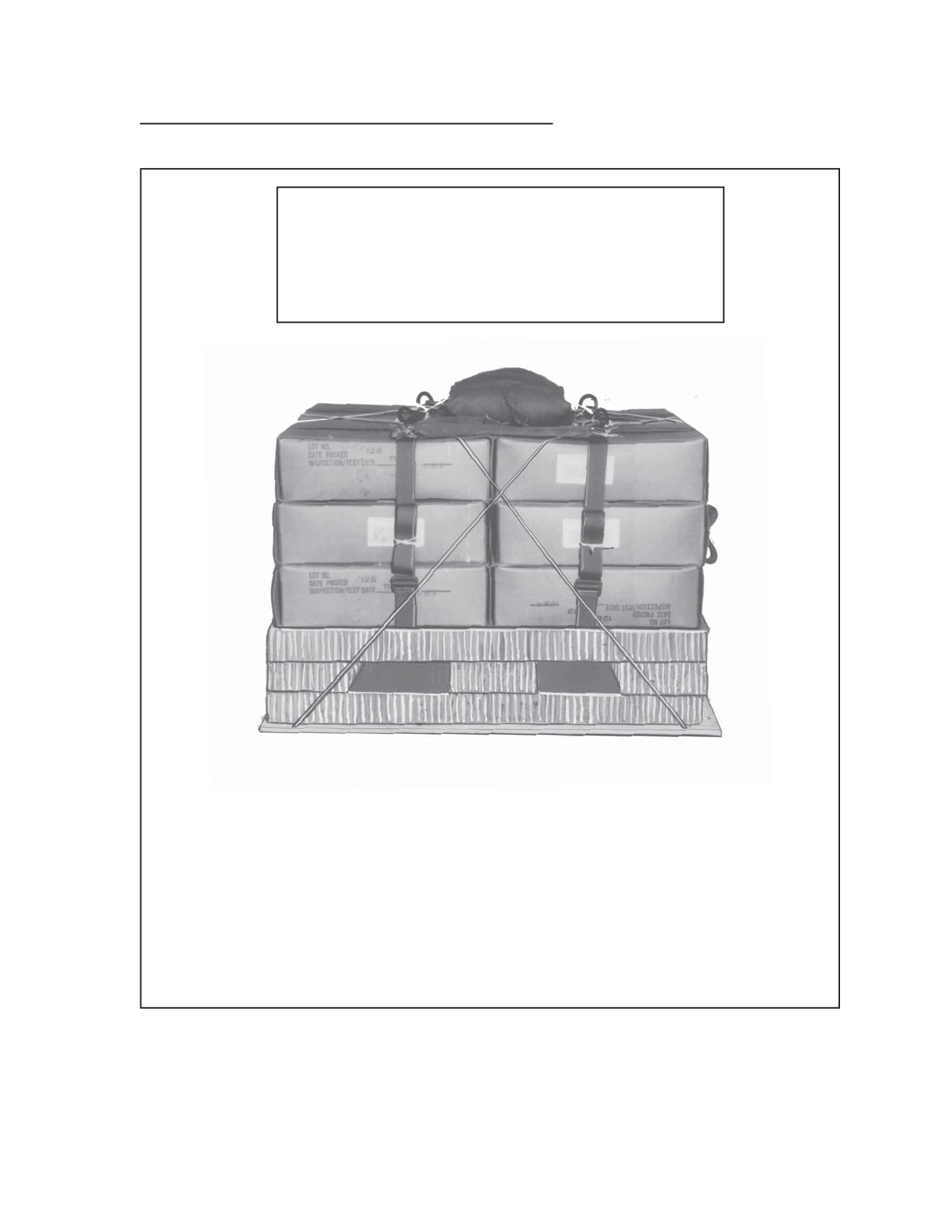
4-23. Use the equipment listed in Table 4-3 to rig a four strap load for high-
velocity airdrop as shown in Figure 4-12.
Table 4-3. Equipment Required for Rigging the Four-Strap A-7A
Load for High-Velocity Ramp Airdrop
National Stock
Item
Quantity
Number
8040-00-273-8713
Adhesive, paste, 1-gallon
As required
4020-00-240-2146
Cord, nylon, type III
As required
8135-00-664-6958
Cushioning material, packaging, cellulose
As required
waddin g
1670-00-753-3928
Pad, energy-dissipating material, honeycom b
As required
1670-00-788-8666
Parachute, cargo, high-velocity, 12-foot
1
Plyw ood:
5530-00-129-7777
1/2- by 48- by 96-inch
1 sheet
or
5530-00-128-4981
3/4- by 48- by 96-inch
1 sheet
1670-00-251-1153
Sling assembly, cargo airdrop, A7A
1
7510-00-266-6710
Tape, masking, 2-inch
As required
Webbing:
8305-00-268-2411
Cotton, 1/4-inch, type I
As required
8305-00-082-5752
Nylon, tubular, 1/2-inch
As requried
4-14
2 September 2005
FM 4-20.103/MCRP 4-11.3C/TO 13C7-1-11
CAUTION
Make the final rigger inspection required by FM 4-20.102/
NAVSEA SS400-AB-MMO-010/TO 13C7-1-5 and AR 59-
4/OPNAVINST 4630.24C/AFJ 13-210(I)/MCO 13480.1B
i
before the load leaves the r
gging site.
RIGGING LOAD DATA (without parachute)
One 68-inch parachute
75 - 150 pounds
Three 68-inch parachutes
151 - 500 pounds
One 12-foot, high-velocity cargo parachute (shown)
151 - 500 pounds
One 15-foot (modified for high velocity)
151 - 500 pounds
* Primary parachute
Figure 4-12. Four-Strap A-7A Load Rigged for High-Velocity Ramp Airdrop
2 September 2005
4-15
FM 4-20.103/MCRP 4-11.3C/TO 13C7-1-11
PART THREE
RIGGING A-21 CONTAINER LOADS
Chapter 5
General Information and Procedures
A-21 CARGO BAG ASSEMBLY
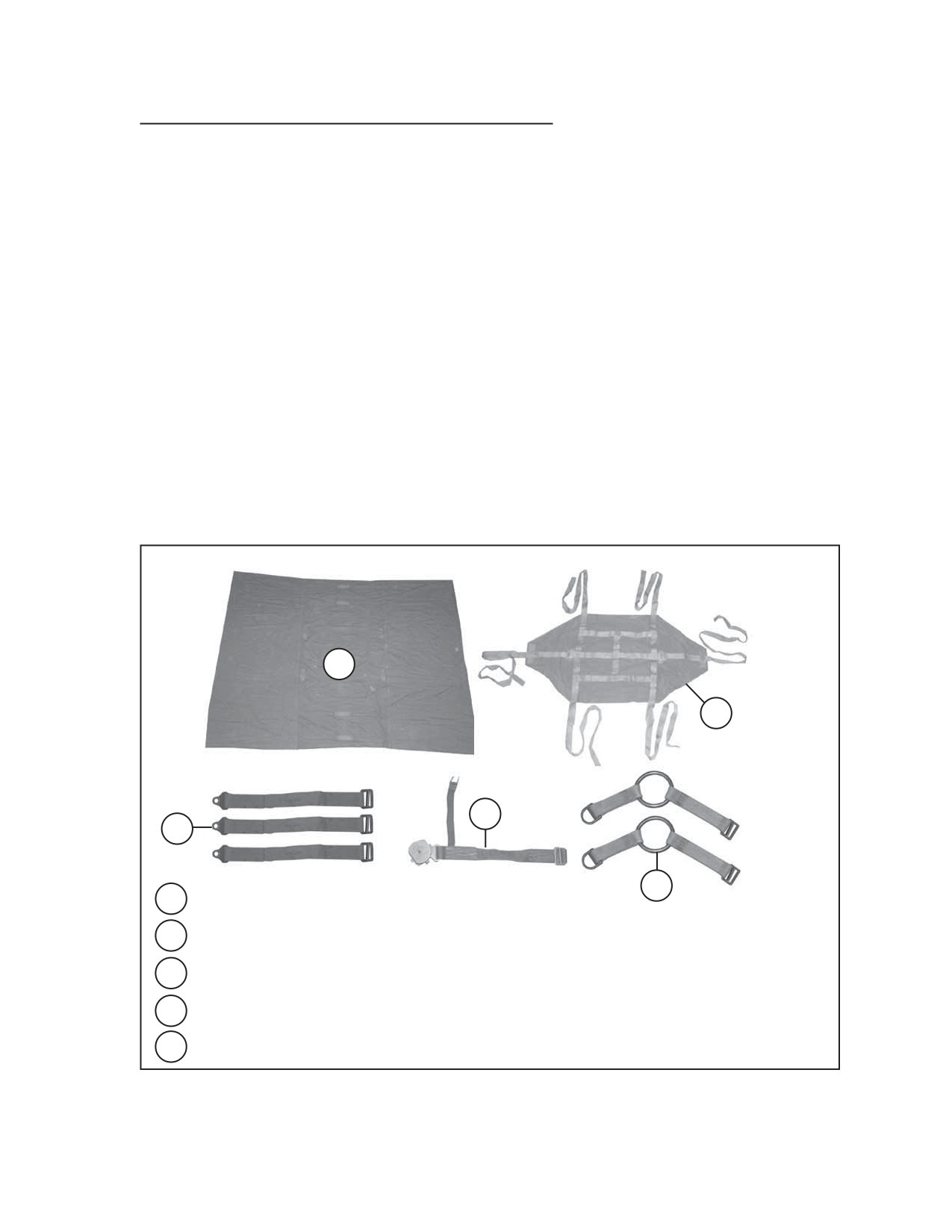
5-1. The A-21 cargo bag assembly is an adjustable airdrop container. It consists
of a sling assembly and a 97- by 115-inch canvas cover. The sling assembly
consists of the sling portion with a scuff pad attached, two O-ring straps, three
quick-release straps, and one quick-release strap with a quick-release assembly
attached. Figure 5-1 shows an A-21 cargo bag assembly.
1
2
4
3
5
1 Cover.
2 Sling assembly with scuff pad.
3 Quick-release straps.
4 Quick-release strap with quick-release assembly attached.
5 O-ring straps.
Figure 5-1. A-21 Cargo Bag Assembly
2 September 2005
5-1
FM 4-20.103/MCRP 4-11.3C/TO 13C7-1-11
CAPABILITIES OF A-21 CARGO BAG
5-2. The A-21 cargo bag can exit either through paratroop doors or off the
ramp. The container can be rigged for low-velocity or high-velocity airdrop.
The container is capable of dropping loads up to 500 pounds of rigged weight,
excluding the weight of the parachute. When dropped from the paratroop doors,
the load must weigh a minimum of 11 pounds per square foot. When dropped
from the ramp, the load must weigh a minimum of 28 pounds per square foot.
Table 5-1 lists parachutes used with this container and the weight restrictions.
PARACHUTES USED FOR A-21 CARGO BAG
5-3. The T-10 modified cargo or G-14 cargo parachute is the parachute used on
this container for low-velocity drops. For high-velocity drops, the primary
parachute is a 12-foot, high-velocity cargo parachute. If a 12-foot, high-velocity
cargo parachute is not available, a 15-foot cargo extraction parachute or three
68-inch pilot parachutes may be used. Table 5-1 gives the weight ranges.
Table 5-1. Parachute Requirements for A-21 Cargo Bag
Suspended Weight (Pounds)
Parachute
Minimum
Maximum
Low -Velocity
One T-10 modified cargo
90
500
One G-14 cargo
200
500
High-Velocity
Three 68-inch pilot
151
500
*One 12-foot high-velocity
151
500
One 15-foot cargo extraction
151
500
* Primary parachute
INSTALLING PARACHUTE ON A-21 CARGO BAGS
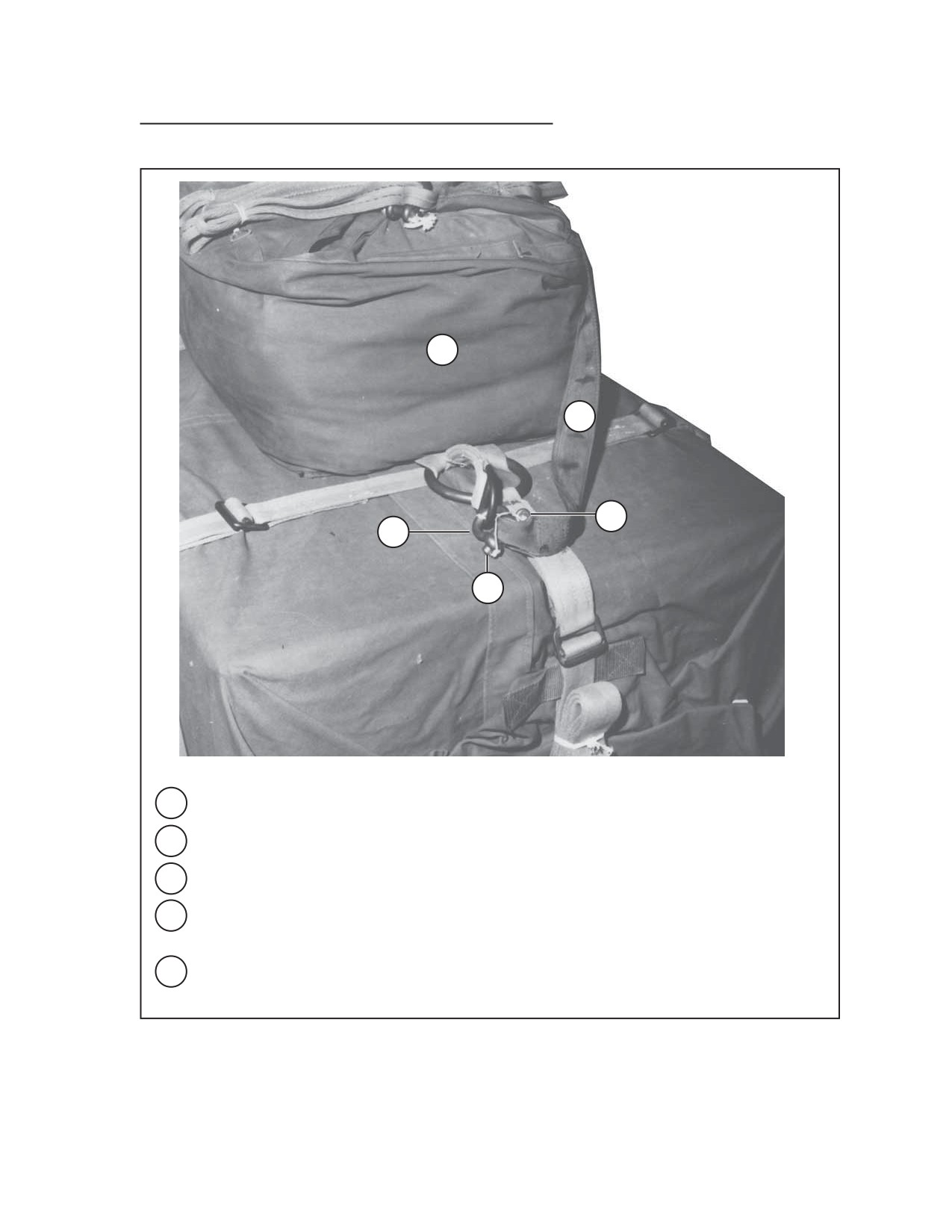
5-4. The parachutes used on A-21 loads are installed to the two D-rings located
on the O-ring straps. Figure 5-2 shows how to install the G-14 cargo parachute.
Steps similar to the G-14 cargo parachute installation are used when installing
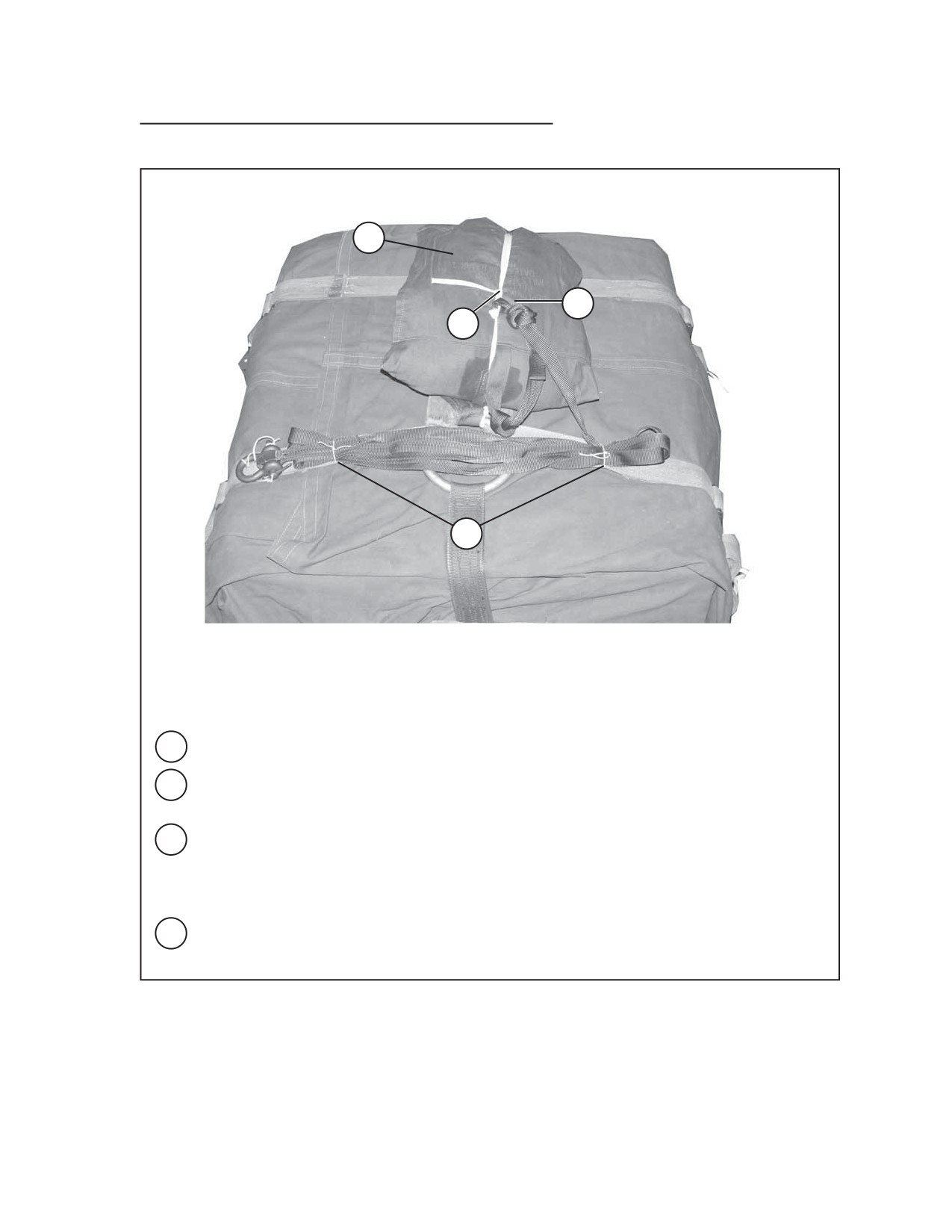
the T-10 modified cargo parachute. Figure 5-3 shows how to install the 12-foot,
high-velocity cargo parachute. When using the 68-inch pilot parachute or 15
foot cargo extraction parachute, refer to Chapter 3 and modify the procedures
to the two D-rings on the O-ring straps.
5-2
2 September 2005
FM 4-20.103/MCRP 4-11.3C/TO 13C7-1-11
1
2
4
3
5
1
Center the parachute on the load between the O-rings.
2
Position each riser to the closest D-ring on the end of the O-ring straps.
3
Place the bell portion of the clevis on the D-ring.
4
Route the clevis pin through one side of the clevis, through the loop at the end of the
riser, and through the other hole on the other side of the clevis.
5 Insert the cotter pin through the clevis pin and spread the ends of the cotter pin enough
to prevent the cotter pin from sliding out.
Figure 5-2. G-14 Cargo Parachute Installed
2 September 2005
5-3
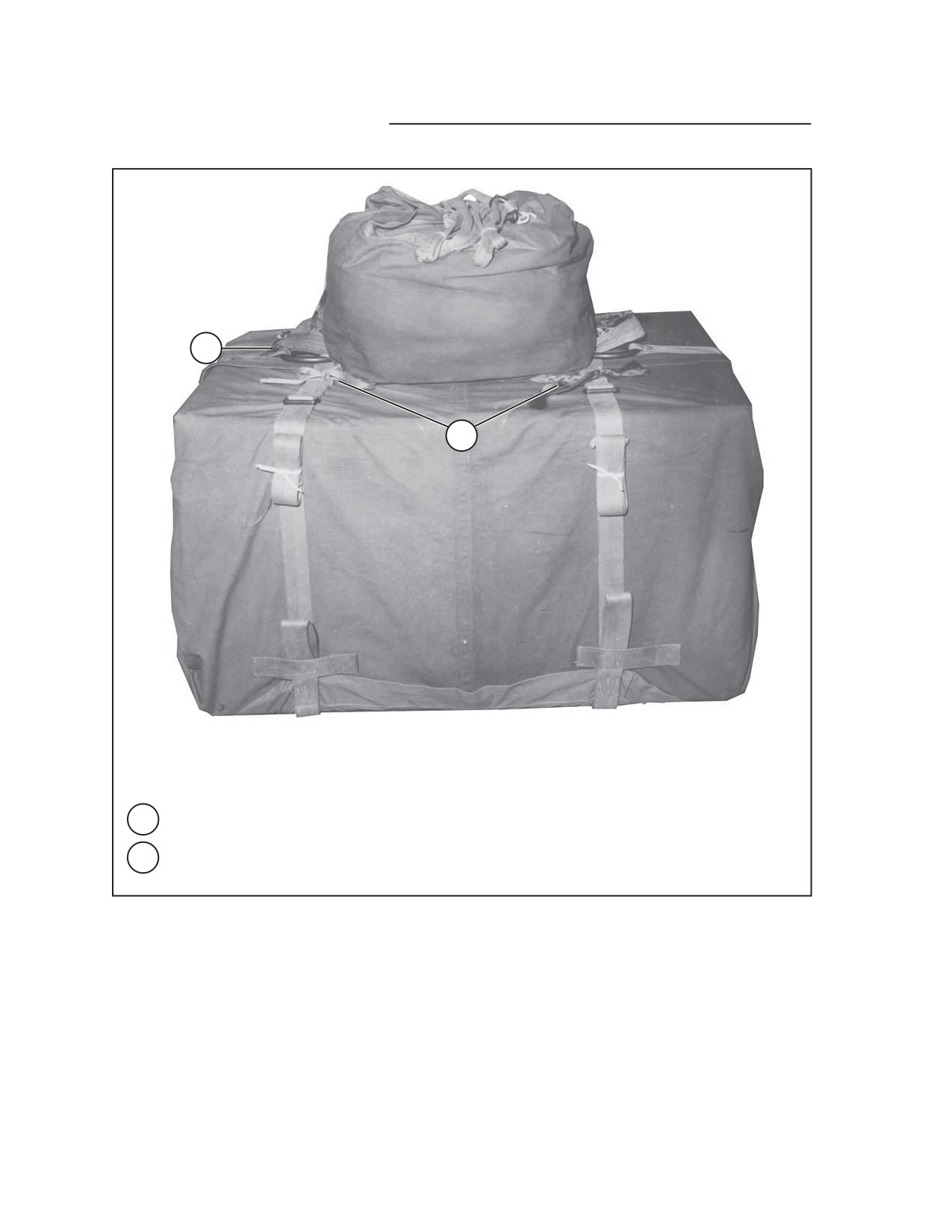
FM 4-20.103/MCRP 4-11.3C/TO 13C7-1-11
6
7
6 Repeat steps 3 through 5 with the other clevis.
7 Tie the parachute tie tapes to convenient points on the load.
Figure 5-2. G-14 Cargo Parachute Installed (Continued)
5-4
2 September 2005
FM 4-20.103/MCRP 4-11.3C/TO 13C7-1-11
1
2
3
4
1 Install the parachute on the load using steps 1 through 6 of Figure 5-2.
2 Form a 3-inch diameter loop in the static line by tying an overhand knot approximately
8 inches up from the deployment bag main strap attaching loop.
3 Tie one end of a length of type I, 1/4-inch cotton webbing to a convenient point on the
load on top of the load. Route the free end of the cotton webbing through the retaining
loop, through the loop in static line and around a convenient point on the load. Form a
trucker’s hitch knot to secure the parachute.
4 S-fold the static line on top of the load. Secure the folds to the top of the load with a
length of ticket number 8/7 cotton thread.
Figure 5-3. 12-Foot, High-Velocity Cargo Parachute Installed
2 September 2005
5-5
This page intentionally left blank.
FM 4-20.103/MCRP 4-11.3C/TO 13C7-1-11
Chapter 6
Rigging Typical A-21 Loads
SECTION I - LOW-VELOCITY AIRDROP FROM PARATROOP DOOR
DESCRIPTION OF LOAD
6-1. Typical A-21 loads are rigged for airdrop from a paratroop door of an aircraft.
Typical loads include rations, repair parts, water cans, and other small nonfragile
items. Items to be dropped may be rigged in their original container or may be
repacked and padded further to prevent damage. When completely rigged, the
load must not exceed 500 pounds, excluding the weight of the parachute. The
maximum dimensions for this load are 48- by 30- by 66-inches. Refer to Part
Two for general rigging information and aircraft considerations and restrictions.
PREPARING DROP ITEMS
6-2. Prepare the drop items according to the load’s sensitivity. Some items will
require no padding while others will need padding with cellulose wadding, felt,
and honeycomb. All items should be padded well to prevent damage during
airdrop. In addition, items must be in containers large enough so they will not
fall out of the load during airdrop.
POSITIONING CONTAINER AND LOAD
6-3. Position the container and load as shown in Figure 6-1.
2 September 2005
6-1
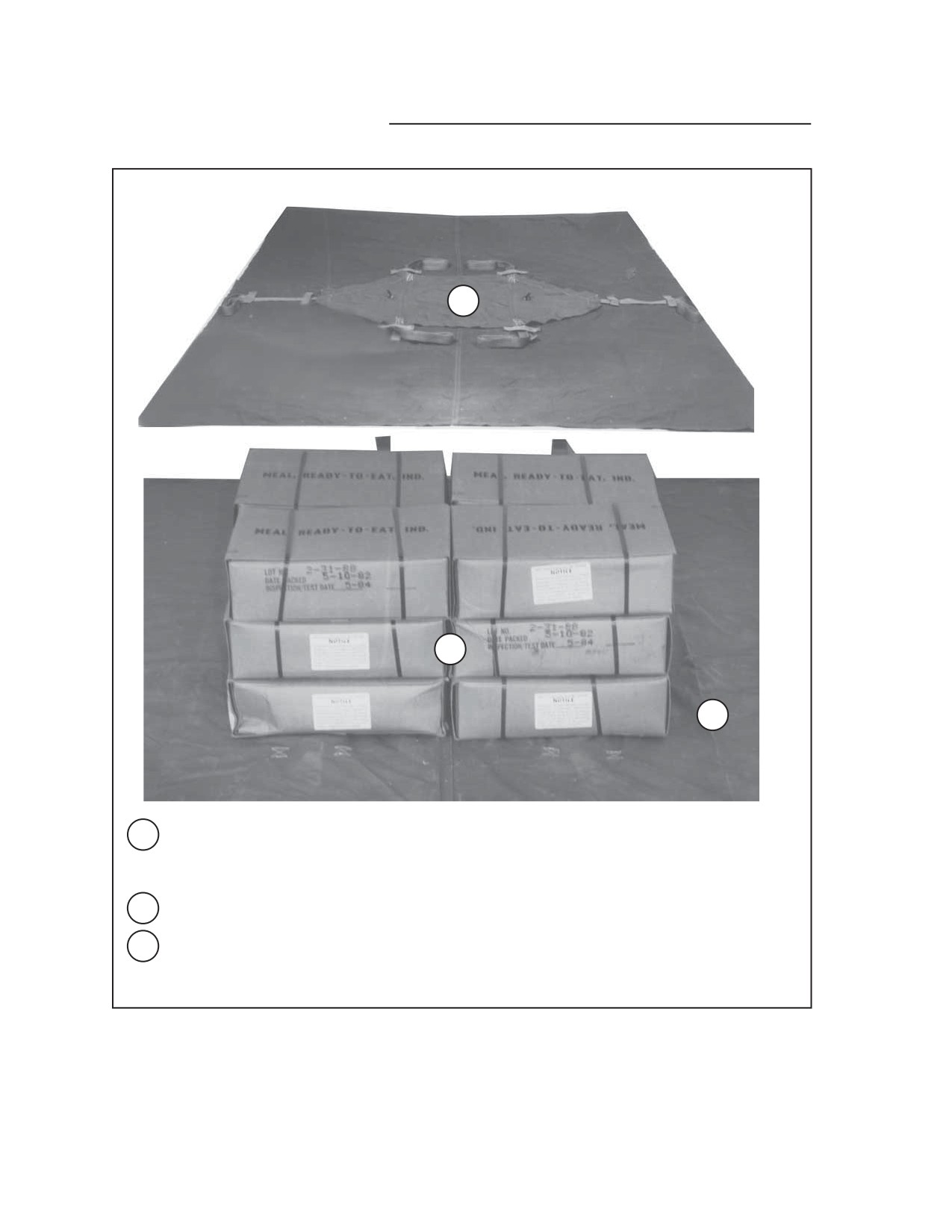
FM 4-20.103/MCRP 4-11.3C/TO 13C7-1-11
1
3
2
1 Lay the A-21 bag cover on a flat, dry surface with the strap keepers up. Center the sling
assembly on the cover with the sewn webbing facing the cover. Route the straps
through the strap keepers.
2 Flip the cover and sling assembly over. The scuff pad should be on the bottom.
3 Center the load on the cover and the sling assembly.
NOTE: One or two layers of honeycomb may be placed under the load, if needed.
Figure 6-1. Container and Load Positioned
6-2
2 September 2005
FM 4-20.103/MCRP 4-11.3C/TO 13C7-1-11
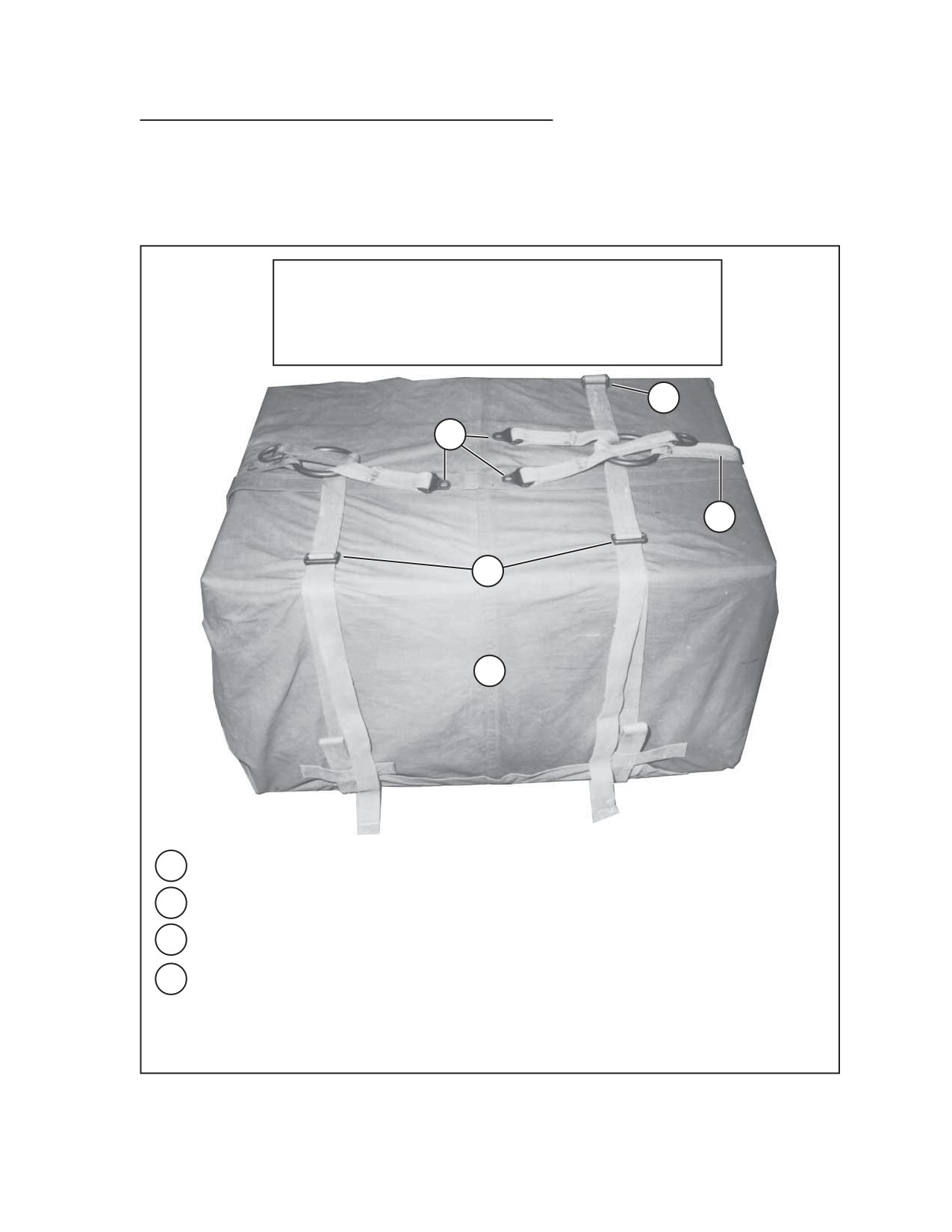
RIGGING CONTAINER
6-4. Rig the container as shown in Figure 6-2.
CAUTION
Make sure friction adapters are fastened properly
according to Figure 1-3.
3
4
2
3
1
1 Fold the cover over the load. Fold the excess cover under itself.
2 Loosely fit an O-ring strap on the right side long strap. Repeat for left side.
3 Fit a quick-release strap on the two front straps and the rear right strap.
4 Pass the free end of the quick-release strap under the O-ring and up through the center
of the O-ring. Lay the running end toward the center of the load. Repeat step for the
other two quick-release straps. There should be a half twist inward when the straps are
routed properly.
Figure 6-2. Container Rigged
2 September 2005
6-3
FM 4-20.103/MCRP 4-11.3C/TO 13C7-1-11
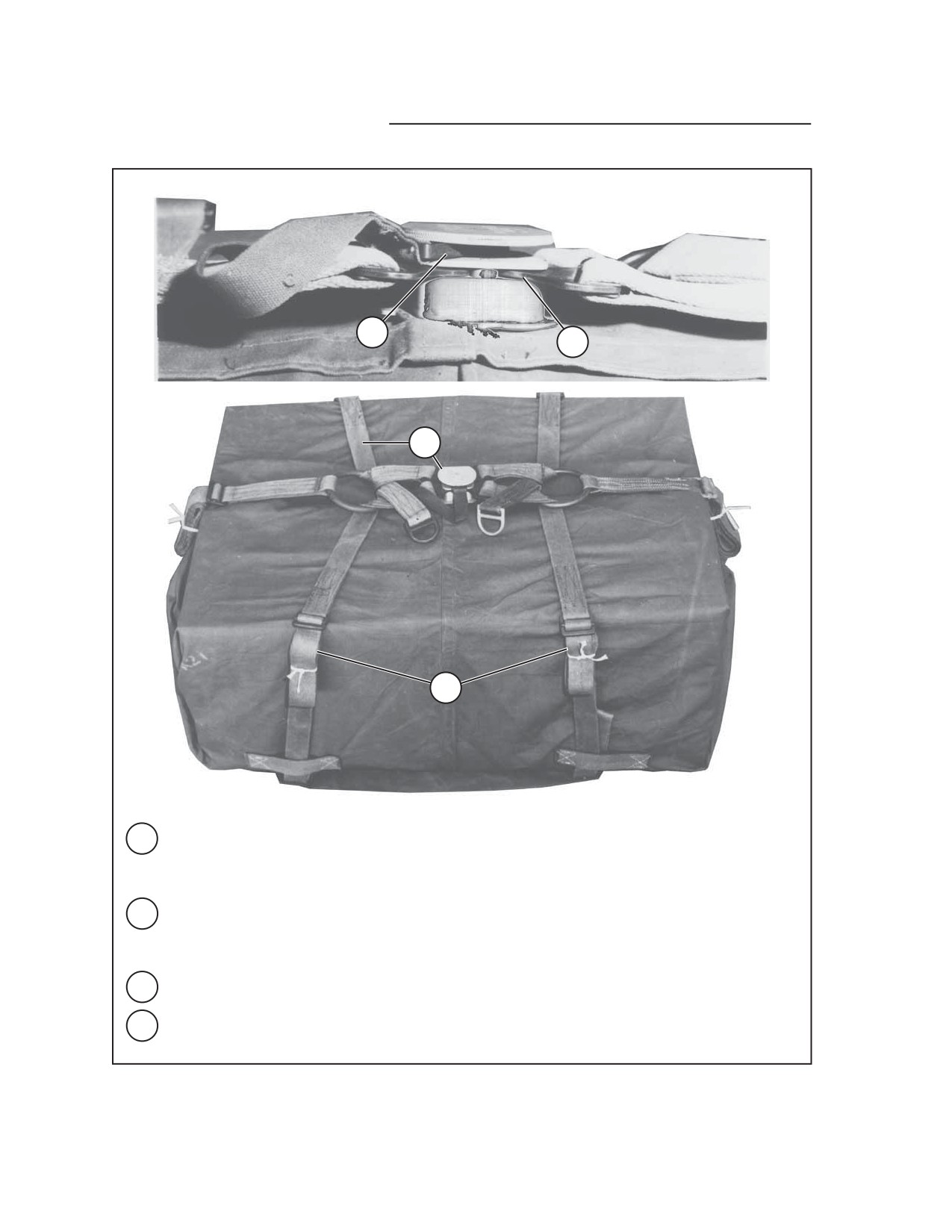
7
6
5
8
5 Center the strap with the quick-release assembly on the load. Route the strap over the
left O-ring and down through the center. Fasten the friction adapter to the rear left
strap. Make sure the friction adapter is fastened properly according to Figure 1-3.
6 Make sure the quick-release assembly plungers are up. Insert the three quick-release
strap lugs into the quick-release assembly. Pull slightly on each to make sure the
plungers lock the straps in place.
7 Insert the safety clip.
8 Tighten all straps. Make sure the quick-release assembly is centered on the load. Fold
the excess strap, and tie or tape in place according to Figure 1-3.
Figure 6-2. Container Rigged (Continued)
6-4
2 September 2005
FM 4-20.103/MCRP 4-11.3C/TO 13C7-1-11
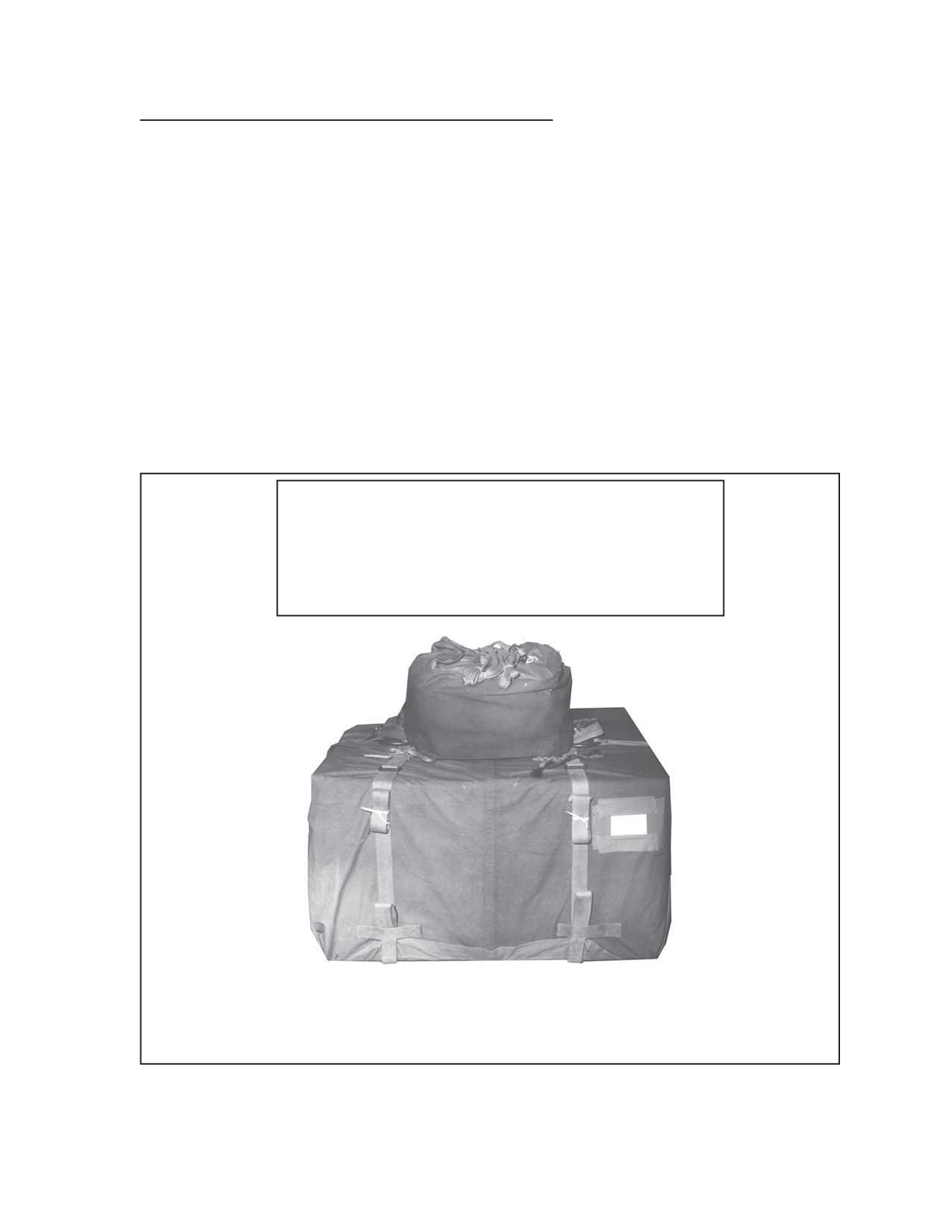
INSTALLING PARACHUTE
6-5. Install the T-10 modified cargo or the G-14 cargo parachute according to
Paragraph 5-4.
MARKING RIGGED LOAD
6-6. Mark the rigged load according to Paragraph 1-5. Compute the rigged
load data.
EQUIPMENT REQUIRED
6-7. Use the equipment listed in Table 6-1 to rig the load as shown in Figure
6-3.
CAUTION
Make the final rigger inspection required by FM 4-20.102/
NAVSEA SS400-AB-MMO-010/TO 13C7-1-5 and AR 59-
4/OPNAVINST 4630.24C/AFJ 13-210(I)/MCO 13480.1B
before the load leaves the ri
gging site.
RIGGING LOAD DATA (without parachute)
G-14 cargo parachute (shown)
200 - 500 pounds
T-10 modified cargo parachute
200 - 500 pounds
Figure 6-3. A-21 Container Load Rigged for Low-Velocity Paratroop Door Airdrop
2 September 2005
6-5
FM 4-20.103/MCRP 4-11.3C/TO 13C7-1-11
Table 6-1. Equipment Required for Rigging the A-21 Container Load
For Low-Velocity Paratroop Door Airdrop
National Stock
Item
Quantity
Number
1670-00-242-9173
Bag, cargo, A-21
1
8135-00-664-6958
Cushioning material, packaging, cellulose
As required
wadding
1670-00-753-3928
Pad, energy-dissipating material, honeycomb
As required
1670-00-999-2658
Parachute, cargo, G-14
1
8305-00-268-2411
Cotton, 1/4-inch, type I
As required
SECTION II - LOW-VELOCITY AIRDROP FROM RAMP
DESCRIPTION OF LOAD
6-8. Typical A-21 loads are rigged to be dropped off the ramp of an aircraft.
Typical loads include rations, water cans, small parts, and other nonfragile
supplies. The load must be rigged with a skid board. The weight range for an
A-21 load is 200 to 500 pounds, excluding the weight of the parachute.
PREPARING DROP ITEMS
6-9. Prepare the drop items according to the load’s sensitivity. Some items will
require no padding while others will require cellulose wadding, felt, and
honeycomb. All items should be padded well to prevent damage during airdrop.
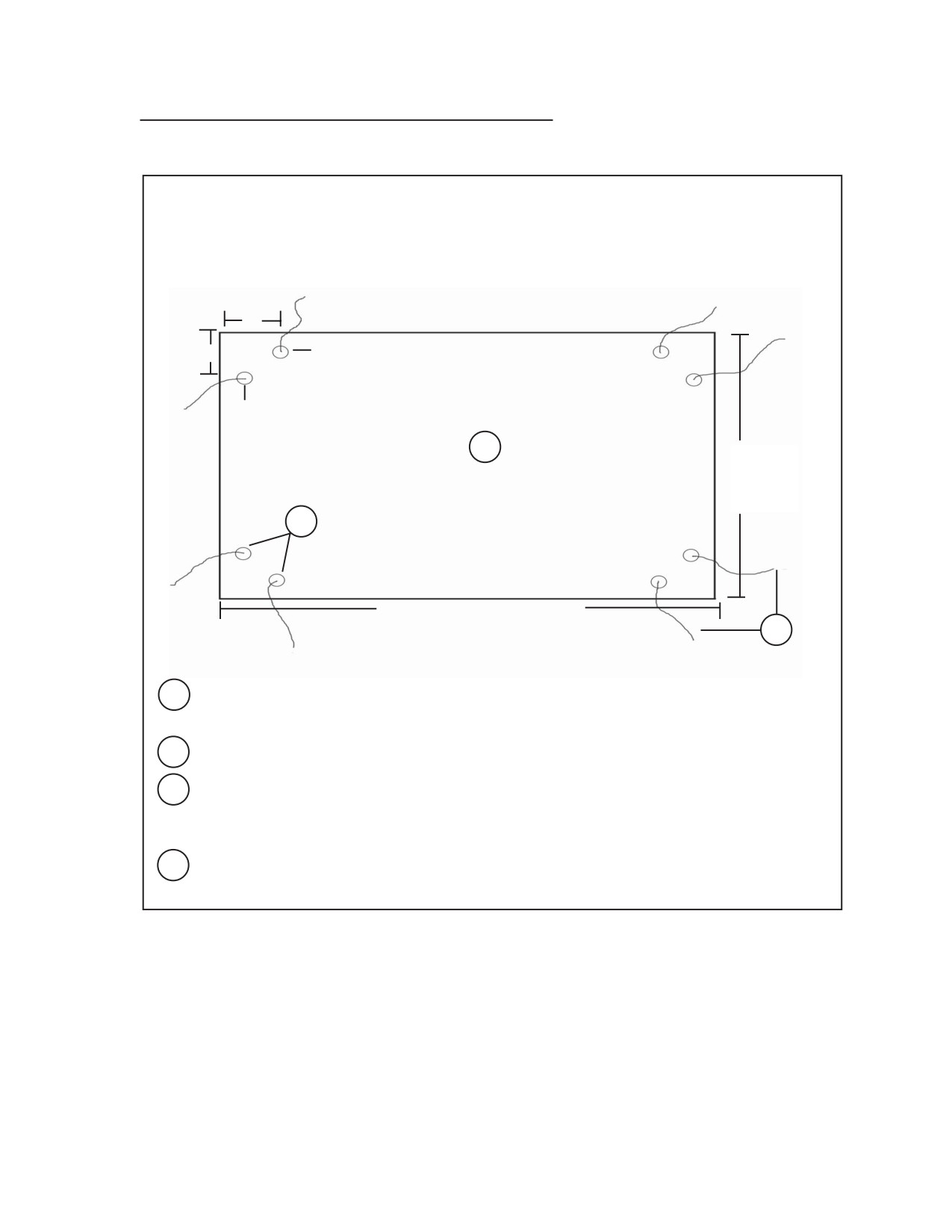
PREPARING SKID BOARD
6-10. Prepare a skid board as shown in Figure 6-4.
POSITIONING CONTAINER AND LOAD
6-11. Position the container and load according to Paragraph 6-3.
RIGGING CONTAINER
6-12. Rig the container according to Paragraph 6-4.
6-6
2 September 2005
FM 4-20.103/MCRP 4-11.3C/TO 13C7-1-11
NOTES:
1. This drawing is not drawn to scale.
2. All dimensions are given in inches.
3
1
3
1
1
Length
will
vary
2
At least 42 inches wide
3
1 Place a 1/2- or 3/4-inch piece of plywood on a flat surface. Size will vary depending on
load.
2 Drill eight 1/2-inch holes as shown above.
3 Pass a length of type III nylon cord through each set of holes. The length of the cord
will vary according to the height of the load. If the type III nylon cord is not available,
use 1/2-inch tubular nylon webbing.
4 If required, place two layers of honeycomb the size of the base of the load on the skid
board (not shown).
Figure 6-4. Skid Board Prepared
2 September 2005
6-7
FM 4-20.103/MCRP 4-11.3C/TO 13C7-1-11
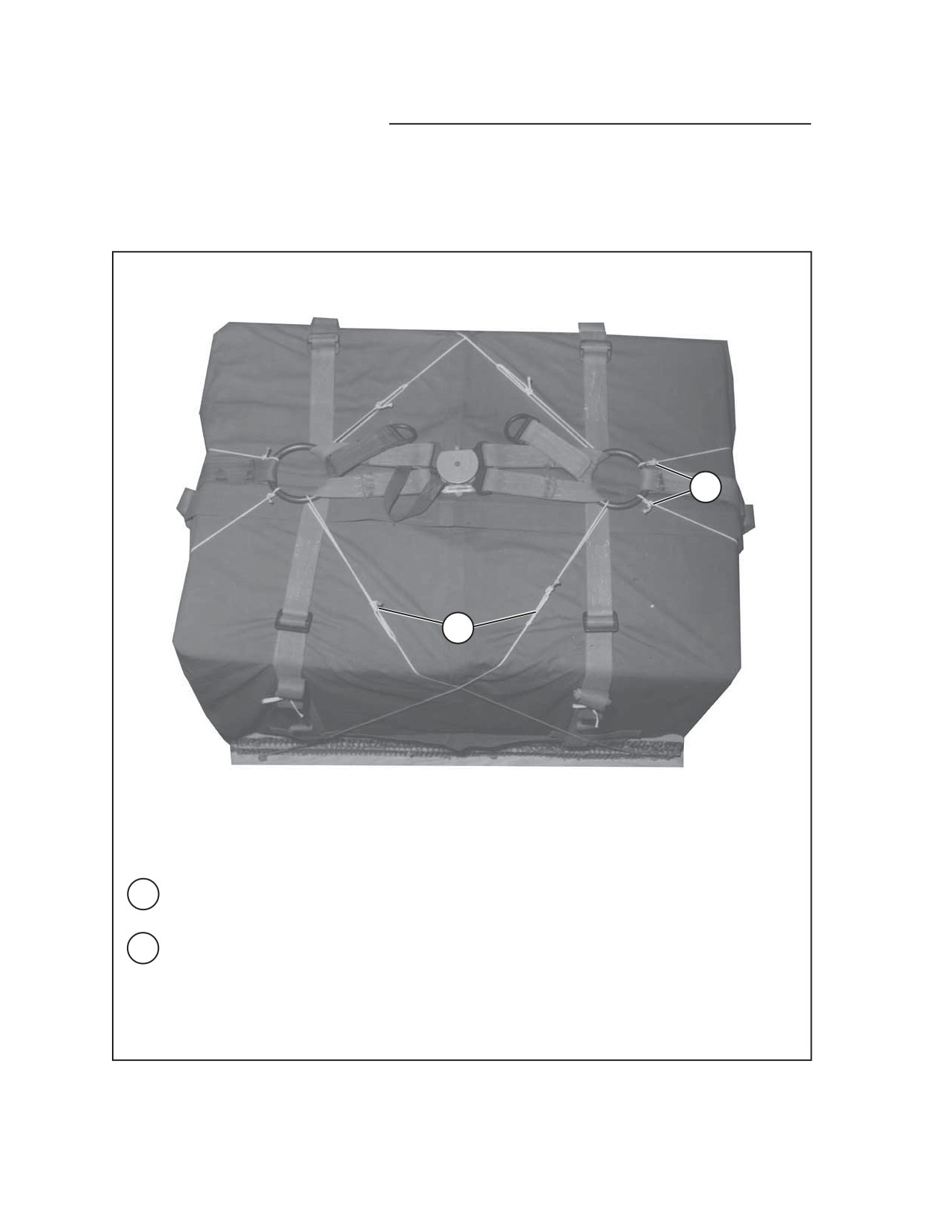
SECURING SKID BOARD
6-13. Secure the skid board to the load as shown in Figure 6-5.
1
2
1 Tie the two lengths of type III nylon cord on the right side of the load to the top right
O-ring with three half-hitch knots and a knot in the running end. Repeat for left side.
2 Using the front right length of cord, cross it over the load and tie it to the left O-ring
with a trucker’s hitch knot and an overhand knot in the running end. Repeat with the
left front length of cord to the right O-ring. Ties should form an “X”. Repeat for the
back side.
Figure 6-5. Skid Board Secured
6-8
2 September 2005
FM 4-20.103/MCRP 4-11.3C/TO 13C7-1-11
INSTALLING PARACHUTE
6-14. Install the T-10 modified cargo or the G-14 cargo parachute to the load
according to Paragraph 5-4.
MARKING RIGGED LOAD
6-15. Mark the rigged load according to Paragraph 1-5. Compute the rigged
load data.
EQUIPMENT REQUIRED
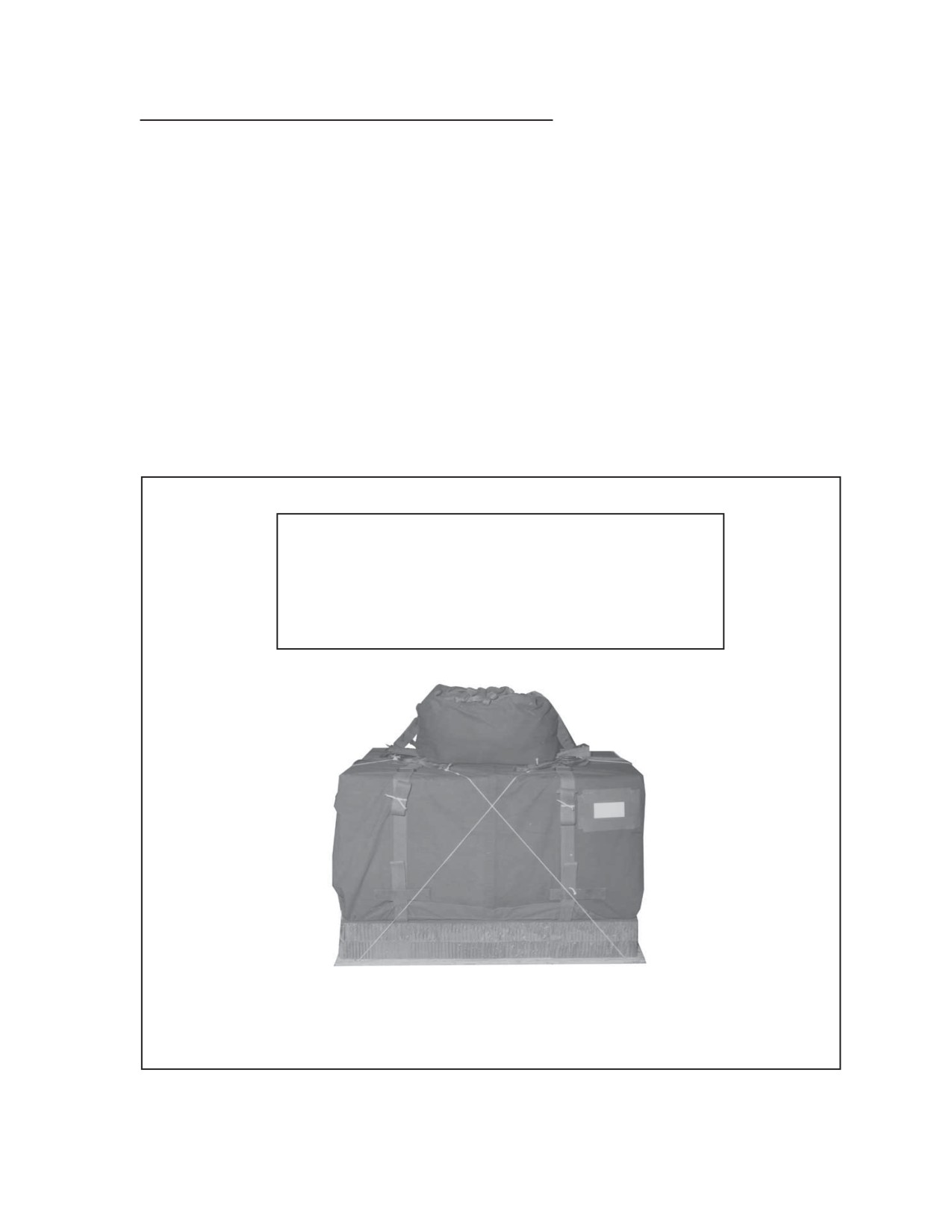
6-16. Use the equipment listed in Table 6-2 to rig the load shown in Figure 6
6.
CAUTION
Make the final rigger inspection required by FM 4-20.102/
NAVSEA SS400-AB-MMO-010/TO 13C7-1-5 and AR 59-
4/OPNAVINST 4630.24C/AFJ 13-210(I)/MCO 13480.1B
before the load leaves the ri
gging site.
RIGGING LOAD DATA (without parachute)
G-14 cargo parachute (shown)
200 - 500 pounds
T-10 modified cargo parachute
200 - 500 pounds
Figure 6-6. A-21 Container Load Rigged for Low-Velocity Ramp Airdrop
2 September 2005
6-9
FM 4-20.103/MCRP 4-11.3C/TO 13C7-1-11
Table 6-2. Equipment Required for Rigging the A-21 Container Load
for Low-Velocity Ramp Airdrop
National Stock
Item
Quantity
Number
1670-00-242-9173
Bag, cargo, A-21
1
4020-00-240-2146
Cord, nylon, type III
As required
8135-00-664-6958
Cushioning material, packaging, cellulose
As required
wadding
1670-00-753-3928
Pad, energy-dissipating material, honeycom b
As required
1670-00-999-2658
Parachute, cargo, G-14
1
Plyw ood:
5530-00-129-7777
1/2- by 48- by 96-inch
1 sheet
or
5530-00-128-4981
3/4- by 48- by 96-inch
1 sheet
8305-00-268-2411
Webbing, cotton, 1/4-inch, type I
As required
SECTION III - HIGH-VELOCITY AIRDROP
DESCRIPTION OF LOAD
6-17. Typical A-21 loads are rigged for high-velocity airdrop from either the
paratroop door or ramp of an aircraft. Typical loads include rations, water
cans, small repair parts, and other small nonfragile items. The load shown in
this section consists of rations and boxes filled with sand to increase weight.
The load cannot exceed 500 pounds, excluding the weight of the parachute.
The minimum weight will vary according to the parachute used. The load shown
in this section is rigged with one 12-foot, high-velocity cargo parachute.
PREPARING DROP ITEMS
6-18. Prepare the drop items according to the load’s sensitivity. Items should
be well padded so items will not be damaged during airdrop. Items can be
dropped in original container or repacked if necessary.
6-10
2 September 2005