FM 4-20.103 AIRDROP OF SUPPLIES AND EQUIPMENT: RIGGING CONTAINERS (September 2005) - page 1
*FM 4-20.103/MCRP 4-11.3C/TO 13C7-1-11
Field Manual
HEADQUARTERS
NO 4-20.103
DEPARTMENT OF THE ARMY
Marine Corps Reference Publication
UNITED STATES MARINE CORPS
NO 4-11.3C
DEPARTMENT OF THE AIR FORCE
Technical Order
Washington, DC, 2 September 2005
NO 13C7-1-11
Airdrop of Supplies and Equipment:
Rigging Containers
TABLE OF CONTENTS
Page
Preface
viii
PART ONE
GENERAL INFORMATION
Chapter 1
General Rigging Information For Container Loads
Description of Container Loads
1-1
Types of Airdrop
1-2
Commonly Used Items
1-3
Parachute Requirements
1-4
Data Tag for Rigged Loads
1-4
Computation of Minimum Weight for Container Loads
1-5
Special Considerations
1-6
Safety Precautions
1-7
Rigging Precautions
1-7
Loads Dropped in Frigid Climates
1-8
Final Inspection
1-8
Release Gate
1-8
Release Gate Load Spreader
1-9
Knots Used
1-10
Securing Straps and Webbing
1-11
Chapter 2
Aircraft Information
Army Aircraft
2-1
Air Force Aircraft
2-2
Marine Corps Aircraft
2-2
Centerline Vertical Restraint System
2-3
Non-CVRS Load
2-4
Inboard Logistics Rail
2-4
DISTRIBUTION RESTRICTION: Approved for public release; distribution is unlimited.
* This publication supersedes FM 10-500-3, 8 December 1992
MARINE CORPS PCN: 14400013000
i
FM 4-20.103/MCRP 4-11.3C/TO 13C7-1-11
Page
PART TWO
RIGGING A-7A CONTAINER LOADS
Chapter 3
General Information and Procedures
A-7A Airdrop Cargo Sling Assembly
3-1
Weight Limits
3-2
A-7A Container Loads
3-2
Parachutes for A-7A Loads
3-2
Modifying the T-10 Parachute
3-17
Chapter 4
Rigging Typical A-7A Containers
Section I
Low-Velocity Airdrop from Paratroop Door
Description of Load
4-1
Positioning Straps
4-1
Positioning Load and Securing Straps
4-2
Installing Parachute
4-5
Marking Rigged Load
4-5
Equipment Required
4-5
Section II
Low-Velocity Airdrop from Ramp
Description of Load
4-7
Preparing Skid Board
4-7
Placing Honeycomb and Positioning Straps
4-8
Positioning Load and Securing Straps
4-8
Securing Skid Board
4-8
Installing Parachute
4-10
Marking Rigged Load
4-11
Equipment Required
4-11
Section III
High-Velocity Airdrop
Description of Load
4-12
Preparing Drop Items
4-12
Preparing Skid Board
4-12
Placing Honeycomb
4-13
Securing Straps
4-14
Securing Skid Board
4-14
Installing Parachute
4-14
Marking Rigged Load
4-14
Equipment Required
4-14
ii
2 September 2005
FM 4-20.103/MCRP 4-11.3C/TO 13C7-1-11
Page
PART THREE
RIGGING A-21 CONTAINER LOADS
Chapter 5
General Information and Procedures
A-21 Cargo Bag Assembly
5-1
Capabilities of A-21 Cargo Bag
5-2
Parachutes Used for A-21 Cargo Bag
5-2
Installing Parachute on A-21 Cargo Bags
5-2
Chapter 6
Rigging Typical A-21 Loads
Section I
Low-Velocity Airdrop From Paratroop Door
Description of Load
6-1
Preparing Drop Items
6-1
Positioning Container and Load
6-1
Rigging Container
6-3
Installing Parachute
6-5
Marking Rigged Load
6-5
Equipment Required
6-5
Section II
Low-Velocity Airdrop From Ramp
Description of Load
6-6
Preparing Drop Items
6-6
Preparing Skid Board
6-6
Positioning Container and Load
6-6
Rigging Container
6-6
Securing Skid Board
6-8
Installing Parachute
6-9
Marking Rigged Load
6-9
Equipment Required
6-9
Section III
High-Velocity Airdrop
Description of Load
6-10
Prepaing Drop Items
6-10
Preparing Skid Board
6-11
Positioning Honeycomb
6-11
Positioning Container and Load
6-12
Rigging Container
6-12
Securing Skid Board
6-12
Installing Parachute
6-12
Marking Rigged Load
6-12
Equipment Required
6-12
2 September 2005
iii
FM 4-20.103/MCRP 4-11.3C/TO 13C7-1-11
Page
Chapter 7
Rigging Ground Laser Location Designator in A-21 Container Rigged
for Low-Velocity Airdrop
Description of Load
7-1
Preparing Skid Boards
7-1
Placing Honeycomb and Top Skid Board
7-1
Rigging GLLD
7-1
Installing Parachute
7-1
Marking Rigged Load
7-1
Equipment Required
7-1
PART FOUR
RIGGING A-22 CONTAINER LOADS
Chapter 8
General Information and Procedures
A-22 Cargo Bag Assembly
8-1
A-22 Skid Board
8-2
A-22 Container Limitations
8-2
Double A-22 Cargo Bag
8-2
Stretch A-22 Cargo Bag
8-3
Assembly Line Rigging
8-3
Inspecting Load
8-3
Parachutes Used
8-3
Installing Parachutes
8-4
Chapter 9
Rigging Typical A-22 Loads
Section I
Rigging A-22 Loads for Low-Velocity Airdrop
Description of Load
9-1
Preparing Drop Items
9-1
Preparing Skid Board
9-1
Positioning Honeycomb
9-3
Positioning A-22 Cargo Bag Sling, Cover, and Load
9-4
Securing A-22 Cargo Bag Cover
9-5
Securing A-22 Cargo Bag Sling
9-6
Securing Skid Board to A-22 Cargo Bag
9-7
Attaching Suspension Webs
9-8
Installing Parachute
9-9
Marking Rigged Load
9-9
Equipment Required
9-10
Section II
Rigging A-22 Loads for High-Velocity Airdrop
Description of Load
9-10
Preparing Items and Skid Board
9-10
Positioning Honeycomb
9-11
Rigging Container
9-12
Installing Parachute
9-12
iv
2 September 2005
FM 4-20.103/MCRP 4-11.3C/TO 13C7-1-11
Page
Marking Rigged Load
9-14
Equipment Required
9-15
Section III
Rigging Double A-22 Cargo Bag Loads for Low-Velocity Airdrop
Description of Load
9-15
Preparing Skid Board
9-16
Preparing Skid Board Ties and Positioning Honeycomb
9-17
Positioning A-22 Sling Assemblies
9-18
Positioning Covers
9-20
Positioning Load and Closing Bag Covers
9-21
Securing Tie-Down Straps
9-22
Securing Lateral Straps
9-23
Securing Skid Board Ties
9-24
Installing Suspension Slings
9-25
Installing Parachute
9-26
Marking Rigged Load
9-27
Equipment Required
9-28
Section IV
Rigging Stretch A-22 Cargo Bag Loads for Low-Velocity Airdrop
Description of Load
9-28
Preparing Skid Board
9-29
Preparing Skid Board Ties and Positioning Honeycomb
9-29
Positioning A-22 Sling Assemblies
9-30
Positioning Covers
9-32
Positioning Load and Closing Bag Covers
9-33
Securing Tie-Down Straps
9-34
Securing Lateral Straps
9-35
Securing Skid Board Ties
9-36
Installing Suspension Slings
9-37
Installing Parachute
9-38
Marking Rigged Load
9-39
Equipment Required
9-39
Chapter 10
Rigging Petroleum Products
Description of Load
10-1
Preparing Skid Board and Positioning Honeycomb
10-1
Positioning Container
10-1
Positioning Load
10-1
Securing Container and Installing Parachute
10-2
Equipment Required
10-3
2 September 2005
v
FM 4-20.103/MCRP 4-11.3C/TO 13C7-1-11
Chapter 11
Rigging Specific Double A-22 Loads
Section I
Rigging Snowmobile
Description of Load
11-1
Preparing Skid Board
11-1
Positioning Container
11-1
Positioning Honeycomb
11-1
Preparing Snowmobile
11-4
Positioning Load
11-6
Completing Rigged Load
11-8
Marking Rigged Load
11-8
Equipment Required
11-8
Section II
Rigging Ahkio Sleds
Description of Load
11-11
Prepaing Skid Board and Positioning Honeycomb and Container
11-11
Positioning Load
11-11
Completing Rigged Load
11-11
Marking Rigged Load
11-13
Equipment Required
11-13
PART FIVE
RIGGING LOW-COST AERIAL DELIVERY SYSTEM
Chapter 12
General Information and Procedures
LCADS Components
12-1
LCADS Skid Board
12-1
LCADS Container Limitations
12-2
Inspecting Load
12-2
Parachute Used
12-2
Chapter 13
Rigging Typical Low-Cost Aerial Delivery System Loads
Section I
Rigging LCADS for Low-Velocity Airdrop
System Description
13-1
Preparing Items and Skid Board
13-1
Perparing and Placing Honeycomb
13-1
Positioning Sling Assembly
13-2
Positioning Load and Securing Sling Assembly
13-3
Securing Sling Assembly to Skid Board
13-5
Installing Parachute
13-6
Marking Rigged Load
13-7
Equipment Required
13-7
Section II
Rigging LCADS for High-Velocity Airdrop
System Description
13-9
Preparing Items and Skid Board
13-9
vi
2 September 2005
FM 4-20.103/MCRP 4-11.3C/TO 13C7-1-11
Positioning Honeycomb
13-9
Positioning Sling Assembly
13-9
Positioning Load and Securing Sling Assembly
13-10
Securing Sling Assembly to Skid Board
13-10
Installing Parachute
13-11
Marking Rigged Load
13-14
Equipment Required
13-14
PART SIX
RIGGING SPECIALIZED LOADS AND EQUIPMENT
Chapter 14
Fabricating Air Force Airdrop Equipment
Section I
Air Force Unilateral Training
Description of Load
14-1
Preparing Sandbag
14-1
Fabricating SATB
14-2
Attaching Pendulum Line
14-4
Packing and Installing Pilot Parachute
14-6
Attaching Marker Light
14-7
Using Extraction Parachute Deployment Bag
14-7
Equipment Required
14-8
Section II
Fabrication of C-130 CDS Pulley Strap
Description of C-130 CDS Pulley Strap
14-8
Preparing C-130 CDS Pulley Strap
14-8
Section III
CDS Kit
Description and Use of CDS Kit
14-9
Equipment Required
14-9
Glossary
Glossary-1
Bibliography
Bibliography-1
2 September 2005
vii
FM 4-20.103/MCRP 4-11.3C/TO 13C7-1-11
Preface
SCOPE
This manual provides the latest approved doctrine for rigging airdrop containers. It is written for
use by a parachute rigger or jumpmaster. It consists of six parts.
a. Part one contains general information for container loads and aircraft.
b. Part two contains procedures for rigging A-7A container loads.
c. Part three contains procedures for rigging A-21 container loads.
d. Part four contains procedures for rigging A-22 container loads.
e. Part five contains procedures for rigging low-cost aerial delivery systems.
f. Part six contains procedures for rigging specialized loads and equipment.
NOTICE OF EXCEPTION
When an item of airdrop equipment is replaced or a rigging procedure is changed, it will be impossible
to change all manuals in the field at one time. Therefore, Field Manual (FM) 4-20.103/Marine
Corps Reference Publication (MCRP) 4-11.3C/Technical Order (TO) 13C7-1-11 will be changed,
when necessary and will take precedence over the procedures in an individual rigging manual.
There may be times, however, when the procedures in an individual rigging manual must be followed
even though they are different from those in this manual. When this occurs, a notice of exception
will be printed at the beginning of each paragraph where the exception is authorized. The notice of
exception will look like the following:
NOTICE OF EXCEPTION
The procedures in this paragraph are different from those
in FM 4-20.103/MCRP 4-11.3C/TO 13C7-1-11. An excep
tion to FM 4-20.103/MCRP 4-11.3C/TO 13C7-1-11 is
granted. The procedures in this paragraph must be fol
lowed.
REFERENCE INFORMATION
To avoid repeating certain information and procedures, it is often necessary to reference other FMs
and technical manuals (TM). For example, this manual often references FM 4-20.102/Naval Sea
Command (NAVSEA) SS400-AB-MMO-010/TO 13C7-1-5. This may seem to be contradictory in
that this manual, FM 4-20.103/MCRP 4-11.3C/TO 13C7-1-11, deals with rigging container loads
and FM 4-20.102/NAVSEA SS400-AB-MMO-010/TO 13C7-1-5 deals with rigging platform loads.
However, FM 4-20.102/NAVSEA SS400-AB-MMO-010/TO 13C7-1-5 also provides general
information and general procedures. Where information is the same or only minor differences
exist, it is permissible to state that the information is provided in FM 4-20.102/NAVSEA SS400-
AB-MMO-010/TO 13C7-1-5. Where procedures are the same or only minor differences exist it is
permissible to state that the procedure is done according to or by adapting the procedures in FM 4-
20.102/NAVSEA SS400-AB-MMO-010/TO 13C7-1-5.
viii
2 September 2005
FM 4-20.103/MCRP 4-11.3C/TO 13C7-1-11
USER INFORMATION
This publication applies to the Active Army, the Army National Guard (ARNG)/Army National
Guard of the United States (ARNGUS), and the United States Army Reserve (USAR).
The proponent of this publication is the United States Army Training and Doctrine Command
(TRADOC). You are encouraged to report any errors or omissions and to suggest ways of making
this a better manual.
Army personnel, send your comments on DA Form 2028 directly to:
Director
Aerial Delivery and Field Services Department
USA Quartermaster Center and School
710 Adams Avenue
Fort Lee, Virginia 23801-1502
Air Force personnel, send your reports on AFTO Form 22 through your respective command
Weapons and Tactics to:
Headquarters
Air Mobility Command (AMC/A39T)
402 Scott Drive, Unit 3AI
Scott AFB, Illinois 62225-5302
Air Force personnel in Special Operations Command, send your reports on AFTO Form 22. HQ
AMC/A39T will consolidate and forward changes to:
Director
Aerial Delivery and Field Services Department
USA Quartermaster Center and School
710 Adams Avenue
Fort Lee, Virginia 23801-1502
Also send an information copy of AFTO Form 22 to:
WR-ALC/LEET
295 Byron Street
Robins AFB, Georgia 31098-1611
Marine Corps personnel, send your comments to:
Marine Corps Combat Development Command
Doctrine Division (C398)
3300 Russell Road, Suite 318A
Quantico, Virginia 22134-5010
2 September 2005
ix
FM 4-20.103/MCRP 4-11.3C/TO 13C7-1-11
PART ONE
GENERAL INFORMATION
Chapter 1
General Rigging Information For Container Loads
DESCRIPTION OF CONTAINER LOADS
1-1. Container loads are loads that are rigged for airdrop in airdrop containers
such as the A-7A airdrop cargo sling assembly, the A-21 cargo bag assembly,
and the A-22 cargo bag assembly. These containers are packed with supplies,
disassembled equipment, or small items of ready-to-use equipment prepared
for airdrop. Loads may be required to be cushioned with energy dissipating
material (honeycomb), felt, or cellulose wadding depending on the load
requirements and the method of airdrop. The number and types of parachutes
required to stabilize the load and slow its descent depend on the type of container
used, the weight of the load, and the type of airdrop.
a. A-7A Airdrop Cargo Sling Assembly. The A-7A airdrop cargo sling
assembly consists of four identical sling straps. The length of each strap is
188 inches. Each sling strap is fitted with a friction adapter and a floating
D-ring. Loads weighing up to 500 pounds may be airdropped with an A-7A
airdrop cargo sling assembly. Each A-7A cargo sling strap weighs 1 1/2
pounds. Part Two of this manual covers rigging the A-7A container for
airdrop.
b. A-21 Cargo Bag Assembly. The A-21 cargo bag assembly is an
adjustable container. It consists of a sling assembly with scuff pad, fixed
quick-release strap and assembly, two O-ring straps, three quick-release
straps, and a 97- by 115-inch canvas cover. The A-21 cargo assembly has a
500-pound load capacity. Part Three of this manual covers rigging an A-21
container for airdrop.
c. A-22 Cargo Bag Assembly. The A-22 cargo bag assembly is an
adjustable cotton duck cloth/nylon and nylon webbing container. It consists
of a sling assembly, a cover, and four suspension webs. The container weight
is about 41 pounds. The load may be rigged with or without a cover. The
weight capacity for the container is 501 to 2,200 pounds without the weight
of the parachute. The height will vary, but will not exceed 83 inches with
parachute unless specific rigging procedure authorizes it. Containers rigged
for C-17 airdrop are restricted to 101 inches. Part Four of this manual
covers rigging the A-22 container for airdrop.
2 September 2005
1-1
FM 4-20.103/MCRP 4-11.3C/TO 13C7-1-11
d. Stretch A-22 Cargo Bag. The stretch A-22 cargo bag consists of two
A-22 cargo bag assemblies. The covers may or may not be used. Only six of
the suspension webs are used. Nylon and cotton sling assemblies must not
be mixed. The weight capacity of the load is 675 to 2,200 pounds without
the weight of the parachute. Part Four of this manual covers rigging the
stretch A-22 container for airdrop.
e. Double A-22 Cargo Bag. The double A-22 cargo bag consists of two
A-22 cargo bag assemblies. The covers may or may not be used. Only six of
the suspension webs are used. Nylon and cotton sling assemblies must not
be mixed. The weight capacity of the load is 900 to 2,200 pounds without
the weight of the parachute. Part Four of this manual covers rigging the
double A-22 container for airdrop.
f.
Low-Cost Aerial Delivery System (LCADS). LCADS is a modified,
lightweight A-22 container with no scuff pad, cover, or friction adapters on
the lateral bands. It is rigged like the A-22 container, but is used for high-
volume delivery of items where airdrop equipment is not recoverable. The
weight capacity of the load is 501 to 2,200 pounds without the weight of the
parachute. Part Five of this manual covers rigging the LCADS for airdrop.
TYPES OF AIRDROP
1-2. The three types of airdrop by which container loads can be delivered are
low-velocity airdrop, high-velocity airdrop, and free drop. These are described
below.
a. Low-Velocity Airdrop. Low-velocity airdrop is the delivery of supplies
and equipment from an aircraft in flight using cargo parachutes. The items
are usually rigged with honeycomb under them. The cargo parachutes are
attached to the top of the load. The parachutes slow the descent of the load
and ensure minimum shock when the load hits the ground.
b. High-Velocity Airdrop. High-velocity airdrop is the delivery of
supplies and equipment from an aircraft in flight using a stabilizing
parachute. The items are rigged with honeycomb under them. The
stabilizing parachute is attached to the top of the load to maintain it in an
upright position.
c. Free Drop. Free drop is the delivery of certain nonfragile items of
supply from an aircraft in flight without the use of a parachute. No specific
instructions are given in this manual for this type of airdrop.
1-2
2 September 2005
FM 4-20.103/MCRP 4-11.3C/TO 13C7-1-11
COMMONLY USED ITEMS
1-3. Items commonly used for rigging container loads are described below. An
equipment required table is included for each load in this manual as a part of
the section describing that load. This table lists the items and quantity of each
item needed to prepare and rig the load covered in that section. Standard airdrop
hardware straps, and canvas items are described in FM 4-20.102/NAVSEA
SS400-AB-MMO-010/TO 13C7-1-5. Canvas, metal, webbing and wood items
are inspected according to TM 10-1670-298-20&P. Strength rating for the items
in this section and for other airdrop items are listed in FM 4-20.116/TO 13C7-1-
13. Some textile, wood, and miscellaneous items are described below. The
proper use of these items will be covered in this manual or in other manuals of
the FM 4-20/TO 13C7 (FM 10-500) series.
a. Textile Items. Textile items which may be used when a container
load is being rigged are described below.
NOTE: Lengths will vary. Lengths specified are only typical and may be changed.
(1) Type III nylon cord is used to make safety ties and to hold items in
place. It has a tensile strength of 550 pounds.
NOTE: When 1/2-inch (or 5/8-inch) tubular nylon webbing is not available for the skid
board tie, type IV (coreless) braided nylon cord can be used. When the type IV
(coreless) braided nylon cord is not available, double length of type III nylon cord can
be used.
(2) One-half-inch (or 5/8-inch) tubular nylon webbing is used as a
primary skid board tie. It is also used to secure items during a drop. It
has a tensile strength of 1,000 pounds.
(3) Type I, 1/4-inch cotton webbing is used to make many of the needed
safety ties. It has a tensile strength of 80 pounds.
(4) Ticket numbers 8/4 and 8/7 cotton thread are used to make various
ties.
b. Wood Items. Wood items used on container loads, with the exception
of the A-22 skid board, are made locally using details found in the rigging
manual for the particular load. The 48- by 48-inch skid board for the A-22
cargo bag may be ordered precut or prepared locally. When the skid board
is prepared locally, AC grade plywood must be used.
c. Miscellaneous Items. Miscellaneous items which may be used when
a container load is being rigged are described below.
(1) Two-inch masking tape is used to prevent honeycomb from being
cut by the type III nylon cord and to hold padding in place.
(2) Cellulose wadding and felt sheets may be used to pad fragile items
to prevent sharp edges from cutting and to protect slings during
deployment.
2 September 2005
1-3
FM 4-20.103/MCRP 4-11.3C/TO 13C7-1-11
(3) Honeycomb is used to absorb the landing shock. Honeycomb is also
used to fill empty spaces and to level and pad the load. The number of
layers used depends on the item being airdropped and the method of
airdrop. Honeycomb is issued in 3- by 36- by 96-inch sheets.
(4) Steel strapping may be used for rigging airdrop items. The standard
strapping used is 1/50 inch thick and 5/8 inch wide with a breaking
strength of 1,000 pounds. It can be used to bind items together or form
containers on A-7A and A-21 loads. When strapping is used to form
containers, it will be doubled and the maximum weight of the load will
not exceed 250 pounds without parachute weight. When strapping is
used on A-22 loads, it will not be bound around the skid board unless
specific rigging procedures authorize it.
PARACHUTE REQUIREMENTS
1-4. The parachute requirements for low-velocity and high-velocity airdrop are
as described below.
a. Low-Velocity Airdrop. The 68-inch pilot, T-10 modified cargo, and
G-14 cargo parachutes are used singularly with A-7A cargo sling loads and
A-21 cargo bag loads rigged for low-velocity airdrop. Three 68-inch pilot
parachutes may be used only on A-7A sling loads. The G-14 in clusters of
two or three parachutes or a G-12 cargo parachute is used on A-22 cargo
bag loads. The minimum required weight and the maximum allowable
weight for cargo parachutes used on loads rigged for low-velocity airdrop
are listed in Table 1-1.
b. High-Velocity Airdrop. A 68-inch pilot parachute is the primary
parachute used for a 75- to 150-pound load without parachute weight being
prepared for high-velocity airdrop. For loads between 150 to 500 pounds,
use the 12-foot high-velocity parachute. When the 12-foot high velocity
parachute is not available, a 15-foot cargo extraction parachute packed
specifically for use as a high-velocity parachute may be used. For loads
over 500 pounds, the 26-foot high-velocity cargo parachute is the primary
parachute and should be used whenever possible. See Table 1-1 for weight
ranges. If the 26-foot high-velocity parachute is not available, a 22-foot
cargo extraction parachute packed specifically for use as a high-velocity
parachute may be used. Special procedures for the 15- and 22-foot extraction
parachute consist of attaching the static lines and replacing the extraction
line with a 20-foot cargo sling (see TM 10-1670-278-23&P/TO 13C5-26-2/
NAVAIR 13-1-27 for the 15-foot extraction parachute and TM 10-1670-279-
23&P/TO 13C5-27-2/NAVAIR 13-1-28 for the 22-foot extraction parachute).
DATA TAG FOR RIGGED LOADS
1-5. A data tag is prepared and secured to each container load so that it can be
easily seen. Entries on the tag are used for inspection purposes and to help the
loadmaster determine where to place the loads in the aircraft. Use a ballpoint
pen or other waterproof marker to record the following information on the tag:
1-4
2 September 2005
FM 4-20.103/MCRP 4-11.3C/TO 13C7-1-11
a. Total rigged weight.
b. Height, including parachute.
c. Width.
d. Overall length.
e. Type of parachute/breakaway or nonbreakaway.
Table 1-1. Parachute Requirements
Suspended Weight
(P
ounds)
Parachute
Minimum
Maximum
Low-Velocity
One 68-inch pilot
30
50
Three 68-inch pilot
51
200
One T-10 modified cargo
90
500
One G-14 cargo
200
500
* Two G-14 cargo
501
1,000
* Three G-14 cargo
1,001
1,500
* One G-12E cargo
501
2,200
High-Velocity
** One 68-inch pilot
75
150
Three 68-inch pilot
151
500
** One 12-foot high velocity cargo
151
500
One 15-foot cargo extraction
151
500
** One 26-foot high velocity cargo
501
2,200
One 22-foot cargo extraction
501
2,200
* On an A-22 load, a G-14 cargo parachute should be used only when a G-12 cargo
parachute is not available.
** Primary parachute.
NO TE: Loads with three G-14 cargo parachutes must be dropped one at a time.
COMPUTATION OF MINIMUM WEIGHT FOR CONTAINER LOADS
1-6. The following information can be used to determine the minimum weight
required for a container load.
a. Container loads may be dropped from the paratroop doors or the ramp.
(1) Paratroop Door Loads. Containers dropped from the paratroop
doors require a minimum weight of 11 pounds per square foot.
(2) Ramp Loads. Containers dropped from the ramp require a
minimum weight of 28 pounds per square foot.
2 September 2005
1-5
FM 4-20.103/MCRP 4-11.3C/TO 13C7-1-11
b. To compute the minimum weight required for a container load, measure
the length, width, and height (without parachute) of each container. Multiply
the two largest dimensions (in inches). Divide the answer by 144. Multiply
that answer by 28 (or 11 for paratroop door loads). The answer is the
minimum allowable weight for that load. See the example in Table 1-2.
Table 1-2. Example of How to Determine Minimum Allowable Weight
Example:
Height (without parachute)
27 inches
Length
44 inches
Width
21 inches
44 inches x 27 inches = 1,188 square inches
1,188 ÷ 144 = 8.25 square feet
RAMP
8.25 x 28 = 231 pounds
The minimum allowable weight for this container is
231 pounds, without parachute, for ramp operations.
DOOR
8.25 x 11 = 90.75 pounds
The minimum allowable weight for this container is
90.75 pounds, without parachute for door operations.
SPECIAL CONSIDERATIONS
1-7. Special considerations for this manual are described below.
CAUTION
Only ammunition listed in FM 4-20.153/MCRP 4-11.3B/
TO 13C7-18-41/may be airdropped.
a. The loads covered in this manual may include hazardous materials as
defined in AFMAN 24-204(I)/TM 38-250. If included, the hazardous material
must be packaged, marked, and labeled as required by AFMAN 24-204(I)/
TM 38-250.
b. A copy of FM 4-20.103/TO 13C7-1-11 must be available to the joint
airdrop inspectors during the before- and after-loading inspections.
1-6
2 September 2005
FM 4-20.103/MCRP 4-11.3C/TO 13C7-1-11
SAFETY PRECAUTIONS
CAUTION
Package, mark, and label hazardous materials according
to AFMAN 24-204(I)/TM 38-250.
1-8. Safety precautions must be closely followed when airdrop container loads
are rigged. Failure to follow precautions could result in serious injury to the
rigger or damage to the item or aircraft. Take the following safety precautions
when rigging an item.
a. Make sure that a lifting device has a rated lifting capacity that exceeds
the weight of the item to be lifted.
b. Be sure that items being lifted are secured to the lifting device.
c. Do not work under equipment that is suspended above an airdrop
container unless absolutely necessary.
d. Cover all wet cell batteries in service with plastic or nonflammable
material.
e. Check the fuel tanks of engines to ensure that they are drained. Check
fuel cans to make sure they are performance oriented packaging (POP)
approved. When stowing fuel containers, use cellulose wadding or other
suitable material to prevent metal-to-metal contact.
RIGGING PRECAUTIONS
1-9. The following precautions must be taken when a container load is being
rigged.
a. Assemblies. When components of assemblies are being rigged, make
sure that all items needed to operate the assembly are packed in the same
airdrop container whenever possible. For example, a radio and its battery
should be packed in the same container.
b. Items. When items such as radio equipment are rigged, they should be
individually wrapped. Padding or honeycomb should be placed under each
item being prepared and inserted between items of the load to prevent
contact. Cellulose wadding, felt or other suitable material must be used to
avoid metal-to-metal or metal-to-wood contact.
c. Webbing. All excess lengths of webbing must be folded and tied with
type I, 1/4-inch cotton webbing. This reduces the danger of containers
becoming snagged as they are ejected or released from the aircraft.
d. Hazardous Materials. Hazardous materials must be packed and the
rigged load labeled or marked according to Air Force Manual (AFMAN) 24-
204(I)/TM 38-250. Gasoline cans and drums must be padded and rigged to
prevent metal-to-metal contact.
2 September 2005
1-7
FM 4-20.103/MCRP 4-11.3C/TO 13C7-1-11
LOADS DROPPED IN FRIGID CLIMATES
1-10. When loads are dropped in frigid climates, special procedures or
precautions may need to be followed. Some drop items may have been modified
for use in frigid climates by the installation of extra equipment such as heaters.
Special rigging procedures may be needed when a drop item has been modified.
FINAL INSPECTION
1-11. After the data tag has been attached, the rigged load must be given a
complete and final inspection by a qualified person. A-7A and A-21 loads may
be inspected by either the jumpmaster or parachute rigger. All A-22 loads will
be inspected by a parachute rigger. The load inspection must include the
following.
a. Check for serviceability of webbing, straps, and covers.
b. Make sure load is rigged according to procedures outlined in this manual.
c. Make sure the loads containing hazardous materials comply with
AFMAN 24-204(I)/TM 38-250 and are labeled accordingly.
d. Make sure the proper size parachute has been used and check its
condition.
e. Inspect the log record book.
f.
Make sure that the parachute is correctly connected to the load.
RELEASE GATE
1-12. A release gate is installed in the aircraft to restrain the load during
flight. It is also used to prevent premature exit of container loads from the
aircraft. The gate is installed according to procedures in the technical order for
the particular aircraft used. The components of the type XXVI nylon webbing
release gate, with the exception of the webbing to be severed, are furnished by
the US Air Force. The type XXVI nylon webbing is furnished by the user. See
Table 1-3 for release gate requirements.
1-8
2 September 2005
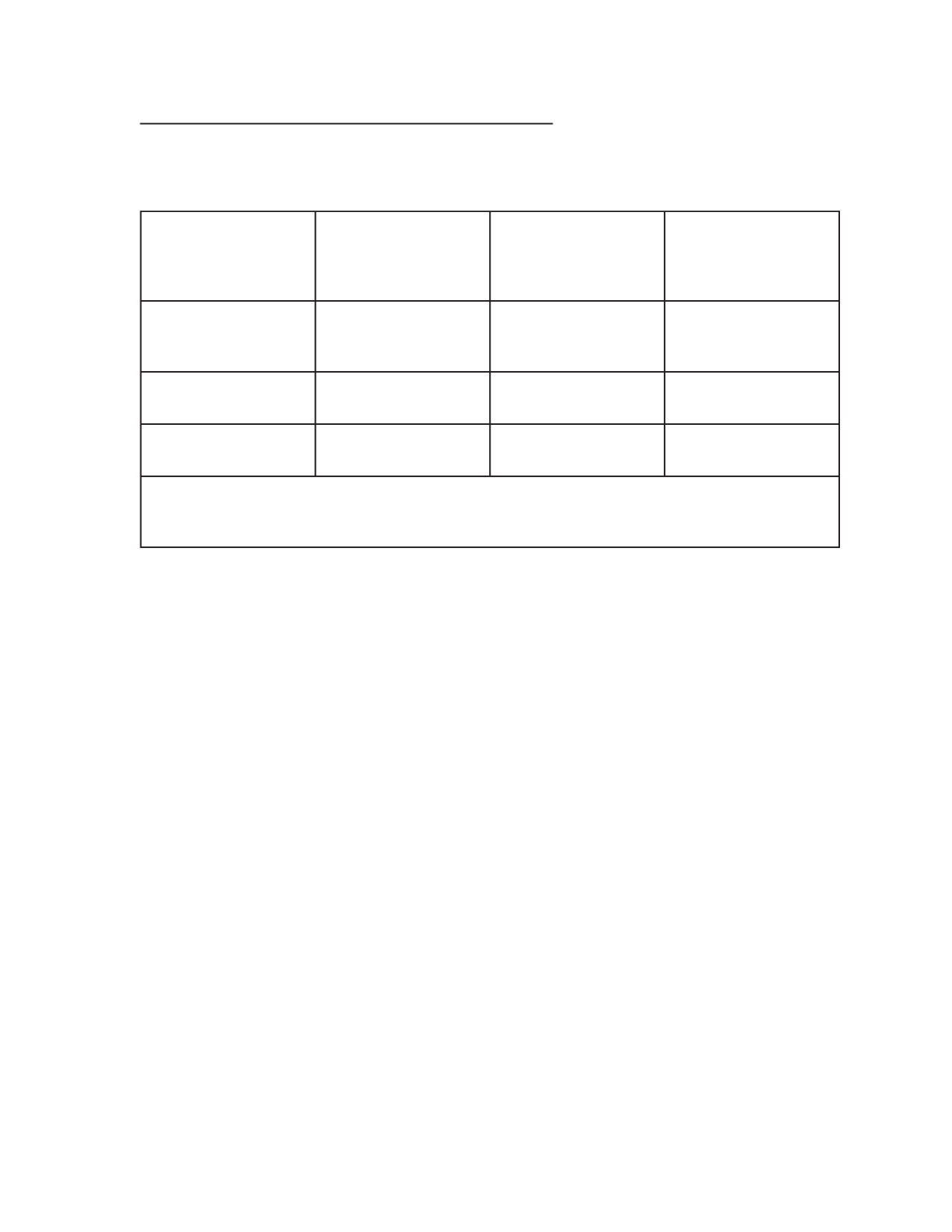
FM 4-20.103/MCRP 4-11.3C/TO 13C7-1-11
Table 1-3. Release Gate Requirements
Length of
Rigged Weight
Type XXVI
Aircraft
Aircraft Rail System
(Pounds)
Nylon Webbing
Required
C-130 (all models)
Non-CVRS*
501 - 13,000
One 20-foot
13,001 - 25,00 0
T wo 20-foot
2
,
Three 20-foot
C-130 (all models)
CVRS*
501 - 13,000
One 15-foot per stick
13,001 - 25,00 0
T wo 15-foot per stick
C-17
Inboard Logistic Rail
501 - 18,800
20-foot single stick
18,001 - 37,60 0
40-foot double stick
Note: For multiple deliveries, provide a release gate based on the w eight of each group of
containers to be airdropped at one time.
* CVRS (centerline vertical restraint system
)
RELEASE GATE LOAD SPREADER
1-13. Any time a container is rigged for container delivery system (CDS) and
offered as the aft-most container but cannot firmly support the release gate to
prevent excessive load shift, it must have a release gate load spreader. When
the total weight of the container to be dropped from the C-17 aircraft exceeds
38,000 pounds, a release gate load spreader is needed for each aft-most container.
Construct and secure it as given below.
a. Nail two 3/4- by 24- by 48-inch pieces of plywood together using eight
penny nails.
b. Drill a 1/2-inch hole 2 inches from each corner.
c. Place the spreader between the sling assembly and cover or load so the
48-inch side is parallel to the top and bottom of the container. Center the
spreader on the release gate.
d. Secure the corners of the spreader to the load with type III nylon cord
routed through the 1/2-inch holes.
NOTES:
1. The user is responsible for offering a gate load spreader to prevent excessive load
shift.
2. The number of joint airdrop inspection forms will be determined by the number of
release gates used.
2 September 2005
1-9
FM 4-20.103/MCRP 4-11.3C/TO 13C7-1-11
KNOTS USED
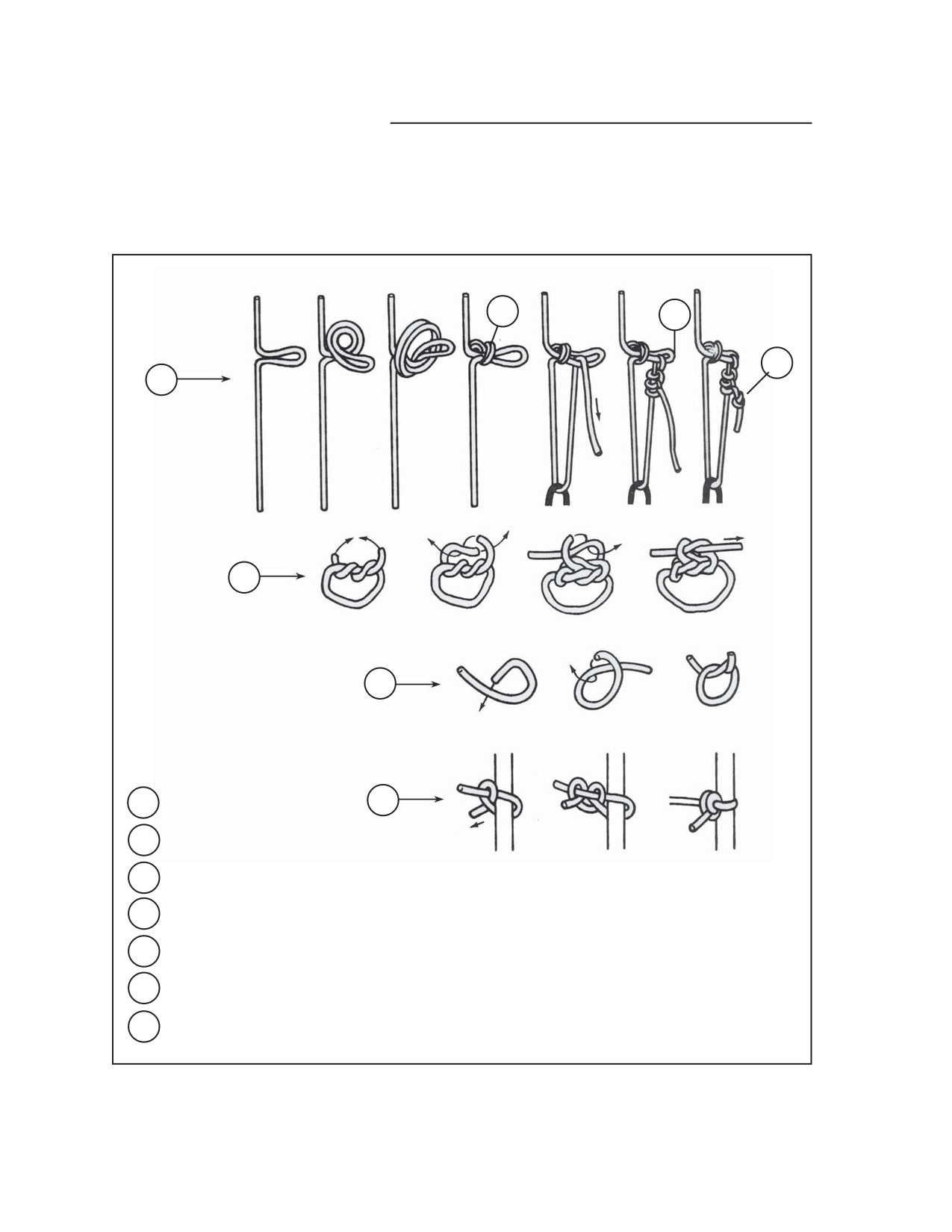
1-14. Some knots used in rigging container loads are shown in Figure 1-1.
NOTE: This drawing is not drawn to scale.
5
6
7
4
3
2
1 Double half-hitch
1
2 Overhand knot
3 Surgeon’s knot and locking knot
4 Trucker’s hitch
5 Overhand knot in a double line
6 Three half-hitch knots
7
(Locking knot) overhand knot in running end
Figure 1-1. Knots Used
1-10
2 September 2005
FM 4-20.103/MCRP 4-11.3C/TO 13C7-1-11
SECURING STRAPS AND WEBBING
1-15. The straps and webbing used to rig loads must be properly fastened and
secured.
CAUTION
Instructions given in this paragraph must be followed ex
actly to ensure a malfunction-free drop.
a. Fastening Strap With Friction Adapter. All containers in this
manual have friction adapters attached somewhere on the container. It is
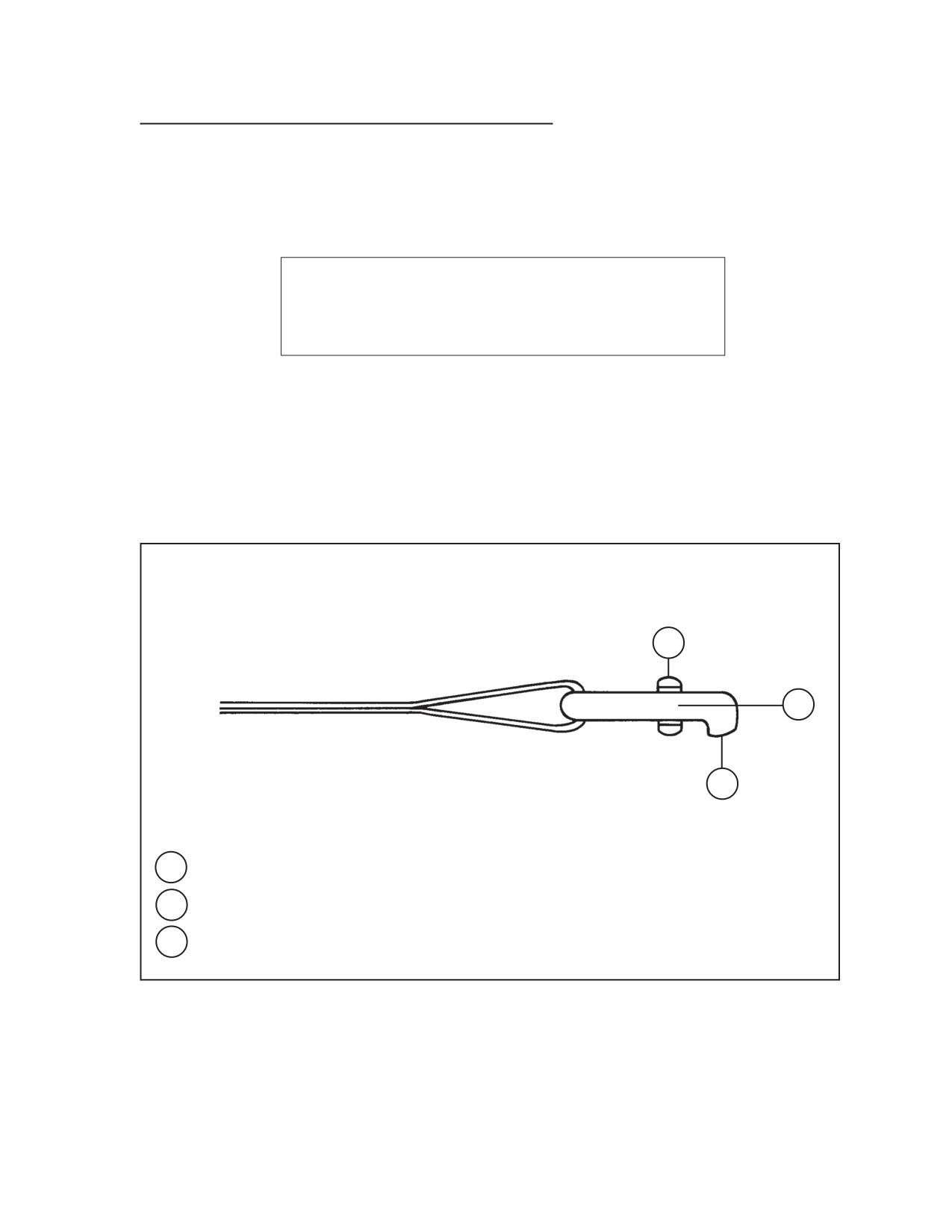
critical that the running ends of straps are routed properly. Figure 1-2
identifies the parts of the friction adapter. Figure 1-3 shows how to route
the running end of the strap through the friction adapter.
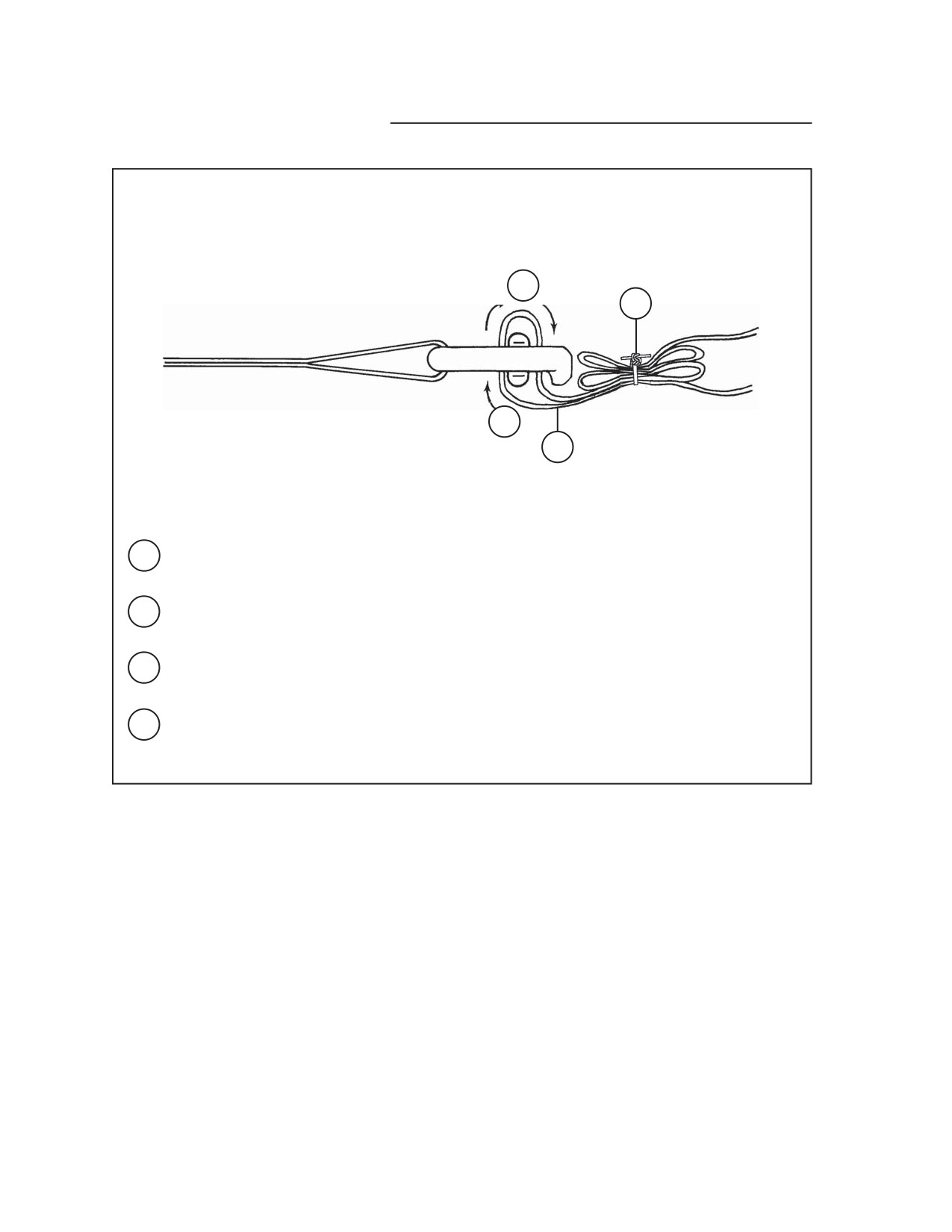
b. Securing Excess Strap. Excess strap is folded and tied with type I, 1/
4-inch cotton webbing. Figure 1-3 shows how to secure the excess strap.
NOTE: This drawing is not drawn to scale.
3
1
2
1
Metal frame.
2
Oversized portion.
3 Friction bar.
Figure 1-2. Friction Adapter
2 September 2005
1-11
FM 4-20.103/MCRP 4-11.3C/TO 13C7-1-11
NOTE: This drawing is not drawn to scale.
2
4
1
3
1 Using the running end of the webbing, route it up from the bottom between the friction
bar and the stitch formation side of the metal frame.
2 Route the running end down between the friction bar and the oversized portion of the
metal frame.
3 Pull tension. The oversized portion of the metal frame should be pressing against the
two layers of webbing.
4 S-fold the excess webbing. Secure it with one turn single, type I, 1/4-inch cotton web
bing using a surgeon’s knot and locking knot.
Figure 1-3. Webbing Routed and Excess Secured
1-12
2 September 2005
FM 4-20.103/MCRP 4-11.3C/TO 13C7-1-11
Chapter 2
Aircraft Information
ARMY AIRCRAFT
2-1. The following Army aircraft are used to airdrop loads.
a. UH-60 (Blackhawk) Helicopter. The UH-60 helicopter can carry
supplies both internally (door loads) and externally (cargo hook loads). The
allowable weight of the total cargo load is determined by responsible aviation
personnel using weight limitation data provided in TM 11-1520-237-23-7.
The weight and dimensional limits for both door loads and cargo hook loads
are listed in Table 2-1.
b. CH-47 (Chinook) Helicopter. The CH-47 helicopter can deliver
airdrop supplies over the ramp. The weight allowance of the total cargo
load is determined by responsible aviation personnel using weight limitation
data provided in TM 55-1520-240-23-10. Any standard A-7A cargo sling,
A-21 cargo bag, or A-22 cargo bag load may be dropped from the cargo ramp.
The maximum size of the load dropped from the external cargo hook is
limited only by the maximum dimensions of the container.
Table 2-1. Load Limitation for UH-60 Helicopter
Door Load Data
UH-60
Weight (w ithout parachutes)
Maximum for A-7A or A-21
500 lb
Minimum for each container
*
Dimensions (including parachute)
Length
48 in
Width
30 in
Height
42 in
* See Table 1-1 for the minimum w eight requirements which are based on type of parachute.
2 September 2005
2-1
FM 4-20.103/MCRP 4-11.3C/TO 13C7-1-11
AIR FORCE AIRCRAFT
2-2. The C-130 and C-17 aircraft can deliver container loads from the paratroop
door or from the cargo ramp.
a. Paratroop Door Loads. The maximum weight limit for the paratroop
door load is 500 pounds excluding the weight of the parachute. However, if
the load weighs more than 350 pounds, three trained designated pushers
must assist the jumpmaster in pushing the load from the aircraft. The
dimensions including the parachute, must not exceed 48- by 30- by 66-inches.
Loads are dropped before parachutists. Loads followed immediately by
parachutists are rigged with parachutes having non-breakaway static lines.
When the load is dropped from the paratroop door, the largest dimension
will be placed in the upright position. The parachute must be placed on top
of the load, or toward the inside of the aircraft.
b. Ramp Loads. A-7A and A-21 containers may be dropped off the cargo
ramp of C-130 aircraft. When using the ramp the skid board must be at
least 42-inches in width. A-22 containers may also be dropped from the
cargo ramp of C-17 and C-130 aircraft in a single or double stick, but the
skid board must be 48-inches in width. The number of containers dropped
will vary depending on the type of aircraft and the skid board size (see
Table 2-2 or 2-3). The maximum height of a container must not exceed 83
inches for C-130 and 101 inches for C-17. The width of the container must
not exceed 48 inches.
MARINE CORPS AIRCRAFT
2-3. The C-130 and CH-53 aircraft can deliver container loads from the paratroop
door or from the cargo ramp.
a. C-130 Aircraft. The Marine Corps C-130 uses the same procedure and
has the same capability as the Air Force C-130.
b. CH-53 (Sea Stallion) Helicopter. The CH-53E assault support
helicopter is a class 2 aircraft equipped with a seven-blade main rotor and
a four-blade canted tail rotor. It is designed for land- and ship-based
operations, with an emergency water operating capability. The helicopter
is equipped with a rear ramp loading system, cargo winch, roller conveyors,
and cargo tie-down facilities. External cargo may be suspended from hooks
using either single- or two-point suspension systems. Maximum weight on
wheels is 69,750 pounds. Maximum allowable gross weight is 73,500 pounds.
Refer to NAVAIR A1-H53BE-NFM-000 Part XI Performance Data for specific
capabilities. Inboard cabin compartment floor is limited to static loads of
300 pounds per square foot. Outboard sections of the floor are stressed to
greater loads at various positions (Refer to NAVAIR A1-H53BE-NFM-000,
Page 2-105). Roller conveyor limits are generally limited to 2200 pounds.
The maximum usable cabin height is 73-inches. The maximum usable cabin
length is 336-inches. The maximum usable cabin width is 76-inches. The
maximum airdrop weight is 2,200 pounds. The tie-down fittings vary in
capacity between 4,400 pounds and 20,000 pounds. Specifics can be found
in the Cargo Loading Manual NAVAIR A1-H53BE-CLG-000.
2-2
2 September 2005
FM 4-20.103/MCRP 4-11.3C/TO 13C7-1-11
NOTES:
1. Loads to be followed immediately by parachutists must be rigged, unless specified,
with parachutes having non-breakaway static lines.
2. High-velocity CDS dropped over 10,000 feet mean sea level will be rigged with a
breakaway static line.
3. High-velocity CDS dropped under 10,000 feet mean sea level will be rigged with a
non-breakaway static line.
Table 2-2. C-130 Aircraft CDS Capabilities
CDS Skid Dimension
Non-CVRS
CVRS
48- by 48-inch
Only single stick, 1-8
Single or double stick, 1-16
containers.
containers. Must be dropped in even
numbers when dropping double stick.
48- by 72-inch stretch Only single stick, 1-6 stretch
Single or double stick, 1-12 stretch
container
containers
containers. Must be dropped in even
numbers when dropping double stick.
48- by 96-inch double Only single stick, 1-4 double
Single or double stick, 1-8 double
A-22 container
containers
containers. Must be dropped in even
numbers when dropping double stick.
NOTES:
1. If the loads have a front or rear overhang, the number of containers will be
reduced.
2. Wh en steel strapping is bound around the skid board, non-CVRS mu st be used.
CENTERLINE VERTICAL RESTRAINT SYSTEM
2-4. The CVRS was designed to restrain container loads vertically in Air Force
aircraft.
a. Description. The CVRS is designed to work with the dual rail system
in Air Force aircraft. It adds a rail in the center of the cargo area. The rail
runs from the front of the cargo area of the aircraft to the rear and is bolted
in place. Aircraft without the CVRS in place may be loaded with containers
in a single stick formation in the center of the cargo area of the aircraft.
Aircrafts with the CVRS installed may be loaded with A-22 containers
positioned in a right stick formation, left stick formation, or both; however,
container skid boards must be 48-inches in width and must be 1-inch thick
if the rigged weight is 1,600 pounds or greater. On aircraft with the CVRS
in place, when an A-22 container is being positioned in the right stick, the
right edge of the skid is positioned in the right rail of the aircraft dual rail
system and the left edge of the skid is positioned in the center rail. The left
stick is loaded in a similar manner. On aircraft with the CVRS in place,
each stick of containers is independent of the other.
2 September 2005
2-3
FM 4-20.103/MCRP 4-11.3C/TO 13C7-1-11
NOTE: Any overhang must be placed lengthwise in the aircraft. If the container load
has an overhang on three or four sides, the load must be dropped in a centerline
configuration (non-CVRS).
b. Capabilities. Air Force aircraft equipped with the CVRS can drop
single or double A-22 container loads in a single or double stick formation.
Both sticks may be released simultaneously, or each stick can be dropped
separately. All containers in a stick maybe dropped on the same drop zone,
or any combination of containers may be dropped on different drop zones.
A separate release gate is required for each container or group of containers
in each stick to be dropped on a separate drop zone. See Table 1-3 for
release gate requirements.
NON-CVRS LOADS
2-5. The CVRS was designed to restrain the load vertically during the aircraft
flight. When the load is not restrained to CVRS standards, it must be vertically
restrained for flight. These restraints will be removed up to 30 minutes before
airdrop. After the restraints are removed, the aircraft will have reduced
maneuverability for threat avoidance.
INBOARD LOGISTICS RAIL
2-6. The inboard logistics rail was designed to restrain container loads vertically
in the C-17 aircraft.
a. Description. The inboard logistics rail is a permanent rail in the center
of the C-17 aircraft cargo area. It runs from the front of the cargo area to
the rear and folds down when not in use. The aircraft may be loaded with
A-22 containers positioned in the right stick formation, left stick formation,
or both; however, container skid boards must be 48-inches in width and
must be 1-inch thick if the rigged weight is 1,600 pounds or greater. When
A-22 containers are being positioned in the right stick, the right edge of the
skid is positioned in the right rail of the aircraft aerial delivery system rail
and the left edge of the skid is positioned in the inboard logistics rail. The
left stick is loaded in a similar manner. Each stick of containers is
independent of each other.
NOTE: The width of the container load MUST NOT exceed 48 inches.
b. Capabilities. The C-17 aircraft can drop single or double A-22 container
loads in either a single or double stick configuration, but double sticks must
have an even number of containers. Both sticks may be released
simultaneously, or each stick can be dropped separately. All containers in
a stick may be dropped on the same drop zone, or any combination of
containers may be dropped on different drop zones. A separate release gate
is required for each container or group of containers in each stick to be
dropped on a separate drop zone. See Table 1-3 for release gate
requirements.
2-4
2 September 2005
FM 4-20.103/MCRP 4-11.3C/TO 13C7-1-11
Table 2-3. C-17 Aircraft CDS Capabilities
CDS Skid Dimension
Inboard Logistics Rail
48- by 48- inch
Single or double stick, 1-40 containers. Must
be dropped in even numbers w hen dropping
double stick.
48- by 72-inch stretch container
Single or double stick, 1-20 stretch containers.
Must be dropped in even numbers w hen
dropping double stick.
48- by 96-inch double A-22 container
Single or double stick, 1-20 double contianers.
Must be dropped in even numbers w hen
dropping double stick.
NO TE: If the loads have a front or rear overhang, the number of containers will be
reduced.
2 September 2005
2-5
This page intentionally left blank.
FM 4-20.103/MCRP 4-11.3C/TO 13C7-1-11
PART TWO
RIGGING A-7A CONTAINER LOADS
Chapter 3
General Information and Procedures
A-7A AIRDROP CARGO SLING ASSEMBLY
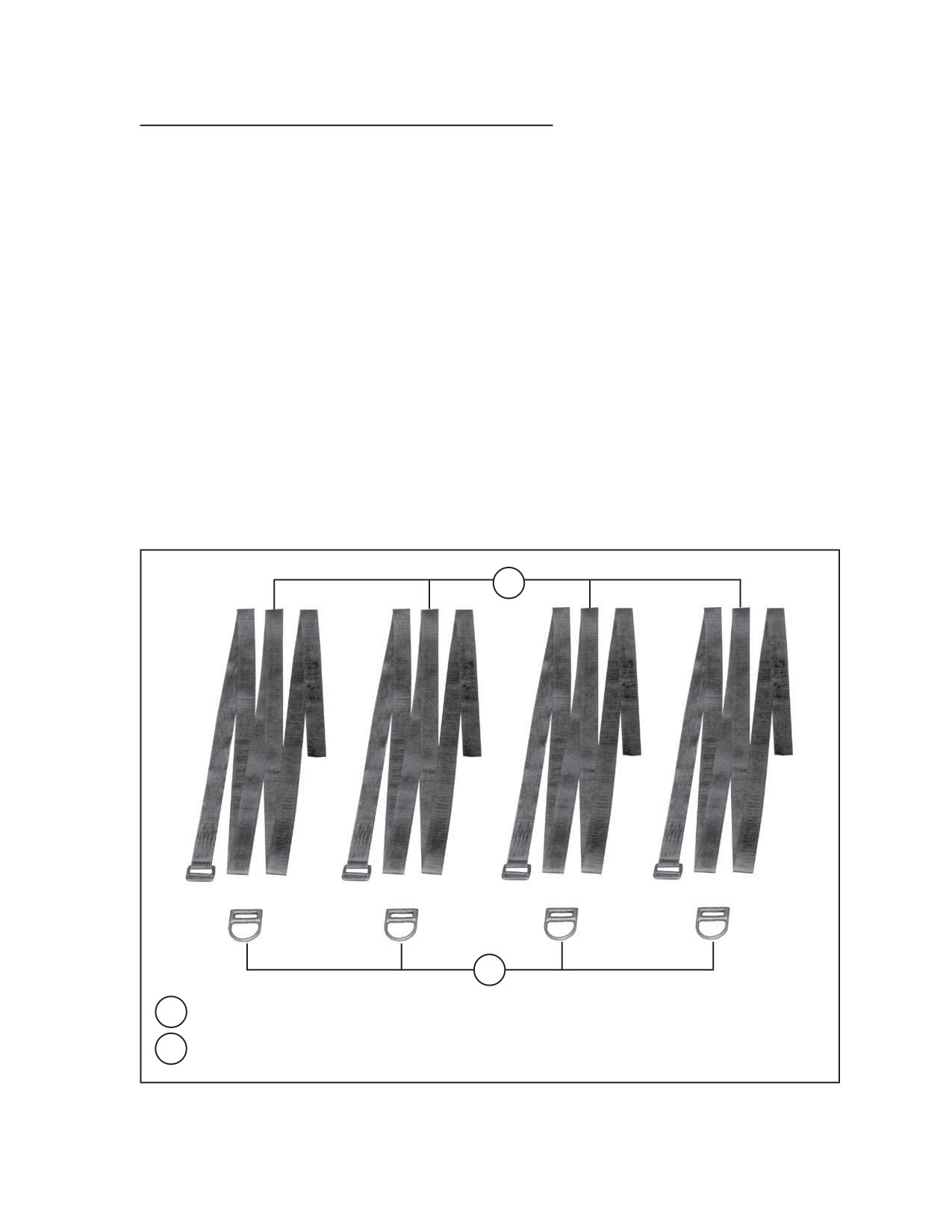
3-1. The A-7A airdrop cargo sling assembly consists of four D-rings and four
identical sling straps. Each strap is 188 inches long and has a friction adapter
attached at one end. To rig an A-7A container two or more straps are required.
Figure 3-1 shows an A-7A airdrop cargo sling assembly.
1
2
1 A-7A strap with friction adapter on one end
2 D-rings
Figure 3-1. A-7A Airdrop Cargo Sling Assembly
2 September 2005
3-1
FM 4-20.103/MCRP 4-11.3C/TO 13C7-1-11
WEIGHT LIMITS
3-2. The maximum weight of this container will vary according to the number
of straps, but must not exceed 500 pounds. When two straps are used, 300
pounds is the maximum weight. When three straps are used, 400 pounds is the
maximum weight. When four or more straps are used, the maximum weight
must not exceed 500 pounds. The minimum weight will vary according to the
parachute used. When dropped from the paratroop doors, the load must weigh
a minimum of 11 pounds per square foot. When dropped from the ramp, the
load must weigh a minimum of 28 pounds per square foot. Table 3-1 lists
parachutes used with this container and the weight restrictions.
Table 3-1. Parachute Requirements for A-7A Container Loads
Suspended Weight (Pounds)
Parachute
Minimum
Maximum
Low -Velocity
One 68-inch pilot
30
50
Three 68-inch pilot
51
200
One T-10 modified cargo
90
500
One G-14 cargo
200
500
High-Velocity
One 68-inch pilot
75
150
Three 68-inch pilot
151
500
*One 12-foot high-velocity
151
500
One 15-foot cargo extraction
151
500
* Primary parachute
A-7A CONTAINER LOADS
3-3. The A-7A loads can be rigged for low-velocity or high-velocity airdrop. The
container can exit the aircraft either through the paratroop doors or off the
ramp. The equipment should be padded with felt, cellulose wadding, or
honeycomb. This container is usually used to supply small items, ready-to-use
or disassembled equipment, or other nonfragile supplies. The load can be rigged
by the using unit. The parachute must be packed by a parachute rigger. It is
only required to be inspected by a jumpmaster or parachute rigger.
PARACHUTES FOR A-7A LOADS
3-4. To select a parachute for an A-7A load, consider the type of airdrop (low
velocity or high-velocity) and the weight of the rigged container, shown in Table
3-1. Pack and install the parachute as described below.
3-2
2 September 2005
FM 4-20.103/MCRP 4-11.3C/TO 13C7-1-11
a. LOW-VELOCITY LOADS. The parachutes that can be used to rig an
A-7A load for low-velocity airdrop are described below.
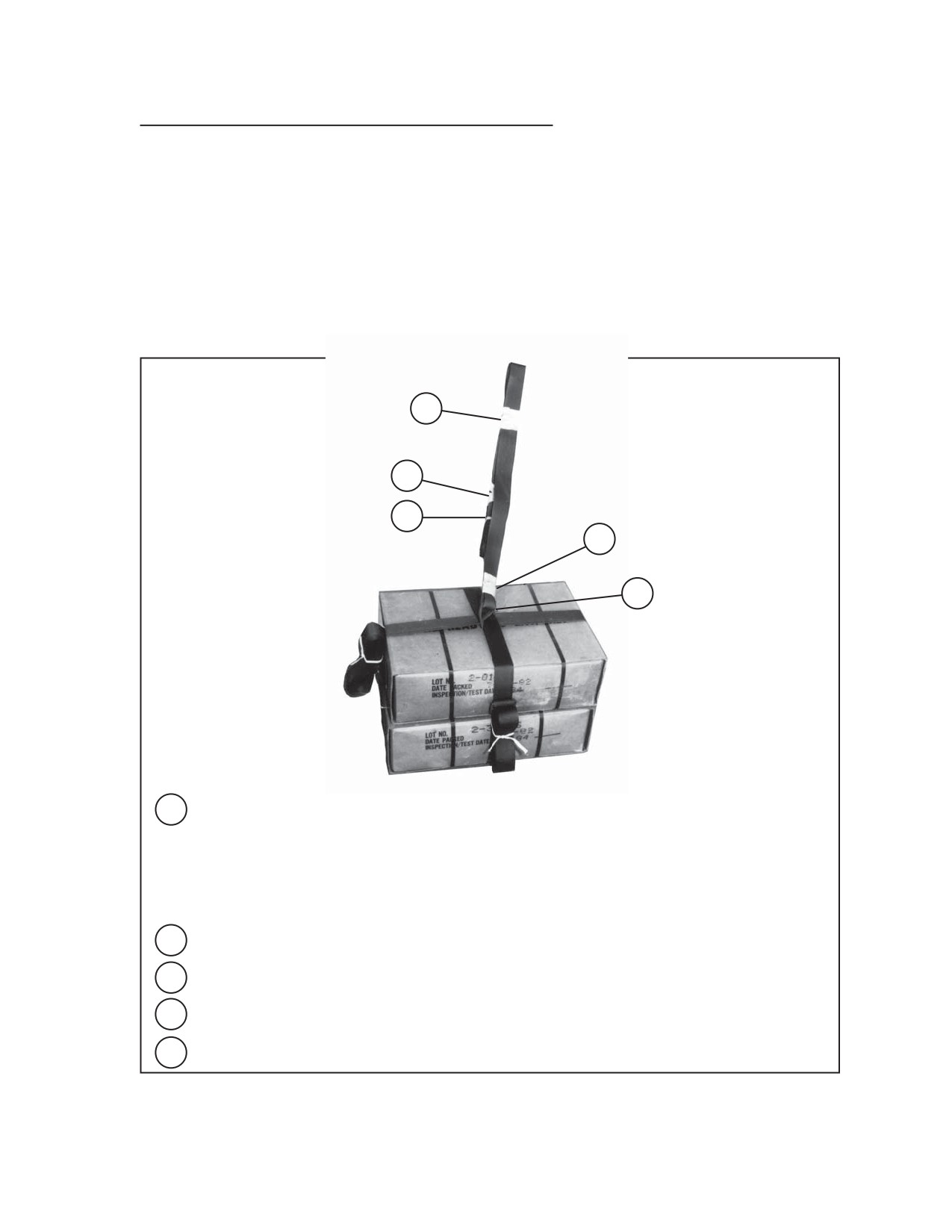
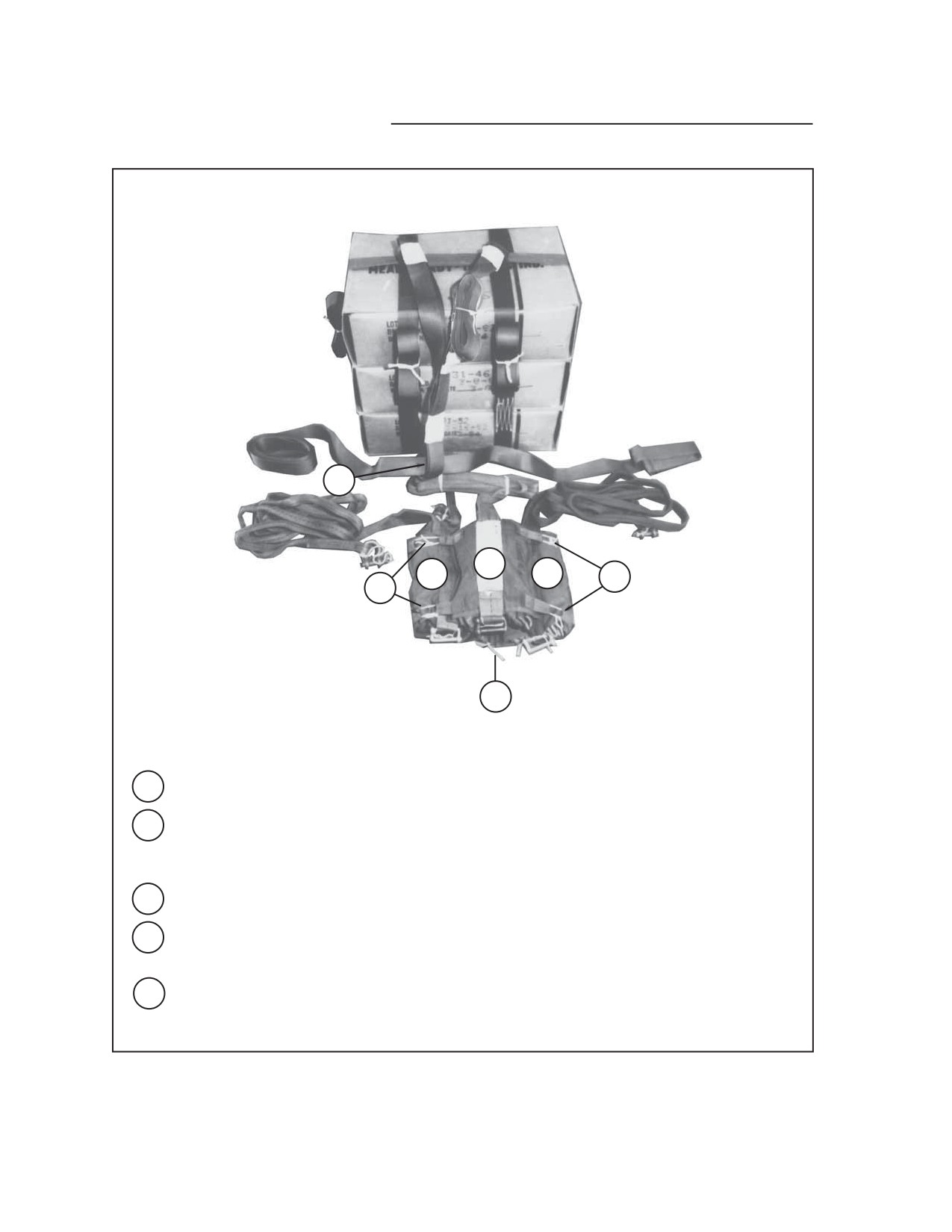
(1) One 68-inch pilot parachute. Pack one 68-inch pilot parachute
in accordance with TM 10-1670-281-23&P/TO 13C5-32-2/NAVAIR 13-
1-32. Install the parachute as shown in Figure 3-2.
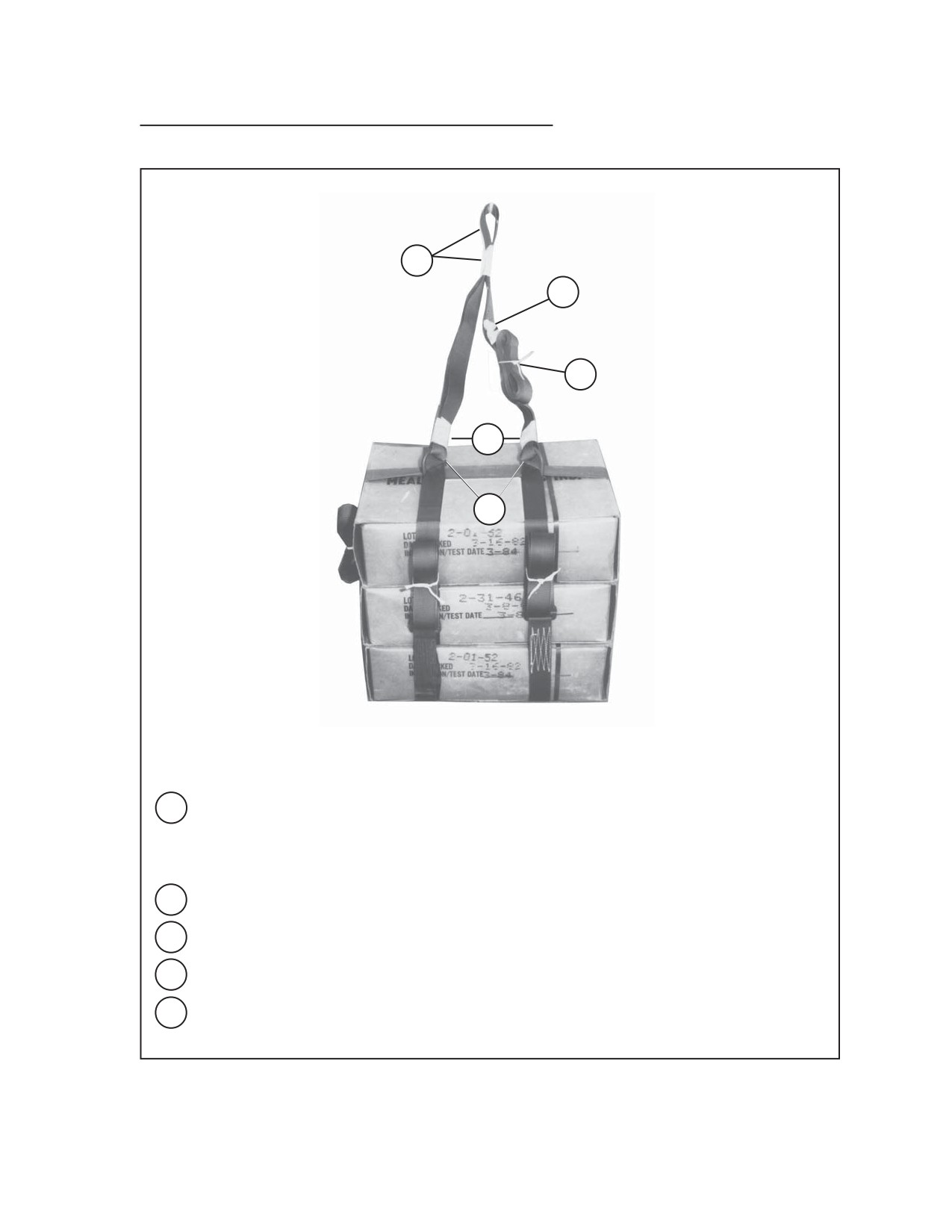
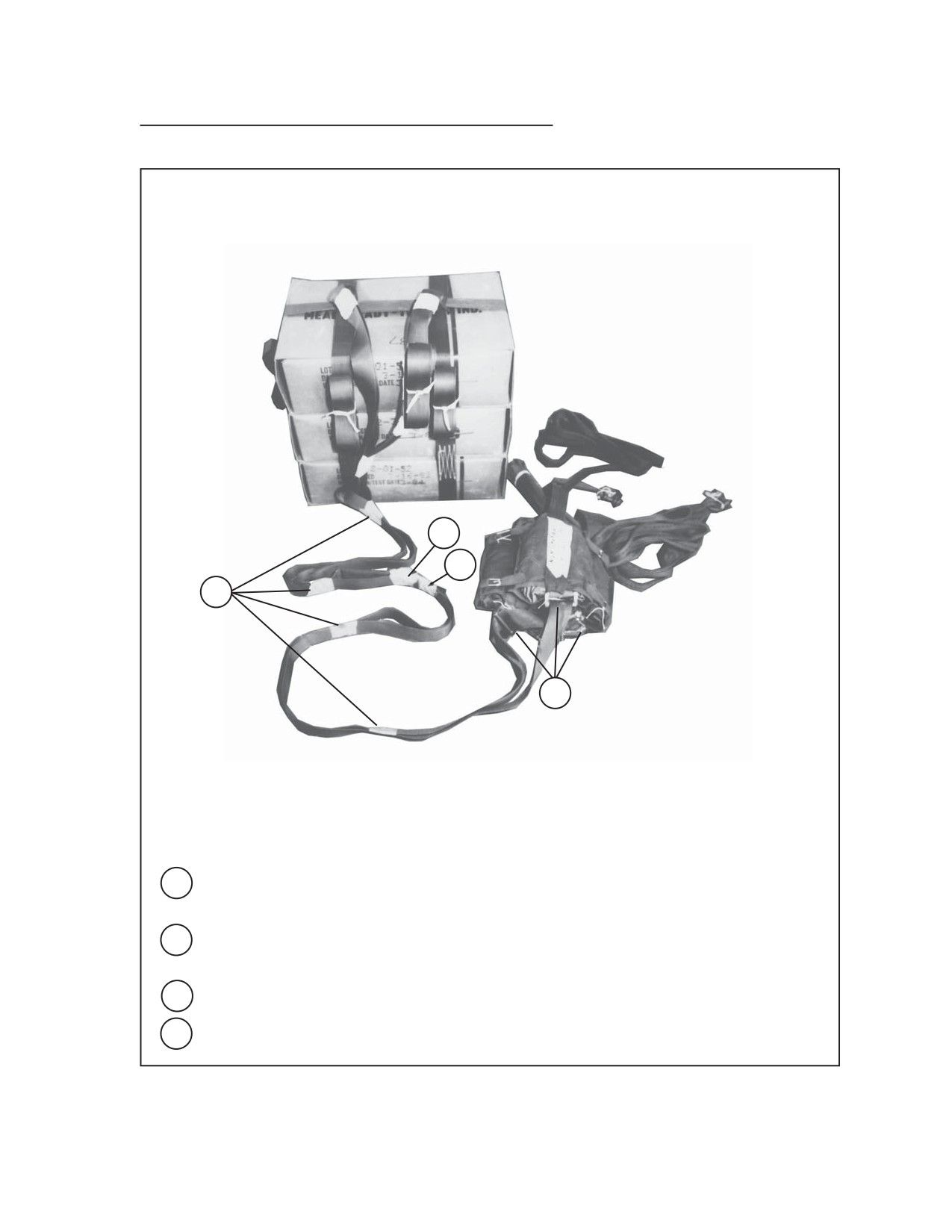
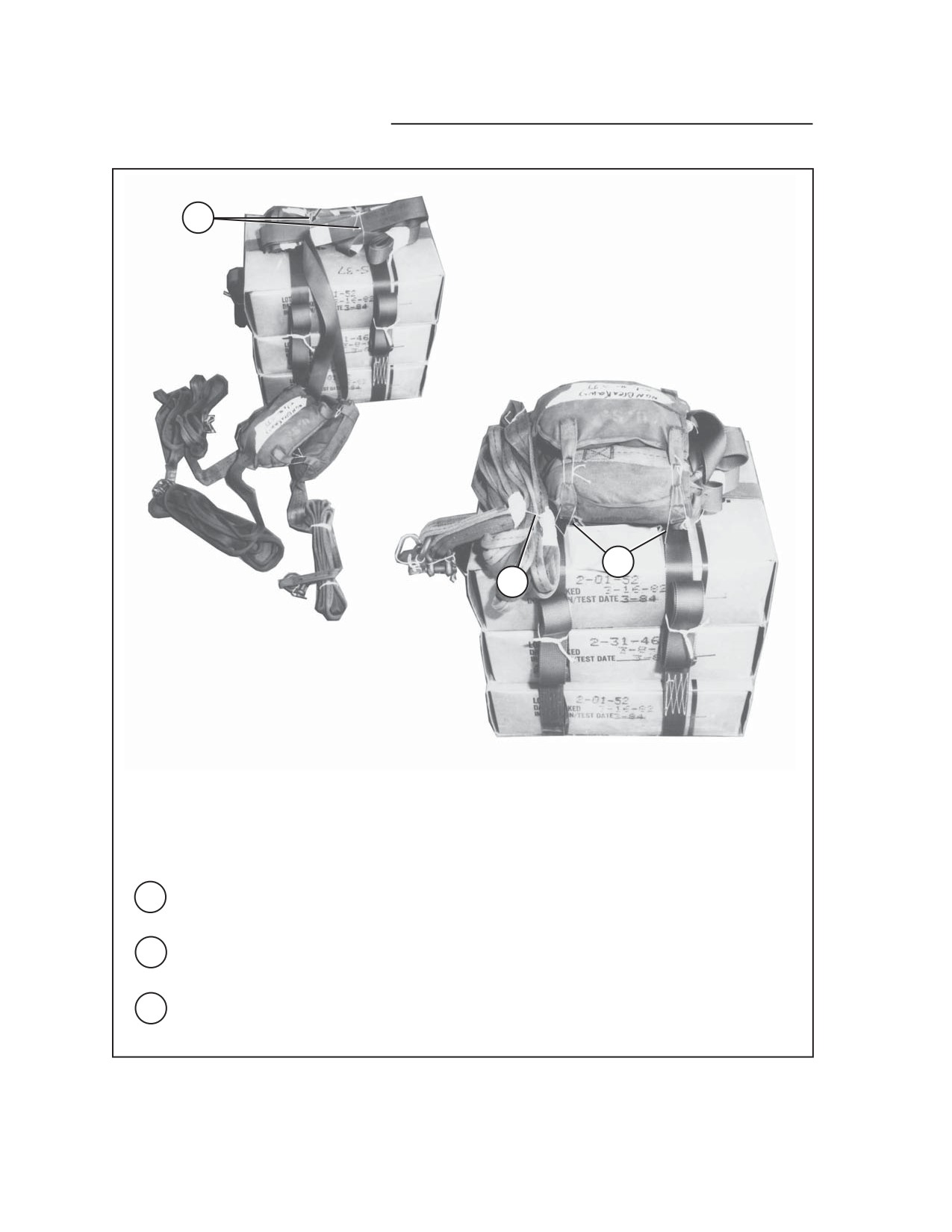
(2) Three 68-inch pilot parachutes. Pack three 68-inch pilot
parachutes in accordance with TM 10-1670-281-23&P/TO 13C5-32-2/
NAVAIR 13-1-32. Install the parachutes as shown in Figure 3-3.
5
3
2
4
1
1
Pass the free end of an A-7A strap through the D-ring on top of the load. Pass the free
end of the strap through the friction adapter. Tighten the strap until a 24-inch loop is
formed.
NOTE: Route the strap so that the oversized portion of the metal frame is down. Make
sure the friction adapter is about halfway down the strap.
2
Fold the excess strap. Secure the excess strap according to Chapter 1.
3
Tape the friction adapter.
4
Tape the strap together 2 inches above the D-ring with masking tape.
5 Tape the other end of the strap together so that a 3-inch loop is formed.
Figure 3-2. One 68-inch Pilot Parachute Installed
2 September 2005
3-3
FM 4-20.103/MCRP 4-11.3C/TO 13C7-1-11
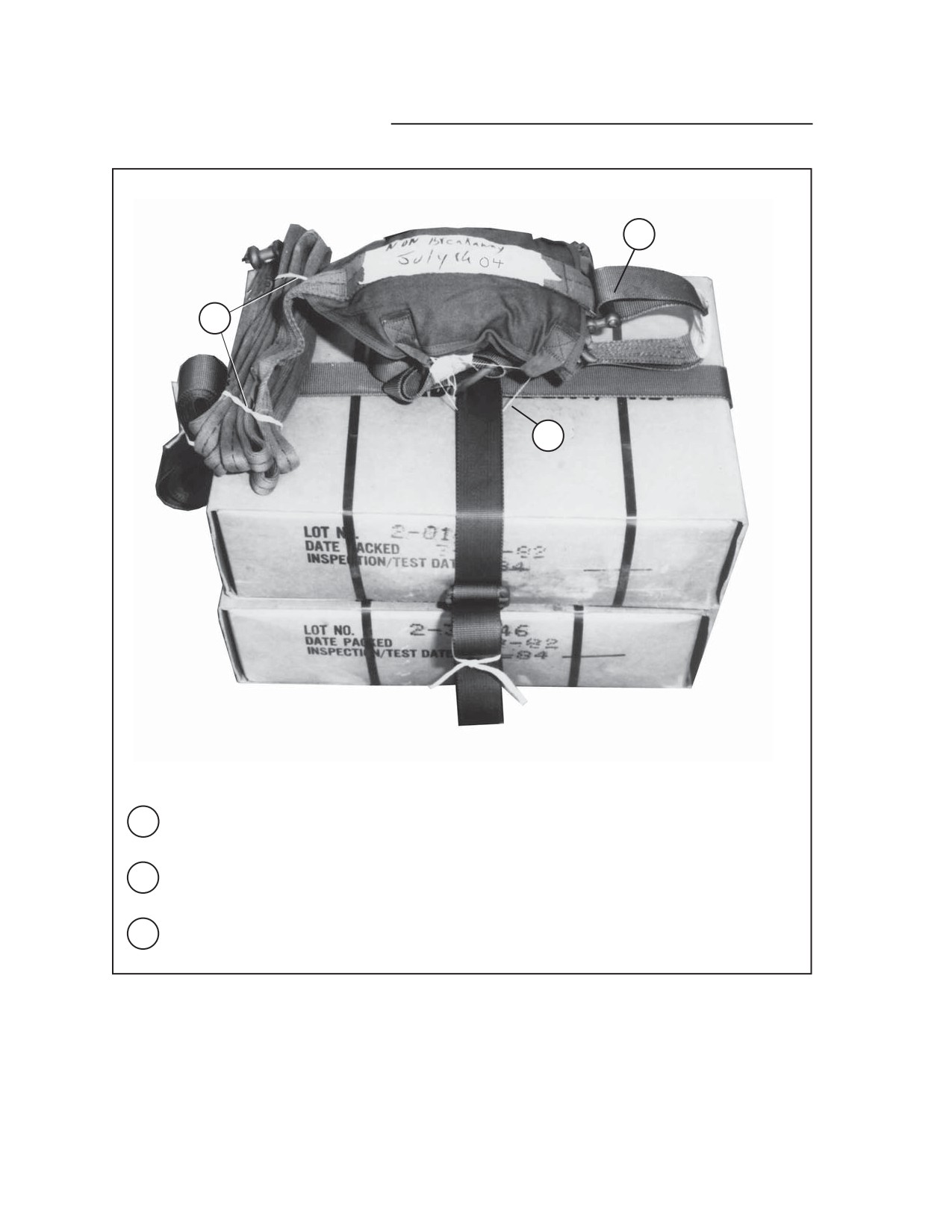
6
8
7
6
Place the 3-inch loop on the parachute L-bar connector link. Fasten the L-bar connector
link.
7
Place the 68-inch pilot parachute on top of the load. Tie each side of the parachute to
one A-7A strap with a length of ticket number 8/7 thread.
8 Fold the static line and secure it to top of the load with retainer bands.
Figure 3-2. One 68-inch Pilot Parachute Installed (Continued)
3-4
2 September 2005
FM 4-20.103/MCRP 4-11.3C/TO 13C7-1-11
NOTE: Use masking tape only.
5
3
2
4
1
1
Pass the free end of an A-7A strap through the two D-rings on top of the load. Pass the
free end of the strap through the friction adapter. Pull both plies of the strap upward
between the D-rings. Tighten the strap until the two plies of the strap are 24 inches
above the load.
2
Fold the excess strap. Secure the excess strap according to Paragraph 1-14.
3
Tape the friction adapter with masking tape.
4
Tape the A-7A strap together 2 inches above each D-ring.
5 Form a 3-inch loop in the center of the A-7A strap. Tape the plies of the strap together
below the loop.
Figure 3-3. Three 68-inch Pilot Parachutes Installed
2 September 2005
3-5
FM 4-20.103/MCRP 4-11.3C/TO 13C7-1-11
10
8
6
6
9
9
7
6
Place two 68-inch parachutes on a flat, dry surface.
7
Tie the parachutes together using the closest bag attaching loops with one length of
ticket number 8/7 cotton thread at the top of the bag and one length at the bottom of the
bag.
8
Place a third 68-inch parachute on top of the two parachutes in step 6.
9
Tie the top (third) parachute bag attaching loops to the outside bag attaching loops on
the bottom parachutes with four lengths of ticket number 8/7 cotton thread.
10 Pass the free end of another A-7A strap through the 3-inch loop (step 5) in the other A
7A strap.
Figure 3-3. Three 68-inch Pilot Parachutes Installed (Continued)
3-6
2 September 2005
FM 4-20.103/MCRP 4-11.3C/TO 13C7-1-11
12
14
13
11
11 Pass the free end of the A-7A strap through the L-bar connector links of each 68-inch
parachute.
12 Pass the free end of the A-7A strap through the friction adapter, and tighten it to a
length of 7 feet. Tape the friction adapter.
13 Tape the plies of the A-7A strap together.
14 Fold and tape the excess strap.
Figure 3-3. Three 68-inch Pilot Parachutes Installed (Continued)
2 September 2005
3-7
FM 4-20.103/MCRP 4-11.3C/TO 13C7-1-11
15
16
17
15
Fold the A-7A straps and lay them on top of the load. Tie the folds to the top of the load
with two lengths of ticket number 8/7 cotton thread.
16
Place the parachutes on top of the load. Tie the parachute bag attaching loops to the A
7A straps with four lengths of ticket number 8/7 cotton thread.
17 Tape the parachute static lines together. Tie the static lines to the top of the load with
ticket number 8/7 cotton thread.
Figure 3-3. Three 68-inch Pilot Parachutes Installed (Continued)
3-8
2 September 2005
FM 4-20.103/MCRP 4-11.3C/TO 13C7-1-11
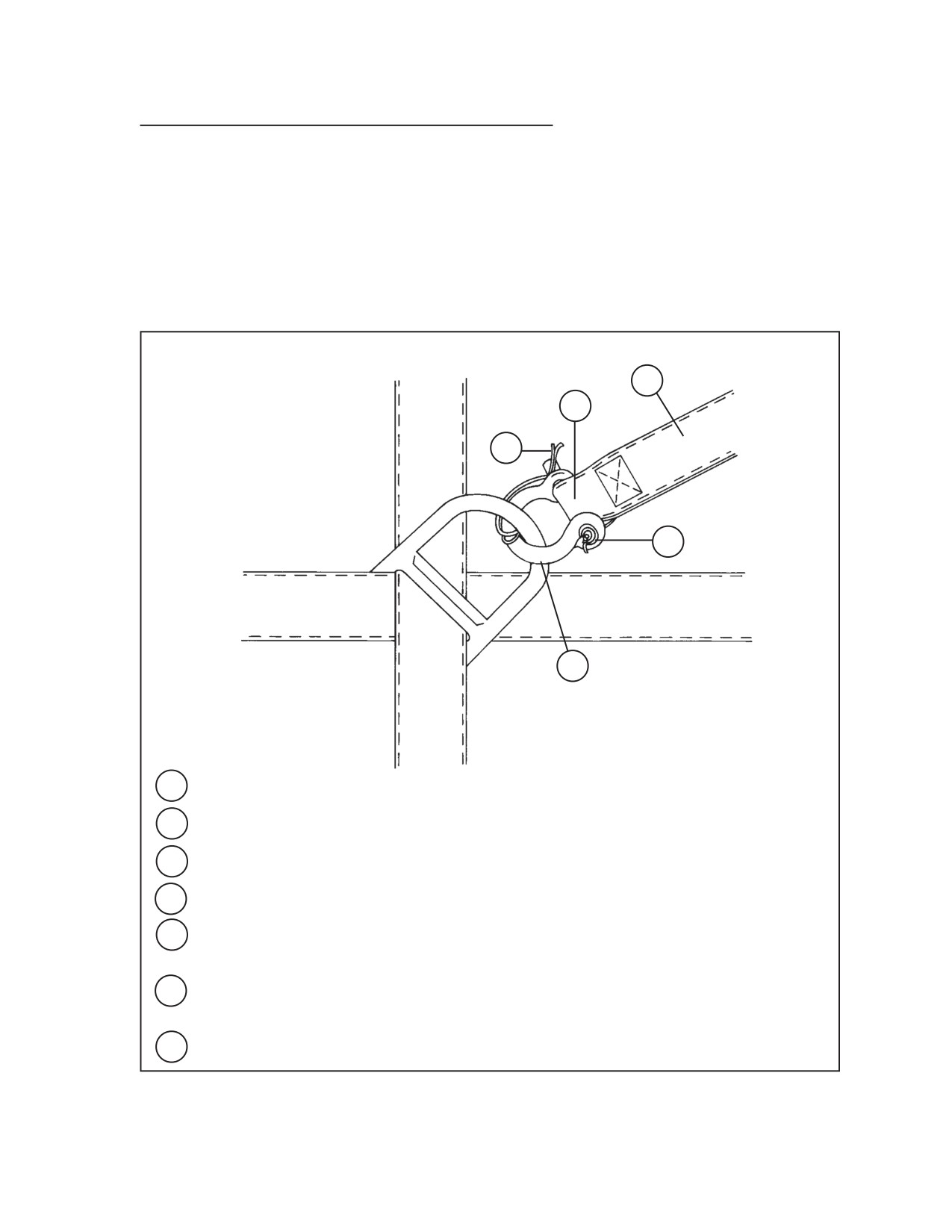
(3) One T-10 Modified Cargo Parachute. Pack one T-10 parachute
according to TM 10-1670-293-23&P/TO 14D1-2-467-2. Intall the
parachute as shown in Figure 3-4 to attach the T-10 modified cargo
parachute.
(4) One G-14 Cargo Parachute. Pack one G-14 cargo parachute
according to TM 10-1670-282-23&P/TO 13C5-30-2/NAVAIR 13-1-33.
Install the parachute as shown in Figure 3-4.
NOTE: This drawing is not drawn to scale.
2
4
6
5
3
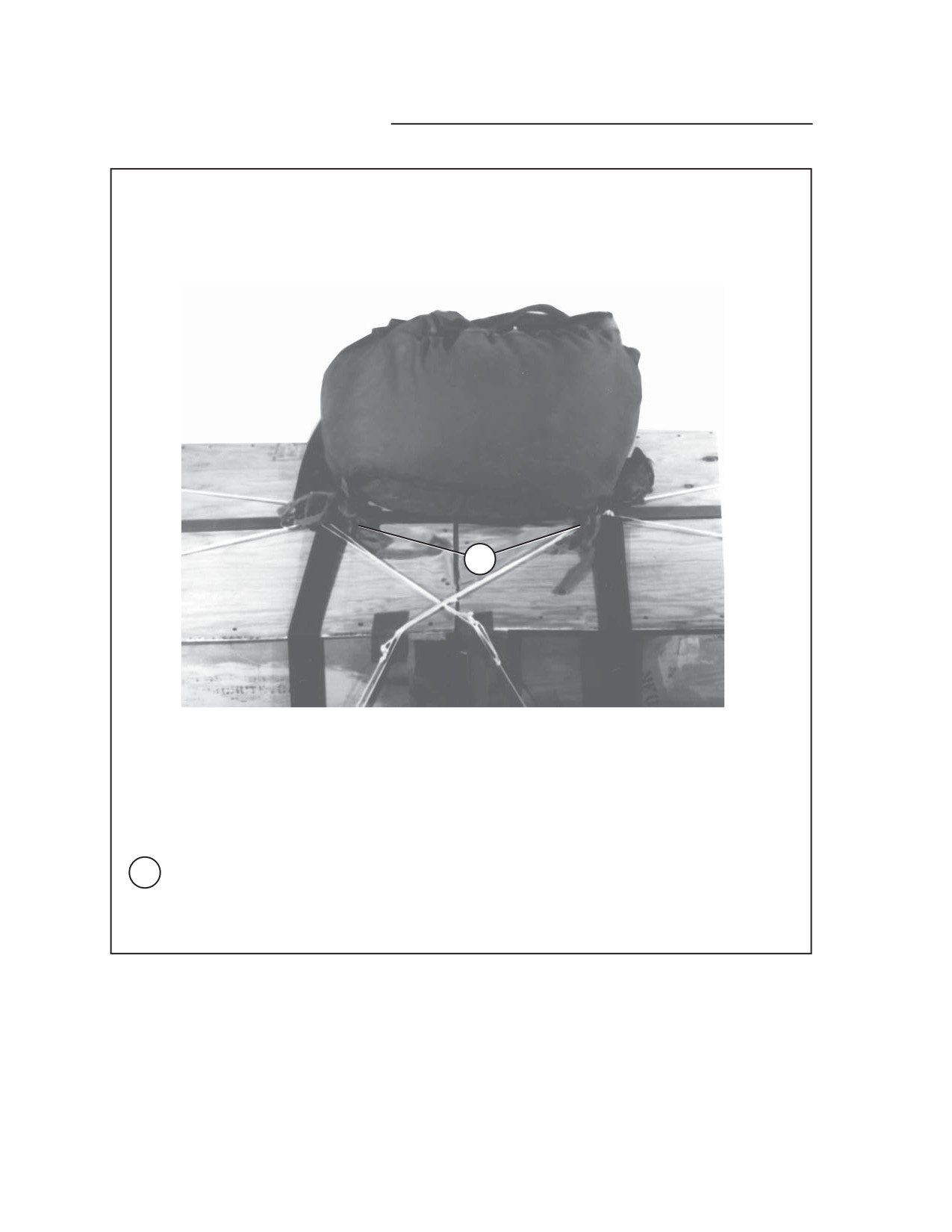
1 Place the parachute on top of the load between the D-rings (not shown).
2 Pull each riser to the closest D-ring.
3 Place the bell portion of the clevis on one D-ring.
4 Place the loop on the end of the riser between the clevis arm.
5 Insert the clevis pin through the hole in the clevis arm, through the loop on the riser,
and through the hole in the other clevis arm.
6 Insert the cotter pin in the hole of the clevis pin. Spread the ends of the cotter pin
enough to prevent the cotter pin from sliding out of the clevis pin.
7 Attach the other riser to the other D-ring as described in steps 3 through 6.
Figure 3-4. G-14 Cargo Parachute Installed
2 September 2005
3-9
FM 4-20.103/MCRP 4-11.3C/TO 13C7-1-11
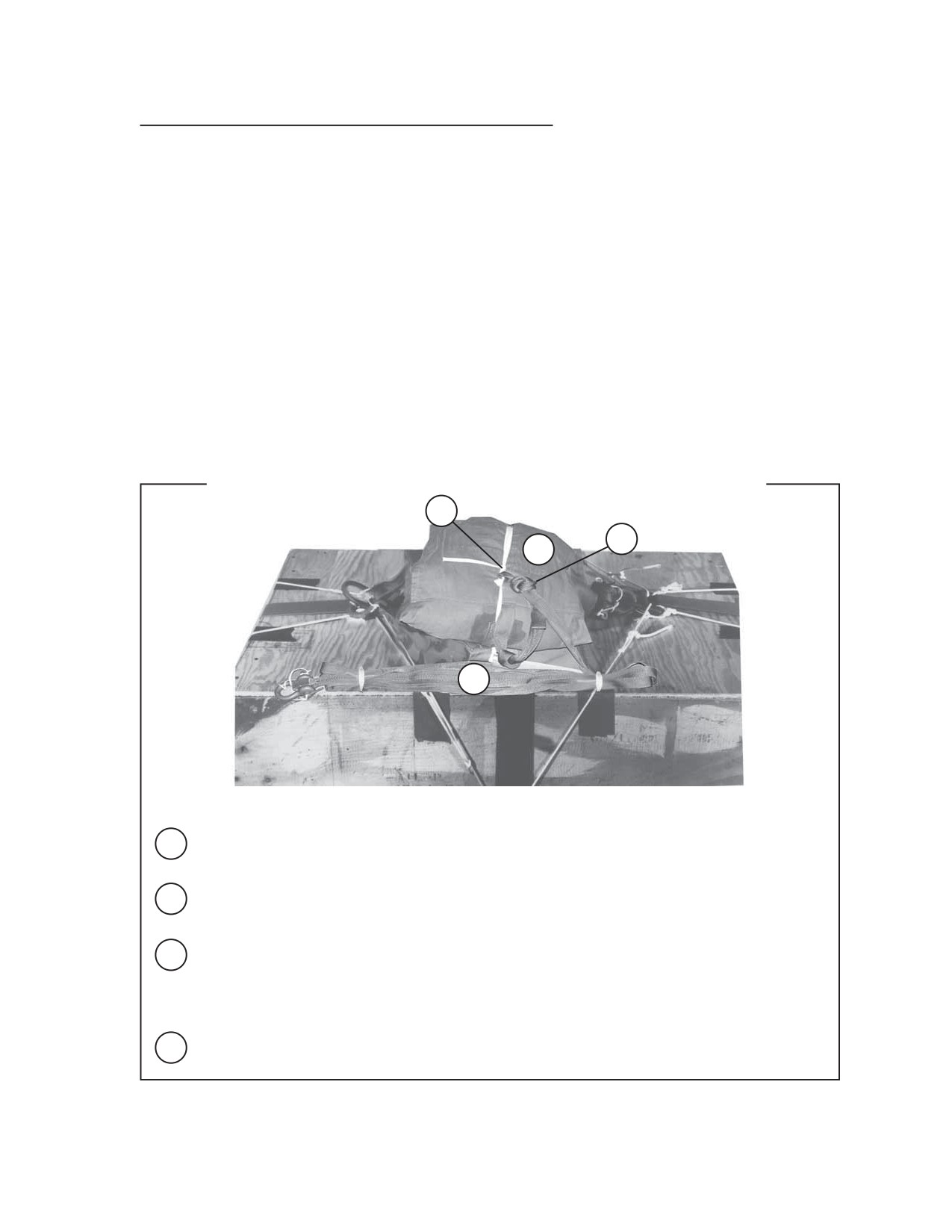
8
8 Tie the parachute tie tapes to convenient points on the load with bow knots.
Figure 3-4. G-14 Cargo Parachute Installed (Continued)
3-10
2 September 2005
FM 4-20.103/MCRP 4-11.3C/TO 13C7-1-11
b. HIGH-VELOCITY LOADS. The parachutes that can be used to rig
an A-7A load for high-velocity airdrop are described below.
(1) One 68-inch Pilot Parachute. Pack and install one 68-inch pilot
parachute as described in paragraph 3-4a(1).
(2) Three 68-inch Pilot Parachutes. Pack and install three 68-inch
pilot parachutes as described in paragraph 3-4a(2).
(3) One 12-foot, High-Velocity Cargo Parachute. Pack one 12
foot high-velocity cargo parachute according to TM 10-1670-275-23&P/
TO 13C5-25-2/NAVAIR 13-1-26. Install the parachute as shown in
Figure 3-5.
(4) One 15-foot Cargo Extraction Parachute. When the 15-foot
cargo extraction parachute is used, modify the parachute as shown in
Figure 3-6. Install parachute as shown in Figure 3-7.
3
2
1
4
1
Center the parachute and attach risers to D-rings as described in Figure 3-4, steps 1
through 7.
2
Form a 3-inch diameter loop in the static line by tying an overhand knot approximately
8 inches up from the deployment bag main strap attaching loop.
3
Tie one end of a length of type I, 1/4-inch cotton webbing to a convenient point on the
load on top of the load. Route the free end of the cotton webbing through the retaining
loop, through the loop in static line and around a convenient point on the load. Form a
trucker’s hitch knot to secure the parachute.
4 S-fold the static line on top of the load. Secure the folds to the load with a 2-inch re
tainer band.
Figure 3-5. 12-Foot High-Velocity Cargo Parachute
2 September 2005
3-11
FM 4-20.103/MCRP 4-11.3C/TO 13C7-1-11
2
1
3
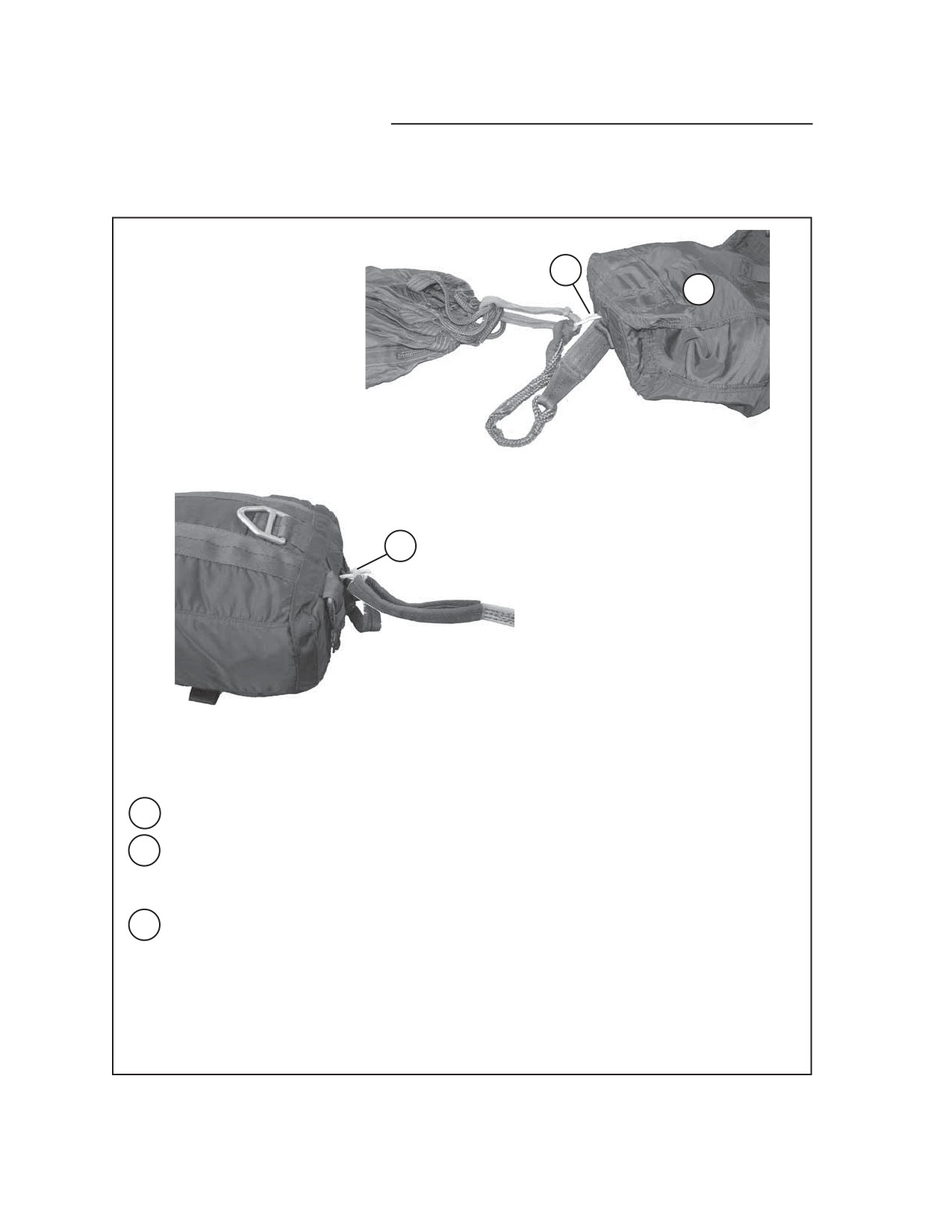
1
Invert the 15-foot cargo extraction parachute deployment bag.
2
Route one end of the gutted type III nylon cord through the hole in the top of the deploy
ment bag and through the bridle loop then back out through the hole in the top of the
deployment bag.
3 Route the ends of the type III nylon cord through the static line buffer loop in opposite
directions and draw the ends tight. Tie the ends of the type III nylon cord together with
a surgeon’s knot and a locking knot. Tie an overhand knot in each end.
NOTE: For a non-breakaway parachute, girth hitch the static line through the deploy
ment bag retaining loop and tie a 3-inch loop of gutted type III nylon cord around the
static line and through the small clevis.
Figure 3-6. 15-Foot Cargo Extraction Parachute Modified
3-12
2 September 2005
FM 4-20.103/MCRP 4-11.3C/TO 13C7-1-11
5
6
7
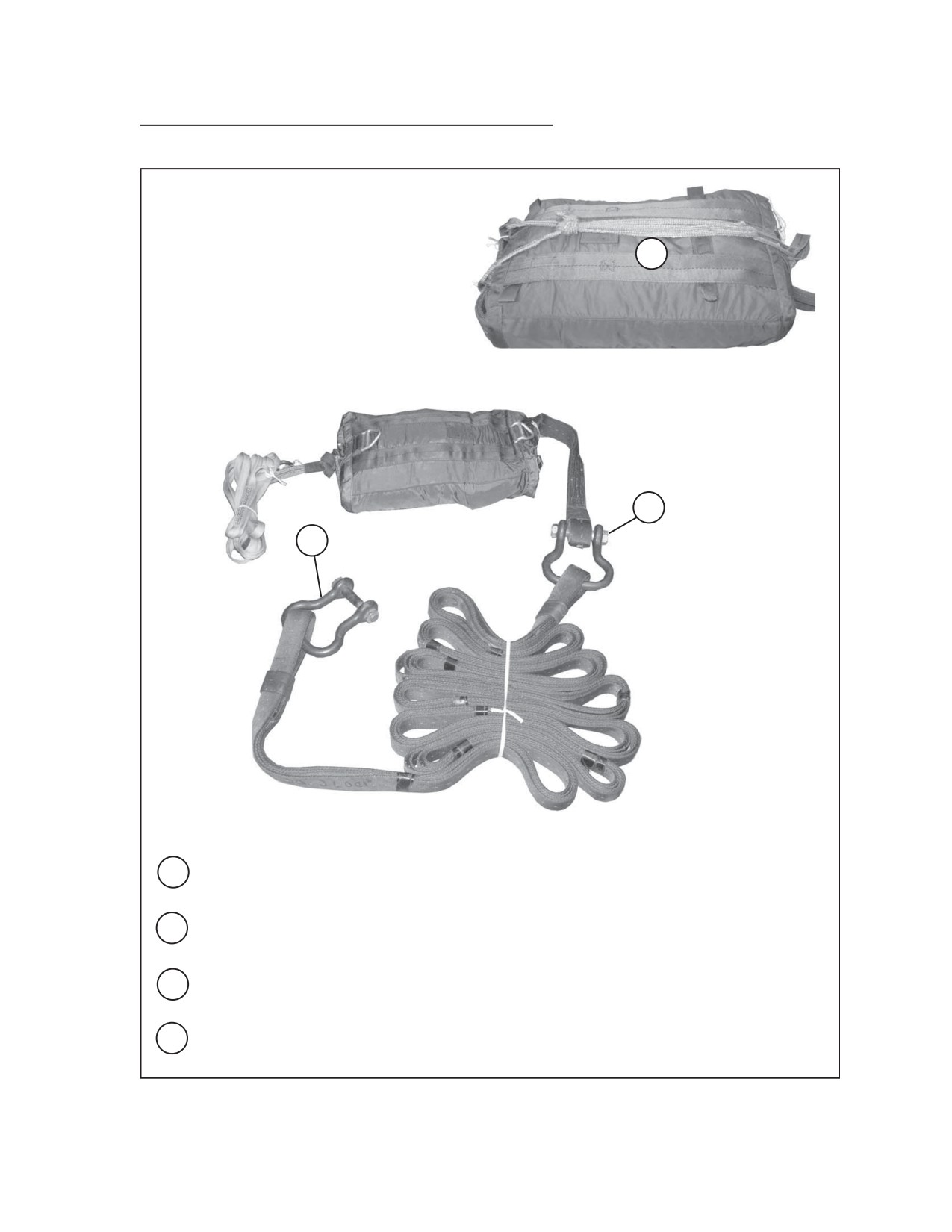
4
Pack the 15-foot extraction parachute in accordance with TM 10-1670-278-23&P/TO
13C5-26-2/NAVAIR 13-1-27/TM 01109C-23&P/1.
5
S-fold the pendulum line along the length of the deployment bag on the back side
through the safety loop and secure the end.
6
Attach a 20-foot (2 loop) type XXVI nylon webbing sling with a 3/4-inch cargo suspen
sion clevis to the 36-inch adapter web. Replace the bolt and nut.
7 Place a 3/4-inch cargo suspension clevis on the free end of the 20-foot sling. Replace the
bolt and nut.
Figure 3-6. 15-Foot Cargo Extraction Parachute Modified (Continued)
2 September 2005
3-13
///////////////////////////////////////