FM 4-20.103 AIRDROP OF SUPPLIES AND EQUIPMENT: RIGGING CONTAINERS (September 2005) - page 5
FM 4-20.103/MCRP 4-11.3C/TO 13C7-1-11
PREPARING SNOWMOBILE
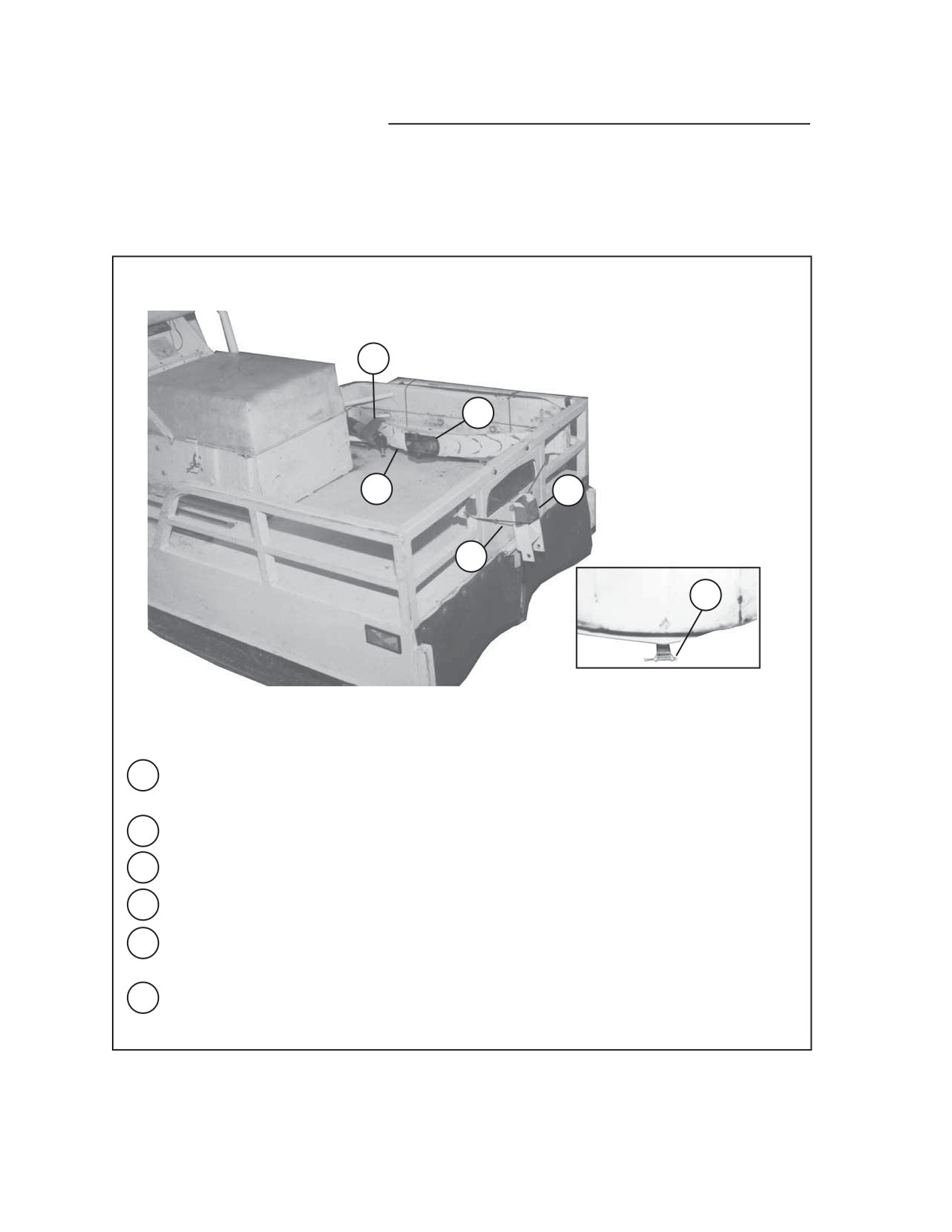
11-5. Prepare the snowmobile as shown in Figure 11-2.
4
1
3
6
5
2
1 Remove the front ski. Place the ski on the rear deck of the snowmobile and tie it in
place with type III nylon cord.
2 Replace the bolt in the steering bracket and tighten the nut.
3 Replace the bolt in the shock absorber of the ski and tighten the nut.
4 Tape the shock absorber to the spring of the ski with masking tape.
5 Remove the stabilizing pin from the rear towing point and place it in the toolbox. Fold
the towing point up and tie it in place with a length of type III nylon cord.
6 Tape the latch on the towing point with masking tape.
Figure 11-2. Snowmobile Prepared
11-4
2 September 2005
FM 4-20.103/MCRP 4-11.3C/TO 13C7-1-11
7
9
8
10
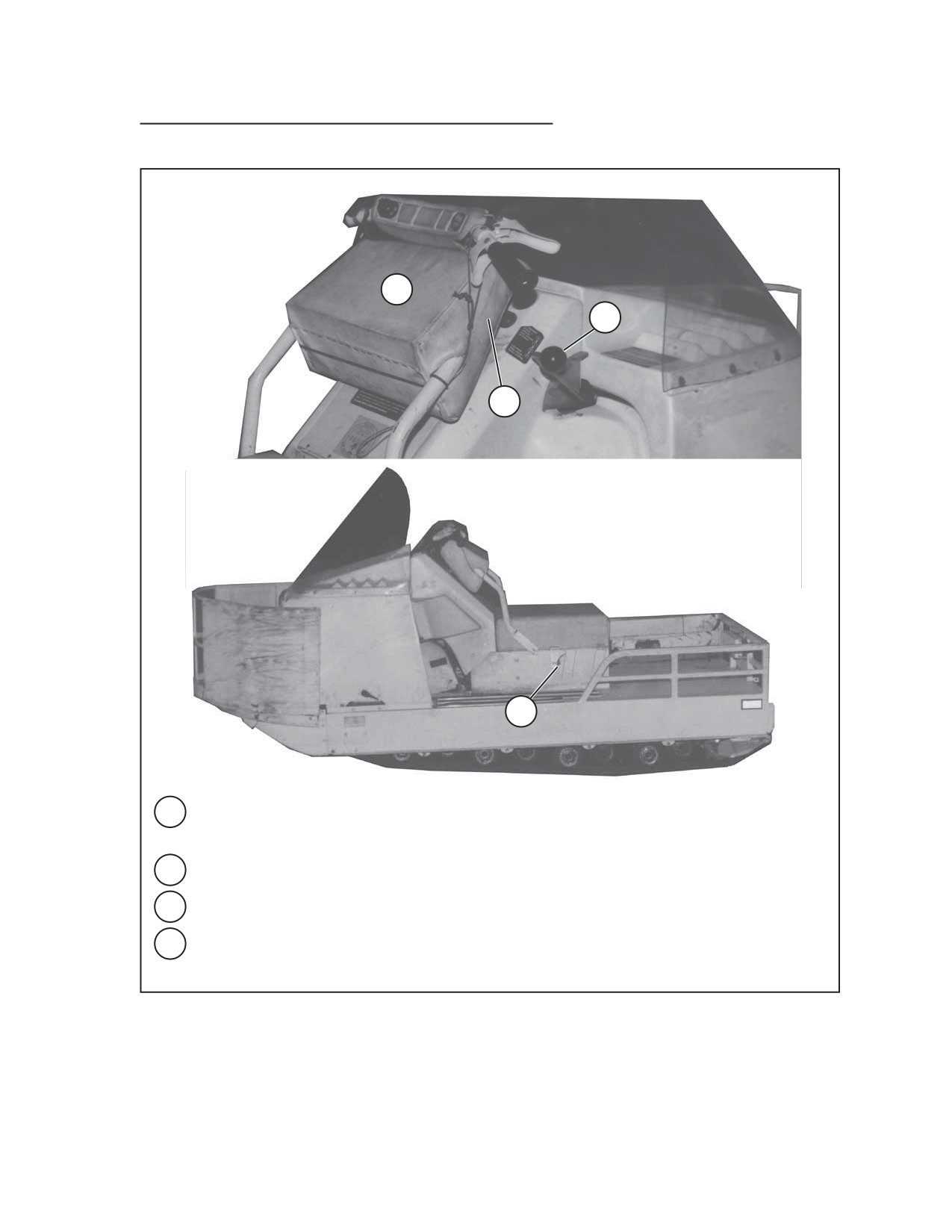
7 Remove the back of the seat and frame. Place the back of the seat against the dash with
the frame extending down on each side of the front part of the seat.
8 Tie the back of the seat in place with a length of type III nylon cord.
9 Place the gear shift lever in the neutral position.
10 Tie the tool box closed with a length of type III nylon.
Figure 11-2. Snowmobile Prepared (Continued)
2 September 2005
11-5
FM 4-20.103/MCRP 4-11.3C/TO 13C7-1-11
POSITIONING LOAD
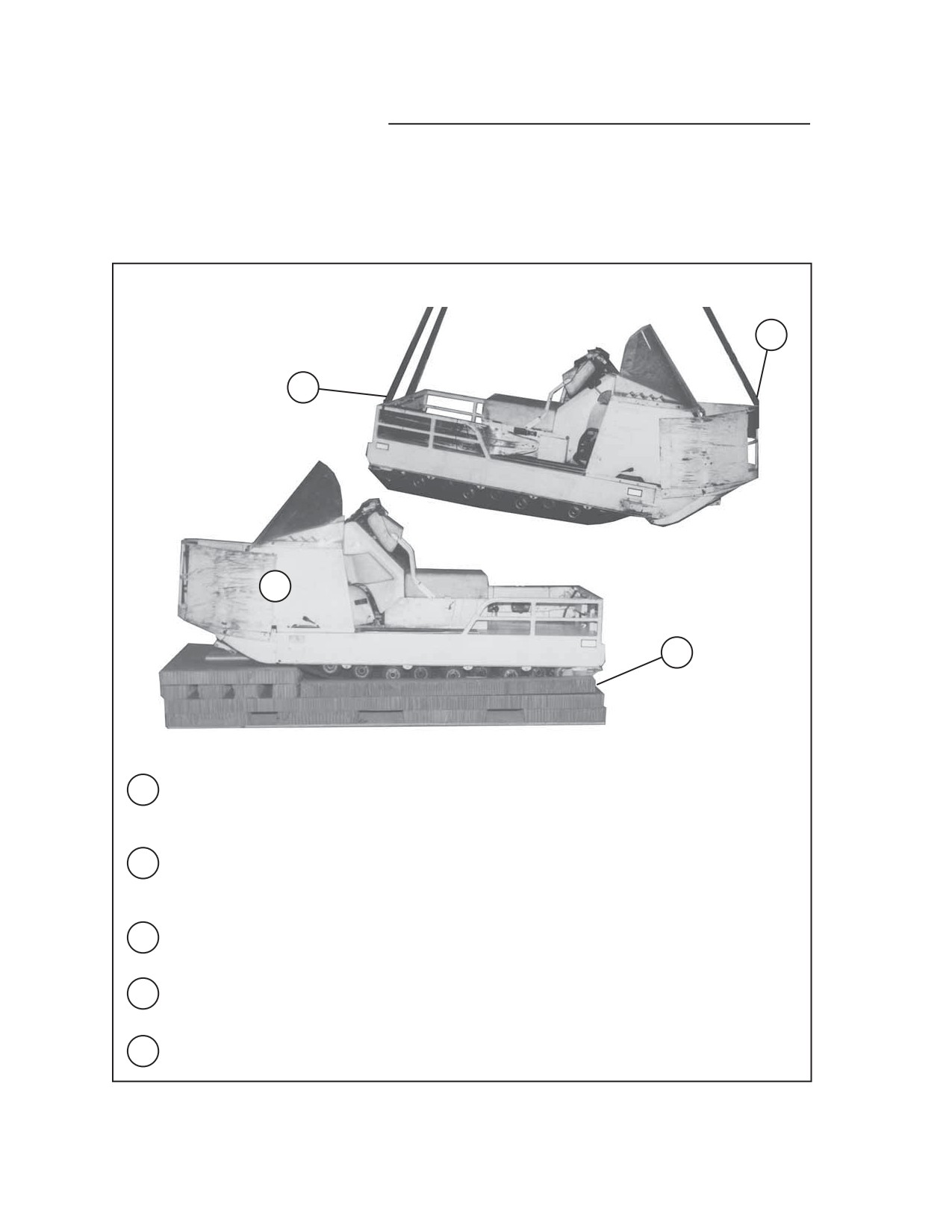
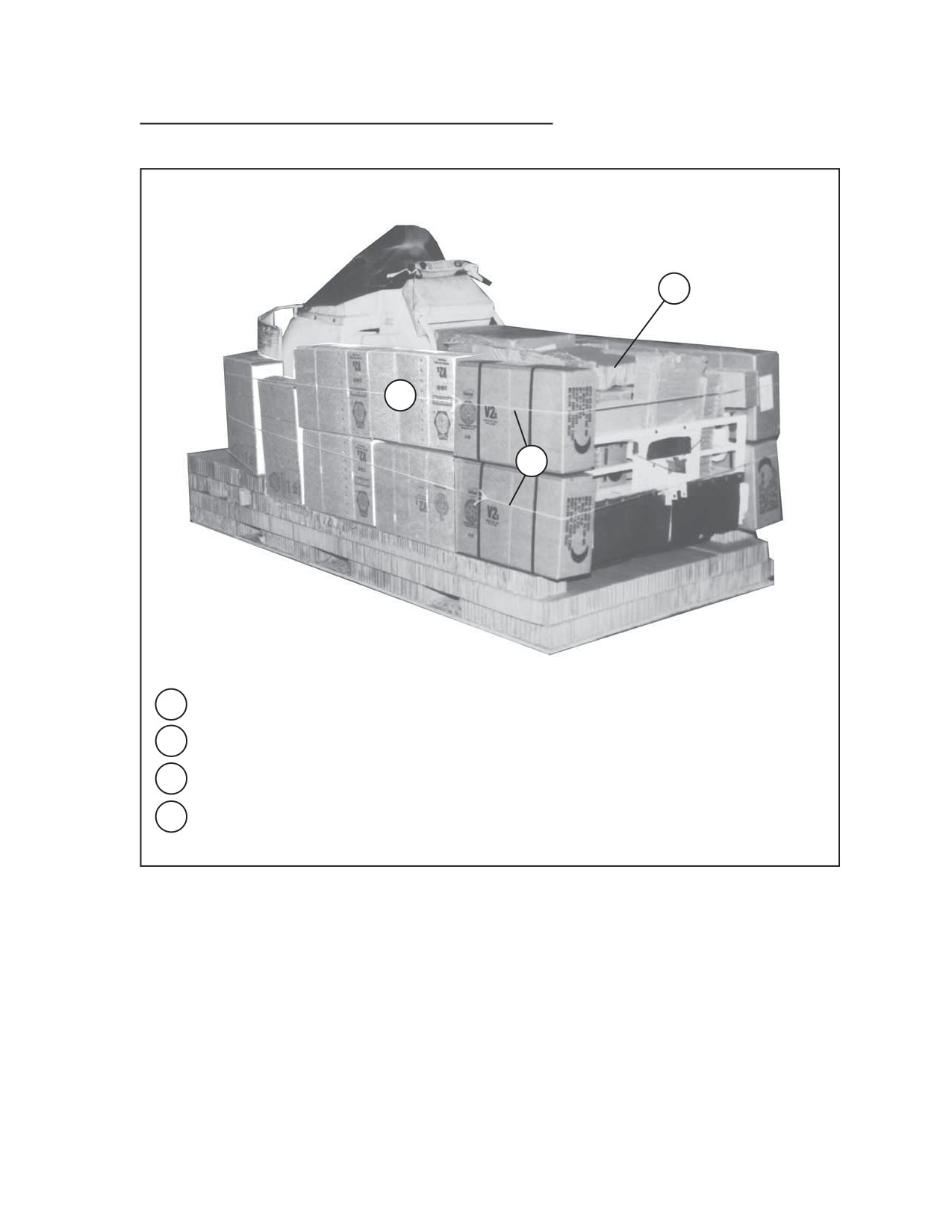
11-6. Position the snowmobile as shown in Figure 11-3. Position the rations as
shown in Figure 11-4.
2
1
3
4
1
Pass one end of a 16-foot (4-loop), type XXVI nylon webbing sling (lifting sling) through
one side of the lower part of the rear deck rail, under the rear light frame and through
the other side of the lower part of the rear deck rail. Even the ends of the sling.
2
Pass one end (first end) of a 9-foot (4-loop), type XXVI nylon webbing sling (lifting sling)
around the brush guard. Pass the other end (second end) of the sling through the loops
of the first end. Pull the second end tight.
3
Lift the snowmobile and position it on the honeycomb with the front edge of the snow
mobile even with the rear of the honeycomb stack. Center the snowmobile left to right.
4
Place snowmobile on 8- by 60-inch piece of honeycomb against the outside of each track
and on top of the second layer of the honeycomb stack.
5 Remove the lifting slings (not shown).
Figure 11-3. Snowmobile Positioned
11-6
2 September 2005
FM 4-20.103/MCRP 4-11.3C/TO 13C7-1-11
3
1
4
1
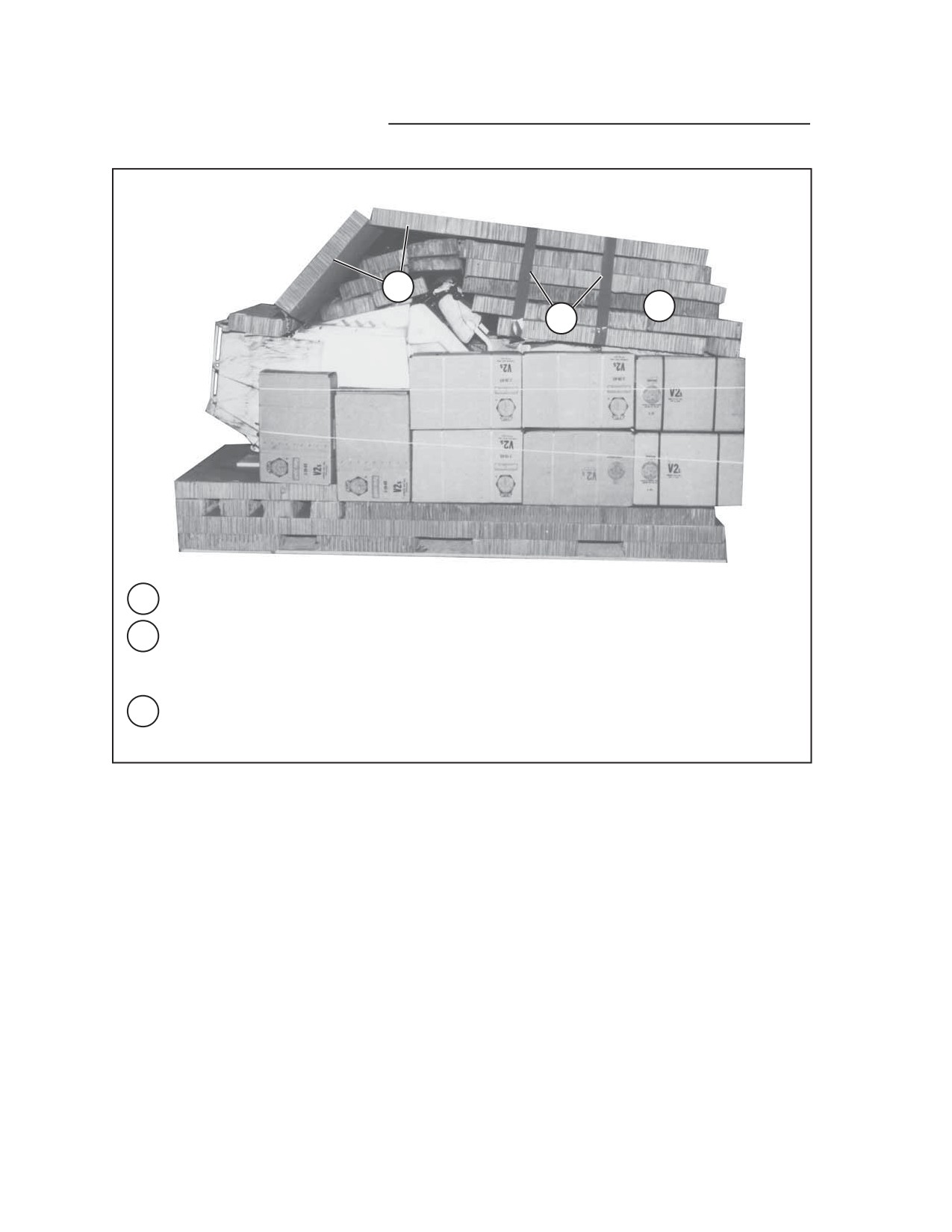
Place eight cases of rations on each side of the load.
2
Place four cases of rations (not shown) on the rear deck of the snowmobile.
3
Level the rear of the load with scrap honeycomb.
4 Tie the rations in place with two lengths of type III nylon cord.
Figure 11-4. Rations Positioned
2 September 2005
11-7
FM 4-20.103/MCRP 4-11.3C/TO 13C7-1-11
6
5
7
5 Use honeycomb to build up to the height of the top of the windshield.
6 Place a 36- by 96-inch piece of honeycomb on top of the load. Partially cut through the
honeycomb at the windshield so that the honeycomb will bend down over the
windshield.
7 Tape the honeycomb in place with masking tape or tie the honeycomb in place with
type I, 1/4-inch cotton webbing.
Figure 11-4. Rations Positioned (Continued)
COMPLETING RIGGED LOAD
11-7. Complete the rigging of the load according to Paragraphs 9-16 through 9
21.
MARKING RIGGED LOAD
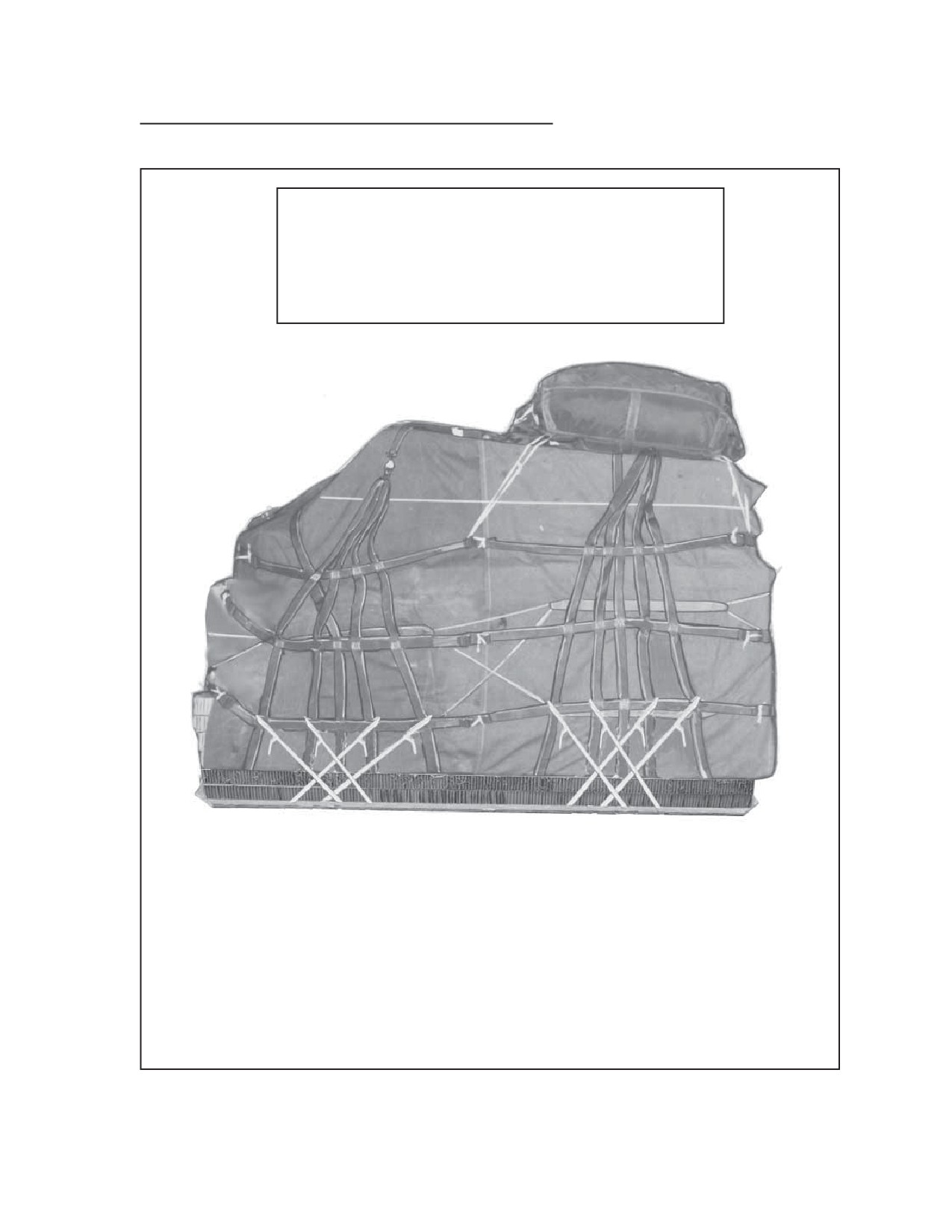
11-8. Mark the rigged load according to Paragraph 1-5 using the data given in
Figure 11-5. If the load varies from the one shown in Figure 11-5, recompute
the data.
EQUIPMENT REQUIRED
11-9. Use the equipment listed in Table 11-1 to rig the load shown in Figure
11-5.
11-8
2 September 2005
FM 4-20.103/MCRP 4-11.3C/TO 13C7-1-11
CAUTION
Make the final rigger inspection required by FM 4-20.102/
NAVSEA SS400-AB-MMO-010/TO 13C7-1-5 and AR 59-
4/OPNAVINST 4630.24C/AFJ 13-210(I)/MCO 13480.1B
before the load leaves the ri
gging site.
RIGGING LOAD DATA SNOWMOBILE
Weight: Load shown
1,654 pounds
Maximum load allowed
2,200 pounds
Height (with one G-12E cargo parachute)
67 inches
Width
48 inches
Overall Length
104 inches
Figure 11-5. Snowmobile Rigged in a Double A-22 Cargo Bag for Low-Velocity Airdrop
2 September 2005
11-9
FM 4-20.103/MCRP 4-11.3C/TO 13C7-1-11
Table 11-1. Equipment Required For Rigging The Snowmobile In A Double A-22 Cargo Bag For
Low-Velocity Airdrop
National Stock
Item
Quantity
Number
8040-00-273-8713
Adhesive, paste, 1-gallon
As required
1670-00-587-3421
Bag, cargo, A-22
2
4030-00-678-8562
Clevis, suspension, 3/4-inch (medium)
2
4020-00-240-2146
Cord, nylon, type III
As required
8135-00-664-6958
Cushioning material, packaging, cellulose
As required
wadding
1670-00-753-3928
Pad, energy-dissipating material, honeycomb
7 sheets
Parachute
1670-01-065-3755
Cargo, G-12E
1
1670-00-216-7297
Pilot, 68-inch diameter
1
Ply wood:
5530-00-128-4981
3/4- by 48- by 96-inch
1 sheet
5530-00-914-5118
1- by 48- by 96-inch
1 sheet
Sling, type XXVI nylon webbing
1670-01-062-6301
3-foot (2-loop)
3
1670-00-432-2501
9-foot (4-loop)
1
1670-00-432-2505
16-foot (4-loop)
1
7510-00-266-6710
Tape, masking, 2-inch
As required
8310-01-102-4478
Thread, cotton, ticket number 8/7
As required
Webbing:
8305-00-268-2411
Cotton, 1/4-inch, type I
As required
Nylon:
8305-00-082-5752
Tubular, 1/2-inch
As required
8305-00-263-3591
Type VIII
As required
8305-00-260-6890
Type X
As required
11-10
2 September 2005
FM 4-20.103/MCRP 4-11.3C/TO 13C7-1-11
SECTION II - RIGGING AHKIO SLEDS
DESCRIPTION OF LOAD
11-10. Four ahkio sleds are rigged in a double A-22 cargo bag. The sleds are
filled with at least 200 pounds of equipment in each sled. The load uses a G
12E cargo parachute. Each sled is 24 inches wide, 88 inches long and 8 inches
high. It weighs 38 pounds and can carry up to 500 pounds of equipment.
PREPARING SKID BOARD AND POSITIONING HONEYCOMB AND
CONTAINER
11-11. Prepare a typical double A-22 skid board as shown in Figure 9-12.
Position two layers of honeycomb on the skid board as shown in Figure 9-13.
Position the A-22 sling assembly according to Paragraph 9-23. Position the A
22 covers according to Paragraph 9-24.
POSITIONING LOAD
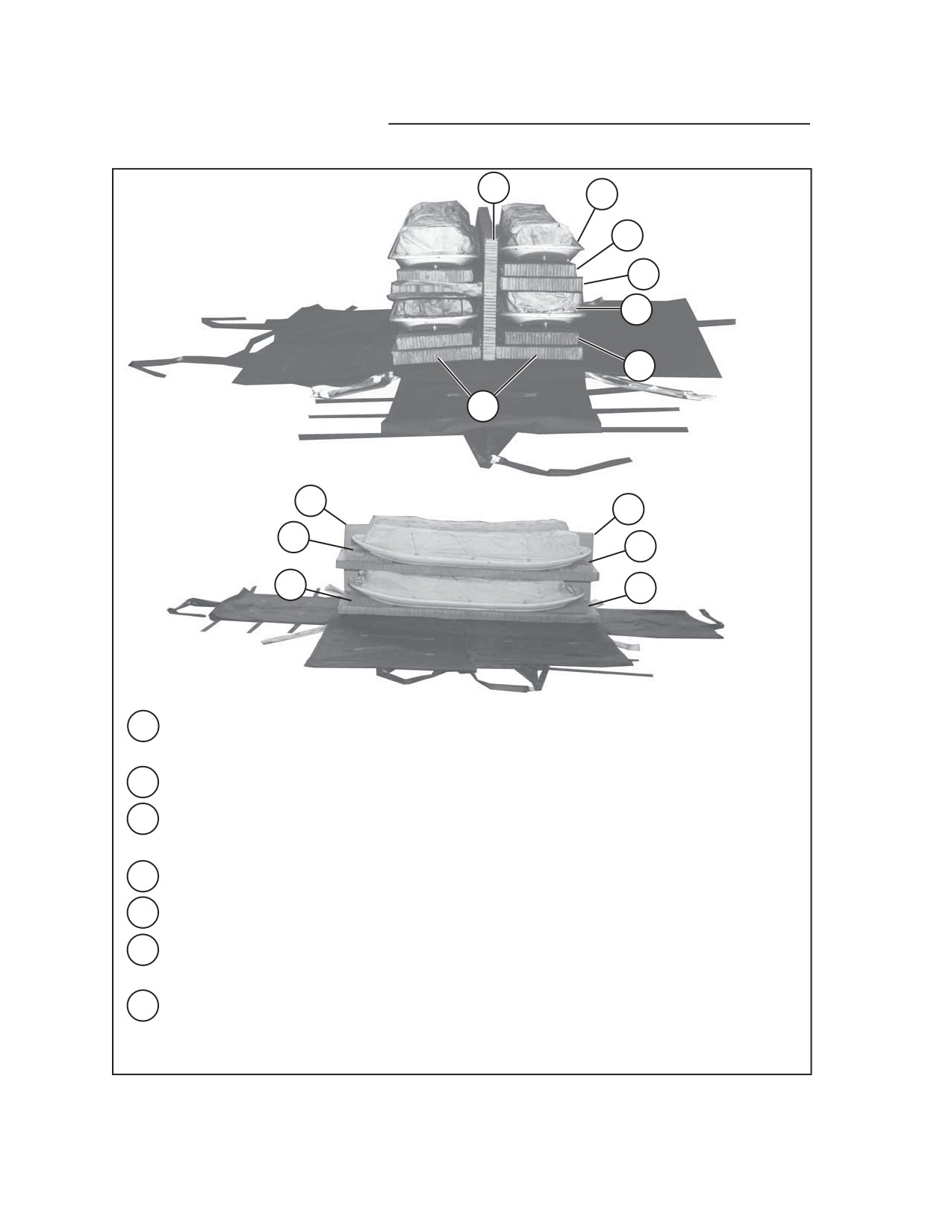
11-12. Position the load according to Figure 11-6. Make sure the sleds have
rations, equipment, or other items positioned inside so that the load will weigh
at least 900 pounds without the weight of the parachute.
COMPLETING RIGGED LOAD
11-13. Complete the rigging of the load according to Paragraphs 9-25 through
9-30.
2 September 2005
11-11
FM 4-20.103/MCRP 4-11.3C/TO 13C7-1-11
7
5
6
4
2
3
1
7
7
6
6
3
3
1
Place two 21- by 94-inch pieces of honeycomb side by side on the cargo covers. Leave a
3-inch space between the honeycomb pieces.
2
Place one sled on each 21- by 94- inch piece of honeycomb.
3
Place an 18- by 21-inch piece of honeycomb under each end of the sleds. Crush the
edges of the honeycomb so that the honeycomb will support the ends of the sleds.
4
Lay a 21- by 94-inch piece of honeycomb on top of each sled.
5
Place one sled on each 21- by 94-inch piece of honeycomb.
6
Place an 18- by 21-inch piece of honeycomb under each end of the sleds. Crush the
edges of the honeycomb so that the honeycomb will support the ends of the sleds.
7 Place a 94-inch piece of honeycomb between the stacks of sleds. The height of the
honeycomb may vary according to the height of the load. The honeycomb should be
even with the top of the load.
Figure 11-6. Load Positioned
11-12
2 September 2005
FM 4-20.103/MCRP 4-11.3C/TO 13C7-1-11
MARKING RIGGED LOAD
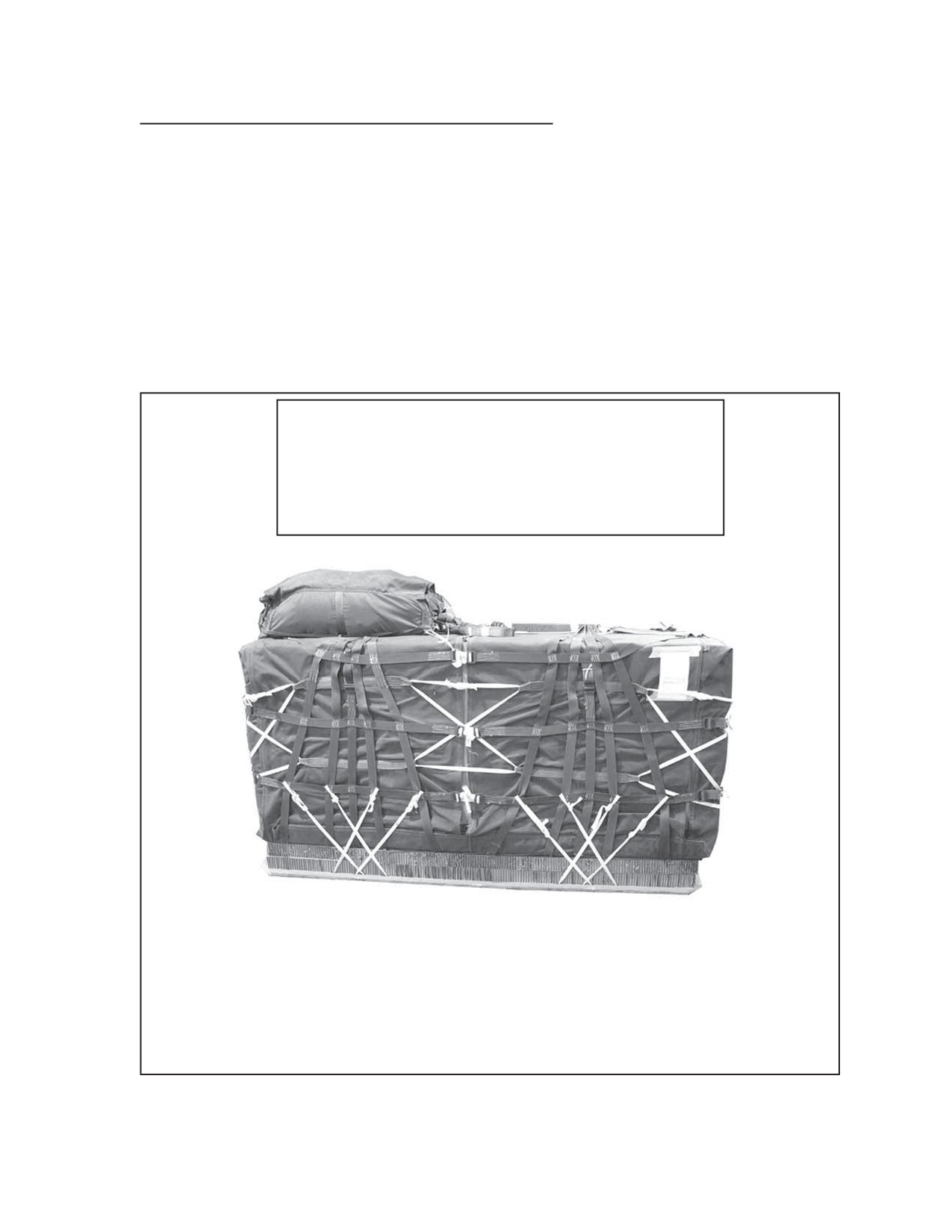
11-14. Mark the rigged load according to Paragraph 1-5 using the data given in
Figure 11-7. Each load must be computed due to varying accompanying loads.
Make sure the load weighs at least 900 pounds.
EQUIPMENT REQUIRED
11-15. Use the equipment listed in Table 11-2 to rig the load shown in Figure
11-7.
CAUTION
Make the final rigger inspection required by FM 4-20.102/
NAVSEA SS400-AB-MMO-010/TO 13C7-1-5 and AR 59-
4/OPNAVINST 4630.24C/AFJ 13-210(I)/MCO 13480.1B
before the load leaves the ri
gging site.
RIGGING LOAD DATA AHKIO SLEDS
Weight: minimum load allowed
900 pounds
Maximum load allowed
2,200 pounds
Height (with one G-12E cargo parachute)
up to 83 inches
Width
48 inches
Length
96 inches
Figure 11-7. Ahkio Sleds Rigged in a Double A-22 Cargo Bag for Low-Velocity Airdrop
2 September 2005
11-13
FM 4-20.103/MCRP 4-11.3C/TO 13C7-1-11
Table 11-2. Equipment Required For Rigging Ahkio Sleds In A Double A-22 Cargo Bag For
Low-Velocity Airdrop
National Stock
Item
Quantity
Number
8040-00-273-8713
Adhesive, paste, 1-gallon
As required
1670-00-587-3421
Bag, cargo, A-22
2
4030-00-678-8562
Clevis, suspension, 3/4-inch (medium)
2
4020-00-240-2146
Cord, nylon, type III
As required
8135-00-664-6958
Cushioning material, packaging, cellulose
As required
wadding
1670-00-753-3928
Pad, energy-dissipating material, honeycomb
7 sheets
Parachute
1670-01-065-3755
Cargo, G-12E
1
1670-00-216-7297
Pilot, 68-inch diameter
1
Ply wood, (skid board)
5530-00-128-4981
3/4- by 48- by 96-inch
1 sheet
or
5530-00-914-5118
1- by 48- by 96-inch
1 Sheet
1670-01-062-6301
Sling, type XXVI nylon webbing 3-foot (2-loop)
3
7510-00-266-6710
Tape, masking, 2-inch
As required
8310-01-102-4478
Thread, cotton, ticket number 8/7
As required
Webbing:
8305-00-268-2411
Cotton, 1/4-inch, type I
As required
Nylon:
8305-00-082-5752
Tubular, 1/2-inch
As required
8305-00-263-3591
Type VIII
As required
8305-00-260-6890
Type X
As required
11-14
2 September 2005
FM 4-20.103/MCRP 4-11.3C/TO 13C7-1-11
PART FIVE
RIGGING LOW-COST AERIAL DELIVERY SYSTEM
Chapter 12
General Information and Procedures
LCADS COMPONENTS
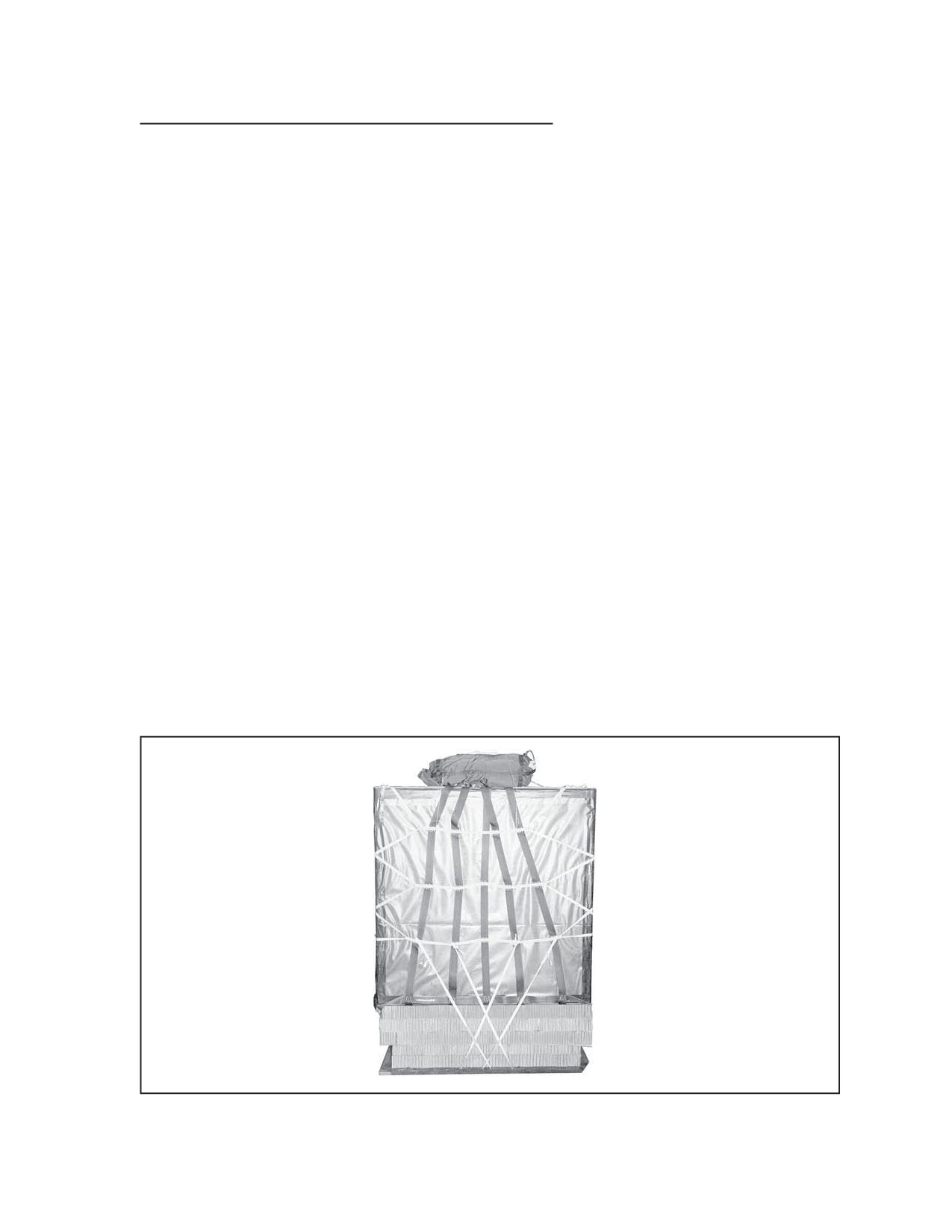
12-1. LCADS is a modified, lightweight A-22 system with no scuff pad, cover,
suspension webs, or friction adapters on the lateral bands. LCADS is used for
high-volume delivery of non-fragile items where airdrop equipment is not
recoverable. The LCADS shown in Figure 12-1, employs a lower cost version of the
A-22 sling assembly. The low cost sling assembly uses a more readily available
and more economical material and eliminates much of the hardware thus reducing
the costs.
LCADS SKID BOARD
12-2. Like the standard A-22 container, the sling assembly is secured to a 3/4 or
1- by 48- by 48-inch piece plywood (Grade AC) skid board with 1/2- inch tubular
nylon webbing. Honeycomb is positioned between the container and the skid board
for impact cushioning.
Figure 12-1. Fully Rigged LCADS for High-Velocity Airdrop
2 September 2005
12-1
FM 4-20.103/MCRP 4-11.3C/TO 13C7-1-11
LCADS CONTAINER LIMITATIONS
12-3. The LCADS container has a weight restriction of 501 to 2,200 pounds.
INSPECTING LOAD
12-4. The LCADS must be inspected by a qualified rigger. While being rigged
this load should be supervised or rigged by a parachute rigger. DD Form
1748-1 must be completed before airdrop.
PARACHUTE USED
12-5. There are three types of parachutes used for LCADS loads, depending on
whether the load is being dropped for low-velocity or high-velocity airdrop.
a. LOW-VELOCITY DROPS. The G-12E cargo parachute is the primary
parachute for low-velocity airdrops. It is rated for 501 to 2,200 pounds of
suspended weight. A 68-inch pilot parachute is installed on the G-12E cargo
parachute to deploy it. Other parachutes may be used to deploy the G-12E
cargo parachute; however, the specific manual must give the procuderes.
b. HIGH-VELOCITY PARACHUTE.
(1) Primary Parachute. The 26-foot low-cost parachute performs
identical to the standard 26-foot high-velocity parachute except the low
cost parachute is designated for one-time use. The low cost parachute
is pre-packed and ready to attach to the load.
(2) Alternate Parachute. The 26-foot high-velocity cargo parachute
is rated for 501 to 2,200 pounds of suspended weight. TM 10-1670-279-
23&P/TO 13C5-27-2/NAVAIR 13-1-28 covers the inspection and packing
of the parachute.
12-2
2 September 2005
FM 4-20.103/MCRP 4-11.3C/TO 13C7-1-11
Chapter 13
Rigging Typical Low-Cost Aerial Delivery System Loads
SECTION I - RIGGING LCADS FOR LOW-VELOCITY AIRDROP
SYSTEM DESCRIPTION
13-1. The LCADS is rigged as a typical A-22 low-velocity load. Typical loads
include rations, repair parts, water, and/or other small items. Items may be
dropped in their original configuration or repackaged for greater protection.
The LCADS container loads must weigh at least 501 pounds but not exceed
2,200 pounds excluding the parachute. The load is rigged with a G-12E cargo
parachute.
PREPARING ITEMS AND SKID BOARD
13-2. Prepare the skid board using Figure 9-1. Prepare the items to be dropped
according to load's sensitivity. Items must be well padded to prevent damage
during airdrop.
PREPARING AND PLACING HONEYCOMB
13-3. Prepare and place the honeycomb as shown in Figure 9-2.
2 September 2005
13-1
FM 4-20.103/MCRP 4-11.3C/TO 13C7-1-11
POSITIONING SLING ASSEMBLY
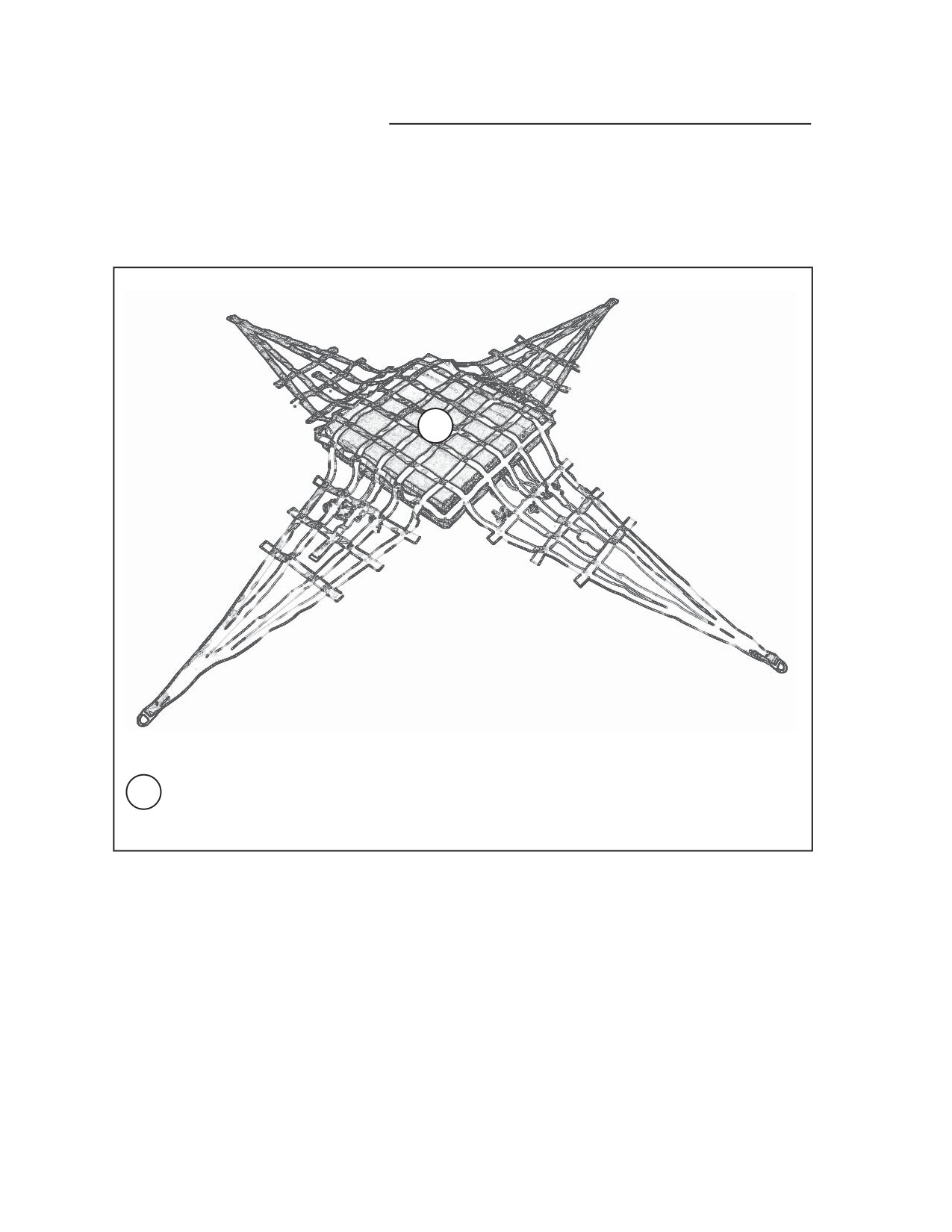
13-4. Center the sling assembly over the honeycomb and skid board as shown
in Figure 13-1. The dimensions of the webbing is 222 by 222 inches.
1
1 Position the webbing centered on top of the 44- by 44-inch piece of honeycomb. Ensure
that the thick lip of the friction adapter is facing down (toward the surface).
Figure 13-1. Sling Assembly Positioned
13-2
2 September 2005
FM 4-20.103/MCRP 4-11.3C/TO 13C7-1-11
POSITIONING LOAD AND SECURING SLING ASSEMBLY
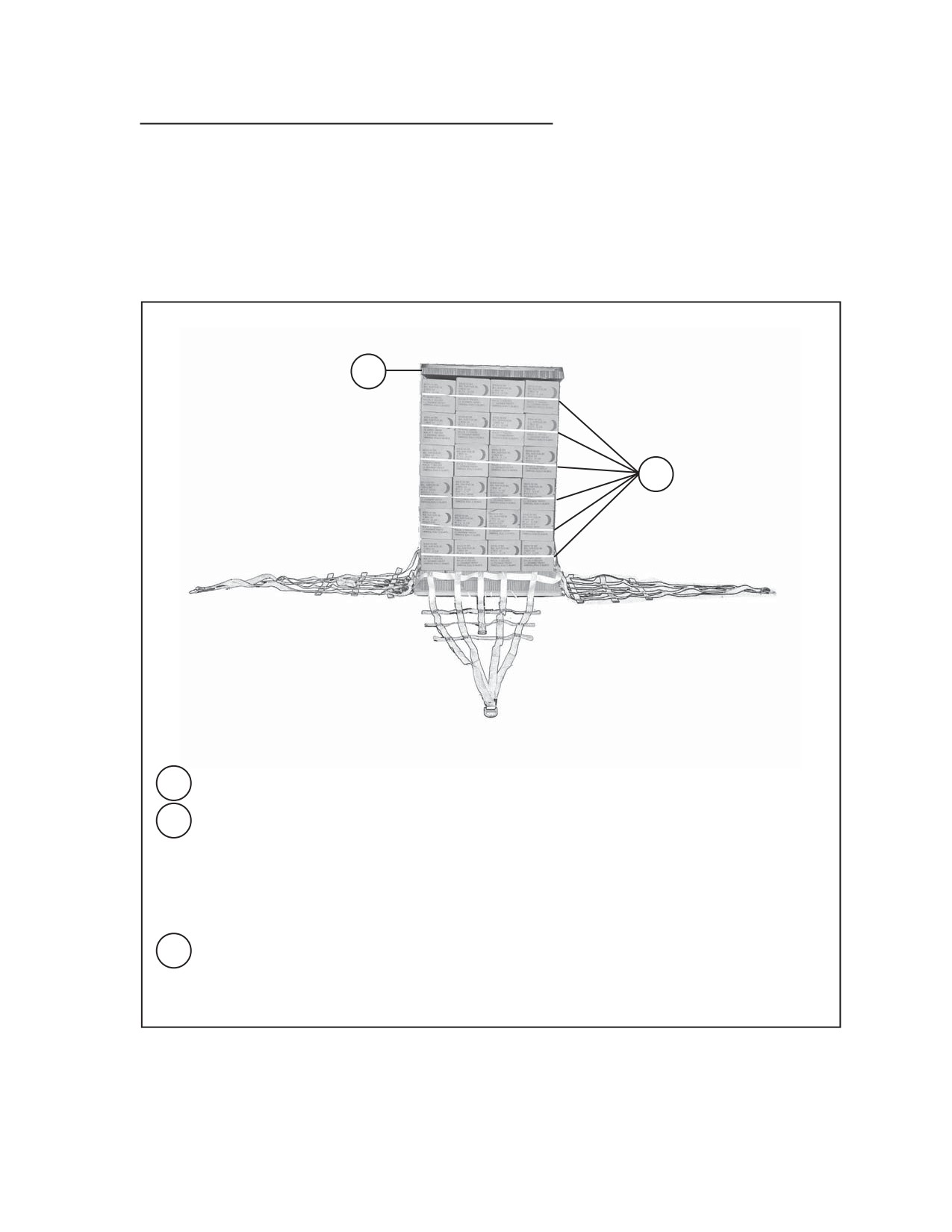
13-5. Center and secure the load on the sling assembly and honeycomb. If a
cover is available, cover the load with a plastic bag, shrink wrap or an A-22
cargo cover. A cover is not required. Secure and tie the sling assembly as
shown in Figure 13-2.
2
1
1 Secure the load together with 1/2-inch tubular nylon around each layer.
2 Cut and position a 36- by 44- and 8- by 44-inch piece of honeycomb on top of the load.
Tape the pieces together and around the outside edges. Position the honeycomb cen
tered on top of the load.
NOTE: When 55-gallon drums are used, cut and position a 44- by 44- by 1-inch piece
of plywood on top of the four 55-gallon drums.
3 Cover the load with shrink wrap, plastic, or an A-22 cover (Not shown or required).
Figure 13-2. Load Positioned and Sling Secured
2 September 2005
13-3
FM 4-20.103/MCRP 4-11.3C/TO 13C7-1-11
5
4
4
5
5
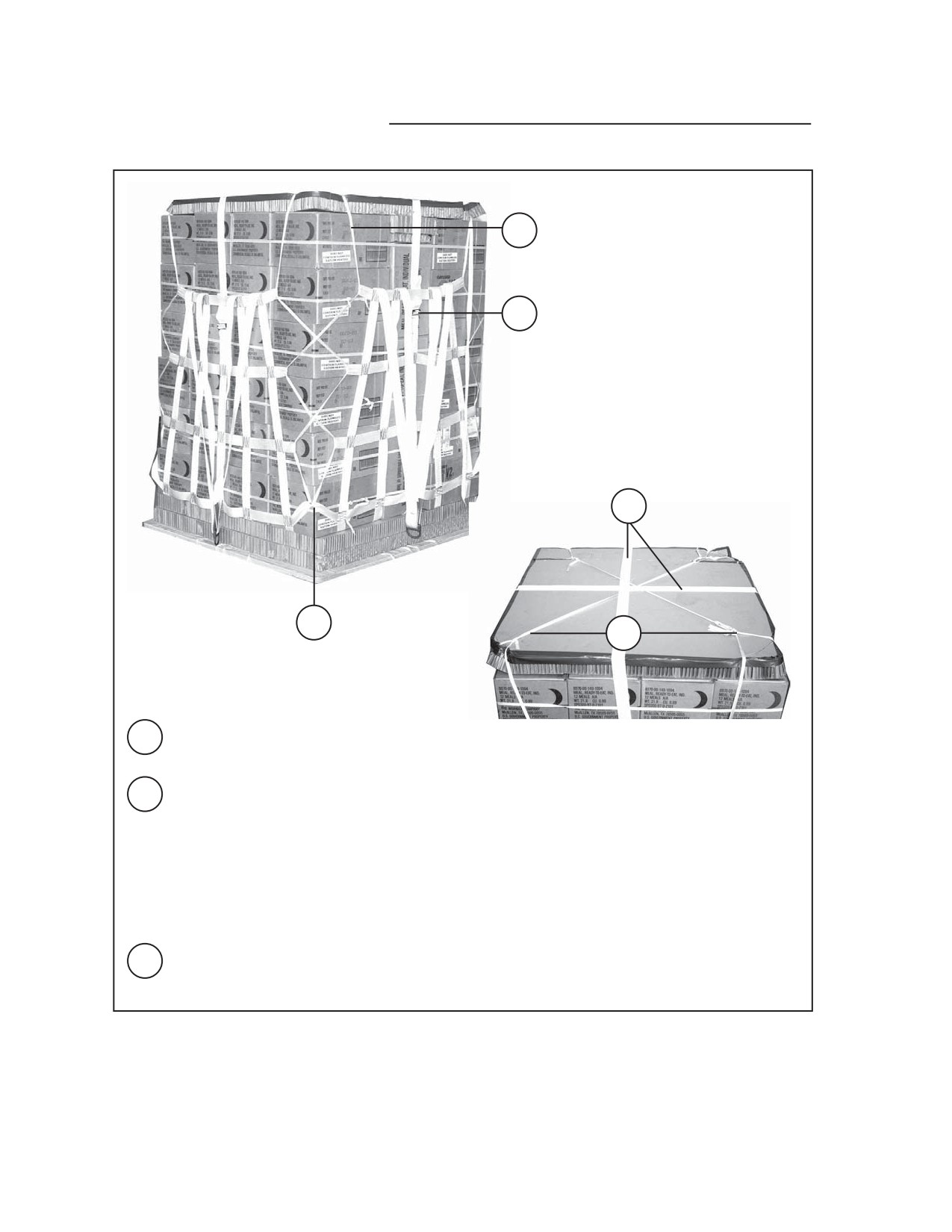
4 Fasten the long and short tie-down straps over the load using the friction adapters
provided.
5 Tie each corner of the sling assembly with 1/2-inch tubular nylon webbing; route the
webbing up through the bottom webbing loop, across the ties, up through the next loops,
and repeat until the top loops are reached. Secure the ties together on the top corners
with a surgeon’s knot and locking knot. Secure the excess webbing to the loop of the
opposite corner with three alternating half hitches with a knot in the running end.
NOTE: On a load where the top lateral straps are above the top of the item, secure the
loops together as closely as possible with the tie on top.
6 Bring the ends of the support web up, remove any twists, and tape them together 4
inches below the D-rings using 2-inch masking tape (not shown).
Figure 13-2. Load Positioned and Sling Secured (Continued)
13-4
2 September 2005
FM 4-20.103/MCRP 4-11.3C/TO 13C7-1-11
SECURING SLING ASSEMBLY TO SKID BOARD
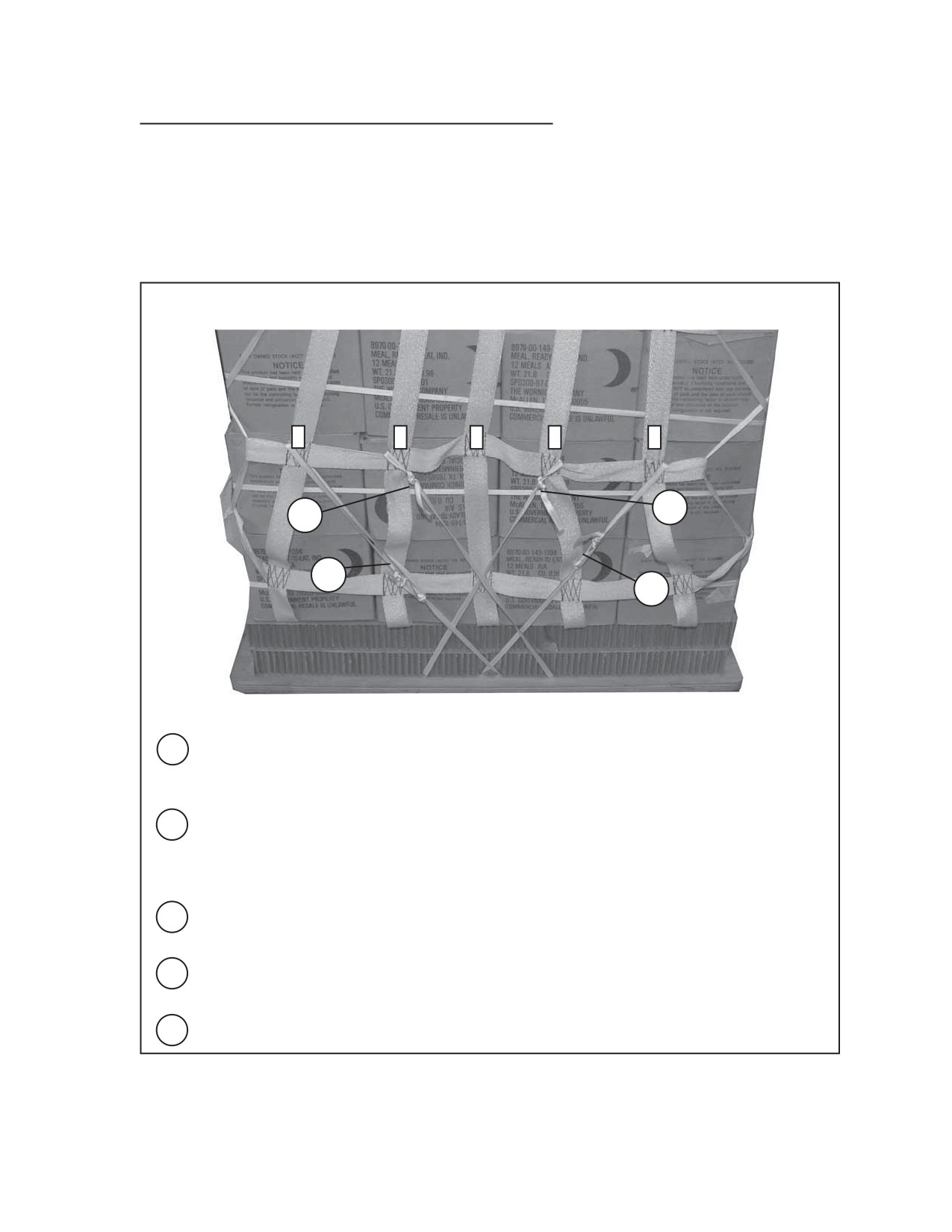
13-6. Tie the sling assembly to the skid board as shown in Figure 13-3.
1
2
3
4
5
1
3
4
2
A
B
C D
1 Starting at the left side, take tie-down A and diagonally tie it around the intersection of
the lower lateral strap and fourth support web. Use three half-hitch knots and over
hand knots in the running end.
2 Route tie-down B around the fifth support web and lower lateral strap intersection
diagonally. Pull the excess slack out, and tie it with a trucker’s hitch knot and an
overhand knot in the running end. Cut excess webbing, leaving the end approximately
6 inches long.
3 Repeat step 1 for tie-down D, and secure it to the second intersection on the lower
lateral strap.
4 Repeat step 2 for tie-down C, and secure it to the first intersection on the lower lateral
strap.
5 Repeat steps 1 through 4 for the other tie-downs (not shown).
Figure 13-3. Skid Board Secured
2 September 2005
13-5
FM 4-20.103/MCRP 4-11.3C/TO 13C7-1-11
INSTALLING PARACHUTE
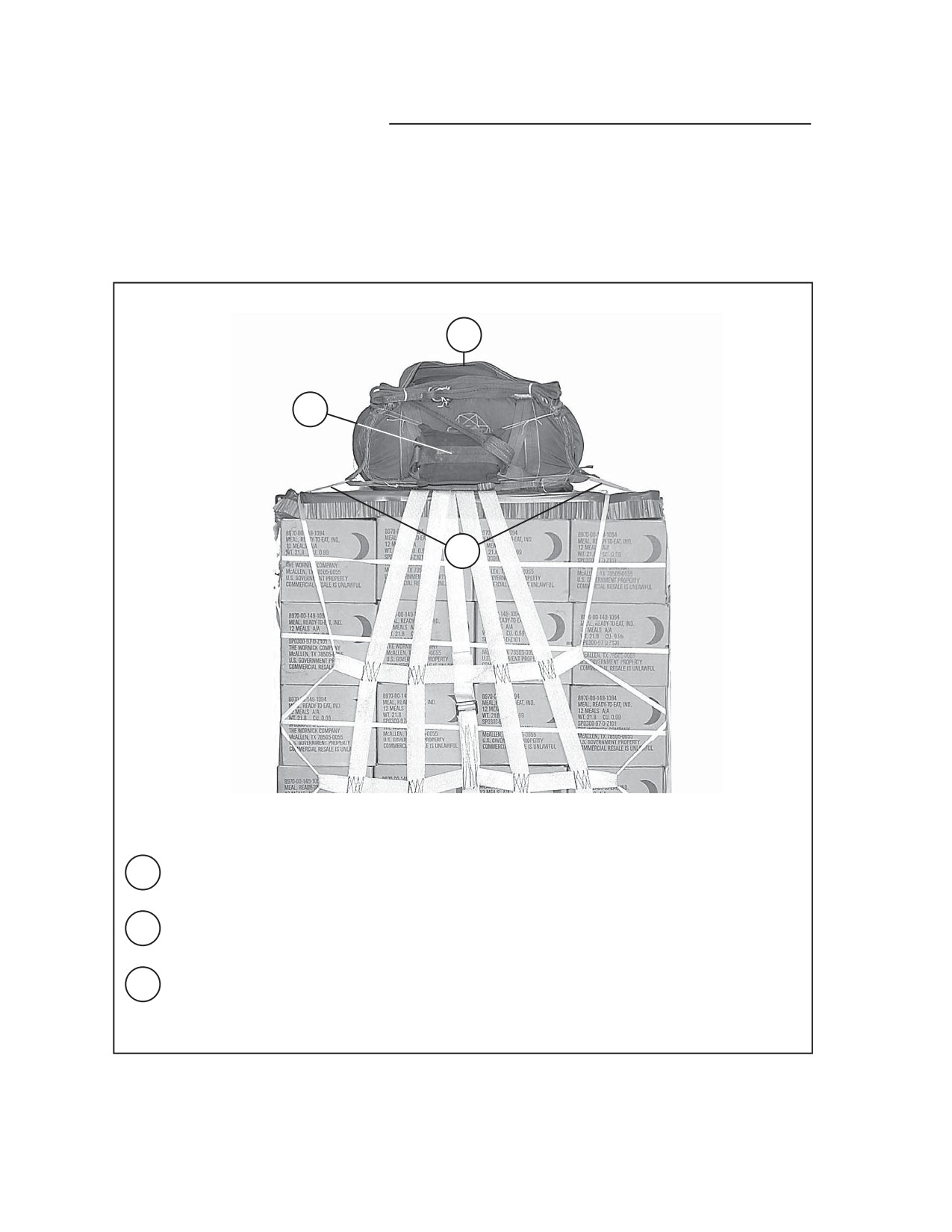
13-7. Install the G-12E cargo parachute as shown in Figure 13-4.
1
3
2
1
Position a G-12E cargo parachute on top of the load and secure the parachute clevis to
the securing web D-rings.
2
Tie the corners of the parachute with one turn single type I, 1/4-inch cotton webbing to
the sling assembly.
3 Secure the 68-inch pilot parachute to the G-12 deployment bag as described in TM 10-
1670-281-23&P/TO 13C5-32-2/NAVAIR 13-1-32.
Figure 13-4. G-12E Cargo Parachute Installed
13-6
2 September 2005
FM 4-20.103/MCRP 4-11.3C/TO 13C7-1-11
MARKING RIGGED LOAD
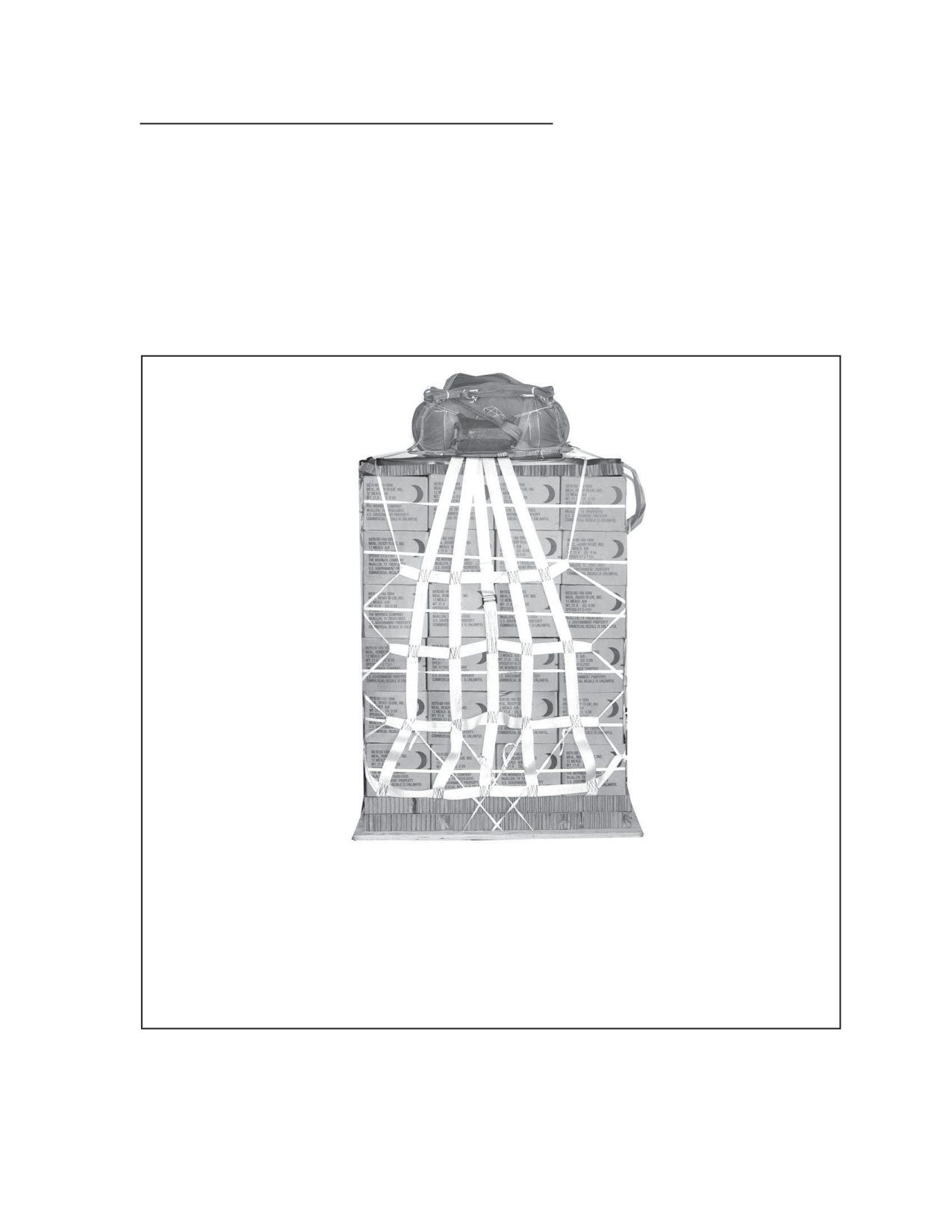
13-8. Mark the rigged load according to Paragraph 1-5 and as shown in Figure
13-5. Compute the rigged load data.
EQUIPMENT REQUIRED
13-9. Use the equipment listed in Table 13-1 to rig the load shown in Figure
13-5.
RIGGED LOAD
Weight: Minimum load allowed
501 pounds
Maximum load allowed (without parachute)
2,200 pounds
Height:
80 inches
Width:
48 inches
Length:
48 inches
Figure 13-5. LCADS Rigged for Low-Velocity Airdrop
2 September 2005
13-7
FM 4-20.103/MCRP 4-11.3C/TO 13C7-1-11
Table 13-1. Equipment Required for Rigging LCADS for Low-Velocity Airdrop
National Stock
Item
Quantity
Number
8040-00-273-8713
Adhesive paste, 1-gallon
As required
No NS N
Bag, cover, 4 mil polyethylene (54- by 52- by
60-inches)
As required
No NS N
Shrink w rap
As required
No NS N
Sling assembly, LCADS
1
4030-00-678-8562
Clevis, suspension, 3/4-inch (medium)
1
4020-00-240-2146
Cord, nylon type III
As required
1670-00-753-3928
Pad, energy dissipating material, honeycomb
3 sheets
36- by 96- by 3-inches
Parachute:
1670-00-893-2371
Cargo, G-12E
1
1670-00-216-7297
Pilot, 68-inch diameter
1
5530-00-128-4981
Ply wood, 3/4- by 48- by 96-inch
1 sheet
or
5530-00-914-5118
Ply wood, 1- by 48- by 96-inch
1 sheet
or
1670-01-342-5913
Skid Board, 1- by 48- by 48-inch
1
or
1670-00-883-1654
Skid Board, 3/4- by 48- by 48-inch
1
7510-00-266-6710
Tape, masking, 2-inch
As required
8310-01-102-4478
Thread, cotton, ticket number 8/7
As required
Webbing:
8305-00-268-2411
Cotton, 1/4-inch, type I
As required
8305-00-082-5752
Nylon, tubular, 1/2-inch
As required
13-8
2 September 2005
FM 4-20.103/MCRP 4-11.3C/TO 13C7-1-11
SECTION II - RIGGING LCADS FOR HIGH-VELOCITY AIRDROP
SYSTEM DESCRIPTION
13-10. The LCADS is rigged as a typical A-22 high-velocity load. Typical loads
include rations, water, and other small items. LCADS container loads must
weigh at least 501 pounds but not exceed 2,200 pounds, excluding the weight of
the parachute. The load is rigged with a 26-foot low-cost parachute or a standard
26-foot high-velocity parachute.
PREPARING ITEMS AND SKID BOARD
13-11. Refer to Figure 9-1 for preparation of the skid board. Prepare the drop
items according to the load’s sensitivity. Items must be well padded to prevent
damage during airdrop.
POSITIONING HONEYCOMB
13-12. Position honeycomb as shown in Figure 9-10.
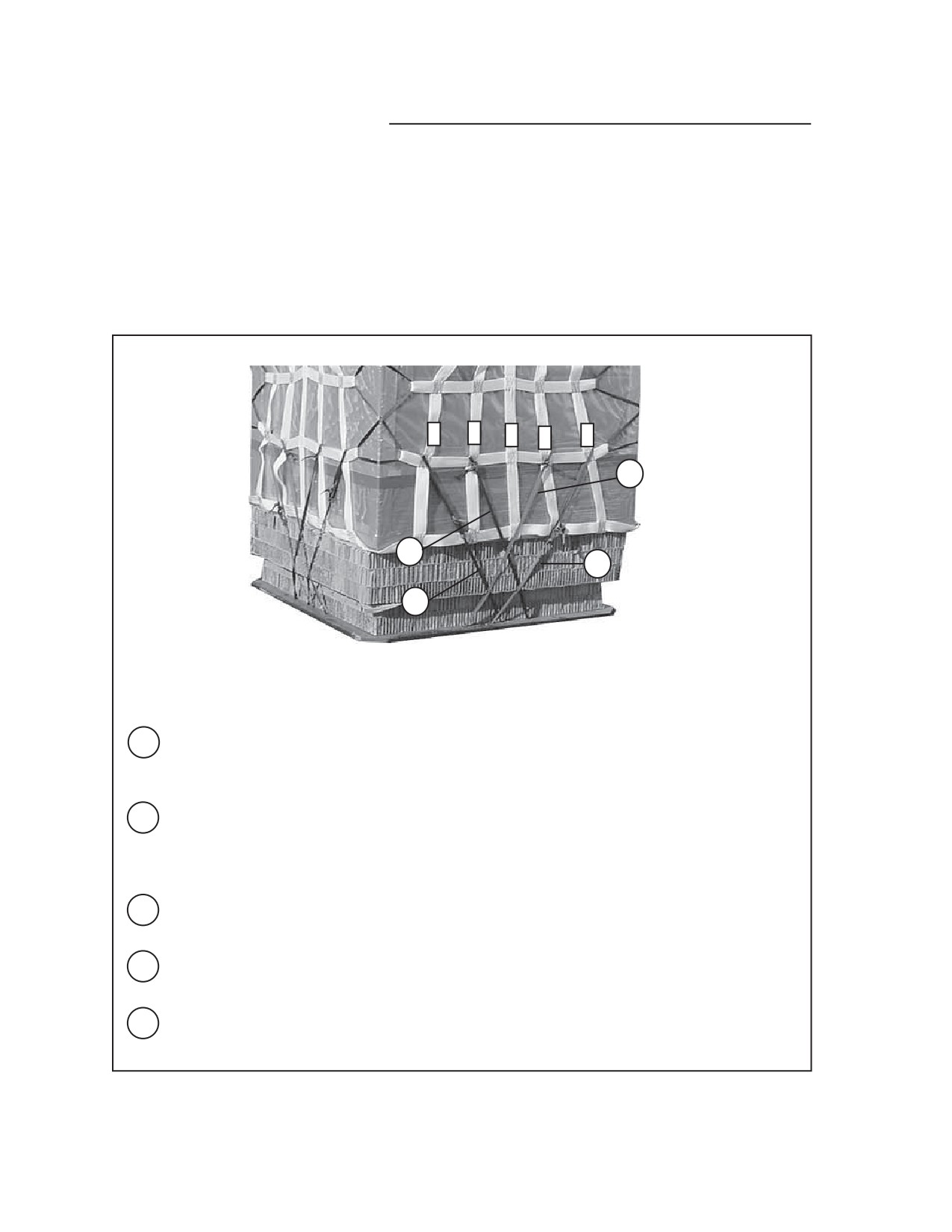
POSITIONING SLING ASSEMBLY
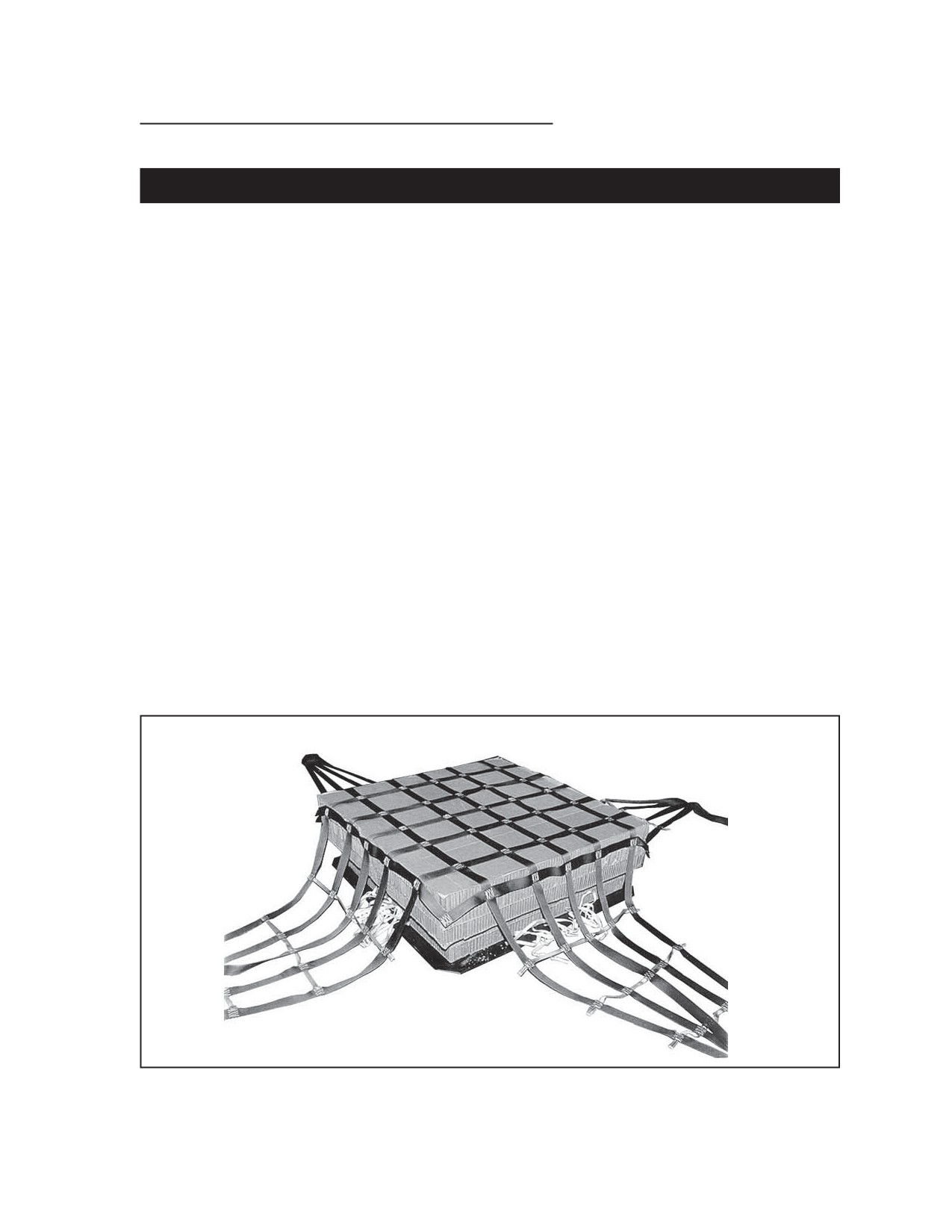
13-13. Center the sling assembly over the honeycomb and skid board as shown
in Figure 13-6.
Figure 13-6. Sling Assembly Positioned
2 September 2005
13-9
FM 4-20.103/MCRP 4-11.3C/TO 13C7-1-11
POSITIONING LOAD AND SECURING SLING ASSEMBLY
13-14. Position load and secure sling assembly according to Figure 13-2.
SECURING SLING ASSEMBLY TO SKID BOARD
13-15. Tie the sling assembly to the skid board as shown in Figure 13-7.
1
2
3
4
5
1
3
2
4
A
B C D
1 Starting at the left side, take tie-down A and diagonally tie it around the intersection of
the lower lateral strap and fourth support web. Use three half-hitch knots and over
hand knots in the running end.
2 Route tie-down B around the fifth support web and lower lateral strap intersection
diagonally. Pull the excess slack out, and tie it with a trucker’s hitch knot and an
overhand knot in the running end. Cut excess webbing, leaving the end approximately
6 inches long.
3 Repeat step 1 for tie-down D, and secure it to the second intersection on the lower
lateral strap.
4 Repeat step 2 for tie-down C, and secure it to the first intersection on the lower lateral
strap.
5 Repeat steps 1 through 4 for the other tie-downs (not shown).
Figure 13-7. Skid Board Secured to Sling Assembly
13-10
2 September 2005
FM 4-20.103/MCRP 4-11.3C/TO 13C7-1-11
INSTALLING PARACHUTE
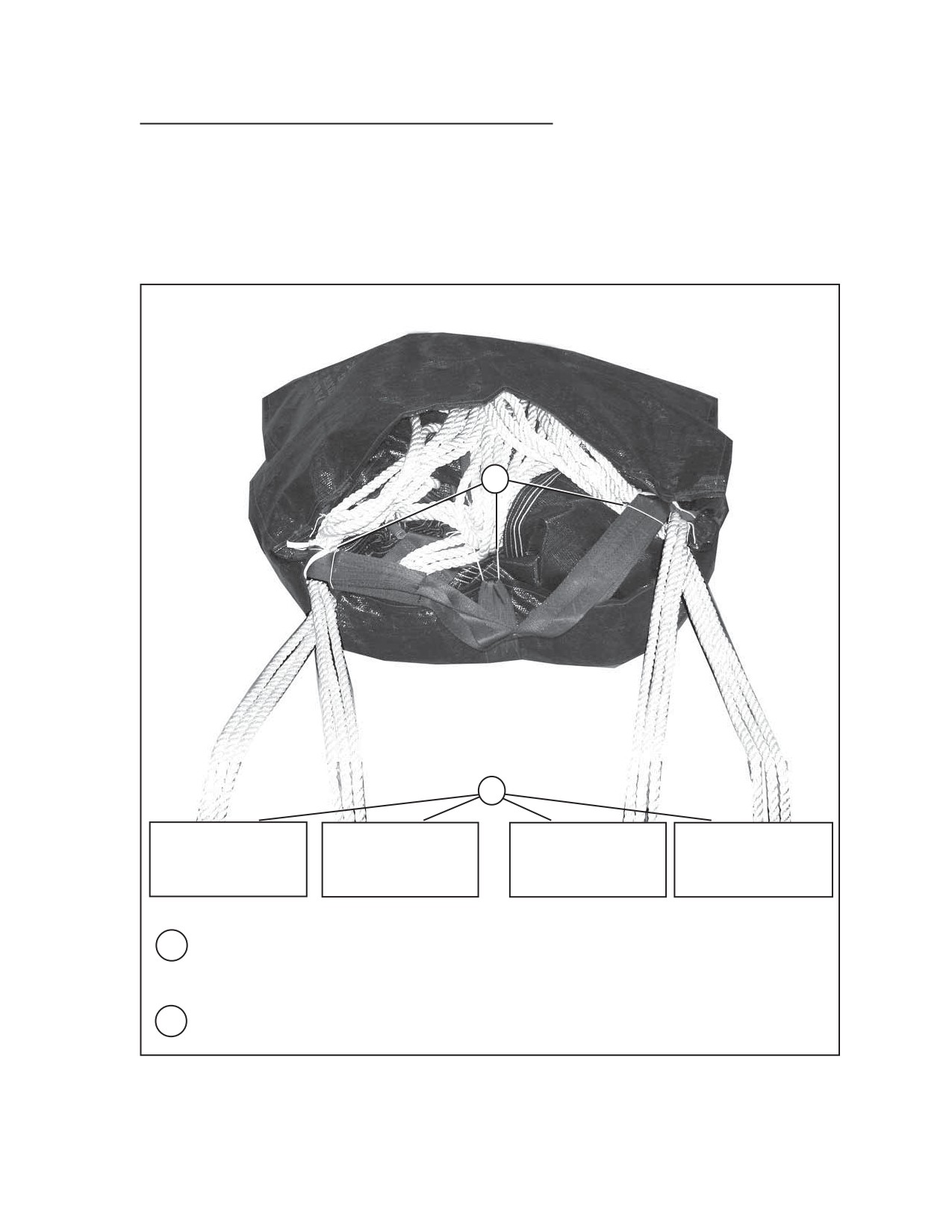
13-16. Install the LCADS high-velocity parachute as shown in Figure 13-8.
Install the standard 26-foot high-velocity parachute according to Figure 8-5.
1
2
suspension line
suspension line
suspension line
suspension line
group 10 through 12
group 1 through 3 on
group 4 through 6 on
group 7 through 9 on
on bottom left of D-
top left of D-bag
top right of D-bag
bottom right of D-bag
bag
1 Inspect LCADS HV Parachute to ensure bag closing ties have not broken. If broken,
retie using a signle turn of cotton thread 8/7 on the outside ties and a double turn of
cotton thread 8/7 on the center tie.
2 Identify suspension line groups 1 through 3, 4 through 6, 7 through 9, and 10 through
12.
Figure 13-8. LCADS High-Velocity Parachute Installed
2 September 2005
13-11
FM 4-20.103/MCRP 4-11.3C/TO 13C7-1-11
5
6
8
4
7
3
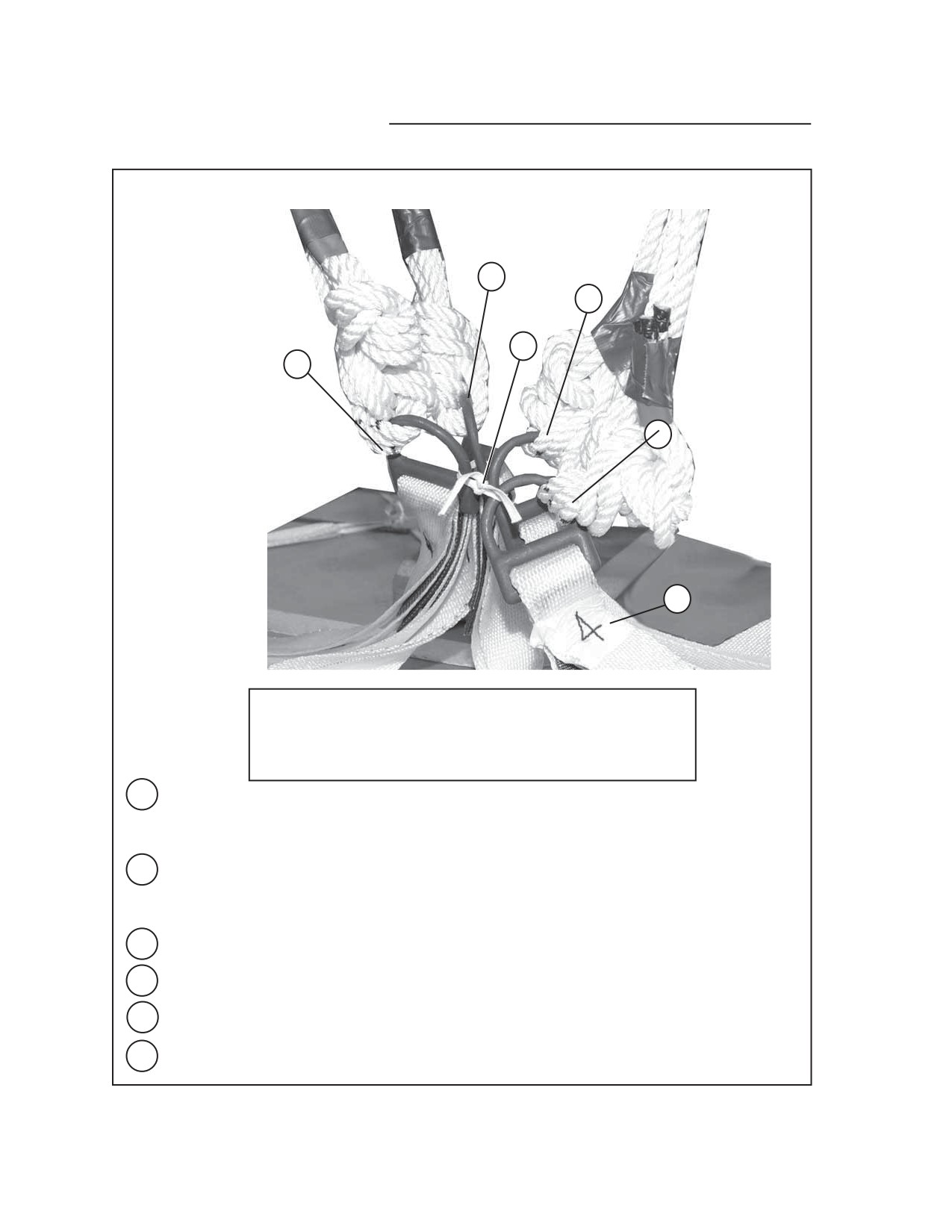
CAUTION
Failure to properly connect the suspension line groups
could result in suspension lines or securing webs cross
ing.
3 Identify four D-rings on LCADS securing web as follows. Facing the container, D-ring 1
is near side of container, D-ring 2 is on left side of container, D-ring 3 is far side of
container, and D-ring 4 is to the right side of container.
4 Route suspension line group 1 through 3, 30 inches through D-rings 1. Secure suspen
sion line group with three alternating half-hitches and tape the running ends with 2
inch cloth-backed tape.
5 Route suspension line group 10 through 12 through D-ring 2 and secure same as step 4.
6 Route suspension line group 7 through 9 through D-ring 3 and secure same as step 4.
7 Route suspension ling group 4 through 6 through D-ring 4 and secure same as step 4.
8 Secure the four D-rings together with 1/4-inch cotton webbing with surgeon’s knot and
locking knot.
Figure 13-8. LCADS High-Velocity Parachute Installed (Continued)
13-12
2 September 2005
FM 4-20.103/MCRP 4-11.3C/TO 13C7-1-11
10
9
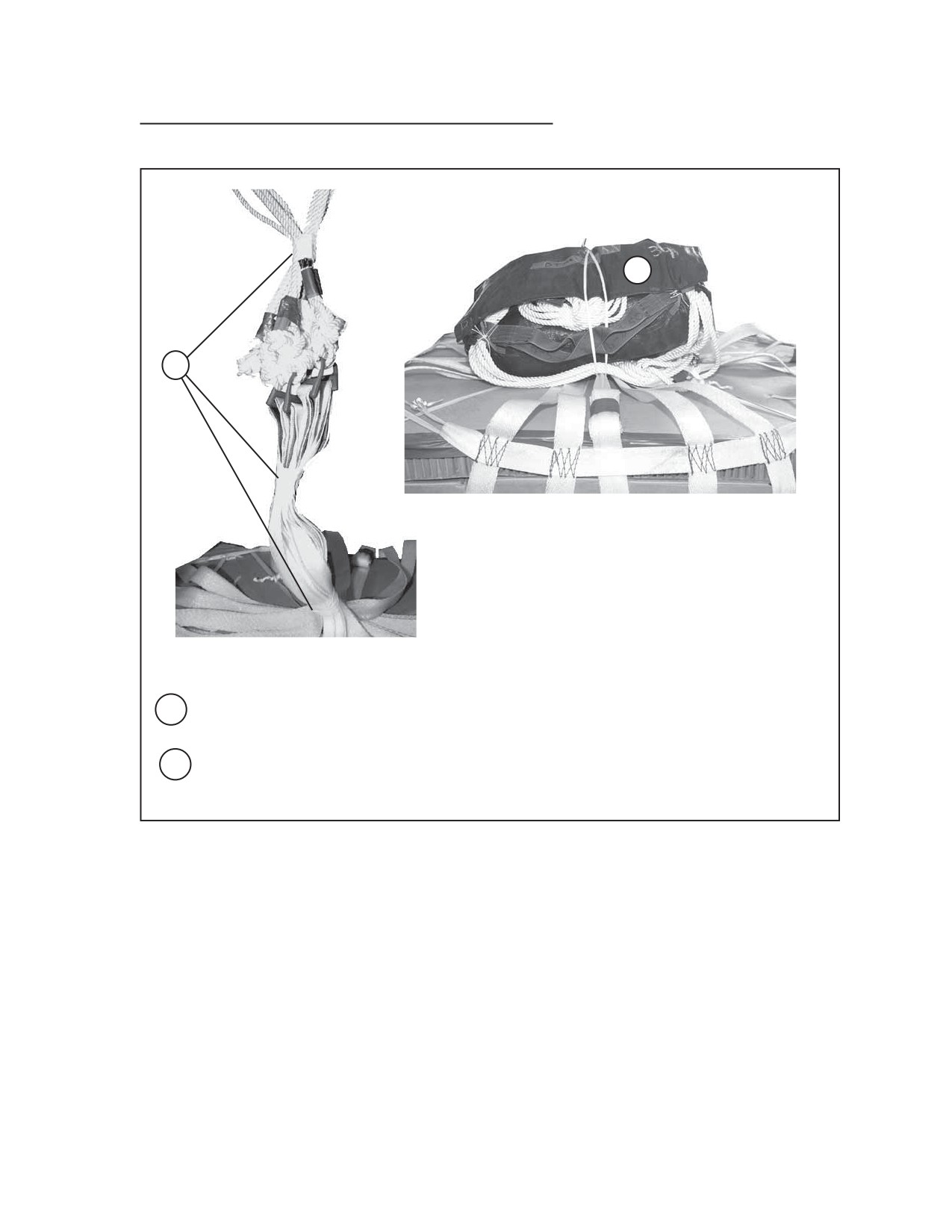
9 Secure the suspension line groups above the knots, 2 inches below the D-rings, and 4
inches above the load with 2-inch masking tape.
10 Position the parachute in the center of the load and secure according to Figure 8-5,
steps 3 through 6.
Figure 13-8. LCADS High-Velocity Parachute Installed (Continued)
2 September 2005
13-13
FM 4-20.103/MCRP 4-11.3C/TO 13C7-1-11
MARKING RIGGED LOAD
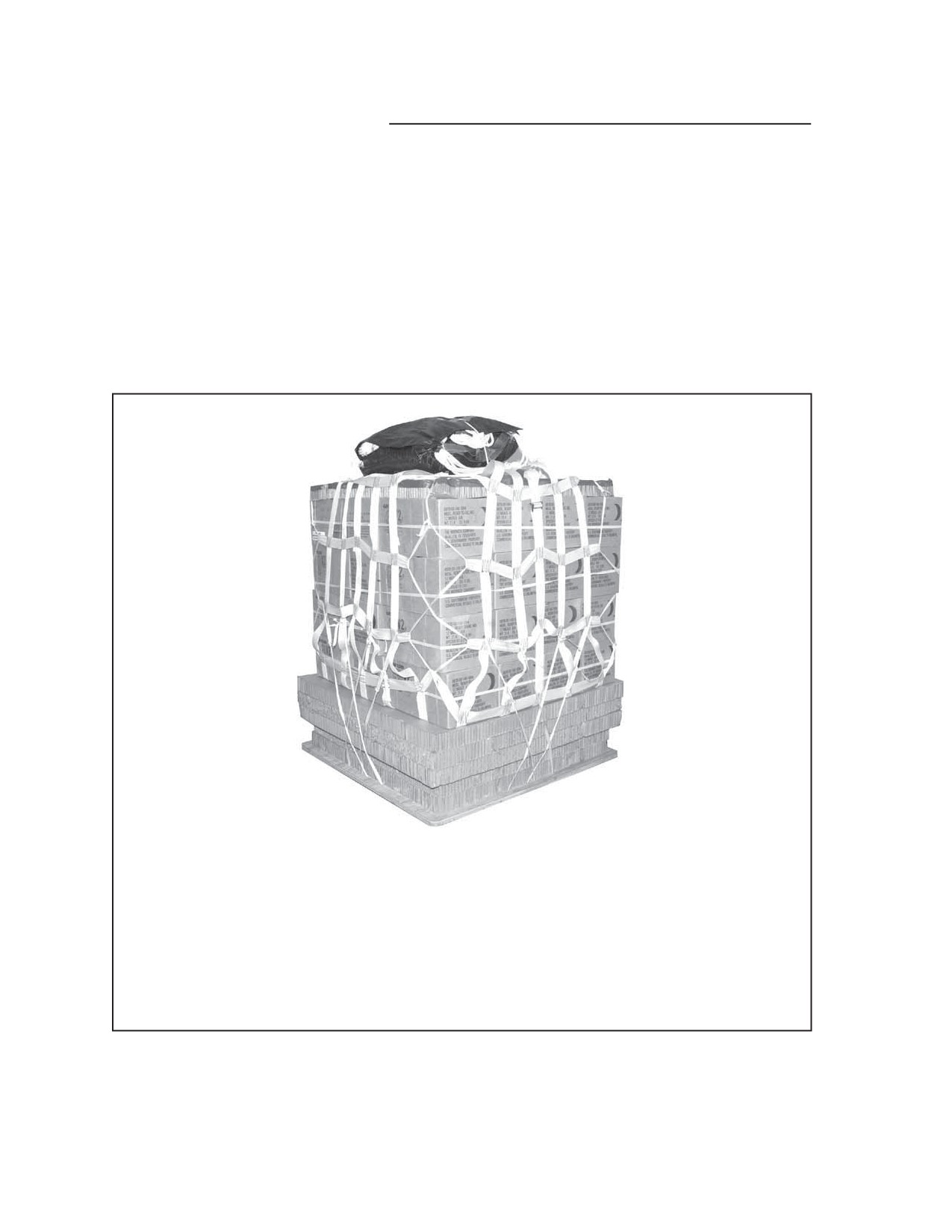
13-17. Mark the rigged load according to Paragraph 1-5 and as shown in
Figure 13-9. Compute the rigged load data.
EQUIPMENT REQUIRED
13-18. Use the equipment listed in Table 13-2 to rig the load shown in
Figure 13-9.
RIGGED LOAD DATA
Weight: Minimum load allowed
501 pounds
Maximum load allowed
2,200 pounds
Height:
83 inches
Width:
48 inches
Length:
48 inches
Figure 13-9. LCADS Rigged for High-Velocity Airdrop
13-14
2 September 2005
FM 4-20.103/MCRP 4-11.3C/TO 13C7-1-11
Table 13-2. Equipment Required for Rigging LCADS for High-Velocity Airdrop
National Stock
Item
Quantity
Number
8040-00
273-8713
Adhesive paste, 1-gallon
As required
No NS N
Bag, cover, 4 mil polyethylene (54- by 52- by 60-inches)
As required
No NS N
Shrink wrap
As required
No NS N
Sling assembly, LCADS
1
4030-00-678-8562
Clevis, suspension, 3/4-inch (medium)
1
4020-00-240-2146
Cord, nylon type III
As required
1670 00 753-3928
Pad, energy dissipating material, honeycomb
3 sheets
36- by 96- by 3-inches
Parachute:
1
No NS N
LCADS, high-velocity
or
1
1670 00 872-6109
Cargo, high velocity, 26-foot
1 sheet
5530-00-128
4981
Plywood, 3/4- by 48- by 96-inch
or
1 sheet
5530-00-914
5118
Plywood, 1- by 48- by 96-inch
As required
7510-00-266-6710
T
ape, masking, 2-inch
As required
8310-01-102-4478
Thread, cotton, ticket number 8/7
Webbing:
As required
8305-00-268-2411
Cotton, 1/4-inch, type I
As required
8305-00-082-5752
Nylon, tubular, 1/2-inch
2 September 2005
13-15
FM 4-20.103/MCRP 4-11.3C/TO 13C7-1-11
PART SIX
RIGGING SPECIALIZED LOADS AND EQUIPMENT
Chapter 14
Fabricating Air Force Airdrop Equipment
SECTION I - AIR FORCE UNILATERAL TRAINING
DESCRIPTION OF LOAD
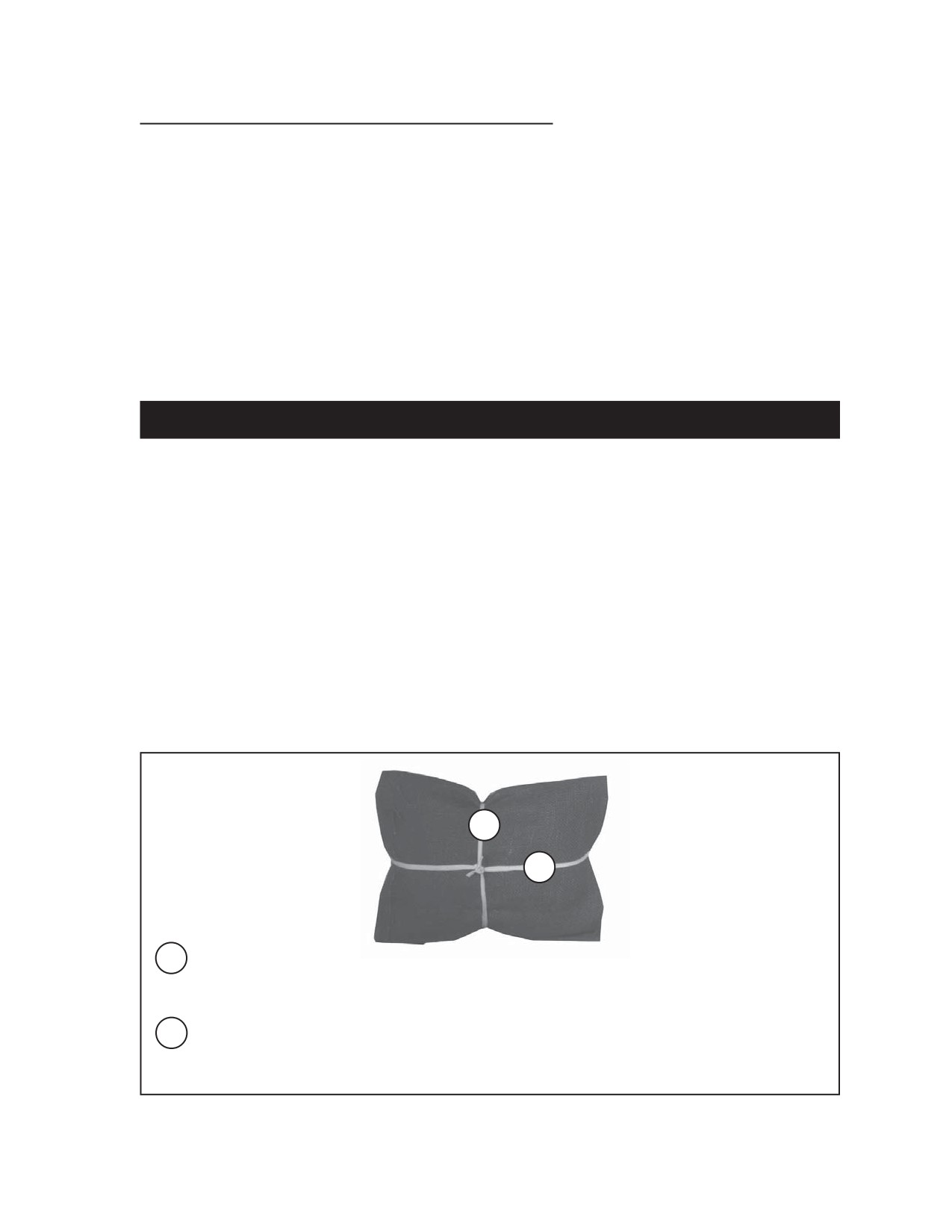
14-1. This chapter shows how to make a standard airdrop training bundle
(SATB) for use in unilateral training by the Air Force. The SATB is used to
simulate personnel, heavy equipment, and container airdrops from a C-130
aircraft. It consists of a sandbag filled with 13 1/2 pounds of sand or gravel and
a locally made canvas bag. A 15-foot cargo extraction parachute deployment
bag may be substituted for the canvas bag.
PREPARING SANDBAG
14-2. Fill a sandbag with 13 1/2 pounds of sand or gravel. Wrap the excess
portion of the bag around the filled portion to make a compact unit. Secure the
bag as shown in Figure 14-1.
1
2
1 Pass a length of type I, 1/4-inch cotton webbing around two sides of the bag. Pull the
webbing tight and tie the ends of the webbing together with a surgeon’s knot and a
locking knot.
2 Pass a length of type I, 1/4-inch cotton webbing around the opposite sides of the bag.
Pull the webbing tight and tie the ends of the webbing together with a surgeon’s knot
and a locking knot.
Figure 14-1. Sandbag Secured
2 September 2005
14-1
FM 4-20.103/MCRP 4-11.3C/TO 13C7-1-11
FABRICATING SATB
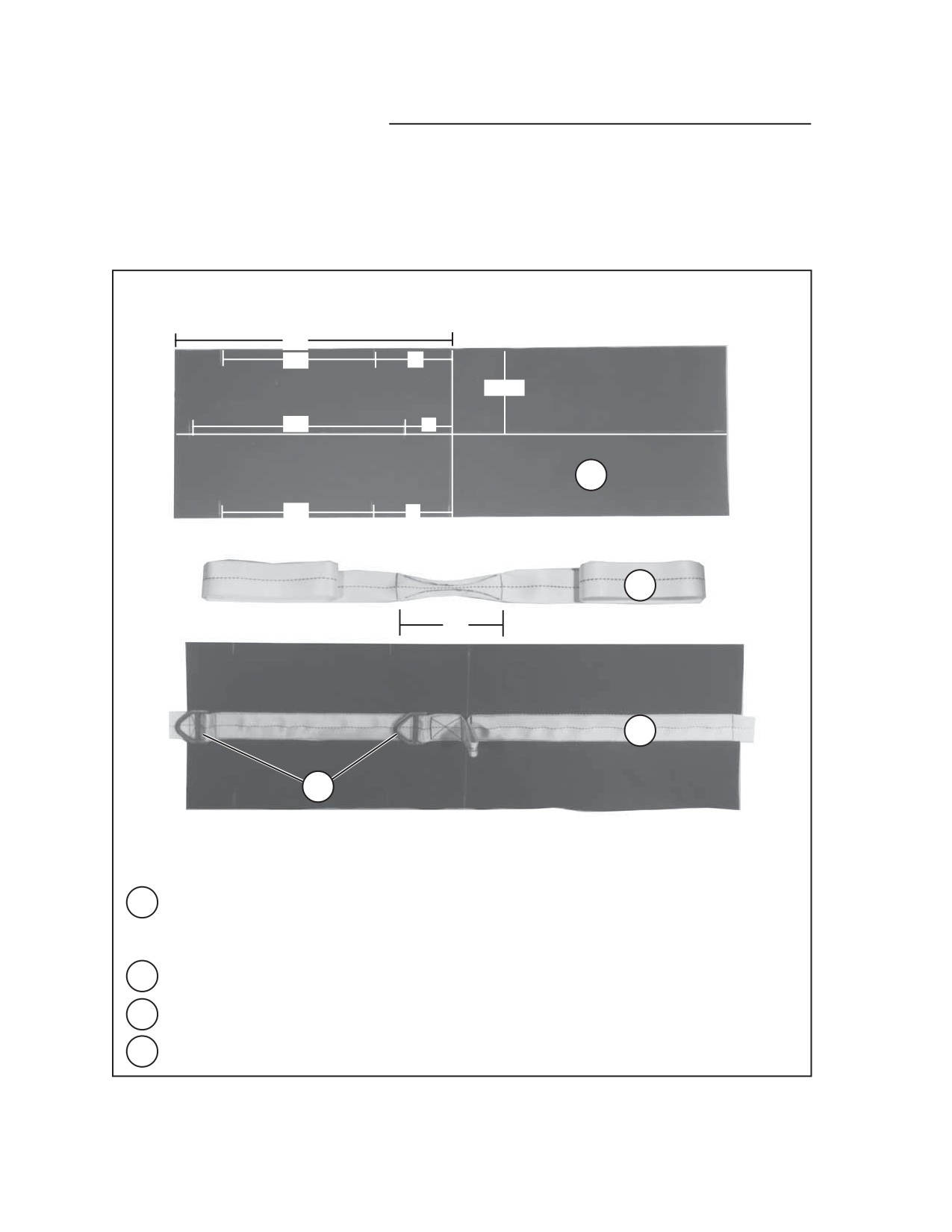
14-3. Construct a canvas bag as shown in Figure 14-2.
NOTES:
1. All dimensions are given in inches.
2. Stitches should be sewn with size FF, OD nylon thread.
18
10
5
5 1/2
14
3
2
10
5
1
6
4
3
NOTE: The canvas (duck cloth) may be painted orange or yellow for easy identifica
tion.
1 Make a main body strap from a 56-inch length of type VIII nylon webbing. Mark the
webbing at points 25 inches from each end. Form a pendulum line attatching loop by
rolling the edges between the marks and sewing the rolls in place with a lockstitch.
2 Lay out an 11- by 36-inch piece of canvas and mark it as shown.
3 Sew two V-rings to the canvas with a box stitch or a single X-box stitch as shown.
4 Sew the edges of the main body strap to the canvas as shown.
Figure 14-2. SATB Fabricated
14-2
2 September 2005
FM 4-20.103/MCRP 4-11.3C/TO 13C7-1-11
7
5
6
7
5
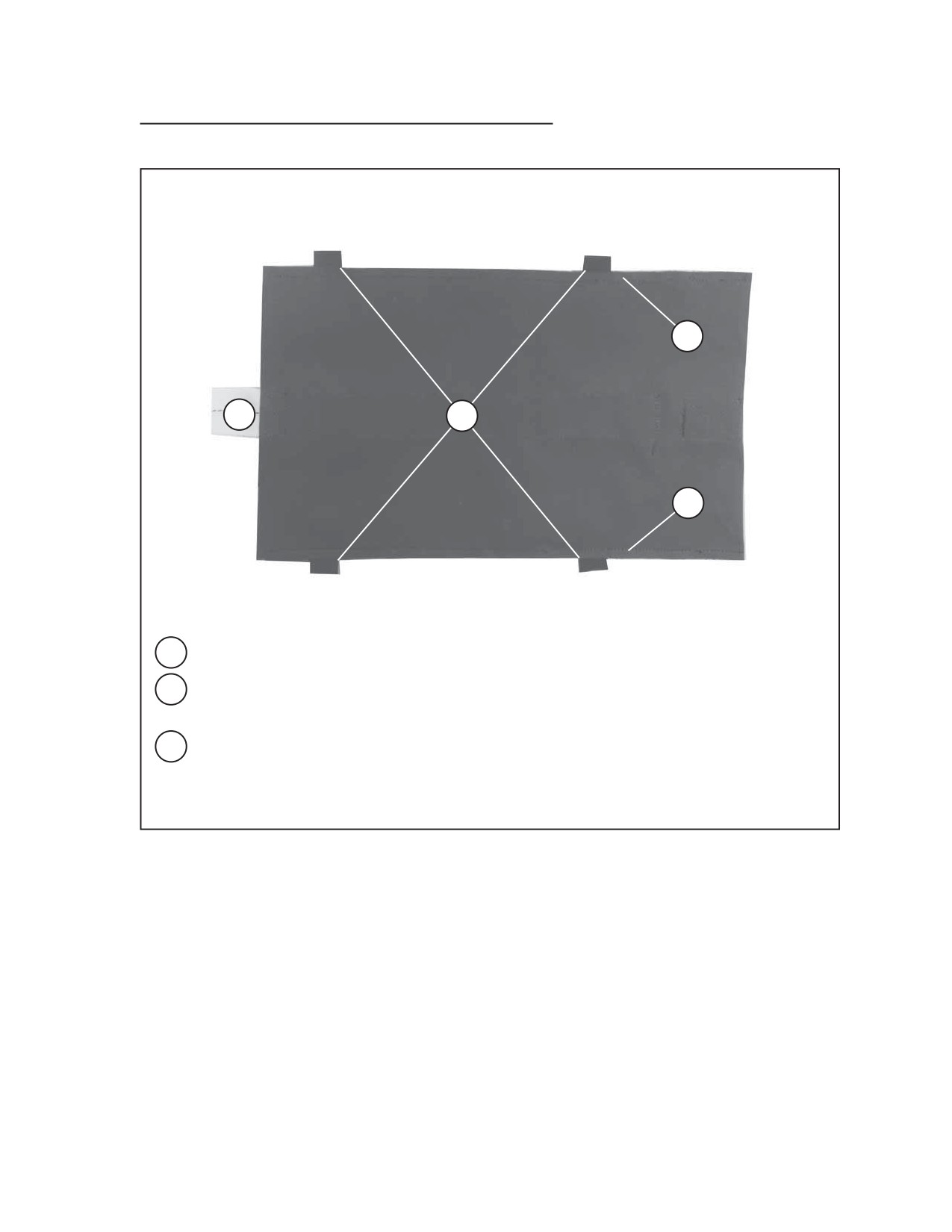
Fold the canvas in half lengthwise with the main body strap on the inside.
6 Make tie tabs by cutting four 4-inch lengths of type IV, 1-inch nylon webbing. Fold the
webbing in half lengthwise and mark each piece 1 inch from the folded end.
7
Start sewing the two long outside seams with a double row of locking stitches. Sew the
tie tabs to the canvas by inserting the folded end of the tie tabs inward on the 10-inch
marks (step 2).
Figure 14-2. SATB Fabricated (Continued)
2 September 2005
14-3
FM 4-20.103/MCRP 4-11.3C/TO 13C7-1-11
ATTACHING PENDULUM LINE
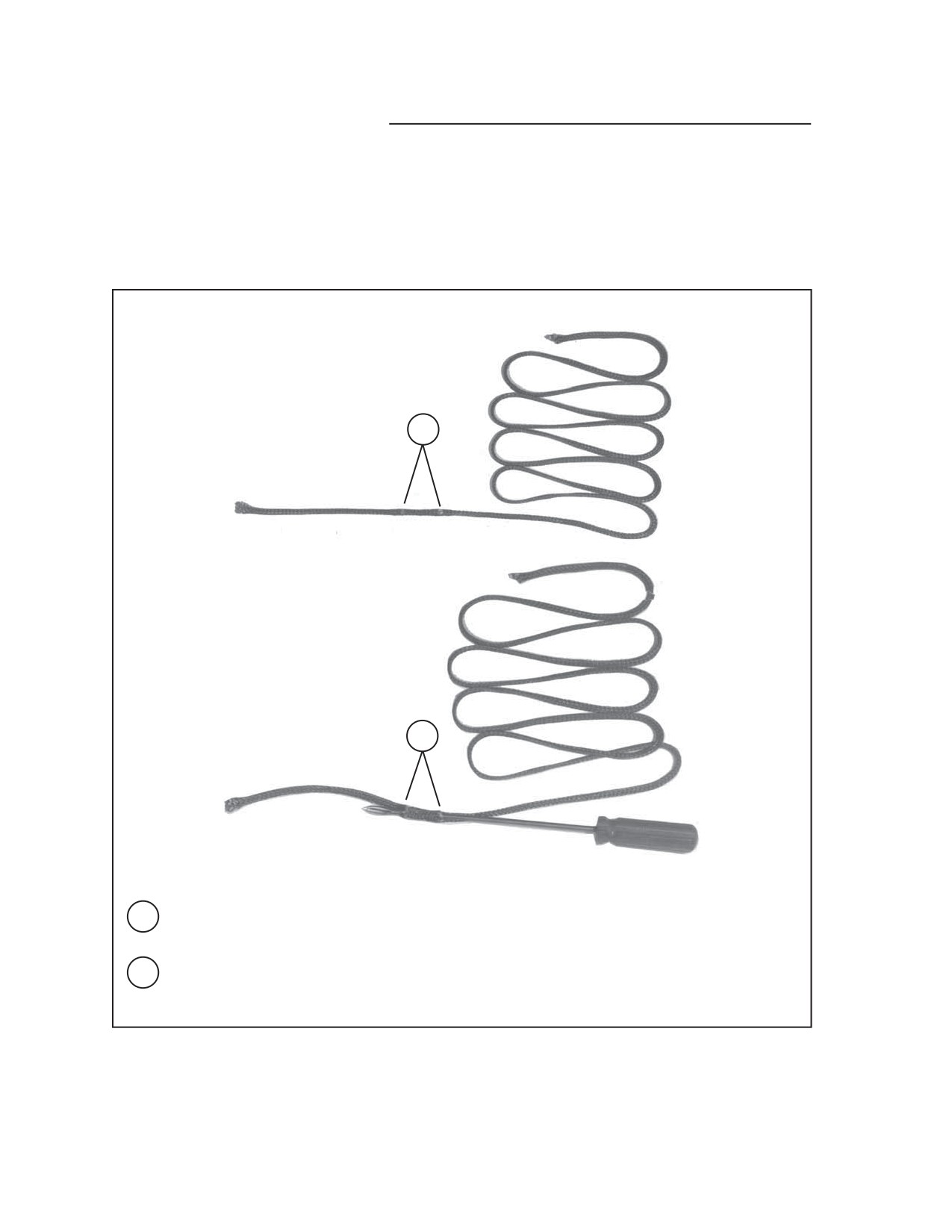
14-4. Attach a 40-inch, type IV coreless nylon cord pendulum line to the
pendulum line attaching loop of the SATB as shown in Figure 14-3.
1
2
1 Mark a location at 6 1/2 inches and another at 8 inches from the end of an 85-inch
length of type IV coreless nylon cord.
2 Insert a splicing tool into the cord at the 8-inch mark. Slide the cord onto the tool and
push the end of the tool out at the 6 1/2-inch mark.
Figure 14-3. Pendulum Attached to SATB
14-4
2 September 2005
FM 4-20.103/MCRP 4-11.3C/TO 13C7-1-11
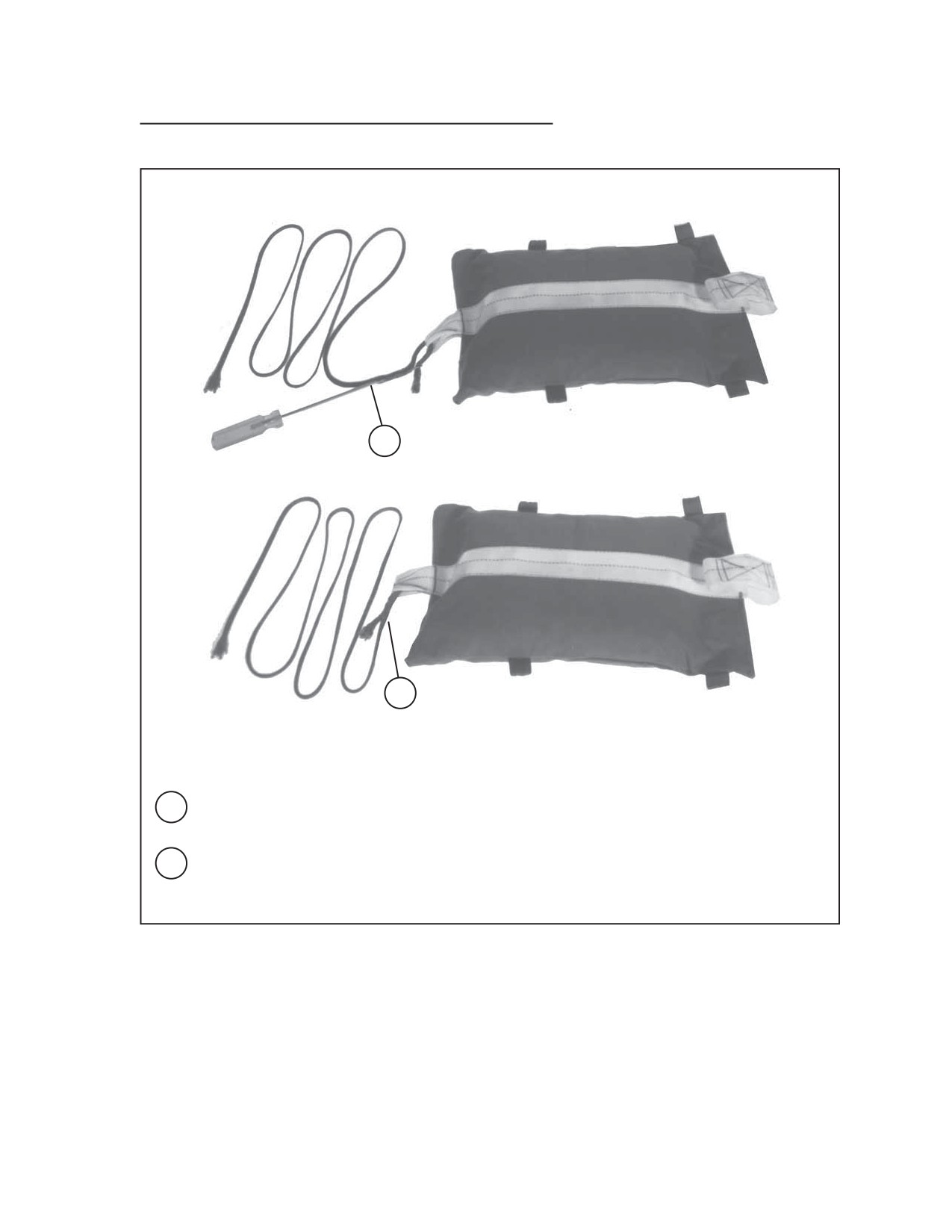
3
4
3 Run the free end of the cord through the pendulum line attaching loop and through the
eye in the splicing tool.
4 Pull the tool back through the cord. Remove the free end of the cord from the eye of the
splicing tool and tie an overhand knot 1 inch from the end.
Figure 14-3. Pendulum Attached to SATB (Continued)
2 September 2005
14-5
FM 4-20.103/MCRP 4-11.3C/TO 13C7-1-11
PACKING AND INSTALLING PILOT PARACHUTE
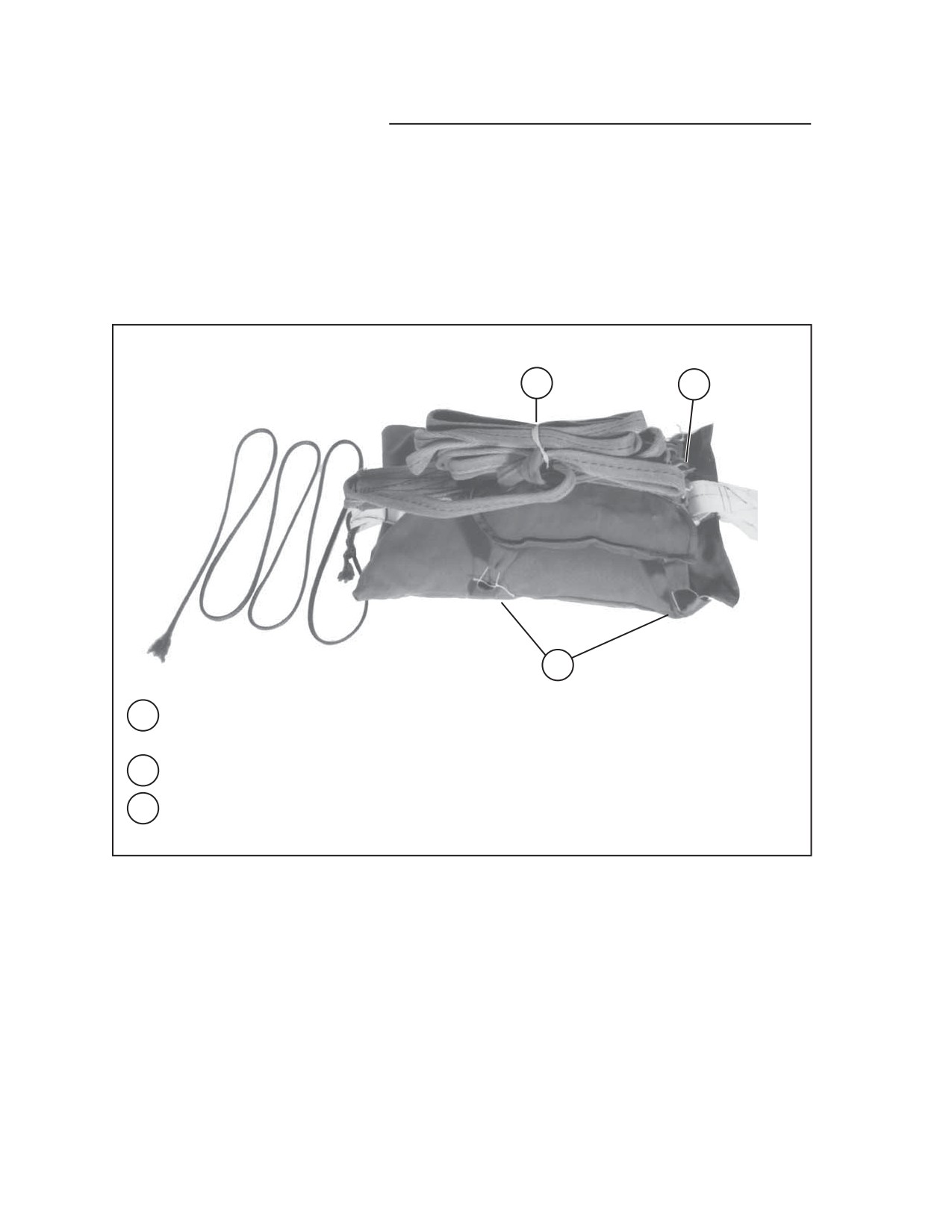
14-5. Pack a 68-inch pilot parachute as outlined in TM 10-1670-281-23&P/ TO
13C5-32-2, but make the apex and bag-closing ties with single lengths of ticket
number 8/4 cotton thread. Install the pilot parachute on the SATB as shown in
Figure 14-4.
3
1
2
1 Attach the pilot parachute deployment line to the deployment line attaching loop of the
SATB with a connector link.
2 Tie the pilot parachute to the SATB with single ties of ticket number 8/4 cotton thread.
3 Fold the static line and secure the folds with a retainer band.
Figure 14-4. Pilot Parachute Installed on SATB
14-6
2 September 2005
FM 4-20.103/MCRP 4-11.3C/TO 13C7-1-11
ATTACHING MARKER LIGHT
14-6. For night operations tie a distress marker light or chemical light to a tie
tape with a double length of type I, 1/4-inch cotton webbing.
USING EXTRACTION PARACHUTE DEPLOYMENT BAG
14-7. If a 15-foot cargo extraction parachute deployment bag is substituted for
the canvas bag used to enclose the sandbag, prepare the SATB as described
below.
a. Place the filled sandbag in the deployment bag and tie the deployment
bag closed.
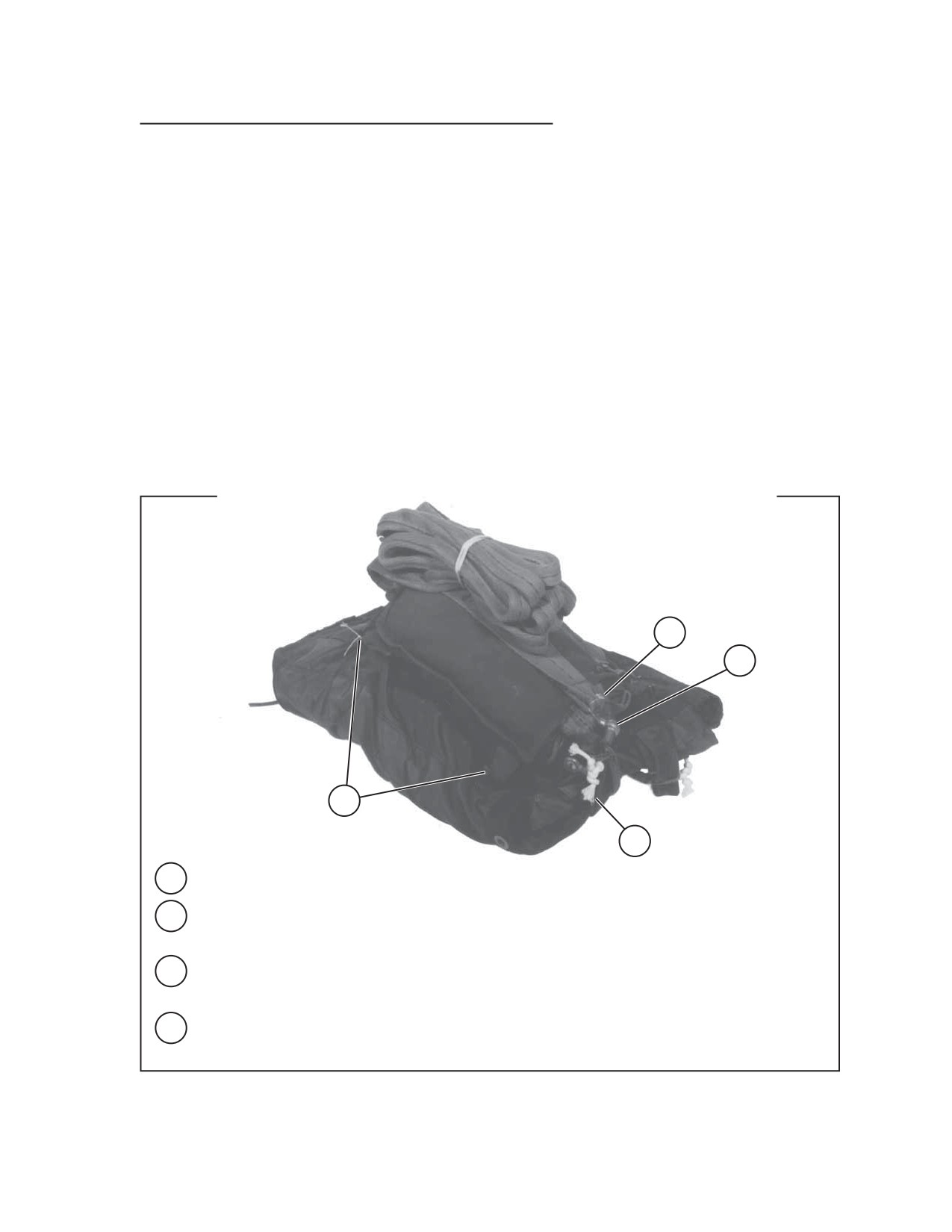
b. Safety a 68-inch pilot parachute to the deployment bag as shown in
Figure 14-5.
3
2
4
1
1 Tie the deployment bag closed with ties of type III nylon cord.
2 Attach the pilot parachute deployment line to both closing loops on the grommet side
with the deployment line connector link.
3 Tie the pilot parachute bag closed with a single length of ticket number 8/4 cotton
thread.
4 Tie the pilot parachute bag to the extraction parachute deployment bag with four ties.
Make each tie using a single length of ticket number 8/4 cotton thread.
Figure 14-5. Pilot Parachute Tied to Deployment Bag
2 September 2005
14-7
FM 4-20.103/MCRP 4-11.3C/TO 13C7-1-11
EQUIPMENT REQUIRED
14-8. Use the equipment listed in Table 14-1 to rig the SATB.
Table 14-1. Equipment Required for Rigging an SATB
National Stock
Item
Quantity
Number
1670-00-815-2727
Bag, deployment, 15-foot, cargo parachute
1
1670-00-568-0323
Band, rubber, retainer
1
8305-00-242-3593
Cloth, cotton duck, 60-inch
As required
Cord, nylon:
4020-00-262-2020
Braided, type IV
As required
4020-00-240-2146
Type III, 550-pound
As required
1670-00-217-2421
Link assembly, L-bar type
1
1670-00-216-7297
Parachute, pilot, 68-inch diameter
1
8105-00-285-4744
Sandbag
1
8310-00-102-4477
Thread, cotton, ticket number 8/4
As required
1670-00-360-0471
V-ring
2
Webbing:
8305-00-268-2411
Cotton, 1/4-inch, type I
As required
Nylon:
8305-00-268-2455
Tubular, 1-inch
As required
8305-00-263-3591
Type VIII, NT
As required
SECTION II - FABRICATION OF C-130 CDS PULLEY STRAP
DESCRIPTION OF C-130 CDS PULLEY STRAP
14-9. This section shows how to make a 1-inch tubular nylon webbing CDS
pulley strap for use in C-130 aircraft. CDS pulley straps are used to suspend a
pulley overhead in the aircraft to release the gate.
PREPARING C-130 CDS PULLY STRAP
14-10. Prepare a 1-inch tubular nylon webbing CDS pully strap in lengths as
specified in TO 1C-130A9 and as shown in Figure 14-6.
14-8
2 September 2005
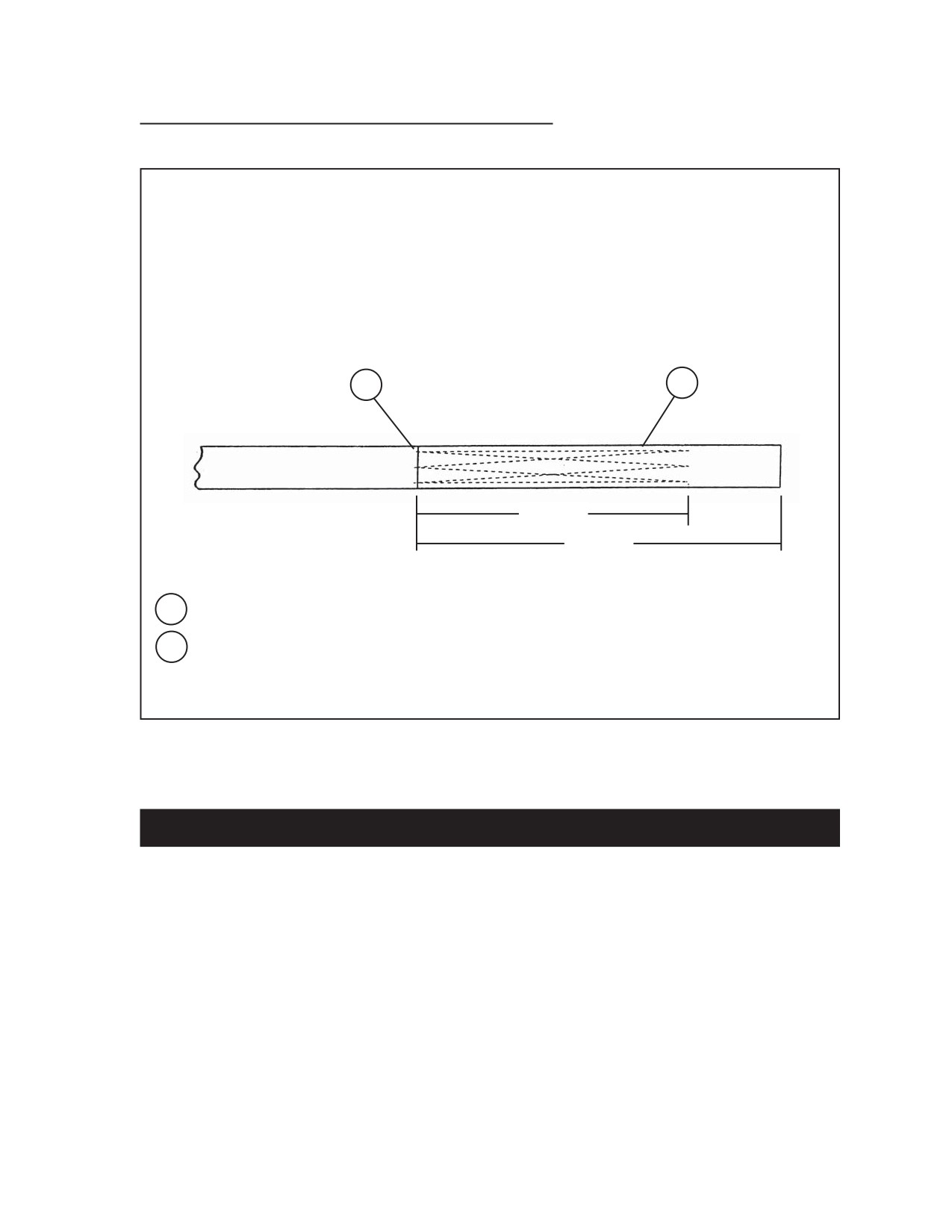
FM 4-20.103/MCRP 4-11.3C/TO 13C7-1-11
NOTES:
1. All stitching will be 1/8 inch from sides or spaced 1/8 inch apart unless
otherwise specified.
2. A 1/2-inch lock stitch must be made.
3. All exposed ends of nylon webbing must be fused.
Make sure no sharp
edges are formed.
4. All dimensions are in inches.
2
1
6 ± 1/8
8 ± 1/8
1 Use thread, type I or II, Class I, size 3, OD S-1, with five to seven stitches per inch.
2 Carry stitching over the end a minimum of one stitch.
Figure 14-6. C-130 CDS Pulley Strap Prepared
SECTION III - CDS KIT
DESCRIPTION AND USE OF CDS KIT
14-11. A CDS kit for C-130 aircraft is locally assembled and includes all the
equipment required to drop CDS. The CDS kit contains additional equipment
not normally carried on aircraft.
EQUIPMENT REQUIRED
14-12. Use the equipment listed in Table 14-2 to assemble a CDS kit. The
equipment list is for a single CDS kit single. Additional quanitities may be
required for multiple passes or a mass CDS drop.
2 September 2005
14-9
FM 4-20.103/MCRP 4-11.3C/TO 13C7-1-11
Table 14-2. Equipment Required for CDS Kit
National Stock
Item
Quantity
Number
5140-00-473-6256
Bag, tool, satchel
1
1670-00-406-2657
Ratchet, 10,000 pound
4
3020-00-517-1327
Pulley, assembly grooved
1
5305-00-167-0827
Bolt, Machine for pulley
1
5310-00-167-0821
Washer, flat
2
5310-00-950-0039
Nut, self-locking
1
1670-01-162-2372
Assembly, clevis, type V
1
1670-00-738-5879
120-inch strap, type X nylon webbing
1
8305-00-268-2455
**
114-inch strap, 1-inch tubular nylon webbing
2
8305-00-268-2455
**
95-inch strap, 1-inch tubular nylon webbing
1
8305-00-261-8584
**
41-inch strap, type X nylon webbing
1
8305-00-268-2455
**
24-inch strap, 1-inch tubular nylon webbing
1
1670-00-836-2231
Knife, release, cargo, guillotine
2
1560-00-650-4219
Yoke, assembly for knives
2
4030-00-618-6824
Terminal, w ire rope
1
5310-00-877-5796
Nut, self-locking for knife terminal
2
5306-00-151-1423
Bolt, machine for knife terminal
2
8305-00-177-5069
* Type XXVI nylon webbing release gate
As required
8305-00-268-2453
1/2-inch tubular nylon, retriever winch cable
1
loop guide
Normally provided by transported force.
** Locally fabricated.
14-10
2 September 2005
FM 4-20.103/MCRP 4-11.3C/TO 13C7-1-11
Glossary
AFB
Air Force Base
AFMAN
Air Force manual
AFJ
Air Force Joint
AFTO
Air Force technical order
AMC
Air Mobility Command
AR
Army Regulation
CDS
container delivery system
CVRS
centerline vertical restraint system
DA
Department of the Army
DD Form
Department of Defense form
FM
field manual
GLLD
ground laser location designator
HQ
headquarters
LCADS
Low-Cost Aerial Delivery System
MCO
Marine Corps Order
MCRP
Marine Corps reference publication
NAVAIR
Naval Air Systems Command
NAVSEA
Naval Sea Command
No
number
NT
natural
OD
olive drab
OPNAVINST
Operational Naval Instruction
POP
performance oriented packaging
SATB
standard airdrop training bundle
2 September 2005
Glossary-1
FM 4-20.103/MCRP 4-11.3C/TO 13C7-1-11
TM technical manual
TO technical order
US United States
USL universal static line
Glossary-2
2 September 2005
FM 4-20.103/MCRP 4-11.3C/TO 13C7-1-11
Bibliography
AFMAN 24-204(I)
Preparing Hazardous Materials for Military Air Shipments.
TM 38-250
December 2001
AFTO Form 22
Technical Order Publication Improvement Report
AR 59-4/OPNAVINST 4630.24C
Joint Airdrop Inspection Records, Malfunction Investigations,
AFJ 13-210(I)/MCO 13480.1B
and Activity Reporting. May 1998
DA Form 2028
Recommended Changes to Publication and Blank Forms.
DD Form 1748-1
Joint Airdrop Inspection Record (Container).
FM 4-20.102
Airdrop of Supplies and Equipment: Rigging Airdrop
NAVSEA SS400-AB-MMO-010
Platforms.22 August 2001
TO 13C7-1-5
FM 4-20.116
Airdrop of Supplies and Equipment: Reference Data for
TO 13C7-1-13
Airdrop Platform Loads. 20 August 2001
FM 4-20.153
Airdrop of Supplies and Equipment: Rigging Amunition.
MCRP 4-11.3B
1 May 2004
TO 13C7-18-41
FM 10-500-9
Tactics, Techniques, and Procedures for Quartermaster
Airdrop and Airdrop Support Units. 3 October 1995
NAVAIR A1-H53BE-NFM-000
NATOPS Flight Manual, Navy Model CH-53E.
15 August 2002
NAVAIR A1-H53BE-CLG-000
Cargo Loading Manual, Navy Models CH-53D, CH53E and
MH-53E Helicopters. 31 December 1998
TM 10-1670-201-23
Organizational and DS Maintenance Manual for General
TO 13C-1-41
Maintenance of Parachute and Other Airdrop Equipment.
NAVAIR 13-1-17
30 October 1973
TM 10-1670-275-23&P
Unit and Intermediate Direct Support (DS) Maintenance
TO 13C5-25-2
Manual (Including Repair Parts and Special Tools List) for
NAVAIR 13-1-26
Parachute Cargo Type: 12-Foot Diameter, High-Velocity
Cargo Parachute. 17 March 1989
TM 10-1670-276-23&P
Unit and Intermediate Direct Support (DS) Maintenance
TO 13C5-29-2
Manual (Including Repair Parts and Special Tools List) for
NAVAIR 13-1-29
Parachute Cargo Type: 26-Foot Diameter, High-Velocity
Cargo Parachute. 28 September 1990
2 September 2005
Bibliography-1