FM 3-90.12/MCWP 3-17.1 COMBINED ARMS GAP-CROSSING OPERATIONS (July 2008) - page 4
Appendix B
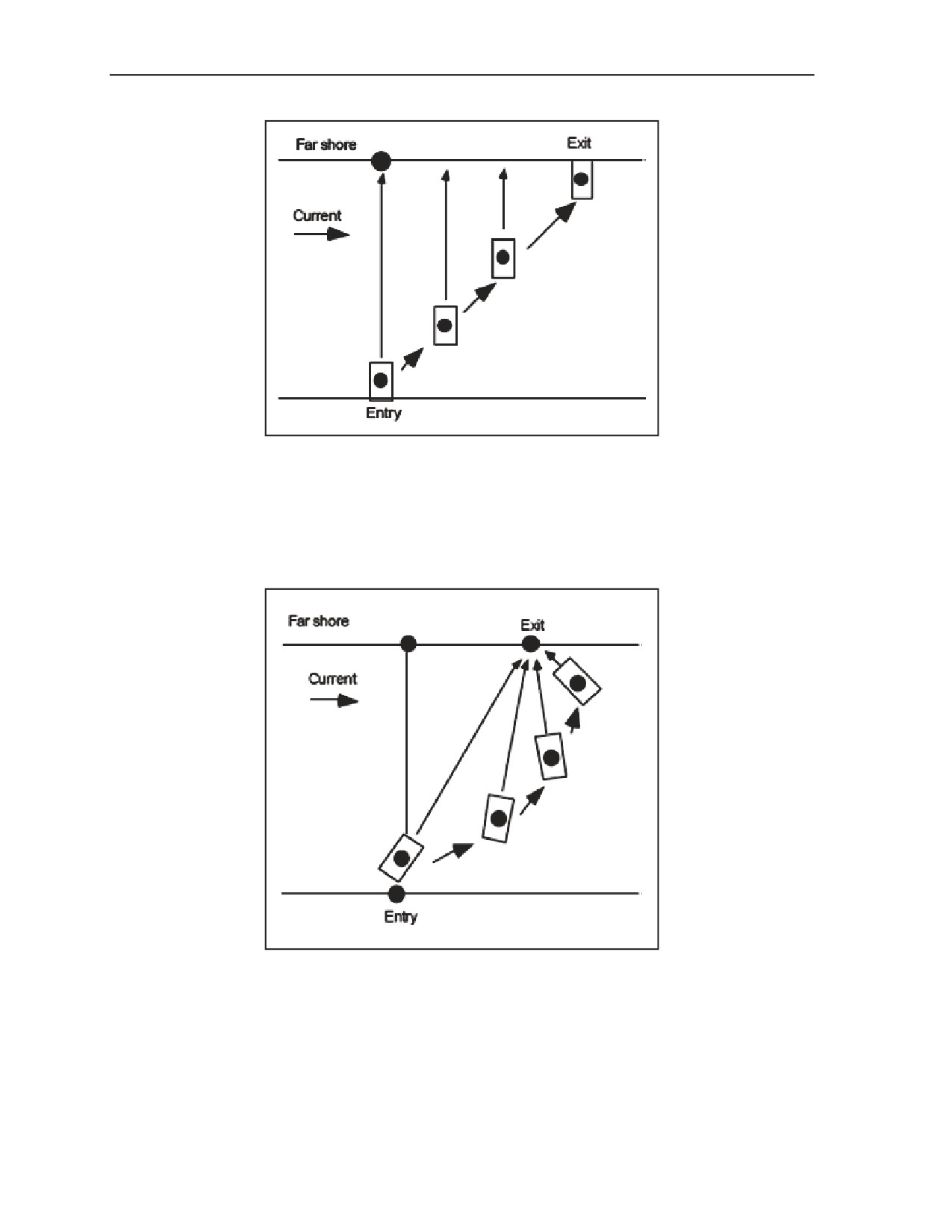
Figure B-7. Downstream Sideslip
Example 2
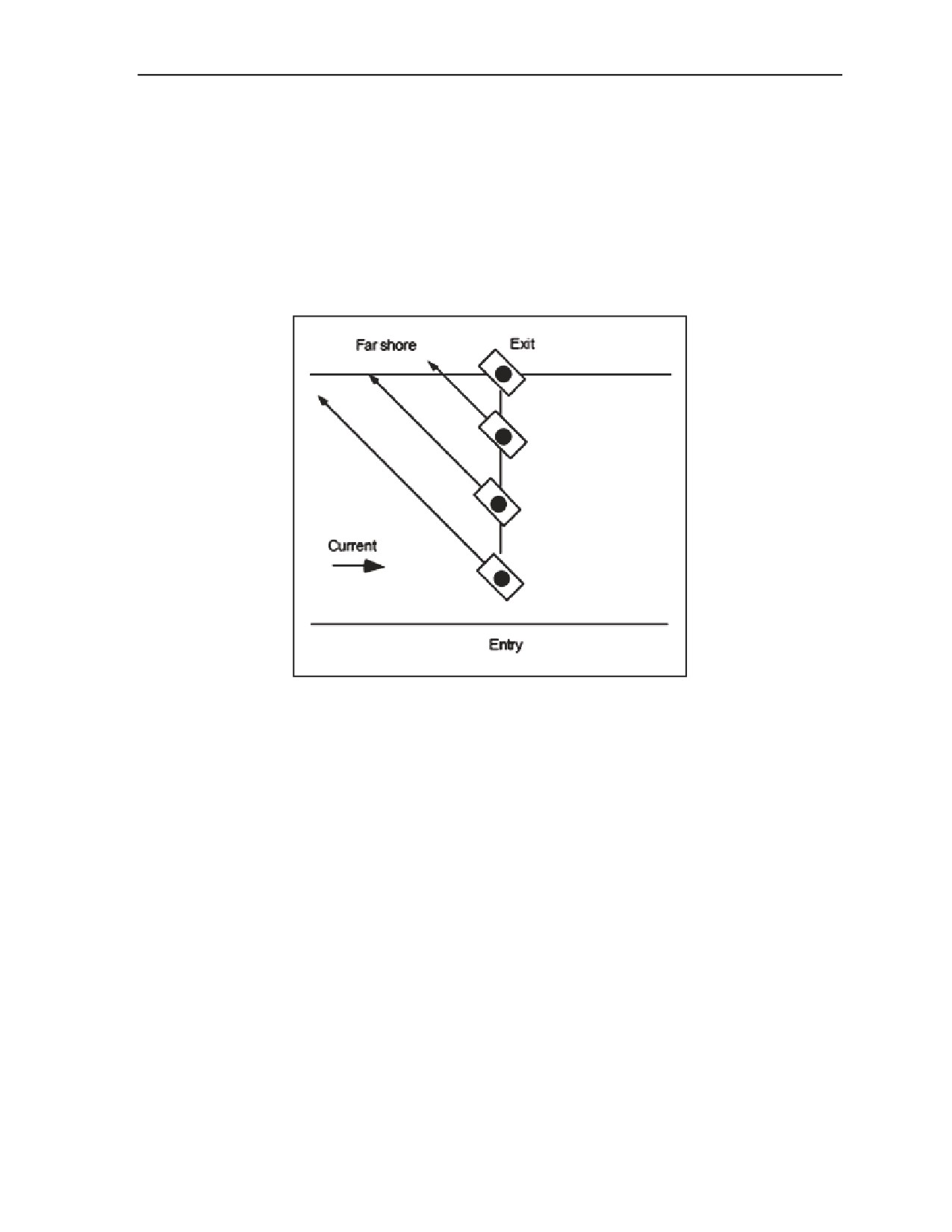
B-35. If the operator continues to aim the vehicle at the desired exit point, the orientation of the craft at the
exit point will approximate an upstream heading. The craft’s path is an arc in proportion to the current’s
velocity (Figure B-8).
Figure B-8. Constant Aim Point
B-10
FM 3-90.12/MCWP 3-17.1
1 July 2008
Crossing Site Selection
Example 3
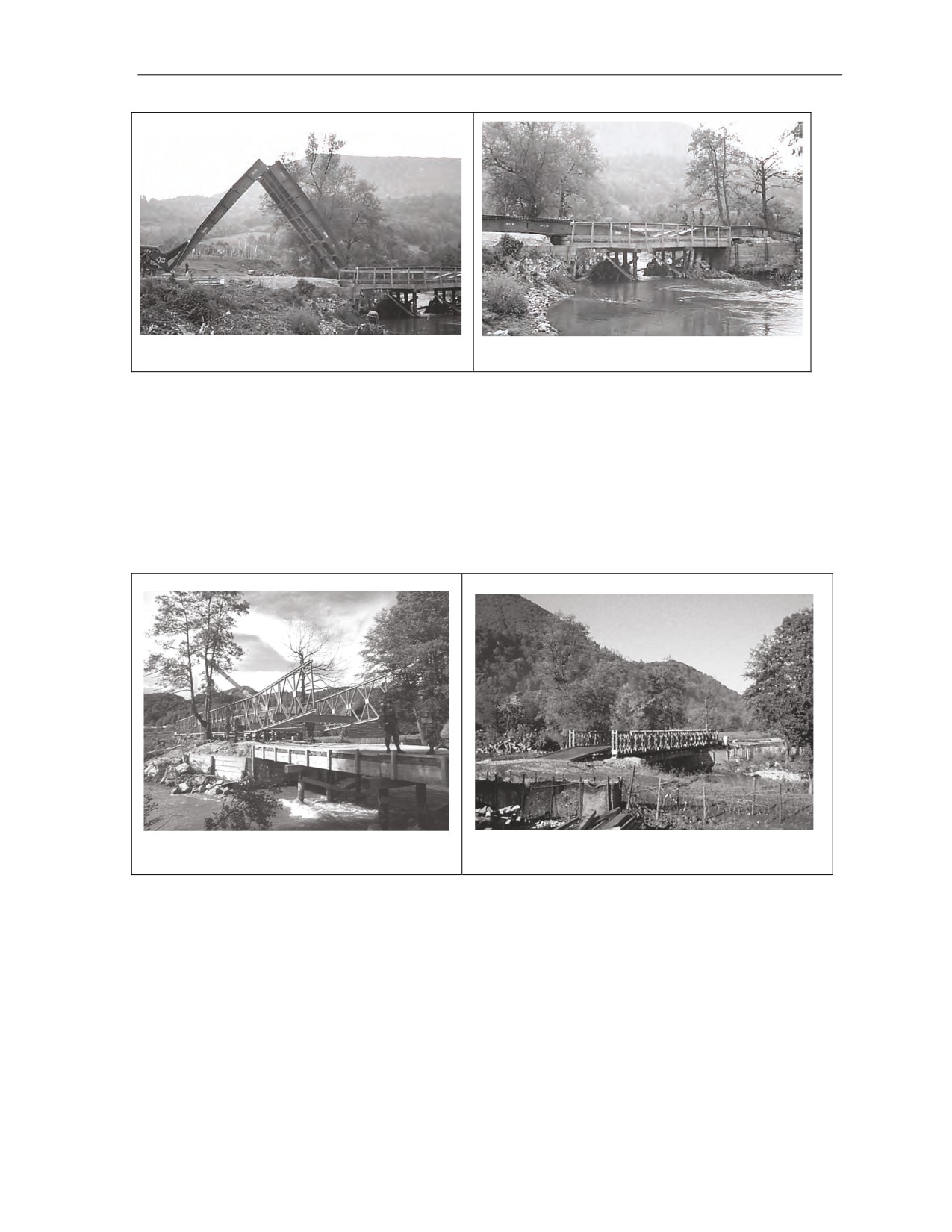
B-36. To exit at a point directly across from the entry point requires an upstream heading to compensate
for the current’s velocity (Figure B-9). In all three examples, the craft's speed on the current’s velocity is
constant; assuming the engine revolutions per minute or paddling rate remains constant. Terrain conditions
may restrict the location of entry and/or exit locations. Enemy situations may require alternate techniques.
For example, when aiming at the downstream exit point, the craft moves at a greater speed relative to the
banks after entry than it does as it nears the exit due to the current’s velocity. Use of this technique may be
favored when the enemy has a better observation of the entry bank rather than the exit bank. Watercraft
moving fast and at a changing rate is more difficult to engage effectively.
Figure B-9. Constant Heading
1 July 2008
FM 3-90.12/MCWP 3-17.1
B-11
Appendix C
Engineer Crossing Factors
This appendix provides information about specific procedures, conditions, and
factors that can impact a gap-crossing operation. Although focused on the extreme of
considerations often encountered in a wet-gap crossing, many of these are applicable
to any type of gap crossing or classification.
GENERAL
C-1. A gap crossing requires specific procedures for success because the gap inhibits what would
otherwise be normal ground maneuver. It demands detailed planning and different and (in some cases)
unique technical support than other tactical operations. Extensive use of engineer assets is required. It is
critical for the supporting engineers to be totally involved in all facets of the gap-crossing operation from
initial planning through the preparation and execution. For this reason, an engineer HQ that will support
the crossing must be designated as soon as a potential crossing is identified. For a BCT this may be an
engineer battalion, while for a division this will generally be an engineer brigade or a MEB that is
specifically focused on support of the river crossing. This will generally require a second MEB in support
of the division.
C-2. Traffic control may be one of the most vital components of a gap-crossing operation. ERPs are used
to control traffic flow and optimize the ordered movement across the gap in an unhindered manner.
Engineer units, with the assistance of military police, provide positive control and the necessary equipment
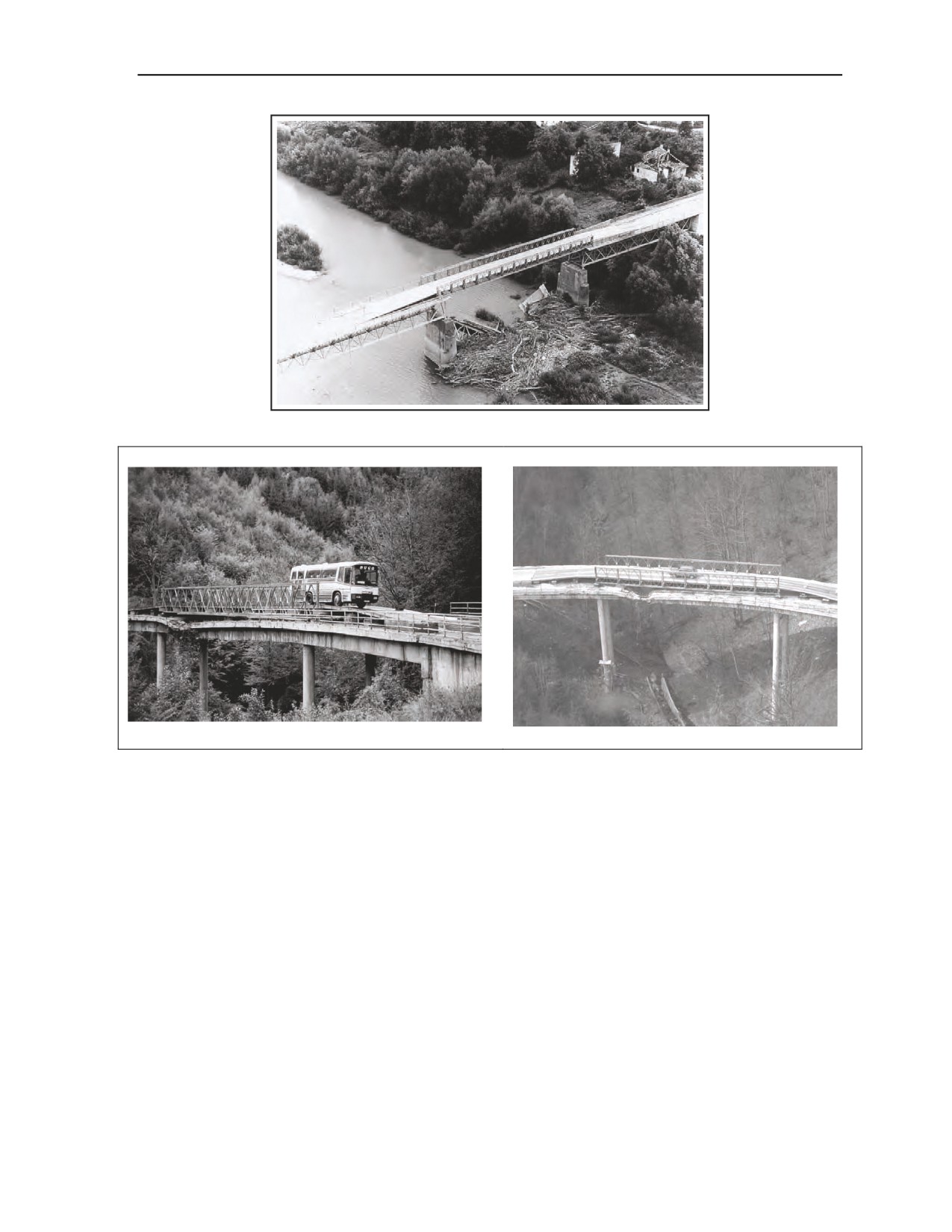
to ensure maneuver forces successfully and safely cross the gap in a timely and synchronized manner,
unhindered by obstacles.
C-3. Contingency operations may require that tactical crossing assets be used for longer periods of time
because support bridging is not feasible or readily available. Engineer units must implement techniques
that allow the long-term use of tactical bridging assets without heavily affecting operations or damaging
equipment. These topics will be discussed in detail in this appendix.
ENGINEER REGULATING POINT OPERATIONS
C-4. ERPs ensure the effective use of the crossing means. ERPs and TCPs may be collocated to provide
control for the gap crossing. The CSC uses TCPs to facilitate moving units through the crossing area.
C-5. The CSC establishes ERPs at the call forward area and, if enough engineer assets are available, at the
staging area and the farside holding area. He uses additional ERPs only when specific site conditions make
it necessary for crossing area control. If conducting a wet-gap crossing, ERP personnel will need enough
space to mark an area the size of a raft (mock-up raft), brief crossing procedures, and conduct necessary
inspections and rehearsals. A hardstand, such as a rest stop or parking lot, is ideal for this purpose but lacks
the overhead concealment usually desired. Some ERP functions may be done at separate ERPs to ensure a
smooth and rapid flow of vehicles to and across the gap. In this case, communications between ERPs must
be maintained.
1 July 2008
FM 3-90.12/MCWP 3-17.1
C-1
Appendix C
C-6. Typically, an engineer squad mans an ERP. This maintains unit integrity and provides enough
personnel and equipment for continuous operations. The crossing site HQ establishes direct
communication with ERP personnel to control raft load or individual vehicle movement. Depending on the
location and purpose of the ERP, it can be used for the following functions:
Briefing crossing unit personnel on crossing procedures, including safety.
Demonstrating ground guide signals.
Inspecting equipment to ensure that it meets the load class capability of the crossing means.
Organizing vehicles into raft loads or serials.
Conducting rehearsals.
Controlling vehicle movement.
RAFTING OPERATIONS
C-7. ERP personnel configure vehicles into raft loads and send them to the gap to coincide with the
arrival of an empty raft. Engineers brief crossing units before their arrival in the call forward area to make
this happen as rapidly as possible. The briefing covers the—
Route and its markings through the crossing site.
Road speeds and vehicles intervals.
Loading and unloading of rafts.
Location of passengers while rafting across the gap.
Configuration of the vehicles for the crossing.
Actions to take for disabled vehicles and the location of the maintenance collection point.
Hand-and-arm signals and signaling devices.
Arm bands or other identification of guides and traffic controllers.
Issuing, wearing, and returning of life jackets and/or other safety equipment.
Location of holding areas and alternate routes.
Location of a casualty collection point.
Actions to take in the call forward area.
Actions to take in case of enemy fire.
Regrouping of the company in the farside holding area.
C-8. An engineer from the squad running the ERP can brief vehicle crews and rehearse the movement
signals with them. The staging area is an ideal place to do this, minimizing the time and effort spent
organizing a crossing unit in the call forward area. Otherwise, a separate ERP should handle this task.
C-9. Chapter 4, Figure 4-2, page 4-8 is an example of an ERP at the call forward area. The engineer squad
leader positions to best control vehicle movement from the call forward area to the gap entry point.
Communications are established with the crossing site HQ. As a crossing unit arrives, the assistant squad
leader contacts the unit’s commander, who determines the order in which his vehicles will cross. The
assistant squad leader then configures individual vehicles into raft loads, while ensuring that the vehicles
do not exceed either the weight limit or the maximum dimensions of the raft. A space should be marked on
the ground in the exact dimensions of a raft (mock-up raft) for this purpose. An engineer squad member
guides the vehicles onto this mock-up raft, using the same procedure to be used at the raft’s embarking
point at the gap. At the same time, another engineer inspects the vehicles for the proper load classification
and dimensional clearances and chalks the raft load number on the vehicles. Once cleared through the
mock-up, an engineer squad leader releases individual raft loads to the gap as directed by the crossing site
HQ.
C-2
FM 3-90.12/MCWP 3-17.1
1 July 2008
Engineer Crossing Factors
C-10. Items useful for running an ERP include the following:
Communication equipment.
Engineer tape and stakes.
Traffic markers.
Flashlights with colored filters.
Chemical lights.
Signal flags.
Chalk.
Camouflage nets and poles.
Night vision goggles.
Sandbags.
BRIDGE OPERATIONS
C-11. A bridge operation requires a continuous traffic flow to the gap. Units must be briefed and quickly
sent to the crossing site. To do this, engineers brief at staging areas and check vehicle load classifications
and dimensional clearances. The briefings include the following rules:
Vehicles will maintain a maximum speed of 9 kilometers per hour while crossing the bridge.
Vehicles must not stop on the bridge.
Operators must not shift or make abrupt changes in speed while on the bridge.
Vehicles will maintain the interval indicated by signs on the side of the road.
Operators will follow the signals of engineers at ramps and intervals along the bridge.
C-12. ERPs may be established along the routes to the crossing site to regulate traffic. A mock-up bridge is
not necessary at the ERP.
FORDING AND SWIMMING OPERATIONS
C-13. For fording and swimming operations, ERP personnel provide the necessary briefings and vehicle
inspections. Units must consider vehicle capabilities and mitigating factors such as reactive armor, payload,
water current, and exit side slope before attempting to swim. Crossing units are responsible for most
preparations, but ERP personnel can assist with operations at the pre-dip site (for swimming operations)
that is established nearby and provide recovery assets. A briefing on fording and swimming operations
should include the following:
The layout of entrance and exit markers.
Swamping drills.
A review of safety procedures.
Rescue procedures.
The actions to take in case of enemy fire.
ENGINEER CONTINGENCY BRIDGING OPERATIONS
C-14. Versatile engineers provide unique personnel and equipment capabilities that can effectively support
complex and sensitive situations in any contingency operation. Therefore, engineer force projection
planning should include the possibility that forces committed to contingency operations may become
involved with combat operations. The engineer commander tailors engineer support based on contingency
operation requirements, which may be radically different from supporting combat operations. In many
cases, the only difference between wartime and an engineer contingency bridging operation during stability
or civil support is the threat level.
C-15. Contingency operations may require the same or greater level of logistics support to engineers as
wartime operations. Combatant commanders (CCDRs) tailor logistics support to engineers based on theater
needs. Logistics efforts are integrated with HN or local resources and activities. Engineers invariably get
1 July 2008
FM 3-90.12/MCWP 3-17.1
C-3
Appendix C
involved with a wide variety of gap-crossing operations that may need flexible logistics support. Critical
engineer logistics considerations during contingency operations include the following:
The availability of construction equipment.
A direct-support maintenance capability.
Repair parts supply.
Class IV construction materials.
Bridging equipment and materials.
SUPPORT BRIDGING, LONG-TERM USE
C-16. Ribbon bridge operations are normally intended to last no longer than 72 hours. Having the ribbon
bridge remain in operation beyond that time frame may present problems. Equipment maintenance,
anchorage systems, constant changes in the water level, and the repair of approaches require an increased
level of consideration for long-term use of support bridging. Divers may also become necessary to support
long-term bridge use.
MAINTENANCE
C-17. As equipment remains in use during crossing operations, maintenance services become more
difficult to manage. Time must be made to allow boats and bays to be recovered from the water and
completely serviced and checked for unusual wear. The techniques discussed in Chapter 5 are applicable,
but they must include complete recovery of the equipment and movement back to the EEP where the
services can be done. To do maintenance services without jeopardizing bridging operations, boats and their
replacements must be carefully managed. This may require procuring more boats than authorized by the
table(s) of organization and equipment (TOE) to permit continued crossing operations without disruption
for maintenance. These and other considerations must be addressed early in the planning process.
C-18. To check and service interior and end bays of the ribbon bridge, it must be broken apart and
replacement interior and end bays emplaced. Time for such actions should be incorporated into the bridge
crossing timeline and maneuver units notified when the crossing site will be shut down temporarily.
Synchronization of alternating times for crossing sites to be closed for maintenance can proactively reroute
traffic flow and prevent major disturbances in movement across the gap. To expedite the time required to
replace bays needing maintenance and quickly allow traffic to resume crossing operations, engineers
prepare replacement bays and boats and stage them before closing the crossing site. Daily checking of the
bridge throughout the operation, considering the current's velocity and the amount of debris that may affect
the bridge's operation, and maintaining vehicle speeds as they cross the bridge are critical to prevent
damage to the bay's lower lock devices and roadway-to-bow portion latches.
ANCHORAGE
C-19. All military bridges must be held in position by some anchorage system. Short-term anchorage is
normally used for support bridges but, if the bridge is required to remain operational for a longer period,
the anchorage must be upgraded to provide long-term support. See FM 3-34.343 and FM 5-125 for more
detailed information about anchorage.
C-4
FM 3-90.12/MCWP 3-17.1
1 July 2008
Engineer Crossing Factors
C-20. The design of any anchorage system is influenced by several factors, including the—
Width of the gap.
Water velocity or currents.
Depth and bottom conditions of the gap.
Height and slope of the gap banks.
Conditions of the soil.
Depth of the groundwater table.
Availability of equipment.
Potential enemy threats.
C-21. The ribbon bridge must be anchored if the bridge is used for long-term operation. During short-term
crossings, boats maintain the bridge's stability against the current and keep the bridge from being damaged.
However, as time permits, an anchorage system must be emplaced to provide continuous stability and
provide relief for the number of boats required. Initially, the anchorage may consist of a combination of
shore guys and boats. This method can still allow the bridge to be broken and permit barge or river traffic
access. Eventually, a semipermanent anchorage system, such as an overhead cable system, should be
emplaced to keep the bridge secure.
C-22. The three basic components of all long-term anchorage systems include approach guys, an upstream
anchorage system, and a downstream anchorage system. Approach guys are cables that prevent the bridge
from being pushed away from the shore as a result of the impact of vehicles driving onto the ramps of the
bridge. The upstream anchorage system holds the bridge in position against the force of the current. The
downstream anchorage system protects the floating bridge against reverse currents, tidal conditions, eddies,
high winds, or storms that might temporarily alter or reverse the natural flow of the water. The following
types of anchorage systems can be used for stabilizing a bridge.
Kedge Anchors
C-23. Kedge anchors lie in the streambed and are secured to the bridge bays with anchor lines. They are
designed to sink with the stock lying flat and the fluke positioned to dig into the bottom. On hard bottoms,
the kedge anchor is useless.
Shore Guys
C-24. Shore guys are cables attached from the bridges to a deadman or similar holdfasts on the shore.
Shore guys can be upstream or downstream if the maximum anticipated current (or reverse current for
downstream systems) does not exceed 0.9 meter per section. Shore guys can be used for any length of
floating bridge if a 45-degree angle is maintained between the shore guy and the bridge centerline.
Combination of Kedge Anchors and Shore Guys
C-25. A combination system may be used for upstream or downstream anchorage systems in currents less
than or equal to 1.5 meters per second. When constructing a combination system, attach kedge anchors to
every float and a shore guy to every sixth float.
1 July 2008
FM 3-90.12/MCWP 3-17.1
C-5
Appendix C
Overhead Cable
C-26. An overhead cable system consists of one or more tower supported cables spanning the gap parallel
to the bridge. Each end of the overhead cable is secured to the bank, preferably by using a deadman. Bridle
lines are used to connect each bay of the bridge to the overhead cable. The cable functions like a cable used
in a suspension bridge, except that its final working position is inclined toward the bridge because of the
force of the current on the bridge. TC 5-210 provides the specific criteria for the design of an overhead
cable anchorage system, to include the cable design, tower design and placement, and deadman design.
PROTECTIVE SYSTEMS
C-27. Floating bridges, particularly those that will remain in place for long periods of time, must be
protected against severe weather conditions and enemy destruction. If flood conditions or heavy debris
hamper bridging operations, removal of interior bays will reduce the lateral pressure on the bridge and
allow the debris to pass downstream. If losing the bridge is imminent, release an end section and securely
anchor the bridge parallel to the shore until conditions permit resuming bridging operations. As the gap's
width increases, add more interior bays to the bridge to compensate.
C-28. The enemy may attempt to destroy floating bridges in a variety of ways, including air attacks, land
attacks, underwater demolition teams, floating mines, or assault boats (see Appendixes E and G). It is
necessary to construct floating protective devices to prevent waterborne forces from damaging or
destroying the bridge. The three types of floating protective systems are as follows.
Antimine Boom
C-29. This device is designed to stop any mines that are sent downstream toward the bridge. The antimine
boom is placed far upstream to protect the other protective devices as well as the bridge. It consists of some
logs or other large floating structures attached to a cable running across the gap. Concertina is normally
placed along the length of the boom.
Note. Before using timber logs or railroad ties, ensure that they are not waterlogged and that
they will float.
Impact Boom
C-30. The impact boom is designed to withstand the impact of large natural or man-made debris and stop
the enemy from attacking the bridge by boat. It is constructed by placing a series of floats and cables across
the gap. The cables absorb the impact of the debris or boat and restrain it until it can be removed or
destroyed.
Antiswimmer Net
C-31. This net is used to stop swimmers or underwater demolition teams from reaching the bridge. The net
can be constructed by suspending a mesh or net barrier from an anchorage cable to the gap’s bottom.
Concertina may also be connected to the cable and net to prevent swimmers from climbing over the net.
The net must be firmly affixed to the bottom or enemy divers can easily go under the net. The antiswimmer
net should also be placed on the downstream side of the bridge to prevent enemy divers from reaching the
bridge from downstream.
C-32. Army diver teams can assist in emplacing the protective devices and can test them to ensure they are
able to prevent penetration of the bridge.
APPROACHES
C-33. Over a period of time, traffic flow at the same location will eventually wear the approaches down
and make them unusable. Engineers incorporate repair of the entry and exit banks and the approaches
leading to the crossing site into the crossing operation plan. Initially, the approaches may be suitable to
C-6
FM 3-90.12/MCWP 3-17.1
1 July 2008
Engineer Crossing Factors
receive heavy traffic with little effect, but reinforcing the approaches must be done for long-term traffic.
When inspecting approaches, consider the following:
The steepness of the approaches.
The ruts or gullies along the approaches, particularly in a floodplain area.
Water level conditions and expected changes due to weather or seasonal conditions.
The location of alternate approaches (alternate crossing sites) to allow for the repair of existing
approaches.
C-34. Matting and rock or gravel are the most suitable materials to use to support the approaches.
Maneuver units that will have to conduct long-term crossing operations should develop procedures to
requisition and deliver these materials to identified crossing site locations. Reconnaissance teams can
locate local quarries where rock and gravel can be obtained through coordination with the host country.
C-35. New techniques for constructing bridge approach roads include using fabric as reinforcement across
soft soil
(see FM 3-34.400). An impervious, neoprene-coated, nylon-woven membrane can be placed
between stone aggregate and soft surface soil to allow the ground to withstand heavy traffic. The most
important feature that a reinforcing fabric membrane can offer is improving soil stability and strength,
which creates smaller deformations from vehicle traffic than soils acting alone.
LONG-TERM, GAP-CROSSING COMMAND AND CONTROL
C-36. More than any other mobility task, gap crossing involves managing combat power, space, time, and
terrain. The controlling HQ must be flexible enough to react to any changes in the tactical situation and
scheme of crossing. This is particularly difficult when involved with long-term operations in the same area
of operations. Management of the crossing site, enemy considerations, traffic-control measures, and
sustainment must be synchronized for long term activities and must not be based on less than a 72-hour
period.
Management
C-37. Traffic and movement control remain the responsibility of the C2 HQ. Activities may direct that
another unit take over the crossing operation and equipment as a whole or bring their own crossing
equipment and personnel to relieve the existing units and permit them to move forward with the maneuver
force. All aspects of the operation must be covered when handing over the crossing site to the gaining unit
just as though they were conducting the crossing for the first time.
Enemy Considerations
C-38. Operation of a single crossing site over an extended period of time increases the possibility of enemy
interdiction. The possible use of CBRN weapons against friendly crossing activities impacts on control
measures. To prevent the friendly elements from becoming targets, forces must cross the gap as swiftly as
possible to minimize the concentration of forces on either side of the gap. The controlling HQ may also
vary the crossing site location to reduce the likelihood of successful enemy interdiction.
Traffic Control Measures
C-39. Military police traffic control is essential to help reduce exposure time and speed units across the
gap. Additionally, effective traffic control contributes to the flexibility of the crossing plan by enabling
commanders to change the sequence or timing or redirect units to other crossing sites. Military police can
switch units to different routes or hold them in waiting areas as the mission dictates. This is done using
mobile patrols along primary routes, stationary vehicles at key points, or appropriate signage along the
route. This support assists in reducing congestion and speeding the crossing, thus enabling the maneuver
forces to maintain momentum. Finally, military police can establish temporary detainee collection points to
facilitate the collection, evacuation, and/or movement of the local population so that it does not interfere
with the movement of friendly forces.
1 July 2008
FM 3-90.12/MCWP 3-17.1
C-7
Appendix C
C-40. Staging and holding area control must be maintained. These areas must be located far enough away
from the gap to facilitate rerouting and using alternate roads to crossing sites. Staging and holding areas on
the farside must be developed to handle the traffic as vehicles travel back across. New routes may be
constructed and existing routes upgraded to improve traffic flow. Staging areas should be able to provide
the following:
Cover and concealment.
A sufficient area for vehicle and equipment dispersion.
Easy accessibility.
Enough trafficability to prevent delays caused by increased traffic flow within the area of
operation.
Sustainment
C-41. In a normal gap-crossing situation, the committed combat forces will be temporarily separated from
their support force(s). For long-term, gap-crossing operations, increased traffic flow for the support
vehicles must be considered and controlled. Enough crossing sites and designated crossing times can
ensure that priority is given to field trains and that timely resupply operations are not hindered. Recovery
of nonmission-capable equipment presents an additional problem for recovery teams transporting the
equipment back to the nearside for direct-support maintenance. Additionally, recovery resources should
continue to be provided at both sides of the crossing sites so they can quickly recover a vehicle that is
unable to cross and prevent delays.
OVERBRIDGING
C-42. Overbridging is a method used to reinforce, provide emergency repair, or augment existing
bridges or bridge spans utilizing standard bridging (the definition was shortened, and the complete
definition is printed in the glossary). Overbridging may be used to reinforce existing bridges that are not
strong enough to carry the expected traffic weight or to make damaged bridges functional. An overbridge
typically uses the existing bridges abutments or the piers as bearing points.
Note. It is important to ensure that the existing span is capable of supporting any load which may
be applied to it during construction of the overbridge.
C-43. In close combat, this is typically provided through the employment of tactical bridging. It can be
used in a variety of gap-crossing situations, but is typically used when time is critical and/or construction
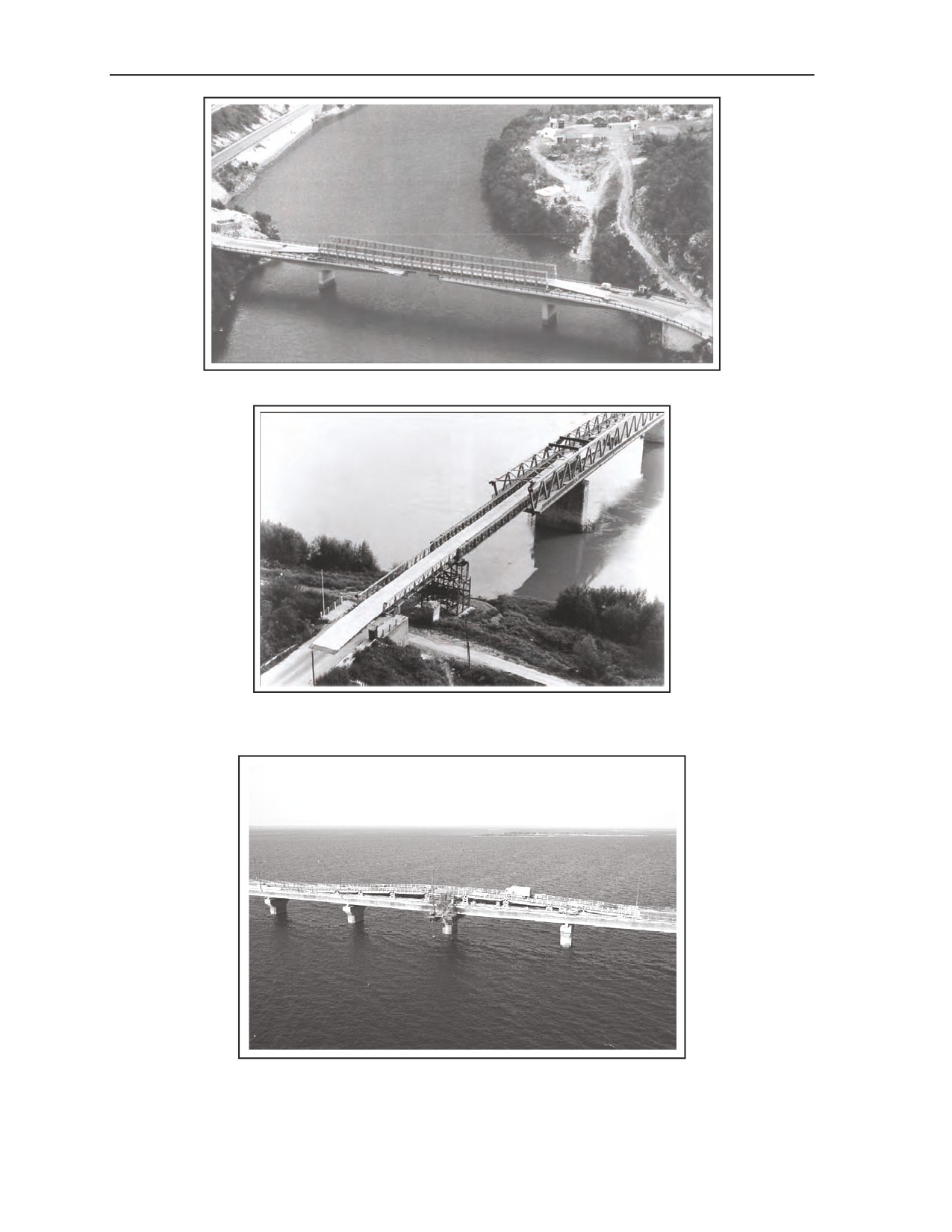
assets and resources are not readily available to make the existing bridge reliable. See Figure C-1 for an
example of using two tactical AVLB bridges over an existing timber trestle bridge whose abutments were
severely compromised during a flood (though both piers were intact). When used to support combat
maneuver, the AVLB, the JAB, the Wolverine, and other tactical bridging are often the augmenting bridge
assets made available to the maneuver commander. The inherent characteristics of each of these tactical
bridges, including the fact that they do not require a gap for emplacement (zero gap bridge), make them an
extremely viable option for placement as an overbridge in support of close combat and other operations.
However, when using these bridges to repair or replace damaged spans, risk should be calculated if the
bridge will not be supported by a pier or a prepared abutment.
C-8
FM 3-90.12/MCWP 3-17.1
1 July 2008
Engineer Crossing Factors
Launching
Completed
Figure C-1. AVLB Overbridge (Camp Demi, Bosnia-Herzegovina)
C-44. In other situations when time is not as critical, enemy contact is less likely, support/LOC bridging is
readily available, and/or the gap is beyond the span length of tactical bridging, the MGB, LSB, Bailey,
Mabey & Johnson®, Acrow, or similar systems may provide an appropriate alternative. See Figure C-2 for
an example of a Mabey & Johnson Compact 200 used as overbridging of the same timber trestle bridge in
Figure C-1. Figures C-3, C-4, C-5, and C-6 (pages C-10 through C-11) show examples of other Mabey &
Johnson overbridges in use. Figure C-7, page C-11, was built in October 1995 by British Royal Engineers
in 1 day. It is a 24-meter bridge (excluding the ramps).
Launching
Completed
Figure C-2. Mabey & Johnson Overbridge (Camp Demi, Bosnia-Herzegovina)
1 July 2008
FM 3-90.12/MCWP 3-17.1
C-9
Appendix C
Figure C-3. Mabey & Johnson Overbridge (Aleksin, Bosnia)
Figure C-4. Mabey & Johnson Overbridge With a Temporary
Pier Added (Bos Gradiska, Bosnia)
Figure C-5. Mabey & Johnson Midspan Overbridge Erected
Over a Damaged Pier (Sweden)
C-10
FM 3-90.12/MCWP 3-17.1
1 July 2008
Engineer Crossing Factors
Figure C-6. Mabey & Johnson Overbridge (Brcko, Bosnia)
Figure C-7. Mabey & Johnson Overbridge (Komar, Bosnia, near Travnik)
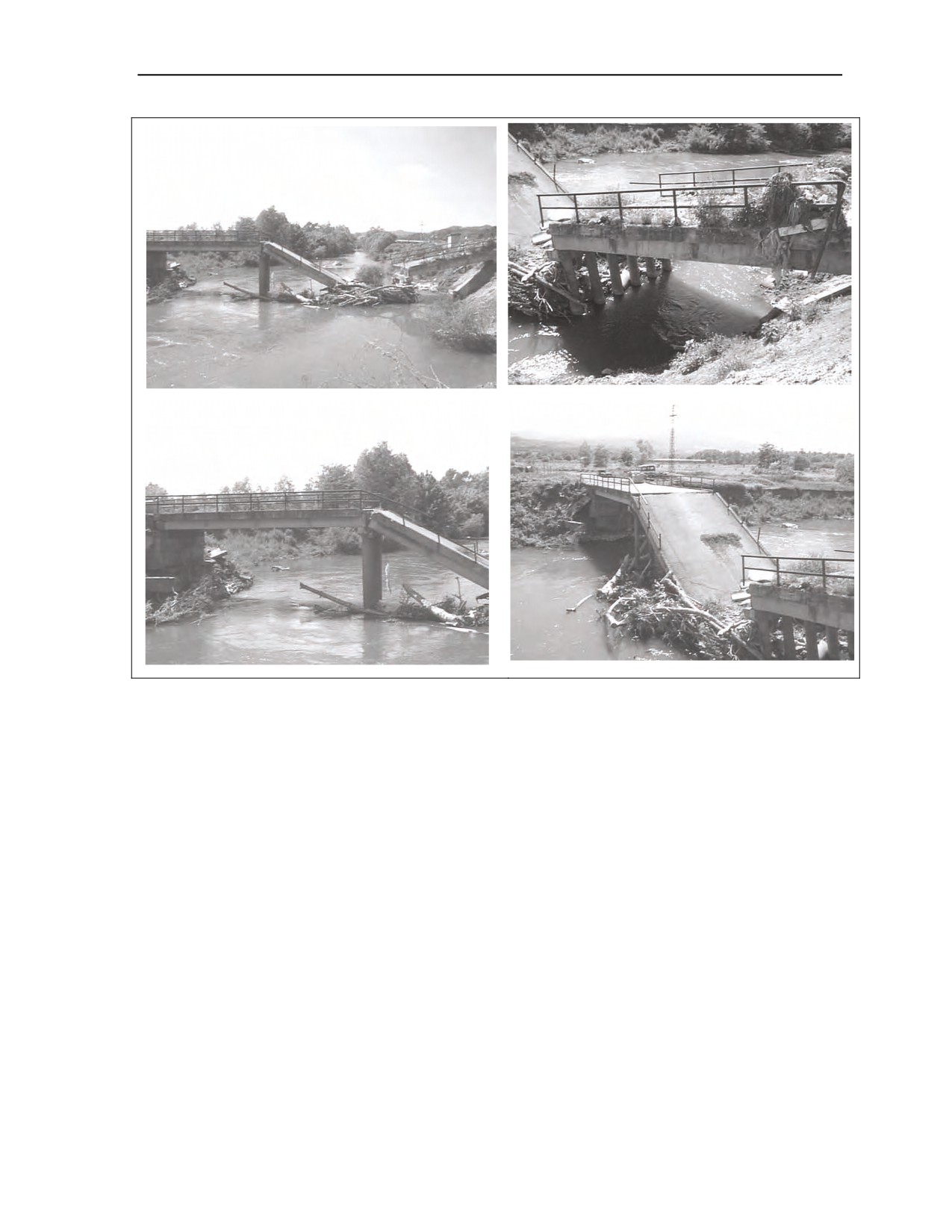
C-45. Refer to the historical perspective (page C-12) for the history of the construction and launch of the
bridge over the Spreca river. Figure C-8, page C-13 shows photographic views of the war-damaged bridge
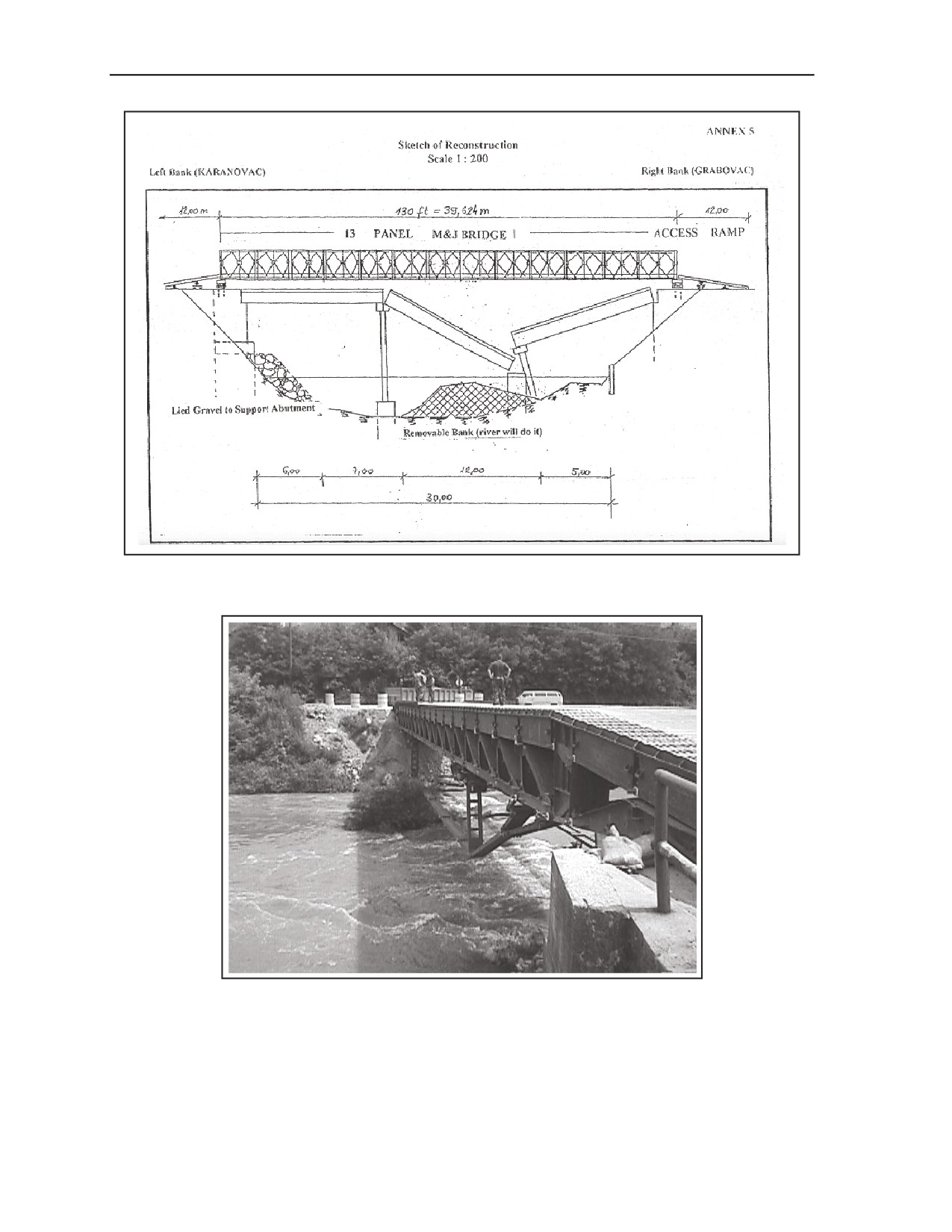
over the Spreca river vicinity of Karanovac before reconstruction. Figure C-9, page C-14, is a sketch of the
proposed Mabey & Johnson overbridge. Figure C-10, page C-14, shows a view of the existing site
(completed MGB) after the reconstruction. Figure C-11, pages C-15 through C-17, is an extract of the
OPORD to conduct the operation referred to in the last paragraph of the perspective.
1 July 2008
FM 3-90.12/MCWP 3-17.1
C-11
Appendix C
Historical Perspective - Bridging the Spreca
To support local economic regeneration, displaced persons, refugees, and evacuees
(DPRE) returns, and freedom of movement across the inter-entity boundary line
(IEBL) in the fall of 1998, multinational division (MND) north (N) requested the use of
available excess stabilization force (SFOR) bridge stocks for the reconstruction of a
war-damaged bridge over the Spreca River vicinity of Karanovac, Bosnia-
Herzegovina. The Karanovac bridge was on a list of priorities for reconstruction by
the U.S. Agency for International Development (USAID) but was not scheduled for
construction in the next two years. MND (N) engineers would then construct and
launch the bridge.
This bridge would provide direct access to Route New Jersey by those south of the
Spreca River. At that time the Petrovo/Doboj road could not support heavy cargo
traffic and was in very bad condition. The installation of this bridge would provide a
much needed alternate route and access to a better road. The project would provide
an essential cargo route for a local brick factory and saw mill.
SFOR denied use of its strategic bridge stocks.
Sweden had purchased two MGB bridges for evaluation and had them on hand at
their engineer school. Sweden decided to donate one of its bridges for emplacement
over the Spreca River.
A legal consideration was then for MND (N) SJA to determine that receipt of this "gift"
by MND (N) was acceptable and to draft a memorandum of understanding (MOU)
with Sweden for the "gift" of bridge to MND
(N), U.S. Forces, or SFOR as
appropriate. Another key consideration to take into account was who would conduct
routine bridge inspections and who had the maintenance responsibilities and
oversight of the bridge once in place.
Once those issues were worked out and the bridge stocks delivered, the old war
damaged bridge was removed and the MGB was erected over the existing
abutments. While the end result of constructing an MGB vice the Mabey & Johnson
bridge was not a full overbridging operation (as the majority of the original bridge had
to be removed to accommodate the MGB with its reinforcing link system in place),
the planning process and execution of the operation was extremely similar in nature.
C-12
FM 3-90.12/MCWP 3-17.1
1 July 2008
Engineer Crossing Factors
Figure C-8. Photographic Views of the Damaged Bridge (Karanovac, Bosnia-Herzegovina)
1 July 2008
FM 3-90.12/MCWP 3-17.1
C-13
Appendix C
Figure C-9. Sketch of Proposed Mabey & Johnson Overbridge
Figure C-10. Completed MGB (Karanovac, Bosnia-Herzegovina)
C-14
FM 3-90.12/MCWP 3-17.1
1 July 2008
Engineer Crossing Factors
OPERATION ORDER
(classification)
FOR TRAINING PURPOSES ONLY
Operation Order _____________ 20_____
Copy __ of __ copies
Task Organization:
1. SITUATION. This order describes the removal of the war damaged bridge at Karanovac, Bosnia-
Herzegovina (BQ 840 528) to allow for future emplacement of a temporary military MGB donated by
the country of Sweden.
2. MISSION. MND (N) removes the destroyed civilian bridge pieces remaining at the Karanovac site
(BQ 840 528) between __ - __ and emplaces a donated MGB from Sweden upon arrival in the area of
responsibility (AOR) at the site to allow for further DPRE returns and economic development.
3. EXECUTION.
a. Commander’s Intent. This mission quickly and safely removes the destroyed civilian bridge
spans at Karanovac. First, we will demine the work site using the mine-clearing armor-protected
(MCAP) dozer or the Miniflail to ensure safety of the site. Then, we will remove all debris at the
destroyed bridge site that will interfere with the removal of the spans. By using a combination of
cranes, tie-downs, and heavy vehicles, we will remove each piece of the destroyed bridge to clear the
site to allow the future emplacement of an MGB bridge. Upon arrival from Sweden, we will emplace the
donated MGB bridge to replace the destroyed bridge. The end state for this mission is the removal of
the destroyed civilian bridge spans at Karanovac and replaced by the donated temporary MGB bridge
from Sweden.
b. Concept of Operation. Refer to ANNEX __ (KARANOVAC SITE) of this order for a picture and
site plan of the bridge site. First, Nordic-Polish (NORDPOL) Brigade removes the debris surrounding
the bridge that will interfere with the removal of the spans.
2BCT demines the Karanovac work site
using the Mini-flail to ensure safety for all MND (N) soldiers. Once the debris is removed, then 2BCT
and NORDPOL will extract the three spans of the destroyed bridge using a combination of cranes, tie-
downs, and heavy vehicles. 2BCT and NORDPOL Brigade will break up the bridge spans to allow for
easy transportation from the bridge site. NORDPOL Brigade will use these broken up spans for
erosion control around their AOR. NORDPOL Brigade will also establish a laydown yard for the MGB
bridge from Sweden. NORDPOL Brigade, with augmentation from 2BCT, will construct the MGB
bridge at the Karanovac site.
c. Tasks to Maneuver Units.
(1)
2 BCT.
(a) O/O provide a platoon-sized element of combat engineers to assist the NORDPOL
Brigade in the removal of the Karanovac Bridge (BQ 840 528). Refer to ANNEX C (KARANOVAC
SITE) of this implementing instructions (IMPIN) for a picture and plan of the bridge site.
(b) Submit a transportation movement request (TMR) for one (1) Brown & Root Services
Corporation™ (BRSC) 40-ton crane to assist in bridge span removal at the Karanovac Bridge site for
the duration of the mission. Direct coordination with MND
(N) DTO for synchronization of the
equipment and operator delivery is authorized.
Figure C-11. Sample OPORD for a Temporary LOC Bridge Replacement
1 July 2008
FM 3-90.12/MCWP 3-17.1
C-15
Appendix C
(c) Receive one (1) welding trailer with acetylene torch and arc welding capabilities and
operator from __ - __ to assist in the removal of the broken spans
(d) Provide MGB expertise to NORDPOL Brigade __ - __ to ensure safe launching of the
MGB bridge at Karanovac. Conduct training of all soldiers using the MGB bridge training set before
launching the actual bridge.
(2) NORDPOL.
(a) Remove the log jam and debris at the Karanovac Bridge no later than (NLT) ______ to
assist in preparing the site to have the bridge spans removed.
(b) Ensure the immediate area surrounding the remaining parts of the civilian bridge are
free from mines and booby traps.
(c) In coordination with 2BCT, remove all spans from the Karanovac Bridge NLT _____ to
facilitate the replacement of the existing bridge with the donated MGB bridge from Sweden. Direct
coordination with 2BCT Engineers is authorized and encouraged. Point of contact (POC) is the __ EN
BN S3, MAJ ______ at _____.
(d) Establish a site laydown yard for preparation in receiving the donated MGB bridge from
Sweden for construction on site NLT ________.
(e) Provide jackhammers or similar equipment with operator to break up the concrete
spans at the Karanovac Bridge site for transportation once the spans have been extracted.
(f) Provide Leopard recovery vehicle and operators at the Karanovac Bridge site to assist
in span removal during the operation. Direct coordination with 2BCT for synchronization of the
equipment is authorized and encouraged.
(g) Construct the MGB bridge at the Karanovac site after the destroyed bridge has been
removed and the site has been prepared to allow for DPRE returns across the Spreca River.
(h) Receive augmentation of up to a platoon from 2BCT to assist in the construction of the
MGB bridge from __ - __.
(i)
(C) Receive augmentation of bridge experts for assistance in training and construction
of the MGB bridge
d.
(C) Tasks to Combat Support Units.
(1) LTF ___. Provide one (1) Bolster trailer with acetylene torch and arc welding capabilities,
operator, and prime mover from __ - __ to assist in the removal of the broken spans at Karanovac
(2) DIVENG.
(a) Provide one (1) explosive ordnance disposal (EOD) team to 2BCT and NORDPOL
during the operation to assist in the mine proofing operation from __ - __.
(b) As required, coordinate for MGB technical assistance from SFOR headquarters MND
southwest (SW) or U.S. Army, Europe (USAREUR) to assist NORDPOL in proper emplacement of the
donated MGB from Sweden.
Figure C-11. Sample OPORD for a Temporary LOC Bridge Replacement (Continued)
C-16
FM 3-90.12/MCWP 3-17.1
1 July 2008

Engineer Crossing Factors
e. Tasks to Staff.
(1) Provost Marshal's Office (PMO). Notify the International Police Task Force (IPTF) and the
local police of the ongoing operation in the vicinity of Karanovac Bridge NLT ____. The operation may
cause minor traffic delays along Route New Jersey in the immediate vicinity.
(2)
(C) Coalition Press Information Center (CPIC). (C) Inform local media about the bridge
replacement NLT ____. The main theme to stress is: SFOR engineers will remove the damaged bridge
to allow for the emplacement of a temporary military bridge to aid in FOM and DPRE returns.
(3) G4. Provide one (1) 40-ton (BRSC) crane to 2BCT to assist in the removal of the destroyed
bridge spans duration of the operation.
f.
(C) Coordinating Instructions.
(1)
(C) Timeline.
Day 1
Equipment site preparation and mine proofing
NLT Day 3
Debris removed from bridge site.
Days 4-6
Excavation and bridge reduction with jackhammer
Prepare laydown yard (Rock/Geotextile)
Removal of war damaged Karanovac Bridge.
Day 7
MGB bridge training from bridge master and bridge commander
Day 8
Training/rehearsal by joint construction team
Days 9-11
Emplacement of the temporary MGB bridge
TBD
Opening ceremony with MND(N) Commander as key note speaker
(2)
(C) All major equipment will be stored at NORDPOL’s Sierra Base.
(3)
(C) POC is MAJ _________ at ____.
4.
(U) SERVICE SUPPORT. No change.
5.
(C) COMMAND AND SIGNAL. No change.
NOTE: Paragraph C(1)(b) reference to BRSC is currently known as Kellogg, Brown, & Root Services,
Incorporated™ (KBR).
Figure C-11. Sample OPORD for a Temporary LOC Bridge Replacement (Continued)
1 July 2008
FM 3-90.12/MCWP 3-17.1
C-17
Appendix D
Engineer Planning and Calculations
This appendix addresses the detailed engineer planning necessary for a wet-
gap-crossing operation and is designed to supplement the planning considerations
described in Chapter 3. It provides some example charts, overlays, and planning
criteria that will assist the planner in coordinating and synchronizing gap-crossing
activities leading to a detailed crossing plan. When using these planning tools, the
planner should understand that factors, such as weather, austere environments,
condition of the bridging equipment, water currents, and the enemy situation must be
considered as they can significantly impact the actual crossing times, required
crossing sites and locations, and equipment necessary to do the crossing.
ENGINEER PLANNING
D-1. Initial engineer planning at corps and division levels focuses on providing enough engineer assets to
handle crossing requirements. The terrain teams maintain the terrain database and can provide potential
crossing sites and river widths. The engineer assigned or supporting the division or BCT uses this
information to construct a site overlay (Figure D-1, page D-2). The engineer labels assault and rafting or
bridging sites and shows the site capacity and the estimated preparation time for each site (from the terrain
database).
D-2. Preparation time is the time required to improve routes and wet-gap sides or river banks to support
the units that will use the site. It also includes the time required to construct rafts and bridges. Rafting site
capacity is the number of raft round trips per hour. The engineer calculates rafting site capacity by
multiplying the number of raft trips per hour by the number of rafts and the number of centerlines at the
site (Table D-1, page D-3). Centerlines must be at least 100 meters apart. Each assault company needs 200
meters of river frontage. Figure D-1 shows the determination of rafts per hour and the capacity of the
assault site for the division crossing overlay. The site overlay provides additional details necessary to
ensure that each brigade has enough potential crossing sites within its boundaries. Table D-2, page D-3,
provides planning factors for assault boat operations.
D-3. Standards for making this determination are as follows:
A brigade requires 31 assault boats to cross a battalion with 3 companies in the first wave. With
70 boats, it can cross 2 battalions (6 companies) at once. See Appendix A, Table A-1, page A-2.
A brigade requires 2 bridges or the equivalent bridging configured into rafts.
D-4. The engineer planner uses the above standards to task-organize engineers that are supporting each
crossing area. The division engineer then develops a rough crossing timeline using pure battalions. This
provides enough information for division planning, without requiring detailed knowledge of the brigade’s
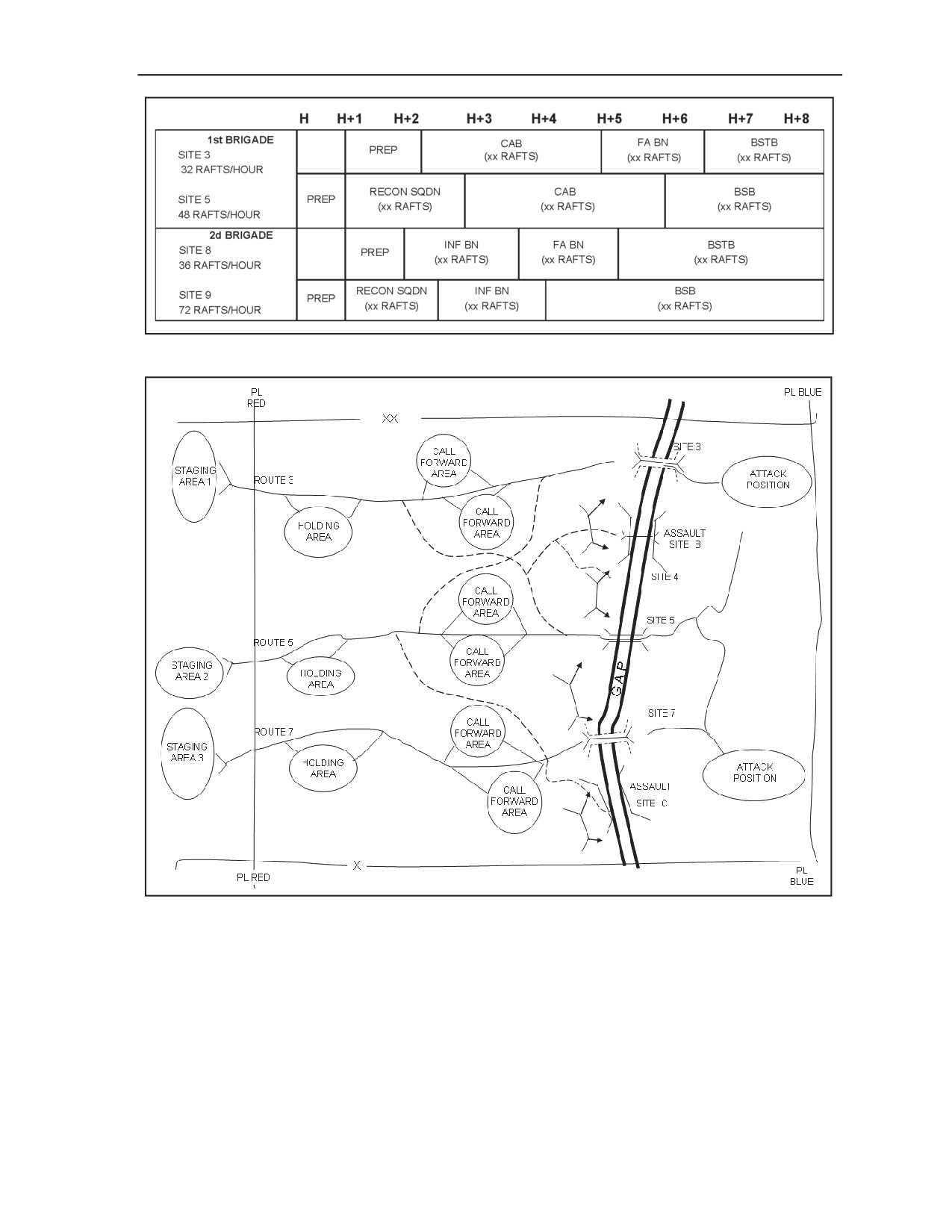
plan. Table D-3, page D-4, provides necessary rafting planning numbers. Figure D-2, page D-5, illustrates
an initial crossing timeline using 6 float rafts. The brigade HQ does the majority of planning for detailed
crossings. During the mission analysis, the brigade engineer also develops a crossing timeline to provide
initial buildup rate information to the maneuver planners when they outline possible schemes of maneuver.
This timeline is the same as the timeline that is developed at the division and may be provided by the
division engineer.
1 July 2008
FM 3-90.12/MCRP 3-17.1
D-1

Engineer Planning and Calculations
Table D-1. Raft Centerline Data
Number of
River Width in
Round Trip in
Number of
Raft Trips per
Meters
Minutes
Rafts
Hour
75
7
8.60
1
100
8
7.50
1
125
9
6.70
1
150
10
6.00
2
175
11
5.40
2
225
12
5.00
2
300
16
3.75
3 to 5
Note. Planning times are for current velocities up to 1.5 meters per second.
Table D-2. Boat Planning Factors
River Width
Equipment
Characteristic
75 Meters
150 Meters
300 Meters
Pneumatic assault boat with
Minutes per round trip
3
4
5
an OBM
Trips per hour
20
15
12
Pneumatic assault boat
Minutes per round trip
4
6
10
without an OBM
Trips per hour
15
10
6
Notes.
1. Factors are averaged based on load/unload time and safety.
2. Planning times are for current velocities up to 1.5 meters per second. For faster current velocities, classification
must be reduced to a caution or risk crossing, and an engineer analysis must be made of the actual site conditions
before planning times may be assessed.
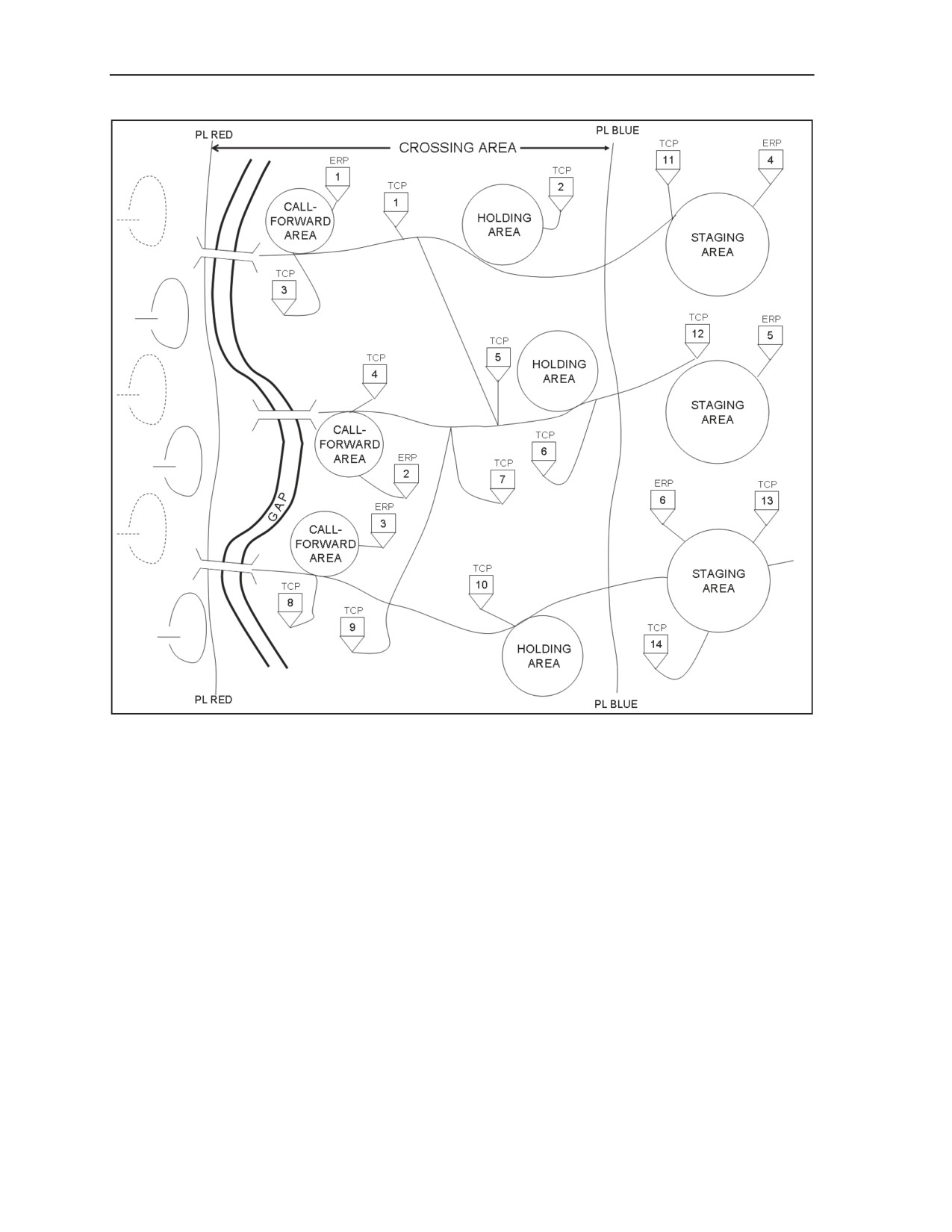
D-5. Once the commander identifies the COAs, the staff engineer develops crossing area overlays for
each (Figure D-3, page D-5). These overlays are developed using information from the site overlay, along
with additional terrain data. The crossing area overlays show staging areas, holding areas, call forward
areas, and routes for each crossing site included in the COA. A crossing area overlay is necessary for each
COA. The overlay for the COA eventually selected is later modified by adding ERPs, TCPs, and crossing
area HQ information and is used to support the operation.
D-6. When maneuver planners develop COAs, they assign crossing sites and the order of crossing to units
as they have task-organized them. The staff engineer uses this information to construct a crossing timeline
for each COA. He calculates the number of vehicles and raft loads for each unit using pure company
figures from Table D-4, page D-6. The staff engineer then calculates the crossing time for the unit by using
the crossing capacity of the site assigned to it. The crossing timeline shows these crossing periods, by site,
based on the order of crossing. The staff engineer then develops a detailed crossing timeline based on the
task organization (Figure D-4, page D-7).
D-7. During the comparison of the COAs, the staff engineer uses timelines, brigade site overlays, and
crossing area overlays to demonstrate the differences in the crossing plans. After the commander has
selected the COA for the mission, the staff converts it into a detailed plan. The staff engineer develops a
vehicle-crossing capability chart.
D-8. The staff engineer starts by displaying the capabilities of each crossing site in terms of raft loads per
hour (rafting operations) or vehicles per hour (bridging operations). Since the crossing rate for rafts is less
during darkness, each site shows total raft trips separately (during the day and during the night). An
example of the product of this first step is shown in Figure D-5, page D-7).
1 July 2008
FM 3-90.12/MCWP 3-17.1
D-3

Appendix D
Table D-3. Selected Unit Rafting Requirements
Raft Trips Required
Units
Vehicles/Trailers
5 Bays
6 Bays
7 Bays
SBCT
1048/410
444
410
312
Infantry battalion
125/29 (x3 BN)
43
40
30
Reconnaissance squadron
125/26
43
40
30
Field artillery battalion
109/45
45
45
35
Brigade support battalion
281/179
174
156
118
Separate companies
(headquarters company, signal
158/83
53
49
39
corps [SC], military intelligence
[MI], engineer company, and AT)
HBCT
1143/430
529
456
365
Combined arms battalion
163/24 (x2 BN)
63
61
46
Reconnaissance squadron
119/21
47
44
41
Field artillery battalion
115/29
42
39
36
Brigade support battalion
414/247
254
201
154
Brigade special troops battalion
119/66
42
35
29
IBCT
804/443
430
364
309
Infantry battalion
88/34 (x2 BN)
28
23
20
Reconnaissance squadron
93/32
32
27
23
Field artillery battalion
101/58
36
31
27
Brigade support battalion
384/245
239
215
182
Brigade special troops battalion
138/74
52
45
37
Armored cavalry regiment (ACR)
208
110
98
82
squadron
Potential RCT units*
N/A
N/A
N/A
N/A
Infantry battalion (USMC)
90
45
40
35
Reconnaissance squadron
30
15
10
8
(USMC)
Artillery battalion (USMC)
80
50
40
32
Amphibious assault battalion
55
32
27
22
(USMC) LAR BN**
Tank battalion (USMC)
145
90
90
80
Notes.
1. Assume that current velocities are
less
than
0.9 mile per
second and that
battalions/squadrons are
at
100 percent modified table of organization and equipment (MTOE) strength.
2. Numbers of vehicles and trailers are approximate and may vary between units.
3. Raft loads are calculated using IRB.
* RCT - Vary in organization, size, and composition; mission dependent.
** Numbers account for rolling stock minus LAVs that have swim capability.
D-4
FM 3-90.12/MCWP 3-17.1
1 July 2008
Engineer Planning and Calculations
Figure D-2. Initial Division Crossing Timeline (Sample)
Figure D-3. Brigade Combat Team Crossing Area Overlay (Sample)
D-9. The engineer determines the crossing requirements using the factors from Table D-4, page D-6. He
then blocks out the crossing periods for all units based on the site assignment, the site capability, and the
crossing order in the scheme of maneuver. After adding the units’ crossing periods to the chart, he
coordinates the plan with the S-3 to ensure that it is synchronized and that units will arrive on the farside
by the times they are needed (Figure D-6, page D-8). If not, the S-3 and engineer work together to adjust
the crossing order of subordinate units. The basic technical information remains constant as different
crossing sequences are checked until one meets farside requirements. The vehicle crossing capability chart
is the primary tool for finalizing the crossing plan.
1 July 2008
FM 3-90.12/MCWP 3-17.1
D-5

Appendix D
Table D-4. Selected Pure Company/Troop Rafting Requirements
Raft Trips Required
Units
Vehicles/Trailers
5 Bays
6 Bays
7 Bays
SBCT
Infantry company
24/5
11
10
8
Reconnaissance troop
20/4
10
9
7
155 T field artillery battery
21/9
14
14
11
Engineer company
43/28
34
30
25
Antitank company
13/2
5
4
3
HBCT
Infantry company
19/2
16
16
9
Armor company
19/1
16
16
9
Reconnaissance troop
25/2
10
10
9
155SP field artillery battery
33/5
13
13
12
Engineer company
24/9
12
11
11
IBCT
Infantry company
2/2
1
1
1
Weapons company
23/6
8
6
5
Reconnaissance troop
25/6
9
8
7
Dismounted troop
7/5
3
2
2
105 T field artillery battery
30/19
11
10
8
Engineer company
24/14
12
11
11
ACR squadron
ACR squadron HQ
6
3
2
2
ACR troop
27
18
17
15
ACR tank company
15
14
14
12
ACR field artillery battery
13
10
7
6
USMC units
Tank company
20
16
16
16
Infantry company
28
15
10
10
Artillery battery
32
21
18
15
Reconnaissance company
5
2
2
1
Notes.
1. Assume that current velocities are less than 0.9 mile per second and that battalions/squadrons are at 100 percent
MTOE strength.
2. Numbers of vehicles are approximate and may vary between units.
3. Numbers do not include trailers or secondary loads.
D-6
FM 3-90.12/MCWP 3-17.1
1 July 2008
Engineer Planning and Calculations
ENGINEER CALCULATIONS
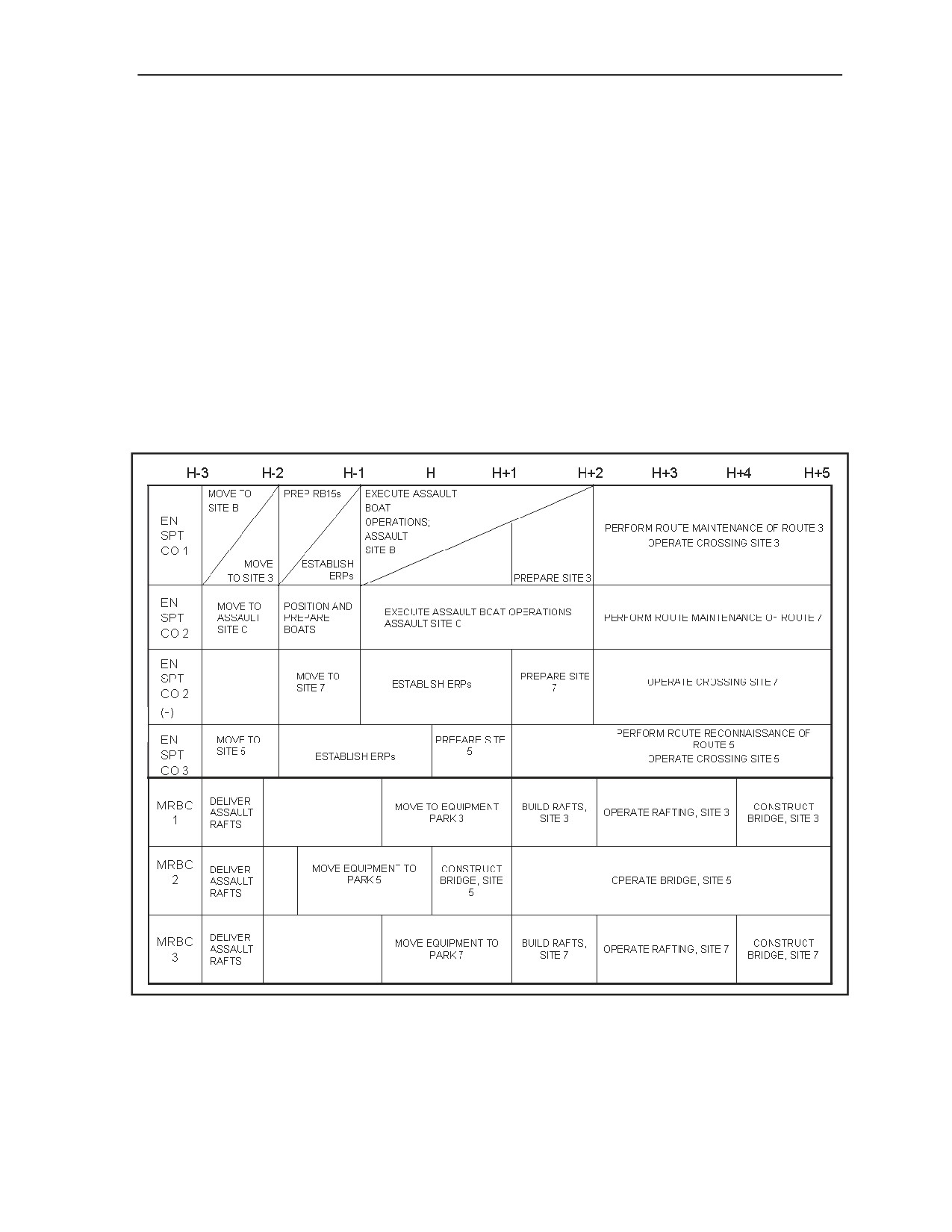
D-10. After the crossing order has been established, the staff engineer develops the engineer execution
matrix (Figure D-7). This is the tool that the CAC and CAE will use to synchronize the execution of the
crossing. It is constructed as a chart, with the unit’s locations and activities displayed by time on the upper
half and terrain occupation displayed by time on the lower half. The staff can follow each unit's location as
the operation progresses and can easily see potential conflicts resulting from changes. The matrix also
provides critical information for traffic control.
D-11. The crossing synchronization matrix is constructed backwards by first portraying the units' crossing
times established from the vehicle-crossing capability chart, then by using road movement times to show
route usage and staging-area times. The time required for the crossing of the assault force is also included.
Once all of the units are displayed, the same information is transferred to the lower terrain portion of the
matrix.
D-12. The staff immediately resolves any conflicts they discover while preparing the matrix. The final
engineer planning step is developing the engineer execution matrix (Figure D-7). It displays subordinate
units' task assignments by time. It is useful both for tracking unit execution and for aiding decisions if
changes to the plan are required.
Figure D-7. Engineer Execution Matrix (Sample)
1 July 2008
FM 3-90.12/MCWP 3-17.1
D-9
Appendix E
Diving Support Considerations
Engineer diving teams perform a variety of tasks in support of mobility operations.
Of particular importance are the specialized tasks that divers perform in support of a
wet-gap crossing. Regardless of the crossing means, a reconnaissance of the crossing
site by divers can provide the planner with the necessary details to confirm the
conditions of a selected site. Additionally, divers can inspect and assist in the repair
of nonstandard or floating bridges. They may also confirm that an existing bridge is
not wired for demolition and assist with the removal of explosives if a bridge has
been prepared for destruction. Since the basics of bridge design are similar to pier
design, the same inspections conducted by divers on piers and pilings are conducted
on bridge components. For more information, see FM 3-34.280.
WET-GAP-CROSSING SUPPORT
GENERAL
E-1. Maneuver commanders require up-to-date intelligence of crossing sites to choose the most
appropriate site or sites. Divers work closely with MRBCs and reconnaissance elements to provide
accurate information for the CSC. Divers conduct nearside and farside reconnaissance and perform bottom
composition surveys (see FM 3-34.170). Some information divers collect may include the following:
Gap width.
Stream velocity.
Nearside and farside bank composition and characteristics.
Bottom composition.
Obstacle type and location.
Approach and bypass information.
E-2. The survey of a wet-gap-crossing site is similar to other hydrographic surveys conducted by divers.
The degree of accuracy delivered will depend upon the commander’s requirements and the threat level. In
an unsecured location, engineer divers require support from security personnel.
E-3. To facilitate emplacement of bridging, divers may perform a variety of tasks to include the
following:
Neutralizing underwater obstacles.
Constructing underwater bridge structures.
Performing in water repair to bridging and watercraft.
Recovering sunken equipment.
Searching for and recovering casualties.
E-4. Once the bridging is emplaced, divers assist in installing impact booms, antimine booms, and
antiswimmer nets to prevent damage caused by waterborne munitions and collision by floating debris.
Antiswimmer nets are placed both upstream and downstream to protect bridges from enemy swimmers or
underwater demolition teams.
1 July 2008
FM 3-90.12/MCWP 3-17.1
E-1
Appendix E
E-5. Diving teams also conduct inspections and surveys of deepwater fording sites. When the divers
cannot easily span the distance between banks, an inflatable boat or a BEB can be used. Helicopters may
be used to drop teams in the water or place teams on the farside if the situation permits. Engineer diving
teams routinely conduct reconnaissance at night to avoid detection and keep crossing site locations from
being compromised.
E-6. Engineer divers also assist in wet-gap crossings by denying enemy access to bridging assets. Divers
can be used to survey, emplace, prime, and detonate explosives on bridge supports to degrade or destroy
bridges as the situation dictates.
BRIDGE INSPECTION AND REPAIR
E-7. Engineer divers provide critical support by providing inspection and repair of both standard and
nonstandard bridging while the bridging is in place at the crossing sites. Divers conduct both underwater
and surface reconnaissance of bridges to determine structural integrity and capacity. Divers may be used to
repair or reinforce bridge structures and neutralize underwater obstacles in and around the bridge.
HYDROGRAPHIC SURVEYS
E-8. Hydrographic surveys provide a depiction of underwater bottom profiles of an operational shoreline
or port area. Products from a survey may indicate bottom depth gradients, ship channels, and the location
and type of obstructions that may impede vessel traffic.
E-9. Hydrographic surveys can be done with two levels of accuracy. A hasty survey is quicker to perform
and gives the commander a general idea of the bottom profile, but the degree of detail is correspondingly
less. A deliberate survey can take more time but produces more accurate results and provides a complete
picture of the underwater profile, including obstacles.
OBSTACLE EMPLACEMENT AND REDUCTION
E-10. Underwater obstacles can be man-made or natural and may include mines and other explosive
devices. Divers can be used to emplace or reduce these underwater obstacles by using demolitions
underwater. Many of the same principles and techniques for using demolitions above water are used when
employing demolitions underwater. Divers use sympathetic detonation to clear in-water munitions. This is
done by emplacing demolitions on or near underwater obstacles. Demolitions are always detonated from
the surface.
E-11. A diving team is fully capable of utilizing available materials to deny access to any site that has
aquatic or vehicular traffic. Steel can be welded into hedgehog or tetrahedron configurations and concrete
can be poured into block, cylinder, or tetrahedron molds. In the event of retrograde operations, the diving
team is fully capable of rigging a bridge substructure with explosives for command detonation.
E-12. Divers can be used to emplace or breach underwater minefields. Many of the same techniques used
to emplace or breach surface minefields can be adapted to underwater operations. Divers can emplace
mines in water, but additional factors to consider are as follows:
Many rivers or beaches have currents and waves that prohibit using mines with tilt rods.
Floating debris may prematurely detonate mines.
Soft river bottoms may prevent pressure-activated mines from detonating.
E-13. Divers can emplace mines in the water, but the mines must have additional anchors to hold them in
place. One method is to use crossed pickets under the mine. This not only helps to anchor the mine but also
helps to create a larger surface area in soft bottoms so that the mine can be pressure-activated.
E-14. Divers can breach underwater minefields. They use mine detectors, side-scan sonar or remotely
operated underwater vehicles to locate underwater mines. The mines are then marked and, if necessary,
neutralized to create a safe lane for passage. Sympathetic detonation of underwater mines is done by
emplacing explosives on or near the mine, dependant on the type of fusing mechanism. Clearing an
E-2
FM 3-90.12/MCWP 3-17.1
1 July 2008
Diving Support Considerations
underwater minefield is a slow and deliberate process and should only be used when other alternatives for
crossing have been exhausted.
ENGINEER DIVING TEAM
E-15. The mission of the engineer diving team is to provide diving support for all types of military
operations. The diving team is a module that is normally attached to an engineer brigade or an engineer
battalion headquarters conducting or supporting a wet-gap crossing to ensure proper C2 and logistical
support. However, the module can be attached to any unit needing dive capabilities. The organization of an
engineer diving team can be found in AR 611-75.
E-16. Due to mission requirements, any dive team can be reconfigured according to the manning levels
outlined in AR 611-75, allowing for mission support with a much smaller footprint. Manning dive
requirements for typical diving operations can be found in FM 3-34.280.
1 July 2008
FM 3-90.12/MCWP 3-17.1
E-3
Appendix F
Retrograde Gap Crossings
A retrograde is a type of defensive operation that involves organized movement away
from the enemy (see FM 3-0). Gap crossings in support of a retrograde operation are
most often conducted as a deliberate gap crossing. Like most deliberate gap
crossings, the retrograde is normally conducted at the division level. In most
situations, an engineer brigade should be part of the division and provide the division
with the necessary C2 to those subordinate engineer battalions and companies
supporting this sort of gap crossing. If a BCT is conducting such an operation, it will
likely depend on an engineer battalion HQ to provide similar C2. This chapter
describes only those tactics and techniques used by a division or BCT in a retrograde
gap-crossing operation that differs from those used in an offensive crossing like the
example provided in Chapter 4.
GENERAL
F-1. The goal of a retrograde gap-crossing operation is to cross a gap while preserving the integrity of the
force. This involves an organized movement to the rear or away from the enemy.
F-2. A retrograde crossing features centralized control at the division or BCT level. Detailed planning and
preparation of engineer assets are a critical consideration within the time available. A retrograde crossing
differs from an offensive crossing in the following aspects:
Both sides of the gap are initially under friendly control. Accordingly, detailed information
concerning the gap and the area over which the retrograde is conducted should be readily
available to the commander.
All existing bridges and other crossing sites are available to the retrograde force to expedite the
crossing.
Relative combat power may favor the enemy. Units conducting retrograde operations must
retain a mobility advantage over the enemy in this situation.
Significant numbers of dislocated civilians or refugees may compound the crossing
(see
Chapter 6).
F-3. Deception is often planned and executed to mislead the enemy and to protect the force during a
retrograde operation. As a minimum, these plans seek to conceal the extent of the operation and the actual
crossing sites. Obscurants, electronic deception, and dummy sites may be used to reduce the enemy’s
capability to disrupt the crossing.
F-4. The same control measures are used in retrograde gap-crossing operations as in other deliberate
gap-crossing operations. Figure F-1, page F-2, shows an example of some of the basic control measures
used in a retrograde gap crossing.
1 July 2008
FM 3-90.12/MCWP 3-17.1
F-1
Appendix F
Figure F-1. Graphic Control Measures for a Retrograde Crossing
RETROGRADE TYPES
F-5. A retrograde operation may be forced by enemy action or by a higher headquarters. A well planned,
well organized, and aggressively executed retrograde operation provides opportunities for the division or
BCT to inflict heavy damage on enemy troops and equipment while continuing to maintain its fighting
integrity. The three types of retrograde operations are delay, withdrawal, and retirement (see FM 3-90).
DELAY
F-6. Units conduct delays when they are under pressure and desire to trade space for time. Flexible
planning allows the units conducting a retrograde gap crossing to adapt quickly to changes during
execution. Some important features of a flexible plan include—
Multiple approach routes from battle positions to crossing sites.
Lateral routes between crossing sites.
Alternate crossing sites if enemy actions close primary sites.
Crossing equipment held in reserve to replace losses or open alternate sites.
Multiple means or methods for crossing.
Preplanned engagement areas (EAs) to block enemy advances.
F-2
FM 3-90.12/MCWP 3-17.1
1 July 2008
Retrograde Gap Crossings
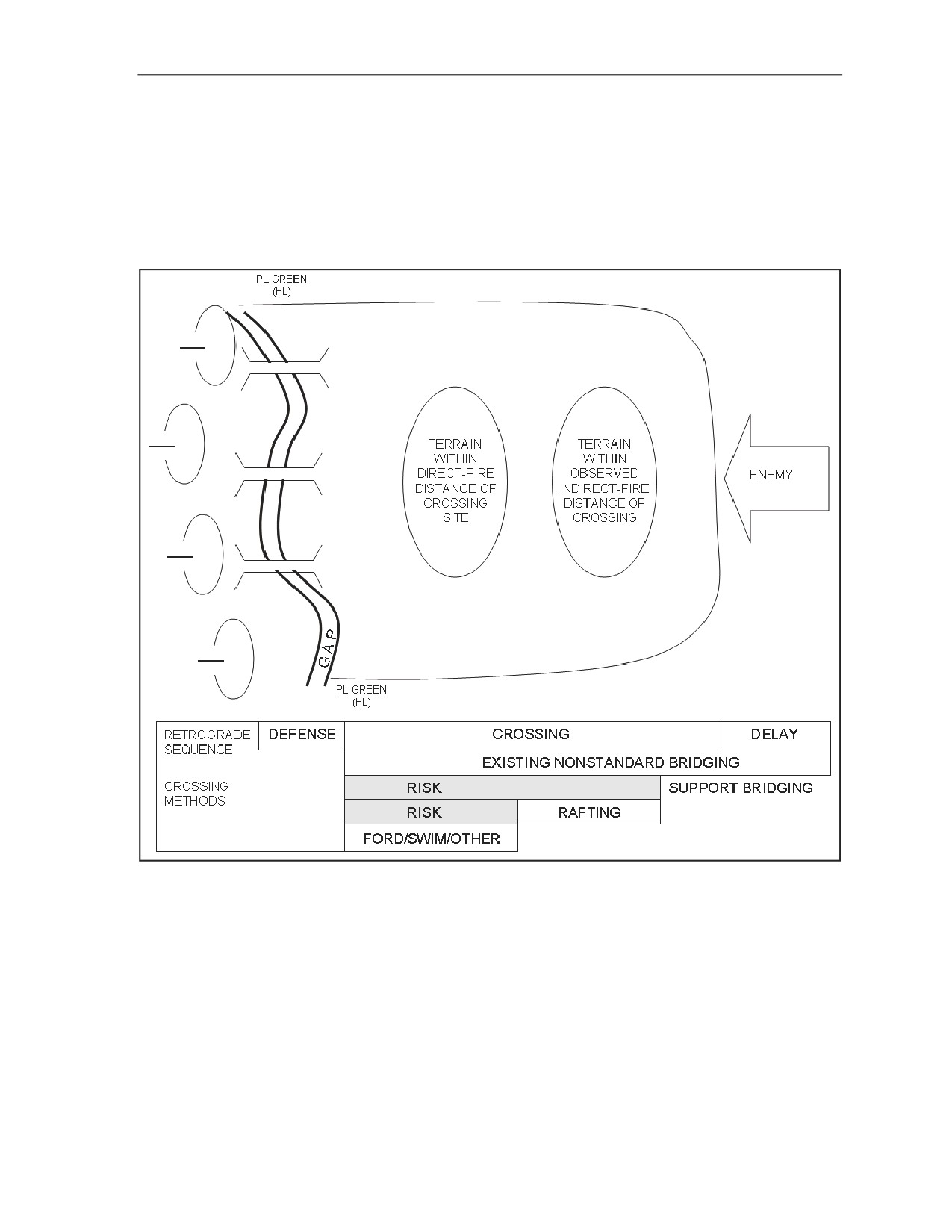
F-7. A delay combined with a retrograde gap crossing has the following phases:
Delay.
Crossing.
Defense.
F-8. Each phase is separate only in planning; they overlap during execution. Employing military crossing
equipment in the retrograde is essentially the reverse of the method used in a deliberate offensive
gap-crossing operation. Figure F-2 relates the retrograde sequence to the crossing stages.
Figure F-2. Retrograde Planning
Delay Phase
F-9. The delay phase provides security for the main body and allows the delaying force to gain enough
time for the main body to do its mission (cross the gap). For this reason, delaying forces take some risk to
ensure the security of the rest of the division as it withdraws across the gap. The delaying force must
deceive the enemy and keep it from the gap-crossing sites, allowing the main body to cross and establish
the exit-side defense. While it may be impossible to deceive the enemy into believing that a retrograde
crossing is occurring, it is possible to deny them the timing and specific locations and means that will allow
the crossing to take place.
F-10. The division or BCT commander establishes a holding line (HL) on defensible terrain between the
gap and the enemy. In retrograde gap-crossing operations, a holding line is the outer limit of the area
1 July 2008
FM 3-90.12/MCWP 3-17.1
F-3
Appendix F
established between the enemy and the water obstacle to preclude direct and observed indirect fires
into the crossings. This location is chosen to preclude direct and observed indirect fires into the crossing
area.
F-11. Forces not assigned tasks in the delay, including those forces with a mission to support crossing
areas or establish the defense on the exit side, execute a planned retirement or withdrawal and cross the gap
as rapidly as possible. To preclude early enemy detection of the retrograde, the forces follow a movement
control plan that supports the deception plan.
F-12. The delay phase continues until the battle is within communications and fire-support range of the
exit side defense. The delaying force must be strong enough to hold the enemy until other forces
establishes the defense. The defending force assumes responsibility for the battle as the delaying force
completes a rearward passage of lines through the defending force.
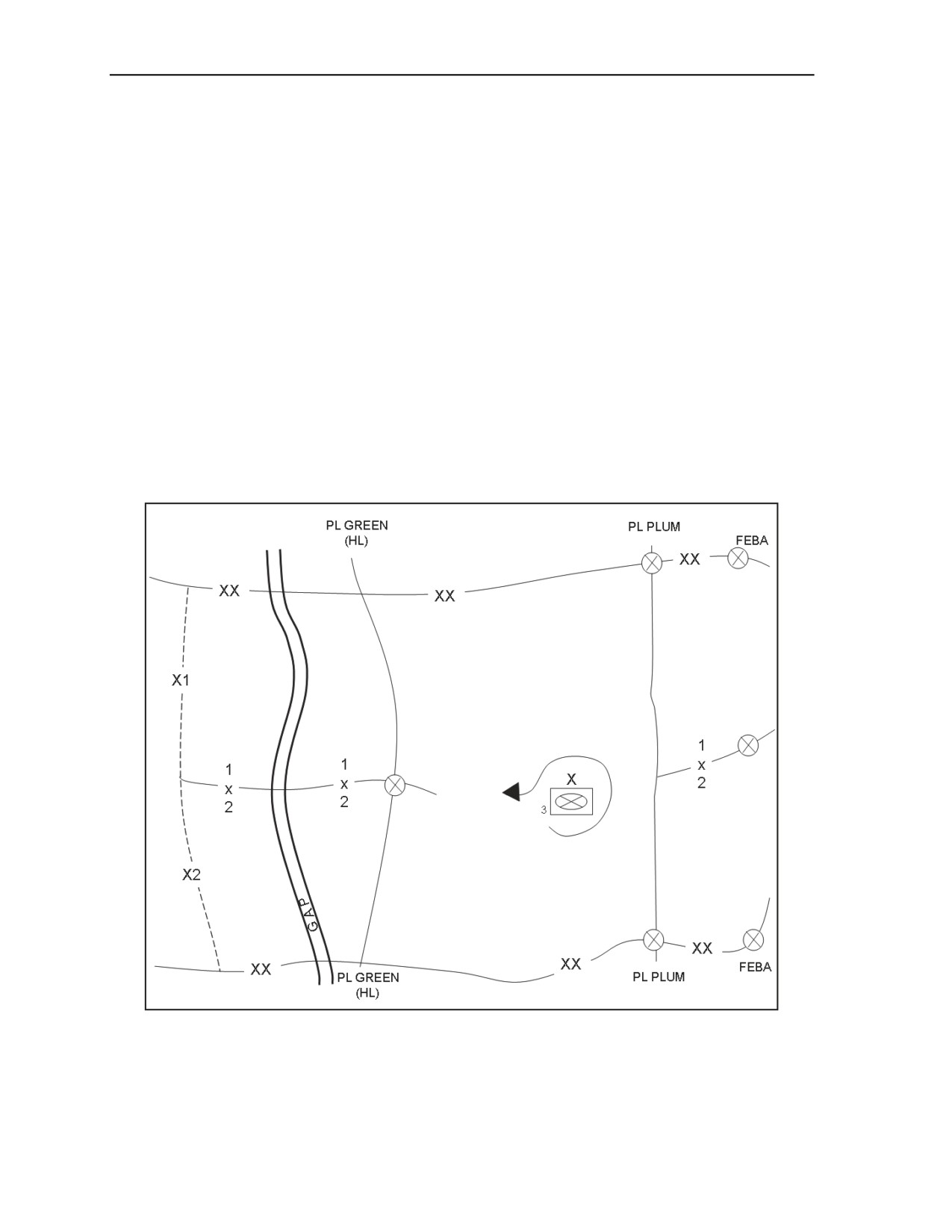
F-13. Figure F-3 shows an example of a retrograde crossing. In this case, the 3d Brigade will be the
delaying force. It initially occupies battle positions to the rear of the 1st and 2d Brigades along PL PLUM
to facilitate their withdrawal and crossing. The 3d Brigade delays the enemy in a sector forward of PL
GREEN (the HL) until the rest of the division has completed crossing the gap and the 1st and 2d Brigades
reestablished their defense along the line of the gap. If available and practical, an aviation heavy delay
force may afford ease in the withdrawal of the delay force due to its high relative mobility and inherent
ability to cross the gap with less engineer support.
Figure F-3. Retrograde Crossing
F-4
FM 3-90.12/MCWP 3-17.1
1 July 2008
Retrograde Gap Crossings
Crossing Phase
F-14. In contrast to normal offensive crossing operations, friendly forces initially control retrograde
crossing sites, although they may be insufficient in number. The enemy usually knows where the logical
crossing sites are and will likely attack them early in the operation. While little can be done to prevent an
attack, the enemy must not be allowed to capture them, and it may be possible to deceive the enemy about
the time periods particular crossing sites are in use. Friendly forces should develop additional and multiple
crossing sites, providing flexibility against potential loss of one or more crossing sites during the operation
and the flexibility to vary the crossing sites that are in use.
F-15. The commander should attempt to salvage tactical bridges and rafts for future use; however, it may
be necessary to use them for the final crossings and then destroy them to prevent capture. Nonstandard
bridging must be prepared for destruction and also be protected against ground and air attacks. This
requires close coordination with the delaying force to preclude cutting off friendly forces while at the same
time denying the seizure of any intact crossing sites by the enemy.
F-16. Traffic control up to and through the crossing area is a critical challenge in this type of crossing
operation. For this reason, movement plans must be detailed and synchronized with the retrograde
operation. Control is exercised by the CAC with assistance from the delaying force [brigade] commander.
The CAC controls all movement within the crossing area to include delaying forces that enter that area.
F-17. It is the responsibility of the CAC to ensure the continuous and orderly flow of the retrograde
elements across the gap. His control includes both the ERPs, which ensure that all vehicles are of the
proper class and size, and all waiting areas that feed vehicles through the crossing area. To assist the CAC,
military police and, if available, engineers establish and operate TCPs. CSCs oversee the crossing means.
The CAC and his staff must synchronize the crossing plan with the commander's tactical plan.
F-18. Normally, activity within the crossing area begins with two-way crossings by sustainment units
evacuating nonessential supplies or restocking the delaying force. During the early stages of the retrograde,
the existing crossing means may be supplemented by tactical bridging. As a minimum, additional tactical
bridging assets must be planned and available. Some tactical bridging may be emplaced to deceive the
enemy about the location of actual crossing sites.
F-19. Initially, the force crosses on nonstandard and/or floating bridges. It crosses on bridges as long as
possible, since this is the most rapid means and allows for the greatest volume of flow. Once the bridges
become vulnerable to capture, air attack, or observed indirect fires, they may need to be converted to rafts
(if a wet gap) or removed. Vehicles continue to cross by using the rafts and swimming (if capable). The
crossings are made under the relative protection of the suppressive fires of the defending force's direct- and
indirect-fire weapons.
F-20. The forces cross the gap in an orderly flow while conserving combat power. Even when the division
has to establish the crossing areas quickly, under adverse circumstances, it synchronizes crossing support
activities with those of the defense force that is preparing to close the routes in the crossing areas.
F-21. Crossing sites need the highest priority for air interdiction. This is particularly critical when the
enemy has air superiority or when air parity exists. The sequence for crossing AMD units should account
for the need to provide continuous coverage of crossing sites.
F-22. Engineers required to support this type of operation that is not organic to the BCTs will, as a
minimum, include bridge companies (MAC or MRBC depending on the gap size) and engineer support
companies. They will begin preparing defensive positions on the far side of the crossing site. Essential
tasks for M/CM/S support will be essential to the success of the operation on both sides of, as well as
across, the gap. Engineer units performing these tasks will be organized under engineer battalions and
potentially engineer brigade HQs for C2 to facilitate the operation.
Defensive Phase
F-23. The defensive phase stops the enemy by keeping it out of the direct range and observed indirect
range of the crossing area, denying it crossing sites upstream or downstream, and destroying all attempts to
1 July 2008
FM 3-90.12/MCWP 3-17.1
F-5
Appendix F
cross the gap. In particular, the defensive phase targets potential enemy crossing assets. Whether
continuing the retrograde further or defending along the gap, the division or BCT establishes a strong exit
bank defense. The defending force protects the delaying force as it crosses the gap and conducts battle
handover with the defending force. The rearward passage of lines by the delaying force is performed as a
normal defensive operation but is complicated by the gap and the proximity of pursuing enemy forces.
F-24. Initially, the defending force may be small. It consists of combat and combat-support units not
involved in the delay or actually conducting withdrawal. Due to lack of forces available to defend all points
along the gap, the defense depends on rapid lateral movement to concentrate at vulnerable points. In
particular, it orients on and protects the crossing sites against the enemy’s forward detachments and
heliborne forces. Withdrawing combat forces should rapidly move to occupy their defensive positions
behind the gap.
F-25. In our example, the battle handover line (BHL) is also the HL (PL GREEN). After accepting the
battle handover from the delaying force, the defending force assumes responsibility for the area between
the HL (PL GREEN) and their defensive positions on the exit side of the gap. The defending force masses
fires to support any of its elements in contact forward of the gap to withdraw or be supported if it is
planned for them to remain forward of the gap by design.
F-26. The defending force accepts battle handover from the last of the delaying force at the BHL and HL
(PL GREEN), covering its crossing over what may be one or more nonstandard or standard bridges that
have normally been prepared for demolition. Friendly forces at the gap prevent the enemy from crossing at
the site of a demolished bridge so that its companies securing the farside of the crossing sites can be safely
withdrawn. These last elements may be formed around vehicles with swim or ford capabilities and be
capable of being extracted by helicopters or other viable and rapid means of crossing the gap without any
bridges being in place. If available, USMC amphibious vehicles may be very useful in this role because of
their swimming capability (see Appendix A).
WITHDRAWAL
F-27. A withdrawal differs from a delay because it is an operation in which the unit in contact disengages
from an enemy force. Withdrawals are executed when the commander desires to withdraw to control future
tactical operations without being forced to do so by enemy pressure. A withdrawal follows the same
sequence as a delay. The only difference is that the unit may or may not be in enemy contact.
F-28. During a withdrawal, the enemy may or may not pressure withdrawing units. Also, other friendly
units are not always necessary to assist in withdrawals. Care must be taken to ensure that the enemy does
not try to isolate and encircle units during gap-crossing operations. If a unit has difficulty breaking with the
enemy in a withdrawal, it can request help from a higher level. The assisted withdrawal may take the form
of another unit becoming the stationary unit and allowing the unit with difficulty to conduct a rearward
passage of lines and subsequent gap crossing behind the protecting forces of the stationary unit. The
exchange of information on obstacles, indirect-fire targets, and routes in the sector must be coordinated
before conducting the passage of lines. The assisting unit provides mobility support along cleared routes
and corridors in its sector for the passing unit.
F-29. Engineers may need to conduct clearing operations before the passage begins, as well as on a
recurring basis until the crossing is completed. The assisting unit also closes the lanes once passage is
complete. The passing unit must plan and organize for the possible requirement to conduct in-stride
breaching or gap-crossing operations before initiating the passage of lines. This should ensure responsive
mobility operations if the enemy blocks routes during the passage.
RETIREMENT
F-30. Retirements are rearward movements away from the enemy by a force not in contact. Typically,
another unit's security forces cover their movement as they conduct a tactical road march. A retirement
follows the same sequence as a delay. Speed is important, so engineers should focus on mobility for the
retiring unit and expect to perform operations such as route clearance, route repair, and breaching of enemy
countermobility efforts.
F-6
FM 3-90.12/MCWP 3-17.1
1 July 2008
Retrograde Gap Crossings
DENIAL MEASURES
F-31. Denial measures are actions taken to hinder or deny the enemy use of resources or facilities. In
retrograde crossings, the commander includes bridges and crossing sites in his denial measures.
F-32. The law of war requires that denial operations, particularly against civilian resources such as existing
bridges, be carefully considered and that execution authority to destroy the structure is maintained at the
highest level, consistent with the ROE. A thorough understanding of the ROE and identification of the
destruction authority are essential early in the planning process.
F-33. A defending force commander handles the preparation of existing bridging and other crossing means
in his sector, such as ferries, for destruction to prevent their use by the enemy if they cannot be withdrawn.
The CAE controls the engineers who prepare those targets. The timing of their destruction depends on their
use in supporting the crossing operation. When the tactical situation dictates that crossing sites are no
longer needed, or the risk of capture outweighs their usefulness, the defending force must destroy them.
Authority for destruction must be clearly articulated in the OPORD.
F-34. Use of bridges in the retrograde requires a redundant means of bridge destruction and a robust
demolition guard with an engineer demolition party (see FM 3-34.214). Engineer diving teams may be
used to survey and emplace, prime, and detonate explosives on bridge supports to deny enemy access
during retrograde operations. Because of the severe consequences of a premature decision to destroy a site,
the division commander usually designates sites as reserve targets and issues specific orders stating under
what conditions and by whose authority this destruction can be achieved.
F-35. Engineers destroy military bridges that they cannot recover quickly. Bridge stocks are in short
supply; therefore, if existing bridges are enough to support the retrograde, the engineers recover military
bridges as early as the OPORD allows. Also, the denial of major existing bridges can be so important that
the commander may choose to destroy them early to ensure they are not captured by the enemy and rely on
military bridges to cross the remainder of his force. In a deliberate wet-gap crossing, the IRB is preferred
for this portion of the crossing because of its relative recovery speed. Engineers either recover LOC
bridges well before the enemy arrives or destroy those left in place after the delay.
PLANNING
F-36. The division or BCT commander (as appropriate) as the higher HQ identifies the HL and BHL and
the units required to fight the delay and defensive battles. The senior engineer HQ supporting the division
(or the BCT), in conjunction with the G-3 (or the S-3), identifies crossing sites and required crossing
assets. The division staff coordinates for additional assets, as needed. The staff uses the planning process
identified in Chapter 3. Destruction authority is identified early in the planning process.
F-37. The commander uses deception to conceal the extent of the operation and the actual crossing sites.
Obscurants, electronic warfare, and dummy sites reduce the enemy’s capability to disrupt the crossing.
OPSEC keeps the enemy intelligence collectors from identifying the specific time and place of the
crossing.
F-38. The commander may consider retaining nonstandard bridges in defense of the gap if he anticipates
future counterattacks back across the gap. He may also only partially destroy bridges to ease their
restoration in support of future offensive operations, weighing this decision against the enemy’s potential
use of them.
F-39. Denial operations are somewhat restrictive. Only those civilian targets with a clearly identified
military value may be destroyed or removed. Coordination between the theater command and the HN
government is important in the policy development process. The staff judge advocate (SJA) of the division
or the command judge advocate (CJA) of the BCT will advise their respective commanders on these issues.
1 July 2008
FM 3-90.12/MCWP 3-17.1
F-7
Appendix G
Security Considerations
Gap crossings have inherent security considerations because of the significance of
their purpose and how they are done. The purpose of crossing sites is to enhance
mobility by providing avenues of approach and freedom of movement for combat
and support forces across linear obstacles. Gap crossings are by nature choke points
and provide opportunities for the enemy to easily affect the maneuver of friendly
forces. Enemy forces will attack crossing sites in various ways and at various times to
disrupt and eventually suspend crossing operations. The engineer force that provides
a majority of the expertise, personnel, and equipment for all types of gap crossing is
not generally equipped to provide complete security for the gap-crossing site, making
them and their equipment vulnerable during emplacement, maintenance, and
removal. For these reasons, it is imperative that planners understand the threat and
provide the necessary resources to ensure the security of key gap-crossing sites.
GENERAL
G-1. Gap crossings are normally conducted at key locations to promote freedom of movement. They
generally are resource intensive operations requiring significant planning, personnel, and equipment to
construct and maintain. Due to the nature of a gap, the crossing typically exposes forces by placing them in
the open without the ability to adequately maneuver. Forces are restricted to the lane that crosses the gap
and metered in their crossing ability to the capacity of the lane or the boats and rafts. Soldiers and Marines
and their equipment are often targeted by the enemy for air interdiction, direct and indirect fires, and
sabotage. To protect against these activities, planners must take an approach to security that focuses on the
three basic areas of air, nearside and farside, and the lane that is the crossing site itself.
AIR SECURITY
G-2. Attacks from enemy air, while not as likely as other types of attacks, can devastate a crossing site
and completely destroy crossing assets very quickly. While U.S. forces maintain air superiority, planners
must ensure that both tactical and nontactical crossing sites are within AMD system coverage areas. Enemy
aircraft and other aerial threats in the airspace that can threaten the crossing site(s) must be identified and
defended against. Enemy reconnaissance aircraft and remotely piloted vehicles (RPVs) are included as
aerial threats to the crossing site because of the linkages that they will have to killing systems. This is a
critical part of the planning and execution of a gap-crossing operation.
NEARSIDE AND FARSIDE SECURITY
G-3. Nearside and farside security can prevent direct- and indirect-fire weapons, EH, and other obstacles
from being effectively employed. Near and farside security is not only an important consideration when
conducting tactical crossing operations, but is important as well for non-tactical crossing operations.
Security of routes leading from assembly areas to entry and exit points on both sides of the gap utilizing
patrols conducting route and area reconnaissance (see FM 3.34-170) can avoid potential traffic delays,
crossing site disruption, or sabotage. Protection against improvised explosive devices (IEDs) may also
need to be considered although this is more applicable to LOC gap-crossing sites than it would be to those
supporting combat maneuver.
G-4. Bridges and crossing sites are high priority targets for enemy direct- and indirect-fire systems.
Identification and destruction of enemy indirect-fire systems before beginning the crossing is imperative.
1 July 2008
FM 3-90.12/MCWP 3-17.1
G-1
Appendix G
The counterfire battery must plan and coordinate counterfiring to address any indirect-fire systems that
may acquire the crossing site during the operation. Suppression or destruction of enemy direct-fire means
and observation sites must also be planned for in support of gap-crossing operations.
G-5. Obscuration measures, such as smoke, may be employed to provide concealment of the site or to
isolate the farside for rapid occupation by maneuver forces (see FM 3-50). Conducting gap-crossing
operations at night, while significantly more dangerous from a crossing perspective than daylight crossing
operations, and maximizing the advantages of the terrain will also provide additional concealment. This is
simply one more consideration in the conduct of the risk assessment by the commander. Other means of
camouflage, concealment, and deception (CCD) may also contribute to providing security and protection to
gap-crossing operations (see FM 20-3).
CROSSING SITE SECURITY
G-6. In a wet-gap crossing, the actual crossing site is perhaps the most vulnerable location within the
crossing area. Moving patrol boats, divers, and other stationary protective systems (such as antimine
booms, impact booms, or antiswimmer nets) will assist in preventing waterborne forces or floating devices
from damaging or destroying the bridge and closing the lane across the gap.
SUMMARY
G-7. Regardless of the type or classification of the crossing, proactive security measures must be planned
and implemented. Because of the complexity of gap-crossing operations and the inability of the units
tasked to conduct the crossing to provide site security, it may be imperative that maneuver commanders
provide tactical forces that are capable of providing security to gap-crossing sites.
G-2
FM 3-90.12/MCWP 3-17.1
1 July 2008
Appendix H
Foreign Bridging Resources
U.S. forces often conduct operations as part of an alliance (North Atlantic Treaty
Organization [NATO] and others) or as part of a coalition. As a part of these theatres
of operations, Army and Marine engineers can expect to conduct gap-crossing
operations with support from other nations, including equipment support.
Additionally, U.S. forces may encounter other foreign bridges on the battlefield. As
such, engineers should be aware of some of the other types of gap-crossing assets
available to these forces. This appendix provides a basic description of some of the
more common bridging systems.
GENERAL
H-1. It will become apparent in many cases, particularly with alliance and coalition forces, that other
bridging systems may be similar to U.S. bridging systems, but they usually differ in specific details, such
as the length of the bridge. Foreign bridges discussed in this appendix are listed by how they are best
described utilizing U.S. bridging categories. The categories of foreign bridging discussed are as follows:
Standard tactical bridging.
Standard support and LOC bridging.
STANDARD TACTICAL BRIDGING
GENERAL
H-2. Standard tactical bridging normally consists of a fixed span bridging system mounted on a tank
chassis that can be emplaced within a matter of minutes. It is designed to support combat maneuver on the
battlefield and capable of participating in close combat.
BRITISH ARMORED VEHICLE-LAUNCHED BRIDGES
H-3. The armored bridges developed for the United Kingdom (UK) as part of the BR 90-series replace the
old number 8 and number 9 bridges. Slight modifications on the present Chieftain AVLB have been
necessary to use the three new bridges, but laying times are very similar (about 4 minutes) due to the use of
the same hydraulic system. Soon, the Titan armored vehicle launcher will replace the Chieftain as the
primary transporter for the number 10, 11, and 12 bridges. The Titan has a 7.62-millimeter machine gun
and stowage for crew man-portable light antitank weapons and is fitted with a CBRN protection system.
The new bridges were the first part of the BR 90 system being used by the British.
Number 10 Bridge. The number 10 bridge is launched using the scissors principle. At
26 meters, it is the world’s longest tank bridge capable of spanning a gap of 24.5 meters. See
Figure H-1, page H-2.
1 July 2008
FM 3-90.12/MCWP 3-17.1
H-1
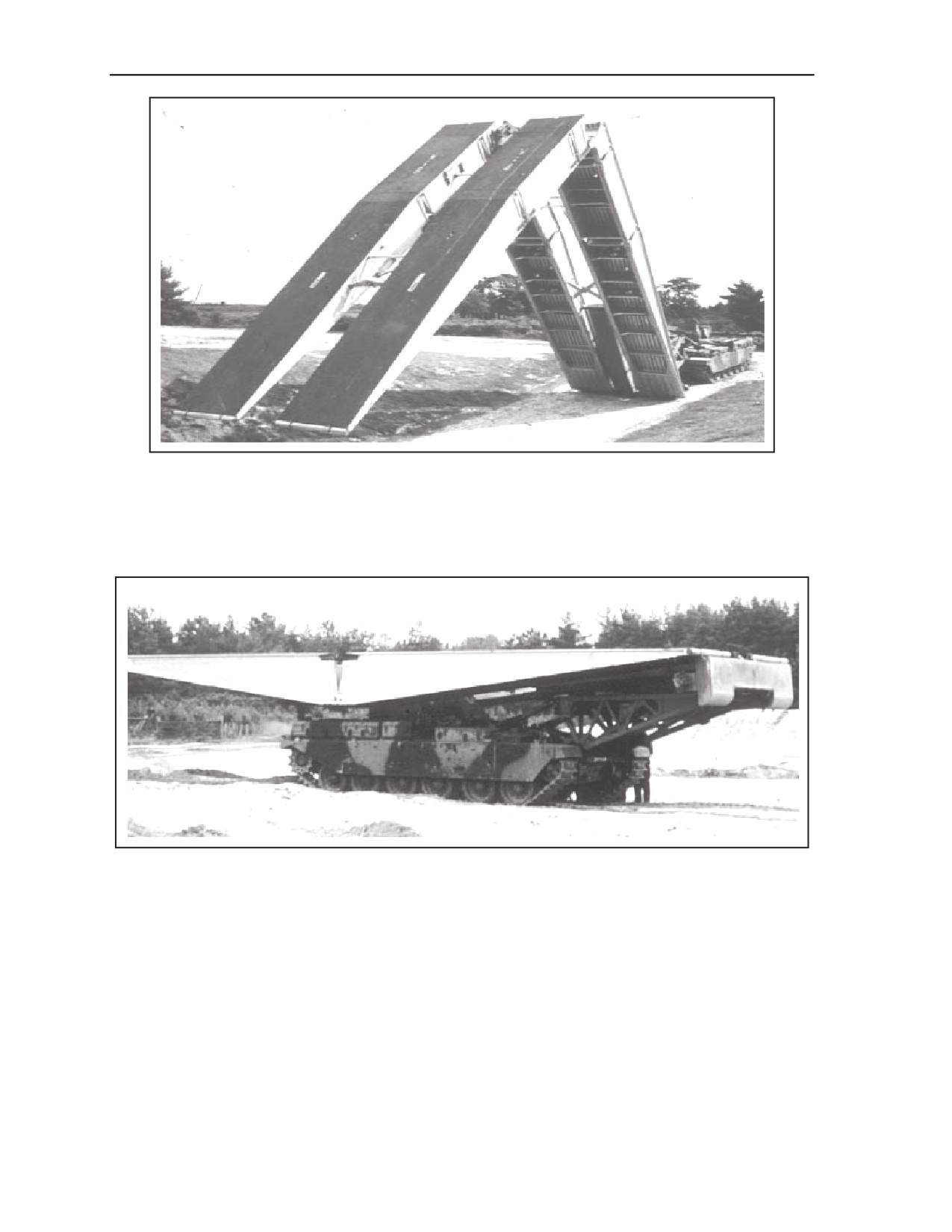
Appendix H
Figure H-1. British Number 10 Bridge in Launch Sequence
Number 11 Bridge. The number 11 bridge consists of four ramp sections and, due to its large
overhang, is only constructed for specific tasks. It is launched by the up-and-over method
(similar to the number 12 bridge). It is 16 meters long and can span 14.5 meters. See Figure H-2.
Figure H-2. British Number 11 Bridge
Number 12 Bridge. The most significant aspect of the number 12 bridge is that it may be
carried in pairs on the AVLB. Both bridges can be launched in sequence without the crew
leaving their vehicles. The number 12 uses the up-and-over launch method and is 13.5 meters
long. It is capable of spanning a gap of up to 12 meters. See Figure H-3.
H-2
FM 3-90.12/MCWP 3-17.1
1 July 2008
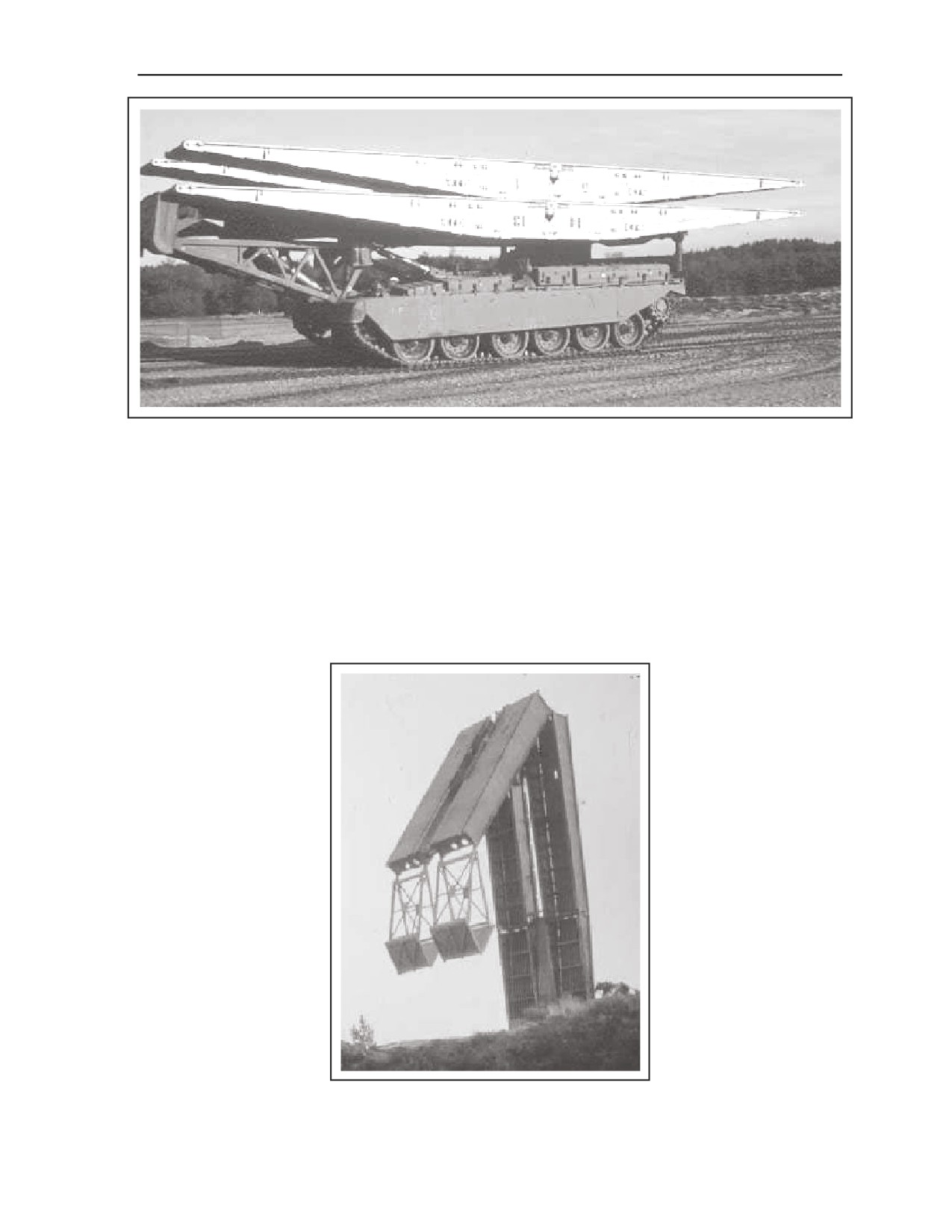
Foreign Bridging Resources
Figure H-3. British Number 12 Bridge
Combination Bridging. Each AVLB is scaled for one number 10 bridge and two number 12
bridges. Like the present range of bridges, these bridges can be laid in combination up to a
maximum of 66 meters.
Extensions Trestle. To permit crossing gaps that are wider than the standard number 8 bridge,
an extension trestle has been introduced. This trestle is fitted in place of the far-bank end ramps
in such a fashion that the trestle is allowed to unfold and swing downwards as the bridge is
extended. The trestle then supports the bridge to allow another AVLB to cross and lay an
additional bridge. A new trestle, which will incorporate a special panel and will be used with a
number 10 bridge, provides the ability to employ combination bridges over a greater range of
gap depths and for a wider range of gaps. See Figure H-4.
Figure H-4. British Number 10 Bridge With Trestle
1 July 2008
FM 3-90.12/MCWP 3-17.1
H-3
Appendix H
GERMAN ARMORED VEHICLE-LAUNCHED BRIDGES
H-4. German engineers employ the Leopard 1 Biber AVLB, the same variant as employed by Canadian
engineers. During the past decade, the Germans have begun developing their tactical bridging using
various tank chassis. Outlined below are some of the German-made bridging assets employed by other
nations:
MAN M47/M60 LEGAUN Armored Bridge Layer. The MAN M47/M60 LEGUAN armored
bridge layer is an adaptation of an M47 or M60 MBT chassis, designed to carry and launch the
standard MLC 70, 26-meter LEGUAN bridge. With a crew of two, laying operations take
between 3.5 to 4 minutes. Forward slopes of up to 20 percent and down to 20 percent can be
accommodated, as can traverse slopes of up to 10 percent. The maximum downward laying
slope is 0.8 meter. The bridge weighs 10,000 kilograms, with an MLC of 70. The bridge can
span gaps up to 24 meters and has a width of 4.01 meters, allowing 1.5 meters for roadway. This
bridge can also be adapted to MBT, such as the Centurion, the Leopard 1 or 2, and the M1
Abrams. Currently this version is also used by the Spanish Military. See Figure H-5.
Figure H-5. MAN M47 LEGUAN Armored Bridge Layer
MAN Leopard 1 LEGUAN Armored Vehicle-Launched Bridge. The MAN Leopard 1
LEGUAN AVLB is based on the hull and chassis of the Leopard 1 MBT with all main and
subcomponents unchanged. Various items from the removed turret and other components have
been modernized and integrated into the AVLB. The 26-meter, aluminum alloy bridge follows
standard construction design. Laying procedures remain the same with the exception that before
laying, a hydraulically operated tilt-table support blade is lowered under driver control from the
front of the hull. Acting as a stabilizer blade it can also be used for light obstacle clearance.
Operating with a crew of two, launching and retrieval times are less than 5 minutes. Currently in
service with Norway and on order for Belgium. See Figure H-6.
Figure H-6. MAN Leopard 1 LEGUAN Armored Vehicle-Launched Bridge
H-4
FM 3-90.12/MCWP 3-17.1
1 July 2008