FM 3-90.12/MCWP 3-17.1 COMBINED ARMS GAP-CROSSING OPERATIONS (July 2008) - page 5
Foreign Bridging Resources
CANADA LEOPARD ARMORED VEHICLE-LAUNCHED BRIDGE (BEAVER)
H-5. The Leopard AVLB was introduced to the Canadian Forces in 1976. Other NATO and America,
Britain, Canada, and Australia (ABCA) countries that currently employ the Leopard AVLB are: Australia,
Denmark, Germany, Greece, Italy, the Netherlands, and Norway. The AVLB is a fixed span bridge
mounted on a Leopard I tank chassis, using a horizontal launch system instead of the more common
scissors launch. The bridge provides an MLC 60 gap-crossing capability for gaps up to 21 meters using
prepared abutments or 20 meters using natural banks. It operates with a crew of two, with launching and
retrieval times of less than 5 minutes. It has eight launcher tubes that can use smoke rounds to conceal
bridge launching or canister-type high explosives (HE) grenades for self defense.
Note. The Chinese-Type 84 bridge layer is similar in design to the German Beaver AVLB.
CZECHOSLOVAKIAN MT-55A ARMORED BRIDGE LAYER
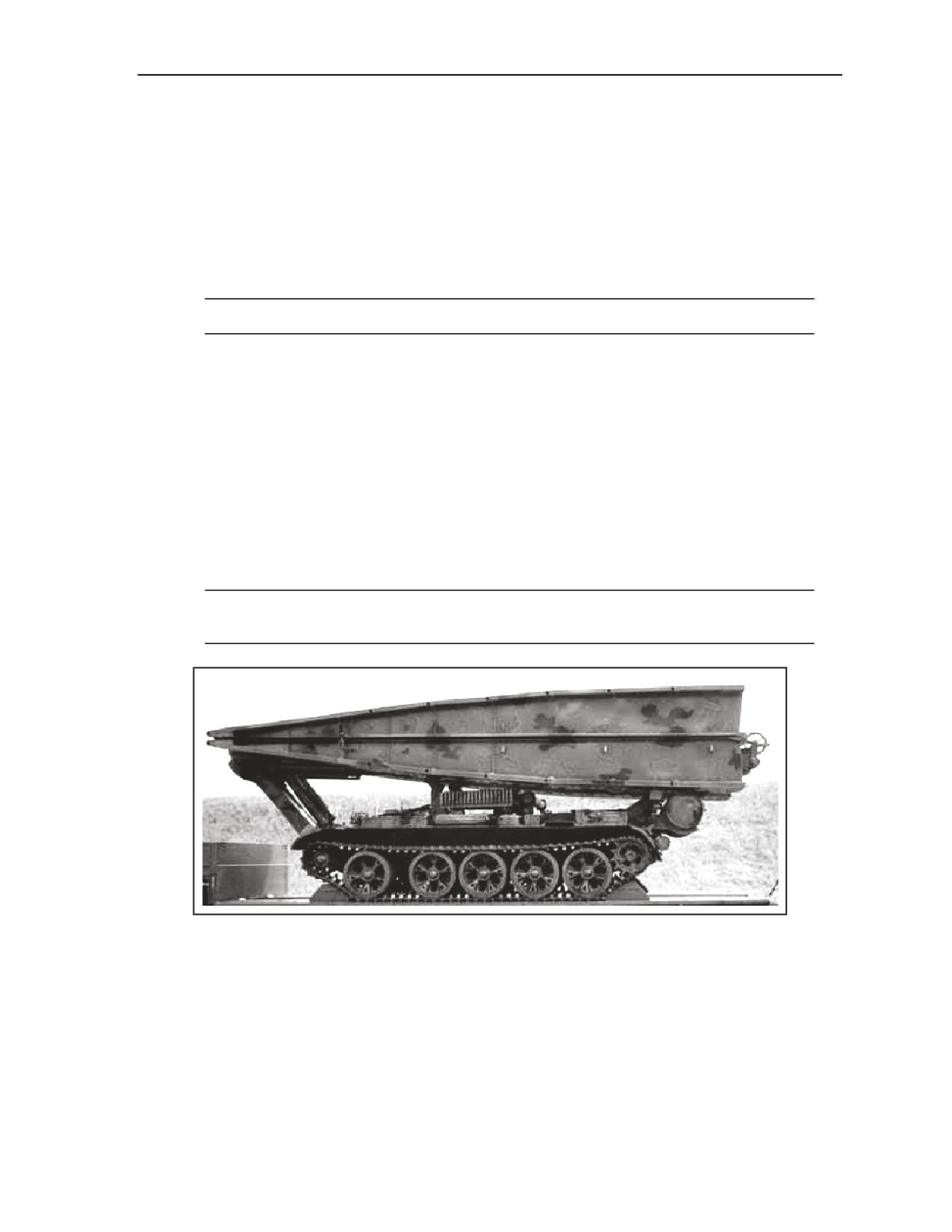
H-6. The MT-55A armored bridge layer (Figure H-7), a joint project between Czechoslovakia and Russia,
replaced the earlier MT-34. First produced in 1962, it is based on T-55A tank chassis. There are two types
of scissor bridges. The first model of the bridge has circular holes in the sides of the bridge, while the more
recent model has solid panels. The difference between the two is that one has a pattern while the other is
smooth with a plastic covering. With a crew of two, the bridge takes 3 minutes to lay in position while 3 to
8 minutes are required for recovery. The bridge is 18 meters long and 3.34 meters wide. It has the ability to
span gaps up to 17 meters with the maximum capacity of 50,000 kilograms. Standard equipment on the
MT-55A includes a CBRN system, a snorkel, an inclinometer, and other equipment for determining the
width of the gap before the bridge is laid. This bridge layer is also in service with Croatia, India, Iraq,
Russia, Slovakia, Yugoslavia, and some countries in the Middle East.
Note. Slovakia now markets the MT-72. A follow-on, scissors-type bridge that uses the T-72
chassis.
Figure H-7. MT-55A Bridge Layer in the Traveling Position
1 July 2008
FM 3-90.12/MCWP 3-17.1
H-5
Appendix H
RUSSIA MTU-72 ARMORED BRIDGE LAYER
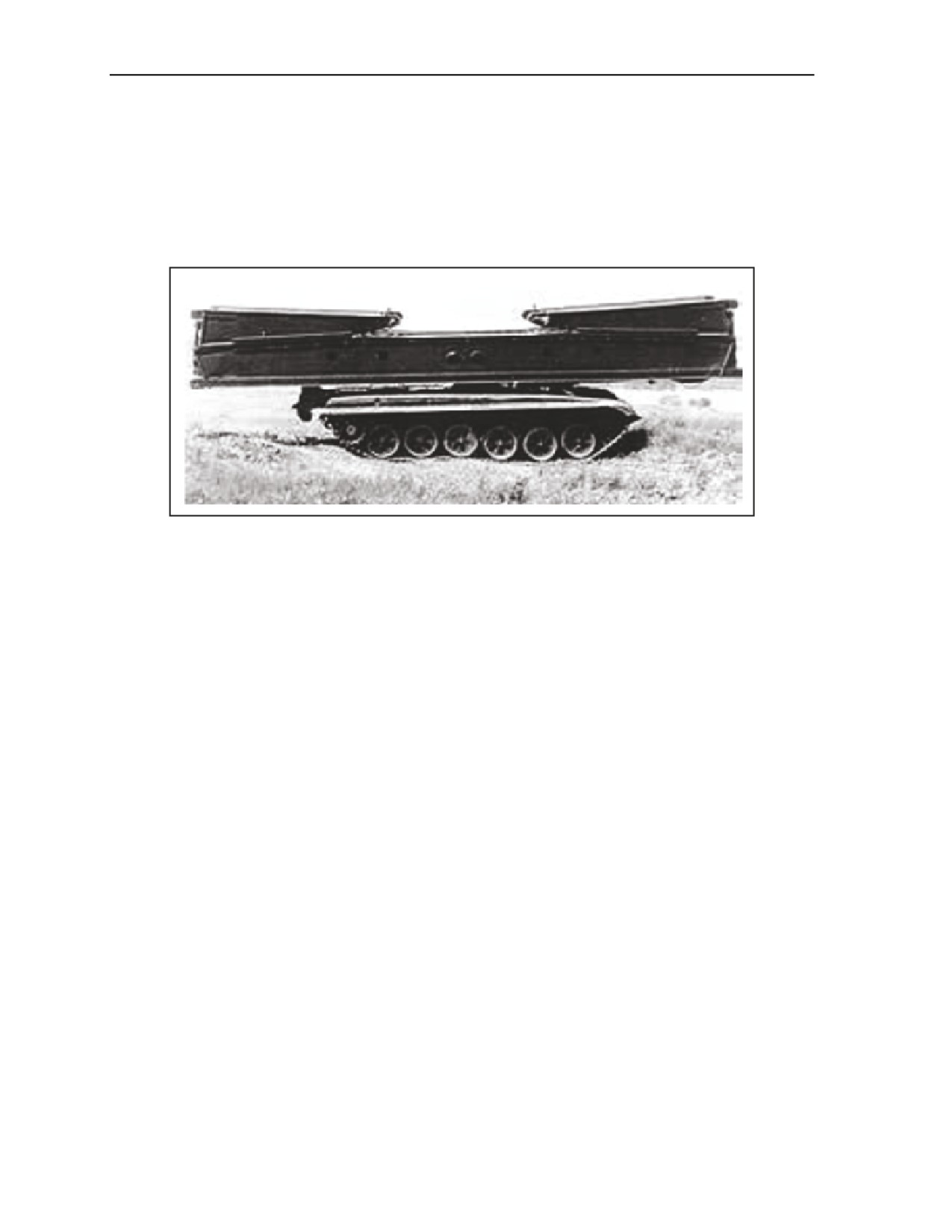
H-7. The MTU-72 armored bridge layer (Figure H-8) is a fixed span, aluminum alloy bridge mounted on
a T-90 MBT chassis with a crew of two. The bridge provides an MLC 50 gap-crossing capability for gaps
up to 18 meters. The bridge can be laid in 3 minutes with recovery in 8 minutes. It is possible to cover a
30-meter span by laying a second bridge in concert with the first. The outrigger dozer with hydraulic
control is mounted on the front of the vehicle.
Figure H-8. MTU 72 Armored Bridge Layer
RUSSIA MTU-90 ARMORED BRIDGE LAYER
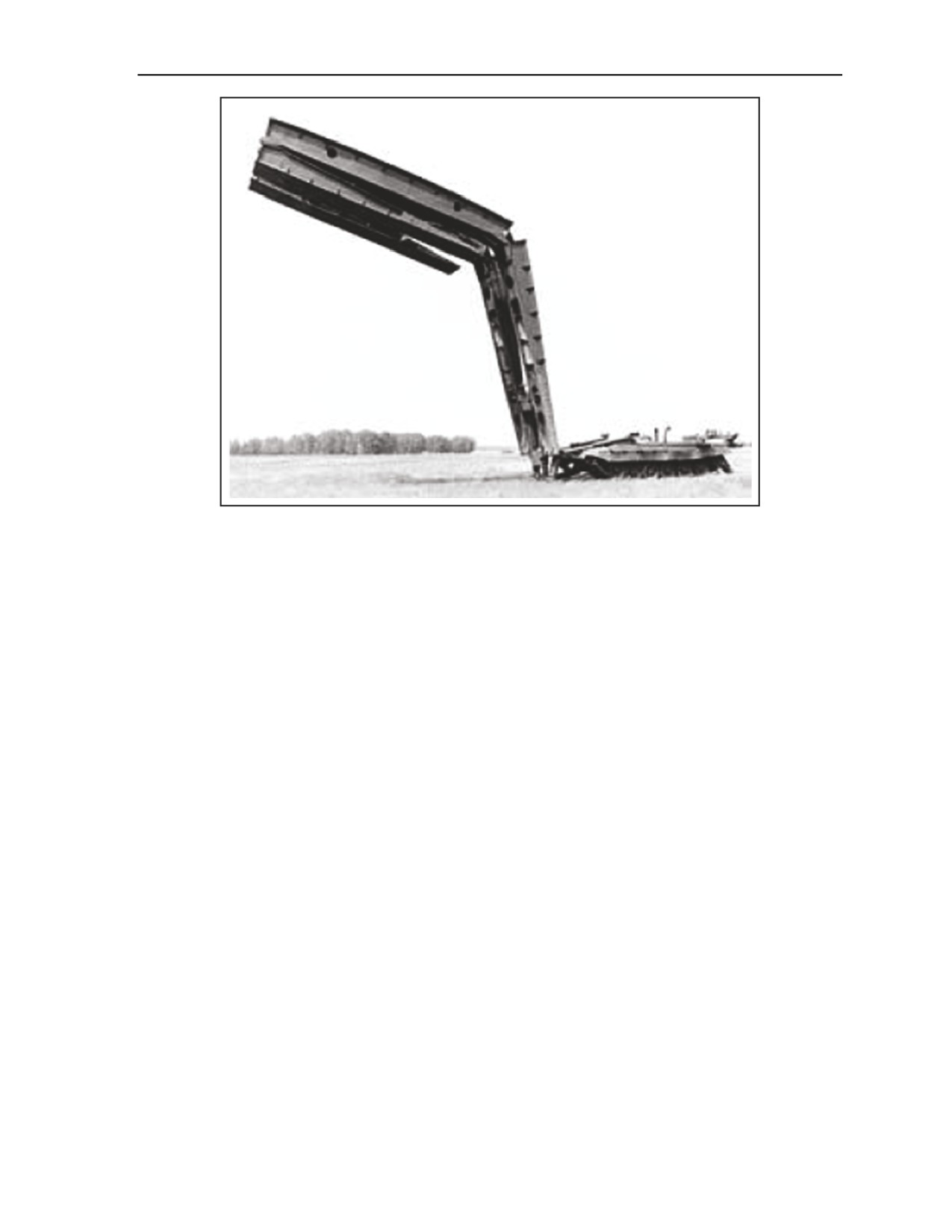
H-8. The MTU-90 armored bridge layer (Figure H-9) is designed to carry and lay a one-span bridge over
ditches, canals, and narrow gaps on the battlefield. The bridge provides an MLC 50 gap-crossing capability
for gaps up to 24 meters. Laying the bridge can be accomplished in 3 minutes with recovery in 2 1/2
minutes. It can also support the TMM-6 heavy bridge building system in laying multispan bridges to
provide passages for tanks and wheeled vehicles. It is made on the basis of the T-90S MBT chassis. Laying
and removing bridge procedures are fulfilled by a crew of two without leaving the cabin. The vehicle
carries a single-span bridge. It is equipped with CBRN protection, fire extinguishing, and smoke-screen
systems, as well as intercom and radio sets, and night vision device. Special provisions are made to provide
protection against armor piercing, incendiary, and hollow-charge projectiles.
H-6
FM 3-90.12/MCWP 3-17.1
1 July 2008
Foreign Bridging Resources
Figure H-9. MTU 90 Armored Bridge Layer
FRANCE-PAA BRIDGE LAYER AND PTA MODULAR ASSAULT BRIDGE
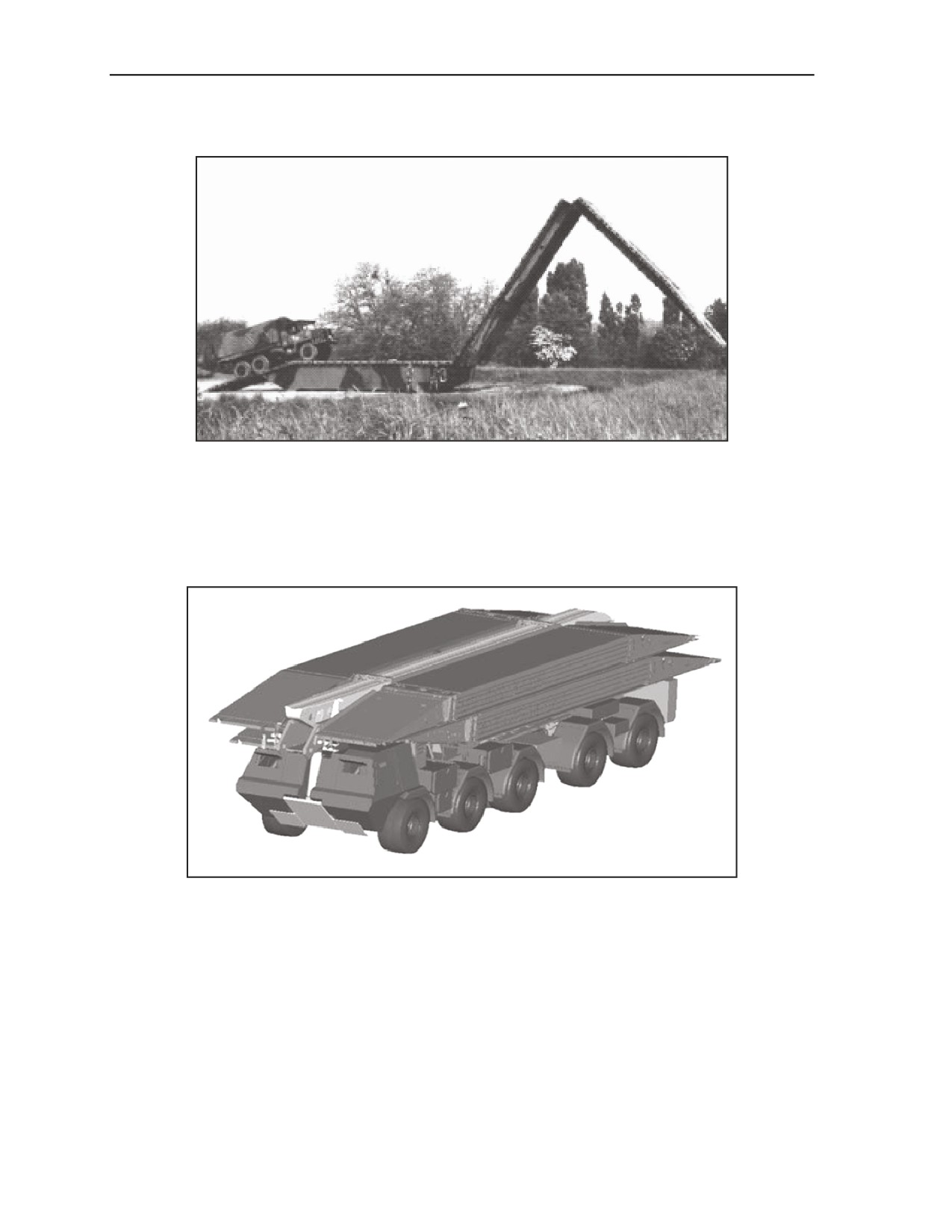
H-9. The PAA bridge layer (Figure H-10, page H-8) is a French bridge that consists of a wheeled vehicle
carrying a scissor launched bridge. The vehicle can either lay the bridge and retract from the farside or stay
in place with the bridge still attached to it. When deployed, the four wheels are raised off the ground, and
the hull of the vehicle is supported on shoes. Combination bridging is possible using an intermediate
trestle.
H-10. The MLC is 49 with a span of 21.4 meters, however, the MLC and span vary depending on the
nature of the banks and the vehicle position after laying the bridge. If two bridges are laid within 2 meters
and parallel to each other, an MLC 70 is possible. A truck is needed as a counterweight when launching the
bridge. The bridge width is 3.3 meters, has a crew of three, and a maximum road speed of 60 kilometers
per hour.
1 July 2008
FM 3-90.12/MCWP 3-17.1
H-7
Appendix H
Figure H-10. PAA Bridge Layer
H-11. The SPRAT (Figure H-11) is an MLC 70 modular assault bridge, whose length is adjusted by the
crew according to the width of the gap. It comes in two versions: one version can launch two 14.3-meter
bridges or one 26-meter bridge before replenishment; the other can launch three 10.5-meter bridges, or one
10.5-meter plus one 18.7-meter bridge, or one 27-meter long bridge. Operation, launch, and retrieval are
fully automated. The system is operated by a crew of two under armor.
Figure H-11. SPRAT Modular Assault Bridge
INDIA BRIDGE LAYER TANK AND SARVATRA TRUCK-MOUNTED SYSTEM
H-12. The bridge layer tank (BLT) is a fixed span, aluminum alloy, bridge mounted on a T-72 tank
chassis. It can span gaps up to 20 meters in about 5 minutes.
H-13. The Sarvatra truck-mounted bridging system is a wheel-based, universal bridging system on a Tatra
(8 x 8) chassis. A single span provides MLC 70 gap-crossing capability across gaps up to 20 meters. It can
be launched or recovered in 15 to 20 minutes (per span) from either end. The bridge has multispan
capability of up to 100 meters.
H-8
FM 3-90.12/MCWP 3-17.1
1 July 2008
Foreign Bridging Resources
SUPPORT AND LINE OF COMMUNICATIONS BRIDGING
GENERAL
H-14. Standard support and LOC bridging is used to construct bridges that can be dismantled and moved to
a new site. These bridges require manpower, time, and transportation depending on the span design. These
bridges often support combat maneuver based upon gap characteristics, however, normally replace assault
bridging assets to support follow-on forces. The following is a list of some of the available LOC bridges:
General Support Bridge. The general support bridge (GSB) is UK designed and is part of the
BR 90 package. Using the automotive bridge launching equipment
(ABLE) vehicle,
construction of 30 meters of MLC 70 bridge by 10 persons in fewer than 30 minutes has been
achieved, a significant improvement over the MGB. Construction is mechanical and uses the
cantilever launch rail to build and launch the bridge. All 8 x 8 unipower vehicles offer excellent
cross-country mobility. The ABLE vehicle is capable of launching and recovering bridges up to
44 meters long. The two-span bridge (TSB) allows gaps of 62 meters with a floating pier or 60
meters with fixed piers to be crossed. All BR 90 bridges are MLC 70.
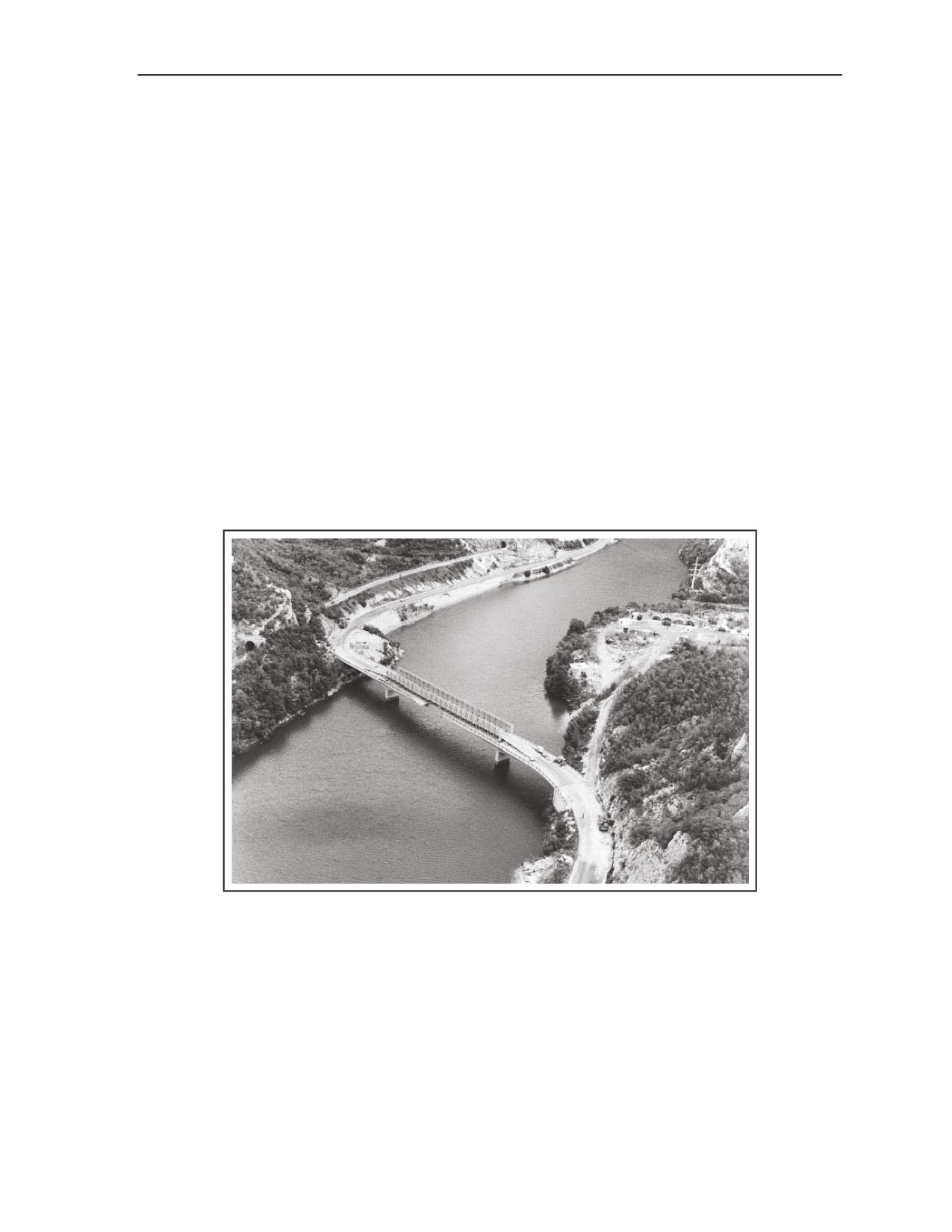
Mabey & Johnson. Mabey & Johnson (Figure H-12) is one of Europe’s foremost organizations
involved in the supply of steel bridging, with almost 150 years of experience. These bridges
were designed to replace the ever-popular Bailey bridge and have recently received worldwide
attention as the direct result of the hostilities in the Balkans. Currently Mabey & Johnson
bridges are in service throughout the world. The most common types of bridging used by
military forces are the LSB or the Compact 200.
Figure H-12. Mabey & Johnson Compact 200 Bridge
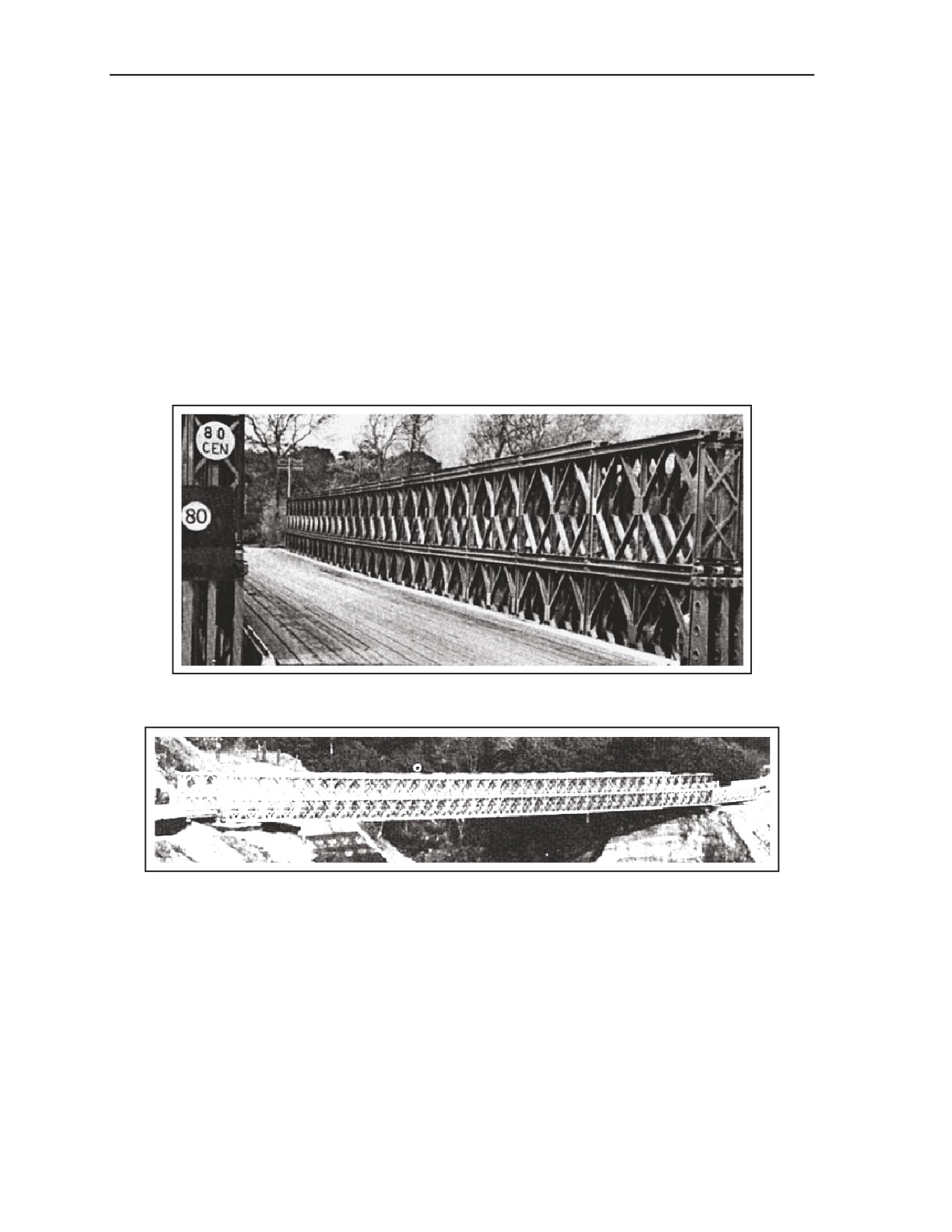
Bailey Bridge. The Bailey bridge
(Figures H-13 and H-14, page H-10) was originally
developed by Sir Donald Bailey of the UK and was widely used during World War II. The great
advantage of the bridge is its use of standard interchangeable components that (combined with
the simplicity of design) enables it to be erected in a short time. Using basic equipment, the
maximum span is 61 meters with an MLC of 80. Depending on the version of the Bailey bridge
(Bailey, standard, wide, or extra-wide), it can be constructed in three widths (3.28, 3.81, and
4.19 meters). Finally, a double-width Bailey (7.23 meters wide) was developed to permit two-
way traffic. Over the years, improvements have included new steel decking that is quick and
easy to erect, an antiskid surface and has a long life (unlike the wooden deck). This decking can
be used with the standard, wide, extra-wide, or double-width Bailey bridge. Another
1 July 2008
FM 3-90.12/MCWP 3-17.1
H-9
Appendix H
development is the Bailey panel, which provides an extra 40 percent safe working shear load
plus increased bending capacity and is completely interchangeable with the standard Bailey
panel. Besides being used as a road bridge, the Bailey bridge has been widely used for other
applications including rail and footbridges, retractable lift bridges, derrick supports, and mobile
gantries. The Bailey bridge is in service with many armed forces around the world, or it can be
found in military and civilian stockpiles as emergency or reserve equipment.
M2 Bailey Bridge. The M2 Bailey bridge has been proven both as a tactical and LOC bridge
capable of carrying heavy traffic loads. The M2 Bailey bridge is an all-purpose prefabricated
steel-panel bridge designed for portability and speed of erection under adverse conditions.
Optimum spans are 12.2 to 61 meters long, with a width of 3.8 meters between steel curbs and
4.3 meters between trusses. The components are manufactured in fixtures to ensure accuracy
and interchangeability. The heaviest component weighs 281 kilograms. There are about 15
major components in an average Bailey bridge and about 50 components, fittings, accessories,
special items, and tools available. Currently the M2 Bailey bridge is in service with the U.S.
Army and other armed forces.
Figure H-13. Bailey Bridge
Figure H-14. M2 Bailey Bridge
EuroBridge/Faltfestbruecke Foldable Bridge. In the German military, this bridge is known as
the Faltfestbruecke (FFB) (Figure H-15) and has been specified for near combat zones support
tasks. It can be employed as a general support bridge during conflicts or out of area operations
and for disaster relief. The bridge has been designed for MLC 70 traffic and has a crossing
speed of 25 kilometers per hour. The 39.5-meter bridge can be assembled by a crew of six in 60
minutes. It is equipped with a hoisting device for carrying the bridge bays and a traversing
beam. The bridge bays are arranged so that when the hoisting device is used, the bays will
automatically unfold to a 4.4-meter road width. The bridge is capable of spanning a 38.8-meter
gap while maintaining MLC 70. Currently this bridge is used by Germany and Spain.
H-10
FM 3-90.12/MCWP 3-17.1
1 July 2008
Foreign Bridging Resources
Figure H-15. EuroBridge/Faltfestbruecke
AM-50B. The AM-50B is a bridge system used by the Czech Republic. It is based on a scissor-
launched bridge that is carried, launched, and retracted by a TATRA T 813 or T 815 chassis.
The bridge is provided with a detachable telescopic abutment with a length of 1.75 meters to
5.15 meters. It is possible to combine up to eight of these bridges. The bridge is an MLC 50, has
a width of 4 meters, and the maximum span of each bridge is 13.5 meters. Installation time is 6
to 8 minutes for one bridge, 15 to 19 minutes for two, 25 to 30 minutes for three, and 34 to 42
minutes for four. See Figure H-16.
Figure H-16. AM-50B
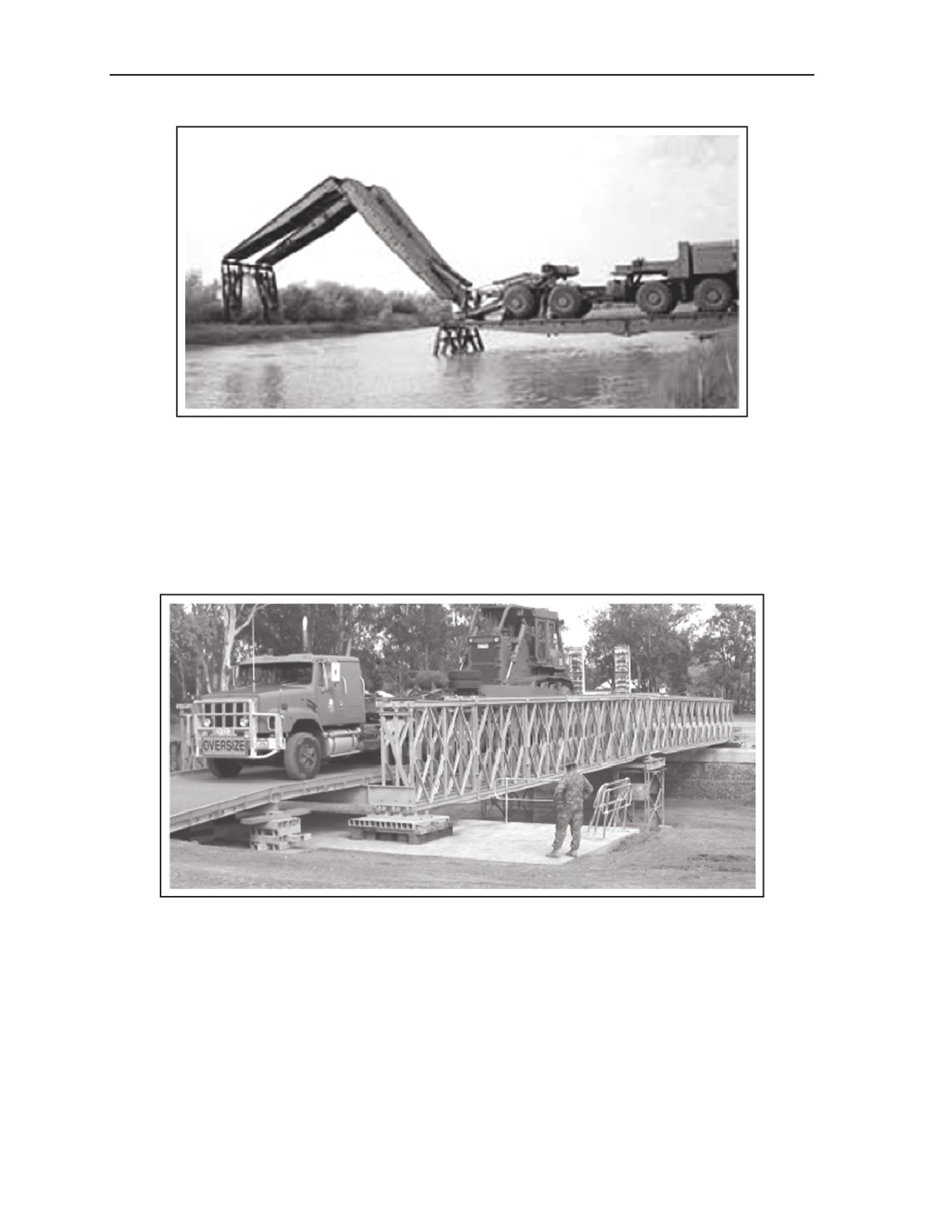
TMM-6. The Russian TMM-6 mobile bridge building system is designed to provide bridge
crossing of heavy-wheeled and tracked vehicles (60 tons). With a crew of two, it is found in
many countries and used in a variety of roles to include military, disaster relief, and
humanitarian operations, as well as in the oil, gas, and mining industry to provide access to
remote areas with harsh terrain. The system is composed of a bridge layer mounted on the
undercarriage of a wheeled prime mover and bridge elements (bays) with intermediate supports.
Depending on the number of bridge bays placed in a series, the length of the bridge crossing can
vary in length from
17 meters to lengths greater than
100 meters. Bridge members are
transported both by a bridge layer and by special transport vehicle. See Figure H-17, page H-12.
1 July 2008
FM 3-90.12/MCWP 3-17.1
H-11
Appendix H
Figure H-17. TMM-6
Acrow. The Acrow panel bridge (Figure H-18) is a Canadian bridge and uses the Bailey unit
construction system with its ease of assembly, but employs higher tensile steel and has an
advanced design. As with the Bailey, the bridge decking can be either steel or timber. The
roadway width may be suited for one or two-way traffic. The bridge can be launched on rollers
and is constructed using nonspecialized personnel without a crane. Acrow panels can be used to
produce other bridges such as railway bridges. The MLC varies according to construction.
Figure H-18. Acrow Panel Bridge
H-12
FM 3-90.12/MCWP 3-17.1
1 July 2008
Foreign Bridging Resources
FLOATING/AMPHIBIOUS BRIDGES AND FERRIES
H-15. Probably the biggest technical advances in military bridging have been made in floating bridges with
the amphibious self-propelled units and quick-assembly bridges, such as the medium floating bridge.
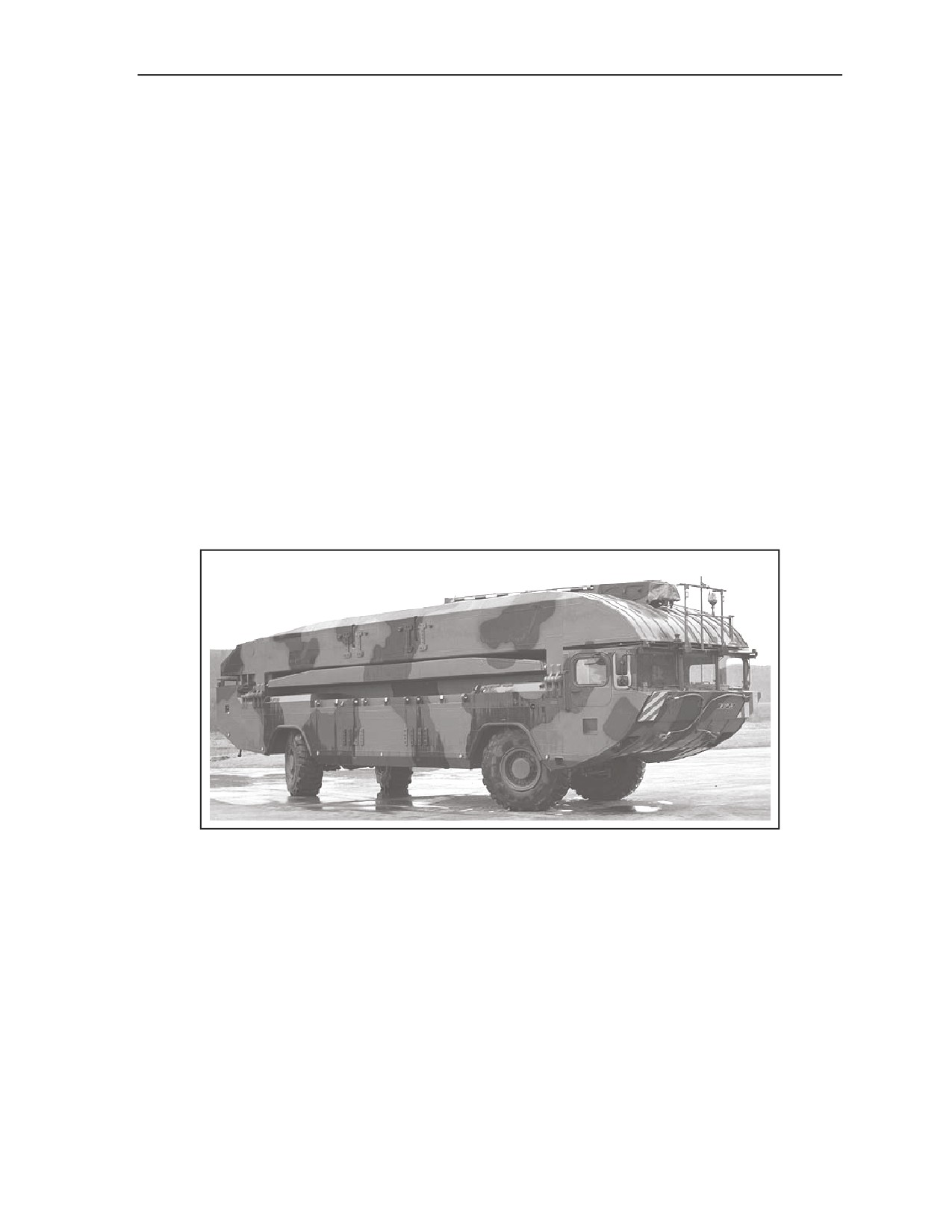
The M3 Amphibious Bridging and Crossing Vehicle. The M3 (Figure H-19) was developed
in Germany as a follow-on to the M2. It entered service with the German Army and in the UK at
the end of 1996. The UK Ministry of Defense purchased 38 vehicles. The Taiwanese have also
purchased this system. The M3 is a MLC 31, 4 x 4 wheeled vehicle that is powered by a single
diesel engine. It is 12.8 meters long and 3.9 meters high during road operation, achieving a road
speed of 85 kilometers per hour. The main hull and side pontoons are constructed exclusively of
aluminum alloy that provides no CBRN or direct-fire protection for a crew of three except for
the Taiwanese M3s that are equipped with an armored cabin, CBRN protection system, air
conditioning system, and a special tropical kit. It has the option of 4-wheel steering, and the
ability to adjust tire pressure while on the move. Thus, giving it outstanding cross-country
capabilities. The M3 can carry vehicles up to MLC 70 (tracked) and MLC 100 (wheeled). A
unique feature of the M3 is that it requires no preparation to enter or exit the water. The water
jet-propulsion system gives the M3 a speed of 13 kilometers per hour in the water along with
other exceptional ferry capabilities allowing it to be employed from widely dispersed sites. A
100-meter bridge formed by eight M3s is designed to accommodate vehicles of up to
MLC70T/100W. A ferry of two linked M3s (Figure H-20, page H-14) carries an MLC 70 MBT.
A 100-meter bridge can be built by 24 Soldiers in less than 15 minutes—at least half the time
and personnel required to build the M2.
Figure H-19. M3 Amphibious Bridging and Crossing Vehicle
1 July 2008
FM 3-90.12/MCWP 3-17.1
H-13
Appendix H
Figure H-20. Linked Amphibious Bridges Deployed
MAN Floating Bridge. The MAN floating bridge (Figure H-21) is an old model based on
connected metal pontoons. It permits a variety of configurations: MLC 30-50-80 floating bridge
and MLC 80 ferry. It also permits the construction of jetty and floating infrastructure for landing
or underwater works. The installation requires cranes and forklifts help to speed up installation.
The major advantage is that it doesn’t require a dedicated vehicle. Installation of a 100-meter
MLC 80 bridge by an engineer platoon takes 18 hours. The bridge is currently in use by Spain
and Norway.
Figure H-21. MAN Floating Bridge
H-14
FM 3-90.12/MCWP 3-17.1
1 July 2008
Foreign Bridging Resources
Two-Span Bridge Pontoon. The UK two-span bridge pontoon is carried in threes on a DROPS
flat rack system. The flat racks can carry payloads up to 15,000 kilograms, with the units being
launched into the water from the back of a vehicle. Once in the water, they are fixed back to
back. The top pontoon of each load is fitted with a propulsion system similar to that found on
the combat support boat operating on the water jet principle. See Figure H-22.
Figure H-22. Launching a Two-Span Bridge Pontoon
Damen FAC 540 Floating Bridges and Ferries. The Damen FAC 540 (Figure H-23) is a fast
assault craft that can be used in the construction of floating bridges or light ferries for loads up
to MLC 8. All the bridges and ferries are based on using the aluminum hull FAC 540, designed
to carry a fully equipped infantry section and an operating crew of two. It is in use with the
engineers in Brunei, Malaysia, the Royal Netherlands Marine Corps, and the International Red
Cross in Nicaragua.
Figure H-23. FAC 540 Raft
1 July 2008
FM 3-90.12/MCWP 3-17.1
H-15
Appendix H
EFA Amphibious Bridge. The EFA is a French amphibious bridging system that is used for
wet-gap crossing. In a wet gap, it is also used as a ferry. The bridge element is mounted on top
of the vehicle. Before the vehicle enters the water, hinged flaps are deployed on each side and
the floats are inflated. Preparation time from road position takes about 6 minutes. The following
ferry combinations are possible: a single-rig ferry, a 2-rig ferry, and a 3-rig ferry. A 100-meter
floating bridge is formed with four rigs. The bridge has an MLC of 70, with a width of 3.6
meters, a crew of four, and a maximum on-road travel speed of 75 kilometers per hour. See
Figure H-24.
Figure H-24. EFA Amphibious Bridge
PFM Motorized Floating Bridge. The PFM is a French designed asset in service in France,
Switzerland, Italy, and Malaysia. It has an MLC of 70 and its length varies based on the number
of bridge modules put together. Each module has a 10-meter span a 4.4 meter width and is
propelled by two 75-horsepower engines. The module has a crew of three plus an additional
transporter driver. A 100-meter bridge or two 50-meter ferries can be constructed in 30 minutes.
See Figure H-25.
Figure H-25. PFM Motorized Floating Bridge
H-16
FM 3-90.12/MCWP 3-17.1
1 July 2008
Foreign Bridging Resources
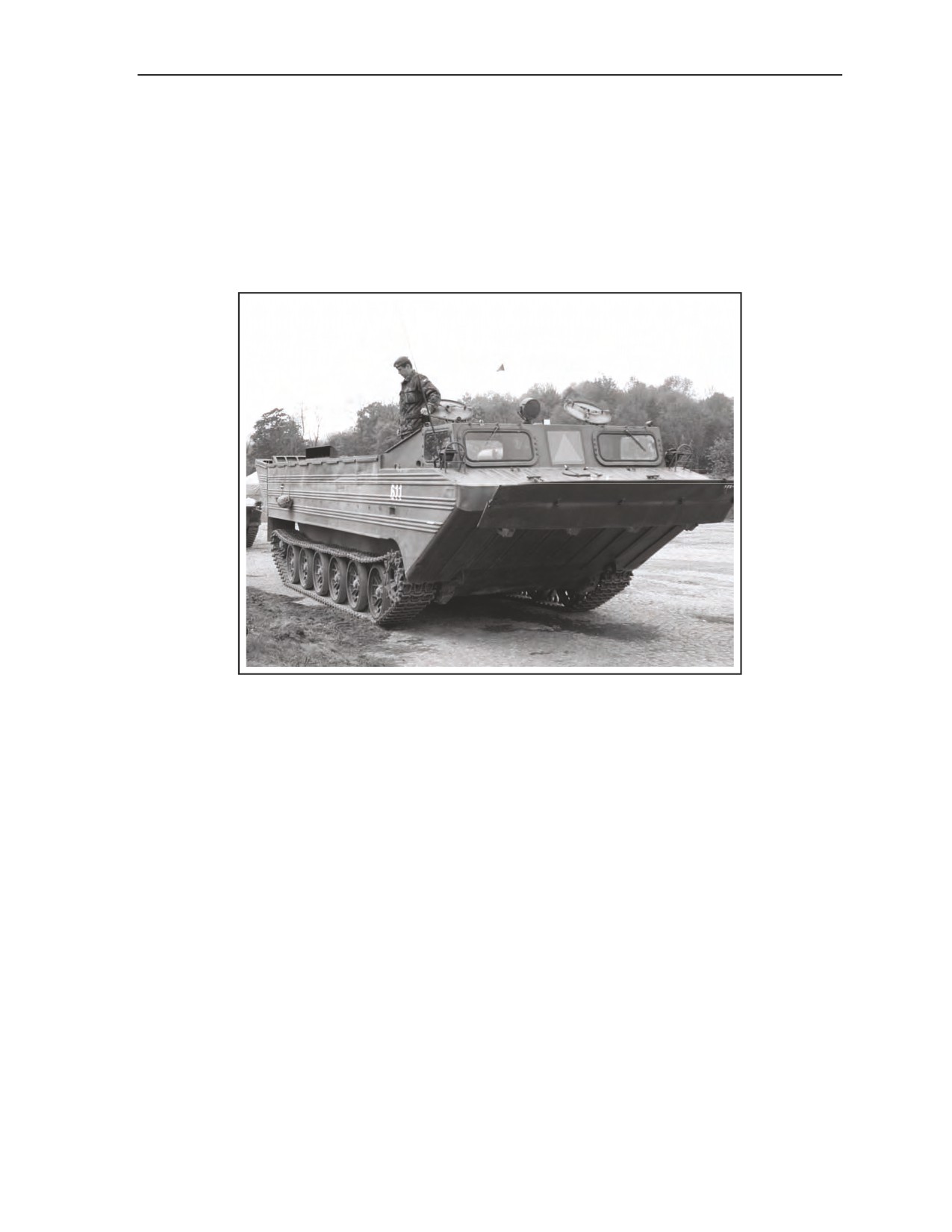
PTS-10 Tracked Amphibious Self-Propelled Transport Vehicle. The PTS-10 system is in use
in the Czech Republic, Russia, and Poland for wet gap crossing. It is a tracked amphibious self-
propelled transport vehicle for floating transport of persons, casualties, materiel, and some
equipment with loading and unloading on land or for transportation on land. It can be used in
flow velocities of up to 2.5 meters per second. Design load-bearing is 5,000 kilograms on land
and 10,000 kilograms on water. It can transport 72 persons including all personal equipment or
12 injured on stretchers. The vehicle has an MLC of 10, a width of 3.3 meters, a crew of two,
and a maximum on-road travel speed of 42 kilometers per hour or 10 kilometers per hour in the
water. See Figure H-26.
Figure H-26. PTS-10
RAILWAY BRIDGES
H-16. Standard bridging railway bridges are valuable assets because they are not commonly used in other
countries. In most cases, repair or reinforcement of existing railroad bridges should be considered.
MAN SE RAILWAY BRIDGE
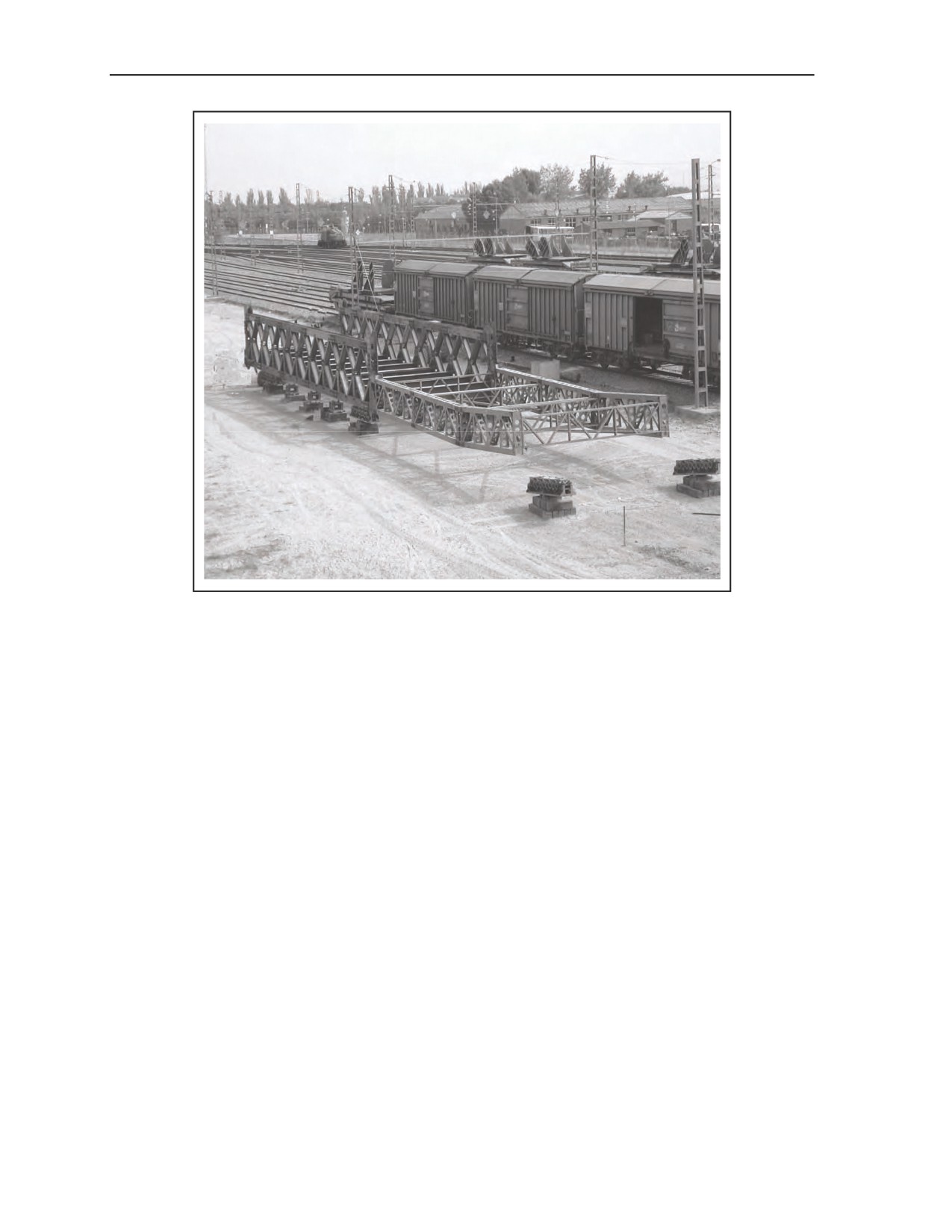
H-17. The MAN SE railway bridge is a panel bridge that is similar to the Bailey bridge but is much
stronger. It has two configurations: upper deck and lower deck. With the upper deck configuration, it can
span gaps up to 40.95 meters; with the lower deck up to 50.4 meters. It is designed to withstand the
crossing of locomotives with 30 tons per axle and wagons with 20 tons per axle. Installation time is 20 to
30 hours with a 50-man crew and two cranes. This bridge requires a prepared abutment (existing railway
abutments or concrete abutment). Spain and Italy are the only NATO countries with existing military
railway bridges in their inventory. See Figure H-27, page H-18.
1 July 2008
FM 3-90.12/MCWP 3-17.1
H-17
Appendix H
Figure H-27. MAN SE Railway Bridge
CONCLUSION
H-18. As outlined in this chapter, there are many pieces of equipment available worldwide that refer to
bridging in all forms. Due to the wide array of equipment, engineers should collect data and be
knowledgeable of the various bridges and bridging assets that may be encountered in theater. Many
publications offer details at length and can be found on the internet. One of the most comprehensive and
up-to-date publications is offered by Jane's <www.janes.com > and is readily accessible in book form as
well as electronically.
H-18
FM 3-90.12/MCWP 3-17.1
1 July 2008
Source Notes
This section lists sources by page number. Boldface indicates titles of vignettes.
1-1
"Throughout history…": George S. Patton, War As I Knew I, George S. Patton, Paul D. Harking with
New Introduction by Rick Atkinsin, (New York: Houghton Mifflin, 1995), 97.
2-1
"The wise man…": John Pierpont Morgan, Benefit Realisation Management: A Practical Guide to
Achieving Benefits through Change, Gerald L. Bradley, (Aldershot, England: Gower, 2006), 61.
2-8
Perspective: "There are few military…": Based on information extracted from an article by Richard
W. Stewart, Crossing the Rhine and the Irrawaddy, (Military Review, Volume 69, August 1989), 74.
3-1
"No enterprise is…": Niccolo Machiavelli, The Art of War, Neal Wood (Massachusetts: DaCapo Press,
2001), 202.
4-1
"The passage of…": Frederick the Great, The Army and Navy of America, Dr. Jacob K. Neff
(Montana: Kessinger Publishing, 2005), 58.
5-1
"The most dangerous…": William Lloyd George, Nobel Lectures in Peace 1951-1970, Fredrick W.
Haberman (Singapore; River Edge, New Jersey: World Scientific Publishing, 1999), 198.
6-1
"It is an immense…": George McClellan, An llustrated History of the Civil War: Images of an
American Tragedy, (Virginia: Time Life Trade Publishing, 2000), 98.
1 July 2008
FM 3-90.12/MCWP 3-17.1
Source Notes-1
This page intentionally left blank.
Glossary
SECTION I - ACRONYMS AND ABBREVIATIONS
AA
assembly area
AAV
amphibious assault vehicle
ABCA
America, Britain, Canada, and Australia
ABLE
automative bridge launching equipment
ACE
armored combat earthmover
ACR
armored cavalry regiment
ADC
assistant division commander
AFCS
Army Facilities Components System
AFJPAM
Air Force joint pamphlet
AFR
Air Force reserve
AFTTP
Air Force technical training publication
AMD
air and missile defense
AN/PSS
Army-Navy/portable special search
AO
area of operations
AOR
area of responsibility
AR
Army regulation
ARNG
Army National Guard
ARNGUS
Army National Guard of the United States
ART
Army task
AT
antitank
ATTN
attention
AUTL
Army Universal Task List
AVLB
armored vehicle-launched bridge
BCT
brigade combat team
BEB
bridge erection boat
BHL
battle handover line
BLT
bridge layer tank
bn
battalion
BRSC
Brown & Root Services Corporation
BSB
brigade support battalion
BSTB
brigade special troops battalion
C2
command and control
CAB
combined arms battalion
CAC
crossing area commander
CAE
crossing area engineer
CAS
close air support
1 July 2008
FM 3-90.12/MCWP 3-17.1
Glossary-1
Glossary
CBRN
chemical, biological, radiological, and nuclear
CBT
common bridge transporter
CCD
camouflage, concealment, and deception
CCDR
combatant commander
CCIR
commander's critical information requirements
CEB
combat engineer battalion
CFA
call forward area
CFZ
critical friendly zone
cgo
cargo
CJA
command judge advocate
cm
centimeters
co
company
COA
course of action
COE
contemporary operational environment
const
construction
COTS
commercial off-the-shelf
CP
command post
CPIC
Coalition Press Information Center
CPS
collective protective shelter
CSC
crossing site commander
CSE
combat support engineer
CV
combat vehicle
DA
Department of the Army
DCG
deputy commanding general
DCO
deputy commanding officer
DCP
detainee collection point
DD
double double
DIVENG
divisional engineer
DOD
Department of Defense
DPRE
displaced persons, refugees, and evacuees
DROPS
demountable rack offload and pickup system
DS
double story; double single
DSB
dry support bridge
DTO
division transportation officer
DWFK
deepwater fording kit
EA
engagement area
EEP
engineer equipment park
EFV
expeditionary fighting vehicle
EH
explosive hazards
EIC
end item code
EMW
expeditionary maneuver warfare
Glossary-2
FM 3-90.12/MCWP 3-17.1
1 July 2008
Glossary
EN
engineer
ENCOORD
engineer coordinator
EOD
explosive ordnance disposal
equip
equipment
ERP
engineer regulating point
ERT
engineer reconnaissance team
ESB
engineer support battalion
F
fahrenheit
FA
field artillery
FEBA
forward edge of the battle area
FFB
Faltfestbruke
FM
field manual
FMT
forward maintenance team
FMI
field manual interim
FOM
freedom of movement
fps
feet per second
FOLAV
family of light armored vehicles
FRAGO
fragmentary order
FSCL
fire-support coordination line
ft
feet
G-2
Assistant Chief of Staff, Intelligence
G-3
Assistant Chief of Staff, Operations
G-4
Assistant Chief of Staff, Logistics
G-5
Assistant Chief of Staff, Plans
GSB
general support bridge
HBCT
heavy brigade combat team
HE
high explosive
HEMTT
heavy expanded-mobility tactical truck
HL
holding line
HMMWV
high-mobility, multipurpose wheeled vehicle
HN
host nation
HQ
headquarters
IBCT
infantry brigade combat team
ICV
infantry carrier vehicle
IEBL
inter-entity boundary line
IED
improvised explosive device
IMPIN
implementing instructions
in
inch(es)
inf
infantry
IPB
intelligence preparation of the battlefield
IPE
individual protective equipment
1 July 2008
FM 3-90.12/MCWP 3-17.1
Glossary-3
Glossary
IPTF
International Police Task Force
IRB
improved ribbon bridge
ISO
International Organization for Standardization
ISR
intelligence, surveillance, and reconnaissance
JAB
joint assault bridge
JP
joint publication
KBR
Kellogg, Brown, & Root
LAR
light armored reconnaissance
LAV
light assault vehicle
LAVFOV
light armored vehicle family of vehicles
LCAC
landing craft air cushion
LCM-8
landing craft, mechanized 8
LCU
landing craft, utility
LOA
limit of advance
LOC
line of communications
LRS
link reinforcement set
LSB
logistics support bridge
LTF
logistics task force
LV
launch vehicle
LZ
landing zone
m
meter(s)
MAJ
major
MAC
mobility augmentation company
MAGTF
Marine air-ground task force
maint
maintenance
MBT
main battle tank
MCAP
mine-clearing armor-protected
M/CM/S
mobility, countermobility, and survivability
MCRP
Marine Corps reference publication
MCWP
Marine Corps warfighting publication
MDMP
military decision-making process
ME
maneuver enhancement
MEF
Marine expeditionary force
METT-T[C]
mission, enemy, terrain and weather, troops and support available, and
time available [Army adds "civil considerations"]
MGB
medium girder bridge
MI
military intelligence
MLC
military load classification
MND(N)
multinational division (north)
MND(SW)
multinational division (southwest)
MOD2
modification 2
Glossary-4
FM 3-90.12/MCWP 3-17.1
1 July 2008
Glossary
MOU
memorandum of understanding
mps
meters per second
MRBC
multirole bridge company
MSI
multispectral imagery
MSR
main supply route
MTOE
modified table of organization and equipment
MTV
medium tactical vehicle
NATO
North Atlantic Treaty Organization
NCO
noncommissioned officer
NLT
no later than
No.
number
NSN
national stock number
NTTP
naval tactics, techniques, and procedures
NWP
naval warfare publication
OAKOC
observation and fields of fire, avenues of approach, key terrain,
obstacles, and cover and concealment
obj
objective
OBM
outboard motor
OBSTINTEL
obstacle intelligence
OCONUS
outside the continental United States
OE
operational environment
OPLAN
operation plan
OPORD
operation order
OPSEC
operations security
OTH
over the horizon
PIR
priority intelligence requirements
PL
phase line
PLS
palletized load system
plt
platoon
PM
provost marshal
PMCS
preventive-maintenance checks and services
PMO
provost marshal office
P/N
part number
POC
point of contact
POL
petroleum, oil, and lubricants
prep
preparation
RCT
regimental combat team
REB
rapidly emplaced bridge
REBS
rapidly emplaced bridge system
recon
reconnaissance
RL
release line
1 July 2008
FM 3-90.12/MCWP 3-17.1
Glossary-5
Glossary
ROE
rules of engagement
RP
release point
RPV
remotely piloted vehicle
S-2
intelligence staff officer
S-3
operations staff officer
S-4
logistics staff officer
SBCT
Stryker brigade combat team
SC
signal corps
sec
section
SFOR
stabilization force
SJA
staff judge advocate
SOP
standing operating procedure
SOSRA
suppress, obscure, secure, reduce, and assault
spt
support
sqdn
squadron
SRB
standard ribbon bridge
SS
single story; single single
STOM
ship-to-objective maneuver
SU
situational understanding
TAC CP
tactical command post
TBD
to be done
TC
training circular
TCMS
Theater Construction Management System
TCP
traffic control post
TD
triple double
TF
task force
TLP
troop-leading procedure
TM
technical manual
TMR
transportation movement request
TO
task organization
TOE
table(s) of organization and equipment
TRADOC
United States Training and Doctrine Command
trk
truck
TS
triple single
TT
triple triple
TSB
two span bridge
UK
United Kingdom
U.S.
United States
USAID
United States. Agency for International Development
USAR
United Stated Army Reserve
USAEUR
United States. Army, Europe
Glossary-6
FM 3-90.12/MCWP 3-17.1
1 July 2008
Glossary
USMC
United States Marine Corps
vol
volume
WARNORD
warning order
SECTION II - TERMS
assured mobility
Actions that give the force commander the ability to maneuver where and when he desires without
interruption or delay to achieve the mission. (FM 3-34)
assault position
(Army) A covered and concealed position short of the objective, from which final preparations are
made to assault the objective. (FM 3-90) (Marine Corps). That position between the line of departure
and the objective in an attack from which forces assault the objective. Ideally, it is the last covered and
concealed position before reaching the objective (primarily used by dismounted infantry).
assembly area
(joint, NATO) - 1. An area in which a command is assembled preparatory to further action. 2. In a
supply installation, the gross area used for collecting and combining components into complete units,
kits, or assemblies. (Army) The area a unit occupies to prepare for an operation. Also called AA.
(FM 3-90)
attack position
(joint) The last position occupied by the assault echelon before crossing the line of departure. See
FM 3-90. (FM 1-02)
*bridgehead
(joint) An area of ground held or to be gained on the enemy’s side of an obstacle. (Army) In
gap-crossing operations, an area on the enemy’s side of the linear obstacle that is large enough to
accommodate the majority of the crossing force, has adequate terrain to permit defense of the crossing
sites, provides security of crossing forces from enemy direct fire, and provides a base for continuing
the attack.
*bridgehead force
A force that assaults across a gap to secure the enemy side (the bridgehead) to allow the buildup and
passage of a breakout force during river crossing operations.
*bridgehead line
(joint, NATO) The limit of the objective area in the development of the bridgehead. See also objective
area.
*call forward area
1. In gap-crossing operations, waiting areas within the crossing area where final preparations are
made. (FM 3-90.12) 2. In air movement, the area at the departure airfield where plane loads are
assembled in a ready condition prior to being directed to the loading ramp area. (FM 55-1) Also called
CFA.
command
(Army) The authority that a commander in the military service lawfully exercises over subordinates by
virtue of rank or assignment. Command includes the leadership, authority, responsibility, and
accountability for effectively using available resources and planning the employment of, organizing,
directing, coordinating, and controlling military forces to accomplish assigned missions. It includes
responsibility for unit readiness, health, welfare, morale, and discipline of assigned personnel.
(FMI 5-0.1)
1 July 2008
FM 3-90.12/MCWP 3-17.1
Glossary-7
Glossary
command and control
(Army) The The exercise of authority and direction by a properly designated commander over
assigned and attached forces in the accomplishment of a mission. Commanders exercise command and
control through a command and control system. (FM 6-0)
control
(Army) The regulation of forces and warfighting functions to accomplish the mission in accordance
with the commander’s intent. (FMI 5-0.1)
covert breach
A breaching operation that is planned and intended to be executed without detection by opposing
forces. Its primary purpose is to reduce obstacles undetected to facilitate the passage of maneuver
forces. (FM 3-34.2)
*covert crossing
A gap-crossing operation that is planned and executed without detection by opposing forces. It’s
primary purpose is to facilitate undetected infiltration on the far side of a gap and is normally
conducted by battalion and smaller forces.
*crossing area
(joint, NATO) 1. A number of adjacent crossing sites under the control of one commander. 2. (joint
only) A controlled access area for a gap-crossing operation used to decrease traffic congestion at the
river. It is normally a brigade-sized area defined by lateral boundaries and release lines 3 to 4
kilometers (based on mission, enemy, terrain and weather, troops and support available, time
available) (Note. The Army definition adds “and civil considerations.”) from each side of the river. (JP
1-02)
*crossing area commander
The officer responsible for the control of all crossing units, assault units, and support forces while they
are in the crossing area.
*crossing force
The unit that has responsibility to establish the bridgehead. Also see bridgehead line; crossing area;
crossing site.
*crossing force commander
The individual designated to control the lead brigades during the assault across the gap to secure the
bridgehead line.
*crossing site
The location along a water obstacle or other gap where the crossing can be made using amphibious
vehicles, assault boats, rafts, bridges, or fording vehicles.
*crossing site commander
The individual, normally an engineer company commander or a platoon leader, responsible for the
crossing means and the crossing site. He commands the engineers operating the crossing means and
the engineer regulating points at the call forward areas and the staging areas for that site. See also
bridgehead.
*deliberate crossing
(joint, NATO) The crossing of an inland water obstacle or other gap that requires extensive planning
and detailed preparations. See also bridgehead; bridgehead line; hasty crossing; river crossing.
*engineer regulating point
Checkpoint to ensure that vehicles do not exceed the capacity of the crossing means and to give
drivers final instructions on site-specific procedures and information, such as speed and vehicle
interval. Also called ERP.
Glossary-8
FM 3-90.12/MCWP 3-17.1
1 July 2008
Glossary
*ford
A shallow part of a body of water or wet gap that can be crossed without bridging, boats, ferries, or
rafts. It is a location in a water barrier where the physical characteristics of current, bottom, and
approaches permit the passage of personnel, vehicles, and other equipment where the wheels or tracks
remain in contact with the bottom at all times. See also gap; reconnaissance; river crossing.
*gap
A ravine, mountain pass, river, or other terrain feature that presents an obstacle that may be bridged.
*gap crossing
Projecting combat power across a linear obstacle (wet or dry gap).
*gap-crossing operations
A mobility operation consisting of river crossing, brigade-level crossing, and special gap-crossing
operations conducted to project combat power across a linear obstacle (wet or dry gap).
*hasty crossing
(joint, NATO) The crossing of an inland water obstacle or other gap using the crossing means at hand
or those readily available, and made without pausing for elaborate preparations. See also bridgehead;
deliberate crossing.
*holding line
In retrograde gap-crossing operations, the outer limit of the area established between the enemy and
the water obstacle to preclude direct and observed indirect fires into the crossings.
*line of communications bridging
Bridges used to establish semipermanent or permanent support to planned road networks that
anticipate high-volume traffic. These bridges are typically placed in locations free from the direct
influence of force on force combat operations.
mobility
A quality or capability of military forces which permits them to move from place to place while
retaining the ability to fulfill their primary mission. (JP 1-02)
*nonstandard bridging
Bridging that is purposely designed for a particular gap and typically built utilizing commercial off-
the-shelf (COTS) or locally available materials.
operational environment
(joint) A composite of the conditions, circumstances, and influences which affect the employment of
military forces and bear on the decisions of the unit commander. Some examples are as follows: a.
permissive environment—Operational environment in which host country military and law
enforcement agencies have control as well as the intent and capability to assist operations that a unit
intends to conduct. b. uncertain environment—Operational environment in which host government
forces, whether opposed or receptive to operations that a unit intends to conduct, do not have totally
effective control of the territory and population in the intended operational area. c. hostile
environment—Operational environment in which hostile forces have control and the intent and
capability to effectively oppose or react to the operations a unit intends to conduct. See FM 3-07.
*overbridging
A method used to reinforce, provide emergency repair, or augment existing bridges or bridge spans
utilizing standard bridging. In close combat this is typically provided through the employment of
tactical bridging.
retrograde
A type of defensive operation that involves organized movement away from the enemy. (FM 3-0)
1 July 2008
FM 3-90.12/MCWP 3-17.1
Glossary-9
Glossary
*river crossing
A type of gap-crossing operation required before ground combat power can be projected and sustained
across a water obstacle. It is a centrally planned and controlled offensive operation that requires the
allocation of external crossing means and a force dedicated to the security of the bridgehead.
situational understanding
The product of applying analysis and judgment to the common operational picture to determine the
relationships among the factors of mission, enemy, terrain and weather, troops and support available,
time available, civil considerations. (FM 3-0)
*standard bridging
Any bridging derived from manufactured bridge systems and components that are designed to be
transportable, easily constructed, and reused.
*support bridging
Bridges used to establish semipermanent or permanent support to planned movements and road
networks. They are normally used to replace tactical bridging when necessary.
*tactical bridging
Bridges that are used for immediate mobility support of combat maneuver forces in close combat.
They are very often employed under the threat of direct or indirect fire and are intended to be used
multiple times for short periods.
traffic control post
Manned post used to preclude interruption of traffic flow or movement along designated routes. They
are used to support maneuver and mobility support operations only when needed. (FM 3-19.4)
*waiting area
A location adjacent to the route or axis that may be used for the concealment of vehicles, troops, and
equipment while an element is waiting to resume movement. Waiting areas are normally located on
both banks (or sides) close to crossing areas.
Glossary-10
FM 3-90.12/MCWP 3-17.1
1 July 2008
References
SOURCES USED
These are the sources quoted or paraphrased in this publication.
PUBLICATIONS
AR 611-75, Management of Army Divers, 20 August 2007
AR 715-9, Contractors Accompanying the Force, 29 October 1999
FM 1, The Army, 14 June 2005
FM 3-0, Operations, 27 February 2008.
FM 3-07 (100-20), Stability Operations and Support Operations, 20 February 2003 (To be revised as
FM 3-28)
FM 3-19.4 (19-4), Military Police Leader’s Handbook, 4 March 2002
FM 3-34 (5-100), Engineer Operations, 2 January 2004
FM 3-34.2, Combined-Arms Breaching Operations, 31 August 2000
FM 3-34.170, Engineer Reconnaissance, 25 March 2008
FM 3-34.214 (5-250), Explosives and Demolitions, 11 July 2007
FM 3-34.221, Engineer Operations-Stryker Brigade Combat Team, 7 January 2005 (To be revised as
FM 3-34.22.)
FM 3-34.280, Engineer Diving Operations, 20 December 2004
FM 3-34.343, Military Nonstandard Fixed Bridging, 12 February 2002
FM 3-50, Smoke Operations, 4 December 1990
FM 3-90, Tactics, 4 July 2001
FM 3-90.2, The Tank and Mechanized Infantry Battalion Task Force, 11 June 2003
FM 3-90.6, The Brigade Combat Team, 4 August 2006
FM 3-100.21 (100-21), Contractors on the Battlefield, 3 January 2003
FM 5-0, Army Planning and Orders Production, 20 January 2005
FM 5-7-30, Brigade Engineer and Engineer Company Combat Operations (Airborne, Air Assault,
Light), 28 December 1994 (To be revised as FM 3-34.22.)
FM 5-71-2, Armored Task-Force Engineer Combat Operations, 28 June 1996 (To be revised as
FM 3-34.22.)
FM 5-71-3, Brigade Engineer Combat Operations (Armored), 3 October 1995 (To be revised as
FM 3-34.22.)
FM 5-104, General Engineering, 12 November 1986 (To be revised as FM 3-34.400/MCRP 3-17.8.)
FM 5-125, Rigging Techniques, Procedures, and Applications, 3 October 1995
FM 5-277, M2 Bailey Bridge, 9 May 1986
FM 6-0, Mission Command: Command and Control of Army Forces, 11 August 2003
FM 20-3, Camouflage, Concealment, and Decoys, 30 August 1999
FM 34-130, Intelligence Preparation of the Battlefield, 8 July 1994
FM 55-1, Transportation Operations, 3 October 1995
FM 55-50, Army Water Transport Operations, 30 September 1993
FM 100-10-2, Contracting Support on the Battlefield, 4 August 1999
FM 100-15, Corps Operations, 29 October 1996
FMI 5-0.1, The Operations Process, 31 March 2006
1 July 2008
FM 3-90.12/MCWP 3-17.1
References-1
References
TC 5-210, Military Float Bridging Equipment, 27 December 1988
TM 5-302-1, Army Facilities Components System: Design, 28 September 1973
TM 5-302-2, Army Facilities Components System: Design, 28 September 1973
TM 5-302-3, Army Facilities Components System: Design, 28 September 1973
TM 5-302-4, Army Facilities Components System: Design, 28 September 1973
TM 5-302-5, Army Facilities Components System: Design, 28 September 1973
TM 5-349, Arctic Construction, 19 February 1962
TM 5-5420-212-10-1, Operator's Manual for Medium Girder Bridge Including Bridge Set (NSN
5420-00-172-3520) Bridge Erection Set (5420-00-172-3519) Link Reinforcement Set
(5420-01-139-1503), 16 February 1993
TM 5-5420-278-10, Operator's Manual for Improved Ribbon Bridge (IRB), Ramp Bay M16 (NSN
5420-01-470-5825), P/N 12478918 (EIC: XMT), Interior Bay M17 (NSN 5420-01-470-5824)
P/N 12478919 (EIC: XMS), 8 April 2003
TM 5-5420-279-10, Operator's Manual for Dry Support Bridge (DSB) (NSN 5420-01-469-7479),
10 May 2004
TM 5-5420-280-10, Operator's Manual for Rapidly Emplaced Bridge (REB) (NSN:
5420-01-481-3959), 31 August 2006
JOINT PUBLICATIONS
JP 1-02, Department of Defense Dictionary of Military and Associated Terms, 12 April 2001
JP 3-02, Joint Doctrine for Amphibious Operations, 19 September 2001
UNITED STATES MARINE CORPS PUBLICATIONS
MCWP 3-13, Employment of Amphibious Assault Vehicles, 10 September 2003
MULTI-SERVICE PUBLICATIONS
FM 1-02, Operational Terms and Graphics {MCRP 5-12A}, 21 September 2004
FM 3-11, Multiservice Tactics, Techniques, and Procedures for Nuclear, Biological, and Chemical
Defense Operations {MCWP 3-37.1; NWP 3-11; AFTTP(I) 3-2.42}, 10 March 2003
FM 3-11.3, Multiservice Tactics, Techniques, and Procedures for Chemical, Biological, Radiological,
and Nuclear Contamination Avoidance {MCWP 3-37.2A; NTTP 3-11.25; AFTTP(I) 3-2.56},
2 February 2006
FM 3-11.4, Multiservice Tactics, Techniques, and Procedures for Nuclear, Biological, and Chemical
(NBC) Protection {MCWP 3-37.2; NTTP 3-11.27; AFTTP(I) 3-2.46}, 2 June 2003
FM 3-11.5, Multiservice Tactics, Techniques, and Procedures for Chemical, Biological, Radiological,
and Nuclear Decontamination {MCWP 3-37.3; NTTP 3-11.26; AFTTP(I) 3-2.60}, 4 April
2006.
FM 3-100.4, Environmental Considerations in Military Operations {MCRP 4-11B}, 15 June 2000 (To
be revised as FM 3-34.500/MCRP 4-11B.)
FM 5-34, Engineer Field Data {MCRP 3-17A}, 19 July 2005 (To be revised as FM 3-34.310.)
FM 90-13/MCWP 3-17.1. River-Crossing Operations. 26 January 1998
DOCUMENTS NEEDED
These documents must be available to the intended users of this publication.
DA Form 2028, Recommended Changes to Publications and Blank Forms
References-2
FM 3-90.12/MCWP 3-17.1
1 July 2008
References
READINGS RECOMMENDED
These sources contain relevant supplemental information.
Canada B-GL-361-010/FP-001, Gap Crossing, 2004
FM 3-100.12, Risk Management for Multiservices Tactics, Techniques, And Procedures {MCRP 5-
12.1C; NTTP 5-03.5; AFTTP(I) 3-2.34}, 15 February 2001
FM 7-15, The Army Universal Task List, 31 August 2003
FM 31-71, Northern Operations, 21 June 1971
FM 71-100, Division Operations, 28 August 1996
FM 90-3, Desert Operations, 24 August 1993
FM 90-5, Jungle Operations, 16 August 1982
TM 5-852-1, Arctic and Subarctic Construction-General Provisions {AFR 88-19, Vol 1},
4 September 1987
TM 5-5420-203-14, Operator's, Unit, Direct Support and General Support Maintenance Manual for
Bridge, Armored-Vehicle-Launched: Scissoring Type; Aluminum, 60 ft span for M-48A5 and
M-60 Launcher, (all makes and models) (NSN 5420-00-522-9599), 3 June 1991
TM 5-5420-232-10, Operator's Manual Operator Controls, PMCS, Operation Under Usual
Conditions, Unusual Conditions, Troubleshooting and Maintenance, Bridge Launching
Carrier M104 Wolverine (NSN 5420-01-430-5403), 1 March 2001
TM 5-600, Bridge Inspection, Maintenance, and Repair {AFJPAM 32-1088}, 6 December 1994
MCWP 3-17, Engineering Operations, 14 February 2000
1 July 2008
FM 3-90.12/MCWP 3-17.1
References-3