FM 3-90.12/MCWP 3-17.1 COMBINED ARMS GAP-CROSSING OPERATIONS (July 2008) - page 3
Appendix A
Crossing Means and Organizations
Crossing a gap can be accomplished numerous ways making use of various types of
equipment and/or available resources. Any method that is used, to include standard
and nonstandard bridging or nonbridging alternatives is described as the crossing
means. This appendix describes those means that are most commonly used by Army
and Marine forces. While not inclusive of all possible means that may be used to
cross a gap, it does include discussion of both bridging and nonbridging means. For
selected information on bridging assets used by other armies, see Appendix H.
GENERAL
A-1. Crossing means are the equipment or materials (nonbridging) used to allow a force to cross a gap.
Gap-crossing equipment is specially designed to operate within certain limits, and commanders must
understand these limits if the force is to cross safely.
A-2. A safety matter that affects operational use is the load capacity of rafts, bridges, and other
equipment. The quantities shown in Table A-1, page A-2 reflect the normal capabilities for selected
crossing equipment. In exceptional circumstances, certain safety factors or margins allow an increase in the
load. These exceptional (risk) capacities have been deliberately omitted here because they are not intended
for use in operational planning. The standard or design capabilities are provided for normal crossings. The
exceptional category is intended for special situations using the terms caution or risk crossings.
A-3. Besides the command decision required to employ caution and risk-crossing loads, commanders
must consider the physical status of the equipment. Thus, CACs or CFCs should obtain an assessment of
the bridge condition from an engineer familiar with the equipment. The commander weighs these factors
with the tactical needs before directing an increase in the load, keeping in mind that the equipment may be
lost for future use. There is a significant difference between the risk involved in the crossing of a single
vehicle and the crossing of multiple vehicles over a bridge. Gap crossings are categorized as one of the
following:
Normal crossing. The vehicle's classification number is equal to or less than the bridge's.
Vehicles maintain 30-meter intervals on standard bridging, and the vehicle's speed must not
exceed 24 kilometers per hour. Sudden stopping or acceleration is forbidden.
Caution crossing. Vehicles with a classification exceeding the capacity of the bridge by 25
percent are allowed to cross under strict traffic control. The crossing requires that vehicles
remain on the centerline and maintain 50-meter intervals. The crossing requires that vehicles do
not exceed 13 kilometers per hour, stop, accelerate, or shift gears.
Risk crossing. The crossing may be made only on standard bridging and in the greatest
emergencies. The vehicle moves on the centerline and is the only vehicle on the bridge. The
crossing requires that vehicles do not exceed 5 kilometers per hour, stop, accelerate, or shift
gears. The vehicle's classification number must not exceed the published risk classification for
the bridge type being crossed. After the crossing and before other traffic is permitted, a qualified
engineer must reinspect the entire bridge for any damage.
1 July 2008
FM 3-90.12/MCWP 3-17.1
A-1

Appendix A
Table A-1. Selected Nonvehicle Crossing Equipment Characteristics
Assembly/
Remarks/
Equipment
Allocation
Transportation
Capabilities
Propulsion
Limitations
Inflatable assault
30 per MRBC
Deflated size—
The boat can
Inflation time
2 pumps and
boat (Zodiac)
70" x 36" x 26"
carry a maximum
is 10 to 15
9 paddles are
of 15 Soldiers
minutes with
included with each
8 combat rubber
and Marines or a
pumps.
boat.
reconnaissance
A deflated boat
total load
craft (CRRC) per
weighs
capacity of
USMC bridge
196 kilograms
Paddle speed
OBM must be
1,714 kilograms
company
(432 pounds)
is 1.5 meters
requested separately
(3,770 pounds)
per second
(10 per MRBC)
of equipment.
(5 feet per
9 per ACR
second).
Can be used
with 9 paddles or
Speed with an
an 80
OBM is
horsepower
4.5 meters per
(maximum)
second
outboard motor
(15 feet per
(OBM).
second).
Pneumatic,
2 per engineer
The boat is
The boat can
Inflation time
The maximum
company IBCT
carried by
carry 3 Soldiers
is 5 minutes
current velocity is
3-man
backpack (1-man
and Marines with
with a pump.
1.5 meters per
reconnaissance
carry).
equipment or
second (5 feet per
boat
3 per engineer
306 kilograms of
second).
company SBCT
Paddle speed
equipment.
The boat and
is 1.0 meters
backpack weigh
per second
1 pump and
2 per combat
26 kilograms.
(3 feet per
3 paddles are
engineer company
second).
required per boat.
HBCT
The boat cannot be
6 per MRBC
used with an OBM.
Bridge erection
14 per MRBC
The boat is
The boat can
Launch time
The draft is—
boat (BEB)
carried by 1
carry a 3-man
from the
21 per USMC
•
56 centimeters
common bridge
crew and 12
cradle is
bridge company
for normal
transporter (CBT)
Soldiers and
5 minutes.
operations.
with an improved
Marines with
boat cradle
equipment or
•
66 centimeters
(Army). Weight is
1,814 kilograms
when fully
4,445 kilograms
of equipment.
loaded.
or MK 48/18 or a
•
122 centimeters
bridge trailer
Tow hook
for a launch
(USMC) or 1
provides safe
from the cradle.
medium-lift
towing capacity
helicopter.
of 2,000
kilograms.
The boat weighs
3,992 kilograms.
Can be deployed
with a CH-47
helicopter.
DESCRIPTIONS OF CROSSING MEANS
A-4. This appendix supplements a general description of the crossing means discussed in Chapter 2. It
provides a graphic of the equipment as well as equipment capability tables that should be useful in
selecting crossing means and planning crossing operations. The tables located in this appendix provide unit
allocations based on authorizations and emplacement times that only consider the estimated construction
times in a best case scenario. The emplacement planning times in the tables were derived using well-
trained crews in sterile OEs with times starting with the first transporter in place at the crossing site and
A-2
FM 3-90.12/MCWP 3-17.1
1 July 2008
Crossing Means and Organizations
end when the bridge is open for traffic. Planners must consider that there are many variables that can
impact the actual amount of bridging available and the emplacement times when determining the resources
necessary and the time required. Challenges such as unit training, experience, and the tactical situation in
conjunction with the results of the gap reconnaissance (gap width, gap bank conditions and slope, stream
velocity, visibility, terrain, weather conditions, and accessibility) must all be considered during the mission
analysis to assist in developing an accurate timeline and execution matrix to support the gap-crossing
operation.
A-5. Available crossing means dictate both the manner of crossing operations and the force buildup rate
on the farside. Before the commander develops his tactics, he must understand how the available crossing
means may impact his ability to mass forces on the farside. The following are some of the crossing means
that the military uses to cross a gap:
Fording.
Swimming.
Amphibious vehicles.
Helicopters.
Boats.
Rafts.
Bridges.
Other nonbridging means.
FORDING
A-6. Combat vehicles can ford shallow wet gaps that have a limited current velocity and stable beds.
Some vehicles have kits to increase the fording depth, to include the USMC, which has the deepwater
fording kit (DWFK) for the M1A1 tank. Fording is possible for current velocities that are less than 1.5
miles per second. If fording a riverbed, the site must be firm and free of large rocks and other obstructions.
Vehicle-operator manuals contain specific depth capabilities and required adaptations. The AVLB, JAB,
and Wolverine can be used to assist fording vehicles in deep water. See Table A-2, page A-4.
1 July 2008
FM 3-90.12/MCWP 3-17.1
A-3

Appendix A
Table A-2. Fording and Swimming Capability of Selected Combat Vehicles
Ford Depth
Ford
Fording
Equipment
With
Depth
Swimming Data
Depth
Preparation
With Kit
M113 series
1.02 meters
Nonswimmer
M2/M3 series
1.10 meters
Nonswimmer
M1 series2
1.20 meters
Note 2
Nonswimmer
Stryker infantry carrier
1.00 meters
Nonswimmer
vehicle (ICV) series
Light assault vehicle (LAV)
Fully amphibious with 3 minutes of
series3
preparation
Swim speed-6 miles per hour in
current up to 2.5 meters per second
Amphibious assault
Fully amphibious
vehicle (AAV) 7A1 series3
Swim speed-6 to 8 miles per hour in
current up to 2.5 meters per second
Expeditionary fighting
Fully amphibious
vehicle (EFV) series3
Swim speed-23 to 28 miles per hour
in sea state 34
JAB5
1.20 meters
Note 5
Nonswimmer
Notes.
1 Fording capability can vary based on various factors including current, bottom structure, and bank slope.
2 M1 series (USMC) is capable of fording up to 2.37 meters with a DWFK.
3 Reflects vehicles that are also capable of swimming as well as fording. Only the USMC is equipped with this variant.
4 Wind: 7 to 10 knots, gentle breeze, large wavelets, crests beginning to break, scattered whitecaps, and light flags
extended.
5 Fording kit for the JAB is under development.
SWIMMING
A-7. Some combat vehicles can swim (Table A-2). Entry and exit points must be clear of obstructions and
have slopes consistent with the vehicle's capabilities. The current's velocity sets limits. Crews of
amphibious vehicles prepare and inspect each vehicle before entering the water. Engineer assistance,
including recovery vehicles and standing cables, maximizes swimming opportunities.
AMPHIBIOUS VEHICLES
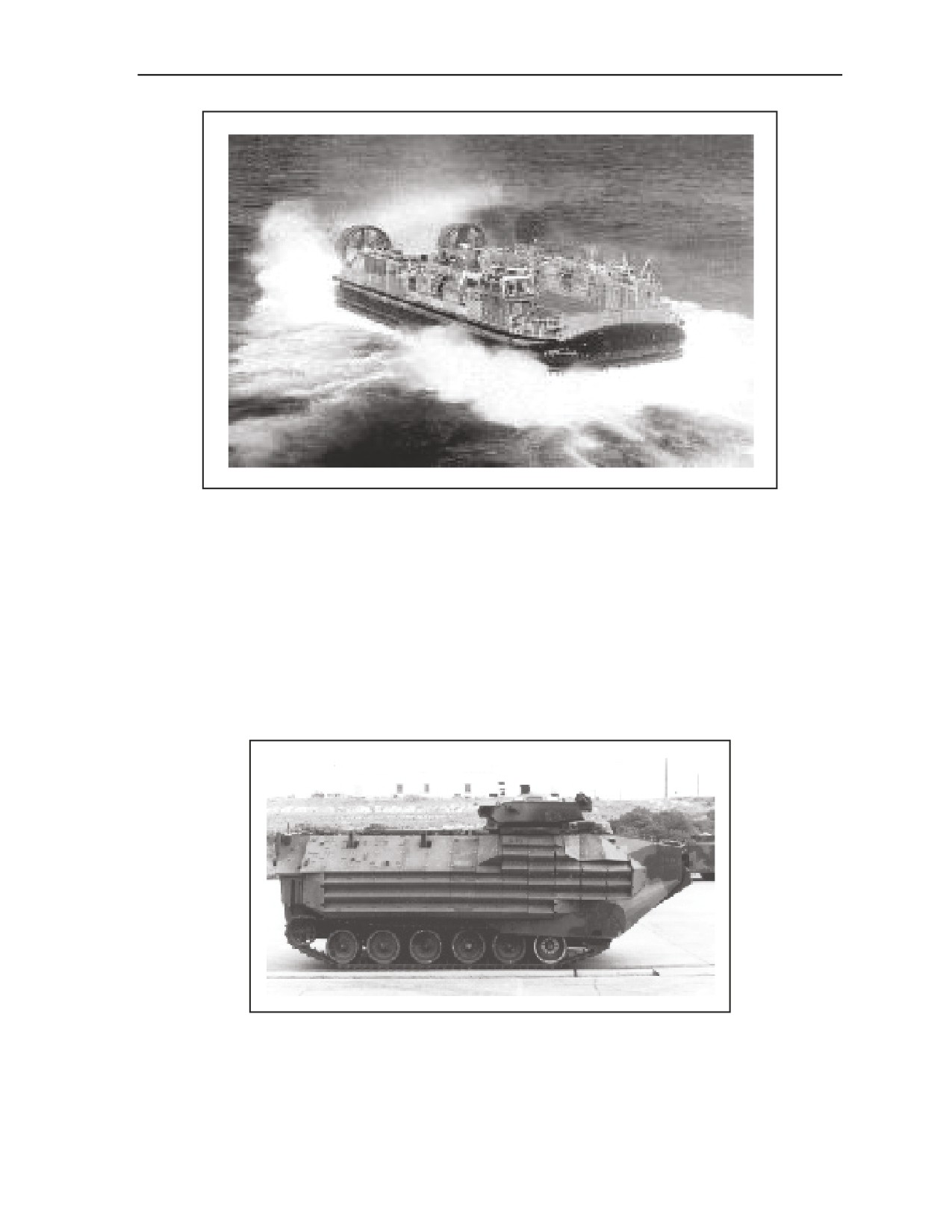
A-8. The LCAC is the primary vehicle used by the USMC to move tactical equipment and Marines from
ship to shore. It is a high-speed, fully amphibious craft capable of carrying a 60-ton payload at speeds in
excess of 40 knots, at a nominal range of 200 nautical miles. Its ability to ride on a cushion of air allows it
to operate directly from the well decks of amphibious warships and to access more than 70 percent of the
world’s beaches. See Figure A-1.
A-4
FM 3-90.12/MCWP 3-17.1
1 July 2008
Crossing Means and Organizations
Figure A-1. Landing Craft Air Cushion
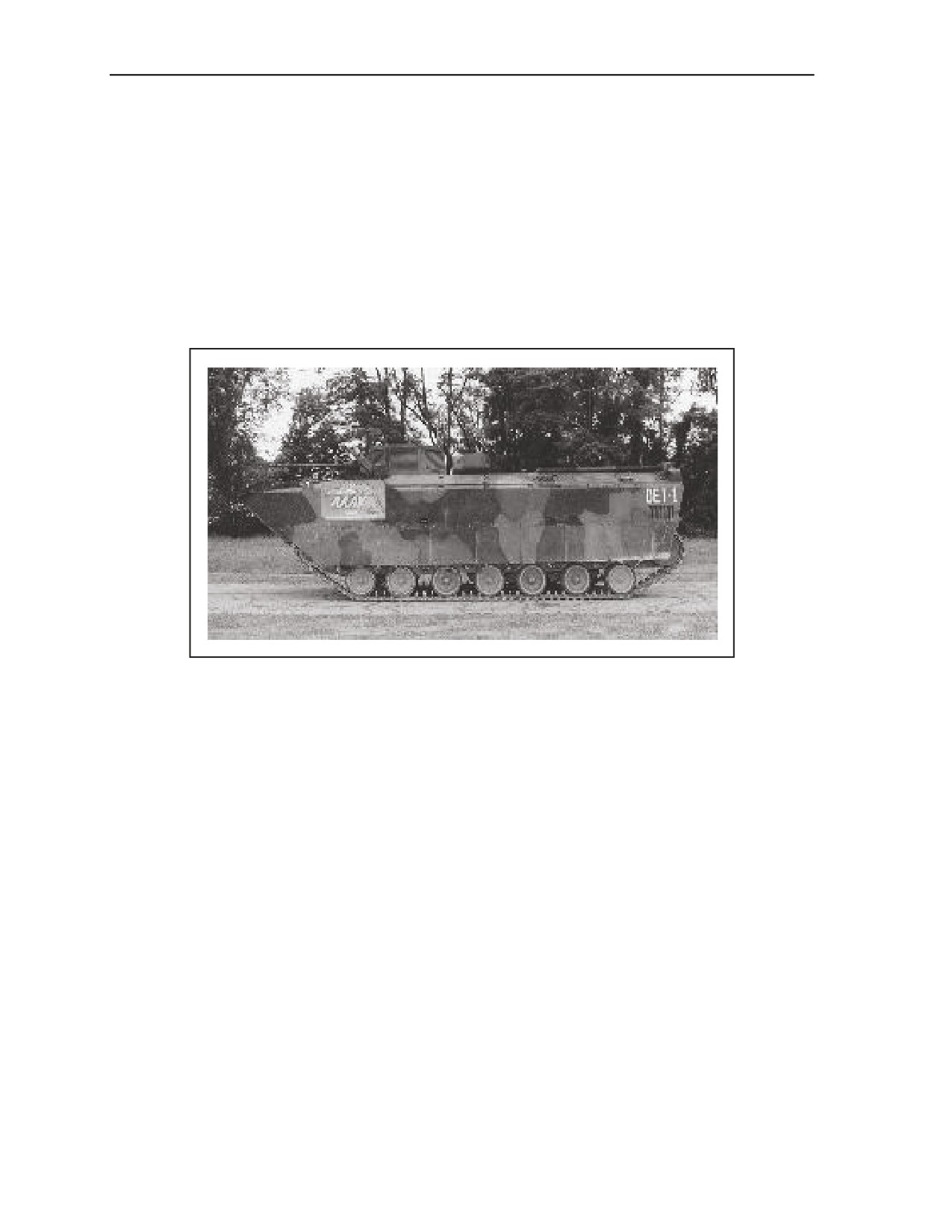
A-9. The AAV P7A1 (Figure A-2) is an armored assault amphibious full-tracked landing vehicle. The
vehicle carries troops in water operations from ship to shore, through rough water and surf zone. It also
carries troops to inland objectives after ashore. The amphibious capability of the AAV makes it unique
among all the military’s land combat systems. The primary responsibility of AAVs during an amphibious
operation is to spearhead a beach assault. They disembark from the ship and come ashore, carrying infantry
and supplies to the area to provide a forced entry into the amphibious assault area for the surface assault
element. Once the AAVs have landed, they can take on several different tasks. The standard AAV comes
equipped with an MK-19 grenade launcher and an M2 .50-caliber machine gun. With a 10,000-pound
capacity, the AAV can also be used as a bulk refueler or a field-expedient ambulance. The vehicle has a
water speed of 6 to 8 miles per hour and can travel up to 45 miles in the water. On land, it can travel 15 to
20 miles per hour with a range of 300 miles.
Figure A-2. Amphibious Assault Vehicle P7A1
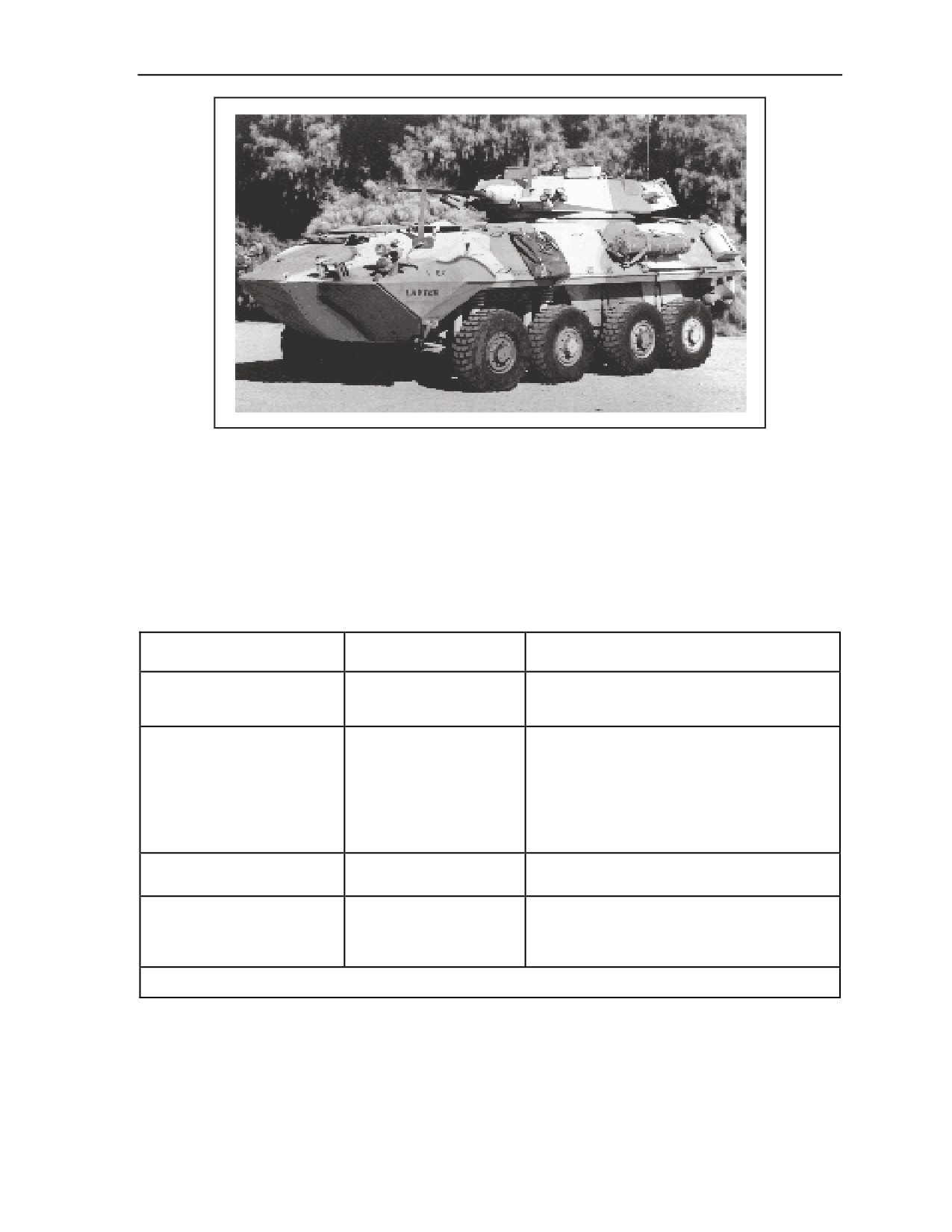
A-10. The EFV (Figure A-3, page A-6) is a keystone vehicle for both the Marine Corps expeditionary
maneuver warfare (EMW) and ship-to-objective maneuver (STOM) warfighting concepts. It will replace
the AAV P7A1 and represent the Marine Corps as its primary means of tactical mobility for the Marine
1 July 2008
FM 3-90.12/MCWP 3-17.1
A-5
Appendix A
rifle squad during the conduct of amphibious operations and subsequent ground combat operations ashore.
The EFV is an armored amphibious vehicle capable of seamlessly transporting Marines from Naval ships
located beyond the visual horizon to inland objectives. While providing the speed and maneuvering
capabilities to operate with the main battle tank (MBT) on land, it can also cross gaps such as lakes and
rivers. The EFV has two variants; the EFVP1 and the EFVC1. The EFVP1 has a 3-man crew and is
capable of initiating amphibious operations from 20-25 miles over the horizon (OTH) and transporting 17
combat equipped Marines to inland objectives. It is a fully-armored, tracked combat vehicle equipped with
an MK46 30-millimeter weapon station and 7.62-millimeter coax machine gun. The EFVC1 provides the
same armor as the EFVP1, but is employed as a tactical command post for maneuver unit commanders at
the battalion and regimental level. It is equipped with a 7.62-millimeter machine gun. Both of the EFV
variants have a water speed of 23 to 29 miles per hour on water and about 30 miles per hour on land. They
have a range of 65 miles in the water and 300 miles on land.
Figure A-3. Expeditionary Fighting Vehicle
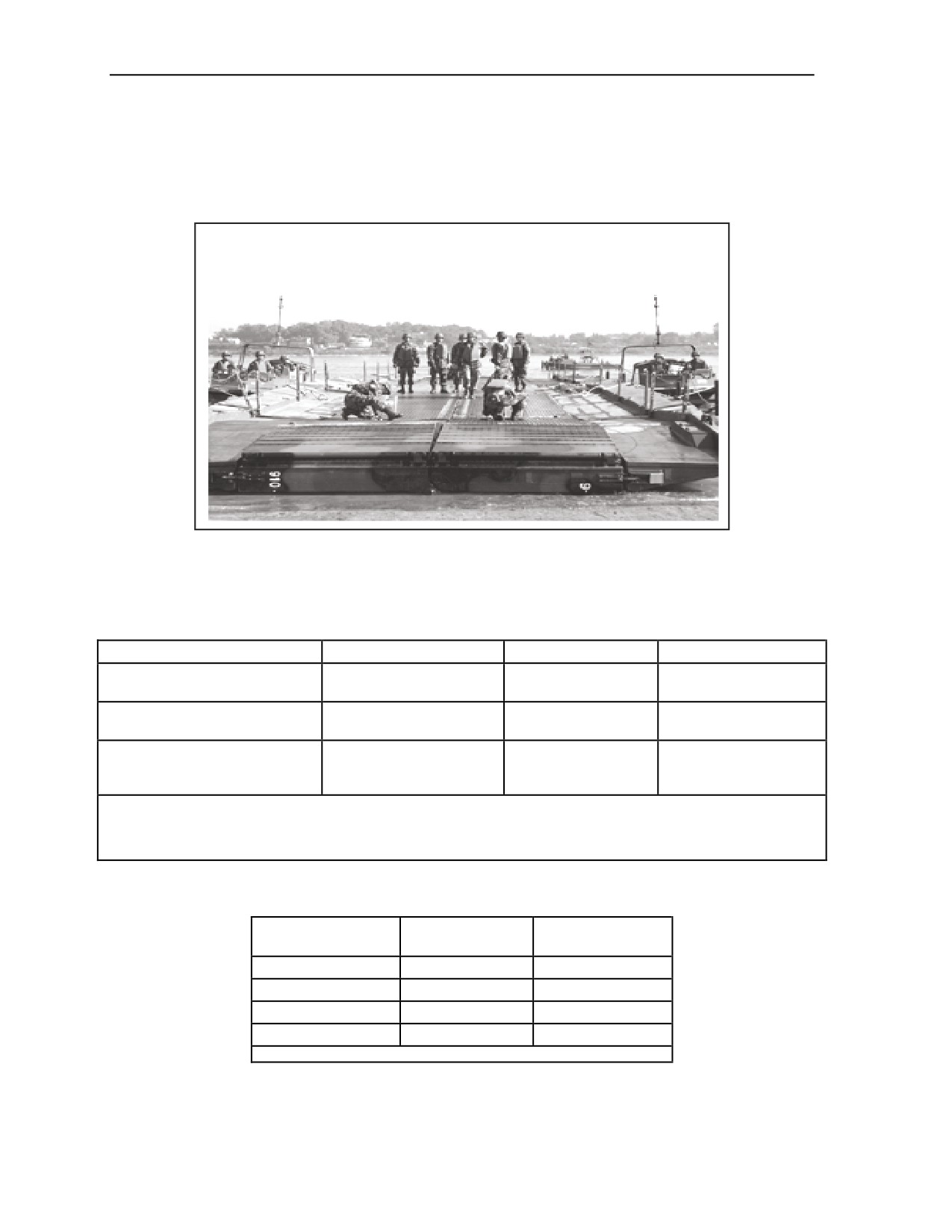
A-11. The family of light armored vehicles (FOLAV) includes 8 x 8 wheeled light armored combat,
combat support, and combat service support vehicles. The light armored vehicle family of vehicles
(LAVFOV) consists of seven fielded LAV configurations, and one communication/intelligence-configured
asset on an LAV chassis. The LAV-25 is the baseline vehicle chassis and is primarily used for the combat
and combat support roles. It is based on the Mowag Piranha family of armored fighting vehicles used by
the USMC. Powered by Detroit diesel turbo-charged engines, they are 4-wheel drive (rear wheels)
transferable to 8-wheel drive. These vehicles are also amphibious, meaning they have the ability to "swim,"
but are limited to nonsurf bodies of water (no oceans). While engaged in amphibious operations, the
maximum speed is approximately 6 miles per hour. Typical land speeds are approximately 62 miles per
hour in either 4- or 8-wheel drive; however, fuel economy decreases in 8-wheel drive. The vehicles operate
on diesel fuel, and require 3 weights of lubricants to remain in running condition. They are equipped with a
M242 25-millimeter cannon, two M240 7.62-millimeter machine guns, and two 4-barrel launchers usually
loaded with smoke canisters. The crew is three and four passengers with combat gear. See Figure A-4.
A-6
FM 3-90.12/MCWP 3-17.1
1 July 2008
Crossing Means and Organizations
Figure A-4. Light Armored Vehicle
HELICOPTERS
A-12. A primary crossing means for carrying dismounted infantry across a gap may be helicopters.
Selected types of helicopters may also be used to lift other crossing assets to the gap and carry essential
combat support and critical resupply across it. See Table A-3 for characteristics of external loads for
aircraft.
Table A-3. Typical External Loads for Helicopters
Weight in Kilograms
Equipment
Remarks
(pounds)
BEB MK II-S
The boats are lifted in the bow-and-stem
4,445 (9,800)
configuration without the cab and placed directly
on water surfaces.
Ribbon bridge bays
The bays are placed directly on water surfaces.
SRB
Interior bays
5,443 (12,000)
Ramp bays
5,307 (11,700)
IRB
Interior and ramp bays
6,350 (14,000)
REBS bridge
The bridge can be emplaced directly over the
gap.
4,800 (10,582)
DSB pallets
Transported to the bridge site in a palletized
Maximum weight of a
load configuration. The DSB launcher (M1975
single pallet load of DSB:
launch vehicle [LV]) is not helicopter
10,473 (23,040)
transportable.*
Note.
* If using a helicopter lift, refer to TM 5-5420-280-10 for the REBS or TM 5-5420-279-10 for the DSB.
BOATS
A-13. Pneumatic assault boats are another crossing means for dismounted infantry and accompanying
elements. For light infantry, assault boats may be the only means required if air resupply is available. They
carry 12 assault troops and a 2-man engineer crew in a silent or powered crossing OBM.
1 July 2008
FM 3-90.12/MCWP 3-17.1
A-7
Appendix A
RAFTS
A-14. Heavy rafts are often the initial crossing means for tanks and other fighting vehicles. They are faster
to assemble than bridges and can operate from multiple sites to reduce their vulnerability. The MRBC can
provide heavy rafting utilizing the IRB (Figure A-5 and Tables A-4 through A-8, pages A-8 through
A-10).
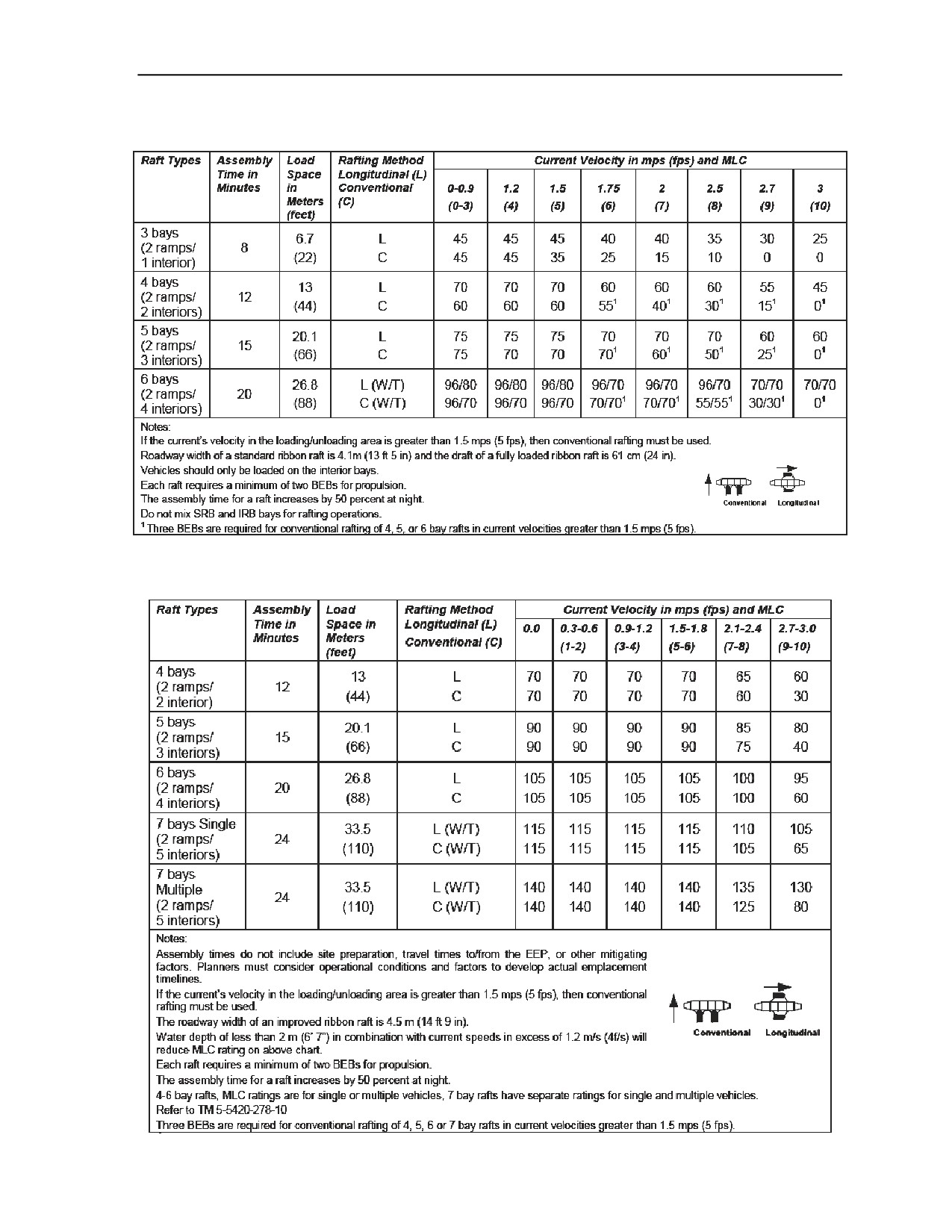
Figure A-5. Ribbon Raft
Table A-4. Launch Restrictions
Characteristics
Free Launch
Controlled Launch
High-Bank Launch
Minimum depth of water required
Ramp bay 112 (44)
76 (30)*
76 (30)**
in centimeters (inches)
Interior bay 92 (36)**
Bank height restrictions in meters
0-1.5 (0-5)
0
1.5-8.5 (5-28)
(feet)
Level the ground unless
Bank slope restrictions
0-30 percent
0-20 percent
the front of the truck is
restrained.
Notes.
* This is the recommended water depth. The launch could technically be conducted in 43 centimeters (17 inches) of water.
**The launch is based on a 10 percent slope with the transporter backed into the water. The required water depth for a 30 percent
slope with a 1.5-meter (5 feet) bank height is 183 centimeters (72 inches). Interpolate between these values when needed.
Table A-5. Allocation of Ribbon Bridge
Per Multirole
USMC Bridge
Components
Bridge Company
Company
Bridge platoons
2
1
Interior bays
30
12
Ramp bays
12
5
BEBs
14
21
Note. The longest ribbon bridge that can be constructed is 215 meters.
A-8
FM 3-90.12/MCWP 3-17.1
1 July 2008
Crossing Means and Organizations
Table A-6. Ribbon Raft Design (Standard Ribbon Bridge)
Table A-7. Ribbon Raft Design (Improved Ribbon Bridge)
1 July 2008
FM 3-90.12/MCWP 3-17.1
A-9

Appendix A
Table A-8. Raft Crossing Capabilities
River Width
Minutes per
Round Trips
Number of Rafts
Round Trip
per Hour
per Centerline
Feet
Meters
246
75
7
8
1
328
100
8
7
1
410
125
9
6
1
492
150
10
6
2
610
188
11
5
2
738
225
12
5
2
861
263
14
4
3
964
300
16
3
3
1,148
350
18
3
4
1,312
400
20
3
5
1,476
450
22
2
5
1,640
500
24
2
5
1,968
600
26
2
6
2,296
700
29
2
6
2,824
800
32
1
6
2,952
900
35
1
6
3,280
1,000
38
1
6
3,808
1,100
41
1
6
3,936
1,200
45
1
6
Notes.
1. This table is valid for ribbon rafts in current velocities up to and including 1.5 meters per
second (5 feet per second).
2. This data is based on using crews under ideal conditions.
3. Round-trip times include the times required to load and unload the raft.
4. Crossing times will take 50 percent longer at night.
5. If the river width falls between 2 columns, use the value found in the next highest column.
BRIDGES
A-15. The following sections describe standard bridging assets for the three bridging categories: tactical,
support, and LOC. These listed bridges are currently in the Army and/or USMC inventory, are in the
procurement, testing, and fielding process, or are the most common bridges currently being purchased as
COTS bridging.
Tactical Bridging
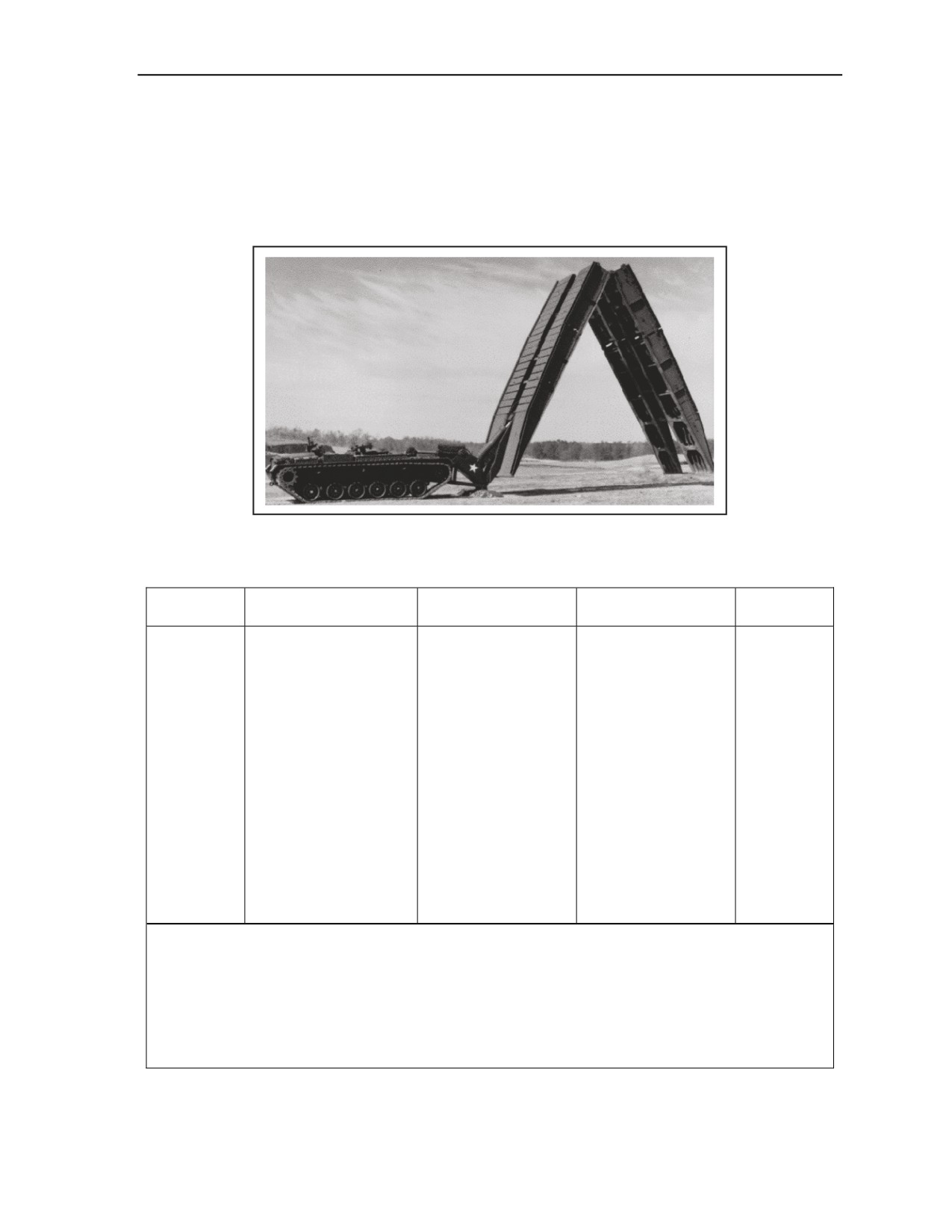
A-16. The AVLB is an organic engineer asset based on the M60 (or M48 for some nations) that can travel
with maneuvering tactical formations and can quickly gap up to 18 meters for MLC 70 vehicles. It is
unable to effectively maintain the tempo of M1 or M2 equipped units. The launcher can launch the bridge
without exposing bridge personnel to enemy fire and can retrieve the bridge from either end (Figure A-6
and Table A-9).
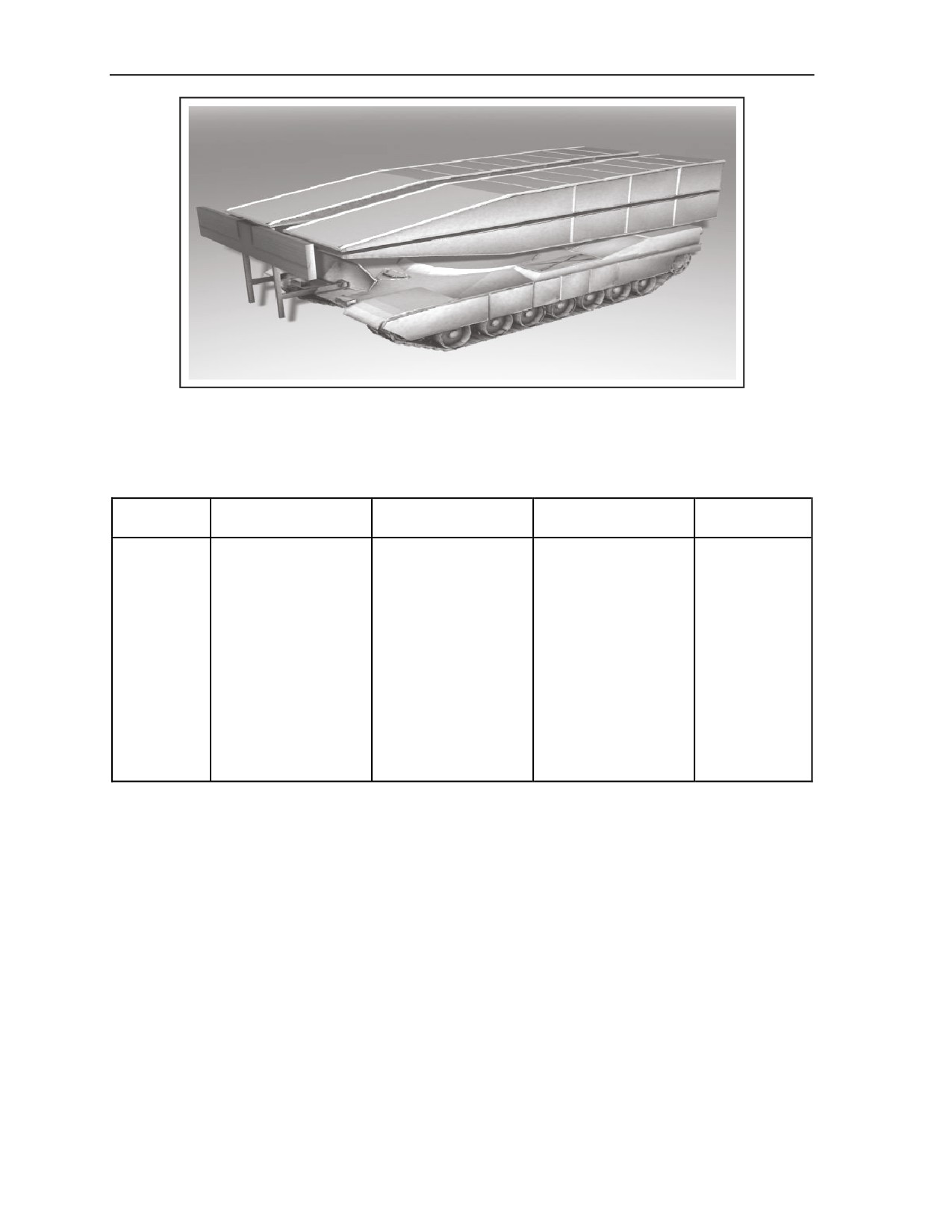
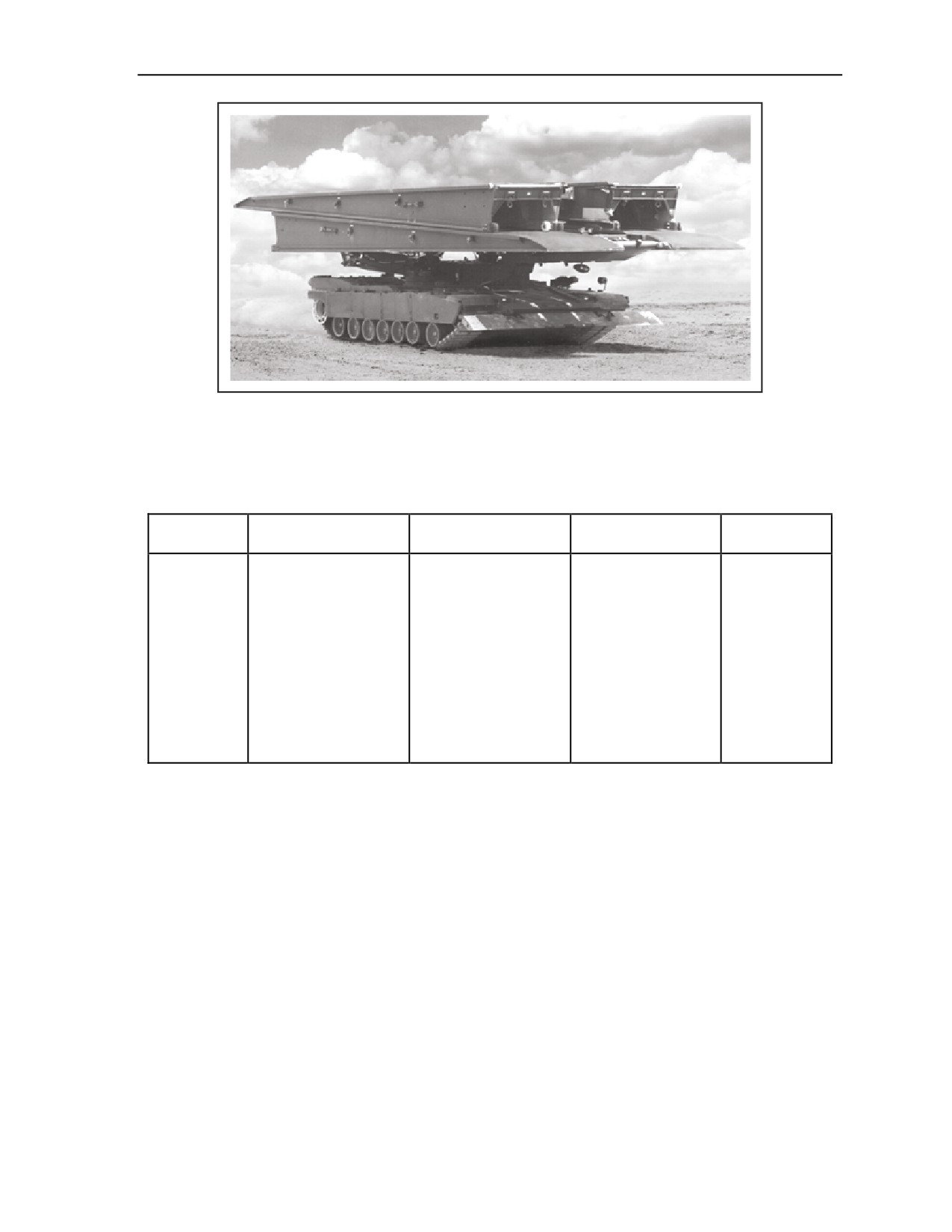
A-17. The JAB (Figure A-7, page A-12 and Table A-10, page A-12) and the Wolverine (Figure A-8, page
A-13 and Table A-11, page A-13) will eventually replace the AVLB. The Wolverine and the JAB are each
based on the M1-series Abrams tank chassis and modified to transport, launch, and retrieve an MLC 70
bridge. Because they are both mounted on the M1 chassis, they are able to maintain the tempo of all
combat maneuver organizations. The Marine Corps uses the AVLB and the JAB and they are organic to
A-10
FM 3-90.12/MCWP 3-17.1
1 July 2008
Crossing Means and Organizations
the Marine Corps armor battalions. They are organic to the MAC for Army organizations. Only selected
Army MACs are equipped with the Wolverine.
A-18. The JAB will support the assault force with the capability of spanning obstacles up to 60 feet (18.3
meters) from the high watermark inland. The JAB provides a rapidly employable, short-gap, assault
crossing bridge capable of spanning road craters, antitank ditches, partially blown bridges, railroad cuts,
canals, rivers, and ravines.
Figure A-6. Armored Vehicle-Launched Bridge
Table A-9. Characteristics of the Armored Vehicle-Launched Bridge
Capacity
Limitations/
Allocation
Transportation
Emplacement
Classification
Remarks
6 per MAC
The AVLB—
The AVLB—
The total length of the
AVLB is 19.2 meters
• Is carried on a
• Can be launched
(63 feet).*
launcher (a
in 2 to 5 minutes
modified M48A5 or
by a buttoned up
an M60A1
2-man crew.
The AVLB is capable
chassis).
of holding an MLC 60
• Can be retrieved
vehicle across—
• Weighs 15,000
from either end.
kilograms (15 tons)
• A 17.4 meters
• Requires that 1
(bridge only).
(57 feet) gap with
man be exposed
unprepared
• The spare bridge is
to guide and
abutments.
folded on a 25-ton
connect while
low bed trailer with
retrieving.
• An 18.3 meters
a 10-ton tractor
(60-feet) gap with
(usually
prepared
consolidated at
abutments.
corps or theater
level).
Notes.
For crossings on the AVLB that exceed MLC 60:
(1) Vehicles must not stop on the bridge.
(2) Vehicles must not turn or adjust their alignment on the bridge.
(3) The ground guide must have the vehicle lined up properly before it drives onto the bridge.
(4) All four center pins of the bridge must be in place to provide additional stability.
1 July 2008
FM 3-90.12/MCWP 3-17.1
A-11
Appendix A
Figure A-7. Joint Assault Bridge
Table A-10. Characteristics of the Joint Assault Bridge
Capacity
Limitations/
Allocation
Transportation
Emplacement
Classification
Remarks
6 Per MAC
The JAB—
The JAB—
The total height of the
The JAB is
(will replace
JAB is 13.1 feet.
currently being
• Is carried on a
• Can be retrieved
the AVLB)
tested.
launcher (a
from either end.
modified M1
• Requires that 1
The JAB is capable of
series Abrams
holding an MLC 70
Only good when
man be exposed
tank chassis).
to guide and
vehicle across an 18.3
spanning
• The spare bridge
connect while
meters (60 feet) gap.
obstacles/gaps
is folded on a 25
retrieving.
of 60 feet (18.3
ton low bed trailer
meters).
with a 10-ton
tractor (usually
consolidated at
corps or theater
level).
A-12
FM 3-90.12/MCWP 3-17.1
1 July 2008
Crossing Means and Organizations
Figure A-8. Wolverine
Table A-11. Characteristics of the Wolverine
Capacity
Limitations/
Allocation
Transportation
Emplacement
Classification
Remarks
6 per MAC
The Wolverine—
The Wolverine—
The Wolverine—
The launcher
(Only 6
and bridge has
• Is carried on a
• Can be launched
• Can hold an
selected
a maximum
launcher (a
in less than
MLC 70
MACs are
speed of 83
modified M1
5 minutes by a
vehicle.
equipped
kilometers per
series Abrams
buttoned up 2
• Expands to a
with
hour.
tank chassis).
man crew.
total length of
Wolverines)
• Weighs 12,500
• Can be retrieved
24 meters.
kilograms (12.5
from either end.
The Wolverine
tons) (bridge
can ford up to
• Can be
only).
a depth of 122
recovered in less
centimeters
than 10 minutes.
(without a kit).
Support Bridging
A-19. Support bridges (excluding float bridges) rest on the gap sides or riverbanks. They span dry gaps as
well as wet gaps. They have limited use for the initial assault because they are slower to emplace and
vulnerable to enemy action. Where appropriate, other standard or nonstandard bridging supplements or
replaces float bridges.
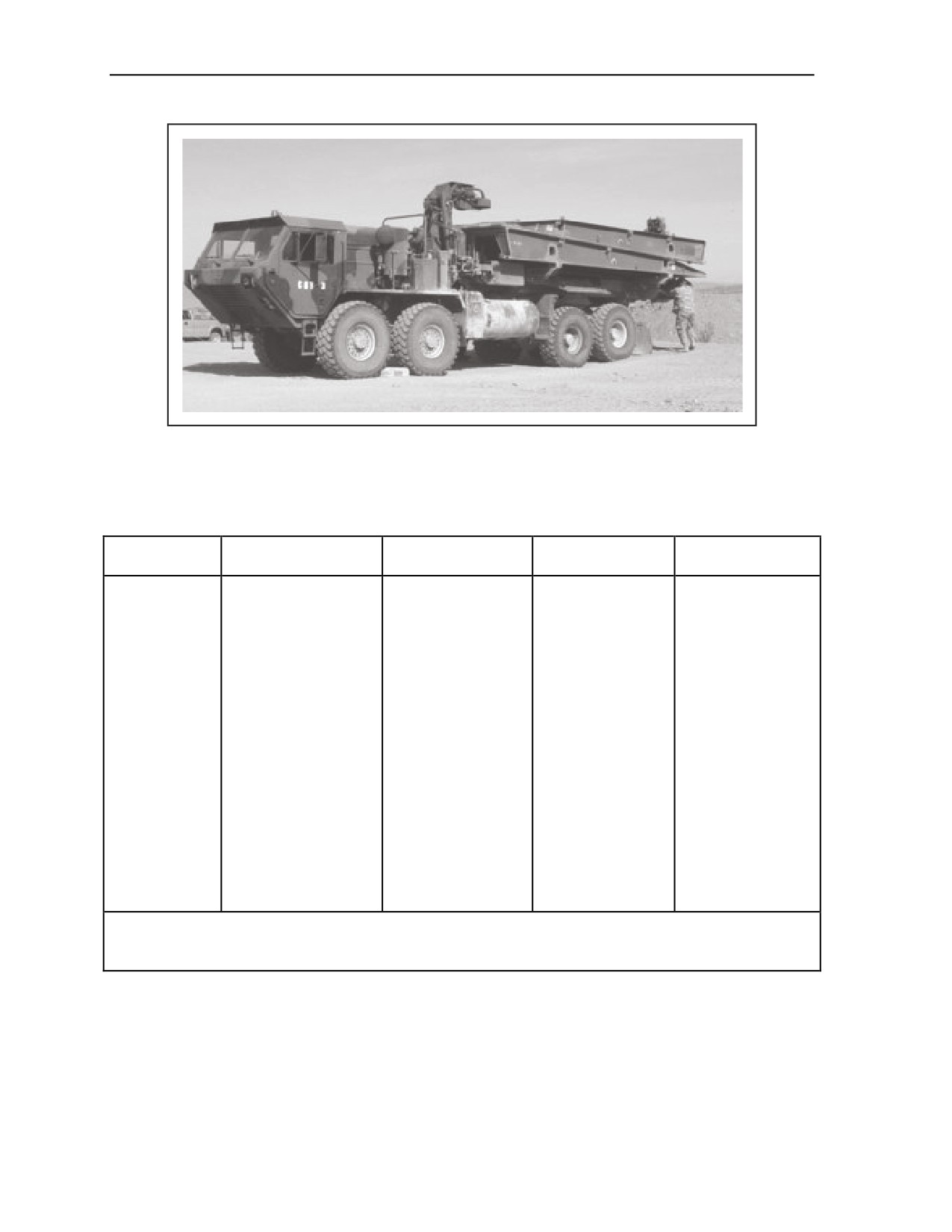
A-20. The REBS (Figure A-9, page A-14, and Table A-12, page A-14) is a deployable and retrievable
bridge that provides the SBCT with a gap-crossing capability. The REBS can be employed by two Soldiers
within 10 minutes and is air-transportable by the C-130. The REBS has an MLC 30 and is capable of
crossing gaps up to 13 meters wide. It is also capable of an MLC 40 caution crossing. The REBS is
designed to serve as a support bridge, however, it may be used as a tactical bridge as the situation and time
permits.
1 July 2008
FM 3-90.12/MCWP 3-17.1
A-13
Appendix A
Figure A-9. Rapidly Emplaced Bridge System
Table A-12. Characteristics of the Rapidly Emplaced Bridge System
Capacity
Limitations/
Allocation
Transportation
Emplacement
Classification
Remarks
4 per EN CO
REBS—
REBS—
REBS—
The bridge is
SBCT
capable of being
• The bridge is
• Can launch in
• Can hold an
lifted/ emplaced by
carried on an
less than
MLC 40
helicopter.
integrated
10 minutes with
vehicle
pallet/launch
a 2-man crew.
• Can be used
platform.
• Can be
to bridge a
The pallet with the
• The bridge and
retrieved from
maximum of
bridge is C-130
pallet are carried
either end.
13 meters of
transportable.*
together on the
an unprepared
• Can be
CBT.
gap.
recovered in
• Weighs
less than
10,582 pounds,
10 minutes with
4800 kilograms
a 2-man crew.
(bridge only).
• Weighs
20,856 pounds,
9460 kilograms
(bridge and
pallet).
Notes.
Emplacement times vary based on many factors (such as unit training, experience, and site preparation). Planners must
consider these and other operational conditions and factors to develop actual emplacement timelines.
* To transport by C-130, the REBS must be placed on 463 L pallets.
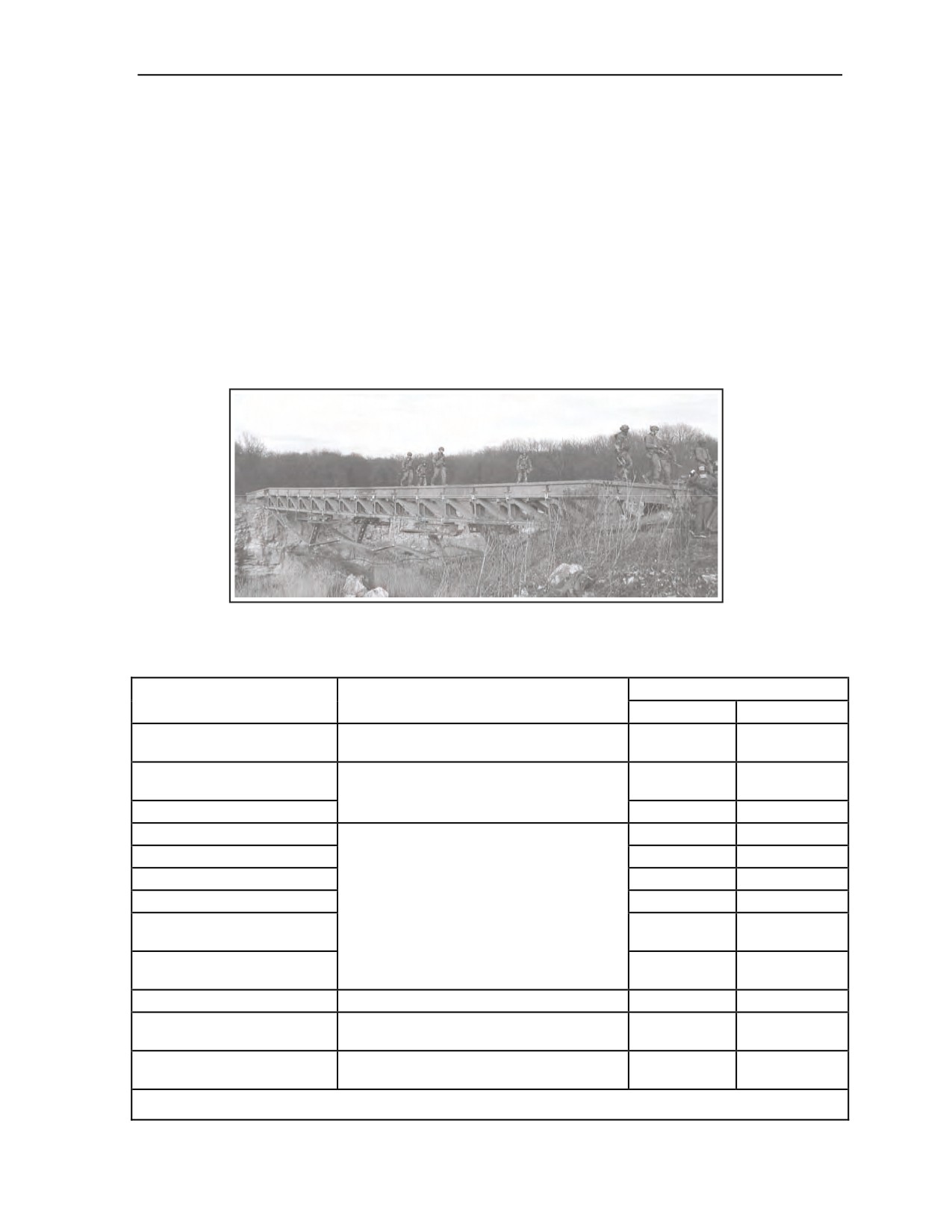
A-21. The MGB (Figure A-10 and Tables A-13 through A-16, pages A-15 through A-17) is lightweight,
hand-built bridging equipment that can be built in various configurations serving as a support bridge. Its
parts are fabricated from a specially developed zinc, magnesium, and aluminum alloy that enables a
lightweight, high-strength bridge to be built. All except three parts weigh less than 200 kilograms. Most
parts can be handled easily by four Soldiers and Marines. The three heavier parts, used in limited
quantities, are six-man loads.
A-14
FM 3-90.12/MCWP 3-17.1
1 July 2008
Crossing Means and Organizations
A-22. The MGB is a two-girder, deck bridge. The two longitudinal girders with deck units between
provide a 4-meter-wide roadway. Girders of top panels can form a shallow, SS configuration. This type of
bridge is used for short spans that will carry light loads. A heavier DS configuration using top panels and
triangular bottom panels is used for heavy loads or longer spans. SS bridges can be constructed by 9 to 17
Soldiers and Marines. The normal building party for DS bridges is 25 Soldiers and Marines.
A-23. The bridge can be supported on unprepared and uneven ground without grillages. It is constructed on
one roller beam for SS construction; on two roller beams, 4.6 meters apart for DS construction; and on
three roller beams when constructing a DS bridge over 12 bays long. The ends of the roller beams are
supported on base plates and each can be adjusted in height. No leveling or other preparation of the ground
is required. Single-span bridges are launched using a centrally mounted launching nose.
A-24. A third configuration using the LRS is constructed when a long, high-class type of bridge is
required. The LRS deepens the girder and transfers the load throughout the length of the bridge. This type
of construction requires a building party of 34 Soldiers and Marines, and is built on three roller beams.
Figure A-10. Medium Girder Bridge
Table A-13. Work Parties and Construction Times for the Medium Girder Bridge (Army)
Construction Time (Hours)
Bridging Activity
Work Party
Day
Night
4 and 5 bay SS (7.9 to 9.8
1 noncommissioned officer (NCO) and 8
1/2
3/4
meters or 26 to 32 feet)
personnel
6 through 12 bay SS (11.6 to
3/4
1
15.2 meters or 38 to 50 feet)
1 NCO and 16 personnel
9 through 12 bay SS
1
1 1/4
1 through 4 bay DS
3/4
1 1/4
5 through 8 bay DS
1
1 1/2
9 through 12 bay DS
1 1/2
2
13 bay DS without LRS
1 1/2
2
1 NCO and 24 personnel
14 through 18 bay DS without
1 3/4
2 3/4
LRS
19 through 22 bay DS without
2
3
LRS
13 bay DS with LRS
2 NCO and 32 personnel
2
3
14 through 18 bay DS with
2 3/4
4
LRS
16 through 22 bay DS with
3
4 1/2
LRS
Note. Construction times vary based on many factors (such as unit training, experience, and site preparation). Planners must
consider these and other operational conditions to develop actual emplacement timelines.
1 July 2008
FM 3-90.12/MCWP 3-17.1
A-15
Appendix A
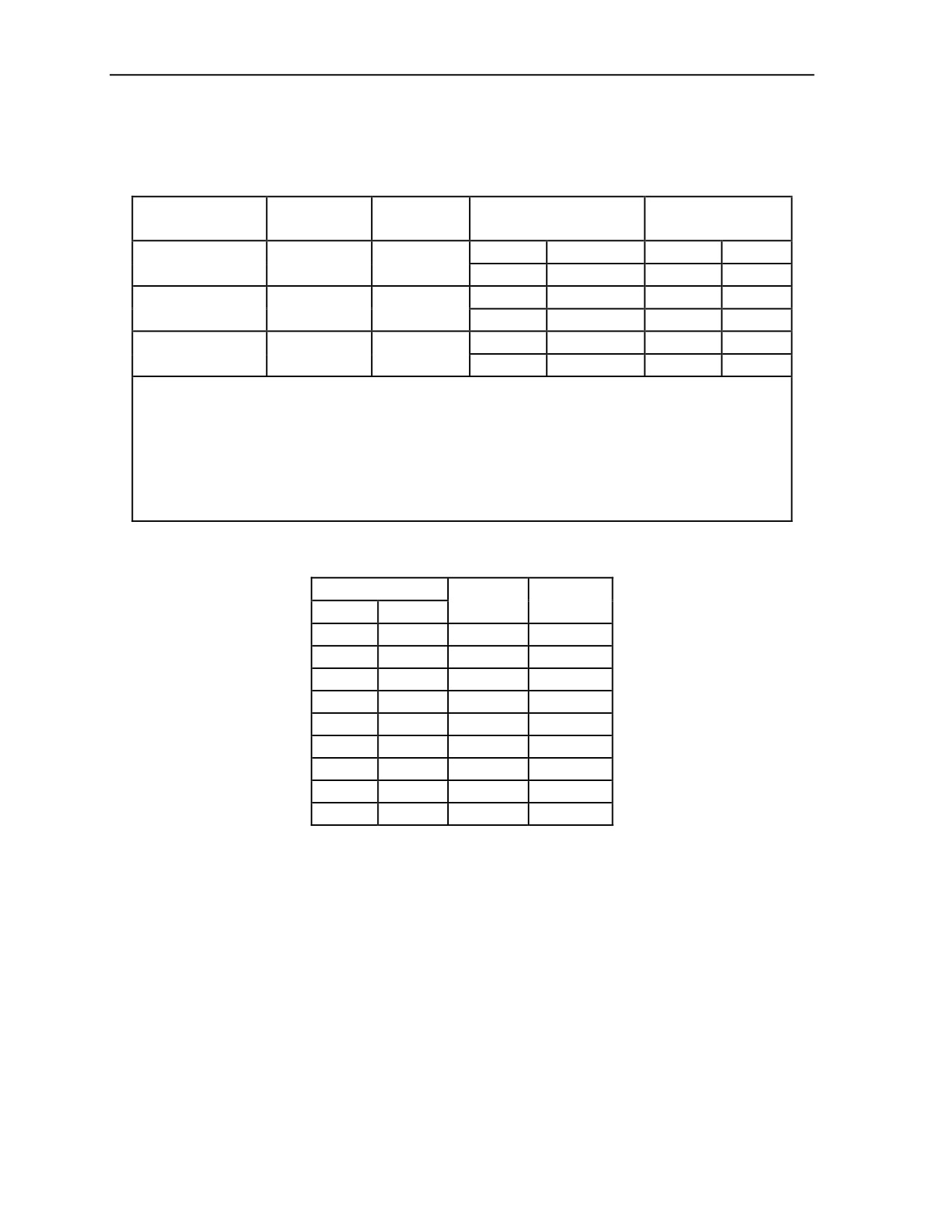
Table A-14. Work Parties and Construction Times for the Medium Girder Bridge
(USMC)
Transport
Construction Time
Configuration
Gap Length
Personnel
Required*
(Hours)
Up to 9
NCO
Workforce
Day
Night
SS
7
meters
1
8
1 hr
1 1/4 hr
Up to 29
NCO
Workforce
Day
Night
DS
11
meters
1
16
1 1/2 hr
2 hr
Up to 40
NCO
Workforce
Day
Night
DS with LRS
15
meters
1
24
3 hr
4 1/2 hr
Notes.
1. Emplacement times vary based on many factors (such as unit training, experience, and site preparation). Planners
must consider these and other operational conditions to develop actual emplacement timelines.
2. Six sets per USMC bridge company. Each set is equipped with enough components to build one of the
configurations shown above.
3. Maximum approach ramp slope not to exceed 1:10 for SS, DS, and XX.
4. Maximum approach ramp slope not to exceed 1:20 for DS with LRS.
5. Maximum size for each configuration is depicted in this table.
6. Actual requirements will vary based on actual bridge configuration and proficiency of personnel.
*Value is expressed in quantity of 7-ton trucks. Includes vehicles for transportation of personnel.
Table A-15. Single-Story Bridge Length and Classification for the Medium Girder Bridge
Bridge Length
Number
MLC
of Bays
Feet
Meters
26
7.9
4
70
32
9.8
5
70
38
11.6
6
40
44
13.4
7
30
50
15.2
8
30
56
17.1
9
24
62
18.9
10
20
68
20.7
11
16
74
22.6
12
16
A-16
FM 3-90.12/MCWP 3-17.1
1 July 2008

Crossing Means and Organizations
Table A-16. Classification for the Medium Girder Bridge Double Story, Double Story Without
Link Reinforcement Set, and Double Story With Link Reinforcement Set
Bridge Length
2E +
MLC
Number of
Without Link
With Link
Feet
Meters
Bays
Reinforcement
Reinforcement
37
11.0
1
70
-
43
12.8
2
70
-
49
14.6
3
70
-
55
16.5
4
70
-
61
18.3
5
70
-
67
20.1
6
70
-
73
21.9
7
70
-
79
23.8
8
70
-
85
25.6
9
70
-
91
27.4
10
70
-
97
29.3
11
70
-
103
31.1
12
70
-
109
32.9
13
60
70
115
34.8
14
50
70
121
36.6
15
40
70
127
38.4
16
40
70
133
40.2
17
30
70
139
42.1
18
30
70
145
43.9
19
24
70
151
45.7
20
24
70
157
47.6
21
20
70
163
49.4
22
16
70
Note. Emplacement times vary based on many factors (such as unit training, experience, and site
preparation). Planners must consider these and other operational conditions to develop actual
emplacement timelines.
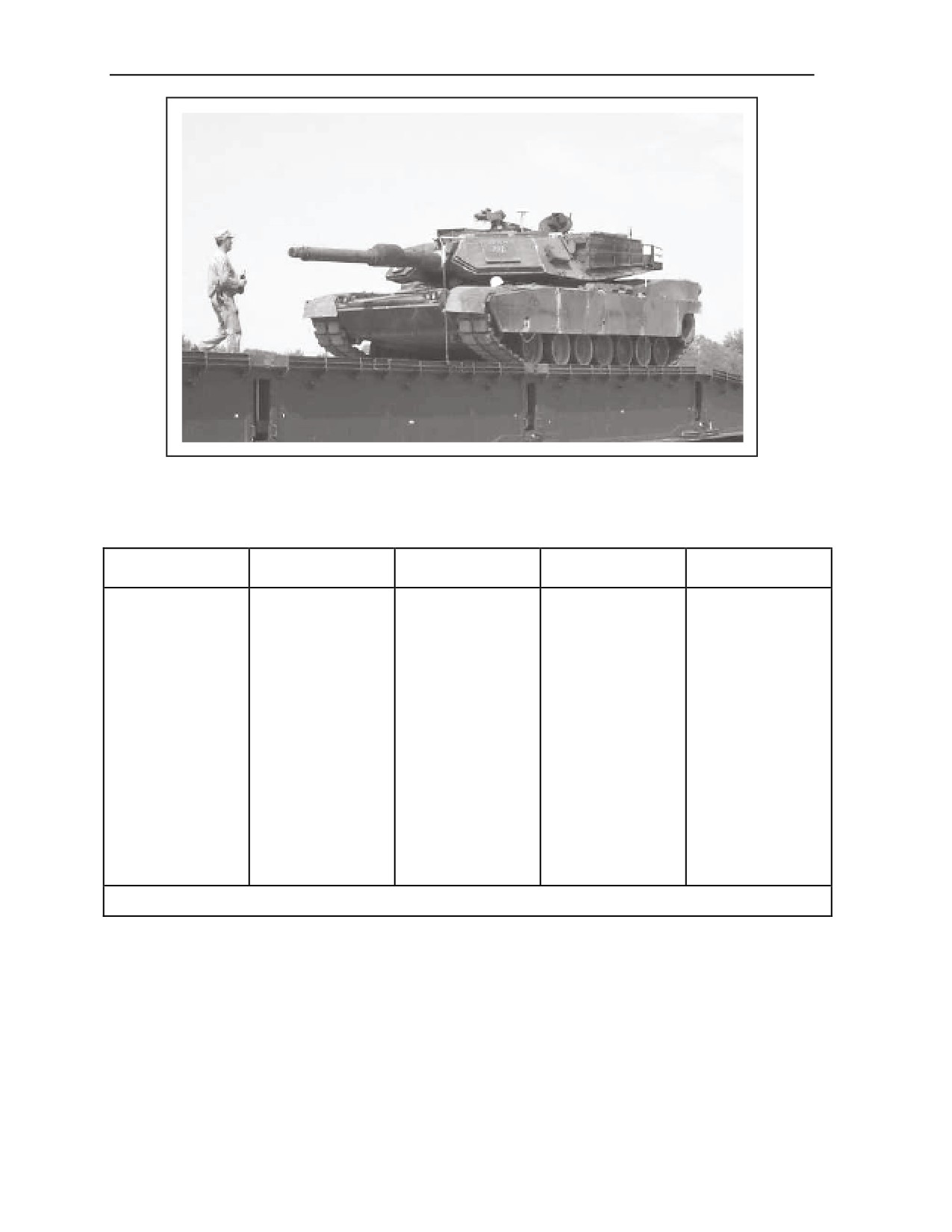
A-25. Now being fielded as a replacement for the MGB in the MRBCs is the M18 DSB. It is a mobile,
rapidly erected, modular component bridge that provides a 40-meter gap-crossing capability with an MLC
of 70T/96W. It has advantages over the MGB in that it can be erected in much less time with fewer
personnel and equipment. Each MRBC is capable of emplacing up to four 40-meter bridges or eight
20-meter bridges with organic equipment (Figure A-11, page A-18, and Table A-17, page A-18).
1 July 2008
FM 3-90.12/MCWP 3-17.1
A-17
Appendix A
Figure A-11. M18 Dry Support Bridge
Table A-17. Characteristics of the M18 Dry Support Bridge
Capacity
Limitations/
Allocation
Transportation
Emplacement
Classification
Remarks
4 per MRBC
The DSB—
The DSB—
The DSB—
The DSB—
• Launcher is a
•
40-meter bridge
• MLC for all bridge
• Maximum
separate vehicle
can be launched
configurations
approach ramp
(M1975 LV).
in 90 minutes
(70T/96W).
angle (1:9).
with an 8-man
• One 40-meter
• Can provide one
• All components
crew.
bridge is
40-meter bridge
are landing craft,
transported on
•
40-meter bridge
or two 20-meter
utility (LCU) 2000
seven PLS
can be retrieved
bridge
or larger
pallets.
in less than
configurations.
(transportable).
150 minutes with
• Complete
• Approved for
an 8-man crew.
system is
C17 and C5
transportable
• Can be retrieved
transport.
and requires one
from either end.
• Zero gap capable
M1975 LV with
bridge.
trailer and three
M1977 CBT with
trailers.
Note. Emplacement times vary based on many factors (such as unit training, experience, and site preparation). Planners must
consider these and other operational conditions to develop actual emplacement timelines.
Support Bridging - Float Bridges
A-26. If there is a need for a wet-gap-crossing means beyond the capability of tactical bridging, it should
be understood that, in most cases, rafts alone will not handle the total volume of traffic in the needed time.
Floating bridges are the primary means to cross the force and its supplies rapidly. The same units that
provide heavy rafts also provide float bridges. They often assemble bridges from the rafts used earlier.
A-27. The SRB and IRB (Figures A-12 and A-13 and Table A-18, pages A-20 and A-21) are modular,
aluminum-alloy, and continuous floating bridge systems consisting of interior and ramp bays that are
transported, launched, and retrieved by a transporter/launcher vehicle. Bridge bays, which are carried in a
folded position, automatically open upon entering the water to form a 22-foot section of bridge.
A-18
FM 3-90.12/MCWP 3-17.1
1 July 2008
Crossing Means and Organizations
A-28. Ribbon equipment is designed for use primarily during the rafting and bridging phases of the
deliberate wet-gap crossing. Because ribbon bridges and rafts are significantly faster to construct with
fewer personnel than other floating bridges, they are heavily relied upon in this capacity. Site
considerations are of primary importance when ribbon equipment is to be used for rafting or bridging
operations. Both the launch sites and actual bridge or raft sites should be considered.
A-29. Ribbon bridges can be emplaced during daylight hours at the rate of 200 meters per hour or 600 feet
per hour. Assembly times should be increased by 50 percent when construction is at night. These times are
also based upon an experienced bridge crew for bridge construction under ideal conditions. Like the other
bridging emplacement times provided in this manual, planners must consider challenges such as unit
training and experience and the tactical situation in conjunction with the results of the gap reconnaissance
(such as gap width, gap bank, conditions of the slope, stream velocity, visibility, terrain, weather
conditions, and accessibility). Other unique planning considerations for float bridging impacting
emplacement times are simultaneous bay launch, distance to the EEP, and the number of BEBs supporting
construction. All of these factors must be incorporated into the mission analysis to make an actual
determination of emplacement times.
A-30. The river's current velocity can impact significantly upon all float bridging operations. Ribbon
equipment can be used in currents of 0 to 10 feet per second. Rafting and bridging operations can become
quite difficult in currents greater than 5 feet per second unless the boat operators and bridge crewmen have
experience working in swift currents. For raft sites on rivers with currents greater than 5 feet per second,
the unloading site on the farside should be located downstream of the loading site on the nearside to allow
for a downstream drift.
A-31. The IRB is a modular floating bridge with integral superstructure and floating supports. A complete
IRB consists of a ramp bay at each bank and the required number of interior bays to complete the bridge.
Individual bays may be joined to form a raft for rafting or ferrying operations. The IRB mission is to
provide a continuous roadway or raft capable of crossing assault or tactical vehicles over nonfordable wet
gaps. IRBs have an MLC of 70T/96W.
A-32. The IRB is employed in the same general manner as the SRB. However, it will be able to cross faster
water with higher MLCs and with banks that are up to 2 meters high. The IRB bays are modified ribbon
bays. They possess better hydrodynamics, providing the capability of rafting or bridging MLC 70T traffic
in currents up to 8 feet per second. The bays can be connected in 1 minute and can be connected to the
standard ribbon bays. The bays include positive flotation to increase the survivability of the system. The
ramp bays can be hydraulically articulated to 2 meters.
1 July 2008
FM 3-90.12/MCWP 3-17.1
A-19
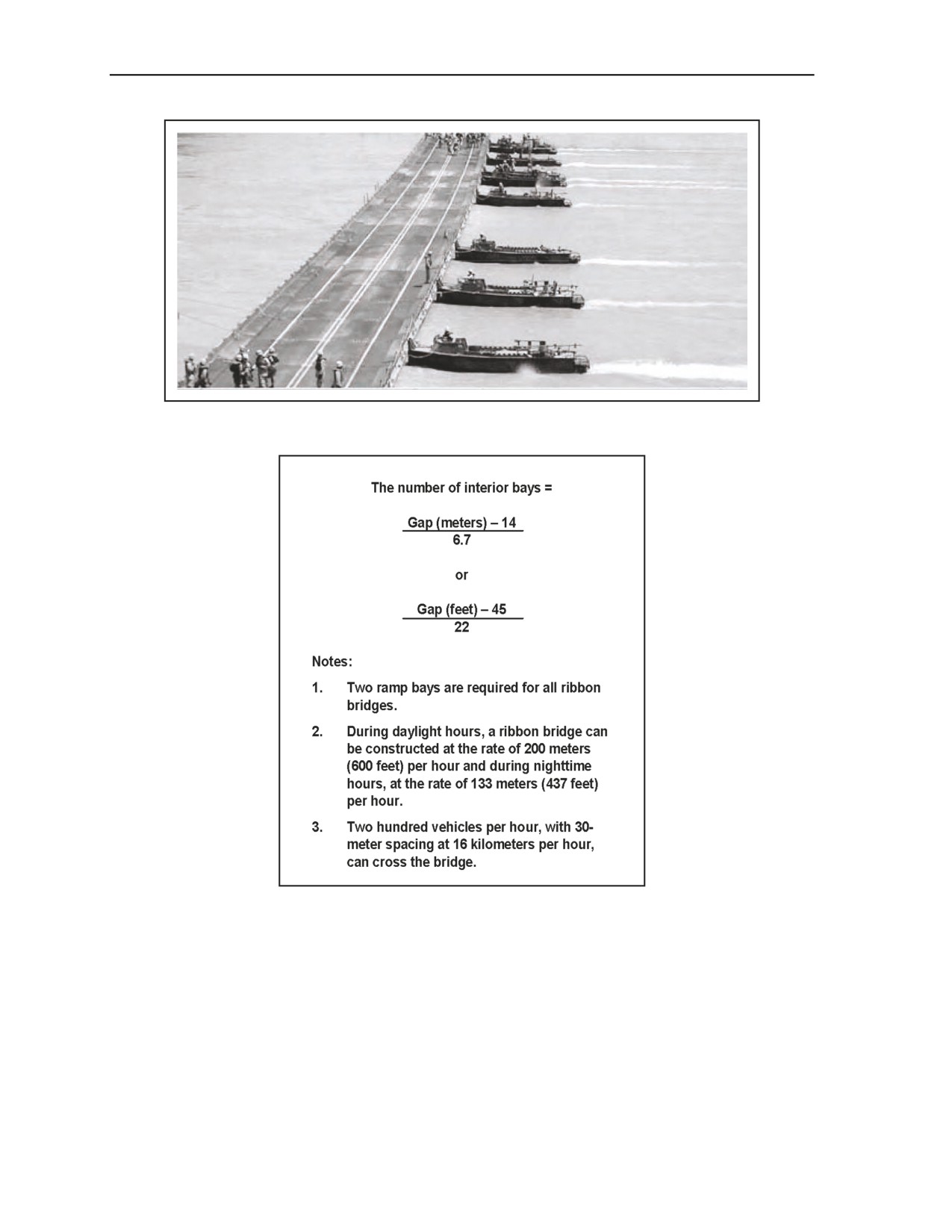
Appendix A
Figure A-12. Ribbon Bridge
Figure A-13. Ribbon Bridge Design
A-20
FM 3-90.12/MCWP 3-17.1
1 July 2008
Crossing Means and Organizations
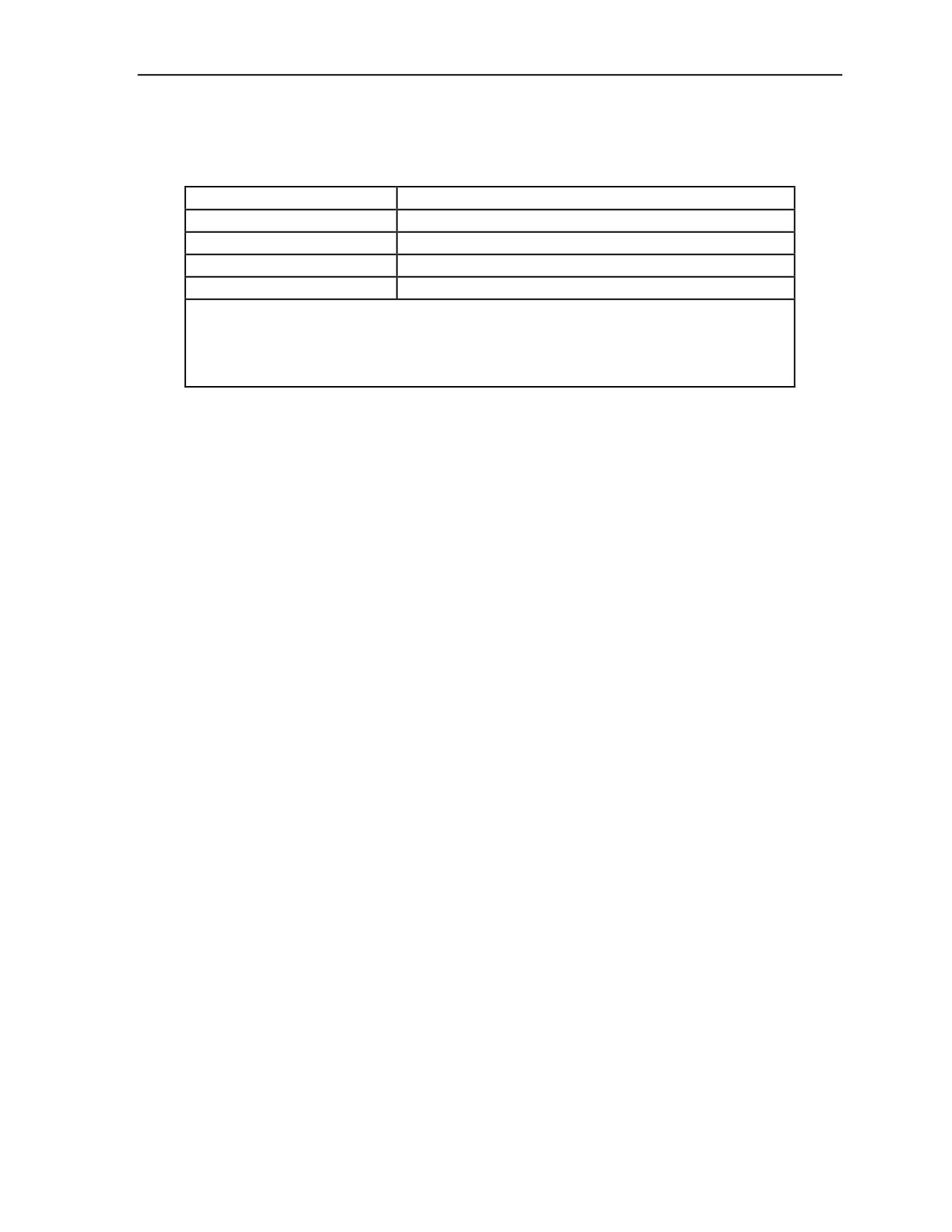
Table A-18. Boat Requirements for Ribbon Bridge Anchorage
Current Velocity in mps (fps)
Number of Boats: Number of Bridge Bays
0 to 1.5 (0 to 5)
1:4
1.5 to 2.4 (5 to 8)
1:3
2.4 to 2.6 (8 to 9)
1:2
2.7 to 3.0 (9 to 10)
Anchorage system is necessary
Note.
(1)Temporary anchorage of ribbon bridges is normally done by tying BEBs to the downstream side of the
bridge.
(2) The number of boats required is shown in the table.
(3) For long-term anchorage or if the water current dictates, additional anchorage systems will be
necessary.
Line of Communications Bridging
A-33. LOC bridging is generally conducted in areas free from the direct influence of enemy action. This
does not mean that protection against attacks by air and ground forces are not considered. Their
emplacement is not generally time-constrained in a tactical sense. Because of the load to be carried,
potential length of service, and the longer spans (usually) of LOC bridges, a thorough reconnaissance,
planning, and site preparation are essential. While there are several standard bridging options for LOC
bridges, consideration should be given to nonstandard construction if time permits and resources are
available; due to the length of anticipated service and to conserve standard bridging assets.
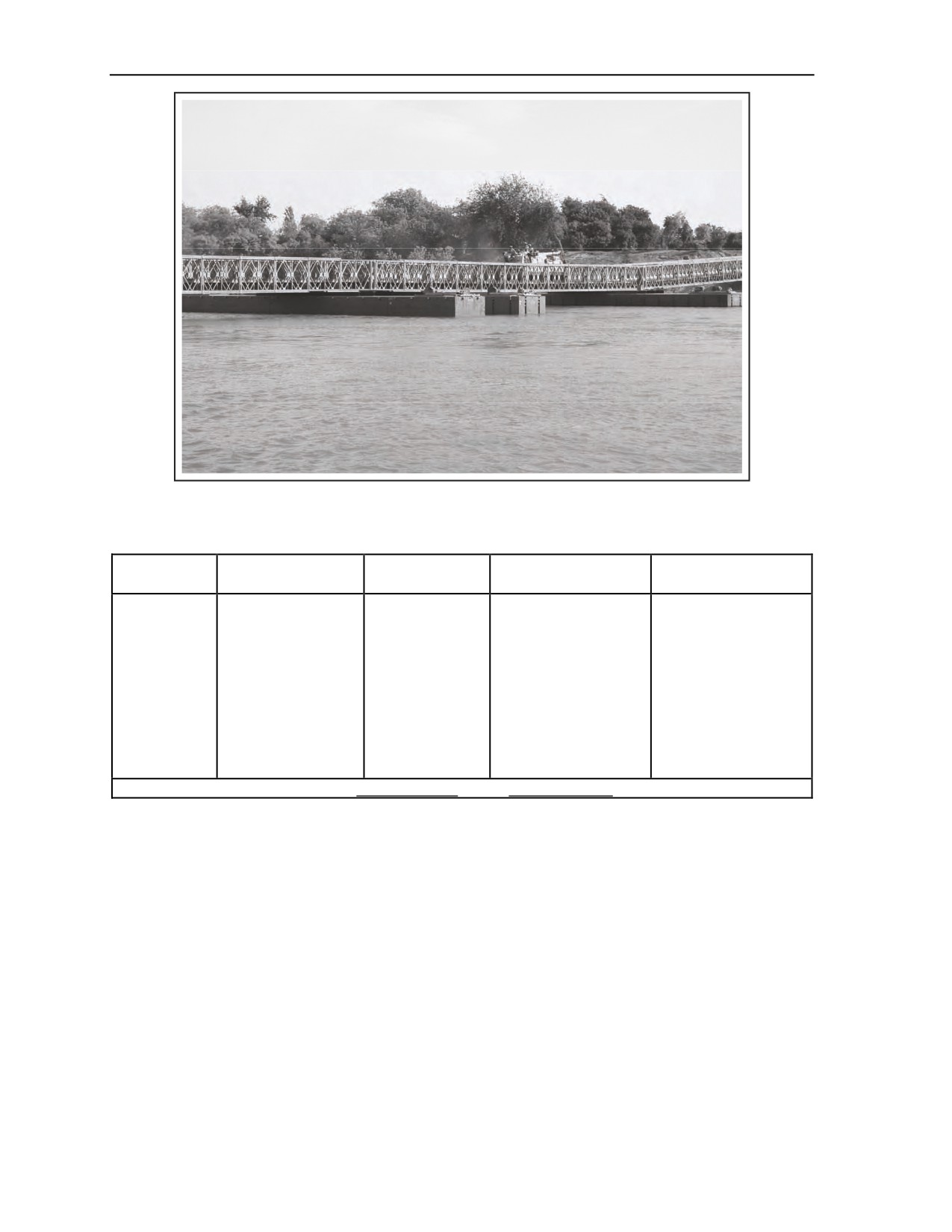
A-34. The LSB (Figure A-14 and Table A-19, page A-22) uses equipment from the COTS Compact 200®
panel bridge system together with special features to make it suitable for military applications. The system
is composed of a small range of standard parts: panels, chord reinforcements, transoms, decks, bracing
members, ramps, grillages, and ground beams. The modular design of the equipment means it can be
constructed in a large number of different configurations, allowing the system to be used for a wide range
of load and spans. The LSB is a LOC bridge that can serve as a new bridge, replace a damaged bridge, or
replace a support bridge to upgrade routes for heavier traffic.
A-35. The system is capable of routinely carrying loads to MLC 80 tracked and MLC 110 wheeled (MLC
80T/110W), and is designed to be left as a semipermanent bridge. To fulfill this requirement, the LSB
requires only minimal maintenance. The LSB overcomes limitations in width, span, capacity and fatigue
life associated with many other systems. The LSB can be built by hand, but where cranes and other
mechanical handling equipment are available, the total number of man-hours to build the bridge is
substantially reduced. Bridge components can be transported using a demountable rack offload and pickup
system
(DROPS), palletized load system
(PLS) flat racks, and International Organization for
Standardization (ISO) containers.
1 July 2008
FM 3-90.12/MCWP 3-17.1
A-21
Appendix A
Figure A-14. Logistics Support Bridge
Table A-19. Characteristics of the Logistics Support Bridge
Allocation
Transportation
Emplacement
Capacity
Limitations/ Remarks
Classification
Purchased
LSB can be
LSB—
LSB—
Site preparation must
only when
transported by
be taken into account
• Can be
• MLC 80T/110W;
needed.
numerous means:
emplaced by
48.77-meter span;
for planning.
•
40-foot flat bed
hand or by
normal crossing.
trailer.
mechanical
• Single or multiple
Large amount of time
means
• PLS flat racks.
span bridges.
or personnel plus
(crane).
equipment must be
• ISO containers.
• Roadway width of
dedicated to complete
4.2 meters; 4.72
•
20-foot rigid
the bridge.
meters between
trucks.
trusses.
Note. Additional and contact information: <www.mabey.com>; email: <info@mabey.com>.
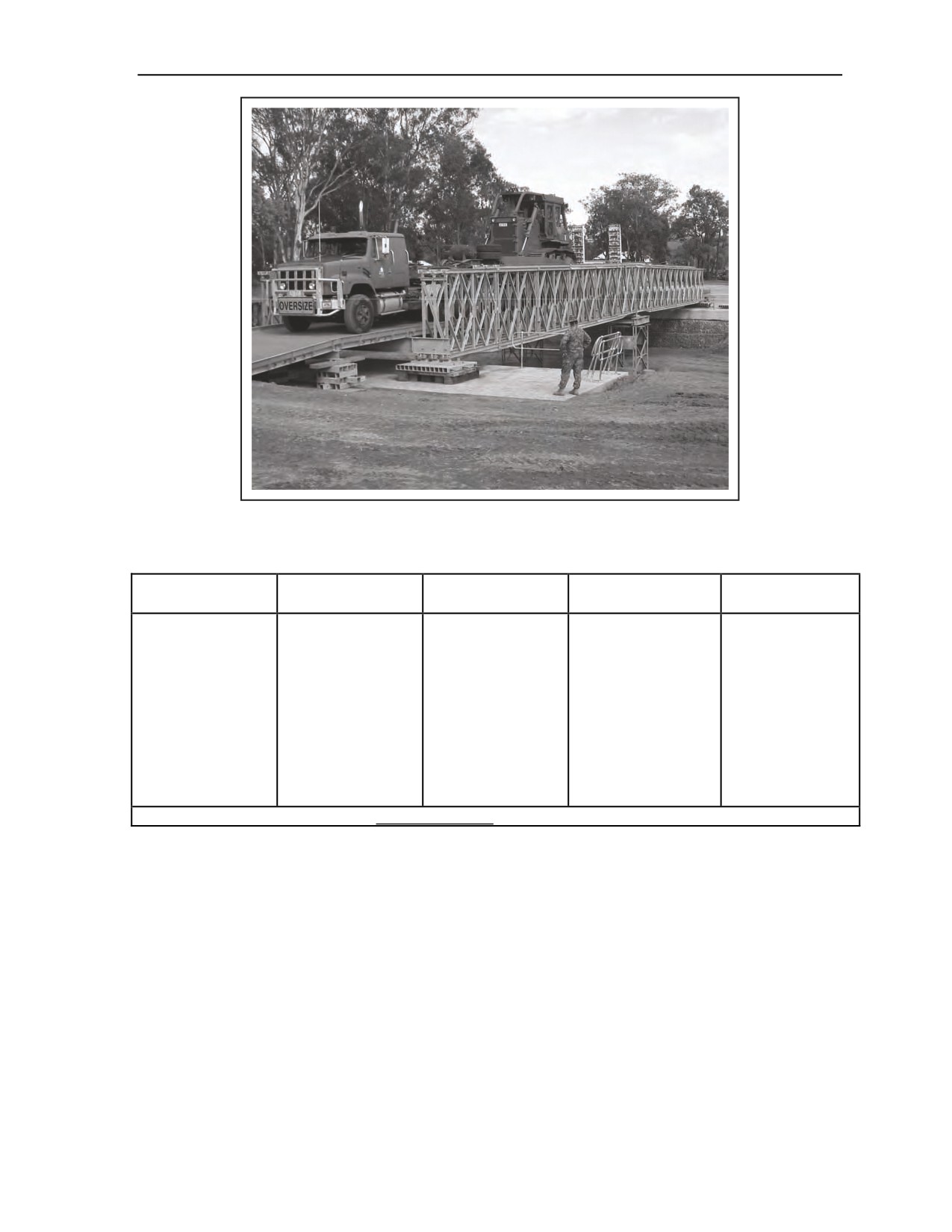
A-36. The Acrow 700XS® (Figure A-15 and Table A-20) is a COTS system based upon a panel-type
bridge design. The system is composed of a small range of standard parts: truss panels, chord
reinforcements, transoms, steel decks, bracing members, bridge ramps and foot walk ramps, support piers,
grillages and ground beams. The modular design of the equipment means it can be constructed in a large
number of different configurations, allowing the system to be used for a wide range of load and spans. The
700XS is a LOC bridge that can serve as a new bridge, replace a damaged bridge, or replace a support
bridge to upgrade routes for heavier traffic.
A-37. The system is capable of routinely carrying loads to MLC
110 tracked and wheeled (MLC
110T/110W) up to spans of 76 meters, and is designed to be left as a permanent or semipermanent bridge.
To fulfill this requirement, the 700XS requires only minimal maintenance. It is available in 4.2-meter and
5.5-meter, one-lane widths. It is also available on a COTS basis in 2- and 3-lane widths. The 700XS can be
built by hand, but where cranes and other mechanical handling equipment are available, the total number of
man-hours to build the bridge is substantially reduced. Bridge components can be transported using
DROPS, PLS flat racks, and ISO containers (ISO containers being the most common).
A-22
FM 3-90.12/MCWP 3-17.1
1 July 2008
Crossing Means and Organizations
Figure A-15. Acrow 700XS
Table A-20. Characteristics of the Acrow 700XS
Capacity
Limitations/
Allocation
Transportation
Emplacement
Classification
Remarks
Purchased only
700XS can be
The 700XS can be
700XS—
Site preparation
when needed.
transported by
emplaced by hand
must be taken into
• MLC 120T/120W;
numerous means.
or by mechanical
account for
51.81-meter
•
40-foot flat bed
means (crane,
span; normal
planning.
forklift, or other lift
trailer.
crossing.
assets).
• PLS flat racks.
• Single or multiple
Large amount of
span bridges.
time or personnel
• ISO containers.
plus equipment
• Roadway width is
•
20-ton trucks.
must be dedicated
4.2 meters or 5.5
to complete the
meters.
bridge.
Note. Additional and contact information: <www.acrowusa.com>.
1 July 2008
FM 3-90.12/MCWP 3-17.1
A-23
Appendix A
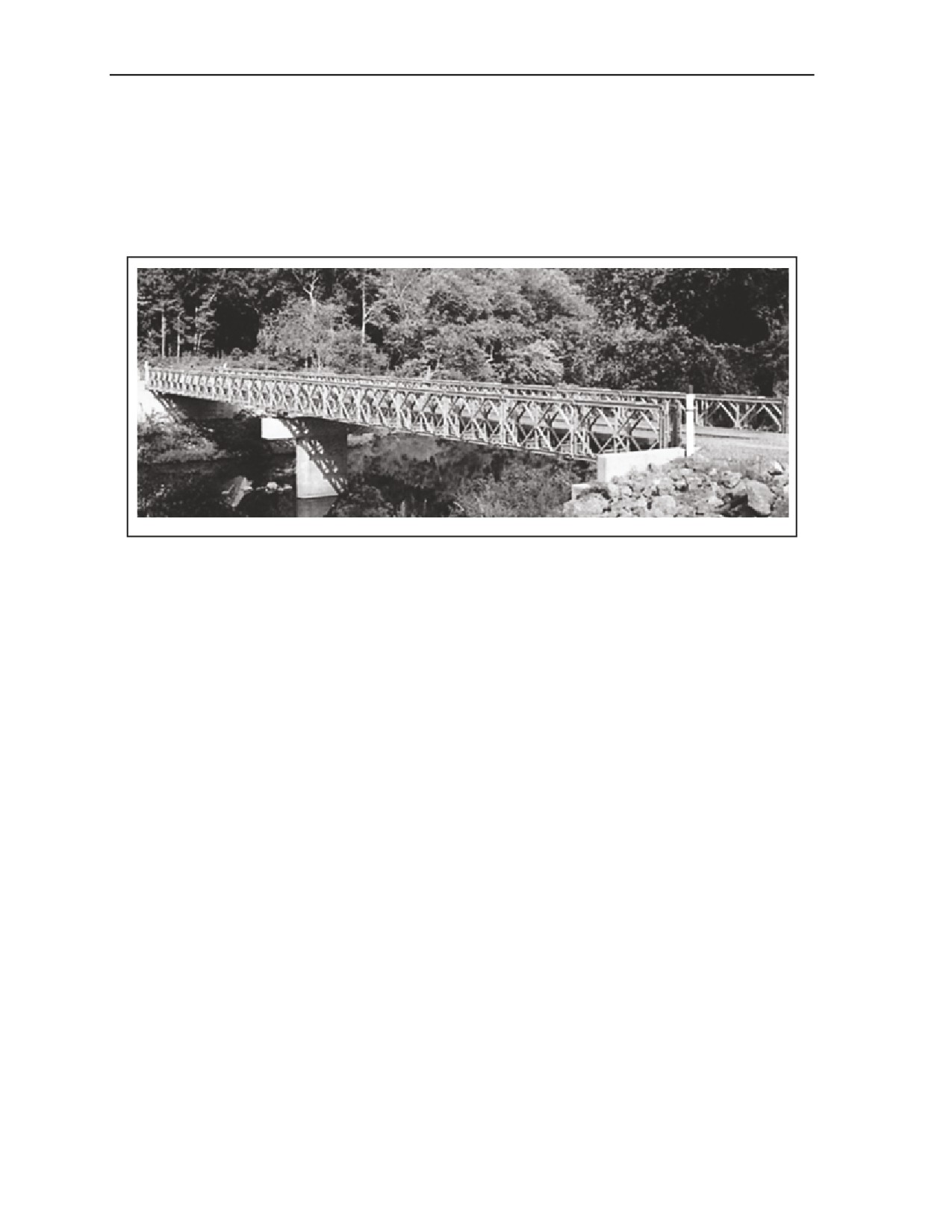
A-38. The M2 Bailey bridge is a truss bridge manually assembled by connecting panels end to end. It is
used to replace support bridging, usually the MGB or DSB, but its primary purpose is to serve as a LOC
bridge. The Bailey bridge system is highly labor intense but also highly versatile. In some cases, the Bailey
bridge is the only support bridge suitable for long spans and heavy loads, because it can be assembled in
multiple heights and widths. The Bailey bridge is maintained in war stocks both in the United States and
outside the continental United States (OCONUS). The bridge system can also be assembled as a railway
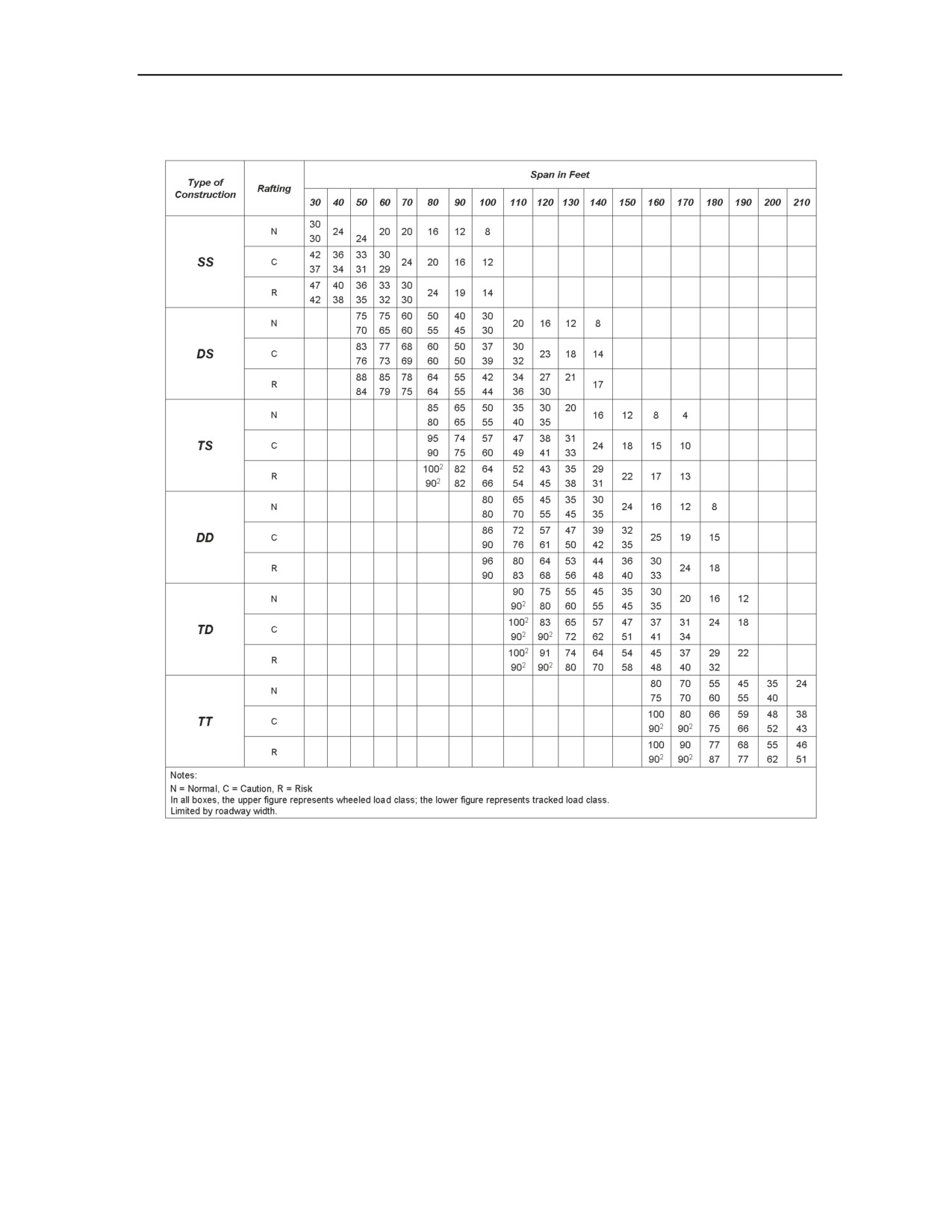
bridge, providing a relatively rapid repair capability (Figure A-16 and Table A-21).
Figure A-16. M2 Bailey Bridge
A-24
FM 3-90.12/MCWP 3-17.1
1 July 2008
Crossing Means and Organizations
Table A-21. Load Classification for M2 Bailey Bridge
A-39. In arctic regions and areas that experience seasonal winter weather, a consideration that cannot be
overlooked is "ice bridging." Ice bridging is using a thick layer of ice over a wet gap, such as a lake or
river that forms a bridge. For more information on how to design and construct an ice bridge, see FM 3
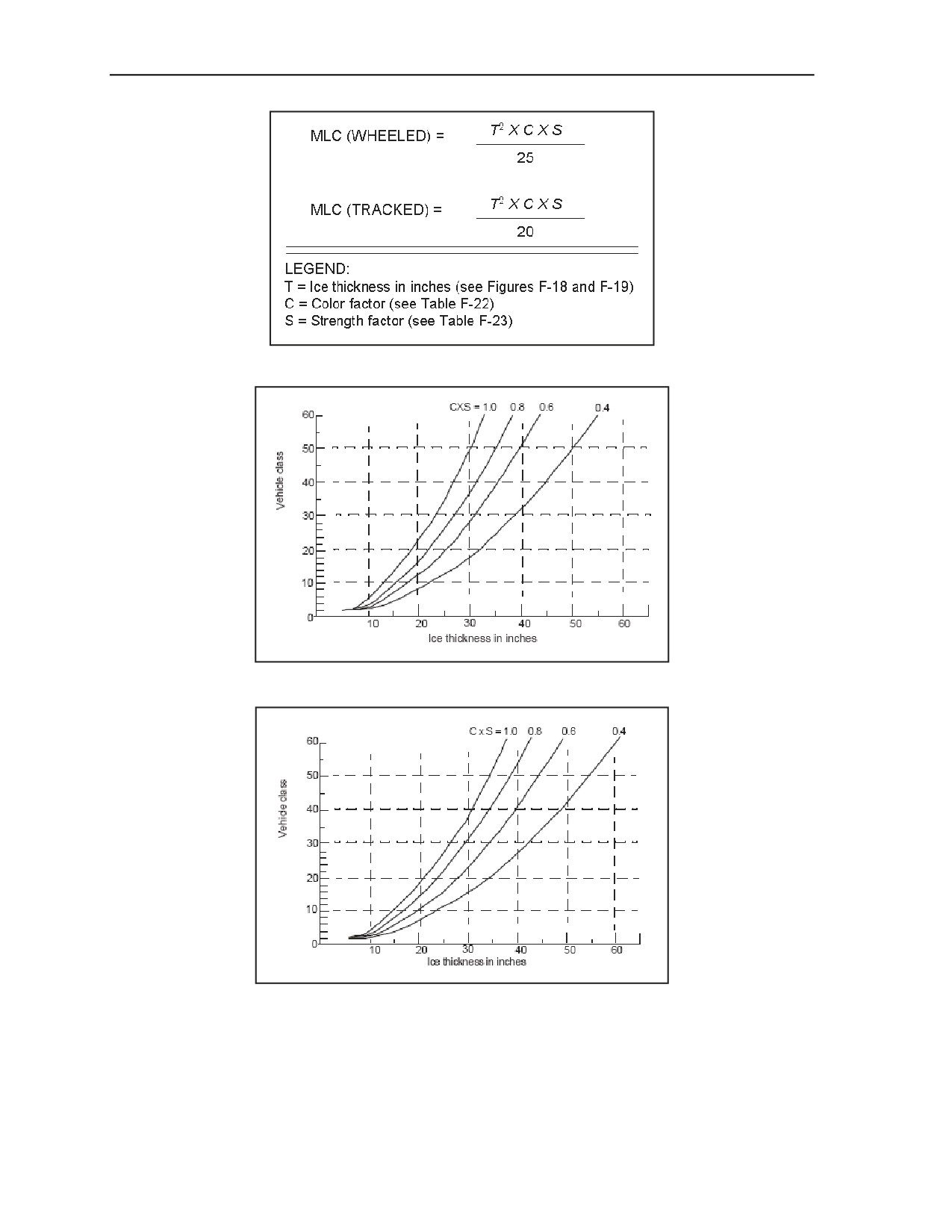
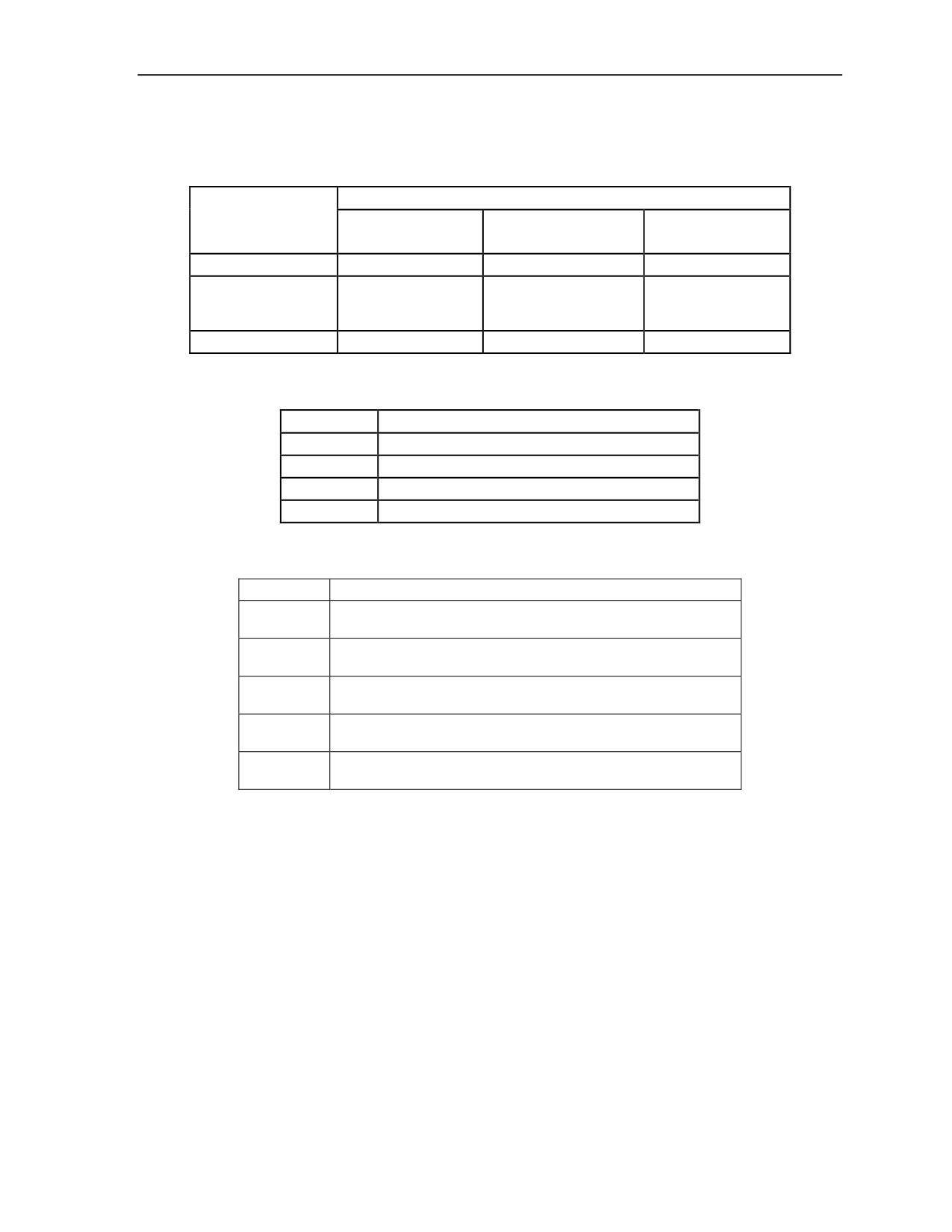
34.343. Figures A-17 through A-19 and Tables A-22 through A-25, pages A-26 through A-28, provide the
basic planning factors and tools when considering this type of bridge.
1 July 2008
FM 3-90.12/MCWP 3-17.1
A-25
Appendix A
Figure A-17. Determining Load Classes for Ice
Figure A-18. Required Ice Thickness for Wheeled Vehicles
Figure A-19. Required Ice Thickness for Tracked Vehicles
A-26
FM 3-90.12/MCWP 3-17.1
1 July 2008
Crossing Means and Organizations
Table A-22. Ice Depth Requirements
Personnel
Ice Thickness Requirements in Inches
Strong
Medium
Weak
C = 1, S = 1
C = 0.8, S = 0.8
C = 0.7, S = 0.6
On skis
1.5
2
3
In a file formation
with 2-meter
3
4
5
intervals
On snowmobiles
3
4
5
Table A-23. Ice Color Factors
Factor
Characteristics
C = 1
Ice is clear (transparent)
C = 0.9
Ice is semiclear
C = 0.8
Ice is white
C = 0.7
Ice is discolored (stained brown or yellow)
Table A-24. Ice Strength Factors
Factor
Characteristics
S = 1
Ice is solid, and temperatures have remained at or below
freezing for the previous week.
S = 0.9
Ice is solid, and temperatures have been above freezing during
the day but drop below freezing during the night.
S = 0.8
Ice is solid, and water is running on the surface from runoff or
overflow.
S = 0.7
Ice is not solid, and water or air pockets are found in between
layers of ice.
S = 0.6
An air pocket is under the ice, so the ice is not floating on the
water underneath.
1 July 2008
FM 3-90.12/MCWP 3-17.1
A-27

Appendix A
Table A-25. Ice Thickness Versus Vehicle Distance Determination
Vehicle Class
Required Ice
Distance Between Vehicles in
(wheeled or
Thickness in
Meters (about 100 x ice
tracked)
Centimeters
thickness [in centimeters])
1
11
11
2
15
15
3
18
18
4
21
21
5
23
23
10
33
33
15
40
40
20
48
46
25
51
51
30
58
55
35
61
61
40
65
65
50
72
72
60
79
79
70
85
85
80
91
91
Notes.
1. If the air temperature has been above freezing for more than 6 of the past 24 hours,
multiply the vehicle class by
1.3 to obtain the required ice thickness. If the air
temperature stays above freezing for 2 hours or more, the ice starts to lose strength,
and the table no longer represents safe conditions. A rapid and unusually large
temperature drop causes the ice to become brittle, and travel may not be safe for 24
hours.
2. For the distance required between two vehicles of different classes, use the distance
required for the higher class.
3. If you plan to park for extended periods, multiply the vehicle class by 2 to obtain the
required ice thickness and maintain at least the original distance requirements. Drill a
hole through the ice near the vehicle, and move if the ice begins to flood.
4. The ice must have water support. Be very careful close to the shore. Often, the water
level will drop after freeze-up. When this happens, the ice close to the shore may no
longer have water support.
5. Cracks are either dry or wet. If dry, they do not penetrate the ice cover and can be
ignored. If wet, multiply the vehicle class by 2 to obtain the required ice thickness, and
try to drive straight across the cracks (avoid going parallel to wet cracks).
OTHER NONBRIDGING MEANS
A-40. The most common gap-crossing means not mentioned earlier include fascines, culverts, and soil.
These materials can be used separately, together, or in conjunction with other crossing means. Fascines can
be made out of pipe, logs, or other locally procured materials and, when tied together and placed across a
gap, will reinforce the gap bottom. Not only are the materials readily available, but they are easy to
assemble and, if used across a wet gap, are less likely to cause localized flooding.
A-41. Typically, culverts are used in conjunction with soil when crossing a wet gap. Like the fascine, the
culvert will allow the water to continue to flow underneath the crossing surface. Culverts come in various
sizes and are made of different materials. When using culverts, consideration must be given to the amount
of water flow and the carrying capacity of the culvert.
A-42. Using soil alone to fill dry gaps when the situation permits and equipment is available is perhaps one
of the most rapid and perhaps one of the most effective methods. When using soil, compaction is a primary
A-28
FM 3-90.12/MCWP 3-17.1
1 July 2008
Crossing Means and Organizations
concern. Heavy vehicles or volumes of traffic will eventually displace the soil causing deep ruts resulting
in a delayed crossing. Another consideration is the slope from the gap edge to the fill material. Gentle
slopes at the entry and exit points will also avoid ruts and facilitate continuous traffic flow. Finally, filling
the gap without leaving a culvert or other drainage method along the water flow may cause problems over
time.
ARMY AND MARINE CORPS BRIDGING UNITS
A-43. While there are only a couple of U.S. units designated as bridging units, the list below will not only
address those units but also those units in which bridging systems are organically found. This includes both
tactical and support bridging.
MOBILITY AUGMENTATION COMPANY
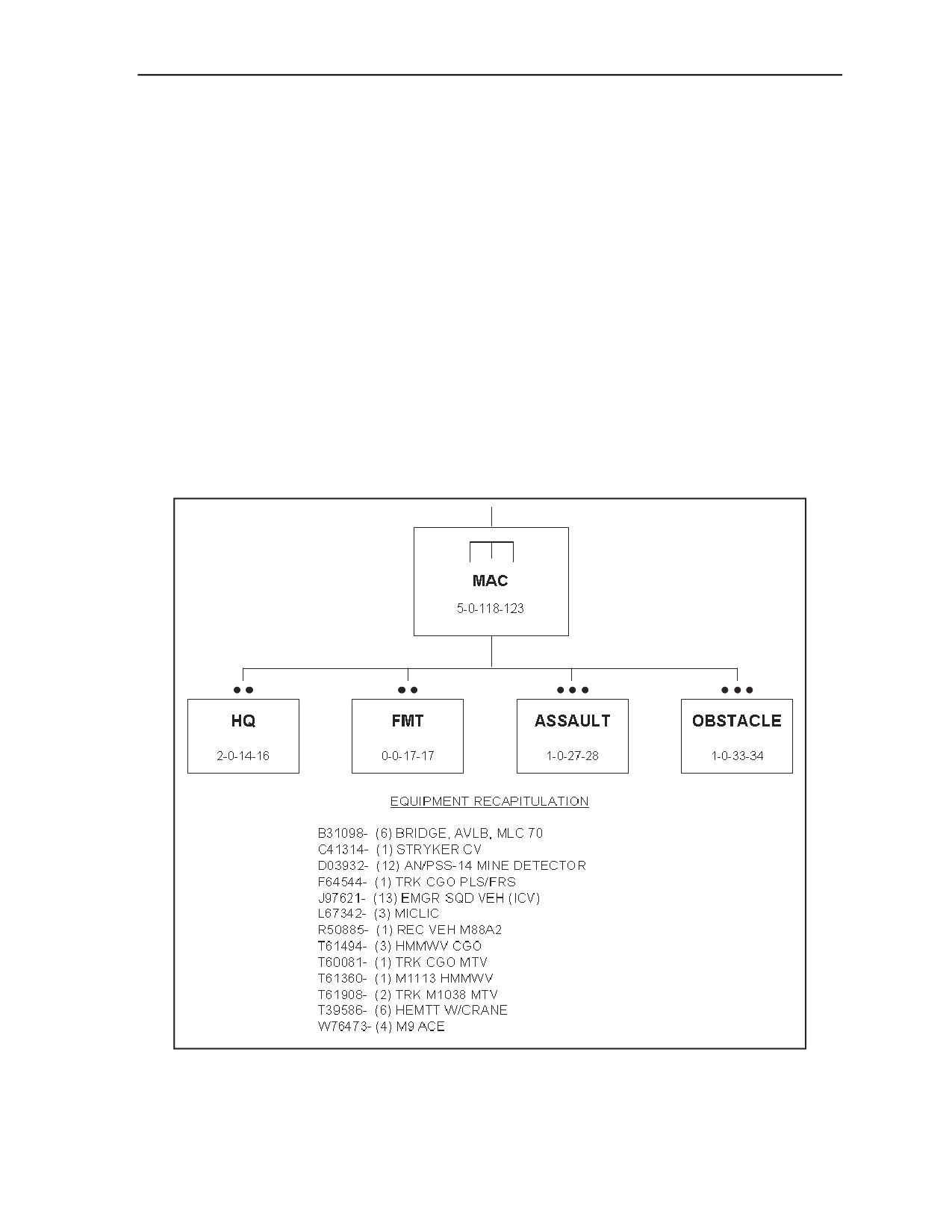
A-44. The MAC is the primary engineer unit that will support BCTs in tactical gap crossing. The company
has two assault platoons. Each platoon has a tactical bridge squad with three AVLBs, and the platoon is
capable of providing two tactical bridges with 50 percent redundancy. Each of the tactical bridging squads
three MLC 70 AVLBs are equipped with the appropriate personnel and communications equipment.
Besides its tactical gap-crossing capability, the MAC is also capable of conducting breaches (mounted and
dismounted) and hasty route clearance and emplacing obstacles in support of the maneuver BCT. See
Figure A-20.
Figure A-20. Organization Chart-Mobility Augmentation Company
1 July 2008
FM 3-90.12/MCWP 3-17.1
A-29
Appendix A
MULTIROLE BRIDGE COMPANY
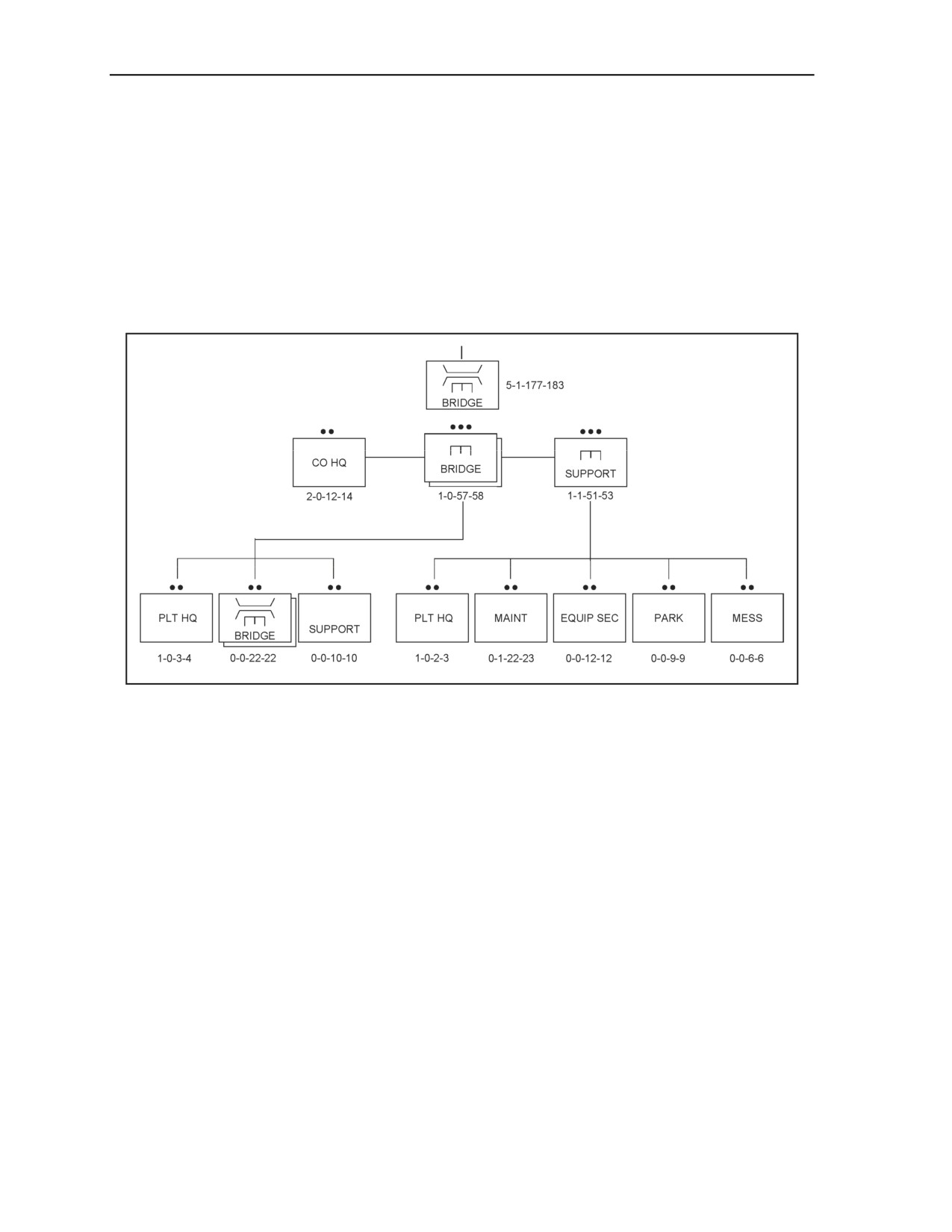
A-45. The MRBC is organized with a company HQ, two bridge platoons, and a support platoon. Each
bridge platoon has two bridge sections and a support section. The bridge sections contain the primary
equipment for float bridging operations utilizing the IRB. The support section contains the primary
equipment to provide support bridging to the force. The bridge sections can provide four 40-meter spans of
MLC 70T/96W bridge, about 215 meters of MLC 70/96W (with SRB at 5 to 6 feet per second) float
bridge, or six rafts of MLC 70. The support section will have either four DSBs or two MGBs (two bridge
sets, one link reinforcement set, one erection set, and two ramp sets). The company has a maintenance
section, equipment section, park section, and mess section. This allows the company to function as a single
entity during gap-crossing operations. Additionally, the company can be task-organized into several
sections and spread across the BCT area. See Figure A-21.
Figure A-21. Organization Chart - Multirole Bridge Company
MARINE CORPS BRIDGING
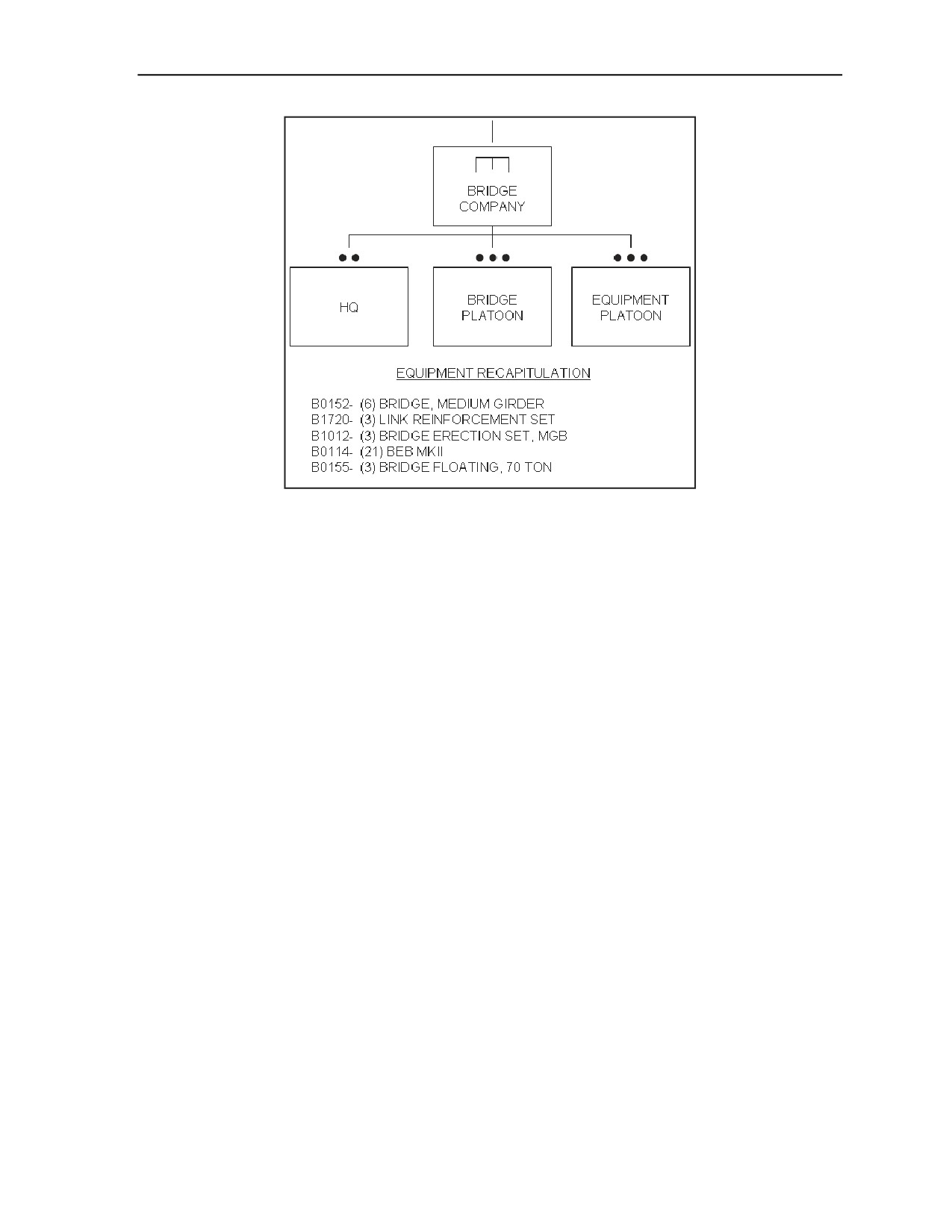
A-46. The USMC currently has one active and two Reserve Component bridge companies. The Active
Component company resides in the 8th ESB. The bridge company has three MGB systems with each
system containing two MGB sets, one link set, and one erection set. Those sets together give the unit the
ability to construct a 22-bay, link-reinforced bridge, which spans gap lengths of 44.8 to 46.2 meters.
Additionally, they have three IRB bridge sets with each set containing 12 interior bays and five ramp bays.
The unit is equipped with 21 MKII BEB to support their gap-crossing operations. See Figure A-22.
A-30
FM 3-90.12/MCWP 3-17.1
1 July 2008
Crossing Means and Organizations
Figure A-22. Organization Chart-U.S. Marine Corps Bridge Company
1 July 2008
FM 3-90.12/MCWP 3-17.1
A-31
This page intentionally left blank.
Appendix B
Crossing Site Selection
Crossing site selection is one of the most important planning considerations for a
successful gap crossing. The crossing site must support the desired scheme of
maneuver and available crossing means. In some cases, the preferred crossing site in
terms of the gap-crossing operation is not located in an area that best supports the
larger tactical operation. Other times, the preferred crossing site does not support the
available crossing means. To resolve these challenges, planners must understand the
complexities associated with selecting a crossing site. Reconnaissance and
specifically, engineer reconnaissance is critical to the success of crossing site
selection. This appendix provides the planner with some considerations to assist in
evaluating a potential crossing site for a gap-crossing operation.
GENERAL
B-1. The following paragraphs supplement the general descriptions of acceptable crossing sites in
Chapter 3. Selection of crossing sites is primarily based on the—
Existing situation and anticipated scheme of maneuver.
Physical characteristics of the available sites, road networks, and surrounding terrain.
Availability and capabilities of gap-crossing means.
Availability of engineer support.
B-2. Conflicts between tactical and technical requirements often occur. Commanders evaluate the factors
bearing on the problem to determine the best overall solution.
CROSSING SITE SELECTION
B-3. Each gap-crossing means, except air lift (rotary wing aircraft), requires a type of crossing site. They
can be identified as fording, assault boat, swimming, rafting, or bridging sites. Assault battalions use either
a fording or an assault boat site (or sometimes a swimming site) as an assault site.
B-4. Both the desired scheme of maneuver and available gap-crossing means influence crossing site
selection. The division assigns a crossing area to each lead brigade. The brigade chooses which crossing
sites to use within its area. When a particular site is important to the division's tactical concept, such as for
the movement of breakout forces, the division either coordinates with the affected brigade to open that
bridge site or moves a bridge to that site once the brigade hands over the crossing area to the division.
B-5. Brigade commanders select final crossing sites based on tactical intelligence and their desired
schemes of maneuver. Each site's physical characteristics, required engineer support, and available crossing
means influence the decision, but tactical requirements are the most important.
B-6. The goal when selecting assault sites is to pick those that allow the lead battalions to cross
unopposed and seize farside objectives rapidly. If unsuccessful at finding undefended crossing sites, the
lead battalions must typically cross under enemy fire while overwatch units provide direct and indirect
suppressive fires. Assault sites may or may not coincide with rafting or bridging sites.
B-7. When selecting swimming sites, the goal is to pick those that permit fighting vehicles to rapidly
enter, swim across, and exit the water with minimum assistance.
1 July 2008
FM 3-90.12/MCWP 3-17.1
B-1
Appendix B
B-8. The goal when selecting rafting and bridging sites is to pick those that support the greatest volume of
vehicle traffic consistent with the scheme of maneuver. Rafting and bridging sites are usually on or near
major roads to minimize route preparation and maintenance. When the sites are located close together, the
bridging site should be upstream of the rafting site. This will avoid potential damage that may be caused by
disabled rafts drifting into the bridge.
B-9. Regardless of the crossing means, each site may need engineer reconnaissance swimmers or an
engineer diving team to cross early to reduce obstacles and develop exit points on the farside. Gap sides or
riverbanks at otherwise suitable crossing sites often need work for access to the gap (river). Most natural
soil becomes unstable under heavy traffic. This condition worsens as fording, swimming, and rafting
activities carry water onto it. The required engineer effort varies with soil type, crossing means, and vehicle
density. An engineer vehicle that is capable of maintaining the farside bank should be one of the first
vehicles across.
B-10. Natural conditions vary widely. Banks may require little preparation, or they may be so restrictive
that they limit feasible sites. Desirable site characteristics include—
Minimum exposure to enemy direct-fire weapons.
Covered and concealed access to the gap (river) edge.
Firm and gently sloping banks that allow rapid entry and exit at multiple points.
B-11. Initial and subsequent entry points can vary. Available locations seldom have all the desired tactical
and technical characteristics. The best routes through the crossing area normally cross the gap at the best
technical crossing sites. The best technical sites may not be the best tactical sites, because they are well
known and heavily defended by the enemy. Forces initially crossing at less desirable locations are more
likely to avoid detection and gain surprise. Moving laterally along the farside, forces attack the flank or
rear of enemy units to seize the best crossing locations. Use of these sites allows rapid buildup of combat
power.
PLANNING
B-12. Planners need information about potential crossing sites to evaluate their compatibility with
proposed crossing plans. Generally, planners need to know—
Friendly and enemy capabilities and probable COAs.
Site capacity for the crossing of troops, equipment, and supplies using various crossing means.
Engineer support that is required to develop, improve, and maintain each site.
B-13. More specifically, planners need to know the—
Condition of the bottom, banks, and water of the gap (river).
Impact of forecasted and/or past seasonal weather conditions.
Location of defensible terrain, covered and concealed areas, and natural or enemy-emplaced
obstacles on both sides of the gap.
Amount of time and effort that is required to develop sites, assemble rafts, if necessary, and
construct bridges.
Entry and exit routes and off-road trafficability.
Road networks.
Capabilities of friendly forces to deny observation, suppress fires, and provide site protection.
REQUIREMENTS
B-14. Specific requirements are necessary for crossing sites. These requirements are discussed in the
following paragraphs.
B-2
FM 3-90.12/MCWP 3-17.1
1 July 2008
Crossing Site Selection
ENTRY AND EXIT ROUTES OR PATHS
B-15. A desired feature of all sites is readily accessible entry and exit routes or paths on either side of the
gap. The approaches to the banks are checked for their ability to support the requirements (width, slope,
and trafficability) of the wheeled and tracked vehicles of the crossing element. Covered and concealed
approaches enhance surprise and survivability; however, multiple routes (free from obstruction) will
increase crossing speed and flexibility. Exit bank conditions often take precedence over entry bank
conditions until equipment and troops can be crossed to develop and improve the site.
ROUTES AND APPROACHES
B-16. Depending on the crossing operation that is used, the following considerations must be given to
routes and approaches:
Fording. Dismounted forces may use approaches with steep slopes and heavy vegetation, while
vehicle fording requires paths or roads to approach fording sites.
Assaulting or swimming. Assault boat crossings may use more rugged approaches than
amphibious vehicles.
Rafting. Multiple approach routes to rafting sites permit the relocation of rafting upstream or
downstream.
Bridging. Bridging sites require developed road networks to sustain the crossing capacity.
B-17. Depending on the vehicle that is used, the following considerations must be given to routes and
approaches:
Wheeled vehicles. In general, wheeled vehicles require 3.5-meter path widths and 3.5 meters of
overhead clearance. Dry, hard slopes of 33 percent can be negotiated; however, slopes less than
25 percent are desired.
Tracked vehicles. Tracked vehicles require up to 4-meter path widths and 3.5 meters of
overhead clearance. Tanks can climb 60-percent (31-degree) slopes on dry, hard surfaces;
however, slopes less than 50 percent are desired.
WAITING AREAS
B-18. Many waiting areas are required for equipment, troops preparing and protecting sites, and troops and
vehicles preparing and/or waiting to cross. These areas should be dispersed, should provide cover and
concealment, and should be accessible to a road network near the sites.
RIVER CONDITIONS
B-19. In general, currents less than 1.5 meters per second are desired. While narrow segments of the river
decrease equipment requirements, crossing time, and exposure time, the resulting increased current
velocities may offset any advantage gained. As the current’s velocity increases, it decreases the ribbon
bridge's ability to handle heavy MLC vehicles. More boats will then be required to keep the bridge in place
and allow for heavy MLC vehicles to cross.
GAP SIDES/BANKS
B-20. Ford banks may be steep and rugged for dismounted troops; however, vehicles require slopes less
than 33 percent and firm soil conditions. Assault or swim banks may be steep when using assault boats for
dismounted troops. Amphibious vehicles may be able to enter over low, 1-meter vertical banks, but they
require sloped exits. Vertical banks of about 1.7 meters may be accommodated by ribbon raft ramps.
1 July 2008
FM 3-90.12/MCWP 3-17.1
B-3
Appendix B
GAP BOTTOMS
B-21. When fording, bottoms must be firm, uniform, and free from obstacles. Gap bottoms or riverbeds
can be improved with rock fill or grading equipment. Guide stakes make the crossing of a gap easier for
boat drivers. Assault or swim site bottoms must be free from obstructions that interfere with boats or the
tracks of amphibious vehicles. Rafting sites must be free from obstructions that could interfere with boat
operations. Bridges emplaced for lengthy periods (4 hours or more) or in strong currents require suitable
riverbeds for anchorage. Engineer diving teams (see Appendix E) may be used to—
Conduct river bottom reconnaissance.
Emplace shore and midstream anchorage for debris and antimine and antidiver nets to ensure the
success of the operation.
ENEMY SITUATION
B-22. Typically, the enemy will defend potential crossing sites either forward, along, or to the rear of the
gap. If located forward of the crossing site, the enemy most likely intends to defeat the crossing force
before it reaches the gap. When enemy forces are positioned along the gap, it may be an attempt to protect
the crossing sites and defeat the crossing force while it is divided in the gap. Finally, the enemy usually
defends from the rear of the gap if time or terrain prohibits a forward defense. A security element may be
positioned on the farside to disrupt the crossing force. In this situation, the enemy force could be
attempting to delay the crossing force to provide time to establish a defense.
B-23. Sites masked from enemy observation enhance surprise and survivability by degrading the enemy’s
ability to see. While using existing sites reduces preparation time, they require caution because the enemy
may have emplaced obstacles and registered artillery on the site.
SITE ANALYSIS
B-24. A ground reconnaissance refines and confirms information gathered from other sources. Training
Circular (TC) 5-210 and FM 3-34.170 contain details for conducting and reporting site reconnaissance.
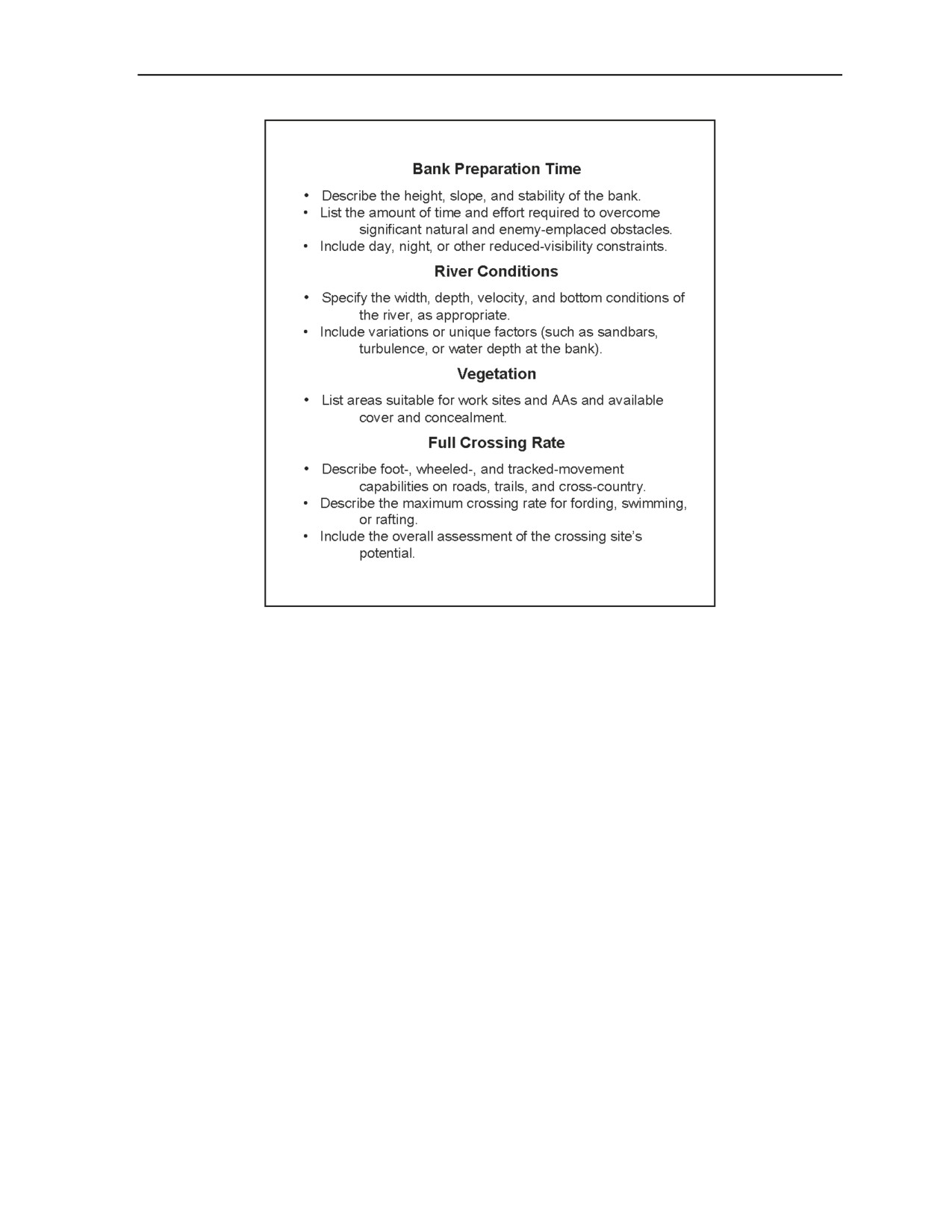
From this and other detailed reports, planners may develop charts or overlays to compare alternate sites.
Unit SOPs may prescribe specific comparative methods. See Figure B-1 for an example.
B-4
FM 3-90.12/MCWP 3-17.1
1 July 2008
Crossing Site Selection
Figure B-1. Crossing Site Requirements
FIELD CALCULATIONS
B-25. Some common relationships and field-expedient calculations that are useful during a ground
reconnaissance include—
Measuring the current’s velocity.
Determining the slopes and degrees.
Measuring the gap width.
Calculating the downstream drift.
MEASURING THE CURRENT’S VELOCITY
B-26. Correlating the desired maximum current velocity of
1.5 meters per second with a familiar
comparative unit of measure may help in estimating the current’s velocity. The quick-time march rate of
120 steps per minute, with a 76-centimeter (or 30-inch) step, equates to 1.5 meters per second. Other
approximate correlations of 1.5 meters per second include—
5 feet per second.
3.5 miles per hour.
5.5 kilometers per hour.
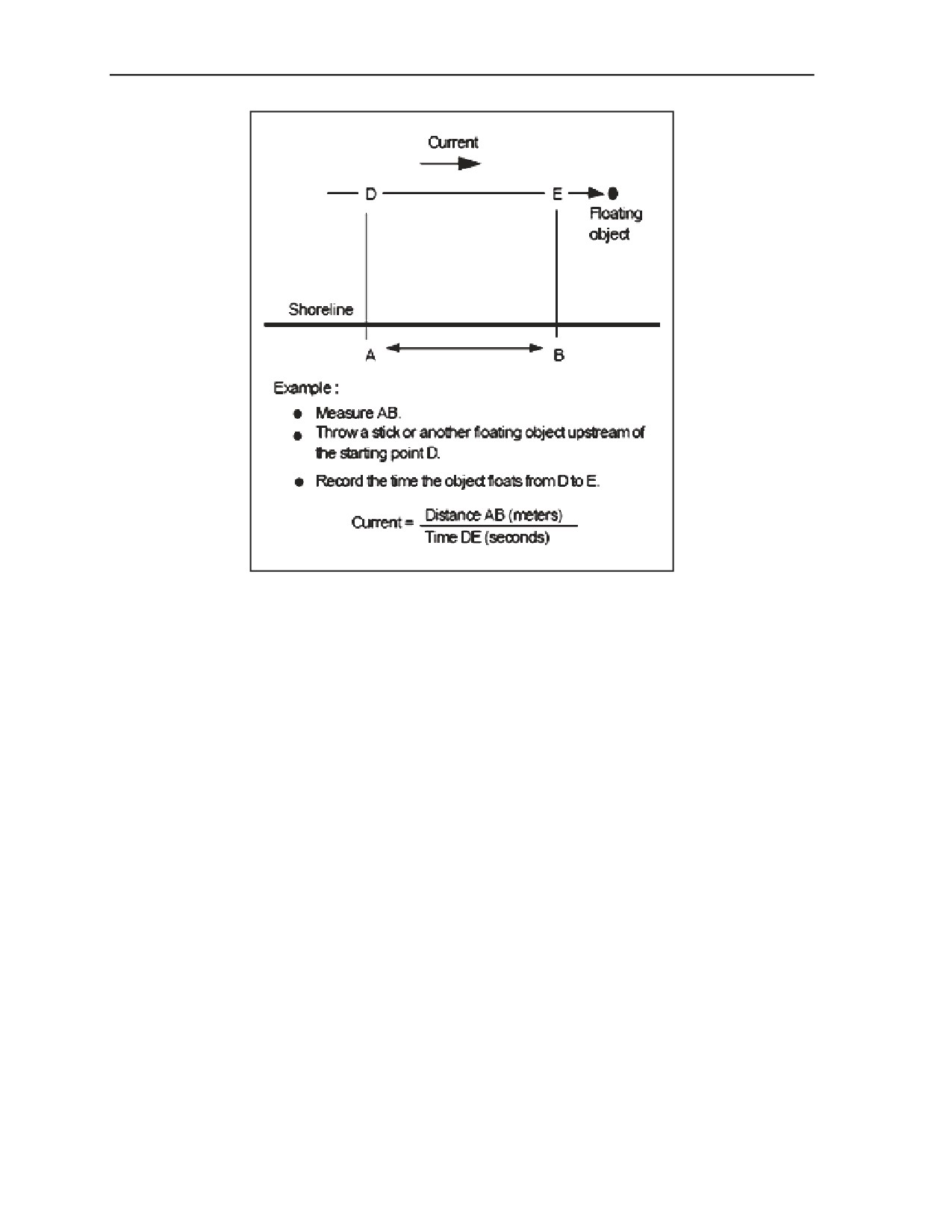
B-27. Determining the current’s velocity is critical to effective and safe crossing operations. When it is
high, more boats are required to stabilize the bridge, particularly when anchorage is not used. A reasonable
estimation involves measuring a distance along the riverbank and noting the time a floating object takes to
travel the same distance. Dividing the distance by the time provides the current’s velocity (Figure B-2,
page B-6).
1 July 2008
FM 3-90.12/MCWP 3-17.1
B-5
Appendix B
Figure B-2. Measuring the Current’s Velocity
DETERMINING THE SLOPES AND DEGREES
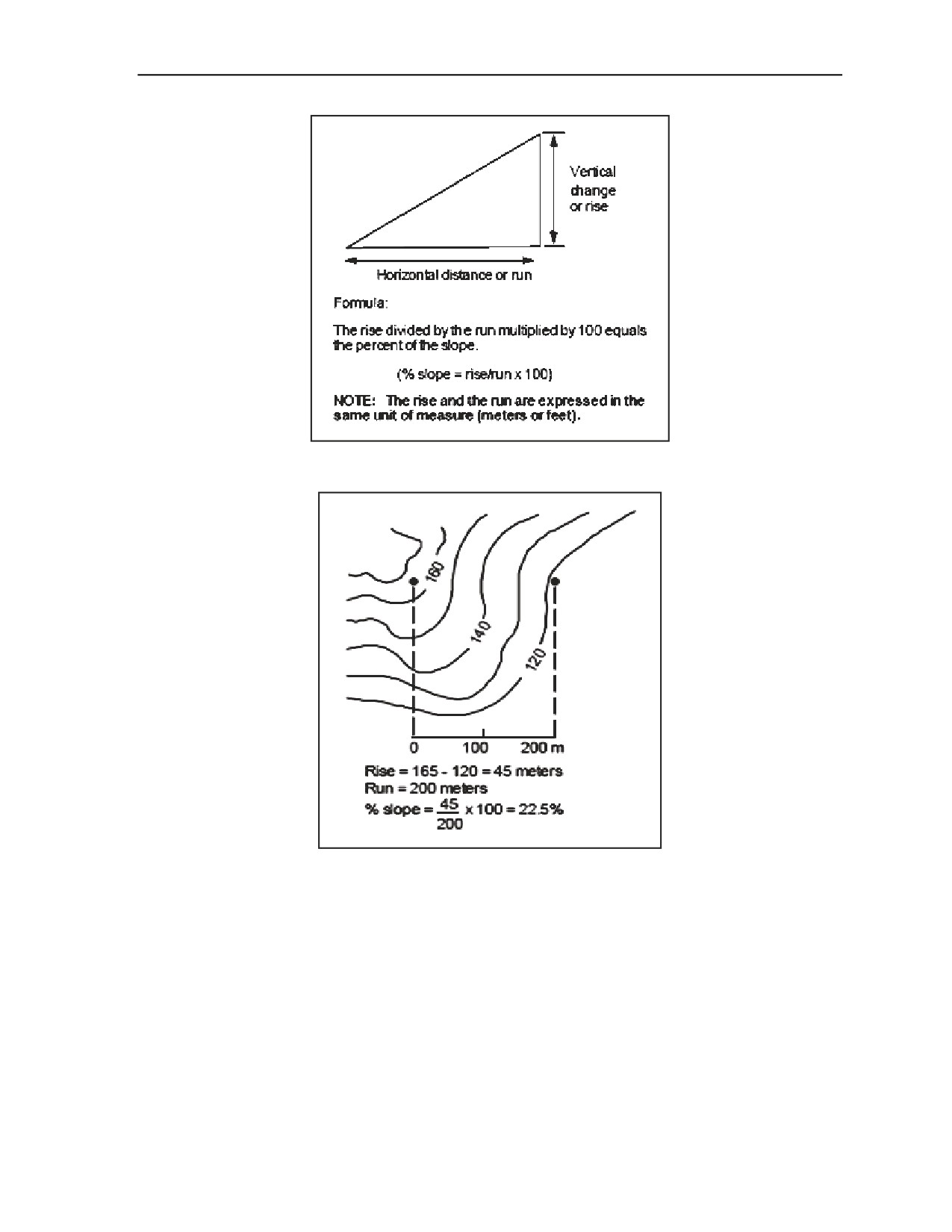
B-28. The slope of the terrain is significant (for example, slopes of 7 percent or more slow movement and
may require vehicles to operate in a lower gear). Slope, usually expressed as a percentage, is the amount of
change in elevation (rise or fall) over a ground (horizontal) distance (Figure B-3). The means to determine
the percent of the slope include—
Clinometers. These instruments measure the percent of the slope and are organic to most
engineer units down to the platoon level.
Maps. In this method, first measure the horizontal distance along the desired path, then
determine the difference in elevation between the starting and ending points of the path. The
next step is to ensure that both figures are the same unit of measure (such as meters or feet). The
final step is to divide the elevation (rise) by the distance (run) and multiply the result by 100 to
get the percent of the slope (Figure B-4).
Line of sight and pace. This method uses the eye-level height above ground (usually from 1.5
to 1.75 meters) and the length of standard pace (usually 0.75 meter). While standing at the
bottom of the slope, the individual picks a spot on the slope while keeping his eyes level. He
paces the distance and repeats the procedure at each spot. Adding the vertical and horizontal
distances separately provides the total rise and run.
B-6
FM 3-90.12/MCWP 3-17.1
1 July 2008
Crossing Site Selection
Figure B-3. Slope Calculation
Figure B-4. Terrain Slope
B-29. Slope may also be expressed in degrees; however, this provides angular measurements. The method
is not commonly used because the relationships are more complex than desired for field use. Table B-1,
page B-8 lists some relationships of the percent of the slope to the degree of the slope.
1 July 2008
FM 3-90.12/MCWP 3-17.1
B-7
Appendix B
Table B-1. Relationship of Slope to Degrees
Slope
Degrees
100 percent
45
60 percent
31
40 percent
22
20 percent
11
MEASURING THE GAP WIDTH
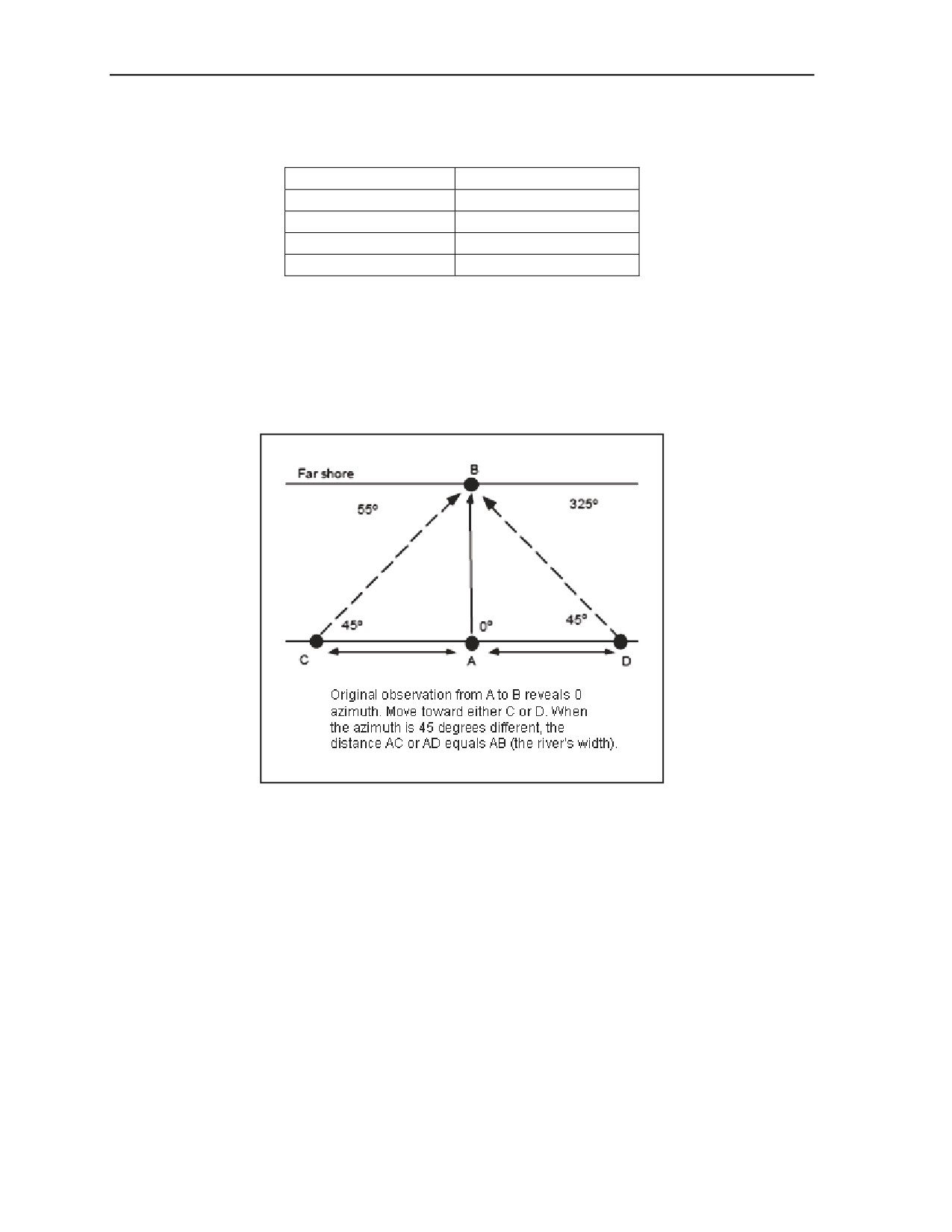
B-30. A field-expedient means of measuring gap width is with a compass. While standing at the gap edge,
note the magnetic azimuth by citing a point on the opposite side. Move laterally, up or down the edge of
the gap (upstream or downstream) until the azimuth reading to the fixed point on the opposite side is 45
degrees different than the original reading. The distance from the original point to the final point of
observation is equal to the gap width (Figure B-5).
Figure B-5. Gap Width
CALCULATING THE DOWNSTREAM DRIFT
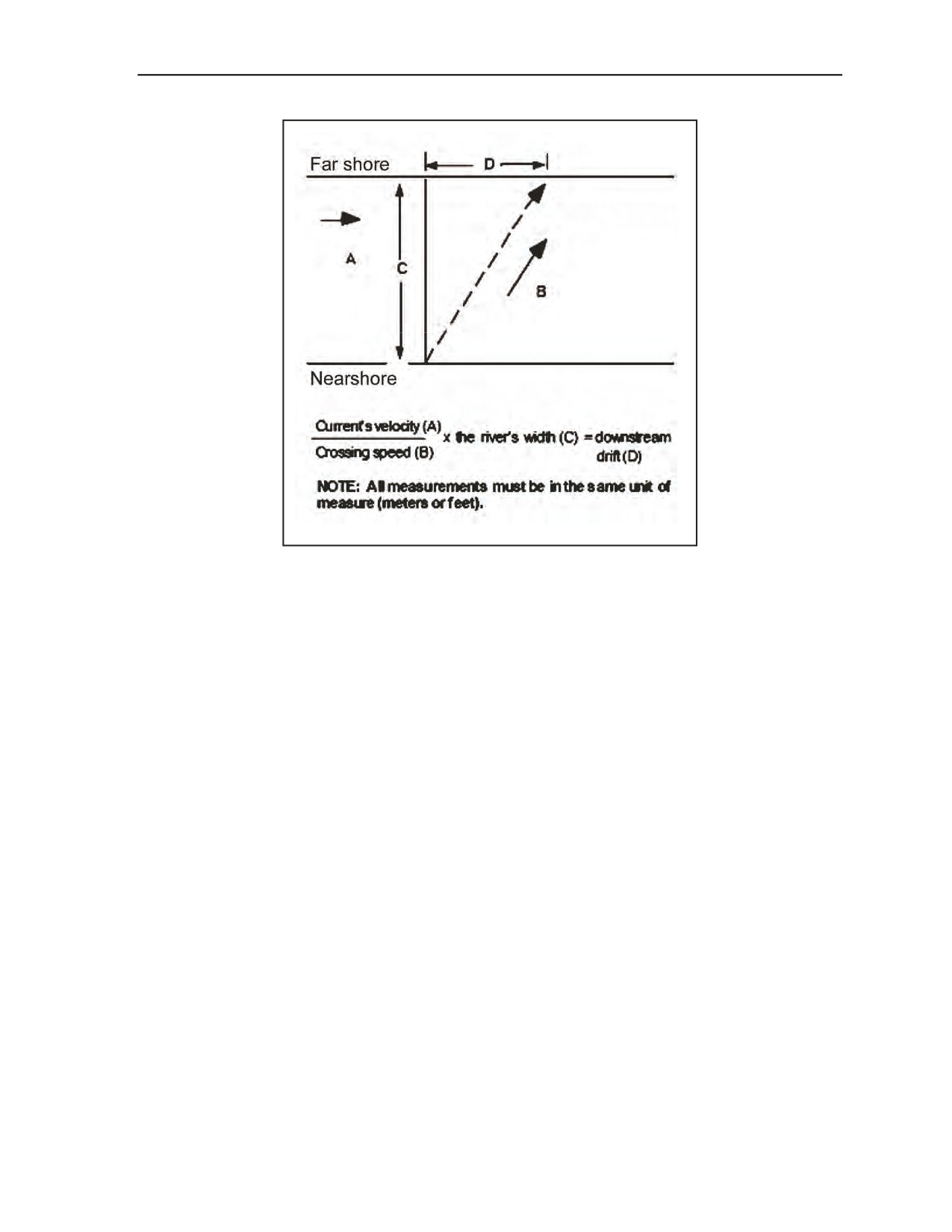
B-31. Current causes all surface craft to drift downstream. Each vehicle has a different formula for
calculating downstream drift. Amphibious vehicles and assault boats drift more than powered boats and
rafts; the latter has a greater capability to negate the effect of the current’s velocity by applying more
power.
B-32. Amphibious vehicles and nonpowered assault boats are generally limited to current velocities of 12.5
to 2 meters per second and 1 meters per second respectively (Figure B-6).
B-8
FM 3-90.12/MCWP 3-17.1
1 July 2008
Crossing Site Selection
Figure B-6. Amphibious Drift
B-33. When crossing with amphibious vehicles and pneumatic boats, compensate for the effect of the
current. Several examples follow.
Example 1
B-34. Entry is usually made upstream of the desired exit point. The vehicle or boat is aligned, or aimed,
straight across the river, creating a head-on orientation that is perpendicular to the exit bank. However, the
current produces a sideslip, downstream forward movement (Figure B-7, page B-10). This technique
requires operator training in continual adjustment to reach the objective point on the exit bank. This
technique results in a uniform crossing rate in the least amount of time and is usually the desired technique.
1 July 2008
FM 3-90.12/MCWP 3-17.1
B-9