FM 3-90.12/MCWP 3-17.1 COMBINED ARMS GAP-CROSSING OPERATIONS (July 2008) - page 1
*FM 3-90.12/MCWP 3-17.1 (FM 90-13)
Field Manual No.
Headquarters
Department of the Army
3-90.12/MCWP 3-17.1 (FM 90-13)
Washington, DC, 1 July 2008
COMBINED ARMS GAP-CROSSING
OPERATIONS
Contents
Page
PREFACE
vii
INTRODUCTION
x
Chapter 1
OPERATIONS IN SUPPORT OF GAP CROSSING
1-1
Challenge to Maneuver
1-1
Integrating Assured Mobility
1-2
Gap-Crossing Operations
1-4
Chapter 2
OVERVIEW OF GAP-CROSSING OPERATIONS
2-1
Gap Crossing as a Functional Area of Mobility Operations
2-1
Gap-Crossing Means
2-4
Gap-Crossing Fundamentals
2-6
Gap-Crossing Considerations
2-9
Chapter 3
PLANNING CONSIDERATIONS
3-1
General
3-1
Planning Process
3-2
Engineer Planning Considerations
3-10
Terrain Analysis
3-10
Intelligence Integration
3-14
Priority Intelligence Requirements
3-14
Chapter 4
GAP CROSSING IN SUPPORT OF COMBAT MANEUVER
4-1
Types of Gap Crossings
4-1
Control Mechanisms
4-4
Crossing Plan
4-7
Control Elements
4-10
A Deliberate Wet-Gap Crossing
4-13
Phases of a Deliberate Wet-Gap Crossing
4-14
Distribution Restriction: Approved for public release; distribution is unlimited.
*This publication supersedes FM 90-13/MCWP 3-17.1, dated 26 January 1998.
i
Contents
Chapter 5
LINE OF COMMUNICATIONS GAP-CROSSING SUPPORT
5-1
Overview of Line of Communications Gap Crossing
5-1
Nonstandard Bridging
5-3
Standard Bridging
5-3
Rafts, Ferries, Landing Craft Air Cushions, and Others
5-4
Sustainment, Maintenance, and Replacement of Line of Communications
Gap-Crossing Systems
5-5
Chapter 6
SPECIAL ENVIRONMENTS AND SITUATIONS
6-1
General
6-1
Gap-Crossing Operations in Arctic and Cold Weather
6-2
Gap-Crossing Operations in Mountainous Areas
6-3
Gap-Crossing Operations in Desert and Extremely Hot Conditions
6-5
Gap-Crossing Operations in Jungles and Forests
6-7
Gap Crossing Compounded by Chemical, Biological, Radiological, or
Nuclear Conditions
6-9
Gap Crossing Compounded by Significant Numbers of Dislocated Civilians
or Refugees
6-10
Appendix A
CROSSING MEANS AND ORGANIZATIONS
A-1
Appendix B
CROSSING SITE SELECTION
B-1
Appendix C
ENGINEER CROSSING FACTORS
C-1
Appendix D
ENGINEER PLANNING AND CALCULATIONS
D-1
Appendix E
DIVING SUPPORT CONSIDERATIONS
E-1
Appendix F
RETROGRADE GAP CROSSINGS
F-1
Appendix G
SECURITY CONSIDERATIONS
G-1
Appendix H
FOREIGN BRIDGING RESOURCES
H-1
SOURCE NOTES
Source Notes-1
GLOSSARY
Glossary-1
REFERENCES
References-1
INDEX
Index-1
Figures
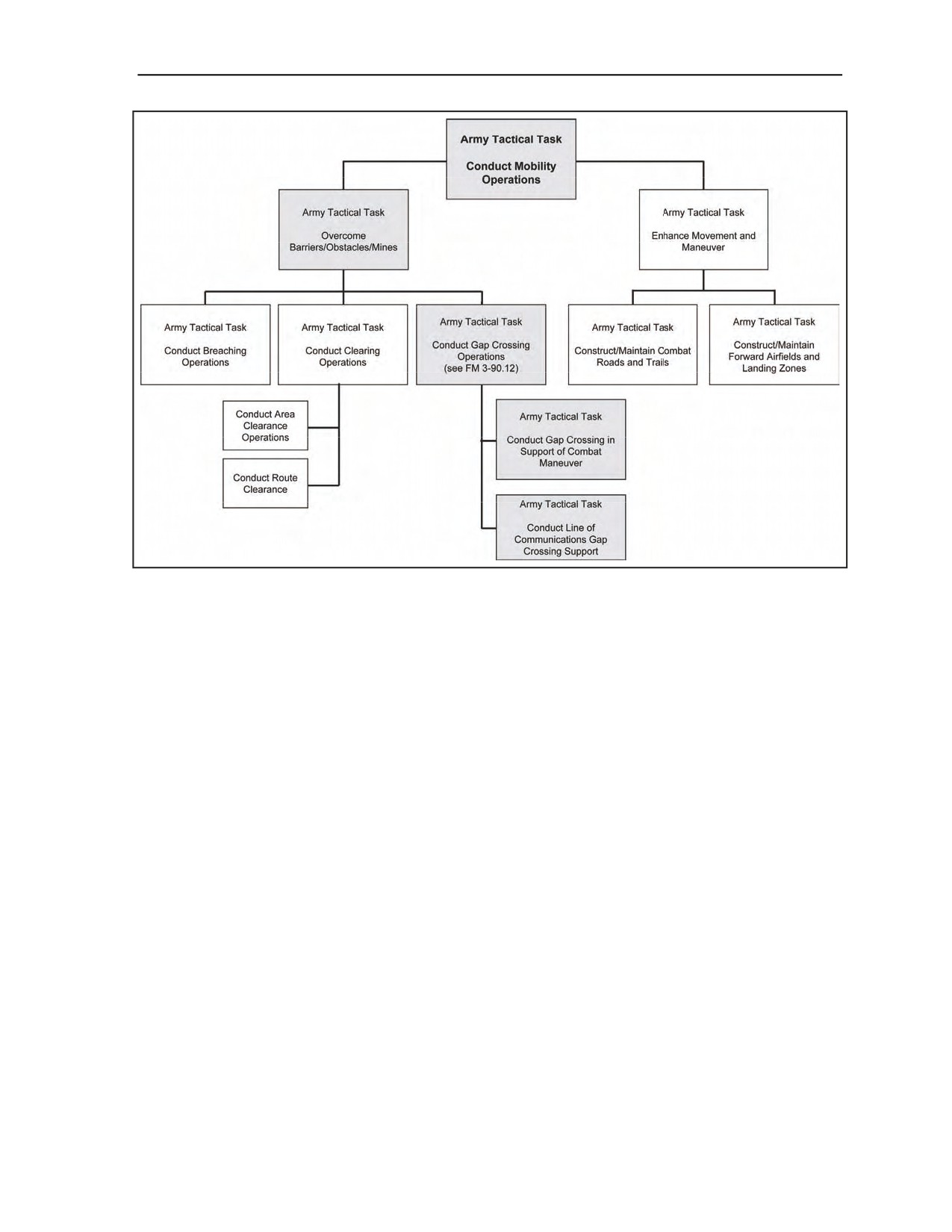
Figure 1-1. Gap-Crossing Operations in the Army Universal Task List
1-5
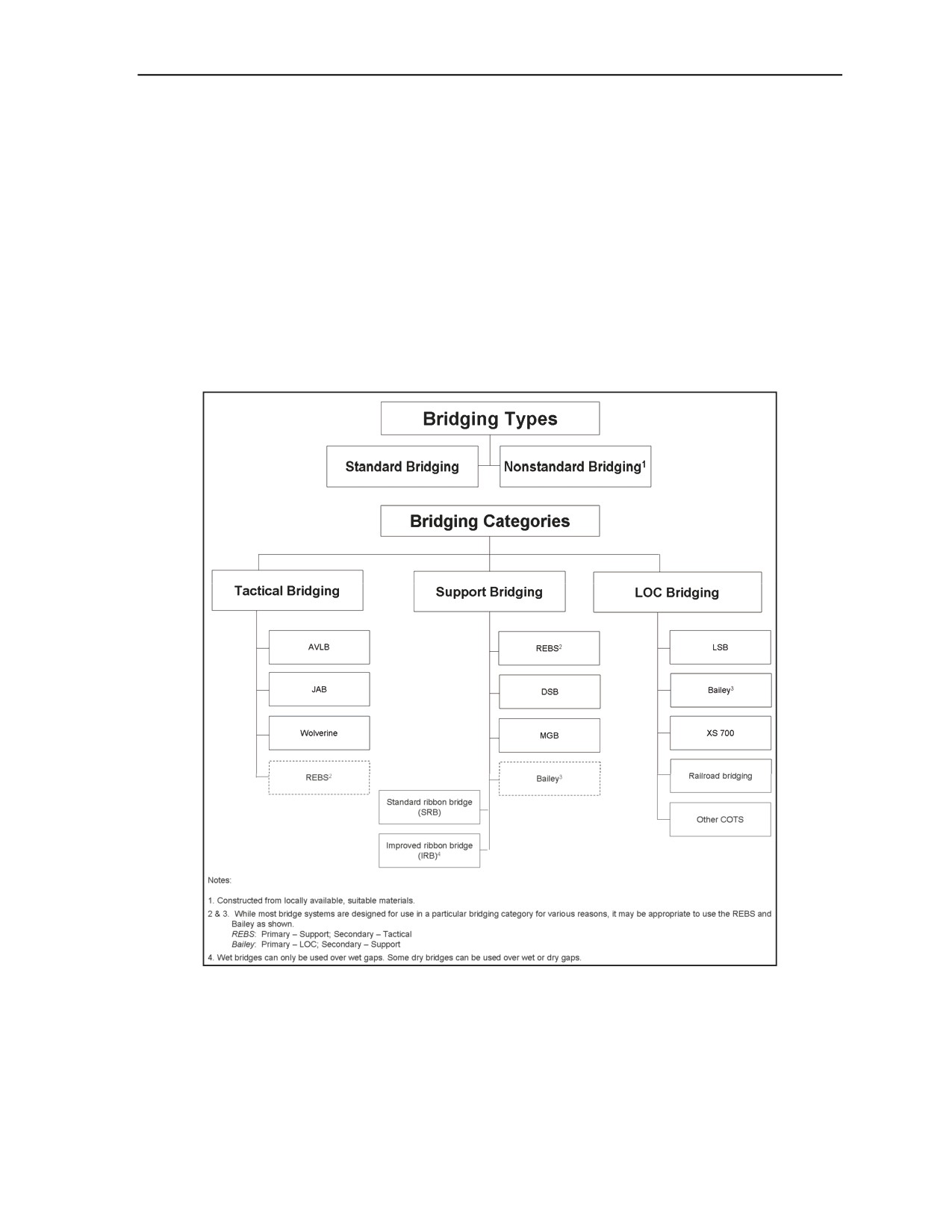
Figure 2-1. Types and Categories of Bridging
2-5
Figure 3-1. Brigade Combat Team Crossing Timeline for a Course of Action
3-7
Figure 3-2. Brigade Combat Team Crossing Area Overlay for a Course of Action
3-8
Figure 3-3. Salients and Reentrants on the Enemy Shore
3-13
Figure 4-1. Graphic Control Measures
4-5
Figure 4-2. Engineer Regulating Point Layout
4-8
Figure 4-3. Communication Linkages
4-9
Figure 4-4. Overview of a Deliberate Gap Crossing
4-14
ii
FM 3-90.12/MCWP 3-17.1
1 July 2008
Contents
Figure
4-5. Advance to the Gap
4-15
Figure
4-6. Assault Across the Gap
4-17
Figure
4-7. Advance From the Farside
4-18
Figure
4-8. Secure the Bridgehead Line
4-19
Figure A-1. Landing Craft Air Cushion
A-5
Figure A-2. Amphibious Assault Vehicle P7A1
A-5
Figure A-3. Expeditionary Fighting Vehicle
A-6
Figure A-4. Light Armored Vehicle
A-7
Figure A-5. Ribbon Raft
A-8
Figure A-6. Armored Vehicle-Launched Bridge
A-11
Figure A-7. Joint Assault Bridge
A-12
Figure A-8. Wolverine
A-13
Figure A-9. Rapidly Emplaced Bridge System
A-14
Figure A-10. Medium Girder Bridge
A-15
Figure A-11. M18 Dry Support Bridge
A-18
Figure A-12. Ribbon Bridge
A-20
Figure A-13. Ribbon Bridge Design
A-20
Figure A-14. Logistics Support Bridge
A-22
Figure A-15. Acrow 700XS
A-23
Figure A-16. M2 Bailey Bridge
A-24
Figure A-17. Determining Load Classes for Ice
A-26
Figure A-18. Required Ice Thickness for Wheeled Vehicles
A-26
Figure A-19. Required Ice Thickness for Tracked Vehicles
A-26
Figure A-20. Organization Chart-Mobility Augmentation Company
A-29
Figure A-21. Organization Chart - Multirole Bridge Company
A-30
Figure A-22. Organization Chart-U.S. Marine Corps Bridge Company
A-31
Figure B-1. Crossing Site Requirements
B-5
Figure B-2. Measuring the Current’s Velocity
B-6
Figure B-3. Slope Calculation
B-7
Figure B-4. Terrain Slope
B-7
Figure B-5. Gap Width
B-8
Figure B-6. Amphibious Drift
B-9
Figure B-7. Downstream Sideslip
B-10
Figure B-8. Constant Aim Point
B-10
Figure B-9. Constant Heading
B-11
Figure C-1. AVLB Overbridge (Camp Demi, Bosnia-Herzegovina)
C-9
Figure C-2. Mabey & Johnson Overbridge (Camp Demi, Bosnia-Herzegovina)
C-9
Figure C-3. Mabey & Johnson Overbridge (Aleksin, Bosnia)
C-10
Figure C-4. Mabey & Johnson Overbridge With a Temporary Pier Added (Bos
Gradiska, Bosnia)
C-10
Figure C-5. Mabey & Johnson Midspan Overbridge Erected Over a Damaged Pier
(Sweden)
C-10
1 July 2008
FM 3-90.12/MCWP 3-17.1
iii
Contents
Figure C-6. Mabey & Johnson Overbridge (Brcko, Bosnia)
C-11
Figure C-7. Mabey & Johnson Overbridge (Komar, Bosnia, near Travnik)
C-11
Figure C-8. Photographic Views of the Damaged Bridge (Karanovac, Bosnia-
Herzegovina)
C-13
Figure C-9. Sketch of Proposed Mabey & Johnson Overbridge
C-14
Figure C-10. Completed MGB (Karanovac, Bosnia-Herzegovina)
C-14
Figure C-11. Sample OPORD for a Temporary LOC Bridge Replacement
C-15
Figure C-11. Sample OPORD for a Temporary LOC Bridge Replacement
(Continued)
C-16
Figure C-11. Sample OPORD for a Temporary LOC Bridge Replacement
(Continued)
C-17
Figure D-1. Division Site Overlay (Sample)
D-2
Figure D-2. Initial Division Crossing Timeline (Sample)
D-5
Figure D-3. Brigade Combat Team Crossing Area Overlay (Sample)
D-5
Figure D-4. Brigade Combat Team Crossing Timeline (Sample)
D-7
Figure D-5. Brigade Combat Team Vehicle Crossing Capability (Sample)
D-7
Figure D-6. Brigade Combat Team Crossing Synchronization Matrix (Sample)
D-8
Figure D-7. Engineer Execution Matrix (Sample)
D-9
Figure F-1. Graphic Control Measures for a Retrograde Crossing
F-2
Figure F-2. Retrograde Planning
F-3
Figure F-3. Retrograde Crossing
F-4
Figure H-1. British Number 10 Bridge in Launch Sequence
H-2
Figure H-2. British Number 11 Bridge
H-2
Figure H-3. British Number 12 Bridge
H-3
Figure H-4. British Number 10 Bridge With Trestle
H-3
Figure H-5. MAN M47 LEGUAN Armored Bridge Layer
H-4
Figure H-6. MAN Leopard 1 LEGUAN Armored Vehicle-Launched Bridge
H-4
Figure H-7. MT-55A Bridge Layer in the Traveling Position
H-5
Figure H-8. MTU 72 Armored Bridge Layer
H-6
Figure H-9. MTU 90 Armored Bridge Layer
H-7
Figure H-10. PAA Bridge Layer
H-8
Figure H-11. SPRAT Modular Assault Bridge
H-8
Figure H-12. Mabey & Johnson Compact 200 Bridge
H-9
Figure H-13. Bailey Bridge
H-10
Figure H-14. M2 Bailey Bridge
H-10
Figure H-15. EuroBridge/Faltfestbruecke
H-11
Figure H-16. AM-50B
H-11
Figure H-17. TMM-6
H-12
Figure H-18. Acrow Panel Bridge
H-12
Figure H-19. M3 Amphibious Bridging and Crossing Vehicle
H-13
Figure H-20. Linked Amphibious Bridges Deployed
H-14
Figure H-21. MAN Floating Bridge
H-14
iv
FM 3-90.12/MCWP 3-17.1
1 July 2008
Contents
Figure H-22. Launching a Two-Span Bridge Pontoon
H-15
Figure H-23. FAC 540 Raft
H-15
Figure H-24. EFA Amphibious Bridge
H-16
Figure H-25. PFM Motorized Floating Bridge
H-16
Figure H-26. PTS-10
H-17
Figure H-27. MAN SE Railway Bridge
H-18
Tables
Table 3-1. The Military Decision-Making Process and its Relationship to the Engineer
Estimate
3-3
Table 3-2. Step Two: Mission Analysis
3-4
Table 3-3. Step Three: Course of Action Development
3-7
Table 3-4. Step Four: Course of Action Analysis (War Game)
3-8
Table 3-5. Step Five: Course of Action Comparison
3-9
Table 3-6. Steps Six and Seven: Course of Action Approval and Orders Production
3-9
Table 4-1. Command Post Tasks
4-11
Table 5-1. United States-Line of Communications Bridging
5-2
Table 5-2. Selected Allied-Line of Communications Bridging
5-3
Table A-1. Selected Nonvehicle Crossing Equipment Characteristics
A-2
Table A-2. Fording and Swimming Capability of Selected Combat Vehicles
A-4
Table A-3. Typical External Loads for Helicopters
A-7
Table A-4. Launch Restrictions
A-8
Table A-5. Allocation of Ribbon Bridge
A-8
Table A-6. Ribbon Raft Design (Standard Ribbon Bridge)
A-9
Table A-7. Ribbon Raft Design (Improved Ribbon Bridge)
A-9
Table A-8. Raft Crossing Capabilities
A-10
Table A-9. Characteristics of the Armored Vehicle-Launched Bridge
A-11
Table A-10. Characteristics of the Joint Assault Bridge
A-12
Table A-11. Characteristics of the Wolverine
A-13
Table A-12. Characteristics of the Rapidly Emplaced Bridge System
A-14
Table A-13. Work Parties and Construction Times for the Medium Girder Bridge
(Army)
A-15
Table A-14. Work Parties and Construction Times for the Medium Girder Bridge
(USMC)
A-16
Table A-15. Single-Story Bridge Length and Classification for the Medium Girder
Bridge
A-16
Table A-16. Classification for the Medium Girder Bridge Double Story, Double Story
Without Link Reinforcement Set, and Double Story With Link
Reinforcement Set
A-17
Table A-17. Characteristics of the M18 Dry Support Bridge
A-18
Table A-18. Boat Requirements for Ribbon Bridge Anchorage
A-21
1 July 2008
FM 3-90.12/MCWP 3-17.1
v
Contents
Table A-19. Characteristics of the Logistics Support Bridge
A-22
Table A-20. Characteristics of the Acrow 700XS
A-23
Table A-21. Load Classification for M2 Bailey Bridge
A-25
Table A-22. Ice Depth Requirements
A-27
Table A-23. Ice Color Factors
A-27
Table A-24. Ice Strength Factors
A-27
Table A-25. Ice Thickness Versus Vehicle Distance Determination
A-28
Table B-1. Relationship of Slope to Degrees
B-8
Table D-1. Raft Centerline Data
D-3
Table D-2. Boat Planning Factors
D-3
Table D-3. Selected Unit Rafting Requirements
D-4
Table D-4. Selected Pure Company/Troop Rafting Requirements
D-6
vi
FM 3-90.12/MCWP 3-17.1
1 July 2008
Preface
This publication applies to the Active Army, the Army National Guard (ARNG)/Army National Guard of the
United States (ARNGUS), and the United States Army Reserve (USAR) unless otherwise stated.
The doctrine of gap-crossing operations focuses on the support provided by engineer and other capabilities to
the combined arms team that enhances mobility of the force by projecting elements across an obstacle, wet or
dry, in support of assured mobility. It is also applicable to joint, interagency, or multinational forces and is
specifically written as a dual manual between the United States (U.S.) Army and the U.S. Marine Corps
(USMC). Although other branches contribute to gap-crossing operations and are included in the discussions,
this manual focuses on the engineer contribution to gap-crossing operations, while acknowledging the
significant role of other branches and capabilities. This manual follows the principles and tenets found in Field
Manual (FM) 3-90, FM 3-34, and FM 3-34.2 that continues the discussion of mobility and gap-crossing
operations. It recognizes the contribution of the entire combined arms team to gap-crossing operations and the
multi-Service capabilities that exist to support gap-crossing operations at both the tactical and operational
levels. Finally, it addresses the specifics associated with gap crossing in support of combat maneuver and line
of communications (LOC) gap crossing, integrating the considerations created by the significant changes to
doctrine and force structure that have occurred since FM 90-13 was published in 1998.
This FM is the tactical commander’s and engineer staff planner’s manual and primary resource for
understanding gap-crossing operations. This manual follows the mobility concepts and fundamentals outlined
in FM 3-34.2 and is intended for use by commanders and their staff at both the operational and tactical levels. It
relates the engineer-focused aspects of gap crossing to the functional area of combined arms mobility
operations, incorporating new concepts associated with the expansion of the existing Army task (ART)
Conduct Gap-Crossing Operations and the advent of the modular force structure.
FM 3-90.12 provides detailed guidance on integrating gap crossing into mobility operations. As a functional
area of mobility operations, it describes the fundamentals and considerations necessary for the proper planning
and execution of the two major types of gap-crossing support (combat maneuver and LOCs). This manual
discusses the following:
• Chapter 1 defines gap crossing and how it supports mobility operations within the framework of
assured mobility.
• Chapter
2 provides an overview of gap-crossing operations by providing the definitions,
fundamentals, and considerations necessary to understand the concept of gap crossing.
• Chapter 3 focuses on planning considerations that should be considered during tactical and
operational level planning.
• Chapter 4 goes into depth on how gap crossing supports combat maneuver at the division,
brigade combat team (BCT), and lower levels.
• Chapter 5 provides an insight on how gap crossing supports the establishment or maintenance of
LOCs.
• Chapter 6 provides selected special planning and when conducting gap-crossing operations in
special environments and situations.
1 July 2008
FM 3-90.12/MCRP 3-17.1
vii
Preface
• Appendix A describes crossing means that are most commonly used by Army and Marine
forces.
• Appendix B provides the planner with some considerations to assist in evaluating potential
crossing sites for gap-crossing operations.
• Appendix C provides information about specific procedures, conditions, and factors that can
impact a gap-crossing operation.
• Appendix D addresses detailed engineer planning necessary for a wet-gap-crossing operation.
• Appendix E discusses the specialized tasks that divers perform in support of wet-gap crossing.
• Appendix F describes the tactics and techniques used by a division or BCT in a retrograde
gap-crossing operation that differ from those used in an offensive crossing.
• Appendix G discusses gap-crossing security considerations.
• Appendix H provides descriptions of some common foreign bridging resources.
The primary audience for FM 3-90.12 is the task force (TF) and above maneuver commander and supporting
staff. This also includes nonorganic unit commanders and staffs that will support brigade and above maneuver
organizations. This doctrine will assist Army branch schools in teaching the integration of engineer capabilities
into Army operations as well as the combined arms roles and responsibilities in regards to gap-crossing
operations.
Engineer involvement is critical to most gap-crossing operations. The degree of involvement will include all of
the essential tasks for mobility, countermobility, and survivability (M/CM/S) performed by engineers and
others with focus on mobility operations. FM 3-90.12 is intended to inform all Service components of the types
and complexity of gap-crossing operations and the capabilities of Army and Marine engineers to do them. This
doctrine applies to all Army, USMC, Navy, and Air Force commanders and staffs (and other Department of
Defense [DOD] units and/or staffs and other elements operating under their command authority) responsible for
gap-crossing operations in support of combat operations at the tactical and selected operational levels.
FM 3-90.12 is linked to the doctrine articulated in FM 3-0, FM 5-0, FM Interim (FMI) 5-0.1, FM 3-90.6, FM
3-90.2, FM 3-34, and FM 3-34.2. Given the magnitude of recent doctrinal changes and the fact that river
crossing operations are now a subordinate operation within gap-crossing operations, it is important to
understand the changes occurring in Army doctrine and organization to effectively use FM 3-90.12. The
doctrine in FM 3-90.12 applies to all types of operations (offense, defense, stability, and civil support) and is
focused at the tactical level of war in support of the tactical commander’s mobility needs.
Terms that have joint or Army definitions are identified in both the glossary and the text. Glossary references:
The glossary lists most terms used in FM 3-90.12 that have joint or Army definitions. Terms for which
FM 3-90.12 is the proponent FM (the authority) are indicated with an asterisk in the glossary. Text references:
Definitions for which FM 3-90.12 is the proponent FM are printed in boldface in the text. These terms and their
definitions will be incorporated into the next revision of FM 1-02/Marine Corps reference publication (MCRP)
5-12A. For other definitions in the text, the term is italicized, and the number of the proponent FM follows the
definition.
The proponent for this publication is the United States Army Training and Doctrine Command (TRADOC).
Send comments and recommendations on Department of the Army (DA) Form 2028 (Recommended Changes
to Publications and Blank Forms) directly to Commandant, United States Army Engineer School, ATTN:
ATZT-TDD-E, 320 MANSCEN Loop, Suite 220, Fort Leonard Wood, Missouri 65473-8929. Submit an
electronic DA Form 2028 or comments and recommendations in the DA Form 2028 format by e-mail to
<leon.mdottddengdoc@conus.army.mil>.
Unless this publication states otherwise, masculine nouns and pronouns do not refer exclusively to men.
viii
FM 3-90.12/MCWP 3-17.1
1 July 2008
Preface
Some common abbreviations and acronyms—for example, the abbreviations for military ranks—are not spelled
out; refer to the glossary. As a dual service manual, references made to the U.S. Army, Soldiers, division, and
BCT are interchangeable with and/or include the USMC, Marines, and regimental combat team (RCT) unless
stated otherwise in the text. References made to mission, enemy, terrain and weather, troops and support
available, time available, and civil considerations (METT-TC) is the way the Army uses this acronym by
adding "civil considerations." The Marine Corps and joint doctrine use it without "civil considerations."
ACKNOWLEDGMENT
The copyright owners listed here have granted permission to reproduce material from their works. Other
sources of quotations, graphics, and material used in examples and vignettes are listed in the Source Notes.
Photographs of Mabey and Johnson overbridges and the Compact 200 bridge. Permission given from Kevin
Traynor, Mabey Bridge & Shore, Inc.®, 6770 Dorsey Road, Elkridge, MD 21075.
1 July 2008
FM 3-90.12/MCWP 3-17.1
ix
Introduction
MOBILITY DOCTRINE
Gap-crossing operations are functional areas of combined arms mobility operations and are applied across
the spectrum of conflict. Each of the warfighting functions have the potential to contribute to a gap
crossing. This manual focuses on the engineer roles and responsibilities for gap-crossing support to tactical
commanders at the BCT level and above. It also discusses the general engineering aspects related to the
establishment and maintenance of LOCs and other crossing operations. Finally, geospatial engineering is
used to enable gap-crossing operations and the other functional areas of mobility. It is an important
contributor to the planning process.
FM 3-90.12 also discusses how commanders can best plan and execute gap crossing as a part of all
operations with the support of their engineer and other key staff members. The planning of gap crossings is
linked to the fundamentals of operations and planning contained in FM 3-0 and FM 5-0. Because
gap-crossing operations are focused on support of maneuver forces at the BCT level, the primary combined
arms manual for this manual is FM 3-90.6. For the same reason, this manual complements FM 3-34 and
FM 3-34.2. Additionally, since many gap crossings involve or require a subsequent general engineering
effort, FM 5-104 has applicability.
The degree of a land component force’s success can depend on their ability to move freely and quickly
across terrain to achieve critical tactical and operational aims. As such, it is imperative that effective and
efficient crossing means are available throughout the area of operations (AO). Additionally, in today’s
operational environment (OE), land forces must coordinate and synchronize their efforts so that they are
able to fully support joint, interagency, and multinational forces that may require movement throughout the
AO. As dominant land forces, it is incumbent on the Army and Marine Corps to support these diverse
forces and agencies with gap-crossing solutions to facilitate the successful conduct of all types of military
operations. In the past, various gap-crossing operations were identified in FM 90-13. River crossing is
defined as a combined arms operation to project combat power across a terrain feature, wet or dry, that is
too wide to overcome by self-bridging. Therefore, by definition it is a type of gap crossing. With
transformation and today’s OE, the focus of gap crossing is normal maneuver, thus obstacles as significant
as river crossings are but one type of gap that must be fully considered. As such, it has become necessary
to expand the concepts associated with gap crossing with the emphasis on combined arms maneuver and
force movement within the AO.
EMERGING DOCTRINAL REQUIREMENTS
FM 3-90.12 is a significant revision of FM 90-13. While the principles of river crossing have not changed,
it is but one of the gap crossings that must be considered to facilitate the movement and maneuver of the
force within the AO. Another fundamental change to this manual is the adjustment to current doctrine and
the alignment and titling of the ART Conduct Gap-Crossing Operations. This ART has two subordinate
ARTs: Conduct Gap Crossing in Support of Combat Maneuver and Conduct Line of Communications
Gap-Crossing Support. These tasks essentially divide gap crossings into those that have a tactical focus and
directly impact normal combat maneuver, and those that facilitate movement as part of force sustainment
or have unique or special considerations in their application. Finally, the Army’s reorganization and
restructuring to a modular force has impacted both the doctrinal and operational approach to gap-crossing
operations.
x
FM 3-90.12/MCRP 3-17.1
1 July 2008
Introduction
Changes that directly affect this manual include the following:
The expansion of the ART of river crossing to include all gap-crossing operations. With that, the
addition of the two subordinate ARTs.
The advent of the construct and term of assured mobility and its relationship to other doctrine
(see FM 3-34).
An acknowledgement of the importance of joint interdependence among the Services.
The formalization of a planning tool that supports the engineer staff running estimate known as
essential tasks for M/CM/S (see FM 3-34).
The OE and specifically how the contemporary operational environment (COE) can be expected
to challenge maneuver (see FM 1 and FM 3-0).
The likelihood that operations will be conducted in a joint, interagency, and multinational
environment with a reliance on joint interdependence (see FM 1 and FM 3-07) to maximize their
total complementary and reinforcing effects while minimizing vulnerabilities.
The frequency of contractors on the battlefield and their support for selected LOC bridging and
similar tasks associated with general engineering missions. (See Army Regulation (AR) 715-9,
FM 100-10-2 and FM 3-100.21).
Changes in the design and organizational structures and equipment of engineer organizations to
support the Army’s ongoing transformation.
The deletion of the term shallow fording. This term is no longer necessary.
The engineer role in combined arms gap-crossing operations is to facilitate mobility by providing the
expertise, equipment, and/or materials necessary to move units across a terrain feature or linear obstacle,
wet or dry, in a manner which is unimpeded by the obstacle. The resources that support this task are limited
and normally require a significant effort to be effective. Due to the lack of organic gap-crossing equipment
in the heavy brigade combat team (HBCT) and the infantry brigade combat team (IBCT) and limited assets
in the Stryker brigade combat team (SBCT), the task organization of nonorganic gap-crossing assets is one
that requires careful planning and consideration by operational staffs and commanders. Tactical
gap-crossing capability should always augment BCTs whenever they are engaged in offensive or defensive
operations.
SUMMARY OF CHANGES OR EVOLVING ISSUES
The following material highlights some of the changes or evolving issues that are present in this manual.
This manual has attempted to capture the most critical changes highlighted within FMI 5-0.1, FM 3-0
Content Summary, and other ongoing and evolving issues and doctrinal guidance.
NEW TERMS AND CONCEPTS
This manual has captured or attempted to highlight and integrate many of the following terms or concepts
that have been (or are being) discussed for addition to Army doctrine:
Warfighting function.
Assured mobility.
Engineer reconnaissance team (ERT).
Deputy commanding general (DCG) as a replacement for the assistant division commander
(ADC).
Essential tasks for M/CM/S.
Gap crossing and gap-crossing operations.
Gap-crossing considerations in special environments or circumstances (such as overbridging).
Revision of bridging terms and definitions.
Tactical bridging and support bridging (to include line of communication bridges).
Standard and nonstandard bridging.
Spectrum of conflict.
1 July 2008
FM 3-90.12/MCWP 3-17.1
xi
Chapter 1
Operations in Support of Gap Crossing
"Throughout history, wars had been lost by not crossing rivers."
General George S. Patton
Freedom of movement and maneuver within the AO is critical to achieve decisive
results across the full spectrum of conflict. Mobility operations are designed to
facilitate moving forces to achieve a position of advantage in relation to the enemy.
One of the major challenges to movement and maneuver are linear obstacles or gaps.
These obstacles are natural and man-made, wet or dry, and vary in size. From simply
fording a shallow creek to continuing movement, to synchronizing assets and
activities at multiple crossing sites across a major water obstacle in an opposed
crossing operation, gap-crossing operations can range in complexity from very
simple to extremely difficult. The simplest operation may be done by using organic
assets, while the most difficult will require extensive augmentation and support from
higher-level headquarters (HQ) to resource and for C2 of the operation.
Gap crossings and gap-crossing operations are essential to enable combat and
supporting forces to do their mission. They will occur in support of decisive and
shaping operations. Because of the importance of these operations, as well as the
amount of resources that may have to be committed, gap crossings are often
controlled by division/Marine expeditionary force (MEF) or BCT/RCT HQ. Future
operations will be characterized by a high degree of mobility, firepower, and
situational understanding (SU) resulting in an increase of the operating tempo and the
synchronization of battlefield effects. Engineers (and others) must understand the
gap-crossing fundamentals of surprise, extensive preparation, flexible plan, traffic
control, organization, and speed to properly plan, resource, and facilitate the
execution of a successful gap crossing. Simultaneously, they must be able to plan
longer term gap-crossing operations and upgrade bridging over gaps through support
and LOC bridging to ensure freedom of movement for the supported force. Tactical
bridging should primarily serve in close support of combat maneuver forces. It is
replaced by support bridging, when necessary, to allow continued support of combat
maneuver. Support bridging should be replaced by LOC bridging when that is the
proper solution for long-term, gap-crossing support.
CHALLENGE TO MANEUVER
1-1. Maneuver warfare depends on freedom of movement and seeks to capitalize on enemy weaknesses
whenever possible. The enemy will use firepower, terrain, and natural and man-made obstacles to deny
freedom of maneuver. Friendly forces will first attempt to bypass such obstacles; however, this may not
always be an option. Challenges which limit maneuver must be overcome. Gap crossing is defined as
projecting combat power across a linear obstacle (wet or dry gap). Combined arms gap-crossing
operations [is] defined as a mobility operation consisting of river crossing, brigade-level crossing, and
special gap-crossing operations conducted to project combat power across a linear obstacle (wet or
dry gap). These are employed to restore the ability to wage maneuver warfare in spite of the reality of
natural and man-made obstacles. Gap crossing, which involves projecting combat power across a linear
1 July 2008
FM 3-90.12/MCRP 3-17.1
1-1
Chapter 1
obstacle (wet or dry gap), is also a necessary operation to facilitate the freedom of movement for support
forces in and around the AO. Gaps present a significant challenge and are found in almost every
environment and throughout the full spectrum of operations.
1-2. In the past, gap-crossing operations were described only in the context of "river crossing." River
crossing is a type of gap-crossing operation required before ground combat power can be projected
and sustained across a water obstacle. It is a centrally planned and controlled offensive operation
that requires the allocation of external crossing means and a force dedicated to the security of the
bridgehead. While a river crossing is still considered one of the most challenging of gap crossings, it is
but one type of gap that can obstruct freedom of movement. A gap is a ravine, mountain pass, river, or
other terrain feature that presents an obstacle that may be bridged. The fundamentals of crossing any
type of gap are essentially the same as those fundamentals that have been associated with river crossing.
The acknowledgment is that river crossings are simply one focused set of challenges among all of the
possible gap-crossing operations. Gap crossing encompasses all types of gaps (wet or dry); in any type of
environment using organic and augmenting modularized engineer (and other) elements best suited to do the
mission.
1-3. The organic structure of the BCT does not include the engineer and other support elements needed to
conduct all combined arms gap-crossing operations. In fact, BCTs will require additional gap-crossing
capabilities as augmentation in most cases and only the SBCT has limited organic gap-crossing
equipment/bridging in the form of the rapidly emplaced bridge system (REBS). Depending on mission
requirements and the type of crossing or crossings, the BCT may require augmentation of at least one
engineer battalion HQ with subordinate engineer capabilities and other specialized assets. The engineer
battalion will assist the BCT in planning and serve as a C2 element for the subordinate mix of mobility
augmentation companies
(MACs), multirole bridge companies
(MRBCs), and any other necessary
units/capabilities. Mission analysis may identify other shortfalls such as military police; chemical,
biological, radiological, and nuclear (CBRN) ; aviation; or other capabilities required to support the BCT
in a gap-crossing operation. It is imperative that the BCT commander and staff identify and correct any
required capability shortfalls through augmentation early in the planning process.
1-4. Early identification of gaps within the maneuver area and applying the appropriate forces and
resources early in the planning process can mean the difference between success and failure for maneuver
units. Assuring mobility requires proactive assessment as a part of intelligence preparation of the battlefield
(IPB) as well as integrating the proper support elements into the combat maneuver force to deal with
planned or unplanned obstacles (to include gaps) that will affect the mobility of the force. While gap
crossing is only one of the five mobility functions (FM 3-34.2), it has an important role in enabling the
tactical commanders’ freedom of movement so he can maintain or dictate the momentum on the battlefield.
INTEGRATING ASSURED MOBILITY
1-5. Assured mobility provides a planning framework to guide the commander and staff in the proactive
application of engineer and other combat power to assure the freedom of movement and maneuver. As an
integrating process, assured mobility provides linkage between the tasks associated with mobility,
countermobility, and survivability and their roles across the six warfighting functions. It applies in all
operations and across the complete spectrum of conflict. Assured mobility is the framework of processes,
actions, and capabilities that assure the ability of the joint force to deploy and maneuver where and when
desired, without interruption or delay, to achieve the mission. It strives to ensure freedom of maneuver and
preserve combat power throughout the AO as it seeks to exploit superior SU. This construct is one means
of enabling a joint force to achieve the commander’s intent. Assured mobility emphasizes proactive
mobility and countermobility (and supporting survivability) and integrates all of the engineer functions in
accomplishing this. Assured mobility is broader than the term mobility and should not be confused with the
limited application of the mobility operations as described in FM 3-34.2. Its focus is on supporting the
maneuver commander’s ability to gain a position of advantage in relation to the enemy; by conducting
mobility operations to negate the impact of enemy obstacles, conducting countermobility to impact and
shape enemy maneuver, or a combination of both.
1-2
FM 3-90.12/MCWP 3-17.1
1 July 2008
Operations in Support of Gap Crossing
Note. Assured mobility is defined as actions that give the force commander the ability to
maneuver where and when he desires without interruption or delay to achieve the mission.
(FM 3-34)
1-6. While focused primarily on the warfighting function of movement and maneuver, intelligence, and
protection, it has linkages to each of the warfighting function and both enables and is enabled by those
functions. While the engineer has a primary staff role in assured mobility, other staff members support its
integration and have critical roles to play. The engineer plays an integrating role in assured mobility that is
similar to the role played by the intelligence officer in the IPB integrating process. Ultimately, assured
mobility is the commander’s responsibility. Other staff members also integrate essential tasks for M/CM/S
as part of assured mobility. For example, the regulation of traffic in the maneuver space; the handling of
displaced persons; and other essential tasks for M/CM/S to support the maneuver plan. Assured mobility is
the integrating planning process where consideration of engineer, CBRN, and other reconnaissance
capabilities also occur.
1-7. The framework of assured mobility follows the continuous cycle of the operations process.
Achieving assured mobility rests on applying six fundamentals that both sustain friendly maneuver,
preclude the enemy’s ability to maneuver, and assist the protection of the force. The fundamentals of
assured mobility are:
Predict. Engineers and other planners must accurately predict potential enemy impediments to
joint force mobility by analyzing the enemy’s tactics, techniques, procedures, capabilities, and
evolution. Prediction requires a constantly updated understanding of the OE.
Detect. Using intelligence, surveillance, and reconnaissance (ISR) assets, engineers and other
planners identify early indicators for the location of natural and man-made obstacles,
preparations to create and/or emplace obstacles, and potential means for obstacle creation. They
identify both actual and potential obstacles and propose solutions and alternate COA to
minimize or eliminate their potential effects.
Prevent. Engineers and other planners apply this fundamental by denying the enemy’s ability to
influence mobility. This is done by forces acting proactively before the obstacles are emplaced
or activated. This may include aggressive action to destroy enemy assets and/or capabilities
before they can be used to create obstacles. Political considerations and rules of engagement
(ROE) may hinder the ability to apply the fundamental early in a contingency.
Avoid. If prevention fails, the commander will maneuver forces to avoid impediments to
mobility if this is viable within the scheme of maneuver.
Neutralize. Engineers and other planners plan to neutralize, reduce, or overcome
obstacles/impediments as soon as possible to allow unrestricted movement of forces. The
breaching tenets and fundamentals apply to the fundamental of "neutralize."
Protect. Engineers and other elements plan and implement survivability and other protection
measures that will deny the enemy the ability to inflict damage as joint forces maneuver. This
may include countermobility missions to deny the enemy maneuver and provide protection to
friendly maneuvering forces.
1-8. Assured mobility provides the broad framework of fundamentals that serve to retain the focus and
integrate mobility, countermobility, and survivability within the combined arms team. Planners at all levels
of the combined arms team rely on this framework to ensure that adequate support is provided to the
commander’s scheme of maneuver and intent. Within the combined arms team planning staff, it is the
assured mobility section at the BCT level (and those same staff members at echelons above the BCT) that
provide the input for engineer, CBRN, and similar specialized reconnaissance. The engineer coordinator
(ENCOORD) plans for the application of and coordinates the integration of engineer reconnaissance across
the engineer functions and spanning the range from tactical to technical capabilities.
1 July 2008
FM 3-90.12/MCWP 3-17.1
1-3
Chapter 1
1-9. Many gap-crossing options exist to overcome gaps that may be encountered. While there are many
options, standard gap-crossing systems are a valuable and limited asset. Where and how they are used,
their emplacement duration, and recovery or replacement by other systems are important considerations.
Staffs apply the fundamentals of assured mobility to assist in resolving the challenges of what, where,
when, and how gap-crossing operations are to be resourced and performed on the battlefield.
GAP-CROSSING OPERATIONS
1-10. Mobility is a quality or capability of military forces which permits them to move from place to place
while retaining the ability to fulfill their primary mission (Joint Publication [JP] 1-02). Gap crossing is but
one of the five mobility areas intended to meet the challenges of maintaining freedom of tactical and
operational movement (Figure 1-1). The Conduct Mobility Operations ART has the following two primary
subordinate ARTs related to gap crossing:
Conduct Gap Crossing in Support of Combat Maneuver. This task includes deliberate, hasty
and covert gap crossings. A deliberate crossing involves the crossing of an inland water
obstacle or other gap that requires extensive planning and detailed preparations (JP 1-02).
A hasty crossing is the crossing of an inland water obstacle or other gap using the crossing
means at hand or those readily available, and made without pausing for elaborate
preparations (JP 1-02). A covert crossing is a gap-crossing operation that is planned and
executed without detection by opposing forces. Its primary purpose is to facilitate
undetected infiltration of the far side of a gap and is normally conducted by battalion and
smaller forces. See Chapter 2 for more information about each of these. The terms of crossing
force and crossing force commander may be useful in describing the force executing the
crossing and their commander. The crossing force is the unit that has responsibility to
establish the bridgehead. The crossing force commander is the individual designated to
control the lead brigades during the assault across the gap to secure the bridgehead line.
Gap crossing in support of combat maneuver includes those operations conducted primarily at
the BCT level, as well as potentially some of those conducted by the division or corps level
organization, but this task is typically conducted in a close-combat environment. The crossing
means task organized to combat maneuver can provide temporary to semipermanent crossing
capability; however, its primary purpose is to provide the maneuver force a means to maintain
its momentum. Those gap crossings conducted as a reduction method within a combined arms
breaching operation are also included in this ART, but since the primary focus of planning and
preparation is on the breaching operation, they are typically discussed as a part of the breaching
operation rather than as a separate gap-crossing operation in that context.
Conduct Line of Communications Gap-Crossing Support. The conduct of LOC gap-crossing
support is not tactically focused, although it may clearly have an effect on tactical operations.
LOC bridging is used to establish semipermanent or permanent support to planned road
networks that anticipate high-volume traffic. These bridges are typically placed in
locations free from the direct influence of force on force combat operations. This support
may provide the means for combat maneuver forces to move, but it is not directly in support of
combat maneuver. This type of gap-crossing support is typically distinguished by the size or
length of the bridge and the capacity for high volume and frequent crossings. The crossing
means is designed to provide extended service and is normally associated with support forces. It
is typically conducted in an area free of the threat of direct or indirect fire. As the title implies,
the focus of this ART is on nonstandard bridging.
1-4
FM 3-90.12/MCWP 3-17.1
1 July 2008
Operations in Support of Gap Crossing
Figure 1-1. Gap-Crossing Operations in the Army Universal Task List
1 July 2008
FM 3-90.12/MCWP 3-17.1
1-5
This page intentionally left blank.
Chapter 2
Overview of Gap-Crossing Operations
"The wise man bridges the gap by laying out the path by means of which he can get from
where he is to where he wants to go."
John Pierpont Morgan
The purpose of any gap-crossing operation is to project combat power or operational
forces across a linear obstacle in support of mobility. A gap crossing is a unique
operation that often requires specific procedures for success because the obstacle,
either wet or dry, can prevent or severely impede tactical maneuver or operational
movement. In addition to specific procedures, a gap crossing normally requires
special equipment or materials that are limited or nonexistent as organic assets in the
BCT. It is incumbent on engineer planners to highlight the need for augmentation of
additional assets early in the planning process. Then they should task-organize all
available assets in a manner that best supports the commander’s scheme of maneuver
within the entire AO. Engineers face the challenge of getting the necessary assets to
the right location at the right time. They should synchronize the effort so that the
tactical force can maintain their movement while the supporting forces retain
freedom of movement in support of the operation.
GAP CROSSING AS A FUNCTIONAL AREA OF MOBILITY
OPERATIONS
2-1. The change of the ART from "Conduct River Crossing" to "Conduct Gap-Crossing Operations" is
based on the realization that gap crossings are necessary for a wide variety of gaps, not just rivers. It has
become clear that while river crossings are perhaps one of the most difficult gaps to cross, the
fundamentals, planning, and many of the resources used in a river crossing are applicable to other types of
gap crossings.
2-2. Combined arms gap-crossing operations are narrowly focused on the reduction of natural or man-
made gaps utilizing mechanical equipment
(normally bridging assets) or commercially procured or
expedient materials to facilitate mobility. To further refine the doctrine associated with gap-crossing
operations, it is necessary to divide it into two categories: combat maneuver gap-crossing support and LOC
gap-crossing support (Chapter 1, Figure 1-1, page 1-5). The challenge for both is the same: to minimize a
gap’s impact on the commander’s ability to maneuver.
2-3. Combat maneuver gap-crossing support is like a breaching operation in that the force is vulnerable
while moving through a lane or across a gap. Maneuver units are forced to break movement formations,
concentrate within lanes or at crossing points, and reform on the farside before continuing to maneuver. To
minimize the impact on maneuver, commanders must determine if the gap crossing is to be conducted as a
deliberate, hasty, or covert operation. While much of the terminology and planning associated with gap
crossing is the same as that used in a breaching operation, they differ in scope and the amount and type of
assets involved. Additionally, gap crossings do not ordinarily require the reduction or clearance of
explosive hazards (EH) obstacles.
2-4. LOC gap-crossing support concentrates on nonstandard bridging, specialized bridging, and other
LOC crossing means. They differ in that they are always well planned and conducted under relatively safe,
protected conditions.
1 July 2008
FM 3-90.12/MCRP 3-17.1
2-1
Chapter 2
2-5. The expansion of the ART, to be more inclusive of natural and man-made gaps, has led to the need
for expanding and, in some cases, redefining some of the previous terminology associated with river
crossing. Listed below are many of the terms that are necessary to understand gap-crossing operations.
DELIBERATE
2-6. A deliberate gap crossing is classified as wet or dry and is usually done with one or more MRBCs in
support of combat maneuver. It is normally done when a hasty crossing is not feasible or has failed. Often,
these types of crossings will be river crossings. However, like any deliberate crossing, they all require
detailed reconnaissance, detailed planning, coordination of fire plans, extensive preparations and
rehearsals, and significant engineer assets. While a BCT can do a deliberate crossing, in most cases a
division- or corps-level organization will C2 the crossing because they involve more than one BCT.
Deliberate crossings can involve both general and combat engineering elements.
2-7. Some additional considerations for conducting deliberate gap crossings are as follows:
Complexity and assets required to do the crossing.
Opposition from a defending enemy and/or the severity of the obstacles.
Necessity to clear entry and/or exit crossing points of enemy forces.
Clarifying if the situation allows and time permits thorough preparations.
Deliberate Wet-Gap Crossing
2-8. The deliberate wet-gap crossing
(see the example in Chapter
4) is one that requires rafting
(nonbridging) and/or bridging assets. Assault craft (boats and/or helicopters), rafts and/or ferries, and the
emplacement of bridging assets may occur sequentially or concurrently. The objective in deliberate wet-
gap crossings is to project combat power to the exit bank of a river or other type of significant water
obstacle at a faster rate than the enemy can concentrate forces for a counterattack. It is typically one of the
most difficult types of gap crossings and will generally require significant augmenting with specialized
assets to accomplish.
Deliberate Dry-Gap Crossing
2-9. A deliberate dry-gap crossing is usually determined by the strength of the enemy's defenses and the
magnitude of the gap. Generally, the M9 armored combat earthmover (ACE), the Wolverine, the joint
assault bridge (JAB), or the armored vehicle-launched bridge (AVLB) is preferred in the HBCT and the
IBCT, while the REBS is organic to and may normally serve the basic immediate needs of the SBCT with
augmentation of other assets as required. Neither the HBCT nor the IBCT has any organic gap-crossing
capability and will need augmentation as a minimum for all offensive and defensive operations. Other
bridging, to include the logistics support bridge (LSB) , the dry support bridge (DSB), the medium girder
bridge (MGB), and the M2 Bailey bridge, are used to span larger dry gaps. (See Appendix A for military
load classification [MLC] information.) These assets are labor-intensive and expose personnel to enemy
fire during construction while providing stable gap-crossing support for continuous operations.
HASTY
2-10. A hasty gap crossing is also classified as wet or dry. A hasty gap crossing is normally preferable to a
deliberate crossing because there is no intentional pause to prepare. This promotes speed, facilitates
surprise, and provides a continuation of maneuver momentum. It is most often used when enemy resistance
is weak and the gap is not a severe obstacle. It also features decentralized control at the BCT and below
level, utilizing an augmenting MAC, organic assets, or expedient crossing means at multiple sites along a
broad front. Due to the limited organic crossing assets, additional support in the form of MACs from
echelons above the BCT is often necessary. That support is only available when those HQ have taken
purposeful action to position the assets at the right time and place and integrate them with the maneuver
force to make a hasty gap crossing feasible. Coordination for these assets must be made early in the
planning process.
2-2
FM 3-90.12/MCWP 3-17.1
1 July 2008
Overview of Gap-Crossing Operations
2-11. Some additional considerations for conducting hasty gap crossings are as follows:
Size of the gaps in the maneuver area.
Availability of existing bridges, fords, bypasses, or expedient crossing materials. A ford is a
shallow part of a body of water or wet gap that can be crossed without bridging, boats,
ferries, or rafts (the definition was shortened, and the complete definition is printed in the
glossary).
Recovery of assets.
Aviation (helicopter) asset availability.
Hasty Wet-Gap Crossing
2-12. The depth and width of the "wet gap," bank conditions, and the current’s velocity are major factors
to determine the maneuver unit’s ability to conduct a hasty wet-gap crossing. These factors will determine
if the maneuver force can cross by fording or swimming, if expedient materials can be used, or if specific
bridging assets are required. Identifying wet gaps early and deploying the required resources allow hasty
crossings of known or anticipated gaps to occur.
Hasty Dry-Gap Crossing
2-13. Antitank (AT) ditches, craters, dry river beds, partially blown bridges, and similar obstacles are
normally what maneuver forces encounter as a dry-gap-crossing obstacle. Maneuver forces can use the M9
ACE to push down the sides of ditches or to fill in craters. Substantial fill materials placed in the dry gaps
allow the passage of combat tracked vehicles. The crossing site, defined as the location along a water
obstacle or other gap where the crossing can be made using amphibious vehicles, assault boats, rafts,
bridges, or fording vehicles, can be improved and maintained for wheeled traffic use by follow-on forces.
The AVLB, Wolverine, JAB, or REBS are also well suited for hasty dry-gap crossings. (See Appendix A
for bridge MLC information.) As with any hasty crossing, consideration must be given to the need for
replacement bridging so that the maneuver unit can maintain its assets for follow-on, gap-crossing
requirements.
In-Stride Gap Crossing
2-14. An in-stride gap crossing is merely a variation of a hasty gap crossing (wet or dry) with the unique
requirements for a company team (or lower) to do the gap crossing in a drill-like fashion. In-stride gap
crossings can occur when a given gap is not the same as the unit planned or anticipated. To conduct an in-
stride crossing, the unit must be well trained, have established standing operating procedures (SOPs), and
be task-organized with the proper assets and capabilities.
COVERT
2-15. A covert gap crossing is a gap crossing used to overcome gaps (wet or dry) without being detected
by the enemy. It is used when surprise is essential to infiltrate across a gap and when limited visibility and
gap conditions present an opportunity to complete the crossing without being seen. The covert gap crossing
is normally done by a battalion-size element or smaller (dismounted or in wheeled vehicles) as a BCT is
typically too large to maintain the level of stealth necessary to conduct a successful covert gap crossing.
2-16. The primary purpose of a covert gap crossing is to move forces across a gap in an undetected fashion
to infiltrate forces to the farside. It should not be confused with the assault phase of a deliberate
gap-crossing operation. While a covert crossing can precede a deliberate or hasty gap crossing by a
like-sized or larger element, it is planned and conducted as a separate operation. Common crossing means
to facilitate a covert crossing include rope bridges, infantry foot bridges, rafts, Zodiac boats, fording and
swimming, or aerial insertion. Whatever means is used, consideration must be given to the recovery of the
crossing assets. Plans (contingencies) should also be made to deal with the possibility that the covert
crossing may be compromised.
1 July 2008
FM 3-90.12/MCWP 3-17.1
2-3
Chapter 2
GAP-CROSSING MEANS
2-17. Gap-crossing means refer to the method used and include standard and nonstandard bridging assets
utilized to cross a gap (Figure 2-1). Additionally, crossing means can include nonbridging methods. Some
examples of nonbridging methods include rafting, ferrying, rotary-wing airlift, or fill materials (culverts,
fascines, or soil). Nonbridging methods are promoted for certain types of gaps and where possible to
conserve bridging resources. The expedient and rapid nature of some of these nonbridging methods
aggressively supports maintaining the tempo of the tactical force they are supporting. These methods are
essentially only limited to imagination, the materials available, and the commander’s willingness to accept
a measure of risk.
BRIDGING TYPES
2-18. There are two basic bridging types: standard and nonstandard (Figure 2-1). While the two types
could be combined as a hybrid of some nature, the bridge will normally be identified by the predominant
components of the bridge. Standard bridging includes any bridging derived from manufactured bridge
systems and components that are designed to be transportable, easily constructed, and reused.
Examples of standard bridging include the Wolverine, DSB, and Bailey bridges. Nonstandard bridging is
purposely designed for a particular gap and typically built utilizing commercial off-the-shelf (COTS)
or locally available materials. They are normally used when time permits and materials and construction
resources are readily available; standard bridging is inadequate, unavailable, or being reserved for other
crossings; and when the situation allows for unique construction. These bridges are normally left on-site,
even when they are no longer necessary to support military movement. Nonstandard bridging is typically
constructed by construction engineers or contractors utilizing construction materials such as steel, concrete,
and/or timber.
BRIDGING CATEGORIES
2-19. There are three bridging categories (Figure 2-1), and they are broadly defined by their intended
purpose(s). These categories include tactical, support, and LOC bridging. The bridging category is
typically dictated by the operational environment, gap characteristics, and equipment available. They are
subordinate to the bridging types and, therefore, can be standard or nonstandard. As the situation changes,
crossing sites may eventually be abandoned, improved, or replaced with appropriate alternatives that befit
the requirements.
Tactical Bridging
2-20. Tactical bridging are those bridges that are used for immediate mobility support of combat
maneuver forces in close combat. They are very often employed under the threat of direct or indirect
fire and are intended to be used multiple times for short periods.
Support Bridging
2-21. Support bridging is used to establish semipermanent or permanent support to planned
movements and road networks. They are normally used to replace tactical bridging when necessary.
These bridges are used to establish semipermanent or permanent support to planned movements and road
networks. High use can be expected by both tracked and wheeled traffic. Replacement of tactical bridging
by support bridging should be considered to allow the tactical bridge asset to continue in support of the
combat maneuver force’s mobility.
2-4
FM 3-90.12/MCWP 3-17.1
1 July 2008
Overview of Gap-Crossing Operations
Line of Communications Bridging
2-22. The construction of a LOC bridge is generally conducted in areas free from the direct influence of
enemy action. This does not mean that protection against attacks by air and ground forces are not
considered. Their emplacement is not generally time-constrained in a tactical sense. Because of the load to
be carried, potential length of service (relative to tactical or support bridging), and the longer spans
(usually) of LOC bridges, a thorough reconnaissance, planning, and site preparation are essential.
GAP-CROSSING BRIDGES
2-23. When selecting a particular crossing means, it is important to clarify between bridging and
nonbridging as the method for crossing a gap. A gap-crossing bridge is a bridge system that, when fully
employed or constructed either independently or in conjunction with other or additional bridges, closes the
gap. This includes standard and nonstandard bridges. It does not include partial bridges utilized as rafts or
ferries.
Figure 2-1. Types and Categories of Bridging
1 July 2008
FM 3-90.12/MCWP 3-17.1
2-5
Chapter 2
GAP-CROSSING FUNDAMENTALS
2-24. Gap-crossing fundamentals are the same for all gap crossings, but their application varies. For
example, traffic control is a key fundamental. The commander maintains it in a hasty gap crossing by using
the unit’s SOP and a fragmentary order (FRAGO). In a deliberate gap crossing, he uses a traffic control
organization
(such as a military police unit) that implements a detailed movement plan. Crossing
fundamentals must be applied to ensure success when conducting any type of gap crossing.
2-25. Gap-crossing fundamentals include the following:
Surprise.
Extensive preparation.
Flexible planning.
Traffic control.
Organization.
Speed.
SURPRISE
2-26. The range and lethality of modern weapons allow even a small force to defeat a larger exposed force
caught in the position of having to cross a gap. A gap does the following:
Limits a force to a small number of crossing sites.
Splits the force’s combat power on both sides of the gap.
Exposes the force to fires while crossing the gap.
2-27. Surprise minimizes these disadvantages. Forces that fail to achieve surprise may also fail in a
crossing attempt. A deception plan may be a key element of surprise. It reinforces the enemy’s
predisposition to believe that the force will take a particular course of action (COA). The enemy usually
expects a crossing; however, it does not know where or when. A deception plan that employs
reconnaissance, site preparation, force buildup, and preparatory fires at a time or location other than the
intended crossing area may delay an effective enemy response to the true crossing.
2-28. The usual operations security
(OPSEC) measures are also important. Commanders enforce
camouflage, noise, thermal, electromagnetic, and light discipline. In particular, commanders closely control
movement and concealment of gap-crossing equipment and other obvious gap-crossing preparations.
Though modern intelligence gathering technology is helpful, the skillful use of night, smoke, fog, and bad
weather to assist obscuration can still be effective.
EXTENSIVE PREPARATION
2-29. Comprehensive intelligence of the enemy’s composition, disposition, and crossing area terrain must
be developed early, since planning depends on an accurate and complete intelligence picture. Supporting
forces (some may not be present in a hasty gap crossing) that typically include MRBCs, MACs, air and
missile defense (AMD) and artillery elements, CBRN units with obscuration capabilities, and military
police companies must link up. They immediately begin crossing preparations and are available to train
with the crossing force during rehearsals.
2-30. Commanders plan and initiate deceptive operations early to mask the actual preparation. These
operations should conceal both the time and location of the crossing, beginning before and continuing
throughout the preparation period.
2-31. Work necessary to improve routes to handle the traffic volume of the crossing operation should
occur early as to not interfere with other uses of the routes. This requires a detailed traffic plan that is
carefully synchronized with the deception plan. Full-scale rehearsals are essential to clarify roles and
procedures, train personnel, inspect equipment, develop teamwork, and ensure the unity of effort.
2-6
FM 3-90.12/MCWP 3-17.1
1 July 2008
Overview of Gap-Crossing Operations
FLEXIBLE PLANNING
2-32. Even successful crossings seldom go according to plan. A flexible plan enables the crossing force to
adapt rapidly to changes in the situation during execution. It allows the force to salvage the loss of a
crossing site or to exploit a sudden opportunity. A flexible plan for a gap crossing is the result of thorough
staff planning, not chance. This type of plan includes the following:
Multiple approach routes from assembly areas (AAs) to crossing sites.
Lateral routes to redirect units to alternate crossing sites.
Alternate crossing sites and staging areas to activate if enemy action closes the primaries.
Alternate gap-crossing means.
Crossing equipment held in reserve to replace losses or open alternate sites.
Multiple crossing means and/or methods.
TRAFFIC CONTROL
2-33. A gap can be a significant obstacle that slows or even stops units, thus impeding their ability to
maneuver. Units are restricted to moving in column formations along a few routes that come together at the
crossing sites. Traffic control is essential to cross units at the locations and in the sequence desired. Traffic
control also prevents the formation of targets that are susceptible to destruction by artillery or air strikes. In
addition, effective traffic control contributes to the flexibility of the plan by enabling commanders to
change the sequence, timing, or site of crossing units. The traffic control organization can switch units over
different routes or hold them in waiting areas as directed by the tactical commander.
ORGANIZATION
2-34. Commanders use the same C2 nodes for gap crossings as they do for other operations. These nodes,
however, take on additional functions in deliberate gap crossings. For this reason, commanders specify
which nodes and staff positions have specific planning and control duties for the crossing. This may
require some temporary collocation of HQ cells
(or individual augmentation) and an increase in
communication means.
2-35. The tactical commander organizes his units into assault, assured mobility, and bridgehead forces. He
organizes support forces consisting of engineer, military police, CBRN, and other units, as needed, into a
crossing organization. This organization reports to the tactical commander’s controlling HQ. Since this is a
temporary grouping, procedures that the controlling HQ establishes must be clear, simple, and rehearsed by
all elements to ensure responsive support of the plan and unity of command.
2-36. Terrain management is an integral part of the crossing operation. The controlling HQ assigns space
for support forces to work on and for assault forces to concentrate on before crossing. Otherwise, they
interfere with each other and become lucrative targets for indirect fires and enemy air attacks.
SPEED
2-37. A tactically oriented gap crossing is typically a race between the crossing force and the enemy to
mass combat power on the farside. The longer the force takes to cross, the less likely it will succeed,
because the enemy will defeat, in detail, the elements split by the gap. Speed is so important to crossing
success that extraordinary measures may be justified to maintain it. The commander must allow no
interference with the flow of vehicles and units once the crossing has started. Speed, in the context of a
deliberate or a hasty crossing, is focused on the execution of the crossing itself, not necessarily on the
rapidity of getting to the gap. Rather, it is focused on the speed of execution and not allowing crossing
units to be defeated by the enemy.
1 July 2008
FM 3-90.12/MCWP 3-17.1
2-7
Chapter 2
Historical Perspective - Bridging the Rhine
There are few military operations as complex or as hazardous as an opposed gap crossing.
Rivers have historically been key psychological barriers for attackers and defenders alike and can
be formidable obstacles. A well-planned and well-executed crossing can achieve significant results
despite a well-entrenched foe. The important role of deception in achieving surprise during gap
crossings is highlighted by examining the crossing of the Rhine River in March 1945 by the U.S.
Ninth Army (Operation Flashpoint). Deception played a key, perhaps essential, role in achieving
success and minimizing friendly casualties.
The U.S. Ninth Army was positioned along the Rhine River from Dusseldorf north to Wesel.
Composed of three corps (XVI, XIII, XIX), it was ordered to cross the Rhine north of the Ruhr and
secure a firm bridgehead with the view to developing operations, isolating the Ruhr, and penetrating
deeper into Germany.
The XVI Corps was chosen to conduct the main attack in the north of the army sector. The XIX
Corps was to be prepared to follow. XVI Corps was to cross the Rhine at two places simultaneously,
with the 30th Division crossing near Mehrum and the 79th Division crossing to the south near
Milchplatz. In an effort to minimize casualties by achieving a measure of surprise, the Ninth Army
planned a deception operation, called Operation Exploit. The plan proposed that XIII Corps conduct
a large-scale demonstration near Dusseldorf to cause the Germans to believe that this corps was
conducting the main assault.
To aid in the demonstration, many deception measures were adopted. False vehicle
concentrations were displayed in the XIII Corps area. False radio nets were established and bogus
traffic was sent, indicating that the 30th and 79th Divisions were subordinate to XIII Corps. Patrols
were conducted at the deception sites almost twice as frequently as at the real ones. Dummy
engineer parks were created. To add more realism to the deception, genuine antiaircraft barriers
were placed near the fake crossing sites, dummy parks, and notional command post locations. In
addition, numerous real, improved roads were built to the false crossing sites. Finally, troop and
vehicle noise was amplified, inflatable dummies were used to simulate tanks, trucks, and artillery
pieces, false unit patches were worn, and elements moved throughout the area simulating MPs
conducting traffic control and posting false unit directional signs and command posts. An elaborate,
well-thought out and believable picture was slowly built for the German intelligence gatherers.
On the flip-side of deception, cover and concealment, the true concentrations of the 30th and
79th Divisions in the XVI Corps area had to be kept secret as long as possible. Using radio security,
strict camouflage measures, only conducting unit movements at night, and removing bumper
numbers and distinctive patches during training and rehearsals, the XVI Corps successfully
"concealed the real," while XIII Corps "displayed the false."
During the last eight days before the attack, chemical units generated smoke virtually nonstop
during daylight hours along the entire riverfront. Many German POWs later reported that they had
initially expected the assault when the smoke screen began, but had gotten so used to it that the
actual crossings were a surprise. This is an excellent example of accustoming the enemy to a higher
level of activity, so that it becomes "normal" behavior just before an attack.
Early on the morning of 24 March, the 30th Division crossed with little opposition in a well-
planned and well-executed operation. The 79th Division achieved equal success. What has been
called the "most elaborate assault river crossing of all time" had gone off virtually without a hitch.
Operation Exploit had obviously helped to make Operation Flashpoint a success. As a post war
critique of the plan stated: "nothing was overlooked" to make the operation "a model of deception as
to time and place of the deliberate crossing." The Germans had been surprised by the time, place,
and strength of the river crossings. German confusion was, without a doubt, important in saving
hundreds of lives and was almost certainly important in assuring the speedy success of the
bridgehead. The combination of planning for deception, camouflage, and smoke operations, had
achieved operational and tactical surprise even in the face of a prepared, entrenched enemy. For
more information, see Conquer: The Story of Ninth Army.
NOTE. Excerpt taken from Military Review 69. See the Source Notes.
2-8
FM 3-90.12/MCWP 3-17.1
1 July 2008
Overview of Gap-Crossing Operations
GAP-CROSSING CONSIDERATIONS
2-38. Gap-crossing considerations are those things that the commander should, as a minimum, consider
before making a crossing that involves crossing equipment or procured materials. While these
considerations have applicability to both crossings in support of combat maneuver and LOC support, some
of them require more consideration depending on the location and purpose of the crossing within the AO.
2-39. These considerations include the following:
Size of gap(s).
Location and purpose.
Avenues of approach.
Size/type of crossing unit(s).
Deliberate or hasty versus covert.
Engineer (and other) assets required or available.
Duration of emplacement.
Sustainment of crossing equipment.
Recovery procedures.
Retrograde operations.
SIZE OF GAP(S)
2-40. The size of the gap(s) that the maneuver element must cross during an operation directly impacts the
units and assets required to support the mission. To effectively anticipate, plan, and allocate resources for
gap crossings, it is imperative that the maneuver force define the size of the gap(s) in their respective
mobility corridors.
LOCATION AND PURPOSE
2-41. Identifying the location of gaps and the purpose of the crossings assists the commander in
determining potential crossing sites. For example, if it is possible to bypass a site, the commander may
choose to vary the movement route to prevent the need for a crossing. Likewise, if it is proven that the gap
must be crossed, it will provide clarity to the type of crossing, such as deliberate, hasty, or covert; wet or
dry gap; and the assets required. Reconnaissance is critical in supporting the commander’s decision
making.
AVENUES OF APPROACH
2-42. The movement routes from the avenues of approach to the crossing site should be capable of
handling a large volume of traffic without requiring excessive maintenance during the gap-crossing
operation. The routes must also provide for lateral movement between the primary routes in the event that
traffic should need to be diverted to an alternate crossing site. Sharp or constricted turns, narrow roadway
width, and overhead obstructions are other considerations that impact the selection of routes because they
can frustrate or prevent passage by larger vehicles. These considerations, in turn, delay movement and
potentially impact the movement timetable. Finally, the routes should have areas that support easy access in
and out of staging or waiting areas. These areas are typically close to the primary routes; however, they
should provide concealment and be free of enemy activity. Portions of the routes may, ideally, also be
partially covered or concealed.
SIZE AND TYPE OF CROSSING UNIT(S)
2-43. The size and type of the unit conducting the crossing impacts the number of crossing sites and the
type and amount of assets required. Additionally, the number and type of vehicles (tracked or wheeled)
making the crossing can impact the type of crossing equipment involved and/or their emplacement
duration. The ability to swim or ford certain vehicles may provide a reduction of other gap-crossing means.
1 July 2008
FM 3-90.12/MCWP 3-17.1
2-9
Chapter 2
DELIBERATE OR HASTY VERSUS COVERT
2-44. Making the determination to conduct a deliberate, hasty, or covert crossing is based on the mission,
the enemy, the significance of the crossing, the troops and assets available, the need for additional C2, and
the time available. While a hasty crossing is normally preferable, it is not always the most reasonable.
ENGINEER (AND OTHER) ASSETS REQUIRED OR AVAILABLE
2-45. Under the current force structure, the HBCT and IBCT have no organic tactical bridges to facilitate
gap crossing. The SBCT does have the organic REBS, however, its primary bridging category is support
bridging. It is not designed to be employed in support of close combat.
2-46. If considering a hasty gap crossing, a BCT would require at least one (and more likely two) MAC(s)
with their organic tactical bridges. Generally a HBCT would receive two while the IBCT and SBCT may
only receive one. Additionally, if the maneuver force is to cross gaps greater than 18 meters, a MRBC
would become necessary. It is imperative that the engineer terrain team identify each gap along the
maneuver routes to allow the BCT staff to ensure that the BCT is resourced, organized, and prepared to
properly conduct all necessary gap crossings. Other support assets may also be required.
DURATION OF EMPLACEMENT
2-47. There are no absolute set rules concerning bridge emplacement duration, however, each bridge has a
primary purpose and a finite number of tracked and wheeled crossings that it can safely support. Tactical
bridging is designed to support combat maneuver. It is designed to support a high emplacement frequency,
although the duration of the emplacement is normally intended to be very brief. Tactical bridging is usually
replaced by support bridging if the crossing is to be maintained for a period after the maneuver elements
are across the gap. Support bridging generally remains in place until it is determined that the bridge is
required to support other combat maneuver; it is no longer needed; or it becomes clear that the bridging is
located on a LOC route. If it is determined that the bridge is located on a primary movement route,
supports a considerable amount of traffic, and/or is intended to serve for an extended period, LOC bridging
should be considered as a replacement.
SUSTAINMENT OF CROSSING EQUIPMENT
2-48. Sustaining crossing equipment varies with the type of crossing means. Besides normal maintenance
and inspections of the crossing equipment, the bridge transport vehicle(s) must also be serviced. While
each type of bridge has its own set of criteria to ensure that it operates effectively and in a safe manner,
there are other considerations to ensure that the crossing equipment does not get damaged while in service.
Maintaining access roads, abutments, shorelines, piers, anchorage systems, and bridge roadway surfaces
will assist in minimizing stress on the bridge, lengthening the overall lifespan, and ensuring military load
capacity is not compromised.
RECOVERY PROCEDURES
2-49. The recovery of tactical crossing assets after the crossing is especially important to the BCT to
enable the continuation of movement. Typically, BCTs will expect that their task organized tactical
crossing assets are recovered and rejoin the maneuver force on the far side of the gap to continue the
mission (see Chapter 4). If this is not the case, they need to be adequately resourced with additional tactical
bridging to allow them to continue the momentum of their movement and maneuver.
2-50. The recovery of support and LOC bridging assets is more complicated than tactical bridging,
because it requires Soldiers and Marines to be exposed to recover the bridge. Additionally, the equipment
involved in the recovery requires a large, relatively open area to stage and maneuver the equipment. Most
support and LOC bridging requires significant time to lay as well as recover, and it is typically not
recovered once it is laid until after the tactical operation is complete.
2-10
FM 3-90.12/MCWP 3-17.1
1 July 2008
Chapter 3
Planning Considerations
"No enterprise is more likely to succeed than one concealed from the enemy until it is
ripe for execution."
Niccolo Machiavelli
The military decision-making process
(MDMP) (and associated troop-leading
procedures [TLP]) is the doctrinal planning model that establishes procedures for
analyzing a mission; developing, analyzing, and comparing COAs against criteria of
success and each other; selecting the optimum COA; and producing a plan or order
(FM 5-0). Commanders must utilize the operations process to ensure that they
synchronize the many integrating processes
(such as the MDMP, the IPB, and
targeting) to do the mission. This occurs during the planning, preparation, and
execution and provides for continuous assessment throughout the operation. This
chapter provides specific planning considerations associated with the MDMP that are
applicable to a deliberate wet-gap crossing (formerly known as a deliberate river-
crossing operation). An example of a deliberate wet-gap crossing is used in this
chapter to describe the planning process, because it will generally require the most
extensive planning. It is written as if a division were planning the operation, although
the fundamentals are also applicable to the BCT when conducting the same type of
operation at the BCT level. When conducting this type of operation at the division
level, it is necessary for a brigade or battalion engineer HQ to augment the division
or brigade, respectively, to assist in the planning and overall execution of the
crossing. When referring to the division or brigade engineer in this chapter, it is
typically the augmenting engineer HQ commander in conjunction with the staff
engineer that is organic to these organizations.
GENERAL
3-1. Units plan deliberate gap crossings in the same fashion as any tactical operation, with one major
difference. Force allocation against enemy units has an added dimension of time as affected by rate.
Friendly forces can only arrive on the battlefield at the rate at which they can be brought across the gap.
This rate will change at various times throughout the operation. This chapter outlines the detailed planning
necessary to support this significant difference. The rate at which combat forces need to cross will directly
affect the number of crossing sites. See Appendix B for more information concerning crossing site
selection.
3-2. The corps (if present in the AO) allocates support elements to the division and provides terrain and
enemy analysis. It assigns mission objectives to the division. For operations where the corps is crossing the
gap, it may assign the bridgehead line.
3-3. The division assigns mission objectives to the brigades and specifies the bridgehead line. It may
assign bridgehead objectives to the brigades. The division allocates maneuver and assured mobility forces
to the brigades and develops coordination measures, such as movement schedules, that apply to more than
one brigade. The division also provides terrain and enemy analysis to the brigades.
3-4. The senior engineer HQ, allocated to the division for the crossing, assists the division engineer
section with detailed crossing plans. The lead brigade develops the tactical portion of the crossing plans
1 July 2008
FM 3-90.12/MCRP 3-17.1
3-1
Chapter 3
that it will execute. It develops subordinate crossing objectives that will attain its mission objective from
the division.
3-5. An engineer battalion HQ will typically be assigned to support each brigade crossing and assist with
the development of the detailed crossing plan (see Appendix C). Subordinate battalions within the BCT
will further develop the tactical plans necessary to seize their respective assigned objectives. The USMC
engineer battalion HQ will task-organize to support the Marine air-ground task force
(MAGTF) as
required.
3-6. The actual planning process for a deliberate wet-gap crossing is the same as for any other tactical
operation. Differences occur primarily because of the complexity of crossing a "wet gap" (which makes
extensive calculation necessary) and the need to balance tactics with crossing rates.
3-7. Planners perform crossing calculations at least twice. Once for initial planning, where simple
calculations and standards are typically used to produce quick but useful force buildup information. The
second time is after the commander selects a specific COA and planners proceed with the detailed crossing
calculations necessary to produce the crossing plan. Crossing calculations are critical to COA evaluations
and are required to ensure that force buildup supports the COA.
PLANNING PROCESS
3-8. The staff planning process produces a best possible solution to accomplish the unit's mission. This
chapter discusses those parts of planning that are necessary for a deliberate wet-gap crossing. It does not
attempt to discuss the larger planning process necessary for full-mission accomplishment.
3-9. In the following paragraphs, the planning process is described in steps and by echelons. The
shadowed text in the tables that follows shows the step in the planning process being discussed, with the
engineer and other respective staff section planning requirements. During the MDMP, the engineer must
simultaneously develop the engineer staff running estimate (see Table 3-1, the discussion later in this
chapter, and the discussion in FM 3-34.2, as necessary) with the MDMP development. The estimate allows
for early integration and synchronization of essential tasks for M/CM/S into the combined arms planning
process. The remainder of the chapter is focused on those considerations that are specific to a deliberate
wet-gap crossing that must be considered during the MDMP. In general, the corps identifies the crossing
requirement and provides assets; the division conducts a detailed terrain analysis and develops rough
crossing plans; and the brigade develops the detailed crossing plans.
3-2
FM 3-90.12/MCWP 3-17.1
1 July 2008

Planning Considerations
Table 3-1. The Military Decision-Making Process and its Relationship to the Engineer
Estimate
Military Decision-Making Process Mission
Engineer Staff Running Estimate
Analysis
Analyze higher HQ order.
Analyze higher HQ orders.
Conduct IPB.
• Commander’s intent.
Determine specified, implied, and essential tasks.
• Mission.
Review available assets.
• Concept of operation.
Determine constraints.
• Timeline.
Identify critical facts and assumptions.
• AO.
Conduct risk assessment.
Conduct IPB/develop engineer staff running
Determine commander’s critical information
estimate.
requirements (CCIR).
• Terrain and weather analysis.
Develop ISR plan.
• Enemy mission and essential tasks for
Plan use of available time.
M/CM/S capabilities.
Write restated mission.
• Friendly mission and essential tasks for
Conduct mission-analysis briefing.
M/CM/S capabilities.
Approve restated mission.
Analyze the engineer mission.
Develop commander’s intent.
• Specified essential tasks for M/CM/S.
Issue commander’s guidance.
• Implied essential tasks for M/CM/S.
Issue warning order (WARNORD).
• Assets available.
Review facts and assumptions.
• Limitations.
• Risk as applied to engineer capabilities.
• Time analysis.
• Identify essential tasks for M/CM/S.
• Restated mission.
Conduct risk assessment.
• Safety.
• Environment.
• Determine CCIR (terrain and mobility
restraints, obstacle intelligence, threat
engineer capabilities).
Integrate reconnaissance effort.
COA development.
Develop scheme of engineer operations.
• Analyze relative combat power.
• Refine essential tasks for M/CM/S.
• Identify engineer missions and allocation of
forces and assets.
• Determine engineer priority of effort/support.
• Refine the commander’s intent for essential
tasks for M/CM/S operations.
• Apply engineer employment considerations.
• Integrate engineer operations into maneuver
COA.
COA analysis.
War-game and refine engineer plan.
COA comparison.
Recommend COA.
COA approval.
Finalize engineer plan.
Order production.
Input to basic operation order (OPORD).
• Scheme of engineer operations.
• Essential tasks for M/CM/S.
• Subunit instructions.
• Coordinating instructions.
• Engineer annex/appendixes.
1 July 2008
FM 3-90.12/MCWP 3-17.1
3-3

Chapter 3
RECEIPT OF MISSION
3-10. The first step of the MDMP is the receipt of mission. The second step is the recognition that a
deliberate gap crossing is necessary.
MISSION ANALYSIS
3-11. Upon receipt of the mission, the staff develops and conducts a mission analysis (Table 3-2). This is
done to—
Understand the purpose of the mission and the intent of the commander and the commander two
levels up.
Review the conditions of the AO.
Identify the tasks (both specified and implied), assets available, constraints, restraints, and an
acceptable level of risk
(to include risk associated with environmental considerations in
conjunction with FM 3-100.4/MCRP 4-11B).
Begin the development of essential tasks for M/CM/S in conjunction with the task identification
and the maneuver commander’s guidance.
Table 3-2. Step Two: Mission Analysis
Military Decision-Making Process
Actions to be Taken
Receipt of Mission
The battle staff—
Mission Analysis
• Identifies critical facts and assumptions.
COA Development
• Conducts an initial IPB by—
COA Analysis (War Game)
- Identifying key terrain affecting the crossing.
- Templating enemy gap (river) defenses.
COA Comparison
- Estimating the crossing capability of the area to
COA Approval
be crossed using terrain data and available
Orders Production
crossing means.
- Calculating force crossing rates for each
crossing area using the troop list.
- Reviewing available bridging assets.
• Determines specified, implied, and essential
tasks.
• Recognizes that a river crossing operation is
necessary.
• Issues a WARNORD.
• Determines the CCIR as they pertain to the gap
(river) crossing.
3-12. A mission analysis is conducted in the manner identified in FM 5-0. Corps planners normally
identify gap-crossing requirements when assigning missions to the division. The corps plan will then
provide gap-crossing assets to the division, and may specify crossing the gap as one of the tasks assigned
to the division. If the corps does not see the need for a division-level gap crossing, it may not specify a
crossing. Gap crossings requiring bridging assets may still be required, and either the BCT or the division
must then request these assets in a timely fashion as soon as they understand the requirements of their
mission. Necessary crossing assets should be listed in the corps and division orders.
3-13. Normally, if the corps identifies the requirement for a deliberate gap crossing, its WARNORD
includes it. The topographic element supporting the corps provides detailed gap data and crossing area
overlays to support the planning of the operation. This topographic element automatically provides
necessary geospatial data to the division and BCT terrain teams. See FM 100-15 for more details on
planning at the corps level.
3-4
FM 3-90.12/MCWP 3-17.1
1 July 2008
Planning Considerations
3-14. The division discovers that it must cross a gap by receiving a specified task in the corps order or by
developing an implied task during mission analysis. The engineer section assigned to the division should
always examine every potential gap in the division AO during the mission analysis process as a standard
piece of the engineer estimate. The division terrain team maintains a terrain database that includes gap data
and potential crossing sites for the division AO. The terrain team in the BCT should also maintain similar
data for the AO of the BCT. Together, the engineer HQ assigned to the division and the division organic
terrain team immediately determine the potential crossing sites to do the mission.
Intelligence Preparation of the Battlefield
3-15. All staff sections, to include the engineers, help analyze the existing situation. This analysis includes
the METT-TC for the mission. This step is primarily designed to acquire the data necessary for the
following planning steps, but some early analysis is necessary to generate critical information. The
engineer staff officer must very quickly convert raw terrain data and friendly information into crossing
rates. This allows the planners to make intelligent decisions about supportable schemes of maneuver. For
more information on the IPB process and its integration into the MDMP, see FM 34-130 and FM 5-0.
3-16. As a part of the IPB process, the Assistant Chief of Staff, Intelligence
(G-2) leads the staff
development of a defensive situational template along the entire gap that the division must cross. The
template focuses attention on possible areas of weakness, enemy counterattack forces, artillery, and
potential close air support as a minimum.
3-17. The G-2, with the engineer’s help, develops obstacle templates from the line of contact through to
division objectives. He provides the templates to the brigade intelligence sections for their planning and
analysis. The division engineer provides enemy obstacle information (particularly along the gap) to the
engineer HQ supporting each of the brigades. This information is continuously updated based on
intelligence updates focused on obstacle intelligence (OBSTINTEL).
3-18. The division provides the brigade staff with templates that it continues to refine and further develop
focused on the enemy forces in its AO. The intelligence staff officer
(S-2) develops intelligence
requirements and a detailed intelligence collection plan with specific emphasis on the far side of the gap.
3-19. Reconnaissance teams seek information to fill those requirements. Obstacle templates are verified by
active air and ground reconnaissance. Continuous reconnaissance is performed to update all aspects of this
information as required.
Troops and Support Available
3-20. The division engineer coordinates for engineer units to cross the force using the simple standard that
every forward brigade requires a minimum of two bridges or crossing sites. Not having enough bridging
assets will limit possible COAs. Other required specialized units and capabilities are also identified.
3-21. The brigade engineer identifies the crossing sites required for the brigade and for each battalion
based primarily on the number and type of vehicles. This calculation is based on simple assumptions of
vehicle densities within the task organization of the battalions/TFs at full strength. From it, the brigade
engineer determines the approximate time necessary to cross the entire brigade (see Appendix D). The
number of crossings required is a critical element for consideration during COA development. The brigade
engineer also determines the amount of bridging available, the number of possible heavy rafts, and the
number of likely assault boats. This information is forwarded to the crossing area engineer (CAE), who
handles the control of all crossing means. Other crossing means such as helicopters (if available) should
also be added into the calculations.
Terrain and Weather
3-22. The division engineer ensures that adequate information is compiled in the crossing site database to
support planning at brigade level. The division and brigade terrain teams generate crossing site overlays,
site data files, and road and cross-country movement overlays for the crossing areas.
1 July 2008
FM 3-90.12/MCWP 3-17.1
3-5
Chapter 3
3-23. The division engineer ensures that enough vehicle swimming, assault boat, raft, and bridge sites are
available within each assault brigade area. Generally, a main attack brigade requires two vehicle swim or
assault boat (for dismounted battalions) sites and at least two raft or bridge sites.
3-24. The brigade engineer, coordinating with the CAE, evaluates all potential crossing sites from both
technical and tactical considerations, including the following:
Entry and exit road networks.
Cross-country movement.
The width, velocity, and depth of the gap (river).
The conditions of the bank (as they support each of the four types of sites).
The vegetation along the shore.
The obstacles in or along the gap.
The obstacles immediately affecting the approaches to or from potential crossing sites.
Possible attack positions and routes to the gap.
Possible call forward areas, which are defined as waiting areas within the crossing area
where final preparations are made (the definition was shortened, and the complete definition
is printed in the glossary).
Projected weather conditions and the potential impacts.
Environmental considerations as appropriate.
3-25. The brigade engineer, coordinating with the CAE, then analyzes each site to arrive at a rough
crossing rate capability and the effort necessary to open the site. Operational planners use this information
to develop possible COAs.
3-26. The division engineer, coordinating with the crossing area commander (CAC), ensures that crossing
requirements of the lead brigades and breakout force are adequately resourced to satisfy each COA.
3-27. The BCT main command post (CP) evaluates the terrain along the gap in terms of observation and
fields of fire, avenues of approach, key terrain, obstacles, and cover and concealment (OAKOC). The
intent is to understand the terrain along the gap (and along selected approaches) so that potential COAs can
be devised with crossing objectives. The operations planners combine this knowledge with the crossing site
comparisons and enemy templates to develop possible COAs.
COURSE OF ACTION DEVELOPMENT
3-28. The Assistant Chief of Staff, Operations (G-3), along with key members of the staff, sketches out
possible COAs to do the mission of the division as they accomplish COA development (Table 3-3). COAs
must include the following:
Assigned crossing areas for each brigade.
A crossing timeline for each COA.
Brigade boundaries that include terrain, which is necessary to defend the bridgehead against
enemy counterattacks.
3-6
FM 3-90.12/MCWP 3-17.1
1 July 2008
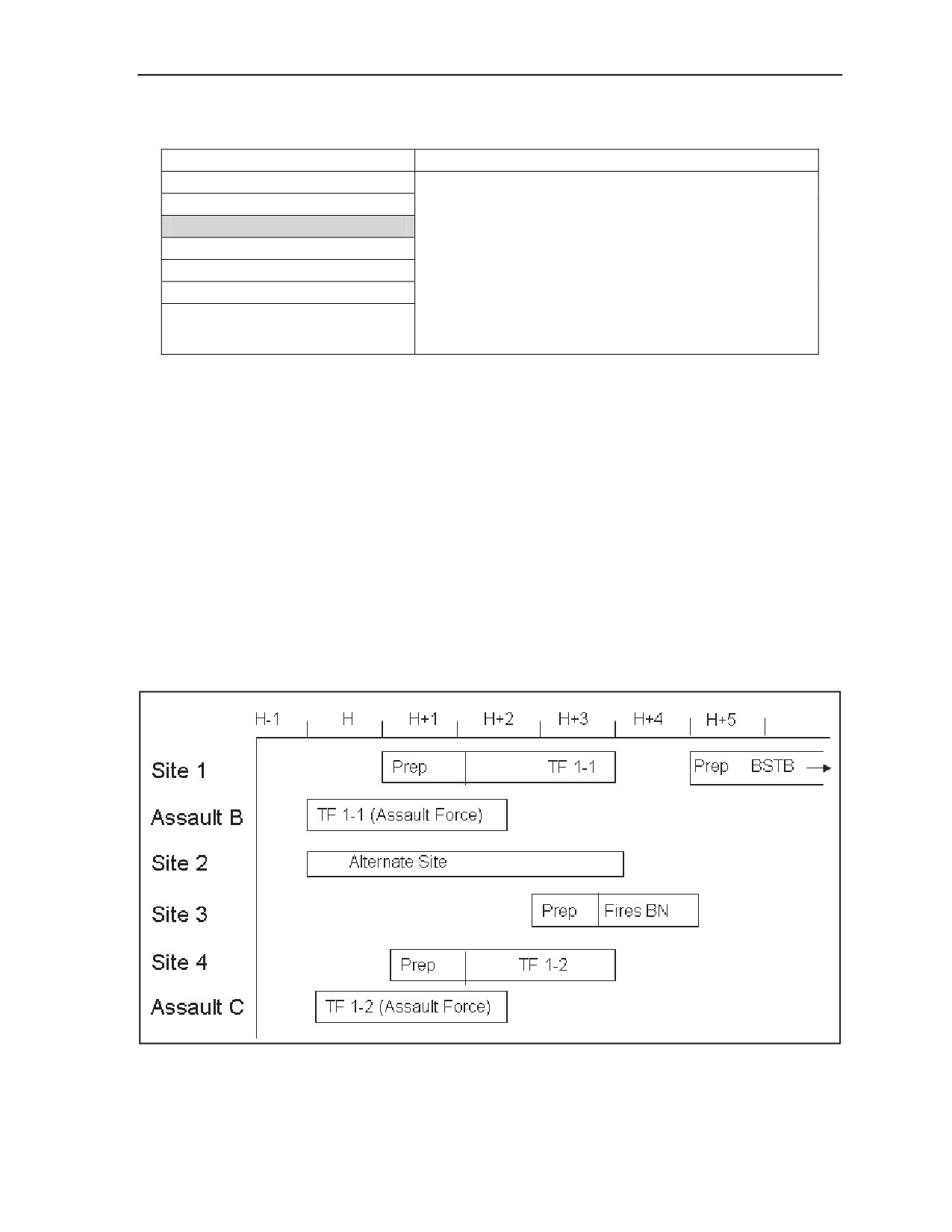
Planning Considerations
Table 3-3. Step Three: Course of Action Development
Military Decision-Making Process
Actions to be Taken
Receipt of Mission
The battle staff—
Mission Analysis
• Uses the commander’s guidance to sketch out
several COAs.
COA Development
• Develops the scheme of maneuver, fire plan, and
COA Analysis (War Game)
support plan for each COA considering crossing
COA Comparison
capabilities and the order of crossing.
COA Approval
The engineer selects sites; determines vehicle swimming and
Orders Production
assault boat, rafting, and bridging configurations and bank
preparation requirements; and task-organizes the engineers
for each COA.
3-29. Looking two levels down, the division staff plans an assault crossing site (vehicle fording or assault
boat) for each anticipated assault battalion in a brigade area. A brigade should also have two bridging or
rafting sites within its boundaries as a norm. The discussion proceeds to the BCT gap crossing for this
crossing. Multiple brigade packages may be necessary for a division crossing.
3-30. The brigade operations staff officer (S-3) looks closely at the avenues leading to brigade mission
objectives, particularly at crossing sites feeding the avenues. Developing practicable COAs is normally an
iterative process. The division staff first develops a scheme of maneuver to take the final objective, and
then verifies that the force buildup rate across the river is adequate for the scheme of maneuver. If so, the
S-3 expands the COAs to include the tactics required for the crossing.
3-31. The tactics required for the crossing are based on enemy defenses near the crossing sites, enemy
reaction forces and earliest employment times, and crossing rates at each site. The COAs must include exit
bank, intermediate, and bridgehead objectives.
3-32. The S-3, working with the brigade engineer and CAE, develops the control mechanisms, crossing
graphics, crossing timeline, and crossing area overlay for each COA (Figure 3-1 and Figure 3-2, page 3-8).
This planning assists the division in their overall plan by providing the specifics necessary for their portion
of the crossing. See Appendix D, Figure D-2, page D-5.
Figure 3-1. Brigade Combat Team Crossing Timeline for a Course of Action
1 July 2008
FM 3-90.12/MCWP 3-17.1
3-7
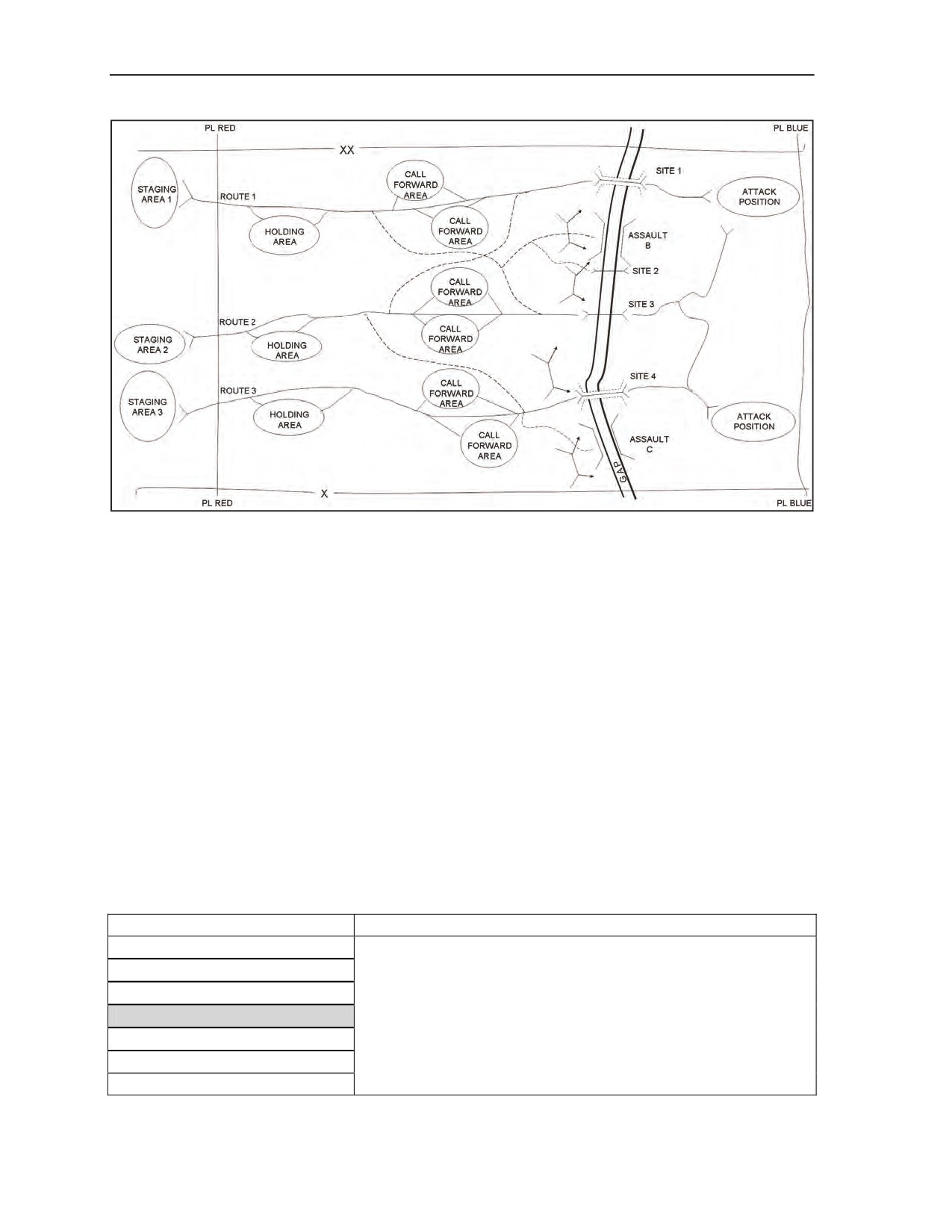
Chapter 3
Figure 3-2. Brigade Combat Team Crossing Area Overlay for a Course of Action
COURSE OF ACTION ANALYSIS
3-33. The staff at both the division and brigade levels war-game each COA against likely enemy reactions
(Table 3-4). They then attempt to counter each enemy response.
3-34. The engineer does the following:
War-games against other variables outside his control, such as terrain difficulties, potential
weather impact, and crossing equipment losses.
Considers what will happen—
If it takes longer to open a crossing site.
If damage slows progress over entrance and exit routes.
If the conditions of the gap change.
Considers what will happen if enemy action shuts down a crossing site or forces its relocation.
Considers the consequences of equipment failure or loss to enemy action.
Evaluates the most likely of these against all COAs and develops, within his means, necessary
counters to include alternate sites, routes, and crossing means.
Table 3-4. Step Four: Course of Action Analysis (War Game)
Military Decision-Making Process
Actions to be Taken
Receipt of Mission
The battle staff war-games each COA against possible enemy
responses.
Mission Analysis
The engineer war-games each COA against potential changes to the
COA Development
terrain and likely equipment losses.
COA Analysis (War Game)
COA Comparison
COA Approval
Orders Production
3-8
FM 3-90.12/MCWP 3-17.1
1 July 2008
Planning Considerations
COURSE OF ACTION COMPARISON
3-35. The division staff examines each COA against both the immediate and follow-on missions
(Table 3-5). The division is particularly concerned with the movement of reserve and support forces and
compares COAs against these requirements.
3-36. The brigade staff considers the ability of each COA to handle enemy responses, support follow-on
missions, provide flexibility for the brigade, and allow for crossing redundancy.
Table 3-5. Step Five: Course of Action Comparison
Military Decision-Making Process
Actions to be Taken
Receipt of Mission
The battle staff—
Mission Analysis
• Compares and evaluates the advantages and disadvantages of
the COAs.
COA Development
• Recommends one COA to the commander.
COA Analysis (War Game)
The commander selects a COA and issues a FRAGO.
COA Comparison
COA Approval
Orders Production
COURSE OF ACTION APPROVAL AND ORDERS PRODUCTION
3-37. COA approval and orders production are the final two steps of the MDMP. Once the commander has
selected and approved a COA, the staff engineer immediately issues a verbal FRAGO or written
WARNORD to the engineer HQ executing the crossing. Simultaneously, the staff converts the selected
COA into a plan with enough detail for synchronized execution (Table 3-6). The staff engineer conducts an
extensive analysis to develop a unit-by-unit crossing plan and movement schedule in conjunction with the
G-3, the Assistant Chief of Staff, Logistics (G-4), and the division transportation officer (DTO).
Table 3-6. Steps Six and Seven: Course of Action Approval and Orders Production
Military Decision-Making Process
Actions to be Taken
Receipt of Mission
The battle staff—
Mission Analysis
• Adjusts the COA to reflect commander guidance.
COA Development
• Issues a WARNORD to units involved in the operation.
COA Analysis (War Game)
• Converts the selected COA chosen by the commander
into an executable plan.
COA Comparison
The engineer develops a detailed crossing plan to support the
COA Approval and Orders
operation.
Production
3-38. As a result of this process, the engineer now refines and fully develops the crossing capability chart,
the crossing timeline, the crossing site overlay, and the crossing synchronization matrix. These documents
serve as primary C2 tools for the CAC and execution tools for the BCT/RCT/TF S-3 (see Appendix D for
examples of those graphics not shown in this chapter). Support is provided to the traffic control cell as they
work out the traffic circulation plan to support the operation.
3-39. While detailed planning is underway, the CAE initiates farside and nearside reconnaissance to
develop enough detail for battalion-level planning. He converts this planning into a detailed engineer task
list, and develops the engineer execution matrix to synchronize it (see Appendix D for an example of an
execution matrix).
1 July 2008
FM 3-90.12/MCWP 3-17.1
3-9
Chapter 3
ENGINEER PLANNING CONSIDERATIONS
3-40. Commanders maneuver their forces into positions of advantage over the enemy. Engineers analyze
the terrain to determine the maneuver potential, ways to reduce natural and enemy obstacles, and how they
can deny freedom of maneuver to the enemy by enhancing the inherent obstacle value of the terrain (see
FM-3-34.2 for more information).
ENGINEER ESTIMATE
3-41. Commanders and staffs develop running estimates before and during the MDMP. These estimates
are updated throughout the operation as well. Terrain, enemy aspects, and water characteristics are key
components of the estimate for gap-crossing operations and are applied during the planning process. Much
of this information directly applies to and must be included as a part of the IPB (Table 3-1, page 3-3).
3-42. Although terrain characteristics have a strong influence, tactical requirements ultimately determine
the location of the crossing site(s). During a wet-gap crossing, water conditions must allow the proper
employment of available crossing means and the tactics required for their operation.
3-43. The farside terrain must support mission accomplishment; otherwise, crossing the gap in that
location serves little purpose. Crossing sites must also support the rapid movement of units to the farside,
or the enemy can win the force buildup race. Commanders balance the tactical use of the farside terrain
against technical crossing requirements at the gap to determine suitable crossing locations.
3-44. Nearside terrain must support initial assault sites, rafting and bridging sites, and the assembly and
staging areas used by the force. Routes to and from the gap must support the quantity of traffic that is
necessary for the operation and for the sustainment of the force in subsequent operations.
3-45. The enemy’s disposition of forces may limit options for the commander. Because the gap physically
splits his force, he should execute his crossing operation where the enemy is most vulnerable or least able
to react. This gives the commander time to mass his force on the farside before the enemy can concentrate
against it.
TERRAIN ANALYSIS
3-46. The engineer is the terrain expert. He must work closely with the S-2 during the planning process to
identify the advantages and disadvantages presented by the terrain for both friendly and enemy forces.
Engineers have the primary responsibility of collecting the terrain information needed for wet-gap
crossings. This is easiest if the nearside is under friendly control in adequate time to collect necessary
information about the gap. Engineers collect water, bank, and route information through the integration of
geospatial means, engineer reconnaissance
(see FM 3-34.170), and other reconnaissance means and
methods. Engineer diving teams may be available to provide farside, nearside, water bottom, and
underwater-obstacle information
(see Appendix E and FM 3-34.280). Local inhabitants can provide
additional information about bridges, flow, bank stability, road networks, ford sites, and other gap
conditions. Aviation assets can provide aerial and video reconnaissance to greatly enhance the IPB for gap-
crossing operations. Normal intelligence collection assets develop the picture of the enemy’s defense that is
necessary to build a template of those forces affecting the gap.
CHARACTERISTICS
3-47. Wet gaps requiring a deliberate crossing that confront a division or BCT are usually rivers. Rivers
form unique obstacles. They are generally linear and extensive and normally cannot be bypassed.
Meandering bends in rivers provide farside defenders with opportunities for flanking fires and observation
of multiple crossing sites. The combined arms team, as normally configured for combat, needs special
preparation and equipment to carry it across river obstacles. After the attacking force crosses the river, it
3-10
FM 3-90.12/MCWP 3-17.1
1 July 2008
Planning Considerations
remains an obstacle for all follow-on forces unless a permanent bridge has been emplaced or rafting and/or
ferry assets are in place to provide a crossing means.
3-48. A formation cannot typically cross a river (wet gap) wherever desired as compared to the options
available when crossing most dry gaps or breaching most field obstacles. Potential crossing sites may be
few, and they will be equally obvious to both the attacker and defender.
3-49. A gap (river) provides excellent observation and fields of fire to both the attacker and defender. It
exposes the force on the water and makes it vulnerable while entering and leaving the water. It is also an
aerial avenue of approach, allowing enemy aircraft low-level access to crossing operations.
3-50. Force buildup on the farside is a race between the defender and the attacker. The gap (river) can be
an obstacle behind the initial assault force allowing the enemy to pin and defeat it in detail while
preventing rapid reinforcement.
MILITARY ASPECTS
3-51. Terrain analysis for a wet-gap crossing includes the OAKOC aspects of terrain; however, many
details are peculiar to river crossings. These details include the specific technical characteristics of the gap
as an obstacle.
WATER CURRENT
3-52. Water current is a major limiting factor for wet-gap crossings. It imposes limits on all floating
equipment whether rubber assault boats, swimming armored vehicles, rafts, or bridges (the current’s
velocity determines the amount of personnel and equipment each type of floating equipment can carry or if
it can operate at all). Current affects the distance that the floating equipment will drift downstream.
Commanders must either select an offset starting point upstream to reach a desired point on the farside or
take additional time to fight the current. High current velocities make control of a heavy raft difficult;
therefore, landings require skilled boat operators and raft commanders and more time.
3-53. Current causes water pressure against floating bridges. MRBCs use boats or an anchorage system to
resist this pressure. The higher the current, the more extensive the anchorage system must be. Higher
currents provide velocity to floating objects, which can damage or swamp floating equipment.
3-54. Current can be measured easily (for example, by timing a floating stick) but is normally not constant
across the width of the river. Generally, it is faster in the center than along the shore. It is also faster on the
outside of a curve than on the inside. A factor of 1.5 times the measured current should be used for
planning purposes.
WATER MEASUREMENTS
3-55. The depth of the water influences all phases of a wet-gap crossing. If the water is shallow enough
and the riverbed will support traffic, fording is possible. If the force uses assault boats and the water
becomes shallow in the assault area, the force will have to wade and carry their equipment. Shallow water
may also cause difficulty for swimming vehicles, because the rapidly moving tracks can dig into a shallow
bottom and ground the vehicle. The water must be deep enough to float bridge boats and loaded rafts on
their crossing centerlines and deep enough in launch areas to launch boats and bridge bays. The depth of
the water is not normally constant across a wet gap. It is generally deeper in the center and in high velocity
areas. Either a bottom reconnaissance with divers or sounding from a reconnaissance boat is necessary to
verify the depth.
3-56. The width of a wet gap is a critical dimension for bridges (especially when it determines how much
equipment is necessary) and rafts. The distance a raft or assault boat must travel determines its round-trip
crossing time, which in turn determines the force buildup rate on the farside.
1 July 2008
FM 3-90.12/MCWP 3-17.1
3-11
Chapter 3
WATER CHANGES
3-57. A swell is the wave motion found in large bodies of water and near the mouths of rivers. It is caused
by normal wave action in a larger body, from tidal action, or from wind forces across the water. A swell is
a serious consideration for swimming armored vehicles, although it is of lesser importance for assault
boats, heavy rafts, and bridges. Hydrographic data and local residents are sources of information on swells.
Direct observation has limited use, because a swell changes over time with changing tide and weather
conditions.
3-58. Tidal variation can cause significant problems. The water’s depth and current changes with the tide
and may allow operations only during certain times. Tidal variation is not the same every day. It depends
on lunar and solar positions and on the current's velocity. Planners need tide tables to determine the actual
variation, but they are not always available for rivers. Another tidal phenomenon found in some estuaries is
the tidal bore, which is a dangerous wave that surges up the river as the tide enters. It seriously affects
water operations. This reverse flow may require that float bridges be anchored on both sides.
3-59. Wet gaps may be subject to sudden floods due to heavy rain or thawing upstream. This will cause
bank overflow, higher currents, deeper water, and significant floating debris. If the enemy possesses
upstream flood control structures or dams, it can cause these conditions also. Dry gaps may also become
wet gaps given certain weather conditions or as a result of the breaching of flood control devices or similar
structures.
OBSTRUCTIONS
3-60. The following obstructions may impede gap-crossing operations:
Sand or mud. Most wet gaps contain sand or mud banks. They are characteristic of low current
areas along the shore and on the inside of the curves of a river, but they can be anywhere. Since
they cause problems for swimming vehicles, assault boats, outboard motors, bridge boats, and
rafts, troops must find them through underwater reconnaissance or sounding.
Rocks. Rocks damage propellers, boats, floating bridges, and ground rafts. They cause
swimming armored vehicles to swamp if the vehicle body or a track rides up on them high
enough to cant the vehicle and allow water into a hatch or engine intake. They can also cause a
fording vehicle to throw a track. Rocks are found by underwater reconnaissance or sounding.
Natural obstructions and floating debris. These can range from sunken ships to wreckage and
snags. The current in large waterways can carry significant floating debris, which can seriously
damage boats and floating equipment. Usually, debris can be observed after flooding or rapidly
rising waters. Performing underwater reconnaissance or using bottom-charting sonar is the only
way to locate these obstructions.
Man-made. Man-made underwater obstacles can be steel or concrete tetrahedrons or dragon's
teeth, wood piles, or mines. The enemy places them to deny a crossing area and designs them to
block or destroy boats and rafts. Performing underwater reconnaissance or using bottom-
charting sonar can locate these obstacles.
Vegetation. Vegetation in the water can snag or choke propellers and ducted impellers on
outboard motors and bridge boats. Normally, floating vegetation is not a significant problem.
Thick vegetation beds that can cause equipment problems are found in shallow water and
normally along the shore. Thick vegetation must extend to within 30 to 60 centimeters of the
surface to hinder equipment, so it can normally be seen from the surface.
Animals. Some water creatures may also conceivably become obstructions to crossing
operations.
FRIENDLY SHORE (NEARSIDE)
3-61. Concealment is critical to the initial assault across the gap. The assault force must have concealed
access to the gap. It must also have concealed attack positions close to the gap from which to prepare
assault boats. The overwatching unit prepares concealed positions along the friendly shore, taking full
3-12
FM 3-90.12/MCWP 3-17.1
1 July 2008
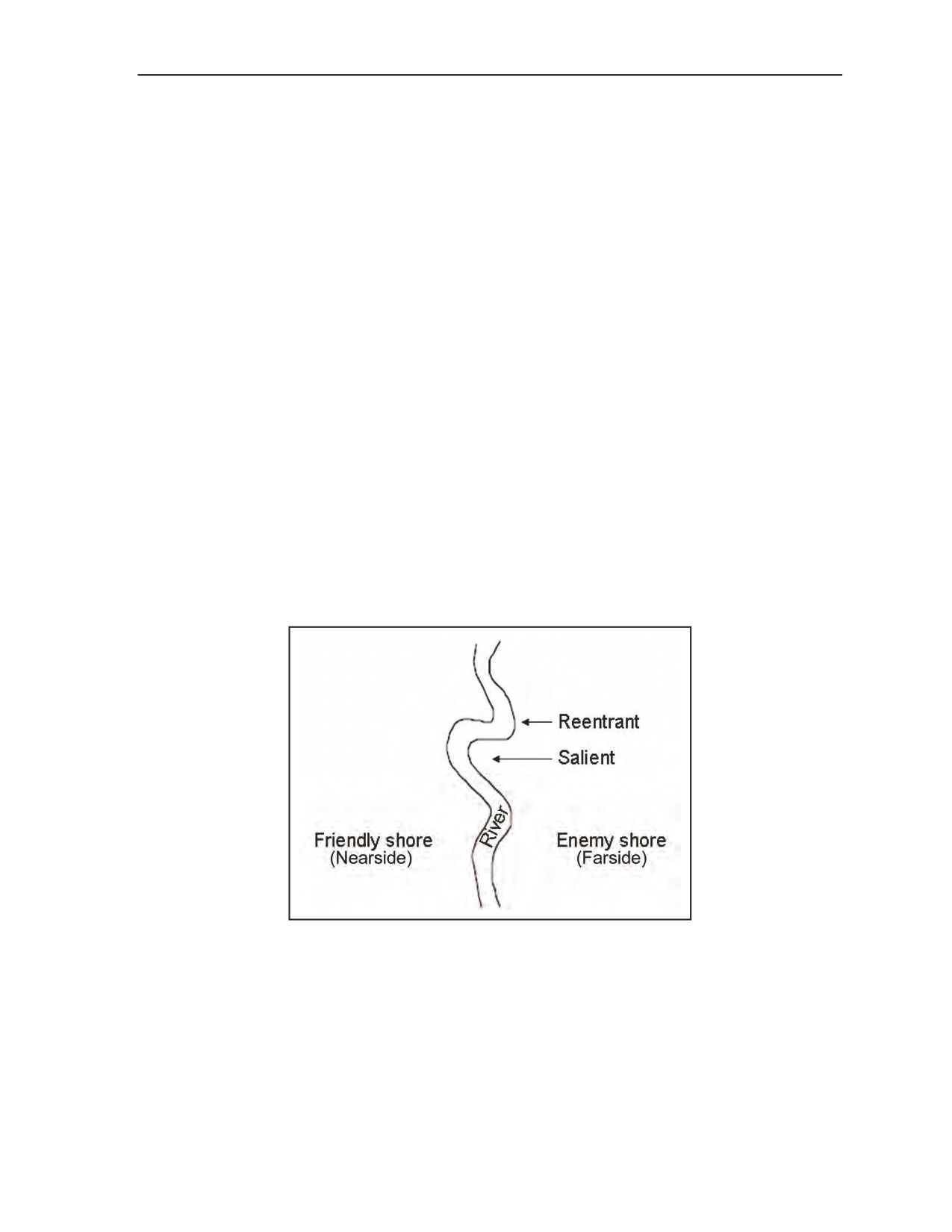
Planning Considerations
advantage of vegetation and surface contours. Overwatching units must be in position to engage the most
likely enemy position(s) on the enemy shore.
3-62. Dominant terrain formed by hill masses or bluffs provides direct-fire overwatch positions. If the
dominant terrain is along the shore, it also covers attack positions, AAs, and staging areas. AMD sites
should be located on terrain that dominates aerial AAs (one of which is located along the gap). When
selecting a crossing site, consider the following:
Dismounted AAs that allow silent and concealed movement of assault battalions to the gap.
Concealed attack positions that are very close to the gap along the dismounted avenue.
Approaches from the attack positions to the wet gap that have gradual slopes and limited
vegetation to allow the assault force to carry inflated assault boats.
Bank conditions that are favorable. Dismounted forces must be able to carry assault boats to the
water, and engineer troops must be able to construct and operate rafts with little bank
preparation.
Road networks that feed the crossing sites and support the lateral movement of vehicles between
sites. These road networks must be well constructed to carry large amounts of heavy vehicle
traffic.
Potential staging areas that can support large numbers of tracked and wheeled vehicles without
continual maintenance.
Helicopter landing zones (LZs) for embarkation of the assault force.
ENEMY SHORE (FARSIDE)
3-63. A river meanders and forms salients and reentrant angles along the shore. A salient on the enemy
shore is desirable for the crossing area, because it allows friendly fires from a wide stretch of the nearside
to concentrate against a small area on the farside and limits the length of enemy shore that must be cleared
to eliminate direct fire and observation (Figure 3-3).
Figure 3-3. Salients and Reentrants on the Enemy Shore
3-64. Having dominant terrain on the enemy side of the gap is undesirable. Any terrain that permits direct
fires or observed indirect fires onto crossing sites is key terrain. Friendly forces must control it before
beginning the rafting or bridging phases. Merely attempting to suppress this key terrain will probably not
be effective.
3-65. Natural obstacles must be minimal between the river and the bridgehead objectives. River valleys
often have parallel canals, railroad embankments, flood control structures, swamps, and ridges that can
impede more than the river itself. Obstacles perpendicular to the river can help isolate the bridgehead.
1 July 2008
FM 3-90.12/MCWP 3-17.1
3-13
///////////////////////////////////////