FM 3-90.12/MCWP 3-17.1 COMBINED ARMS GAP-CROSSING OPERATIONS (July 2008) - page 2
Chapter 3
3-66. Exits from the river must be reasonably good without preparation. Initially, the bank should allow
the assault force to land and dismount from the assault boats. This requires shallow banks with limited
vegetation. The assault force also requires concealed dismounted avenues up from the river. Bank
conditions must allow vehicles to debark from rafts and move up from the river. If banks require
earthwork, at least one unimproved crossing site must allow the landing of earthmoving equipment. The
most important far shore requirement is a road network to carry high volumes of heavy vehicle traffic.
INTELLIGENCE INTEGRATION
3-67. Detailed knowledge of the gap and adjacent terrain is critical to both tactical planning and to
engineer technical planning. The keys are early identification of intelligence requirements and an effective
collection plan. Space- and aircraft-based imaging and weather systems can provide invaluable information
to the terrain database. Multispectral imagery (MSI) from satellites and aircraft can give the engineer
terrain teams a bird's-eye view of the AO. Satellite images can be used to identify key terrain and provide
crossing locations. These images can provide information concerning the depth and turbidity of the water
and can be used to identify the line of site for weapons and communications systems. With MSI products,
prospective construction materials, the locations of existing crossing sites, and nearside and farside road
networks can be identified and exploited.
3-68. When the MSI is combined with satellite weather receivers, data processors, and the terrain database,
it can be used to identify mobility corridors and establish floodplain trafficability. When these space
systems are used together, the effects of the weather on terrain can be analyzed and used to develop
decision support products for the commander.
3-69. The terrain database is the starting point for obtaining terrain information. Hydrographic studies exist
for most bodies of water and/or rivers in potential theaters of operation around the world. Many of these
studies have enough detail for identifying feasible crossing sites. Modern information collection and
storage technology permits frequent revision of existing data.
3-70. Engineer terrain teams maintain a terrain database and provide information in the form of
topographic and other geospatial products. These products are used with other tools, such as computers and
photography, to develop terrain intelligence for staff planners. The planners, in turn, determine initial
crossing requirements and estimated crossing rates from their terrain analyses.
3-71. Early in the mission analysis, planners identify further terrain intelligence needs for the crossing.
They provide this information to the G-2 for inclusion in the intelligence collection plan. The plan specifies
that intelligence systems are used to gather essential terrain information for a more detailed analysis.
Information on specific gap segments and the surrounding terrain is obtained and verified by aerial and
ground reconnaissance.
PRIORITY INTELLIGENCE REQUIREMENTS
3-72. The following tactical and technical information is often characterized as priority intelligence
requirements (PIR) used in the decision making process:
Enemy positions that can place direct or observed indirect fires on crossing sites and
approaches.
The location and type of enemy obstacles, particularly mines, in the water and on exit banks.
The location of enemy reserves that can counterattack assault units.
The location of enemy artillery that can range crossing sites, staging areas, and approaches.
The location and condition of existing crossing sites.
The width, depth, and water velocity of the wet gap.
The condition and profile of the gap (river) bottom.
The height, slope, and stability of the bank.
The condition of nearside and farside road networks.
3-14
FM 3-90.12/MCWP 3-17.1
1 July 2008
Chapter 4
Gap Crossing in Support of Combat Maneuver
"The passage of great rivers in the presence of the enemy is one of the most delicate
operations in war."
Frederick the Great
Conducting gap crossings in support of combat maneuver includes deliberate, hasty
and covert gap crossings and will include the majority of river-crossing operations. It
includes both those operations conducted primarily at the BCT level and those
conducted by the division or corps level organization. Those gap crossings conducted
as a reduction method within a combined arms breaching operation are also included
in this, but since the primary focus of planning and preparation is on the breaching
operation, they are typically discussed as a part of the breaching operation rather than
as a separate gap-crossing operation in that context. While the fundamentals and
requirements associated with gap crossings have not changed too much over the
years, Army transformation has now provided more flexibility in terms of C2
elements within both the division and the brigade and structured forces so that a BCT
may be able to execute hasty, deliberate, and covert crossings when provided with the
necessary resources. In most cases this begins with a task-organized engineer
battalion HQ that includes subordinate engineer units and associated engineer
gap-crossing means. The examples presented in this chapter will typically focus on a
wet-gap crossing since these tend to be more complex and demanding than dry-gap
crossings.
TYPES OF GAP CROSSINGS
4-1. There are three types of gap crossings: deliberate, hasty, and covert. Each of these has a general list
of conditions that help define their category. As with the categories of breaching operations, all other labels
placed upon a crossing are a variation of a deliberate, hasty, or covert gap crossing. The planning
requirements for each type of gap crossing are similar. However, the required degree of detail and
necessary conditions for a high degree of success will vary based on the type and the unique features
associated with a given crossing operation.
DELIBERATE GAP CROSSING
4-2. Deliberate gap crossings are conducted as part of an offensive operation when a hasty crossing is not
feasible or has failed. The phases, echelons, organizations, and C2 of a division or BCT deliberate gap
crossing are discussed in detail in this chapter. This type of crossing normally requires additional
augmentation that is focused exclusively on facilitating the crossing. While a BCT is capable of making a
deliberate crossing, this type of crossing normally requires a higher HQ to assist in the planning and C2 as
it requires meticulous planning, preparation, and coordination; centralized control; and extensive
rehearsals. Additionally, deliberate crossings usually involve more than one BCT and/or the crossing of
gaps greater than 20 meters. A gap of this length limits the effectiveness of tactical bridging assets and will
typically require other bridging assets. To cross gaps of this magnitude, support bridging is normally
required in the form of float bridging (wet gap) or other types of standard bridging.
1 July 2008
FM 3-90.12/MCRP 3-17.1
4-1
Chapter 4
4-3. A deliberate gap crossing is generally more costly than a hasty crossing in terms of manpower,
equipment, and time. It requires the concentration of combat power on a narrow front, capitalizing on the
element of surprise whenever possible. Deliberate gap crossings are generally conducted in the same
manner as hasty gap crossings and utilize the same basic terminology. Deliberate wet-gap crossing are
usually more difficult in terms of complexity and amount and type(s) of specialized resources required.
4-4. While they may be conducted by a BCT, deliberate gap crossings are normally conducted by a
division. Division and brigade commanders organize their forces into assault, assured mobility, bridgehead
(defined as an area of ground held or to be gained on the enemy’s side of an obstacle [the definition
was shortened, and the complete definition is printed in the glossary]), and breakout forces for deliberate
gap-crossing operations. Assault forces seize the farside objective to eliminate direct fire on the crossing
sites. Assured mobility forces may consist of sapper companies, MACs, MRBCs, military police, and
CBRN units that provide crossing means, traffic control, and obscuration. Further augmentation
requirements may be necessary and are based on METT-TC conditions that affect the operation.
Bridgehead forces assault across a gap to secure the enemy side (the bridgehead) to allow the buildup
and passage of a breakout force during river crossing operations.
4-5. A retrograde gap crossing is not a fourth type of gap crossing. In reality it is merely a variation of a
deliberate or hasty gap crossing and is typically performed as a deliberate gap crossing. It may be
performed with or without enemy pressure on the maneuver force. Clearly it is more difficult when
performed under enemy pressure. For more information see Appendix F.
HASTY GAP CROSSING
4-6. Hasty gap crossings tend to be focused on a combined arms operation to project combat power
across a terrain feature (wet or dry) that can be overcome by self-bridging assets within the BCT. These
assets may be organic, provided to the BCT as augmentation, or found as expedient crossing materials
within the AO. They typically are, but are not limited to, gaps that are 20 meters or less in width. They are
normally done through tactical bridging, such as the AVLB, JAB, Wolverine, or REBS. Most hasty gap
crossings will be conducted using tactical bridging. They may also include support bridging and expedient
bridging or gap crossing by other means.
4-7. The gap-crossing fundamentals for a hasty crossing are the same as those discussed previously;
however, there must be a particular emphasis on early task organization of bridging or other gap-crossing
assets for it to be successful. A hasty crossing is conducted to maintain the momentum of the maneuver
force by quickly massing combat power on the far side of the gap with no intentional pause. To do this, it
is critical in the planning process to identify gap locations and their dimensions, and then request and/or
allocate the necessary assets to ensure unimpeded movement. Planned, organized, and executed much like
a hasty breaching operation, the unit must consider the integration of the crossing assets in their movement
formation; redundancy in crossing means; traffic flow across the gap; and the recovery of the crossing
assets (see FM 3-34.2). Because a gap crossing constricts and splits the maneuver force at the crossing site,
the plan must be flexible enough for the commander or his designated representative to be able to make
execution decisions based on acceptable opportunity and threat variances. The BCT TAC CP can assist the
command group by controlling the execution of the crossing and maintaining a status of the location and
operational readiness of the crossing assets.
4-8. The BCT task-organizes in a manner that supports the overall mission and facilitates a successful gap
crossing followed by a quick recovery. To do gap crossing efficiently, bridging assets should be located in
a position within the maneuver formation where positive control can be maintained. This is an important
consideration since all gap-crossing equipment does not have the necessary communications equipment to
maneuver effectively as part of a BCT or combat maneuver battalion formation. Additionally, some of the
gap-crossing equipment is less maneuverable and slower than the other combat maneuver systems it
supports and is also less survivable in some cases. This may slow down the speed of movement for the
maneuver elements. In spite of these challenges, proper planning and C2 can minimize these negative
impacts.
4-9. Two other considerations are the desirability for redundancy of crossing equipment and the
capability to rapidly recover the crossing means. Tactical bridging is designed with these considerations in
4-2
FM 3-90.12/MCWP 3-17.1
1 July 2008
Gap Crossing in Support of Combat Maneuver
mind. Commanders should plan on using multiple crossing means, depending on the criticality of the
crossing and the time available. While the Wolverine can be launched in less than 5 minutes and recovered
in less than 10 minutes, there are sometimes extenuating circumstances that will dramatically increase the
launch and recovery times. The JAB and the AVLB have comparable launch and recovery times but are
not as fully capable as the Wolverine. Terrain, transporter and bridge maintenance, and crew experience
can all impact bridge launch and recovery.
4-10. As one of the most important considerations, the recovery of crossing assets and transition after the
crossing is important to the BCT to sustain its momentum. Typically, BCTs will expect crossing assets to
recover and join the maneuver force on the far side of the gap. For this to be successful, the BCT has at
least two options. First, the BCT can halt movement on the far side of the gap and wait for the crossing
asset to recover the bridge. Another option is for the BCT to continue movement and leave an adequate
security force during the recovery, which can also assist the crossing asset in rejoining the maneuver force.
Whatever option is used, if the assets are intended to stay with the BCT, consideration must be given to
follow-on support or LOC bridging assets to ensure support or follow-on forces can adequately continue to
follow the maneuver force. The BCT may also be directed by division to keep its crossing assets in place
for follow-on forces to use, but this will degrade or eliminate the ability of the BCT to cross any additional
gaps unless they have been resourced by the division with enough tactical bridging to do this. If division
intends for tactical bridging to remain in place, then the BCT must be augmented with enough assets to do
this task while retaining enough tactical gap-crossing capability to facilitate continued movement and
maneuver.
4-11. An in-stride gap crossing is a variant of the hasty gap crossing that consists of a rapid gap-crossing
adaptation conducted by forces organic to (or task-organized with) the attacking force. It consists of
preplanned, well-trained, and well-rehearsed gap-crossing battle drills and the unit’s SOP. An in-stride gap
crossing takes advantage of surprise and momentum to bridge or defeat gaps and relies on good and timely
reconnaissance for its success. The force uses in-stride gap crossings against either weak defenders or very
simple gaps and executes the battle drill(s) on the move. Attacking maneuver forces generally move
configured to be able to execute an in-stride gap crossing except when a deliberate gap crossing is planned.
In-stride gap crossings may occur when a given gap is not the same as the unit planned to cross, or in some
cases, where the unit is surprised by the gap (obstacle). To conduct in-stride crossings, the unit must be
task-organized with the necessary tactical bridging assets or capabilities and trained to perform such an
operation. There are many similarities between an in-stride breach and an in-stride gap crossing. The
primary difference between an in-stride breach and an in-stride gap crossing is the nature of the obstacle or
obstacles. See FM 3-34.2 for more information on in-stride breaches.
4-12. The battalion is the principal unit to plan, coordinate, and control an in-stride gap crossing; but a
company will normally conduct the actual crossing. The battalion normally designates specific support
forces and handles the synchronizing of the breaching fundamentals (suppress, obscure, secure, reduce, and
assault
[SOSRA]) as they apply to a gap crossing through detailed planning and/or well-rehearsed,
immediate action drills. The commander planning for an in-stride gap crossing must also plan for a
transition to a deliberate gap crossing should an in-stride gap crossing be unsuccessful. An unclear
situation (both enemy and exact gap dimensions and conditions) will make it necessary for several lead
company-sized units to be capable of conducting independent gap-crossing operations. Accurate and
timely reconnaissance of the gap (obstacle) and enemy force defending it sets the condition for properly
focusing the location of the in-stride gap crossing.
COVERT GAP CROSSING
4-13. The third type of gap crossing is the covert gap crossing. The covert gap crossing is an operation
used to overcome obstacles (gaps) without being detected by the enemy. It is used when surprise is
essential to infiltrate over a gap, and when limited visibility and terrain present the opportunity to reduce or
defeat the enemy obstacle (gap) without being seen. Through surprise, the commander conceals his
capabilities and intentions and creates the opportunity to position support and assault forces to strike the
enemy unaware or unprepared. Like the covert breach, it is normally conducted by a battalion or smaller-
sized unit. A covert breach is defined as a breaching operation that is planned and intended to be executed
without detection by opposing forces. Its primary purpose is to reduce obstacles undetected to facilitate the
1 July 2008
FM 3-90.12/MCWP 3-17.1
4-3
Chapter 4
passage of maneuver forces (FM 3-34.2). The forces executing a covert gap crossing can mark nearside
and farside entry and exit points and secure and/or guard the crossing site if the covert gap crossing is a
precursor to a larger, deliberate gap-crossing operation. The primary difference between the covert breach
and the gap crossing is the nature of the obstacle or obstacles. See FM 3-34.2 for more information on
covert breaches.
4-14. The covert gap crossing applies the same gap-crossing fundamentals as the other gap-crossing types;
however, it is focused on the crossing fundamental of surprise. Surprise is the primary element of the
covert crossing. The requirement to execute the crossing without enemy detection is the element that
distinguishes it from the other types of crossings. It can be used in a variety of situations to support various
operations, but should be considered (as opposed to deliberate or hasty) only when there is a need or
opportunity to cross a gap without being discovered.
4-15. The battalion is usually the principal unit to conduct a covert breach. A covert breach requires a level
of detailed planning, intelligence collection, and C2 that is normally beyond the capability of a company. A
BCT is usually too large to maintain the level of stealth necessary to conduct a covert breach. A covert gap
crossing is ideally suited for foot-mobile forces that are battalion-sized or smaller. A covert crossing can be
used to cross forces that will support a follow-on crossing of a larger or similar-sized element; however, it
is a separate operation and should be planned. If conducted as an operation that does not involve crossing
additional elements, planning and consideration should be given to the recovery of the crossing assets. If
the crossing is a precursor to a larger, follow-on crossing, it may be considered that recovery of the
crossing assets should be done as part of that follow-on operation.
4-16. If a covert gap crossing is being used as a precursor to a deliberate crossing and is compromised,
higher HQ may need to re-evaluate other potential crossing sites before conducting the deliberate crossing.
A contingency plan must always be included in the planning of a covert operation in the event that the
operation is compromised.
CONTROL MECHANISMS
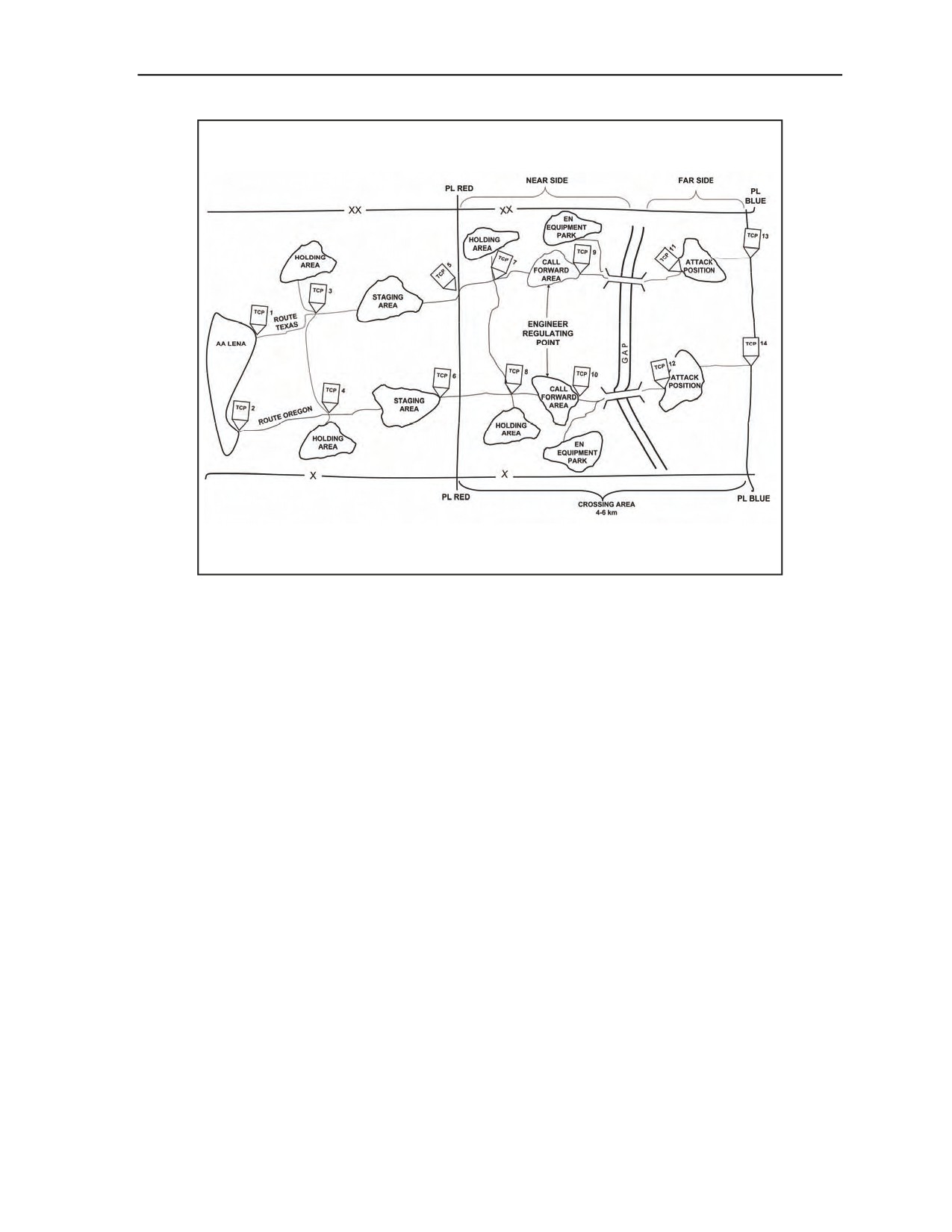
4-17. A major control mechanism category is graphic control measures. The commander uses graphic
control measures to delineate areas of responsibility for subordinates and to ease traffic control. Figure 4-1
provides a simplistic illustration of the graphic control measures described in the following paragraphs.
RELEASE LINE
4-18. As used in gap-crossing operations, a release line (RL) is used to delineate the crossing area. RLs are
located on both the farside and nearside and indicate a change in the HQ that is controlling movement. RLs
are normally located within 3 to 4 kilometers of the gap and on easily identifiable terrain features, if
possible. Typically, they are graphically identified as phase lines (PLs).
CROSSING AREA
4-19. A crossing area is a controlled access area for a gap-crossing operation used to decrease traffic
congestion at the river (JP 1-02) (the definition was shortened, and the complete definition is printed
in the glossary). This permits swift movement of forces. Each lead brigade has a crossing area on both
sides of the gap that is defined by brigade boundaries and RLs. Crossing areas normally extend 3 to 4
kilometers on each side of the gap, depending on the terrain and the anticipated battle.
4-4
FM 3-90.12/MCWP 3-17.1
1 July 2008
Gap Crossing in Support of Combat Maneuver
Figure 4-1. Graphic Control Measures
WAITING AREA
4-20. A waiting area is a location adjacent to the route or axis that may be used for the concealment
of vehicles, troops, and equipment while an element is waiting to resume movement. Waiting areas
are normally located on both banks (or sides) close to crossing areas. Commanders use the following
waiting areas to conceal vehicles, troops, and equipment while waiting to resume movement or to make
final crossing preparations:
Staging area.
Call forward area.
Holding area.
Attack position.
Assault position.
AA.
Staging Area
4-21. A staging area is a battalion TF size waiting area outside the crossing area where forces wait to enter
the crossing area. The BCT traffic control cell handles units’ movement into staging areas. The crossing
area commander (CAC) is the officer responsible for the control of all crossing units, assault units,
and support forces while they are in the crossing area. The CAC controls movement from the staging
areas into the crossing areas. Military police operate traffic control posts (TCPs) at staging areas according
to the crossing and traffic circulation plans. They emplace temporary signs along the route from the staging
area through the crossing area to guide convoys. Units make crossing preparations and receive briefings on
vehicle speed and spacing in the staging areas. Staging areas—
Are located to support the crossing concept.
1 July 2008
FM 3-90.12/MCWP 3-17.1
4-5
Chapter 4
Are far enough back to permit the rerouting of the battalion along other roads or to alternate
crossing sites.
Are easily accessible from major routes.
Have enough area for dispersing a battalion-sized unit.
Provide concealment.
Holding Area
4-22. A holding area is a waiting area that forces use during traffic interruptions. Units move into these
areas when directed by TCP personnel and disperse rather than stay on the roads. Holding areas are
battalion TF size outside of the crossing area and company size within it. Nearside holding areas are used
to organize return traffic. Military police and engineers, if available, operate holding areas according to the
crossing and traffic circulation plans. Established as needed on both sides of the gap, holding areas—
Are used as call forward areas for return traffic from the farside.
Are located where they support the crossing plan.
Are easily accessible from routes.
Have enough area for dispersion.
Provide cover and concealment.
Are defensible.
Maximize traffic flow with minimum control.
Call Forward Area
4-23. A call forward area is a company-sized waiting area located within the crossing area. Engineers use
them to organize units into raft loads, or crews use them to make final vehicle swimming or other crossing
preparations, depending on whether the crossing is a wet or dry gap. The CAC controls movement from the
staging area to the call area. The crossing site commander (CSC) is the individual, normally an engineer
company commander or a platoon leader, responsible for the crossing means and the crossing site.
He commands the engineers operating the crossing means and the engineer regulating points at the
call forward areas and the staging areas for that site. As a minimum, each CSC operates his own call
area. Call areas—
Are located where they support the crossing plan.
Are company-sized within the crossing area.
Are easily accessible from designated routes.
Are planned with a minimum of one per crossing site.
Have engineer regulating points (ERPs) collocated with them.
Are used to organize units into crossing means (rafts in a wet-gap crossing) loads.
Are the final preparation areas before going to the crossing site.
Are normally operated by engineers.
Attack Position
4-24. An attack position is the last position occupied by the assault echelon before crossing the line of
departure (FM 1-02). Within the bridgehead, the attack position is the last position before leaving the
crossing area.
Assault Position
4-25. An assault position is a covered and concealed position short of the objective, from which final
preparations are made to assault the objective (FM 3-90). The USMC definition adds: That position
between the line of departure and the objective in an attack from which forces assault the objective.
Ideally, it is the last covered and concealed position before reaching the objective (primarily used by
dismounted infantry).
4-6
FM 3-90.12/MCWP 3-17.1
1 July 2008
Gap Crossing in Support of Combat Maneuver
Assembly Area
4-26. An assembly area is the area a unit occupies to prepare for an operation (FM 3-90). As such, it
should have good road access, offer cover and concealment, and be positioned so that it supports follow-on
tactical maneuver.
ENGINEER EQUIPMENT PARK
4-27. An engineer equipment park (EEP) is an area located a convenient distance from crossing sites for
assembling, preparing, and storing bridge or other crossing equipment and material. It is at least 1
kilometer from the gap and holds spare equipment and empty trucks that are not required at the crossing
sites. An EEP should be located where it does not interfere with the traffic to the crossing sites and where
equipment can be concealed and dispersed. Ideally, routes leading from EEPs to the crossing sites are not
the same routes used by units crossing the gap.
TRAFFIC CONTROL POST
4-28. A traffic control post is a manned post used to preclude interruption of traffic flow or movement
along designated routes. They are used to support maneuver and mobility support operations only when
needed (FM 3-19.4). In deliberate gap crossings, TCP personnel assist the crossing area HQ in traffic
control by reporting and regulating the movement of units and convoys. TCP personnel relay messages
between the crossing area HQ and moving units. The provost marshal (PM) identifies locations that need
or require TCPs. Military police or engineers, as available, operate TCPs on both sides of the gap to control
traffic moving toward or away from it. TCPs are additionally operated at major or critical crossroads and
road junctions, staging areas, holding areas, and ERPs. If necessary, military police may also establish a
detainee collection point to prevent traffic interruption. Additional military police augmentation may be
needed from a higher military police command, depending on the amount of traffic and number of
detainees in the area.
ENGINEER REGULATING POINT
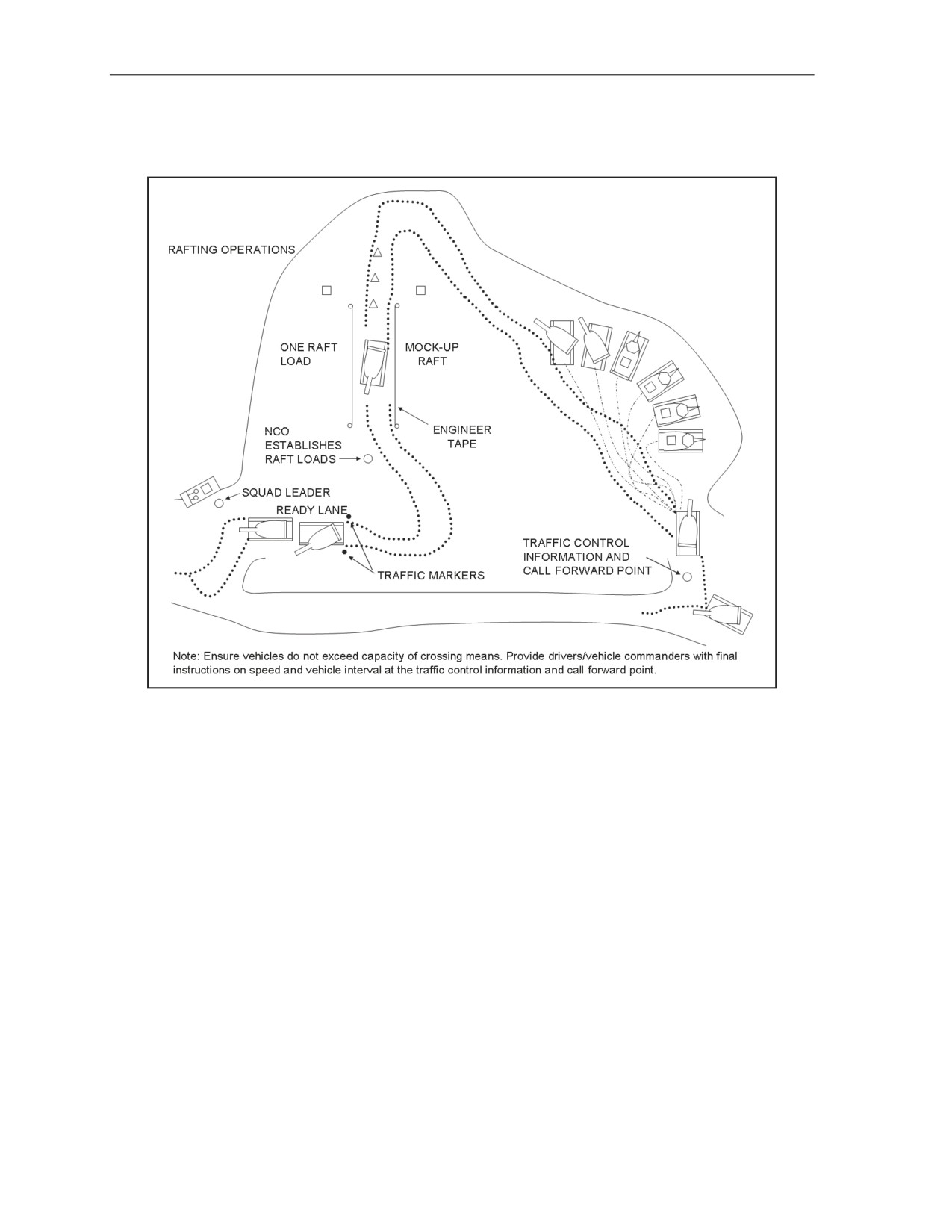
4-29. An engineer regulating point (ERP) is a checkpoint to ensure that vehicles do not exceed the
capacity of the crossing means and to give drivers final instructions on site-specific procedures and
information, such as speed and vehicle intervals. See Figure 4-2, page 4-8. They help maintain traffic
flow. Vehicles that will not be allowed to cross are removed so that they do not cause a traffic backup at
the actual crossing site. Engineers man the ERPs and report to the CSC. TCPs are collocated with the ERPs
to ensure that all vehicles clear the call forward areas. Additionally, ERP personnel give the drivers final
instructions on site-specific procedures and other information such as speed and vehicle intervals. As a
minimum, each crossing site requires an ERP at its own call forward area. If enough engineer assets are
available, ERPs may be established at farside holding areas to regulate rearward traffic. Finally, the ERP
may be used to issue crossing specific safety equipment and information. Safety equipment may need to be
recovered on the farside to sustain the operation.
CROSSING PLAN
4-30. The crossing plan is integrated throughout the division's and brigade's OPORD and is as detailed as
time permits. The crossing annex to the OPORD contains much, but not all, of the plan. It has the crossing
overlay and the crossing synchronization matrix.
4-31. The crossing overlay (Chapter 3) shows the crossing areas, the crossing sites, the routes leading up
to them from the waiting areas, and all the control measures necessary for the crossing. The crossing
synchronization matrix (Appendix D, Figure D-6, page D-8) is a tool to adjust the crossing plan as the
battle develops. It shows crossing units in relation to their planned crossing times and locations. The
crossing overlay, in conjunction with the crossing synchronization matrix, provides critical information to
the CAC as they depict the locations of critical C2 nodes and detail unit crossing schedules and locations
while they are within the crossing area.
1 July 2008
FM 3-90.12/MCWP 3-17.1
4-7
Chapter 4
4-32. The task organization paragraph and paragraph 5 of the OPORD contain the organization and
command portions of the crossing plan. For more information on the development of the crossing plan,
refer to Chapter 3.
Figure 4-2. Engineer Regulating Point Layout
COMMUNICATIONS
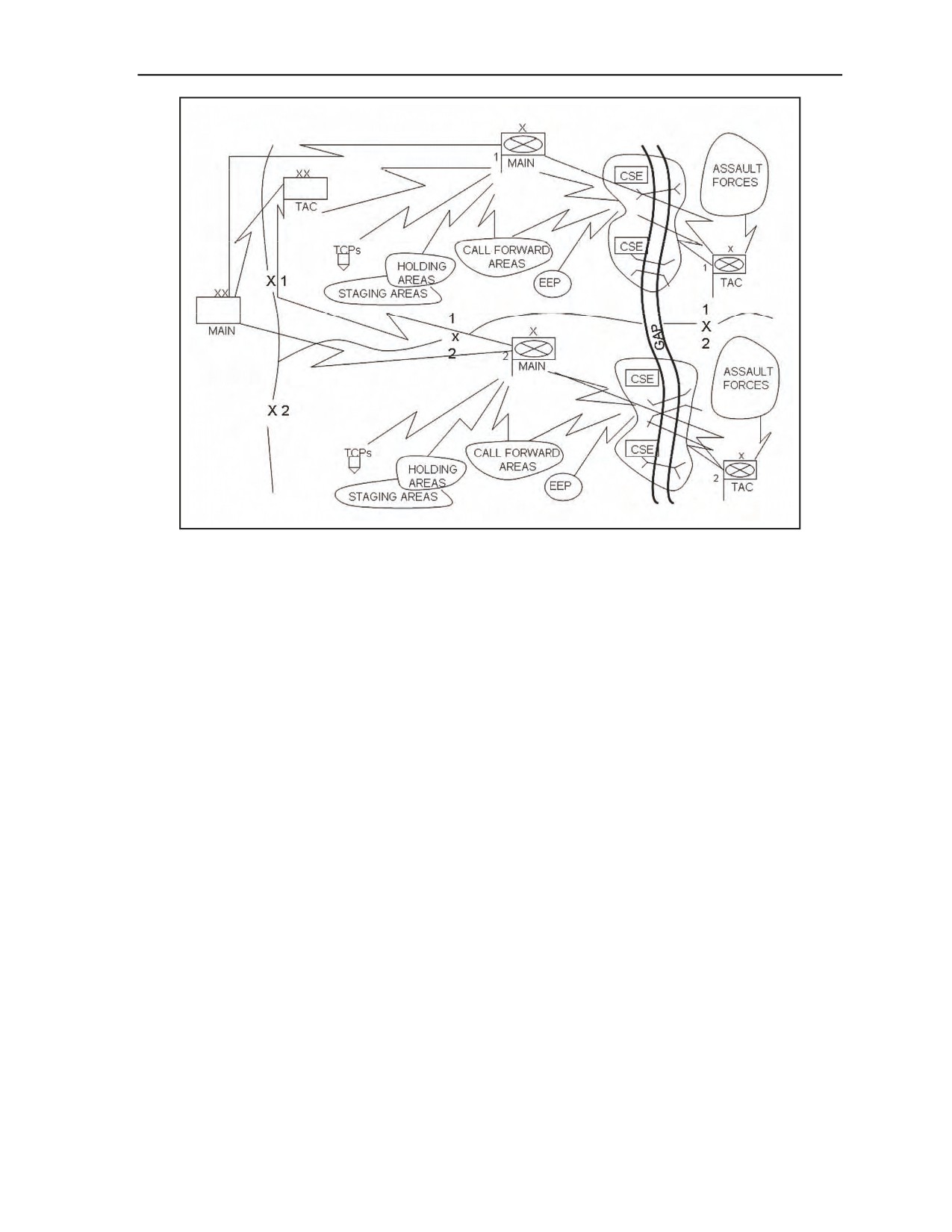
4-33. The communications network that supports a deliberate crossing is critical to the success of a gap
crossing. It should be planned and support the five phases of the deliberate gap-crossing operation
(Table 4-1, page
4-11). The operation is divided into phases for planning purposes only, with no
intentional pauses during execution. This will require early planning and a redundancy of communications.
It may even be desirable to include wire as one of the redundant means of communication. The selected
mode(s) of communications are dependent on what is available; however, all sites involved in the C2 and
execution (all CPs, waiting areas, EEPs, TCPs, and ERPs) should have communications capable of
monitoring and sending information to every other element that has a role in the crossing operation. This is
an important consideration to ensure efficient vehicle positioning, traffic flow, and proper crossing order.
Figure 4-3 provides a graphic depiction of the minimum communications linkages to support a deliberate
crossing during Phase 3 of the operation. Regardless of the phase, it should be understood that each node
must have a similar communications structure for proper C2.
4-8
FM 3-90.12/MCWP 3-17.1
1 July 2008
Gap Crossing in Support of Combat Maneuver
Figure 4-3. Communication Linkages
MOVEMENT CONTROL
4-34. Movement control is vital to efficiently move units and material up to the crossing area in the
sequence needed by the commander. The traffic control cells at the division and brigade HQ exercise
movement control through TCPs outside the crossing area. The division main CP controls movement from
its rear boundary up to the nearside RL. In this example, the division main CP (assisted by the focused
efforts of the crossing area HQ) synchronizes movement through the crossing area to the attack positions
on the farside. The division TAC coordinates and synchronizes movement from the attack positions to the
bridgehead line and beyond, as required. The bridgehead line is the limit of the objective area in the
development of the bridgehead (JP 1-02). The brigade main CP controls battalion TF movement from
the rear boundary up to the bridgehead line.
4-35. The DTO develops the division movement plan according to the movement priorities that the
Assistant Chief of Staff, Plans (G-5), G-3, and G-4 establish. The logistics staff officer (S-4) prepares the
brigade movement plan according to the priorities that the S-3 establishes. Each unit movement officer,
normally the battalion S-4, provides the unit's vehicle information to the planning HQ.
4-36. The movement plan normally consists of a traffic circulation overlay and a road movement table
found in the movement annex to the division or BCT order. Military police provide the support to
implement the circulation control plan. Military police establish and operate TCPs, and provide temporary
route signing. These measures are implemented at major crossroads on the MSR leading to and inside the
crossing area. Military police also provide mobile patrols to operate along primary routes to control traffic,
spot problems, guide and escort vehicles, and reroute traffic when necessary. Military police also establish
detainee collection points (DCPs), if they become necessary, or evacuate detainees to ensure they do not
impede the gap-crossing operation.
1 July 2008
FM 3-90.12/MCWP 3-17.1
4-9
Chapter 4
SUSTAINMENT OPERATIONS
4-37. While units are in waiting areas, the unit leadership should take advantage of the time available to
make necessary preparations for the crossing and the mission. Additionally, activities may include anything
extending from the TLPs inherent with the particular mission. For example, if the situation is defensive in
nature, the leadership may review priorities of work. Conversely, if the situation is offensive, the
leadership may focus on rehearsals. Finally, depending on the time and space available, leaders may want
to conduct some final maintenance checks on vehicles, ensure items are loaded and secured properly,
and/or conduct refueling operations.
CONTROL ELEMENTS
4-38. Division and brigade commanders are responsible for crossing their formations. They organize their
staffs and subordinate commanders to help them control the crossing. Division and brigade HQ operate
from a command group, main CP, and TAC CP. At the division level, an engineer brigade or an additional
maneuver enhancement brigade (MEB) maneuver enhancement (ME) is normally designated as the
crossing area HQ for the execution of a deliberate gap crossing. In a deliberate gap-crossing operation, it
may be necessary to collocate a center for movement control to assist the crossing area HQ in monitoring
traffic and routes between RLs. Some hasty dry-gap crossings may not require all of the control elements
discussed. See Table 4-1.
4-10
FM 3-90.12/MCWP 3-17.1
1 July 2008

Gap Crossing in Support of Combat Maneuver
Table 4-1. Command Post Tasks
Secure the
Phases
Advance to the
Assault across
Advance from
Continue the
Bridgehead
River
the River
the Farside
Attack
Line
CPs
Coordinates
Coordinates
Coordinates
Coordinates
Coordinates deep
deep operations
deep operations
deep operations
deep operations
operations to
to isolate the
to isolate the
to isolate the
to isolate the
isolate the
Division
division’s
crossing area
exit bank and
bridgehead.
enemy’s attack
Main CP
advance to the
and the farside
intermediate
Sustains the
against corps
gap (river).
objectives.
objectives.
fight.
objective.
Sustains the
Sustains the
Sustains the
Sustains the
fight.
fight.
fight.
fight.
Coordinates the
Coordinates the
Assists the
Coordinates the
Directs the attack
division’s
division’s
BCTs in the
lead brigades
and integrates
seizure of
dismounted
transition to
seizing of and
follow-on BCTs
nearside
assault of the
seize and
securing of
into the attack.
Division TAC
objectives.
gap to attack
secure the exit
bridgehead
CP
positions on the
bank and the
objectives.
farside.
intermediate
and bridgehead
objectives.
Coordinates
Facilitates BCT
Coordinates
Continues
Continues
marking,
assault
marking,
crossing
crossing
control, and
crossings.
control, and
operations.
operations.
Engineer
improvement of
Coordinates the
improvement of
Brigade or
routes from the
preparation of
routes and the
MEB, or
staging areas to
farside exit
establishment of
different
the crossing
sites. Begins
holding areas in
BCT
sites; lays out
rafting and/or
the farside
(Division
staging, holding,
bridging
crossing area.
Crossing
and call forward
operations.
Continues
Area HQ)
areas; and the
crossing
establishment of
operations.
ERPs and
TCPs.
Coordinates the
Coordinates the
Coordinates the
Coordinates the
Prepares to
lead TFs seizing
dismounted
TFs attack to
TFs seizing of
reorganize and
of and securing
assault crossing
seize and
and securing of
follow the
of nearside
of the gap
secure exit bank
bridgehead
breakout forces
BCT TAC
objectives.
(river) to secure
and
objectives.
attack out of the
the farside
intermediate
bridgehead
objectives.
objectives.
toward the
division’s deep
objectives.
Moves into the
Coordinates
Controls follow-
Controls the
Passes crossing
crossing area to
assault crossing
on TFs passing
passage of the
area control to
BCT Main CP
provide traffic
means for TFs
through the
brigade units
division TAC CP.
(Brigade
control, crossing
dismounted and
crossing area
through the
Crossing
means, and
controls
into attack
crossing area
Area HQ)
obscuration.
obscuration of
positions.
and prepares to
the crossing
cross breakout
sites.
forces.
1 July 2008
FM 3-90.12/MCWP 3-17.1
4-11
Chapter 4
DIVISION HEADQUARTERS
4-39. One of the DCGs is typically designated to C2 the division’s deliberate gap crossing as the CAC. His
primary function is to serve as the division’s CAC, controlling the gap-crossing operation, to include
synchronizing forces and integrating the elements of combat power as they pertain to the crossing
operation. As the CAC he may reallocate crossing means or movement routes to the gap between different
brigades as the crossing develops. As the division CAC, he will typically remain at the crossing area HQ
until the division has completed the crossing or is relieved by a corps element. The division TAC CP is
normally established to C2 the lead brigades attack across the gap and to subsequent objectives.
4-40. The division main CP prepares the gap-crossing plan. It also directs the division's deep operations to
isolate the bridgehead from enemy reinforcements and counterattacking formations. As a guide, the main
CP typically waits to displace across the gap until after the division reserve has crossed.
4-41. The division crossing area engineer is typically the engineer brigade or MEB commander that
supports the division deliberate gap crossing. His HQs usually serves as the division’s crossing area
headquarters. Under the direction of the division CAC, he coordinates the division’s gap crossing activities
within the crossing area.
BRIGADE HEADQUARTERS
4-42. Each brigade HQ operates with a command group, main CP, and TAC CP. The BCT TAC CP
controls the advance to and the attack across the gap. It displaces across the gap as soon as practical after
the assault to control the fight for the exit side and both the intermediate and bridgehead objectives.
4-43. The BCT main CP controls the crossing of the rest of the brigade. It prepares the brigade crossing
plan and provides the staff nucleus to coordinate it. For brigade crossings, the S-4 assisted by the
supporting military police platoon leader, the company commander, or the BCT PM (and the engineers, if
available) organizes a small, temporary traffic control cell collocated with the BCT main CP. This cell
conducts coordination with the division movement center for movement control.
4-44. Once the lead battalions assault across the gap and secure the farside objective, the crossing area is
activated. The brigade CAC, normally the brigade's deputy commanding officer (DCO), controls the
movement of forces inside the crossing area. The BCT main controls the assured mobility force that should
normally consist of an engineer battalion HQ with bridge companies and other engineer capabilities,
military police, and perhaps CBRN units that have obscuration capabilities. This leaves the BCT
commander free to direct key activities while the DCO runs the crossing. The CAC controls—
The movement and positioning of all elements transiting or occupying positions within the
crossing area.
Security elements at crossing sites.
Assured mobility forces such as engineer, military police, and CBRN units within the crossing
area.
4-45. Each forward brigade will normally be task-organized for the crossing operation with an engineer
battalion HQ and subordinate elements. The engineer battalion commander is responsible to the brigade
CAC for the engineer crossing means and sites and will generally function as the brigade’s CAE. While
unlikely, if multiple engineer battalions are required to carry out a BCT deliberate crossing, an engineer
brigade would typically provide C2 and the engineer brigade commander would serve as the brigade’s
CAE. The CAE informs the CAC of changes, due to equipment or operator difficulties or threat variances
that render a crossing means inoperable or reduce its capacity. He commands those engineers tasked to
move the brigade forces across the gap; they remain there as the attack proceeds beyond the exit side
objectives. Organic or augmenting combat engineers within the combined arms battalions (CABs) or other
maneuver battalions remain under the C2 of those organizations to support their movement and maneuver
after the gap crossing.
4-12
FM 3-90.12/MCWP 3-17.1
1 July 2008
Gap Crossing in Support of Combat Maneuver
Crossing Site Commander
4-46. Each crossing site has an engineer, typically either a company commander or a platoon leader, who
handles the crossing of the units sent to the site. Normally, the CSC is the company commander for the
bridge unit operating the site. He commands the engineers operating the crossing means and the ERPs at
the call forward areas for that site. He maintains the site and decides on the immediate action needed to
remove broken down or damaged vehicles that interfere with activities at the site. He is responsible to the
CAE and keeps him informed on the status of the site.
Unit Movement Control Officer
4-47. Each battalion and separate unit commander designates a movement control officer, who coordinates
the unit's movement according to the movement control plan. He provides staff planners with detailed
information about the unit's vehicle types and numbers and any other pertinent information.
MARINE CORPS
4-48. When conducting independent operations or providing C2 of a gap-crossing operation, Marine
engineer units assigned to support MAGTFs will task-organize their HQ assets to establish the C2 nodes.
The core of this task organization will most likely come from the engineer support battalion (ESB)
providing the bridging assets but could include engineers from the combat engineer battalion (CEB) and
division staff. The basic organization will include a CAE cell that can be formed as an independent CP
from the ESB HQ or integrated into the division CP by the division engineer staff, depending on the
situation. Each maneuver unit requiring gap-crossing capability will have a CAE formed from the ESB
HQ. This is usually done at the RCT level and requires significant communications capability
augmentation from outside of the ESB.
A DELIBERATE WET-GAP CROSSING
4-49. The following section describes an example of a deliberate wet-gap (river) crossing operation from
the divisions’ and brigades’ perspectives. It details the actions that are required by the phase of the
operation.
4-50. A division is normally the smallest organization that can conduct a deliberate wet-gap (river)
crossing operation. It is usually an implied task in a larger mission given by the corps. The gap crossing is
not the objective but is part of the scheme of maneuver and overall offensive action against the enemy. The
enemy will normally use the gap as a tactical obstacle system to slow and gain positional advantage against
the division’s advance. The intent of the division is to maintain its momentum through the crossing.
4-51. METT-TC will dictate the force allocation required during each phase of the operation. Aside from
the normal planning, detailed march tables are required for the rapid passage of units through the crossing
area into the bridgehead. Detailed plans are disseminated before the execution to ensure an uninterrupted
operation. Deliberate wet-gap (river) crossing operations normally restrict movement to four to six routes.
This requires disciplined and controlled movement to ensure that combat power builds in the bridgehead
faster than the enemy's ability to react.
4-52. An integral part of the wet-gap (river) crossing operation is the deception plan. The corps will plan,
resource, and control all of the requirements to execute a believable deception so that the enemy does not
know where the division will conduct the deliberate gap-crossing operation.
4-53. To conduct the deliberate wet-gap (river) crossing, the division requires an appropriate engineer HQ
specifically for C2 of the gap crossing that includes bridging augmentation in the form of MRBCs. Also,
the division may require augmentation from other combat engineers, MACs, and dive teams to assist in the
overall operation.
1 July 2008
FM 3-90.12/MCWP 3-17.1
4-13
Chapter 4
4-54. Additionally, military police from echelons above BCT should augment the division to assist in
regulating the traffic and conducting route security in the crossing area. The corps also allocates CBRN
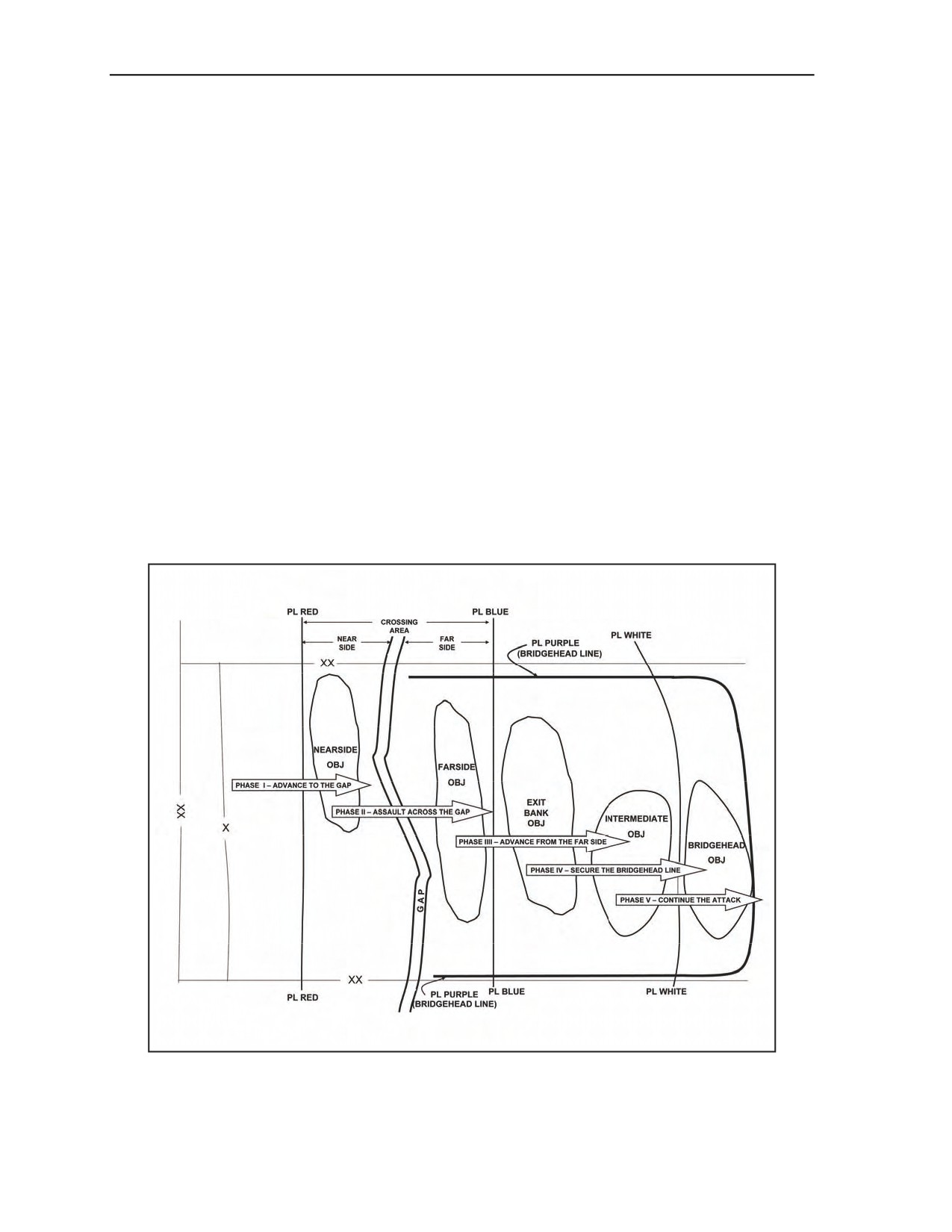
units with obscuration capabilities to assist in gap-crossing operations. Finally, the corps will provide
AMD support to protect the bridgehead from air interdiction.
PHASES OF A DELIBERATE WET-GAP CROSSING
4-55. An offensive deliberate wet-gap-crossing operation has five phases. They are distinct phases for
planning, but there is no pause between them in execution. The phases are as follows:
Advance to the gap (Phase I). The first phase is the attack to seize the nearside objective.
Assault across the gap (Phase II). The second phase involves units assaulting across the gap to
seize the farside objective, eliminating direct fire into the crossing sites.
Advance from the farside (Phase III). The third phase is the attack to secure the exit bank and
intermediate objectives that eliminate direct and observed indirect fires, into the crossing area.
Secure the bridgehead line (Phase IV). The fourth phase involves units that secure bridgehead
objectives to protect the bridgehead against a counterattack. This gains additional time and space
for force buildup for the attack out of the bridgehead.
Continue the attack (Phase V). The fifth phase is the attack out of the bridgehead to defeat the
enemy at a subsequent or final objective. It is considered as a phase of the gap-crossing
operation because the timing and initiation of this phase is typically dependent on the success of
the other four phases of gap crossing.
4-56. Figure 4-4 provides an overview of a deliberate gap crossing, showing the five phases and their
relationship to the crossing area.
Figure 4-4. Overview of a Deliberate Gap Crossing
4-14
FM 3-90.12/MCWP 3-17.1
1 July 2008
Gap Crossing in Support of Combat Maneuver
ADVANCE TO THE GAP (PHASE I)
4-57. Once the division has planned the operation, the first phase is initiated. The division, typically using
the C2 of division TAC CP, will attack to seize nearside terrain that includes favorable crossing sites and
road networks. Normally, the division advances with two brigades abreast and a reserve brigade trailing.
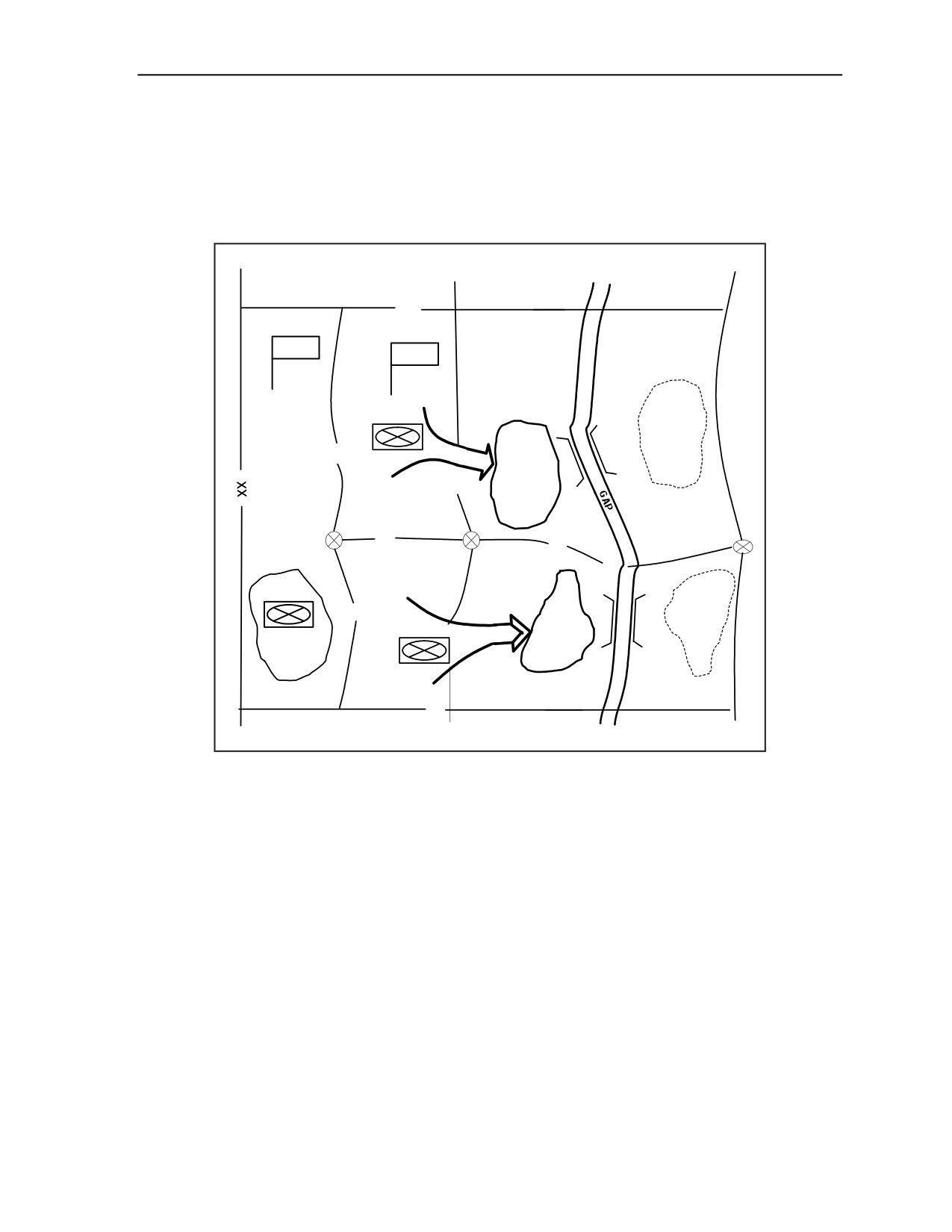
The division TAC CP controls the efforts of the lead brigades. Figure 4-5 depicts the advance to the gap
from a division perspective.
RL RED
XX
XX
XX
MAIN
TAC
X
FARSIDE
2
OBJ 1
X 2
NEARSIDE
OBJ
2
2
X
X
3
3
X
X 3
FARSIDE
1
NEARSIDE
X
OBJ 2
OBJ
AA LENA
3
XX
RL RED
Figure 4-5. Advance to the Gap
4-58. Well before the division reaches the river, a reconnaissance element moves ahead of the main body
to conduct a reconnaissance of the nearside and predetermined crossing sites. ERTs may need to be
allocated to the reconnaissance element to assist in the reconnaissance of crossing sites. If the tactical
situation prohibits reconnaissance of the crossing sites, one or both of the lead brigades must conduct the
reconnaissance. As the division arrives at the gap, the lead brigades establish security on the nearside. The
lead brigades develop hasty defensive positions to protect the crossing area and cover the crossing sites
with direct and indirect fires.
4-59. During the advance to the river, the division main CP coordinates counterfire, close air support
(CAS), and support of the division aviation brigade against deep targets. By effectively using these assets,
the division main CP fights the deep battle and isolates the bridgehead.
4-60. As METT-TC allows, the crossing area HQ (an engineer brigade or additional MEB coordinates the
improvement, control, and marking of routes within the nearside crossing area to the crossing sites; lays
out staging, holding, and other areas and establishes TCPs and ERPs. The crossing area HQ ensures that
key classes of supplies are pre-positioned forward.
4-61. The BCT TAC controls the fight of the TFs within its brigade. The brigade travels in a formation
that is METT-TC driven. The brigade seizes objectives that secure the nearside.
1 July 2008
FM 3-90.12/MCWP 3-17.1
4-15
Chapter 4
4-62. Each BCT main CP functions as the crossing area HQ. The crossing area is bound by RLs on the
friendly and enemy sides of the gap. The RL on the friendly side is usually set 2 to 3 kilometers from the
exit bank, out of the range of enemy direct-fire weapons. The RL on the enemy side delineates an area
large enough for forces to occupy battalion-sized attack positions. The BCT main CP is responsible for
controlling units that provide the crossing means, traffic management, and obscuration. Once the brigade
has secured the nearside, military police and engineers mark routes from the staging area to the crossing
sites; lay out staging, holding, and call forward areas; and set up ERPs and TCPs. Additionally, the BCT
commander, in coordination with the CFC, normally designates an appropriate area around the crossing
sites as critical friendly zones (CFZ) to ensure priority is given to the protection of the crossing site(s).
4-63. The farside must provide enough space and time for the initial buildup of combat power to continue
offensive combat operations to establish the bridgehead. The crossing area is the area, bound on either side
of the gap by RLs, in which units move on predetermined routes and use the time tables that are specified
in the division operation plan (OPLAN).
ASSAULT ACROSS THE GAP (PHASE II)
4-64. The division main CP continues to control deep fire assets to isolate the bridgehead. As units
advance, deep fires shift to subsequent targets.
4-65. The division coordinates with the corps for AMD coverage to protect the bridgehead from enemy air
interdiction. The gap creates lucrative targets at relatively fixed locations that are easily targeted by enemy
air. Therefore, approaches; holding, staging, and call forward areas; and crossing sites along the gap are the
highest priority for AMD during the crossing. AMD units occupy positions to engage aircraft with massed
fires before the aircraft can reach weapons release points (RPs).
4-66. The division TAC CP (in conjunction with the crossing area HQ) coordinates the actions of the
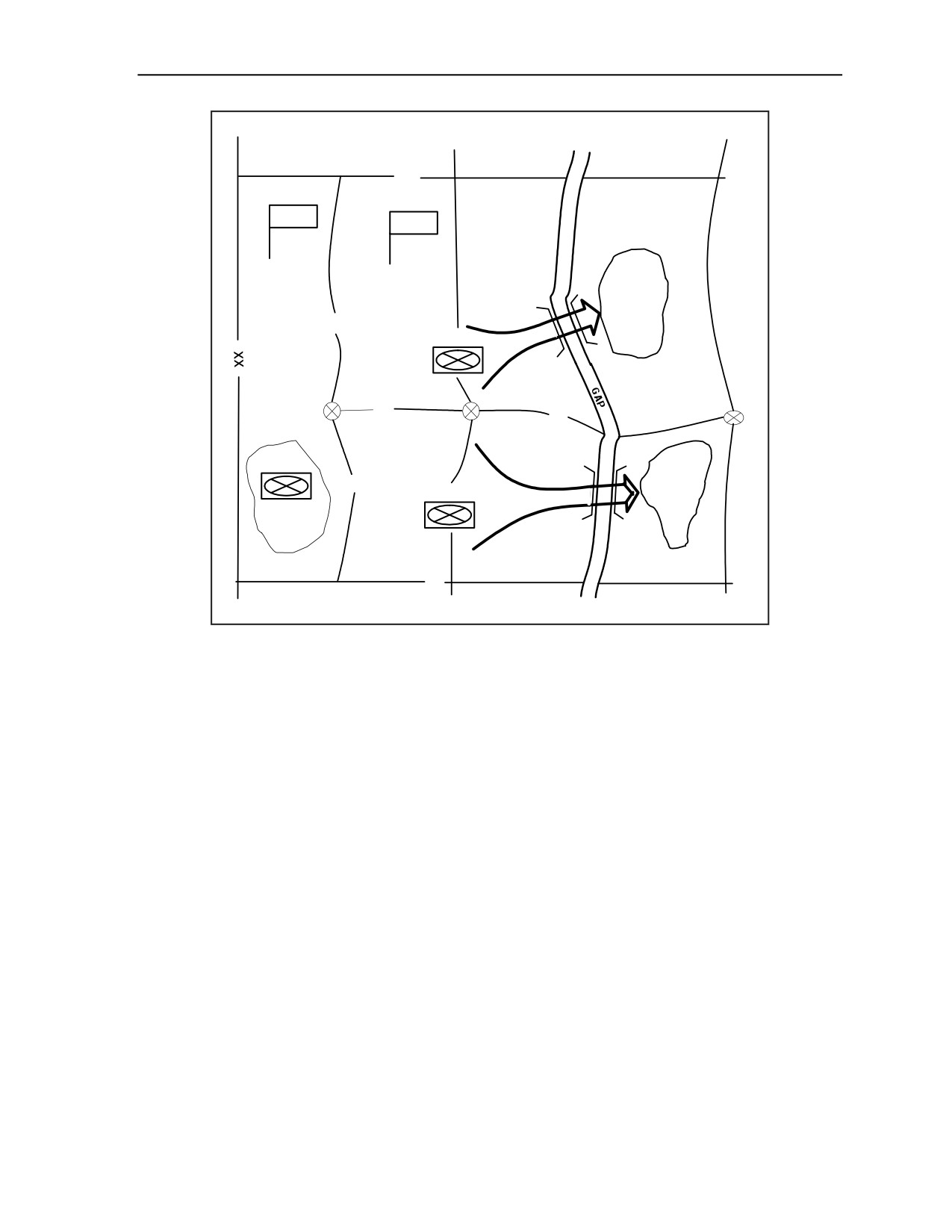
brigades conducting the assault across the gap (Figure 4-6). The crossing sites are chosen because of
available concealment, good route systems, and enough space for AAs on the nearside. These sites also
have defensible terrain on the far side of the gap to provide a secure base for continuing the operation.
4-67. Each BCT TAC controls their own respective assault crossing elements, which normally consist of
dismounted infantry. Combat maneuver battalions conducting the assault across the gap move to it under
the direct control of their BCT commander. The BCT commander keeps the remainder of the BCT back
from the gap to avoid congestion. Elements not engaged in security or supporting the crossing occupy AAs
and prepare for movement across the gap.
4-68. An engineer company, operating assault boats, transports the dismounted Soldiers and Marines of
the assault force to the farside. The dismounted element crosses the gap and secures terrain for the
reinforcing armored vehicles. The assault across the gap may also be an air assault operation, or the two
types may both be conducted. The dismounted assault forces are supported by the tanks and infantry
fighting vehicles from their TF and by other combat units in support from fire positions. Heavy rafts are
prepared to transport tanks and infantry fighting vehicles to the farside for reinforcing the dismounted
infantry. M9 ACEs and/or dozers are transported to prepare the farside exit sites. Rapid reinforcement of
dismounted assault forces with armored vehicles may be so critical, based on the METT-TC, that it justifies
using any expedient method to get the first few armored vehicles across. This includes winching, towing,
or pushing the first ones across normally unsuitable places while engineers improve entry and exit points
for the rest. In certain situations, tanks may be able to cross using fording equipment.
4-16
FM 3-90.12/MCWP 3-17.1
1 July 2008
Gap Crossing in Support of Combat Maneuver
PL BLUE
PL RED
XX
XX
XX
MAIN
TAC
FARSIDE
OBJ 1
X 2
X
2
2
2
X
X
3
3
X
X 3
FARSIDE
1
X
OBJ 2
AA LENA
3
XX
PL RED
PL BLUE
Figure 4-6. Assault Across the Gap
4-69. Each BCT main CP controls smoke to obscure the crossing sites of the gap in conjunction with the
division OPORD. When employed, the smoke blanket covers several kilometers of the gap and gap
approaches to conceal the actual crossing locations, but not as to obscure the bridge crewmen’s vision. The
crossing area HQ uses smoke generators, smoke pots, and smoke munitions from the division. Each BCT
main CP controls military police and engineer units to establish nearside waiting areas, mark routes to the
crossing sites, and begin constructing heavy rafts and/or bridges in conjunction with the division OPORD.
4-70. The intent of this phase is to rapidly place combat power on the farside to eliminate the enemy's
direct fire onto the crossing sites and secure terrain for attack positions. Brigades normally establish limits
of advance (LOAs) and fire-support coordination lines (FSCLs) for the dismounted TFs conducting the
assault in conjunction with the division OPORD. These lines establish an LOA that encompasses the
farside objective. Enemy indirect fire into the crossing area will probably continue; however, each crossing
site within the crossing area must be isolated from direct fire to enable the construction and operation of
rafts. These rafts will then be used to transport armored vehicles for rapid reinforcement of the dismounted
infantry TF. Within the crossing area, secured attack positions allow units to form into combat formations
before continuing the attack.
4-71. The CAC may consider immediate construction of a bridge during this phase without ever
conducting rafting operations, if this is viable. The advantage to this is that it may allow for combat power
to be massed on the farside at a much faster rate. The risk that the commander takes in making this decision
is that a large amount of bridging assets are potentially exposed to enemy fire before the elimination of
enemy indirect fires on the crossing area. This phase is completed once the farside objectives are secure.
1 July 2008
FM 3-90.12/MCWP 3-17.1
4-17
Chapter 4
ADVANCE FROM THE FARSIDE (PHASE III)
4-72. The division TAC CP continues to secure the farside until the BCTs are set in attack positions. The
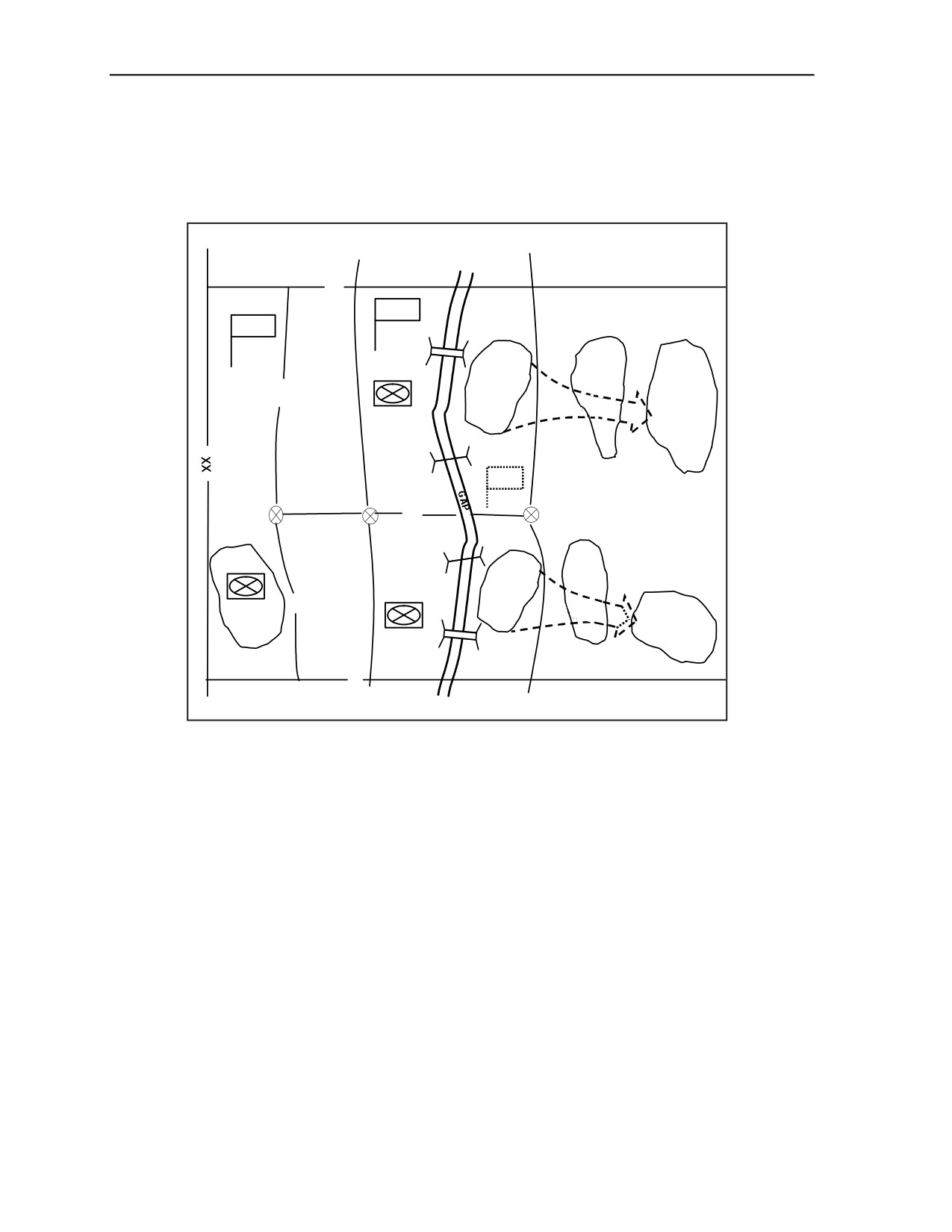
intent is to eliminate direct fires and observed indirect fires from the crossing area (Figure 4-7). Once set in
attack positions, the division TAC CP coordinates the attack of the lead brigades from the farside attack
positions to the bridgehead.
PL
PL BLUE
RED
X
XX
X
XX
TAC
MAIN
EXIT
X
BANK
ATK
OBJ
POSITION
X 2
INTERMEDIATE
2
OBJ
XX
2
TAC
X
3
X
EXIT
BANK
ATK
OBJ
POSITION
1
X
X 3
AA LENA
3
INTERMEDIATE
OBJ
X
PL
RED
PL BLUE
Figure 4-7. Advance From the Farside
4-73. The division commander selects exit banks and intermediate objectives based on METT-TC. The
gap splits the attacking force, limiting massed direct fires beyond the exit bank. Therefore, these objectives
are usually smaller and not as far from the attack positions as the objectives used in other offensive
operations.
4-74. The BCT main CP prepares push packages of Class III and V supplies that will support the attack
out of the bridgehead. They also begin to push Class IV and V supplies for the hasty defense during the last
phase of the gap-crossing operation.
4-75. Each respective BCT main CP controls the movement of their follow-on TFs from the staging areas
across the gap to their attack positions on the farside. They control the upgrade of crossing sites from
assaults boats to heavy rafts and/or bridging in conjunction with the division OPORD to ensure that the
force buildup can support the advance from the exit bank to the intermediate objectives. Military police
and, if available, engineers assist in movement control through the crossing area.
4-76. During this phase, limited two-way traffic begins to allow for the return of disabled equipment and
casualties by ground transportation. Each respective BCT TAC, in conjunction with division TAC CP,
controls the movement out of the attack positions to the exit bank, intermediate objectives, and a
subsequent bridgehead. Exit bank objectives are those positions that, when seized, eliminate the enemy's
ability to use direct-fire weapons on the crossing area. Intermediate objectives are those positions from
4-18
FM 3-90.12/MCWP 3-17.1
1 July 2008
Gap Crossing in Support of Combat Maneuver
which the enemy can provide observation for indirect-fire weapons. This enables the expansion of AMD
coverage, allowing more time to engage aircraft in air avenues of approach on the far side of the gap.
4-77. The TF that conducted the dismounted assault across the gap continues to cross armored and/or
wheeled vehicles and remount their dismounted Soldiers and Marines in preparation for continued
offensive operations. The BCT commander (with staff support) establishes the order of raft loads based on
the division's crossing priorities. Bridge companies run heavy raft sites and begin to construct ribbon
bridges. Military police mark routes and control holding areas on the farside to ensure rapid transit within
the crossing area.
SECURE THE BRIDGEHEAD LINE (PHASE IV)
4-78. The bridgehead must be defendable and large enough to accommodate forces that will break out to
continue offensive combat operations. The lead brigades attack to secure the final objectives within the
bridgehead to prevent the enemy from successfully counterattacking against forces within the bridgehead
line by rapidly building enough combat power to establish a hasty defense in the sector. The lead brigades
maintain continuous farside security to prevent bypassed enemy elements from infiltrating back to the gap
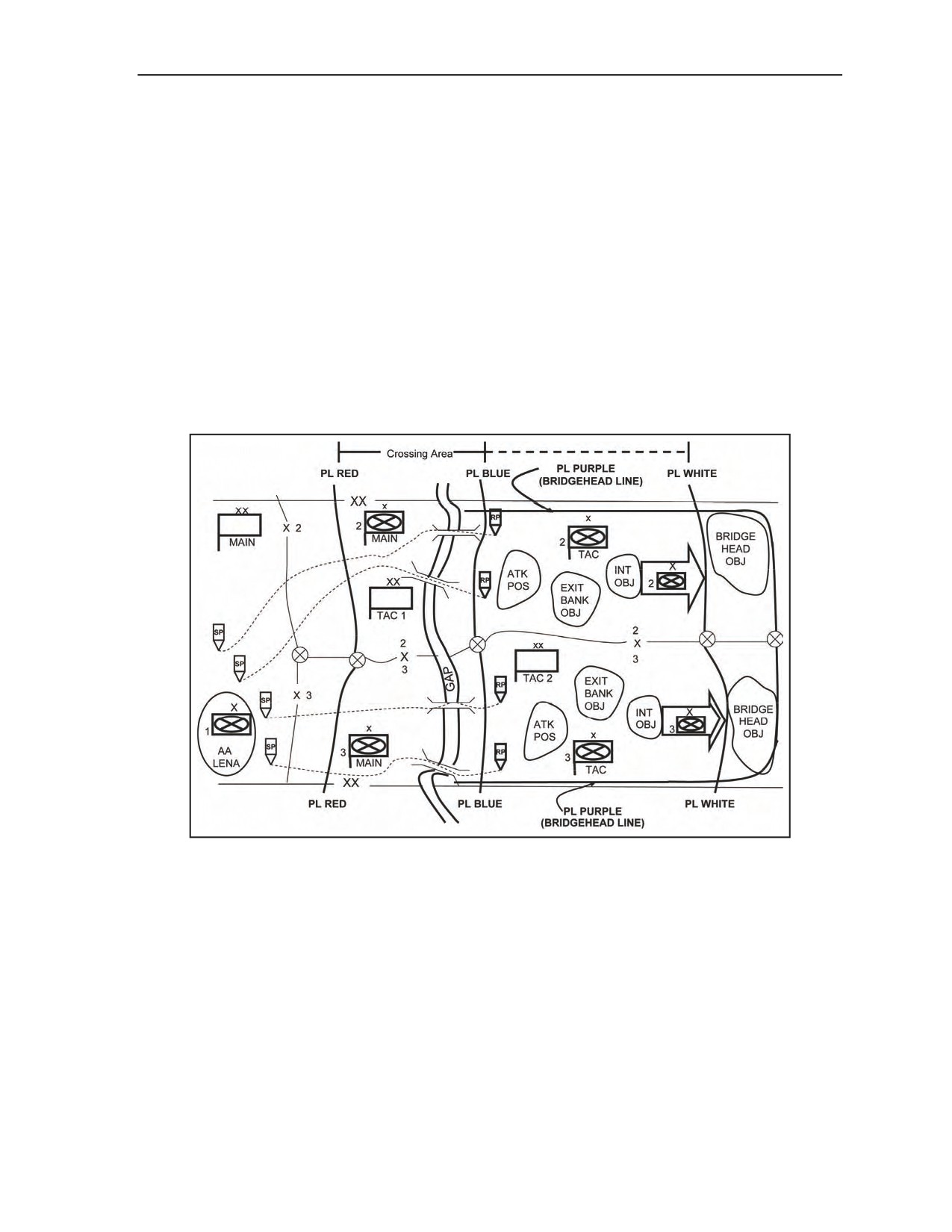
and disrupting activities at the crossing sites. See Figure 4-8.
Figure 4-8. Secure the Bridgehead Line
4-79. The division TAC CP controls the lead brigades as they secure the bridgehead objectives and
preparation is made to move the reserve brigade or other forces (breakout forces) into attack positions
within the bridgehead. Once the bridgehead objectives are secured, the lead brigades establish a hasty
defense in sector.
4-80. The BCT main CP continues to upgrade and monitor the crossing sites and control the movement of
forces through the crossing area. The farside RL, defining the crossing area, is moved just past the
intermediate objectives to provide space for the breakout forces. The division TAC CP controls the
movement of the breakout forces through the crossing area to attack positions within the bridgehead.
During this phase, specific bridges and/or rafts are designed for full time return traffic. This ensures that
ground resupply and the evacuation of wounded Soldiers and Marines and disabled equipment can occur.
1 July 2008
FM 3-90.12/MCWP 3-17.1
4-19
Chapter 4
4-81. The division main CP controls the aviation, artillery, and available CAS sorties to screen the flanks
and interdict enemy counterattacks. Deep operations play a key role in the bridgehead defense by targeting
enemy formations as they move to counterattack. They also eliminate effective artillery fire within range of
the bridgehead and destroy other enemy artillery forces moving up to the fight.
4-82. The lead BCT elements that secure the bridgehead line must control the avenues of approach into the
bridgehead and be large enough to defeat counterattacks. After the bridgehead is secure, the division
commander commits the breakout force to an attack position within the bridgehead. The bridgehead needs
enough space (20 to 30 kilometers deep) to accommodate both the lead brigades and the breakout force
with their sustainment. The bridgehead line must also be deep enough to employ AMD systems against
hostile aircraft before they can engage crossing sites.
CONTINUE THE ATTACK (PHASE V)
4-83. Once the division has secured the bridgehead and the breakout forces are in attack positions, the
division gap crossing is complete. Crossing area control will normally be passed to a higher HQ or
follow-on HQ. The breakout force must complete its passage before continuation of offensive operations.
The lead BCTs must reorganize and prepare to follow the breakout force as the division or corps reserve.
Security forces from the corps must come forward to relieve the lead BCTs from their bridgehead security
mission.
4-20
FM 3-90.12/MCWP 3-17.1
1 July 2008
Chapter 5
Line of Communications Gap-Crossing Support
"The most dangerous thing in the world is to try to leap a chasm in two jumps."
William Lloyd George
Conducting LOC gap crossing support is not tactically focused, although it may
clearly have an effect on tactical operations. It may however employ what has been
categorized as support bridging (see Chapter 2, Figure 2-1, page 2-5). This support
may provide the means for combat maneuver forces to move, but it is not directly in
support of combat maneuver. As the title implies, LOC gap crossing is focused on
sustainment of the force. The focused logistics joint functional concept seeks the
ability to sustain widely dispersed forces over a large AO. As such, it is imperative
that LOC gap crossing be included in the overall theater sustainment plan. These
crossings must be capable of effectively and efficiently supporting the uninterrupted
flow of forces, equipment, personnel, supplies, and support for sustained ground
operations for not only U.S. forces, but also allied, coalition, and host nation (HN)
forces, and displaced civilians.
OVERVIEW OF LINE OF COMMUNICATIONS GAP CROSSING
5-1. While LOC gap crossings vary in size, scope of work, and bridge type, their purpose is primarily
sustainment of the force. To ensure support forces are able to move freely and without delay throughout the
theater, it is imperative that LOC crossings support the movement plan, are able to handle high volumes of
various types of traffic, and don’t require levels of maintenance and/or replacement that would impede
traffic flow for extended periods. There are two principle methods used to do LOC gap crossings: military
or contracted panel bridging and nonstandard bridging. Contingency purchases of COTS panel bridging are
better maintained than the Bailey, but normally require special training to emplace and sustain them. New
construction LOC nonstandard bridging involves horizontal and vertical engineer units and usually
requires weeks instead of days to complete. As a general rule, they are built in areas free from the direct
influence of enemy action, however, this does not mean that protection against attacks by air and ground
forces are not considered. This is an important factor because they require a large organizational footprint
of manpower and equipment. Additionally, they are built with the assumption that once emplaced, they will
not be removed until a more permanent structure can replace them, they are no longer needed, or they are
eliminated by friendly or enemy forces or natural causes.
1 July 2008
FM 3-90.12/MCRP 3-17.1
5-1

Chapter 5
Historical Perspective - Bridging the Sava
U.S. Army operations in Bosnia included the mission to bridge the Sava River near
Zupania, Croatia, in December 1995. This mission was the largest gap-crossing
operation since World War II and was conducted under extreme conditions.
Seasonal weather caused the Sava River to swell from its normal width of 300
meters to more than 600 meters. Despite harsh conditions, engineers used Chinook
helicopters to deploy ribbon bridge sections into the gap while other engineers rebuilt
the approaches and successfully bridged the Sava River to allow elements of the 1st
Armored Division to cross. As the floodwater receded, engineers built a causeway
across the floodplain. As operations in the area continued, the ribbon bridge
remained the only crossing means for both military and civilian traffic while
preparations were made for LOC bridging. The 130th Engineer Brigade maintained
the bridge and received traffic—a total of 20,000 vehicles until it was disassembled in
April 1996.
GAP SIZE
5-2. The size of LOC gaps vary. Often, the size depends on one of the following situations: replacement
for assault bridging emplaced by maneuver forces, repair of existing bridging, or new construction. If its
purpose is to replace assault bridging emplaced by a maneuver unit, the gap size will typically be 18 meters
or less. If it is a repair to existing bridging, the size fluctuates based on the amount of damage to the
original structure. Finally, the gap size requiring new construction depends on current and future mission
necessity, availability of alternative crossing sites and means, and cost and availability of resources.
SCOPE OF WORK
5-3. The scope of work required for LOC bridging is based on the gap size and type (wet or dry), enemy
activity, terrain, site preparation requirements, entry and exit routes, bridge type to be installed, and the
availability of resources. A detailed reconnaissance early in the process should identify as much of this
information as possible to assist the staff engineer in planning and resourcing the bridge construction.
BRIDGING TYPES
5-4. LOC bridging is normally nonstandard fixed or commercially procured bridging. It can, however,
include the Bailey bridge (standard fixed bridge), rafting, or ferrying operations for limited durations.
Considerations for bridge selection include: bridge availability, time constraints, access to bridge site,
amount and type of crossing vehicles, and number of crossings. Table 5-1 and Table 5-2 depict those
bridges that are currently being used (or could temporarily serve) as LOC bridging by U.S. and allied
forces.
Table 5-1. United States-Line of Communications Bridging
Nomenclature
Name
Span
MLC
References
M2
Bailey
24.4 meters
Triple Single 80T/85W
FM 5-34/MCRP 3-17A
Bailey
33.5 meters
Triple Double 90T/90W
Bailey
51.8 meters
Triple Triple 70T/70W
LSB
61 meters
80T/110W
Purchased with contract
5-2
FM 3-90.12/MCWP 3-17.1
1 July 2008

Line of Communications Gap-Crossing Support
Table 5-2. Selected Allied-Line of Communications Bridging
Country
Name
Span
MLC
Canada
MGB
• Single story (SS)
9 meters
70
• Double story (DS)
31 meters
70
• DS with link
49 meters
70
reinforcement set
(LRS)
Acrow® 700XS
48 meters
60
Germany
Faltfestbruke (FFB)
45 meters
70
UK
BR 90
56 meters
70T/105W
M3 Bailey
61 meters
80
LSB
61 meters
80T/110W
MGB
• SS
9 meters
70
• DS
31 meters
70
• DS with LRS
49 meters
70
NONSTANDARD BRIDGING
5-5. Engineers design nonstandard bridges to match specific conditions of a particular site when standard
bridges are not available; they are unable to handle the volume and weight of the anticipated traffic; they
are needed forward of the proposed bridge site; or the bridge is expected to remain in place indefinitely.
Available structural materials, site details, proposed traffic, and time will influence the design. The design
of military nonstandard fixed bridges is similar to that of civilian fixed bridges. Military methods, however,
include several simplifications and assumptions about the loads to be carried, the type of construction, and
the materials available. For task organization (TO) nonstandard bridging, steel stringers are desired with
laminated, plank, or concrete decking and plank or asphalt as a wearing surface (see FM 3-34.343).
5-6. Before considering new construction, engineers should conduct a reconnaissance to determine if
there are existing bridges that are intact, if a detour or bypass is available, or if there are existing bridges
that can be reinforced or repaired. If one of these options exists, it is generally more economical and less
time consuming to use one of these alternatives. It is important to note that if an existing bridge is
acceptable, it must be classified utilizing normal military classification procedures.
5-7. Some examples of nonstandard fixed bridges that may be encountered include: timber trestle bridge,
steel stringer bridge, composite steel/concrete stringer bridge, steel girder bridge, truss bridge, reinforced
concrete slab bridge, reinforced concrete T-beam bridge, reinforced concrete box girder bridge, prestressed
concrete bridge, arch bridge, suspension bridge, moveable bridge, or expedient ice bridge. Detailed
information concerning classification and repair is contained in FM 3-34.343.
STANDARD BRIDGING
5-8. In some cases, it may be necessary to use the Bailey bridge (see FM 5-277) or DSBs (see Technical
Manual [TM] 5-5420-212-10-1) as temporary or semipermanent LOC bridging. If using one of these
bridges, careful consideration must be given to MLC and the volume of traffic to ensure that the bridge can
withstand the desired weight and number of crossings that would be required. Currently, the Bailey bridge
is not organic to the MRBC; however, they are capable of emplacing the bridge. The DSB is organic to the
MRBC. If the bridge can satisfy the weight and volume requirements, it is usually an option for temporary
service.
1 July 2008
FM 3-90.12/MCWP 3-17.1
5-3
Chapter 5
5-9. Railroad bridging is a LOC bridge and is classified as a standard fixed or nonstandard fixed bridge.
The U.S. Army does not have design criteria for nonstandard railroad bridges nor does it maintain railroad
float bridge equipment. Many variables of standard railroad bridges are available through the Army
Facilities Components System (AFCS). Construction details and bills of material are given in the TM 5
302 series which supports AFCS. Also see FM 5-104 for more information.
RAFTS, FERRIES, LANDING CRAFT AIR CUSHIONS, AND OTHERS
5-10. When it is necessary to cross a wet gap, rafts, ferries, landing craft air cushions (LCACs), or other
equipment and assets may provide the best solution. They are normally used when time is critical; when
float bridging is unavailable or impractical; when they are supporting a larger deliberate wet-gap crossing;
or when they are involved in ship-to-shore operations. These types of operations (rafting, ferrying, and ship
to shore) essentially have the same purpose—to cross a gap. Unlike bridging that closes the gap, these
operations use floating equipment to move between two points across a wet gap. Each solution for dealing
with a gap has advantages and disadvantages which typically center on the specifics of the gap; the
availability of equipment or other items, supplies, or personnel; the types of equipment and other items to
be crossed; and the nature of the threat.
RAFTS
5-11. Rafting is most often used as the sole crossing means. It may be used in conjunction with other
crossing means when it is employed for gap crossing in support of combat operations. It can also, however,
serve as an alternative or temporary solution for LOC bridging.
5-12. Units begin their preparations for rafting operations at a staging area. There, they receive briefings,
conduct inspections, and rehearse the rafting operation. Personnel will be issued life jackets and given
instructions on what to do upon loading onto the raft.
5-13. When ordered to begin rafting, the site commander directs personnel at the ERP in the call forward
area to begin sending raft loads forward. Units proceed from a staging area to the call forward area where
engineers at the ERP organize them into raft loads and send them down to the river. Any points along the
route that may cause confusion, such as intersections, are either manned with a guide or are marked to
ensure that the vehicles do not get lost. Once a raft load nears the river, the platoon leader directs it to the
appropriate centerline. The platoon leader controls the traffic flow to the centerlines to ensure that there is a
smooth traffic flow and that centerlines are neither congested nor underused. He establishes the timing
required so that raft loads leave the call forward area and match up with a returning empty raft. When a raft
load reaches the riverbank, it is met by an engineer centerline guide. He stops the raft load 3 meters from
the edge of the water and holds it there for the raft commander. The raft commander guides the vehicles of
the raft load onto the raft. The raft crew chocks the vehicles and ensures that all passengers are wearing life
jackets. The passengers do not dismount from their vehicles. All hatches are opened to allow quick exit of
the vehicle in case of an emergency. Upon reaching the debarkation point, the raft commander guides the
vehicles off the raft. After the raft load debarks, the raft commander checks with the centerline guide for
any return vehicles and returns to the embarkation point.
5-14. Once on the farside, the centerline guide directs the raft load to the farside holding area where it
reforms. The passengers remove their life jackets, which are collected and returned by an engineer team to
the staging area for future loads. During rafting operations, rafts require stops for refueling, preventive
maintenance, and minor repairs. The efficiency of the crossing depends on all rafts having enough fuel and
minimal lost time for refueling and normal maintenance. This efficiency requires the bridge company to
intensely manage raft maintenance and to operate the maintenance area much like a pit crew in an
automobile race. When directed, a raft pulls off the centerline and moves to the crossing site maintenance
area.
5-15. With the raft secured, the crew begins refueling and performing maintenance operations. Mechanics
assess and repair any minor damages to the raft and the boats. Fuel handlers run fuel lines from the fuel to
both bridge boats and fuel them simultaneously. If no major deficiencies are identified, the entire process
requires 20 minutes. If major deficiencies are identified on the boat, it is removed from the raft and
5-4
FM 3-90.12/MCWP 3-17.1
1 July 2008
Line of Communications Gap-Crossing Support
replaced with an awaiting spare. The boat will then be removed from the water and sent back to the EEP
for repair. When refueling and maintenance operations are finished, the raft returns to its centerline and
another raft is directed in for maintenance and refueling.
5-16. Since the maintenance and refueling operation is continuous and requires removing a raft from the
operation for up to 30 minutes, it is important to account for this reduction in capabilities when planning
the operation. Generally, it is unnecessary to refuel for the first 2 hours after rafting begins. Once raft
maintenance and refueling begin, one of the six rafts in each bridge company is unavailable for carrying
vehicles across the river at all times.
5-17. When a raft becomes damaged and needs immediate repair, the raft commander moves it to the
maintenance area. If a raft loses a boat and cannot make it to the maintenance area without assistance, the
raft commander contacts the maintenance supervisor, who sends the maintenance boat out to assist. If a raft
is still carrying a load, the raft commander will decide which bank he will use to disembark the load. Once
in the maintenance area, mechanics determine the extent of the damage. If the damage requires significant
repair, the raft will be removed and replaced with a spare. Lengthy equipment repairs are done at the EEP.
FERRIES
5-18. Ferry operations are similar to rafting operations with the primary difference being the scale of the
operation and the fact that they are less likely to be involved in active support of combat maneuver. They
also differ in that they are generally used in lower threat areas, are conducted for extended periods of time,
and have designated crossing times that may be developed into a standard schedule. Ferries may provide
the best crossing solution when bridging assets are unavailable or the gap is so large that bridging is not
feasible. Often times when conducting ferrying operations, it may be necessary to do so in conjunction
with riverine operations. In a riverine area, watercraft is the principal means of transport. In such areas,
indigenous personnel often settle along the waterways because they are the primary means of travel
between villages. Civilian traffic, ferrying operations, and settlements can conceal enemy movement (see
FM 55-50 for more information concerning riverine operations). Ferries are a likely means of supporting
LOC requirements in AOs that are characterized by the need for riverine operations.
LANDING CRAFT AIR CUSHIONS AND OTHER SIMILAR SYSTEMS
5-19. This section describes two primary vessels used by the USMC and Army when conducting
amphibious operations (see Marine Corps Warfighting Publication [MCWP] 3-13 and JP 3-02). They may
also have applicability in supporting other selected wet-gap-crossing operations. Typically, Navy and
USMC assault units conduct amphibious operations and Army amphibians and watercraft are used as
floating platforms for on-call supply movement after the beachhead has been secured. The Army can,
however, be a part of the assault force in an amphibious operation.
5-20. The LCAC is a high-speed, fully amphibious craft capable of carrying a 60-ton payload (75 tons in
overload), at speeds in excess of 40 knots, at a nominal range of 200 nautical miles. Its primary purpose is
to move Marines and Soldiers and their equipment from the well decks of warships to the beach.
5-21. The Landing Craft, Mechanized 8 (LCM-8), Modification 2 (MOD2) is an Army vessel that is
primarily used for C2, moving Soldiers and Marines, or light salvage. It is normally used in harbors, inland
waterways, and as a C2 vessel for ship-to-shore operations. For other Army vessels that may support
selected wet-gap-crossing operations see FM 55-50.
SUSTAINMENT, MAINTENANCE, AND REPLACEMENT OF LINE OF
COMMUNICATIONS GAP-CROSSING SYSTEMS
5-22. Engineer horizontal and MRBC companies, usually under the C2 of an engineer battalion, are
normally responsible for LOC bridge sustainment, maintenance, or replacement depending on the amount
and type of work to be done. Organic and special engineer equipment may be augmented from depot
stocks, supply points, other units, or commercially procured. Captured equipment, parts, and material
should also be considered as possible resources. When speed is essential, stock items are best for efficient
1 July 2008
FM 3-90.12/MCWP 3-17.1
5-5
Chapter 5
maintenance. The responsible commander should determine the best resources and methods for obtaining
material (see FM 3-34.343 for more information).
DECKS
5-23. Decks should be free of stones, mud, ice, and debris to decrease wear on the surface. Keep flat decks
clear with a patrol grader, which throws mud, ice, and debris to the curb where it can be removed by hand
shoveling. A scarifier may help remove ice. If patrol grading is impractical, shoveling and hand removal of
large debris is necessary.
5-24. A thin tar or asphalt coating densely covered with sand, pea gravel, or stone chips will reduce the
danger of fire on wooden decks. Loose sand, chemical fire extinguishers, water pumps for river water, or
barrels of water are effective resources for fighting bridge fires.
5-25. Misalignment (caused by simple shifting or structural failure) can be repaired by pulling the deck
back into place with wire cable and tractors. Mechanical or hydraulic jacks may be effective. Misalignment
of major superstructure members is usually caused by movement of the footings. Since this type of
misalignment is difficult to repair, the bridge may have to be reconstructed.
5-26. The principles of firefighting, shifting, and stringer replacement in highway bridges also apply to
railroad bridge decks. Replace burned or damaged ties promptly. Check the rail alignment and guardrails
for shifting and correct any problems. The maintenance patrol or gang should also tighten all loose rail
spikes, end joints, hook bolts, and tie-spacer connections and check the following:
Fastenings. Wooden decks tend to shift under load. Correct this problem by adding adequate
fastenings to the curb rail, tread, or stringers. If the stringers shift, draw them back into position
and secure them with drift bolts (for timber stringers) or steel bolts (for steel stringers). Redrive
any loose nails or add new nails to loose planks. Drift pins or lag screws might be needed in
troublesome spots. Ensure that the clamps for the curbs and handrails are secure.
Timber treads. All types of timber deck bridges should have timber treads. Bolt timber treads
onto steel grid floors if the grids show signs of excessive wear. Replace the treads when 10 to 15
percent of the original surface has worn. A tar or asphalt coating covered with sand, fine gravel,
or stone chips will prevent excessive splintering and rapid wear.
Wearing surfaces. Asphalt concrete best protects wearing surfaces of concrete or masonry.
Stringers. Replace bent, crooked, or rotten stringers by removing and replacing the flooring
planks. Correct stringer bearing is essential for the bearing cap and the flooring. Placing metal
shims between the stringer and cap is the best way to correct the bearing. Securely fasten shims
in place to prevent them from dislodging. Do not use small shims between the floors and
stringers.
Curbs and handrails. Replace curbs and handrails only when they have been damaged by
accidents.
FOUNDATIONS
5-27. Foundation settlement is usually caused by scour or structural failure. Correct minor settlement by
jacking up the structure and inserting steel shims between the stringers and the cap or between the bearing
plates and the pedestal. Use hardwood shims under wooden members. Correction of settlement is discussed
below.
ABUTMENTS
5-28. Treat scour and settlement of abutments the same as foundation settlement. However, since an
abutment also acts as a retaining wall, it is subject to horizontal earth pressures. If the abutment is unstable,
shore it or hold it in place with guy lines from anchors on shore.
5-6
FM 3-90.12/MCWP 3-17.1
1 July 2008
Line of Communications Gap-Crossing Support
TIMBER
5-29. Decay, excessive loads, structural defects, fire, or explosives may cause timber members to fail.
Untreated timbers that are alternately wet and dry or are only partly saturated decay quickly. Timber that is
under water or otherwise continually wet does not decay, but may be attacked by marine borers. Replace
all timber showing decay or structural damage (preferably with masonry or steel) especially if the timber is
in contact with the ground. One method of repairing piling is to splice new members to solid members with
butt joints and scabs.
5-30. To allow timber to breathe, leave at least a 1/8-inch clearance between the timbers (where possible).
Keep all bridge timber clear of debris. Remove the bark from native logs if this was not done during
construction. Green or wet timber shrinks considerably when seasoned. Repeated wetting and drying also
cause dimension changes as great as 5 to 10 percent, parallel to the grain. Unseasoned timber may require
frequent renailing and tightening of bolts.
STEEL
5-31. Intense heat that raises steel temperatures above 1,000°F is particularly serious when the members
are under stress. Members under tension that are heated to this extent will permanently elongate and will
buckle if under compression. Intense heat will also destroy the temper and extra strength in certain types of
steel (especially cold-rolled sections and high-strength wire). Replace damaged steel or reinforce it by
welding new members onto the damaged sections.
5-32. Bending (due to accidents or explosions) is not as serious in members that are under tension as it is
in those that are under compression. Straighten the bent compression members to their original shape. If
not possible, weld or bolt steel plates or shapes onto the bent member to increase its stiffness. When
essential members are severed, other members assume added stresses. Relieve overstressing of members by
adding bolted or welded plates or structural sections across the gap.
5-33. Military loads and design stresses are high, with impact adding to the severity of steel stresses.
Fatigue failure is caused by repeated stressing and may result in sudden collapse. Fatigue failure is usually
preceded by small hairline cracks around the rivet holes, welds, and other surface irregularities. Since these
cracks usually do not get large before ultimate failure, reinforce the affected components immediately with
steel plates.
5-34. Rusting on bridges seldom requires special attention unless these structures are subject to salt spray
or are located in humid climates. Keep all steel clear of debris, and limit timber-steel contact to a minimum
to prevent rusting due to moisture retention. Loose rust is not serious, but deep pitting should be
investigated. Paint areas that are subject to severe rusting, and coat them with tar, asphalt, or thick grease.
Remove all rust with a wire brush or sandblast before painting.
CONCRETE
5-35. Correct surface spalling on concrete with plaster or with a low-water content mortar applied with a
pneumatic sprayer. Extensive frost damage is usually not repairable. Rust flakes on reinforcing steel can
exert considerable pressure when confined and will spall concrete along bars that are too close to the
surface. Although seldom serious, repair this condition by chipping away the concrete, cleaning most of the
rust from the bar, and grouting the area. Fires of 1,200°F and above that last for an hour or more cause
spalling and cracks and reduce the strength. Replace the concrete if the damage is serious. Patch all holes
and gaps that are caused by accidents or explosions.
Tension
5-36. Concrete tensile strength is negligible since resistance to tension is furnished by the reinforcing steel.
Tension cracks crossed at right angles by reinforcing steel are not serious unless they are more than 1/8 to
1/4 inch wide, depending on the structural details.
1 July 2008
FM 3-90.12/MCWP 3-17.1
5-7
Chapter 5
Compression
5-37. Compression creates a crushing failure that crumbles concrete, especially in columns. Connections
between steel tension and compression members are usually made with splice plates that are welded,
riveted, or bolted to the members.
Shear
5-38. Repair concrete shear failure in rectangular members with tight steel bands. Do this only under the
supervision of a structural engineer.
APPROACHES
5-39. Correct any settlement of approaches immediately. The grade line of unpaved approaches should be
1 inch above the grade of the deck. The grade line of paved approaches should be the same grade as the
deck. Patch any potholes immediately. When settlement occurs on railroad bridges, add ballast to the track
(shoreward of the abutment) to keep the track from dipping.
5-40. Some waterways with flat grades and floodplains have a tendency to shift channel locations. Such
shifts may deposit eroded material against the piers or erode the pier foundations or approaches. These
problems can be controlled by earth or rock dikes or by piles strung with brush mats woven into wire
cables.
5-8
FM 3-90.12/MCWP 3-17.1
1 July 2008
Chapter 6
Special Environments and Situations
"It is an immense task that I have on my hands, but I believe I can accomplish it."
General George McClellan
Gap-crossing operations in austere environments can present many challenges—not
only in the selection of a bridging means, but also on the personnel constructing the
crossing. When planning crossings in these environments, planners must develop
specific, flexible plans because the conditions often change in very short periods of
time. Crossing sites must be monitored continually, with close attention paid to the
condition of the bridging means and other factors that may impact the risk
assessment. Additionally, it may be necessary to make or construct crossings that are
affected by unique conditions or situations. Such situations include, but are not
limited to, crossing a contaminated area or conducting a crossing in conjunction with
crowds of dislocated civilians or refugees that compound the other challenges
associated with a gap crossing. These situations require extensive specialized and
focused planning as added conditions and will increase the level of difficulty and the
assets necessary to successfully complete the crossing.
GENERAL
6-1. Gap-crossing operations in specific environments or under unique conditions refers to tasks
undertaken in extremes of temperature, climate, topography, or combinations. It also applies to more
specialized situations such as a CBRN or in a situation where the impact of large numbers of refugees add
a very special twist to a gap-crossing operation. The specific environments and unique conditions
considered in this chapter include the following:
Arctic and cold weather.
Mountainous areas.
Desert and extremely hot conditions.
Jungles and forests.
When compounded by CBRN conditions.
When compounded by significant numbers of dislocated civilians or refugees.
6-2. This chapter introduces the engineer to the climate and terrain limitations imposed on gap-crossing
operations. It is not intended to study in detail the effects of these environments since they are outlined in
other publications. In certain climates or situations, specific aspects of environmental considerations may
require adjustments to the gap-crossing solution.
6-3. Remember that the nature of dry gaps can rapidly change to wet gaps as a result of a change in
weather conditions, the destruction of dams and dikes, or as the result of other actions. Seasonal effects on
the nature of a gap must also be taken into consideration when planning gap crossings.
1 July 2008
FM 3-90.12/MCRP 3-17.1
6-1
Chapter 6
GAP-CROSSING OPERATIONS IN ARCTIC AND COLD WEATHER
CONSIDERATIONS
6-4. Arctic and cold weather operations can be conducted in many parts of the world. The same type of
temperature conditions can be found in mountainous areas. Even moderate climates can experience severe
winters, producing the same constraints on operations as found in other cold weather areas. When
conducting operations in this type of environment, significant changes in temperature can cause ice or
snow melt or freeze. Ice or snow melt can cause significant water level and current changes in streams,
rivers, and lakes—potentially causing flooding in low areas in short periods.
Terrain
6-5.
The following terrain conditions may be encountered:
Deep snow. In many areas there will be deep snow. This will impede mobility and make it
difficult to see the true ground conditions.
Permafrost. Permafrost is perennially frozen ground. The annual thaw depth, from 0.3 meters
to 1.5 meters, is called the active layer. Digging, even in summer, is nearly impossible. Because
permafrost restricts surface drainage, the active layer is often saturated with slow moving water.
Any surface disturbance collects water if it provides a channel in the direction of the watershed.
Surface water may wash away or otherwise alter the vegetation that binds the surface and
insulate the permafrost. In turn, this deepens the active layer and creates the effect of a drainage
ditch, which again increases the flow of water into the area of the channel. Under certain
watershed conditions, this cycle may convert a single vehicle track into a destructive ditch of
erosion—preventing vehicle movement.
Hydrology. If the precipitation is low, streams may have relatively little volume. However,
melting snow in the warm months can produce sudden variations. Also, ice expansion,
continued water influx, and partial thaws can create pressure ridges in frozen bodies of water.
These ridges, often 1 meter high, can be formidable obstacles to vehicles. Similarly, dependant
upon the snow cover, ice can be up to and greater than 2 meters thick if the snow cover is sparse
and the lake windswept, or only a fraction of a meter thick if the snow cover is extensive. In the
winter, swamps, rivers, and lakes may be an asset to movement. In the summer, they may be a
liability and an obstacle to overcome. Gap-crossing operations predominate during the summer
but must not be discounted during the winter.
Vegetation. The vegetation could range from nil on the high arctic tundra to heavy forests such
as the forests of northern Canada or Norway. Forested areas may provide the engineer with an
abundance of natural materials for the construction of nonstandard bridges, but restrict
movement on prepared routes.
Personnel
6-6. The climate provides some particularly unique problems. In many cases of extreme cold or storms,
personnel survival becomes the preoccupying activity of military forces. The most common problem areas
are dehydration, exposure and frost bite, and reduced work rates. Good clothing, equipment, and training
will ease the problems, but Soldiers and Marines need to have access to a warming area, hot and high
calorie food, and a shelter from severe weather to maintain long-term effectiveness.
Equipment
6-7. The cold affects equipment in many ways, some considerations include the following:
Petroleum, oils, and lubricants. Some types of petroleum, oil, and lubricants (POL) will gel at
low temperatures. Engines could be difficult to start and fuel consumption will be high due to
the need to keep engines running for warmth.
Vehicles. Vehicles may have to run continuously, resulting in excessive wear on the engine.
Parts may break due to increased brittleness of materials at low temperatures.
6-2
FM 3-90.12/MCWP 3-17.1
1 July 2008
Special Environments and Situations
Mobility. Mobility could be affected by snow, weather (whiteouts or storms), and ice.
Effects on metals. Metals could become brittle at low temperatures.
GAP-CROSSING TECHNIQUES
6-8. The various gap-crossing techniques used in other environments are normally an option in cold
weather. However, caution must be used due to the extreme cold temperatures and challenges associated
with large formations of ice.
Standard Bridging
6-9. Regardless of whether standard (fixed) or nonstandard bridging is to be used, it is most desirable to
construct the bridges in one clear span. This is to prevent damage, or in the worst case, destruction of the
bridge due to a heavy water flow during runoff and the floating debris and ice associated with it.
6-10. Not usually considered as an alternative, floating bridges such as the IRB are suitable for use over
large lakes and slow moving rivers, limited by freeze-up. If extreme care is not taken and bridges removed
early enough, extensive damage can be expected should the bridge become frozen in the ice. Care must be
exercised to ensure that the equipment does not sustain damage by an overnight freeze-up or floating ice
and debris in the spring.
Nonstandard Bridging
6-11. Not usually desirable from the point of view of task duration, nonstandard bridging from local
resources and prefabricated components may be an alternative. It provides the engineer with the flexibility
to construct/erect each bridge to suit the particular site requirements.
6-12. Ice bridging is an effective crossing technique but time consuming to complete. As indicated by the
name, it can only be constructed when conditions permit. Its purpose is to reinforce the already present ice
cover on large bodies of water, streams, and rivers allowing the passage of heavier load classes that would
otherwise be supported by the existing ice. Care must be taken to ensure that the initial ice span is stable
and not simply a floating ice mass (see TM 5-349).
Nonbridging Techniques
6-13. Gap-crossing techniques that may be considered include the following:
Culverts. Culverts may be an adequate means of crossing streams and rivers. The requirement
for bridging material is minimized, but conversely it may necessitate the movement of resources
and heavy equipment to the construction site.
Aerial ropeways/cableways. These crossing methods can be used if movement is limited to
personnel and equipment. They provide a quick and effective method of traversing a gap.
Fords. Where permafrost is prevalent, the preparation of entrances and exits is extremely
difficult. The fords could deteriorate rapidly under traffic.
Amphibious crossings. Amphibious crossings should not be overlooked. These crossings are
limited in the same manner as fords.
GAP-CROSSING OPERATIONS IN MOUNTAINOUS AREAS
6-14. The biggest factor affecting mountainous region operations is the terrain. Mountainous and hilly
areas are characterized by rocks, steep slopes, and valleys. Movement is normally canalized along the
valleys and lateral, cross-country movement is difficult. In the mountains, some areas can be barren of
vegetation while other parts are covered by thick forests. Rivers and watercourses are often deep and fast
flowing. If a river is slow moving, it is usually because it is a major river in a valley. The climate in
mountainous areas can vary widely, depending on the geographical location. Mountainous areas are often
subject to heavy precipitation, either in the form of rain or snow. Abrupt temperature changes or heavy
precipitation, particularly during short periods, often dramatically increases water current in mountain
1 July 2008
FM 3-90.12/MCWP 3-17.1
6-3
Chapter 6
streams and rivers. Division and BCT terrain teams can provide detailed information on the proposed AO
and will be able to provide up-to-date information on routes, climate, and hydrology.
TERRAIN
6-15. The sharp relief of the mountains creates multiple dead ends, covered approaches, and extreme
slopes. The major characteristics of many mountainous areas include the following:
Topography. The terrain is characterized by—
Steep precipitous slopes and vertical crags.
Valleys that canalize movement and can rapidly change in size and direction.
An exaggerated slope that makes movement difficult.
Few roads that normally follow valleys.
Hydrology. Deep, swift-running rivers and streams, especially after rain or during thaw, could
scour abutments or piers. Special consideration may be required for drainage.
Vegetation. At higher elevations, vegetation may be very scarce, affecting the availability of
resources for nonstandard bridging and soil stability. However, the forested areas may provide
the engineer with an abundance of natural materials for construction. These forests will also
restrict movement to prepared routes.
PERSONNEL
6-16. Personnel operating in mountainous areas can be affected by the altitude, which can result in reduced
work rates or altitude sickness. Dismounted personnel also have to work harder climbing up and down the
slopes. Accident rates can increase due to small injuries, sprains, and broken bones when moving and
working in the rough terrain. At certain times of the year, the threat from exposure (high winds, cold, and
rain) is severe. These are all considerations when planning any gap-crossing operation.
EQUIPMENT
6-17. The terrain will also affect vehicles and equipment:
Road widths and carrying capacity may limit the size and type of vehicles that can be used. This
should not be overstated. Fully loaded logging trucks use narrow, rough logging roads.
However, roads may have to be used as one-way routes or with traffic control to allow safe two-
way traffic.
Moving up and down steep roads will increase movement time, as well as impact the
maintenance required on vehicles. Fuel consumption could increase.
Mobility off routes may be difficult.
Communications may be difficult due to interference by the mountains. Any gap-crossing plan
must consider the communications requirements and ensure that potential problems are
addressed.
GAP-CROSSING TECHNIQUES
6-18. Bridging techniques in mountainous and hilly areas are not unique. The means or construction may
have to be adapted to the realities of constricted sites, terrain, hydrology and crossing sites. In some
instances, it may be necessary to airlift equipment and material to the site. This would normally be done to
bypass the traffic and speed up the movement of the bridging or gap-crossing material. Most available
crossing sties may have already been used by the local inhabitants or are part of the existing traffic
network.
6-4
FM 3-90.12/MCWP 3-17.1
1 July 2008
Special Environments and Situations
Standard Bridging
6-19. Most standard bridging is laid as a single span. In some cases, MGBs can be constructed with piers.
Whether single span or multispan, the potential for water damage must be considered as the water level
could change radically and rapidly. Multispan bridges often use existing piers. If a pier must be
constructed, it must be well-sited and protected against water and ice damage.
6-20. The SRB and the IRB have limited use in mountainous terrain, other than across rivers with slow
currents. The engineer planner, in conjunction with the terrain team, should consider the potential need for
these bridges early due to the significant challenges presented by the terrain.
Nonstandard Bridging
6-21. Any nonstandard bridge may prove useful in some areas, especially if locally procured materials are
readily available, such as a gap crossing in a forested area. Unless standard bridging is in short supply it
may not be feasible to transport nonstandard bridging material over long distances. Nonstandard bridging
is relatively slow and most suitable for small gaps. It should be considered for lateral movement to free up
standard bridging for time urgent gap-crossing operations.
Nonbridging Techniques
6-22. Gap-crossing techniques that can be considered include the following:
Culverts. Culverts may be an adequate means of crossing streams. The requirement for bridging
material is minimized, but conversely, it may necessitate the movement of resources and heavy
equipment to the construction site.
Aerial ropeways. These crossing methods can be used if movement is limited to personnel and
equipment. They provide a quick and effective method of traversing a gap. In some
mountainous areas, the local inhabitants may have sites for aerial ropeways or personnel
suspension bridges.
Fords. The preparation of entrances and exits may be extremely difficult if the banks are rocky
or shear. Explosives and drilling may be required to make the cuts. When the bottom of the ford
is hard, it can be used with consistent monitoring for changes of water level and current. The
fording option should be considered, because some time and effort expended to opening a ford
could result in a low-maintenance, high-volume traffic route.
Amphibious crossings. Considerations for amphibious crossing in mountainous and hilly
terrain include the following:
Entrances and exits. Sheer and rocky banks to the water course could prevent the vehicles
from safely entering and exiting the water.
Water current. Fast currents may prevent an amphibious crossing.
Assault boats. Assault boats are a potential crossing resource in mountainous and hilly terrain,
but are affected by water current. Proximity of rapids or falls must be taken into account when
deciding on assault boats. Current outboard motors provided with assault boats may not be
strong enough to move a fully laden boat upstream in strong current.
GAP-CROSSING OPERATIONS IN DESERT AND EXTREMELY HOT
CONDITIONS
6-23. All deserts are not hot, and not all extremely hot terrain is a desert. The desert can incorporate many
and varied relief features from a flat, barren sand plain to irregular mountain heights exceeding
3,000 meters. While terrain and weather in desert areas, unlike the other geographical areas discussed, has
the least effect upon bridging operations, it must not be overlooked. Any amount of precipitation can cause
sudden and significant increases in water flow, particularly in dried-up lake beds, marshes, river channels,
gullies, or wadis.
1 July 2008
FM 3-90.12/MCWP 3-17.1
6-5
Chapter 6
TERRAIN
6-24. Desert areas often hold vast stretches of the flattest ground on the globe and may sometimes include
extensive coastal flatlands, alluvial planes, and fan-cut gorges. Within these general forms of relief occur
an almost infinite number of smaller irregularities, such as thin, soil-covered hill rocks and bare rocks,
eroded rock-strewn areas, shallow lakes and dried-up lake beds, salt marshes, steep-sided gullies (wadis),
dry washes, and dry river channels. Some desert areas have huge tracts of moving sand dunes. The many
variations in desert topography require flexibility and ingenuity of engineer commanders. Some variations
and types include the following:
Hydrology. Precipitation in hot climates can range from zero (deserts) to intense (rain forests).
Depending on the location, dry gaps may turn into deep, fast streams and rivers, which can scour
abutments or piers. Special consideration may be required for drainage.
Vegetation.
In desert areas, vegetation may be very scarce, affecting the availability of resources for
nonstandard bridging and soil stability.
In extremely hot areas that contain jungles or forests, there may be an abundance of natural
materials for the construction of nonstandard bridging, but movement is normally restricted
to prepared routes.
PERSONNEL
6-25. The main issue in deserts and extremely hot areas is water. Soldiers and Marines will require large
quantities of potable water, and extra water will be required for hygiene. The heat can also be debilitating,
resulting in heat casualties and reduced work rates. The environment is also prone to diseases and
disease-bearing insects and animals.
EQUIPMENT
6-26. Desert climate may affect equipment in many ways. Some considerations include the following:
Temperatures and dryness are major causes of equipment failure. Wind action lifts and spreads
sand and dust, clogging and jamming anything that has moving parts. Vehicle maintenance will
have to take the hot weather and dust into account. This could include more frequent filter
changes and other increased maintenance.
Soil compaction may be difficult or require additives due to the lack of moisture. If water is
required, this will be an extra burden on the water supply system.
Blade edges may wear more rapidly in dry, abrasive soil and rocks.
GAP-CROSSING TECHNIQUES
6-27. Bridging in hot weather is generally of a conventional nature; however, heavy reliance may be
placed on the tactical and support bridging assets to maintain the momentum of mechanized formations.
Standard Bridging
6-28. There are no unique issues with standard bridging in this type of climate other than some problems
with clearances due to metal expansion. The SRB and IRB could still be used in desert or hot weather
environments and should not be automatically discounted. The division or BCT terrain teams can provide
information concerning most potential water courses that may have to be crossed in a particular AO.
Floating bridge assets may prove useful for lateral moves.
Nonstandard Bridging
6-29. In desert conditions there will normally be a lack of natural resources to allow the construction of
nonstandard bridging. It is possible that there will be stockpiles of man-made resources that could be used,
such as pipes and other construction material. Using nonstandard materials may require a review of the
6-6
FM 3-90.12/MCWP 3-17.1
1 July 2008
Special Environments and Situations
design if materials are not used according to the Theater Construction Management System (TCMS).
Nonstandard bridging should be used whenever possible to best utilize standard bridging resources. In
extremely hot areas with jungles or other forests, there may be an abundance of natural resources
permitting the construction of bridges or rafts. In most cases, nonstandard bridging construction requires
more time than standard bridging.
Nonbridging Techniques
6-30. Gap-crossing techniques that can be considered include the following:
Culverts. Culverts may be an adequate means of crossing streams. They should be considered
for dry water courses, as water may flow down the channel during use. A risk assessment may
be made to fill in a dry water course as a more rapid means of crossing. The requirement for
bridging material is minimized, but conversely, it may necessitate the movement of resources
and heavy equipment to the construction site.
Aerial ropeways. These crossing methods can be used if movement is limited to personnel and
equipment. They provide a quick and effective method of traversing a gap.
Fords. Fords should be used whenever feasible.
Amphibious crossings. Amphibious crossing means can be employed when they are available.
GAP-CROSSING OPERATIONS IN JUNGLES AND FORESTS
6-31. Almost one third of the earth’s tropical zone is an area of high temperature and humidity where the
natural vegetation is largely rain forest. This area includes deciduous forests, swamps, and tropical
grasslands. Gap-crossing tasks in the jungle occur more often than in other areas; however, they are less
complex in terms of manpower and equipment involved. As with all environments, rainfall is a
consideration for where and when bridging assets can be most effectively employed. If gap crossing is
necessary during periods of extended rainfall or monsoon season, careful attention must be given to water
levels. Relying on improvised bridging techniques and available natural resources will play a key role in
the success of an operation.
TERRAIN
6-32. The majority of jungle covers extensive tracts of hilly country. Jungle regions sometime include
rugged mountains, often with razorback ridges abruptly intersected by deep and steep-sided valleys. Some
mountain chains may reach 3,000 meters or more and extend above the tree line to areas where
temperatures drop at night below freezing. The jungle terrain can further be described in terms of the
following:
Coastal Areas
6-33. The coastlines of jungle and forest areas include a wide variety of terrain, from open beaches to
dense mangrove swamps that sometimes extend for a considerable distance inland. The coastal belt behind
the beaches may vary from flat alluvial plains to narrow strips with foothills rising abruptly near the shore.
In flat coastal regions and near deltas, the area is seldom well drained, resulting in many slow-moving
streams many of which finally flow into swamps with tidal effects often evident well inland.
Plains
6-34. Where extensive plains are found they are usually in the form of river basins, deltas, or high
plateaus. The rivers often vary widely according to the season and where monsoon conditions prevail; they
may rise quickly and flood easily. Rice cultivation is a major feature of low-lying plains. It requires
prolonged flooding and the construction of many dykes, which give the landscape a patterned appearance
and hinder movement.
1 July 2008
FM 3-90.12/MCWP 3-17.1
6-7
Chapter 6
Soils
6-35. The soils of the jungle areas vary widely. They seldom provide a good surface for wheeled traffic,
especially during rainy periods.
Hydrology
6-36. The large rainfall in jungle areas produces swift-flowing streams in the hills often bordered by steep
rocky banks with frequent rapids. These streams drain into sluggish and meandering rivers in the plains
that flood quickly and often take a long time to drain.
Vegetation
6-37. The heavy rainfall and high temperatures encourage rapid and continuous growth and a consequent
profusion of vegetation. Vegetation is further explained as follows:
Primary jungle. Primary jungle is the original growth of full and profusely leaved trees that
occur naturally in lowland tropical areas where the annual rainfall averages 2000 millimeters or
more. Movement on foot through primary jungle is generally easy because the trees are
well-spaced. The worst obstacles are streams or river banks where dense undergrowth may
occur. Movement of wheeled vehicles is difficult if not impossible.
Secondary jungle. Whenever primary or deciduous forest is cleared and later abandoned, a
secondary growth known as secondary jungle occurs. Due to exposure to sunlight, the bare areas
are rapidly overgrown by weeds, grasses, ferns, canes, thorns, and shrubs that reach a height of
2 to 3 meters within a year. Movement is very slow for Soldiers on foot and, while tanks can
sometimes crash their way through, the growth of woody species and the presence of old, felled
logs, stumps, and protruding roots that often litter the ground create conditions virtually
impossible for wheeled vehicles.
Deciduous forest. Deciduous forest occurs in areas that have a dry season lasting 3 to 6 months.
The trees are not as dense or as tall as in the primary jungle and some sunlight filters through the
canopy, encouraging profuse undergrowth. In the wet season, movement is generally more
difficult than in the primary jungle because of the amount of undergrowth. However, in the dry
season it is easier because the forest floor is firmer and trees are more wildly spaced. Vehicles
can seldom negotiate deciduous forest without considerable effort.
Swamps. Swamps are commonplace in tropical jungles in all low-lying areas where there is
water. They produce a formidable combination of terrain and vegetation through which
movement is difficult except to a limited extent by foot or small boat.
PERSONNEL
6-38. The main issue for personnel operating in extremely hot or jungle areas is a supply of potable water.
These areas are also high-risk areas for diseases and disease-bearing insects and animals. The heat can
become debilitating, resulting in heat casualties and reduced work rates.
EQUIPMENT
6-39. Equipment is affected in many of the same ways as in a desert environment. Protection against water
may be a serious problem, especially during periods of monsoon rains. The rain may cause increased
problems with mobility of the vehicles and equipment.
GAP-CROSSING TECHNIQUES
Standard Bridging
6-40. The road network in some parts of this environment can be very restricted. This means that the
location of standard bridging assets (whether tactical, support, or LOC bridging) must be carefully planned.
Standard bridging is essential to allow the momentum of operations to be maintained, but it has to be in the
6-8
FM 3-90.12/MCWP 3-17.1
1 July 2008
Special Environments and Situations
right place at the right time. Using aviation to lift in bridging equipment should be considered to reduce the
burden on the road network. It will not eliminate it; however, certain pieces of equipment cannot be lifted
by Army aviation. Since the bridge is of little use if a road network is not connected to it, the demands for
clearing dense growth and creating or improving the roads will still exist. Using aviation to lift bridge
components may make it possible to construct the bridge concurrently with the preparation of the roads to
get to the bridge.
6-41. Floating bridge and raft resources can be critically important in jungle operations. Most jungles are
cut by large rivers draining all of the water that falls to form the jungle. Most of these waterways are too
large to cross with tactical bridging, leaving SRB or IRB the only feasible way to cross. Locally available
craft should be exploited whenever possible.
Nonstandard Bridging
6-42. Nonstandard bridging may be the predominant means of moving personnel and material through the
jungle. The jungle should have an abundance of natural building material that can easily be incorporated
into bridging tasks. Using nonstandard bridging will free up standard bridging resources to maintain
freedom of maneuver.
Nonbridging Techniques
6-43. Gap-crossing techniques that can be considered are as follows:
Culverts. Culverts may be an adequate means of crossing streams. The requirement for bridging
material is minimized, but conversely, it may necessitate the movement of resources and heavy
equipment to the construction site.
Aerial ropeways. These crossing methods can be used if movement is limited to personnel and
equipment. They provide a quick and effective method of traversing a gap.
Fords. The preparation of entrances and exits may be extremely difficult. The fords deteriorate
rapidly under traffic as well as heavy rainfall.
Amphibious crossings. Amphibious crossings should not be overlooked. These crossings are
limited in the same manner as fords.
Expedient raft. It may be possible to construct rafts with local material or boats.
GAP CROSSING COMPOUNDED BY CHEMICAL, BIOLOGICAL,
RADIOLOGICAL, OR NUCLEAR CONDITIONS
6-44. Central to the planning of a gap-crossing operation in a situation compounded by CBRN conditions
is an assessment of the operational risk. The threat of having to operate in a CBRN environment can come
from multiple sources. They can be unexpected and employed through a broad range of tactics from
clandestine operations to large scale attacks. They may be intended to cause psychological distress or
diversion, hinder operations, or cause mass casualties and force withdrawal. Because gap-crossing
operations tend to canalize forces and severely restrict maneuver within the crossing area, it is critical to
identify and quantify the risk of a CBRN attack on the crossing. See FM 3-11.3/MCWP 3-37.2A/Naval
Tactics, Techniques, and Procedures
(NTTP)
3-11.25/AFTTP(I)
3-2.56, and FM
3-11.4/MCWP
3-37.2/NTTP 3-11.27/AFTTP(I) 3-2.46.
6-45. If intelligence suggests that a significant risk of a potential CBRN attack exists for the crossing site,
planners should conduct a focused risk assessment to determine the priority trade-offs, assessing the
tactical requirements against the additional time and assets required to execute the crossing in anticipation
(or as a result) of a contaminated area. The likely increase in the number of designated crossing locations to
allow for both clean and dirty crossing lanes may cause a significant increase in the assets and time
required to accomplish the crossing. Planners must weigh these realities against the trade-off of time,
assets, and risk to the force as well as a successful accomplishment of the mission. It must be understood
that not all CBRN agents have the same impact on operations because different agents have different
1 July 2008
FM 3-90.12/MCWP 3-17.1
6-9
Chapter 6
degrees of lethality and persistence. If it is determined that a crossing is inevitable in a potentially
contaminated area, planners should consider the following in their subsequent planning:
Contamination avoidance.
Protection measures.
Decontamination.
Additional crossing sites and/or lanes.
CONTAMINATION AVOIDANCE
6-46. Contamination avoidance includes those individuals and/or unit measures taken to avoid or minimize
CBRN attacks and reduce the effects of the hazards. Contamination avoidance helps to avert the disruption
to gap-crossing operations by preventing casualties, eliminating unnecessary time in protective posture,
and minimizing decontamination requirements. Commanders need information about contamination
hazards and locations of clean areas (gained through CBRN reconnaissance, warning, and reporting) to
determine alternative COAs or other potential crossing sites. See FM 3-11.3.
PROTECTION MEASURES
6-47. CBRN protection is a command responsibility. The commander directs actions to ensure continued
mission accomplishment. If or when the potential use of CBRN becomes essential to conduct a crossing in
a contaminated area, it is imperative that all personnel are trained and have access to individual protective
equipment (IPE). Besides IPE, collective protective shelters (CPSs) can be placed in selected areas to
provide additional cover and protection to groups of Soldiers and Marines, enabling them to relax their
individual protection. This requires extensive planning and logistical support to maintain these systems. It
also greatly reduces work efficiency within the crossing area and at the crossing site. See FM 3-11.4.
DECONTAMINATION
6-48. Decontamination sites must be incorporated into the planning of a gap-crossing operation. The
principles of speed (decontaminate as soon as possible), need (decontaminate only what is necessary), and
limit
(decontaminate as close to the site of contamination as possible to limit spread) should guide
planning. For example, if the farside is not a contaminated area, personnel and equipment should be
decontaminated before departing the nearside and if the situation permits, before entering the crossing area.
If decontamination must occur within the crossing area, a water source, such as a river, will speed and
improve the quality of the decontamination process. CBRN staff decontamination expertise must be
included in the planning and decision making for how and when the decontamination of bridging
equipment and units involved in moving through the gap crossing will occur. See FM 3-11.5/MCWP 3
37.3/NTTP 3-11.26/AFTTP(I) 3-2.60.
ADDITIONAL CROSSING SITES AND/OR LANES
6-49. This is similar to provisions that may need to be made for the operation of main supply routes
(MSRs) in a CBRN environment. Selected routes (lanes) may be designed and maintained as clean while
others are designated as dirty. A single lane may be maintained as dirty with alternating one-way traffic, or
it may be necessary to create a dirty lane in each direction across the gap. Sustainment and maintenance of
a clean lane (or series of lanes) would require similar considerations of desired traffic flow and time
available. Additional crossing sites and/or lanes would require not only additional bridging or rafting
assets, but CBRN personnel and military police as well.
GAP CROSSING COMPOUNDED BY SIGNIFICANT NUMBERS OF
DISLOCATED CIVILIANS OR REFUGEES
6-50. The consideration of conducting a gap-crossing operation when hampered by significant numbers of
dislocated civilians or refugees is an example of an added condition that can significantly increase the
complexity of a gap crossing. This condition is perhaps most often encountered during stability operations;
6-10
FM 3-90.12/MCWP 3-17.1
1 July 2008
Special Environments and Situations
however, it is a consideration during any operation where the population envisions a perceived or real
threat (economic hardship, social injustice, ethnic differences, objections to an organization or government,
political unrest, terrorist threats, or pursuing an enemy army) or simply a better opportunity in another
location.
6-51. Two significant historical examples of this kind of fleeing, in conjunction with a retrograde gap
crossing, are the French and their allies retreating from Moscow during the Napoleonic Wars and the
German Army and its allies retreating to the west, pursued by the Armies of the Soviet Union during
World War II. In both cases, there were masses of frightened fleeing civilians challenging the attempts of
the military forces to withdraw across gaps (rivers) under pressure. A similar scene highlighting the affect
of the crush of civilians was as U.S. forces attempted to evacuate Saigon at the end of the Vietnam War
(although in that example the crush occurred as helicopters attempted the evacuation of the U.S. embassy.
In that case, the crossing lanes were essentially replaced by the helicopter lifts). However, the same issues
and challenges of control and capability abounded.
6-52. When these conditions exist within a crossing area, planners must ensure they include COAs to deal
with the civilians. Considerations impacting the COA development could include the tactical situation, the
numbers of civilians involved, the desire of U.S. and HN forces to safely support the movement of the
civilians to the other side of the gap, the amount of bridging and other supporting assets available, and time
constraints. As the planning process continues, at least two other considerations must be addressed. First,
control of the civilians to prevent disruption of the crossing, destruction of assets, and the possibility of
violence among the gathered civilians among themselves or against U.S. or allied forces. Second, if it is
determined that the civilians will be allowed to cross, the crossing priority and special accommodations
that will be necessary to support their crossing.
CONTROL
6-53. Any gap crossing has control issues and challenges and the addition of civilians merely heightens the
requirement for control. Ideally, the movement of civilians can be included in the planning for the gap
crossing with only minimal additional control assets required to support additional capacity so that all
needing to cross can do so in an appropriate timeframe. When capacity cannot be increased, significant
additional control may be required for crossing success. This additional control will include additional
engineer, military police, and C2 assets at a minimum. If the panic among the civilians and the numbers are
great enough, combat forces may also be required to ensure that the crossing is done in an orderly fashion.
The crossing of civilians will compete with the necessary crossing of military forces and equipment. Large
numbers of civilians and their property create a capacity as well as a control challenge.
CROSSING PRIORITY
6-54. When a gap-crossing site has additional personnel and perhaps unique sorts of equipment (such as
wagons or even livestock needing to cross), the number and type of crossing lanes or the time available to
complete the crossing must be increased. Developing a crossing priority in a waiting area as far back as
feasible in the crossing area will assist in maintaining control and facilitate a more organized and speedy
crossing.
1 July 2008
FM 3-90.12/MCWP 3-17.1
6-11
Chapter 6
GAP-CROSSING TECHNIQUES
6-55. Gap-crossing techniques which can be considered include the following:
Fords. Fords should be used whenever feasible.
Focused lanes. Keeping the civilian flow on designated crossing lanes is essential. Military
bridging may not always allow for the rapid movement of civilians and their material or their
various modes of transportation. Expedient or locally procured products may be necessary to
augment the decking or roadway surface for one or more of the lanes.
Amphibious crossings. Amphibious crossing means can be employed when they are available.
Rotary wing crossings. Depending on the number of civilians, their possessions, and
availability of aircraft, helicopters may provide one of the most efficient methods for crossing
selected categories of civilians. Capacity itself may be one of the greatest issues to resolve when
considering the use of rotary wing equipment to transport in this sort of scenario.
6-12
FM 3-90.12/MCWP 3-17.1
1 July 2008