FM 3-07 Stability Operations (October 2008) - page 4
Interagency, Intergovernmental, and Nongovernmental Organizations in Stability Operations
normally work closely with the operations officer to seek and resolve interagency problems. Liaison teams
establish authoritative representation of the commander, accurately interpret the commander’s intent, and
explain the capabilities of the force. Conversely, the teams interpret the commander’s intent and
capabilities of the nonmilitary organizations. Liaison teams provide input while developing courses of
action for future operations. They also work to maximize current operations through proactive interaction
with the departments, agencies, and organizations to which they are attached.
A-79. The professional abilities of the liaison officer determine a successful liaison. Additional factors that
contribute to successful liaisons are—
z
Knowledge of the doctrine, capabilities, procedures, and culture of partner organizations.
z
Transportation.
z
Foreign language ability.
z
Regional orientation.
z
Communication.
z
Single point of contact in the headquarters.
z
Support to humanitarian assistance missions by aligning functional skills and experience with
the need for medical and logistics expertise.
A-80. Liaison teams are formed when a representational capability is required. Teams are tailored to the
specific situation and may require communications assets controlled by the Chairman of the Joint Chiefs of
Staff. Individual liaison officers are assigned when representation is not required and adequate
communications with the joint task force staff are available.
COMMUNITIES OF PURPOSE
A-81. The ability to quickly form communities of purpose comprised of military forces, government
agencies, and NGOs is essential to successful stability operations. A community of purpose is a group of
people tasked or voluntarily agreeing to perform a specific task or objective. Often the life span of these
communities is limited to the time required to perform the task or objective. Communities of purpose are
valuable for teams and working groups. Usually they have a hierarchal structure and provide for some level
of managed dialog and information sharing.
A-82. Collaboration within these communities may occur in real time—using forums such as a working
group meetings, chat rooms, or conference calls—or be facilitated through other means, such as telephone
calls, electronic mail, and instant messaging. Other tools that communities of purpose may use include
desktop video teleconference collaboration tools, knowledge repositories, expertise locators, and “wikis.”
(A “wiki” is software that lets users create collaborative Internet sites. These sites are also referred to as
“wikis.”)
A-83. Key to an effective community of purpose is the ability to link expertise rapidly to solve a specific
problem. An example of a community of purpose might be an improvised explosive device defeat
community formed to identify the best way to counter a specific device type.
6 October 2008
FM 3-07
A-15
Appendix B
Interagency Management System
Weak and failed states pose a serious security challenge for the United States and the
international community. They can become breeding grounds for terrorism, weapons
proliferation, trafficking in humans and narcotics, organized crime, and humanitarian
catastrophes. Since the end of the Cold War, the United States has been involved in or
contributed significant resources to more than
17 reconstruction and stabilization
operations. And the challenge persists. RAND recently reported that in this same time
period, the pace of U.S. military interventions has risen to about one every two years. If
the U.S. Government is going to meet these threats, we must adapt our national security
architecture.
John E. Herbst
Coordinator for Office of Reconstruction and Stabilization
BACKGROUND
B-1. The Department of State’s Office of the Coordinator for Reconstruction and Stabilization (S/CRS)
was established in July 2004. Designed as an interagency office, S/CRS was constituted primarily with
staff from within the Department of State and complemented with staff from other departments. These
included the Departments of Defense, Treasury, Justice, Homeland Security, and Labor; the United States
Agency for International Development (USAID); the staff of the Director for National Intelligence, Central
Intelligence Agency; and the Defense Intelligence Agency. S/CRS promotes unity of effort to leverage
limited resources and avoid unnecessary duplication, with two primary tasks:
z
Ensure that the entire United States Government (USG) is organized to plan for and manage
USG responses to reconstruction and stabilization crises affecting national interests, to include
balancing civilian and military activities.
z
Build a staff of trained civilians to deploy to support these missions when called upon to
respond.
RECONSTRUCTION AND STABILIZATION
B-2. On December
7,
2005, President Bush signed National Security Presidential Directive
44
(NSPD-44), directing the Secretary of State to coordinate and lead integrated USG efforts to prepare, plan
for, and conduct reconstruction and stabilization activities. These activities depend on the conditions of the
operational environment; they may be conducted with or without U.S. military engagement. NSPD-44
outlines the President’s vision for promoting the security of the United States through improved
coordination, planning, and implementation of reconstruction and stabilization activities. The directive
requires the Secretaries of State and Defense to coordinate and synchronize civilian and military efforts to
ensure integrated civilian and military planning. The DODD 3000.05 complements NSPD-44.
B-3. Since that time, S/CRS has led an interagency effort to implement NSPD-44. A major element of that
effort has been the creation of the Interagency Management System, a new management structure for the
conduct of whole of government reconstruction and stabilization operations.
INTERAGENCY MANAGEMENT SYSTEM ORGANIZATION
B-4. The Interagency Management System (IMS) for reconstruction and stabilization was approved by
senior decisionmakers in March 2007, along with triggering mechanisms for planning operations. The IMS
consists of three elements:
6 October 2008
FM 3-07
B-1
Appendix B
z
Country reconstruction and stabilization group (CRSG). A Washington-based decisionmaking
body equivalent to a policy coordinating committee with a planning and operations staff.
z
Integration planning cell (IPC). A civilian planning cell deployed to the relevant geographic
combatant command or multinational headquarters to integrate and synchronize civilian and
military planning.
z
Advance civilian team. A team consisting of one or more subordinate interagency management
and coordination field advance civilian teams that deploy to support the chief of mission.
B-5. These structures are flexible in size and composition to meet the particular requirements of the
situation and to integrate personnel from all relevant agencies. Recruitment of personnel may require
flexible hiring authorities, training, and resources not presently available. Interagency or coalition partners
may also be represented. Each team is designed to support and augment, not replace, existing structures in
Washington, at the geographic combatant command, and in the field.
B-6. The IMS is designed to provide coordinated interagency policy and program management for
complex crises. These crises include national security priorities that involve widespread instability, may
require military participation, and where multiple U.S. agencies are involved in the response. It may be
used in cases that do not require military operations. The IMS is designed to provide an interface and
support improved coordination with multinational partners, international organizations, and host-nation
governments. It is not intended to respond to the political and humanitarian crises that are regularly and
effectively handled through the current Washington and field systems. When a significant crisis occurs or
begins to emerge, senior government leaders may choose to convene the IMS.
B-7. The IMS clarifies roles, responsibilities, and processes for mobilizing and supporting interagency
teams conducting reconstruction and stabilization operations. It assists Washington policymakers, chiefs of
mission, and military commanders with managing these complex operations by ensuring coordination
among all USG agencies at the strategic, operational, and tactical levels. The IMS facilitates and supports
integrated planning processes for unified USG strategic and implementation plans. These plans include
funding requests, joint interagency field deployments, and a joint civilian operations capability including
shared communications and information management systems.
COUNTRY RECONSTRUCTION AND STABILIZATION GROUP
B-8. The CRSG serves as the central coordinating body for the USG effort. The group consists of a policy
coordinating committee jointly chaired by the regional assistant secretary of state, the coordinator for
reconstruction and stabilization, and the relevant National Security Council director. S/CRS primarily
focuses on coordination and planning; policy development and management is led by the regional bureau
and other traditional policy players. The CRSG is supported by a secretariat, complete with planning and
operations staff.
B-9. The CRSG prepares the whole of government strategic plan for reconstruction and stabilization,
including shared strategic goals, a concept of operations, the major essential tasks to undertake, and the
resources required to achieve stability. It can build on earlier interagency situation-based planning. The
CRSG prepares and forwards strategic guidance recommendations for decisions by senior government
officials, ensuring appropriate guidance and direction for USG civilians in Washington and in the field.
B-10. Once the USG integrated strategic plan is approved, the CRSG facilitates preparation and integration
of operations support, information management, partnership development, and resource mobilization. The
group also works with the appropriate chief of mission to develop and update interagency implementation
plans.
INTEGRATION PLANNING CELL
B-11. An IPC can be deployed to a geographic combatant command or to the headquarters of a
multinational peacekeeping or other force. The CRSG may establish and deploy an IPC at the request of
Department of Defense or a multinational headquarters, and by direction of the Secretary of State in
consultation with the relevant regional assistant secretary.
B-2
FM 3-07
6 October 2008
Interagency Management System
B-12. The IPC helps to integrate and synchronize civilian and military planning processes and operations.
It generally consists of interagency planners and regional and sectoral experts. The CRSG empowers the
IPC to synchronize and coordinate USG planning within a geographic combatant command, United
Nations peacekeeping operation, or a multilateral planning mission. This synchronization and coordination
ensures integration and constant dialog among strategic, operational, and tactical echelons.
B-13. The IPC is a flexible interagency team with size and team composition adjustable depending on the
requirements of a specific situation. The IPC helps the combatant commander integrate the interagency
strategic and implementation plans with those of the joint force. The cell is critical to integration across
echelons of command; it ties strategic efforts at the CRSG with the tactical efforts of the advance civilian
team and field advance civilian teams.
ADVANCE CIVILIAN TEAM
B-14. To supplement an existing USG civilian presence or to establish such a presence where none
currently exists, the CRSG may recommend that the Secretary of State deploy an advance civilian team. As
a skills-specific team, it provides surge capacity to support chiefs of mission and country team efforts that
develop, integrate, and execute reconstruction and stabilization plans. This team can operate with or
without the involvement of military forces.
B-15. The advance civilian team coordinates with existing embassy structures and personnel to support
implementation of the USG reconstruction and stabilization plan by the chief of mission. In the absence of
an existing USG diplomatic presence, the designated chief of mission leads the advance civilian team with
the additional task of establishing a more permanent USG presence. If necessary, this team can deploy
several field advance civilian teams. These field teams provide the chief of mission with maximum
capacity to implement reconstruction and stabilization programs at the provincial or local level. When
required, field advance civilian teams integrate with military forces to maximize unity of effort.
WHOLE OF GOVERNMENT PLANNING
B-16. As a companion to the IMS, a framework for whole of government planning is necessary for
addressing both immediate crisis response and long-term engagement scenarios. Whole of government
planning builds from a foundation of conflict prevention planning common to security cooperation efforts.
Proposals for initiating planning for specific countries are based on a set of established criteria integral to
whole of government planning. Work continues on standardizing a whole of government planning
framework.
TRIGGERING WHOLE OF GOVERNMENT PLANNING
B-17. In March 2007, the deputies committee approved a national-level document that defines the
triggering mechanisms for whole of government planning for reconstruction and stabilization operations
and conflict transformation. The triggering mechanisms describe a general decision structure for
determining the whole of government planning for reconstruction and stabilization.
B-18. The triggering mechanisms for whole of government planning for reconstruction and stabilization
describe the criteria and processes for tasking joint interagency planning (civilian and military). Planning
generally takes two forms: long-term, situation-based planning and crisis action planning for immediate
response. When necessary, whole of government planning may also be initiated for a specific country or
region. Whole of government planning usually takes place within the context of the IMS; however, it may
be initiated under other circumstances, as required.
PRINCIPLES OF USG PLANNING AND THE PRACTITIONER’S GUIDE
B-19. On May 13, 2008, the reconstruction and stabilization policy coordinating committee approved the
Principles of the USG Planning Framework for Reconstruction, Stabilization and Conflict Transformation,
known within the interagency as the “planning framework principles.” These principles are the product of
significant collaboration among eight USG departments and agencies and seven bureaus within the
6 October 2008
FM 3-07
B-3
Appendix B
Department of State. The planning framework principles describe the key principles, decision points, and
processes used when triggering whole of government planning for reconstruction and stabilization
operations. It details the types of reconstruction and stabilization planning: specific steps in the planning
process and the method of incorporating monitoring and evaluation into planning. The planning framework
principles reflect the collective lessons learned gained from four years of planning efforts and exercises.
B-20. To translate these principles into a comprehensive guide for planners, a supporting planning
framework practitioner’s guide is under development. When complete, this guide will be subject to
approval by the reconstruction and stabilization policy coordinating committee. The processes described in
the planning framework principles and detailed in the draft guide will be used to complete contingency
planning for a specified country beginning in October 2008. S/CRS will facilitate the country selection
process for this effort.
CIVILIAN RESPONSE CORPS
B-21. The Civilian Response Corps (CRC) represents the USG civilian rapid response capability that
enables the management and conduct of reconstruction and stabilization operations. The CRC consists of
active, standby, and reserve components.
B-22. The CRC active component consists of Federal employees in the Department of State and throughout
various civilian agencies. They work full time to support reconstruction and stabilization activities. This
includes training and preparing to deploy immediately to a crisis location. Seventy-five percent of the
active component is deployable at any given time for up to six months.
B-23. The CRC standby component consists of existing USG employees with a wide range of skill sets and
expertise. Members of the standby component have full-time jobs with responsibilities that extend beyond
reconstruction and stabilization. They are available for training and subsequent deployments of up to six
months on 30 to 45 days notice. This component increases the number of skilled personnel available to
meet specific mission requirements.
B-24. The CRC reserve component represents the third tier of rapid civilian responders in the USG. The
reserve component can work reconstruction and stabilization projects for the Departments of State and
Justice, USAID, and other government agencies. When deployed, members of the reserve component
provide management capacity to the embassy and technical assistance to the host-nation government.
Using the reserve component offers two advantages over relying solely on contractors for additional
response: faster response and greater accountability.
B-25. The reserve component provides immediate expertise in the field on a short-term basis. When
activated, the reserve component would consist of U.S. citizens from outside Federal agencies.
TRAINING
B-26. To support NSPD-44 implementation, S/CRS established an interagency training working group to
unite representatives from the Departments of State, Defense, Justice, Commerce, Treasury, Agriculture,
Health and Human Services, and Homeland Security; USAID; and the U.S. Institute of Peace. This
working group fosters collaboration among agencies. Together, these agencies develop individual and
collective training to prepare personnel and organizations for reconstruction and stabilization operations.
The training working group builds upon and leverages existing resources to connect multiple interagency
training programs, including exercises.
B-27. S/CRS coordinates training in reconstruction and stabilization with the Department of State’s
Foreign Service Institute. It also offers courses in conflict transformation for USG personnel from the
Department of State and other government agencies. S/CRS assists in designing courses for personnel
deploying to provincial reconstruction teams. (See appendix F.) S/CRS also assists in developing courses
for Joint Knowledge Online to promote interagency understanding.
B-28. CRC active and standby component personnel attend S/CRS courses. They attend additional training
available through the military, other civilian agencies, international counterparts, and outside organizations.
B-4
FM 3-07
6 October 2008
Interagency Management System
INTERNATIONAL COLLABORATION
B-29. Building close working relationships with international partner nations and organizations enhances
the effectiveness of reconstruction and stabilization operations. These organizations range from the United
Nations and European Union to partner countries like the United Kingdom and Canada. National and
multinational experiments and exercises improve civil-military cooperation among international partners
while helping to enhance interoperability in practical application. S/CRS and interagency partners engage
in ongoing cooperation with international partners worldwide.
B-30. The Department of State accomplishes missions using the range of tools of diplomacy; it works with
a wide range of partners on a global scale. Broad application of the range of tools of diplomacy,
development, and defense—including the capabilities of domestic agency partners—supports building and
sustaining effective, legitimate states. These states will respond to the needs of their people, reduce the
drivers of conflict, and enable responsible participation in the international community. NSPD-44 instructs
USG agencies to work with international partners on early warning systems, planning, conflict prevention,
and conflict response.
SUMMARY
B-31. S/CRS has led interagency partners through the development of three distinct yet tightly linked
capabilities that can be customized in scale and scope. The emergence of interagency planning and
response capability, along with the structures of the IMS, enable USG leaders to integrate the efforts of
civilian agencies and, when necessary, military forces to achieve unified USG reconstruction and
stabilization operations in an international context. A civilian reconstruction and stabilization capacity
facilitates the development of unity of purpose across the USG and translates into unity of effort by the
USG during execution. This capacity also relieved military forces of numerous reconstruction and
stabilization activities best performed by civilian agencies and actors, thereby allowing greater focus on the
primary mission for military forces. Ground forces rely on a robust civilian capacity for reconstruction and
stabilization. Increased civilian capacity provides the USG with the ability to partner civilian and military
efforts when necessary or deal with some crises without invoking military power.
6 October 2008
FM 3-07
B-5
Appendix C
USAID Principles for Reconstruction and Development
The development community and the military community will continue to move towards
closer and increased collaboration. It is critically important that the military and
development communities achieve a better understanding of each other’s comparative
advantages and collaborate accordingly…while the military is the best instrument to
enter a conflict environment and provide an immediate stabilizing force; civilian
agencies are better equipped to oversee actual reconstruction and development work.
Andrew S. Natsios
former Administrator of the U.S. Agency for International Development2
BACKGROUND
C-1. The tragic events of 11 September 2001 ushered in a new development and security paradigm; the
implications have been far-reaching, extending through all branches of the United States Government
(USG). This new paradigm suggests that complex emergencies and fragile states will increasingly impact
U.S. national security interests. The United States must engage failed states while understanding the
potential correlation between fragile states and terrorist-induced instability. Effective engagement will
increasingly require the use of the tools of diplomacy, development, and defense in a collaborative fashion.
The success of U.S. military strategy and development assistance policy in these countries have become
mutually reinforcing. Development cannot effectively occur without the security that armed force provides,
and security will not be sustained until local populaces see the promise of development as a viable
alternative to violence to meet their needs. While involved in reconstruction activities in Iraq and
Afghanistan, the U.S. military has been called upon to manage substantially increased levels of U.S.
bilateral foreign assistance. This assistance included official development assistance funding traditionally
managed by the United States Agency for International Development (USAID). To use these resources
effectively, commanders involved in stabilization and reconstruction activities need to understand and
apply basic reconstruction and development principles. Such principles have evolved by the development
community through years of experience.
PRINCIPLES OF RECONSTRUCTION AND DEVELOPMENT
C-2. USAID and the development community assist fragile states with finding solutions and resources to
meet their requirements for sustained development and growth. To accomplish this, the development
community relies on specific operating principles for stabilization, reconstruction, and development
assistance. The principles have been tested through years of practical application and understanding the
cultural and socioeconomic influences in the host nation. Understanding these generally accepted
principles enables those involved in development, and in the development aspects of stabilization and
reconstruction, to incorporate techniques and procedures effectively. Then those involved can help
countries improve the economic and social conditions of their people. The USAID principles for
reconstruction and development are ownership, capacity building, sustainability, selectivity, assessment,
results, partnership, flexibility, and accountability.
C-3. Development officials improve the likelihood of success by applying the principles of reconstruction
and development. Timely and adequate emphasis on these principles increases the opportunity for
immediate success or, at a minimum, provides a means to adapt to the changing conditions. Development
assistance officials assume risk in their programs when these principles are violated or ignored.
2 © 2005 by Andrew S. Natsios. Reproduced with permission of Parameters.
6 October 2008
FM 3-07
C-1
Appendix C
OWNERSHIP
C-4. The principle of ownership creates conditions of success by building on the leadership, participation,
and commitment of the host nation and its people. Ownership implies relying on the host nation to
establish and drive the development priorities. The host nation leads this unified effort with support from
external donor organizations. Ownership begins with and is focused on the people. It is founded on
community involvement. This is fundamental to success, since the host-nation government may not exist or
may lack the legitimacy to assume full ownership for peaceful governing processes.
C-5. Donor organizations support and assist the reconstruction and development process as partners
working with the host nation toward common objectives. The local populace should view development as
belonging to them and not the donor community. Reconstruction and development projects and initiatives
should first address the needs of the country, its communities, and its populace. The presence of outside
assistance agencies can help build credibility, trust, and consensus in the local populace. Building host-
nation or community ownership is a delicate and time-consuming process. It often requires a long-term
commitment of personnel and resources.
C-6. When ownership exists and a community invests itself in a project, citizens will defend, maintain,
and expand the project after donor organizations have left. Citizens will abandon what donor organizations
leave behind if they perceive that the project fails to meet their needs or does not belong to them. The
development community achieves positive results when it patiently engages national and local leaders in
their own development rather than trying to impose development quickly and autocratically from the
outside.
Ownership
U.S. policy in Afghanistan embodies the principle of ownership and focuses on
encouraging Afghans to take government leadership positions. The selection of
Hamid Karzai as President of Afghanistan is a good illustration. In December 2001,
the four major Afghan factions met in Bonn, Germany, to select an interim leader.
They subsequently chose Karzai to head the Afghan Transitional Authority. The
significance of this model is that Karzai and his ministers are all Afghan-born. Karzai
has additionally strived for ethnic balance; the interim cabinet comprehensively
represented all the various political groups in Afghanistan, from Mujahidin and
Northern Alliance factions to European and American members of the Afghan
Diaspora.
C-7. It is important to have a national lead the country and to have nationals head the ministries for
several reasons. Such leaders can—
z
Foster national legitimacy.
z
Eliminate language barriers.
z
Develop ownership and responsibility for governance decisions.
z
Understand and better navigate the national political landscape.
z
Maximize national support of government policy.
CAPACITY BUILDING
C-8. The principle of capacity building involves the transfer of technical knowledge and skills to the local
populace and institutions. Capacity building aims to strengthen national and local institutions, transfer
technical skills, and promote effective policies and programs. Once met, these goals enable a long-term
host-nation capacity to establish policies and provide competent sustained public services.
C-9. An important by-product of capacity building is that the country increases its ability to retain,
absorb, and facilitate economic investment. The investments can come from donor assistance or from
private sources of foreign direct investment. Ultimately, an improved governance and investment
environment is a necessary condition for sustained economic growth in any country.
C-2
FM 3-07
6 October 2008
USAID Principles for Reconstruction and Development
C-10. The development community recognizes that the right government policies underscore all successful
development efforts. Simply put, a country with weak governance institutions and misguided policies will
have a limited ability to lead its own economic and social development. For example, it is not enough to
build universities and educate a country’s population. This effort must be accompanied by direct
opportunities that will allow university graduates to become future political and business leaders.
Capacity Building
In Afghanistan, USAID built individual teacher capacity using programs such as the
radio-based teacher training program. This program targets teachers who reside in
remote areas of the country. As of June 2005, some 65,000 teachers have been
trained through broadcasts that strengthen their teaching skills and spread civic and
educational messages. About 7,500 more teachers have been trained through face-
to-face instruction, and 6,800 more were taught in an accelerated training program.
As more teachers have been trained, more children have returned to school: Primary
school enrollment increased from a prewar total of one million (2001) to 4.8 million by
December 2004.
SUSTAINABILITY
C-11. Development assistance agencies design programs with an impact that endures beyond the end of the
project. The sustainability principle encompasses two premises: a nation’s resources are finite, and
development should ensure a balance among economic development, social development, and democracy
and governance. The sustainability principle compels aid managers to consider whether the technology,
institution, or service they are introducing will have a lasting effect on a society. In some cases, managers
may pursue programs without long-term sustainability to establish stability. Nevertheless, program
implementation affects potential long-term implications of the assistance. When implementing the
program, commanders ultimately strive for attaining long-term sustainability, even when circumstances
dictate short-term solutions to immediate conditions.
C-12. Sustainability is applicable in the military context. The military balances the need to execute
immediate mission requirements quickly and the subsequent withdrawal of intervening forces with the
obligation to develop sustainable host-nation security forces. These forces can protect the country against
resurgent and future threats, both internal and external. Military forces cannot equate success with merely
training and equipping host-nation forces. The best-trained military will languish and deteriorate without
ongoing government support and funding. Sustainability demands that the government eventually start
replacing external military assistance with domestic tax revenues to fund national military forces and other
public services.
Sustainability
Civil servants of Iraq’s Diyala Province gained confidence and the capability to track
and implement resources for development through computer training. They received
the training from the local provincial reconstruction team. Employees of the Diyala
provincial government received hands-on computer literacy training, an important
step in moving Diyala towards effective self-governance. Their lack of basic
computer skills and technology slowed their capacity-building efforts. For example,
budget execution, a slow and tedious process, was done using handwritten
documents. Providing training to improve the skills of government servants was the
first step in creating a more efficient office environment. This training sped up routine
tasks that have been computerized for years in much of the world.
6 October 2008
FM 3-07
C-3
Appendix C
An additional step in bringing Diyala into the digital age was creating a sustainable
computer infrastructure within the provincial government by providing a locally
sustainable source of electricity to power the computers. Without attention to the
second two elements, the computer training was not only likely to be a waste of time
and money but could be counterproductive; It might have disrupted what may have
been a slow but effective resource management and accounting system, leaving no
adequate system in its place.
SELECTIVITY
C-13. The selectivity principle directs U.S. bilateral assistance organizations to invest scarce aid resources
based on three criteria: humanitarian need, foreign policy interests of the United States, and the
commitment of a country and its leadership to reform. To maximize effectiveness, donor organizations
allocate resources where resources make a significant impact and where the recipient community
demonstrates a commitment to development goals. The underlying idea is that resources are finite and are
most effective when concentrated together in select situations. Any allocation of resources, whether in
combat operations or infrastructure projects, must consider foreign policy interests, political circumstances,
and ground-level needs and requirements.
Selectivity
In Afghanistan, the restored Kabul-to-Kandahar highway illustrates the selectivity
principle. More than 35 percent of the country’s population live within 50 miles of the
highway. Restoring the highway was a high priority for the presidents of Afghanistan
and the United States. They asked USAID to implement the project over a short time.
The project was crucial to extending the influence of the new government. Since its
completion, the highway has led to increased rates of economic development,
fostered civil society development, and helped ensure unity and long-term security in
the country. In addition, the road travels through several Taliban strongholds. Its
upgrade has diminished the Taliban’s ability to exert influence in this area. The
highway was a development priority since it opened access to the cities and markets.
It serves U.S. foreign policy interests by promoting economic development, country
unity, and the commitment of the country’s leadership while counteracting Taliban
influence.
ASSESSMENT
C-14. A development assistance agency must complete a comprehensive assessment of local conditions
before designing and implementing a program. Development agencies have the important task of
conducting careful research, adapting best practices, and designing for local conditions. A serious concern
for foreign aid programs is forcing too much money into local institutions that cannot responsibly spend
the increased external funding. As a result, development agencies must consider several questions in their
assessment:
z
Do reconstruction plans conform to conditions on the ground?
z
What are the best practices for each intervention?
z
What is the society able to absorb?
C-15. Development agencies must work with entities such as provincial reconstruction teams to ensure
proposed projects fit into national plans. A democratically elected government should provide essential and
needed public services. Providing services builds public support to and perceived legitimacy of the
government. To facilitate this, each ministry within the government must produce a strategy that fits into
the overall national development plan to maximize limited resources. Donors ensure potential programs are
included in the host nation’s strategic plan and budgeted to fund their support for continuous resourcing
and ultimate project effectiveness.
C-4
FM 3-07
6 October 2008
USAID Principles for Reconstruction and Development
Assessment
USAID’s collaboration with the provincial reconstruction teams
(PRTs) in
Afghanistan—which are joint civil-military organizations consisting of
70 to
80
personnel—illustrates the assessment principle. Productive development demands
that an agency complete ground-level assessments before starting a project. USAID
uses PRTs in select situations; the teams allow civilian personnel to complete field
assessments in areas that are otherwise unstable. The instability may be from the
presence of Taliban insurgents, regional warlords, drug-financed criminal
organizations, or an atmosphere of general lawlessness. With support from PRTs,
USAID has the ability to monitor critical reconstruction projects, complete needs
assessments, and mobilize local partners.
C-16. Without a comprehensive field assessment, it is almost impossible to predict whether a project will
have a measurable and definable effect. The principle of assessment is linked closely to the principle of
developing results. Rapid assessment techniques are vital to helping reduce delays in aid project
implementation.
RESULTS
C-17. The principle of results includes directing resources to achieve clearly defined, measurable, and
strategically focused objectives. The principle of results draws on the assessment principle. This principle
ensures that before a donor organization invests in a certain country, it first determines its strategic
objectives or what impact the donor organization and the country hope to achieve.
C-18. The donor organization and host nation must consider how they can best attain the desired impact
and what types of programs and resources will lead to the goal. Together they must determine specific
benchmarks. The benchmarks indicate whether the two are accomplishing their strategic objectives and
whether implemented programs are achieving the intended impact.
C-19. USAID incorporates the principle of results in its programs and operations worldwide. USAID
believes that when an agency considers a program’s impact from the beginning stages, the agency will
have more clearly defined and strategically focused objectives. Since 1993, the notion of managing for
results has emerged as an explicit core value of the agency. When deciding whether to implement a
particular project, the agency applies a “results framework” that visually depicts the objectives to be
achieved by USAID and through contributions from other donor organizations.
Results
USAID Iraq’s Community Action Program works to promote grassroots democracy
and better local governance via demand-driven community development. It ensures
community buy-in by requiring communities to contribute between 15 and 25 percent
of the value of each project. Community action groups certify that projects are
completed successfully before final payments are authorized. The effort has worked
in Kirkuk, where a PRT-backed initiative helped revitalize the local market. The shop
had been a major outdoor public market, but was losing business as it degenerated
in a mass of potholes and fetid, standing water that attracted bugs and rodents.
USAID helped pave the road, install new sidewalks, and dig a drainage canal for
excess water. The local community contributed more than $10,000 to the $60,000
project. For that investment, the market is now awash in fresh fruits and vegetables,
meats, clothes, and people of all ethnicities and religions shopping at the tables and
stalls.
6 October 2008
FM 3-07
C-5
Appendix C
PARTNERSHIP
C-20. The partnership principle holds that donor organizations should collaborate closely at all levels with
partner entities, from local businesses and nongovernmental organizations to government ministries and
other donors. Development agencies like USAID usually implement projects through a network of public
and private partners that often include nongovernmental organizations and private contractors or private
businesses. These partners can directly oversee an entire program, or a local entity like a university can
implement a part of a program, such as a civic education initiative within a larger governance program.
USAID uses a highly decentralized structure, where implementation and much program design takes place
in missions located in the host nation. The USAID equivalent of “commanders” is its “mission directors.”
These directors have much greater autonomy than do their counterparts in the military and most other
international aid agencies. USAID missions work in a linear, horizontal organizational structure. The
structure links various voluntary partnerships, many different parts of civil society, and local and national
governments through voluntary agreements and funding mechanism.
Partnership
From all across Iraq, people are traveling to the northern city of Erbil to learn about
democracy, elections, civil society, and governance. The U.S. funded National
Democratic Institute (NDI) has been teaching these courses to thousands of Iraqis.
The group does not teach what policies to adopt. Instead, it teaches how to debate
issues and reach agreements peacefully. For example, in Kirkuk, where ethnic
tension is high, NDI gets representatives from the three main ethnic groups to talk
about security, services, and education. “We walk through methods of negotiation,”
said the director. Despite the violence, Iraqis still want to learn. They go to Erbil then
return to their communities to try and advocate for the issues important to them, such
as services and education. The trainees back home organize in their apartment block
or use the Internet and media to organize people around issues.
C-21. USAID first seeks a strong, local partner on the ground when considering a project. This partner
must be able to manage the program effectively from design and assessment to implementation. The
agency has developed a set of analytical tools to determine which potential partners have the highest
likelihood of success.
FLEXIBILITY
C-22. Development assistance is laden with uncertainties and changing circumstances that require an
agency to assess current conditions continuously and adjust its response appropriately. The principle of
flexibility maintains that agencies must be adaptable to anticipate possible problems and to seize
opportunities. Flexibility must be balanced against the premise that good development takes time and
reconstruction efforts should be systematized and executed on a large scale.
Flexibility
The provincial reconstruction team’s (PRT’s) role in providing procedures for safe,
secure potable water systems in Iraq illustrates the importance of being responsive
and flexible. Most people in the Fallujah District of Al Anbar Province, Iraq receive
drinking water from wells or directly from the Euphrates River, which is contaminated.
This same district lacked reliable sources on power. However, in 2008, it received
solar-powered water purification units to help prevent waterborne disease. This
purification unit is a point distribution system that uses solar panels to generate
electricity to power the pump. The pump draws source water through a series of
filters and ultraviolet lights and into a holding tank for distribution. The people then
draw water from a storage tank or directly from the unit; they do not require a water
distribution network.
C-6
FM 3-07
6 October 2008
USAID Principles for Reconstruction and Development
To ensure equitable placement of the units, the PRT worked closely with the Fallujah
District Council. This council consisted of the municipal and tribal leadership of the
major Fallujah subdistricts. The result is access to potable (drinking) water for the
entire population. At the same time, the PRT avoided exacerbating ethnic tensions
with preferential distribution of the units to certain groups or communities. The solar-
powered water purification units provide crucial future capacity for preventing
diseases that strike vulnerable population groups.
C-23. The fact that stability operations incorporate such an expansive agenda—encompassing everything
from antiterrorism exercises to humanitarian assistance—underscores the need for military flexibility.
Flexibility is an integral component of stability operations as political considerations guide stabilization
efforts. Military forces and development agencies must remain constantly aware of the political
environment and be prepared to change tactics accordingly.
ACCOUNTABILITY
C-24. The host nation, donor organizations, and the development community must design accountability
and transparency into systems. By doing so, they build effective checks and balances to guard against
corruption, while meeting the needs of the local populace. Donors should work to fight corruption in the
countries where they operate. Within the USG, oversight bodies help guard against cost overruns, financial
abuse, and contractor mismanagement. These oversight bodies can include the inspector general,
independent auditors, the Government Accountability Office, and congressional investigative committees.
Externally, development agencies should prevent corrupt local officials from preying on potential projects.
These same agencies should ensure that development programs enhance effective governance structures
and local accountability systems. Political institutions—especially in developing countries—are fragile,
and if these countries lack a strong rule of law foundation, then the risk of corruption increases.
C-25. The accountability principle closely relates to stability operations as well. The local populace must
view the military operation as legitimate while perceiving that their government has real authority. If
corruption takes root, either on the side of the U.S. aid program or on the part of the host-nation
government, then the entire principle of legitimacy is undermined.
C-26. Agencies such as USAID follow a standard set of accountability guidelines based on institutional
experience. USAID limits prime contracting to major international firms but ensures that the international
firm subcontracts with local firms and builds in several layers of oversight. It distributes smaller amounts
of money to local organizations to avoid overwhelming underdeveloped systems. It disperses funds only
after work on a project run by a new local organization is completed or as bills arrive. The agency seldom
provides up-front money to untested implementing organizations. USAID provides significant financial
system training to local groups to build their capacity to handle larger sums of monetary assistance. USAID
compiles a list of corrupt organizations and bars them from receiving future funding. Finally, the agency
chooses experienced organizations as primary fiduciary agents to facilitate timely and accountable
completion of large-scale projects.
Accountability
The Kabul-to-Kandahar road project illustrates the first two factors in practice. USAID
selected the prime contractor, which in turn subcontracted various pieces to local
firms. For purposes of accountability, the agency built in several layers of oversight.
First, the agency has an in-country engineering staff that performed quality
assurance inspections of contractor work and that operated as watchdogs over the
entire process. Second, USAID’s inspector general consistently reviewed financial
invoices and completed two general audits to ensure regularity and compliance.
Third, the agency contracted with the U.S. Army Corps of Engineers to provide
technical oversight over the contractor. The result was that the project finished to
specification and on schedule.
6 October 2008
FM 3-07
C-7
Appendix C
SUMMARY
C-27. The nine principles of reconstruction and development formalize customary practices and operating
procedures. The principles reflect key institutional principles that most aid agencies incorporate into the
reconstruction framework. The principles are designed to ensure local ownership and sustainability of
program results while building local capacity and thus eventual independence from outside assistance.
They take advantage of the skills and resources others can bring to the effort by forging partnerships.
Following these principles helps the host nation to adjust reconstruction and development activities to the
dynamic political environment usually encountered in a violent conflict or post-conflict situation.
C-8
FM 3-07
6 October 2008
Appendix D
Interagency Conflict Assessment Overview
BACKGROUND
D-1. Successful stability operations are predicated on identifying and reducing the causes of instability
and reestablishing or building community and state capacity to diminish, manage, or prevent them from
recurring in the future. The conflict assessment frameworks discussed in this appendix were developed
collaboratively by the departments and agencies of the United States Government (USG) to identify the
causes of instability, develop activities to diminish or mitigate them, and evaluate the effectiveness of the
activities in fostering stability. This appendix presents these assessment frameworks for information
purposes only. Army forces use doctrinal assessment tools to inform understanding, aid in planning, and
shape execution. These frameworks will inform, but not replace, those doctrinal tools.
INTERAGENCY CONFLICT ASSESSMENT FRAMEWORK
D-2. Addressing the causes and consequences of weak and failed states has become an urgent priority for
the USG. Conflict both contributes to and results from state fragility. To effectively prevent or resolve
violent conflict, the USG needs tools and approaches that enable coordination of U.S. diplomatic,
development and military efforts in support of local institutions and actors seeking to resolve their disputes
peacefully.
D-3. A first step toward a more effective and coordinated response to help states prevent, mitigate, and
recover from violent conflict is the development of shared understanding among USG agencies about the
sources of violent conflict or civil strife. Achieving this shared understanding of the dynamics of a
particular crisis requires both a joint interagency process for completing the assessment and a common
conceptual framework to guide the collection and analysis of information. The interagency conflict
assessment framework (ICAF) is a tool that enables an interagency team to assess conflict situations
systemically and collaboratively; it supports USG interagency planning for conflict prevention, mitigation,
and stabilization.
PURPOSE
D-4. The ICAF is intended to develop a commonly held understanding across relevant USG departments
and agencies of the dynamics driving and mitigating violent conflict in a country. This understanding
informs national policy and planning decisions. The ICAF may also include steps to establish a strategic
baseline against which USG engagement can be evaluated. It is a process and a tool available for use by
any USG agency to supplement interagency or military planning.
D-5. The principles of interagency conflict assessment outline the key concepts, processes, and products
essential to completing an interagency assessment. The USG departments and agencies develop
supplementary documents to provide a fuller treatment of the analytical framework, appropriate tools and
data collection procedures, and set the composition and functions of an interagency conflict assessment
team.
D-6. The ICAF draws on existing conflict assessment procedures used by USG departments and agencies
as well as with some international and nongovernmental organizations. It is not intended to duplicate or
replace existing independent analytical processes, such as those conducted within the intelligence
community. Rather, the ICAF builds upon those and other analytical efforts to provide a common
framework. It allows USG departments and agencies to leverage and share the knowledge gained from
their own assessments and establish a common interagency perspective.
6 October 2008
FM 3-07
D-1
Appendix D
D-7. The ICAF is distinct from other forecasting tools that identify countries at risk of instability or
collapse and that describe conditions leading to outbreaks of instability or violent conflict. The ICAF
builds on this forecasting. It helps an interagency team to understand why such conditions may exist and
how to best engage to transform them. To do so, the ICAF draws on social science expertise to describe a
process that an interagency team uses to identify societal and situational dynamics shown to increase or
decrease potential violent conflict. In addition, the ICAF provides a shared, strategic perspective of the
conflict against which future progress can be measured. (See chapter 1 for a discussion of conflict
transformation in stability operations.)
APPLYING THE INTERAGENCY CONFLICT ASSESSMENT FRAMEWORK
D-8. The ICAF is the first step in any interagency planning process, informing and clarifying USG goals.
It also provides information concerning the design and adjustment of activities, implementation, or revision
of programs, and resource allocation. Within the interagency planning process, the ICAF determines who
initiates and participates in the assessment, the time and place for the assessment, the type and application
of products needed, and the appropriate level of classification. When the ICAF is used, all of its analytical
steps should be completed; however, the nature and scope of the information collected and assessed may be
constrained by time, security classification, or access to the field.
D-9. The ICAF is a flexible, scalable interagency tool suitable for use in—
z
Steady-state engagement and conflict prevention planning.
z
USG reconstruction and stabilization contingency planning.
z
USG reconstruction and stabilization crisis response planning.
Steady-State Engagement and Conflict Prevention Planning
D-10. In a steady-state or conflict prevention planning effort, sufficient time to allow for a full-scale
assessment and a generally permissive operational environment are the norm. Such efforts may include—
z
Preparing an embassy for National Defense Authorization Act funding.
z
Answering requests by an embassy or combatant command for interagency assistance in
understanding and planning for leveraging U.S. interests in fragile or at-risk countries.
z
Assisting with the development of combatant command theater security cooperation plans.
z
Developing country assistance strategies or mission strategic plans.
z
Designing interagency prevention efforts for countries listed on state failure watch lists and
early warning systems.
United States Government Reconstruction and Stabilization Contingency Planning
D-11. Contingency planning is based on a hypothetical future. Thus, the ICAF provides relevant
background concerning existing dynamics that could trigger, exacerbate, or mitigate violent conflict. The
ICAF is a robust element of contingency planning, providing critical information for situational analysis. A
Washington, DC-based tabletop or an in-country verification assessment often proves useful when using
the ICAF as part of this planning process.
United States Government Reconstruction and Stabilization Crisis Response Planning
D-12. The ICAF provides critical information for the initial step of interagency planning, which provides
detailed situational analysis. The ICAF is updated as more information becomes available and better access
is obtained to inform the policy formulation, strategy development, and interagency implementation
planning steps of the framework. When used for crisis response, the ICAF might be a Washington-based
tabletop assessment that could be completed in as little as one and one-half days or, with longer lead-times
to the crisis, could take place over several weeks with conversations back and forth between Washington
and any USG field presence.
D-2
FM 3-07
6 October 2008
Interagency Conflict Assessment Overview
ROLES AND RESPONSIBILITIES
D-13. The planning process within which the ICAF is used determines which agencies and individuals
serve on the team and in what capacities they should serve. An established country team may use the ICAF
to inform country assistance strategy development while a geographic combatant command might use the
ICAF to bring an interagency perspective to theater security cooperation planning. In crisis response under
the Interagency Management System, the ICAF normally is part of the strategic planning process led by the
country reconstruction and stabilization group. (See appendix B for an overview of the Interagency
Management System.) The ICAF may also be used with a key bilateral partner as part of collaborative
planning. The agency or individual responsible for managing the overall planning process is also
responsible for proposing the ICAF and requesting necessary agency participation.
D-14. As a rule, participants in an ICAF assessment include the broadest possible representation of USG
departments and agencies with expertise or vested interest in a given situation. An ideal interagency field
team would represent diverse skill sets and bring together the collective knowledge and experience of
various USG departments and agencies. Participants might include relevant regional bureaus, sectoral
experts, intelligence analysts, and social science or conflict specialists. When the ICAF is used to support
planning, the team includes members of the strategic planning team. This team may be expanded as needed
to include local stakeholders and international partner representatives.
D-15. To ensure the most comprehensive analysis, members of the interagency team must provide all
relevant information retained by their department or agency, including the results of past assessments and
related analyses. These representatives must retain reachback capability with their agencies to obtain
further information to fill critical information gaps identified through the ICAF process.
ELEMENTS OF THE INTERAGENCY CONFLICT ASSESSMENT FRAMEWORK
D-16. The ICAF can be used by any USG department or agency at any planning level. Using the ICAF
involves an iterative process with initial results refined as the USG engagement expands. For example, an
assessment completed in Washington at the outset of a crisis might be expanded upon later by a more in-
depth examination conducted in the host nation. The level of detail achieved from the assessment depends
upon the conflict and type of USG engagement. The ICAF includes two major elements: conflict diagnosis
and segue into planning.
Conflict Diagnosis
D-17. Conflict diagnosis allows the interagency team to deliver a product that describes the context, core
grievances and resiliencies, drivers of conflict and mitigating factors, and opportunities for increasing or
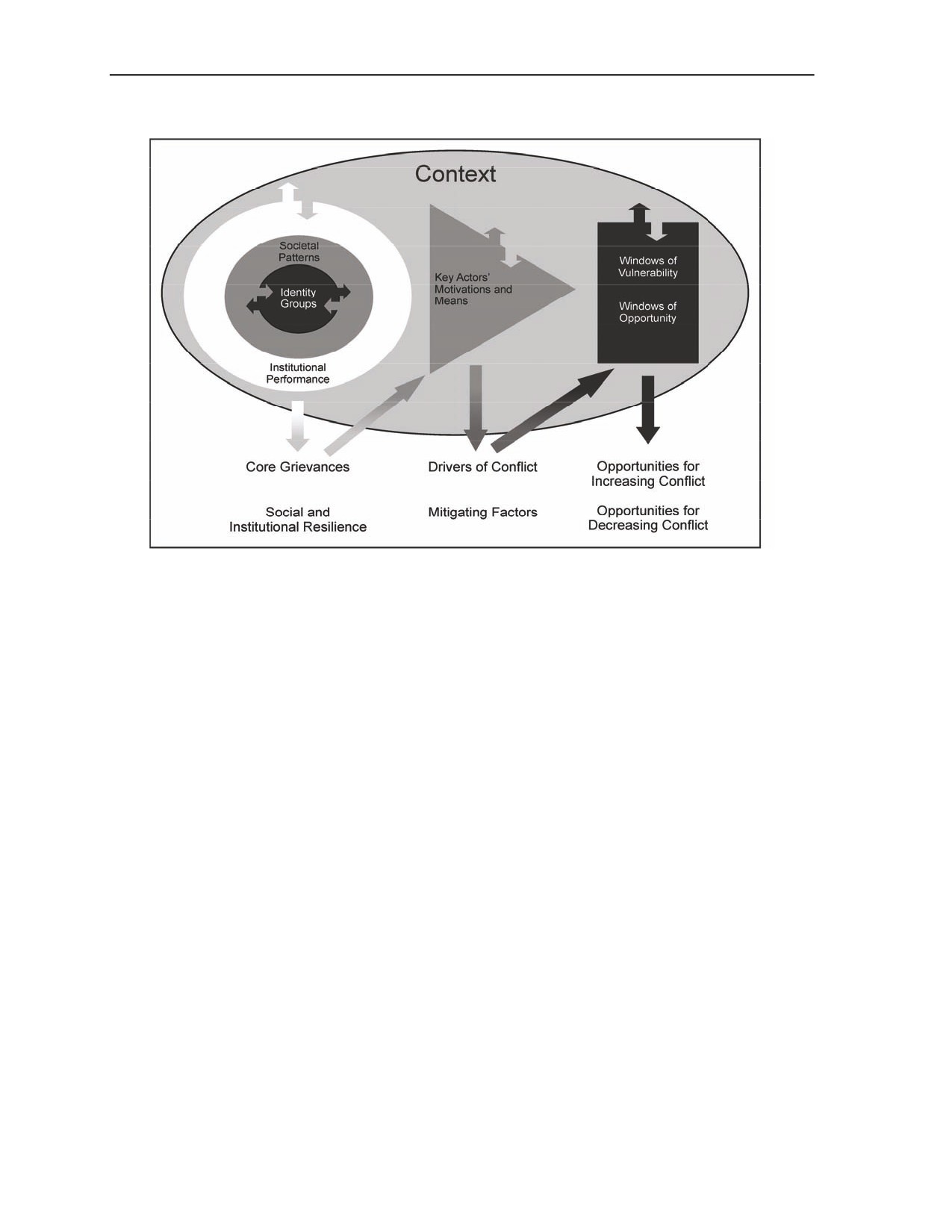
decreasing conflict. Figure D-1 on page D-4 illustrates the conceptual framework for conflict diagnosis. To
identify the critical elements of the conflict dynamic, the interagency conflict assessment team follows a
series of analytical steps:
z
Establish context.
z
Understand core grievances and sources of social and institutional resilience.
z
Identify drivers of conflict and mitigating factors.
z
Describe windows of vulnerability and windows of opportunity.
6 October 2008
FM 3-07
D-3
Appendix D
Figure D-1. Conflict diagnosis
Step 1: Establish Context
D-18. During the first step of conflict diagnosis, the team evaluates and outlines key contextual issues of
the operational environment. Context does not cause conflict but describes the often long-standing
conditions that are resistant to change. This context may create the conditions for conflict by reinforcing
divisions between communities or contributing to pressures making violence appear as a more attractive
means for advancing individual interests. Context can shape perceptions of identity groups and be used by
key actors to manipulate and mobilize constituencies. The context may include environmental conditions,
poverty, recent history of conflict, youth bulge, or a conflict-ridden region.
D-19. Each ICAF step begins with identifying and acknowledging the context from which the conflict
evolved. This process, depicted in figure D-1, reflects the complex interaction between the context and
each of the other elements of the ICAF.
Step 2: Understand Core Grievances and Sources of Social and Institutional Resilience
D-20. The team should understand, agree upon, and communicate the concepts of core grievance and
sources of social and institutional resilience, and describe them within the specific situation being assessed.
A core grievance is the perception, by various groups in a society, that their needs for physical security,
livelihood, interests, or values are threatened by one or more other groups or social institutions. A source
of social and institutional resilience is the perception by various groups in a society that social
relationships, structures, or processes are in place, able to provide dispute resolution, and meet basic needs
through nonviolent means.
D-21. During the second step of conflict diagnosis, the team must—
z
Describe identity groups who perceive threats to their identity, security, or livelihood.
z
Articulate how societal patterns reinforce perceived deprivation, blame, and intergroup
cleavages as well as how those social patterns promote comity and peaceful resolution of
disputes.
D-4
FM 3-07
6 October 2008
Interagency Conflict Assessment Overview
z
Explain how positive or negative institutional performance contributes to or aggravates the
resolution of conflict.
D-22. Identity groups are groups of people that identify with one another, often because of characteristics
used by outsiders to describe them. These can include ethnicity, race, nationality, religion, political
affiliation, age, gender, economic activity, or socioeconomic status. Identity groups are inclined to conflict
when they perceive that other groups’ interests, needs, and aspirations compete with and jeopardize their
identity, security or other fundamental interests.
D-23. Societal patterns associated with conflict reinforce divisions between groups. These patterns can
include elitism, exclusion, corruption, chronic state capacity deficits, and unmet expectations. Capacity
deficits consist of systemic economic stagnation, scarcity of necessary resources, and ungoverned spaces.
Unmet expectations may be a lack of a peace dividend, land tenure issues, disillusionment, and
disenfranchisement. Impacts of societal patterns often include negative economic consequences for
disadvantaged groups.
D-24. Institutional performance considers formal and informal social structures to determine the groups’
performance level and if they contribute to or mitigate conflict and instability. Formal social structures
consist of governments, legal systems, religious organizations, public schools, security forces, and
economic institutions. Informal social structures include traditional dispute resolution bodies; families,
clans or tribes; and armed groups. Assessing institutional performance involves distinguishing between
outcomes and perceptions. Institutional outcomes are results that can be measured objectively; perceptions
are the evaluative assessment of those outcomes. Understanding how outcomes are perceived by various
groups within a society, especially in terms of effectiveness and legitimacy, is essential to conflict
diagnosis.
Step 3: Identify Drivers of Conflict and Mitigating Factors
D-25. The team should understand and outline the drivers and mitigating factors of conflict and enumerate
them within the specific situation being assessed. Drivers of conflict represent the active energy moving
the conflict—the dynamic situation resulting from key actors’ mobilization of social groups around core
grievances. While core grievances can be understood as the potential energy of conflict, key actors
translate that energy into drivers of conflict. Mitigating factors represent the dynamic situation resulting
from key actors’ mobilization of social groups around sources of social and institutional resilience.
Mitigating factors can be understood as the energy produced when key actors mobilize the potential energy
of social and institutional resilience.
D-26. During the third step of conflict diagnosis, the team identifies the key actors central to producing,
perpetuating, or profoundly changing the societal patterns or issues of institutional performance identified
previously. The team determines whether key actors are motivated to mobilize constituencies toward
inflaming or mitigating violent conflict and what means are at their disposal. To perform the analysis
required in this step, the team—
z
Identifies the key actors:
Who: The people, organizations, or groups that, because of their leadership abilities or
power—such as political position, moral authority, charisma, wealth, and weapons—affect
societal patterns and institutional performance, can shape perceptions and actions, and
mobilize people around core grievances or social and institutional resilience.
Where: Key actors in leadership positions in governing, social, or professional
organizations or networks (either within or external to a state or territory). They include
private businesses, religious organizations, government positions, informal and illicit power
structures, media, and academic institutions.
What and how: What motivates key actors to exert influence on each of the political,
economic, social, and security systems within the host nation—such as commitment to a
cause or a people, greed (money or notoriety), and religious beliefs—and how they exert
that influence (leadership capacity, moral authority, personal charisma, access to resources
or weapons, or networks).
6 October 2008
FM 3-07
D-5
Appendix D
z
Determines key actors’—
Supporting and opposing constituencies and the core grievances or social or institutional
resilience around which they are being mobilized.
Critical motivations, means, and resources.
D-27. Using this information, the team drafts brief narrative statements describing how and why key actors
mobilize specific constituencies around core grievances and sources of social and institutional resilience.
Each statement relating to core grievances becomes an entry in the list of drivers of conflict and each
relating to sources of social and institutional resilience becomes an entry in the list of mitigating factors.
Step 4: Describe Windows of Vulnerability and Windows of Opportunity
D-28. In the final step of conflict diagnosis, the team—
z
Identifies potential situations that could contribute to an increase in violent conflict.
z
Identifies potential situations that might offer opportunities for mitigating violent conflict and
promoting stability.
D-29. The team should specify opportunities for increasing and decreasing conflict and describe those
expected within the specific situation being assessed. These are described as windows of vulnerability and
windows of opportunity. Windows of vulnerability are potential situations that may trigger conflict
escalation. They often result from large-scale responses to an increase of uncertainty during elections or
following an assassination. They also result from an exclusion of parties from important events (such as
negotiations or elections) or attempts to marginalize disenfranchised followers. Windows of vulnerability
are moments when events threaten to rapidly and fundamentally alter the balance of political or economic
power. Elections, devolution of power, and legislative changes are examples of possible windows of
vulnerability. Key actors may seize, retain, and exploit the initiative during these moments to amplify the
drivers of conflict. Windows of opportunity describe potential situations that may enable significant
progress toward achieving stable peace. They may include situations where overarching identities assume
prominence among disputing groups, natural disasters impact multiple identity groups, the response
requires a unified response, or a key leader driving the conflict is killed. These windows are moments
when overarching identities become more important than subgroup identities, such as when a natural
disaster impacts multiple groups and requires a unified response. These occasions may present
opportunities to provide additional support for a conflict’s mitigating factors.
D-30. The team completes conflict diagnosis by considering windows of vulnerability and windows of
opportunity and prioritizing drivers of conflict and mitigating factors identified previously. The team uses
the list of prioritized drivers and mitigating factors as the basis for its findings.
Segue into Planning
D-31. When the ICAF is used to support crisis response or contingency planning, the findings of the
conflict diagnosis feed into the situational analysis and policy formulation steps of interagency, whole of
government planning. When the ICAF is used to support steady-state engagement or conflict prevention
planning, the team begins preplanning activities after completing conflict diagnosis. During the segue into
these types of planning, the team maps existing diplomatic and program activities against the prioritized
lists of drivers of conflict and mitigating factors. This mapping identifies gaps in current efforts as they
relate to conflict dynamics. However, this is not intended as an evaluation of the overall impact or utility of
any specific program or initiative. The team uses these findings as a basis for making recommendations to
planners on potential entry points for USG activities.
D-32. When the ICAF is used to support steady-state engagement or conflict prevention planning, the
following steps are used to facilitate the planning process:
z
Step 1: Specify current USG activities (identify USG departments and agencies present in the
country and the nature and scope of their efforts) by—
Identifying the impact of these efforts on drivers of conflict and mitigating factors.
Identifying efforts that target similar outcomes and coordination mechanisms in place.
D-6
FM 3-07
6 October 2008
Interagency Conflict Assessment Overview
z
Step 2: Specify current efforts of non-USG actors, including bilateral agencies, multilateral
agencies, nongovernmental organizations, and private sector and local entities by—
Identifying the impact of the efforts on the drivers of conflict and mitigating factors.
Identifying efforts that target similar outcomes (including USG efforts) and coordinating
mechanisms in place.
z
Step 3: Identify drivers of conflict and mitigating factors not sufficiently addressed by existing
efforts (gaps).
z
Step 4: Specify challenges to addressing these gaps.
z
Step 5: Describe risks associated with failing to address gaps (relate directly to windows of
vulnerability).
z
Step 6: Describe opportunities to address gaps (relate directly to windows of opportunity).
D-33. The team draws on the information generated from this effort to determine potential entry points for
USG efforts. The description of these entry points explain how the dynamics outlined during conflict
diagnosis may be susceptible to outside influence.
TACTICAL CONFLICT ASSESSMENT AND PLANNING
FRAMEWORK
D-34. To increase the effectiveness of stability operations, the U.S. Agency for International Development
created the tactical conflict assessment and planning framework (TCAPF). The TCAPF was designed to
assist commanders and their staffs identify the causes of instability, develop activities to diminish or
mitigate them, and evaluate the effectiveness of the activities in fostering stability at the tactical level
(provincial or local). The TCAPF should be used to create local stabilization plans and provide data for the
ICAF, which has a strategic and operational-level (country or regional) focus.
CONCEPTUAL FRAMEWORK
D-35. The TCAPF is based on the following four premises:
z
Instability results when the factors fostering instability overwhelm the ability of the host nation
to mitigate these factors.
z
Assessment is necessary for targeted and strategic engagement.
z
The population is the best source for identifying the causes of instability.
z
Measures of effectiveness are the only true measure of success.
Instability
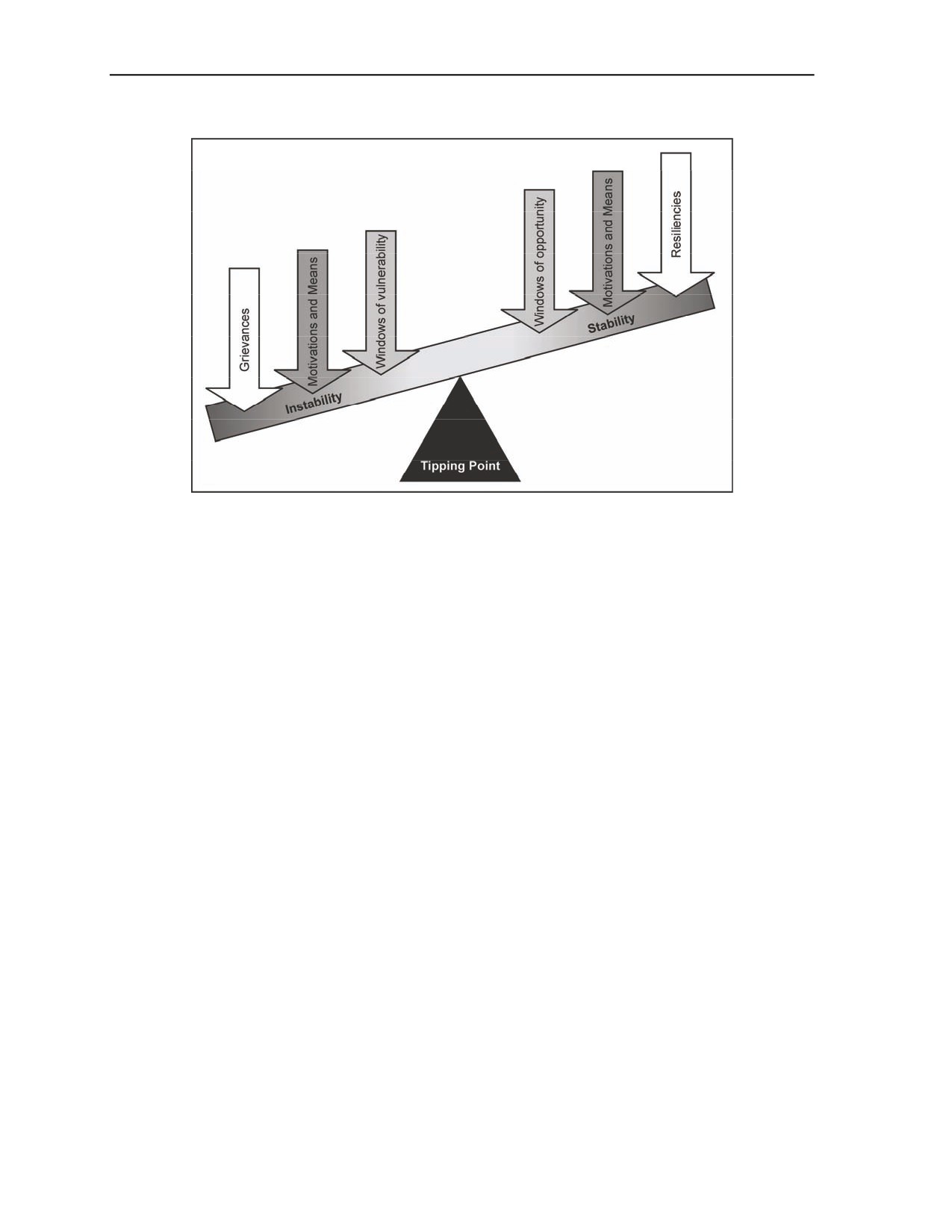
D-36. Instability results when the factors fostering instability overwhelm the ability of the host nation to
mitigate these factors. (See figure D-2 on page D-8.) To understand why there is instability or determine
the risk of instability, the following factors must be understood:
z
Grievances.
z
Key actors’ motivations and means.
z
Windows of vulnerability.
6 October 2008
FM 3-07
D-7
Appendix D
Figure D-2. Dynamics of instability
D-37. Grievances are factors that can foster instability. They are based on a groups’ perception that other
groups or institutions are threatening its interests. Examples include ethnic or religious tensions, political
repression, population pressures, and competition over natural resources. Greed can also foster instability.
Some groups and individuals gain power and wealth from instability. Drug lords and insurgents fall in this
category.
D-38. Key actors’ motivations and means are ways key actors transform grievances into widespread
instability. Although there can be many grievances, they do not foster instability unless key actors with
both the motivation and the means to translate these grievances into widespread instability emerge.
Transforming grievances into widespread violence requires a dedicated leadership, organizational capacity,
money, and weapons. If a group lacks these resources, it will not be able to foster widespread instability.
Means and motivations are the critical variables that determine whether grievances become causes of
instability.
D-39. Windows of vulnerability are situations that can trigger widespread instability. Even when
grievances and means are present, widespread instability is unlikely unless a window of vulnerability exists
that links grievances to means and motivations. Potential windows of vulnerability include an invasion,
highly contested elections, natural disasters, the death of a key leader, and economic shocks.
D-40. Even if grievances, means, and vulnerabilities exist, instability is not inevitable. For each of these
factors, there are parallel mitigating forces:
z
Resiliencies.
z
Key actors’ motivations and means.
z
Windows of opportunity.
D-41. Resiliencies are the processes, relationships, and institutions that can reduce the effects of
grievances. Examples include community organizations, and accessible, legitimate judicial structures. Key
actors’ motivations and means are ways key actors leverage resiliencies to counter instability. Just as
certain key actors have the motivation and means to create instability, other actors have the motivation and
the means to rally people around nonviolent procedures to address grievances. An example could be a local
imam advocating peaceful coexistence among opposing tribes. Windows of opportunity are situations or
events that can strengthen resiliencies. For example, the tsunami that devastated the instable Indonesian
D-8
FM 3-07
6 October 2008
Interagency Conflict Assessment Overview
province of Aceh provided an opportunity for rebels and government forces to work together peacefully.
This led to a peace agreement and increased stability.
D-42. While understanding these factors is crucial to understanding stability, they do not exist in a vacuum.
Therefore, their presence or absence must be understood within the context of a given environment.
Context refers to longstanding conditions that do not change easily or quickly. Examples include
geography, demography, natural resources, history, as well as regional and international factors.
Contextual factors do not necessarily cause instability, but they can contribute to the grievances or provide
the means that foster instability. For example, although poverty alone does not foster conflict, poverty
linked to illegitimate government institutions, a growing gap between rich and poor, and access to a global
arms market can combine to foster instability. Instability occurs when the causes of instability overwhelm
societal or governmental ability to mitigate it.
Assessment
D-43. Assessment is necessary for targeted engagement. Since most stability operations occur in less
developed countries, there will always be a long list of needs and wants, such as schools, roads, and health
care, within an operational area. Given a chronic shortage of USG personnel and resources, effective
stability operations require an ability to identify and prioritize local sources of instability and stability.
They also require the prioritization of interventions based on their importance in diminishing those sources
of instability or building on sources of stability. For example, if village elders want more water, but water
is not fostering instability (because fighting between farmers and pastoralists over land is the cause), then
digging a well will not stabilize the area. In some cases, wells have been dug based on the assumption that
stability will result from fulfilling a local want. However, ensuring both farmers and pastoralists have
access to water will help stabilize the area only if they were fighting over water. Understanding the causal
relationship between needs, wants, and stability is crucial. In some cases, they are directly related; in
others, they are not. Used correctly, the TCAPF, triangulated with data obtained from other sources, will
help establish whether there is a causal relationship.
D-44. Understanding the difference between symptoms and causes is another key aspect of stability. Too
often, interventions target the symptoms of instability rather than identifying and targeting the underlying
causes. While there is always a strong temptation to achieve quick results, this often equates to satisfying a
superficial request that does not reduce the underlying causes of instability and, in some cases, actually
increases instability.
D-45. For example, an assessment identified a need to reopen a local school in Afghanistan. The prevailing
logic held that addressing this need would increase support for the government while decreasing support
for antigovernment forces. When international forces reopened the school, however, antigovernment forces
coerced the school administrator to leave under threat of death, forcing the school to close. A subsequent
investigation revealed that the local populace harbored antigovernment sentiments because host-nation
police tasked with providing security for the school established a checkpoint nearby and demanded bribes
for passage into the village. The local populace perceived the school, which drew the attention of corrupt
host-nation police, as the source of their troubles. Rather than improve government support by reopening
the school, the act instead caused resentment since it exposed the local populace to abuse from the police.
This in turn resulted in increased support for antigovernment forces, which were perceived as protecting
the interests of the local populace. While the assessment identified a need to reopen the school, the act did
not address a cause of instability. At best, it addressed a possible symptom of instability and served only to
bring the true cause of instability closer to the affected population.
The Population
D-46. The population is the best source for identifying the causes of instability. Since stability operations
focus on the local populace, it is imperative to identify and prioritize what the population perceives as the
causes of instability. To identify the causes of instability, the TCAPF uses the local populace to identify
and prioritize the problems in the area. This is accomplished by asking four simple, standardized questions.
(See paragraph D-49.)
6 October 2008
FM 3-07
D-9
Appendix D
Measures of Effectiveness
D-47. A measure of effectiveness is the only true gauge of success. Too often, the terms “output” and
“effect” are used interchangeably among civilian agencies. However, they measure very different aspects
of task performance. While “outputs” indicate task performance, “effects” measure the effectiveness of
activities against a predetermined objective. Measures of effectiveness are crucial for determining the
success or failure of stability tasks. (See chapter 4 for a detailed discussion of the relationship between
among assessment, measures of performance, and measures of effectiveness.)
THE TACTICAL CONFLICT ASSESSMENT AND PLANNING FRAMEWORK PROCESS
D-48. The TCAPF consistently maintains focus on the local populace. Organizations using the TCAPF
follow a continuous cycle of see-understand-act-measure. The TCAPF includes four distinct, but
interrelated activities:
z
Collection.
z
Analysis.
z
Design.
z
Evaluation.
Collection
D-49. Collecting information on the causes of instability within an operational area is a two-step process.
The first step uses the following four questions to draw critical information from the local populace:
z
Has the population of the village changed in the last twelve months?
z
What are the greatest problems facing the village?
z
Who is trusted to resolve problems?
z
What should be done first to help the village?
D-50. Has the population of the village changed in the last twelve months? Understanding population
movement is crucial to understanding the operational environment. Population movement often provides a
good indicator of changes in relative stability. People usually move when deprived of security or social
well-being. The sudden arrival of dislocated civilians can produce a destabilizing effect if the operational
area lacks sufficient capacity to absorb them or if there is local opposition to their presence.
D-51. What are the greatest problems facing the village? Providing the local populace with a means to
express problems helps to prioritize and focus activities appropriately. The local populace is able to
identify their own problem areas, thus avoiding mistaken assumptions by the intervening forces. This
procedure does not solicit needs and wants, but empowers the people to take ownership of the overall
process.
D-52. Who is trusted to resolve problems? Identifying the individuals or institutions most trusted to resolve
local issues is critical to understanding perceptions and loyalties. Responses may include the host-nation
government, a local warlord, international forces, a religious leader, or other authority figure. This question
also provides an indication of the level of support for the host-nation government, a key component of
stability. This often serves as a measure of effectiveness for stability tasks. It also identifies key informants
who may assist with vetting or help to develop messages to support information engagement activities.
D-53. What should be done first to help the village? Encouraging the local populace to prioritize their
problems helps to affirm ownership. Their responses form the basis for local projects and programs.
D-54. A central facet of the collection effort is determining the relationship between the symptoms and
cause of the basic problem; understanding why a symptom exists is essential to addressing the cause. For
example, an assessment completed in Afghanistan identified a lack of security as the main problem within
a specific operational area. Analysis indicated this was due a shortage of host-nation security forces in the
local area and an additional detachment of local police was assigned to the area. However, the assessment
failed to identify the relationship between the symptom and cause of the problem. Thus, the implemented
solution addressed the symptom, while the actual cause remained unaddressed. A subsequent assessment
D-10
FM 3-07
6 October 2008
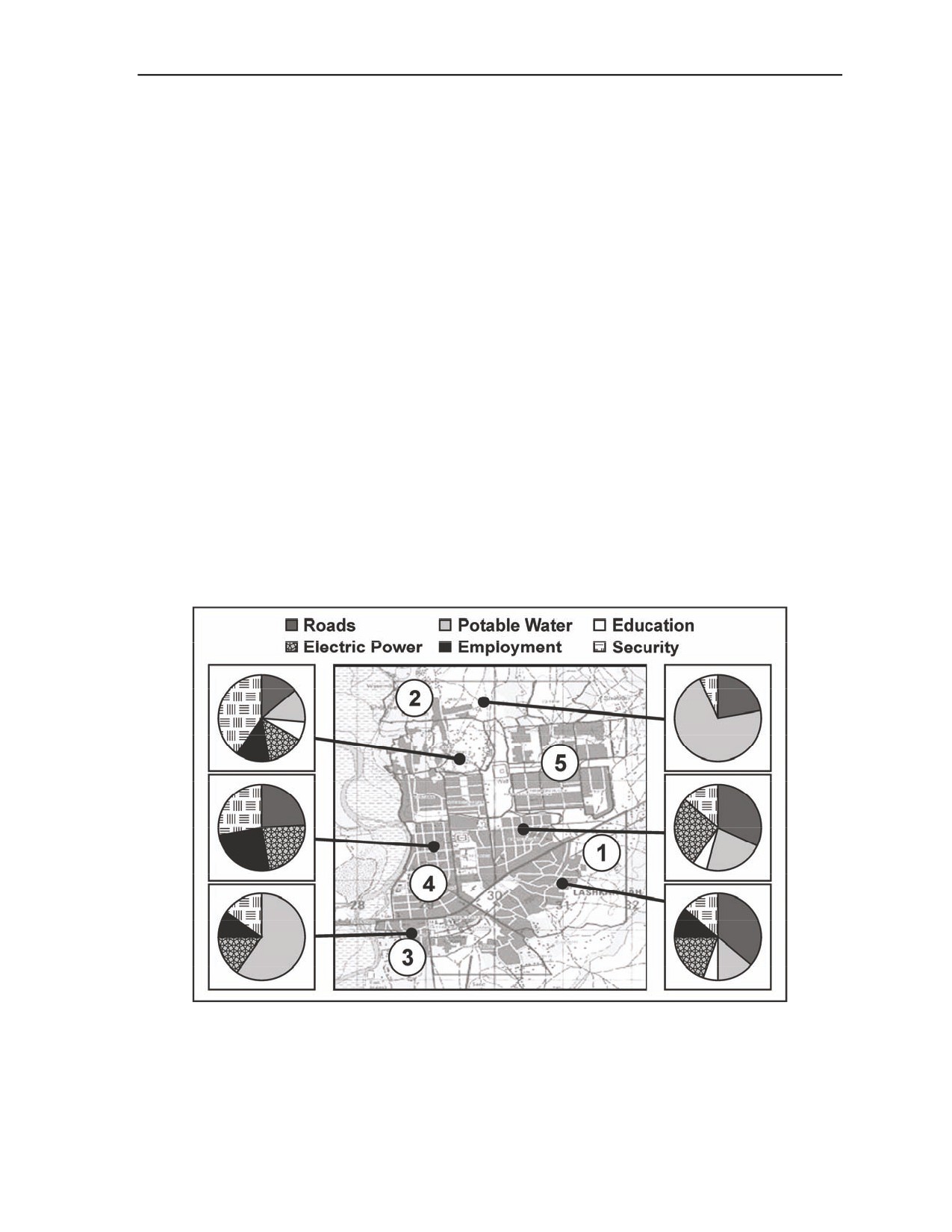
Interagency Conflict Assessment Overview
revealed that the local police were actually the cause of the insecurity: it was common practice for them to
demand bribes from the local populace while discriminating against members of rival clans in the area. By
addressing the symptom of the problem rather than the cause, the implemented solution actually
exacerbated the problem instead of resolving it.
D-55. The second step of collection involves conducting targeted interviews with key local stakeholders,
such traditional leaders, government officials, business leaders, and prominent citizens. These interviews
serve two purposes. First, targeted interviews act as a control mechanism in the collection effort. If the
answers provided by key stakeholders match the responses from the local populace, it is likely the
individual understands the causes of instability and may be relied upon to support the assessment
effort. However, if the answers do not match those of the local populace, that individual may be either an
uninformed stakeholder or possibly part of the problem. Second, targeted interviews provide more detail on
the causes of instability while helping determine how best to address those causes and measure progress
toward that end.
D-56. Information obtained during collection is assembled in a formatted TCAPF spreadsheet. This allows
the information to be easily grouped and quantified to identify and prioritize the most important concerns
of the population.
Analysis
D-57. During analysis, the information gained through collection is compiled in a graphical display. (See
figure D-3.) This display helps identify the main concerns of the population and serves a reference point
for targeted questioning. The TCAPF data is combined with input from other staff sections and other
sources of information—such as intergovernmental organizations, nongovernmental organizations, and
private sector entities. All this input is used to create a prioritized list of the causes of instability and
sources of resiliency that guide the conduct of stability operations.
Figure D-3. Analyzing causes of instability
6 October 2008
FM 3-07
D-11
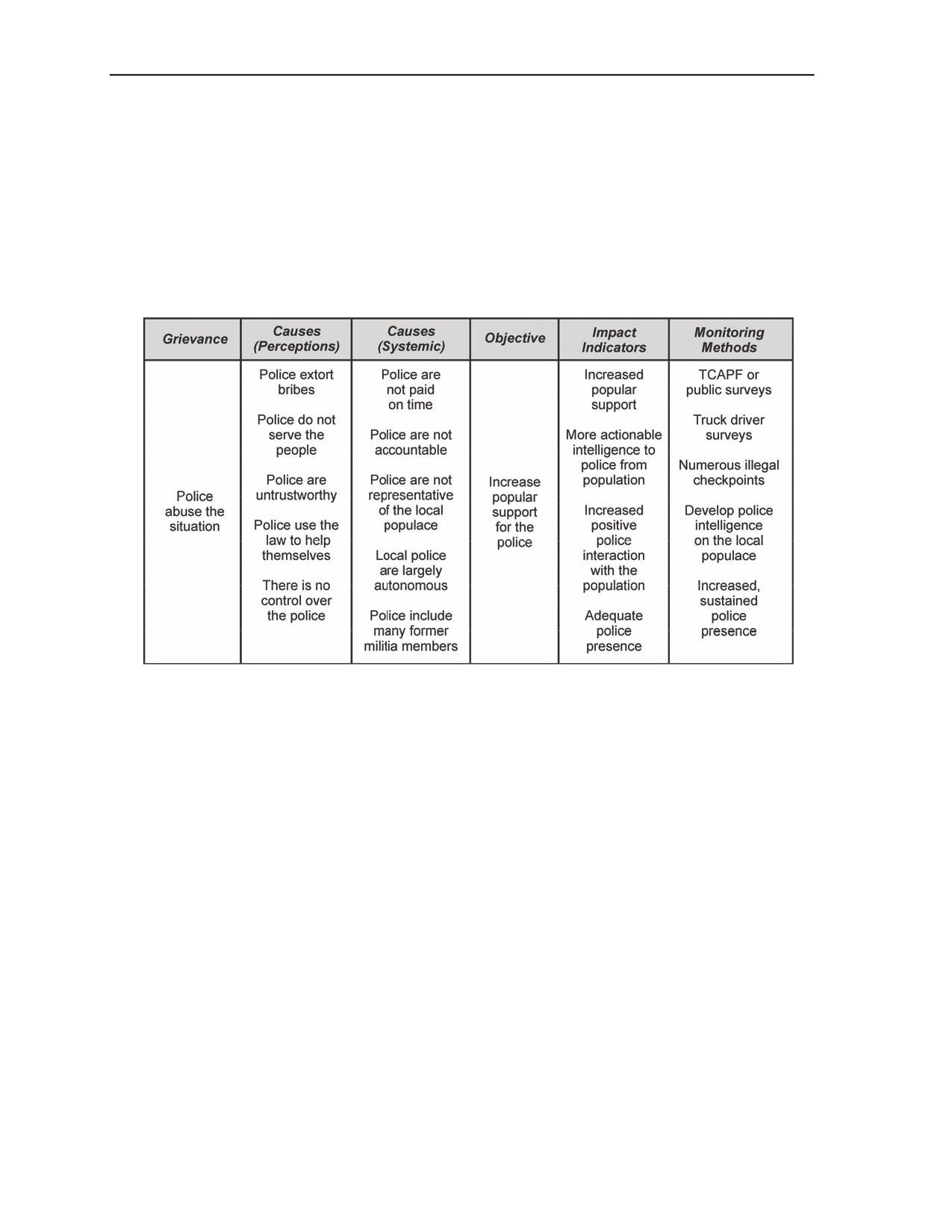
Appendix D
Design
D-58. The design effort is informed through analysis, the results of which are used to create a tactical
stability matrix for each of the causes of instability. (See table D-1.) After identifying the causes of
instability and sources of resiliency, a program of activities is designed to address them. Three key factors
guide program design, which ensures program activities:
z
Increase support for the host-nation government.
z
Decrease support for antigovernment forces.
z
Build host-nation capacity across each of the stability sectors.
Table D-1. Tactical stability matrix
D-59. The tactical stability matrix and program activities form the basis for planning within an operational
area. The plan targets the least stable areas and ensures instability is contained. It is nested within the
higher headquarters plan and details how specific stability tasks will be integrated and synchronized at the
tactical level. The TCAPF data is collated at each echelon to develop or validate assessments performed by
subordinate elements.
Evaluation
D-60. The TCAPF provides a comprehensive means of evaluating success in addressing the sources of
instability. Through measures of effectiveness, analysts gauge progress toward improving stability while
diminishing the sources of instability. Measures of effectiveness are vital to evaluating the success of
program activities in changing the state of the operational environment envisioned during the design effort.
D-61. While evaluation is critical to measuring the effectiveness of activities in fostering stability, it also
helps to ensure the views of the population are tracked, compared, measured, and displayed over
time. Since these results are objective, they cannot be altered by interviewer or analyst bias. This creates a
continuous narrative that significantly increases situational awareness.
Best Practices and Lessons Learned
D-62. Capturing and implementing best practices and lessons learned is fundamental to adaptive
organizations. This behavior is essential in stability operations, where the ability to learn and adapt is often
the difference between success and failure. The TCAPF leverages this ability to overcome the dynamics of
the human dimension, where uncertainty, chance, and friction are the norm. Examples of best practices and
lessons learned gained through recent experience include the following:
D-12
FM 3-07
6 October 2008
Interagency Conflict Assessment Overview
z
Activities and projects are products that foster a process to change behavior or perceptions.
Indicators and measures of effectiveness identify whether change has occurred or is occurring.
z
Perceptions of the local populace provide the best means to gauge the impact of program
activities.
z
Indicators provide insight into measures of effectiveness by revealing whether positive progress
is being achieved by program activities. (See paragraph 4-69 for a discussion on the role of
indicators in assessment.)
z
“Good deeds” cannot substitute for effectively targeted program activities; the best information
engagement effort is successful programming that meets the needs of the local populace.
z
Intervention activities should—
Respond to priority issues of the local populace.
Focus effort on critical crosscutting activities.
Establish anticorruption measures early in the stability operation.
Identify and support key actors early to set the conditions for subsequent collaboration.
z
Intervention activities should not—
Mistake “good deeds” for effective action.
Initiate projects not designed as program activities.
Attempt to impose “Western” standards.
Focus on quantity over quality.
SUMMARY
D-63. The TCAPF has been successfully implemented in practice to identify, prioritize, and target the
causes of instability in a measurable and immediately accessible manner. Since it maximizes the use of
assets in the field and gauges the effectiveness of activities in time and space, it is an important tool for
conducting successful stability operations.
6 October 2008
FM 3-07
D-13
Appendix E
Humanitarian Response Principles
BACKGROUND
E-1. Even in those situations where military forces are not directly involved, a focused and integrated
humanitarian response is essential to reestablishing a stable environment that fosters a lasting peace to
support broader national and international interests. Providing humanitarian aid and assistance is primarily
the responsibility of specialized civilian, national, international, governmental, and nongovernmental
organizations and agencies. Nevertheless, military forces are often called upon to support humanitarian
response activities either as part of a broader campaign, such as Operation Iraqi Freedom, or a specific
humanitarian assistance or disaster relief operation. These activities consist of stability tasks and generally
fall under the primary stability task, restore essential services. This appendix outlines the guiding
principles used by the international community to frame humanitarian response activities.
E-2. Generally, the host nation or affected country coordinates humanitarian response. However, if the
host nation or affected country is unable to do so, the United Nations often leads the international
community response on its behalf. The principles that guide the military contribution to that response are
fundamental to success in full spectrum operations. These principles reflect the collective experience of a
diverse group of actors in a wide range of interventions conducted over decades across the world. They
help to shape the humanitarian component of stability operations.
E-3. United Nations General Assembly Resolution 46/182 governs the humanitarian response efforts of
the international community. It articulates the principal tenets for providing humanitarian assistance—
humanity, neutrality, and impartiality—while promulgating the guiding principles that frame all
humanitarian response activities. These guiding principles are drawn from four primary, albeit separate,
sources:
z
InterAction and the Department of Defense.
z
International Red Cross and Red Crescent Movement.
z
Oslo Guidelines.
z
Interagency Standing Committee.
INTERACTION AND THE DEPARTMENT OF DEFENSE
E-4. InterAction is the largest coalition of U.S.-based nongovernmental organizations focused on the
world’s poorest and most vulnerable people. Collectively, its members work in every developing country.
Members meet people halfway in expanding opportunities and support gender equality in education, health
care, agriculture, small business, and other areas.
RECOMMENDED GUIDELINES
E-5. The following guidelines facilitate interaction between American forces and nongovernmental
humanitarian agencies (NGHAs). This latter group engages in humanitarian relief efforts in hostile or
potentially hostile environments. Simply, these guidelines recognize that military forces and NGHAs often
occupy the same space, compete for the same resources, and will likely do so again. When they share an
operational area, both should strive to follow these guidelines; they recognize that extreme circumstances
or operational necessity may require deviation. When aid organizations deviate from established
guidelines, they must make every effort to explain their reasoning.
E-6. Military forces use the following guidelines consistent with protection, mission accomplishment, and
operational requirements:
6 October 2008
FM 3-07
E-1
Appendix E
z
When conducting relief activities, military personnel wear uniforms or other distinctive clothing
to avoid being mistaken for NGHA representatives. These personnel do not display NGHA
logos on any clothing, vehicles, or equipment. This does not preclude the appropriate use of
symbols recognized under the law of war, such as a red cross. U.S. forces may use the red cross
on military clothing, vehicles, and equipment when appropriate.
z
Military personnel visits to NGHA sites are by prior arrangement.
z
NGHA views on the bearing of arms within NGHA sites are respected.
z
NGHAs have the option of meeting with military personnel outside military installations for
information exchanges.
z
Military forces do not describe NGHAs as “force multipliers” or “partners” of the military, or in
any fashion that could compromise their independence or their goal to be perceived by the
population as independent.
z
Military personnel and units avoid interfering with NGHA relief efforts directed toward
segments of the civilian population that the military may regard as unfriendly.
z
Military personnel and units respect the desire of NGHAs not to serve as implementing partners
for the military in conducting relief activities. However, individual nongovernmental
organizations may seek to cooperate with the military. In this case, such arrangements will be
carried out while avoiding compromise of the security, safety, and independence of the NGHA
community at large, NGHA representatives, or public perceptions of their independence.
E-7.
NGHAs should observe the following guidelines:
z
NGHA personnel do not wear military-style clothing. NGHA personnel can wear protective
gear, such as helmets and protective vests, provided that such items are distinguishable in color
or appearance from military-issue items.
z
Only NGHA liaison personnel—and not other NGHA staff—may travel in military vehicles.
z
NGHAs do not co-locate facilities with facilities inhabited by military personnel.
z
NGHAs use their own logos on clothing, vehicles, and buildings when security conditions
permit.
z
Except for liaison arrangements, NGHAs limit activities at military bases and with military
personnel that might compromise their independence.
z
NGHAs may, as a last resort, request military protection for convoys delivering humanitarian
assistance, take advantage of essential logistic support available only from the military, or accept
evacuation assistance for medical treatment or for evacuating a hostile environment. Providing
such military support to NGHAs is not obligatory but rests solely within the discretion of the
military forces. Often it will be provided on a reimbursable basis in accordance with applicable
U.S. law.
z
NGHA personnel visits to military facilities or sites are by prior arrangement.
E-8.
The third recommended guideline deals with forms of coordination. Military forces and NGHA staff
coordinate to minimize the risk of confusion between military and NGHA roles in hostile or potentially
hostile environments; they are subject to protection, mission accomplishment, and operations security
requirements. They follow these guidelines:
z
NGHA liaison officers participate in unclassified security briefings conducted by the military
forces.
z
Military forces share unclassified information with the NGHA liaison officer concerning
security conditions, operational sites, location of mines and unexploded explosive ordnance,
humanitarian activities, and population movements.
z
NGHA staff arranges liaisons with military commands prior to and during military operations to
deconflict military and relief activities. Such liaison includes protecting humanitarian
installations and personnel. It also includes informing military personnel of humanitarian relief
objectives, modalities of operation, and the extent of prospective or ongoing civilian
humanitarian relief efforts.
E-2
FM 3-07
6 October 2008
Humanitarian Response Principles
z
Military forces assist NGHAs for humanitarian relief activities when civilian providers are
unavailable or unable to do so. Often, such assistance is provided on a reimbursable basis in
accordance with applicable U.S. law.
RECOMMENDED PROCESSES
E-9. The dialog between NGHAs and military forces during contingency planning follows certain
procedures. These procedures apply to Department of Defense relief operations in a hostile or potentially
hostile environment:
z
NGHAs engaged in humanitarian relief send a small number of liaison officers to the
geographic combatant command for discussions with the contingency planners responsible for
designing relief operations.
z
NGHAs engaged in humanitarian relief assign a small number of liaison officers to the
geographic combatant command. For example, one liaison officer was stationed at U.S. Central
Command for six of the first twelve months of the war in Afghanistan, and one was in Kuwait
City before U.S. forces entered Iraq in 2003.
z
The relevant military planners, including but not limited to the civil affairs representatives of the
geographic combatant command, meet with humanitarian relief NGHA liaison officers at a
mutually agreed location.
E-10. NGHAs and military forces follow certain procedures to access assessments of humanitarian needs.
Military and NGHA representatives—
z
Access NGHA and military assessments directly from a Department of Defense or other United
States Government (USG) Web site.
z
Access NGHA and military assessments through a nongovernmental organization serving in a
coordination role and identifying a common Web site.
z
Access NGHA and military assessments through a United Nations’ Web site.
E-11. Certain procedures exist for NGHA liaison relationships with combatant commands engaged in
planning for military operations in hostile or potentially hostile environments. The NGHA community
provides the following:
z
One NGHA liaison officer physically located outside the military headquarters; if feasible, the
officer is near it to facilitate daily contact.
z
One NGHA liaison officer with appropriate access to senior-level officers within the geographic
combatant commander’s headquarters and who meets with them as necessary and feasible.
z
Two-way information flow. The NGHA liaison officer provides such details as NGHA
capabilities, infrastructure, plans, and concerns. Military forces provide details concerning
minefields, unexploded explosive ordnance, other hazards to NGHAs, access to medical
facilities, and evacuation plans.
z
Military personnel with the opportunity to brief NGHAs, to the extent appropriate, on USG
goals and policies, monitoring principles, and applicable laws and rules of engagement.
Conversely, the International Committee of the Red Cross (ICRC) will typically brief military
commanders on the role and capabilities of the International Red Cross and Red Crescent
Movement. The NGHA liaison officer has the opportunity to brief military commanders on—
NGHA objectives.
Codes of conduct for the International Red Cross and Red Crescent Movement and the
nongovernmental organizations.
The Interagency Standing Committee guidelines.
Country-specific guidelines based on the Interagency Standing Committee guidelines.
If desired, Sphere Project Minimum Standards.
z
The NGHA liaison officer could continue as a liaison to the combatant command headquarters
even after a civil-military operations center (CMOC) or similar mechanism is established in
6 October 2008
FM 3-07
E-3
Appendix E
country. Once this occurs, liaison officers of an individual NGHA can begin coordination in
country through the CMOC for civil-military liaison.
E-12. Possible organizations can serve as a bridge between NGHAs and military forces in the field. (In
situations in which no actor exists to serve as a bridge, a U.S. CMOC can serve as a temporary liaison
between NGHAs and military forces.) These organizations can include the U.S. Agency for International
Development’s Office of Military Affairs, Department of State’s Office of the Coordinator for
Reconstruction and Stabilization, and the United Nation’s humanitarian coordinator. The following are
recommended procedures:
z
If the U.S. Agency for International Development or the Department of State’s Office of the
Coordinator for Reconstruction and Stabilization agrees to serve a liaison, it should be prepared
to work with NGHAs in addition to USG implementing partners.
z
The United Nations’ humanitarian coordinators or representatives can act as liaisons because
they normally would be responsible for working with all NGHAs and maintaining contact with
the host-nation government or a successor regime. An exception to this practice is the
International Red Cross and Red Crescent Movement, which provides this function
independently.
INTERNATIONAL RED CROSS AND RED CRESCENT MOVEMENT
E-13. The International Red Cross and Red Crescent Movement encompasses two institutions and nearly
200 national societies. The two institutions are the ICRC and the International Federation of Red Cross and
Red Crescent Societies. The ICRC is an impartial, neutral, and independent organization. Established in
1863, its exclusively humanitarian mission aims to protect the lives and dignity of victims of war and
internal violence and to provide them with assistance. It directs and coordinates the international relief
activities conducted by the International Red Cross and Red Crescent Movement in conflicts. It also
endeavors to prevent suffering by promoting and strengthening laws pertaining to human rights and
universal humanitarian principles.
FUNDAMENTAL PRINCIPLES OF THE RED CROSS
E-14. The seven fundamental principles bond together the national Red Cross and Red Crescent Societies,
the ICRC, and the International Federation of the Red Cross and Red Crescent Societies. The principles
ensure the continuity of the International Red Cross and Red Crescent Movement and its humanitarian
work. These principles are—
z
Humanity.
z
Impartiality.
z
Neutrality.
z
Independence.
z
Voluntary service.
z
Unity.
z
Universality.
Humanity
E-15. The International Red Cross and Red Crescent Movement was developed to bring unbiased
assistance to the wounded on the battlefield. It aims to prevent and alleviate human suffering wherever
found. It aims to protect life and health and to ensure respect for the human being. It promotes mutual
understanding, friendship, cooperation, and lasting peace among all people.
Impartiality
E-16. The second principle makes no discrimination as to nationality, race, religious beliefs, class, or
political opinions. It tries to relieve the suffering of individuals—guided solely by their needs—and to give
priority to the most urgent cases of distress.
E-4
FM 3-07
6 October 2008
Humanitarian Response Principles
Neutrality
E-17. Neutrality is the third fundamental principle of the International Red Cross and Red Crescent
Movement. To continue to enjoy the confidence of all, the Movement may not take sides in hostilities. It
may not engage at any time in controversies of a political, racial, religious, or ideological nature.
Independence
E-18. The fourth fundamental principle is independence. The national societies are auxiliaries in the
humanitarian services of their governments and subject to the laws of their respective countries. As such,
the societies must always maintain their autonomy. Such independence enables the societies to act in
accordance with the principles of the Movement at all times.
Voluntary Service
E-19. Voluntary service is the fifth fundamental principle of the International Red Cross and Red Crescent
Movement. It is a voluntary relief movement. It is not prompted in any manner by a desire for gain.
Unity
E-20. The sixth principle is unity. There can be only one Red Cross or one Red Crescent Society in any
one country. It must be open to all. It must carry on its humanitarian work throughout its territory.
Universality
E-21. The seventh fundamental principle is universality. Universality ensures that all societies have equal
status in the Movement. It also ensures that all societies share equal responsibilities and duties in helping
each other. The Movement is worldwide.
CODE OF CONDUCT
E-22. In the summer of 1994, the code of conduct for the International Red Cross and Red Crescent
Movement and nongovernmental organizations in disaster relief was developed. (See table E-1 on page
E-6.) Eight of the world’s largest disaster response agencies agreed on this code. It represents the body of
international standards for disaster response. Before then, no accepted body of professional standards
existed to guide their work. Today, the international community uses it to monitor its own standards of
relief delivery and to encourage other agencies to set similar standards.
Table E-1. The International Red Cross and Red Crescent Movement and Nongovernmental
Organization Code of Conduct in Disaster Relief
• The humanitarian imperative comes first.
• Aid is given regardless of the race, creed, or nationality of the recipients and without adverse
distinction of any kind. Aid priorities are calculated based on need alone.
• Aid will not be used to further a particular political or religious standpoint.
• We shall endeavor not to act as instruments of government foreign policy.
• We shall respect culture and custom.
• We shall attempt to build disaster response on local capacities.
• Ways shall be found to involve program beneficiaries in the management of relief aid.
• Relief aid must strive to reduce future vulnerabilities to disaster as well as meeting basic needs.
• We hold ourselves accountable to both those we seek to assist and those from whom we accept
resources.
• In our information, publicity, and advertising activities, we shall recognize disaster victims as
dignified human beings, not hopeless objects.
E-23. Like most professional codes, the code of conduct is voluntary. It applies to any nongovernmental
organization, national or international, regardless of size. It provides ten “points of principle” that all
6 October 2008
FM 3-07
E-5
Appendix E
nongovernmental organizations should adhere to in their disaster response work. The code of conduct also
describes the relationships that these groups should seek with donor organizations, host-nation
governments, and the United Nations. The code is self-policing; no one nongovernmental organization is
going to force another to act in a certain way. There is, as yet, no international association for disaster-
response nongovernmental organizations that possesses any authority to sanction its members.
The Humanitarian Imperative Comes First
E-24. The right to receive humanitarian assistance, and to offer it, is a fundamental humanitarian principle
that all citizens of all countries should have. As part of the international community, the International Red
Cross and Red Crescent Movement recognizes its obligation to provide humanitarian assistance wherever
needed. Hence, to provide humanitarian assistance, organizations need unimpeded access to affected
populations. The International Red Cross and Red Crescent Movement’s motivation to respond to disaster
is to alleviate human suffering. It strives to help those least able to withstand the stress caused by disaster.
Giving humanitarian aid is not a partisan or political act and should not be viewed as such.
Aid Is Given Regardless of Race, Creed, or Nationality
E-25. Aid priorities are calculated on need alone. Wherever possible, the International Red Cross and Red
Crescent Movement provides relief aid after thoroughly assessing the situation. It assesses the needs of the
disaster victims and the local capacities already in place to meet those needs. In all of its programs, the
Movement provides aid in proportion to the need. Human suffering must be alleviated whenever it is
found; life is as precious in one area as another. The Movement recognizes the crucial role women play in
disaster-prone communities. It tries to support, not diminish, their role with its aid programs. Implementing
such a universal, impartial, and independent policy is effective only when relief organizations have access
to resources and all disaster victims. Only then can they provide equal relief.
Aid Will Not Be Used to Further Certain Standpoints
E-26. Humanitarian aid will be given according to the need of individuals, families, and communities. The
International Red Cross and Red Crescent Movement affirms that assistance does not depend on the
recipients to adhere to political or religious opinions. The Movement does not tie the promise, delivery, or
distribution of assistance to the embracing or acceptance of a particular political or religious creed.
Agents of Aid Shall Not Act as Instruments of Government Foreign Policy
E-27. NGHAs act independently from governments. They form their own policies and implementation
strategies. They do not seek to implement the policy of any government unless it coincides with their own
independent policy. They never knowingly or through negligence allow themselves to be used to gather
information. Information could be politically, military, or economically sensitive to governments or other
bodies that may serve purposes other than those that are strictly humanitarian. NGHAs do not act as
instruments of foreign policy of donor organizations. They use the assistance received to respond to needs.
This assistance is not driven by the need to use surpluses or by the donor’s political interest. Agents of aid
value and promote the voluntary giving of labor and finances by individuals to support their work. To
protect independence, agents of aid avoid depending on a single funding source.
Agents of Aid Shall Respect Culture and Custom
E-28. The International Red Cross and Red Crescent Movement tries to respect the culture, structures, and
customs of the communities and countries in which the members work.
Agents of Aid Shall Attempt to Build Disaster Response on Local Capacities
E-29. All people and communities—even in disaster—possess capacities as well as vulnerabilities. Where
possible, the International Red Cross and Red Crescent Movement strengthens these capacities by
employing local staff, purchasing local materials, and trading with local companies. Where possible, these
agents of aid work through local nongovernmental organizations providing humanitarian assistance as
E-6
FM 3-07
6 October 2008
Humanitarian Response Principles
partners in planning and implementation; they cooperate with local governments where appropriate. The
International Red Cross and Red Crescent Movement places a high priority on properly coordinating
emergency responses. Coordination is best accomplished within the countries concerned by those most
directly involved in the relief operations. Such efforts should include representatives of the relevant United
Nations bodies and of the International Red Cross and Red Crescent Movement.
Involve Program Beneficiaries in Managing Relief Aid
E-30. Disaster response assistance should never be forced on those needing assistance. Effective relief and
lasting rehabilitation can best be achieved when the intended beneficiaries help to design, manage, and
implement the assistance program. The International Red Cross and Red Crescent Movement strives to
achieve full community participation in relief and rehabilitation programs.
Aid Must Strive to Reduce Future Vulnerabilities and Meet Basic Needs
E-31. All relief actions affect the prospects for long-term development, either positively or negatively.
Recognizing this, the agents of aid strive to implement relief programs that actively reduce the
beneficiaries’ vulnerability to future disasters and help create sustainable lifestyles. These agents pay
particular attention to environmental concerns when designing and managing relief programs. The
International Red Cross and Red Crescent Movement tries to minimize the negative impact of humanitarian
assistance. The Movement tries to prevent the beneficiary from depending upon external aid for a long
time.
Agents of Aid Hold Themselves Accountable
E-32. The International Red Cross and Red Crescent Movement often acts as an institutional link between
those who wish to assist and those who need assistance during disasters. The Movement therefore holds
itself accountable to both constituencies. All dealings with donors and beneficiaries are open and
transparent. The agents of aid report on activities, both from a financial perspective and the perspective of
effectiveness. They recognize they must appropriately monitor aid distributions and regularly assess the
impact of disaster assistance. The International Red Cross and Red Crescent Movement openly reports on
the impact of its work and the factors limiting or enhancing that impact. Relief programs are based on high
standards of professionalism and expertise to minimize the wasting of valuable resources.
Agents of Aid Recognize Disaster Victims as Dignified Humans
E-33. Respect for the disaster victim as an equal partner in action should never be lost. In public
information, the Movement portrays an objective image of the disaster situation. This image highlights the
capacities and aspirations of disaster victims, not just their vulnerabilities and fears. While working with
the media to enhance public response, the Movement prohibits external or internal demands for publicity to
take precedence over the principle of maximizing overall relief assistance. These agents of aid avoid
competing with other disaster response agencies for media coverage. In some situations, coverage may
hinder the service provided to the beneficiaries or the security. Humanitarian response applies to men and
women—both genders are to be helped equally. Bringing a gender perspective illuminates how gender
inequalities, roles, responsibilities, and identities shape and influence vulnerabilities and capacities in a
crisis. Men and women (individually and collectively) experience war, floods, earthquakes, and dislocation
differently; they can have different priorities, responsibilities, and protection needs. They also can mobilize
or draw on different resources to protect themselves, feed their families, or become leaders. Understanding
gender inequalities, relations, and identities helps agents of aid understand how a crisis affects
communities and how communities can best respond.
OSLO GUIDELINES
E-34. The Oslo Guidelines were completed in 1994. They were the result of a collaborative effort of over
180 delegates from 45 nations and 25 organizations. These delegates drafted the Oslo Guidelines to
establish a framework. This framework aims to formalize and improve the effectiveness and efficiency
when using United Nations military and civil defense assets for international disaster relief operations.
6 October 2008
FM 3-07
E-7
Appendix E
HUMANITY
E-35. Human suffering must be addressed wherever it is found. Relief groups pay particular attention to
the most vulnerable populations, such as children, women, and the elderly. The dignity and rights of all
victims are respected and protected.
NEUTRALITY
E-36. Agents of aid provide humanitarian assistance without engaging in hostilities or taking sides in
controversies of a political, religious, or ideological nature.
IMPARTIALITY
E-37. Agents of aid provide humanitarian assistance without discriminating in regards to ethnic origin,
gender, nationality, political opinions, race, or religion. Relief of the suffering is guided solely by needs;
priority is given to the most urgent cases of distress.
SOVEREIGNTY
E-38. The United Nations provides humanitarian assistance with full respect for the sovereignty of states.
Agents of aid fully respect the sovereignty, territorial integrity, and national unity of states in accordance
with the Charter of the United Nations. In this context, humanitarian assistance is provided with the
consent of the affected country and in principle because of an appeal by the affected country.
MILITARY AND CIVIL DEFENSE ASSETS
E-39. As a matter of principle, the military and civil defense assets of forces will not be used to support
United Nations humanitarian activities under certain conditions; the forces are perceived as belligerents or
units are actively engaged in combat in the affected country or region. Military and civil defense assets
should be seen as a tool complementing existing relief efforts by providing specific support to specific
requirements.
INTERAGENCY STANDING COMMITTEE
E-40. The Interagency Standing Committee was established in June 1992 in response to United Nations
General Assembly Resolution 46/182 on the strengthening of humanitarian assistance. It is the primary
mechanism for interagency coordination of humanitarian assistance. It is a unique forum involving the key
United Nations and non-United Nations humanitarian partners. All humanitarian action, including civil-
military coordination for humanitarian purposes in complex emergencies, must be conducted in accordance
with the overarching principles of humanity, neutrality, and impartiality. This section outlines these
principles and concepts to follow when planning or undertaking civil-military coordination.
HUMANITY, NEUTRALITY, AND IMPARTIALITY
E-41. Any civil-military coordination must serve the prime humanitarian principle of humanity; human
suffering must be addressed wherever it is found. In determining whether and to what extent humanitarian
agencies should coordinate with military forces, one must consider the potential consequences or
perceptions of too close an affiliation with the military. These affiliations might jeopardize the
humanitarian principles of neutrality and impartiality.
E-42. The concept of nonallegiance is central to the principle of neutrality in humanitarian action; likewise,
the idea of nondiscrimination is crucial to the principle of impartiality. However, humanitarian assistance
means providing protection and assistance to populations in need. Pragmatically, it might include civil-
military coordination. Even so, agents of aid must find the right balance between a pragmatic and a
principled response so that coordination with the military would not compromise humanitarian imperatives.
E-8
FM 3-07
6 October 2008
Humanitarian Response Principles
HUMANITARIAN ACCESS TO VULNERABLE POPULATIONS
E-43. Humanitarian agencies must have access to all vulnerable populations in all areas of the emergency.
They also must be able to negotiate such access with all parties to the conflict. Particular care must be
taken to ensure the sustainability of access. Coordination with the military facilitates, secures, and
sustains—not hinders—humanitarian access.
PERCEPTION OF HUMANITARIAN ACTION
E-44. Delivering humanitarian assistance to all populations in need must be neutral and impartial. It must
come without political or military conditions. Humanitarian staff must avoid taking sides in disputes or
political positions. Such bias will harm the credibility and independence of humanitarian efforts in general.
Any civil-military coordination must avoid jeopardizing the longstanding local network and trust that
humanitarian agencies created and maintained.
NEEDS-BASED ASSISTANCE FREE OF DISCRIMINATION
E-45. Humanitarian assistance is provided based on needs of those affected, taking into account the local
capacity already in place to meet those needs. The independent assessment and humanitarian assistance are
given without adverse discrimination of any kind. Assistance is given regardless of race, ethnicity, gender,
religion, social status, nationality, or political affiliation of the recipients. All populations in need receive
aid equitably.
CIVILIAN-MILITARY DISTINCTION IN HUMANITARIAN ACTION
E-46. At all times, agents of aid clearly distinguish between combatants and noncombatants. They identify
those actively engaged in hostilities as well as civilians and others who do not or no longer directly
participate in the armed conflict. The latter group may include the sick, wounded, prisoners of war, and
demobilized ex-combatants. The law of armed conflict protects noncombatants by providing immunity
from attack. Thus, humanitarian workers must never present themselves or their work as part of a military
operation, and military personnel must refrain from presenting themselves as civilian humanitarian
workers.
OPERATIONAL INDEPENDENCE OF HUMANITARIAN ACTION
E-47. In any civil-military coordination, humanitarian actors take the lead role in undertaking and directing
humanitarian activities. The agents preserve independence of humanitarian action and decisionmaking both
at the operational and policy levels. Humanitarian organizations do not implement tasks on behalf of the
military nor represent or implement their policies. Basic requisites must not be impeded. These requisites
can include freedom of movement for humanitarian staff, freedom to complete independent assessments,
freedom to select staff, freedom to identify beneficiaries of assistance based on their needs, or free flow of
communications between humanitarian agencies as well as with the media.
SECURITY OF HUMANITARIAN PERSONNEL
E-48. Any perception that humanitarian actors are affiliated with the military could impact negatively on
the security of humanitarian staff and their ability to access vulnerable populations. However, relief
workers must identify the most expeditious, effective, and secure approach to ensure the delivery of vital
assistance to vulnerable target populations. They balance this approach against the primary concern for
ensuring staff safety. The decision to seek military-based security for humanitarian workers should be
viewed as a last resort option when other staff security mechanisms are unavailable, inadequate, or
inappropriate.
DO NO HARM
E-49. Considerations on civil-military coordination must be guided by a commitment to “do no harm.”
Humanitarian agencies must ensure at the policy and operational levels that any potential civil-military
6 October 2008
FM 3-07
E-9
Appendix E
coordination will not contribute to further the conflict nor harm or endanger the beneficiaries of
humanitarian assistance.
RESPECT FOR INTERNATIONAL LEGAL INSTRUMENTS
E-50. Both relief workers and military forces must respect laws pertaining to human rights as well as other
international norms and regulations, including instruments for human rights.
RESPECT FOR CULTURE AND CUSTOM
E-51. Agents of aid maintain respect and sensitivities for the culture, structures, and customs of the
communities and countries. Where possible and to the extent feasible, they find ways to involve the
intended beneficiaries of humanitarian assistance and local personnel in the design, management, and
implementation of assistance, including in civil-military coordination.
CONSENT OF PARTIES TO THE CONFLICT
E-52. The risk of compromising humanitarian operations by cooperating with the military might be
reduced if all parties to the conflict recognize, agree, or acknowledge in advance that humanitarian
activities might necessitate civil-military coordination in certain exceptional circumstances. Negotiating
such acceptance entails contacts with all levels in the chain of command.
OPTION OF LAST RESORT
E-53. Use of military assets, armed escorts, joint humanitarian-military operations, and any other actions
involving visible interaction with the military must be the option of last resort. Such actions may occur
only when no comparable civilian alternative exists and only the use of military support can meet a critical
humanitarian need.
AVOID RELIANCE ON THE MILITARY
E-54. Humanitarian agencies must avoid depending on resources or support provided solely by the
military. Any resources or support provided by the military should be, at its onset, clearly limited in time
and scale. Often resources provided by the military are transitory in nature. When higher priority military
missions emerge, such support may be recalled at short notice and without any substitute support.
E-10
FM 3-07
6 October 2008
Appendix F
Provincial Reconstruction Teams
For the post-September 11 period, the chief issue for global politics will not be how to
cut back on stateness but how to build it up. For individual societies and for the global
community, the withering away of the state is not a prelude to utopia but to disaster. A
critical issue facing poor countries…is their inadequate level of institutional
development. They do not need extensive states, but they do need strong and effective
ones within the limited scope of necessary state functions.
Francis Fukuyama
State-Building: Governance and World Order in the 21st Century3
PRINCIPLES OF PROVINCIAL RECONSTRUCTION TEAMS
F-1. A provincial reconstruction team (PRT) is an interim civil-military organization designed to operate
in an area with unstable or limited security. The PRT leverages all the instruments of national power—
diplomatic, informational, military, and economic—to improve stability. However, the efforts of the PRT
alone will not stabilize an area; the combined military and civil efforts are required to reduce conflict while
developing the local institutions to take the lead in national governance, the provision of basic services,
fostering economic development, and enforcement of rule of law.
F-2. The development community uses specific principles for reconstruction and development. (See
appendix C.) These enduring principles represent years of practical application and understanding of the
cultural and socioeconomic elements of developing nations. Understanding these principles enables
development officials to incorporate techniques and procedures effectively to improve economic and social
conditions for the local populace. By applying the principles of reconstruction and development, the
development community significantly improves the probability of success. Timely emphasis on the
principles increases the opportunity for success and provides the flexibility to adapt to the changing
conditions. This community assumes risk in projects and programs by failing to adhere to the principles.
F-3. A PRT does not conduct military operations or directly assist host-nation military forces. The PRT
helps the central ministries distribute funds to respective provincial representatives for implementing
projects. This assistance encompasses more than a distribution of funds; it includes mentoring,
management, and accountability.
F-4. PRTs aim to develop the infrastructure necessary for the local populace to succeed in a post-conflict
environment. A PRT is an integral part of the long-term strategy to transition the functions of security,
governance, and economics to the host-nation. This team serves as a combat multiplier for commanders
engaged in governance and economic activity, as well as other lines of effort. The PRT also serves as a
force multiplier for United States Government development agencies engaged across the stability sectors.
A PRT assists local communities with reconciliation while strengthening the host-nation government and
speeding the transition to self-reliance. To accomplish this mission, the PRT concentrates on three essential
functions: governance, security, and reconstruction.
GOVERNANCE
F-5. Within an operational area, a PRT focuses on improving the provincial government’s ability to
provide effective governance and essential services. Strengthening the provincial government is important
given the decentralization of authority common to a post-conflict environment. For example, under
3 © 2004 by Francis Fukuyama. Reproduced with permission of Cornell University Press.
6 October 2008
FM 3-07
F-1
Appendix F
Saddam Hussein’s regime In Iraq, provincial officials received detailed directions from Baghdad. Under
the current structure, provincial officials take initiatives without direct guidance from Baghdad.
F-6. The United States Agency for International Development (USAID) contracts a three-person team of
civilian specialists to provide training and technical assistance programs. These programs aim to improve
the efficiency of provincial governments. They do this by providing policy analysis, training, and technical
assistance to national ministries, their provincial representatives, provincial governors, and provincial
councils. The team of civilian specialists works directly with provincial officials to increase competence
and efficiency. For example, they help provincial council members conduct meetings, develop budgets, and
oversee provincial government activities. The team also encourages transparency and popular participation
by working with citizens and community organizations, hosting conferences, and promoting public forums.
F-7. The USAID team contains members with expertise in local government, financial management, and
municipal planning. Up to 70 percent of the contracted staff members come from regional countries and
include local professionals. Additional contracted experts are on call from regional offices. The USAID
requires contract advisors that speak the host-nation language and possess extensive professional
experience. USAID-trained instructors present training programs based on professionally developed
modules in the host-nation language. The training and technical assistance programs emphasize practical
application with focus areas in computers, planning, public administration, and provision of public
services.
SECURITY
F-8. The absence of security impacts the effectiveness of PRT operations and efforts to develop effective
local governments. Provincial governors and other senior officials may be intimidated, threatened, and
assassinated in limited or unsecured areas. Provincial councils may potentially reduce or eliminate regular
meetings if security deteriorates. Additionally, provincial-level ministry representatives could become
reluctant to attend work because of security concerns. PRT personnel and local officials may lose the
ability to meet openly or visit provincial government centers and military installations in limited security
environments. During security alerts, PRT civilian personnel may be restricted to base, preventing
interaction with host-nation counterparts. Unstable security situations limit PRT personnel from promoting
economic development by counseling local officials, encouraging local leaders and business owners, and
motivating outside investors.
F-9. Moving PRT personnel with military escorts contributes to the overall security presence. However,
the PRT does not conduct military operations nor does it assist host-nation military forces. The only
security role assigned to a PRT is protection; military forces provide vehicles and an advisor to escort PRT
personnel to meetings with local officials. Military personnel assigned to escort civilian PRT members
receive training in protecting civilian PRT personnel under an agreement with the Department of State. The
training is designed to reinforce understanding of escort responsibilities and to avoid endangering PRT
civilian personnel. Military forces escorting PRT personnel should not combine this responsibility with
other missions. The problem of providing PRT civilian personnel with security is compounded by
competing protection priorities. Such priorities often prevent dedicated security teams in most situations
limiting security teams to available personnel.
RECONSTRUCTION
F-10. The USAID representative of the PRT is responsible for developing the PRT economic development
work plan including its assistance projects. The PRT emphasizes the construction of infrastructure,
including schools, clinics, community centers, and government buildings. The PRT also focuses on
developing human capacity through training and advisory programs.
F-11. A PRT, such as those operating in Afghanistan and Iraq, receives $10 million in U.S. military
Commanders’ Emergency Response Program funding in addition to project funds from USAID programs.
Funds and financing for microcredit projects from the Commanders’ Emergency Response Program are
necessary to build host-nation capacity and strengthen the legitimacy of the governance. U.S. funds and
other sources of outside funding are vital; however, host-nation governments should budget for the long-
F-2
FM 3-07
6 October 2008
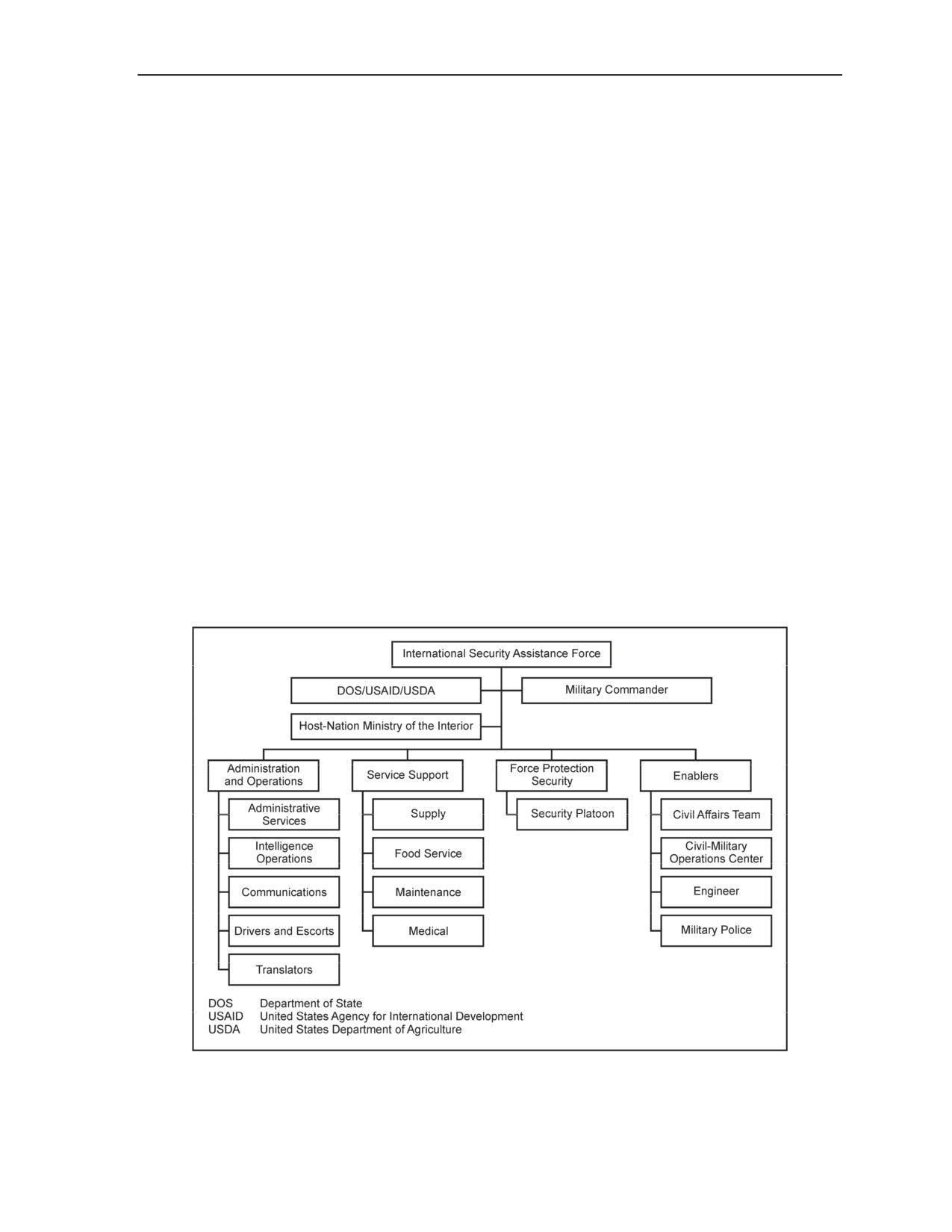
Provincial Reconstruction Teams
term financing of most projects. The PRT exists to encourage central ministries in distributing funds to
provincial representatives. These funds are for project implementation, including accountability and
management of funds.
F-12. Provincial reconstruction development committees
(PRDCs) prioritize provincial development
projects and ensure the necessary funding for economic progress. The PRDC was developed before the
creation of the current PRT structure. The PRDC contains a USAID representative, a civil affairs advisor,
one or more PRT members, and host-nation officials. A PRDC develops a list of potential projects after
consulting with the national ministries, provincial authorities, and local citizens. It aims to coordinate
projects with both national and provincial development plans. The PRDC examines possible funding
sources to determine how project funding will be provided.
F-13. The PRT provincial program manager (a Department of State employee) works with the PRDC to
review projects and determine compliance with project funding guidelines. The PRT engineer reviews
construction projects to determine their technical feasibility. The list of projects is presented in a public
forum to the provincial council for approval following PRDC deliberations. The list is presented to the
host-nation coordination team. This team circulates the project list for final review and funding priority. A
PRT has limited involvement in project implementation following project selection.
STRUCTURE OF PROVINCIAL RECONSTRUCTION TEAMS
F-14. The PRT structure is modular in nature with a core structure tailored to the respective operational
area. A typical PRT contains the following personnel: six Department of State personnel; three senior
military officers and staff; twenty Army civil affairs advisors; one Department of Agriculture
representative; one Department of Justice representative; three international contractors; two USAID
representatives; and a military or contract security force (size depends on local conditions). The size and
composition of a PRT varies based on operational area maturity, local circumstances, and U.S. agency
capacity. (See figure F-1.)
Figure F-1. Example of provincial reconstruction team organization
6 October 2008
FM 3-07
F-3
Appendix F
F-15. The PRT structure normally has sixty to ninety personnel. A PRT is intended to have the following
complement of personnel:
z
PRT team leader.
z
Deputy team leader.
z
Multinational force liaison officer.
z
Rule of law coordinator.
z
Provincial action officer.
z
Public diplomacy officer.
z
Agricultural advisor.
z
Engineer.
z
Development officer.
z
Governance team.
z
Civil affairs team.
z
Bilingual bicultural advisor.
F-16. PRT civilian personnel normally serve twelve months, while civil affairs and other advisors may
serve from six to nine months. Changes in personnel often result in changes in PRT objectives and
programs. Ensuring continuity between redeploying personnel and new arrivals maintains project priorities
and prevents unnecessary program termination and restart that expend time and resources and deprive the
local populace. Department of Defense support of PRTs is contingent upon approval of a formal request
for forces initiated by Department of State.
STAFF FUNCTIONS
F-17. PRT operations differ depending on location, personnel, environment, and circumstances. PRT
personnel perform specific tasks to support reconstruction and stabilization.
F-18. The team leader is a senior U.S. foreign service officer. This leader represents the Department of
State and chairs the executive steering committee responsible for establishing priorities and coordinating
activities. The team leader is a civilian and does not command PRT military personnel, who remain
subordinate to the commander of multinational forces. This leader meets with the provincial governor, the
provincial council, mayors, tribal elders, and religious figures and is the primary contact with the host-
nation coordination team and American embassy officials. The team leader builds relationships with host-
nation institutions and monitors logistic and administrative arrangement.
F-19. The deputy team leader is typically an Army lieutenant colonel who serves as the PRT chief of staff
and executive officer. This officer manages daily operations, coordinates schedules, and liaises with the
forward operating base commander on sustainment, transportation, and security. The deputy team leader is
the senior representative of the commander of multinational forces. This leader approves security for PRT
convoys and off-site operations.
F-20. The multinational force liaison officer is a senior military officer responsible for coordinating PRT
activities with the division and forward operating base commander. These activities include intelligence,
route security, communications, and emergency response in case of attacks on convoys. The liaison officer
tracks PRT movements and coordinates with other military units in the operational area.
F-21. The rule of law coordinator is a Department of Justice official responsible for monitoring and
reporting the local government judicial system activities. The coordinator leads the rule of law team
consisting of civil affairs and local government personnel. This coordinator visits judicial, police, and
corrections officials and reports local conditions to the American embassy. The rule of law coordinator
advises the embassy on response measures to local government problems. This coordinator also provides
advice and limited training to local government officials. The program emphasizes improvement of court
administration, case management, protection of judicial personnel, training of judges, and promotion of
legal education. Rule of law coordinators meet with corrections officials to monitor and report on prison
conditions and the treatment of prisoners. However, in Iraq, the rule of law officer works for the Multi-
F-4
FM 3-07
6 October 2008