FM 3-07 Stability Operations (October 2008) - page 2
Chapter 3
Essential Stability Tasks
Many stability operations tasks are best performed by indigenous, foreign, or U.S.
civilian professionals. Nonetheless, U.S. military forces shall be prepared to perform all
tasks necessary to establish or maintain order when civilians cannot do so. … The long-
term goal is to help develop indigenous capacity for securing essential services, a viable
market economy, rule of law, democratic institutions, and a robust civil society.
Department of Defense Directive 3000.05
IDENTIFYING ESSENTIAL TASKS
3-1. Military forces are organized, trained, and equipped to be modular, versatile, and rapidly deployable.
They are tailored for expeditionary operations, easily task-organized, and continuously self-sufficient.
These unique expeditionary capabilities allow for prompt movement into any operational environment,
even the most austere regions. Expeditionary military forces can conduct operations without delay; they
can deliver decisive combat power with little advance warning.
3-2. In an operational environment with unstable security conditions in which the host-nation government
has either failed or is unable to function effectively, a military force may be the only substantial stabilizing
presence. In these conditions, the force must be prepared to perform all the tasks essential to establishing
and maintaining security and order while providing for the essential needs of the populace. In most
situations, local and international aid organizations will be present in the operational area but may have
limited access to the population. Military forces can significantly contribute to increasing the access of
these aid organizations, allowing them to provide essential humanitarian assistance to the civilian
population. In turn, this reduces a substantial logistic burden on military forces, allowing them to focus on
providing a safe, secure environment.
3-3. Success in stability operations often depends on the commander’s ability to identify the tasks
essential to mission success. Success also depends on the commander’s ability to prioritize and sequence
the execution of those tasks with available combat power, the diverse array of actors participating, and the
ability of the host nation to accept change. Even more so than in the offense and defense, stability
operations require commanders to demonstrate cultural astuteness and a clear understanding of the myriad
stability tasks to determine which are truly essential to mission success.
3-4. The commander and staff identify essential stability tasks based on due consideration of the relevant
mission variables. (See FM 3-0 for a discussion of mission variables.) Essential stability tasks are those
that the force must successfully execute to accomplish the specific mission. These essential tasks may
include specified and implied tasks required to establish the end state conditions that define success. They
include stability tasks and supporting information engagement tasks that inform and influence a wide array
of audiences. In addition, they include any essential offensive and defensive tasks associated with the
defeat of an enemy force. Typically, these are initial response tasks for which military forces retain primary
responsibility. Other tasks may be included that are not the primary responsibility of military forces. Some
tasks are executed simultaneously and some sequentially.
3-5. For the commander and staff, stability operations require a unique combination of knowledge and
understanding, the ability to achieve unity of effort, and a thorough depth of cultural astuteness. A finite
amount of combat power is available to apply against the essential tasks associated with a given stability
operation. Essential stability tasks lay the foundation for success of the other instruments of national
power. This foundation must sustain the burdens of governance, rule of law, and economic development
that represent the future viability of a state. Establishing this foundation depends on applying combat
6 October 2008
FM 3-07
3-1
Chapter 3
power to the essential stability tasks identified during the initial assessment of the situation and the framing
of the basic problem. Decisions about using combat power are more than a factor of the size of the force
deployed, its relative composition, and the anticipated nature and duration of the mission. Ensuring a
state’s long-term stability depends on applying combat power to those tasks that are, in fact, essential.
PRIMARY STABILITY TASKS
3-6. Stability operations aim to stabilize the environment enough so the host nation can begin to resolve
the root causes of conflict and state failure. These operations establish a safe, secure environment that
facilitates reconciliation among local or regional adversaries. Stability operations aim to establish
conditions that support the transition to legitimate host-nation governance, a functioning civil society, and
a viable market economy.
3-7. The size of the force and combination of tasks necessary to stabilize conditions depend on the
situation in the operational area. When a functional, effective host-nation government exists, military
forces work through and with local civil authorities. Together they restore stability and order and may be
required to reform the security institutions that foster long-term development. In this situation, the size of
the force and the scope of the mission are more limited. However, in a worst-case engagement scenario, the
security environment is in chaos, and the state is in crisis or has failed altogether. In this situation,
international law requires the military force to focus on essential tasks that establish a safe, secure
environment and address the immediate humanitarian needs of the local populace. This requires a force
capable of securing borders, protecting the population, holding individuals accountable for criminal
activities, regulating the behavior of individuals or groups that pose a security risk, reestablishing essential
civil services, and setting conditions in the operational area that enable the success of other actors.
3-8. Military forces provide support to facilitate the execution of tasks for which the host nation is
normally responsible. Typically, these tasks have a security component ideally performed by military
forces or a private security company. However, military forces sometimes provide logistic, medical, or
administrative support to enable the success of civilian agencies and organizations. These tasks generally
fall into one of three categories, representing the collective effort associated with a stability operation:
z
Tasks for which military forces retain primary responsibility.
z
Tasks for which civilian agencies or organizations likely retain responsibility, but military forces
are prepared to execute.
z
Tasks for which civilian agencies or organizations retain primary responsibility.
3-9. This chapter only addresses those essential tasks for which military forces retain primary
responsibility or must be prepared to execute. Within each stability sector, the primary stability tasks focus
effort toward the desired end state conditions for a specific execution time frame. For example, initial
response tasks executed in the security sector typically focus on establishing a safe, secure environment.
Finally, the five primary stability tasks are broken down into major subcategories that facilitate integration
and synchronization of related activities.
3-10. The primary stability tasks reflect a myriad of interrelated activities conducted across the five
stability sectors. Tasks executed in one sector inevitably create related effects in another; planned and
executed appropriately, carefully sequenced activities complement and reinforce these effects. Achieving a
specific objective or establishing certain conditions often requires performing a number of related tasks
among different stability sectors. An example of this is the effort required to provide a safe, secure
environment for the local populace. Rather than the outcome of a single task focused solely on the local
populace, safety and security are broad effects. Military forces achieve them by ending hostilities, isolating
belligerents and criminal elements, demobilizing armed groups, eliminating explosives and other hazards,
and providing public order and safety. Sustaining that security over time requires the execution of even
more tasks across all the stability sectors.
ESTABLISH CIVIL SECURITY
3-11. Within the security sector, initial response tasks aim to establish a safe and secure environment;
transformation tasks focus on developing legitimate and stable security institutions; and fostering
3-2
FM 3-07
6 October 2008
Essential Stability Tasks
sustainability tasks consolidate host-nation capacity-building activities. These conditions define success
within the sector but also reflect the end state that ensures the foundation for enduring stability and peace.
Enforce Cessation of Hostilities, Peace Agreements, and Other Arrangements
3-12. The tasks associated with this subcategory contribute to providing security and stability after an
armed conflict while setting the conditions necessary to begin disarmament, demobilization, and
reintegration. These tasks are critical to providing effective security for the local populace by reducing
their exposure to the threat of violent conflict. The tasks help military forces establish a sustained peace by
focusing on processes and activities fundamental to conflict transformation. The list of essential tasks may
include—
z
An initial response in which military forces—
Enforce ceasefires.
Supervise disengagement of belligerent forces.
Identify and neutralize potential adversaries.
Provide security for negotiations.
z
Transformation in which military forces establish and control buffers, including demilitarized
zones.
Determine Disposition and Constitution of National Armed and Intelligence Services
3-13. The tasks within this subcategory establish the conditions for successful security sector reform.
These tasks focus on the security and intelligence institutions that form the underpinnings of an effective
security sector based in a clearly defined legal framework. They provide the broad guidance and direction
for the training and advising effort central to security sector reform. The list of essential tasks may
include—
z
An initial response in which military forces—
Implement a plan for disposition of host-nation forces, intelligence services, and other
national security institutions.
Identify future roles, missions, and structure.
Vet senior officers and other individuals for past abuses and criminal activity.
z
Transformation in which military forces—
Conduct security force assistance.
Build host-nation capacity to protect military infrastructure.
Establish defense institutions.
z
Fostering sustainability in which military forces establish military-to-military programs with
host-nation forces and services.
Conduct Disarmament, Demobilization, and Reintegration
3-14. A disarmament, demobilization, and reintegration program is fundamental to most efforts to establish
stability and lasting peace. It includes physically disbanding armed groups, removing the means of combat
from former combatants and belligerents, and reintegrating the latter two into society. The groups include
men, women, and children. Many do not carry weapons; however, they support the fighting forces. Their
communities and families perceive them as part of an armed group. Together, the tasks of disarmament,
demobilization, and reintegration reduce a potential resurgence of armed conflict. Additionally, these tasks
provide a means for these individuals and groups to reenter society as contributing members.
3-15. While the tasks that support the disarmament, demobilization, and reintegration program generally
fall under civil security, the program itself represents one element of comprehensive security sector reform.
(See chapter 6 for a detailed discussion of security sector reform.) The list of essential tasks may include—
z
An initial response in which military forces—
Negotiate arrangements with belligerents.
Establish and enforce weapons control programs, including collection and destruction.
6 October 2008
FM 3-07
3-3
Chapter 3
Provide reassurances and incentives for disarmed factions.
Establish a monitoring program.
Establish demobilization camps.
Ensure adequate health, food, and security for belligerents.
z
Transformation in which military forces—
Disarm former combatants and belligerents.
Reduce availability of unauthorized weapons.
Ensure safety of quartered personnel and families.
Reintegrate former combatants and dislocated civilians into society.
z
Fostering sustainability in which military forces—
Secure, store, and dispose of weapons.
Develop host-nation arms control capacity.
Conduct Border Control, Boundary Security, and Freedom of Movement
3-16. A central component of civil security is the ability of the state to monitor and regulate its borders.
Generally, border and coast guard forces secure national boundaries while customs officials regulate the
flow of people, animals, and goods across state borders. These border controls are necessary to regulate
immigration, control the movements of the local populace, collect excise taxes or duties, limit smuggling,
and control the spread of disease vectors through quarantine. The list of essential tasks may include—
z
An initial response in which military forces—
Establish border control and boundary security.
Establish and disseminate rules relevant to movement.
Dismantle roadblocks and establish checkpoints.
Ensure freedom of movement.
z
Transformation in which military forces train and equip border control and boundary security
forces.
Support Identification
3-17. Identification programs complement efforts to vet host-nation personnel, encourage participation in
representative government, resolve property disputes, and validate professional credentials. Although vital
to other programs for rebuilding a functioning civil society, identification programs are equally important
to civil security. After the collapse of an authoritarian or hostile regime, these programs ensure that
potential adversaries do not inadvertently reintegrate into society. Thus, they are deprived of the ability to
provide the seeds for future organized sabotage, subversion, or insurgency. The list of essential tasks may
include—
z
An initial response in which military forces—
Secure documents relating to personal identification, property ownership, court records,
voter registries, professional certificates, birth records, and driving licenses.
Establish identification program.
Ensure individuals have personal forms of identification.
z
Transformation in which military forces develop mechanisms for long-term dispute resolution.
Protect Key Personnel and Facilities
3-18. When required, military forces may extend protection and support to key civilian personnel to ensure
their continued contribution to the overall stability operation. In the interest of transparency, military forces
specifically request and carefully negotiate this protection. Similarly, the long-term success of any
intervention often relies on the ability of external actors to protect and maintain critical infrastructure until
the host nation can resume that responsibility. The list of essential tasks may include—
z
An initial response in which military forces—
Protect government-sponsored civilian reconstruction and stabilization personnel.
Protect contractor and civilian reconstruction and stabilization personnel and resources.
3-4
FM 3-07
6 October 2008
Essential Stability Tasks
Provide emergency logistic support, as required.
Protect and secure places of religious worship and cultural sites.
Protect and secure critical infrastructure, natural resources, civil registries, and property
ownership documents.
Protect and secure strategically important institutions
(such as government buildings;
medical and public health infrastructure; the central bank, national treasury, and integral
commercial banks; museums; and religious sites).
Protect and secure military depots, equipment, ammunition dumps, and means of
communications.
Identify, secure, protect, and coordinate disposition for stockpiles of munitions and
chemical, biological, radiological, and nuclear (CBRN) materiel and precursors; facilities;
and adversaries with technical expertise.
z
Transformation in which military forces—
Build host-nation capacity to protect civilian reconstruction and stabilization personnel.
Build host-nation capacity to protect infrastructure and public institutions.
Build host-nation capacity to protect military infrastructure.
Clear Explosive and CBRN Hazards
3-19. In a state already burdened by collapsed institutions of central government, the presence of explosive
hazards (including minefields and unexploded explosive ordnance) and CBRN hazards (resulting from
intentional or accidental release) inflicts stress that the surviving institutions cannot bear. These hazards
restrict freedom of movement, hinder international trade, and detract from the ability of a fragile state to
secure its borders and boundaries. Military forces may clear unexploded explosive ordnance and other
explosive hazards to facilitate capacity-building activities. Removing these hazards ensures the safety,
security, and well-being of the local populace. (FM 3-34.210 includes tactics, techniques, and procedures
for clearing explosive hazards.) The list of essential tasks may include—
z
An initial response in which military forces—
Establish an explosive hazards coordination cell.
Conduct emergency clearing of mines, unexploded explosive ordnance, and other explosive
hazards.
Map, survey, and mark mined areas, unexploded explosive ordnance, and other explosive
hazards.
Remediate hazards remaining from the release of CBRN hazards and radiological fallout, as
well as provide decontamination support.
z
Transformation in which military forces—
Create host-nation capacity to conduct demining.
Build host-nation capability to export demining expertise.
3-20. The John Warner National Defense Authorization Act limits the assistance that military forces may
provide with respect to demining. Military forces may assist and train others in demining techniques and
procedures. However, no member of the armed forces—while providing humanitarian demining
assistance—will engage in the physical detection, lifting, or destroying of landmines or other explosive
remnants of war (unless the member does so for the concurrent purpose of supporting a U.S. military
operation). Nor will any member provide such assistance as part of a military operation that does not
involve the armed forces.
ESTABLISH CIVIL CONTROL
3-21. Civil control regulates selected behavior and activities of individuals and groups. It reduces risk to
individuals or groups and promotes security. Within the justice and reconciliation stability sector, initial
response tasks aim to develop interim mechanisms for establishing rule of law. Transformation tasks focus
on restoring the justice system and processes for reconciliation. Fostering sustainability tasks serve to
6 October 2008
FM 3-07
3-5
Chapter 3
establish a legitimate, functioning justice system founded on international norms. These conditions define
success within the sector while reflecting the end state necessary to ensure the foundation for enduring
stability and peace.
Establish Public Order and Safety
3-22. The tasks within this category provide a broad range of activities to protect the civilian populace,
provide interim policing and crowd control, and secure critical infrastructure. These essential tasks
represent actions that must occur during and after direct armed conflict to ensure the long-term
sustainability of any reform efforts. The speed and effectiveness in performing these tasks directly
correlates with the length of time required to return the host nation to a normal state. Executing these tasks
as soon as practical after intervening reduces the time required for related efforts and allows the mission to
be accomplished far sooner. However the military’s legal authorities for all activities in the justice sector,
particularly involving enforcement and adjudication of the law, must be clear. The list of essential tasks
may include—
z
An initial response in which military forces—
Protect vulnerable elements of the population (such as dislocated civilians).
Ensure humanitarian aid and security forces have access to endangered populations and
refugee camps.
Perform civilian police functions, including investigating crimes and making arrests.
Locate and safeguard key witnesses, documents, and other evidence related to key ongoing
or potential investigations and prosecutions.
Control crowds, prevent looting, and manage civil disturbances.
Secure facilities, records, storage equipment, and funds related to criminal justice and
security institutions.
z
Transformation in which military forces—
Build host-nation capacity to protect military infrastructure.
Build host-nation capacity to protect infrastructure and public institutions.
Build host-nation capacity for emergency response.
z
Fostering sustainability in which military forces identify modernization needs and the means to
achieve them.
Establish Interim Criminal Justice System
3-23. When conditions require the restoration of governance, establishing an interim justice system is a
prerequisite. This restoration requires a wide range of skilled professionals working under a clearly defined
legal authority: judges, prosecutors, court administrators, defense lawyers, corrections personnel, law
enforcement, and investigators. These personnel—and the institutions they represent—provide a temporary
respite allowing the host nation to restore its capacity. The list of essential tasks may include an initial
response in which military forces—
z
Assess the current legal framework and the need for modifications or adoption of internationally
accepted codes.
z
Deploy interim justice personnel to complement host-nation criminal justice system.
z
Establish mechanisms to review the legality of detentions and minor cases to minimize pretrial
detention.
z
Enact interim legal codes and procedures permitted by international law.
z
Assess host-nation capacity to combat crime.
Support Law Enforcement and Police Reform
3-24. Integral to establishing civil control is the support military forces provide to law enforcement and
policing operations. Host-nation civilian law enforcement agencies and organizations may provide this
capability if the security environment permits. However, in a fragile state, these institutions may have
3-6
FM 3-07
6 October 2008
Essential Stability Tasks
become corrupt or failed altogether. In failed states, especially during and immediately after conflict,
military police forces are the only organizations able to fill this void. At times, civilian law enforcement
personnel augment military forces.
3-25. The preferred providers of civilian law enforcement services are civilian police, augmented as
required by military and paramilitary police units with stability policing capabilities. Civilian agencies
typically provide training and capacity-building support for law enforcement services. However, military
forces may be required to perform these services on an interim basis, until the situation permits the
transition of this function to civilian agencies or organizations. The list of essential tasks may include—
z
An initial response in which military forces—
Identify, secure, and preserve evidence of war crimes, crimes against humanity, corruption,
and transnational crime (terrorism, organized crime, human trafficking, and narcotics).
Identify and detain perpetrators of these offenses.
Support vetting, credentialing, and accounting for host-nation police forces.
Deploy police trainers and advisors.
Inventory and assess police facilities and systems.
z
Transformation in which military forces—
Train and advise host-nation police forces.
Establish police academies.
Develop community interface forums.
Rehabilitate or construct necessary facilities.
Support Judicial Reform
3-26. The reform of judicial bodies is integral to rule of law and provides the necessary framework for
broader security sector reform. The support provided to judicial institutions parallels efforts with police
and security forces to enhance the state’s capability to maintain civil control and security. Under most
circumstances, other agencies and organizations typically support the development of the judicial branch of
government. In a failed state, however, military forces may initially perform these functions until they can
be transitioned to an appropriate civilian agency or organization. The list of essential tasks may include—
z
An initial response in which military forces—
Identify host-nation legal professionals.
Identify actual and potential leaders to incorporate into reform process.
Determine gaps or inconsistencies with international human rights norms in legal
framework.
Establish vetting criteria.
Educate criminal justice personnel on interim legal codes and international human rights
standards.
Inventory and assess courts, law schools, legal libraries, and bar associations.
Deploy judicial advisors and liaisons.
z
Transformation in which military forces—
Rehabilitate or construct necessary facilities.
Support vetting of host-nation legal professionals.
Support Property Dispute Resolution Processes
3-27. One of the most vital services provided by the judiciary branch is the resolution of property disputes.
In a fragile state, long-standing disputes over ownership and control of property are common. Authorities
must implement dispute resolution mechanisms. This prevents the escalation of violence that can occur in
the absence of law and order as people seek resolution on their own terms. Typically, the military’s role in
resolving disputes is limited to transitional military authority where these mechanisms are implemented in
6 October 2008
FM 3-07
3-7
Chapter 3
the absence of a functioning host-nation government. The list of essential tasks may include an initial
response in which military forces—
z
Implement mechanisms to prevent unauthorized occupation or seizure of land or property.
z
Publicize dispute resolution process.
z
Coordinate dispute resolution process to deter violence and retribution.
Support Justice System Reform
3-28. Justice system reform, much like other reform processes, is integral to a comprehensive rule of law
program and is necessary for successful security sector reform. Within the justice system, reform activities
aim to reorganize basic structures, update legal statutes, encourage citizen participation, protect human
rights, and ultimately achieve broad institutional reform. These activities are instrumental to establishing a
justice system the local populace perceives as legitimate, fair, and effective. Although other civilian
agencies typically lead reform efforts, military forces may conduct some critical tasks to establish the
conditions necessary to facilitate future efforts. The list of essential tasks may include an initial response in
which military forces—
z
Support the development of a host-nation strategy to rebuild the justice system.
z
Determine local due process norms and expectations.
z
Develop awareness of notice and comment forums.
z
Review current laws and resolve questions of applicability.
z
Abolish provisions incompatible with international standards of human rights.
z
Assess court administration capabilities and resources.
Support Corrections Reform
3-29. As with other reform processes, corrections reform is an integral component of broader security
sector reform. Corrections reform tasks focus on building host-nation capacity in the penal system,
restoring the institutional infrastructure, and providing oversight of the incarceration process. Tasks also
include a comprehensive assessment of the prisoner population to help reintegrate political prisoners and
others unjustly detained or held without due process. The list of essential tasks may include—
z
An initial response in which military forces—
Identify and register all detention, correction, or rehabilitative facilities.
Preserve and secure penal administrative records and reports.
Inventory and assess prison populations and conditions.
Implement humanitarian standards in prisons.
Provide emergency detention facilities.
Vet corrections personnel.
Deploy penal trainers and advisors.
Refurbish prison facilities at key sites.
Coordinate jurisdiction and handover.
Facilitate international monitoring.
z
Transformation in which military forces—
Rebuild corrections institutions.
Train and advise corrections personnel to internationally accepted standards.
Develop reconciliation, parole, and reintegration mechanisms.
Support War Crimes Courts and Tribunals
3-30. While the military government operates military commissions and provost courts, the international
community oversees the conduct of war crimes courts and tribunals. As part of the broad processes that
represent justice system reform, military forces identify, secure, and preserve evidence for courts and
tribunals of war crimes and crimes against humanity. However, military forces also provide support in
3-8
FM 3-07
6 October 2008
Essential Stability Tasks
other forms, to include helping to establish courts and tribunals, supporting the investigation and arrest of
war criminals, and coordinating efforts with other agencies and organizations. The list of essential tasks
may include—
z
An initial response in which military forces—
Acquire secure facilities.
Establish an atrocity reporting system.
Document and preserve evidence of mass atrocities.
Publish progress reports.
z
Transformation in which military forces—
Assist in investigation, arrest, and transfer of suspected war criminals to international
courts.
Support witness protection.
Support media access.
Support Public Outreach and Community Rebuilding Programs
3-31. Public outreach and community rebuilding programs are central to the reconciliation process and to
promoting public respect for the rule of law. They provide the local populace with a means to form a
cohesive society. While these programs generally do not involve substantial military involvement, some
activities require the force’s support to achieve success. The list of essential tasks may include an initial
response in which military forces—
z
Establish broad public information programs to promote reconciliation efforts.
z
Develop public access to information.
z
Assess needs of vulnerable populations.
RESTORE ESSENTIAL SERVICES
3-32. The activities associated with this primary stability task extend beyond simply restoring local civil
services and addressing the effects of humanitarian crises. While military forces generally center efforts on
the initial response tasks for immediate needs of the populace, other civilian agencies and organizations
focus on broader humanitarian issues and social well-being. Transformation tasks establish the foundation
for long-term development, resolving the root causes of conflict that lead to events such as famine,
dislocated civilians, refugee flows, and human trafficking. Fostering sustainability tasks ensures the
permanence of those efforts by institutionalizing positive change in society.
3-33. Normally, military forces support host-nation and civilian relief agencies with these efforts.
However, when the host nation cannot perform its roles, military forces may execute these tasks directly or
to support other civilian agencies and organizations. It is imperative that these activities are properly scaled
to local capacity for sustainment. Proper scaling also creates the best opportunity for the local populace to
create small-scale enterprises to provide as many of these essential services as possible through the private
economy. Large-scale projects that require complicated host-nation efforts to sustain should not be initiated
until the necessary infrastructure is in place to support such effort.
Provide Essential Civil Services
3-34. Although closely related to establishing and supporting effective local governance, efforts to provide
essential civil services to the host-nation people involve developing the capacity to operate, maintain, and
improve those services. This broader focus involves a societal component that encompasses long-range
education and training, employment programs, and economic investment and development.
3-35. At the tactical level, activities of military forces to provide essential civil services are often defined
in terms of the immediate humanitarian needs of the people: providing the food, water, shelter, and medical
support necessary to sustain the population until local civil services are restored. Once their immediate
needs are satisfied, efforts to restore basic services and transition control to civil authorities typically
progress using lines of effort based on the memory aid, SWEAT-MSO (sewage, water, electricity,
6 October 2008
FM 3-07
3-9
Chapter 3
academics, trash, medical, safety, and other considerations). These lines of effort are vital to integrating
efforts to reestablish local civil services with similar, related actions to establish a safe, secure
environment. Military forces, specifically functional units or functional specialists, may support the effort
to provide essential civil services by conducting detailed infrastructure reconnaissance. The list of essential
tasks may include—
z
An initial response in which military forces—
Provide for immediate humanitarian needs of the population (food, water, shelter, and
medical support).
Ensure proper sanitation, purification, and distribution of drinking water.
Provide interim sanitation, wastewater, and waste disposal services.
z
Transformation in which military forces build host-nation capacity to operate and maintain
essential civil services.
Tasks Related to Civilian Dislocation
3-36. The following three task subcategories share similar characteristics related to the challenges
associated with dislocated civilians. Intergovernmental and nongovernmental organizations, as well as
other humanitarian actors, are best equipped and trained to manage the human crises associated with
dislocated civilians. Intergovernmental organizations may include the United Nations and the International
Organization for Migration. Nongovernmental organizations may include groups such as Cooperative
Assistance for Relief Everywhere (known as CARE). Humanitarian actors may include the International
Committee of the Red Cross, a well-known international organization.
3-37. The presence and uncontrolled flow of dislocated civilians can threaten the success of any stability
operation. Dislocated civilians are symptoms of broader issues such as conflict, insecurity, and disparities
among the population. How displaced populations are treated can either foster trust and confidence—
laying the foundation for stabilization and reconstruction among a traumatized population—or create
resentment and further chaos. Local and international aid organizations are most often best equipped to
deal with the needs of the local populace but require a secure environment in which to operate. Through
close cooperation, military forces can enable the success of these organizations by providing critical
assistance to the populace.
3-38. Nearly 80 percent of all dislocated civilians are women or children. Most suffer from some form of
posttraumatic stress disorder, and all require food, shelter, and medical care. Following a major disaster,
humanitarian crisis, or conflict, providing adequate support to dislocated civilians often presents a
challenge beyond the capability of available military forces. Therefore, military forces offer vital support—
coordinated with the efforts of other agencies and organizations—to provide humanitarian assistance to the
general population. The list of essential tasks includes—
z
Assist dislocated civilians.
z
Support assistance to dislocated civilians.
z
Support security to dislocated civilians camps.
Assist Dislocated Civilians
3-39. When assisting dislocated civilians, military forces—
z
Ensure humanitarian aid organizations have access to populations in need.
z
Estimate food aid needs for affected populations.
z
Assess the adequacy of local physical transport, distribution, and storage.
Support Assistance to Dislocated Civilians
3-40. When supporting efforts to assist dislocated civilians, the list of essential tasks may include—
z
An initial response in which military forces—
Estimate food aid needs for dislocated civilians.
Assess the adequacy of local physical transport, distribution, and storage.
3-10
FM 3-07
6 October 2008
Essential Stability Tasks
Establish camps for dislocated civilians.
Provide emergency food, water, shelter, sanitation, and medical care to dislocated civilians.
z
Transformation in which military forces—
Ensure access to basic services, including education and health care.
Clear damaged and destroyed housing and assess damage.
Support Security to Dislocated Civilians Camps
3-41. When supporting dislocated civilians camp security, the list of essential tasks may include—
z
An initial response in which military forces—
Assess conditions of temporary shelters and camps for dislocated civilians.
Ensure adequate protection and monitoring of camps.
Ensure access of humanitarian aid organizations and security forces to camps.
z
Transformation in which military forces assist in establishing and maintaining order in camps.
Support Famine Prevention and Emergency Food Relief Programs
3-42. Famine-prone countries are a unique subcategory of fragile states and require special focus. Without
exception, weak and failing economic, governance, health, and food systems at the national level increase
famine vulnerability. The combination of weak institutions, poor policies, and environmental change often
results in famine. Famine may result in food insecurity, increased poverty, morbidity, malnutrition, and
mortality. Government agencies—such as the U.S. Agency for International Development—numerous
nongovernmental organizations, and the United Nations are instrumental to response efforts in famine-
prone states. They oversee the major relief programs that provide emergency food aid to suffering
populations.
3-43. Military support of these efforts is minimal but vital to the overall success of the operation. The list
of essential tasks may include—
z
An initial response in which military forces—
Monitor and analyze food security and market prices.
Predict the effects of conflict on access to food.
Estimate total food needs.
Assess the adequacy of local physical transport, distribution, and storage of food.
Deliver emergency food aid to most vulnerable populations.
z
Transformation in which military forces ensure safe access to transportation and distribution
networks.
Support Nonfood Relief Programs
3-44. Military forces offer significant support capability to the broader effort to provide nonfood relief
during humanitarian crises. Any support provided for nonfood relief programs for dislocated civilians
should be closely coordinated with the relevant host-nation ministry, United Nations agency, and
appropriate aid organizations. Although the related tasks are minimal, they greatly influence the long-term
success of these efforts. The list of essential tasks may include—
z
An initial response in which military forces—
Secure emergency nonfood relief distribution networks.
Deliver emergency nonfood items.
z
Transformation in which military forces clear devastated housing and assess damage.
Support Humanitarian Demining
3-45. Humanitarian demining is related to the subordinate task clear explosive and CBRN hazards under
the primary stability task establish civil security; however, this task focuses on supporting the humanitarian
aspects of demining, while the task clear explosive and CBRN hazards is generally considered a
6 October 2008
FM 3-07
3-11
Chapter 3
protection-related task. In fragile states, vast minefields and unexploded explosive ordnance pose a
significant hazard to freedom of movement. Marking and removing these hazards initiates long-term
recovery, especially along major transport routes and in critical public facilities. In comprehensive
demining programs, much of the effort focuses on educating the local populace on how to recognize,
avoid, and report the presence of mines and unexploded explosive ordnance. The list of essential tasks may
include—
z
An initial response in which military forces—
Map and survey mined areas.
Mark minefields.
Treat initial injuries.
z
Transformation in which military forces—
Educate the local populace to recognize and avoid mines.
Build host-nation capacity to conduct demining.
Support Human Rights Initiatives
3-46. Often, forces that intervene after conflict or disaster encounter conditions of human suffering beyond
their ability to resolve. Such situations require the dedicated support of intergovernmental and
nongovernmental organizations able to provide long-term solutions to complex humanitarian issues. The
military contribution to these efforts generally involves preventing further abuse of vulnerable populations
and establishing conditions that support long-term development. These conditions enable the success of the
agencies and organizations that provide for the long-term well-being of these populations. Military forces
play a critical role in promoting the rule of law in preventing human rights abuses within its own ranks.
The list of essential tasks may include an initial response in which military forces monitor vulnerable
groups, provide information and referrals to groups whose rights may be violated, and act preemptively to
deter human rights abuses.
Support Public Health Programs
3-47. The military contribution to the public health sector, especially early in an operation, enables the
complementary efforts of local and international aid organizations. The initial efforts of military forces aim
to stabilize the public health situation within the operational area. These efforts may include assessments of
the civilian medical and public health system such as infrastructure, medical staff, training and education,
medical logistics, and public health programs. Following these initial response tasks, civilian organizations
tailor their efforts to reforming the public health sector through health systems strengthening and other
public health capacity-building activities. Health systems strengthening involves reducing bureaucracy by
streamlining management, increasing cost-effectiveness, improving efficiency through reorganized
services, decentralizing health systems, and allocating resources to better address the needs of the
population. Achieving measurable progress requires early coordination and constant dialog with other
actors; ultimately, this also facilitates a successful transition from military-led efforts to civilian
organizations or the host nation.
3-48. The tasks performed to support public health programs closely relate to the tasks required to restore
essential services. In many cases, they complement and reinforce those efforts. The list of essential tasks
may include—
z
An initial response in which military forces—
Assess public health hazards within their area of operations and area of interest including
malnutrition, water sources, and sewer and other sanitation services.
Assess existing medical infrastructure including preventative and veterinary services,
health—physical and psychological—care systems, and medical logistics.
Evaluate the need for additional medical capabilities.
Repair existing civilian clinics and hospitals.
Operate or augment the operations of existing civilian medical facilities.
Prevent epidemics through immediate vaccinations.
3-12
FM 3-07
6 October 2008
Essential Stability Tasks
z
Transformation in which military forces—
Support improvements to local waste and wastewater management capacity.
Promote and enhance the host-nation medical infrastructure.
Support Education Programs
3-49. Military activities to support education programs generally focus on physical infrastructure. In some
cases, trained personnel with appropriate civilian backgrounds provide additional services such as
administrative or educational expertise. The efforts of civilian organizations aim to improve adult literacy,
train teachers and administrators, develop curricula, and improve school-age access to education. The list
of essential tasks may include—
z
An initial response in which military forces repair and reopen schools as quickly as possible.
z
Transformation in which military forces build schools.
SUPPORT TO GOVERNANCE
3-50. When a legitimate and functional host-nation government is present, military forces operating to
support the state have a limited role. However, if the host-nation government cannot adequately perform its
basic civil functions—whatever the reason—some degree of military support to governance may be
necessary. A state’s legitimacy among its people is tied in part to its perceived ability to provide these
essential services. In extreme cases, where civil government is completely dysfunctional or absent
altogether, international law requires the military force to provide the basic civil administration functions
of the host-nation government under the auspices of a transitional military authority. (See chapter 5 for a
detailed discussion of transitional military authority.)
Support Transitional Administrations
3-51. When the host-nation government has collapsed or been deposed, initial response efforts focus on
immediately filling the void in governance. In either situation, the reliability and trustworthiness of local
officials is suspect; due care and prudence are necessary to avoid empowering officials whose interests and
loyalties are inconsistent with those of the occupying force. The list of essential tasks may include—
z
An initial response in which military forces—
Vet host-nation officials.
Reconstitute leadership at multiple levels of government.
Establish interim legislative processes.
z
Transformation in which military forces advise and assist transitional administrations.
Support Development of Local Governance
3-52. Establishing effective governance at the local level is necessary before developing governance
institutions and processes throughout the state. Initially, effective local governance almost depends entirely
on the ability to provide essential civil services to the people; restoring these services is also fundamental
to humanitarian relief efforts. (See paragraph 2-55 for additional discussion on the primary stability task,
restore essential services.) Most stability tasks require an integrated and synchronized effort across all
sectors to achieve the desired end state. The list of essential tasks may include—
z
An initial response in which military forces—
Establish mechanisms for local-level participation.
Identify, secure, rehabilitate, and maintain basic facilities for the local government.
6 October 2008
FM 3-07
3-13
Chapter 3
Restore essential local public services.
Provide resources to maintain essential local public services.
z
Transformation in which military forces advise local legislatures and civil servants during
administrative actions.
Support Anticorruption Initiatives
3-53. Providing legal guidance and assistance to the transitional government mitigates the near-term
effects of corruption. Long-term measures ensure lasting success. Corruption and graft can hinder efforts to
establish governance, restore rule of law, or institute economic recovery. While some level of corruption is
common to many cultures, its existence can unhinge reform efforts and put the entire mission at risk. The
list of essential tasks may include an initial response in which military forces create mechanisms to curtail
corruption across government institutions. The list of essential tasks may include an initial response in
which military forces—
z
Implement or reaffirm government employee oaths of office.
z
Develop and disseminate ethical standards for civil servants.
z
Ensure transparency in the dispersal of government resources.
z
Implement reporting procedures for corruption and intimidation.
z
Support witness protection programs.
Support Elections
3-54. The ability of the state and its local subdivisions to stage fair and secure elections is a significant
milestone toward establishing legitimate, effective governance. While civilian agencies and organizations
that maintain strict transparency guide the elections process, military forces provide the support that
enables broad participation by the local populace. The list of essential tasks may include—
z
An initial response in which military forces—
Determine identification requirements for voter registration.
Establish or verify voter registry.
z
Transformation in which military forces provide security to ensure free and fair elections.
SUPPORT TO ECONOMIC AND INFRASTRUCTURE DEVELOPMENT
3-55. Sound economic policies promote equitable, sustainable growth. It is the key to remedying
underlying tensions in society. This allows the state to progress toward recovery and eventually long-term
economic development. Therefore, any effort to establish economic stabilization is closely linked to similar
efforts in other stability sectors. Linking these efforts expands the possibilities for changing the underlying
social, economic, and political conditions that led to the collapse of the state. Synchronizing reform efforts
among the economic, governance, and security sectors decreases the chance of continued or renewed
conflict.
3-56. Building capacity within the economic sector requires an integrated approach to achieve sustainable
growth. Appropriate civilian or host-nation organizations can accomplish much of this effort at the macro
level through development mechanisms but may look to the military for security or other types of
assistance. Despite this, military forces must maintain an understanding of the economic sector, the impact
of their activities on the economy, and the proper method to lay a stabilizing foundation that will support
future sustainability and development.
3-57. At the local level, military forces play a significant role in supporting economic stabilization and
infrastructure development. The building blocks for broad national recovery and development are set at the
local level. At the local level, emphasis is on generating employment opportunities, infusing monetary
resources into the local economy, stimulating market activity, fostering recovery through microeconomics,
and supporting the restoration of physical infrastructure. However, military forces must avoid causing
unintended disruptions to the local markets by suddenly stimulating the economy. Unanticipated demand
on local markets may cause prices to spike, thus making products cost prohibitive for the people. This may
3-14
FM 3-07
6 October 2008
Essential Stability Tasks
cause resentment and undermine broader efforts, particularly if the military force is only in the area for a
short time and a sudden collapse in market activity occurs after its departure. Thus, it is critical that
members of the force understand the economic fundamentals of the area—key markets, revenue producers,
and price trends—to gauge the impact of military activities.
3-58. At the regional or national level, efforts focus on comprehensive infrastructure improvements, such
as rebuilding a national electrical grid system or on supporting the efforts of other agencies to strengthen
the economy or foster development. Intergovernmental organizations such as the World Bank, the
International Monetary Fund, and the Organisation for Economic Co-operation and Development help set
sound economic policies and establish conditions for long-term development and investment. (See The
[Organisation for Economic Co-operation and Development Development Assistance Committee]
Handbook on Security System Reform (SSR): Supporting Security and Justice for more information.)
Support Economic Generation and Enterprise Creation
3-59. Economic recovery begins with an actively engaged labor force. When a military force occupies an
operational area, the demand for local goods, services, and labor creates employment opportunities for the
local populace. Local projects, such as restoring public services, rebuilding schools, or clearing roads, offer
additional opportunities for the local labor pool. Drawing on local goods, services, and labor presents the
force with the first opportunity to infuse cash into the local economy, which in turn stimulates market
activity. However, this initial economic infusion must be translated into consistent capital availability and
sustainable jobs programs. Thus, short-term actions are taken with an eye towards enabling financial self-
reliance and the creation of a durable enterprise and job market.
3-60. The local economy requires this stimulus to sustain economic generation and enterprise creation. It
includes efforts to execute contracting duties; identify, prioritize, and manage local projects; and
implement employment programs. Often, such programs reinforce efforts to establish security and civil
order by providing meaningful employment and compensation for the local populace. The assessment of
the economic sector must include developing knowledge and understanding of local pay scales; this is
essential to establishing jobs programs with appropriately wages. Inflated pay scales may divert critical
professionals from their chosen field in pursuit of short-term financial gains from new jobs created by the
force. Establishing appropriate pay scales is also significant when the environment includes illicit actors
willing to pay for actions or services in direct conflict with the aims of the force. Adversaries can easily
exploit relatively low pay scales and quickly undermine efforts to build positive perceptions among the
people.
3-61. Host-nation enterprise creation is an essential activity whereby the local people organize themselves
to provide valuable goods and services. In doing so, they create jobs for themselves, their families, and
neighbors that are inherently sustainable after the departure of other actors. Host-nation enterprises may
provide various goods and services, including essential services such as small-scale sewerage, water,
electricity, transportation, health care, and communications. The availability of financing through banking
or microfinance institutions is essential to enterprise creation.
3-62. Local jobs programs require a complementary vetting program to ensure the reliability of the
workforce, especially if the labor pool draws from a population that includes former combatants. Linking
vetting tasks with efforts to support economic generation mitigates risk to the force and the local populace.
The list of essential tasks may include—
z
An initial response in which military forces—
Implement initiatives to provide immediate employment.
Create employment opportunities for all ages and genders.
Assess the labor force for critical skills requirements and shortfalls.
Assess market sector for manpower requirements and pay norms.
z
Transformation in which military forces—
Implement public works projects.
Support establishment of a business registry to register lawful business activity at the local
or provincial level.
6 October 2008
FM 3-07
3-15
Chapter 3
Provide start-up capital for small businesses through small-scale enterprise grants.
Encourage the creation of small lending institutions.
Enable the development of financial institutions.
Support Monetary Institutions and Programs
3-63. At the operational level, the military force focuses on supporting the strengthening of the national
economy, including the central bank, which acts as the physical repository of government funds and
maintains the stability of the currency and financial (banking) systems of the country. Normally, other
agencies lead this effort while the military provides support to ensure the broad success of the mission.
Efforts include selecting a national currency, working through the central bank to ensure the solvency of
commercial financial institutions, and balancing government expenditures and revenue. Organizations such
as the Department of the Treasury, World Bank, and the International Monetary Fund provide the means
and expertise to establish or reform the central bank. The Department of the Treasury possesses the
capability to dispatch civilian experts along with or immediately after military forces to ensure adequate
crisis management. In some instances, international institutions can provide the fiscal resources to manage
the currency while maintaining the national budget. The list of essential tasks may include an initial
response in which military forces—
z
Facilitate assessment of capabilities of central bank and ministry of finance.
z
Assist in the distribution of currency to key banking outlets.
z
Initiate immediate capacity in the central bank to conduct essential operations.
Support National Treasury Operations
3-64. In most nations, the finance ministry is the central authority for establishing fiscal policy regarding
the use of government resources. In fragile states, this ministry is often among the first institutions to
collapse, resulting in high unemployment, uncontrolled inflation, and other financial crises. Restoring the
payment programs of the national treasury ministry, identifying and renewing sources of revenue, and
developing the host nation’s fiscal capacity are central to reestablishing the economic viability of the state.
The Department of the Treasury, U.S. Agency for International Development, and international
organizations can provide assistance in these areas. In states suffering from economic collapse, the failure
of the national treasury may leave essential regional or local public services without a paid work force.
Reestablishing government payment programs complements efforts to restore and maintain these vital
public works. The list of essential tasks may include an initial response in which military forces—
z
Reestablish government payment mechanisms to fulfill recurrent and emergency expenditures.
z
Establish simple and reliable capacity to process, record, and report payments.
z
Facilitate assessment of revenue-generating activities for the national treasury.
z
Identify tax structure and sources of revenue.
z
Facilitate establishment of basic audit functions to ensure officials use local government
resources appropriately.
Support Public Sector Investment Programs
3-65. Although organizations such as U.S. Agency for International Development usually manage public
sector investment in a fragile state, the military force also can influence success in these programs. Public
sector investment ensures the long-term viability of public education, health care, and mass transit. It also
provides for development in industries—such as mining, oil, and natural gas—and hydroelectricity. At the
local level, military forces may spur investment through grant programs or direct public investment
projects. The list of essential tasks may include—
z
An initial response in which military forces—
Prioritize public investment needs.
Develop plans to allocate available resources.
Pay civil service debts.
3-16
FM 3-07
6 October 2008
Essential Stability Tasks
z
Transformation in which military forces invest in critical projects neglected by the private
sector.
Support Private Sector Development
3-66. Developing the private sector typically begins with employing large portions of the labor force. In
addition to acquiring goods and services from the local economy, the tasks that support private sector
development infuse much-needed cash into local markets and initiate additional public investment and
development. Even in the most remote, austere regions of the world, local markets offer unique
entrepreneurial opportunities, as well as services often considered vital to the economies of developed
countries. The list of essential tasks may include—
z
An initial response in which military forces—
Assess the depth of the private sector and enterprise creation.
Identify obstacles to private sector development.
z
Transformation in which military forces—
Facilitate access to markets.
Strengthen the private sector through contracting and outsourcing.
Provide investors with protection and incentives.
Facilitate access to credit for legitimate banking and financial activity.
Protect Natural Resources and Environment
3-67. Protecting a nation’s natural resources is an extension of the requirement to secure and protect other
institutions of the state. Additionally, it preserves the long-term economic development and investment
capacity of a fragile state. This capacity includes the revenues generated by the storage, distribution, and
trade in natural resources. Rival factions often target these resources to finance illegitimate interests. The
list of essential tasks may include—
z
An initial response in which military forces assess and secure access to vital natural resources.
z
Transformation in which military forces prevent the illicit generation of revenues from natural
resources.
Support Agricultural Development Programs
3-68. The agricultural sector is a cornerstone of a viable market economy, providing crops and livestock
vital to local markets and international trade. The development of this sector may be hindered by property
disputes, difficulty accessing nearby markets, poor irrigation, animal disease, minefields, or unexploded
explosive ordnance. Therefore, development agencies prioritize and integrate projects with related tasks in
other stability sectors to establish and institutionalize practical solutions to the long-term growth of the
agricultural sector. The military contribution to agricultural development parallels related efforts to spur
economic growth in local communities. Together, they draw on local labor pools to help reestablish basic
services central to the agricultural sector. The list of essential tasks may include—
z
An initial response in which military forces—
Assess the state of agricultural sector.
Secure and protect postharvest storage facilities.
Rebuild small-scale irrigation systems.
Establish work programs to support agricultural development.
z
Transformation in which military forces—
Protect water sources.
Identify constraints to production.
Assess health, diversity, and numbers of animals.
Channel food aid to promote market activity.
Establish transportation and distribution networks.
6 October 2008
FM 3-07
3-17
Chapter 3
Encourage host-nation enterprise creation to provide goods and services to the agricultural
sector.
Ensure open transit and access to local markets.
Restore Transportation Infrastructure
3-69. Restoring the transportation and distribution capability of the state is central to economic recovery.
An underdeveloped or incapacitated transportation infrastructure limits freedom of movement, trade, social
interaction, and development. Military forces often initiate immediate improvement to the transportation
and distribution networks of the host nation. These networks enable freedom of maneuver, logistic support,
and the movement of personnel and materiel to support ongoing operations. Transportation infrastructure
improvements help to ease the transportation challenges common to relief efforts in fragile states. These
improvements facilitate the vital assistance efforts of civilian agencies and organizations that follow in the
wake of military forces. The list of essential tasks may include an initial response in which military
forces—
z
Assess overall condition of national transportation infrastructure
(airports, roads, bridges,
railways, and coastal and inland ports, harbors, and waterways), including facilities and
equipment.
z
Determine and prioritize essential infrastructure programs and projects.
z
Conduct expedient repairs or build new facilities to facilitate commercial trade.
Restore Telecommunications Infrastructure
3-70. The telecommunications infrastructure of the state exists to support every element of a society, from
the government to the financial sector, and from the media to the local populace. The failure of this
infrastructure accelerates the collapse of the state, isolates the state and the populace from the outside
world, and hampers development efforts. The military contribution to reconstruction efforts in the
telecommunications infrastructure is limited; normally, few essential tasks exist in this area. The list of
essential tasks may include an initial response in which military forces—
z
Assess overall condition of the national telecommunications infrastructure.
z
Determine and prioritize essential infrastructure programs and projects.
Support General Infrastructure Reconstruction Programs
3-71. General infrastructure reconstruction programs focus on rehabilitating the state’s ability to produce
and distribute fossil fuels, generate electrical power, exercise engineering and construction support, and
provide municipal and other services to the populace. The United States Army Corps of Engineers and
Field Force Engineering have the expertise to support host-nation capacity building in many of these areas.
Such capacity building spurs rehabilitation efforts that establish the foundation for long-term development.
As with the restoration of essential services, support to general infrastructure programs requires a thorough
understanding of the civil component of the operational area. Civil affairs (CA) personnel support this
information collection to help prioritize programs and projects.
3-72. The forward engineer support team, part of the United States Army Corps of Engineers, provides
detailed infrastructure reconnaissance in the operational area. These efforts are central to understanding the
needs of the state and prioritizing programs and projects. In a fragile state, fuels, energy, engineering, and
construction industries represent the difference between a primitive tribal state and a developing country
with a vibrant, functioning society. The list of essential tasks may include an initial response in which
military forces—
z
Assess overall condition of national energy infrastructure.
z
Determine and prioritize essential infrastructure programs and projects.
z
Assess conditions of existing power generation and distribution facilities.
z
Assess conditions of existing natural resources conversion and distribution facilities.
z
Assess conditions of existing facilities integral to effectively execute essential tasks in other
sectors.
3-18
FM 3-07
6 October 2008
Essential Stability Tasks
z
Assess conditions of existing local, municipal facilities that provide essential services.
z
Conduct expedient repairs or build new facilities to support local populace (such as schools,
medical clinics, and municipal buildings).
INFORMATION ENGAGEMENT TASKS
3-73. Although not considered stability tasks, information engagement tasks are fundamental to each
stability sector. Information engagement tasks are deliberately integrated with activities in each stability
sector and primary stability task to complement and reinforce the success of operations. This integration is
vital to success; information engagement tasks must be carefully sequenced with other tasks and supported
with thorough risk assessments. Exploiting or ceding the initiative within the information domain is often a
matter of precise timing and coordination. Combined with broad efforts to reduce the drivers of conflict
and build host-nation capacity, information engagement is essential to achieving decisive results: the
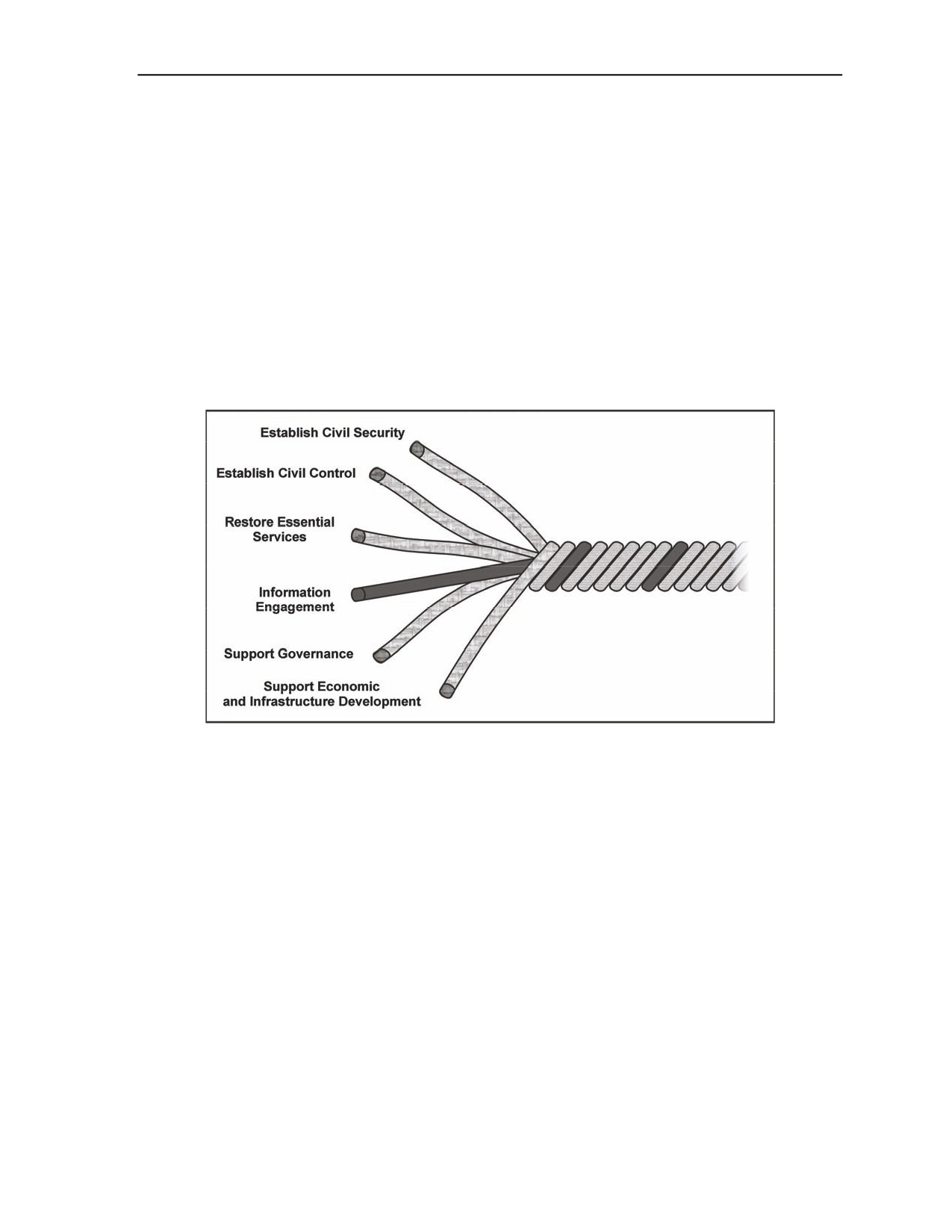
recovery of the host-nation government and the attainment of a lasting, stable peace. Figure 3-1 illustrates
the relationship between information engagement and each of the primary stability tasks.
Figure 3-1. Relating information engagement to the primary stability tasks
3-74. In executing stability operations, the military force focuses on people. They aim to gain the
cooperation and support of the populace. Stability tasks that improve their safety, security, and livelihood
help to shape their perceptions that supporting the objectives of the operation are in their best interest.
Shaping perceptions that the operation is legitimate will increase support for it. Executing the following
essential tasks can further the populace’s and the international community’s understanding of the
commander’s objectives:
z
Identify or establish outlets for international, national, and local news media.
z
Provide factual, accurate information to the media to control rumors and disinformation.
z
Issue effective press releases and prompt information in local languages.
z
Assist transitional civil or military authorities with public information programs.
z
Synchronize messages with operations; ensure messages are consistent with actions.
z
Assess media capability and capacity of the host nation; tailor information engagement strategy
to the ability of the local populace to receive messages.
z
Integrate cultural understanding with information engagement strategy.
6 October 2008
FM 3-07
3-19
Chapter 3
THE ROLE OF CIVIL AFFAIRS IN STABILITY OPERATIONS
3-75. CA forces support full spectrum operations in every environment across the spectrum of conflict,
from stable peace to general war. They are essential to the conduct of successful stability operations. CA
personnel provide unique area and linguistic orientation, cultural astuteness, advisory capabilities, and
civilian professional skills that generally parallel those of host-nation governments. They provide the
commander with specialized expertise on the civil component of the operational environment. The
commander draws on this expertise to analyze and influence the human dimension through specific
processes and dedicated resources and personnel.
THE CIVIL AFFAIRS MISSION
3-76. The mission of CA forces is to engage and influence the local populace by planning, executing, and
transitioning CA operations in Army, joint, interagency, and multinational operations. These forces
conduct CA operations that support and are nested within the overall operation. CA forces support these
operations by addressing civil considerations within the operational area before, during, or after a conflict
or disaster. CA forces help to shape the operational environment by interacting with the local populace to
facilitate military operations. A supportive local populace can provide valuable resources and critical
information that supports friendly operations. A hostile local populace threatens the immediate success of
military operations and may undermine domestic public support for those operations. When executed
properly, CA operations reduce the friction between the local populace and the military force.
CIVIL AFFAIRS OPERATIONS
3-77. During full spectrum operations, CA forces conduct operations that support and are nested within the
overall mission and commander’s intent. CA operations improve the relationship between military forces
and host-nation authorities in areas in which the military force operates. They involve applying CA
functional specialty skills to areas normally under the responsibility of a host-nation government. CA
operations establish, maintain, influence, or exploit relationships between military forces and all levels of
host-nation governments and officials. These operations are fundamental to executing stability tasks
successfully.
3-78. CA organizations and personnel develop detailed assessments based on civil considerations. These
include information about infrastructure, civilian institutions, and attitudes and activities of civilian leaders,
the local populace, and host-nation organizations. These assessments may reveal that a viable host-nation
government does not exist or cannot perform its basic civil functions. In such cases, military forces may
support or implement transitional military authority until a legitimate host-nation government is
established. (JP 3-57 and FMs 3-05.40 and 3-05.401 provide doctrine on CA.)
3-79. CA operations help to ensure the sustained legitimacy of the mission and the transparency and
credibility of the military force. This is accomplished by minimizing the effects of military operations on
the local populace, limiting how civilians impact those military operations, and providing sound advice to
the commander on the legal and moral obligations of the force as it conducts operations. The key to
successful CA operations is in leveraging the relationship between the military force and every individual,
group, and organization in the operational area.
3-80. CA personnel help the commander to understand and visualize the civil component of the
operational area. They provide detailed analysis based on careful consideration of operational and mission
variables. (See FM 3-0 for doctrine for the operational and mission variables.) This analysis is critical to
determining the following within the supported unit’s operational area:
z
The root causes of instability and civil strife.
z
The requirement for civil-military operations centers to facilitate communications and
coordinate with civilian agencies and organizations.
z
The need to use liaison teams to enhance communications and coordination with civilian
agencies and organizations to facilitate operations at all echelons.
3-20
FM 3-07
6 October 2008
Essential Stability Tasks
z
What, when, where, and why civilians might be encountered; what ongoing or planned military
operations might impact the activities of those civilians; what activities those civilians are
engaged in that might affect military operations; and what actions the military force must take to
mitigate the effects of those civilians.
z
Measures of performance and measures of effectiveness for CA operations to support the larger
military operation.
MISSION-ESSENTIAL TASKS IN STABILITY OPERATIONS
3-81. A mission-essential task is a collective task a unit must be capable of performing successfully to
accomplish its mission. Since organizations must be able to conduct full spectrum operations, they cannot
afford to focus training exclusively on one element of full spectrum operations at the expense of the other
elements. Yet they also cannot conceivably maintain proficiency on all tasks across the spectrum of
conflict. Therefore, commanders use the mission-essential task list to focus organizational training. There
are three types of mission-essential task lists:
z
Joint mission-essential task list derived from the Universal Joint Task List.
z
Core mission-essential task list (CMETL) standardized for brigades and above units by the
Department of the Army.
z
Directed mission-essential task list (DMETL) developed by a commander.
3-82. Units train on only a single mission-essential task list at any given time but may be required to report
readiness on more than one mission-essential task list.
CORE MISSION-ESSENTIAL TASK LIST
3-83. An organization’s CMETL is a list of the tasks derived from a unit’s specific capabilities based on
the organization, mission, and doctrine for that unit. A CMETL reflects the tasks the organization was
designed to perform and general tasks applicable to all organizations, regardless of type. The CMETL
consists of general mission-essential tasks and core capabilities mission-essential tasks. Each mission-
essential task is comprised of task groups of related collective tasks that support a specific portion of a
mission capability. (See FM 7-0 for a detailed discussion of general mission-essential tasks and core
capabilities mission-essential tasks.)
3-84. For stability operations, the specific focus of the CMETL will typically vary between echelons and
organizations and will be regulated by procedures outlined in FM 7-0. However, for all echelons, CMETL
will aim for proficiency in those tasks most likely during or immediately after a violent conflict or disaster.
Divisions and corps will orchestrate a broad range of missions and must maintain proficiency in selected
primary stability tasks during training. Since CMETLs are reviewed periodically by Headquarters,
Department of the Army, those lists and their associated task groups are subject to change. For division and
corps headquarters, an example of the task groups underpinning the core capabilities mission-essential task
of conduct stability operations could include the following:
z
Establish civil security.
z
Establish civil control.
z
Restore essential services.
3-85. For brigade-level headquarters, the focus of the CMETL varies according to the type of brigade, its
mission, and established doctrine. The CMETL only trains brigades to minimum capability. In stability
operations, the brigade combat team remains the principal means of executing the broad range of tasks
required for success. Other brigade-level organizations, such as the maneuver enhancement brigade, play a
significant role in stability operations; these brigades provide the force with significant capabilities to
conduct a wide array of stability tasks. For these support brigades, the CMETL will likely focus training on
providing their core capabilities mission-essential tasks during full spectrum operations, including the
stability element. For example, an aviation brigade may provide specific support focused on stability tasks
performed by other elements of the force.
6 October 2008
FM 3-07
3-21
Chapter 3
3-86. Functional brigades, like the support brigades, have a subordinate organizational structure that may
vary considerably among brigades of the same type. Unlike the support brigades, however, functional
brigades typically operate under theater army control and depend on theater-level elements for signal and
other support. The theater army may task-organize them to corps or division headquarters. For functional
brigades, the core capabilities mission-essential tasks reflect the most likely tasks according to its
organization, mission, and doctrine.
DIRECTED MISSION-ESSENTIAL TASK LIST
3-87. When an organization is assigned a specific mission, the focus of organizational training shifts from
CMETL to a DMETL and training conditions that realistically portray mission conditions. The commander
develops a list of the tasks required to accomplish that mission. This list, a unit’s DMETL, is based on a
thorough mission analysis and, once established, forms the new foundation and focus for unit training until
mission accomplishment. When developing the DMETL, commanders may capture a broad range of
stability tasks required for the directed mission, possibly expanding on the CMETL significantly.
3-88. Analysis of the situation and conditions within the operational area helps determine the DMETL
with respect to specific stability tasks. The DMETL for stability operations may remain consistent with a
unit’s CMETL, assume a broader focus on tasks that encompass reconstruction activities, or focus on
stability tasks conducted during peacetime military engagement. For division and corps headquarters, the
DMETL may expand to include the primary stability tasks support to governance and support to economic
and infrastructure development. (See FM 7-0 for doctrine on CMETL and DMETL development.)
3-89. For brigade-level organizations, the DMETL may expand to include various tasks that support the
efforts of the other instruments of national power, the host nation, and other actors and stakeholders. In
operations where host-nation security forces cannot provide security adequately for the state and its people,
brigade combat teams may be assigned the mission of conducting security force assistance. Though not
integral to the CMETL of these organizations, security force assistance draws on many skills already
resident in these organizations, as well as the developed command and control infrastructure to coordinate
the broad and often dispersed efforts involved. (See chapter 6 for a discussion of security force assistance.)
3-22
FM 3-07
6 October 2008
Chapter 4
Planning for Stability Operations
A plan, like a tree, must have branches—if it is to bear fruit. A plan with a single aim is
apt to prove a barren pole.
Captain Sir Basil Liddell Hart
Thoughts on War
PLANNING FUNDAMENTALS
4-1. For every operation, commanders develop personal, detailed understanding of the situation and
operational environment. They then visualize a desired end state and craft a broad concept for shaping the
current conditions toward that end state. Finally, they describe their visualization through the commander’s
intent, planning guidance, and concept of operations, setting formal planning processes in motion. Thus,
planning is an adaptive process that ebbs and flows with the situation; as understanding of the situation
evolves, planners develop branches and sequels to account for such evolution. Planning is a continuous
activity, constantly adapting as the conditions of the operational environment are shaped by activities, both
natural and human. Since planning is an ongoing process, the resultant plan is an interim product of
deliberate thought, based on knowledge and understanding at a specific point in time and space. The truest
measure of a good plan is not whether execution occurs as planned, but whether the plan fosters flexibility,
initiative, and adaptability in the face of unforeseen events.
4-2. Planning consists of two separate, but closely related aspects: a conceptual component, represented
by the less tangible aspects of visualization, and a detailed component, which introduces specificity to the
plan through a deliberate process. During planning these activities overlap; there is no clear delineation
between either. As commanders conceptualize the operation, their vision informs the staff to add detail to
the plan. As the plan increases in detail, it helps to refine the commander’s visualization. This chapter
addresses the conceptual component of planning.
REDUCE COMPLEXITY
4-3. Conflict, by nature, is a complex endeavor; it is fundamentally human in character and, as such, is
inherently unpredictable in nature. Uncertainty, chance, and friction are ubiquitous. This is the essence of
complexity. In an era of persistent conflict, human interaction, globalization, and technological diffusion
characterize an increasingly complex global security environment. Planning provides the tools necessary to
understand this environment and to minimize the adverse effects of complexity on operations.
4-4. Given the inherently uncertain nature of war, the object of planning is not to eliminate or minimize
uncertainty but to foster decisive and effective action in the midst of such uncertainty. Planning does not
aim to predict the future but contains an element of forecasting. Effective planning provides an informed
forecast of how future events are likely to unfold based on understanding the current situation and
conditions of the operational environment. This forecast accounts for the uncertainty, chance, and friction
innate to complex situations. Commanders express it through planning as flexibility and adaptability.
4-5. Simplicity is central to reducing complexity in planning. The most effective plans are clear, concise,
and direct. Simplicity fosters a shared understanding of the situation, the problem, and the solution. It
counters the effects of complexity by encouraging Soldiers to exercise initiative, accept prudent risks, and
seize opportunities. A well-conceived plan accounts for risk and spurs initiative. It is flexible enough to
allow for adaptation within the commander’s intent yet sufficiently clear to ensure that all effort focuses on
a common understanding of the desired end state.
6 October 2008
FM 3-07
4-1
Chapter 4
INCULCATE AN OFFENSIVE MINDSET
4-6. Planning is essential to the ability to seize, retain, and exploit the initiative. Planning helps
commanders anticipate events and set in motion the actions that allow forces to act purposefully and
effectively. Exercising initiative this way shapes the situation as events unfold. Planning is inherently
proactive, and effective plans instill that spirit into operations. Planning ensures that forces are postured to
retain the initiative and consistently able to seek opportunities to exploit that initiative. Plans account for
the interdependent relationship among initiative, opportunity, and risk; successful plans combine the three
to reduce or counter the effects of complexity using the commander’s intent to foster individual initiative
and freedom of action.
4-7. Effective planning also anticipates the inherent delay between decision and action, especially
between the levels of war and echelons of command. Sound plans draw on the fundamentals of mission
command to overcome this effect, fostering initiative within the commander’s intent to act appropriately
and decisively when orders no longer sufficiently address the changing situation. This ensures commanders
act promptly as they encounter opportunities or accept prudent risk to create opportunities when they lack
clear direction. In such situations, prompt action requires detailed foresight and preparation.
4-8. Planning is especially important in situations in which experience is lacking; in such situations,
creative and adaptive planning is the only viable substitute for experience. With sufficient experience in a
given situation, commanders intuitively know what to expect, what goals are feasible, and what actions to
take. In situations where experience is lacking, planning enables a systematic approach to problem solving
that helps to formulate practical solutions to complex situations.
ANTICIPATE FUTURE EVENTS
4-9. Planning involves projecting thoughts forward in time and space to influence events before they
occur. Rather than responding to events as they unfold, proactive planning anticipates these events.
Proactive planning contemplates and evaluates potential decisions and actions in advance; it involves
visualizing consequences of possible courses of action to determine whether they will contribute to
achieving the desired end state. Proactive planning reduces the effects of complexity during execution.
4-10. Newton’s third law of motion states that for every action, there is an equal and opposite reaction;
thus, in a fundamentally complex environment, planning is essential to anticipating the most likely
reactions to friendly action. Proactive planning entails anticipating results of friendly action and resulting
reactions to those activities. Planning integrates these individual actions
(tasks) together into likely
sequences (operations) and examines the possible implications (results) of these sequences in time and
space. These actions and sequences are linked through planning along lines of effort, which focus the
outcomes toward objectives that help to shape the conditions of the operational environment.
BALANCE RESOURCES, CAPABILITIES, AND ACTIVITIES
4-11. During persistent conflict where operations will be increasingly multilateral and involve a diverse
array of actors and stakeholders, requirements will often outpace available resources and capabilities
necessary to reestablish conditions of peace and stability. Planning involves focusing efforts toward
accomplishing the mission while carefully balancing resources, capabilities, and activities across multiple
lines of effort.
4-12. Planning ensures that limited resources and capabilities are weighted according to priority of effort.
While commanders typically focus resources on the decisive operation, they also provide sufficient
resources to capitalize on unforeseen opportunities and to provide impetus for other efforts. The numerous
tasks involved in a stability operation require specific capabilities that are often just as limited in
availability. An effective plan judiciously applies these capabilities where and when they are most needed.
Commanders synchronize the activities in time and space to create the greatest effect, one that achieves
broad success in one line of effort while reinforcing progress in the others.
4-2
FM 3-07
6 October 2008
Planning for Stability Operations
SHAPE A POSITIVE FUTURE
4-13. Planning is based on the principle that by intervening in events in the present, the results of friendly
actions can shape a better future. If there was no way to influence the future, if military forces perceived
that the natural course of events would lead to a satisfactory outcome, or if military forces believed they
could achieve desired results purely by reacting to the situation, there would be no reason to plan. There
may be cases in which these conditions apply, but these cases are rare.
4-14. Planning alone does not guarantee success. It does not ensure friendly actions will quantifiably
improve the situation. Planning takes on value when performed properly. Commanders must use methods
appropriate to the situation, the planned operation, and the roles and capabilities of actors involved.
Performed properly and focused toward a common goal, planning proves a valuable activity that greatly
improves performance and prudently applies time and effort. Performed haphazardly and without proper
focus and effort, planning becomes time-consuming, ineffective, process-focused, and irrelevant. Proper,
thoughtful, and informed planning is the only sure means to achieve lasting success and instill positive
change in the operational environment.
RECOGNIZE TIME HORIZONS
4-15. All planning is based on imperfect knowledge and involves assumptions about the future that are
fundamentally uncertain in nature. Regardless of the quality of the information available or the depth of
understanding, operational limits affect the commander’s ability to plan. The more certain the future, the
easier it is to plan.
4-16. The time horizon refers to how far into the future that plans attempt to shape events. Uncertainty
increases with the length of the planning horizon and the rate of change in the environment. Planning
attempts to anticipate and influence the future; the farther into the future that plans reach, the more time
commanders have for preparation. However, the farther into the future that plans reach, the wider the range
of possibilities, and the more uncertain the forecast. A fundamental tension thus exists between the desire
to plan in detail and the lack of certainty in future events. The farther the plans reach into the future to
facilitate preparation and coordination, the less certain events may be, and the less relevant detailed
preparations become.
UNDERSTAND THE PITFALLS
4-17. Planning can often be a time-consuming and frustrating endeavor. Familiarity with the requisite
processes and steps typically speeds the planning effort, and repetition only serves to imbue it with an
inherent efficiency. Collaborative planning in a stability operation, especially among the many diverse
participants, presents unique challenges and opportunities. The challenges of various systems, cultures, and
personalities involved can quickly derail effective planning; these challenges may create significant pitfalls
to developing a coherent, integrated plan.
4-18. The first pitfall consists of attempting to forecast and dictate events too far into the future. This may
result from the natural desire to believe a plan can control the future. People naturally tend to develop plans
based on the assumption that the events will progress on a logical, linear path to the future. Their plans
often underestimate the scope of changes in direction that may occur, especially in operations that occur
among populations, where predictability is elusive at best. Even the most effective plans cannot anticipate
the unexpected. Often, events overcome plans much sooner than anticipated; effective plans include
sufficient branches and sequels to account for the nonlinear nature of events.
4-19. The second pitfall consists of trying to plan in too much detail. While sound plans must include
detail, planning in more detail than needed only consumes limited time and resources. This pitfall often
stems from the natural desire to leave as little as possible to chance. In general, the less certain the
situation, the less detail included in the plan. However, people naturally respond to uncertainty by planning
in greater detail to try to account for every possibility. This attempt to plan in greater detail under
conditions of uncertainty can generate even more anxiety, which in turn leads to even more detailed
planning. The result may become an extremely detailed plan that does not survive the friction of the
situation and that constricts effective action.
6 October 2008
FM 3-07
4-3
Chapter 4
4-20. The third pitfall consists of using planning as a scripting process that tries to prescribe the course of
events with precision. When planners fail to recognize the limits of foresight and control, the plan can
become a coercive and overly regulatory mechanism that restricts initiative and flexibility. The focus for
subordinates becomes meeting the requirements of the plan rather than deciding and acting effectively.
4-21. The fourth pitfall is the danger of institutionalizing rigid planning methods that lead to inflexible or
overly structured thinking. This tends to make planning rigidly process-focused and produce plans that
overly emphasize detailed procedures. Planning provides a disciplined framework for approaching and
solving complex problems. The danger is in taking that discipline to the extreme. This especially proves
dangerous in the collaborative environments typical of stability operations, where the mix of different
planning cultures and processes can stymie progress. Stakeholders may want to follow a rigid,
institutionalized planning method or, in some situations, not use any planning methodology whatsoever. In
a collaborative environment, it is imperative to streamline the planning effort, providing economy of effort
and coordination among several people working on the same problem.
PLANNING FOUNDATIONS
4-22. Planning is an essential part of command and control. It helps commanders to decide and act more
effectively in an uncertain and complex environment. As such, planning is one of the principal tools
commanders use to exercise command and control. Planning involves elements of both art and science,
combining analysis and calculation with intuition, inspiration, and creativity. Effective planning
demonstrates imagination rather than an overreliance on mechanics. Fundamentally, planning struggles to
reconcile the tension between the desire for preparation with the need for flexibility in recognition of the
uncertainty of war.
4-23. Effective planning is founded on the bedrock of the commander’s collective wisdom, experience,
intellect, and intuition. The commander drives planning, providing sound advice, definitive direction, and
seasoned leadership. In setting the tone for planning, the commander provides—
z
Understanding.
z
The commander’s intent and planning guidance.
z
A concept of operations.
UNDERSTANDING
4-24. Understanding is fundamental to planning. Without understanding, commanders cannot establish the
situation’s context. Analyzing the situation and the operational variables provides the critical information
necessary to develop understanding and frame complex problems. To develop a truer understanding of the
operational environment, commanders circulate throughout their operational areas as often as possible,
talking to Soldiers performing their duties, making observations, and communicating with the local
populace and other actors operating in the area. These commanders will better sense the local situation.
Their intuition may cause them to detect trouble or opportunity long before the staff might. This deepens
commanders’ understanding. It allows them to anticipate potential opportunities and threats, information
gaps, and capability shortfalls. Understanding becomes the basis of the commander’s visualization.
4-25. Effective planning requires a broad understanding of the operational environment at all levels. It also
requires practical creativity and the ability to visualize changes in the operational environment.
Commanders need to project their visualization beyond the realm of physical combat. They must anticipate
the operational environment’s evolving military and nonmilitary conditions. Therefore, planning
encompasses visualizing the synchronized arrangement and use of military and nonmilitary forces and
capabilities to achieve the desired end state. This creativity requires the ability to discern the conditions
required for success before committing forces to action.
4-26. Numerous factors determine the commander’s depth of understanding. These include education,
intellect, experience, and perception. Effective intelligence is essential to understanding; this is especially
true in stability operations, when intelligence efforts focus on the local populace, the host-nation
government, and the security apparatus of the state. Maintaining understanding is a dynamic ability, and
situational understanding changes as the operation unfolds. Relevant information fuels understanding and
4-4
FM 3-07
6 October 2008
Planning for Stability Operations
fosters initiative. Greater understanding enables commanders and staffs to make quantifiably better
decisions; it allows them to focus their intuition on visualizing the current and future conditions of the
environment and describing them to subordinates.
4-27. Knowledge management is a key to understanding and exists to help commanders make informed,
timely decisions despite the complexity inherent in stability operations. It enables effective collaboration
by linking disparate organizations and the people across these organizations requiring knowledge.
Knowledge management facilitates rapid adaptation in dynamic operations, focusing assessment and
analysis to create knowledge from information. It bridges the gap between the information currently
possessed and the relevant information required to make sound decisions. (FM 6-01.1 contains doctrine on
knowledge management.)
4-28. Developing a knowledge management plan helps to—
z
Address knowledge and information flow.
z
Develop criteria for displaying the common operational picture.
z
Access and filter information from external sources.
z
Support developing situational awareness and situational understanding.
z
Enable rapid, accurate retrieval of previously developed knowledge.
z
Route products to the appropriate individuals in a readily understood format.
z
Keep commanders, civilian leaders, and staffs from being overwhelmed by information.
4-29. In operations conducted among the people, understanding is informed by sustained engagement of
the host-nation population. This is the essence of leader and Soldier engagement, the face-to-face
interaction of military personnel with the local populace of the host nation. Such interaction not only
informs understanding, it is fundamental to shaping the perceptions of the people among whom military
forces operate. (See chapter 2 for a detailed discussion of leader and Soldier engagement.)
COMMANDER’S INTENT AND PLANNING GUIDANCE
4-30. Commanders summarize their visualization in their initial commander’s intent statement. The initial
commander’s intent aims to facilitate planning while focusing the overall operations process. Commanders
personally develop this commander’s intent statement. It succinctly describes the commander’s
visualization of the entire operation; it clearly states what the commander wants to accomplish. The initial
commander’s intent links the operation’s purpose with the conditions that define the desired end state. The
commander’s intent statement usually evolves as planning progresses and more information becomes
available.
4-31. The initial commander’s intent focuses the staff during the operations process. The staff uses this
statement to develop and refine courses of action that contribute to establishing conditions that define the
end state. Planning involves developing lines of effort that link the execution of tactical tasks to end state
conditions. A clear initial commander’s intent statement is essential to this effort.
4-32. Commanders also provide planning guidance with their commander’s intent statement. Planning
guidance conveys the essence of the commander’s visualization. Guidance may be broad or detailed,
depending on the situation. Effective planning guidance is essentially an initial concept of operations that
includes priorities for each warfighting function. It reflects how the commander sees the operation
unfolding. It broadly describes when, where, and how the commander intends to leverage combat power to
accomplish the mission within the higher commander’s intent.
4-33. Commanders use their experience and judgment to add depth and clarity to their planning guidance.
They ensure staffs understand the broad outline of their visualization while allowing the latitude to explore
different options. This guidance forms the basis for a detailed concept of operations without dictating
specifics of the final plan. As with their commander’s intent, commanders may modify planning guidance
based on staff and subordinate input and changing conditions.
6 October 2008
FM 3-07
4-5
Chapter 4
CONCEPT OF OPERATIONS
4-34. Every operation begins with a concept of operations that guides its conduct. In almost all cases, a
commander’s concept of operations includes the other instruments of national power present in the
operational area working with the military toward a common end state. Commanders frame their concept
by answering several fundamental questions:
z
What is the force trying to accomplish (ends)?
z
What conditions, when established, constitute the desired end state (ends)?
z
How will the force achieve the end state (ways)?
z
What sequence of actions is most likely to attain these conditions (ways)?
z
What resources are required, and how can they be applied to accomplish that sequence of
actions (means)?
z
What risks are associated with that sequence of actions, and how can they be mitigated (risk)?
4-35. The concept of operations expands on the commander’s intent by describing how the commander
visualizes the force accomplishing the mission. It details the principal tasks necessary to accomplish the
mission, the subordinate units responsible for those tasks, and how the tasks complement one another. The
concept of operations promotes general understanding by explicitly stating the decisive operation—the task
that directly accomplishes the mission, the units that will execute it, and the shaping and sustaining
operations required to ensure the success of the decisive operation. The concept of operations also
describes the status of the force at the end of the operation. (FM 5-0 discusses the concept of operations in
detail.)
4-36. Conflict is fundamentally a human endeavor. Often, violence, uncertainty, chance, and friction
characterize conflict. Land operations are inherently tied to the human dimension; they cannot be reduced
to a simple formula or checklist. Planning is essential to the commander’s ability to integrate diverse
capabilities, including those related to the human dimension. It also helps commanders synchronize
military actions with actions of other instruments of national power. Planning provides the conceptual
framework for ordering thought when visualizing and describing operations. As a creative engine, planning
drives commanders’ ability to seize, retain, and exploit initiative.
DESIGNING STABILITY OPERATIONS
4-37. The elements of operational design are essential to identifying tasks and objectives that tie tactical
missions to achieving the desired end state. They help refine and focus the concept of operations that forms
the basis for developing a detailed plan or order. During execution, commanders and staffs consider the
design elements as they assess the situation. They adjust current and future operations and plans as the
operation unfolds.
4-38. Stability operations, more so than offensive and defensive operations, present a unique challenge.
Where combat typically focuses on the defeat of an enemy force, stability focuses on the people. With an
extended time horizon, people often gauge success over the course of several years. Such operations
typically include significant offensive and defensive components. These components set the appropriate
conditions to enable the success of concurrent stability tasks. These operations may set conditions as the
operation progresses toward reestablishing the conditions of a stable, lasting peace necessary to plant the
seeds of effective governance and economic development.
4-39. Planning for stability draws on all elements of operational design. However, certain elements are
more relevant than others are, and some in particular are essential to successful stability operations. (See
FM 3-0 for a detailed discussion of the operational art.)
END STATE AND CONDITIONS
4-40. Generally, the end state is represented by the broadly expressed conditions that will exist when an
operation ends. The end state is thus an image of the operational environment consistent with the
commander’s visualization of the operation. In a stability operation, the end state is achieved through the
4-6
FM 3-07
6 October 2008
Planning for Stability Operations
integrated, collective activities of all the instruments of national power, not by any single instrument
applied in isolation. Clearly describing the end state requires appreciating the nature of the operational
environment and assessing its friendly, enemy, adversary, and neutral aspects. Ultimately, the end state
shapes the operation’s character. Commanders include it in their planning guidance and commander’s
intent. A clearly defined end state promotes unity of effort, facilitates integration and synchronization, and
helps mitigate risk.
4-41. Commanders explicitly describe the end state and its defining conditions for every operation.
Otherwise, the necessary integration between tactical tasks and the conditions that define the end state are
not achieved. This is even more critical in stability operations, where military and nonmilitary tasks must
be integrated and synchronized to achieve an end state formulated through collaborative planning.
Therefore, every operation focuses on a clearly defined, decisive, and attainable end state. However, that
end state may evolve over the course of an operation, as strategic and operational guidance is refined, the
conditions of operational environment change, and understanding increases. Hence, all commanders
continuously monitor operations and assess their progress against measures of effectiveness and the end
state conditions. These conditions form the basis for decisions that ensure operations progress consistently
toward the desired end state.
4-42. Military operations typically focus on attaining the military end state. However, the efforts of
military forces also contribute to establishing nonmilitary conditions. Sometimes that is their focus. This is
most apparent in stability operations, when integrating military and nonmilitary capabilities is essential to
success. Achieving the desired end state in a stability operation requires deliberately coordinating and
synchronizing military and civilian efforts. These efforts focus on a shared understanding of the conditions
that support a stable, lasting peace. Due to the interrelated nature of the primary stability tasks, these efforts
are fundamentally complementary and contribute toward shaping an enduring end state.
4-43. To achieve the desired end state, stability operations capitalize on coordination, cooperation,
integration, and synchronization among military and nonmilitary organizations. These civil-military efforts
aim to strengthen legitimate governance, restore rule of law, support economic and infrastructure
development, reform institutions to achieve sustainable peace and security, foster a sense of national unity,
and create the conditions that enable the host-nation government to reassume civic responsibilities.
OPERATIONAL APPROACH
4-44. The operational approach conceptualizes the commander’s visualization of the surest technique for
establishing the conditions that define the desired end state. Some operations are conducted among the
people, where military interaction with the local populace is inherent to the mission. In those operations,
the most effective operational approach achieves decisive results through combinations of stability and
defeat mechanisms. While the stability mechanisms leverage the constructive capabilities inherent to
combat power, the defeat mechanisms allow the commander to focus the coercive capabilities of the force
to provide security and public order and safety for the local populace.
4-45. The conditions of the operational environment ultimately determine the operational approach.
During planning, as commanders and staffs frame the problem, they determine the appropriate combination
of stability and defeat mechanisms necessary to resolve the situation. This begins the process that ends with
an integrated, synchronized plan for an operation that achieves the desired end state. At times, military
forces intervene in an unstable situation where the security environment is actively violent in nature. In
these cases, military forces may initially use defeat mechanisms to alter the conditions sufficiently to
protect the civil populace. In a relatively benign environment where military forces primarily assist or
facilitate civil efforts, the stability mechanisms will dominate.
Stability Mechanisms
4-46. Commanders use stability mechanisms to visualize how to employ the stability element of full
spectrum operations. A stability mechanism is the primary method through which friendly forces affect
civilians in order to attain conditions that support establishing a lasting, stable peace
(FM 3-0).
Combinations of the stability mechanisms produce complementary and reinforcing effects that help to
6 October 2008
FM 3-07
4-7
Chapter 4
shape the human dimension of the operational environment more effectively and efficiently than a single
mechanism applied in isolation. The four stability mechanisms are compel, control, influence, and support.
4-47. Compel involves maintaining the threat—or actual use—of lethal force to establish control and
dominance, effect behavioral change, or enforce cessation of hostilities, peace agreements, or other
arrangements. Compliance and legitimacy interrelate. While legitimacy is vital to achieving host-nation
compliance, compliance itself depends on how local populace perceives the force’s ability to exercise force
to accomplish the mission. The appropriate and discriminate use of force often forms a central component
to success in stability operations; it closely ties to legitimacy. Depending on the circumstances, the threat or
use of force can reinforce or complement efforts to stabilize a situation, gain consent, and ensure
compliance with mandates and agreements. The misuse of force—or even the perceived threat of the
misuse of force—can adversely affect the legitimacy of the mission or the military instrument of national
power.
4-48. Control involves establishing public order and safety; securing borders, routes, sensitive sites,
population centers, and individuals; and physically occupying key terrain and facilities. As a stability
mechanism, control closely relates to the primary stability task, establish civil control. However, control is
also fundamental to effective, enduring security. When combined with the stability mechanism compel, it
is inherent to the activities that comprise disarmament, demobilization, and reintegration, as well as
broader security sector reform programs. (Chapter 6 discusses security sector reform in detail.) Without
effective control, efforts to establish civil order—including efforts to establish both civil security and
control over an area and its population—will not succeed. Establishing control requires time, patience, and
coordinated, cooperative efforts across the operational area.
4-49. Influence involves altering the opinions and attitudes of the host-nation population through
information engagement, presence, and conduct. It applies nonlethal capabilities to complement and
reinforce the compelling and controlling effects of stability mechanisms. Influence aims to affect
behavioral change through nonlethal means. It is more a result of public perception than a measure of
operational success. It reflects the ability of forces to operate successfully among the people of the host
nation, interacting with them consistently and positively while accomplishing the mission. Here,
consistency of actions and messages is vital. Influence requires legitimacy. Military forces earn the trust
and confidence of the people through the constructive capabilities inherent to combat power, not through
lethal or coercive means. Positive influence is absolutely necessary to achieve lasting control and
compliance. It contributes to success across the lines of effort and engenders support among the people.
Once attained, influence is best maintained by consistently exhibiting respect for, and operating within, the
cultural and societal norms of the local populace.
4-50. Support involves establishing, reinforcing, or setting the conditions necessary for the other
instruments of national power to function effectively; coordinating and cooperating closely with host-
nation civilian agencies; and assisting aid organizations as necessary to secure humanitarian access to
vulnerable populations. Support is vital to a comprehensive approach to stability operations. The military
instrument of national power brings unique expeditionary and campaign capabilities to stability operations.
These capabilities enable the force to quickly address the immediate needs of the host nation and local
populace. In extreme circumstances, support may require committing considerable resources for a
protracted period. However, easing the burden of support on military forces requires enabling civilian
agencies and organizations to fulfill their respective roles. This is typically achieved by combining the
effects of the stability mechanisms compel, control, and influence to reestablish security and control;
restoring essential civil services to the local populace; and helping to secure humanitarian access necessary
for aid organizations to function effectively.
Defeat Mechanisms
4-51. Defeat mechanisms primarily apply in combat operations against an active enemy force. They are
defined in terms of the broad operational and tactical effects they produce—physical or psychological.
Commanders translate these effects into tactical tasks, formulating the most effective method to defeat
enemy aims. Physical defeat deprives enemy forces of the ability to achieve those aims; psychological
defeat deprives them of the will to do so. Military forces prove most successful when applying deliberate
4-8
FM 3-07
6 October 2008
Planning for Stability Operations
combinations of defeat mechanisms. As with stability mechanisms, this produces complementary and
reinforcing effects not attainable with a single mechanism. The four defeat mechanisms are—
z
Destroy. It involves identifying the most effective way to eliminate enemy capabilities; it may
be attained by sequentially applying combat power over time or with a single, decisive attack.
z
Dislocate. It involves compelling the enemy to expose forces by reacting to a specific action; it
requires enemy commanders to either accept neutralization of part of their force or risk its
destruction while repositioning.
z
Disintegrate. It involves exploiting the effects of dislocation and destruction to shatter the
enemy’s coherence; it typically follows destruction and dislocation, coupled with the loss of
capabilities that enemy commanders use to develop and maintain situational understanding.
z
Isolate. It involves limiting the enemy’s ability to conduct operations effectively by
marginalizing critical capabilities or limiting the enemy’s ability to influence events; it exposes
the enemy to continued degradation through the massed effects of other defeat mechanisms.
Combining Stability and Defeat Mechanisms
4-52. Stability and defeat mechanisms complement planning by providing focus in framing complex
problems; they offer the conceptual means to solve them. By combining the mechanisms in a stability
operation, commanders can effectively address the human dimension of the problem while acting to reduce
the security threat. Therefore, one element of the force can focus on reestablishing security and control
while another element can address the immediate humanitarian needs of the populace. This is essential in
operations conducted among the people where success is often gauged by the effectiveness of long-term
reconstruction and development efforts. Thus, early and deliberate combinations of the stability and defeat
mechanisms are vital to success, especially in environments where actors may face active opposition.
LINES OF EFFORT
4-53. A line of effort links multiple tasks and missions to focus efforts toward establishing the conditions
that define the desired end state. Lines of effort are essential in stability operations, where physical,
positional references to an enemy or adversary are less relevant. In these operations, where the human
dimension typically becomes the focus of the force, lines of effort often work best to link tasks, effects,
conditions, and the end state. Lines of effort are essential to helping commanders visualize how military
capabilities can support the other instruments of national power. They prove particularly valuable where
unity of command is elusive, if not impractical, and when used to achieve unity of effort in operations
involving multinational forces and civilian agencies and organizations.
4-54. Commanders use lines of effort to describe how they envision their operations creating the more
intangible end state conditions inherent in stability operations. These lines of effort show how individual
actions relate to one other and to achieving the desired end state. In these situations, lines of effort combine
the complementary, long-term effects of stability tasks with the cyclic, short-term events typical of
offensive or defensive tasks. Commanders at all levels use lines of effort to develop missions and tasks,
identify complementary and reinforcing actions, and allocate resources appropriately. Commanders may
designate actions on one line of effort as the decisive operation and others as shaping operations. They
synchronize and sequence related actions across multiple lines of effort; recognizing these relationships
helps them to assess progress toward achieving the end state.
4-55. Commanders typically visualize stability operations along lines of effort. At the corps and division
levels, commanders may consider linking primary stability tasks to their corresponding Department of
State post-conflict stability sectors. These stability tasks link military actions with the broader interagency
effort across the levels of war. Figure 4-1 on page 4-10 provides an example. (Chapter 2 discusses the
stability sectors in detail.) A full complement of lines of effort may also include lines focused on offensive
and defensive activities, as well as a line that addresses the information element of combat power. Tasks
along the information line of effort typically produce effects across multiple lines of effort.
6 October 2008
FM 3-07
4-9
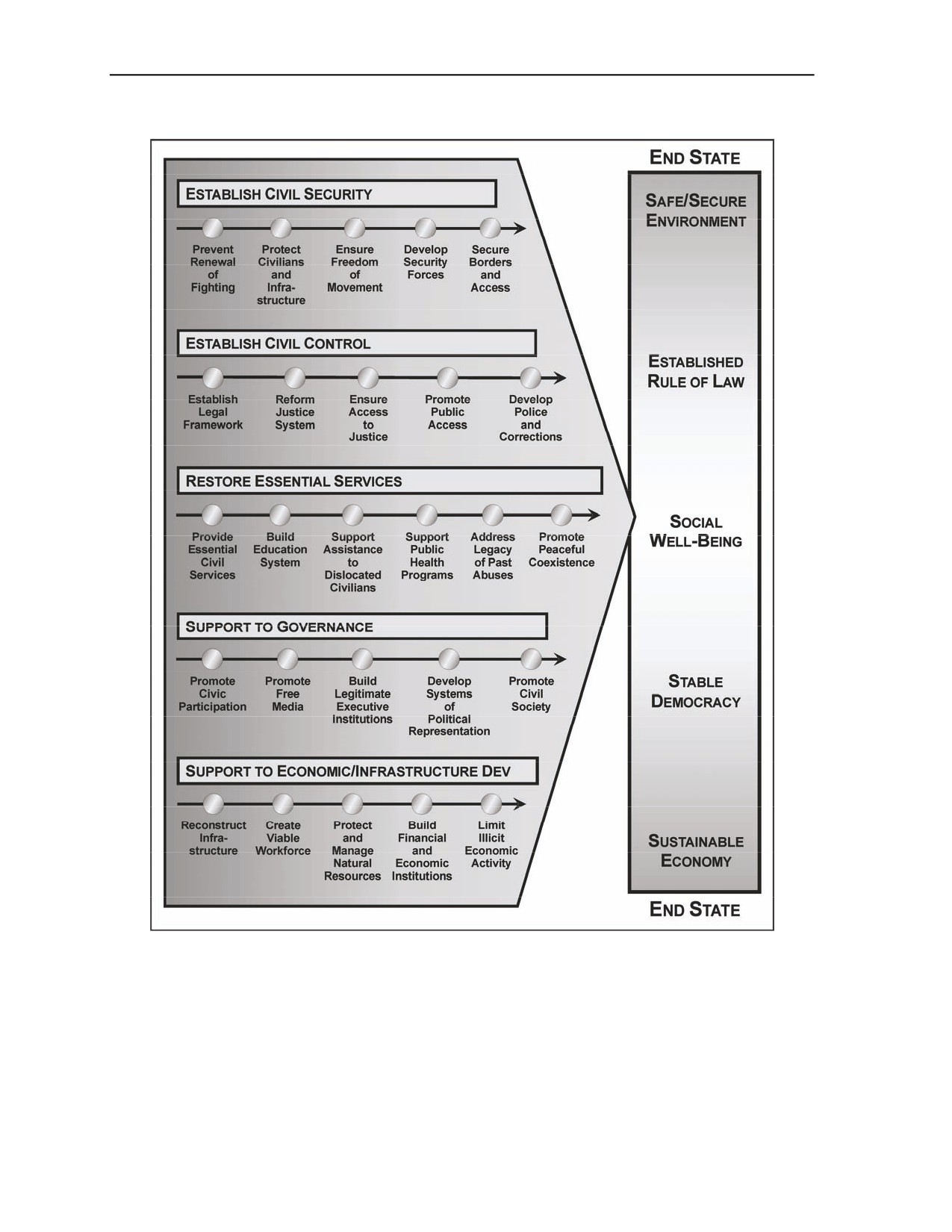
Chapter 4
Figure 4-1. Example of stability lines of effort
4-10
FM 3-07
6 October 2008
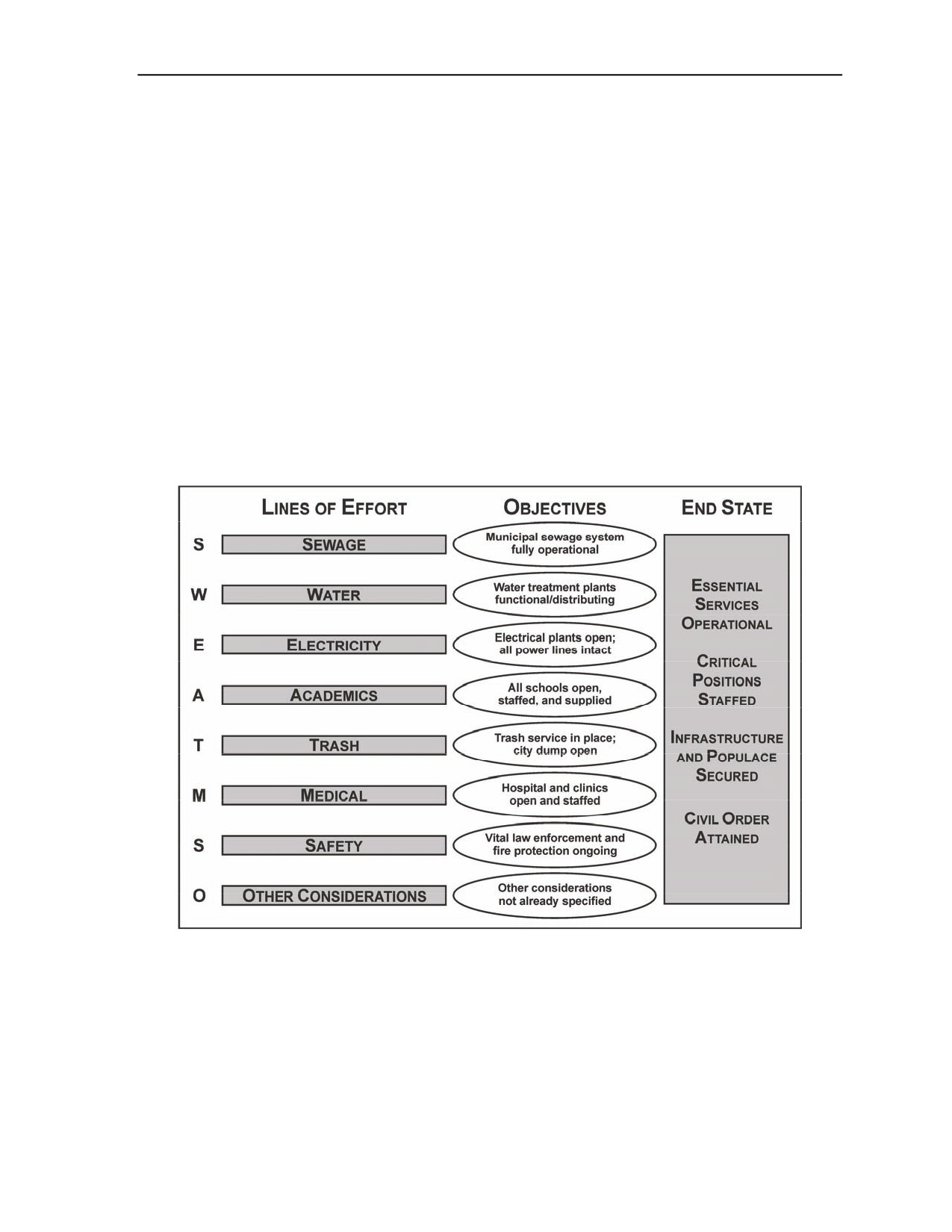
Planning for Stability Operations
4-56. Together, the stability sectors and the five primary stability tasks provide a framework for
identifying the individual tasks that exert the greatest influence on the operational environment where
stability operations are the major focus. They help to identify the breadth and depth of relevant civil-
military tasks and emphasize the relationships among them. The stability sectors form the basis for the
collaborative interagency planning and dialog that leads to developing lines of effort that synchronize the
actions of all instruments of national power.
4-57. However, at the brigade level and below, the primary stability tasks and corresponding stability
sectors are often too broad to focus effort appropriately; at lower tactical echelons, lines of effort are best
designed using core or directed mission-essential task lists.
(Chapter 3 includes additional detail on
mission-essential stability tasks.) Lines of effort may focus on specific aspects of the local situation, such
as the activities of host-nation security forces, local development projects, and essential services
restoration. For example, efforts to restore those services are often shaped using lines of effort based on the
memory aid, SWEAT-MSO (sewage, water, electricity, academics, trash, medical, safety, and other
considerations) while addressing the need to provide emergency food aid and shelter. Figure 4-2 provides
the infrastructure reconnaissance and survey model used to integrate and synchronize tactical actions,
delineate roles and responsibilities, and focus the civil-military efforts pursuit of related objectives. This
integrates efforts to reestablish local civil services with similar, related actions to establish a safe, secure
environment. (See FM 3-34.170 for detailed discussion on infrastructure reconnaissance.)
Figure 4-2. Using SWEAT-MSO
4-58. As operations progress, commanders may modify lines of effort after assessing conditions and
collaborating with other actors in the operational area. Lines of effort typically remain focused on
integrating the effects of military operations with those of other instruments of national power to support a
broader, comprehensive approach to stability operations. Each operation, however, differs. Commanders
develop and modify lines of effort to keep operations focused on achieving the end state, even as the
situation evolves.
6 October 2008
FM 3-07
4-11
Chapter 4
DECISIVE POINTS
4-59. During stability operations, decisive points may be less tangible and more closely associated with
important events and conditions, and typically relate to the human dimension of the problem. A decisive
point is a geographic place, specific key event, critical factor, or function that, when acted upon, allows
commanders to gain a marked advantage over an adversary or contribute materially to achieving success
(JP 3-0). Examples include—
z
Securing national borders.
z
Repairing a vital water treatment facility.
z
Obtaining the political support from key tribal leaders for a transitional authority.
z
Establishing a training academy for national security forces.
z
Securing a major election site.
z
Quantifiably reducing crime.
4-60. None of these examples is purely physical. Nonetheless, any may be vital to establishing conditions
for transitioning to civil authority. In stability operations, commanders identify the decisive points that
most directly influence the end state conditions. Decisive points that enable commanders to seize, retain, or
exploit the initiative are crucial. Controlling them is essential to mission accomplishment. Ceding control
of a decisive point may exhaust friendly momentum, force early culmination, or expose the force to undue
risk. Decisive points shape the design of operations. They help commanders select clearly decisive,
attainable objectives that directly contribute to establishing the end state.
4-61. The essential stability tasks offer an efficient means for commanders to identify those tasks most
closely associated with decisive points. Success in stability operations depends on the commander’s ability
to identify the tasks essential to mission success and to prioritize and sequence the performance of those
tasks with available combat power. These tasks include the essential tasks required to establish the end
state conditions that define success. These tasks are linked to the end state through decisive points.
Therefore, identifying essential tasks and tying them directly to decisive points and objectives most
effectively identifies conditions that define the desired end state. (See chapter 3 for a discussion of the
essential stability tasks.)
FORCE TAILORING AND TASK-ORGANIZING
4-62. Force tailoring is the process of determining the right mix of forces and the sequence of their
deployment in support of a joint force commander (FM 3-0). During stability operations, it involves
selecting the right force structure from available units within a combatant command or from the Army
force pool. The selected forces are then sequenced into the operational area as part of force projection.
Joint force commanders request and receive forces for each phase of an operation, both for combat and
stability tasks, adjusting the quantity and Service component of forces to match the weight of effort
required.
4-63. Army Service component commanders tailor their forces to meet specific land force requirements for
stability operations as determined by the joint force commander. They also recommend types of forces for
stability operations and a deployment sequence to meet those requirements. Force tailoring is continuous:
as new forces rotate into the operational area, forces with excess capabilities return to the supporting
combatant and Army Service component commands.
4-64. Task-organizing is the act of designing an operating force, support staff, or logistic package of
specific size and composition to meet a unique task or mission. Characteristics to examine when task-
organizing the force include, but are not limited to: training, experience, equipage, sustainability, operating
environment, enemy threat, and mobility. For Army forces, it includes allocating available assets to
subordinate commanders and establishing their command and support relationships (FM 3-0). Task-
organizing occurs within a previously tailored force package as commanders organize groups of units for
specific stability missions or modify their staff accordingly. It continues as commanders reorganize units
for subsequent missions. The ability of Army forces to task-organize gives them extraordinary agility. It
lets operational and tactical commanders configure their units to best use available resources. It also allows
4-12
FM 3-07
6 October 2008
Planning for Stability Operations
Army forces to match unit capabilities rapidly to the priority assigned to offensive, defensive, and stability
or tasks.
ASSESSMENT
4-65. Assessment is vital to the success of any operation. The commander and staff continuously assess the
current situation, gauging progress against the desired end state for the operation. Based on that
assessment, the commander directs adjustments as required, ensuring that the operation remains focused
toward establishing the conditions that represent the end state. Assessment is a critical activity intended to
inform situational understanding. It does this while providing a running comparison of the actual situation
in the operational area to the forecasted conditions described in the concept of operations, mission, and
commander’s intent. Broadly, assessment is a continuous activity that encompasses three discreet tasks:
z
Gauging the strengths, weaknesses, and vulnerabilities of enemies and adversaries.
z
Monitoring the situation while measuring the progress of the operation against the desired end
state.
z
Evaluating the progress of the operation against measures of performance and measures of
effectiveness.
4-66. Three measurement tools assist the commander and staff with the assessments function: measures of
performance, measures of effectiveness, and indicators. Measures of performance assess proper completion
of assigned tasks. Measures of effectiveness assess progress toward changing the state of the operational
environment envisioned in the commander’s intent. Indicators are subordinate measures that provide
insight into measures of effectiveness and measures of performance.
4-67. A measure of performance is a criterion used to assess friendly actions that is tied to measuring task
accomplishment (JP 3-0). At the most basic level, every Soldier assigned a task maintains a formal or
informal checklist to track task completion. The items on that checklist are measures of performance. At
battalion level and above, command posts monitor measures of performance for assigned tasks. Examples
of measures of performance include the construction of a training facility for host-nation security forces or
an increased border presence by friendly forces.
4-68. A measure of effectiveness is a criterion used to assess changes in system behavior, capability, or
operational environment that is tied to measuring the attainment of an end state, achievement of an
objective, or creation of an effect (JP 3-0). They focus on the results or consequences of task execution and
provide information that guides decisions to take additional or alternate actions. Examples of measures of
effectiveness include reduced insurgent activity, reduced inflation rates, and improvements in agricultural
production.
4-69. An indicator is an item of information that provides insight into a measure of effectiveness or
measure of performance. Indicators use available information to inform a specific measure of performance
or measure of effectiveness. A single indicator can inform multiple measures of performance and measures
of effectiveness. Valid indicators are measurable, collectable, and relevant to a specific time. Examples of
indicators include bushels of apples sold in a specific market in the past month, number of escalation of
force incidents along a given route in the past 90 days, and number of bridges repaired in a province.
4-70. Stability operations are often lengthy endeavors, and progress may be gauged over the course of
months or years. Responsiveness is a particularly important consideration for selecting measurement tools
in this type of environment. In this context, responsiveness is the speed with which a desired change can be
detected by a measurement tool. In practice, responsiveness varies greatly among potential measures of
effectiveness. It is critical to select measures of effectiveness and supporting indicators that are as
responsive as possible during the conduct of stability operations.
4-71. Continuous assessment is a key to seizing, retaining, and exploiting the initiative. It provides a
constant flow of vital information on the current situation that allows the commander and staff to quickly
act on unanticipated changes, take prudent risks, and create opportunities for future success. (See appendix
D for an overview of interagency conflict assessment.)
6 October 2008
FM 3-07
4-13
Chapter 4
TRANSITIONS
4-72. Transitions mark a change of focus between phases or between the ongoing operation and execution
of a branch or sequel. The shift in relative priority between the elements of full spectrum operations—such
as from offense to stability—also involves a transition. Transitions require planning and preparation well
before their execution. Potential transitions are identified during planning and accounted for throughout
execution; assessment ensures that progress toward such transitions is measured and appropriate actions
are taken to prepare for and execute them. The force is vulnerable during transitions, and commanders
establish clear conditions for their execution. Transitions may create unexpected opportunities; they may
also make forces vulnerable to enemy threats or unanticipated changes to the situation.
4-73. An unexpected change in conditions may require commanders to direct an abrupt transition between
phases. In such cases, the overall composition of the force remains unchanged despite sudden changes in
mission, task organization, and rules of engagement. Typically, task organization evolves to meet changing
conditions; however, transition planning must also account for changes in the mission. Commanders
attuned to sudden changes can better adapt their forces to dynamic conditions. They continuously assess
the situation and task-organize and cycle their forces to retain the initiative. They strive to achieve changes
in emphasis without incurring an operational pause.
4-74. Stability operations include transitions of authority and control among military forces, civilian
agencies and organizations, and the host nation. Each transition involves inherent risk. That risk is
amplified when multiple transitions must be managed simultaneously or when the force must conduct a
series of transitions quickly. Planning anticipates these transitions, and careful preparation and diligent
execution ensures they occur without incident. Transitions are identified as decisive points on lines of
effort; they typically mark a significant shift in effort and signify the gradual return to civilian oversight
and control of the host nation.
4-14
FM 3-07
6 October 2008
Chapter 5
Transitional Military Authority
Because of the ideological aspect of the struggle and because the United States acted as
a member of a coalition of Allies, U.S. military leaders sometimes had to add to their
traditional roles as soldiers those of the statesman and the politician. They were beset by
the problems of resolving conflicting national interests and of reconciling political
idealism and military exigency. On another level—in feeding hungry populations, in
tackling intricate financial and economic problems, and in protecting the cultural
heritage of a rich and ancient civilization—they had to exercise skills that are also
normally considered civilian rather than military.
Harry L. Coles and Albert K. Weinberg
Civil Affairs: Soldiers Become Governors
AUTHORITY AND COMMAND RESPONSIBILITY
5-1. Under extreme circumstances, where the host-nation government has failed completely or an enemy
regime has been deposed, the intervening authority has a legal and moral responsibility to install a
transitional military authority on the behalf of the population. When military forces have invaded and are
occupying enemy territory, such an authority is established by the occupying force pursuant to
international law, including The Hague and Geneva Conventions. Such authority is limited in scope by
international law. In other circumstances, transitional military authority may be established pursuant to a
United Nations Security Council resolution or a similar international legal authority, which will also
describe the limits of that authority. Furthermore, when occupying enemy territory, authority additional to
that provided by traditional sources of international law, such as The Hague and Geneva Conventions, may
be provided by United Nations Security Council resolutions or similar authority. Commanders should only
take action with regard to transitional military authority after close and careful consultation with the legal
advisor.
5-2. Transitional military authorities are installed to act on the behalf of the population and, in the case of
occupation of enemy territory, to secure the occupying force. The United Nations Security Council
resolution or similar authority may prescribe specific or additional roles of the transitional military
authority. In cases other than the occupation of enemy territory, the international community generally will
lead this effort through an intergovernmental organization such as the United Nations. The occupation of
enemy territory may result in one nation or a coalition of nations providing the transitional military
authority.
5-3. A transitional military authority may draw assistance from experienced civilian agencies and
organizations. These agencies and organizations have the expertise to establish a system of government
that fosters the gradual transition to a legitimate host-nation authority. Sometimes, however, sufficient
civilian expertise is not present or conditions of the operational environment do not support introducing
such civilian expertise. Military forces may then be required to lead this effort until they stabilize the
security situation and can safely transition responsibility for governance to civil authority and control.
5-4. Effective transitional military authority enhances security and facilitates ongoing operations while
fulfilling the legal obligations of occupying forces under international law. This authority enhances
stability by promoting the safety and security of both military forces and the local populace, reducing
active or passive sabotage, and maintaining public order. It helps ongoing operations by building host-
nation capability and capacity to perform government functions and relieving maneuver forces of the
responsibility of civil administration. Until the military authority can safely transition to civil authority and
6 October 2008
FM 3-07
5-1
Chapter 5
control, activities of the transitional military authority are performed with civilian personnel assistance and
participation. These civilians may come from the host-nation, the United States Government (USG), or
other agencies or organizations. This cooperation facilitates the transition while ensuring that all activities
complement and reinforce efforts to establish conditions necessary to achieve success.
5-5. A transitional military authority exercises functions of civil administration. These functions include
providing for the safety, security, and well-being of the populace; reestablishing and maintaining public
order; and restoring essential services. Such functions—and the tasks that support them—evolve from the
essential tasks described in the essential stability task matrix and are reflected in the five primary stability
tasks. (See chapter 3 for a discussion of essential stability tasks.) Establishing transitional military authority
may require military forces to execute tasks typically performed by the host-nation government. These
tasks may be provided for under international law, including applicable treaties—such as The Hague and
Geneva Conventions—and United Nations Security Council resolutions.
COMMAND RESPONSIBILITY FOR TRANSITIONAL MILITARY AUTHORITY
5-6. The exercise of transitional military authority is a command responsibility, exercised in accordance
with international law. To ensure that understanding and cultural awareness inform planning and the
conduct of transitional military authority, commanders at all levels maintain open, continuous dialog. They
also collaborate among the echelons of command and various agencies, organizations, and institutions that
share in efforts to restore legitimate governance to the host nation.
5-7. The authority to implement transitional military authority resides with the President and is exercised
through the Secretary of Defense and the joint force commander. Broad policy formulation and initial
planning for transitional military authority is conducted under the direction of the Joint Chiefs of Staff.
However, the joint force commander, key staff, and subordinate Service component and allied commanders
also participate to a lesser degree.
ESTABLISHING TRANSITIONAL MILITARY AUTHORITY
5-8. A transitional military authority is a temporary military government exercising the functions of
civil administration in the absence of a legitimate civil authority. It restores and maintains public order,
ensures the safety and security of the local populace, and provides essential civil services. Transitional
military authority is not limited to the occupation of enemy territory. During operations outside the United
States and its territories, necessity may also require establishing transitional military authority in various
situations, including—
z
An allied or neutral territory liberated from enemy forces.
z
A technically neutral or allied territory proven to be hostile.
z
Ungoverned areas.
5-9. The time during which a transitional military authority exercises authority varies based on the
requirements of both the military operation and international law. To establish transitional military
authority, commanders may require from the host-nation population a level of obedience commensurate
with military necessity. Such obedience provides security of military forces, maintenance of law and order,
and proper administration of the operational area. Commanders can reward civil obedience by reducing
infringement on the individual liberties of the local populace.
5-10. The degree of control exercised by a transitional military authority varies greatly due to several
factors, including—
z
The legal authorities of the military commander under international law.
z
The relationship that previously existed between the USG and the host-nation government.
z
Existing attitudes and the level of cooperation of the host nation’s national, regional, and local
leaders, and the local populace.
z
Ongoing and projected military operations.
z
The presence of hostile or enemy forces.
z
The level of civil obedience.
5-2
FM 3-07
6 October 2008
Transitional Military Authority
5-11. As conditions in the territory subject to transitional military authority stabilize, the degree of control
exercised by a military authority can decrease. Authority and control can transfer either to the legitimate
sovereign or to another civil authority.
ORGANIZING FOR TRANSITIONAL MILITARY AUTHORITY
5-12. The joint force commander is responsible for the detailed planning and operations of the transitional
military authority under the general guidelines received from the President, Secretary of Defense, and Joint
Chiefs of Staff. The structure and organization of the transitional military authority depend on—
z
International law, including any applicable United Nations Security Council resolutions or
similar authorities.
z
The mission of the military force.
z
The organization, capabilities, and capacities of deployed forces.
z
The military and political conditions of the operational area.
z
The nature, structure, and organization of the existing or former host-nation government.
z
The physical, political, economic, and cultural geography of the host nation.
EXISTING LAWS, CUSTOMS, AND BOUNDARIES
5-13. The laws of the territory subject to transitional military authority may not be changed, except to the
extent permitted by The Hague and Geneva Conventions. Commanders must consult closely and carefully
with their legal advisors before attempting to change any local laws.
5-14. In general, the military authority should not impose the customs of another nation on an occupied
territory. Implementing changes or reforms inconsistent with local customs may foster active or passive
resistance, adding friction to an already complex effort. Commanders and their legal advisors must
recognize that laws and customs often vary between political divisions of a country, such as between
provinces or municipalities. Commanders need to identify issues related to ethnic and minority groups so
policies of the transitional military authority do not inadvertently oppress such groups.
5-15. Local boundaries and political divisions may not be redrawn except to the extent permitted by
international law. Unit boundaries should normally reflect these boundaries as closely as possible.
Periodically, however, unit boundaries should shift to avoid inadvertently creating sanctuaries for
adversaries. Existing police jurisdictional boundaries and lines should be examined to determine if their
location contributes to setting the conditions for successful stability operations. Established precincts,
zones, districts, regions, counties, parishes, or other mechanisms that delineate police authority can assist in
command and control, decisionmaking, and employment of military forces. Police jurisdictional boundaries
may reflect dominant or sensitive cultural realities or fault lines that exist in a community. Some police
boundaries may also exist to ensure that police capability is commensurate or appropriate to the criminal
conditions of an area.
FORMS OF TRANSITIONAL MILITARY AUTHORITY
5-16. In general, transitional military authorities are either operational or territorial. An operational
military authority expands in authority as operations continue. In the territorial form of transitional military
authority, a separate organization is established under the direct command of the joint force commander or
an authorized subordinate.
Operational Military Authority
5-17. The responsibilities and geographic area over which a transitional military authority exercises civil
administration may expand as operations continue. Commanders oversee civil functions of government in
their respective operational areas. This includes ensuring the safety, security, and well-being of the local
populace, and providing humanitarian assistance. Under operational military authority, the existing chain
of command retains the responsibility for authority and is supported by the staff structure at that echelon.
6 October 2008
FM 3-07
5-3
Chapter 5
5-18. Concentrating authority and responsibility in the commander helps ensure that activities related to
civil administration are integrated consistently with ongoing operations. These activities include relations
between the military force and civilians. By ensuring the integrity of unity of command in an operational
area, commanders can mitigate much of the friction associated with operations in and among the local
populace. As the situation permits, the responsibility for civil administration transfers to host-nation or
other civil authority to help it return to full self-governance. Using host-nation civilian advisory groups
helps accelerate this transfer of authority.
5-19. The advantages of operational military authority, however, are tempered by the rate of military
activities. Generally, the higher the tempo within the operational area, the less the commander is able to
address the requirements of transitional military authority. In areas where the tempo of operations and civil
situation are consistently dynamic, civil administration policies may change frequently. Finally, operational
headquarters are not always assigned operational areas corresponding to known political subdivisions.
Even after hostilities, conformance of these areas to political boundaries may prove impossible, however
desirable.
Territorial Military Authority
5-20. In territorial military authority, a separate organization is established to exercise the functions of civil
administration. It may be under the direct command of the joint force commander or an authorized
subordinate or may report directly to the Secretary of Defense or the President. The military governor may
command subordinate military governors assigned to political subdivisions throughout the territory of the
host nation. Generally, the territorial military authority represents a separate chain of command from
operational forces.
5-21. A territorial military authority typically uses military manpower and expertise more effectively and
economically than an operational military authority. Established after the operational area is stabilized, a
territorial military authority may ensure improved continuity of policy and administration and better
facilitate selecting and assigning specially trained military personnel. A territorial military authority
operates under the provisions of unity of effort, representing the fundamental principles for unified action.
5-22. However, the existence of a separate chain of command within an operational area or a political
subdivision presents unique challenges to the territorial military authority. Activities of the territorial
military authority must be carefully coordinated with those of operational military forces. These activities
must not interfere with ongoing operations or expose the operational force to undue risk. To ensure unity
of effort, the territorial military authority and the operational forces must maintain close communications,
cooperation, and coordination.
5-23. In practice, the exact form of authority should be adapted to suit the political and military situation in
the operational area. A territorial military authority may draw certain features from an operational form, or
vice versa. As operations progress, the character of the military authority may evolve according to the
situation, mirroring the effort to build host-nation capacity. In certain cases, one type of military authority
may dominate in one region of the host nation, while another type is better suited for another region.
LOCAL GOVERNMENT OFFICIALS AND DEPARTMENTS
5-24. Successfully implementing transitional military authority often depends on how the host-nation
government and its civilians participate and contribute. The transitional military authority thoroughly
assesses the capability of the remaining host-nation government officials. This assessment determines if
those officials can support and contribute to transitional military authority. The long-term success of the
operation may depend on this assessment. If permitted by international law, offices that are unnecessary or
detrimental to the transitional military authority may close temporarily, and officials who refuse to serve
the best interests of the transitional military authority may be suspended. However, such officials may be
retained in an advisory capacity at the discretion of the military commander. In such cases, they should
continue to receive compensation for their services.
5-25. Generally, if a transitional military authority needs to be established, high-ranking political officials
of the former government will not continue to hold office. Such officials may include heads of the host-
5-4
FM 3-07
6 October 2008
Transitional Military Authority
nation government, cabinet ministers, and other political elites. To the extent permitted by international
law, the transitional military authority may be required to perform certain duties that would otherwise fall
to individuals in these positions.
5-26. Typically, mere membership in unfriendly organizations or political groups is not by itself
considered sufficient grounds for removal from office. However, officials who have served as active
leaders of such organizations or political groups may need to leave office. Similarly, officials who prove
unreliable or corrupt must leave office through legal action or through an open, transparent administrative
process. The willful failure of retained officials to perform their duties satisfactorily is a serious offense
against the transitional military authority.
5-27. The commander’s decisions about whether or not to retain leaders of the local government will likely
vary. In some areas, full local participation may be the norm, while in other areas entire departments and
bureaus of the local government may need to close. Where practical, the transitional military authority
should retain subordinate officials and employees of the local government. These officials can continue to
properly discharge their duties under the direction and supervision of appropriately trained military
personnel. Under certain circumstances, military forces may protect officials who continue to serve in, or
are appointed to, local public service. Hostile elements may pose a threat to these individuals, putting their
safety at risk.
5-28. In some areas, the local populace may have had very limited participation in government due to
centralized power in an authoritarian regime or a dominating foreign power. Elitist groups may also have
focused regional, provincial, or municipal power under their control, negating the participation of the local
populace. In such cases, civilian officials of the former government may flee. Even if they remain, it may
be impractical or unsafe for them to continue in office. For this reason, building new partner capability—
training local nationals to assume certain government positions—must often precede long-term efforts in
capacity building.
5-29. When a local official is removed or unavailable, the transitional military authority should seek a fully
qualified, trained, and experienced replacement. When selecting officials, the military authority should
consider their reliability, willingness to cooperate with the transitional military authority, and status in the
community. The transitional military authority does not make permanent appointments, however. If a
suitable candidate is not available, a representative of the transitional military authority should perform the
duties of the position until an appropriate replacement can assume the duties.
5-30. Commanders at all echelons must avoid any commitments to, or negotiations with, local political
elements without the approval of higher authority. Military personnel should refrain from developing or
maintaining unofficial relationships with local officials and host-nation personnel. Soldiers must refuse
personal favors or gifts offered by government officials or the local populace unless authorized by higher
authority.
GUIDELINES FOR TRANSITIONAL MILITARY AUTHORITY
5-31. For military forces, the successful completion of the mission is paramount. As long as operations
continue, the commander must exercise the necessary control and take appropriate measures with host-
nation personnel and the local populace to ensure mission success. The policies and practices adopted for
transitional military authority can reduce the possibility that civilians interfere with ongoing operations.
5-32. To ensure operations continue unimpeded by civilians, transitional military authority focuses on
ensuring the safety and security of civilians, restoring and maintaining law and order, building host-nation
capability and capacity in key areas of government, and reestablishing living conditions to a normal,
customary state. This effort is facilitated by thoroughly integrating civil affairs planning and capabilities
into the operations process and maintaining positive interaction between military forces and the local
people.
5-33. Commanders develop codes of behavior that avoid violation of, or insult to, local customs and
practices. Foreign area officers, civil affairs and military intelligence personnel, and chaplains provide
relevant information and intelligence on the local populace, specific aspects of culture, and general
6 October 2008
FM 3-07
5-5