FM 3-07 Stability Operations (October 2008) - page 3
Chapter 5
customs and behaviors. Civil affairs personnel and chaplains provide host-nation religious information that
may restrict military use or targeting of religiously consecrated buildings or locations. Commanders may
direct trained personnel, in coordination with chaplain support, to act as negotiators or mediators between
opposing groups within the local populace. (See FM 27-10 for doctrine on customary and treaty law during
land operations.)
TREATMENT OF THE POPULATION
5-34. Fair treatment of the local populace can help reduce the chance that it will be hostile to U.S. forces
and increase the chance for obtaining its cooperation. The proper and just treatment of civilians helps
military forces establish and maintain security; prevent lawlessness; promote order; and secure local labor,
services, and supplies. Such treatment promotes a positive impression of the military force; the United
States; and other government agencies, organizations, and institutions engaged in unified action. It
strengthens the legitimacy of the operation and the transitional military authority in the eyes of the
populace, bordering nations, and other members of the international community.
5-35. Nonetheless, a policy of proper and just treatment does not prevent the imposition of restrictive or
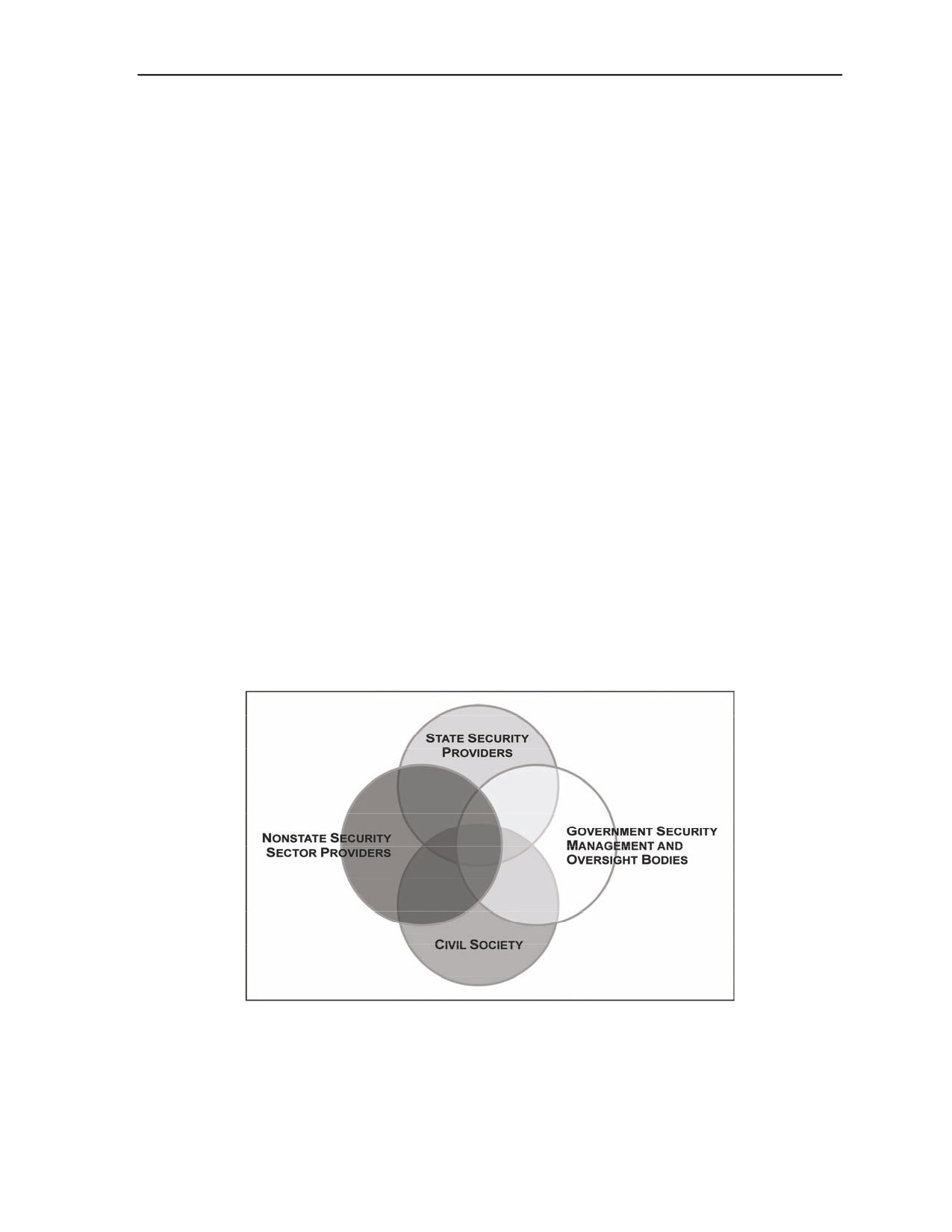
punitive measures necessary to secure the objectives of the transitional military authority. In particular,
such measures may be needed in an area where the population is actively and aggressively hostile.
5-36. The military’s policies for treating any population vary depending on several factors. These factors
include characteristics of the population, such as their attitude toward the governing forces, the degree of
technical-industrial development, socioeconomic conditions, the political system, and local history and
culture. Another determining factor is the policies of the United States with respect to the host-nation
government. The commander must become familiar with host-nation customs, institutions, and attitudes
and implement transitional military authority accordingly.
5-37. When determining policies for treating the local populace, commanders consider other factors:
z
Generally, less restrictive measures are appropriate for civilians of friendly or nonhostile states.
More restrictive measures generally are needed with civilians of hostile states.
z
Depending on the culture, the local populace may perceive certain actions as characteristic of an
illegitimate or weak military government. On the other hand, certain actions, though permissible
under international law, may aggravate an already complex civil situation or reduce the
effectiveness of the force in imposing civil control.
z
Force may be used to subdue those who resist the transitional military authority or to prevent the
escape of prisoners or detainees suspected of crimes. Force is limited to what is necessary and
must be consistent with international law. Legal advisors should be consulted when formulating
policies for the use of force and the treatment of prisoners, detainees, and other persons.
5-38. Military commanders are inherently empowered to take all prudent and proportional measures
necessary to protect their forces. However, during stability operations, the nature of the threat can often
inhibit the ability of friendly forces to differentiate between hostile acts, hostile intent, and normal daily
activity among civilians. For this reason, military commanders and forces must retain the authority to
detain civilians and an acceptable framework under which to confine, intern, and eventually release them to
the operational environment. This authority has the most legitimacy when sanctioned by international
mandate or when bestowed or conveyed from the local or regional government power. The initial or
baseline authority granted to military forces to use force and detain civilians will ultimately determine the
status of the persons they detain. The status of detained persons will further determine the manner in which
they are processed, the degree of due process they are afforded, and whether their offense is military or
criminal in nature.
ECONOMIC STABILIZATION AND RECOVERY
5-39. Transitional military authority generally focuses on security, the restoration and maintenance of law
and order, and the immediate humanitarian needs of the local populace. In certain circumstances, military
forces may need to act with regard to economic conditions to promote security and law and order.
However, international law generally limits the authority of a transitional military authority in this area.
5-6
FM 3-07
6 October 2008
Transitional Military Authority
Specific sources of international law directed at the activities of the transitional military authority, such as
United Nations Security Council resolutions, may provide additional authority. Commanders must
routinely consult legal advisors in this complex area.
5-40. When international law and the governing mandate permits a transitional military authority to engage
in economic stabilization and recovery activities, two immediate goals generally exist for the economic
sector. The first goal aims to use all available goods and services as efficiently as possible to meet the
essential needs of the local populace. The second aims to revive the economy at the local level to reduce
dependence on external support. It does this by stimulating production capability and workforce capacity.
Typically, the authority achieves this goal by quickly identifying local sources of supply and services to
support military operations. This infuses critical monetary resources into the local economy to stimulate
further growth, investment, and development.
5-41. When international law permits the transitional military authority to engage in economic stabilization
and recovery efforts, commanders have a task. They must keep in mind that actions taken to stimulate
economic recovery at the local level must be closely tied to efforts to stabilize the national economy.
Therefore, the transitional military authority must immediately draw on the expertise and advice of civilian
agencies (such as the Department of the Treasury) and organizations (such as the International Monetary
Fund) to contend with macroeconomic challenges. Issues such as stabilizing monetary policy, controlling
inflation, and reestablishing a national currency generally exceed expertise resident in the transitional
military authority. This lack of expertise underscores the necessity of introducing appropriate civilian
expertise as soon as practical or puts the success of broader economic recovery programs at risk from the
outset of operations.
5-42. Stimulating the economy at the microeconomic level is known to facilitate economic recovery,
especially in areas suffering from market failure or collapse. The transitional military authority may apply
microeconomics principles to influence local prices, supply and demand, or the availability of labor. For
example, the transitional military authority can offer small-scale grants and low- or fixed-interest loans to
encourage entrepreneurial investment and host-nation enterprise creation. These practices enable
impoverished people to invest in projects that generate income and, in many cases, begin to build wealth
and exit poverty. At the local level, this stimulation is essential to economic recovery; it sets the
cornerstone for recovery and development on a national scale.
5-43. Economic assessments are critical to the success of recovery programs. The transitional military
authority must understand the economic conditions in the operational area, the factors that affect
stabilization and growth, and the cultural nuances that influence how the market sector performs.
Developing a shared understanding of the economic situation spurs market integration, helps to identify
key needs and opportunities, increases private sector participation, and improves social and economic
cohesion throughout the host nation.
5-44. An equitable distribution of necessities—such as food, water, shelter, and medicine—supports
economic stability. To this end, it may be necessary to establish and enforce temporary controls over
certain aspects of the local economy. These controls may be designed to affect the prices of goods and
services, wage rates and labor practices, black market activity, hoarding of goods, banking practices,
imports or exports, and production rates within industry. However, these controls may also have adverse
effects that can lead to renewed violence. These adverse effects may consist of causing potential shortages
of goods and services, impeding economic progress, and causing corruption, conflict over limited
resources, and social tension Commanders must weigh the decision to implement economic controls very
carefully. In doing so, they should seek guidance from higher echelons and from personnel and
organizations with appropriate expertise. They may discover alternatives available that achieve the same
results with fewer negative consequences. They determine how well the private sector can identify
profitable lines of investment and enterprise creation quickly, stimulate market-led economic recovery, and
provide reasonably priced consumable goods and services to the population. (See FM 3-05.40 for doctrine
on populace and resources control.)
5-45. When permitted by international law, the transitional military authority may stimulate the economy
to help the local industry develop, but it must do so with the end state of sustainable, private-sector activity
in mind. This may include agriculture, manufacturing, mining, forestry, and any number of service trades.
6 October 2008
FM 3-07
5-7
Chapter 5
The transitional military authority may support the production in a specific operational area. Industries may
require some form of initial subsidization to spur productivity as well as assistance with management. In
potentially hostile areas, the transitional military authority may provide or train personnel for skilled
positions (to replace people who have fled or are not cooperative or dependable). Detailed infrastructure
assessments help to locate useable production facilities and identify damaged or inoperable facilities for
reconstruction planning.
PUBLIC HEALTH
5-46. Establishing the public health policy is a primary concern of the transitional military authority for
security, public safety, and humanitarian reasons. Sustained operations cannot exist without healthy
military forces. Without a healthy, viable force, the military cannot provide for the health and well-being of
the people adequately. To protect the health of the force, the transitional military authority may need to
take measures to safeguard, and if necessary, improve, the health of the local populace. Generally, the force
lacks the health service support capacity to provide sustained medical care for civilians. However, with
appropriate resources and security, the transitional military authority may open and secure humanitarian
access to the local populace. It may also take steps such as establishing temporary clinics, training local
health professionals, and augmenting existing medical facilities.
5-47. The transitional military authority should take steps to secure the public health infrastructure. Such
steps can enable functioning hospitals and clinics to remain open so local medical personnel can continue
to serve civilians. The transitional military authority can also repair critical transportation infrastructure to
ensure continued delivery of medical supplies and accessibility for emergency patient transport. The
transitional military authority should ensure the continued functioning of essential services infrastructure
so that adequate power, water, and sanitation are available to support health care facilities. Public health
policy should also focus on burying or cremating remains; disposing of sewage, garbage, and refuse
properly; purifying local water supplies; inspecting food supplies; and controlling insects and disease.
Preventive medicine specialists, working with civil affairs personnel, provide the capability to exercise
public health policy.
OTHER CONSIDERATIONS
5-48. During stability operations, leaders and Soldiers become governors in a much broader sense,
influencing events and circumstances normally outside the bounds of the military instrument of national
power. By virtue of their responsibilities to the local populace, they become the executors of national and
international policy. They are often required to reconcile long-standing disputes between opposing parties,
entrusted with responsibilities more suited to civilian rather than military expertise. They are frequently
called up to restore host-nation civil authority and institutions, to facilitate the transition toward a desired
political end state that supports national and international order. The burdens of governance upon a
transitional military authority require culturally astute leaders and Soldiers capable of adapting to nuances
of religion, ethnicity, and a number of other considerations essential to success.
Respect for Religious Customs and Organizations
5-49. The depth to which religious and political factors interact in other societies drives the motivations
and perceptions of the local populace. The religious conventions and beliefs of a society may significantly
influence the political dimension of conflict. Depending upon how that influence is leveraged often
determines whether conflict and instability give way to peaceful outcomes. International law mandates that
the religious convictions and practices of members of the local populace be respected. The military force
should, consistent with security requirements, respect the religious celebrations and the legitimate activities
of religious leaders. Places of religious worship should remain open unless they pose a specific security or
health risk to the military force or the local populace.
Archives and Records
5-50. Archives and records, current and historical, of all branches of the former government should be
secured and preserved. These documents are of immediate and continuing use to the military force as a
5-8
FM 3-07
6 October 2008
Transitional Military Authority
source of valuable intelligence and other information. They are of even greater importance to the
transitional military authority by providing invaluable information in running the government. Therefore,
the military force must seize, secure, and protect archives and records.
Mail
5-51. Large quantities of mail and other documents are often found in post offices or at other points of
central communications. These also represent an important source of intelligence and other information.
The transitional military authority should seize, secure, and protect such materials until the forces can
process and deliver them.
Shrines and Art
5-52. Except in cases where military operations or military necessity prevents it, the force protects and
preserves all historical and cultural monuments and works, religious shrines and objects of art, and any
other national collections of artifacts or art.
Atrocities
5-53. Under certain circumstances, the transitional military authority may be required to contend with the
aftermath atrocities, including war crimes, crimes against humanity, and genocide. To the greatest extent
possible, the transitional military authority should assist in establishing commissions and with identifying,
processing, and memorializing remains of victims. These are especially sensitive matters and must be
carried out with appropriate sensitivity and respect for local culture and customs.
Corruption
5-54. The transitional military authority will likely contend with corruption in certain sectors of the host
nation. Appropriate anticorruption measures may need to be implemented to counter the influence of
corrupt officials in host-nation institutions. Dismissing these officials, however, must be weighed against
their prestige and influence. Transparent, legitimate processes are fundamental to effective anticorruption
programs.
Vetting
5-55. Successful capacity building relies on dependable vetting processes to screen potential civil servants
from the host nation. These processes help commanders select qualified, competent officials while
reducing the threat of security risks. Vetting processes should include the participation of local inhabitants
to ensure transparency, cultural sensitivity, and legitimacy. Commanders should monitor these processes
closely to prevent the exclusion of specific religious, ethnic, or tribal groups.
COURTS AND CLAIMS
5-56. The ordinary courts in areas under control of the transitional military authority generally continue to
function during a military occupation. They may only be suspended if judges abstain from fulfilling their
duties, the courts are corrupt or unfairly constituted, or the administration of the local jurisdiction has
collapsed. In such cases, the transitional military authority may establish its own courts.
5-57. The penal laws of the occupied territory remain in force during the occupation. However, the
transitional military authority may suspend them during an occupation if they constitute a threat to security
or an obstacle to the application of the Geneva Conventions.
5-58. During an occupation, the transitional military authority may enact special decrees and penal
provisions essential for it to—
z
Fulfill its obligations under The Hague and Geneva Conventions.
z
Maintain orderly administration of the occupied territory.
z
Ensure the security of the occupying forces.
6 October 2008
FM 3-07
5-9
Chapter 5
5-59. Penal provisions enacted by the transitional military authority during an occupation may not be
enforced until they are made public to the population of the occupied territory in the national language of
that territory. Such penal provisions may not be retroactive and the penalty must be proportionate to the
offense. Courts may only apply those provisions of law that were applicable prior to the alleged offense
and are in accordance with the general principles of law.
5-60. The transitional military authority may establish courts to hear cases on alleged violations of the
special decrees and penal provisions enacted by the transitional military authority. It may also establish
courts and administrative boards for other certain purposes. These might include considering the cases of
detainees and reconsidering the refusals of requests by aliens to leave the occupied territory. For further
information on courts, commissions, and military tribunals, see the Manual for Military Commissions.
5-61. During an occupation, the transitional military authority has certain requirements. It may not declare
that the rights and actions of enemy nationals are extinguished, suspended, or unenforceable in a court of
law. During an occupation, U.S. forces and the transitional military authority are not subject to local laws.
Nor are they subject to the jurisdiction of the local civil or criminal courts of the occupied territory unless
expressly agreed to by the transitional military authority or by the occupying power. Only U.S. military
courts should try U.S. personnel subject to the Uniform Code of Military Justice. Promptly investigating,
arbitrating, and settling local damage claims—to the extent permitted by U.S. law, regulation, and policy—
can help to strengthen the credibility of the transitional military authority. (See AR 27-20 for regulatory
guidance on claims.)
5-10
FM 3-07
6 October 2008
Chapter 6
Security Sector Reform
Establishing security involves domestic security, secure borders, and relatively
accommodating neighbors. Of the three factors in achieving stabilization and
reconstruction, domestic security is the most important and often the most difficult to
achieve.
James Stephenson
Losing the Golden Hour: An Insider’s View of Iraq’s Reconstruction1
BACKGROUND
6-1. National defense and internal security are the traditional cornerstones of state sovereignty. Security
is essential to legitimate governance and participation, effective rule of law, and sustained economic
development. For a state recovering from the effects of armed conflict, natural disaster, or other events that
threaten the integrity of the central government, an effective security sector fosters development,
encourages foreign investment, and helps reduce poverty.
6-2. Establishing security in a country or region affected by persistent conflict requires a comprehensive
assessment of the drivers of conflict in the host nation. It also requires applying all available capabilities to
reduce or eliminate the drivers of conflict and create an environment of security and rule of law. In
nonpermissive areas, security is the first priority and therefore must be established before other external
actors can enter the operational area. Such areas typically require the initial use of military forces to
achieve security and set the conditions that enable the success of those actors.
6-3. The security sector comprises the individuals and institutions responsible for the safety and security
of the host nation and its people. Generally, this includes the military and any state-sponsored paramilitary
forces; national and local police; the justice and corrections systems; coastal and border security forces;
oversight bodies; militia; and private military and security companies employed by the state. The security
sector represents the foundation of effective, legitimate governance and the potential of the state for
enduring viability.
6-4. Security sector reform is the set of policies, plans, programs, and activities that a government
undertakes to improve the way it provides safety, security, and justice. Security sector reform aims to
provide an effective and legitimate public service that is transparent, accountable to civil authority, and
responsive to the needs of the public. It may include integrated activities to support defense and armed
forces reform; civilian management and oversight; justice, police, corrections, and intelligence reform;
national security planning and strategy support; border management; disarmament, demobilization, and
reintegration (DDR); and concurrent reduction of armed violence.
6-5. The National Security Strategy seeks to contribute to a world of legitimate, effectively governed
states that provide for the needs of their citizens and conduct activities responsibly within the international
system. Security sector reform (SSR) can reinforce diplomacy and defense while reducing long-term
security threats by helping to build stable, prosperous, and peaceful societies. SSR facilitates security
cooperation, capacity-building activities, stability operations, and engagement. Ultimately, SSR builds on
the Nation’s tradition of working in partnership with foreign governments and organizations to support
peace, security, and effective governance.
1
6 October 2008
FM 3-07
6-1
Chapter 6
6-6. SSR involves reestablishing or reforming institutions and key ministerial positions that maintain and
provide oversight for the safety and security of the host nation and its people. Through unified action, those
individuals and institutions assume an effective, legitimate, and accountable role; they provide external and
internal security for their citizens under the civilian control of a legitimate state authority. Effective SSR
enables a state to build its capacity to provide security and justice. SSR promotes stability, fosters reform
processes, and enables economic development. The desired outcome of SSR programs is an effective and
legitimate security sector firmly rooted within the rule of law.
6-7. SSR includes reform efforts targeting the individuals and institutions that provide a nation’s security
as well as promote and strengthen the rule of law. By recognizing the inherently interdependent aspects of
the security sector and by integrating operational support with institutional reform and governance, SSR
promotes effective, legitimate, transparent, and accountable security and justice. SSR captures the full
range of security activities under the broad umbrella of a single, coherent framework. It spans from
military and police training to weapons destruction and from community security to DDR of former
combatants to security sector oversight and budgeting.
INTEGRATED SECURITY SECTOR REFORM
6-8. The departments and agencies of the United States Government (USG), including the Department of
Defense (DOD), pursue an integrated SSR based on a whole of government approach. With the support of
the host nation, military forces collaborate with interagency representatives and other civilian organizations
to design and implement SSR strategies, plans, programs, and activities. The Department of State (DOS)
leads and provides oversight for these efforts though its bureaus, offices, and overseas missions. The DOD
provides coercive and constructive capability to support the establishment, to restructure or reform the
armed forces and defense sector, and to assist and support activities of other USG agencies involved in
SSR. Army forces participate in and support SSR activities as directed by the joint force commander.
ROLES AND RESPONSIBILITIES
6-9. To implement SSR programs, elements of the U.S. country team cooperate to design SSR strategies,
plans, programs, and activities. These programs work in partnership with the appropriate USG departments
and agencies as well as the chief of mission’s authority in the country.
6-10. The DOS leads U.S. diplomatic initiatives and oversees program support to SSR through its bureaus,
offices, and overseas missions. These efforts coordinate closely with DOS regional and functional bureaus
holding substantive or lead roles for developing and executing SSR programs. Such programs can include
the Bureau for International Narcotics and Law Enforcement Affairs, the Bureau of International
Organizations, the Bureau of Diplomatic Security, and the Office of the Coordinator for Reconstruction
and Stabilization in connection with its National Security Presidential Directive 44 responsibilities.
6-11. The primary role of the DOD in SSR is the reform, restructuring, or reestablishment of the armed
forces and the defense sector. The regional offices assume the lead DOD role in setting regional and
country priorities for SSR. The Joint Staff director of strategic plans and policy is responsible for
coordinating SSR guidance with the geographic combatant commands. These commands plan and direct
SSR activities within their areas of responsibility. The military departments and defense agencies normally
conduct SSR activities and implement SSR programs for the DOD.
6-12. The primary role for the United States Agency for International Development (USAID) is to support
the governance, conflict mitigation and response, and rule of law agenda. USAID does this through
programs aimed at building civilian capacity to manage, oversee, and provide security and justice as well
as through reintegration and reconciliation programs. USAID regional bureaus as well as a number of
functional offices may have substantive or lead roles to develop and execute SSR and rule of law
programs. These functional offices include the Office of Conflict Management and Mitigation, the Office
of Transition Initiatives, and the Office of Military Affairs.
6-13. In addition to DOS, DOD, and USAID, other USG departments and agencies provide important
capabilities for executing SSR programs. In particular, the Departments of Justice, Homeland Security,
Energy, and the Treasury may have substantive or lead roles in developing and executing SSR and rule of
6-2
FM 3-07
6 October 2008
Security Sector Reform
law. This whole of government approach to SSR is a cooperative activity. USG agencies and military
forces, intergovernmental and nongovernmental organizations, multinational partners, and civil authorities
conduct this activity. Through unified action, SSR actors integrate and synchronize reform activities to
achieve unity of effort across all agencies, organizations, institutions, and forces contributing to SSR.
Success requires a shared understanding of the desired end state and supporting conditions. This
understanding develops as the actors collaborate and is expanded upon through open and continuous
dialog. Unified action in a collaborative environment ensures more than unity of effort; it reinforces the
broader effort to integrate SSR into the overall reconstruction and stabilization strategy for the host nation.
6-14. SSR programs nested within an integrated approach are complex undertakings that require time and
patience. Managing expectations and setting realistic goals for SSR programs are essential to sustaining
such programs. Many reforms require an adjusted frame of reference that responds to changes in the
operational environment, local culture, and existing political conditions.
6-15. All SSR programs proceed from the understanding that good governance—the effective, equitable,
responsive, transparent, and accountable management of civil services and resources—and the rule of law
are essential to establishing an effective security sector. Effective, enduring security sector governance
requires legitimate oversight and control of security policy and practices. Security sector governance
expands the concept of civilian oversight and control to include administration, management, and policy
formulation.
ELEMENTS OF THE SECURITY SECTOR
6-16. The security sector consists of both uniformed forces—police and military—and civilian agencies
and organizations operating at various levels within the operational environment. Elements of the security
sector are interdependent; the activities of one element significantly affect other elements. (See figure 6-1.)
The four core elements of the security sector consist of—
z
State security providers.
z
Government security management and oversight bodies.
z
Civil society and other nonstate actors.
z
Nonstate security sector providers.
Figure 6-1. Elements of the security sector
6-17. State security providers are those bodies authorized by the state to use or support the use of force.
They include the active armed forces, civilian agencies, executive protection services, formed police units,
military and civilian intelligence services, coast guards, border guards, customs services, reserves or local
6 October 2008
FM 3-07
6-3
Chapter 6
security units
(civil defense units), national guards, government militias, and other paramilitary
organizations.
6-18. Government security management and oversight bodies are those bodies, both formal and informal,
authorized by the state to manage and oversee the activities and governance of armed and public security
forces and agencies. They may include (but are not limited to) the executive branch and ministries of
defense, interior, justice, and foreign affairs; judicial branch, national security coordination and advisory
bodies; the legislative branch and its committees; traditional and customary authorities; the ministry of
finance and other financial management bodies; civilian review boards and compliance commissions; and
local government structures. The latter includes governors, municipal councils, auditing bodies, civilian
review boards, and public complaints commissions.
6-19. The third core element of the security sector consists of the civil society and other nonstate actors.
The society consists of professional organizations, policy analysis organizations
(think tanks and
universities), advocacy organizations, human rights commissions and ombudsmen, informal and traditional
justice systems, nongovernmental organizations, media, and other nonstate actors. In addition to
monitoring security actor performance, civil society articulates the public demand for safety and security.
In some cases, particularly where a host-nation government’s capacity may be limited, civil society and
other nonstate actors fill the security void by providing some degree of security and justice to local
communities or constituents.
6-20. Nonstate security sector providers are nonstate providers of justice and security. These providers
encompass a broad range of actors with widely varying degrees of legal status and legitimacy.
Unaccountable nonstate actors or illicit power structures may engender human rights abuses. Sometimes,
they facilitate inappropriate links between the private and public security sector and political parties, state
agencies, paramilitary organizations, and organized crime. Conversely, local actors, such as informal or
traditional justice systems, may provide a stabilizing influence during and after conflict.
6-21. Although normally focused on a specific state or area, SSR activities occur in a broader regional
context. Within that context, cultural sensitivities, political concerns, or apprehensions of neighboring
states can become obstacles to reform. This makes SSR inherently complex in execution. Effective SSR
requires a broad understanding of the security environment and an appreciation for the time commitment
required to achieve long-term success.
THE MILITARY ROLE IN SECURITY SECTOR REFORM
6-22. SSR can occur at any point across the spectrum of conflict, in conditions ranging from general peace
to the aftermath of major combat operations. No matter the conditions, SSR activities focus on the stability
of the host nation to ensure conditions do not foment crisis and conflict. Within full spectrum operations,
SSR is an aspect of stability operations. SSR includes tasks, functions, and activities from each of the
primary task areas. It concentrates on generating the necessary capacity of the state and societal institutions
to support responsible governance and the rule of law.
6-23. In general, military forces play a primary role in SSR activities affecting host-nation defense
institutions and armed forces. Within the other elements of the security sector, military forces are typically
limited to a role supporting the efforts of other SSR actors. However, military forces may assume a more
active role in SSR activities affecting the nonmilitary elements of the security sector. Ultimately,
conditions of the operational environment determine the role of military forces.
6-24. When the operational environment is characterized as nonpermissive, military forces can expect to
lead reform efforts. When conditions permit, other SSR actors assume primary responsibility for their
roles, allowing military forces to relinquish the lead. Initially, the presence of nonmilitary SSR partners
may be limited, requiring military forces to undertake tasks normally performed by other interagency and
civilian partners. Even when nonmilitary SSR actors are present, the nature of the environment may require
military forces to support those actors extensively as they undertake their respective aspects of SSR. Many
civilian agencies and law enforcement forces require a permissive or semipermissive environment before
assuming responsibility for their respective elements. In certain situations, the military establishes security
and control over an area so other elements of the security sector can become active. In these situations, the
6-4
FM 3-07
6 October 2008
Security Sector Reform
military role is essential to establishing the conditions that enable subsequent SSR efforts by civilian
partners.
6-25. When the operational environment is more permissive and suitable to introduce nonmilitary SSR
partners, reform efforts can focus on all SSR activities. These activities include the transition from external
to host-nation responsibility for security and public safety. Under these conditions, SSR activities may also
transition to new host-nation institutions, groups, and governance frameworks as part of the peace process.
As the transition proceeds, military primacy recedes. Other civilian agencies and organizations come to the
forefront. They apply their expertise to their respective areas of the security sector and leave the military to
focus on the host-nation defense sector and forces. Often the situation requires disarming, demobilizing,
and reintegrating personnel associated with armed forces or belligerent groups before and as part of SSR.
Military forces can expect to assume a primary role in disarmament. As the situation and conditions of the
operational environment allow, military forces begin establishing and training host-nation forces within a
comprehensive reform program. As the host-nation forces train and validate their capabilities, they begin to
conduct operations and to assume responsibility for security. Finally, the supporting, external military
forces reduce their level of operations and supervision, and civil authorities assume full responsibility for
security sector functions.
6-26. During peacetime military engagement, military forces may conduct SSR activities as part of the
theater security cooperation plan. The military element of SSR during peacetime military engagement helps
reform established host-nation defense institutions and processes as well as security force assistance
activities aimed at promoting SSR objectives in host-nation forces. During peacetime military engagement,
the chief of mission carries out SSR. The military role in SSR is normally limited to helping reform host-
nation defense activities and security force assistance to the host-nation armed forces. These efforts may
impact other, nonmilitary aspects of SSR. The military element of the security sector closely coordinates
with the other elements, consistent with a collaborative, comprehensive approach.
SECURITY SECTOR REFORM AND HOST-NATION AUTONOMY
6-27. Stability operations seek to enhance the legitimacy of host-nation governance while leveraging
efforts to reform the security sector. The host-nation institutions, laws, and processes, however
developmental, should play a central role when formulating and implementing SSR programs and
processes. External influences frequently shape SSR policy formulation and implementation, especially
when the host-nation government functions poorly. Nonetheless, SSR planners carefully uphold the host
nation’s sovereignty by integrating its government into reform planning and execution.
6-28. Comprehensive peace agreements may be helpful where a national constitution is not in place or is
not practiced. National security strategies or policies, national defense acts, and national justice codes
illustrate host-nation guidelines that can help to add structure to the reform effort. Also important are host-
nation groups in charge of specific responsibilities, such as government reform agencies, national
reconciliation commissions, and national DDR bodies.
6-29. Participants in SSR help develop the program using their own policy guidance and policy
implementation mechanisms. For example, United Nations (UN) Security Council resolutions define the
mandates of UN peacekeepers and UN-integrated missions. National policy guidance; national justice
systems; and relevant national legislation, treaties, and agreements—both bilateral and multilateral—
provide a framework for host-nation and military forces. U.S. security assistance, in particular, must
proceed within the framework of legislated provisions governing the delivery of foreign assistance by U.S.
agencies, both military and civilian. While SSR integrates these influences, ultimately, it reflects the host-
nation institutions, laws, and processes.
SECURITY SECTOR REFORM PLANNING
6-30. Sustainable SSR depends on thorough planning and assessment. Working within a collaborative
environment, the various actors consider the unique capabilities and contributions of each participant. The
ensuing plan aims for a practical pace of reform and accounts for the political and cultural context of the
situation. The plan accounts for available resources and capabilities while balancing the human capacity to
6 October 2008
FM 3-07
6-5
Chapter 6
deliver change against a realistic timeline. The SSR plan reflects host-nation culture, sensitivities, and
historical conceptions of security. It does not seek to implement a Western paradigm for the security sector,
understanding that a Western model may not be appropriate. As with the broader campaign plan, the SSR
plan seeks to resolve the underlying sources of conflict while preventing new or escalating future security
crises.
6-31. The level of host-nation development—especially as it pertains to poverty and economic
opportunity—is an important consideration in SSR planning. High levels of poverty and endemic
corruption significantly challenge SSR efforts. These factors—both at the individual and institutional
levels—are typically evidenced by inadequate government revenues and a chronically under-resourced
public sector. SSR programs are tailored to challenges that such environments pose. These programs
confront endemic corruption in the public sector and accommodate limited host-nation public
administration and public management capacities. External resourcing and external fiscal management for
elements of the host-nation security sector, including its military institutions, may be necessary until
sufficient host-nation capacity exists to sustain SSR activities.
6-32. Ideally, the SSR plan is informed and guided by host-nation security strategy and defense policy.
However, in states without established, legitimate government institutions able to develop mature strategy
and policy, SSR planning draws on a broad review of international security strategy and defense policy
before implementing a plan. This review, which accounts for the nuances of host-nation culture, ensures
the SSR plan reflects the needs of the country. It also ensures the end state is a security apparatus
appropriate for the needs of the state and its people.
PRINCIPLES OF SECURITY SECTOR REFORM
6-33. Effective SSR requires unity of effort and shared vision among the agencies, organizations,
institutions, and forces contributing to the reform process—a comprehensive approach. SSR is a
cooperative activity, conducted with the other agencies of the USG, intergovernmental organizations,
nongovernmental organizations, multinational partners, and the host nation. Integrated programs that
consider relationships among organizations, sectors, and actors increase the likelihood of success,
minimize unforeseen developments, and ensure the most effective use of resources. Six principles guide
SSR:
z
Support host-nation ownership.
z
Incorporate principles of good governance and respect for human rights.
z
Balance operational support with institutional reform.
z
Link security and justice.
z
Foster transparency.
z
Do no harm.
Support Host-Nation Ownership
6-34. The principles, policies, laws, and structures that form an SSR program are rooted in the host
nation’s history, culture, legal framework, and institutions. Notably, the needs, priorities, and
circumstances driving SSR differ substantially from one country to another. Assistance is designed to
support local civil authorities, processes, and priorities to ensure the sustainability of SSR. As a result, SSR
programs generally should be conceived as lengthy in nature.
6-35. Ultimate responsibility for SSR rests with the host nation. Commanders clearly must respect the
views and interpretations of the host nation regarding what it perceives the security architecture should
look like. The host nation bases its perception on threats and its broader security needs. SSR programs nest
within existing host-nation social, political, and economic institutions and structures. Commitment and
constructive engagement by the host nation’s leaders ensures that institutions, capabilities, and forces
developed under SSR will be enduring, appropriate to the needs of the host nation, and trusted by the host-
nation government and its population.
6-6
FM 3-07
6 October 2008
Security Sector Reform
Incorporate Principles of Good Governance and Respect for Human Rights
6-36. Accountability, transparency, public participation, and legitimacy are integral features of security
force development. Technical assistance not only aims to build operational capability but also to strengthen
adherence to democratic principles and build respect for human rights. Security forces—whether military,
police, or intelligence services—carry out their core functions in accordance with these principles. This is
especially important in rebuilding countries where the legacy of abuse by the military may have eroded
public confidence.
Balance Operational Support with Institutional Reform
6-37. Incentives, processes, resources, and structures are placed so that externally supported reforms,
resources, and capacities are sustained after the assistance effort ends. Building training platforms and
providing material assistance without parallel efforts to help develop the infrastructure, personnel, and
administrative support systems ultimately undermines the ability of host-nation forces to perform their
security functions. Equal emphasis is placed on how recipients of security force assistance efforts are
managed, monitored, deployed, sustained, and supported. Success and sustainability depend on developing
the institutions and governance processes that support SSR as well as the human capacity to lead and
manage the elements of that sector.
Link Security and Justice
6-38. Host-nation security policies and practices are nested in the rule of law. Rule of law cannot flourish
in crime-ridden environments or where public order breaks down and citizens fear for their safety.
Assistance efforts consider the diverse array of actors and institutions that compose the justice system.
Police assistance undertaken without accompanying efforts to reform other parts of the justice system
might result in increased arrests without the means to adjudicate individual cases or to support the
incarceration or rehabilitation of convicted offenders. Similarly, focusing solely on reforming and
rebuilding host-nation military forces while police services and justice system institutions languish can lead
to the militarization of civil security. It also might encourage using military forces in roles inconsistent
with existing frameworks for host-nation justice and rule of law.
Foster Transparency
6-39. Effective SSR programs are conducted as transparent and open as possible. Program design includes
robust communications to foster awareness of reform efforts among host-nation officials and the
population, neighboring countries, the donor community, and other actors.
Do No Harm
6-40. In complex environments, donor assistance can become a part of the conflict dynamic serving to
either increase or reduce tension. As with any policy or program activity that involves changes to the status
quo, actors ensure their efforts do not adversely affect the security sector or the wider political climate in
unanticipated or unaddressed ways. Developing a thorough understanding of the system for which change
is sought is a prerequisite for the success of any SSR-related activity. Actors complete a risk assessment
prior to implementation and make adjustments as required during the conduct of SSR.
FOUNDATIONS OF SECURITY SECTOR REFORM
6-41. During SSR, participating military forces understand that the ultimate responsibility for reform rests
with the host nation. SSR planning is based on the recognition that successful efforts require an extended
commitment of time and resources. The military judiciously selects and uses forces to create a secure
environment for an SSR program to progress unimpeded. The military may provide temporary capability
and expertise, but long-term success in reform depends on how quickly and effectively it transitions to
appropriate civilian agencies and the host nation. The military participates in SSR under principles for
stability operations.
6 October 2008
FM 3-07
6-7
Chapter 6
6-42. The foundations of SSR are—
z
A concept of security developed by the host nation and ingrained in its culture. The core
values of a SSR program reflect the needs of the people and inculcate the principle of
ownership.
z
A framework that encompasses all security sector participants and challenges. A SSR
program provides a framework to structure thinking concerning the diverse security challenges
facing host nations and their populations. This inclusive framework is essential to better
integrate SSR policies and greater civilian involvement and oversight. It is founded on
understanding the security sector from the host nation’s perspective.
z
Cooperation with and among civil authorities. SSR approaches are developed in cooperation
with civil authorities. SSR approaches have many sectors; they are based on a broad assessment
of the security and justice needs of the people and the state. Strategies reflect a comprehensive
plan that encompasses all participants in the security sector.
z
Human rights. A SSR program is based on democratic norms and underpinned by international
human rights principles. SSR creates an environment characterized by freedom from fear by
measurably reducing armed violence and crime. A SSR program enhances the institutional and
human capacity for security policy to function effectively and for justice to be delivered
equitably.
z
Clear policies, accountability, and professionalism. SSR programs include well-defined
policies that strengthen the governance of security institutions. Programs build professional
host-nation security forces that are accountable to civil authorities and capable of executing their
responsibilities. The security sector and supporting SSR activities adhere to basic principles of
governance and broader public sector reform programs, including transparency and
accountability.
CONSIDERATIONS FOR PLANNING
6-43. Coordinated interagency planning is required to ensure balanced development of the entire security
sector. Imbalanced development can actually undermine the long-term success of SSR efforts. Integrated
planning helps prioritize and sequence the activities of each contributing agency into a comprehensive SSR
strategy. SSR planning must account for several interrelated factors that influence reform:
z
Cultural awareness.
z
Leadership capacity building.
z
Public trust and confidence.
z
Host-nation dependency.
z
Perseverance.
z
End state.
Interactions among the security sector and these factors complicate reform. Additionally, actions taken to
reform one aspect of the security sector invariably affect reform activities in another. Effective assessment
of these factors will drive the process and help define success.
Cultural Awareness
6-44. Regardless of the need to develop a host nation’s security forces quickly, SSR requires considerable
tolerance, cultural awareness, and an environment of mutual respect. In particular, actors working closely
with host-nation forces must respect the security culture of the host nation. This culture is shaped by
history, language, religion, and customs and must be understood. Cultural awareness and sensitivity are
necessary to dispel the natural tensions that arise when external actors dictate the terms and conditions of
SSR for the host nation. Responsiveness, flexibility, and adaptability to local culture help limit resentment
and resistance to reform while generating local solutions to local problems. Local help fosters acceptance
and strengthens the confidence of the citizens in reform.
6-8
FM 3-07
6 October 2008
Security Sector Reform
Leadership Capacity Building
6-45. Challenges associated with developing capable, legitimate, and accountable security forces require
capable leadership in the host-nation security sector at all levels. To establish the conditions for long-term
success, SSR may help the host nation identify and begin training and advising security force leaders as
early as possible. Such efforts must avoid undermining host-nation legitimacy while recognizing that
assistance, advice, and education may be needed.
6-46. Programs focused on developing senior leaders, such as those conducted by the DOD Regional
Centers for Security Studies, may prove helpful. Often the host nation can augment programs for officer
training and staff college courses of participating forces and may even develop similar institutions. This
participation ensures that future leaders gain the knowledge and skills to manage security forces effectively
while meeting the broader responsibilities normally associated with leaders in the security sector.
Public Trust and Confidence
6-47. In rebuilding the institutions of a failed state, commanders must engender trust and confidence
between the local populace and the security forces. As SSR proceeds, these security forces carry a
progressively greater burden in ensuring public safety. Frequently, they do so in an environment
characterized by crime and violence. This proves true in areas recovering from violent, predatory forces.
Recovery requires a community-based response that uses the unique capabilities of the security forces and
police. Operating in accordance with the laws of the host nation, the success of these forces will help to
gain the trust and confidence of the local populace. Furthermore, increased public confidence engenders
greater desire among the people to support the efforts of the security forces.
6-48. External participants in SSR must focus on enhancing the functionality of host-nation security forces
while sustaining and strengthening the perception of legitimacy for civilians. Public confidence is further
strengthened as host-nation forces support activities that foster civil participation. These activities, such as
providing security for elections, associate the security forces with positive processes; this improves the
credibility of host-nation security forces while providing visible signs of accountability and responsibility.
Host-Nation Dependency
6-49. During reform, the risk of building a culture of dependency is mitigated by adopting a training
process. This process sequentially provides training and equipment to security forces, a dedicated advising
capability, and an advisory presence. After initial training efforts, this reform helps host-nation security
forces progress toward the transition of security responsibility. A robust transition plan supports the
gradual and coherent easing of host-nation dependency, typically in the form of increased responsibility
and accountability.
6-50. Depending on the security environment, external actors in SSR may need to protect new host-nation
security forces from many direct and immediate threats during their development. While this requirement
usually applies only during initial training, security forces remain at risk throughout their development
during SSR; these threats may contribute to problems with discipline, dependability, and desertion. In
extreme circumstances, protecting host-nation security forces may necessitate training outside the physical
boundaries of the state.
Perseverance
6-51. SSR is a complex activity, and participants must demonstrate persistence and resilience in managing
the dynamic interactions among the various factors affecting the reform program. Within the SSR
processes, some failures are likely. Early identification of potential points of failure, such as corruption
within the police force, allows for mitigating action.
End State
6-52. In stability operations, the external assistance force cannot impose success on the host nation. The
host-nation government should emerge as the only legitimate authority. Within SSR, security forces are
6 October 2008
FM 3-07
6-9
Chapter 6
developed to enhance the legitimacy of the host-nation government. The resulting security forces must
be—
z
Competent from the ministerial level to the individual soldier and police officer, across all
related fields of interest and functional specialties.
z
Capable in size and effective enough to accomplish missions, remain sustainable over time, and
maintain resources within state capabilities.
z
Committed to the security and survival of the state, the preservation of the liberties and human
rights of the citizens, and the peaceful transition of authority.
z
Confident in the ability to secure the country; earning the confidence of the citizenry, the
government, and the international community.
TRANSITION OF AUTHORITY
6-53. Transferring security responsibility from intervening to host-nation forces is done according to the
tactical, operational, and strategic conditions identified during SSR planning. As forces establish suitable
conditions, responsibility for security gradually transitions to the local, provincial, and national
government. During transition, the presence of advisors is reduced, although some advisors may be
retained to ensure the long-term sustainability of SSR. Transition planning must begin early and focus on
timeline adherence.
6-54. During the transition of authority, a formal network of committees or consulting agencies validates
the readiness and accountability of host-nation security forces. Progress toward transition is gauged
through a process that confirms the performance and capabilities of host-nation security forces. Typically,
forces gauge capabilities through test exercises similar to those used to validate the readiness of forces for
contingency operations. These procedures prevent a premature transition of authority, which can lead to a
loss of confidence and cause the populace to seek alternative means of security.
6-55. When the host nation emerges from an extended period of violent conflict characterized by
widespread human rights violations, a rigorous vetting process should reestablish the legitimacy of
reconstituted or rebuilt security forces. Such processes must be demonstrably neutral and free from
political manipulation and may require external control or administration. When public records have been
destroyed or lost, effective vetting may require detailed background investigations by trained interviewers
to identify past human rights violators and to screen out unsuitable recruits from reconstituting security
forces.
COMPREHENSIVE SECURITY SECTOR REFORM
6-56. Through unity of effort, execution of SSR unites all elements of the security sector. The activities of
military forces may be focused on reforming the host-nation military forces, but those actions are only part
of a broader, comprehensive effort to reform the entire security sector. Military forces may directly support
related reform efforts or indirectly support the efforts as related, integrated activities.
6-57. Once the security environment is considered stable, other participating agencies, organizations, and
institutions can safely begin operations in the operational area. Military forces gradually transfer
appropriate responsibilities to other participants in the stability effort, one military force to another military
or civilian group. These transitions allow the military force to focus their efforts on other stability tasks,
many of which fall within the bounds of the broader effort to reform the security sector of the host nation.
CIVILIAN OVERSIGHT AND CONTROL
6-58. Establishing civilian oversight and control of the defense sector is critical to the success of any SSR
program. Oversight and control mechanisms and processes ensure civilian control of the military, a
fundamental tenet of effective governance. These processes and mechanisms also ensure that the various
components of the defense sector are accountable to elected and appointed civilian leadership, both in the
executive and legislative branches. That accountability is essential to establishing a sound foundation for
defense budget planning and program implementation.
6-10
FM 3-07
6 October 2008
Security Sector Reform
6-59. The primary agent of civilian oversight and control within the defense sector is the ministry of
defense. The ministry of defense operates within some form of interagency or cabinet framework that
establishes political links and accountability between the ministry and the executive branch. Other agencies
involved in the defense sector may share oversight and control responsibilities, such as the cabinet-level
leadership of intelligence agencies, executive protection forces, and border forces. In transitioning or post-
conflict states, these institutions are frequently weak, dysfunctional, or altogether absent. SSR programs
encompass restructuring, rebuilding, and, in some cases, creating entirely new institutions to provide
oversight and control mechanisms for the defense sector.
6-60. The legislative branch plays an important role in oversight and control. The legislature typically
determines the funding level of government activities while providing the statutory framework for planning
and implementation. Constitutional frameworks may vest in the legislature a share in the appointment of
senior government officials, or in the structuring, commissioning, and promoting of military personnel. In
this context, building an effective partnership between the executive and legislative branches becomes an
important enabler of effective SSR.
6-61. Most transitioning and post-conflict states clearly define and delineate the roles and responsibilities
of military forces and law enforcement agencies as they provide internal security for the state. As the
security apparatus of a state begins to fracture, the necessary distinctions between military and law
enforcement roles and missions erode or disappear entirely. This situation frequently leads to inappropriate
military involvement in political affairs. As a result, military forces may subsume justice and law
enforcement functions although they lack the training or equipment. Restoring the distinction between
military and law enforcement functions, as well as providing robust mechanisms to sustain that distinction,
is fundamental to SSR.
6-62. The primary agent of civilian oversight and control over law enforcement agencies will likely be a
separate ministry, such as the ministry of interior or of justice. As host-nation capacity for law enforcement
increases, inherent power struggles may develop as police leaders strive for primacy in the management of
social order. For this reason, it becomes imperative to facilitate forcing functions and forums that improve
communications and coordination between disparate ministries that have responsibility for maintaining
civil security. Often, the threshold delineating military and police primacy issues depends on the
quantifiable level of violent activities in an area. This threshold serves as a quantifiable measure of
effectiveness for military or civilian security sector efforts.
SECURITY FORCES STRUCTURE
6-63. An integrated approach is essential to building partner capacity in the security sector. While it is
important to develop all essential capabilities, structures must be kept simple. In determining the optimal
security forces structure, SSR accounts for the following:
z
Political oversight and control in the form of capable ministries or Departments of Defense,
Justice, and Interior. This aspect of SSR links the political direction of the state to the
implementation of national interests and policies.
z
National force headquarters that provides overall command and translates national interests and
policies to the operational level for military, police, and other security forces. For the military
element, this may be a joint structure.
z
Appropriate legislation defining the role of the different security sector elements and forces and
delineating oversight mechanisms in both the legislative and executive branches.
z
Operational headquarters for both the military and law enforcement sectors. These may be
regionally based, capability based, or a combination of the two.
z
Staff disciplines at all levels, from strategic to tactical, for both military and law enforcement
sectors.
z
The ethnic and cultural factors that influence the security sector. SSR approaches must be able
to accommodate significant cultural differences across societies and states.
6-64. The size, structure, and capabilities of tactical organizations, whether in the law enforcement or the
military sector, depend on various considerations. Tactical forces must meet all the operational functions
6 October 2008
FM 3-07
6-11
Chapter 6
identified when assessing the security sector. This assessment informs SSR; an interagency team completes
the assessment, drawing on all of the functional specialties required for a successful program. The
considerations and factors guiding the assessment include the following:
z
Required capabilities and roles. This includes consideration of the requirement for different
types of forces. These requirements stem from a thorough threat analysis that helps to identify
functional capabilities and requirements.
z
Historical lineage and traditions (their positive and negative influences) of previous host-nation
security forces.
z
A realistic consideration of available resources, including near- and long-term manpower.
z
Legal and political requirements for peace settlements, mandates, host-nation tools of
governance, bilateral agreements, and similar political documents, frameworks, or processes that
shape the overall stability operation.
Equipment and Resources
6-65. An integrated and synchronized training plan provides guidelines for identifying and balancing
resource requirements; accounts for resource planning and prioritization; and identifies budget, funding
control, execution, and reporting requirements. It also addresses the funding, procurement, allocation, and
distribution of resources necessary to reform host-nation security forces. This is a broad task with the
military advising and assisting the host nation and other actors in the stability operation. Training plans
address not only how to use the equipment and resources, but also how to maintain them. Likewise,
equipment procurement includes sustainment plans that provide life cycle management for materiel
systems.
Infrastructure and Essential Services
6-66. The initial SSR assessment identifies requirements to support the entire program, including the
reform of host-nation security forces. These requirements are incorporated into the broad plan for SSR, and
resources are allocated against them. Typically, these requirements consist of the basic infrastructure and
services necessary to support training and operational requirements. While commanders try to use existing
infrastructure, they may need to acquire resources to improve or expand that infrastructure to support the
reform effort.
Geographical Force Dispositions
6-67. Several factors influence the geographical distribution of restructured security forces. These factors
include regional requirements, force role and capabilities, geography and climate, and existing
infrastructure. Other considerations include differing cultural regions, local and regional associations, and
historical lines of authority.
Accession and Training Policies
6-68. SSR planning includes policies for accession and training host-nation security sector personnel.
These policies are developed with, and as a complement to, the broad program for DDR. The accession
effort includes a thorough, transparent vetting of all prospective recruits by an external agency that has
credibility with all participants in SSR; vetting is conducted in consultation with civil authorities.
REQUIREMENTS FOR FORCE DEVELOPMENT
6-69. The initial SSR assessment identifies the nature and type of forces to be developed and their
respective capabilities. While these capabilities reflect host-nation aspirations, they also represent a
detailed capability requirements analysis. This ensures a qualitative, as well as quantitative, foundation for
the development program that accounts for future contributions by the host nation. All efforts to build
capable forces are balanced with support to the institutional systems, processes, and managers that support
them.
6-12
FM 3-07
6 October 2008
Security Sector Reform
Military Forces
6-70. Military forces are developed primarily to counter external threats. The design of these forces
develops from the analysis of those threats and the specific capabilities required to counter them. Other key
military missions include providing humanitarian assistance, and in special cases, countering certain types
of internal military threats. External organizations executing SSR and the individuals assigned to them are
selected for their specific abilities to train and advise the developing force. For example, military police
should help develop military police forces. This provides for appropriate development of expertise while
facilitating the advising process.
Justice and Law Enforcement Forces
6-71. An effective and accountable justice system and supporting law enforcement (especially police)
forces are central to a legitimate security framework. Although the military may be involved initially in
developing the justice and law enforcement forces, this task should be assumed by other agencies as soon
as possible. Qualified, professional justice sector and police trainers support an improved advising process
and ensure sustainable development with appropriate civilian oversight. Their expertise ensures an
appropriate delineation of roles and responsibilities between military forces and law enforcement sectors.
In policing, development of organizational substructure—supervision, process, policy, internal governance,
planning, and budgeting—are vital to the long-term sustainability of reform efforts.
Other Security Forces
6-72. Requirements may arise for the development of other forces within the security sector. These
requirements may include specialized security forces; presidential guards; a coast guard, border control,
and customs services; or intelligence services. The host nation provides the specific requirements on which
to develop these forces. Until such forces are developed and trained, other security forces assume
responsibilities outside of their intended domain. In such cases, due caution ensures forces conduct
operations in compliance with relevant host-nation constitutional and statutory provisions and consistent
with international law and humanitarian guidelines. Such caution extends to how civilians perceive
operations and the legitimacy of the forces supporting the operation; continuous assessment ensures that
commanders remain aware of how their operations affect the local populace and the broader SSR program.
6-73. In general, the capabilities of the security forces reflect the roles for which they were designed and
trained. There may be overlap, particularly in times of emergency or until all planned forces are developed
and trained. Cooperation between military and police is emphasized from the outset, permitting both to
maintain their appropriate and distinct constitutional roles in the security sector. SSR educates host-nation
forces, civilian oversight agencies, and political leadership on the appropriate roles for each part of the
security forces. Military forces should be restricted to their role as a force of last resort in the face of
military threats. Their use may require several approaches within the constitutional rule of law when
military support to civil authority is required.
6-74. Ultimately, force development clearly defines and institutionalizes the separation of roles and
responsibilities between military forces and law enforcement agencies. Usually, their organization,
training, and equipment reflect this distinction; their design clearly limits the amount and degree of force
that law enforcement agencies can generate. For example, civilian police entities may adopt military-style
command structures and systems but not their mobile organizational structure. Another separation exists in
that police forces provide services to a particular local area, neighborhood, or community. Since they lack
organization for a large-scale maneuver, they do not generally form like military forces.
INITIAL TRAINING AND EDUCATION
6-75. In areas of the world torn by conflict, disaster, poverty, or internal strife, host-nation security forces
often possess only rudimentary proficiency and development. Initial training for security forces must focus
primarily on developing basic skills appropriate to their roles. Host-nation security forces should not train
for specialty skills until personnel exhibit sufficient competence and confidence with these basic core
6 October 2008
FM 3-07
6-13
Chapter 6
skills. Advanced technology or materiel, while representative of increased status among developing forces,
often extends beyond the comprehension of local forces, creating an unnecessary training burden.
6-76. To foster development and ease transition, training exercise programs are progressive. They test all
levels of command, gradually bringing together all the individuals and institutions representing the new
security sector, from team-level organizations through senior ministerial personnel. Host-nation security
forces also require a complementary education program that supplements training, ensures understanding
of roles and responsibilities, and reinforces relationships across the security sector with the local populace.
Education and training must encourage civilian oversight of the security forces and a culture of service to
the host nation and its population.
DEVELOPING SECURITY FORCES
6-77. Security force assistance is the unified action to generate, employ, and sustain local, host-
nation, or regional security forces in support of a legitimate authority. It is integral to successful
stability operations and extends to all security forces: military, police, and border forces, and other
paramilitary organizations. This applies to all levels of government within the host nation as well as other
local and regional forces. Forces are developed to operate across the spectrum of conflict—combating
internal threats such as insurgency, subversion, and lawlessness; defending against external threats; or
serving as coalition partners in other areas. It is critical to develop the institutional infrastructure to sustain
security force assistance gains; host-nation security forces must have the capability to perform required
functions across the stability sectors. They must exist in sufficient numbers to have the capacity to perform
these functions wherever and whenever required. Finally, they must have the sustainability to perform
functions well into the future, long after external forces are no longer engaged. Successful security force
assistance involves thorough and continuous assessment and includes the organizing, training, equipping,
rebuilding, and advising of the forces involved.
6-78. Some security force assistance operations require organizing new institutions and units from the
ministerial level to the smallest maneuver unit. Building infrastructure-related capability and capacity—
such as personnel, logistics, and intelligence—is necessary for sustaining the new host-nation capacity.
Developing host-nation tactical capabilities without the sustainment structure is inadequate. Host-nation
organizations reflect their own unique requirements, interests, and capabilities; they should not simply
mirror existing external institutions.
6-79. Training is conducted in institutions—such as training centers and academies—in units, and by
individual personnel. It includes a broad range of subject matter including those issues that make security
forces responsive to a civilian oversight and control.
6-80. Equipping is accomplished through several mechanisms including traditional security assistance,
foreign military support, and donations. Equipment must be appropriate for host-nation sustainment—
appropriate to the physical environment of the region and within reasonable appropriations for operations
and maintenance—and property accountability procedures. Equipping police forces can be a dangerous and
complex process, occurring at numerous, geographically disparate locations across an operational area.
6-81. In many cases, particularly after major combat operations, it may be necessary to rebuild—or
build—infrastructure to support security forces. This typically includes facilities and materiel but may also
include physical plants, information systems, communications infrastructure, transportation, personnel
management processes, and other necessary infrastructure. Rebuilding police facilities often differs from
rebuilding military compounds. Police stations must be approachable and accessible to the community they
support to be legitimate and effective.
6-82. Advising host-nation units and institutions is key to the ultimate success of security force assistance.
This benefits both the state and the supporting external organizations. To be effective, advising requires
specially selected and trained personnel.
6-83. Military forces conduct security force assistance according to certain imperatives. Like the principles
of war, these imperatives, if followed, give the operation the best chance for success:
6-14
FM 3-07
6 October 2008
Security Sector Reform
z
Understand the operational environment. An in-depth understanding of the operational
environment—including the available friendly host-nation forces, the opposing threats, and civil
considerations—is critical to planning and conducting effective security force assistance
operations.
z
Provide effective leadership. Leadership, a critical aspect of any application of combat power,
is especially important in the inherently dynamic and complex environments associated with
security force assistance.
z
Build legitimacy. Ultimately, security force assistance aims to develop security forces that
contribute to the legitimate governance of the local populace.
z
Manage information. Disseminating timely and protected relevant information, integrating it
during planning, and leveraging that information appropriately during execution is critical to
successful security force assistance. Effective and efficient information management supports
decisionmaking throughout capacity building.
z
Ensure unity of effort. The effort will include security force assistance and host-nation forces
and may include large-scale conventional forces, as well. Additionally, other joint, interagency,
intergovernmental, and multinational organizations involved in security force assistance need to
be integrated into the overall effort.
z
Sustain the effort. Sustainability consists of two major components: the ability to sustain the
security force assistance effort throughout the operation and the ability of the host-nation
security forces to sustain their operations independently.
6-84. As host-nation security forces gradually progress toward the transfer of authority, close relationships
forged between host-nation forces and their partners prove essential to sustainable development and
successful transition. Genuine relationships engender trust and confidence, enabling increased
responsibility and a well-executed transition process. These relationships also foster a clear understanding
of command responsibilities and authorities. Such an understanding ensures host-nation forces approach
transition prepared to assume the full weight of their future role in the security sector. Success in
developing host-nation forces often depends more on relationships and personalities at the unit level than
any other factor. (FM 3-24 includes additional detail on developing host-nation security forces.)
6-85. Trainers and advisors play a significant role in transition. They offer a guiding influence for host-
nation security forces before, during, and after the transfer of authority. Practical experience with
development activities in SSR indicate that—
z
Trainers and advisors provide a crucial link between host-nation forces and the forces, agencies,
organizations, and institutions supporting the broader stability effort.
z
Trainers and advisors must be capable of dealing with challenges inherent in working with
poorly trained and equipped forces. To contend with these challenges, predeployment training
focuses on the stresses and ambiguity associated with developing host-nation security forces.
z
Continuity of personnel is essential to maintaining relationships on which the success of force
development depends. Tour lengths for advisors must be long enough to develop these
relationships and staggered enough to maintain continuity and expertise with the developing
host-nation force. Continuity fosters understanding, which is essential to development.
z
The nuances of language and dialect must be addressed, either through formal training or
dedicated interpreters. If using interpreters, they must be capable of performing all of the
activities conducted by embedded trainers and advisors.
z
The organization, training, and equipping of trainers and advisors should be tailored to support
the planned role for the host-nation force under development.
z
Trainers and advisors at all levels should be linked through a collaborative network that
facilitates information sharing across the security sector. This enables them to monitor the
actions, challenges, and decisions among the host-nation forces under development while
providing a means to alert one another should issues arise.
6 October 2008
FM 3-07
6-15
Chapter 6
Developing Border Control Forces
6-86. To maintain its authority, the state must control access to its territory. External actors and host-nation
military forces provide the necessary border security and control while trainers and advisors focus on
training host-nation border control forces. These border security activities include managing land border
areas, airspace, coastal and territorial waters, and exclusive economic zones. The control of border areas
and crossings prevents smuggling, movement of irregular forces into host-nation territory, and uncontrolled
flow of refugees. In a broad sense, border control also includes managing and regulating the flow of
intangible goods through the information environment. This is common in electronic commerce and
banking, where the state may levy duties and import and export fees on transactions conducted through the
Internet.
6-87. Border guards often are involved in monitoring, detecting, and preventing crime in border areas,
including illegal entry and the illicit trafficking of goods, services, and human capital. The activities of
border guards correlate to those of customs in facilitating and securing legal trade, migration control, and
antiterrorism efforts. Effective, accountable border guards encourage trade and economic activity,
facilitating the ability of the state to generate revenue and investment.
6-88. In fragile states, ineffective border control and management systems can frustrate efforts to detect
and prevent organized criminal and irregular activity. Such failures erode confidence, fuel conflict, and
threaten security. This often results in increased trafficking in illegal arms, goods, and human capital. To
avoid these conditions, initial development efforts include—
z
Establishing a civil border service under the control of the host-nation government.
z
Facilitating the efficient and regulated movement of goods and people. This helps to achieve an
appropriate balance among security, commerce, and social normalization.
z
Building capacity to detect and prevent illegal trafficking, organized crime, irregular force
movements, terrorism, and other activities that threaten the security of border areas.
z
Strengthening revenue-generating capacity, promoting integrity, and discouraging corruption.
z
Integrating the activities of border control and customs.
z
Establishing and coordinating cross-border protocols with adjoining states to enhance
cooperation, trade, and social normalization.
Developing Intelligence and Security Services
6-89. Intelligence and security services provide advance warning, analysis, information, and insights
concerning emerging and existing threats and trends that affect the security and economic stability of the
state. In peacetime, their analysis and intelligence indirectly shape policy through the state’s political
leadership. They usually are organized under the central government and report directly to senior political
leaders. During SSR, intelligence and security services often resist change and may actively attempt to
subvert the reform effort. Participants in the reform program must acknowledge host-nation sensitivities
and the potential lack of transparency, while recognizing the substantial commitment of time and resources
required to develop intelligence and security services appropriate to the host nation. During the initial
development of intelligence and security services, training and advising activities include—
z
Strengthening the legitimacy of intelligence and security services through civilian oversight and
control.
z
Developing effective systems capable of providing strategic intelligence and measurable
contributions to national security planning.
z
Enhancing the professionalism and ethics of intelligence and security services personnel. This
can include the disestablishment of illicit intelligence groups with specific political agendas or
allegiances.
z
Reducing functional redundancies among intelligence services and agencies.
6-16
FM 3-07
6 October 2008
Security Sector Reform
JUSTICE REFORM
6-90. The host-nation justice system encompasses an array of formal and informal institutions and actors.
These institutions can include the ministry of justice, law enforcement, law schools and bar associations,
and legal advocacy organizations. The actors can include members of the judiciary, legislature, corrections,
and prosecutor’s office; public defenders; ombudsmen; regulatory bodies; and human rights and public
interest groups. The legal framework includes the Constitution, laws, rules, and regulations. Peace
agreements may also constitute part of the legal framework in post-conflict countries.
6-91. Justice systems differ significantly across national boundaries; there may also be multiple justice
systems functioning in a country. To enhance host-nation legitimacy, justice reform should build upon the
existing legal framework. This may include common law, civil law, criminal codes, and traditional or
religious law, as well as international law. SSR planners do not impose their concepts of law, justice, and
security on the host nation. The host nation’s systems and values are central to its development of justice
system reform.
Courts
6-92. A formal justice system may be complemented by informal customary or traditional justice systems
unique to particular areas, cultures, or regions. Sometimes referred to as “nonstate justice systems,”
traditional justice systems frequently provide important alternatives to formal, codified systems and
provide greater access to justice to remote or underserved populations. Traditional justice systems may
enjoy high levels of legitimacy with host-nation populations and may possess unique advantages as a
means of promoting SSR in a broader context. Conversely, nonstate systems may not adhere to
international human rights law. At the very least, SSR planners gain a thorough knowledge of any
alternative systems that may be operating in a particular host nation.
6-93. Transitioning and post-conflict states frequently confront significant unresolved justice concerns
from past or ongoing conflicts. Those concerns may be especially widespread, involving large numbers of
perpetrators and victims or have especially horrific violence accompanying intrastate conflict. In such
cases, special venues and processes for conflict-related justice and reconciliation may be necessary. Such
processes sometimes are incorporated in the comprehensive peace agreements that form the foundation of
conflict transformation. SSR programs must recognize and account for the requirement for such
approaches and ensure reform acknowledges, embraces, and facilitates such efforts by—
z
Promoting access to justice and legal empowerment as a priority to rebuild legitimacy and
generate a culture that supports the rule of law. It must increase citizens’ awareness of their
rights and their ability to use justice systems to build capacity to advocate for change.
z
Rebuilding core functions, reconstructing the disrupted (and possibly dysfunctional) justice
system, redefining the legal framework and institutional roles, and building partner capacity.
z
Developing reconciliation mechanisms to promote public trust and create accountability for past
abuses.
Law Enforcement
6-94. The creation of community-based police services, with clearly separated police and military roles, is
essential to successful SSR. However, in many weak or fragile states, the police become an instrument of
state security rather than a protective force for the local populace. In the absence of a functioning central
government, unaccountable, corrupt, and abusive police forces may undermine authority and threaten,
rather than protect, the population’s safety and security. Instead of helping to establish the conditions for
recovery, they further destabilize the environment. SSR efforts include demilitarization and
professionalization of the police. Police often resist these efforts, especially when the security environment
is unstable. Nevertheless, police services are the cornerstone of any justice system and a necessary
component of a functioning society.
6-95. Law enforcement reform is nested within the larger justice system reform. The justice system
consists of a number of interrelated steps—arrest, detention, corrections, prosecution, adjudication,
corrections, and parole or rehabilitation. Functionality requires that all actors work together as a system.
6 October 2008
FM 3-07
6-17
Chapter 6
Law enforcement reform that outpaces the rest of the justice sector may result in more arrests with
inadequate detention facilities and no means of adjudication.
6-96. Establishing police primacy for internal security is difficult when confronting a failed state; that
challenge is compounded when no historical precedent for primacy exists. Police may need only selective
reform, or they may require extensive reform that encompasses a long-term development effort. Ultimately,
a police reform effort aims to build a professional police force that earns the trust and confidence of the
local populace while strengthening the legitimacy of the host-nation government.
6-97. Following an intervention in a failed state, an effective police force may not exist. With the local
security environment in disarray, international police trainers and advisors often cannot safely deploy into
the area. Military forces may be required to take the lead in restoring and maintaining order until enough
civilian police partners arrive to initiate that component of SSR. While conventional military forces may be
capable of providing immediate security from armed threats, they are not effective trainers of policing
skills. Nor are they appropriate providers of police services to local communities unless they act as an
occupying force under the provisions of the law of land warfare. Formed police units trained in stability
policing skills are appropriate to perform these functions. Initial planning for failed state interventions
should plan to incorporate such forces at the earliest opportunity. Typically, military police assist in
training and advising local police and establishing police stationing operations for local law enforcement
forces; military police forces may also assist in training and advising corrections officers as part of
capacity-building activities.
6-98. For effective skill-building efforts with host-nation police services, trainers and advisors—
z
Assess police roles, responsibilities, structures, management, and practices.
z
Understand the traditional role of police within the host nation’s society. From that starting
point, they develop a force that conforms to internationally accepted law. Changing the
institutional mentality of the police force to one that secures and protects the population requires
extensive effort, time, and resources.
z
Support links across the justice system to ensure system wide functionality.
z
Improve police training, including the police education system. In the aftermath of conflict, it is
important to focus training on investigative processes, including the gathering, handling, and
preserving evidence to support ongoing prosecutions.
z
Enhance the ability of police services to plan and develop criminal intelligence analysis skills.
z
Strengthen police accountability.
z
Develop an integrated approach that complements the broader SSR program.
Corrections
6-99. Within fragile states, police often arrest and detain prisoners without charge or trial, often for
extended periods; overcrowded and poorly managed prisons are the norm. Typically, the abuse and torture
of inmates characterize these prisons. In addition, they present serious health and hygiene issues for the
local populace. In these circumstances, military forces must take immediate action to quickly reform and
develop the corrections system. Issues considered during the initial development of the corrections system
include—
z
Ensuring respect for the human rights and dignity of detainees.
z
Reducing pretrial detention to manageable levels.
z
Improving health, hygiene, and social services in prisons.
z
Increasing civilian oversight of the corrections system.
z
Promoting rehabilitation and reintegration of detainees.
z
Developing an approach integrated with judicial reform.
THE ROLE OF INTERGOVERNMENTAL ORGANIZATIONS IN SECURITY SECTOR REFORM
6-100. Since the end of the Cold War, intergovernmental organizations have emerged as prominent actors
in SSR efforts worldwide. The most prominently recognized among these is the UN. Its broad membership,
6-18
FM 3-07
6 October 2008
Security Sector Reform
international reach, and inherent legitimacy ensure generally unfettered access to any corner of the world.
However, intergovernmental organizations often focus on regional or other specific interests. These
organizations can include the North Atlantic Treaty Organization (known as NATO) and the African
Union, and subregional organizations such as the Economic Community of West African States.
Intergovernmental organizations exhibit significant qualitative differences; however, their ability to engage
meaningfully in operations must be weighed against their expertise, personnel, and equipment.
Intergovernmental organizations take active roles in SSR and represent partners that can provide legitimacy
to the SSR effort while helping to marshal support for that effort from key subregional, regional, and
international states. Regional and subregional intergovernmental organizations have emerged as important
players in SSR efforts in recent years, providing vital support worldwide. Such organizations play a critical
role in mobilizing multinational partners to support SSR and may provide an important source of
legitimacy for the SSR effort.
6-101. The UN brings high levels of legitimacy, unique capabilities provided by a broad mix of member
states, and a capacity for sustaining large missions over long periods. It deploys many agencies capable of
supporting SSR efforts across all three elements of the security sector. UN-integrated missions—under the
direction of a special representative to the United Nations Secretary General —encourage multiple actors
across UN agency and functional mission lines to cooperate to support SSR activities. The integrated
mission leverages this cooperative spirit—the essence of the comprehensive approach—to help build unity
of effort among a diverse array of external and host-nation actors.
DISARMAMENT, DEMOBILIZATION, AND REINTEGRATION
6-102. DDR efforts aim to increase the stability of the security environment by disarming and
demobilizing armed forces and by helping return former combatants to civilian life. The complex DDR
process has dimensions that include culture, politics, security, humanity, and socioeconomics. DDR can
potentially provide incentives for commanders and combatants to enter negotiations, facilitate political
reconciliation, dissolve belligerent force structures, and present opportunities for former combatants and
other DDR beneficiaries to return to their communities. A successful DDR program helps establish
sustainable peace. A failed DDR effort can stall SSR, disrupt peace processes, and socially and
economically destabilize communities. Such failure can potentially lead to a renewal of conflict.
6-103. The immediate goal of DDR is to appropriately scope the armed forces to the security
requirements of the host nation. Typically, a DDR program transitions from disarmament and
demobilization to reintegration. Disarmament and demobilization refers to the act of releasing or
disbanding an armed unit and the collection and control of weapons and weapons systems. Reintegration
helps former combatants return to civilian life through benefit packages and strategies that help them
become socially and economically embedded in their communities.
DISARMAMENT
6-104. Disarmament is the collection, documentation, control, and disposal of small arms,
ammunition, explosives, and light and heavy weapons of former combatants, belligerents, and the
local populace. Disarmament also includes the development of responsible arms management programs.
Ideally, disarmament is a voluntary process carried out as part of a broader peace process to which all
parties accede. Disarmament functions best with high levels of trust between those being disarmed and the
forces overseeing disarmament. Some groups may hesitate to offer trust and cooperation or even refuse to
participate in disarmament efforts. In these circumstances, disarmament may occur in two stages: a
voluntary disarmament process followed by measures that are more coercive. The latter will address
individuals or small groups refusing to participate voluntarily. In this second stage, disarmament of
combatant factions can become a contentious and potentially very destabilizing step of DDR. Military
forces manage DDR carefully to avoid disarmament stimulating renewed violence.
6 October 2008
FM 3-07
6-19
Chapter 6
DEMOBILIZATION
6-105. Demobilization is the process of transitioning a conflict or wartime military establishment and
defense-based civilian economy to a peacetime configuration while maintaining national security and
economic vitality (JP 4-05). Within the context of DDR, demobilization involves the formal and controlled
discharge of active combatants from armed forces or other armed groups. The second stage of DDR,
demobilization, includes identifying and gathering former combatants for processing and predischarge
orientation. This extends from the processing of individual combatants in temporary centers to the massing
of troops in camps designated for this purpose (cantonment sites, encampments, assembly areas, or
barracks). In many societies, women and children are active participants in violent conflict. During
demobilization, separate facilities are necessary for adults and children. Additionally, child soldiers require
specific services including health, education, food, assistance with livelihood development, and
reintegration into communities.
6-106. SSR programs must adequately address demobilization to avoid reemerging violence from
combatant groups or organized criminals. Demobilization involves deliberately dismantling combatant
chains of command and belligerent group loyalties, replacing those with more appropriate group
affiliations and restoring their identity as part of the national population. The demilitarization of combatant
groups and individuals enables the eventual development of value systems, attitudes, and social practices
that help them reintegrate into civil society. Former combatants and belligerents traumatized by violent
conflict may require extended counseling prior to reintegrating into the local populace. This is especially
important when dealing with child soldiers.
REINTEGRATION
6-107. Reintegration is the process through which former combatants, belligerents, and dislocated
civilians receive amnesty, reenter civil society, gain sustainable employment, and become
contributing members of the local populace. It encompasses the reinsertion of individual former fighters
and dislocated civilians into host-nation communities, villages, and social groups. Reintegration is a social
and economic recovery process focused on the local community; it complements other community-based
programs that spur job training, employment services, and economic recovery. It includes programs to
impart marketable skills to demobilized armed forces and groups, belligerents, and dislocated civilians;
relocation assistance to support their resettlement in civilian communities; basic and vocational education;
and assistance in finding employment in local economies. It accounts for the specific needs of women and
children associated with armed forces and groups, as well as those of civilians forced to flee their homes
after violent conflict or disaster. Reintegration also addresses the willingness of civilian communities to
accept former fighters into their midst; amnesty and reconciliation are key components to successful
reintegration. In this context, reintegration cannot be divorced from justice and reconciliation programs
that are part of the broader transition process. Successful reintegration programs tend to be long term and
costly, requiring the participation of multiple external and host-nation SSR actors.
6-108. Reintegration is part of the general development of a country. It leads to restoration of a national
identity and a sense of citizenship and civil responsibility. Programs that genuinely reintegrate former
combatants and belligerents make significant contributions economically, socially, and politically to the
reconstruction of fragile states. Only through successful reintegration can a nation avoid renewed violence
and instability. Reintegration inherently includes reinsertion. However, the repatriation and resettlement of
personnel associated with armed forces and belligerent groups involve broader political and diplomatic
issues. These issues extend beyond the role of military forces but may also be integral to the reintegration
process:
z
Reinsertion is the assistance offered to former combatants, belligerents, and dislocated civilians
prior to the long-term process of reintegration. Reinsertion is a form of transitional assistance
intended to provide for the basic needs of reintegrating individuals and their families; this
assistance includes transitional safety allowances, food, clothes, shelter, medical services, short-
term education, training, employment, and tools. While reintegration represents enduring social
and economic development, reinsertion comprises short-term material and financial assistance
programs intended to meet immediate needs.
6-20
FM 3-07
6 October 2008
Security Sector Reform
z
Repatriation is the return of individuals to their country of citizenship.
z
Resettlement is the relocation of refugees to a third country, which is neither the country of
citizenship nor the country into which the refugee has fled. Resettlement to a third country is
granted by accord of the country of resettlement. It is based on a number of criteria, including
legal and physical protection needs, lack of local integration opportunities, medical needs,
family reunification needs, and threat of violence and torture.
6-109. Military forces may establish and operate internment facilities or reintegration centers to ensure
the continuity of detainee programs. Such centers established in detention centers and reintegration efforts
conclude at the points of release back into society. The local populace must widely recognize, understand,
and accept these and other programs that facilitate reintegration. This is achieved through effective
information engagement, utilizing leader and Soldier engagement to leverage the interaction between
military forces and the local populace. Former combatants will participate in reintegration when their
behavior shows some level of due process involvement links to their corrective behavior modification.
IMPORTANCE OF DISARMAMENT, DEMOBILIZATION, AND REINTEGRATION TO STABILITY
6-110. The DDR program is a critical component of peace and restoration processes and is accounted for
in initial planning. Often, the terms of this program are negotiated in ceasefire or peace accords. DDR
focus on the immediate management of people previously associated with armed forces and belligerent
groups. DDR set the foundation for safeguarding and sustaining the communities in which these
individuals live as contributing, law-abiding citizens. The DDR program is a central contributor to long-
term peace, security, and development.
6-111. DDR dictate, and are dictated by, a variety of priority areas in planning for full spectrum
operations and SSR. The promise of DDR to formerly competing fighting forces often plays a crucial role
in achieving a peace agreement. DDR planning directly ties to SSR, determining the potential size and
scope of military, police, and other security structures. In addition, reintegration of former combatants back
into their communities sets the foundation for—and determines the success of—long-term peace building
and development programs.
6-112. The success of DDR depends on integrating strategies and planning across all the sectors. For
example, the employment opportunities extended to disarmed and demobilized former combatants result
from an effectively governed, viable economy with an active market sector. If the DDR program expires
without providing alternative economic opportunities to the former combatants, the likelihood of a return
to violence substantially increases. DDR closely coordinate with reform efforts in all sectors to ensure an
integrated approach that synchronizes activities toward a common end state. For additional information on
DDR, see the Department of State’s Lessons-Learned: Disarmament, Demobilization, and Reintegration
(DDR) in Reconstruction and Stabilization Operations.
PLANNING AND EXECUTING DISARMAMENT, DEMOBILIZATION, AND REINTEGRATION
6-113. Planning for a successful DDR program requires an understanding of both the situation on the
ground and the goals, political will, and resources in which actors and other donor organizations are
willing to support. Effective DDR planning relies on analysis of possible DDR beneficiaries, power
dynamics, and local society as well as the nature of the conflict and ongoing peace processes. Assessments
are performed while consulting the local populace and with personnel from participating agencies who
understand and know about the host nation. Military forces and other actors may enter the DDR process at
many different stages; therefore, assessment is a continuous process used to guide decisionmaking
throughout the DDR program.
6-114. Governmental and nongovernmental organizations from the international community and the host
nation cooperate to plan and execute DDR programs. External and host-nation military forces and police
working together in a peace support role may facilitate DDR. Conflict termination, represented by a
negotiated or imposed settlement, provides the basis for DDR to proceed. Former combatants must develop
confidence in DDR and the organizations charged with implementing it. To build this confidence, the DDR
6 October 2008
FM 3-07
6-21
Chapter 6
program focuses on restoring the society, the government, and the economy at all levels. This leads to the
host nation taking responsibility for DDR processes.
6-115. Generally, the military does not lead the planning and execution of the DDR program. However,
military forces must be integrated in the planning of DDR from its inception and may be involved more
directly in the disarmament and demobilization stages. Military forces and police, whether from external
sources or the host nation, are fundamental to the broad success of the program, providing security for
DDR processes. Successful DDR programs use many approaches designed for specific security
environments. Each program reflects the unique aspects of the situation, culture, and character of the state.
6-116. The best interests of children and their protection from violence and abuse are overarching
principles during DDR. In operations involving the welfare of children, the entire process emphasizes
integration and inherently is a community process. To the greatest extent possible, children associated with
armed groups should be immediately released and reintegrated into civil society. Cash payments to
demobilized minors are harmful and should therefore be avoided. Juvenile justice considerations, which
may involve restorative as well as retributive actions, are central to any DDR program involving child
soldiers. International DDR approaches must comply with The Principles and Guidelines on Children
Associated with Armed Forces or Armed Groups, also known as The Paris Principles. The staff judge
advocate is the staff principle responsible for providing command guidance on any situations pertaining to
child combatants.
6-22
FM 3-07
6 October 2008
Appendix A
Interagency, Intergovernmental, and Nongovernmental
Organizations in Stability Operations
BACKGROUND
A-1. Stability operations include a wide array of actors with various experiences, resources, mandates,
and capabilities. This requires forging a comprehensive approach with a shared understanding and
appreciation for the intended end state. This approach is both the overall goal and the greatest challenge to
mission accomplishment. Many actors cannot be compelled to work within a coalition, nor do they have
any incentive to do so. Therefore, military forces must build strong relationships through cooperation and
coordination. This appendix provides a limited overview of certain interagency, intergovernmental, and
nongovernmental organizations that U.S. forces can expect to operate alongside during stability operations.
INTERAGENCY ORGANIZATIONS
A-2. Military forces conduct stability operations under the authority of the President of the United States,
in accordance with treaties, conventions, and executive and other agreements; statutory laws; and Federal
and agency regulations. These operations are conceived and implemented through an interagency process
under the general direction and supervision of the National Security Council and its staff. Normally,
specific agencies such as the Department of State (DOS), Department of Defense (DOD), and Central
Intelligence Agency (CIA) are designated as having the lead in the interagency working groups. These
groups do the bulk of the day-to-day work involved in implementing policy. (See appendix B for a
discussion of the Interagency Management System.)
NATIONAL SECURITY COUNCIL
A-3. The National Security Council (NSC) advises and assists the President in integrating all aspects of
the national security policy—domestic, foreign, military, intelligence, and economic (in conjunction with
the National Economic Council). The NSC system is the principal forum for considering national security
issues requiring presidential decisions. The NSC system provides the foundation for interagency
coordination in developing and implementing national security policy. It is the only level of the executive
branch in which authoritative direction to the various departments can be given. The functions,
membership, and responsibilities of the NSC were set forth in National Security Presidential Directive 1.
A-4. The members of the NSC include the President, the Vice President, the Secretary of State, and the
Secretary of Defense. The Director of National Intelligence regularly attends NSC meetings as a cabinet
officer. The Chairman of the Joint Chiefs of Staff attends NSC meetings and serves as a statutory advisor.
Other regular NSC meeting attendees include the Secretary of Treasury, the assistant to the President for
national security affairs (referred to as the national security advisor), the assistant to the President for
economic policy, and the chief of staff to the President. Heads of executive departments and agencies and
other senior officials, such as the United States permanent representative to the United Nations (UN), may
be invited to attend meetings of the NSC on an ad hoc basis. The NSC staff tracks and directs the
development and implementation of national security policies for the President.
DEPARTMENT OF STATE
A-5. The DOS is the United States Government (USG) agency responsible for planning and implementing
the foreign policy of the United States. The DOS is headed by the Secretary of State, who is the ranking
member of the President’s cabinet and fourth in presidential succession. The Secretary of State is the
6 October 2008
FM 3-07
A-1
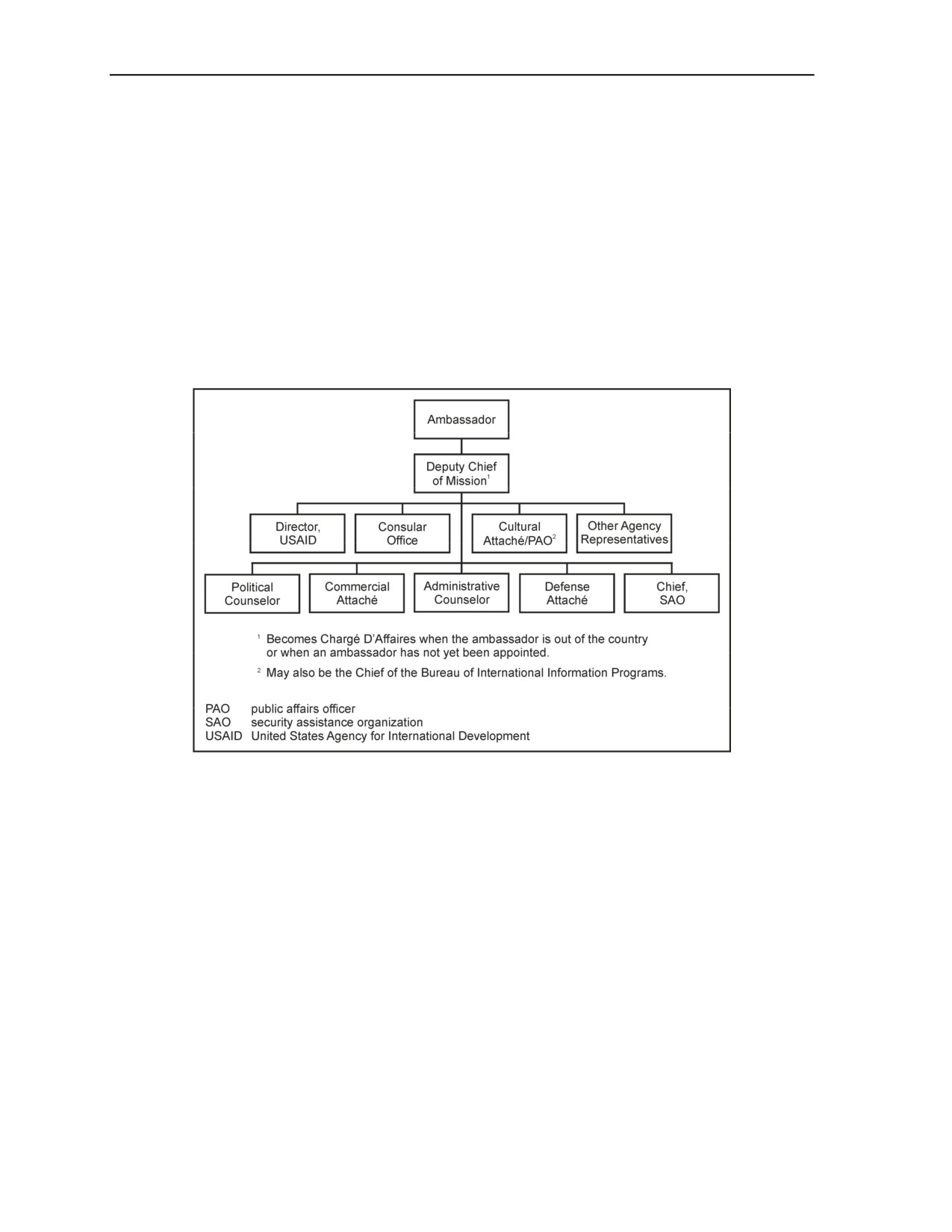
Appendix A
President’s principal advisor for conducting foreign affairs and formulating foreign policy. In its
diplomatic role, the DOS is an important source of foreign affairs data, national security and economic
information, and information on the policies and inner workings of countries. In its consular function, it
provides notarial and citizenship services to American citizens abroad and assists in implementing U.S.
immigration and naturalization laws.
Country Team
A-6. The country team is the senior, in-country, U.S. coordinating and supervising body, headed by the
chief of the U.S. diplomatic mission, and composed of the senior member of each represented U.S.
department or agency, as desired by the chief of the U.S. diplomatic mission (JP 3-07.4). The team
composition varies widely depending on specific U.S. national interests, the desires of the ambassador, the
situation in the country, and the number and level of presence of U.S. agencies. Figure A-1 shows possible
members of the country team.
Figure A-1. Country team members
A-7. The country team facilitates interagency action on recommendations from the field and implements
effective execution of U.S. programs and policies. It builds the foundation for rapid interagency
consultation and action on recommendations from the field and effective execution of U.S. missions,
programs, and policies. A country team is relatively small and may not be adequate for every need. A
country team may not exist in every country, or it may be inoperative due to damage or casualties from a
disaster. Country teams generally have received some crisis management training, but they usually are not
prepared to plan in detail. The relationship with military chains of command is frequently ad hoc.
Senior Defense Official or Defense Attaché
A-8. The senior defense official or defense attaché serves as the defense attaché and chief of security
assistance in the embassy. This official also acts as the in-country focal point for planning, coordinating,
supporting, and executing U.S. defense activities in the host nation. These activities include theater security
cooperation plans conducted under the oversight of the combatant commander. In addition, the senior
defense official defense attaché—
z
Serves as the principal embassy liaison with host-nation defense establishments and actively
participates in national security and operational policy development and coordination.
A-2
FM 3-07
6 October 2008
Interagency, Intergovernmental, and Nongovernmental Organizations in Stability Operations
z
Represents the Secretary of Defense and the DOD components to host-nation counterparts and
foreign diplomats accredited to the host nation.
z
Presents coordinated DOD views on all defense matters to the chief of mission and acts as the
single DOD point of contact to the chief of mission.
z
Represents the Secretary of Defense and the appropriate combatant commanders for
coordinating administrative and security matters for all DOD personnel not under the command
of a U.S. military commander.
A-9. The defense attaché office, which consists of one or more defense or service attachés and support
personnel, observes and reports on the country’s military and political-military situation. This information
can be valuable when planning and executing various missions in the country. These missions may include
noncombatant evacuation operations and support to counterdrug and counterinsurgency. Defense attaché
office personnel are active duty military attached to the embassy in a diplomatic status. The Defense
Intelligence Agency rates and funds defense attachés. They may add to the daily embassy situation report
and provide other written intelligence-related information. All military personnel, even those not assigned
to the embassy or under direct control of the ambassador, should coordinate their activities through the
senior defense representative (which may be the security assistance organization or the defense attaché,
depending on the country.) Duties of the defense attaché office also include liaising with host-nation
defense officials on military matters related to threat assessments, intelligence, and in-country capabilities.
A smaller embassy may not have a defense attaché present; rather, it depends on a regional attaché
accredited to the host nation but stationed elsewhere.
Security Assistance Organization
A-10. The security assistance organization (SAO) also maintains a liaison with the host-nation military
forces. It is the most important military activity related to foreign internal defense under the ambassador’s
supervision. The SAO assists host-nation security forces by planning and administering military aspects of
the security assistance program. It also helps the U.S. country team communicate host-nation assistance
needs to policy and budget officials in the USG. In addition, the SAO oversees training and assistance
teams temporarily assigned to the host nation. The SAO is prohibited from providing direct training
assistance. Instead, training is provided through special teams and organizations assigned to limited tasks
for specific periods, such as mobile training and technical assistance teams.
A-11. The SAO is a joint organization. Through the senior defense official or defense attaché, the chief of
the U.S. diplomatic mission directs and supervises the SAO chief to accomplish the SAO’s mission. The
geographic combatant commander commands the SAO in matters that are not functions of the chief of the
U.S. diplomatic mission. The director of the Defense Security Cooperation Agency prescribes policy for
managing security assistance programs by the SAO.
A-12. In country, the SAO may be known by many names according to the number of persons assigned,
the functions performed, or the desires of the host nation. Typical SAO designations include a joint
military assistance group, a military liaison office, the military training mission, and the office of defense
cooperation. In countries where the United States has no SAO, another member of the mission oversees
security assistance. In many countries, security assistance functions are performed within the defense
attaché office. The defense attaché may also serve as the SAO.
A-13. The United States tailors each SAO to the needs of its host nation; thus, no typical SAO exists.
However, a large SAO normally has Army, Navy, and Air Force components. Each component must
accomplish its Service portion of security assistance activities. A small SAO may have divisions by
function but no separate Service components.
A-14. The primary functions of security assistance personnel are logistics management, fiscal management,
training management, and contract administration of country security assistance programs. Security
assistance personnel maintain a liaison with host-nation defense establishments. They operate with the
host-nation military—primarily at the national level—to interpret U.S. policies, resolve problems in
materiel delivery, and obtain technical assistance for defective materiel. They assess the capabilities of the
host-nation military and determine additional materiel requirements.
6 October 2008
FM 3-07
A-3
Appendix A
A-15. The SAO provides host-nation governments with information necessary to make decisions about
acquiring and using U.S. defense articles and services. (These services include training under the auspices
of U.S. security assistance programs.) The SAO obtains information to evaluate the host-nation military’s
capability to employ and maintain the equipment requested. The SAO processes security assistance
proposals of foreign governments. It also maintains communications with host-nation defense officials on
military matters, such as the threat’s and host-nation military capabilities.
A-16. Documents describing SAO responsibilities and functions include DODD 5105.65 and DODD
5132.3. The former establishes the responsibilities, functions, authorities, and relationships of the Defense
Security Cooperation Agency as an agency of the DOD. The latter establishes DOD policy and assigns
responsibilities pursuant to the Foreign Assistance Act of 1961, as amended, the Arms Export Control Act
of 1976, as amended, and related statutory authorities, executive orders, and policies established by the
Secretary of State relating security assistance.
Embassy Representatives
A-17. The chief of mission (the ambassador) has authority over all in-country USG elements except forces
assigned to a combatant commander. The ambassador represents the President but takes policy guidance
from the Secretary of State through regional bureaus. The ambassador integrates the programs and
resources of all government agencies represented on the country team. As the President’s representative in
the host nation, the ambassador has extraordinary authority. This individual may tailor the country team as
needed for any crisis that arises with few limits from written rules. The ambassador functions at both
operational and tactical levels, where recommendations and considerations for crisis action planning are
provided directly to the geographic combatant commander or senior military representative in the area.
A-18. The President gives the chief of mission immediate direction and control over USG personnel in
country. This does not include personnel in another mission, assigned to an international organization, or
assigned to a combatant command or its subordinate elements. The chief of mission ensures that all in-
country USG activities serve U.S. interests as well as regional and international objectives. This individual
promotes positive program direction by seeing that all activities are necessary, are efficiently and
economically run, and are effectively interrelated.
A-19. The deputy chief of mission is the senior diplomatic official in the embassy below the rank of
ambassador. This official has the diplomatic title of minister, minister-counselor, or counselor (depending
on the size of the mission) and is usually a career foreign service officer. The deputy chief of mission or
chief of staff (military equivalent) usually chairs the emergency action committee meetings and coordinates
embassy staff. The deputy chief helps ensure that all U.S. in-country activities best serve national interests.
A-20. The U.S. defense representative is an additional title assigned to a military officer serving in a
specifically designated position. This duty title may be assigned to either the defense attaché or the security
assistance officer. This representative represents the Secretary of Defense, the Chairman of the Joint Chiefs
of Staff, and the geographic combatant commander. This officer coordinates administrative, security, and
logistic matters with USG officials for all DOD noncombatant command elements in the country in which
the U.S. defense representative is assigned.
A-21. The chief of station is the senior intelligence advisor to the ambassador. The chief of station is an
excellent source of information on the country and the current situation.
A-22. The administrative counselor, sometimes referred to as the management officer, oversees various
activities at the embassy compound. These activities may include security at small posts; running the
commissary, motor pool, and maintenance activities; and handling monetary aspects of embassy business,
including foreign service national payroll, cash collection, and the budget. At a small post with no security
officer assigned, the administration officer assumes the functions of the post security officer and has
operational control of the Marine security guard detachment. The general services officer and information
management officer work for the administration officer:
z
The general services officer is responsible for buildings, grounds, construction, vehicles, and
maintenance.
A-4
FM 3-07
6 October 2008
Interagency, Intergovernmental, and Nongovernmental Organizations in Stability Operations
z
The information management officer runs the post communications center; processes and tracks
all classified pouch material; and oversees the computer system at the embassy. This officer is
the point of contact for the post’s communication capabilities.
A-23. The political counselor reports on political developments, negotiates with the host-nation
government, and represents views and policies of the USG. This officer maintains regular contact with
host-nation officials, political and labor leaders, and other influential citizens of the host nation, as well as
other countries’ diplomats. The political counselor makes major contributions to the overall intelligence
picture.
A-24. The refugee coordinator works in a regional position to oversee USG assistance to refugees and
other populations of concern. This coordinator works closely with the Bureau of Population, Refugees, and
Migration at the DOS, United States Agency for International Development (USAID), international and
local nongovernmental organizations (NGOs), and organizations such as United Nations Office of the High
Commissioner for Refugees and the International Committee of the Red Cross (ICRC).
A-25. The commercial attaché or economic officer analyzes, reports on, and advises superiors, DOS, and
DOD personnel on economic matters in the host nation. This attaché also negotiates with the host nation on
trade and financial issues.
A-26. Consular officers screen, process, and grant U.S. passports and visas. Other duties mandated by law
include attending to the welfare of and maintaining a census of American citizens in the host nation.
During noncombatant evacuation operations, the consular officer provides personnel to screen documents
of all potential evacuees and instructs personnel in the evacuation control center.
A-27. The regional medical officer is qualified for general practice and can set up triage, trauma, and mass
casualty operations. This officer may provide advice on indigenous diseases and proper prophylactic
procedures for forces executing a noncombatant evacuation operation. These officers are only found in
certain interagency coordination embassies where the support exists for them to carry out their duties.
A-28. The regional security officer (RSO) is a DOS diplomatic security agent responsible for the security
functions of all U.S. embassies and consulates in a given country. This officer directs the Marine security
guard detachment via the detachment commander. Similar to the regional medical officer, the RSO is
found in all but the smallest embassies. The RSO oversees the following:
z
Post security officer. Posts with no RSO have a post security officer. This officer has general
security duties at a specific embassy (or consulate) and is usually the administration officer. The
post security officer is supported by a designated RSO in a nearby country.
z
Mobile security division. This division consists of DOS employees of the diplomatic security
service who respond to crises in foreign countries. The mobile security division responds to
increased threats or critical security needs at an embassy, provides additional security, and
immediately responds to a security-related incident.
z
Local guard force. Embassies enhance security by hiring civilian security guards to provide
perimeter security.
A-29. The public affairs officer (PAO) is the ambassador’s advisor concerning public affairs and overseer
of U.S. cultural center operations. If the situation permits during an emergency, the PAO is responsible for
all press releases and inquiries for information directed to the embassy. The PAO usually speaks at press
conferences that the ambassador cannot attend. (See FM 46-1 for details on public affairs.)
A-30. A Marine security guard detachment has, on average, six Marines, with the maximum number
assigned according to need. The Marine detachment commander is normally a member of the emergency
action committee. This individual has responsibility to protect classified material, U.S. personnel, and USG
property. Administrative control of detachment Marines is through their geographic combatant
commander.
6 October 2008
FM 3-07
A-5
Appendix A
DEPARTMENT OF DEFENSE
A-31. The DOD coordinates with the DOS and other government agencies on many issues including—
z
Bilateral and multilateral military relationships.
z
Treaties involving DOD interests.
z
Technology transfers.
z
Armaments cooperation and control.
z
Humanitarian assistance.
z
Peace operations including those under the auspices of the UN.
A-32. Within an area of responsibility, the geographic combatant commander plans and implements theater
and geographic military strategies that require interagency coordination. Coordination between the DOD
and other government agencies may occur with a country team or within a combatant command. In some
operations, a special representative of the President or special envoy of the UN Secretary General may be
involved. Many USG organizations are regionally focused, such as the DOS in its regional bureaus and the
USAID. In individual countries, the ambassador and country team supervise and direct the overall foreign
assistance program.
A-33. A campaign plan is based on a joint force commander’s intent and concept of operations. This plan
presents a broad vision of the required aim or end state and how operations will be sequenced and
synchronized to achieve objectives. A campaign plan is essential for laying out a clear, definable path
linking the mission to the desired end state. Such a plan enables commanders to help political leaders
visualize operational requirements for achieving objectives. Given the systematic military approach to
problem solving, often the combatant commander formally or informally functions as the lead organizer of
many operations. (JP 3-08 outlines how to develop and execute a campaign plan in the interagency arena.)
A-34. A political advisor is a foreign service officer from the DOS. Usually combatant commanders are
augmented with a political advisor. Army component commanders in multinational operations and other
operations may also be augmented with a political advisor. The political advisor provides diplomatic
considerations and enables informal links with embassies in the area of responsibility to the DOS. The
foreign policy advisor supplies information regarding DOS policy goals and objectives relevant to the
geographic combatant commander’s theater strategy. Other government agencies also may detail liaison
personnel to operational-level staffs when requested to improve interagency coordination.
CENTRAL INTELLIGENCE AGENCY
A-35. The CIA coordinates the intelligence activities of other U.S. departments and agencies. It advises
and recommends policy to the NSC on matters regarding intelligence activities of all government
departments and agencies. It correlates and evaluates this intelligence and disseminates it in the
government. The CIA also conducts special activities approved by the President. Executive Order 12333
directs that “no agency except the CIA (or the Armed Forces of the United States in time of war declared
by Congress or during any period covered by a report from the President to the Congress under the War
Powers Resolution … may conduct any special activity unless the President determines that another agency
is more likely to achieve a particular objective….”
UNITED STATES AGENCY FOR INTERNATIONAL DEVELOPMENT
A-36. USAID is an independent USG agency that answers to the President through the Secretary of State.
It manages U.S. developmental, humanitarian, and civic assistance activities. USAID supervises and gives
general direction on all nonmilitary assistance programs under the Foreign Assistance Act of 1961,
Agricultural Trade Development and Assistance Act of 1954
(also known as “Food for Peace”), and
related legislation. USAID also provides global technical leadership and technical assistance on
development issues. It applies to multiple sectors that are critical for reconstruction and stabilization
operations. Examples of these sectors include economic development, agriculture, health, democracy and
governance, environment, humanitarian response, and conflict management and mitigation. This agency
A-6
FM 3-07
6 October 2008
Interagency, Intergovernmental, and Nongovernmental Organizations in Stability Operations
plans and implements programs to improve economic and social conditions overseas, to help countries
improve governance, to build legitimate institutions and manage conflict, and to address global problems.
The agency administers food assistance programs with the Department of Agriculture. Under arrangements
made with USAID, U.S. affiliates of international voluntary agencies conduct most bilateral food
assistance programs appropriated under Agricultural Trade Development and Assistance Act of 1954.
USAID also administers development assistance programs with the U.S. Millennium Challenge
Corporation. Although USAID is concerned primarily with development and civic assistance, many
programs it administers, particularly in weak or fragile states, are security related. The agency
representative in the host nation coordinates USAID managed assistance programs with other members of
the country team, including the DOD representative. Coordination is also with all other assistance
programs managed by USG departments or agencies active in the host nation. The USAID representatives
in a host nation help coordinate U.S. foreign assistance with other multilateral, bilateral, and U.S. private
assistance programs to that country.
A-37. USAID, through its Office of Foreign Disaster Assistance, leads U.S. humanitarian assistance efforts
overseas. The Office of Foreign Disaster Assistance developed the disaster assistance response team to
provide rapid response to foreign disasters. This team provides various trained specialists to assist U.S.
embassies and USAID missions with short-term assistance. It is a major component of USG capability in
foreign humanitarian crisis or complex emergencies. (See JP 3-08 for more information.)
A-38. The overseas USAID mission is part of the American embassy; it operates under chief of mission
authority and guidance. Its size varies widely depending upon the size and complexity of the U.S. foreign
assistance program to that host nation. A small USAID mission may consist of a single U.S. representative
supported by several locally hired employees. A large mission may have 50 or more U.S. direct hire
employees. These employees often receive support from 50 to 125 locally hired host nation, U.S., or third
country contract employees. A medium to large USAID mission overseas usually has a USAID mission
director, deputy director, program office, and various technical offices. The latter may include economic
growth, democracy and governance, health and education, and other support offices. More than 70
developing countries have USAID missions, while over 100 countries have active USAID programs.
USAID implements U.S. foreign assistance through agreements with implementing partners. Implementing
partners may be host-nation entities or organizations, other USG departments or agencies,
intergovernmental or nongovernmental organizations, contractors, or private sector entities. While the
numbers of USAID staff in a country is usual small, it often has substantial reach and influence through its
implementing partners.
INTERGOVERNMENTAL ORGANIZATIONS
A-39. Intergovernmental organizations possess area or global influence. Examples of intergovernmental
organizations with global reach include the UN, its agencies, and the World Bank. These organizations
have well-defined structures, roles, and responsibilities as well as the resources and expertise to lead and
participate in complex operations. Regional examples include North Atlantic Treaty Organization (NATO),
the African Union, the Organization of American States, the European Union, and the Organization for
Security and Cooperation in Europe. Paragraphs A-40-A-52 discuss formal or informal ties between the
United States and some of the larger intergovernmental organizations.
THE UNITED NATIONS
A-40. Coordination with the UN begins at the national level with the DOS, through the U.S. permanent
representative to the UN. In some administrations, this individual has cabinet status. The U.S.
representative is assisted at the U.S. mission to the UN by a staff of 100 foreign nationals, military, and
civilian personnel. This staff includes a military assistant who coordinates appropriate military interests
primarily with the United Nations Office for the Coordination of Humanitarian Affairs (OCHA), the UN
Development Programme, and the United Nations Department for Peacekeeping Operations (UNDPKO).
A-41. The Foreign Assistance Act of 1961, the United Nations Participation Act of 1945, and Executive
Order 10206 authorize various types of U.S. military support to the UN, either on a reimbursable or
nonreimbursable basis. U.S. military operations to support the UN usually fall within Chapter VI or
6 October 2008
FM 3-07
A-7
Appendix A
Chapter VII of the UN Charter. (See JP 3-08 for details regarding the UN Charter and Chapters VI and VII
of that charter.)
A-42. The UN Security Council normally authorizes peace operations or conducts humanitarian assistance
under the provisions of a resolution or mandate from the UN Security Council or the general assembly. As
politicians and diplomats try to reach a compromise, they develop mandates. The compromises often
challenge military commanders who translate these mandates into workable mission orders. Additionally,
fast-changing events on the ground can quickly render a mandate obsolete. Commanders must quickly
inform the chain of command of significant changes in the situation.
A-43. The UN headquarters coordinates peace operations and humanitarian assistance around the world. It
maintains a strategic-operational-tactical structure equivalent to the armed forces for implementing UN
Security Council resolutions. The UN organizational structure consists of the headquarters and the
operational field elements. Strategic decisionmaking resides with the UN Security Council. The Secretariat
provides strategic guidance between resolutions of the UN Security Council as well as exercises a measure
of operational authority. Within an operational area, the special representative to the United Nations
Secretary General (UNSG) at the integrated mission headquarters—normally based in the host-nation
capital—provides operational-level command as well as a link to the tactical level. At the tactical level, the
various heads of the sectors into which the host nation has been divided for mission implementation
provide tactical counterparts for military commanders operating at that level.
A-44. The OCHA coordinates humanitarian operations. This office makes necessary arrangements for UN
relief organizations to deliver assistance quickly and effectively. The UN emergency relief coordinator
appoints humanitarian coordinators for natural disasters and complex emergencies. In complex
emergencies, the emergency relief coordinator appoints a field-based humanitarian coordinator. This latter
coordinator works under the authority of the special representative to the UNSG. Under certain
circumstances, the UNSG may appoint a special representative to direct day-to-day operations. This
representative reports to the UNSG directly and advises UNDPKO and OCHA at UN headquarters.
A-45. The OCHA is a part of the UN Secretariat. It coordinates UN assistance in humanitarian crises that
exceed the capacity and mandate of any single humanitarian organization. The head of this office, the
emergency relief coordinator, chairs the Interagency Standing Committee, thus uniting all major
humanitarian actors inside and outside the UN system. This committee works to analyze a given crisis. It
also ensures interagency decisionmaking when responding to complex emergencies and developing
humanitarian policy. The UN country team led by the humanitarian coordinator coordinates the responses
to specific crises at the country level for the UN system.
A-46. The UNDPKO is the operational arm of the UNSG for managing day-to-day peacekeeping
operations. In this capacity, the department acts as the main channel of communications between UN
headquarters and the field when a peacekeeping force is deployed.
A-47. The UN Development Programme is a separate agency that is part of the UN system. As indicated by
its name, this agency focuses more on long-term development than emergencies. The in-country program
representative is often the UN humanitarian coordinator, responsible to mobilize and manage the local UN
humanitarian resources and provide direction for the field relief effort. If conflict erupts, a special
representative to the UNSG—who has greater expertise in emergencies and negotiations—may replace the
UN resident coordinator.
A-48. Normally, UN-sponsored operations employ a force under a single commander. The force
commander is appointed by the UNSG with the consent of the UN Security Council. This commander
reports to the special representative to the UNSG or to the UNSG directly. In any multinational operation,
the U.S. commander retains command authority over all assigned U.S. forces. The U.S. chain of command
flows from the President through the combatant commander. With presidential authorization, the
multinational force commander may exercise operational control over U.S. units in specific operations
authorized by the UN Security Council.
A-8
FM 3-07
6 October 2008
Interagency, Intergovernmental, and Nongovernmental Organizations in Stability Operations
THE NORTH ATLANTIC TREATY ORGANIZATION
A-49. NATO is a good example of the interagency process on a regional level. NATO has been challenged
by the demands for cooperation that characterize every regional effort and has endured for over 50 years.
U.S. efforts within NATO are led and coordinated by the permanent representative. This representative is
appointed by the President and has the rank and status of ambassador extraordinary and chief of mission
(see the Rogers Act). Table A-1 lists the 26 members of NATO.
Table A-1. Members of NATO
Belgium
Bulgaria
Canada
Czech Republic
Denmark
Estonia
France
Germany
Greece
Hungary
Iceland
Italy
Latvia
Lithuania
Luxembourg
Netherlands
Norway
Poland
Portugal
Romania
Slovakia
Slovenia
Spain
Turkey
United Kingdom
United States
A-50. Over the years, NATO has undergone changes in organization, orientation, and membership.
Following the Cold War, the alliance was restructured to enable it to participate in peacekeeping and crisis
management tasks. The alliance undertakes the tasks in cooperation with countries that are not members of
the alliance and with other international organizations. NATO support to UN operations in the former
Yugoslavia illustrates this cooperation.
A-51. In Kosovo, Operation Allied Force demonstrated for the first time NATO’s ability to conduct
offensive operations to force a noncompliant to assent to the alliance’s collective will. The alliance has
been actively involved in planning, preparing, and implementing peace operations, such as protection for
humanitarian relief and support for UN monitoring of heavy weapons.
A-52. Beyond day-to-day operations, training exercises, and logistics authorized by statute, extraordinary
use of military forces with NATO across the spectrum of conflict requires presidential approval. They may
also be subject to congressional review, including those employments authorized and limited by the War
Powers Resolution of 1973.
NONGOVERNMENTAL ORGANIZATIONS
A-53. NGOs do not operate within the military or governmental hierarchy or the chain of command.
Therefore, any relationship between the armed forces and an NGO is best characterized as a professional or
circumstantial association. Generally, coordination between military forces and NGOs is facilitated through
the UN, USAID, or DOS. The military force ordinarily orchestrates this interaction with other agencies and
organizations through the activities of a civil-military operations center (CMOC).
A-54. NGOs are frequently present and actively engaged in development activities when U.S. forces arrive.
They often remain long after military forces have departed. Some NGOs are independent, diverse, flexible,
grassroots-focused, primary relief providers. Others, however, provide a channel for funds and collaborate
with other primary relief NGOs (usually local) to carry out the programs. These organizations often
provide support to host-nation populations. NGOs assist over 250 million people annually. The funding
received by NGOs comes from a multitude of sources, including governmental, international, and private
organizations; that is, the NGOs act as independent implementing partners for funding agencies. Because
they can respond quickly and effectively to crises, they can lessen the civil-military resources that
commanders would otherwise have to devote to an operation. Despite differences that may exist between
military forces and civilian agencies, certain objectives may be similar. Discovering common ground is
essential to unity of effort. The commander’s assessment of conditions and resources includes the activities
and capabilities of NGOs and their role and mission within the operational area.
A-55. NGOs range from internationally based groups with global reach to local organizations focused on a
specific area or state. They include groups with multimillion-dollar budgets and decades of global
experience in development and humanitarian relief as well as newly created small organizations dedicated
6 October 2008
FM 3-07
A-9
Appendix A
to a particular emergency or disaster. Most NGOs are not relief-oriented but carry out long-term
development projects. The professionalism, capability, equipment, resources, and expertise vary greatly
from one NGO to another. NGOs participate in diverse activities such as human rights, education, technical
projects, relief activities, refugee assistance, public policy, and development programs. The connection
between NGOs and the DOD is ad hoc, with no specific statutory link. Generally, military forces work
through the UN, USAID, or the DOS to establish contacts with NGOs from the United States. While their
focus remains grassroots and their connections informal, NGOs are major actors in many areas where
military forces conduct stability operations. Such organizations affect many lives and control significant
resources, making NGOs powerful in the relief, reconstruction, and development community. UN and
USG agencies often use individual organizations to carry out specific relief functions.
A-56. Military forces are likely to encounter many NGOs in an operational area. In Somalia, there were 78
private organizations contributing relief support, and in the Rwanda crisis, over 100 relief organizations
assisted the UN relief. Over 350 such agencies are registered with the USAID. The first line of security for
most NGOs is their adherence to strict principles of impartiality, neutrality, and independence. Actions that
blur the distinction between relief workers and military forces may be perceived as a threat to these
principles. Such perceptions can increase the risk to civilian aid workers, both expatriates and nationals.
However, NGOs may request certain types of military support from forces geographically co-located
within an operational area. For example, command-approved chaplain support helps to build unity of effort
and enhances relationships among diverse groups.
A-57. Their extensive involvement, local contacts, and experience make NGOs valuable sources of
information about local and regional governments and civilian attitudes toward an operation. While some
organizations seek the protection of the armed forces or the use of military aircraft to move relief supplies
to overseas destinations, others may avoid a close affiliation with military forces, preferring autonomous
operations. Their rationale may be fear of compromising their impartiality with the local populace or
suspicion that military forces intend to take control of, influence, or even prevent their operations. Staffs
should consult these organizations, along with the host-nation government (if applicable), to identify local
issues and concerns the proposed public affairs guidance should reflect.
A-58. Public affairs planning includes identifying points of contact in NGOs operating in an affected area.
Generally, the PAO refers media queries regarding NGO operations to an authorized NGO spokesperson.
Military spokespersons should only comment on an NGO based on specific guidance received from that
NGO or the UN. The office of the assistant Secretary of Defense (public affairs) or a regional organization
(such as NATO) may also provide guidance in cooperation with the in-country headquarters of the
organization.
A-59. The President may determine that it is in the national interest to task U.S. forces with missions that
bring them into close contact with (if not support of) NGOs. All participants benefit when they closely
coordinate their activities. Military forces seek to establish a climate of cooperation with NGOs. Missions
to support NGOs are short term, usually necessitated by extraordinary events. In most situations, the NGOs
need logistics, communications, and security capabilities. However, in such missions, the role of the armed
forces is to enable—not perform—NGO tasks. Often U.S. military assistance has proven to be the critical
difference that enabled success of an operation. Commanders understand that mutually beneficial
arrangements between the armed forces and NGOs may determine the success of the military operation.
(Appendix B of JP 3-08 describes many agencies that commanders may encounter in an operational area.)
OTHER ORGANIZATIONS
A-60. Other organizations that assist people in need include the International Red Cross and Red Crescent
Movement, the CMOC, and various liaisons.
THE INTERNATIONAL RED CROSS AND RED CRESCENT MOVEMENT
A-61. The International Red Cross and Red Crescent Movement is a well-known global network of
humanitarian actors. It consists of three independent elements: the ICRC, the National Societies, and the
Federation. Five citizens of Switzerland founded the ICRC in 1863 as the “International Committee for
A-10
FM 3-07
6 October 2008
Interagency, Intergovernmental, and Nongovernmental Organizations in Stability Operations
Relief of Wounded.” Voluntary contributions by governments provide the majority of ICRC funding,
complemented by financing from national Red Cross and Red Crescent Societies and private sources.
A-62. The ICRC mission is, on the basis of the Geneva Conventions and protocols, to protect and assist
victims of armed conflict and those affected by internal disturbances or tension. More specifically, this
means to—
z
Visit, interview, and transmit messages to, without witnesses, prisoners of war, and detained or
interned civilians.
z
Provide aid to the populations of occupied territories.
z
Search for missing persons.
z
Offer services for establishing hospital zones, localities, and security.
z
Receive requests for aid from protected persons.
z
Exercise its right of initiative to pursue the above tasks and to offer its services to the parties of
internal disputes.
A-63. In its own country, a national Red Cross (such as the American Red Cross) or Red Crescent Society
assists the public authorities in humanitarian matters. It primarily backs up the military medical services
during conflict. The International Federation of Red Cross and Red Crescent Societies supports the
humanitarian activities carried out by the national societies.
A-64. The ICRC is often described as a NGO, but it is not; it is also not an international or
intergovernmental organization. The ICRC is an organization with a hybrid nature. As a private association
organized under the Swiss Civil Code, its existence is not in itself mandated by governments. Yet its
functions and activities—to provide protection and assistance to victims of conflict—are mandated by the
international community of states and are founded in international law.
A-65. The terms neutrality and independence acquire a specific meaning when related to the activities of
the ICRC. The ICRC applies almost exclusively to armed conflicts, disturbances, and tensions. It strictly
avoids any involvement in hostilities or in controversies of a political, racial, religious, or ideological
nature as an imperative for humanitarian action. This strict and specific neutrality that fosters and maintains
universal trust also requires the ICRC to act openly and in good faith toward the nations and parties to the
conflict. To discharge the mandate conferred by the Geneva Conventions and to take the humanitarian
initiatives fundamental to its role as neutral intermediary, the ICRC must remain independent. Therefore,
the ICRC adopts a special structure that allows it to resist political, economic, and other pressures and to
maintain its credibility in the eyes of the governments and the public that support its activities.
A-66. In terms of civil-military relations, ICRC’s humanitarian activities aim to protect human dignity and
lives. ICRC humanitarian activities cannot be subordinated to political or military objectives. The ICRC
must maintain a role independent of such influence or association. While consulting closely with
international military missions deployed in the same operational area, it must create and maintain a specific
humanitarian space. This space clearly distinguishes humanitarian action and political-military action.
CIVIL-MILITARY OPERATIONS CENTER
A-67. The CMOC is a standing capability formed by all civil affairs units. This capability provides the
commander with the core personnel and equipment to form a CMOC organization. The CMOC serves as
the U.S. forces’ primary technique to interface among the local populace and institutions, humanitarian
organizations, intergovernmental and nongovernmental organizations, multinational military forces, and
other civilian agencies of the USG. The supported commander establishes the CMOC. The civil affairs
staff officer or the supporting civil affairs unit may direct the CMOC. The size, structure, and location of
the CMOC are situation dependent and may be augmented by the commander with other forces (such as
military police, engineers, or Army Medical Department). Normally, the supported unit civil affairs staff
officer conducts detailed civil affairs operations or civil-military operations analysis and planning and
provides staff oversight of the supporting civil affairs unit. The supporting CMOC executes, assesses, and
provides feedback relating to the effects of the operation. As a coordination center, the CMOC is neither a
unit nor an organization.
6 October 2008
FM 3-07
A-11

Appendix A
A-68. If there is a host-nation government, it has the presumptive right to establish the mechanisms for
civil-military coordination in the form commonly known as a humanitarian operations center. The structure
of a humanitarian operations center can be formal or informal.
A-69. The CMOC may be the first, second, or even third coordinating mechanism, depending on the
situation. Strong consideration should be given to co-locating CMOC functions with previously existing
mechanisms, such a humanitarian operations center, humanitarian assistance coordination center, or a civil-
military cooperation center. (See table A-2.) Protection is always a concern for the commander considering
where to locate the CMOC; while placing the CMOC “inside the wire” increases protection, it can also
interfere with its ability to interact with NGOs and other actors. The commander must consider this
difficulty when analyzing the situation according to the mission variables (mission, enemy, terrain and
weather, troops and support available, time available, and civil considerations).
Table A-2. Example of coordination centers
Coordinating Center
Description
Humanitarian
This center is usually established by a host-nation government or UN. The
Operations Center
HOC coordinates the overall relief strategy in large-scale foreign humanitarian
assistance operations. It is responsible for policy making and coordinating, but
does not exercise command and control. The HOC may submit requests for
support to a commander through a CMOC. HOCs were established in the UN
operations in Somalia and Rwanda.
Humanitarian
The supported combatant commander may establish a HACC to assist with
Assistance
interagency coordination and planning. The HACC provides the critical link
Coordination Center
between the combatant commander and other government agencies,
intergovernmental organizations, and NGOs that may participate in a foreign
humanitarian assistance operation. Normally, the HACC is a temporary body
that operates during the early planning and coordination stages of the
operation. Once the lead relief agency has established a CMOC or civilian
humanitarian operations center, the role of the HACC diminishes, and its
functions are accomplished through the normal organization of the combatant
commander’s staff.
Civil-Military
Civil-military cooperation is a NATO doctrinal organization that roughly
Cooperation Center
equates to the CMOC. Thus, when the NATO-led implementation force in
Bosnia-Herzegovina established a center for coordination with the NGO
community, it was known as the civil-military cooperation center rather than a
CMOC, but it performed the same functions.
CMOC civil-military operations center
NATO North Atlantic Treaty Organization
HOC humanitarian operations center
NGO nongovernmental organization
HACC humanitarian assistance coordination center
UN
United Nations
A-70. Coordination centers have various names and functions according to the mission and needs of the
establishing commander. The CMOC is the type of coordination center employed at the direction of Army
commanders. (JP 3-57 discusses these coordination centers in greater detail.)
A-71. Participants in CMOC operations may include representatives of U.S. forces, interagency and
multinational partners, the host-nation or foreign nation organizations
(if outside the United States),
intergovernmental organizations, the private sector, and NGOs. Mission requirements, command
directives, operations security, workload, and accessibility to civilian agencies affect its actual
organization. (Figure A-2 shows a notional CMOC organization.)
A-72. The officer in charge typically has both civilian- and military-related staff sections:
z
The public affairs branch handles media inquiries to coordinate the release of information to the
public with the PAO and to synchronize CMOC information with the unit’s civil affairs staff
section.
z
The security branch manages the various aspects of security (physical, operations, personnel,
and command and control) inherent to CMOC functions.
z
Liaison officers or representatives are on-site CMOC contacts for both military and civilian
agencies and organizations.
A-12
FM 3-07
6 October 2008
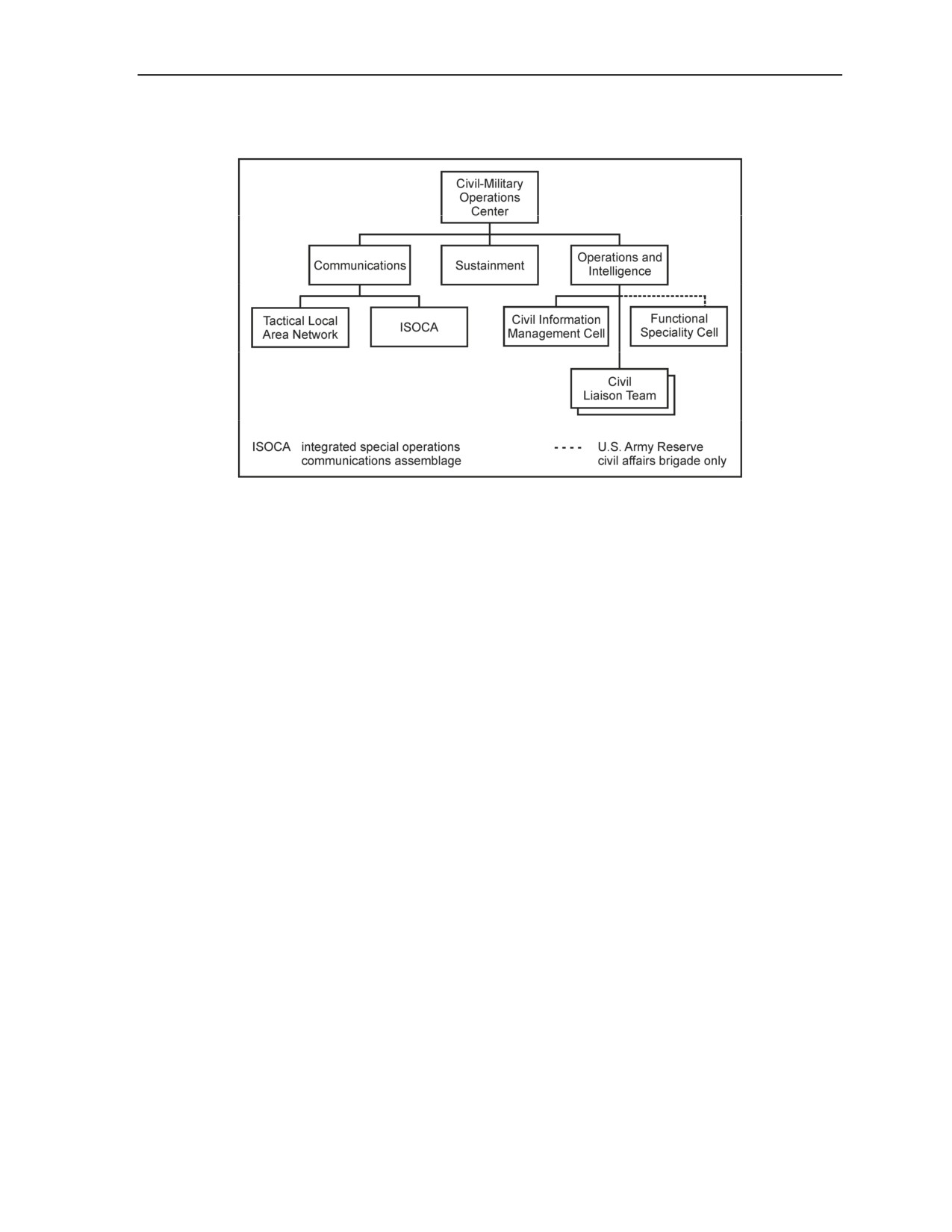
Interagency, Intergovernmental, and Nongovernmental Organizations in Stability Operations
z
The plans and operations section maintains current status of routes.
Figure A-2. Notional civil-military operations center (battalion and above)
A-73. The logistics section maintains a database of all points of contact and host-nation resources available
for military or humanitarian purposes (facilities, transportation assets, goods, and services). Generally, this
section also tracks costs incurred by military forces and other participating government agencies.
A-74. The number of CMOCs supporting a given operation varies according to mission requirements and
the situation in the operational area. Commanders at any echelon may establish a CMOC. The decision to
establish a CMOC stems from civil-military coordination requirements. The distance from the headquarters
serving a particular geographic or tactical area can also influence the decision. A joint task force often
establishes a CMOC; however, in operations where the joint force headquarters is located in one locale and
units are spread throughout the operational area, subordinate Army commanders may establish their own
CMOCs.
A-75. The CMOC will usually host daily meetings to identify requirements and determine available
resources. CMOC personnel validate requests for additional resources and forward those to the appropriate
joint force, Service, or agency representative for action. CMOC tasks may include—
z
Facilitate civil-military coordination among those involved (see figure A-3 on page A-14):
Host nation (understood throughout).
Intergovernmental organizations.
International and regional organizations.
Other government agencies.
Military forces.
NGOs.
Private sector entities.
z
Assist in facilitating transitions to civil authorities or the host nation.
z
Receive, validate, coordinate, and monitor requests from NGOs for routine and emergency
military support.
z
Coordinate requests to NGOs for their support.
z
Convene ad hoc mission planning groups to address complex military missions that support
NGO requirements (such as convoy escort and management as well as security of refugee camps
and feeding centers).
6 October 2008
FM 3-07
A-13
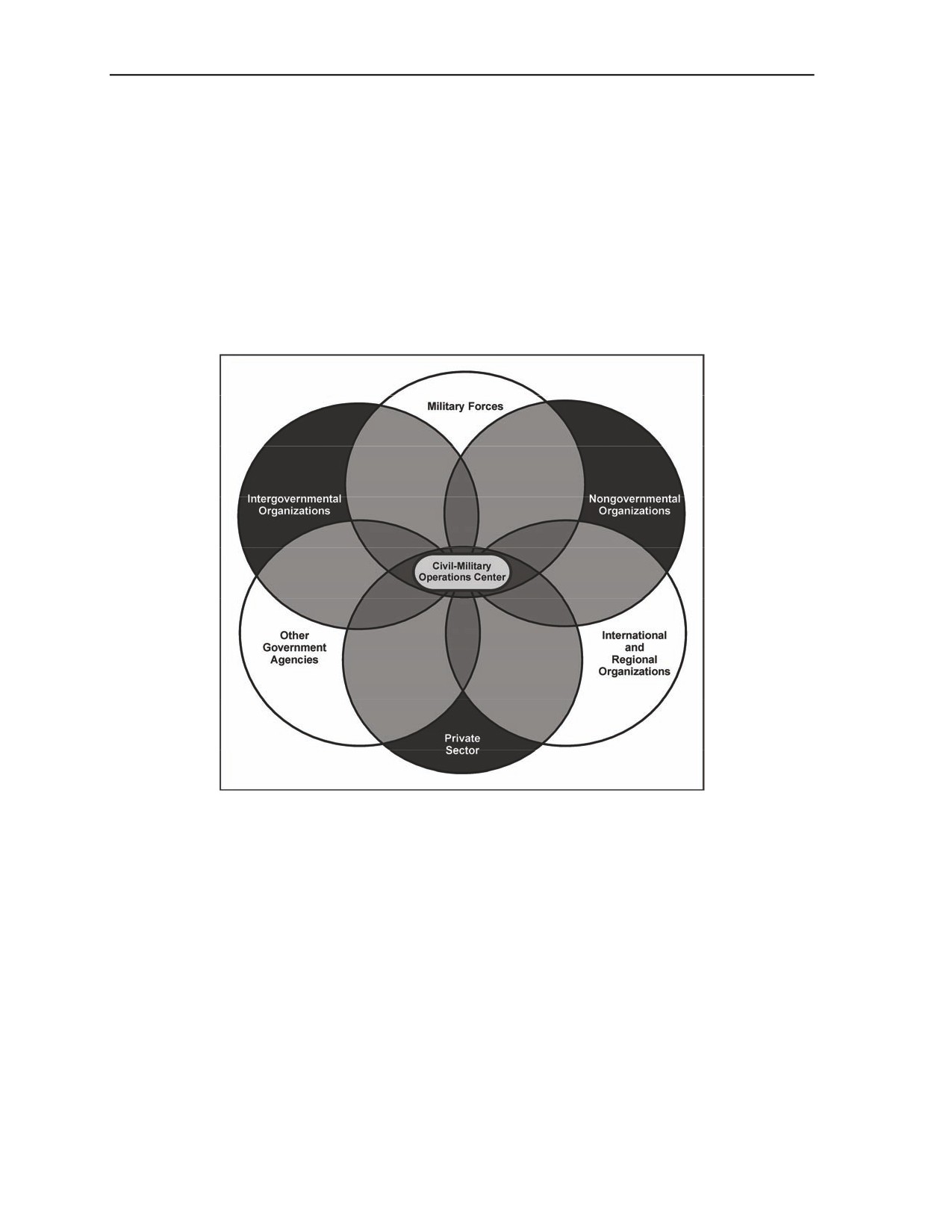
Appendix A
z
Convene follow-on assessment groups.
z
Provide situation reports regarding force operations, security, and other information for external
actors.
z
Chair meetings on NGO logistic prioritization issues and liaising with port and airfield control
authorities.
z
Help develop and organize a logistic distribution system to support provision of essential civil
services (critical food, water, shelter, medical care, and basic sanitation).
z
Provide information updates to support chemical, biological, radiological, and nuclear as well as
other explosives hazard clearance and mine awareness activities.
z
Provide input to update briefings, including incidents of crime, landmine strikes, militia activity,
and general safety.
Figure A-3. Coordination within the CMOC
A-76. The PAO attends daily CMOC meetings. As an active member of the CMOC, the PAO ensures that
member agencies agree on message and press releases and develop a group consensus in response to media
queries. Although each agency’s message need not be identical, agencies must not contradict each other.
LIAISON
A-77. Liaison maintains contact and communications between elements of military forces and other
government and nongovernmental agencies and organizations to ensure understanding and unity of effort.
Liaison is essential in stability operations because of the variety of external actors and the inherent
coordination challenges.
A-78. Liaison officers are a focal point for communications instability operations. Liaison officers
centralize direction and facilitate understanding while conducting operations with external agencies or
forces.
(See also appendix E of FM 6-0.) Multinational military and civilian partners need a clear
understanding of the military planning process. This is best accomplished by direct liaison. Liaison officers
A-14
FM 3-07
6 October 2008