FM 3-90.31 MANEUVER ENHANCEMENT BRIGADE OPERATIONS (FEBRUARY 2009) - page 4
Chapter 8
z
Treaty compliance inspections.
z
Negotiation or mediation.
Termination of Stability Operations
8-63. The MEB can terminate stability operation in four ways. First, the MEB may be relieved of its
mission and conduct a mission handover of the operation to a follow-on force. This force could be another
MEB, functional brigade, BCT, a UN force, or a nonmilitary organization. Second, the situation could
become stabilized and not necessitate the continuance of operations. In this case, the HN or domestic
community assumes responsibility for stability. Third, the MEB could be redeployed with no follow-on
forces and without the area being stabilized. A condition such as this would place the MEB in a vulnerable
situation. Security must be intense and the protection of the force during its exit must be well planned and
executed. Finally, the MEB could transition to MCO. The commander must always ensure the MEB
maintains the ability to transition quickly and forcefully. See FM 3-07 for more discussion on transitions
during humanitarian response and between various stability missions.
ASSESS
8-64. The MEB must continually assess the OE to maintain SU. Running estimates are continuously
updated to ensure the commander is provided with accurate data and staff assessments to make necessary
decisions. Assessing stability operations requires a long-range horizon, coordinated short-term goals, and
great flexibility to include “out of the box” thinking. The MEB must consider their assessments and
variances from planning goals and variances from the assessments provided by supported civil authorities.
The MEB has the ability to assess infrastructure, security requirements, mobility requirements, HN police
capabilities, I/R requirements, general engineering requirements, and CBRNE materials. (See FM 3-07 and
FM 7-15 for possible MOEs and MOPs related to stability operations.)
8-65. The MEB CA staff can provide detailed on the ground assessments to validate IPB and assess
progress. Every Soldier must be trained and able to collect and report information of value. (See FM 3-07
for information on the role of CA in stability operations.
SPECIALIZED CAPABILITIES OF THE MANEUVER
ENHANCEMENT BRIGADE
8-66. The MEB has a broad range of capabilities to conduct stability operations. With adequate resources,
the MEB can conduct stability tasks in its AO while simultaneously supporting offensive or defensive
operations being conducted by its higher headquarters. The unique breadth and capabilities of the MEB
staff and likely mix of units with constructive capabilities could make it the preferred headquarters to
conduct some stability operations rather than use a BCT or other functional headquarters.
8-67. In some stability operations, the employment of an MEB rather than a BCT may prove less
provocative and a much more effective alternative. MEB elements are suited to helping to set the
conditions for post-conflict recovery in areas where active combat operations are not underway.
Commanders may choose to use an MEB and its task organized elements in lower risk areas to economize
combat power for decisive operations being conducted elsewhere in the supported echelon’s AO.
8-68. An MEB is typically task organized with assets (such as CBRN, CA, engineer, EOD, and MP)
capable of performing many of the essential stability tasks. These resources may come from higher-echelon
Army or even joint, interagency, or multinational sources and must be integrated into MEB operations for
successful use. Assets with high facility to conduct stability operations include components capable of
security operations, engineering support, CA operations support, information engagement, police
intelligence operations, hazard neutralization, and other capabilities required to meet the unique situations
encountered in stability operations.
8-14
FM 3-90.31
26 February 2009
Stability Operations
COMMAND AND CONTROL
8-69. The MEB headquarters allows it to deploy with a staff that is trained to conduct a wide range of
technical and combat missions. It knows how to use these units frequently required in stability operations:
CA, CBRN, EOD, engineer, and MP. With specific staff augmentation it can better use other more
specialized assets in its AO. It can readily accept augmentation and quickly task organize to create the
needed TFs and teams to conduct complex stability missions.
8-70. The MEB may be required to conduct stability operations in its own AO while other units are
conducting major combat operations in their AOs. Depending on task organization, the MEB could
simultaneously conduct MANSPT operations for its higher headquarters.
SUSTAINMENT
8-71. With its organic BSB the MEB has the baseline ability to integrate its sustainment in austere and
undeveloped areas. This baseline ability allows it to rapidly accept other augmentation to include additional
sustainment organizations.
COMMUNICATIONS
8-72. With its organic signal network support company the MEB can communicate with most
organizations. With augmentation, it can interface with and support civil communications. The MEB uses
its organic liaison teams to affect interagency coordination.
MANEUVER SUPPORT OPERATIONS
8-73. The MEB may conduct MANSPT operations in support of stability operations. Improving mobility
in the supported units AO or within the MEB AO will almost certainly be a part of the unit’s mission in
stability operations. The freedom to move and maneuver is essential to the conduct of stability operations.
The MEB may be tailored and task organized with a variety of engineer or other mobility assets. Providing
protection support will also typically be required and will depend heavily on MP and other assets (Army,
joint, multinational, HN, and potentially other contracted security).
8-74. The MEB has a staff that routinely integrates unit capabilities to conduct MANSPT operations that
enhance the freedom of movement needed to conduct stability operations. MANSPT operations can
support military forces or civil authorities. (See chapter 5.) The MEB has a staff that routinely fuses
intelligence and plans and conducts operations to provide many aspects of protection to create a safe and
secure environment.
SUPPORT AREA OPERATIONS
8-75. The MEB may conduct support area operations in support of stability operations. The ability to
control terrain is key in most stability operations. The MEB is staffed to control terrain, own an AO, and
influence the population to enhance freedom of action for the friendly force while denying it to the enemy.
It will likely require ISR and fire support if there is a significant threat since these are not organic to the
brigade. It may also require augmentation that includes a TCF when level III threats are likely within the
AO it has been assigned.
26 February 2009
FM 3-90.31
8-15
Chapter 8
EMPLOYMENT EXAMPLE
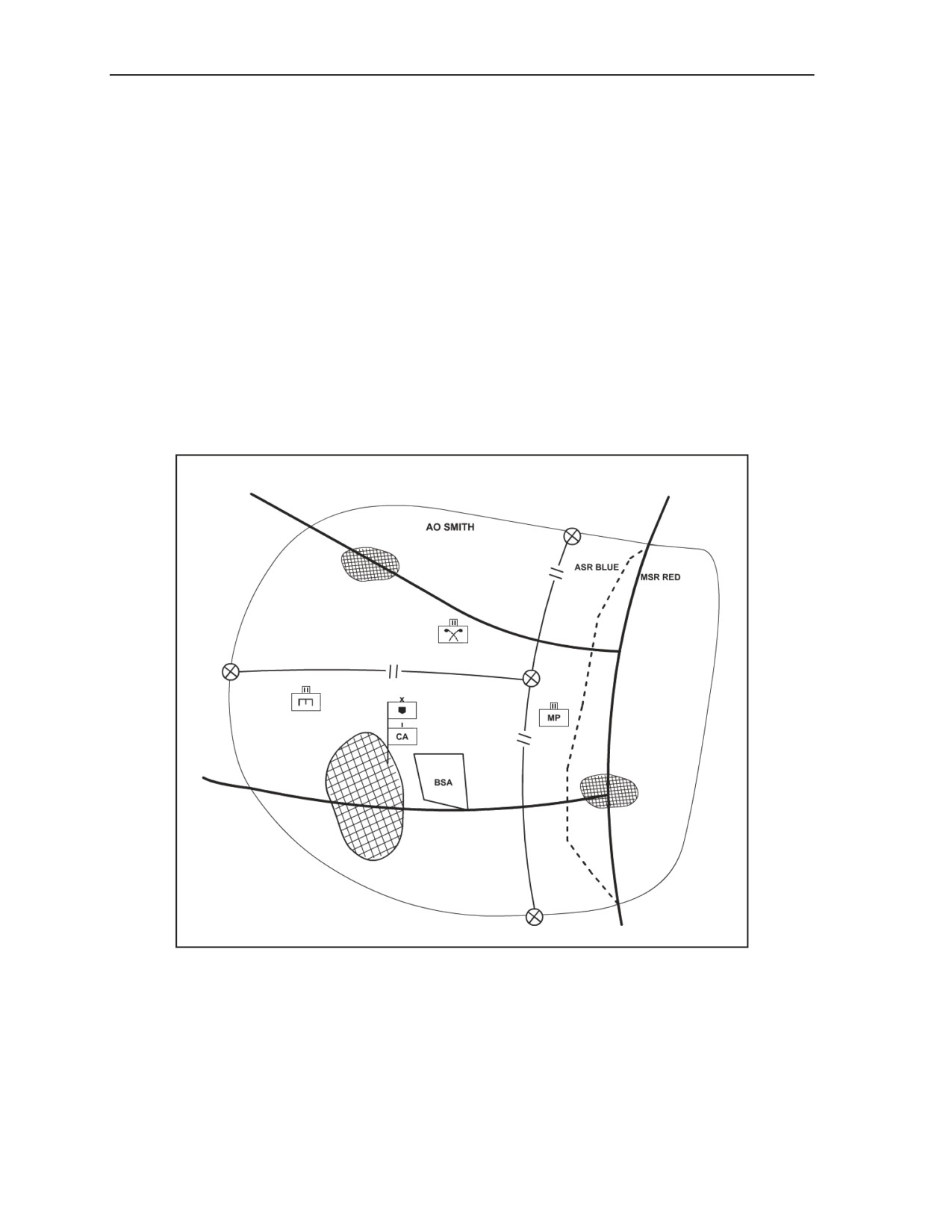
8-76. One example of an MEB conducting stability operations is shown in figure 8-2. In this example, the
MEB is assigned AO Smith primarily to conduct stability operations within. The stability operations
require the MEB to establish civil security, civil control, and restore essential services. The MEB is task-
organized with a chemical, engineer, and MP battalion, and a CA and EOD company. Based on METT-TC,
the MEB creates three battalion TFs task-organized based on the primary tasks within their assigned
boundaries. The MP TF has responsibility for the MSR RED and construction of ASR BLUE to improve
movement within the AO and bypass the built up area. Attachments to the MP TF include an engineer
company and a CA team and it has detached a company and a platoon. The chemical battalion TF has
TIC/TIM concerns and responsibility for the smaller built up area. Attachments to the chemical battalion
TF include an MP platoon, and a CA team. The engineer TF has responsibility for the largest built up area,
general engineering support to the BSB, and the largest area of demand to restore essential services.
Attachments to the engineer TF include an MP company and a CA team and it has detached a company.
The MEB and CA headquarters are collocated within the largest built up area to coordinate with and assist
the regional civil authority. The MEB locates the BSA within a partially destroyed existing base near the
built up area due to sources of local supplies and access to the road connecting to MSR RED.
Figure 8-2. Example of an MEB conducting stability operations
8-16
FM 3-90.31
26 February 2009
Chapter 9
Sustainment Operations
Sustainment is the provision of logistics and personnel services required to maintain
and prolong operations until successful mission accomplishment
(JP
3-0). The
endurance of Army forces is primarily a function of their sustainment. Sustainment
determines the depth to which Army forces can conduct decisive operations, allowing
the commander to seize, retain and exploit the initiative. The guiding principles of
sustainment include responsiveness, anticipation, continuity, improvisation, and
integration. MEB commanders use their assets to maintain the momentum of
operations and enhance the capabilities of their forces. Digital C2 enablers enhance
their sustainment operations. This chapter discusses sustainment of the MEB, not the
conduct of sustainment tasks, as a part of MANSPT operations. Further information
on sustainment operations can be found in FM 4-0, FM 63-2, and FM 3-90, appendix
E. Information on contracting can be found in FM 100-10-2 and FM 3-100.21. See
FM 3-34 or FM 3-34.400 for information on general engineering support (part of
logistics).
PLANNING
9-1. The sustainment warfighting function is defined as the related tasks and systems that provide support
and services to ensure freedom of action, extend operational reach, and prolong endurance (FM 3-0).
Sustainment encompasses the sub-functions of logistics, personnel services, AHS support, and I/R
operations required to maintain operations for mission accomplishment. Logistics is the science of
planning, preparing, executing, and assessing movement and maintenance of forces. Personnel services are
those sustaining functions related to Soldier’s welfare, readiness, and quality of life. AHS support consists
of all measures taken by commanders, leaders, individual Service members, and the military health system
to promote, improve, conserve, or restore the mental and physical well-being of Service members.
9-2. The MEB staff synchronizes operations across all six warfighting functions to generate and maintain
combat power. It plans tactical logistics. The sustainment warfighting function is synchronized with the
higher echelon staff and supporting sustainment brigade. An MCT supporting the AO and other
sustainment brigade assets may be located in the MEB brigade area. If required, the MEB will coordinate
directly with the contracting support brigade (CSB) for contingency contacting. (See FM 100-10-2)
9-3. The MEB S-4, S-1, MEB brigade surgeon, and chaplain are the principal sustainment planners in the
MEB. The BSB is the principal sustainment executer. Logistics synchronization for the brigade is done
between the primary staff sections and the BSB support operations section. The MEB commander
designates who will oversee logistics synchronization for the brigade. Traditionally this has been the XO.
However, the MEB commander may elect to use the DCO for that mission while the executive officer
focuses on other staff planning, integration, and synchronization functions in the main CP. The MEB
obtains the logistics preparation of the theater information/products from the supporting sustainment
brigade and the higher echelon headquarters concept of operations and integrates this with their IPB. The
S-4, S-1, and BSB support operations officer maintain a continuous sustainment estimate during all
operations. They use the logistics estimate to determine sustainment capabilities, anticipate support
requirements, identify and resolve shortfalls, and develop support plans. They integrate into all planning
what is needed to develop and synchronize sustainment with maneuver and fire plans. Sustainment
commanders and planners must thoroughly understand the mission, tactical plans, and the MEB
commander's intent.
26 February 2009
FM 3-90.31
9-1
Chapter 9
They must know—
z
Mission, task organization, and concept of operations for all subordinate battalions and
attachments under MEB control.
z
Higher headquarters sustainment plans.
z
Known and anticipated branch plans and sequels.
z
Density of personnel and equipment of each subordinate unit.
z
Known and anticipated enemy situation and capabilities.
z
Capabilities and limitations of subordinate units.
z
HN support and contract capabilities.
9-4. The organic BSB supports the MEB employment, sustainment, and maintenance of organic and
attached units. The BSB receives sustainment augmentation to expand capabilities as required. It task
organizes as needed to support multiple simultaneous or sequential operations. It conducts sustainment for
current operations and sets conditions for future operations. The BSB may command nonlogistics units
when the MEB uses them as a TF or the BSB may form company teams to provide security as necessary.
The BSB maintains visibility of the distribution system, theater infrastructure, and MSRs to provide the
flexible support when and where it is needed.
9-5. The MEB establishes a BSA. The BSA could be a perimeter established by the BSB within a
supported unit’s AO, a base commanded by the BSB, or an area or base within the MEB’s support AO.
The MEB operations may require split based sustainment operations. The BSB may conduct replenishment
operation within the MEB support AO or within the AO of a unit that the MEB is supporting. The MEB
may establish an area within the support AO to support MSO for the MEB or support a BCT to establish an
area for them in their AO or in the support AO.
PLANNING OVERVIEW
9-6. Logistics planners must understand the MEB’s current and projected sustainment capabilities. They
use information collected from personnel and logistics reports and operational reports to determine the
personnel, equipment, and supply status of each unit within the MEB. They consider the disposition and
condition of all supporting sustainment units and individual unit-level capabilities. They analyze this data
and the current situation to determine the MEB’s logistical capabilities and limitations.
9-7. Logistics planners must anticipate and understand support requirements of a tactical plan or COA.
The S-1, S-4, and the BSB commander/BSB support operations officer analyze all COAs and
modifications to current plans. They assess their sustainment feasibility, identify support requirements, and
determine requirements for synchronization. The S-1 and S-4, like the commander, must visualize how the
battle will unfold to determine critical requirements for each sustainment function. They logically consider
the requirements for each sustainment function during the operational phases of before
(prior to
commitment), during (commitment to battle), and after (future missions). They analyze each COA/plan and
consider the following:
z
Type and duration of the operation.
z
Task organization, tasks, and sustainment requirements of subordinate forces.
z
Medical and maintenance profile of units to be assigned or attached.
z
Ramifications of tactical operations such as gap
(river) crossings, tactical pauses, long
movements, preparatory fires, or defenses.
z
Need for special equipment, supplies, or service.
z
Requirements to separate, disassemble, configure, uncrate, or transload supplies above normal
requirements.
z
Requirements for reconstitution.
z
Required varieties and quantities of all classes of supplies (especially class III, V, and IX).
z
Requirements for support of reconnaissance forces, security operations, or deception efforts.
z
Need for class IV/V obstacle material.
9-2
FM 3-90.31
26 February 2009

Sustainment Operations
z
Positioning of combat trains and other supporting logistics elements.
z
Casualty numbers and likely locations.
z
Large-scale decontamination operations in support of BCTs or consequence management mass
casualty decontamination operations.
z
ADC preparations and response.
9-8. The S-4’s analysis also includes estimated attrition based on likely outcomes of subordinate
missions. Analysis of estimated attrition primarily focuses on critical systems. The S-1 assists by projecting
potential personnel losses. To perform this analysis, current unit personnel and equipment densities,
standard planning factors, operations logistics software, and historical data are used in conjunction with
operations logistics plan. When analyzing COAs, this projection helps the commander understand the
potential losses and associated risks of each COA.
9-9. To understand the MEB’s capabilities and determine support requirements, logistics planners apply a
METT-TC analysis to the situation. Table 9-1 gives an example of general sustainment consideration for
tactical operations.
Table 9-1. Logistics considerations for tactical operations
Terrain and
Time
Civil
Mission
Enemy
Troops
Weather
Available
Considerations
•MEB
• Enemy
• MEB’s task
• Effects of
• Impact on
• Host-nation
mission
capabilities
organization
weather and
the ability to
support and
and
and tactics
to include
terrain on
build-up
contract
command-
that could
supporting
sustainment
supplies and
services.
er's intent.
threaten
logistics
operations.
replenish
• Impact of
sustainment
units.
units.
• Concept of
• Additional
civilian and
operations.
operations.
• Location
sustainment
• Planning
refugee
• Enemy
and
require-
and
movements.
• Higher
uncon-
condition of
ments of the
preparation
head-
• Potential for
ventional
all units,
MEB due to
time for
quarter’s
hostile
tactics that
including
weather and
sustainment
mission
reactions by
could
sustainment
terrain.
units.
civilians
and
threaten
units.
concept of
• Condition of
• Impacts of
against
sustainment
operations.
• Current and
infra-
time on
sustainment
operations.
projected
structure
support
operations.
• Higher
• Anticipated
status of
such as
require-
• Potential
head-
amount of
personnel,
roads and
ments and
detainee or
quarter’s
EPWs.
equipment,
bridges.
distribution
resettlement
concept of
and classes
methods.
requirements.
support.
of supply.
• Type and
• Availability
duration of
and status
operation.
of services.
• Required
• Unit-level
supply rate.
sustainment
capabilities.
• Controlled
supply rate.
9-10. The S-4 and BSB support operations officer must balance support requirements and priorities with
available sustainment capabilities. They consider existing stockages, anticipated receipts, capacities, and
capabilities. They must assess the status of all logistics functions required to support the MEB and compare
26 February 2009
FM 3-90.31
9-3
Chapter 9
them to available capabilities. They identify potential shortfalls then take or recommend actions to
eliminate or reduce their effect on the operation.
9-11. When a logistics shortfall is identified, the S-1, S-4, MEB surgeon, chaplain, and BSB support
operations officer take every action available to eliminate or reduce its effect. They must understand its
potential impact on the force, the risk it presents to mission accomplishment, its duration, and which
requirement exceeded the unit’s capabilities. They analyze the shortfall to determine its cause such as battle
losses, supply availability, resource availability (equipment, man-hours), or distribution shortfall. They
consider the following actions to resolve a shortfall:
z
Shifting supplies or assets by phase of the operation.
z
Requesting support or additional assets from higher headquarters.
z
Using alternative distribution methods.
z
Considering the use of host nation support.
z
Considering pre-positioning supplies or attaching additional sustainment capabilities to
subordinate forces.
z
Modifying the COA or plan.
9-12. Based on the logistics estimate, the S-4, MEB surgeon, chaplain, and BSB support operations officer
develop support plans. The overall sustainment plan is briefly described in the concept of support. The
concept of support provides all commanders and staffs a general understanding of the commander’s
priorities and how the operation will be logistically supported. Detailed sustainment plans are outlined in a
logistics annex to the MEB’s OPORD or as part of a FRAGO. BSB commanders also issue an OPORD to
all units under their control. BSB commanders in conjunction with the S-4 and executive officer closely
monitor the implementation of the sustainment plan. They adjust sustainment operations, or shift resources
to account for changing situations, changes in priorities (such as shifting the main effort) or to replace lost
sustainment capabilities.
9-13. The MEB staff plans for sustainment of a frequently changing task organization with augmentation
from other Army, joint, interagency, and multinational forces. Attachments to the MEB should arrive with
their appropriate sustainment capability. When a company, team, or detachment is attached to the MEB,
the S-4 integrates their sustainment augmentation pieces into the MEB support system. The S-4 must
clearly state who will provide medical, maintenance, and recovery services, and provide support for class
III, V, and IX supplies. When receiving attachments, sustainment planners require some basic information
from the sending unit’s S-4 to anticipate how to develop a synchronized concept of support. When the unit
is detached, the MEB assists forwarding any on-hand supplies or equipment to the gaining unit. Some
considerations are—
z
Number and type of vehicles, personnel by specialty, and weapons systems.
z
Current status and/or strength.
z
Organic medical and maintenance capabilities.
z
When attachment is effective and for how long.
z
What support assets are coming with each attachment to the MEB.
z
When and where linkup will occur, and who is responsible for linkup.
OPERATIONS
LOGISTICS
9-14. Logistics is primarily the responsibility of the MEB S-4 and provided primarily by the MEB’s
organic BSB. Logistics includes maintenance, transportation, supply, field services, distribution,
contracting and general engineering. General engineering and I/R are primarily planned by the S-3 staff
and not discussed in this chapter. Field services will be discussed further and include mortuary affairs,
shower, laundry and light textile repair, and water purification. Contracting is discussed in greater detail
since much of this information is new or emerging doctrine.
9-4
FM 3-90.31
26 February 2009
Sustainment Operations
FIELD SERVICES
9-15. The MEB is dependent on augmentation for collection, processing and evacuation. A mortuary
affairs team from the theater sustainment brigade provides mortuary services support to the MEB. The
team operates from the BSA and is responsible for processing remains. The team has no transportation
capabilities and coordinates with the support operations officer for evacuation back to the theater mortuary
evacuation point. Internal to the MEB, handling teams are pre-designated at the unit level. It is the unit’s
responsibility to evacuate remains to the BSA.
9-16. There is no organic laundry or bath capability in the MEB. Support must be coordinated with the
sustainment brigade.
9-17. The BSB has the organic capability to produce, store and transport purified water to meet the MEB’s
support requirements.
OPERATIONAL CONTRACT AND OTHER ACQUISITION LOGISTICS AND TECHNOLOGY
SUPPORT
Overview
9-18. Acquisition, logistic, and technology (ALT) support consists of a myriad of unique support functions
on the modern battlefield to include rapid equipment fielding support, technical equipment support,
prepositioned stock support, and contracting support. Most of this ALT support is conducted through two
colonel (O-6) level (United States Army Materiel Command [USAMC]) units—the Army field support
brigade (AFSB) and the CSB. AFSB and CSB ALT support to the MEB will normally be executed in a GS
manner under the C2 of the theater sustainment command (TSC) or expeditionary support command
(ESC).
Army Field Support Brigade
9-19. The AFSB is the primary ALT unit for the Army and is responsible to control all ALT functions, less
theater support contracting and logistic civil augmentation program (LOGCAP) support in the AO. The
AFSB is a small TOE and augmented table of distribution and allowance (TDA) headquarters. It leverages
reach (for technical support) and call-forward procedures to bring the requisite USAMC and Assistant
Secretary of the Army for Acquisition, Logistics and Technology (ASA[ALT]) program executive offices
(PEOs) (such as PEO Ground Combat Systems) and their subordinate product/ project manager (such as
project manager Stryker brigade combat team) capabilities forward to the AO. These capabilities are
organized in a USAMC-wide contingency TDA consisting of nearly 2,000 personnel. (Additional AFSB
information can be found in FMI 4-93.41.) Specific AFSB functions include, but are not limited to—
z
Army Logistics Assistance Program (LAP) U.S. Army Materiel Command support.
z
System support contract management.
z
Army preposition stocks offload support.
z
USAMC research and development call forward support.
z
USAMC Life Cycle Management Command (LCMC) call forward support.
z
Project manager/PEO rapid-fielding and equipment modification support.
z
Contractor personnel accountability and deployment support.
9-20. Two key AFSB subordinate units are the Army field support battalion and the brigade logistics
support team (BLST). Army field support battalions are small, tailorable, deployable, lieutenant colonel
(O-5) level TDA organizations of about 22 personnel, mostly LCMC logistics assistant representatives,
aligned to specific division headquarters. BLSTs are similar to Army field support battalions, but are
smaller major (O-4) level organizations (can also be lead by a warrant officer) that provide DS LAP
support to a specific BCT or aviation brigade. Since MEBs do not have a DS BLST, they receive GS ALT
support (less theater support contracting and LOGCAP from a designated Army field support battalion
commander on GS basis.
26 February 2009
FM 3-90.31
9-5
Chapter 9
Contracting Support Brigade
9-21. The Army has recently consolidated its theater support contracting capabilities into separate TOE
units. These units include the CSB, contingency contracting battalions, senior contingency contracting
teams, and contingency contracting teams (CCTs). These consolidated units are made up of primarily 51C
military occupational specialty officers and NCOs. Like the AFSB, these units are currently assigned to the
ASC, but are scheduled to come under the command of the new U.S. Army Contracting Command, and its
subordinate expeditionary contracting command in the near future. The CSB and its subordinate unit's
primary missions include—
z
Providing theater support contracting capabilities to deployed Army forces, and as other military
forces, governmental agencies and/or nongovernmental agencies, as directed.
z
Developing contracting support plans; normally at the Army force (ARFOR) level. These plans
will include mission specific LOGCAP support information.
z
Coordinating execution of LOGCAP support to ensure that it is not in competition with existing
or planned theater support contracts.
z
Staying in close coordination with the supporting AFSB, providing contracting advice and
planning assistance to senior maneuver and sustainment commanders.
9-22. In major operations, the CSB will normally be OPCON to the TSC or a separate joint theater support
contracting command. In these situations, theater support contracting actions in support to the MEB will be
executed in a GS manner.
9-23. For more information on operational contract support, see FM 3-100.21 and FM 100-10-2. For more
specific postings of questions and discussions of operational contract support issues, see the Combined
Arms Support Command battle command knowledge system on logistics data network (array) (LOGNET)
<https://lognet.bcks.army.mil/>. Click on “Battlefield Contracting.” For online training covering basic
contracting familiarization, go to
course catalogues, select “Software Center of Excellence (SCOE) courses,” and enroll in “151-CAF-DL,
Contractors Accompanying the Force (CAF).”
Maneuver Enhancement Brigade’s Role in Planning and Managing Operational Contract
Support
9-24. Contracting is a key source of support for deployed armed forces across the full spectrum operations.
Because of the importance and unique challenges of operational contract support, the MEB commander
and staff need to fully understand their role in planning and managing contracted support in the AO.
Current doctrine describes three broad types of contracted support—theater support, external support and
systems support.
z
Theater support contracts support deployed operational forces under prearranged contracts, or
contracts awarded from the mission area, by contracting officers under the C2 of the CSB.
Theater-support contractors are utilized to acquire goods, services, and minor construction
support, usually from the local commercial sources, to meet the immediate needs of operational
commanders. Theater support contracts are the type of contract typically associated with
contingency contracting. MEBs will often be the requiring activity for theater support contract
support actions related to both internal and external missions. Theater support contracts in
support of the MEB’s missions are normally executed through a GS CCT or regional contracting
office.
z
External support contracts provide a variety of mission support to deployed forces. External
support contracts may be prearranged contracts or contracts awarded during the contingency
itself to support the mission and may include a mix of U.S. citizens, third country nationals, and
local national subcontractor employees. The largest and most commonly used external support
contract is LOGCAP. This Army program is commonly used to provide life support,
transportation support, and other supporting functions to deployed Army forces and other
elements of the joint force as well. In most operations, the MEB is a supported unit, but not the
requiring activity when it comes to LOGCAP support.
9-6
FM 3-90.31
26 February 2009
Sustainment Operations
z
System support contracts are prearranged contracts by the USAMC LCMCs and separate ASA
(ALT) PEO and project manager offices. Supported systems include, but are not limited to,
newly fielded weapon systems, C2 infrastructure, such as the ABCS and STAMIS, and
communications equipment. System contractors, made up of U.S. citizens, provide support in
garrison and may deploy with the force to both training and real-world operations. They may
provide either temporary support during the initial fielding of a system, called interim contracted
support, or long-term support for selected materiel systems, often referred to as contractor
logistic support. The MEB does not normally have a significant role to play in planning or
coordinating system support contracts other than coordinating and executing support of system
support contract related personnel.
9-25. For the MEB, the major challenge is ensuring theater support and external contract support
(primarily LOGCAP related support) actions are properly incorporated and synchronized with the overall
MEB support effort. It is imperative the MEB S-4 and its BSB support operations officer (SPO) work
closely work with the TSC/ESC SPO, the ARFOR G-4, the CSB and the supporting Team LOGCAP-
Forward. It is also important to understand that MEBs do not have any dedicated contingency
contracting officers on their staff and that this support will be provided on a GS basis through the
supporting CSB. Because of these new modular force contracting support arrangements, it is imperative the
MEB S-4 and BSB SPO staff be trained on their roles in the operational contract support planning and
execution process as described below:
z
Contract planning. The sustainment brigade must to be prepared to develop “acquisition
ready” requirement packets for submission to the supporting contracting activity. The packets
must include a detailed performance work statement
(PWS) (sometimes referred to as a
statement of work [SOW]) for service requirements or detail item description(s)/capability for a
commodity requirement. In addition to the PWS, packets must include an independent cost
estimate for the item or service required along with an O-6 level and resource manager staff
approved DA Form 3953, (Purchase Request and Equipment). Depending upon local ARFOR
or joint force command policies, certain items or specific dollar amount requests may require
formal acquisition review board packet review.
z
Contract management. One of the most important MEB staff tasks is to nominate and track
contract officer representatives
(CORs) (sometimes referred to as contract officer technical
representatives [COTRs]) for every service contract and a receiving official for all supply
contracts. Quality COR and receiving official support is key to ensuring contractors provide the
service or item according to the contract. The MEB must also manage funding for each contract
and request funds in advance of depletion of current funds or all contract work will stop until
adequate funds are available.
z
Contract close out. The MEB is responsible for completing receiving reports, certifying that
contracted goods or services were received by the Army, and submitting the receiving report to
the contracting officer so the contract can be closed out and the contractor paid.
PERSONNEL SERVICES
9-26. Personnel services complement logistics by planning for and coordinating efforts that provide and
sustain personnel. Personnel services are an integral part of unit readiness. The MEB S-1 is the staff officer
responsible for personnel services. MEB capabilities include human resources support, legal support, and
religious support.
9-27. Human resources (HR) support is an important component of sustainment. The MEB S-1 is
responsible for providing or coordinating the operational and tactical level HR support that sustains the
combat potential of the force, and the morale and welfare of Soldiers.
9-28. HR activities are divided into three categories—manning the force, personnel services, and personnel
support. During the early phases of operations, HR support for the MEB focuses on the critical tasks of
strength management, casualty operations, and replacement operations. Other HR key tasks will be
completed via reachback operations or as the situation allows.
26 February 2009
FM 3-90.31
9-7
Chapter 9
MANNING THE FORCE
9-29. The MEB S-1 section serves as a conduit between subordinate units and the division HR
organization
(G-1). Because of distances and communications capabilities, all reports are submitted
through the MEB S-1 for forwarding to the appropriate agency. Initial personnel data is submitted by
subordinate and attached units of the MEB by using digital technology. The MEB S-1 also provides
information to subordinate units on status of evacuated/hospitalized personnel and adjusts personnel
requirements accordingly.
9-30. There are four critical HR systems/functions that combine to form the task of manning the force—
personnel readiness management, replacement management, personnel accounting, and personnel
information management. The S-1 is responsible for integrating the elements of this task at the MEB level.
9-31. The purpose of the personnel readiness management system is to distribute Soldiers to units based on
documented requirements or authorizations to maximize mission preparedness and provide the manpower
needed. Personnel accounting is the system for recording by-name data on Soldiers when they arrive in and
depart from units, when their duty status changes (such as from duty to hospital), and when their grade
changes. Strength reporting is a numerical end product of the accounting process. It starts with
strength-related transactions submitted at unit level and ends with a database update through all echelons to
the Total Army Personnel Database. Personnel information management encompasses the collection,
processing, and storing of critical information about Soldiers, units, and civilians. Personnel readiness
managers, casualty managers, and replacement managers all utilize a personnel information database when
performing their missions.
9-32. Replacement companies under C2 of replacement battalions at theater or corps level, receive,
support, and process replacements. They coordinate movement with the appropriate movement control
element. The division replacement section coordinates with the G-4 and division transportation officer for
movement to the BSA. The MEB S-1 processes and assigns replacements to battalions. The battalion S-1
further assigns replacements to company level.
PERSONNEL SERVICES
9-33. Personnel services are an integral part of unit readiness. The MEB S-1 is the staff officer responsible
for personnel services. This includes casualty reporting, military pay, and other essential services such as
awards and decorations, evaluation reports, and enlisted promotions. While many of these functions are
completed via reach operations, casualty operations are a critical function that must be completed
throughout all operations, and with 100 percent accuracy.
Casualty Operations
9-34. The casualty reporting system is a by-name personnel accounting system that begins at unit level
with the person who knows that a casualty has occurred. DA Form 1156 (Casualty Feeder Card) is
forwarded as soon as possible. Reports are prepared using the Army Casualty Information Processing
System-Light and are sent directly to HQDA, with copies furnished to other higher headquarters, as
appropriate. Patient evacuation and mortality reports and treatment and disposition logs are provided daily
to the MEB S-1 from the area support medical company.
Personnel Support
9-35. The third element of HR is personnel support. It includes postal operations management; morale,
welfare, and recreation; and community support. The MEB has no unique capabilities in these areas.
FINANCIAL MANAGEMENT
9-36. The MEB has no special financial management capability. The MEB S-1 coordinates for support
from mobile finance teams. Finance organizations provide support to the MEB units and individual
Soldiers on an area basis. During deployments, mobile teams from corps-level finance organizations
provide support to forward units. A finance battalion typically supports a division, with detachments
providing financial management services as required.
9-8
FM 3-90.31
26 February 2009
Sustainment Operations
LEGAL SUPPORT
9-37. The brigade legal section (BLS) provides and supervises legal support to MEB C2, sustainment, and
support operations. The BLS provides and coordinates all legal support for the MEB. Paralegal Soldiers in
the MEB and subordinate battalions provide paraprofessional and ministerial support for legal actions. The
U.S. Army Trial Judiciary and U.S. Army Trial Defense Service are independent organizations that provide
military judge and trial defense services to the MEB.
RELIGIOUS SUPPORT
9-38. The MEB chaplain is the staff officer responsible for implementing the commander’s religious
support program. Included in this program are worship opportunities; administration of sacraments; rites
and ordinances; pastoral care and counseling; religious education; ministry to casualties to include support
of combat operational stress reaction casualty treatment; and development and management of the unit
ministry team (UMT). The chaplain advises the commander and staff on matters of morals, morale as
affected by religion, the impact of local religion on the military mission, and the ethical impact of
command decisions. The UMT is composed of a chaplain and one enlisted chaplain assistant. The chaplain
assistant is an active member of the NCO support channel. The assistant assesses the Soldiers and other
authorized personnel’s well being that can affect the unit’s fighting spirit. (See AR 165-1 and FM 1-05.)
HEALTH SERVICE SUPPORT
9-39. Health service support includes limited organic medical support and relies on area medical support.
The MEB has limited medical logistics planning capability. The MEB surgeon ensures that all AHS
support functions are considered and included in operation plans and operation orders. The MEB surgeon
is a full-time special staff officer answering directly to the MEB commander on matters that pertain to the
health of the command. The MEB surgeon coordinates AHS support for both HSS and FHP. The MEB
surgeon coordinates AHS support operation with both the supported division surgeon and the medical
brigade
(MEDBDE) commander and establish medical guidelines for the MEB. The duties and
responsibilities of the MEB surgeon include both HSS and FHP functions.
9-40. The MEB surgeon's duties and responsibilities for AHS may include—
z
Advising the commander on the health of the MEB units.
z
Planning and coordinating for HSS for MEB units (including but not limited to medical
treatment, medical logistics, medical evacuation, hospitalization, dental support, preventive
medicine, behavioral health, and clinical medical laboratory support.
z
Developing and coordinating the HSS portion of AHS operation plans to support the MEB
commander’s decisions, planning guidance, and intent in support of full spectrum operations.
(See FM 4-02.12 and FM 8-55.)
z
Determining the medical workload requirements (patient estimates).
z
Advising the MEB commander on policy regarding the eligibility of care for non-U.S. military
personnel.
z
Maintaining situational understanding by coordinating for current HSS information with
surgeons of the next higher, adjacent, and subordinate headquarters.
z
Recommending task organization of medical units/elements in support to MEB units to satisfy
all HSS mission requirements.
z
Recommending policies concerning medical support of stability operations (that include civil-
military operations).
z
Monitoring troop strength of medical personnel and their utilization.
z
Coordinating, and synchronizing health consultation services.
z
Evaluating and interpreting medical statistical data.
z
Monitoring medical logistics and blood management operations in the theater. (See FM 4-02.1.)
26 February 2009
FM 3-90.31
9-9
Chapter 9
z
Monitoring medical regulating and patient tracking operations for MEB personnel.
(See
FM 4-02.2.)
z
Determining MEB training requirements for first aid and for maintaining wellness of the
command.
z
Ensuring field medical records are maintained on each Soldier assigned to the TSC at their
primary care medical treatment facility per AR 40-66 and FM 4-02.4.
z
Establishing, in coordination with the chain of command, and promulgating a plan to ensure
individual informed consent is established before administering investigational new drugs as
described in Executive Order 13139.
z
Recommending disposition instructions for captured enemy medical supplies and equipment.
(Refer to FM 4-02 for additional information on the Geneva Conventions).
z
Submitting to higher headquarters those recommendations on medical problems/conditions that
require research and development.
z
Coordinating, and synchronizing—
Health education and combat lifesaver training for the MEB.
Mass casualty plan developed by the S-3.
Medical care of EPWs, detainees, and civilians in the MEB’s operations area.
Treatment of sick, injured, or wounded Soldiers.
z
Performing medical evacuation, including use of both the Army’s dedicated MEDEVAC
platforms (air and ground).
z
Coordinating medical logistics including class VIII resupply, blood management, and medical
maintenance.
z
Creating health-related reports and battlefield statistics.
z
Collecting and analyzing operational data for on-the-spot adjustments in the medical support
structure and for use in postoperations combat and materiel development studies.
z
Providing Army Health System support for stability and civil support operations.
Force Health Protection
9-41. The MEB surgeon's duties and responsibilities for FHP may include:
z
Identifying potential medical-related commander’s critical information requirements (priority
intelligence requirements and friendly force information requirements) as they pertain to the
health threat; ensuring they are incorporated into the command’s intelligence requirements.
z
Coordinating for veterinary support for food safety, animal care, and veterinary preventive
medicine to include zoonotic diseases transmissible to man.
z
Planning for and implementing FHP operations to counter health threats. (See FM 4-02.17.)
Force health protection operations may include:
z
Planning for and accomplishing redeployment and postdeployment health assessments.
Establishing and executing a medical surveillance program (refer to AR 40-5, AR 40-66, and
FM 4-02.17 for an in-depth discussion).
z
Establishing and executing an occupational and environmental health surveillance program. (See
FM 3-100.4.)
z
Recommending combat and operational stress control, behavioral health, and substance abuse
control programs. (See FM 4-02.51.)
z
Ensuring the general threat, health threat, and medical intelligence considerations are integrated
into AHS support operation plans and orders.
z
Advising MEB commanders on FHP CBRN defensive actions, such as immunizations, use of
chemoprophylaxis, pretreatments, and barrier creams.
z
Identifying health threats and medical-related commander’s critical information requirements.
z
Maintaining situational understanding by coordinating for current FHP information with
surgeon staffs of the next higher, adjacent, and subordinate headquarters.
9-10
FM 3-90.31
26 February 2009
Sustainment Operations
z
Coordinating, and synchronizing—
Combat and operational stress control program with the division surgeon section (DSS) and
supporting medical brigade.
Veterinary food inspection, military working dogs and other animal care, and veterinary
preventive medicine activities of the command, as required.
Preventive medicine services to include identification of health threats.
Preventive dentistry support program for the prevention of cavities and gum disease.
Support of area medical laboratories support to include the identification of biological and
chemical warfare agents, as required.
Brigade Surgeon Section
9-42. The brigade surgeon section (BSS) assists the surgeon with responsibilities listed above. The BSS
monitors and tracks operations with medical communications for applicable automated systems (see FM 4-
02.21) and provides updated information to the surgeon and the SPO chief for building capabilities to meet
the MEB's medical requirements identified by the surgeon. Other functions include—
z
Planning for the AHS support for the MEB units.
z
Identifying and coordinating through the DSS and as authorized directly with medical brigade
elements to support requirements of the MEB.
z
Coordinating/managing medical evacuation and treatment capabilities.
z
Coordinating/managing class VIII resupply capabilities and ensuring medical support is
integrated and synchronized with the MEB’s operational support plan.
Medical Plans and Operations
9-43. The BSS is normally staffed with medical operations officers Major 04, AOC 70H00, and a medical
operations NCO (E-7, military occupational specialty 68W40). The primary function of this BSS is
medical planning to ensure that adequate AHS support is available and provided in a timely and efficient
manner for the MEB and its attached units. This BSS coordinates with the DSS and, as authorized, with
medical brigade for the placement and support requirements of medical units and elements located in the
MEB's operations area. For additional information on medical staff planning, see FM 8-55.
Medical Treatment Team
9-44. The medical treatment team assigned to the BSS and supports the MEB headquarters. The team
provides Role 1 HSS for MEB headquarters personnel. The medical treatment leader is a physician
assistant and works under the supervision of the MEB surgeon.
Health Threat
9-45. The health threat to Soldiers comes from enemy action and environmental situations. Effective and
timely FHP initiatives are essential factors in sustaining combat power during continuous operations. The
MEB's first line of protection is the use of preventive medicine measures and the units' field sanitation
teams. For additional support, the MEB's subordinate units coordinate through their medical treatment team
or the BSS for PVNTMED and COSC support. The PVNTMED and mental health elements from the
MEDBDE provide DS as required that includes—
z
Preventive medicine advice and consultation in the areas of disease and nonbattle injury,
environmental sanitation, epidemiology, entomology, medical surveillance, limited sanitary
engineering services, and pest management. See FM 4-02.17 for definitive information on
PVNTMED.
z
Training and advice in the promotion of positive combat and operational stress behaviors; the
mental health element can provide early identification, handling, and management of
misconduct stress behavior and Soldiers with combat and operational stress reactions. It assists
and counsels personnel with personal, behavioral, or psychological problems and may refer
suspected neuropsychiatric cases for evaluation. (See FM 4-02.51, FM 6-22.5 and FM 22-51 for
definitive information on COSC.)
26 February 2009
FM 3-90.31
9-11
This page intentionally left blank.

Appendix A
Unit Manning Charts
Since there is no predecessor and little awareness of the MEB structure, this appendix
provides the organizational and manning charts for the organic elements of the MEB
as described in chapter 2. The manning charts for the MEB headquarters company,
BSB, and NSC are based upon unit reference sheet decisions concerning duty title or
position, rank, and military occupational skill (MOS).
Note. There are differences between these generic unit manning charts and the specific manning
provided to each MEB in their TOE or MTOE. This information is provided to give a general
understanding of the breadth and depth of manning for this new unit. Use this web site to see
INTRODUCTION
A-1. The manning charts found in this appendix relate directly to the organizational charts in chapter 2.
Chapter 2 provides additional details on the structures of all organic MEB organizations. Note the 01C00
MOS coding that specifies certain positions as being reserved for only CBRN, engineer, or MP personnel.
MEB HHC
A-2. Tables A-1 through A-21, pages A-1 through A-7, are MEB HHC manning charts.
Table A-1. Command section
Duty Title
Rank
MOS
Commander
Colonel (COL)
01C00
Deputy Commander
Lieutenant Colonel (LTC)
01C00
Executive Officer
LTC
01C00
Command Sergeant Major
CSM
00Z50
Driver
Sergeant (SGT)
88M20
Executive Administrative Assistant
Specialist (SPC)
42A10
Vehicle Driver
Private First Class (PFC)
31B10
26 February 2009
FM 3-90.31
A-1

Appendix A
Table A-2. Personnel section
Duty Title
Rank
MOS
S-1
Major (MAJ)
42H00
Strength Manager
Lieutenant (LT)
42B00
Chief Warrant Officer
Military Personnel Tech
420A0
2(CW2)
Senior Human Resources Sergeant
Master Sergeant (MSG)
42A50
Human Resources Sergeant
Staff Sergeant (SSG)
42A30
Human Resources Sergeant
SGT
42A20
Human Resources Sergeant
SGT
42A20
Human Resources Systems Management
SGT
42F20
Specialist
Human Resources Specialist
SPC
42A10
Human Resources Specialist
SPC
42A10
Human Resources Specialist
SPC
42A10
Human Resources Systems Management
SPC
42F10
Specialist
Table A-3. Intelligence section
Duty Title
Rank
MOS
S-2
MAJ
35D00
Vulnerability Assessment Officer
Captain (CPT)
31A00
Intelligence Officer
CPT
35E00
Chief Warrant Officer 3
Criminal Intelligence/ Operations Officer
311A0
(CW3)
Chief Intelligence Sergeant
MSG
35F50
Sergeant First Class
Vulnerability Assessment NCO
31B40
(SFC)
Intelligence Sergeant
SSG
35F3I0
UAS Operator
SGT
15W20
Intelligence Analyst
SGT
35F20
UAS Operator
SPC
15W10
Intelligence Analyst
SPC
35F10
Intelligence Analyst
PFC
35F10
Table A-4. Operations section
Duty Title
Rank
MOS
S-3
LTC
01C00
Operations Officer
MAJ
01C00
Operations Officer
MAJ
57A00
Chief Operations Sergeant
Sergeant Major (SGM)
11Z50
Operations Sergeant
MSG
11Z50
Vehicle Driver
PFC
21B10
Vehicle Driver
PFC
31B10
A-2
FM 3-90.31
26 February 2009

Unit Manning Charts
Table A-5. Logistics section
Duty Title
Rank
MOS
S-4
MAJ
90A00
Maintenance Officer
CPT
91A00
Mobility Officer
CW2
882A0
Property Assessment Technician/Property
CW2
920A0
Book Officer
Command Food Service Technician
CW2
922A0
Senior Food Operations Sergeant
MSG
92G50
Senior Supply Sergeant
MSG
92Y50
Senior Movements NCO
SFC
88N40
Movements Supervisor
SSG
88N30
Property Book NCO
SGT
92Y20
Assistant Supply Sergeant
SGT
92Y20
Supply Specialist
SPC
92Y10
Table A-6. Plans section
Duty Title
Rank
MOS
Plans Officer
MAJ
21B00
Plans Officer
MAJ
31A00
Plans Officer
MAJ
74A00
Power Systems Technician
CW3
210A5
Operations Sergeant
SFC
11B40
Table A-7. Communications section
Duty Title
Rank
MOS
S-6
MAJ
25A00
Information System Management Officer
CPT
53A00
Information System Technician
CW2
251A0
Signal Support System Chief
MSG
25U50
Senior Local Area Network (LAN) Manager
SGT
25B20
LAN Manager
SPC
25B10
Signal Support System Maintenance
SPC
25U10
Signal Information Service Support
SPC
25U10
LAN Manager
PFC
25B10
Signal Support System Support
PFC
25U10
Table A-8. Civil-military plans and operations
Duty Title
Rank
MOS
Civil Affairs Officer
MAJ
39C00
Civil Affairs Sergeant
SFC
38B40
26 February 2009
FM 3-90.31
A-3

Appendix A
Table A-9. MP operations cell
Duty Title
Rank
MOS
Operations Officer
MAJ
31A00
Assistant S-3
MAJ
31A00
Assistant Operations Officer
CPT
31A00
Maneuver and Mobility Support Operations
CPT
31A00
Officer
Maneuver and Mobility Support Operations
CPT
31A00
Officer
Protective Services Officer
CW3
311A0
Operations NCO
MSG
31B50
Operations NCO
MSG
31B50
Operations NCO
SFC
31B40
Operations NCO
SFC
31B40
Operations NCO
SFC
31B40
Internment/Resettlement NCO
SFC
31E40
Operations Sergeant
SSG
31B30
Operations Sergeant
SSG
31B30
Military Police
SPC
31B10
Table A-10. Fires cell
Duty Title
Rank
MOS
FSCOORD
LTC
13A00
FSO
MAJ
13A00
Assistant FSO
CPT
13A00
Targeting Officer
CW3
131A0
Operations Sergeant
MSG
13Z50
Effects NCO
SFC
13F40
Targeting NCO
SSG
13F30
Fire Support Specialist
SPC
13F10
Table A-11. CBRNE operations cell
Duty Title
Rank
MOS
Operations Officer
MAJ
74B00
Assistant Operations Officer
CPT
74B00
Intelligence Officer
CPT
74B00
EOD Officer
CPT
89E00
Chemical Operations NCO
MSG
74D50
Operations Sergeant
MSG
89D50
CBRN Staff NCO
SFC
74D40
CBRN NCO
SSG
74D30
CBRN NCO
SSG
74D30
CBRN Operations Specialist
SPC
74D10
CBRN Operations Specialist
PFC
74D10
A-4
FM 3-90.31
26 February 2009

Unit Manning Charts
Table A-12. Engineer operations cell
Duty Title
Rank
MOS
Operations Officer
MAJ
21B00
Engineer Tactical Assistant Officer in
CPT
21B00
Charge (OIC)
Assistant Operations Officer
CPT
21B00
Operations Sergeant
MSG
21Z50
Assistant Operations Sergeant
SFC
21B40
Assistant Operations Sergeant
SFC
21C40
Reconnaissance Sergeant
SSG
21B30
Reconnaissance Sergeant
SSG
21B30
Terrain Data Sergeant
SGT
21U20
Terrain Data Specialist
SPC
21U10
Terrain Data Specialist
PFC
21U10
Terrain Data Specialist
PFC
21U10
Table A-13. Brigade unit ministry team
Duty Title
Rank
MOS
Chaplain
MAJ
56A00
Chaplain Assistant NCO
SSG
56M30
Table A-14. Brigade legal section
Duty Title
Rank
MOS
Brigade Judge Advocate
MAJ
27A00
Operational Law Judge Advocate
CPT
27A00
Paralegal NCO
SSG
27D30
Table A-15. Public affairs section
Duty Title
Rank
MOS
Public Affairs Operations NCO
SFC
46Z40
Public Affairs Sergeant
SGT
46Q20
Table A-16. Brigade surgeon section
Duty Title
Rank
MOS
Brigade Surgeon
MAJ
62B00
Medical Operations Officer
CPT
70H67
Health Care NCO
SFC
68W40
Table A-17. Medical treatment team
Duty Title
Rank
MOS
Physician Assistant
CPT
65D00
Health Care Sergeant
SSG
68W30
Health Care Specialist
SPC
68W10
Health Care Specialist/Driver
PFC
68W10
26 February 2009
FM 3-90.31
A-5

Appendix A
Table A-18. Company headquarters
Duty Title
Rank
MOS
Commander
CPT
01C00
First Sergeant
1SG
31B5M
Food Operations Management NCO
SFC
92G40
Senior First Cook
SSG
92G30
Supply Sergeant
SSG
92Y30
Human Resources Sergeant
SGT
42A20
Equipment Receipt/Parts Specialist
SGT
92A20
First Cook
SGT
92G20
Equipment Receipt/Parts Specialist
SPC
92A10
Supply Specialist
SPC
92Y10
Cook
SPC
92G10
Cook
SPC
92G10
Cook
PFC
92G10
Table A-19. Liaison team
Duty Title
Rank
MOS
Team Chief
MAJ
01C00
Liaison Officer
MAJ
31A00
Liaison Officer
CPT
21B00
Liaison Officer
CPT
74A00
Construction Inspector
SFC
21N40
Liaison NCO
SFC
31B40
Liaison NCO
SSG
74D30
Table A-20. Airspace management section
Duty Title
Rank
MOS
Airspace Management Officer
MAJ
15B00
Assistant Operations Officer
CPT
14A00
C2 System Integrator
CW3
140A0
AC2 Sergeant
SFC
15Q40
Operations Sergeant
SSG
14J30
Electronic Warfare System Operator
SPC
14J10
Tactical Airspace Integration System
SPC
15Q10
Operator
Electronic Warfare System Operator
PFC
14J10
A-6
FM 3-90.31
26 February 2009

Unit Manning Charts
Table A-21. Area operations section
Duty Title
Rank
MOS
Operations Officer
MAJ
03A00
Operations Officer
MAJ
03A00
Engineer Operations Officer
MAJ
21B00
Area Security/Protection Officer
MAJ
31A00
Chemical Officer
MAJ
74A00
Area Damage Officer
CPT
21B00
Civil Engineer
CPT
21B00
Area Security/Protection Officer
CPT
31A00
Assistant Operations Officer
LT
74B00
Chief Operations Sergeant
SGM
11Z50
Operations Sergeant
MSG
11Z50
Operations Sergeant
MSG
21X50
Operations NCO
MSG
31B50
Construction Inspector
SFC
21H40
Construction Inspector
SFC
21N40
Senior Technical Engineer NCO
SFC
21T40
Operations NCO
SFC
31B40
CBRN Staff NCO
SFC
74D40
Technical Engineer Specialist
SPC
21T10
Vehicle Driver
PFC
21B10
Vehicle Driver
PFC
31B10
NETWORK SUPPORT COMPANY
A-3. Tables A-22 through A-32 and pages A-7 through A-9 are NSC manning charts.
Table A-22. Company headquarters
Duty Title
Rank
MOS
Commander
CPT
25A00
Executive Officer
LT
25A00
First Sergeant
1SG
25W5M
CBRN NCO
SGT
74D20
Supply Sergeant
SGT
92Y20
Armorer
SPC
92Y10
Table A-23. Signal maintenance section
Duty Title
Rank
MOS
Senior Signal Support System Maintainer
SGT
25U20
Cable System Installer/ Maintainer
SPC
25L10
Support Electronic Devices Repairer
SPC
94F10
26 February 2009
FM 3-90.31
A-7

Appendix A
Table A-24. Network/chemical network defense team
Duty Title
Rank
MOS
Network Management Tech
CW2
250N0
COMSEC Custodian
SFC
25B40
Battlefield Spectrum Manager
SFC
25W40
Automated Data Processing (ADP)
SSG
25B30
Security Team Chief
Assistant COMSEC Custodian
SSG
25B30
Network System Maintainer
SSG
25F30
Network System Maintainer
SSG
25F30
SATCOM Operations NCO
SSG
25S30
ADP Security Specialist
SPC
25B10
ADP Security Specialist
PFC
25B10
Table A-25. Range extension platoon headquarters
Duty Title
Rank
MOS
Platoon Leader
LT
25A00
Platoon Sergeant
SFC
25U40
Table A-26. Small command post support team (X2)
Duty Title
Rank
MOS
Senior Transmission (XMSN)
SGT
25Q20
Operator/Maintainer
Information System Support
SPC
25B10
XMSN Operator/Maintainer
SPC
25Q10
Information System Support
PFC
25B10
Table A-27. Retransmission team (X3)
Duty Title
Rank
MOS
Team Chief
SGT
25U20
Radio Retransmission Operator
SPC
25U10
Radio Retransmission Operator
PFC
25U10
Table A-28. Network extension platoon
Duty Title
Rank
MOS
Platoon Leader
LT
25A00
Platoon Sergeant
SFC
25W40
A-8
FM 3-90.31
26 February 2009

Unit Manning Charts
Table A-29. Joint nodal network team
Duty Title
Rank
MOS
External Switch Supervisor
SSG
25F30
Senior Switch System Operator/Maintainer
SGT
25F20
TACSAT System Team Chief
SGT
25S20
Range Extension Operator
SPC
25F10
External Switch Operator/Maintainer
SPC
25F10
Table A-30. Line of sight V3 team
Duty Title
Rank
MOS
Senior XMSN System Operator/Maintainer
SGT
25Q20
XMSN System Operator/Maintainer
SPC
25Q10
XMSN System Operator/Maintainer
PFC
25Q10
Table A-31. Data support team
Duty Title
Rank
MOS
Senior Info Systems Specialist
SGT
25B20
Cable System Installer/Maintainer
SPC
25L10
Table A-32. Retransmission team
Duty Title
Rank
MOS
Team Chief
SGT
25U20
Radio Retransmission Operator
SPC
25U10
Radio Retransmission Operator
PFC
25U10
BRIGADE SUPPORT BATTALION
HHD BSB
A-4. Tables A-33 through A-43 and pages A-9 through A-12 are HHD, BSB manning charts.
Table A-33. Command section
Duty Title
Rank
MOS
Commander
LTC
90A00
Executive Officer
MAJ
90A00
Command Sergeant Major
CSM
00Z50
Chauffeur
SPC
88M10
26 February 2009
FM 3-90.31
A-9

Appendix A
Table A-34. Personnel section
Duty Title
Rank
MOS
S-1
CPT
90A00
Senior Human Resources Sergeant
SFC
42A40
Human Resources Sergeant
SSG
42A30
Human Resources Sergeant
SGT
42A20
Human Resources Sergeant
SGT
42A20
Paralegal Specialist
SPC
27D10
Human Resources Specialist
SPC
42A10
Human Resources Specialist
PFC
42A10
Table A-35. Unit ministry team
Duty Title
Rank
MOS
Chaplain
CPT
56A00
Chaplain Assistant
SPC
56M10
Table A-36. Logistics section
Duty Title
Rank
MOS
S-4
CPT
90A00
Supply Sergeant
SFC
92Y40
Supply Sergeant
SGT
92Y20
Supply Specialist
SPC
92Y10
Table A-37. Intelligence/operations section
Duty Title
Rank
MOS
S-2
CPT
35D00
S-3
CPT
90A00
Operations Sergeant
MSG
92A50
Intelligence Sergeant
SSG
35F30
Operations Sergeant
SSG
63H30
CBRN NCO
SSG
74D30
Movements NCO
SGT
88N20
Intelligence Analyst
SPC
35F10
Table A-38. Communications section
Duty Title
Rank
MOS
S-6
CPT
25A00
Section Chief
SFC
25U40
LAN Manager
SPC
25B10
Signal Information Service Specialist
SPC
25U10
LAN Manager
PFC
25B10
Signal Support System Specialist
PFC
25U10
A-10
FM 3-90.31
26 February 2009

Unit Manning Charts
Table A-39. Support operations office
Duty Title
Rank
MOS
Support Operations Officer
MAJ
90A00
Transportation Officer
CPT
88A00
Ammunition Officer
CPT
91A00
Operations Officer
CPT
92A00
Operations Sergeant
MSG
92A50
Ammunition Logistics Sergeant
SFC
88B40
Ammunition Inspector
SSG
89B40
Material Management NCO
SSG
92A30
Mortuary Affairs NCO
SSG
92M30
Transportation Management NCO
SGT
88N20
Material Contract/Accounting Specialist
SPC
92A10
Table A-40. Combat service support automation management office
Duty Title
Rank
MOS
Material Management NCO
SSG
92A30
Senior Information Systems Specialist
SGT
25B20
Patient Services NCO
SGT
68G20
Supply Sergeant
SGT
92Y20
Information Systems Specialist
SPC
25B10
Supply Specialist
SPC
92U10
Table A-41. Plans section
Duty Title
Rank
MOS
Plans Officer
CPT
90A00
Movements Supervisor
SSG
88N30
Table A-42. Readiness operations division
Duty Title
Rank
MOS
Maintenance Officer
CPT
91A00
Maintenance Management NCO
SFC
63X40
26 February 2009
FM 3-90.31
A-11

Appendix A
Table A-43. Detachment headquarters
Duty Title
Rank
MOS
Commander
CPT
90A00
First Sergeant
1SG
92Y5M
Senior Food Operations Sergeant
SFC
92G40
Senior First Cook
SSG
92G30
CBRN Decontamination Specialist
SPC
74D10
Cook
SGT
92G20
Cook
SGT
92G20
Supply Sergeant
SGT
92Y20
Cook
SPC
92G10
Cook
SPC
92G10
Cook
SPC
92G10
Cook
SPC
92G10
Cook
SPC
92G10
Armorer
SPC
92Y10
Cook
PFC
92G10
Cook
PFC
92G10
Cook
PFC
92G10
Cook
PFC
92G10
DISTRIBUTION COMPANY
A-5. Tables A-44 through A-53 and pages A-12 through A-15 are distribution company manning charts.
Table A-44. Company headquarters
Duty Title
Rank
MOS
Commander
CPT
90A00
Operations Officer
LT
92A00
First Sergeant
1SG
92A5M
Supply Sergeant
SSG
92Y30
CBRN Specialist
SPC
74D10
Armorer
SPC
92Y10
Table A-45. Distribution platoon headquarters
Duty Title
Rank
MOS
Platoon Leader
LT
88A00
Platoon Sergeant
SFC
88M40
Dispatcher
SGT
88M20
A-12
FM 3-90.31
26 February 2009

Unit Manning Charts
Table A-46. Truck squad (X2)
Duty Title
Rank
MOS
Squad Leader
SSG
88M30
Heavy Vehicle Driver
SSG
88M30
Heavy Vehicle Driver
SGT
88M20
Heavy Vehicle Driver
SGT
88M20
Heavy Vehicle Driver
SGT
88M20
Heavy Vehicle Driver
SPC
88M10
Heavy Vehicle Driver
SPC
88M10
Heavy Vehicle Driver
SPC
88M10
Heavy Vehicle Driver
PFC
88M10
Heavy Vehicle Driver
PFC
88M10
Table A-47. Supply platoon headquarters
Duty Title
Rank
MOS
Platoon Leaders
LT
92A00
Platoon Sergeant
SFC
92A40
Table A-48. Stock control section
Duty Title
Rank
MOS
Supply Systems Technician
CW2
920B0
Material Contract/Accounting Supervisor
SSG
92A30
Material Contract/Accounting NCO
SGT
92A20
Material Contract/Accounting Specialist
SPC
92A10
Material Contract/Accounting Specialist
SPC
92A10
Material Contract/Accounting Specialist
SPC
92A10
Material Contract/Accounting Specialist
PFC
92A10
Material Contract/Accounting Specialist
PFC
92A10
Table A-49. General supply section
Duty Title
Rank
MOS
Material Management Supervisor
SSG
92A30
Material Storage/Handling Sergeant
SGT
92A20
Material Storage/Handling Sergeant
SGT
92A20
Material Storage/Handling Specialist
SPC
92A10
Material Storage/Handling Specialist
SPC
92A10
Subsistence Supply Specialist
SPC
92A10
Subsistence Supply Specialist
SPC
92A10
Material Storage/Handling Specialist
PFC
92A10
Material Storage/Handling Specialist
PFC
92A10
Material Storage/Handling Specialist
PFC
92A10
Subsistence Supply Specialist
PFC
92A10
Subsistence Supply Specialist
PFC
92A10
26 February 2009
FM 3-90.31
A-13

Appendix A
Table A-50. Class IX section
Duty Title
Rank
MOS
Stock Control Supervisor
SFC
92A40
Material Management Supervisor
SSG
92A30
Material Storage/Handling Sergeant
SGT
92A20
Material Storage/Handling Sergeant
SGT
92A20
Material Storage/Handling Sergeant
SGT
92A20
Material Contract/Accounting NCO
SGT
92A20
Material Contract/Accounting Specialist
SPC
92A10
Material Storage/Handling Specialist
SPC
92A10
Material Storage/Handling Specialist
SPC
92A10
Material Storage/Handling Specialist
SPC
92A10
Material Storage/Handling Specialist
PFC
92A10
Material Storage/Handling Specialist
PFC
92A10
Material Storage/Handling Specialist
PFC
92A10
Material Storage/Handling Specialist
PFC
92A10
Table A-51. Fuel and water platoon headquarters
Duty Title
Rank
MOS
Platoon Leader
LT
92F00
Platoon Sergeant
SFC
92W40
Petroleum Lab Sergeant
SGT
92L20
A-14
FM 3-90.31
26 February 2009

Unit Manning Charts
Table A-52. Class III storage/issue section
Duty Title
Rank
MOS
Section Chief
SSG
92F30
Petroleum Heavy Vehicle Operator
SGT
92F20
Petroleum Heavy Vehicle Operator
SGT
92F20
Petroleum Heavy Vehicle Operator
SGT
92F20
Petroleum Heavy Vehicle Operator
SGT
92F20
Petroleum Heavy Vehicle Operator
SGT
92F20
Petroleum Heavy Vehicle Operator
SGT
92F20
Petroleum Light Vehicle Operator
SPC
92F10
Petroleum Heavy Vehicle Operator
SPC
92F10
Petroleum Heavy Vehicle Operator
SPC
92F10
Petroleum Heavy Vehicle Operator
SPC
92F10
Petroleum Heavy Vehicle Operator
SPC
92F10
Petroleum Heavy Vehicle Operator
SPC
92F10
Petroleum Heavy Vehicle Operator
SPC
92F10
Petroleum Heavy Vehicle Operator
SPC
92F10
Petroleum Heavy Vehicle Operator
SPC
92F10
Petroleum Heavy Vehicle Operator
SPC
92F10
Petroleum Heavy Vehicle Operator
SPC
92F10
Petroleum Heavy Vehicle Operator
SPC
92F10
Petroleum Light Vehicle Operator
PFC
92F10
Petroleum Light Vehicle Operator
PFC
92F10
Petroleum Light Vehicle Operator
PFC
92F10
Table A-53. Water section
Duty Title
Rank
MOS
Water Treatment Supervisor
SSG
92W30
Water Treatment NCO
SGT
92W20
Water Treatment Specialist
SPC
92W10
Water Treatment Specialist
SPC
92W10
Water Treatment Specialist
SPC
92W10
Water Treatment Specialist
PFC
92W10
Water Treatment Specialist
PFC
92W10
26 February 2009
FM 3-90.31
A-15

Appendix A
SUPPORT MAINTENANCE COMPANY
A-6. Tables A-54 through A-66 and pages A-16 through A-21 are
support
maintenance
company
manning charts.
Table A-54. Company headquarters
Duty Title
Rank
MOS
Commander
CPT
91A00
Executive Officer
LT
91A00
First Sergeant
1SG
63Z5M
Motor Sergeant
SFC
63X40
Senior Food Operations Sergeant
SFC
92G40
Senior Mechanic
SSG
63B30
CBRN NCO
SSG
74D30
Senior First Cook
SSG
92G30
Supply Sergeant
SSG
92Y30
Human Resources Sergeant
SGT
42A20
Power Generator Equipment Repairer
SGT
52D20
Wheeled Vehicle Mechanic
SGT
63B20
Wheeled Vehicle Mechanic
SGT
63B20
Cook
SGT
92G20
Forward Signal Support Specialist
SPC
25U10
Human Resources Specialist
SPC
42A10
Utilities Equipment Repairer
SPC
52C10
Construction Equipment Repairer
SPC
62B10
Wheeled Vehicle Mechanic
SPC
63B10
Wheeled Vehicle Mechanic
SPC
63B10
Tracked Vehicle Mechanic
SPC
63H10
Equipment Receipt/Parts Specialist
SPC
92A10
Cook
SPC
92A10
Cook
SPC
92A10
Armorer
SPC
92Y10
Power Generator Equipment Repairer
PFC
52D10
Wheeled Vehicle Mechanic
PFC
63B10
Wheeled Vehicle Mechanic
PFC
63B10
Wheeled Vehicle Mechanic
PFC
63B10
Equipment Receipt/Parts Specialist
PFC
92A10
Cook
PFC
92G10
Supply Specialist
PFC
92Y10
A-16
FM 3-90.31
26 February 2009

Unit Manning Charts
Table A-55. Maintenance control section
Duty Title
Rank
MOS
Maintenance Control Officer
LT
91A00
Maintenance Control Sergeant
MSG
63Z50
Equipment Receipt/Parts Sergeant
SGT
92A20
Equipment Receipt/Parts Specialist
SPC
92A10
Equipment Receipt/Parts Specialist
PFC
92A10
Equipment Receipt/Parts Specialist
PFC
92A10
Table A-56. Service/recovery section
Duty Title
Rank
MOS
Allied Trades Warrant Officer
CW3
914A0
Section Chief
SSG
44E30
Metal Worker/Repairer
SGT
44B20
Metal Worker/Repairer
SGT
44B20
Machinist
SGT
44E20
Recovery Vehicle Operator
SGT
63B20
Metal Worker/Repairer
SPC
44B10
Machinist
SPC
44E10
Recovery Vehicle Operator
SPC
63B10
Welder
PFC
44B10
Welder
PFC
44B10
Machinist
PFC
44E10
Table A-57. Automotive/armament maintenance platoon
Duty Title
Rank
MOS
Platoon Leader
LT
91A00
Senior Automotive Maintenance Warrant
CW3
915E0
Officer
Platoon Sergeant
SFC
63X40
Armament Maintenance Technical
SSG
45K30
Inspector
Technical Inspector
SSG
63B30
Technical Inspector
SSG
63B30
Technical Inspector
SSG
63H30
26 February 2009
FM 3-90.31
A-17

Appendix A
Table A-58. Tank/automotive maintenance section
Duty Title
Rank
MOS
Section Sergeant
SFC
63X40
Shop Foreman
SSG
63B30
Senior Mechanic
SSG
63B30
Wheeled Vehicle Mechanic
SGT
63B20
Wheeled Vehicle Mechanic
SGT
63B20
Wheeled Vehicle Mechanic
SGT
63B20
Wheeled Vehicle Mechanic
SGT
63B20
Tracked Vehicle Mechanic
SGT
63H20
Wheeled Vehicle Mechanic
SPC
63B10
Wheeled Vehicle Mechanic
SPC
63B10
Wheeled Vehicle Mechanic
SPC
63B10
Wheeled Vehicle Mechanic
SPC
63B10
Wheeled Vehicle Mechanic
SPC
63B10
Tracked Vehicle Mechanic
SPC
63H10
Wheeled Vehicle Mechanic
PFC
63B10
Wheeled Vehicle Mechanic
PFC
63B10
Wheeled Vehicle Mechanic
PFC
63B10
Wheeled Vehicle Mechanic
PFC
63B10
Wheeled Vehicle Mechanic
PFC
63B10
Wheeled Vehicle Mechanic
PFC
63B10
Wheeled Vehicle Mechanic
PFC
63B10
Tracked Vehicle Mechanic
SPC
63H10
Table A-59. Armament maintenance section
Duty Title
Rank
MOS
Armament Systems Maintenance Warrant
CW3
913A0
Officer
Section Chief
SFC
45K40
Small Arms/Artillery Repairer
SGT
45B20
Fire Control Repairer
SGT
45G20
Armament Repairer
SGT
45K20
Small Arms/Artillery Repairer
SPC
45B10
Fire Control Repairer
SPC
45G10
Armament Repairer
SPC
45K10
Armament Repairer
SPC
45K10
Small Arms/Artillery Repairer
PFC
45B10
Small Arms/Artillery Repairer
PFC
45B10
Fire Control Repairer
PFC
45G10
Fire Control Repairer
PFC
45G10
Armament Repairer
PFC
45K10
A-18
FM 3-90.31
26 February 2009

Unit Manning Charts
Table A-60. Electronic equipment maintenance platoon
Duty Title
Rank
MOS
Platoon Leader
LT
91A00
Electrical Systems Maintenance Warrant
CW3
948B0
Officer
Platoon Sergeant
SFC
94W40
Electrical Maintenance Quality Assurance
(QA)/Quality Control (QC) Technical
SFC
94W40
Inspector
Technical Inspector/Quality Control
SSG
25P30
Special Electronic Devices QA/QC
SSG
94F30
Technical Inspector
Radio Repair QA/QC Technical Inspector
SGT
94E20
Table A-61. Radio and communications security repair section
Duty Title
Rank
MOS
COMSEC/Radio Supervisor
SSG
94E30
Senior COMSEC/Radio Repairer
SGT
94E20
COMSEC/Radio Equipment Repairer
SPC
94E10
COMSEC/Radio Equipment Repairer
SPC
94E10
COMSEC/Radio Equipment Repairer
SPC
94E10
COMSEC/Radio Equipment Repairer
PFC
94E10
COMSEC/Radio Equipment Repairer
PFC
94E10
COMSEC/Radio Equipment Repairer
PFC
94E10
Table A-62. Computer/automated systems repair section
Duty Title
Rank
MOS
Special Electronic Devices Repair
SSG
94F30
Supervisor
Senior Special Electronic Devices Repairer
SGT
94F20
Special Electronic Devices Repairer
SPC
94F10
Special Electronic Devices Repairer
PFC
94F10
Special Electronic Devices Repairer
PFC
94F10
Table A-63. Microwave/radar repair section
Duty Title
Rank
MOS
Microwave Team Chief
SGT
25P20
Microwave Operator-Maintainer
SPC
25P10
Radar Repairer
SPC
94M10
Microwave Operator-Maintainer
PFC
25P10
Radar Repairer
PFC
94M10
26 February 2009
FM 3-90.31
A-19

Appendix A
Table A-64. Special electronic devices/wire systems repair section
Duty Title
Rank
MOS
Special Electronic Devices Repair
SSG
94F30
Supervisor
Senior Special Electronic Devices Repairer
SGT
94F20
Senior Special Electronic Devices Repairer
SGT
94F20
Special Electronic Devices Repairer
SPC
94F10
Special Electronic Devices Repairer
SPC
94F10
Special Electronic Devices Repairer
SPC
94F10
Special Electronic Devices Repairer
PFC
94F10
Special Electronic Devices Repairer
PFC
94F10
Special Electronic Devices Repairer
PFC
94F10
Table A-65. Ground support equipment platoon
Duty Title
Rank
MOS
Platoon Leader
LT
91A00
Engineer Equipment Maintenance Warrant
CW3
919A0
Officer
Platoon Sergeant
SFC
52X40
Technical Inspector
SSG
52D30
A-20
FM 3-90.31
26 February 2009

Unit Manning Charts
Table A-66. Ground support equipment maintenance section
Duty Title
Rank
MOS
Special Purpose Equipment Repair
SFC
52X40
Supervisor
Senior Quartermaster and Chemical
SSG
52C30
Equipment Repairer
Senior Utilities Equipment Repairer
SSG
52C30
Senior Power Generator Equipment
SSG
52D30
Repairer
Senior Construction Equipment Repairer
SSG
62D30
Utilities Equipment Repairer
SGT
52C20
Power Generator Equipment Repairer
SGT
52D20
Power Generator Equipment Repairer
SGT
52D20
Construction Equipment Repairer
SGT
62B20
Quartermaster and Chemical Equipment
SGT
63J20
Repairer
Utilities Equipment Repairer
SPC
52C10
Power Generator Equipment Repairer
SPC
52D10
Power Generator Equipment Repairer
SPC
52D10
Construction Equipment Repairer
SPC
62B10
Quartermaster and Chemical Equipment
SPC
63J20
Repairer
Utilities Equipment Repairer
PFC
52C10
Utilities Equipment Repairer
PFC
52C10
Power Generator Equipment Repairer
PFC
52D10
Power Generator Equipment Repairer
PFC
52D10
Construction Equipment Repairer
PFC
62B10
Construction Equipment Repairer
PFC
62B10
Quartermaster and Chemical Equipment
PFC
63J20
Repairer
Quartermaster and Chemical Equipment
PFC
63J20
Repairer
26 February 2009
FM 3-90.31
A-21
This page intentionally left blank.
Appendix B
MEB Command Post
MEB commanders organize their C2 systems discussed in chapter 3 into CPs for
optimum use (to include their staffing, layouts, and INFOSYS) based on the factors
of METT-TC. This appendix provides solutions for the MEB CPs and provides
examples of potential CP layouts using cells and staff sections. See FM 3-90, FMI
5-0.1, and FM 6-0 for additional possibilities and a discussion of how to optimize CP
performance.
COMMAND POST
B-1. The MEB commander considers effectiveness and survivability factors when organizing CPs. (See
FMI 5-0.1.) Normally, the MEB will establish a main CP and may also choose to establish a TAC CP.
Additionally, the brigade may use command groups (away from the main or TAC CPs) or an early-entry
command post (ECCP) as ad hoc or temporary CPs. (See chapter 2.) The MEB commander may choose to
use the staff sections, S1 through S6, align with the modular division or supported headquarters cell or
directorate organization, or use a mix of staff sections and cell as shown in the example below. FMI 5-0.1
should be the primary reference for considerations in establishing MEB CPs. It provides doctrine for the
overall function of each functional and integrating cell. It also describes the roles, functions, and
relationships between each type of CP. FMI 5-01 discusses the cells within a CP as functional cells
(intelligence; movement and maneuver; fire support; protection; sustainment; and command, control,
communications, and computer operations) and integrating cells (current operations, future operations, and
plans). Any staff member and C2 capability augmentation to the MEB must be integrated into the various
CPs.
B-2. CPs help commanders control operations by coordinating and synchronizing the warfighting
functions. Activities common to all CPs include—
z
Maintaining running estimates and the common operating picture. (See FMI 5-0.1.)
z
Integrating the information superiority contributors—the Army information tasks, ISR,
knowledge management, and information management. (See FM 3-0.)
z
Developing and disseminating orders. (See FM 5-0.)
z
Controlling operations. (See FMI 5-0.1.)
z
Assessing operations. (See FMI 5-0.1.)
z
Coordinating with higher, lower, and adjacent units.
z
Administering the CP to include—
Displacing.
Providing security.
Organizing for operations
Maintaining continuity of operations.
B-3. In most instances, both the TAC CP and main CP must be operational to support C2 over extended
distances. If the MEB is only conducting operations in the support AO then they might be able to operate
with only the main CP and have the TAC CP or BSB CP prepared as an alternate CP to make the C2
system more survivable. All CP initial locations and subsequent locations must be integrated into the
MEB’s communication plan to ensure continuous connectivity is maintained. Only the main CP is
discussed in more detail here.
26 February 2009
FM 3-90.31
B-1
Appendix B
B-4. The main CP is the commander’s principal C2 facility. It is positioned to maintain communications
with subordinate units and control MEB operations. Considerations for positioning the main CP include—
z
Where the enemy can least affect the main CP operations.
z
Where the main CP can achieve the best communications (digital and voice).
z
Where the main CP can control operations best.
B-5. When assigned an AO, the MEB main CP can locate in and control one of the bases. If the MEB is
located in another unit’s AO then that unit will locate the MEB CP. Staffs develop a plan that addresses
each CPs initial and subsequent position.
CP EQUIPMENT
B-6. See the MTOE for each MEB. The major equipment used to establish the CPs is the standard
integrated command post system (SICPS). SICPS is the CP facility systems to support digitized units.
SICPS provides the flexibility, commonality, and operational capabilities needed to enhance unit mobility
and integrate ABCS and associated communication and networking equipment. SICPS can serve as a
stand-alone CP facility or as an integrated element in a larger CP facility.
B-7. The SICPS has seven CP variants (not all will be organic to the MEB headquarters, some may come
from augmentation units), including tracked and wheeled vehicle mounted vans, tents, and hard shelters.
The MEB collocates staff sections and supporting communications systems to facilitate both face-to-face
interaction and digital data exchange. The BSB CP is not shown in the MEB CP examples because they
normally would not be collocated with the MEB main CP. The NSC CP is also not shown in the examples.
B-8. The CP's physical setup must facilitate communication and analysis of information, as well as
accommodate computer hardwire requirements. Within the CP, information is processed at two locations—
individual workstations and the combat information center (CIC). The focus of the individual workstation
is the individual automated system and the specific warfighting function it supports. At the individual
workstations, staff members input and monitor data within their sphere of responsibility. They also
accesses data posted to web pages and shared files by other staff sections in the LAN and wide area
network to carry out their warfighting function and duties. The focus of the CIC is integrated battle
monitoring and decisionmaking. It is a special location within the CP for the display of information. The
CIC is the central area for viewing information in order for commanders and their staff to maintain SU.
The large screen display (LSD) accomplishes this, and is the only area in the CP where all key automated
system data can be viewed simultaneously. It is therefore the place where battlefield vision is supported
best. Commanders use the CIC to illustrate their guidance and with their staff's assistance, to develop and
maintain the COP.
B-9. CICs vary by unit MTOE. However, the typical CIC has two LSDs, each capable of displaying nine
sub-screens. Each sub-screen can display the COP and can be configured in various ways to best support
the commander’s information display preferences. The more sub-screens used, the lower the resolution of
the image. For this reason, each LSD screen should use no more than four sub-screens.
B-10. The CP examples show the MEB C2 system organized in seven SICPS tents. It also displays
vehicles/shelters with some of the C2 INFOSYS positioned both inside and outside of the tents. The MEB
also uses a large number of items not discussed here to establish the CPs. Some of these include barrier
materials, access control facilities, generators, lights, heaters, and cables. The MEB could establish some
CPs in fixed facilities if available and desirable.
EXAMPLE MEB CP LAYOUT
B-11. This example provides one potential layout for the CPs (main CP and the tactical CP) of the MEB.
Other layouts are possible based on a specific METT-TC analysis. Included in this example is a way to lay
out the SICPS tents and position cells and staff sections (as named in appendix A) to take advantage of the
potential INFOSYS that are provided to the MEB.
B-12. Figure B-1 provides an overall view of the MEB main CP SICPS layout and titles and the MEB
HHC tent, which will normally be collocated with the main CP.
B-2
FM 3-90.31
26 February 2009
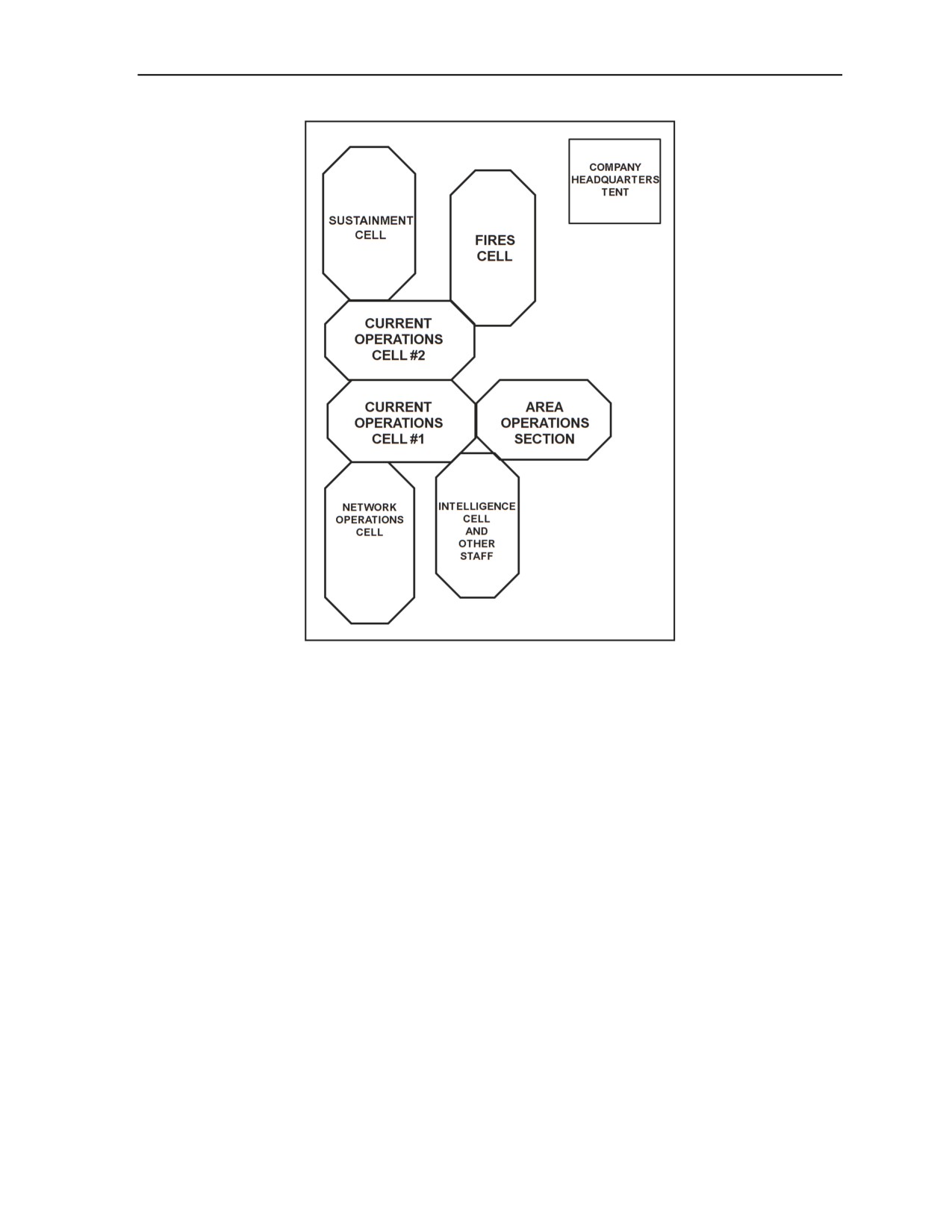
MEB Command Post
Figure B-1. MEB main CP
B-13. Figure B-2, page B-4, highlights the TAC CP and a recommended option for its layout using its
single SICPS. In this option, the DCO has a position in the TAC CP. A combat service support automated
information system interface (CAISI) bridge is necessary for the TAC CP.
26 February 2009
FM 3-90.31
B-3
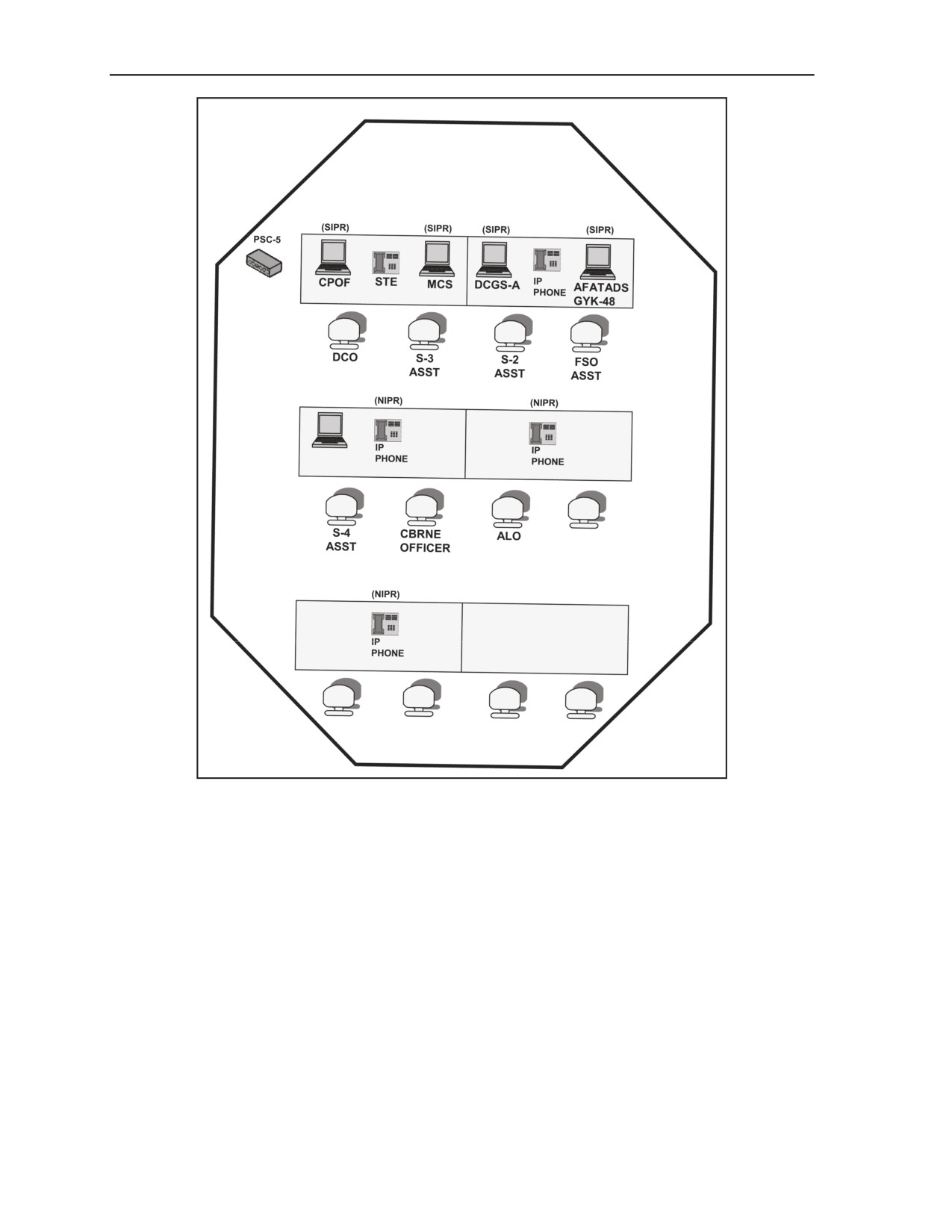
Appendix B
Figure B-2. Tactical operations center
B-14. Figure B-3 highlights the current operations cell #1, the SICPS location identified for the MEB
commander and DCO when they are at the main CP and includes a portion of the complete operations cell
(primarily the plans section). A position is also allocated for the DCO in the TAC CP (figure B-2). In this
option, the XO has a position in the current operations cell #1. The LSD in this cell is one of two in the
headquarters.
B-4
FM 3-90.31
26 February 2009