FM 3-90.31 MANEUVER ENHANCEMENT BRIGADE OPERATIONS (FEBRUARY 2009) - page 3
Chapter 6
Support Area Operations
The MEB must plan, prepare, execute, and assess support area operations. This
chapter includes a discussion of base security and defense operations within the
higher headquarters support area assigned to the MEB as an AO. The other units
operating with the MEB AO must understand this doctrine to protect, secure, and
defend themselves; to support other units when needed; and to operate within the
support area. This FM will not discuss the detailed procedures for base security and
defense or the detailed standards for base construction. (See FM 3-34.400 and the
Joint Contingency Operations Base
[JCOB] Protection Handbook.) Further
information on defense within an AO can be found in FM 3-90. Information on
defensive operations conducted by the MEB and its subordinate elements can be
found in FM 3-90. Further information on movement and base/base cluster defense
can be found in FM 63-2 and FMI 4-93.41.
FUNDAMENTALS
6-1. The MEB is staffed to control terrain and should be assigned an AO. The MEB conducts support
area operations within the echelon support area to assist the supported headquarters to retain freedom of
action within areas not assigned to maneuver units. When conducting support area operations, the MEB is
in the defense regardless of the form of maneuver or the major operation of the higher echelon. Defensive
doctrine, tasks, and TTPs provide a clear framework to conduct area security and defense. The MEB uses
the defensive tactics in FM 3-90 as a construct on how to think about, structure and conduct defensive
operations in the support area. The challenge for the MEB is integrating the actions of and providing for
units of varying defensive capabilities operating under multiple chains of command and focused on their
primary missions as they occupy terrain inside the echelon support area assigned to the MEB.
DEFINITIONS
6-2. To understand the fundamentals of support area operations, the staff of the MEB must first
understand the terms and their definitions, and the fundamental principles common to support areas—
z
Area damage control is the measures taken before, during, or after hostile action or natural or
manmade disasters to reduce the probability of damage and minimize its effects. (JP 3-10)
z
Base is locality from which operations are projected or supported; an area or locality containing
installations which provide logistic or other support; home airfield or home carrier. (JP 1-02)
See FM 3-90 for guidance on protecting military bases.
z
Base camp is an evolving military facility that supports military operations of a deployed unit
and provides the necessary support and services for sustained operations. Base camps consist of
intermediate staging bases and forward operating bases.
z
Base cluster, in base defense operations, is a collection of bases, geographically grouped for
mutual protection and ease of C2. (JP 3-10) See FM 3-90.
z
Base cluster operations center is a C2 facility that serves as the base cluster commander’s focal
point for defense and security of the base cluster. (JP 3-10) See FM 3-90.
z
Base defense is the local military measures, both normal and emergency, required to nullify or
reduce the effectiveness of enemy attacks on, or sabotage of, a base, to ensure that the maximum
capacity of its facilities is available to U.S. forces. (JP 1-02). See FM 3-90.
26 February 2009
FM 3-90.31
6-1
Chapter 6
z
Base defense operations center is a C2 facility established by the base commander to serve as
the focal point for base security and defense. It plans, directs, integrates, coordinates, and
controls all base defense efforts. (JP 3-10) See FM 3-90.
z
Base defense force (BDF) is a security element established to provide local security to a base. It
normally consists of the combined security assets provided by each unit on the base toward the
ongoing security requirement of the base. The mission is to deter, resist, or destroy enemy level
I force attacking the base. (See FM 3-90.) It may include a quick reaction force to reinforce the
guard force in the event of a level I or level II attack.
z
Mobile security force is a dedicated security force designed to defeat level I and II threats on a
base and/or base cluster. (JP 3-10) The mobile security force “shapes” the fight with level III
threats until a TCF arrives.
z
Base cluster defense force is all of the BDFs within the base cluster or a designated response
force. The base cluster commander directs the employment of BDFs or response force to counter
level II threats. See FM 3-90.
z
Base defense reaction forces are forces comprised of personnel or elements of units assigned to
a specific base with the responsibility to rapidly bolster base defenses or react to an unforeseen
threat. (See FM 3-90)
z
Response force is a mobile force with appropriate fire support designated, usually by the area
commander, to deal with level II threats in the rear area. (JP 3-10). It usually consists of MP
forces supported by available fire support and Army aviation assets. Other possible response
force options include engineer units, chemical units, transiting combat elements, elements of the
reserve, or host nation assets. See FM 3-90.
z
Reserve is a portion of a body of troops which is kept to the rear or withheld from action at the
beginning of an engagement, in order to be available for a decisive movement; (See FM 3-90.)
members of the military services who are not in active service but who are subject to call to
active duty; portion of an appropriation or contract authorization held or set aside for future
operations or contingencies and, in respect to which, administrative authorization to incur
commitments or obligations has been withheld. (JP 1-02)
z
Support area specific surface area designated by the echelon commander to facilitate the
positioning, employment, and protection of resources required to sustain, enable, and control
tactical forces. (FM 3-0.1)
z
Tactical combat force is a combat unit, with appropriate supporting assets that is assigned the
mission of defeating level III threats. (JP 3-10) See FM 3-90.
PRINCIPLES
6-3. There are fundamental principles that are common to all support areas. Support areas may be
designated by any Army echelon or by operational necessity but are usually associated with organizations
that are capable of synchronizing and integrating continuing activities necessary to control terrain. A joint
force would designate a JSA. See JP 3-10 for discussion of joint security area, joint security coordinator,
and joint security coordination center. For each echelon, the support area is annotated with the echelon
size, such as a brigade support area or a division support area. The use of the Army term AO applies when
an Army unit is assigned responsibility for the JSA.
6-4. Support area operations are conducted by the MEB and tenants to prevent or minimize interference
with C2 and support operations, provide unimpeded movement of friendly forces, to provide protection,
operations to find, fix, and destroy enemy forces or defeat threats, and provide ADC. Key functions
performed in the support area include terrain management, movement, protection (security and defense),
and sustainment. The support area may provide critical infrastructure and secondary C2 nodes. In this
chapter, sustainment will only be discussed with respect to sustaining the MEB. Support area operations as
discussed in this chapter do not include the mission support operations conducted by tenants within the
support area.
6-5. Support areas achieve economy of force by having properly staffed headquarters control terrain so
combat forces can conduct battles and engagements in other AOs. The MEB conducts battles and
6-2
FM 3-90.31
26 February 2009
Support Area Operations
engagements within the support area when needed to defend. At division level, the assigned support area
headquarters perform similarly to the previous Army division level organization, the rear operations center
(ROC). However, the previous ROC supply/logistics/sustainment functions are the responsibility of the
sustainment brigade. ROCs or rear area operations centers will continue to be used at EAD.
6-6. When a division support area is designated, the MEB may be given responsibility for it. In this case
the division support area becomes the MEB’s AO. The MEB commander conducts operations within the
AO for the echelon headquarters it is supporting in a similar fashion to what a BCT does within its AO.
The higher headquarters/echelon remains responsible for all unassigned areas within its AO that are not
assigned to subordinate units. If the supported echelon has more than one MEB assigned, then the support
area may be split into two or more AOs, one for each MEB. At times, a single MEB may be required to C2
two noncontiguous AOs and conduct split-based operations for a short period of time, but this is not the
desired situation. The MEB designates and controls its own BSA.
6-7. All units in the support area will be assigned to an established base, will be directed to establish a
base, command a base/base cluster, or will establish their own perimeter security and provide mutual
support to a base cluster. The assignment or direction may be by the higher headquarters or the MEB.
RESPONSIBILITIES
6-8. Assignment of an AO (see FM 3-0) includes the authority to perform the following:
z
Terrain management.
z
Intelligence collection.
z
CA activities.
z
Air and ground movement control.
z
Clearance of fires.
z
Security.
6-9. The following tasks must also be performed by commanders assigned AOs for units located in or
transiting their AO:
z
Integrate ISR.
z
Protection.
z
Base/base cluster defense.
z
Liaison and coordination.
z
Information engagement.
z
Infrastructure development.
z
Integrate HN support.
z
ADC.
6-10. Support area operations include ADC. The higher headquarters is responsible for ADC and delegates
this responsibility to the AO commander. (See chapter 7.) Incident response, consequence management,
and ADC follow established battle drills and SOP. These drills allow effective action against fear, panic,
and confusion that follows an attack.
6-11. Units within an AO have responsibility for unit self defense and should be integrated into the area
security plan, base defense plan, and base cluster defense plan. See FM 3-90.
6-12. The MEB commander may designate subordinate AOs and base and base cluster commanders. Units
may establish their own defensive perimeters or be assigned to operate within an established base. The
MEB commander can group units with their own defensive perimeters or established bases into a base
cluster for mutual support. The higher headquarter or the MEB commander will designate the senior
commander as the base or base cluster commander who will establish a base defense operation center
(BDOC) or base cluster operations center (BCOC) to C2 the operations among the bases close to each
other. The BDOC or BCOC will be staffed and equipped from units within the base or cluster. Unless the
AO or base/base cluster commander has assets to secure and defend the AO or base, and staff and equip the
BDOC or BCOC, the AO or base/base cluster commander may task other tenant units to support these
26 February 2009
FM 3-90.31
6-3
Chapter 6
collective tasks. The base/base cluster commanders will submit requests for other support to conduct
support area operations to the MEB commander. The MEB commander provides the support or coordinates
for it.
6-13. When a higher headquarters assigns the MEB an AO it also may assign them the authority to C2 or
task units operating within the AO. This is essential for unity of command and effort. The higher
headquarters or the MEB commander may designate base/base cluster commanders. The MEB commander,
normally by order of the echelon commander, will typically have TACON of all units within the AO for
security and defense and specified broader TACON over base/base cluster commanders within the AO
(this could include aspect of protection, security, defense, movement control or terrain management). The
base/base cluster commanders have TACON over their tenant and transient units unless the higher
headquarters orders otherwise. The tenant or transient units may be tasked to support security, AT/FP,
defense, guard, and response force requirements within the limits of their capability. The conduct of these
operations will challenge all units to closely assess the troops-to-tasks, and other mission priorities. Each
unit commander in the support area will have to decide on acceptable risk as they apportion effort between
security and defensive tasks and conduct their primary mission. The MEB commander will designate a
minimum level of effort that each unit must provide to security and defensive tasks. The higher headquarter
may establish a TACON relationship of other forces to the MEB. The AO commanders, subordinate AO
commanders, base cluster commanders, or base commanders ensure unity of effort regardless of C2
relationships. This requires coordinated, integrated, and synchronized planning, preparation, execution, and
assessment.
6-14. The MEB commander’s operations center establishes communications and coordinates directly with
higher headquarters, the subordinate AO commanders, base cluster commanders and base commanders.
The AO commander will provide C2 for AO collective efforts and support individual unit’s tactical
operations in the AO.
6-15. The MEB commander determines the support mission, commander’s intent, task and responsibilities,
and issues the order(s) for movement, protection, area security, and defense, as does each individual base
commander. If the MEB is responsible for a base located outside the support area, it may need to conduct
split-based operations for a short period of time.
6-16. Each base has a BDOC to maintain SA and make timely decisions, coordinate base defense, C2
counter strikes, and coordinate incident and consequence management. The AO commander and base/base
cluster commanders designate base defense force, base cluster defense force, base defense reaction forces,
mobile security force, response force, TCF, and a reserve as needed. Depending on the threat assessment,
the MEB may form a TCF from assigned, attached, or OPCON units to handle a less mobile threat level III.
If the threat assessment indicates a continually present more mobile or armored force, then the MEB should
be assigned a maneuver TCF to defeat this threat. The AO, base/base cluster commanders should use
liaison teams to coordinate operations. The higher level commander may direct the base cluster, base or
tenant unit provide a liaison member.
6-17. Following an attack, the AO commander and his headquarters may assist the higher echelon
commander to C2 the mission support of the units in the support area if their chain of command or C2
assets are disrupted. This assistance would be temporary until the higher headquarters reestablishes the
chain of command or C2 assets or the unit completes reorganization.
CONSIDERATIONS
PLAN
6-18. The MEB plans for support area operations within an assigned support area or within the MEB
support area. The AO responsibilities of the MEB require it to plan decisive, shaping, and sustaining
operations within the AO. It must integrate numerous units and headquarters elements to conduct support
area operations. Even if the MEB is not assigned an AO, it still must plan support area operations to
operate its own BSA.
6-4
FM 3-90.31
26 February 2009
Support Area Operations
6-19. The higher headquarters order should define the C2 and support requirements within the AO and
give the MEB commander clear authority to alleviate the MEB commander from having to request or
negotiate with units for their compliance/adherence/support. Within this authority and that inherent in
being assigned the AO, the MEB commander directs, tasks, provides oversight of tenants and transient
units within the AO. The MEB must be able to have positive control of all tactical actions and movements
within the AO. Other support and functional brigades within the support AO provide necessary support to
the MEB for the conduct of support area operations within the support AO. The rest of this chapter will
focus on the MEB designated as the support area commander.
6-20. When the OE or particular missions require a high degree of certainty and order, compliance, or
centralization, the MEB may exercise detailed command. Examples are in terrain management with the
positioning and design of bases. This is often needed for base inherent defensibility and clustering of bases
for mutual support and employment of base and base cluster response forces and the MEB reserve.
Detailed fire plans, security plans, defense plans, and ADC plans require a more prescriptive OPORD.
Some units that are tenants within the MEB’s AO will not have the staff to conduct detailed IPB and
defense planning and preparation needed to execute a decentralized mission command type operation. This
requires the MEB to conduct operations in a level of detail not normally done by other brigades.
6-21. The MEB develops plans to support its operations. When it has been given an AO it must also
integrate the actions of tenant units to include base/base cluster commanders. Responsibilities may include
protection, ISR, security, defense, movement control, fires, air support, AMD, CM, incident response, and
ADC. The brigade coordinates decentralized execution by its assigned units and base/base cluster
commanders. It integrates the actions of tenant units to include base/base cluster commander. The MEB
may also need to coordinate ADC support to functional brigades, the sustainment brigade and/or the theater
sustainment command. The brigade reviews and coordinates the supporting base/base cluster defense plans
and develops plans to employ the TCF and/or reserve, fires, and coordinates for HN, joint, interagency, and
multinational assets.
6-22. The MEB coordinates with the higher headquarters to establish priorities, develop plans, and decide
when and where to accept risk in the AO. The MEB can use several levels of vulnerability assessments and
the composite risk management process discussed in FM 5-19. Plan for contractor and HN worker security.
6-23. During fluid offensive operations with advancing BCT AOs, the higher headquarters may be
tempted to assign a support area to the MEB that exceeds their ability to see/control/secure/defend it. The
higher headquarters would need to provide the MEB with additional task organization to include ISR
support, additional security forces, or additional fires and other forces. The increased span of control might
be excessive for the MEB and require the higher headquarters to deal with more unassigned area within its
larger AO, commit a second MEB or another unit that is capable of providing C2 for another portion of
those unassigned areas if that is feasible, or accept risk in another fashion.
6-24. The MEB usually will command one of the bases within the support area and may designate the BSB
commander or an assigned battalion size unit as the base commander. The MEB may assign subordinate
unit boundaries within the AO.
6-25. The MEB may use several boards or working groups during planning and execution. For example,
the protection working group’s multifunctional members ensures all aspects of protection are considered,
assessed, and incorporated.
6-26. The MEB may perform CA activities within their AO. Commanders use CA activities to mitigate
how the military presence affects the populace and vice versa. Conduct CA activities is a task under the C2
warfighting function (FM 3-0). The MEB CA staff works with assigned CA forces, higher headquarter CA
staff, the division CA battalion and if required the corps level CA brigade to develop civil considerations
assessments and plan CA operations. CA units can establish liaison with civilian organization to enhance
relationships and integrate their efforts as much as possible with MEB operations.
6-27. Although the MEB was not designed to be a maneuver headquarters, some of its subunits must be
capable of maneuver and enabled with capabilities to enhance their freedom of maneuver when required.
The MEB may be assigned a maneuver unit as a TCF (designed to combat level III threats) or may
potentially form a response force short of a TCF from other attached or OPCON units such as combat
26 February 2009
FM 3-90.31
6-5
Chapter 6
engineers or MP units. The MEB would control the maneuver of the TCF or response force as they employ
maneuver and fires to defeat threats. The discussion of maneuver in this chapter is within this limited
context. The MEB will initially fight any size threat operating in the AO and must plan to employ all fires,
Army aviation, and close air support (CAS). The MEB select targets and plans where to locate and use
counterfire radars to determine points of origin and predicted impact location of enemy indirect fires. The
MEB develops the intelligence requirements to commit the base response force, MEB AO response force,
TCF, and/or MEB reserve.
PREPARE
6-28. During initial entry, the designated base commanders may prepare their individual bases according
to standards directed by the MEB. If the support area is established in an initially secure area, then
contractors alone or assisted by military units may construct the bases. A technique may be to have the
MEB construct “turn-key” bases within their AO. “Turn-key” would include planning, designing, siting,
constructing, and securing against level II or III threats as required. This is similar to the effort performed
to construct Camp Bondsteel in Kosovo. This required the efforts of the 94th Engineer Battalion (Combat
Heavy), 1st Engineer Brigade of the 1st Armored Division, United States Army Corps of Engineers
(USACE) and contractors to accomplish the mission. There may be situations in which the MEB takes
control of bases that are not constructed to acceptable standards and must redesign and renovate them.
6-29. The MEB can conduct MANSPT operations to prepare the support AO defensive plan and prepare
for ADC. This includes mobility, countermobility, and survivability; obstacles; structures; and
antiterrorism. The MEB will conduct initial reconnaissance of their AO to verify intelligence preparation of
the battlefield
(IBP). The proper location selection, design, construction, and manning of bases/base
clusters can help to reduce the need for a maneuver TCF.
6-30. The MEB will establish SOPs to ensure protection, security, defense, and the ability to perform ADC
within their AO. These SOPs allow the MEB to use more mission command orders. The MEB will ensure
the base security and defense forces are trained, rehearsed, and ready. Important rehearsals include
commitment of base response forces, commitment of cluster response forces, commitment of the MEB
reserve, and fire plan rehearsals.
EXECUTE
6-31. The MEB conducts support area operations within the assigned support AO. The MEB staff will
ensure close, continuous coordination with the higher headquarters staff and AO tenant and transient units
to ensure security, protection, movement, continuous support, and defense. The MEB will aggressively
execute detection, early warning, and rapid response to threats and coordinate responsive ADC to minimize
effects.
6-32. The MEB will synchronize security operations, integrate ISR, and develop the COP and share it will
all units in the AO. The MEB will C2 the collective defense within the AO. The MEB may direct and
employ transiting combat forces with the approval of higher headquarters. The MEB will defeat level III
threats or conduct battle handoff to other combat forces.
ASSESS
6-33. The MEB must fuse the assessments from the commander, staff, subordinates, supporting units and
tenant units to monitor and evaluate the current situation and progress. The MEB conducts base threat and
vulnerability assessments. Key areas the staff assesses include security, base defense preparations, and
ADC preparations. The staff can use MOEs and MOPs from FM 7-15 to help it develop METT-TC
measures for the assigned support area and required detailed tasks.
TERRAIN MANAGEMENT
6-34. The higher headquarters may position a number of other support brigades, functional brigades, and
smaller units, various higher headquarters, contractors, and joint, interagency, and multinational
6-6
FM 3-90.31
26 February 2009
Support Area Operations
organizations within the MEB support AO. Regardless of commander’s ranks or size of units, the MEB
commander has some C2 responsibilities over those in his or her AO. The MEB commander retains final
approval authority for the exact placement of units and facilities within its AO, unless placement is directed
by the MEB’s higher headquarters. The commander must deconflict operations, control movement, and
prevent fratricide. The MEB conducts many of the functions previously conducted by the division rear
command post. The MEB has the authority to C2 tactical operations within the AO through subordinate
commanders and the base/base cluster commanders.
6-35. Terrain management involves allocating terrain by establishing AOs and other control measures, by
specifying unit locations, and by de-conflicting activities that are not complementary or that may interfere
with operations. For example, indirect fire assets should not be located where their fires could interdict an
active air corridor. It includes grouping units into bases and designating base clusters as necessary for
common defense. A technique is for the MEB to designate subordinate TF AOs to increase the ability of
unit leaders to develop improved relationship with local officials. Terrain management should facilitate
current and future operations. Poor terrain management can result in congestion, interruption of tactical
traffic patterns, and degradation of support operations. The failure to follow basic rules of coordination can
cause disruption and create combat identification hazards. Good terrain management will enhance
operations. This section establishes procedures for terrain management in the MEB support AO. Refer to
FM 3-90 for more doctrinal guidance.
6-36. Having an AO assigned both restricts and facilitates the movement of units and the use of fires. It
restricts units not assigned responsibility for the AO from moving through the AO without coordination. It
also restricts outside units from firing into or allowing the effects of its fires to affect the AO. Both of these
restrictions can be relaxed through coordination with the owning unit. It facilitates the movement and fires
of the unit assigned responsibility for, or owning, the AO. In selected situations, subordinate AOs may be
created to facilitate the movement of sustainment convoys or maneuver forces through the support AO.
The MEB can conduct movement corridor operations as discussed in chapter 5.
6-37. Within its support AO, the MEB conducts the tactical coordination and integration of land and air
units while employing firepower and maneuvering forces for positional advantage in relation to the enemy.
Beyond the inherent responsibilities for adjacent unit coordination, the area operations section within the
MEB deconflicts terrain coordination issues by collaborating with adjacent, passing, and supported units to
reduce the likelihood of combat identification errors, trafficability problems, and to enhance situational
understanding, security, and defense. Airspace management is also planned, coordinated, and monitored
from the airspace management cell in the area operations section. Firepower integration and coordination,
to include fires from rotary wing aircraft, is conducted by the MEB fire support element (FSE) through the
targeting process to detect, decide, deliver, and assess targets and affects supporting mission requirements.
S-3 PROCEDURES
6-38. The MEB S-3 functions as the overall terrain manager for the brigade and assigns and reassigns AOs
based on mission requirements to subordinate units. The brigade manages and is responsible for any terrain
in its AO not assigned to a subordinate unit. Within the MEB the area operations section serves as primary
terrain manager for the brigade and reports directly to the S-3. The S-3 is responsible for overall AO
surveillance and reconnaissance plans and integrates subordinate unit and base plans.
6-39. The MEB performs a detailed IPB for their AO and shares it with all tenants. The detailed terrain
analysis is key to MEB terrain management. The MEB must consider the defensibility of the terrain and
primary units missions when constructing new bases and assigning units to existing bases. The MEB
considers the military aspect of terrain and other applicable aspects. (See the JCOB Protection Handbook
and FM 5-103.) The MEB S-3 will engage the entire staff, particularly the S-2, the engineer, the provost
marshal (PM), and the CBRN officer when analyzing factors essential to assigning territory and locating
bases and facilities within its AO. These factors include—
z
Locating bases on the best defensible terrain. The S-2, S-3, terrain analysis team, engineer, and
maneuver commander (if a TCF is assigned) collaborate on this effort. This will significantly
reduce the resources need to effectively defend them.
z
Locating the sustainment brigade (if in the AO) with access to transportation infrastructure.
z
Constructing a base defense can be viewed as constructing a strong point (360-degree defense).
26 February 2009
FM 3-90.31
6-7
Chapter 6
6-40. These factors also include an assessment of—
z
The availability of drop zones/LZs protected from the enemy’s observation and fire is a main
consideration in selecting and organizing the location.
z
Geographical boundaries.
z
Concept of the operation.
z
Mission requirements.
z
Mission priority.
z
Tactical maneuver plans.
z
Likely enemy avenues of approach.
z
Direct and indirect fire weapons capabilities.
z
Deconflict fires (fire control measures/fire control plan) and airspace coordinating measures.
z
Equipment density.
z
Consequence management.
z
Accessibility for sustainment.
z
Storage space for supply units.
z
Indigenous civil considerations.
z
Trafficability (ideally level, well drained, and firm ground).
z
Access to MSR, roads, transportation infrastructure.
z
Available facilities.
z
Environmental considerations.
z
Room for dispersion.
z
Natural obstacles and canalized areas.
z
Cover, concealment, and camouflage (natural or man-made structures).
z
Security and mutual support.
z
Ease of evacuation.
z
Key facilities.
z
WMD research, production, and storage sites.
z
Toxic industrial material (TIM) hazard sites/areas.
z
Decontamination sites.
6-41. The S-3 remains informed and involved in ongoing, potential, and planned unit movements and
major activities by using various TTPs to synchronize the actions and efforts of the many units and
subunits in the AO. Networked communication systems help provide real time visibility of unit movements
in an AO and the MEB makes maximum use of these technologies to track every unit movement in its AO.
Further, the MEB develops TTPs in the areas of unit reporting, adjacent unit coordination, higher to lower
unit liaison, and movement information exchange to further enhance situation awareness in the MEB AO.
6-42. MEB elements may be tasked to conduct traffic regulation enforcement for major unit movements in
the division/EAD AO in general or they may be tasked to enforce a specific circulation, control, or
movement plan. For example, the division/EAD provost marshal’s office, in conjunction with the division
transportation officer (DTO), generally develops and disseminates a battlefield circulation plan of some
type.
OTHER KEY STAFF INPUT TO TERRAIN MANAGEMENT
6-43. The MEB engineer cell supports the planning, integration, and assessment of engineer capabilities
supporting the maneuver support and terrain management functions for the brigade. The brigade engineer
cell plans and synchronizes engineer support for infrastructure development, and survivability and
protection tasks in the MEB or sustainment areas of operation. Competing requirements at every echelon
will drive commanders to carefully prioritize and synchronize engineer tasks and efforts to maximize their
effectiveness consistent with the mission, threats and hazards, and time. Additional support includes:
6-8
FM 3-90.31
26 February 2009
Support Area Operations
z
Identifying and coordinating with the area operations section for unit-specific terrain
requirements that may require engineer preparation.
z
Assisting the S-3 in analyzing terrain for placement of units.
z
Assisting in coordination of assembly areas or other facilities in the MEB AO for incoming
units.
z
Assisting the intelligence section in the IPB process that supports the terrain management effort.
z
Conducting engineer reconnaissance to facilitate terrain use and trafficability.
z
Assessing facilities and bases and making recommendation on repair or upgrade.
z
Designing and planning construction and security features of bases and facilities.
Note. Infrastructure development applies to all fixed and permanent installations, fabrications, or
facilities that support and control military forces. Infrastructure development focuses on facility
security modifications and includes ADC and repairs.
6-44. The MEB CBRN officer considers the vulnerability of facilities and supplies to CBRN attack and
recommends locations and tasks to mitigate enemy effects. Potential decontamination sites and procedures
are developed.
6-45. The MEB PM assists in AO vulnerability assessments and security requirement (the MEB may
designate the senior MP as PM). The PM recommends allocation of assessment to protect critical facilities
and high value targets.
INTELLIGENCE, SURVEILLANCE, AND RECONNAISSANCE
6-46. The MEB integrates organic ISR, tenants ISR, adjacent units ISR, and higher headquarters ISR
efforts to develop information to conduct support area operations and conduct operations within other AOs.
The MEB will provide assigned units, tenant units, and units passing through the support AO with
intelligence updates and share the COP as needed.
6-47. The S-2 provides intelligence synchronization, support to security programs, and other intelligence
assistance required to support units and organizations in the MEB AO. The S-2 will maintain and
disseminate a continual IPB of the MEB AO and will be integrated into the terrain management process.
The S-2 cell examines and reviews the positioning of friendly units and capabilities in relation to threat
patterns and likely enemy responses. The S-2 cell remains nested with higher threat indicators and warning
systems to advise commanders on protection postures, effects, and patterns, trends, and associations (PTA)
that could threaten operations or LOCs.
6-48. The MEB requests ISR support from the higher headquarters and is supported by the BFSB when
assigned to an Army division. This support could be provided through criminal intelligence (CI), human
intelligence, signal intelligence, UAS systems, or ground surveillance systems. The BFSB has
responsibility to conduct ISR in the division’s unassigned areas. (See FM 2-0 and FM 34-10.) When the
MEB is deployed in an AO without an assigned BSFB the MEB will typically be augmented and perhaps
task-organized with ISR capabilities.
6-49. The MEB conducts detailed terrain analysis to site facilities, bases, and tenants based on their
mission and capabilities. Terrain considerations include identifying the best defensible terrain, site
drainage, existing infrastructure, communications, and mutual security/defense.
6-50. The MEB tasks units that it has a command or support relationship with within its AO to conduct
parts of the ISR plan. The MEB must know enemy capabilities and intentions. It must anticipate and both
receive and provide early warning of emerging threats in the AO. This requires access to all-source
intelligence. Based on intelligence the MEB commander locates facilities and units and applies combat
power to defeat threats early in the security area and if required relocate units at risk.
26 February 2009
FM 3-90.31
6-9
Chapter 6
6-51. The MEB and base commanders use observation posts and patrols to gain intelligence and improve
security. Base/base cluster commanders have an inherent responsibility to gather information and share
intelligence with the MEB. Surveillance is inherent and continuous in all security operations.
6-52. Counterreconnaissance is also inherent in all security operations. It is the sum of all actions taken to
counter the enemy reconnaissance and surveillance efforts. The focus is to deny the enemy information and
destroy or repel enemy reconnaissance elements. Security forces operate either offensively or defensively
when executing counterreconnaissance.
6-53. Counterintelligence is the information gathered and activities conducted to protect against espionage,
other intelligence activities, sabotage, or assassinations conducted by or on behalf of foreign governments
or elements thereof, foreign organizations, or foreign persons, or international terrorist activities. (JP 2-0)
(See FM 3-13.) The Marine Corps defines counterintelligence as the active and passive measures intended
to deny the enemy valuable information about the friendly situation, to detect and neutralize hostile
intelligence collection, and to deceive the enemy as to friendly capabilities and intentions. The MEB S-2
will coordinate all CI measures and operations with the counterintelligence coordinating authority of the
higher headquarters. (See FM 34-60.)
MOVEMENT CONTROL
6-54. Movement control includes the planning, routing, scheduling, and control of personnel and cargo
movements over lines of communications personnel (the definition was shortened; the complete definition
is printed in the glossary). Maintaining movement control, keeping LOCs open, managing reception and
transshipment points, and obtaining host nation support are critical to movement control within a unit’s
AO. FM 4-01.30 discusses movement planning and control measures.
6-55. The MEB commander controls movement throughout the assigned AO unless the movement is
conducted on MSRs or alternate supply routes (ASRs) designated by higher headquarters. The MEB
provides movement coordination and regulation on these MRSs and ASRs. Units may not move through
the AO without clearance from the MEB. The MEB designates, maintains, secures, and controls movement
along the routes within the AO unless the higher headquarters directs otherwise. The sustainment brigade
or higher headquarters assist the MEB in the conduct of movement control. Most routine movement control
is handled by the unit conducting the movement or the supporting headquarters. The MEB must assert
control when security conditions require it and stop, reroute, or delay movement even if coordinated or
approved by others.
6-56. The echelon that designates the support AO must provide clear guidance on the roles and
responsibilities for movement control, protection, and defense of forces moving through the AO or
originating in the support area AO that move into other AOs. Active participation with higher headquarters
planners will help to ensure proper guidance is provided. The MEB has responsibility for movement
control, protection, and defense within its support AO, and may have a role within the higher headquarters
AO as it conducts MANSPT operations for other units/forces. The higher headquarters, through its
movement control battalion and movement control teams
(MCTs), has primary responsibility for
movement control within the larger AO. The convoy commander has primary responsibility for convoy
protection, security, and defense. The MEB may be assigned TACON (JP 3-10 uses TACON in joint
security area operations [JSAO]) while units are moving within the AO.
6-57. When a unit wants to move within the AO, it coordinates with the BDOC/BCOC. The BDOC/BCOC
will coordinate with the MEB to obtain movement support: intelligence updates, additional security, fires,
MANSPT operations, and final approval. When the unit plans to leave the support AO, the MEB will
coordinate with the supporting MCT as required to obtain movement clearance for use of the MSRs/ASRs.
The base/base cluster commander adjusts perimeter security after a unit loads out for movement or
integrates a new unit into existing plans to ensure a comprehensive security posture.
6-58. When a unit moves through the support AO, it coordinates with the supporting MCT and the MEB.
The MEB will provide needed support as it does for convoys originating within the support AO.
6-10
FM 3-90.31
26 February 2009
Support Area Operations
6-59. The division/EAD assistant chief of staff, operations (G-3) or assistant chief of staff, logistics (G-4)
or their supporting sustainment brigade may establish control points and measures such as the first
destination reporting points, a periodic movement control board
(MCB) or the sustainment brigade
mobility branch, to control the movement of forces into the division/EAD AO in a predictable or deliberate
manner. The MEB may want to consider placing an LNO at the higher headquarters movement control
board. The responsible MCT coordinates all sustainment movement into and out of the MEB AO. The
MEB area operations section may have reporting, regulating, or response force responsibilities to major
movements and convoys in coordination with the responsible provost marshal’s office and DTO while
supporting division/EAD movement priorities. For major movements the MEB may establish a movement
control board to coordinate with higher headquarters G-4, movement control staffs, the sustainment
brigade, convoy commanders, and AO owners that the movement will transit.
6-60. The MEB staff plans and conducts the required MANSPT operations to support movement. The
CBRN officer determines likely areas for enemy use of CBRN, and designates decontamination sites for
restoring contaminated units. The CBRN officer also coordinates with task-organized CBRN assets to
position chemical detection sensors and to establish the corresponding process for receiving, validating,
and disseminating chemical alerts, precautions, and downwind messages to subordinate, adjacent, and
higher units. The engineer coordinates mobility support, monitoring route status and directing required
route maintenance. The EOD staff, in coordination with the engineer and S-2, monitors and conducts trend
analysis within the support AO. The MP coordinates traffic control. He directs required MP security. The
S-6 ensures that the required codes, loads, administrative data, and procedures for accessing dedicated
communication nets or networked systems are current, available, operational and packaged for
dissemination by the operations section to organic, tenant or passing units. He coordinates with subordinate
electronic warfare officers to ensure that electronic counter measure devices and equipment are properly
installed, tested, and deconflicted with noncomplementary devices of similar purpose within the support
AO.
OPERATIONAL AREA SECURITY
6-61. The MEB may perform any required security task within their AO. This discussion focuses on the
Army Universal Task List task of conducting operational area security. The MEB commander is
responsible for the security of all units operating with the support AO. Each unit commander retains
responsibility for his unit’s local security. (See FM 3-90.)
6-62. The MEB conducts operational area security to protect the force. They provide time and maneuver
space in which to react to the enemy and develop the situation. Security operations include—
z
Conducting reconnaissance to reduce terrain and enemy unknowns.
z
Gaining and maintaining contact with the enemy to ensure continuous information.
z
Providing early and accurate reporting of information to the protected force.
6-63. Security is an essential part of all operations. Security operations are those operations undertaken by
a commander to provide early and accurate warning of enemy operations, to provide the force being
protected with time and maneuver space in which to react to the enemy, and to develop the situation to
allow the commander to effectively use the protected force. The ultimate goal of security operations is to
protect the force from surprise and reduce the unknowns in any situation. The MEB commander does not
have to conduct area security operations throughout his AO. This may occur with a large AO and
noncontiguous bases. He must provide security forces to prevent surprise and provide time for units within
the AO to effectively respond. The MEB commander must inform tenants and transients of his security
plans and capabilities. (See FM 3-90.)
6-64. The main difference between security operations and reconnaissance operations is that security
operations orient on the force or facility being protected, while reconnaissance is enemy and terrain
oriented. Security operations are shaping operations.
6-65. Successful security operations are planned and performed using the five fundamentals of security:
z
Orient on the main body (base). The security force operates at a specified distance between
the base and known or suspected enemy units. The security force commander must know the
26 February 2009
FM 3-90.31
6-11
Chapter 6
scheme of maneuver for defensive operations to remain between the base and the enemy and
conduct battle handover as appropriate. The value of terrain occupied by the security force lies
in the protection it provides to the base.
z
Perform continuous reconnaissance. Security is active. The security force performs
continuous, aggressive reconnaissance to gain all possible information about the enemy and
terrain. Surveillance and patrolling required in security use the same techniques as in
reconnaissance.
z
Provide early and accurate warning. Early warning of enemy activity provides the main body
commander the time and information needed to retain the tactical initiative and to choose the
time and place to concentrate against the enemy. Ground scouts are positioned to provide long-
range observation of expected enemy avenues of approach and are reinforced with electronic
surveillance devices and aerial platforms when available. Flexibility and depth are built into the
surveillance plan.
z
Provide reaction time and maneuver space. The security force operates as far from the main
body as possible, consistent with the factors of METT-TC. This distance provides the reaction
time and maneuver space required by the MEB commander. It fights, as necessary, to ensure
adequate time and space for the brigade commander to maneuver and concentrate forces to meet
the enemy.
z
Maintain enemy contact. Once contact is made with the enemy, the security force keeps
contact to protect the brigade. The security force uses redundant surveillance methods, direct
and indirect fires, freedom of maneuver, and depth to achieve continuous contact.
6-66. There are five primary types of security-screen, guard, cover, area security, and local security. The
MEB would not be assigned a screen, guard or cover mission by a higher headquarters, but can use all
except guard and cover as part of their conduct of support AO security operations.
6-67. A screen unit is tasked to maintain surveillance; provide early warning to the main body/base; or
impede, destroy, and harass enemy reconnaissance without becoming decisively engaged. Depending on
the screening unit’s capabilities, they may be able to impede and harass the enemy force with indirect and
or direct fires. A screen may be static or moving. Any subordinate element that can maneuver can be given
a screening mission. The assigned maneuver unit should be trained on these doctrinal tasks. The engineer
and MP units may need training to perform these security missions.
6-68. Area security is a form of security that includes reconnaissance and security of designated personnel,
airfields, unit convoys, facilities, MSRs, LOCs, equipment, and critical points. An area security force
neutralizes or defeats enemy operations in a specified area. It screens, reconnoiters attacks, defends, and
delays as necessary to accomplish the mission. The MEB conducts area security to deny the enemy the
ability to influence friendly actions in a designated area or to deny the enemy use of an area for his own
purposes. Area security often entails route security, convoy security, and checkpoint operations.
6-69. Local security consists of low-level security operations conducted near a unit to prevent surprise by
enemy forces. All units of the MEB are capable of, and required to, conduct local security operations as an
inherent part of self-protection and mission assurance measures.
6-70. Other security operations include—
z
Area and high value asset (HVA) security.
z
Route security.
z
Convoy security.
6-71. Area and HVA security is a form of security that includes reconnaissance and security of designated
personnel, airfields, unit convoys, facilities, MSRs, LOCs, and other critical points. An area security force
neutralizes or defeats enemy operations in a specified area. It screens, reconnoiters attacks, defends, and
delays as necessary to accomplish the mission. The MEB performs area security missions to prevent the
enemy from influencing friendly actions in a designated area, or to deny the enemy use of an area for its
own purposes. Area security often entails route security, convoy security, and checkpoint operations. The
MEB support AO security operations will involve both these forms of security.
6-12
FM 3-90.31
26 February 2009
Support Area Operations
6-72. The MEB conducts route security missions to prevent enemy ground maneuver forces or
unconventional forces from coming within direct fire range of the protected route. MP or reconnaissance
units execute this mission as part of battlefield circulation and may require augmentation during small scale
contingency or major combat operations (MCOs) conflicts. A route security force operates on and to the
flanks of a designated route. Route security operations are defensive in nature and, unlike guard operations,
are terrain oriented. A route security force prevents an enemy force from impeding, harassing, containing,
seizing, or destroying traffic along the route.
6-73. The MEB conducts convoy security operations when insufficient friendly forces are available to
continuously secure LOCs in an AO. They also may be conducted in conjunction with route security
operations. A convoy security force operates to the front, flanks, and rear of a convoy element moving
along a designated route. Convoy security operations are offensive in nature and orient on the force being
protected. A convoy security mission has certain critical tasks that guide planning and execution. (See
FM 3-90.)
RESPONSE FORCE OPERATIONS
6-74. Each designated base commander is responsible for organizing and preparing a response force. The
response force can be assigned, attached, or OPCON units or supporting/reinforcing combat forces directed
to conduct combat operations in support of the unit. These forces operate under control of the BDOC to
defeat level I and some level II threats and contain and maintain contact with level III threats until the
MEB responds with their reserve or a TCF. A base cluster commander is also responsible for organizing
and preparing a response force, for level II threats, from the assets available in assigned bases.
6-75. When needed, the base response force assembles and counterattacks by fire and maneuver to
eliminate the threat. The base commander commits the response force, reconstitutes the response force and
notifies the base cluster commander, if assigned, or the MEB commander. This notification becomes the
WARNO for the base cluster or MEB reserve.
6-76. The commitment of a response force or reserve becomes a significant C2 and potential fratricide
problem that rehearsals and SOPs can mitigate. Since the two friendly forces may converge, typically the
higher commander assumes C2 of the engagement.
RESERVE
6-77. When assigned an AO the MEB dedicates a reserve. All base commanders may as well, but typically
only have a response force. The reserve is a dedicated force withheld from action and committed at a
decisive moment. The reserve provides the commander flexibility to exploit success or deal with a tactical
setback. The force is not committed to perform any other task.
6-78. The reserve may be positioned to have a shaping effect. The reserve is positioned to respond quickly
to unanticipated missions. A reserve maintains protection from enemy fires and detection by maximizing
covered and concealed positions, wide dispersion, and frequent repositioning.
6-79. When resources (or METT-TC) permit, the MEB may begin defensive operations with a company
reserve, and allocate additional forces to the reserve as operations progress. In other cases, the MEB’s
initial reserve force might be as small as a platoon. The commander and staff must look for opportunities to
use other forces to assist with the reserve mission. Such forces may include fires, aviation, airmobile
Javelin teams, and rapidly emplaced minefields. The MEB commander must strive for IS over his enemy to
eliminate as much uncertainty as possible, and achieve decisive results. He must capitalize on the
capabilities of digitization to apportion his available troops to the required defense tasks.
6-80. A reserve usually is assigned an assembly area or base. Maintaining and positioning a reserve is a
key requirement for achieving depth within the defense. The commander and staff determine the size and
position of the reserve based on the accuracy of knowledge about the enemy and the ability of the terrain to
accommodate multiple enemy courses of action. When the MEB has good knowledge about the enemy and
the enemy's maneuver options are limited, the MEB can maintain a smaller reserve. If knowledge of the
enemy is limited and the terrain allows the enemy multiple COAs, then the MEB needs a larger reserve
positioned more centrally in the AO. This gives the MEB the required combat power and reaction time to
commit the reserve effectively throughout the AO.
26 February 2009
FM 3-90.31
6-13
Chapter 6
6-81. To employ the reserve the MEB must be able to
“see” the threat, assess information, and
employ/control fires. The MEB may need air surveillance assets to look at NAIs and targeted areas of
interest not under routine surveillance by base/base clusters or units in C2 of movement corridors. The
MEB must plan and coordinate responsive fires when bases or convoys are attacked.
COMBINED ARMS TACTICAL COMBAT FORCE OPERATIONS
6-82. The MEB defeats level I, II, and III (if assigned a TCF) threats within their AO. Tennant units defeat
level I and some II threats within their assigned base. The MEB employs a reserve combat force (may be
engineer units and/or MP units) within their AO to assist tenants or convoy commanders to defeat level II
threats when they are not capable of doing it themselves. The MEB employs a TCF as the designated MEB
reserve, to defeat level III threats.
BASE SECURITY AND DEFENSE
6-83. A MEB will conduct base/base cluster security and defense when it is necessary to defend in all
directions, when it must hold critical terrain in areas where the defense is not tied in with adjacent units, or
when it has been bypassed and isolated by the enemy, and must defend in place. Within a support area, the
MEB normally must defend in all directions and prepares perimeter base security and defense. Forward
operating bases may be used by either the BCTs or MEBs. The MEB continually conducts base security
and base defense within its AO.
6-84. The MEB is responsible for area security, base/base cluster security and defense within its AO. The
designated base commanders within the MEB AO should be TACON to the MEB. The elements operating
within the individual bases should be under OPCON or TACON of the base commander. The MEB tasks
units within their AO to conduct collective ISR, security and defense operations.
6-85. Base security includes measures taken by military units, activities, and installations to protect
themselves from acts designed to impair their effectiveness. It has four components: intelligence, base and
base cluster self-defense, response force operations, and combined arms TCF operations.
6-86. The MEB integrates the base and base cluster security and self-defensive plans. The MEB
commander designates tenant commanders as base commanders. The base commanders perform this
additional responsibility under the oversight of the MEB commander. The MEB can mass forces,
capabilities, or systems from several bases or base clusters to integrate, synchronize, and mass combat
power at a decisive point where the threat exceeds a single base’s security or defensive capabilities. Units
conduct these tasks to improve security by—
z
Establishing a perimeter with obstacles and access control.
z
Preparing surveillance and reconnaissance plans.
z
Establishing outposts.
z
Conducting patrols.
z
Preparing direct and indirect fire plans.
z
Preparing overall base sector sketch.
z
Emplacing TRPs to control fires, and for use of indirect fires.
z
Conducting rehearsals.
z
Identify an alarm or warning system to enable rapid execution of the defense plan (include in the
SOP).
z
Designating a reaction force/response force.
SECURITY AREA
6-87. Typically each base/base cluster has a boundary established beyond their perimeter to at least direct
fire range (may be 3 to 5 kilometers) to execute their fire plans and within their ability to control; this is
their security area. The MEB is responsible for the security of unassigned area within the MEB AO and
may use it for the same purpose as a forward security area in a defense in depth. This security area should
6-14
FM 3-90.31
26 February 2009
Support Area Operations
be wide enough to preclude enemy use of mortars and allow adequate time to detect enemy threats and
engage with direct fire weapons. This security area provides early warning and reaction time, denies enemy
reconnaissance efforts, and protects the bases. The MEB could divide the area around the bases into
subordinate AOs and have each base commander provide a security force within their AOs. Commanders
give their security force its boundaries to define its area, or control measures as part of the overall ISR
plan. Within this security area responsible units conduct ISR and engage enemy forces. The commander
clearly defines the objective of the security area. OPORDs state the tasks of the security force(s) in terms
of time required or expected to maintain security, expected results, disengagement criteria, withdrawal
criteria, and follow-on tasks. The OPORD identifies specific avenues of approach and NAIs the security
force(s) must cover.
6-88. Early warnings of pending enemy actions ensure the commander time to react to any threat. The S-2
analyzes likely routes and methods the enemy could use to conduct reconnaissance. He templates likely
locations and activities of enemy observation posts (OPs), patrols (mounted and dismounted), and other
reconnaissance assets. NAIs are established at these locations to focus counterreconnaissance activities.
Security forces use OPs, combat outposts, patrols, sensors, target acquisition radars, and aerial surveillance
to locate high potential targets, and to confirm or deny the CCIR. This is a vital step in disrupting the
enemy's plan and getting inside his decision.
DEFENSE IN DEPTH
6-89. The support AO can be viewed as a defense in depth. The depth extends from the range of the
threat’s indirect weapons, to the individual Soldier’s response to threats inside the perimeter. The MEB
commander can mass combat power at any of the bases or direct the response forces, reserve, or TCF to
fight from one of the bases. The commander plans fires throughout the support area up to the maximum
range of available weapons. He may place portable obstacles around critical locations within the AO or
base perimeters during periods of reduced visibility to disrupt the enemy’s plan based on visual
reconnaissance and add depth to the defense.
6-90. The bases formed into base clusters provide mutual support to each other. The MEB can coordinate
mutual support between bases and between base clusters. This provides a series of integrated defensive
positions that adds to defense in depth.
STRONG POINT
6-91. In hostile fire areas, most bases are planned, prepared, and executed as modified strong points since
their focus is not primarily anti-armor. Normally the modified strong point must defeat antipersonnel, car
or truck bombs, and indirect fires. If the base is designated a strong point, then the MEB has sited and
planned it based on a detailed analysis of the terrain to best use its defensive potential. A strong point is a
heavily fortified battle position (BP) tied into a natural obstacle or restrictive terrain, to create an anchor for
the defense. Any base can be viewed as a strong point with an engagement area around it, but would not be
called a strong point. A strong point implies retention of terrain for the purpose of controlling key terrain
and/or blocking, fixing, or canalizing enemy forces. Defending units require permission from the higher
headquarters to withdraw from a strong point. Strong points are prepared for all-around defense. Strong
points require extensive engineer effort and resources. All unit assets within the strongpoint require
fortified positions. Also, extensive protective and tactical obstacles are required to provide an all-around
defense. A strong point usually requires one full day of engineer effort by an engineer force equal in size to
that of the force defending the strong point. Before assigning a strong point mission, the commander
considers the following:
z
Loss of survivability and countermobility effort to other areas within the defense.
z
Potential for the defending force to be encircled or isolated by the attacking enemy.
z
Availability of sufficient time and resources to construct the position.
26 February 2009
FM 3-90.31
6-15
Chapter 6
COMBAT OUTPOSTS
6-92. A combat outpost is a reinforced OP capable of conducting limited combat operations. While the
factors of METT-TC determine the size, location, and number of combat outposts established by a unit, a
reinforced platoon typically occupies a combat outpost. Both mounted and dismounted forces can employ
combat outposts. Combat outposts are usually located far enough in front of the protected force to preclude
enemy ground reconnaissance elements from observing the actions of the protected force. Considerations
for employing combat outposts—
z
Allow security forces to be employed in restrictive terrain that precludes mounted security
forces from covering the area.
z
Can be used when smaller OPs are in danger of being overrun by enemy forces infiltrating into
and through the security area.
z
Enable a commander to extend the depth of his security area.
z
Should not seriously deplete the strength of the main body.
6-93. Forces manning combat outposts can conduct aggressive patrolling, engage and destroy enemy
reconnaissance elements, and engage the enemy main body before their extraction. The commander should
plan to extract his forces from the combat outpost before the enemy has the opportunity to overrun them.
AREA OF OPERATIONS
6-94. If the MEB commander does not assign units an AO, then the MEB is responsible for terrain
management, security, clearance of fires, and coordination of maneuver within the entire AO. The MEB
can designate subordinate AO. This gives subordinates freedom of maneuver and fire planning within a
specific area.
6-95. Major avenues of approach should be defended within a single AO. AOs require continuous
coordination with bordering units for security and to maintain a coherent defense. During base defense
preparations, the commander and staff use confirmation brief, back briefs, inspections, supervision, and
rehearsals to ensure base defenses are coordinated, and that unacceptable gaps do not develop.
PENETRATIONS
6-96. The MEB must develop plans to find, fix, and destroy enemy forces in the support AO. This is
accomplished in the security area and within the bases when there is a penetration. Each base commander
or unit assigned an AO is responsible for identifying enemy forces. Enemy threats may originate within the
support area or be a larger element that penetrates the security area or a base perimeter.
6-97. If a base is threatened with a penetration, the MEB commander may take several actions in order of
priority:
z
Allocate immediate priority of all available indirect fires, including attack aviation or CAS, to
the threatened unit. This is the most rapid and responsive means of increasing the combat power
of the threatened unit.
z
Direct and/or reposition adjacent units to engage enemy forces that are attacking the threatened
unit. This may not be possible if adjacent units are already decisively engaged.
z
Commit the TCF (if available) to defeat the level III threat.
z
Commit the reserve to reinforce the threatened unit.
z
Commit the reserve to block, contain, or destroy the penetrating enemy force.
6-98. The MEB or base commander can use the following steps to counter a penetration:
z
Maintain contact with the penetrating enemy force. Security area forces may be able to delay
the penetrating force, with which to maintain contact. The commander seeks to determine the
penetrating enemy force’s size, composition, direction of attack, and rate of movement. Forces
in contact must also adjust indirect fires and CAS against the enemy to disrupt, delay, or divert
his attack.
6-16
FM 3-90.31
26 February 2009
Support Area Operations
z
Take immediate actions to hold the shoulders of the penetration. This may require changing
task organization, adjusting adjacent boundaries and tasks, executing situational or reserve
obstacles, or shifting priority of fires.
z
Move threatened units. Based on the enemy’s direction of attack, units may need to move
away from the penetration. These movements must be controlled to ensure they do not interfere
with counterattack plans or movements of combat forces.
z
Determine where and how to engage the penetrating enemy force. Based on the enemy’s
size, composition, and direction of attack, the commander selects the best location to engage the
enemy. The reserve may counterattack into the enemy’s flank, or it may establish a defensive
position in depth to defeat or block the enemy. The staff establishes control measures for the
reserve’s attack. The reserve can use an engagement area or objective to orient itself to a
specific location to engage the enemy. A BP can be used to position the reserve along defensible
terrain. When the situation is vague or the enemy has multiple avenues of approach, the
commander may establish an AO for the reserve. This requires the reserve to locate, and move
to intercept and engage the enemy anywhere in the assigned AO. The commander and staff
develop a concept of fires and consider required adjustments to fire support coordination
measures (FSCMs). They also decide on the commitment of directed, reserve, or situational
obstacles to support the action. Traffic control is especially critical. Sufficient routes must be
designated for the reserve to use, and provisions such as the use of MPs and combat engineers
must be taken to ensure those routes remain clear.
z
Issue an order. If the operation is not well controlled, the situation could easily deteriorate into
a total force failure. Orders must be developed quickly and issued clearly, concisely, and calmly.
z
Plan effectively. A simple, well thought-out plan, developed during the initial planning process,
greatly improves the ability of subordinates to react effectively.
6-99. The MEB commander must keep his higher headquarters informed of any enemy penetrations and
the base commanders must keep the MEB commander informed. The higher headquarters or MEB
commander might reinforce the base commander with additional fires, attack aviation, security forces, or
maneuver forces. Normally, in the case of a base penetration, the commander positions with the response
force or reserve due to the criticality of the counterattack.
COUNTERATTACK
6-100. The MEB and base commanders use counterattacks to destroy an enemy within the AO or base
perimeter. The units seek to slow the rate of penetration, weaken the enemy, and reduce his maneuver
options, momentum, and initiative, then counterattack with all available force. Timing is critical to a
counterattack. Assuring the mobility of the counterattacking force is critical.
6-101. Ideally, the response force or reserve must be given warning time to prepare and maneuver. A
quick verbal WARNO or monitoring the command net or security forces net can give the response force or
reserve some warning and allow them to begin immediate movement toward their attack position to begin a
counterattack. The response force or reserve would issue situation reports and oral fragmentary orders on
the move. Planning and preparation to a battle drill standard are needed. Within the support area, a
successful defense is the defeat of enemy forces within the security area or the main battle area (MBA), if
designated.
FIRES
6-102. The MEB must plan for both Army and joint fires: indirect fires, attack aviation, and CAS. The
best results are normally obtained when a ground or aerial observer has eyes on the target to call for and
adjust fire. The commander of the AO where the munitions will impact must approve those fires.
Commanders commit a ground force to ensure and confirm that all enemy forces are defeated.
26 February 2009
FM 3-90.31
6-17
Chapter 6
AIRSPACE MANAGEMENT
6-103. The MEB is staffed to conduct AC2 to synchronize use of airspace and enhance C2 of forces using
airspace. (See FM 3-52 and JP 3-52.) The MEB manages the airspace over its assigned AO to include
identification, coordination, integration, and regulation of airspace users. The MEB coordinates with the
higher headquarters AC2 staff, the joint air operations center, or the theater airspace control authority as
required to deconflict and integrate use of airspace within the MEB AO. The airspace management section
has digital connectivity to theater level with the tactical airspace integration system. When assigned an AO,
the MEB commander approves, disapproves, or denies airspace combat operations. Fires and airspace use
is deconflicted in the FC. The MEB can use control measures such as a UAS holding area, base defense
zone, restricted operations area, and restricted operations zone. Key tasks may include coordinating UAS
brigade level operations and coordinating Army aviation support.
FIRE SUPPORT COORDINATION
6-104. The MEB has the authority to determine surface targets and perform clearance of fires within their
AO. The MEB integrates fires with security and defense plans and rehearses their employment. Within its
AO, the MEB may employ any direct or indirect fire system without further clearance. FM 3-90 list three
exceptions: munitions effects extend beyond the AO, restricted munitions, and restrictive FSCM.
6-105. The MEB must do detailed fire support planning down to company and below target level detail
for bases and movement corridors for those tenants without this capability. The MEB must integrate fire
support planning (including nonlethal fires and the positioning of fire support personnel and assets) and
targeting. The MEB staff will coordinate fires with the higher headquarters and base/base clusters staffs.
The MEB could provide fires if the TCF is task organized with artillery or mortar systems. Much of the
time, the MEB will receive fire support from the fires brigade. The MEBs must develop targeting and
counterfire SOPs. See FM 6-20 and FM 3-13.
EMPLOYMENT EXAMPLE
6-106. An example of MEB conduct of support area operations is shown in figure 6-1. In this example,
the division support area was assigned to the MEB as AO BILL. Based on the templated company team
(TM) mechanized armor threat, the division task organized an OPCON TCF to the MEB. The MEB located
them in an area within the base closest to the templated threat. The division established TACON for the
aviation and sustainment brigade to the MEB. The MEB designated the aviation brigade and chemical
battalion commanders as base commanders. The sustainment brigade designated one of its battalion
commanders as a base commander. The MEB designated the sustainment brigade as base cluster
commander and established TACON for the MEB MP company TM assigned to a small base within the
sustainment brigade’s boundary. The division located its headquarters in a base commanded by the aviation
brigade. The MEB also established TACON for the MEB MP company located within the aviation
brigade’s base. The MEB created a unit boundary, an MP battalion TF, an engineer battalion TF, and
assigned them each about half of the AO. The division TAA has a proposed DHA and LZ to be developed
later. (See chapter 5.) The MEB established a proposed movement corridor from the sustainment brigade to
division unassigned area along MSR WHITE. Within the proposed movement corridor, the MEB
established an air corridor and ACPs to their current AO boundary. The MEB prepared ISR and fires plans
and designated NAIs and TRPs.
6-18
FM 3-90.31
26 February 2009
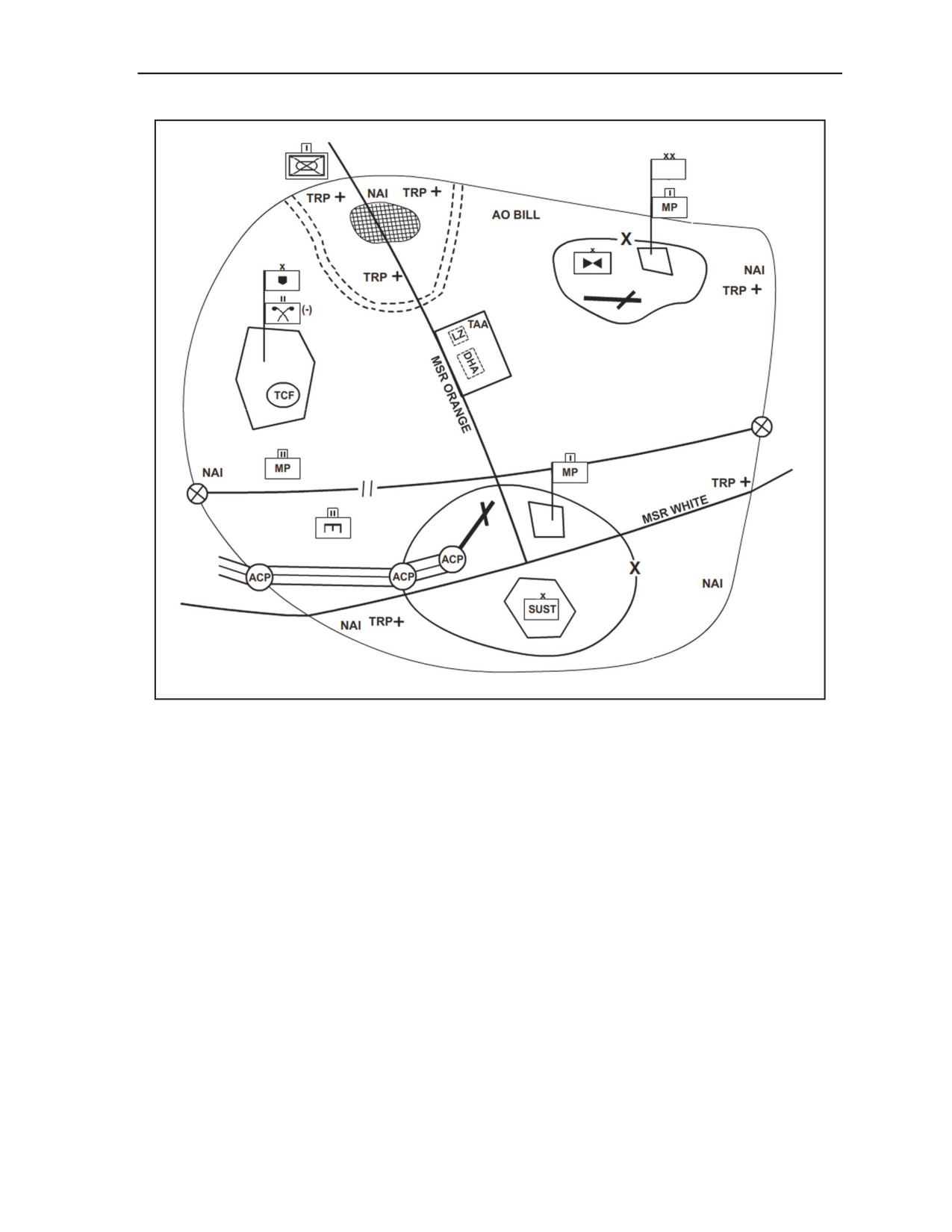
Support Area Operations
Figure 6-1. Example of MEB conducting support area operations
AREA DAMAGE CONTROL
6-107. The MEB conducts ADC to respond to incidents within the support area. (See chapter 7.) FM 3-90
discusses the actions following an enemy attack. The MEB or base commander may need to reorganize.
Reorganization is action taken to shift internal resources within a degraded unit to increase its level of
combat effectiveness (FM 100-9). ADC and reorganization may include such measures as—
z
Reestablishing security.
z
Assessing the situation and damage.
z
Treating and evacuating casualties.
z
Cross-leveling equipment and personnel.
z
Matching operational weapons systems with crews.
z
Forming composite units (joining two or more reduced units to form a single mission-capable
unit).
z
Redistributing ammunition and supplies.
z
Reestablishing the chain of command, C2 facilities, and key staff leaders lost during the attack.
z
Eliminating pockets of enemy resistance.
z
Destroying captured enemy equipment and processing enemy prisoners of war (EPWs) and
detainees.
26 February 2009
FM 3-90.31
6-19
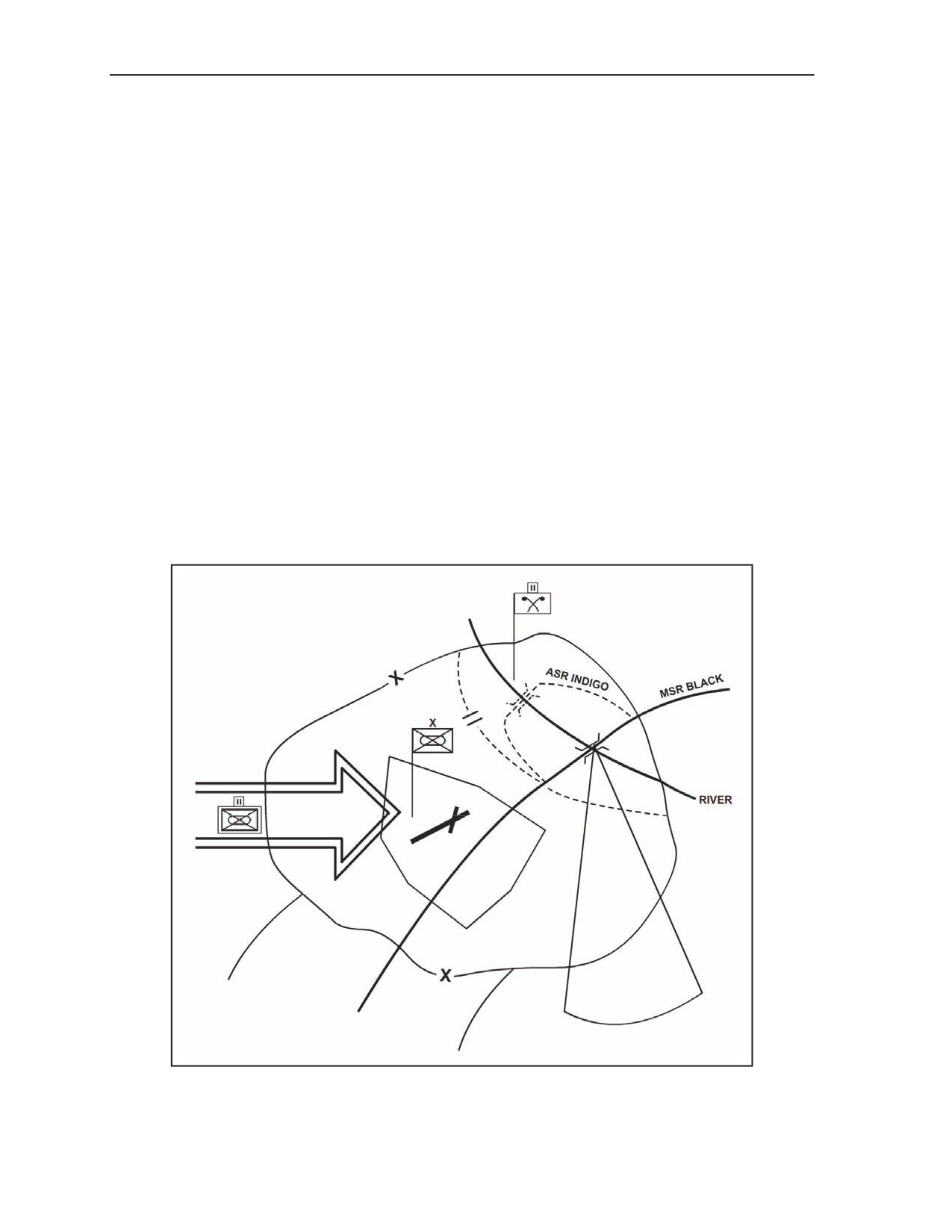
Chapter 6
z
Reorganizing or reconstituting a response force or reserve.
z
Reconstructing facilities.
z
Improving security or defenses.
z
Capturing lessons learned.
z
Replacing or shifting ISR assets and observers.
z
Conducting emergency resupply and refueling operations.
z
Recovering and repairing damaged equipment.
z
Submitting reports to higher headquarters.
z
Repairing/restoring critical routes within the AO.
EMPLOYMENT EXAMPLE
6-108. One example of MEB performing ADC is shown in figure 6-2. In this example, the BCT area
from the movement corridor employment example (figure 5-1, page 5-7) is shown in more detail. An
enemy rocket attack destroyed the bridge on MSR BLACK and produced a CBRN incident with a
corresponding downwind prediction. The BCT requested ADC support from the division to allow the BCT
to focus their capabilities on an expected enemy attack on their base. The MEB task organized and
prepared a chemical battalion TF which included the chemical battalion, an engineer construction
company, a bridging company, and two MP companies. The division detached the TF from the MEB and
placed it in DS to the BCT. The BCT created a new unit boundary and placed the TF within it to allow the
BCT to mass their organic capabilities on the expected ground attack. The TF is required to conduct area
security, highway regulation, decontamination, construction of ASR INDIGO, and emplacement of a
bridge upstream from the contaminated and destroyed bridge.
Figure 6-2 Example of an MEB performing ADC
6-20
FM 3-90.31
26 February 2009
Chapter 7
Consequence Management Operations
The MEB is capable of conducting many of the missions that may be associated with
consequence management operations. It has the most complete multifunctional staff
of any Army brigade with the staff skills needed to C2 consequence management
operations. The MEB is designed to integrate many of the types of units that have the
greatest applicability in support to consequence management
(CBRN, engineer,
EOD, and MP). Other brigade units are optimized for specific consequence
management functions but the MEB has the broadest consequence management
capabilities and the training to integrate them. The MEB may be the ideal type of
brigade for certain consequence management incidents because of its capability to C2
an AO and perform other related requirements. The brigade is trained to C2 airspace
and interface with others that control airspace. This is particularly important in large-
scale disasters with DOD aviation support. The MEB can conduct consequence
management depending on the nature of the incident and its task organization. The
MEB may be called upon to function as the on-site DOD or Army headquarters or
complement or support another headquarters such as a JTF or the CBRNE
Operational Headquarters to respond to specific consequence management missions.
The MEB can provide ADC as part of support area (see chapter 6) or MANSPT
operations
(see chapter
5) performed in support of its higher headquarters and
assigned units. For further guidance on consequence management refer to Chairman,
Joint Chiefs of Staff instruction (CJCSI) 3125.01, CJCSI 3214.01A, JP 3-07.6, JP 3-
28, JP 3-40, JP 3-41, FM 3-11.21 (FM 3-21), FM 3-07, FM 3-90, and FMI 3-90.10.
FUNDAMENTALS
7-1. Consequence management involves actions taken to maintain or restore essential services and
manage and mitigate problems resulting from disasters and catastrophes, including natural, manmade, or
terrorist incidents (JP 3-28). JP 3-41 contains doctrine on chemical, biological, radiological, nuclear, and
high-yield explosives consequence management.
7-2. This manual discusses consequence management operations in support of full spectrum operations.
With applicability in both domestic and foreign operations, consequence management is focused on DHS
and Department of State (DOS) related actions. Although ADC is distinct from consequence management,
it is included in the discussion here given the numerous similarities between it and consequence
management. ADC is focused on DOD related actions and typically has a tactical connotation unlike
consequence management which focuses on actions taken during or after an event, ADC also includes
actions taken before an event. For domestic crisis management or crisis response, see the National doctrine
in the NIMS, and NRF.
7-3. Land power includes the ability to address the consequences of catastrophic events—both natural
and manmade—to restore infrastructure and reestablish basic civil services. Consequence management
could be a joint military operation generally conducted under the operational theme of limited intervention.
(See FM 3-0.) Consequence management operations can also be conducted under foreign humanitarian
assistance. (See JP 3-0.)
26 February 2009
FM 3-90.31
7-1
Chapter 7
7-4. There is currently no consistent use of the term consequence management in Army doctrine. This
manual provides a framework for the MEB to understand how to view consequence management in
support of full spectrum operations.
7-5. Consequence management supports domestic civil authorities, foreign civil authorities, or military
authorities. Consequence management operations support foreign civil authorities or military authorities
when conducted in support of stability operations. Consequence management in support of stability
operations may be referred to in some publications as Foreign Consequence Management
(FCM).
Consequence management operations support domestic civil authorities when conducted in support of civil
support operations. Consequence management operations support military authorities when conducted in
support of offensive or defensive operations. Army commanders that are assigned AOs use ADC to
respond to incidents. ADC has similar tasks as consequence management. ADC may be conducted as part
of support area operations or MANSPT operations. ADC could support joint and multinational forces.
DOMESTIC INCIDENT MANAGEMENT, EMERGENCY MANAGEMENT, CRISIS RESPONSE, AND
INCIDENT RESPONSE
7-6. The National Doctrine in the NIMS and the NRF employ the term incident to include any occurrence
or event, natural or manmade, that requires a response to protect life or property (NIMS). Therefore, at the
national level, incident is the most inclusive official term.
7-7. Incidents include, major disasters, emergencies, terrorist attacks, terrorist threats, civil unrest, wild-
land and urban fires, floods, hazardous materials spills, nuclear accidents, aircraft accidents, earthquakes,
hurricanes, tornadoes, tropical storms, tsunamis, war related disasters, and public health and medical
emergencies. Within this manual, incidents also include hostile action or enemy attacks on DOD forces that
require ADC.
AREA DAMAGE CONTROL
7-8. Area damage control is the measures taken before, during, or after hostile action or natural or
manmade disasters, to reduce the probability of damage and minimize its effects (JP 3-10). ADC is
separate but similar to consequence management. This is a DOD lead action and what an AO unit
commander does initially within existing capabilities or a unit does to support others.
7-9. When the MEB provides ADC support to others, it is typically viewed as part of MANSPT
operations. (See chapter 5.) ADC is also listed as a key element of operational area security. (See chapter
6.) The preventative part of ADC (before an event) is less evident in consequence management. ADC is
focused on DOD related actions and typically has a tactical connotation.
CBRNE/CBRN CONSEQUENCE MANAGEMENT
7-10. JP 3-0 and JP 3-41 contain doctrine on chemical, biological, radiological, nuclear, and high-yield
explosives consequence management. This chapter uses the task Respond to CBRNE Incident as part of
consequence management operations and ADC.
7-11. FM 3-11.21 contains doctrine on CBRN consequence management operations at the tactical level.
TECHNICAL OPERATIONS
7-12. Technical operations are activated to address aspects of CBRNE materials when encountered in
consequence management operations. Technical operations may occur before the operation to support the
crisis management response and continue to support the consequence management response. Technical
operations include actions to identify, assess, dismantle, transfer, dispose of, or decontaminate personnel
and property exposed to explosive ordnance or weapons of mass destruction. The lead federal agency for
technical operations depends on the material involved and the location of the incident. (See JP 3-41.)
7-13. This manual takes an inclusive view of consequence management to conduct the response to a broad
range of incidents. Where consequence management is performed and who the designated lead is define
7-2
FM 3-90.31
26 February 2009
Consequence Management Operations
the different categories of consequence management and whether it is considered to be ADC rather than
consequence management. The MEB can conduct consequence management or ADC in support of each of
these operations for the responsible authority, to include—
z
Stability operations with DOS or DOD for lead for foreign civil authorities. (See FM 3-07.)
z
Civil support operations and domestic support operations with a DHS, Department of Justice, or
DOD lead for domestic civil authorities.
z
CBRNE consequence management operations with a DOD lead for civil or military authorities.
(See JP 3-41.)
z
ADC with an AO commander lead for military units. (See FM 3-90.)
7-14. The nature of consequence management environment is often complicated by the following factors:
z
Interagency coordination.
z
Overwhelming scope of consequences.
z
Large number and types organizations providing support.
z
Complex C2 arrangements.
z
Rapidly changing situations.
z
Uncertainty and conflicting information.
z
A loss of hope by many.
7-15. Consequence management activities manage the problems and consequences and mitigate, contain,
and reduce the effects of the incident or attack. Most of these purposes apply equally to ADC. The purpose
of consequence management includes—
z
Preventing, limiting, or containing consequences.
z
Assessing consequences.
z
Coordinating responses.
z
Protecting public health and safety.
z
Maintaining or restoring essential services.
z
Providing emergency relief to governments, businesses, and individuals.
z
Eliminating or alleviating human suffering.
z
Alleviating damage, loss and hardship.
7-16. The first priority in civil support operations is to save lives. In the aftermath of a manmade or natural
disaster, the first military forces to arrive focus on rescue, evacuation, and consequence management. (See
FM 3-0.) Essential services and priorities are defined by the supported agency. DOD consequence
management support is typically provided to a lead agency.
7-17. Domestic or foreign governments have primary responsibility to plan, prepare, prevent, and to
manage crises and coordinate consequence management responses. Geographic combatant commanders
(GCCs) have consequence management responsibility for support to U.S. forces and on U.S. controlled
installations.
7-18. For consequence management as part of civil support operations, State governments are responsible
and have the authority to respond and the Federal Government provides assistance. DHS is the “Primary
Agency” for consequence management during civil support operations.
7-19. Military support for consequence management during civil support operations will be provided
through Commander, United States Northern Command; Commander, United States Southern Command;
or Commander, United States Pacific Command depending upon the location of the incident.
7-20. The Joint Director of Military Support (JDOMS) in the J-3, Joint Staff serves as the action agent for
the Assistant Secretary of Defense-Homeland Defense and America's Security Affairs who has the
executive agent responsibility delegated by the Secretary of Defense. The JDOMS plans for and
coordinates the DOD civil support mission and is the primary DOD contact for all federal departments and
agencies during DOD involvement in most domestic civil support operations.
26 February 2009
FM 3-90.31
7-3

Chapter 7
7-21. For consequence management during stability operations the DOS is normally the federal agency
with lead responsibility although in some cases it may be the DOD. U.S. military support to consequence
management operations during stability operations normally will be provided to the foreign government
through the GCC within whose AOR the incident occurs. (See FM 3-07.) FCM includes—
z
Support to DOS on U.S. installations such as embassies.
z
FHA operations in support of foreign governments or people.
z
CBRNE consequence management.
7-22. The MEB can conduct the consequence management operations supporting tasks outlined in chapter
2 and shown in the left column of table 7-1 as part of consequence management operations. This table
shows what key tasks may be performed during stability, civil support, and ADC operations.
Table 7-1. MEB consequence management operations tasks relationships to other
operations
Stability Operations
Civil Support Operations
ADC Operations
Respond to CBRNE
X
X
X
incident
Provide support to law
X
X
enforcement
Conduct post incident
X
X
X
response operations
7-23. ADC may also include key additional tasks that are not necessarily performed as a part of
consequence management operations. These include but are not limited to—
z
Overcome barriers, obstacles, and mines.
z
Provide illumination.
z
Provide general engineering support.
z
Provide high-value site security.
z
Identify local resources, facility.
z
Conduct personnel recovery operations.
z
Conduct AT activities.
z
Conduct survivability operations.
z
Conduct CBRNE operations.
z
Conduct consolidation and reorganization activities.
z
Respond after an enemy attack.
z
Conduct recovery (often an Air Force term for what an air base does after an attack).
z
Assess and repair battlefield damage assessment and repair.
7-24. Consequence management operations can be categorized several ways; by location where they occur,
what they provide, after what type incident, and for whom they provide support. Location may be foreign
or domestic. In both locations, consequence management may occur on U.S. government controlled
installations and directly support U.S. forces. The types of incidents are disasters and catastrophes. Causes
of incidents are natural, manmade, or terrorist. In this manual “man-made or terrorist incidents” include
hostile actions against military forces that require consequence management or ADC. The types of military
response for consequence management include C2, resources, equipment, supplies/sustainment, services,
and advice to decisionmakers. (See FM 3-07.)
CONSIDERATIONS
PLAN
7-25. All Army units develop incident response plans to prevent, mitigate, or limit consequences, contain
consequences, coordinate responses, and reestablish operations. Consequence management is often
7-4
FM 3-90.31
26 February 2009
Consequence Management Operations
provided in a complex environment characterized by uncertainty, multiple service providers, unclear roles
and responsibilities, and the potentially overwhelming nature of catastrophic consequences. If requested,
the MEB could participate in pre-incident planning to support military units or civil authorities. Local civil
authorities may have a prepared plan for some incidents but may be quickly overwhelmed with a major
incident and request support. The MEB would then conduct parallel and collaborative planning with the
lead agency to modify a plan and create new incident response plans. See FM 3-90 for ADC planning
guidance. See FM 3-11.21 for planning guidance for CBRN consequence management.
7-26. In emergency preparedness planning, the DHS plans for manmade and natural disasters and incident
and executes the plans as civil support operations. See the NIMS and NRF for essential services Army
forces provide in response to disaster.
7-27. While the MEB may be the lead DOD unit on-site, it will typically be in support of another military
or civilian organization. The MEB coordinates all planning with whoever is in the lead to determine
required support. The MEB considers support functions that may be required during consequence
management to include communications, transportation, engineering, maintenance, medical, and public
affairs.
7-28. The MEB will typically develop plans for all of the potential consequence management operations
that the MEB is projected to participate in. Anticipate those operations that may require MEB support as a
C2 headquarters. Plan sequential responses; initial, subsequent, follow-on, and transition to other
authorities. Develop a plan that defines the conditions when additional functional headquarters should be
requested to C2 functional requirements that overload the span of control or expertise of the MEB. Military
OPLANs/OPORDs currently use Annex T-Consequence Management (CM). (See FM 5-0.) Much of the
C2 information, except combat operations in chapter 6, titled conduct support area operations, applies to
the MEB’s conduct of consequence management. Task organization of subordinates, terrain management,
and assignment of AOs are similar.
7-29. The MEB must assess the probable requirements for medical assets required to respond to given
consequence management incidents. Ideally, the command or support relationship of the medical assets to
the MEB would be determined before deployment, but changes in their requirement may only become
evident as certain incidents occur.
7-30. The MEB task organizes subordinates, conducts terrain management, and assigns AOs in much the
same manner as it does during the conduct of support area operations. (See chapter 5.)
7-31. The MEB conduct of risk management in consequence management is more important due to the
uncertainty, complexity, and unfamiliarity of the OE during most incidents. Besides the standard risk
management process, the MEB may consider the following:
z
Detailed IPB continually updated with input from the on-scene command post, first responders,
and MEB ISR plan.
z
Risk assessment of all phases of the operation from any required deployment, through
execution, to any redeployment.
z
Both natural and manmade incidents often have follow-on incidents that can complicate the
operation and affect the initial risk assessment.
PREPARE
7-32. Form, train, and rehearse crisis response teams to include medical, CA, CBRN, engineer, EOD, MP,
damage assessment, fire, search and rescue and other capabilities. Prepare equipment and supplies for
deployment or stage response equipment and supplies.
7-33. MEB elements may be deployed in anticipation of an incident if there is sufficient warning. When
authorized, quickly deploy to the incident location and establish contact with the on-site lead. Continue to
support crisis planning, and potentially support protection and security efforts, or pre-positioning of
resources.
26 February 2009
FM 3-90.31
7-5
Chapter 7
7-34. Based on guidance from the higher headquarters that will be supported and mission analysis, project
necessary task organization or augmentation to include units, technical experts, specialized equipment, and
supplies. Conduct rehearsals of known or probable support tasks.
7-35. Continue mission analysis and conduct or request ISR operations to develop SA and SU. Share your
COP with the supported headquarters/agency.
7-36. Conduct survivability operations before an incident to reduce the probability of damage and
minimize its effects. Vulnerability assessment can be conducted on fixed locations and a risk assessment
supported by CRM can help to identify potential preemptive or preparatory actions.
EXECUTE
7-37. All Army units execute consequence management (or ADC) within their ability. Commanders
assigned AOs provide ADC for those units located within their AO. AO commanders take actions to
maintain and restore essential services, C2 capabilities, and mission support. Actions are taken to manage
and mitigate the effects of incidents.
7-38. Commanders act quickly to control events. Acting faster than the situation deteriorates can change
the dynamics of a crisis. (See the discussion of tempo in FM 3-0.) The capability to act quickly helps
prevent, contain, or recover from incidents.
7-39. Domestically, first responders should establish a local command post at the incident location.
Determining on-site who is in charge of various response efforts may be a challenge as response grows for
a large incident. Coordinate and integrate all support with the on-site command post, commander, or
manager.
7-40. Continually update and share your COP with the lead agency. The MEB may employ capabilities to
support the lead agency’s COP and SA. Quickly adjust efforts based on changing situations and new
priorities. This also supports risk management.
7-41. Coordinate all information operations with the supported agency. The media can have a significant
impact on public support, legitimacy of local authorities, views of our military, and changes in priority of
effort.
7-42. Decide when to hand off to functional brigades/other units or civil authorities (foreign or domestic)
and when to request additional support or release assets no longer required. Initial or follow-on support
requirements could include C2 and support to movement and maneuver, protection, and sustainment
support.
ASSESS
7-43. Before an incident, assess measures that could prevent, limit, or contain consequences. Assess
readiness to respond. Assess MEB sustainment requirements before deployment.
7-44. After an incident, conduct an initial assessment of the consequences (immediate and long-term) and
provide advice on response measures. Assess needs and the organizations capabilities and resources to
respond. UAS can assist in aerial damage assessment (ADA) and MEB technical experts can assess beyond
most units’ capabilities. Assess the requests for assistance. Continually asses if additional forces or
resources are required to meet approved levels of support. Be aware of unintended mission creep.
7-45. Assess response efforts using MOEs and MOPs as in any operation.
RESPOND TO CBRNE INCIDENTS
7-46. This task includes respond to CBRN or CBRNE incidents as discussed in other chapters and
reference manuals. Depending on the nature of the incident and initial assessment, the task organization of
the MEB may need to be frequently changed. The controlling headquarters may also change the command
or support relationship of the MEB as additional units or organizations respond to the incident. Key
response tasks may include: assessing CBRN hazard, conducting risk management, responding to
7-6
FM 3-90.31
26 February 2009
Consequence Management Operations
chemical/biological EOD incidents, responding to WMD incident, planning/preparing for CBRN CM
support, responding to a CBRN CM incident, and providing mass casualty decontamination support.
PROVIDE SUPPORT TO LAW ENFORCEMENT
7-47. The MEB conducts this task in both domestic and foreign locations and is governed by the
applicable laws and policies. The efforts are similar to the stability tasks; establish civil security and
establish civil control. Key law enforcement tasks may include conducting law and order operations,
providing guidance on MP operations, planning L&O operations, and providing operational law support.
CONDUCT POST INCIDENT RESPONSE
7-48. The MEB organic staff has many of the skills required to conduct most post incident response tasks.
MEB requirements could include many of the tasks from stability and civil support operations to include
tasks from support area operations and MANSPT operations. Some disasters would require the MEB to C2
AC2, UAS employment, debris removal, medical care, and the employment of specialized search and
rescue teams. The MEB can C2 most search and rescue tasks on land but may require augmentation and
task organized capabilities depending on the mission. In a domestic incident, United States Northern
Command has a capability area of protection that includes search and rescue. The USACE provides
organic and contracted land based search and rescue capabilities.
EMPLOYMENT EXAMPLE
7-49. One example of an MEB conducting consequence management within CONUS is shown in
figure 7-1, page 7-8. In this example, a plane has crashed into a major industrial site and mass casualties
have resulted; a CBRNE incident has occurred with downwind prediction that affects a built up area and
state Highway 5, and there is an environmental hazard of runoff into the river that provides water to a built
up area downstream. This example could also be viewed as civil support operations as part of full spectrum
operations. The local officials responded but were overwhelmed. The state governor declared a state of
emergency, directed the state emergency management agency (SEMA) to take over incident command,
management and response, and requested support from a neighboring state. That state has an ARNG MEB
ready to respond to the mission based upon an existing support agreement.
7-50. The ARNG MEB immediately deploys the DCO with an ECCP to collocate with the SEMA on-site
command post while the rest of the MEB mobilizes and moves to the incident site. The MEB is task
organized with one engineer battalion, two MP battalions, a CA battalion, two chemical battalions, and one
mechanized infantry battalion. The SEMA also put their state medical battalion, Chinook squadron, local
and state search and rescue teams, and a volunteer local construction company OPCON to the MEB. The
SEMA assigned the MEB an area to control and in which they will conduct the operations. The key tasks
include conducting risk management, responding to CBRNE incident, providing support to law
enforcement, conducting post incident response, conducting MANSPT operations; improving movement,
and supporting area security in and around the industrial site. Finally, they are to conduct sustainment
support operations (general engineering to construct a berm to control surface runoff) and other critical
requirements that may be identified.
26 February 2009
FM 3-90.31
7-7
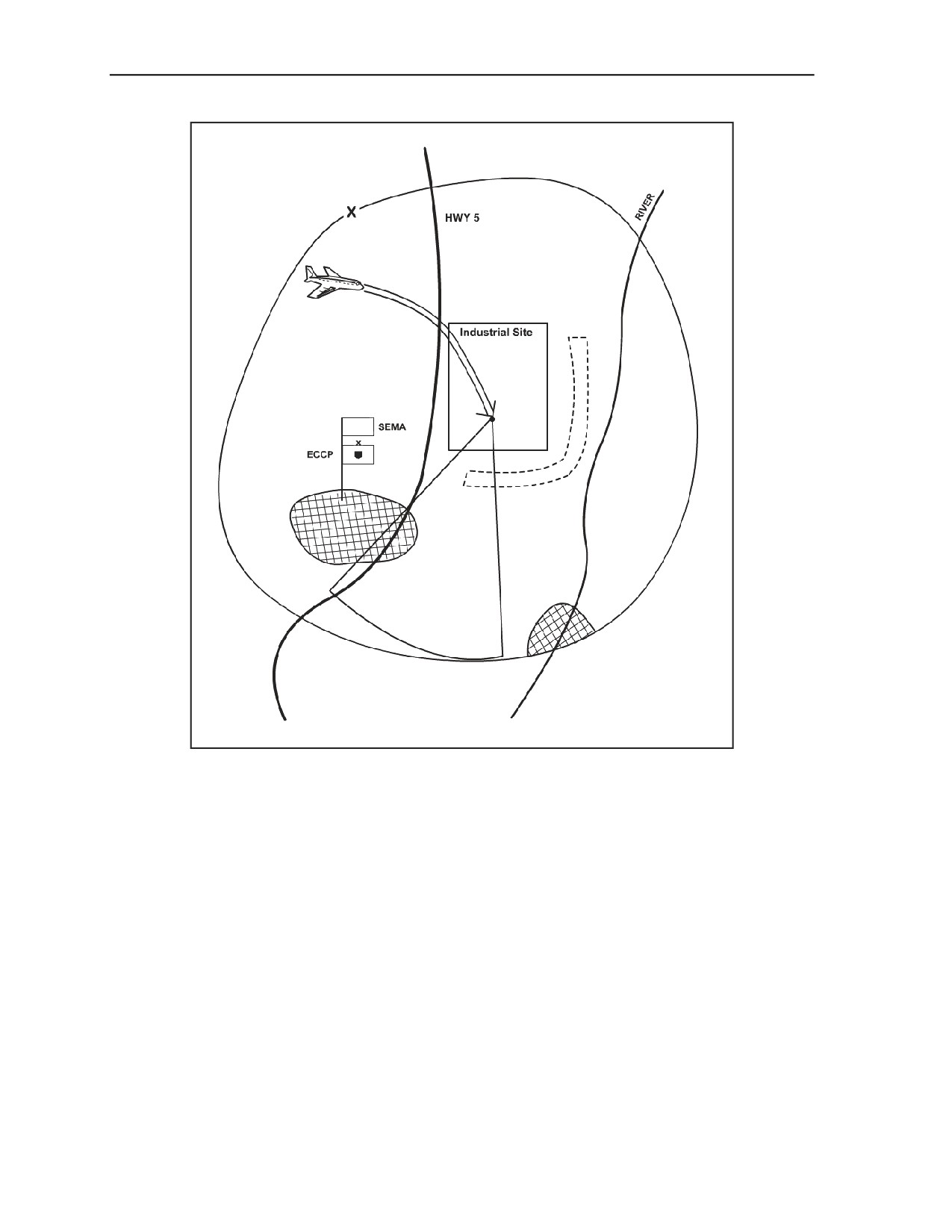
Chapter 7
Figure 7-1 Example of an MEB conducting consequence management
7-8
FM 3-90.31
26 February 2009
Chapter 8
Stability Operations
The specialized organization and training focus of the MEB make it an important
contributor to stability operations. The MEB may be required to conduct some
stability operations for its supported echelon within an assigned AO while concurrent
MCO are occurring in the larger AO of the headquarters they are supporting. In this
case the MEB would effectively perform in an economy of force role in one area with
the relative weight of the effort on stability operations as other units focus the relative
weight of their effort on combat operations in another area. The MEB may be
required to conduct stability operations simultaneously with support area operations,
consequence management operations, and MANSPT operations. (See FM 3-0, and
FM 3-07 for additional information on stability operations.)
OVERVIEW
8-1. Stability operations is an overarching term encompassing various military missions, tasks, and
activities conducted outside the United States in coordination with other instruments of national power to
maintain or reestablish a safe and secure environment and provide essential government services,
emergency infrastructure reconstruction, and humanitarian relief (JP 3-0). Stability operations can be
conducted in support of an HN or interim government or as part of an occupation when no government
exists. Stability operations involve both coercive and constructive military actions. They help to establish a
safe and secure environment and facilitate reconciliation among local or regional adversaries. Stability
operations can also help establish political, legal, social, and economic institutions and support the
transition to legitimate local governance. Army stability operations will take place in continuous,
simultaneous combinations with offensive and defensive operations. The mission determines the relative
weight among these elements. (See FM 3-0.)
STABILITY TASKS AND PURPOSES
PRIMARY TASKS OF STABILITY OPERATIONS
8-2. Military stability tasks include—
z
Civil security.
z
Civil control.
z
Restoration essential services.
z
Support to governance.
z
Support to economic and infrastructure development.
8-3. The MEB can conduct or support the five primary military stability tasks; however, they have little
unique capability to conduct the primary tasks: support to governance and support to economic
development. The MEB does have capability to conduct support to infrastructure development. These tasks
are conducted in a complementary, reinforcing, and concurrent manner with other agencies or
multinational forces. While the five stability tasks are essential for success, without complementary
information engagement that explains these actions to the population, success may be unattainable. The
MEB could be the primary military unit conducting selected stability tasks in an environment with a low
level of violence or following a natural disaster. However, it would more likely conduct stability operations
concurrently in support of other Army or joint forces. The MEB may conduct stability operations within
their assigned AO. The brigade may also provide forces in a command or support relationship when
commanders of other AOs require MEB capabilities.
26 February 2009
FM 3-90.31
8-1
Chapter 8
8-4. The MEB and its subordinate elements may support HN or other civilian agencies. When the HN or
other agencies cannot provide basic government functions, MEB forces may be required to do so directly.
The MEB conducts both coercive and constructive actions. The brigade has the capability to C2 many of
the types of units needed to establish and maintain stability. The MEB establishes fusion cells to integrate
intelligence from all organizations. It assesses requirements and conducts operations integrated and
synchronized with others to shape the civil conditions. The MEB interacts with the populace and civil
authorities and conducts MANSPT operations to provide full freedom of movement for friendly forces
while denying it to the enemy. The MEB’s organic staff is best suited to conduct civil security, civil
control, and restore essential services. They can use reachback or staff augmentation to better conduct
these tasks. See FM 3-07 for a discussion of essential stability tasks, subordinate stability tasks, and
supporting information engagement tasks. The MEB may be called upon to conduct any of their key tasks
in the conduct of stability operations.
8-5. Many stability operations require Soldiers to interact with the populace in the AO often for
prolonged periods of time to a greater extent than in offensive and defensive operations. NGOs may be
assisting some efforts or conducting parallel efforts. There can be a large range of small unit technical or
constructive tasks along several lines of operation that the commander must integrate and synchronize.
This makes the environment complex and suited to the MEB staff capabilities and probable task
organization of CBRN, EOD, and engineer units, especially if major offensive or defensive operations are
not required in the MEB AO, or are small enough to be conducted by the MEB with a task organized
maneuver battalion.
Civil Security
8-6. The MEB provides major capabilities through MANSPT operations to establish civil security, and
could conduct support area operations. The objective is to provide a safe and secure environment to create
conditions for political, economic, and humanitarian activities to succeed. Civil security involves
protecting individuals, infrastructure, and institutions from external and internal threats. Ideally, Army
forces defeat external threats posed by enemy forces that can attack population centers. Simultaneously,
they assist HN police and security elements as the HN maintains internal security against criminals and
small, hostile groups. In some situations, there is no adequate HN capability for civil security and Army
forces may provide most of it while developing HN capabilities. Civil security is required for the other
stability tasks to be effective. The MEB may be required to secure and account for conventional or CBRNE
weapons and materials before appropriate EOD or technical escort units render safe if required/disposal/or
preparation/transport for subsequent disposition. Responsibility is transferred to competent and legitimate
local authorities when they can perform the task. Stability subordinate tasks may include—
z
Enforce cessation of hostilities, peace agreements, and other agreements.
z
Determine disposition of constitution and national armed and intelligence services.
z
Conduct disarmament, demobilization, and reintegration.
z
Conduct border control, boundary security, and freedom of movement.
z
Support identification programs.
z
Protect reconstruction and stabilization personnel and facilities.
z
Clear unexploded ordnance.
8-7. MEB key supporting tasks may include coordinating interface/liaison between U.S. military forces
and local authorities/NGOs, conducting area security operations, planning HN police building operations,
and planning security operations.
Civil Control
8-8. The MEB provides major capabilities through MANSPT operations to establish civil control. The
objectives of civil control are to establish civil administration and provide for social reconciliation. Civil
control regulates selected behavior and activities of individuals and groups. This control reduces risk to
individuals or groups and promotes security. Civil control channels the population’s activities to allow the
establishment of security and essential services. Civil control may be required while coexisting with a
8-2
FM 3-90.31
26 February 2009
Stability Operations
military force conducting operations. The MEB may use MP, engineer, CBRN, CA units, or a combat force
to impose martial law, impose curfews, conduct information engagement, or close borders. Stability
subordinate tasks may include—
z
Establish public order and safety.
z
Establish interim criminal justice system.
z
Support law enforcement and police reform.
z
Support judicial reform.
z
Support property dispute resolution processes.
z
Support legal system reform.
z
Support human rights initiatives.
z
Support corrections reform.
z
Support war crimes courts and tribunals.
z
Support public outreach and community rebuilding programs.
8-9. MEB key supporting tasks may include planning populace and resource control operations, advising
commanders of obligation to civilian population, providing EOD support to weapons storage site
inspection, planning civil disturbance operations, and a variety of MP tasks.
Restore Essential Services
8-10. The MEB provides major capabilities through MANSPT operations and conduct consequence
management operations to restore essential services. The objective is to provide immediate and essential
humanitarian relief in coordination with NGOs and international government organizations. Normally,
Army forces support other government, intergovernmental, and HN to establish or restore the most basic
services and protect them until a civil authority or the HN can provide them. This military stability task
includes programs conducted to relieve or reduce the results of natural or manmade disasters or other
endemic conditions such as human suffering, disease, or privation that might represent a serious threat to
life or that can result in great damage to or loss of property. When the HN or other agency cannot perform
its role, MEB Army forces may provide the basics directly. The MEB has the staff to assess most needs
and plan for the provision of most essential services. They can use reachback or staff augmentation to
better plan and control some tasks. Stability subordinate tasks may include—
z
Restore essential civil services.
z
Perform tasks related to civilian dislocation.
z
Support famine prevention and emergency food relief programs.
z
Support shelter and nonfood relief programs.
z
Support humanitarian de-mining
z
Support public health programs.
z
Support education programs.
8-11. MEB key supporting tasks may include coordinating support with HN/multinational
representative(s), performing an initial infrastructure assessment, installing prime power generation
equipment, and other general engineering tasks.
Support to Governance
8-12. The MEB has no special capabilities to support governance. The short-term objective may be to
establish a military government, support an interim or HN government and to create an environment
conducive to stable governance. The objective is to support legitimate authorities, assess formal and
informal power arrangements, encourage dialogue among leaders, and work with local leaders in
coordination with interagency objectives. The MEB can help establish conditions that enable interagency
and HN actions to succeed. This could include providing military governance on a temporary basis to
include societal control functions that include regulation of public activity, rule of law, taxation,
maintenance of security, and essential services, and normalizing means of succession of power. The MEB
could establish security and control, conduct MANSPT operations, and conduct information engagement to
26 February 2009
FM 3-90.31
8-3
Chapter 8
provide a foundation for transitioning authority to other government or intergovernmental agencies and
eventually to the HN. Stability subordinate tasks may include—
z
Support transitional administrations.
z
Support development of local governance.
z
Support anticorruption initiatives.
z
Support elections.
Support to Economic and Infrastructure Development
8-13. The MEB provides capabilities through MANSPT operations and some pure functional engineer
tasks to support infrastructure development. Without staff augmentation, the MEB has no major
capabilities to support economic development, except to support economic generation by conducting local
infrastructure projects and providing security and protection. The objective is to prevent infrastructure
from further deterioration and decay, to rebuild infrastructure to provide basic services to the populace and
restore functioning of economic production and distribution. Civilian agencies have the lead for this task.
Support to economic and infrastructure development helps a HN develop capability and capacity in these
areas. It may involve direct and indirect military assistance to local, regional, and national entities.
Infrastructure has four major subsystems: utilities, transportation, industry, and public facilities. The CA,
CBRN, engineer, EOD, and capabilities typically task organized to an MEB are often needed in the support
of economic and infrastructure development. Infrastructure reconnaissance will be an important piece of
this support. For more information on infrastructure reconnaissance, see FM
3-34.170. Stability
subordinate tasks may include—
z
Support economic generation.
z
Support monetary institutions and programs.
z
Support national treasury operations.
z
Support public sector investment programs.
z
Support private sector development.
z
Protect national resources and environment.
z
Support agricultural development.
z
Restore transportation infrastructure.
z
Restore telecommunications infrastructure.
z
Support general infrastructure reconstruction programs.
PURPOSES OF STABILITY OPERATIONS
8-14. Stability purposes include—
z
Providing a secure environment.
z
Securing land areas.
z
Meeting the critical needs of the populace.
z
Gaining support for HN government.
z
Shaping the environment for interagency and HN success.
8-15. Stability operations focus on achieving the military end state and creating conditions where the other
instruments of national power predominate. The design and training focus of the MEB make it a valuable
contributor to stability operations. The following paragraphs discuss the purposes of stability operations.
Provide a Secure Environment
8-16. Isolate enemy fighters from the local populace and protect the population. By providing security and
helping HN authorities control civilians, Army forces begin the process of separating the enemy from the
general population. Information engagement complements physical isolation by persuading the populace to
support an acceptable, legitimate HN government. This isolates the enemy politically and economically.
8-4
FM 3-90.31
26 February 2009
Stability Operations
Secure Land Areas
8-17. Help to secure land areas by developing HN capabilities. Areas of population unrest often divert
forces that may be urgently needed elsewhere. In contrast, stable areas may support bases and
infrastructure for friendly forces, allowing commitment of forces elsewhere. In stability operations,
friendly bases may be key terrain.
Meet the Critical Needs of the Populace
8-18. MEB forces can provide many essential services until the HN government or other agencies can do
so. Examples of essential services include sanitation, emergency health care, shelter, and food.
Gain Support for HN Government
8-19. Successful stability operations depend on the legitimacy of the HN government—its acceptance by
the population as the governing body. All stability operations are conducted with that aim.
Shape the Environment for Interagency and HN Success
8-20. The MEB may provide part of the security and control necessary for HN and interagency elements to
function and may support them in other key related functions. The MEB will likely conduct simultaneous
combat and stability operations. The MEB applies its mix of combat power to enhance the shaping of the
environment. At the conclusion of MCO, the purpose of the stability operations must link with the DOS
efforts.
STABILITY OPERATIONS CONSIDERATIONS
PLAN
8-21. The MEB considerations for stability operations planning are very similar for civil support
operations planning because the supporting tasks outlined in chapter 2 are similar. The MEB will normally
plan stability operations. The MEB will typically conduct MANSPT and support area operations during
stability operations. The MEB may need to plan to conduct or support each of the military stability tasks.
MEB leaders must understand the Army doctrine in FM 3-07 to conduct or support stability operations.
8-22. The MEB must understand any linkage to the DOS stability sectors. (See FM 3-07.) The MEB must
be involved in the early stages of stability support planning to ensure higher level planners understand the
capabilities and limitations of the MEB and effect force tailoring. The MEB staff must understand the
conditions and objectives to achieve the strategic and military end states to develop the MEB operations.
The end state can evolve and the MEB adjust operations.
8-23. Stability operations are designed using lines of effort to create the conditions that define the end
state. See figure 8-1, page 8-6. Some lines of effort may be decisive or shaping. (See FM 3-07.)
26 February 2009
FM 3-90.31
8-5
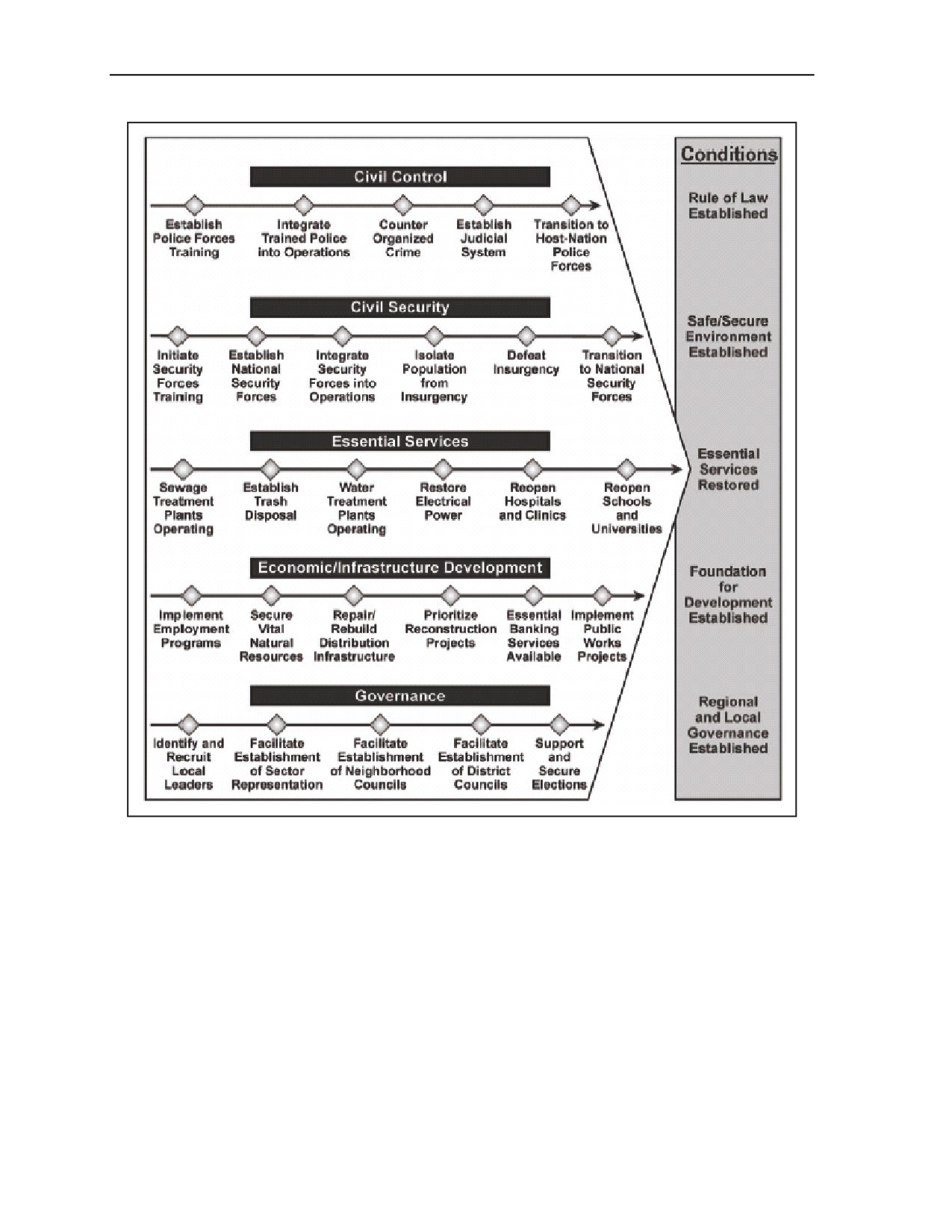
Chapter 8
Figure 8-1. Examples of lines of effort
8-24. A stability mechanism is the primary method through which friendly forces focus affect civilians in
order to attain conditions that support establishing a lasting stable peace. As commanders and their staffs
frame an operation, they determine an appropriate combination of stability mechanisms to contend with the
civil population and civil considerations required for successful operations. The situation may require a
combination of defeat (dislocation, isolation, destruction, and disintegration) and stability mechanisms.
This sets in motion the process that will ultimately create the conditions that define the desired end state.
(See FM 3-0.) The four stability mechanisms are—
z
Compel.
z
Control.
z
Influence.
z
Support.
8-25. CA operations are fundamental to executing stability tasks. CA operations are those activities that
establish and maintain relations among U.S. military forces, HN, NGOs, DOS agencies, other U.S.
8-6
FM 3-90.31
26 February 2009
Stability Operations
governmental agencies, and the civilian populace. CA units provide commanders with the means to shape
their OE with regard to these significant factors and to synchronize their actions with those of the military
force. Additionally, CA units perform important liaison functions between the military force and the local
civil authorities, international organizations, and NGOs. The MEB plans CA operations nested within the
use of stability mechanisms to attain conditions. (See FM 3-05.40.)
8-26. Planning considerations and necessary interagency coordination for stability operations are discussed
in FM 3-0. The stages of stability operations and the necessary interaction with other agencies are further
discussed in detail in FM 3-07. Within its AO the MEB must—
z
Understand the drivers of conflict.
z
Coordinate actions with other agencies.
z
Enhance the capabilities and legitimacy of the HN.
z
Empower at the lowest feasible levels.
z
Project a credible force.
z
Act decisively to prevent escalation.
z
Apply force selectively and discriminately.
z
Provide essential support to the largest number of people with focus on the most vulnerable.
z
Collaborate on measures of effectiveness.
z
Hand over to civilian agencies as soon as possible.
z
Conduct all operations in as transparent a manner as possible.
z
Be flexible and adaptable.
8-27. Army tactical tasks for stability are those tasks that must be performed to establish or maintain order
when civilians cannot do so. Successfully performing these tasks can help secure a lasting peace and
facilitate the timely withdrawal of U.S. and foreign forces. (See FM 3-0 and FM 3-07.)
8-28. Stability operations require the absence of major threats to friendly forces and the populace. The
MEB must plan to secure critical infrastructure and populated areas, and provide essential services to
minimize and relieve civilian suffering. Plan to minimize the effects of combat on the populace. As civil
security is established, the force returns territory to civil authorities’ control, as they are prepared to accept
control. Transitions to civil authority require the coordination and integration of civilian organizations and
military efforts. Unified action is crucial.
8-29. To ensure a unified effort, MEB commanders and their staff coordinate plans and actions with their
higher headquarters and adjacent units, and with government and NGOs present in the AO. Use of liaison
officers is vital for this requirement. The MEB may work with a variety of organizations and CA will be
critical to the success of its operations. (JP 3-57, JP 3-57.1, FM 3-05.40, and FM 3-05.401 contain doctrine
CA.)
8-30. The MEB augments its communications abilities to effect long-range communications, access to
civilian telephones and data links, and proper liaison with necessary organizations. Commanders and their
staff consider equipment compatibility, data encryption, information sharing, and security measures when
working with SOF, joint forces, and multinational forces.
8-31. Stability operations involve numerous legal, religious, and cultural issues. The MEB Chaplain, CA,
brigade judge advocate (BJA), and psychological operations (PSYOP) staff will play key roles in the
planning and execution of stability operations in these areas. All staff members must incorporate these
considerations in their planning and running estimates as they apply to each staff section. Legal
implications will be largely the staff focus of the BJA and the religious and culture implications will
typically be the focus of the Chaplain, CA officer, and PSYOP officer.
8-32. Stability operations are normally long-term endeavors requiring the commitment of forces and
resources to achieve a lasting success. To account for this, the commander must develop a vision for the
operation from initiation to the desired end state. The commander must guard against a tendency to expand
the stated mission in an effort to accomplish more than is appropriate. The commander and staff should not
26 February 2009
FM 3-90.31
8-7
Chapter 8
expand their mission unless the accomplishment of additional tasks is critical to accomplishing the stated
mission and achieving the desired end state.
8-33. Commanders and their staff analyze the current political and socioeconomic situation in the AO, the
friendly situation, and the higher headquarters’ order to determine the MEB’s mission and requirements.
Developing and articulating a desired end state in terms of the military and political socioeconomic
conditions that have the greatest potential for lasting stability in the area is a commander’s responsibility.
For commanders of the MEB, much of this guidance will typically be provided by a higher headquarters.
Commanders and their staff determine the required sequence of tasks and objectives that must be
accomplished to meet the end state. The most critical tasks that normally provide at least a temporary
suspension of violence, suffering, and chaos are undertaken immediately. These often include actions that
separate the warring factions, restore basic security, and provide immediate relief to suffering people.
Other critical actions include moving into the AO and the establishment of a base of operation and
sustainment base for the MEB. As the immediate situation stabilizes, follow-on actions are taken to restore
order, assist local governments, assist in repairing infrastructure, remove weapons, disarm factions, and
enforce specified military aspects of political agreements. The commander and staff assign objectives and
AOs to subordinate forces. They allocate forces and establish control measures for subordinate forces to
accomplish their missions.
8-34. To maintain focus during this type of long-term operation, it is vital that commanders and their staff
develop a concept of the operation that establishes objectives and time lines that meet the desired end state.
The concept should cover the entire duration of the operation from deployment to the end state, defining
how the MEB will accomplish its assigned mission. Fragmentary orders (FRAGOs) and subsequent
OPORDs are used to control execution of each phase of operation and various missions as required.
Command and Support Relationships
8-35. With the exception of military forces under the command of a GCC, the ambassador to the country is
responsible for U.S. operations, both civilian and military. The ambassador heads a country team that
interfaces with civilian and military agencies. The term
“country team” describes interdepartmental
coordination among the members of the U.S. diplomatic mission within a specific country. Examples of
team members include the—
z
Economics officer.
z
Director of the United States Agency for International Development.
z
Commercial attaché.
z
Agriculture attaché.
z
Military attaché.
z
Department of State.
z
Chief, Security Assistance Office.
8-36. The U.S. area military commander is not a member of the diplomatic mission. The JTF interfaces
with the senior military defense representative on the country team. If there is no JTF, a division or MEB
headquarters may be responsible for interface with the country team and HN.
Fires
8-37. Although fire support planning for stability operations is the same as for traditional MCO, there will
likely be additional limitations or restrictions on the use of certain indirect fire assets. The ROE and
munitions restrictions may be established to decrease fratricide and prevent collateral damage.
8-38. MEB commanders integrate fire support into their tactical plans in accordance with the ROE, and
any restrictions imposed within the AO
(such as no-fire or restrictive fire areas, presence of
noncombatants). Special considerations include—
z
Procedures for the rapid clearance of fires (more complex due to avoidance of collateral damage
and fratricide of noncombatants).
z
Close communication and coordination with host country officials.
8-8
FM 3-90.31
26 February 2009
Stability Operations
z
Increased security for indirect firing positions.
z
Restricted use of certain munitions such as dual-purpose improved conventional munitions or
scatterable mines.
z
Integration nonlethal effects.
Information Engagement
8-39. Information engagement in stability operations is critical to inform U.S. and friendly audiences and
to influence foreign audiences. (See FM 3-0 and FM 3-07.) Successful information engagement helps to
give MEB commanders the ability to affect the perception of the local population, belligerent factions, and
local leaders, and to accomplish their missions. The MEB may have PSYOP, CA, and PA elements
attached, OPCON, or otherwise operating in support of the MEB. As the staff coordinates and
synchronizes their employment, they must consider the ROE, the order from higher headquarters, and the
commander’s intent. If these elements are operating in the MEB AO, the MEB could be responsible for
providing security for them. Sources of information used by the MEB include—
z
Neutral parties.
z
Former warring factions.
z
Civilian populace.
z
Other agencies working in the AO.
z
Media and information passed from organic and nonorganic assets.
8-40. The MEB commander must be aware of theater of operations positions and interests and the effects
of events on the perceptions of Soldiers, opponents, and the population in general. The commander must
understand the positions of and information environments created by—
z
Neutral parties.
z
Warring or formerly warring factions.
z
The population and its major segments.
z
Other agencies working in the AO.
z
Media.
z
Information gathered by elements of the MEB.
Sustainment
8-41. The MEB’s ability to sustain itself in the AO depends on theater maturity, the sustainment structure,
and the time flow of forces. Refugees, an inadequate infrastructure, and demands by the HN and
multinational partners can make logistical support complex. Engineering support plays a critical role in
delivering sustainment by enhancing its capabilities. General principles to consider when planning
sustainment for stability operations include—
z
Ability to implement logistical support in any stability operations area.
z
Ability of the MEB to provide its own support.
z
Ability of higher headquarters to provide support.
z
Availability of local supplies, facilities, utilities, services, and transportation support systems by
contract or local purchase.
z
Availability of local facilities such as LOCs, ports, airfields, and communications systems.
z
Local capabilities for self-support to facilitate the eventual transfer of responsibilities to the
supported nation for development or improvement.
z
Availability of resources.
8-42. The primary sustainment challenges of stability operations are to anticipate needs and to integrate
assigned units and sources of supply into the operation. Informational needs include—
z
Resources available in the AO.
z
Status of critical supply items and repair jobs.
z
Nature and condition of the infrastructure.
26 February 2009
FM 3-90.31
8-9
Chapter 8
z
Capabilities of general reconstruction units.
z
Mission tasks.
z
Overall material readiness of the MEB.
z
Contracting. (In some cases, contracting can augment organic sustainment.)
z
Contractor protection (MEBs may encounter contractor-provided services and supply operations
in reconstruction operations environments. The MEB S-4 and commander must understand the
terms and limitations of contractor reconstruction.)
z
Liaison with civil authorities.
z
Additional liaison teams. (Close coordination with civil authorities and nonstandard supporting
relationships demand the use of digitized liaison teams to assure their greatest usefulness. They
can also require the creation of additional liaison teams that may have to operate without the C2
INFOSYS.)
Army Health System Support
8-43. The Army Health System (AHS) is a component of the military health system that is responsible for
operational management of the Army’s HSS and FHP missions, including training and predeployment,
deployment, and post-deployment operations. It is responsible for all mission support services performed,
provided, or arranged by the Army Medical Department (AMEDD) for the Army and, as directed, for joint,
intergovernmental, multinational, and multinational forces and agencies. Health service support includes all
support and services to promote, improve, conserve, or restore the mental and physical well-being of
personnel in the Army and other organizations as directed. This includes medical evacuation
(MEDEVAC), medical logistics, and casualty care, encompassing a number of AMEDD functions, to
include—
z
Organic and area medical support.
z
Hospitalization.
z
Treatment aspects of dental care.
z
Behavioral health/neuropsychiatric treatment.
z
Clinical laboratory services.
z
Treatment of CBRN patients.
8-44. Force health protection includes all measures to enable a healthy and fit force, prevent injury and
illness, and protect the force from health hazards. It covers prevention aspects of a number of AMEDD
functions, to include—
z
Preventive medicine
(PVNTMED), including medical surveillance and occupational and
environmental health surveillance.
z
Veterinary services, including food inspection and animal care missions.
z
Prevention of zoonotic diseases (those transmissible from animals to humans).
z
Combat and operational stress control (COSC).
z
Dental services (preventive dentistry).
z
Laboratory services (area medical laboratory support).
8-45. In stability operations, the MEB’s BSB could be augmented with an area support medical company
or supported by a brigade support medical company. Additional HSS augmentation could include a
forward surgical team, a forward MEDEVAC team (forward support medical evacuation team [FSMT])
(from the general aviation support battalion), and hospital augmentation may be required. (See AR 40-3 for
information on emergency medical treatment for local national civilians during stability operations.) Army
Health System support for the MEB in stability operations depends upon the specific type of operations,
anticipated duration of the operations, number of personnel deployed, evacuation policy, medical troop
ceiling, and anticipated level of violence. Additional FHP requirements could include veterinary services,
preventive medicine, laboratory, combat and operational stress control, and preventive dentistry support.
8-10
FM 3-90.31
26 February 2009
Stability Operations
Contracting
8-46. Contracting can be an effective force multiplier and should be used to augment existing sustainment
capabilities. Weak logistical infrastructures in the AO may make it necessary to contract some supplies and
services. If he knows that contracting may be required, the MEB commander obtains guidance from higher
headquarters concerning contracting during the initial planning stages. Hostilities can cause interruptions in
the delivery of any contracted services, such as food and water. For this reason, the MEB must be prepared
to sustain itself, attached forces, supporting forces, and the local populace for limited periods of time. A
good plan anticipates large consumption rates of supplies in classes I, III, IV, and VIII and provides for
reserve stockage of nonperishables. The MEB S-4 and the engineer coordinator are typically the members
of the MEB staff to coordinate contracting efforts.
PREPARE
8-47. The MEB may conduct stability operations in its own AO or in support of other AOs within the
larger AO of the unit it is supporting. When deploying from home station the typical sequence for an MEB
committed to conducting stability operations will generally follow this sequence—
z
Deploy and move into the AO.
z
Conduct stability operations.
z
Terminate operations and redeploy.
Deployment and Movement into the Area of Operations
8-48. The commander and staff must plan, synchronize, and control the movement of forces into the AO to
maintain the proper balance of security and flexibility. In coordination with the MCT/MCB, commanders
must decide the sequence in which their forces will enter the AO. The MEB must consider the number of
suitable routes or lift assets available to meet the movement requirements of its subordinate elements.
Other considerations include—
z
Road and/or route improvement and maintenance.
z
Route construction.
z
Obstacles clearance.
z
Bridge and culvert repair.
z
Bridging rivers or dry gaps.
z
Establishment of security along routes.
z
Traffic control to permit freedom of or restrict civilian movements along routes.
z
Communications architecture.
8-49. If the AO does not have the infrastructure to support the operation, it might be necessary to deploy
an advance party heavy with logistical and engineering support into the AO. If the threat level is high,
security elements will be a critical consideration. In other circumstances, it may be necessary for the
commander or deputy commander and a small group of specialized key personnel such as CA, PA, or the
BJA to lead the advance party. These personnel will set the groundwork for the rest of the force by
conducting face-to-face coordination with local civilian or military leaders. In all cases, a well-developed
movement order is essential. Infrastructure reconnaissance (to include the use of geospatial products) may
be critical to early success. (See FM 3-34.170.)
NGOs and UN Relief Agencies and International Organizations
8-50. Commanders and their staff coordinate the MEB's actions with the higher headquarters, adjacent
units, and governmental and NGOs in the AO to ensure a unified effort. The effective use of LNOs is vital
for this requirement.
26 February 2009
FM 3-90.31
8-11
Chapter 8
The Role of NGOs
8-51. NGOs may range in size and experience from those with multimillion dollar budgets and decades of
global experience in developmental and humanitarian relief to newly created small organizations dedicated
to a particular emergency or disaster. The professionalism, capability, equipment, and other resources and
expertise vary greatly from one organization to another.
8-52. NGOs are involved in such diverse activities as education, technical projects, relief activities,
refugee assistance, public policy, and development programs. It should be remembered that NGO
objectives may be counter to the U.S. government objectives.
Civil-Military Operations Center
8-53. Conceptually, the civil-military operations center (CMOC) is the meeting place of NGOs and the
population. Although not a new concept, the CMOC has been effectively employed as a means to
coordinate CA operations and plays an execution role. The organization of the CMOC is theater and
mission dependent, and flexible in size and composition. A commander at any echelon may establish a
CMOC to facilitate coordination with other agencies, departments, organizations, and the HN.
8-54. The commander may form a CMOC as the action team to provide the following:
z
Carry out guidance and institute decisions regarding CA operations.
z
Perform liaison and coordination between military capabilities and other agencies, departments,
and organizations to meet the needs of the populace.
z
Provide a partnership forum for military and other engaged organizations.
z
Receive, validate, and coordinate requests for support from the NGO and regional and
international organizations.
Use of Force in Stability Operations
8-55. When using force, restraint is as important in stability missions as applying overwhelming force is in
offensive and defensive operations. In stability operations, commanders at every level emphasize that
violence not precisely applied is counterproductive. Speed, surprise, and shock are vital considerations in
lethal actions; perseverance, legitimacy, and restraint are vital considerations in stability and civil support
operations. The ROE may include procedures for warnings and the employment of lethal and nonlethal
force. During preparation, all subordinate units must understand completely how to comply with the ROE.
8-56. Commanders address the apprehension caused by the presence of heavily armed Soldiers operating
among the local populace. Discipline and strict adherence to the rules of engagement are essential but not
sufficient to reassure the population. Commanders balance protecting the force, deterring attacks, and
taking constructive action throughout the AO. They also stress cultural awareness in training and preparing
for operations. Cultural awareness makes Soldiers more effective when operating in a foreign population.
8-57. Generally, stability operations require a greater emphasis on nonlethal actions. Often the mere
presence of military force is enough to maintain stability and compel behavior. However, some belligerents
may provoke forces conducting stability operations into an overreaction that can be further exploited
through propaganda. Commanders may demonstrate restraint by employing coercive, nonlethal methods
and capabilities that escalates force, including lethal force in a scalable manner enhancing the legitimacy of
an operation.
EXECUTE
Nature of Stability Actions
8-58. The MEB may execute stability operations at any point along the full spectrum operations from
stable peace to general war. Stability operations by nature are often decentralized in execution. Subordinate
units (often at the company and platoon level) carry out the vast majority of critical tasks and must possess
a complete understanding of the commander’s intent. The MEB must maintain the ability to conduct
8-12
FM 3-90.31
26 February 2009
Stability Operations
coordinated small-scale operations over great distances quickly and securely. Subordinate units may
conduct a wide range of tasks to support the stability subordinate tasks including, but not limited to,—
z
Battalion level and below offensive tasks such as attacks, search and attack, and ambushes.
z
Defensive tasks such as area defense.
z
Cordon and search operations.
z
Humanitarian assistance.
z
Environmental assistance which may include environmental clean-up or environmental services.
z
Security operations such as area security or convoy escort missions.
z
Reconnaissance operations.
z
Controlling civil disturbances.
8-59. Due to the multiple and unique demands of these operations, MEB forces must remain responsive
and flexible. Task organization of units may change many times during the course of the operation. The
MEB must ensure adequate support for its subordinate units and take active measures to create the
conditions for its subordinates to succeed. The MEB focuses the majority of its efforts towards
coordinating and supporting subordinate’s actions, assigning subordinate objectives and responsibilities
that support the concept of operations, and controlling all efforts to ensure they are working towards the
brigade’s overall objectives.
Complex and Uncertain Situations
8-60. Stability operations often take place in political, military, and cultural situations that are highly fluid
and dynamic. Unresolved political issues, an unclear understanding or description of a desired end state, or
difficulty in gaining international consensus may cause ambiguity. Complexity in these actions may also
arise from—
z
Troops dispersed throughout the AO.
z
Difficulty in discriminating between combatants and noncombatants or between the many
parties of a dispute.
z
Undisciplined factions, uncontrolled by a central authority and unwilling to consent to the
agreement.
z
Absence of basic law and order.
z
Violations of human rights.
z
Widespread destruction or decay of physical and social infrastructure and institutions; collapse
of civil infrastructure.
z
Environmental considerations (damage, hazardous materials).
z
Threats of disease or epidemics.
z
Presence of many displaced persons.
z
Presence and involvement of nongovernmental organizations, media, and other civilians.
8-61. Stability operations require detailed interagency planning and coordination. The Army’s response to
crises will have to address several components, such as political, diplomatic, humanitarian, economic, and
security.
8-62. After the MEB has moved into its AO and established a base for future operations, a continuation of
the stability effort commences. To successfully execute the mission, commanders at all levels must clearly
understand the mission and the higher commander’s concept of operation and intent. This knowledge
enables the commander to prioritize tasks, begin stability operations, and allow subordinates to take
initiative. Tactical tasks executed during the stability operation depend upon the factors of METT-TC.
These tactical tasks include—
z
Establishment of zones of separation.
z
Combat operations including raids, checkpoints, patrols, and reconnaissance.
z
Support to the HN.
z
Security operations.
26 February 2009
FM 3-90.31
8-13