FM 3-90.31 MANEUVER ENHANCEMENT BRIGADE OPERATIONS (FEBRUARY 2009) - page 2
Chapter 4
early in the process and provide the necessary flexibility of employment and the necessary transitions that
will occur in operations. Effective multifunctional and functional C2 of MEB capabilities are essential to
achieving this.
4-4. Each element of full spectrum operations—offense, defense, and stability or civil support—is
necessary in most the campaigns. There are exceptions in that during most domestic operations Army
forces will only conduct civil support operations. Offensive and defensive operations may be required
within the continental United States
(CONUS) in support of Homeland Security
(HLS). Stability
operations may predominate in foreign humanitarian assistance (FHA) with minor defensive operations,
and with little or no offensive component.
GENERAL MEB CONSIDERATIONS
4-5. This manual uses the term conduct as defined in FM 6-0—to perform the activities of the operations
process: planning, preparing, executing, and continuously assessing. Full spectrum operations follow a
cycle of planning, preparation, execution, and continuous assessment with the commander driving the
operations process through battle command.
4-6. The following are general operations process considerations that apply to all MEB operations.
PLANNING
4-7. The MEB must conduct its operations in collaboration with higher, lower, and adjacent units. It
conducts a broad range of tasks in full spectrum operations, with a broad range of task-organized units and
capabilities. This requires it to conduct integrated (this includes “synchronized”) planning and balance
effort across several operations. It must integrate several major simultaneous operations. It must integrate
the functions, activities, processes, staffs, and the units, tasks, systems and capabilities of numerous Army
branches and joint, interagency, and multinational forces, often into combined arms teams, to conduct
complex operations. It must integrate planning with its higher headquarters, planning processes, staff
sections, warfighting functions, directorates, centers, and boards. It must integrate with supported units. It
must integrate plans, measures, actions, and activities. The MEB commander, staff, and LNOs all
contribute to this integrated planning effort.
4-8. FM 5-0 and FM 6-0 discuss integration in its various forms and the many things that must be
integrated during planning. FM 3-0 discusses the use of integrating processes to synchronize operations
during all operations process activities. They must be synchronized with each other and integrated into the
overall operation—
z
Intelligence preparation of the battlefield. (See FM 34-130 [to be revised as FM 2-01.3].)
z
Targeting. (See FM 6-20-10.)
z
ISR synchronization. (See FM 34-2.)
z
CRM. (See FM 5-19.)
z
Knowledge management. (See FM 3-0.)
4-9. The MEB uses the operations process to synchronize across all of the warfighting functions within
the brigade and with its supported higher headquarters. The MEB commander uses the warfighting
functions to assist in exercising battle command. Some of the key tasks within each warfighting function,
or related to the warfighting functions that the MEB focuses on for planning include—
z
Movement and maneuver.
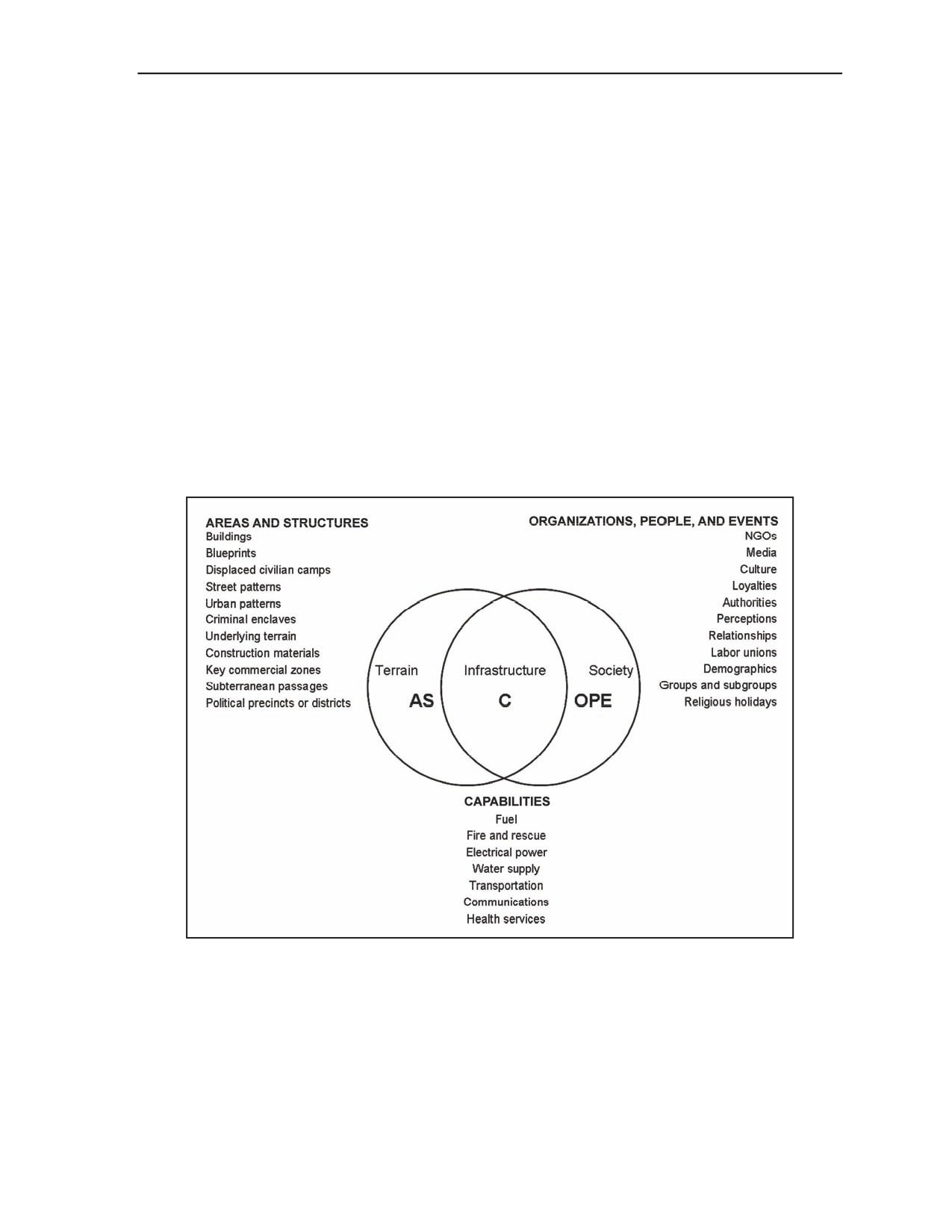
Deploy.
Move.
Maneuver.
Employ direct fires (typically, when task-organized with a TCF).
Occupy an area.
Conduct mobility and countermobility operations.
Employ battlefield obscuration.
4-2
FM 3-90.31
26 February 2009
MEB Operations
z
Intelligence.
Support to situational understanding.
Conduct ISR.
z
Fires.
Decide which surface targets within MEB AO that should be attacked.
Detect and allocate surface targets.
Provide fires support (if task-organized, TCF has artillery or mortar systems).
Assess effectiveness of fires delivered.
Integrate C2 warfare, including nonlethal fires, into MEB operations.
z
Sustainment.
Provide general engineering support.
Conduct I/R.
Support of distribution (within an assigned AO).
Coordinate for Army Health System health service support (HSS).
z
C2.
Execute the operations process.
Conduct CP operations.
Integrate the IS contributors.
Conduct information engagement.
Conduct terrain management.
Provide C2 to a support AOs.
Conduct CA activities.
Integrate AC2 (within an assigned AO).
Execute command programs.
z
Protection.
AMD (within an assigned AO).
Personnel recovery (within an assigned AO).
Information protection.
Fratricide avoidance.
Operational area security.
AT.
Survivability.
Force health protection.
CBRN operations.
Safety.
Operations security.
EOD.
4-10. Commanders use integrating processes and continuing activities to synchronize operations during all
operations process activities. They are synchronized with one another and integrated into the overall
operation. (See FM 3-0 for additional information.)
4-11. Maintaining balance is critical for the MEB staff and commander. The MEB must continually
maintain a balance of effort across the elements of full spectrum operations to ensure the success of the
supported headquarters. The MEB must initially allocate resources against all required tasks. The MEB can
request additional capabilities to meet identified shortfalls. When the brigade’s assets will not allow the
simultaneous conduct of all tasks, the MEB must sequence or phase tasks or operations or assume risk on
some tasks by executing them with less than ideal resources or not at all. Through continuous assessment,
the MEB adjusts the balance of effort across operations by changes in task organization, resource
allocation, and priorities. The MEB can use uncommitted resources to add combat power as necessary. One
26 February 2009
FM 3-90.31
4-3
Chapter 4
tool the MEB can use to maintain balance is a synchronization matrix that tracks all MEB resources against
the warfighting functions, operations, tasks, or similar categories. Any tool or process used by the brigade
to maintain balance must be very flexible and adaptive to continually identify emerging requirements, and
then weigh them against ongoing efforts and make changes. The MEB must be very responsive in the
conduct of tasks, assessing risk, and shifting effort between competing requirements. Contingency plans,
branches and sequels, and be prepared missions help provide responsiveness. MEBs must develop other
techniques or processes to maintain balance and share these lessons learned.
GENERAL PLANNING CONSIDERATIONS
4-12. The MEB will normally conduct MANSPT operations and support area operations in support of full
spectrum operations. The MEB performs tactical level planning even when attached or OPCON to an
operational level headquarters. The MEB conducts assessment during planning to include—
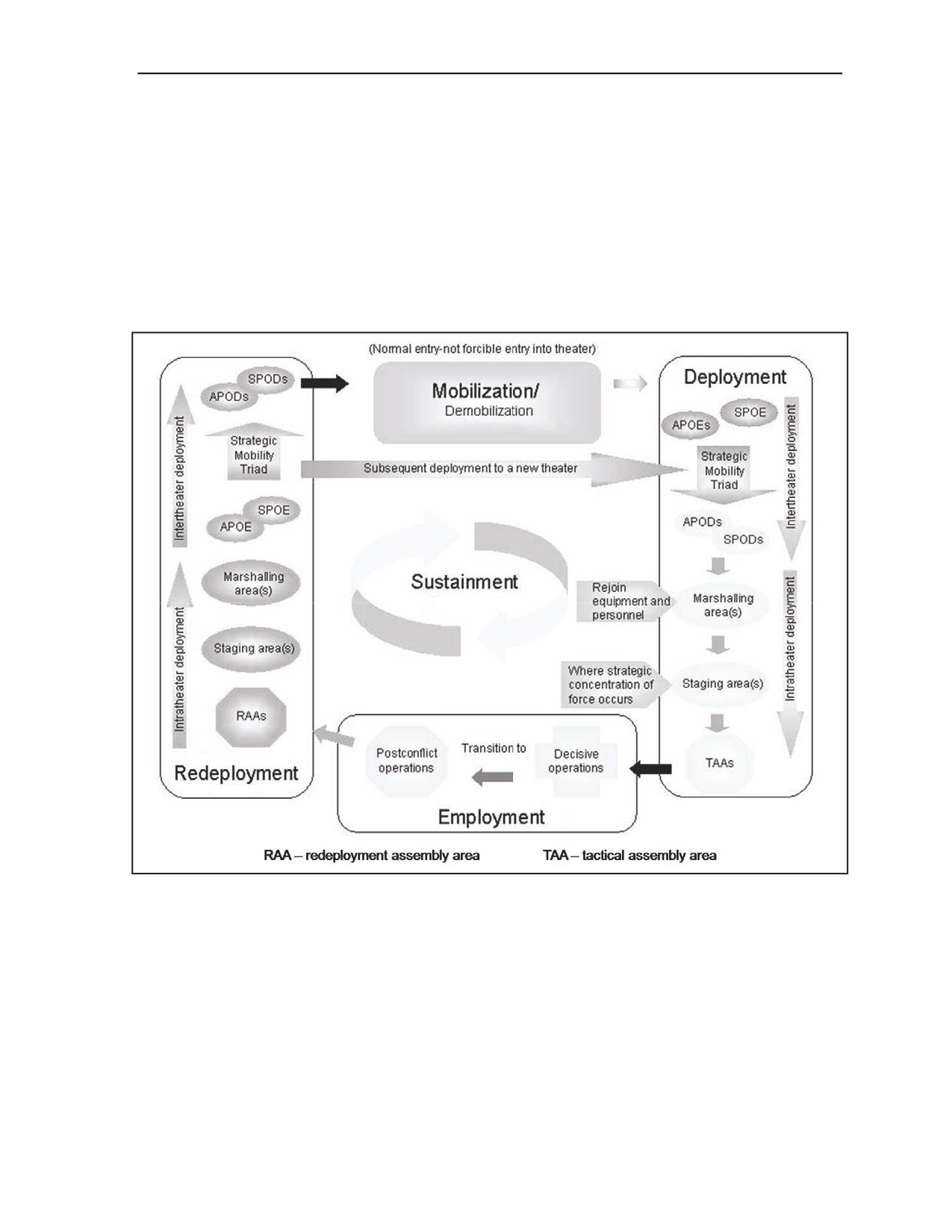
z
Monitoring the OE.
z
Monitoring the measures of performance (MOPs) and measures of effectiveness (MOEs).
z
Evaluating courses of action
(COAs) for their operations and supported and supporting
headquarters planning.
4-13. The commander and staff visualize how to creatively arrange forces and group missions to provide
MANSPT operations in the most effective fashion. MANSPT operations are a combined arms activity.
(See chapter 5.) The MEB may use lines of effort to help visualize stability and civil support operations.
(See example in chapter 8.)
4-14. The MEB must balance support across conflicting mission areas. (See chapter 2.) The MEB must
balance between detailed and mission command orders. The support area operations orders may be more
detailed while MANSPT operations orders may be more mission command. (See chapter 6.)
4-15. The MEB uses mission variables (as discussed in chapter 1 and later in this chapter) to support
analysis of the OE and conditions in their designated AO. (See FM 3-07 for more complete discussion of
the relevance of each of these variables to stability operations.) The initial assessment conducted by the
MEB is continuously updated and supported by running estimates maintained by each staff section.
4-16. The MEB commander considers mutual support when task organizing forces and assigning areas of
operations and positioning units. Mutual support is that support which units render each other against an
enemy because of their assigned tasks, their position relative to each other and to the enemy, and their
inherent capabilities (JP 3-31). In Army, doctrine mutual support is a planning consideration related to
force disposition, not a command relationship. The concept of mutual support is useful to plan MANSPT
operations and support area operations. Mutual support can be between MEB units, between units in the
echelon support area, or between MEB units and supported units. (See FM 3-0.) The MEB uses mutual
support between bases to conduct base cluster security and defense when assigned responsibility for an
echelon support area. (See chapter 6.)
4-17. The continuum of operations helps understand the context and purpose of MEB operations. While
conducting its current operations or missions, the MEB affects the OE to establish conditions for
conducting subsequent operations. The operations of the supported headquarters are generally conducted to
move conditions to a lower level of violence and ideally establish a stable peace. A stable peace may
include any or all of the following:
z
A safe and secure populace.
z
A legitimate central government.
z
A viable market economy.
z
Effective rule of law.
4-18. A major operation is a series of tactical actions (battles, engagements, strikes) conducted by combat
forces of a single or several Services, coordinated in time and place, to achieve strategic or operational
objectives in an operational area. These actions are conducted simultaneously or sequentially according to
a common plan and are controlled by a single commander. See JP 3-0 for noncombat operations to the
relative size and scope of a military operation. Major operations have varying levels of violence over time
and location within the AO. The operational theme for a major operation may change with phases or
changes in the OE.
4-4
FM 3-90.31
26 February 2009
MEB Operations
4-19. The development of task organization may be a more significant effort for the MEB than most units.
This is due to the large number and range of specified and implied tasks for the MEB, the lack of organic
units and the wide range of assigned, attached, or OPCON units, and the variety of operations it must
conduct. (See FM 5-0 for general considerations.)
4-20. Some considerations for task organizing versus employing function units:
z
Although based on METT-TC, the MEB may form battalion TFs and company teams. (See
chapter 5.)
z
A mission with a broad range of tasks
(multifunctional), uncertain or quickly changing
requirements, and geographically spread out with a desire to minimize unit travel to mission
sites may be better performed by a battalion TF or company team.
z
A mission with mostly functional task requirements, with a long duration, conducted within a
smaller area and where other capabilities may be integrated without changing the task
organization may be better performed by functional units rather than a battalion TF or company
team. (See FM 3-0 for further discussion on supporting range and supporting distance.)
4-21. Some other considerations for developing the task organization (see paragraph 1-37, page 1-8) for
the MEB include:
z
Decide what to retain under MEB control and what to allocate to each subordinate based on
METT-TC.
z
Forces under brigade control give the commander flexibility to shift or mass resources without
affecting forces task-organized to subordinates.
z
The assigned command and support relationships either increase responsiveness to subordinate
or supported units or limit the MEB commander’s flexibility or agility in shifting resources.
z
Consider how to weight the MEB decisive operation and support the higher headquarters
decisive operation.
z
When directing the execution of “be prepared” task organization changes to subordinates,
consider their response time to detach and attach forces and prepare them for new tasks.
z
It is much easier to change task organization upon immediate mission completion or changes in
phases of an operation.
z
The MEB should expect to change task organization frequently and rapidly to meet changes in
the METT-TC factors.
MILITARY DECISION-MAKING PROCESS
4-22. The MEB uses the operations process to critically think about how to conduct its operations. The
MEB routinely conducts parallel and collaborative planning with subordinates and higher headquarters.
(See FM 5-0 and FMI 5-0.1.) Throughout the planning process, the MEB staff may need to advise
supported commanders and their staffs about MEB capabilities, methods of employment, and possible
capabilities shortfalls. The MEB may also need to provide planning support to those units without
embedded functional staff capabilities, such as construction engineering, that are resident in the MEB staff
that might otherwise only be available through reachback. The MEB staff will use the automated tools and
systems of their functional areas such as Joint Warning and Reporting Network (JWARN) and Joint
Engineer Planning and Execution System.
4-23. The large number of essential tasks developed during MDMP for the MEB may be grouped into
larger doctrinally approved tasks in the restated mission. Any nondoctrinal terms used must be defined to
reduce confusion. The commander’s intent and concept of the operation can provide details. (See FM 5-0.)
4-24. Intelligence preparation of the battlefield (IPB) remains the same for all types of military operations;
however, its focus may change depending on the predominant type of operation or the unit’s primary focus.
Products required to portray the information may also change based on the type of operation or unit focus.
Doctrinal and situation templates used to portray the various threats will differ. In addition, civil
considerations have assumed an importance on a par with the enemy and environment for all types of
operations. IPB products must provide enough detail for commanders and staffs to make informed
decisions.
26 February 2009
FM 3-90.31
4-5
Chapter 4
4-25. Because of the current limited organic ISR capabilities of the MEB, the staff must carefully develop
the ISR plan and set priorities to gain critical information first. Additional assets may be attached or
otherwise provided to the MEB to accomplish the ISR mission when the MEB is responsible for an
echelon support area. In most cases, UAS support would come from the BFSB or combat aviation brigade.
4-26. The MEB may use the rapid decision-making and synchronization process (RDSP) as a tool to make
decisions, and rapidly resynchronize forces and warfighting functions when presented with opportunities or
threats during execution. (See FMI 5-0.1.) One of the significant differences between the RDSP and the
MDMP is that RDSP is based on an existing order. A second difference between the RDSP and the MDMP
is that RDSP seeks an acceptable solution, while the MDMP seeks the optimal (most desirable) one.
4-27. The MEB staff balances the time to plan at brigade level and allows subordinates time to plan and
prepare. Parallel planning, collaborative planning, and warning orders (WARNOs) help subordinate units
and staffs prepare for new missions by providing them with maximum time. MEB subordinate units
without staffs use troop leading procedures (TLPs) to prepare for a mission.
MISSION VARIABLES
4-28. This section discusses in more detail the mission variables METT-TC introduced in chapter 1. The
information from the operational variables analysis is used during MEB mission analysis using six mission
variables—mission, enemy, terrain and weather, troops and support available, time available and civil
considerations. (See chapter 1.) (FM 3-0, FM 3-90, and FM 6-0 discuss METT-TC in more detail.) This
section will discuss the OE in terms of the tactical tool of METT-TC.
4-29. The tactical level is the level at which the MEB headquarters typically operates as it narrows the
focus to the mission variables of METT-TC. The MEB staff will use METT-TC to synthesize operational
and tactical level information with local knowledge relevant to its missions.
4-30. Incorporating the analysis of the operational variables into METT-TC emphasizes the OE’s human
aspects, most obviously in civil considerations, but in the other factors as well. This requires critical
thinking, collaboration, continuous learning, and adaptation. It also requires analyzing local and regional
perceptions. Many factors affect perceptions of the enemy, adversaries, supporters, and neutrals. These
include—
z
Language.
z
Culture.
z
Geography.
z
History.
z
Education.
z
Beliefs.
z
Perceived objective and motivation.
z
Communications media.
z
Personal experience.
Mission
4-31. The mission is the task, together with the purpose, that clearly indicates the action to be taken and the
reason therefore (this definition was shortened; the complete definition is printed in the glossary). Mission
is always the first factor commanders consider during decisionmaking. Commanders and staff view all
other METT-TC factors in terms of their impact on mission accomplishment. A thorough understanding of
why the unit is conducting an operation provides the focus for planning. Under mission command, the staff
determines the minimum control measures necessary to ensure coordination. (See FM 6-0.)
4-32. The MEB assigns a mission to each subordinate commander. The commander allocates resources
between subordinates and the often competing mission requirements to best support the decisive operation
and the higher commander’s intent. Consider the mission of adjacent units and support AO tenant units to
ensure complementary and reinforcing efforts. The missions of support AO tenant units are also considered
in locating units within the support area.
4-6
FM 3-90.31
26 February 2009
MEB Operations
Enemy
4-33. The second factor to consider is the enemy—disposition (strength, location, and tactical mobility),
doctrine, equipment, vulnerabilities, and probable COAs. (See FM 34-130.) Commanders look for enemy
weaknesses and strengths in order to deny options to enemy commanders and keep them reacting to
friendly maneuvers. They also analyze their forces for weaknesses and vulnerabilities that enemies might
exploit and act to counter them. (See FM 6-0.)
4-34. The MEB is optimized with the capability to enhance friendly or inhibit enemy maneuver and
movement options and to conduct selected protection and sustainment tasks. These capabilities facilitate
retaining the initiative while maximizing combat power potential at the operational and tactical levels of
war. The IPB helps the staff identify opportunities to shape the OE. The staff must analyze the enemy
across their higher headquarters AO, the AOs of supported units, the assigned support AO, and unassigned
areas. The MEB depends on supported units sharing their COP, higher headquarters assistant chief of staff,
intelligence (G-2), and the BSFB information, and ISR support.
4-35. The MEB staff assists in the operational analysis of the enemy’s ability to deny United States access
to the region itself—to ports and airfields along with maritime zones. Future adversaries will use all means
possible to prevent U.S. forces from establishing a foothold in the region and seek to disrupt the flow of
organizations and supplies. These likely enemy operational goals drive the requirement for the MEB to
support rapid entry through unimproved or expedient ports, austere forward airfields, and across all
environmental domains—air, ground, maritime, space, and information.
Terrain and Weather
Terrain
4-36. Terrain is not neutral. Terrain includes natural conditions and manmade structures. The staff
analyzes how the terrain affects trafficability, wind patterns, drainage, operations, weapons and other
systems, selecting objectives, movement and maneuver, protective measures, locating bases and facilities,
and Soldiers. (See FM 6-0.) OEs feature a wide range of terrain characteristics that include various soils,
topographies, elevations, and densities of vegetation and populations.
4-37. The MEB has the capability to conduct and leverage engineer topographic teams to provide a
detailed topographical analysis of the five military aspects of terrain—observation and fields of fire,
avenues of approach, key and decisive terrain, obstacles, and cover and concealment. This analysis is
especially critical to conduct both MANSPT and support area operations. The MEB also provides the
supported commander with the ability to influence terrain and use the effects of weather to friendly forces’
advantage especially with engineer and CBRN capabilities. Terrain analysis and effective use of terrain is
important to position bases and facilities within an assigned MEB AO. This is especially important within
an echelon support area where positioning bases add to their inherent defensive capabilities and reduces
demand on other resources to defend them. (See chapter 6.)
4-38. Complex terrain describes areas that feature jungles, dense forests, mountains, and urban areas.
Steep slopes and high elevations found in mountainous environments will challenge MEB Soldiers,
aviation, and ISR support. All terrain, open, jungle, mountain, and urban must be analyzed in relation to
three disparate dimensions: elevated, surface, and subsurface. Complex terrain can often provide an
opponent with the opportunity to offset the advantages of a superior force. Adaptive opponents will
leverage jungles, tunnel complexes, high ground, and other aspects of complex terrain to minimize friendly
forces advantages and to create conditions for close combat. The enemy may use highly restricted and
urban terrain to hide and shield themselves from our precision fires. They may also use cultural, religious,
and civilian structures to hide and shield themselves, to stockpile weapons, to limit line of sight, and to
constrain weapon trajectories and effects.
4-39. Complex terrain in general and urban terrain in particular can restrict and canalize forces along a
finite number of predictable routes where they can be destroyed or attacked by a prepared and patient
enemy. The MEB deliberately shapes designated or critical routes through a series of developed tactics,
techniques, and procedures (TTPs) to ensure protected access to a specific route or to retain maneuver
options among a number of different routes.
26 February 2009
FM 3-90.31
4-7
Chapter 4
Weather
4-40. Planners consider climate with longer-range plans, while most tactical planners consider weather for
shorter-range plans. Weather effects are classified as direct and indirect. Weather can create opportunities
or difficulties for each side. (See FM 6-0.)
4-41. Weather affects the operational performance of troops, equipment, and technology and when not
properly anticipated and considered, can result in mission failure. The MEB analyzes weather effects in the
OE by assessing all phases of the concept of operations in relation to the five military aspects of weather—
temperature and humidity, visibility, precipitation, winds, and clouds.
4-42. Land forces must be capable of conducting operations anywhere that our national interests are at
issue. Historically and geographically, these locations have typically been environments that experience
extreme variations in many of the military aspects of weather. These extremes will challenge the endurance
and performance of MEB troops and even the most hardened high-technological systems. When operating
in environments with extreme weather variations, the MEB emphasizes responsive and layered protective
postures for troops and equipment. Sensor, communication, and situational awareness technologies are
susceptible to extreme weather degradation and the MEB insulates and arrays them, using TTPs that are
redundant, integrated, and overlapping.
Troops and Support Available
4-43. This includes number, type, capabilities, and condition of friendly troops and support from Army,
HN, contractor, joint, interagency, and multinational sources. Commanders maintain an understanding of
friendly information two echelons down. They track subordinate readiness—including training,
maintenance, logistics, strengths and weaknesses, and morale. Commander and staffs visit subordinates to
confirm data and reports and gain insights into the intangibles that data and reports cannot capture. (See
FM 6-0.)
4-44. Since many organizations will join the MEB during deployment or even in theater, the MEB
commander considers the level of trust and confidence that exist between himself or herself, the staff, and
subordinate commanders when deciding mission assignment, and how best to C2 them (mission command
versus detailed command).
4-45. The MEB staff identifies shortfalls, requests task organization or staff augmentation, and makes
recommendations to the commander about how to allocate resources. It is probable that the MEB will
routinely need task organization of MI assets, an area support medical company, and a geospatial staff that
is similar to that which is organic to BCTs. This task organization would be essential when the MEB is
assigned an AO. The MEB will require CA units/staff to perform CA operations. MP battalions task
organized to the MEB should be augmented with aid stations. Selected units of the MEB may require fire
support teams. The MEB staff may require an Air Force tactical air control party (to include a joint
terminal attack controller). Staff augmentation may also require (or require additional) medical plans and
operations, ammunition planning, mortuary affairs, logistics planning, public affairs, finance operations,
contracting, EOD, and information engagement operations personnel augmentation.
Time Available
4-46. Effective commanders and staff know how much time and space their units need to plan, prepare,
and execute operations. They also consider time with respect to the enemy ability to plan, prepare, and
execute. (See FM 6-0.)
4-47. The MEB must consider the time needed to effect task organization changes, move to supported
units locations, link up, rehearse, and integrate forces. Parallel and collaborative planning maximizes use of
available time. SOPs to conduct routine tasks, especially in the support area, also reduce planning and
orders preparation time.
4-8
FM 3-90.31
26 February 2009
MEB Operations
Civil Considerations
4-48. Civil considerations comprise the influence of manmade infrastructure, civilian institutions, and
attitudes and activities of the civilian leaders, populations, and organizations within an AO on the conduct
of military operations. If the military’s mission is to support civil authorities, civil considerations define the
mission. (See FM 6-0.)
4-49. The staff analysis of civil considerations improves SU and lends directly to mission accomplishment.
Civil considerations are essential to developing effective plans for all operations—not just those dominated
by stability or civil support. Full spectrum operations often involve stabilizing the situation, securing the
peace, and transitioning authority to civilian control. Combat operations directly affect the populace,
infrastructure, and the force’s ability to transition to HN authority. The degree of the populace’s expected
support or resistance to Army forces affects nearly all operations.
4-50. At the tactical level, commanders and staffs analyze civil considerations in terms of the six
categories expressed in this memory aid (ASCOPE: areas, structures, capabilities, organizations, people,
and events). MEB operations require the consideration of many of the items identified here and others that
are not represented in this example. Figure 4-1, page 4-10, provides a graphical depiction and an example
of the use of the memory aid ASCOPE. The ASCOPE characteristics further expand into 29 subcategories
to provide a framework for greater fidelity and a more detailed analysis of the civil dimension as needed.
The ASCOPE structure and categories can form the basis for the development of evaluation criteria, MOP,
or MOE.
Figure 4-1. ASCOPE construct with examples
4-51. The MEB may encounter a multitude of difficult political, economic, religious, social, and
technological variables when conducting operations. During stability and civil support operations, the
MEB may assist in performing functions that would otherwise fall to local governmental agencies. The
MEB may also control populations or restore humanitarian infrastructure while supporting a division or
corps or while directly engaged in combat operations. The MEB must prepare for operations in areas and
environments where the fabric of society is in tremendous disarray.
26 February 2009
FM 3-90.31
4-9
Chapter 4
4-52. Full spectrum operations recognize that military land power formations must defeat enemy forces
and capabilities while effectively shaping the civil environment in which they operate. This is often done
simultaneously and should be accomplished in a way that gives all elements of national power the greatest
chance of lasting success. When a mission is specified, civil considerations must be included in the
planning process and during the METT-TC analysis as associated with a particular operation or mission.
To do this, the MEB draws upon information and analysis already developed and derived from a thorough
understanding of the operational variables characteristics of the OE.
4-53. The conduct of military operations and Soldiers are often essential to popular support. Populations
that accept the presence and behavior of intervening or occupying military forces may be the greatest
source of information and the best protection against insurgencies and unconventional warfare. An
understanding of the civil and human dimensions of the operating environment is necessary to prevent the
unintended consequences of deliberate military action and to effective decisionmaking.
TRANSITION OPERATIONS
4-54. Transitions between missions and operations have the potential to be challenging. The design of the
MEB optimizes its ability to deal with transitions. The design of the staff and the typical augmentation
received by the MEB are those elements that are critical to performing MANSPT operations and the tasks
associated with stability or civil support operations.
4-55. The MEB may hand over all or some of its AO to other military forces, governmental agencies,
NGOs, or the local authorities as stability is achieved. This transfer is similar to a relief and must be
carefully planned, coordinated, and executed with the relieving force or agency. The MEB may also
transition only some sectors to local authorities.
4-56. Transitions may be a continuation of an ongoing operation, execution of a completely new tactical
mission, or conducting logistical resupply operations. Increased flexibility and agility afforded by
improved SA and collaborative C2 tools facilitates transitions to the next mission without halting to
conduct extended decision-making processes. With increased capability to affect the enemy over a larger
area of influence, the MEB can begin setting the conditions for the next engagement during the transition
from the last mission.
4-57. The MEB facilitates rapid transition between operations for the unit it is supporting. Its ability to
rapidly transition denies the enemy an opportunity to recover, regroup, and conduct preparations.
Similarly, it allows commanders to quickly deal with consequences arising out of tactical action precluding
its growth into a separate operational requirement. The MEB normally conducts combat replenishment
operations as part of transitional activities. This series of tactical sustainment operations will continue until
the supported commander’s cycle of operations accommodates a transition to a mission staging operation
and a subsequent change in mission for the MEB.
PREPARE
4-58. Back briefs and rehearsals occur during preparation. They are essential to ensure those responsible
for execution have a clear understanding of the mission, commander’s intent, and concept of operations.
Most MEB operations are executed at the battalion level and below. However, some operations may
require a MEB level rehearsal. The MEB conducts the brigade combined arms rehearsal, sustainment
rehearsal, and ISR and fire support rehearsals (when assigned an AO) after subordinate battalions or base
and base cluster commanders have had an opportunity to issue their OPORDs. These rehearsals ensure that
subordinate plans are synchronized with those of other units and that subordinate commanders understand
the intent of the higher headquarters. Usually, the MEB commander, DCO, XO, primary staff, and
subordinate battalion commanders and their S-3s attend the rehearsals. Based upon the type of operation,
the commander can modify the audience such as the brigade attachments. (See FM 6-0 for a detailed
discussion on rehearsals.)
4-59. The MEB must establish and disseminate clear, concise rules of engagement (ROE) and rules of
interaction (ROI) before deploying to the AO. Back briefs and rehearsals help ensure everyone understands
4-10
FM 3-90.31
26 February 2009
MEB Operations
the ROE since small-unit leaders and individual Soldiers must make ROE decisions promptly and
independently. For a discussion of the rules in ROE, see FM 3-07.
4-60. The ROI embody the human dimension of stability operations. They lay the foundation for
successful relationships with the numerous factions and individuals that play critical roles in these
operations. The ROI encompass an array of interpersonal communication skills such as persuasion and
negotiation. These skills are the tools the individual Soldier needs to deal with the nontraditional threats
that are prevalent in stability operations. Examples of such threats are political friction, unfamiliar cultures,
and conflicting ideologies. In turn, ROI enhance the Soldier’s survivability in such situations. The ROI are
based on the applicable ROE for a certain operation. The ROI must be tailored to the specific regions,
cultures, and populations affected by the operation. Like ROE, the ROI can be effective only if they are
thoroughly rehearsed and understood by every Soldier in the unit.
4-61. Key preparation activities (see FM 6-0) include—
z
Assessment—monitor and evaluate preparations.
z
Reconnaissance operations.
z
Security operations.
z
Protection.
z
Revising and refining the plan.
z
Coordination and liaison.
z
Rehearsals.
z
Task organizing.
z
Training.
z
Movement.
z
Preoperations checks and inspections.
z
Logistic preparations.
z
Integrating new Soldiers and units.
EXECUTE
4-62. Execution is putting a plan into action by applying combat power to accomplish the mission and
using situational understanding to assess progress and make execution and adjustment decisions. It focuses
on concerted action to seize, retain, and exploit the initiative. The Army’s operational concept emphasizes
executing operations at a tempo enemies cannot match by acting or reacting faster than they can adapt. To
achieve this type of flexibility, commanders use mission command to focus subordinate commanders’
initiative. Subordinates exercising initiative within the commander’s intent can significantly increase
tempo; however, they also may desynchronize the unit’s warfighting functions. This may reduce
commanders’ ability to mass the effects of combat power. Even relatively minor, planned actions by
command post cells affect other cells’ areas of expertise, affecting the operation’s overall synchronization.
4-63. Collaborative synchronization—enabled and expected by mission command—uses individual
initiative to achieve resynchronization continuously. Subordinates’ successes may offer opportunities
within the concept or develop advantages that make a new concept practical. In either case, the
commander’s intent keeps the force acceptably focused and synchronized. Subordinates need not wait for
top-down synchronization. Mission command is especially appropriate for operations in which stability
operations predominate. It allows subordinates to exploit information about enemies, adversaries, events,
and trends without direction from higher echelons.
4-64. During execution, the current operations cell strives to keep the warfighting functions synchronized
and balanced between individual initiative and synchronized activities as the situation changes. The current
operations cell follows and provides its own level of collaborative synchronization. To assist commanders
in massing the effects of combat power at decisive times and places, the current operations cell considers
the following outcomes when making synchronization decisions or allowing others’ collaborative
synchronization to proceed:
z
Combined arms integration.
26 February 2009
FM 3-90.31
4-11
Chapter 4
z
Responsiveness—both proactive and reactive.
z
Timeliness.
4-65. Execution involves monitoring the situation, assessing the operation, and adjusting the order as
needed. Throughout execution, commanders continuously assess the operation’s progress based on
information from the COP, running estimates, and assessments from subordinate commanders. When the
situation varies from the assumptions the order was based on, commanders direct adjustments to exploit
opportunities and counter threats.
4-66. Both the MEB unit commander’s staff and the subordinate commander’s staff, assist the commander
in execution through the integrating processes and continuing activities during execution. (See FM 3-0.) In
addition, commanders assisted by the staff perform the following activities that are specific to execution:
z
Focus assets on the decisive operation.
z
Adjust CCIR based on the situation.
z
Adjust control measures.
z
Manage movement and positioning of supporting units.
z
Adjust unit missions and task as necessary.
z
Modify the concept of operations as required.
z
Position or relocate committed, supporting, and reserve units.
z
Determine commitment of the MEB reserve (becomes the main effort and decisive point of the
brigade).
4-67. Key execute activities (see FM 6-0) include—
z
Assessing the current situation and forecasting progress of the operation—monitor operations
and evaluate progress.
z
Making execution and adjustment decisions to exploit opportunities or counter threats.
z
Directing actions to apply combat power at decisive points and times—synchronize and
maintain continuity.
z
Balancing effort and risk among competing tasks.
4-68. Entry operations encompass those actions necessary to move from home station or forward locations
into the TO for further employment. The MEB conducts entry operations from points of embarkation into
designated points of entry using a full range of transportation modes. Employing air movement, ground
movement, or intratheater sealift, the MEB provides the force commander with a flexible tailored force
capability package for entry and shaping operations to prepare for follow-on forces.
4-69. Employing embedded en route mission planning, rehearsal, and training capability may allow
commanders and their staff to refine plans, rehearse with leaders at all levels, and update plans as new
intelligence becomes available. Necessary task organization of assets occurs before departure to optimize
the combined arms performance of the MEB.
4-70. During entry operations, the MEB is involved in the deployment process. While en route, the MEB
conducts en route mission planning with the echelon above brigade headquarters it will support to shape
the OE before the brigade’s arrival. In a nonpermissive OE, a BCT may precede the MEB entry. Echelons
above brigade assets provide the lethal and nonlethal effects that set the conditions for BCT entry
operations that may be needed to set the conditions for MEB entry operations. Upon arrival, the MEB
integrates into the operations of the higher headquarters, continues mission planning, and prepares for
operations. In a permissive environment, the MEB may be one of the first deployed headquarters.
ASSESS
4-71. Assessment is the continuous monitoring and evaluation of the current situation, particularly about
the enemy and progress of an operation. Assessment occurs during planning, preparation, and execution.
Initial assessments are made during planning and continually updated. Assessment involves monitoring and
evaluating the OE and the progress of operations using MOEs and MOPs. Continuous assessment involves
4-12
FM 3-90.31
26 February 2009
MEB Operations
situational understanding, monitoring, and evaluating. (See FM 6-0.) (See FMI 5-01 for TTPs to assess
operations and for a discussion of monitoring and evaluation.)
4-72. The running estimate is a staff section’s continuous assessment of current and future operations to
determine if the current operation is proceeding according to the commander’s intent and if future
operations are supportable (FM 3-0). The running estimate format parallels the steps of the MDMP and
serves as the primary tool for recording a staff section’s assessments, analyses, and recommendations.
4-73. The commander and staff assess the progress of the operation, new information, and changes in
conditions to revise plans. On-site assessments are essential to validate IPB, assess subordinates
understanding of orders, progress, preparations, and combat readiness. The MEB anticipated branches and
sequels, initially formulated during the planning stage, are assessed and updated for possible execution.
The staff can make adjustment of the plan within their area of expertise.
4-74. Assessment precedes and guides every activity in the operations process and concludes each
operation or phase of an operation. It involves a comparison of forecasted outcomes to actual events, using
MOPs and MOEs to judge progress toward success. It entails two distinct tasks—continuously monitoring
the situation and progress of the operation towards the commander’s desired end state, and evaluating the
operation against measures of effectiveness and performance as defined below:
z
A measure of performance is a criterion used to assess friendly actions that is tied to measuring
task accomplishment (JP 3-0). MOPs answer the question, “Was the task or action performed as
the commander intended?” MOPs confirm or deny that we have done things right.
z
A measure of effectiveness is a criterion used to assess changes in system behavior, capability,
or OE that is tied to measuring the attainment of an end state, achievement of an objective, or
creation of an effect (JP 3-0). MOEs focus on the results or consequences of friendly actions
taken. They answer the question, “Are we doing the right things, or are additional or alternative
actions required?”
OFFENSIVE OPERATIONS
PLAN
4-75. The MEB plans to support division and BCT offensive operations; routine support may include
MANSPT operations and support area operations. They also may plan limited MEB controlled offensive
operations (such as counter or spoiling attacks) as part of defending while conducting support area
operations. (See chapter 6.)
4-76. The MEB follows the doctrine in FM 3-90 when conducting limited offensive tasks within their
assigned AO and is familiar with how the BCT conducts offensive operations to plan MEB support. The
MEB never attacks or conducts offensive operations as a brigade.
PREPARE
4-77. During offensive operations, the initial focus of the MEB is typically on movement and maneuver
and then on support to protection and selected sustainment based on the intent and priorities of the
supported forces. The MEB may conduct reconnaissance with their task-organized units or capabilities as
part of MANSPT operations to support the BCTs offensive actions. The MEB may also conduct or support
movement corridor operations to support troop movement and logistics preparations.
4-78. The MEB can form TFs or company teams to support the offensive operations of its supported
headquarters. These organizations may be attached or placed OPCON to BCTs, or employed by the MEB
to complement or reinforce all maneuver forces across the higher headquarters’ AO. The units under MEB
control can be more easily reallocated or massed where and when needed to meet higher headquarters
directed requirements than units attached to BCTs. Deciding the best command and support relationships
for the specific situation can be a challenge. The fluid nature of offensive operations may require
adjustments to the initial task organization. Due to the difficulty of linkup and integration, any changes in
task organization are best made at conclusion of a battle or at the end of a phase of an operation.
26 February 2009
FM 3-90.31
4-13
Chapter 4
4-79. Detached elements from the MEB must link up and integrate into supported maneuver forces combat
formations. The MEB conducts preoperations checks inspections to ensure readiness before the detachment
of these elements. These detached MEB forces participate in the supported forces’ rehearsals.
4-80. The MEB apportions its resources across the various operations to best meet the supported
commander’s intent. The MEB also allocates resources across the warfighting functions within an
operation. For example, the MEB will—
z
Allocate resources to provide protection during movement.
z
Enhance the supported BCT’s mobility within the movement and maneuver warfighting
function.
EXECUTE
4-81. The MEB executes MANSPT operations to support the maneuver commander’s intent. The MEB
conducts support area operations in the division/EAD support area. When required, the MEB conducts
consequence management operations or stability operations in support of forces conducting the offense.
4-82. The MEB assesses the offensive operations and anticipates changes in task organization, priorities,
and balances resource allocation between its operations to support the decisive operation.
ASSESS
4-83. The MEB continually assesses these areas—the balance of effort between mobility and survivability;
if shaping operations are setting the intended conditions; and the balance between supporting division and
corps offensive operations and its responsibilities within the MEB’s AO
DEFENSIVE OPERATIONS
PLAN
4-84. The MEB plans to support division and BCT defensive operations. Routine support may include
MANSPT operations, support area operations, and consequence management operations. They also may
plan limited MEB controlled defensive operations as part of the conduct of support area operations or
when defending themselves. (See chapter 6.)
4-85. The MEB follows the doctrine in FM 3-90 when conducting defensive tasks and is familiar with how
BCTs conduct defensive operations to plan MEB support.
PREPARE
4-86. If the MEB is supporting a division-level defense, the MEB’s focus is on defensive operations within
its AO as discussed in chapter 6 of this manual. It is also prepared to provide task-organized assets to
support BCTs in their defensive preparations.
4-87. During defensive operations, the initial focus of the MEB is typically on protection and then on
support to movement and maneuver and selected sustainment based on the intent and priorities of the
supported forces. The MEB may conduct reconnaissance operations to support the defense. The MEB
prepares to execute consequence management and ADC. Depending on the situation, the MEB will
continually improve defensive positions within its AO or relocate some or all of its activities if required by
the higher headquarters defensive plans.
EXECUTE
4-88. The MEB executes defensive operations to achieve the supported commander’s intent. The MEB
provides support to the division/EAD defensive operations and conducts support area operations when
assigned an AO.
4-14
FM 3-90.31
26 February 2009
MEB Operations
4-89. When required, the MEB executes consequence management operations and ADC in support of the
supported division or corps conducting the defense.
ASSESS
4-90. The MEB continually assesses its effort to support the defensive efforts of its supported division or
corps. This includes these areas:
z
When to commit the MEB reserve.
z
The balance of effort between support to movement and maneuver, protection, and sustainment.
z
The balance of effort between self-defense and mission support.
4-91. Each staff section updates the running estimate to ensure the latest information is available for the
commander to support decisionmaking.
CIVIL SUPPORT OPERATIONS
PLAN
4-92. Army civil support operations fall under defense support of civil authorities (DSCA). Defense
support of civil authorities is defined as civil support provided under the auspices of the National Response
Plan (now known as the National Response Framework [JP 3-28]). When published, DODD 3025 is
expected to define DSCA as support provided by U.S. military forces. The Army’s roles and
responsibilities for civil support operations fall under the following three primary tasks:
z
Task 1: Provide support in response to a disaster or terrorist attack.
z
Task 2: Support civil law enforcement.
z
Task 3: Provide other support as required.
4-93. These tasks of civil support can overlap. For example, providing Army support to civil law
enforcement can occur during a response to a disaster or its aftermath. In most cases, an MEB may provide
support for tasks 1 and 2. The MEB may provide that assistance as a unit or as part of a joint TF in support
of a lead civil authority for civil support operations. (See JP 3-28.) U.S. laws carefully circumscribe the
actions military forces conduct within the United States, its territories, and possessions. The MEB complies
with these laws while assisting citizens affected by a disaster.
z
Task 1 involves providing essential services support to civil authority in response to a disaster or
terrorist attack. It encompasses the full range of natural and manmade events, whether labeled as
emergencies, incidents, hazards, natural or manmade disasters, or domestic acts of terrorism.
Essential service categories are medical; water, food, and everyday essentials; transportation
network; police and fire; electricity; schools; and sanitation. Army forces assist civil authority
for restoration or protection of essential services.
z
Task 2 refers to restricted use of military assets for support to civil law enforcement personnel
conducting civil law enforcement operations within the United States and its territories. These
operations are significantly different from operations in other nations. MEB forces may support
civil law enforcement under U.S. Constitutional and statutory restrictions and corresponding
directives and regulations.
z
Task 3 denotes planned, routine, and periodic support not related to a disaster. Examples include
providing military support for parades, funeral details, and community relations. National policy
directs the military and other organizations to use National Incident Management System
(NIMS) and National Response Framework (NRF) policies and procedures, where applicable,
for conducting other support as required.
4-94. There is one primary case where the MEB is well suited to provide support to civil authorities;
consequence management. (See chapter 7.) Consequence management pertains to the civil support tasks 1
and 2. The MEBs in the ARNG could be among the first military forces to respond on behalf of state
authorities. Planning civil support operations is similar to planning stability operations (See chapter 8.);
they both interact with the populace and civil authorities to provide essential services. The MEB tasks are
26 February 2009
FM 3-90.31
4-15
Chapter 4
similar but the environment is different (domestic versus foreign). The specialized capabilities of the MEB
to conduct stability operations apply to civil support operations, primarily for tasks 1 and 2. (See chapter
8.) However, the MEB supports the lead civil authority for civil support operations. A civil authority is in
the lead for civil support operations while the TF or joint task for (hence MEB) supports the lead civil
authority.
4-95. The MEB uses Army or joint planning procedures for civil support but must be able to participate
and integrate its planning with other U.S. national, state, or local organization’s planning procedures as
discussed in the next section. Soldiers receive their orders in an Army format, but they must be consistent
with the overall shared objectives for the response. They are aligned with the specific guidance other on-
the-ground responders of other civilian and military organizations are receiving. Soldiers exercise
individual initiative to establish and maintain communication at all levels. Based upon the type of support
provided, MEB leaders, staff and Soldiers need to be familiar (to varying degrees) with the terminology,
doctrine, and procedures used by first responders to ensure effective integration of Army personnel and
equipment to ensure that citizens affected by the disaster receive the best care and service possible.
4-96. When the MEB conducts civil support operations, a lead federal or state governmental agency has
the overall responsibility depending on the MEB’s status as a Title 10 or Title 32 organization.
z
If the MEB is a state asset, it reports to its state National Guard chain of command.
z
If the MEB is a Federal title 10 asset (Regular Army), it reports to its federal chain of command.
Note: The military chain of command is not violated while the MEB supports the lead federal
agency in order to assist citizens affected by a disaster.
4-97. MEB leaders and staff may help support the emergency preparedness planning conducted at the
national, state, or local level. The MEB may conduct contingency planning, crisis response planning, or
deliberate planning. MEB leaders and staff must understand two documents from the Department of
Homeland Security (DHS):
z
The National level civil disaster and emergency response doctrine contained within the NIMS.
z
NRF documents located at the following web sites:
Note: All military, civil agencies, and organizations are directed to follow this doctrine. MEB
leaders must understand the doctrine in JP 3-28.
4-98. The NRF organizational structure includes emergency support function annexes. There are currently
fifteen emergency support function annexes. (See www.fema.gov/nrf for list, scope, and coordinators.) The
emergency support functions are used to help identify who has what type of resources to provide as part of
a disaster response.
4-99. Joint doctrine states that disaster response is conducted in five phases: shaping, staging, deployment,
conducting civil support operations, and transition. The role of the military is most intense in the shaping
by conducting civil support operations phases, decreasing steadily as the operation moves into the recovery
and restoration stages. Although each civil support mission is different, the visualization process, military
decision-making process, and troop leading procedures still apply and correlate with those contained
within joint doctrine, the NIMS, and the NRF. Army MOPs and MOEs can be used to help develop NIMS
objectives.
4-100. Possible considerations for MEB civil support planning include—
z
Assistance with interorganizational planning.
z
Assistance with initial needs assessment.
z
Logistics support for civil authorities.
z
Sustainment in a damaged austere environment.
4-16
FM 3-90.31
26 February 2009
MEB Operations
4-101. Other possible considerations include—
z
Assist the lead civil agency to define and share courses of action.
z
Solicit agency understanding of roles.
z
Develop measurable objectives.
z
Assist in coordination of actions with other agencies to avoid duplicating effort.
z
Plan to handover to civilian agencies as soon as feasible; end state and transition based on—
The ability of civilian organizations to carry out their responsibilities without military
assistance.
The need to commit Army forces to other operations or preparation for other operations.
z
Provide essential support to the largest possible number of people.
z
Know the legal restrictions and rule for the use of force.
z
Establish funding and document expenditures. (See NIMS procedures.)
z
Identify and overcome obstacles.
Plan media operation and coordinate with local officials.
Maintain information assurance.
Establish liaison with the lead federal government agency.
PREPARE
4-102. Commanders should prepare for civil support operations by understanding the appropriate laws,
policies, and directives that govern the military during response and planning and preparing with the
agencies and organizations they will support before an incident. There may be little or no time to prepare
for a specific civil support mission. When possible, the commander helps develop contingency plans and
SOPs for potential natural and manmade disasters. The MEB may plan, receive units, and deploy within
hours. It is possible that the MEB would link up with units on site during execution as they arrive from
across a state or region.
4-103. Based on METT-TC factors, training before deployment in support of civil operations aids in
preparing for and executing the necessary tasks. Many stability operations tasks correlate with civil support
tasks. When possible, the MEB leaders and staff train with civil authorities.
4-104. Notification for civil support operations employment usually requires rapid reaction to an
emergency, but sometimes may allow for deliberate preparation. After notification, the MEB commander
and staff leverage the C2 system to coordinate and synchronize their operations with civilian authorities.
4-105. The deployment may be within a state or anywhere within the United States or its territories. The
MEB should develop SOPs for the various methods and locations of deployment. Based on METT-TC, the
MEB task organizes to conduct civil support operations. The MEB may deploy its TAC CP with additional
staff augmentation as an EECP to provide on-site assessment and an immediate C2 presence. Whether the
civil support mission warrants the entire MEB or one or more TFs from the MEB, affects deployment. The
MEB task organization may change periodically as the need for particular services and support changes.
MEB involved in civil support operations normally will be task-organized with CBRN, engineer, medical,
MP, PA, and potentially units from other Services as well. Throughout the coordination effort, it is
important for the commander and staff to understand and inform interagency personnel of the MEB’s
capabilities and limitations.
4-106. Due to nonhabitual supporting relationships and dissimilar equipment, the MEB and the lead
governmental organization must ensure that there is close coordination in all areas. The MEB may
collocate its headquarters with the lead agency to improve coordination. The MEB’s headquarters may be
established in tactical equipment or fixed facilities. By using liaison teams, the commander and staff work
closely with interagency and other military elements.
4-107. A defense coordinating officer and assigned staff may not suffice for a complex disaster. When
required, the MEB headquarters can control capabilities that the lead authority requires from the
Department of Defense (DOD). Depending on the complexity of the operation, some staff augmentation
26 February 2009
FM 3-90.31
4-17
Chapter 4
may be required. The previously existing task organization of the MEB may require reinforcement with
additional functional units to accomplish assigned missions. The MEB commander task organizes available
assets for the mission and requests reinforcement as necessary.
4-108. The MEB C2 headquarters can employ most capabilities that the lead agency requires from the
DOD. Depending on the complexity of the operation, some staff augmentation may be required.
4-109. All MEB leaders must understand the complex environment in which the brigade conducts its
mission. The MEB must integrate its activities into the planning effort of the supported civilian agency,
understand support requirements, and be aware of the supported agency’s capabilities and limitations. This
leader understanding creates an atmosphere that permits shared communications and forges a unified effort
between elements. Integrating the MEB C2 system into the C2 systems of the lead governmental agency
and local first responders may be a challenge. The extent to which the MEB C2 system is able to integrate
into the supported agency C2 system depends upon the communications/network compatibility/capability
of the supported agency.
4-110. Often times an agency possesses data that, in its present form, creates compatibility issues with the
MEB’s format and the COP. It is incumbent upon the MEB to facilitate the exchange of information with
the lead agency. During planning and execution, the MEB can deploy LNOs to the lead agency. The
network centric environment of the MEB serves as the conduit for rapidly communicating information,
while either stationary or while moving en route to the geographical site for support operations.
4-111. When the MEB works closely with an agency, the problem sets can be complex and diverse. Both
the MEB and the agency must leverage their skill sets and resources to better inform leaders and maximize
its greatest potential when preparing to conduct a civil support operation. By eliminating redundancies and
identifying shortfalls in corresponding capabilities, the MEB creates the conditions for a unified effort. The
MEB must always protect its information, leverage its ISR capabilities and the communications network to
enhance situational awareness, and verify the lead governmental agencies capability to fuse data. There are
several key points preparing for civil support operations.
EXECUTE
4-112. The MEB will do what is required to accomplish its mission during the conduct of civil support
operations even though task organizations may need to be changed. The MEB will execute support area
operations for the brigade and may do so for others. The MEB may not be assigned an AO. The brigade
will execute consequence management in addition to other required civil support.
4-113. Executing civil support operations must occur within the guidelines laid out by the lead civil
agency. When requested and within the legal limits of federal and state law, the MEB may leverage
attached/OPCON ISR assets and network by positioning sensors, robotics, or forces in a manner that
provides rapid and accurate data flow to lead governmental agencies, which enables them to assess the
situation and the status of objectives. The civil agency may require an adjustment to the plan and the MEB
must be ready to modify its ongoing operations. The information processes the MEB has in place, because
of its communication network, will allow for rapid dissemination of potential issues to the lead agency for
resolution.
4-114. When executing civil support operations, MEB leaders and staff must—
z
Be familiar with the incident command system (ICS) and be able to follow unified command
system procedures for the integration and implementation of each system.
z
Know how the systems integrate and support the incident.
z
Be familiar with the overall operation of the two command systems and be able to assist in
implementing the unified command system if needed.
z
Know how to develop an Incident Action Plan and identify assets available for controlling
weapons of mass destruction (WMD) and hazardous material events.
z
Coordinate these activities with the on-scene incident commander.
z
Be familiar with steps to take to assist in planning operational goals and objectives that are to be
followed on site in cooperation with the on-scene incident commander.
4-18
FM 3-90.31
26 February 2009
MEB Operations
z
Know how to interface with and integrate requisite emergency support services and resources
among the emergency operations center
(EOC) management and the incident or unified
command on-scene incident management team.
z
Be familiar with the coordination functions and procedures that are to be conducted by and with
the EOC in support of on-scene emergency response activities.
4-115. The tasks of Soldiers are similar to many of the tasks in stability operations. In most cases, they do
not need to have as much knowledge of the ICS.
4-116. While civil support operations vary greatly in every mission, the MEB can expect events to follow
a pattern of planning, preparation, response, and recovery. If civil support is provided concurrently with
homeland defense, then the MEB must be prepared to transition to support the offensive and defensive
operations of other military forces. Planning was discussed above. Transition is the last phase in joint
doctrine and is discussed below.
PREPARATION
4-117. MEB preparation for disaster response depends upon priority of other missions. If the MEB is a
regular Army Title 10 unit, then mission priorities may dictate minimal planning and preparation for civil
support operations. On the other hand, a National Guard MEB may have enough time to plan and prepare
for civil support operation with other civil and military organizations.
4-118. Preparation implements approved plans and relevant agreements to increase readiness through a
variety of tasks. Such tasks may include, but are not limited to—
z
Develop common SOPs and TTP with expected supported and supporting elements.
z
Task organize to fill any gaps in duties and responsibilities.
z
Train personnel and leaders on nonmilitary terminology and procedures used in support of civil
authorities (such as the incident command system).
z
Obtain (through training) the proper credentials for key personnel.
z
Exercise and refine plans with military and civilian counterparts.
z
Obtain the proper equipment to provide the required capability.
z
Develop, request, and maintain logistics packages for follow-on resupply and maintenance of all
classes of supplies in support of extended operations.
z
Prepare and maintain medical records for all personnel to ensure that they are up to date.
z
Ensure that all communications equipment, communications security, and controlled
cryptographic items are serviceable and ready to deploy.
RESPONSE
4-119. As part of a response, the MEB’s subordinate units and/or liaison teams enter the affected area and
make contact with relief organizations. They relay pertinent information about the effort of these
organizations up through their military chain of command. The military chain of command relays this
information to the lead civil authority. Planning for the operation, staging command posts into the area,
establishing security, deploying the MEB’s subordinate units, and initiating contact with supported
activities and other parts of the relief force occur during this phase of operations.
4-120. The commander considers leading with liaison teams and urgent relief assets, such as debris
clearance, law enforcement, search and rescue, food, and water. The lead unit’s C2 system gives the MEB
units robust early ability to communicate and coordinate with each other and those organization with which
the C2 INFOSYSs are compatible. Further, MEB units’ ability to reconnoiter and gather information
makes them useful in the initial efforts by civil and other authorities to establish SA and control of the area
and oversee critical actions.
26 February 2009
FM 3-90.31
4-19
Chapter 4
RECOVERY
4-121. Once the MEB civil support operation is underway, recovery begins. With initial working
relationship between all organizations in place, the MEB maintains steady progress in relieving the
situation throughout this phase of operations. The MEB’s work includes coordination with its higher
headquarters, supported groups, and other relief forces and daily allocation of its own assets to recovery
tasks.
4-122. The MEB task organization is likely to change periodically as the need for particular services and
support changes. Security, maintenance, effective employment of resources, and Soldier support all need
continuing attention. The brigade surgeon advises and assists the MEB commander in counteracting the
psychological effects of disaster relief work and exposure to human suffering on the MEB’s Soldiers
throughout the operation.
RESTORATION
4-123. Restoration is the return of normality to the area. In most cases, the MEB disengages before
restoration begins. The Federal Emergency Management Agency is in charge of restoration operations for
civil support.
4-124. Civil support operations end in different ways. Crises may be resolved or the MEB may hand off a
continuing civil support operation to a replacement unit, a relief agency, a police force, or other civil
authority. Missions of short duration or narrow scope may end with the completion of the assigned task.
ASSESS
4-125. The MEB C2 system is essential to support the interagency overall assessment. The MEB’s
network centric environment provides for a robust exchange of information. A common problem that both
the MEB and a nonmilitary agency may encounter is information overload or a different perception on how
an operation is progressing. Commanders share the COP with their civil agency counterpart and their
interpretation of the situation in order to ensure a unified effort. Liaison should occur to demonstrate this
capability and verify the method in which information sharing will occur.
4-126. The MEB leverages its C2 system capabilities and supports a degraded or destroyed civilian
C2/communications system. The MEB brings its mobile network and augments and/or replaces a
devastated civil infrastructure. Most first responders’ communications are wireless using tower-based
repeating which are powered by the grid. In the case of hurricane Katrina in 2005, the storm rendered all
municipal communications inoperative. In such a case, the MEB augments local law enforcement,
emergency medical, fire services, and other first responder’s communications with the Battle Command
Network to restore vital services to the AO.
JOINT AND FORCE PROJECTION CONSIDERATIONS
JOINT PLANNING PROCESS
4-127. When an MEB is directly subordinate to a JTF it may participate in joint operations planning and
receives joint-formatted orders. The MEB could also support joint planning under a division or corps
supporting a JTF but would use the Army planning process and the five-paragraph field order format for its
internal orders. (See FM 3-0.) The MEB staff may participate in joint contingency or crisis action planning.
MEB leaders should understand the joint planning process and be familiar with the joint format for plans
and orders. (See CJCSM 3122.03A and JP 5-0 for additional guidance on joint operations planning and
preparation of joint plans and orders.)
4-128. MEB systems are joint interdependent and the brigade routinely employs joint capabilities. The
MEB integrates joint capabilities that complement Army assigned capabilities to accomplish tactical
objectives. Joint capabilities include fires, layered ISR sensors to fill in voids in brigade coverage,
protection, communications, and sustainment capabilities.
4-20
FM 3-90.31
26 February 2009
MEB Operations
FORCE PROJECTION PROCESS
4-129. Force projection is the ability to project the military instrument of national power from the United
States or another theater in response to requirements for military operations (JP 5-0). Force projection
operations extend from mobilization and deployment of forces to redeployment to CONUS or home
theater. (See JP 3-35.) Force projection also applies to rapidly deploying forces to respond to a HLS
requirement or national emergency or disaster (civil support operations).
4-130. The MEB could participate in or may be required to provide support to any of the five processes
of force projection: mobilization, deployment, employment, sustainment, and redeployment. The
operations discussed in this manual focus on employment and sustainment. When required, the MEB may
conduct operations to support deployment or redeployment. (See figure 4-2, page 4-22.)
Figure 4-2. Force projection process
TASK ORGANIZATION AND STAFF AUGMENTATION
4-131. The MEB both receives and provides units and capabilities as a part of task organization. The
MEB staff requires augmentation to perform some tasks and will provide C2 for some units until they are
needed to be attached to other units for a mission, and then receive them back or assist them in moving to
another area or command.
4-132. The MEB commander is responsible for ensuring that the brigade’s organic and task-organized
forces are combat ready and properly integrated into existing MEB formations. The MEB should develop
SOPs for attaching and detaching units and small teams.
26 February 2009
FM 3-90.31
4-21
Chapter 4
TRAINING ATTACHMENTS
4-133. Because the MEB has few organic units, there is a high-frequency requirement to train attached
units and small teams and occasionally augmentation of staff expertise to understand the units or
capabilities it will be receiving, plan for their integration, and C2 their use and sustainment within the
MEB. The MEB staff must also be trained to properly conduct operations employing the capabilities
provided by these attachments. The MEB staff may also require augmentation to accomplish nonstandard
missions. Successful MANSPT operations depend on the ability of the MEB to integrate functionally
organized units, task organizes them as needed, and employ them during the conduct of full spectrum
operations. The MEB must train to request and leverage pooled Army and joint capabilities as necessary.
4-134. The MEB provides training to assigned, attached, and OPCON units on the MEB SOPs, MANSPT
operations, and security and defense TTPs. Units within the MEB’s AO that are attached or TACON for
security will be trained on security TTPs and incorporated into MEB defensive plans.
PLANNING
4-135. The MEB optimizes the employment of assigned, attached, OPCON, or TACON Army forces and
joint, interagency, and multinational assets by ensuring the respective staffs integrate plans and operations.
MEB staff procedures must include continuous communications with the augmentation formations to
ensure that they understand the commander’s intent. Unity of command, planning, and standardized
communications procedures are essential to successfully execute battle command. The MEB must plan
how it will integrate Army forces and joint, interagency, and multinational assets into its C2 system, share
a COP, and achieve high levels of shared SA.
4-136. The networking interfaces between the MEB and the integration of Army or joint, interagency,
and multinational units requires coordination with gaining units and configuration management controls.
The MEB requires established legacy waveforms SINCGARS, EPLRS, high frequency and ultra high
frequency, COMSEC keying, and signal operating instructions requirements to maintain voice networks.
Internet protocol routing and server interoperability requires a coordinated network configuration
management to ensure the passage of information between the different networks. The use of the
communication elements must be coordinated between the MEB and its attached, OPCON, TACON, and
supported elements.
4-137. In addition, logistical and personnel issues must be coordinated between the MEB and its attached
elements. Sources of personnel and materiel resupply must be understood and considered in planning for
the conduct of MEB operations by all elements under its control.
SUSTAINMENT OF ATTACHED UNITS
4-138. The MEB provides selected sustainment to attached units. It is not required doctrinally to provide
sustainment support to units that are OPCON or TACON to the brigade although special arrangement can
be made. As discussed in chapter 2, the MEB BSB generally lacks the capability to provide sustainment
support to anything beyond the organic elements of the MEB—the brigade HHC, the MEB signal
company, and the BSB HHD, and distribution and support maintenance companies. While it may provide
limited and selected support to some attachments, as a rule attachments must bring their own sustainment
support with them. For example, a combat engineer battalion attached to a MEB should have a supporting
FSC that will be attached to the MEB BSB. Joint, interagency, and multinational elements likewise should
bring their own support capabilities with them when they are attached to the MEB. Otherwise, the
headquarters directing the attachment of joint, interagency, and multinational elements to the MEB, or their
support by the MEB, will have to provide additional Army sustainment assets to the MEB. The MEB staff
will integrate its organic and attached sustainment assets to support brigade operations.
4-139. In any MEB operational plan, sources of sustainment must be determined for and understood by
the MEB and all attached, OPCON, or TACON elements in order to ensure successful MEB operations.
4-140. If properly resourced, the MEB could provide support for—
z
Other U.S. joint forces.
z
Multinational or HN government agencies.
4-22
FM 3-90.31
26 February 2009
MEB Operations
z
Other U.S. government agencies.
z
Multinational or HN civilians.
z
Multinational or HN military forces.
z
Authorized international organizations and nongovernmental organizations.
OTHER TASK ORGANIZATION CONSIDERATION
4-141. Joint, interagency, and multinational resources supporting the MEB will all have different
organizational and operational cultures and procedures. Care should be taken by the MEB commander,
staff, and units to be aware of these differences to ensure successful operations. With U.S. joint and
interagency assets, the differences between the MEB commander and staff culture and procedures and the
culture and procedures of these assets may not be as great as with multinational participants but those
differences still require consideration. Other services and civilian agencies may have different definitions
of similar-seeming terms. Common operational expectations and understandings must be ensured before
planning and operations begin.
4-142. With multinational augmentation, the need for ensuring common operational expectations and
understanding increases. MEB leaders and Soldiers should respect the culture, religions, customs, and
principles of multinational forces, combined with an understanding and consideration of their ideas, to
solidify the working relationship. Respect builds confidence while lack of respect leads to friction that may
jeopardize mission accomplishment. MEB personnel must be proactive in building a mutually beneficial
relationship.
4-143. If the MEB is part of a multinational force, the MEB commander must immediately establish
rapport with the senior commanders of the multinational force. Effective liaison is essential to overcome
misunderstandings and misconceptions. Using liaison teams, both horizontally and vertically, eliminates
confusion and cannot be overemphasized. Commanders and staffs must learn and understand the
capabilities of multinational forces. Differences in languages and customs may create barriers and tension
leading to fractures in a multinational force.
4-144. The MEB must develop procedures to share COP information with multinational forces. While
some multinational or multinational members may possess the technology to digitally share information,
others may not. Disseminating classified COP information to multinational partners requires detailed
coordination to establish proper protocols. Before sharing information, the MEB must establish procedures
for processing and sharing data. Units must anticipate what information and intelligence can be exchanged
and then obtain the necessary authorizations. When necessary, intelligence should be sanitized to facilitate
dissemination. (See FM 100-8 for additional information on working with multinational forces. See JP 3-
08 for additional information on working with international organizations.)
26 February 2009
FM 3-90.31
4-23
Chapter 5
Maneuver Support Operations
This chapter introduces the Army definitions for maneuver support operations and
movement corridor. It discusses the integration of key protection, movement and
maneuver, and sustainment tasks and the continuous integration of these major areas
of MANSPT operations. It discusses how to think differently about combined arms
operations to support movement and maneuver and apply key aspects of protection to
movement as part of maneuver support operations. The MEB was designed with a
staff that is optimized to conduct MANSPT operations. The integration of MANSPT
operations is typically a continuous process. This chapter discusses the fundamentals
of MANSPT operations and looks at the typical tasks associated with MANSPT
operations. See FM 3-90 and other appropriate manuals for further discussion of
tasks associated with movement and maneuver. For further discussion of selected
sustainment tasks, see FM 3-19.1, FM 3-34, and, and FM 3-34.400.
FUNDAMENTALS
FRAMEWORK
5-1. Maneuver support operations integrate the complementary and reinforcing capabilities of key
protection, movement and maneuver, and sustainment functions, tasks, and systems to enhance
freedom of action. An overview of MANSPT operations was provided in chapter 1 and its primary
subordinate tasks were identified in chapter 2. This chapter further develops the discussion of what
maneuver support operations are and how they may be implemented. The following is a framework to
think systematically about MANSPT operations.
5-2. MANSPT operations integrate the complementary and reinforcing capabilities of key functions,
tasks, organizations, and systems organic to and task organized to the MEB within the primary warfighting
functions included in the definition above and synchronizes them across all of the Army warfighting
functions. A lesser focus is applied to sustainment and intelligence warfighting functions with selected
application within the fires and C2 warfighting functions. MANSPT actions occur throughout the
operations process (plan, prepare, execute, and assess).
5-3. Rather than the independent performance of functional tasks, MANSPT operations are usually
combined arms activities. Combined arms is the synchronized and simultaneous application of units to
achieve an effect greater than if each was used separately or sequentially. Many units may conduct specific
tasks that complement or reinforce protection, movement and maneuver, or sustainment. However, when
MEB units perform these tasks in an integrated fashion, it is viewed as MANSPT operations rather than a
branch function operation or task. It is often more efficient and more effective when all members of the
supporting units provide the creative thinking to identify tasks best performed by task-organized
subordinate headquarters to increase the teamwork, synergy, and efficient use of forces. For example, a
similar task common for many units is conduct reconnaissance. When multiple task-organized MEB units
perform these similar reconnaissance tasks as a team to complement protection, movement and maneuver,
or sustainment, they may be conducting MANSPT operations. This teamwork reduces security
requirements, economizes use of manpower and equipment, improves operational security (OPSEC),
improves ISR integration, and increases the combat power of the formation performing the tasks.
26 February 2009
FM 3-90.31
5-1
Chapter 5
5-4. The MEB integrates task-organized organizations and units, capabilities, tasks, and systems to
conduct MANSPT operations. CBRN, engineer, and MP units constitute the core body of MEB units that
contribute to MANSPT operations. If required support can be performed by a single branch pure unit, then
the MEB would assign a pure functional battalion or company a branch task and purpose rather than a
MANSPT task and purpose. To view the nested efforts; the MEB would conduct MANSPT operations
while a subordinate functional pure battalion or company would conduct a branch task. If METT-TC
determines that required support can be performed better by integrating branch pure units, then the MEB
may create a battalion TF or company team and assign them a MANSPT operations task and purpose. The
TF or company team may still perform some purely functional tasks.
5-5. MANSPT operations can shape the OE and help protect the force. MEB mobility and
countermobility support can modify the physical environment, and help dominate terrain. MEB protection
support can protect the force and physical assets. The MEB conducts MANSPT operations to support the
higher headquarters and its assigned units.
PROTECTION
5-6. An overview of protection was provided in chapter 1. Joint doctrine defines protection as preventive
measures taken to mitigate hostile actions against DOD personnel (to include family members), resources,
facilities, and critical information. Protection does not include actions to defeat the enemy or protect
against accidents, weather, or disease (JP 5-0). Protection is an overarching concept that is inherent to
command within all military operations. The Army includes protecting personnel
(combatants and
noncombatants) within the protection warfighting function. (See FM 3-0.)
5-7. Unable to challenge the United States in conventional combat, adversaries seek to frustrate
operations by resorting to asymmetric means, weapons, or tactics. Protection counters these threats. The
MEB uses counterintelligence and threat assessments to decrease the vulnerability of friendly forces.
Dispersion during movement helps reduce losses from enemy fires and asymmetric actors. Camouflage
discipline, local security, and field fortifications do the same. Protection of electronic links and nodes is
vital to protecting information, information systems, and Soldiers.
5-8. All support and functional brigades provide needed protection support. Although it does take a unit
with a robust staff to integrate all the protection efforts, no single brigade can best integrate or own
protection. Protection may a significant commitment of resources that can limit a formation’s freedom of
action if not integrated deliberately.
5-9. Some protection tasks are GMETs for all units. Units normally do not need augmentation to perform
these GMET tasks. For unit self-protection, the MEB must be proficient on the GMET of Protect the Force
and these supporting tasks:
z
Conduct Area Security.
z
Employ Survivability Measures.
z
Employ CBRNE Protection Measures.
z
Employ Air Defense Measures.
z
Conduct Personnel Recovery Operations.
5-10. When resourced and tasked, the MEB can best integrate, provide combined arms augmentation, or
support these tasks included in the protection warfighting function:
z
AMD (coordination).
z
Operational area security.
z
Antiterrorism.
z
Survivability.
z
CBRN operations.
z
EOD.
5-2
FM 3-90.31
26 February 2009

Maneuver Support Operations
5-11. The MEB will provide some support of the protection warfighting function tasks to forces located
within the MEB’s assigned AO:
z
AMD.
z
Fratricide avoidance.
z
Operational area security.
z
Survivability.
z
CBRN operations.
z
EOD.
5-12. Most units can generally conduct the other tasks included in the protection warfighting function with
minimal support:
z
Personnel recovery.
z
Information protection.
z
Fratricide avoidance.
z
Antiterrorism.
z
Force health protection (FHP).
z
Safety.
z
Operations security.
5-13. Some protection warfighting function tasks frequently require support or augmentation from the
MEB or another support or functional brigade. The MEB coordinates the integration of key protection
tasks with the higher headquarters protection staff, cells, or directorates. The MEB may conduct all
protection tasks for themselves. Table 5-1 shows the protection tasks that may be performed or coordinated
by the MEB for others during MANSPT operations or support area operations.
Table 5-1. MEB protection support
Protection tasks
During MANSPT operations
During support area operations
AMD
Coordination
Coordination
Personnel recovery
X
Information protection
Fratricide avoidance
Coordination
Operational area security
X
X
Antiterrorism
X
X
Survivability
X
X
Force health protection
Coordination
CBRN operations
X
X
Safety
Operations security
EOD
X
X
Air and Missile Defense
5-14. The MEB staff includes an air space management section and an air operations section to coordinate
actions during support area operations or when the MEB is assigned an AO. The MEB may include AMD
units. (See chapter 6.)
Personnel Recovery
5-15. The MEB staff has no unique capabilities to conduct this protection task but could support a unit
personnel recovery mission with the MEB’s assigned, attached, or OPCON units. Personnel recovery is
one task the MEB performs when assigned an AO. (See FMI 3-0.1.) The Army defines personnel recovery
26 February 2009
FM 3-90.31
5-3
Chapter 5
as the sum of military, diplomatic, and civil efforts to prepare for and execute the recovery and
reintegration of isolated personnel (JP 3-50).
Operational Area Security
5-16. Many parts of the MEB staff contribute to the MEB’s capability to conduct operational area security,
typically performed when the MEB is assigned an AO. (See chapter 6.) At the operational level,
survivability, area and base security contribute to protection and preserves combat power. (See JP 3-10.1.)
Commanders should consider—
z
Sites, accommodations, and defensive positions. Precautions should be taken to protect
positions, headquarters, support facilities, and accommodations. These may include obstacles
and shelters. Units must also practice alert procedures and develop drills to rapidly occupy
positions. A robust engineer force can provide support to meet survivability needs. Units should
maintain proper camouflage and concealment based on METT-TC. Additional information on
precautions is provided in FM 3-06 and FM 5-103.
z
Roadblocks. MP forces may establish and maintain roadblocks. If MP forces are unavailable,
other forces may assume this responsibility. Roadblocks can be used not only to restrict traffic
for security purposes but also to control the movement of critical cargo in support of
humanitarian operations. As a minimum, the area should be highly visible and defensible with
an armed over watch.
z
Personnel vulnerabilities. Forces are always vulnerable to personnel security risks from local
employees and other personnel subject to bribes, threats, or compromise. The threat from local
criminal elements is also a constant threat and protection consideration.
z
Personal awareness. An effective measure for survivability is individual awareness by Soldiers
in all circumstances. Soldiers must look for things out of place and patterns preceding
aggression. Commanders should ensure that Soldiers remain alert and do not establish a routine.
z
Sniper threats. In stability operations and civil support operations, the sniper can pose a
significant threat. Counters include rehearsed responses, reconnaissance and surveillance,
battlefield obscuration, and cover and concealment. ROE should provide specific instructions on
how to react to sniper fire, to include restrictions on weapons to be used. Units can use specific
weapons, such as sniper rifles, to eliminate a sniper and reduce collateral damage.
z
Security measures. Security measures are METT-TC dependent and may include the full range
of active and passive measures such as patrolling, reconnaissance and surveillance, and use of
reaction forces. Every Army leader has the inherent responsibility to secure their formation or
position and must do so with the organic capabilities and the means at hand.
z
Coordination. Commanders should coordinate security with local military and civil agencies
and humanitarian organizations when possible.
z
Evacuation. Commanders must have a plan to evacuate the force should conditions warrant,
such as war erupting during the conduct of a peacekeeping operations or a host nation
withdrawing support for humanitarian and civic assistance. This plan should include appropriate
routes for ground, sea, or air evacuation. All units should rehearse their evacuation plan and
develop contingency plans that cover such tasks as the breakout from an encirclement or the
fighting of a delaying action. OPSEC is critical as public knowledge of such plans or witnessing
of a rehearsal could erode the confidence of the local population and thus the legitimacy of the
mission.
Security During Movement
5-17. The MEB has several capabilities that can be used to apply additional protection to movement. One
method may be to use movement corridors to provide protection and enable movement. (See the example
at paragraph 5-75.) When controlling movement, the MEB determines the most effective means and mode
of transporting, moving, maneuvering, or repositioning organic, attached, OPCON, and TACON units and
capabilities in concert with the environment, the commander’s intent, and available assets. The MEB
considers several factors to determine or to provide guidance on the arrangement of force capabilities,
5-4
FM 3-90.31
26 February 2009
Maneuver Support Operations
movement planning and preparation requirements, combat loads, movement techniques and formations,
and on using HN or civilian support. Some of those factors include—
z
Likelihood of threat interference or contact.
z
Weapons and munitions mix and configuration.
z
Proximity to field trains or resupply capability.
z
Terrain and weather effects.
z
Access to other route or maneuver options.
z
Specific characteristics of the transported capability or cargo.
z
Movement control measures.
z
Civil considerations.
Antiterrorism
5-18. Antiterrorism is the defensive measures used to reduce the vulnerability of individuals and property
to terrorist acts, to include limited response and containment by local military and civilian forces. (JP
3-07.2) (See JP 1-02 and FM 3-07.) Terrorism may well be the most likely threat that Army forces will
face when conducting stability operations and civil support operations. Commanders have an inherent
responsibility for conducting antiterrorism measures to provide for the security of the command.
5-19. Antiterrorism support from the MEB could include assisting in unit and installation threat and
vulnerability assessments, establishing special reaction teams and protective services, establishing civil-
military partnerships for WMD crisis and consequence management, supporting survivability operations,
ADC, and security of key locations and personnel.
Survivability Operations
5-20. Survivability operations are the development and construction of protective positions, such as earth
berms, dug-in positions, overhead protection, and countersurveillance means, to reduce the effectiveness of
enemy weapons systems. (FM 3-34.) Key tasks also include protecting against enemy hazards in the AO
conducting related security operations, and conducting actions to control pollution and hazardous
materials. The MEB engineer operations cell and engineer units may conduct survivability operations in
their AO or as part of MANSPT operations. Other cells and units (to include the CBRNE cell and CBRN
units) may also participate in survivability operations. (See FM 5-103.)
Chemical, Biological, Radiological, Nuclear, and High Yield Explosives Operations
5-21. CBRNE operations include integrated CBRN and EOD operations that may also require
collaborative coordination with engineers. The MEB staff includes a CBRNE cell to integrate CBRN and
EOD tasks and units into CBRNE operations. EOD actions are often also integrated with engineer
operations.
MOVEMENT AND MANEUVER
5-22. Movement is necessary to disperse and displace the force as a whole when maneuvering. (See FM
3-0.) Movement helps provide/enhance protection. Most units move without a combat force to provide
added security. This is normally an economy of force measure. The movement of units not conducting
maneuver does not have this inherent level of protection. The opposite is true; they become more
vulnerable and need added protection. Protection must often be applied to units that are conducting
movement and are not capable of maneuver. Most units that conduct only movement do not have the
combat power that a maneuver unit does and therefore are less secure during movement. MANSPT
operations apply protection to movement and are initially integrated though the operation process. Units
apply protection to movement by the combined arms application of its assigned units, capabilities, and
systems. Effective movement also requires MANSPT operations planning and resources.
5-23. Maneuver is the employment of forces in the operational area through movement in combination
with fires to achieve a position of advantage in respect to the enemy in order to accomplish the mission (JP
26 February 2009
FM 3-90.31
5-5
Chapter 5
3-0). Maneuver is the means by which commanders mass the effects of combat power to achieve surprise,
shock, and momentum. (See FM 3-0.) When a unit maneuvers, it moves and fires which provides an
inherent level of protection. Any other move may be referred to as movement, categorized as tactical
ground movement, air movement, and administrative movement. These movements require deliberate
effort to apply protection.
5-24. As highlighted in chapter 1, movement and maneuver is an Army element of combat power and a
warfighting function. The movement and maneuver warfighting function is the related tasks and systems
that move forces to achieve a position of advantage in relation to the enemy. Direct fire is inherent in
maneuver, as in close combat. (See FM 3-0.) The integration and synchronization of MANSPT-related
tasks shape the environment to provide mobility and countermobility, provide or enhance other movement
and maneuver tasks, and expand the freedom of action of friendly forces while denying it to the enemy.
MANSPT operations directly enable the movement and maneuver warfighting function. The movement
and maneuver warfighting function does not include administrative movements of personnel and materiel.
These movements fall under the sustainment warfighting function.
SUSTAINMENT
5-25. Sustainment is an Army element of combat power and a warfighting function (FM 3-0 and FM 4-0).
Several key tasks performed by the MEB are aligned under sustainment in FM 7-15. The support to the
sustainment warfighting function provided by the MEB is primarily through its focus on tasks associated
with general engineering support and internment and resettlement operations.
MANEUVER SUPPORT INTEGRATION
5-26. MANSPT operations represent combined arms operations that typically require the MEB to integrate
key capabilities within and across the warfighting functions in a complementary or reinforcing manner to
achieve the effect of enhancing freedom of action within the division or higher echelons. The MEB
conducts MANSPT operations to complement or reinforce primarily the protection, movement and
maneuver, and sustainment related capabilities in a scalable manner necessary to extend and maintain
tactical momentum and operational reach. For example, the MEB reinforces the movement and maneuver
function with mobility, countermobility, and obscuration capabilities to enable an operational tempo that
threat forces cannot maintain. (See figure 5-1.) Similarly, the MEB complements the sustainment function
when it applies protection to transportation through the conduct of convoy escort. However, movement
corridor operations reflect an expansion of security tasks within the protection function and therefore are
considered reinforcing capabilities to route and area security operations.
5-6
FM 3-90.31
26 February 2009
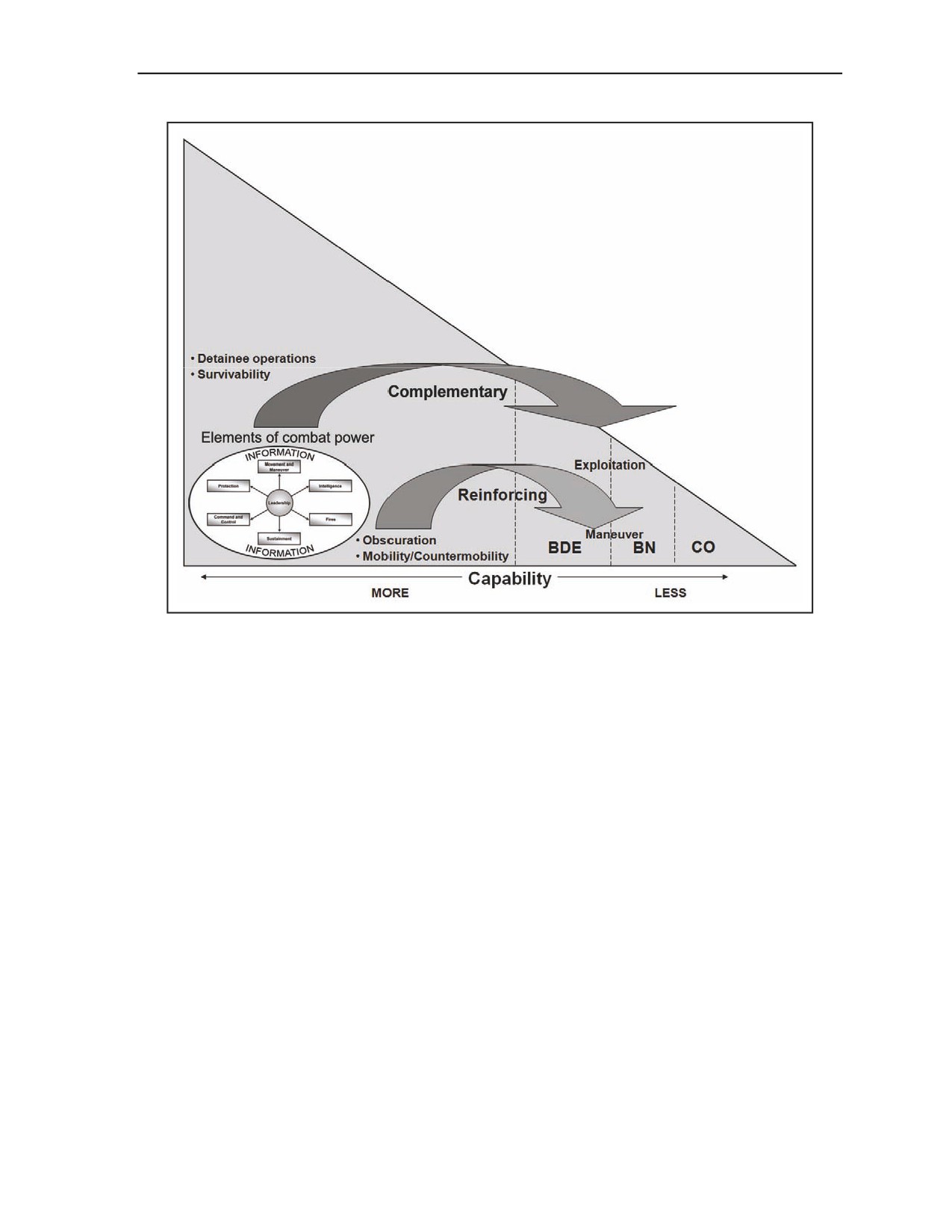
Maneuver Support Operations
Figure 5-1. Complementary and reinforcing capabilities
5-27. The MEB is in essence a C2 organization that represents the C2 function. For this reason, when
functional brigades, such as MP or engineer, provide functional forces to the MEB, we can say that they
are providing complementary capabilities because they are supporting the C2 warfighting function
represented by the MEB headquarters. (See figure 5-2, page 5-8.)
26 February 2009
FM 3-90.31
5-7
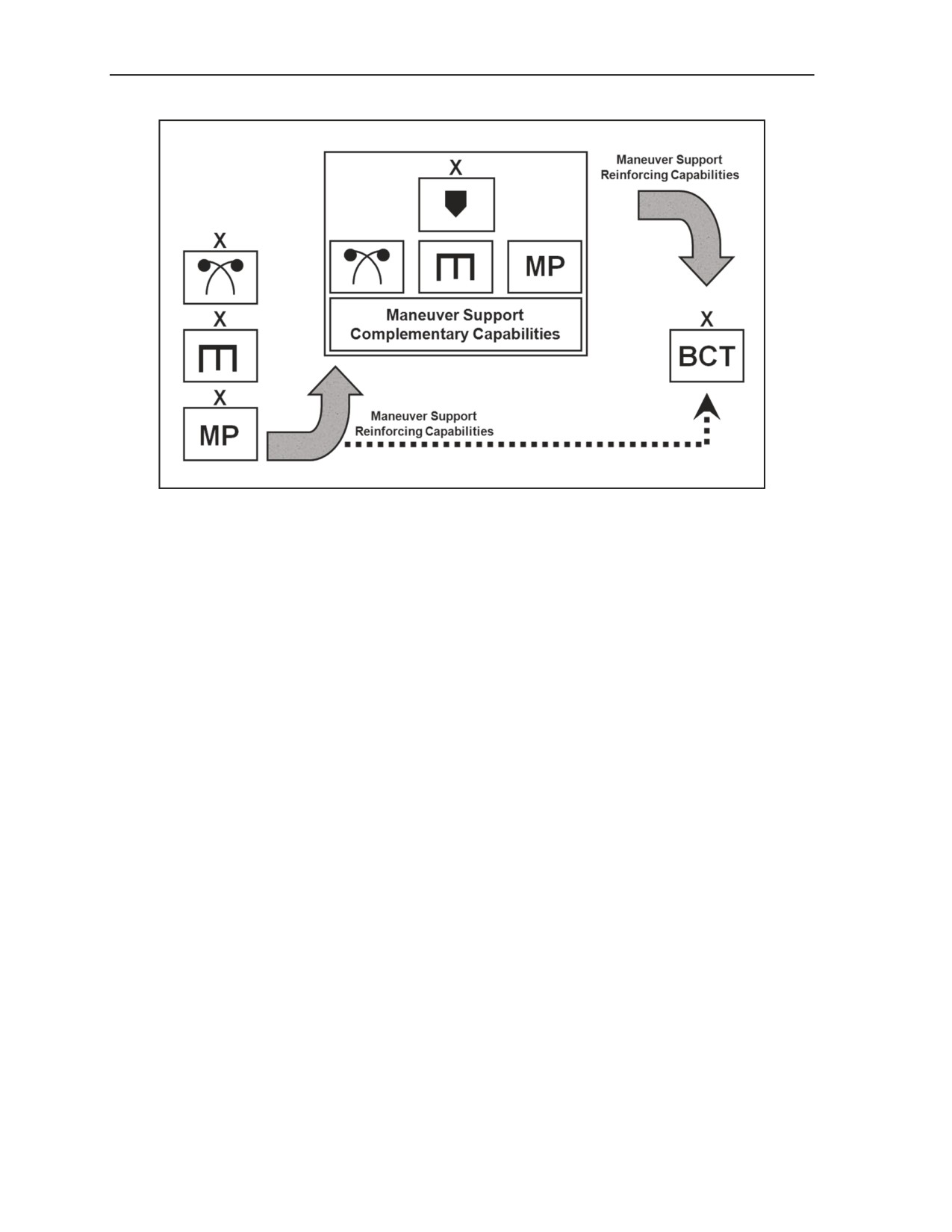
Chapter 5
Figure 5-2. The MEB and MANSPT operations
5-28. The composition of the MEB headquarters staffed with CBRN, engineer, MP, fire support,
intelligence, and aviation expertise makes it uniquely capable among other support or functional brigades
when integrating these capabilities. The significant level of expertise resident in the CBRN, engineer, and
MP functional areas enable a level of detail and precision in all facets of the operations process (prepare,
plan, execute, assess) not possible in the BCTs or the functional brigades without augmentation. The MEB
staff is trained and organized to facilitate MANSPT operations.
5-29. Typically, MANSPT operations at division and above are best conducted by the MEB rather than
other potential headquarters because the MEB has the highest concentration of staff capabilities required
for its integration and synchronization. Another formation may be tasked with conducting MANSPT
operations if deliberately augmented with functional expertise from across the required functional units
required for the specific purpose of providing freedom of action for a supported force.
5-30. Determining whether the MEB will provide complementary or reinforcing capabilities to the force
supports decisionmaking and serves as a point of departure when task-organizing formations or
recommending command and support relationships. The complementary and reinforcing character of the
capabilities that the MEB typically provides permits the scalable expansion of key tasks and functions
along a range or continuum of functional capability. (See figure 5-3.) This is significant because some
warfighting functions do not maintain the same character as operations transition along the full spectrum
operations among the levels of military action (strategic, operational, tactical) or as resources are applied to
solve the tactical problem. The protection and movement and maneuver warfighting functions provide
good examples of this.
5-8
FM 3-90.31
26 February 2009
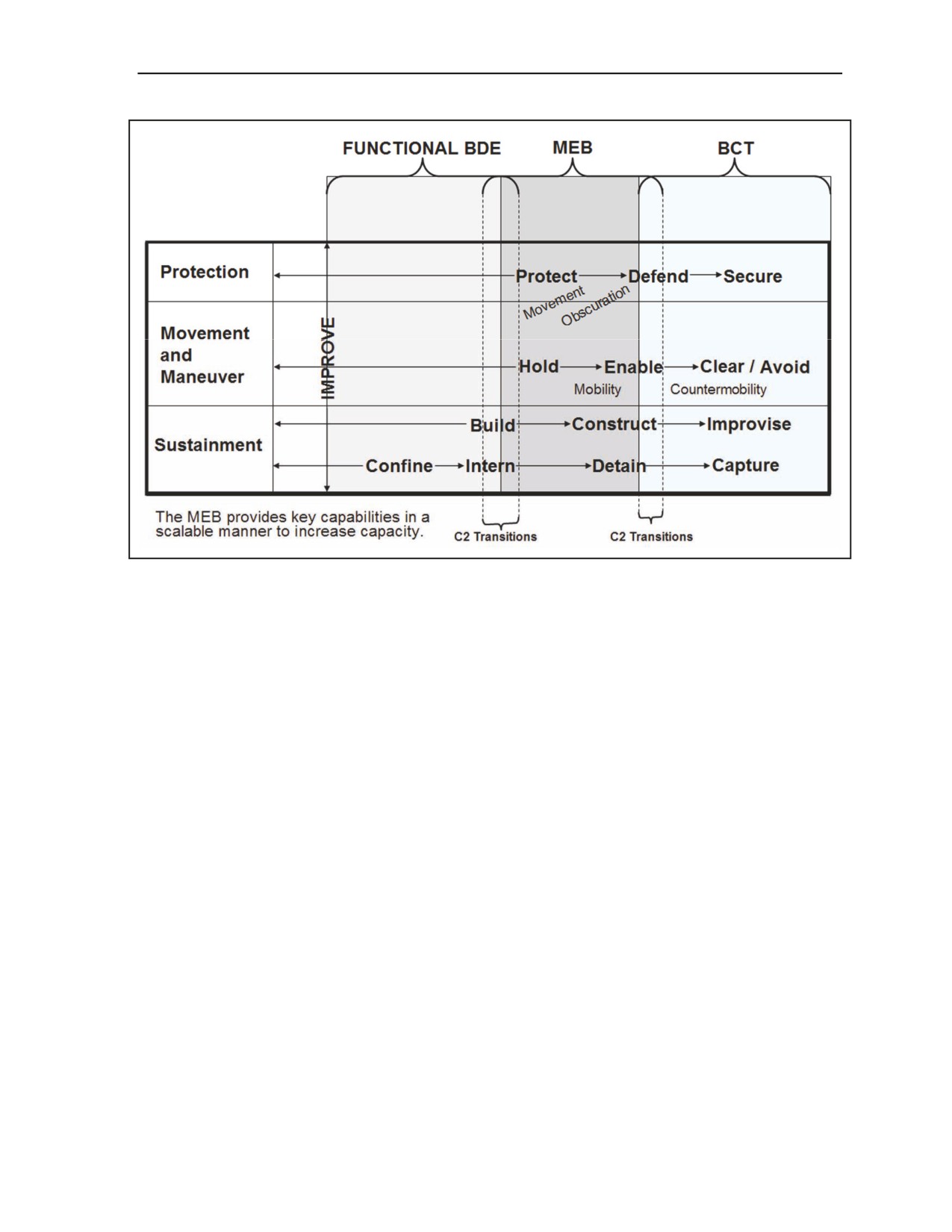
Maneuver Support Operations
Figure 5-3. Increasing functional capabilities
5-31. Typically, the MEB simultaneously reinforces maneuver with mobility operations or tasks while
complementing the movement with protection coordination. The MEB staff continually analyzes and
examines how specific functions are affected as they expand along a capability scale to meet the changing
requirements of the OE. Consequently, the MEB adjusts it mission profile, task organization, and C2
arrangement to accommodate those scalable effects.
FREEDOM OF ACTION
5-32. An overview of freedom of action is provided in chapter 1. Freedom of action allows the commander
to seize, retain, and exploit operational initiative. Army forces gain and preserve freedom of action, reduce
vulnerability, and exploit success through maneuver. (See FM 3-0.) Freedom of action includes the ability
of commanders to exercise their wills to complete the mission, achieve the objective, affect movement, or
to protect the force. MANSPT operations enhance maneuver and help protect forces that typically do not
conduct maneuver. This contributes to enhancing freedom of action for the force.
5-33. The MEB increases freedom of action by shaping the OE, providing protection, and reducing
impediments to operations. MANSPT operations deny the enemy freedom of action. Some MANSPT
efforts set conditions, some are preemptive, and some are in response to the OE. Regardless of when they
occur, MANSPT operations enhance the freedom of action of the commander.
5-34. MANSPT operations enhance freedom of action for the supported commander similarly to the
sustainment warfighting function that provides support and services to ensure freedom of action. MANSPT
operations are multifunctional and typically performed throughout all types of operations. The MEB
primarily conducts mobility and countermobility operations to enhance freedom of maneuver. The brigade
also primarily performs protection support coordination, movement corridor operations, and selected
sustainment operations to enhance freedom of movement.
26 February 2009
FM 3-90.31
5-9
Chapter 5
MANEUVER SUPPORT OPERATIONS AND THE OPERATIONS PROCESS
5-35. Commanders and staff use continuing activities to synchronize operations throughout the operations
process (plan, prepare, execute, and assess). They use MDMP and troop leading procedures to integrate
activities during planning (See FM 3-0). The MEB also uses METT-TC to continually consider the
physical, human, and informational factors to analyze the impact of the OE on MANSPT operations and
the impact of MANSPT operations on the OE.
5-36. The MEB uses MANSPT operations to integrate and synchronize primarily the selected key tasks
related to primarily protection, movement and maneuver, and sustainment with the continuing activities
and into the overall operation to generate combat power and mission success. MANSPT operations are
integrated during all operations process activities and are required in all full spectrum operations. During
plan and assess, MANSPT operations provide predictive and proactive capabilities and a better
understanding of the OE. During prepare and execute, MANSPT operations provide initiative, flexibility,
protection, and proactive OE shaping capabilities.
5-37. The MEB and other selected headquarters use their battle rhythm as a key control measure for
managing their integration of tasks within MANSPT operations, across the warfighting functions, and with
supported and higher headquarters.
PLANNING CONSIDERATIONS
PLAN
5-38. The integration of MANSPT operations is continuous and must be included in offense, defense,
stability, or civil support operations. Using the operation process and MDMP, the MEB staff conducts
mission analysis to determine the company level (two levels down) tasks. The staff then continuously
integrates the tasks to plan combined arms MANSPT operations. The staff determines how these tasks can
best be grouped. The staff may determine that some tasks are best performed by functionally pure units.
The staff would then propose TF or company team formations and assign tasks to them or to functional
unit headquarters. The TFs or company teams would execute most grouped tasks using combined arms
formations but may also perform some functionally pure tasks. The staff may be asked to recommend the
command or support relationship between the MEB forces or functional units and the supported
headquarters. The staff continually assesses to update required tasks, integration, and changes to the task
organization. The staff also synchronizes the MANSPT effort within all the warfighting functions at the
brigade and with higher and supported headquarters. MANPST operations synchronization matrix can be
used to integrate complementary and reinforcing efforts within and across the warfighting functions.
5-39. The MEB normally conducts combined arms shaping and sustaining operations or tasks.
Occasionally the MEB may conduct the decisive operation or task for a higher headquarters. The purpose
of the operation or task would define whether to think of the effort as shaping or sustaining. For example
emplacing an obstacle to deny an enemy freedom of maneuver against a BCT conducting an attack would
be a shaping operation. Emplacing the same obstacle as part of a base entry control point to protect a guard
tower would be viewed as a protection task. The building of the same obstacle may be a general
engineering and considered as a sustainment task.
5-40. Planners should use these maneuver support planning considerations:
z
Integrate operations, task, and new units.
z
Integrate with supported headquarters.
z
Analyze when to transfer efforts to functional organizations.
z
Analyze when to form combined arms TFs and company teams.
z
Phase task organization of attachments and detachments; ensure sustainment.
z
Deliberately apply protection to movement.
z
Balance support area operations efforts and MANSPT operations.
z
Reach back to augment expertise.
z
Mitigate the effects of the complex environment.
5-10
FM 3-90.31
26 February 2009
Maneuver Support Operations
5-41. Planners also—
z
Analyze tasks where a combined arms MANSPT operations approach is a better way to conduct
tasks than a pure functional effort. Some examples may include gap
(river) crossing,
reconnaissance, route clearance, convoy protection/security, consequence management, and
movement corridors.
z
Keep the tasks under brigade control that it takes a brigade staff to C2.
z
Give the TF and company team the tasks they are resourced to perform.
z
Give other tasks to subordinate pure functional units.
z
Provide MEB units and capabilities to others with a command or support relationship if they are
best done by one unit or capability under the supported units C2.
5-42. The MEB has a multifunctional staff to plan, prepare, execute, and assess the efforts of organic,
attached, and OPCON units and capabilities so that the supported headquarters staff does not need to. TF
and company team headquarters also alleviate the need for supported headquarters to integrate multiple
supporting units. This is valid for most operations but especially valid for MANSPT operations.
5-43. A supported unit may receive support from the MEB and other pure functional units at the same
time. The supported unit could use the attached or OPCON MEB unit headquarters to C2 or integrate the
other functional support. When the MEB and one or more functional brigades support a BCT the brigade
headquarters coordinates the efforts. If no MEB is available a functional (CBRN, engineer, or MP brigade
(or battalion) may be required to integrate efforts to conduct MANSPT operations.
PREPARE
5-44. Once a task organization has been approved, the staff can issue a warning order to the subordinate
MEB units to allow them to reorganize and synchronize movement and rehearsals with supported
headquarters.
5-45. The MEB must orient assigned units to understand how they contribute to MANSPT operations and
how they operate as part of MANSPT combined arms teams. There will be cases where MEB units provide
purely functional support.
5-46. The MEB forms TFs and company teams as necessary to accomplish its missions. The MEB must
build mutual trust quickly with units that have been task-organized to them and verify that all formations
are combat ready.
5-47. When units from the MEB are required to support other units, the MEB may provide battalion TFs,
company teams, or functional units to the BCT. The gaining unit integrates and synchronizes task
organization of these resources (if the command and support relationship allows that) until the mission is
completed. The provided resources will then be returned to the MEB or tasked to provide mission support
in another AO.
5-48. The MEB will conduct key rehearsals. When assigned an AO or conducting the tasks associated with
a movement corridor, rehearsals may include—fires, commitment of the MEB reserve, or commitment of a
TCF.
EXECUTE
5-49. The MEB is a multifunctional combined arms headquarters that accepts and provides C2 to units that
conduct MANSPT operations across the higher headquarters AO in support of other units or within its
assigned AO, and in support of the higher headquarters. It assists its higher headquarters to conduct the
integration of MANSPT operations. It also supports operational movement and maneuver of units during
deployment.
5-50. Although the MEB may frequently attach and detach more units than other support brigades, it must
also continually provides integrated and synchronized services like the other support brigades. The MEB
must not be viewed as an intermediate force pool/force provider.
26 February 2009
FM 3-90.31
5-11
Chapter 5
5-51. The MEB provides C2 over key mobility areas within its AO or as tasked to support within a BCT’s
AO. Based on reconnaissance, topographical, and terrain analysis, the MEB validates and further develops
the supported headquarters modified combined obstacle overlay in its assigned AO. When necessary to
ensure the mobility of the force, the MEB directs necessary actions to eliminate, neutralize, or reduce
physical and potential inhibitors to friendly movement and maneuver. The MEB develops information
requirements essential to maintaining a maneuver-focused situational awareness that contributes to the
commander’s COP. This focused awareness enables the acceleration of friendly maneuver decisions and
the prevention of enemy countermobility efforts.
5-52. Based on an analysis of METT-TC and commander’s guidance from the higher headquarters, the
MEB will tailor forces for MANSPT operations, structure support assignments and forces, and provide
support from within its task organization to the remainder of the force. The MEB has a wide array of
capabilities with which to defeat enemy threats in its assigned AO. These capabilities consist of direct fires
of assigned, attached, OPCON, or TACON forces and the ability to leverage Army and joint lethal and
nonlethal precision fire assets, Army and joint aviation assets. (See FM 3-90.)
ASSESS
5-53. The MEB must continually assess the OE to predict and detect impediment to operations and adjust
MANSPT operations to mitigate impediments. It must assess the progress and effectiveness all MEB
operations to shift resources across those operations as required. It must assess the effects of MANSPT
operations on enemy freedom of action and the freedom of action provided for the echelon headquarters
that it is supporting.
5-54. The staff can use the measures from FM 7-15 where tasks exist. Other MANSPT operations tasks are
still being developed at this time and units may need to initially develop specific MOPs or MOEs to
address some of the MANSPT operations tasks.
PROTECTION
5-55. The MEB performs key supporting tasks as a part of the task-perform protection. These key
supporting tasks are highlighted below.
CONDUCT SURVIVABILITY OPERATIONS
5-56. The MEB is optimized to conduct a host of survivability related tasks and operations across the full
spectrum operations. Plans and procedures are developed by the MEB to provide immediate protection to
the units residing in the brigade AO based on postulated threat assessments, intelligence summaries, and
unit reporting. Individuals, equipment, facilities, communications, infrastructure and other mission
essential materials will be safeguarded, prepared, or hardened to prevent damage, casualties, or mission
failure. The MEB area security section considers the dispersal of tenant units within the brigade AO while
conducting terrain management and allocating terrain. Most units attached, OPCON, or TACON to the
MEB conduct operations that contribute to the survivability of the force as they protect information and
execute security operations. The MEB can be configured to contain and control hazardous material
incidents or to defend against CBRN attacks in the brigade AO. Key survivability tasks may include direct
survivability construction, construct earthen walls and berms, and construct vehicle protective positions.
(See FM 5-103.)
CONDUCT CHEMICAL, BIOLOGICAL, RADIOLOGICAL, AND NUCLEAR OPERATIONS
5-57. The MEB can integrate or conduct most CBRN operations using the principles of CBRN defense
(contamination avoidance, protection, and decontamination), CBRN information management (CBRNE
Warning and Reporting System, and hazard modeling and prediction), and CBRN consequence
management (CM) in support of full spectrum operations. CBRN operations may include offensive
operations (for example, raids to secure sensitive sites), active defense measures (for example, active air
defense), and passive defense measures to prevent and defend against attack by CBRN weapons and their
effects; and to survive and sustain combat operations in a CBRN environment. CBRN passive defense
5-12
FM 3-90.31
26 February 2009
Maneuver Support Operations
measures predominate for the MEB and include the following principles: avoidance of CBRN hazards;
protection of personnel and equipment from unavoidable CBRN hazards; and decontamination. An
effective CBRN defense deters belligerent threats and attacks by minimizing vulnerabilities, protecting
friendly forces, and maintaining an operational tempo that complicates targeting. By denying or countering
any advantages that the enemy may accrue from using CBRN weapons, Army forces and their
multinational partners significantly deter their use. (See FM 3-11.)
5-58. CBRN passive defense measures include: CBRN reconnaissance and surveillance, CBRN asset
support to WMD-elimination operations as required, CBRN warning and reporting, CBRN hazard
modeling and prediction, CBRN protection for personnel, equipment, and installations, and CBRN
decontamination. CBRN CM includes activities to plan, prepare, respond, and recover from intentional or
accidental incidents involving CBRN hazards. The MEB also may have CBRN units capable of providing
large area obscuration in its task organization to support friendly forces.
PROVIDE EXPLOSIVE ORDNANCE DISPOSAL PROTECTION SUPPORT
5-59. The MEB will coordinate with the higher headquarters protection staff and any EOD unit in a
command or support relationship to the MEB to provide EOD support, within the MEB AO. Key EOD
tasks may include develop EOD disposal support plan, coordinate EOD disposal support, supervise EOD
operations, and respond to IED incidents. As an example, an EOD battalion may be attached to an Army
division and the division may further establish a command or support relationship with the particular
subunits of a division. An EOD company may be allocated to those subordinate headquarters within a
division that are assigned an AO (BCTs and MEBs). EOD elements in the division that are not allocated to
a headquarters assigned an AO typically receive their planning and execution guidance from the division
through their EOD battalion or TF headquarters. The MEB only exercises control over EOD operations
within their AO while BCTs control their own EOD assets.
CONDUCT LAW AND ORDER OPERATIONS
5-60. The MEB can conduct law and order (L&O) operations primarily with task-organized MP units. Law
and order operations include measures necessary to enforce laws, restore order, reconstitute indigenous
police forces, conduct investigations, control populations, and provide customs support. The conduct of
law and order operations specifically supports protection, as do police intelligence operations (PIO)
(discussed below as part of the movement corridor discussion). Key tasks may include conduct, coordinate,
and perform L&O operations, and coordinate law enforcement patrols. (See FM 3-19.1.)
MOBILITY AND MANEUVER
5-61. The MEB performs key supporting tasks as a part of the task-perform mobility. These key
supporting tasks are highlighted below.
CONDUCT MOBILITY OPERATIONS
5-62. Mobility operations are defined as obstacle reduction by maneuver and engineer units to reduce or
negate the effects of existing or reinforcing obstacles. The objective is to maintain freedom of movement
for maneuver units, weapons systems, and critical supplies. (See FM 3-34.) The MEB directs, integrates,
and controls the capabilities necessary to clear an area, location, or LOC of obstacles or impediments that
could hazard or hinder friendly movement and maneuver or the occupation of a location. The MEB may
conduct this operation in its own AO to support movement corridors, rapid runway repair, and horizontal
construction. The MEB may support combat operations of a BCT such as breaching operations, and gap
crossings. Key mobility tasks may include: plan engineer mobility operations, plan gap (river) crossing
operations, conduct maneuver and mobility support (MMS) operations, plan breaching operations, direct,
overcome barriers, obstacles, and mines; enhance movement and maneuver; and negotiate a tactical AO.
(See FM 7-15.) (See FM 3-19.1 and FM 3-34 and for detailed discussion of these operations.)
26 February 2009
FM 3-90.31
5-13
Chapter 5
CONDUCT COUNTERMOBILITY OPERATIONS
5-63. Countermobility operations are the construction of obstacles and emplacements of minefields to
delay, disrupt, and destroy the enemy by reinforcement of the terrain. (See FM 3-34.) The MEB direct,
integrates, and controls the capabilities necessary to alter the mobility of adversaries. The MEB may
conduct this operation in its own AO as part of security and defense. The MEB may support combat
operations of a BCT such as defense and use terrain reinforcement or directed targets. Key countermobility
tasks may include plan engineer countermobility operations, prepare an obstacle plan, site obstacles;
construct, emplace, or detonate obstacles; mark, report, and record obstacles; and maintain obstacle
integration. (See FM 90-7.)
PROVIDE BATTLEFIELD OBSCURATION
5-64. The MEB may employ its CBRN units to provide battlefield obscuration effects to include large area
or long duration effects. Military applications include protection, marking, and deception. The CBRN staff
and units conduct the planning, coordination, and synchronization and use tactical and technical
considerations to provide battlefield obscuration. They select and employ smoke and obscurants to achieve
and maintain spectrum superiority, denying adversaries’ access to select portions of the spectrum while
leaving other portions open for U.S. forces to attack and suppress or destroy adversaries, contributing to
the protection of forces while enhancing maneuver and firepower. Key tasks may include plan smoke
operations and conduct smoke operations.
SUPPORT SITE EXPLOITATION
5-65. Multifunctional capabilities enable the MEB to exploit sites for information, intelligence, and
consequence management. Site exploitation (SE) is primarily a reconnaissance effort but could result in an
incident that requires consequence management. The MEB conducts consequence management to prevent,
neutralize, or mitigate the effects of threat activity, natural and manmade disasters, or criminal incidents
with the goal of restoring and recovering essential capabilities, information, and combat power potential.
Using attached or OPCON units, the MEB may form a TF or company team to conduct SE; CBRN unit
capabilities provide detection, reconnaissance, identification, hazard prediction and assessment capability
for CBRN related sites or incidents; MP assets can assist by isolating and securing the site by establishing
a restricted perimeter, restrict access to prevent evidence destruction, conduct detainee operations, evidence
collection, provide military working dog teams with explosive detection, narcotic detection, or specialized
search dog capabilities, and provide investigators (MP/criminal investigation division) who can assist with
site evaluation and collection of forensic evidence. (See FM 3-19.17.) Engineers conduct military searches
and may conduct operations to isolate, protect, or demolish sensitive sites as necessary; and EOD integrate
with both CBRN units and engineers to facilitate the render safe and disposal of explosive ordnance and
IEDs.
ESTABLISH A MOVEMENT CORRIDOR
5-66. A movement corridor is a designated area established to protect and enable ground movement
along a route. Units establish a movement corridor to set the conditions to protect and enable movement
of traffic along a designated surface route. Units conduct synchronized operations within the movement
corridor such as reconnaissance, security, mobility, and information engagement for forces that require
additional C2, protection and support to enable their movement. A movement corridor may be established
to facilitate the movement of a single element or be established for a longer period of time to facilitate the
movement of a number of elements along a given route. The owner of an AO may establish a movement
corridor within their AO along an established MSR or a route designated for a unit’s movement. The
movement corridor would typically include the airspace above it to allow the establishing unit to conduct
aerial reconnaissance and fires.
5-67. One way to apply protection to movement is by planning for MANSPT operations during the
operations process. The unit commander or convoy commander is responsible for a base level of security
during movement. Most support brigades and functional units have a need for more security that they can
5-14
FM 3-90.31
26 February 2009
Maneuver Support Operations
organically provide during their movement and receive little support from maneuver units to provide
additional required security. Units owning an AO may provide additional security support to units moving
through or present in their AOs to include the ability to provide fires. Several tasks and TTPs can be
integrated within an AO to set conditions to help secure individual unit movement, to include—
z
Support to situational understanding.
z
Conduct tactical maneuver (performed by the AO owner or maneuver security forces).
z
Conduct route and convoy security operations.
z
Conduct antiterrorism activities.
z
Conduct CBRNE operations.
z
Conduct survivability operations.
z
Hand off security responsibility when crossing AO borders or at nearest secure
area/facility/base.
z
Integrate fires.
z
Coordinate logistics support.
z
Conduct tactical troop movement.
z
Employ combat patrols.
z
Conduct counter ambush actions.
z
Employ obscurants.
z
Provide tactical overwatch.
5-68. The MEB routinely controls the enablers and has the staff necessary to establish a movement
corridor and integrate operations within it. Chapter 6 discusses MEB support to movement within the
assigned support AO. This paragraph discusses support to movement beyond the MEB’s initially assigned
support area by using the technique of movement corridors. There are several techniques the MEB may use
to support movement beyond their assigned support area. Where an MSR passes from the MEB support
area AO through division controlled unassigned area directly into a BCT AO the division could designate
an AO around the MSR and assign it to the MEB as part of the support area. The MEB could create a
movement corridor from the MEB’s original AO to the BCT AO. In this case, the MEB would be
responsible for all actions within the movement corridor. The division would provide the required ISR and
fires support. The MEB would coordinate with the higher headquarters and unit conducting the movement
to provide the required MANSPT operations. The MEB would transfer responsibility for units moving
along the corridor to the BCT at their boundary. The BCT could extend the movement corridor within their
AO to their BSA or to their other boundary if the MSR passes through the AO. MEB support to movement
that does not move on an MSR could also be provided within a movement corridor. A movement corridor
that does not use an established MSR may require additional ISR and other MANSPT effort to set
conditions. The MEB can perform the key supporting tasks discussed below to conduct movement corridor
operations.
Perform Intelligence, Surveillance, and Reconnaissance
5-69. ISR conducted within the movement corridor provides support to targeting and IS. This may include
complementary route and area reconnaissance and ground and aerial reconnaissance. These actions may
help identify and target the threats to the other’s operations within the movement corridor. The MEB
employs the ISR capabilities of assigned, attached, or OPCON units and produces a COP for the movement
corridor.
Conduct Operational Area Security
5-70. Operational area security may include route security operations, observation posts, check points,
antiterrorism activities, security of convoy support facilities, and convoy security operations. Convoy
security operations protect convoys. Units conduct convoy security operations any time there are not
enough friendly forces to continuously secure lines of communications in an AO and there is a danger of
enemy ground action against the convoy. Convoy security operations are defensive in nature and orient on
26 February 2009
FM 3-90.31
5-15
Chapter 5
the protected force. (See FM 3-90.) The MEB may be tasked to enhance convoy security operations
through the technique of creating and supporting a movement corridor.
5-71. Route
(including highway, pipeline, rail, and water) security operations protect lines of
communications and friendly forces moving along them. Units conduct route security missions to prevent
enemy ground forces from moving into direct fire range of the protected route. Route security operations
are defensive in nature and terrain-oriented. (See FM 3-90.)
CONDUCT MOBILITY AND COUNTERMOBILITY OPERATIONS
5-72. Mobility operations may include aspects of movement control, route maintenance, and clearance
operations
(to include potential EOD participation). These operations tend to focus on combat and
supporting general engineering tasks and MP tasks associated with MMS operations. See FM 3-19.1, FM
3-34.2, and FM 3-34.210 for more information.
5-73. Countermobility operations may include actions required to limit threat movements. The result of
these operations is to provide added security to the movement corridor. (See FM 3-34, FM 3-90.12, and
FM 90-7, for additional information.)
Conduct Police Intelligence Operations (PIO)
5-74. PIO is an MP function that capitalizes on the capability to analyze criminal information and
intelligence through the integration and employment of MP assets and other police organizations,
networks, forums, and relationships. PIO supports, enhances, and contributes to commanders’ situational
understanding and battlefield visualization and protection programs by portraying the relevant criminal
threat and friendly information, which may affect their operational and tactical environment. These
operations ultimately assist the commander in focusing and applying combat power. PIO establishes and
supports networks that can be used to leverage HN police, security organizations, and the local population
in support of operations in movement corridors. PIO is integrated with all other MP functions and activities
to gather police information, increase situational awareness, and help mitigate the threats associated with
the criminal environment that can influence the success of operations within the movement corridor. The
MEB integrates the police intelligence activities and products within, or as an adjunct to, the overall
intelligence process to support the operations and targeting processes. (See FM 3-19.50.)
EMPLOYMENT EXAMPLE
5-75. One example of an MEB establishing and conducting operations in a movement corridor is shown in
figure 5-4. In this example, the MEB AO and the BCT AO are connected by MSR BLACK. Based on
METT-TC, the division needs to secure movement between the brigade AOs and has tasked the MEB to
expand its existing AO to include an area that runs about 4 kilometers on each side of the MSR and
establish a movement corridor. The MEB is required to conduct reconnaissance, clear, and secure the new
area; support the sustainment brigade to establish the convoy support center (CSC) and conduct movement
regulation and traffic control; and to maintain the MSR in its expanded AO. Due to the complexity of the
requirement, the MEB has assigned the mission to an MP TF (shown with its headquarters in the CSC), but
retained control of the movement corridor as part of its AO. The MEB has developed an initial ISR plan.
The TF MP conduct police engagement to leverage HN or multinational police assets to enhance security.
The brigade has also established traffic control points along the MSR, an air corridor, and air control points
(ACPs) in conjunction with the division headquarters and the BCT to regulate ground traffic and control
rotary wing and UAS traffic between the MEB and BCT airfields. The ACP near the CSC supports air
traffic to and from the CSC and respond to the named area of interest (NAI) in the built up area. The MEB
develops an initial fires plan for convoy and CSC security and defense with target reference points (TRPs)
as shown in figure 5-4.
5-16
FM 3-90.31
26 February 2009
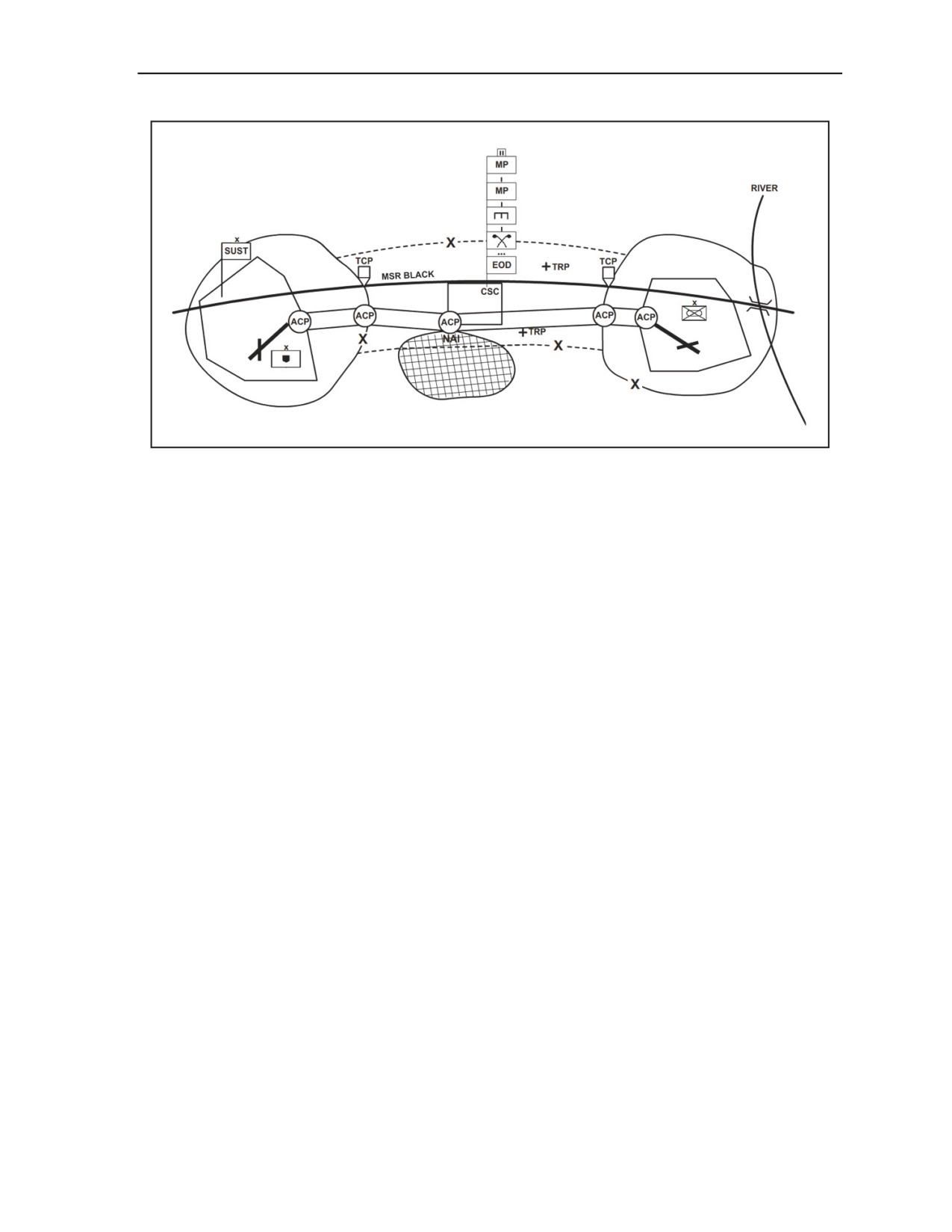
Maneuver Support Operations
Figure 5-4. Example of an MEB supporting a movement corridor
SUSTAINMENT
5-76. The MEB performs supporting tasks as a part of the task of conduct sustainment. These supporting
tasks are reflected in the internment/resettlement and engineer construction support tasks.
CONDUCT INTERNMENT/RESETTLEMENT OPERATIONS
5-77. This is primarily an MP task that could require combined arms. The conduct of I/R operations may
require operations to collect, move, secure, and care for various groups of people. The general engineering
construction support may be required to construct or modify facilities. MI and CA staff augmentation or
task-organized capabilities are integrated as required.
5-78. I/R operations include detainee operations, U.S. military prisoner operations, and dislocated civilian
operations. I/R operations are a complex set of activities with diverse requirements that require clear and
concise guidelines, policies, and procedures to ensure success. MP leaders and Soldiers conducting I/R
operations must maintain task proficiency for every category of detainee, U.S. military prisoner, and
dislocated civilian operations to ensure adherence to relevant standards for each.
5-79. The MEB can facilitate the development and the C2 of I/R operations to support the onward
momentum of combat forces or to control the dispersion of displaced populations. Organic legal personnel
and assigned MP can operate temporary detainee holding areas (DHAs) until dedicated functional, theater,
or joint capabilities can expedite the evacuation of detainees to a theater internment facility (TIF) or
strategic internment facility
(SIF). Assigned engineer assets are capable of modifying, preparing, or
constructing facilities for internment and they can develop the life support infrastructure necessary for
resettled groups. The MEB may also provide support for the construction or security of a theater
internment facility reconciliation center (TIFRC) positioned within a division AO to facilitate the release of
detainees back into the civilian population.
5-80. The MEB may conduct operations to control the influence of populations and resources on friendly
operations and freedom of movement while preventing the enemy from leveraging human and material
resources. These operations may include the enforcement of curfews, martial law measures, movement
restrictions, or identity registration and resource/commodity controls, inspections and amnesty programs,
and checkpoints. Resettlement operations for dislocated civilians may also require the wholesale
movement, resettlement, and subsequent sustainment of populations for their protection or to increase the
combat power potential of the force.
26 February 2009
FM 3-90.31
5-17
Chapter 5
PROVIDE ENGINEER CONSTRUCTION SUPPORT
5-81. This is primarily an engineer effort and is focused general engineering. The capability of the MEB to
conduct engineer construction support may require staff augmentation and will primarily depend on
task-organized unit capabilities. The construction support could include assessments, estimates, project
management, and vertical and horizontal construction. Project site security may be provided by
non-engineer units to maximize the engineer effort.
5-82. The MEB integrates engineer C2 augmentation to provide a wide array of engineer construction
capability and support applicable across the full spectrum of operations. The MEB staff can integrate the
tasks necessary to repair infrastructure; restore, repair; and maintain lines of communications; provide base
camp sustainment, site preparation, ongoing operational and recovery support: or restore areas damaged by
environmental hazards, natural and manmade disasters, or threat action. Fire fighting, facilities, vertical
construction and repair are included in this capability. Using task-organized units, the MEB is capable of
developing and maintaining electric power generation, distribution, and management in a tactical
environment. The MEB engineer section is also capable of conducting engineer assessments and
inspections of routes, structures, facilities, or other infrastructure. (See FM 3-34 and FM 3-34.170.)
EMPLOYMENT EXAMPLE
5-83. One example of an MEB performing sustainment is shown in figure 5-5. In this example the tactical
assembly area (TAA) from the division support area was included in the AO assigned to an MEB is shown
in detail. (See figure 6-1, page 6-19, for a broader discussion of the MEB AO.) The example includes
primarily examples of general engineering and I/R support. In this example, the MEB is required to
construct and C2 the DHA within the TAA. This includes the internal structure of the DHA, the security
fence and measures, the road connecting it to MSR ORANGE, and an improved rotary wing landing zone
(LZ). The MEB creates an MP TF that is task-organized with an MP team (that includes an MP I/R
company and a transportation section to allow for initial movement of personnel to the DHA) and an
engineer construction company. The MEB has assigned the TAA to the MP TF and they have designated
subordinate areas for their subordinate elements to occupy while the DHA is being constructed. Once the
DHA is constructed, the MEB will change the task organization and the MP battalion will assign the DHA
mission to the MP I/R company. The task organization may then change to include MI and/or CA
capabilities.
5-18
FM 3-90.31
26 February 2009
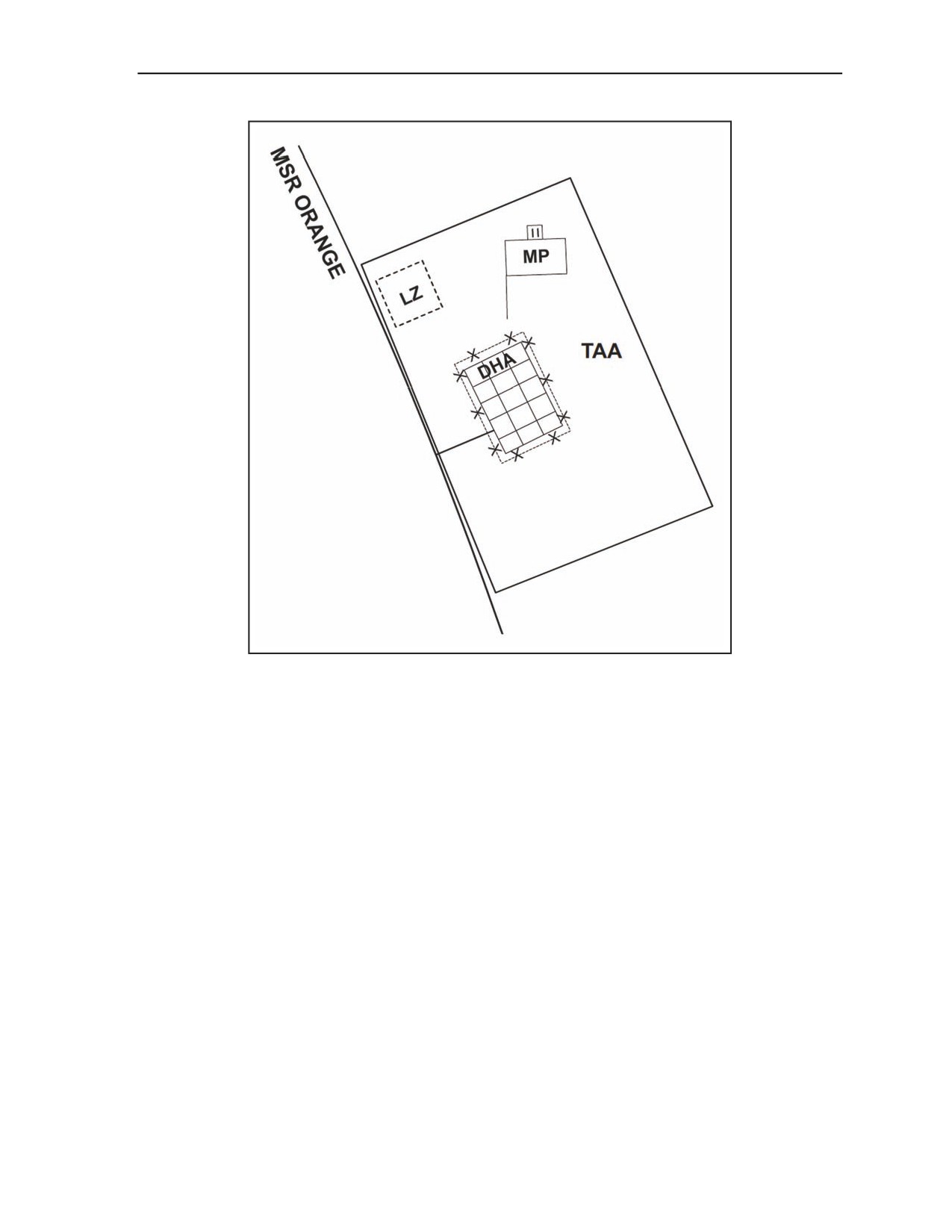
Maneuver Support Operations
Figure 5-5. Example of an MEB performing sustainment
26 February 2009
FM 3-90.31
5-19