FM 3-21.12 The Infantry Weapons Company (July 2008) - page 4
Chapter 8
Section IV. OPERATIONS WITH AIRBORNE, AIR ASSAULT, AND SPECIAL
OPERATIONS FORCES
Weapons companies may often find themselves operating with other units including airborne, air assault and
special operations forces. The nature of these operations can be complementary to both the weapons company
and the other forces. While the weapons company may assist in an airborne or air assault mission, aviation
assets may assist the weapons company in a mission of its own. Special operations forces (SOF) may use the
weapons company to assist in a raid while the weapons company may need to capitalize on intelligence from
SOF units in order to conduct a separate mission. Regardless, weapons unit leaders must be prepared to work
alone side these forces in combined arms operations.
AIRBORNE AND AIR ASSAULT FORCES
8-73.
Weapons company elements may conduct operations in support of or in conjunction with airborne
or air assault forces. The nature of these operations may be varied including operations at PZs, LZs, or
drop zones (DZ), or may include the company itself being air lifted in an air assault operation.
PICK-UP AND DROP ZONES
8-74.
Whether the operation is in support of an airborne or an air assault operation, weapons company
involvement will most likely be constituted with similar missions. Some drop zones can be very large in
nature and security of these areas concentrates on the high-speed avenues of approach. Weapons
companies are ideally suited to cover these avenues. The use of a weapons company in these roles implies
that most likely the PZ or DZ is in territory occupied by friendly forces and the weapons company would
be able to move to the zone for the security mission. If the DZ is occupied by enemy forces, security would
most likely be conducted by the airborne forces into the zone.
LANDING ZONES
8-75.
LZs are often in enemy territory. Weapons company involvement in these missions would most
likely not security, but as a part of the assault force itself. In this situation, first-in elements would be
ground forces that can quickly assemble on the LZ and provide security for the following elements.
Weapons company elements would then be brought in via sling load with ground forces providing security
during their assembly.
AIRLIFTING VEHICLES
8-76.
The rotary wing aircraft used for airlifting vehicles is the CH-47D. Weapons company vehicles
that are sling loaded into a LZ will normally be a follow-on unit with security maintained from initial
forces on the ground. It is important to note, however, that the vehicles will not be fully ready for combat
until post-landing preparations have been accomplished. Sling loaded vehicles will not have a main gun
mounted, glass will be taped and certain other sling load preparations will have been performed on the
vehicle. Upon landing, slings will need to be secured from the vehicle and the vehicle driven to a place
with additional cover and concealment rather than the openness of the LZ. Main weapon systems will be
stored inside the vehicle for air transport. Whether or not a main gun is mounted prior to leaving the LZ is
a commanders METT-TC decision. As always during LZ operations, time on the LZ itself should remain at
a minimum.
SPECIAL OPERATIONS FORCES
8-77.
In today’s complex operational environment, interoperability and integration between friendly
units are a necessity in order to achieve battlefield success. Historically, SOF operated independently from
8-14
FM 3-21.12
1 July 2008
Tactical Enabling Operations
conventional forces. SOF operations were typically separated from conventional unit missions largely by
space and time. Planning was conducted independently and missions varied. Modern day conflicts are now
more often characterized by SOF and conventional units occupying the same operational area. Combining
the various forms of Infantry with special operations elements is a combat multiplier. Such operations can
take advantage of the firepower and mobility of the weapons company while the weapons company itself
takes advantage of SOF characteristics such as information gathering. Special operations forces provide
Infantry units with force multipliers, especially in information operations, effects, and intelligence. The
Infantry units provide the additional forces sometimes required for SOF to accomplish their mission.
WEAPONS COMPANY AND SOF COMBINED OPERATIONS
8-78.
Modern conflicts have been increasingly marked with incidents of conventional forces (CF) and
SOF interoperation and integration. CF units find themselves operating along side SOF units, often
supporting each other in a common mission. These type operations may include CF operating with SOF
A-Teams, civil affairs teams, and tactical psychological operations teams. Examples of integration for
combined operations include--
• Cordon and Search mission - SOF generally does not have the manpower to complete this
mission on their own. The weapons company is ideally suited to provide a cordon for a SOF
operation.
• Checkpoints in support of SOF - SOF units may use the weapons company to establish
checkpoints in order to support a particular mission.
• Crowd control - psychological operations (PSYOP) teams and CF units may work together to
influence crowds or local citizens in order to gain or maintain control in urban environments.
For more information regarding integration with SOF see FM 3-12.10.
COORDINATION
8-79.
When operating with or near SOF, the weapons company commander should coordinate, at a
minimum, the following with the SOF unit leader:
• Command and control (C2) relationship.
• Communication information (frequencies, call signs, challenge and passwords, emergency
signals and codes).
• Safehouse locations.
• Number and types of vehicles.
• Control measures being used.
• Battle handover criteria.
• Liaisons.
• Sustainment plans.
• Contingency plans for mutual support.
8-80.
For a complete Quick Reference Checklist for CF and SOF integration and interoperability see
USSOCOM Pub 3-33.
1 July 2008
FM 3-21.12
8-15
Chapter 8
Section V. BREACHING OPERATIONS
Breaching operations are conducted when a unit cannot bypass the obstacles with maneuver. Units should
always try to bypass enemy obstacles. If the situation demands that the obstacles be reduced, then units should
try to bypass the obstacles, destroy or repel the defending enemy forces, and then reduce the obstacles. Only as
a last resort should commanders try to breach into an obstacle that is actively defended. For breaching
operations, the weapons company may be part of the support force with an element attached to the assault force
to provide additional firepower on the far side of the breach. For more detail on breaching operations, see
FM 3-21.10, and FM 5-7-30.
FUNDAMENTALS
8-81.
Suppress, obscure, secure, reduce and assault (SOSRA) are the five breaching fundamentals.
These fundamentals always apply, but their importance may vary based on the specific METT-TC
conditions.
SUPPRESS
8-82.
Suppression is a tactical task that focuses direct and indirect fires on enemy personnel, weapons,
or equipment to prevent effective fires on friendly forces. The purpose of suppression during breaching
operations is to protect forces while they move to, reduce and maneuver through an obstacle. It is the key
to a successful breaching operation. The weapons company often plays a critical role during the
suppression mission.
OBSCURE
8-83.
Obscuration protects forces conducting obstacle reduction and the passage of assault forces.
Obscuration hampers enemy observation and target acquisition, and it conceals friendly activities and
movement.
SECURE
8-84.
Those actions in which friendly forces eliminate the enemy’s ability to interfere with obstacle
reduction and passage of combat units through a lane created during the reduction.
REDUCE
8-85.
Reduction is the creation of lanes through or over an obstacle to allow an attacking force to pass.
ASSAULT
8-86.
A breaching operation is not complete until friendly forces have assaulted to destroy the enemy on
the far side of the obstacle and battle handover with follow-on forces has occurred.
ORGANIZATION
8-87.
A commander organizes friendly forces to accomplish the five breaching fundamentals. This
requires him to organize support, breach, and assault forces with the necessary assets to accomplish their
roles.
8-16
FM 3-21.12
1 July 2008
Tactical Enabling Operations
SUPPORT FORCE
8-88.
The support force's primary responsibility is to eliminate the enemy's ability to interfere with a
breaching operation. Suppression depends on the commander massing enough direct fires to protect the
breach force. The weapons company is ideally suited to be the support force element. The support
force must--
• Isolate the reduction area with fires.
• Mass and control direct and indirect fires to suppress the enemy and to neutralize any weapons
that can fire on the breach force.
• Control obscuring smoke to prevent enemy-observed direct and indirect fires.
8-89.
The support force should be provided with assets to reduce the impact of unexpected obstacles or
scatterable minefields on their approach to and occupation of support-by-fire positions. Failure to provide
reduction assets can greatly affect the synchronization of the entire breaching operation. As a technique, a
unit may create a reserve that supports the decisive operation throughout the operation. Initially, the
reserve can support the support force until it seizes support by fire (SBF) positions. Then, the reserve shifts
priority to the breach or assault force. If possible, the support force should follow a covered or concealed
route to the SBF position, take up its assigned sectors of fire and observation, and begin to engage the
enemy.
8-90.
Observation is critical. Artillery observers with the support force may initially bring indirect fires
on enemy positions to fix and suppress the enemy. The support force adjusts the indirect fire-delivered
obscuring smoke to protect the breach and assault forces as they approach the reduction area. When
allocating resources to the support force, consider possible personnel and equipment losses as the assault
force fights its way into its SBF position. To increase the survivability of the support force, the commander
may request a designation of the SBF(s) as a critical friendly zone (CFZ). A CFZ is an area, usually a
friendly unit or location, which the maneuver commander designates as critical to protect an asset whose
loss would seriously jeopardize the mission. Covered by target acquisition sensors, the CFZ supports
counterfire operations by providing the most responsive submission of targets to the fire support system
when rounds impact inside the CFZ.
BREACH FORCE
8-91.
The breach force helps in the passage of the assault force by creating, proofing (if necessary), and
marking lanes. The breach force might be a combined-arms force. It includes reduction assets, enough
maneuver forces to provide additional suppression, and local security and engineers (if available). The
breach force applies portions of the following breaching fundamentals as it reduces an obstacle. The role of
the weapons company will most likely be near side security/suppression until the obstacle is reduced
enough to allow travel.
ASSAULT FORCE
8-92.
While the breach is in progress, the assault force assists the support force, or follows the breach
force while it maintains cover and dispersion. Once a lane is cleared through the obstacle, the assault force
moves through the breach. It secures the far side of the obstacle by physical occupation and/or continues
the attack in accordance with the commander’s intent. Once the far side is secured, elements of the
weapons company can move forward to support the assault force.
1 July 2008
FM 3-21.12
8-17
Chapter 8
Section VI. PATROLS
A patrol is a detachment sent out by a larger unit to conduct a combat, reconnaissance, or security mission. A
patrol’s organization is temporary and specifically matched to the immediate task. Because a patrol is an
organization, not a mission, it is not correct to speak of giving a unit a mission to "Patrol."
OPERATIONS
8-93.
Commanders send patrols out from the main body to conduct specific tactical tasks with an
associated purpose. Upon completion of that task, the patrol leader reports to the commander and describes
the events that took place, the status of the patrol’s members and equipment, and any observations.
8-94.
The senior officer or noncommissioned officer (NCO) is designated as the patrol leader. This
temporary title defines his role and responsibilities for that mission. The patrol leader may designate an
assistant, normally the next senior man in the patrol, and any subordinate element leaders he requires.
8-95.
A weapons company patrol element may consist of a unit as small as a single squad. Squad and
platoon size patrols are common. For larger combat tasks, such as a raid, the patrol may consist of a
company or company (-) element.
8-96.
The leader of any patrol, regardless of the type or the tactical task assigned, has an inherent
responsibility to prepare and plan for possible enemy contact while on the mission. Patrols are never
administrative. They are always assigned a tactical mission. On his return to the main body, the patrol
leader must always report to the commander. He then describes the patrol's actions, observations, and
condition.
TYPES
8-97.
The planned action determines the type of patrol and the weapons company commander
determines the units weapons mix based on an analysis of the factors of METT-TC. The two main types of
patrols are combat and reconnaissance. Regardless of the type of patrol, the unit needs a clear task
and purpose.
COMBAT PATROL
8-98.
A combat patrol provides security and harasses, destroys, or captures enemy troops, equipment, or
installations. When the commander gives a unit the mission to send out a combat patrol, he intends for the
patrol to make contact with the enemy and engage in close combat. A combat patrol always tries to escape
detection while moving, but of course discloses their location to the enemy in a sudden, violent attack. For
this reason, the patrol normally carries a significant amount of weapons and ammunition. It may carry
specialized munitions. A combat patrol collects and reports any information gathered during the mission,
whether related to the combat task or not. The three types of combat patrols are a raid, an ambush and a
security patrol. Both the raid and ambush are characterized by surprise, avoidance of detection until the
attack is initiated, and short but violent action.
Raid
8-99.
As stated in the discussion of offensive operations, a raid is a limited-objective form of attack that
entails a penetration of hostile terrain with a high expectation of encountering enemy resistance. A raid is
not intended to hold territory and is always accompanied by a planned withdrawal to a friendly location
upon the completion of the assigned mission. It is an offensive operation with a specific purpose. The
weapons company may participate in the conduct a raid along with other forces or conduct an independent
raid.
8-18
FM 3-21.12
1 July 2008
Tactical Enabling Operations
8-100. During a raid conducted with other ground forces, the weapons company is best suited to establish
security and isolate the objective. In this role, they are able to respond to external enemy support or
interference from outside the objective area but also able to respond with heavy weapons inside the
objective if needed. As an independent force, the weapons company may conduct a raid using its direct fire
weapons to attack an objective and obtain a specific outcome, e.g. the destruction of an observation post.
Since speed is an important aspect of a raid, the mobility of the weapons company make it well suited to
conduct a raid where the distance to the objective is considerable. Unit vehicles will not only get them to
the objective quickly but will also provide for a rapid withdrawal.
8-101. Raids are also common offensive actions conducted in a region where stability operations are
ongoing. Most often in these instances, raids are used to obtain personnel, equipment or information. These
raids usually have detailed information on the location of the persons or items sought and hostile contact is
expected during the operation. As always, standing operating procedures (SOP), ROE and METT-TC will
play a part in determining how these type raids will be conducted.
Role.
8-102. The weapons company conducts raids to accomplish a number of missions, including the
following:
• Destroy specific command and control locations.
• Destroy logistical areas.
• Destroy vehicle assembly or staging areas.
• Isolate the objective.
• Support the withdrawal of the assault force.
• Confuse the enemy or disrupt his plans (feint).
• Obtain information concerning enemy locations, dispositions, strength, intentions, or methods
of operation.
• Capture of personnel (threat or captured prisoners)
• Capture of weapons, caches or equipment
Ambush
8-103. An ambush is a surprise attack, from concealed positions, on a moving or temporarily halted
enemy. It may take the form of an assault to close with and destroy the enemy, or it may be an attack-by-
fire only, executed from concealed positions. An ambush does not require that ground be seized or held.
Although the execution of an ambush is offensive in nature, the unit may be directed to conduct an ambush
in a wide variety of situations. It may stage the ambush during offensive or defensive operations, as part of
the higher unit’s sustaining operations, or during retrograde operations. OPSEC is critical to the success of
an ambush. The unit must take all necessary precautions to ensure that it is not detected during movement
to or preparation of the ambush site. The unit must also have a secure route of withdrawal following the
ambush.
Role.
8-104. The weapons company, or elements of the weapons company is well equipped to conduct an
ambush. The ambush is generally conducted to reduce the enemy force’s overall combat effectiveness.
Destruction is the primary reason for conducting an ambush. Other reasons for an weapons company to
participate in ambushes are--
• To confuse the enemy or disrupt his plans.
• To isolate enemy units in the kill zone.
• To destroy vehicles and personnel with accurate, long range, and high volume fires.
• To harass the enemy.
• To capture the enemy.
1 July 2008
FM 3-21.12
8-19
Chapter 8
Task Organization.
8-105. The unit is normally task-organized into assault, support, and security forces for the execution of
the ambush. Elements of the weapons company can be employed in any of the three forces.
• The assault force executes the ambush. It may employ an attack-by-fire, an assault, or a
combination of those techniques to destroy the ambushed force.
• The support force fixes the enemy force and prevents it from moving out of the kill zone,
allowing the assault force to conduct the ambush. The support force generally uses direct fires
in this role; however, it may also be responsible for calling for and adjusting indirect fires to
assist in fixing the ambushed force.
• The security force provides protection and early warning to the ambush patrol and secures the
objective rally point or assault position. It isolates the ambush area both to prevent the
ambushed enemy force from moving out of the ambush site and to keep enemy reaction forces
from reaching the site. The security force may also be responsible for securing the unit’s
withdrawal route.
Security Patrol
8-106. A security patrol is sent out from a unit location during a halt, when the unit is stationary, to
search the local area, to detect any enemy forces near the main body, and to engage and destroy them
within the capability of the patrol. Weapons company units may be assigned a mounted security patrol
mission. This type of combat patrol is normally sent out by units operating in close terrain with limited
fields of observation and fire. Although this type of combat patrol seeks to make direct enemy contact and
to destroy enemy forces within its capability, the patrol should try to avoid decisive engagement. A
security patrol detects and disrupts enemy forces that are conducting reconnaissance of the main body or
that are massing to conduct an attack. Security patrols are normally away from the main body of the unit
for limited periods, returning frequently to coordinate and rest. They do not operate beyond the range of
communications and supporting fires from the main body, especially mortar fires.
RECONNAISSANCE PATROL
8-107. A reconnaissance patrol collects information or confirms or disproves the accuracy of information
previously gained. The intent for this type of patrol is to avoid enemy contact and accomplish its tactical
task without engaging in close combat. With one exception (presence patrols), reconnaissance patrols
always try to accomplish their mission without being detected or observed. Because detection cannot
always be avoided, a reconnaissance patrol carries the necessary arms and equipment to protect itself and
break contact with the enemy. A reconnaissance patrol travels light, that is, with as few personnel and as
little arms, ammunition, and equipment as possible. This increases stealth and cross-country mobility in
close terrain. Regardless of how the patrol is armed and equipped, the leader always plans for the contact.
For more information on types of reconnaissance patrols, see FM 3-21.10. Weapons company elements
may be assigned or involved in any of the following types of reconnaissance patrol missions:
• Route reconnaissance patrols
• Area reconnaissance patrols
• Zone reconnaissance patrols
• Point reconnaissance patrols
• Leader’s reconnaissance patrols
• Presence patrols (Unique to stability or civil support operations)
• Tracking patrols
• Contact patrols
8-20
FM 3-21.12
1 July 2008
Chapter 9
Direct Fire Control
The integration of direct fires into the scheme of maneuver is essential to success on
the battlefield. While individual elements may be well rehearsed in their particular
tasks relating to the mission, effective direct fire engagements do not happen without
careful planning, coordination and control. All direct fires in a particular engagement
area must be well synchronized to enhance combat effectiveness and protect friendly
troops. Effective direct fires are the unique contribution of maneuver forces to the
combined arms team, and fire and movement are complementary components of
maneuver. Although the weapons company is a maneuver unit, a large portion of the
weapons company mission is directed toward the direct fire support of other
maneuvering friendly forces. The weapons company commander should be well
aware of all direct fire control measures and how the direct fires of his subordinate
elements fit into the battalion direct fire plan.
COMMANDER'S ROLE IN COA DEVELOPMENT
9-1.
As the owner of much of the Infantry battalions direct fire heavy weapons, the weapons company
commander should be ready to act as a participating member of the battalion-planning cell if requested by
the battalion commander. In this role, he would be the principal advisor on employment of his company
heavy weapons in mission support during course of action (COA) development. He would not only advise
on how best to support the mission with heavy weapons, but also suggest any additional fire control
measures that would help facilitate operations. During COA development and mission execution,
commanders should take into consideration the fire control principles that will ultimately increase the
effectiveness of direct fires.
PRINCIPLES
9-2.
When planning and executing direct fires, all company commanders and subordinate leaders in an
Infantry battalion must know how to apply several fundamental principles. The purpose of these direct fire
control principles is not to restrict the actions of subordinates, but to help the company accomplish the
primary goal of any direct fire engagement: to eliminate the enemy by acquiring first and shooting first.
Applied correctly, these principles give subordinates the freedom to respond rapidly upon acquisition of
the enemy. This discussion focuses on the following principles.
• Mass the effects of fire.
• Destroy the greatest threat first.
• Avoid target overkill.
• Employ the best weapon for the target.
• Minimize friendly exposure.
• Plan and implement fratricide avoidance measures.
• Plan for extreme limited visibility conditions.
• Develop contingencies for diminished capabilities.
1 July 2008
FM 3-21.12
9-1
Chapter 9
MASS FIRES
9-3.
The Infantry units must mass its direct fires to achieve decisive results. Whether a battalion or
company mission, or whether in a primary or supporting role, the principle of massing fires remains the
same. Massing entails focusing direct fires at critical points and distributing the effects. Random
application of fires is unlikely to have a decisive result. For example, concentrating the company's fires at a
single target may ensure its destruction or suppression; however, that fire control option will fail to achieve
the decisive result on the remainder of the enemy formation or position. The weapons company
commander will often have his platoons in a supporting role such as in a support by fire position. He must
integrate his fires with those of the maneuvering unit to achieve a combined mass effect of direct fires.
9-4.
The weapons company masses its fires by positioning its units so that more than one platoon can
fire into an engagement area. Through the use of control measures such as target reference points (TRP),
the commander can distribute their fires and, in turn, his platoon leaders distribute the fires within their
assigned area. Use of engagement criteria and control measures such as engagement lines, the commander
can destroy the enemy with sudden, distributed, and simultaneous fires from multiple platoons. Careful
analyses of time-distance factors between positions can also allow the leaders to displace units in time to
reinforce a threatened area and affect the outcome of the battle.
DESTROY GREATEST THREAT FIRST
9-5.
The order in which Infantry units engage enemy forces is in direct relation to the danger these
forces present. The threat posed by the enemy depends on his weapons, range, and positioning. Presented
with multiple targets, a unit must initially concentrate direct fires to destroy the greatest threat, and then
distribute fires over the remainder of the enemy force. The weapons company with long-range direct fire
capabilities will often be the first to engage an approaching enemy unit and will concentrate on attacking
the greatest threat first such as tanks and other heavy weapons vehicles.
9-6.
The commander establishes a priority for targets. This may be part of the tactical standing
operating procedure
(TSOP) or is revised based on the mission and threat. For example, bridging
equipment may become a priority target when the Infantry battalion is defending a river crossing.
AVOID TARGET OVERKILL
9-7.
Use only the amount of fire required to achieve necessary results. Target overkill wastes
ammunition and is not tactically sound. To the other extreme, the company cannot have every weapon
engage a different target because the requirement to destroy the greatest threats first remains paramount.
The help avoid target overkill, leaders should use robust fire control measures. If the target is not burning
or showing obvious signs of destruction however, it is often difficult to determine whether a target has
been destroyed.
EMPLOY BEST WEAPON FOR TARGET
9-8.
Using the appropriate weapon for the target increases the probability of rapid enemy destruction or
suppression; at the same time, it conserves ammunition. The Infantry weapons company has a variety of
weapons with which to engage the enemy. Target type, range, and exposure are key factors in determining
the weapon and ammunition that should be employed, as are weapons and ammunition availability and
desired target effects. Careful planning and analysis will enable the weapons company commander to select
the best weapons to mount on the vehicles and allow him to array his forces based on the terrain, enemy,
and achieve the desired effects from all his direct fire engagements. A given weapons system can have its
own priority of fires and engage different targets in sequence. Although the specific mission and threat
dictates the use of specific weapons, close combat missile systems and machine guns are most often
employed using the guidelines in the following paragraphs:
• Close combat missile systems provide long-range direct fire capable of destroying armored
vehicles and fortifications. They have a limited high explosive effect on Infantry. Their primary
9-2
FM 3-21.12
1 July 2008
Direct Fire Control
disadvantages are a relatively slow flight time for the missile and the number of missiles that
can be carried are limited. Specifically, Javelins have a fire-and-forget and both it and some
versions of the tube-launched, optically-tracked, wire-guided (TOW) missile have top attack
capability.
• Grenade machine guns and heavy caliber machine guns are very effective against dismounted
Infantry and lightly armored vehicles and can also provide area suppression or be used for
reconnaissance by fire. The amount of ammunition is limited and may not be effective against
more heavily armored vehicles.
MINIMIZE FRIENDLY EXPOSURE
9-9.
Units increase their survivability by exposing themselves to the enemy only to the extent necessary
to engage him effectively. Natural or manmade defilade provides the best cover from antitank guided
missiles (ATGM) and other large caliber direct fire munitions. Although armored, weapons company
vehicles are vulnerable to direct fires from weapons larger than small arms and to indirect fires. The
weapons company commander must select positions that minimize their exposure by constantly seeking
effective available cover, trying to engage the enemy from the flank, remaining dispersed, displacing to
and firing from multiple positions, and limiting engagement times.
PLAN AND IMPLEMENT FRATRICIDE AVOIDANCE MEASURES
9-10. The company commander must work proactively to reduce the risk of fratricide and noncombatant
casualties. He must plan and use the numerous tools to assist him in this effort: identification training for
combat vehicles and aircraft, the unit's weapons safety posture, the weapons control status (WCS), and
recognition markings. Knowledge and employment of applicable rules of engagement (ROE) are the
primary means of preventing noncombatant casualties. Digital tracking systems and control measures also
decrease the chance of fratricide.
PLAN FOR EXTREME LIMITED VISIBILITY CONDITIONS
9-11. The Infantry weapons company is uniquely equipped to adapt to limited visibility conditions. The
night sights for close combat missile systems not only allow for engagements during limited visibility
conditions but also may be used as a night observation device for security missions. At night, limited
visibility fire control equipment enables the weapons company to engage enemy forces at nearly the same
ranges that are applicable during the day. However, obscurants such as dense fog, heavy rain, heavy
smoke, and blowing sand can reduce the capabilities of thermal and IR equipment. The company
commander develops contingencies for limited visibility conditions. Although a decrease in acquisition
capabilities has little effect on area fire, point target engagements are likely to occur at decreased ranges.
Firing positions, whether offensive or defensive, typically must be adjusted closer to the area or point
where the commander intends to focus fires. Another alternative is the use of visual or IR illumination
when there is insufficient ambient light for passive light intensification devices.
PLAN FOR DIMINISHED CAPABILITIES
9-12. Leaders initially develop plans based on their units’ maximum capabilities; they make backup
plans for implementation in the event of casualties, weapon damage, or failure. While leaders cannot
anticipate or plan for every situation, they develop plans for what they view as the most probable
occurrences. Building redundancy into these plans, such as having two systems observe the same sector, is
an invaluable asset when the situation (and the number of available systems) permits. Designating alternate
sectors of fire and supplementary firing positions provides a means of shifting fires if adjacent elements
become unable to fire.
1 July 2008
FM 3-21.12
9-3
Chapter 9
PROCESS
9-13. To bring direct fires against an enemy force successfully, commanders and leaders continuously
apply the four steps of the fire control process. At the heart of this process are two critical actions: rapid,
accurate target acquisition and the massing of fires to achieve decisive results on the target. Target
acquisition consists of detecting, identifying, and locating the enemy in sufficient detail to permit the
effective employment of weapons. Massing entails focusing fires at critical points and then distributing the
fires for optimum effect. The four steps are--
• Identify probable enemy locations and determine the enemy scheme of maneuver.
• Determine where and how to mass (focus and distribute) fires.
• Orient forces to speed target acquisition.
• Shift fires to refocus or redistribute their results.
9-14. Planning and coordination at the battalion and between the weapons and rifle company
commanders is required for an effective operation. For example, if a rifle company is attacking an
objective it is vitally important for the weapons company units in a support by fire role to understand
where and when the maneuver commander plans to focus and mass his direct fires. He must also be aware
of all control measures and know when and where to refocus or redistribute those fires in synchronization
with the maneuver company operation. For a complete discussion of the four steps in the fire control
process refer to FM 3-21.10
PLANNING CONSIDERATIONS
9-15. The company commander plans direct fires as part of the troop-leading procedures. Determining
where and how the company can and will mass fires are essential steps as the commander develops his
concept of the operation.
OVERVIEW
9-16. After identifying probable (or known) enemy locations, the commander determines points or areas
where he will focus his combat power. His situational understanding (SU), or vision, of where and how the
enemy will attack or defend helps him determine the volume of fires he must focus at particular points to
have a decisive result. In addition, if he intends to mass the direct fires of more than one platoon, he must
establish a means for distributing those fires effectively.
• Based on where and how he wants to focus and distribute direct fires, the commander can
establish the weapons ready postures for company elements as well as triggers for initiating
fires. He must evaluate the risk of fratricide and establish controls to prevent it. Fratricide
prevention measures include designation of recognition markings, weapons control status
(WCS), and weapons safety posture.
• Having determined where and how he will mass and distribute direct fires, the company
commander orients platoons so they can rapidly and accurately acquire the enemy. The
commander anticipates how the enemy will fight. He gains this anticipation through a detailed
war-game of the selected course of action. With this war game, he determines probable
requirements for refocusing and redistributing fires and for establishing other necessary
controls. Also during the troop-leading procedures, the company commander plans and
rehearses direct fires (and the fire control process) based on his analysis.
• The company commander continues to apply planning procedures and considerations
throughout execution. When necessary, he must also apply effective direct fire standing
operating procedures (SOP).
9-4
FM 3-21.12
1 July 2008
Direct Fire Control
STANDING OPERATING PROCEDURES
9-17. A well-rehearsed direct fire SOP enhances direct fire planning and ensures quick, predictable
actions by all members of the company. The commander bases the various elements of the SOP on the
capabilities of his force and on anticipated conditions and situations. SOP elements should include standard
means for focusing fires, distributing their results, orienting forces, and preventing fratricide. He should
adjust the direct fire SOP whenever changes to anticipated and actual factors of mission, enemy, terrain,
troops, time, civilians (METT-TC) become apparent.
Focus Fires
9-18. One technique is to establish a standard respective position for TRPs in relation to friendly
elements and then to consistently number the TRPs such as from left to right. This allows leaders to
quickly determine and communicate the location of the TRPs.
Distribute Fires
9-19. Two useful means of distributing the results of the company's direct fires are engagement priorities
and target array. Engagement priorities, by type of enemy vehicle or weapon, are assigned for each type of
friendly weapon system. The target array technique helps in distribution by assigning specific friendly
elements to engage enemy elements of approximately similar capabilities.
Orient Forces
9-20. A standard means of orienting friendly forces is to assign a primary direction of fire, using a TRP,
to orient each element on a probable (or known) enemy position or likely avenue of approach. To provide
all-round security, the SOP can supplement the primary direction of fire with sectors using a friendly-based
quadrant. The following sample SOP elements show the use of these techniques.
The front (center) platoon's primary direction of fire is TRP 2 (center) until otherwise specified; the
platoon is responsible for the front two quadrants.
The left flank platoon's primary direction of fire is TRP 1 (left) until otherwise specified; the platoon is
responsible for the left two friendly quadrants (overlapping with the center platoon).
The right flank platoon's primary direction of fire is TRP 3 (right) until otherwise specified; the
platoon is responsible for the right two friendly quadrants (overlapping with the center platoon).
Prevent Fratricide
9-21. The SOP must address the most critical requirement of fratricide prevention. It must direct
subordinate leaders to inform the commander, adjacent elements, and subordinates whenever a friendly
force is moving or preparing to move. One technique is to establish a standing WCS of WEAPONS
TIGHT, which requires positive enemy identification prior to engagement. The SOP must also cover
means for identifying dismounted Infantry squads and other friendly dismounted elements. Techniques
include using armbands, medical heat pads, or an IR light source, as well as detonating a smoke grenade of
a designated color at the appropriate time.
CONTROL
9-22. Acquiring the enemy is a precursor to direct fire engagement. Leaders must expect the enemy to
use covered and concealed routes effectively when attacking and to make best use of flanking and
concealed positions in the defense. As a result, the company may not have the luxury of a fully exposed
enemy that it can easily see. The acquisition of the enemy often depends on visual recognition of very
subtle indicators such as exposed antennas, reflections from the vision blocks of enemy vehicles, small dust
clouds, or smoke from vehicle engines or ATGM or tank fires. Because of the difficulty of target
1 July 2008
FM 3-21.12
9-5
Chapter 9
acquisition, the company commander must develop surveillance plans to assist the company in acquiring
the enemy.
CONTROL MEASURES
9-23. Fire control measures are the means by which leaders control direct fires. Application of these
concepts, procedures, and techniques help the unit acquire the enemy, focus fires on him, distribute the
results of the fires, and prevent fratricide. At the same time, no single measure is enough to control fires
effectively. At company level, fire control measures are effective only if the entire unit has a common
understanding of what they mean and how to employ them. Table 9-1 lists terrain-based and threat-based
fire control measures.
Table 9-1. Common fire control measures.
Terrain-Based Fire Control Measures
Threat-Based Fire Control Measures
Target reference point
Fire patterns
Engagement area
Target array
Sector of fire
Engagement priorities
Direction of fire
Weapons ready posture
Terrain-based quadrant
Engagement criteria
Friendly based quadrant
Weapons control status
Maximum engagement line
Rules of engagement
Restrictive fire line
Weapons safety posture
Final protective line
Engagement techniques
9-24. Commanders use terrain-based fire control measures to focus and control fires on a particular
point, line, or area rather than on a specific enemy element. Threat-based fire control measures are used to
focus and control direct fires by directing the unit to engage a specific enemy element rather than to fire on
a point or area. A complete detailed discussion of each of these measures can be found in FM 3-21.10.
COMMANDS
9-25. Fire commands are oral orders issued by the commander and his subordinate leaders to focus and
distribute fires as required to achieve the desired results against an enemy force. Fire commands allow
leaders, in the already confusing environment of close combat, to articulate their firing instructions rapidly
and concisely using a standard format. Unit fire commands include these elements:
Alert
9-26. The alert specifies the units that are directed to fire. It does not require the leader who initiates the
command to identify himself. Examples of the alert element (call signs and code words based on unit SOP)
include--
GUIDONS (all subordinate elements)
RED (1st platoon only)
Weapon or Ammunition (Optional)
9-27. This element identifies the weapon and ammunition to be employed by the alerted units. Leaders
may designate the type and number of rounds to limit expenditure of ammunition. Examples of this
element include--
JAVELIN
MACHINE GUN
9-6
FM 3-21.12
1 July 2008
Direct Fire Control
Target Description
9-28. Target description designates which enemy forces are to be engaged. Leaders may use the
description to focus fires or achieve distribution. Example target descriptions include--
TROOPS IN TRENCH
BUNKER
PCs
Orientation
9-29. This element identifies the location of the target. The location of the target might be designated in
any of several ways, for example--
Closest TRP TRP 13
Clock direction ONE O’CLOCK
Terrain quadrant QUADRANT ONE
Friendly quadrant LEFT FRONT
Target array FRONT HALF
Tracer on target ON MY TRACER
Laser pointer ON MY POINTER
Range (Optional)
9-30. The range element identifies the distance to the target. Announcing range is not necessary for
systems that have range finders or that employ command-guided or self-guided munitions. For systems that
require manual range settings, leaders have a variety of means for determining range, including--
Predetermined ranges to TRPs or phase lines.
Handheld rangefinders.
Range stadia.
Mil reticles.
Control (Optional)
9-31. The company commander may use this optional element to direct desired target results, distribution
methods, or engagement techniques. Subordinate leaders may include the control element to supplement
the company commander's instructions and achieve effective distribution. Examples of information
specified in the control element include--
Target array - FRONT HALF
Fire pattern -FRONTAL
Terrain quadrant - QUADRANT 1
Engagement priorities - M203 ENGAGE BUNKERS;
MACHINE GUNS ENGAGE TROOPS
Engagement technique - ALTERNATING
Target effect - AREA
1 July 2008
FM 3-21.12
9-7
Chapter 9
Execution
9-32. The execution element specifies when direct fires should be initiated. The company commander
may engage immediately, delay initiation, or delegate authority to engage. Examples of this element
include--
FIRE
AT MY COMMAND
AT YOUR COMMANDAT PHASE LINE ORANGE
9-8
FM 3-21.12
1 July 2008
Chapter 10
Fire Support, Mobility, Protection, and Other Support
Full combat potential is only achieved by the combined integration of all available
combat arms and maneuver support assets into the maneuver unit’s mission plan.
This often includes attachments to the weapons company, detachments of weapons
company platoons to other units, and other surrounding units. Commanders must
evaluate all available assets and effectively employ them to not only quickly and
decisively obtain mission success, but to achieve it with the least amount of friendly
causalities as possible. Based on the mission, higher command establishes specific
command and support relationships between surrounding and supporting units. Each
commander must understand the command and support relationships between his
company and these units (FM 3-21.10). This chapter reviews other combat elements
that the Infantry weapons company is most likely to work with such as fire support,
engineers, air defense, chemical, biological, radiological or nuclear (CBRN) and
Army aviation units.
FIRE SUPPORT
10-1.
Fire support is the collective and coordinated use of indirect fire weapons and armed aircraft in
support of the battle plan. Fire support assets include mortars, field artillery cannons and rockets, and close
air support (CAS). Desired results from fire support assets can be achieved through a combination of both
lethal and nonlethal means. The integration of fire support assets is critical to the success of the company.
The Infantry battalion fire support officer (FSO) plans fires (in coordination with the plans developed by
the Infantry battalion S-3) to support the Infantry battalion commander's concept of the operation. The
company FSOs plan company fire support, and the company commander approves his plan. Fire support
planning is the process of analyzing, allocating, and scheduling fire support assets.
INDIRECT FIRE CAPABILITIES
10-2.
Indirect fire assets include 60-mm, 81-mm, and 120-mm mortars as well as 105-mm and 155-mm
cannon artillery. Each system has a variety of projectiles, fuzes, ranges, and sustained rate of fire
(FM 3-21.10).
AIR FIRE SUPPORT
10-3.
Infantry company operations might be supported by attack aircraft including Army helicopters or
ground attack fighters of the Air Force, Navy, or Marines. However, next to Army aviation, the Air Force
most commonly provides sorties for the close-in fight. This type air power is typically CAS but can also be
joint air attack team (JAAT) operations. Though JAAT missions might be flown in or near the company
area of operations (AO), they are more complex than pure CAS, requiring higher-level command and
control (C2). For attack helicopter operations with Infantry units see FM 3-21.10.
1 July 2008
FM 3-21.12
10-1
Chapter 10
FIRE SUPPORT TEAM
10-4.
The weapons company link to artillery, mortar and tactical air support is provided by the fire
support team (FIST). The Infantry weapons company has a dedicated FIST associated with them that are
normally attached to the company from the Fires Support Platoon in the battalion headquarters. The
weapons company FIST consists of an FSO, a fire support sergeant, a fire support specialist, and a radio
operator. Infantry rifle company FIST contain six additional personnel (three radio-telephone operators and
three forward observers) that form forward observer (FO) teams (one FO and one radio operator) that are
normally sent to the rifle platoons. The weapons company four man FIST will normally be positioned near
the weapons company commander. The mission of the fire support team is to provide fire support for the
weapons company through fire support planning, fire support coordination, target location, calls for
indirect fire, battlefield information reporting, and emergency control of CAS.
FIRE SUPPORT PLANS AND COORDINATION
10-5.
At all levels, leaders plan fire support and maneuver concurrently. Infantry battalions typically
plan fire support from the top down, and refine plans from the bottom up. The commander develops
guidance for fire support tasks, purposes, and results. The fire support planner determines the method for
accomplishing each task. Individual units then incorporate assigned tasks into their fire support plans. In
addition, units tasked to initiate fires refine and rehearse their assigned tasks. The company commander
refines his unit's assigned portion of the battalion fire support plan, ensuring that the designated targets will
achieve the intended purpose. He also conducts rehearsals to prepare for the mission and, as specified in
the plan, directs the company to execute its assigned targets. Leaders must understand basic fire support
terms to effectively plan and employ fire support assets. A complete list of terms and definitions associated
with fire support planning and coordination can be found in FM 3-21.10.
FIRE SUPPORT PREPARATION
10-6.
Although the Infantry battalion and brigade commanders establish target tasks and purposes and
allocate appropriate fire support assets, the maneuver company commanders are the one who must ensure
execution of the fire support plan and assigned targets. Often this responsibility is given to the Infantry
rifle companies while the platoons of the Infantry weapons company are in a supporting role themselves.
Execution of a portion of the indirect fire plan may become the responsibility of the Infantry weapons
company commander while operating pure or task organized with a specific company mission. The
weapons company commander has his company FSO to assist in fire support planning and preparation. The
successful execution of his plan demands thorough preparation that focuses on the key areas covered in the
following paragraphs:
10-2
FM 3-21.12
1 July 2008
Fire Support, Mobility, Protection, and Other Support
Observation Plan
10-7.
As stated, the Infantry weapons company does not have dedicated forward observer teams
attached down to the platoon level. When required, company or platoon personnel will function as their
own observers for indirect fire support. Often this responsibility will fall on the platoon leader or platoon
sergeant. The weapons company is unique in the fact that often they are given missions that place them in
positions with good observation. Additionally, they have eight Improved Target Acquisition System
(ITAS) within the company, which are equipped with the target acquisition system (TAS), the optical
sighting system for the weapon. This integrated day/night sight may be used to enhance the unit’s
observation ability during daylight or limited visibility conditions. Other systems, such as the
ground/vehicle laser locator designator or similar device provides enhanced execution of fires by allowing
first round fire-for-effect capability. In developing the observation plan, the commander must ensure that
both primary and alternate observation is available to cover all targets and to determine whether the desired
target results have been achieved. The plan provides clear, precise guidance for the observers. Perhaps the
most important aspect of the plan is positioning. An observer's positions must allow him to see the trigger
for initiating fires as well as the target area and the enemy force on which the target is oriented; this is done
to help the observer determine if the target results have been achieved. The observation plan must also
include contingency plans that cover limited visibility conditions and backup communications.
Battle Damage Assessment
10-8.
Battle damage assessment (BDA) is the timely and accurate estimate of damage resulting from the
application of lethal or nonlethal military force against a target. BDA is primarily an intelligence
responsibility but requires coordination with maneuver and fire support observers to be effective.
Commanders use BDA to get a series of timely and accurate snapshots of their effects on the enemy. This
helps determine when or if the targeting objectives are being met. BDA also helps determine if restrike
is necessary.
Rehearsals
10-9.
The company commander is responsible for involving his FSO in company and battalion level
rehearsals. The weapons company commander must ensure that he and his FSO are clear on the execution
of the company fire support plan and that it fits with the battalions plan. Company rehearsals are necessary
to ensure that personnel responsible for executing indirect fires are clear on how, when and where to
employ fires in the plan. The company FSO may be used to reinforce this portion of the mission rehearsal.
The commander must also ensure that the company's primary and backup communications systems
adequately support the plan.
Target Adjustment
10-10. In preparation for a defense mission, target adjustments may be made to confirm target location
and ensure first round effects during execution. Adjustment of fires may normally be conducted as time
and situation permit for targets such as an engagement area development.
Tactical and Technical Triggers
10-11. The two types of triggers associated with a target are tactical and technical. The company
commander develops a tactical trigger for each target and then he or his FSO develop the technical trigger.
A tactical trigger is the maneuver related event or action that causes the commander to initiate fires. This
event can be friendly or enemy based. The tactical trigger is usually determined during course of action
(COA) development. The technical trigger is the mathematically derived solution for firing the indirect
fires based on the tactical trigger to ensure that the indirect fires arrive at the correct time and location to
achieve the desired results. Triggers can be marked using techniques similar to those for marking Target
reference points (TRP).
1 July 2008
FM 3-21.12
10-3
Chapter 10
10-12. When selecting the tactical trigger the commander must ensure that either he, or the designated
observer, is able to observe the enemy forces or event that is designated as the trigger. For example, "When
enemy forces occupy their defensive positions vicinity Objective Brown." The tactical trigger may also be
friendly event or time driven; for example, "When Charlie company crosses phase line Bowen" or
"at 0900."
10-13. Several factors govern the selection and positioning of the technical trigger. Critical factors are the
enemy's likely locations or rate of travel, and the time required for the enemy force to move from the
technical trigger to the target area. Using this information, the commander can then select the technical
trigger location based on the following considerations:
• The amount of time required to initiate the call for fire.
• The time needed by the fire support element to prepare for and fire the mission.
• The time required to clear the fires.
• Any built-in or planned delays in the firing sequence.
• The time of flight of the indirect fire rounds.
• Possible adjustment times.
Ceasing or Shifting of Fires
10-14. As in trigger planning for the initiation of fires, the commander must establish triggers for ceasing
or shifting fires based on battlefield events such as the movement of enemy or friendly forces. One
technique is the use of a minimum safe line (MSL) when a friendly element, such as a breach force, is
moving toward an area of indirect fires. As the element approaches the MSL, observers call for fires shift
or cease, allowing the friendly force to move safely in the danger area.
Clearance of Fire
10-15. The maneuver commander has the final authority to approve (clear) fires and their results within
his zone or AO. Although he may delegate authority to coordinate and clear fires to his FSO, the ultimate
responsibility belongs to the company commander. Normally, the FSO helps the commander by making
recommendations on the clearance of fires.
Fire Support Execution Matrix
10-16. As a tool in fire support planning and execution, the company commander may develop a graphic
summary outlining the critical elements of the fire support plan and the company's role. The commander
incorporates this information into his own execution matrix or into a separate fire support execution matrix,
similar to the battalion's fire support execution matrix. The company fire support execution matrix is
similar and should include, as a minimum, the following information for each target:
• Target number and type, to include final protective fire (FPF) designation.
• Allocated fire support asset and munitions type.
• Observer and backup observer.
• Trigger.
• Target purpose.
• Target grid.
• Priority of fire.
• Priority targets.
• Fire support coordination measures (FSCMs).
10-4
FM 3-21.12
1 July 2008
Fire Support, Mobility, Protection, and Other Support
Maneuver Commander's Intent
10-17. The company commander ensures the FSO clearly understands the intent and desired results for
maneuver and fire support. He identifies the role of fire support in the concept of operations (when, where,
what, and why) by explaining in detail the concept of the fires supporting the scheme of maneuver, and
tasks and desired results for fire support to the FSO.
• Providing this level of guidance is not easy. Artillery fires are not instantaneous, and planning
must allow for this lag time. It takes several minutes to process targets of opportunity and
deliver fires in the target area. While war-gaming the maneuver, the company commander
refines the critical targets or engagement areas, priority of targets, priority of engagement,
sequence of fires, triggers, and results desired. He then can see when and how to synchronize
direct and indirect fires to destroy the enemy and protect the force.
• The company commander normally designates the company's decisive operation to have
priority of fires. This prioritizes requests when two or more units want fires at the same time.
He also designates where to place obscuration or illumination, suppressive fires, and
preparation fires.
FIRE SUPPORT PLANNING
10-18. While the company commander develops and refines the tactical plan, he also develops the fire
support plan. The FSO concurrently helps develop and refine fire support. Targets are placed in the fire
support planning channels as soon as possible in order for processing at the battalion Fires Cell or battery
fire direction center (FDC). For a complete description of the fire planning process, see FM 3-21.10.
Regardless of the planning method used, the company fire support plan should include--
• Target number and location.
• A description of the expected target.
• Primary and alternate persons responsible for shooting each target.
• The amount of result required and purpose.
• Radio frequency and call sign to use in requesting fires.
• When to engage the target.
• Priority of fires and shifting of priority.
Other Planning Considerations
10-19. While not unique in themselves to the Infantry weapons company, there are some considerations
during fire support planning that may have a unique effect on weapons company mission planning and
execution. The following paragraphs include some of these considerations for the commander:
Special Munitions
10-20. Obscuration fires use smoke and white phosphorous (WP) ammunition to degrade the enemy by
obscuring his view of the battlefield. (High explosive ammunition may also obscure his view with dust and
fires, but the unit should not rely on it as the primary means.) Because smoke is subject to changes in wind
direction and terrain contours, its use must be coordinated with other friendly units affected by the
operation. Used properly, obscuration fires can--
• Slow enemy vehicles to blackout speeds.
• Obscure the vision of enemy direct fire weapon crews.
• Reduce accuracy of enemy-observed fires by obscuring observation posts (OP) and command
posts (CP).
• Cause confusion and apprehension among enemy Soldiers.
• Limit the effectiveness of the enemy's visual command and control signals.
1 July 2008
FM 3-21.12
10-5
Chapter 10
10-21. Screening fires are closely related to obscuration fires; they also involve the use of smoke and
WP. However, screening fires mask friendly maneuver elements to disguise the nature of their operations.
Screening fires may assist in consolidation by placing smoke in areas beyond the objective. They may also
be used to deceive the enemy to believe that a unit is maneuvering when it is not. Screening fires require
the same precautions as obscuration fires.
10-22. The weapons company has no organic mortars. Therefore, smoke support must come from
external mortars, artillery and smoke pots. Smoke pots are a primary means of producing small-area
screening smoke. A smoke platoon is required for long-term, large-area obscuration. If attached, the smoke
platoon can provide both hasty smoke and large-area smoke support for tactical operations in the main
battle area.
10-23. Weapons company commanders need to carefully plan the use of obscuration or screening fires
because their effects may adversely affect mission execution of his or other friendly troops. Hot
obscuration fires such as WP munitions may degrade both the day and night visibility of weapon sights if
placed improperly. Other obscurants such as smoke munitions and smoke generators may obscure day
sights while still allowing use of thermal night sights.
10-24. Special munitions may be used for illumination. These may be scheduled or on-call missions.
Illumination from indirect fires may need to be adjusted to illuminate areas of suspected enemy movement
or to orient moving units. There are two types of illumination, infrared (IR) and white light, that may be
used based on availability and mission, enemy, terrain, troops, time, civilians (METT-TC) conditions.
Observer Positions
10-25. To ensure that indirect fire can be called on a specific target, observers are designated and in the
proper position. As the company plans indirect fire targets to support the operation and passes these down
to the platoon, observers are positioned to observe the target and the associated trigger line or TRP. As
already mentioned the Infantry weapons company has no dedicated observer teams in the platoons.
Therefore, indirect fires will often be initiated by the company FSO. However, any Soldier can perform
this function as long as he understands the mission and has the communications capability and training.
Once the target has been passed to the platoon or included by the platoon in the fire support plan, the
platoon leader must position the observer and make sure he understands the following in precise terms:
• The nature and description of the target he is expected to engage.
• The terminal results required (destroy, delay, disrupt, limit, and so on) and purpose.
• The communications means, radio net, call signs, and FDC to be called.
• When or under what circumstances targets are to be engaged.
• The relative priority of targets.
• The method of engagement and method of control to be used in the call for fire.
• Purpose and location of target; observers (primary and alternate); trigger; communications; and
the resource providing the fires.
Final Protective Fires
10-26. These are immediately available planned fires that block enemy movement, especially dismounted
Infantry approaching defensive lines or areas. These areas are integrated with defensive plans. The pattern
of FPF plans may be varied to suit the tactical situation. They are drawn to scale on the target overlay. The
size of the FPF is determined by the number and type of weapons used to fire on it. The company
commander is responsible for the precise location of FPFs. The company FSO--
• Reports the desired location of the FPF to the supporting FDC.
• Adjusts indirect fire on the desired location, by weapon.
• Transmits the call to fire FPF to the supporting FDC.
10-6
FM 3-21.12
1 July 2008
Fire Support, Mobility, Protection, and Other Support
10-27. The leader (normally the company commander or a platoon leader) in whose area the FPF is
located has the authority to call for the FPF. The FPF has the highest priority of any target assigned to a
fire support means. The FPF is only fired when required to repel the enemy's assault. Premature firing
wastes ammunition and allows the enemy to avoid the impact area.
Rehearsals and Execution
10-28. Once the company has developed and coordinated the fire support plan, it rehearses the plan. As
the company rehearses the maneuver, it rehearses the fire plan. The target list is executed as the maneuver
is conducted; fires are requested (though not actually executed by the firing units) just as they would be
during the operation. Under ideal circumstances, an FPF can be adjusted during the rehearsal. Rehearsals
on the terrain reveal any problems in visibility, communications, and coordination of the fire support plan.
Conduct rehearsals under degraded conditions (at night and in mission-oriented protective posture (MOPP)
4) to make sure the company can execute the plan in all circumstances.
• If time or conditions prohibit full-scale rehearsals, key leaders can meet, preferably at a good
vantage point, and brief back the plan. They can use a sand table to show it on the terrain. Each
participant explains what he does, where he does it, and how he plans to overcome key-leader
casualties. The fire support plan execution is integral to this process and is rehearsed in exactly
the same way.
• The company executes the fire plan as it conducts the operation. It fires targets as required and
makes adjustments based on enemy reactions. Priority targets are cancelled as friendly units
pass them or they are no longer relevant to the maneuver.
Communications
10-29. The FSO can monitor three of four possible radio voice nets and three digital nets. The company's
mission and priority determine the specific nets. The commander and company FSO should ensure that all
communication channels, assignments and networks are available and understood by all elements. These
networks should be tested as part of the mission rehearsal.
Echelonment Of Fires
10-30. Fires support planning should include the concept of echelonment of fires. This concept takes into
account the available fire support assets, their accuracy and lethal zones and orchestrates a time to fire,
shift fire or cease fire of each specific system. These fires are also planned and executed in conjunction
with the direct fire plan as discussed in Chapter 9 of this manual. For a complete explanation of
echelonment of fires, see FM 3-21.10.
10-31. Company commanders will often find themselves as the observer (and executor) of battalion fires.
Understanding the concept of echelonment of fires is critical for the indirect fire plan to be effectively
synchronized with the maneuver plan. The purpose of echeloning fires is to maintain constant fires on a
target while using the optimum delivery system up to the point of its risk-estimate distance (RED) in
combat operations or minimum safe distance (MSD) in training. Echeloning fires provides protection for
friendly forces as they move to and assault an objective, allowing them to close with minimal casualties. It
prevents the enemy from observing and engaging the assault by forcing the enemy to take cover, allowing
the friendly force to continue the advance unimpeded.
1 July 2008
FM 3-21.12
10-7
Chapter 10
10-32. The concept behind echeloning fires is to begin attacking targets on or around the objective using
the weapons system with the largest RED-combat (or MSD-training). As the maneuver unit closes the
distance, that is, crosses the RED line for that specific munition en route to the objective, the fires cease,
shift, or switch to a different system such as to the 81- or 60-mm mortar. This triggers the engagement of
the targets by the delivery system with the next largest RED-combat (or MSD-training). The length of time
to engage the targets is based on the rate of the friendly force's movement between the RED-combat (or
MSD-training) trigger lines. The process continues until the system with the least RED-combat (or
MSD-training) ceases fires and the maneuver unit is close enough to eliminate the enemy with direct fires
or make its final assault and clear the objective.
10-33. The RED for combat (or MSD training) take into account the bursting radius of particular
munitions and the characteristics of the delivery system. It associates this combination with a probability of
incapacitation for Soldiers at a given range. The RED-combat (or MSD-training) is defined as the
minimum distance friendly troops can approach the effects of friendly fires without 0.1 percent or more
probability of incapacitation. A commander may maneuver their units into the RED-combat area based on
the mission. However, he is making a command decision to accept the additional risk to friendly forces.
MOBILITY
10-34. The combat engineer company of the Infantry brigade combat team (IBCT) is tailored to fight as
part of the combined arms team in the IBCT. It focuses on mobility but also provides limited
countermobility and survivability engineer support. Only one engineer company is organic to the IBCT.
Depending on the mission and other METT-TC conditions, the Infantry weapons company may have or
need support from engineer assets. These assets may be a supporting engineer element such as a sapper
squad to aid in mobility, countermobility, and survivability.
ORGANIZATION
10-35. The engineer company can be augmented according to the mission with units with brigades at
echelons above the IBCT. Augmentation provides additional engineer capability and functions.
Engineer Company
10-36. The IBCT engineer company is assigned and executes engineer missions that are identified by the
brigade combat team (BCT) commander. Their employment depends on the BCT commander's analysis of
METT-TC. The engineer company commander may receive augmentation from other engineer units. He
directs his unit in the execution of mission support to the BCT. The engineer company is self-sufficient for
mobility purposes.
Engineer Platoon
10-37. An engineer platoon (Sappers) might be task-organized to a battalion or company, based on the
BCT commander's analysis of METT-TC. The engineer platoon can be employed to accomplish almost any
engineer mission. However, the engineer platoon lacks organic sustainment assets and has minimal C2
depth and combat systems. Thus, it will most likely require augmentation or external support to conduct
continuous operations over a sustained period of time (more than 48 hrs). The engineer platoon might also
require some augmentation to conduct combined-arms tasks such as breaching operations. The engineer
platoon may receive augmentation from its engineer company or other units as required.
10-8
FM 3-21.12
1 July 2008
Fire Support, Mobility, Protection, and Other Support
Sapper Squad
10-38. A sapper squad might be task organized to a company. It executes engineer tasks to support the
company mission. Task organization is based on the battalion commander's analyses of METT-TC. The
squad is the smallest engineer element that can be employed with its own organic C2 assets and as such can
accomplish tasks such as reconnaissance, manual breaching, demolitions, or route clearance as part of a
platoon or company mission. The sapper engineer may receive augmentation of engineer equipment such
as a small emplacement excavator or other specialized engineer equipment based on METT-TC.
MISSIONS
10-39. The tactical missions of combat engineers correspond to those of IBCT Infantry units. Combat
engineer units can operate in restrictive terrain such as forests, jungles, mountains, and urban areas.
Because of their austere nature, IBCT engineers have limited tactical mobility. To compensate for this,
IBCT engineers train to operate in a decentralized manner. Like their supported maneuver force, they are
very well suited to operate under conditions of limited visibility.
10-40. The mobility, countermobility, and survivability tasks performed by combat engineers fall
primarily within the Maneuver and Movement or Protection warfighting function (WFF). Table 10-1
shows the main tasks included in each of these categories. A combat engineer platoon or squad might be
attached to a company depending on METT-TC. Engineers also provide general (construction) and
geospatial engineering. Engineers also conduct reconnaissance (see FM 3-34.170) which may support or
enable each of the three engineer functions of combat, general, and geospatial engineering. Combat
engineers are also prepared to fight as Infantry.
Table 10-1. Combat engineer focus.
Mobility
Countermobility
Survivability
Breach obstacles.
Construct
Construct
obstacles to turn,
crew-served
Clear minefields.
fix, block, or
weapons and
Clear routes.
disrupt enemy
vehicle fighting
forces.
positions.
Cross gaps
(expedient).
Construct combat
roads or trails.
CAPABILITIES
10-41. The IBCT combat engineer company was designed with a focus on mobility support. For the
weapons company this may include route reconnaissance or clearance and obstacle reduction support
among other missions. They may also identify potential enemy counterattack routes and support to
establishment of countermobility measures such as scatterable mines to protect the force. IBCT engineers
train in Infantry skills and are able to move undetected when close to the enemy. For a complete listing of
weapons and engineer assets see FM 3-21.10 and FM 5-7-30.
PROTECTION
10-42. Air defense assets may operate in and around the Infantry weapons company AO. However, the
company is unlikely to receive task-organized air defense assets. Therefore, the company conducts its own
air defense operations. It relies on disciplined, passive air defense measures and the ability to engage aerial
platforms actively with organic weapons systems. Troops should be familiar with air defense assets,
capabilities, operational procedures, as well as self-defense measures.
1 July 2008
FM 3-21.12
10-9
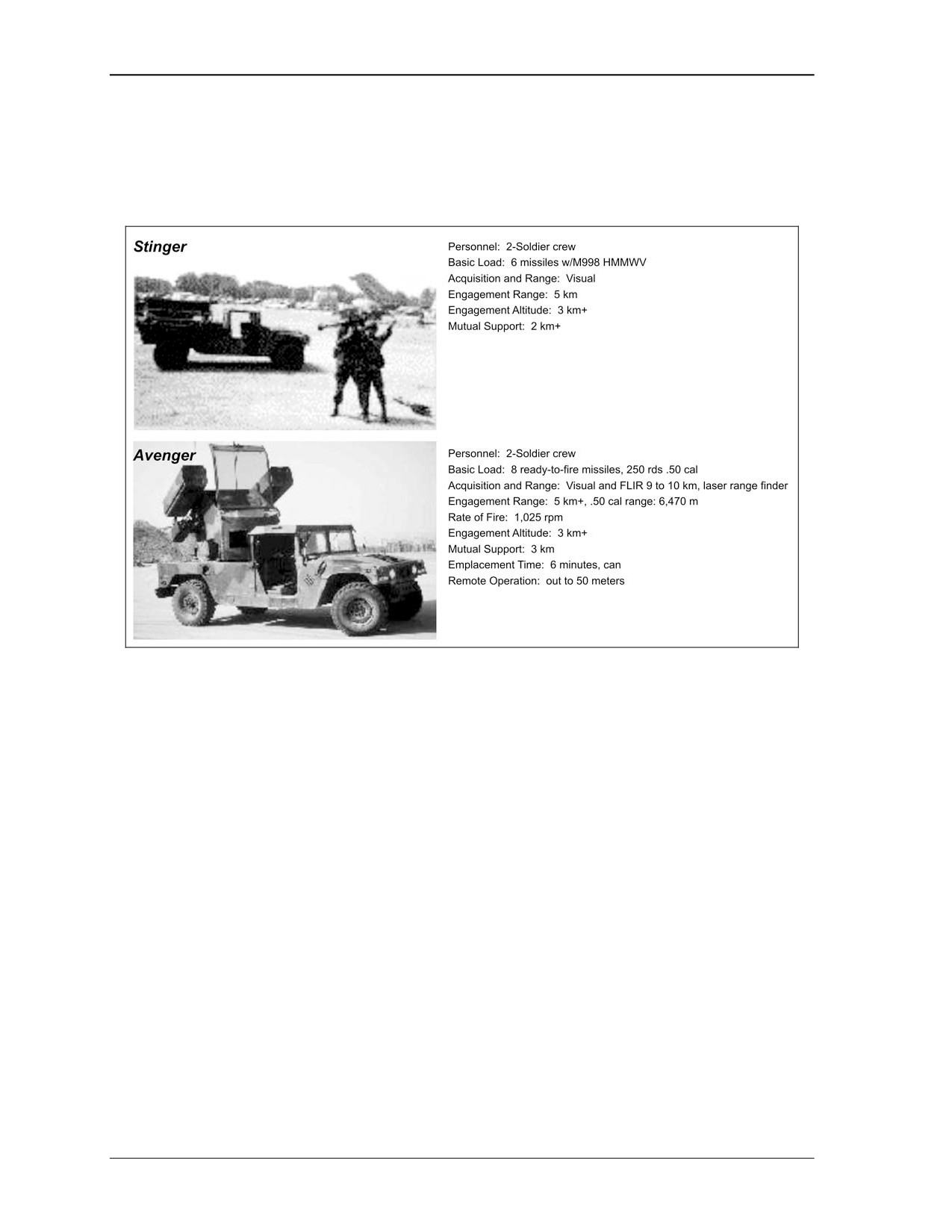
Chapter 10
SYSTEMS, ORGANIZATION, AND CAPABILITIES
10-43. The man-portable Stinger and the vehicle-mounted Stinger
(then called the "Avenger"),
Figure 10-1, might be used in and adjacent to the company AO. A maneuver battalion might be task
organized with an air defense platoon equipped with four Avengers.
Figure 10-1. Stinger, man-portable, mounted on a HMMWV.
EMPLOYMENT
10-44. In offensive situations, man-portable Stingers and Avengers accompany the main attack. They
may maneuver with the battalion's lead companies, orienting on low-altitude air avenues of approach.
When the unit is moving or in a situation that entails short halts, the Stinger gunners can dismount to
provide air defense when the unit reaches the objective or pauses during the attack. In the defense,
man-portable Stinger and the vehicle-mounted Stinger might be used in and adjacent to the company AO.
A maneuver battalion might be task-organized with an air defense platoon equipped with four Avengers.
10-45. The term weapons control status (WCS) describes the relative degree of control in effect for air
defense fires. It applies to all weapons systems. The WCS is coordinated between the airspace-controlling
agency and brigade and disseminated when required. For more information on WCS, see FM 3-21.10.
OTHER SUPPORT
10-46. Other support includes at the least CBRN support, Army aviation support, other attack
helicopters, unmanned aircraft,
10-10
FM 3-21.12
1 July 2008
Fire Support, Mobility, Protection, and Other Support
CHEMICAL, BIOLOGICAL, RADIOLOGICAL, OR NUCLEAR SUPPORT
10-47. CBRN weapons can cause casualties, destroy or disable equipment, restrict the use of terrain, and
disrupt operations. They might be used separately or in combination to supplement conventional weapons.
The company must be prepared to fight on a CBRN-contaminated battlefield. The commander designates
principal CBRN defense trainers and advisors on CBRN defense operations and CBRN equipment
maintenance. These trainers include a CBRN defense officer, a CBRN noncommissioned officer (NCO),
and an enlisted alternate. The commander ensures all personnel in his command can operate and perform
maintenance on all organic CBRN equipment. CBRN assets within the Infantry company are limited. To
survive on a contaminated battlefield, the company must practice the fundamentals of CBRN defense,
avoidance, protection, and decontamination. (For more on CBRN, see FM 3-21.10 or FM 3-11.)
ARMY AVIATION
10-48. Army aviation is an asset available to the BCT and can be requested by the Infantry battalion.
Requests from the Infantry weapons company go through the battalion. These requests are processed and
integrated by the air defense airspace management/brigade aviation element cell at the BCT. Army aviation
can be used for command and control, reconnaissance, medical evacuation (MEDEVAC), movement of
troops and supplies, direct fire support, and as maneuver units. Air assault helicopter operations deliver
assault elements of an Infantry company to locations on or near tactical objectives.
OTHER ATTACK HELICOPTERS
10-49. Other Attack helicopters are employed as integral parts of the joint and combined arms team and
might be provided by US Marine or Navy assets. They are aerial attack systems also suited for situations
calling for a quick response if available.
UNMANNED AIRCRAFT SYSTEMS
10-50. The Weapons company commander should consider support from unmanned aircraft systems
(UAS) as he plans, coordinates, and executes operations. UAS can increase the situational awareness of
commanders through intelligence, surveillance, reconnaissance, and communications relay. They are
capable of locating and recognizing enemy forces that contrast with their surroundings, locating and
confirming the position of friendly forces, and the presence of noncombatant civilians, etc. The RQ-11
Raven is the most common UAS used at the battalion and company level.
10-51. A primarily use of UAS is for surveillance and reconnaissance. UAS can provide surveillance to
the front, flanks, and rear of weapons company units during movement. They can survey planned attack
and support by fire positions prior to their occupation. They can also provide reconnaissance along
high-speed avenues of approach into the battalion or company AO and provide time for the weapons
company to deploy and counter the threat. UAS can also provide reconnaissance along secondary avenues
of approach that may not have coverage by ground units.
Capabilities of UAS
10-52. UAS currently bring numerous capabilities to Army units, providing near real time
reconnaissance, surveillance, and target acquisition. They can be employed on the forward line of friendly
elements, on the flanks, or in rear areas. Employed as a team, UAS and manned systems provide excellent
reconnaissance and attack resolution. Some UAS can be fitted with laser designators to mark targets and
others may be armed. Other capabilities currently provided are:
• Support target acquisition efforts and lethal attacks on enemy reconnaissance and advance
forces.
• Assist in route, area, and zone reconnaissance.
• Locate and help determine enemy force composition, disposition, and activity.
1 July 2008
FM 3-21.12
10-11
Chapter 10
• Maintain contact with enemy forces from initial contact through battle damage assessment.
• Provide target coordinates with enough accuracy to enable an immediate target handover, as
well as first-round fire-for-effect engagements.
• Provide or enhance multispectrum sensor coverage of the AO.
• Provide extended three-dimensional vantage, both in distance and time, at critical decision
points in difficult terrain.
• Perform decoy, demonstration, feint, and deception operations.
• Support mission duration beyond those of manned systems.
• Provide digital connectivity, allowing for rapid product dissemination.
Limitations of UAS
10-53. While UAS are an excellent force multiplier, they have limited effectiveness in locating enemy
forces that are well covered or concealed. Tactical unmanned aircraft (UA), such as Shadow and Raven,
are not well suited for wide area searches. Rather, employing UA as part of an overall collection plan takes
advantage of their capabilities. Other limitations include--
• Vulnerability to enemy fire.
• Weather restrictions (cloud cover, turbulence, and others).
• Must maintain line of sight to ground control stations.
• Limited frequencies for UAS control.
• Air space command and control issues.
• Limited sensor field of view.
• Limited detection capability in highly vegetated areas.
• Unique Class III/V Requirements.
• Assembly Area survivability.
RQ-11 Raven
10-54. The weapons company has the RQ-11 Raven, a small, man-portable, hand-launched, unmanned
aircraft system used for reconnaissance, surveillance, and remote monitoring. The operator can launch and
recover the Raven in minutes from unprepared terrain without special equipment. He can either control it
remotely from the ground control unit, or he can set it up to fly completely autonomous missions using
global positioning system (GPS) waypoint navigation. If the operator selects the "Home" command, the
Raven will immediately return to its launch point.
Capabilities
• Expendability.
• Day and night imagery and operations.
• Low noise signature.
• Portability.
• Interchangeable payloads and components.
• Hand launched auto-landing or manual recovery.
• Auto navigation using military Py code GPS.
• Manual navigation and flight modes.
• Quick assembly (less than three minutes).
• Man-portable or backpack portable.
• Reusable (100 or more flights).
• Climbs to operational altitude in 1 to 2 minutes.
10-12
FM 3-21.12
1 July 2008
Fire Support, Mobility, Protection, and Other Support
Limitations
• More difficult to launch in zero wind conditions. Mounted launch or launch from atop building
or terrain is an option.
• Winds less than 20 knots increase battery use, which decreases system endurance, and can
cause uncommanded altitude deviations.
• Extreme heat and cold reduces endurance and degrades system performance. Overheating can
cause ground control unit failure.
• Night front-looking or side-looking camera only.
• Fragile components.
1 July 2008
FM 3-21.12
10-13
Chapter 11
Sustainment Operations
The role of sustainment support in any military unit is to sustain the force for
continuous combat operations. Within the Infantry battalion, sustainment at the
company level is provided by the forward support company (FSC) from the brigade
support battalion (BSB) and the battalion headquarters and headquarters company
(HHC) under the staff supervision of the battalion executive officer (XO), HHC
commander, S-1, and S-4. At the company level, the company commander has
ultimate responsibility for sustainment. The XO and the first sergeant are the
company's primary sustainment operators; they work closely with the battalion staff
to ensure they receive the required support for the company's assigned operations.
Sustainment operations for the Infantry weapons company mirrors that of the Infantry
rifle company as discussed in FM 3-21.10 with few minor changes. This chapter
briefly discusses the elements of sustainment operations and identifies those aspects
unique to the Infantry weapons company.
Section I. PLANNING CONSIDERATIONS
Infantry company commanders, as well as the battalion S-4, make plans and key decisions concerning
sustainment. The battalion S-4, company XO, company first sergeant, company supply sergeant, platoon
sergeants, and squad leaders implement these plans. Platoon leaders plan and relay support requirements for
mission accomplishment to the company headquarters where it is consolidated and passed on to the battalion.
Unit standing operating procedures (SOP) address planning, implementation, and responsibilities in detail and
standardize as many routine sustainment operations as possible.
OVERVIEW
11-1.
The Infantry company plans, prepares, and executes its portion of the sustainment plan.
Concurrent with other operational planning, the company develops and refines its sustainment plan during
troop-leading procedures. Rehearsals are normally conducted at both battalion and company levels to
ensure a smooth, continuous flow of materiel and services. The company's sustainment responsibilities
follow:
• Determine requirements.
• Report status.
• Request support.
• Receive support.
• Distribute.
11-2.
Army Health System support in the Infantry weapons company is a critical sustainment function.
The battalion medical platoon provides the Army Health System (AHS) support that includes Health
Service Support (HSS) and Force Health Protection (FHP). The battalion medical platoon provides direct
support (DS) support to the Infantry weapons company with a combat medic and habitually positions a
ground ambulance team/crew with the company. Nonmedical personnel performing first-aid procedures
1 July 2008
FM 3-21.12
11-1
Chapter 11
assist the combat medic in his duties. First aid is administered by an individual (self-aid/buddy aid) and
enhanced first aid by the combat lifesaver (CLS).
• Self-aid and buddy aid. Each individual Soldier is trained to be proficient in a variety of
specific first-aid procedures. These procedures include aid for chemical casualties with
particular emphasis on lifesaving tasks. This training enables the Soldier or a buddy to apply
first aid to alleviate a life-threatening situation.
• Combat lifesaver. The CLS is a nonmedical Soldier selected by his unit commander for
additional training beyond basic first-aid procedures. A minimum of one individual per squad,
crew, team, or equivalent-sized unit should be trained. The primary duty of this individual does
not change. The additional duty of the CLS is to provide enhanced first aid for injuries based
on his training before the combat medic arrives. Combat lifesaver training is normally provided
by medical personnel assigned, attached, or in sustainment units. The senior medical person
designated by the commander manages the training program.
RESPONSIBILITIES
11-3.
In sustainment operations, roles differ slightly from other operations.
COMMANDER
11-4.
The commander ensures that his sustainment operations meet the tactical plan. He will--
• Assure sustainment operations sustain his company's fighting potential.
• Identify special requirements for the mission.
• Integrate and synchronize sustainment activities into the tactical plan.
• Provide guidance to the operators.
EXECUTIVE OFFICER
11-5.
The XO coordinates and supervises the company's logistical effort. During planning, he receives
status reports from the platoon leaders, platoon sergeants, and first sergeant. He then reviews the tactical
plan with the company commander to determine company sustainment requirements, and coordinates these
needs with the battalion S-4. During execution, as determined by the company commander, the XO locates
at the second most important place on the battlefield. At times, this is where he can best supervise
sustainment operations. The XO also performs the following functions.
• Determines the location of the company's resupply point based on data developed during
operational planning and the war-gaming process.
• Selects resupply method according to mission, enemy, terrain, troops, time, civilians
(METT-TC) (Tailgate, Service Station, In Position).
• Maintains logistics status (LOGSTAT).
• Receives LOGSTAT from platoons.
• Completes company rollup and forwards to the combat trains command post (CTCP).
• Ensures that the company executes sustainment according to the battalion plan and SOP (along
with the first sergeant).
• Ensures his unit sustainment requirements are met.
FIRST SERGEANT
11-6.
In addition to his tactical responsibilities, the first sergeant is a key player in sustaining the
company. He is also key in the execution of the company's plan and may supervise the company trains
based upon the commander's intent and the factors of METT-TC. He may assist the XO with LOGSTAT
management and in preparing paragraph 4 of the operation order (OPORD). He normally supervises the
11-2
FM 3-21.12
1 July 2008
Sustainment Operations
evacuation of casualties, enemy prisoner of war (EPW), and damaged equipment in addition to supervising
company resupply activities and monitoring company maintenance activities. The first sergeant orients new
replacements and assigns them to squads and platoons in accordance with (IAW) the company commander's
guidance. He assures proper tracking of casualties between battalion, platoon leadership, and the senior
trauma specialist; and oversees the noncommissioned officer
(NCO) chain performing sustainment
functions and tasks IAW the company SOP. The first sergeant may also perform the following functions:
• Conduct sustainment rehearsals at the company level and integration with maneuver rehearsals.
• Perform command and control (C2) over company medic and oversee the evacuation plan from
platoon to company CCP.
• Maintain the company battle roster.
• Maintains personnel status (PERSTAT)
• Receives PERSTAT from the platoons
SUPPLY SERGEANT
11-7.
The supply sergeant is the company representative for resupply to the company and based upon
METT-TC may locate in either the combat trains or battalion field trains. He assists the FSC in assembling
the logistics package (LOGPAC) and moves with the LOGPAC forward to the company. He coordinates
the company's sustainment requirements with the FSC distribution platoon leader and the Infantry battalion
S-4. The supply sergeant may control the casualty evacuation (CASEVAC) vehicle when it is unable to
remain forward with the company. He monitors the tactical situation and adjusts the sustainment plan as
appropriate to meet the tactical plan and the company commander's guidance. He may assist the
commander by establishing caches. He forecasts the company's consumption of food; water; ammunition;
petroleum, oils, and lubricants (POL); and batteries; based on the operation. The supply sergeant also
performs the following sustainment functions.
• Coordinate with the battalion S-4 for resupply of Classes I, III, and V.
• Maintain individual supply and clothing records.
• Requisition Class II resupply as needed.
• Request Class IV and Class VII equipment and supplies.
• Coordinate for maintenance support from the Forward Support Company maintenance section
to include turn in and pick up maintenance documents, routine Class IX supplies, and
recoverable materials.
• Pick up replacement and return to duty personnel and, if necessary, deliver them to the first
sergeant.
• Coordinate for receipt and evacuation of human remains and personal effects.
• Transport, guard, and transfer EPW as required.
• Accompany the LOGPAC to the logistics release point.
• Guide the LOGPAC to the company resupply point.
• Accompany the LOGPAC along with EPW and damaged vehicles (if applicable) back to
the brigade support area (BSA).
• Coordinate with the battalion S-1 section to turn in and pick up mail and personnel action
documents.
• Collect hazardous material and transport it to collection points as part of LOGPAC procedures.
• Maintain and provide supplies for company field sanitation activities.
1 July 2008
FM 3-21.12
11-3
Chapter 11
PLATOON SERGEANT
11-8.
Each PSG in the company performs the following sustainment functions.
• Ensure Soldiers perform proper maintenance on all assigned equipment.
• Compile and submit all personnel and logistics status reports for the platoon as directed or in
accordance with SOP.
• Collect DA Form 2404 (Equipment Inspection and Maintenance Worksheet) or DA Form
5988E (Equipment Inspection and Maintenance Worksheet [EGA]).
• Obtain supplies and equipment (all classes except Class VIII) and mail from the supply
sergeant and ensures proper distribution within the platoon.
COMBAT MEDIC
A combat medic or senior company medic is attached to the weapons company to provide
emergency medical treatment for sick, injured, or wounded company personnel. For a detailed
list of combat medic responsibilities, see Chapter 1 of this manual.
Section II. TRAINS, SUPPLY, AND TRANSPORTATION
The logistical focal point is described as the trains. Sustainment personnel and equipment organic or attached to a
force that provides support such as supply, evacuation, and maintenance services comprise the unit trains.
TRAINS
11-9.
The company trains are the focal point for company sustainment operations. It is the most forward
sustainment element, and provides essential medical treatment and critical resupply support. The size and
composition of the company trains vary depending upon the tactical situation. The trains may consist of
nothing more than preplanned locations on the ground (a control measure such as a checkpoint) during
fast-paced offensive operations, or the trains may contain two to five tactical vehicles during resupply
operations. The company trains are established to conduct evacuation (of wounded in action (WIA),
weapons, and equipment) and resupply as required. The company trains are located in a covered and
concealed position, close enough to the company to provide responsive support, but out of enemy direct
fire. The first sergeant or XO will position the trains and supervise sustainment operations. Support to the
company trains comes from the battalion’s supporting FSC. In a non-contiguous area of operations (AO)
the BSA, combat trains and company trains may be located within a forward operating base (FOB) for
added security. The combat trains may be located either in a FOB with the BSA or with the battalion itself.
Figure 11-1 shows a typical trains layout.
11-4
FM 3-21.12
1 July 2008
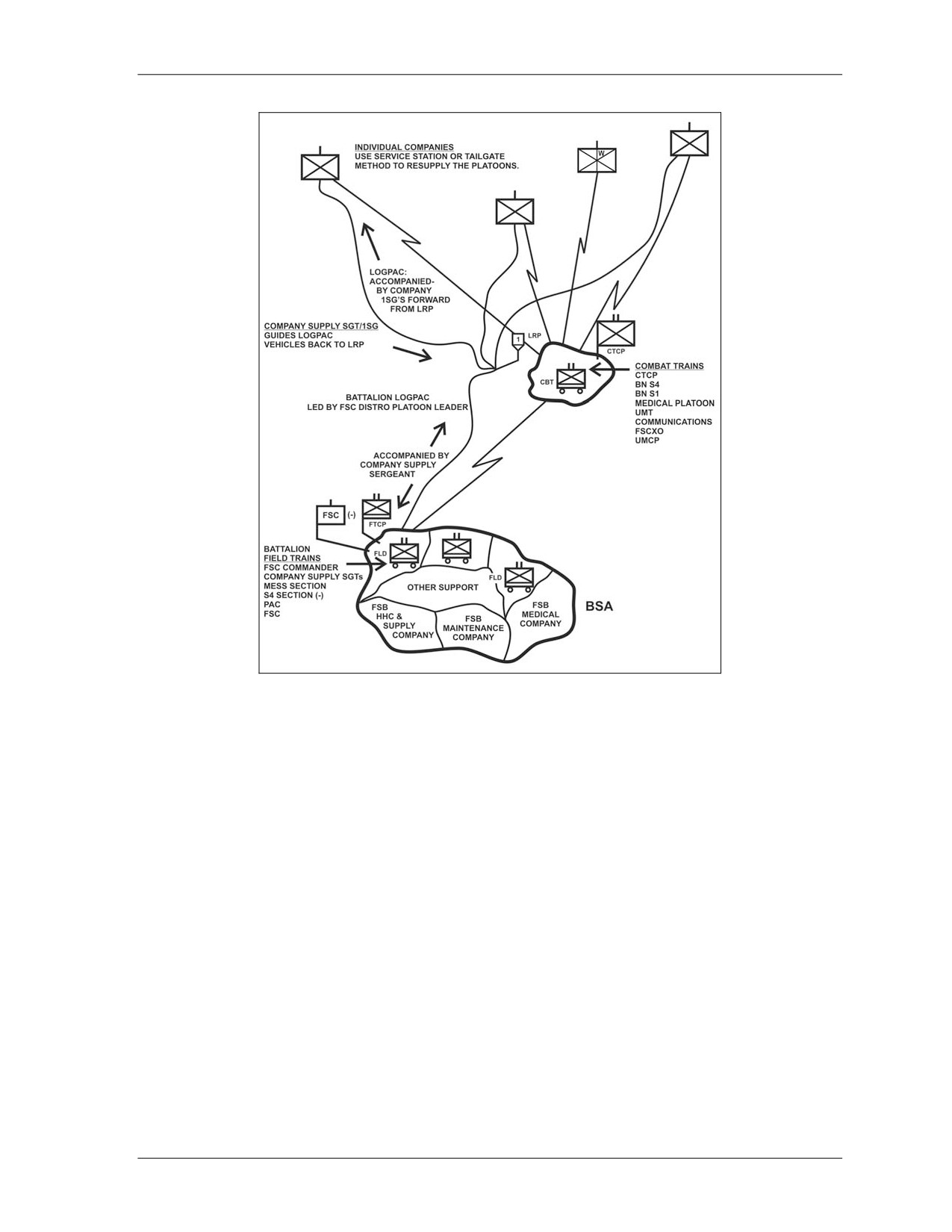
Sustainment Operations
Figure 11-1. Trains layout.
SECURITY
11-10. Security of sustainment elements is critical to the success of the Infantry company and battalion
missions. For this reason, the company trains must develop plans for continuous security operations.
Generally, company trains are located between 500 and 1,000 meters away from the company’s combat
operations. By placing at least one terrain feature between it and the enemy, the company trains will be out
of engagement by the enemy’s direct fire weapons. This location gives the company virtually immediate
access to essential sustainment functions while allowing the trains to remain in a covered and concealed
position behind the company combat elements. Where feasible, they may plan and execute a perimeter
defense. The trains, however, may lack the personnel to conduct a major security effort. In such situations,
they must plan and implement passive security measures to provide protection from enemy forces.
FORWARD SUPPORT COMPANY
11-11. The FSC is a multifunctional sustainment unit organized to provide habitual and direct support to
the Infantry battalion, Figure 11-2, and subsequently to the Infantry companies and weapons company. The
FSC directly supports the Infantry battalion and a close SOP supported relationship exists between the
units. Both the BSB and Infantry battalion commanders ensure the FSC is integrated tightly into the
Infantry battalion’s operations in garrison, training, and in combat. In the modular force, the FSC is
1 July 2008
FM 3-21.12
11-5
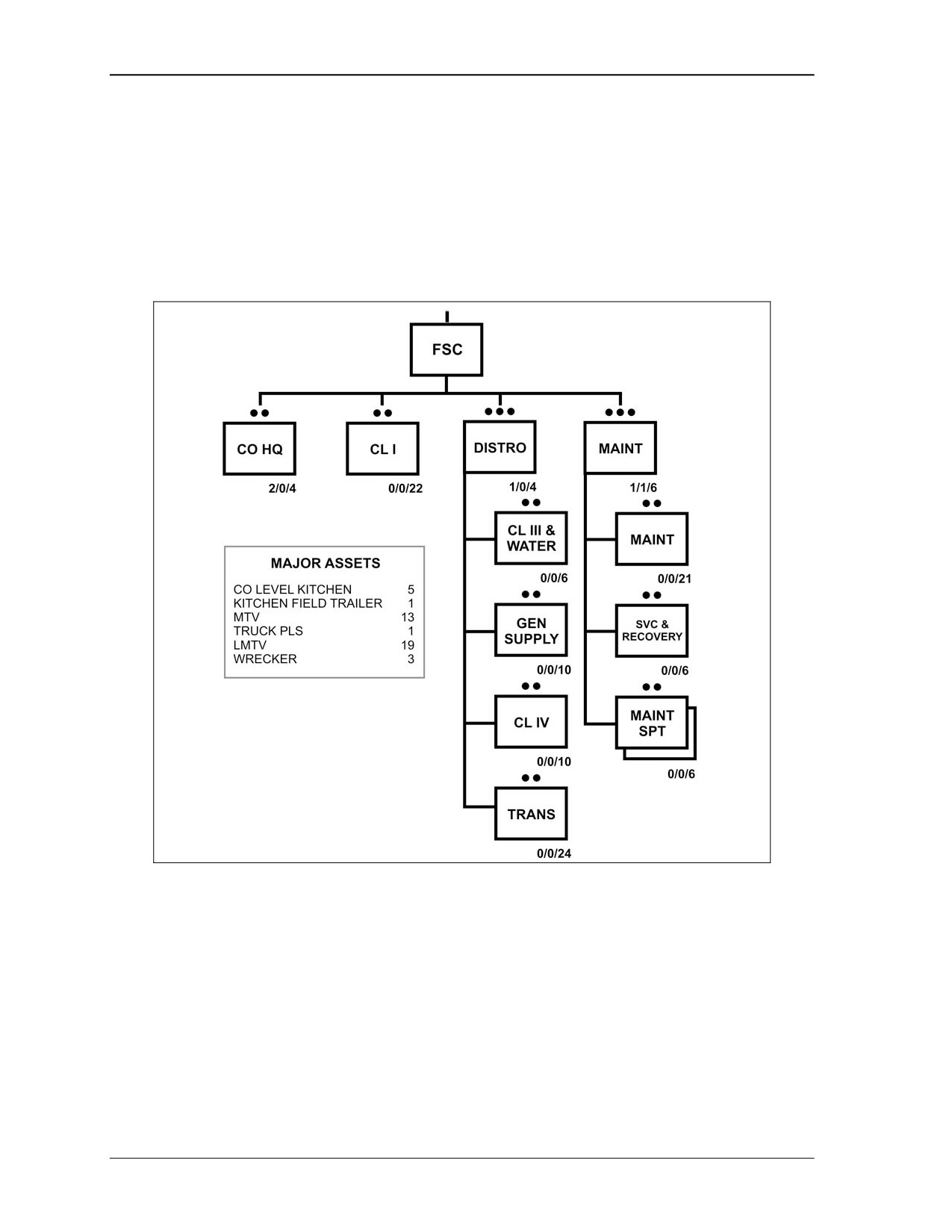
Chapter 11
responsible for conducting the majority of sustainment operations that were conducted previously by the
Infantry battalion HHC. These responsibilities include—
• Field level vehicle and equipment maintenance and recovery.
• Resupply operations for all classes of supply (except medical) and water.
• Transportation for all classes of supply.
• Supplemental transportation of personnel with no organic wheel movement capability. The
FSC can move one Infantry company at any one time.
• LOGPAC operations.
Figure 11-2. Forward support company.
11-12. The FSC commander is the senior logistics commander at battalion level. He is not the planner;
however, he assists the battalion S-1 and S-4 with the battalion’s logistics planning. The FSC commander
is responsible for executing the logistics plan IAW the battalion commander’s guidance as developed by
the battalion S-1 and S-4. The FSC commander responds directly to the guidance and directives given by
the Infantry battalion XO who serves as the battalion logistics integrator and assists the battalion S-1 and
S-4 in logistics synchronization and troubleshooting. Many functions described in this section are a
coordinated effort between the FSC commander and the battalion S-1 and S-4. The FSC commander
provides information, input, or feedback to the battalion S-1 and S-4 for their use in planning and
coordination. He also provides the battalion commander a logistics common operational picture. The FSC
regularly interfaces with the BSB in order to provide logistics support to the battalion. He ensures requests
are filled correctly by the support operations officer and the distribution company in the BSB.
11-6
FM 3-21.12
1 July 2008
Sustainment Operations
11-13. The FSC XO is the principle assistant to the FSC company commander. As second in command,
he must understand both operations that provide support to the Infantry battalion, and the other functions of
the FSC. He often serves as the FSC liaison officer at the CTCP.
11-14. The first sergeant is the commander’s primary logistics and tactical advisor and the company’s
primary internal logistics operator. He often assists in the operation of the battalion field trains command
post and FSC headquarters (HQ).
11-15. The distribution platoon provides supply and transportation support to the Infantry battalion. The
distribution platoon provides Class I (to include food service support), II, III (P, B), IV, V, VI, and VII, to
the battalion. The distribution section has the ability to conduct simultaneous Class III and V retail support
to the maneuver companies, the Infantry battalion HHC, and the FSC itself. The distribution platoon leader
of the FSC takes over the responsibilities previously held by the support platoon leader in the Infantry
battalion. The key activity of the distribution platoon is the conduct of LOGPAC operations to the
battalion, and acquiring replenishment sustainment stocks from sustainment brigade units through combat
replenishment operations and sustainment replenishment operations.
11-16. The FSC’s maintenance platoon provides field maintenance to itself and the Infantry battalion.
The platoon consists of a headquarters section and maintenance control section, recovery and service
section, and two field maintenance support teams. The maintenance platoon provides C2 and reinforcing
maintenance to the field maintenance support teams. The field maintenance support teams provide field
maintenance and battle damage assessment and repair (BDAR) primarily to the weapons company and the
Infantry battalion HHC. As the battalion commander task organizes the force, all or part of a field
maintenance support team goes with the company teams in order to maintain habitual support. The
maintenance platoon maintains a limited quantity of combat spares (prescribed load list (PLL), shop, and
bench stock) in the maintenance control section. The maintenance platoon’s supply section can provide
Class IX support (combat spares) to each maneuver company and the HHC. It maintains combat spares
(PLL, shop, and bench stock) for the unit it supports and also provides exchange of reparable items.
BATTALION TRAINS
11-17. The weapons company receives most of its’ support from the FSC located in the battalion trains.
The battalion uses consolidated unit trains only when occupying a battalion assembly area or when the
terrain restricts movement so that the battalion must depend on aerial resupply and evacuation for support.
In this case, the unit trains and all sustainment assets are placed in one central location. However, the
Infantry battalion normally operates in echeloned trains where the trains are split into multiple locations.
Echeloned trains for the battalion normally consist of two types: the battalion combat trains and the field
trains.
Combat Trains
11-18. Generally, combat trains are located between 1 and 4 kilometers away from the company’s
combat operations. This allows the combat trains to be outside the range of enemy mortars. The combat
trains should not be considered a permanent or stationary support area. The battalion combat trains usually
consist of the S-1, the HHC’s medical platoon, the unit ministry team, communications personnel, forward
elements of the FSC, and emergency resupply trucks (e.g. CL III and V). They are supervised by the
CTCP, which is headed by the battalion S-4. The trains are positioned based upon the factors of
METT-TC. The battalion’s combat trains control all resupply operations for the Infantry battalion. At
times, the battalion may move company supply sections forward, and an Infantry company may store its
sustainment load with its company supply section in the combat trains. The company sustainment load
normally consists of rucksacks, duffel bags containing extra clothing and personal items, chemical
protective over garments, and sleeping bags. As the alternate main command post, and in the event that
they must assume responsibilities as the main command post, the combat trains command post must
maintain situational understanding (SU) of current and future battalion operations.
1 July 2008
FM 3-21.12
11-7
Chapter 11
Field Trains
11-19. The fields trains are positioned based on METT-TC considerations and often will be located in the
BSA. The field trains normally consist of the FSC, Infantry battalion PAC, personnel transitioning to and
from the battalion and the HHC, and Infantry company and weapons company supply sections. Usually,
the Infantry and weapons companies will store its sustainment loads with its company supply section in the
field trains. The units in the field trains operate as the primary direct coordination element between the
Infantry companies and the BSA. The FSC fills orders with on-hand stocked items. Requests for those
items not on-hand in the FSC are forwarded.
SUPPLY
11-20. The weapons company normally deploys with 72 hours of supplies. The commander uses the unit
basic load as the frame of reference for determining 72 hours worth of supplies. The company commander
considers his situation to decide on the best means of resupplying his company. Resupply requests are
classified as either routine or emergency. Cues and procedures for each method are specified in the
company SOP and are rehearsed during company training exercises. The resupply method is typically
either tailgate or service station depending on METT-TC. Infantry companies are supported by the Infantry
battalion and its’ direct support FSC, which in turn is supported by the BSB. Supplies are divided into 10
major categories, which are referred to as classes. For a complete description of each type of supply and
how they relate to the company see FM 3-21.10. The 10 classes are:
Class I - Subsistence Items and Water
Class II - Consumable supplies
Class III - Petroleum, oils and lubricants
Class IV - Construction and Barrier Materials
Class V - Ammunition
Class VI - Personal Demand Items
Class VII - Major End Items
Class VIII - Medical Materiel
Class IX - Repair Parts and Components
Class X - Material to Support Civil Programs
ROUTINE RESUPPLY
11-21. Routine resupply operations cover items in Classes I, III, V, and IX, as well as mail and any other
items requested by the company. Resupply operations normally occur once a day. Whenever possible,
routine resupply should be conducted daily, ideally during periods of limited visibility. Resupply
operations mimic those of the Infantry rifle company. Detailed descriptions of logistic package operations
(LOGPAC), and resupply methods and procedures can be found in FM 3-21.10. The three methods of
resupply are:
• Service Station resupply
• Tailgate resupply
• In-position resupply
EMERGENCY RESUPPLY
11-22. Occasionally (normally during combat operations), the company may have such an urgent need
for resupply that it cannot wait for a routine LOGPAC. Emergency resupply may involve Classes III, V,
and VIII, as well as chemical, biological, radiological or nuclear (CBRN) supplies and, on rare occasions,
Class I. Emergency resupply can be conducted using either the service station or tailgate method, but more
often the in-position method. The fastest appropriate means is normally used although procedures might
have to be adjusted when the company is in contact with the enemy. In the service station method,
11-8
FM 3-21.12
1 July 2008
Sustainment Operations
individual squads may pull back during a lull in combat to conduct resupply and then return to the fight.
With tailgate resupply, the company brings limited supplies forward to the closest concealed position
behind each element.
PRESTOCK OPERATIONS
11-23. Prestock resupply, which includes pre-positioning and caching, is most often required in defensive
operations. Normally only Class IV and V items are pre-positioned. Prestock operations must be carefully
planned and executed at every level. All leaders must know the exact locations of prestock sites, which
they verify during reconnaissance or rehearsals. The company must take steps to ensure survivability of the
prestock supplies. These measures include digging in prestock positions and selecting covered and
concealed positions. The company commander must also have a plan to remove or destroy pre-positioned
supplies to prevent the enemy from capturing them.
Caches
11-24. A cache is a pre-positioned and concealed supply point. It can be used in any operation. Caches
are an excellent tool for reducing the Soldier's load and can be set up for a specific mission or as a
contingency measure. However, concealing the bulky and sensitive supplies, such as fuel and missiles, for
weapons company vehicles and heavy weapons systems is difficult to do. Leaders must weight the risks to
determine if a cache is warranted. A security risk always exists when returning to a cache. An above
ground cache is easier to get to but is more likely to be discovered by the enemy, civilians, or animals.
SECURITY
11-25. While these supply techniques are used in both offensive and defensive operations, the transfer of
supplies to the company is usually conducted from a defensive posture. As such, the security
considerations for a resupply operation are like those for a perimeter defense.
SUPPLY CONSIDERATIONS
11-26. The techniques just described are the normal methods for resupply within the company. However,
a basic understanding of nonstandard techniques, different modes of delivery, and specific supply issues is
also required to successfully execute the sustainment function (FM 3-21.10). These techniques include--
• Foraging and scavenging.
• Aerial resupply.
• Cross-leveling.
• Backhauling.
• Managing consumption of water.
TRANSPORTATION
11-27. Movement of supplies, equipment, and personnel with the limited vehicle assets available requires
careful planning and execution. The weapons company has limited organic transportation for resupply
operations. The 2 ½ ton cargo truck provided for company resupply will most often be used to carry class I
and small amounts of Class III, V, IX or other class supplies. Vehicle assets from battalion or the forward
supply company are provided to supplement company assets for resupply operations.
11-28. When extra vehicles are provided to the company, they are employed to capitalize on their
capability to execute the mission requirement, and must be returned for follow-on company or parent-unit
missions. Transportation assets are scarce, often resulting in trade-offs. For example, upload increased
quantities of ammunition and less water, or carry unit rucksacks and be unavailable for resupply. The
company commander must ensure that the asset is being employed to accomplish the most important
1 July 2008
FM 3-21.12
11-9
Chapter 11
mission. Time is critical and the company must reduce on-station time so that all company requirements
can be met. Since most vehicles do not have radios, leaders must ensure that drivers know where they are
going and how to get there. Land navigation training, marked routes, and strip maps referenced to
landmarks are all ways to keep drivers from getting lost.
11-29. Because of the limited ground transportation, company personnel must know how to conduct
aerial resupply (FM 90-4). An understanding of pickup zones (PZ)/landing zones (LZ) selection, sling
loading, bundle drops, and allowable cargo loads might be critical to company sustainment.
Section III. MAINTENANCE
The maintenance of weapons and equipment is continuous. Every Soldier must know how to maintain his
weapon and equipment in accordance with the related technical manual. The commander, XO, and first
sergeant must understand maintenance for every piece of equipment in the company.
UNIT MAINTENANCE
11-30. Proper maintenance is the key to keeping vehicles, equipment, and other materials in serviceable
condition. This continuous process starts when the operator of each piece of equipment or vehicle takes
preventive measures and continues through repair and recovery of the equipment. Proper maintenance also
includes inspecting, testing, servicing, repairing, requisitioning, recovering, and evacuating equipment.
MAINTENANCE STRUCTURE
11-31. The Infantry brigade combat team (IBCT) uses the two level maintenance structure for repair and
recovery of equipment. The two levels are the “Field Level Maintenance” designated as “On System
Maintenance” and “Sustainment Level Maintenance” designated as “Off System Maintenance.” Field level
maintenance is focused at the IBCT level with one FSC in support of each battalion. Organic to the FSC is
a maintenance platoon designated as a combat repair team (CRT) that is responsible for repair and recovery
of battalion equipment.
VEHICLE MAINTENANCE
11-32. Infantry weapons companies are uniquely different than rifle companies in that they are highly
mobile units. All weapons company personnel operate from some type of vehicle with the majority being
high mobility multipurpose wheeled vehicles (HMMWV). It is imperative that proper vehicle maintenance
is maintained in order to keep the unit mobile and ready to perform its’ mission. Operators should carefully
follow unit standing operating procedures for maintaining vehicles. Limited repair may be accomplished
by the operator depending on the extent of the damage or malfunction. If necessary, send the vehicle
rearward for repair. A recovery team from the FSC maintenance platoon performs vehicle recovery. The
weapons company does not have a company level maintenance area or personnel outside operator
maintenance. Repair of evacuated vehicles will be accomplished by the FSC CRT either at the battalion
unit maintenance collection point (UMCP) located near the battalion combat trains, or at the battalion field
trains located in the brigade support area.
11-33. Vehicle maintenance is critical to mission accomplishment. Poorly maintained vehicles will fail.
As they do, the operating tempo for functional vehicles increases. Potential adverse effects can result in:
•
Reduced weapon carrying capacity and therefore reduced combat power.
•
Increased probability of platoons and sections having vehicle assigned from other units during
missions.
•
Increased maintenance problems for overused vehicles.
11-10
FM 3-21.12
1 July 2008
Sustainment Operations
Commanders are responsible for operator and crew level maintenance on vehicles and equipment. The FSC’s
organic maintenance platoon and its two field maintenance support teams also provide field level maintenance
for vehicles and equipment. Normally the field maintenance support teams are tasked to provide maintenance
support to the Infantry battalion headquarters and weapons companies. If the Infantry battalion task organizes,
the field maintenance support teams provide prioritized support as specified by the battalion. The BSB’s field
maintenance company provides very limited backup support to FSCs, since it primarily supports to
non-maneuver units (brigade combat team (BCT) HQ, BSB, and brigade special troops battalion (BSTB)). It
also serves as the maintenance point for low-density equipment
(e.g., tube-launched, optically-tracked,
wire-guided (TOW) missile systems). When required, the BSB dispatches field maintenance teams to perform
on-site diagnoses, make minor adjustments, and conduct repairs. Equipment that cannot be repaired by the BSB
usually is evacuated to sustainment brigade units.
WEAPONS AND OTHER EQUIPMENT
11-34. Maintenance on other equipment such as weapons and communications equipment has limited
field level maintenance available. Maintenance beyond the skill level of assigned personnel will need
evacuation to the FSC or the BSB for repair.
UNIT MAINTENANCE COLLECTION POINT
11-35. The UMCP is normally located near the battalion combat trains or collocated with the combat
trains for security, and should be on a main axis or supply route. The UMCP is manned by elements of the
FSC. The UMCP provides vehicle and equipment evacuation, and maintenance support to the field
maintenance support teams. Field maintenance support teams evacuate vehicles and equipment to the
UMCP that cannot be repaired within 2 hours. Normally, vehicles or equipment evacuated to the UMCP
that cannot be towed or repaired within 4-6 hours, are further evacuated to the field trains, BSB, or
higher-level support unit.
11-36. UMCP does not have to be located in the battalion combat trains; however, if not in the same
location, the UMCP is normally in the general vicinity. The advantages to collocating the UMCP at the
combat trains is for increased security, and coordination of class IX resupply. The trains must be mobile
enough to support frequent changes in location, time and terrain permitting, under the following
conditions when—
•
Heavy use or traffic in the area may cause detection.
•
Area becomes worn by heavy use such as in wet and muddy conditions.
•
Security is compromised.
MAINTENANCE CONSIDERATIONS
11-37. The maintenance of weapons and equipment is continuous. Every Soldier must know how to
maintain his weapon and equipment IAW the related technical manual. Proper operator level maintenance
is key to keeping vehicles, equipment, and other materials in serviceable condition. It is a continuous
process that starts with preventive measures taken by each operator of each piece of equipment or vehicle
and continues through repair and recovery of the equipment. It includes the functions of inspecting, testing,
servicing, repairing, requisitioning, recovering, and evacuating equipment. See FM
4-30.3 for more
information on maintenance operations and procedures.
11-38. Maintenance functions begin with preventive maintenance checks and services, a daily
responsibility for each piece of equipment to include inspection and completion of maintenance forms
when required. The DA Form 5988-E is the primary means through which the company obtains
maintenance support or repair parts. The forms follow a path from operator/crew level to the BSA and
back. The company XO or first sergeant supervises the "flow" of these critical maintenance documents and
parts based on the unit’s SOP. These instructions must be integrated into the SOPs for patrol bases,
assembly areas, defenses, and reorganization to ensure that maintenance is done without jeopardizing unit
security.
1 July 2008
FM 3-21.12
11-11
Chapter 11
11-39. Inoperative equipment is fixed as far forward as possible. When a piece of equipment is damaged,
it should be inspected to see if it could be repaired on the spot. Company armorers keep a small-arms repair
kit in the company vehicle. If equipment cannot be repaired forward, it is evacuated immediately to the
UMCP and returned with a LOGPAC. Even if the item cannot be evacuated at once, the sustainment
system is alerted to prepare for repair or replacement. If a replacement is available (from an evacuated
Soldier or inoperative equipment), it is sent forward. If not, the leader must work around it by prioritizing
the use of remaining equipment.
11-40. In addition to operator maintenance, selected Soldiers are trained to perform limited maintenance
on damaged weapons and BDAR. (see FM 4-30.31) The purpose of BDAR is to return disabled combat
equipment to the tactical commander as quickly as possible. It is characterized by rapid damage assessment
and repair, and the bypassing or the temporary fixing of components to support a combat mission or enable
self-recovery. The CTCP implements the commander’s guidance on whether or not to use BDAR in lieu of
normal maintenance procedures. Such enabling repairs are usually temporary. At the completion of
immediate combat operations, mechanics from the FSC will make repairs that will return the equipment to
fully mission-capable status. Since it may not be possible to train BDAR techniques in peacetime using
actual equipment, the best substitute is to train system-oriented crews and mechanics to understand the
principles associated with weapon systems. BDAR actions include--
•
Using shortcuts to install or remove parts.
•
Modifying and installing components designed for other vehicles or equipment.
•
Using parts serving a noncritical function on a like vehicle.
•
Using substitute fuels, fluids, or other POL.
•
Using readily available materials to execute a temporary repair.
VEHICLE RECOVERY
11-41. Many recovery operations consist of self-recovery methods when the vehicle becomes stuck,
mechanical disabled, or disabled due to enemy action. Establish security before the vehicle is recovered.
Vehicle recovery is easiest when the tires still have traction and when crewmembers can help the vehicle
move through the original tire tracks. When the vehicle is stuck in snow, sand, or mud, the crew can lower
tire pressure to increase traction. Using a second vehicle to help winch or pull a stuck vehicle is normally
the quickest recovery method. The company should always carry tow straps or chains. They should have
hooks or clevises attached to both ends for anchoring to the vehicles. If possible, the company carries at
least one tow bar for each vehicle section to assist in long-range recovery or to tow a vehicle at high speed.
When a vehicle is stuck in mud or sand, the unit uses pioneer tools to emplace dry or solid matter under the
tires for traction. Sandbags or other materials can be dug into and under the wheels to assist traction.
Vehicles should carry empty sandbags for this purpose. When using the vehicle winch, crews should
follow these basic dos and don’ts.
• Do--
-- Use the stuck vehicle's wheel power to help the winch.
-- Carefully prepare the winching operation.
-- Position personnel where they will not be injured should the cable snap or unhook.
-- Ensure the anchor points are solid.
-- Use artificial surfaces for traction when the vehicle is stuck in water or soft sand.
• Do not--
-- Overtake the cable.
-- Exceed the maximum angle of pull.
11-42. The commander should make contingency plans for vehicles that cannot be repaired or recovered.
The company will make every attempt to recover the vehicle and return it where it can be repaired, if
needed. However, if the company cannot recover the vehicle, then they may have to destroy it in place to
prevent the enemy from capturing it.
11-12
FM 3-21.12
1 July 2008
Sustainment Operations
DESTRUCTION
11-43. When a vehicle or piece of equipment cannot be recovered or is damaged beyond repair, the
platoon reports the situation to the company commander. The commander gives permission for destruction
of the materiel if that is the only way to prevent enemy capture. Operators remove all salvageable
equipment and parts and take all classified materials or paperwork that could be of intelligence value to the
enemy. The platoon then destroys the vehicle or equipment IAW the company SOP.
Section IV. ARMY HEALTH SYSTEM SUPPORT
Effective timely medical care is an essential factor in sustaining the company's combat power during
continuous operations. The company commander must ensure that the company's leaders and its medical
personnel are aware of the potential health threats and implements field sanitation and preventive medicine
measures to keep Soldiers healthy. They must also be prepared to care for wounded personnel or non-battle
injuries through self-aid, buddy-aid, enhanced first-aid, CLS or emergency medical treatment and preparing
casualties for evacuation. AHS provides for both the conservation of Soldier’s health through FHP, and for
treating wounded, sick or injured Soldiers through HSS.
FORCE HEALTH PROTECTION
11-44. FHP covers those measures to promote, improve, or conserve the mental or physical well-being of
Soldiers. These measures help enable the prevention of injuries and illnesses as well as assisting in
protecting Soldiers from health hazards and helping to ensure Soldiers are healthy, fit and ready for
combat.
PREVENTIVE MEDICINE
11-45. History continues to show that more Soldiers are lost in combat due to illness caused by disease
and nonbattle injury (DNBI) than to combat wounds. Therefore, maintaining the health and fighting fitness
of Soldiers is a vital responsibility of all leaders. Commanders reduce the health threat by emphasizing
preventive measures. All leaders must be active participants in the areas of hygiene, sanitation, counseling,
and in the treatment of stress and combat and operational stress reaction (COSR). The IBCT preventive
medicine (PVNTMED) functional assets include—
• Preventive medicine.
• Combat and operational stress control.
• Preventive dentistry and good oral hygiene.
11-46. Rules of hygiene should be established in the tactical standing operating procedure (TSOP) and
observed daily to prevent the spread of disease. Immunizations must be current. Soldiers should wash and
change undergarments daily. Proper clothing and inspections can assist in the prevention of cold and hot
weather injuries. Comprehensive field sanitation will prevent the spread of debilitating diseases. Use only
approved or tested water sources. Utensils used for eating must be properly cleaned before reuse. In static
situations, Soldiers use slit trenches or latrines; at other times they use cat holes. All must be covered after
use to prevent the spread of disease.
11-47. Rest is extremely important and the effects of sleep degradation are disastrous to unit missions
and personnel. Sleep plans must be practiced and established in the TSOP. When possible, Soldiers should
sleep outside vehicles to allow them to fully stretch out and get the full benefit of at least four hours of
continuous sleep.
11-48. The combat operational environment is full of risks associated with vehicles, weapons, stress, and
fatigue that can prove dangerous in matters unrelated to combat. The TSOP incorporates safety concerns in
establishing procedures for assembly areas and other locations of troop concentrations. Equipment and
1 July 2008
FM 3-21.12
11-13