FM 3-21.12 The Infantry Weapons Company (July 2008) - page 3
Chapter 5
use of CAS, indirect fires, and direct fires. Besides causing casualties, the effective use of combat outposts
occupied by weapons company units can confuse the enemy as to the location of the main defensive
positions and make him deploy prematurely and thus reveal his scheme of maneuver. Weapons company
units can further degrade the enemy threat by destroying priority targets such as C2 and recovery vehicles.
The combination of long-range indirect and direct fires and other forces such as dismounted Infantry stay
behind forces can be very effective. Weapons company units can also rapidly displace to reinforce
threatened areas and to affect a passage of lines through the forward defensive units. Once the passage of
lines is completed, these units will move to their previously assigned positions. The weapons company
units do not want to become decisively engaged while in the security zone. The battalion commander has
to weigh the advantages of adding depth to his engagement areas with the possibility of loosing all or some
of his long-range mobile combat power.
5-100. While the factors of METT-TC determine the size, location, and number of combat outposts
established by a unit, a combat outpost must have sufficient resources to accomplish its designated
missions, but not so much as to seriously deplete the strength of the main body. It is usually located far
enough in front of the protected force to preclude enemy ground reconnaissance elements from observing
the actions of the protected force.
RESERVE.
5-101. The commander may decide to use his weapons units as his reserve, specifically when there is
more than one mobility corridor the enemy is likely to use, negating the use of one unit battle position.
When operating as the reserve, the weapons unit may perform a variety of missions to include these
counterattack missions: Block a penetration from an attack-by-fire position. Occupy a battle position.
Reinforce another unit's position. Destroy enemy mobility and protection or sustainment forces. The
reserve is normally positioned in an assembly area to wait for orders to execute one of several preplanned
contingency courses of action. The weapons company commander conducts rehearsals of all his
contingency missions. During security operations, he receives the priority of the potential missions to
ensure he can rehearse them with his subordinate leaders. Another method for the company is to have the
company XO, with the platoon sergeants, rehearse the potential missions while the company is conducting
the security operation. Full-up rehearsals may not always be possible.
5-102. The factors of METT-TC determine the amount of preparation completed for each contingency
mission assigned. The unit keeps the direct fire plan as simple as possible in each engagement area to
reduce confusion.
5-103. Weapons units may receive the mission to be prepared for a combination of the above roles. The
battalion clarifies the priority of each contingency to focus their preparation. The execution of all of these
missions may occur during limited visibility. IR markers are used to mark vehicle positions for rapid
occupation. Any unit TRPs emplaced are set up for limited visibility before darkness (for example, heat the
TRPs or use IR source markers as TRPs).
ENGAGEMENT AREA DEVELOPMENT
5-104. The engagement area is where the company commander intends to destroy an enemy force using
the massed fires of all available weapons. The success of any engagement depends on how effectively he
can integrate the obstacle plan, the indirect fire plan, the direct fire plan, and the terrain within the
engagement area to achieve the unit’s tactical purpose. Beginning with an analysis of METT-TC factors,
the development process covers these steps:
• Identify all likely enemy avenues of approach.
• Determine likely enemy schemes of maneuver.
• Determine where to kill the enemy.
• Emplace weapons systems.
• Plan and integrate obstacles.
• Plan and integrate indirect fires.
5-24
FM 3-21.12
1 July 2008
Defensive Operations
• Rehearse the execution of operations in the engagement area.
5-105. Figures 5-5 through 5-10 are simplified examples of an engagement area development and do not
necessarily show the requisite detailed requirements needed for a complete plan.
IDENTIFY LIKELY ENEMY AVENUES OF APPROACH.
5-106. The following procedures and considerations, apply in identifying the enemy’s likely avenues of
approach.
• Conduct an initial reconnaissance. If possible, do this from the enemy’s perspective along each
avenue of approach into the AO or engagement area.
• Identify key and decisive terrain. This includes locations that afford positions of advantage over
the enemy as well as natural obstacles and choke points that restrict forward and lateral
movement.
• Determine which avenues will provide cover and concealment for the enemy while allowing
him to maintain his tempo.
• Evaluate lateral routes adjoining each avenue of approach.
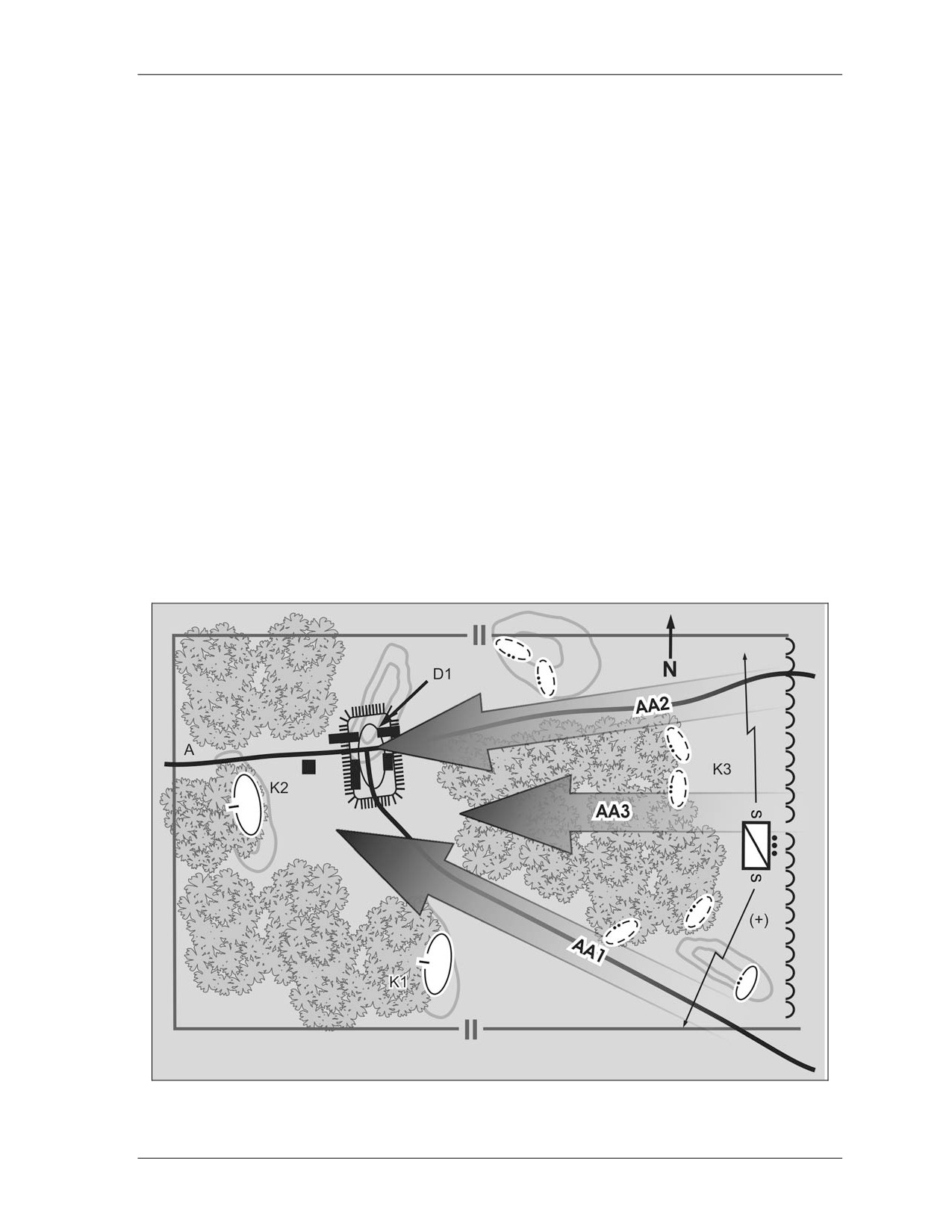
5-107. In the example in Figure 5-5, avenues of approach 1 and 2 provide high-speed avenues of
approach into the AO but they both narrow at the town and to the west. Avenue of approach 3 provides a
concealed dismounted approach route to just east of the town. The following areas are decisive (D) and key
(K) terrain features:
• D1: Blocks the two high-speed avenues of approach and is a choke point for all westward
movement in the AO.
• K1: Covers avenue of approach 1 (AA1) and the southern part of the AO.
• K2: Reinforces D1 and is a choke point for further western movement into the AO.
• K3: Provides observation and long-range fires to the east.
Figure 5-5. Likely enemy avenues of approach.
1 July 2008
FM 3-21.12
5-25
Chapter 5
DETERMINE THE ENEMY SCHEME OF MANEUVER.
5-108. The company commander can use the following procedures and considerations in determining the
enemy’s scheme of maneuver. Much of this information comes from the S2 and the operation plan
(OPLAN)/FRAGO.
• Determine how the enemy will structure the attack. In what formation will he attack? How will
he sequence his forces?
• Determine how the enemy will use his reconnaissance assets. Will he attempt to infiltrate
friendly positions?
• Determine where and when the enemy will change formations and establish support-by-fire
positions.
• Determine where, when, and how the enemy will conduct his assault and breaching operations.
• Determine where and when the enemy will commit follow-on forces.
• Determine the enemy’s expected rates of movement.
• Assess the effects of the enemy’s combat multipliers.
• Determine what reactions the enemy is likely to have in response to projected friendly actions.
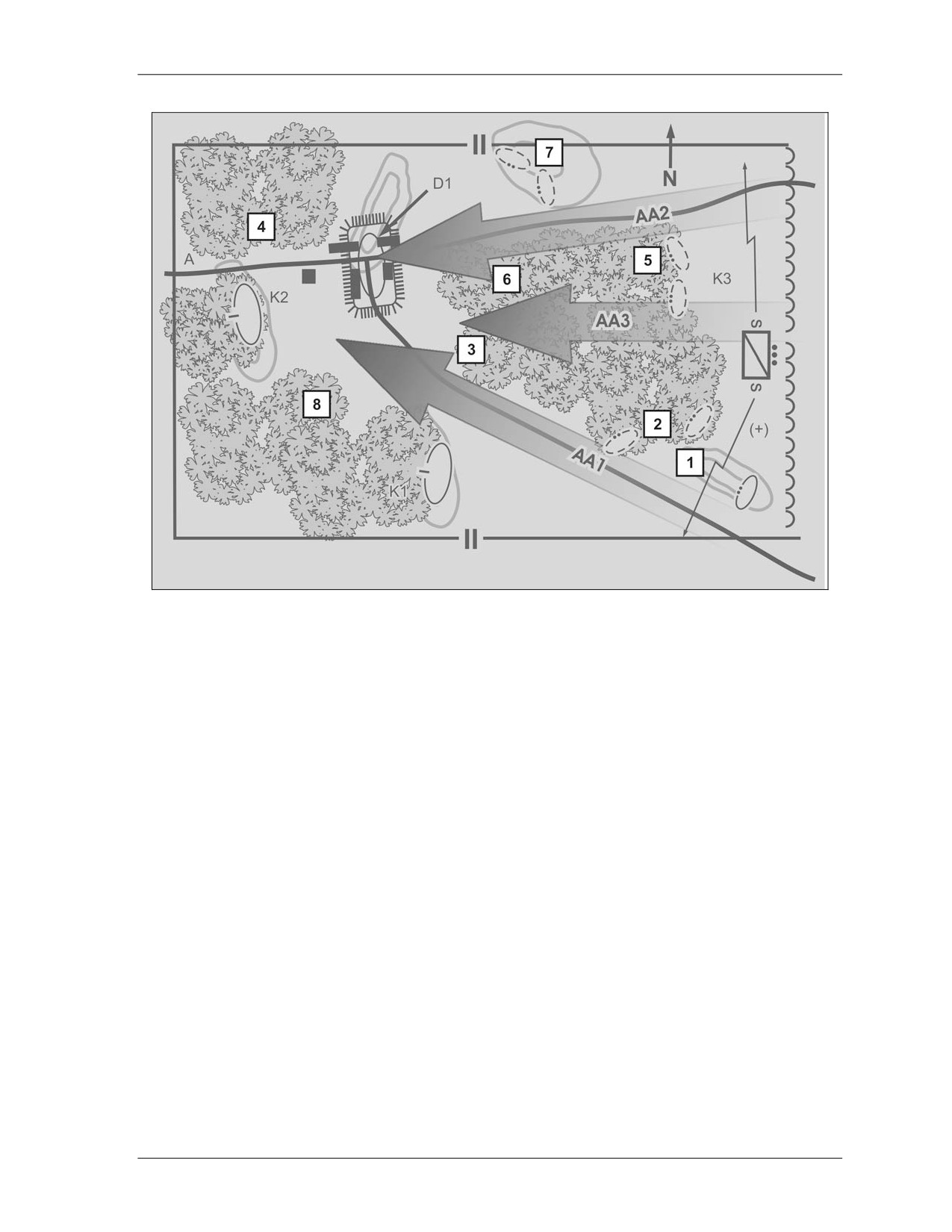
5-109. In Figure 5-6:
If enemy attacks along AA1, he will:
• Seize 1, the wood line at 2-3, K1, and wood line at 8.
• Capture D1.
• Capture K2 and 4.
• Continue along route A to the West.
If enemy attacks along AA2, he will:
• Seize wood line 5-6 and capture hill at 7.
• Capture D1.
• Capture K2 and 4.
• Continue along route A to the West.
If enemy attacks along AA3, he will:
• Seize woods 2-3-5-6.
• Capture D1.
• Capture K2 and 4.
• Continue along route A to the West.
5-26
FM 3-21.12
1 July 2008
Defensive Operations
Figure 5-6. Enemy’s scheme of maneuver.
DETERMINE WHERE TO KILL THE ENEMY.
5-110. The following steps apply in identifying and marking where the higher unit and company will
engage the enemy.
• Identify direct fire control measures (DFCM), including TRPs, that match the enemy’s scheme
of maneuver, allowing the company to identify where it will engage enemy forces through the
depth of the AO, how it will distribute fires, and identify unit sectors of fire.
• Identify and record the exact location of each TRP.
• Determine how many weapons systems, by type, must focus fires on each TRP to achieve the
desired effects.
• Determine which platoons will mass fires on each TRP.
• Establish engagement areas around TRPs.
• Develop the direct fire planning measures necessary to focus fires at each TRP.
• Identify other control measures such as the trigger points and break points.
• In marking TRPs, use thermal sights to ensure visibility at the appropriate range under varying
conditions, including daylight and limited visibility.
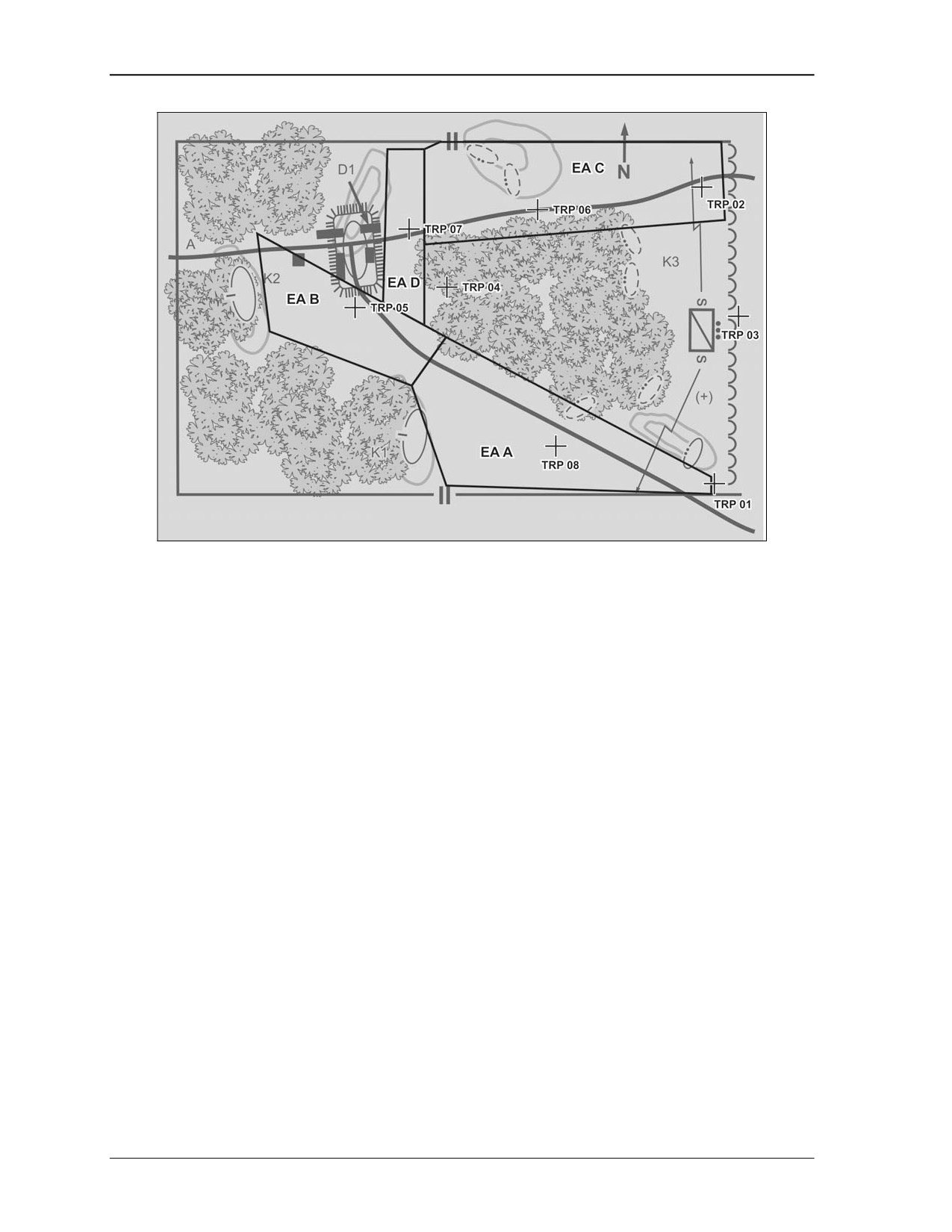
5-111. In Figure 5-7, TRPs 1 and 2 are used to initiate direct and indirect fires, TRP 3 is used to initiate
and distribute fires from the scout and attached weapons platoon, TRP 4 is used to distribute fires along
wood line, and TRPs 5 through 8 are used to distribute fires within engagement areas.
1 July 2008
FM 3-21.12
5-27
Chapter 5
Figure 5-7. Determine where to kill the enemy.
EMPLACE WEAPONS SYSTEMS.
5-112. The following steps apply in selecting and improving battle positions and emplacing the
company’s weapons systems.
• Select tentative platoon battle positions. (When possible, select these while moving in the
engagement area. Using the enemy’s perspective enables the commander to assess survivability
of the positions.)
• Conduct a leader’s reconnaissance of the tentative battle positions.
• Drive the engagement area to confirm that selected positions are tactically advantageous.
• Confirm and mark the selected battle positions.
• Ensure that battle positions do not conflict with those of adjacent units and that they are
effectively tied in with adjacent positions.
• Select primary, alternate, and supplementary fighting positions to achieve the desired effect for
each TRP in the engagement area. If the terrain allows, select sites that permit hull down and
hide positions.
• Ensure that platoon leaders, platoon sergeants, section leaders, and squad leaders position
weapons systems to effectively cover each TRP with the required number of weapons systems
(by type).
• Site and mark vehicle positions in accordance with unit SOP.
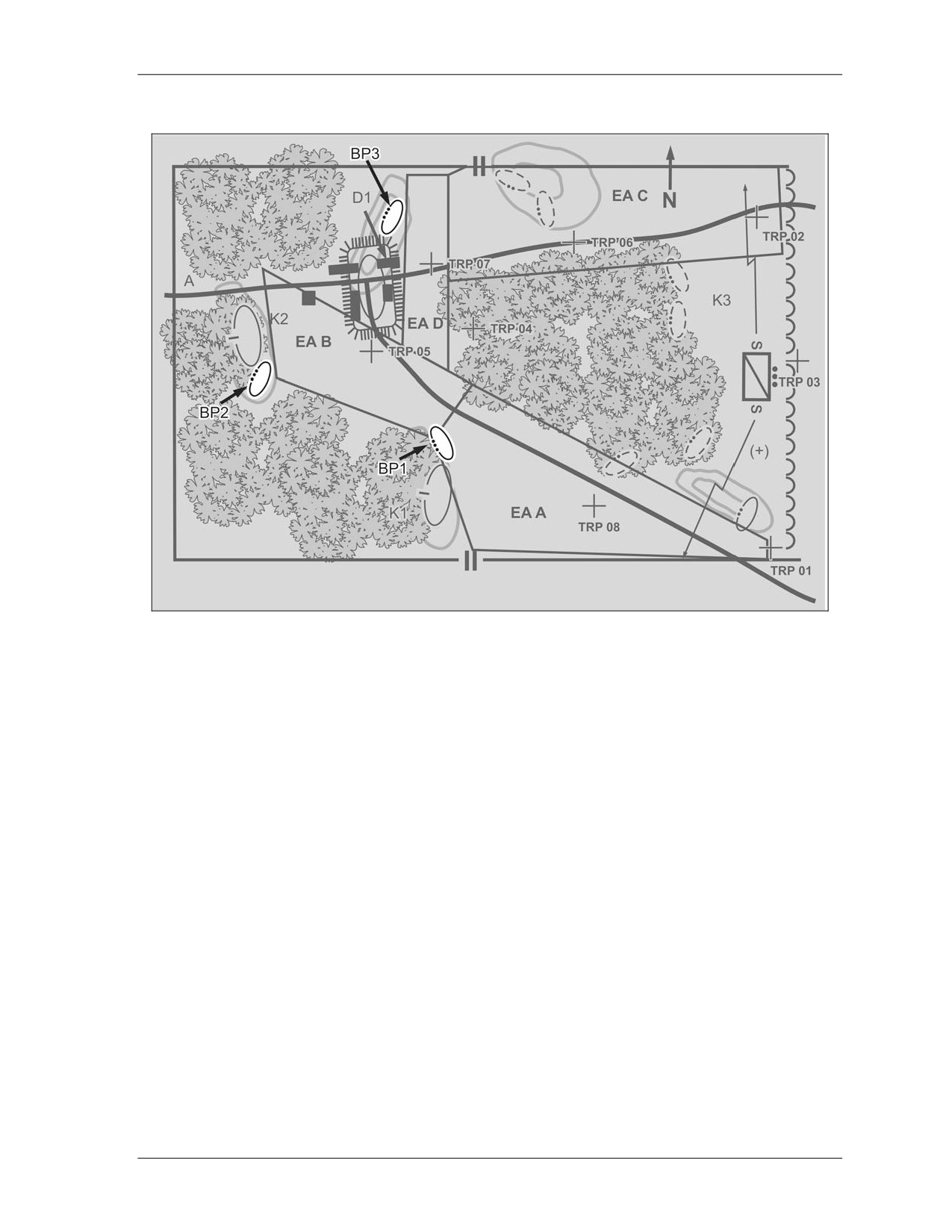
5-113. In the example in Figure 5-8, weapons are placed in the following battle positions as follows:
• BP1: (SE) Engage enemy in engagement area (EA) A. Be prepared to engage enemy in EAs B
and D.
• BP2: (SE) Engage enemy in EA B. Be prepared to engage dismounted enemy south of TRP 04
• BP3: (ME) Engage enemy in EAs C and D. Be prepared to engage dismounted Infantry to
north of TRP 04.
5-28
FM 3-21.12
1 July 2008
Defensive Operations
Figure 5-8. Emplace weapons systems.
PLAN AND INTEGRATE OBSTACLES.
5-114. The following apply in planning and integrating obstacles in the weapons company defense.
• Understand the obstacle group intent.
• Coordinate with the engineers.
• Site and mark individual obstacle locations.
• Refine direct and indirect fire control measures.
• Identify lanes and gaps.
• Report obstacle locations and gaps to higher headquarters.
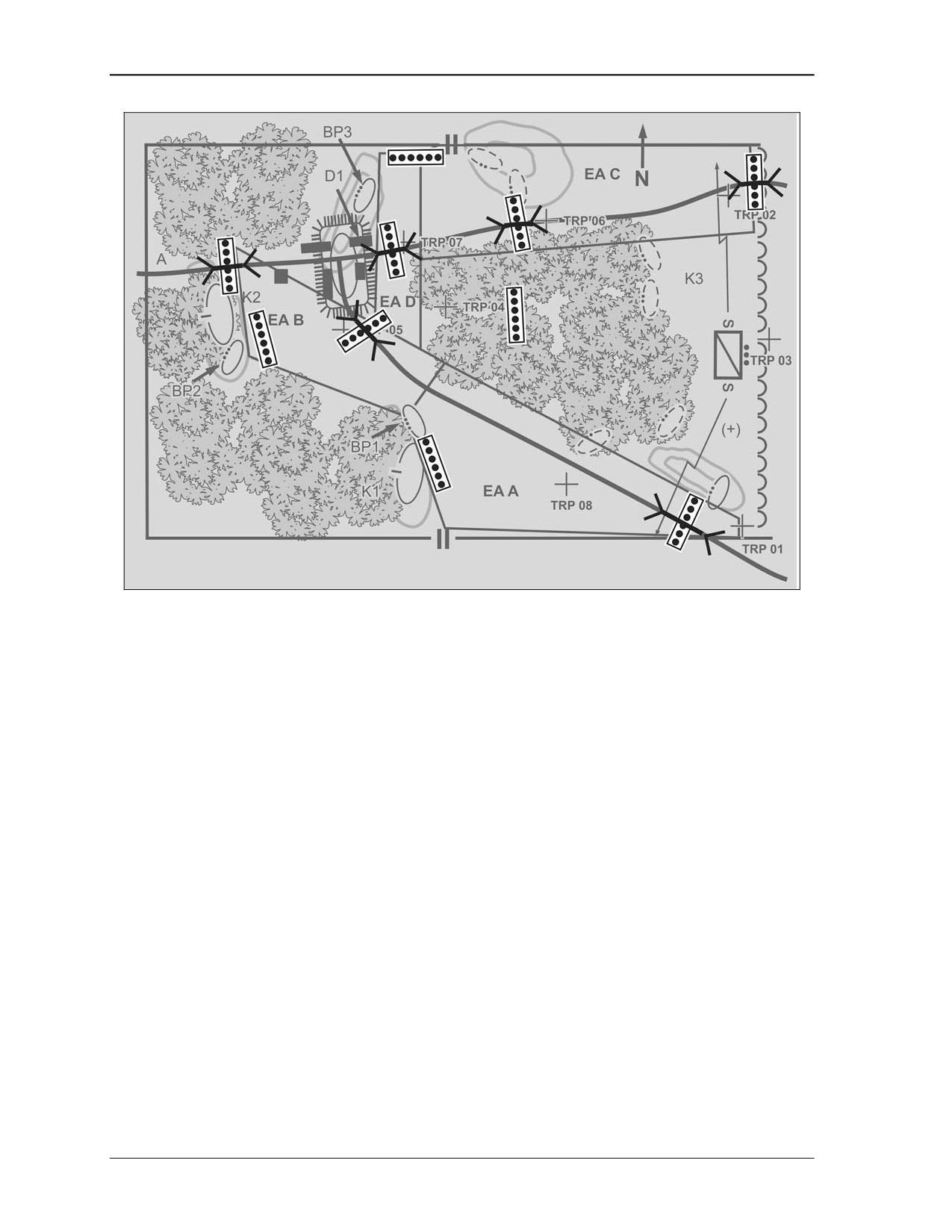
5-115. Figure 5-9 shows an example obstacle plan.
1 July 2008
FM 3-21.12
5-29
Chapter 5
Figure 5-9. Plan and integrate obstacles.
PLAN AND INTEGRATE INDIRECT FIRES.
5-116. The following steps apply in planning and integrating indirect fires.
• Determine the purpose of fires and any essential task to be accomplished by fire support.
• Determine where that purpose can best be achieved.
• Establish the observation plan, with redundancy for each target. Observers include the FSO
(if attached) as well as leaders of elements with fire support responsibilities.
• Establish triggers and observers.
• Obtain accurate target locations using lazing devices.
• Refine target locations to ensure coverage of obstacles.
• Adjust/register artillery and mortar targets.
• Plan FPFs.
• Request critical friendly zones (CFZ) for protection of maneuver elements and no-fire areas for
protection of observation posts and forward positions.
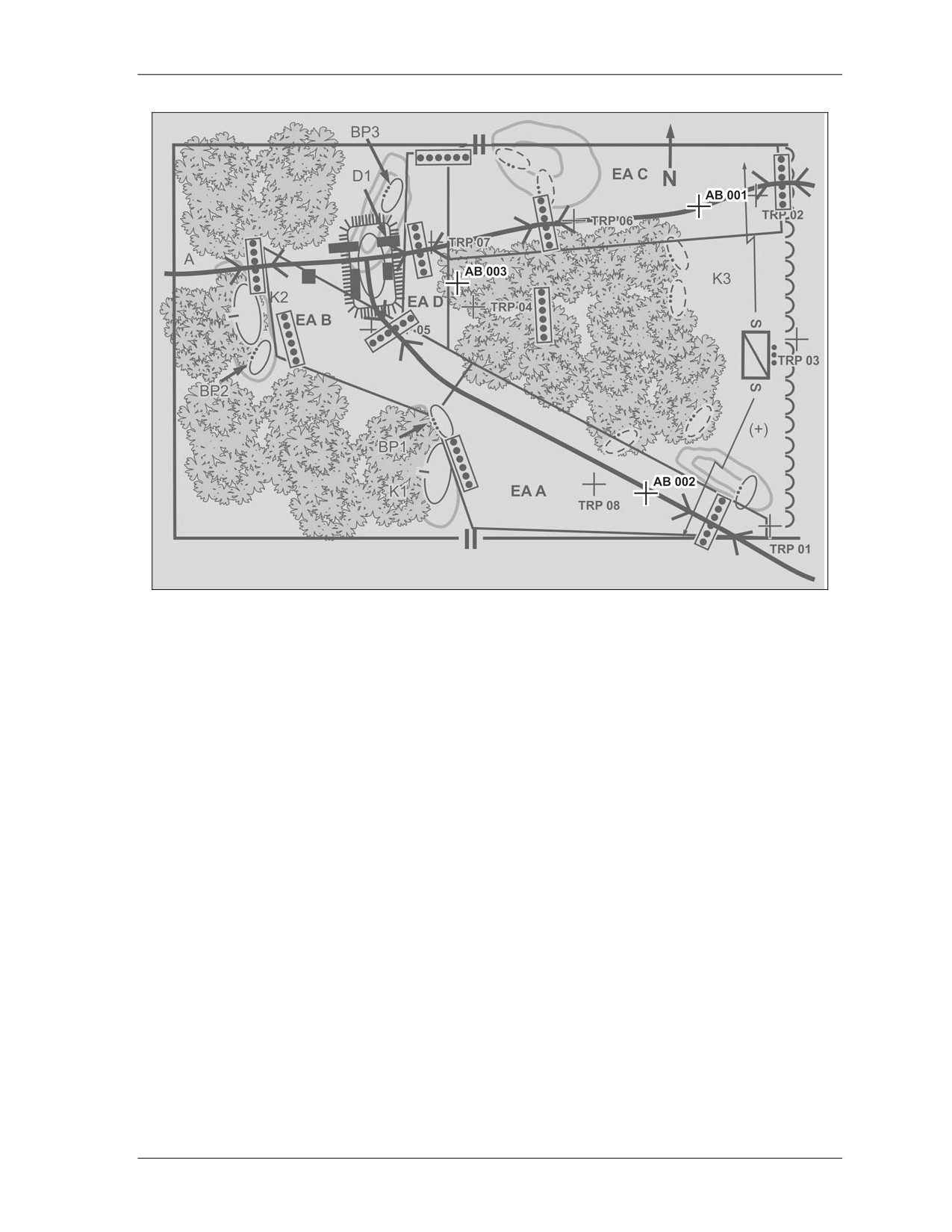
5-117. Figure 5-10 shows planned indirect fires locations.
5-30
FM 3-21.12
1 July 2008
Defensive Operations
Figure 5-10. Plan and integrate indirect fires.
CONDUCT AN ENGAGEMENT AREA REHEARSAL.
5-118. The purpose of this rehearsal is to ensure every leader and Soldier understands the plan and all
elements are prepared to cover their assigned areas with direct and indirect fires. Although the weapons
company commander has several options, the most common and most effective type of rehearsal is
replicating the threat. The company commander should coordinate the rehearsal with the higher
headquarters to ensure other units’ rehearsals are not planned for the same time or location. The rehearsal
should cover these actions:
• Rearward passage of security forces (as required).
• Closure of lanes (as required).
• Movement from the hide position to the battle position.
• Use of fire commands, triggers, and maximum engagement lines to initiate direct and indirect
fires.
• Shifting of fires to refocus and redistribute fire effects.
• Emplacement of scatterable mines.
• Preparation and transmission of critical reports frequency modulation (FM) radio or FBCB2.
• Assessment of the effects of enemy weapons systems.
• Displacement to alternate, supplementary, or successive battle positions.
• Cross-leveling or resupply of Class V.
• Evacuation of casualties.
1 July 2008
FM 3-21.12
5-31
Chapter 5
PRIORITY OF WORK
5-119. This is a set method of controlling the preparation and conduct of a defense. SOP should describe
the priorities of work to include individual duties. A commander changes priorities based on the situation.
The leaders in the unit all should have a specific priority of work for their duty position. Although listed in
sequence, several tasks may be performed at the same time. An example priority of work sequence is listed
below:
• Post local security.
• Establish the company reconnaissance and surveillance operation.
• Position Javelins, machine guns, and Soldiers; assign sectors of fire.
• Position other assets (company command post (CP) and mortars).
• Designate final protective lines and FPFs.
• Clear fields of fire and prepare range cards and sector sketches.
• Adjust indirect fire FPFs. The firing unit fire direction center (FDC) should provide a safety
box that is clear of all friendly units before firing any adjusting rounds.
• Prepare fighting positions.
• Install wire communications, if applicable.
• Emplace obstacles and mines.
• Mark (or improve marking for) TRPs and direct fire control measures.
• Improve primary fighting positions such as overhead cover.
• Prepare alternate and supplementary positions.
• Establish sleep and rest plan.
• Reconnoiter movements.
• Rehearse engagements and disengagements or displacements.
• Adjust positions and control measures as required.
• Stockpile ammunition, food, and water.
• Dig trenches between positions.
• Reconnoiter routes.
• Continue to improve positions...
SECTOR SKETCHES AND FIRE PLANS
5-120. Weapons leaders prepare sector sketches based on their defensive plan. These sector sketches are
based on range cards prepared for all crew-served weapons systems. The sector sketch allows the higher
headquarters to determine the effectiveness of the direct fire plan. If necessary, the higher commander
makes adjustments to the sectors and or position of his subordinates. Sector sketches also are useful for
units occupying previously prepared defenses (example: a relief in place).
SECTION SECTOR SKETCH.
5-121. Each section leader prepares a sector sketch to visually depict his section’s fire plan. This
information is found on the range card for the two squads. The section leader makes two copies of the
sketch, keeping one and forwarding the other to his platoon leader. The sector sketch should provide the
following information: Prominent terrain features in the sector of fire and the ranges to them. Each
weapons squad’s primary and secondary sectors of fire, TRPs, dead space, phase lines, break points
(triggers), maximum engagement lines, obstacles, and indirect-fire targets. Also included is the distance
and direction to all dead space and TRPs.
5-32
FM 3-21.12
1 July 2008
Defensive Operations
PLATOON SECTOR SKETCHES, AND PLATOON AND COMPANY FIRE PLANS.
5-122. The platoon leader inspects the section sector sketches. He uses these sector sketches to prepare
his platoon sector sketch and fire plan. He also makes two copies, keeping one and forwarding the other
copy or digitally transmitting (if equipped) a copy of the sector sketch to his commander or higher
headquarters. Using the section sector sketches, the platoon leader can prepare a platoon fire plan and
engagement matrix. This matrix aids the platoon leader by detailing what TRPs each section can observe
by position (primary, alternate, and supplementary). See Figure 4-8 in FM 3-20.151: The Mobile Gun
System Platoon, for an example of a platoon fire plan. The company commander uses the platoons’ fire
plans to develop the company fire plan.
ADJACENT UNIT COORDINATION
5-123. The goal of adjacent unit coordination is to ensure unity of effort in the accomplishment of the
battalion mission. Items that adjacent units must coordinate include, but are not limited to, the following:
• Unit positions, including locations of command and control nodes.
• Locations of observation posts and patrols.
• Overlapping fires (to ensure that direct fire responsibility is clearly defined).
• Target reference points.
• Primary, alternate, and supplementary battle positions.
• Indirect fire and automated net control device (ANCD) information.
• Obstacles (location, orientation, and type).
• Exchange or confirm FBCB2 data.
• Air defense considerations, if applicable.
• Routes to be used during occupation and repositioning.
• Sustainment considerations.
Section IV. RETROGRADE OPERATIONS
Retrograde operations move friendly forces away from the enemy to gain time, preserve forces, place the
enemy in unfavorable positions, or avoid combat under undesirable conditions. The enemy may force these
operations or a commander may execute them voluntarily. In either case, the higher commander of the force
executing the operation must approve the retrograde. Companies normally conduct retrogrades as part of a
larger unit. The weapons company, along with the scout platoon, can greatly assist the execution of retrogrades
by its maneuver advantages over the Infantry companies. It can move rapidly to a danger point and mass its
fires onto an enemy that may be impeding the retrograde or attempting to conduct a maneuver to cut off the
friendly force, such as an attack to the flank.
PURPOSE
5-124. Retrograde operations accomplish the following.
• Resist, exhaust, and defeat enemy forces.
• Draw the enemy into an unfavorable situation.
• Avoid contact in undesirable conditions.
• Gain time.
• Disengage a force from battle for use elsewhere in other missions.
• Reposition forces, shorten lines of communication, or conform to movements of other friendly
units.
• Secure more favorable terrain.
1 July 2008
FM 3-21.12
5-33
Chapter 5
TYPES
5-125. There are three types of retrograde operations: delay, withdrawal, and retirement.
DELAY
5-126. This operation allows the unit to trade space for time, avoiding decisive engagement and
safeguarding its elements. A delay is a series of defensive and offensive actions over subsequent positions
in depth. It is an economy of force operation that trades space for time. While the enemy gains access to
the vacated area (space), friendly elements have time to conduct necessary operations, while retaining
freedom of action and maneuver. There are two types of delay missions: in an AO and forward of a
specified line or position for a specified time. For either type of delay mission, the flow of the operation
can be summarized as "hit hard, then move." Delay missions usually conclude in one of three ways: a
defense, a withdrawal, or a counterattack. Planning options should address all three possibilities. A
successful delay has three key components:
• The ability to stop or slow the enemy's momentum while avoiding decisive engagement.
• The ability to degrade the enemy's combat power.
• The ability to maintain a mobility advantage.
Weapons Company Role in Delay Operations
5-127. The weapons company has a major subordinate role during retrograde operations. It can:
• With its long-range weapons and ability to mass fires, maintain the distance between the two
forces and prevent decisive engagement, a key objective for the delay.
• Counter enemy threats through its rapid movement through the AO.
• Maneuver between the enemy and the rifle companies and, because of its armor, be protected
from small arms fire.
5-128. The battalion commander may task organize some of his Infantry companies by the attaching
weapons platoons. Based on a METT-TC analysis, he may want to retain the bulk of the weapons company
under battalion control to conduct attack or support by fire missions. Any attachments to the weapons
company should have equal mobility.
5-129. The area through which an Infantry battalion delays may be close terrain and not very trafficable
to wheeled or armored vehicles. This will also affect the mobility of the vehicles in the weapons company.
WITHDRAWAL
5-130. The commander uses this operation to break enemy contact, especially when he needs to free the
unit for a new mission. Withdrawal is a planned operation in which a force in contact disengages from an
enemy force. Withdrawals may or may not be conducted under enemy pressure. The two types of
withdrawals are assisted and unassisted:
Assisted
5-131. The assisting force occupies positions to the rear of the withdrawing unit and prepares to accept
control of the operation. It can also assist the withdrawing unit with route reconnaissance, route
maintenance, fire support, and sustainment. Both forces closely coordinate the withdrawal. After
coordination, the withdrawing unit delays to a battle handover line, conducts a passage of lines, and moves
to its final destination.
5-34
FM 3-21.12
1 July 2008
Defensive Operations
Unassisted
5-132. The withdrawing unit establishes routes and develops plans for the withdrawal and then
establishes a security force as the rear guard while the main body withdraws. Sustainment and mobility and
protection elements normally withdraw first followed by combat forces. To deceive the enemy as to the
friendly movement, battalion may establish a detachment left in contact (DLIC) if withdrawing under
enemy pressure. As the unit withdraws, the DLIC disengages from the enemy and follows the main body to
its final destination.
5-133. Withdrawals are accomplished in three overlapping phases:
• Preparation. The commander dispatches quartering parties, issues warning orders, and initiates
planning. Nonessential vehicles are moved to the rear.
• Disengagement. Designated elements begin movement to the rear. They break contact and
conduct tactical movement to a designated assembly area or position.
• Security. A security force protects and assists the other elements as they disengage or move to
their new positions. This is done either by a DLIC, which the unit itself designates in an
unassisted withdrawal, or by a security force provided by the higher headquarters in an assisted
withdrawal. As necessary, the security force assumes responsibility for the AO, deceives the
enemy, and protects the movement of disengaged elements by providing overwatch and
suppressive fires. The weapons company can provides this overwatch force. In an assisted
withdrawal, the security phase ends when the security force has assumed responsibility for the
fight and the withdrawing element has completed its movement. In an unassisted withdrawal,
this phase ends when the DLIC completes its disengagement and movement to the rear.
5-134. In an unassisted battalion withdrawal, the DLIC may consist of an element from each company
(under leadership of the company XO or a platoon leader), with the battalion S-3 as the overall DLIC
commander. As an alternative, a company may serve as the DLIC for the rest of the battalion. The
company commander has several deployment options. He can reposition elements across the entire
battalion frontage. Another option is to position the company to cover only the most dangerous enemy
avenues of approach; other avenues into the AO are covered with observation from additional security
elements provided by the battalion such as the reconnaissance platoon.
5-135. In an assisted battalion withdrawal, the higher headquarters will normally provide a security
element to maintain contact with and deceive the enemy while the battalion conducts its withdrawal. The
security force establishes defensive positions behind the withdrawing unit and conducts preparations for a
rearward passage of lines. The withdrawing force disengages from the enemy and conducts the rearward
passage through the security force to assembly areas in the rear.
RETIREMENT
5-136. This operation is employed to move a force that is not in contact away from the enemy. Typically,
the weapons company conducts a retirement as part of a larger force while another unit’s security force
protects their movement. A retiring unit organizes for combat but does not anticipate interference by enemy
ground forces. Triggers for a retirement may include the requirement to reposition forces for future
operations or to accommodate other changes to the current concept of operations. The retiring unit should
move sustainment elements and supplies first, and then should move toward an assembly area that supports
preparations for the next mission. Where speed and security are the most important considerations, units
conduct retirements as tactical road marches.
1 July 2008
FM 3-21.12
5-35
Chapter 6
Stability Operations
Stability operations are operations that restore, establish, preserve, or exploit security
and control over areas, populations, and resources. In contrast to Civil Support
operations, Stability operations are executed outside the United States. Stability
operations involve a wide range of both coercive and cooperative actions that shape
the political environment and respond to developing crises. Coercive military actions
involve the application of limited, carefully prescribed force, or the threat of force, to
achieve specific objectives. Cooperative actions are aimed at enhancing a
government’s willingness and ability to care for its people, or simply providing
humanitarian relief following a natural disaster. Both of these types of operations are
designed to help establish a safe and secure environment, facilitate reconciliation
among local or regional adversaries, establish political, legal, social, and economic
institutions, and facilitate the transition to legitimate local governance. Army forces
engaged in stability operations establish or restore basic civil functions and protect
them until the host nation is capable of providing these services themselves. Stability
operations may occur in conjunction with offensive and defensive operations and are
often diverse, continuous, noncontiguous and long-term. For more detailed
information on stability operations, see FM 3-21.10 and FM 3-0.
Section I. OVERVIEW
Stability operations typically occur in conjunction with either offensive or defensive operations in foreign
countries. They may be the decisive operation within a phase of a campaign or major combat operation.
Although military forces set the conditions for success, the ultimate goal is to transition to where the other
instruments of power predominate.
PURPOSES
6-1.
The purposes of stability operations are to assist foreign nations in a number of areas including to--
• Protect national interests.
• Promote peace and deter aggression.
• Satisfy treaty obligations or enforce agreements and policies.
• Reassure allies, friendly governments, and agencies.
• Maintain or restore order.
• Protect life and property.
• Demonstrate resolve.
• Prevent, deter, or respond to terrorism.
• Reduce the threat of conventional arms and weapons of mass destruction (WMD) to regional
security.
• Protect freedom from oppression, subversion, lawlessness, and insurgency.
• Promote sustainable and responsive institutions.
1 July 2008
FM 3-21.12
6-1
Chapter 6
TYPES
6-2.
Stability operations typically fall into five broad types that are neither discrete nor mutually
exclusive. These are:
CIVIL SECURITY
6-3.
Protecting the populace from external and internal threats.
CIVIL CONTROL
6-4.
Regulating the behavior and activity of individuals and groups to reduce risk to individuals or
groups and to promote security. Control channels the population’s activity to allow for the provision of
security and essential services while coexisting with a military force conducting operations. A curfew is an
example of civil control.
PROVISION OF ESSENTIAL SERVICES
6-5.
Essential services include emergency life-saving medical care, the prevention of epidemic disease,
provision of food and water, provision of emergency shelter from the elements, and the provision of basic
sanitation (sewage and garbage disposal).
GOVERNANCE
6-6.
The provision of societal control functions that include regulation of public activity, rule of law,
taxation, maintenance of security, control and essential services, normalizing means of succession of
power.
SUPPORT TO ECONOMIC AND INFRASTRUCTURE DEVELOPMENT
6-7.
Direct and indirect military assistance to local, regional, and national economic and infrastructure
development to provide an indigenous capacity and capability for continued economic and infrastructure
development.
6-8.
Within each of these categories, units may be involved in a wide variety of missions. The actions
they conduct within these missions will also vary. While certain actions may more likely be associated with
a particular type of operation, many actions may be conducted within several or all of the operations. The
characteristics of the Infantry weapons company may lend it to being assigned missions and actions that
capitalize on their mobility, enhanced optics, weapons, communications, and transportation assets.
Section II. CAPABILITIES AND EMPLOYMENT
Stability operations are complex and demanding. The Infantry weapons company must master a wide variety of
skills such as negotiating, establishing checkpoints and escorting convoys. This section includes employment
considerations for some of the actions that could benefit from weapons company capabilities.
CAPABILITIES
6-9.
The Infantry weapons company is uniquely equipped with capabilities that can aid in the execution
of many actions pertaining to stability operations. These additional capabilities may likely lead to assigning
the weapons company specific actions that employ their unique assets and capitalize on their added
contribution. Additional capabilities include, but are not limited to, weapons assets, transportation
6-2
FM 3-21.12
1 July 2008
Stability Operations
capability, increased mobility, increased observation with enhanced optics during limited
visibility
conditions, and increased communications assets. Examples of how these capabilities
may
be
employed include--
• Weapons
-- Use in civil security, control and governance
-- Show of force
-- Protection of personnel, equipment and supplies
• Transportation
-- Assistance in food and water distribution in support of relief operations
-- Vehicle support for moving displaced civilians or other supplies
• Mobility
-- Mounted patrols
-- Rapid response to threats
-- Escorts
• Enhanced Optics
-- Security and Protection
-- Observation posts
-- Night operations
• Communications assets
-- Operations communications support
-- Communications relay assistance
-- Information distribution
EMPLOYMENT
6-10. The weapons company commander may be required to perform a wide variety of actions to support
stability operations. Depending on the type and nature of the overall mission, task requirements may come
with specific execution guidelines. Rules of engagement (ROE) will often dictate conduct requirements
while executing these actions. Regardless of the specific missions and actions assigned to the weapons
company, units should keep in mind that the ultimate goal is to restore, establish, preserve, or exploit
security and control to an area or population and its resources. The weapons company will often be
assigned missions that capitalize on its unique capabilities. Some of the more common actions that employ
these capabilities include the following. For a more detailed explanation see FM 3-21.10, FM 3-21.20,
FM 3-21.11 and FM 3-21.91:
ESTABLISH AN OBSERVATION POST
6-11.
Constructing and operating observation posts (OP) is a high-frequency task for Infantry units and
subordinate elements whenever they must establish area security. Each OP is established for a specified
time and purpose. Some OPs are overt (clearly visible) and deliberately constructed. Others are covert and
designed to observe an area or target without the knowledge of the local population. Each type of OP must
be integrated into supporting direct and indirect fire plans and into the overall observation plan. Based on
mission, enemy, terrain, troops, time, civilians (METT-TC) factors, deliberate and overt OPs may include
specialized facilities such as--
• Observation towers.
• Ammunition and fuel storage areas.
• Power sources.
• Supporting helipads.
• Billeting, food service, and sanitation areas.
1 July 2008
FM 3-21.12
6-3
Chapter 6
6-12.
During establishment of OPs, Infantry weapons companies will not only capitalize on the increase
in limited visibility operations but also the use of heavy weapons assets. The optics for the Improved
Target Acquisition System (ITAS), the target acquisition system (TAS) an integrated day/night sight, and
Javelin’s command launch unit (CLU) may be used to enhance the unit’s observation ability during
daylight or limited visibility conditions. This proves to be a tremendous asset for establishing observation
posts. The weapons systems provide for defensive measures and, in the case of overt OPs, help establish a
sense of deterrence for aggressive behavior. Weapons may be either vehicular or ground-mounted
depending on the type and permanence of the OP. Additionally, since the weapons company has more
heavy weapons than vehicles, the capability exists to ground mount and vehicle mount weapons
simultaneously. However, leaders must take into account the time needed to collect ground-mounted
systems in the event of a quick displacement.
ACT AS A MOUNTED QUICK REACTION FORCE
6-13.
A quick reaction force
(QRF) is a designated organization for any immediate response
requirement that occurs in a designated area of operation. In contrast to a unit designated as a reserve, a
QRF is not committed to support one particular mission but rather is on-call to respond to a multitude of
contingencies within an operational area. An Infantry weapons company is uniquely equipped to act as a
mounted QRF. It has organic vehicles for rapid mobility and protection, a mix of automatic heavy weapons
for firepower, communications assets for operational control, and the ability to better operate in limited
visibility conditions. However, these units are limited in their ability to conduct dismounted operations
once arriving at the site. If transportation is available, an Infantry element may be attached to the mounted
QRF...
ESCORT A CONVOY
6-14.
This mission requires a unit to provide a convoy with security and close-in protection from direct
fire while on the move. If given this mission, Infantry rifle companies must be augmented with additional
transportation assets. On the other hand, Infantry weapons companies with their organic vehicles have the
mobility and firepower to perform this mission without augmentation.
6-15.
In any escort operation, the basic mission of the convoy commander (and, as applicable, the
convoy security commander) is to establish and maintain security in all directions and throughout the
length of the convoy. He must be prepared to move the security force to fit the situation. Several factors
apply, including convoy size, organization, and composition. Sometimes, he positions the security
elements, such as platoons, to the front, rear, or flanks of the convoy. He may also disperse the combat
vehicles throughout the convoy body. The convoy commander often organizes the convoy security into
three distinct elements: advance guard, close-in protective group, and rear guard.
6-16.
The weapons company is well equipped to react to contact while performing a convoy escort
mission. Contact usually occurs in the form of an ambush, often executed at a hasty obstacle. The safety of
the convoy rests on the speed and effectiveness with which escort elements can execute appropriate actions
on contact. Based on the factors of METT-TC, portions of the convoy security force might be designated
as a reaction force. This element performs its normal escort duties, such as conducting tactical movement
or occupying an assembly area, unless enemy contact occurs. Upon contact, it performs a reaction mission
given by the convoy commander. The mix of weapons systems gives the convoy commander the option of
creating a mix of vehicular mounted heavy weapons based on METT-TC conditions.
ESTABLISH A CORDON
6-17.
The establishment of a cordon is normally in conjunction with a cordon and search mission unless
task organized with Infantry platoons. Due to the number of resources required for an effective cordon and
search, the mission is often given to a battalion size element. In this respect, the weapons company will
most likely be given all or part of the task of establishing the cordon. The inherent characteristics of the
6-4
FM 3-21.12
1 July 2008
Stability Operations
company make it ideal for establishing the cordon. Infantry rifle companies will often perform the search
with the weapons company and other elements providing the cordon for security and protection.
6-18.
The cordon and search mission centers on an objective area with a limited degree of information
regarding the exact location of what is sought, usually personnel, equipment, weapons etc. A cordon and
search usually, but not always, takes a large amount of time due to the unknown nature of actual locations
of personnel or items.
6-19.
In establishing a cordon, two cordons may be established: the outer cordon to focus on isolating
the objective from outside, and the inner cordon to focus on keeping individuals from escaping the
objective area. However, both cordon elements must focus both inward and outward for security purposes.
Emplacement of these cordon elements may occur simultaneously or sequentially. Although more difficult
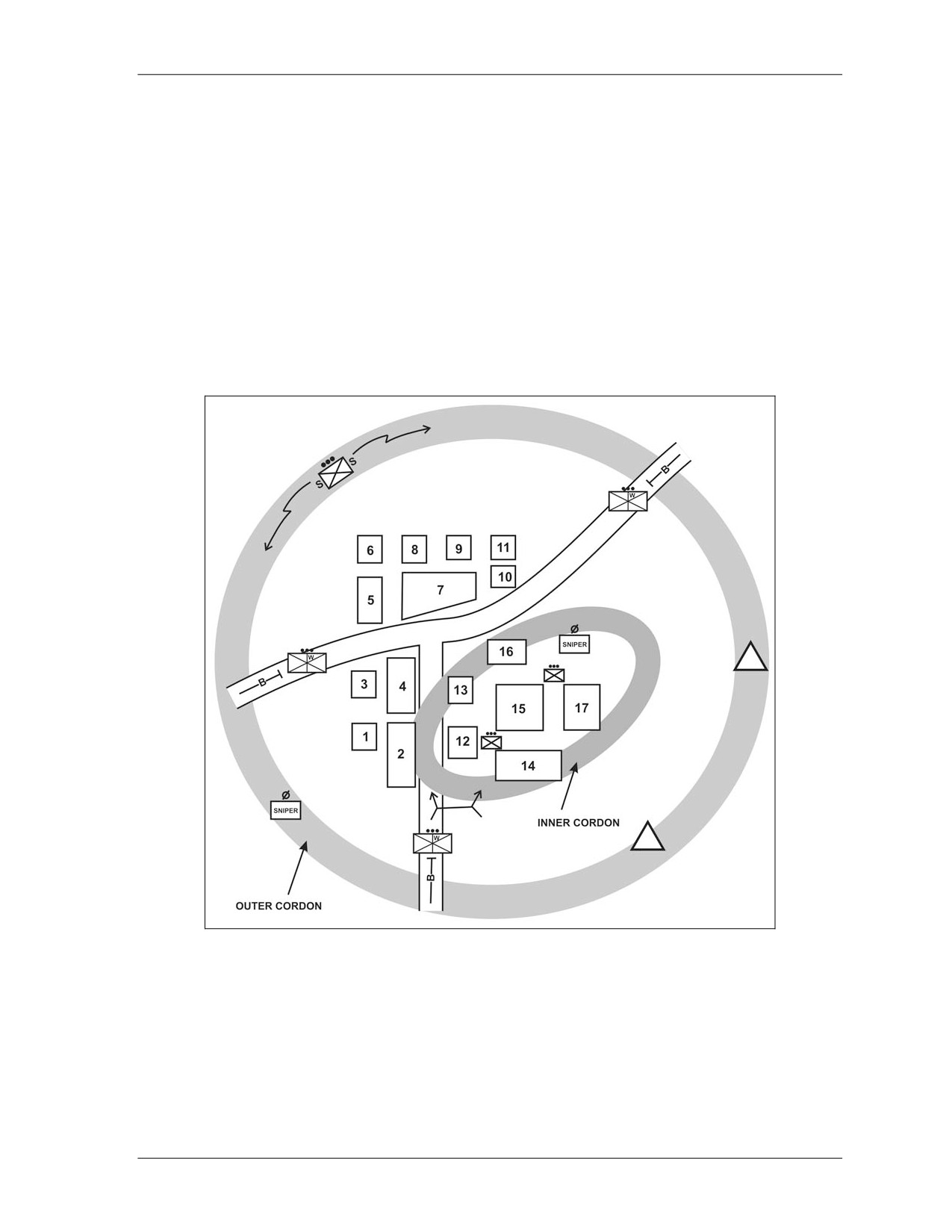
to control, the use of limited visibility aids in the establishment and security of the cordon. The weapons
company enhanced optics greatly assist with this task. Figure 6-1 shows an example of the establishment of
inner and outer cordon.
Figure 6-1. Establishment of a cordon.
Outer Cordon
6-20.
The outer cordon is an integral part of the security element in any cordon and search operation. It
requires detailed planning, effective coordination, and meticulous integration and synchronization to
achieve the combined arms effects. Both lethal and nonlethal effects should be considered by the
commander.
1 July 2008
FM 3-21.12
6-5
Chapter 6
6-21.
Each subordinate outer cordon element (traffic control point or blocking position) must have a
designated leader and a clear task and purpose. Units and elements to consider for establishing the outer
cordon include--
• Weapons company.
• Assault platoons.
• Weapons squads.
• Sniper teams.
6-22.
The security element of the outer cordon may include the following:
• Vehicle mounted platoons or sections.
• Interpreter(s).
• Detainee security teams.
• Crowd control teams.
• Observation posts.
• Traffic control points or blocking positions.
• Host nation security forces (military or police).
• Aviation.
• Dismounted platoons or squads.
• Female search teams.
Inner Cordon
6-23.
The inner cordon may be under the control of the security element of the search element. It is
normally tasked with the following actions:
• Preventing exfiltration or reposition of threat forces.
• Serving as a support by fire force for search teams.
• Maintaining communications with the search element.
• Understanding the marking system and control measures.
• Seizing supporting structures in built-up areas to overwatch target area buildings
ESTABLISH A CHECKPOINT
6-24.
A common mission during stability operations is a vehicle or traffic checkpoint. In recent
operations, checkpoints have been used so often that through repetitive execution units can perform them
virtually like battle drills.
Purposes
6-25.
Checkpoints may be established to--
• Obtain intelligence.
• Identify enemy combatants or seize illegal weapons.
• Disrupt enemy movement or actions.
• Deter illegal movement.
• Create an instant or temporary roadblock.
• Control movement into the area of operations or onto a specific route.
• Demonstrate the presence of US or peace forces.
• Prevent smuggling of contraband.
• Enforce the terms of peace agreements.
• Serve as an OP, patrol base, or both.
6-6
FM 3-21.12
1 July 2008
Stability Operations
Types
6-26.
Checkpoints may be established for many reasons including one or more of the purposes listed
above. Based on the purpose for establishing the checkpoint and METT-TC conditions checkpoints may be
established using one of the common types listed below.
• Deliberate Checkpoints.
-- Permanent or semipermanent.
-- May be classified as heavy or light traffic.
-- Used to protect an operating base, well-established main supply route, critical intersections.
-- Complete or random searches.
• Hasty Checkpoints.
-- Used only for a short, set period.
-- Employed during the conduct of a patrol.
-- Only uses transportable materials.
-- Can be quickly positioned where needed.
-- May be conducted when specific intelligence indicates that a checkpoint hinders the enemy's
freedom of movement at a specific time and place.
6-27.
Many checkpoint operations require a highly mobile unit for employment. The organic vehicles in
a weapons company suit it perfectly for these type checkpoint operations.
SECURE A ROUTE
6-28.
This task is a combined arms operation normally conducted with engineer support. The Infantry
weapons company might be tasked to assist in route security and to provide overwatch support. Route
clearance may achieve one of several tactical purposes.
• To clear a route for the initial entry of the battalion into an area of operations.
• To clear a route ahead of a planned convoy to ensure that belligerent elements have not
emplaced new obstacles since the last time the route was cleared.
• To secure the route for use as a main supply route.
6-29.
While Infantry rifle companies are sometimes tasked for any portion of this mission, the weapons
company portion will often be to provide security for the route rather than assist in route clearance.
Depending on METT-TC, security may be performed in a combination of ways. Often security procedures
resemble those of a convoy escort but may also include setting up static or mobile overwatch positions.
The weapons company is both mobile and equipped with heavy weapons for overwatching fires making it
ideally suited for this mission.
CONDUCT A PATROL
6-30.
Patrolling is also a high-frequency task during stability operations. Patrols help to add security,
aid in information gathering and provide for a strong presence in an operation area. Security and presence
patrols usually occur in urban areas and leaders must be aware of the ROE and the purpose of the patrol.
6-31.
Urban terrain provides multiple opportunities for attack against patrols in the stability
environment. The locations of enemy firing points can be concealed by building characteristics, vehicles,
civilian population, and noise. The patrol must therefore have a through understanding of reactionary
procedures based on their standing operating procedure (SOP), METT-TC and ROE. An attack is normally
initiated on a patrol only when the attacker has an open escape route. This emphasizes the need react
quickly and if conditions exist that call for aggressive action.
6-32.
US forces are deployed increasingly in combat operations in urban areas and in support of
stability operations missions all around the world. The Infantry weapons company would conduct these
patrols to show force and lend confidence and stability to the local population of the host nation. Rarely
1 July 2008
FM 3-21.12
6-7
Chapter 6
should a commander use a presence patrol where enemy contact is likely. Although the weapons company
will be a mounted element, it may be employed with or without dismounted troops. Either way,
vehicular-based personnel are not precluded from interfacing with the local populace. The presence patrol
is a primary means by which leaders collect information about the area of operations (AO). Interface with
local civilians provides much of the valuable information. The presence patrol is often used to--
• Confirm or supervise an agreed cease-fire.
• Gain information.
• Cover gaps between OPs or checkpoints.
• Show a stability force presence.
• Reassure isolated communities.
• Inspect existing or vacated positions of former belligerents.
• Escort former belligerents or local populations through trouble spots.
6-33.
Infantry weapons units may find themselves conducting frequent patrols during stability
operations. Leaders should consider the following if assigned a patrolling mission:
• Organize and orient vehicle gunners and commanders to maintain all-round security
• Rehearse battle drills
• Plan alternate routes, civilian traffic, and roadblocks
• Plan actions for disabled or destroyed vehicles
• Configure vehicles for optimal observation and select weapons systems for firepower
• Consider positioning of weapons
• Harden unarmored vehicles
• Establish a communications plan
• Secure external gear to prevent theft and inspect it to ensure it is not flammable
• Plan for heavy civilian vehicle and pedestrian traffic
• Conduct a map reconnaissance and identify likely chokepoints, ambush sites and overpasses.
• Plan primary and alternate routes to avoid potential hazards
SUPPORT RELIEF OPERATIONS
6-34.
Providing support during relief operations in a foreign country is very similar to conducting civil
support operations in the US. Both involve using the Army to respond with a wide array of capabilities and
services to aid authorities in the following types of actions.
• Protecting public health.
• Restoring public order.
• Assisting in disaster recovery.
• Alleviating large-scale suffering.
• Protecting critical infrastructure.
6-35.
Examples of how these capabilities may be employed include--
• Transportation
-- Assistance in food, fuel, water, clothing and blanket distribution
-- Vehicle support for personnel and other supplies
-- Medical evacuation assistance
• Mobility
-- Transport capability to remote areas
-- Assistance in rapid assessments of large areas
-- Assistance with verbal or written information distribution
6-8
FM 3-21.12
1 July 2008
Stability Operations
• Enhanced Optics
-- Security
-- Search and rescue
-- Personnel and civil disturbance control
• Communications assets
-- Operations communications support
-- Communications relay assistance
-- Information distribution
CONTROL CROWDS
6-36. Hostile crowds or disturbances pose a threat to US troops that are conducting relief operations.
Commanders must consider the effects of mob mentality, the willingness of enemies to manipulate media,
and the ease with which a small, isolated group of Soldiers can be overwhelmed by masses of people. The
police forces of each state and territory are normally responsible for controlling crowds involved in mass
demonstrations, industrial, political and social disturbances, riots, and other civil disturbances. The prime
role of US troops in the control of unlawful assemblies or demonstrations is to support and protect the
police, innocent bystanders, and property. The troops will only use force as a last resort to disperse the
crowd or prevent its advancing past a given point or line.
6-37. Often, isolating a hostile crowd from peaceful civilians and key facilities is a sufficient means to
control the disturbance. This isolation should prevent reinforcement of demonstrators and prevent the
disturbance from moving. Although complete isolation is probably unlikely, roadblocks, checkpoints, or
even a cordon can help. As stated earlier, the Infantry weapons company is ideally suited to conduct these
missions. They may be required to employ them to varying degrees based on the immediate situation and
other METT-TC factors. Unit SOPs, the ROE and agreements with civil authorities will all play a part in
determining what action can and will be taken in response to large crowds and riots.
Section III. ESCALATION OF FORCE
During the conduct of stability operations, a myriad of complex circumstances, actions and events can evolve
sometimes making the mission demanding and difficult to control. Units must not only understand specific task
procedures but also the overall mission purpose. Circumstances may often arise that call for the use of force,
whether slight, lethal or anywhere in between. The determination of what type and how much force to use can
be confusing if all personnel are not trained on the proper execution of employing force during stability
operations. Escalation of force (EOF) is the process of determining force level(s) to be used in reaction to a
particular incident. The quick determination of what type of force should be applied within those guidelines
remains with the leaders and individuals confronted with any particular incident.
OVERVIEW
6-38. EOF is a term used to describe a process that friendly forces use in making a determination of a
level of response and the response itself to an incident. An incident may be presented in a variety of ways
that involve some form of contact with a threat or a potential threat to friendly forces. EOF centers on the
use of a proportionate amount of force needed to achieve a desired effect without endangering friendly
personnel. If the desired effect is not achieved, the EOF process includes a graduating the response by
increased means of force until the desired effect is met. It is not a step-by-step process but rather a range of
options. Its purpose is to provide a common concept basis that helps enable Soldiers to make quick
decisions to protect themselves and other unit members, while preventing unnecessary deaths and collateral
damage during the application of force.
1 July 2008
FM 3-21.12
6-9
Chapter 6
6-39. EOF supports, but is different than, ROE. ROE are directives issued by a competent military
authority to delineate the circumstance and limitations under which its own naval, ground and air forces
will initiate and/or continue combat engagement with other forces encountered.
6-40. Key EoF concepts include--
• Leaders and Soldiers must continually train and rehearse EOF procedures
• Soldiers are never limited in actions of self-defense
• All Soldiers must understand how EOF supports ROE and the difference between the two
• Leaders must plan and prepare for EOF prior to an operation
• Units must be resourced with the proper equipment and intelligence information to implement
EOF
• Leaders and Soldiers must understand EOF principles and possible strategic impacts of EOF
incidents
6-41. The ultimate goal is to properly train and equip Soldiers at all levels to apply EOF principles to
prevent unnecessary deadly force engagements. This will build and reinforce a positive image of military
forces with the local Nationals and other noncombatants.
GUIDELINES AND PRINCIPLES
6-42. All uses of force should be necessary, proportional and reasonable in intensity, duration and
magnitude based on the perceived threat. The general guidelines for the employment of EOF are:
• De-escalate the incident. When time and circumstances permit, the forces committing hostile
acts or demonstrating hostile intent should be warned and given the opportunity to withdraw or
cease their threatening actions.
• Determine the necessity of employing force. When a hostile act occurs, or when hostile intent is
demonstrated, a determination of the use of force may be made and force applied while the
force continues the acts or intent.
• Act in proportionality. The use of force in self-defense is often a sufficient response to hostile
acts or demonstrations of hostile intent. Such use of force may exceed the means and intensity
of the hostile act or intent but the nature, duration and scope of force used should not exceed
what is required.
• When time and circumstances allow, use a gradual EOF with the means available.
• If use of deadly force is warranted, always get a positive identification of the target and use
aimed fire.
6-43. Below is list of EOF principles in the form of graduated measures for use in response to hostile
acts or demonstrations of hostile intent. These principles may be printed on a Soldiers card for individual
reference. There is no requirement to use all the measures in order. Each circumstance will often be unique
and the selection of type of force applied may graduate with some or all of the measures listed while others
may require the immediate use of deadly force. EOF principles do not apply to declared hostile forces.
• Display a visual warning such as a sign, spotlight, or laser.
• Sound an audible warning, for example, shout, or use a bullhorn or air horn.
• Show weapon and demonstrate the intent to use it.
• Block access using a physical barrier or spike strips, for example.
• Physically detain the person.
• Fire a warning shot, if authorized.
• Fire disabling shots at tires or engine block, for example.
• Engage with deadly force.
6-44. Units will often prepare a leader's card with EOF measures and procedures outlined for reference.
However, all personnel should be trained and familiar with the procedures since events often require the
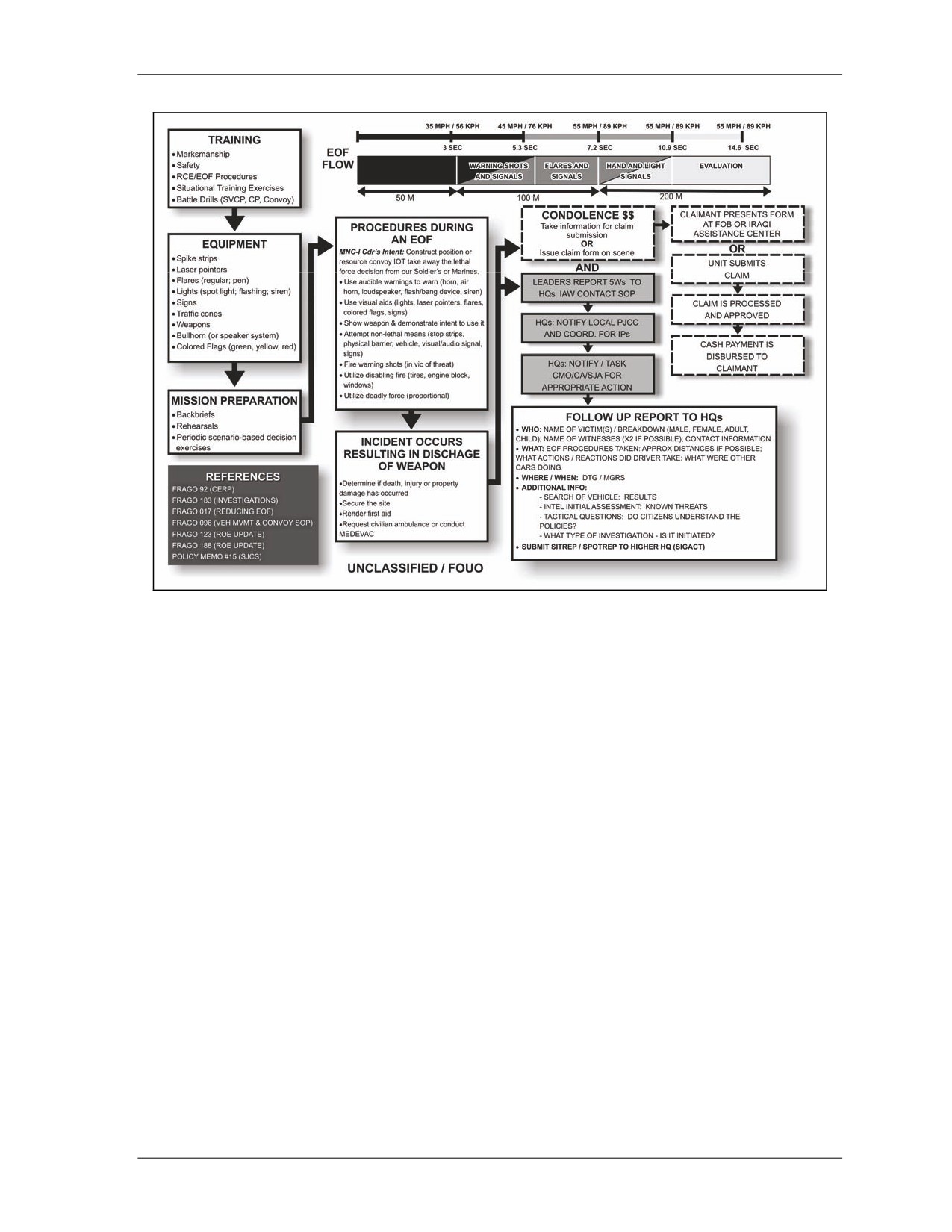
application of a quick decision. An example of a leaders EOF card is shown below in Figure 6-2.
6-10
FM 3-21.12
1 July 2008
Stability Operations
Figure 6-2. EOF leader's card.
6-45. The following situation is an example of the use of EOF. Since each situation is unique within its
own operational context, this example is an application of how EOF may be used and not how it must be
employed:
SITUATION: A platoon from the weapons company has been tasked to provide a four-vehicle
roadblock on a high-speed avenue of approach, in support of a Cordon and Search mission.
During the conduct of the operation, one of the guards identifies a vehicle traveling at an
unusually slow speed coming towards the cordon from the north.
ACTION: The vehicle arrives at the alert line
REACTION: A guard attempts to use hand and arm signals to stop the vehicle
ACTION: Vehicle passes the alert line, and speed bumps
REACTION: A guard uses visual and audio tools i.e. lasers, floodlights, bullhorns, sirens, etc. in an
attempt to stop the vehicle
ACTION: Vehicle ignores the signals and drives over the stop sticks
REACTION: Guards escalate to disabling shots and/or deadly force. It is reasonable to assume this
driver has shown hostile intent; therefore, deadly force is authorized.
1 July 2008
FM 3-21.12
6-11
This page intentionally left blank.
Chapter 7
Civil Support Operations
Civil support operations are actions that assist domestic civil authorities in providing
essential supplies and services to control disease and alleviate suffering, restoring
civil order, or helping people and communities recover from disasters. The ultimate
goal of civil support operations is to meet the immediate crisis, and then to transfer
responsibility quickly and efficiently back to the appropriate civilian authorities. For
more information on Civil Support Operations see FM 3-21.20, The Infantry
Battalion.
Section I. OVERVIEW
The US military provides civil support based on a DoD directive for military assistance to civil authorities.
Such a directive normally addresses both natural and manmade disasters. It can direct military aid in civil
disturbances, counterdrug and counterterrorism activities, law enforcement, and management of consequences
associated with weapons of mass destruction (WMD).
PURPOSES
7-1.
The US active duty military is limited by the Posse Comitatus Act (PCA) and other legislation in
the actions it can take in within the US and its territories. Under PCA, Army forces do not conduct stability
operations within the United States, but we do conduct civil support operations. Normally, for US armed
forces to conduct offensive and defensive operations inside the US and its territories, the President must do
two things. First, he must identify a significant armed force that threatens the territorial integrity of the US.
Second, he must declare a national emergency.
7-2.
Only then can jointly commanded Army forces conduct, in accordance with (IAW) Chapter 4,
Offensive Operations and Chapter 5, Defensive Operations, offensive and defensive Homeland
Security missions.
7-3.
The fundamental rule in employing military forces in civil support operations is to recognize that
civil authorities have the primary authority and responsibility for domestic operations. When so authorized,
Army forces conduct civil support operations, providing Army resources, expertise, and capabilities in
support of the lead agency. This expertise and capability is limited to supporting civil authorities and law
enforcement agencies, and to preventing civil disturbance. Civil support may include circumstances that
require the conduct of offensive and defensive operations in order to return the affected population to a
state of normalcy.
7-4.
Significant legal and constitutional issues arise when military forces are committed to combat
operations within the US. Differences exist between the actions that active duty forces, federalized reserve
component forces, and National Guard forces are authorized to perform. Commanders and leaders at all
levels must ensure they clearly understand the guidelines and rules of engagement established by the
President and his legal representatives.
7-5.
Leaders must keep their Soldiers informed on the situation and on guidance from higher
headquarters. The Infantry company will encounter various units and organizations classified by certain
1 July 2008
FM 3-21.12
7-1
Chapter 7
titles under US Code that may affect command and control relationships. Civil authorities may need to be
told what each can and cannot do.
• National Guard, in its role as the state militia, can be called to respond as state active duty
(SAD) under the command of the governor.
• Title 32 says that National Guard on full time status can be moved from SAD to Title 32.
• Title 10 applies to Active duty military units, including active Guard and Reserve.
• Title 14 applies to the US Coast Guard.
7-6.
In disaster relief, the Infantry weapons company becomes a force provider. As such, it
supplements the efforts and resources of state and local governments, and possibly those of
nongovernmental organizations, within the United States. During civil support operations, the US military
responds in support of civilian agencies and may receive guidance and instructions from civil authorities
through their assigned chain of command. These include responding to civil emergencies or major
disasters. A presidential declaration of an emergency or disaster usually precedes the Army’s commitment
to civil support operations, but in cases of extreme emergency, it may follow the initial actions. Regardless
of the relationship between the civil authorities and the military, the fundamental elements and
responsibilities of military command do not change. A representative of the civil authority does not, except
in some specific and rare circumstances, exercise command over military forces.
7-7.
The US Constitution mandates that the civilian government is responsible for preserving public
order. However, the Constitution also allows military forces to protect federal and civilian property and
functions. The Posse Comitatus Act restricts the use of the military in civilian law enforcement except in
the role of supporting or technical assistance.
7-8.
Federal military forces remain under the military chain of command while supporting civil law
enforcement. The supported law enforcement agency coordinates Army force activities under appropriate
civil laws and interagency agreements. Army and Air National Guard units that have not been federalized
can assist civil authorities when active duty federal units cannot under the provisions of the Posse
Comitatus Act.
TYPES
7-9.
Civil support involves using the Army to respond with a wide array of capabilities and services to
aid civil authorities in the following types of actions:
• Protecting public health.
• Restoring public order.
• Assisting in disaster recovery.
• Alleviating large-scale suffering.
• Protecting critical infrastructure.
7-2
FM 3-21.12
1 July 2008
Civil Support Operations
Section II. CAPABILITIES AND EMPLOYMENT
Civil support operations are varied and unpredictable. The Infantry weapons company must adaptable to a wide
variety of unconventional actions that may arise during civil support operations. This section includes
employment considerations for some of the actions that could benefit from weapons company capabilities.
CAPABILITIES
7-10.
In contrast to an Infantry rifle company, the weapons company is uniquely equipped with
additional capabilities that may aid in the execution of certain civil support actions. While the mission
remains the same, these additional capabilities may lead to assigning specific actions to the weapons
company that employ their unique assets. Additional capabilities include, but are not limited to, increased
transportation capability, increased mobility, increased assets in observation with enhanced optics during
limited visibility conditions, and increased communications assets. Examples of how these capabilities may
be employed include--
• Transportation
-- Assistance in food, fuel, water, clothing and blanket distribution
-- Vehicle support for personnel and other supplies
-- Medical evacuation assistance
• Mobility
-- Transport capability to remote areas
-- Assistance in rapid assessments of large areas
-- Assistance with verbal or written information distribution
• Enhanced Optics
-- Security
-- Search and rescue
-- Personnel and civil disturbance control
• Communications assets
-- Operations communications support
-- Communications relay assistance
-- Information distribution
EMPLOYMENT
7-11.
The weapons company commander cannot predict the exact actions his unit might have to perform
during civil support operations. Infantry units must often perform nonstandard actions during national and
local emergencies. Civil support operations respond to requests for help with protection and restoration.
Typically, these include riots or widespread disorder; forest and grassland fires; hazardous material
releases; and floods, storms, hurricanes, tornados, and earthquakes.
7-12.
State, local, and federal authorities are responsible for restoring essential services in the case of a
disaster. Army forces may support their efforts. Disaster relief focuses on recovery of critical infrastructure
after a natural or manmade disaster. Both humanitarian and disaster relief normally occur simultaneously.
The most common civil support actions the Infantry weapons company may encounter include--
• Search and rescue of survivors.
• Recovery of human remains.
• Disposal of animal carcasses.
• Disinfection and sanitation.
• Debris and trash removal.
• Riot and civil disturbance control.
1 July 2008
FM 3-21.12
7-3
Chapter 7
• Police augmentation.
• Food and ice distribution.
• Fuel distribution.
• Contamination containment.
• Personnel movement and control.
• Key facilities protection.
• Vital services assessment.
• Medical triage and treatment.
• Emergency fire fighting.
• Emergency flood control.
• Hazard identification.
• Water purification and distribution.
• Temporary shelter construction and administration.
• Transportation support.
• Power generation.
• Communications support.
• Clothing and blanket distribution.
• Information distribution.
• Medical evacuation coordination.
• Operations coordination.
• Observation posts.
• Checkpoints and roadblocks.
7-13.
Since the actions the weapons company may be required to
perform
during
civil support
operations vary widely, a detailed discussion of employment of weapons company capabilities in support
of possible actions is not warranted. Leaders and authorities will analyze the missions to be performed with
the units available to perform them and assign actions to individual units that will best accomplish the
mission. The weapons company must remain flexible and adaptive in their response to the missions they
may be assigned during civil support operations. While the unit will often be selected for missions that
employ their enhanced mobility, visibility, communications and transportation assets, leaders and
personnel must also realize they may be assigned other actions that do not necessarily capitalize on those
capabilities. For a further discussion of these actions see FM 3-21.10 and FM 3-21.20.
7-4
FM 3-21.12
1 July 2008
Chapter 8
Tactical Enabling Operations
The commander conducts tactical enabling operations to assist the planning,
preparation, and execution of any of the four types of military operations. Tactical
enabling operations are either shaping or sustaining. This chapter describes how the
weapons company commander conducts tactical enabling operations independently
or as part of the battalion.
Section I. RECONNAISSANCE
Reconnaissance is any mission undertaken to get information about the activities and resources of enemy forces
or the physical characteristics of a particular area, using visual observation or other methods. Successful
reconnaissance is a focused collection effort, aimed at gathering timely and accurate information about the
enemy and the terrain in the area of operations. All commanders have the requirement to gain the information
he needs to ensure the success of his mission. The weapons company may conduct reconnaissance operations to
gather information for his unit, other units, or as directed by a higher headquarters. For a more detailed
discussion of reconnaissance operations, see FM 3-20.98. This section discusses reconnaissance efforts in
which the weapons company may be involved.
TYPES
8-1.
In addition to reconnaissance performed as part of another type of operation, three types of
reconnaissance missions are conducted as distinct operations. These are the route, zone and area
reconnaissance. The weapons company may often conduct a route reconnaissance for themselves or
elements within the battalion. The weapons company, because of their inherent mobility, may be assigned
to a zone or area reconnaissance mission. If involved in a zone or area reconnaissance, it will often be as a
part of a larger scale mission rather than a separate mission of their own and may be attached to a
reconnaissance unit. A brief explanation of the three types follows.
ROUTE RECONNAISSANCE
8-2.
A route reconnaissance is a directed effort to get detailed information on a specific route as well
as on all terrain where the enemy could influence movement along that route. Route reconnaissance might
be oriented on a specific area of movement, such as a road or trail, or on a more general area, like an axis
of advance.
ZONE RECONNAISSANCE
8-3.
A zone reconnaissance is a directed effort to get detailed information about all routes, terrain,
enemy forces, and obstacles, including areas of chemical, biological, radiological or nuclear (CBRN)
contamination, within specified boundaries. The company may be a part of a zone reconnaissance when the
enemy situation is vague, or when information about cross-country trafficability is needed. As in route
reconnaissance, the commander's intent as well as mission, enemy, terrain, troops, time, civilians
(METT-TC) dictates the company's actions.
1 July 2008
FM 3-21.12
8-1
Chapter 8
AREA RECONNAISSANCE
8-4.
An area reconnaissance is a directed effort to get detailed information about the terrain or enemy
activity within a prescribed area. The area can be any location that is critical to the unit's operations.
Examples include easily identifiable areas covering fairly large spaces such as towns or military
installations; terrain features such as ridge lines, wood lines, or choke points; or single points such as
bridges or buildings. As with the zone reconnaissance, the weapons company may be involved in an area
reconnaissance as a part of a larger operation and my be attached to another unit for this mission.
RECONNAISSANCE IN FORCE
8-5.
A reconnaissance in force is a deliberate combat operation designed to discover or test threat
strength, disposition, and reaction, or to obtain other information. It is conducted when the threat is known
to be operating within an area, but adequate intelligence cannot be obtained by other means. It is an
aggressive reconnaissance, conducted as an offensive operation in pursuit of clearly stated information
requirements. The overall goal of the operation is to determine threat weaknesses that can be exploited.
The weapons company cannot conduct a reconnaissance in force independently. It can, however,
participate in such an operation as part of a robust combined arms force. During a reconnaissance in force,
the weapons company may be tasked to conducts zone, area, or route reconnaissance, or may conduct
screening operations in support of the unit conducting a reconnaissance in force.
OPERATIONS
8-6.
In planning for route, zone, or area reconnaissance, the company commander determines the
objective of the mission, and identifies whether the reconnaissance will orient on the terrain or on the
enemy force. He provides the company with clear guidance on the objective of the reconnaissance. In a
force-oriented reconnaissance operation, the critical task is to find the enemy and gather information on
him; terrain considerations of the route, zone, or area are a secondary concern. The company is generally
able to move more quickly in a force-oriented reconnaissance than in a terrain-oriented reconnaissance.
8-7.
To be most effective, reconnaissance must be continuous and conducted before, during, and after
operations. Before an operation, the company focuses its reconnaissance effort to confirm or deny a
possible course of action. After an operation, the company normally reconnoiters so it can maintain contact
with the enemy, collect information for upcoming operations, and provide force protection and security.
8-8.
Situations in which the company may conduct reconnaissance before or after an
operation include--
• Reconnaissance by a quartering party of an assembly area and the associated route to it.
• Reconnaissance before an offensive operation.
• Reconnaissance to probe enemy positions for gaps prior to an attack or infiltration.
• Reconnaissance to locate and/or observe enemy forward positions.
• Reconnaissance to locate bypasses around obstacle belts or to determine the best locations and
methods for breaching operations.
• Reconnaissance of choke points or other danger areas in advance of the remainder of the
company.
• Reconnaissance of defensive positions or engagement areas prior to the conduct of the defense.
• Reconnaissance as part of security operations to secure friendly obstacles, clear possible enemy
observation posts (OP), or cover areas not observable by stationary OPs.
• Reconnaissance to maintain contact with adjacent units.
• Reconnaissance to maintain contact with enemy elements.
8-2
FM 3-21.12
1 July 2008
Tactical Enabling Operations
METHODS
8-9.
Infantry weapons companies involved in reconnaissance missions may conduct them in one of
two ways. They often will be conducted through the employment of a patrol but certain types may also be
accomplished through the use of a reconnaissance by fire.
RECONNAISSANCE BY PATROL
8-10.
Most reconnaissance is accomplished through the employment of patrols. (For a discussion of
reconnaissance patrol operations see Section V.)
RECONNAISSANCE BY FIRE
8-11.
The focus of reconnaissance by fire is on the key terrain that dominates danger areas, on built-up
areas that dominate the surrounding terrain, and on uncleared wooded areas. The reconnaissance by fire
can be a planned or ordered action. The battalion commander may direct the company to execute
reconnaissance by fire when enemy contact is expected, or when contact has occurred but the enemy
situation is vague. Rules of engagement (ROE) will often dictate opportunities to use or not to use
reconnaissance by fire. The platoon then conducts tactical movement, occupying successive overwatch
positions until it makes contact with the enemy or reaches the objective.
8-12.
At each overwatch position, the leader must plan and develop direct fire control measures
(DFCM) and fire support coordination measures (FSCM). Then he either requests indirect fires or employs
direct fires on likely enemy locations. This forces the enemy force to return direct fire or to move, thus
compromising its positions. The weapons leader then uses fire commands to control the fires of his unit.
The machine guns can provide a heavy volume of fire at long range. If appropriate targets are sighted, then
the close combat missile systems may also be used. The weapons leader usually observes and corrects the
fires of his unit.
8-13.
A disciplined enemy force might not return fire, or might move if it determines that the pattern or
type of fires employed will lethal. The leader must analyze the situation and direct the use of appropriate
fires on suspected positions.
Section II. SPECIAL-PURPOSE OPERATIONS
This section discusses three special-purpose operations including passage of lines, relief in place, and linkup.
PASSAGE OF LINES
8-14.
Passage of lines occurs when one unit moves through the stationary positions of another, as part
of a larger force. The weapons company participates in a passage of lines as part of the battalion. If it is
part of the stationary force, the company occupies firing positions and assists the passing unit. If it is part
of a passing unit, the company executes tactical movement through the stationary unit. A passage may be
forward or rearward, depending on whether the passing unit is moving toward (forward) or away from
(rearward) an enemy unit or area of operations.
PASSAGE LANES
8-15.
The passage should facilitate transition to follow-on missions through the use of multiple lanes or
lanes wide enough to support doctrinal formations for the passing units.
1 July 2008
FM 3-21.12
8-3
Chapter 8
USE OF DECEPTION
8-16.
The unit can use deception techniques, such as smoke (previously coordinated with the stationary
unit and approved by the commander), to enhance security during the passage.
BATTLE HANDOVER
8-17.
The controlling higher commander must clearly define the battle handover criteria and procedures
to be used during the passage. His order should cover the roles of both the passing unit and the stationary
unit and the use of direct and indirect fires. He also specifies the location of the battle handover line (BHL)
as part of the unit’s graphic control measures. For a forward passage, the BHL is normally the line of
departure (LD) for the passing force; in a rearward passage, it is normally a location within the direct fire
range of the stationary force. In general, a defensive handover is complete when the passing unit is clear
and the stationary unit is ready to engage the enemy. Offensive handover is complete when the passing unit
has deployed and crossed the BHL.
OBSTACLES
8-18.
The passing and stationary units must coordinate obstacle information to include the locations of
enemy and friendly obstacles, existing lanes and bypasses, and guides for the passage.
AIR DEFENSE
8-19.
Air defense coverage is imperative during the high-risk passage operation. The stationary unit
normally is responsible for providing air defense, allowing the passing unit’s air defense assets to move
with it.
SUSTAINMENT RESPONSIBILITIES
8-20.
Responsibility for sustainment actions, such as vehicle recovery or casualty evacuation in the
passage lane, must be defined clearly for both passing and stationary units.
COMMAND AND CONTROL
8-21.
To enhance command and control during the passage, the weapons company co-locates a
command and control element with a similar element from the stationary or moving unit (as applicable).
OPERATIONAL CONSIDERATIONS
8-22.
Detailed reconnaissance and coordination are critical in ensuring that the passage of lines is
conducted quickly and smoothly. The commander usually conducts all necessary reconnaissance and
coordination for the passage. At times, he may designate the executive officer (XO), first sergeant, or a
platoon leader to conduct liaison duties for reconnaissance and coordination. The following items of
information are exchanged or coordinated. An asterisk indicates items that should be confirmed by
reconnaissance.
• Unit designation and composition, including type and number of passing vehicles.
• Passing unit arrival time(s).
• Location of attack positions or assembly areas.*
• Current enemy situation.
• Stationary unit’s mission and plan (to include OP, patrol, and obstacle locations).*
• Location of contact points, passage points, and passage lanes (NOTE: The use of global
positioning system (GPS) waypoints will simplify this process and speed the passage.).*
8-4
FM 3-21.12
1 July 2008
Tactical Enabling Operations
• Guide requirements.
• Order of march.
• Anticipated and possible actions on enemy contact.
• Supporting direct and indirect fires, including location of any restrictive fire lines (RFLs).*
• CBRN conditions.
• Available support assets and their locations.*
• Communications information (to include frequencies, digital data, and near and far recognition
signals).
• Chain of command, including location of the BHL.
• Additional procedures for the passage.
• Vulnerability of concentrated vehicles and decreased maneuverability.
FORWARD PASSAGE OF LINES
8-23.
In a forward passage, the passing unit first moves to an assembly area or an attack position behind
the stationary unit. Designated liaison personnel move forward to link up with guides and confirm
coordination information with the stationary unit. Guides then lead the passing elements through the
passage lane.
8-24.
As the passing unit, the weapons company conducts tactical movement to maximize its battle
space within the limitations of the passage lane. Radio traffic is kept to a minimum. Disabled vehicles are
bypassed. The company holds its fire until it passes the BHL. Once clear of passage lane restrictions, the
company conducts tactical movement in accordance with its orders.
REARWARD PASSAGE OF LINES
8-25.
Because of the increased chance of fratricide during a rearward passage, coordination of
recognition signals and direct fire restrictions are critical. The passing unit contacts the stationary unit
while it is still beyond direct fire range, and conducts coordination as discussed previously. RFLs and near
recognition signals are emphasized.
8-26.
As the passing unit, the weapons company then continues tactical movement toward the passage
lane. Weapons are oriented on the enemy, and the company is responsible for its security until it passes the
RFL. Ideally, the passing unit moves through the passage lanes without stopping or stopping only long
enough to pick up guides. The company then moves quickly through the passage lane to a designated
location behind the stationary unit.
RELIEF IN PLACE
8-27.
A relief in place occurs when one unit assumes the mission of another unit. It may occur during
offensive operations or during defensive operations, preferably during periods of limited visibility. There
are two methods by which to conduct a relief in place:
• Simultaneous. All elements are relieved simultaneously.
• Sequential. The relief takes place one element at a time (by individual vehicle or by groups of
vehicles).
8-28.
The weapons company follows the same procedures for a relief in place during combat as does an
Infantry company (Chapter 8, FM 3-21.10).
8-29.
Often during stability operations and civil support operations, a relief in place is referred to as a
transfer of authority. In addition to the normal responsibilities of a relief, commanders must also deal with
civilians or coalition partners. The departing unit often develops a continuity book that includes lessons
learned, details about the populace, village and patrol reports, updated maps, and photographs; anything
1 July 2008
FM 3-21.12
8-5
Chapter 8
that helps follow-on units master the environment. For more detail on relief in place during stability and
civil support operations, see FM 3-05.401 and FM 3-90.
LINKUP
8-30.
A linkup is an operation that entails the meeting of friendly ground forces (or their leaders or
designated representatives). The company conducts linkup activities independently or as part of a larger
force. Within a larger unit, the company may lead the linkup force.
8-31.
Linkup may occur in, but is not limited to, the following situations.
• Advancing forces reaching an objective area previously secured by air assault, airborne, or
infiltrating forces.
• Units coordinating a relief in place.
• Cross-attached units moving to join their new organization.
• A unit moving forward with a fixing force during a follow-and-support mission.
• A unit moving to assist an encircled force.
• Units converging on the same objective during the attack.
• Units conducting a passage of lines.
8-32.
The weapons company follows the same procedures for a linkup operation as an Infantry
company (Chapter 8, FM 3-21.10).
Section III. SECURITY OPERATIONS
Security operations are conducted to provide early and accurate warning of enemy operations, to provide the
protected force with time and maneuver space to react to the enemy and to develop the situation to allow a
commander to employ the protected force effectively. Units may conduct these operations to the front, flanks,
or rear of the higher force. The weapons company can conduct security operations as an independent force or
subordinate to another element. (For additional information on security operations, refer to FM 17-95.)
TYPES
8-33.
The four types of security operations are screen, cover, guard, and area security. Screen, guard,
and cover entail deployment of progressively higher levels of combat power and provide increasing levels
of security for the main body. Area security preserves a higher commander’s freedom to move his reserves,
position fire support assets, conduct command and control operations, and provide for sustainment
operations. A weapons company can conduct screen operations. It participates in cover, guard, and area
security missions as part of a larger element or with significant augmentation.
8-34.
All forces have an inherent responsibility to provide for their own local security. Local security
includes observation posts, local security patrols (mounted and dismounted), perimeter security, and other
measures taken to provide close-in security for the force.
PLANNING CONSIDERATIONS
8-35.
Security operations require the commander assigning the security mission and the security force
leader to address a variety of special operational factors.
8-6
FM 3-21.12
1 July 2008
Tactical Enabling Operations
AUGMENTATION OF SECURITY FORCES
8-36.
When a weapons unit conducts a screen, guard, or area security mission, the unit may receive
additional combat, and sustainment elements. Attachments may include, but are not limited to, the
following:
• A scout platoon or squad.
• A mortar section.
• An engineer element.
ENEMY-RELATED CONSIDERATIONS
8-37.
Security operations require the weapons element to deal with a varying set of enemy
considerations. For example, the array of enemy forces (and the tactics that enemy commanders use to
employ them) may be different from those for other tactical operation the unit conducts. Additional enemy
considerations can influence security operations including the following:
• The presence or absence of specific types of forces on the battlefield, including:
-- Insurgent elements (not necessarily part of the enemy force).
-- Enemy reconnaissance elements of varying strength and capabilities
(at divisional,
regimental, or other levels).
-- Enemy security elements.
-- Enemy stay-behind elements or enemy elements that have been bypassed.
• Possible locations that the enemy will use to employ his tactical assets, including:
-- Reconnaissance and infiltration routes.
-- OP sites for surveillance or indirect fire observers.
• Availability and anticipated employment of other enemy assets, including:
-- Surveillance devices, such as radar devices or unmanned aircraft systems (UAS).
-- Long-range rocket and artillery.
-- Helicopter and fixed-wing air strikes.
-- Elements capable of infiltration.
-- Mechanized forward detachments.
INITIATION OF THE SECURITY OPERATION
8-38.
The time by which the screen or guard must be established influences the unit’s method of
deploying to the security area as well as the time it begins the deployment.
RECONNAISSANCE OF THE SECURITY AREA
8-39.
The weapons company commander conducts a thorough analysis of the factors of METT-TC to
determine the appropriate methods and techniques for the unit to use in accomplishing this mission. The
weapons company commander should make every effort to conduct his own reconnaissance of the security
area that he expects the unit to occupy, even when the operation is preceded by a reconnaissance by other
battalion elements.
MOVEMENT TO THE SECURITY AREA
8-40.
In deploying elements to an area for a stationary security mission, the weapons company
commander must resolve the competing requirements of establishing the security operation quickly to meet
mission requirements while providing the necessary level of local security in doing so. Two methods can
be used to move to the security area:
1 July 2008
FM 3-21.12
8-7
Chapter 8
Tactical Road March
8-41.
If enemy contact is not expected or when time is critical, the unit can conduct a tactical road
march to a release point (RP) behind the security area to occupy their initial positions. This method of
deployment is faster than a movement to contact, but less secure.
Movement to Contact
8-42.
If time is not critical and either enemy contact is likely or the situation is unclear, the weapons
element conducts an approach march from the LD to the security area. This method is slower than a tactical
road march, but it is more secure.
LOCATION AND ORIENTATION OF THE SECURITY AREA.
8-43.
The higher commander determines the location, orientation, and depth of the security area in
which he wants the security force to operate. The security force commander conducts a detailed analysis of
the terrain in the security area. He then establishes his initial dispositions. This is usually a screen line
(even for a guard mission) as far forward as possible and on terrain that allows clear observation of
avenues of approach into the area of operations (AO). The initial screen line is shown as a phase line and
sometimes represents the forward line of own troops (FLOT). As such, the screen line may be a restrictive
control measure for movement. This requires the security force commander to conduct all necessary
coordination if he decides to establish observation posts (OPs) or to perform any reconnaissance forward of
the FLOT.
INITIAL OP LOCATIONS.
8-44.
The weapons company commander may deploy OPs to ensure effective surveillance of the AO or
of named area of interests (NAI). He designates initial OP locations on or behind the screen line. He should
assign the OPs with specific orientation and observation guidance, including, at a minimum, the primary
orientation for the surveillance effort during the conduct of the screen. Once set on the screen line, the
surveillance elements report their locations. The element that occupies each OP always retains the
responsibility for changing the location in accordance with tactical requirements and the commander’s
intent and guidance for orientation.
SPECIAL REQUIREMENTS AND CONSTRAINTS.
8-45.
The security force commander must specify any additional considerations for the security
operation, including, but not limited to, the following:
• All requirements for observing NAIs, as identified by the battalion or brigade.
• Any additional tactical actions or missions that the unit must perform.
• Engagement and disengagement criteria for the subordinate elements.
INDIRECT FIRE PLANNING.
8-46.
The security force commander conducts indirect fire planning to integrate artillery and mortar
assets into the security mission. If mortars are attached, a wide area may require him to position mortar
assets where they can provide effective coverage of the enemy’s most likely axis of attack or infiltration
routes. The fire support officer (FSO) assists him in planning artillery fires.
POSITIONING OF COMMAND AND CONTROL AND SUSTAINMENT ASSETS.
8-47.
The security force commander normally positions himself where he can observe the most
dangerous enemy axis of attack or infiltration route, with the XO (or the person identified as second in
8-8
FM 3-21.12
1 July 2008
Tactical Enabling Operations
command) positioned on the second most critical axis or route. The XO positions the company command
post (if used) in depth and, normally, centered in the AO. This location allows the XO to provide control of
initial movement, to receive reports from the screen or guard elements, and to assist the commander in
more effectively facilitating command and control. Unit trains are positioned behind masking terrain, but
they remain close enough for rapid response. The trains are best sited in depth and along routes that afford
good lateral mobility. Patrols may be required to cover gaps between the OPs. The security force
commander tasks elements to conduct either mounted or dismounted patrols, as required.
COORDINATION.
8-48.
The security force commander must conduct adjacent unit coordination to ensure there are no
gaps in the screen or guard and to ensure smooth execution of the unit’s rearward passages of lines (if
required). Additionally, he must coordinate for the unit’s follow-on mission.
SUSTAINMENT CONSIDERATIONS.
8-49.
The security force commander’s primary considerations for sustainment during the security
operation is coordinating and conducting resupply of the unit, especially for Class III and V supplies, and
casualty evacuation. In addition to normal considerations, however, the security force commander may
acquire other responsibilities in this area, such as arranging sustainment for attached elements or
coordinating resupply for a subsequent mission. The unit’s support planning can be further complicated by
a variety of factors. To prevent these factors from creating tactical problems, the unit may receive
requested logistical support, such as additional medical evacuation vehicles, from the higher headquarters.
FOLLOW-ON MISSIONS.
8-50.
The complexities of security missions, combined with normal operational requirements (such as
troop-leading procedures, engagement area development, rest plans, and sustainment activities), can easily
rob the security force commander of the time he needs for planning and preparation of follow-on missions.
He must address these competing demands in his initial mission analysis to ensure that the unit and its
leaders can adequately meet all requirements for current and future operations. If possible, the security
force commander can shift his focus to preparing for follow-on missions once preparations for the security
mission are complete (or satisfactorily under way). Another technique is to task the XO, with support
personnel and vehicles, to prepare for follow-on missions. The XO and this element can handle such
operational requirements as reconnaissance, selection of firing positions, coordination, and development of
follow-on engagement areas and battle positions. The drawback to this technique is that the XO and those
with him are unavailable for the current fight.
SCREEN
8-51.
A screen primarily provides early warning. It observes, identifies, and reports enemy actions to
the main defense. A screen provides the least amount of protection of any security mission. Generally, a
screening force fights only in self-defense; however, it may engage enemy reconnaissance elements within
its capability. It does not want to become decisively engaged. If the area to be screened is large, the
weapons company may have the combat power to develop the situation. Using the weapons company for
the screening mission however, provides the screen with long-range fires and the mobility to mass these
fires. Terrain is a key factor with long-range fields of fire providing an advantage to the weapons company
while close terrain making it less effective.
PURPOSES.
8-52.
A screen is appropriate to cover gaps between forces, the exposed flanks or rear of stationary and
moving forces, or the front of a stationary formation. It is used when the likelihood of enemy contact is
1 July 2008
FM 3-21.12
8-9
Chapter 8
remote, the expected enemy force is small, or the friendly main body needs only a minimum amount of
time once it is warned to react effectively. Units accomplish a screen primarily by establishing a series of
OPs and conducting patrols to ensure adequate surveillance of the assigned AO. Purposes of a screen
include the following:
• Prevent enemy ground elements from passing through the screen undetected or unreported.
• Maintain continuous surveillance of all avenues of approach into the AO under all visibility
conditions.
• Destroy or repel enemy reconnaissance elements within its capability without violating the
commanders’ intent.
• Locate the lead elements of each enemy advance guard force and determine their direction of
movement.
• Maintain contact with enemy forces and report any activity in the AO.
• Impede and harass the enemy within capability while displacing.
• Maintain contact with the enemy main body and any enemy security forces operating on the
flanks of friendly forces.
STATIONARY SCREEN.
8-53.
The weapons company commander assigns surveillance responsibility to its platoons and attached
elements. He designates locations of OPs, which should be in depth through the AO. Weapons squads
within the unit normally man the OPs. The commander identifies the enemy’s likely axes of attack or
infiltration routes. If necessary, he identifies additional control measures (such as NAIs, phase lines, target
reference points (TRP), or checkpoints) to assist in movement control and in tracking of enemy elements.
The unit conducts mounted and limited dismounted patrols to reconnoiter areas that cannot be observed
from OPs. Once the enemy is detected from an OP, the screening force may engage him with indirect fires.
This prevents the enemy from penetrating the screen line and does not compromise the location of the OP.
Within its capability, the screening force may destroy enemy reconnaissance assets with direct fires if
indirect fires cannot accomplish the task. The screening force also impedes and harasses other enemy
elements, primarily through the use of indirect fires. If enemy pressure threatens the security of the
screening force, the unit normally reports the situation and requests permission to displace to a subsequent
screen line, conduct a passage of lines, or execute a follow-on mission.
MOVING SCREENS.
8-54.
A weapons company can conduct a moving screen to the flanks or rear of the main body force. Its
mobility permits it to move and establish a series of OPs to protect the flank or rear of the Infantry
battalion. The movement of the screen is keyed to time and distance factors associated with the movement
of the friendly main body.
Moving Flank Screen.
8-55.
Responsibilities for a moving flank screen begin at the front of the main body’s lead combat
element and end at the rear of the protected force. In conducting a moving flank screen, the company either
occupies a series of temporary OPs along a designated screen line or, if the protected force is mounted and
moving too fast, continues to move while maintaining surveillance and preparing to occupy a designated
screen line. There are four basic methods of controlling movement along the screened flank. The screening
force may use one or more of these methods as the speed of movement of the protected force changes or
contact is made.
Alternate Bounds by Individual OP.
8-56.
This method is used when the protected force is advancing slowly and enemy contact is likely
along the screen line. Designated elements of the screening force move to and occupy new OPs as dictated
8-10
FM 3-21.12
1 July 2008
Tactical Enabling Operations
by the enemy situation and the movement of the main body. Other elements remain stationary, providing
overwatch and surveillance, until the moving elements establish their new positions; these elements then
move to new positions while the now-stationary elements provide overwatch and surveillance. This
sequence continues as needed. The method of alternate bounding by individual OP is secure but slow.
Alternate Bounds by Unit.
8-57.
This method is used when the protected force is advancing slowly and enemy contact is likely
along the screen line. Designated elements of the screening force move and occupy new positions as
dictated by the enemy situation and the movement of the main body. Other elements remain stationary,
providing overwatch and surveillance, until the moving elements establish their new positions; these
elements then move to new positions while the now-stationary elements provide overwatch and
surveillance. This sequence continues as needed. The method of alternate bounding by unit is secure but
slow. Because of the mix of weapons at the section and platoon level, the weapons company may use this
method if the threat has both armored and motorized or dismounted Infantry.
Successive Bounds.
8-58.
The screening element uses this method when the total tactical environment is being developed
and enemy contact is possible. During this time, the main body makes frequent short halts during
movement. Each subordinate unit of the screening force occupies a designated portion of the screen line
each time the main body stops. When main body movement resumes, the subordinate units move
simultaneously, retaining their relative position as they move forward.
Continuous Marching.
8-59.
This method is used when the main body is advancing rapidly at a constant rate and enemy
contact is not likely. This can occur if the Infantry battalion is mounted. The screening force maintains the
same rate of movement as the main body while at the same time conducting surveillance as necessary.
Stationary screen lines are planned along the movement route, but the screening force occupies them only
as necessary to respond to enemy action.
Moving Rear Screen.
8-60.
A moving rear screen may be established to the rear of a main body force conducting an offensive
operation or between the enemy and the rear of a force conducting a retrograde operation. In either case,
movement of the screen is keyed to the movement of the main body or to the requirements of the enemy
situation; the weapons company commander normally controls the moving rear screen by moving to a
series of pre-designated phase lines.
GUARD
8-61.
A guard force protects the friendly main body either by fighting to gain time
(while
simultaneously observing the enemy and reporting pertinent information) or by attacking, defending, or
delaying the enemy to prevent him from observing the main body and engaging it with direct fires. There
are three types of guard operations (advance, flank, and rear guard). They can be conducted in support of
either a stationary or a moving friendly force. The guard force differs from a screening force in that it
contains sufficient combat power to defeat, repel, or fix the lead elements of an enemy ground force before
they can engage the main body with direct fires. In addition, the guard force normally deploys over a
narrower front than does a comparably sized screening force, allowing greater concentration of combat
power. The guard force routinely engages enemy forces with both direct and indirect fires, and it normally
operates within range of the main body’s indirect fire weapons. With its firepower and range, the weapons
company may be designated to conduct a guard mission but the battalion commander has to weigh the
1 July 2008
FM 3-21.12
8-11
Chapter 8
benefits of the increased firepower for the guard force and the possibility of loosing a portion of his
weapons company.
PURPOSES.
8-62.
The purposes of the guard, in addition to those listed in the earlier discussion of the screen,
include the following:
• Destroy or repel all enemy reconnaissance elements.
• Fix and defeat enemy security elements.
• Cause the enemy main body to deploy, then report its direction of travel to the friendly main
body commander.
TYPES.
8-63.
The following paragraphs describe the operational considerations for a weapons company
conducting advance, flank, or rear guard:
Advance Guard.
8-64.
An advance guard for a stationary force is defensive in nature. The weapons company defends or
delays in accordance with the intent of the higher commander. An advance guard for a moving force is
offensive in nature. The weapons company normally conducts an offensive advance guard mission during a
movement to contact as part of a battalion. Its role is to maintain the freedom of maneuver of the main
body by providing early warning of enemy activity and by finding, fixing, and destroying enemy
reconnaissance and security elements.
Flank Guard.
8-65.
A flank guard protects an exposed flank of the main body. A flank guard is similar to a flank
screen except that both OPs and defensive positions are planned. The weapons company may conduct a
moving flank guard during an attack or a movement to contact. In conducting a moving flank guard, the
weapons company normally occupies a series of pre-designated battle positions along the protected flank.
It must maintain orientation both to the front (to perform its overwatch role and to maintain its own
security) and to the protected flank. It must also maintain a sufficient distance from the main body to
prevent the enemy from engaging the main body with long-range direct fires before early warning can be
sent.
Rear Guard.
8-66.
The rear guard protects the rear of the main body. This may occur during offensive operations
when the main body breaks contact with the enemy or during retrograde operations. Rear guards may be
deployed behind either moving or stationary main bodies. The rear guard for a moving force displaces to
successive battle positions along phase lines as the main body moves. During retrograde operations, the
rear guard normally deploys its elements across the entire AO behind the main body’s forward maneuver
units.
STATIONARY GUARD.
8-67.
As noted, a stationary guard mission is, at least initially, defensive in nature. The guard force
normally employs OPs to accomplish all surveillance requirements of the guard mission. The weapons
company is prepared to conduct actions against the enemy’s main body and security elements as well as his
reconnaissance forces. The following paragraphs describe considerations for the weapons company
commander in operations involving specific enemy elements:
8-12
FM 3-21.12
1 July 2008
Tactical Enabling Operations
Actions against Main Body and Security Elements.
8-68.
Once contact is made with an enemy main body or security force, the guard force attacks, defends,
or delays in accordance with the enemy situation and the intent of the commander of the protected force
(main body).
Actions against Reconnaissance Elements.
8-69.
When it must execute counterreconnaissance tasks, the weapons company normally
task-organizes into surveillance elements that normally occupy a screen line and attack elements.
Surveillance elements may include the scout platoon. Each element has specific responsibilities but must be
prepared to work effectively with the other to ensure success of the operation. The weapons company
commander must assign clear responsibilities for surveillance of identified avenues of approach and
designated NAIs. The surveillance element is tasked with detecting, reporting, and maintaining contact
with the enemy in the assigned area.
MOVING FLANK GUARD.
8-70.
Many of the considerations for a moving flank screen apply to the execution of a moving flank
guard. However, unlike a moving flank screen, which occupies a series of OPs, the flank guard force plans
to occupy a series of defensive positions. In conducting a moving flank guard, the weapons company either
occupies a series of temporary battle positions along the protected flank or, if the protected force is moving
too quickly, continues to move along the protected flank. During movement, the weapons company
maintains surveillance to the protected flank of the higher unit while preparing to occupy designated battle
positions based on enemy activity or on the movement of the protected force. There are three basic
methods of controlling movement along the guarded flank. The methods are similar to the methods for
controlling movement along a screened flank, except that the weapons company and its platoons occupy
pre-designated battle positions instead of OPs. The three methods are--
• Alternate bounds by unit.
• Successive bounds by unit.
• Continuous marching.
8-71.
The lead element of a moving flank guard must accomplish three tasks. It must maintain contact
with the protected force, reconnoiter the flank guard’s axis of advance, and reconnoiter the zone between
the protected force and the flank guard’s advance. The remainder of the flank guard marches along the axis
of advance and occupies battle positions to the protected flank as necessary.
LOCAL SECURITY
8-72.
A weapons company is responsible for maintaining its own security at all times. It does this by
deploying mounted and dismounted OPs and patrols to maintain surveillance and by employing appropriate
operations security (OPSEC) measures. In addition to maintaining security for its own elements, the unit
may implement local security, if augmented, for other units as directed by the higher commander.
Examples of such situations include, but are not limited to, the following:
• Provide security for engineers as they emplace obstacles or construct survivability positions in
the unit’s battle position (BP).
• Secure pickup zone (PZ) and landing zones (LZ).
• Establish mounted or dismounted OPs to maintain surveillance of enemy infiltration and
reconnaissance routes.
• Conduct mounted or dismounted patrols to cover gaps in observation and to suppress possible
enemy OPs from surrounding areas.
1 July 2008
FM 3-21.12
8-13