FM 3-21.12 The Infantry Weapons Company (July 2008) - page 1
FM 3-21.12
Headquarters
Field Manual
Department of the Army
No. 3-21.12
Washington, DC, 1 July 2008
The Infantry Weapons Company
Contents
Page
PREFACE
viii
Chapter 1
INTRODUCTION
1-1
Section I. OVERVIEW
1-1
Organization
1-1
Battlefield Functions
1-2
Characteristics
1-2
Capabilities
1-3
Organization
1-4
Section II. DUTIES AND RESPONSIBILITIES OF KEY PERSONNEL
1-4
Company Commander
1-4
Executive Officer
1-5
First Sergeant
1-6
Fire Support Officer
1-6
Radio Operator
1-6
Supply Sergeant
1-7
Chemical, Biological, Radiological, and Nuclear NCO
1-7
Armorer
1-7
Combat Medic
1-8
Assault Platoon Leader
1-8
Assault Platoon Sergeant
1-9
Section III. PREPARATION FOR WAR
1-9
Leaders
1-9
Warrior Ethos
1-10
Every Soldier as a Sensor
1-10
Section IV. EMPLOYMENT
1-11
Provide Mutual Support
1-11
Establish Security
1-12
Seek Flank Shot Engagements
1-12
Distribution Restriction: Approved for public release; distribution is unlimited.
i
Contents
Take Advantage of Standoff
1-12
Use Cover and Concealment
1-12
Employ in Depth
1-13
Employ as Part of a Combined Arms Team
1-13
Chapter 2
PLANNING AND PREPARATION
2-1
Section I. PLANNING
2-1
Battle Command
2-1
Troop-Leading Procedures
2-1
Planning Considerations
2-2
Section II. PREPARATION
2-6
Vehicle Load Considerations
2-6
Up-Armored HMMWVs
2-6
Unit-Installed Protection
2-7
Vehicle Weight, Observation, and Survivability
2-7
Precombat Checks and Inspections
2-8
Chapter 3
MOVEMENT
3-1
Section I. MOVEMENT FORMATIONS AND TECHNIQUES
3-1
Formations
3-1
Techniques
3-8
Section II. OPERATIONAL CONSIDERATIONS
3-13
Movement Fundamentals
3-13
Movement Control Techniques
3-14
Chapter 4
OFFENSIVE OPERATIONS
4-1
Section I. OVERVIEW
4-1
Purpose
4-1
Characteristics
4-1
Types
4-2
Sequence
4-3
Section II. PLANNING CONSIDERATIONS
4-5
Warfighting Functions
4-5
Weapons Selection
4-7
Selection of Support and Attack-by-Fire Positions
4-7
Section III. MOVEMENT TO CONTACT
4-7
Overview
4-8
Approach March Technique
4-8
Search and Attack Technique
4-8
Section IV. ACTIONS ON CONTACT
4-8
Commander's Analysis
4-9
Time Requirements
4-9
Steps
4-9
Section V. ATTACKS
4-9
Types
4-9
Exploitation
4-12
Pursuit
4-12
ii
FM 3-21.12
1 July 2008
Contents
Section VI. OFFENSIVE MANEUVER
4-12
Support-by-Fire Force
4-12
Attack-by-fire
4-13
Use of Terrain for Cover and Concealment
4-14
Hasty Occupation of a Position
4-14
Chapter 5
DEFENSIVE OPERATIONS
5-1
Section I. OVERVIEW
5-1
Purpose
5-1
Characteristics
5-1
Types
5-3
Section II. PLANNING CONSIDERATIONS
5-3
Warfighting Functions
5-3
Selection of Positions
5-9
Section III. TACTICAL EMPLOYMENT
5-14
Contiguous and Noncontiguous Defense
5-14
Tactics
5-15
Other Employment Options
5-22
Engagement Area Development
5-24
Priority of Work
5-32
Sector Sketches and Fire Plans
5-32
Adjacent Unit Coordination
5-33
Section IV. RETROGRADE OPERATIONS
5-33
Purpose
5-33
Types
5-34
Chapter 6
STABILITY OPERATIONS
6-1
Section I. OVERVIEW
6-1
Purposes
6-1
Types
6-2
Section II. CAPABILITIES AND EMPLOYMENT
6-2
Capabilities
6-2
Employment
6-3
Section III. ESCALATION OF FORCE
6-9
Overview
6-9
Guidelines and Principles
6-10
Chapter 7
CIVIL SUPPORT OPERATIONS
7-1
Section I. OVERVIEW
7-1
Purposes
7-1
Types
7-2
Section II. CAPABILITIES AND EMPLOYMENT
7-3
Capabilities
7-3
Employment
7-3
Chapter 8
TACTICAL ENABLING OPERATIONS
8-1
Section I. RECONNAISSANCE
8-1
Types
8-1
Operations
8-2
Methods
8-3
1 July 2008
FM 3-21.12
iii
Contents
Section II. SPECIAL-PURPOSE OPERATIONS
8-3
Passage of Lines
8-3
Relief in Place
8-5
Linkup
8-6
Section III. SECURITY OPERATIONS
8-6
Types
8-6
Planning Considerations
8-6
Screen
8-9
Guard
8-11
Local Security
8-13
Section IV. OPERATIONS WITH AIRBORNE, AIR ASSAULT, AND SPECIAL
OPERATIONS FORCES
8-14
Airborne and Air Assault Forces
8-14
Special Operations Forces
8-14
Section V. BREACHING OPERATIONS
8-16
Fundamentals
8-16
Organization
8-16
Section VI. PATROLS
8-18
Operations
8-18
Types
8-18
Chapter 9
DIRECT FIRE CONTROL
9-1
Commander's Role in COA Development
9-1
Principles
9-1
Process
9-4
Planning Considerations
9-4
Control
9-5
Chapter 10
FIRE SUPPORT, MOBILITY, PROTECTION, AND OTHER SUPPORT
10-1
Fire Support
10-1
Mobility
10-8
Protection
10-9
Other Support
10-10
Chapter 11
SUSTAINMENT OPERATIONS
11-1
Section I. PLANNING CONSIDERATIONS
11-1
Overview
11-1
Responsibilities
11-2
Section II. TRAINS, SUPPLY, AND TRANSPORTATION
11-4
Trains
11-4
Supply
11-8
Transportation
11-9
Section III. MAINTENANCE
11-10
Unit Maintenance
11-10
Maintenance Considerations
11-11
Vehicle Recovery
11-12
Destruction
11-13
iv
FM 3-21.12
1 July 2008
Contents
Section IV. ARMY HEALTH SYSTEM SUPPORT
11-13
Force Health Protection
11-13
Health Service Support
11-15
Section V. OTHER OPERATIONS
11-17
Reorganization
11-17
Enemy Prisoners of War, Detainees, and Other Retained Persons
11-17
Chapter 12
URBAN OPERATIONS
12-1
Section I. TACTICAL CONSIDERATIONS
12-1
Command and Control
12-1
Maneuver
12-2
Enemy Organizations and Capabilities
12-3
Fundamentals of Enemy Operations
12-4
Fire Support
12-4
Sustainment
12-4
Planning Considerations
12-5
Section II. EMPLOYMENT
12-6
Task Organization
12-6
Tactical Considerations
12-8
Section III. OFFENSIVE URBAN OPERATIONS
12-10
Phases
12-10
Task Organization
12-11
Section IV. DEFENSIVE URBAN OPERATIONS
12-12
Enemy Forces Outside Urban Area
12-12
Enemy Forces Within Urban Area
12-12
Role of Weapons Company
12-12
Fighting and Firing Positions
12-13
Employment of Infantry Squads
12-13
Employment of Reserve Force
12-13
GLOSSARY
Glossary-1
REFERENCES
References-1
INDEX
Index-1
Figures
Figure 1-1. The Infantry Battalion, IBCT
1-1
Figure 1-2. The Infantry Weapons Company. IBCT
1-4
Figure 1-3. Overlapping fires
1-11
Figure 3-1. Column formation
3-2
Figure 3-2. Wedge formation
3-3
Figure 3-3. Line formation
3-3
Figure 3-4. Vee formation
3-4
Figure 3-5. Diamond formation
3-4
Figure 3-6. Box formation
3-5
1 July 2008
FM 3-21.12
v
Contents
Figure 3-7. Echelon left/right formation
3-6
Figure 3-8. Coil formation before (left) and after (right)
3-7
Figure 3-9. Herringbone formation
3-7
Figure 3-10. Transition from movement techniques to maneuver
3-9
Figure 3-11. Traveling technique
3-10
Figure 3-12. Traveling overwatch technique
3-11
Figure 3-13. Bounding overwatch technique
3-12
Figure 4-1. Support-by-fire on Objective Jake and attack-by-fire on Objective Jackie
4-14
Figure 5-1. Defensive firing positions
5-11
Figure 5-2. Defense of an area of operations
5-16
Figure 5-3. Defense from a reverse slope
5-19
Figure 5-4. Perimeter defense
5-22
Figure 5-5. Likely enemy avenues of approach
5-26
Figure 5-6. Enemy’s scheme of maneuver
5-27
Figure 5-7. Determine where to kill the enemy
5-28
Figure 5-8. Emplace weapons systems
5-29
Figure 5-9. Plan and integrate obstacles
5-30
Figure 5-10. Plan and integrate indirect fires
5-31
Figure 6-1. Establishment of a cordon
6-5
Figure 6-2. EOF leader's card
6-11
Figure 10-1. Stinger, man-portable, mounted on a HMMWV
10-10
Figure 11-1. Trains layout
11-5
Figure 11-2. Forward support company
11-6
Tables
Table 2-1. Weapons characteristics
2-4
Table 2-2. Example precombat check and inspection list
2-8
Table 3-1. Comparison of movement formations
3-8
Table 4-1. General weapons employment guidelines
4-7
Table 9-1. Common fire control measures
9-6
Table 10-1. Combat engineer focus
10-9
vi
FM 3-21.12
1 July 2008
Preface
This field manual provides a doctrinal framework for the Infantry weapons company assigned to Infantry
battalions in an Infantry brigade combat team (IBCT). It is a companion to FM 3-21.10, The Infantry Rifle
Company, much of which applies to the Infantry weapons company and as such will not be repeated herein.
This manual will discuss on the unique characteristics of the Infantry weapons company, including principles,
tactics, techniques, procedures, and terms and symbols. It will also cover what the Infantry weapons company
brings to the Infantry battalion and the battlefield. Among topics covered in FM 3-21.10 but omitted here are
the characteristics and fundamentals of urban operations, risk management and fratricide avoidance, heavy and
Stryker unit employment, sniper employment, improvised explosive devices, operations in a chemical,
biological, radiological, and nuclear
(CBRN) environment, media considerations, pattern analysis, and
situational understanding.
It focuses on the employment of the Infantry weapons company while fighting as a pure company or combined
arms team under the command of an Infantry weapons company commander. This framework will help Infantry
weapons company leaders effectively--
•
Exploit weapons company-unique capabilities.
•
Employ the company using unit weapon fundamentals.
•
Reduce the vulnerability of the unit.
•
Plan and conduct full-spectrum operations.
•
Accomplish missions in various tactical situations, from stability and civil support to
high-intensity combat.
•
Win on the battlefield.
Although organization for combat may require the detachment of individual weapons company platoons to
other units, this manual does not cover detailed operations of detached platoons. It only provides a general
discussion of coordination and operational issues pertaining to detachments.
The main target audience for this manual includes Infantry weapons company commanders, executive officers,
first sergeants, platoon sergeants, and platoon leaders. Others who may find it useful include military
instructors, evaluators, training and doctrine developers, and other Infantry company commanders, including
those at headquarters and headquarters company and rifle companies; Infantry battalion staff officers; service
school instructors; and commissioning source instructors.
This manual applies to the Active Army, the Army National Guard (ARNG)/Army National Guard of the
United States (ARNGUS), and the United States Army Reserve (USAR) unless otherwise stated.
The proponent is the US Army Training and Doctrine Command. The preparing agency is the US Army
Infantry School. You may send comments and recommendations by any means—US mail, e-mail, fax, or
telephone—as long as you use or follow the format of DA Form 2028 (Recommended Changes to Publications
and Blank Forms). You may also phone for more information.
E-mail
BENN.CATD.Doctrine@conus.army.mil
Office/Fax
COM 706-545-7114/7500 (DSN 835)
US Mail
Commandant, USAIS
ATTN: ATSH-ATD
6751 Constitution Loop
Fort Benning, GA 31905-5593
Unless this publication states otherwise, masculine nouns and pronouns may refer to either men or women.
1 July 2008
FM 3-21.12
vii
Chapter 1
Introduction
"Battles are won by fire and movement. The purpose of movement is to set the fire in
a more advantageous place." -- GEN G.S. Patton Jr.
As the operational environment (OE) in which the Infantry must operate continues to
evolve, so does the Infantry. Infantry units must continually adapt in order to meet
the threat. The Infantry weapons company is a response to meet these changing
conditions. This chapter discusses the mission, organizational structure,
characteristics, and weapon systems of the Infantry weapons company found in the
Infantry battalions of the Infantry brigade combat team (IBCT).
Section I. OVERVIEW
Infantry weapons companies are uniquely equipped to provide the Infantry battalion with additional
capabilities. Their organization structure and equipment provide the battalion with additional heavy weapons
firepower, maneuverability, and long-range communications.
ORGANIZATION
1-1.
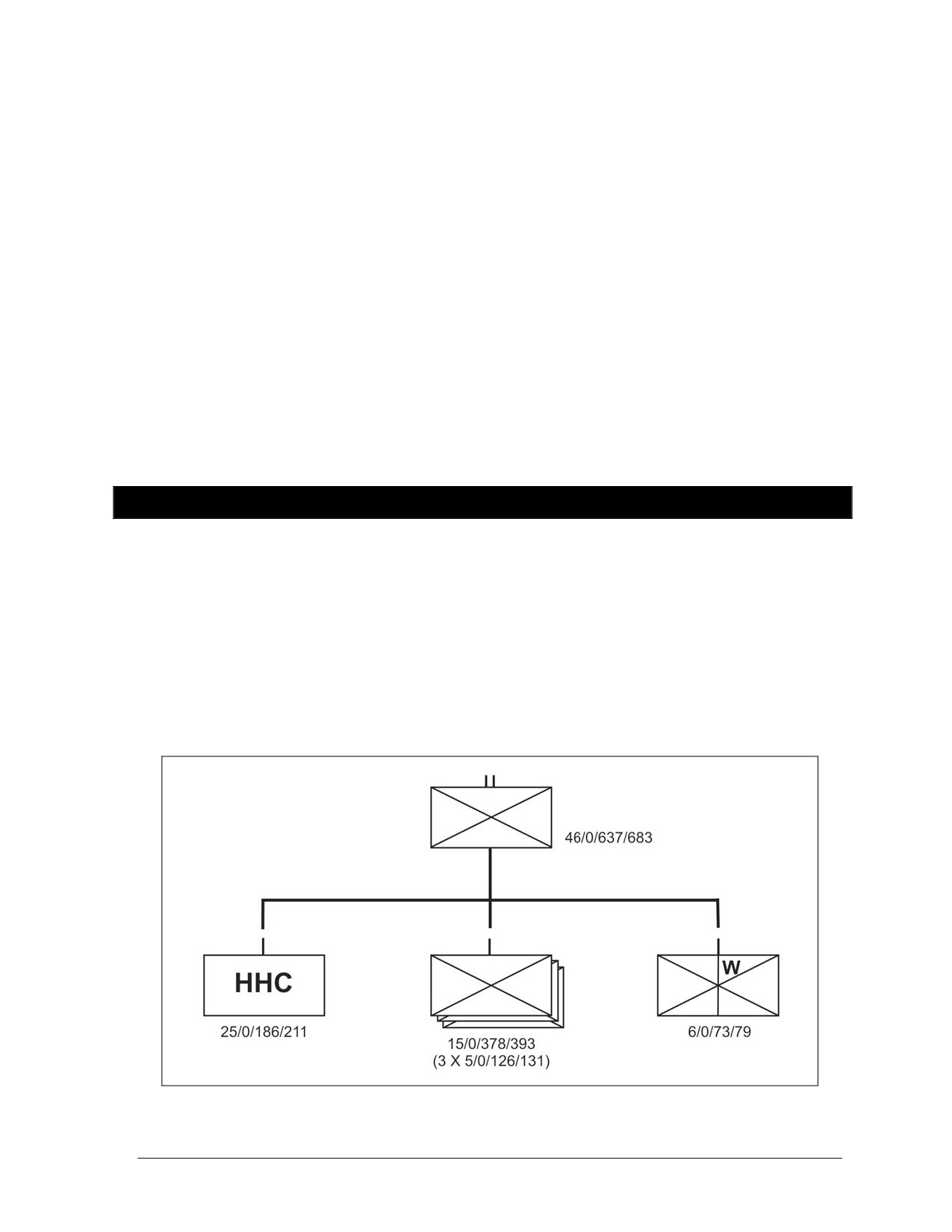
The Infantry weapons company is organic to an Infantry battalion assigned to an IBCT. In each
IBCT Infantry battalion, there is a headquarters company, three Infantry rifle companies, and one Infantry
weapons company as shown in Figure 1-1. The weapons company has approximately 80 personnel. It is a
fully mobile unit consisting of weapons carrier vehicles and a variety of heavy weapons systems.
Figure 1-1. The Infantry Battalion, IBCT.
1 July 2008
FM 3-21.12
1-1
Chapter 1
BATTLEFIELD FUNCTIONS
1-2.
The mission of the Infantry weapons company is to provide mobile heavy weapons and long range
close combat missile fires to the Infantry battalion. The inherent versatility of the weapons company as part
of the Infantry battalion also makes it well suited in employment against asymmetrical threats in full
spectrum operations. Mass and depth are key components to employing heavy weapons assets. During
tactical operations, heavy weapons units can suppress, fix, or destroy enemy at long ranges, allowing other
Infantry units or combined arms teams to maneuver. The weapons company provides the Infantry battalion
with a highly mobile, multi-functional element that can:
•
Deliver precision long-range, large-caliber direct fires to destroy enemy armored vehicles and
fortifications.
•
Deliver massed heavy machinegun and grenade launcher fires to engage enemy personnel, destroy
light vehicles, and provide area suppression.
•
Move rapidly on the battlefield to shift combat power where it is needed.
•
Communicate over longer distances than units using man-packed radios.
•
Employ long-range thermal weapons sights to detect and engage enemy forces during hours of
darkness.
•
Conduct moving or stationary observation, reconnaissance, screen, and guard missions.
•
Provide security and control for armed convoy escorts.
•
Coordinate, mass, and shift long-range direct fires.
•
Control and execute mounted combat and reconnaissance patrols.
•
Support the assaults of other units with massed supporting fires.
•
Provide responsive and flexible over-watch of moving elements.
•
Provide effective and wide-ranging outer cordon forces.
•
Integrate indirect and aerial fires with the unit’s direct fire plan.
•
Task organize with one or more rifle platoons, or attached armored forces, into a powerful and
flexible combined arms team.
•
Detach one or more Assault platoons to augment rifle companies within the battalion.
•
Conduct unit self-sustainment and maintenance within its capability.
CHARACTERISTICS
1-3.
The Infantry weapons company is uniquely equipped with heavy weapons to support the
maneuver of the rifle companies within the Infantry battalion. The heavy weapons contained in the
weapons company include a mix that can be tailored to a particular mission based on mission, enemy,
terrain, troops, time, civilians (METT-TC). The company maneuvers in all types of terrain, climates and
visibility conditions.
ARMS ROOM CONCEPT
1-4.
Infantry weapons companies are currently equipped with four types of heavy weapons. The
selection and employment of weapon system or systems to use for a particular mission is termed the “Arms
Room Concept.” The heavy weapons systems currently available in the weapons company are the
tube-launched, optically-tracked, wire-guided (TOW) Improved Target Acquisition System (ITAS), the
MK-19 40mm Grenade Machine Gun, the M2 .50 caliber Machine Gun, and the Javelin Close Combat
Missile System. Each vehicle-mounted system is also equipped with a tripod for ground mount operations.
Only one of these systems can be mounted on each individual vehicle at a time. Javelins may be carried in
the vehicle along with a vehicle-mounted system. During movements, other weapon systems not mounted,
along with any additional equipment, may be carried in trailers. When trailers are not feasible, non-mission
essential equipment may be left in a stay behind position. During mission planning, leaders must determine
which weapons systems are best suited for that particular mission and configure the vehicles appropriately.
While all of the heavy weapons vehicles can mount the MK-19 and the M2, only two per platoon are
1-2
FM 3-21.12
1 July 2008
Introduction
equipped to mount the ITAS. There are two ITAS, two M2 .50 caliber machine guns, two MK-19 40mm
Grenade Machine Guns, and two Javelin Close Combat Missile Systems per platoon for a total of 24
mountable heavy weapons systems per company. For any given mission, only four of the six vehicular
mountable systems may be mounted in each platoon. The remaining systems may be left in the stay behind
position.
CAPABILITIES
1-5.
The heavy weapon systems available to the weapons company provide direct fire against
personnel, vehicles, armored or other hard targets to support maneuver of Infantry. Vehicular mounted
communications systems may be used to enhance long range communications for the battalion offering
communications relay if necessary. Optic systems supplied with the heavy weapons may also aid in
security and information gathering.
OFFENSIVE CAPABILITIES
1-6.
A weapons company may initially provide the base of fire in a battalion attack in order to
suppress, fix, or destroy the enemy in position. It may also engage enemy in planned engagement areas,
isolate objectives by destroying enemy counterattacks, or destroy withdrawing enemy forces. It is also well
suited to protect the battalion’s flanks. Within the confines of the rules of engagement, the company’s
heavy weapons may also be useful in urban operations with tasks such as creating entry points into
buildings, engagement of snipers, and destruction of reinforced structures.
DEFENSIVE CAPABILITIES
1-7.
Weapons companies can be positioned forward of the defensive area to participate in security
operations or to overwatch reconnaissance units or obstacles. As the enemy closes, they can displace to
positions that provide direct fires into an engagement area. They may also be positioned throughout the
depth of the decisive area of operation to cover likely armor avenues of approach, perform reconnaissance
or assist in route security. During counterattacks, the weapons company can provide overwatching
support-by-fire (SBF) positions for the maneuvering element.
STABILITY AND CIVIL SUPPORT CAPABILITIES
1-8.
Whether conducting stability operations in a foreign nation or domestic civil support operations,
the weapons company brings with it a host of capabilities including transportation, mobility, enhanced
optics, and communications assets. These capabilities can be creatively employed to assist both of these
operations. For further discussion, see Chapter 6 and Chapter 7 of this manual.
LIMITATIONS
1-9.
Although the weapons company’s vehicles provide protection against small arms and
fragmentation, these vehicles lack protection against large caliber direct and indirect fires and are still
vulnerable to enemy antiarmor weapons.
1-10.
The weapons carrier vehicle provides increased mobility and can maneuver the weapons quickly
to advantage locations on the battlefield. However, certain types of terrain such as steep slopes, thick
vegetation, mud and other restrictive areas, may restrict vehicular travel. Weather may also prevent
vehicles from operating at full capacity.
1-11.
The inherent maintenance requirement for the vehicles and heavy weapons are greatly increased
for the weapons company over those of the rifle company. This requirement creates a large increase in
responsibilities for the logistical personnel for the company.
1 July 2008
FM 3-21.12
1-3
Chapter 1
1-12.
The ITAS fires TOW missiles. TOW missiles are accurate, but missile flight time is long and
obstacles may interfere with the flight path. The slow rate of fire and the visible launch signature of the
TOW missile increase the weapons squad’s vulnerability especially if a vehicle mounted ITAS engages
within an enemy’s effective direct-fire range
(no standoff). Units can reduce this vulnerability by
displacing often and by integrating their fires with those of automatic weapon systems and with other
antiarmor weapons in the platoon. Vulnerability is further decreased through the use of obstacles and
indirect fires.
ORGANIZATION
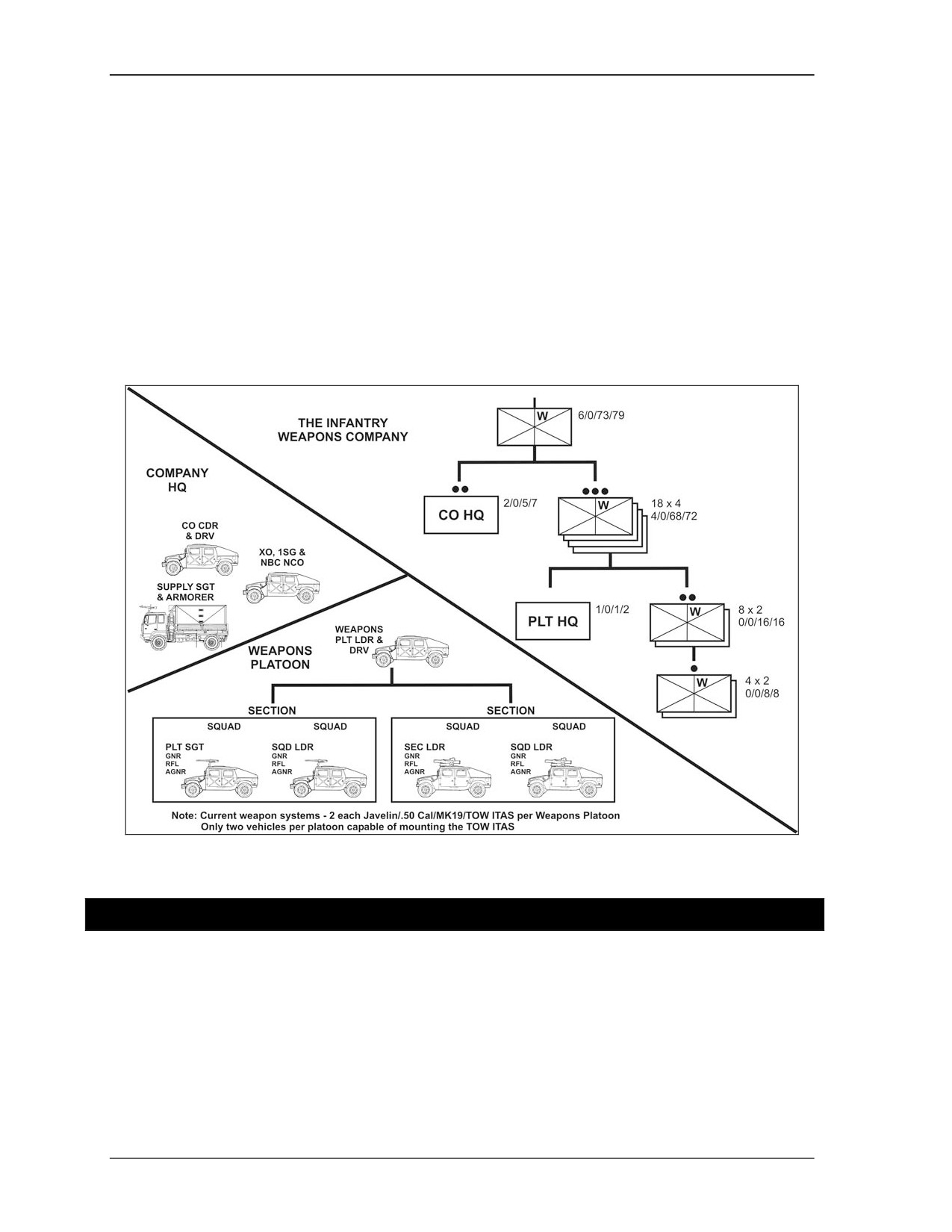
1-13.
Figure 1-2 shows the organization of the weapons company. The company consists of a company
headquarters and four assault platoons. Each assault platoon has two sections consisting of two squads
each and a leader’s vehicle. Each squad contains four Soldiers and a vehicle mounting the heavy weapons.
Figure 1-2. The Infantry Weapons Company. IBCT.
Section II. DUTIES AND RESPONSIBILITIES OF KEY PERSONNEL
This section describes the duties and responsibilities of key personnel in the Infantry weapons company.
COMPANY COMMANDER
1-14.
The company commander leads by personal example and is responsible for everything the
company does or fails to do. His principle duties include the key areas of tactical employment, training,
administration, personnel management, maintenance, force protection, and sustainment of his company. He
must integrate and synchronize a mix of forces for full spectrum operations including other combined arms
1-4
FM 3-21.12
1 July 2008
Introduction
and maneuver elements, civil affairs, psychological operations (PSYOP), interpreters, media, unmanned
aircraft systems (UAS), and robotics teams. The commander:
•
Commands and controls through his subordinate leaders.
•
Employs his company to accomplish its mission within the battalion commander's intent and
concept.
•
Selects the best location to maneuver the platoons and other elements.
•
Conducts mission analysis, troop-leading procedures
(TLP), and issues operation orders for
company tactical operations.
•
Maintains and expresses situation awareness and understanding.
•
Resources the platoons and other elements and requests battalion support when needed.
•
Ensures that the company command post (CP) effectively tracks the battle situation and status.
•
Provides a timely and accurate tactical picture to the battalion commander and subordinate units.
•
Implements effective measures for force protection, security, and accountability of forces
and systems.
•
Develops the leadership and tactical skill of his platoon leaders.
•
Conducts direct fire coordination, principal advisor to the battalion commander on direct fire
coordination and may perform as the battalion direct fire coordinator.
EXECUTIVE OFFICER
1-15.
The executive officer (XO) is second in command. His primary role is to assist the commander in
mission planning and accomplishment. He assumes command of the company as required and ensures that
tactical reports from the platoons are forwarded to the battalion tactical operations center. The XO locates
where he can maintain communications with the company commander and the battalion. His
responsibilities include:
•
Planning and supervising, before the battle along with the first sergeant, the company's
sustainment operations and is responsible for the company command post. He ensures that
precombat inspections are complete. He plans and coordinates logistical support with agencies
outside the company while the first sergeant does the same internally. He prepares or aids in
preparing paragraph 4 of the company operation order (OPORD). He may also help the company
commander plan the mission.
•
Performing duties as the unit maintenance officer.
•
Coordinating with higher, adjacent, and supporting units. He may aid in control of critical events
of the battle such as a passage of lines, bridging a gap, or breaching an obstacle; or, he may
assume control of a platoon attached to the company during movement.
•
Performing as landing zone or pickup zone control officer. This may include straggler control,
casualty evacuation, resupply operations, or air-ground liaison.
•
Leading a quartering party. The quartering party is an element consisting of representatives of
various company elements. Their purpose is to precede the company and reconnoiter, secure, and
mark an assembly area.
•
Leading a detachment. A detachment consists of a group of personnel assigned other tactical tasks
such as shaping or sustaining force leader in a company raid or attack or control of the company
machine guns.
•
Leading the reserve, leading the detachment left in contact during a withdrawal, controlling
attachments to the company, or serving as movement control officer.
1 July 2008
FM 3-21.12
1-5
Chapter 1
FIRST SERGEANT
1-16.
The first sergeant is the senior noncommissioned officer
(NCO) and normally the most
experienced Soldier in the company. He is the expert on individual and NCO skills. He helps the
commander prepare, coordinate, and supervise all activities that support the unit mission. He operates
where the commander directs or where he can best influence a critical point or what is viewed as the unit's
decisive point. The first sergeant’s duties include:
•
Supervising routine operations. This can include enforcing the tactical standing operating
procedures (TSOP); planning and coordinating both training and full spectrum operations; and
administering replacement operations, logistics, maintenance, communications, field hygiene, and
casualty evacuation operations.
•
Supervising, inspecting, and influencing matters designated by the commander as well as areas
that depend on his expertise such as Soldier care, force protection, security, and accountability.
•
Assisting the XO and keeping himself prepared to assume the XO's duties, if needed.
•
Leading task-organized elements or subunits for the company's shaping effort or other designated
missions.
•
Leading the company casualty evacuation (CASEVAC) efforts and running the company casualty
collection point (CCP) for company missions.
FIRE SUPPORT OFFICER
1-17.
The fire support officer (FSO) is attached to the company from the battalion fire support platoon
and helps plan, coordinate, and execute the company's fire support. During planning, he develops a fire
support plan based on the company commander's concept and guidance. He coordinates the fire support
plan with the battalion fire support officer. During planning, the fire support officer:
•
Advises the commander of the capabilities and statuses of all available fire support assets.
•
Helps the commander develop the OPORD to ensure full integration of fires into the concept.
Refines field artillery and mortar targets to support the maneuver plan.
•
Designates targets and fire control measures and determines method of engagement and firing
responsibility.
•
Determines the specific tasks and instructions required to conduct and control the fire plan.
•
Briefs the fire support plan as part of the company OPORD, and coordinates with platoon leaders
to ensure they understand their fire support responsibilities.
•
Integrates platoon targets into the company target overlay and target worksheet, and sends the
resulting products to the battalion fires cell.
•
During the battle, normally locates near the commander. This allows greater flexibility in
conducting or adjusting the fire support plan. At times, locates away from the commander to
better control supporting fires. Informs the commander of key information on the radio net.
•
Understands Infantry tactics in order to integrate fires effectively, and if the company commander
becomes a casualty, may assume temporary control of the company until the XO can do so.
•
Coordinates the employment of the joint air attack team (JAAT), close air support (CAS), attack
helicopter, and UASs.
•
Ensures the indirect fire plan is part of each company rehearsal.
RADIO OPERATOR
1-18.
The radio operator supervises operation, maintenance, and installation of organic wire, and
frequency modulation (FM) communications. This includes sending and receiving routine traffic and
making required communication checks. The radio operators duties include:
•
Monitoring the communications nets, relaying information, and keeping the commander informed
of significant events if necessary.
1-6
FM 3-21.12
1 July 2008
Introduction
•
Rendering clear, accurate, and timely situation reports (SITREP).
•
Performing limited troubleshooting of organic communications equipment. Serves as the link
between the company and the battalion for communications equipment maintenance.
•
Supervising all aspects of communications security (COMSEC) equipment, to include requesting,
receipting, maintaining, securing, employing, and training for COMSEC equipment and
related materials.
•
Advising the company commander in planning and employing the communications systems.
Based on the commander's guidance, assists in preparing paragraph 5 of the OPORD.
SUPPLY SERGEANT
1-19.
The supply sergeant requests, receives, issues, stores, maintains, and turns in supplies and
equipment for the company. He coordinates requirements with the first sergeant, the XO and the battalion
S-4. If located in the Infantry battalion trains, the headquarters and headquarters company commander may
provide guidance and assistance to supply sergeants. His responsibilities include
•
Controlling the supply trucks that are organic to the company.
•
Monitoring tactical situation.
•
Anticipating logistical requirements (Chapter 11).
•
Communications using the battalion administrative/logistical radio and digital network.
CHEMICAL, BIOLOGICAL, RADIOLOGICAL, AND NUCLEAR NCO
1-20.
The chemical, biological, radiological, or nuclear (CBRN) NCO helps the company commander
plan CBRN operations. He conducts and supervises CBRN training within the company (decontamination,
monitoring, survey, and equipment maintenance operations) and inspects detection and protective
equipment for serviceability. His duties include:
•
Operating forward with the company CP and helping the senior radio operator with CP operations
and security.
•
Recommending mission-oriented protective posture (MOPP) levels to the commander (based on
guidance from the battalion CBRN NCO and the current situation).
•
Conducting continuous CBRN vulnerability analysis.
•
Ensuring connectivity with the joint warning and reporting network.
•
Acting as liaison with supporting chemical units if necessary.
•
Reporting, analyzing, and disseminating CBRN attack data manually or digitally using the CBRN
Warning and Reporting System, and nuclear, biological and chemical (NBC)1, NBC4, and spot
reports from digital systems.
•
Planning and supervising decontamination and monitoring and survey operations.
•
Requesting CBRN equipment and supplies.
•
Maintaining and calibrating equipment.
ARMORER
1-21.
The armorer is a supply specialist whose duties focus on organizational maintenance and repair of
the company's small arms weapons. He assures accountability and security of weapons and ammunition
under his control and evacuates weapons for repair or replacement, if required. Normally, he helps the
supply sergeant in the brigade support area (BSA), but he may operate forward with the company CP to
support continuous CP operations and to fix equipment forward.
1 July 2008
FM 3-21.12
1-7
Chapter 1
COMBAT MEDIC
1-22.
The combat medic is the first individual in the medical chain who makes medically substantiated
decisions based on medical military occupational specialty (MOS)-specific training. A combat medic may
be attached to the weapons company to provide emergency medical treatment for sick, injured, or wounded
company personnel. Emergency medical treatment
(immediate far forward care) consists of those
lifesaving steps that do not require the knowledge and skills of a physician. Emergency medical treatment
procedures performed by the combat medic may include opening airways, starting intravenous fluids,
controlling hemorrhages, preventing or treating shock, splinting suspected or confirmed fractures, and
relieving pain. The emergency medicine performed by the combat medic is supervised by the battalion
surgeon or physician's assistant. The combat medic is responsible for:
•
Providing guidance to the company commander pertaining to Army Health System (AHS) support
issues.
•
Triaging disease non-battle injured (DNBI), wounded, or ill friendly and enemy personnel for
priority of evacuation as they arrive at the company CCP.
•
Overseeing sick-call screening for the company.
•
Requesting and coordinating the evacuation of DNBI or wounded personnel under the directions
of the company first sergeant.
•
Assisting in the training of the company personnel on first aid (self-aid and buddy-aid) and
combat lifesavers in enhanced first-aid procedures.
•
Requisitioning Class VIII supplies from the battalion aid station (BAS) for the company according
to the TSOP.
•
Assisting the commander with medical planning, advises on higher headquarters’ AHS plan, and
recommending locations for company CCPs.
•
Monitoring the tactical situation, and anticipate and coordinate Health Service Support
(HSS)/Force Health Protection (FHP) requirements and Class VIII resupply as necessary.
•
Advising the company commander and first sergeant on mass casualty operations.
•
Keeping the first sergeant informed on the status of casualties, and coordinate with him for
additional HSS requirements.
ASSAULT PLATOON LEADER
1-23.
The assault platoon leader (PL) leads his Soldiers by personal example. He is responsible for all
the platoon does or fails to do and has complete authority over his subordinates. This centralized authority
enables the PL to maintain unit discipline and unity and to act decisively. The demands of modern combat
or full spectrum operations require the PL to exercise initiative without continuous guidance from higher
commands. He must know his Soldiers as well as how to employ the platoon, its weapons, and its systems.
He relies on the expertise of the Platoon Sergeant and regularly consults with him on all platoon matters.
As part of his key tactical responsibilities, the platoon leader:
•
Leads the platoon in accomplishing its mission according to the company and battalion
commanders’ intent and concept.
•
Performs TLPs for missions assigned to the platoon.
•
Locates where he can best maneuver the squads and the fighting elements, and then synchronizes
their efforts.
•
Anticipates the platoon's next tactical move.
•
Requests and controls assets.
•
Ensures force-protection measures are implemented.
•
Maintains all-round, three-dimensional security.
•
Controls emplacement of key weapon systems.
1-8
FM 3-21.12
1 July 2008
Introduction
•
Ensures security measures are implemented at the limit of advance.
•
Provides a timely and accurate tactical picture to the commander.
ASSAULT PLATOON SERGEANT
1-24.
The assault platoon sergeant is the platoon's most experienced NCO and second in command. He
is accountable to the platoon leader for the leadership, discipline, training, and welfare of the platoon's
Soldiers. He sets the example in everything. His expertise includes tactical maneuver, employment of
weapons and systems, logistics, administration, security, accountability, force protection, and Soldier care.
As part of his traditional tactical responsibilities, the platoon sergeant:
•
Locates and acts where best to help control the fight or other platoon operations.
•
Assures that the platoon is prepared to accomplish its mission by supervising precombat checks
and inspections.
•
Helps develop the squad leaders' tactical and leadership skills.
•
Supervises platoon sustainment operations.
•
Receives the squad leaders' administrative, logistical, and maintenance reports and requests for
rations, water, fuel, and ammunition.
•
Coordinates with the company first sergeant or XO for resupply.
•
Runs the platoon CCP; directs the medic and aid and litter teams; forwards casualty reports;
manages personnel strength levels, receives and orients replacements.
Section III. PREPARATION FOR WAR
Infantry units are organized and equipped to close with and kill the enemy, to destroy his equipment, and to
shatter his will to resist. This close personal fight requires combat-ready units with skilled Soldiers and leaders.
These units are developed into agile combat forces by tough, thorough, and demanding training. This takes
leaders who understand the effective employment of all Infantry forces in a complex OE. As leaders train their
units, they too should strive to enhance their leadership abilities and seek to polish their decision-making and
leadership skills with each training exercise.
LEADERS
1-25.
Leadership is a skill that can be practiced and improved upon. A competent leader is one that not
only ensures his unit is prepared, but one that prepares himself as well. A leader must be able to exercise
effective command in combat by gaining a clear understanding of the fight before him, and then use his
skills as a tactician and competent decision maker to lead his unit. A distillation of World War experiences
was prepared in 1939 for the Infantry Journal under the, supervision of Colonel George C. Marshall. The
handbook contained a caution that should be heeded by all those who expect from history detailed
instructions for conduct in specific situations. An excerpt of Col Marshall’s thoughts published in the
journal follows:
1 July 2008
FM 3-21.12
1-9
Chapter 1
“The art of war has no traffic with rules, for the infinitely varied circumstances and
conditions of combat never produce exactly the same situation twice
“It follows, then, that the leader who would become a competent tactician must first
close his mind to the alluring formula that well-meaning people offer in the name of
victory. To master his difficult art he must learn to cut to the heart of a situation,
recognize its decisive elements and base his course of action on these. The ability to
do this is not God-given, nor can it be acquired overnight; it is a process of years. He
must realize that training in solving problems of all types, long practice in making
clear, unequivocal decisions, the habit of concentrating on the question at hand, and
an elasticity of mind, are indispensable requisites for the successful practice of the
art of war.
“The leader who frantically strives to remember what someone else did in some
slightly similar situation has already set his feet on a well-traveled road to ruin.
“Every situation encountered in war is likely to be exceptional. The schematic
solution will seldom fit. Leaders who think that familiarity with blind rules of thumb will
win battles are doomed to disappointment. Those who seek to fight by rote, who
memorize an assortment of standard solutions with the idea of applying the most
appropriate when confronted by actual combat, walk with disaster, rather, it is
essential that all leaders---from subaltern to commanding general---familiarize
themselves with the art of clear, logical thinking. It is more valuable to be able to
analyze one battle situation correctly, recognize its decisive elements and devise a
simple, workable solution for it, than to memorize all the erudition ever written of war.
“The American Army's call for the use of imagination, backed up by a knowledge of
history, may well be what accounts for its repeated successes.”
WARRIOR ETHOS
1-26.
At the core of the American Soldier are the values that drive his spirit, commitment and ethical
behavior. These values, the Army Values, shape the behavior of the Soldier and reflect the common
foundation of character for all Soldiers known as the Warrior Ethos. Put into practice, the Warrior Ethos
reflect a Soldiers’ unrelenting determination to do what is right with pride, both in uniform and out, and a
total commitment and to victory at peace and war. On the battlefield every Soldier must remain focused on
mission accomplishment and be ingrained with the principles of--
•
I will always place the mission first.
•
I will never accept defeat.
•
I will never quit.
•
I will never leave a fallen comrade.
1-27.
The Army has developed a three-pronged strategy for the Warrior Ethos Implementation. This
strategy addresses Warrior skills, Warrior culture, and mental and physical toughness. The implementation
itself must be infused throughout the Army both from the bottom up and from the top down. For a further
discussion of the Warrior Ethos, see FM 6-22, Army Leadership, OCT 2006 and FM 3-21.75 (Warrior
Ethos and Soldier Combat Skills).
EVERY SOLDIER AS A SENSOR
1-28.
The successful resolution of ground combat depends on the Infantry. Individual Soldiers, molded
into a disciplined and well-led team, create a combat-ready force. To ensure maximum combat
effectiveness, Soldiers must master a diverse set of skills. An important skill all personnel must actively
1-10
FM 3-21.12
1 July 2008
Introduction
employ is labeled Every Soldier as a Sensor or ES2. ES2 means that Soldiers are trained to observe details
related to critical command information requirements while in an area of operations (AO). Their reporting
must be competent, concise, and accurate in their reporting. Their leaders understand how to optimize the
collection, processing, and dissemination of information in their unit to enable generation of timely
intelligence. The individual Soldier is the Infantry's most precious resource.
Section IV. EMPLOYMENT
Following the fundamentals of heavy weapons employment increases the probability of destroying targets and
enhances survivability.
PROVIDE MUTUAL SUPPORT
1-29.
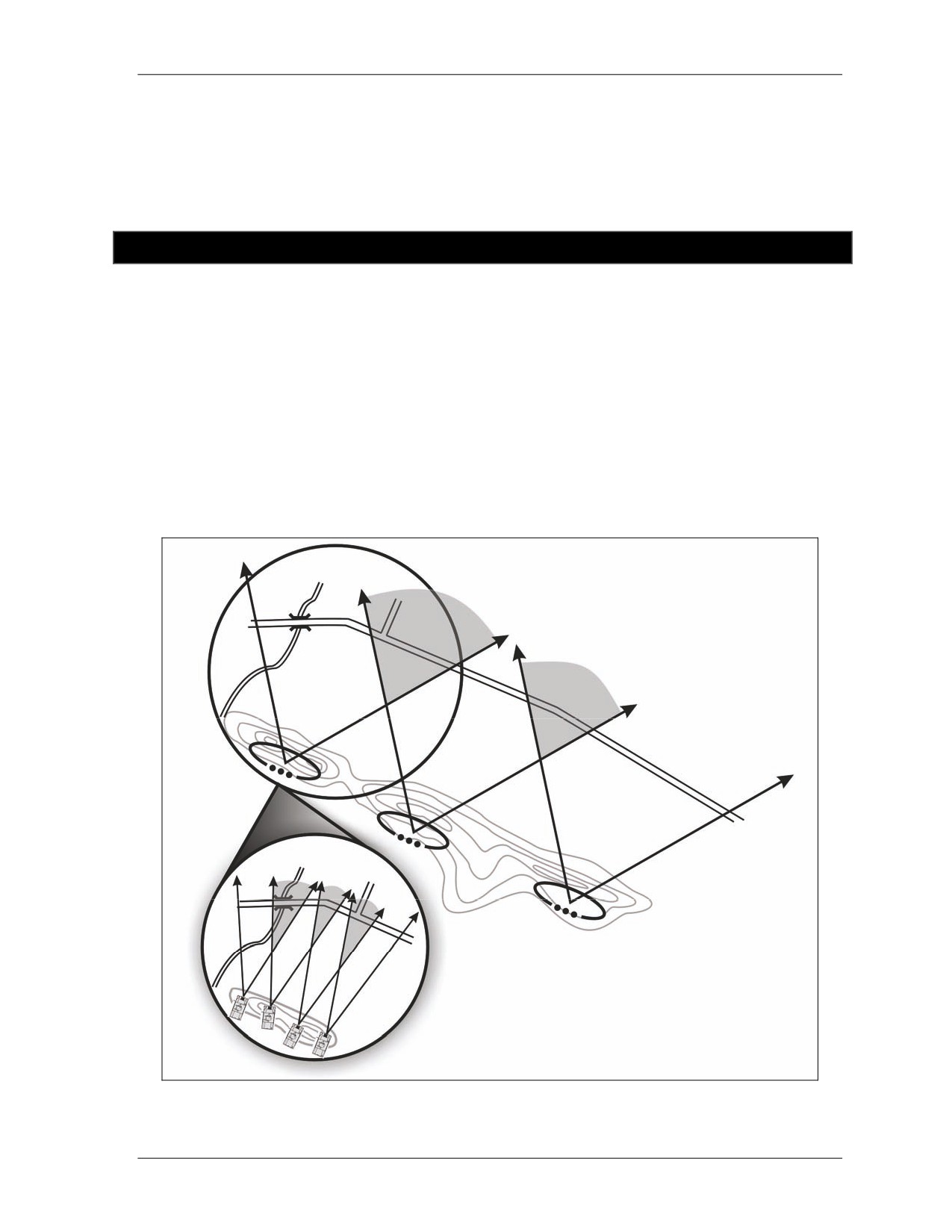
Mutual support is a condition that exists when elements are able to support each other by direct
fire in order to prevent the enemy from attacking one position without being subject to direct fire from one
or more adjacent positions. To establish mutual support, unit sections and platoons may be employed with
overlapping primary and secondary sectors of fire Figure1-3. If one squad, section or platoon is attacked or
forced to displace, the other units continue covering the assigned area. In order to achieve this effect, the
heavy weapons squads are positioned so that fires directed at one squad or section can suppress only
those units.
Figure 1-3. Overlapping fires.
1 July 2008
FM 3-21.12
1-11
Chapter 1
ESTABLISH SECURITY
1-30.
Because most weapons company personnel are needed to man the weapons and operate the
vehicles, local security against a dismounted threat may be a challenge for them in some circumstances.
When the weapons company is positioned near other friendly Infantry units, those units may assist in
protecting against possible attack by dismounted enemy Infantry. Though the weapons company is not
always collocated with other units, Infantry units positioned near them should be able to cover dismounted
avenues of approach to weapons unit’s positions. However, the weapons company is always responsible
for insuring its own local security whether friendly units are positioned near them or not. Weapons units
moving with Infantry provide their own local security. During halts, the driver or assistant gunner may
dismount to assist in securing the flank and rear sectors.
SEEK FLANK SHOT ENGAGEMENTS
1-31.
Heavy weapons squads, sections and platoons should be positioned to engage tanks or armored
vehicles from the flank. Frontal engagements at enemy armor are less desirable for the following
reasons:
• An armored vehicle’s protection is greatest to the front.
• An armored vehicle’s firepower and crew are normally oriented to the front.
• A frontal engagement increases the chance of detection and suppression by enemy armored
vehicles.
• An armored vehicle provides a smaller target from the front.
TAKE ADVANTAGE OF STANDOFF
1-32.
Standoff is the difference between a friendly weapon’s maximum range and an enemy weapon’s
maximum effective range. The ITAS maximum range provides it with a standoff advantage over many other
weapon systems. Despite this advantage, engaging enemy armored vehicles at greater standoff ranges
may not always be tactically feasible. The additional tracking time required to fire an ITAS missile beyond
2,000 meters gives a frontal target more time to maneuver against the friendly position and provides a
flanking target more time to reach cover. Additionally, the terrain may not provide the fields of fire to support
standoff distance engagements.
USE COVER AND CONCEALMENT
1-33.
Cover and concealment are critical to the survival of heavy weapons units and must be analyzed
along with the other factors of METT-TC. An analysis of all of these factors is necessary for the heavy
weapons units to be effective, to survive, and to overcome the following inherent weaknesses:
•
The gunner is vulnerable because he is exposed while employing the weapon systems.
•
The ITAS missile has a long flight time and must be continually tracked by the gunner.
•
The ITAS has a slow rate of fire.
•
Indirect fire systems may suppress the gunner decreasing his effectiveness...
1-34.
When employing heavy weapon systems, leaders should avoid conspicuous terrain, disperse
weapons laterally and in depth so that no single enemy weapon can suppress two weapons squads, and
disperse weapons squads to reduce casualties and equipment damage that could result from enemy mortar
and artillery fires. The considerations for weapon system employment also apply during route selection and
movement.
•
Offensive Considerations. Determine the routes where cover and concealment are good, identify
areas along the approaches to the objective where cover and concealment are poor, and consider
using smoke or conducting missions during limited visibility to provide concealment.
1-12
FM 3-21.12
1 July 2008
Introduction
•
Defensive Considerations. Focus on locations with good fields of fire. Determine how the enemy
can use the available cover and concealment and look at it from his point of view, both in daylight
and at night.
EMPLOY IN DEPTH
1-35.
Heavy weapons squads are often employed in depth. In the offense, routes and firing positions
should be selected to support the forward movement of attacking units. In the defense, weapons squads can
be positioned forward then moved to positions in depth as the enemy closes, or the squads may be
positioned in depth initially.
EMPLOY AS PART OF A COMBINED ARMS TEAM
1-36.
Skillful integration of Infantry, armor, engineer, and indirect fire assets improves the survivability
and lethality of heavy weapons units.
•
Infantry rifle units and platoons can assist in providing local security for the heavy weapons
elements. Heavy weapons units also support the maneuver of Infantry forces.
•
Heavy weapons units support the maneuver of armor forces. Heavy weapons may focus on
destroying lightly armored enemy vehicles and dismounted Soldiers at long ranges, allowing the
tanks to focus on destroying enemy tanks.
•
Combat engineers focus on support of close combat and help shape the battlefield by enhancing
mobility, countermobility, and survivability. General and geospatial engineers augment that
support and provide other specialized capabilities. Mobility is enhanced as engineers provide
expertise and assistance in breaching, clearing, gap crossing and other aspects of mobility support.
Countermobility support is focused on the emplacement of tactical obstacles that reduce the
enemy’s ability to maneuver, mass, or reinforce, and increase his vulnerability to direct and
indirect fires. To accomplish this, obstacles must disrupt, fix, turn, or block the enemy. To be
effective, the obstacles must be covered by both direct and indirect fire. Survivability includes
supporting the construction of fighting positions, other types of survivability positions, and those
aspects of protection related to hardening as well as camouflage, concealment, and deception.
•
Weapons unit leaders must be part of the indirect fire planning process at higher levels. They must
coordinate frequencies, call signs, and priorities of fire. The Fire Support Officer habitually
attached to the company from the battalion Fires Support Platoon can assist in this coordination.
To do this, the weapons unit leaders should contact the attached fire support team (FIST) and the
battalion mortar platoon. They should also contact the battalion fires cell or the fires battalion if
there is no FSO or FIST Team. Indirect fires (artillery and mortars) are used to--
-- Destroy or neutralize the enemy. Slow the enemy rate of advance.
-- Destroy or disrupt enemy formations. Cause enemy vehicles to button up.
-- Suppress accompanying enemy artillery and antitank guided missile (ATGM) support by
fire.
-- Fire white phosphorous/hexachloroethane (WP/HC) smoke to conceal weapon system firing
signatures and to cover the movement of weapons squads between positions. When using
obscurants, weapons company commanders (or platoon leaders) must consider the degrading
effects these obscurants have on friendly units. For example, covering smoke may alert the
enemy to friendly movement and may reduce a leader’s ability to visually control fires.
1 July 2008
FM 3-21.12
1-13
Chapter 2
Planning and Preparation
The information in this chapter is provided to the commander and leaders for
consideration during planning and preparing for missions. It is to be used as a guide
to assist the commander during application of the troop leading procedures (TLP) for
mission related decisions based on the situation, his experience, the experience of his
subordinate leaders, and key planning concepts.
Section I. PLANNING
During the mission planning process, leaders will take into consideration the personnel and equipment available
to him to conduct his mission. Leaders will not only consider organic assets, but also those of personnel with
associated weapons and equipment that may be attached routinely or for a specific mission or time period.
Leaders must understand the characteristics and capabilities of all organic and attached assets in order to best
employ them for maximum effectiveness and mission accomplishment. During the mission planning process, a
leader will decide how to employ the personnel, weapons and systems he selects for the mission. Selection and
employment of available assets is based on the factors of mission, enemy, terrain, troops, time, civilians
(METT-TC).
BATTLE COMMAND
2-1.
Battle command is the art and science of understanding, visualizing, describing, directing, leading,
and assessing forces in operations against a hostile, thinking, and adaptive enemy. Battle command applies
leadership to translate decisions into actions by synchronizing forces and warfighting functions in time,
space, and purpose to accomplish missions. These command skills are developed over time through study,
practice, and judgment. The commander visualizes the operation, describing it in his intent and concept of
the operation, and directs the actions of subordinates within his intent. He directly influences operations by
his personal presence and his command and control (C2) system. He uses the war fighting functions (WFF)
to organize, prepare, coordinate, integrate, synchronize, and execute his plan. That is, he considers
everything he has or knows about an operation for each WFF.
2-2.
Visualizing, describing, and directing are aspects of battle command and leadership common to
every commander. Technology, the fluid nature of operations, the increased volume of information that
commanders must process, and today’s battlefield underline the importance of the commander's ability to
visualize, describe, and direct operations. Assessment is also an integral part battle command. Commanders
must continually assess the threat, friendly forces, and effects throughout all three aspects of battle
command.
TROOP-LEADING PROCEDURES
2-3.
TLPs begin when the leader receives the first indication of an upcoming mission and continue
throughout the operational process of planning, preparing, executing, and assessing. The TLP comprise a
sequence of actions that help leaders use available time effectively and efficiently to issue orders and
execute tactical operations. TLPs are not a hard and fast set of rules. Some actions may be performed
simultaneously. They are a guide that must be applied consistent with the situation and experience of the
commander and his subordinate leaders. The standard Army planning process embedded within the TLPs
1 July 2008
FM 3-21.12
2-1
Chapter 2
consist of a series of interrelated subprocesses. For a detailed explanation of each process refer to
FM 3-21.10.
PLANNING CONSIDERATIONS
2-4.
The unique characteristics of a weapons company requires leaders to take some additional factors into
consideration during mission planning. Along with their tactical organization for combat, weapons company leaders must
also include in mission planning their selection of weapons systems, communications, and vehicle load and modification
considerations. As mentioned earlier, leaders will not only consider organic assets, but also those of attached personnel
and their associated weapons and equipment. Selection and employment of the available assets is based on the factors of
METT-TC.
WEAPON SELECTION CONSIDERATIONS
2-5.
The mix of weapons in a weapons company includes systems that can effectively engage troops,
field fortifications, lightly armored and armored vehicles. The arms room concept allows for flexibility in
weapons configuration for specific missions given to the weapons company. Considerations during
selection of weapons systems must include an analysis of the terrain and threat in conjunction with the
characteristics and capabilities of each weapon system. Table 2-1 shows weapons characteristics to assist in
weapons planning.
Improved Target Acquisition System
2-6.
The Improved Target Acquisition System (ITAS) is a multipurpose weapon used for long-range
engagement of targets. It can be employed in all weather conditions. It fires a tube-launched,
optically-tracked, wire-guided
(TOW) missile that provides a long-range capability against armored
vehicles, heavily fortified bunkers, buildings, and dug-in or fortified enemy positions. The ITAS optics
system, the Target Acquisition System (TAS), can also be used to increase visibility for reconnaissance,
surveillance, and security operations. For planning purposes, TOW missiles have a maximum range of
3,750 meters and a minimum range of 200 meters for the TOW 2B. TOW missiles have the ability to defeat all
known armor units they may encounter during combat operations. For detailed information on all ITAS
characteristics and TOW munitions, refer to FM 3-22.32 and FM 3-22.34.
M2, .50 caliber, Machine Gun
2-7.
The M2 can be used against personnel and light armored vehicles with accurate fires past 2,000
meters. It is effective in restrictive terrain such as wooded areas. For detailed information on M2
characteristics and munitions, refer to FM 3-22.65.
MK-19, 40mm, Grenade Machine Gun
2-8.
The MK-19 is capable of laying down a heavy volume of close, accurate, and continuous fire. As
a point weapon, it can penetrate up to 2 inches of steel armor at ranges out to 1,500 meters. As an area
weapon, it can inflict personnel casualties out to 15 meters from impact at ranges out to 2,000 meters. Like
the M2, the MK-19 can be employed in restrictive terrain conditions. It may also be used to cover dead
space. For detailed information on all MK-19 characteristics and munitions, refer to FM 3-22.27.
Javelin Close Combat Missile System
2-9.
The Javelin is a dual-mode, man-portable AT missile with the capability to engage and defeat all
known armor including tanks and other armored vehicles. When there is no armored vehicle threat, the
Javelin can be employed in a secondary role of providing fire support against point targets such as bunkers
and crew-served weapons positions. The Javelin command launch unit (CLU) can be used as an aid to
reconnaissance, security operations and surveillance. The Javelin supports the fires of ITAS and can cover
2-2
FM 3-21.12
1 July 2008
Planning and Preparation
secondary armor avenues of approach and provide observation posts with an antiarmor capability. The
Javelin has a maximum effective range of 2000 meters. For detailed information on all Javelin characteristics
and munitions, refer to FM 3-22.37.
Optics
2-10.
All heavy weapons within the weapons company have optics systems. These systems provide the
company with the ability to acquire targets at long range during daylight or limited visibility. All of the systems
have magnification and thermal imaging capability (see Table 2-1) allowing thermal acquisition of targets at night
or in dense forest or brush areas during light. Besides target acquisition, these can be used for both day and night
observation. Some environmental conditions that affect all optics include limited visibility, night, infrared clutter,
and infrared crossover.
1 July 2008
FM 3-21.12
2-3

Chapter 2
Table 2-1. Weapons characteristics.
Close Combat Missiles
Machine Guns
TOW 1
Javelin 2
MK19 3
M2 4
Maximum
3,750
2,000
2,212
6,764 ball and AP
Range (M)
1,800-2,450 tracer
burnout
Maximum
3,750
2,000
1,500 point target
1,500 point target
Effective
(single shot)
2,212 area target
Range (M)
1,830 area target
Minimum
200 (TOW 2B)
150 top attack
18 to 30 M430
NA
Range/Arming
18 to 36 M383
65 direct attack
Distance (M)
Flight Time
21 seconds to
14 sec
NA
NA
max range
@ 2,000 M
Rates of Fire
(Rds/min)
Sustained
NA
NA
40
Slow fire < 40
Rapid
NA
NA
60
Rapid fire > 40
Cyclic
NA
NA
325 to 375
450 to 550
Casualty
UK
UK
15
NA
Radius (M)
Weight (lbs)
260
14 (CLU)
Gun: 72.5
Gun: 84
MK93 Mount: 30
MK93 Mount: 30
Ammunition
Explosive form
HEAT
HEDP
Ball, tracer, AP,
Type
penetrator
API, and more
HE
Ammunition Weight
54 to 66 lbs
35 lbs
About 65 lbs
About 45 lbs
(50 rounds)
(100 rds)
Sight Type
Integrated day
Integrated Day and Night
Mounts a AN-PAS
Mounts a AN-PAS
and night
13(V)3
13(V)3
Sight Magnification
Day and night
Day
Night
3.3X WFOV
3.3X WFOV
vision sight
4X
4X
10X NFOV
10X NFOV
normal/zoom
Night
9X
Wide View
4/8X
M98A2 CLU
Narrow View
12/24X
4X
12X
2X
zoom
1 FM 3-22.34: TOW Weapon System
2 FM 3-22.37: Javelin—Close Combat Missile System-Medium
3 FM 3-22.27: MK19 40-mm Grenade Machine Gun, Mod 3
4 FM 3-22.65: Browning machine gun, caliber .50 HB, M2
2-4
FM 3-21.12
1 July 2008
Planning and Preparation
TASK ORGANIZATION
2-11.
The battalion operations order will contain the task organization for combat depicting attachments
and detachments to or from the weapons company for a particular mission. Attachments and/or
detachments may be habitual or temporary for a specific operation. If the weapons company receives any
attachments, the commander may further task organize within the company itself to best accomplish his
mission. To provide for optimal command and control and optimize heavy weapons unit’s capabilities,
heavy weapons platoons are not normally task organized below platoon level.
Attachments
2-12.
Weapons companies may have habitual attachments such as a FSO and a combat medic. Other
sustainment support may or may not consist of a medical evacuation or field maintenance team (Chapter 1,
Chapter 10, and Chapter 11).
2-13.
Weapons companies may also receive various other attachments with one of the more common
being an Infantry platoon. A typical mission for an Infantry platoon attached to a weapons company would
be to provide security for the company while the company performs its primary mission such as support by
fire for another maneuvering element.
Detachments
2-14.
Elements of the weapons company may also be detached out to other units. Detachments often
include a weapons platoon attached to an Infantry rifle company. Specific missions given to detached units
are the responsibility of the gaining unit commander and are not covered in detail in this manual. Typical
missions may include, but are not limited to, establishing support by fire (SBF) in an attack engaging the
enemy in a planned engagement area, or security of flanks. Special consideration needs to be given to the
maintenance requirements of the detached unit due to the gaining unit not having a habitual requirement
for maintenance of their specific weapons or vehicles.
Planning Checklist
2-15.
The following example checklist shows several items for consideration for units attached to the
weapons company or for elements of the weapons company detached to other units.
• Radio communications between units
• Command and support relationship
• Communications requirements
• Unit tactical standing operating procedure (TSOP)
• Unit situation report (SITREP), tactical situation, nature of mission
• Current operation orders (OPORD) with graphics
• Signal operating instructions (SOI) (current frequencies, call signs, challenge, and password)
• Digital communications
• Special instructions
• Special equipment
• Location of units
• Reporting times
• Duration of mission
• Link up information and location
• Coordination and contact points
• Pre-combat checks and pre-combat inspections
• Support and sustainment requirements
1 July 2008
FM 3-21.12
2-5
Chapter 2
Section II. PREPARATION
Upon receipt of an OPORD, weapons company units must ensure they are prepared for the mission. This
includes personnel, equipment and vehicle preparation. Once the decision is made on heavy weapons
configurations for the vehicles they must be mounted for the mission.
VEHICLE LOAD CONSIDERATIONS
2-16.
Load configurations for vehicles and trailers will vary between units. During mission planning
and preparation leaders will need to plan for what equipment will be taken and where it will be carried. See
FM 3-21.10 and TM 9-2320-280-10 for additional information on vehicle load considerations. At a
minimum leaders should consider;
• How much of what type of ammunition will be carried where?
• Will trailers be taken or left in a separate location?
• Where will non-mounted weapon systems be carried or stored?
• Where will any special equipment taken be stored?
• How will the nature and duration of the mission alter the standard load configuration?
• Will any vehicle modifications alter the load plan?
2-17.
Vehicle commanders must ensure that any externally stowed items are secured from theft and do
not constitute a fire hazard if the vehicle is attacked by an improvised explosive device
(IED),
rocket-propelled grenade (RPG), or other flammable device. External stowage should be minimized or
modified to lessen the threat of vehicle fire and not restrict the view or movement of gunners or passengers
providing security. All loose items stored inside the vehicle must be secured to prevent theft or becoming
secondary missiles in the event of a mine or IED strike or a roll over. Commanders should consider
stowing flammable items that are mission essential inside the vehicle behind armored portions of the
vehicle, and securing non-mission-essential and nonflammable items outside the vehicle. Other
considerations follow:
• Use on-board ammunition storage containers such as 60-mm mortar ammunition cans. These
hold several types of ammunition. This saves the crew a lot of time when they have to switch
between ammunition for crew-served weapons.
• Carry complete spare wheel and tire assemblies rather than just spare tires. This reduces the
time needed to change a flat, and will often allow a crew to repair a vehicle after a mine strike.
• Consider equipping every vehicle or every other vehicle with wheeled vehicle tow bars, so that
vehicles can recover or tow each other. Tow bars are better than cables, since no driver is
needed in the towed vehicle.
• Consider emplacing civilian or military fire extinguishers in fixed positions inside the vehicle.
Normally, locate them to protect the crew rather than the vehicle. This helps ensure crew
survivability. Carry additional loose fire extinguishers to fight vehicle fires.
2-18.
Commanders should establish load plan standing operating procedures (SOP) for sensitive items.
They should account for ammunition and additional special equipment such as breach kits, demolitions,
and first aid equipment. They should also account for any additional weapons.
UP-ARMORED HMMWVS
2-19.
The Army started adding armor to its high mobility multipurpose wheeled vehicles (HMMWV)
years before Operation Iraqi Freedom, but attacks from small arms, rocket-propelled grenades, and IEDs
prompted the Army to place an urgent priority on shortening production schedules and beefing up
protection for vehicles already in the field. However, both RPGs and IEDs can defeat many armored
vehicles, and will likely defeat any wheeled vehicle at the point of detonation, with or without an armor
package.
2-6
FM 3-21.12
1 July 2008
Planning and Preparation
2-20.
Factory produced up-armored HMMWVs provide level-one armor protection. They provide
all-around protection, both glass and on the armament on the side, front, rear, sides, top, and bottom.
"Add-on" up-armor kits, or level-two armor protection, are also factory-produced in the United States, and
is installed on existing 'soft-skinned HMMWVs. However, "add-on" up-armor kits only provide front, rear,
and side glass protection, while leaving the top and the bottom of the vehicles vulnerable. Level-three
armor refers to the stop-gap measure use of steel plates that have been approved, and which are cut for
vehicles, and then either welded or bolted on a vehicle.
2-21.
In addition to increased armor protection, up-armored HMMWVs feature more rugged suspension
systems able to handle the added weight and ballistic- resistant glass. They also include air conditioners
that enable crews to operate with the windows up, even in stifling temperatures.
UNIT-INSTALLED PROTECTION
2-22.
Improvised armor and other protection have been added to vehicles by American Soldiers at least
since World War II. Units may be permitted to add additional improvised armor and other protective
devices to supplement the existing protection on their vehicles. Examples of these include wire cutters and
reinforced bumpers. Besides the strain on engines and suspensions, there are some other factors to consider
when adding armor:
• What is the primary enemy threat? For example, if the threat is 7.62-mm guns, RPGs, IEDs, or
mines, how well can the vehicle's armor protect the crew from each threat? What threats must
be protected by increased offensive capabilities?
• If the enemy is employing mines, consider whether the armor and weight associated with mine
strike protection is practical versus armor, which protects against other threats.
• Consider armoring critical pieces of the vehicle itself such as the fuel system, communication
system, and cooling system. Ensure added armor does not reduce cooling airflow around
electronic equipment.
• Use of Kevlar blankets from disabled HMMWVs or the M2 Bradley spall liner to ‘armor’
HMMWV seats and to add lightweight armor to other areas of the vehicle.
• Does the gunner have enough protection? Consider his legs and lower body, which will be
exposed through the middle of the vehicle as well, and which are not covered by body armor.
• Does the protection interfere with the firing of the primary weapon? For example, a wire cutter
on a vehicle may interfere with firing the missile.
2-23.
Inherent with light-wheeled vehicle operations in combat are the risk associated with the reduced
protection compared to more heavily armored systems. While the up-armored HMMWVs found in the
weapons company do increase their protection, the vehicles and personnel are still at risk from heavy
weapons and high explosives. Other risks such as low-lying power lines and wires may also impose a
hazard to occupants of the vehicle. Modifications to the HMMWVs such as the unit-installed wire cutters
and wire guards should be considered to reduce the risk of injury due to these hazards. See FM 3-21.10 for
additional information on vehicle modifications.
VEHICLE WEIGHT, OBSERVATION, AND SURVIVABILITY
2-24.
Force protection is directly linked to mission success and must always be an important
consideration in the planning and execution of missions that employ soft-skinned vehicles. The balance
between the protection of vehicles and crews, observation, and the employment of weapons is critical. The
additional weight of additional armor also places a strain on other vehicle components, such as the engine
and the suspension. Normally, heavily armored vehicles, especially wheeled vehicles with extra armor such
as the up-armored HMMWV, severely limit crew and passenger observation in restrictive and urban
terrain. They can also limit weapons employment at close ranges. At times, insurgent and terrorist enemy
forces target vehicles with poor security, because they seem easier to destroy and less likely to respond
effectively. Commanders must analyze enemy trends and events in their area of operations (AO) before
1 July 2008
FM 3-21.12
2-7
Chapter 2
deciding on the appropriate levels of armor versus offensive capabilities, mission demands, and crew
survivability. Other considerations might include--
•
Can the vehicle suspension support additional armor and still carry the payload?
•
Can the vehicle crew and passengers provide all-round security for themselves?
•
Will additional armor affect vehicle mobility over rough terrain or in restrictive urban areas?
•
Does the vehicle have sufficient power, acceleration, and speed?
•
Can the vehicle crew and passengers quickly and safely mount or dismount? Can they do so under
fire?
PRECOMBAT CHECKS AND INSPECTIONS
2-25.
Precombat checks (PCC) and precombat inspections (PCI) are critical to the success of any
combat mission. These checks and inspections are leader tasks and cannot be delegated below squad leader
level. They ensure that the Soldier is prepared to execute the required individual and collective tasks that
support the mission. Checks and inspections are part of the TLPs that protect against shortfalls that could
endanger Soldiers’ lives and jeopardize the successful execution of a mission. PCCs and PCIs must be
tailored to the specific unit and the mission requirements. Each mission and each patrol may require a
separate set of checklists. One of the best ways to ensure PCCs and PCIs are complete and thorough is with
full-dress rehearsals. These rehearsals, run at combat speed with communication and full
mission-equipment, allow the leader to envision minute details, as they will occur on the battlefield. If the
operation is to be conducted at night, Soldiers should conduct full-dress rehearsals at night as well. PCCs
and PCIs should include back briefs on the mission, the task and purpose of the mission, and how the
Soldiers’ role fits into the scheme of maneuver. The Soldiers should know the latest intelligence updates
and the rules of engagement (ROE), and be versed in medical evacuation (MEDEVAC) procedures and
sustainment requirements. Table 2-2 lists sensitive items, high-dollar value items, issued pieces of
equipment, and supplies. This table should spur thought--it is not a final list.
Table 2-2. Example precombat check and inspection list.
ID card
T&E mechanisms
Grappling hook
ID tags
Spare barrels
Sling sets
Ammunition
Spare barrel bags
PZ marking kit
Weapons
Extraction tools
ANCD
Protective mask
Asbestos gloves
Plugger or GPS
Knives
Barrel changing handles
Handheld microphones
Flashlights
Headspace and timing gauges
NVDs
Radios and backup communication
SAW tools
Batteries and spare batteries
Communication cards
Basic issue items
Picket pounder
Nine-line MEDEVAC procedures
Oil and transmission fluids
Engineer stakes
OPORD
Antifreeze coolant
Pickets
FRAGOs
Water
Concertina wire
Maps
MREs
TCP signs
Graphics, routes, objectives, LZs,
Load plans
IR lights
and PZs
Fuel cans
Glint tape
Protractors
Fuel spout
Chemical lights
Alcohol pens
Tow bars
Spare handsets
Alcohol erasers
Slave cables
Pencil with eraser
Pen and paper
Concertina wire gloves
Weapon tie downs
Tripods
Pintles
2-8
FM 3-21.12
1 July 2008
Chapter 3
Movement
In combat, units are positioned on the battlefield in order to gain the maximum
advantage possible over the enemy. This is accomplished through tactical movement
and maneuver. This chapter discusses mounted movement techniques and formations
available to the company commander for moving his unit. Some are secure and slow,
while others are faster, but less secure. Some work well in certain terrain or tactical
situations, but not so well in others. Some offer security, but take longer; others offer
speed, but less security. The commander must consider the overall movement plan
including the unique advantages and disadvantages of each movement technique and
formation.
Section I. MOVEMENT FORMATIONS AND TECHNIQUES
Tactical movement is used to position units on the battlefield and prepare them for contact. Maneuver is
movement while in contact combined with supporting fire. At company level, movement and maneuver overlap
considerably. The process by which units transition from tactical movement to maneuver is called "actions on
contact" and are covered in Chapter 4. The formation and technique used are determined by the commander
based on mission, enemy, terrain, troops, time, civilians (METT-TC) conditions and the likelihood of enemy
contact. Platoons will also employ movement formations and techniques within a company movement.
FORMATIONS
3-1.
Mounted movement formations describe the specific locations of the company's elements in
relation to each other. They are guides on how to arrange the unit for movements. Each formation aids
control, security, and firepower to varying degrees. The following factors should be considered in
determining the best formation to use.
• Mission.
• Enemy situation.
• Terrain.
• Weather and visibility conditions.
• Speed of movement desired.
• Degree of flexibility desired.
• Ability to command and control.
3-2.
The company moves using seven basic mounted movement formations including the company
column, wedge, line, vee, diamond, box and echelon right or left. They also employ two stationary
formations during temporary halts, the coil and the herringbone. Below is a brief description and diagram
of each type formation.
COLUMN FORMATION
3-3.
Figure 3-1.The company uses the column when moving fast, when moving through restricted
terrain on a specific route, or when it does not expect enemy contact. Each platoon normally follows
1 July 2008
FM 3-21.12
3-1
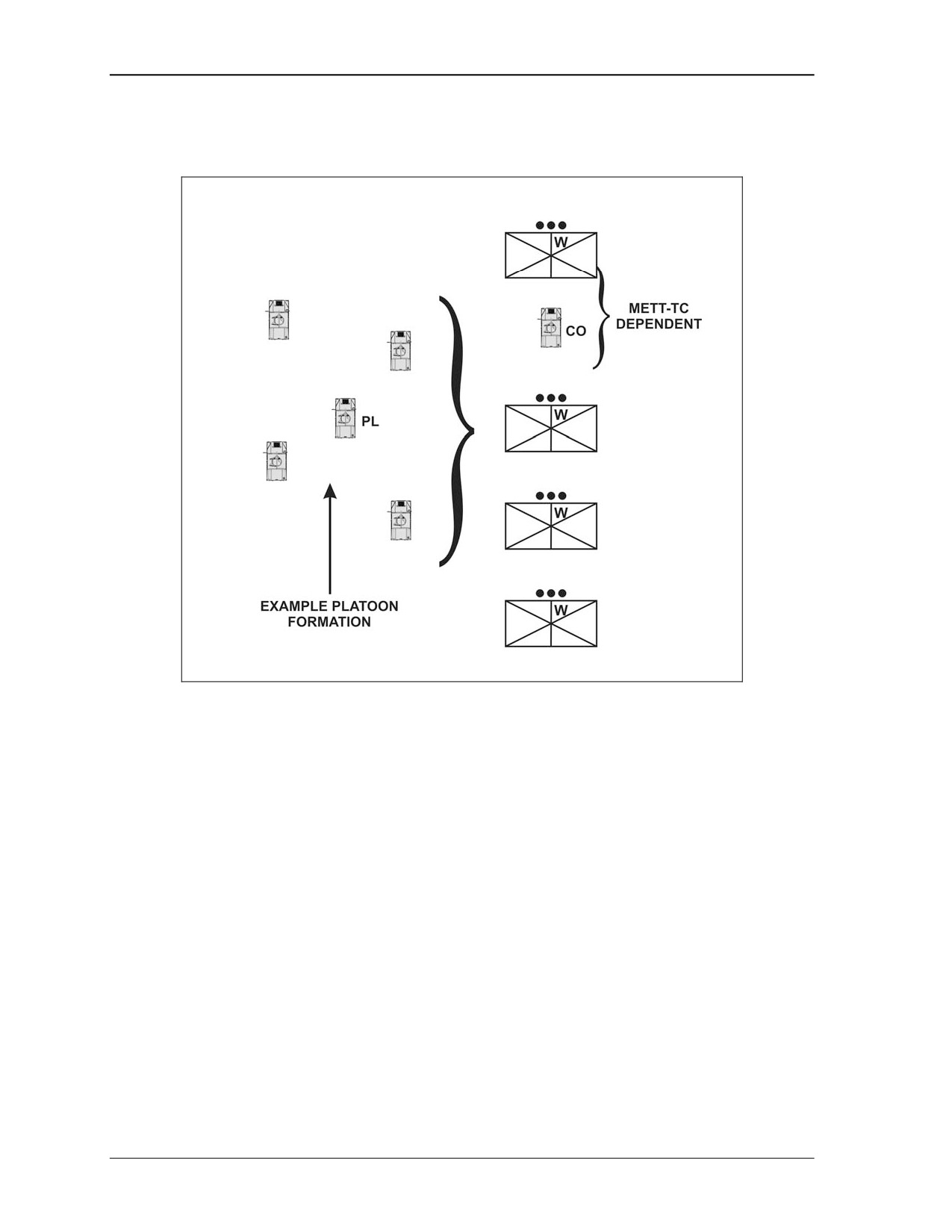
Chapter 3
directly behind the platoon in front of it. If the situation dictates, platoons can disperse laterally to enhance
security.
Figure 3-1. Column formation.
WEDGE FORMATION
3-4.
Figure 3-2. When the enemy situation seems unclear or when contact might occur, leaders often
use the wedge formation.
3-2
FM 3-21.12
1 July 2008
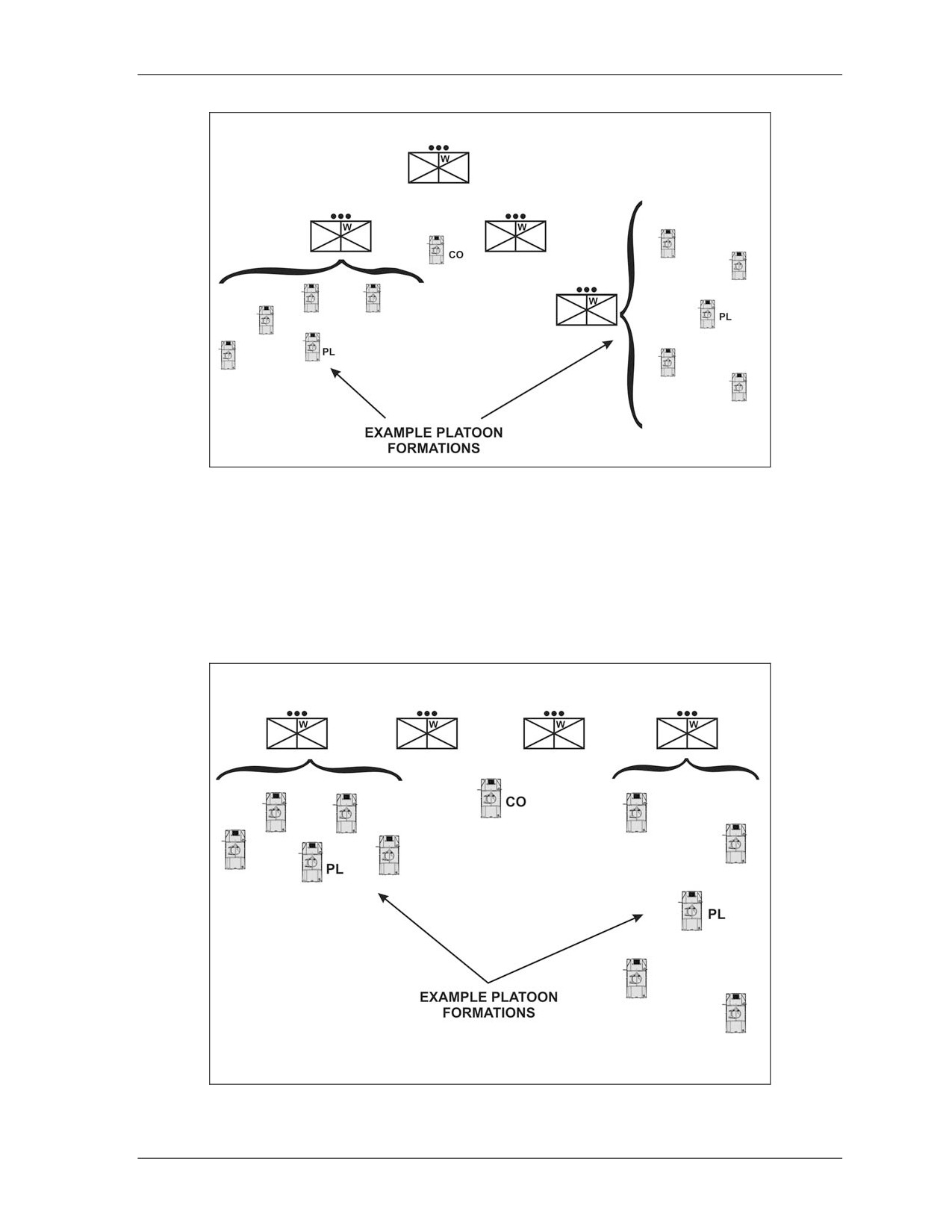
Movement
Figure 3-2. Wedge formation.
LINE FORMATION
3-5.
Figure 3-3. When crossing open areas or occupying a support-by-fire position, the company may
use the line formation. The line formation is normally used when no terrain remains between it and the
enemy, when the enemy’s antitank weapons have been suppressed, or when the company is vulnerable to
artillery fire and must move fast.
Figure 3-3. Line formation.
1 July 2008
FM 3-21.12
3-3
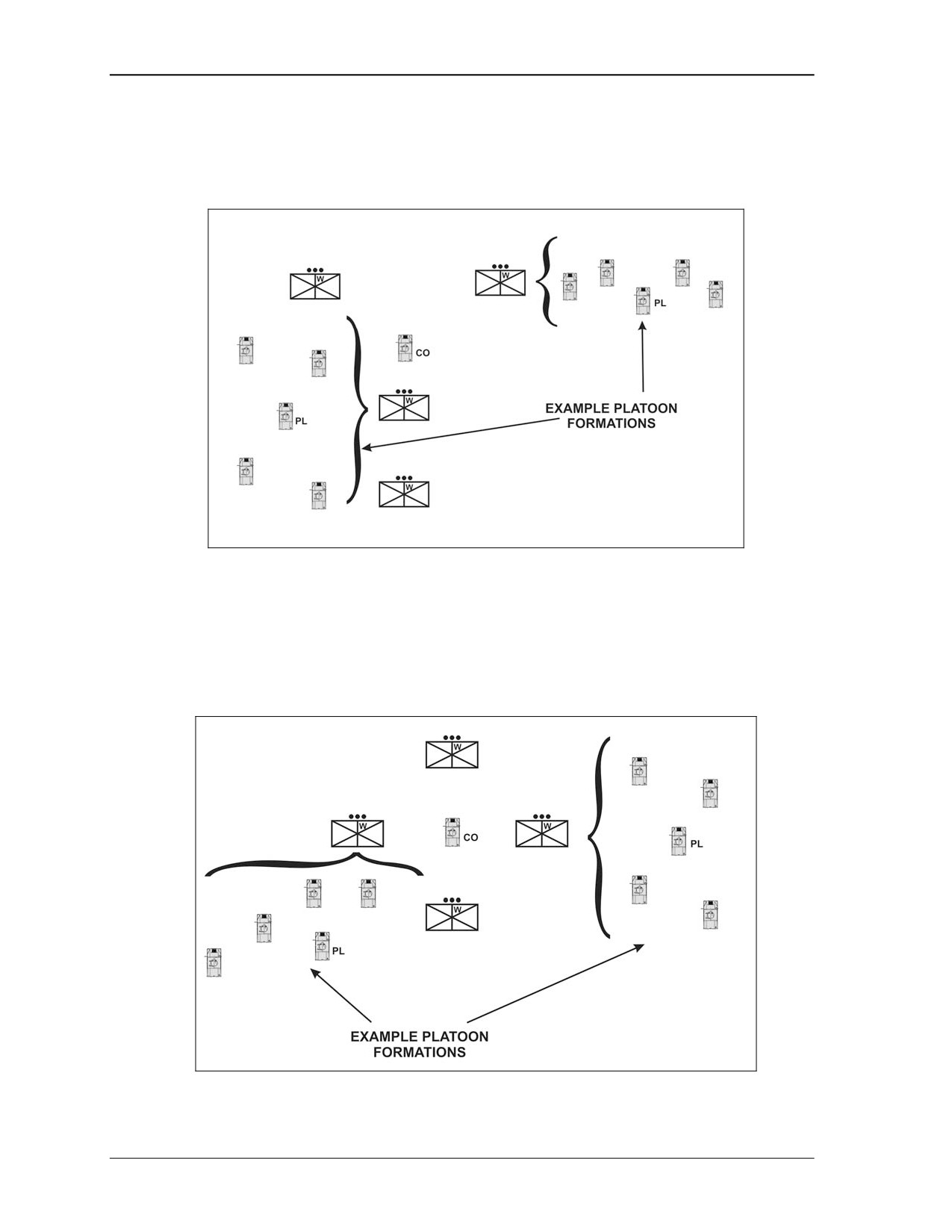
Chapter 3
VEE FORMATION
3-6.
Figure 3-4. The Vee formation is used when enemy contact is possible. In the company
Vee, the center platoons are located in the rear of the formation, while the flank platoons are
to the front of and outside the center platoon.
Figure 3-4. Vee formation.
DIAMOND FORMATION
3-7.
Figure 3-5. The company uses the diamond formation when they want to maintain all around
security, and enemy contact is not expected. The company leads with a platoon with two platoons to the
flanks and the fourth platoon in the rear.
Figure 3-5. Diamond formation.
3-4
FM 3-21.12
1 July 2008
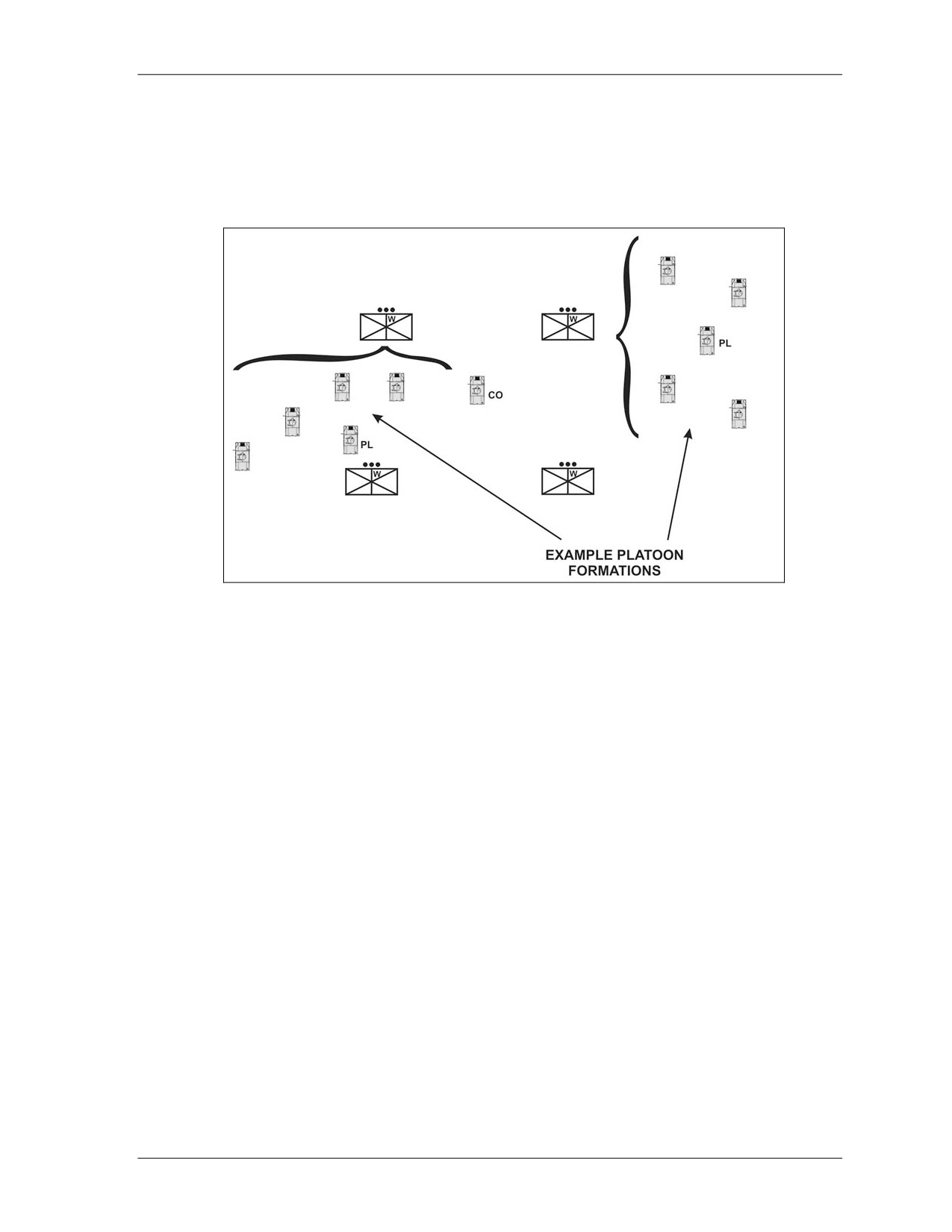
Movement
BOX FORMATION
3-8.
Figure 3-6. The box formation arranges the unit with two forward and two trail
platoons. A weapons company with only three platoons would have to adopt a Vee or another
formation. It is often used when executing an approach march, an exploitation, or a pursuit
when the commander has only general knowledge about the enemy.
Figure 3-6. Box formation.
ECHELON FORMATION
3-9.
Figure 3-7. The echelon formation is used when the company wants to maintain
security and/or observation of one flank and enemy contact is not likely. The company
echelon formation (either echelon left or echelon right) has the lead platoon positioned
farthest from the echeloned flank, with each subsequent platoon located to the rear of and
outside the platoon in front of it.
1 July 2008
FM 3-21.12
3-5
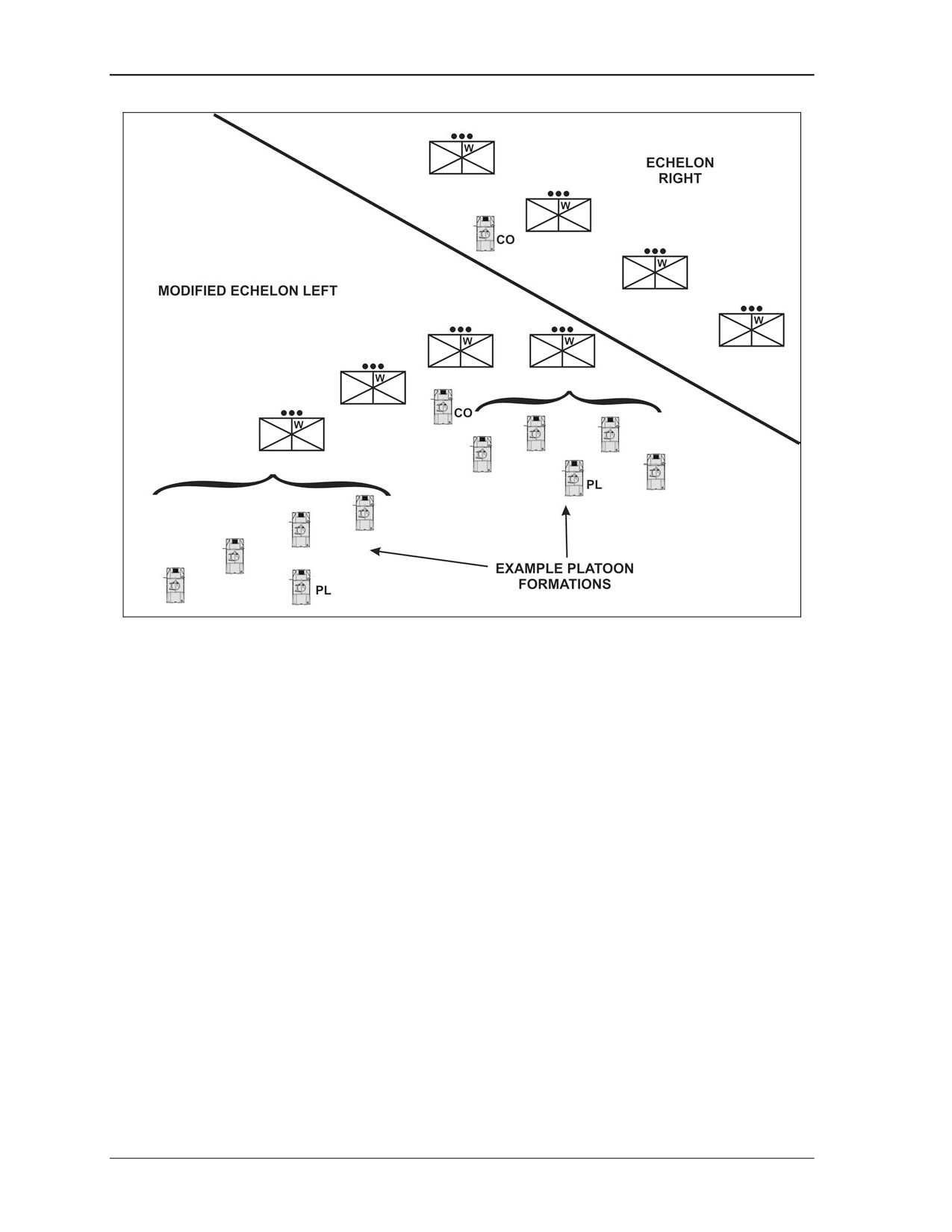
Chapter 3
Figure 3-7. Echelon left/right formation.
COIL AND HERRINGBONE FORMATIONS
3-10. The coil and herringbone are formations employed when elements of the company are stationary
and must maintain 360-degree security.
Coil
3-11. Figure 3-8. The coil is used to provide all-round security and observation when the company is
stationary. It is also useful for tactical refueling, resupply, and issuing orders. Security is posted to include
air guards and dismounted rifleman.
3-6
FM 3-21.12
1 July 2008
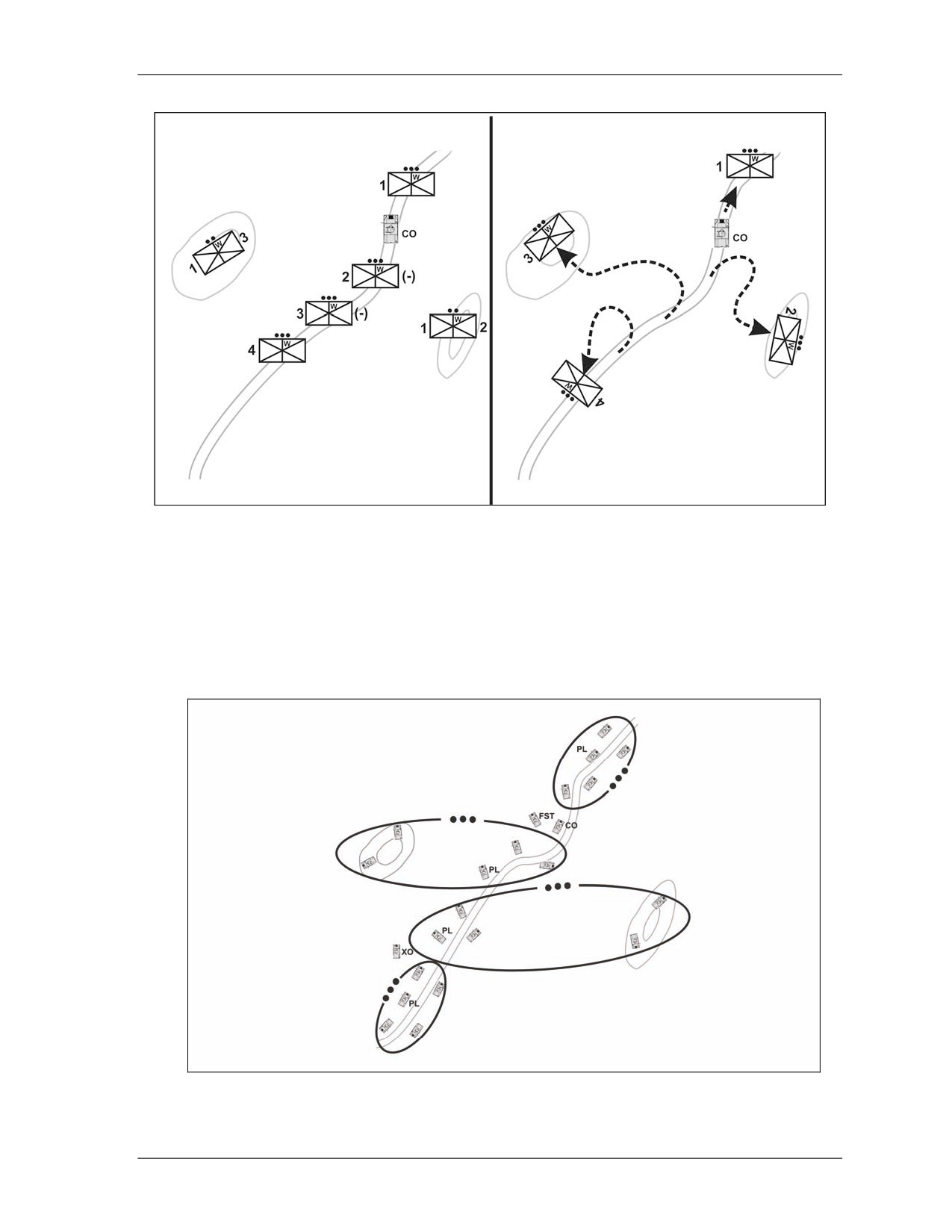
Movement
Figure 3-8. Coil formation before (left) and after (right).
Herringbone
3-12. Figure 3-9. The company uses the herringbone to disperse when traveling in column formation.
They can use it during air attacks or when they must stop during movement. It lets them move to covered
and concealed positions off a road or from an open area and set up all-round security without detailed
instructions. They reposition the vehicles as needed to take advantage of the best cover, concealment, and
fields of fire.
Figure 3-9. Herringbone formation.
1 July 2008
FM 3-21.12
3-7

Chapter 3
FORMATION SELECTION
3-13. Commanders select the formation that provides the proper control, security, and speed. Table 3-1
compares the six movement formations.
Table 3-1. Comparison of movement formations.
Formation
Security
Fires
Control
Speed
Column
Good dispersion.
Limited to front and
Easy to control.
Fast.
rear.
Limited all-round
Flexible formation.
security.
Excellent to the
flanks.
Line
Excellent to the front.
Excellent to the
Difficult to control.
Slow.
front.
Poor to the flank and
Inflexible formation.
rear.
Poor to the flank
and rear.
Wedge
Good all-round
Excellent to the
Easy to control but
Slower than the
security.
front and good to
more difficult than the
column.
flanks.
column.
Flexible formation.
Echelon
Good to the
Excellent to the
Difficult to control.
Slow.
echeloned flank and
echeloned flank and
front.
front.
Coil
Excellent all around
Excellent to front
Easy to control.
Used while
security.
rear and flanks.
stationary.
Herringbone
Great dispersion.
Good to front rear
Easy to implement.
Used to disperse
and flanks
Control more difficult
to cover and
Good all-round
after dispersion.
concealment
security
while traveling.
TECHNIQUES
3-14. The company commander selects from the three-mounted movement
techniques
(traveling,
traveling overwatch, and bounding overwatch) largely based on the likelihood of enemy contact and other
METT-TC factors. As the probability of enemy contact increases, leaders adjust the movement technique
to provide greater security. For example, if an enemy update received from higher headquarters states that
the enemy has moved much closer to the platoon than the platoon leader anticipated, he immediately
switches the technique from traveling overwatch to bounding overwatch. Figure 3-10 shows the link
between the possibility of contact and movement technique. Other factors that may influence a leaders
decision include--
• The type of contact expected.
• The availability of an overwatch element.
• The terrain over which the moving element will pass.
• The balance of speed and security required during movement.
3-8
FM 3-21.12
1 July 2008
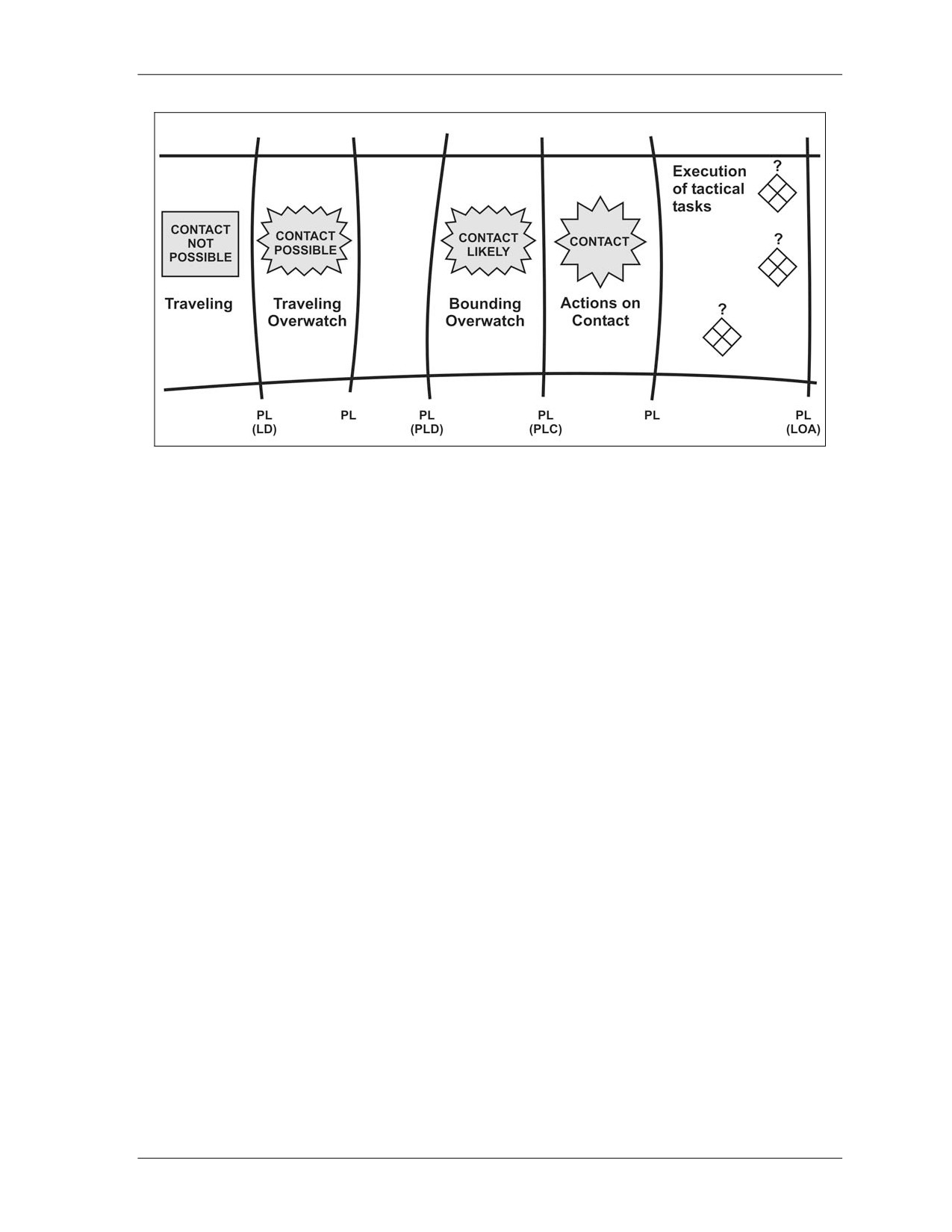
Movement
Figure 3-10. Transition from movement techniques to maneuver.
TRAVELING
3-15. Continuous movement characterizes the traveling technique by all company elements. It is best
suited for situations in which enemy contact is unlikely and speed is important. When leaders analyze the
latest information on the enemy and determine that contact with the enemy is unlikely, often the traveling
techniques will be used for movement. Figure 3-11 shows a traveling technique for an Infantry weapons
company.
1 July 2008
FM 3-21.12
3-9
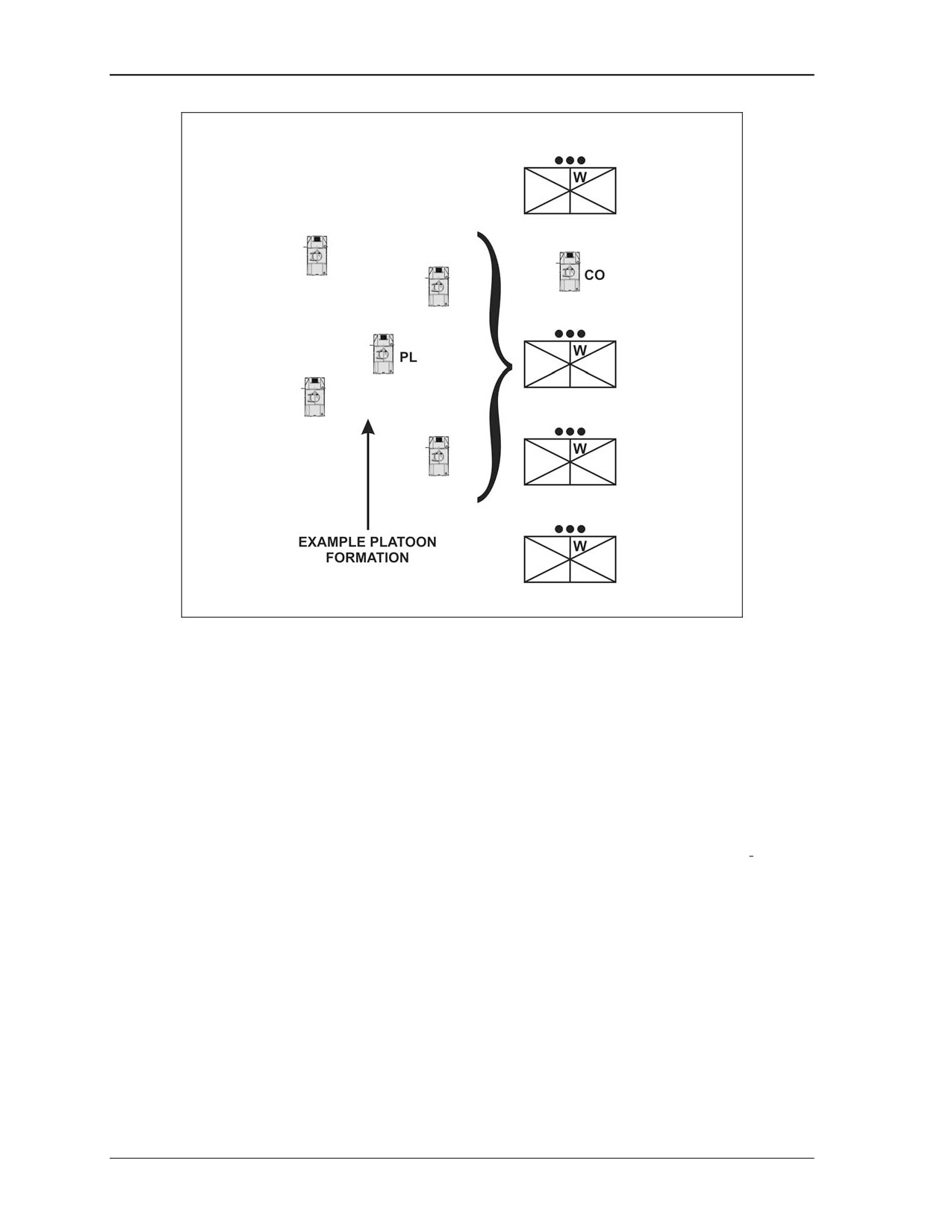
Chapter 3
Figure 3-11. Traveling technique.
TRAVELING OVERWATCH
3-16. Traveling overwatch is an extended form of traveling that provides additional security when speed
is desirable but contact is possible. The lead element moves continuously and provides security forward of
the main body. Leaders track the movement of forward security elements. The trail platoon moves at
various speeds and may halt periodically to overwatch movement of the lead platoon. Dispersion between
the two platoons must be based on the trail platoon’s ability to see the lead platoon and to provide
immediate suppressive fires in case the lead platoon is engaged. The intent is to maintain depth, provide
flexibility, and maintain the ability to maneuver even if contact occurs. However, if contact is made, ideally
a unit should be moving in bounding overwatch rather than traveling overwatch. Figure 3-12 shows a
traveling overwatch technique for an Infantry weapons company.
3-10
FM 3-21.12
1 July 2008
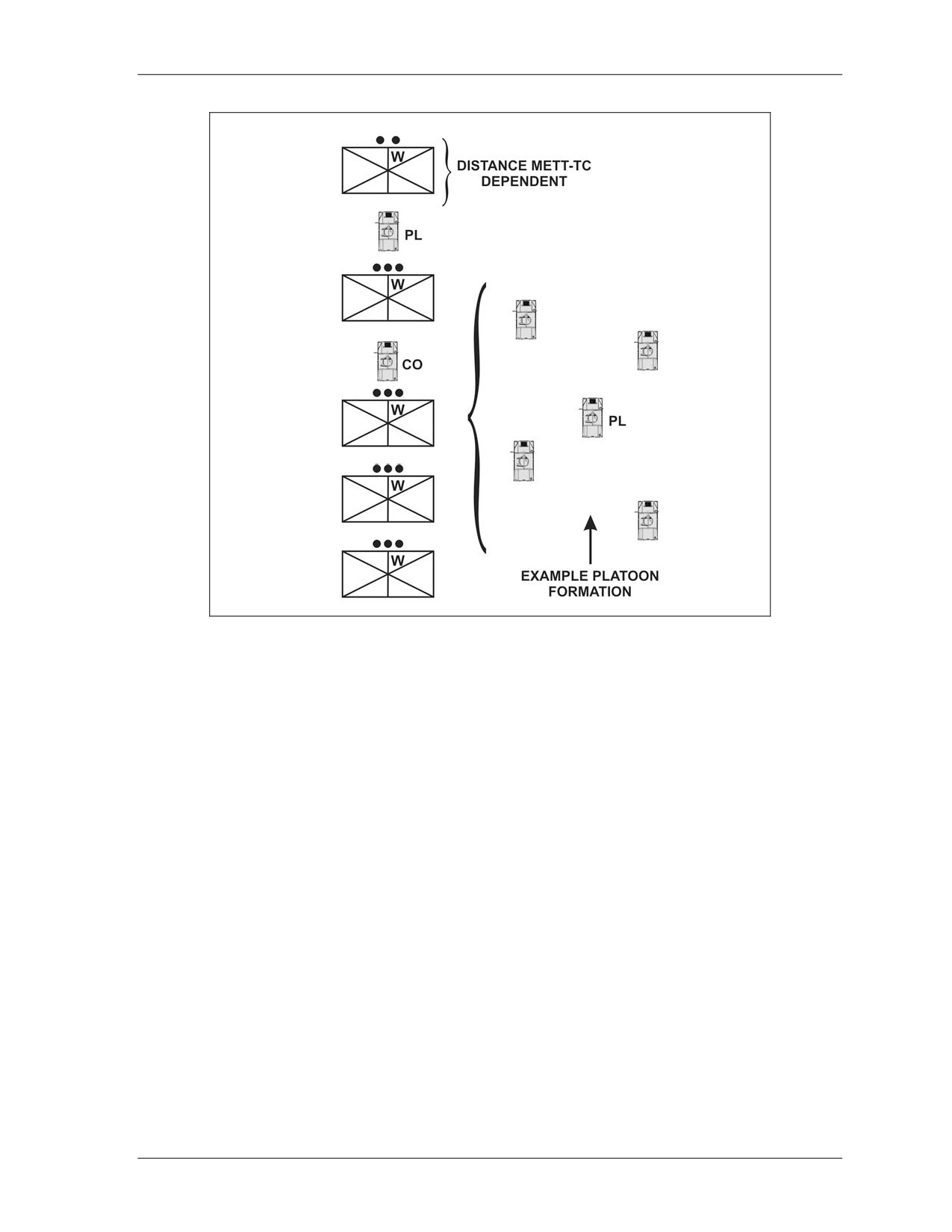
Movement
Figure 3-12. Traveling overwatch technique.
BOUNDING OVERWATCH
3-17. Bounding overwatch is used when contact is expected. It is the most secure, but slowest,
movement technique. The purpose of bounding overwatch is to deploy prior to contact, giving the unit the
ability to protect a bounding element by immediately suppressing an enemy force. In all types of bounding,
the overwatch element is assigned sectors to scan while the bounding element uses terrain to achieve cover
and concealment. The bounding element avoids masking the fires of the overwatch element; it never
bounds beyond the range at which the overwatch element can effectively suppress likely or suspected
enemy positions. Ideally, the overwatch element keeps the bounding element in sight. Before bounding, the
leader shows the bounding element the location of the next overwatch position. Once the bounding element
reaches its overwatch position, it signals
“READY” by voice or visual means to the element that
overwatched it’s bound. The company can employ either of two bounding methods: alternate or successive.
Figure 3-13 shows a bounding overwatch technique for an Infantry weapons company.
1 July 2008
FM 3-21.12
3-11
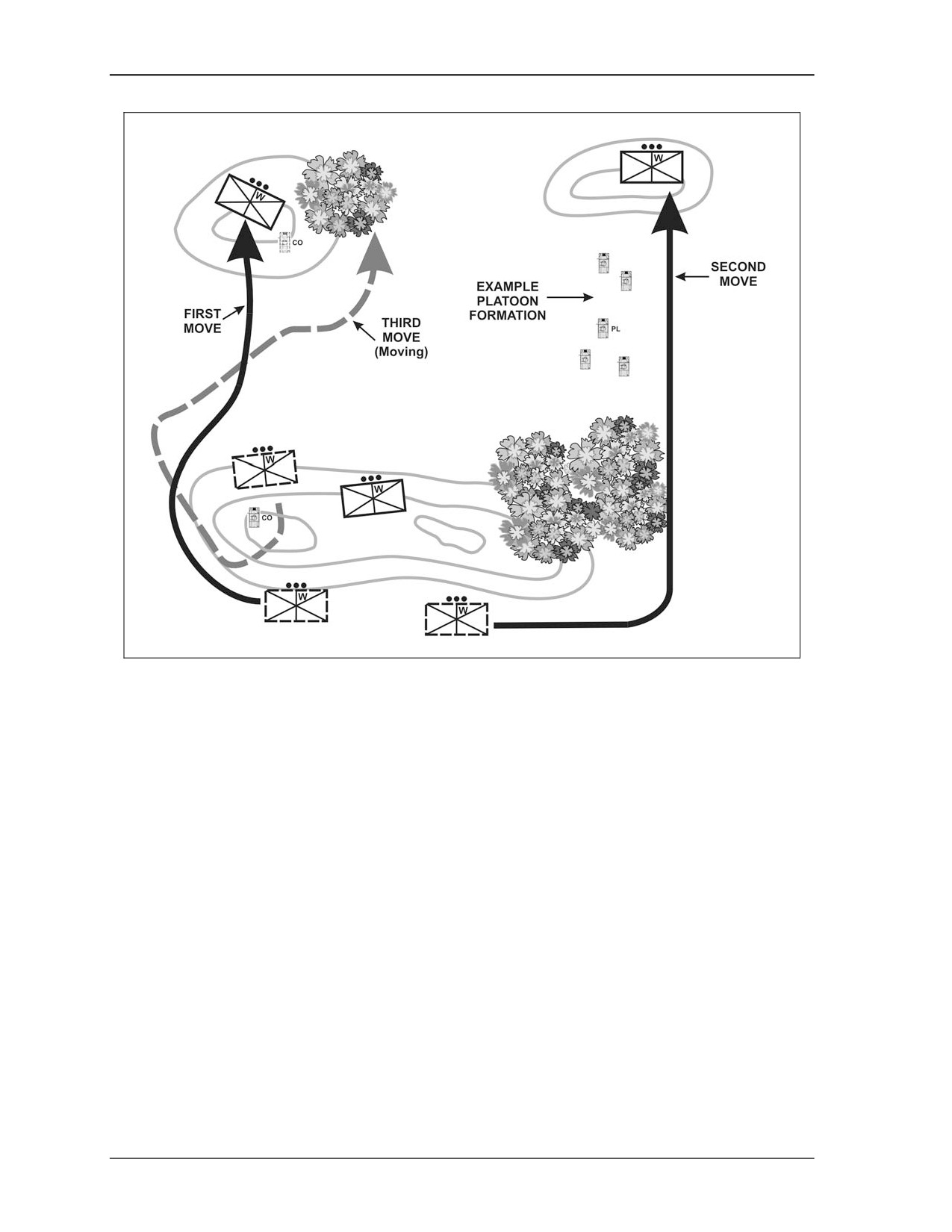
Chapter 3
Figure 3-13. Bounding overwatch technique.
Alternate Bounds
3-18. Covered by the rear element, the lead element moves forward, halts, and assumes overwatch
positions. The rear element advances past the lead element and takes up overwatch positions. This
sequence continues as necessary with only one element moving at a time. This method is usually more
rapid than successive bounds.
Successive Bounds
3-19. In the successive bounding method the lead element, covered by the rear element, advances and
takes up overwatch positions. The rear element then advances to an overwatch position roughly abreast of
the lead element and halts. The lead element then moves to the next position, and so on. Only one element
moves at a time, and the rear element avoids advancing beyond the lead element. This method is easier to
control and more secure than the alternate bounding method, but it is slower.
3-12
FM 3-21.12
1 July 2008
///////////////////////////////////////