FM 3-21.12 The Infantry Weapons Company (July 2008) - page 2
Movement
Section II. OPERATIONAL CONSIDERATIONS
The company commander assists in protecting his company during movement by ensuring the company is using
proper movement formations and techniques. Movement should be as rapid as the terrain, mobility of the force,
and enemy situation permit. The ability to gain and maintain the initiative often depends on movement being
undetected by the enemy. The Infantry weapons company depends heavily upon terrain, mobility and standoff
for protection from enemy fire.
MOVEMENT FUNDAMENTALS
3-20. The Infantry weapons company commander's mission analysis helps him decide how to move most
effectively and securely. When planning company movements, the commander ensures the unit is moving
in a way that supports a rapid transition to maneuver. Once contact with the enemy is made, squads and
platoons execute the appropriate actions on contact, and leaders begin to maneuver their units. The
following fundamentals provide guidance for planning effective company movements.
Reconnoiter
3-21. All echelons reconnoiter. The enemy situation and the available planning time may limit the unit's
reconnaissance, but leaders at every level seek information about the terrain and enemy. If sufficient
information is still lacking, an effective technique is to send a reconnaissance element forward of the lead
platoon. Even if this unit is only 15 minutes ahead of the company, it can still provide valuable information
and reaction time for the company commander.
Use Terrain and Weather Effectively
3-22. Unlike the Infantry rifle company with the ability to move across almost any terrain, the Infantry
weapons company is restricted to areas trafficable by the vehicles. This restriction is largely counteracted
by the speed at which the unit can move. To the greatest extent possible, the company moves on covered
and concealed routes. Moving in limited visibility may provide better concealment, and the enemy might
be less alert during these periods. Leaders should plan to avoid identified danger areas or kill zones such as
large open areas surrounded by covered or concealed areas.
Move as Sections or Platoons
3-23. The advantages to moving the company by sections or platoons include--
• Faster movement.
• Better security. A small unit is less likely to be detected because it requires less cover and
concealment.
• More dispersion. The dispersion gained by moving the company by sections and platoons
makes it more difficult for the enemy to concentrate his fires against the company, especially
indirect fires, close air support (CAS), and chemical agents. Subordinate units also gain room
to maneuver.
• Better operations security (OPSEC). It is harder for the enemy to determine what the friendly
force is doing with only isolated platoon, section or individual vehicle spot reports.
3-24. When planning decentralized movements the commander should also consider the following
disadvantages.
• Numerous linkups are required to regroup the company.
• May take longer to mass combat power to support a hasty attack or disengage in the event of
enemy contact.
1 July 2008
FM 3-21.12
3-13
Chapter 3
Maintain Security During Movement
3-25. Security is critical during movement since the company is vulnerable to enemy aerial, direct and
indirect fires. Since weapons companies do not often move with rifle companies during tactical
movements, they are responsible for their own security. Leaders must be alert to maintain security of the
unit during movements and halts. In addition to the fundamentals listed earlier, the company commander
achieves security for the company by applying the following.
• Use the appropriate movement formation and technique for the conditions
• Move as fast as the situation allows. This may degrade the enemy's ability to detect the unit and
the effectiveness of his fires once he detects it.
• When possible, orient weapons to cover the front, flanks, and rear during movements.
• In addition to his assigned sector, the gunner is responsible for aerial security. The leader and
assistant gunner should have their weapons ready to fire out of their respective windows while
scanning the terrain for the enemy.
• During halts, dismount as many Soldiers as possible for security. The gunner maintains his
position behind the main weapon while the leader, assistant gunner, and driver dismount if
possible. The driver should stay within arms reach of the vehicle.
• Enforce noise and light discipline.
• Enforce camouflage discipline (Soldiers and their equipment).
Employ Countermeasures
3-26. Commanders should also consider the use of countermeasures during movements such as
suppressive fires, direct and indirect, to degrade his ability to observe fire upon the unit by use of terrain or
obscurant (smoke).
Employ Additional Control Techniques
3-27.
Additional movement control techniques often aid commanders in controlling company
movements.
MOVEMENT CONTROL TECHNIQUES
3-28. Using the proper formation and movement techniques helps the Infantry weapons company
commander control the company, but additional control techniques are often required. The following
techniques may help in controlling company movements.
GRAPHICS
3-29. Normally the battalion assigns graphic control measures to synchronize a company movement into
the battalion's movement or scheme of maneuver. The company commander may need to establish
additional control measures to control his units. These may include boundaries, routes, command posts
(CP), release points (RP), target reference points (TRP), and objectives on known (likely) enemy positions
to control direct fires. The company commander ensures each graphic control measure is updated as
needed and is easy to locate on the terrain.
RECONNAISSANCE
3-30. Prior reconnaissance aids control during movement. It provides the commander with a better idea
of where movement is more difficult and where graphic control measures are needed. Elements from the
company may perform this reconnaissance, however the battalion reconnaissance platoon is more likely to
conduct the reconnaissance and provide the information to other organizations. The use of unmanned
aircraft systems (UAS) can also be a valuable reconnaissance asset. The Improved Target Acquisition
3-14
FM 3-21.12
1 July 2008
Movement
System (ITAS) target acquisition system (TAS) and Javelin’s command launch unit (CLU) are also a
valuable systems that can aid in reconnaissance.
GUIDES
3-31. Guides who have already seen the terrain are the best way to provide control. When guides are not
available for the entire movement, they should reconnoiter the difficult areas and guide the company
through those. Examples: complex road interchanges, obstacle lanes, and another unit’s area of operations
(AO).
NAVIGATIONAL AIDS
3-32. Even with the availability of a global positioning system (GPS), every leader should maintain
positioning on his map and verify his position with terrain features. If possible, select routes that allow
leaders to use prominent terrain to stay oriented.
LIMITED VISIBILITY MOVEMENTS
3-33.
The measures listed above are equally useful in limited visibility conditions. However, to aid
movement in during limited visibility, the use of night vision devices (NVD) is a great asset. Leaders may
also consider closing up the vehicle interval in formations while still maintaining the most dispersion
possible at all times and reducing the speed of movement. Well-trained units can operate at night as they do
during the day.
1 July 2008
FM 3-21.12
3-15
This page intentionally left blank.
Chapter 4
Offensive Operations
The offense is the decisive form of war. Offensive operations destroy or defeat the
enemy. The weapons company can be deployed to support the Infantry companies or
given a separate mission. The weapons company possesses the greatest combination
of firepower and mobility available to the Infantry battalion. In the offense, the
company provides tank-killing, bunker-destroying, and suppression capabilities that
can influence the outcome of operations. It can also move quickly on the battlefield
to support engaged units or to react to enemy movements. This chapter describes the
tactics and techniques used by the weapons company during offensive operations.
Many of the subjects covered in this chapter are also included in FM 3-21.10: The
Infantry Rifle Company.
Section I. OVERVIEW
The outcome of decisive combat derives from offensive actions. All operations are designed to transition to and
support the offense. A sound doctrinal foundation during offensive planning assists the weapons company
commander in capitalizing on the tactical flexibility of his unit. For more detail on offensive planning
considerations, refer to FM 3-21.10: The Infantry Rifle Company.
PURPOSE
4-1.
Offensive operations seek to seize, retain, and exploit the initiative to decisively defeat the enemy.
Additionally, offensive operations accomplish the following:
• Disrupt enemy coherence.
• Secure terrain.
• Deny the enemy of resources.
• Fix the enemy.
• Gain information.
• Deceive the enemy.
CHARACTERISTICS
4-2.
The common characteristics of all offensive operations are surprise, concentration, tempo, and
audacity. Based on mission, enemy, terrain, troops, time, civilians (METT-TC), the commander’s plan and
actions should balance these characteristics to accomplish the mission with minimal casualties.
SURPRISE
4-3.
Units achieve surprise by striking the enemy at a time, at a place, or in a manner for which he is
unprepared. Surprise delays and disrupts the enemy's ability to react. The speed and lethality of the
weapons
1 July 2008
FM 3-21.12
4-1
Chapter 4
company makes the use of surprise an important advantage. Surprise also reduces the vulnerability of the
company. Some methods that the weapons company can use to achieve surprise are:
• Following operations security (OPSEC) procedures.
• Massed and simultaneous engagements of fires from multiple weapons units.
• Making the best possible use of vehicle speed.
• Operating during limited visibility.
• Using covered or concealed routes during tactical movements.
• Attacking in an unexpected direction such as a flank or rear.
CONCENTRATION
4-4.
Units achieve concentration by massing the effects of their weapons systems without necessarily
massing their vehicles at a single location. Proper control and modern position location devices enable the
leader to disperse his vehicles while retaining the ability to quickly mass the effects of the platoon’s
weapons systems whenever necessary. The challenge for the company commander is to concentrate combat
power while reducing the enemy's ability to do the same against his unit... Examples of concentrating the
firepower of the weapons company and other weapon systems include coordinating obstacle with direct
and indirect fires, multiple platoons firing into an engagement area, and the use of supplementary positions
to mass fires.
TEMPO
4-5.
Tempo is the ability to adjust the rate of operations relative to battle circumstances and relative to
the enemy’s capability to sense and react. It is the controlled rate of military action. While a rapid tempo is
often preferred, tempo should be adjusted to ensure synchronization. The weapons company can utilize
tempo by using its mobility advantage to position its units, and using mission-type orders and tactical
standing operating procedures (TSOP) to increase its ability to more quickly maneuver against the enemy.
AUDACITY
4-6.
Audacity is characterized by violent execution of the mission and a willingness to seize the
initiative. Knowledge of the commander’s intent enables leaders to take advantage of battlefield
opportunities whenever they present themselves. This enhances the effectiveness of the company’s support
for the entire offensive operation. The mobility and firepower of the weapons company enables it to attack
quickly with great firepower.
TYPES
4-7.
The four types of offensive operations are movement to contact, attack, exploitation, and pursuit.
The weapons company often provides support for each using support by fire or attack-by-fire positions. Its
mobility advantage relative to the Infantry companies enables it to maneuver rapidly on the battlefield and
may increase its tactical value during exploitations and pursuits.
MOVEMENT TO CONTACT
4-8.
Movement to contact is a type of offensive operation designed to develop the situation and
establish or regain contact. The commander conducts a movement to contact (MTC) when the enemy
situation is vague or not specific enough to conduct an attack. Because the enemy situation is vague, the
weapons company may have one or more of its platoons attached to other units within the battalion. The
weapons company may also be used in support of or in concert with the scouts to find the enemy. The
weapons company also has the ability to fix the enemy once contact has been made and can guide Infantry
units into an engagement.
4-2
FM 3-21.12
1 July 2008
Offensive Operations
ATTACK
4-9.
An attack is an offensive operation that destroys or defeats enemy forces, seizes and secures
terrain, or both. Movement, supported by fires, characterizes the conduct of an attack. However, the
commander may decide to conduct an attack using only fires. An attack differs from a MTC because
enemy main body dispositions are at least partially known, which allows the commander to achieve greater
synchronization. This enables him to mass the effects of the attacking force’s combat power more
effectively in an attack than in a MTC. Special-purpose attacks are ambush, spoiling attack, counterattack,
raid, feint, and demonstration. In planning attacks, the weapons company may be used to--
• Suppress the enemy on an objective.
• Isolate the objective.
• Exploit the point of penetration and continue the attack deeper.
• Conduct a feint or demonstration (deception).
• Secure lines of communication.
• Conduct a raid using its direct fire weapons.
• Establish blocking positions by ground maneuver or air lift to destroy or canalize the enemy.
EXPLOITATION
4-10.
Exploitation is a type of offensive operation that rapidly follows a successful attack and is
designed to disorganize the enemy in depth. The objective of exploitation is to complete the enemy’s
disintegration. The weapons company uses speed and firepower to actively seek to gain terrain or destroy
enemy forces. The weapons company paired with close combat attack from army aviation can be very
effective in maintaining the initiative and tempo.
PURSUIT
4-11.
A pursuit is an offensive operation designed to catch or cut off a hostile force attempting to
escape, with the aim of destroying it. A pursuit normally follows a successful exploitation. The weapons
company may take part in a pursuit as part of a larger force or, because of its organic transportation, may
be task-organized as a pursuit force to close with and destroy the remnants of the enemy force.
SEQUENCE
4-12.
As the company commander plans an offensive mission, he generally considers a sequence of
operations, which apply to many, but not all, offensive operations. Offensive operations generally follow a
sequence of several events. These are assembly area operations, reconnaissance, movement to the line of
departure, maneuver, deployment, assault, consolidation, and reorganization.
ASSEMBLY AREA
4-13.
The commander directs and supervises mission preparations in the assembly area to prepare the
unit for the upcoming battle. This includes the mounting of the best weapon for the mission. Preparation
time also allows the unit to conduct pre-combat inspections and checks, rehearsals, TLPs, and sustainment
activities. For more information on action in the assembly area, see Troop Leading Procedures in
FM 3-21.10; Chapter 11 in this manual, and precombat checks (PCC) and precombat inspections (PCI)
checklist in Chapter 2 of this manual.
RECONNAISSANCE
4-14.
Reconnaissance should be conducted at all echelons. The enemy situation and available planning
time may limit the unit’s reconnaissance, but leaders at every level must aggressively seek information
about the terrain and enemy. A ground reconnaissance is preferred but often not possible. Unmanned
1 July 2008
FM 3-21.12
4-3
Chapter 4
aircraft systems (UAS), Force XXI Battle Command, Brigade and Below (FBCB2), and, at a minimum,
map reconnaissance may have to be used in lieu of a ground reconnaissance. If the digital map is installed,
the FBCB2 allows leaders to determine the line of sight, dead space from locations, and permits the
selection of tentative firing positions. However, it does not take into account man-made features and
vegetation. The weapons company may be assigned recon responsibilities and can use the weapons sights
for increased visibility in visual recon, perform area recon or route recon in support of the main body
movement.
MOVEMENT TO THE LINE OF DEPARTURE
4-15.
When attacking from positions not in contact, the weapons company often stages in rear assembly
areas, road marches to attack positions behind friendly units in contact with the enemy, and conducts a
forward passage of lines. When necessary, the unit employs indirect fires, close air support (when
available), and direct fire to facilitate movement.
MANEUVER
4-16.
The weapons company commander plans the approach to the objective to ensure security, speed,
and flexibility. He selects the routes, techniques, and formations that protects his force and supports the
actions on the objective. The unit may need to overcome enemy resistance en route to the objective and
should plan accordingly. The commander will often use movement techniques such as the bounding
overwatch to maneuver to support by fire positions.
DEPLOYMENT
4-17.
The weapons company deploys and moves toward the final attack-by-fire or support by fire
positions. Units cover their assigned sectors of fire and may place their vehicles in hull defilade positions
by using existing terrain to their advantage. They need to be prepared to seize their position and may either
have scouts reconnoiter their positions or have Infantry clear the positions if necessary.
ASSAULT
4-18.
The unit's objective may be terrain- or force oriented. Terrain-oriented objectives require the unit
to secure and retain a designated area and often require fighting through enemy forces. If the objective is
force-oriented, an objective area may be assigned for orientation, but the unit’s effort is focused on the
enemy’s actual disposition. The weapons company can either direct their fires onto the objective, be used
to isolate it from other enemy positions, cover enemy avenues of approach, or other missions as assigned.
CONSOLIDATION AND REORGANIZATION
4-19.
The company executes follow-on missions as directed by the higher commander. Whether a raid,
hasty attack, or deliberate attack, the unit organizes itself and prepares for continued operations, which may
include continued offensive actions, transition to stability operations, or defensive operations. Regardless
of the follow-on mission, the unit will perform site security, process any detainees, and conduct tactical site
exploitation (TSE). During TSE all collected items and personnel are properly documented, photographed,
and handled according to TSOP to ensure accountability and chain of custody.
4-4
FM 3-21.12
1 July 2008
Offensive Operations
Section II. PLANNING CONSIDERATIONS
During planning for the offense, the commander visualizes, describes, and directs his concept of the operation.
The weapons company commander begins with a designated area of operations (AO), identified mission (s),
and assigned forces. The commander then develops and issues verbally planning guidance based on his
visualization in terms of the physical means to accomplish the mission.
WARFIGHTING FUNCTIONS
4-20.
The weapons company commander uses the warfighting functions to develop, review and prepare
his plan and preparations for the attack. A warfighting function is a group of tasks and systems united by a
common purpose that commanders use to accomplish missions and training objectives. Decisive, shaping,
and sustaining operations combine all the warfighting functions to generate combat power.
INTELLIGENCE
4-21.
Intelligence is the related tasks and systems that facilitate understanding of the enemy, terrain,
weather, and civil considerations. It includes tasks associated with intelligence, surveillance, and
reconnaissance. The weapons company commander must understand the enemy’s strengths and
weaknesses. Ideally, this knowledge will be available during troop leading procedures
(TLP). The
commander must analyze all combat information received via command updates and through a common
operational picture gained with FBCB2 if available. Additionally, the commander should conduct personal
reconnaissance or request UAS overflights of his AO as the situation permits. The weapons company may
also gather information through reconnaissance to be used for intelligence.
MOVEMENT AND MANEUVER
4-22.
The movement and maneuver function move forces to achieve a position of advantage in relation
to the enemy. It includes tasks associated with projecting, protecting and employing forces. Maneuver is
the means by which commanders mass the effects of combat power to achieve surprise, shock, momentum,
and dominance. For example, the weapons company may support maneuver by supplying heavy machine
gun fire in support of a maneuvering Infantry unit. Movement is necessary to support that function and to
assure the protection, dispersion and displacement of the force as a whole. The weapons company role in
support of movement may be in the form of support such as convoy security for other mobile forces.
FIRES
4-23.
Fire support provides collective and coordinated use of indirect fires and close air support (CAS)
through the targeting process. All fires in support of the weapons company and other units are external to
the weapons company itself. The commander may employ supporting fires in the offense to achieve a
variety of tactical goals:
• To suppress enemy weapons systems that inhibits movement.
• To fix or neutralize bypassed enemy elements.
• To prepare enemy positions for an assault.
• To obscure enemy observation or screen friendly maneuver.
• Illuminate enemy positions.
PROTECTION
4-24.
The weapons company continually seeks ways increase its own protection and assist in providing
protection to other units. They employ both active and passive security measures using techniques such as
cover and concealment and site security. Protection preserves the force so the commander can apply
1 July 2008
FM 3-21.12
4-5
Chapter 4
maximum combat power. Preserving the force includes protecting personnel, physical assets, and
information. Protection facilitates the ability of the commander to maintain the integrity and combat power
of the deploying force. For a discussion of active and passive defensive measures (Chapter 5, Section II).
Protection focuses on several tasks:
• Area security.
• Defend against air and missile attack and aerial surveillance.
• Counter rockets, artillery, and mortars.
• Survivability operations.
• Casualty prevention.
• Antiterrorism.
• Protection against deliberate and accidental CBNR to include improvised explosive devices.
• Battlefield obscuration.
• Information protection.
• Fratricide avoidance.
• Personnel recovery operations.
• Safety.
Employment of Air Defense Systems
4-25.
In offensive situations, air defense elements accompany the main attack. They may maneuver with
the lead company, orienting on low-altitude air avenues of approach. When the unit is moving or in a
situation that entails short halts, the short range air defense (SHORAD) element positions its vehicles and
man portable air defense system to assure mutual support between systems and coverage to the company.
The Stinger gunners can dismount to provide air defense when the unit reaches the objective or pauses
during the attack.
SUSTAINMENT
4-26.
Sustainment provides support and services to ensure freedom of action, extend operational reach,
and prolong endurance. Unit endurance is primarily a function of its sustainment ability. Key sustainment
planning considerations for the weapons company during offensive operations include--
• Increased consumption of Class III supplies.
• Vehicle maintenance requirements.
• Class V projection planned throughout the depth of the operation.
COMMAND AND CONTROL
4-27.
Command and control support the commander in exercising authority and direction. It includes
those tasks associated with acquiring friendly information, managing relevant information, and directing
and leading subordinates. The commander determines where to position himself on the battlefield in order
to most effectively influence the operation. The weapons company may assist communications for other
units such as using their more powerful radios in providing a long-range communications relay for rifle
companies. In the offense to effectively command and control:
• The communications standing operating procedures (SOP) for the company must be clear,
simple and redundant.
• Daylight and limited visibility markings must be understood by all.
• Radio transmissions must be clear and concise to enhance offensive command and control
(C2).
• Units establish SOPs that dictate message recipients to insure critical information reaches the
commander, without burdening him with routine digital traffic.
4-6
FM 3-21.12
1 July 2008

Offensive Operations
WEAPONS SELECTION
4-28.
The selection of weapons is based on a careful analysis of METT-TC, especially enemy and
terrain. If the enemy is capable of employing tanks and mechanized elements, then the weapons company
commander should consider having a mix of heavy weapons. Table 4-1 shows some very general selection
guidelines for the current weapons in the weapons company based on the enemy and terrain. Ultimately,
thorough planning and analysis should result in a weapons ready posture, to include engagement criteria
and engagement priorities for each weapon system (Chapter 9).
Table 4-1. General weapons employment guidelines.
Enemy
Terrain
Weapon
Tank &
Infantry
Open
Close
Mechanized
ITAS
9
9
MK19
9
9
9
9
M2
9
9
9
Javelin
9
9
SELECTION OF SUPPORT AND ATTACK-BY-FIRE POSITIONS
4-29.
The weapons company commander carefully studies the battalion’s scheme of maneuver and
selects tentative support and attack-by-fire positions throughout the battalion’s AO. He selects the best
locations for those fire positions directed by battalion and selects others throughout the AO. He is
especially careful in the selection of positions that support the capture of any intermediate and final
objective. He also identifies positions that can cover any enemy avenues of approach into the battalions
AO and fire positions to support the Infantry’s consolidation on the objective and positions to stop any
counterattacks. The weapons company commander therefore selects positions to--
• Comply with those directed in the battalion operation order OPORD or FRAGO.
• Support the battalion’s movement through the AO.
• Support the capture of intermediate and final objectives.
• Cover any potential enemy avenues of approach into the battalion’s AO.
• Support the Infantry’s consolidation on the objective(s).
• Maximize standoff capabilities of the weapon system.
• Stop any counterattacks.
• Continue the attack.
Section III. MOVEMENT TO CONTACT
The purpose of a movement to contact is to gain or reestablish contact with the enemy. A movement to contact
is most often executed through one of two techniques, the approach march and the search and attack. When
operating as part of a higher unit’s movement to contact, the weapons company normally employs the same
technique as that unit. The company commander must consider the mounted capabilities of his company during
both techniques. Considerations that may assist the commander in developing his concept include the time
available, the speed of movement, the enemy situation, and security. For additional information on these
techniques, see FM 3-21.10.
1 July 2008
FM 3-21.12
4-7
Chapter 4
OVERVIEW
4-30.
The weapons company normally conducts a movement to contact as part of the battalion. An
Infantry battalion may be given a movement to contact mission as the lead element of an attack or as a
counterattack element of a brigade combat team (BCT) or higher-level unit. Reconnaissance, surveillance
and flexibility are essential in gaining and maintaining the initiative. The movement to contact terminates
with the occupation of an assigned objective or when enemy resistance requires the battalion to deploy and
conduct an attack in order to continue forward movement. The battalion normally moves with a security
force, a main body and a rear guard. Often the security force consists of a company size element formed
into a reconnaissance force and an advance guard. The weapons company may be part of the battalion’s
main body or may have one or more of its platoons attached to the advanced guard. It should be prepared
to deploy and attack the enemy with concentrated heavy weapons firepower at the decisive point on the
battlefield.
APPROACH MARCH TECHNIQUE
4-31.
An approach march is the advance of a combat unit when direct contact with the enemy is
intended. During offensive operations, the commander can choose to have all or part of his force conduct
an approach march as part of the movement to contact. A battalion conducts movement to contact in a
manner that allows it to maneuver to develop the situation fully, to maintain freedom of action, and if
required, to defeat the enemy once contact is made. The approach March technique can facilitate the
commander’s decisions by allowing freedom of action and movement of the main body.
SEARCH AND ATTACK TECHNIQUE
4-32.
The search and attack may be used in a noncontiguous AO and against an enemy operating in
dispersed elements. It is organized into finding, fixing, and finishing forces. The search and attack
techniques purpose is to find the enemy with a small element (squad, section, or platoon) and, if possible,
fix and destroy him. If the finding force is not strong enough to fix and finish the enemy, then the fixing
force (normally a company for a battalion level operation) is committed to fixing and, if possible, finishing
off the enemy. If the fixing force is not strong enough, then it fixes the enemy and the finishing force
completes the destruction of the enemy. This cascading effect allows the battalion to commit the smallest
force to destroy the enemy while retaining the ability to “pile on” other units if required. The weapons
company may have a platoon attached to the fixing force and the rest of the company as part of the
finishing force. It can be used to support the attack-by-fire or use attack-by-fire positions to cordon the
objective area.
Section IV. ACTIONS ON CONTACT
In both offensive and defensive operations, contact occurs when a member of a weapons company encounters
any situation that requires an active or passive response to a threat or potential threat. Contact may occur in
different forms through a variety of circumstances. These may happen through:
• Visual (friendly elements may or may not be observed by the enemy).
• Physical or direct fire with an enemy force.
• Indirect fire.
• With obstacles of enemy or unknown origin.
• With enemy or unknown aircraft.
• Involving chemical, biological, radiological or nuclear (CBRN) conditions.
• Involving electronic warfare tactics.
• With nonhostile elements such as civilians.
4-8
FM 3-21.12
1 July 2008
Offensive Operations
COMMANDER'S ANALYSIS
4-33.
Company commanders analyze the enemy throughout the troop-leading procedures to identify all
likely contact situations that may occur during a mission. Through the planning and rehearsals conducted
during troop-leading procedures, leaders develop and refine course of actions (COA) to deal with probable
enemy actions. The COAs eventually become the foundation for the unit’s scheme of maneuver. During
the troop-leading process, the leader must evaluate a number of factors to determine impacts on the unit’s
actions on contact.
TIME REQUIREMENTS
4-34.
Company commanders must understand that properly executed actions on contact require time at
section, platoon, and company levels. To develop the situation fully, a subordinate unit may need to
execute extensive lateral movement, conduct reconnaissance-by-fire, and call for and adjust indirect fires.
Each of these activities requires time. The commander must balance the time required for subordinate
elements to conduct actions on contact with the need of his organization or the higher headquarters to
maintain tempo and momentum. In terms of slowing the tempo of an operation, however, the loss of a
platoon or team is normally much more costly than the additional time required to allow the subordinate
element to properly develop the situation.
STEPS
4-35.
The weapons company should execute actions on contact using a logical, well-organized,
four-step, decision-making process:
1. Deploy and report.
2. Evaluate and develop the situation.
3. Choose a COA.
4. Execute the selected COA.
4-36.
The four-step process is not intended to generate a rigid, lockstep response to the enemy. Rather,
the goal is to provide an orderly framework that enables the unit and its subordinate elements to survive the
initial contact and then to apply sound decision-making and timely actions to complete the operation.
Ideally, the unit will acquire the enemy before being sighted by the enemy. It then can initiate physical
contact on its own terms by executing the designated COA. For more detail, see FM 3-21.10: The Infantry
Rifle Company.
Section V. ATTACKS
An attack is a type of offensive operation characterized by movement supported by fire. The purpose of an
attack is to destroy an enemy force or to seize terrain. The attack should always try to strike the enemy where
he is weakest. The company can attack independently or as part of a battalion or larger element. This section
discusses the types of attacks including the hasty attack, the deliberate attack, and special-purpose attacks. It
also quickly discusses follow on actions of the exploitation and pursuit. For a more detailed explanation of
attacks, exploitation and pursuit see FM 3-21.10.
TYPES
4-37.
The two basic types of attack are the hasty attack and the deliberate attack. The primary difference
between them is the extent of planning and preparation conducted by the attacking force, but no clear
distinction exists between deliberate and hasty attacks. Attacks range along a continuum. At one end of this
continuum, the company commander issues a FRAGO that directs a hasty attack with rapid execution of
battle drills by forces immediately available. These attacks rely on an implicit understanding and frequency
1 July 2008
FM 3-21.12
4-9
Chapter 4
modulation (FM) radio (or digital) communication with detailed orders and appropriate branches or sequels
that make understanding explicit. Information on the general enemy situation may come from a movement
to contact, and the unit launches a hasty attack as a continuation of the meeting engagement. The weapons
company normally supports the attack from support by fire positions or has an independent mission, often
to isolate the objective, for attack-by-fire positions. It can also conduct reconnaissance by fire primarily
with its machine guns. In the attack, the company maneuvers along the lines of least resistance using the
terrain for cover and concealment. This indirect approach affords the best chance to achieve surprise on the
enemy force. All attacks, whether hasty or deliberate, depend on synchronization for success. They require
planning, coordination, and time to prepare.
HASTY ATTACK
4-38.
A hasty attack is used to--
• Maintain momentum.
• Exploit a tactical opportunity.
• Regain the initiative.
• Prevent the enemy from regaining organization or balance.
• Gain a favorable position that may be lost with time.
4-39.
Because its primary purpose is to maintain momentum or take advantage of the enemy situation,
the hasty attack is normally conducted with only the resources that are immediately available. Maintaining
unrelenting pressure through hasty attacks keeps the enemy off balance and makes it difficult for him to
react effectively. Rapidly attacking before the enemy can act often results in success even when the combat
power ratio is not as favorable as desired. With its emphasis on agility and surprise, however, this type of
attack may cause the attacking force to lose a degree of synchronization. To minimize this risk, the
commander should maximize use of standard formations and well-rehearsed and thoroughly understood
battle drills and SOPs. By maintaining situational understanding and assigning on-order and be-prepared
missions to subordinate units as the situation warrants, the weapons company is better able to transition
into hasty attacks. The hasty attack is often the preferred option during continuous operations. It allows the
commander to maintain the momentum of friendly operations while denying the enemy the time needed to
prepare his defenses and to recover from losses suffered during previous action. Hasty attacks normally
result from a movement to contact, successful defense, or continuation of a previous attack. The weapons
company, with its inherent speed and firepower, can move quickly into firing positions to support the
Infantry attack. It can also isolate the objective from attack-by-fire positions.
DELIBERATE ATTACK
4-40.
The weapons company typically will conduct a deliberate attack as part of a larger force. It often
conducts a deliberate attack by itself when it has an attack-by-fire mission or has been task organized with
Infantry units. Deliberate attacks follow a distinct period of preparation, which is used for extensive
intelligence, surveillance, and reconnaissance (ISR) operations, detailed planning, task organization of
forces, fires planning, preparation of troops and equipment, coordination, rehearsals, and plan refinement.
The deliberate attack is a fully synchronized operation that employs every available asset against the
defending enemy. It is characterized by a high volume of planned fires (direct and indirect), use of major
supporting attacks, forward positioning of resources needed to maintain momentum, and operations
throughout the depth of enemy positions. Thorough preparation allows the attacking force to stage a
combined-arms and fully integrated attack. Likewise, however, the enemy will have more time to prepare
his defensive positions and integrate fires and obstacles. The factors of METT-TC dictate how thoroughly
these activities are accomplished.
4-41.
The weapons company commander plans for the commitment of his company in compliance with
battalion orders. He conducts a METT-TC analysis, gives his order, and prepares for the attack. The
following are some of the tasks that are done by the commander and his primary subordinates, the
executive officer and the first sergeant, prior to a successful deliberate attack:
4-10
FM 3-21.12
1 July 2008
Offensive Operations
• Develops his scheme of maneuver and fire plan.
• Briefs his platoon leaders.
• Conducts rock drills and briefbacks to ensure subordinates understand their missions.
• Coordinates indirect fires with the fire support officer.
• Coordinates with the Infantry company commanders to ensure his maneuver and fire plan
supports their plans.
• Assigns targets.
• Conducts rehearsals.
• Vehicles are mounted with the best weapon’s mix for the mission and additional ammunition is
brought forward.
• Routes to support by fire and attack-by-fire positions are reconnoitered by leaders and marked.
• Check equipment for serviceability.
SPECIAL-PURPOSE ATTACKS
4-42.
The weapons company could possibly receive a mission to conduct a raid, ambush, spoiling
attack, counterattack, feint, or a demonstration. The weapons company can use both support by fire and
attack-by-fire positions during these types of attacks. Its mobility is an advantage. Any attachments
however, such as Infantry, should be equally mobile. The commander selects weapons based on a detailed
analysis of the factors of METT-TC.
Raid
4-43.
This is a limited-objective form of attack entailing swift penetration of hostile terrain. A raid
operation always ends with a planned withdrawal to a friendly location upon the completion of the
assigned mission. A raid is not intended to hold territory. The weapons company can conduct an
independent raid, a raid in conjunction with other ground forces, or it can participate in a higher unit
offensive operation that encompasses several related raids or other related operations. For more
information on the weapons company and their involvement in raids, see Chapter 8, Section VI of this
manual.
Ambush
4-44.
An ambush is a surprise attack, from concealed positions, on a moving or temporarily halted
enemy. It may take the form of an assault to close with and destroy the enemy, or it may be an attack-by-
fire only, executed from concealed positions. An ambush does not require that ground be seized or held.
Although the execution of an ambush is offensive in nature, the unit may be directed to conduct an ambush
in a wide variety of situations. The weapons company can ambush enemy units from support by fire
positions. Ideally, the weapons units strike from a flank and, in the case of an enemy convoy, destroy the
lead and rear vehicles, and then destroy the rest in detail. Priority targets include enemy systems that can
return effective fire or control such as tanks, heavy automatic weapons, and command and control systems.
Spoiling Attack
4-45.
This is a limited-objective attack to delay, disrupt, or destroy the enemy's capability to attack.
Units mount spoiling attacks from defensive postures to disrupt expected enemy attacks. A spoiling attack
attempts to strike the enemy while he is most vulnerable--during his preparations for attack in assembly
areas and attack positions or while he is on the move prior to crossing his line of departure. In most
respects, units conduct spoiling attacks like any other attack. They may be hasty (when planning time is
short) or deliberate
(when the unit has obtained adequate forewarning). The weapons company can
effectively support a spoiling attack or conduct one by establishing attack-by-fire positions.
1 July 2008
FM 3-21.12
4-11
Chapter 4
Counterattack
4-46.
This is an attack by defensive forces to regain the initiative or to deny the enemy success with his
attack. Commanders conduct counterattacks either with a reserve or with lightly committed forward
elements. They counterattack after the enemy launches his attack, reveals his main effort, or creates an
assailable flank. The weapons company commander conducts a counterattack much like other attacks, but
synchronizing them within the overall defensive effort requires careful timing. Counterattacks made by the
weapons company however, may be limited to movement to better terrain in order to bring fires on the
enemy.
Feint
4-47.
The feint is in many ways identical to other forms of the attack. Its purpose is to cause the enemy
to react in a particular way, such as by repositioning forces, committing its reserve, or shifting fires. The
key difference between the feint and other attack forms is that it is much more limited in scope, with an
extremely specific objective. The scale of the operation, however, usually is apparent only to the
controlling headquarters. For the element actually conducting the feint, such as a weapons company,
platoon, or section, execution is just as rapid and as violent as in a full-scale attack. The grenade machine
guns may be very effective during a feint by delivering a high volume of high explosive into the target
area.
Demonstration
4-48.
The demonstration is an attack whose purpose is to deceive the enemy about the location of the
decisive operation. The purpose of a demonstration is similar to that of a feint, but the friendly force does
not make contact with the enemy. The mobility of the weapons company allows it to demonstrate then
reposition quickly to another predetermined location on the battlefield.
EXPLOITATION
4-49.
A company normally takes part in exploitations as part of a larger force; however, all company
commanders should prepare to exploit tactical success at the local level. Any action must be within the
higher commanders' intent and concept of the operation.
PURSUIT
4-50.
The objective of the pursuit is the total destruction of the enemy force. The weapons company
may take part in a pursuit as part of a larger force or, because of its organic transportation, may
task-organize a pursuit force that can close with and destroy the remnants of the enemy force. It can also
fix the enemy in place to allow the Infantry units’ time to maneuver and destroy the enemy. In the pursuit
the weapons company commander should be aware of the locations of friendly units and not maneuver
beyond the mutual support of the rest of the battalion.
Section VI. OFFENSIVE MANEUVER
Two common ways a weapons company can support a battalion or company in the offense by conducting a
support by fire mission or an attack-by-fire mission. Both type missions are shown in Figure 4-1.
SUPPORT-BY-FIRE FORCE
4-51.
The combination of fire and movement first needs a unit to remain stationary and provide
protection through fires for the assaulting forces by destroying, suppressing, or fixing enemy forces. This is
4-12
FM 3-21.12
1 July 2008
Offensive Operations
a mission well suited for the weapons company due to their mix of heavy weapons. The decision on
weapon selection is based on a detailed METT-TC analysis. Ideally, their positions would be selected prior
to movement. The support by fire force avoids fratricide by using FBCB2, direct fire control measures
(DFCM), and visual confirmation. The integration of these direct fires into the scheme of maneuver,
known as direct fire control, is essential to battlefield success. For more information on direct fire control,
see Chapter 9 of this manual.
4-52.
As the support by fire force, the weapons company occupies support by fire positions that afford
effective cover and concealment, unobstructed observation, and clear fields of fire. Once it is in position, it
has the responsibility both for placing the effects of direct fires on known enemy forces and for
aggressively scanning assigned sectors of observation. In doing so, it identifies previously unknown enemy
elements and then fires upon them. The protection provided by the support by fire force allows the
assaulting force to continue its movement and to retain the initiative even when it is under enemy
observation or within range of enemy weapons.
4-53.
The assaulting force can either be other units, such as Infantry companies or scouts, or elements
from the weapons company itself. Movement in a maneuver situation is inherently dangerous. It is
complicated not only by the obvious potential for harm posed by enemy weapons but also by the
uncertainty caused by unknown terrain and other operational factors. The assaulting force must therefore
take full advantage of whatever cover and concealment are provided by the terrain.
ATTACK-BY-FIRE
4-54.
An attack-by-fire mission may be conducted as a stand-alone mission. It may also be used to
engage enemy elements by firing on a position other than an assault conducted by another unit on a
separate objective. The purpose of an attack-by-fire is to mass the effects of direct and indirect fire systems
from one or multiple locations on an enemy to destroy, suppress, fix, or deceive him without closing with
him. This mission may be used to help allow freedom of operations of other forces on a separate objective.
A commander assigning this task to a subordinate must also state the desired effect on the enemy, such as
destroy, suppress, fix, or deceive. A commander normally employs this task when the mission does not
dictate or support close combat and occupation of a geographical objective by another friendly force. The
commander may assign the force conducting an attack-by-fire mission with either a sector of fire, an
engagement area, or an objective. He may also assign it an axis of advance and a force-oriented objective.
The attack-by-fire unit can also cover an enemy avenue of approach. An attack-by-fire closely resembles
the task of support by fire but ground forces do not close with the enemy.
1 July 2008
FM 3-21.12
4-13
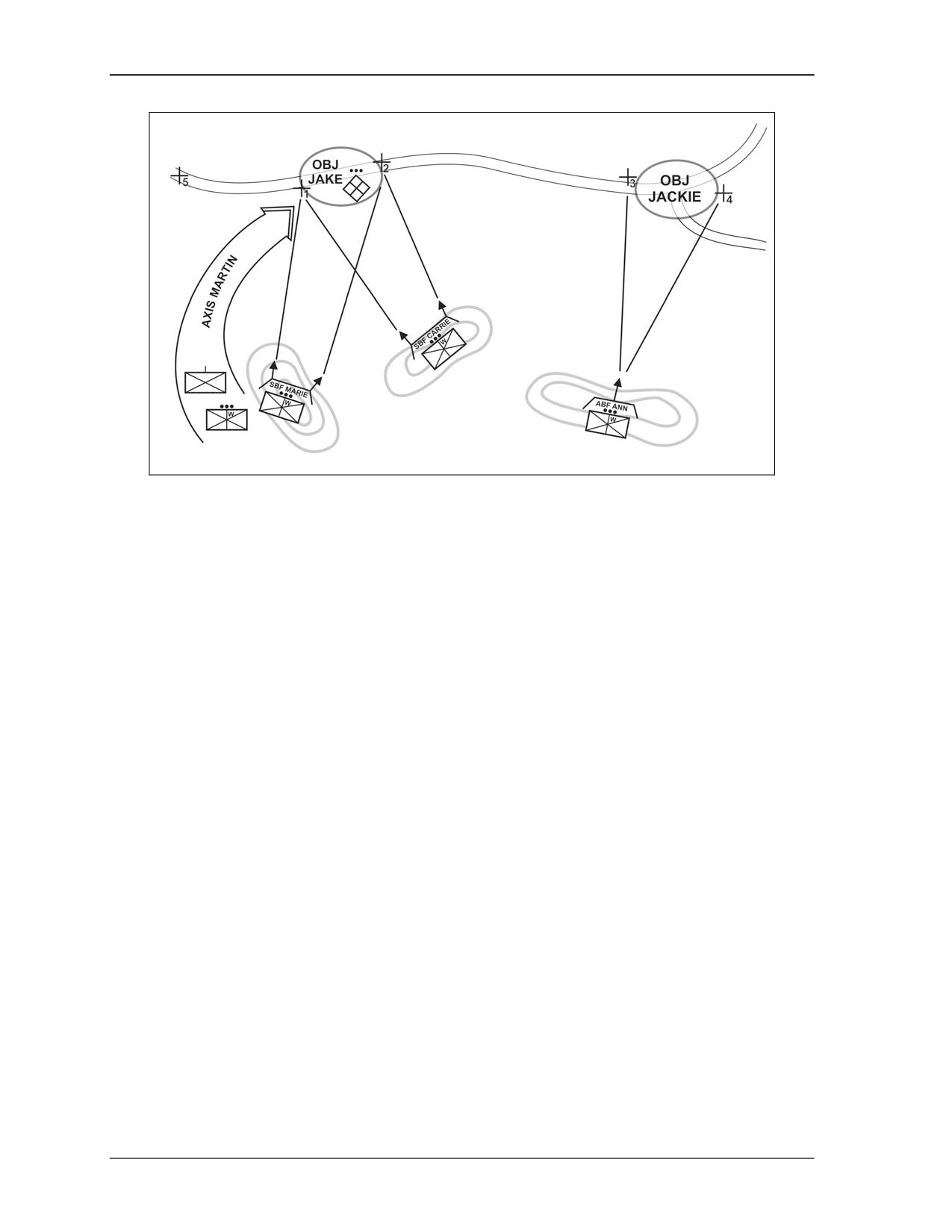
Chapter 4
Figure 4-1. Support-by-fire on Objective Jake and attack-by-fire on Objective Jackie.
USE OF TERRAIN FOR COVER AND CONCEALMENT
4-55.
While maneuvering, the all units should use terrain to provide cover and concealment. Some
techniques include:
• Not moving forward from a firing position. Back away from your position and go around on
the low ground.
• Staying on low ground as much as possible. Moving on top of ridgelines and over hilltops
silhouettes (skylines) vehicles.
• Scanning the ground for indicators of an obstacle or minefield such as disturbed earth,
out-of-place features, and surface-laid mines.
• Selecting the formation and movement technique that maximizes the unit’s battle space while
minimizing gaps and dead space.
• Bounding fore, covering dead space and gaps. The overwatch element cannot cover all of the
assaulting unit’s gaps and dead space. Vehicle crews keep the distance of each move (or
bound) within the direct fire range of the overwatch element.
• Planning actions at danger areas. If necessary, the vehicle crew dismounts and either observes
around blind spots or checks the trafficability of a route or defile before the vehicle moves over
or through these locations.
• Reducing the vehicle signature, such as creating dust clouds, as much as possible.
• Prior to conducting an operation, leaders can use FBCB2 to analyze line of sight (LOS) to
identify tentative overwatch positions.
HASTY OCCUPATION OF A POSITION
4-56.
The weapons company and platoons may use this method if it is fixed or suppressed by enemy fire
and no longer has the ability to move forward or bypass. It may also set up a hasty defense when the enemy
executes a hasty attack. The company or platoons maintain contact or fixes the enemy in place until
additional combat elements arrive or until it is ordered to move. When the unit must conduct a hasty
defense, the commander has responsibility for continuing to develop the situation. The actions are the same
as those for actions on contact.
4-14
FM 3-21.12
1 July 2008
Chapter 5
Defensive Operations
The weapons company contributes to success in the defense by employing
long-range direct fires to destroy enemy forces with fire from its heavy weapons. The
weapons unit’s mobility, heavy weaponry, and thermal observation devices make it
an important part of the battalion’s defense. The weapons unit can perform several
missions in the defense including defending from a battle position(s), establishing
firing positions in the main battle area (MBA), participating in security operations,
and serving as a reserve.
Section I. OVERVIEW
Though the outcome of decisive combat derives from offensive actions, commanders may find that it is
necessary to defend. Once they make this choice, they must set the conditions for the defense that allows
friendly forces to withstand and hold the enemy while they prepare to seize the initiative and return to the
offense. A thorough understanding of the commander’s intent is critical in defensive operations, which
demands precise integration of combat, support, and sustainment elements.
PURPOSE
5-1.
The Army conducts defensive operations to defeat an enemy attack, buy time, economize forces,
or develop conditions favorable for an attack. Defensive actions alone are not normally decisive and are
frequently followed by an offensive action.
CHARACTERISTICS
5-2.
The characteristics of the defense are preparation, security, disruption, massing effects, and
flexibility. These are the defensive fundamentals for the weapons company. These fundamentals should be
considered when planning or conducting company defensive operations. (See Chapters 9 and 10, FM 3-90,
for further discussion on mobile and area defenses.)
PREPARATION
5-3.
The critical element affecting preparation for the defense is the time available and proper time
management. Time management begins with receipt of the warning order, operation order (OPORD), or
fragmentary order (FRAGO). Effective use of available time allows the company commander and platoon
leaders to conduct a thorough reconnaissance of engagement areas, battle positions (BP), displacement
routes, friendly positions, axes for possible enemy attacks and axes for friendly counterattacks.
Coordination with other units is also critical. The weapons company may be deployed throughout the
battalion area of operations (AO) which makes it even more imperative that the commander send orders to
his subordinates as soon as possible. Besides troop leading procedures, Weapons company leaders at all
levels have a multitude of tasks to accomplish during the preparation phase to include:
• Ensure Soldiers, vehicles, and weapons are prepared for action.
• Establishing or confirming engagement areas and fire control measures.
1 July 2008
FM 3-21.12
5-1
Chapter 5
• Verify exact firing positions.
• Reconnoiter and calculate time-distance factors for routes between firing positions.
• Move the unit and occupy primary positions.
SECURITY
5-4.
The company and platoons establish operations security (OPSEC) procedures to maintain security
during planning, preparation, and execution of the defense. The weapons leaders integrate their security
plan with that of the adjacent units. Leaders enhance their position by using early warning devices to
identify potential mounted and dismounted avenues of approach. They then position early warning devices
and observation posts (OP) to cover these avenues. Coordination with other unit commanders is necessary
to make sure weapons units are fully integrated into the overall security plan. Weapon units must provide
their own security if they are on BPs that have no other Infantry support. Units should also maintain
security during movement and select routes that provide concealment and cover from enemy fire. Shorter
engagement ranges and close terrain make weapons company units employing missile systems more
vulnerable to dismounted enemy Infantry. Therefore, leaders should consider positioning units with or in
close proximity to Infantry units. If the Infantry is not available, the weapons unit should protect itself by
task organizing the unit with some Soldiers operating the missile systems and other Soldiers providing
security with small arms, and machine guns. To protect themselves from enemy direct and indirect fires,
Weapons units should consider constructing fighting positions even if the main weapon system remains on
the vehicle.
DISRUPTION
5-5.
All defensive concepts are aimed at disrupting the attacker's synchronization. Counterattacks,
indirect fires, obstacles, and retention of key terrain prevent the enemy from concentrating his strength
against portions of the defense. The combination of direct fires coupled with obstacles and indirect fires
can greatly reduce the enemy’s ability to use his systems against us. Smoke and white phosphorous can
also obscure the enemy’s overwatch positions and isolate his units. Within the weapons company, units can
separate dismounted Infantry from armored vehicles by using the machine guns. Destroying enemy
command and control vehicles also disrupts enemy synchronization and flexibility. The weapons company
should establish an engagement priority for specific types of enemy vehicles and formations.
MASSING EFFECTS
5-6.
If a defender is to succeed, he must concentrate his combat power at the decisive time and place.
The weapons company can achieve this by massing its direct fires from multiple firing positions spread
both laterally and in depth. Using trigger lines or other fire control measures, the weapons company can
destroy many enemy vehicles and personnel in a short period of time. The proper use of fire control
measures help allow fires to be distributed through the enemy’s point(s) of attack. The defender also strives
to obtain a local advantage at points of decision. Offensive action and the use of surprise and deception are
often the means of gaining this advantage. To concentrate combat power, the defender normally must
economize in some areas, retain a reserve, and maneuver to gain local superiority. Weapons company units
can provide fire support to local counterattacks to maintain the integrity of the defense. The weapons
company can also quickly move to provide support throughout the battle area. Indirect fires can be shifted
to critical points to rapidly concentrate destructive effects.
FLEXIBILITY
5-7.
The key to the employment of the weapons company is flexibility. Flexibility is derived from
sound preparation and effective command and control. The defender must be agile enough to counter or
avoid the attacker's blow and then strike back effectively. Flexibility results from a detailed mission
analysis, an understanding of the unit's purpose, aggressive reconnaissance and security, and, when
applicable, organization in depth and the retention or reconstitution of a reserve. Supplementary fire
5-2
FM 3-21.12
1 July 2008
Defensive Operations
positions on primary and secondary avenues of approach may provide additional flexibility to the unit.
Alternate fire positions within the BP allow vehicles to move and continue to fire after the primary position
is located by the enemy. Successive BPs provide depth for weapons company units to move to if the
present original BP becomes untenable. After a thorough analysis of the terrain and enemy, reserves can be
positioned to allow the unit to react to unanticipated events. With its mobility, communications, and
firepower, the weapons company can also quickly reinforce threatened sectors and increase the depth of the
defense behind engaged units.
TYPES
5-8.
On a large operational level, there are three types of defensive operations including the area
defense, the mobile defense, and retrograde. At the company level, defensive operations as a part of a
mobile or area defense will be largely transparent. As a part of these operations, a company-sized unit may
defend, delay, withdraw or counterattack. The weapons company may participate in any of these operations
however, with their organic mobility and firepower, they may be well suited to quickly maneuver and
destroy enemy units that threaten or penetrate the battalion’s position. For more information on these types
of defensive operations and sequence of the defense, see FM 3-90.
AREA DEFENSE
5-9.
The area defense a type of defensive operation that concentrates on denying enemy forces access
to designated terrain for a specific time rather than destroying the enemy outright. The focus of the area
defense is on retaining terrain where the bulk of the defending force positions itself in mutually supporting,
prepared positions.
MOBILE DEFENSE
5-10.
The mobile defense is a type of defensive operation that concentrates on the destruction or defeat
of the enemy through a decisive attack by a striking force. The mobile defense focuses on defeating or
destroying the enemy by allowing him to advance to a point where he is exposed to a decisive
counterattack by the striking force. The decisive operation is an attack conducted by the striking force. The
weapons company is often part of a strike force due to its mobility, speed, firepower, and command and
control capability.
RETROGRADE
5-11.
The retrograde is a type of defensive operation that involves organized movement away from the
enemy. The enemy may force these operations, or a commander may execute them voluntarily. The
retrograde is a transitional operation; it is not conducted in isolation. It is part of a larger scheme of
maneuver designed to regain the initiative and defeat the enemy. The weapons company may often be used
to cover the withdrawal of Infantry units.
Section II. PLANNING CONSIDERATIONS
This section discusses warfighting functions and defensive planning as well as the selection of defensive
fighting positions.
WARFIGHTING FUNCTIONS
5-12.
The weapons company commander uses the warfighting functions to develop, review and prepare
his plan and preparations for defensive operations. The warfighting functions (WFF) are critical tactical
considerations that provide a means of reviewing plans, preparation, and execution. Commanders visualize,
1 July 2008
FM 3-21.12
5-3
Chapter 5
describe, direct, and lead operations in terms of the warfighting functions. The synchronization and
coordination of activities within each WFF and among the various WFFs are critical to the successful
defensive operations.
INTELLIGENCE
5-13.
Intelligence operations for the defense are similar to that of the offense. The company commander
will not have complete information about enemy intentions. Therefore, he must obtain or develop the best
possible intelligence preparation of the battlefield (IPB) products and conduct continuous intelligence,
surveillance, and reconnaissance (ISR) collection throughout the operation. He may also need to request
information from the battalion staff to answer priority intelligence requirements. ISR assets serve to help
study terrain to determine the enemy’s probable routes he may use for attacks; and confirm or deny
strengths, dispositions, and likely course of actions (COA), especially where and in what strength the
enemy will conduct offensive operations.
MOVEMENT AND MANEUVER
5-14.
The goal of effective weapons positioning is to enable the weapons company to mass direct fires
at critical points on the battlefield and to enhance its survivability. To do this, the commander must
maximize the strengths of his weapons systems while minimizing the company's exposure to enemy
observation and fires. The following paragraphs focus on tactical considerations for weapons positioning:
Depth and Dispersion.
5-15.
Dispersing positions laterally and in depth helps to protect the force from enemy observation and
fires. If the terrain allows for the development of an engagement area, the positions are established in depth
allowing sufficient maneuver space within each position to establish in-depth placement of vehicles and
weapons systems. Fighting positions should be positioned to allow the massing of direct fires at critical
points on the battlefield.
Flank Positions.
5-16.
Flank positions enable a defending force to bring fires to bear on an attacking force moving
parallel to the defender’s forces. An effective flank position provides the defender with a larger and more
vulnerable target while leaving the attacker unsure of the location of the defense. Major considerations for
successful employment of a flank position are the defender’s ability to secure the flank and his ability to
achieve surprise by remaining undetected. Effective fire control and fratricide avoidance measures are
critical considerations in the employment of flank positions.
Displacement Planning.
5-17.
Disengagement and displacement allow the company to retain its operational flexibility and
tactical agility. The ultimate goals of disengagement and displacement are to enable the weapons company
to maintain standoff ranges and to avoid being fixed or decisively engaged by the enemy. The commander
considers several important factors in displacement planning. These include, but are not limited to, the
following:
• The enemy situation (for example, an attack with two battalion-size enemy units may prevent
the unit from disengaging).
• Disengagement criteria and disengagement line.
• Availability of indirect fires, including final protective fires (FPF) and smoke that can support
disengagement by suppressing or disrupting the enemy.
• Availability of cover, concealment, smoke or other obscurants to assist disengagement.
• Obstacle integration.
5-4
FM 3-21.12
1 July 2008
Defensive Operations
• Positioning of forces on terrain that provides an advantage to the disengaging elements (such as
reverse slopes or natural obstacles).
• Identification of displacement routes and times when disengagement or displacement will take
place. Movements along routes are rehearsed and the time required recorded.
• The size and composition of a friendly force that must be available to engage the enemy in
support of the displacing unit.
5-18.
While disengagement and displacement are valuable tactical tools, they can be extremely difficult
to execute in the face of a rapidly moving enemy force. In fact, displacement in contact poses such great
problems that the weapons company commander plans for it thoroughly and rehearses displacement before
the conduct of the defense. Then he must carefully evaluate the situation at the time displacement in
contact becomes necessary to ensure that it is feasible and will not result in unacceptable loss of personnel
or equipment.
Disengagement Criteria.
5-19.
Disengagement criteria dictate to subordinate elements the circumstances under which they will
displace to an alternate, supplementary, or successive battle position. The company commander establishes
disengagement criteria and develops a disengagement plan to support the company scheme of maneuver.
Disengagement criteria are primarily based on a specified number and type of enemy reaching a specified
location (usually called the break point) to trigger displacement. Other considerations, such as ammunition
supplies and friendly combat power, also influence the decision to displace. Disengagement criteria are
developed during the planning process based on the unique conditions of a specific situation; they should
not be part of the unit’s standing operating procedure (SOP).
Direct Fire Suppression.
5-20.
The attacking enemy force must not be allowed to bring effective direct and indirect fires to bear
on a disengaging friendly force. Direct fires from the supporting element, employed to suppress or disrupt
the enemy, are the most effective way to facilitate disengagement. The company may receive supporting
fires from another element. In most cases, however, the weapons company establishes its own supporting
element. Having an internal element requires the company commander to carefully sequence the
displacement of his forces.
Cover and Concealment.
5-21.
Ideally, the company and subordinate units use covered and concealed routes when moving to
alternate, supplementary, or successive BPs. Regardless of the degree of protection the route itself affords,
all of the units should rehearse the movement. Rehearsals increase the speed at which the unit can conduct
the move and provide an added measure of security. The commander or leader makes a concerted effort to
allocate available time to rehearse movement in limited visibility and degraded conditions.
Indirect Fires and Smoke.
5-22.
Artillery or mortar fires can assist the unit during disengagement. Suppressive fires, placed on an
enemy force as it is closing inside the defender’s standoff range, slow the enemy. The defending force
engages the enemy with long-range precision direct fires and then disengages and moves to new positions.
Smoke can obscure the enemy’s vision, slow his progress, or screen the movement of the weapons
company out of the BP or along his displacement route.
Obstacle Integration.
5-23.
Obstacles must be integrated with direct and indirect fires. By slowing and disrupting enemy
movement, obstacles provide the defender with the time necessary for displacement and allow friendly
forces to employ direct and indirect fires effectively against the enemy. Artillery-delivered scatterable
1 July 2008
FM 3-21.12
5-5
Chapter 5
mines and other mine laying systems can also be employed in support of the disengagement, either to block
a key displacement route once the displacing unit has passed through it or to close a lane through a tactical
obstacle. The location of obstacles in support of disengagement depends in large measure on an analysis of
the factors of mission, enemy, terrain, troops, time, civilians (METT-TC). A major consideration for
employing an obstacle is that it should be positioned far enough away from the defender that he can
effectively engage the enemy on the far side of the obstacle while remaining out of range of the enemy’s
direct fires.
Mobility.
5-24.
During defensive preparations, mobility operations initially focus on the ability to resupply,
reposition, and conduct rearward and forward passage of forces, material, and equipment. Once defensive
preparations are complete, the focus normally shifts to supporting the unit’s reserve, local counterattacks,
and the higher headquarters (HQ) counterattack or reserve. Priorities set by the higher HQ may specify
routes for improvement in support of such operations.
FIRES
5-25.
Field artillery and mortars provide long-range, lethal, accurate, and responsive fires for the
indirect fire plan. To be effective in the defense, the unit must plan and execute fires in a manner that
achieves the intended task and purpose of each target. Indirect fires serve a variety of purposes in the
defense, including:
• Slowing or disrupting enemy movement.
• Preventing the enemy from successfully executing breaching operations.
• Destroying or delaying enemy forces at obstacles using massed fires or pinpoint munitions.
• Disrupting enemy support-by-fire elements.
• Conducting counterbattery fire missions against enemy indirect fire units.
• Defeating attacks along Infantry avenues of approach.
• Covering dead space where direct fire weapons cannot engage such as likely areas the enemy
may use to mass in preparation for an assault.
• Allowing friendly elements to disengage or conduct counterattacks.
• Using smoke to screen friendly displacement or to silhouette enemy formations, facilitating
direct fire engagement.
• Delivering scatterable mines to close lanes and gaps in obstacles, to disrupt or prevent enemy
breaching operations, to disrupt enemy movement at choke points, or to separate or isolate
enemy echelons.
• Executing suppression of enemy air defense missions to support close air support (CAS), attack
aviation, and high-payoff targets.
• Providing illumination both white light and infrared.
Fire Support Assets.
5-26.
In developing the indirect fire plan, the weapons company commander must evaluate the indirect
fire systems available. Organic fire support at battalion is four 120-mm towed mortars and the brigade has
a battalion of 105-mm (towed). Considerations include tactical capabilities, weapons ranges, and available
munitions. With assistance from the battalion or company FSO, the company commander determines the
best methods for achieving the task and purpose of each target in the fire plan. Positioning of the company
FSO is crucial due the fact that he is the only fire support personnel asset attached to the weapons
company. Since there are no forward observers attached to the weapons platoons, the FSO must be able to
observe critical targets and triggers in support of the tactical plan.
5-6
FM 3-21.12
1 July 2008
Defensive Operations
PROTECTION
5-27.
Protection relates to the actions taken to prevent or mitigate hostile actions against the unit. These
actions conserve the force’s fighting potential so it can be applied at a decisive time and place. Force
protection incorporates the coordinated and synchronized offensive and defensive measures to enable the
effective employment of the force while degrading opportunities for the enemy.
Air Defense
5-28.
The weapons company, relative to other units in the Infantry battalion, is especially vulnerable to
enemy air attack. They are vulnerable because:
• There are relatively few vehicles in the Infantry battalion operating in the vicinity of the
forward edge of the battle area (FEBA).
• They may be a priority target for the enemy because of its firepower and ability to rapidly
maneuver.
• Vehicles can produce a pronounced signature to enemy aircraft in the form of dust, wheel
tracks, glare, and heat.
• Moving targets are easier to detect than stationary targets.
• Although highly mobile, the weapons company vehicles are still confined to unrestricted and
restricted terrain.
• Air defense assets are scarce and maneuver units cannot always count on receiving dedicated
air defense protection.
Passive Air Defense
5-29.
Passive air defense measures are key to protecting the weapons company units from air attack.
These measures include--
• Attack avoidance
-- Use concealment, camouflage, deception, communications security, and any other action that
can prevent threat detection.
-- Whenever possible, static positions must provide effective overhead concealment. When
concealment is not available, crews must camouflage their vehicles to blend into the natural
surroundings. Crews must obliterate wheel marks leading into the concealed position and
cover all shiny objects that could reflect light and attract attention.
• Damage limiting measures
-- Dispersion. Dispersion is one of the most successful ways to reduce the effects of threat air
attack. It is essential when a unit occupies static positions, prepares to cross a water obstacle;
or passes through a breached obstacle. When a weapons unit is on the move and air guards
identify threat aircraft, the unit leader must make a determination on a course of action to
take based on if he feels the vehicles were acquired. If undetected by enemy aircraft, actions
may include vehicles dispersing quickly, moving to covered and concealed positions if
possible, and stopping. From the air, a stationary vehicle is more difficult to see than a
moving vehicle. Leaders must remember the infrared (IR) signature from engine heat can be
acquired regardless of whether the vehicle is moving or not. If the leader feels the unit has
been detected, actions may include dispersion while continuing to move to a location
offering better cover and concealment.
-- Cover. Use natural or man-made cover to reduce the effects of threat munitions. Folds in the
earth, depressions, buildings, and sandbagged positions can also provide this protection.
Active Air Defense
5-30.
Although passive measures are the first line of defense against air attack, the weapons company
must be prepared to engage threat aircraft. The leader bases his decision upon the situation and upon the
1 July 2008
FM 3-21.12
5-7
Chapter 5
capabilities of weapons systems organic to his unit. Although missile systems can be effective against
hovering or slow moving helicopters, the primary active air defense weapons within the weapons platoon
are heavy caliber machine guns and individual weapons. All platoon members must understand that they
can defend against a direct attack, but they may not engage aircraft that are not attacking them unless the
weapon control status allows it. The steps in active air defense include--
Step 1--Initiate fires. The primary intent is to force aircraft to take self-defense measures that alter
their attack profile and reduce their effectiveness. Leaders may use a tracer burst to designate an
aim point for machine gun antiaircraft fires. Volume is the key to effectiveness; crew-served and
individual weapons throw up a "wall of steel" through which aircraft must fly.
Step 2--Create a noncontiguous target. Vehicles move as fast as possible at a 45- degree angle away
from the path of flight and toward attacking aircraft. Each vehicle maintains an interval of at least
100 meters, forcing aircraft to make several passes to engage the entire platoon.
Step 3--Move quickly to covered and concealed positions and stop. Vehicles freeze their movement
for at least 60 seconds after the last flight of aircraft has passed.
Step 4--Send a spot report. The company commander or executive officer (platoon leader or platoon
sergeant) updates the higher commander on the situation as soon as possible.
Employment of Air Defense Systems
5-31.
In the defense, short-range air defense (SHORAD) units establish battle positions based on
available information and the battalion and or brigade commander’s scheme of maneuver. Squads are
positioned approximately 2 kilometers apart to maximize the air defense vehicles’ defensive capabilities.
Survivability
5-32.
Combat engineer companies are limited in organic earthmoving equipment. They are capable of
preparing hasty fighting positions during the transition to a hasty defense, but to construct survivability
positions for a deliberate defense, the engineer company of the Infantry brigade combat team (IBCT) will
require augmentation. It is critical that units maximize the effects of terrain when selecting positions for
key weapons and vehicles.
5-33.
Because of the limited availability of engineers, weapons company units often have to prepare
their own positions. To the maximum extent possible, units use natural cover and concealment as well as
the use of hull down positions. Personnel shelters may be built next to firing positions to protect the crew
from indirect fire. If engineer support is available, the weapons company commander prepares the area of
operation for the arrival of the earthmoving equipment by marking positions and designating guides for the
engineer vehicles. If time is available, vehicle positions are constructed with both hull defilade firing
positions and full-defilade positions.
5-34.
An additional consideration for survivability is the possibility of dismounting the weapons
systems in circumstances where mobility is not necessarily required. While dismounting the systems and
hiding the vehicles may reduce mobility, it will also help reduce the signature of the position.
SUSTAINMENT
5-35.
In addition to the sustainment functions required for all operations, the weapons company
commander’s planning process should include the following considerations.
Pre-Positioning and Caches.
5-36.
His mission analysis may reveal that the unit’s ammunition needs during an upcoming operation
exceed its basic load. This requires the unit to pre-position ammunition (caches). The caches, which may
be positioned either at an alternate or successive BP or in the vehicles firing position, should be dug in,
camouflaged, and (if possible) guarded.
5-8
FM 3-21.12
1 July 2008
Defensive Operations
Position of Trains.
5-37.
The location of the all or part of weapons company trains is based on the sustainment needs of the
company. They may be located behind the company (normally one terrain feature or 1000 meters to the
rear), at the battalion combat trains area, or bringing up supplies and ammunition from the forward support
company often located in the brigade support area. If available, the attached ambulance squad is located
where it can move quickly to treat and evacuate casualties. Maintenance support is usually located at the
battalion combat trains and releases recovery vehicles to the company as required.
COMMAND AND CONTROL
5-38.
As in the offense, command and control supports the commander in exercising authority and
direction. Similarly, it includes those tasks associated with acquiring friendly information, managing
relevant information, and directing and leading subordinates. The commander determines where to position
himself, the executive officer (XO), and the FSO during defensive operations to effectively influence
tactical actions as they develop.
SELECTION OF POSITIONS
5-39.
In the defense, weapons company units may employ their weapons either mounted or dismounted.
Leaders make the decision as to mounted or dismounted employment after an analysis of the METT-TC
factors. They must also consider the loss of mobility that results when a weapon system is dismounted from
its vehicle.
SELECTION CRITERIA
5-40.
The company commander and platoon leaders select positions that maximize the advantages and
minimize the disadvantages of the weapon system used in the position. For example, the weapons leader
may position vehicles with mounted machine guns closer to the engagement area while vehicle mounted
missile systems may be positioned further to the rear. Machine guns may also be positioned to cover
dismounted avenues of approach into the AO. Leaders also select positions that enable the massing of fires
from several firing positions.
5-41.
Indirect fires present one of the greatest dangers to the weapons company. For this reason,
covered and concealed locations are critical for a weapons unit’s survival. Weapons company units avoid
firing positions that could be easily identified by an enemy map reconnaissance. The weapons unit leader
also avoids positions that can be easily located due to their proximity to prominent terrain or man-made
features. The enemy normally fires artillery and mortar fires to support an attack based on an analysis of
the terrain and the likely locations of friendly forces. Therefore, choosing firing positions carefully will
assist weapons company units avoid much of the enemy’s planned fires.
1 July 2008
FM 3-21.12
5-9
Chapter 5
5-42.
Firing position selection begins when each element is assigned a mission, a sector of fire or a
portion of an engagement area, and a general location. Leaders select firing positions that are the optimal
balance between protection and the ability to effectively engage targets. Leaders select positions that are:
• Below ridgelines and crests, preferably on the sides of hills.
• Masked by terrain or man-made features from the enemy’s avenue of approach.
• As dry and as level as possible. Leaders should avoid choosing positions such as swampy areas,
or steep hillsides.
5-43.
Leaders select firing positions during daylight and, if possible, position their units at night to
reduce the chance of enemy detection. Leaders must not assume that darkness provides concealment for
their firing positions. Through the use of night vision devices, enemy forces see almost as well in darkness
as in daylight. Thermal imagery devices sense the heat emitted by vehicles and personnel. These devices
provide the enemy with a capability to see through smoke, light foliage, and camouflage. Weapons squads
continuously improve their positions throughout mission preparation.
5-44.
Each firing position should provide the following advantages:
• Cover to the front, flank, and, time permitting, overhead.
• Concealment from ground and aerial observation.
• Good observation and fields of fire into the assigned portion of an engagement area.
• Covered and concealed routes to, and between, positions.
• Mutual support between squad positions and with other elements.
5-45.
If engineer assets do not have the blade time to dig positions, give careful consideration to
existing cover. Supplementary positions may not be an allocated engineer effort, so the same guidance
provided for alternate positions applies. Designate hide positions. These are positioned where they are
concealed from enemy reconnaissance assets and preferably safe from the impact of artillery fires on
primary positions. Dig primary fighting positions for anticipated fighting conditions (daylight or limited
visibility). Supervision of engineer assets is invaluable to ensure positions are dug to standard and to
maximize the precious available time
PRIMARY, ALTERNATE, SUPPLEMENTARY, AND SUBSEQUENT POSITIONS
5-46.
Each battle position has a primary firing position. Leaders may assign any number of alternate,
supplementary, and subsequent positions as a result of their analysis of the factors of METT-TC.
Primary Position
5-47.
The initial firing position from which a platoon covers an assigned sector of fire or portion of an
engagement area along an enemy’s most likely avenue of approach is referred to as the platoon’s primary
position and is the best position for engaging enemy vehicles. The company commander or platoon leader
usually designates the general location of this position.
Alternate Position
5-48.
An alternate position covers the same enemy avenue of approach or sector of fire as from the
primary position. The company commander or platoon leader designates the locations of alternate positions
to be used when primary positions become untenable or unsuitable for the assigned task. When platoons
have sufficient time and resources, they construct an alternate position to the same level of preparation as a
primary position.
5-49.
An alternate position should be positioned such that the fires delivered from there can achieve the
desired effects. Then, as a general guideline, it should be located
300 meters or more, METT-TC
dependent, from the primary position to reduce the chance that indirect fire that suppresses the primary
position also will affect the alternate position. Though terrain may not allow this much space, leaders
should always consider this guideline when selecting alternate positions.
5-10
FM 3-21.12
1 July 2008
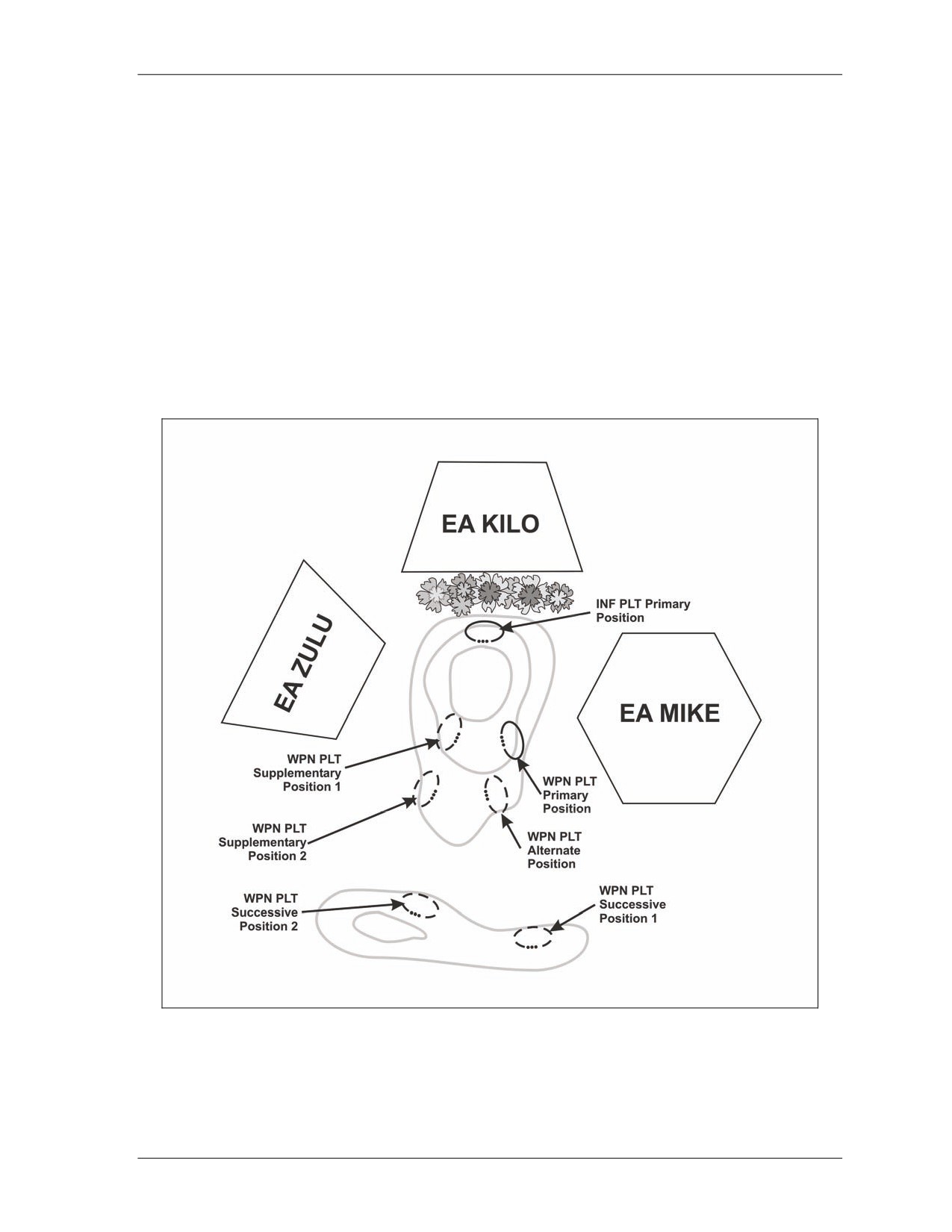
Defensive Operations
5-50.
If the platoon leader selects alternate positions, he should report the locations of each alternate
position to the company commander.
Supplementary Position
5-51.
The supplementary position allows the platoon to cover an enemy avenue of approach or sector of
fire that is different from that covered by the primary or alternate positions. It usually is chosen to cover
avenues of approach to the flank or rear of a unit. The squads reconnoiter their specific positions and
prepare range cards. Leaders will typically base occupation of a supplementary position on specific enemy
actions.
Subsequent Position
5-52.
The subsequent position is a position that a unit expects to move to during the course of battle. A
defending antiarmor unit may have numerous subsequent positions. These positions may also have
primary, alternate, and supplementary positions associated with them as shown in Figure 5-1.
Figure 5-1. Defensive firing positions.
1 July 2008
FM 3-21.12
5-11
Chapter 5
FIRING POSITION PREPARATION.
5-53.
The company commander or platoon leader will designate the level of preparation for each firing
position based on the factors of METT-TC, with emphasis on the time available. There are three levels of
preparation: reconnaissance, preparation, and occupation.
Reconnaissance
5-54.
Leaders reconnoiter the engagement area or AO and firing positions. They must get on the ground
to physically inspect the terrain and determine its effects on antiarmor weapons employment and on enemy
weapons employment.
Preparation
5-55.
The weapons element begins preparing a firing position as soon as the leaders complete their
reconnaissance. The leaders call the vehicles forward and guide them into position. They may consider
having drivers back the vehicles into position so they can leave quickly without moving toward the enemy
or using time to turn around. The unit removes or camouflages all signs that the enemy could detect (such
as wheel tracks, windshield reflections). Squads continue to improve the position until it is vacated.
Preparation includes, but is not limited to--
• Marking the position.
• Emplacing fire control measures (as required).
• Digging the position.
• Identifying and digging ammunition caches.
• Preparing a range card.
• Emplacing protective obstacles.
• Camouflaging the position.
• Platoon and company sector sketches.
• Rehearsing occupation and disengagement.
5-56.
The unit occupies the general position identified by the platoon leader or section leader and
establishes security. Each weapons squad must be prepared to fight while it prepares the position.
Maintaining security during preparation allows the squad to react quickly if the enemy appears before the
position has been completed.
5-57.
After selecting a firing position, a common technique leaders use to mark the position is by using
stakes and then preparing a range card. This enables the squad or another squad to occupy the firing
position and use the data from the range card for the position. Often three stakes are used to mark a
mounted firing position. One stake is placed in front of and centered on the vehicle. It should be long
enough so that the driver can see it as he moves the vehicle into position. The other two stakes are placed
parallel to the left side of the vehicle and lined up with the hub on the front and rear wheels. The stakes are
placed close to the vehicle with enough clearance to allow the driver to move into the position without
knocking the stakes down. The stakes are driven solidly into the ground. Engineer tape or luminous tape
can be placed on the friendly side of the stakes to make it easier to see them during limited visibility. Once
the squad has dug the position, it camouflages it. Squad members use sod, leaves, brush, grass, or any other
natural material to do so. The items should not be taken from the immediate area of the position.
Camouflage nets or other man-made materials also are used, but these work best if used with natural
materials. The position should look as natural as possible.
5-12
FM 3-21.12
1 July 2008
Defensive Operations
Occupation
5-58.
The company commander establishes criteria and SOPs for occupation of the position. For
example:
• Vehicles approach the firing position from the rear using terrain-driving techniques on a
rehearsed route.
• To reoccupy a marked position, the driver aligns his vehicle on the front stake and moves
forward slowly until the two stakes on the left of his vehicle are centered on the front and rear
wheels.
• The SOP includes the sequence of action and the priority of work.
• A trigger for occupation may be established based on METT-TC, specifically keying on the
sequence of the enemy attack.
• Rehearsals
TYPES OF FIRING POSITIONS
5-59.
Based on a thorough analysis of the factors of METT-TC, leaders select the appropriate type of
weapons firing position for the situation.
Mounted Position.
5-60.
The mounted firing position is characterized by a hull-down firing position. The vehicle is
positioned behind either a natural or constructed cover with only the weapon system exposed. Leaders
should seek a natural hull-down position whenever it is available. When a natural hull-down position is not
available, the unit obtains, if available, engineer assistance to excavate hull-down positions. When hide
positions are used, the primary firing positions should be hull-down positions. Leaders should select or
construct hull-down positions so that the vehicle moves quickly into complete defilade. Routes into and out
of hull-down positions should offer sufficient cover and concealment.
Dismounted Position.
5-61.
The dismounted position has cover and concealment to protect squads from direct and indirect
fires. Overhead cover must be camouflaged. Overhead cover must allow room to effectively operate the
selected weapon system. Individual weapons must be positioned for effective self-defense. The squad
keeps the selected weapon system mounted in the vehicle while it constructs a dismounted position and the
gunner prepares a range card. The tripod outlines the dismounted position. Once the position is complete,
the squad emplaces the selected weapon system in the position and camouflages the position. The vehicle
is place in a hide position.
Anitarmor Ambush Position
5-62.
The antiarmor ambush position can be either mounted or dismounted. The mounted position has
the same criteria as above with the vehicle normally facing to the rear. If dismounted, the squad constructs
a simple position that is large enough to conceal the antiarmor system and the squad until the ambush is
completed. The position requires no overhead cover and the squad uses existing terrain features for this
purpose. In choosing this position, the squad leader considers whether his squad can survive returned fire
from the ambushed enemy element. The weight of the selected antiarmor system and the distance it must
travel are important planning considerations because they prevent the squad from quickly withdrawing
from the ambush site.
1 July 2008
FM 3-21.12
5-13
Chapter 5
Urban Terrain Position.
5-63.
The squad leader considers the same crew survival question that he would for an antiarmor
ambush position. Urban terrain affords the squad more cover and concealment. However, urban terrain
does present certain firing limitations for close combat missile systems. For example, a ground-mounted
Improved Target Acquisition System (ITAS) should be fired from a building only when the following
conditions exist:
• The building is sturdy.
• The ceiling is at least 2 meters (7 feet) high.
• The room is at least 5 meters by 8 meters (17 feet by 24 feet) or larger.
• There are 2 square meters (20 square feet) of ventilation to the rear of the system (an open door
2 meters by 1 meter [7 feet by 3 feet] provides that much ventilation).
• Glass is removed from all windows and doors, the floor is swept, and any furniture and other
objects that could be blown around are removed from the room.
• Squad members in the room are wearing hearing protection and ballistic eye protection and are
positioned forward of the rear end of the launch tube.
Section III. TACTICAL EMPLOYMENT
This section describes the tactics and planning considerations available to the company commander as he
prepares his defense. The weapons company commander's analysis determines the most effective control
measures needed for each defensive mission.
CONTIGUOUS AND NONCONTIGUOUS DEFENSE
5-64.
Despite the increasing noncontiguous nature of operations, there may be situations where
commanders describe decisive, shaping, and sustaining operations in spatial terms. Typically, contiguous
operations involve conventional combat and concentrated maneuver forces. Ground forces share
boundaries and orient against a similarly organized enemy force. Terrain or friendly forces secure flanks
and protect sustainment operations. Noncontiguous operations are now more common than ever. Stability
operations are normally noncontiguous. In noncontiguous operations, smaller, lighter, more mobile, and
more lethal forces sustained by efficient, distribution-based sustainment systems lend themselves to
simultaneous operations against multiple objectives. Situational understanding, coupled with precision
fires, frees commanders to maneuver against multiple objectives. Swift maneuver against several objectives
supported by precise, concentrated fires induces paralysis and shock among enemy troops and
commanders.
CONTIGUOUS DEFENSE
5-65.
This tactic allows interlocking and overlapping observation and fields of fire across the battalion
front. A thorough analysis of METT-TC results in the balanced positioning of forces along and in depth
from the FEBA. Since he is rarely able to defend in strength along the entire length of his assigned FEBA,
he must accept risk in some areas to provide strength in other, more vulnerable, areas. Actions conducted
in the security area should identify the area that the enemy intends to attack in sufficient time to reinforce
that area, shift reserves, and to mass fires. Indirect fires are used to slow and disrupt the attack. The
weapons company is able to move rapidly to threatened areas and provide the means to mass long-range
fires. Weapons platoons may be rapidly detached or released back to the weapons company as required to
support the battalion commander’s scheme of maneuver. The weapons company does not have to move as
a unit but rather displaces from their positions and move independently, under the control of the company
commander, to the threatened area and occupy pre-reconnoitered positions with the units arriving first
occupying the most important positions or those furthest away. The battalion commander may also keep
weapons company units in non-threatened areas while having the weapons company commander or the
5-14
FM 3-21.12
1 July 2008
Defensive Operations
counterattack force commander in charge of the remainder. Indirect and direct fires are coordinated
throughout the battle. Priority targets are also identified and destroyed.
5-66.
Should the enemy have an air assault capability, the weapons company can quickly move to
contain the enemy forces until Infantry units can deploy. It can have platoons detached and be part of the
battalion reserve. The type of terrain that is good for Infantry in the contiguous defense however, may limit
the movement of the weapons company units and may have the battalion commander detach more platoons
to his Infantry companies. The weapons company can also have platoons attached to units, such as the
scouts, placed forward of the main battle area to provide security, intelligence, and kill the enemy with
long-range fires. The weapons company’s weapons systems optic systems provide a major enhancement to
normal day/ night observation capabilities of the Infantry battalion.
Weapons Configuration and Targeting
5-67.
If an enemy Infantry or Infantry heavy force is attacking, the weapons company will
predominantly arm itself with antipersonnel weapons such as machine guns. Against a mechanized enemy
or mechanized heavy team, the weapons company will choose to predominantly arm itself with missile
systems. However, the weapons company commander usually determines the weapons mix for his platoons
based on his mission analysis of the battalion’s OPORD\FRAGO and may not have the time to change the
mix at the beginning of the attack and may decide to retain a balanced weapons mix able to engage a wide
array of enemy forces.
Enemy Penetration
5-68.
A contiguous defense often has the space required to absorb an enemy penetration and then
maneuver forces around the penetration to hit its flanks while a counterattack is prepared and executed.
The weapons company is capable of rapid maneuver to the flanks of the penetration and delivering mass
fires. If the battalion is forced to withdraw to successive positions, then the weapons company can be
employed to cover this movement and not allow the Infantry forces to become decisively engaged.
NONCONTIGUOUS DEFENSE
5-69.
The noncontiguous defense is the most decentralized and dynamic defense conducted by an
Infantry battalion. This type of defense orients on the enemy and not terrain. To be successful, this defense
depends on surprise, offensive action, and the initiative of small-unit leaders. It is characterized by
aggressive patrolling and reconnaissance to locate, fix, and destroy the enemy. It is often used to permit the
local population to continue to remain in the area at the same time as the enemy is attacked.
5-70.
Companies are assigned areas of operation (AOs) within the battalion’s area of operations. These
can be contiguous, with boundaries between company AOs, or noncontiguous, with space between
companies that is the responsibility of the battalion. Noncontiguous defense is often used where the
location of the enemy is ill-defined, such as during stability operations. The weapons Company will often
have its platoons attached to Infantry companies. These platoons and the company are employed as they
would be in any defense with the addition of missions such as convoy security and acting as part of the
cordon during cordon and search operations. It can also conduct mounted patrols and as a quick reaction
force (QRF) to reinforce units in contact.
TACTICS
5-71.
The weapons company typically defends using one of four basic defensive tactics: defense of an
AO, from a battle position, on a reverse slope, and in a perimeter. Detached weapons platoons conform to
the scheme of maneuver of the Infantry company commander but will still fight from battle positions in
support of the Infantry. Typical control measures for the defense are AOs, battle positions, phase lines,
engagement areas, target reference points, decision points, and other movement and fire control measures.
There are no set criteria for selecting the control measures.
1 July 2008
FM 3-21.12
5-15
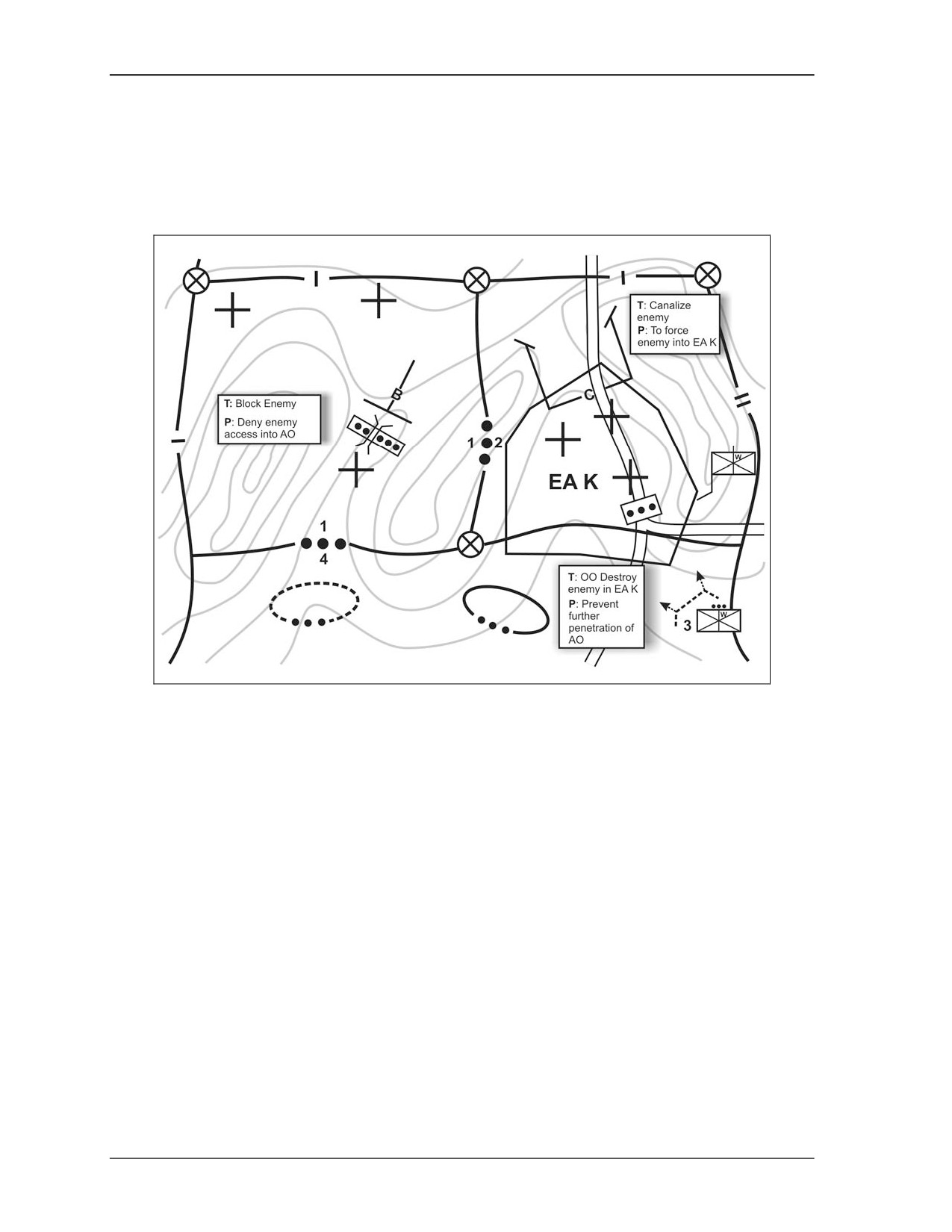
Chapter 5
DEFEND AN AO
5-72.
An AO defense, Figure 5-2, uses control measures that provide the most freedom of action to a
subordinate unit. It provides flexibility by allowing the subordinate unit to operate in a decentralized
manner while still maintaining sufficient control to prevent confusion and to synchronize the higher unit’s
operation.
Figure 5-2. Defense of an area of operations.
Weapons Company’s Disposition
5-73.
A weapons company’s disposition may consist of a company or platoon AOs and a series of
mutually supporting battle positions. Positions are arrayed in depth. The strength of this defense comes
from its flexibility. The weapons company defense normally orients on the enemy force and not on
retaining terrain. It is effective because it forces the enemy to expose his flanks and critical command and
control (C2) and mobility and protection assets through his own maneuver into the depth of the defense.
Platoon AOs
5-74.
By assigning platoon AOs, the company may fight an AO defense very similar to a noncontiguous
defense. This decentralized defense requires greater initiative and delegates more of the control to
subordinate leaders. When required, subordinate units may disengage independently and move to another
location within the AO to continue the fight. The company commander can control the rate of movement
various ways, to include phase lines.
5-75.
When fighting a weapons company defense with platoon AOs from battle positions, the goal is to
defeat the attacker through the depth of his formation by confronting him with effective fires from
mutually supporting battle positions as he attempts to maneuver around them. Observation posts, indirect
fire targets, mines, and other obstacles cover gaps that, because of terrain masking or heavy woods, cannot
be covered effectively by direct fire. Units remain in place except for local or internal movement to
5-16
FM 3-21.12
1 July 2008
Defensive Operations
alternate or supplementary positions. If certain platoon positions become untenable during the battle, the
platoon leader may withdraw his units to successive positions according to prepared plans and rehearsals.
However, the platoon leader aggressively fights within his AO, moving his sections to bring the enemy
under flank attack and re-taking lost positions. Some methods for fighting in AOs include--
• Allow the enemy to move into the engagement area and destroy him with massed fires.
• Engage the attacker at maximum range with fires from attack helicopters, field artillery, and
mortars and then to engage with organic weapons systems positioned to deliver fires at
maximum effective ranges from the flanks and rear. As the enemy closes, weapons systems
may move to alternate or supplementary firing positions to continue firing and avoid being
bypassed.
5-76.
The weapons company defense of an AO generally requires the company commander to be able to
see and control the battle. It also requires good fields of fire to allow mutual support. If the terrain or the
expected enemy course of action prevents this, the defense may be more effective if control is more
decentralized and the platoons fight in AOs.
5-77.
A significant concern, particularly when fighting with platoon AOs within the company defense
of an AO, is the enemy's ability to isolate a part of the weapons company and then fix, destroy, or bypass
it. Without effective mutual support between battle positions and between adjacent platoons, this is likely
to occur. Even with mutual support, responsive and effective indirect fire support is often critical to
defending AOs.
DEFEND FROM A BATTLE POSITION.
5-78.
A defense from a battle position is a general location and orientation of forces on the ground from
which units defend. The size of units occupying battle positions can from squad to battalion. The unit is
located within the general area of the battle position. Security elements may be located forward and to the
flanks of the battle position. Units defending from a battle position may not be tied in with adjacent units;
thus, the requirement for all-round security is increased. When assigning battle positions, the company
commander assigns sectors of fire and primary positions to his platoons to defend. Each position must
contribute to the accomplishment of the company’s assigned task and purpose within the higher
commander's concept of the operation. A commander may also assign alternate, supplementary, and
successive positions to platoons, depending on the situation. The leader occupying the battle position
should also assign alternate, supplementary, and successive positions within the BP.
Engagements from a Battle Position
5-79.
Fighting from a battle position is a more centralized tactic and may also be more contiguous at the
company level. Even so, it should not be a static defense. Battle positions should be positioned to achieve
surprise and to allow maneuver forward, within, and between battle positions. A defense from battle
positions is effective in concentrating combat power into an engagement area. It prevents the enemy from
isolating one part of the company and concentrating his combat power in this area. Normally, subordinate
platoons are assigned mutual supporting battle positions that cover the enemy's likely avenue of approach.
These battle positions are located on terrain that provides cover and concealment.
Surprise
5-80.
A company commander's concept for using this method should concentrate on achieving surprise
for each of the battle positions. This is accomplished by effective OPSEC and fire control. Counter
reconnaissance, if the resources are available, prevents the enemy from locating the battle positions. By
initiating fires from one battle position and waiting for the enemy to maneuver, other battle positions can
then initiate fires on the enemy’s flanks and rear. Fighting in this manner confuses the enemy and disrupts
his C2.
1 July 2008
FM 3-21.12
5-17
Chapter 5
Massed Fires
5-81.
When the terrain permits and the weapons company commander's concept focuses most of the
enemy into the engagement area, the company may engage with massed fires from all of the platoon battle
positions. Control of these fires through target reference points and other fire control measures reduces the
possibility of multiple engagements of the same target. A disadvantage to this tactic is that if there are still
uncommitted enemy forces outside the engagement area, they will know the locations of the BPs and will
attempt to isolate and concentrate against them. To counter this threat, coordinated indirect fires on these
enemy units reduce their effectiveness and ability to identify battle positions. The company commander
must develop contingency plans to disengage from exposed battle positions and reorganize to continue the
fight. This may involve displacing to alternate battle positions or disengaging to conduct counterattacks or
spoiling attacks against identified enemy C2, mobility and protection, or sustainment assets.
Multiple Platoon Engagements
5-82.
Instead of one company engagement area, multiple platoon engagement areas may be identified to
provide flexibility to the plan. The plan must clearly state which platoons must reorient fires into the
alternate engagement area and when they must do so. This tactic is especially effective when operating in
restrictive terrain or compartmented environment.
DEFEND ON A REVERSE SLOPE.
5-83.
An alternative to defending on the forward slope of a hill or a ridge is to defend on a reverse
slope, Figure 5-3. In such a defense, the company is deployed on terrain that is masked from enemy direct
fire and ground observation by the crest of a hill. Although some units and weapons may be positioned on
the forward slope, the crest, or the counterslope (a forward slope of a hill to the rear of a reverse slope),
most Infantry forces are on the reverse slope. However, weapons company units may be concentrated on
the counterslope. The key to this defense is control of the crest by direct fire.
5-18
FM 3-21.12
1 July 2008
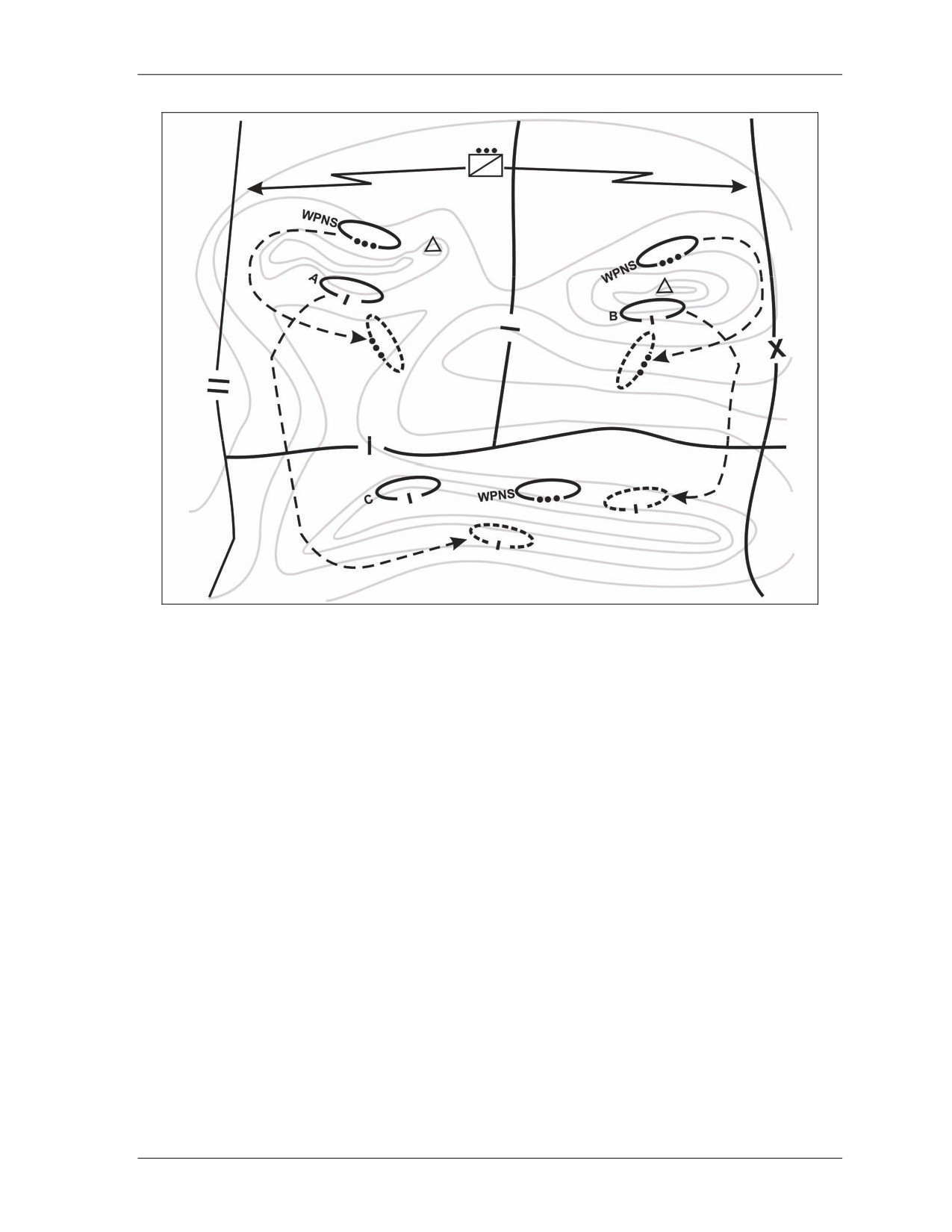
Defensive Operations
Figure 5-3. Defense from a reverse slope.
Advantages.
5-84.
The following advantages generally apply when defending on a reverse slope:
• The crest protects the unit from direct fire. This is a distinct advantage if the attacker has
greater weapons range and firepower than the defender. The reverse slope defense can
eliminate or reduce the attacker’s standoff advantage. It also makes enemy adjustment of his
indirect fire more difficult since he cannot see his rounds impact. It keeps the enemy's second
echelon from supporting his first echelon's assault.
• The enemy may be deceived and may advance to close contact before he discovers the
defensive position. Therefore, the defender may gain the advantage of surprise.
• The defender can improve positions, build obstacles, and clear fields of fire without disclosing
the location of the positions.
• The defender may use dummy positions on the forward slope to deceive the enemy.
• Resupply and evacuation (when under attack) may be easier when defending on a reverse
slope.
• Enemy target acquisition and jamming efforts are degraded. Enemy radar, infrared sights, and
thermal viewers cannot easily detect Soldiers masked by a hill. Radios with a hill between them
and the enemy are less vulnerable to jamming and direction finders.
• Enemy use of close air support and attack helicopters is restricted. Enemy aircraft must attack
defensive positions from the flank or from the rear, which makes it easier for friendly air
defense weapons to engage them.
• A counterattacking unit has more freedom of maneuver since it is masked from the enemy's
direct fire.
1 July 2008
FM 3-21.12
5-19
Chapter 5
Disadvantages.
5-85.
The following disadvantages may apply when defending on a reverse slope.
• Observation of the enemy is more difficult. Soldiers in a reverse slope position can see forward
no farther than the crest. This makes it hard to determine exactly where the enemy is as he
advances, especially when visibility is poor. OPs should be placed forward of the topographic
crest for early warning and long-range observation. Unmanned aircraft systems (UAS) and
remote sensors can also be used.
• Egress from the position may be more difficult.
• Fields of fire are normally short but fires to the flank can increase the range.
• Obstacles on the forward slope can be covered only with indirect fire or by units on the flanks
of the company unless some weapons systems are initially placed forward.
• If the enemy gains the crest, he can assault downhill. This may give him a psychological
advantage.
• If observation posts are insufficient or improperly placed, the defenders may have to fight an
enemy who suddenly appears in strength at close range.
Feasibility.
5-86.
A defense on a reverse slope may be effective when--
• The forward slope has little cover and concealment.
• The forward slope is untenable because of enemy fire.
• The forward slope has been lost or not yet gained.
• There are better fields of fire on the reverse slope.
• It adds to the surprise and deception.
• The enemy has more long-range weapons than the defender.
Use of the Weapons Company in the Reverse Slope Defense.
5-87.
The weapons company commander should consider the following while employing his company
in a reverse slope defense:
• Weapons company’s units may be employed on the forward slope and then displace to the rear.
• Forward Infantry unit positions should be within 200 to 500 meters of the crest of the defended
hill or ridge and sited so they block enemy approaches and exploit existing obstacles. They
should permit surprise fire on the crest and on the approaches around the crest. Weapons
company units can provide fire support from the counterslope.
• Weapons such as the close combat missile systems can gain standoff distances by firing across
the front or from the counterslope. The grenade machine guns can be fired from behind the
counterslope in partial defilade or, with an observer, full defilade in an indirect mode.
• Emplace observation posts, including fire support team (FIST) personnel (if available), on the
crest or the forward slope of the defended hill. At night, observation posts and patrol units
should be increased to prevent infiltration. Weapon company units, especially the missile
systems with thermal sights, may be employed at the observation posts.
• Position weapons units in depth or reserve where it can provide the most flexibility, support the
forward units by fire, protect the flanks and the rear of the higher unit, and, if necessary,
counterattack. It may be positioned on the counterslope to the rear of the forward units if that
position allows it to fire and hit the enemy when he reaches the crest of the defended hill.
• Position the weapons company command post to the rear where it will not interfere with the
supporting units or the employment of the reserve. The commander may have an observation
post on the forward slope or crest and another on the reverse slope or counterslope. He uses the
observation post on the forward slope or crest before the battle starts when he is trying to
5-20
FM 3-21.12
1 July 2008
Defensive Operations
determine the enemy's intentions. During the fight, he moves to the observation post on the
reverse slope or counterslope.
• Indirect fire has to be coordinated with the battalion FSO. However, plan indirect fire well
forward of, on, and to the flanks of the forward slope, crest, reverse slope, and counterslope.
• The battalion normally plans counterattacks. The plan focuses on driving the enemy off the
crest by fire, if possible. The plan should also be prepared to drive the enemy off by fire and
movement. The weapons company can support counterattacks from support by fire or attack-
by-fire positions.
PERIMETER DEFENSE
5-88.
A perimeter defense, Figure 5-4, allows the defending force to orient in all directions. The
weapons company uses the perimeter defense primarily in assembly areas, as a reserve, or as part of a
larger force. In most instances, it would be difficult for a weapons company to establish a perimeter
defense, assembly areas and reserve positions excluded, without Infantry augmentation. Ideally, the
augmented weapons company would establish a perimeter defense on terrain that would enhance its
long-range firepower. In terms of weapons emplacement, direct and indirect fire integration, and reserve
employment, a commander conducting a perimeter defense considers the same factors as for any defense.
As part of a larger force, the weapons company will usually cover the enemy’s most likely high-speed
avenues of approach. Some examples of using a perimeter defense include a firebase, a forward operating
base, and a combat outpost. The weapons company might be ordered to execute a perimeter defense under
a variety of conditions, including:
• When it must secure itself against terrorist or guerilla attacks. This tactic may also apply if the
company must conserve or build combat power in order to execute operations.
• When it must hold critical terrain in areas where the defense is not tied in with adjacent units.
• When it has been bypassed and isolated by the enemy and must defend in place.
• When it conducts occupation of an independent assembly area or reserve position.
• When it is directed to concentrate fires into two or more adjacent avenues of approach.
5-89.
The following preparations are conducted during a perimeter defense:
• Preparing a perimeter defense is like preparing any other position defense, but the company
must disperse in a circular configuration for all-round security (the actual shape depends on the
terrain). The company must be prepared to defend in all directions.
• The commander assigns the weapons platoons to cover the most likely enemy avenues of
approach. He prepares alternate and supplementary positions within the perimeter.
• If available, Infantry occupy positions to cover likely enemy dismounted avenues of approach.
• If available, snipers or designated marksmen should cover likely or suspected enemy positions
or OPs. Snipers and designated marksmen may also be used to observe or overwatch areas
where civilians congregate.
• If possible, hold a section or platoon in reserve. The company commander assigns a primary
position to the rear of the platoon, covering the most dangerous avenues of approach.
• Prepare obstacles in depth around the perimeter.
• Plan direct and indirect fire as for any type of defense. Plan and use fire support from outside
the perimeter when available.
• Counter enemy initial attacks by area fire weapons (artillery, mortars, grenade launchers) to
avoid revealing the locations of fighting positions (rules of engagement (ROE) dependent).
• If the enemy penetrates the perimeter, the reserve occupies predetermined fire positions if
possible and destroys the enemy, and then blocks the penetration. Even though the company's
counterattack ability is limited, it must strive to restore its perimeter.
1 July 2008
FM 3-21.12
5-21
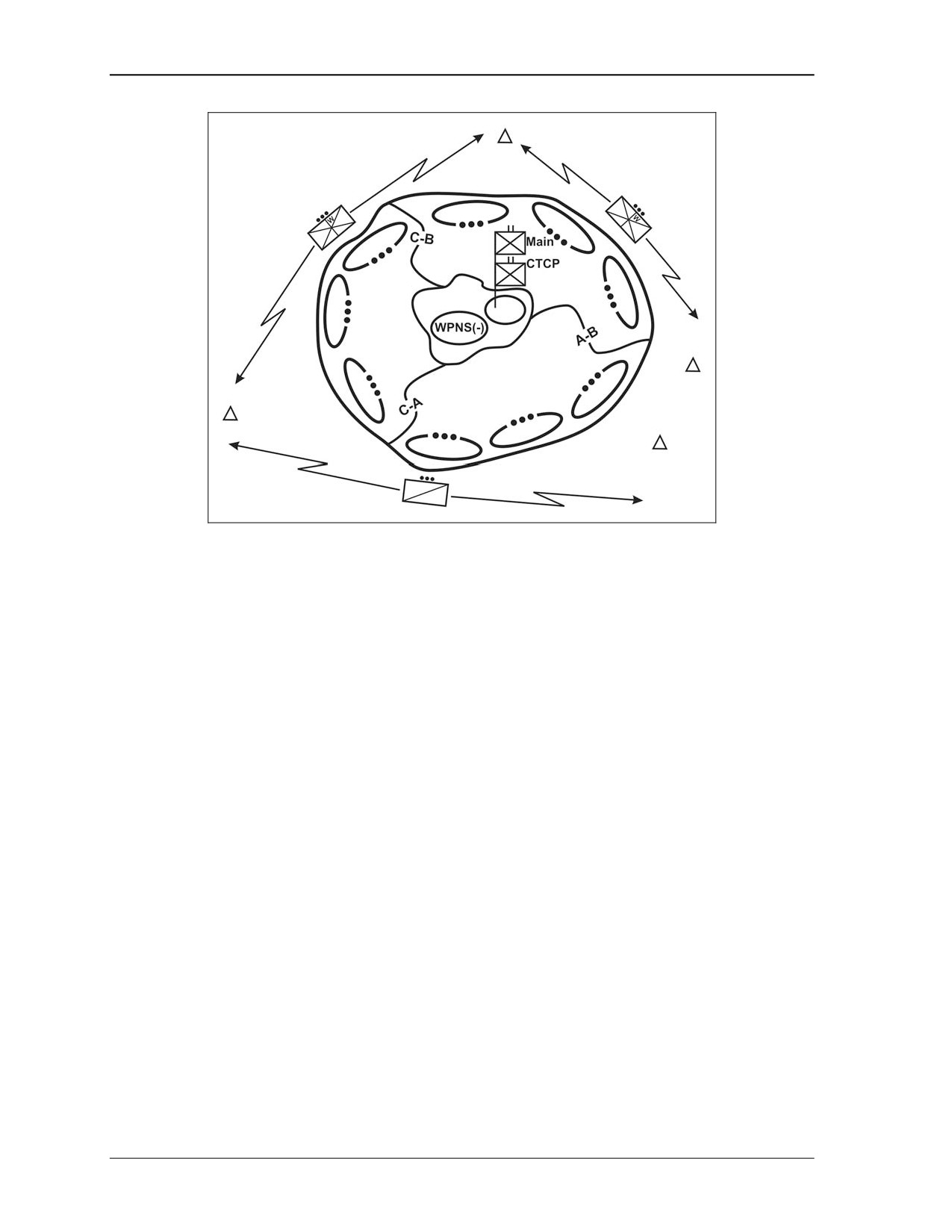
Chapter 5
Figure 5-4. Perimeter defense.
OTHER EMPLOYMENT OPTIONS
5-90.
The weapons company may participate in a defense by operating as a battalion’s security force, as
part of the security force, and as a battalion reserve.
SECURITY FORCE.
5-91.
Battalion and brigade security forces normally conduct the tactical tasks of screen or guard.
Defending battalions deploy security forces beyond the FEBA to provide early warning, to deny enemy
observation of the MBA, to assist rearward passage of a covering force, and to deceive and disorganize the
enemy. The security force commander places the security force where it can cover enemy avenues of
approach into the defensive area. One or more weapons platoons can form part of the battalion's security
force. The battalion commander positions the weapons company or platoon in areas that offer long-range
observation and fields of fire on high-speed enemy avenues of approach. Their thermal sights and mobility
make them an efficient asset in these operations. The other security elements, most often the scout platoon,
report the direction and size of the enemy advance, and the weapons company units may then maneuver to
engage. They can also support the withdrawal of the forward security units.
5-92.
Heavy weapons can destroy most types of enemy reconnaissance elements. The weapons unit is
positioned so that it has good fields of fire, observation of the avenues of approach, and able to support the
forward security units. The leader may have to designate supplementary positions if there are more
mobility corridors than can be covered from one position.
Planning Considerations.
5-93.
The battalion S2 provides the results of his IPB in the form of the disposition, composition,
capabilities, and the most probable course of action, with accompanying situation template, for the enemy’s
reconnaissance effort. The results of the terrain analysis, which includes LOS information, will be valuable
when considering the tactical array or disposition of security forces. Weapons units can determine the LOS
5-22
FM 3-21.12
1 July 2008
Defensive Operations
from maps or, if the digital map has been installed, from the Force XXI Battle Command, Brigade and
Below (FBCB2) (FBCB2 LOS however does not account for vegetation and man-made structures).
5-94.
Leaders ensure their subordinates receive the appropriate control measures, which include the
locations and graphics for the remainder of the security force. All security force elements should have
common graphics to ensure a clear understanding of the situation (for example, phase lines, checkpoints,
and target reference points to control the hand-off of targets). This includes confirmation of FBCB2 data. If
each element in the security force uses different control measures, then the security force effort will be
disjointed and ineffective.
5-95.
Security force elements observe named areas of interest (NAI) along the anticipated enemy
avenues of approach. Upon detection of enemy targets, the platoon sends reports to the higher
headquarters. The location and direction of travel are clarified by using the common control measures of
the security force (for example, enemy armored personnel carrier at target reference point (TRP) 2 moving
east to TRP 3). Security force elements use their optics equipment and observation devices to identify
targets. This is especially useful when the elements of the security have difficulty detecting targets. The
limitations to these methods are that the enemy may detect the laser signature and take evasive action as
well as engage the source. Leaders closely monitor the situation and ensure their units positively identify
targets to prevent fratricide.
5-96.
A weapons mix is selected based on the battalion’s IPB, security force commander’s guidance,
and the platoon leader’s own METT-TC analysis. Some major concerns are the type of reconnaissance
vehicles expected and the fields of fire available. Close combat missile systems may not be an effective
weapon system against reconnaissance vehicles in restrictive terrain because of tracking limitations. Since
the Javelin is man-portable, it could be placed in a better position than the vehicle-mounted weapons.
(Although all the weapons systems can be ground-mounted, time to remount these systems should be taken
into consideration when deciding to dismount the systems.) The heavy machine guns can destroy most
lightly armored reconnaissance vehicles such as BMPs and BRDMs.
Engagement
5-97.
Leaders monitor the situation to ensure they are aware of the locations of the remainder of the
security force. They accept target hand over from the security element. They receive target information as
to the type, location, and direction of enemy maneuver. Common control measures helps to clarify the
information. Once targets are identified, they are tracked until the desired point of engagement, and then
destroyed. There is always a risk of weapons systems being lost before the main battle when employing
weapons elements during security operations.
Withdrawal.
5-98.
The security force normally attempts to conduct a rearward passage of lines during limited
visibility. This requires detailed coordination. The withdrawal route and other control measures are
provided to MBA forces before the passage of lines. The security force also can mark itself using IR
markers, battlefield
“VS” marking panels, chemlites or other tactical standing operating procedures
(TSOP) markings to provide visual identification to the MBA forces. This identification, combined with
rehearsals of the rearward passage, will improve night observation devices and reduce the likelihood of
fratricide.
COMBAT OUTPOST
5-99.
A combat outpost is a reinforced OP capable of conducting limited combat operations. The
commander uses a combat outpost when he wants to extend the depth of his security area, when he wants
his forward OPs to remain in place until they can observe the enemy’s main body, or when he anticipates
that his forward OPs will be encircled by enemy forces. Combat outposts manned wholly or in part by
weapons company units become in effect attack-by-fire positions located in the security zone. Units from
the weapons company can provide long-range observation and fires, and can inflict casualties through the
1 July 2008
FM 3-21.12
5-23