FM 3-16 The Army in Multinational Operations (May 2010) - page 3
Logistics
INTERMEDIATE STAGING BASE
6-47. The decision on use of an ISB outside the operating area requires a conscious decision to balance
numerous requirements, including greater lift requirements against better efficiency. Multinational forces
should assemble and stage in an ISB, especially if combat is imminent. The ISB provides a secure area to
assemble, train, equip, and bond the coalition or alliance force into a cohesive one. It is better to solve
problems and correct deficiencies in a nonhostile environment. The multinational force headquarters staff
should assemble first and work together, followed by the rest of the multinational force. The ISB should
have sufficient billeting and training capacity to support the entire multinational force at once. Access to
airports and seaports for smooth reception of the force and its subsequent deployment is critical. If the
multinational operation is a lesser regional contingency or a second major regional contingency, an ISB
may not be possible.
6-48. Planners should anticipate disruptions from many factors, ranging from weather to political
decisions. This will alter the planned flow of personnel, forces, and equipment. The Army Service
component commander, or a supporting combatant command, operates the ISB and deploys fully ready
forces into the operating area. When the lodgment is well established, the ISB may shift into the operating
area if it will not drain additional resources. Larger areas, such as Europe or Korea, allow for a reception
center or ISB in theater from the beginning. In the Korean War, UN forces operated the UN reception
center where incoming contingents were equipped, trained, and linked up with U.S. liaison elements.
THEATER RECEPTION
6-49. At ports of debarkation, units work with HN contracted, HN support, and multiservice personnel to
secure the port, discharge equipment, process equipment and personnel, and move units to marshaling
areas. HN forces can perform and assist in many of these functions. The multinational force headquarters
may assign a troop-contributing nation to oversee and assist the host nation in performing these functions.
If no HN support forces are available, national units must perform those functions. All units must be
planned for in the strategic flow and some, because of their limited capability, may be assigned a certain
function.
THEATER STAGING
6-50. Staging is that part of the RSOI operation in which several key activities take place in controlled
areas in the ongoing incremental buildup of combat power. During this phase the following is
accomplished:
z
Units are reassembled and united with their equipment and scheduled for movement toward the
tactical assembly area.
z
Materiel is segregated, prioritized, and prepared for transport.
z
Class V supplies are uploaded.
z
Life support is provided to personnel.
20 May 2010
FM 3-16
6-11
Chapter 6
THEATER ONWARD MOVEMENT
6-51. This phase begins when units are configured to move to their final destination. Such movement is
accomplished through a carefully devised movement program that employs convoy, rail, and HN contract
assets (such as heavy equipment transporters and other trucks) to ensure the forward and concurrent
movement of troops and supplies. Centralized control of transportation assets is required. Real estate
management may be a problem unless a multinational counterpart to the U.S. joint force utilization board
(usually controlled by engineers) is given authority to allocate terrain to all forces and agencies.
6-52. Movement planning must account for differences in how nations conduct road marches or similar
administrative movements. These differences can lead to confusion and disorganization. For example, one
multinational force contingent may consider any movement made by a tactical unit to be a tactical
movement. Terminology must be coordinated through the movement control center to avoid confusion.
6-53. When planning the movement of a multinational force, planners must know the details of the
organization, equipment, capabilities, and limitations of the forces. Planners must know how to efficiently
request intratheater movement of multinational operational forces consistent with the operational
commander’s OPLAN. The movement should complement sequencing of operations and time-phased force
deployment. Movement planners should consider all assets (joint, allied, host nation, and third country) and
modes (air, land, or sea) of transport. During execution of these movements, movement control personnel
must locate where they can validate actual movements.
THEATER INTEGRATION
6-54. This phase covers both the effective management of RSOI movement of units, as well as, the TOA
of units to the tactical commander.
6-12
FM 3-16
20 May 2010
Logistics
CHECKLIST
Commanders and staffs participating in multinational operations should be able to answer the
following questions with respect to the logistics portion of the operation.
SUPPORT AND CAPABILITIES
6-55. What areas will come under multinational control? What areas will remain national issues?
6-56. What logistic support is available?
6-57. Does the unit have sufficient assets
(such as maintenance, communications, transportation) to
conduct its movement and/or mission? Will it require support?
6-58. What are the unique logistics capabilities of each nation of the multinational force? Understanding
these capabilities is essential to effective and efficient logistics planning and support.
6-59. What mortuary affairs capabilities does the command have?
6-60. What legal restrictions do national laws impose on logistic support?
6-61. Do national legal authorities permit the provision of logistic support among multinational nations?
6-62. Are mutual logistic support agreements in accordance with existing legal authorities?
6-63. What is the system for property accountability?
6-64. What are the special clothing and equipment requirements that may require a long lead-time to
obtain? (For example, nonmilitary supplies or riot control gear.)
6-65. What are the procedures for providing support such as transportation, housing, and meals to
diplomats and distinguished visitors? What coordination is there with the joint visitor’s bureau on this?
6-66. What is the system for preventing fraud, waste, and abuse?
6-67. How does the command assess logistics requests, requirements, and actions to ensure that they are
valid with respect to the operation and authority given to the command?
6-68. How does the command adequately secure logistics assets?
6-69. Will the command establish a common retail store? A well-stocked retail store will not only provide
personnel support items, but will also serve as a morale booster.
6-70. How will the intelligence staff gather information from logistics sources such as truck drivers and
engineers?
6-71. What are the ACSA procedures to account for and reimburse nations for services and supplies
exchanged between nations?
6-72. What are the common supplies and services that one nation or a multinational organization might
provide?
6-73. Is there an agreement that authorizes forces to exchange mutual logistic support of goods and
services and that accounts for the amounts received?
6-74. Will there be, and if so when and how, a TOA of national logistics assets to the multinational force?
6-75. What is the multinational force’s authority to redistribute or cross-level logistics assets and services
under routine and emergency conditions?
6-76. How will the command maintain national asset accountability from the national sustaining base to
the front-line units?
20 May 2010
FM 3-16
6-13
Chapter 6
6-77. How will the command ensure compatibility and interoperability of communications and information
systems, to include automated data processing interfaces between the multinational and national support
systems?
6-78. How will the command prioritize, allocate, and use common infrastructure capabilities (ports,
airfields, roads) to support military and civil operations?
6-79. What are the existing standardization agreements that will facilitate multinational logistic support?
6-80. What is the logistic support structure? How will it identify capabilities and responsibilities of
contributing nations?
6-81. Does the multinational have ACSA among multinational nations?
6-82. Does the logistics structure have one officer in charge or a main point of contact for C2 of contract
personnel?
6-83. Have contractor procedures been established to allow total multinational participation in contracts let
by national personnel and used by multinational personnel?
6-84. Is there a need to establish a multinational logistics command or element? If so, has its staffing been
determined?
6-85. Has the relationship between the multinational and national logistics elements been clearly defined?
6-86. Have lead nations been designated where appropriate?
6-87. Have logistics reporting procedures been established throughout the force?
6-88. Do all forces know and comply with the infrastructure repair plan?
6-89. Is there duplication of effort in the support plan for the operation?
6-90. If there is a need, what is the composition of the multinational logistics command or element? Have
coordinating centers been established for movements, medical support, contracting, infrastructure
engineering, and logistics operations?
6-91. What is the transitional plan for operational assumption of in-place contracts, equipment, facilities,
and personnel belonging to another agency or alliance?
6-92. Are multinational legal representatives available to provide counsel on international law and legal
agreements?
6-93. Has a certification process been established?
6-94. Have standards been identified for logistic support? Is there a plan to conduct, inspect, and ascertain
compliance with these standards prior to deployment?
6-95. What is the division of responsibilities between multinational, national, and HN logistic support?
6-96. How will each class of supply be handled?
6-97. What are the multinational force’s capabilities to receive, store, and issue dry cargo, fuel, and water
to include water production and purification capability?
6-98. Does the multinational force have the means to communicate requirements to the multinational
logistics management center?
6-99. What materiel handling equipment is available within the multinational force?
6-100. Does the multinational force have a basic load of ammunition? What are the ammunition
procedures?
6-101. What are the multinational force’s special requirements to include tents, cots, reverse osmosis
water purification units, laundry, latrines, and batteries?
6-102. What are the military assistance program requirements for multinational forces?
6-14
FM 3-16
20 May 2010
Logistics
6-103. What is the best method for providing potable water? Have the engineers, medical personnel, and
other staff officers been consulted about this issue? Using bottled water may have an added advantage of
enhancing troop morale.
6-104. What is available in lessons learned databases for unique requirements, planning factors, and
potential problem areas?
6-105. Has liaison been established with other multinational nations and civilian agencies to obtain the
most up-to-date logistics information on the AO?
6-106. What are the personnel augmentation requirements and equipment needed for mission support?
6-107. Have basing rights and diplomatic clearances critical to mobility been secured?
6-108. What are in-theater capabilities and resources of civilian agencies in the AO?
6-109. What current agreements exist with other participating nations that provide for logistic support?
Does this include agreements governing logistic support with representatives of other nations?
6-110. What quality controls have been established for all services and supplies such as POL, water, and
food? How will they be monitored?
6-111. What are the procedures to ensure in-transit visibility at all transportation nodes? Lack of in-transit
visibility will cause loss of confidence in the supply system and lead to unnecessary reordering, further
clogging the supply lines.
6-112. For UN operations, what standards are to be followed concerning support?
6-113. What is the support plan for redeployment of forces, materiel, and equipment?
6-114. What logistics infrastructure, materiel, capabilities, and equipment will remain in-country for use
by follow-on forces or organizations?
FUNDING
6-115. Has it been determined if, or to what extent, operational-related expenses will be reimbursed from
common funding or sources external to national funding by the participating nations?
6-116. Has funding been identified to support operations or to reimbursement expenditures? What are the
limits on funding authority?
6-117. What is the availability of common funding for contracting, establishing a multinational
headquarters, and general or common support? What are the procedures for common funding for
contracting, establishing a multinational headquarters, and general or common support?
6-118. What are the accounting and reimbursement procedures for services and supplies exchanged
between nations? Are replacement-in-kind procedures included?
6-119. Has the probable cost of the multinational operations been determined? Is the probable cost
acceptable?
6-120. What are the funding requirements for renting facilities to support operations?
6-121. Does the command have funding codes from all multinational nations? What methods and
documentation are required to record all expenditures?
6-122. How will the command capture costs associated with supporting the multinational forces?
20 May 2010
FM 3-16
6-15
Chapter 6
HOST-NATION SUPPORT
6-123. Has HN support been evaluated to determine the logistic support available? Are law enforcement,
sanitation, medical services, facilities, storage, and materiel included?
6-124. What are the capabilities of existing infrastructure? Do they include water treatment plants, power
stations, reservoirs, and bulk and retail fuel storage? Engineers or facility managers can provide critical
information on the availability of existing facilities.
6-125. Have negotiations to secure support either been established or completed?
6-126. What is the impact of obtaining HN support on the host nation’s economy?
6-127. What are the possible environmental impacts on the host nation providing this support?
6-128. What specific technical agreements—such as environmental clean-up; customs duties and taxes;
and hazardous material and waste storage, transit, and disposal—must be developed to augment HN
support agreements?
MAINTENANCE
6-129. Do the multinational forces have maintenance support?
6-130. Do the multinational forces have the means to order and receive repair parts?
6-131. Do the multinational forces have wreckers, stake and platform trailers, or heavy equipment
transporters?
6-132. Do the multinational forces have communications repair facilities?
CBRN DEFENSE
6-133. What infrastructure exists for assisting multinational forces to deal with low level radiation or
toxic industrial chemical hazards like medical treatment facilities or detection equipment supply houses?
(Are U.S. policy and guidelines acceptable to other nations if none exist?)
6-134. Is the necessary CBRN protection, detection, and reconnaissance equipment available to troops to
counter the threat?
6-135. Are adequate theater stocks of chemical overgarments available?
6-136. What plans exist to protect and train locally hired civilians against WMD threats?
6-16
FM 3-16
20 May 2010
Logistics
TRANSPORTATION
6-137. What is the multinational transportation command structure?
6-138. What are the available multinational air and sea lines of communications?
6-139. What are assigned airlift and sealift capabilities and allocations? Are the requirements to support
both military and civilian agencies included?
6-140. What are the requirements for and capabilities, limitations, and availability of airfields, seaports,
and inland transportation systems in the departure, intermediate staging, and objective areas? What
resources are required for new construction or necessary improvements to existing facilities?
6-141. What is the multinational RSOI process?
6-142. What is the ability of the host nation to receive personnel and equipment at ports and airfields?
6-143. What are the access rights in the AO? The command must coordinate diplomatic efforts to arrange for-
z
Support, country, and diplomatic clearances.
z
Over-flight rights.
z
Basing for forces in transit from one locality to another.
6-144. What is the capability of transportation systems to move forces once they arrive in theater?
6-145. Do multinational forces have tactical rotary- and fixed-wing assets for intratheater supply?
6-146. Who supplies transportation supply throughput from the multinational logistics center for
multinational forces?
6-147. Do multinational forces have transportation assets for moving troops?
6-148. How will the command control movement into and out of airfields and seaports?
6-149. How will transportation facilities be shared with civilian agencies and contractors?
20 May 2010
FM 3-16
6-17
Chapter 7
Army Information Tasks
The impact of the information environment on operations continues to increase. What
Army forces do to achieve advantages across it—information superiority—
significantly affects the outcome of operations. Consequently, FM 3-0 revised how
the Army views IO and staff responsibility for associated Army information tasks.
Army information tasks are used to shape the operational environment. The Army
conducts five information tasks to shape the operational environment. These are
information engagement, C2 warfare, information protection, OPSEC, and military
deception. FM 3-0 contains additional information about Army information tasks.
This chapter discusses and uses the terms Army information tasks and information
superiority.
The joint and multinational communities continue to use the term information
operations. Each of the nations in the multinational force may embrace a concept of
information superiority. The multinational force commander must resolve potential
conflicts between each nation’s individual Army information tasks and those of the
multinational force as a whole. If some multinational members do not have Army
information task capabilities, it may be necessary for the multinational force
headquarters to assist the subordinate commanders and staffs in conducting Army
information tasks to achieve the multinational force information superiority plan
goals.
MULTINATIONAL FORCE ARMY INFORMATION TASKS
7-1. Developing Army information tasks and supporting activities requires close coordination between
multinational members. The key to effective information superiority within the multinational force is
coordinating the information-related activities of all multinational force formations to achieve the
multinational forces’ aim.
7-2. Planning, preparing, and executing multinational Army information tasks is difficult due to
differences in doctrine and training, complex security issues, and interoperability of equipment. The need
to produce Army information task products in unfamiliar languages compounds these difficulties. The
multinational force size, composition, and mission—as well as diplomatic considerations—influences how
multinational Army information tasks are planned, prepared, and executed. Centralized planning,
preparation, and execution by the multinational force headquarters IO (Army information tasks) cell are
essential for conducting successful Army information tasks, especially because multinational formations
below force headquarters level may not deploy their own IO (Army information tasks) cells. It would
therefore be beneficial for the multinational force headquarters IO (Army information tasks) cell to
represent all force formations. Direct representation ensures that multinational IO elements are efficiently
used and that the information engagement plan is coordinated with all other aspects of the operation.
20 May 2010
FM 3-16
7-1
Chapter 7
7-3. Army information tasks must consider the impact public opinion has on policy makers to modify
their participation in the multinational mission. Thus, the impact of media coverage of force activities is a
vital consideration.
7-4. To assist the multinational force in coordinating Army information tasks, the commander should
establish a multinational IO (Army information tasks) working group. (See JP 3-13 for details.) All
countries should be invited to send LNOs to the IO (Army information tasks) working group. This will
help to rapidly identify differences in IO (Army information tasks) doctrine (if any), country capabilities,
and national caveats that could influence the development or execution of the multinational information
engagement plan. Additionally, the working group should be work with the multinational fires-effects
coordination cell. This will help to ensure that lethal and nonlethal capabilities are synchronized and
mutually supporting. It will help to ensure that the desired effects are achieved in the AO.
7-2
FM 3-16
20 May 2010
Army Information Tasks
CHECKLIST
Commanders and staffs participating in multinational operations should be able to answer the
following questions with respect to Army information tasks.
ARMY INFORMATION TASKS
7-5. What is the process for releasing information among the multinational partners?
7-6. How does each multinational nation view population, neutrals, adversaries, and civilians?
7-7. What is the multinational members’ understanding of the GIE?
7-8. What is the multinational members’ understanding of national information environment? Is it
accessible to the other multinational members?
7-9. What do multinational members understand about the MIE?
7-10. How interoperable are Army information tasks between multinational members?
7-11. What is the multinational member’s definition of IO?
7-12. What is the respective army’s doctrine for exploiting the elements of Army information tasks?
7-13. How does each of the multinational members manage information? Is the process open to other
multinational members?
7-14. What threats to Army information tasks are common to all the multinational members? What threats
to Army information tasks are specific to any one army?
7-15. What common solutions can be applied across armies to negate the threats to Army information
tasks?
7-16. What mission essential task lists must be modified to accommodate multinational Army information
tasks?
7-17. What is the guidance (for example, types of information, level of detail, and approved audience) on
releasing information to multinational partners?
7-18. What is the process for obtaining authorization to release information to multinational partners?
COMMANDER
7-19. How do commanders examine the vulnerability of their Soldiers and systems to exploitation or
attack by an adversary capable of employing EW, physical destruction, military deception, and
propaganda?
7-20. Does the commander’s intent and concept of the operations provide sufficient guidance for
information engagement planning?
7-21. Are there anomalies between multinational members in how commanders synchronize Army
information tasks with other military operations?
STAFF ORGANIZATION
7-22. Do multinational members use an Army information tasks cell for coordination, synchronization, and
deconfliction?
7-23. Does the Army information tasks cell or some other staff element contribute to planning, preparing,
and executing the information engagement portion of the plan?
7-24. How does the commander provide guidance concerning Army information tasks during the planning
process?
20 May 2010
FM 3-16
7-3
Chapter 7
7-25. Are the elements of Army information tasks deconflicted?
7-26. Is the information engagement annex reviewed for compliance with ROE and other legal
restrictions?
7-27. How are Army information tasks CCIRs integrated into the collection plan?
7-28. What are the roles and responsibilities of the Army information tasks element staff members in
planning and conducting Army information tasks?
7-29. Do Army information tasks cell personnel understand the planning process? Do they employ
effective and efficient models and tools?
7-30. Do multinational members use an Army information tasks coordinator?
7-31. Does the table of organization and equipment of multinational members require augmentation to
perform its Army information tasks mission?
7-32. Does the information engagement cell accomplish the following tasks:
z
Focus the commander’s intent to gain information superiority?
z
Establish Army information tasks priorities to accomplish planned objectives?
z
Determine the availability of Army information task resources to carry out Army information
task actions?
z
Synchronize, coordinate, and deconflict Army information tasks?
z
Integrate Army information tasks into the OPLAN?
z
Recommend tasking to the G-3 for the assets needed to execute Army information tasks?
z
Nominate targets for physical destruction to the targeting meeting?
z
Publish the information engagement appendex to an OPLAN or OPORD?
z
Coordinate Army information tasks input into an OPLAN or OPORD?
z
Coordinate intelligence support from the all source intelligence cell?
z
Ensure that a solution is provided to the command to reverse Army information task
vulnerabilities?
ARMY INFORMATION TASKS ASSESSMENT
7-33. Is IPB reviewed and incorporated into the information engagement estimate?
7-34. Are potential courses of action analyzed for Army information tasks supportability?
7-35. Are all Army information tasks elements considered throughout the mission analysis process?
7-36. How do Army information tasks support all potential courses of action?
7-37. How does the staff integrate and synchronize the actions included in the related annexes with each
other and the OPLAN?
7-38. Are CCIRs, information requirements, and battle damage assessment requirements developed to
support the plan and annexes?
7-39. Do the intelligence capabilities and resources request cycle support Army information tasks
requirements?
7-40. Are the CMO, and PA annexes fully deconflicted and synchronized with the appendices of Army
information tasks elements?
7-41. How does the staff integrate and synchronize the actions of the Army information tasks elements?
7-42. Is a synchronization matrix employed?
7-43. Does the higher headquarters intend to synchronize and coordinate the implementation of Army
information tasks support within the force?
7-4
FM 3-16
20 May 2010
Army Information Tasks
INFORMATION, PLANNING, PREPARING, AND EXECUTION
7-44. Are information engagement plans supportable by organic and nonorganic assets?
7-45. Is the target development process appropriate to produce Army information tasks targets?
7-46. Does the target development process adhere to doctrine and follow established procedures in support
of Army information tasks?
7-47. Is information superiority over the adversary the chief criterion for target selection?
7-48. Do the targets selected support Army information tasks?
7-49. Are potential targets evaluated for vulnerability and accessibility as well as fratricide avoidance?
7-50. Are selected targets and engagement methods reviewed for ROE compliance?
7-51. Is the C2 structure analyzed to identify critical friendly nodes and systems?
7-52. Is a threat assessment done to determine adversary Army information tasks capabilities?
7-53. Is a vulnerability assessment of critical friendly nodes and systems conducted and are protection
measures recommended and executed?
7-54. Are Army information tasks resources and capabilities sufficient to execute the OPLAN?
7-55. What security policy, guidance, and implementation procedures need to be modified to effectively
conduct Army information tasks?
7-56. Are security policy, guidance, and implementation procedures effective in protecting C2 and ISR
systems from information compromise, data corruption, and denial of service?
VULNERABILITY ASSESSMENT
7-57. Can the unit protect its equipment and personnel from threat Army information tasks?
7-58. Is the Army information tasks threat to the unit’s equipment and personnel identified and validated?
7-59. Are the unit’s critical C2 systems, nodes, and networks identified and validated?
7-60. Has a vulnerability assessment been done on Army information tasks elements from-
z
Malicious software?
z
Insider threats?
z
Intrusion?
z
Unauthorized users?
z
Signals intelligence?
z
EW?
z
Physical destruction?
z
Electromagnetic pulse directed energy weapons?
z
Obscurants?
z
Biological and chemical weapons?
7-61. How interoperable are the elements of information systems between multinational partners?
7-62. Can the unit’s Army information tasks posture be improved by identifying and correcting
component-level vulnerabilities in its information systems?
7-63. Have the components of the information systems been identified?
7-64. Have the critical components been isolated?
7-65. Are countermeasures being incorporated to correctly identify the components of the information
systems?
20 May 2010
FM 3-16
7-5
Chapter 7
7-66. Are security polices, guidance, and implementation procedures effective in protecting division C2
and ISR from information compromise, data corruption, and denial of service?
7-67. Has the vulnerability of C2 and ISR been assessed versus friendly and adversary Army information
tasks capabilities?
7-68. Have the critical nodes or networks been identified?
7-69. Has a vulnerability assessment been conducted?
7-70. Has the accessibility of vulnerable nodes or networks been assessed?
7-71. Are security policy, guidance, and implementation procedures in place to protect critical information
systems?
7-72. Are instances of adversary Army information tasks accurately identified and reported?
7-73. Are instances of Army information tasks fratricide accurately identified and reported?
7-6
FM 3-16
20 May 2010
Chapter 8
Protection
In a multinational environment, philosophies of protection may vary. The nations
must coordinate at the earliest opportunity to ensure cohesion. The multinational
commander should develop and coordinate protection guidelines for the force as a
whole. Effective protection makes the command more credible as a multinational
force. Within each national unit, national commanders will conduct protection for
some nations in accordance with their own national concepts and multinational
guidelines.
ASSYMETRIC THREATS
8-1. Protection minimizes, as far as is practical, the threat from IO components overhead attack systems,
WMD, and environmental hazards to sustaining operations in general. In addition to attacks by
conventional forces, irregular forces frequently threaten to attack. This may be indigenous or from a third
party. It could manifest itself in a number of ways—from guerrilla and terrorist action to civil disturbance.
In stability operations, such activity may be the main threat. One of protection’s primary aims is to protect
the force from these attacks. Protection also aims to reduce the civil population’s interference with
operations. This will minimize casualties and reduce the loss of materiel. It also allows the commander to
concentrate on the mission. Using IO will provide valuable security intelligence and aid protection
activities.
POTENTIAL FOR FRATRICIDE
8-2. A significant problem facing multinational force commanders is the potential for fratricide. Different
operational procedures and languages compound this risk. Commanders must make every effort to reduce
fratricide. They must know what situations can increase the risk of fratricide and, with other multinational
forces, institute appropriate preventative measures. The measures include-
z
Command emphasis.
z
Disciplined operations.
z
Close coordination across national commands.
z
Rehearsals.
z
Enhanced situational understanding.
z
The use of LNOs to assess the fratricide risk and recommend potential solutions.
8-3. Antifratricide measures should be included in the command’s SOPs and other directives. The
command must coordinate these measures with other multinational forces to ensure that all forces
understand and follow them.
PRINCIPLES
8-4. Five protection principles are common for national, multinational, and subordinate commanders:
z
Threat assessment.
z
Risk management.
z
Joint and multinational focus.
z
Prioritization.
z
Flexibility.
20 May 2010
FM 3-16
8-1
Chapter 8
THREAT ASSESSMENT
8-5. A threat assessment based on accurate and timely all-source intelligence must be conducted as the
basis for selecting protection measures.
COMPOSITE RISK MANAGEMENT
8-6. Protection is based on composite risk management, not risk elimination. Casualties are a reality of
military operations. Thus, commanders must balance the risks and balance them in the context of the
campaign end state. The commander should ensure that composite risk management is fully integrated into
planning and execution with special emphasis on the hazards related to multinational operations. Safety in
training, planning, and operations must be stressed. Composite risk management applies to all levels of
military operations. The multinational commander must ensure that all nations are involved in this process.
JOINT AND MULTINATIONAL FOCUS
8-7. Protection must embrace all force components, joint and multinational, within the AO. It should
address all aspects of the threat.
PRIORITIZATION
8-8. Although, protection must embrace the whole force, the capability to protect all elements to the same
degree probably will not exist. Priority should be given to centers of gravity. These centers of gravity may
be tangible such as intelligence, surveillance, target acquisition and reconnaissance (ISTAR) assets or
combat service support (CSS). They may also be intangible such as multinational cohesion or political will
as influenced by public opinion.
FLEXIBILITY
8-9. The protection policy and measures must be flexible and capable of responding to a rapidly changing
threat.
CONCEPT
8-10. Protection is not an issue that can be addressed separately or in isolation. It is an integral part of
operations and must be incorporated into the multinational force commander’s plan from the outset. The
commander should stress the importance of protection in his or her estimate and directive to subordinates.
The lead nation headquarters may have to negotiate with national command elements to arrive at protection
measures that satisfy national political imperatives, the multinational commander’s intent, and the ability of
the force to act cohesively. Mission analysis done by subordinates must include protection and incorporate
the guidance given in the multinational force commander’s directive.
8-11. Protection is, primarily, a composite risk management process as shown in figure 8-1. By producing
an accurate and comprehensive threat assessment and covering all the principles covered in the section
above, the staff can produce an initial set of measures that address the actual threat. Protection measures
can be offensive or defensive. Examples are given in Appendix D. The proposed measures are balanced
against the commander’s mission and operational requirements. The measures are then tempered in
application by risk management. For example, measures that could be perceived as aggressive, such as
patrolling in armored vehicles or hard targeting, could impair a force’s mission in many peace operations
environments.
8-2
FM 3-16
20 May 2010
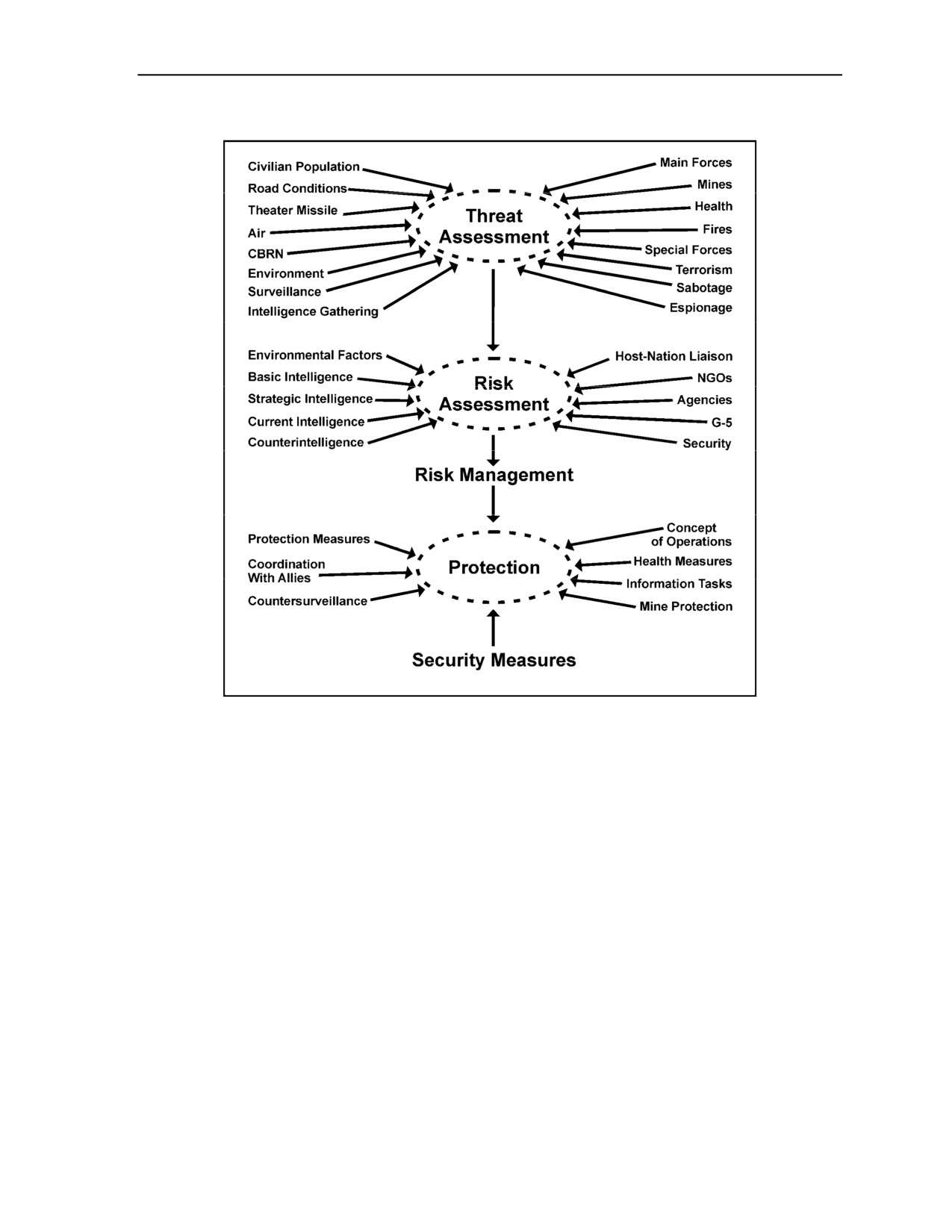
Protection
Figure 8-1. Protection process diagram
8-12. The lead nation headquarters distributes the final selection of protection measures in an annex to the
OPORD. Implementing some measures may not be force wide. The threat, particularly in stability
operations, may not be uniform and may be subject to frequent review and change. Subordinate
commanders, in consultation with the multinational force commander, may implement additional local
measures.
8-13. The threat assessment is a continual process. As the situation changes or new intelligence is
received, the staff will review protection measures and adapt them to the new situation. As part of mission
command, subordinate commanders will be directed to conduct local reviews, although the overall
coordination of protection will remain under the control of the lead nation headquarters.
NONMILITARY AGENCIES
8-14. Nonmilitary agencies may request some form of protection. As these threats may not always be
transparent, these agencies may provide help in identifying them. The protection afforded to these agencies
may enhance military credibility and thereby provide the multinational force with an opportunity to
advance a cooperative environment. However, the protection provided must be in proportion to mission
requirements.
20 May 2010
FM 3-16
8-3
Chapter 8
CONSTITUENTS
8-15. There are two constituents of protection. They are a balanced threat assessment and derived
protection measures. Together they provide collective security of the multinational force.
THREAT ASSESSMENT
8-16. Protection is based on the threat assessment, the results of which determine those measures
addressing collective protection, security, and health and safety. Overprotection, to counter an improbable
threat, can divert scarce resources from achieving the mission. As part of the planning process, the national
authorities should conduct a threat assessment. The national authorities may provide political guidance on
which priority to take to avoid casualties. Where multiple adversaries exist, their varying intents, threats,
and capabilities must be included in the threat assessment. An overall assessment of protection
requirements based on this threat assessment should be incorporated into the national military directive.
Appendix B gives examples of the content for a threat assessment. It includes the following:
z
The lead nation’s national assessment. This will provide the basis for the multinational force
commander’s estimate and directive. It also provides a start point for negotiations with the other
troop-contributing nations.
z
National or local assessments. These may reveal a threat to the civilian population of troop-
contributing nations or their forces in other theaters. They may include nonviolent activities
such as PSYOP and other associated tactics aimed at influencing international perceptions.
Countering such threats will be a national responsibility.
PROTECTION MEASURES
8-17. Following the threat assessment, commanders can decide on appropriate protective measures. The
threat assessment also informs the targeting process. The best or, indeed, only form of defense against
certain threats may be attack. Protection includes those elements, normally the responsibility of the lead
nation headquarters, which protect the whole force. Responsibility for these may be devolved to
subordinate commanders. Protection measures fall under several broad categories:
z
Theater missile defense.
z
CBRN defense.
z
AD.
z
IO.
z
Countersurveillance.
z
CSS protection.
z
Physical protection (equipment and standards).
z
Traffic regulation.
z
Counterfratricide.
z
Security.
z
Space control.
8-18. Within an American-led multinational force, the U.S. would probably provide theater missile
defense. Multinationals without U.S. coverage would have to rely not only on destroying surface-to-
surface missiles and ground launchers, but also on preventing the adversary from neutralizing or destroying
their associated C2 structures.
8-19. The threat assessment will determine the need to deploy specialist CBRN assets and additional
medical resources.
8-20. The multinational force airspace control commander will normally coordinate AD, to include
offensive and defensive operations, for the multinational force. The functions and responsibilities of this
commander, the airspace control authority, and the air defense commander must be integrated to unite joint
air operations, airspace control, missile detection and warning, and AD operations in support of the
multinational plan.
8-4
FM 3-16
20 May 2010
Protection
8-21. IO must be related to protecting the integrity and capability of the force. These operations must also
physically protect the headquarters and communications assets, particularly isolated communications
outstations. Specific measures may be exercised nationally or within the multinational force as a whole.
These measures include-
z
Physical destruction.
z
EW.
z
PSYOP, OPSEC, and deception that falls within an IO or C2 warfare plan.
z
Computer network operations.
8-22. Effective countersurveillance protects all force elements by making the locating and targeting of
friendly forces harder. Countersurveillance measures should be part of each formation’s SOPs, but
direction should come from the lead nation headquarters via the subordinate commanders. It should be
based on the adversary’s ISTAR capability from the threat assessment.
8-23. CSS units require specific protection in warfighting as they lack a self-defense capability against
anything other than small-scale infantry attacks. The threat assessment should determine the likely level,
scale, and warning time for attacks on CSS units. This will determine the allocation of additional forces to
the sustainment area commander, multinational force logistics commander, or both. CSS units may have to
decrement mission assets (such as converting cargo-carrying trucks to gun trucks) to augment protection
forces.
8-24. The physical protection of the force has three aspects. They are structures, vehicles, and individuals.
Structural specifications for field defenses are an engineer responsibility. Decisions on additional armor
protection and other vehicle modifications will be made by national authorities. The decisions should be
implemented before deployment or arrival in theater. The subordinate commanders will control some
personal equipment, such as general-purpose laser goggles and fragmentation vests, within lead nation
headquarters guidelines. Decisions on protective dress policy should normally be delegated to subordinate
commanders.
8-25. Military police provide a wide array of functions and capabilities during multinational operations.
Military police are uniquely trained to-
z
Interact with local police authorities where appropriate.
z
Advise on, implement, and enforce main supply route regulations.
z
Provide a visible protection presence in built-up areas.
z
Provide vital information on criminal and threat forces.
z
Conduct dislocated civilian and refugee operations.
8-26. A counterfratricide policy should cover areas such as overall operational awareness at all levels,
weapons-tight zones, use of liaison, coordination between adjacent units, and combat identification. The
lead nation headquarters should formulate and coordinate this policy.
8-27. Security covers the physical and procedural measures, directed at lead nation headquarters level and
integrated into the overall plan, but mainly applied at the local level. Security aims to minimize direct and
indirect attacks on personnel, equipment, installations, and LOC by other than the adversary’s main forces.
In stability operations, NATO Article 5 Crisis Response Operations, and peace support operations (PSO),
where the adversary may not possess an air, surface-to-surface missile, and CBRN capability, security is
probably the main constituent of protection. Some security measures will affect the civilian population.
Such measures must be subject to appropriate legal advice that may need to incorporate the requirements of
international law, HN law, and any extant SOFAs or memorandums of understanding. Security
incorporates the following:
z
Personnel security—to include standing physical and procedural measures to protect personnel.
z
Positional or installation security—to include physical and procedural measures to protect
positions or installations from attack, sabotage, and theft.
z
LOC defense—to include patrols, mine clearance, overwatch, and bridge guards that ensure safe
and secure lines of communications.
20 May 2010
FM 3-16
8-5
Chapter 8
z
Security of information—to include physical and procedural barriers to protect friendly
information.
z
Liaison with HN security forces. Where the HN security forces retain some operational
capability, liaison is vital to coordinate actions. In some cases, HN security forces may have
primacy. In nearly all cases, they can provide intelligence and other related information about
conditions in-theater.
z
Population controls—to include curfews, movement restrictions, travel permits, registration
cards, and resettlement of villagers.
z
POWs and detainees—to include providing secure accommodations and guard forces to contain
POWs and detainees.
z
Health defense that aims to minimize casualties from disease and environmental hazards. For
example, pollution, poor sanitation, and climatic extremes. It incorporates the following:
Proactive measures—to include vaccination against endemic and biological warfare
pathogens, acclimatization, medical surveillance, and clinical presentations.
Health education—to include advising personnel on prevalence of, and measures to prevent,
endemic and sexually transmitted diseases; measures to prevent casualties from climatic
extremes; and measures to prevent transmission of biological warfare agents and persistent or
residual chemical and radioactive agents.
Local environment advice—to include dangerous wildlife, hazardous terrain, and industrial
and other pollution hazards.
z
Mine defense—to include mine, UXO, IED, and bobby traps marking; clearing and awareness;
and out of bounds areas. This may require the establishment of a mine and UXO action center.
These centers are established to track mine, UXO, and booby trap hazards resulting from
previous combat.
COMMAND AND CONTROL
8-28. Protection is a cyclical process, which assesses the threat and prescribes appropriate measures to
reduce the vulnerabilities at risk from elements of that threat. It is not a separate staff function, but an
implicit part of the OPLAN. Multinational force construction should address the required elements or
components of protection and their C2 functions to implement the plan. All these elements must be brought
together in a single coordination process at senior J-3 staff level with joint coherence. As with all other
aspects of military operations, responsibility for protection rests with the multinational force commander.
Nevertheless, the chief of staff through the J-3 should exercise day-to-day responsibility for protection.
The multinational commander may establish a coalition operational protection coordination center under
the staff supervision of G-3 to coordinate protection issues for the multinational force and with the host
government.
8-29. If the threat to sustaining operations is anything other than low, and particularly if adversary main
forces threaten sustaining operations, then the multinational force commander may need to appoint a
sustaining operations coordinator separate from the force logistics headquarters.
8-6
FM 3-16
20 May 2010
Protection
CHECKLIST
Commanders and staffs participating in multinational operations should be able to answer the
following question with respect to the protection portion of the operation.
THREAT ASSESSMENT
8-30. Has a threat assessment been carried out?
8-31. Has the lead nation headquarters coordinated protection measures for the multinational force?
8-32. Has the mission, to include the commander’s intent, been disseminated? Do elements two echelons
down understand it?
8-33. Who is the designated staff officer for protection at the lead nation headquarters and subordinate
headquarters?
8-34. What does protection mean to each nation in the multinational?
8-35. Do the ROE support protection?
8-36. What are the force’s antifratricide measures?
8-37. Do commanders at all levels understand how to apply risk management?
8-38. Will any formation be required to carry out a local threat assessment?
8-39. Are countersurveillance measures included in formation SOPs?
8-40. What nonlethal technology is available? How is the force trained to use it? Do the ROE authorize its
employment?
8-41. What controls exist on using personal equipment?
8-42. What units are available to the command and when are they available?
8-43. What are the multinational airspace control measures?
8-44. What training is required once deployed?
8-45. Has a PSYOP program been developed to support the operation?
8-46. Have PSYOP assets been requested?
8-47. What multinational space control assets are available?
8-48. Has a computer network operations plan been developed to support the operation?
8-49. Have computer network operations assets been requested?
8-50. Has a vulnerability assessment been made of friendly high value facilities?
8-51. Has a multinational operation protection coordination center been established?
8-52. Are there sufficient military police or similar forces available for area and route security in the AO?
20 May 2010
FM 3-16
8-7
Chapter 8
GROUND-BASED AIR DEFENSE FORCE PLANNING
The Army air defense artillery is to protect the force from enemy interference from the air. This
checklist assumes that the multinational air force has not neutralized a credible air threat.
8-53. Stability operations and PSO may not have a credible air threat. If that is the case, is there a real need
for ground-based air defense?
8-54. Which ground-based air defense package does the warfighting, low to high intensity conflict,
require?
8-55. What is the multinational force structure?
8-56. What maritime and air assets will support the multinational force?
8-57. What is the desired ground-based air defense orbit for early entry forces?
8-58. What is the desired order of arrival of ground-based air defense assets?
8-59. What is the commander’s intent?
8-60. What is the multinational command structure for ground-based air defense?
8-61. What airspace control procedures will be used to deconflict air, aviation, indirect fire, and unmanned
aircraft system use?
8-62. Is there a requirement for a multinational airspace management cell at division or force level?
8-63. What will be the command relationships for ground-based air defense assets in OPCON versus
TACON situations?
8-64. What national sensitivities exist concerning the use of national ground-based air defense assets?
8-65. What international procedures will apply during the operations—for example, NATO or ABCA?
8-66. What national ground-based air defense command arrangements are required to support the
multinational command structure?
8-67. What are the national requirements for LNOs?
8-68. Will there be a multinational ground-based air defense C2 system? If not, how will national systems
such as forward area AD; command, control, communications, and intelligence; and AD communications
and information systems be integrated?
8-69. What multinational bearer communication system will be used?
(Examples include mobile
subscriber equipment.)
8-70. Will the low-level air picture interface be used?
8-71. What are the multinational real estate procedures for ground-based air defense assets?
8-72. What battlefield coordination detachment requirements are available to coordinate land component
commander requirements in the air operations center?
Intelligence
8-73. Has a multinational IPB, including air IPB, and estimate process been conducted? What factors were
deduced by the multinational force headquarters?
8-74. Is there a multinational G-3 geospatial database to assist in defining likely air avenues of approach
and, consequently, the ground-based air defense deployment plan?
8-75. What multinational force assets will need protection—seaport of disembarkation, aerial port of
disembarkation, LOCs, force logistics areas, force concentration area, forward battle area, or a combination
of these?
8-8
FM 3-16
20 May 2010
Protection
AIRSPACE CONTROL SYSTEM
8-76. Will the joint force air component commander concept be employed by the multinational force? If
so, who is the multinational air component commander and where is he or she located?
8-77. Will the multinational air component commander produce the airspace control plan, the airspace
coordination order, and the air tasking order and act as the airspace control authority for the operation? If
not, who will?
8-78. What interface will there be with the HN civil aviation authority prior to the commencement of
hostilities?
8-79. Where will the combined air operations center for the force be located?
8-80. Will the airspace control system aim for positive control or will national ground-based air defense
C2 limitations force it back to procedural control?
SITUATIONAL UNDERSTANDING
8-81. What type of recognized air picture and local air picture system is available?
8-82. Will there be a recognized air picture?
8-83. How will maritime, land, air, and space units contribute to it?
8-84. What tactical data link system will be used?
8-85. Who will be the identification authority for the recognized air picture (multinational air operations
center or sector operations center)?
8-86. Who will be the identification authority for situational understanding?
RULES OF ENGAGEMENT
8-87. What will be the multinational ROE before hostilities and after committing the first hostile act?
8-88. Will the policy on pre-emptive air strikes be contained within the multinational ROE?
8-89. Who will define weapon control statuses such as weapons free, weapons tight, and weapons hold?
8-90. What mechanism will exist to update ROE during the operation?
IDENTIFICATION, FRIEND OR FOE
8-91. What identification, friend or foe systems will be used?
8-92. What identification, friend or foe types are fitted to ground-based air defense systems?
ELECTRONIC COUNTERMEASURES
8-93. What electronic countermeasure policy will be put in place by the force J6?
8-94. Does the electronic countermeasure policy minimize potential suppression of enemy air defenses
against the force ground-based air defense assets?
20 May 2010
FM 3-16
8-9
Chapter 8
LOGISTICS
8-95. What major equipment will multinational partners bring to theater?
8-96. What is the logistics structure?
8-97. What arrangements will be in place for multinational resupply of common ammunition?
8-98. What is the multinational policy on the scale of war reserve ground-based air defense systems, by
equipment type?
8-99. What will be the in-theater repair policy? What mutual support is planned for common equipment?
TRAINING
8-100. Where will training take place—at home, en route to operation, or in concentration area? When
will training take place?
8-101. Will in-theater ranges be available?
8-102. What will be the policy on test firing weapon systems in-theater?
8-103. What part will simulators play in the transition to war training strategy?
8-104. What collective training will take place?
EXPLOSIVE HAZARDS
8-105. What types of explosive hazards have been used in the AO?
8-106. Are there existing mine field maps and/or assessments of the types of mines and patterns used?
8-107. What types of cluster munitions were used and what are their locations?
8-108. What types of booby traps/IEDs have been, or are anticipated to be, used in the AO?
8-109. Is there an ongoing humanitarian demining program in the AO?
8-110. What explosive ordnance disposal (EOD) and engineer assets are available in the AO to respond
to these threats?
8-10
FM 3-16
20 May 2010
Chapter 9
Civil Affairs Operations
As with many areas discussed in this manual, civil affairs operations (CAO), civil-
military operations, or CIMIC does not have a single doctrinal focus that all the
nations share.
(CIMIC is the more commonly used term in the multinational
community.) For example, some nations see CAO as supporting the commander’s
mission. Others believe that CIMIC has a wider scope in that it supports the
commander’s mission as it helps the military troops play their part in a wider
response to a crisis. For those latter nations, CAO funding may come from other
government departments rather than from their defense establishment. Therefore,
CAO for those nations does not support the military mission alone.
The concept of CAO was developed to allow the commander to interface effectively
with all parts of the civilian environment within the joint operations area (JOA).
CAO may include performance by military forces of activities and functions
normally the responsibility of the local, regional, or national government. They may
also occur, if directed, in the absence of other military operations.
It is a function of operations conducted by staffs that are fully integrated into
headquarters at every level. CIMIC activity begins at the highest political levels,
becomes integrated into the campaign plan, and should remain coherent throughout
all operational levels. CIMIC, therefore, contributes to achieving the overall political
mission as well as the commander’s mission.
The campaign plan, as agreed by all multinational partners, will-
• Direct the commander on the legal obligations to the civilian sector.
• Prioritize the major tasks.
• Provide the necessary funding.
• Ensure consistency across zones of national responsibility within the JOA.
• Outline the relationships with the strategic decisionmakers.
Commanders should consider the CAO dimension of the operation early in the
planning process.
This chapter aims to provide commanders and staffs with an overview of various
terminology, general principles for using CAO, the key military and civilian players,
and assistance in the overall planning and support of CAO. It focuses on the military
role while acknowledging a greater overall role for these types of operations.
20 May 2010
FM 3-16
9-1
Chapter 9
PURPOSE
9-1. The purpose of CAO is to-
z
Minimize civilian interference with military operations.
z
Maximize support for operations.
z
Meet the commander’s legal responsibilities and moral obligations to civilian populations within
the commander’s area of control.
9-2. When possible, a second purpose is to reduce military interference with the civilian populace. This
helps to create civil-military conditions that maximize advantages for commanders in accomplishing their
missions. The long-term purpose of CAO is to achieve mission success and then create and sustain the
conditions to support a lasting solution to a crisis. CAO is the interface between military and civil
authorities, agencies, and populations. It must be considered integral to any military operation.
DEFINITIONS AND TERMINOLOGY
9-3. Many multinational armies have adopted different terminology as this area has developed. The U.S.
Army uses CAO while NATO and ABCA use CIMIC. See the Glossary for all definitions. The following
explains the relationship between U.S. and NATO terminology-
z
The U.S. term civil affairs is most closely related to the NATO term CIMIC groups.
z
The U.S. term civil affairs operations refers to the actions of CA personnel. It is related to the
NATO term CIMIC.
z
The U.S. term CMOC is most closely related to the NATO term CIMIC center.
COOPERATION
9-4. Fundamental to successful multinational CAO is the establishment and maintenance of sound
working relationships with organizations operating within the civil sector. These relationships range from
high-level interorganizational to less formal relations that stem from ongoing working interactions. These
relationships will form the bedrock on which effective cooperation can occur.
9-5. It will be neither practicable nor necessary to have the same degree of cooperation with all civil
agencies. Many mechanisms and activities will underpin this process. These may include general liaison,
regular meetings, and standing for an agency collaboratively staffed by both civil and military
representatives.
9-6. These mechanisms and activities will facilitate various levels of cooperation ranging from basic
information sharing to integrated planning.
FUNCTIONS
9-7. The headquarters CAO staff should carry out the following core functions-
z
Civil-military liaison.
z
Support to the civil environment.
z
Support to the force.
CIVIL-MILITARY LIAISON
9-8. This liaison provides the coordination necessary to facilitate and support the planning and conduct of
operations. Such liaison early in the planning process and immediately following the deployment of forces
provides the basis for the other two core CAO functions.
9-2
FM 3-16
20 May 2010
Civil Affairs Operations
SUPPORT TO THE CIVIL ENVIRONMENT
9-9. Support to the civil environment can involve a wide range of military resources: information,
personnel, materiel, equipment, communications facilities, specialist expertise, or training. Decisions on
depth, duration, and extent of this support should be made at the highest appropriate level. Decisions must
take into account political as well as military and civil factors. Nations will likely have different national
agendas as to their extent, type, and purpose of support to the civil environment. The coalition commander
will need to understand these positions.
SUPPORT TO THE FORCE
9-10. Commanders, depending on the circumstances at the time, may require significant civilian support
within the JOA. They also may require coordination of efforts to minimize disruption to military operations
such as population and resources control operations. The force may be partially dependent on civilian
resources and information from civilian sources. Commanders will also seek as much tacit civilian support
for operations as possible.
GUIDELINES
9-11. CAO implies neither military control of civilian organizations or agencies nor the reverse. It
recognizes that-
z
The military normally will only be responsible for security related tasks and limited logistics,
communication, or other support. It may be possible to support the appropriate civil authority
for implementing civil tasks. However, this is possible only if the mandated civil authorities if
applicable, and the appropriate military commander have agreed in accordance with the
campaign plan.
z
In exceptional circumstances subject to political sanction by the governments of troop-
contributing nations, the force may be required to take on tasks normally the responsibility of a
mandated civil authority. This may involve civil administration operations.
z
These tasks should only be accepted where the appropriate civil body is not present or is unable
to carry out its mandate.
z
The military should be prepared to undertake such tasks necessary to maintain momentum
towards a lasting solution to a crisis until the mandated civil authority or agency is prepared and
able to assume them.
z
Responsibility for civil related tasks will be handed over to the appropriate civil authority,
organization, or agency as soon as is practical. Responsibility will be handed over in as smooth
a manner as possible.
PRINCIPLES
9-12. The following principles will assist multinational forces in conducting CAO:
z
Coordination.
z
Unity of effort.
z
Minimize the impact.
z
Impartiality.
z
Transparency.
z
Identification of common goals.
z
Primacy of the military mission.
z
Economy of effort.
z
Relationships.
20 May 2010
FM 3-16
9-3
Chapter 9
COORDINATION
9-13. CAO is a key strand of the overall operational plan and not an activity apart. It requires close
coordination with other military capabilities and actions. It facilitates creating interfaces with the civil
environment necessary for the conduct of other functions such as HN support or engineering activities.
UNITY OF EFFORT
9-14. Unity of effort is essential to achieve effective CAO. Activities in theater should have central
direction, be closely coordinated, and where necessary be deconflicted without prejudicing the needs of
lower levels of command. Explicit policies and procedures must be established specifying what
subordinate commanders are cleared to do and what must first be coordinated with higher headquarters.
MINIMIZE THE IMPACT
9-15. Commanders should strive to minimize the military impact on the civil environment and minimize
the civil environment impact on military operations. The military often requires access to local civilian
resources. In such circumstances, every effort should be made to avoid adversely impacting local
populations, economies, or infrastructure.
9-16. The military should take on civil tasks only-
z
Where no other practical solution exists.
z
Where an otherwise unacceptable vacuum would arise.
z
Where it has the available resources.
9-17. Creating a “dependency culture” is likely to prejudice the successful achievement of the overall mis-
sion. Responsibility for civil related tasks should be handed back to the civil sector as quickly and as
smoothly as possible. Likewise, every effort should be made to reduce the civil environment impact on
military operations. An example of this includes the impact of dislocated civilians on the main routes for
providing supply and relief aid. This will require careful planning.
IMPARTIALITY
9-18. Not only should strict impartiality be shown towards all sections of the local population when
conducting CAO activities, but also every practical effort should be made to avoid compromising the
neutrality of civil humanitarian agencies. This may often be difficult, but commanders and staffs must be
sensitive to the issue and exercise their judgment.
TRANSPARENCY
9-19. Tension within a civil military relationship is detrimental to the overall goal. Transparency in all
CAO activities is the best way to minimize potential tension.
IDENTIFICATION OF COMMON GOALS
9-20. To maximize the effectiveness of CAO, military and civilian organizations should try to identify and
share common goals. Such goals should be established early in planning, incorporating political guidance.
PRIMACY OF THE MILITARY MISSION
9-21. Ideally, no conflict will exist between military objectives and those of most of the civilian
organizations working in the JOA. Nonetheless, only the commander can decide how much to commit
military resources to CAO tasks. Indeed, additional tasks should not be assumed without assessing the
resources, in coordination with civilian agencies, and prioritizing military tasks.
9-4
FM 3-16
20 May 2010
Civil Affairs Operations
ECONOMY OF EFFORT
9-22. Commanders should aim to minimize the use of military assets in civil tasks and encourage
maximum use of civil resources. Equally commanders must avoid creating long-term civilian dependence
on military resources by the local population, government, international organizations, or NGOs. Once
provided, withdrawing or reducing resources may strain civil relations or retard the growth of civil-military
relations. Also, withdrawing or reducing resources could cause lasting damage to public confidence in the
military force.
RELATIONSHIPS
9-23. Commanders must establish close working relationships between the key decisionmakers, military
and civilian, thus developing mutual respect and understanding. As the operation matures, commanders
must recognize the impact made with the turnover of civilian and military staff.
LEGAL PARAMETERS
9-24. One of the key aspects of CAO is the role that it plays in winning the battle for moral authority and
legitimacy. In this respect, legal parameters and frameworks that form the basis for CAO elements of the
overall plan can be used to win the battle for moral authority. In addition there are significant legal issues
that will have a bearing on various planning factors, particularly as concerns logistics. The overriding
feature of CAO is that they are integral to meeting the obligations arising from the legal principle of
command responsibility.
9-25. Legal parameters will vary according to the type of operation and its position in full spectrum
operations. The domestic legal restrictions that apply to coalition partners will vary in the extent and nature
of their involvement in CAO. Coalition partners may also interpret differently the international laws appli-
cable to all the partners. It is critical that consultation be ongoing to illuminate these differences and, where
possible, resolve or provide for them in operational planning. The legal staffs of coalition partners must be
involved in developing CAO plans and able to consult amongst themselves at the earliest opportunity.
KEY FACTORS
9-26. If an operation is taking place under a UN Security Council resolution, then the terms of the
resolution are binding on all UN members. Where the terms of the resolution specifically or indirectly
authorize CAO activity or initiatives, the resolution takes precedence over impediments that may have
otherwise existed arising from the law of the affected nation in which operations are occurring. This will be
the case particularly in Chapter VII (of the UN charter) operations where “all necessary means” are author-
ized to achieve such tasks as securing humanitarian relief activities or restoring peace and order.
9-27. An operation may be affected, to varying degrees, by HN laws such as those related to customs and
contracting. Such issues should be flagged in the IPB process when developing the CAO plan. As part of
dealing with the host nation or in dealing with states that are hosting forward operating bases, SOFAs may
also clarify issues relating to logistics activity and jurisdiction. The terms of the SOFA may significantly
impact CMOC planning and should be well known to CAO planners. SOFAs are also discussed in Chapter 3.
20 May 2010
FM 3-16
9-5
Chapter 9
9-28. The logistics aspects of CAO could also be affected or assisted by ASCA existing among coalition
partners. These agreements can materially facilitate standardization and streamlining of procurement and
supply. Chapter 5 discusses logistics in detail.
9-29. Domestic law considerations for coalition partners can greatly affect the activities that a particular
contingent or national personnel may undertake. For example, the National Foreign Assistance Act may
contain certain provisions that govern national involvement in issues such as the raising and training of
foreign police forces. These provisions may impact on the activities that coalition partners undertake and
should be understood as early as possible before beginning an operation.
9-30. The most significant legal factor that may need to be considered in CAO is the possible application
of international humanitarian law. The law of this class that has the most direct bearing on CAO is the
Fourth Geneva Convention of 1949 and related instruments. This body of law sets out in detail the rights
and obligations which may be relied upon to authorize a wide spectrum of CAO which may be deemed
important to mission success. CAO also needs to consider the Universal Declaration of Human Rights of
1948. In particular, Article 25 lays out a basic minimum standard of living.
ADMINISTRATION IN HOSTILE OR OCCUPIED TERRITORY
9-31. Alliances, coalition forces, or nations may be required to conduct civil administration activities
across the range of military operations and particularly in the collapsed state context, acting on the
authority of a nation, alliance, coalition of nations, or the UN. The territory under administration is
effectively under military control. The occupying force has rights and obligations under international
humanitarian law to ensure public order and safety as well as the just and effective administration of and
support to a hostile or occupied territory.
9-32. Within its capabilities and subject to the principle of military necessity arising from any ongoing
combat or security operations, the occupying force must maintain an orderly administration and must have
as its ultimate goal the handover to an effective civilian administration/government as soon as possible.
Subject to the requirements of the military situation, the multinational force commander must analyze
military activities likely to increase tensions as well as those likely to facilitate and accelerate a return to
civil administration or government. This is especially important in multiethnic or multicultural
environments where a chosen course of action will almost invariably be seen as partisan by one or more of
the parties to a conflict.
9-33. Many differences of opinion may exist amongst coalition partners as to when aspects of international
humanitarian law may apply. It is also critical that policy applying CAO action under an international
humanitarian law regime should be centrally coordinated and monitored by the multinational force
commander. Action should be taken in the out of operation environment to find common ground on such
issues.
KEY CIVIL AFFAIRS OPERATIONS ORGANIZATIONS
9-34. Civilian organizations perform for a wide range of activities encompassing humanitarian aid:
z
Human rights.
z
Protection of minorities, refugees, and displaced persons.
z
Legal assistance.
z
Medical care.
z
Reconstruction.
z
Agriculture.
z
Education, arts, and sciences.
z
General project funding.
9-6
FM 3-16
20 May 2010
Civil Affairs Operations
9-35. CAO staff and personnel must fully understand the mandate, role, structure, methods, and principles
of civilian organizations. Collectively, with local populations and their representatives, they represent the
other half of the CAO equation. It will be impossible to establish an effective relationship with them
without this understanding.
PRINCIPLES OF HUMANITARIAN ACTION
9-36. Quite apart from the requirement to understand the different roles and mandates of the various
civilian organizations, commanders must understand the four humanitarian principles to understand the
civil-military relationship. The international community adopted these four principles, under which most
civil aid organizations operate and upon which humanitarian action is based. The four principles are-
z
Humanity. Human suffering is to be relieved wherever it is found. The dignity and other human
rights of individuals and groups must be respected.
z
Impartiality. Humanitarian assistance must be provided without discrimination. Relief is given
without regard to nationality, political or ideological beliefs, race, religion, sex, or ethnicity, but
only on the basis of the urgency of the need.
z
Neutrality. Humanitarian participants may not take sides in hostilities or engage at any time in
controversies of a political, racial, religious, or ideological nature.
z
Independence. Humanitarian participants maintain the right to independence of their own
actions and will resist any attempts to place conditions on their actions or movements in return
for cooperation with military authorities.
LEAD AGENCIES
9-37. A lead agency is one that has been mandated by the international community to initiate the coordina-
tion of the activities of civilian organizations that volunteer to participate in an operation. It is normally a
major UN agency such as UN High Commissioner for Refugees, UN Children’s Fund, or—increasingly
likely—the UN Office for the Coordination of Humanitarian Affairs, part of the UN secretariat. Specific
responsibilities of a lead agency are to-
z
Act as a point of contact for other agencies, particularly in the areas of planning and information
sharing.
z
Coordinate field activities to avoid duplicating effort and wasting resources.
z
Act as an interface with the military at the theater level.
Sometimes such organizations may not begin operations in an area while the conflict is ongoing.
9-38. Often the lead agencies will coordinate field activities through field offices of another agency or
organization. Although the latter will usually be from UN High Commissioner for Refugees or the World
Food Programme, NGOs such as Save the Children have in the past filled this role. Lead agencies have
also contracted other international organizations and NGOs to implement health, food, or transportation
programs or to operate refugee camps. The International Organization for Migration has assisted in these
areas. The International Committee of the Red Cross (ICRC) has conducted its activities with the other
agencies in this field. In such situations, NGOs will operate under legal agreements involving them as
partners with the HN government and a UN agency. The relationship between the coalition and the lead
agency is critical. A memorandum of understanding between the multinational force and the lead agency
can provide a useful tool in making the relationship work.
TYPES OF ORGANIZATIONS
9-39. Three principal types of civilian organizations operate outside formal national government
structures: international organizations, NGOs, and international and national donor organizations. The
following paragraphs discuss these types and their roles and mandates.
20 May 2010
FM 3-16
9-7
Chapter 9
International Organizations
9-40. International organizations are established by intergovernmental agreements and operate at the
international level such as the various UN organizations and the Organization for Security and Cooperation
in Europe. The major UN organizations that are most likely to be involved in humanitarian relief are the-
z
UN High Commissioner for Refugees.
z
UN Office for the Coordination of Humanitarian Affairs.
z
UN High Commissioner for Human Rights.
z
World Food Programme.
z
UN’s Children Fund.
z
International Organization for Migration.
9-41. Separate mention should be made of the ICRC, which unlike those international organizations
mentioned above, was not established by intergovernmental agreement. The ICRC is an impartial, neutral,
and independent organization whose exclusively humanitarian mission is to protect the lives and dignity of
victims of war and internal violence and to provide them with assistance. It directs and coordinates the
international relief activities conducted by the International Red Cross and Red Crescent Movement in
situations of conflict and their aftermath. The ICRC has a unique status. It fulfills a role conferred upon it
by international treaties such as the Geneva Conventions of 1949 (and their additional protocols of 1977)
to which virtually all countries in the world are party, and the Statutes of the International Red Cross and
Red Crescent Movement adopted by the states party to the Geneva Conventions in 1986.
Nongovernmental Organizations
9-42. NGOs are voluntary organizations that are not always funded by governments. The term is used in
Article 71 of the UN charter. They are primarily nonprofit organizations independent of government,
international organizations, or commercial interests. While many NGOs come to the AO from foreign
nations, local NGOs may also be operating. They legally differ from UN agencies and other international
organizations in that they write their own charter and mission. They may fall into one of two categories:
z
Mandated. A mandated NGO has been officially recognized by the lead international
organization in a crisis and authorized to work in the affected area.
z
Nonmandated. A nonmandated NGO has had no official recognition or authorization and
therefore works as a private concern. These organizations could be contracted or subcontracted
by an international organization or a mandated NGO. In other cases they obtain funds from
private enterprises and donors.
9-43. An implementing partner denotes those NGOs, local or international, mandated and contracted by a
UN lead organization or other donor or international organization, to carry out work on its behalf.
9-44. The number of NGOs and their level of sophistication is increasing. In any potential AO they could
be numbered in the hundreds. They generally remain strongly independent from political control to
preserve their independence and effectiveness. In many cases, their impartiality has been of great benefit,
forming the only available means of rebuilding relations when political dialog has broken down. They are
often highly professional in their field, extremely well motivated, and prepared to take physical risks in
appalling conditions. NGOs will usually be accredited by the host nation before being authorized to operate
within the country. However, some NGOs may not be accredited and this can create local tensions.
9-8
FM 3-16
20 May 2010
Civil Affairs Operations
International and National Government Donor Agencies
9-45. The following international and national government donor agencies have responsibilities for
funding, monitoring, and evaluating development programs:
z
U.S. State Office of Population, Refugees, and Migration.
z
U.S. Agency for International Development.
z
Department for International Development (UK).
z
Canadian International Development Agency.
z
Australian Agency for International Development.
z
European Commission’s Humanitarian Aid Office.
z
World Bank.
9-46. These donors may be present during humanitarian emergencies. They may be working with the lead
agency or with the civil administration or government.
OTHER AGENCIES
9-47. Within the above generic types, civilian development and human rights agencies are also important.
Civilian Development Agencies
9-48. Some civilian organizations are concerned mainly with reconstruction. Their mandates are to provide
technical assistance to developing countries. The UN Development Programme administers and
coordinates most development technical assistance provided through the UN system. These agencies
normally spend a longer time in the affected area than the military. In these cases the CAO staff will
identify any need for military involvement in reconstruction with the local government and, when possible,
lead agencies, to enable the organizations to begin work and continue under the most favorable conditions.
The reconstruction agencies will usually have allocated resources to plan and develop projects throughout
the affected area on the basis of need.
Human Rights and Democratization Agencies
9-49. The primary agencies in this area are the UN High Commissioner for Human Rights and the Office
for Democratic Institutions and Human Rights of the Organization for Security and Cooperation in Europe,
although the latter only operates within Europe. These agencies seek to protect human rights in states
where abuses may be rampant. They seek to instill democratic values and the rule of law at all levels of
government. Additionally, the Organization for Security and Cooperation in Europe has the ability to
arrange for and monitor elections and coordinate programs instilling democratic institutional values.
RELATIONSHIPS AMONG CIVIL ORGANIZATIONS,
GOVERNMENTS, AND THE MILITARY
9-50. Governments have the primary responsibility for handling humanitarian needs within their own
countries. Civil organizations will establish contacts with government and local authorities to develop their
activities. The role of the military in CAO is to work closely with the civil organizations, national
governments, local authorities, or a combination of these organizations. In some cases, the military will
only play a supporting role. In other situations, CAO participation and coordination will be the main focal
point for the establishment and development of the necessary initial contacts. This type of situation can
occur when no civil authority is in place, which is a common occurrence.
20 May 2010
FM 3-16
9-9
Chapter 9
9-51. Military forces, international organizations, NGOs, government donors, and the UN contain their
own organizational cultures characterized by national, professional, and institutional differences. The
degree of involvement, liaison, and influence of each organization may vary greatly depending on the
situation. Cooperation and consensus between the various organizations may be difficult to achieve due to
the requirement for each to maintain relationships on three levels:
z
In the field, relationships must be maintained at the tactical level.
z
Between national parties (host government or authorized governmental body), relationships
must be maintained at the operational level.
z
For the international community and supporting donors, relationships must be maintained at the
strategic level.
9-52. Where the law of occupation applies, the military commander has a legal responsibility and will be
held accountable for matters relating to the relief activities in the JOA. With this responsibility comes the
legal authority to regulate the activities of relief and civil agencies. A commander may also have this
authority in operations conducted under Chapter VII of the UN charter where “all necessary measures” are
authorized and humanitarian assistance is part of the mandate. At all times however, the principle will be to
conduct CAO as a consultative and cooperative process as far as possible.
UNDERSTANDING NONGOVERNMENTAL ORGANIZATIONS
9-53. NGOs are most concerned about protecting civilians during conflict. They become frustrated when
the military is not able to afford adequate protection to all civilians, particularly if there is a perception that
force is being applied selectively. At times they also feel that the military uses inappropriate tactics,
techniques, or procedures to support the humanitarian mission and may compromise the NGO by
association.
9-54. Common problems shared by both the military and NGOs include the following:
z
Working in an environment with limited or no overarching international political or strategic
direction.
z
Operating in a very crowded operational theater where little or no infrastructure exists to support
operations.
z
Making difficult moral choices.
z
Experiencing frustration over an inability to fix serious problems.
z
Ensuring the safety of their personnel.
z
Competing for local resources.
9-55. The military and NGOs often see each other from their own colored perspectives. They have been
distilled from expert commentators who emphasize that it is critical that relationships between the parties
are based on mutual respect and understanding. Many NGOs have considerable resources that can support
the mission and avoid creating any long-term dependency on the military forces.
9-56. The military may view itself as a structured and well-resourced organization with a good
understanding of the large political picture and whose presence is the only means of stopping the violence,
thereby setting the conditions for ending the crisis. The NGO may see the military as politically
compromised and not neutral, deployed on a basis of strategic interests rather than humanitarian need, with
hidden political and economic interests, and using mandates that can be seen as uselessly restrictive or
narrowly interpreted. Protection can sometimes be viewed as being the first priority, with no interest in
developing the competence of the local public security structures. The military may be seen as not
understanding the local cultural context, with a propensity to be confrontational. The CMOC can be seen as
one-way communication, military to civilian, peripheral to military decisionmaking, and with limited
information to share. The presence of the military in an area may bring with it the possible perception of
corruption, trafficking, and prostitution with the potential to severely compromise humanitarian aid.
9-10
FM 3-16
20 May 2010
Civil Affairs Operations
9-57. The NGO community emphasizes its self-mandating and idealistic view. NGOs believe that they are
efficient and close to the people, thus representing the people. The military attitude toward NGOs may be
that some NGOs are highly competitive and self interested, unable to speak with one voice or through one
forum. NGOs may be viewed as lacking discipline with no understanding of the broader issues. They may
also be seen as opportunistic rather than principled, sometimes wasteful and amateurish, playing with
danger, and lacking in cultural sensitivity applying what are perceived as simplistic (inadequate) fixes to
complex problems. The mere presence of NGOs can also involve them in a conflict, notwithstanding a self-
view or mandate of impartiality and neutrality.
SECURITY
9-58. Security adds complexity to the military-civil relationships in PSO. There are many NGO players
and no one speaks for them all. NGOs believe that in security management, the military should not be seen
as the sole authority. Most NGOs have security plans and processes. The military normally characterizes
these as poor quality, lacking drill and discipline. In certain circumstances, NGOs will use the military for
emergency rescues on an opportunistic basis. NGOs are developing more competence in security
management. This is because the 1990s saw a rapid increase in security incidents and there have been
casualties in most danger zones where aid workers have been present. However, the cause of most
incidents is crime. Using armed protection by peacekeeping forces is seen as controversial in the aid
community. NGOs see the need for security information sharing to be of value for threat and incident
analysis. Contemporary challenges in security management for the NGO community include field training
and headquarters expertise.
9-59. In relations to the military, there are three possible security strategies for NGOs:
z
Developing security plans and the accepting risk on their own. This is seen as the preferred
option. Most NGOs see this as offering a long-term solution that meets their needs of remaining
close to people.
z
Relying on local security forces for protection.
z
Asking the multinational force to provide protection.
These latter two strategies do not reduce the threat and have the risk of disrupting relationships with the
local population. Military deterrence as a strategy is seen as posing a risk to the image of humanitarian aid
and may increase the risk to aid workers.
ORGANIZATIONAL STRUCTURE.
9-60. There is a perception, due to the need for funding, of increased competition amongst the NGOs. This
perception accentuates the idea of a lack of structure in the NGO community. NGOs may cooperate at the
local level and this needs to be developed further. NGOs need to be persuaded by reason, not by authority,
with an emphasis on networking and building coalitions.
9-61. Integral players in these initiatives are the international organizations and NGOs that may already be
operating in the multinational force’s area of responsibility and influence. These organizations may have
long-standing relationships within the area of responsibility, may have been conducting their operations
well before coalition operations began, and may continue during and remain after coalition operations
conclude.
9-62. International organizations and NGOs may either support the multinational force’s mission or be
neutral or hostile. Their disposition towards the mission and initiatives may be inconsistent or fluid. It is
useful to understand that these attitudes are driven in part by how their organizations are structured,
managed, and financed.
9-63. International organizations have the following characteristics:
z
Tend to have vertical management structures.
z
Tend to be large.
z
Have well established and long standing managerial chains of command and corporate
institutional social structures.
20 May 2010
FM 3-16
9-11
Chapter 9
z
Have personnel, who generally speaking, started with the organization at an entry-level position
and worked up a progressive chain of responsibility with an increased loyalty to the principles
and practices of the international organization corporate culture.
z
Tend to have larger budgets and resources than NGOs.
z
Are not as flexible and responsive to fluid and dynamic situations as an NGO due to their
institutional size and procedures.
z
Are less susceptible to fluctuations or shifts in public opinion and financial support because of
their size, structure, and institutional systems.
9-64. NGOs have the following characteristics:
z
Tend to have horizontal management structures.
z
Tend to be small and have less established managerial chains of command and corporate
institutional social structures.
z
Have staffs which, generally speaking, are more independent.
z
Tend to have smaller budgets and fewer resources than the international organizations.
z
Can be very flexible and responsive to fluid and dynamic situations due to their size and
independence.
z
Are very sensitive to the attitudes of their financial contributors. Because they tend to not have
smaller reserve assets, their contributors have more influence on how to allocate contributions.
9-65. Commanders should consider these capabilities, limitations, and influences of organizational
structures when working alongside or with international organizations and NGOs. Commanders and
civilians on the battlefield, should remember that regardless of the person or organization, a commander’s
legal responsibility is to provide protection. Commanders and planners should also be aware that there may
not be NGOs to fill significant gaps in CAO with regard to assisting the host nation in restructuring or
rebuilding. There are aspects for which no voluntary donor base exists such as rehabilitating prisons and
re-establishing police forces and judiciaries. There may also be issues involved in a particular environment
that may cause the NGO relief to focus its effort towards one set of victims or party to a conflict. These
gaps may unavoidably fall to the military element to fill on an interim basis.
UNITED NATIONS
9-66. In addition to the military mission, the UN is likely to have a mandated mission operating alongside
the multinational force. The respective mandates will establish the relationship between the force and the
UN. In some cases, the UN mission will include assuming responsibility for the AO from a transiting
multinational force. The UN mission’s capabilities and mandate must be factored in to the planning of
CAO activities. The UN mission will normally have a CA component. This should not be confused with
military CA forces and activities. For more information on the UN, go to http://www.un.int on the internet.
LOCAL AUTHORITIES
9-67. Local authorities are of prime importance to the CAO effort. They are the prime contacts in
coordinating civilian support to military operations and providing military support directly to the local
civilian community. The role of local authorities must also be factored into the relationship between the
military and the humanitarian participants in the JOA.
MILITARY CIVIL AFFAIRS FORCES
9-68. Military forces bring capabilities to the CAO effort that are the main resource for the implementation
of the commander’s CAO plan. These forces include CAO staffs and CA troops. For U.S. Army
capabilities for CA go to FM 3-05.40 and FM 3-05.401.
9-12
FM 3-16
20 May 2010
Civil Affairs Operations
9-69. Each headquarters should have a CAO staff cell that coordinates the planning and execution to the
commander’s CAO plan. The staff cell includes the following:
z
CA units, which may be part of a national organization. CA units are likely to contain or be able
to call upon expertise in the following areas:
Civil administration (including security and law and order).
Civil infrastructure.
Humanitarian aid.
Economic and commercial structures.
Cultural affairs.
z
Functional specialists. Functional specialists are hired to carry out specific tasks that have been
identified through the assessment process. (See Appendix B.) Again, their number and area of
expertise will vary according to both need and availability. They should only be employed for
the duration of the specified task. These specialists may be either military or civilian. The terms
under which the latter are employed will be determined by the legal requirements of the donor
nation. However, they must be under readiness states that enable them to deploy when required.
CA units are likely to contain many military personnel capable of carrying out specific CAO
functional activities. Nations have sources of functional specialists who together may provide a
pool of expertise.
9-70. The commander may also task units (general troops) under his or her command to carry out CAO
tasks.
MILITARY SUPPORT TO THE CIVILIAN COMMUNITY
CAPABILITIES
9-71. Military forces have a wide range of protection, mobility, and survivability capabilities that enable
the force to carry out its mission. These include fighting troops for protection and survivability tasks; naval
and air assets for protection tasks; transportation of people and vital stores; and using engineers to provide
essential services such as water, electrical power, sanitation, and shelter and mobility tasks. U.S. forces are
prohibited by law from conducting humanitarian demining operations, but special operations forces,
engineers, and EOD personnel may be involved with training others to perform these critical missions. The
military forces of other nations may not be constrained in this fashion. Additional capabilities include-
z
Medical elements for saving lives and limiting the spread of disease.
z
Logistics units to provide road transport and vital stores such as food and medical supplies.
z
Communication units to enable the passage of information.
z
Military police and legal elements enforce the rule of law in accordance with international law,
rules, and conventions.
Some of these capabilities could be employed on CAO tasks.
TASKS
9-72. Depending on the nature of the military activity, civilian agencies could require any of the
aforementioned capabilities for CAO activities. However, the military will normally only be responsible
for providing security related tasks and emergency relief to support the appropriate civil authority—and
only within the available military capacity. In the first instance, military support tasks could include, but
are not limited to-
z
Protection of helpless population.
z
Transport to safe havens.
z
Provision of essential services such as clean water, sanitation, and shelter.
z
Provision of limited medical life-saving support.
20 May 2010
FM 3-16
9-13
Chapter 9
9-73. Military support can only be provided when the resources to do so are available, and its provision is
in concert with the military commander’s overall plan. Moreover, providing military support should not be
at the expense of achieving the overall military objectives for which the military forces have been
deployed. The responsibility for civil-related tasks will be handed over to the appropriate civil authority or
agency as soon as practical and as smoothly as possible.
9-74. Experience has shown that the demand for military services will normally exceed the resources
available. Thus, limited resources must be applied to the highest priorities. To ensure that scarce resources
are applied to the higher priority tasks, agencies seeking military support must then understand and apply
the agreed mutual guidelines for the provision of support. This includes giving early warning to allow the
necessary planning to take place in a timely and efficient manner.
GUIDELINES
9-75. Military assets will be used primarily in support of military missions, but under certain
circumstances these assets can be deployed to support other missions when a need consistent with accom-
plishing the military mission is demonstrated. This includes saving lives and providing essential
infrastructure.
9-76. The civil population can become dependent on the military. Likewise the NGOs can become
dependent on the resources provided by the military forces, particularly security and logistics resources.
Military forces must discourage this dependency. Military forces should provide advice and technical
assistance rather than taking ownership of the problem. Military forces can achieve this by acting primarily
as coordinators, channeling military support as a last resort through a CAO organization such as CIMIC
centers, CMOC, or LNOs.
9-77. Military resources can be made available, but they usually require early notice. Military forces are
less flexible than other providers are because resources must be redirected from their primary tasks to
provide CAO support. CAO staffs must anticipate requests and know the concept of operations to ensure
that required resources can be made available without detriment to other aspects of the mission.
MILITARY PLANNING
9-78. CAO planning must occur within the pre-operational, operational, and transitional stages of any
coalition operation. These planning phases may be concurrent. Consideration for the transition phase
should occur during the pre-operational stage. Early engagement of the transitional authority is imperative.
CAO staff must be included in both the commander’s operation planning staff and the initial
reconnaissance.
PREOPERATIONAL STAGE
9-79. At the earliest opportunity, CAO staff will be involved in preparing the coalition force to deal with
the civil dimension. This will include planning, advice and education, and training. CAO staff must be
involved in the CAO input to the main operational plan by analyzing the courses of action and producing a
CAO (CMO) annex. Inputs will be based, where possible, on reconnaissance and detailed assessment.
Planning factors for CAO may include the following:
z
Food and water.
z
Public health.
z
Shelter.
z
Movement of civil population (such as displaced persons, refugees).
z
Detainee handling.
z
Public security.
z
Infrastructure support and rehabilitation.
z
Interim administrative support and action.
9-14
FM 3-16
20 May 2010
Civil Affairs Operations
9-80. Coordination and information exchange also needs to occur with the following specialist areas. The
order of the following should start with the essential elements and move to the less so, for example-
z
IO.
z
Public relations and PA.
z
Engineers.
z
Health.
z
Logistics.
z
Intelligence.
z
Legal.
z
Police.
z
Chaplains.
z
Relevant government departments.
OPERATIONAL PHASE
9-81. The core CAO task throughout operations is to secure effective civil-military cooperation in support
of the commander’s mission. To do this, relations with a wide range of civil bodies will have to be
established and maintained. These relationships, along with numerous CMO tasks, will be identified
through the continuous assessment process. Centralized coordination of CMO tasks through the J-3 across
the AO will ensure that relationships do not conflict with the commander’s mission.
TRANSITION PHASE
9-82. The overarching objective of CAO is to achieve civil primacy. In the transition stage, CAOCMO
should assist the civil authorities to function without coalition forces in the AO. As the military force
reduces the number and scope of its responsibilities, CAO will continue to assist in transferring any
civilian responsibilities that the force may have assumed. Transition will normally be to either an
international (UN) or local civil authority. The effective transfer of responsibilities will depend on the
deployment of an international capability or standing up a local capability.
PREDEPLOYMENT TRAINING
9-83. Before they deploy to the AO, troop-contributing nations need to be trained in CAO, especially in
assessing their country’s capability requirements. These requirements may include-
z
Troop awareness. All Soldiers must be aware of the multinational force CMO policy to ensure
that assistance is provided in accordance with that policy and not in greater or lesser support
than is authorized.
z
Staff capability. This is an enhanced level of training in that staffs are trained to plan and
coordinate CMO tasks.
z
Tactical capability. This involves using dedicated units at the tactical level to execute CMO
tasks.
z
Training level. This will vary between nations as well as between regular (active duty) and
reserve forces within nations.
9-84. If there is a perceived need for a CMO capability, commanders should not train all personnel. It is
essential to focus on jobs identified as involved in the coordination, planning, and execution of CMO tasks.
Training should begin with the higher levels headquarters and proceed to lower levels as the need and the
resources become available. Establishing a cadre for educating others from the initial personnel trained can
expand resources.
20 May 2010
FM 3-16
9-15
Chapter 9
SUPPORT TO INFORMATION OPERATIONS AND TARGETING
9-85. CAO personnel will be required to support both IO and the targeting process. Each of the CMO
players is a source of information sharing. Each player will be reluctant to share information with the other
players. The military will be concerned about compromising sources and information. The other players
will be concerned about compromising their neutrality. Information will be shared when the players
perceive a common interest. CMO Personnel must build on these common interests and work to ensure that
information sharing is both a receiving and giving process. Each group’s concerns need to be addressed
and respected. Properly executed, information sharing can be a force multiplier for operations. Chapter 7
discusses IO.
9-86. The CMO staff will assist the targeting process by ensuring that additional problems are not created
as a result of targeting. The CMO staff will make the commander aware of the locations of all the other
CMO players in the AO, thereby playing in the IPB process. A tactical action can have strategic impact or
sometimes the sum of seemingly insignificant tactical actions can have strategic impact. The CMO staff
will interact with other CMO players and the civilian community in maintaining the moral authority of the
commander in relation to targeting. The CMO staff can gauge the moral impact of targeting on these
groups. Additionally, the CMO staff will provide areas of cultural and religious significance that must not
be targeted except under extreme circumstances because of the negative moral impact that will be created.
Chapter 11 further discusses targeting.
LESSONS LEARNED
9-87. Many nations maintain a database with lessons learned. These can be accessed via the internet. For
examples, the Center of Army Lessons Learned is located at http://call.army.mil/ and the ABCA Armies
Standardization Program coalition operations lessons learned database is located on its home page at
9-16
FM 3-16
20 May 2010
Civil Affairs Operations
CHECKLIST
Commanders and staffs participating in multinational operations should be able to answer the
following questions with respect to CAO.
9-88. Is there a comprehensive campaign plan? Does it address CAO issues?
9-89. Have CAO planners been included in the assessment team for the operation?
9-90. What areas of CAO come under multinational force control? What areas remain national issues?
9-91. What are the political and civil implications of the desired strategic and operational end states?
9-92. What are the civil end states implied by the military end states?
9-93. What are the civil centers of gravity that need to be addressed? What are the associated decisive
points?
9-94. What are the CAO culminating points?
9-95. Have measures been established to synchronize the CIMIC activities with the campaign plan’s line
of operation?
9-96. What are the required civil and military resources to achieve the operational objectives?
9-97. What key civil organizations will be operating in the AO? Has an analysis been conducted on their
respective end states, culture, objectives, and methods? How will they affect military operation?
9-98. What structures, reinforcements, policies, committees, and liaison are needed at the strategic level to
support the operational commander?
9-99. Where the operational commander is to be reliant on HN support, are sufficient resources available
to sustain the force? Are memorandum of understandings and technical agreements for this support in
place? What will be the impact on the local economy as human and personnel resources are drawn to
military HN support?
9-100. Is the national civil-military plan coordinated with the other governmental departments?
9-101. Have national civil-military plans been coordinated with multinational force headquarters?
9-102. Has the multinational force headquarters established a relationship with coalition ambassadors
and, if a UN operation, the special representative of the secretary-general?
9-103. Is the civil administration sound, or will one be established? If the latter, what resources will be
required?
9-104. What are the requirements for restoring, or rebuilding the local infrastructure?
9-105. What are the requirements for restoring or providing essential services in the short-, medium-, and
long-term? The short-term tasks(such as urgent provision of shelter, water, sanitation, and power) may
become military tasks. The military will need to plan accordingly.
9-106. What support is required to assist or establish the HN civilian law and order system?
9-107. Has a CAO operational estimate been conducted?
9-108. Are there adequate CAO personnel available to assist planners?
9-109. Has a CMOC been established at appropriate level to coordinate CAO?
9-110. Is there a lead agency or lead agencies for humanitarian assistance such as UN or ICRC?
9-111. What international organizations, NGOs, and international and national donor agencies will be
operating in the JOA?
20 May 2010
FM 3-16
9-17
Chapter 9
9-112. Is there a process in place for the commander to deal with “rogue” NGOs? Is it linked to a lead
agency?
9-113. What is the policy for dealing with international organizations or NGOs that are political or
economic fronts to corporations, political action groups, rogue nations, allies of the combatants, criminal
organizations, or terrorist groups?
9-114. What legal authority does the commander have to take a more prescriptive approach to CAO if
this should be necessary?
9-115. Is there a synchronization plan that articulates a common operational effect across boundaries
(such as military, social, political, cultural, or economic boundaries)?
9-116. What areas of CAO support can nations provide and what areas can nations not provide?
9-117. Do all participating nations have an understanding of CAO or CIMIC?
9-118. Do all NGOs subscribe to the code of conduct for the International Red Cross and Red Crescent
Movement and NGOs in disaster relief?
9-119. Is there a need for mine awareness and UXO training for civilians in the AO?
9-120. What other CAO engineering requirements exist in the theater?
9-121. Is there separate funding to support these requirements?
9-18
FM 3-16
20 May 2010