FM 3-16 The Army in Multinational Operations (May 2010) - page 1
*FM 3-16 (FM 100-8)
Field Manual
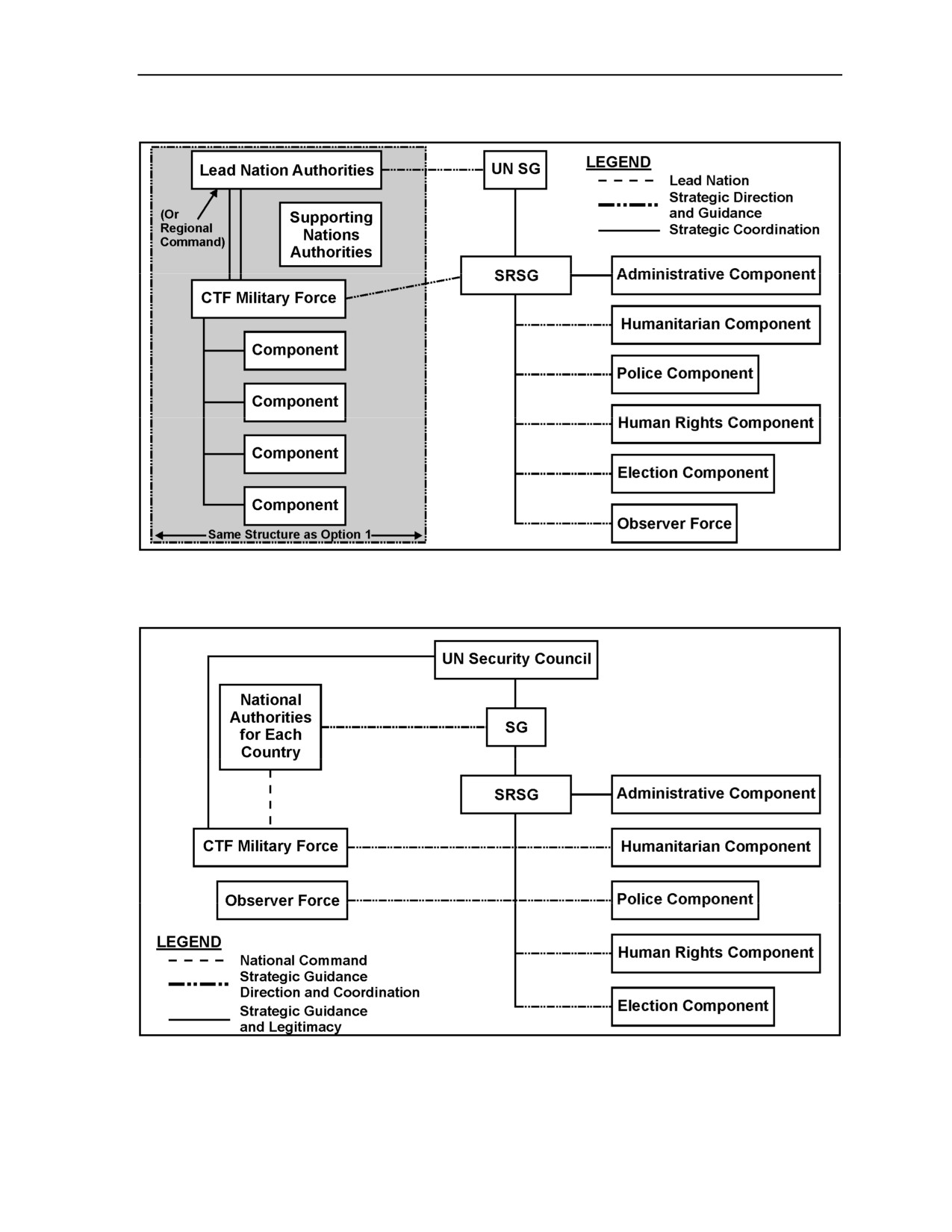
Headquarters
Department of the Army
No. 3-16 (100-8)
Washington, DC, 20 May 2010
The Army in Multinational Operations
Contents
Page
PREFACE
v
INTRODUCTION
vi
Chapter 1
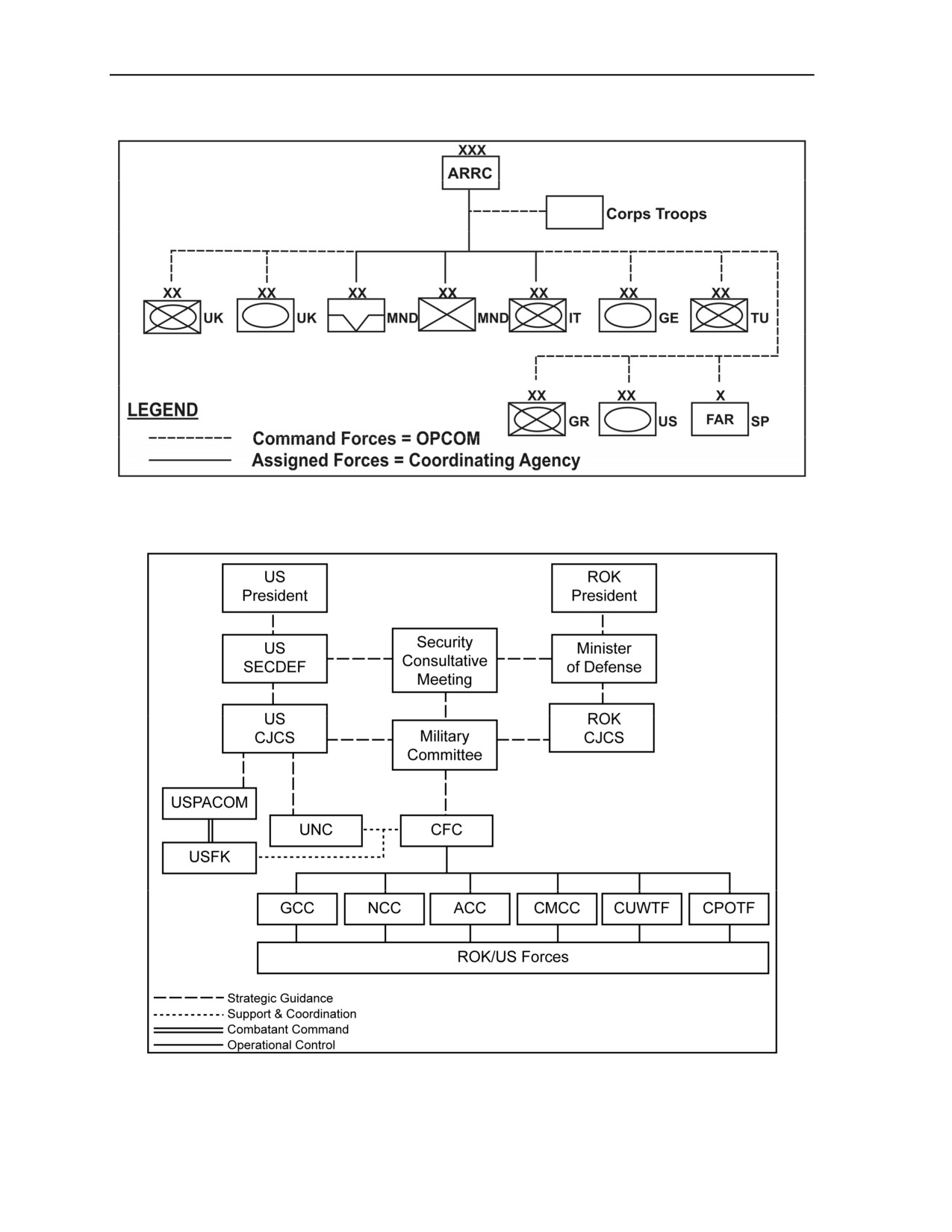
FUNDAMENTALS
1-1
Multinational Forces
1-1
Multinational Operations
1-2
Mutual Confidence
1-2
Chapter 2
COMMAND AND CONTROL
2-1
Command Structure
2-2
Command Jurisdiction
2-9
Unity of Effort
2-9
National Interests
2-9
Command Authority
2-10
NATO Operations
2-10
CFC/USFK Operations
2-10
Control
2-12
C2 Interoperability
2-14
Cooperation and Coordination
2-14
Staffing
2-15
Establishing Communications
2-22
Checklist
2-23
Chapter 3
PERSONNEL
3-1
G-1 or S-1 (Personnel)
3-1
Legal Considerations
3-3
Environmental Considerations
3-8
Checklist
3-9
Chapter 4
INTELLIGENCE
4-1
Planning Operations
4-1
Communications and Processing
4-1
Effective Coordination
4-2
Distribution Restriction: Approved for public release; distribution is unlimited.
*This publication supersedes FM 100-8, 24 November 1997.
i
Contents
Support to Stability Operations
4-2
Information Versus Intelligence
4-3
Checklist
4-5
Chapter 5
OPERATIONS AND PLANNING
5-1
Plan Early
5-1
Force Projection
5-2
Mission Focus
5-2
Commander’s Intent
5-2
Transfer of Authority
5-2
Planning Group
5-3
Transition Planning
5-3
Types of Transitions
5-4
Training
5-4
Checklist
5-7
Chapter 6
LOGISTICS
6-1
Unity of Effort
6-1
Responsibility
6-1
Planning
6-2
Host-Nation Support
6-3
Acquisition and Cross-Servicing Agreements
6-5
Contracting
6-6
Role Specialization
6-7
Organization
6-7
Transportation
6-9
Waste and Disposal Plans
6-9
United Nations System
6-9
Movement
6-10
Checklist
6-13
Chapter 7
ARMY INFORMATION TASKS
7-1
Multinational Force Army Information Tasks
7-1
Checklist
7-3
Chapter 8
PROTECTION
8-1
Assymetric Threats
8-1
Potential for Fratricide
8-1
Principles
8-1
Concept
8-2
Nonmilitary Agencies
8-3
Constituents
8-4
Command and Control
8-6
Checklist
8-7
Chapter 9
CIVIL AFFAIRS OPERATIONS
9-1
Purpose
9-2
Definitions and Terminology
9-2
Cooperation
9-2
Functions
9-2
Guidelines
9-3
Principles
9-3
ii
FM 3-16
20 May 2010
Contents
Legal Parameters
9-5
Key Factors
9-5
Administration in Hostile or Occupied Territory
9-6
Key Civil Affairs Operations Organizations
9-6
Principles of Humanitarian Action
9-7
Relationships Among Civil Organizations, Governments, and the Military
9-9
Organizational Structure
9-11
Military Support to the Civilian Community
9-13
Military Planning
9-14
Lessons Learned
9-16
Checklist
9-17
Chapter 10
FINANCIAL MANAGEMENT
10-1
Resource Manager (Comptroller)
10-1
Resourcing Guidance
10-2
Funding and Control Processes
10-3
Reimbursement Procedures
10-4
Checklist
10-5
Chapter 11
HEALTH SERVICE SUPPORT
11-1
Principles
11-1
Medical Staff
11-1
Command Surgeon
11-2
Command and Control
11-3
Planning
11-3
Threat Assessment
11-4
Policies and Issues
11-4
Countermeasures
11-5
Standards of Care
11-6
Required Capabilities
11-6
Checklist
11-7
Chapter 12
OTHER CONSIDERATIONS
12-1
Fire Support
12-1
Engineers
12-1
Engineer Support
12-3
Interoperability and Standardization
12-5
Checklist
12-6
Chapter 13
MARITIME OPERATIONS
13-1
Characteristics
13-1
Employment of Maritime Forces
13-2
Maritime Constabulary Functions
13-3
Operations in Wartime
13-4
Checklist
13-5
Chapter 14
AIR OPERATIONS
14-1
Multinational Air Component Commander
14-1
Air Defense
14-3
Missile Defense
14-3
Checklist
14-4
20 May 2010
FM 3-16
iii
Contents
Appendix A CAPABILITIES
A-1
Appendix B THREAT ASSESSMENT
B-1
Appendix C CIVIL AFFAIRS OPERATIONS ESTIMATE
C-1
Appendix D PROTECTION MEASURES
D-1
GLOSSARY
Glossary-1
REFERENCES
References-1
INDEX
Index-1
Figures
Introductory Figure 1. Coalition building
vii
Figure 2-1. Generic multinational command structure
2-1
Figure 2-2. UN sanctioned and authorized-lead nation led
2-3
Figure 2-3. UN sponsored and mandated-UN led
2-3
Figure 2-4. Force structure concept with a lead nation
2-4
Figure 2-5. U.S. as a lead nation
2-5
Figure 2-6. Combination command structure: lead nation and parallel
2-6
Figure 2-7. Integrated command structure
2-7
Figure 2-8. ARRC
2-8
Figure 2-9. Combined Forces Command (Korea)
2-8
Figure 2-10. Comparison of command authority
2-11
Figure 6-1. Host-nation considerations
6-4
Figure 8-1. Protection process diagram
8-3
Figure C-1. Contents of CAO (CMO) annex
C-1
Tables
Table 2-1. Preferred ranks for LNOs by unit
2-13
Table 2-2. Possible staff liaison requirements
2-13
iv
FM 3-16
20 May 2010
Preface
This manual provides a guide for Army commanders and staffs operating in a multinational environment. It
applies across the full spectrum of military operations. It provides general information on important topics
necessary for conducting multinational operations. However, it also lists questions that multinational partners
need to address to improve their mission effectiveness and efficiency. Every multinational operation differs.
The purpose, character, capabilities, composition, and scope of a multinational operation are functions of
changing missions. These missions are magnified by the complexities of two or more armies operating together.
Each member nation brings its own view and methods of operations.
This manual blends key points of Joint Publication (JP) 3-16 into its approach to ensure consideration by Army
elements of a joint force. It addresses the Army's roles and functions within a multinational operation. The
focus is on responsibilities for conducting operations as part of a multinational force. It also addresses
multinational leadership and provides examples of possible command relationships. Finally, it addresses
planning considerations of the multinational commanders and their staffs. Information contained herein will
help other national forces and other services plan and conduct multinational operations with U.S. Army forces.
Commanders must recognize those areas within multinational control and those areas under national control.
This is a key issue that crosses all functions. Recognizing this issue will enable commanders and their staffs to
focus on important issues. It will enable them to function more effectively and efficiently. Multinational
partners conduct multinational operations to prevent, contain, or resolve conflicts that may pose threats to
common national interests. This manual provides a handy reference of fundamental issues and interfaces that
must be addressed to promote a successful multinational operation.
While North Atlantic Treaty Organization (NATO) and the American, British, Canadian, Australian Armies
Program (ABCA) have achieved some levels of standardization in certain areas, no comprehensive common
doctrine exists between the armies. This manual does not fill this gap. It will, however, assist the multinational
commander in understanding and developing solutions to create an effective fighting force. This manual
incorporates selected information from NATO standardization agreements (STANAGs) and ABCA standards.
However, it does not reproduce these documents. This manual does not repeat staff planning procedures or the
military decisionmaking process. It does include some of the differences in doctrine, tactics, techniques, and
procedures of selected nations with which the United States has operated on numerous occasions.
This manual takes into account the full continuum of operations and varying political objectives, force
compositions, operating areas, and other factors. It also considers some general similarities in multinational
operations. Because of varying compositions and varying political objectives, consensus is extremely difficult
to obtain. Harmonization of the multinational force is critical to ensure unity of effort.
The primary audience for this manual is commanders of ARFORs, Army Service component commanders, and
other senior leaders and their staffs. This manual will also assist Army branch schools teach multinational Army
operations. This publication applies to the Active Army, the Army National Guard (ARNG)/Army National
Guard of the United States (ARNGUS), and the United States Army Reserve (USAR) unless otherwise stated.
The proponent for this publication is Headquarters, United States Army Training and Doctrine Command
(TRADOC). The preparing agency is the Combined Arms Doctrine Directorate, U.S. Army Combined Arms
Center. Send written comments and recommendations on Department of the Army
(DA) Form 2028
(Recommended Changes to Publications and Blank Forms) directly to: Commander, U.S. Army Combined
Arms Center and Fort Leavenworth, ATTN: ATZL-CD (FM 3-16), 300 McPherson Avenue, Fort Leavenworth,
KS 66027-2337; by e-mail to: leav-cadd-web-cadd@conus.army.mil; or submit an electronic DA Form 2028.
Follow the DA Form 2028 format or submit an electronic DA Form 2028.
20 May 2010
FM 3-16
v
Introduction
Whenever commonality of interest exists, nations will enter into political, economic, and/or military
partnerships. These partnerships will occur in regional and worldwide patterns as nations seek
opportunities to promote their mutual national interests or seek mutual security against real or perceived
threats. Cultural, psychological, economic, technological, and political factors all influence the formation
and conduct of multinational operations.
America's interests are global, but its focus is regional. Existing alliances and past coalitions reflect that
focus. Alliance participants establish formal, standard agreements for operational objectives. Alliance
nations strive to field compatible military systems, structure common procedures, and develop contingency
plans to meet potential threats. As forces of these nations plan and train together, they develop mutual trust
and respect. The U.S. is a member of the following alliances and agreements:
• United Nations.
• NATO.
• ABCA Armies Standardization Program.
• Defense and cooperation treaties with the Republic of Korea and Japan.
• Inter-American Treaty of Reciprocal Assistance.
There are three basic possible responses to a multinational crisis: United Nations
(UN), regional
organizations (alliances or treaties), and coalitions. There are two types of responses associated with the
UN. Those are UN mandated and UN authorized operations. UN authorized operations may involve either
regional organizations and/or coalitions. While alliances form the basis for responding to a variety of
regional threats, coalitions, such as Operations Desert Shield/Desert Storm, Operation Enduring Freedom,
and Operation Iraqi Freedom have emerged to meet national strategic requirements. Coalitions, which are
created for limited purposes and for a limited length of time, do not afford military planners the same
political resolve and commonality of aim as alliances. Thus, planners must closely study the political goals
of each participant as a precursor to detailed planning. Political considerations weigh more heavily with
coalitions than with alliance operations.
Multinational military operations are not new. Most major military operations in the twentieth century have
been both joint and multinational: World War I, the Allied intervention in Russia 1918-1920, World War
II, the Korean Conflict, the Vietnam Conflict, and various UN-sponsored operations. Since human nature
has not changed, regional conflicts over territory, religion, politics, and economics will continue to occur.
The precise role of land forces in these operations will vary according to each political and military
situation. U.S. Army participation is likely for three reasons:
• Only land forces can hold terrain and control populations.
• Army structure contains unique capabilities other services do not have.
• Soldiers on the ground are a clear demonstration of political resolve.
vi
FM 3-16
20 May 2010
Introduction
Introductory Figure 1. Coalition building
The strategic principle of collective security caused the U.S. to join several alliances and form coalitions.
This requires the Army to conduct multinational military operations with forces from other nations. These
operations will generally include a variety of governmental organizations, nongovernmental organization
(NGO), other services, and international agencies. Another reason the U.S. conducts such operations is that
rarely can one nation go it alone. Participating national contingents and NGOs bring certain unique core
competencies. This blending of capabilities and political legitimacy makes certain operations possible that
the U.S. could not or would not conduct unilaterally.
Much of the information in this manual is based on the ABCA Coalitions Operations Handbook. The
handbook was written to support a requirement identified in the 1996 ABCA Exercise Cascade Peak in
Fort Lewis, Washington. It was designed to assist the ABCA nations serving in coalitions with other
countries. In 1998, the handbook was evaluated during ABCA Exercise Rainbow Serpent in Brisbane,
Australia. At that time, the Australian joint deployable headquarters served as the headquarters. In 1999,
they deployed to East Timor to lead the ABCA armies and other coalition nations. This was a highly
successful mission. The handbook was revised based on that mission and the ABCA Exercise Focus 2000
in Sandhurst, United Kingdom.
20 May 2010
FM 3-16
vii
Chapter 1
Fundamentals
Multinational operations describe military actions conducted by forces of two or
more nations. These operations are undertaken within the structure of a coalition or
alliance. Army forces conduct full spectrum operations across the spectrum of
conflict.
Army forces are the decisive component of land warfare in multinational operations.
The Army’s role in multinational operations may be to serve as a joint multinational
command headquarters; a multinational land component command headquarters; and
a troop-contributing nation as part of a multinational command.
Many Soldiers will serve with foreign military partners or with civilian partners.
Having a clear understanding of this environment is necessary. This chapter discusses
the environment that units will face when conducting multinational operations.
Multinational military operations are not new. American commanders throughout our
history have operated with multinational forces. An example is General George
Washington and his partnership with our French allies. In the twentieth century,
Generals John Pershing, Douglas MacArthur, Dwight Eisenhower, Mathew Ridgway,
William Westmoreland, Creighton Abrams, and Norman Schwartzkopf have all
operated in difficult multinational environments.
MULTINATIONAL FORCES
1-1. Although the U.S. will act unilaterally when it is in its national interests, wherever possible it will
pursue its national interests through multinational operations. Multinational operations are conducted
within the structure of an alliance or a coalition.
ALLIANCES
1-2. An alliance is the relationship that results from formal agreements (for example, treaties) between
two or more nations for broad, long-term objectives, that further the common interests of the members.
One of those broad, long-term objectives is standardization. This helps to achieve the most effective
military capabilities. Standardization normally includes materiel (equipment) and nonmateriel (doctrine)
matters. Alliances will normally have standing headquarters and organizations. For the U.S. Army,
operations taking place within the NATO or the Combined Forces Command, Korea are alliance
operations.
COALITIONS
1-3. A coalition is an ad hoc arrangement between two or more nations for a common action. A coalition
action is a multinational action outside the bounds of an established alliance. It usually exists for a single
occasion or for longer cooperation in a narrow sector of common interest.
1-4. Coalitions are created for a limited purpose and for a set time. They do not afford military planners
the same political resolve and commonality of aim as alliances. Thus, planners must closely study the
political goals of each participant as a precursor to planning. Normally, political considerations weigh more
heavily with coalitions than with alliances.
20 May 2010
FM 3-16
1-1
Chapter 1
1-5. The most difficult issues for the commander of any multinational force will be sovereignty issues.
Often the coalition commander is a “commander” in title only. The coalition commander will accomplish
the mission through coordination, communication, and consensus or leadership rather than by traditional
command relationships. Commanders must acknowledge sensitivities. Often they and their subordinates
must operate as “diplomats” rather than as “warriors.” Such is the nature of coalition operations.
MULTINATIONAL OPERATIONS
1-6. Multinational operations may be driven by-
z
Common agreement among the participating alliance or coalition partners.
z
Terms of an alliance.
z
A mandate or authorization provided by the UN.
Whichever way, their multinational character merits particular attention because national interests and
organizational influence may compete with doctrine and efficiency. Gaining consensus can be
painstakingly difficult. Solutions are often national in character. Commanders may expect contributing
nations to adhere to national policies and priorities, which at times complicates the multinational effort.
1-7. In UN-sponsored multinational operations, a force is employed under a single commander. The
secretary general appoints the force commander with the consent of the UN Security Council. The force
commander reports either to a special representative of the secretary general or directly to the secretary
general. The force commander has wide discretionary powers over day-to-day operations. However, he or
she refers all policy matters to the special representative or secretary general for resolution.
MUTUAL CONFIDENCE
1-8. Successful multinational operations are built by the commander’s focus. The commander focuses on
the political objective, assigned mission, patience, sensitivity to the needs of other force members, a
willingness to compromise or come to a consensus when necessary, and mutual confidence. This mutual
confidence stems from a combination of tangible actions and entities and intangible human factors.
Tangible considerations, such as liaison and language, are discussed throughout this manual. The
intangible considerations that must guide the actions of all participants, but especially the senior
commander, are-
z
Rapport.
z
Respect.
z
Knowledge of partners.
z
Team building.
z
Patience.
These factors cannot guarantee success for multinational operations, but ignoring them will usually
guarantee failure.
RAPPORT
1-9. Commanders and staffs should establish rapport with their counterparts from other countries. This is
a personal, direct relationship that only they can develop. Good rapport between multinational force
members results in successful teamwork and overall unity of effort.
1-10. The first concern when establishing rapport is an understanding of the characteristics, personalities,
capabilities, ambitions, sensitivities, history, and cultural habits of the various multinational partners.
Additionally, commanders and staffs should understand each nation’s legal and policy constraints. Once
this understanding exists, the keys to developing and maintaining rapport are respect, trust, patience, and
the ability to compromise. The multinational force commander must be visible to members of the
multinational force. Personal visits to all units provide the opportunity to assess capabilities, readiness, and
morale as well as to build rapport.
1-2
FM 3-16
20 May 2010
Fundamentals
1-11. Commanders can more easily establish rapport within the partnership when the nations combining
forces share similar cultural backgrounds. Conversely, the partnership can be fractured when members
come from diverse cultural backgrounds and do not respect each other’s cultural sensitivities.
Historical Example
During the New Guinea campaign in World War II, General Douglas MacArthur
dispatched Lieutenant General Robert Eichelberger to the area to improve the poor
situation. Prior to Eichelberger's arrival in Papua, an adversarial relationship had
developed between U.S. and Australian commanders. Australian leaders had
questioned the fighting capability of U.S. forces and similar charges were made by
the American side regarding the Australians.
One of Eichelberger's first acts upon assuming command in Papua was to send a
communiqué to Lieutenant General Edmund Herring, the Australian appointed by
MacArthur to be the field commander of the Papua operation. In this message,
Eichelberger informed Herring that he was anxious to cooperate with the Australians.
Herring, who had been terse in his previous correspondence with Eichelberger,
mellowed considerably subsequent to this event.
Upon Herring's return to Port Moresby to command all operations on New Guinea, he
appointed Eichelberger field commander of a corps composed of both Australian and
American units. This was the first time in the war that the Australians placed their
troops under the tactical command of an American officer. The quality Eichelberger
possessed that made him particularly suited to the multinational environment was his
ability to demonstrate to his allies his belief that personal and national prestige
cannot be allowed to interfere with harmony within the partnership. This ability,
coupled with his skill in promoting a spirit of teamwork with allied forces, enabled him
to command effectively in the multinational arena.
RESPECT
1-12. Respect must exist among multinational partners. All nations should perceive they are making a
significant contribution toward accomplishing the mission, regardless of the rank of their senior member or
the size of the national force. Respect for the partners’ culture, religions, customs, and values combined
with understanding and consideration of their ideas, will solidify the partnership. Lack of respect may lead
to friction, jeopardizing mission accomplishment. All members of the multinational force must understand
their partners’ national views and work to minimize friction.
1-13. In assigning missions to multinational forces, commanders must consider that national honor and
prestige may be as important as combat capability. All partners must be included in the planning process.
Their opinions must be sought in mission assignment. Understanding, considering, and accepting ideas
from multinational force partners leads to a solidified multinational force. Without genuine respect of
others, rapport and mutual confidence cannot exist.
PARTNERS
1-14. Commanders must know their multinational partners as well as they know their adversary. Much
time and effort are expended in learning about the enemy. It is even important that partners understand
each other. Each partner in an operation has a unique cultural identity. Although nations with similar
cultures face fewer obstacles to interoperability than nations with divergent cultural outlooks, differences
will still exist. Commanders and staffs must learn the capabilities of partner nations or organizations. These
capabilities differ based on national and organizational interests and objectives, political guidance,
limitations on the national force, doctrine, organization, rules of engagement
(ROE), law of war,
equipment, religions, customs, history, and a myriad of other factors.
20 May 2010
FM 3-16
1-3
Chapter 1
TEAM BUILDING
1-15. Team building is essential to multinational operations. Differing national agendas can be disruptive.
On a more personal level, the natural competitiveness among Soldiers and nations can become a serious
problem. Such competitiveness can be a motivating factor if properly managed. Left unchecked, it can
destroy force cohesion. Multinational force commanders at all levels must reinforce the fact that all forces
are on the same team. Establishing an atmosphere of cooperation and trust at the highest levels is essential.
When such an atmosphere is established, subordinate commands are influenced positively.
1-16. Commanders must ensure equitable treatment and exposure of all units, regardless of national
background. Failure to do so may be perceived as prejudice and result in political repercussions. All
members must have fair representation on the planning staff to preclude allegations that any nation was
excluded from the decisionmaking process. All participants must perceive missions as appropriate,
achievable, and equitable in burden and risk sharing. Unit capabilities are an obvious factor in assigning
missions. However, national honor and prestige may be as important to the partnership as battlefield
capability. Partners should be included in the planning process. Their opinions must be sought concerning
the type of mission assignment for their units. However, the political impact of high casualties must always
be balanced against national honor and prestige. Commanders must consider national caveats based on
legal and policy constraints when assigning missions and tasks to members. If these are not considered,
multinational commanders may be faced with nations refusing to perform assigned tasks. The term
“national red card” using a soccer simile has been coined for this type of action. Prior understanding and
proper missions will avoid “national red cards”.
Historical Example
In Somalia, certain Somali factions targeted the Nigerian national contingent for
repeated attack. The Nigerian sector did not have any unique features warranting
attack, and the Nigerians did not provoke attacks. What planners had not considered
was that Nigeria had earlier granted the former President of Somalia, Siyad Barre,
political asylum in Nigeria. Some Somalis took revenge on Barre by targeting the
Nigerian soldiers for attack.
PATIENCE
1-17. Developing effective partnerships takes time and attention. Diligent pursuit of a trusting, mutually
beneficial relationship with multinational force partners requires untiring, even-handed patience.
1-18. Desert Storm proved that a successful coalition among nations having widely disparate social and
cultural norms is achievable. American commanders ensured that their Soldiers received education
regarding social norms prevalent in the Middle East. They imposed measures to respect these norms. Arab
coalition leaders, for their part, granted American and other Western coalition forces liberties that would
not normally be permitted under Islamic law. Allowing female Soldiers to drive vehicles and perform other
duties forbidden by Saudi Arabian law and permitting the conduct of non-Islamic religious services would
not be considered major concessions by Western standards. But in Saudi Arabia, these allowances were
extremely significant.
1-4
FM 3-16
20 May 2010
Chapter 2
Command and Control
In multinational operations, ensuring compatibility at the political, military, and
cultural levels between partners to build consensus is key. A successful multinational
operation must establish unity of effort, if not unity of command. The success of a
multinational operation begins with the authority to direct the operations of all
assigned or attached military forces.
Once nations have reached a commonality of interests and have decided to enter into
a military partnership, a multinational force is created to pursue those common
interests. The basic purpose of the multinational force command is to direct the
military effort to reach a common objective. This chapter discusses different types of
multinational command structures, command authorities, and the roles and
responsibilities of the participants. It also discusses liaison, the multinational staff,
and communications.
Each multinational operation is unique. Each national commander that is part of a
multinational force is responsible not only to the commander of the multinational
force, but to his or her national chain of command as well. Therefore troop-
contributing nations maintain a direct line of communication to their national
headquarters and thus to their own national governments. (See figure 2-1.)
Figure 2-1. Generic multinational command structure
20 May 2010
FM 3-16
2-1
Chapter 2
Experience shows that responsibility for reestablishing, training, and equipping
security forces for the indigenous population creates command and control (C2)
challenges for a multinational command. These challenges are further complicated by
the fact that the indigenous civilian governments responsible for national C2 are
often in the formative stage as well. Commanders must be flexible in dealing with
these units. Commanders will need to ensure that they fully understand all the
elements of the command authority for these security forces.
COMMAND STRUCTURE
2-1. All multinational operations, regardless of their structure or authority will have two chains of
command. There will be the multinational chain of command constructed by the UN, alliance, or coalition
and a national chain of command extending back to national capitals. Ultimate authority is vested in the
national chain of command.
2-2. The UN, which is chartered by the world to serve as a focal point for maintaining peace and
upholding human rights, many times provides the mandate or authorization for the conduct of multinational
operations. The UN charter serves as the basis for the conduct these operations. Under the UN charter-
z
Chapter V addresses the Security Council, which directs the implementation of peace operations.
z
Chapter VI addresses peaceful means.
z
Chapter VII addresses enforcement actions.
z
Chapter VIII addresses regional means to maintain peace and security.
2-3. There are two types of operations associated with the UN:
z
The first are UN commanded operations that are under the command of the UN and report to the
secretary-general. The mandate for these operations is set out by the Security Council in a
resolution. The secretary-general is responsible for managing and supervising the execution of
the mandate.
z
The second are operations that are conducted by a coalition of willing states that are authorized
by the UN. The coalition remains under the command of a lead state or regional organization
and reports to its national or alliance chain of command. These operations are authorized by a
decision of the Security Council that allows the coalition to take all necessary measures to
achieve its specified mission.
2-4. As a result of the two types of operations, there are two types of C2 structures. The first, shown in
figure 2-2, is the UN led that is UN sponsored and mandated. The second, shown in figure 2-3, is the “lead
nation led” (or “regional organization led”) that is UN sanctioned and authorized.
2-2
FM 3-16
20 May 2010
Command and Control
Figure 2-2. UN sanctioned and authorized-lead nation led
Figure 2-3. UN sponsored and mandated-UN led
20 May 2010
FM 3-16
2-3
Chapter 2
2-5. Alliances and coalitions create a command structure that meets the needs, diplomatic realities,
constraints, and objectives of the participating nations. Since no single command structure fits the needs of
all alliances and coalitions, several different command structures have evolved. This chapter describes four
types of command structures:
z
Lead nation.
z
Parallel.
z
Combination. (Discussed with reference to coalitions.)
z
Integrated. (Discussed with reference to alliances.)
2-6. While the command structures of alliances and coalitions are normally organized along these lines,
there are some situations in which these structures are not applicable. Coalitions normally form as a rapid
response to unforeseen crises. The nature of the coalition (for example, whether or not it is based on a UN
mandate or common agreement among countries) will determine the type of command structure. The
nature of the coalition is influenced by the political agendas of each of the nations that are participating in
the coalition. Some nations use the term “framework nation” for lead nation. Only the name is different.
Because lead nation is better known and more commonly used, all further discussion uses lead nation.
LEAD NATION COMMAND STRUCTURE
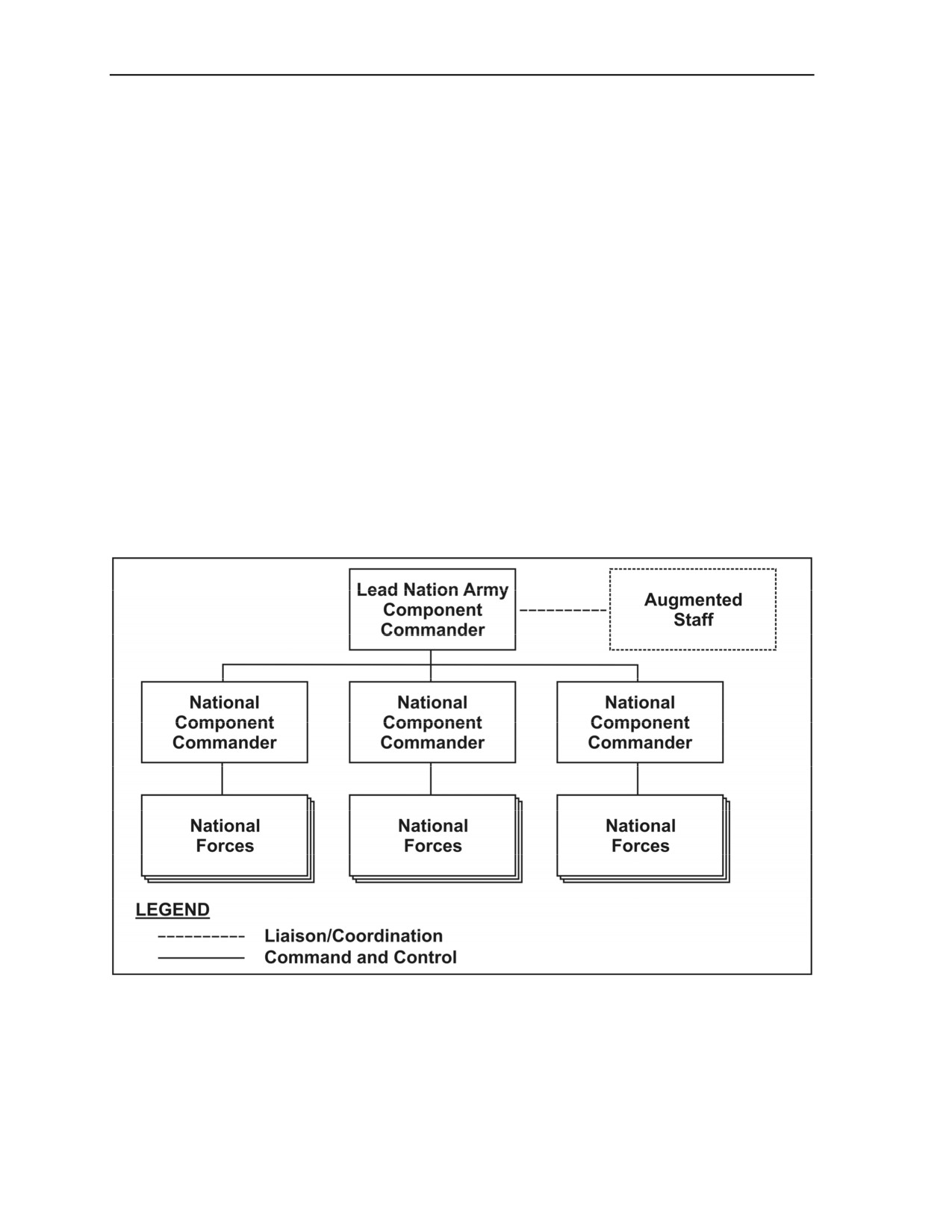
2-7. The lead-nation concept recognizes that one nation is assigned the lead role and its C2 dominates.
Normally, the lead nation is the country providing the largest number of forces and/or resources for that
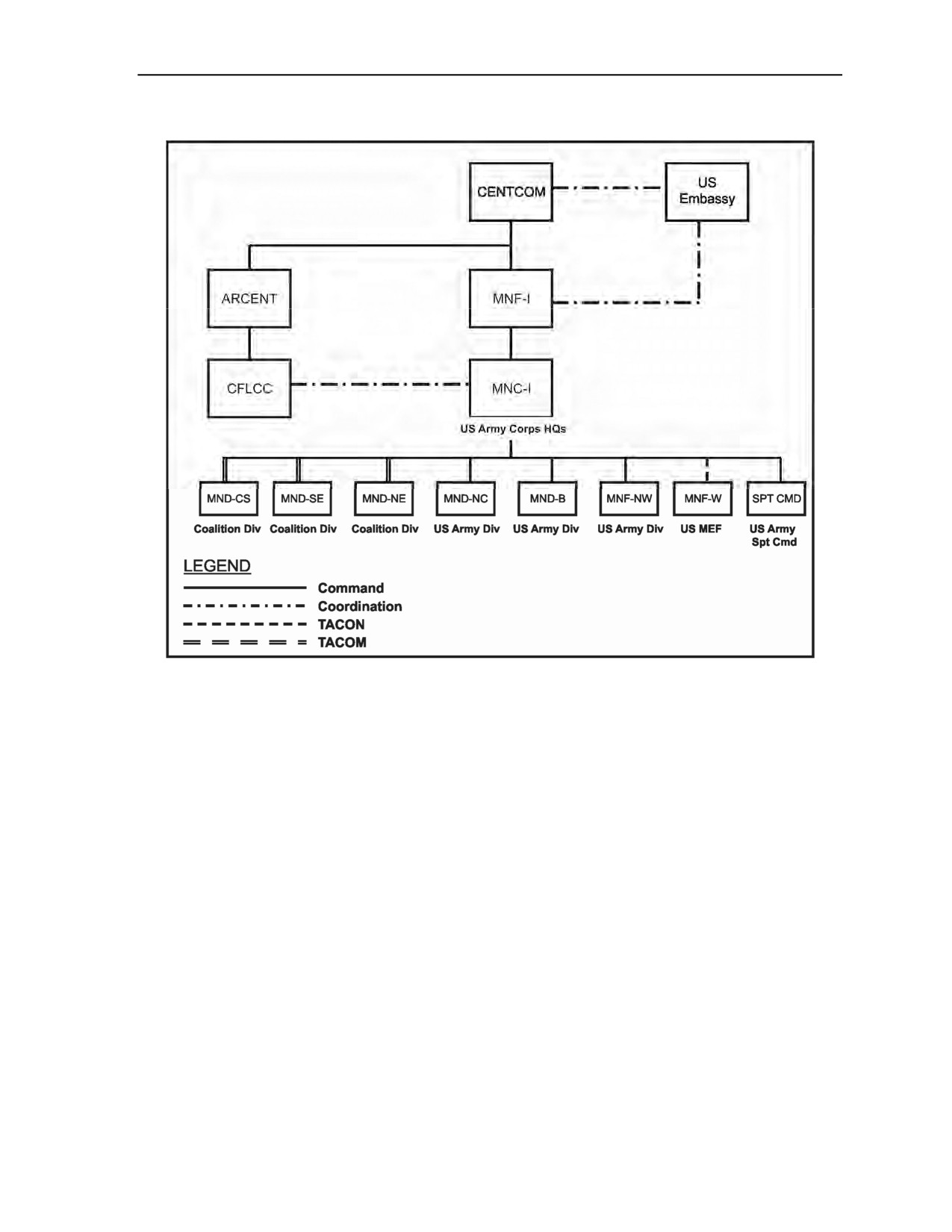
operation. Figure 2-4 illustrates the concept of a force structure with a lead nation. Figure 2-5 provides an
example of the U.S. as a lead nation.
Figure 2-4. Force structure concept with a lead nation
2-4
FM 3-16
20 May 2010
Command and Control
Figure 2-5. U.S. as a lead nation
2-8. In the lead-nation concept, the lead nation determines the appropriate C2 procedures, working
closely with the other national contingents. The lead nation should provide unique C2 equipment and
software to national component headquarters of other nations whenever feasible. Other nations
participating in the operation provide appropriate liaison personnel to the lead nation headquarters. Robust
liaison is essential to developing and maintaining unity of effort in coalition operations.
2-9. Depending on the size, complexity, and duration of the operation, staff augmentation from other
national contingents may be required to supplement the lead-nation staff. This will ensure that the lead
nation headquarters represents the entire coalition. Such augmentation may include designated deputies or
assistant commanders, planners, and logisticians. This facilitates the planning process by providing the
coalition commander with a source of expertise on coalition members. Augmentation will be required if a
coalition partner possesses unique organizations or capabilities not found in the forces of the lead nation.
PARALLEL COMMAND STRUCTURE
2-10. An alternative to the lead-nation concept is the parallel command structure. Under a parallel
command structure, no single coalition commander is named. The coalition leadership must develop a
means for coordination among the participants to attain unity of effort. The use of a parallel command
structure should be avoided if possible because of the absence of a single coalition commander and lack of
unity of command.
20 May 2010
FM 3-16
2-5
Chapter 2
COMBINATION COMMAND STRUCTURE
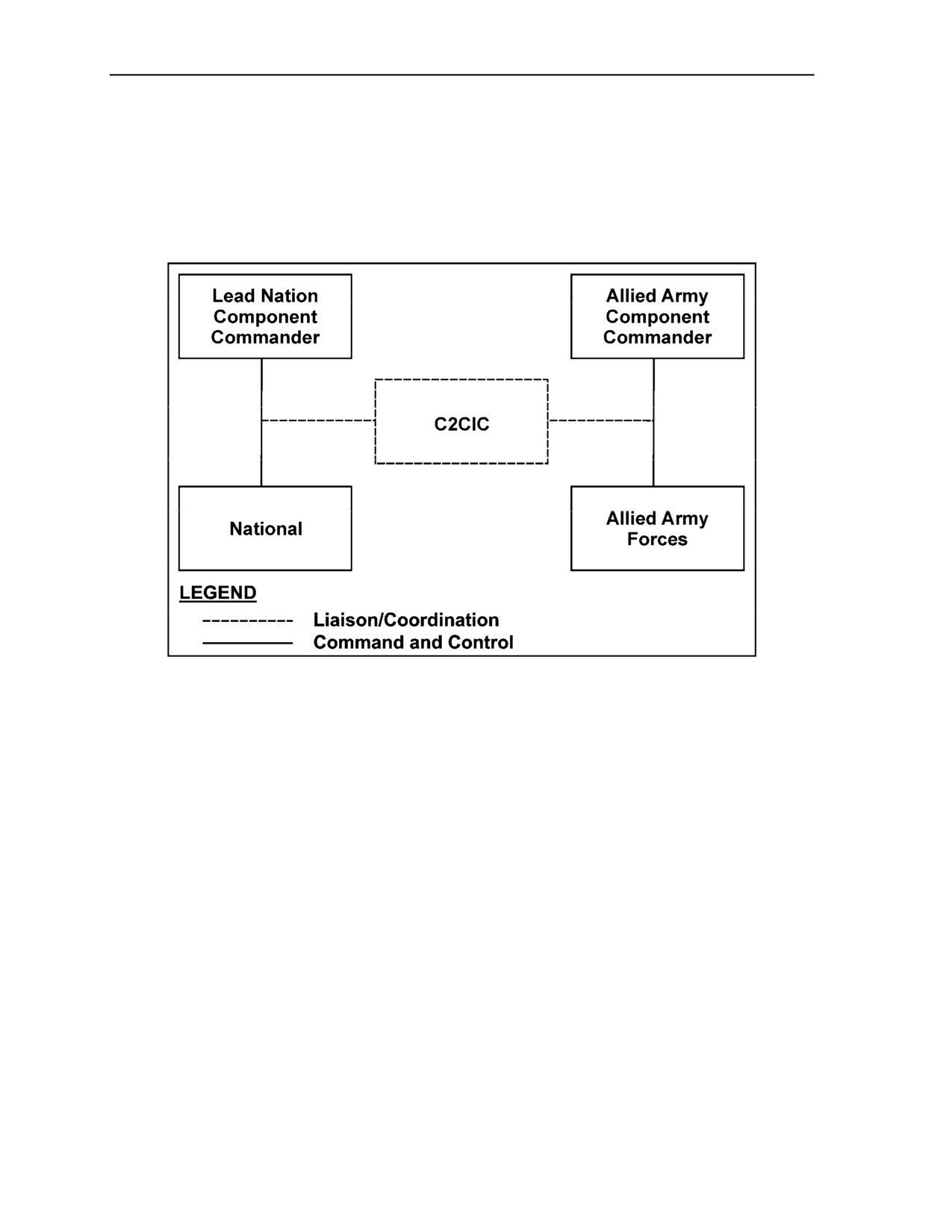
2-11. The lead-nation concept and a parallel command structure may exist simultaneously within a
coalition. This occurs when two or more nations serve as controlling elements for a mix of international
forces. The Gulf War coalition was an example of this structure. While more desirable than the parallel
command structure, an effort to achieve a total lead-nation concept for unity of command is preferred.
Figure 2-6 shows the combination of a lead nation and parallel command structure.
Figure 2-6. Combination command structure: lead nation and parallel
INTEGRATED COMMAND STRUCTURE
2-12. In an alliance, a coalition or UN-mandated operation, instead of merely augmenting the staff with
other national representatives, the entire staff is an integrated command structure. The deputy commander
and each primary staff officer could be of a different nationality.
2-13. The use of an integrated command structure in an alliance provides unity of command. The NATO
command structure is a good example of an integrated command structure. In Europe, NATO has Allied
Command Operations, also known as Supreme Headquarters Allied Powers, Europe (SHAPE). It has a
commander who is designated from one of the member nations. The SHAPE staff is made up from
members of the NATO nations. This integration also occurs among the subordinate commands and staffs
several levels below SHAPE.
2-14. The key ingredients in an integrated alliance command structure are-
z
A single designated commander.
z
A staff composed of representatives from all member nations.
Subordinate commands and staffs integrated to the lowest echelon necessary to accomplish the mission.
(See figure 2-7.)
2-6
FM 3-16
20 May 2010
Command and Control
Figure 2-7. Integrated command structure
2-15. Another example of a standing integrated command structure is NATO's Allied Command Europe
Rapid Reaction Corps (ARRC). However, it has some characteristics of a lead nation, in that the United
Kingdom (UK) provides most of the framework of the headquarters structure. It is, nevertheless, an
integrated command structure because the primary staff members are of different nationalities. (For
example the G-3 is a U.S. brigadier general.) The entire staff is integrated. The ARRC’s two subordinate
divisions, the multinational division (central) and the multinational division (south), are also integrated.
Other NATO nations provide forces for specific operations as the mission dictates. One U.S. division has a
standing relationship of coordinating with the ARRC in peacetime for planning and training. Figure 2-8
shows the complexity of the ARRC organization.
2-16. Another example of a standing integrated command structure is Republic of Korea/U.S. Combined
Forces Command, Korea (CFC), which has evolved over years of cooperation between the U.S. and Korea.
The CFC staff and the staff of its subordinate ground component command are fully integrated. (See figure 2-9.)
2-17. It is possible that a coalition may also have an integrated command structure. An integrated staff
demonstrates greater burden sharing and commitment, but may create more friction than the other types of
command structures. Every aspect of C2, planning, and operations have to be developed while the staff is
forming and learning to operate together. Because of the time involved and the work necessary to create an
integrated coalition command structure, it should be avoided if possible.
20 May 2010
FM 3-16
2-7
Chapter 2
Figure 2-8. ARRC
Figure 2-9. Combined Forces Command (Korea)
2-8
FM 3-16
20 May 2010
Command and Control
COMMAND JURISDICTION
2-18. Command jurisdiction is the legal position of command by one national commander over the
Soldiers of another nation. Each nation participating in a multinational operation is responsible to its own
national authority for the conduct of operations. Each nation will view the conflict based on its own
national interests. Where those interests coincide, the multinational commander will have his or her
greatest latitude. Where those interests vary, he or she will have the least. Commanders will be dealing not
only with the national force commander, but also with the national authority of that nation. Coalition
commanders always must operate within constraints of one sort or another. Therefore, commanders must
understand not only what has been agreed to, but also what national caveats have been made so they can
account for them in plans. Commanders should be prepared to spend time working political and military
issues rather than purely military matters.
UNITY OF EFFORT
2-19. In multinational operations, unity of effort must be achieved. The principle of unity of command also
applies. However, this principle may be more difficult to attain. In stability operations (and NATO Article
5 Crisis Response Operations, government agencies may have the lead. Commanders may report to a
civilian chief and employ resources of a civilian agency. Command arrangements often may be loosely
defined and many times will not involve a command authority as normally understood. Commanders
should consider how their actions contribute to initiatives that are also diplomatic, economic, and
informational in nature. Because peace operations may be conducted at the small unit level, all levels must
understand the military-civilian relationship to avoid unnecessary and counterproductive friction.
2-20. For successful multinational operations, sound and effective command relationships must be
developed. Multinational commanders should seek assistance from governmental agencies in assessing
other countries’ capabilities. They must carefully consider national sensitivities as well as differing norms
of behavior among national militaries and civilian agencies. Multinational forces should anticipate that
some forces from member nations would have direct and near immediate communications from the
operational area to their respective national political leaderships. This capability can ease coordination
issues. But it can also be a source of frustration if external leaders external issue guidance directly to
deployed national forces.
NATIONAL INTERESTS
2-21. Multinational operations are affected by the political agendas of participating countries. Many
nations will not, or are reluctant to, relinquish command of their forces to other countries. On a case-by-
case basis, their national governments may place national forces under the operational control (OPCON) of
a multinational commander. In such cases, parallel chains of command may exist, with part being through
the coalition force and part through the national authority. The challenge for the multinational force is to
arrange the best command relationships with its subordinate forces to ensure mission success.
2-22. The interests of nations regarding the operation are usually described in the terms of reference
(TOR) between the contributing nations and other multinational partners or, if involved, the UN.
Developing a written document that outlines command relationships is vital. These documents could be an
annex to an operation plan (OPLAN), an operation order (OPORD), or a campaign plan.
2-23. One essential issue in C2 concerns the transfer of authority (TOA) of multinational forces to the
multinational commander’s control. Nations may not agree on when the transfer should occur. The earlier
the multinational force gains control, the more flexibility it has in training for and conducting the
operations. Differences in national interests, objectives and policies at the national level, as well as the
availability of forces based on concurrent commitments may delay planning and agreement to subsequent
decisions.
20 May 2010
FM 3-16
2-9
Chapter 2
COMMAND AUTHORITY
2-24. The Army has doctrinal definitions for command relationships. Those are the same definitions used
by the joint community. (See JP 1-02.) However, as a member of NATO, the U.S. has also agreed to
NATO definitions for command relationships. The NATO definitions are not the same as the U.S.
definitions. Additionally in CFC United States Forces Korea (USFK), definitions have been developed to
describe command relationships. Therefore, to operate effectively in multinational operations, commanders
must understand how each nation defines command relationships. Multinational force commanders must
understand what they can and cannot do with each troop-contributing nation’s forces. For a further
explanation of the U.S. view of command authority, see JP 3-16.
2-25. To provide a basic understanding of some of the issues involved in the different aspects of command
authority see figure 2-10. It provides a comparison of command authorities between U.S., NATO, and CFC
definitions.
NATO OPERATIONS
2-26. NATO has defined five command relationships:
z
Full command.
z
Operational command (OPCOM).
z
OPCON.
z
Tactical command (TACOM).
z
Tactical control (TACON).
Definitions for these NATO command relationships can be found in the glossary.
CFC/USFK OPERATIONS
2-27. Combined operations currently employed in the Korean theater use two specific control measures:
z
Combined OPCON.
z
Command less OPCON.
2-28. Most national authorities providing forces to multinational operations will normally assign national
forces under OPCON of the multinational force commander. Smaller nations may place their forces
OPCON to a larger force. The larger force is then placed under OPCON to the multinational force
commander. The assignment of these national forces under OPCON may be qualified by caveats from the
respective nations in accordance with their national policies. Further assignment to service component
commanders in an OPCON status by the multinational force commander is subject to approval by the
respective national governments.
2-29. Command less OPCON of the national forces is retained by the parent national commander and is
exercised through the designated national commander of the respective nations within the multinational
force. The multinational commander and national commanders should discuss and clarify their mutual
understandings of the command authorities that have been transferred to them. This clarification will
ensure there is common understanding of those authorities. It will also preclude potential
misunderstandings.
2-30. For Army forces, the U.S. commander retains command over all assigned U.S. forces in
multinational operation. The U.S. chain of command runs from the president through a combatant
commander to the U.S. national commander. The chain of command, from the president to the lowest U.S.
commander in the field, remains inviolate.
2-10
FM 3-16
20 May 2010
Command and Control
Figure 2-10. Comparison of command authority
20 May 2010
FM 3-16
2-11
Chapter 2
CONTROL
2-31. Two essential structural enhancements improve control of multinational forces: the establishment of
a liaison network and coordination centers. These in conjunction with meetings, boards, and conferences
help integrate operations across the multinational force.
LIAISON NETWORK
2-32. Regardless of the command structure, effective liaison is vital in any multinational force. Using a
liaison is an invaluable confidence-building tool between the multinational force and subordinate
commands. It also-
z
Fosters a better understanding of mission and tactics.
z
Facilitates the transfer of vital information.
z
Enhances mutual trust.
z
Develops an increased level of teamwork.
2-33. A liaison supplies significant information for the multinational force headquarters about subordinate
force readiness, training, and other factors. Early establishment reduces the fog and friction caused by
incompatible communications systems, doctrine, and operating procedures.
2-34. Liaison should be established as early as possible between a command and its higher headquarters,
adjacent units, supporting, and attached forces, as well as other appropriate host-nation
(HN) and
international organizations. When supporting UN operations, the multinational commander should consider
placing liaison personnel at the UN headquarters in New York and the UN office in Geneva, Switzerland.
For U.S. forces, liaison with the U.S. ambassador, if there is one, is essential.
2-35. The command must identify and request liaison personnel at the earliest opportunity. The request
should include any specific qualifications needed. Differences in doctrine, organization, equipment, and
training among the multinational nations demand a hardier liaison structure to facilitate operations than
would be necessary in a purely national force. Because many functions must be covered on a 24-hour
basis, liaison teams rather than individuals may be required. This requires more liaison personnel than a
force normally has assigned. Liaison personnel must have equipment compatible with the multinational
force.
2-36. Liaison personnel must fully understand the capabilities and limitations of their parent units and
nations, to include the structure, capabilities, weapon systems, logistics, and planning methods employed
and their national interests. Whether they are language qualified or have interpreter support, personnel
must understand the language and culture of the headquarters to which they are attached to have successful
liaison operations. However, professional knowledge and functional expertise are far more important.
Officers who have participated in schools and training with other multinational nations or have experience
in multinational operations can sometime provide this expertise depending upon the depth of their
experience. The sending command should provide liaison teams with knowledge of the language,
organization, materiel, and doctrine of multinational partners as well as an understanding of appropriate
regional information. The liaison officers (LNOs) assigned to the multinational force headquarters should
be of sufficient rank to influence the decisionmaking process. They should also possess the authority to
answer routine multinational force queries on behalf of their commands.
2-37. Once liaison is established, liaison teams become the direct representatives of their respective
commanders. They monitor, coordinate, advise, and assist the command to which attached. As such, they
attend briefings and maintain close contact with the multinational operations center. However, the
command to which they are sent should not formally task their sending unit through the LNO. Formal
tasking should be accomplished through normal C2 channels. Table 2-1 lists preferred ranks for LNOs.
Table 2-2 shows possible staff liaison requirements.
2-12
FM 3-16
20 May 2010

Command and Control
Table 2-1. Preferred ranks for LNOs by unit
Preferred rank
Unit size
represented
Unit size going to
Offense/defense
Support/stability
Division
Corps and Above
Major
Colonel
Brigade
Corps and Above
Major
Colonel
Brigade
Division
Captain
Major
Battalion
Brigade and Above
Lieutenant
Captain
Company
Battalion and Above
Lieutenant
Table 2-2. Possible staff liaison requirements
Unit going to
Unit size
represented
Battalion and above
Brigade and above
Division
Corps and above
Logistics
Division
Operations/Plans
Intelligence
Logistics
Logistics
Brigade
Operations/Plans
Operations/Plans
Intelligence
Intelligence
Logistics
Logistics
Logistics
Battalion
Operations/Plans
Operations/Plans
Operations/Plans
Company
Operations/Plans
Operations/Plans
Operations/Plans
Operations/Plans
Note: Under certain circumstances, multiple LNOs may be required due to the complexity of operations.
2-38. Integrating multinational liaison personnel into the staff of the multinational force totally depends on
the commander’s desires. When integration creates a more effective organization, the multinational force
should establish an orientation program for all liaison personnel. The multinational personnel reception
center could perform this requirement. The multinational force must determine what staff officer or staff
section will have overall responsibility for liaison personnel reporting to the headquarters.
2-39. Special operations forces have proven particularly effective in multinational operations as LNOs or
liaison teams. Their language capabilities, cultural training, and experience in working and training with
other country’s militaries allow them to improve coordination and minimize misunderstanding.
2-40. U.S. Army mobile liaison teams are assigned to selected Army Service component commands. These
teams provide the ARFOR commander with the capability to conduct liaison with subordinate or parallel
joint and multinational headquarters within the operational area. These teams are composed of
23
functional staff experts capable of providing advice and assistance to supported units and ensuring rapid
and accurate coordination between headquarters. Mobile liaison teams have organic transportation and
receive communications support from Army theater signal units. Although mobile liaison teams may have
qualified linguists, they will need to be augmented with specific language capabilities. In Korea, the
combat support coordination teams are similar in function to the mobile liaison team. These teams serve to
facilitate coordination for the unique U.S. aspects of combat, information, protection, and logistical support
within CFC.
COORDINATION CENTERS
2-41. Using a coordination center is a proven means of enhancing stability and interaction. It also
improves control within a multinational force. Multinational forces, especially one that operates under a
parallel command structure, should routinely create such a center in the early stages of any effort. The
coordination center can be used for C2 and can organize and control functional areas including logistics
20 May 2010
FM 3-16
2-13
Chapter 2
and civil-military operations (CMO). Initially, a coordination center can be the focal point for support
issues such as force sustainment, medical support, infrastructure engineering, HN support, and movement
control. However, as a multinational force matures, the center’s role can be expanded to include command
activities. When a coordination center is activated, member nations provide action officers who are familiar
with its activities. Multinational forces should be encouraged to augment this staff with linguists and
requisite communications capabilities to maintain contact with their parent headquarters. Early
establishment and staffing of skilled personnel add to the success of such centers.
C2 INTEROPERABILITY
2-42. All multinational force troops must fully understand the mission, goals, and objectives of the
operation. Standing operating procedures (SOPs) should be developed whenever appropriate. These SOPs
should be easy to understand and address multinational procedures, not single-nation procedures. When
there is a lead nation, its SOPs will be used for most purposes.
2-43. Even with SOPs, the lead nation will still need to provide a forum for deconflicting and resolving
misunderstandings. This will require more than a platform to express ideas. There may be personnel, to
include commanders from multinational forces, who do not have a working understanding of English. The
multinational force must use some mechanism, such as sand tables, as a tool to overcome language
deficiencies when describing operational requirements. Regardless of the mechanism used, the
multinational force commander and staff will need patience and possibly detailed explanations to ensure
understanding. A robust liaison team will help in bridging C2 interoperability gaps.
2-44. Terminology is also a problem between multinational forces and other organizations. For example,
the use of acronyms could pose a problem between organizations. Therefore, all military forces and the
agencies they work with should develop and distribute a lexicon of mutually agreed terms. The glossary in
this manual can help provide a common basis for understanding. See also Field Manual (FM) 1-02.
2-45. The location of the multinational force headquarters is important. The multinational force must
protect itself against various threats. However, it should be in a position to easily work with both the
political and military sides of the operation.
2-46. The multinational force must remember that many countries are not staffed or equipped to offer full
support. They may not possess a full array of combat support or combat service support assets, maps of the
projected area of operations (AO), or the capability to obtain or use intelligence and imagery data of the
type commonly used by other multinational forces. These military forces probably will look to other
nations for equipment and supplies. With regard specifically to UN operations, it is important to know
what agreements exist between the UN and these militaries before their arrival in the projected AO.
2-47. The multinational force commander will have to look at which nations can offer special capabilities
such as airlift, special operations, intelligence collection, communications, security, and logistics. These
capabilities can offset other countries’ shortfalls and enhance overall operational competence. The
multinational force commander may have difficulty removing particular forces or individuals from the
force unless they are from his or her own nation.
COOPERATION AND COORDINATION
2-48. Multinational force commanders must focus on cooperation and coordination rather than C2 when
dealing with most nonmilitary agencies. These agencies will have their own missions and goals. Coalition
commanders will have a limited ability to influence their actions. Ensuring that they can accomplish the
mission and end state—while allowing these agencies to do the same—requires that commanders seek
agency cooperation. It also requires that efforts be coordinated to prevent interference in one another’s
missions. Additionally, these agencies may be in a position to help commanders accomplish the mission.
Developing a civil-military operations center
(CMOC) is one way of achieving cooperation and
coordination with nonmilitary agencies. The CMOC, described in detail in Chapter 9, provides a single
point of contact between these agencies and the commander.
2-14
FM 3-16
20 May 2010
Command and Control
STAFFING
2-49. The multinational staff organization will be based on what option is used to form the headquarters,
either the lead-nation concept or a composite headquarters. The commander may not have a choice if the
establishing authority designates an organization. If the lead-nation concept is used, the routine duties of
the commander and staff will be those assigned by the doctrine of the lead nation, modified as necessary
for the specific situation. If a composite headquarters is selected, the commander and staff will have to
specify duties in more detail. It may be necessary to change the names of various multinational functions
based on sensitivities when working with organizations such as the UN. This section covers several
responsibilities unique to multinational operations.
2-50. The multinational staff should be composed of appropriate members in key positions from each
country providing forces. Positions on the staff should be divided so that country representation and
influence generally reflect the composition of the force. These positions should also stem from the mission
and type of operations to be conducted. Multinational commanders must also look at force composition as
it applies to capabilities, limitations, and required support. The importance of knowing, trusting, and
quickly reaching a comfort level with staff members may make it desirable for the multinational
commander to handpick some members of the staff such as the chief of staff or G-3.
2-51. When mission requirements exceed staff capabilities, the commander must request the necessary
personnel, facilities, and equipment from either the national chain of command or the multinational
establishing authorities. They may have a “cell” of experts prepared to augment a multinational force to
provide assistance in the early stages of organization and planning. Staff officers who augment the staff
nucleus should be trained as part of a multinational training and exercise program. The staff should include
experienced operators for the C2 systems. Personnel nominated to fill multinational augmentation billets
should possess the following attributes:
z
Knowledge, confidence, and forcefulness.
z
Preparedness to represent their nations and units.
z
Understanding that they are the de facto country “experts.”
z
Ability to work as part of a multinational team without country parochialism.
2-52. The command should establish a staff orientation program to ensure that all individuals joining the
staff become thoroughly familiar with their surroundings. This could be accomplished by establishing a
multinational personnel reception center under the G-1 or S-1. The “buddy system” is another program that
the command could establish with the reception center or by itself. This system assigns an experienced
staff member to a new staff member to assist in the familiarization process.
MULTINATIONAL FORCE COMMANDER
2-53. The multinational force commander is responsible to the member nations for the successful
accomplishment of the mission. The following responsibilities are provided as a guide. They may be
adapted to the specific mission and forces assigned:
z
Making recommendations to the establishing authorities on the proper employment of assigned
and attached forces for mission accomplishment. This includes identifying requirements for
additional forces as needed.
z
Exercising control over assigned and attached forces. The commander must also determine
when to transfer forces to the multinational force OPCON or TACON.
z
Developing an OPORD or campaign plan within the planning guidelines as directed by the
establishing authorities. The commander determines applicability of existing OPLANs, if any, to
maximize the benefits of prior deliberate planning.
z
Requesting supplemental ROE needed to accomplish the assigned mission.
z
Establishing combat identification measures.
z
Notifying the establishing authorities when prepared to assume responsibility for the assigned
AO.
z
Ensuring that cross-nation support is provided.
20 May 2010
FM 3-16
2-15
Chapter 2
z
Ensuring the force operates as an effective, mutually supporting multinational team.
z
Determining the requirement for and providing guidance on establishing the necessary boards,
centers, and bureaus (such as multinational visitor’s bureau, multinational movement center, or
CMOC). If a staff proposes creating an organization, the commander should require that the
staff provide criteria, supporting rationale, and membership. The final decision is the
commander’s. If it is not required, the commander should not establish it.
z
Defining the subordinate AOs for each subordinate force, to include the Special Operations
Force. The commander should-
Ensure accurate accountability of forces deployed.
Monitor the operational situation and maintain daily contact with the establishing
authorities to keep fully informed of the situation.
Coordinate with forces and agencies not assigned or attached, including friendly forces and
governments, multinational nation agencies, NGOs, or international organizations as
appropriate.
Build a cohesive team, to include NGOs, international organizations, and others.
DEPUTY MULTINATIONAL FORCE COMMANDER
2-54. Normally, the deputy commander is from a different country than the commander. The selection may
be based on the mission assigned or the number and type of forces in the multinational force. The deputy
usually is of equal or senior rank to the subordinate force commanders. He or she should possess a broad
understanding of the operation to be conducted. The deputy performs special duties as directed by the
commander. Examples of these duties include the following:
z
Chairing committees.
z
Coordinating with liaison personnel.
z
Coordinating for incoming and outgoing requirements.
z
Coordinating interagency requirements.
CHIEF OF STAFF
2-55. In most cases, the chief of staff will come from the same country as the commander, probably from
the same command. Because the staff may have officers from different nations, the chief of staff places
special emphasis on training, coordinating, and directing the work of the staff. The chief of staff must pay
particular attention to establishing routine procedures that ensure necessary coordination takes place and in
reviewing staff actions for completeness and clarity.
G-1 (S-1), PERSONNEL
2-56. See Chapter 3, Personnel, for details. It discusses human resources, financial, legal, and religious
support to the command.
G-2 (S-2), INTELLIGENCE
2-57. See Chapter 4, Intelligence, for details.
G-3 (S-3), OPERATIONS
2-58. See Chapter 5, Operations and Planning, for details.
G-4 (S-4), LOGISTICS
2-59. See Chapter 6, Logistics, for details. This chapter includes health service support
(HSS) and
contracting.
G-5 (S-5), PLANS
2-60. See Chapter 5, Operations and Planning, for details.
2-16
FM 3-16
20 May 2010
Command and Control
G-6 (S-6), SIGNAL
2-61. See Chapter 2, Command and Control, for details of establishing communications.
G-7 (S-7), INFORMATION ENGAGEMENT
2-62. See Chapter 7, Army Information Tasks, for details.
G-8, FINANCIAL MANAGEMENT
2-63. See Chapter 10, Financial Management, for details.
G-9 (S-9), CIVIL AFFAIRS OPERATIONS
2-64. See Chapter 9, Civil Affairs Operations, for details.
COMMANDER’S PERSONAL AND SPECIAL STAFF
2-65. The commander’s personal and special staff groups may include the following:
z
Political advisor.
z
Inspector general.
z
Command historian.
z
Engineer.
z
Public affairs (PA) officer.
z
Legal officer.
z
Surgeon.
z
Provost marshal.
z
Chaplain.
z
Others as directed.
2-66. Each member has specific tasks and responsibilities. In addition to the G-1, Chapter 3 covers the
chaplain, legal officer, and provost marshal. Chapter
11 covers the surgeon. Chapter 12 covers the
engineer. See FM 6-0 for information on personal and special staff groups.
Political Advisor
2-67. Commanders will routinely work directly with political authorities in the region. The commander
should establish a close, efficient, and effective relationship with the political advisor. The responsibilities
of the political advisor include the following:
z
Working with the commander and assisting the national government in creating policies that
meet multinational objectives and are realistically executed.
z
Acting as the principal contact with ambassadors and informing the appropriate diplomatic
personnel of multinational force plans within the AO.
z
Supplying information regarding policy goals and objectives of the diplomatic agencies relevant
to the operation.
Inspector General
2-68. The inspector general (IG) is a confidential advisor and fact finder for the commanding general. He
or she serves as the extension of the commander's eyes, ears, voice, and conscience. The IG has the
responsibility to inform the commander of IG observations, findings, and impressions on all aspects of the
command. When directed by the commanding general, the IG-
z
Assesses the operational and administrative effectiveness of the command.
z
Informs the commanding general on all matters affecting mission accomplishment.
z
Inquires into the reports on the state of the economy, efficiency, discipline, morale, esprit de
corps, and quality of command management and leadership of all assigned and attached units
and organizations.
20 May 2010
FM 3-16
2-17
Chapter 2
z
Assists the commanding general in sustaining readiness by taking care of Soldiers, civilians and
family members.
z
Advises the commanding general on inspections policy and effectiveness of the organizations
inspections program.
Command Historian
2-69. All too often, important events, important decisions, and lessons learned from an operation are not
recorded. Thus, they are not available for use as learning tools by multinational forces in future operations.
The commander should establish a staff section to collect historical information and lessons learned about
the operation from the initial planning process to redeployment. A command historian should head this
section. The historian is responsible for-
z
Capturing and recording events for historical purposes (to include photographs).
z
Collecting lessons learned and ensuring turnover files are properly developed.
z
Assisting in the development of SOPs.
2-70. Additionally, the historian should record all events daily. This record must be created at the time of
each event. It should include available sources as well as a synopsis of rationales for actions taken. This
staff section should not become entangled in the decisionmaking process.
Public Affairs and the Media
2-71. The modern battlefield has changed dramatically and so has the ability of the media to report from
the battlefield. Technological advances ensure that future operations will unfold on a global stage before a
worldwide audience. Tactical actions and the hardships of Soldiers and civilians alike have an increasing
impact on strategic decisionmaking. Real-time visual images of operations, both positive and negative, will
continue to influence public understanding and support.
2-72. Media presence on the battlefield is a factor that commanders must consider during mission
planning. They must understand and account for media capabilities and requirements. Failure in this regard
will not prevent the media from covering multinational operations. It will, however, ensure that the media
will use alternate sources for information and multinational forces will have lost the ability to influence the
outcome of the story.
Information Environments
2-73. The global information environment (GIE) contains those information processes and systems that are
beyond the direct influence of the military, but which may directly impact on the success or failure of
military operations. The media, international organizations, and even individuals are players in the GIE.
Multinational operations can be influenced through planned or inadvertent messages communicated via the
GIE. Media coverage of multinational operations can be broadcast in real-time, or near real-time, to our
troops, our national publics, our allies, and our adversaries.
2-74. The military information environment (MIE) consists of information systems and organizations, both
friendly and enemy—or belonging to one of the belligerent factions in stability operations—military and
nonmilitary, that support, enable, or significantly influence military operations. Information superiority is a
key factor in the GIE and essential in the MIE for a commander to achieve success.
2-75. Commanders must understand the pervasiveness and capability of the media, not only in its ability to
report on an operation, but also on its ability to influence target audiences with respect to the legitimacy of
that operation. Commanders must anticipate how an adversary may attempt to use the media to achieve
their own version of information superiority. Commanders must also have the means to counter these
attempts at misinformation and propaganda to mitigate the effects on the morale of the troops.
2-18
FM 3-16
20 May 2010
Command and Control
Public Affairs Objectives
2-76. PA aims to help ensure information superiority. The public affairs office (PAO) seizes the initiative
with respect to media operations and puts in place programs that do the following:
z
Protect Soldiers and local civilians from the effects of enemy propaganda, misinformation, and
rumor.
z
Support open, independent reporting and access to units and Soldiers (within the limits of
operations security [OPSEC]).
z
Establish the conditions leading to confidence in the multinational force.
z
Provide a balanced, fair, and credible presentation of information that communicates the
multinational force’s story and messages through an expedited flow of complete, accurate, and
timely information.
Public Affairs Operations
2-77. PA operations assist the commander in understanding and operating in the GIE. These operations
support the commander’s efforts to meet the information requirements of internal and external audiences
without compromising the mission.
2-78. Understanding that the perception of an operation can be as important as the execution of the
operation. PA staff supports the commander by monitoring media perceptions and reporting trends. The
staff prepares and disseminates clear and objective messages about the operation to target audiences to
address any instances of misinformation or imbalanced reporting.
2-79. Successful operations require an accurate PA assessment of the situation. The PA assessment is the
continual analysis of the GIE and its potential impact on the operation. This assessment provides the
commander with a thorough examination of critical PA factors such as-
z
The number, types, and nationalities of news media representatives in theater.
z
The identification of media personalities and their respective reporting trends or biases.
z
Media needs and limitations.
z
Media transportation and communication capabilities or requirements.
z
The perception of past, current, or potential operations by internal and external audiences.
2-80. The chief challenge for the multinational PA staff is to develop a plan that not only supports the
commander’s concept of operations, but also takes into account the PA requirements of the multinational
partners.
2-81. The forces of each nation forming the multinational force are familiar with their respective national
media organizations and their methods. However, these may be dissimilar between countries. Commanders
and PA staffs must take these differences into account when developing working relationships that will
allow for open and accurate reporting with a minimum of ground rules to ensure OPSEC. Policies on
media accreditation and release or nonrelease of information must be developed at the multinational force
headquarters level and adhered to by all units in the command regardless of nationality.
2-82. PA operations consist of four key elements: planning, media operations, internal communications,
and training.
Planning
2-83. PA planning is an integral part of operational planning. It must be included at the very outset of the
planning process. PA officers seek to establish the conditions that lead to confidence in the multinational
force. They expedite the flow of complete, accurate, and timely information that communicates the
multinational force’s perspective. This helps to ensure media understanding of the events covered and thus
contributes to fair and balanced reporting. Included in this planning element is the requirement to provide
issues management and crisis communications advice to the commander and senior staff on a wide range of
issues, both operational and nonoperational.
20 May 2010
FM 3-16
2-19
Chapter 2
Media Operations
2-84. Commanders and their staffs must accurately assess the level and intensity of media interest in their
operation. Media operations involve advising the commander on the likely implications of media reporting
on the chosen course of action. Media operations involve the following:
z
Facilitating media coverage of operations by anticipating and responding to the needs of the
media. This includes providing access to official spokespersons and subject matter experts. In-
theater media may have additional requirements such as transportation, accommodation, and
emergency medical treatment. Most media organizations will come prepared with either the
necessary logistic support or the money to buy it. However, whatever level of support is
provided to the media, it is important that it be consistently applied.
z
Verifying media accreditation and assisting with accreditation, as required.
z
Discussing the “ground rules” with respect to media coverage of ongoing operations with
written acknowledgement and ensuring enforcement, as required.
z
Establishing and operating an information bureau.
Internal Communications
2-85. PA has an essential and constant requirement to inform multinational troops on operational issues as
well as national and international events. This is an important function as it contributes directly to the
maintenance of morale. It also helps to counter rumors and misinformation.
Training
2-86. Given the level of media interest in military operations, all Soldiers must learn how to deal
effectively with the media, both on and off the battlefield. Soldiers of all ranks must receive media
awareness training prior to deployment. Attention must be paid to individuals selected as “official”
spokespersons. However, the potential exists for any Soldier to be asked to respond to media queries
regarding their jobs and personal experiences.
Information Bureau
2-87. The multinational force should establish a multinational information bureau staffed by PA officers
with necessary logistic support. It verifies media credentials and assists with accreditation. This bureau
facilitates media coverage within the AO by sustaining the efforts of those media representatives
accompanying units. It also facilitates media coverage by communicating with media agencies outside the
AO. In taking advantage of the principles of modularity and flexibility, the bureau must expand its
capability in concert with that of the deploying force. It must be prepared to deal with the potential for a
large number of media deployed throughout the AO. It must also be prepared to establish subbureaus, if
required.
2-88. Information is important to multinational force personnel and their families at home. The bureau
should ensure that the international media, including the national media of the multinational partners,
receive information on the multinational force’s activities. The morale of the multinational force members
often is influenced by what their family members report they have seen or heard on television and radio.
Release authority for information should be pre-established. It should not compromise OPSEC parameters
and next of kin process or investigative procedures. The bureau must be prepared to deal with the language
requirements of the various target audiences.
Public Affairs , Civil Affairs, and Psychological Operations
2-89. The common ground between PA, civil affairs (CA), and psychological operations (PSYOP) is
information. Civil affairs operations use information to inform the in-theater public on assistance programs
and reconstruction projects in their area. PA uses information to manage issues and inform the troops and
the international media community. PSYOP use information to attempt to change the perceptions, opinions,
attitudes, behavior, and beliefs of a population to gain support for civil tasks and military activities.
2-20
FM 3-16
20 May 2010
Command and Control
2-90. PSYOP should use government or military means for producing and disseminating messages.
PSYOP may also use information from the media to reinforce its messages. However, PA must not be used
to disseminate PSYOP messages. Coordination is essential between CA, PA, and PSYOP to ensure that no
contradictions or divergences occur. The information operations coordination cell
(chaired by the
multinational J-7 or G-7) normally coordinates these activities.
Public Affairs Guidance
2-91. The media will want to talk to commanders and troops. This is a good idea, but commanders must
avoid staged shows. Experienced media will immediately spot them. It is better to let the media talk to the
troops after PA guidance has been issued to the troops and “ground rules” for reporting have been
explained to accredited media. PA guidance is covered in the PA annex to the operation order. PA
guidance to Soldiers should include the following:
z
The Soldier’s right to talk to the media.
z
Everything said is “on the record.” What is said will be quoted by name.
z
Do not discuss classified or sensitive information and do not comment on policy.
z
Be honest.
z
If you do not know the answer, say so.
z
Do not speculate. Stay within your area of expertise.
z
Listen to the question carefully. If you are unsure of a question, ask the reporter to clarify it.
z
Treat the media as professionals and respect their deadlines.
z
Respect HN sensitivities and speak slowly when necessary.
z
Keep your answers brief and to the point.
z
Always maintain eye contact with the interviewer.
z
Avoid military or technical jargon.
z
Relax, be yourself, and be friendly.
Linguists and Interpreters
2-92. Linguists and interpreters can be critical to mission success. Communications with the local
populace and multinational forces can be greatly hindered without them. Language barriers may cause
difficulties in interoperability with other armies and in dealing with the host nation. Language problems
can make it difficult to sustain a rapid decision cycle. Even common tasks, such as sharing intelligence,
must await translation before data can be passed through the command, slowing the development of plans
and execution. Language capability speeds command, reduces confusion, and contributes to mutual
respect. Forces must be able to effectively exchange commands and other information to work successfully
together. Few linguists have both the technical expertise and depth of understanding to be fully understood
while crossing both language and doctrinal boundaries.
2-93. Planners must consider LNOs, foreign area officers, and language-capable personnel to fill these
positions. Planners must determine requirements for language-trained personnel early in the planning cycle
because of the scarcity of these assets and the long-lead time required for deploying them. These language-
qualified personnel will probably require a training period to familiarize themselves with technical terms
and procedures of the organization. Language is more than the direct translation of words. Word choice,
mannerisms, and so forth also convey much information.
2-94. Linguistic requirements are not confined to liaison teams or headquarters elements. Linguists are
needed throughout CMO and logistics functions to coordinate with local authorities, civilian transportation
coordinators, refugee and relief centers, medical staffs, legal offices, and local police forces.
20 May 2010
FM 3-16
2-21
Chapter 2
2-95. Historically, the timely acquisition of enough linguists and interpreters has been a problem that
significantly impacted both personnel tempo and multinational operations. These assets often are in the
reserves and must be requested early to ensure availability and timeliness for deployment. Contracted
interpreters may also be used. While this is acceptable for many requirements, some sensitive positions will
require military linguists with appropriate security clearances. In cases of less common languages,
multinational components may require parent country or other country augmentation.
ESTABLISHING COMMUNICATIONS
2-96. Communication assets and the capability to communicate are fundamental to successful
multinational operations. The key to successful communications is preparation during planning. The
mission analysis and assessment process provide the opportunity for the communications officer to identify
communication requirements and evaluate in-country capability.
INITIAL CONSIDERATIONS
2-97. Many communication issues can be resolved through equipment exchange and liaison teams.
Continual liaison between communication planners helps alleviate interoperability issues. Communication
requirements vary with the mission, composition, and geography of the AO. Interoperability is often
constrained by the least technologically advanced nation. The multinational force should address the need
for integrated communications among all forces early in the planning phase of the operation.
2-98. In a multinational force, a primary communication link is between the lead nation and the national
contingent headquarters. The ability to communicate with civilian agencies across the full continuum of
operations is equally important. The transition to follow-on units, commercial communications, or to
agencies like the UN must be considered early in the operation.
2-99. The multinational force should plan for adequate communications, to include the ability to
communicate using voice (secure and nonsecure), data, and video teleconferencing. The force needs a
deployable communication capability and enough trained operators for sustained operations, with multiple
means of communications to avoid the possibility of a single point failure.
ADEQUATE EQUIPMENT
2-100. In addition to problems of compatibility and security, many units do not have enough
communication equipment to meet mission requirements. During initial planning stages, planners must
identify required communications, issues of spectrum management, and controls on access to information.
Liaison teams, with adequate communication gear, can reduce the severity of some of these problems.
Satellite communications may be needed to provide communications between the higher-level
multinational force headquarters. Other space-based services, such as weather reporting and use of global
positioning systems, may also be needed.
2-101. Communications planners must anticipate these requirements during initial planning, evaluate HN
communication resources, and integrate them into the communication plan. However, these means must
satisfy operational requirements. Common user communications may be used for operations provided there
is sufficient capacity to ensure acceptable reaction times. Although many combined communication
doctrine and procedures exist, there are some differences in operating standards.
2-22
FM 3-16
20 May 2010
Command and Control
CHECKLIST
Commanders participating in a multinational operation should be able to answer the following
questions with respect to the force’s participation in the operation.
COMMAND
2-102. What is the command structure? Is it a lead nation, parallel command, combined, or integrated
command structure?
2-103. What political motivations are responsible for each nation’s participation in the operation? What
potential conflicts may arise?
2-104. Have the implications of national and regional culture on contemplated multinational operations
been assessed?
2-105. Have appropriate orientation briefings from civilian agencies been requested?
2-106. Have status-of-forces agreements
(SOFAs) been agreed to? If not, who should conduct
negotiations? Is there an alternative
(for example, technical agreements) that will provide adequate
protection?
2-107. What interoperability factors (for example, command, control, communications, or logistics) will
affect the mission?
2-108. Are there cultural barriers that may prevent a harmonious relationship? What force structure will
minimize friction between partners?
2-109. Have supported and supporting relationships been established or referred to higher authority to
resolve inadequacies?
2-110. What unique capabilities does a national contingent bring to the multinational force?
2-111. What constraints are imposed on multinational forces by their national authorities?
2-112. Have standards regarding operational or logistics capabilities been established for certifying units
to participate in the operation? Have nations with deficiencies indicated a method of resolution?
2-113. Have deficiencies with multinational commanders been negotiated for resolution?
2-114. Have C2 arrangements been made to include the multinational ambassadors, military attaches, and
nonmilitary government officials in coordinating functions?
2-115. Are forces; logistic support; and command, control, and communications capabilities robust
enough to respond to increased levels of operational intensity?
2-116. Have all multinational legal constraints been considered in planning for C2?
2-117. Have the personnel for the multinational staff been chosen to reflect the required functional skills,
training level, language skill, and avoidance of historic animosities?
2-118. Have minimum communications capabilities been established for each multinational member to
enable successful 24-hour operations?
2-119. Has the command structure been designed to minimize the number of layers?
20 May 2010
FM 3-16
2-23
Chapter 2
COMMAND RELATIONSHIPS
2-120. Have command relationships for the control of forces been defined?
2-121. Is there an initiating directive that clearly articulates the command arrangements?
2-122. Have the command relationships been defined and analyzed for the following:
z
Feasibility of achieving unity of command or unity of effort?
z
The feasibility of achieving mission under the command relationships?
z
Assistance required from the national government in negotiating unity of command or effort at
the strategic level?
z
Clarity of relationships and understanding on the part of all multinational elements?
LIAISON
2-123. What LNOs must be sent to multinational force headquarters and adjacent, supporting, and
supported units?
2-124. Do liaison elements on the staff possess requisite authorities? Do they have a full understanding of
both national interest and multinational objectives?
2-125. Do liaison elements have appropriate communications, linguistic, logistics, and office support
capabilities in place?
2-126. Have LNOs been identified? Have key LNOs been interviewed for suitability?
2-127. What are the requirements for interagency and multinational coordination? Does the force have
adequate LNOs or LNO teams to meet required coordination?
2-128. Have ARFOR mobile liaison teams been requested?
LANGUAGE
2-129. What language will be used for force wide communications?
2-130. At what command level will each force resort to its national language? Are there sufficient
interpreters for planning and execution?
COMMUNICATIONS
2-131. What areas come under multinational control and what areas remain national issues?
2-132. What is the requirement for portable communication devices such as cell phones?
2-133. Will commercial companies establish telephone service for use by multinational forces?
2-134. If the multinational force establishes a multinational visitor’s bureau, what communication
capability is required?
2-135. Do national laws require agreements defining payments for using the information systems
networks or military satellite communication assets?
2-136. Who is responsible for funding additional communication capability?
2-137. Will nations be expected to provide communication capability to other nations’ military forces or
civilian agencies?
2-24
FM 3-16
20 May 2010
Command and Control
2-138. What are the plans for expanding the communication system, if needed?
2-139. What is the policy on morale calls? Who supports them?
2-140. What steps have been taken to ensure procedural compatibility?
2-141. What is the common identification friend or foe procedure?
2-142. What are the data-link protocols?
2-143. What is the communication equipment capability between forces?
2-144. Has coordination been accomplished regarding frequency assignment?
2-145. What C2 systems are required to support diminishing multinational force presence?
2-146. Will command channels be used only for execution and national channels for reporting status and
requesting support?
2-147. Are there a means and a plan to provide all forces with a common operational picture?
2-148. Do multinational partners with a lesser C2 capability have appropriate LNOs, interpreters,
operators, and maintainers to enable adequate C2 within the multinational force?
2-149. Is there a policy or plan for the control, release, and dissemination of sensitive information and
cryptographic materials, especially to civilian agencies that may require some access to classified material
to accomplish their missions?
2-150. Has the language exchange point been determined?
2-151. Are there sufficient interpreters available for both planning and execution?
2-152. Has the terrain and environment been considered while planning for the C2 network?
2-153. Has the rapid dissemination of targeting materials been provided for?
2-154. Have arrangements been made for staff communications?
2-155. Have common databases been provided for?
2-156. Has the nation most capable of providing an integrated, interoperable C2 network been selected to
serve as network manager for the multinational C2 infrastructure?
2-157. Have arrangements been made to allow contract HN employees to work on C2 staffs without
exposing them to automated data processing and classified information used in daily operations?
2-158. Has the multinational established a standard datum? Will all products be on that datum?
2-159. Is there a multinational force geospatial information and services plan that designates all mapping,
charting, and geodesy products for use?
2-160. Have the command relationships, locations of headquarters and the type of services required such
as tactical satellite, telephone, facsimile, amplitude modulation, and frequency modulation/modulated been
determined?
2-161. What are the frequency requirements and planning ranges for equipment?
2-162. Have frequencies been requested from the multinational force communications coordinator?
20 May 2010
FM 3-16
2-25
Chapter 2
2-163. How will the multinational force conduct spectrum management? This must account for
frequencies already in use by civilian agencies.
2-164. How will the multinational force achieve automated data processing software compatibility to
facilitate file transfers?
2-165. How will the multinational force achieve communication interoperability? Will the system satisfy
communication requirements from the national authorities to the lowest information exchange
requirement?
2-166. If civilian agencies have separate communication networks and the multinational force provides
security for these agencies, how will they request assistance during emergencies?
2-167. How will the multinational ensure adequate redundancy? Multiple assets must be available and
used during operations to ensure information flow.
2-168. How will the multinational handle noncompatible communications equipment among
organizations and multinational forces?
2-169. What communications support will be provided to civilian agencies? Will it be provided through
the CMOC?
2-170. How and when will the multinational force establish its communications architecture?
2-171. How will the multinational force account for and utilize communication networks established by
civilian agencies? This includes commercially leased circuits, commercial satellite services, high
frequency, and very high frequency radios.
2-172. How will the multinational force address the need for secure communications?
2-173. How will the command handle incidents when a person accidentally transmits classified data over
the unclassified computer network?
2-174. What is the policy on implementing communications black-out periods in support of multinational
OPSEC?
2-175. Is there a multinational force standardized email naming convention?
PUBLIC AFFAIRS
2-176. What areas come under multinational control and what areas remain national issues?
2-177. Has coordination been affected with other national PA officers or equivalents?
2-178. What is the plan for handling publicity, news correspondents, and journalists?
2-179. What are the biographical backgrounds of multinational force senior leaders? What unique
equipment do they have or require?
2-180. Has the senior PA officer met the multinational force senior leaders?
2-181. Who is the senior spokesperson for the multinational force?
2-182. Has the multinational force information bureau been established?
2-183. Has a coordinated media policy, to include a system to provide credentials for the media, been
established? This allows some control over who attends multinational force briefings.
2-26
FM 3-16
20 May 2010
Command and Control
2-184. Do the media understand the end state and how the force is progressing toward it?
2-185. Has the command aggressively countered inaccurate information with subject matter experts?
2-186. Has media awareness training been conducted prior to deployment? Has sustainment training been
conducted in the AO?
2-187. Has the senior PA officer identified points of contact with agencies that will operate in the AO to
arrange referrals of media queries regarding their operations?
2-188. Has release of information authority for accidents/incidents and notification of next-of-kin process
and investigative procedures been established?
2-189. Will media be embedded in units? What are the procedures for dealing with this situation?
2-190. Has translation/interpretation support for media ground rules, as well as other documents, been
established?
2-191. Does the command have a PA plan that includes crisis management? Is the senior PA officer a
member of the crisis management team?
2-192. Does the PA plan reflect the cultural differences of all troop-contributing nations and the host
nation?
2-193. Does the PA plan consider the impact of print, radio, televised, and internet media?
2-194. Does the command have a PA plan that includes the following:
z
Provides a contingency statement to use in response to media queries before initial public
release of information concerning the multinational force and its mission?
z
States who (which nation and when, or all nations simultaneously) makes the initial public
release concerning the multinational force and its mission?
z
States agreed-upon procedures for the subsequent release of information concerning the
multinational force and its national components?
z
States specific requirements for combat camera support, including communicating to
subordinate units the need for operational documentation?
20 May 2010
FM 3-16
2-27
Chapter 3
Personnel
Although human resources support for national contingents is a national
responsibility, human resources support assets of the multinational force should be
collocated for ease of coordination between the national elements of the multinational
force. Human resources support is the system and functions of staffing, personnel
support, and personnel services. Staffing includes personnel readiness management,
personnel strength accounting, personnel information management, and replacement
management. Personnel support includes casualty operations management, personnel
processing, and essential personnel services (promotions, awards, evaluations, and so
forth). Personnel services support includes postal operations management; morale,
welfare and recreation; equal opportunity; and drug and alcohol. In addition to
human resources support, the G-1 or S-1 normally assumes staff coordinating
responsibility of financial management, finance services, chaplain activities,
command information, and legal service support.
G-1 OR S-1 (PERSONNEL)
3-1. The G-1 or S-1 is the principal staff assistant to the commander on human resources support. He or
she is responsible for providing guidance, oversight, and coordination of overall manpower and personnel
issues. He or she is the coordinating staff officer for finance, religious ministry, and legal support.
3-2. The multinational G-1, in coordination with the national contingents, should recommend a policy on
tour lengths to the multinational force commander. A rotation policy should be based on the multinational
force’s mission, length of operation, operational environment, and requirement for skilled personnel. A
standard tour length for all personnel is equitable and impacts favorably on morale. However, this may not
be supportable from an operational aspect. However, the rotation policies of participating nations and
services will probably preclude a standardized tour length. The multinational commander must be aware of
national contingent rotations and their status so that he or she can accurately account for all the forces in
the AO.
RECEPTION CENTER
3-3. In multinational operations, a multinational personnel reception center may be established by the G-1.
The center familiarizes personnel with the multinational force, its mission, and the situation for which the
multinational force was formed. It also assists personnel in acclimating themselves to the host nation, its
culture, and its history. Each troop-contributing nation should be represented in the center. The
multinational personnel reception center may also serve as the location of national personnel service
support operations.
VISITOR’S BUREAU
3-4. The number of visitors to an AO may warrant establishing a multinational visitor’s bureau. This
bureau can assist in handling all visitors, especially distinguished visitors. This is usually a full-time
responsibility. A senior officer should be the director of the bureau. A reservist with a protocol background
can be a good choice as a director. The multinational visitor’s bureau should be a separate entity and not
part of the multinational information bureau or PAO. It should be composed of representatives from all
multinational force nations. It must possess sufficient communications and transportation capabilities. Its
personnel may require training in executive protection and properly escorting distinguished visitors.
20 May 2010
FM 3-16
3-1
Chapter 3
RELIGIOUS MINISTRY
3-5. The entire force must understand the religious groups and movements within the AO and the
potential impact they may have on the mission. Religious differences among personnel in both
participating nations and populations in the AO must be identified and addressed during the planning
stages. Religion plays a pivotal role in the self-understanding of many people. It has a significant effect on
the goals, objectives, and structure of society. This may seriously impact multinational policy, strategy, and
tactics.
3-6. The primary responsibility for religious ministry support in multinational operations remains with
the national component commanders. The multinational force may assign the senior national component
chaplain to the multinational force staff. This helps ensure comprehensive ministry cooperation and respect
for any religious sensitivity of the host nation and among the national components. This also helps ensure a
balanced coverage among personnel and faith group requirements exists among the multinational force.
The chaplain has the following responsibilities:
z
Recommends deployment of religious ministry teams.
z
Advises the commander on religion, morals, ethics, and morale.
z
Performs ministry according to his or her faith and country practices and standards.
z
Ensures that all nations’ religious support personnel receive professional assistance, program
funding, logistics, and personnel through appropriate staff channels.
z
Establishes and coordinates a multinational force religious ministry support plan to provide
adequate religious ministry support to all elements of the multinational force.
z
Advises on personnel replacement or rotational policies.
z
Assists the command with humanitarian and disaster-relief programs.
z
Ensures that detainees receive ministry and care appropriate to their needs.
z
Prepares religious ministry support portions of the OPLAN and OPORD.
z
Provides confidential and privileged communications in counseling for multinational personnel
in support of stress management, morale, and early identification of critical personnel problems.
LEGAL ADVISOR
3-7. Legal support is essential to multinational operations. Operations, especially peacekeeping and
peace-enforcement operations, involve a myriad of statutory, regulatory, and policy considerations, both
foreign and domestic. Therefore, a commander may call on the legal advisor as often as the operations
officer. The legal advisor can help a commander understand the problems of multinational operations. The
legal advisor should be a vital part of the planning team before deployment. However, adherence to the law
is the responsibility of command at all levels. Legal advisors will not be those called to account if the
multinational force carries out an illegal act. This is especially relevant in areas of national fiscal
restrictions on the expenditures of funds, equipment, and manpower.
3-8. Additionally, multinational operations and missions may require subordinate commanders to become
involved with local governments and conduct negotiations among competing factions. Commanders may
also be required to negotiate with governmental organizations, NGOs, and other international organizations
to accomplish the mission. Accordingly, the command will need a legal advisor of sufficient rank to
influence the decisionmaking process.
3-9. The legal advisor should be responsible for the following:
z
Advising the commander on operational law including the law of war, ROE, law of the sea, air
law, SOFAs, and applicable international laws, military justice, claims, legal assistance, and
administrative law encompassing environmental issues, contracts, and fiscal law.
z
Reviewing operational plans for legal sufficiency and potential issues.
z
Drafting basic policy for the force regarding prohibited and permitted actions while deployed.
z
Serving as a member of the ROE planning cell providing advice and counsel on the
development and promulgation of ROE.
3-2
FM 3-16
20 May 2010
///////////////////////////////////////