MULTISERVICE TACTICS, TECHNIQUES, AND PROCEDURES FOR CHEMICAL, BIOLOGICAL, RADIOLOGICAL, AND NUCLEAR CONSEQUENCE MANAGEMENT OPERATIONS (APRIL 2008) - page 4
Preoperations
Establish a water supply, if necessary.
Ensure that a sufficient amount of decontamination solution and supporting equipment is
available.
Coordinate decontamination team protective clothing with safety standards.
Ensure that sufficient respiratory protection devices are available.
Ensure that the decontamination area is level or sloped toward the entrance.
Ensure that the decontamination area position is based upon ground and wind direction/air flow.
Establish the decontamination area in the warm zone at the exit from the hot zone.
Coordinate selection of decontamination methods and procedures with site safety and the IC.
Identify CBRN material hazard.
Ensure that the decontamination station is well marked and designated.
Recheck runoff considerations.
Set up containment basins.
Establish water flow.
Ensure that sufficient disposal containers are available and in place for contaminated material.
Ensure that spare respiratory protection devices are available for decontamination personnel
and entry teams.
Mix decontamination solutions.
Ensure that entry and exit points are well marked.
Advise and prepare EMS personnel.
Position decontamination and cleaning equipment.
Ensure that the decontamination team is wearing protective clothing.
Brief the entry team on decontamination procedures.
Operations
Enter the decontamination area.
-Drop tools on the dirty side.
-Confirm that entry personnel are all right and the air supply is adequate.
-Prioritize the order of personnel to be decontaminated based on the amount of air supply
remaining.
Remove contaminants.
-Step into the containment basin.
-Examine protective clothing.
-Scrub contaminated protective clothing with decontaminant.
-Allow for appropriate contact time.
-Rinse protective clothing with water.
Conduct an air cylinder exchange if returning to the hot zone.
Remove Level A protective clothing.
Remove Level A respiratory protection.
or
Remove Level B respiratory protection.
Remove Level B protective clothing.
Remove personal clothing (if required).
Dry off and re-dress.
Evaluate (EMS).
Coordinate with DMORT/grave registration for disposition of human remains.
Postoperations
Isolate and bag disposable materials. Discard them in approved containers.
Seal, mark, and isolate all containers.
Clean and account for all equipment.
Identify any equipment requiring isolation for further analysis or decontamination.
Clean decontamination personnel.
Clean all entry personnel.
Contain and dispose of decontamination solutions.
Replenish decontamination supplies.
Terminate decontamination operations.
Figure B-2. CBRN Consequence Management (Responder Decontamination) Unit
Checklist (Example)
B-4
FM 3-11.21/MCRP 3-37.2C/NTTP 3-11.24/AFTTP(I) 3-2.37
1 April 2008
2.
Organization
a.
A CBRN CM response unit organization provides the commander with the
capabilities to execute assigned missions. Mission analysis identifies key mission-essential
tasks. See paragraph 5 of this appendix for key tasks that CBRN CM response units may
have the capability to perform.
b.
Changes may require a CBRN unit to reevaluate how it will conduct and support
its mission. Unit personnel must have the training and equipment to execute required
missions. Units may require new equipment and training to provide new capabilities.
Emerging technology is producing new equipment that is being procured to provide
response units with enhanced capabilities. Organizational structures are revised to adapt
to these new capabilities. New equipment issue is accompanied by training and the
supporting TTP.
3.
Equipment
a.
CBRN CM response unit equipment will likely include military standard and
COTS equipment. Unit leaders ensure that—
•
Equipment sets are configured to deploy as part of effective unit load plans.
•
Unit load plans are configured for road, rail, or aerial deployment.
•
Equipment is maintained according to government and/or commercial technical
manuals.
•
Trained unit personnel accomplish operator and organizational maintenance
according to PMCS checklists.
•
Prepared logistic support packages provide units with the needed organizational
level repair parts and supplies.
•
Prepared support agreements ensure that logistic support (above organizational
level) will provide the needed sustainment during deployment.
•
Integrated exercises provide mission-related training that includes the use of all
authorized equipment.
•
Safety-related equipment issues are understood by unit leaders and personnel.
•
Required inventories are maintained and updated.
•
Required storage guidelines are followed, especially for perishable, limited-shelf
life items.
b.
Equipping a unit to conduct or support a CBRN CM operation requires an
understanding of the operational environment in which the unit will function. Specialized
protective and detection equipment is used when conducting CBRN CM operations. In
many cases, the standard sets of equipment used when conducting CBRN CM operations
must be approved by the NIOSH for use in a hazardous environment. Response units must
not obtain new COTS equipment unless higher command authorities have authorized its
procurement. Even with COTS equipment, standardization of issue is still a key guideline
that will influence equipment fielding.
1 April 2008
FM 3-11.21/MCRP 3-37.2C/NTTP 3-11.24/AFTTP(I) 3-2.37
B-5

4.
Training and Certification
a.
Tables B-1 and B-2 provide an overview of the training and certification required
for CBRN responders and other personnel participating in a CBRN CM operation. These
tables are derived from DODI 2000.16, DOD Antiterrorism (AT) Standards.
Table B-1. Levels of Response Capabilities Guidelines
Priority
Objective Response
Supporting Training
Associated Equipment
Level
Capability
Courses
High
Operator competency plus
High-level equipment:
• Technician
Priority
ability to—
• Advanced detection
/Specialist-level
• Operate unhindered by
equipment.
HAZMAT (offensive/hot
(Technician/
equipment shortfalls in a
• Computer database
zone) training.
Specialist
contaminated environment.
references.
• Specialist-level
Capability)
• Conduct safe sampling
• Computer
physician, nurse, and
procedures in a contaminated
programming for
public health training.
environment.
detection equipment.
• Emergency
• Responder protected
assessment and
detection equipment.
detection training.
Medium
Basic competency plus ability
Moderate level
• Operations-level
Priority
to—
equipment:
training for firefighters
• Operate with HAZMAT
• Level A, B, and C
and selected security,
(Operations
teams (defensive only).
PPE.
EMS, public works,
Capability)
• Conduct initial detection
• SCBA.
physician, nurse, and
and monitoring (defensive,
• Decontamination.
public health personnel.
outside hot or warm zone).
• Detection.
• Technician-level
• Establish mass casualty
training for HAZMAT
response/treatment systems.
teams or personnel who
• Establish transport for
expect to work in the hot
mass casualties (gross
zone.
decontamination only).
• CBRN training for
• Implement evacuation
installation emergency
plans.
response trainers and
• Apply advanced PPE
training and installation
measures (if trained).
planners.
• Conduct operations in a
contaminated environment.
Low Priority
• Ability to implement self-
• PPE, to include
• Responder
protective measures.
equipment, detection,
Awareness Course.
(Awareness
• Ability to protect general
and decontamination
• Awareness-level
Capability )
population from further
capabilities, as
training, all disciplines
contamination.
appropriate.
(except firefighters for
which minimum is
operations-level
training).
• Command and staff
workshop.
B-6
FM 3-11.21/MCRP 3-37.2C/NTTP 3-11.24/AFTTP(I) 3-2.37
1 April 2008

Table B-2. Performance Objectives
Awareness
Technician/
Competency Level
Operations
IC
Employees
Responders
Specialist
Facility
Initial, police
IRTs, EMS,
IRT
IC,
Sample Workers for Competency Levels
workers,
officers, 911
firefighters,
specialists,
OSC
hospital
operators,
on-scene
HAZMAT
support,
dispatchers
support
team
janitors,
personnel
members/
security
technicians,
guards
medical
CBRN Incident Areas of
Notes
Competency
(see legend below)
1. Know the potential for terrorist
C
use of CBRN, to include—
F
- What CBRN weapons
M
substances are.
m
o
Ɣ
Ɣ
Ɣ
Ɣ
- Associated hazards and risks.
G
o
Ɣ
Ɣ
¸
Ɣ
- Likely locations for its use.
o
Ɣ
Ɣ
Ɣ
Ɣ
- Potential outcomes of a CBRN
o
Ɣ
Ɣ
Ɣ
Ɣ
incident.
- Indicators of possible criminal or
Ɣ
Ɣ
Ɣ
Ɣ
terrorist activity involving such
Ɣ
¸
Ɣ
agents.
- Behavior of CBRN agents.
2a. Know the indicators, signs,
C
o
Ɣ
Ɣ
¸
Ɣ
and symptoms for exposure to
F
CBRN, and identify the agents, if
M
possible.
m
2b. Know questions to ask a
m
Ɣ
caller to elicit critical information
G
(911 only)
regarding a CBRN incident.
2c. Recognize unusual trends,
M
Ɣ
Ɣ
¸
Ɣ
which may indicate a CBRN
G
incident.
3. Understand relevant response
C
o
Ɣ
Ɣ
Ɣ
Ɣ
plans and SOPs and your role in
F
them.
M
m
4. Recognize and communicate
C
o
Ɣ
Ɣ
Ɣ
Ɣ
the need for additional resources.
F
m
G
5. Make proper notification, and
C
o
Ɣ
Ɣ
Ɣ
Ɣ
communicate the hazard.
F
M
m
6. Understand—
C
- CBRN agent terms.
F
o
Ɣ
Ɣ
Ɣ
Ɣ
- CBRN toxicology terms.
m
Ɣ
(EMS only)
7. Employ individual protection:
C
- Use self-protection measures.
F
o
Ɣ
¸
Ɣ
- Properly employ PPE.
M
- Select and use proper
m
Ɣ
¸
Ɣ
protective equipment.
Ɣ
¸
Ɣ
8a. Know protective measures
F
o
Ɣ
Ɣ
Ɣ
Ɣ
and how to initiate actions to
M
protect others and safeguard
property.
1 April 2008
FM 3-11.21/MCRP 3-37.2C/NTTP 3-11.24/AFTTP(I) 3-2.37
B-7

Table B-2. Performance Objectives (Continued)
Awareness
Technician/
Competency Level
Operations
IC
Employees
Responders
Specialist
8b. Know evacuation measures
F
Ɣ
Ɣ
Ɣ
for personnel in a downwind
M
hazard area.
G
9. Know decontamination
C
procedures for self, victims, site,
F
equipment, and mass casualties:
M
- Understand and implement.
m
- Determine.
o Self
Ɣ
Ɣ
¸
Ɣ
Ɣ
¸
Ɣ
10a. Know crime scene and
F
o
Ɣ
Ɣ
Ɣ
Ɣ
evidence preservation.
M
(except 911)
m
10b. Know procedures and
F
Ɣ
Ɣ
¸
Ɣ
safety precautions for collecting
m
legal evidence.
G
11. Know how to access federal
C
o
o
Ɣ
¸
and other support infrastructure.
F
(911 only)
M
m
12. Understand the risks of
C
o
Ɣ
Ɣ
Ɣ
operating in protective clothing.
F
m
13. Understand emergency and
F
o
Ɣ
¸
o
firstaid procedures for exposure
M
to CBRN agents and principles
of triage.
14. Know how to perform hazard
C
Ɣ
¸
Ɣ
and risk assessment.
F
M
m
15. Understand termination and
C
o
Ɣ
Ɣ
Ɣ
all-clear procedures.
F
m
16. Understand ICS/IMS.
C
o
- Function within role.
F
Ɣ
Ɣ
¸
- Implement.
M
¸
17a. Know how to perform
C
o
Ɣ
¸
Ɣ
CBRN contamination control and
F
containment operations,
M
including for fatalities.
m
17b. Understand procedures
F
Ɣ
¸
Ɣ
and equipment for safe transport
m
of contaminated items.
G
18. Know the classification,
C
o
¸
Ɣ
detection, identification, and
F
verification of CBRN materials
M
using field survey instruments
m
and equipment and methods for
collection of solid, liquid, and
gas samples.
19. Know safe casualty
F
o
Ɣ
Ɣ
¸
o
extraction and CB antidote
m
administration.
20. Know patient assessment
M
Ɣ
¸
and EMT.
m
(medical only)
(medical only)
G
21. Be familiar with CBRN-
G
Ɣ
Ɣ
o
related public health and local
(medical only)
(medical only)
EMS issues.
B-8
FM 3-11.21/MCRP 3-37.2C/NTTP 3-11.24/AFTTP(I) 3-2.37
1 April 2008

Table B-2. Performance Objectives (Continued)
Awareness
Technician/
Competency Level
Operations
IC
Employees
Responders
Specialist
22. Know procedures for patient
F
o
Ɣ
¸
o
transport.
G
(medical only)
(medical only)
23. Have the ability to execute
G
Ɣ
¸
CBRN triage and primary care.
(medical only)
(medical only)
24. Know laboratory
G
¸
identification and diagnosis for
(medical only)
biological agents.
25. Have the ability to develop a
C
¸
¸
site safety plan and control plan.
F
26. Have the ability to develop a
G
Ɣ
CBRN response plan and
m
conduct exercise of response.
NOTES:
Symbols:
C 29 CFR 1910.120
o basic level
M Macro objectives developed by a training subgroup of the Senior Interagency
Ɣ advanced level
Coordinating Group
¸ specialized level
m Micro objectives developed by United States Research, Development, and Engineering
Command
G Focus group workshop
F NFPA Standard 472 and/or NFPA Standard 473
b.
CBRN CM response unit personnel are required to meet the capability guidelines
and performance objectives outlined in Tables B-1, page B-6, and B-2, page B-7. Unit
leaders identify those sections within their organizations that require awareness-,
operations-, or technical/specialist-level capabilities.
c.
Assigned missions (and associated tasks) may require that unit personnel
operate within the hot zone. Therefore, the unit leader must ensure that those personnel
receive the required technician or specialist training.
d.
Unit leaders prepare plans that outline the training program for their unit.
Plans will likely include provisions for internal training (such as unit sustainment) and
external training (such as attendance at training courses provided by other agencies).
e.
The unit maintains individual training records to help ensure that training is
current.
5.
Universal Tasks
a.
JP 3-41, Appendix B, provides a cross-walk between the DOD UJTL and the
DHS universal task list. A summary of the DHS all-hazards task list is provided below. As
DOD unit responders train to standard on Service-specific tactical CBRN CM tasks, they
should understand how they apply to the CM-related DHS tasks.
b.
The DHS all-hazards universal task list is used for national preparedness. The
list is comprised of four main tasks: prevent, protect, respond, and recover. Conducting
CBRN CM operations falls primarily within the domains of the last two tasks (respond and
recover). DOD participation in CBRN CM operations focuses almost exclusively within the
domain of the respond task. The respond and recover tasks are shown below along with its
supporting subtasks.
1 April 2008
FM 3-11.21/MCRP 3-37.2C/NTTP 3-11.24/AFTTP(I) 3-2.37
B-9
(1)
Respond.
(a) Assess the incident.
•
Investigate the incident.
•
Assess the hazards and consequences.
•
Conduct internal communications.
(b) Minimize the impact.
•
Manage the incident.
•
Respond to the hazard.
•
Implement protective actions.
•
Conduct search and rescue.
•
Distribute public information.
(c)
Care for the public.
•
Provide medical care.
•
Distribute prophylaxes.
•
Provide mass care.
•
Manage casualties.
(2)
Recover. These tasks are generally performed by other federal, state and/or
local agencies (such as FEMA).
(a) Assist the public.
•
Provide long-term care.
•
Provide recovery information.
•
Provide social services.
(b) Restore the environment.
•
Conduct site cleanup.
•
Dispose of materials.
•
Conduct site remediation.
•
Restore natural resources.
(c)
Restore infrastructure.
•
Reconstitute government services.
•
Rebuild property.
•
Restore lifelines.
•
Restore economic institutions.
B-10
FM 3-11.21/MCRP 3-37.2C/NTTP 3-11.24/AFTTP(I) 3-2.37
1 April 2008
6.
Exercises
a.
Response units participate in CBRN CM exercises. Exercise design must provide
a realistic portrayal of the possible CBRN CM operational environment. These scenarios
provide guidance for responder organizations. The guidance in these scenarios can be used
to support a reference base for exercise design.
b.
The following are sample exercise scenarios for CBRN CM operations (Figures B
3 to B-5, pages B-11 to B-13). Each exercise scenario also includes multiple vignettes.
Scenario: CBRN hazard assessment, MCD-DCM environment, and MCD at an incident site-stateside
airport.
A truck containing an unknown powdery substance has exploded outside of a major U.S. airport. DHS
has requested DOD support. The Secretary of Defense has approved support from the local military base
and one of its tenant units.
a. Vignette One. (CBRN Hazard Assessment)
(1) Situation. The unit stationed at a nearby base has been requested to support the IC at the local
airport following a terrorist attack.
(2) Mission. The unit will conduct a CBRN hazard assessment of the attack area to help determine the
need for follow-on support.
(3) Execution. Tasks include the following:
•
Plan.
•
Prepare and coordinate.
•
Conduct movement.
•
Execute linkup.
•
Detect.
•
Identify.
•
Mark.
•
Assess.
•
Report.
•
Sample.
•
Evacuate the sample.
•
Decontaminate (technical).
•
Resupply.
•
Recover.
(4) Service Support. The unit will support the IC, as required.
(5) Command and Signal. The unit will remain under military C2. The unit will report the results of its
CBRN hazard assessment to the IC.
b. Vignette Two. (MCD)
(1) Situation. The unit stationed at a nearby base has been requested to support the IC at the local
airport following a terrorist attack.
(2) Mission. The unit will support local and state responders conducting MCD of large numbers of
people that were injured during the blast and exposed to the unknown powdery substance.
(3) Execution. Tasks include the following:
•
Plan.
•
Prepare and coordinate.
•
Conduct movement.
•
Execute linkup.
•
Decontaminate (technical).
•
Set up mass casualty site.
•
Decontaminate (mass casualty).
•
Resupply.
•
Recover.
(4) Service Support. The unit will support the IC, as required.
(5) Command and Signal. The unit will remain under military C2.
Figure B-3. Sample Domestic Consequence Management Scenario
1 April 2008
FM 3-11.21/MCRP 3-37.2C/NTTP 3-11.24/AFTTP(I) 3-2.37
B-11
Scenario: CBRN hazard assessment, FCM environment, Treeland.
United States units stationed in Treeland are currently at force protection condition (FPCON)
Bravo. Treeland is not considered a combat zone, and U.S. forces are conducting operations in other parts
of the continent using Treeland as a base of operations for logistics.
a. Vignette One. (CBRN Hazard Assessment)
(1) Situation. A small fixed-wing aircraft has been crashed by terrorists into a U.S. military
headquarters building in the city of Yew, Treeland. There are reports of casualties downwind from the crash
area. It is suspected that a release of some type of HAZMAT has occurred during the attack.
(2) Mission. The unit stationed in the vicinity of the U.S. military headquarters is ordered to conduct a
CBRN hazard assessment of the crash site.
(3) Execution. Tasks include the following:
•
Plan (TLP).
•
Prepare and coordinate.
•
Conduct movement.
•
Execute linkup.
•
Detect.
•
Identify.
•
Assess.
•
Report.
•
Decontaminate (technical).
•
Recover.
(4) Service Support. The unit will support the senior military commander.
(5) Command and Signal. The unit will provide recommendations for follow-on support to the theater
J-3 within 2 hours of arrival on site.
b. Vignette Two. (CBRN Hazard Assessment)
(1) Situation. A truck has been detonated in front of the U.S. embassy in a large city in Treeland.
There are large numbers of U.S. and HN casualties in the vicinity of the embassy.
(2) Mission. The unit stationed in the vicinity of the U.S. embassy in Treeland is ordered to conduct a
CBRN hazard assessment of the embassy area. Close coordination with HN responders is required.
(3) Execution. Tasks include the following:
•
Plan (TLP).
•
Prepare and coordinate.
•
Conduct movement.
•
Execute linkup.
•
Detect.
•
Identify.
•
Assess.
•
Report.
•
Decontaminate (technical).
•
Recover.
(4) Service Support. The unit will support the senior military commander, HN IC, and DOS.
(5). Command and Signal. The unit will provide recommendations for follow-on support to the theater
J-3 and DOS within 2 hours of arrival on-site.
Figure B-4. Sample Foreign Consequence Management Scenario
B-12
FM 3-11.21/MCRP 3-37.2C/NTTP 3-11.24/AFTTP(I) 3-2.37
1 April 2008
Scenario: MCD/CBRN hazard assessment, support at a receiving hospital, CBRN hazard
assessment-NSSE.
An international sporting event is being hosted by the United States; athletes from around the world
are participating. This event has been designated as an NSSE with DOD support authorized in the event of
a terrorist attack. Local DOD units are on-call at various venues across the United States.
a. Vignette One. (NSSE, MCD)
(1) Situation. Numerous car bombs have exploded on the roads leading into the stadium hosting one
of the events. These explosions have caused mass casualties in a 10-mile radius around the stadium. Many
of the casualties seem to be having trouble breathing, have burning sensations on their skin and in their
throats and eyes, and are reporting dizziness and nausea.
(2) Mission. Three DOD units have been tasked to provide MCD support to hospitals receiving these
casualties.
(3) Execution. Tasks include the following:
•
Plan (TLP).
•
Prepare and coordinate.
•
Conduct movement.
•
Execute linkup.
•
Report.
•
Decontaminate (technical).
•
Set up an MCD site.
•
Decontaminate (mass casualty).
•
Resupply.
•
Recover.
(4) Service Support. Units will support the IC, as required.
(5) Command and Signal. Units will remain under military C2.
b. Vignette Two. (NSSE, CBRN Hazard Assessment)
(1) Situation. Numerous car bombs have exploded on the roads leading into the stadium hosting one
of the events. These explosions have caused mass casualties in a 10-mile radius around the stadium. Many
of the casualties seem to be having trouble breathing, have burning sensations on their skin and in their
throats and eyes, and are reporting dizziness and nausea.
(2) Mission. One unit has been ordered to report to the IC and conduct a CBRN hazard assessment to
determine the CBRN hazard and obtain samples.
(3) Execution. Tasks include the following:
•
Plan (TLP).
•
Prepare and coordinate.
•
Conduct movement.
•
Execute linkup.
•
Detect.
•
Identify.
•
Assess.
•
Report.
•
Decontaminate (technical).
•
Resupply.
•
Recover.
(4) Service Support. The unit will support the IC, as required.
(5) Command and Signal. The unit will remain under military C2.
Figure B-5. Sample National Special Security Event Scenario
c.
The Homeland Security Council—in partnership with the DHS and federal,
interagency, state, and local homeland security agencies—has developed 15 all-hazards
planning scenarios for use in national, federal, state, and local homeland security
preparedness activities. Following are three scenario extracts that reflect a CBRN incident:
(1)
Scenario 1 (see Figure B-6, page B-14). Nuclear Detonation, 10-Kiloton
IND. In this scenario, terrorist members of the UA group assemble a gun-type nuclear
device using highly enriched uranium (HEU) stolen from a nuclear facility located in the
former Soviet Union. (In this context, HEU is weapons-grade uranium.) The nuclear device
components are smuggled into the United States. The 10-kiloton nuclear device is
1 April 2008
FM 3-11.21/MCRP 3-37.2C/NTTP 3-11.24/AFTTP(I) 3-2.37
B-13

assembled near a major metropolitan center. Using a delivery van, terrorists transport the
device to the central business district of a large city and detonate it. Most buildings within
1,000 meters (approximately 3,200 feet) of the detonation are severely damaged. Injuries
from flying debris (missiles) may occur out to 6 kilometers (approximately 3.7 miles). An
electromagnetic pulse damages many electronic devices within about 5 kilometers
(approximately 3 miles). A mushroom cloud rises above the city and begins to drift east-
northeast.
Casualties
Can vary widely.
Infrastructure Damage
Total within radius of 0.5 to 1.0 mile.
Evacuations/Displaced Persons
450,000 or more.
Contamination
Approximately 3,000 square miles.
Economic Impact
Hundreds of billions of dollars.
Potential for Multiple Events
No.
Recovery Timeline
Years.
Figure B-6. Scenario 1 Data
(2)
Scenario 2 (see Figure B-7). Biological Attack: Aerosol Anthrax. Anthrax
spores dispersed by aerosol delivery results in the inhalation of anthrax, which develops
when the bacterial organism, Bacillus anthracis, is inhaled into the lungs. A progressive
infection follows. This scenario describes a single aerosol anthrax attack delivered by a
truck using a concealed improvised spraying device in one densely-populated urban city
with a significant commuter workforce. It does not, however, exclude the possibility of
multiple attacks in disparate cities or time-phased attacks (i.e., “reload”). For federal
planning purposes, it will be assumed that the UA will attack five separate metropolitan
areas in a sequential manner. Three cities will be attacked initially, followed by two
additional cities 2 weeks later.
Casualties
13,000 fatalities and injuries.
Infrastructure Damage
Minimal, other than contamination.
Evacuations/Displaced Persons
Possibly.
Contamination
Extensive.
Economic Impact
Billions of dollars.
Potential for Multiple Events
Yes.
Recovery Timeline
Months.
Figure B-7. Scenario 2 Data
(3)
Scenario 3 (see Figure B-8). Chemical Attack: Nerve Agent. Sarin, also
known as GB, is a human-made CWA classified as a nerve agent. Nerve agents are the
most toxic and rapidly acting of the known CWAs. Sarin is a clear, colorless, and tasteless
liquid that has no odor in its pure form; however, sarin can evaporate into a vapor and
spread into the environment. In this scenario, the UA builds six spray-dissemination
devices and releases sarin vapor into the ventilation systems of three large commercial
office buildings in a metropolitan area. The agent kills 95 percent of the people in the
buildings and kills or sickens many of the responders. In addition, some of the agent exits
through rooftop ventilation stacks, creating a downwind hazard. For purposes of estimating
federal response requirements, each building is assumed to have an occupancy of 2,000
personnel (twenty-story buildings with 100 occupants per floor), and the outdoor/subway
population density of the surrounding areas is 3,900 people per square mile (one-tenth of
the total population density in the vicinity of Times Square, New York City).
B-14
FM 3-11.21/MCRP 3-37.2C/NTTP 3-11.24/AFTTP(I) 3-2.37
1 April 2008
Casualties
6,000 fatalities (95% of the building
occupants; 350 injuries.
Infrastructure Damage
Minimal, other than contamination.
Evacuations/Displaced Persons
Yes.
Contamination
Extensive.
Economic Impact
$300 million.
Potential for Multiple Events
Extensive.
Recovery Timeline
3 to 4 months.
Figure B-8. Scenario 3 Data
7.
Rehearsals
As with any military operation, conducting rehearsals can mean the difference
between success and failure. Rehearsals allow individuals and units to establish their roles,
responsibilities, and duties in any given mission and to visualize how they fit into the
larger scheme of operations. It also reveals flaws and weaknesses in a plan so that
corrections can be made prior to execution.
1 April 2008
FM 3-11.21/MCRP 3-37.2C/NTTP 3-11.24/AFTTP(I) 3-2.37
B-15
Appendix C
RESPONSE TACTICS, TECHNIQUES, AND PROCEDURES
1.
Command and Control
A clearly defined and understood C2 during CBRN CM allows for effective synergistic
operations.
a.
C2 and Synchronization.
(1)
Effective C2 is essential to maximize the use of available assets in
accomplishing CBRN CM missions. C2 relationships may be tailored to a particular
situation, whether domestic or foreign. Unity of effort is achieved by focusing on the
commander’s intent and maintaining coordination with the IC. An effective C2 system
supports the synchronization of military and civilian agency operations to ensure an
effective and efficient response to CBRN CM operations.
(2)
As stated in Chapter I, military CM response assets remain under the C2 of
the military chain of command. The CP is the field office for on-scene unit emergency
operations and requires access to communications, information, and technical and
administrative support. The CP should be located so that the incident site is in view; this
allows the commander to supervise and control the accomplishment of the assigned
mission. Capabilities that should be resident at the CP include—
•
Communications.
•
Reference material (computer and/or paper copies).
•
Situational status.
•
Maps.
•
General administrative support.
b.
Notification. Requests for DOD CM support originate from civilian authorities
(DHS or DOS) in the aftermath of a CBRN incident. When requested through appropriate
channels, DOD makes resources available to assist the IC in response to a CBRN incident.
Upon appropriate notification, military response assets deploy to support the IC that is
tasked with managing the coordinated federal response to a CBRN incident. The DCO is
normally delegated OPCON of DOD response assets assigned to the operation. Upon
activation, the DCO provides a response capability, establishes liaison with military
response elements, supports crisis management and CM operations associated with the
CBRN incident, and conducts requisite predeployment and deployment actions.
(1)
The response unit will likely receive a WARNORD as preliminary notice of
an upcoming deployment to an incident site. At this point, the unit may execute the unit
recall procedures, assemble the unit, alert the reachback and integrated logistic support
systems, begin identifying required information, and plan the deployment.
(2)
Following notification, the commander will likely need access to critical
incident information to support required planning steps. To support this need, the
commander may receive permission to deploy an ADVON. Representative ADVON
functions are shown in Table C-1, page C-2.
1 April 2008
FM 3-11.21/MCRP 3-37.2C/NTTP 3-11.24/AFTTP(I) 3-2.37
C-1

Table C-1. Representative Advanced Echelon Functions
Report to the ICS.
Arrive on-scene.
Get a SITREP.
Obtain ICS data.
Coordinate a staging area.
Coordinate the sector layout.
Conduct initial assessment.
Obtain IC intentions for response unit employment.
Obtain IC strategic goals for the incident.
Conduct site assessment and coordination with responding agencies.
Determine whether the site is secured from hostile action.
Conduct hazard analysis
Obtain the site map, including the hot, warm, and cold zone boundaries.
and/or prepare the site
safety plan.
Obtain information for the CBRN agent identified or suspected.
Verify decontamination setup requirements.
Verify survey sites hotline.
Monitor the designated response unit AO.
Conduct coordination.
Verify and mark the hot zone.
Assist in the site layout.
Guide main body personnel and equipment into the site.
Coordinate with the IC to determine the preferred location to stage
Develop a tentative plan,
survey/medical teams.
priorities of work, and draft
Ensure that the operations officer provides the deputy commander and
CCIRs.
main body with CCIRs based on the initial assessment and the IC initial
brief.
(3)
Upon notification and receipt of a valid deployment order, the response unit
deploys to the designated staging area in the AO. Upon arrival, the unit initiates contact
with the local IC and/or the supported emergency response organization. Once the response
unit notifies the gaining command of their arrival, key site mapping information is used
and/or updated to provide a quick orientation. This information may include—
Hazard control zones (cold, warm, and hot zones and minimum safe distances).
Site terrain.
Ingress and egress routes.
Site accessibility by vehicle and on foot.
Off-site populations or environments at risk.
Weather conditions (wind speed and direction, temperature, precipitation,
humidity, and forecast).
Site maps (detailed and to scale).
c.
Reporting. The coordination of warning and reporting activities during CBRN
CM is essential for maintaining SA. The response unit reports to the C2 element via
electronic means and liaison.
(1)
Reporting during an incident or CBRN emergency is an important
aspect of the response. The response unit must provide timely and accurate
information to effectively support the response operation and the decision-making
process at all tiers of the response. Examples of reports that a unit may provide are
summarized in Table C-2.
(2)
Reporting timelines and frequency will be according to the timelines
specified in applicable OPLANs/OPORDs and the directives published by the IC or
C-2
FM 3-11.21/MCRP 3-37.2C/NTTP 3-11.24/AFTTP(I) 3-2.37
1 April 2008

staff. During operations, the reporting sequence should be from the unit to the
parent headquarters (at the incident site) and to other activities at the incident site
(as designated in written or oral instructions to the response unit).
Table C-2. Reporting Timelines
Report
Submission Timeline
Deployment Report
Not later than _________ after departure and arrival.
SITREP
As required.
Requests for Support (RFSs)
As required by procedures.
RFI
As required.
Redeployment Report
Not later than __________ after departure and return to
home station.
OPREP3
According to higher-level command guidance.
Post-mission Report
According to higher-level command guidance.
(3)
Reports must be timely and concise and include enough information for
addressees to fully understand the situation. Operational reports (OPREPs), deployment
reports, SITREPs, RFSs, and reports used during redeployments will be submitted
according to OPLAN, OPORD, and SOP requirements.
(4)
The exchange of information from periodic reporting and SITREPs
support—
•
Prioritization of CM efforts and associated resource allocations.
•
Resolution of issues.
•
Identification of resource shortages.
•
Implementation of IC decisions.
•
SA.
(5)
Depending on the classification guidelines established, secure
communications may also be a requirement. Many of the reports that update the situation
will be provided on a near-real-time basis to the various users (such as military support C2
elements, IC, and area CPs). Effective and efficient reports are needed, and timeliness is
critical. Most reports are provided on a periodic basis; however, some SITREPs may involve
high-priority issues and its submission may involve high-priority requirements (such as on-
scene emergency management).
(6)
Information requirements that may be reported via SITREPs or OPREPs
include the following:
•
Identification of CBRN hazards.
•
Disposition of CBRN casualties.
•
Arrival or departure of CBRN CM units.
1 April 2008
FM 3-11.21/MCRP 3-37.2C/NTTP 3-11.24/AFTTP(I) 3-2.37
C-3
•
Injuries or incidents involving personnel operating within the hot zone.
•
Significant loss or contamination of equipment.
•
Additional CBRN hazards identified at the incident site.
d.
Liaison. The military response unit conducts liaison and coordination and
receives reports to remain updated on key operational, personnel, and logistical
information. Subsequent information in this appendix (such as coordination and incident
site assessment characterization) provides other key resources for data that can be obtained
through the liaison process. The response unit uses this information to support several
tasks. These tasks include the following:
(1)
Preparing reports, assessments, vulnerability analyses, and hazard
predictions.
(2)
Monitoring the augmentation of civilian and military response elements at
the incident site.
(3)
Maintaining unit incident information boards that include event situation,
event casualty, damage summary, weather and evacuation status, area closing and shelter
facility status, resources status, hospital bed availability, contracts and agreements, and
incident logs.
(4)
Collecting, processing, and disseminating information about the incident to
other elements.
(5)
Recommending unit employment strategies for its optimum use as a
response element.
(6)
Conducting predictive analysis to identify vulnerabilities at the incident
site and advising the IC of results.
(7)
Receiving the necessary information on sample analysis and/or
identification of unknown substances.
(8)
Using reachback communication links to designated scientists and subject
matter experts for advisory, confirmatory, and technical information.
(9)
Monitoring performance of surveys to complete assessments, as required.
(10) Advising on protocols regarding military chemical agents, military chemical
agent precursors, known biological agents, unknown biological agents, dispersed
radiological material, and TIM.
(11) Advising the IC on the additional unit capabilities that could help in
mitigation of CBRN effects at the incident site.
(12) Helping the IC develop RFAs for additional response capabilities, providing
information to assets identified to respond, and bridging any civil-military communication
gaps or issues.
e.
Coordination. Coordination is accomplished to support internal and external
requirements.
(1)
Coordinating requirements within the internal structure of the response
unit is facilitated through the use of SOPs, checklists, and a common understanding of the
ICS framework.
C-4
FM 3-11.21/MCRP 3-37.2C/NTTP 3-11.24/AFTTP(I) 3-2.37
1 April 2008
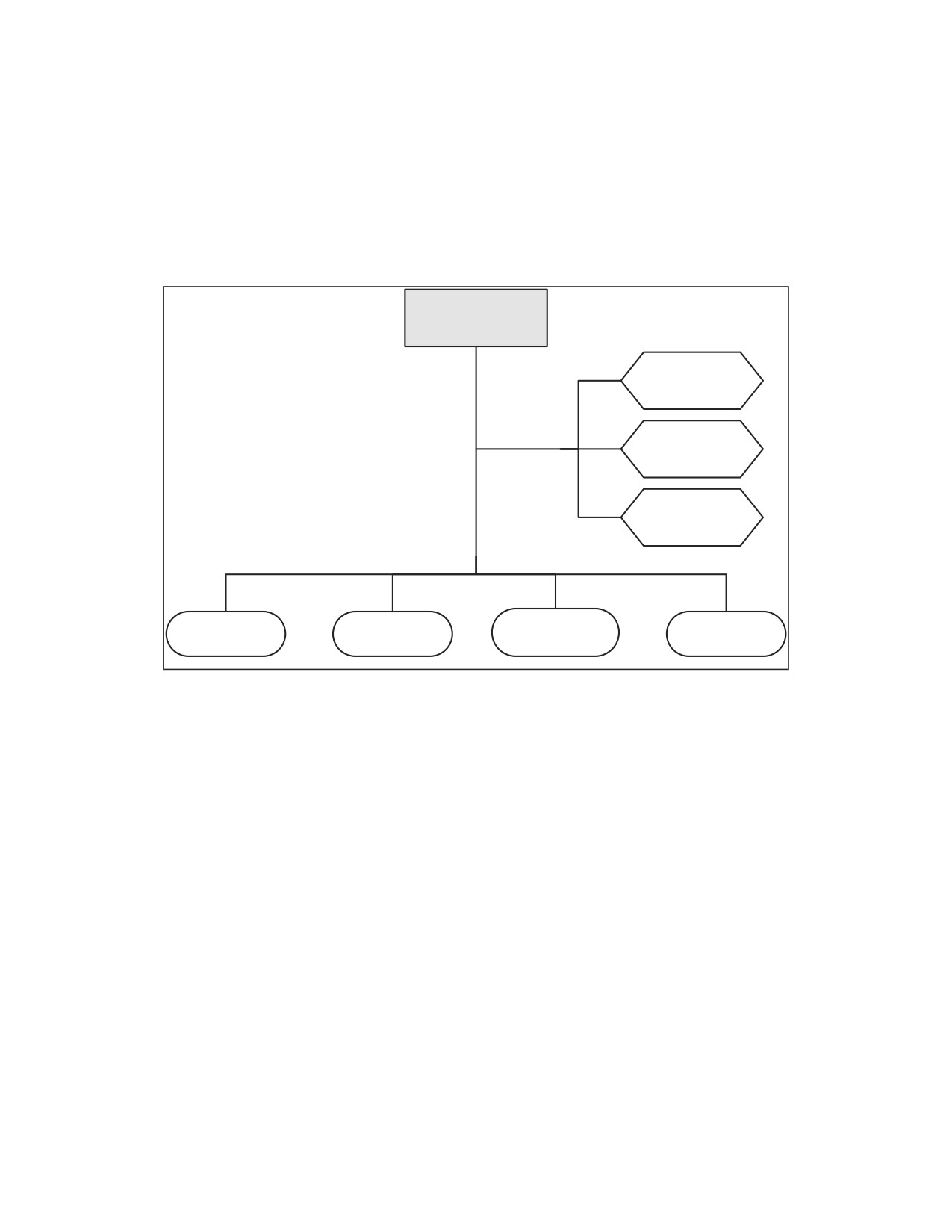
(2)
Coordinating external requirements is also facilitated through SOPs,
checklists, and a common understanding of the ICS framework. Although every CBRN CM
incident will be different, the ICS framework provides a central focal point for coordination
measures. For the military response unit, coordination points will be identified in the
higher headquarters OPORD. If direct coordination is authorized with the ICS structure,
see Figure C-1 for the ICS structure and Table C-3, page C-6, for the key external
coordination points, especially those pertaining to functions within the HAZMAT Branch,
Operations Section.
Command
Safety
Public
Information
Officer
Liaison
Operations
Planning
Logistics
Admin/Finance
Section
Section
Section
Section
Figure C-1. Incident Command System Structure
NOTE: A response unit should not go to each activity within the ICS structure to
receive information, but should use key coordination focal points. Those key
focal points would likely be the ICS Liaison Officer, the Operations Section
HAZMAT Liaison Officer, and/or the Planning Section.
1 April 2008
FM 3-11.21/MCRP 3-37.2C/NTTP 3-11.24/AFTTP(I) 3-2.37
C-5
Table C-3. Incident Command System Structure: Coordination Focal Points
Operations Section
Management, coordination, and control of all on-scene tactical operations.
Operations Section, HAZMAT Branch Operations
Safety—Site safety plan.
Safety—Health and safety issues (including work/rest cycles for entry teams).
Safety—Protection guidance on hazards.
Safety—Health exposure/surveillance guidance.
HAZMAT Liaison—Coordination between HAZMAT branch and other emergency service units, and
agencies.
HAZMAT Information/Research Team—Technical data.
HAZMAT Information/Research Team—Monitoring data, to include analysis of samples.
HAZMAT Information/Research Team—Selection and use of PPE.
HAZMAT Information/Research Team—Projection of the potential environmental impact of the incident.
Entry Group Team—Coordination of entry operations with decontamination and medical branches.
Entry Group Team—Direction of rescue operations, as required, within the hot zone.
Entry Group Team—Offensive and defensive actions to mitigate/control actions at the incident site.
Decontamination Team—Appropriate level of decontamination to be provided.
Decontamination Team—Recommending decontamination procedures, to include area setup, methods,
procedures, staffing, and PPE requirements.
Decontamination Team—Coordinating transfer of decontaminated patients requiring medical treatment.
Decontamination Team—Monitoring the effectiveness of decontamination operations.
Decontamination Team—Control of personnel entering and operating within the decontamination area.
Medical Team—Preentry/postentry medical monitoring.
Medical Team—Medical treatment.
Planning Section
Collection, evaluation, and dissemination of incident information.
Information on the current and forecasted situation, status of resources at the incident site, and provision
technical specialists.
Logistics Section
All incident support needs, including facilities, services, and materials.
Communications requirements.
Administrative/Finance Section
All costs and financial actions of the incident.
2.
Incident Site Assessment
Incident site assessment provides the IC with SA of the conditions and hazards that
exist at an incident site. The SA is derived from the information received from site
characterization. Information is collected during the characterization process to support
decision requirements. The R&S data, including samples, provide input for the
characterization and assessment effort and support the agent identification process. As
CBRN hazards are identified, advise and assist actions become more focused on specific
measures to help mitigate the CBRN hazard.
a.
Characterization.
(1)
Characterization of the incident site starts when the incident is first
recognized. Any information gathered, including historical information, will assist in
characterizing the incident. Characterization of the site is a continual process as the
situation changes while the operation is progressing. Characterization falls into two
categories—general characterization and technical characterization. For each category, the
goal is to determine who is involved or affected by the incident, what has happened, when it
occurred, where exactly the affected area is located, and why the incident occurred, if
known. Characterizing the incident site also includes the following evaluations:
C-6
FM 3-11.21/MCRP 3-37.2C/NTTP 3-11.24/AFTTP(I) 3-2.37
1 April 2008
(a) Physical and CBRN hazards associated with the site.
(b) PPE requirements for personnel entering the warm and hot zones.
(c) Decontamination requirements.
(d) Contamination containment requirements.
(e) Access points and site security.
(2)
See Table C-4 for a sample site characterization checklist that should
enable the response unit to help gain the needed SA. The response unit should not require
all of the information offered in Table C-4. The commander will determine what IRs are
important for the mission.
Table C-4. Site Characterization Checklist (Example)
•
Type of CBRN Material.
-Health impact of CBRN material.
-Flammability issues.
-Reactivity issues.
-Physical properties.
-Isolation/evacuation distances.
-Protective clothing required.
-Hot zone (dimensions, protection required).
-Warm zone (dimensions, protection required).
-When the hot and warm zones were established.
•
Weather Conditions.
-Wind speed.
-Wind direction.
-Temperature.
-Precipitation.
-Humidity.
-Weather forecast.
•
Decontamination.
-Location.
-Activity (emergency decontamination).
-Activity (technical decontamination).
-Activity (MCD).
•
Casualties.
-Number.
-Types.
-Exposure identified.
1 April 2008
FM 3-11.21/MCRP 3-37.2C/NTTP 3-11.24/AFTTP(I) 3-2.37
C-7
Table C-4. Site Characterization Checklist (Example) (Continued)
•
Release.
- Was there a release?
- What was released?
- Duration of release.
- Estimated size.
- Has the release caused contamination? Where?
•
Other Concerns.
- Has there been a fire?
- Is it confined?
- Potential for further damage or contamination.
- Additional facilities at risk.
- Expected duration of the incident.
- Evacuation measures implemented.
- SIP measures implemented.
•
Support Resources.
- Medical.
- EOD.
- Technical escort.
- Laboratory.
- Sample evacuation.
- Other CBRN resources.
•
References.
- Technical reachback capabilities.
- Reference library used.
- Computer database used.
•
Communications.
- Frequencies.
- Means available.
•
Recon Sector Data.
- Checklists.
- Site drawings.
- Photographs.
- Personnel debriefs.
- Contamination overlay.
•
Intelligence Section.
•
Logistics.
- Life support facilities.
- Maintenance and supply support (military).
- Maintenance and supply support (CLS) .
b.
Reconnaissance and Surveillance. Conducting R&S operations assist in
characterization of the site. An incident site survey can identify the location of
contamination and the physical hazards that may hinder mitigation of the hazards; it
provides information to the IC and future entry teams for prioritization of mitigation
efforts. R&S also provides information for possible sampling operations. Reconnaissance is
among the most critical tasks for management of a CBRN incident. Reconnaissance will use
data input from sources such as observable indicators and monitoring and detection
equipment. Surveillance (biological and medical) also serves to provide data to support site
C-8
FM 3-11.21/MCRP 3-37.2C/NTTP 3-11.24/AFTTP(I) 3-2.37
1 April 2008
characterization requirements. The collection of R&S data is accomplished on a continuing
basis. The R&S collection effort is coordinated to preclude wasted effort.
(1)
Reconnaissance. Reconnaissance measures include observation of visible
indicators and the use of monitoring instruments. Detailed information on reconnaissance
TTP can be found in Multiservice Tactics, Techniques, and Procedures for Nuclear,
Biological, and Chemical Reconnaissance.
(a) Initial reconnaissance may use the following observable indicators to
support incident data collection:
•
Occupancy and Location. The incident site may be located at a CBRN
production, storage, or transportation venue.
•
Container/Device Characteristics. The size, shape, and construction
features are an indicator for the potential recognition of the CBRN material involved. The
container (or dissemination device) may be as simply constructed as a liquid plastic
container, a sack (nonbulk packaging), an aerosol container, bulk packaging, or a
pressurized container.
•
Marking and Colors. A container may have specific markings or colors
which provide some indication of the hazard or contents. These indicators may include color
codes, container specification numbers, signal words, or the content’s name and associated
hazards.
•
Placards and Labels. The placards and labels affixed to items such as
freight containers or cargo tanks, serve as an indicator to support identification of the
CBRN hazard.
•
Shipping Papers and Facility Documents. Shipping papers also serve
to provide key information about the nature of the material being shipped.
•
Senses. Senses are certainly not a primary tool; however, data on
agent smell, appearance (color), and signs and symptoms can yield observable indicators.
(b) Monitoring and detection instruments and sampling are important
tools used to—
•
Determine the appropriate levels of PPE.
•
Determine the size and location of hazard control zones.
•
Develop protective action recommendations and corridors.
•
Assess the potential health effects of exposure.
•
Determine when the incident scene is safe and allow former occupants
to return.
(c) Reconnaissance techniques used within the hot zone will be
coordinated with the IC’s Operations Section to ensure that an integrated, synchronized,
tactical-level strategy is used.
(d) Specific CBR reconnaissance TTP are outlined in Multiservice Tactics,
Techniques, and Procedures for Nuclear, Biological, and Chemical Reconnaissance.
Depending on the government and COTS monitoring and detection equipment in use, the
guidance found in the MTTP may require adaptation to specific operational situations.
1 April 2008
FM 3-11.21/MCRP 3-37.2C/NTTP 3-11.24/AFTTP(I) 3-2.37
C-9
(e) The response unit (equipped with monitoring equipment) uses a
monitoring strategy that considers the following operational challenges:
•
Selecting the appropriate monitoring instruments based on the use of
a known CBRN/TIM or unknown materials. Identified monitoring equipment should be
able to detect the anticipated hazard, measure applicable concentrations, and operate
under field conditions at the site.
•
Determining whether a hazard is present. The absence of a positive
response does not imply that contaminants are not present. Contaminant concentrations
affected by wind, temperature, moisture, or interferents could impact monitoring results.
Conversely, monitoring teams should never assume that only one hazard is present.
•
Establishing action levels based on monitoring results.
(f)
Reconnaissance actions may also provide samples to support the
identification process. Military sampling procedures are contained in Multiservice Tactics,
Techniques, and Procedures for Nuclear, Biological, and Chemical Reconnaissance.
However, military response units should expect to use the sampling techniques that are in
place at the incident site. The value of a sample can be lost if consistent sample-collection
protocols are not used.
(2)
Surveillance. Biological and medical surveillance play key roles in support
of incident site assessment. Threat assessments will influence the use of samplers and/or
detection equipment for biological surveillance. The TTP for biological surveillance are
provided in Multiservice Tactics, Techniques, and Procedures for Biological Surveillance.
Medical surveillance is conducted on a continuing basis. Medical surveillance results are
used to monitor the health status of the CM response force. See FM 4-02.7 for information
on how DOD PVNTMED capabilities provide health risk assessment planning, operations,
and advice within the ICS.
c.
Identification.
(1)
Supporting military response units use organic government and COTS
capabilities to identify suspected CBRN contaminants. Various levels of confidence are
associated with identification results, depending upon the source. For example, biodetectors
such as the handheld assay provide presumptive identification results. Supporting field and
fixed-site laboratories provide definitive and confirmatory identification results that impart
a higher level of confidence. The identification process is also used to provide analysis and
identification of samples collected during the reconnaissance process.
(2)
Military response units provide capabilities briefings to its supported
activities/units at the incident site, including limitations.
(3)
Technical reachback capabilities may also be used to support the
identification process.
(4)
Information contributed by the identification process supports incident
command advise and assist functions and decisions.
(5)
Prior planning ensures the availability of the requisite technical specialists
and units for different types of CBRN contamination.
(6)
As required, the response unit may also package CBR samples and
transfer chain of custody to the applicable receiving organization.
C-10
FM 3-11.21/MCRP 3-37.2C/NTTP 3-11.24/AFTTP(I) 3-2.37
1 April 2008
(7)
The identification process directly links to the other military support
functions (characterization, advice, and assistance) and provides the commander with a full
dimensional picture.
d.
Advice. The response unit may provide an augmentee to the incident command
planning and/or operations section to provide advice on the technical aspects of CBRN CM
response. For example, during a response, the augmentee may recommend measures such
as the follow-on capabilities (types of units, equipment, and supplies) needed to support
mitigation measures at an incident site. Postincident, the military support commander can
advise on measures such as the preparation of a transition plan. This plan helps support
the disengagement of military units for redeployment to home stations. Other advisory
support functions could include interagency operations to provide technical expertise and
consultation to the local authority. The augmentee could also recommend decontamination
actions for tailoring of actions to minimize the impact of the event.
e.
Assistance. The supporting response unit provides input to the IC on the unit’s
capabilities to support CM incident operations. This assistance may help emergency
response officials identify capabilities gaps and prepare RFAs. The assistance from the
response units contributes to the IC’s COP at the incident site. The response unit can assist
in determining how unit capabilities can be tailored to meet new mission requirements.
Unanticipated tasks will arise. Military response units provide a versatile and resilient
capability to meet new challenges.
f.
Site Safety. The response unit provides the IC with frequent updates. Tools such
as the site safety plan are updated periodically to ensure the safety of responders and
citizens. Site safety tasks that the military support staff performs include—
(1)
Analyzing the hazards at the incident site and conducting a risk analysis of
those hazards.
(2)
Maintaining and updating the site map or sketches.
(3)
Updating the site control zones (hot, warm, and cold).
(4)
Monitoring decontamination area operations.
(5)
Ensuring that site communications diagrams remain updated.
(6)
Updating information on the location of CPs or command centers.
(7)
Maintaining and updating hazard-monitoring overlays and results.
3. Incident Site Framework
From a tactical perspective, the incident site framework can be grouped into like
tasks. These can include (but are not limited to) the following:
•
Assuming command and establishing control at the incident site.
•
Ensuring the safe approach and positioning of response assets at the incident
site.
•
Establishing staging areas to control arriving resources.
1 April 2008
FM 3-11.21/MCRP 3-37.2C/NTTP 3-11.24/AFTTP(I) 3-2.37
C-11
•
Establishing hazard control zones.
•
Assessing the need for immediate actions (rescue) and implementing protective
actions (evacuate or SIP).
a.
Command.
(1)
A CBRN CM operation requires central command authority. A central
command will—
•
Assign command responsibility to one particular individual through a
standard identification system.
•
Ensure that strong, direct, and visible command is established as soon as
possible.
•
Establish a management framework that clearly outlines the objectives and
functions of the operations.
(2)
As part of the centralized command structure, responsible units are notified
of the command structure and the location for the CP. An experienced commander gives up
the advantage of a stationary CP only when it is absolutely necessary for the IC to
personally provide one-on-one direction to emergency response personnel operating in
forward positions. In each case, the IC must maintain a command presence.
(3)
The IC establishes a staging area in an easily accessible location and
announces the location for incoming personnel and equipment.
b.
Approach and Positioning.
(1)
Safe approach and positioning by the responders is critical to managing the
overall incident. For example, if responders become contaminated, the action plan shifts
from protecting the public to rescuing and decontaminating the responders.
(2)
When possible, responders approach from uphill and upwind. Responders
look for physical indicators of contaminant and avoid wet areas, vapor clouds, and spilled
material. Conditions can change quickly at an incident site, and the IC does not allow
positioning too close until a proper assessment has been completed.
c.
Staging Areas.
(1)
The staging area is the designated location where emergency response
resources (equipment and personnel) are assigned until they are needed.
(2)
Staging is a function of the operations section. The staging officer accounts
for all incoming emergency response units, dispatches resources to the emergency scene at
the request of the IC, and requests additional emergency resources, as necessary.
(3)
The ideal staging area is close enough to the perimeter to significantly
reduce response time, yet far enough away to provide the unit the mobility required to
rapidly respond to an assignment. Staging is effective when the IC anticipates that
additional resources may be required and orders them to respond to a predesignated area
approximately 3 minutes from the scene.
(4)
Staging areas should be clearly identified through the use of signs, color-
coded flags or lights, or other suitable means. The exact location of the staging area will be
based upon prevailing wind conditions and the nature of the emergency.
C-12
FM 3-11.21/MCRP 3-37.2C/NTTP 3-11.24/AFTTP(I) 3-2.37
1 April 2008
(5)
Large CBRN incidents can bring extensive resources to the scene, which
may be needed at different times throughout the emergency. If resources will not be
required for some time, the IC should consider establishing primary and secondary staging
areas.
d.
Isolation and Perimeter.
(1)
Isolating the hazard area and establishing a perimeter are two of the first
tactical considerations of a CBRN CM operation.
(2)
The first objective of the isolation procedure, after rescue, is to immediately
limit the number of civilian and response personnel exposed to the CBRN materials. This
begins by identifying and establishing an isolation perimeter. When confronted with an
incident inside a structure, the best place to begin is at the points of entry such as the main
entrance doors. Once doorways are secured and the entry of unauthorized personnel is
denied, response teams can begin to isolate above and below the hazard. Proper protective
clothing and equipment must be worn.
(3)
The same concept applies for outdoor situations. First, secure the entry
points, and then establish an isolation perimeter around the CBRN hazard. Begin by
controlling intersections, on/off ramps, service roads, or any other access to the scene. At
this point, a CBRN reconnaissance team can begin an assessment.
(4)
The IC should make perimeter isolation assignments as soon as possible.
Security personnel involved in establishing a perimeter must know what the potential
hazards and risks appear to be. If there is any possibility that these officers may be exposed
to the hazard as the isolation area expands, they must be provided with proper safety
equipment and specific directions concerning evacuation, if required.
e.
Protective Actions.
(1)
Initiating protective actions, such as SIP or evacuation, is a tactical
strategy used by the IC to protect the general population from CBRN material. This tactical
strategy is usually implemented after the IC has established an isolation perimeter and
defined the hazard control zones for emergency responders.
(2)
This decision-making process uses a combination of factors to determine
protective actions, including the size and nature of the release, hazards of the materials
involved, weather conditions, type of facility, and the availability of airtight structures.
(3)
See Multiservice Tactics, Techniques, and Procedures for Nuclear,
Biological, and Chemical Protection and Multiservice Tactics, Techniques, and Procedures
for Installation Chemical, Biological, Radiological, and Nuclear Defense for further
guidance on evacuation and SIP.
f.
Hazard Control Zones.
(1)
When the primary isolation perimeter has been secured, the IC can
establish hazard control zones. The IC divides the area into three distinctly different zones,
beginning at the incident scene and working outward toward the perimeter. Hazard control
zones are designated from most to least dangerous as hot, warm, and cold zones.
(2)
The primary purpose of establishing three different hazard control zones
within the isolation perimeter is to provide the highest level of control and personnel
accountability for response personnel working at the incident scene. Defined zones help
1 April 2008
FM 3-11.21/MCRP 3-37.2C/NTTP 3-11.24/AFTTP(I) 3-2.37
C-13
ensure that responders do not inadvertently cross into a contaminated area or place
themselves in locations that could be quickly threatened by explosions or migrating vapor
clouds.
(3)
As a general rule, the field CP and support personnel should be located in
the cold zone, emergency operations personnel supporting the CBRN HAZMAT team should
be positioned in the cold and warm zones, and the entry team should be located in the hot
zone, as necessary.
(4)
Hazard control zones should be physically marked and posted on the IC’s
C2 chart. The hot zone can be indicated with colored banner tape, color-coded traffic cones,
or color-coded light sticks. In outdoor situations, hazard control zones can be designated by
using key geographical reference points such as a tank dike wall, fence line, or street name.
Geographic areas should be communicated verbally by radio or in a face-to-face briefing
between the IC and sector officers. When the hazard is confined to a building, these zones
can be denoted by its location within the structure.
(a) The hot zone is the area in which hazards present could cause adverse
effects on personnel who do not have appropriate levels of personal protection. These
personnel should be immediately evacuated or SIP actions initiated, depending on the
situation. The initial isolation zone, identified in the Emergency Response Guide, is the
initial distance the incident is isolated in order to contain the hazard and protect personnel.
The initial isolation zone size is dependent upon the hazard, weather conditions, and area
affected. The protective action zone, also identified in the Emergency Response Guide, is the
area in which a downwind hazard may be present depending on the weather conditions and
terrain at the incident site. Both the initial isolation zone and the protective action zone are
encompassed in the hot zone, which provides an additional buffer from the associated
hazards prior to entering the warm zone.
(b) The warm zone is the area surrounding the hot zone that is also
referred to as the decontamination zone. Contamination reduction and decontamination
operations are conducted in this zone to limit the spread of contamination to the cold zone.
See Appendix D for information relating to the decontamination zone.
(c) The cold zone, also referred to as the support zone, is an area
surrounding the warm and hot zones where incident support operations are coordinated.
Personnel in this zone are not required to wear PPE, but should have it on hand in case of a
sudden change in weather conditions.
(d) The decontamination corridor is established in the warm zone to
provide decontamination support and control the spread of contamination. Multiple
decontamination corridors may be established at an incident site depending upon the
situation. The decontamination corridor is established in an uncontaminated area just
outside the contaminated hot zone boundary. Once contaminated personnel have been
processed through the decontamination corridor, access to the corridor must be controlled to
preclude entry by unprotected personnel. See Chapter V and Appendix D for further
information.
4.
Health Service Support
Providing HSS during the response phase of a CBRN CM operation encompasses
several areas. The following checklist, Table C-5, and discussion provide information to
assist HSS response operations.
C-14
FM 3-11.21/MCRP 3-37.2C/NTTP 3-11.24/AFTTP(I) 3-2.37
1 April 2008
Table C-5. Health Service Support Checklist for Response Operations
Medical Support
Provide medical support to the populace in a restriction of movement or quarantine status.
Provide EMT, as needed.
Provide stress management, as needed.
Provide PVNTMED support, as required.
Laboratory Services
Provide confirmatory sample identification.
Provide definitive sample identification.
Medical Reachback
Establish reachback linkage with USAMEDCOM, USAMRICD, USAMRIID, AFRRI, CDC, and
USACHPPM for technical assistance, as needed.
Direct the medical specialty team response.
Use MEDSURV data from the area to aid in diagnosis and plan for the population that may be affected by
a CBRN incident.
C2
Provide C2 for medical response units or staffs.
Provide communications guidance for medical response units or staff.
Dispatch medical units or staff to designated response areas.
Coordinate DOD response activities with the IC and local, state, federal, or HN response agencies.
Establish alternate treatment locations, as required.
PVNTMED Services
Conduct health hazard VAs. Update daily or as often as required to maintain current VA status.
Continue MEDSURV activities. Report MEDSURV data, as developed.
Monitor units, staffs, and local populace that are placed in restriction of movement or quarantine status.
Maintain OEH surveillance activities.
Monitor water supplies. Conduct water sampling, as required.
Monitor food service operations. Provide recommendations, as required.
Monitor SIP operations.
Provide recommendations of corrective action on health hazards.
Veterinary Services
Monitor food supplies for food safety standards.
Provide advice on handling food supplies.
Provide guidance on disposition of unsafe food items.
Provide animal care for government-owned animals.
Provide guidance on care and management of domestic animals.
Provide animal care for domestic animals, as capabilities permit.
Provide guidance on domestic food crops and supplies.
Combat Operational Stress (COS) Control/Behavioral Health
Conduct stress management support for response forces.
Provide stress management guidance for local populace.
Conduct stress management support for local populace, within staffing capabilities.
Health Service Logistics
Provide Class VIII support to response units and staffs.
Maintain connectivity with prime vendors to ensure that essential pharmaceuticals are delivered in a
timely manner to maintain the required amounts.
Provide medical equipment repair support.
Assist response units and staffs in the acquisition of replacement medical equipment and supplies, as
required.
First Responders
Ensure that personal protective measures are applied at the incident site.
Provide EMT.
Assist in casualty rescue operations.
Request medical assistance, as required.
a.
Laboratory Services. Medical laboratory services are provided by operational
units such as the USA AML; USN laboratories and FDPMUs; USAF TETs; or local, state,
federal, and HN laboratories. Medical laboratory services within MTFs are able to perform
1 April 2008
FM 3-11.21/MCRP 3-37.2C/NTTP 3-11.24/AFTTP(I) 3-2.37
C-15
limited identification of a suspect agent from patient specimens generated within the
facility; however, they are not staffed or equipped to perform analysis on specimens
collected outside of the facility.
(1)
The level of characterization is determined by the capabilities of the
supporting laboratory. Operational DOD medical laboratory elements are capable of
providing field confirmatory identification of a suspect agent. USAMRIID, the NMRC, and
the CDC will provide definitive identification of a suspect biological agent. Supporting
medical laboratories must coordinate with local, state, and federal laboratories to ensure
that sample data is provided to the appropriate authorities.
(2)
State and HN laboratories may have the capability to provide confirmatory
identification of suspect biological agents. However, coordination must be made with these
laboratories to determine its capabilities.
(3)
The CDC established a Laboratory Response Network (LRN) that can
respond to bioterrorism, chemical terrorism, and other public health emergencies. The LRN
is a national network of local, state, and federal public health; food testing; veterinary
diagnostic; environmental; DOD; and international laboratories that provide the laboratory
infrastructure and capacity to respond to biological and chemical terrorism and other public
health emergencies. The laboratories that make up the LRN are affiliated with federal
agencies, CONUS DOD laboratories, international partners, and state/local public health
departments. See Table C-6 for LRN levels and capabilities.
Table C-6. Laboratory Response Network Sample Identification Levels
Laboratory
Definition
Characterization Level
National
National laboratories, including those operated by the
Definitive characterization
laboratories
CDC, USAMRIID, and the NMRC, are responsible for
specialized strain characterizations, bioforensics,
select agent activity, and handling of highly infectious
biological agents.
Reference
Reference laboratories are responsible for
Confirmatory testing
laboratories
investigation and/or referral of specimens. They are
made up of public health, military, international,
veterinary, agricultural, food, and water testing
laboratories.
Sentinel
Sentinel laboratories play a key role in the early
Recognize, rule-out, and/or
laboratories
detection of biological agents. Sentinel laboratories
refer
provide routine diagnostic services, rule-out, and
referral steps in the identification process. While these
laboratories may not be equipped to perform the same
tests as LRN reference laboratories, they can test
samples.
National laboratories, including those operated by the CDC, USAMRIID, and the
NMRC, are responsible for specialized strain characterizations, bioforensics, select agent
activity, and handling of highly infectious biological agents. They provide definitive
characterization of agents.
Reference laboratories are responsible for investigation and/or referral of specimens.
They are made up of public health, military, international, veterinary, agricultural, food,
and water testing laboratories. They provide confirmatory identification of agents.
C-16
FM 3-11.21/MCRP 3-37.2C/NTTP 3-11.24/AFTTP(I) 3-2.37
1 April 2008
Sentinel laboratories play a key role in the early detection of biological agents.
Sentinel laboratories provide routine diagnostic services, rule-out, and referral steps in the
identification process. While these laboratories may not be equipped to perform the same
tests as LRN reference laboratories, they can test samples. They provide presumptive
identification of agents.
b.
Veterinary Services. As the DOD executive agent for veterinary services, the
United States Army Veterinary Corps provides support to all branches of DOD. Depending
upon the location of the incident, veterinary services may be provided by deployable and
nondeployable veterinary units or personnel. Veterinary services include, but are not
limited to—
(1) Monitoring the security and protection of subsistence in the CBRN environment.
(2) Inspecting subsistence and providing disposition instructions in the CBRN
environment.
(3) Monitoring the decontamination of CBRN-contaminated subsistence, military
working dogs (MWDs), and other government-owned animals.
(4) Treating MWDs and other government-owned animals that become CBRN
casualties.
(5) Providing consultation and guidance on animal care and food safety to non-DOD
responders and local populace on the effects of a CBRN incident.
(6) Providing assistance to privately owned animals in cases of evacuation.
(7) Providing food and water laboratory testing capabilities.
(8) Reporting intelligence data through command channels. See FM 4-02.7, FM 4
02.18, Veterinary Services Tactics, Techniques, and Procedures, and FM 8-42, Combat
Health Support in Stability Operations and Support Operations, for additional information.
c.
Health Service Logistics. The HSL system provides medical supplies and
equipment for response to a CBRN incident in the AO or as part of the homeland security
response to a domestic or foreign terrorist incident. In joint operations, the CCDR may
designate one service as the single integrated medical logistics management (SIMLM)
agency for all services operating within the CBRN CM AO. SIMLM functions encompass
the provision of medical supplies, medical equipment maintenance and repair, blood
management, arrangement for contract support, provision of patient movement items, and
optical fabrication to all Joint forces within the AO including, on an emergency basis, USN
ships for common-use items. By exercising directive authority over the HSL arena for the
accomplishment of assigned missions; the CCDR can centralize control, reduce duplication
of services, and provide the support in a more economical and efficient manner. For
additional information on HSL, refer to Service-specific technical reference manuals. See
appendix D for HSS recovery TTP.
d. Combat and Operational Stress/Behavioral Health. CBRN presents multiple
challenges to military operations when considering COS. The perception of a CBRN threat,
whether real or not, in a high-COS environment places military members at high risk of
suffering combat and operational stress reactions (COSR). Therefore, commanders and
leaders must take actions to prevent and reduce the potential numbers of COSR casualties.
Working in an actual CBRN environment poses both a real and perceived danger to
military members conducting military operations. Pseudosymptoms may be experienced by
1 April 2008
FM 3-11.21/MCRP 3-37.2C/NTTP 3-11.24/AFTTP(I) 3-2.37
C-17
those believing they have been exposed or simply overwhelmed by the operational stressors
resulting from CBRN use. Whether the threat is real or perceived, when working in an
actual CBRN environment, the protective measures alone can be a significant stressor to
military members required to use these protective measures. COS care in a CBRN
environment is the commander’s responsibility. The COS care service delivery is achieved
through the aid of many resources available to the command to include military behavioral
health assets. The key to successful COS care operations in a CBRN environment is the
prevention activities that are conducted prior to actual CBRN events. These may include—
(1) Training in MOPP Level 4 to increase personnel confidence in their ability
to wear the ensemble.
(2) Training in the protective mask often. It takes repeated wear and time to
acclimate and get over the claustrophobic feeling of wearing the mask.
(3) Emphasizing the buddy system as a means of keeping watch for each other.
Peer support is a key element in reducing COSR at the unit level.
e.
PVNTMED Services. PVNTMED units/personnel provide support and
consultation in the areas of DNBI prevention, field sanitation, entomology, sanitary
engineering, and epidemiology to minimize the effects of environmental injuries, enteric
diseases, vector-borne diseases, and other health threats to personnel. PVNTMED services
include, but are not limited to—
(1)
Coordinating CBRN-related specimen collections and environmental
sampling, monitoring, and evaluation activities with treatment, CBRN, laboratory, and
intelligence personnel in the operational environment.
(2)
Monitoring casualties, hospital admissions, and reports of autopsy for signs
of CW and BW agent use.
(3)
Collecting environmental samples and specimens and performing selected
analyses or evaluations to assist in the assessment of the health threat.
(4)
Monitoring field sanitation, water treatment and storage, waste disposal,
and DNBI control practices and providing advice and training as necessary.
(5)
Investigating and evaluating sanitation, water supply, waste disposal
practices, and other environmental health-related problems and recommending corrective
measures as necessary.
(6)
Conducting health surveillance activities in the AO, to include coordinating,
compiling, analyzing, and reporting surveillance data to assist in evaluating conditions
affecting the health of the supported force.
(7)
Conducting epidemiological investigations.
5.
Logistics
Logistics is an integral part of CBRN CM operations and must be considered during
all phases from planning, through response, to recovery.
a.
Response. Logistics must be planned and integrated early in a CBRN CM
response to be effective. The challenge of logistics is the effective integration of DOD
logistics within the services and with sustaining organizations; support agencies; and other
local, state, federal, and HN agencies, as required. No matter the size of the CBRN CM
C-18
FM 3-11.21/MCRP 3-37.2C/NTTP 3-11.24/AFTTP(I) 3-2.37
1 April 2008

operation, some level of logistic support will be required. Table C-7 provides a checklist for
logistic support operations during a CBRN CM response.
Table C-7. Logistic Support Checklist
Supply
Pre-position material at or near the point of planned use or at a designated location to reduce reaction time
and to ensure timely support of a specific force during the initial phases of an operation.
Coordinate and synchronize supply functions with the supported IC logistics section.
Coordinate support (as required) with commercial vendors or a central government contracting focal point to
resupply common COTS items such as bleach or services such as oxygen bottle refills.
Control the allocation of high demand logistics resources such as CBRN float items (detection and
surveillance).
Establish procedures to monitor and track the issue of supplies to civilian personnel. This process supports
maintaining controls for reimbursement of costs following the mission.
Monitor and approve (if required) the stock levels for CBRN supplies.
Approve the return of CBRN COTS components or systems for repair or replacement.
Check on the receipt, storage, and distribution of CBRN supplies. For example, selected items may require
temperature controls and/or require segregated and/or secure storage.
Transportation
Ensure that the required military resources reach the incident site on time with the needed supplies and
equipment.
Coordinate the time phasing of military support resources with the supported IC.
Maintain asset visibility on the shipment of repairable material such as detection and surveillance equipment
for repair.
Transport samples taken from the incident site.
Maintenance
Coordinate emergency and routine actions to maintain personnel and materiel in a safe and serviceable
condition.
Coordinate for the replacement or repair of damaged or contaminated mission-essential equipment.
b.
Responder Support. The logistics process facilitates obtaining, maintaining,
storing, moving, and replenishing resources used in responding to a CBRN incident. For
example, transportation support is required to move assets, both human and materiel, in
response to a CBRN incident. This includes the ability to protect the transportation means
and the operators providing response support. Elements of the sustainment process used to
support an incident may include contracting, negotiated support, military support, and
support from other federal agencies.
(1)
Contracting. Contracting, purchasing, renting, or leasing supplies or
services from nonfederal sources are effective and efficient ways to provide support in a
crisis. Included are all classes of supply or maintenance used in a CBRN response situation.
During the initial stages of an operation, contracting officers are required to procure
supplies and services.
(2)
Negotiated Support. In some cases, civil authorities have enough logistical
resources to support not only themselves but also the military units providing assistance.
For example, civil authorities may provide housing, food, and fuel to military assets. Such
support is negotiated on a case-by-case basis with the civil authorities.
(3)
Military Support. Installations continue habitual relationships with units,
but they may also have to support personnel with whom they have no established support
relationship. These personnel include civil authorities and elements from other Services. If
an installation or other source discussed below cannot provide the required support
directly, planners tailor a support force.
1 April 2008
FM 3-11.21/MCRP 3-37.2C/NTTP 3-11.24/AFTTP(I) 3-2.37
C-19
(4)
Support from Other Federal Agencies. Federal agencies such as GSA
provide support to civil authorities. GSA provides general supplies and services that are
common to more than one department of the federal government. While GSA can provide
an extensive amount of support to DOD, other federal agencies and organizations may
provide assistance depending on the nature, scope, and duration of the operation.
(5)
Other. Special event packages containing items such as decontamination,
detection, and medical equipment may be pre-positioned as part of a preparedness program.
This equipment can be transported by air and ground on a short notice and is available for
use by civilian responders and military support elements.
C-20
FM 3-11.21/MCRP 3-37.2C/NTTP 3-11.24/AFTTP(I) 3-2.37
1 April 2008
Appendix D
RECOVERY TACTICS, TECHNIQUES, AND PROCEDURES
1.
Decontamination Operations
TTP for recovery operations include various supporting decontamination types, to
include, emergency, technical, and MCD. Also, HSS, logistics, and transition TTP occur
during CBRN CM recovery.
a.
The decontamination process begins in the warm zone. A controlled entry point
marks the entrance to the decontamination corridor, and a controlled exit point marks the
exit to the VCL (the transition point between the warm and cold zones). More than one type
of decontamination corridor can be operated in the warm zone based on situational needs.
The main decontamination corridors used in CBRN CM response operations are emergency,
technical, mass casualty, and patient decontamination. Detailed discussion of each
decontamination corridor will be provided further in the appendix.
b.
Chronologically, the emergency decontamination corridor is generally set up by
first responders (local HAZMAT teams) to facilitate immediate response and
decontamination of personnel that were in the hot zone when the incident occurred.
Emergency decontamination is conducted by using copious amounts of water to dilute the
agent in order to evacuate the personnel to medical aid as quickly as possible. Once the
technical and/or MCD lanes have been established, the emergency decontamination
corridor may no longer be required.
c.
Technical decontamination is set up next for responders who have specialized
PPE that requires a higher percentage of decontamination solution prior to removal. The
technical decontamination corridor is usually set up by the emergency responders. The
technical decontamination corridor is located where other evacuees would not confuse it
with emergency decontamination or MCD. Entry into the technical decontamination
corridor is limited to responders only. Evacuees are directed to the emergency
decontamination corridor or MCD corridor.
d.
The MCD corridor may be the last corridor set up and is normally set up by
emergency responders tasked to provide MCD. This is a large-scale decontamination
corridor designed to process large numbers of personnel in a short amount of time. In some
situations, an MCD corridor may not be required to conduct CBRN CM operations. For
example, an incident that involved only first and emergency responders would not
necessarily require an MCD corridor. A patient decontamination corridor is similar to the
MCD corridor, except that it would normally be established adjacent to an MTF.
2.
Emergency Decontamination
Emergency decontamination removes contamination from personnel quickly in order
to save lives, minimize casualties, and limit the spread of contamination. It facilitates rapid
medical attention without transferring the contamination to other personnel or equipment.
The procedures outlined below apply when the type of hazard is unknown. Adjustments to
the steps may be made if and when the hazard is known (for example, the material reacts
in a caustic manner when it comes in contact with water, rapidity of hazard effect on the
1 April 2008
FM 3-11.21/MCRP 3-37.2C/NTTP 3-11.24/AFTTP(I) 3-2.37
D-1
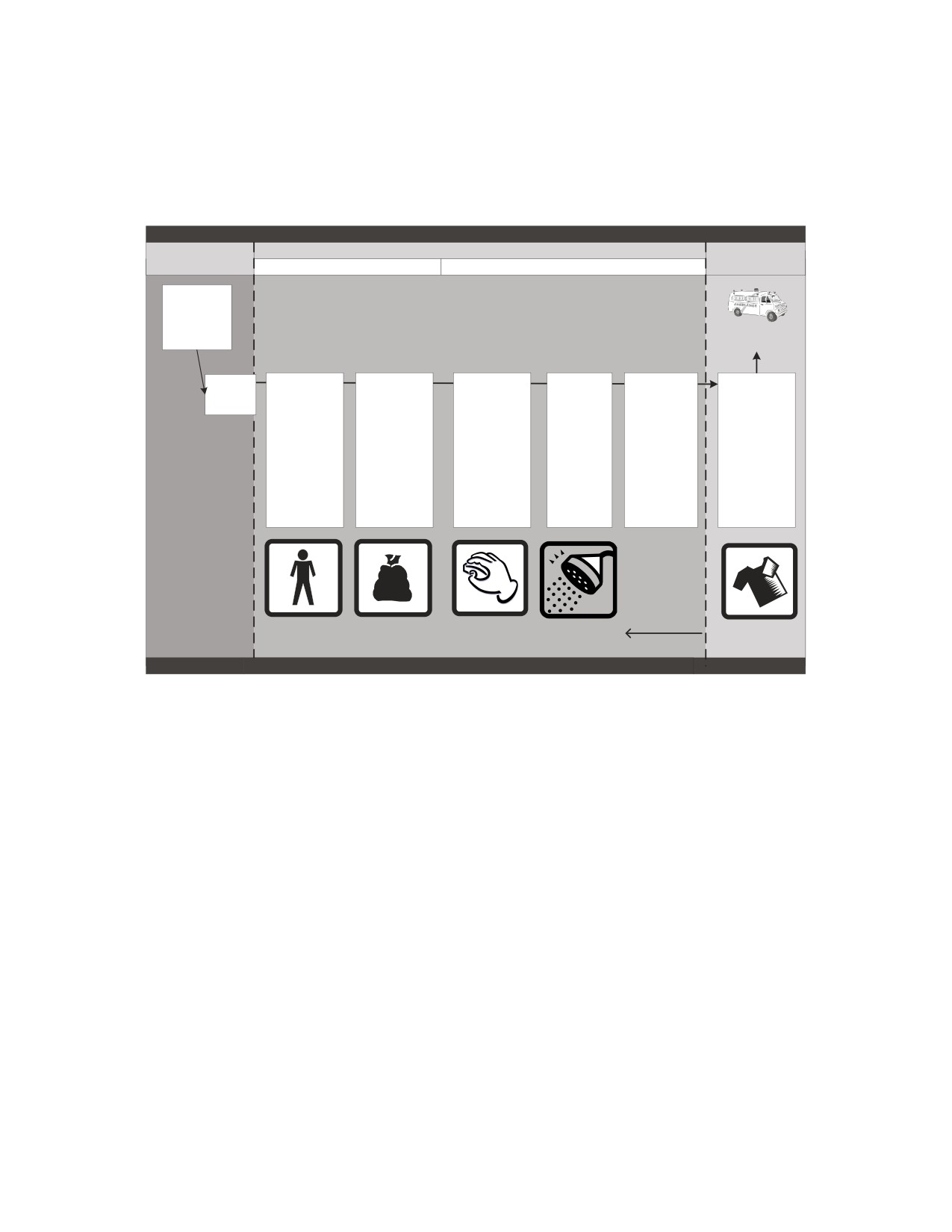
skin dictates contaminated clothing be removed prior to the people being sprayed down, or
biological and radiological decontamination requirements differ from chemical and TIM
situations). Additional modifications regarding the placement of the decontamination
corridor may be needed for incidents that occur during cold weather operations. Figure D-1
provides an example of emergency decontamination operations.
Self/Emergency Decontamination Process
Decontamination area
Contaminated area
Treatment area
Self decontamination procedures
Emergency decontamination procedures
Direct mobile
victims away
from the
hazard.
CCP
1
2
3
4
5
6
Enter the
Remove outer
Bag or pile
Blot, scrape,
Check victims
Dry and re-dress.
shower area
layer of clothing
clothing and
absorb, or rinse
visually and
(high volume,
and personal
personal items.
any liquid agent
through
low pressure)
items.
from skin.
interviews.
Wash hands
(wet clothing
Conduct
and flush eyes.
before removal if
additional
biological or
decontamination
Thoroughly
radiological
as necessary.
wash body.
contamination is
suspected)
Wind direction
Hot Zone
Warm Zone
Cold Zone
Figure D-1. Emergency Decontamination
a.
Casualty Collection Point (CCP). A CCP is established in the warm zone adjacent
to the hot zone. All casualties are moved to the collection point. Medical personnel conduct
initial triage at this location. Casualties that require EMT are directed or moved to the
contaminated emergency medical treatment station for lifesaving procedures. All other
casualties are directed to the decontamination lane.
b.
Decontaminants. Decontaminants used are safe for use on skin and wounds.
Multiservice Tactics, Techniques, and Procedures for Chemical, Biological, Radiological,
and Nuclear Decontamination provides information on individual emergency
decontamination procedures.
c.
Emergency Decontamination Supported by Firefighting Equipment.
(1)
Resources. The employment of resources that can dispense large amounts of
water significantly increases the number of personnel that can be decontaminated. Very
large volumes of water are needed for these operations, and control of runoff will be limited.
However, the level of contamination will be reduced through dilution achieved during the
process.
(2)
Decontamination Corridor. A decontamination corridor is established using
means such as fire hydrants, fire hoses, and nozzles; pumper trucks; or fire trucks with
ladder pipes. In each case, the nozzles should be adjusted to produce a low-pressure fan
D-2
FM 3-11.21/MCRP 3-37.2C/NTTP 3-11.24/AFTTP(I) 3-2.37
1 April 2008
spray. When possible, two or more systems should be used to increase the volume of water
and spray area to increase the casualty flow rate through the lane. Time permitting and
equipment available, a screen should be positioned to create a lane for males and a lane for
females and small children. The screen should be of sufficient height and length to provide
privacy between the two lanes. Privacy covers may also be positioned to separate the
shower areas from the undress and re-dress areas.
(a) Fire Hydrant, Fire Hoses, and Nozzles. When setting up fire hydrants,
fire hoses, and nozzles, platform trucks are needed to elevate the hoses and nozzle
assemblies above ground level. Adjust the nozzle to a low pressure (50-80 pounds per
square inch) spray pattern to allow the casualties to move under the water spray. The hose
should be positioned in a manner that will not create a tripping hazard for casualties.
(b) Pumper Trucks. When setting up pumper trucks, the pumper cannon
and hoses can be used to establish the water spray areas.
(c)
Ladder Pipe Decontamination. When setting up trucks with ladder
pipes, the ladder pipes are elevated above ground level to produce a low-pressure spray
pattern. The nozzle pressure should be between 50 and 80 pounds per square inch (normal
household shower pressure).
3.
Technical Decontamination
Technical decontamination is conducted during a CBRN CM response, where trained
responders conduct operations to mitigate the hazards. The incident may be accident- or
terrorist-related, and it can involve CBRN or TIM hazards, or a combination. Responders
may be required to use supplied air respirators, such as SCBA or rebreathers, and fully
encapsulated, splash-resistant protective suits.
a.
The planning and execution of technical decontamination operations requires
incorporation of different strategies than those used for military-specific operations.
Consider the following actions when planning for technical decontamination:
(1)
Direct the decontamination process toward confinement of the contaminant
within the hot zone and the decontamination corridor. Consider the potential effects of the
decontamination process on responder personnel when developing the decontamination
plan, and establish countermeasures (such as adequate work/rest cycles).
(2)
Determine proper decontamination methods and procedures prior to an
incident as part of the overall preincident planning, hazard assessment, and risk evaluation
process. Do not permit entry into the hot zone until the appropriate decontamination
methods and procedures have been established.
b.
Technical decontamination requires a step-by-step process to reduce
contamination on responder personnel to a safe level and to prevent the transfer of
contamination outside the containment area. The procedures used are based on field
analyses of the hazards and risks involved. Field analyses consist of checking detection
results and using technical reference sources to determine the general hazards, such as
flammability and toxicity, and then evaluating the relative risks associated with the
contaminants (for example, vapor versus liquid, blister versus nerve agents, and
radiological versus CB hazards).
c.
Technical decontamination can be accomplished in several ways, depending on
the hazard. Typically, it consists of a wet decontamination in which the individual is
1 April 2008
FM 3-11.21/MCRP 3-37.2C/NTTP 3-11.24/AFTTP(I) 3-2.37
D-3