MULTISERVICE TACTICS, TECHNIQUES, AND PROCEDURES FOR CHEMICAL, BIOLOGICAL, RADIOLOGICAL, AND NUCLEAR CONSEQUENCE MANAGEMENT OPERATIONS (APRIL 2008) - page 5

flushed with water to remove or dilute the contaminants. A dry decontamination, such as
brushing and scraping, is an appropriate alternative for other contamination removal
(physical radioactive-contaminated particles). Other considerations, such as the hazard’s
reactivity with water and its solubility, are factors in determining the appropriate
decontamination method.
d.
Technical decontamination may consist of one or more stations, depending on the
hazard. The decontamination team must be available to supervise the operation and assist
in the processing of personnel. The team is trained to help personnel decontaminate their
outer clothing from top to bottom (always moving the contaminants toward the ground).
Low-pressure water should be used and overspraying or splashing should be kept to a
minimum to control the spread of contaminants. The decontamination site should be
established in an area where contaminated runoff can be controlled. Figure D-2 shows an
example of a technical decontamination operation.
NOTE: The number of stations required for technical decontamination will vary
depending on factors such as the type of agent and the weather.
Technical Decontamination Process
Contaminated area
Decontamination area
Treatment area
Direction of
team return
travel
Technical emergency decontamination
Medical
evaluation
7
Technical decontamination
PPE
Monitoring
Protective
Clothing/respirator
Shower and
decontamination
point
clothing removal
removal*
re-dress*
Equipment
Drop
2
3
4
5
6
1
SCBA
exchange
*Personal clothing removal, shower, and re-dress may be unnecessary if
contamination did not penetrate the protective clothing.
Direction of entry team travel
Wind direction
Hot Zone
Warm Zone
Cold Zone
Figure D-2. Technical Decontamination
e.
The entry point is clearly designated and identifies the beginning of the
decontamination corridor. Responders know the location of the technical decontamination
corridor prior to entering the hot zone. The purpose of the entry point is to ensure that all
personnel leaving the hot zone process through the decontamination corridor, thereby
controlling the spread of contamination. At the entry point, two separate lanes are set up—
the primary decontamination lane and an emergency decontamination lane. The
decontamination corridor has two main contamination control areas—the liquid control
area and the vapor control area.
D-4
FM 3-11.21/MCRP 3-37.2C/NTTP 3-11.24/AFTTP(I) 3-2.37
1 April 2008
f.
The primary decontamination lane requires only those stations necessary to
accomplish effective decontamination of response personnel. The basic goal is to eliminate
the contaminant in a safe and appropriate manner. Each station should be manned by
properly equipped individuals trained to direct and assist personnel in the decontamination
process. An emergency decontamination lane is used when a responder requires immediate
evacuation or medical attention. When the emergency lane requires activation, normal
decontamination operations stop until the situation is mitigated. Normal operations resume
once the victim has been safely processed through the emergency lane of the technical
decontamination corridor.
(1)
Equipment Drop. The equipment drop may consist of a tarp or table for the
placement of all equipment used in the hot zone. The equipment drop serves a dual
purpose. It ensures that all potentially contaminated equipment stays within the
contaminated area, and it allows the equipment to be operationally decontaminated and
reused by those reentering the hot zone. This minimizes the amount of equipment brought
into the hot zone that requires later decontamination or disposal.
(2)
PPE Decontamination. Removing gross contamination from boots and
gloves (the primary places generally contaminated) prior to starting the decontamination
process helps control the spread of contamination. Scrubbing boots and gloves using long-
handled brushes with buckets or step pans filled with decontaminant is one method used to
accomplish gross removal of contaminants.
(3)
Monitoring Point. Personnel should be monitored for any residual
contamination once the decontaminant application and rinsing are complete. Monitors such
as individual chemical agent monitors, radiac meters, and commercial instruments can be
used to perform this function if the hazard is known. When working with an unknown
substance or without monitoring devices, visual observation of obvious signs and symptoms
of exposure provide an alternative monitoring method. If the contamination is still present
following decontamination (visually observed or detected by monitoring devices), affected
personnel should be returned to the beginning of the decontamination lane to repeat the
procedure, with specific attention paid to the areas observed or noted by detection devices.
(4)
Protective Clothing Removal. Personnel should be assisted in removing
their protective suits prior to crossing the liquid control line when monitoring indicates
contamination is not present. During removal of the protective suit in Level B, an attendant
is required to hold the SCBA while the protective suit is removed. The attendant will
maintain control of the respirator until it is removed at Station 5. Decontamination team
members ensure that they touch only the outside of the suit. Personnel inside the suit
assist with the removal, touching only the inside of the suit. Decontamination personnel
then contain the suit in a thick plastic bag for further disposition after all personnel are
decontaminated.
NOTE: Personal clothing removal, shower and re-dress may be unnecessary if
contamination did not penetrate the protective clothing. Monitoring equipment
should be used to verify if any contamination has penetrated the protective suit.
(5)
Clothing/Respirator Removal. Personnel remove the clothing worn under
their protective suit and place it in a thick plastic bag for further disposition by the
decontamination team. The respirator is removed from their back, if necessary, and the
attendant takes control of the backpack. Prior to removing their face piece, personnel close
their eyes and hold their breath. They will remove and release their face piece as they cross
1 April 2008
FM 3-11.21/MCRP 3-37.2C/NTTP 3-11.24/AFTTP(I) 3-2.37
D-5
the contamination control line, entering the cold zone. The attendant will place the
respirator in a thick plastic bag for further disposition.
(6)
Shower and Re-dress. When required, personnel will shower and re-dress
prior to receiving postentry medical evaluation.
(7)
Medical Evaluation. After responders have entered the hot zone, they
receive a medical evaluation to assist in identifying any health issues that may have
occurred during entry operations.
g.
The decontamination and monitoring process is unique to each accident/incident.
Decontamination techniques may be physical and/or chemical. The decontamination
methods selected should be tailored to the hazard, on-scene responders, location, and
equipment available. No matter which method is used, the outcome should be the
elimination or reduction of contamination to a safe level while confining the hazard to the
hot zone and decontamination corridor.
4.
Mass Casualty Decontamination
a.
Site Setup.
(1)
Military personnel responsible for MCD may provide support to existing
civilian-led ambulatory and nonambulatory decontamination lanes.
(2)
Alternately, military responders conducting MCD may be responsible for
establishing the MCD site.
(3)
In either case, military unit C2 remains in place.
(4)
The military leadership coordinates with the appropriate official (as part of
a site survey) to select a site that is upwind and uphill from the contamination sources.
(5)
The site should have an ample water supply, good drainage, and vehicle
access.
(6)
Planning determines where the stations are established to support
ambulatory and litter decontamination.
(7)
The decontamination team leadership lays out the site and—
•
Reviews the outline for hot, warm, and cold zones.
•
Establishes entry and exit points.
•
Establishes liquid and VCLs.
•
Identifies runoff control procedures.
•
Determines the need for protection, when required.
b.
Operations. The team establishes an MCD site. Resources are assigned to
complete each task (by station) for casualty decontamination operations. A C2 element
provides supervision at the MCD site. The C2 element maintains communications with
operating personnel in the cold, warm, and hot zones. The C2 element prioritizes and
provides additional resources (when needed). The procedures outlined below apply when
the type of hazard is unknown. Adjustments to the steps may be made if and when the
hazard is known (for example, the material reacts in a caustic manner when it comes in
contact with water, rapidity of hazard effect on the skin dictates contaminated clothing be
D-6
FM 3-11.21/MCRP 3-37.2C/NTTP 3-11.24/AFTTP(I) 3-2.37
1 April 2008
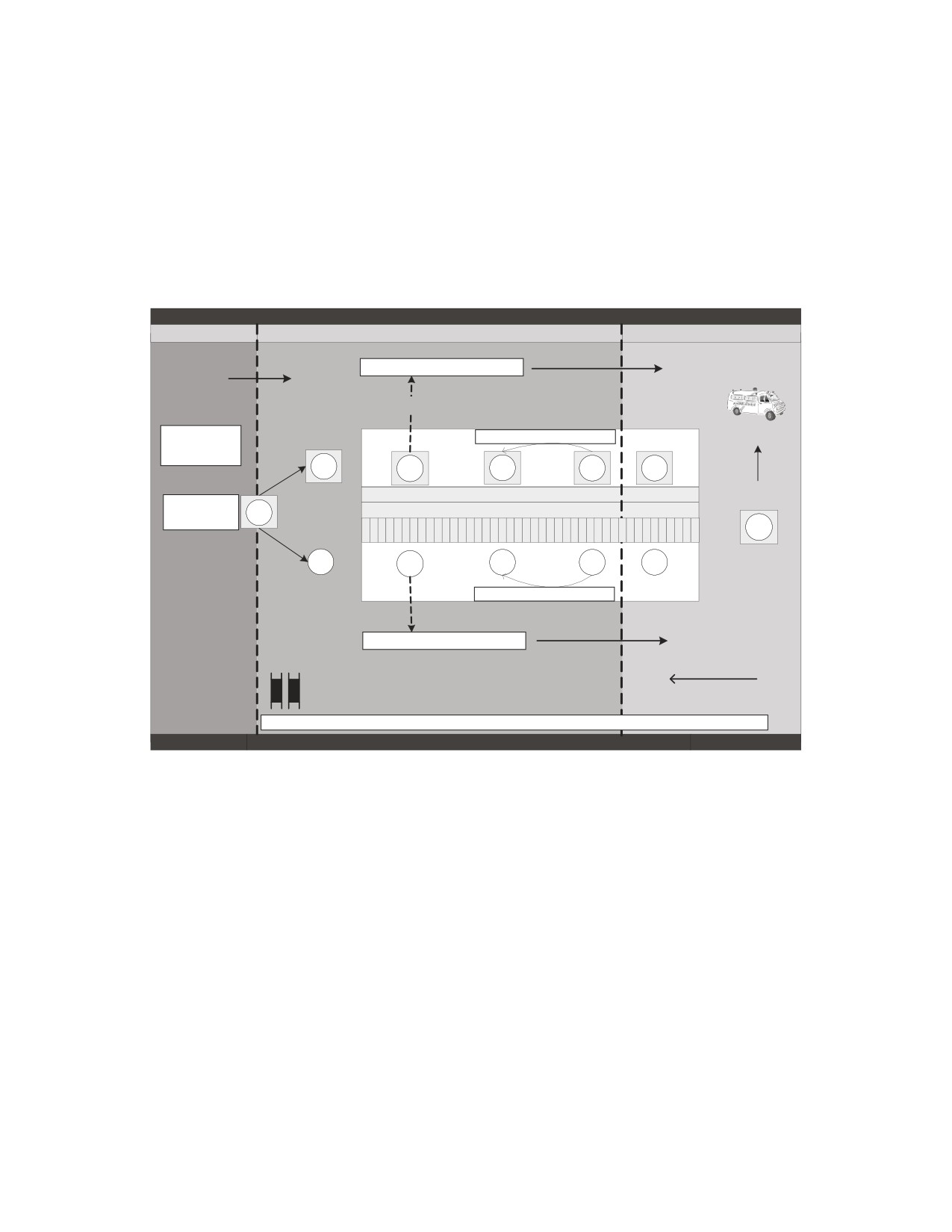
removed prior to the people being sprayed down, or biological and radiological
decontamination requirements differ from chemical and TIM situations). Additional
modifications regarding the placement of the decontamination corridor may be needed for
incidents that occur during cold weather operations. Casualty decontamination operations
are described in the following paragraphs. See FM 4-02.7; FM 8-500, Hazardous Materials
Injuries: A Manual for Pre-Hospital Care; the Emergency Response Guide; and Multiservice
Tactics, Techniques, and Procedures for Chemical, Biological, Radiological, and Nuclear
Decontamination for additional information on decontamination procedures. Figure D-3
illustrates a representative MCD station layout.
MCD Process
Contaminated area
Decontamination area
Treatment area
Bagged personal items
Police
Direction of
travel
Clothing /personal
Contaminant
Monitoring
Re-dress
Self/emergency
items removal
removal /shower
point
area
decontamination
Patient
(open wound/burn
If decontamination is incomplete
Contaminated
disposition point
And wet down)*
waste
2
3
4
5
6
Medical
Ambulatory decontamination
evaluation
CCP/log-in
1
Nonambulatory decontamination
7
Clean
2
3
4
5
6
treatment
Emergency
area
decontamination
If decontamination is incomplete
(open wound/
burn and wet
down)*
Emergency
Bagged personal items
Police
treatment
(if needed )
Wind direction
*Wet down hair and clothing with water mist prior to disrobing in biological and radiological incidents .
Hot Zone
Warm Zone
Cold Zone
Figure D-3. Mass Casualty Decontamination
NOTE: The number of stations and personnel required for MCD will vary
depending on factors such as the number and type of injuries, agent used, and
weather. Not all stations described in this section may be required.
(1)
Casualty Collection Point. Tasks at this point include casualty collection,
log-in, and preparation for triage. Crowd control may also be required to handle potentially
hostile victims. At this station, casualties are received and quickly assessed and prioritized
by medical personnel, and ambulatory casualties are segregated from nonambulatory
casualties. Ambulatory casualties are directed to the triage station, and nonambulatory
casualties are transported to the triage station by litter bearers. A minimum of two
augmentees should be used at this station. Other tasks accomplished at this point are listed
below:
NOTE: When moving casualties, ensure that an appropriate number of personnel are used
to prevent further injuries.
1 April 2008
FM 3-11.21/MCRP 3-37.2C/NTTP 3-11.24/AFTTP(I) 3-2.37
D-7
(a) Triage. Tasks at this station require performance by medical personnel.
Casualties are triaged and assigned treatment priorities by medical personnel assigned to
the CCP.
(b) Emergency Medical Treatment Area (such as hemorrhage control). At
least one medical treatment provider is required at this station.
(c) Casualty Log-In (Warm Zone). An MCD attendant logs in casualties
and identifies valuables and items that generally cannot be decontaminated. The attendant
assigns each casualty a number, prepares a record for each casualty processed, and
identifies the casualty’s personal property and entry medical condition, as determined by
the triage officer. Official documentation of the care provided is maintained. One person is
required for operations at this station.
(d) Contaminated Waste Holding Area. The hazardous waste site is
established during setup and maintained by logistic personnel for receipt of contaminated
waste. The station attendants deploy contaminated waste receptacles in the
decontamination corridor, prepare and clearly mark the waste collection point, protect the
ground with tarps, secure contaminated material in heavy plastic bags, and control
contaminated drainage from decontaminated clothing.
(e) Personal Property Receipt. The log-in station properly receives and
accounts for personal property and determines its decontamination priority. The personal
property and equipment decontamination sites are established adjacent to the casualty
decontamination lanes. Decontamination of these items may occur as items are received or
they may be held for later processing. One station attendant supports this operation.
Personal property is retrieved from individual bags and neutralizing solution is applied to
the items. The station attendant allows ample time for the decontamination solution to
function and then forwards the items for a contamination check. The station operator
checks for completeness of decontamination prior to transfer back to the casualty.
NOTE: Wet down hair and clothing with water mist prior to undressing during
biological and radiological incidents.
(2)
MCD Operations. These warm zone decontamination operations are
subdivided into a series of steps that generally involve undressing and showering and
should remove most of the contamination from casualties.
(a) Emergency Decontamination. Emergency decontamination procedures
are conducted by medical personnel (for open wounds, burns, and wet-down) prior to
casualties processing through the MCD corridor.
(b) Ambulatory Decontamination.
•
Clothing and Personal Items Removal. The operator receives
casualties and directs them to remove their clothing. Some casualties may require
assistance in clothing removal. The operator should have cutting devices (scissors or a
safety knife) to aid in clothing removal. Pressure bandages and splints are not removed—
clothing is cut around them and any material under the bandage or splint is left in place.
One person should be used at the clothing removal station.
•
Contaminant Removal and Shower. The operator receives casualties
and leads them to the shower. The operator instructs the casualty on shower procedures to
reassure the casualty. The casualty is placed in the center of the shower with hands and
D-8
FM 3-11.21/MCRP 3-37.2C/NTTP 3-11.24/AFTTP(I) 3-2.37
1 April 2008
arms raised to allow water flow to all parts of the body, medical condition permitting. If
sponges are available, have the casualty sponge the skin from head to toe. If the casualty
cannot raise his arms and hands, the attendant should make efforts to ensure that the
water reaches areas covered by the arms. The attendant turns the water on and directs
upper nozzles to the head, directs side sprayers to the sheltered portions of the body, and
ensures that the bandage/splint is thoroughly soaked. The attendant stops the water flow
when the casualty is thoroughly washed and directs the casualty to the next station. One
person is required at each wash station.
•
Monitoring Point. Casualties are monitored for completeness of
decontamination, and their status is recorded on a decontamination card. One station
attendant is required at this station.
(c)
Nonambulatory Decontamination.
•
Clothing and Personal Items Removal. The operator receives a litter
casualty. Using a cutting device, the station operator cuts away the casualty's clothing. One
person per patient is required at each litter stand setup. The operator requests assistance;
lifts the casualty, using a four-person lift technique; and transfers the casualty to a clean
litter. A litter transfer team carries the litter casualty to the clothing removal station.
Casualties are placed, head first, on the roller system and rolled under the shower.
NOTE: Medical personnel monitor casualties at all stages of the decontamination
process—looking for indications of hypothermia, managing bandages and splints,
and providing EMT, as needed.
•
Contaminant Removal and Shower. The supporting wash team
showers the casualty with water from shower nozzles and side sprayers. The casualty is
rolled slowly through the shower allowing ample time for complete gross contamination
removal. Two station attendants should support this operation.
•
Monitoring Point. At this station, casualties are monitored for
completeness of decontamination, and their status is recorded on a decontamination card.
Three station attendants should be used at this station.
(3)
MCD Re-dress Area (Cold Zone). The casualty is provided a covering, such
as a medical gown, sheet, poncho, or disposable wrap, prior to proceeding to the medical
evaluation and clean treatment area.
(4)
MCD Medical Evaluation (Cold Zone). Tasks accomplished include the
following:
(a) Conduct Postdecontamination Triage. At this station, casualties are
thoroughly assessed by a medical augmentee without the limitations imposed by operating
in PPE.
(b) Provide Postdecontamination Emergency Medical Treatment.
Operations at this station allow for medical interventions without PPE limitations.
(c)
Transport Casualties. Casualties are consolidated at this point and
medically evacuated or transported to a supporting MTF. When medical staff is available,
casualties are monitored during the transportation process to ensure that their health
status remains stable.
1 April 2008
FM 3-11.21/MCRP 3-37.2C/NTTP 3-11.24/AFTTP(I) 3-2.37
D-9
5.
Health Service Support
HSS recovery operations include, but are not limited to, the following areas shown in
Table D-1.
Table D-1. HSS Checklist for Recovery Operations
Triage
Assume the appropriate PPE/IPE level.
Direct casualties to the contaminated EMT point or to the casualty decontamination lanes, as their triage
condition dictates.
Provide triage support in the cold zone casualty staging area.
Sort casualties into the appropriate triage category as their medical status dictates.
Provide triage support at the CCP.
EMT
Assume appropriate PPE/IPE level.
Provide EMT procedures in the CCP in the warm zone.
Provide EMT procedures at the cold zone casualty staging area, as required.
Patient Decontamination
Provide EMT and medical supervision of patient decontamination procedures.
Manage/decontaminate splints and pressure bandages in the patient decontamination area. See
FM 4-02.7 for details.
Evacuation
Provide casualty evacuation to the supporting MTF, within unit evacuation capabilities.
Provide en route EMT augmentation to local casualty evacuation responders.
Coordinate patient movement.
Define ground evacuation routes.
Determine patient movement staging areas and medical vehicle decontamination plans.
Coordinate with the FCC DOD coordinator for an appropriate evacuation site.
Hospitalization
Establish a patient decontamination area and patient receiving area adjacent to the hospital.
Receive casualties from the incident site.
Provide triage in the patient receiving area. Evaluate patients for decontamination status.
Provide EMT at the casualty receiving area, as required.
Conduct patient decontamination procedures, as required.
Admit patients into the emergency service area. Provide EMT, as required.
Admit patients into the inpatient treatment areas, as their condition dictates.
Discharge patients not requiring inpatient care.
Coordinate with the FCC for patient hospitalization.
Medical Augmentation
Provide medical augmentation to receiving MTFs.
Provide augmentation at the MTF patient receiving and decontamination areas.
Provide augmentation in the MTF emergency service area.
Provide augmentation in the inpatient treatment areas.
Coordinate with nonmedical personnel for augmentees to assist with tasks such as litter bearing.
6.
Logistics
Logistics serves to revitalize units that have expended valuable resources during the
conduct of CBRN CM. During recovery, units use logistical operations to prepare for future
missions.
a.
Logistic recovery operations following a CBRN CM operation should recover,
restore, reoutfit, and sustain the unit in preparation for follow-on missions. Common
recovery functions include the following:
(1)
PPE maintenance and resupply.
(2)
Equipment decontamination, maintenance, calibration, and expendables
resupply.
D-10
FM 3-11.21/MCRP 3-37.2C/NTTP 3-11.24/AFTTP(I) 3-2.37
1 April 2008

(3)
Postincident medical screening.
b.
The checklist at Table D-2 is provided to assist in logistic recovery operations
after a CBRN CM operation. This checklist should be used as a supplement to unit SOPs.
Table D-2. Personal Protective Equipment Checklist
PPE Item
Recovery Procedures
Level A
Uncontaminated suits should be turned inside out, placed on hanger assemblies,
Protective Suits
and then suspended on racks or heavy duty hangars for sanitizing. One ounce of
disinfecting solution and 24 ounces of mild liquid detergent mixed in a gallon of
water is applied to the entire interior of the suit and allowed a contact time of 10
minutes. The suit is thoroughly rinsed with water and allowed to air-dry. After
drying, it is returned to its original configuration (right side out). In the event the
exterior of the suit requires cleaning it is washed as necessary with a sponge and
allowed to air-dry. Each suit is thoroughly inspected for serviceability and
damage. The individual performing the inspection records the results of this
inspection on a Suit Inspection Log. The suit is then folded properly and placed in
its assigned storage bag. Each bag is brushed with a stiff bristle brush to remove
any dirt that may have accumulated.
Protective Boots
The boots are deposited in a warm soapy water solution, allowed to soak for 10
minutes, and then rinsed thoroughly in warm water. A soft bristle brush may be
required to remove any soil buildup on the boots. Allow the boots to air-dry
upside down until thoroughly dry.
Protective Gloves
The gloves are deposited in a warm soapy water solution, allowed to soak for 10
minutes, and then rinsed thoroughly in warm water. Allow the gloves to air-dry
until the inside and outside are thoroughly dry.
SCBA
All SCBA models consist of a cylinder for storing compressed breathing air, a
harness and back frame assembly to support the equipment on the body of the
wearer, and a face piece assembly. All these items are generally contained in a
hardened plastic case that is cleaned by wiping with a clean, wet cloth and
allowed to air-dry. All other components are addressed separately in the following
paragraphs.
SCBA Air Cylinder
Before use, cylinders are visually inspected for dents or gouges in the metal or in
composite wrapping. Cylinders which show damage such as gouges or dents are
removed from service and emptied of compressed air. The cylinders are wiped
free of any dirt that may have accumulated during use. The hydrostatic test date
is checked for validity.
SCBA Harness and
Each harness and back frame assembly is checked visually for worn and/or
Back Frame
frayed straps, aging rubber parts, workable buckles, and any damages that the
Assembly
harness and back frame assembly and/or components may have. Any dirt that
may have accumulated on the assembly/component is wiped free by hand.
Damaged harness and backpack frame assemblies should be turned in for
repair.
SCBA Face Piece
Most SCBA face pieces require that you remove the breathing regulator from the
face piece. Face pieces are cleaned by immersing them in a solution of warm
soapy water followed by rinsing in clear water. Allow a 10 minute contact time
before rinsing. Rinse with drinking water using a spray bottle or gently running
water. Prepare a disinfectant solution to kill germs. Two tablespoons of bleach
per gallon of water is a suitable disinfectant. Other commercially available
disinfectants can be used if the manufacturer recommends them. Disinfectant
wipes (70% isopropyl alcohol) can also be used as a disinfectant. Shake excess
water from the face piece, and if time permits, hang it until dry; if time does not
permit, then dry with a clean, lint-free cloth or gently blow dry with clean, dry
breathing air of 30 pounds per square inch or less pressure. After drying, the face
piece and breathing regulator are reconnected. Damaged face pieces are sent to
an authorized maintenance facility for repair.
1 April 2008
FM 3-11.21/MCRP 3-37.2C/NTTP 3-11.24/AFTTP(I) 3-2.37
D-11
Table D-2. PPE Checklist (Continued)
PPE Item
Recovery Procedures
Air Purifying
Remove any filters or cartridges. Filters and cartridges should not be washed.
Respirators
Discard any filters that are clogged or cartridges that are spent. Disassemble
valves and other reusable face piece parts. Wash the face piece and associated
parts with a mild detergent and warm water. Do not use organic solvents. A soft
bristle brush may be used to remove any heavy debris. Rinse the respirator face
piece and parts in clean, warm water. Prepare a disinfectant solution to kill
germs. Two tablespoons of bleach per gallon of water is a suitable disinfectant.
Other commercially available disinfectants can be used if the manufacturer
recommends them. Disinfectant wipes (70% isopropyl alcohol) can also be used
as a disinfectant. Immerse the face piece and parts in the disinfectant solution
for 2 minutes; then rinse with clean, warm water and air-dry overnight. After
drying, reassemble the respirator. When not in use, the respirator and cartridges
are kept in a sealed container and stored in a clean, dry, temperate,
noncontaminated environment. It is especially important to keep gas and vapor
cartridges in a sealed container so they do not passively absorb gases and
vapors from the storage area, thereby reducing the filter service life. Particulate
filters should also be protected from dusts and dirt. Each respirator is inspected
routinely before and after each use and discarded if found unserviceable, such
as exposure to liquid chemical contamination.
Cooling Vests
Cooling vests are visually inspected for damages and cleanliness. Any soiled or
damaged vest is laundered and repaired.
Cooling Vest Inserts
Inserts are visually inspected for tears, leaks, or any other type of damage.
Damaged inserts will be turned in for disposal. Maintenance is limited to gently
washing undamaged inserts in warm soapy water, rinsing, and then placing them
in storage (freezer) for future use.
7.
Transition Operations
Military response assets will transition to their home station after they are properly
relieved from the mission or civilian authorities no longer require their assistance. Proper
notification of and approval by the unit’s higher headquarters should initiate the transition
operations.
D-12
FM 3-11.21/MCRP 3-37.2C/NTTP 3-11.24/AFTTP(I) 3-2.37
1 April 2008
REFERENCES
Department of Defense
DODD 1241.01, Reserve Component Medical Care and Incapacitation Pay For Line of Duty
Conditions, 23 April 2007.
DODD 2000.12, DOD Antiterrorism (AT) Program, 21 November 2003.
DODD 3025.1, Military Support to Civil Authorities (MSCA), 15 January 1993.
DODD 6000.12, Health Services Operations and Readiness, 24 November 2003.
DODD 6400.4, DOD Veterinary Services Program, 24 November 2003
DODI 2000.16, DOD Antiterrorism (AT) Standards, 8 December 2006.
DODI 2000.18, Department of Defense Installation Chemical, Biological, Radiological,
Nuclear and High-Yield Explosive Emergency Response Guidelines, 4 December 2002.
DODI 2000.21, Foreign Consequence Management (FCM), 10 March 2006.
DODI 6050.5, DOD Hazard Communication (HAZCOM) Program, 15 August 2006.
DODI 6055.1, DOD Safety and Occupational Health (SOH) Program, 19 August 1998.
Joint
CJCS CONPLAN 0500, Military Assistance to Domestic Consequence Management
Operations in Response to a Chemical, Biological, Radiological, Nuclear, or High-Yield
Explosive Situation, 11 February 2002.
CJCSI 3110.16A, Military Capabilities, Assets, and Units for Chemical, Biological,
Radiological, Nuclear, and High Yield Explosive Consequence Management Operations,
10 January 2007.
CJCSI 3125.01A, Military Assistance to Domestic Consequence Management Operations in
Response to a Chemical, Biological, Radiological, Nuclear, or High-Yield Explosive
Situation, 16 March 2007.
CJCSI 3214.01B, Military Support to Foreign Consequence Management Operations,
31 March 2006.
CJCSM 3123.01, Joint Operation Planning and Execution System (JOPES),
29 September 2006.
CJCSM 3500.04D Change 1, Universal Joint Task List (UJTL), 15 September 2006.
JP 1-02, Department of Defense Dictionary of Military and Associated Terms,
14 September 2007
JP 2-01.3, Joint Tactics, Techniques, and Procedures for Joint Intelligence Preparation of
the Battlespace, 24 May 2000.
JP 3-0, Joint Operations, 17 September 2006.
JP 3-08, Interagency, Intergovernmental Organization, and Nongovernmental Organization
Coordination During Joint Operations, 17 March 2006.
1 April 2008
FM 3-11.21/MCRP 3-37.2C/NTTP 3-11.24/AFTTP(I) 3-2.37
References-1
JP 3-11, Joint Doctrine for Operations in Nuclear, Biological, and Chemical (NBC)
Environments, 11 July 2000.
JP 3-26, Homeland Security, 2 August 2005.
JP 3-33, Joint Task Force Headquarters, 16 February 2007.
JP 3-35, Deployment and Redeployment Operations, 7 May 2007.
JP 3-40, Joint Doctrine for Combating Weapons of Mass Destruction, 8 July 2004.
JP 3-41, Chemical, Biological, Radiological, Nuclear, and High-Yield Explosives
Consequence Management, 2 October 2006.
JP 3-61, Public Affairs, 9 May 2005.
JP 4-0, Doctrine for Logistic Support of Joint Operations, 6 April 2000.
JP 4-01.8, Joint Tactics, Techniques, and Procedures for Joint Reception, Staging, Onward
Movement, and Integration, 13 June 2000.
JP 4-02, Health Service Support, 31 October 2006.
JP 4-06, Mortuary Affairs in Joint Operations, 5 June 2006.
JP 5-0, Joint Operation Planning, 26 December 2006.
JP 5-00.2, Joint Task Force Planning Guidance and Procedures, 13 January 1999.
Multiservice
FM 3-11/MCWP 3-37.1/NWP 3-11/ AFTTP(I) 3-2.42, Multiservice Tactics, Techniques, and
Procedures for Nuclear, Biological, and Chemical Defense Operations, 10 March 2003.
FM 3-11.3/MCWP 3-37.2A/NTTP 3-11.25/AFTTP(I) 3-2.56, Multiservice Tactics, Techniques,
and Procedures for Chemical, Biological, Radiological, and Nuclear Contamination
Avoidance, 2 February 2006.
FM 3-11.4/MCWP 3-37.2/NTTP 3-11.27/AFTTP(I) 3-2.46, Multiservice Tactics, Techniques,
and Procedures for Nuclear, Biological, and Chemical (NBC) Protection,
2 June 2003.
FM 3-11.5/MCWP 3-37.3/NTTP 3-11.26/AFTTP(I) 3-2.60, Multiservice Tactics, Techniques,
and Procedures for Chemical, Biological, Radiological, and Nuclear Decontamination,
4 April 2006.
FM 3-11.9/MCRP 3-37.1B/NTRP 3-11.32/AFTTP(I) 3-2.55, Potential Military
Chemical/Biological Agents and Compounds, 10 January 2005.
FM 3-11.14/MCRP 3-37.1A/NTTP 3-11.28/AFTTP(I) 3-2.54, Multiservice Tactics,
Techniques, and Procedures for Nuclear, Biological and Chemical Vulnerability
Assessment, 28 December 2004.
FM 3-11.19/MCWP 3-37.4/NTTP 3-11.29/AFTTP(I) 3-2.44, Multiservice Tactics, Techniques,
and Procedures for Nuclear, Biological, and Chemical Reconnaissance, 30 July 2004.
FM 3-11.34/MCWP 3-37.5/NTTP 3-11.23/AFTTP(I) 3-2.33, Multiservice Tactics, Techniques,
and Procedures for Installation Chemical, Biological, Radiological, and Nuclear Defense,
November 2007.
References-2
FM 3-11.21/MCRP 3-37.2C/NTTP 3-11.24/AFTTP(I) 3-2.37
1 April 2008
FM 3-11.86/MCWP 3.37.1C/NTTP 3-11.31/AFTTP(I) 3-2.52, Multiservice Tactics,
Techniques, and Procedures for Biological Surveillance, 4 October 2004.
FM 4-02.283/NTRP 4-02.21/AFMAN 44-161(I)/MCRP 4-11.1B, Treatment of Nuclear and
Radiological Casualties, 20 December 2001.
FM 4-02.285/MCRP 4-11.1A/NTRP 4-02.22/AFTTP(I) 3-2.69, Multiservice Tactics,
Techniques and Procedures for Treatment of Chemical Agent Casualties and
Conventional Military Chemical Injuries, 18 September 2007
FM 8-284/NAVMED P-5042/AFMAN(I) 44-156/MCRP 4-11.1C, Treatment of Biological
Warfare Agent Casualties, 17 July 2000.
Army
AR 11-34, The Army Respiratory Protection Program, 15 February 1990.
DA Form 12-99-R, Initial Distribution (ID) Requirements for Publications.
DD Form 2795, Pre-Deployment Health Assessment.
DD Form 2796, Post-Deployment Health Assessment (PDHA).
FM 3-11.22, Weapons of Mass Destruction Civil Support Team Tactics, Techniques, and
Procedures, 6 June 2003.
FM 4-02.2, Medical Evacuation, 8 May 2007.
FM 4-02.7, Health Service Support in a Nuclear, Biological, and Chemical Environment
Tactics, Techniques, and Procedures, 1 October 2002.
FM 4-02.17, Preventive Medicine Services, 28 August 2000.
FM 4-02.18, Veterinary Services Tactics, Techniques, and Procedures, 30 December 2004.
FM 5-0, Army Planning and Orders Production, 20 January 2005.
FM 8-10-6, Medical Evacuation in a Theater of Operations Tactics, Techniques, and
Procedures, 14 April 2000.
FM 8-42, Combat Health Support in Stability Operations and Support Operations,
27 October 1997.
FM 8-500, Hazardous Materials Injuries: A Manual for Pre-Hospital Care (Fourth Edition),
17 January 1997.
USAMEDCOM Pamphlet 525-1, Medical Emergency Management Planning,
1 October 2003.
Air Force
AFDD 2-1.8, Counter-Chemical, Biological, Radiological, and Nuclear Operations,
26 January 2007.
AFDD 2-4.1, Force Protection, 9 November 2004.
AFH 10-2502, USAF Weapons of Mass Destruction (WMD) Threat Planning and
Response Handbook, 30 October 2001.
1 April 2008
FM 3-11.21/MCRP 3-37.2C/NTTP 3-11.24/AFTTP(I) 3-2.37
References-3
AFI 10-245, Air Force Antiterrorism (AT) Standards, 21 June 2002.
AFI 10-401, Air Force Operations Planning and Execution, 7 December 2006.
AFI 10-403, Deployment Planning and Execution, 5 August 2005.
AFI 10-404, Base Support and Expeditionary Site Planning, 9 March 2004.
AFI 10-801, Assistance to Civilian Law Enforcement Agencies, 15 April 1994.
AFI 10-802, Military Support to Civil Authorities, 19 April 2002.
AFI 10-2501, Air Force Emergency Management (EM) Program Planning and Operations,
24 January 2007.
AFI 10-2603, Emergency Health Powers on Air Force Installations, 7 December 2005.
AFI 14-119, Intelligence Support to Force Protection (FP), 15 August 2007.
AFI 25-201, Support Agreements Procedures, 1 May 2005.
AFI 34-242, Mortuary Affairs Program, 7 January 2005.
AFI 41-106, Medical Readiness Planning and Training (Change 2), 14 December 2006.
AFI 48-105, Surveillance, Prevention, and Control of Diseases and Conditions of Public
Health or Military Significance, 1 March 2005.
AFMAN 10-401, Planning Formats and Guidance, Volume 2, 1 May 1998.
AFMAN 10-2602, Nuclear, Biological, Chemical, and Conventional (NBCC) Defense
Operations and Standards, 29 May 2003.
AFMAN 32-4002, Hazardous Material Emergency Planning and Response Compliance,
22 March 1999.
AFMAN 32-4004, Emergency Response Operations, 1 December 1995.
AFMAN 32-4013, Hazardous Material Emergency Planning and Response Guide,
1 August 1997.
AFOSHSTD 48-8, Controlling Exposures to Hazardous Materials, 1 September 1997.
AFOSHSTD 48-137, Respiratory Protection Program, 10 February 2005.
AFPD 10-8, Homeland Defense and Civil Support, 7 September 2006.
AFPD 10-25, Emergency Management, 26 September 2007.
AFPD 10-26, Counter-Chemical, Biological, Radiological, and Nuclear Operations,
26 September 2007.
AFTTP 3-42.3, Health Service Support in Nuclear, Biological, and Chemical Environments,
26 August 2002.
AFTTP 3-42.32, Home Station Medical Response to Chemical, Biological, Radiological,
Nuclear, or High-Yield Explosive (CBRNE) Events, 20 April 2004.
Headquarters AFCESA, Protective Actions for a Hazardous Materials Release: A U.S. Air
Force Protective Actions Planning Guide for Individuals and Facility Managers,
22 October 2001.
References-4
FM 3-11.21/MCRP 3-37.2C/NTTP 3-11.24/AFTTP(I) 3-2.37
1 April 2008
Marine Corps
MCWP 3-37, Marine Air-Ground Task Force (MAGTF), Nuclear, Biological, and
Chemical Defensive Operations, 21 September 1998.
MCWP 5-1, Marine Corps Planning Process, 24 September 2001.
Navy
NTTP 3-07.2.1 (Rev A), Navy Tactics, Techniques, and Procedures for Antiterrorism/Force
Protection, October 2003.
NWP 5-01, Naval Operational Plans, September 1991.
SECNAVINST 5530.4D, Naval Security Force Employment and Operations, 3 October 2006.
NATO Standardization Agreements (STANAG) and Publications
STANAG 2103, Reporting Nuclear Detonations, Biological and Chemical Attacks, and
Predicting and Warning of Associated Hazards and Hazard Areas (Operator’s Manual)
ATP-45(C), 1 December 2005.
STANAG 2426, Chemical, Biological, Radiological and Nuclear (CBRN) Hazard
Management Doctrine for NATO Forces, 21 May 2003.
STANAG 2984, Graduated Levels of Chemical, Biological, Radiological and Nuclear
Threats and Associated Protective Measures, 2 November 2002.
Other Sources
29 CFR Part 1910.120, Hazardous Waste Operations and Emergency Response, 1 July 2007.
29 CFR Part 1910.134, Respiratory Protection, 1 July 2007.
29 CFR Part 1910.1200, Hazard Communication, 1 July 2007.
AFSPC Plan 10-1, ICBM Radiological Accident/Incident Response and Recovery Plan,
October 2004.
Department of Homeland Security, National Response Plan, December 2004.
Department of Transportation, Emergency Response Guidebook: A Guide for First
Responders During the Initial Phase of a Dangerous Goods/Hazardous Materials
Incident, 2004.
Federal Emergency Management Agency, Emergency Response to Terrorism Job Aid
Edition 2.0, February 2003.
Federal Emergency Management Agency, Guidelines for Public Sector Hazardous Materials
Training, March 1998.
Homeland Security Presidential Directive (HSPD)-5, Management of Domestic Incidents,
28 February 2003.
HSPD-7, Critical Infrastructure Identification, Prioritization, and Protection,
17 December 2003.
HSPD-8, National Preparedness, 17 December 2003.
National Disaster Medical System, Federal Coordinating Center Guide, 7 July 2006.
1 April 2008
FM 3-11.21/MCRP 3-37.2C/NTTP 3-11.24/AFTTP(I) 3-2.37
References-5
National Fire Protection Association Standard (NFPA) 471, Recommended Practice for
Responding to Hazardous Materials Incidents, 2002 Edition.
National Fire Protection Association Standard (NFPA) 472, Standard for Professional
Competence of Responder’s to Hazardous Materials Incidents, 2002 Edition.
National Fire Protection Association Standard (NFPA) 473, Standard for Competencies for
Emergency Medical Services Personnel Responding to Hazardous Materials Incidents,
2002 Edition.
Occupational Safety and Health Administration, OSHA Best Practices for Hospital-Based
First Receivers of Victims from Mass Casualty Incidents Involving the Release of
Hazardous Substances, January 2005.
PDD 39, U.S. Policy on Counterterrorism, 21 June 1995.
PDD 62, Combating Terrorism, 22 May 1998.
Technical Support Working Group (TSWG), Best Practices and Guidelines for CBR Mass
Personnel Decontamination, Second Edition, July 2004.
Title 10 USC, Armed Forces, 8 January 2004.
Title 18 USC 2332a, Crimes and Criminal Procedure, Use of Weapons of Mass Destruction,
19 January 2004.
Title 32 USC, National Guard, 8 May 2002.
Title 50 USC 2302, War and National Defense, Defense Against Weapons of Mass
Destruction, 3 January 2005.
References-6
FM 3-11.21/MCRP 3-37.2C/NTTP 3-11.24/AFTTP(I) 3-2.37
1 April 2008
Glossary
PART I—ABBREVIATIONS AND ACRONYMS
A
AAR
after-action review
ACC
Air Combat Command
ADVON
advanced echelon
AFCESA
Air Force Civil Engineer Support Agency
AFDD
Air Force doctrine document
AFH
Air Force handbook
AFI
Air Force instruction
AFMAN
Air Force manual
AFMAN(I)
Air Force manual (instruction)
AFMIC
Armed Forces Medical Intelligence Center
AFOSHSTD
Air Force Occupational Safety and Health Standard
AFPD
Air Force policy directive
AFRAT
Air Force Radiation Assessment Team
AFRRI
Armed Forces Radiobiology Research Institute
AFSPC
Air Force Space Command
AFTTP
Air Force technical training publication
AFTTP(I)
Air Force tactics, techniques, and procedures (instruction)
AFWA
Air Force Weather Agency
AL
Alabama
AMC
Air Mobility Command
AML
Area Medical Laboratory
ANG
Air National Guard
AO
area of operations
AOR
area of responsibility
AR
Army regulation
ARNG
Army National Guard
ASCC
Army Service Component Commands
AT
antiterrorism
ATP
allied tactical publication
ATTN
Attention
Aug
August
B
BEE
bioenvironmental engineer
BSI
base support installation
BW
biological warfare
1 April 2008
FM 3-11.21/MCRP 3-37.2C/NTTP 3-11.24/AFTTP(I) 3-2.37
Glossary-1
C
C2
command and control
CAP
crisis action planning
CB
chemical-biological
CBIRF
chemical-biological incident response force
CBR
chemical, biological, and radiological
CBRN
chemical, biological, radiological, and nuclear
CBRNCC
chemical, biological, radiological, and nuclear control center
CBRNE
chemical, biological, radiological, nuclear, and high-yield
explosives
CCA
contamination control area
CCDR
combatant commander
CCIR
commander’s critical information requirement
CCMRF
CBRNE Consequence Management Response Force
CCP
casualty collection point
CDC
Centers for Disease Control and Prevention
CE
civil engineer
CERFP
CBRNE Enhanced Response Force Package
CFR
Code of Federal Regulations
CIRG
Critical-Incident Response Group
CJCS
Chairman of the Joint Chiefs of Staff
CJCSI
Chairman of the Joint Chiefs of Staff instruction
CLS
contracted logistic support
CM
consequence management
CMAT
consequence management advisory team
COA
course of action
COCOM
combatant command
CONOPS
concept of operations
CONPLAN
concept plan
CONUS
continental United States
COP
common operational picture
COS
combat operational stress
COSR
combat and operational stress reactions
COTS
commercial off-the-shelf
CP
command post
CRM
composite risk management
CST
civil support team
CW
chemical warfare
CWA
chemical warfare agent
D
DA
Department of the Army
D.C.
District of Columbia
DCM
domestic consequence management
DCO
defense coordinating officer
DD
Department of Defense (form)
Glossary-2
FM 3-11.21/MCRP 3-37.2C/NTTP 3-11.24/AFTTP(I) 3-2.37
1 April 2008
DHS
Department of Homeland Security
DMORT
Disaster Mortuary Operational Response Team
DNBI
disease and nonbattle injury
DOD
Department of Defense
DODD
Department of Defense directive
DODI
Department of Defense instruction
DOS
Department of State
DRCD
domestic reconnaissance, casualty decontamination
DRF
Disaster Response Force
DSCA
defense support of civil authorities
DSN
Defense Switched Network
DTG
date-time group
DTRA
Defense Threat Reduction Agency
DTRG
Defense Technical Response Group
E
EMR
emergency medical response
EEI
essential element of information
EMEDS
expeditionary medical support
EMS
emergency medical services
EMT
emergency medical treatment
EOC
emergency operations center
EOD
explosive ordnance disposal
EPA
United States Environmental Protection Agency
EPLO
emergency preparedness liaison officer
ERT
emergency response team
ESF
emergency support function
F
FBI
Federal Bureau of Investigation
FCC
Federal coordinating center
FCM
foreign consequence management
FDPMU
Forward-Deployed Preventive Medicine Unit
FEMA
Federal Emergency Management Agency
FHP
force health protection
FL
Florida
FM
field manual
FMFM
Fleet Marine Force manual
FORSCOM
United States Army Forces Command
FP
force protection
FPCON
force protection condition
FRP
Federal Response Plan
FY
fiscal year
1 April 2008
FM 3-11.21/MCRP 3-37.2C/NTTP 3-11.24/AFTTP(I) 3-2.37
Glossary-3
G
GB
Sarin, a chemical agent
GCC
geographic combatant commander
GPS
global positioning system
GSA
General Services Administration
H
HAZCOM
hazard communications
HAZMAT
hazardous material
HEU
highly enriched uranium
HMRU
Hazardous Materials Response Unit
HN
host nation
HSL
health service logistics
HSPD
Homeland Security Presidential Directive
HSS
health service support
I
IC
incident commander
ICBM
Intercontinental Ballistic Missile
ICP
incident command post
ICS
incident command system
ID
initial distribution
IED
improvised explosive device
IGO
intergovernmental organization
IIMEF
II Marine Expeditionary Forces
IMS
incident management system
IS
independent study
IND
improvised nuclear device
IPE
individual protective equipment
IPOE
intelligence preparation of the operational environment
IR
information requirement
IRF
incident response force
IRT
incident response team
J
J-3
operations directorate of a joint staff
JDOMS
Joint Director of Military Support
JFCOM
Joint Forces Command
JOPES
Joint Operation Planning and Execution System
JP
joint publication
JTF
joint task force
JTF-CM
joint task force-consequence management
JTF-CS
joint task force-civil support
Glossary-4
FM 3-11.21/MCRP 3-37.2C/NTTP 3-11.24/AFTTP(I) 3-2.37
1 April 2008
L
LNO
liaison officer
LRN
Laboratory Response Network
M
MAA
mutual aid agreement
MAGTF
Marine air-ground task force
MCBAT
medical chemical biological advisory team
MCD
mass casualty decontamination
MCRP
Marine Corps reference publication
MCWP
Marine Corps warfighting publication
MEDCOM
United States Army Medical Command
MEDSURV
medical surveillance
MMRS
Metropolitan Medical Response System
MO
Missouri
MOA
memorandum of agreement
MOPP
mission-oriented protective posture
MOS
military occupational specialty
MOU
memorandum of understanding
MRAT
medical radiobiology advisory team
MRE
meal, ready to eat
MSC
major subordinate command
MSCA
military support to civil authorities
MTF
medical treatment facility
MTTP
multiservice tactics, techniques, and procedures
MTW
major theater war
MWD
military working dog
N
NARAC
National Atmospheric Release Advisory Center
NAVMED
Naval Medical
NBC
nuclear, biological, and chemical
NBCC
nuclear, biological, chemical, and conventional
NCO
noncommissioned officer
NDMS
National Disaster Medical System
NDPO
National Domestic Preparedness Office
NFPA
National Fire Protection Association
NGB
National Guard Bureau
NGO
nongovernmental organization
NGRF
National Guard Response Force
NIMS
National Incident Management System
NIOSH
National Institute for Occupational Safety and Health
NLT
not later than
NMRC
Naval Medical Research Center
1 April 2008
FM 3-11.21/MCRP 3-37.2C/NTTP 3-11.24/AFTTP(I) 3-2.37
Glossary-5
NMRT
National Medical Response Team
NRL
Naval Research Laboratory
NRP
National Response Plan
NSF
National Strike Force
NSSE
national special security event
NTRP
Naval Tactical reference publication
NTTP
Naval tactics, techniques, and procedures
NWP
Naval warfare publication
O
OCONUS
outside the continental United States
OEH
occupational and environmental health
ONR
Office of Naval Research
OC
operations center
OPCON
operational control
OPLAN
operation plan
OPORD
operation order
OPR
office of primary responsibility
OPREP
operational report
OPSEC
operations security
OSC
on-scene commander
OSHA
Occupational Safety and Health Administration
P
PAM
preventive aerospace medical
PCC
precombat checks
PCI
precombat inspections
PDD
Presidential Decision Directive
PDHA
Post-Deployment Health Assessment
PIR
priority intelligence requirement
PMCS
preventive-maintenance checks and services
POC
point of contact
POD
port of debarkation
POE
port of embarkation
PPE
personal protective equipment
PVNTMED
preventive medicine
PVO
private voluntary organization
R
R&S
reconnaissance and surveillance
RC
Reserve Component
RDD
radiological dispersal device
RERT
Radiological Emergency Response Team
RFA
request for assistance
RFF
request for forces
Glossary-6
FM 3-11.21/MCRP 3-37.2C/NTTP 3-11.24/AFTTP(I) 3-2.37
1 April 2008
RFI
request for information
RFS
request for support
RI
Rhode Island
ROE
rules of engagement
RSOI
reception, staging, onward movement, and integration
RTF
Response Task Force
S
SA
situational awareness
SCBA
self-contained breathing apparatus
SECNAVINST
Secretary of the Navy instruction
SIMLM
single integrated medical logistics management
SIP
shelter in place
SITREP
situation report
SMART
special medical augmentation response team
SMART-AI
SMART-Aeromedical Isolation
SMART-B
SMART-Burn
SMART-CBRN
SMART-Chemical/Biological/Radiological/Nuclear
SMART-EMR
SMART-Emergency Medical Response
SMART-HS
SMART-Health Systems Assessment and Assistance
SMART-IND
SMART-Investigational New Drug
SMART-LOG
SMART-Logistics
SMART-MC3T
SMART-Medical Command, Control, Communications, and
Telemedicine
SMART-PC
SMART-Pastoral Care
SMART-PM
SMART-Preventive Medicine/Disease Surveillance
SMART-RAM
SMART-Radiological Advisory Medical
SMART-SER
SMART-Smallpox Emergency Response
SMART-SM
SMART-Stress Management
SMART-SST
SMART-Smallpox Specialized Treatment
SMART-V
SMART-Veterinary
SNS
strategic national stockpile
SOH
safety and occupational health
SOP
standing operating procedure
STANAG
standardization agreement
T
TET
Theater Epidemiology Team
TIC
toxic industrial chemical
TIM
toxic industrial material
TOC
tactical operations center
TOE
table of organization and equipment
TRADOC
United States Army Training and Doctrine Command
TSWG
Technical Support Working Group
TTP
tactics, techniques, and procedures
1 April 2008
FM 3-11.21/MCRP 3-37.2C/NTTP 3-11.24/AFTTP(I) 3-2.37
Glossary-7
U
UA
universal adversary
UC
unified command
UJTL
Universal Joint Task List
U.S.
United States
USA
United States Army
USACHPPM
United States Army Center for Health Promotion and
Preventive Medicine
USAF
United States Air Force
USAFE
United States Air Forces in Europe
USAMEDCOM
United States Army Medical Command
USAMRICD
United States Army Medical Research Institute for Chemical
Defense
USAMRIID
United States Army Medical Research Institute of Infectious
Diseases
USAR
United States Army Reserve
USARNORTH
United States Army North
USARNORTHCOM
United States Army North Command
USARC
United States Army Reserve Command
USC
United States Code
USCG
United States Coast Guard
USEUCOM
United States European Command
USMC
United States Marine Corps
USN
United States Navy
USNORTHCOM
United States Northern Command
UTC
unit type code
V
VA
Virginia, vulnerability assessment
VCL
vapor control line
W
WARNORD
warning order
WMD
weapons of mass destruction
WMD-CST
weapons of mass destruction-civil support team
Glossary-8
FM 3-11.21/MCRP 3-37.2C/NTTP 3-11.24/AFTTP(I) 3-2.37
1 April 2008
PART II - TERMS AND DEFINITIONS
antiterrorism (AT). Defensive measures used to reduce the vulnerability of individuals
and property to terrorist acts, to include limited response and containment by local military
and civilian forces. (JP 3-07.2)
area of operations (AO). An operational area defined by the joint force commander for
land and maritime forces. Areas of operation do not typically encompass the entire
operational area of the joint force commander, but should be large enough for component
commanders to accomplish their missions and protect their forces. (JP 3-0)
assembly area. 1. An area in which a command is assembled preparatory to further
action. 2. In a supply installation, the gross area used for collecting and combining
components into complete units, kits, or assemblies. (JP 1-02)
Assessment. 1. A continuous process that measures the overall effectiveness of employing
joint force capabilities during military operations. 2. Determination of the progress toward
accomplishing a task, creating an effect, or achieving an objective. 3. Analysis of the
security, effectiveness, and potential of an existing or planned intelligence activity. 4.
Judgment of the motives, qualifications, and characteristics of present or prospective
employees or "agents." (JP 3-0) 5. The evaluation and interpretation of measurements and
other information to provide a basis for decision-making. (NIMS)
base. 1. A locality from which operations are projected or supported. 2. An area or locality
containing installations which provide logistic or other support. 3. (DOD only) Home
airfield or home carrier. (JP 1-02)
biological agent. A microorganism that causes disease in personnel, plants, or animals or
causes the deterioration of materiel. (JP 1-02)
biological weapon. An item of materiel which projects, disperses, or disseminates a
biological agent including arthropod vectors. (JP 1-02)
capability. The ability to execute a specified course of action. (A capability may or may
not be accompanied by an intention.) (JP 1-02)
casualty. Any person who is lost to the organization by having been declared dead, duty
status - whereabouts unknown, missing, ill, or injured. (JP 1-02)
chemical agent. Any toxic chemical intended for use in military operations. (JP 3-11)
chemical, biological, radiological, and nuclear responder. DOD military and civilian
personnel who are trained to respond to CBRN incidents and certified to operate safely at
the awareness, operations, or technician level in accordance with 29 CFR 1910.120 and
NFPA 472. (NIMS)
chemical, biological, radiological, nuclear, or high-yield explosives incident
(CBRNE incident). An emergency resulting from the deliberate or unintentional, release
of nuclear, biological, radiological, or toxic or poisonous chemical materials, or the
detonation of a high-yield explosive. (JP 3-28)
chemical defense. The methods, plans, and procedures involved in establishing and
executing defensive measures against attack utilizing chemical agents. (JP 1-02)
chemical warfare (CW). All aspects of military operations involving the employment of
lethal and incapacitating munitions/ agents and the warning and protective measures
1 April 2008
FM 3-11.21/MCRP 3-37.2C/NTTP 3-11.24/AFTTP(I) 3-2.37
Glossary-9
associated with such offensive operations. Since riot control agents and herbicides are not
considered to be chemical warfare agents, those two items will be referred to separately or
under the broader term "chemical," which will be used to include all types of chemical
munitions/ agents collectively. (JP 1-02)
chemical weapon. Together or separately, (a) a toxic chemical and its precursors, except
when intended for a purpose not prohibited under the Chemical Weapons Convention; (b) a
munition or device, specifically designed to cause death or other harm through toxic
properties of those chemicals specified in (a), above, which would be released as a result of
the employment of such munition or device; (c) any equipment specifically designed for use
directly in connection with the employment of munitions or devices specified in (b), above.
(JP 3-11)
civil defense. All those activities and measures designed or undertaken to: a. minimize
the effects upon the civilian population caused or which would be caused by an enemy
attack on the United States; b. deal with the immediate emergency conditions that would
be created by any such attack; and c. effectuate emergency repairs to, or the emergency
restoration of, vital utilities and facilities destroyed or damaged by any such attack. (JP 1
02)
combatant command. A unified or specified command with a broad continuing mission
under a single commander established and so designated by the President, through the
Secretary of Defense and with the advice and assistance of the Chairman of the Joint
Chiefs of Staff. Combatant commands typically have geographic or functional
responsibilities. (JP 5-0)
command. 1. The authority that a commander in the Armed Forces lawfully exercises
over subordinates by virtue of rank or assignment. Command includes the authority and
responsibility for effectively using available resources and for planning the employment of,
organizing, directing, coordinating, and controlling military forces for the accomplishment
of assigned missions. It also includes responsibility for health, welfare, morale, and
discipline of assigned personnel. 2. An order given by a commander; that is, the will of the
commander expressed for the purpose of bringing about a particular action. 3. A unit or
units, an organization, or an area under the command of one individual. (JP 1)
command and control (C2). The exercise of authority and direction by a properly
designated commander over assigned and attached forces in the accomplishment of the
mission. Command and control functions are performed through an arrangement of
personnel, equipment, communications, facilities, and procedures employed by a
commander in planning, directing, coordinating, and controlling forces and operations in
the accomplishment of the mission. (JP 1)
commander's critical information requirements (CCIR). An information
requirements identified by the commander as being critical in facilitating timely decision
making. The two key elements are friendly force information requirements and priority
intelligence requirements. (JP 3-0)
common operational picture (COP). A single identical display of relevant information
shared by more than one command. A common operational picture facilitates collaborative
planning and assists all echelons to achieve situational awareness. (JP 3-0)
concept of operations (CONOPS). A verbal or graphic statement that clearly and
concisely expresses what the joint force commander intends to accomplish and how it will
Glossary-10
FM 3-11.21/MCRP 3-37.2C/NTTP 3-11.24/AFTTP(I) 3-2.37
1 April 2008
be done using available resources. The concept is designed to give an overall picture of the
operation. (JP 5-0)
consequence management (CM). Actions taken to maintain or restore essential services
and manage and mitigate problems resulting from disasters and catastrophes, including
natural, manmade, or terrorist incidents. (JP 3-26)
continental United States (CONUS). United States territory, including the adjacent
territorial waters, located within North America between Canada and Mexico. (JP 1-02)
control zones. A controlled airspace extending upwards from the surface of the Earth to a
specified upper limit. (JP 1-02) Designated areas at dangerous goods incidents, based on
safety and the degree of hazard. Many terms are used to describe control zones; however, in
this guidebook, these zones are defined as the hot/exclusion/restricted zone,
warm/contamination reduction/limited access zone, and cold/support/clean zone. (JP 3-41)
(NFPA 471)
coordinate. To advance systematically an analysis and exchange of information among
principals who have or may have a need to know certain information to carry out specific
incident management responsibilities. (NIMS)
course of action (COA). 1. Any sequence of activities that an individual or unit may
follow. 2. A possible plan open to an individual or commander that would accomplish, or is
related to the accomplishment of the mission. 3. The scheme adopted to accomplish a job or
mission. 4. A line of conduct in an engagement. 5. A product of the Joint Operation
Planning and Execution System concept development phase. (JP 5-0)
crisis management (CrM). Measures to identify, acquire, and plan the use of resources
needed to anticipate, prevent, and/or resolve a threat or an act of terrorism. It is
predominantly a law enforcement response, normally executed under federal law. (JP 1-02)
critical information. Specific facts about friendly intentions, capabilities, and activities
vitally needed by adversaries for them to plan and act effectively so as to guarantee failure
or unacceptable consequences for friendly mission accomplishment. (JP 1-02)
debarkation. The unloading of troops, equipment, or supplies from a ship or aircraft. (JP
1-02)
decontamination. The process of making any person, object, or area safe by absorbing,
destroying, neutralizing, making harmless, or removing chemical or biological agents, or by
removing radioactive material clinging to or around it. (JP 1-02)
defense coordinating officer (DCO). Department of Defense single point of contact for
domestic emergencies. Assigned to a joint field office to process requirements for military
support, forward mission assignments through proper channels to the appropriate military
organizations, and assign military liaisons, as appropriate, to activated emergency support
functions. (JP 1-02)
defense support of civil authorities (DSCA). Civil support provided under the auspices
of the National Response Plan. Refers to DOD support, including Federal military forces,
DOD civilians and DOD contractor personnel, and DOD agencies and components, for
domestic emergencies and for designated law enforcement and other activities.
1 April 2008
FM 3-11.21/MCRP 3-37.2C/NTTP 3-11.24/AFTTP(I) 3-2.37
Glossary-11
deliberate attack. A type of offensive action characterized by preplanned coordinated
employment of firepower and maneuver to close with and destroy or capture the enemy.
(JP 1-02)
detection. 1. In tactical operations, the perception of an object of possible military interest
but unconfirmed by recognition. 2. In surveillance, the determination and transmission by a
surveillance system that an event has occurred. 3. In arms control, the first step in the
process of ascertaining the occurrence of a violation of an arms control agreement. 4. In
nuclear, biological, and chemical (NBC) environments, the act of locating NBC hazards by
use of NBC detectors or monitoring and/ or survey teams. (JP 1-02)
directive. 1. A military communication in which policy is established or a specific action is
ordered. 2. A plan issued with a view to putting it into effect when so directed, or in the
event that a stated contingency arises. 3. Broadly speaking, any communication which
initiates or governs action, conduct, or procedure. (JP 1-02)
emergency operations center (EOC). The physical location at which the coordination of
information and resources to support domestic incident management activities normally
takes place. An emergency operations center may be a temporary facility or may be located
in a more central or permanently established facility, perhaps at a higher level of
organization within a jurisdiction. Emergency operations centers may be organized by
major functional disciplines (e.g., fire, law enforcement, and medical services), by
jurisdiction (e.g., Federal, state, regional, county, city, tribal), or by some combination
thereof. (JP 3-41)
emergency preparedness liaison officer (EPLO). A senior reserve officer who is the
representative of the providing Service, the Federal Emergency Management Agency, and a
designated defense coordinating officer. (JP 3-41)
emergency response planning guideline (ERPG). Values intended to provide
estimates of concentration ranges above which one could reasonably anticipate observing
adverse health effects; see ERPG-1, ERPG-2 and ERPG-3. (EPA)
ERPG-1. The maximum airborne concentration below which it is believed nearly all
individuals could be exposed for up to 1 hour without experiencing more than mild,
transient adverse health effects or without perceiving a clearly defined objectionable odor.
(EPA)
ERPG-2. The maximum airborne concentration below which it is believed nearly all
individuals could be exposed for up to 1 hour without experiencing or developing
irreversible or other serious health effects or symptoms that could impair an individual’s
ability to take protective action. (EPA)
ERPG-3. The maximum airborne concentration below which it is believed nearly all
individuals could be exposed for up to 1 hour without experiencing or developing life-
threatening health effects. (EPA)
emergency support functions (ESF). A grouping of government and certain private-
sector capabilities into an organizational structure to provide the support, resources,
program implementation, and services that are most likely to be needed to save lives,
protect property and the environment, restore essential services and critical infrastructure,
and help victims and communities return to normal, when feasible, following domestic
incidents of domestic emergency, disaster, or catastrophe. The emergency support functions
Glossary-12
FM 3-11.21/MCRP 3-37.2C/NTTP 3-11.24/AFTTP(I) 3-2.37
1 April 2008
serve as the primary operational-level mechanism to provide assistance to state, local, and
tribal governments or to Federal departments and agencies conducting missions of primary
Federal responsibility. (JP 3-41)
evacuation. 1. The process of moving any person who is wounded, injured, or ill to and/ or
between medical treatment facilities. 2. The clearance of personnel, animals, or materiel
from a given locality. 3. The controlled process of collecting, classifying, and shipping
unserviceable or abandoned materiel, U.S. or foreign, to appropriate reclamation,
maintenance, technical intelligence, or disposal facilities. 4. The ordered or authorized
departure of noncombatants from a specific area by Department of State, Department of
Defense, or appropriate military commander. This refers to the movement from one area to
another in the same or different countries. The evacuation is caused by unusual or
emergency circumstances and applies equally to command or non-command sponsored
family members. (JP 1-02)
exercise. A military maneuver or simulated wartime operation involving planning,
preparation, and execution. It is carried out for the purpose of training and evaluation. It
may be a multinational, joint, or single-Service exercise, depending on participating
organizations. (JP 1-02)
explosive ordnance. All munitions containing explosives, nuclear fission or fusion
materials, and biological and chemical agents. This includes bombs and warheads; guided
and ballistic missiles; artillery, mortar, rocket, and small arms ammunition; all mines,
torpedoes, and depth charges; demolition charges; pyrotechnics; clusters and dispensers;
cartridge and propellant actuated devices; electro-explosive devices; clandestine and
improvised explosive devices; and all similar or related items or components explosive in
nature. (JP 1-02)
explosive ordnance disposal (EOD). The detection, identification, on-site evaluation,
rendering safe, recovery, and final disposal of unexploded explosive ordnance. It may also
include explosive ordnance which has become hazardous by damage or deterioration. (JP 1
02)
force health protection (FHP). Measures to promote, improve, or conserve the mental
and physical wellbeing of Service members. These measures enable a healthy and fit force,
prevent injury and illness, and protect the force from health hazards. (JP 4-02)
health service support (HSS). All services performed, provided, or arranged to promote,
improve, conserve, or restore the mental or physical well-being of personnel. These services
include, but are not limited to, the management of health services resources, such as
manpower, monies, and facilities; preventive and curative health measures; evacuation of
the wounded, injured, or sick; selection of the medically fit and disposition of the medically
unfit; blood management; medical supply, equipment, and maintenance thereof; combat
stress control; and medical, dental, veterinary, laboratory, optometric, nutrition therapy,
and medical intelligence services. (JP 4-02)
host nation (HN). A nation that receives the forces and/or supplies of allied nations,
coalition partners, and/or NATO organizations to be located on, to operate in, or to transit
through its territory. (JP 1-02)
immediately dangerous to life or health (IDLH). An exposure condition is one that
poses a threat of exposure to airborne contaminants when that exposure is likely to cause
death or immediate or delayed permanent adverse health effects or prevent escape from
1 April 2008
FM 3-11.21/MCRP 3-37.2C/NTTP 3-11.24/AFTTP(I) 3-2.37
Glossary-13
such an environment. The purpose of establishing an IDLH exposure level is to ensure that
the worker can escape from a given contaminated environment in the event of failure of the
respiratory protection equipment. The IDLH is considered a maximum level above which
only a highly reliable breathing apparatus providing maximum worker protection is
permitted. Any appropriate approved respirator may be used to its maximum use
concentration up to the IDLH. (NFPA 1670)
improvised explosive device (IED). A device placed or fabricated in an improvised
manner incorporating destructive, lethal, noxious, pyrotechnic, or incendiary chemicals and
designed to destroy, incapacitate, harass, or distract. It may incorporate military stores, but
is normally devised from nonmilitary components. (JP 3-07.2)
incident command system (ICS). A standardized on-scene emergency management
organization that reflects the complexity and demands of single or multiple incidents,
without being hindered by jurisdictional boundaries. The incident command system is the
combination of facilities, equipment, personnel, procedures, and communications operating
with a common organizational structure, designed to aid in the management of resources
during incidents. The incident command system is used for all kinds of emergencies and is
applicable to small as well as large and complex incidents. The incident command system is
used by various jurisdictions and functional agencies, both public and private, or organized
field-level incident management operations. (JP 3-41).
incident management. A national comprehensive approach to preventing, preparing for,
responding to, and recovering from terrorist attacks, major disasters, and other emergencies.
Incident management includes measures and activities performed at the local, state, and national
levels and includes both crisis and consequence management activities. (JP 3-28)
individual protective equipment (IPE). In nuclear, biological, and chemical warfare, the
personal clothing and equipment required to protect an individual from biological and chemical
hazards and some nuclear effects. (JP 1-02)
installation. A grouping of facilities, located in the same vicinity, which support
particular functions. Installations may be elements of a base. (JP 1-02)
joint doctrine. Fundamental principles that guide the employment of US military forces in
coordinated action toward a common objective. Joint doctrine contained in joint publications
also includes terms, tactics, techniques, and procedures. It is authoritative but requires judgment
in application. (CJCSI 5120.02)
joint force. A general term applied to a force composed of significant elements, assigned
or attached, of two or more Military Departments operating under a single joint force
commander. (JP 3-0)
joint publication (JP). A publication containing joint doctrine and/ or joint tactics,
techniques, and procedures that involves the employment of forces prepared under the
cognizance of Joint Staff directorates and applicable to the Military Departments,
combatant commands, and other authorized agencies. It is approved by the Chairman of the
Joint Chiefs of Staff, in coordination with the combatant commands and Services. (CJCSI
5120.02A)
joint task force (JTF). A joint force that is constituted and so designated by the
Secretary of Defense, a combatant commander, a subunified commander, or an existing
joint task force commander. (JP 1)
Glossary-14
FM 3-11.21/MCRP 3-37.2C/NTTP 3-11.24/AFTTP(I) 3-2.37
1 April 2008
Joint Task Force-Civil Support (JTF-CS). A standing joint task force established to
plan and integrate Department of Defense support to the designated lead federal agency for
domestic chemical, biological, radiological, nuclear, and high-yield explosives consequence
management operations. (JP 3-41)
mass casualty (MASCAL). Any large number of casualties produced in a relatively short
period of time, usually as the result of a single incident such as a military aircraft accident,
hurricane, flood, earthquake, or armed attack that exceeds local logistic support
capabilities. (JP 1-02)
medical surveillance (MEDSURV). The ongoing, systematic collection, analysis, and
interpretation of data derived from instances of medical care or medical evaluation, and the
reporting of population-based information for characterizing and countering threats to a
population's health, well-being and performance. (JP 4-02)
Mutual Aid Agreement (MAA). Reciprocal assistance by local government and an
installation for emergency services under a prearranged plan. Mutual aid is synonymous
with "mutual assistance," "outside aid," "memorandums of understanding," memorandums
of agreement, "letters of agreement," "cooperative assistant agreement,"
"intergovernmental compacts," or other similar agreements, written or verbal, that
constitute an agreed reciprocal assistance plan for emergency services for sharing purposes.
MAAs between entities are an effective means to obtain resources and should be developed
whenever possible. MAAs should be in writing, be reviewed by legal counsel, and be signed
by a responsible official. (NIMS)
National Incident Management System (NIMS). A national crisis response system
that provides a consistent, nationwide approach for Federal, state, local, and tribal
governments; the private sector; and nongovernmental organizations to work effectively
and efficiently together to prepare for, respond to, and recover from domestic incidents,
regardless of cause, size, or complexity. (JP 3-41)
national special security event (NSSE). Events of national significance that require
greater visibility. (JP 3-28)
nonbattle injury (NBI). A person who becomes a casualty due to circumstances not
directly attributable to hostile action or terrorist activity. (JP 1-02)
on-scene commander (OSC). 1. The person designated to coordinate the rescue efforts at
the rescue site. 2. Federal officer designated to direct federal crisis and consequence
management efforts at the scene of a terrorist or weapons of mass destruction incident. (JP
3-50)
operational control (OPCON). Command authority that may be exercised by
commanders at any echelon at or below the level of combatant command. Operational
control is inherent in combatant command (command authority) and may be delegated
within the command. When forces are transferred between combatant commands, the
command relationship the gaining commander will exercise (and the losing commander will
relinquish) over these forces must be specified by the Secretary of Defense. Operational
control is the authority to perform those functions of command over subordinate forces
involving organizing and employing commands and forces, assigning tasks, designating
objectives, and giving authoritative direction necessary to accomplish the mission.
Operational control includes authoritative direction over all aspects of military operations
and joint training necessary to accomplish missions assigned to the command. Operational
1 April 2008
FM 3-11.21/MCRP 3-37.2C/NTTP 3-11.24/AFTTP(I) 3-2.37
Glossary-15
control should be exercised through the commanders of subordinate organizations.
Normally this authority is exercised through subordinate joint force commanders and
Service and/ or functional component commanders. Operational control normally provides
full authority to organize commands and forces and to employ those forces as the
commander in operational control considers necessary to accomplish assigned missions; it
does not, in and of itself, include authoritative direction for logistics or matters of
administration, discipline, internal organization, or unit training. (JP 1)
operational environment. A composite of the conditions, circumstances, and influences
that affect the employment of capabilities and bear on the decisions of the commander. (JP
3-0)
operations center (OC). The facility or location on an installation, base, or facility used
by the commander to command, control, and coordinate all crisis activities. (JP 3-07.2)
operations security (OPSEC). A process of identifying critical information and
subsequently analyzing friendly actions attendant to military operations and other
activities to: a. identify those actions that can be observed by adversary intelligence
systems; b. determine indicators that hostile intelligence systems might obtain that could
be interpreted or pieced together to derive critical information in time to be useful to
adversaries; and c. select and execute measures that eliminate or reduce to an acceptable
level the vulnerabilities of friendly actions to adversary exploitation. (JP 3-13.3)
personal protective equipment (PPE). The equipment provided to shield or isolate a
person from the chemical, physical, and thermal hazards that can be encountered at a
hazardous materials incident. Personal protective equipment includes both personal
protective clothing and respiratory protection. Adequate personal protective equipment
should protect the respiratory system, skin, eyes, face, hands, feet, head, body, and hearing.
NOTE: PPE is used in non-military-unique occupational environments where OSHA
standards apply, including emergency response to CBRN incidents in the United States.
(NFPA 472)
port of debarkation (POD). The geographic point at which cargo or personnel are
discharged. This may be a seaport or aerial port of debarkation; for unit requirements; it
may or may not coincide with the destination. (JP 1-02)
port of embarkation (POE). The geographic point in a routing scheme from which cargo
or personnel depart. This may be a seaport or aerial port from which personnel and
equipment flow to a port of debarkation; for unit and non-unit requirements, it may or may
not coincide with the origin. (JP 4-01.2)
pre-position. To place military units, equipment, or supplies at or near the point of
planned use or at a designated location to reduce reaction time, and to ensure timely
support of a specific force during initial phases of an operation. (JP 1-02)
preventive medicine (PVNTMED). The anticipation, communication, prediction,
identification, prevention, education, risk assessment, and control of communicable
diseases, illnesses and exposure to endemic, occupational, and environmental threats.
These threats include nonbattle injuries, combat stress responses, weapons of mass
destruction, and other threats to the health and readiness of military personnel.
Communicable diseases include anthropod-, vector-, food-, waste-, and waterborne diseases.
Preventative medicine measures include field sanitation, medical surveillance, pest and
vector control, disease risk assessment, environmental and occupational health
Glossary-16
FM 3-11.21/MCRP 3-37.2C/NTTP 3-11.24/AFTTP(I) 3-2.37
1 April 2008
surveillance, waste (human, hazardous, and medical) disposal, food safety inspection, and
potable water surveillance. (JP 4-02)
priority intelligence requirement (PIR). Those intelligence requirements for which a
commander has an anticipated and stated priority in the task of planning and decision-
making. (JP 2-0)
reconnaissance (RECON). A mission undertaken to obtain, by visual observation or
other detection methods, information about the activities and resources of an enemy or
potential enemy, or to secure data concerning the meteorological, hydrographic, or
geographic characteristics of a particular area. (JP 2-0)
risk assessment. The identification and assessment of hazards. (JP 1-02) In terms of this
document, this term broadly refers to an evaluation of the probability and severity of
safety/health hazards. These can include qualitative, semi-qualitative, and quantitative
methods. Field-expedient risk assessments are more qualitative, while environmental or
health risk assessments are typically quantitative.
status-of-forces agreement (SOFA). An agreement that defines the legal position of a
visiting military force deployed in the territory of a friendly state. Agreements delineating
the status of visiting military forces may be bilateral or multilateral. Provisions pertaining
to the status of visiting forces may be set forth in a separate agreement, or they may form a
part of a more comprehensive agreement. These provisions describe how the authorities of a
visiting force may control members of that force and the amenability of the force or its
members to the local law or to the authority of local officials. To the extent that agreements
delineate matters affecting the relations between a military force and civilian authorities
and population, they may be considered as civil affairs agreements. (JP 3-16)
support. The action of a force that aids, protects, complements, or sustains another force
in accordance with a directive requiring such action. 2. A unit that helps another unit in
battle. 3. An element of a command that assists, protects, or supplies other forces in
combat. (JP 1)
surveillance. The systematic observation of aerospace, surface, or subsurface areas,
places, persons, or things, by visual, aural, electronic, photographic, or other means. (JP 1
02)
survey. The directed effort to determine the location and the nature of a chemical,
biological, and radiological hazard in an area. (JP 1-02)
sustainment. The provision of personnel, logistic, and other support required to maintain
and prolong operations or combat until successful accomplishment or revision of the
mission or of the national objective. (JP 1-02)
technical decontamination. Technical decontamination commonly refers to the
deliberate decontamination of responders, response equipment, and evidence. It is
conducted during a CBRN CM response where trained responders conduct decontamination
operations. The focus of technical decontamination is neutralization of the agent. Terms
that are commonly associated with technical decontamination are detailed, thorough,
deliberate, definitive, and responder decontamination. (NFPA 471)
terrorism. The calculated use of unlawful violence or threat of unlawful violence to
inculcate fear; intended to coerce or to intimidate governments or societies in the pursuit of
goals that are generally political, religious, or ideological. (JP 3-07.2)
1 April 2008
FM 3-11.21/MCRP 3-37.2C/NTTP 3-11.24/AFTTP(I) 3-2.37
Glossary-17
threat analysis. In antiterrorism, a continual process of compiling and examining all
available information concerning potential terrorist activities by terrorist groups which
could target a facility. A threat analysis will review the factors of a terrorist group's
existence, capability, intentions, history, and targeting, as well as the security environment
within which friendly forces operate. Threat analysis is an essential step in identifying
probability of terrorist attack and results in a threat assessment. (JP 3-07.2)
toxic chemical. Any chemical which, through its chemical action on life processes, can
cause death, temporary incapacitation, or permanent harm to humans or animals. This
includes all such chemicals, regardless of their origin or of their method of production, and
regardless of whether they are produced in facilities, in munitions or elsewhere. (JP 3-11)
toxic industrial material (TIM). Any toxic industrial material manufactured, stored,
transported, or used in industrial or commercial processes. It includes toxic industrial
chemicals, toxic industrial radiologicals, and toxic industrial biologicals. (JP 3-41)
vulnerability. 1. The susceptibility of a nation or military force to any action by any
means through which its war potential or combat effectiveness may be reduced or its will to
fight diminished. 2. The characteristics of a system that cause it to suffer a definite
degradation (incapability to perform the designated mission) as a result of having been
subjected to a certain level of effects in an unnatural (manmade) hostile environment. 3. In
information operations, a weakness in information system security design, procedures,
implementation, or internal controls that could be exploited to gain unauthorized access to
information or an information system. (JP 3-60)
vulnerability assessment. A Department of Defense, command, or unit-level evaluation
(assessment) to determine the vulnerability of a terrorist attack against an installation,
unit, exercise, port, ship, residence, facility, or other site. Identifies areas of improvement to
withstand, mitigate, or deter acts of violence or terrorism. (JP 3-07.2)
weapons of mass destruction (WMD). Weapons that are capable of a high order of
destruction and/ or of being used in such a manner as to destroy large numbers of people.
Weapons of mass destruction can be high explosives or nuclear, biological, chemical, and
radiological weapons, but exclude the means of transporting or propelling the weapon
where such means is a separable and divisible part of the weapon. (JP 3-28)
Glossary-18
FM 3-11.21/MCRP 3-37.2C/NTTP 3-11.24/AFTTP(I) 3-2.37
1 April 2008