FM 3-98 Reconnaissance and Security Operations (JULY 2015) - page 4
Chapter 6
guard, and rear guard. Additionally, a commander may assign a guard mission to protect a stationary or
moving force.
6-59. A Cavalry squadron, maneuver battalion, or BCT performs guard missions. A guard force operates
within the range of the main body indirect fire weapons. It accomplishes all the tasks of a screen but it deploys
over a narrower front to permit the concentration of combat power.
6-60. Squadron-sized elements or higher generally conduct guard missions due to the protection and assets
required. A brigade combat team conducts guard missions for the division and corps.
6-61. Staffs consider augmenting the guard force based on the anticipated threat and tasks for the guard
force. Dependent on the BCT type, the guard force has different combat power capabilities than the parent
force it protects. Additionally, BCT commanders consider and plan for the integration of assets and enablers
across all warfighting functions.
6-62. The guard force differs from a screen in that the guard force contains sufficient combat power to
defeat, cause to withdraw, or fix lead threat elements before they can engage the protected force. A guard
force is appropriate when contact is expected, there is an exposed flank or a threat to the rear, the protected
force is conducting a retrograde operation, or there is a requirement for greater protection than a screen
provides.
6-63. Attack/reconnaissance aviation units supporting a guard mission accomplish all the tasks of a screen,
zone reconnaissance, and hasty attack missions. Emphasis is placed on the early development of the situation
along the main body’s axis of advance. Early contact with the enemy may cause enemy forces to prematurely
deploy providing opportunity to the main body to counterattack a vulnerable enemy force. Aerial assets
support the guard force by screening between and in front of BPs as they are established. Aviation
reconnoiters the area between the guard or cover force and the main body, assists in maintaining contact
between the security force and the main body, and protects the flank guard force to allow it to concentrate on
its security or battle position tasks. When supporting a moving force, aviation units reconnoiter forward of
advancing ground units by conducting a zone reconnaissance to successive screen lines, OPs, or BPs.
GUARD TASKS
6-64. BCTs, maneuver battalions, and squadrons conducting a guard perform certain tasks and staffs
consider whether subordinate units conducting a guard mission require augmentation to execute their
mission. Within their capabilities, the guard force destroys the enemy advance guard, causing the enemy
main body to prematurely deploy. Guard forces maintain surveillance of avenues of approach into the AO.
While displacing, the guard force impedes and harasses the enemy within their capability denying the enemy
the ability to place effective direct fires on the protected force.
6-65. Additionally the guard force or squadron causes the enemy main body to deploy, and then reports its
direction of travel. Guard forces deny the enemy ground elements the ability to pass through the security area
undetected and unreported. The guard force destroys or causes the withdrawal of all enemy reconnaissance
patrols, maintains contact, and reports enemy activity during all operations the guard force maintains contact
with the protected force and other forces operating on its flanks. The guard force prevents direct fires upon
the main body. Squadron commanders and staffs analyses requirements and notify the BCT commander of
those tasks they will be unable to accomplish. The protected force commander then task organizes more
augmentation or provides guidance on the prioritization of tasks.
BCT PLANNING AND EXECUTION CONSIDERATIONS
6-66. BCT commanders, or higher echelon commanders in the case of a BCT or R&S BCT conducting a
guard, may augment the guard force with internal and external assets. Attack/reconnaissance aviation assists
the guard force by gaining contact with enemy forces and reporting the enemy’s composition, disposition,
and strength. Aerial assets maintain the guard by rapidly maneuvering over large areas to weaker sections.
Aerial assets can be a quick reaction force to destroy enemy ground forces and reinforcements through close
combat attacks that canalize the enemy towards areas supported by the guard force’s fires plan. Indirect fire
considerations are the same as in a screen, though the guarding unit may have more indirect fire assets at
their disposal. BCT engineers assist the guard force by conducting mobility, counter mobility and
survivability tasks.
6-12
FM 3-98
-XO\ 2015
Security
Advance Guard
6-67. An advance guard for a stationary BCT deploys forward and defends the main body. Once the unit
makes contact, they continue to defend or delay within the area of operations consistent with the BCT
commander’s intent.
6-68. An advance guard for a moving force is offensive in nature, finding and defeating enemy units along
the axis of advance. Units conducting an advance guard provide for the uninterrupted movement of the
protected force. The advance guard engages in offensive tasks as needed to accomplish the mission and in a
movement to contact. If the advance guard encounters enemy forces beyond its capability, the advance guard
transitions to a defense to protect the BCT, continues reconnaissance to develop the situation, and prepares
to pass elements of the main body forward. If BCTs advancing as part of a division advance along widely
separated axes, the advance guard will move with the main effort (based on the factors of METT-TC). The
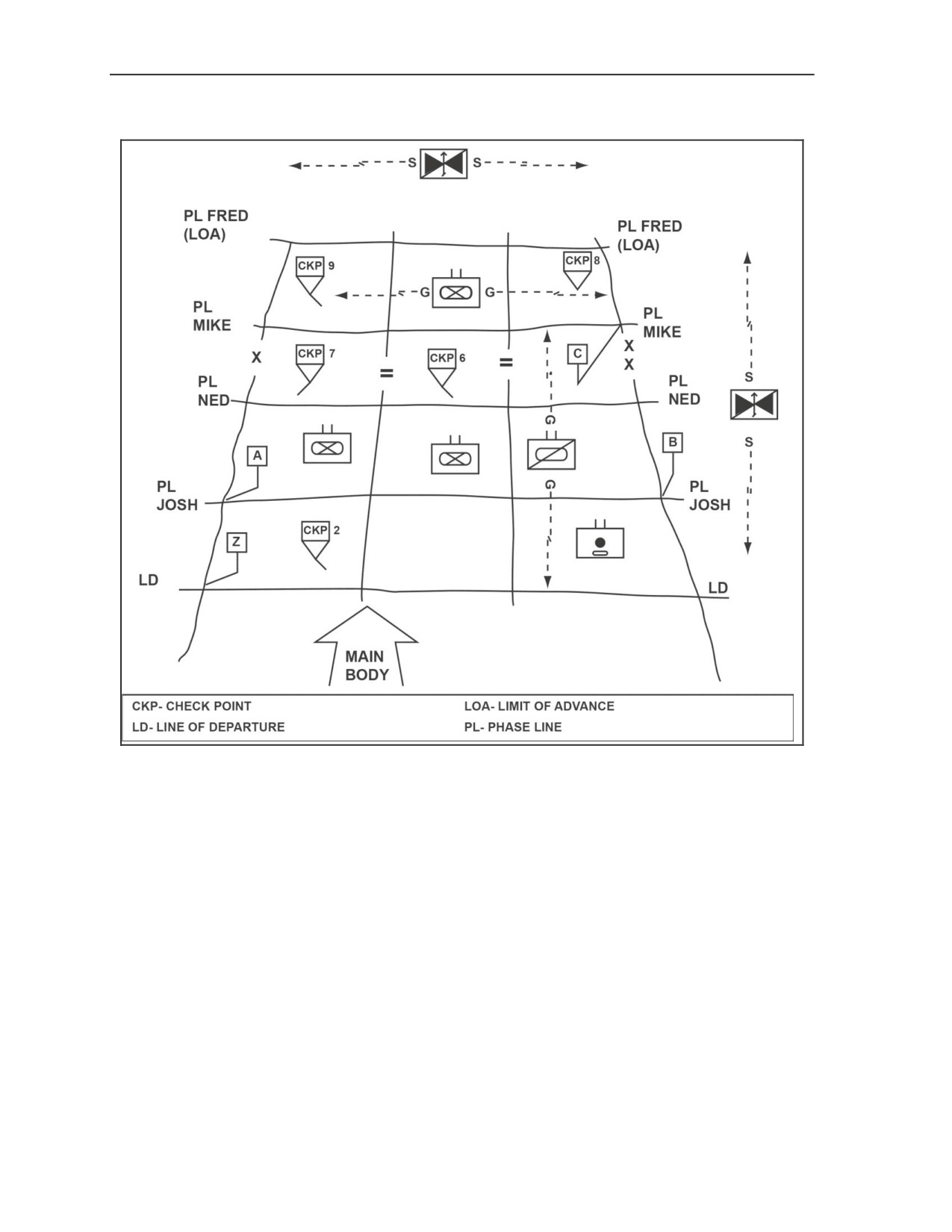
supporting effort provides its own security. (See figure 6-2 on page 6-14.)
-XO\ 2015
FM 3-98
6-13
Chapter 6
Figure 6-2. Armored brigade combat team advance guard mission
Organization of Forces
6-69. An advance guard performs continuous reconnaissance along the main body’s axis of advance,
maintains continuous surveillance of enemy avenues of approach (when stationary), destroys or repels enemy
reconnaissance and security forces, and defeats, disrupts, or fixes enemy ground forces before they can
engage the main body with direct fires. In coordination with the protected force commander, the advance
guard commander clarifies the interval between the advance guard and the main body. The advance guard
maintains the interval from the protected force and leads the main body within the protected force
commander’s intent. The advance guard guides the main body through gaps in the enemy force to take
advantage of opportunities. In planning and conducting an advance guard, the BCT commander and staff
considers the factors of METT-TC. BCT and squadron staffs conduct collaborative and individual planning
considering the missions and the area of operation assigned to subordinate units. The staff plans fires to
support the maneuver plan, and integrates aerial assets to enhance the capability of the advance guard to find,
fix, and defeat enemy reconnaissance assets. Integrate engineer assets to provide mobility, countermobility,
and survivability support. Staffs deliberately plan for the positioning of mission command nodes to support
advance guard operations and the positioning of support and sustainment assets to allow seamless logistical
support to maintain the momentum of the advance guard. Additionally, the BCT commander identifies a unit
to serve as a reserve for the advance guard. A reserve is that portion of a body of troops which is withheld
from action at the beginning of an engagement, to be available for a decisive movement (ADRP 3-90). By
6-14
FM 3-98
-XO\ 2015
Security
allocating forces to field a reserve, the commander will arm himself with the freedom to exploit opportunity
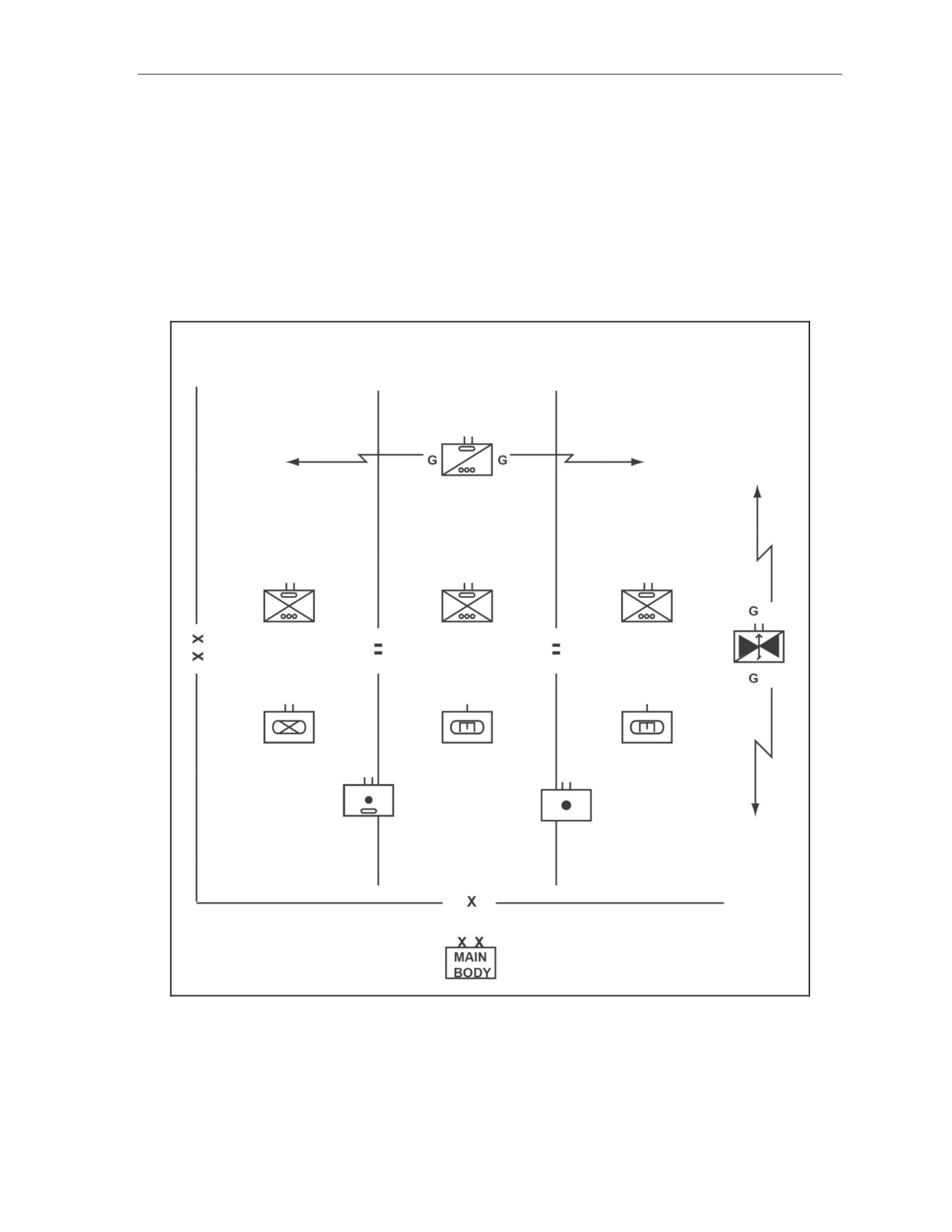
or reinforce friendly elements as required. For a BCT conducting a guard, the reserve is a maneuver company
from one of the combined arms battalions. If the Cavalry squadron is performing a guard, BCTs consider
providing a maneuver company from a combined arms battalion to serve as the squadron reserve so the
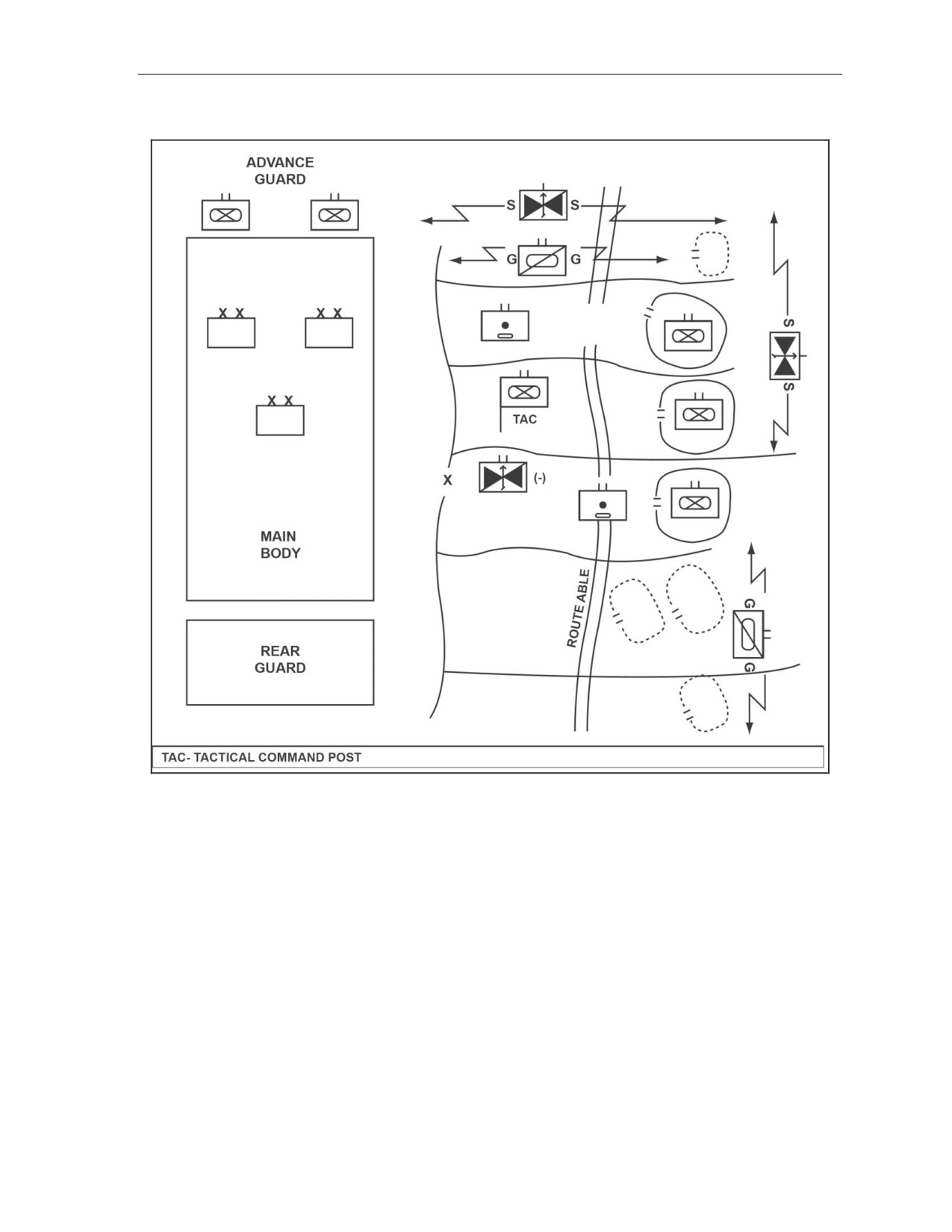
squadron does not place a reconnaissance asset in a reserve role.
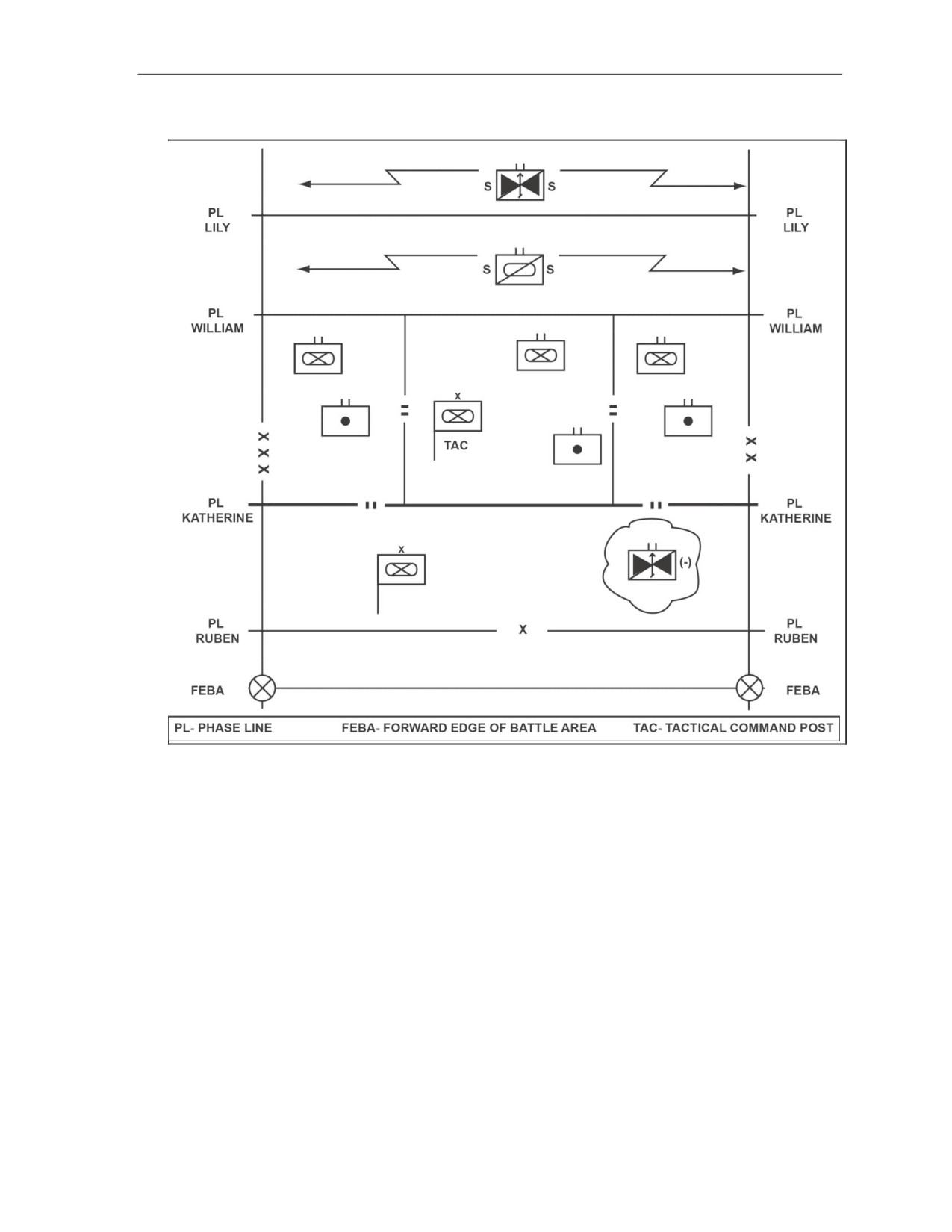
FLANK GUARD
6-70. A flank guard protects an exposed flank of the main body. In performing this mission, the flank guard
operates beyond the assigned zone or sector of the protected force. The flank guard’s responsibility begins at
the trail element of the advance guard or at the lead combat element of the main body. It ends at the rear of
the protected force or lead element of the rear guard. The higher commander tasking the flank guard mission
specifies the boundary. (See FM 3-90-2 for more information.)
Stationary Flank Guard
6-71. A flank guard for a stationary force performs a zone or area reconnaissance when establishing the
initial security line positions allowing the flank guard to become familiar with the terrain they will defend.
Upon reaching their initial positions, the flank guard establishes a defense and goes through the steps of
engagement area development. Once the flank guard makes contact, it continues to defend or delay, when
necessary according to the commander’s intent. As with the advance guard, the commander must allocate
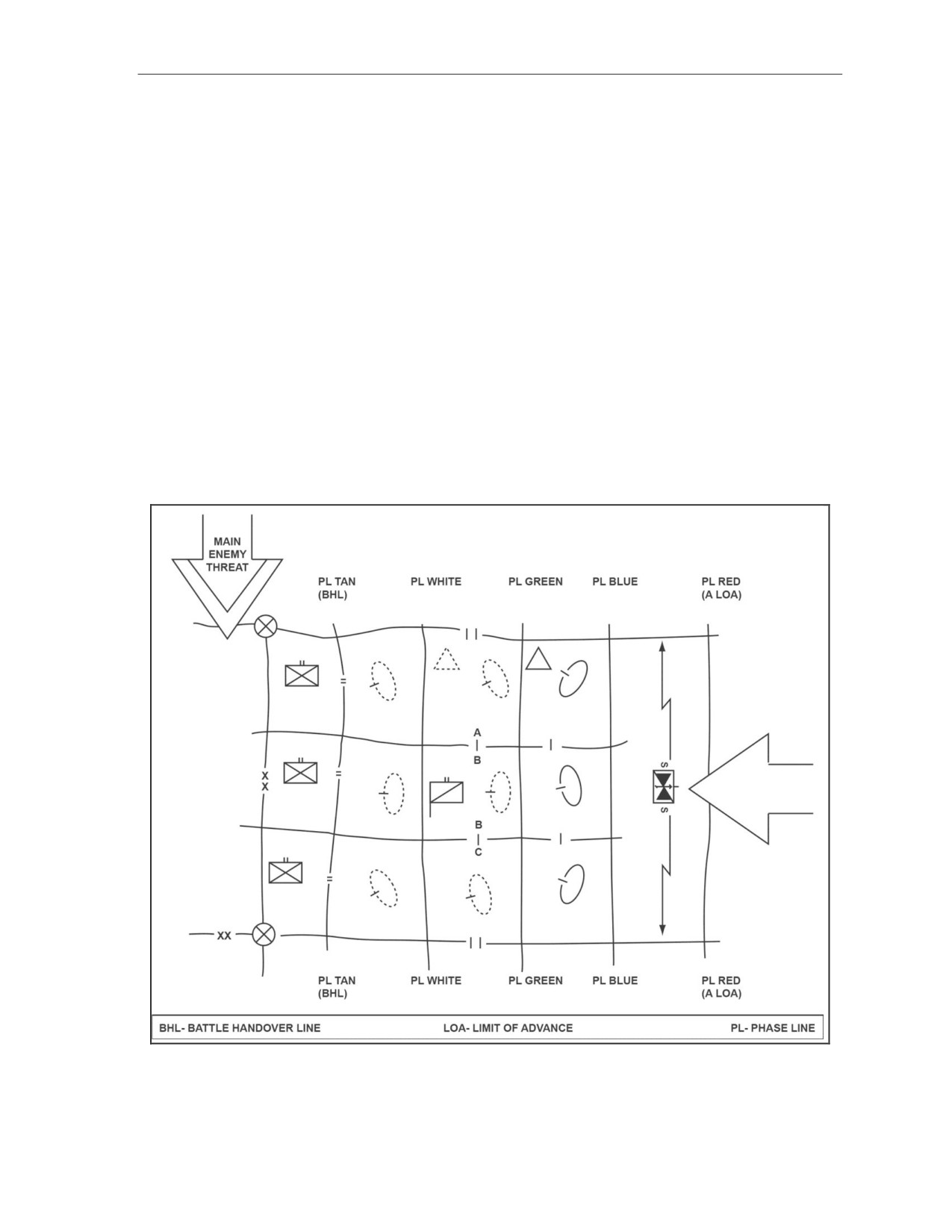
forces to serve as a reserve. (See figure 6-3.)
Figure 6-3. IBCT Cavalry squadron stationary flank guard
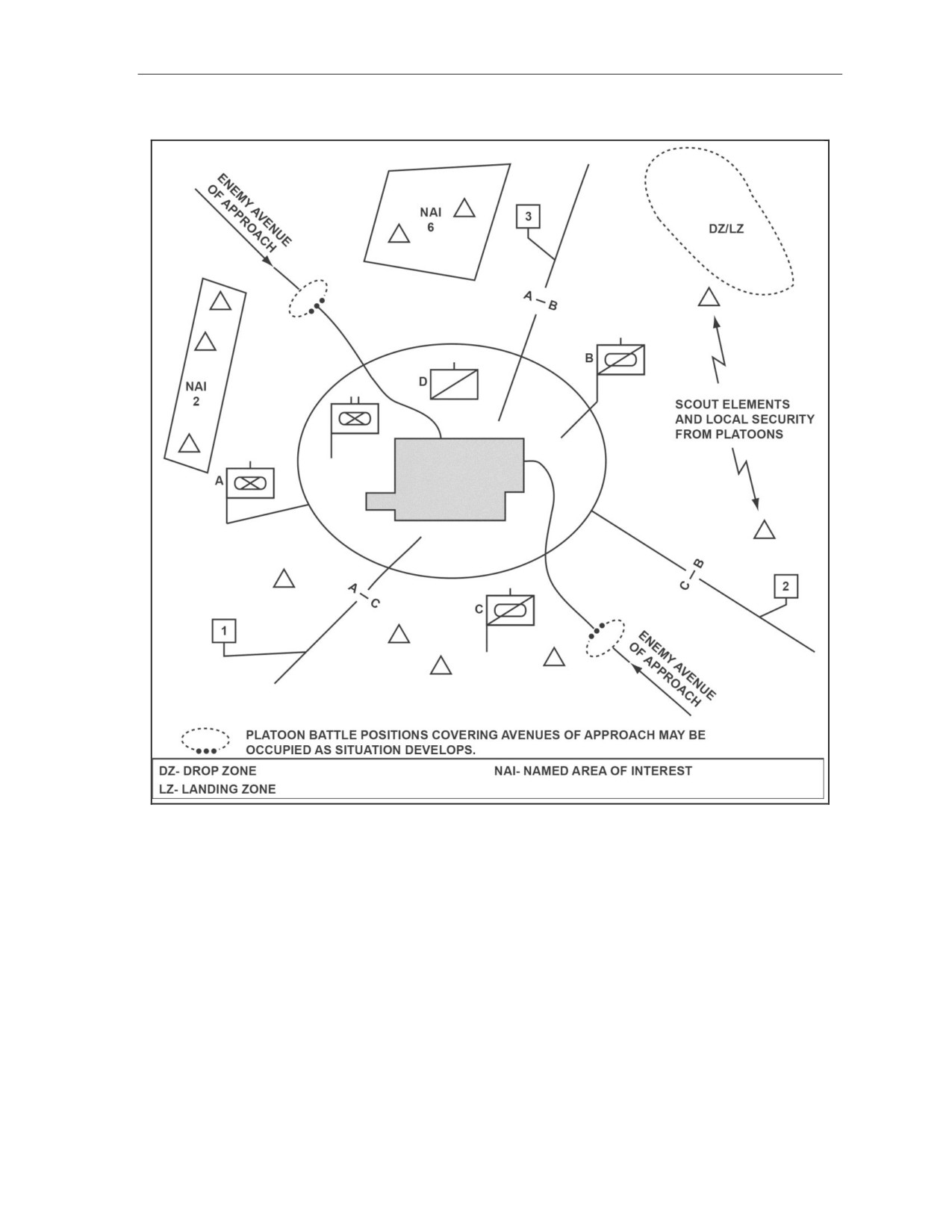
-XO\ 2015
FM 3-98
6-15
Chapter 6
Moving Flank Guard
6-72. A moving flank guard poses additional considerations. A moving flank guard has many of the same
considerations as the moving flank screen though instead of occupying a series of OPs the moving flank
guard plans a series of troop/company-level battle positions along the axis of advance. Tasks for the moving
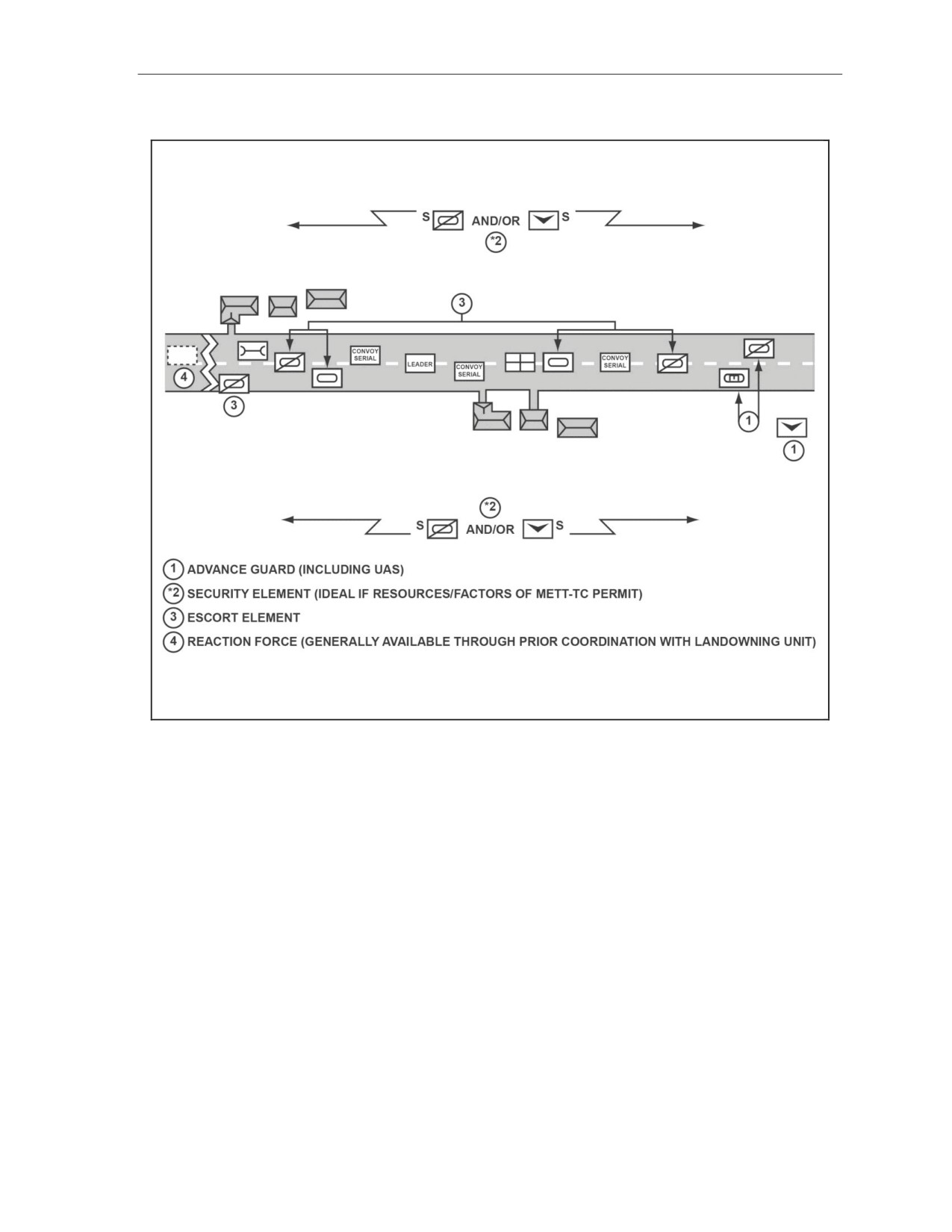
flank guard include maintaining continuous surveillance of enemy battalion-sized avenues of approach along
the main body’s avenue of approach, reconnoitering the zone between the main body and the flank guard’s
battle positions, and maintaining contact with the lead combat elements of the main body. Additionally, guard
tasks include destroying or disrupting enemy reconnaissance forces, and defeating, disrupting, or fixing
enemy ground forces before they can engage the main body with direct fire. The protected force commander
assigns a security objective to orient the flank guard force.
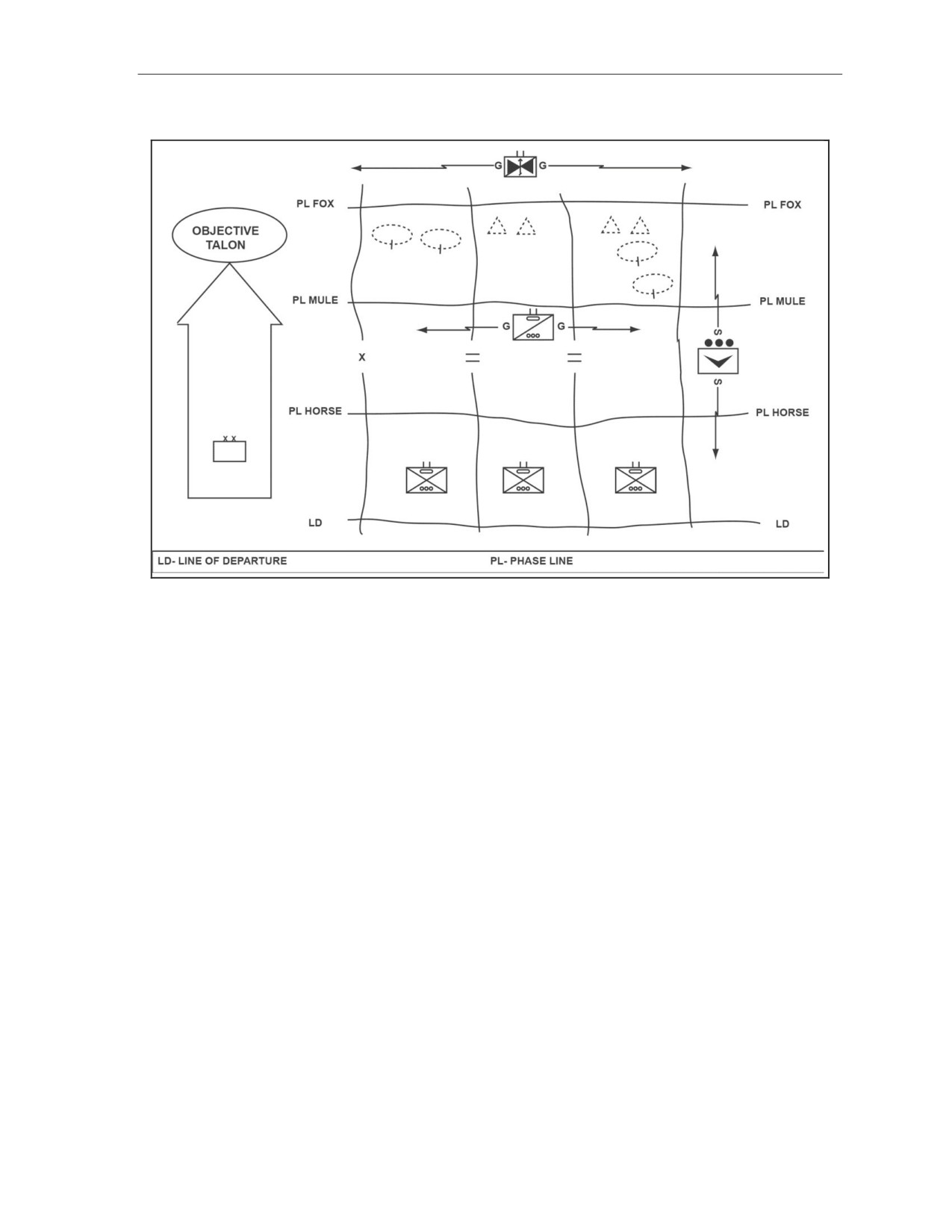
6-73. Moving flank guards use two methods to execute their initial maneuver; sequentially or
simultaneously. In the sequential method, the flank guard crosses the line of departure separately (in
sequence) from the main body and deploys to perform the mission (see figure 6-4). Sequential LD is faster
and keeps the two forces (the flank guard and the main body) from interfering with one another. Sequential
LD is appropriate when another force has penetrated the line of contact or the main body is not in contact
with the enemy.
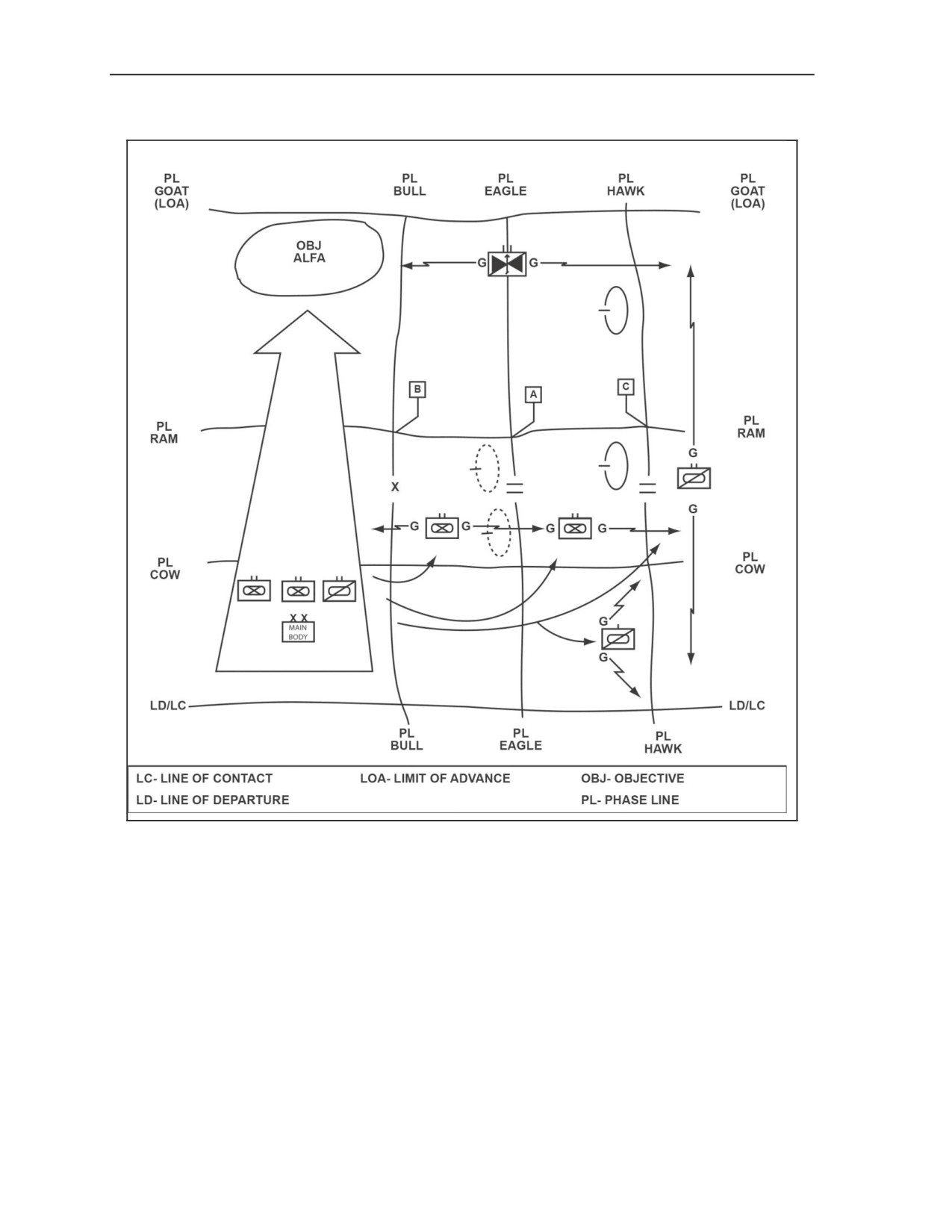
6-74. In the simultaneous method, the flank guard crosses the line of departure with the main body and then
deploys out into its AO. The simultaneous method is appropriate when the main body makes its own
penetration of enemy defenses along the line of contact. The flank guard may follow the lead combat elements
of the protected force through the gap and deploy when the situation permits (see figure 6-5 on page 6-18).
This method is slower, but provides security for the guarding force before assuming the flank guard.
6-75. The lead element of a moving flank guard has a critical three-fold mission; they must maintain contact
with the main body, reconnoiter the zone between the main body and the moving flank guard’s route of
advance, and reconnoiter the moving flank guard force’s route. The lead element accomplishes these tasks
by performing a zone or area reconnaissance. The speed of the main body and tempo provided in the
commander’s guidance determines how thoroughly the reconnaissance is performed or required. Staffs
consider METT-TC and the capabilities of their formations to determine if augmentation is required.
6-76. When the distance from the guard line to the main body exceeds the organic capability of the element
tasked to conduct zone reconnaissance, commanders augment the lead element with additional forces to
ensure the lead element maintaining contact with the main body is not over tasked and can match the tempo
of the main body. During planning staffs war game to determine whether the task assigned to subordinate
units exceed the capabilities of the unit. However, if the flank guard determines it is over-extended, the
commander of the flank guard informs the protected force commander and recommends one of the following
courses of action: reinforce the flank guard, reduce the area of responsibility, or screen a portion of the area
and guard the rest.
6-77. The remainder of the moving flank guard maneuvers along the route of advance and occupies battle
positions as necessary. The commander of the moving flank guard designates battle positions parallel to the
axis of the main body. The flank guard commander may place battle positions outside the route of advance
and along avenues of approach into the flank guard. Follow-on elements reconnoiter assigned battle positions
before occupation.
6-16
FM 3-98
-XO\ 2015
Security
Figure 6-4. SBCT moving flank guard (method one)
6-78. The commander designates battle positions parallel to the axis of the main body. The flank guard
commander may place battle positions outside the route of advance and along avenues of approach into the
flank guard. The lead element conducts initial reconnaissance of battle positions and reports information to
the units designated to occupy them. The rest of the guard force occupies battle positions as needed. Follow-
on troops reconnoiter these battle positions as they occupy them. Attached company teams prepare to occupy
battle positions, or may form a reserve.
6-79. Commanders assign an objective to orient the force and secure the flank of the main body objective.
Commanders establish phase lines that run parallel and perpendicular to the direction of the movement of the
main body. If the enemy attacks from the protected flank, the commander uses parallel PLs to control the
delay or defense. Perpendicular PLs are used to control movement forward towards the main body’s
objective. The main body commander may assign the flank guard an objective that secures the flank or
otherwise serves to orient its security efforts.
-XO\ 2015
FM 3-98
6-17
Chapter 6
Figure 6-5. Armored brigade combat team moving flank guard mission (method two)
6-80. The guard force regulates movement along the route of advance by the pace of the protected force,
distance to the objective, and the enemy situation. The following are three methods of movement: successive
bounds, alternate bounds, or continuous movement.
6-81. If the protected force stops, the guarding force occupies blocking positions. As the speed of the main
body changes, the guarding force changes movement methods. The commander should not allow the force
to fall behind the main body or present a lucrative target by remaining stationary along the route. To that end,
the guarding force occupies positions passed by the rear of the protected force.
6-82. If the guarding force anticipates being overextended, the commander informs the main body
commander and recommends one of the following courses of action:
z
Reinforce the flank guard.
z
Reduce the area of responsibility.
z
Screen a portion of the area and guard the rest.
6-18
FM 3-98
-XO\ 2015
Security
6-83. The squadron/battalion combat trains move with the flank guard force. The field trains move with the
brigade support battalion.
REAR GUARD
6-84. A rear guard protects the exposed rear of the main body. Rear guards are appropriate when conducting
offensive tasks, when the protected force breaks contact with flanking forces, or during a retrograde. The rear
guard deploys and defends for moving and stationary main bodies. The critical tasks described for a stationary
flank guard apply. The rear guard for a moving force displaces to successive battle positions along phase
lines in depth as the main body moves. The nature of enemy contact determines the scheme of maneuver for
displacement. (Refer to FM 3-90-2 for more information.)
6-85. The commander establishes the rear guard during retrograde operations in two ways:
z
The guarding force relieves other units in place as they move to the rear.
z
The guarding force establishes a position in depth behind the main body and passes those forces
through.
COVER
6-86. A cover is a brigade-level, force-oriented mission that protects the division or corps main body from
detection or engagement by enemy forces attempting to delay or disrupt friendly operations. A covering force
may be offensive or defensive in nature. The nature of the cover mission reflects the type of operation
conducted by the division or corps. All covering force operations are aggressively executed making
maximum use of offensive opportunities. A covering force accomplishes all the tasks of screening and guard
forces. (Refer to FM 3-90-2 for more information.)
6-87. Unlike screening or guard forces, a covering force is tactically self-contained and capable of operating
independently from the main body. The covering force operates away from the main body to develop the
situation, prevent enemy observation, and protect the main body from effective direct and indirect fires. The
distance from the main body is determined by METT-TC factors, though to protect the main body from
effective observation, direct, and indirect fires the BCT may execute operations as far as 50 to 60 kilometers
from the main body. The covering force denies the enemy information by conducting counterreconnaissance
to destroy enemy reconnaissance and enemy forces within the security zone. A covering force develops the
situation earlier than a guard force, fights longer and more frequently, and defeats larger enemy forces than
a guard force. Furthermore, a covering force reconnoiters, screens, attacks, defends and delays as necessary.
The covering force does not allow enemy forces to bypass and affect the main body.
6-88. Division or corps headquarters determine the requirements for a covering force built around a brigade.
The covering force is reinforced with maneuver, enabling and sustainment assets to allow it to accomplish
its mission. Reinforcements increase the distance and time the covering force can operate away from the
main body, and enhances the covering force’s ability to fight. Reinforcements typically revert to their parent
organizations upon the passage of the covering force. (See table 6-1 on page 6-20.)
-XO\ 2015
FM 3-98
6-19

Chapter 6
Table 6-1. Typical Attachments for Cover
ATTACHMENT
RELATIONSHIP
PARENT ORGANIZATION
Battalion Task Force
Attached
Division
Cavalry Squadron
Attached
Division
Attack Helicopter Battalion
Operational Control
Division/Corps
Field Artillery Brigade
Attached or direct support
Division/Corps
(DS)
Engineer Battalion
Attached or DS
Corps
Air Defense Artillery Brigade
Attached or DS
Corps
Sustainment units
Attached or DS
Division/Corps
6-89. A covering force may be offensive or defensive in nature, but all covering force operations are
aggressively executed, making maximum use of offensive opportunities. The covering force executes its
mission like a zone reconnaissance or reconnaissance in force in that it is force-oriented.
OFFENSIVE COVER
6-90. An offensive covering force seizes the initiative early, allowing the main body commander freedom
of maneuver. While conducting offensive tasks, a covering force may operate to the front or flanks of the
main body. Offensive covering forces conduct reconnaissance along the main body’s axis of advance, deny
the enemy information about the size, strength, composition, and objective of the main body, destroy, disrupt,
or fix enemy forces and reconnaissance assets in the security zone forces, develop the situation to determine
enemy strengths, weaknesses, and disposition, and exploit opportunities until main body forces are
committed. There are two forms of offensive covers—advance cover and flank cover. (Refer to FM 3-90-2
for a complete list of tasks.)
Advance Covering Force
6-91. An advance covering force is an offensive cover operation and is task organized to locate and penetrate
the security zone and forward defenses of an enemy force deployed to defend and to destroy enemy
reconnaissance, advance guard units, and first-echelon units of a move enemy force.
BCT Planning and Execution Considerations for Offensive Cover Missions
6-92. The BCT advances on a broad front and conducts operations similar to that for zone reconnaissance
or movement to contact. Staffs determine the width of the zone to cover during mission analysis and IPB.
Typically, aviation assets task organized to the covering force reconnoiter forward of the advancing ground
elements. Upon enemy contact, air assets engage and destroy enemy forces according to the covering force
commander’s intent and report the enemy’s location, composition, and disposition to the ground forces while
maintaining contact with the enemy. Aviation assets conduct target handover to ground forces when required
and ground forces from the covering force will attack to defeat enemy forces. The covering force will not
bypass enemy forces without approval of the main body commander.
6-93. If the covering force finds a gap in enemy defenses it prepares to penetrate the integrity of the defense.
The covering force immediately reports to the main body to allow follow-on forces to be diverted to seize,
retain, and exploit the enemy vulnerability. Covering forces prepare to defeat enemy counterattack during
penetrations due to the opportunities hasty attacks provide the defender.
6-94. When the BCT covering force can advance no further, it transitions to a defense and prepares to
execute a forward passage of lines of the main body. The covering force continues to perform reconnaissance
of enemy positions to locate gaps or vulnerable flanks. The covering force conducts target and reconnaissance
handover to guide the main body as they attack through or around the covering force. If the covering force is
successful, the main body commander is able to attack enemy vulnerabilities at the time desired with
previously uncommitted main body forces.
6-20
FM 3-98
-XO\ 2015
Security
6-95. The covering force must retain a reserve. At the brigade level, a reserve should consist of attached
attack aviation assets and a maneuver battalion. The reserve must be centrally located and ready to deploy
anywhere in the covering force’s zone, located in the most dangerous or critical portion of the covering force
zone, or positioned to support the covering force commander’s scheme of maneuver.
Flank Covering Force
6-96. A flank cover is an offensive covering force mission. It is assigned if the main body commander
perceives a significant threat to one of the unit’s flanks. A BCT or R&S BCT conducts a flank cover much
the same as a flank guard. The main differences between the two missions are the scope of operations and
the distance the covering force operates from the main body. (See figure 6-6.)
Figure 6-6. Reinforced SBCT performing advanced cover
6-97. Like the flank guard, the flank covering force clears the area between its route of advance and the
main body. The flank covering force maintains contact with an element of the main body specified by the
main body commander. The commander assigning the mission designates the area of operations for the flank
-XO\ 2015
FM 3-98
6-21
Chapter 6
covering force and the protected force. The flank covering force clears the area between its route of advance
and the main body.
6-98. Integration of air aviation assets is essential to cover mission. Aviation assets may assist in clearing
the area between the covering force and the main body, assisting in maintaining contact with the protected
force, and screening to the front of the units conducting the flank covering force.
DEFENSIVE COVER
6-99. A defensive covering force prevents the enemy from attacking at the time, place, and combat strength
of their choosing. Defensive covers primary aim is force the enemy to reveal their main effort, to disrupt the
enemy’s attack, destroy their initiative and set the conditions for their defeat. Defensive covers maintain
continuous surveillance of avenues of approach, destroy or disrupt enemy reconnaissance and security forces
to deceive the enemy of friendly disposition, and the location of the main defensive effort, determine the size,
strength, composition, and direction of the enemy’s main effort, and maintain contact and force the
commitment of enemy second-echelon forces. A defensive covering force operates to the front, flanks, or
rear of a main body deploying to defend. Defensive cover is performed most frequently forward of the main
body. (See figure 6-7.) There are three types of defensive cover—front, flank, and rear cover. The planning
and execution considerations are applicable to all types of defensive cover.
6-22
FM 3-98
-XO\ 2015
Security
Figure 6-7. Reinforced ABCT performing flank cover
Planning and Execution Considerations for Defensive Cover Missions
6-100. The division or corps commander normally uses a BCT or designates a R&S BCT as the foundation
covering force, reinforcing and augmenting it with combat power to increase the length of time it can fight
the covering force battle, and give it the capability to destroy larger enemy forces. The amount of
augmentation the covering force receives depends upon the intent of the main body commander. (See
figure 6-8 on page 6-25.) The BCT commander always designates reserves to seize the initiative during the
early stages of an enemy attack.
6-101. The main body commander designates the forward and rear boundaries of the security force with
phase lines. The lateral boundaries of the security area are normally extensions of the main body boundaries.
The rear boundary of the security force is the battle handover line, which is within range of main body
artillery. The BCT commander designates additional control measures as needed to help control the
operation.
6-102. The BCT commander assigns an area of operations to each subordinate. Covering force missions
delay and defeat enemy forces to allow maximum time for the main body to prepare and execute effective
offensive or defensive tasks. If certain terrain is crucial to the operation, battle positions may be assigned to
-XO\ 2015
FM 3-98
6-23
Chapter 6
task forces. Subordinate commanders have the same options in the deployment of their units. If the terrain
and situation permit, the covering force boundaries are extensions of the boundaries of corresponding main
body units to simplify the battle handover, and transfers of control of supporting assets from the covering
force to main body units.
6-103. The BCT conducts a zone reconnaissance or movement to contact to the forward PL in the security
area. The BCT may be required to fight through enemy resistance to establish control over the security area.
If the unit encounters heavy enemy resistance, the main body commander orders the covering force to occupy
a new defensive line and conducts the cover. Planning for such contingencies is critical to the success of the
covering force mission.
6-104. Battle handover and passage of lines is inherent in the conduct of defensive cover. Battle handover
and passage of lines may not occur simultaneously for all covering force units. As some units begin passage,
others may still be taking advantage of offensive opportunities in other parts of the security area. The BCT
prepares to continue fighting in those portions of the security area where forces are successful, to set up
offensive opportunities for the main body. Disengagement criteria established by either the division or BCT
commander will dictate when covering force units may begin battle handover and passage of lines.
6-105. Organic and attached aviation and air assets are invaluable assets in assisting disengagement of
ground units during the conduct of battle handover and passage of lines with the main body. Additionally,
they can assist the reconnaissance of the security area as the covering force moves forward, screening forward
of the covering force, covering areas between ground units, and providing additional firepower for
disengaging ground units.
6-106. BCT staffs consider communications requirements to maintain contact with the main body and
subordinate battalions within the covering force. Covering forces consider use of high frequency and tactical
satellite (TACSAT) communications to maintain continuous communications with all organic units, adjacent
units, and higher. Covering forces may require additional signal assets to provide communications
infrastructure support and retransmission.
6-107. Reserves are critical to a defensive cover. They allow the BCT commander to seize the initiative
during the early stages of an enemy attack. The covering force commander always designates a reserve. They
are frequently attack aviation units, combined arms battalions, and other operational control maneuver forces.
In the absence of attached or operational control maneuver units, the BCT commander may assign a
contingency mission to assigned tank companies and dictate employment restrictions to subordinate
commanders. The tank company is the battalion-level commander’s primary reserve force. Ground reserve
forces are normally positioned in depth and prepared to execute a series of contingency missions (such as
counterattack, block, and assume an area defense). Aviation reserves may counterattack in coordination with
ground reserves and conduct close combat attack. The covering force commander frequently designs his
defense to shape an enemy penetration, causing the enemy to become isolated and provide opportunities to
mass effects to defeat the isolated enemy.
6-24
FM 3-98
-XO\ 2015
Security
Figure 6-8. Reinforced ABCT performing defensive cover
Flank and Rear Defensive Covering Forces
6-108. The planning and execution considerations for flank and rear defensive covering forces are the same
as for a frontal covering force.
6-109. A rear covering force mission is similar to a rear guard mission. A rear covering force protects a
force moving away from the enemy. The BCT deploys behind the forward maneuver units of the main body,
conducts battle handover and passage of lines, and then defends or delays. Alternatively, the covering force
may conduct a relief in place as part of a deception plan, or to take advantage of the best defensive terrain.
6-110. The BCT deploys its subordinate units abreast and in depth. The subordinate units establish passage
points and assist the rearward passage of the main body, as needed. From that point on, the mission is
conducted the same as any other defensive covering force operation. As the main body moves, the covering
force displaces to subsequent phase lines in depth. If the enemy does not follow the withdrawing forces,
contact may eventually be lost. Fighting a defense or delay is necessary if the enemy detects the movement
and attacks.
-XO\ 2015
FM 3-98
6-25
Chapter 6
AREA SECURITY
6-111. Area security is a security task conducted to protect friendly forces, installations, routes, and actions
within a specified area. The BCT conducts area security to preserve the commander’s freedom of maneuver,
ability to move reserves, positioning of fire support assets, provide effective mission command, and conduct
sustainment operations. Area security degrades the enemy’s ability to affect friendly actions in a specific area
by denying the enemy’s use of an area for its own purposes. Area security is essential to all operations,
particularly operations in asymmetric environments during stability tasks. Area security enables military
support to local governance, reconstruction efforts, rule of law and the development of legitimate security
forces. BCTs conduct area security to establish security around base camps, critical infrastructure, airfields,
facilities, and main supply routes, lines of communication (LOC), terrain features, towns, equipment, and
high-value assets. Offense, defense, and stability tasks support area security.
6-112. The commander may task subordinate units to conduct the following in support of area security
operations:
z
Area, route, or zone reconnaissance.
z
Screen.
z
Offensive and defensive tasks (within capabilities).
z
Route and convoy security.
z
Security for high-value assets.
EXECUTION CONSIDERATIONS
6-113. When conducting an area security mission, the security force prevents threat ground reconnaissance
elements from directly observing friendly activities within the area being secured. Within capabilities, it
prevents threat ground maneuver forces from penetrating the defensive perimeters.
6-114. The commander can have the subordinate troops employ a variety of techniques such as OPs, battle
positions, ambushes, and combat outposts to accomplish this security mission. A reserve or quick reaction
force enables the commander to react to unforeseen contingencies. Using the intelligence assets available to
the BCT, the Cavalry squadron can execute ambushes and preemptive strikes with greater precision. Figure
6-9 depicts an example of a BCT Cavalry squadron conducting area security of a small village.
6-115. METT-TC determines the required augmentation for the Cavalry squadron. Of particular
importance is the need for such assets as aviation, maneuver forces, engineers, intelligence operations assets,
armor, infantry, and military police (MP). Early warning of threat activity is paramount in area security
missions, and provides the commander with time and space to react to threats. Failure to conduct continuous
reconnaissance may create a vulnerable seam where the enemy can execute an infiltration or attack.
6-116. A unit establishes a perimeter when it secures an area where the defense does not have a supporting
unit. Perimeters vary in shape and distribution of assets based upon the results of mission analysis, IPB, and
METT-TC. A probable direction of attack based on enemy most likely and most dangerous courses of action
as determined in IPB may require the massing of combat power in that portion of the perimeter to defeat an
attack or infiltration. If the perimeter is inward-focused, as in stability tasks or counterinsurgency, the
massing of combat power would prevent exfiltration or a breakout from the secured area.
6-117. The unit establishing the perimeter typically divides it into subordinate unit sectors with boundaries
and contact points. The unit employs integrated OPs, integrating attack/reconnaissance aviation, ground-
based sensors, UAS, HUMINT assets, and mounted and dismounted patrols. Commanders emplace attached
tanks, mobile gun systems, and other antiarmor weapon systems to orient on high-speed avenues of approach.
UAS and ground-based sensors provide overlapping reconnaissance capabilities at extended distances from
the perimeter.
6-26
FM 3-98
-XO\ 2015
Security
Figure 6-9. Reinforced Cavalry squadron conducts area security
6-118. Area security is a frequent mission conducted during stability tasks when circumstances may not
permit establishment of clearly defined perimeters. When a perimeter is not feasible, the Cavalry unit secures
the area by establishing a presence and conducting reconnaissance tasks throughout the area. Subordinate
units establish perimeters around base camps, critical infrastructure, and high-value assets, while other units
conduct operations to establish presence, provide security, and assist stability or relief tasks. The commander
positions reaction forces or disperses the reserve between several secured perimeters. Other missions or tasks
in support of area security may include the following:
z
Route or convoy security of critical lines of communications.
z
Checkpoint operations to monitor or control movement.
z
Patrols to cover gaps between secured perimeters.
z
Maintaining an observable presence.
-XO\ 2015
FM 3-98
6-27
Chapter 6
ROUTE SECURITY
6-119. Cavalry units conduct route security missions to prevent enemy forces from affecting freedom of
maneuver along a protected route. A route security force operates on and to the flanks of a designated route.
Route security operations are defensive in nature, and unlike guard operations, are terrain-oriented. A route
security force prevents an enemy force from impeding, harassing, containing, seizing, or destroying traffic
along the route. To accomplish this task, the force performs the following functions:
z
Conduct continuous mounted and dismounted reconnaissance of the route and key locations
along the route to ensure trafficability.
z
Conduct sweeps of the route at irregular intervals to prevent emplacement of enemy mines.
z
Cordon sections of the route to search suspected enemy locations.
z
Establish roadblocks and checkpoints along the route and lateral routes to stop and search
vehicles, persons, and those entering the route.
z
Occupy key locations and terrain along or near the route. If possible, establish a screen line
oriented to prevent enemy direct fire weapons and observation from influencing the route. This
function is also known as out posting.
z
Aggressively conduct ground and aerial patrols to maintain route security.
z
Establish OPs (covert and overt) or ambushes at critical points to watch for threat activity.
CONVOY SECURITY
6-120. Convoy security is a subset of area security. Convoy security missions are offensive in nature and
orient on the protected force. Convoy security is typically a security mission assigned to Cavalry troops,
maneuver companies, and maneuver platoons. Commanders order convoy security missions when
insufficient friendly forces are available to secure LOCs in an AO. The commander may order them
conducted in conjunction with route security operations. A convoy security force operates to the front, flanks,
and rear of a convoy element moving along a designated route, or integrated into the body of the convoy.
(Refer to ADRP 3-90 for more information.)
6-121. A convoy security mission has certain tasks that guide planning and execution. To protect a convoy,
the security force accomplishes the following:
z
Reconnoiter the route the convoy is to travel.
z
Clear the route of obstacles or positions from which the enemy could influence movement.
z
Provide early warning of enemy presence along the route.
z
Prevent the enemy from impeding, harassing, containing, seizing, or destroying the convoy.
Organization
6-122. If possible, the convoy security force is a combined arms organization with integrated air and ground
assets. (See figure 6-10.) Ideally, a convoy security force has sufficient combat power to organize into the
following elements:
z
Advance guard. The advance guard performs tasks associated with zone and route
reconnaissance forward of the convoy. It may perform duties of the security element.
z
Security element. The security element provides early warning and security to the convoy’s
flanks and rear. It may perform duties of the escort element.
z
Escort element. The escort element provides close-in protection to the convoy. It may provide
a response force to assist in repelling or destroying threat contact.
z
Reaction force. The reaction force provides firepower and support to assist the other elements
in developing the situation or conducting a hasty attack. It may perform duties of the escort
element.
6-28
FM 3-98
-XO\ 2015
Security
Figure 6-10. Convoy security organization
Planning and Execution Considerations
6-123. Convoy security missions generate unique requirements the commander and staff should take into
account when formulating a plan. The convoy security commander and subordinates receive a briefing on
the latest information regarding the threat situation and the area through which the convoy is to pass.
6-124. The commander formulates plans and issues orders covering the commander’s intent, assignment
of security force elements (reconnaissance, screen, escort, and reaction), the movement formation, and
intervals between echelons and vehicles, rate of travel, and detailed plans for actions on contact. Leaders at
all levels should ensure the convoy security force identify and rehearse immediate action drills (such as
enemy ambush, obstacle, and react to indirect fire) before movement and are able to execute them in case of
contact.
6-125. The commander may maintain a quick reaction force to support convoy movement. The Cavalry
unit may perform this mission. In addition, the commander assigns the Cavalry unit to set up outposts along
the convoy route or movement corridor to provide overwatch and security of the area. The commander has
not assigned the Cavalry unit an AO, but the responsibility to provide security for that segment of the route
or corridor.
6-126. Communications are vital to the success of movement. Leaders plan communications with convoy
elements and units occupying AOs along the route of movement to ensure availability of support assets.
Visual and sound signals are prearranged. Signals include colored smoke, identification panels, whistles or
-XO\ 2015
FM 3-98
6-29
Chapter 6
horn signals, and escalation of force signs. While limited, these communications means are effective when
all personnel understand the prearranged signals and responses.
6-127. When possible, units should coordinate fires along the entire route of movement. Adequate fires
planning and prior coordination with fire support cells can ensure indirect fire coverage. Ensure the FSO
conducts detailed fire support rehearsals on the fire support net before convoy movement confirming
communications connectivity and improving the fire support teams overall understanding of the fire support
plan by reviewing call signs, frequencies, pre-planned target locations, target numbers, and schedules of
movement. If the convoy moves through multiple AOs assigned to multiple units before planning and
coordination must occur with both operations cells and movement control cells.
6-128. If an air threat is possible, the commander addresses air defense of the convoy in the planning. The
convoy elements review small arms air defense procedures and establish orientation sectors. The commander
orchestrates air defense reinforcements into the movement and defense plan. If the route falls under an
existing air defense umbrella, the staff conducts the appropriate coordination with the controlling air defense
headquarters.
6-129. Convoy security operations in an urban environment or built-up area require different emphasis and
techniques than those in rural areas. The population density and characteristics of the area may require
nonlethal weapons and the careful application of lethal weapons. To ensure they apply minimum essential
force to minimize loss of life and destruction of property, leaders conduct detailed planning, coordination,
and control. Whenever possible, convoys move through populated areas when these areas are least congested
and pose less danger to the security of the convoy. Convoy operations may require assistance from military
or local police and other government agencies to secure the route before the convoy enters the built-up area.
6-130. The S-4 and unit commanders carefully plan for sustainment in convoy security operations. Fuel
and maintenance elements are included in the convoy itself, or prepositioned in secure areas along the route.
Leaders should perform a detailed precombat inspection before the convoy starts. Plan CASEVAC along the
entire movement route. Maintain coordination between the security force elements to ensure immediate
medical support is available including the aid station, unit CP, sustainment CP, and designated units along
the route. When operating at extended distances from organic or supporting medical assets, air medical
evacuation is the preferred means of evacuation, and is planned and rehearsed in detail.
HIGH-VALUE ASSET CONSIDERATIONS
6-131. High-value assets are those whose capture or destruction by enemy forces could decisively change
the course of the operation. Security missions to protect high-value assets are an important component of
area security in major combat operations and stability tasks. Examples of high-value assets to be secured in
major combat operations include the following:
z
Major power-generation facilities (power plants and dams).
z
Airports, seaports, and other centers for mass transit.
z
Industrial complexes.
z
Cities.
z
Dislocated civilian camps.
6-132. High-value assets to be secured in stability tasks include the following:
z
Government officials and political and military leaders.
z
Government facilities.
z
High-value detainees.
z
Pipelines and relay stations.
6-133. Considerations the security force should address when it tasks subordinate elements to secure high-
value assets include the following:
z
Internet protocol (IP) address, frequencies, location, and linkup point of the high-value asset.
z
Route used in reaching the high-value asset, and the composition and disposition of enemy
forces that can influence the route.
z
Mission and movement or positioning plan of the high-value asset.
6-30
FM 3-98
-XO\ 2015
Security
z
How easily the threat may detect and target the high-value asset with indirect fire. The security
force should consider its own survivability and maintain adequate standoff from the high-value
asset.
z
Duration of the mission and sustainment considerations.
z
Other friendly or neutral forces in the area, and their task and purpose.
z
Triggers for change of mission from security to reconnaissance, offensive, or defensive actions.
Is there an implied reserve mission?
z
Ability of the security force to maintain communications with higher HQ.
z
Locations used by enemy personnel serving as forward observers for enemy indirect fire
systems.
LOCAL SECURITY
6-134. Local security includes local measure that prevents or interdicts enemy efforts. Local security is an
enduring priority of work, is essential to maintaining initiative, and prevents units from being surprised. Local
security involves avoiding detection or deceiving the enemy about friendly actions, positions and intentions.
It includes finding enemy forces in the immediate vicinity, and knowing as much about their positions and
intentions as possible. Units use active and passive measures to provide local security. Active patrolling and
continuous reconnaissance are active measures that help provide local security. Passive measures include
using camouflage, movement control, noise and light discipline, proper communications procedures, ground
sensors, night-vision devices, and daylight sights.
-XO\ 2015
FM 3-98
6-31
Chapter 7
Stability Tasks
Reconnaissance and security tasks are imperative to successful stability tasks.
Reconnaissance focuses on identifying enemy forces, human interaction and
engagement, and vital infrastructure to collect information necessary to understand
sources of stability and instability with the unit’s area of operation. As the environment
changes so do the sentiments of the population and its key actors. Staffs continuously
assess their area of operations based on information collected to provide context to
understanding the human dimension of their area of operations. BCTs conduct security
tasks to establish safe and secure environments enabling positive gains and sustainable
stability. Since the complexity of the human context is ever changing and evolving in
any environment, reconnaissance and security tasks are continuous, intelligence
estimates are constantly reassessed and refined to determine if commanders are
collecting the right information and developing intelligence to understand the
operational environment.
SECTION I - RECONNAISSANCE AND SECURITY
7-1. Units conduct reconnaissance and security to gain a detailed understanding of sources of stability and
instability, and the intentions and capability of key actors to shape both the BCT’s and unified action partners’
area of operations during stability tasks. Sources of Instability are actors, actions, or conditions that exceed
the legitimate authority’s capacity to exercise effective governance, maintain civil control, and ensure
economic development.
7-2. Enemy forces influence sources of instability to create conflict, exacerbate existing conditions, or
threaten to collapse failing or recovering states. Sources of instability include insurgents, religious, ethnic,
economic, and political differences between the populace, empowered individuals working in opposition to
legitimate governance, degraded infrastructure, economic strife, ineffective or corrupt security forces,
scarcity of vital resources, and natural disasters.
Task Force (TF) 1-61 CAVALRY in East Baghdad
Following the Samara Mosque bombing in February
2006, sectarian tension
transitioned to widespread violence. By June enemy militia and insurgent activity increased
significantly in both the TF 1-61 Cavalry (CAV) and 506th RCTs area of operation across
East Baghdad. Murders, kidnappings, vehicle borne improvised explosive device (VBIED)
and suicide bombings, hostile neighborhood takeovers, and violent forced-evictions
increased nearly 300 percent and were seriously contributing to sources of instability for the
Iraqi Security Forces, Coalition forces, and the Government of Iraq.
In the wake of the Samarra bombing and during this critical four month period, TF 1-61
conducted zone recon and security operations in the militia friendly cities of Narhwan,
Adamiya and Shaab/Ur, as well as maintaining responsibility of the insurgent influenced
towns of Jisr Diyala, Tuweitha, and Salman Pak.
TF 1-61 CAV began security operations in Adamiya June, 2006. Prior to their
assignment, Adamiya suffered daily attacks against Iraqi Security Forces. Through unity of
effort the military transition teams (MITT) commander advising the 1/2/6 IA battalion shared
SITREPS and OPS/INTEL assessments resulting in effectiveness of
1-61
Cavalry’s
reconnaissance and security operations supporting stability. TF 1-61 CAV maintained enemy
contact to develop the situation and defeat insurgents from disrupting effective governance,
-XO\ 2015
FM 3-98
7-1
Chapter 7
security, and rule of law. By the end of June direct fire attacks on Iraqi Security Forces and
U.S. forces declined to one per week. There was a significant decline in the number of Anti-
Iraqi Forces
(AIF) attacks and sectarian motivated incidents as a result of their
reconnaissance and security operations. The multinational division Baghdad (MND-B)
Commander and deputy commanding general (DCG) Maneuver (M) commended the actions
of the TF and emphasized the positive operational & strategic effect relative to support of
establishing civil security and legitimacy of the host nation government.
During the Ashura pilgrimage in July, 2006, the B/1-61 CAV Commander and an officer
from an adjacent MITT led the effort to diffuse a sectarian firefight that developed between
Shaab and Adamiya where Shia pilgrims entered a Sunni area. Through engagements with
local leaders an agreement was reached that resulted in peaceful transitions. Their actions
prevented escalation that would have resulted in significant loss of life, inevitable reprisal
actions, and nationwide focus on what would have been perceived as a deteriorating security
situation
The Squadron conducted numerous raids and rapidly developed a network of informants
from JUL-AUG 06 that led to the Squadron's ability to identify several key insurgent leaders.
The squadron executed aggressive area reconnaissance operations followed by timely raids
on identified targets. They analyzed HUMINT and SIGINT reports that helped develop
pattern of life for target locations. The Squadron developed actionable target packages which
allowed them to capture or kill these targets before the sectarian violence and insurgent
actions contributed to instability.
During a reconnaissance effort to identify a location for a high value individual (HVI)
the enemy emplaced armor-defeating explosively formed projectile
(EFP) IEDs that
succeeded in killing a Soldier on 26 August 06. The platoon quickly recovered and completed
the mission to identify his location in Jisr Diyala and in a pre-dawn raid conducted within
36 hours the Task Force succeeded in capturing the HVI. This seriously disrupted enemy
operations across East Baghdad.
During the course of this four month period, TF 1-61 CAV conducted 1556 patrols and
operations, captured eight weapon caches, captured 64 insurgents of which four were
Brigade and Division level high-value target, found and cleared 28 IEDs (including three
"high-end" armor defeating IEDs), captured 32 rifles, eight light/medium machine guns,
seven RPG launchers, 51 RPG rounds, two mortar systems, 13 mortar rounds, and 5 IED
munitions/components. The 64 captured enemy sustained 55 percent success rate of going to
long term detention convicted by the newly established justice system of the Iraqi government.
7-3.
During stability tasks Cavalry units operate within the BCT’s area of operations. Cavalry units conduct
route, area, and zone reconnaissance as well as screen, guard, and area security (to include route security)
missions to secure the populace and answer BCT and higher PIR and assist the commander and staff to
visualize and understand the area of operations.
7-4. While BCTs can assign Cavalry squadrons their own area of operation for a period of time, use of
Cavalry as a maneuver unit instead of as a reconnaissance and security organization incurs risk of incomplete
or inadequate reconnaissance and security tasks. When assigned their own area of operations Cavalry
squadrons conduct tasks to support stability in the same manner as other maneuver units, though they are
best implemented when placed upon a border or boundary with suspected enemy infiltration routes allowing
the squadron to conduct screen or guard tasks to interdict enemy operations to protect the main body of the
formation they support.
CAVALRY UNITS ROLE
7-5. Reconnaissance and security are essential to successful stability tasks. The BCT commander relies
heavily on his Cavalry squadron in conducting reconnaissance and security throughout all phases to support
BCT operations.
7-2
FM 3-98
-XO\ 2015
Stability Tasks
SQUADRON
7-6. The Cavalry squadron can conduct recon and security to support stability tasks. The Cavalry squadron
achieves these goals during all phases of stability tasks within the entirety of the higher echelon’s area of
operations or assigned its own area of operation optimally placed upon a border or boundary having enemy
infiltration routes to conduct screen or guard tasks for the main body.
TROOP
7-7. The Cavalry troop conducts reconnaissance and security missions during stability tasks to answer PIR
and develop the commander’s understanding of the OE and enable the battalion to shape the environment in
the AO. The troop focuses reconnaissance efforts on gaining a detailed understanding OE’s sources of
instability, and the capability and intentions of key actors as the unit moves from the initial response phase
to the transformation phase of stability tasks. Specifically, the scout platoons collect information on civil
considerations using areas, structures, capabilities, organizations, people, and events and operational
variables using political, military, economic, social, infrastructure, information, physical environment, and
time (PMESII-PT) and work directly with unified action partners to assists their efforts.
SUPPORT TO RECONNAISSANCE AND SECURITY DURING
STABILITY
7-8. Maneuver units require attachments to be optimally effective during stability. The nature of stability
is complex therefore it requires more diverse organizations with specialties to actively conduct
reconnaissance and security tasks.
FIELD ARTILLERY
7-9. Fires during any of the phases of stability framework require the right amount of force precisely
applied to the right target. Fires, often conducted in densely populated AOs, create the requirement for well-
integrated and rehearsed airspace de-confliction, clearance of fires, and precision strike mission process.
Implementing reasonable fire support coordination measures, updating them on time, and ensuring highly
accurate (typically 10 meter or less target location error) target location increases the effectiveness of fires in
a stability environment. Targeting is an integral part of stability tasks to synchronize nonlethal effects and to
conduct engagement planning. Fires may be used more frequently to defend key geopolitical sites or strike
high-payoff targets located near restrictive fire areas (RFA) and densely populated locations with precision
munitions. FSOs and Joint Fire Observers ability to plan, coordinate, and execute fires often with precision
munitions in support of stability tasks are crucial to mission success. Increasing the proportion of precision
munitions used in fires and employment of nonlethal capabilities may be necessary to limit collateral damage.
7-10. A precision-guided munition is a guided weapon intended to destroy a point target and minimize
collateral damage (JP 3-03). Precision-guided munitions collectively refer to those munitions that home on
reflected electromagnetic energy (such as the Hellfire missile) and precision munitions.
7-11. A precision munition is a munition that corrects for ballistic conditions using guidance and control up
to the aimpoint or submunitions dispense with terminal accuracy less than the lethal radius of effects (FM 3-
09). Munitions with a precision capability such as the global positioning system-aided Excalibur 155-mm
projectile, guided multiple launch rocket system (MLRS) rockets, and the advanced precision munitions
initiative 120-mm mortar rounds have a circular error probable of less than 10 meters. Munitions with a near-
precision capability have a circular error probable between 10 and 50 meters. Area capabilities have a circular
error probable greater than 50 meters. Circular error probable is an indicator of the delivery accuracy of a
weapon system, used as a factor in determining probable damage to a target. It is the radius of a circle within
which half of the rounds fired at a target will impact. Even at the munitions’ largest anticipated delivery error,
the aimpoint is within the munitions’ anticipated radius of direct effects. The employment of precision
munitions requires the use of current cryptological key information.
7-12. ROE often become more restrictive as phases of stability progress. Commander’s guidance for fires
requires careful consideration during development of ROE and engagement and displacement criteria. Units
conducting reconnaissance and security must carefully consider the benefits and consequences of initiating
fires, or breaking contact if fires are initiated on the unit.
-XO\ 2015
FM 3-98
7-3
Chapter 7
7-13. The BCT utilizes radars and indirect fire acquisition assets in a sensing mode that allows the
identification of the point of impact to protect friendly forces from indirect fire. These radars integrate with
the air defense radar as part of the Counter Rocket Artillery Mortar (C-RAM) system that provides sense and
warn capability for troop assembly areas and command posts. In areas subject to collateral damage,
counterfire should employ precision munitions against well located targets. The use of fires with munitions
having only area capabilities must be carefully considered due to the possible long-term adverse impact on
relations with unified action partners and the indigenous population thereby contributing to sources of
instability.
BEB ELEMENTS
7-14. The BEB within the BCT provides adaptable reconnaissance and security operational support during
all phases of stability tasks. Engineer assets provide mobility, countermobility, survivability, technical
reconnaissance, and infrastructure assessments.
Engineers
7-15. Engineer platoons task organized at the squad level and attached to Cavalry units support mobility,
countermobility and survivability. The combat engineer platoon can execute route and area reconnaissance
organically. The route clearance platoon can provide mobility and limited disposal of mines. The support
platoon/section can conduct initial infrastructure assessments, as well as basic horizontal construction to
restore services in support to governance.
7-16. The combat engineer companies of the BEB can execute a myriad of the stability tasks identified in
reconnaissance and security tasks, as an organic unit, throughout all phases of stability tasks. If required by
the commander, the BEB can conduct route and area reconnaissance, local and area security, patrols, limited
raids, assessment and restoration of services (such as sewage, water, electricity, academics, trash, medical,
safety, and other considerations), and leader engagements, all in support of the reconnaissance and security
stability plan.
7-17. Geospatial teams can provide detailed products about the topography of a specific geographic area.
These products can be analyzed and provided to Cavalry units to narrow the reconnaissance focus to specific
objectives rather than a broad area.
CBRN
7-18. Each BEB has an assigned chemical, biological, radiological, and nuclear-enhanced conventional
weapons (CBRN) reconnaissance platoon capable of executing CBRN specific reconnaissance in support of
stability tasks. The platoon supports route, zone and area reconnaissance tasks and is capable of assessing
key infrastructure in regards to contaminated water sources, industrial chemicals, biological hazards, and
evidence of WMDs. The CBRN platoon assists in security missions by exploiting possible threat locations
and confirming or denying presence of CBRN threats and hazards.
INTELLIGENCE
7-19. Commanders must be involved and knowledgeable of the intelligence collection efforts to narrow the
reconnaissance focus and shape the operational environment. Planning for stability tasks involves
complexity; the need to balance resources, capabilities, and activities; analyzing the significance of various
activities over time; to maximize their efforts to provide stability.
7-20. Commanders often require more detailed intelligence and IPB products to determine how best to
conduct operations and influence the local populace and mitigate sources of instability. The identification
and analysis of actors, terrain and weather, and civil considerations are critical in determining the most
effective missions, tasks, and locations in stability tasks. A lack of knowledge concerning insurgents, local
politics, customs, culture, and how to differentiate between local combatants often leads to actions that can
result in unintended and disadvantageous consequences. To achieve this understanding the BCT commander
attaches collection assets to his Cavalry squadron. (Refer to Chapter 1, Reconnaissance and Collection
Teaming.)
7-21. During stability tasks, the disclosure of military information to host-nation personnel and agencies
requires consideration. The BCT S-2 must ensure the BCT has the required amount of foreign disclosure
7-4
FM 3-98
-XO\ 2015
Stability Tasks
officers. A foreign disclosure officer may approve the disclosure of classified and controlled unclassified
military information to foreign representatives based on the policies, directives, and laws that govern the
national disclosure policy and the release of classified information. The officer provides this service to the
command and staff and to assigned, attached, and supporting unified action partners.
7-22. Stability tasks occur in and between the local population, thus human contact with the local population
has greater emphasis and importance. Observations and experiences of Soldiers—who often work with the
local populace—provide depth and context to information collected through reconnaissance and security
tasks.
Fusion Centers
7-23. A fusion center is an ad hoc collaborative effort between several units, organizations, or agencies that
provide resources, expertise, information, and intelligence to a center with the goal of supporting the rapid
execution of operations by contributing members. Fusion centers primarily focus collection and promote
information sharing across multiple participants within a specific geographic area or mission type. These
centers are not operations centers. Fusion centers have been especially useful when stability tasks dominate
the operation. Commanders at various echelons create fusion centers to manage the flow of information and
intelligence; focus information collection to satisfy information requirements; and to process, exploit,
analyze, and disseminate the resulting collection. (Refer to ADRP 2-0 for more information.)
Company Intelligence Support Teams
7-24. Many company commanders perform basic intelligence tasks that include refining collection
capabilities, analyzing ongoing metrics in the AO, and performing basic intelligence support to targeting. To
accomplish these tasks, company commanders organize small intelligence support teams called COISTs,
providing intelligence to the company leadership. The COIST accomplishes its tasks by analyzing and
reporting information collected by the company while receiving, parsing, and reporting intelligence collected
by both adjacent and higher units. The COIST obtains, analyzes, and exploits information gained from patrol
debriefings, site exploitation, tactical questioning, tips, and engagement of the populace. It also forwards
captured enemy documents and media for analysis and reporting. COIST members are required to follow all
intelligence oversight regulations, primarily Army Regulation
(AR) 381-10. AR 381-10 restricts the
collection of intelligence information on U.S. persons and regulates how and when collection, storage, and
dissemination of such information occurs.
Remote Sensors
7-25. Remote sensors are used to perform such tasks as perimeter defense, surveillance, environmental
monitoring (including radiological, nuclear, and early warning), and target acquisition. Remote sensors are
not an MI collection asset; however, they do provide information used to cue MI collection assets to activity
and should be considered when preparing the information collection plan. They are hand-emplaced by
Soldiers or robotic vehicles either inside or outside buildings and structures. Their optimal employment is in
areas where major movement is restricted to a few key lines of communications and the traffic pattern of
military and civilian activity can be easily discriminated. Remote sensor missions are ideally suited to support
relatively stable situations, such as long-term defensive or security operations, where the time and resources
are available to develop an extensive sensor network throughout the AO. The employment of sensors in open
terrain or heavily congested urban concentrations requires detailed planning to ensure the sensor network can
provide the desired information in those environments. For stability tasks, sensors can provide surveillance
of population centers and key infrastructure areas. They can also provide surveillance along lines of
communications and borders. The supported unit's information collection plan includes provisions for sensor
surveillance. Incorporating remote sensors into the information collection plan provides the employment
concept and detailed instructions for the execution of remote sensor missions. Develop requirements for
sensor employment along with concepts for the monitoring and dissemination of sensor data and incorporate
into the information collection plan. The establishment of a comprehensive sensor network requires time and
a significant investment of resources. During the planning requirements task, the operations and intelligence
working group identifies specific information requirements that remote sensors can answer. As part of the
information collection plan, the sensor surveillance plan specifies the—
z
Type and location of sensors, relays, and monitoring sites.
-XO\ 2015
FM 3-98
7-5
Chapter 7
z
Time of emplacement and unit responsible for emplacing each sensor string and any relays.
z
Time of recovery and unit responsible for recovery.
Expeditionary Military Intelligence Brigade
7-26. As part of Intel 2020, the Army is establishing new and separate brigade-level commands to enhance
the intelligence capability within each of the Army's three programmed corps. These commands, known as
expeditionary military intelligence brigade (E-MIB) conduct intelligence operations to support decisive
action. An E-MIB provides the following capability:
z
CI collection and activities.
z
HUMINT collection.
z
SIGINT collection.
7-27. E-MIBs can also augment corps, division, and BCT intelligence cells, specifically aiding the PED of
national and theater SIGINT and geospatial intelligence. The E-MIB conducts multidiscipline intelligence
operations to support corps and division operational requirements, to include being the MI force provider for
BCTs. When directed, the E-MIB provides mission command and coordination for MI forces in theater.
Instead of deploying the E-MIB as a unit to conduct independent intelligence operations to support the corps,
the corps commander, as part of force tailoring during planning, task-organizes the E-MIB to best support
operations. The corps G-2 advises the commander on the capabilities of the E-MIB and recommends how
best to task-organize its assets.
7-28. The primary focus of the human intelligence collection team during stability tasks is to answer the
commander's information requirements. In stability, the HUMINT collectors must be able to maintain daily
contact with the local population. Examples of HUMINT collection requirements include support to arms
control; extensive political information and demographic data; the threat characteristics regarding several
different former warring factions during peace operations; or extremely detailed target data. HUMINT
collectors help to ascertain the feelings, attitudes, and activities of the local populace.
Signals Intelligence
7-29. SIGINT assets might detect enemy or adversary communication. Intelligence is developed then
confirmed or disproved through active reconnaissance. The focus of SIGINT collection when supporting
stability tasks generally remains on indications and warnings, situation development, and offensive tasks.
Multifunctional Teams
7-30. A multifunctional team is optimized for conducting stability tasks. Insurgent activity remains a threat
to the stability of the host nation, especially when a majority of the population marginally supports the
restored government and friendly forces. MFT assets might be used to augment a maneuver unit targeting an
enemy whose major maneuver units have either been destroyed or have surrendered to friendly forces (refer
to ATP 2-19.4 for more information). The MFT supports the conduct of stability tasks by—
z
Support to targeting.
z
Support to site exploitation, which includes support to document and media exploitation
(DOMEX), biometrics collection and enrollment, and battlefield forensic collection and limited
exploitation.
z
Intelligence operations including—
SIGINT collection, limited analysis, and reporting.
HUMINT MSO.
SIGINT surveys.
z
Limited all-source intelligence analysis (only one all-source analyst currently on the MFT).
SUSTAINMENT
7-31. Stability tasks require unique sustainment considerations. It is important to remember that the design
of the brigade support battalion
(BSB) only supports the BCT’s assigned Soldiers and equipment.
Reconnaissance units will often identify sources of instability that can be mitigated or shaped immediately
with a sustainment effort. If the BSB develops stability support plans, the BSB commander must ensure that
7-6
FM 3-98
-XO\ 2015
Stability Tasks
sustainment estimates differentiate what is supporting internal BCT requirements and what is supporting
external stability support mission requirements. Sustainment during stability tasks often involves supporting
U.S. forces, multinational forces, and other contributing partners in a wide range of missions and tasks.
INTERDEPENDENT CAPABILITIES
7-32. Cavalry and other units conducting reconnaissance and security during stability tasks will often
determine that they are not the first organization operating in the area. Units conducting reconnaissance and
security can gain a better understanding through coordination, information and intelligence sharing with
unified action partners. Below are some unified action partners that units can coordinate with during stability.
SOF
7-33. Conventional forces build relationships and foster interdependence with U.S. Special Operations
Forces operating in the area. Interdependence is the deliberate and mutual reliance of one unified action
partner on another’s inherent capabilities to provide complementary and reinforcing effects. These units
executing different tactical tasks that support the operational objectives and end states to stabilize the area.
Brigades rely on interdependence with unified action partners and SOF partnership to combat sources of
instability. The exercise of interdependence facilitates shared understanding between the U.S. actors in the
OE and it provides a conduit by which the interagency and SOF partners can provide relevant, useful, and
timely information. Planning efforts, update briefs, and working groups are specific events where brigades
ought to incorporate their interagency partners.
CIVIL AFFAIRS
7-34. Civil affairs support to stability tasks depends on the nature of the operation and the condition of the
affected indigenous population and institutions. The S-9 and civil affairs (CA) units continually assess and
monitor the capabilities and capacity of the host nation to identify and mitigate underlying causes of
instability within society and, as required, apply functional skills which are normally the responsibility of
civil government. CA conducts civil reconnaissance and develops civil information through interaction with
the indigenous population and institutions and unified action partners. During the transition from offensive
and defensive tasks to stability tasks, CA units place greater emphasis on infrastructure, economic stability,
and governance expertise.
IGOs/NGOs
7-35. Units conducting reconnaissance must recognize the value of intergovernmental and nongovernmental
organizations (IGOs and NGOs) and build effective relationships with these actors. IGOs and NGOs could
provide subject matter expertise in many essential services and governance topics. They are the primary
provider of humanitarian, infrastructure and essential services in immature operational environments. IGOs
and NGOs have experienced and detailed knowledge of the civil environment and may have a better
understanding of civil considerations other than indigenous population and institutions. This insight can assist
the civil reconnaissance effort to understand and shape the environment.
7-36. Understanding where IGOs and NGOs are on the battlefield and the nature of their activities helps
develop a common operational picture. This developed COP enables the commander and staff to anticipate
changes to the operational environment, the effects of IGOs and NGOs on primary stability tasks and
operations, and future friction points between the organizations. Building relationships with IGOs and NGOs
might be difficult because these organizations are reluctant to establish associations with U.S. forces. Cavalry
must be cognizant of this and establish relationships on terms beneficial to all parties involved. Cavalry units
frequently discover IGOs and NGOs unexpectedly within the OE so they should plan to encounter them
during their operations.
7-37. IGOs and NGOs can bring valuable resources, information regarding the civil populace and the
operational environment, and alternative perspectives to the brigade’s stability operation. Cavalry units
operating with NGOs follow these guidelines (Refer to ATP 3-07.5 for more information):
z
Military personnel wear uniforms when conducting relief activities.
z
Military personnel make prior arrangements before visiting NGOs.
z
Military personnel do not refer to NGOs as force multipliers or partners or other similar terms.
-XO\ 2015
FM 3-98
7-7
Chapter 7
z
United States forces respect an NGO’s decision to not serve as an implementing partner.
SECTION II - PRINCIPLES AND FRAMEWORK
7-38. BCTs conduct reconnaissance and security during stability tasks to increase the commander and staff’s
ability to understand the area of operation. Information collection confirms or denies assumptions made
during planning and identifies sources of stability and instability. Reconnaissance and security tasks
contribute to mission command by answering information requirements enhancing situational awareness and
assisting the BCT to apply the stability principles in an, acceptable, and predictable way. Ultimately,
reconnaissance and security tasks are vital to assisting the BCT in understanding their operational
environment through the context of the stability principles. The four principles of stability tasks are conflict
transformation, unity of effort, legitimacy and host-nation ownership, and building partner capacity.
CONFLICT TRANSFORMATION
7-39. Conflict transformation is the process of reducing the means and motivations for violent conflict while
developing viable, peaceful alternatives for the competitive pursuit of political and socioeconomic
aspirations. Transformation aims to set the host nation on a sustainable, positive trajectory in which
transformational processes directly address the dynamics causing instability. BCTs contribute to conflict
transformation only if they achieve understanding of the causes and influences of conflict and instability
within their area of operation.
7-40. Reconnaissance and security tasks assist in identifying the drivers of violent conflict and instability
through information collection to assess frictions and local populace perceptions of local disputes and
discord. Collected information impacts planning for future operations by assisting commanders and staffs to
identify opportunities linking tactical gains to sustainable strategic objectives. Transformation can only occur
if the BCT understands the dynamics of conflict within their area of operation both from an objective
viewpoint and from the perspective of the local populace. Reconnaissance tasks and engagement with the
populace are the mechanisms to visualize and understand the dynamics of conflict.
UNITY OF EFFORT
7-41. Unity of effort is the coordination and cooperation toward common objectives, even if the participants
are not necessarily part of the same command or organization—and is the product of successful unified action
(JP 1). Reconnaissance and security tasks require unity of effort and purpose to achieve situational awareness
at echelon to enable successful operations throughout the BCT’s area of operation.
7-42. Reconnaissance and security tasks assist the commander and staff to develop shared understanding
between partners allowing BCTs to foster cooperative environments that focus efforts towards a common
goal to achieve stable and sustainable security environments.
LEGITIMACY AND HOST NATION OWNERSHIP
7-43. Legitimacy is a condition based upon the perception by specific audiences of the legality, morality, or
rightness of a set of actions, and of the propriety of the authority of the individuals or organizations in taking
them (ADRP 3-07). Host nation ownership is the will or ability of the ruling entity to resolve its own problems
and assuming responsibility for solutions that it supports and can implement. BCTs conduct reconnaissance
tasks focused on determining the extent of legitimacy as perceived by the local populace and develop an
understanding of areas of conflict that degrade, discredit, or erode perceptions of legitimacy.
7-44. Commanders direct reconnaissance tasks and engagement activities to understand the mandate,
manner, consent, and expectations of legitimate host nation ownership and perceived legitimacy (refer to
ADRP 3-07 for more on the four factors of legitimacy). BCTs conduct reconnaissance and engagement in
close contact with the civilian populace to collect information, reinforce the capabilities of host-nation
security and governance partners, and understand the extent of support and acceptance of host nation partners
with the local populace. BCTs actively seek sources of conflict and connectivity between the host-nation and
local populace to assist partners to bridge gaps in perception and strengthen relationships.
7-8
FM 3-98
-XO\ 2015
Stability Tasks
BUILDING PARTNER CAPACITY
7-45. Building partner capacity is the outcome of comprehensive inter-organizational activities, programs,
and military-to-military engagements that enhance the ability of partners to establish security, governance,
economic development, essential services, rule of law, and other critical government functions (ADRP 3-07).
Reconnaissance and security tasks foster partner capacity growth by continuing to collect information to
ensure activities are consistent with tactical, operational, and strategic goals and by allowing host nation
partners to develop and learn by protecting key activities and enabling key capabilities. BCTs conduct
operations that enable host-nation partners to thrive and eventually develop sustainable capabilities
independent of BCT interference or influence.
STABILITY FRAMEWORK
7-46. BCTs conduct stability tasks and operations based upon conditions identified through information and
intelligence collection. Reconnaissance tasks confirm or deny the conditions and state of stability within the
BCT’s area of operations. The three phases of the stability framework are initial response, transformation,
and fostering sustainability. Continuous reconnaissance and security operations enable BCTs to identify
appropriate mission, tasks, and activities about the framework phases (Refer to ATP 3-07.5 for more
information).
Initial Response
7-47. Initial response actions generally reflect activities to stabilize an area of operations. Units typically
perform initial response actions during, or directly after, a conflict or disaster in which the security situation
prohibits the introduction of civilian personnel. Initial response actions aim to provide a secure environment
that allows relief forces to attend to the immediate humanitarian needs of the local population.
Transformation
7-48. Stabilization, reconstruction, and capacity-building are transformation actions performed in a
relatively secure environment. Transformation actions may take place in either crisis or vulnerable states and
aim to build host-nation capacity across multiple sectors.
Fostering Sustainability
7-49. BCTs foster sustainability when the security environment is stable enough to support efforts to
implement long-term programs that commit to the viability of the institutions and economy of the host nation.
The BCT consolidates gains to encourage capacity building reconstruction activities to enable sustainable
development. Often military forces conduct these long-term efforts in support of broader, civilian-led efforts.
SECTION III - TASKS
7-50. BCTs conduct stability tasks and tasks to create conditions the local populace regards as legitimate,
acceptable, and predictable (ADRP 3-07). BCTs conduct continuous reconnaissance during stability tasks to
develop information requirements, gain situational understanding of their area of operation, identify sources
of conflict and instability, and identify opportunities to seize, retain, and exploit the initiative to consolidate
sustainable and positive gains. Reconnaissance and security tasks assist the commander and staff in
determining short-term impacts and long-term effects on their area of operations. Commanders then assess
the effectiveness of their actions and adjust as needed.
7-51. BCT commanders consider each primary stability task and associated subtasks within the context of
their particular area of operation and with the perception of the local populace and host nation governance
and security forces. (See figure 7-1.)
-XO\ 2015
FM 3-98
7-9
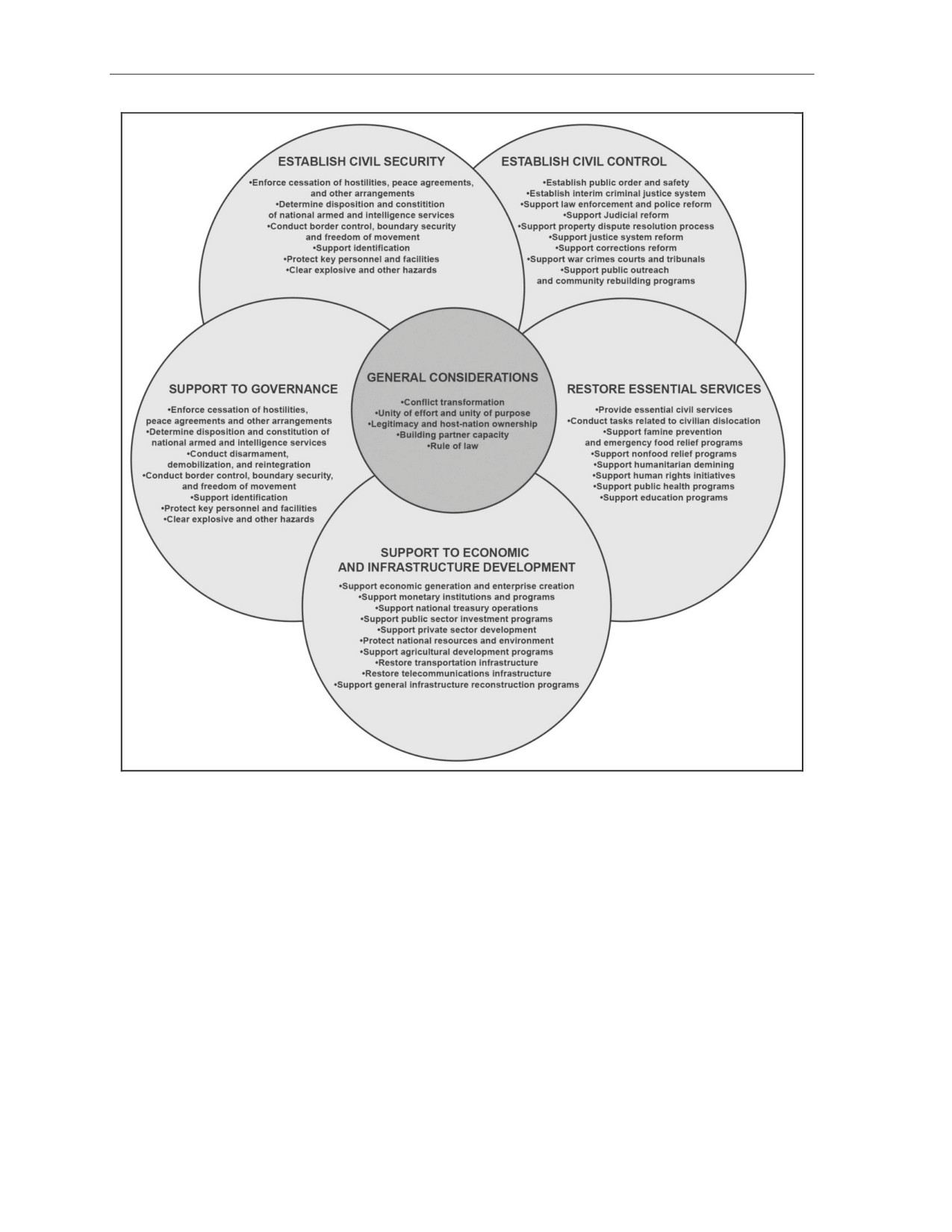
Chapter 7
Figure 7-1. Stability tasks
ESTABLISH CIVIL SECURITY
7-52. The burden on BCTs for establishing civil security will be highest during the initial response phase of
the stability framework when the host nation lacks the capability or capacity to provide security. BCTs
conduct reconnaissance tasks to collect information and security tasks to protect friendly units, local
populace, key actors, and key terrain to enable the establishment of civil security (refer to ATP 3-07.5 for
more information). BCTs and subordinate units execute zone and area reconnaissance tasks to identify
sources of instability affecting civil security. Companies and troops conduct route reconnaissance to support
area security tasks and freedom of maneuver within the AO. BCTs identify sources of instability, and key
terrain to facilitate the commander and staff understanding of the area of operation, and to plan and execute
stability mechanisms. Effective reconnaissance assists the commander to make informed decisions about
allocating resources to each subordinate to establish civil security.
7-53. BCTs conduct security tasks to control borders, secure boundaries and freedom of movement, and to
protect the main body, key personnel and key facilities. Noncontiguous operations complicate the BCT’s
ability to conduct security tasks because potential threats use the civilian populace as cover. BCTs employ
mounted and dismounted patrols, engagements with the local population, aerial reconnaissance and
observation posts to provide early warning, identify threats and create opportunities. Effective security
7-10
FM 3-98
-XO\ 2015
Stability Tasks
operations facilitate manageable transitions between stability framework phases and create dilemmas for
threats who seek to undermine sustainable progress.
7-54. Area security operations are essential to stability tasks because they degrade the enemy’s ability to
affect friendly units, host-nation governance and security forces, key leaders, and key facilities. BCTs
conduct area security to preserve the higher commander’s freedom of maneuver, protect key infrastructure
and leaders, and deny threats access and opportunity to disrupt progress. BCTs establish security zones
around critical infrastructure, airfields, facilities, main supply routes, lines of communication (LOC), towns,
equipment, and high-value assets. Combined security tasks with host nation partners enable transition to the
transformation phase of the stability framework by empowering host nation security and bolstering
legitimacy (see Chapter 6, Security Operations, for more information on area security).
7-55. During the fostering sustainability phase of the stability framework, the host-nation government
assumes responsibility for securing its borders and for internal movement control. Remaining Army units
consist of advisors or, in some cases, BCTs or battalions positioned as a deterrent against external threats.
Advisors continue to help improve host nation capacities as part of larger security force assistance (SFA)
program. Potential external threats may cause military forces to conduct operations to confirm or deny threat
intentions.
ESTABLISH CIVIL CONTROL
7-56. Civil control centers on rule of law by promoting efforts to rebuild host-nation judiciary and
corrections systems by providing training and support to law enforcement and judicial personnel. Units
conducting Reconnaissance can support the primary Army stability task of establish civil control by
identifying critical resources, influential pillar organizations or leaders, sources of instability, and unified
action partners operating in the BCT’s area of operation. During the initial response phase BCTs may be
required to assist host-nation partners build interim solutions to establish civil control which builds upon host
nation governance and security gains capacity and capability transitioning to the transformation phase.
7-57. Establishing security and rebuilding justice institutions assist in developing the necessary conditions
for reconciliation, public confidence, and subsequent economic growth. BCTs secure key infrastructure,
identify key actors, and disrupt enemy forces. Reconnaissance tasks identify viable and working systems of
government as well as gaps in civil control. Identification of governmental strengths and weaknesses help
focus efforts to partner with host nation security forces and assist host nation governance to provide viable
security and services. Units conducting security tasks support civil control by interdicting threat activity
seeking to subvert the local rule of law or legitimacy of an interim government through intimidation,
corruption, or coercion.
7-58. During the transformation phase of the stability framework BCTs continue to conduct operations with
unified action partners but shift efforts focused on legitimacy and host-nation ownership, and building partner
capacity. Reconnaissance tasks support civil control by identifying local population perceptions and
acceptance of host nation governance and security forces, adequacy of local infrastructure security and
viability, sources of corruption, indicators of progress or regression, and acceptance and adherence to the rule
of law. Security tasks support civil control by providing early warning to threats on infrastructure, facilities,
and leaders and assessments of host-nation capabilities.
7-59. BCTs transition to supporting civil control and host nation independence during the fostering stability
phase. BCTs maintain an ability to assist host-nation forces when needed and according to ROE and Status
of Forces Agreement (SOFA) restrictions, if applicable. Sustainable gains allow host nation partners to
conduct civil control with minimal input from the BCT.
RESTORE ESSENTIAL SERVICES
7-60. Efforts to restore essential services in stability operations contribute to the social well-being of the
population. BCTs conduct area and zone reconnaissance to identify areas requiring assistance repair, or
rebuilding, identify public health hazards or outbreaks, and verify locations and dispositions of displaced
civilians requiring aid or support that have no access to key services. BCTs identify popular perceptions of
legitimacy through censuses and engagement with the local populace. Route reconnaissance identifies
mobility corridors to facilitate sustainment operations, humanitarian services and support to outlying or urban
areas, evacuation routes for noncombatant evacuation operations, and freedom of movement and maneuver.
-XO\ 2015
FM 3-98
7-11
Chapter 7
Units conducting security operations support the primary Army stability task of “restoration of essential
services” by conducting area security either independently or partnered with host nation security forces to
ensure those affected receive goods, services and protection, conduct screens along convoy routes to establish
interior lines of communication, support humanitarian assistance with unified action partners, and maintain
control over key infrastructure to prevent threat attacks.
7-61. During transformation framework operations BCTs conduct reconnaissance tasks in concert with host
nation security partners to identify sources of instability adversely affecting host-nation partners to meet
needs of the populace, identifying additional needs or gaps not yet identified, and by training, advising, and
assisting host nation partners in preparation of transfer of authority and the transition to fostering sustainable
gains. Security tasks screen or guard infrastructure projects, provide security to outlying areas and local
government infrastructure, services, and leaders, and to identify enemy safe havens or sources of support.
SUPPORT TO GOVERNANCE
7-62. During the initial response phase the BCT may function as the transitional military authority (TMA)
to establish governmental services and work with established governmental authorities, if any are present, to
increase capability. BCTs conduct security tasks to protect governing officials, key facilities and, eventually,
polling locations.
7-63. During transformation phase the BCT begins to transition its responsibility for governance to civilian
authority. In some cases, authority transfers to host nation representatives that may or may not be the same
host nation government before the operation. As host nation institutions develop, the BCT continues to collect
information indicating good governance through advising, assisting, and supporting host nation partners as
well as identifying sources of instability and corruption that seek to disrupt or degrade effective governance.
BCTs conduct reconnaissance tasks to identify effective and ineffective governing bodies, identifying
locations for potential polling and elections, and maintaining freedom of movement and maneuver. BCTs
conduct security tasks to protect governing officials, key facilities and polling locations. They should prepare
to conduct guard missions to protect polling boxes and election officials during this phase to prevent enemy
disruption on the civilian population.
7-64. BCTs will eventually transfer governance to host nation authorities along with authority for
governance reducing involvement of BCTs with established governments and transition partnership to State
or other government agencies. Reconnaissance and security tasks transfer to appropriate host nation security
forces though BCTs continue to monitor developments regarding governance and identify concerns to host-
nation authorities and U.S. chains of command.
SUPPORT TO ECONOMIC AND INFRASTRUCTURE DEVELOPMENT
7-65. The establishment of wide area security will have secondary effects that facilitate generating
employment opportunities, infusing monetary resources into the local economy, stimulating market activity,
fostering recovery through microeconomics, and supporting the restoration of physical infrastructure to help
retain and exploit the initiative. The early identification of infrastructure damage is key information for
commanders as they conduct area assessments during the initial response phase of the stability framework.
While airborne/space platforms may be able to provide imagery of damaged infrastructure, ground based
reconnaissance operations determine more accurately the scope of the problem. Importantly, BCTs assess
the local impact and feelings of actors in the area to make recommendations to higher HQs on the relative
importance of repair and development when there are multiple pieces of infrastructure in need of attention.
Cavalry units must consider the cultural aspects when conducting reconnaissance and shaping the
environment in regards to key infrastructure.
7-66. The protection of natural resources and the environment may become tasks for the BCT during this
phase. In Iraq the willful burning of oil wells, damage to the oil pipeline infrastructure as well as the deliberate
leaking of oil into the Persian Gulf, provide examples of incidents during the initial response phase, which
resulted in ground forces conducting reconnaissance and security missions over large areas to deter further
incidents. The long term macroeconomic recovery/development of a nation can depend on a relatively small
number of critical pieces of infrastructure.
7-67. Multiple external specialist agencies will be involved in this task during the transformation phase. The
goal of the transformation phase is to firmly establish the foundation for sustainable economic development
7-12
FM 3-98
-XO\ 2015
Stability Tasks
and to begin to transition control of economic development to United States Government civil agencies,
international civil agencies, and host-nation economic officials and entrepreneurs. The balance of effort for
BCTs will switch to security missions in support of these specialists who will be doing the detailed work to
facilitate economic and infrastructure development. The maintenance of wide area security will create
conditions conducive to economic and infrastructure development. Cavalry units likely mission sets include:
z
Screen or guard critical infrastructure.
z
Screening of a border area to prevent external actors adversely impacting economic development.
z
Conducting zone or area reconnaissance with a reconnaissance focus on social/economic
indicators noted above.
z
Route security to enable economic activity to take place in a safe and secure environment.
7-68. During this phase, there may be the opportunity to expand the area of interest and Cavalry units will
continue to report infrastructure issues and economic activity in existing and new areas of operations.
7-69. In the fostering sustainability phase the goal is to institutionalize a long-term sustainable economic
development program and to transition control of the economy completely to host nation officials,
entrepreneurs, and civil society. This phase includes follow-on steps which build on and reinforce the
successes of the initial response and transformation phase. Steps taken during this phase support sustainable
economic growth based on a healthy society supported by healthy communities and neighborhoods.
CONTINUING VIGNETTE FOR STABILITY
7-70.
The notional scenario begun in the reconnaissance chapter continues below and focuses on stability.
The western troop moves to the outskirts of a town as the route becomes restrictive with
vegetation and terrain forming a canalizing effect into the town with a single bridge crossing a river.
With evidence of a large amount of refugees growing and lead scouts reporting massed civilians and
the notable absence of military age males within those groups, the troop commander is struggling to
understand the situation on the ground but immediately understands the importance of this terrain
and in particular the town since it is a significant choke point along the main supply route. He directs
his troop to continue the route reconnaissance outside of the town while tasking a platoon to provide
a hasty screen to the north.
He dismounts and with his interpreter begins to look for the local civil leadership. As a group
of four elderly men approach him, he hands his rifle, helmet, and eye protection to his gunner and
slightly bows to the man standing just behind the front three—greeting him in his language with the
specific local dialect and regional salutation. The man, surprised, responds and begins to describe
the refugee situation and state of dwindling supplies. The troop commander listening intently
understands the role of the men in the local culture; while not the religious leader or civil authority
he is the village elder and as such deserves respect and an appropriate and visible deferment to his
role in the society.
The commander asks for permission for U.S. forces to pass through the town and, if granted,
would like to station a force there to work with local security to assist with protecting the population.
The elderly man is skeptical but listens. The troop commander—knowing the decision was on tenuous
ground—iterates an old, and somewhat local, fable about strength and protection. The man smiles
and corrects his version of the story but smiles at the commander’s effort. As the leader discussion
continues, the screening platoon reports technical vehicles moving down the road toward the town
and they request permission to engage. The commander tells them to hold fire and employ non-lethal
actions to slow them down. The lead vehicle stops and a young man gets out and approaches the
village elder and it soon becomes clear it is his grandson. The elder considering the U.S. forces actions
and their request agrees to grant U.S. forces permission to use the village.
7-71.
Reconnaissance and security tasks develop the situation in close contact with the enemy and civilian
populace to identify sources of conflict and instability and enable the commander and staff to understand
their area of operation. Continuous assessment allows BCTs to determine appropriate tasks, missions, and
activities to support security and stability, ensure unity of effort, bolster host nation legitimacy, and build
partner capacity. BCTs must understand the operational environment to determine which stability tasks are
appropriate to achieve lasting and sustainable objectives.
-XO\ 2015
FM 3-98
7-13
This page intentionally left blank.
Chapter 8
Sustainment
Sustainment units synchronize and execute sustainment operations in support of units
conducting reconnaissance, security and stability tasks, under all conditions, to allow
them to seize, retain and exploit the initiative. Cavalry squadrons frequently operate in
locations distant from their organic sustaining base and carry a configured load or are
task-organized with those assets necessary to ensure their sustainment until they can
be relieved. Generally, units conducting reconnaissance and security tasks have self-
sustainment capability for up to 72 hours. Units conducting reconnaissance and
security tasks and sustainment staffs must anticipate future needs to retain freedom of
movement and action along the entire width and depth of extended and contested lines
of operation during wide area, decentralized reconnaissance tasks.
SECTION I - RECONNAISSANCE AND SECURITY TASKS
8-1. Sustainment is the provision of the logistics, personnel services, and health service support necessary
to maintain operations until mission accomplishment. The purpose of the Army’s logistics system is to sustain
combat power on a continuous basis as far forward as possible. Sustainment principles and fundamentals as
well as roles and responsibilities remain the same for all types of operations at the BCT level and below.
(Refer to ADRP 4-0 for sustainment principles and fundamentals.) Successful sustainment planning and
execution in support of reconnaissance and security tasks at the BCT level and below provides commanders
the degree of flexibility required to develop the situation in close contact with enemy forces and civilian
populations.
8-2. Reconnaissance and security tasks executed at the BCT involve fast-paced, wide ranging operations,
requiring rapid transition from one mission to another. Such operations are characterized by extended lines
of support, higher consumption rates, and present unique challenges to the BCT sustainment units’ ability to
support and sustain reconnaissance and security tasks. Based on the nature of their missions, BCT
sustainment units require echelons above brigade support and other nonorganic assets to effectively support
reconnaissance and security tasks.
8-3. In most cases a forward support company of the brigade support battalion will be in direct support of
a squadron-sized unit conducting reconnaissance and security tasks. Smaller reconnaissance organizations
may have task organized forward logistics element(s) in a direct support sustainment role. A BCT conducting
a cover operation will have an organic brigade support battalion in direct support, and will likely require
augmentation from the sustainment brigade’s combat sustainment support battalion. The key to
reconnaissance and security operation is a fully planned, war-gamed and rehearsed concept of support.
SECTION II - PLANNING FOR RECONNAISSANCE AND SECURITY TASKS
8-4. Reconnaissance and security tasks present unique challenges to sustainment staff planners. Planners
need to consider many factors as they develop their concepts of support. Challenges include the terrain and
enemy situation, friendly situation, type of reconnaissance and security operation, level of covertness and
duration of the operation. Planners consider positioning of sustainment assets based on known friendly and
predicted enemy actions, distances, and on-order requirements. Planners need to consider primary, alternate,
contingency, and emergency sustainment methods.
8-5. Sustainment plans for reconnaissance and security tasks will vary greatly according to the maneuver
commander’s guidance for tempo of the operation, need for stealth or requirements for forceful operations.
Stealthy reconnaissance operations may require a majority of prepositioned stocks and the reliance on
-XO\ 2015
FM 3-98
8-1