FM 3-98 Reconnaissance and Security Operations (JULY 2015) - page 2
Chapter 3
Shape, Engage, and Consolidate Gains
To win within all operational frameworks, BCTs must understand the operational
environment, shape the operational environment through action, engage local leaders
to influence the population, and consolidate gains to seize, retain, and exploit initiative.
Commanders shape the operational environment by conducting multiple missions and
efforts seeking to achieve a common goal and end state that nests with high command
objectives and end state. Commanders must have an understanding of competing
interests within the operational and information environment to determine what is of
value to competitive parties and entities within their area of operations. Understanding
interests helps develop courses of action to engage leaders and information operations
the populace and political structure, enhance the security situation, and lead to mission
success. BCTs consolidate gains and favorable milestones to seize and exploit
weaknesses, capitalize on opportunities, and further the interests of allies to secure
stable political settlements and objectives complimentary to desired outcomes.
SECTION I - UNDERSTANDING THE OPERATIONAL ENVIRONMENT
3-1. Interests are motivations that provide insight to perceived rights, influence, responsibilities, and power.
Interests influence how populations perceive complexity, physical security, political systems, economic
influence, tribal and religious identity, self-serving, or a combination of two or more. Brigades develop an
understanding of operational variables (political, military, economic, social, infrastructure, information,
physical environment and time, or PMESII-PT) and mission variables (mission, enemy, terrain and weather,
troops and support available, time, and civil considerations, or METT-TC) through reconnaissance and
information collection to enhance situational awareness and understanding of competing interests.
Understanding competing interests within the area of operation allows the commander and staff to frame
specific problems. BCTs seek to understand the motivations and recognize each interest has multiple
perspectives. To operate effectively under conditions of complexity and in close contact with enemies and
populations, BCT’s consider political interests from multiple perspectives. Understanding interests assists
commanders and staffs to plan information operations that shape the information environment and modify
behaviors to further sustainable objectives.
3-2. Understanding interests requires analysis of the operational (PMESII-PT) and mission (METT-TC)
variables within a particular region. Understanding requires an appreciation of the operational environment’s
complex, humanistic, political environs within the context of war as a contest of wills. To communicate
effectively brigades must develop an understanding of cultural communication techniques of the local
audience. BCTs must understand the most important aspect of cultural communication is how the population
receives the information rather than how the unit transmits the information. Determination of valued interests
within an area provides options for BCTs to establish programs that incentivize cooperation leading to
mission accomplishment. Comprehension of interests allows for understanding to implement disincentives
that seek to coerce and persuade adversaries, enemies, and neutral parties with interests counter to the
objectives established by the brigade and higher. The understanding and acknowledgement of interests help
frame information operations in future operations.
3-3. Efforts to understand interests begin before deployment. Country studies, analysis of the social
demographics, constructs of local, sub-national, and national governance, and understanding of key
personalities and organizations within the brigade’s future area of operation provide a baseline knowledge to
increase situational awareness and identify potential areas of friction before the brigade deploys. BCTs
consider the elements of PMESII-PT within their area of operations to gain understanding of the interests
-XO\ 2015
FM 3-98
3-1
Chapter 3
and motivations particular to enhance situational awareness. Unified Action Partners, Army Special
Operations Forces
(SOF), and other joint, interagency, intergovernmental, and multinational
(JIIM)
organizations are key resources all units use to develop situational understanding during shaping efforts
leading to a sustainable security environment. The military information support operations (MISO) assets
organic and attached to the BCT can assist in conducting adversary information message analysis and
exploitation. The MISO staff planner can obtain division or higher-level MISO support to counter the
adversary information activities as necessary. Analysis of these considerations allows informed leaders to
identify information gaps and develop courses of action that increase situational understanding within their
area of operation.
3-4. BCTs conduct information collection through reconnaissance tasks focused on information
requirements to bridge information gaps. Gaps identified during IPB develop into information requirements
through continuous reconnaissance. Staffs consider operational variables of PMESSI-PT and the mission
variables of METT-TC with emphasis on civil considerations to understand the interests within their area of
operation. By focusing civil considerations within the construct of area, structures, capabilities,
organizations, people, and events information requirements are defined and collected that develops
situational understanding of the interests within a particular area. BCTs employ a diverse range of integrated
capabilities to understand the cultural implications of conducting military operations among indigenous
populations and institutions (IPI). The BCT S-9 develops plans, policies, and programs to further the
relationship between the BCT and the civil component in the assigned AO and provides a mechanism for
civil-military coordination, collaboration, and communication with the BCT AO. Human terrain system
teams provide a social science-based research, analysis, and training capability to assist commanders and
staffs in understanding the indigenous culture in the BCT AO.
3-5. Commanders and staffs consider culture and pillar organizations that influence the civil considerations
of the operational environment. Culture is the shared beliefs, values, customs, behaviors, and artifacts
members of a society use to cope with the world and each other. Pillar organizations are organizations or
systems on which the populace depends for support, security, strength, and direction. Examination of culture
provides insight to the motivations and interests of people and organizations. Consideration of culture is
imperative to successful shaping operations that set conditions for future success. Thorough understanding
of the interests of groups and individuals allow for informed and viable courses of action that seek to
favorably shape the environment contributing to positive outcomes and objectives within the brigade’s area
of operation.
3-6. Host nation security organizations and political partners provide invaluable insight into values, beliefs,
and interests. These organizations are composed of the people they secure and govern; their native fluency
in the customs, courtesies, cultures, beliefs, interests, and ideals provides the partnering BCT cultural
perspective and intelligence that develop understanding of the operational environment. Close positive
relationships with host nation partners breed trust, which leads to an enhanced understanding of the
operational environment.
When “Ready First” 1st Brigade 1st Armored Division arrived in Ramadi, Iraq in June
2006, the situation was dire. Attacks averaged over thirty per day, spiking on some days to over
fifty. Less than 100 police out of an authorized 4,000 were present for duty, bunkered in their
stations. Attacks bombarded the garrison at the government center several times daily with
mortars, rocket-propelled grenades (RPGs), and small arms fire. The population of this provincial
capital was terrified of an anticipated full-scale assault on the city to remove the insurgents.
The Armored Brigade Combat Team of 5,000 U.S. Soldiers and 3,000 Iraqi Army troops
employed a far different strategy. Instead of launching a massive assault to clear the city house
by house, the brigade isolated the insurgents. Disregarding the theater emphasis to withdraw to
large bases, the brigade pushed out, placing company sized combat outposts in the worst insurgent
areas. These outposts restricted insurgent movement and demonstrated willingness to confront Al
Qaeda in his sanctuary. Using the outposts as an example of the BCT commitment to free the city
from insurgent control, the brigade and Iraqi partners reached out to the remaining local tribal
leaders, offering protection and economic development in exchange for police recruits to clear
the city. Frustrated by Al Qaeda’s excesses and abuse, the tribal leaders provided over 4,000
recruits over the following six months to fill the dwindling police ranks.
3-2
FM 3-98
-XO\ 2015
Shape, Engage, and Consolidate Gains
In the meantime, the brigade continued to execute a clear, hold, build strategy in the city,
emplacing more combat outposts to reduce insurgent control over the city’s center. A linked
information and operations campaign began to discredit Al Qaeda in the eyes of the people.
Intelligence provided by allied tribes enabled raids that demoralized the Al Qaeda force. The Iraqi
Army and U.S. forces liberated the city’s large hospital, freeing access to medical care. Micro
and macro economic development projects began in cooperative areas, providing much needed
local jobs. Sensing diminishing support and legitimacy among the population, Al Qaeda attempted
to retaliate against cooperating tribes through a murder and intimidation campaign. The Ready
First stood by the tribes, providing air, artillery, and troop support to defend against insurgent
attacks when required. This demonstration of solidarity solidified the tribal rebellion, which
expanded exponentially.
Returning police recruits provided security in cleared areas, and provided the flexibility to
expand and clear the remaining sanctuaries. In addition to sending troops to far away police and
army schools, the Ready First Brigade provided a leadership academy to develop local forces’
ability to conduct counterinsurgency operations. Soldiers and local security forces inhabited joint
security stations throughout the city, working together to provide security. The tribal councils
selected mayors and local leaders to rebuild the human infrastructure of the city. By February
2007, violence decreased by nearly 70 percent, and by summer 2007 attacks practically ceased in
Ramadi. The awakening spread quickly from Ramadi to the rest of Anbar, changing the course of
the Iraq war.
SECTION II - SHAPING THE ENVIRONMENT
3-7. Commanders and staffs consider the competitive environment of their area of operation and shape the
operational environment to set conditions to seize, retain, and exploit the initiative. Different political entities
and personalities, tribal dynamics, religious interests, economic motivations, sources of security, and
potential havens of refuge for adversaries all contribute to the competitive nature of the operational
environment in that not all interests will be parallel and mutually supportive of the objectives and end state
for a particular region. Shaping the environment requires BCTs to develop situational understanding,
influence personalities and organizations through engagement to achieve specific objectives, persuading and
empowering other personalities and organizations to modify behaviors and actions consistent with friendly
forces intent and objectives, and to conduct limited offensive operations to maintain initiative. Shaping is an
enduring process throughout all operations and not separated by phase.
3-8. Commanders actively seek to understand the competitive interests within their area of operation and
how interests influence desired outcomes and objectives. Some interests and motivations will be supportive
of the BCT’s objectives and others will conflict, counter, and disrupt efforts supportive to the desired end
state. The ability of the BCT to shape conditions favorable to future outcomes relates to their understanding
of the threat and adversary influences as well as their ability to develop the situation through reconnaissance
and security tasks that collect information requirements enhancing situational awareness and understanding.
A thorough understanding of the threat is imperative to identifying conflicting interests and information
collection requirements that are developed through reconnaissance and security tasks. BCTs actively seek
answers to information gaps through the development of information requirements that are satisfied through
active reconnaissance tasks within a given area. Through information collection and analysis, staffs develop
options for the commander to further inform the populace, influence various actors, seize opportunities, and
maintain initiative.
3-9. Analysis of the motivations and interests of personalities and organizations provide insight to future
information activities seeking to modify behaviors counter to friendly force objectives. Staffs develop plans
and operations that support the BCT commander’s intent and desired end state. Supporting efforts empower
key influencers and organizations and persuade neutral audiences to bolster legitimacy and secure vital
interests and objectives. Coercive efforts attack to neutralize the enemy’s narrative. BCTs use coercive efforts
to counter adversary/enemy information activities and isolate adversaries from their support base to begin
the psychological breakdown of enemy organizations. BCTs shape conditions for favorable objectives in line
-XO\ 2015
FM 3-98
3-3
Chapter 3
with the interests of the host nation governments contributing to the enemy’s defeat through use of military
deception, engagements, and communication mediums.
3-10. Shaping activities derive success in how effectively they persuade the populace and empower the host
nation government. All efforts focus on bolstering the legitimacy of the rule of law and the host nation’s
ability to provide for effective governance. Persuasion and empowerment demand engagement strategies that
provide connections and relationships with pillar organizations and individuals who control and influence
the local community. Engagements secure common and clearly defined goals and ideals that provide a
common reference point for future engagements and activities. Engagements seek to reinforce the authority
of legitimate leaders and pillars and restore or solidify confidence in host nation security forces, governance,
and rule of law. Persuasive efforts utilize a compelling narrative that justifies and explains friendly actions
while delegitimizing motivations and behaviors of adversaries and those entities opposing positive gains
within the area of operations. Additionally, persuasive efforts specifically target neutral or fringe entities with
the goal of tipping neutrality to a favorable alliance.
3-11. Offensive operations of limited scope, duration, and objectives specifically targeting enemy,
capabilities, groups, or individuals seize initiative and opportunities contributing to enduring success. By
building trust and collecting information BCTs identify opportunities to seize, retain, and exploit the initiative
to destroy, dislocate, disintegrate, or isolate enemy organizations and discredit enemy actions. Offensive
operations shape the operational environment within the three operational frameworks and establish
conditions for future operations. Effective offensive operations retain initiative through coherent and
compelling narratives guiding information operations.
3-12. Shaping the operational environment requires understanding of competing dynamics within the BCT’s
area of operation. Commanders and staffs understand through analysis of mission and operational variables
enhanced and developed through information collection and both reconnaissance and security operations.
Understanding and analysis are continuous tasks not bound by phase or operation and executed through the
entire operations process. BCTs seek to understand the interests and motivations of the populace and identify
pillar organizations that provide guidance, inspiration, and strength to the populace. Understanding
influences enables the BCT to engage leaders, influence behaviors, persuade neutral and fringe groups to
synthesize with friendly objectives, and plan and execute limited offensive operations that set conditions for
future successes. Ultimately, greater understanding of mission and operational variables assist in the
development, planning, and execution of information operations activities that further shape the operational
environment.
SECTION III - ENGAGEMENT ACTIVITIES
3-13. Influence is the central activity to shape the operational environment as all activities conducted by all
units will directly or indirectly contribute to or detract from their ability to influence the populace and
environment. Information operations activities are the integration of designated information-related
capabilities to synchronize themes, messages, and actions with operations to inform United States and global
audiences, influence foreign audiences, and affect adversary and enemy decision-making (ADRP 3-0). BCTs
engage local leaders and pillar organizations to clarify intentions through common narratives, counter
adversary/enemy information activities, expose corruption in competing groups or entities, and bolster the
legitimacy of host-nation power and governance. Information operations activities modify behaviors and
efforts through engagement, persuasion, cooperation, or coercion that lead to successful operations that
secure the populace and provide order to the social structure.
3-14. Narratives provide a mechanism and engagement framework for communicating and are the unifying
structures between action and communication with the populace. Simple narratives tie together the actions
of the BCT with unit objectives and provide a basis for informing and influencing leaders and pillars as to
the purpose behind actions and activities conducted by host nation forces and the BCT. Compelling narratives
seek to address concerns and interests of the populace while explaining the methodologies endeavored by the
host nation government and security forces in partnership with the BCT. All leaders must understand the
narrative as they play a central role in key leader engagements and all information operations activities.
Narratives explain and justify friendly actions while delegitimizing the actions of adversaries. In this method,
narratives simultaneously serve as both communication mechanisms and counter-propaganda instruments
that gain favor of the populace and seek to neutralize or disable the support structures provided to adversary
3-4
FM 3-98
-XO\ 2015
Shape, Engage, and Consolidate Gains
or enemy groups and factions. Leaders must be aware of the multiple narratives and audiences within a given
information environment. Competing narratives provide valuable insight for the BCT in determining the
multiple and disparate interests and motivations of the population and its subsets. BCTs determine competing
narratives by identifying the different actors and analyzing the narratives; staffs then articulate these
competing narratives to inform commander’s decisions.
3-15. BCTs address adversary/enemy information activities efforts by preempting and countering
adversary/enemy information activities to neutralize their effects on friendly actions and objectives. MISO
assists adversary information message exploitation. The analysis of adversary information messaging and
products focuses on print substrates, images, graphics, media, and production. These activities include
coordination with MISO forces and use of the source, content, audience, media, and effect (SCAME) and
message, audience, reaction, carrier, origin (MARCO) analysis methods. The resulting information feeds
analysis of the broader adversary information program and appropriate responses, if necessary. All units
maintain initiative by continuously engaging leaders and organizations to maintain credibility with the host
nation populace and countering adversary/enemy information activities that seeks to delegitimize host nation
government and friendly forces actions. Use of mainstream media, social media, community meetings, key
leader engagements, and other messaging mechanisms provide multiple means to counter adversary/enemy
information activities and address accusations and misinformation before the local, regional, national, and
global audience perceives deceit and lies as truth and fact. BCTs actively collect information that allows
unhindered observation of enemy messaging and propaganda platforms to identify enemy information
campaigns that seek to degrade the effectiveness of friendly actions and activities. All units counter
adversary/enemy information activities by crafting narratives, identifying enemy counter-messaging and
propaganda efforts through reconnaissance and information collection, aggressively delivering counter-
messages that discredit adversary/enemy information activities, and assessing the impacts of both friendly
and enemy influence upon the populace at the local, regional, nation, and international level.
3-16. The presence of criminal patronage networks that undermine progress for political or economic gain
require transparency, accountability, and combined oversight with host nation partners. Political
environments and security organizations provide opportunists the ability to infiltrate legitimate systems and
pursue agendas outside the interests, aims, and objectives supportive of sustainable and favorable outcomes.
Political subversion undermines legitimacy and provides adversaries insider information as to friendly
motivations and operations.
3-17. All units and leaders must understand the external and internal influences of corruption within host
nation political, economic, and security systems. BCTs, with their host nation partners, must identify corrupt
officials, discredit enemy influence in legitimate systems, and eliminate subversive elements that provide
negative influence to legitimate governmental processes or other pillar organizations. By denying enemy
organizations sanctuary in pillar organizations they will be required to seek support elsewhere or retire from
a given area, thereby making themselves vulnerable to friendly forces who can identify transitions, seize
initiative, exploit weakness, and neutralize or destroy enemy forces.
3-18. Above all, BCTs support efforts designed to bolster host nation partner legitimacy between the
populace and global audience. Legitimacy takes on varying forms depending upon the social, cultural, and
political systems of a particular society. Rule of law is fundamental to legitimate governance. Partnered
security operations between the BCT and host nation security forces are essential to gaining and maintaining
the rule of law and a sustainable security environment. The populace decides whether the governance
mechanisms within their society are legitimate as local and cultural norms define legitimacy and acceptance
by the people. BCTs enhance legitimacy by measurable and noticeable progress, however slight, that
improves the security, law and order, economic situation, and social structure over time.
3-19. BCTs that exhibit an understanding of the operational environment are prepared to engage their
counterparts to influence and enhance the effectiveness of their operations. Engagement activities
communicate action and intent to the populace, encourage cooperation through persuasion and relationships,
effectively counter adversary/enemy information activities, expose and defeat corruption, and bolster the
legitimacy of host nation partners. Effective information operations activities shape the operational
environment and enable sustainable outcomes that lead to rule of law, effective governance, address the needs
of the people, and enhance mission accomplishment.
-XO\ 2015
FM 3-98
3-5
Chapter 3
SECTION IV - INFLUENCE
3-20. Commanders conduct information operations activities within their area of operation to empower the
successful accomplishment of objectives. Influence alters public opinion garnering support for military and
diplomatic operations. Well planned and executed information operations activities lead to diplomatic and
political conclusions that minimize or eliminate the need for military operations. BCTs use lethal means
through combat operations and nonlethal means through information operations activities to achieve
objectives. Objectives encapsulate the results of activities and the expected or desired conclusion of missions
and tasks. Use of lethal and nonlethal capabilities nested within tactical, operational, and strategic objectives
reinforce narratives that promote influence.
3-21. Culture, history, religion, politics, tradition, and needs hierarchies all contribute to interpretation and
acceptance of the narratives presented to adversaries, host nation forces, and indigenous populations.
Competing narratives clash within the operational environment concurrently with lethal, nonlethal, and
ancillary capabilities. Commanders work with information related capabilities such as civil affairs, public
affairs, intelligence, and other special capabilities such as military information support to operations to draft,
implement, distribute, and monitor the effectiveness of narratives. Unintended or unconsidered
consequences, impacts from activities and actions of entities outside of the commander’s sphere of control,
and the adversaries competing narrative all struggle for acceptance or rejection of the narrative within the
operational environment. Using environmental metrics, civil considerations intelligence, monitoring of
media (both external and social), and constant attention to all competing narratives increase the commander’s
development of influence within his area of operations.
3-22. Influence and outcomes are inextricably linked, allowing commanders to consolidate combat power,
both soft and hard, resulting in mission success and end-state accomplishment. Subsets within influence and
its attainment are concepts and actions such as conflict resolution, negotiation, accommodation,
reconciliation, compromise, and release of authority and responsibility to host nation military and political
forces and entities. Continuous information collection and analysis of intelligence within the human dynamic
are essential to gaining and implementing influence. Commanders and staffs must continuously assess and
modify information operations to maintain narrative dominance, ensuring that any expected or desired
outcomes of other activities and operations are linked and nested with the influence operation and narrative.
SECTION V - CONSOLIDATION OF GAINS
3-23. Consolidating gains is the combination and nesting multiple objectives to unite military advantage and
influence within the area of operation. BCTs consolidate gains through the execution of tasks to accomplish
objectives consistent with the higher intent. Gains capitalize success in military operations, engagement
activities that influence local, regional, national, and international audiences, and combined operations to
accomplish tactical, operational, and strategic objectives.
3-24. Consolidating gains occurs upon the capitalization of positive actions and objectives through
information collection, offensive operations, information operations, narratives, messaging, and host nation
partnership to bridge tactical success with operational and strategic objectives. BCTs consolidate gains by
seizing, retaining, and exploiting the initiative and opportunities resulting from reconnaissance, information
collection, interaction with people and organizations, offensive operations, and information operations
activities resulting in bolstered legitimacy of the host nation forces. BCTs seek opportunities to maintain
pressure on enemy forces, highlight and promote positive contributions in rule of law and governance, and
exploit weaknesses in enemy narratives. Consolidating gains is tied to mass, a principle of war, though instead
of forces or lethal effects it is a matter of positive impacts through lethal, nonlethal, information collection,
and influence mechanisms. In essence, the consolidation of gains links positive contributing tactical actions
with operational and strategic objectives.
3-6
FM 3-98
-XO\ 2015
Shape, Engage, and Consolidate Gains
Note. A BCT establishes two combat outposts within a contested area. These COPs represent gains
in security and stability within their immediate surroundings, but the contested space (physical-
geographical, political, social, and so forth.) between the COPs remains under the control and
influence of adversarial groups. The BCT “consolidates” (nests) these “gains” (COPs security and
stability) through the rapid introduction of joint patrolling and influence operations within the
contested space. Thus the BCT maintains the initiative and momentum towards mission
accomplishment, and operational and strategic goal achievement.
3-25. Commanders and staffs tie complimentary tactical objectives across multiple lines of effort to influence
operational and strategic objectives with tactical actions. BCTs conduct activities that ensure gains are
sustainable. Commanders and staffs build partner capacity through collaboration and empowerment that
enhances legitimacy of host nation forces and government. Partner capacity must be sustainable and
eventually independent of BCT influence to maintain legitimate authority and perception of the rule of law
and governance. The BCT Cavalry squadron plays an important role in assessing the effectiveness of all
operations. Through continuous reconnaissance and information collection BCTs develop and reassess the
situation, perceptions, and opportunities to maintain positive momentum and resultant of tactical, operational,
and strategic gains.
3-26. BCTs collect information and develop intelligence to understand, shape, and influence the operational
environment and consolidate positive gains leading towards desired objectives. Shaping transcends phases
and is continuous throughout all operations. Commanders and staffs analyze operational and mission
variables to provide understanding of the operational environment and to influence the people and
organizations within their area of operation. BCTs shape the environment by influencing, persuading, and
empowering people and organizations to support sustainable objectives. Commanders and staffs influence
their host partners and populace through compelling narratives that explain actions, discredit
adversary/enemy information operations, and highlight common goals, themes, and messages. BCTs
consolidate gains to capitalize on successes and seize, retain, and exploit initiative to achieve tactical,
operational, and strategic objectives.
-XO\ 2015
FM 3-98
3-7
Chapter 4
Mission Command
BCT commanders and staffs apply the principles of mission command to seize, retain,
and exploit the initiative to gain and maintain a position of relative advantage against
adaptive, capable, and determined enemies. Significantly, timely and accurate combat
information provided by reconnaissance and security tasks is the key to allowing BCT
commanders to execute effective mission command.
BCT commanders and squadron commanders must apply the principles of mission
command to develop the situation in close contact with the enemy and civilian
populations to develop their understanding, visualization, and description of the
operating environment, the terrain, local populations, and the enemy. At the same time,
commanders use the information gained from reconnaissance and security tasks to
modify existing or developing plans and reallocate BCT assets as they refine their
direction, leadership, and assessment of both reconnaissance and security tasks and the
BCT’s decisive operations.
The role of reconnaissance and security operations in mission command is essential.
To make effective decisions in an uncertain environment, the BCT commander requires
timely and accurate combat information from his reconnaissance and security
formations.
SECTION I - MISSION COMMAND FOR RECONNAISSANCE AND SECURITY
4-1. Military operations are complex human endeavors characterized by continuous, mutual adaptations
among all participants. The threats, enemies, and adversaries that U.S. forces face in combat will consist of
capable, adaptable, and determined enemies who will resist our actions, employ countermeasures to our
strengths and capabilities, and will seek to impose their will on all actors within the operational environment.
At the same time, Army forces will conduct operations in and among civilian groups whose desires influence
and are influenced by military operations. As a result, Army forces will encounter a wide variety of political
agendas and changing perceptions throughout an operational area. As operations progress in close contact
with enemy forces and civilian populations, commanders will face thinking and adaptive enemies, changing
civilian perceptions, and differing agendas of various organizations and actors throughout the area of
operations. The result of the continuous process of interactions is an environment defined by uncertainty.
MISSION COMMAND
4-2. Mission command is the exercise of authority and direction by the commander using mission orders to
enable disciplined initiative within the commander’s intent to empower leaders in the conduct of unified land
operations (ADP 6-0). Mission command includes visualizing the current situation and the future endstate,
then formulating concepts of operations to get from one state to the other by employing unified land
operations. One of the foundations of unified land operations, the philosophy of mission command helps
commanders capitalize on subordinates’ ability to take action to develop the situation rapidly to achieve the
commander’s intent and desired end state. When contrasted with detailed command, mission command
emphasizes centralized intent and dispersed execution through disciplined initiative.
4-3. Mission command helps commanders and staffs to counter the uncertainty of operations by reducing
the amount of certainty needed to act. Commanders understand that some decisions must be made quickly
and are better made at the point of action. Further, mission command is based on mutual trust and a shared
1 -XO\ 2015
FM 3-98
4-1
Chapter 4
understanding and purpose between commanders, subordinates, staffs, and unified action partners. In
exercising mission command, commanders are guided by six principles—
z
Build cohesive teams through mutual trust.
z
Create shared understanding.
z
Provide a clear commander’s intent (to include providing clear reconnaissance guidance).
z
Exercise disciplined initiative.
z
Use mission orders.
z
Accept prudent risk (refer to ADRP 6-0 for more information).
4-4. Mutual trust, shared understanding, clear intent, mission orders, and disciplined initiative fosters agile
and adaptive forces. Commanders create and sustain shared understanding and purpose through collaboration
and dialogue within their organizations and with unified action partners to facilitate unity of effort.
Commanders provide clear intent and use mission orders to identify information gaps, describe their
reconnaissance guidance, assign tasks, and allocate resources. Based on the commander’s guidance
subordinate units take appropriate actions to develop the situation, answer identified information
requirements, identify, create, and exploit opportunities, anticipate change, and perform the necessary
coordination without requiring new orders.
4-5. The nature of military operations requires responsibility and decision making at the point of action.
Mission command demands leaders who can adapt their thinking, their formations, and their employment
techniques to the specific situation they face. Mission command demands agile and adaptive reconnaissance
and security organizations that can develop the situation through action in close contact with the enemy and
civilian populace to set conditions for future success. Although BCT and squadron commanders and staffs
must accept that they will often have to act despite significant gaps in their understanding, focused
reconnaissance and security tasks answer the prioritized information requirements that seek to eliminate
information gaps. The resulting combat information and intelligence ultimately allow commanders and staffs
to make timely adjustments in response to changes.
RECONNAISSANCE AND SECURITY OPERATIONS
4-6. BCT and squadron commanders apply the principles of mission command to develop the situation in
close contact with the enemy and civilian populations to develop their understanding, visualization, and
description of the operating environment, the terrain, local populations, and the enemy. Through effective
information collection and continuous reconnaissance and security tasks, BCTs develop and sustain the
necessary tactical and operational understanding to defeat adaptive and determined enemies as well as set
conditions to consolidate tactical gains. Reconnaissance and security tasks improve situational understanding
and help commanders to—
z
Understand the tactical, human, and political dynamics within an area of operations.
z
Visualize operations in the context of mission variables (METT-TC).
z
Describe the commander’s decisive operations in time, space, and purpose with a greater degree
of detail, accuracy, and fidelity.
z
Direct the execution of decisive operations with higher degrees of flexibility, adaptability,
synchronization, and integration.
z
Lead the BCT to concentrate its strengths against enemy weakness.
z
Assess progress through continuous reconnaissance, monitoring, and evaluation.
z
Modify existing or developing plans and reallocate BCT assets based on changing tactical
situations.
z
Achieve tactical depth.
z
Identify and create options to seize, retain, and exploit the initiative.
4-7. Based on their initial understanding of the operational environment and the tactical situation, BCT and
squadron commanders generate information requirements for the BCT and its organic Cavalry organizations.
Commanders visualize how the Cavalry squadron and other reconnaissance and security assets (to include
national level intelligence assets, surveillance assets, joint enablers, and special reconnaissance) will work
together, and describe how the BCT’s activities will contribute to the success of higher, adjacent, and lower
4-2
FM 3-98
-XO\ 2015
Mission Command
echelons. The Cavalry squadron is the BCT commander’s primary asset to develop the situation and provide
the combat information that will ultimately refine subsequent courses of action for the BCT’s decisive
operations. As a result, the BCT commander—working with his staff, the BCT S-3 (see Chapter 1), and his
Cavalry squadron commander—directs reconnaissance and security tasks to address information
requirements and develop the situation to establish conditions conducive to mission success.
4-8. Effective reconnaissance and security tasks create opportunities that allow commanders to confirm or
deny assumptions, make decisions, and take action. Commanders establish the commander’s critical
information requirements (CCIR), and continuously update information requirements based on changing
battlefield conditions. Commanders and their staffs first identify information gaps and continuously assess,
adapt, add, and delete requirements throughout the operation. As staffs identify requirements necessary for
successful execution, they recommend and assign tasks for Cavalry units to conduct reconnaissance and
provide answers that allow the commander to make timely and effective decisions. As they continuously
plan, task, and employ collection assets to answer the commander’s CCIR and other information
requirements, commanders and staffs must—
z
Develop and continuously update a list of intelligence requirements.
z
Identify and update the CCIR.
z
Tie the CCIR directly to the scheme of maneuver and decision points.
z
Limit the CCIR to only the most critical intelligence and combat information needs.
z
Seek higher echelons’ collection of—and answers to—information requirements.
z
Ensure CCIR include the latest time information is off value (LTIOV) to ensure timely reporting
and decision making.
4-9. Reconnaissance and security tasks provide flexibility, adaptability, and depth to the BCT commander’s
scheme of maneuver by synchronizing and integrating combined arms, air-ground teams to seize, retain, and
exploit the initiative based on a relevant understanding of the situation. By employing combined arms, air-
ground teams, the BCT commander fights for information and develops the situation against a broad range
of threats, adversaries, and enemies throughout his area of operations. Reconnaissance and security tasks
provide the BCT commander with tactical depth, freedom to maneuver, flexibility, and critical combat
information.
4-10. Commanders conduct reconnaissance and security tasks continuously to protect the force and to seize,
retain, and exploit the initiative. The commander sets reconnaissance priorities early, as reconnaissance tasks
will precede main body movement, minimizing time available for troop-leading procedures for the Cavalry
unit (including planning and rehearsal times, pre-combat checks and inspections, and maintenance). The
commander sets priorities in the warning order
(WARNORD), establishing focus, tempo,
engagement/disengagement criteria, and displacement criteria. Missions without focus degrade the collection
capabilities of the Cavalry unit. Improper utilization of assets can leave an enemy vulnerability—or a
catastrophic threat—undiscovered.
4-11. Reconnaissance and security tasks are most effective when integrating multiple combined arms, air-
ground teams enabled by the tenets of mission command. Reconnaissance and security tasks require quick
dissemination and execution of orders. Reconnaissance leaders must be decisive, make plans quickly, pass
information available to subordinates, report to higher headquarters accurately and rapidly, and be responsive
to changing conditions on the battlefield. Information collection assets, air-ground operations, fires, and
sustainment assets assure completeness in planning and execution and enhance the security effort’s ability to
exercise operations in accordance with the fundamentals of reconnaissance and security.
4-12. The following historical example illustrates the value of a flexible Cavalry force that directly
contributed to effective mission command. The operations of the Napoleon’s Cavalry corps during his 1806
campaign against the Prussian Army demonstrates how Cavalry—particularly when operating in close
contact with the enemy and civilian populations—were an essential factor in the Napoleon's successful
campaign.
Napoleon’s Cavalry and Mission Command
On October 12, 1806, French Cavalry swept through the little Saxon village of Zeitz,
25-miles south of Leipzig. Napoleon’s light Cavalry—his principle reconnaissance and
-XO\ 2015
FM 3-98
4-3
Chapter 4
security force—were executing an advanced guard forward of the lead Corps of the Grande
Armee. As the Cavalry secured the town, scouts and commanders immediately went to work
collecting critical combat information for their Emperor. Marshal Joachim Murat,
Napoleon’s chief of Cavalry, and his staff halted temporarily to interrogate the local
postmaster, priest, and mayor—key civilians—concerning the location and disposition of
the Prussian Army, key terrain features, and important civilian activities. In Zeitz, a French
spy emerged from the crowd of on-lookers and reported that the enemy lay to the west and
south, in the vicinity of Erfurt.
A scout produced pen, paper, and a field desk from his kit, established a hasty
command post and rapidly converted the spy’s initial report into multiple copies of an
important message that contained the critical combat information that the reconnaissance
organization knew their commander and the Emperor needed. Murat approved the report
and handed it to a series of riders who maneuvered along a series of connecting files that
relayed the message to Napoleon.
That night, the report reached Napoleon. The Emperor and his staff quickly analyzed
the combat information, updated situation maps, and then, in a rush of rapid, harshly
accented orders, updated the plan, and issued a series of fragmentary orders. By the next
morning, all of Napoleon’s subordinates received the same word—the enemy was massing
to the west around Erfurt and Weimer. Two days later, elements of the Grand Armee,
operating decentralized but still within mutual support, and taking advantage of the
effective reconnaissance and security operations of its Cavalry screen, crushed the
Prussian army in the battle of Jena-Auerstadt.
SECTION II - EXERCISE OF MISSION COMMAND
4-13. To function effectively and have the greatest chance for successful mission accomplishment,
commanders, supported by their staffs, exercise mission command throughout the conduct of operations. The
exercise of mission command encompasses how BCT and squadron commanders and staffs apply the
philosophy of mission command, described above, using the operations process—the major mission
command activities performed during operations: planning, preparing, executing, and continuously assessing
the operation.
4-14. The operations process and reconnaissance and security tasks are mutually dependent. Just as the
planning, preparation, and assessment of the operations process informs and directs reconnaissance and
security tasks, the BCTs and squadrons conduct reconnaissance tasks during all phases of the operations
process and provide the necessary information to complete plans, preparations, adjust the execution of
operations, and provide further assessments of the tactical situation and the operational environment. The
activities of the operations process are not discrete; planning, preparing, executing, and continuously
assessing the operation overlap and recur as the circumstances of the tactical situation and operational
environment demand. Planning starts an iteration of the operations process, yet upon completion of the initial
order, planning continues as leaders revise the plan based on changing circumstances (and timely reports
from Cavalry units). Preparing begins during planning and continues through execution. Execution puts a
plan into action by applying combat power to seize, retain, and exploit the initiative to gain a position of
relative advantage. (Refer to ADRP 5-0 for more information.)
THE OPERATIONS PROCESS
4-15. Commanders and staffs use the operations process to integrate numerous tasks executed by the BCT’s
organic Cavalry organizations and other subordinate units. Commanders must organize and train their staffs
and subordinates as an integrated team to plan, prepare, execute, and assess operations reconnaissance and
security tasks while simultaneously planning, preparing, and assessing the BCT’s decisive operations.
4-16. In addition to the principles of mission command, commanders and staffs consider the following
principles for the effective employment of the operations process:
z
Commanders drive the operations process.
z
Commanders and staffs collaborate to plan, prepare, execute, and assess operations.
4-4
FM 3-98
-XO\ 2015
Mission Command
z
Commanders and staffs build and maintain situational understanding.
z
Commanders and staffs encourage collaboration and dialogue.
COMMANDERS DRIVE THE OPERATIONS PROCESS
4-17. The commander is the central figure in the operations process. While the staff performs essential
functions that amplify the effectiveness of operations, the commander is ultimately responsible for
accomplishing assigned missions.
4-18. Commanders encourage disciplined initiative through a clear commander’s intent while providing
enough direction to integrate and synchronize the force at the decisive place and time during reconnaissance
and security tasks. Early dissemination of intent is particularly important as Cavalry operations will precede
main body movement and the conduct of decisive operations. The commander relies upon subordinates to
respond quickly to mission-type orders and execute disciplined initiative. To this end, the commander
performs six primary mission command tasks (refer to ADRP 6-0 for additional information); understand,
visualize, describe, direct, lead, and assess.
Understand
4-19. Understanding is fundamental to the commander’s ability to establish a situation’s context. Moreover,
understanding is essential to effective decision-making during planning and execution. Analysis provides the
information used to develop understanding and frame the tactical problem in the context of the operational
environment. In addition, detailed planning assists commanders to develop their initial understanding of the
operational environment and the tactical challenges further. To develop a better understanding of the
operational environment as well as the specific characteristics of the mission variables (METT-TC),
commanders circulate within their area of operations, collaborate and consult with subordinate commanders,
Soldiers, and key staff officers (such as the Brigade S-3 outlined in Chapter 1). Using their own training,
experience, education, and inputs from others (to include running estimates from the staff and unified action
partners), commanders improve their understanding of the operational environment and specific tactical
problems throughout the operations process.
4-20. Reconnaissance and security tasks, as part of the BCT’s information collection efforts, are
indispensible to building and improving the commander’s understanding of the situation. As the commander
refines his understanding, he must quickly formulate the commander’s critical information requirements
(CCIRs), keep them current, determine where to place key personnel, and arrange for liaison teams to
contribute further to improving the commander’s understanding. In short, greater understanding of the
situation will enable commanders to make better decisions throughout the conduct of operations.
Visualize
4-21. As commanders begin to understand their operational environment and the tactical problem, they
visualize potential solutions and their desired endstate. Commander’s visualization is the mental process of
developing situational understanding, determining a desired end state, and envisioning an operational
approach through which the force will achieve that end state (ADP 5-0). The process of commander’s
visualization applies to both the BCT’s primary mission (its decisive operation) as well as the collective
visualization of reconnaissance and security tasks that influence the BCT’s decisive operations.
4-22. Close collaboration between the BCT command and his Cavalry squadron commander, as well as close
synchronization between the BCT staff and the squadron staff, are critical to developing the BCT’s
visualization of reconnaissance and security tasks. (Refer to ADRP 5-0 for more information.) Assignment
of a mission focused on specific reconnaissance and security objectives provides the focus for developing
the commander’s visualization that, in turn, provides the basis for developing plans and orders. During
preparation and execution, the commander’s visualization helps commanders (and their subordinates)
determine if, when, and what to decide as they adapt to changing conditions and the updated information
reports produced by the BCT’s reconnaissance and security tasks.
Describe
4-23. After commanders visualize an operation, they describe it to their staffs and subordinates to facilitate
shared understanding and purpose. During planning, commanders ensure subordinates understand their
-XO\ 2015
FM 3-98
4-5
Chapter 4
visualization well enough to begin course of action development. During execution commanders describe
modifications to their visualization, modifications informed by continuous reconnaissance and security tasks,
in updated planning guidance and directives resulting in fragmentary orders that adjust the unit’s mission.
Commanders describe their visualization in doctrinal terms, refining and clarifying their visualization as
circumstances require. Commanders express their visualization in terms of—
z
Commander’s intent.
z
Planning guidance.
z
Commander’s critical information requirements.
z
Essential elements of friendly information (EEFI).
z
Reconnaissance and security guidance.
Commander’s Intent
4-24. Commander’s intent is a clear and concise expression of the purpose of the operation and the desired
military end state that supports mission command, provides focus to the staff. It helps subordinate and
supporting commanders act to achieve the commander’s desired results without further orders, even when
the operation does not unfold as planned. (Refer to JP 3-0 and ADRP 5-0 for more information.)
4-25. For reconnaissance and security tasks, the commander’s intent statement described what constitutes
success for the reconnaissance and security operation including the operation’s purpose, key tasks, and the
conditions that define the end state. Intent links the mission, concept of operations, and tasks to subordinate
units. A clear commander’s intent facilitates a shared understanding and focuses on the overall conditions
that represent mission accomplishment. During execution the commander’s intent spurs disciplined initiative.
4-26. The commander’s intent must be easy to remember and clearly understood by commanders and staff
two echelons lower in the chain of command. (Refer to ADRP 5-0 for a detailed discussion of writing the
commander’s intent statement.) The more concise the commander’s intent, the easier it is to recall and
understand. Commanders develop their intent statement personally using the following components:
z
Expanded purpose.
z
Key tasks.
z
End state.
4-27. When describing the expanded purpose of the reconnaissance and security operation, the commander’s
intent does not restate the “why” of the mission statement. Rather, it addresses the broader purpose of the
operation and its relationship to the force as a whole (often, incorporating how the operation relates to one or
more of the fundamentals of reconnaissance and security can clearly convey the expanded purpose of an
operation).
4-28. Key tasks are those activities the force must perform as a whole to achieve the desired end state (ADRP
5-0). Key tasks are not specified tasks for any subordinate unit; however, they may be sources of implied
tasks. During execution, when significant opportunities present themselves or the concept of operations no
longer fits the situation, subordinates use key tasks to keep their efforts focused on achieving the desired end
state.
4-29. The end state is a set of desired future conditions the commander wants to exist when an operation
concludes. Commanders describe the operation’s end state by stating the desired conditions of the friendly
force in relationship to desired conditions of the enemy, terrain, other friendly forces, and civil considerations.
A clearly defined end state promotes unity of effort among the force and with unified action partners.
Planning Guidance
4-30. Commanders provide planning guidance to the staff based upon their visualization of the current
situation, their experience, and their professional military judgment. Planning guidance reflects how the
commander sees the operation unfolding with sufficient detail, context, and clarity. It broadly describes when,
where, and how the commander intends to employ combat power to accomplish the mission within the higher
commander’s intent. Broad and general guidance gives the staff and subordinate leaders’ maximum latitude
allowing both the BCT staff and the Cavalry squadron staff to develop flexible and effective options in
parallel, simultaneous, and complimentary efforts. Leaders within the BCT’s Cavalry organizations, the
leaders who will execute the reconnaissance and security tasks in support of the BCT, must clearly understand
4-6
FM 3-98
-XO\ 2015
Mission Command
the BCT commander’s planning guidance so they know what and when to report as they identify combat
information, fill information gaps, and answer priority intelligence requirements (PIR).
Commander’s Critical Information Requirements
4-31. A commander’s critical information requirement is an information requirement identified by the
commander as being critical to facilitating timely decision making. The two key elements are priority
intelligence requirements and friendly force information requirement (FFIR). (Refer to JP 3-0 and ADRP 5-0
for more information.)
4-32. A priority intelligence requirement is an intelligence requirement, stated as a priority for
reconnaissance and security tasks and intelligence collection, that the commander needs to understand about
a threat, enemy, or adversary or about the operational environment
(for example, terrain or civil
considerations). PIRs identify the information about the enemy and the operational environment that the
commander considers most important. Normally tied to either a named area of interest (NAI) or a target area
of interest (TAI) (JP 1-02), PIRs become the central focus for the Cavalry organizations conducting the
BCT’s reconnaissance and security tasks.
4-33. A friendly force information requirement is information the commander and staff need to understand
the status of friendly force and supporting capabilities. (Refer to JP 3-0 and ADRP 5-0 for more information.)
FFIRs identify the information about the mission, troops, and support available, and time available for
friendly forces that the commander considers most important.
4-34. A commander’s critical information requirement directly influence decision making and facilitates the
successful execution of flexible military operations, or decision point tactics. Commanders decide to
designate an information requirement as a CCIR based on likely decisions and their visualization of the
course of the operation. During planning, staffs recommend information requirements for commanders to
designate as CCIRs. During preparation and execution, both the BCT and the Cavalry squadron staff may
recommend changes to CCIRs based on assessment. A CCIR is—
z
Specified by a commander for a specific operation.
z
Applicable only to the commander who specifies it (or his subordinates executing reconnaissance
and security tasks in support of the commander).
z
Situation dependent—directly linked to a current mission or a decision that will create a new
mission, branch, or sequel to the current mission.
z
Time-sensitive.
4-35. Commanders limit the number of CCIRs to focus the efforts of its organic Cavalry organizations or
task-organized combined arms, air-ground teams that will conduct reconnaissance and security tasks for the
BCT. With fewer prioritized CCIRs, subordinate units can apply greater concentrations of combat power and
reconnaissance focus to each information requirement. At the same time, fewer prioritized CCIRs facilitate
timely and accurate reporting and provide the commander with the required information sooner.
4-36. Throughout an operation, the list of CCIRs will constantly change. BCT commanders, through their
staffs, effective liaison teams, the tactical network, and direct communications with their subordinate
commanders, constantly refine and develop their information requirements throughout the operations process
as they add and delete CCIRs based on the information needed for specific decisions.
Essential Elements of Friendly Information
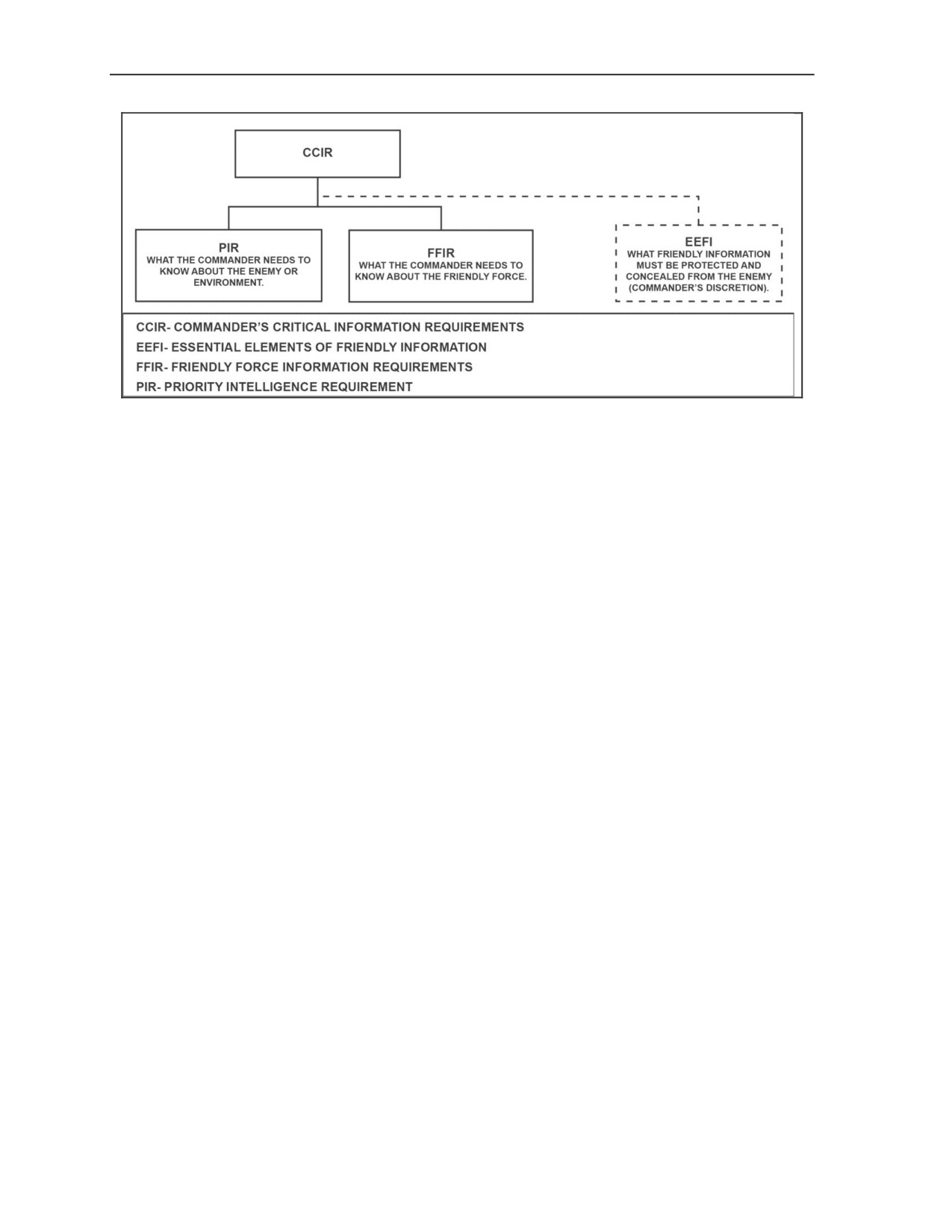
4-37. Commanders describe information they want protected as essential elements of friendly information.
An essential element of friendly information is a critical aspect of a friendly operation that, if known by the
enemy, would subsequently compromise, lead to failure, or limit success of the operation and therefore
protected from enemy detection. (Refer to ADRP 5-0 for more information.) Although EEFIs are not CCIRs,
they have the same priority. EEFIs establish elements of information to protect rather than ones to seek or
collect. EEFI identification is central to prioritizing units, information, or activities focusing security tasks.
(See figure 4-1.)
-XO\ 2015
FM 3-98
4-7
Chapter 4
Figure 4-1. CCIR and EEFI
Reconnaissance Guidance
4-38. Commanders provide clear reconnaissance guidance that offers both freedom of action to develop the
situation as well as adequate direction to ensure that their organic Cavalry organizations can accomplish
stated reconnaissance objectives within the required timeframe. The commander’s reconnaissance and
security planning guidance provides a clear understanding of the Cavalry organization’s task, purpose, and
objective. Reconnaissance and security guidance explains focus, levels of detail required, levels of
covertness, and guidelines for engagement, disengagement, and displacement of the organization. The
commander develops his planning guidance based on the BCT mission, timeline and intent in order to satisfy
information requirements and identify opportunities to seize, retain, and exploit the initiative. The
commander specifies different reconnaissance guidance for each phase of an operation and adjusts the
components of his guidance when appropriate. The commander’s guidance consists of four elements—
z
Focus.
z
Tempo of reconnaissance.
z
Engagement/disengagement criteria (if any), both lethal and nonlethal.
z
Displacement criteria.
Focus
4-39. Reconnaissance focus defines the Cavalry organization’s area of emphasis and is made of four
categories; threat, infrastructure, terrain and weather effects, and society. The higher commander’s intent as
well as the commander’s initial assessment of information requirements and information gaps serves as the
basis for establishing the focus for reconnaissance tasks. Focus helps the Cavalry organization narrow the
scope of operations to get the information most important to developing the situation for future operations.
4-40. Commanders and staffs can further focus reconnaissance efforts by assigning specific reconnaissance
objectives. A reconnaissance objective is a terrain feature, geographic area, or an enemy force about which
the commander wants to obtain additional information. The objective should directly support the end state
defined in the commander’s intent.
4-41. For example, during offensive tasks, a BCT’s Cavalry squadron may conduct reconnaissance to locate
an enemy’s security force, to include its composition, disposition, and capabilities. At the same time, the
squadron could also address information gaps concerning terrain—collecting information on key terrain
features that might affect friendly forces, the enemy’s disposition, and the various courses of action the BCT
commander might develop during his planning. In stability tasks, however, Cavalry troops may focus on
locating IED manufacturing sites. The information developed by terrain- or enemy-focused reconnaissance
helps update templated enemy courses of action as part of the continuous assessment (through Intelligence
Preparation of the Battlefield [IPB]) of the tactical situation and the operational environment.
4-8
FM 3-98
-XO\ 2015
Mission Command
4-42. Additionally, a reconnaissance objective may include gaining an awareness of how the local society
affects military operations as well as the impact of military operations on that society. Cavalry organizations
might have to conduct reconnaissance to gather information on the size, location, composition, and political
temperament of the society. Such reconnaissance focuses on developing an understanding of the cultural and
human factors that affect friendly as well as adversarial perceptions and operations, such as religion,
ethnicity, language, and political or tribal organizations. Civil considerations also address infrastructure—
the systems that support the inhabitants, economy and government of a specific area. The six factors of areas,
structures, capabilities, organizations, people, and events summarize the aspects of civil considerations that
might be a component of reconnaissance focus. Regardless of its focus on terrain, the enemy, or civil
considerations, the reconnaissance objective clarifies the intent of the reconnaissance effort by stating the
most important result of the reconnaissance effort.
4-43. Reconnaissance focus—derived from the commander’s intent and defined by specific reconnaissance
objectives—allows subordinate Cavalry organizations and commanders to prioritize tasks to accomplish, and
the assets used to accomplish them.
Tempo of Reconnaissance
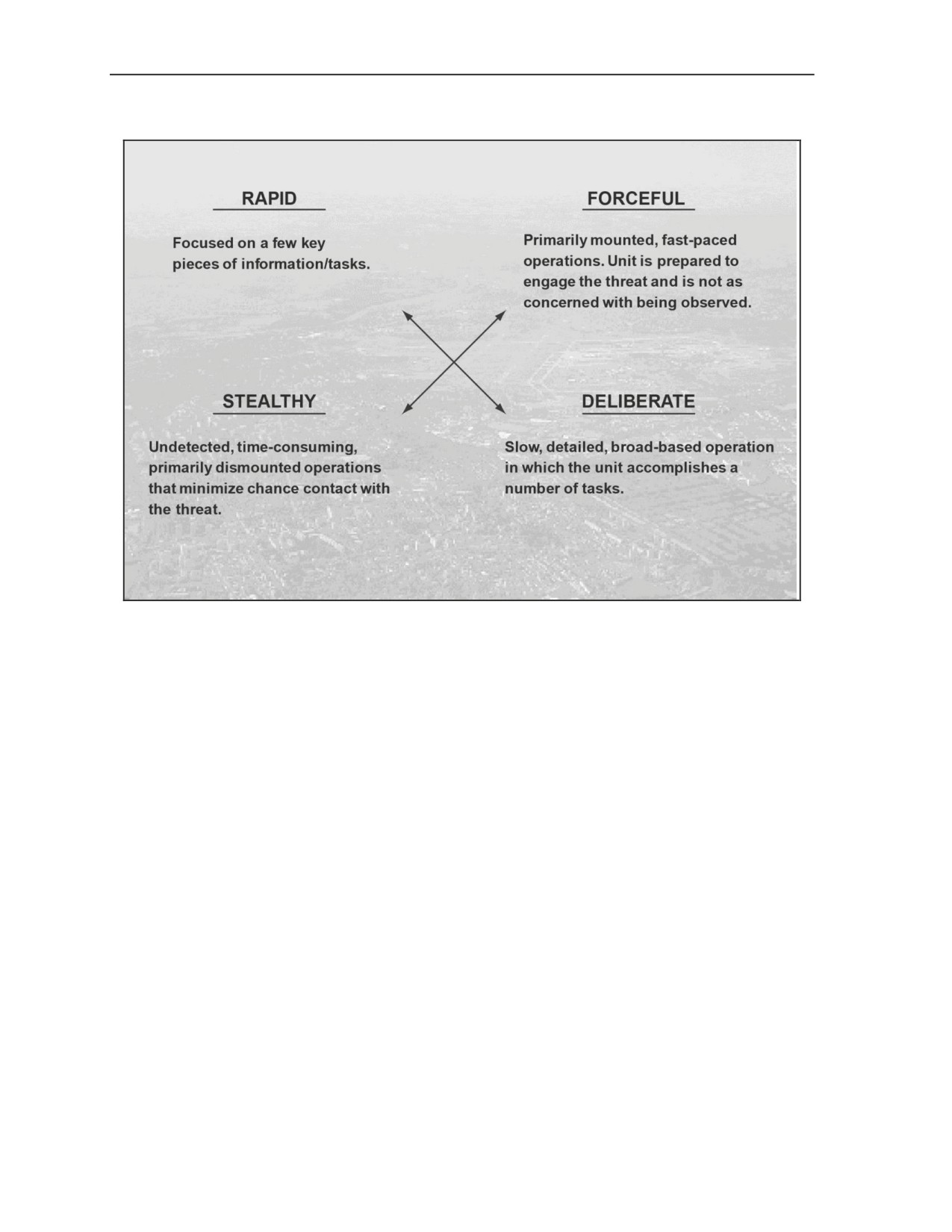
4-44. Tempo of reconnaissance refers to the level of detail and covertness required of the Cavalry
organization to best accomplish either reconnaissance or security tasks. Tempo is described by four terms:
rapid, deliberate, stealthy, and forceful. “Rapid” and “deliberate” are levels of detail and are mutually
exclusive in all cases, as one cannot be rapid and deliberate at the same time. However, Cavalry organizations
can oscillate between the two from phase to phase or even within sub-phases of an operation. “Stealthy” and
“forceful” indicate mutually exclusive levels of covertness. (See figure 4-2 on page 4-10.) Commanders
choose the appropriate form of reconnaissance to accomplish the mission balanced with the other mission
variables of METT-TC.
4-45. “Rapid” tempo dictates that the level of detail for the reconnaissance operation is limited to a certain
prescribed list of tasks or PIR. Rapid tempo is appropriate when time is of the essence and only a limited
number of information requirements are necessary to accomplish the mission.
4-46. “Deliberate” tempo implies all tasks of the mission must be accomplished to ensure mission success.
Deliberate tempo allows the organization more time to answer all information requirements. Detailed and
thorough reconnaissance and security tasks require time-intensive, comprehensive, and meticulous mounted
and dismounted efforts to observe reconnaissance objectives and develop the situation.
4-47. “Stealthy” tempo emphasizes avoiding detection and engagement dictated by restrictive engagement
criteria. Stealthy reconnaissance typically takes more time than aggressive reconnaissance and utilizes
dismounted scouts to take maximum advantage of cover and concealment to reduce signatures that lead to
compromise. Stealthy reconnaissance is used when time is available, detailed reconnaissance and stealth is
required, enemy forces are likely in a specific area, danger areas are encountered, and when restrictive terrain
limits effectiveness of mounted reconnaissance.
4-48. “Forceful” tempo develops the situation through action by employing air and ground reconnaissance,
technical means, and both direct and indirect fire systems moving rapidly to develop the situation. Forceful
reconnaissance requires firepower, aggressive exploitation of action on contact, operational security, and
training to survive and accomplish its mission. Forceful reconnaissance is appropriate when time is limited,
detailed reconnaissance is not required, terrain is open, environmental conditions allow for mounted
reconnaissance, and when dismounted reconnaissance cannot complete the mission within existing time
constraints.
-XO\ 2015
FM 3-98
4-9
Chapter 4
Figure 4-2. Reconnaissance tempo
Engagement/Disengagement Criteria
4-49. Engagement criteria are defined in FM 3-90-1 as protocols that specify those circumstances for
initiating engagement with an enemy force. They can be either restrictive or permissive. The squadron
commander visualizes engagement criteria through analysis of the mission variables (METT-TC) of mission,
enemy, troops and support available, and civil considerations.
4-50. The commander must define the size or type of enemy force he expects his subordinate units to engage
or avoid which drives planning for direct and indirect fires, as well as establishment of bypass criteria. The
squadron commander must consider information engagement and how the squadron interacts and influences
the local populace.
4-51. Merely defining engagement criteria using terms such as “aggressive” or “discreet” is not sufficient.
Engagement criteria should be defined using precise doctrinal terms. Again, the squadron commander issues
specific planning guidance to clearly define the engagement criteria. The staff and subordinate commanders
refine that guidance into specific execution information. Examples include the following:
z
Engagement criteria.
z
Guidance for actions on contact.
z
Bypass criteria.
z
Reconnaissance handover criteria.
z
Priority of fires.
z
Rules of engagement (ROE) or rules for use of force.
z
Fire support coordination measures.
z
Weapons control status.
4-10
FM 3-98
-XO\ 2015
Mission Command
Displacement Criteria
4-52. Displacement criteria define triggers for planned withdrawal, passage of lines, or reconnaissance
handover between units. As with engagement and disengagement criteria, the conditions and parameters set
out in displacement criteria integrate the commander’s intent with tactical feasibility. Conditions are either
event driven (for example, associated PIR being met, threat contact not expected in the area, and observed
NAIs or avenues of approach denied to the enemy); time driven (for example, latest time information of value
[LTIOV] time triggers are met); or threat driven (observation posts have been compromised). Failure to
specifically dictate conditions of displacement, nested within the higher scheme of maneuver will likely result
in ineffective reconnaissance and security tasks.
Security Guidance
4-53. As with reconnaissance guidance, commanders provide clear security guidance that offers freedom of
action and direction to ensure that their organic Cavalry organizations can accomplish stated objectives
within the required timeframe. The commander’s security planning guidance provides a clear understanding
of the Cavalry organization’s task, purpose, and objective and the protection requirements of the security
mission. The elements and purpose of security guidance are the same as reconnaissance guidance.
Focus
4-54. The focus of security tasks defines what the Cavalry organization is to protect and why—the focus
describes the expected results of the security operation. Security tasks are threat, terrain, or friendly unit-
oriented (see Chapter 6 for additional information on security tasks). Examples of focus in security tasks
include the enemy, threat, or adversaries, terrain (key terrain, routes, bridges and gap crossing sites,
defensible terrain), troops and friendly forces (the protected force), and civil considerations.
4-55. The focus of security tasks allows the commander to determine specific critical tasks, their priority,
and their relation to his intent and end state. Moreover, focus allows subordinate commanders to narrow their
operations to acquire the information most important to higher headquarters and protect the most critical
activities.
4-56. Named areas of interest (NAIs) provide a graphical method to focus Cavalry organizations as they
execute security tasks. Significantly NAIs link most likely and most dangerous threat activities to terrain
where those activities may occur. Given the NAIs, subordinate commanders can prioritize the employment
and deployment of their forces and assets to provide the most effective observation and coverage throughout
the area of operations as they develop their scheme of maneuver and observation plans.
Tempo of Security
4-57. Clearly articulating the tempo of security tasks allows the commander to establish associated time
requirements that will drive security tasks planning such as the method of establishing observation posts
(either mounted or dismounted), length of UAS rotation, and required logistical and communications support
necessary to execute the mission. Tempo can also relate to depth, especially in screen missions, as time is
needed to properly deploy into screen lines to achieve the required depth throughout the area of operations.
Commanders consider tasks, their CCIR, the LTIOV, tactical risk, movement techniques, reconnaissance
methods (stealthy or forceful, mounted or dismounted, or appropriate combinations of both), and formations
when articulating the security tempo.
4-58. In addition, tempo affects whether Cavalry units will employ short- or long-duration OPs in their
security tasks.
z
Short duration: Cavalry organizations man short duration OPs for periods less than 12-hours.
Cavalry units establish short duration OPs quickly to allow commanders to take advantage of
available time and to mass reconnaissance assets through maximizing the number of OPs and
associated observing forces on the ground and in the air for a short period of time.
z
Long duration: Cavalry organizations man long-duration OPs for greater than
12-hours.
Significantly, the number of OPs decreases as platoons and troops must allocate additional forces
to each OP to manage a deliberate rotation schedule and rest plan. Units must coordinate for
adequate resupply for all classes of supply to support OPs that will operation for extended periods
of time.
-XO\ 2015
FM 3-98
4-11
Chapter 4
Engagement/Displacement Criteria
4-59. Just as the commander issues guidance concerning engagement and displacement criteria in his
reconnaissance guidance, the same criteria apply to security tasks. In addition, commanders should consider
the following when assigning a security mission and employing a security force:
z
Force or area to secure.
z
Location and orientation of the security area.
z
Initial location and types of OPs, if applicable.
z
Time allocated to establish the security operation.
z
Criteria for transitioning from the security operation to BCT decisive operations.
z
Task organization and augmentation of security forces.
z
Level of protection and minimum warning time requirements.
z
Threat considerations, such as the smallest enemy element allowed passage without engage or the
threat’s capability to influence main body activities.
Direct
4-60. Commanders direct all aspect of operations by establishing their commander’s intent, setting
achievable objectives, and issuing clear tasks to subordinate units. Throughout the operations process,
commanders direct forces by—
z
Preparing and approving plans and orders.
z
Establishing command and support relationships.
z
Assigning and adjusting tasks, control measures and task organization.
z
Positioning units to maximize combat power.
z
Positioning key leaders at critical places and times to ensure effective mission command.
z
Allocating resources to exploit developing opportunities and counter emerging threats.
z
Committing the BCT reserve, as required.
Lead
4-61. Through leadership, commanders provide purpose, direction, and motivation to subordinate
commanders, their staff and Soldiers. The commander’s physical presence is necessary to lead effectively.
During reconnaissance and security tasks, the BCT commander balances his time between leading the staff
through the operations process and providing purpose, direction, and motivation to subordinate commanders
and Soldiers forward of the command post. Once the Cavalry squadron initiates their reconnaissance and
security tasks, the Cavalry squadron commander will need to command his squadron and develop the
situation well forward of the squadron and BCT command posts.
Assess
4-62. Commanders continuously assess the situation to better understand current conditions and determine
how the operation is progressing. Continuous assessment helps commanders anticipate and adapt the force
to changing circumstance. Commanders incorporate the assessment of the staff, subordinate commander, and
unified action partners into their personal assessment of the situation. Based on their assessment, commanders
modify plans and orders to adapt the force to changing circumstances. (See figure 4-3.)
4-12
FM 3-98
-XO\ 2015
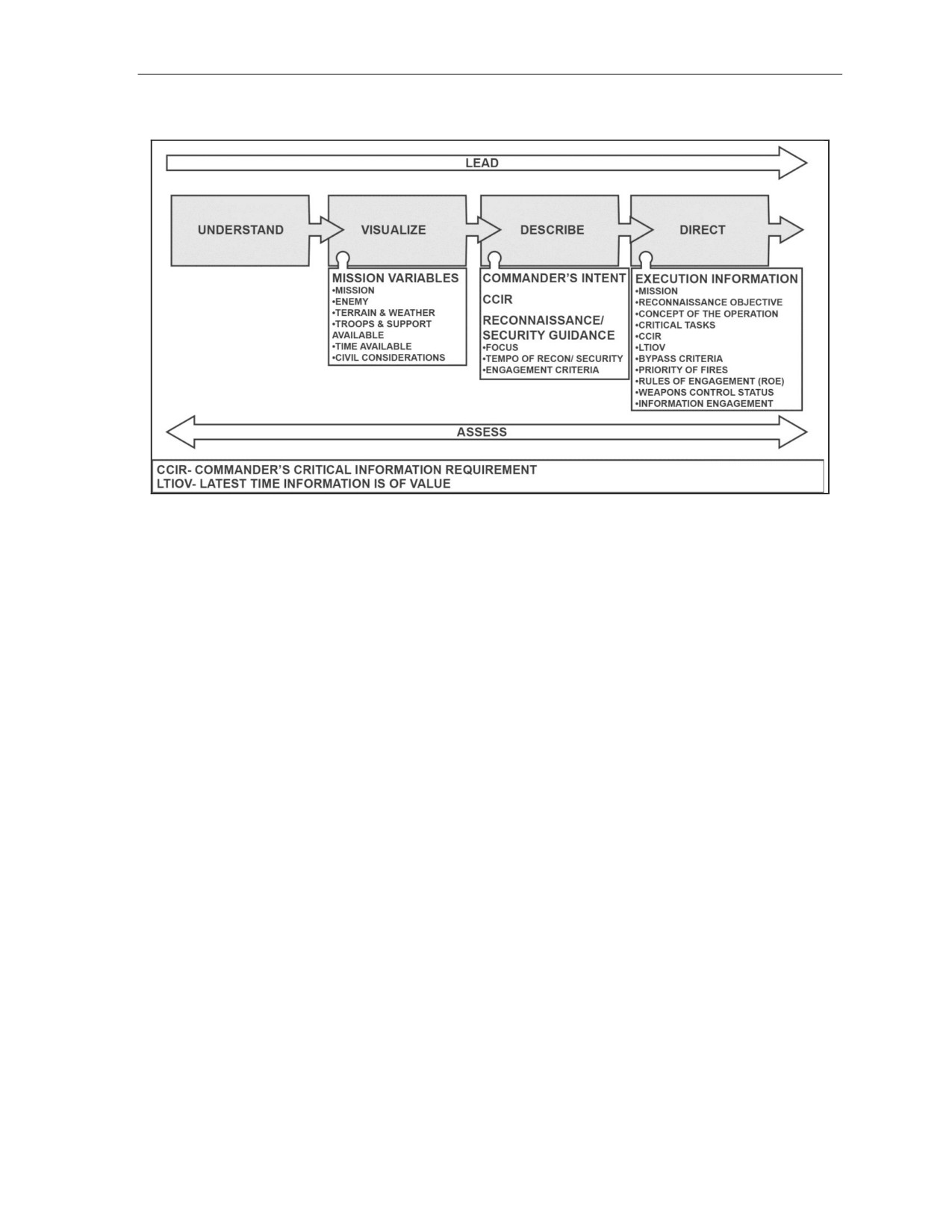
Mission Command
Figure 4-3: Development of guidance for reconnaissance and security tasks
COMMANDERS AND STAFFS COLLABORATE TO PLAN, PREPARE, EXECUTE, AND ASSESS
4-63. The operations process consists of the major activities of mission command conducted during
operations: planning, preparing, executing, and assessing operations. Commanders drive the operations
process, while remaining focused on the major aspects of operations. Staffs conduct the operations process;
they assist commanders in the details of planning, preparing, executing, and assessing.
4-64. The continuous nature of the operations process—and the critical combat information and timely and
accurate reports provided during reconnaissance and security tasks—allows commanders and staffs to make
adjustments, enabling agile and adaptive forces. Commanders, assisted by their staffs, integrate activities and
operations throughout the BCT and the squadron as they exercise mission command. Throughout the
operations process, they develop an understanding and appreciation of the operational environment and the
tactical situation. They formulate a plan and provide purpose, direction, and guidance to the BCT.
Commanders then adjust operations as changes to the operational environment and the tactical situation
occur, allowing commanders to seize, retain, and exploit the initiative to gain a position of relative advantage
over the enemy. (Refer to ADRP 5-0 for more information.)
4-65. Throughout the entire operations process, the staff supports the commander and subordinate
commanders in understanding situations, decision-making, and implementing decisions throughout the
conduct of operations. The staff does this through four staff mission command tasks—
z
Conduct the operations process (plan, prepare, execute, and assess).
z
Conduct knowledge management and information management.
z
Conduct information operations.
z
Conduct cyber-electromagnetic activities.
Plan
4-66. Planning is the art and science of understanding a situation, envisioning a desired future, and laying
out effective ways of bringing that future about. (Refer to ADP 5-0 and ADRP 5-0, Chapter 2, for more
information.) Army leaders plan to create a common vision among subordinate commanders, staffs, and
unified action partners for the successful execution of operations. Planning results in an order that clearly
communicates a commander’s vision and directs actions to synchronize forces in time, space, and purpose
for achieving objectives and accomplishing missions.
-XO\ 2015
FM 3-98
4-13
Chapter 4
4-67. All planning is based on imperfect knowledge and assumptions about the future. Planning cannot
predict exactly what the effects of the operation will be, describe with precision how enemies will behave, or
anticipate how civilian populations will respond to military operations. Understanding and learning that
occurs during planning has great value, even if operations do not proceed precisely as envisioned, the process
of planning results in improved situational understanding that facilitates future decision making. Plans and
planning help leaders to—
z
Understand and develop solutions to problems.
z
Anticipate events and adapt to changing circumstances.
z
Task-organize the force and prioritize efforts.
Understand and Develop Solutions
4-68. The commander and staff conduct conceptual planning (using the Army design methodology) to
understand, visualize, and describe the operational environment and the operational approach to the problem.
Army design methodology entails framing an operational environment, framing a tactical problem, and
developing an operational approach to solve the problem. Army design methodology results in an improved
understanding of the operational environment, a problem statement, initial commander’s intent, commander’s
reconnaissance guidance, and an operational approach that serves as a link between conceptual and detailed
planning. Based on their understanding and learning gained during Army design methodology, commanders
issue planning guidance, to include an operational approach, to guide more detailed planning using the
military decision-making process (MDMP). (Refer to ADRP 5-0 for more information.) The BCT and
Cavalry squadron’s detailed planning efforts use the MDMP to produce a synchronized plan that provides
mission type orders to subordinate units, including the BCT’s Cavalry squadron. (See figure 4-4.)
4-69. The military decision-making process is an iterative planning methodology to understand the situation
and mission, develop a course of action, and produce an operation plan or order. (Refer to ADP 5-0 and
ADRP 5-0 for more information.) The MDMP integrates the activities of the commanders, staffs, subordinate
headquarters, and unified action partners to understand the situation and mission; develop and compare
courses of action; decide on a course of action that best accomplishes the mission; and produce an operations
order for execution. The MDMP helps leaders apply thoroughness, clarity, sound judgment, logic, and
professional knowledge to understand situations, develop options to solve problems, and reach decisions.
The MDMP helps commanders, staffs, and others to think critically and creatively while planning and results
in an improved understanding of the situation and an order that guides the force through preparation and
execution.
4-70. The MDMP consists of seven steps. Each step of the MDMP has various inputs, a method (step) to
conduct, and outputs. The outputs lead to an increased understanding of the situation and to facilitating the
next step of the MDMP.
4-71. The MDMP facilitates collaboration and parallel planning. The BCT headquarters solicits input and
continuously shares information concerning future operations through planning meetings, warning orders,
operations orders, and fragmentary orders. Commanders encourage active collaboration to build a shared
understanding of the situation, participate in course of action development and decision making, and resolve
conflicts before publishing the order.
4-72. The MDMP also drives preparation. Since time is a factor in all operations, commanders and staffs
conduct a time analysis of their planning and preparation activities early in the planning process. Time
analysis may require the commander to direct subordinates through a series of warning orders to start
necessary movements, conduct task organizations changes, begin reconnaissance and security tasks, and
execute other preparation activities before completing the plan. For example, to support reconnaissance and
security tasks, the Cavalry squadron commander and staff must conduct parallel planning simultaneously
with the BCT staff.
4-14
FM 3-98
-XO\ 2015
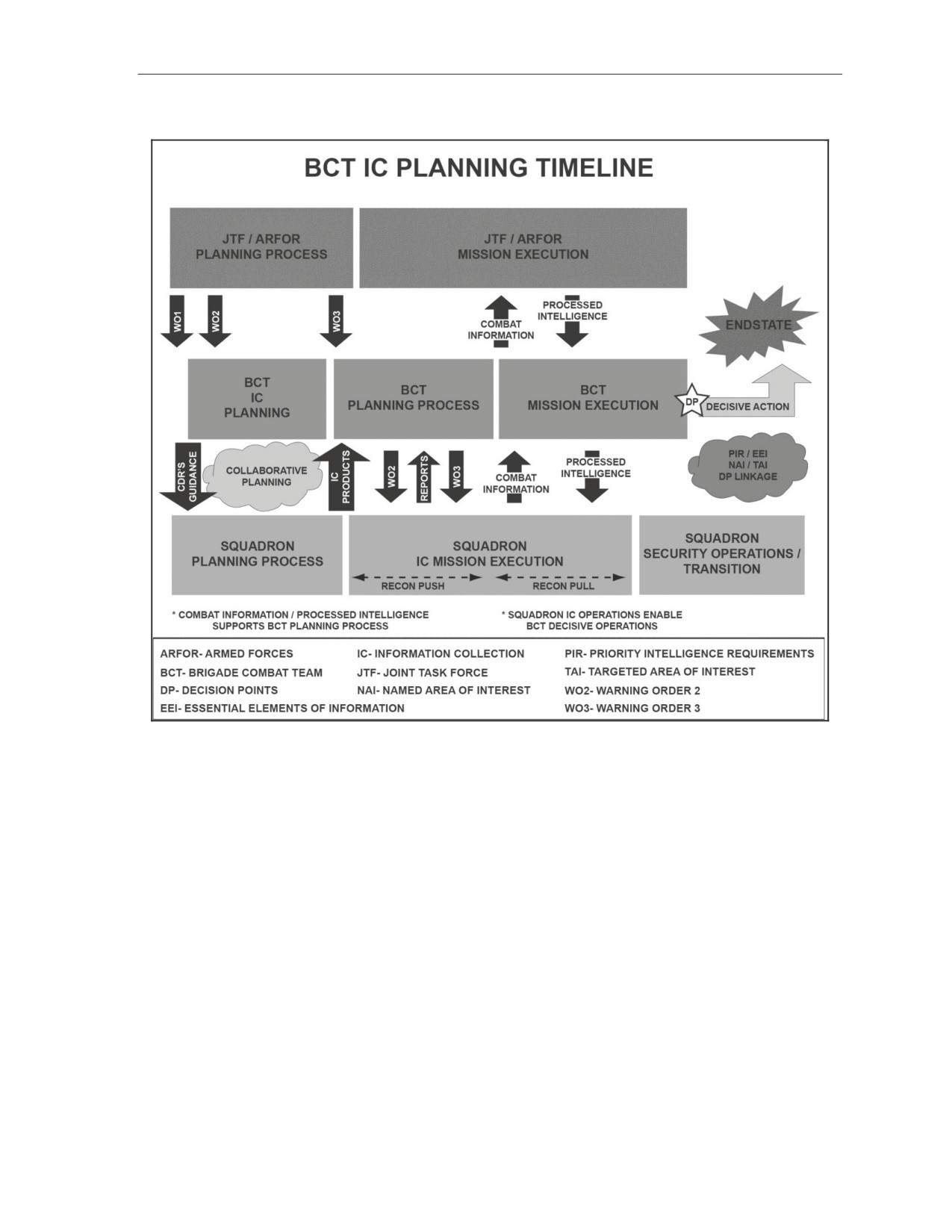
Mission Command
Figure 4-4. The BCT information collection timeline
4-73. The commander is the most important participant in the MDMP. More than simply a decision maker
in the process, commanders use their experience, knowledge, and judgment to guide staff planning efforts.
During the MDMP, commanders focus their activities on understanding, visualizing, and describing.
4-74. The staff’s efforts during the MDMP focuses on helping the commander understand the situation, make
decisions, and synchronize those decisions into a fully developed plan or order. Staff activities during
planning initially focus on mission analysis. The products that the staff develops during mission analysis help
commanders understand the situation and develop the commander’s visualization. The mission analysis
products also define the staff’s input into the initial phases of the BCT’s reconnaissance and security tasks.
Anticipate Events and Adapt to Changing Circumstances
4-75. Cavalry squadrons are the “eyes and ears” of the BCT and the commander, the squadron commander
and staff must be able to assist the BCT commander in understanding, visualizing, and describing the area of
operations and the tactical situation. The squadron’s operations primary purpose is to answer the BCT
commander’s PIR. (See figure 4-5 on page 4-17.)
4-76. To this end, outputs of the intelligence preparation of the battlefield (such as the enemy situational
template, the event template, and the BCT and squadron commanders’ CCIR) are critically important to
assisting the BCT in anticipating events and adapting to changing situations. As commanders articulate,
assess, and refine their information requirements, the BCT and squadron staffs further refine the
commanders’ information requirements into specific reconnaissance and information collection plans.
-XO\ 2015
FM 3-98
4-15
Chapter 4
4-77. As described previously in this chapter PIR are information requirements that drive decision points.
(Refer to ADRP 3-90 for additional information). For example, the BCT commander could establish a PIR
concerning enemy capabilities and disposition as well as PIR concerning civil considerations in conjunction
with a series of FFIRs about the BCT:
z
Priority intelligence requirements, information about the enemy which drives decision points. For
example:
When will enemy artillery be in range of our main body?
Where is the enemy main body?
Where are civilians on the battlefield?
z
Friendly force information requirements, the things we know about ourselves. For example—
Completion and status of defensive preparations.
Loss of communications with quick reaction force.
Loss of key weapons system to maintenance backlogs.
4-78. The Cavalry squadron staff will further refine the BCT commander’s PIR into essential elements of
information (EEI). And the squadron staff and troop commanders, will, in turn, designate EEIs that nest with
the higher commander’s PIR. In the above example, the BCT commander wants to know “when will enemy
artillery be in range of our main body?” After establishing EEIs the squadron staff and troop commanders
may establish indicators. Indicators are items of information that reflect the intention or capability of an
adversary to adopt or reject a course of action (JP 2-0). After doing an analysis of likely firing positions given
the terrain, subsequent EEIs for their respective AO could include the following:
z
Squadron EEI:
Is enemy reconnaissance present in the vicinity of NAI number 3?
Is there enemy movement south of phase line (PL) Gowins?
Do the bridges at grid A and grid B support tracked vehicles?
z
Troop EEI:
What are the trafficable routes into NAI number 3?
Does terrain support artillery firing positions?
What attack routes north into NAI number 3 can support the combined arms battalion?
z
Troop indicator:
Confirm/deny presence of enemy reconnaissance vehicles vicinity of NAI number 3.
After developing EEIs into indicators, the staff and troop commanders will then assign staff
and troop commanders will then assign specific information requirements (SIR) to facilitate
tasking by matching requirements to asset capability.
4-16
FM 3-98
-XO\ 2015
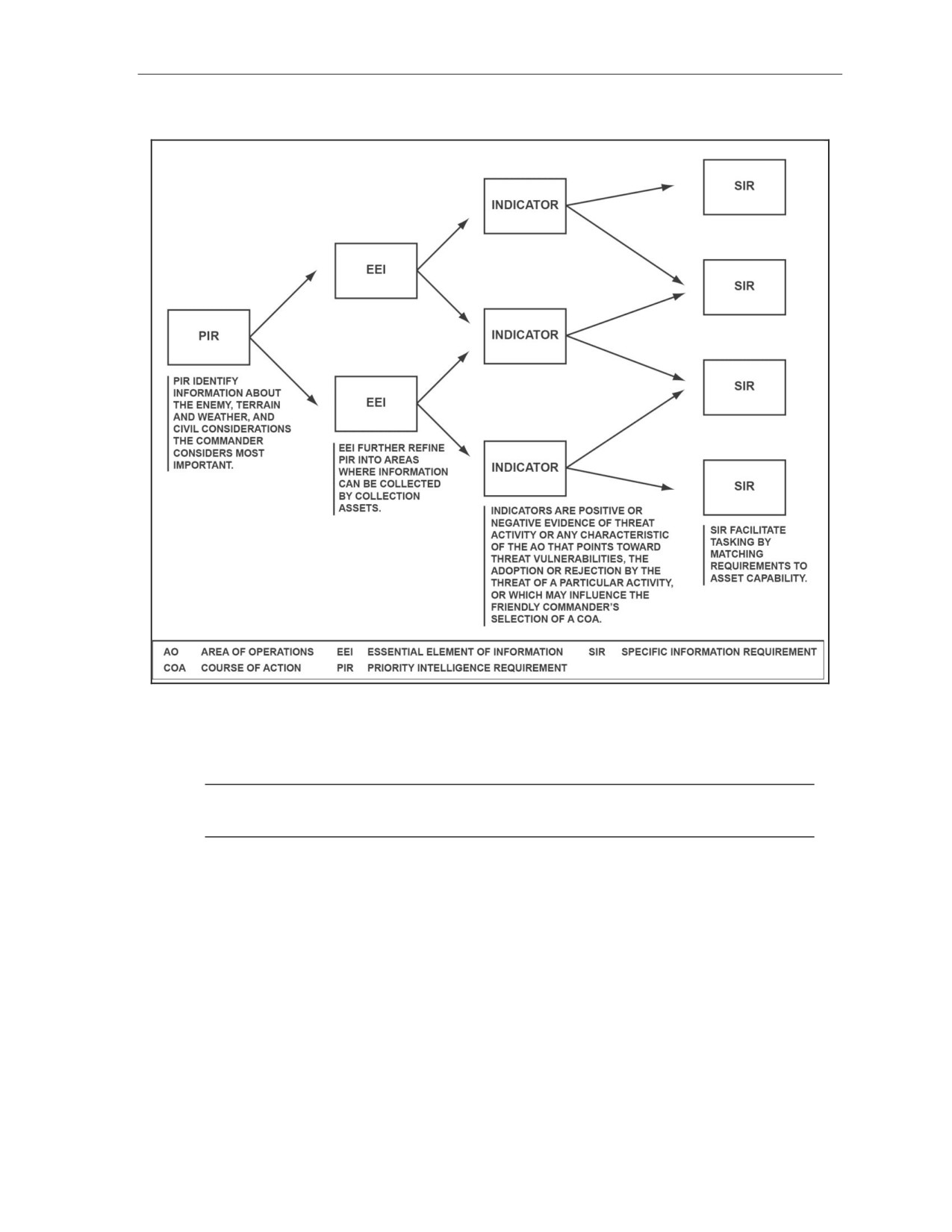
Mission Command
Figure 4-5. Relationship of SIRs to Indicators, to EEIs to PIR
4-79. The Cavalry squadron has a supporting relationship to the BCT’s reconnaissance and security mission,
the squadron staff will often operate on a parallel planning timeline with the BCT staff during the operations
process.
Note. The development of PIR, EEIs, indicators, SIRs, and NAIs is an operations function led by
the BCT S-3. At the squadron-level, the squadron S-3 will lead this planning effort.
Task Organize the Force and Prioritize Efforts
4-80. Task organization is a temporary grouping of forces designed to accomplish a particular mission
(ADRP 5-0). Commanders task organize the force by establishing command and support relationships in
accordance with their analysis of the mission variables (METT-TC).
4-81. BCTs task organize and assign command relationships for their Cavalry formations to execute
combined arms, air-ground operations to accomplish their assigned mission in their anticipated operational
environment. The BCT establishes conditions for reconnaissance and security tasks by enabling the Cavalry
squadron with additional rotary-wing aircraft, joint and organic fires, and additional intelligence collection
assets (to include partnering with and access to joint and national-level intelligence assets). To include
mobility, counter-mobility, and general engineer support, increased sustainment capacity, increased
communications capabilities for extended operational depth and distances, as well as additional lethal combat
power in the form of infantry and armor. The more sufficient the task organization the more capable the
reconnaissance organization is to develop the situation through action, especially in an unclear operational
environment. Similarly, in stability tasks, task organizing the squadrons with assets specific to collecting
-XO\ 2015
FM 3-98
4-17

Chapter 4
necessary information for follow on operations (such as civil affairs, translators, engineers, and infrastructure
assessment teams) provides relevant information in a timely fashion.
4-82. When task organizing, commanders and staffs should clearly define the command and support
relationships between organizations. The type of command relationship will relate to the nature of the
operation and the expected duration of the organization. The following table summarizes the Army command
relationships available to commanders and staffs when task organizing their forces.
4-83. When task organizing, commanders and staffs should consider the various information collection and
combined arms reconnaissance and security assets available to BCTs. Information collection assets can be
categorized several different ways. Table 4-1 outlines the organization and capability of the brigade combat
teams.
Table 4-1. Available Reconnaissance and Security and Information Collection Assets
Organization
Capability
Conduct combined arms, air-ground reconnaissance and security
tasks as needed to meet information requirements.
Conduct area, zone, route reconnaissance, reconnaissance in
Cavalry Squadron
force, or reconnaissance as part of a security task.
In difficult terrain, conduct area, zone, and route reconnaissance
or reconnaissance in force by fixed- or rotary-wing aircraft.
Conduct combined arms, air-ground operations as needed to
meet information requirements. These operations include the
Combined Arms Battalion,
reconnaissance and security tasks conducted by the battalion
Stryker Infantry Battalion, and
scout platoon as well as providing additional combat power
Infantry Battalion
(through task organization) to reinforce the BCT’s organic
Cavalry squadron.
Recon/Attack Aviation
Battalion
Conduct aerial reconnaissance and security tasks in close
(attached from Cbt Avn
coordination with the BCT’s Cavalry squadron (through task
Brigade)
organization).
Supports the BCT and its subordinate commands through
collection, analysis, and dissemination of information and
intelligence.
Conducts analysis, full motion video, signals intelligence
(SIGINT), and human intelligence (HUMINT) collection.
Conducts situation development, target development, and
support to lethal and nonlethal targeting, indications and warning,
Military Intelligence Company
assessment, and protection.
Provides the commander and staff with assessments of enemy
capabilities, intentions, and course of actions (COA) as they
relate to the mission. Disseminates intelligence products
throughout the unit as well as to higher and subordinate
headquarters.
Conducts intelligence reach for transmission and receipt of
intelligence products across the intelligence enterprise.
Field artillery fire support personnel report battlefield intelligence
Field Artillery Battalion
and assessment of the effects of fires. Weapons locating radars
locate the positions of threat firing elements for engagement.
4-18
FM 3-98
-XO\ 2015
Mission Command
Table 4-1. Available Reconnaissance and Security and Information Collection Assets
(continued)
Organization
Capability
Provide additional information collected during conduct of primary
missions. Can provide information on types of wounds or injuries,
diseases, and the health and welfare of a population that refines
Brigade Support Battalion
understanding of the operational environment or enemy
capabilities.
Provide additional information collected during conduct of primary
missions.
Conduct Soldier sensor missions as needed to meet information
Engineer Company
requirements. Terrain and reconnaissance teams identify key
terrain, obstacle intelligence, and infrastructure information.
CBRN Platoon conducts reconnaissance tasks to detect, identify,
CBRN Platoon
mark, report, and sample for the presence of CBRN hazards.
4-84. Additional combat power enhances the Cavalry squadron’s ability to gain and maintain contact,
execute reconnaissance and battle handover, and provide an increased capability to defeat enemy
reconnaissance and security organizations and survive chance encounters. Task organizing additional combat
power with the BCT’s Cavalry squadron can give the brigade a marked advantage during decisive operations.
4-85. Although properly task organized Cavalry organizations can produce effects that outweigh the
diversion of combat power from the main body—achieving an economy of force—the BCT commander
should consider that dedicating these additional capabilities to the Cavalry squadron comes at the expense of
capability for potential follow on operations. Therefore, commanders should carefully consider the risks of
executing reconnaissance tasks as an economy of force.
Prepare
4-86. Preparation consists of activities performed by units and Soldiers to improve their ability to execute
an operation (ADP 5-0). Preparation creates conditions that improve friendly forces’ opportunities for
success. Preparation requires commanders, staffs, and units to ensure that the force is trained, equipped, and
ready to execute operations. Preparation activities help commanders, staffs, and units understand a situation
and their roles in upcoming operations.
4-87. During preparation, commanders take every opportunity to improve their situational understanding
prior to execution of their decisive operations. The BCT and its organic Cavalry squadron must be prepared
to execute aggressive and continuous reconnaissance and security tasks during the preparation phase of the
operations process.
4-88. At the same time, the BCT is often most vulnerable to surprise and enemy attack during preparation,
when forces might be concentrated in assembly areas. Leaders are away from their units and concentrated
together for rehearsals: part of the force could be moving to task-organize. Required supplies may be
unavailable or being repositioned. As a result, security tasks are essential during this phase of the operations
process.
4-89. Commanders and staffs must revise and refine their initial plan during preparation. The commander’s
situational understand will change over the course of the operations process—enemy actions will require
revision of the plan and the ongoing reconnaissance and security tasks will generate both applicable combat
information and unforeseen opportunities. During preparation, assumptions made during planning are
confirmed or denied. Significant new information—either PIR or FFIR that are answered by effective
reconnaissance and security tasks—will require commanders to revise and refine their operational plan.
4-90. Finally, commanders and staffs conduct effective confirmation briefs and rehearsals. A confirmation
brief is a briefing that subordinate leaders give to the higher commander immediately after the operations
order. It is the leaders’ understanding of the commander’s intent, their specific tasks—to include the BCT
commander’s reconnaissance guidance—and the relationship between their mission and the other units in the
-XO\ 2015
FM 3-98
4-19
Chapter 4
operation (ADRP 5-0). Ideally, the commander conducts confirmation briefs in person with selected staff
members. A rehearsal is a session in which the commander and staff or unit practices expected actions to
improve performance during execution (ADRP 5-0). Both confirmation briefs and rehearsals are essential to
ensure that subordinate commanders and staffs understand the concept of operations and the commander’s
intent. Rehearsals and confirmation briefs allow leaders to practice synchronizing operations at times and
places critical to mission accomplishment. Effective rehearsals and confirmation briefs solidify the sequence
of the operation’s key actions and improve mutual understanding throughout the unit. During preparation,
commanders and staffs must ensure that the BCT and the Cavalry squadron are—
z
Securing and protecting the force.
z
Conducting aggressive reconnaissance to improve commanders’ situational understanding.
z
Revising, refining, and rehearsing the operational plan.
z
Integrating, organizing and configuring their task-organized, combined-arms, air-ground teams
z
Ensuring forces and resources are ready for execution.
Note. The BCT and the Cavalry squadron should also conduct a reconnaissance and security
rehearsal to ensure that the BCT reconnaissance and security plan meets the commander’s intent
and is synchronized throughout the BCT. The BCT commander, executive officer (XO), S-2, S-3
fire support coordinator, Cavalry squadron commander, MI company commander, and other BCT
staff cells (for example, sustainment, IO, MC) should attend. The rehearsal should last no longer
than 1-hour, and should focus on rehearsing reconnaissance and security tasks that address each
PIR and their associated NAIs.
Execute
4-91. Execution is putting a plan into action by applying combat power to accomplish the mission. (Refer to
ADP 5-0 and ADRP 5-0 for more information.) In execution, commanders, staffs, and subordinate
commanders focus their efforts on translating decisions into actions. They apply combined arms, air-ground
teams to seize, retain, and exploit the initiative to gain and maintain a position of relative advantage.
4-92. During execution, the tactical situation will change rapidly. Operations the commander originally
envisioned during planning may bear little resemblance to actual events. Subordinate commanders require
maximum latitude to take advantage of unforeseen situations—in the form of both opportunities and
challenges—to execute actions on contact, develop the situation through action, and meet the commander’s
intent, even when the original order no longer applies. Execution requires leaders trained in independent
decision making, aggressiveness, and risk taking conducted within the guidance and philosophy of mission
command.
4-93. To assist BCTs to develop the situation through action, Cavalry organizations within the BCTs must
effectively—
z
Seize the initiative through combined arms, air-ground teams.
z
Execute decision point tactics.
Seize the Initiative Through Combined-Arms, Air-Ground Team
4-94. Reconnaissance and security tasks, by their nature, are combined arms, air-ground operations
providing the commander with information and intelligence that help reduce uncertainty and enable rapid
decision making. Moreover, the same combined arms, air-ground teams are able to present enemy forces
with multiple forms of contact, forcing the enemy to react continuously. Aviation assets provide critical
complimentary effects to BCT’s organic Cavalry squadrons during reconnaissance and security tasks.
Specifically, air assets provide direct fire, extensive observation capabilities, and facilitate the rapid
movement of supplies and personnel during reconnaissance and security tasks. Attack and reconnaissance
rotary and fixed wing aircraft employ guided and unguided munitions, provide close combat attack/close air
support to ground forces, and assist in the ground Cavalry squadron’s ability to retain freedom of maneuver
and action to conduct counterreconnaissance operations. Additionally, these assets can quickly transition to
conduct interdiction missions by destroying high-value and high-payoff targets within a TAI or as identified
during reconnaissance or security tasks. Rotary- and fixed-wing aircraft can provide additional observation
to assist the Cavalry organization in maintaining contact.
4-20
FM 3-98
-XO\ 2015
Mission Command
4-95. Air-ground operations consist of the simultaneous or synchronized employment of ground forces with
manned and unmanned, rotary- and fixed-wing aviation and fires to seize, retain, and exploit the initiative.
Effective air-ground operations are built upon relationships, mutual trust, and a common understanding of
the operational environment, operation, and mission. They require detailed planning, coordination, and
synchronized employment of ground and air maneuver and fire to achieve the commander’s objectives and
ensure freedom of movement and action. Air-ground operations require detailed planning of synchronized
timelines, aviation element task and purpose, and airspace and aircrew fighter management.
4-96. Key to implementing aviation assets into reconnaissance and security tasks is early integration into the
supported commander’s operations process. The supported commander and his staff must understand the
capabilities and limitations of the aviation unit and the types of aircraft available, along with the doctrinal
missions/roles which aviation can support. Regardless of the type of reconnaissance or security mission,
integrating aviation into the early stages of planning allows the supported commander, his staff, and
subordinates, to leverage the capabilities and deconflict issues critical to the effective use and synchronization
of aviation in a combined arms environment. The aviation commander’s plan must be nested and deconflicted
with the ground scheme of maneuver. Aviation-specific information includes the location of aerial OPs, BPs,
forward arming and refueling points (FARPs), ingress and egress corridors and routes, UAS launch and
recovery sites, and other airspace control measures. These locations and assets must be viewed with respect
to the ground scheme of maneuver, ground OPs and artillery positions, and other airspace restrictions such
as UAS restricted operating zone (ROZ) do not interfere with indirect fires, maneuver by other units, or
aviation use. Consideration to the positioning and securing of the aviation unit’s maintenance and support
assets in a forward location is essential to minimize distance traveled yet still maintain supportability.
Coordinating airspace for the rapid and efficient use of fires and aviation is essential and must be planned
early and reviewed often. Once planning is complete, all ground and aviation units must be using the same
common operating picture to prevent fratricide and efficiently conduct operations.
4-97. The BCT's combined arms, air-ground teams operate and move dispersed over wide areas to evade
enemy surveillance and strike capabilities, deceive the enemy, and achieve surprise. Aviation units are
quickly able to reconnoiter terrain that is difficult or hard to reach with ground vehicles, large swaths of open
space such as desert plains and open valleys, or observe the dead-space between ground OPs and BPs.
Attack/reconnaissance aviation units are ideally suited to execute reconnaissance and security tasks due to
the superior speed, mobility, and firepower inherent to aviation. Attack/reconnaissance aircraft have
advanced day and night observation and target acquisition systems, long range digital and voice
communication capabilities, and the can integrate with UAS platforms for increased situational awareness
and information collection. Reconnaissance and security tasks allow the BCT to concentrate rapidly against
decisive points to attack enemy weakness isolate the enemy from sources of strength, or strike the enemy
from unexpected directions.
Execute Decision Point Tactics
4-98. The commander’s and his staff’s ability to anticipate changing conditions on the battlefield is key to
mission success—both commanders and their staffs must see themselves, (and other friendly forces), the
terrain, threats, enemies, and adversaries, and the populace. Reconnaissance and security tasks allow
commanders to accurately anticipate changing conditions. Cavalry organizations confirm or deny the
commander’s and the staff’s initial anticipatory assumptions. For example, during course of action analysis,
commanders and staffs focus on critical events that directly influence mission accomplishment. In addition,
it is during these identified critical events that the commander may identify priority information requirements
that answer his decision points. The decision support matrix coupled with the decision support template are
results of a commander’s and his staff’s ability to visualize the battlefield and identify critical points where
transitions or decisions must occur.
4-99. A decision point is a point in space and time when the commander or staff anticipates making a key
decision concerning a specific course of action (JP 5-0). A decision support template depicts decision points,
timelines associated with movement of forces and the flow of the operation, and other key items of
information required to execute a specific course of action (JP 1-02). A decision support matrix is a written
record of a war-gamed course of action that describes decision points and associated actions at those decision
points (ADRP 5-0).
-XO\ 2015
FM 3-98
4-21
Chapter 4
4-100. The decisions commanders and staffs must make during the execution of operations are either
execution decisions or adjustment decisions (See ADRP 5-0 for additional information). Execution decisions
involve options anticipated in planning and outlined in the operations order. Adjustment decisions involve
options that commanders did not anticipate—they respond to unanticipated opportunities and threats and
require implementing and synchronizing unanticipated operations. Adjustment decisions may include a
decision to develop an entirely new plan.
4-101. The employment of Cavalry organizations tie directly to answer decision points in support of
brigade’s COA and provides the commander the flexibility necessary for mission accomplishment. During
mission execution the staff is constantly updating their critical facts and assumptions based off reports from
reconnaissance and security tasks. This technique of using decision points to influence critical events on the
battlefield highlights the imperative for continuous reporting during mission execution.
4-102. The location of commanders and their tactical command posts should facilitate the rapid and
effective decision making under the anticipated tactical and operational decisions contained within the
decision support matrix (DSM), the decision support template (DST), and updated assessments of the
situation. To create, identify, and seize fleeting opportunities, squadron and BCT commanders must be
capable of commanding forward and take advantage of tactical networks (both frequency modulation, long-
range, and digital networks) to confirm combat information, update their understanding, visualization,
description, direction, assessment, and leadership of combat operations to make timely and effective tactical
and operational decisions
Assess
4-103. BCT and squadron commanders and their staffs prioritize information collection activities by
providing their reconnaissance guidance and intent early in the planning process, establishing CCIR, and
updating information requirements based on changing battlefield conditions as reported by their Cavalry
organizations. While doing so, commanders and their staffs must ensure that the CCIR directly inform
decisions associated with their scheme of maneuver to provide flexibility and agility as they develop the
situation and determine the disposition, intent, and capabilities of enemy organizations. Commanders and
staffs must aggressively seek higher echelons’ collection of, and answers to, the information requirements as
well as identify the time sensitivity of their CCIR with the “latest time information is of value” (LTIOV) to
ensure timely decision making.
Commanders and Staffs Build and Maintain Situational Understanding
4-104. Success in operations demands timely and effective decisions based on applying judgment to
available information provided by effective reconnaissance and security tasks. As a result, commanders and
staffs must build and maintain situational understanding throughout the operations process. Situational
understanding is the product of applying analysis and judgment to relevant information to determine the
relationships among the operational and mission variables to facilitate decision making. (Refer to ADP 5-0
and ADRP 5-0 for more information.) Building and maintaining situational understanding is essential to
establishing the situation’s context, developing effective plans, assessing operations, and making quality
decisions throughout the operations process.
Commanders and Staffs Encourage Collaboration and Dialogue
4-105. Throughout the operations process, commanders encourage continuous collaboration and dialogue
among the staff and with unified action partners. Collaboration and dialogue aids in developing shared
understanding throughout the force. To accomplish the requisite degree of collaboration and dialogue and to
assist the BCT commander and squadron commander to plan, execute, and assess reconnaissance and security
tasks, the BCT staff should organize into an operations and intelligence working group.
4-106. The operations and intelligence working group comprises designated staff officers that coordinate
and integrate information collection activities, and provide the commander and the BCT S-3 with
recommendations. The operations and intelligence working group develops and refines the information
collection plan as part of the BCT’s reconnaissance and security tasks. (Refer to FM 3-55 for more
information.)
4-22
FM 3-98
-XO\ 2015
Mission Command
4-107. The S-3 directs the operations efforts of coordinating and special staff officers, integrating and
synchronizing plans and orders, and supervising management of the CCIR. The S-2 prepares the information
collection plan by working in concert with the entire staff to identify information collection requirements for
inclusion. The intelligence staff determines collection requirements, develops the information collection
matrix with input from the staff representatives, and continues to work with the staff planners to develop the
plan. The S-2 identifies those intelligence assets and resources that can provide answers to the CCIR,
including HUMINT, geospatial intelligence (GEOINT), measurement and signature intelligence (MASINT),
or SIGINT.
4-108. The intelligence cell (known as S-2X) manages CI and HUMINT operations in support of the overall
unit mission. The S-2X section works with the G-2/S-2 for information collection planning and assessment
by taking developed CI and HUMINT requirements and identifying the proper assets to answer the
requirements.
4-109. The S-3 is the primary information collection tasking and directing staff officer within the unit,
tasking the organic and assigned assets for execution. Before publishing the information collection plan, the
S-3 coordinates it with other command post staff to ensure synchronization with the other elements of the
operations order (OPORD). The operations and intelligence working group is represented by the following:
z
Assistant brigade engineer.
z
Air defense airspace management representative.
z
Aviation officer.
z
Air liaison officer
z
Military intelligence company commander.
z
Cavalry squadron S-3.
z
Cavalry squadron S-2.
z
Cavalry squadron liaison office team.
z
Fire support officer.
z
Signal officer.
z
Electronic warfare officer.
z
Chemical, biological, radiological, and nuclear officer.
z
Sustainment cell representative.
z
Information operations officer.
z
Civil affairs officer.
z
JAG (if available)
z
PAO (if available)
4-110. The operations and intelligence working group will directly support the commander in the execution
of mission command of reconnaissance and security tasks by performing four primary mission command
warfighting function tasks. (Refer to ADRP 6-0 for more information.) The operations and intelligence
working group will conduct:
z
The operations process: plan, prepare, execute, and assess.
z
Knowledge management and information management.
z
Synchronization of information related capabilities.
z
Cyber-electromagnetic activities (to include identifying potential opportunities to attack and
vulnerabilities to protect throughout the cyber domain).
SECTION III - INTEGRATING PROCESSES AND CONTINUING ACTIVITIES
4-111. Throughout the operations process, commanders and staffs integrate the warfighting functions to
synchronize the force in accordance with the commander’s intent, his reconnaissance focus, the concept of
operations, and the updated combat information provided by the BCT’s reconnaissance and security tasks.
The integrating processes for reconnaissance and security tasks are—
z
Intelligence preparation of the battlefield.
-XO\ 2015
FM 3-98
4-23
Chapter 4
z
Targeting.
z
Timely reporting and situational understanding.
INTELLIGENCE PREPARATION OF THE BATTLEFIELD
4-112. Reconnaissance and security tasks begin with developing and adapting the commander’s intelligence
preparation of the battlefield, including understanding threat capabilities, visualizing enemy courses of
actions and developing associated decision support matrices and templates.
4-113. Intelligence preparation of the battlefield is a systematic, continuous process of analyzing the threat
and other aspects of an operational environment within a specific geographic area. The entire staff
participates in IIPB to develop and sustain an understanding of the enemy, terrain and weather, and civil
considerations. IPB helps identify options available to friendly and threat forces. IPB is further discussed in
ATP 2-01.3
TARGETING
4-114. Targeting is the process of selecting and prioritizing targets and matching the appropriate response
to them, considering operational requirements and capabilities (JP 3-0). Targeting begins in planning, and it
is an iterative process that continues through preparation and execution.
4-115. The targeting process is comprised of four basic steps: decide; detect; deliver; and assess (D3A).
Targeting, nested within the operations process, provides an effective method for matching friendly force
capabilities against enemy targets. The “decide” step sets priorities for intelligence collection, reconnaissance
and security tasks, and attack planning. The “decide” step draws heavily on detailed IPB and the timely and
accurate reporting of the BCT’s Cavalry organizations to provide a continuous assessment of the enemy
situation.
4-116. To ensure effective targeting, intelligence collection priorities are established for each phase or
critical event of an operation and commanders and staffs must effectively translate these priorities into clear
reconnaissance guidance. Priorities depicted using visual products and matrices communicate the importance
of specific targets to the enemy’s course of action and those targets that, if destroyed, would contribute
favorably to the friendly course of action. The high-payoff target is a target whose loss to the enemy
significantly contributes to the success of the friendly course of action. A high-value target is a target the
enemy commander requires for the successful completion of his mission. The loss of a high-value target
degrades important enemy functions significantly throughout the friendly commander’s area of interest. The
collection plan guides Cavalry units to answer the commander’s PIR, to include finding those high-payoff
targets designated as PIR.
TIMELY REPORTING AND ASSESSMENT
4-117. During both mission planning and mission execution, Cavalry organizations provide timely and
accurate combat information through combined arms operations and their associated reports. These reports
allow the staff and the BCT commander to update their running estimates based on the most recent and
accurate reports generated by reconnaissance and security tasks. At the same time, Cavalry operations
execute assigned security missions while the rest of the force prepares for the overall operation. The force as
a whole is often vulnerable to surprise and enemy attack during preparation, when forces are often
concentrated in assembly areas. Security tasks (screen, guard, cover, area security, and local security) are
essential during preparation.
4-118. Commanders take every opportunity to improve their situational understanding before execution of
the mission. Improving situational understanding requires aggressive and continuous information collection
from Cavalry forces. Through information collection, commanders and staffs continuously plan, task, and
employ collection assets and forces to collect timely and accurate information to help satisfy the
commander’s critical information requirements and other information requirements.
4-119. The commander and staff’s ability to anticipate changing conditions on the battlefield is key in
seizing, retaining, and exploiting the initiative. To be effective, the intelligence and operations staffs base the
information collection plan on the initial intelligence preparation of the battlefield, and modify it as the
intelligence running estimate changes. Other staff sections’ running estimates may contain requirements for
4-24
FM 3-98
-XO\ 2015
Mission Command
inclusion into the information collection plan. Additionally, the staff plans synchronization into the scheme
of maneuver and adds updates as that scheme changes. Properly synchronized information collection
planning begins with developing and updating the intelligence preparation of the battlefield, including threat
characteristics, enemy templates, enemy course of action statements, and an enemy event template or matrix.
4-120. During COA analysis the staff focuses on critical events that directly influence mission
accomplishment. It is during these critical events the staff may identify PIR that answer decision points. The
decision support matrix coupled with the decision support template is a result of a staff’s ability to visualize
the battlefield and identify those potential “points of friction.” The employment of Cavalry organizations
should be tied directly to answer these decision points in support of Brigade’s COA and provide the
commander the flexibility necessary for mission accomplishment. During mission execution the staff is
constantly updating their critical facts and assumptions based off reports from reconnaissance and security
tasks. Using decision points to influence critical events on the battlefield highlights the imperative for
continuous reporting during mission execution.
4-121. As execution of the plan progresses, decision point timelines used as the basis for the LTIOV are
refined. The staff stays alert to the need for recommending changes in the information collection plan due to
refinements. As the need for change arises, the intelligence staff coordinates with the appropriate staff
sections to update the products required to refine the information collection plan.
4-122. The intelligence and operations staffs at the BCT and Cavalry squadron track the status of collection
assets, cross-cueing them as needed, and teaming assets together as appropriate, to answer PIR. For example,
if a Soldier reports the absence of normal activity in a normally active market area, the staff could recommend
redirecting UAS or other surveillance means to monitor the area for a potential threat.
4-123. As the operation continues, the operations and intelligence cell tracks the status of each collection
task, analyze SIRs, and monitor tasks for satisfaction of requirements. The staffs pay particular attention to
assets not producing required results, which may trigger adjustments to the information collection plan or the
reallocation of collection assets.
4-124. The operations and intelligence staff eliminates satisfied requirements and irrelevant requirements
from the collection plan, even if unsatisfied. In this case, the operations staff, in coordination with the
intelligence staff, relieves the collection assets of further responsibility to collect information on the original
task.
RETASK CAVALRY ORGANIZATIONS AND ASSETS
4-125. As the situation changes, or when Cavalry organizations meet the initial information requirements,
the commander and the staff should redirect the focus of reconnaissance and security tasks. Retasking is
assigning an information collection asset or a Cavalry unit a new, modified, or refocused task and purpose.
Retasking is generally accomplished at the squadron level through a fragmentary order published by the S-3.
Retasking occurs—
z
Upon completion of its initial requirement.
z
When an original task becomes irrelevant.
z
On order, after the LTIOV, and having not satisfied the original requirement. (Adjusting the
LTIOV may be required.)
z
As planned to support a branch or sequel.
z
To respond to a changes in the tactical or operational situation.
4-126. As the operation progresses and the threat situation develops, commanders generate new
requirements. The intelligence staff begins updating requirements planning by identifying and prioritizing
new requirements, evaluating resources based on priorities, and making appropriate recommendations to the
commander and operations officer.
-XO\ 2015
FM 3-98
4-25
Chapter 4
TRANSITION
4-127. Updating information collection taskings may result in a change of focus for several collection
assets. Collection assets may require rest and refit, or lead-time for employment, to effectively transition
from one mission or operation to another.
UPDATE THE COLLECTION PLAN
4-128. The staff updates the information collection plan as the reconnaissance assets answer requirements.
Evaluation of reporting, production, and dissemination identifies the need for focus/refocus and
assigning/reassigning collection assets. As the current tactical situation changes, adjustments are made to the
overall information collection plan to keep collection tasks synchronized. The steps for updating the
information collection plan are as follows:
z
Keep information collection activities synchronized to operations.
z
Cue assets to other collection requirements.
z
Eliminate satisfied requirements.
z
Develop and add new requirements.
z
Retask assets.
z
Transition to the next operation.
4-129. These steps are collaborative efforts by the intelligence and operations staffs. Some steps
predominately engage the intelligence staff, others the operations staff, and some steps may require
coordination with other staff sections.
SCREEN REPORTS
4-130. The staff screens incoming reports to determine whether the collection tasks have been satisfied by
the following criteria:
z
Relevance: Does the information address the collection task? If not, use this information to
satisfy other requirements.
z
Completeness: Is essential information missing? (Refer to the original collection task.)
z
Timeliness: Has the asset reported, by the LTIOV, as established in the original task?
z
Opportunities for cueing: Can this asset or another asset take advantage of the new information
to increase the effectiveness and efficiency of the overall information collection effort?
CORRELATE REPORTS TO REQUIREMENTS
4-131. Correlating and evaluating intelligence reports to the original requirement is a key to effective
requirements management. Timely requirements management includes dissemination and receipt of reports
and related information to the original requesters and other users.
4-132. The staff tracks which specific collection task originates from which requirement, ensuring the
collected information provided to the original requester (and to all who need the information) is timely. For
efficiency and timeliness, the staff ensures they receive the proper collection assets to determine which
requirements have been satisfied and which require additional collection.
4-133. The staff address the following potential challenges:
z
Large volumes of information that could overwhelm the intelligence analysis section.
z
Reports that partially satisfy collection tasks.
z
Assets reporting information without referring to the original tasking.
z
Circular reporting or unnecessary message traffic.
4-134. Information collection assets do not submit reports that state nothing significant to report. They
should report collection occurred but observed no activity satisfying the information collection task. Lack of
activity might be a significant indicator. “Nothing observed” states more plainly those information collection
activities occurred.
4-26
FM 3-98
-XO\ 2015
Mission Command
PROVIDE FEEDBACK AND REVISE SCHEME OF MANEUVER
4-135. Commanders should schedule assessments before and after each engagement to update information
collection guidance, and increase their own understanding of the situation. Feedback is essential for
maintaining effectiveness and alerting leaders of deficiencies.
4-136. Following each assessment, staff sections should work together to tailor the information collection
plan, making it as seamless as possible by removing information sharing barriers. Feedback reinforces
whether collection or production satisfies the original task or request, provides guidance if it does not and
aids in the redistribution of assets to capitalize on opportunities or fill identified voids.
4-137. BCTs must conduct effective combined arms, air-ground operations to engage partners and key
actors, and establish security conditions to defeat enemy organizations, shape environments, and consolidate
gains. They require detailed planning, coordination, and synchronized employment of ground and air
maneuver and fire to achieve the commander's objectives and ensure freedom of movement and action.
Reconnaissance and security tasks simultaneously confirm the commander's and staff's initial understanding
and visualization of the environment and further develop the intelligence picture for the BCT.
-XO\ 2015
FM 3-98
4-27
Chapter 5
Reconnaissance
Cavalry formations conduct combined-arms, reconnaissance operations to determine
enemy composition and disposition as well as to gather information on terrain and
populations. Reconnaissance tasks enable all units to seize, retain, and exploit the
initiative across the range of military operations by identifying, creating, and
capitalizing upon opportunities, providing them with information facilitating decision
making, and the concentration of unified efforts against decisive points.
SECTION I - FUNDAMENTALS, METHODS, AND MANAGEMENT
5-1. Reconnaissance is a mission to obtain, by visual observation or other detection methods, information
about the activities and resources of an enemy or adversary, or to secure data concerning the meteorological,
hydrographic, or geographic characteristics of a particular area (JP 1-02). Conducting reconnaissance before
and during other combat operations provides information for the commander to confirm, deny, and modify
his concept of operations. Within the BCT the Cavalry squadron is the principal reconnaissance organization.
There are seven fundamentals that govern planning and executing reconnaissance tasks.
FUNDAMENTALS
5-2. Ensure continuous reconnaissance. BCTs require continuous information collection throughout all
phases and critical events of all operations. Commanders direct information collection throughout all
operations and task organize Cavalry assets to collect required information leading to more informed
identification and execution of branches and sequels. Continuous reconnaissance provides commanders with
a constant flow of information in close contact with the enemy and civilian populace to identify and seize
key terrain, confirm or deny enemy composition, disposition, strength and courses of action, and provides
reaction time and maneuver space for unpredicted enemy actions.
5-3. Do not keep reconnaissance assets in reserve. Continuous and focused collection efforts require an
efficient mix and redundancy of reconnaissance assets; however, this does not mean to employ all assets
simultaneously. Commanders maximize employment of their reconnaissance assets to answer their
commander’s critical information requirements. BCTs task and position reconnaissance assets at the
appropriate time, place, and in the right combination (human, sensor, and technical means) to maximize their
impact, allow for timely analysis of information, and aide decision making at the appropriate echelon.
5-4. Orient on reconnaissance objectives. Commanders direct reconnaissance efforts by establishing
reconnaissance objectives with a specific task, purpose, and focus. Reconnaissance objectives can be a
combination of terrain features, geographic areas, threat, enemy, adversaries, or civil considerations that
provide commanders the necessary information to answer priority intelligence requirements. Cavalry
formations, task organized to effectively accomplish their objectives, develop their scheme of maneuver to
maximize their capability to collect the required information within assigned objectives.
5-5. Report all information rapidly and accurately. Commanders develop plans and make decisions
based upon the analysis of information collected by subordinate units. Quick and accurate reports are required
for the commander to make informed decisions on the proper application of his forces. Rapid reporting allows
staffs maximum time to analyze information and make timely recommendations to the commander.
Information requirements tied to decision points with a LTIOV date-time group provide focus for units
collecting information and ensure units report information to facilitate timely decisions.
5-6. Retain freedom of maneuver. Tactical mobility and maneuver fundamentally drive the success of
reconnaissance tasks. Commanders and staffs consider task organization, movement techniques, and scheme
-XO\ 2015
FM 3-98
5-1