FM 3-98 Reconnaissance and Security Operations (JULY 2015) - page 1
FM 3-98
Field Manual
Headquarters
Department of the Army
No. 3-98
Washington, DC,
-XO\
Reconnaissance and Security Operations
Contents
Page
PREFACE
v
INTRODUCTION
vi
Chapter 1
IMPORTANCE OF RECONNAISSANCE AND SECURITY AND ROLES OF
CAVALRY ORGANIZATIONS
1-1
Section I - Role of the Cavalry Formation in Unified Land Operations
1-1
Section II - Cavalry Employment in Unified Land Operations
1-5
Cavalry in Unified Land Operations
1-5
General Employment of Cavalry Units
1-6
Reconnaissance Considerations at Echelons Above Brigade
1-7
Brigade Operations Officer and Squadron Employment within the BCT
1-10
Section III - Organizations
1-17
Brigade Combat Team
1-18
Cavalry Squadrons
1-19
Cavalry Troops
1-19
Scout Platoon
1-20
Chapter 2
THREAT
2-1
Section I - Understanding the Threat
2-1
Enemies and Adversaries
2-2
Section II - Potential Threat Groups
2-3
States
2-3
Section III - Threat Characteristics and Organization
2-4
Threat Capabilities, Tactics, and Techniques
2-5
Countering Adaptations and Retaining the Initiative
2-7
Chapter 3
SHAPE, ENGAGE, AND CONSOLIDATE GAINS
3-1
Section I - Understanding the Operational Environment
3-1
Section II - Shaping the Environment
3-3
Section III - Engagement Activities
3-4
Section IV - Influence
3-6
Section V - Consolidation of Gains
3-6
Distribution Restriction: Approved for public release; distribution is unlimited.
i
Contents
Chapter 4
MISSION COMMAND
4-1
Section I - Mission Command For Reconnaissance and Security
4-1
Mission Command
4-1
Reconnaissance and Security Operations
4-2
Section II - Exercise of Mission Command
4-4
The Operations Process
4-4
Section III - Integrating Processes and Continuing Activities
4-23
Intelligence Preparation of the Battlefield
4-24
Targeting
4-24
Timely Reporting and Assessment
4-24
Update the Collection Plan
4-26
Screen Reports
4-26
Correlate Reports to Requirements
4-26
Provide Feedback and Revise Scheme of Maneuver
4-27
Chapter 5
RECONNAISSANCE
5-1
Section I - Fundamentals, Methods, and Management
5-1
Fundamentals
5-1
Reconnaissance Techniques
5-2
Reconnaissance Methods
5-2
Reconnaissance Management
5-4
Reconnaissance Assets and Systems
5-4
Section II - Forms of Reconnaissance
5-6
Zone Reconnaissance
5-6
Area Reconnaissance
5-16
Route Reconnaissance
5-18
Reconnaissance in Force
5-21
Special Reconnaissance
5-21
Section III - Reconnaissance Handover
5-22
Chapter 6
SECURITY
6-1
Section I - Fundamentals of Security
6-1
Security
6-1
Fundamentals
6-2
Commander’s Security Guidance
6-2
Section II - Counterreconnaissance
6-3
Section III - Forms of Security
6-4
Screen
6-5
Guard
6-11
Cover
6-19
Area Security
6-26
Local Security
6-31
Chapter 7
STABILITY TASKS
7-1
Section I - Reconnaissance and Security
7-1
Cavalry Units Role
7-2
Support to Reconnaissance and Security During Stability
7-3
Sustainment
7-6
ii
FM 3-98
1 JXO\ 2015
Contents
Interdependent Capabilities
7-7
Section II - Principles and Framework
7-8
Section III - Tasks
7-9
Chapter 8
SUSTAINMENT
8-1
Section I - Reconnaissance and Security Tasks
8-1
Section II - Planning for Reconnaissance and Security Tasks
8-1
Planning Fundamentals and Procedures
8-2
Logistics
8-3
Personnel Services
8-5
Support Areas
8-7
Echelons Above Brigade Sustainment Support
8-9
Section III - Sustainment Considerations for Reconnaissance, Security,
and Stability Tasks
8-9
Sustainment of Reconnaissance Tasks
8-9
Sustainment of Security Tasks
8-10
Sustainment of Stability Tasks
8-11
Section IV - Special Sustainment Considerations
8-11
Attachments and Detachments
8-11
Sustainment Considerations for Specific Units
8-12
Appendix A ANNEX L (INFORMATION COLLECTION) FORMAT AND INSTRUCTIONS . A-1
GLOSSARY
Glossary-1
REFERENCES
References-1
INDEX
..................................................................................................................... Index-1
Figures
Figure 1-1. Reconnaissance and security BCT
1-10
Figure 1-2. Brigade reconnaissance cell
1-11
Figure 1-3. Squadron in its own area of operation
1-12
Figure 1-4. Squadron in BCT deep area of operations
1-13
Figure 1-5. Squadron operating across another battalion’s area of operation
1-14
Figure 1-6. Squadron conducting route reconnaissance throughout the brigade AO
1-16
Figure 1-7. Cavalry units (shaded) in BCTs
1-18
Figure 4-1. CCIR and EEFI
4-8
Figure 4-2. Reconnaissance tempo
4-10
Figure 4-3: Development of guidance for reconnaissance and security tasks
4-13
Figure 4-4. The BCT information collection timeline
4-15
Figure 4-5. Relationship of SIRs to Indicators, to EEIs to PIR
4-17
Figure 5-1. IBCT zone reconnaissance graphics
5-10
Figure 5-2. Notional scenario for initial entry
5-13
Figure 5-3. Notional scenario zone reconnaissance
5-15
Figure 5-4. ABCT area reconnaissance
5-17
-XO\ 2015
FM 3-98
iii
Contents
Figure 5-5. Notional scenario area/route reconnaissance
5-18
Figure 5-6. SBCT route reconnaissance mission
5-20
Figure 5-7. Reconnaissance handover (phase one)
5-23
Figure 5-8. Reconnaissance handover between squadron and combat aviation
brigade
5-24
Figure 5-9. Reconnaissance handover follow-on battalion continues mission
5-25
Figure 6-1. SBCT stationary screen mission
6-8
Figure 6-2. Armored brigade combat team advance guard mission
6-14
Figure 6-3. IBCT Cavalry squadron stationary flank guard
6-15
Figure 6-4. SBCT moving flank guard (method one)
6-17
Figure 6-5. Armored brigade combat team moving flank guard mission (method two)
6-18
Figure 6-6. Reinforced SBCT performing advanced cover
6-21
Figure 6-7. Reinforced ABCT performing flank cover
6-23
Figure 6-8. Reinforced ABCT performing defensive cover
6-25
Figure 6-9. Reinforced Cavalry squadron conducts area security
6-27
Figure 6-10. Convoy security organization
6-29
Figure 7-1. Stability tasks
7-10
Figure 8-1. Process for evacuation of the wounded
8-7
Tables
Table 1-1. Squadron Employment Comparisions
1-15
Table 4-1. Available Reconnaissance and Security and Information Collection Assets
4-18
Table 6-1. Typical Attachments for Cover
6-20
iv
FM 3-98
-XO\ 2015
Preface
Field Manual (FM) 3-98 provides doctrinal guidance and direction for Cavalry organizations, as well as
reconnaissance and security organizations. This FM establishes the foundation for the development of tactics and
procedures in subordinate doctrine publications. This publication applies across the range of military operations.
While the main focus of this field manual is Cavalry formations within the units listed below, all maneuver
formations must be able to conduct reconnaissance and security tasks.
z
Armored brigade combat team (ABCT) Cavalry squadron.
z
Infantry brigade combat team (IBCT) Cavalry squadron.
z
Stryker brigade combat team (SBCT) Cavalry squadron.
z
Battlefield surveillance brigade (BFSB) Cavalry squadron.
z
It is applicable to the—
Scout platoon of maneuver battalions.
Combat aviation brigade air squadron.
The principal audiences for FM 3-98 are commanders, leaders, and staffs responsible for the planning, execution,
or support of reconnaissance and security operations as well as instructors charged with teaching reconnaissance
and security operations.
Commanders ensure their decisions and the actions of their units comply with applicable United States (U.S.),
international, and host nation
(HN) laws and regulations. Commanders ensure that their Soldiers operate
according to the law of war and the rules of engagement. (Refer to FM 27-10 for more information.)
FM 3-98 uses joint terms where applicable. Selected joint and Army terms and definitions appear in both the
glossary and the text. Terms for which FM 3-98 is the proponent publication (the authority) are italicized in the
text and are marked with an asterisk (*) in the glossary. Terms and definitions for which FM 3-98 is the proponent
publication are boldfaced in the text. For definitions shown in the text, the term is italicized and the number of
the proponent publication follows the definition. This publication applies to the Active Army, the Army National
Guard (ARNG), the Army National Guard of the United States (ARNGUS), and the United States Army Reserve
(USAR), unless otherwise stated.
Unless otherwise stated in this publication, the masculine nouns and pronouns do not refer exclusively to men.
The proponent for this publication is the United States Army Training and Doctrine Command (TRADOC). The
preparing agency is the United States Army Maneuver Center of Excellence (MCoE), Fort Benning, Georgia.
Send your comments and recommendations by any means (U.S. mail, e-mail, fax, or telephone). Use Department
of the Army (DA) Form 2028, (Recommended Changes to Publications and Blank Forms). Point of contact
information is as follows:
E-mail: usarmy.benning.mcoe.mbx.doctrine@mail.mil
Phone: COM 706-545-7114 or DSN 835-7114
Fax: COM 706-545-8511 or DSN 835-8511
U.S. Mail: Commanding General, MCoE
ATTN: ATZK-TDD
Fort Benning, GA 31905-5410
-XO\ 2015
FM 3-98
v
Introduction
Doctrine consists of fundamental principles that describe how to fight. At the tactical level, doctrine consists of
authoritative principles concerning how to execute reconnaissance and security operations as part of Army and
joint operations that require professional military judgment in their application. Importantly, our doctrine must
describe how brigade combat teams (BCT) and subordinate units combine the capabilities of various arms into
cohesive, combined arms, air-ground teams and provide a clear description of how to execute reconnaissance and
security operations.
This publication provides the commander and staff of Cavalry formations with doctrine relevant to Army and
joint operations. This publication explains how effective reconnaissance and security operations generate depth,
allow commanders reaction time and maneuver space, fight for information and collect information through
stealth, protect against surprise, ease the forward movement of follow-on forces, and provide commanders with
flexibility and adaptability. The doctrine described in this publication is applicable across unified land operations.
The previous proponent manual for Cavalry Operations was FM 3-20.96, published 12 March 2010, which
included operational considerations. This publication provides doctrinal guidance for all formations assigned to
the ABCT, the IBCT, and SBCT. The following is a summary of each chapter in the manual:
z
Chapter 1 addresses the role of Cavalry in unified land operations and Cavalry organizations.
z
Chapter 2 discusses understanding the threat, potential threat groups and threat characteristics.
z
Chapter 3 addresses the operational environment, shaping, engaging, and influencing outcomes, and
consolidating gains.
z
Chapter
4 highlights the updated concepts of mission command in relation to commander’s
reconnaissance and security guidance, the operations process and information collection.
z
Chapter 5 begins with an overview, followed by a detailed discussion of the fundamentals of
reconnaissance, forms of reconnaissance, and reconnaissance handover.
z
Chapter
6 begins with an overview, followed with the fundamentals of security operations,
counterreconnaissance, and the forms of security.
z
Chapter 7 provides a short overview and then devotes a section to reconnaissance and security stability
planning, stability principles and frameworks, and stability tasks.
z
Chapter
8 describes sustainment for reconnaissance and security tasks, sustainment planning
considerations for reconnaissance and security, sustainment considerations for reconnaissance and
security and special sustainment consideration.
To understand FM 3-98, the reader must understand the operational art, the principles of war, and the links
between the operational and tactical levels of war described in JP 1, JP 3-0, ADP 3-0, and ADRP 3-0. The reader
should understand how the offensive, defensive, stability, and defense support of civil authorities’ tasks described
carry over and affect the conduct described by the other (in ADPs 3-07, 3-28, and 3-90 and ADRPs 3-07 and 3-
90). The reader should understand the operations process (plan, prepare, execute, and assess) and how that process
relates to the Army’s military decision making process and troop-leading procedures described in ADP 5-0 and
ADRP 5-0. The reader must also understand the concepts associated with mission command as described in ADP
6-0 and ADRP 6-0. Reviewing these publications assists the reader in understanding FM 3-98.
While doctrine provides leaders at all echelons authoritative principles to consider before, during, and after
execution of reconnaissance and security operations, FM 3-98, is not a substitute for common sense, professional
military judgment, and leaders’ imperatives to act aggressively. As in any combat operation, success in unified
land operations will depend mainly on leaders and Soldiers who are tough, disciplined, competent, and who take
initiative consistent with the mission, commander’s intent, and the principles outlined within this manual.
vi
FM 3-98
-XO\
Chapter 1
Importance of Reconnaissance and Security and Roles of
Cavalry Organizations
Reconnaissance and security operations are essential to effective execution of unified
land operations. Unified land operations describes how the Army seizes, retains, and
exploits the initiative to gain and maintain a position of relative advantage in sustained
land operations through simultaneous offensive, defensive, and stability tasks in order
to prevent or deter conflict, prevail in war, and create the conditions for favorable
conflict resolution (ADP 3-0). BCTs conduct reconnaissance and security operations
to develop the situation and identify, create, and preserve options to seize, retain, and
exploit the initiative.
Reconnaissance and security tasks allow BCTs to achieve positions of relative
advantage. Effective reconnaissance and security tasks confirm or deny the
commander’s and staff’s initial understanding and visualization of the tactical and
operational situation and further develop the intelligence picture for the BCT to allow
the commander to describe, direct, lead, and assess military operations as well as make
effective decisions.
Reconnaissance and security tasks provide a continuous flow of combat information
and intelligence that help commanders cope with uncertainty, make contact under
favorable conditions, identify opportunities, prevent surprise, and make timely
decisions. Reconnaissance and security tasks provide BCT commanders with freedom
of movement and action that create advantageous conditions for future operations that
seize, retain, and exploit the initiative.
SECTION I - ROLE OF THE CAVALRY FORMATION IN UNIFIED LAND
OPERATIONS
1-1. Reconnaissance operations allow commanders to understand the situation, visualize the battle, and
make decisions. Security operations provide reaction time and maneuver space to enable decisions and
protect the force from unanticipated danger. Reconnaissance and security tasks answer commanders’ critical
information requirements (CCIR), mitigate risk, identify enemy weakness, and isolate the enemy from
sources of strength.
1-2. Cavalry units conduct reconnaissance and security tasks in close contact with enemy organizations and
civilian populations. Cavalry organizations employ appropriate combinations of mounted and dismounted
tactics and are able to both fight for information and develop the situation through stealthy tactics and
observation based upon the mission variables of mission, enemy, terrain and weather, troops and support
available, time available, and civil considerations (METT-TC).
HISTORICAL ROLES OF CAVALRY UNITS
1-3. Armies have used Cavalry forces to capitalize upon their significant advantage in mobility that made
them well suited for long-range reconnaissance and security operations. Cavalry forces ability to fight also
made them well suited for creating and providing options for the commander, shaping subsequent fights and
allowing the commander to make timely decisions to seize, retain, and exploit the initiative. Reconnaissance
-XO\
FM 3-98
1-1
Chapter 1
and security gave commanders the ability to concentrate forces at decisive points while protecting against
surprise. Cavalry continued to play key roles such as—
z
Conduct reconnaissance operations to detect enemy weaknesses and strengths.
z
Conduct security to provide early warning and maneuver space.
z
Cover retreats.
z
Counter enemy Cavalry.
z
Counterattack enemy Infantry attacks.
z
Administer the decisive blow through isolation and pursuit.
1-4. The operations of the newly organized Cavalry Corps of the Army of the Potomac during the
Gettysburg campaign were an essential factor in the Union's success in that pivotal battle. At Gettysburg, the
Union Army employed an effective Cavalry force that worked directly for the commanding General of the
Army.
Shaping the Battlefield with Cavalry: Gettysburg, the First Day
In June 1863, as General Robert E. Lee led his Army of Northern Virginia through
the Shenandoah Valley into Maryland and Pennsylvania, Almost one half of the confederate
Cavalry forces under Major General J.E.B. Stuart were conducting independent operations.
The absence of this leader and his reconnaissance and security force would disadvantage
Lee as he concentrated his forces in south central Pennsylvania near the town of Gettysburg.
The Union Army of the Potomac moved north in several columns, screened by its
Cavalry. The westernmost column benefited from the protection of BG John Buford’s Cavalry
division, a combined arms force. On 29 June this formation moved to a nexus of roads near
Gettysburg, leaving one of its brigades to cover the passes of the Catoctin Mountains to
protect the army’s flank. After a brief encounter with Confederate forces Buford led his
remaining two brigades and one battery of artillery into Gettysburg the following day. He
bypassed initial contact to focus on his reconnaissance objective, the location and actions of
Lee’s Army.
Aware of a Confederate concentration of forces to his west but lacking more detailed
information, Buford dispatched scouts to conduct an area reconnaissance west and north of
Gettysburg. They reported completely and accurately the locations and lines of march for all
three corps of Lee’s army. Buford immediately transmitted collected information to General
Meade and made recommendations to, the Union army commander. Buford’s reports allowed
Meade to understand and visualize the terrain surrounding Gettysburg before occupation.
Based on his scouts’ reports, Buford deployed his division to cover the primary approaches
to the town from the north and west. He also ensured local security by implementing martial
law, the arrest of a suspected spy, and the prohibition of alcohol sales to his soldiers. Buford
understood his mission to delay the Confederates and deny access to the heights overlooking
the town to enable the Army of the Potomac to occupy that position.
Having pinpointed and identified their lines of march and probable objective
(Gettysburg), Buford undertook preparations to delay the Confederate forces
(after
identifying their advance) as long as possible. He prepared his two brigades to cover a seven
mile arc outside the town, stretching from the west to the northeast. His main effort focused
on the Chambersburg Pike that reached Gettysburg from the west, where the closest
Confederate forces were encamped. A series of ridgelines crossed the road, and Buford used
these to add depth to his position. His main position lay upon McPherson Ridge, where he
deployed much of one brigade, supported by his artillery battery. A series of picket lines and
small 4 to 5 man patrols occupied the ridgelines forward of this position to a depth of nearly
two miles. At their most advanced point along Whistler’s Ridge, Buford’s pickets lay only a
half mile from their Confederate counterparts. In Gettysburg’s Lutheran Seminary, whose
high cupola permitted observation of the town and its surroundings, Buford established his
signals officer.
1-2
FM 3-98
-XO\
Importance of Reconnaissance and Security and Roles of Cavalry Organizations
Buford’s operations lay in complete contrast to those undertaken by the
Confederates. When a North Carolina brigade approached Gettysburg and discovered the
Union Cavalry in the town, its commander withdrew and reported the contact to his division
and corps commanders. Neither officer considered the enemy presence in Gettysburg to be
significant and determined to evict it the following day. They lacked detailed information of
Buford’s force, and they were under orders not to trigger a general engagement before the
arrival of the rest of Lee’s army. A thorough reconnaissance of Gettysburg might have
provided a more realistic assessment of the Union position. With much of the Confederate
Cavalry on detached service, they were not available to locate and track the movements of
the Army of the Potomac, much less conduct a deliberate reconnaissance of Gettysburg,
depriving Lee of vital information.
In the early hours of 1 July, Confederate Major General Henry Heth led elements
of his division down the Chambersburg Pike toward Gettysburg. Heth’s forces quickly
encountered Buford’s forward picket line. Large numbers of Confederate skirmishers
deployed to engage the pickets, while an artillery battery provided fire support. Buford’s
pickets withdrew slowly, keeping the enemy engaged and unable to make a rapid advance.
The Confederate advance was further delayed when Buford reinforced his forward lines.
Buford’s actions caused the Confederates to prematurely deploy their brigades in
preparation for a general assault and commence an artillery bombardment of the Union
positions. Confederate deployment allowed the Army of the Potomac the opportunity to gain
positions of tactical advantage and retain initiative.
Buford and his division set conditions for Meade’s success. As more U.S. formations
arrived on the field, Buford’s division was relieved by other Union forces. Buford’s actions
ensured that the Army of the Potomac secured the high ground. Over the next two days,
General Lee’s army would shatter itself in repeated attacks upon these heights.
Reconnaissance operations to identify Confederate forces and key terrain along with security
operations delaying Confederate advances and protecting the main body proved decisive at
The Battle of Gettysburg.
CURRENT ROLE
1-5. The fundamental purpose of Cavalry is to set conditions for successful operations of the unit for which
they are conducting reconnaissance and security tasks. These roles are not necessarily missions themselves,
but translate into mission statements.
Enable Mission Command
1-6. Reconnaissance and security operations are essential to successful operations. BCTs conduct
continuous reconnaissance and security tasks mainly through their organic Cavalry organizations. BCTs must
defeat adaptive and determined enemies as well as consolidate tactical gains. Effective reconnaissance and
security tasks improve situational understanding and help commanders to—
z
Understand the tactical, human, and political dynamics within an area of operations.
z
Visualize operations in the context of mission variables (METT-TC).
z
Achieve situational understanding.
z
Develop the situation through action in close contact with enemy and civilian populations.
z
Execute operations with higher degrees of flexibility, adaptability, synchronization, and
integration.
z
Identify or create options to seize, retain, and exploit the initiative.
Provide Accurate and Timely Information to the Operations Process and Intelligence Collection
Cycle
1-7. Accurate and timely reporting allows the BCT to seize and retain the initiative and concentrate combat
power at the right time and place. The BCT commander requires accurate and timely information on: enemy,
terrain, and the indigenous population as they affect the mission. To understand, visualize, describe, direct,
lead and assess combat operations, the BCT commander relies on information collection assets, including,
-XO\
FM 3-98
1-3
Chapter 1
national intelligence sources, military intelligence units, long-range surveillance detachments, unmanned
aerial systems, aviation, electronic warfare and cyber warfare platforms, and any unit in contact. These assets
assist intelligence preparation of the battlefield (IPB), the operations process, and adjustments during
operations. The commander’s best means of visualizing and understanding their area of operation is through
the conduct of reconnaissance tasks.
1-8. Commanders require timely and accurate information during the execution of operations to maneuver
and direct future combat operations against the enemy. The primary source of fresh information for the
commander during battle is his reconnaissance and security organization—his Cavalry.
1-9. Cavalry units.—
z
Counter enemy deception efforts better than any sensor system.
z
Provide the most reliable means of assessing terrain.
z
Operate actively not passively —Cavalry not only finds the enemy but can further develop the
situation and force the enemy to reveal more information including enemy intentions and fighting
ability.
z
Disseminate relevant information immediately to commanders.
z
Develop recommendations to seize, retain, and exploit the initiative.
1-10. Performing reconnaissance, Cavalry forces provide commanders with combat information needed to
strike at the right place and time, such as the actual size and composition of the enemy, his exact dispositions,
strengths and weaknesses and location of the decisive point.
Operate as Combined Arms Air-Ground Teams
1-11. Cavalry organizations are combined arms teams that, when paired with aviation assets, form air-ground
maneuver teams that utilize appropriate combinations of mounted, dismounted, and aerial operations to
accomplish their mission. The organization is equipped, organized, and trained to identify enemy locations
to improve situational awareness and provide security for the BCT. Cavalry units must move continually and
at times rapidly to positions of tactical advantage to observe and fight. Cavalry units require organized,
integrated, and synchronized support from all warfighting functions to ensure effective reconnaissance and
security operations.
1-12. Cavalry forces satisfy commanders’ critical information requirements by employing all available
combat power. While the enemy seeks to protect or conceal vital information and key assets, Cavalry units
overcome these efforts and fight for information within their capabilities to develop the situation rapidly and
accurately report the specific details of the tactical situation. Air-Ground teams allow reconnaissance efforts
to develop the situation in multiple dimensions to maximize information collection and assist the commander
in visualizing and understanding the area of operations.
1-13. Air-ground operations are the simultaneous or synchronized employment of ground forces with
manned and unmanned, rotary- and fixed-wing aviation and fires to seize, retain, and exploit the initiative.
Effective air-ground operations are built upon relationships, mutual trust, and a common understanding of
the operational environment, operation, and mission. They require detailed planning, coordination, and
synchronized employment of ground and air maneuver and fire to achieve the commander's objectives and
ensure freedom of movement and action.
Provide Reaction Time and Manuever Space
1-14. BCTs use the Cavalry squadron to develop tactical and operational depth and to create sufficient
reaction time and maneuver space. Cavalry organizations conduct stealthy reconnaissance and security tasks
to detect and observe enemy developments well forward of the BCT’s main body. The BCT develops the
situation by fighting for information to buy the time and space required for an effective response to enemy
actions. Reconnaissance tasks develop the situation forward or to the flanks of the main body to prevent the
BCT commander from fighting at a disadvantage. Security tasks provide space to maneuver, creating
flexibility for the commander to respond to unanticipated enemy actions or developments within his areas of
operations. Security operations provide time for the commander to assess the situation, determine a course
of action, issue orders, make continuous assessments, issue additional fragmentary orders, and maneuver.
1-4
FM 3-98
-XO\
Importance of Reconnaissance and Security and Roles of Cavalry Organizations
Preserve Combat Power and Achieve Economy of Force
1-15. To develop the situation, Cavalry units locate enemy forces, identify key terrain, and interact with the
civilian population. As they do so, Cavalry units provide reaction time and maneuver space to allow the
maneuver commander to preserve combat power to use at the decisive time and place. Cavalry organizations
provide security for the BCT main body, which protects and preserves the combat power of the BCT. In
offensive tasks, effective Cavalry operations prevent the premature deployment and loss of critical combat
power. In defensive tasks, an effective Cavalry operation provides early warning, destroys enemy
reconnaissance forces, and fixes the lead elements of enemy organizations within the capabilities of the
respective Cavalry organization. As a result, Cavalry organizations, by their role, are an economy of force.
1-16. Economy of force: Expend minimum essential combat power on secondary efforts to allocate the
maximum possible combat power on primary efforts. (ADRP 3-0.) The flexible capabilities of Cavalry allow
the commander to conserve the combat power of their BCTs to use at a time and place of his choosing. When
augmented with additional combat power—based on METT-TC—the BCT’s Cavalry organizations can
provide the BCT a critical capability based on a principle of war—economy of force.
Facilitate Movement and Transitions
1-17. Cavalry units assist movement and transitions by executing reconnaissance and facilitating
coordination and contact between units. Scout platoons occupy contact points and passage points, and they
coordinate with higher and adjacent units or headquarter to ensure seamless transitions and cross-unit
coordination.
1-18. Effective reconnaissance tasks assist the BCT to ease transitions in plans, phases, and priorities of
effort and mitigate information gaps between units. Reconnaissance tasks assist commanders to employ the
most appropriate forms of maneuver to envelop, turn, dislocate, and ultimately defeat enemy forces.
Combined arms air-ground operations answer priority intelligence requirements (PIR), create options, and
develop the situation to set conditions for reconnaissance handover or decisive engagement.
1-19. Transitions mark a change of focus and priorities between phases, or between the ongoing operation
and execution of a branch or sequel. The shift in relative priority between the elements of military operations,
such as from offense to stability tasks, involve a transition. Cavalry units are instrumental in providing the
commander information to make the transition as seamless as possible. They can provide protection for the
main body transitioning from offense to defense. However, Cavalry units are vulnerable to enemy threats,
unanticipated changes to the situation, or the danger of relaxing discipline and safety standards during their
own and higher transitions. As a result, commanders should establish clear conditions for mission execution.
Fight for Information
1-20. The information friendly forces seek is generally of equal importance to the enemy, who will act to
protect the vital information. While preserving their freedom of maneuver Cavalry units overcome these
efforts and fight for information within their capabilities to develop the situation rapidly and accurately report
the specific details of the tactical situation.
SECTION II - CAVALRY EMPLOYMENT IN UNIFIED LAND OPERATIONS
1-21. Commanders and staffs determine the reconnaissance requirements for the operation and the
commander issues reconnaissance planning guidance early to ensure that reconnaissance tasks can precede
the mission and identify options to seize, retain, and exploit the initiative. Reconnaissance operations often
begin before completion of course of action analysis so the reconnaissance unit can inform the planning
effort.
CAVALRY IN UNIFIED LAND OPERATIONS
1-22. The core competencies of Cavalry forces are to conduct reconnaissance and security in close contact
with enemy forces and civilian populations. These competencies allow the BCT to accomplish its core
missions. Cavalry forces facilitate the supported commander’s ability to maneuver concentrate superior
combat power against the enemy at the decisive time and place, and take appropriate actions to consolidate
gains while preparing for the next mission.
-XO\ 2015
FM 3-98
1-5
Chapter 1
1-23. For reconnaissance and security tasks to be most effective, they must be initiated early in the planning
process for BCT-level missions and continued throughout the mission. As a result, commanders and staffs
develop information requirements throughout the operations process and continuously assess, add, or delete
requirements during planning and execution.
1-24. Cavalry commanders conduct operations consistent with the fundamentals of reconnaissance and
security. They help the BCT commander identify gaps or weaknesses in the plan as well as opportunities to
exploit and improve the situational understanding. Reconnaissance and security tasks answer PIR and enable
the commander to make decisions and direct forces to achieve mission success. Both reconnaissance and
security tasks enable successful offense, defense, and stability tasks. Commanders and staffs first identify
information gaps during the military decision-making process and continuously assess, adapt, add, and delete
requirements throughout the operation. Staffs identify specified, implied, and essential tasks necessary for
mission success during mission analysis, reviewing available assets and indentifying resource and
information shortfalls.
1-25. During mission analysis, staffs identify critical facts and assumptions that aid in the development of
the initial commander’s critical information requirements. Commander’s critical information requirements
are composed of priority intelligence requirements and friendly force information requirements (FFIR) which
facilitate timely decision making. Priority intelligence requirements are an information requirement
necessary to understand the adversary or operational environment. Priority intelligence requirements identify
information about the enemy, terrain, weather, and civil considerations that the commander considers most
important and have impact upon future decisions. Friendly force information requirements identify
information about friendly forces and supporting capabilities—information that affects future courses of
action and decisions from a friendly perspective.
1-26. Based upon identified information requirements, staffs assign tasks to prioritize, manage, and develop
collection of information requirements leading to future decisions. As staffs identify requirements necessary
for successful execution, the staff recommends and assigns tasks for Cavalry units to conduct reconnaissance
and provide answers that allow the commander to make decisions and capitalize on opportunities.
GENERAL EMPLOYMENT OF CAVALRY UNITS
1-27. During operations, the commander and staff’s time and resources are balanced between four major
activities in a continuous learning and adaptive cycle called the operations process which includes planning,
preparing, executing, and continuously assessing the operation (refer to ADP 5-0 for more information).
Operations process activities are sequential but not discrete; all overlap and recur as circumstances demand.
1-28. Commanders implement early information collection and security to help protect and prepare the force
for execution. Cavalry units should deploy in the planning phase to shape preparation activities and execution.
(Refer to ADRP 5-0 for more information.)
1-29. Commanders take every opportunity to improve their situational understanding before execution of the
mission which requires aggressive and continuous information collection from Cavalry forces. Through
information collection, commanders and staffs continuously plan, task, and employ collection assets and
forces to collect timely and accurate information to help meet commander’s critical information requirements
and other information requirements.
1-30. The force as a whole is often vulnerable to surprise and enemy attack during preparation, when forces
are often concentrated in assembly areas. Security tasks (screen, guard, cover, area security, and local
security) are essential during preparation. Cavalry units assigned security missions execute these missions
while the rest of the force prepares for the overall operation.
1-31. When a Cavalry unit’s higher headquarters (HQ) is conducting offensive tasks, the Cavalry unit
develops the situation for the higher commander. For example in a brigade movement to contact, the Cavalry
squadron may be the lead element conducting a zone reconnaissance.
1-32. During defensive actions, a higher HQ typically tasks the Cavalry unit with conducting security tasks
to provide early warning and reaction time, deny enemy reconnaissance efforts, and protect the main battle
area. The commander tasks the Cavalry unit to execute security tasks based upon the degree of protection
required by its higher HQ.
1-6
FM 3-98
-XO\ 2015
Importance of Reconnaissance and Security and Roles of Cavalry Organizations
1-33. Stability tasks are integrated into all operations and are critical to sustaining or establishing civil
security and control over areas, populations, and resources. By focusing on reconnaissance and security
missions that enable its higher HQ to develop a better understanding of the situation, Cavalry units are critical
to successful execution of stability tasks and the units’ ability to consolidate tactical gains. Chapter 5 and
Army Techniques Publication (ATP) 3-07.5 provide details on the five stability tasks.
1-34. Based upon mission variables commanders task organize Cavalry units with combat power necessary
to accomplish the mission. If a higher HQ is conducting security operations, it assigns appropriate security
tasks to the Cavalry unit and ensures the Cavalry unit is appropriately task-organized to accomplish their
mission. Augmentation may include an aviation task force, tank and mechanized Infantry units, additional
Cavalry units, engineers, direct support artillery, close air support (CAS), military intelligence units, and
logistical elements. Reconnaissance and security operations often precede the main operation in time and
space, enablers organized with Cavalry units can often be cut from divisions and corps to provide
reconnaissance and security at echelons above brigade. Mission variables and the commander’s intent
determine what additional assets the Cavalry unit requires.
RECONNAISSANCE CONSIDERATIONS AT ECHELONS ABOVE
BRIGADE
1-35. Corps and division commanders depend on situational understanding to seize and retain the initiative.
Corps requires proficient reconnaissance formations capable of developing the situation through action and
in particular, to determine enemy intentions, strength and disposition. These forces must be able to deploy to
positions of advantage while concurrently developing the situation through action for the Joint Task Force
(JTF) commander. Regionally aligned reconnaissance and security forces to Geographic Combatant
Commands ensure the capability is resident throughout all phases of a joint operation.
1-36. To support the requirement for reconnaissance and security at echelons above brigade, the corps
commander designates and task-organizes a BCT to perform reconnaissance and security tasks. Similarly, a
division commander selects and task-organizes either a BCT or a squadron size unit to perform these
operations. The reconnaissance and security formations’ task organization can vary in duration from semi-
permanent formations to short duration.
1-37. In situations where an reconnaissance and surveillance (R&S) BCT is not available or insufficient, the
corps commander may alternatively elect to task the divisions with guard or cover missions. The determining
factors will be the ability of the divisions to accomplish their missions while simultaneously performing the
reconnaissance and security tasks required by the corps. The division normally operates at the tactical echelon
and includes reconnaissance and security maneuver in its plans. It can employ either a BCT or a Cavalry
squadron to conduct reconnaissance and security tasks. The decision to employ an entire BCT for
reconnaissance and security will be depend upon the mission variables of METT-TC. The division
commander considers several factors sequentially before detaching a Cavalry squadron from a BCT for an
independent reconnaissance or security mission. These factors are—
z
Is the mission distinct from that assigned to the BCT?
z
Will the BCT be unable to complete its mission without the Cavalry squadron?
z
What sustainment will the detached Cavalry squadron require?
z
What additional artillery, aviation, engineer, and maneuver forces will the Cavalry squadron
require?
z
Is the Cavalry commander able to control the necessary reinforcements?
1-38. The reconnaissance and security formation’s proficiency will normally increase with time as leaders
and Soldiers become competent in the individual and collective tasks and become adjusted to METT-TC
factors that differ from offensive and defensive tasks. Rotating the mission and designation between
formations challenges the desired expertise.
1-39. The corps or division commander creates the task organization enabling it to conduct reconnaissance
and security operations in close contact with the enemy and civilian populations. There are several aspects
to consider when deciding on the necessary task organization to include a thorough review of the mission
variables (mission, enemy, terrain and weather, troops and support available, time available, and civil
considerations) and the intelligence preparation of the battlefield. The commander must include an evaluation
-XO\ 2015
FM 3-98
1-7
Chapter 1
of priorities and an evaluation of risk in order to make an informed and conscious decision. The constantly
changing operating environment requires decentralized, combined arms formations capable of working with
joint and interagency partners to defeat a variety of threats from state and nonstate actors. These various
aspects provide a general list of recommended capabilities for reconnaissance task organization. For a
reconnaissance in force, commanders place special emphasis on the maneuver, mobility, and fires
requirements since fighting for information is probably a key aspect of the mission.
1-40. Task organizing a reconnaissance and security formation for employment at echelons above brigade
will normally include the following capabilities:
z
Ground Maneuver.
Reconnaissance capabilities: Dependent on the number of routes or areas; size of the zone or
area(s); anticipated enemy and the need to fight for information; speed required; detail
required; mobility about the enemy and the main body.
Security capabilities: Size of the security area or area of operations; anticipated enemy;
requirement to defeat, delay, and attrit enemy reconnaissance or maneuver capabilities.
z
Manned Aviation.
Reconnaissance capabilities: Dependent on the number of routes or areas; size of the zone or
area(s); anticipated enemy and the need to fight for information; speed required; terrain.
Security capabilities: Size of the security area or area of operations; anticipated enemy;
requirement to defeat, delay, and attrit enemy reconnaissance or maneuver capabilities;
terrain.
z
Unmanned Aerial Systems.
Dependent on unit capabilities; speed required; number and types of NAIs or reconnaissance
objectives; terrain.
z
Mobility.
Engineer reconnaissance capabilities: Dependent on obstacles anticipated and the detail
required; detail of infrastructure required.
Engineer mobility capabilities: Dependent on obstacles anticipated and the requirement to
breach; types and number of gaps anticipated and required to cross.
z
Countermobility.
Engineer countermobility capabilities: Dependent on time available and whether it is a
stationary or moving operation; anticipated enemy; size of security zone or area of operations;
organic capabilities; requirement to defeat, delay, attrit enemy reconnaissance or maneuver
capabilities.
Engineer survivability capabilities: Dependent on time available and whether it is a stationary
or moving operation; anticipated enemy; organic capabilities; requirement to defeat, delay,
and attrit enemy reconnaissance or maneuver capabilities.
z
Indirect Fires.
Supporting reconnaissance: Dependent on organic capabilities; anticipated enemy and the
need to fight for information; distance from the main body or supporting fires capabilities.
Supporting security: Dependent on organic capabilities; anticipated enemy; requirement to
defeat, delay, and attrit enemy reconnaissance or maneuver capabilities; distance from the
main body or supporting fires capabilities.
Indirect fires radar capabilities: Dependent on other units’ ability to provide radar coverage;
distance from main body.
z
Intelligence.
Signal intelligence (SIGINT) capabilities: Dependent on requirement to collect on specific
aspects of enemy communications; distance from the main body and capabilities of SIGINT
assets; site exploitation requirements.
Human intelligence (HUMINT) capabilities: Dependent on time available to collect; specific
information required; site exploitation requirements.
Technical intelligence (TECHINT) capabilities: Dependent on time available to collect;
specific information required; site exploitation requirements.
1-8
FM 3-98
-XO\ 2015
Importance of Reconnaissance and Security and Roles of Cavalry Organizations
z
Protection.
Air Defense capabilities: Dependent on air threat and ability of other air defense artillery
units to provide coverage.
Chemical, biological, radiological, and nuclear (CBRN) reconnaissance and decontamination
capabilities: Dependent on anticipated CBRN threats and hazards; anticipated contaminated
areas; WMD sites that might be encountered in need of assessment and possible exploitation.
z
Sustainment.
Capabilities supporting reconnaissance: Dependent on the breadth and depth of the
reconnaissance mission; organic sustainment capabilities; duration of the mission.
Transportation capabilities: Dependent on the mobility of the unit conducting
reconnaissance; travel distance; time available; speed required.
Capabilities supporting security: Dependent on the breadth and depth of the security area or
area of operations; organic sustainment capabilities; duration of the mission.
Transportation capabilities: Dependent on the mobility of the unit conducting security;
distance required to travel; time available; terrain.
z
Mission Command.
Level of headquarters: Dependent on span of control, unity of command required; span of
control; discretion of the commander.
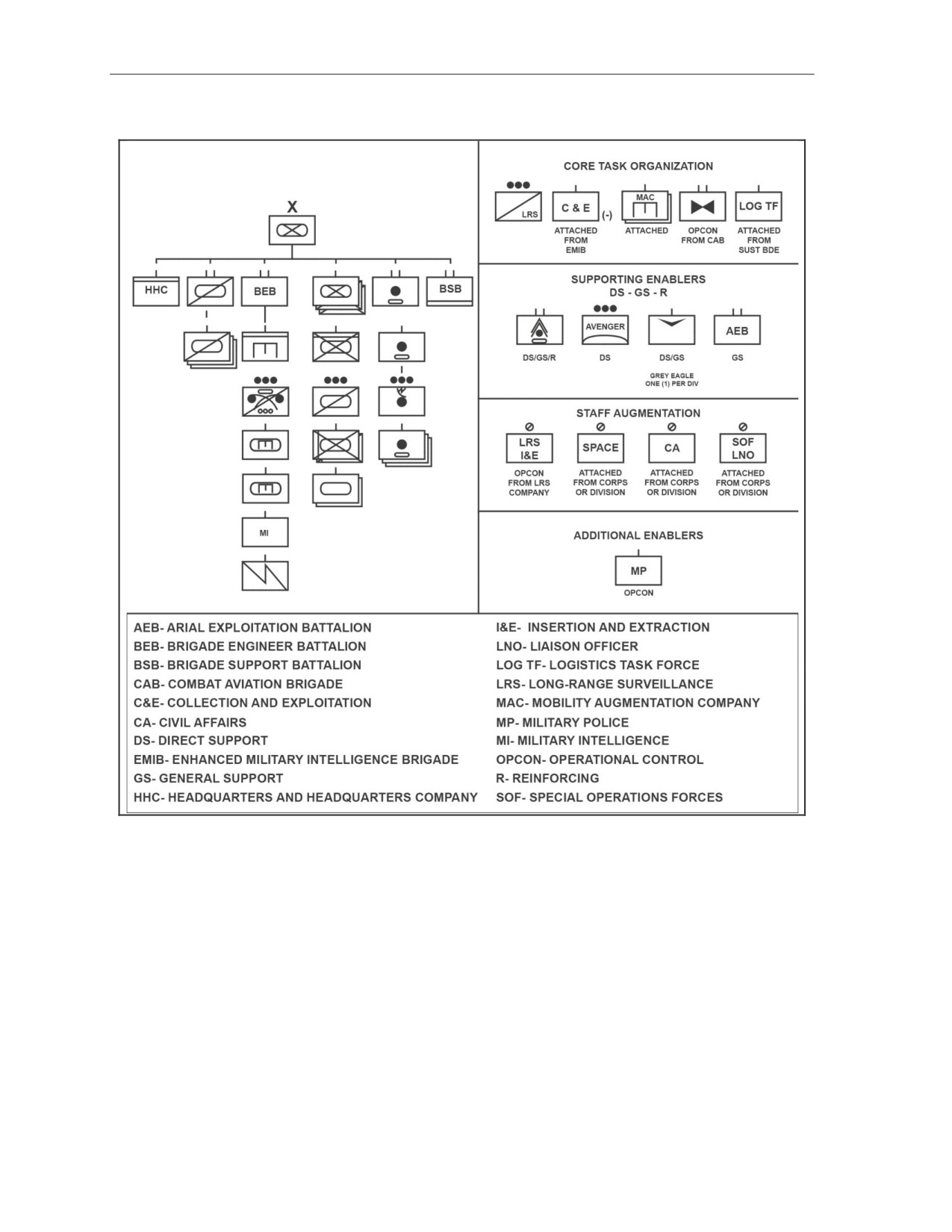
1-41. Task organizing a reconnaissance and security BCT formation for employment at echelons above
brigade will normally include the following organization. This formation is a modular force that should be
provided various enablers and augmentation based on METT-TC and staff analysis to answer the division or
corps commanders PIRs. An example of a reconnaissance and security BCT formation appears in figure 1-1
on page 1-10.
-XO\ 2015
FM 3-98
1-9
Chapter 1
Figure 1-1. Reconnaissance and security BCT
BRIGADE OPERATIONS OFFICER AND SQUADRON
EMPLOYMENT WITHIN THE BCT
1-42. BCT commanders and their staff integrate operations and intelligence in the conduct of reconnaissance
and security tasks. A commander focuses information collection, combined arms, sustainment and signal
organizations and reconnaissance efforts on answering the commander’s PIR through the brigade S-3.
BCT S-3
1-43. The brigade S-3 is responsible for coordinates, and synchronizes information collection and
reconnaissance and security tasks. The brigade S-3 allocates organic, attached, and supporting information
collection assets
(for example, answer PIR or refine reconnaissance objectives) and ensures that
reconnaissance tasks are oriented on assisting the commander and subordinate units in the accomplishment
of key tasks consistent with the concept of operations. In concert with the brigade and subordinate staffs, the
brigade S-3 ensures operations conducted by the Cavalry squadron, combined arms battalions’ scout
1-10
FM 3-98
-XO\ 2015
Importance of Reconnaissance and Security and Roles of Cavalry Organizations
platoons, and other information collection assets are nested and complementary and focused on mission
accomplishment.
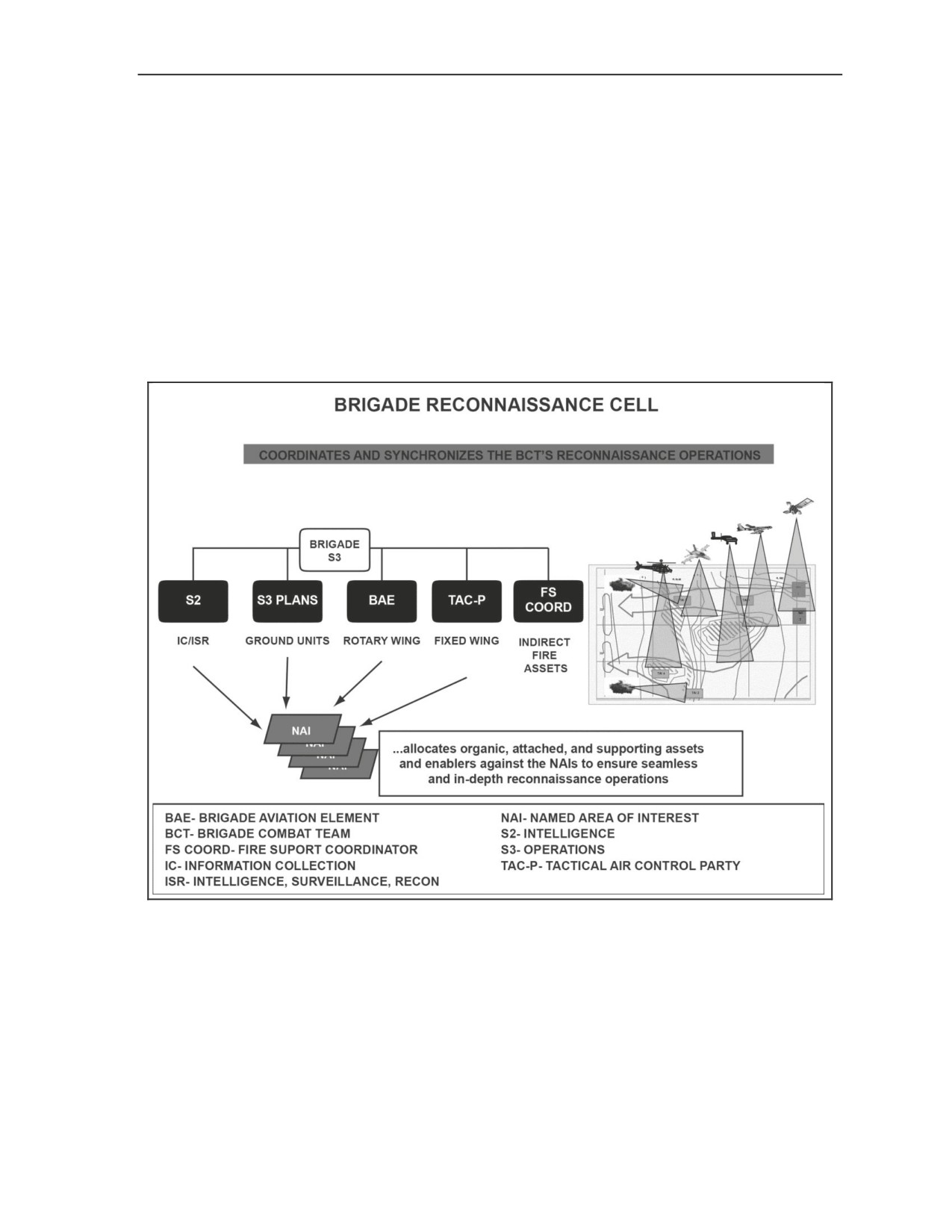
1-44. BCTs establish coordination within the staff to synchronize. This cell might include S-2 (intelligence
community/intelligence, surveillance, and reconnaissance), S-3 Plans (organic maneuver assets—aviation
units, Cavalry troops or scout platoons), Fire Support Officer
(Field artillery battalion), S-4
brigade
sustainment assets, Brigade aviation element (BAE), and the TAC-P (CAS/J-STARS). (See figure 1-2.) At
the same time, to achieve this intent, the BCT commander task organizes the Cavalry squadron with the
necessary combined arms, maneuver support, sustainment, and signal organizations to execute the mission.
At the conclusion of mission analysis, the BCT publishes reconnaissance guidance and a fragmentary order
to initiate reconnaissance forces operations. The Cavalry squadron is usually the lead element in the brigade,
parallel and collaborative planning between the Cavalry squadron and BCT staffs is essential to timely
execution of operations as well as the integration of intelligence collection with reconnaissance and security
tasks.
Figure 1-2. Brigade reconnaissance cell
CAVALRY EMPLOYMENT IN THE AREA OF OPERATIONS (AO)
1-45. The BCT commander employs the Cavalry squadron based on mission variables. The squadron can
operate in its own AO or unassigned deep areas in the BCT AO or across another maneuver battalion’s AO.
Assignment of Its Own AO
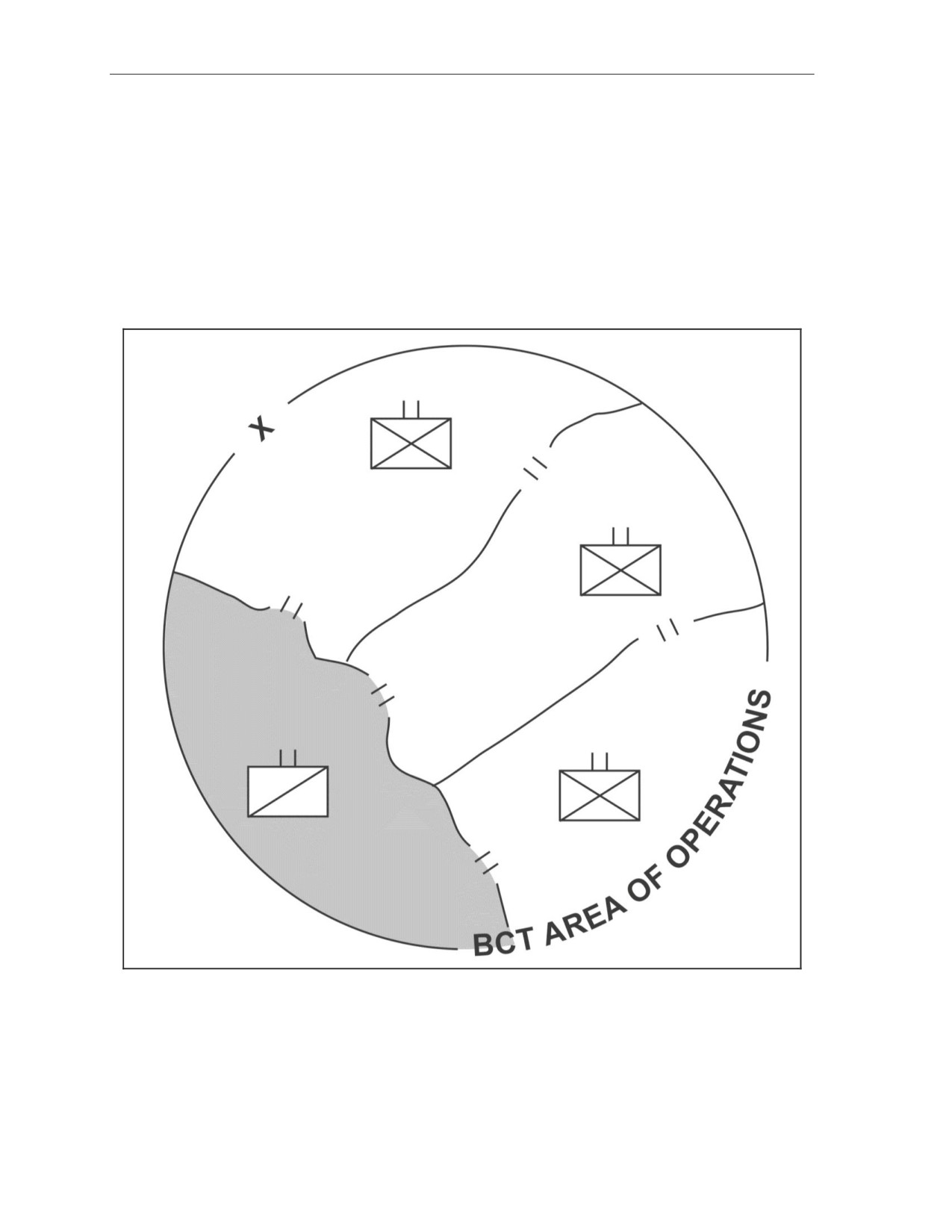
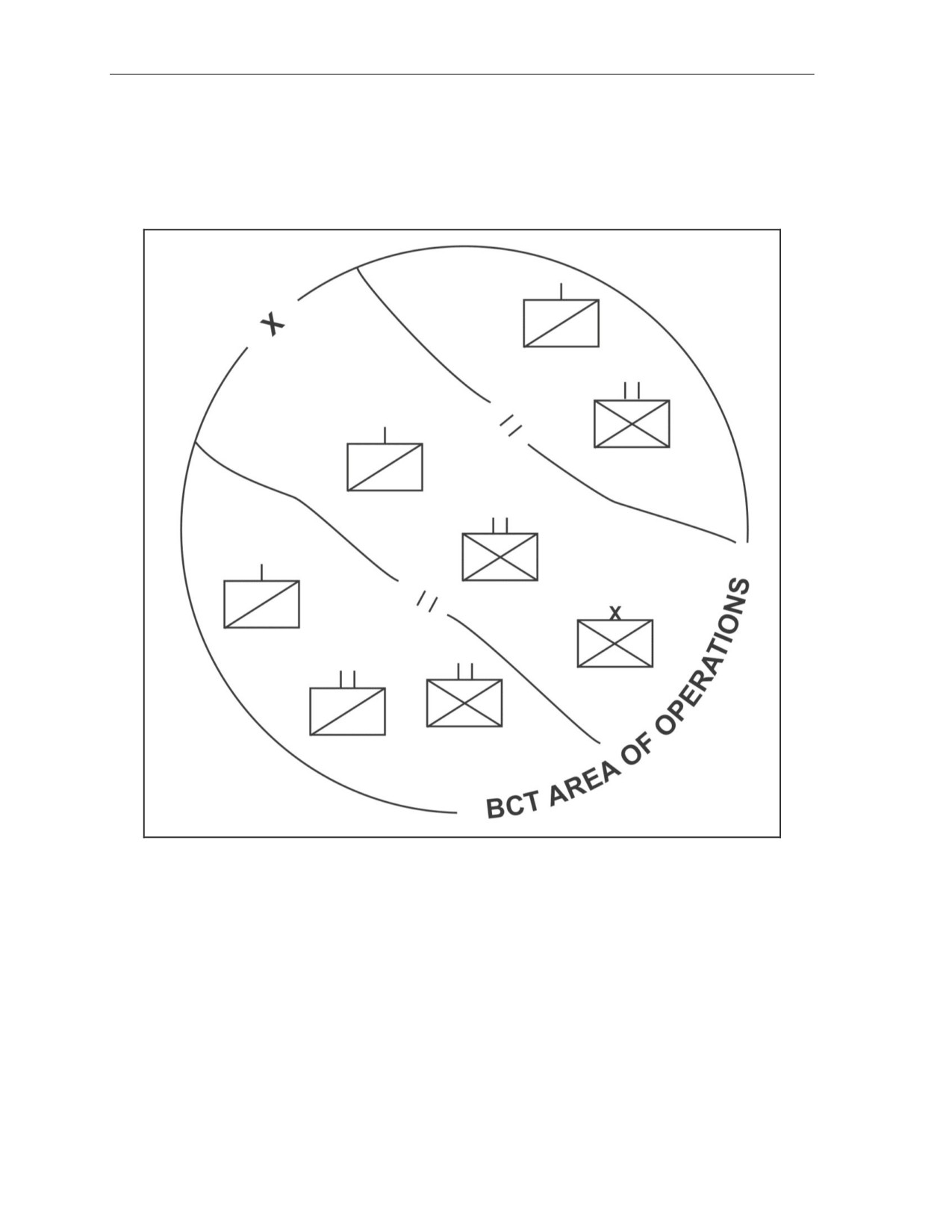
1-46. When the BCT commander assigns the Cavalry squadron a specific area of operation (see figure 1-3)
squadrons must perform the following:
z
Terrain management.
z
Information collection.
-XO\ 2015
FM 3-98
1-11
Chapter 1
z
Conduct civil affairs operations (with attached civil affair forces).
z
Air and ground movement control.
z
Clearance of fires.
z
Security.
z
Personnel recovery.
z
Environmental considerations.
z
Minimal essential stability tasks.
1-47. Assignment of an AO provides the squadron with the maneuver space necessary to execute its
assigned mission. (See ADRP 3-90 for a discussion of what these authorities entail.)
Figure 1-3. Squadron in its own area of operation
Within BCT Deep Areas
1-48. The squadron can also operate in BCT deep areas. In noncontiguous areas of operations, the deep area
is the area between noncontiguous areas of operations or beyond contiguous areas of operations (ADRP 3-
0). The BCT commander may assign urban areas to maneuver battalions allowing them to focus on that area
while the Cavalry squadron conducts operations in the open areas. The BCT may have deep areas due to:
1-12
FM 3-98
-XO\ 2015
Importance of Reconnaissance and Security and Roles of Cavalry Organizations
z
A decision to accept risk due to a low threat level.
z
Areas not assigned to battalions are sparsely populated or the terrain is compartmentalized.
z
Insufficient combat power to assign all areas to subordinate battalions.
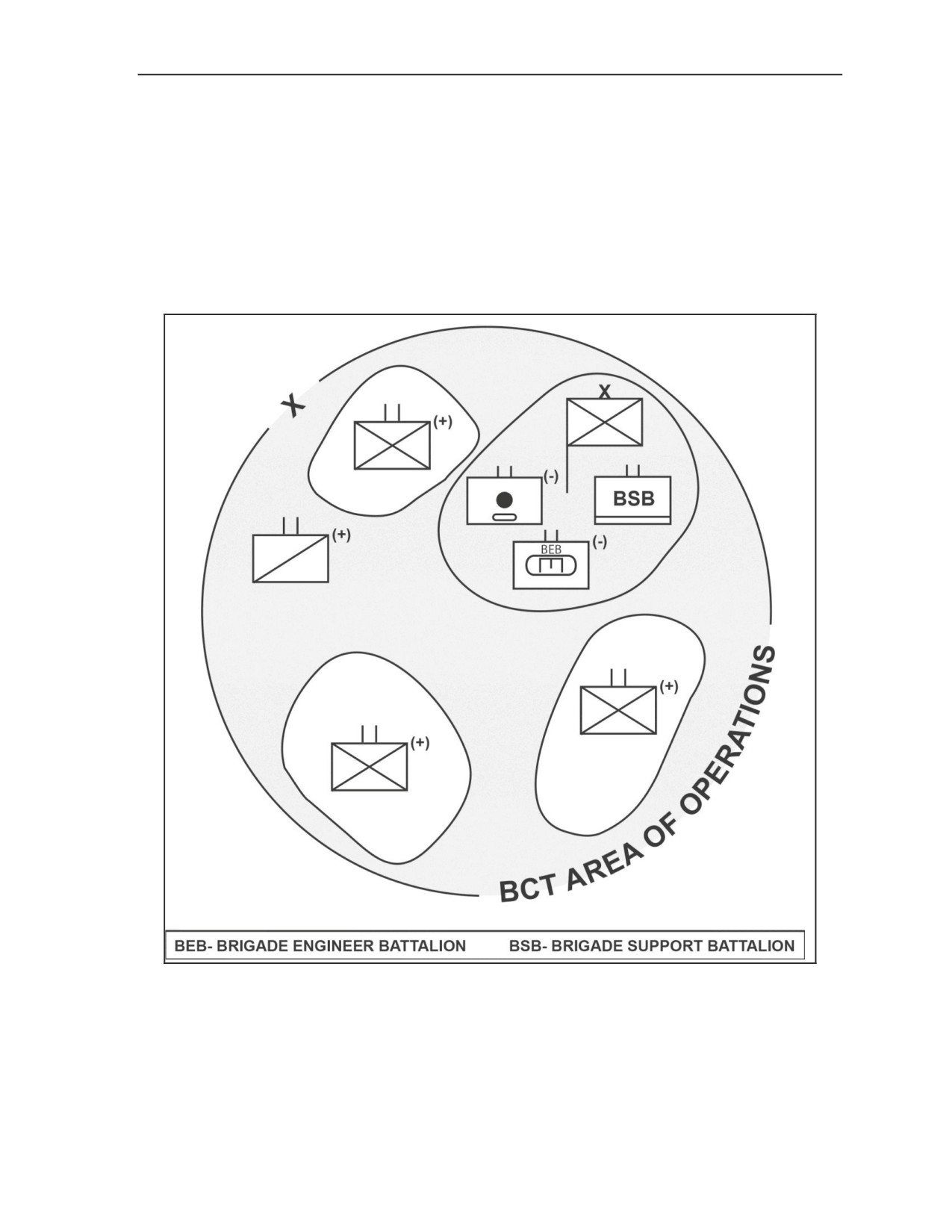
1-49. The BCT is responsible for controlling deep areas within its AO. The BCT commander may direct the
Cavalry squadron to operate in deep areas. (See figure 1-4.)
1-50. Squadrons operating in the BCT deep area are not usually responsible for the entire deep area. The
squadron in the deep area generally operates in one of the following ways:
z
In a contiguous portion of the unassigned area.
z
In multiple, noncontiguous AOs within the unassigned area.
Figure 1-4. Squadron in BCT deep area of operations
Across Another Battalions’ AO
1-51. The squadron may conduct operations across another battalion’s area of operation (see figure 1-5.)
such as during an area security mission or in preparation for offensive defensive tasks. In this case, the BCT
commander has assigned the entire area of operations to subordinate units or battalions, the BCT commander
retains control of the squadron by cutting an AO across the maneuver battalions (for example, along a route).
The squadron retains mission command of its squadron and significant military intelligence (MI) capabilities.
-XO\ 2015
FM 3-98
1-13
Chapter 1
Conditions may include hybrid threat networks operating across brigade boundaries. During transitions to
offense or defense the BCT commander can place the squadron or troops under operational control to the
maneuver battalions (for example, one troop in front of each maneuver battalion scout platoon). The squadron
remains focused on collecting information to assist in answering the higher commander’s PIR or other
information requirements. When operating across other battalions AO, squadrons are still assigned specific
missions by higher HQ.
Figure 1-5. Squadron operating across another battalion’s area of operation
EMPLOYMENT METHOD COMPARISON
1-52. On a contiguous battlefield, the Cavalry squadron may have an AO forward of the battalions or operate
across the BCT AO. On a noncontiguous battlefield the Cavalry squadron may operate in the unassigned area
inside the BCTs area of operations. On a contiguous battlefield where there are no unassigned areas the
Cavalry squadron may employ elements within the BCT AO or across battalion areas of operation to answer
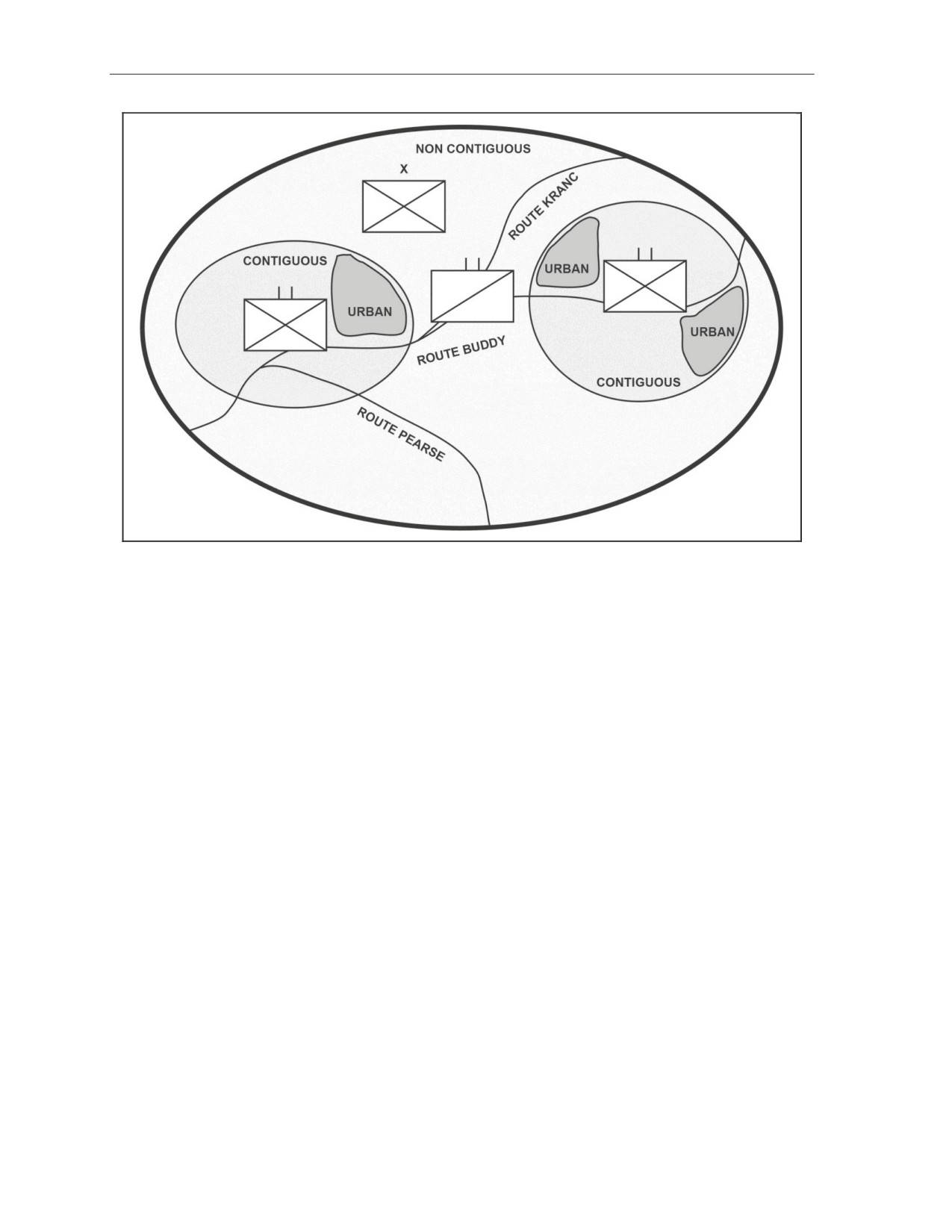
information requirements that cross battalion boundaries such as a route security mission that spans the BCT
AO (See figure 1-6 on page 1-16). It may have an area of operation to meet an economy of force role in areas
where the primary task is reconnaissance and surveillance, such as in border areas. A comparison of the three
general employment methods is in table 1-1.
1-14
FM 3-98
-XO\ 2015

Importance of Reconnaissance and Security and Roles of Cavalry Organizations
Table 1-1. Squadron Employment Comparisions
EMPLOYMENT OPTIONS
Assignment in its own
Operations in the BCT
Operations across
area of operations.
deep areas.
another battalion’s area
of operation.
Tactical Tasks
Route Recon.
Route Recon.
Route Recon.
Area Recon.
Area Recon.
Area Recon.
Zone Recon.
Area Security.
Area Security.
Recon in Force.
Route Security.
Route Security.
Screen.
Convoy Security.
Convoy Security.
Guard.
Hasty Attack.
Cover.
Area Security.
Route Security.
Convoy Security.
Hasty Attack.
Advantages
x Least restrictive
x
Mitigates some risk to BCT
x
BCT commander can
x Focuses squadron
in the unassigned areas.
focus squadron where
efforts in one area.
x
Allows BCT to focus
needed most.
x Covers a broader area.
battalions in smaller AOs.
x
Enables detailed
x Limits risk of fratricide.
x
Potentially enables ability
coordination with
x Provides greater
to identify networks across
maneuver battalions and
freedom of action and
larger area.
BCT.
maneuver.
x
Allows the BCT
x
Battalions can provide
x Simplifies sustainment.
commander to weight his
rapid transition to offensive
main effort.
and defensive tasks.
Disadvantages
x Broader area may
x
Most restrictive.
x
Requires significant and
require significant
x
Increased risk of
constant coordination with
augmentation.
fratricide.
maneuver battalions and
BCT.
x Broad knowledge of
x
Potential for disbursed
x
Most restrictive to
AO rather than deeper
operations over a large
freedom of action.
understanding.
area; noncontiguous
x
Greatest risk of fratricide.
x Provides limited view
operations within the
x
Increases sustainment
of networks (cannot
squadron.
complexity.
operate across
x
High coordination with
boundaries).
adjacent units and BCT
x Difficult fire support.
headquarters most
difficult sustainment
operations.
x
Most difficult fire support.
-XO\ 2015
FM 3-98
1-15
Chapter 1
Figure 1-6. Squadron conducting route reconnaissance throughout the brigade AO
BCT RECONNAISSANCE AND COLLECTION TEAMING
1-53. BCT reconnaissance and collection teaming is the pairing of collection assets, usually by the brigade
S-3, to enhance collection assets ability to conduct integrated reconnaissance and security tasks to answer the
CCIR. Do not keep reconnaissance and information collection assets in reserve. The commander forms
reconnaissance and collection teams to complement capabilities of reconnaissance and intelligence
collection. These teams consist of appropriate combinations of Cavalry Soldiers and multidiscipline
intelligence Soldiers.
1-54. The brigade engineer battalion’s MI company provides multidiscipline combat intelligence, to include
limited SIGINT, electronic warfare, and interrogation of prisoners of war, multidisciplinary
counterintelligence, tactical HUMINT, and air reconnaissance from tactical unmanned aircraft system
(UAS). BCT commanders build reconnaissance and collection teams in executing offensive, defensive, and
stability tasks.
Reconnaissance and Security Collection Teaming
1-55. The BCTs organic MI company augments the Cavalry squadron based on mission variables and PIR.
They operate together for security of collection assets and provide the appropriate combat information and
intelligence necessary to answer the PIR of the supported commander. These brigade reconnaissance,
collection, and security teams provide the supported commander with the ability to more effectively separate
combatants from noncombatants under conditions of uncertainty.
1-56. The MI company’s roles include multifunctional teams (MFTs) comprised of all source HUMINT and
SIGINT disciplines (refer to ATP 2-19.4 for more information), human intelligence collection teams (HCT)
teams, counterintelligence (CI) teams, SIGINT platoons, and operational management teams that coordinate
the various team missions. BCT commanders can augment the squadron to provide the secure access to the
local population that is necessary for MI discipline collection tasks across the brigade.
Composition of Collection Teams
1-57. The lowest level for task-organizing Cavalry units with additional assets and capabilities is the section
although most assets will operate under the operational control of a Cavalry troop or scout platoon. For
1-16
FM 3-98
-XO\ 2015
Importance of Reconnaissance and Security and Roles of Cavalry Organizations
example, a scout platoon from the Cavalry squadron can receive an attached or operational control MI
discipline collection team comprised of a controlling operational management teams, multifunctional teams,
and a HUMINT collection or CI team. Intelligence and reconnaissance teams provide enhanced security for
MI teams, facilitate its movement, and expand the capability of reconnaissance during a mission.
Reconnaissance and collection teams combine and integrate collection and reconnaissance specialties to
accomplish the mission. Teaming allows rapid communication and sharing information as teams work
together to answer critical information requirements.
SECTION III - ORGANIZATIONS
1-58. Reconnaissance and security operations are foundational to all successful operations. Through
effective information collection and continuous reconnaissance, brigades develop and sustain the necessary
understanding to defeat adaptive and determined enemies. Reconnaissance and security tasks help brigades
reduce and adapt to uncertainty. They are essential to understanding the tactical, human, and political
environment; visualizing operations; developing the situation, and identifying or creating options to seize,
retain, and exploit the initiative. Cavalry units provide flexibility, adaptability, and depth to the maneuver
commanders operations synchronizing and integrating lethal combined arms teams to seize, retain, and
exploit the initiative based on relevant understanding of the situation.
1-59. Reconnaissance units provide information on enemy location, disposition and composition, early
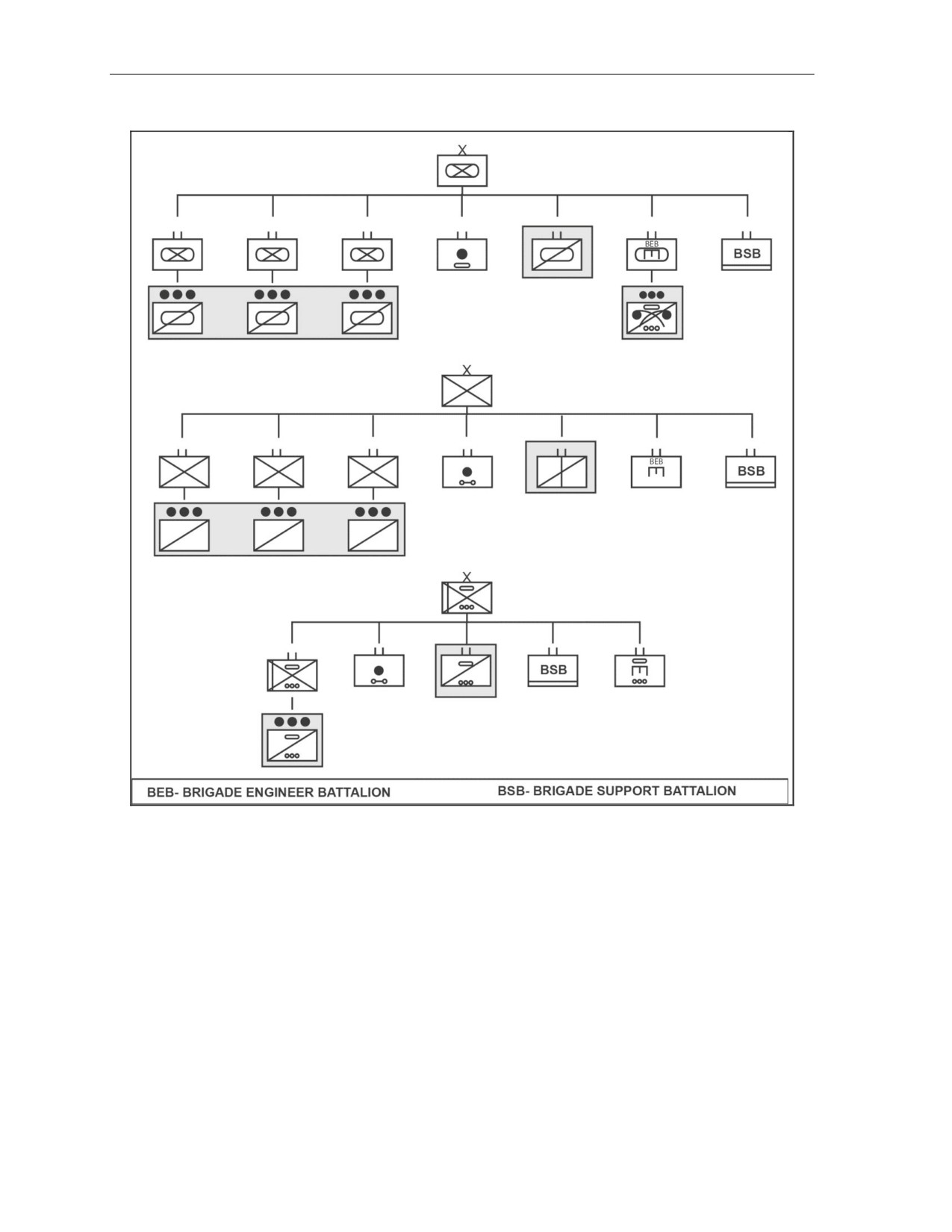
warning, protection, and munitions effectiveness. (See figure 1-7 on page 1-18.) Reconnaissance and security
units preserve the BCTs freedom of maneuver over the enemy. Successful reconnaissance allows the brigade
commander to initiate combat under advantageous conditions to defeat the enemy and accomplish the
mission. Roles and organizations listed in this manual depict habitual attachments and augmentees.
-XO\ 2015
FM 3-98
1-17
Chapter 1
Figure 1-7. Cavalry units (shaded) in BCTs
BRIGADE COMBAT TEAM
1-60. The BCT is the Army’s fundamental combined arms organization and its primary close combat force.
For combat actions, the combatant commander may build the ground component of a JTF around the BCT.
The BCT includes units and capabilities from every warfighting function; it is task-organized to meet specific
mission requirements.
1-61. The Cavalry squadron is the BCT commander’s main instrument for executing reconnaissance and
security tasks at the brigade level; however, each subordinate organization of a BCT is responsible for
information collection, local reconnaissance, and security within their assigned area of operations or battle
position. When the BCT assigns reconnaissance or security tasks to a subordinate element, it task-organizes
subordinate elements and allocates the resources necessary to meet mission requirements. To perform
reconnaissance or security tasks, the BCT commander may allocate tank and mechanized Infantry units,
reconnaissance units, engineer elements, aviation units, priority of fires and CAS, intelligence systems and
sustainment units.
1-18
FM 3-98
-XO\ 2015
Importance of Reconnaissance and Security and Roles of Cavalry Organizations
CAVALRY SQUADRONS
1-62. Cavalry squadrons conduct reconnaissance and security operations through close contact with enemy
and civilian forces. They maintain contact with the enemy to fight for information while preserving their own
freedom to maneuver. They shape the battlefield for the commander to allow him to close with and destroy
the enemy through maneuver and superior firepower at a time and place of his choosing.
1-63. All ground Cavalry squadrons possess the following capabilities:
z
Fight for information within unit capabilities.
z
Gather information about all categories of threats.
z
Support lethal and nonlethal targeting and target acquisition for the higher HQ.
z
Provide all-weather, continuous, accurate, and timely reconnaissance in complex terrain.
z
Rapidly develop the situation.
z
Reduce risk and enhance survivability by providing information that allows the higher HQ
commander to avoid contact, or to achieve overwhelming combat power.
z
Assist in shaping the area of operations by providing information or directing precision joint fires
to disrupt the enemy commander’s decision cycle and deny planned or future options.
z
Conduct collaborative and parallel planning that fully integrates with higher and adjacent units
and results in employment of reconnaissance and security assets to support higher HQ operations.
z
Reestablish mission command through two distinctly different situations:
Repel an enemy attack that caused a disruption in mission command.
Retransmission of information for units or elements out of communication range of the main
body.
1-64. All ground Cavalry squadrons are constrained in that—
z
They require augmentation to perform effective offensive and defensive actions as an economy of
force role.
z
They have limited sustainment assets that frequently operate over extended distances.
z
Wheeled vehicle-equipped squadrons lack direct fire standoff, lethality, and survivability in open
and rolling terrain and need augmentation when arrayed against enemy armor.
z
Medium-weight wheeled vehicles have limited cross-country mobility.
CAVALRY TROOPS
1-65. Cavalry troops conduct reconnaissance and security tasks throughout the AO of their parent brigades.
Reconnaissance synchronized predeployment and operational tracker report and aerial sensor capabilities
allow the troop to build an accurate operational picture of the AO. That operational picture can focus on any
mixture of the METT-TC variables when necessary by the parent BCT mission. However, to develop an
accurate operational picture complex terrain requires additional time.
1-66. The Cavalry troop’s operational picture helps form a squadron common operational picture (COP) in
command nodes within and external to the parent BCT. This COP allows commanders within and external
to, the parent BCT to accurately assess the situation and develop their situational understanding of the correct
courses of action to take. This discussion focuses on the cavalry troops of the BCT organizational variants
ABCT, IBCT, and SBCT.
TROOP MISSIONS
1-67. Regardless of organization, Cavalry troops conduct reconnaissance and security in support of the
information collection plan as outlined in Annex L of the Cavalry squadron’s operations order.
1-68. Cavalry troops can develop the situation in close contact with civilian populations. They can conduct
security force assistance tasks and multinational reconnaissance and security tasks.
1-69. Troops can conduct limited offensive and defensive tasks though they typically support higher level
offensive and defensive task completion through the conduct of reconnaissance and security tasks. The
-XO\ 2015
FM 3-98
1-19
Chapter 1
commander considers the troop’s capabilities and limitations before employing the troop in any specific
mission.
ROLES AND ORGANIZATION
1-70. As the eyes and ears of the squadron commander, the Cavalry troop is the squadron commander’s
primary reconnaissance and information collection asset. Reconnaissance units provide the combat
information the commander needs to conduct better informed planning, to direct operations, and to visualize
the AO. It skillfully conducts reconnaissance and security tasks to collect information on enemy location,
disposition, composition, and battle damage assessment
(BDA). In turn, these operations allow the
commander to proactively shape the AO and to accept or initiate contact at times and places of his choosing.
1-71. Cavalry troops conduct reconnaissance and security tasks throughout the squadron AO. The troop
develops the situation by focusing on the reconnaissance objective in a designated AO. This discussion
focuses on the organizational variations of the reconnaissance and troop.
COMMON CAPABILITIES AND LIMITATIONS
1-72. All types of BCT Cavalry troops have the following capabilities:
z
Provide all-weather, continuous, accurate, and timely information through the combined use of
long-range scout surveillance systems, UAS, and mounted and dismounted scouts.
z
Gather information about hybrid threats.
z
Rapidly develop the situation and direct reconnaissance tasks to answer PIR.
z
Overcome enemy deception, and cover and concealment by employing integrated information
collection and reconnaissance and surveillance systems.
z
Employ joint fires to include the fires support team, weapons locating radar, and UAS.
z
Conduct stealthy reconnaissance or fight for information against light and motorized forces or, if
reinforced, against armored forces.
z
Reduce risk and enhance survivability by providing information that allows the squadron to avoid
contact or achieve a combat power advantage, if contact is necessary.
z
Assist in shaping the area of operations by providing information or directing fires to disrupt the
enemy.
1-73. All BCT Cavalry troops have the following limitations, which can be mitigated with careful
employment or augmentation:
z
With limited dismounts within scout sections, sections may have to combine to generate the
required dismounts to conduct the following:
Long-duration observation posts (OPs).
Continuous screening.
Dismounted tasks associated with zone, area, or route reconnaissance.
z
Limited direct fire standoff, lethality, and survivability.
z
Require augmentation to perform technical engineer tasks.
z
Speed of movement is generally equal to that of the main body, making it difficult to stay ahead
while on the march.
z
Limited sustainment assets that frequently operate over extended distances.
SCOUT PLATOON
1-74. The fundamental role of the scout platoon is to conduct aggressive or stealthy reconnaissance that
satisfies the commander's critical information requirements. The commander gives missions to the platoon
and the platoon progressively builds situational awareness (SA) of the operational environment (OE) for the
commander. The critical information the platoon provides enables the commander to develop situational
understanding, make comprehensive plans and decisions, and direct follow-on or future operations.
1-20
FM 3-98
-XO\ 2015
Chapter 2
Threat
The various actors in any area of operation can qualify as a threat, an enemy, an
adversary, a neutral, or a friend. A threat is any combination of actors, entities, or forces
that have the capability and intent to harm United States forces, United States national
interests, or the homeland (ADRP 3-0). Threats may include individuals, groups of
individuals (organized or not organized), paramilitary or military forces, nation-states,
or national alliances. Threats become enemies when they execute their capability to do
harm to the United States.
An enemy is a party identified as hostile against which force is authorized (ADRP 3-0).
An enemy is a combatant. Target combatants but treat under the rule of law. An
adversary is a party acknowledged as potentially hostile to a friendly party and against
which force may be envisaged (JP 3-0). A neutral is a party identified as neither
supporting nor opposing friendly or enemy forces (ADRP 3-0).
Land operations are often complex and uncertain because threats, enemies, adversaries,
neutrals, and friends intermix and challenge army forces’ ability to classify them.
A hybrid threat is the diverse and dynamic combination of regular forces, irregular
forces, terrorist forces, and criminal elements unified to achieve mutually benefitting
effects (ADRP 3-0).
SECTION I - UNDERSTANDING THE THREAT
2-1. Understanding threats, criminal networks, enemies, and adversaries—to include both state
and
nonstate actors—in the context of the operational environment is essential for the BCT commander to
understand, visualize, describe, direct, lead and assess operations. To develop and maintain estimates of the
situation as the basis for continuous adaptation, commanders and staffs consider their own forces in context
of threats, enemies, and adversaries as well as the mission, terrain, friendly forces, and civilian populations.
The BCT must be prepared to engage in close combat with adaptive enemies and adversaries while operating
in complex terrain and among civilian populations.
2-2. Actors in the operational environment may include agents or forces of—
z
Other nation-states.
z
Political parties and officials.
z
Insurgents.
z
Tribes, clans, or ethnic groups.
z
Transnational criminal organizations.
z
Terrorists or violent extremist organizations.
z
Media.
z
Indigenous governmental security forces.
z
International and private security organizations.
z
Multinational corporations.
z
Joint, interagency, intergovernmental, multinational, and nongovernmental organizations.
z
Private volunteer organizations.
-XO\ 2015
FM 3-98
2-1
Chapter 2
ENEMIES AND ADVERSARIES
2-3. Current and future combat operations require the BCT to fight and win in mountainous, urban, jungle,
desert, and subterranean environments. Besides the physical challenges presented by complex terrain, the
continuous interactions of numerous actors—each with their own agendas, objectives, interests, and
allegiances—influence the operational environment and mission accomplishment.
2-4. The human and political dynamics in the brigade area of operations increase the complexity of BCT
operations. Commanders and staffs work to understand the complicated relationships and complex
interactions between actors that produce tactical challenges and opportunities. Understanding is critical to
seizing, retaining, and exploiting the initiative over enemies and adversaries, and equally critical to the
consolidation of tactical gains to achieve sustainable outcomes consistent with the mission. Emphasis is on
using situational understanding to identify and exploit enemy weakness while isolating enemies from sources
of strength and support. Emphasis is also on bolstering the strength of legitimacy of friends.
STATE AND NONSTATE ACTORS
2-5. The BCT must be prepared to defeat determined state and nonstate actors that combine conventional
and unconventional tactics to avoid our forces’ strengths (such as our mobility, long-range surveillance, and
precision fires capabilities) while attacking perceived vulnerabilities (such as our difficulty distinguishing
the enemy from the civilian population). Threats combine a variety of means, to include conventional
combined arms operations, terrorism, insurgency, political subversion, and information operations to
accomplish objectives and attack United States forces. Enemies and adversaries exploit perceived United
States and coalition military, political, social, economic, and information vulnerabilities as they seek to seize
the initiative and dictate the terms and tempo of operations in their favor. They often rely on networks to
facilitate movement of logistics, finances, people, and weapons.
2-6. Enemy organizations employ countermeasures to limit United States forces ability to develop the
situation, avoid decisive engagements, and initiate contact under advantageous conditions. Enemy
organizations employ technological countermeasures to reduce their signature on the battlefield and degrade
United States forces ability to detect, engage, and destroy them. Many hostile nation-states continue to
procure conventional capabilities such as armor and antiarmor, manned aircraft, and air defense systems,
which are increasingly available to nonstate enemy organizations and hybrid threats. Enemy forces also
integrate emerging technologies such as robotics, unmanned aerial systems, and nanotechnologies. Enemies
and adversaries combine conventional and unconventional tactics to counter, evade, or disrupt United States
forces efforts across the range of military operations.
2-7. Many threat organizations already possess weapons of mass destruction, such as chemical, biological,
radiological, and nuclear (CBRN) weapons and the delivery systems to employ them (for example, rockets
and artillery). Threat organizations that do not possess weapons of mass destruction may attempt to
proliferate, acquire and employ them. While many threat organizations have pursued the use of chemical and
biological weapons, most have opted for large scale explosive events due to the effectiveness and success
over the last decade. BCT commanders and staffs plan for weapons of mass destruction by conducting seize
or secure and isolate activities. (See ATP 3-11.23 for more information on elimination operations.)
2-8. BCT commanders must understand the threat in the context of local conditions that affect the mission.
Such a contextualized understanding allows commanders to identify emerging opportunities to seize, retain,
and exploit the initiative.
NETWORKS AND ORGANIZATIONS
2-9. The BCT commander and staff determine an enemy’s objectives, strategies and the multiple
dimensions (physical, cognitive, informational, and political) in which he operates to defeat him. The BCT
identifies categories, organizations, and networks that affect the mission as friendly, enemy, or neutral based.
The BCT supports friendly networks, influences neutral networks, and disrupts, neutralizes, or defeats enemy
organizations or networks. Assessment of networks and organizations is continuous and collaborative,
integrating joint, interagency, intergovernmental, and multinational partners whenever possible. At the
tactical level, units develop an understanding of various networks through information collection and
2-2
FM 3-98
-XO\ 2015
Threat
reconnaissance in close contact with the enemy and civilian populations. Considerations for network and
organization assessment include:
z
Objectives and strategy.
z
Key individuals, groups, nodes, and their roles within a network or organization.
z
Relationships between key individuals and nodes within networks and organizations.
z
Flow of resources (such as people, money, weapons, and narcotics) across, into, and out of
networks.
z
Where networks and organizations connect to other institutions, businesses, and entities.
z
Network strengths and vulnerabilities.
SECTION II - POTENTIAL THREAT GROUPS
2-10. Multiple threat groups may operate within a BCT’s area of interest. These threat groups may include
military forces of nation states, insurgent organizations, transnational criminal organizations and terrorist
groups. These threat groups may form alliances based on mutual goals and common interests. As a result,
BCTs must be prepared to defeat a complicated and often shifting array of enemies and threats.
Understanding enemy and threat capabilities as well as their political, economic, or ideological aims is
essential to seizing, retaining, and exploiting the initiative.
STATES
2-11. States are sovereign governments that control a defined geographic area. The state is the entity that can
generate, sustain, and employ military forces, raise money, and mobilize resources. Military institutions
develop doctrine, build organizations, and develop materiel components of combat power. As a result, the
BCT commander must understand the combat capabilities of nation fielded forces.
NONSTATE ORGANIZATIONS
2-12. Nonstate organizations operate within states, but act outside of the state institutions to pursue their
individual goals. Such organizations can be small and informal, or large and formal. Organizations frequently
consist of a predominant tribal, ethnic, national, or religious group, but there are corporate, criminal, and
transnational organizations as well. Transnational criminal organizations attempt to obtain power, influence,
monetary, and commercial gains, wholly or in part by illegal means, while protecting their activities through
a pattern of corruption and violence, or while protecting their illegal activities through a transnational
organizational structure and the exploitation of transnational commerce or communication mechanisms.
Some organizations pursue political objectives and some of these may use violence as part of a broad strategy
to accomplish these objectives. Threat organizations often combine criminal networks, terrorists, insurgents,
transnational groups, proxies, and paramilitaries in the pursuit to attain short- or near-term objectives. For
example, during the Iraq war a variety of organizations operated in the country, several posed threats to the
United States mission. Insurgent groups included the Jaysh al Mahdi, Asaab al Haq; militia organizations
included the Sons of Iraq, Khattaib and a variety of Kurdish groups; terrorist groups included Islamic State
of Iraq and Al Qaida. Other groups did not pose a friendly or neutral threat. These groups include corporations
with their private security forces operating inside the country, as well as political parties. The United Nations
and other transnational organizations also operated within the country. Each of the organizations that operated
in Iraq had different goals. Some organizations were actively opposed to United States forces; others were
not overt enemies but had separate goals that did not align with United States interests. As a result, the BCT
commander must understand all nonstate organizations and be prepared to work with and fight against a wide
variety of organizations.
CRIMINAL NETWORKS AND OPPORTUNISTS
2-13. Criminal networks are often stakeholders in state weakness, as it is the weakness of the government’s
institutions that provides the freedom of action and the ability to engage in criminal activity and divert state
resources unchecked by law enforcement and rule of law. Criminal networks often ally other state and
nonstate organizations, engage in, and facilitate a range of illicit activities (often through intimidation and
coercion) to capture and subvert critical state functions and institutions. These networks often pursue political
and criminal agendas. They often form alliances with political leaders, financial institutions, law
-XO\ 2015
FM 3-98
2-3
Chapter 2
enforcement, foreign intelligence, and security agencies. Many operate with impunity—taking advantage of
state weakness and subverting law enforcement, investigative, and judicial institutions within a nation-state’s
government.
2-14. Opportunists take advantage of the conditions of instability and state weakness in the pursuit of their
interests. Opportunists can work with, for, or against insurgent organizations. Opportunists often benefit from
a wartime economy by working with multiple parties in a conflict to maximize influence or profit. For
example, opportunists might facilitate movement of insurgents while providing intelligence to
counterinsurgents.
2-15. Commanders and staffs should identify criminal networks and opportunists, assess their impact on the
mission, and force protection while executing actions to accomplish the mission. Commanders’ work with
local, area, federal, and law enforcement personnel and unified action partners to develop understanding and
mitigate the threat these groups pose. BCTs integrate law enforcement personnel into operations and
coordinate military and law enforcement efforts to defeat threats and individuals. Collaboration allows the
BCT to consolidate security gains such as local law enforcement agencies that can assume responsibility for
maintaining security.
INDIVIDUALS
2-16. Although United States forces have not historically focused on threats from individuals, people with
sufficient technical skills or access to destructive weapons may pose a significant threat to United States
interests or forces. For example, an individual may conduct a cyber attack to degrade or destroy automated
mission command systems. BCTs must be prepared to defend against cyber attacks, whether initiated by a
state, organization, or individual. BCTs must be prepared to identify and neutralize individuals that pose a
threat to the mission or the force.
SECTION III - THREAT CHARACTERISTICS AND ORGANIZATION
2-17. BCTs prepare to fight and win against combinations of regular forces, irregular forces, terrorist forces,
and criminal elements. These “hybrid” enemy threat organizations employ conventional, unconventional,
and terrorist tactics and methods to achieve their strategic goals and political aims.
2-18. Nation states organize, train, equip, and employ regular forces to defeat an enemy’s armed forces,
destroy an enemy’s war-making capacity, seize territory, and defend territory.
2-19. Regular forces often possess technologically advanced weapon systems integrated into mechanized or
motorized combined arms formations as well as light Infantry forces. BCTs are prepared to defeat enemy
forces that include armored fighting vehicles, antiarmor systems, air defense systems, ballistic missiles,
manned and unmanned aircraft, indirect fire systems, mines, improvised explosive devices, digital
communications systems, and cyber and electronic warfare capabilities. Regular forces may also possess
CBRN capabilities and have access to space capabilities. Regular forces organizations are hierarchical (for
example, companies, battalions, brigades, and so forth) with a generally centralized command and control
structure. They can conduct long-term campaigns and employ combinations of conventional and
unconventional tactics. Examples of regular forces include:
z
Islamic Republic of Iran Army.
z
Peoples Liberation Army of China.
z
Russian Army.
z
North Korean People’s Army.
2-20. Irregular forces are armed individuals or groups who are not members of the regular armed forces,
police, or other internal security forces (JP 3-24). Irregular forces employ unconventional, asymmetric
methods to counter U.S. advantages. Unconventional methods may include terrorism, insurgency, and
guerrilla warfare. Weaker enemy organizations often use unconventional methods to exhaust the United
States collective will through protracted conflict. They usually employ sophisticated strategies that combine
economic, political, and informational initiatives to subvert United States partners, strengthen their
organizations, and disrupt United States efforts to accomplish the mission. Irregular forces or complex threats
often combinations of paramilitaries, terrorists, guerillas, and criminal organizations and networks.
2-4
FM 3-98
-XO\ 2015
Threat
2-21. Irregular forces or complex threats generally have political objectives motivated by ideologies or
grievances. These grievances may be real or perceived. Identifying their objectives and motivations is often
difficult because—
z
There may be multiple insurgent groups with differing goals and motivations.
z
Leaders change and the organization goals shift over time.
z
Movement leaders may have different motivations from their followers.
z
Organizations hide their true motivations and make false claims.
2-22. Irregular forces customarily operate in small, dispersed, decentralized formations or cells (team and
squad size) within a decentralized command and control structure while retaining the ability to concentrate
forces if they perceive weakness. They establish local, regional, and worldwide support networks. Irregular
threats’ military capabilities often include small-arms weapons, antitank weapons, man-portable air defense
missiles, mortars, short-range rockets, homemade radio frequency weapons, rudimentary robotics, unmanned
aircraft systems, and improvised explosive devices. Some irregular threats possess significant financial
means, state sponsorship, and can acquire advanced weapon systems and technologies. Irregular forces that
have engaged in recent armed conflict including—
z
Revolutionary Army Forces of Columbia-People’s Army.
z
Mujahidin in Afghanistan (1979).
z
PLO in the West Bank (2001).
z
Al Qaeda in Iraq (2007).
z
Taliban in Afghanistan (2009).
2-23. Hybrid threats combine regular and irregular threats, terrorist forces, or criminal elements unified (or
allied) to achieve mutually benefitting effects. Hybrid threats may include nation-states that employ
protracted regular as well as proxy forces. Hybrid threats can operate under a centralized or decentralized
command and control structure. Examples of hybrid threats in recent conflict include the Iraqi Fedayeen al
Saddam forces in 2003.
2-24. Combat experiences in Afghanistan, Iraq, and other recent conflicts such as those in Lebanon, Mali,
Syria, Gaza, Northern Nigeria, and Southern Thailand reveal a migration of capabilities, tactics, and
techniques previously associated only with military forces of nation-states to state-sponsored and nonstate
threat organizations. This migration of capabilities presents BCTs with challenges that extend beyond
defeating an enemy’s regular force. Threats combine regular and irregular warfare, adopting strategies,
tactics, and techniques to evade and disrupt United States advantages and gain tactical advantages within the
physical, cognitive, informational, and political dimensions of armed conflict. As a result, the BCT must be
prepared to continuously assess the situation and adapt to seize, retain, and exploit the initiative.
THREAT CAPABILITIES, TACTICS, AND TECHNIQUES
2-25. Enemy organizations employ tactical and technical countermeasures to counter United States
operational and tactical advantages. Tactical countermeasures include deception operations, dispersion,
concealment, and the intermingling with civilians in urban terrain. The enemy employs technological
countermeasures, such as cyber attacks and global positioning system jamming and other forms of electronic
warfare, to evade and disrupt United States forces ability to operate effectively.
2-26. BCT commanders and staffs anticipate and counter disruptive enemy capabilities, determine enemies
across multiple battlegrounds or contested aspects of the mission including the physical, cognitive,
informational dimension, and political battlegrounds.
PHYSICAL DIMENSION
2-27. Enemies operate within complex terrain to evade United States weapon systems and advanced
combined arms, air-ground capabilities. The enemy operates in and among populations to evade detection,
preserve their combat power, and retain their freedom of movement. The enemy often establishes
relationships with local, regional, and transnational criminal organizations and violent extremist
organizations to finance their operations and gain access to illicit trafficking networks for the movement of
weapons, munitions, people, narcotics, or money.
-XO\ 2015
FM 3-98
2-5
Chapter 2
EVASION TACTICS AND TECHNIQUES
2-28. Enemy forces use deception, cover and concealment, and obscuration. They may move in small,
dispersed units, formations, groups, or cells to avoid detection and then concentrate against perceived
weakness. Irregular and regular forces often conduct short engagements and attempt to break contact before
United States forces can bring indirect fire or other assets to bear. The enemy employs deception measures
to reduce United States forces information collection efforts. Deception measures include enemy
organizations, hardened and buried facilities, and multispectral decoys to mask the signatures of high-value
systems (for example, short-range ballistic missiles and surface-to-air missiles). The enemy exploits safe
havens within hostile states or in ungoverned areas, and takes advantage of subterranean infrastructure (for
example tunnels, underground facilities, sewers, and drainage systems) to avoid detection. As enemies evade
United States and coalition forces, they simultaneously seek to expand their freedom of movement through
intimidation and coercion. This creates dilemmas where lethal operations may negatively influence the
perceptions of the BCT and degrade popular support (for example, engaging United States forces from
densely crowded populations which causes civilian damage from BCT forces’ response). The enemy often
uses civilian populations and cultural sites to hide or shield key weapon systems or command and control
facilities.
DISRUPTION TACTICS AND TECHNIQUES
2-29. The enemy employs combinations of lethal, (for example offensive and defensive tasks, assassination,
terrorist attacks) and nonlethal (political subversion, propaganda and intimidation) actions to disrupt United
States forces to shape the environment, influence key actors, consolidate gains and efforts to accomplish the
mission.
2-30. The enemy conducts reconnaissance to assess the BCT’s strengths and weaknesses, identify
opportunities, achieve positions of relative advantage, and neutralize the BCT’s strengths in mobility and
firepower. Enemy reconnaissance often operates among the civilian populace to avoid detection. The enemy
conducts deliberate counter-reconnaissance tasks to deny the BCT their ability to develop the situation in
close contact with the enemy and civilian populace. Conventional enemy counter-reconnaissance efforts
include antiarmor and antipersonnel ambushes, indirect fire, UAS assets, fixed- and rotary-wing aircraft,
electronic countermeasures, cyber attacks, raids, and spoiling attacks to degrade the BCT’s reconnaissance
and security tasks. Insurgents and guerillas use ambushes, suicide bombers, demonstrations, propaganda,
assassinations, and indirect fire mortars and rockets to disrupt the BCT’s reconnaissance efforts and
momentum. Additionally, the enemy conducts propaganda and disinformation to discredit the BCT and
generate popular opposition to United States and coalition efforts.
2-31. The enemy augments the tactical capabilities of small combined arms teams with inexpensive
countermeasures such as IEDs, suicide bombers, and fire and smoke as a weapon system to impede United
States forces. The enemy seeks to leverage commercial and military technologies for precision strike
capability, satellite imagery, forward-looking infrared, and electronic warfare systems or platforms.
2-32. In addition, enemies are proficient at establishing and maintaining communications as well as
disrupting United States forces automated mission command systems and combined-arms capabilities
through combinations of global positioning system jamming, cyber attacks, data pirating, and potential
satellite neutralization. Developing and maintaining these capabilities requires extensive recruitment,
training, and outsourcing of personnel with the required skill set to conduct such attacks.
2-33. Regular, irregular, and hybrid forces present formidable tactical challenges to BCTs through area
denial; artillery munitions, land mines, technologically advanced antiship and antiaircraft systems or weapons
of mass destruction. The enemy emphasizes deception, cover, infiltration techniques, mobility, and most
importantly, depth for its defense and operations. Enemy offense operations emphasize deception, cover,
infiltration techniques, mobility, and, most importantly depth for its defense and operations. Taken together,
regular, irregular, and hybrid forces on the current and future battlefield employ significant combined arms
capabilities that seek to disrupt BCT operations and dislocate BCT combined arms capabilities.
COGNITIVE AND INFORMATIONAL DIMENSION
2-34. Enemies recognize the importance of public perception and its impact on the conduct of operations.
The enemy attempts to influence the will of the American people, key allies, and the conflicting populations,
2-6
FM 3-98
-XO\ 2015
Threat
through enemy information activities and attacks on United States and allies assets at home or abroad. The
enemy will use information for effect, misinformation, disinformation, and propaganda to shape local and
international public opinion and perception against the United States, host nation, or coalition forces by
undermining ongoing stabilization efforts, marginalizing successes, exploiting instances of friendly force
missteps, and fabricating or exaggerating friendly force cultural shortcomings. Enemy organizations attempt
to manipulate local, regional, and worldwide news and social media outlets to achieve their ends and solicit
new recruits to their cause. For example, posting improvised explosive devise detonations captured on digital
cameras or internet chat rooms for a worldwide audience.
POLITICAL DIMENSION
2-35. Politics, and in particular, competition for power, resources, and survival drive conflicts. Conflicts
demand ultimately political solutions. Understanding the political dynamics at the local-level allows BCT
commanders to identify the enemy’s strategy, capabilities, and potential weaknesses within the political
environment vulnerable to enemy exploitation. Understanding aids in identifying targets that undermine or
counter United States and coalition efforts that consolidate gains and achieve a sustainable political outcome
consistent with United States vital interests.
2-36. The enemy exploits societal divisions along ethnic, tribal, or religious lines. Enemy organizations often
offer benefits to favored groups to consolidate power and improve popular support. The enemy seeks
opportunities to exert their legitimacy by filling societal roles that United States forces or host-nation leaders
have failed to address. As enemies and adversaries pursue this strategy they often align with criminal
organizations to undermine and attack existing government institutions. Organized crime networks take
advantage of failed states or contested spaces, forge alliances with corrupt foreign government officials and
foreign intelligence services, and destabilize political, financial, and security institutions in fragile states.
Additionally they undermine competition in markets, use cyber technologies and other methods to perpetrate
sophisticated frauds, create the potential for the transfer of weapons of mass destruction to terrorists, and
expand narco-trafficking and human and weapon smuggling networks. Terrorists and insurgents increasingly
turn to criminal networks to generate funding and acquire logistical support. These groups operating together
create corruption, acceptance of illicit activities, and paralysis which undermine political reform, stability
efforts, and effective governance. The enemy promotes weakness within political institutions by disrupting
or influencing elections at all levels through attacks on voting sites, intimidating election officials,
manipulating political districts, or backing corrupt officials. The enemy may attempt to assassinate, abduct,
or extort key civic, ethnic, or military leaders to undermine security and good governance, degrade friendly
forces’ morale, garner media attention to gain support and sway populace opinion, raise funds, and attract
recruits. Weak government institutions provide the enemy with opportunities to divert state resources
unchecked by law enforcement and rule of law.
2-37. Enemy campaigns of political subversion exploit existing social and political weaknesses. Degrading
public opinion of United States and host-nation efforts, disrupting United States and local force abilities to
provide essential services and security, and alienating the populaces from supporting friendly forces’ are all
efforts within this campaign. The BCT commander and staff must recognize and counter these efforts to
maintain the initiative. They must visualize the threat in its political context to accurately understand the
dynamics within the area of operation and direct efforts toward accomplishing tactical objectives that achieve
sustainable political outcomes consistent with United States vital interests. Understanding the political
dynamics of a conflict enables the commander to reassure and protect indigenous populations, while
simultaneously identifying, disrupting, isolating, and ultimately defeating the enemy.
COUNTERING ADAPTATIONS AND RETAINING THE INITIATIVE
2-38. Countering enemy adaptations and retaining the initiative in future armed conflict requires forces that
understand the threat and the operational environment. Reconnaissance operations must overcome
increasingly sophisticated area-denial actions and capabilities to develop the situation, and combined arms
and joint capabilities must be complimentary and effectively integrated to seize the initiative and dominate
an ever increasingly challenging and complex environment.
2-39. The BCT must fight for information to develop the situation while in contact with the enemy and near
the population. Commanders and staffs must understand the tactical, human, and political dynamics
associated with current and future armed conflict because of the requirements and challenges of the
-XO\ 2015
FM 3-98
2-7
Chapter 2
operational environment. Understanding these dynamics must extend beyond enemy organizations and
capabilities and include ethnic groups, political factions, tribes or clans, religious sects, or ideological
movements and their agenda. Identifying and distinguishing these groups and the associated dynamics is
extremely difficult and requires a detailed, in-depth intelligence collection effort through every phase of the
operation. Only through an effective intelligence collection effort can the BCT gain the understanding
necessary to defeat an adaptive and determined enemy on current and future battlefields.
2-8
FM 3-98
-XO\ 2015
///////////////////////////////////////