FM 3-98 Reconnaissance and Security Operations (JULY 2015) - page 3
Chapter 5
of maneuver to retain the unit’s ability to maneuver. Reconnaissance tasks confirm or deny assumptions
about terrain and enemy made during mission analysis and IPB to identify opportunities and maintain agile
freedom of maneuver for the BCT. Effective counter reconnaissance operations retain freedom of maneuver
by denying enemy collection efforts and identifying opportunities for the command to seize, retain, and
exploit initiative. Commanders change movement techniques and employ multiple assets to make contact
with the smallest possible element and avoid becoming decisively engaged. Commanders retain freedom of
maneuver by avoiding decisive engagement with a superior force and develop the situation further—
consistently balancing the requirement to maintain contact with retaining freedom of maneuver.
5-7. Gain and maintain enemy contact. Cavalry forces find and sustain contact with the enemy on terms
and conditions of their choosing. Using at least one of the eight forms of contact, commanders and staffs
plans for and integrate aerial and ground sensors, manned platforms and unmanned systems, dismounted
operations, SIGINT, image intelligence, HUMINT, and visual observation to gain contact with the enemy
using the smallest element possible. Intelligence units can provide a wide array of support to assist cavalry
forces in detecting and tracking the enemy such as: imagery and full motion video provided by UAS or geo-
location provided by signals intelligence collectors. Once units make contact, Cavalry forces maintain contact
until specific orders are given, a change of mission occurs when disengagement or displacement criteria
dictate, or the unit conducts reconnaissance handover with another unit. Maintaining contact with the enemy
provides real-time information of the enemy’s composition, disposition, strength, and actions that allow staffs
to analyze and make recommendations to the commander based on current intelligence.
5-8. Develop the situation rapidly. Cavalry forces act instinctively and urgently to increase the
commander’s situational understanding of the terrain, enemy, and civilian populace. Effective Cavalry forces
understand how time impacts movement (both friendly and enemy) and how timely collection of intelligence
requirements impacts the commander’s decisions. The reconnaissance scheme of maneuver and tempo
matches the requisite urgency to answer the necessary information requirements. Cavalry forces collect on
directed reconnaissance objectives in close contact with civilian populations while selectively choosing to
fight enemy forces to determine intent, disposition, composition, and strength.
RECONNAISSANCE TECHNIQUES
5-9. There are two reconnaissance techniques commanders employ to answer information requirements:
reconnaissance push and reconnaissance pull. Commanders employ these techniques based on their level of
understanding of the operational environment combined with the time available to refine their understanding.
In selecting one technique over the other, the commander considers the following:
z
Degree of the situational understanding of the enemy.
z
Time available to collect the information.
z
Leadership ability of subordinate commanders.
z
Proficiency of subordinate units to plan and rapidly react for uncertain situations.
5-10.
Reconnaissance push is used when commanders have a relatively thorough understanding of the
operational environment. In these cases commanders ‘push’ reconnaissance assets into specific portions of
their areas of operation to confirm, deny, and validate planning assumptions impacting operations.
Reconnaissance push emphasizes detailed, well-rehearsed planning.
5-11.
Reconnaissance pull is used when commanders are uncertain of the composition and disposition
of enemy forces in their areas of operation, information concerning terrain is vague, and time is limited. In
these cases, reconnaissance assets initially work over a broad area to develop the enemy situation. As they
gain an understanding of enemy weaknesses, they then ‘pull’ the main body to positions of tactical advantage.
Reconnaissance pull knowingly emphasizes opportunity at the expense of a detailed, well-rehearsed plan,
and unity of effort. Commanders’ base plans on several viable branches or COAs triggered by decision points
that reconnaissance assets operate to answer associated CCIR. Leaders at all levels must understand and
rehearse branches and sequels.
RECONNAISSANCE METHODS
5-12.
Reconnaissance tasks use appropriate combinations of dismounted, mounted, aerial (manned and
unmanned), and reconnaissance by fire methods to accomplish their mission. No mean is mutually exclusive
5-2
FM 3-98
-XO\ 2015
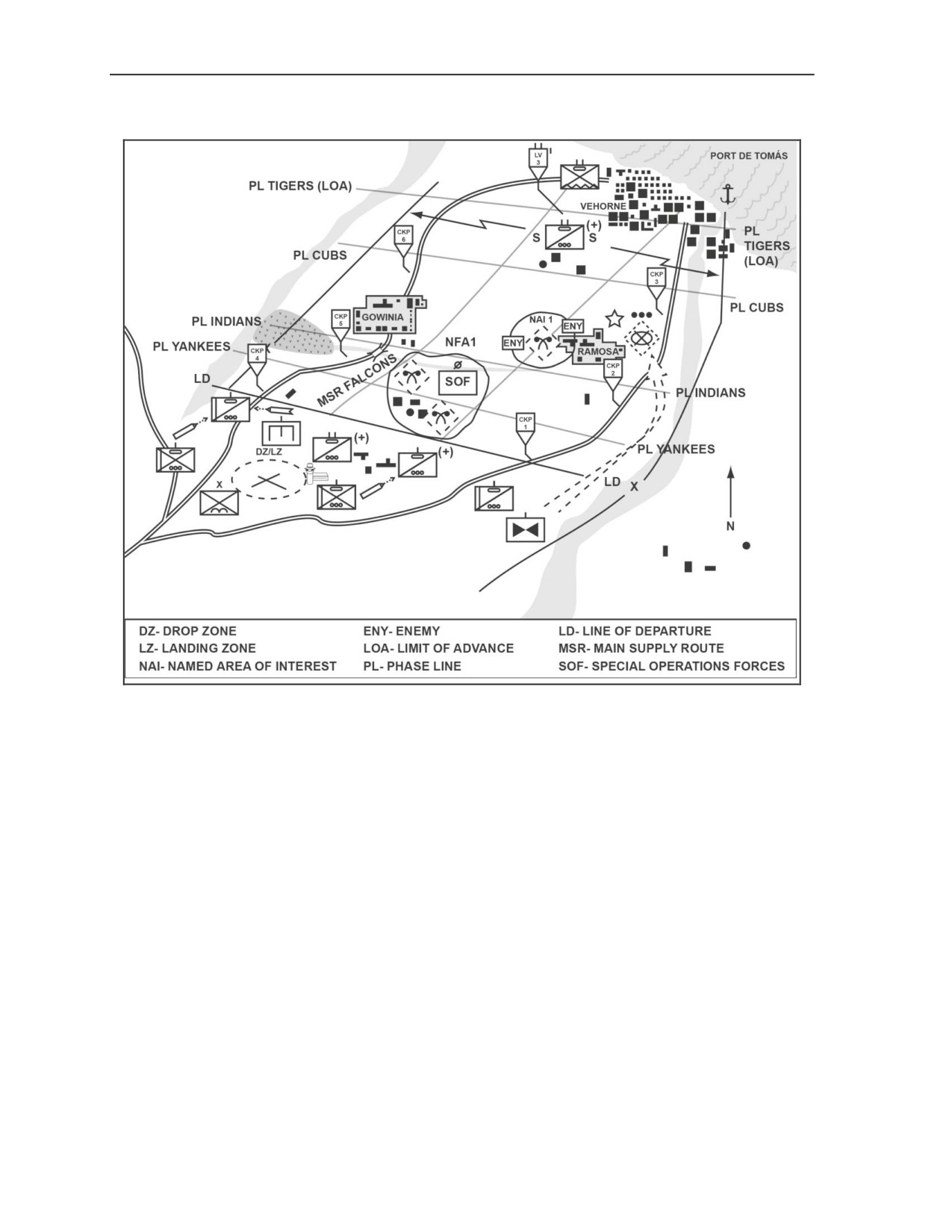
Reconnaissance
of another as the greater number of assets applied to information collection increases the effectiveness of the
operation. All units conduct reconnaissance using a combination of dismounted, mounted, aerial, and
reconnaissance by fire methods augmented with brigade and higher echelon technical sensor capabilities.
DISMOUNTED RECONNAISSANCE
5-13. Dismounted reconnaissance is the most time-consuming method used by ground and air units, but
permits the most detailed information collection about the enemy, terrain, civil considerations, and
infrastructure. The commander considers using dismounted reconnaissance when—
z
Stealth is required or security is the primary concern.
z
Time is available.
z
Detailed information is required.
z
The reconnaissance objective is a stationary threat, fixed site, or terrain feature.
z
The unit expects, or has made, enemy contact through visual/electronic means.
z
Reconnaissance vehicles cannot move through an area because of terrain or threat.
z
Terrain creates a ‘visual dead space’ that prevents optics or sensors use.
z
Vehicles are not available.
MOUNTED RECONNAISSANCE
5-14. Mounted reconnaissance enables a more rapid tempo while increasing the potential compromise of
reconnaissance efforts. Mounted reconnaissance should take advantage of standoff capabilities provided by
surveillance and weapon systems to observe and engage from greater distances and or the speed associated
with mounted movement. Successful reconnaissance tasks mix mounted and dismounted methods based on
the enemy situation and time available. The commander considers mounted reconnaissance when—
z
Time is limited.
z
Distances require mounted movement.
z
Stealth and security are not primary concerns.
z
Detailed information is not required, or the mounted method affords the same level of detail as the
dismounted method.
z
The nature of the reconnaissance objective allows vehicles to approach (such as a terrain feature
or road intersection in stability tasks).
z
Enemy location is known.
AERIAL RECONNAISSANCE
5-15. Aerial reconnaissance conducted by Army or joint aviation assets serves as a link between sensors and
mounted or dismounted reconnaissance and used to cue other reconnaissance methods to specific areas
thereby increasing the overall tempo of the operation. Complex terrain, adverse weather, enemy air defense
systems, and deception/countermeasures degrade the effectiveness of aerial reconnaissance. The commander
considers aerial reconnaissance when—
z
Weather permits.
z
Time is extremely limited or information is required quickly.
z
Ground reconnaissance elements are not available.
z
The objective is at an extended range.
z
Verifying a target.
z
Enemy locations are known and extremely dangerous (high risk) to ground assets or are vague but
identified as high risk to ground assets.
z
Terrain is complex and weather conditions are favorable.
RECONNAISSANCE BY FIRE
5-16. In reconnaissance by fire, reconnaissance elements place direct or indirect fire on positions where
there is a reasonable suspicion of enemy occupation. The goal is to cause the enemy to react by moving or
returning fire and disclose their disposition or willingness to fight. Leaders use this reconnaissance method
-XO\ 2015
FM 3-98
5-3
Chapter 5
when enemy contact is expected and time is limited, or when the unit cannot maneuver to develop the
situation. Commanders consider reconnaissance by fire when the unit—
z
Identifies a natural or manufactured obstacle with suspicion of enemy nearby.
z
Detects an obvious kill zone.
z
Identifies a suspected enemy position that fits the situational template.
z
Determines signs of recent activity (such as track marks or trash).
z
Locates probable enemy bunker complexes.
5-17. Reconnaissance by fire eliminates the element of surprise the Cavalry element may have had, and it is
likely to give the enemy detailed knowledge of their location. However, it may reduce the chance of ambush
within established kill zones. Disciplined troops in prepared positions might not react to the fires particularly
if fires are ineffective and do not inflict damage or casualties. As a result, reconnaissance by fire should not
entail the indiscriminate use of direct and indirect fires at all wood lines and hilltops hoping to cause the
enemy to react.
RECONNAISSANCE MANAGEMENT
5-18. The Cavalry unit commander and staffs manage assets by cueing, mixing, and redundant employment.
Reconnaissance management allows the unit to collect the most critical information with multiple
perspectives at the appropriate time. The BCT S-3 manages and synchronizes all assets in support of the
brigade and Cavalry squadron execution. Cueing, mixing, and redundancy are used to maximize collection
efforts and allow primary focus on reconnaissance objectives likely to yield the most information.
z
Cueing is the integration of one or more types of reconnaissance or surveillance systems to provide
information that directs follow-on collecting of more detailed information by another system (FM
3-90-2). These systems may signal other ground or air reconnaissance assets to investigate specific
areas to confirm, deny, or verify information. For example, a dismounted OP may observe a named
area of interest along avenue of approach (AA) 1 while an unmanned ground sensor (UGS) surveys
AA2. Upon activation of the UGS conducting surveillance of AA2 the OP is retasked to observe
AA2 to confirm or deny enemy presence or movement along the avenue of approach.
z
Mixing is using two or more different assets to collect against the same intelligence requirement
(FM 3-90-2). Employing different systems is always desirable if the situation and available
resources permit. This method increases the probability of collection and tends to provide
information that is more complete. Mixing can help defeat deception attempts by highlighting
discrepancies in information reported by different collection assets. For example, one OP and one
UAS focused on one NAI
z
Redundancy is using two or more like assets to collect against the same intelligence requirement
(FM 3-90-2). Redundancy improves the chances the reconnaissance element collects the required
information and provides depth should one element become compromised. For example, two OPs
focused on one NAI.
5-19. The BCT commander task-organizes with additional assets from within or outside the Cavalry unit to
increase the effectiveness and survivability of a Cavalry asset. For example, the BCT task-organizes a
Cavalry squadron with a lasing team, a signal retransmission element, and an engineer reconnaissance
element to improve fires lethality, increase communications range, and enhance mobility capabilities organic
to the squadron (Refer to ADRP 3-90 for more information).
RECONNAISSANCE ASSETS AND SYSTEMS
5-20. Although the Cavalry scout directly observing the target is the commander’s most flexible
reconnaissance asset, the commander maximizes use of all collection assets, manned and unmanned, to assess
the enemy and the effects of the terrain on enemy and friendly forces. Besides knowing the capabilities and
limitations of these systems, commanders and staffs understand all systems are susceptible to deception and
countermeasures.
5-21. The following assets and systems integrate into the intelligence collection effort through cueing,
mixing, and redundancy. These assets provide the commander most critical information with the fewest assets
at the appropriate time.
5-4
FM 3-98
-XO\ 2015
Reconnaissance
SENSORS
5-22. Sensors allow flexibility in economizing aerial, dismounted, or mounted assets. Commanders use
sensors to observe areas where contact may not be expected but is possible, or for surveillance of areas over
extended periods of time. Sensors facilitate ground reconnaissance by providing redundancy and
confirmation for other assets operating in different areas of the battlefield. They can extend surveillance
distance between ground reconnaissance and the threat. The commander considers sensor reconnaissance to
expand the scope of coverage in a larger AO, conduct missions of an extended duration, conduct CBRN
reconnaissance, or cue a more thorough ground or aerial reconnaissance of a given area.
UNMANNED AIRCRAFT SYSTEMS
5-23. UAS platforms can locate and recognize major enemy forces, moving vehicles, weapons systems, and
other targets that contrast with their surroundings. Additionally, UAS can detect and confirm information on
the ground, such as the position of friendly forces or the presence of noncombatant civilians. (Refer to FM
3-04.155 for more information.)
5-24. Besides its organic UAS, the unit may plan and control employment of UAS from supporting
organizations.
Note. Airspace control is a critical consideration for the employment of UAS. (Refer to FM 3-52
and ATP 3-52.1 for more information.)
5-25. UAS employment is most effective forward or on the flanks. Employed as a team, UAS and manned
or unmanned ground reconnaissance elements provide excellent surveillance capability. Other capabilities
include the following:
z
Support target acquisition efforts and lethal attacks on enemy reconnaissance and advance forces.
z
Assist in zone, area, and route reconnaissance.
z
Locate and help determine enemy force composition, disposition, and activity.
z
Maintain contact with enemy forces.
z
Provide target location with enough accuracy to enable immediate target handover, and first round
fire-for-effect engagements.
z
Provide or enhance multispectral sensor coverage of the AO.
z
Provide information to ground reconnaissance elements, increasing survivability.
z
Reduce or eliminate exposure time of ground reconnaissance elements in high-risk environments.
z
Support mission duration beyond those of manned systems.
z
Provide digital connectivity that enables rapid product dissemination and constant
communications.
5-26. While UAS are an excellent force multiplier, they have limited effectiveness in locating enemy forces
that are well covered or concealed. UAS organic to the reconnaissance unit are not suited for deep, long
duration searches. Other limitations include the following:
z
Vulnerability to enemy fire.
z
Weather restrictions (cloud cover, turbulence, and other factors).
z
Line-of-sight requirements between aircraft and ground control stations.
z
Limited frequencies for UAS control.
z
Airspace control issues.
z
Limited sensor field of view.
z
Limited detection capability in complex terrain.
z
Unique Class III/V requirements.
z
Inability to provide first-hand knowledge of the situation.
z
Fragile components.
-XO\ 2015
FM 3-98
5-5
Chapter 5
SIGNALS INTELLIGENCE
5-27. BCTs use information developed by the signals intelligence systems that are organic or task organized
to the BCT. Signals intelligence systems can monitor or scan for signals, stop at detected signals, and restart
after a predetermined time or when cued manually. The system has on-the-move signal intercept capabilities.
SECTION II - FORMS OF RECONNAISSANCE
5-28. The five forms of reconnaissance are zone, area, route, reconnaissance in force, and special
reconnaissance. All forms of reconnaissance, conducted by the fundamentals of reconnaissance, develop PIR
and intelligence that allow the commander and staff to understand and visualize the environment, develop
the situation, create options, and identify opportunities for the commander to seize, retain, and exploit the
initiative.
5-29. Zone reconnaissance allows intelligence development on threat, terrain, infrastructure, and society
within a specified zone of operations. Zone reconnaissance operations are generally large, deliberate, and
thorough efforts designed to gain a significant amount of information. Area reconnaissance focuses
reconnaissance efforts within a smaller geographic area than a zone reconnaissance but requires collecting
the same information as a zone reconnaissance, as well as information about dominant terrain outside the
specified area from which the threat can influence friendly operations. Route reconnaissance is a directed
operation to obtain detailed information of a specific route and influencing terrain along the route.
Reconnaissance in force is an operation to determine the enemy’s strength, disposition, and reactions in a
specified area conducted by battalion-sized task forces or larger elements. Special reconnaissance is an
operation conducted by special operations forces in hostile, denied, or politically sensitive environments to
collect or verify information of strategic or operational significance and employ capabilities and assets not
normally available to conventional forces.
Note. When the Cavalry unit receives a reconnaissance mission by its higher HQ, it may perform
a combination of reconnaissance forms to answer the higher commander’s information
requirements. For example, if the Cavalry squadron’s mission is to conduct a zone reconnaissance
its subordinate units may conduct a combination of zone, area, or route reconnaissance missions
inside of the assigned squadron zone of operations.
ZONE RECONNAISSANCE
5-30. Zone reconnaissance is a form of reconnaissance that involves a directed effort to obtain detailed
information on all routes, obstacles, terrain, and enemy forces within a zone defined by boundaries (ADRP 3-
90). Any unit can perform a zone reconnaissance, though the Cavalry squadron conducts zone reconnaissance
in advance of the BCT’s combined arms battalions to develop information and intelligence impacting the
success of current and future BCT operations. Commanders assign a zone reconnaissance when the enemy
situation is vague or when information related to terrain, infrastructure, or society is limited. Commanders
require specific information from the zone reconnaissance to develop or refine his course of action before
deployment of additional forces into zone. In this regard, the zone reconnaissance may orient on the main
body’s subsequent area of operation or a specific axis of advance.
5-31. The level of detail required during a zone reconnaissance makes these operations a deliberate and
time-consuming process. The commander must work to balance available time with critical collection
requirements to ensure that they provide the necessary information for their higher commander. To do this,
commanders deliberately focus collection requirements and adjust their reconnaissance techniques to
increase the overall tempo; however, as speed increases so too does the risk associated with the zone
reconnaissance and follow on operations. Commanders choose to task organize the reconnaissance force to
mitigate risks associated with an increased tempo of operations and provide Cavalry organizations with an
increased ability to develop the situation through action in close contact with the enemy and civilian populace.
5-6
FM 3-98
-XO\ 2015
Reconnaissance
TASKS
5-32. The Cavalry squadron commander, working with the BCT commander, determines the priority of
tasks that best answers PIR and then focuses the squadron’s collection efforts against these requirements.
The primary tasks associated with zone reconnaissance are:
z
Find and report all enemy forces within the zone.
z
Based on engagement criteria, clear all enemy forces in the designated AO within the capability
of the unit conducting reconnaissance.
z
Determine the trafficability of all terrain in the zone, including built-up areas.
z
Locate and determine the extent of all contaminated areas in the zone.
z
Inspect and classify all bridges within the zone.
z
Locate fords or crossing sites within the zone.
z
Inspect and classify all overpasses, underpasses, and culverts.
z
Locate and clear all mines, obstacles, and barriers in the zone (within capability).
z
Report reconnaissance information.
5-33. Based on priority, the commander may direct the following:
z
Reconnoiter all terrain within the zone.
z
Reconnoiter specific terrain within the zone.
z
Locate bypass around built-up area, obstacles, and contaminated areas.
BCT PLANNING CONSIDERATIONS
5-34. BCT commanders direct a zone reconnaissance to develop the situation for follow on offensive,
defensive, or stability tasks. The Cavalry squadron is the BCT commander’s primary reconnaissance unit to
develop the situation and refine subsequent courses of action. Consequently, BCT commanders must provide
planning guidance and clear intent for zone reconnaissance tasks that offer both freedom of action and
adequate direction to ensure their Cavalry squadron accomplishes defined reconnaissance objectives within
the required timeframe.
5-35. The BCT commander’s intent for the zone reconnaissance provides focus for information collection.
Based on the potential scale of a zone reconnaissance, commanders prioritize collection efforts on
reconnaissance objectives determined during the IPB process. The event template, terrain analysis, and
enemy situation template create information requirements that in turn focus collection efforts. These
requirements, linked to CCIR, assist the BCT commander and staff in developing and refining courses of
action.
5-36. Regardless of the amount of information known, the BCT commander initially defines and
consistently refines what type of information he needs (information requirements), when he needs it, and
describes how the reconnaissance efforts enable follow on operations. The Cavalry squadron truly serves as
the BCT commander’s eyes and ears allowing him to better understand the operational environment and
focus the main effort at positions of tactical advantage. Finally, the BCT commander defines the Cavalry
squadron’s role during decisive operations and required conditions or time for the squadron’s transition from
a zone reconnaissance to a follow on operations.
5-37. Tempo of reconnaissance is directly affected when reconnaissance assets react to contact. Therefore,
engagement, disengagement, and bypass criteria are essential considerations from the BCT to the section
level. The criteria for which subordinate elements lethally engage or disengage enemy forces assists in the
squadron gaining and maintaining contact with the enemy. Commanders may direct bypassing or handing
off certain sizes or types of units to maintain the tempo of the operation based upon subsequent planned
operations and guidance from higher. Follow-on forces must understand engagement, disengagement, and
displacement criteria and deliberate handoffs are directed and rehearsed.
5-38. To enable information collection one of the major considerations for the BCT staff when planning a
zone reconnaissance is the Cavalry squadron’s task organization. BCTs task-organize and assign command
relationships for their Cavalry formations to accomplish their assigned mission in their anticipated area of
operations. The BCT sets conditions for the zone reconnaissance by enabling the Cavalry squadron with
-XO\ 2015
FM 3-98
5-7
Chapter 5
additional capabilities such as rotary-wing aircraft, joint and organic fires, intelligence collection assets,
mobility support, increased sustainment capacity, retransmission capability, Infantry, and Armor based upon
available assets, information collection requirements, and estimates of the enemy’s capabilities and assets.
Effective Cavalry is task-organized with additional assets that allow them to collect information and
intelligence in close contact with the enemy and civil population without placing the unit in a position of
disadvantage or risk of enemy overmatch. Sufficient task organization enables the unit conducting zone
reconnaissance to develop the situation through action—especially in an unclear operational environment.
Similarly, when conducting operations focused on the conduct of stability tasks, task organizing the squadron
with available assets specific to collecting the necessary information for follow on operations (such as civil
affairs, translators, engineers, and infrastructure assessment teams) provides relevant information in a timely
fashion.
5-39. The positioning of sustainment assets is dependent upon the depth of the zone, anticipated duration of
the operation, and sustainment requirements during operations. Class III, Class V, maintenance collection,
and medical evacuation are of primary concern. A forward positioned FARP reduces aircraft turnaround time.
The FARP may be in the squadron zone or in the area of operations of the lead unit behind the squadron.
5-40. Dedication of additional capabilities comes at a potential cost to follow on operations. Additional
combat power enhances the Cavalry squadron’s ability to gain and maintain contact, execute reconnaissance
and battle handover, while providing an increased capacity to defeat enemy reconnaissance and security
forces. Perhaps above all other considerations, an appropriately task-organized squadron has the ability to
take advantage of situations and opportunities identified during the zone reconnaissance. Seizing
opportunities provides the BCT a marked advantage during decisive operations. Therefore, commanders
should carefully consider the significant risks assumed in executing reconnaissance operations as an economy
of force without appropriately task organizing the Cavalry force.
Note.
“Reconnaissance organizations require versatility to adapt to ever-evolving tactical
situations and operational realities. Versatility without survivability and combat power has little
relevance. Reconnaissance units unable to survive contact with an enemy and incapable of
overcoming even light resistance tend to be marginalized either by a threat or by their own
commanders. Even stealthy reconnaissance requires an ability to survive a chance contact or an
ambush that may occur with little warning.” (To Fight Or Not To Fight, p 577)
CAVALRY SQUADRON PLANNING CONSIDERATIONS
5-41. When developing planning guidance, Cavalry squadron commanders incorporate both the brigade
commander’s intent and concept for follow-on forces into their overall scheme of maneuver. Focus, tempo,
and engagement criteria are three critical components of commander’s reconnaissance guidance.
5-42. The tempo and uncertainty of military operations rarely allows sufficient time to collect all the relevant
or required information during a zone reconnaissance. Therefore, commanders must deliberately focus their
formations on specific reconnaissance objectives that validate or invalidate assumptions and confirm or deny
planned courses of action. Prioritization allows the Cavalry squadron to increase the tempo of collection and
accomplish reconnaissance objectives in sufficient time to facilitate the main effort’s movement and
maneuver to positions of tactical advantage. Mission analysis and IPB produces an event template, terrain
analysis, and enemy situation templates as known at that point. A reconnaissance operation confirms or
denies assumptions made in planning. The squadron uses this available information to determine factors,
such as—
z
Speed, movement, and reconnaissance techniques.
z
Overall focus of the reconnaissance.
z
Task, purpose, and focus for subordinate troops, task-organized assets, and boundaries (zones)
for ground troops.
z
Essential aerial on-station times or locations if available.
z
Prioritize tasks.
5-43. Commanders direct reconnaissance tempo (the rate of speed combined with level of detail required)
during a zone reconnaissance to enable the timely collection of information and intelligence necessary to
5-8
FM 3-98
-XO\ 2015
Reconnaissance
facilitate successful subsequent operations. Commanders prescribe the level of detail to collect against
specific reconnaissance objectives, speed and movement techniques during different portions of the
operation, task organization of reconnaissance assets to create more efficient collection, and timeline for
collection in their planning guidance. The combination of these factors creates a tempo for the zone
reconnaissance.
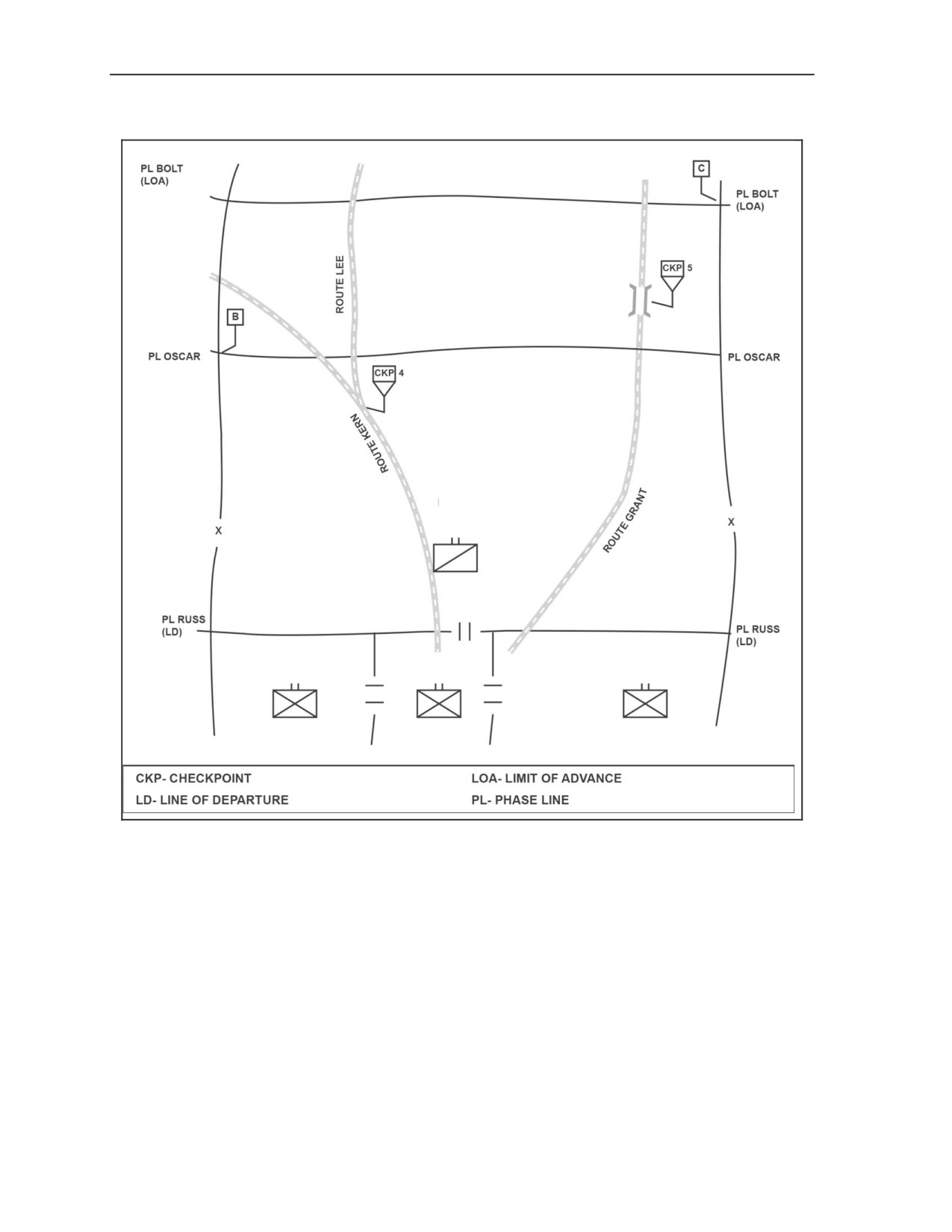
5-44. To control movement, the squadron assigns zones for the ground troops (see figure 5-1 on page 5-10).
A zone reconnaissance begins at the line of departure (LD) and concludes at a specified limit of advance
(LOA) with lateral boundaries defining the AO. Subordinate zones may not necessarily be the same size. The
main body frequently orients movement along a major route, especially an axis of advance; though travelling
directly along the route incurs tactical risk. Reconnaissance of the route typically becomes a specified task
for a troop. Phase lines control progress through the zone. Boundaries and phase lines are drawn along
recognizable terrain. Contact points along boundaries maintain coordinated reconnaissance between adjacent
units. Checkpoints indicate critical terrain features, control reconnaissance movement and reporting, and
coordinate air and ground actions.
-XO\ 2015
FM 3-98
5-9
Chapter 5
Figure 5-1. IBCT zone reconnaissance graphics
5-45. Cavalry units conduct detailed fire planning regardless of the assigned task or prescribed tempo.
Deliberate fire planning has two components: indirect and direct. (Refer to FM 3-60 for more information.)
A commander deliberately plans and integrates indirect fire support into the scheme of maneuver to enhance
the effectiveness of direct fires. Fires integration ensures that templated enemy forces are targeted with the
most casualty-producing weapon systems. By setting the conditions to engage the enemy with indirect fires,
the commander is able to degrade the enemy scheme of maneuver without exposing friendly forces to
observation and direct fire engagement until necessary. Commanders establish a direct fire plan based on
METT-TC. Fire distribution allows the commander to achieve massing fires and effects on the enemy to
degrade or destroy their ability to command and control their forces. Proper direct fire planning:
z
Destroys the most dangerous enemy assets first.
z
Uses each weapon system in its best role.
z
Concentrates fires and effects on long-range targets.
5-10
FM 3-98
-XO\ 2015
Reconnaissance
z
Takes the best shots and expose only those combat vehicles that actually needed to fire.
z
Avoids target overkill.
5-46. Integration of combined arms, air-ground operations are essential to the success of reconnaissance
operations. Considerations for the integration of air and ground operations include:
z
Command and control relationship (normally the squadron pushes aircraft to the lowest possible
level to facilitate movement)
z
Rotary wing rotation plan, task and purpose.
z
Ground troop’s missions.
z
Tasks performed by air and ground troops.
5-47. Rotary wing teams increase the effectiveness of the reconnaissance efforts by reconnoitering open
terrain, reconnoitering forward of the ground troops, screening flanks, or locating enemy forces. Effective,
integrated, and synchronized aerial reconnaissance allows ground troops to focus on terrain, routes, and
reconnaissance of obstacles and enemy. When air and ground reconnaissance efforts are integrated, the
squadron develops the situation faster with more fidelity for the BCT commander.
5-48. Task-organized reinforcements are normally retained under squadron control due to the vague
situation. Engineers typically follow or are attached to the troop that is assigned a critical route to assist in
technical reconnaissance, obstacle reduction, and route repair.
5-49. The BCT field artillery battalion has an organic command relationship with the BCT. Priority of fire
for artillery is assigned to troops based on intelligence or the main effort. Air defense artillery priority is
normally toward protecting trains, command posts, artillery batteries, and task organized or designated
reserve.
5-50. Commanders at all levels position themselves in the best position to command subordinate units and
gain situational awareness. Both the squadron tactical command post (TAC CP) and main command post
(CP) are normally operational to ensure continuous communications over extended distances within the
squadron and to higher headquarters. Combat trains command post (CTCP) generally moves through the
center of the zone along a route providing good movement laterally and in depth. A unit collection point may
move along an alternate route to provide adequate support across a wide zone. The field trains of the Cavalry
squadron are either collocated with the brigade support battalion or echeloned in depth behind the combat
trains. Command posts and sustainment assets remain mobile and bound forward as the squadron advances.
5-51. The purpose of a forward passage of lines is to move forces forward to conduct operations. It ensures
the maintenance of enemy contact while allowing the relief of previously committed forces. The stationary
force controls and secures the AO far enough to its front that the moving force can pass through the stationary
force and reform into a combat formation before contact with an enemy force. A forward passage of lines
prevents the Cavalry squadron or units conducting reconnaissance to avoid being harassed or molested by
enemy forces as they begin operations. Forward or rearward passage of lines can occur during any form of
reconnaissance or security. Refer to FM 3-90-2 for more information.
5-52. Upon completion of the mission, the squadron proceeds with assigned follow-on missions. In absence
of an assigned mission, the squadron typically conducts security tasks in the form of a screen or guard along
the limit of advance or to the flank of a supported unit. If the squadron encounters major enemy formations
before the objective and if no gap or bypass is found, the squadron conducts a screen or guard, continues
reconnaissance, and prepares to pass main body forces forward.
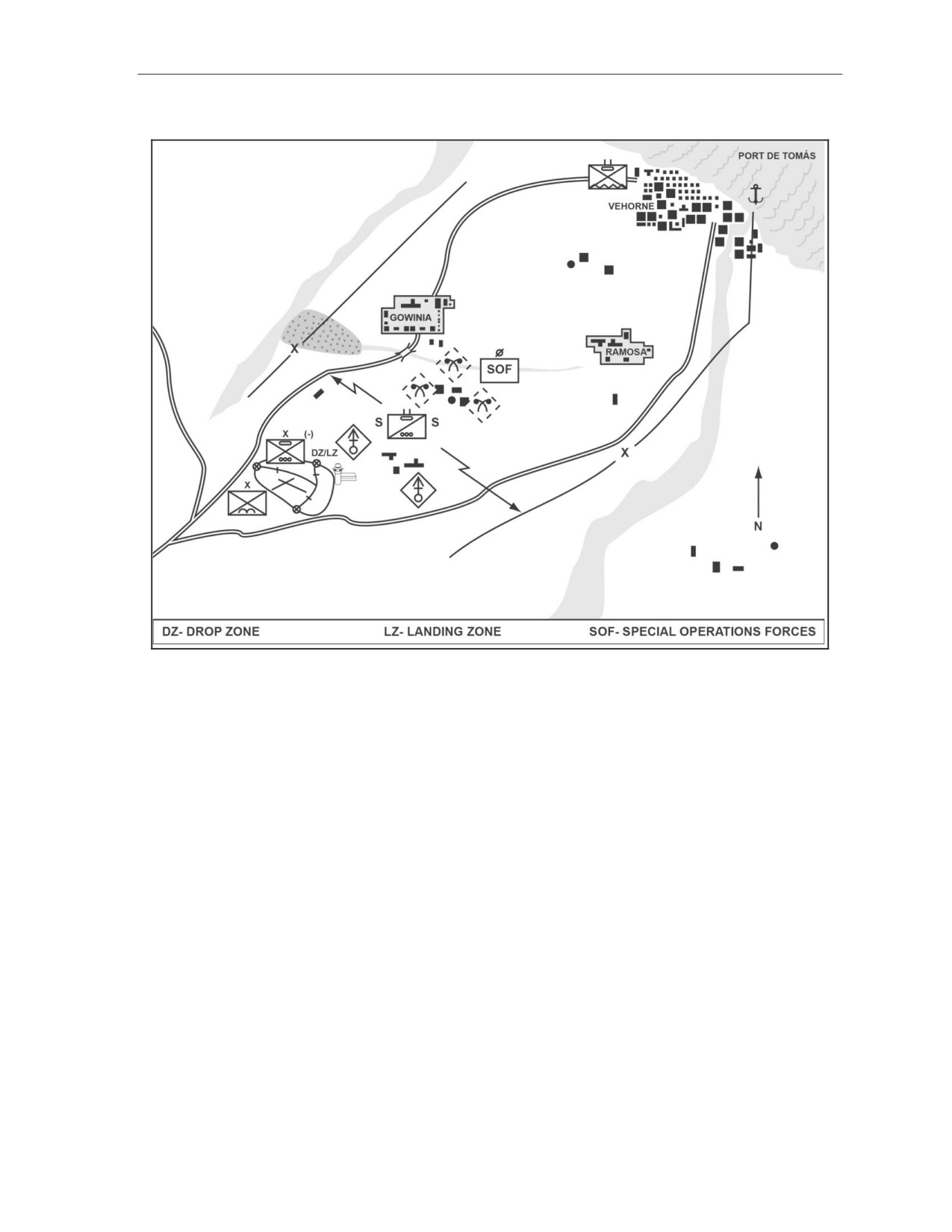
5-53. Below is a notional scenario. This continuing scenario and accompanying graphics will span the
reconnaissance, security and stability chapters.
Following the collapse of a WMD possessing regime, revolutionary militias,
government sponsored forces, and international terrorist organizations fight for control of
the territory. This conflict creates a growing humanitarian and refugee situation combined
with doubts about the security of WMDs (distributed across a wide area). The terrain is a
mixture of rolling plains, hills and swamps with several large rivers naturally
compartmentalizing large areas of the country.
-XO\ 2015
FM 3-98
5-11
Chapter 5
In response, XXII Corps deploys as a Joint Task Force Land Component Command
(JTFLCC). Initially it consists of an air expeditionary wing, special operations forces,
IBCT (Airborne), SBCT, and a USMC Marine Expeditionary Brigade.
As part of a forcible entry, special operations forces and the IBCT airborne brigade
seized a remote airfield in the ungoverned territory. The Marine Expeditionary Brigade
(MEB) establishes a seaport of debarkation, essentially creating two noncontiguous areas
of operation within the country.
The SBCT, working from the intermediate staging base in a friendly neighboring
territory, conducted a tactical road march from the intermediate staging base to the seized
airfield. This simultaneously establishes of a ground line of communication with the
airfield and reinforces the IBCT (airborne) airhead around the airfield. Two of the SBCT’s
infantry battalions along with the SBCT field artillery battalion and most of the brigade
engineer battalion were required to secure that ground line of communication.”
The SBCT cavalry squadron task organized with a combat engineer company, forward
support company, HUMINT, CAT, MISO, and TAC-P. They are followed by a single SBCT
infantry battalion tasked to provide support upon enemy elements attempting to seize the
WMDs. Their efforts where controlled by the SBCT tactical command post.
Upon arrival at the airfield, the SBCT cavalry squadron is detached from the SBCT
and attached to the IBCT (airborne) and assigned an area of operations by the IBCT
(airborne) commander. The width of that area of operations constitutes a significant
portion of the 42 kilometer long airhead line or perimeter around the airfield due to the
tactical mobility of the SBCT cavalry squadron’s combat vehicles and organic information
systems. The size of the airhead is based on the need to keep the airfield out of the range
of enemy mortar and rocket harassment fires. The squadron conducts a zone
reconnaissance of its new area of operations while simultaneously establishing a screen
for its portion of the airhead line to prevent enemy observation and interference of ongoing
friendly activities on the airfield. (See figure 5-2.)
5-12
FM 3-98
-XO\ 2015
Reconnaissance
Figure 5-2. Notional scenario for initial entry
5-54. The notational scenario continues below with the zone reconnaissance vignette.
Following a period of time, during which units revert back to their parent
organization, previously deployed Special Forces teams and national intelligence assets
begin to provide initial reports of unsecure WMD locations, areas of fighting, and an idea
of the growing scale of the humanitarian crisis. Press reports at times confirm these reports
while also providing conflicting rumors of the proliferation of other previously unknown
and reportedly unsecured WMD sites and growing civilian atrocities. The situation
appears to be rapidly deteriorating. Based on this information, the JTF land component
commander gives the SBCT the following guidance:
“We need to find the WMDs and establish a line of communication (LOC) between the
Army and Marines. I need you to help me figure out who is fighting and where they are
fighting but be ready to shift effort based on how this thing plays out. We have to protect
these civilians before this thing gets out of control.”
Given the uncertain nature of the situation combined with the urgency to accomplish
some of the specified tasks, the brigade commander determines that he has neither the time
nor the capacity to develop the situation further before he begins movement. Therefore, he
develops a plan that directs the SBCT to conduct a movement to contact from the airfield
to the port. He gives an initial intent to his squadron commander and brigade S-3:
“I need you to find the WMDs, tell me what we need to know about the main supply
route (MSR), and give me an idea about the scale of humanitarian issues and fighting.
Remember, I want to preserve the Infantry battalions for as long as I can, so find the best
place to use them and let’s pull them in.” By the end of this, I want the LOC from the
-XO\ 2015
FM 3-98
5-13
Chapter 5
Marines to the airfield and all the WMDs in our zone secured, ideally with enough combat
power left over to develop the situation further. This operation sets conditions to protect
the civilians. Come back to me with your thoughts on time and what you’ll need for the
fight.”
As the Cavalry squadron does mission analysis they determine they require:
z
Two Infantry companies to help work through contact.
z
Engineer company to assist with the route reconnaissance.
z
One MGS platoon.
z
CBRN platoon to assist with the WMD site exploitation
z
2 MI HUMINT Teams
z
UAS platoon (tactical control [TACON])
z
Artillery battery (direct support [DS]
z
Air (rotary-wing) (preserve for later)
The SBCT’s S-3 begins to synchronize assets with the Cavalry squadron’s evolving
plan. As he gets access to division and corps assets he works with the S2, fire support
officer (FSO), CBRN officer and brigade aviation element to integrate them into the
information collection plan, airspace control, and fires. The S-2 works to answer PIR.
Their first task is to determine if previously templated WMD sites are vacant. Several
suspect sites have limited activity. Based on this activity, the BCT S-3 determines that he
needs to maintain contact on those with UAS assets until he can work a reconnaissance
handoff with either Special Forces or BCT assets.
The squadron is currently screening its portion of the airhead around the air point of
debarkation. Given the limited time available, the Cavalry squadron commander gives his
squadron the following guidance:
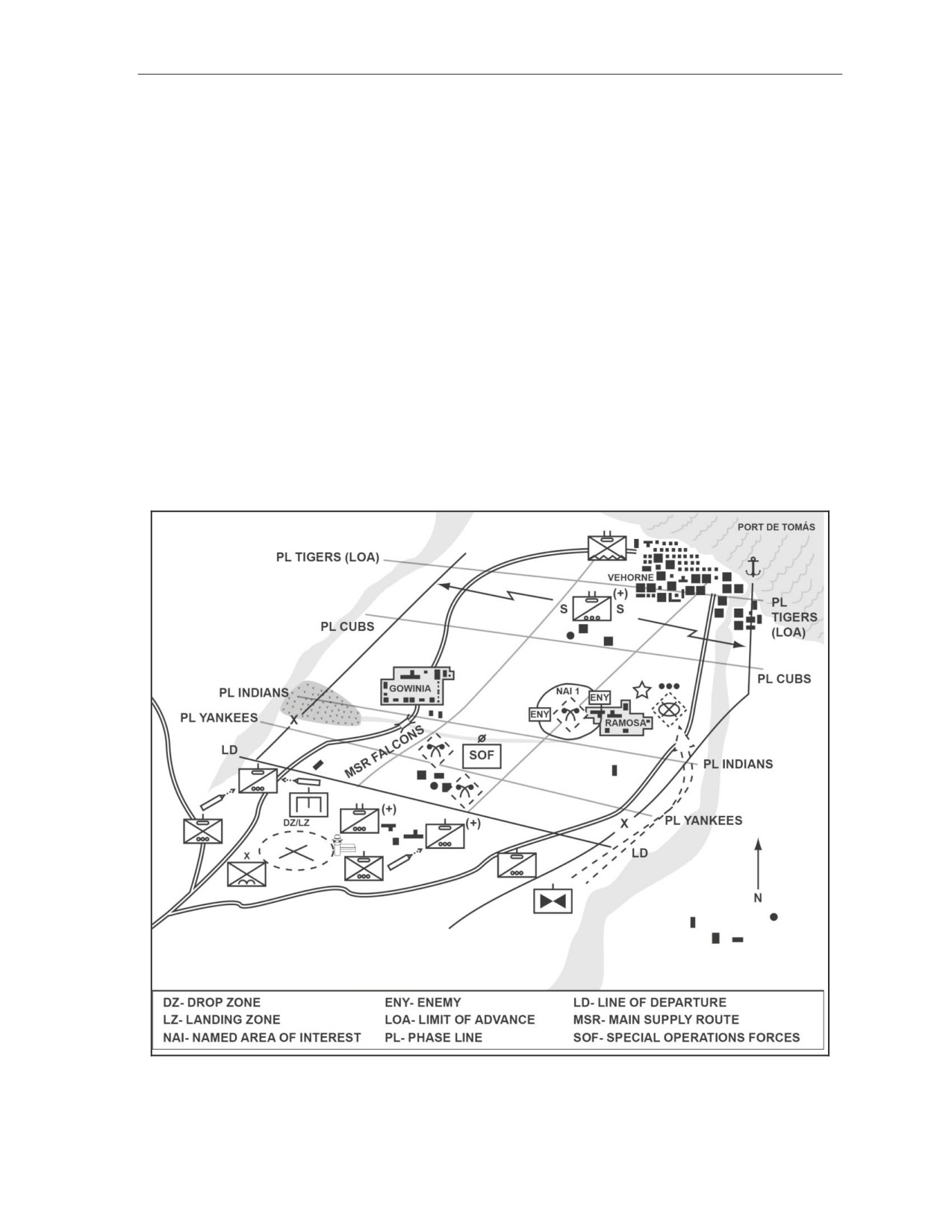
“2-1 Cavalry conducts a zone reconnaissance starting at 0535 tomorrow between the
East and West Rivers from phase line (PL) Royals (the LD) to PL Tigers (the LOA) to detect
and secure WMD sites, linkup with the 5th USMC MEB, and determine the composition
and disposition of groups engaged in hostilities within this area of operations. As shown
on the operations overlay PL Tiger is our forward boundary and well as being the LOA.
Also as shown in the operations overlay, the A Troop area of operations is the western
third of the squadron AO. It will conduct a route reconnaissance of MSR Falcons. A/229th
brigade engineer battalion (BEB) is in direct support of A Troop in the conduct of that
route reconnaissance. C Troop’s AO is the eastern two-thirds of the squadron AO. Linkup
points 7 and B9 allow both troops to make contact with the Marines. B Troop mission is to
secure the suspected WMDs sites in the center sector and detected by the other two troops.
The 229th BEB CBRN reconnaissance platoon (2/Headquarters and Headquarters
Company (HHC)/229 BEB, MGS platoon, and one platoon from B/1-5 Infantry is TACON
to B Troop to assist in this process. A/1-5 Infantry’s mission is to follow and support A
Troop. B/1-5 Infantry is the squadron reserve. It will follow C Troop in column. The
squadron tactical command post will move with B Troop. The squadron’s combat trains
will displace from their current location to the vicinity of Checkpoint 5 on MSR Falcons
once A Troop clears the AO between the LD and PL Indians. The squadron’s field trains
will remain in their current location near the APOD throughout the operation.
We’ll move rapidly from PL Yankee to PL Indians and deliberately handoff contact of
platoon size (3-5 vehicles or 30+ men). Smaller than that send a good synchronized
predeployment and operational tracker report and continue movement.
At PL Indians, we can expect direct and indirect contact. Therefore, I want to
maximize our time with available aircraft while moving through this terrain. At this point,
if we don’t already have aircraft, we’ll make a decision either to set a screen oriented on
the battalions and wait for aircraft or continue movement. Key factor here is time and
5-14
FM 3-98
-XO\ 2015
Reconnaissance
aircraft availability. The squadron’s TACON of D/4-25(AH-64) allows you to plan for a
flight of two aircraft per troop from PL Yankee to PL Tigers.
We’ll move deliberately from Indians to Tigers as I expect a large contingency of
civilians along routes and pockets of fighting in urban areas. When we see fighting work
to figure out what is going on in the area. If it is along the route or by the WMD locations
we need to develop the situation for the STRYKER battalions to follow and support.
Key to this is a tight knit seam between us and the STRYKER battalions. To do this I
want you to:
z
Link up with TACON elements. Rehearse movement, battle handoff, standard operating
procedures (SOPs), and tactics techniques and procedures (TTPs).
z
Link in with the battalion scouts and coordinate changes to handover SOPs—both recon
and battle.
z
Blue force tracking (BFT) graphics order to follow. FM rehearsal timeline to be published.
z
We cross the line of departure at BMNT (-3) hours.”
As the SBCT continues to develop the plan the squadron begins movement, with three
troops abreast, the Infantry company trailing the eastern troop with the engineer company.
The center troop moves toward known WMD locations and the Alpha troop in the west
with an Infantry company trailing, focusing on the proposed main supply route and the
increasing civilian infrastructure along that route. (See figure 5-3.)
Figure 5-3. Notional scenario zone reconnaissance
-XO\ 2015
FM 3-98
5-15
Chapter 5
AREA RECONNAISSANCE
5-55. Area reconnaissance is a form of reconnaissance that focuses on obtaining detailed information about
the terrain or enemy activity a prescribed area (ADRP 3-90). Area reconnaissance allows for detailed
reconnaissance in specific locations that answers PIR and develops the situation to provide options to the
commander. The commander assigns an area reconnaissance when information on the enemy situation is
limited, when focused reconnaissance in the given area will likely yield specific information related to terrain
or decision points, or when more detailed information is required in a designated area. The area targeted for
reconnaissance may consist of a future friendly position such as brigade support areas, or position areas for
artillery. Commanders may further define the area as an NAI or TAI to focus the unit on a more specific area
such as a building, bridge, or key terrain.
TASKS
5-56. An area reconnaissance comprises the same tasks as a zone reconnaissance. Based on time and the
commander’s intent, the commander may direct the reconnaissance towards specific information
requirements only. Like the zone reconnaissance, the commander should focus his unit in the commander’s
intent paragraph and list the tasks in the specific instructions. Primary tasks associated with an area
reconnaissance:
z
Find and report all enemy within the area.
z
Reconnoiter specific terrain within the area.
z
Report reconnaissance information.
5-57. Other tasks include the following:
z
Reconnoiter all terrain within the area.
z
Inspect and classify all bridges within the area.
z
Locate fords or crossing sites near all bridges within the area.
z
Inspect and classify all overpasses, underpasses, and culverts.
z
Locate and clear all mines, obstacles, and barriers in the area within its capability.
z
Locate a bypass around built-up areas, obstacles, and contaminated areas.
BCT PLANNING CONSIDERATIONS
5-58. The planning considerations for an area reconnaissance at the BCT are the same as a zone
reconnaissance. The BCT commander provides focus within the area to reconnoiter, and the reconnaissance
tempo and engagement criteria for both the maneuver to the reconnaissance objective and the objective itself.
CAVALRY SQUADRON PLANNING CONSIDERATIONS
5-59. The planning considerations for an area reconnaissance at the squadron level are the same as a zone
reconnaissance, with some unique considerations. In an area reconnaissance, the squadron’s IPB analysis
determines the speed, formations, and movement techniques used to travel to the area. Depending on the size
of the area, the commander decides the appropriate size force required to reconnoiter the objective. En route
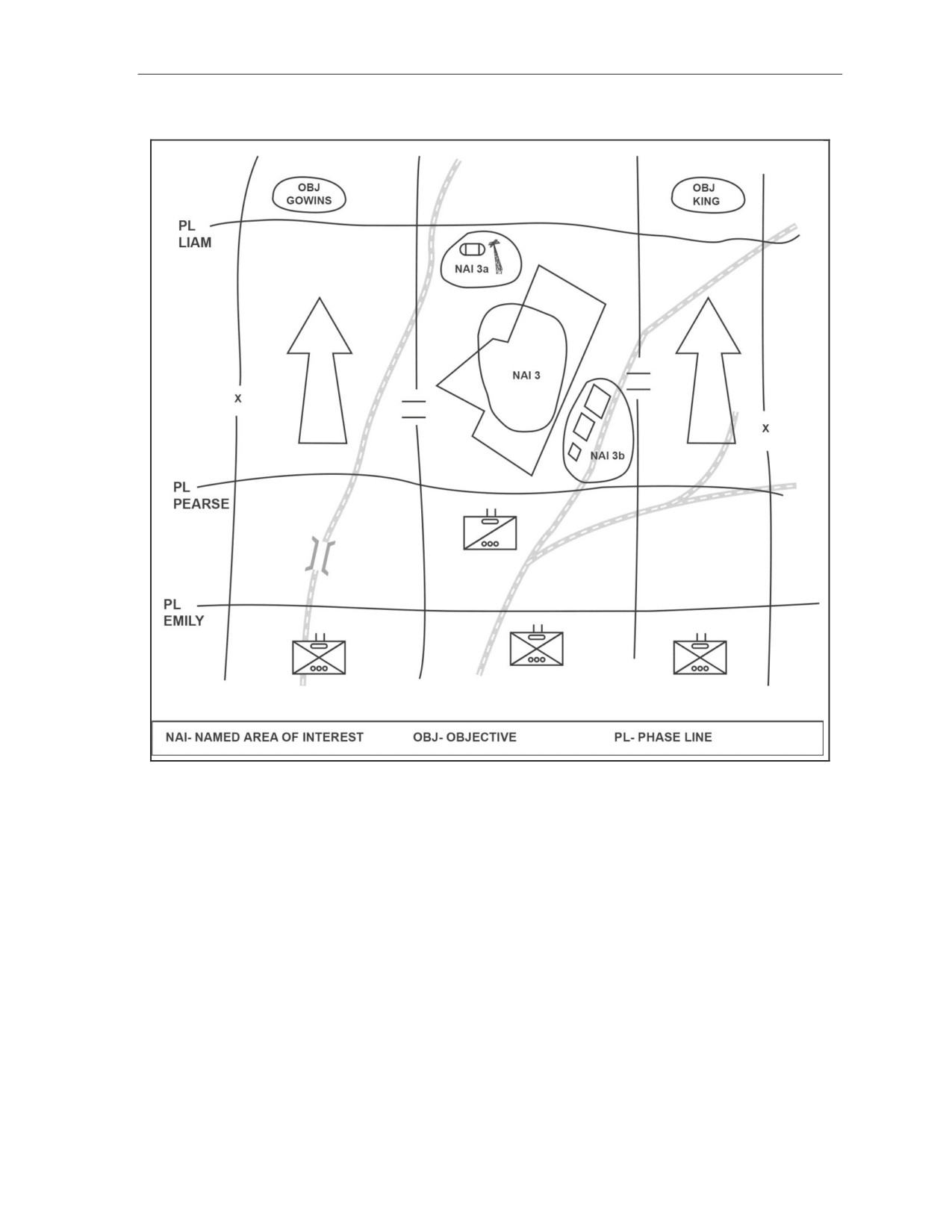
to or inside the area, the squadron establishes control measures as in a zone reconnaissance. (See figure 5-4.)
5-60. If another unit occupies an assembly area, the squadron reconnoiters avenues of approach and mobility
corridors leading to the area to support that force. That squadron can initially secure the area until unit
quartering parties arrive, and then it continues with assigned missions or moves to screen that force as it
conducts assembly area operations. Upon completion of the reconnaissance, the troop or squadron departs
the area along a different route than was used previously.
5-61. The squadron establishes control measures for the area reconnaissance in the same manner as a zone
reconnaissance. The squadron designates the area to reconnoiter with a continuous closed line, usually
depicted as an NAI.
5-16
FM 3-98
-XO\ 2015
Reconnaissance
Figure 5-4. ABCT area reconnaissance
5-62. Continuing vignette from zone reconnaissance.
A/2-1 Cavalry conducts an area reconnaissance of its area of operations between the
LD and PL Tiger (LOA). Falcons is located within that AO. A Troop’s primary
reconnaissance focus is the detection of any WMD sites within its AO. A Troop’s secondary
reconnaissance focus is a route reconnaissance of MSR Falcons in preparation for
establishing a ground line of communications between the aerial point of embarkation
(APOE) and surface port of embarkation (SPOE). It will also make contact with the 5th
Marine Expeditionary Brigade at linkup point 7 at the designated time. A/229th BEB is in
direct support of A Troop to assist in the route reconnaissance of MSR Falcons and to
create lanes as necessary through any obstacles located on that MSR. A Troop’s third
reconnaissance objective is the detection of ongoing conflicts between competing civil
groups within its AO. A/1-5 Infantry follows and supports A Troop in its area
reconnaissance. (See figure 5-5 on page 5-18.)
-XO\ 2015
FM 3-98
5-17
Chapter 5
Figure 5-5. Notional scenario area/route reconnaissance
ROUTE RECONNAISSANCE
5-63. A route reconnaissance is a directed effort to obtain detailed information of a specified route and all
terrain from which the enemy could influence movement along that route (ADRP 3-90). A route can be a
road, highway, trail, mobility corridor, avenue of approach, or axis of advance. Routes begin at a start point
(SP) and end at a specific destination release point (RP). Reconnaissance of a route is essential if intelligence
indicates a probability of enemy contact along the route or surrounding terrain or if information concerning
the terrain influencing a route is vague or unknown. The commander assigns a route reconnaissance either as
a discrete mission or as a specified task during a zone or area reconnaissance. Units collect information about
roads, bridges, tunnels, fords, waterways, and other natural and manmade terrain features that can affect
traffic flow. Route reconnaissance provides commanders with detailed information on the route and terrain
that can influence the route to prevent surprise, determine traffic ability for follow-on forces, and to confirm
or deny staff estimates and assumptions made during the operations process. Route reconnaissance is not to
be confused with route classification, which requires technical measurements and analysis typically
performed by engineer reconnaissance teams.
5-18
FM 3-98
-XO\ 2015
Reconnaissance
TASKS
5-64. Certain tasks are required during a route reconnaissance, unless otherwise directed by the higher
commander. These tasks are not a checklist or arranged sequentially, as some may not be necessary for
mission accomplishment. If time is limited, the commander directs the reconnaissance only towards specific
information requirements. The tasks associated with route reconnaissance are—
z
Find, report, and—based on engagement criteria—clear within capabilities all enemy forces that
can influence movement along the route.
z
Reconnoiter and determine the trafficability of the route.
z
Reconnoiter all terrain the enemy can use to affect movement along the route.
z
Reconnoiter all built-up areas along route.
z
Reconnoiter all lateral routes.
z
Inspect and classify all bridges within the area.
z
Reconnoiter defiles along the route. Clear them of enemy and obstacles (within capability), or
locate a bypass
z
Locate fords or crossing sites near all bridges on the route.
z
Inspect and classify all overpasses, underpasses, and culverts.
z
Locate and clear all mines, obstacles, and barriers on the route within capability.
z
Locate bypasses around built-up areas, obstacles, and contaminated areas.
z
Report route information.
BCT PLANNING CONSIDERATIONS
5-65. The BCT commander assigns a route reconnaissance mission when there are plans to use a specific
route for friendly movement. The planning considerations for a route reconnaissance at brigade level are the
same as a zone reconnaissance with additional considerations. BCT commanders assign the Cavalry squadron
a single route along the length or width of his AO or along geographically separate multiple routes, although
a single route is seldom assigned to a squadron. The BCT commander in his reconnaissance guidance
provides focus, reconnaissance tempo, and engagement criteria as it relates to the main body considerations
for recon or battle handover.
CAVALRY SQUADRON PLANNING CONSIDERATIONS
5-66. The planning considerations for a route reconnaissance at the squadron level are the same as a zone
reconnaissance, with some unique considerations. When a squadron conducts a route reconnaissance of a
single route, one troop acts as the main reconnaissance unit, with the other troops operating abreast on the
flanks to reconnoiter terrain features that dominate or influence the main route. The commander initially
determines possible danger areas and the nature of the potential threat in deciding how much terrain on each
flank of the route to reconnoiter. The squadron then determines the task organization and command
relationships of any combined arms attachments based on the IPB and mission analysis.
5-67. When the squadron conducts route reconnaissance of multiple routes where enemy contact is likely, a
troop conducts the reconnaissance of one route while the other troops secure their flanks. If contact is unlikely
the troop may reconnoiter with assigned scout platoons though multiple routes that must be close enough
together for the troop commander to effectively control the operation. Integrated air and ground
reconnaissance provides for faster and more complete reconnaissance. The squadron establishes control
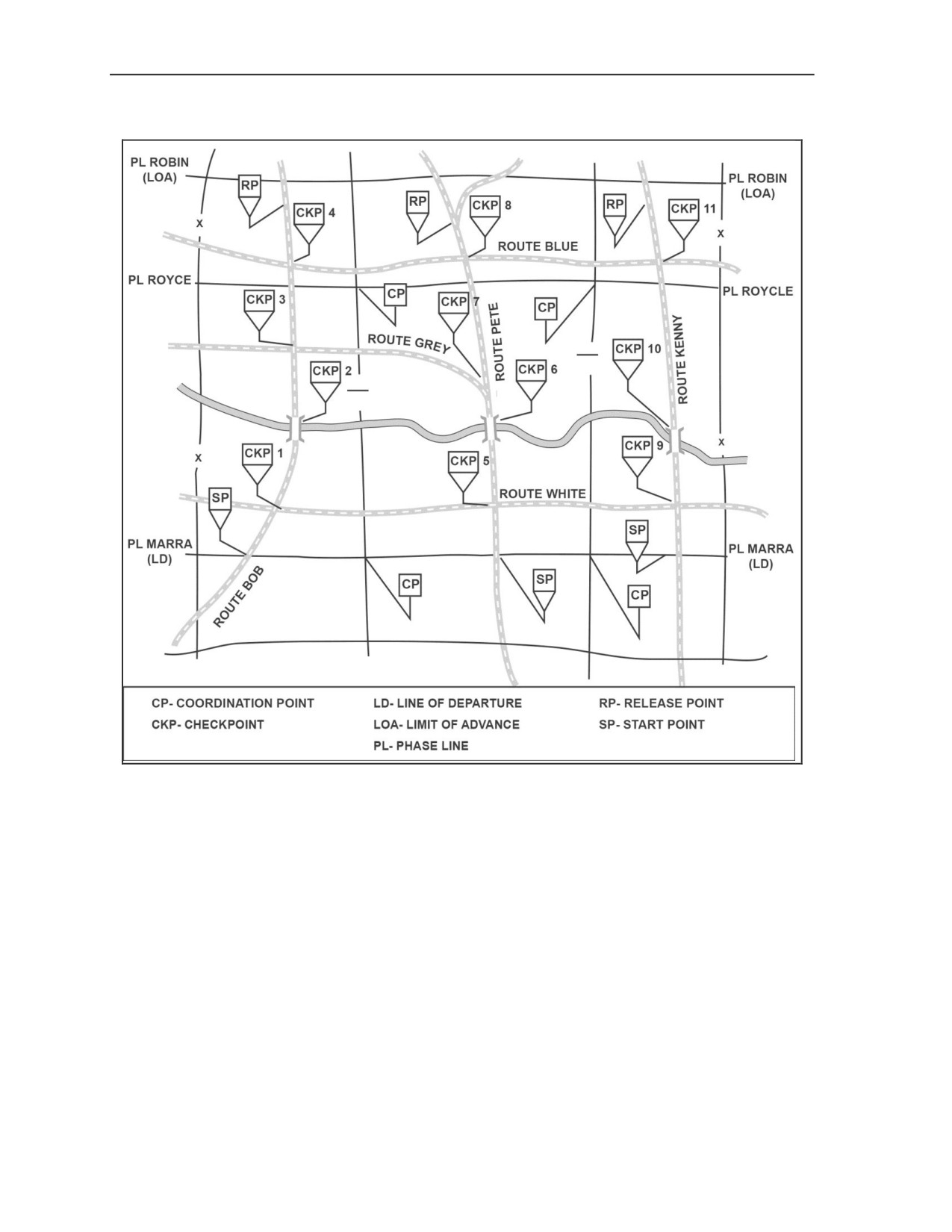
measures for a route reconnaissance by creating an AO for the unit conducting the reconnaissance. The
commander places lateral boundaries on both sides of the route, far enough out to allow reconnaissance of
all terrain from which the enemy could influence movement along the route. An LD is placed perpendicular
to the route and a starting point (SP in the following graphics) at the beginning of the route. The LD creates
the rear boundary of the AO. The commander then places an LOA far enough beyond the route’s release
point (RP) to include terrain from which the enemy could influence the route. The SP and RP define that
section of the route where the unit collects detailed information. Place phase lines and checkpoints to maintain
coordinated reconnaissance, control movement and maneuver, or designate critical points. Place additional
control measures to coordinate indirect and direct fire, as necessary. (See figure 5-6 on page 5-20.)
-XO\ 2015
FM 3-98
5-19
Chapter 5
Figure 5-6. SBCT route reconnaissance mission
PLANNING AND EXECUTION CONSIDERATIONS
5-68. The commander integrates ground, air, and other technical assets to allow for either a faster or more
detailed route reconnaissance. The commander orders aerial reconnaissance if the reconnaissance mission
needs to be completed quickly. When time is limited, aerial reconnaissance is essential to determine which
areas are clear of enemy forces and obstacles and to cue ground reconnaissance regarding where to focus its
efforts.
5-69. The commander establishes priorities of fire and indirect fire control measures if enemy contact is
possible or expected. The squadron considers built up areas, protected sites, and civilians in both planning
and execution of indirect fires.
5-70. If the commander requires detailed information on the route, engineer reconnaissance assets can
conduct a deliberate classification of critical points along the route more quickly and accurately than (hasty)
classification by a cavalry unit. If the commander anticipates significant obstacles or is required to classify
bridges, fords, ferry sites, or culverts combat engineers must be task-organized to the squadron.
5-20
FM 3-98
-XO\ 2015
Reconnaissance
5-71. If CBRN contamination is expected, CBRN reconnaissance assets should accompany the force
conducting ground reconnaissance. They can detect, identify, and determine through CBRN surveys more
accurately and quickly than organic Cavalry assets.
RECONNAISSANCE IN FORCE
5-72. Reconnaissance in force is a deliberate combat operation designed to discover or test the enemy’s
strength, dispositions, and reactions or to obtain other information (ADRP 3-90). A reconnaissance in force
is a limited objective operation normally conducted by a battalion-sized task force or larger force and
assigned when the enemy is operating within a specific area and the commander cannot obtain adequate
intelligence by other means. Reconnaissance in force is an aggressive reconnaissance which develops
information and intelligence in contact with the enemy to determine and exploit enemy weaknesses. The
commander plans for the extrication of the force or the exploitation of success in advance.
5-73. During a reconnaissance in force, the subordinate elements of the Cavalry unit conduct zone, area, and
route reconnaissance missions. The Cavalry squadron often conducts reconnaissance in force in advance of
a brigade combat team movement to contact allowing the main body to maintain freedom of maneuver and
mass combat power.
5-74. BCT commanders order squadrons to conduct reconnaissance in force as a stand-alone mission or as
the lead in a conjunction with a brigade attack. Based upon enemy composition and other METT-TC
variables, the cavalry squadron requires augmentation with maneuver and fires elements to conduct a
reconnaissance in force as a standalone mission.
TASKS
5-75. Tasks for reconnaissance in force include:
z
Penetrate the enemy’s security area and determine its size and depth.
z
Determine the location and disposition of enemy forces.
z
Attack enemy positions and attempt to force the enemy to react by using local reserves or major
counterattack forces, employing fires, adjusting positions, and employing specific weapon
systems.
z
Determine weaknesses in the enemy’s disposition for exploitation.
z
Locate obstacles and create lanes as specified.
z
Enter AOs in complex terrain not previously occupied by friendly forces, such as urban
environments.
PLANNING CONSIDERATIONS
5-76. The planning considerations for reconnaissance in force are the same as a zone reconnaissance. The
control measures of a reconnaissance in force are the same as for offensive tasks. (Refer to ADP 3-90 for
more information.)
SPECIAL RECONNAISSANCE
5-77. Special reconnaissance is characterized as reconnaissance and surveillance actions conducted as a
special operation in hostile, denied, or politically sensitive environments to collect or verify information of
strategic or operational significance employing military capabilities not normally found in conventional
forces (FM 3-05). Special reconnaissance tasks support the collection of the JTF commander’s priority
intelligence requirements. A special operations liaison may provide a responsive reporting capability in those
situations where the SOTF commander has been requested to provide intelligence information that supports
the intelligence requirements of a conventional force commander.
5-78. A SOF element conducting special reconnaissance is supporting the JTF commander’s overall
information collection efforts. The SOF element will not suspend or alter their collection efforts in order to
support another collection plan unless directed to do so by the JTF commander.
5-79. Commanders establish mutual liaison capacity within both the brigade and special operations forces
to understand collection task prioritization, and to understand associated reporting requirements and
-XO\ 2015
FM 3-98
5-21
Chapter 5
mechanisms. Special reconnaissance may occur prior to conventional forces entering a designated area of
operation. Commanders and staffs must understand when, where, and why special reconnaissance operations
are being conducted to establish unity of purpose and provide additional forces if necessary. It is imperative
that detailed coordination is made between SOF and conventional elements to support the operational element
as needed.
SECTION III - RECONNAISSANCE HANDOVER
5-80. Reconnaissance handover is the process of transferring information and responsibility from one
element to another to facilitate observation of a specific target, enemy, or an assigned NAI/TAI.
Reconnaissance handover is the action that occurs between two elements in order to coordinate the transfer
of information and/or responsibility for observation of potential threat contact, or the transfer of an assigned
area from one element to another. Reconnaissance handover occurs between the BCT and other BCTs, SOF,
foreign military forces, civilian agencies and organizations, or indigenous persons as well as between the
BCT’s Cavalry squadron and battalion scouts or maneuver battalions.
5-81. Reconnaissance and security operations require the unit conducting the handover to coordinate with
higher, lower, and adjacent units. Planning for these operations requires the reconnaissance handover
coordination to start at the higher echelons and execute at the lowest element. Reconnaissance handover
assures that information requirements are transferred between units to maintain initiative, tempo and to ease
transitions. Well planned and executed reconnaissance handover eases transitions in plans, phases, and
priorities of effort and mitigates information gaps between units.
5-82. Planning for reconnaissance handover takes place as part of a change of mission before or during
operations. When planning before an operation, commanders review the completed plan for layered,
redundant reconnaissance and security using all available assets. Commanders and staff direct control
measures such as a reconnaissance handover line between units or potential designated coordination points
to facilitate ground linkup, along with other graphic control measures that aid in mission command.
Reconnaissance handover line is a designated phase line on the ground where reconnaissance
responsibility transitions from one element to another.
5-83. Reconnaissance handover is typically associated with a trigger, coordination point, or phase line
designated as the reconnaissance handover line to ensure positive control and chain of custody from the initial
force to the force assuming responsibility and control. Reconnaissance handover prevents gaps or seams from
emerging that the enemy can exploit. Once handover is complete, the force transferring control either passes
to the rear through the main body assuming responsibility for the reconnaissance objective as a rearward
passage of lines or continues further into zone to continue their reconnaissance mission.
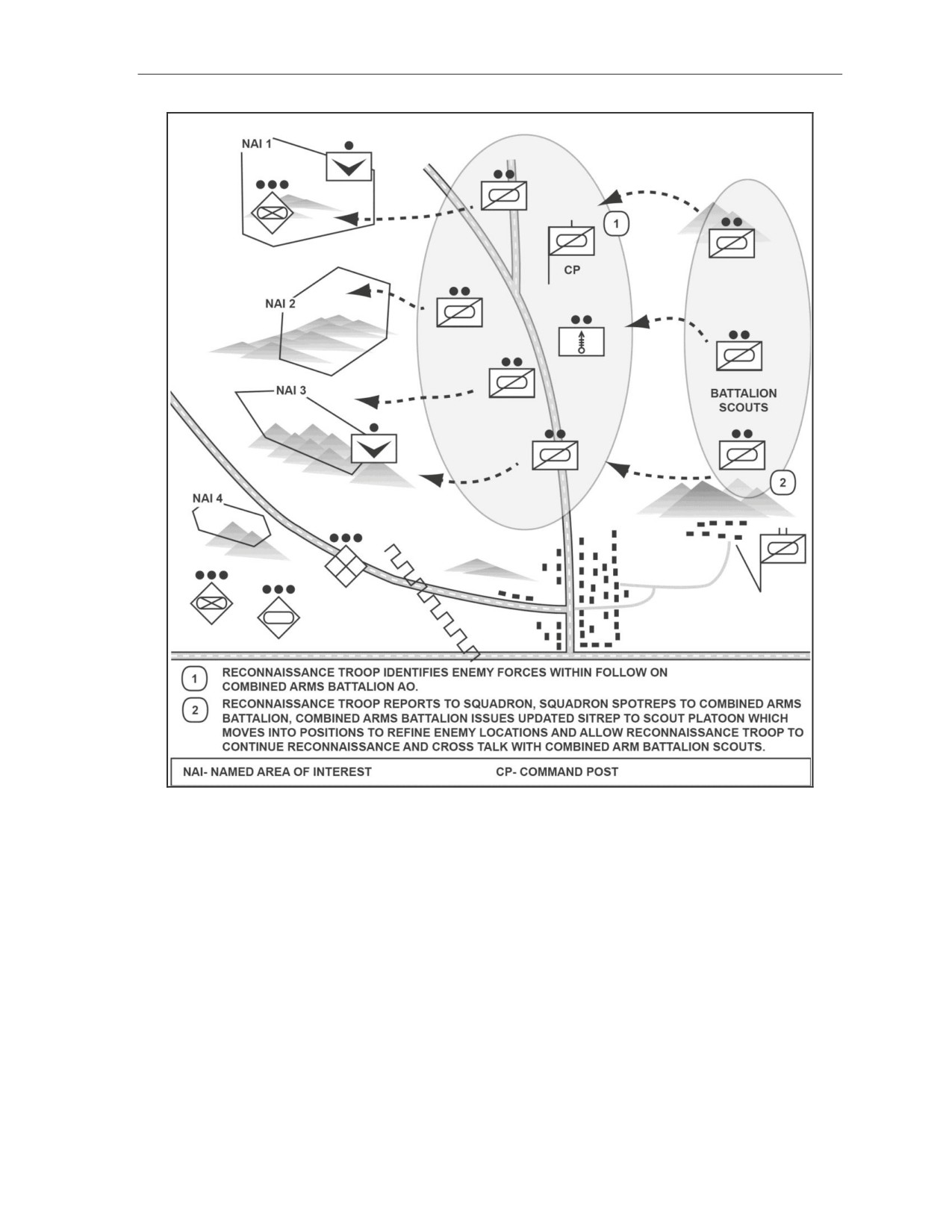
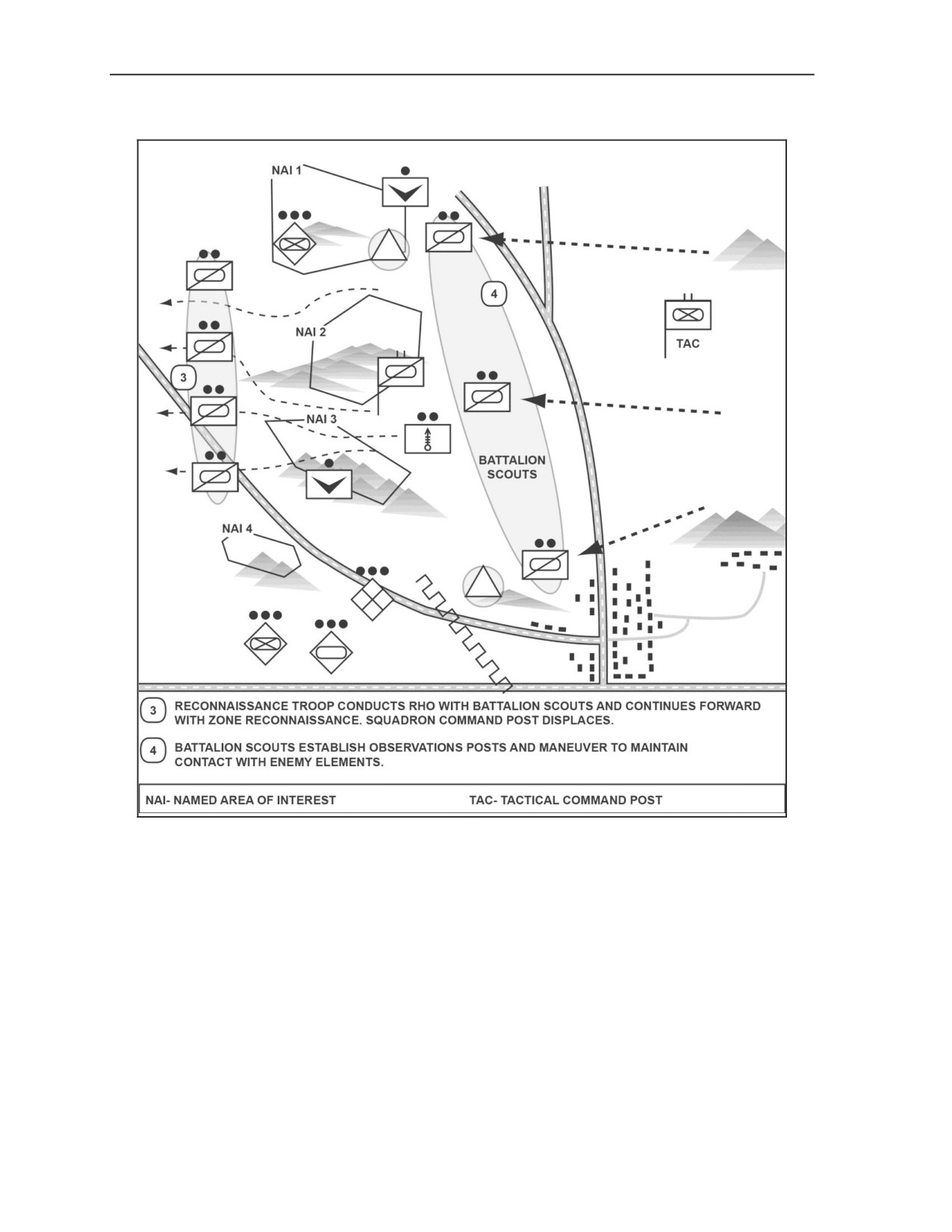
5-84. Reconnaissance handover involves transferring physical, visual, electronic, or digital observation in a
number of combinations. Assets such as ground sensors and UAS may transfer. Similar to battle handover in
that its conduct is in conjunction with other tasks such as relief in place, linkup, and passage of lines. (See
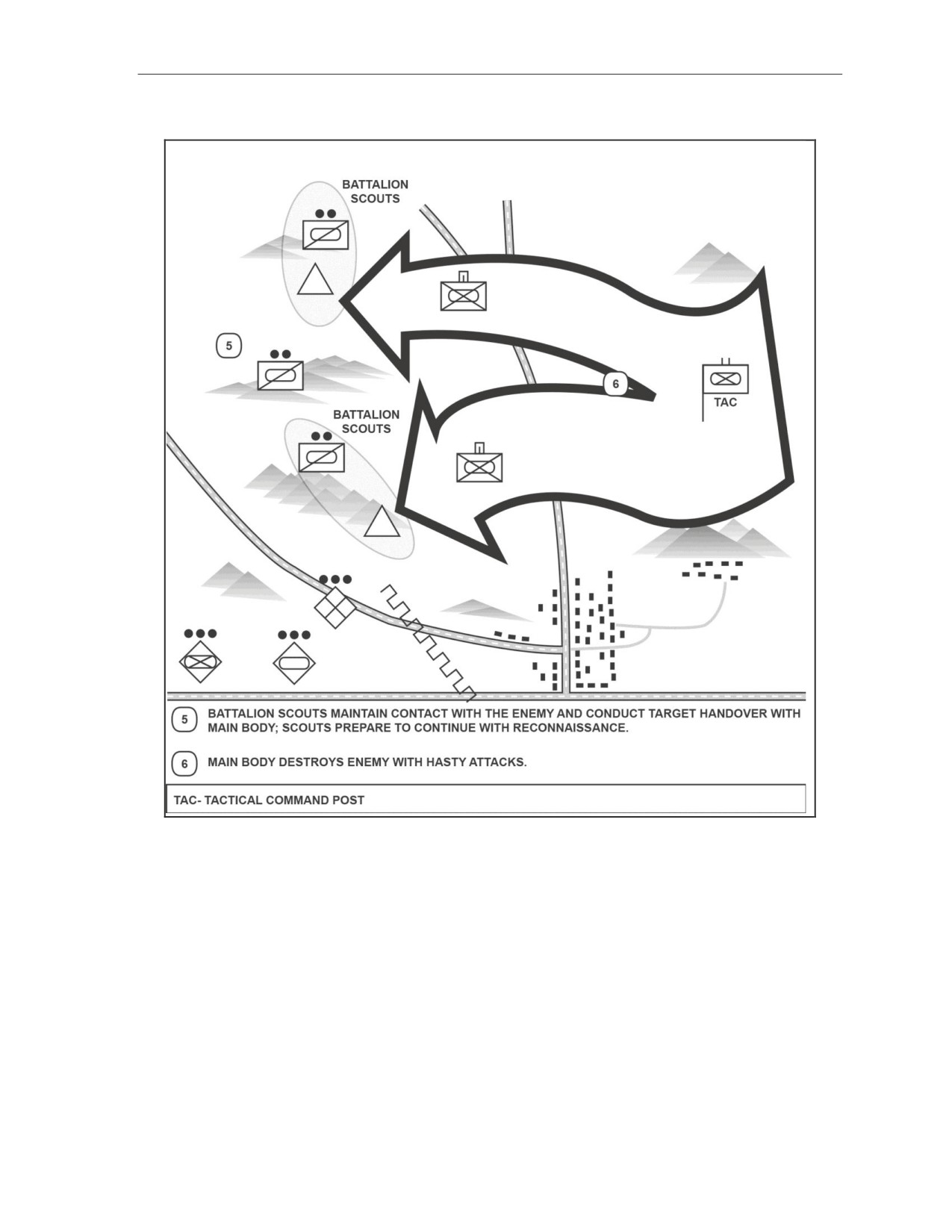
figure 5-7 on page 5-23, figure 5-8 on page 5-24, and figure 5-9 on page 5-25.)
5-85. Leaders and planners at all levels coordinate and execute reconnaissance handover tasks considering:
z
Redundant surveillance to assist in maintaining enemy contact.
z
Location and criteria for RHO.
z
A communications plan between handover elements.
z
Exchanging operations and fires plans.
z
Exchanging intelligence information and information gathering assets.
z
Identifying and coordinating for target handover, as necessary.
z
Contact points or linkup points.
z
Colocating CPs.
z
Transfer and acceptance of command between units.
z
Rehearsals.
z
Recognition signals.
5-22
FM 3-98
-XO\ 2015
Reconnaissance
Figure 5-7. Reconnaissance handover (phase one)
-XO\ 2015
FM 3-98
5-23
Chapter 5
Figure 5-8. Reconnaissance handover between squadron and combat aviation brigade
5-24
FM 3-98
-XO\ 2015
Reconnaissance
Figure 5-9. Reconnaissance handover follow-on battalion continues mission
SPECIAL OPERATIONS FORCES RECONNAISSANCE HANDOVER
5-86. Based on their forward proximity in the area of operation, reconnaissance forces may often be the first
friendly units to encounter Special Operations Forces (SOF) units. (See Chapter 7 for more details.)
Conventional reconnaissance forces may operate in conjunction with or alongside Special Forces. Depending
on the command relationship, a reconnaissance handover (not involving special reconnaissance) may be
required to conduct a relief in place with SOF, conduct joint operations with SOF, or in passing through SOF
areas. The same planning steps listed above are used when conducting Special Operations Forces
reconnaissance handover.
-XO\ 2015
FM 3-98
5-25
Chapter 6
Security
Security operations are operations undertaken by a commander to provide early and
accurate warning of enemy operations, to provide the force being protected with time
and maneuver space within which to react to the enemy, and to develop the situation
to allow the commander to effectively use the protected force (ADRP 3-90). Security
is inherent in all operations and is always the first priority of work. Continual
reconnaissance and the development of information requirements are the means to
provide security. Security operations follow the five fundamentals of security to ensure
early and accurate warning of enemy forces and provide reaction time and maneuver
space to develop the situation and determine the most effective use of force to
neutralize, defeat, or destroy enemy forces. There are five forms of security operations;
screen, guard, cover, area security, and local security. Each form provides varying
levels of protection to the main body with the desired form selected by weighing
operational and mission variables with the end state.
The main difference between security operations and reconnaissance operations is that
security operations orient on the protected force or facility, while reconnaissance is
enemy and terrain oriented. However, security operations cannot be divorced from
reconnaissance missions as one of the fundamentals of security is to perform
continuous reconnaissance.
Security operations prevent enemy reconnaissance assets from determining friendly
locations, strengths, and weaknesses. A review of history repeatedly demonstrates that
to preserve the striking power of an organization and preclude unnecessary attrition or
premature culmination each tactical echelon requires a specially trained organization
capable of executing security missions to preserve freedom of action for the main body.
SECTION I - FUNDAMENTALS OF SECURITY
6-1. Security is an essential part to all BCT tasks. Security enables the BCT to accomplish its mission by
providing the BCT commander with the time and space necessary to focus combat power on the decisive
operation. Maneuver units perform security missions as part of a larger security force or operate on their own
with task-organized attachments.
SECURITY
6-2. Security operations provide information about the enemy and terrain and preserve the combat power
of friendly forces. Security operations provide information about the size, composition, location, and
direction of movement of enemy forces. Reaction time and maneuver space gained by information collected
allows the main body commander to prepare for future operations or to deploy to engage the enemy. Security
prevents the main body from surprise by the enemy, which allows the commander to preserve the combat
power of maneuver forces and mass effects and combat power at the decisive point in time. (See FM 3-90-
2.)
6-3. Security along a common boundary with another friendly unit is the responsibility of the unit assigned
to that zone or sector. Liaison with the protected force is critical during security missions. Constant
communication and liaison ensures both the security force and the protected force remain informed of the
full situation and maintains synchronized operations.
-XO\ 2015
FM 3-98
6-1
Chapter 6
6-4. Counterreconnaissance is an inherent task in all security operations. Counterreconnaissance is the sum
of all actions taken at each echelon to counter enemy reconnaissance and surveillance efforts throughout the
area of operation. Counterreconnaissance is active and passive and includes action to destroy or repel enemy
reconnaissance elements and deny the enemy information about friendly units. Counterreconnaissance keeps
enemy reconnaissance forces from observing the main body by defeating or blocking them. Units organize
to defeat enemy reconnaissance forces without requiring reinforcement. Consider enemy reconnaissance
capabilities to determine if additional maneuver or sustainment assets are required.
FUNDAMENTALS
6-5. The fundamentals of security, like the fundamentals of reconnaissance, provide a framework for
security operations. Reconnaissance operations, because they are continuous throughout all operations to
develop the situation through information collection, are essential to successful security operations. The
fundamentals of reconnaissance are applicable to security operations and are necessary to ensure successful
execution. The following fundamentals guide BCT security tasks.
6-6. Provide early and accurate warning. The squadron or protecting unit detects, orients upon, and
observes threat forces that can influence the brigade combat team. Early detection and warning through rapid
reporting enables the BCT commander to make timely and well-informed decisions for the proper application
of his forces on the observed threat.
6-7. Provide reaction time and maneuver space. As with “provide early and accurate warning,” the
ability for the cavalry squadron to gain and maintain contact and report accurately and rapidly affords the
BCT commander the time and space to make an informed decision to employ forces. Reaction time and
maneuver space relates to decision points driven by information requirements and indicators given LTIOV
parameters to ensure the commander makes decisions that place maximum firepower at the decisive point in
a timely manner.
6-8. Orient on the protected force, area, or facility. While reconnaissance operations orient on the
reconnaissance objective, security operations focus on the protected force by understanding their scheme of
maneuver and follow-on mission. By understanding BCT’s required actions and movement, the squadron
maneuvers to best provide reaction time and maneuver space that allow for timely decisions.
6-9. Perform continuous reconnaissance. Squadron or maneuver battalions continuously seek the enemy
and reconnoiter key terrain. Through continuous reconnaissance, forces continue to gain and maintain enemy
contact, develop the situation, report rapidly and accurately, and retain freedom of maneuver to provide early
and accurate warning and provide reaction time and maneuver space to the protected force. Thus, the
fundamentals of reconnaissance are implicit in all security operations. Commanders use the same
reconnaissance methods, management and techniques. (See Chapter 5 for a more detailed discussion).
6-10. Maintain enemy contact. Real-time and accurate information requires Cavalry forces to gain and
maintain contact with the enemy to rapidly report their actions and provide reaction time and maneuver space.
Like the reconnaissance fundamental “gain and maintain enemy contact,” maintaining enemy contact through
one or more of the forms of contact enables the staff to make recommendations to the commander, generate
options, identify opportunities, and seize, retain, and exploit the initiative.
COMMANDER’S SECURITY GUIDANCE
6-11. The BCT commander’s guidance should consist of the security focus, duration, engagement and
disengagement criteria, and displacement criteria. In providing this guidance, the commander describes,
shapes, and prioritizes how he envisions the security effort supporting the overall scheme of maneuver and
the specific roles of the Cavalry unit. As with the commander’s reconnaissance guidance, this guidance, and
the importance of accomplishing the mission, must be understood at echelon.
FOCUS
6-12. The security force focuses all its actions on protecting and providing early warning to the secured
force or facility. The security force operates between the main body and known or suspected enemy units.
The security force moves as the main body moves and orients on its movement. The security force
commander must know the main body’s scheme of maneuver to keep the security force between the main
6-2
FM 3-98
-XO\ 2015
Security
body and the enemy. The value of terrain occupied by the security force hinges on the protection it provides
to the main body commander.
6-13. The commander directs a specific focus for the security unit. In this context, the focus is a critical
enemy system or organization, which the security unit must identify. Once identified, this typically results in
a commander’s decision or critical action. For example, the focus may be a high-value target or it could be
the exploitation force of an enemy formation. Positive identification could trigger the engagement of the
high-value target or influence the commander to reposition subordinate units to defeat the enemy’s
exploitation force.
Security Objective
6-14. The commander provides focus to the protecting force’s efforts to efficiently and effectively
accomplish the mission. As an example, the security objective may constitute locating and defeating enemy
reconnaissance forces, confirming or denying the commander and staff’s initial assessment, providing early
warning and reaction time to the main body, or protecting the main body from enemy observation and
engagement. The security objective clarifies and prioritizes the tasks for the Cavalry unit nested within the
maneuver plan of the protected commander.
TEMPO OF SECURITY
6-15. Security force operations maximize time, preserve forces, place the enemy in unfavorable positions or
avoid combat under undesirable conditions. The duration required to conduct these operations largely
depends on the protected commander’s current situation and critical requirements. Successful
accomplishment of critical requirements can enhance the combat capability of committed maneuver forces
and enable the defeat of the enemy force. Commanders and staffs direct the duration of security operations
and the trigger for displacement.
ENGAGEMENT AND DISENGAGEMENT CRITERIA
6-16. The BCT commander provides the security force with engagement criteria to enable the purpose of
the operation and to support the execution of displacement criteria. Engagement and disengagement criteria
directs the squadron to engage and destroy enemy reconnaissance assets or to allow enemy reconnaissance
assets to pass to identify, disrupt, or isolate second-echelon forces with direct and indirect fires. Engagement
and disengagement criteria identifies two specific areas—under what conditions the protecting force can
attack enemy forces and what the security force can attack within its capabilities and its task organization. A
protecting force has a restrictive engagement criterion if the BCT desires the protecting force to remain
hidden with a purpose of reporting on enemy composition and disposition. Likewise, a protecting force is
given unrestricted engagement criteria and allowed to destroy enemy reconnaissance assets within their
capability if templated enemy forces are overmatched by friendly forces or if the commander requires an
aggressive counter-reconnaissance effort.
DISPLACEMENT CRITERIA
6-17. The commander directs displacement criteria for the security unit. Displacement criteria dictates a set
of conditions required before the security force conducts movement and maneuver to a subsequent fighting
position or assumes a follow-on mission. Displacement criteria may be either time or event based.
SECTION II - COUNTERRECONNAISSANCE
6-18. Counterreconnaissance is a tactical mission task that encompasses all measures taken by a commander
to counter enemy reconnaissance efforts. (Refer to ADP 3-90 for more information.) Counterreconnaissance
is the sum of all actions taken at each echelon to counter enemy reconnaissance and surveillance efforts
throughout the area of operation. The purpose of counterreconnaissance is to destroy, defeat, or repel all
enemy reconnaissance elements within capabilities and following engagement criteria.
Counterreconnaissance is not a distinct mission, but a component of all forms of security operations. It denies
the enemy commander the ability to conduct reconnaissance and develop their situational understanding.
Successfully countering enemy reconnaissance is the first and possibly most important step in ensuring the
BCT can successfully execute its mission.
-XO\ 2015
FM 3-98
6-3
Chapter 6
6-19. The counterreconnaissance plan should address how to acquire and defeat enemy reconnaissance
elements. The intelligence section provides key input into the planning process. It identifies avenues of
approach into the unit sector, what type of enemy reconnaissance elements the unit expects in the sector, and
when they are most likely to move into the sector. The commander of the squadron or counterreconnaissance
force uses this information to formulate the counterreconnaissance plan, and task units to execute it. Often,
the counterreconnaissance plan calls on a unit to conduct a screen mission to acquire, identify, and defeat
enemy reconnaissance forces.
6-20. The counterreconnaissance must be task organized to accomplish its mission with the enemy.
Whatever option the commander employs, the counterreconnaissance fight should be firmly controlled,
monitored at the higher headquarters level, coordinated early, and thoroughly rehearsed. An effective
counterreconnaissance fight blunts the enemy reconnaissance effort, forcing the enemy to attack without
information about the friendly force disposition.
SECTION III - FORMS OF SECURITY
6-21. Leaders categorize security operations in terms of the degree of security provided and the amount of
combat power required. (Refer to ADRP 3-90 for more information.) Screen (stationary or moving), guard,
cover, area security (including convoy or route security), and local security are the five primary forms of
security operations.
6-22. The five forms of security provide varying levels of protection to the protected force and are dependent
upon the size of the unit conducting the security operation. Screen operations provide early warning to the
main body. Guard operations prevent enemy observation and direct fire on the main body. Cover operations
protect the main body from enemy observation and effective direct and indirect fire. Area security protects
friendly installations, routes, units, and facilities within a prescribed area. Local security is a priority of work
and the responsibility of all units as a force protection measure. All forms of security provide protection and
early warning to the protected force, which, in turn, provides reaction time and maneuver space to the
commander and preserves freedom of action.
6-4
FM 3-98
-XO\ 2015
Security
Arracourt
In September 1944, the 4th Armored Division constituted part of an operation intended
to cross the Moselle River and isolate the city of Nancy. This operation concluded with
elements of the 4th Armored Division playing a significant role in disrupting German rear
area elements and reinforcements to Nancy. The division then transitioned into an
exploitation mission, heading further east into Lorraine and creating more havoc between
German efforts to mount a coherent defense.
The threat posed by the American armored division led the Germans to counterattack
with elements drawn from the Fifth Panzer Army on 18 September. Part of their objective
lay in destroying the scattered U.S. armored forces in and around the town of Arracourt.
The German action triggered a series of fast moving and freewheeling engagements. These
encounters placed the 4th Armored Division at a disadvantage. The Germans employed
superior tanks, practiced infiltration tactics, and benefited from ground fog that protected
them from allied aircraft. However, despite these advantages, the Germans suffered a
significant defeat at Arracourt. They were generally out maneuvered and outfought by
aggressive American small unit tactics.
American armored teams employed basic security measures to offset the initial
surprise of the German attack. C Company, 37th Tank Battalion, for example, employed
outposts to provide early warning of enemy activity. One of these outposts reported the
noise of an enemy column shortly before midnight on the 18th. The outpost dispatched a
patrol to investigate. When it identified tank tracks, a second patrol followed the tracks
and pinpointed the German tanks in a bivouac position. The patrol directed artillery fire
onto the enemy tanks and adjusted onto a nearby crossroads through which the tanks had
to move as they retired.
The following morning another C Company outpost reported contact with German
forces. This outpost included a tank section and smaller outpost further forward. The latter
remained in contact with the tank section via a land line. The smaller outpost provided the
tank section early warning of approaching vehicles. Armed with this information, the
American tank section quickly destroyed two of the German tanks as soon as they came
into view.
In this instance, C Company demonstrated the fundamentals of security. Outposts
provided early and accurate warning of approaching enemy armor. The outposts were able
to provide reaction time and maneuver space that permitted the tank section to maneuver
and destroy two enemy tanks. Positioned between the enemy and the main body of C
Company, the outposts were oriented on the force to be secured. In each case the outposts
were able to perform continuous reconnaissance, reporting and tracking hostile
movements. In the first example, the outpost maintained enemy contact through foot patrols
able to track the enemy Armor column and direct indirect fire upon it.
6-23.
Cavalry squadrons are organized and equipped to perform screen, guard, area, and local security
missions. Cavalry squadrons participate in a cover operation as part of a larger element with external assets
task organized to the squadron, and perform guard operations with combined arms augmentation. Security
missions (screen, guard, cover) at echelons above brigade are assigned to BCTs.
SCREEN
6-24. The primary purpose of a screen is to provide early warning to the main body. Screens provide less
protection than guards or covers. Screen missions are defensive in nature and accomplished by establishing
a series of observation posts and patrols to ensure observation of the assigned sector. The screen force gains
and maintains enemy contact consistent with the fundamentals and destroys or repels enemy reconnaissance
units by conducting counterreconnaissance. The depth of the screen is critical to allow reconnaissance
handover from one element to another without displacement from established OPs. Depth provides friendly
forces the ability to conduct counterreconnaissance to delay, impede, and harass the enemy with indirect fires
-XO\ 2015
FM 3-98
6-5
Chapter 6
causing them to deploy early while preventing enemy forces from identifying, penetrating, and exploiting the
screen.
6-25. Screen missions are appropriate when operations have created extended flanks, gaps exist between
major subordinate maneuver units, or when required to provide early warning over gaps not considered
critical enough to require security in greater strength. The BCT commander maximizes the security effort
where contact is expected.
6-26. A screen is defensive in nature, a unit may conduct a screen in all directions for a stationary protected
force within supporting range of indirect fire assets. Units perform a screen to the flanks or rear, but not in
front of a moving force. Zone reconnaissance, reconnaissance in force and guard are missions given to units
in front of a moving force.
BCT PLANNING CONSIDERATIONS
6-27. When planning the screen, the cavalry squadron, commander or maneuver battalion commander
considers the number of OPs or patrols needed (depth, width, duration, and orientation of the screen), time
needed to occupy the OPs and establish the screen, and the ability of indirect fire assets to range NAIs and
TAIs to provide the required level of security to the protected force. Both BCT and squadron commanders
and staffs consider conditions to facilitate reconnaissance handover or battle handover with the BCT, to
include time required to conduct the handover along with the time and distance needed for subordinate
elements to displace to subsequent positions.
6-28. A rearward passage of lines is similar in concept to a forward passage of lines. It continues the defense
or retrograde operation, maintaining enemy contact while allowing for recovery of security or other forward
forces. This operation may or may not be conducted under enemy pressure. Generally, the stationary unit
assumes control of the AO forward of the battle handover line after two-thirds of the passing force’s combat
elements move through the passage points. A battle handover line is a designated phase line on the ground
where responsibility transitions from the stationary force to the moving force and vice versa. Cavalry
squadrons and security forces conduct extensive coordination enabling rearward passage of lines, especially
while under fire. Passage of lines may occur during any reconnaissance or security task. Refer to FM 3-90-2
for more information.
6-29. Attack/reconnaissance aviation units screen forward, to the flanks, or to the rear of a stationary main
body and to the flanks or to the rear of a moving main body. Aviation units conduct a zone reconnaissance
forward of a moving body. Aviation units conduct continuous reconnaissance to gain contact with the enemy
force unless directed otherwise by the supported commander.
6-30. Based on the BCT commander’s security guidance and intent, a screening aviation unit will impede
and harass the enemy with organic and supporting fires and, within its capabilities, destroy or repel enemy
reconnaissance elements without becoming decisively engaged. Upon enemy contact, the aviation unit
reports the enemy location, maintains contact with the enemy force, and uses its maneuverability and fires to
rapidly develop the situation. Priority of fires is provided to the aviation unit so it does not have to rely on its
own direct fire weapons and risk becoming decisively engaged. Aviation units will not bypass enemy forces
without the permission or direction of the main body commander.
6-31. Attack/reconnaissance aviation units maneuver to the flanks and rear of the enemy to locate and exploit
enemy vulnerabilities, weaknesses, and subsequently conduct offensive engagements such as hasty attacks
and joint air attack team operations. However, the benefit of aviation units conducting an offensive operation
must be weighed against the benefit of retaining aviation units in a reconnaissance and security role.
GENERAL DESCRIPTION OF SCREENS
6-32. Screens, even for a stationary protected force, are active operations of which stationary OPs and
surveillance assets are only part of the overall mission. A screen requires employment of mounted and
dismounted patrols, aerial reconnaissance, and OPs positioned over extended distances in depth. Inactivity
in a stationary screen yields identifiable and exploitable gaps for the threat.
6-33. The BCT commander provides purpose and guidance to the cavalry squadron commander. The
commander of the BCT states why the screen is important to the BCT mission and how it fits into the scheme
of maneuver of the BCT mission.
6-6
FM 3-98
-XO\ 2015
Security
6-34. Depth provides the BCT commander with more time to react to approaching enemy ground units and
allows for reconnaissance handover from one element to another with minimal displacement. Depth prevents
the threat from easily identifying and penetrating the screen, prevents gaps from occurring when OPs
displace, and facilitates the destruction of enemy reconnaissance elements without compromising critical
OPs. Units employ depth by positioning OPs and other information collection assets between the forward
line of own troops (FLOT) and the rear boundary of the security force.
6-35. The wider the area to secure, the less the security force can take advantage of increased depth, because
it has fewer forces to position in depth. Once the BCT has determined the width and depth of the security
area, the initial screen line and likely avenues of approach, the security force orients on the protected force,
area, or facility.
Note. When the term ‘screen line’ is used, it describes only the trace along which the protecting
unit is providing security, not the linear positioning of assets.
6-36. Displacement of the screen elements to subsequent positions is event-driven. The approach of an
identified and specified threat element, detection by a threat force, relief by a friendly unit, or movement of
the protected force may dictate displacement. Collapsing the screen, executed by well-rehearsed drills
performed at all levels, provides security and maintains contact for the unit as it displaces. The BCT
commander can place a time requirement on the duration of the screen if the intent is to provide a higher
level of security to the BCT, or to provide a tentative period for subordinate unit planning and follow-on
missions.
Critical Tasks
6-37. Execution considerations guide screen planning. Execution considerations for a screen include:
z
Allow no enemy ground element to pass through the screen undetected and unreported.
z
Maintain continuous surveillance of all avenues of approach that affect the main body’s mission.
z
Conduct counterreconnaissance to destroy, defeat, or disrupt all enemy reconnaissance elements,
within capabilities and according to engagement criteria.
z
When facing an echeloned enemy force, locate and identify the lead elements that indicate the
enemy’s main attack, as prescribed in the enemy’s order of battle based upon IPB.
z
Determine the direction of enemy movement, maintain contact and report threat activities, even
while displacing.
z
Impede and harass the enemy within capabilities without becoming decisively engaged and while
displacing to provide the protected force commander with additional time and maneuver space.
z
Detect and report all enemy elements attempting to pass through the screen, both ground and aerial
to provide the protected force commander early warning of enemy activities.
Note. To enhance the effectiveness and depth of the screen, the squadron’s subordinate elements
conduct reconnaissance handover or battle handover to pass contact from one element to another.
In this way, the methods of reconnaissance management (cueing, mixing, and redundancy) and
task organization maintain threat contact and protect the main effort following the commander’s
intent.
STATIONARY SCREEN
6-38. A squadron executing a stationary screen mission (see figure 6-1 on page 6-8) requires the following
guidance:
z
General trace of screen and time it should be established.
z
Width of the screened sector.
z
Identity of screened force.
z
Rear boundary of the screening force.
z
Possible follow-on missions.
-XO\ 2015
FM 3-98
6-7
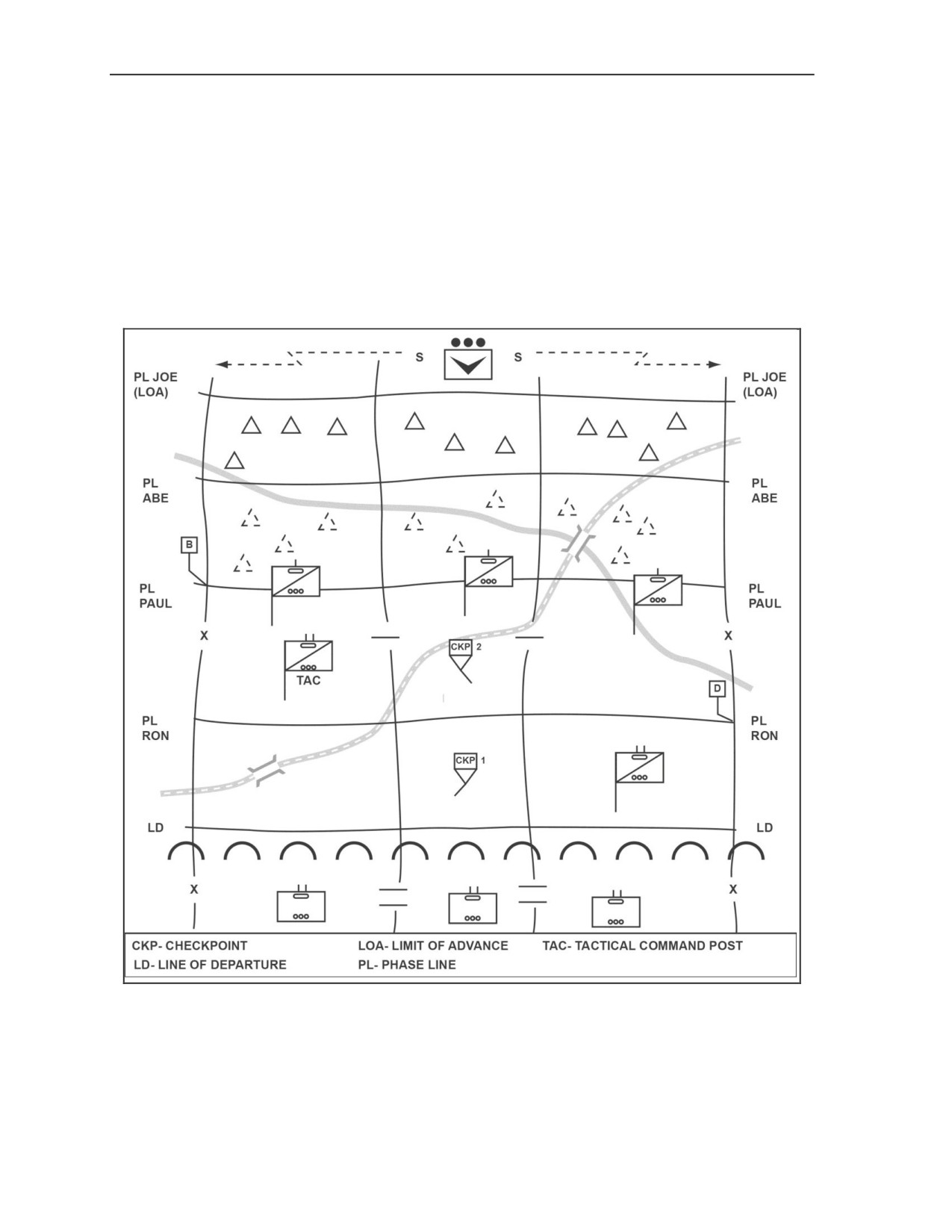
Chapter 6
6-39. The tasks required of a screening unit are minimal compared to other security missions. Therefore, the
screening force may have a wide frontage. Units are normally deployed abreast, with troops established in
depth.
6-40. A phase line placed along identifiable terrain graphically indicates the FLOT and can serve as a limit
of advance. When screening forward of the BCT, this phase line represents the forward line of the screening
unit troops. A boundary depicts the rear limit of the screen. The screening force is responsible for the area
between the screened force and the rear screen boundary. The boundary may serve as a battle handover line
or a reconnaissance handover line. Other phase lines are used to control forward and backward displacements
of subordinate units of the screening force and aid in both reporting and orientation. Designate sectors to
control lateral movement of subordinate units.
Figure 6-1. SBCT stationary screen mission
6-41. Given the higher commander’s guidance (security objective, focus, duration, engagement criteria, and
displacement criteria), commanders and staffs considers the following during planning:
z
Location of the initial screen.
z
Movement or maneuver to occupy the screen.
z
Assigned AOs for subordinate elements.
6-8
FM 3-98
-XO\ 2015
Security
z
Air and ground integration.
z
Surveillance and acquisition assets.
z
Fires.
z
Protection.
z
Mission command.
z
Sustainment.
z
Control of displacement to subsequent positions.
z
Reconnaissance handover between screening elements.
INITIAL SCREEN
6-42. The BCT establishes the general location of the initial screen. To prevent fratricide the squadron or
screening unit adjusts closer to the protected force only with coordination. The initial screen often represents
the forward line of troops and it is considered a restrictive control measure requiring coordination when units
move beyond it to conduct aerial surveillance or ground reconnaissance. If operations forward of the screen
are required, the commander establishes a phase line to designate the security unit LOA. Key considerations
include determining fields of fire and observation, requirements to observe specific NAIs or TAIs, and the
range of supporting indirect fire assets.
6-43. With permission from the BCT, the squadron or screening unit can adjust the initial screen to meet
these considerations. Time available and the threat situation determine the method of occupying the screen,
selected from three primary methods: zone reconnaissance, infiltration, or tactical road march. Zone
reconnaissance is the preferred method to occupy a screen as it provides useful information and intelligence
regarding terrain and maximizes the opportunity to identify enemy forces occupying the zone.
AREAS OF OPERATION FOR SUBORDINATE ELEMENTS
6-44. The squadron or screening unit commander designates AOs for subordinate elements, to include
responsibility for NAIs and TAIs. Attack/reconnaissance aviation, UAS or ground-based sensors and signal
intelligence systems are positioned to provide additional depth. Reduced depth is the trade-off when
screening extended frontages. The commander may assign specific terrain to attack/reconnaissance aviation
units and UAS. This terrain should not be along critical high-speed avenues of approach. Plans include
reconnaissance management (cueing, mixing, and redundancy) to maximize coverage and effectiveness.
Commanders compensate for the absence of visual observation with aerial assets (such as in adverse weather)
by specifying how to adjust ground OPs or positions.
6-45. Attack/reconnaissance aviation and UAS or attached manned aviation assets may conduct
reconnaissance forward, to the rear, or on the flanks of ground elements to add depth and extend the
capabilities of the ground screen. Aerial assets patrol along exposed flanks or in gaps between ground OPs,
augment the surveillance of NAIs, and add redundancy and depth within the sector. Aerial reconnaissance
units extend a ground screen or provide an independent screen to protect ground forces. Aviation assets
provide continuous observation of threat elements, allowing ground forces to displace to subsequent
positions.
6-46. Using its own or the BCT organic surveillance and acquisition assets (such as UAS and ground
sensors), the screening unit develops a plan to provide early warning on the most likely avenues of approach.
Nonorganic, higher assets (such as Joint Surveillance Target Attack Radar System) provide earlier acquisition
information to cue unit assets.
Note. Most likely avenues of approach are not necessarily the high-speed AAs. The factors of
METT-TC influence the most likely AAs.
6-47. BCT assets aid the squadron or screening unit when it is collapsing the screen and is most vulnerable,
or to assist in regaining contact with the threat if contact is lost. If the squadron screens extended frontages,
these assets can operate in an economy of force role; conducting periodic surveillance on less likely areas the
threat may use, maximizing ground combat power along more likely avenues of approach.
-XO\ 2015
FM 3-98
6-9
Chapter 6
6-48. Fires planning includes the integration of direct and indirect fires, attack aviation, and CAS. The
commander's intent drives the screen’s purpose: to report, disrupt, delay, or destroy specific elements of the
threat's formations. The staff plans targets at chokepoints along likely avenues of approach in areas where
the threat movement may be restricted or severely restricted such as areas with natural or manufactured
obstacles. Commanders designate engagement areas to help focus fires along likely threat avenues of
approach where the fires have the greatest likelihood of achieving the desired effects. It is critical the higher
HQ clearly identifies command and or support relationship of supporting artillery available to the screening
force. The Fires Annex further articulates the fire support tasks and communication means (to include both
voice and digital) additional fire support coordination measures, and planned position areas for artillery.
6-49. Engineers provide mobility, countermobility, and survivability capabilities for specific tasks such as
improvement of roads and trails for lateral movement, emplacement of obstacles, and OP survivability.
Obstacles are planned and prepared, but are not executed until the commander’s emplacement criteria are
met. Generally, mine dispensing systems are the most frequently used because they can rapidly and precisely
emplace a minefield with predetermined self-destruct times. In screening operations situational obstacles
disrupt and delay the threat, in conjunction with fires, to protect elements of the screening unit and main
body.
MISSION COMMAND AND SUSTAINMENT
6-50. Commanders and command posts are positioned to support mission command over extended distances
and to maintain communications and digital linkages with higher HQ and subordinate elements. Initial and
subsequent locations of the CPs are integrated into the BCT communications plan to ensure continuous digital
connectivity. BCT and squadron commanders place themselves in positions that maximize their ability to
command their units and gain situational awareness.
6-51. Prepare sustainment assets for operations in both time and space. Units screening forward or to the
flanks of the BCT may require support from the closest battalion. Priorities and sources of support are
determined early in the planning process to allow the supporting sustainment unit time to conduct planning,
coordinate with adjacent units, and position assets to provide sustainment to the screening units.
6-52. Besides phase lines, checkpoints control displacement. The screen’s scheme of maneuver,
engagement, disengagement, and displacement criteria nested within the BCT plan defines the event or time
criteria triggering displacement. Displacement of a screening unit is a decision point that marks a transition
from security operations to offensive or defensive operations.
SECURITY VIGNETTE
6-53. The following vignette continues the notional scenario from the reconnaissance chapter which
describes security tasks.
The brigade TAC crosses LD behind the squadron with the battalion scout platoons
moving just behind the Cavalry squadron. As the center troop approaches a suspected
WMD site it slows its movement and dismounts its scouts. The battalion scout platoons
disperse to screen their battalions. As the Cavalry squadron scout sections bound forward
they observe a small village and report gunfire and smoke with a concentration of technical
vehicles around what looks to be the suspected WMD site.
The fighting is intense and in close quarters. Based on the lack of uniforms and
identification the scouts aren’t initially capable of understanding which side is defending
the WMD site and which side is trying to pilfer the site.
The troop commander begins to develop the situation, at this point out of direct fire
contact. He requests the rotary wing aviation to assist with developing the situation.
Instantly AT fire from the town disables a Stryker. The troop commander, colocated with
the Infantry platoon leader (with the Infantry and mobile ground system platoons), moves
towards the engagement. The troop commander stops short directing his fire support
officer to place mortar fire on the antitank location while the Infantry platoon leader moves
under that fire to position the mobile gun systems. The mobile ground system platoon
locates the building and places precision 105mm fire into the building while establishing
a support by fire for the Infantry platoon which moves into the small complex to clear the
6-10
FM 3-98
-XO\ 2015
Security
remainder of the threat forces. As the platoon clears, the SOF forces working with
indigenous forces, links up with the platoon. The Cavalry troop commander brings the
CBRN platoon forward to begin initial assessment of the suspected WMD site.
Upon initial assessment, the CBRN platoon realizes that this is a WMD site and
recommends the troop commander request follow on technical chemical, biological,
radiological, and nuclear forces to conduct exploitation, characterization and disablement
or neutralization of the WMD sites CBRN threats and hazards and possible destruction
operations.
As the CBRN platoon reconnoiters the WMD site, the troop commander establishes a
hasty screen of the facility and then pulls the STRYKER battalion scouts forward to conduct
a reconnaissance handover. The Cavalry squadron commander recommends that he
release control of the reserve Infantry company (-) to the battalion while maintaining a
platoon, which allows for continued security for the WMD site and continued movement
for the squadron. The brigade commander monitors and quickly approves the task
organization change.
The SOF, moving in the indigenous forces’ technical vehicles, links up with the troop
commander and discusses the situation of pro-regime forces massing south of the capital.
The troop commander, knowing the value of the information, summarizes the information
quickly and distributes across BFT as the MI HUMINT team works with both the captured
forces and “friendly” indigenous forces to answer information requirements on the
composition and disposition of destabilizing forces.
MOVING SCREEN
6-54. A squadron or screening unit executes a moving screen in the same way it conducts a stationary screen,
except for the movement techniques. The screen movement relies upon time and distance factors associated
with the BCT’s movement. Responsibilities for a moving flank screen begin at the front of the BCT’s lead
combat element, and ends at the rear of the protected force (excluding front and rear security forces). The
screening unit, typically the Cavalry squadron, may be required to conduct moving flank screens or screen
the rear of the BCT.
6-55. As with a stationary screen, phase lines, checkpoints, contact points, and lateral boundaries aid to
orient and control the screening unit’s movement. The line of departure, which is the same as the protected
force’s, initiates the screen mission and becomes the rear boundary of the moving screen.
6-56. The planning considerations discussed earlier for stationary screens apply to a moving screen.
However, emphasis may shift because the BCT is moving. As the BCT force moves, the screening unit
occupies a series of successive screens, regulating movement to maintain the time and distance factors desired
by the main body commander. As with the stationary screen, integrating attack/reconnaissance aviation units
and UAS into the screen affords increased flexibility, fires platforms, and sensors to the mission.
6-57. Ground and aerial reconnaissance assets may use four basic methods of movement . (See FM 3-90.2
for more information.) They are as follows:
z
Alternate bounds by individual OPs.
z
Alternate bounds by subordinate units (platoons or troops).
z
Successive bounds.
z
Continuous marching.
GUARD
6-58. Guard is a security task to protect the main body by fighting to gain time while also observing and
reporting information and preventing enemy ground observation of and direct fire against the main body.
Units conducting a guard mission cannot operate independently because they rely upon fires and functional
and multifunctional support assets of the main body (ADRP 3-90). A commander assigns a guard mission
when he expects contact or has an exposed flank that requires greater protection than a screen can provide.
The guard force conducts reconnaissance, attacks, defends, and delays as needed to provide reaction time
and maneuver space to the protected force. There are three types of guard missions: advance guard, flank
-XO\ 2015
FM 3-98
6-11