FM 3-98 Reconnaissance and Security Operations (JULY 2015) - page 5
Chapter 8
covered or concealed resupply routes to remain undetected. Forceful reconnaissance operations may facilitate
routine sustainment operations but increase distances and occasion dispersion based on the assigned critical
tasks.
8-6. Sustainment planners for reconnaissance and security tasks must be aware of the enemy situation and
threat level as these missions are conducted forward of friendly lines. High pay off targets to enemy forces
include sustainment vehicles, equipment and support areas such as fuel tankers, billets and forward arming
and refueling points. Planners should consider inter visibility lines, covered and concealed positions for
support areas and covered and concealed routes for logistics package (LOGPAC) operations.
8-7. The lead sustainment planner in a maneuver battalion or Cavalry squadron is the S-4 assisted by the S-
1, a medical planner, the brigade support battalion forward support company (FSC) commander, and other
appropriate counterparts from supporting sustainment units. Representatives from these elements form the
sustainment planning cell ensuring integrated sustainment plans in all operational planning. Although the
sustainment planners control and coordinate sustainment for specific operations, routine sustainment
operations are usually planned and coordinated by the sustainment unit supporting the units conducting
reconnaissance and security tasks (such as the brigade support battalion). The S-1 may have a representative
at or near the aid station to monitor casualty operations. For reconnaissance and security missions above the
battalion level, the majority of sustainment planning occurs in the BSB support operations officer (SPO)
section in close coordination with the brigade S-4 and FSC commanders.
PLANNING FUNDAMENTALS AND PROCEDURES
8-8. Sustainment planning is integrated into all operational planning, with the concept of sustainment
support synchronized with other areas of the concept of operations. Planning is continuous and concurrent
with ongoing support execution. Key sustainment personnel (such as the S-4, S-1, and FSC commander)
actively participate in the unit’s maneuver planning process, to include COA development and war gaming.
The goal is to ensure support during all phases of an operation.
8-9. The SOP is the basis for sustainment operations, with planning conducted to determine specific
requirements and prepare for contingencies. Orders should address only specific support matters for the
operation. The planning process addresses deviations from SOP sustainment planning early in the planning
process. In some situations, sustainment planning begins before receipt of the mission, as part of the ongoing
process of refining the sustainment estimate.
8-10. To provide effective support, sustainment planners and operators understand the mission statement,
commander’s intent, and concept of operations. The S-4 handles production of paragraph 4 (sustainment) of
the OPORD, which includes the following:
z
Commander’s reconnaissance priorities.
z
Priority of support by type and unit.
z
Sustainment overlay.
z
Supply routes.
z
Logistics release points.
z
Casualty evacuation points.
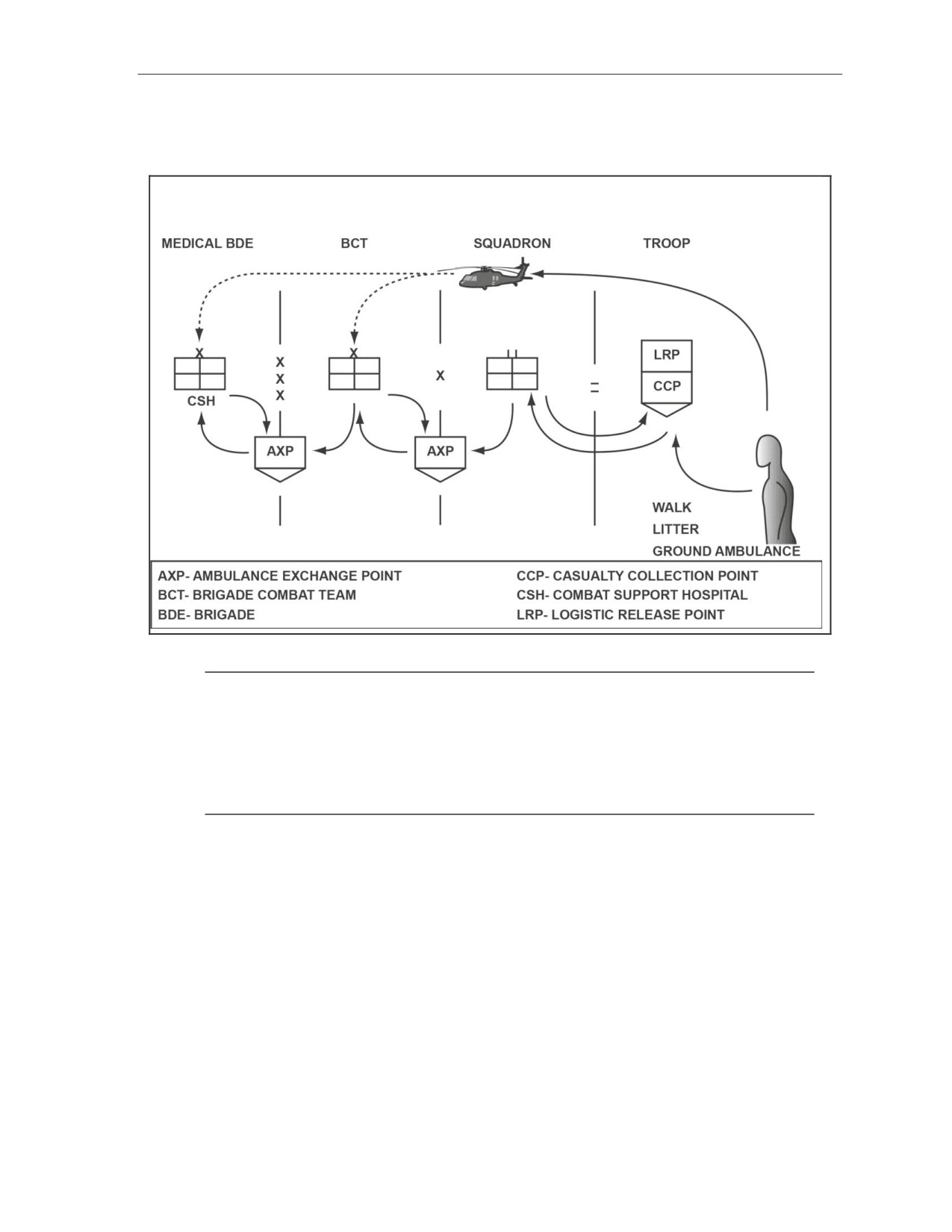
z
Maintenance collection points.
z
Class III and Class V resupply during the mission, if necessary.
z
Movement criteria and triggers.
8-11. To predict support requirements, sustainment planners determine:
z
Type of support required.
z
Quantities of support required.
z
Priority of support by type and unit.
8-12. After determining these support requirements, sustainment planners assess:
z
Sustainment resources available (organic and supporting).
z
Status of the sustainment resources (location, maintenance, and personnel status).
8-2
FM 3-98
-XO\ 2015
Sustainment
z
Time sustainment resources are available to the unit.
z
Configuration of resources and methods of distribution available.
8-13. Based on facts and assumptions, planners develop the support plans for the operation. Several planning
tools are available. The sustainment estimate is the formal, detailed process of analysis that supports
sustainment planning and used when time is available. During execution, use a running estimate to support
recommendations to the commander.
8-14. To facilitate rapid planning, information required to address many of these considerations should be
readily available through routine reports. Force XXI Battle Command, Brigade and Below, medical
communications for combat casualty care, and the mission command sustainment support system are two
examples of available reports. Supplemented by their actual operational experience, sustainment planners
take advantage of—
z
Running estimates, status charts, and automatic estimation tools.
z
Updated status reports when the commander issues a warning order.
z
Established planning factors, historical data and data tailored for their unit.
z
Procedures and organizations specified in the SOP.
LOGISTICS
8-15. Logistics comprises supply, field services, maintenance, transportation, operational contract support,
general engineering support and distribution. In all logistics operations, a vetted primary, alternate,
contingency and emergency plan must be in place before commencement.
8-16. Supply operations consider all classes of supply. For units conducting reconnaissance and security
tasks, Class III (B), IV, V, VIII, and IX are normally priority items for replenishment.
8-17. Most field services will be limited or suspended during reconnaissance and security tasks. The unit S-
4 coordinates most field services through the FSC and BSB SPO. Field services are essential services for
enhancing the quality of life of Soldiers. They include clothing and repair and exchange, laundry and shower
support, mortuary affairs, aerial delivery, food services, billeting and sanitation. Field feeding is the only
service provided by organizations organic to most maneuver units. Logistics organizations at echelons above
brigade coordinate and provide all other field services. The forward support company provides field feeding
support.
8-18. Field maintenance is the level of maintenance that occurs in units conducting reconnaissance and
security tasks. Field maintenance is on-system maintenance, repair and return to the user to include
maintenance actions performed by operators (FM 4-30). Field maintenance is accomplished by mechanics
and technicians organic to the maneuver unit and by the maintenance platoon of the forward support company
of the BSB which may be augmented by maintenance support teams from the BSB field maintenance
company and at times, from echelons above brigade. Maintenance management is accomplished by the unit
motor officer and FSC through the BSB SPO and includes the determination and utilization of battle damage
assessment and repair (BDAR), evacuation, and controlled exchange.
(Refer to ATP 4-33 for more
information.) BDAR occurs at the point of fault or at the maintenance collection point. BDAR properly
applied at the point of fault may immediately return the equipment to a mission-capable status or prolong its
functional life, which may be critical to maintaining combat power during reconnaissance and security tasks.
(Refer to ATP 4-31 for more information.) Maintenance planners recognize that an information requirement
regarding the decision to echelon the field or combat trains forward is influenced by the amount of activity
in the maintenance collection point(s). The maintenance collection point should maintain mobility so that it
may support the reconnaissance or security mission at extended ranges.
8-19. Transportation support for units conducting reconnaissance and security tasks is coordinated through
the unit S-4 and FSC to the BSB SPO. Many transportation requirements will exceed organic assets and will
require support from echelons above brigade transportation units.
8-20. Operational contracting support occurs during all phases of operations and has increased emphasis
during stability tasks and local or area security missions. Trained and ready contractor officer representatives,
field ordering officers and paying agents are a necessity to most units. These personnel are part of a larger
-XO\ 2015
FM 3-98
8-3
Chapter 8
acquisition team at higher echelons that include the contract and financial management experts who provide
the guidance and direction to each field ordering officer and paying agent to meet the unit’s needs.
8-21. The S-4 coordinates general engineering support through the FSC to the BSB SPO and includes
engineering capabilities and activities, excluding combat engineering that modify, maintain, or protect the
physical environment. Examples include the construction, repair, maintenance and operation of facilities.
8-22. Logistics distribution to units conducting reconnaissance and security tasks is either routine or
emergency. Whenever possible, routine resupply is conducted daily based on METT-TC utilizing either
throughput or supply point distribution methods.
ROUTINE RESUPPLY
8-23. Routine resupply methods include use of logistics package operations, push packages and pre-
positioned supplies. Additionally aerial resupply and contracted support is a method for routine supply.
Logistics Package Operations
8-24. The LOGPAC method is a simple and efficient technique to accomplish routine resupply operations
during reconnaissance and security tasks. The key feature is a centrally organized resupply convoy
originating at the field trains. It carries all items needed to sustain the unit for a specific period, until the next
scheduled LOGPAC. Unit SOPs specify the exact composition and march order of the LOGPAC.
8-25. LOGPACs may utilize static logistics release points or rolling logistics release points. Plan and
coordinate LOGPAC distribution methods with the receiving unit before execution, based on METT-TC.
8-26. Logistics planners standardize push packages as much as possible, providing all units with sufficient
quantities of each supply item in anticipation of their requirements. Together with the commander‘s guidance
for issuance of scarce, but heavily requested supply items, accurate reporting allows planners to quickly
forecast supply constraints and then to submit requisitions to alleviate projected shortages. Inaccurate,
incomplete or untimely logistics status/situation reporting can severely handicap efforts to balance unit
requirements and available supplies. The length of time the troop must sustain itself in combat without
resupply determines its quantity of supply items. Specific combat loads vary by mission.
8-27. Prestock or cache operations are used to pre-position supplies for later use. They normally involve
only Class IV items. Prestock or cache items are subject to protection, security and pilferage risks. Prestock
operations involve careful planning and execution at every level. All leaders must know the exact locations
of prestock sites, which they verify during reconnaissance or rehearsals. The squadron and separate troops
must take steps to ensure survivability of the prestock supplies to include a destruction plan to prevent enemy
capture.
Aerial Resupply
8-28. Aerial resupply is an essential sustainment operation during reconnaissance and security tasks. Aerial
resupply operations reduce the risks associated with conducting ground resupply under certain conditions.
Aerial delivery supports units in various operational environments where terrain limits access. Aerial
resupply is sling-load, air-drop (via high or low velocity parachute airdrop and freedrop [also known as speed
ball]) and air-land procedures. (Refer to ATP 4-48 for more information.)
8-29. Aerial resupply is limited based on airframe availability and weather conditions. The signature
produced by aerial delivery (such as rotor wash, dust, or noise) can compromise unit positions. Careful choice
of resupply routes and landing zones based upon thorough IPB minimizes this risk.
8-30. Leaders must be aware of the tolerance of certain supply items for different types of aerial resupply
methods as it may limit distribution means available (for example, some munitions cannot be distributed by
freedrop, and may have a low tolerance level for sling-load or parachute airdrop delivery).
Contracting Support
8-31. Contractors may be employed throughout the area of operations and in all conditions subject to the
mission variables of METT-TC, to provide resupply to units. Protecting contractors on the battlefield is the
unit commander‘s responsibility (Refer to Army Tactics, Techniques and Procedures (ATTP) 4-10 for more
information).
8-4
FM 3-98
-XO\ 2015
Sustainment
EMERGENCY RESUPPLY
8-32. Emergency resupply may utilize any of the routine methods with expedited distribution. Emergency
resupply is conducted using the fastest appropriate means based on METT-TC. Emergency resupply may
involve Classes III, V, VIII, IX, and I. The unit usually uses either aerial resupply or the forward support
company’s supply and transportation platoon located in the combat trains to conduct emergency resupply.
8-33. Pre-rigged loads of standard resupply packages may reduce response time for emergency air resupply
(Refer to the FM 4-20 series, ATP 4-45, ATP 4-48, and TM 4-48 series for more details on rigging supplies
for airdrop).
PERSONNEL SERVICES
8-34. Personnel services are sustainment functions that man and fund the force. Personnel services essential
to units conducting reconnaissance and security tasks include personnel accountability, casualty operations
and religious support. Personnel services maintain Soldier readiness, promote moral and ethical values, and
enable the fighting qualities of the Army (Refer to ADRP 4-0 for more information). Personnel services are
provided by the unit S-1 and ministry team of the squadron.
Casualty Operations
8-35. Unique challenges are present in reconnaissance and security casualty operations. Rehearse casualty
operations before commencement. Casualty operations include production, dissemination, coordination,
validation and synchronization of information regarding each casualty. This information includes casualty
reporting, casualty notification, casualty assistance, line-of-duty determination, disposition of remains, and
disposition of personal effects, military burial honors, and casualty mail coordination.
8-36. As casualties occur, the nearest observer informs the unit first sergeant via the most expedient means.
The unit first sergeant submits a personnel status report to the squadron S-1 documenting duty status changes.
Casualties are classified by injury type at the casualty collection point and entered into the medical
treatment system. The first sergeant ensures completed DA Form
1156 (Casualty Feeder Card) LV
forwarded to the S-1, who then enters the data into the Defense Casualty Information Processing System.
8-37. Platoon combat medics record the treatment received on the casualty’s DA Form 7656 (Tactical
Combat Casualty Care (TCCC) Card), by electronic means or by utilizing a Department of Defense (DD)
Form 1380 (Tactical Combat Casualty Care (TCCC) Card), if available. The squadron S-1 receives
notifications updating the Soldier’s patient tracking status as changes occur, and in turn informs the Soldier’s
troop for accountability.
8-38. Commanders establish procedures for proper next of kin notification. The potential for unofficial
communication in next of kin notification exists and commanders must prepare for this. The next of kin for
Soldiers wounded or killed in action must not receive first notification through unofficial means.
Communication ‘blackouts’ where no unofficial communication is allowed outside of the area of operations
should be considered during next of kin notifications.
Health Service Support
8-39. Health service support is all support and services performed, provided and arranged by the Army
Medical Department to promote, improve, conserve or restore the mental and physical well-being of
personnel in the Army and as directed in other Services, agencies and organizations. Treatment services
include casualty care, evacuation, combat and operational stress control, and hospitalization. (Refer to ATP 4-
02.5 for more information.)
8-40. Squadrons have an organic medical platoon consisting of ambulance squad(s) and treatment squad(s)
equipped to provide mobile advanced trauma management and ground medical evacuation to the combat
casualty. Combat medics provide tactical combat casualty care to wounded Soldiers and are normally placed
under the operational control of the platoon and under technical supervision of the surgeon in the squadron.
8-41. Additionally, a forward surgical team may be attached to the BSB medical company to provide a
rapidly deployable immediate surgical capability as a result of an extended battlefield for those critically
injured patients who cannot be transported over great distances without surgical intervention and
-XO\ 2015
FM 3-98
8-5
Chapter 8
stabilization. Further AHS medical support at echelons above brigade may be available from combat support
hospitals.
8-42. The brigade surgeon, in coordination with the BSB medical company commander, develops the health
service support portion of the concept of support for the brigade. The S-1, S-4, and medical platoon leader
should participate in the development of, and rehearsal of the concept before execution.
Soldier Evacuation
8-43. Conduct evacuation of sick and wounded Soldiers by medical evacuation or casualty evacuation
(CASEVAC). Reconnaissance tasks are conducted over wide and extended areas, therefore careful attention
must be placed on the location of medical treatment facilities and the availability of medical evacuation
platforms (air and ground) against time-distance factors when developing the operation concept of support.
Casualty Evacuation
8-44. Casualty evacuation involves the unregulated movement of casualties using predesignated or
opportune tactical or logistic aircraft and vehicles. As a cautionary note, these vehicles and rotary-wing
aircraft are not staffed with medical personnel for en route care (unless augmentation is planned in the
operational plan [OPLAN]) and do not have organic medical equipment. If the combat medic is not available
to provide care en route, the combat lifesaver may accompany the casualties to monitor their condition.
CASEVAC
Casualties transported in nonmedical vehicles may not receive proper medical care or be
transported to the appropriate medical treatment facility to address the patient’s medical condition.
If the casualty’s medical condition deteriorates during transport, or the casualty is not transported
to the appropriate medical treatment facility, an adverse impact on prognosis and long-term
disability or death may result.
Medical Evacuation
8-45. Medical evacuation is always METT-TC driven. Medical evacuation is performed by dedicated,
standardized medical evacuation platforms with medical professionals providing timely, efficient movement
and en route care of injured or ill persons to medical treatment facilities. Medical evacuation ground/air
ambulance platforms are platforms designed especially for the medical evacuation mission, with allocated
medical equipment to provide en route care by trained medical personnel.
8-46. The medical evacuation plan is a crucial part of the medical OPLAN or OPORD. The brigade surgeon
section handles development of the BCT medical evacuation plan. The medical evacuation plan identifies
ambulance exchange points and casualty collection points. Support graphics in Force XXI Battle Command,
Brigade and Below display these locations. Additional ambulance support is coordinated with the supporting
sustainment unit operations section and the supporting medical company.
8-47. The squadron medical platoon handles medical evacuation of patients from the point of injury to the
aid station. Ambulance teams from the supporting medical company evacuate patients from the aid station
back to the Role 2 medical treatment facility located in the brigade support area (BSA). Pre-positioning of
ambulance teams with the aid station reduces ambulance turnaround times. Medical evacuation of patients
should be no further than their condition requires so they can return to duty as soon as possible.
8-48. The preferred method of medical evacuation is by air, but use of this method is dependent upon mission
variables. Usually, the aviation brigade or aviation task force positions a forward support medical evacuation
platoon in support of a brigade-size element. This platoon provides area support to all units in the supported
area. The brigade aviation element and surgeon in conjunction with higher headquarters coordinate the use
and positioning of the forward support medical evacuation platoon with the aviation element. (See figure 8-1.)
8-49. In developing the medical evacuation plan, medical planners anticipate the potential for high casualty
rates, long evacuation distances, and adverse weather. They identify and coordinate ambulance exchange
points for all operations including the locations of ambulance exchange points for all phases of each
operation, and triggers for displacement to their next locations. Planners retain the flexibility to shift
8-6
FM 3-98
-XO\ 2015
Sustainment
nonstandard evacuation assets to support mass casualties or CASEVAC, as required. Plans and exercises
should include air evacuation (when available) to transport urgent litter patients.
Figure 8-1. Process for evacuation of the wounded
Note. Although the CSH is a medical brigade asset, dependent upon the scenario and AO, the CSH
could be located closer to the patient or, located in the AO laterally (equidistant) to a Role 2
facility. Depending upon the severity of the injury, location of appropriate medical treatment
facilities, and available clinical specialties that the patient may require based on clinical judgment,
the Role 2 medical treatment facility (with or w/o fire support task) may be bypassed and a
particular Role 3 element selected as the medical evacuation destination for a particular patient
with particular injuries. (Refer to FM 4-02, ATP 4-02.2, and ATP 4-02.5 for more information.)
SUPPORT AREAS
8-50. A logistics support area is a designated spot where sustainment elements, some staff elements, and
other elements locate to support a unit. Support areas represent an echelon of support. The method employed
to echelon support is a deliberate, collaborative decision based upon thorough mission analysis and the
military decision-making process conducted by the leadership and staffs at the brigade, squadron, and troop
levels. The primary support areas for units conducting reconnaissance and security operations are the trains
and the BSA. Trains are echeloned forward to provide fluid support to units conducting reconnaissance and
security tasks. The positioning of forward logistics elements (FLEs) and forward arming and refueling points
are considered essential to reconnaissance sustainment planning.
TRAINS
8-51. Trains are a grouping of unit personnel, vehicles, and equipment organized to provide sustainment.
They are the basic tactical sustainment organization. Units use the trains concept to arrange their subordinate
sustainment elements. Trains are usually under the control of the S-4, assisted by the S-1. The composition
and location of unit trains varies depending upon the number of units attached to or augmenting the unit.
-XO\ 2015
FM 3-98
8-7
Chapter 8
Trains have two basic configurations: as unit trains in one location or as echeloned trains. Considerations
include the following:
z
Troop trains are determined by the troop commander and may consist of the troop first sergeant,
supply sergeant, and troop medical assets. Maintenance teams from the FSC may be included.
z
Squadron trains are formed by the FSC. The squadron commander and staff, the BSB commander
and staff, and the FSC commander must collaborate to determine the best method of employment
commensurate with the brigade concept of support.
8-52. The trains are mobile to support the unit when it is moving, and should change locations frequently
depending upon available time and terrain. The trains change locations to provide the best support forward
to the Cavalry unit, and when an area becomes unusable because of environmental conditions, or to follow
protection (survivability) operations. If the unit is operating at extended ranges from the BSA, a positioning
of the field trains between the supporting sustainment unit and the unit conducting reconnaissance and
security may better facilitate support.
BRIGADE SUPPORT AREA
8-53. The BSA is the sustainment hub of the BCT. Usually the BSA is located near a main supply route, and
where there is minimum threat from enemy artillery and mortar fires. For this reason the BSA will likely be
located far behind where units conducting reconnaissance and security tasks are. It is typically composed of
the BSB (less FSCs as applicable), the alternate command post for the higher HQ (if formed), the squadron
field trains, elements from adjacent units or separate companies, other sustainment units from echelons above
brigade (EAB), and task-organized FLE(s) to push critical supplies and services to designated units or
locations, such as combat or field trains.
FORWARD LOGISTICS ELEMENT
8-54. A forward logistics element (FLE) is composed of task-organized multifunctional logistics assets
designed to support fast-moving operations which is characteristic of reconnaissance and security tasks. The
FLE operates out of a forward logistics base or support area. The FLE represents the BSB commander’s
ability to weight the effort for the operation by drawing on all sustainment assets across the brigade.
Additionally, the BSB commander may coordinate with echelons above brigade to provide support
capabilities to augment the FLE in the concept of support (such as a forward surgical team) to include
identifying and the positioning of echelons above brigade unit assets in proximity to geographically dispersed
forces to extend operational reach and prolong endurance. The intent for employing a FLE is to minimize
tactical pauses to the reconnaissance and security plan and enable momentum for the commander.
FORWARD ARMING AND REFUELING POINT
8-55. The forward support company of the aviation support battalion operates forward arming and refueling
points for their supported squadron in the combat aviation brigade as required. The FARP provides fuel and
ammunition necessary for the sustainment of aviation maneuver units during decisive operations. FARPs are
normally employed in support of aviation operations when the distance covered or endurance requirements
exceed normal capabilities of the aircraft. FARPs may be employed during rapid advances when field trains
are unable to keep pace. (Refer to ATP 3-04.94 for more information.)
SECURITY OF SUPPORT AREAS
8-56. Within a support area, a designated unit provides area security, terrain management, movement
control, mobility support, clearance of fires, and required tactical combat forces. Area security operations
focus on the protected force, base, base camp, route, or area allowing sustainment units to focus on their
primary function. When sustainment units are utilized for security operations, logistical operations may be
adversely effected. Security of sustainment efforts during reconnaissance resupply is a critical factor to
successful operations. (Refer to ADRP 4-0 for more information).
8-57. The security of the trains at each echelon is the responsibility of the individual in charge of the trains.
The best defense is to avoid detection. The following activities help to ensure trains security:
z
Select sites that use available cover, concealment, and camouflage.
8-8
FM 3-98
-XO\ 2015
Sustainment
z
Enforce strict movement and positioning discipline as well as noise and light discipline to prevent
detection.
z
Establish a perimeter defense using the occupy procedures for assembly areas.
z
Establish rest plans.
z
Identify an alarm or warning system that would enable rapid execution of the defense plan without
further guidance. The alarm, warning system, and defense plan are usually included in the SOP.
z
Designate a reaction force.
ECHELONS ABOVE BRIGADE SUSTAINMENT SUPPORT
8-58. Support for units conducting wide area security and reconnaissance missions will likely require
sustainment support from EAB sustainment units, particularly in maintenance and medical support. EAB
support normally is provided by a combat sustainment support battalion, the sustainment brigade, and
medical support organizations. If required by the unit conducting reconnaissance and security, EAB units
provide water purification, petroleum storage and transportation support. The medical brigade and the
multifunctional medical battalion provide additional medical capability as required. The FSC, in conjunction
with the unit S-4, requests EAB assistance through the BSB. (Refer to ATP 4-93 for more information on the
sustainment brigade and the combat sustainment support battalion.)
SECTION III - SUSTAINMENT CONSIDERATIONS FOR RECONNAISSANCE,
SECURITY, AND STABILITY TASKS
8-59. Units conduct area, zone and route reconnaissance, screening, guarding and covering security tasks,
and stability tasks. All of these operations present significant challenges to the sustainment system.
Sustainment planners and reconnaissance leaders must consider certain factors when planning and executing
these operations. All reconnaissance and security tasks should consider increased days of supply on all
vehicles, the location of trains, resupplying forward of the LD/LC, increased Class V priority on indirect fires
systems and Class III (B), medical evacuation over greater distances and dispersed areas, and forward
logistics elements. Wide and deep reconnaissance and security tasks have the potential to contact mass
quantities of dislocated civilians and detainees as well as captured enemy ammunition and equipment, all of
which require sustainment operational planning. All sustainment operations prepare a primary, alternate,
contingency and emergency resupply plan.
SUSTAINMENT OF RECONNAISSANCE TASKS
8-60. Maintaining the momentum of the operation is the overriding consideration in supporting
reconnaissance. Certain general considerations guide planning and preparation. Emphasis, priorities, and
requirements may shift as the operation is underway. The availability of adequate supplies and transportation
to sustain the operation becomes more critical as the operation progresses. Main supply routes lengthen,
communications are strained, and requirements for repair and replacement of weapon systems increase.
Rearming operations carefully weigh ammunition consumption against controlled supply rates to avoid
stockpiling at forward locations while ensuring munitions availability. Units conducting reconnaissance
suspend most field service functions during operations, and prepare for increased use of meals ready-to-eat
with a corresponding decrease of food-service prepared meals. Sustainment units are often at risk of
compromising the stealth of the reconnaissance operation due to their footprint; therefore, reconnaissance
plans must consider resupply methods that emphasize cover and concealment, and the reduction in frequency
of resupply. Reconnaissance tasks plan for the disposition of captured enemy supplies and equipment,
particularly ammunition and vehicles.
AREA AND ZONE RECONNAISSANCE
8-61. Sustainment for units conducting area and zone reconnaissance considers the echeloning of trains, pre-
positioning a portion of each essential sustainment asset (such as ammunition; petroleum, oils, and lubricants
(POL), and maintenance in the combat trains), planning for an increased consumption of POL, consideration
of refuel on the move and re-arm on the move operations and push packages of preplanned and preconfigured
essential logistics items. Area reconnaissance plans should account for increased vehicular maintenance,
especially when operating over rough terrain, and mitigate risk through the positioning of maintenance
-XO\ 2015
FM 3-98
8-9
Chapter 8
support teams well forward. Unit distribution should occur at forward locations, planning for aerial resupply.
Area reconnaissance plans include dispersed patient collection points and multiple ambulance exchange
points, coordinate for air medical evacuation support, increased Class VIII consumption, augmentation of
medical treatment elements, and mortuary affairs support. Sustainment units conducting resupply operations
for units conducting reconnaissance must plan for and utilize all available resources for cover and
concealment to mitigate the risk of enemy compromise.
ROUTE RECONNAISSANCE
8-62. Sustainment for units conducting route reconnaissance considers the same factors as area
reconnaissance. Additionally, units plan for rapidly increasing distances and longer turn-around times for
main supply route operations and consider recovering damaged vehicles only to the main supply route for
further recovery by higher headquarters assets.
SUSTAINMENT OF SECURITY TASKS
8-63. Security missions tend to be dynamic in nature, involving substantial maneuver. The most important
consideration for security tasks is the best use of available preparation time and sustainment resources. As
with reconnaissance, emphasis on any particular consideration varies with the mission assigned and shifts
during mission execution. Security missions include screen, guard, cover, and local and area security. As
they are able, units conducting security tasks utilize a deception plan for sustainment preparations and
operations.
SCREEN
8-64. Screen operations occur at platoon level and above. The FSC in the BSB supports screen operations
at the troop level. Sustainment for units conducting screen operations plan for increased use of Class III (B)
and Class V and consider re-arm and refuel on the move operations. They pre-position limited amounts of
ammunition, POL, and barrier material in centrally located forward positions. Screening units resupply
during limited visibility to reduce the chance of enemy interference, and prepare to conduct emergency
resupply well forward during lulls in the battle, or as required. Sustainment units supporting screen operations
should select main supply routes that do not interfere with movement of units or a reserve force and plan
mobility operations to maintain main supply routes. Plans should limit the forward flow of supplies to only
those essential for the operation, and should plan to destroy supplies and equipment (except medical) not
evacuated. Screening units should emphasize recovery and evacuation of equipment over forward repair to
preclude loss to the enemy, utilizing all available noncombat vehicles to tow disabled vehicles. Of critical
importance is a sustainment deception plan during screening operations.
GUARD
8-65. Guard operations are normally executed at the battalion level and above, and require forward support
company and BSB support and may require echelon above brigade sustainment support. Sustainment for
units conducting guard operations considers the echeloning of sustainment assets and pre-positioned
ammunition and other critical supplies on subsequent positions in depth. It plans displacement of sustainment
assets so uninterrupted support continues. Guard operations use push packages of critical supplies on a
scheduled basis, and continues routine resupply until the using unit requests otherwise. Sustainment planners
request additional sustainment assets from higher HQ to support attachments or extended operations. Guard
operations plan displacement of support assets and supplies early to keep routes open and preclude
unnecessary interference with maneuver units. Nonessential sustainment assets should move as early as
possible.
COVER
8-66. Cover operations are executed at the BCT level and require full BSB sustainment support with the
likelihood of echeloned support from above brigade such as the sustainment brigade and medical brigade.
Sustainment for units conducting covering operations considers the same factors as the screen and the guard
at the BCT level. Cover operations consider additional transportation requirements for movement of all
essential classes of supply. Cover operations consider pre-positioned stockpiles, a plan to compensate for lost
sustainment capability, and as missions become more dynamic in execution, determining ways to increase
8-10
FM 3-98
-XO\ 2015
Sustainment
the mobility of forward support assets to maintain pace with the unit. Cover operations anticipate greater
numbers of enemy prisoners of war, civilians on the battlefield and detainees than screen or guard operations.
AREA AND LOCAL SECURITY
8-67. Area and local security operational plans consider the increased use of barrier materiel, lethal and
nonlethal munitions and operational contracting support. The BSB supports area and local security missions,
augmented by the area support capabilities of the sustainment brigade. Many sustainment considerations in
area and local security operations coincide with sustainment of stability tasks, such as the plan for and
anticipation of enemy prisoners of war, civilian refugees, and detainees.
SUSTAINMENT OF STABILITY TASKS
8-68. Stability tasks are required when there is no fully functional, legitimate civil governing authority
present in a theater of operations, and they involve comprehensive efforts to stabilize states in crisis and to
build the capacity of fragile states. Units conducting stability tasks conduct a broad range of offensive and
defensive tasks during stability tasks under the phases of the stability framework of initial response,
transformation and fostering sustainability. Stability tasks are supported by the BSB and echelons above
brigade units. (Refer to ATP 3-07.5, Appendix A, for more information.)
8-69. During the initial response phase, units conducting stability tasks should emphasize medical response
and understand medical rules of engagement requirements for the theater of operations, especially on
civilians, refugees and detainees. During transformation, units conducting stability tasks may execute border
control and boundary security tasks over greatly extended lines of communication that may require echeloned
and area sustainment support beyond the capability of organic sustainment units. During fostering
sustainability operations, sustainment units may partner with host nation units and experience challenges in
supporting both the unit conducting stability and their partners, therefore close coordination in sustainment
planning must be maintained. Throughout all phases of stability operations, the utilization of operational
contracting support occurs and will many times assist in meeting both internal sustainment and external
stability mission tasks.
8-70. Units conducting stability tasks will likely encounter captured enemy material including ammunition
and equipment throughout all phases of the operation. Captured enemy material has the potential for technical
intelligence exploitation and must be retrograded, secured, or destroyed. Planning for captured enemy
material must be an analytical process based on known enemy resources and facilities. Friendly forces
requirements for the disposition of captured enemy material can be extensive enough to exceed the
capabilities of both the unit conducting the operation and their supporting sustainment units. Additionally,
the later disposition of captured enemy material back to the legitimate host nation authority may contribute
to the overall stability plan and preclude insurgent use of bypassed materials.
SECTION IV - SPECIAL SUSTAINMENT CONSIDERATIONS
8-71. Reconnaissance, security and stability mission requirements are diverse; therefore units conducting
them are likely to receive attachments/detachments. Due to their diverse mission set, units conducting
reconnaissance and security tasks may have to consider special sustainment requirements for specific units.
ATTACHMENTS AND DETACHMENTS
8-72. When receiving attachments, sustainment planners should receive or obtain some basic information
from the sending unit’s S-4 to anticipate support requirements. Planning considerations include:
z
Mission.
z
Number and type of vehicles, personnel (by specialty), and weapon systems.
z
Current status or strength.
z
Duration of unit attachment and effective times.
z
Support assets accompanying the attachment.
z
When and where linkup is to occur, coordination measures for the linkup (such as near/far
recognition signals), and who handles the linkup.
-XO\ 2015
FM 3-98
8-11
Chapter 8
8-73. The unit conducting reconnaissance and security may detach a subordinate element to other units or
organizations for certain missions. Use the same considerations that apply to receiving attachments.
Company-size detachments deploy with the appropriate level of support to include maintenance, Class III
and V resupply, and medical materiel’s, based upon how long the unit is detached. Additionally this applies
to troops operating a considerable distance from the unit’s sustainment assets but technically still attached.
The S-4 should send the same information as that listed in the preceding paragraph to the receiving unit’s S-
4.
8-74. Attachment/detachment reports reflect the addition or subtraction of units if the
attachment/detachment is effective for more than 24 hours. Upon notification of pending attachments or
detachments, the unit S-4 immediately notifies the FSC and BSB. (Refer to ATP 4-90 for more information.)
Sustainment units continue to have an area support capability and responsibility for units in or transitioning
through their area of operations.
SUSTAINMENT CONSIDERATIONS FOR SPECIFIC UNITS
8-75. Specific units supporting reconnaissance and security operations may require special considerations
for sustainment. These units include but are not limited to field artillery, air defense artillery, special
operations forces, and engineer units.
FIELD ARTILLERY
8-76. Field artillery units supporting reconnaissance and security tasks present unique challenges for
sustainment. General support rocket fires such as multiple launch rocket system (MLRS)/high mobility
artillery rocket system may provide long range fire support to a BCT conducting reconnaissance and security
tasks. For reconnaissance tasks, missions will generally be fired from firing points located 10 to 15 kilometers
behind the unit conducting reconnaissance. In this case resupply comes from the battery support platoon. For
security tasks, during screen operations launchers may be positioned closely behind the forward line of own
troops to support counterfire missions. In this case screen missions would utilize the munitions on-board the
launcher with little or no resupply required due to the likelihood of limited firing missions. In guard
operations, launcher firing points will be located close to the forward line of own troops and will most likely
be engaging high-payoff targets. Due to expected enemy contact, missions may be of longer duration or
require a larger quantity of munitions and resupply will likely be required. The further forward the firing
point is to the forward line of own troops, the more time is required for resupply due to the distance the
servicing ammunition supply point (ASP) is behind the forward line of own troops. In this case the battery
support platoon may be augmented via throughput from echelons above brigade to conduct resupply. For
cover operations, due to the size of the operation, a MLRS/high mobility artillery rocket system battery will
most likely support the BCT. Depending on the task organization of the battery, sustainment brigade support
may be required to provide resupply.
8-77. When planning sustainment for field artillery units supporting reconnaissance and security tasks, the
appropriate FSO must be included to determine the munitions required supply rate for the fire support tasks
that pertain to the operation, and to apply any controlled supply rates. The FSO, in conjunction with the BCT
fires support coordinator (field artillery battalion commander), can assist in determining the field artillery
resupply triggers, recommended supply routes for field artillery supply trains, and deconflict the artillery
firing areas.
SPECIAL OPERATIONS FORCES
8-78. Sustainment leaders supporting reconnaissance, security and stability tasks may encounter SOF
operating in and around the area of operations. Whether in direct support of the brigade or not, SOF elements
may operate in, or transit through, the area. SOF has organic support capabilities but is reliant upon regional
or combatant command theater of operations infrastructure. The BSB may be called upon to provide area
support to special operations forces operating in the BCT AO. The BSB SPO, in conjunction with the brigade
S-4, will coordinate support as required. The likelihood of SOF area support requirements peak during
stability tasks, and descend during security tasks (with emphasis on local and area security with limited
occurrences in descending order for the cover, guard and screen) and limited occurrences for sustainment
requests during reconnaissance tasks in descending order for area, zone and route reconnaissance tasks.
Collaboration in the requisition, use and distribution of scarce, high demand supplies during reconnaissance
8-12
FM 3-98
-XO\ 2015
Sustainment
and security tasks between SOF and BCT sustainment is optimal (Refer to ATP 3-05.40 for more
information).
AIR DEFENSE ARTILLERY
8-79. Units conducting reconnaissance and security tasks may receive support from air defense artillery
units such as an Avenger unit or a Sentinel platoon. A key sustainment planning consideration for the Sentinel
team is distance from support areas. Sentinel teams are often positioned away from the bulk of the supported
force; typically located in clearings and away from built-up areas to prevent or negate radar masking.
ENGINEER UNITS
8-80. Sustainment considerations for engineer units supporting reconnaissance and security tasks include
coordinating push packages for low-density engineer equipment Class IX repair parts, and materials specific
to the mission. Consider the pre-positioning of large engineering materiel to alleviate strain on transportation
assets and reduce subsequent handling of materiel.
-XO\ 2015
FM 3-98
8-13
Appendix A
ANNEX L (INFORMATION COLLECTION) FORMAT AND
INSTRUCTIONS
A-1. This annex provides fundamental considerations, formats, and instructions for developing Annex L
(Information Collection) in Army plans and orders. It provides a format for the annex that can be modified
to meet the requirements of the base order and operations and an example information collection plan. This
annex follows the five-paragraph attachment format.
A-2. The information collection annex clearly describes how information collection activities support the
offensive, defensive, and stability or defense support of civil authorities operations throughout the conduct
of the operations described in the base order. It synchronizes activities in time, space, and purpose to achieve
objectives and accomplish the commander’s intent for reconnaissance, surveillance, and intelligence
operations (including military intelligence disciplines). The G-3 (S-3), in conjunction with the G-2 (S-2), is
responsible for this annex.
[CLASSIFICATION]
Place the classification at the top and bottom of every page of the attachments. Place the
classification marking at the front of each paragraph and subparagraph in parentheses. Refer to
AR 380-5 for classification and release marking instructions.
Copy ## of ## copies
Issuing headquarters
Place of issue
Date-time group of signature
Message reference number
Include the full heading if attachment is distributed separately from the base order or higher-
level attachment.
ANNEX L (INFORMATION COLLECTION) TO OPERATION PLAN/ORDER [number]
[(code name)]—[issuing headquarters] [(classification of title)]
(U) References: List documents essential to understanding Annex L.
a. List maps and charts first. Map entries include series number, country, sheet names or
numbers, edition, and scale.
b. List other references in subparagraphs labeled as shown.
c. Doctrinal references for this annex include FM 2-0 and FM 6-0.
[page number]
[CLASSIFICATION]
-XO\ 2015
FM 3-98
A-1
Appendix A
[CLASSIFICATION]
ANNEX L (INFORMATION COLLECTION) TO OPERATION PLAN/ORDER [number]
[(code name)]—[issuing headquarters] [(classification of title)]
(U) Time Zone Used Throughout the Plan/Order: Write the time zone established in the base plan
or order.
1. (U) Situation.
a. (U) Area of Interest. Refer to Annex B (Intelligence) or Appendix 2 (Operation Overlay) to
Annex C (Operations).
b. (U) Area of Operations. Refer to Appendix 2 (Operation Overlay) to Annex C (Operations).
(1)
(U) Terrain. Describe the aspects of terrain that impact information collection. Refer to
Annex B (Intelligence) as required.
(2)
(U) Weather. Describe the aspects of weather that impact information collection. Refer to
Annex B (Intelligence) as required.
c. (U) Enemy Forces. Refer to Annex B (Intelligence) as required.
d. (U) Friendly Forces. Refer to base order, Annex A (Task Organization) and Annex C (Operations)
as required.
e.
(U) Interagency, Intergovernmental, and Nongovernmental Organizations. Identify and
describe other organizations in the area of operations that may impact the conduct of operations or
implementation of information collection-specific equipment and tactics. Refer to Annex V
(Interagency Coordination) as required.
f. (U) Civil Considerations. Describe the critical aspects of the civil situation that impact
information collection activities. Refer to Appendix
1
(Intelligence Estimate) to Annex B
(Intelligence) and Annex K (Civil Affairs Operations) as required.
g. (U) Attachments and Detachments. If pertinent, list units or assets attached to or detached
from the issuing headquarters. State when each attachment or detachment is effective (for example,
on order, on commitment of the reserve) if different from the effective time of the base plan or order.
Do not repeat information already listed in Annex A (Task Organization).
h.
(U) Assumptions. List any information collection-specific assumptions that support the
annex development.
2. (U) Mission. State the mission of information collection in support of the operation—a short
description of the who, what (task), when, where, and why (purpose) that clearly indicates the action
to be taken and the reason for doing so.
3. (U) Execution.
a.
(U) Concept of Operations. This is a statement of the overall information collection
objective. Describe how the tasks or missions of reconnaissance, surveillance, security,
intelligence operations, and so forth support the commander’s intent and the maneuver plan. Direct
the manner in which each element of the force cooperates to accomplish the key information
collection tasks and ties that to support of the operation with task and purpose statement. Must
describe, at minimum, the overall scheme of maneuver and concept of fires. Refer to Appendix 1
(Information Collection Plan) to Annex L (Information Collection). The following subparagraphs
are examples. Omit what is unnecessary for brevity.
(1)
(U) Movement and Maneuver. Provide the scheme of movement and maneuver for
collection assets and any other unit given a key information collection task, in accordance with
the concept of operations in the base order (paragraph 3b) and Annex C (Operations). Describe
the employment of information collection assets in relation to the rest of the force and state the
method forces will enter the area of operations.
[page number]
[CLASSIFICATION]
A-2
FM 3-98
-XO\ 2015
Annex L (Information Collection) Format and Instructions
[CLASSIFICATION]
ANNEX L (INFORMATION COLLECTION) TO OPERATION PLAN/ORDER [number]
[(code name)]—[issuing headquarters] [(classification of title)]
(2)
(U) Intelligence. Describe the intelligence concept for supporting information
collection. Refer to Annex B (Intelligence) as required.
(3)
(U) Fires. Describe the concept of fires in support of information collection. Identify
which information collection assets have priority of fires and the coordinating purpose of,
priorities for, allocation of, and restrictions on fire support and fire support coordinating measures.
Refer to Annex D (Fires) as required.
(4)
(U) Protection. Describe protection support to information collection. Refer to Annex
E (Protection) as required.
(5)
(U) Engineer. Describe engineer support, if applicable, to information collection.
Identify priority of mobility and survivability assets. Refer to Annex G (Engineer) as required.
(6)
(U) Sustainment. Describe sustainment support to information collection as required. Refer
to Annex F (Sustainment).
(7)
(U) Signal. Describe signal support to information collection as required. Refer to Annex H
(Signal).
(8)
(U) Soldier and Leader Engagement. State overall concept for synchronizing information
collection with Soldier and leader engagement. Refer to coordinating instructions in Annex C
(Operations).
(9)
(U) Assessment. If required, describe the priorities for assessment for the
information collection plan and identify the measures of effectiveness used to assess end state
conditions and objectives. Refer to Annex M (Assessment) as required.
b. (U) Tasks to Subordinate Units. State the information collection task assigned to each unit
not identified in the base order. Refer to Appendix 1 (Information Collection Plan) to Annex L
(Information Collection) as required.
(1) (U) Information Collection Support Tasks for Maneuver Units.
(a) (U) Tasks to Maneuver Unit 1.
(b) (U) Tasks to Maneuver Unit 2.
(c) (U) Tasks to Maneuver Unit 3.
[page number]
[CLASSIFICATION]
-XO\ 2015
FM 3-98
A-3
Appendix A
[CLASSIFICATION]
ANNEX L (INFORMATION COLLECTION) TO OPERATION PLAN/ORDER [number]
[(code name)]—[issuing headquarters] [(classification of title)]
(2)
(U) Information Collection Support Tasks for Support Units. Direct units to observe
and report in accordance with Appendix 1
(Information Collection Plan) to Annex L
(Information Collection).
(a) (U) Military Intelligence. Refer to Annex B (Intelligence) as required.
(b) (U) Engineer. Refer to Annex G (Engineer) as required.
(c) (U) Fires. Refer to Annex D (Fires) as required.
(d) (U) Signal. Refer to Annex H (Signal) as required.
(e) (U) Sustainment. Refer to Annex F (Sustainment) as required.
(f) (U) Protection. Refer to Annex E (Protection) as required.
(g) (U) Civil Affairs. Refer to Annex K (Civil Affairs Operations) as required.
c.
(U) Coordinating Instructions. List only instructions applicable or not covered in unit
standard operating procedures (SOPs).
(1)
(U) Time or Condition When the Plan Becomes Effective.
(2)
(U) Priority Intelligence Requirements. List priority intelligence requirements (PIRs)
here, the information collection tasks associated with them, and the latest time information is of value
for each PIR.
(3) (U) Essential Elements of Friendly Information. List essential elements of friendly
information (EEFIs) here.
(4)
(U) Fire Support Coordinating Measures. List fire support coordinating or control
measures. Establish no fire areas.
(5)
(U) Intelligence Handover Lines with Adjacent Units. Identify handover guidance
and parameters; refer to necessary graphics or attachments as required.
(6)
(U) Limits of Advance, Limits of Reconnaissance, and Quick Reaction Force
Response Instructions. Identify as required, referencing graphical depictions in attachments or
instructions as needed.
(7) (U) Airspace Coordinating Measures. List airspace control measures.
(8)
(U) Intelligence Coordination Measures. List information such as restrictions on
international borders or other limitations and the coordination or special instructions that
apply. Identify what unit is responsible for coordinating information collection activities in
relation to the area of operations.
[page number]
[CLASSIFICATION]
A-4
FM 3-98
-XO\ 2015
Annex L (Information Collection) Format and Instructions
[CLASSIFICATION]
ANNEX L (INFORMATION COLLECTION) TO OPERATION PLAN/ORDER [number]
[(code name)]—[issuing headquarters] [(classification of title)]
(9) (U) Rules of Engagement. Refer to Appendix 11 (Rules of Engagement) to Annex C
(Operations) as required.
(10) (U) Risk Reduction Control Measures. State reconnaissance, surveillance, and security-
specific guidance such as fratricide prevention measures not included in SOPs, referring to
Annex E (Protection) as required.
(11)
(U) Environmental Considerations. Refer to Appendix 5 (Environmental Considerations) to
Annex G (Engineer) as required.
(12)
(U) Other Coordinating Instructions. List only instructions applicable to two or
more subordinate units not covered in the base plan or order.
4. (U) Sustainment. Describe any sustainment requirements, subparagraphs may include:
a.
(U) Logistics. Identify unique sustainment requirements, procedures, and guidance to
support information collection. Specify procedures for specialized technical logistics support from
external organizations as necessary. Use subparagraphs to identify priorities and specific
instructions for information collection logistics support. Refer to Annex F
(Sustainment) and
Annex P (Host-Nation Support) as required.
b.
(U) Personnel. Identify unique personnel requirements and concerns, associated with
information collection, including global sourcing support and contracted linguist requirements. Use
subparagraphs to identify priorities and specific instructions for human resources support, financial
management, legal support, and religious support. Refer to Annex F (Sustainment) as required.
c. (U) Health Service Support. Provide information including the health threat (endemic and
epidemic diseases, state of health of the enemy forces, medical capabilities of the enemy force and
the civilian population), and medical evacuation routes, barriers, and significant terrain features.
Refer to Appendix 3 (Health System Support) to Annex F (Sustainment) as required.
5. (U) Command and Signal.
a. (U) Command.
(1)
(U) Location of the Commander and Key Leaders. List the location of the commander
and key intelligence collection leaders and staff officers.
(2)
(U) Succession of Command. State the succession of command if not covered in the unit’s
SOPs.
(3)
(U) Liaison Requirements. State intelligence collection liaison requirements not covered in
the unit’s SOPs.
b. (U) Control.
(1)
(U) Command Posts. Describe the employment of command posts (CPs), including
the location of each CP and its time of opening and closing, as appropriate. State the primary
controlling CP for specific tasks or phases of the operation.
(2)
(U) Reports. List reports not covered in SOPs. Describe information collection
reporting requirements for subordinate units. Refer to Annex R (Reports) as required.
[page number]
[CLASSIFICATION]
-XO\ 2015
FM 3-98
A-5
Appendix A
[CLASSIFICATION]
ANNEX L (INFORMATION COLLECTION) TO OPERATION PLAN/ORDER [number]
[(code name)]—[issuing headquarters] [(classification of title)]
c.
(U) Signal. List signal operating instructions for intelligence collection as needed.
Consider operations security requirements. Address any intelligence collection specific
communications and digitization connectivity requirements. Refer to Annex H (Signal) as required.
ACKNOWLEDGE: Include only if attachment is distributed separately from the base plan or order.
[Commander’s last name]
[Commander’s rank]
The commander or authorized representative signs the original copy. If the representative signs the
original, add the phrase “For the Commander.” The signed copy is the historical copy and remains in
the headquarters’ files.
OFFICIAL
[Authenticator’s name]
[Authenticator’s
position]
Use only if the commander does not sign the original attachment. If the commander signs the original,
no further authentication is required. If the commander does not sign, the signature of the preparing
staff officer requires authentication and only the last name and rank of the commander appear in the
signature block.
ATTACHMENTS: List lower-level attachment (appendixes, tabs, and exhibits).
Appendix 1-Information Collection Plan
Appendix 2-Information Collection Overlay
DISTRIBUTION: (if distributed separately from the base order).
[page number]
[CLASSIFICATION]
A-6
FM 3-98
-XO\ 2015
Glossary
SECTION I - ACRONYMS AND ABBREVIATIONS
AA
avenue of approach
ABCT
Armored brigade combat team
ADP
Army doctrine publication
ADRP
Army doctrine reference publication
AO
area of operations
AR
Army regulation
ATP
Army Techniques Publication
ATTP
Army Tactics, Techniques and Procedures
BCT
brigade combat team
BDA
battle damage assessment
BEB
brigade engineer battalion
BHO
battle handover
BSA
brigade support area
BSB
brigade support battalion
BSC
brigade support company
BSTB
brigade special troops battalion
CA
civil affairs
CAS
close air support
CASEVAC
casualty evacuation
CBRN
chemical, biological, radiological, and nuclear
CFV
Cavalry fighting vehicle
CI
counterintelligence
CCIR
commander’s critical information requirements
Class I
subsistence
Class II
clothing, individual equipment, tentage, and organizational tool sets
Class III
petroleum, oil, and lubricants
Class III (B)
petroleum, oil, and lubricants (bulk)
Class IV
construction materiel
Class V
ammunition
Class VIII
medical supplies
Class IX
repair parts
COA
course of action
COP
common operational picture
CP
command post
CRT
combat repair team
CTCP
combat trains command post
DA
Department of the Army
-XO\ 2015
FM 3-98
Glossary-1
Glossary
EEFI
essential elements of friendly information
EOD
explosive ordnance disposal
FARP
forward arming and refueling point
FFIR
friendly force information requirement
FLE
forward logistics element
FM
field manual
FSC
forward support company
FSO
fire support officer
G-2
Assistant Chief of Staff for Intelligence
HCT
human intelligence (HUMINT) collection team
HN
host nation
HQ
headquarters
HUMINT
human intelligence
IBCT
Infantry brigade combat team
IED
improvised explosive device
IGO
intergovernmental organization
IPB
intelligence preparation of the battlefield
JP
joint publication
JTF
joint task force
LD
line of departure
LOA
limit of advance
LOC
line of communication
LOGPAC
logistic package
LTIOV
latest time information is of value (JP 1-02)
MASINT
measurement and signature intelligence
MCoE
United States Army Maneuver Center of Excellence
MDMP
military decision-making process
METT-TC
mission, enemy, terrain and weather, troops and support available time
available and civil considerations
MFT
multifunctional team
MI
military intelligence
MISO
military information support operations
MP
military police
MSR
main supply route
NAI
named area of interest
NGO
nongovernmental organization
OE
operational environment
OPLAN
operational plan
OPORD
operation order
OP
observation post
PIR
priority intelligence requirement
PL
phase line
Glossary-2
FM 3-98
-XO\ 2015
Glossary
POL
petroleum, oils, and lubricants
R&S
reconnaissance and surveillance
RP
release point
S-1
battalion or brigade personnel staff officer
S-2
battalion or brigade intelligence staff officer
S-3
battalion or brigade operations staff officer
S-4
battalion or brigade logistics staff officer
S-6
battalion or brigade signal staff officer
S-9
battalion or brigade civil affairs operations staff officer
SBCT
Stryker brigade combat team
SIGINT
signals intelligence
SIR
specific information requirement
SOF
special operations forces
SOP
standard operating procedure
SPO
support operations officer
TAI
target area of interest
TOW
tube-launched, optically tracked, wire guided
TRADOC
United States Army Training and Doctrine Command
TTP
tactics, techniques, and procedures
UAS
unmanned aircraft system
U.S.
United States
USAR
United States Army Reserve
WARNORD
warning order
XO
executive officer
SECTION II - TERMS
adversary
An adversary is a party acknowledged as potentially hostile to a friendly party and against which force may
be envisaged (JP 3-0).
adjustment decision
An adjustment decision is the selection of a course of action that modified the order to respond to
unanticipated opportunities or threats. An adjustment decision may include a decision to reframe the problem
and develop an entirely new plan (ADP 5-0).
area reconnaissance
A form of reconnaissance that focuses on obtaining detailed information about the terrain or enemy activity
within a prescribed area. (ADRP 3-90) (ADRP 1-02)
commander’s critical information requirement
A commander’s critical information requirement is an information requirement identified by the commander
as being critical to facilitating timely decision making. The two key elements are friendly force information
requirements and priority intelligence requirements (JP 3-0/ADRP 5-0).
-XO\ 2015
FM 3-98
Glossary-3
Glossary
commander’s visualization
Commander’s visualization is the mental process of developing situational understanding, determining a
desired end state, and envisioning an operational approach through which the force will achieve that end state
(ADP 5-0).
culture
Culture is the shared beliefs, values, customs, behaviors, and artifacts members of a society use to cope with
the world and each other.
decision point
A point in space and time when the commander or staff anticipates making a key decision concerning a
specific course of action (JP 1-02/JP 5-0).
decision support matrix
A decision support matrix is a written record of a war-gamed course of action that describes decision points
and associated actions at those decision points. (ADRP 5-0)
decision support template
A decision support template is a combined intelligence and operations graphic based on the results of
wargaming. The decision support template depicts decision points, timelines associated with movement of
forces and flow of operation, and other key items of information required to execute a specific friendly course
of action (JP 2-01.3)
economy of Force
Economy of force: Expend minimum essential combat power on secondary efforts to allocate the maximum
possible combat power on primary efforts (ADRP 3-0).
enemy
An enemy is a party identified as hostile against which force is authorized (ADRP 3-0).
execution decisions
Execution decisions implement a planned action under circumstances anticipated in the order. (ADP 5-0) An
execution decision is normally tied to a decision point—a point in space or time the commander or staff
anticipates making a key decision concerning a specific course of action. (JP 5-0)
friendly force information requirement
A friendly force information requirement is information the commander and staff need to understand the
status of friendly force and supporting capabilities (JP 3-0/ADRP 5-0).
guard
Guard is a security task to protect the main body by fighting to gain time while also observing and reporting
information and preventing enemy ground observation of and direct fire against the main body. Units
conducting a guard mission cannot operate independently because they rely upon fires and functional and
multifunctional support assets of the main body. (ADRP 3-90)
hybrid threat
A hybrid threat is the diverse and dynamic combination of regular forces, irregular forces, terrorist forces,
and criminal elements unified to achieve mutually benefitting effects. (ADRP 3-0)
indicators
(DOD) In intelligence usage, an item of information which reflects the intention or capability of an adversary
to adopt or reject a course of action (JP 1-02).
irregular forces
Irregular forces are armed individuals or groups who are not members of the regular armed forces, police, or
other internal security forces (JP 3-24).
Glossary-4
FM 3-98
-XO\ 2015
Glossary
key tasks
Key tasks are those activities the force must perform as a whole to achieve the desired end state (ADRP 5-0).
military decision-making process
The military decision-making process is an iterative planning methodology to understand the situation and
mission, develop a course of action, and produce an operation plan or order (ADP 5-0).
mission command
Mission command is the exercise of authority and direction by the commander using mission orders to enable
disciplined initiative within the commander’s intent to empower leaders in the conduct of unified land
operations (ADP 6-0).
named area of interest
(DOD) A geospatial area or systems node or link against which information that will satisfy a specific
information requirement can be collected. Named areas of interest are usually selected to capture indications
of adversary courses of action, but also may be related to conditions of the operational environment. Also
called NAI (JP 2-01.3) See ATP 2-01.3 and ATP 3-55.6/MCRP 2-24A/NTTP 3-55.134/AFTTP 3-2.2.
(Army) The geographical area where information that will satisfy a specific information can be collected.
Also called NAI (ADRP 1-02).
neutral
A neutral is a party identified as neither supporting nor opposing friendly or enemy forces (ADRP 3-0).
pillar organizations
Pillar organizations are organizations or systems on which the populace depends for support, security,
strength, and direction. (ADP 3-90 and FM 3-90.5)
planning
Planning is the art and science of understanding a situation, envisioning a desired future, and laying out
effective ways of bringing that future about. (ADRP 5-0)
precision-guided munition
A guided weapon intended to destroy a point target and minimize collateral damage. Also called PGM, smart
weapon, smart munition. (Approved for incorporation into JP 1-02). (JP 3-03)
precision munition
A precision munition is a munition that corrects for ballistic conditions using guidance and control up to the
aimpoint or submunitions dispense with terminal accuracy less than the lethal radius of effects. (FM 3-09)
preparation
Preparation consists of activities performed by units and Soldiers to improve their ability to execute an
operation (ADP 5-0).
reconnaissance
(DOD) A mission undertaken to obtain, by visual observation or other detection methods, information about
the activities and resources of an enemy or adversary, or to secure data concerning the meteorological,
hydrographic, or geographic characteristics of a particular area. Also called RECON. (JP 2-0)
*reconnaissance handover
The action that occurs between two elements in order to coordinate the transfer of information and/or
responsibility for observation of potential threat contact, or the transfer of an assigned area from one element
to another. (FM 3-98)
-XO\ 2015
FM 3-98
Glossary-5
Glossary
*reconnaissance handover line
A designated phase line on the ground where reconnaissance responsibility transitions from one element to
another. (FM 3-98)
reconnaissance objective
A reconnaissance objective is a terrain feature, geographic area, or an enemy force about which the
commander wants to obtain additional information. (ADP 3-0 and FM 3-90.5)
rehearsal
A rehearsal is a session in which the commander and staff or unit practices expected actions to improve
performance during execution (ADRP 5-0).
reserve
That portion of a body of troops which is withheld from action at the beginning of an engagement, to be
available for a decisive movement (ADRP 3-90).
route reconnaissance
A directed effort to obtain detailed information of a specified route and all terrain from which the enemy
could influence movement along that route (ADRP 3-90) (ADRP 1-02).
security operations
Those operations undertaken by a commander to provide early and accurate warning of enemy operations, to
provide the force being protected with time and maneuver space within which to react to the enemy, and to
develop the situation to allow the commander to effectively use the protected force. (ADRP 3-90)
special reconnaissance
(DOD) Reconnaissance and surveillance actions conducted as a special operation in hostile, denied, or
politically sensitive environments to collect or verify information of strategic or operational significance,
employing military capabilities not normally found in conventional forces. (JP 3-05). See ADP 3-05, ADRP
3-05, ADRP 3-90, FM 3-05, and FM 3-90-2.
site exploitations
Site Exploitation (SE) is as a series of activities to recognize, collect, process, preserve, and analyzes
information, personnel, and materiel found during the conduct of operations. (JP 3-31), taking full advantage
of any information that has come to hand for tactical, operational, or strategic purposes. (JP
2-01.3)
Synchronized and integrated enabled by science, technology, and information management to analyze
information, materiel, or people found within a designated area, objective, or facility in order to obtain
actionable intelligence, denies the enemy resources and anonymity, and/or secures a criminal conviction.
sources of instability
Sources of Instability are actors, actions, or conditions that exceed the legitimate authority’s capacity to
exercise effective governance, maintain civil control, and ensure economic development.
target area of interest
(DOD) The geographical area where high-value targets can be acquired and engaged by friendly forces. Not
all target areas of interest will form part of the friendly course of action; only target areas of interest associated
with high priority targets are of interest to the staff. These are identified during staff planning and wargaming.
Target areas of interest differ from engagement areas in degree. Engagement areas plan for the use of all
available weapons; target areas of interest might be engaged by a single weapon. Also called TAI. See also
area of interest; high-value target; target. (JP 1-02)
targeting
The process of selecting and prioritizing targets and matching the appropriate response to them, considering
operational requirements and capabilities (JP 3-0).
Glossary-6
FM 3-98
-XO\ 2015
Glossary
task organization
(DOD) An organization that assigns to responsible commanders the means with which to accomplish their
assigned tasks in any planned action (JP 3-33).
Task organization is a temporary grouping of forces designed to accomplish a particular mission (ADRP 5-0).
threat
A threat is any combination of actors, entities, or forces that have the capability and intent to harm United
States forces, United States national interests, or the homeland (ADRP 3-0).
unified land operations
Unified land operations describes how the Army seizes, retains, and exploits the initiative to gain and
maintain a position of relative advantage in sustained land operations through simultaneous offensive,
defensive, and stability tasks in order to prevent or deter conflict, prevail in war, and create the conditions
for favorable conflict resolution (ADP 3-0).
unity of effort
(DOD) Coordination and cooperation toward common objectives, even if the participants are not necessarily
part of the same command or organization, which is the product of successful unified action. (JP 1) (JP 1-02)
zone reconnaissance
A form of reconnaissance that involves a directed effort to obtain detailed information on all routes, obstacles,
terrain, and enemy forces within a zone defined by boundaries (ADRP 3-90) (ADRP 1-02).
-XO\ 2015
FM 3-98
Glossary-7
This page intentionally left blank.
References
REQUIRED PUBLICATIONS
ADRP 1-02, Terms and Military Symbols, 2 February 2015.
JP 1-02, Department of Defense Dictionary of Military and Associated Terms, 8 November 2010.
RELATED PUBLICATIONS
Most Army doctrinal publications and regulations are available at: http://www.apd.army.mil.
Other publications are available on the Central Army Registry on the Army Training Network,
https://atiam.train.army.mil.
ADP 3-0, Unified Land Operations, 10 October 2011.
ADP 3-05, Special Operations, 31 August 2012.
ADP 3-07, Stability, 31 August 2012.
ADP 3-28, Defense Support of Civil Authorities, 26 July 2012.
ADP 3-90, Offense and Defense, 31 August 2012.
ADP 5-0, The Operations Process, 17 May 2012.
ADP 6-0, Mission Command, 17 May 2012.
ADRP 2-0, Intelligence, 31 August 2012.
ADRP 3-0, Unified Land Operations, 16 May 2012.
ADRP 3-05, Special Operations, 31 August 2012.
ADRP 3-07, Stability, 31 August 2012.
ADRP 3-90, Offense and Defense, 31 August 2012.
ADRP 4-0, Sustainment, 31 July 2012.
ADRP 5-0, The Operations Process, 17 May 2012.
ADRP 6-0, Mission Command, 17 May 2012.
AR 380-5, Department of the Army Information Security Program, 29 September 2000.
AR 381-10, U.S Army Intelligence Activities, 3 May 2007.
ATP 2-01.3, Intelligence Preparation of the Battlefield/Battlespace, 10 November 2014.
ATP 2-19.4, Brigade Combat Team Intelligence Techniques, 10 February 2015.
ATP 3-04.94, Army Techniques Publication for Forward Arming and Refueling Points,
26 January 2012.
ATP 3-05.40, Special Operations Sustainment, 3 May 2013.
ATP 3-07.5, Stability Techniques, 31 August 2012.
ATP 3-11.23, Multi-Service Tactics, Techniques, and Procedures for Weapons of Mass
Destruction Elimination Operations, 1 November 2013.
ATP 3-52.1, Multi-Service Tactics, Techniques, and Procedures for Airspace Control,
9 April 2015.
ATP 3-55.6/MCRP 2-24A/NTTP 3-55.134/AFTTP 3-2.2, Multi-Service Tactics, Techniques, and
Procedures for Airborne Target Coordination and Attack Radar Systems (ATCARS),
22 August 2012.
ATP 3-60, Targeting, 7 May 2015.
ATP 4-02.2, Medical Evacuation, 12 August 2014.
ATP 4-02.5, Casualty Care, 10 May 2013.
-XO\ 2015
FM 3-98
References-1
References
ATP 4-31, Recovery and Battle Damage Assessment and Repair (BDAR), 27 August 2014.
ATP 4-33, Maintenance Operations, 14 April 2014.
ATP 4-45, Force Provider Operations, 24 November 2014.
ATP 4-48, Aerial Delivery, 23 June 2014.
ATP 4-90, Brigade Support Battalion, 2 April 2014.
ATP 4-93, Sustainment Brigade, 9 August 2013.
ATTP 4-10, Operational Contract Support Tactics, Techniques, and Procedures, 20 June 2011.
FM 2-0, Intelligence Operations, 15 April 2014.
FM 3-04.155, Army Unmanned Aircraft System Operations, 29 July 2009.
FM 3-05, Army Special Operations, 9 January 2014.
FM 3-09, Fire Artillery Operations and Fire Support, 4 April 2014.
FM 3-20.96, Reconnaissance and Cavalry Squadron, 12 March 2010.
FM 3-52, Airspace Control, 8 February 2013.
FM 3-55, Information Collection, 3 May 2013.
FM 3-60, The Targeting Process, 26 November 2010.
FM 3-90-1, Offense and Defense, Volume 1, 22 March 2013.
FM 3-90-2, Reconnaissance, Security, and Tactical Enabling Tasks, Volume 2, 22 March 2013.
FM 3-90.5, The Combined Arms Battalion, 7 April 2008.
FM 4-02, Army Health System, 26 August 2013.
FM 4-20.102, Airdrop of Supplies and Equipment: Rigging Airdrop Platforms {MCRP 4-11.3J;
NAVSEA SS400-AB-MMO-010; TO 13C7-1-5}, 8 June 2006.
FM 4-20.103, Airdrop of Supplies and Equipment: Rigging Containers {MCRP 4-11.3C; TO 13C-
1-11}, 2 September 2005.
FM 4-20.107, Airdrop Derigging and Recovery Procedures {TO 13C7-1-10}, 7 October 2004.
FM 4-20.108, Airdrop of Supplies and Equipment: Rigging Military Utility Vehicles {TO 13C7-2-
491}, 10 September 2007.
FM 4-20.113, Airdrop of Supplies and Equipment: Rigging Trailers {TO 13C7-3-51},
27 March 2009.
FM 4-20.116, Airdrop of Supplies and Equipment Reference Data for Airdrop Platform Loads
{TO 13C7-1-13}, 10 May 2006.
FM 4-20.117, Airdrop of Supplies and Equipment: Rigging High-Mobility Multipurpose Wheeled
Vehicles ({TO 13C7-1-111), 1 October 2001.
FM 4-20.137, Airdrop of Supplies and Equipment: Rigging Forward Area Refueling Equipment
(FARE) and Advanced Aviation Forward Area Refueling System (AAFARS) {TO 13C7-1-19},
10 June 2003.
FM 4-20.152, Airdrop of Supplies and Equipment: Rigging Dragon and Javelin Missiles
{TO 13C7-22-61}, 6 September 2007.
FM 4-20.153, Airdrop of Supplies and Equipment: Rigging Ammunition {MCRP 4-11.3B;
TO 13C7-18-41}, 23 October 2006.
FM 4-20.158, Airdrop of Supplies and Equipment: Rigging Water Purification Units
{TO 13C7-7-61}, 11 May 2005.
FM 4-20.166, Airdrop of Supplies and Equipment: Rigging 2- and 4-Litter Ambulance
{TO 13C7-25-71}, 30 May 2006.
FM 4-30, Ordnance Operations, 1 April 2014.
FM 6-0, Commander and Staff Organization and Operations, 5 May 2014.
FM 27-10, The Law of Land Warfare, 18 July 1956.
References-2
FM 3-98
-XO\ 2015
References
To Fight or Not to Fight? Organizational and Doctrinal Trends in Mounted Maneuver
Reconnaissance from the Interwar Years to Operation IRAQI Freedom by Robert S.
Cameron, Ph.D, Combat Studies Institute Press, U.S. Army Combined Arms Center, Fort
Leavenworth, Kansas, 1965.
(http://usacac.army.mil/cac2/cgsc/carl/download/csipubs/cameron_fight.pdf.)
TM 4-48.04, Airdrop of Supplies and Equipment: Rigging Loads for Special Operations,
6 August 2012.
TM 4-48.05, Airdrop of Supplies and Equipment: Dual Row Airdrop Systems, 10 May 2013.
TM 4-48.09, Multiservice Helicopter Sling Load: Basic Operations and Equipment
{MCRP 4-11.3E, Vol 1; NTTP 3-04.11; AFMAN 11-223(I), Vol I; COMDTINST M13482.2B},
23 July 2012.
TM 4-48.10, Multiservice Helicopter Sling Load: Single-Point Load Rigging Procedures,
5 July 2013.
TM 4-48.11, Multiservice Helicopter Sling Load: Dual-Point Load Rigging Procedures,
5 July 2013.
TM 4-48.12, Airdrop of Supplies and Equipment: Rigging Typical Supply Loads, 5 July 2013.
TM 4-48.14, Airdrop of Supplies and Equipment: Humanitarian Airdrop {TO 13C7-37-31),
23 April 2012.
TM 4-48.19, Airdrop of Supplies and Equipment: Rigging Howitzers {TO 13C7-10-31},
5 July 2013.
TM 4-48-21, Airdrop of Supplies and Equipment: Rigging Engineer Equipment (Tractors and
Tractor-Dozers), 29 July 2013.
TM 4-48.25, Airdrop of Supplies and Equipment: Rigging Forklift Trucks; Whole Blood;
Communication Shelters; Tracked Vehicles {TO 13C7-54-1}, 23 April 2012.
Joint Publications
Most joint publications are available online at: http://www.dtic.mil/doctrine/doctrine/doctrine.htm.
JP 1, Doctrine for the Armed Forces of the United States, 25 March 2013.
JP 2-0, Joint Intelligence, 22 October 2013.
JP 2-01.3, Joint Intelligence Preparation of the Operational Environment, 21 May 2014.
JP 3-0, Joint Operations, 11 August 2011.
JP 3-03, Joint Interdiction, 14 October 2011.
JP 3-05, Special Operations, 16 July 2014.
JP 3-24, Counterinsurgency, 22 November 2013.
JP 3-31, Command and Control for Joint Land Operations, 24 February 2014.
JP 3-33, Joint Task Force Headquarters, 30 July 2012.
JP 5-0, Joint Operation Planning, 11 August 2011.
PRESCRIBED FORMS
This section contains no entries.
-XO\ 2015
FM 3-98
References-3
References
REFERENCED FORMS
Unless otherwise indicated, DA forms are available on the Army Publishing Directorate (APD)
DD Forms are available on the Office of the Secretary of Defense (OSD) web site
DA Form 1156, Casualty Feeder Card.
DA Form 2028, Recommended Changes to Publications and Blank Forms.
DA Form 7656, Tactical Combat Casualty Care (TCCC) Card. (Available through normal supply
channels.)
DD Form 1380, Tactical Combat Casualty Care (TCCC) Card. (Available through normal supply
channels.)
References-4
FM 3-98
-XO\ 2015