FM 100-11 Force Integration (January 1998) - page 4

FM 100-11, Force Integration
Table 12-2
Budget Activity Management Structure for Operation and Maintenance Appropriations
Operation and MaintenanceæArmy National Guard, U.S. army Reserve
Records resources for AMSCO 5nxxx, where n=1 or 4 designates the 0-1 level structure.
Code
Description
Manager'
Code
Description
Manager'
Army National Guard
U.S. Army Reserve
BA 1: Operating Forces
CNGB
BA 1: Operating Forces
CAR
51
Mission operations
51
Mission operations
Training operations
Training operations
Recruiting and retention
Recruiting and retention
Medical support
Medical support
Depot maintenance
Depot maintenance
Base support2
Base support2
BA 4: Administration 8 service-wide activities
BA 4: Administration 8 service-wide activities
54
Administration & service-wide CNGB
54
Administration & service-wide CAR
activities
activities
Information management
Information management
Public affairs
Public affairs
Personnel administration
Personnel administration
Staff management
Staff management
Notes.
1. Manager for requirements determination and program and performance except as noted.
2. POMCUS rolls into War Reserve Activities effective FY 1997.
3. Manager for requirements determination. DCSLOG serves as manager for program and performance.
4. No functional manageræfor year of execution only.
5. Follows support recording structure used for Operation and Maintenance, Army.
c. Program Review Group. The Program Re-
12-8. OSD PPBS forums
view Group (PRG) identifies major issues, analyzes
a. Executive Committee. Chaired by the
them, and develops decision options for the DRB.
SECDEF, the DOD Executive Committee
The Director for PA&E chairs the group. Members
(EXCOM) meets regularly as the key, senior delib-
from OSD include the Principal Deputy Under Sec-
erative and decision making body within DOD for
retary for Defense for Acquisition and Technology,
all major Defense issues. The core group of DOD
the Principal Deputy Under Secretary of Defense
managers just described comprises the membership
(Comptroller), the Assistant Secretary of Defense
of the committee.
for Strategy and Requirements
(ASD(S&R)), the
b. Defense Resources Board. The Defense Re-
ASD(C3I), the Assistant Secretary of Defense for
sources Board (DRB) assists the Secretary in mak-
Force Management Policy (ASD(FMP)), the Assis-
ing major program decisions. In addition to the Sec-
tant Secretary of Defense for Health Affairs
retary and the Deputy Secretary (acting as DRB
(ASD(HA)), and the Assistant Secretary of Defense
Chairman in the Secretary’s absence) the DRB in-
for Reserve Affairs (ASD(RA)). Members from the
cludes the CJCS and the VCJCS. Other members
Services include the Army DCSOPS, the Director of
include the USD(A&T), Under Secretary of Defense
the Army Staff (DAS), the Deputy Chief of Staff for
(Policy)
(USD(P)), Under Secretary of Defense
Naval Operations
(Resources, Warfare Require-
(Personnel and Readiness)
(USD(P&R)), DOD
ments and Assessments), the Marine Corps Deputy
Comptroller, and the Secretaries of the Military De-
Chief of Staff (Programs and Resources), the Air
partments. (Although not official members of the
Force Deputy Chief of Staff for Operations and
body, Service Chiefs often accompany their Secre-
Plans, and the Joint Staff Director for Force Struc-
taries.)
ture, Resources, and Assessment (J8).
12-7
FM 100-11, Force Integration
d. Defense Acquisition Board and Joint Re-
12-10. Objectives
quirements Oversight Council. As chairman and
A main objective of the PPBES is to provide essen-
vice chairman, respectively, the USD(A&T) and
tial focus on Departmental policy and priorities for
VCJCS direct the efforts of the DAB. The DAB
Army functional activities during all phases of the
oversees defense system acquisition, providing disci-
PPBES. Phase by phase objectives are as follows:
pline through review of major programs. Assisting
a. Through planning, to size, structure, man,
the DAB and USD(A&T) is the JROC, which is
equip, train, and sustain the Army force to support
chaired by the VCJCS. The JROC articulates mili-
the national military strategy.
tary needs and validates performance goals and pro-
b. Through programming, to distribute projected
gram baselines at successive milestones for each
manpower, dollars, and materiel among competing
DAB program.
requirements according to Army resource allocation
policy and priorities.
Section IV:
c. Through budgeting, to convert program deci-
The Army PPBES
sions on dollars and manpower into requests for
12-9. Concept
Congressional authorization and appropriations.
The PPBES ties strategy, program, and budget to-
d. Through program execution, to apply re-
gether. It helps build a comprehensive plan in which
sources to achieve approved program objectives and
budgets flow from programs, programs from re-
adjust resource requirements based on execution
quirements, requirements from missions, and mis-
feedback. Through program and budget execution,
sions from national security objectives. The pat-
to manage and account for funds to carry out ap-
terned flow—from end purpose to resource cost—
proved programs.
defines requirements in progressively greater detail.
12-11. Management decision packages
a. Long-range planning creates a vision of the
The PPBES architecture distributes and maintains
Army 10 to 20 years into the future. In the 2 to 15-
program and budget resources by appropriation,
year midterm, this force provides the planning foun-
MACOM, program element (PE), and MDEP. Used
dation for program requirements.
internally within the Army, MDEPs provide a useful
b. Guided by force requirements and still in the
resource management tool, serving two main func-
midterm, programming distributes projected re-
tions. First, MDEPs help Army senior leaders when
sources. It seeks to support priorities and policies of
making resource decisions. Second, they help in gen-
the senior Army leadership while achieving balance
erating reports required by OSD and the Congress.
among Army organizations, systems, and functions.
MDEPs fulfill these functions by pulling together in
c. In the 0 to 2-year near term, budgeting con-
one package the fiscal and personnel resources pro-
verts program requirements into requests for man-
grammed, budgeted, and executed to discharge a
power and dollars. When enacted into appropriations
discrete portion of the Army’s responsibilities under
and manpower authorizations, these resources be-
title
10. These statutory responsibilities group
come available to carry out approved programs.
broadly into functions to man, equip, sustain, and
provide installations for the Army. Collectively,
d. Formally adding execution to the traditional
MDEPs account for all of the Army’s re-
emphasis on planning, programming, and budgeting
sourcesæActive, National Guard, and Reserve.
emphasizes Army concern for how well program,
performance, and financial execution apply allocated
a. Each MDEP records manpower and total ob-
resources to meet requirements.
ligational authority over 9 fiscal years (Figure 12-3).
System MDEPs also show item quantities over the
same period.
PY
CY
BY
1
2
3
4
5
6
FY
95
96
97
98
99
00
01
02
03
$TOA
$TOA
Manpower
Manpower
Figure 12-3. Example of FY Structure of Resources in MDEPs for a POM
12-8
FM 100-11, Force Integration
b. During programming, MDEPs provide useful
d. Strategy and Planning Committee. The
visibility. MDEPs help Army managers, decision
Strategy and Planning Committee (SPC) is chaired
makers, and leaders assess program worth, confirm
by the Assistant DCSOPS (ADCSOPS). The alter-
compliance, and rank resource claimants. During
nate chair for international activities is the
budgeting, MDEPs help convey approved programs
ADCSOPS (Joint Affairs). The SPC provides an
and priorities into budget estimates. During execu-
integrating forum for Army planning and oversees
tion, the MDEPs assist HQDA principal officials,
preparation of the ALRPG and the TAP. The SPC
MACOM commanders, PEOs, and heads of other
also considers the results of the Army’s Force Fea-
operating agencies in tracking program and financial
sibility Review which is conducted as part of TAA.
performance. The financial data they get as feedback
The SPC prepares guidance and analyses related to
help determine future requirements.
strategy and reviews goals for their effect on pro-
gramming and budgeting. Its members consist
12-12. PPBES forums
mainly of officials responsible for planning in the
a. Army Resources Board. The SA chairs the
various offices and agencies of the Army Secretariat
Army Resources Board (ARB). The CSA is the
and Staff.
vice-chair. The ARB serves as a forum for senior
(1) From the Secretariat. The Administra-
Army leadership, through which the SA and CSA
tive Assistant to the Secretary of the Army (AASA)
review Army policy and resource allocation issues,
and DAB as well as representatives of the Assistant
particularly those emanating from the PPBES. In
Secretaries for Civil Works; Installations, Logistics,
particular, the ARB focuses on planning, program-
and Environment; Manpower and Reserve Affairs;
ming, and budgeting matters. It sets policy and ap-
and Research Development and Acquisition as well
proves guidance and priorities. It approves the pri-
as representatives from the DISC4, Deputy USA
oritization of Army programs and selects resource
(Operations Research), Deputy USA (International
allocation alternatives. On their completion, it ap-
Affairs), and Army Reserve Forces Policy Commit-
proves the TAP and POM as well as budget submis-
tee.
sions to OSD and Congress. ARB membership in-
cludesæ
(2) From the Army Staff. The DAS,
(1) From the Secretariat. The Under Secre-
DARNG, and DPAE as well as representatives of
tary of the Army (USA), and the ASA(FM&C),
the DCSPER, DCSINT, DCSLOG, ACSIM,
ASA(IL&E), ASA(M&RA), and ASA(RDA).
OCE, CAR, and Surgeon General.
(2) From the Army Staff. The DCSOPS.
e. Program and Budget Committee. The Pro-
gram and Budget Committee (PBC) is co-chaired by
b. ARB Support Group. Chaired by the
the DPAE and DAB, each presiding depending on
ASA(FM&C), the ARB Support Group (ARBSG)
the subject. The PBC oversees the programming,
serves as the central council for coordinating Army
budgeting, and execution phases of the PPBES, in-
policy, PPBES, and other issues requiring ARB ac-
cluding information feedback among the phases. The
tion. It meets to resolve emerging resource allocation
PBC serves in both a coordinating and advisory role.
issues or to refer them to the ARB. It provides rec-
It provides a continuing forum in which program and
ommendations to the ARB regarding prioritization of
budget managers review, adjust, and decide issues.
programs and resource allocation alternatives. It also
Its members consist mainly of officials responsible
monitors the implementation of resource alterna-
for programming and budgeting in the various of-
tives. ARBSG membership includes—
fices and agencies of the Army Secretariat and Staff.
(1) From the Secretariat. The Assistant Sec-
(1) From the Secretariat. The AASA and
retaries of the Army for Installations, Logistics, and
DISC4 as well as representatives of the Assistant
Environment; Manpower and Reserve Affairs; Re-
Secretaries for Financial Management and Comp-
search Development, and Acquisition; the DISC4,
troller; Installations, Logistics, and Environment;
the General Counsel, the ARB Executive Secretary,
Manpower and Reserve Affairs; Research Develop-
and the DAB.
ment, and Acquisition.
(2) From the Army Staff. The DCSOPS and
(2) From the Army Staff. The DARNG and
DPAE.
CAR and representatives from the DCSOPS,
c. ARB Support Group-Ad Hoc. The ARBSG-
DCSPER, DCSINT, DCSLOG, ACSIM, COE, and
Ad Hoc consists of the members of the ARBSG plus
Surgeon General.
the DAS; DCSPER; DCSLOG; ACSIM; DARNG;
f. Council of Colonels. A group of colonels or
and CAR. The Ad Hoc group convenes to consider
civilian equivalents, who represent PBC members,
issues having broader implications for the Army
meet throughout the programming and budgeting
than the resource allocation or other PPBES matters.
process in a forum known as the Council of Colo-
When convened the group functions in the same
nels. The Council is co-chaired by the Deputy Di-
manner as the ARBSG.
rector of Management and Control, ASA(FM&C)
12-9
FM 100-11, Force Integration
and the Chief, Program Development Division, Pro-
(2) From the Army Staff. The DAS,
gram Analysis and Evaluation Directorate (PAED).
DCSPER, DCSLOG, DCSINT, COE, and DPAE.
The group packages proposals, frames issues, and
12-13. Program Evaluation Groups
otherwise coordinates matters that come before its
principals meeting in the PBC.
HQDA uses six Active Army Program Evaluation
Groups (referred to as title 10 PEGs) and two Re-
g. Prioritization Steering Group. Chaired by the
serve Component advisory PEGs to support plan-
DCSOPS, the Prioritization Steering Group (PSG)
ning, programming, and budgeting
(Table
12-3).
serves as another PPBES deliberative body. The
The Title 10 PEGs program and monitor resources
PSG reviews the PBC-recommended program for
to perform Army functions assigned by Title 10,
balance and reviews prioritized lists of unresourced
United States Code (10 USC). An Army National
programs and decrements. As appropriate, the PSG
Guard PEG and a U.S. Army Reserve PEG com-
recommends to the ARBSG zero-sum program al-
prise the Reserve Component advisory PEGs. The
ternatives within OSD resources, including the
advisory PEGs, provide technical assistance to the
funding of unresourced programs together with pro-
Title 10 PEGs and monitor actions to integrate the
posed off-setting decrements. PSG members in-
statutory, Defense, and Army requirements of the
cludeæ
Army National Guard and U.S. Army Reserve into
(1) From the Secretariat. The Military Dep-
the Total Army program.
uty to the Assistant Secretary of the Army, Re-
search, Development, and Acquisition (ASA(RDA)),
the DISC4, and the DAB.
Table 12-3
Title 10 PEGs Listing Proponent Agency, Area of Activity, and Co-Chairs
Active Army
Manning (MM) DCSPER
Provides the Active Army, Army National Guard, and U.S. Army Reserve with authorized personnel in appro-
priate grades and skills. Integrates these activities for the ARNG and USAR. (co-chairsæASA (M&RA),
DCSPER)
Training (TT) DCSOPS
Provides resources for Active and Reserve component unit readiness (to include medical units) and unit and
collective training (Ground OPTEMPO and the Army Flying Hour Program), strategic mobility, combat training
centers (CTC), mobilization, CJCS exercises, and military operations.
Provides for collective training within such categories as officer acquisition (USMA, ROTC, OCS) and institu-
tional training (initial entry training, leader development, professional development, functional training).
Deals with programs, systems, and activities to satisfy intelligence requirements of the National Command
Authorities (NCA) and Army leadershipærequirements funded in the Army portions of the NFIP under Program
31 and Army intelligence support to national agencies under Program 9. (The Equipping PEG addresses most
requirements for Tactical Intelligence and Related Activities (TIARA) managed by ADCSOPS-FD under Pro-
grams 2, and 4 through 10 and acquisitions to meet other intelligence and electronic warfare IEW) require-
ments.) (Co-chairsæASA (M&RA), DCSOPS)
Organizing (OO) DCSOPS
Provides resources for Active and Reserve component modified table of organization and equipment (MTOE)
and table of distribution (TDA) units; the individuals account (TTHSætrainees, transients, holdees, and stu-
dents); and force manning decisions, civilian and military.
Addresses activations and inactivations, as well as adjustments in authorized levels of organization (ALO),
conversions of military and civilian manpower spaces, and related requirements for personnel, equipment, and
facilities.
Supports the Army health care program, which embraces activities of the Defense Health Program (DHP),
U.S. Army medical commands, and deployable medical units of other MACOMs. Interests include require-
ments for medical readiness funded by the Army that concern wartime deployable assets. Interests also in-
clude requirements for peacetime healthcare in fixed facilities funded by OSD through the DHP.
In addition, addresses daily activities to determine, issue, and oversee Army policy. (Co-chairsæASA (M&RA),
DCSOPS)
12-10
FM 100-11, Force Integration
Table 12-3
Title 10 PEGs Listing Proponent Agency, Area of Activity, and Co-Chairs
Equipping (EE) DCSOPS
Provides resources for the integration of new doctrine, training, organization, and equipment to develop and
field war-fighting capabilities for the Active Army, ARNG, and USAR. Focuses mainly on research, develop-
ment, and materiel acquisition.
Considers operating and support costs to field weapons and equipment as well as the costs of incremental
sustainment and combat development. (Co-chairsæASA (RDA), DCSOPS)
Sustaining (SS) DCSLOG
Provides resources to sustain operations of the Active Army, ARNG, and USAR, stressing worldwide readi-
ness. Scope embraces Army reserve stocks, industrial preparedness, and central supply, and also internal op-
erations of Army depots and arsenals, procurement of secondary item Army reserves, and transportation. In-
cludes depot materiel maintenance.
Includes measures to assure the quality and timeliness of sustainment resources and to develop and maintain
strategic logistics systems, manage weapon systems, provide security assistance, conduct logistics long-range
planning, and re-shape Army logistics.
Addresses measures to streamline Army business operations, improve the information management structure,
and develop concepts of operations and procedures to further the integration, sharing, standardization, and
interoperability of information systems. (Co-chairs ASA (IL&E), DCSLOG)
Installations (II)æACSIM
Provides resources to maintain services and infrastructure to support installations as power projection plat-
forms. Plans and programs for installations services that minimize migration of resources into BASOPS. Pro-
vides housing for military personnel and their families
.Scope embraces Real Property Maintenance (RPM) funding to maintain facilities and covers measures to
comply with environmental laws and the exercise of good steward-ship of natural and cultural resources.
Scope includes installation quality of life programs to ensure soldier morale, retention, readiness, and family
support.
Supports measures to establish and maintain information systems, communications, and audio-visual infra-
structure to support power projection platforms and logistical sustainment base operations.
Makes sure within assigned responsibilities that programs to maintain a trained and ready force receive appro-
priate civilian support staffing per statutory guidance. (Co-chairsæASA (I&E), ACSIM)
Reserve
Army national GuardæCNGB
Provides technical assistance to Title 10 PEGs and monitors actions to integrate into the Total Army program
the statutory, Defense, and Army requirements of the Army National Guard.
U.S. Army Reserve (AR)æUSAR
Provides technical assistance to Title 10 PEGs and monitors actions to integrate into the Total Army program
the statutory, Defense, and Army requirements of U.S. Army Reserve.
b. The PPBES has four formal phases. Three
12-14. Process and structure
phases are shared with the DOD PPBSæplanning,
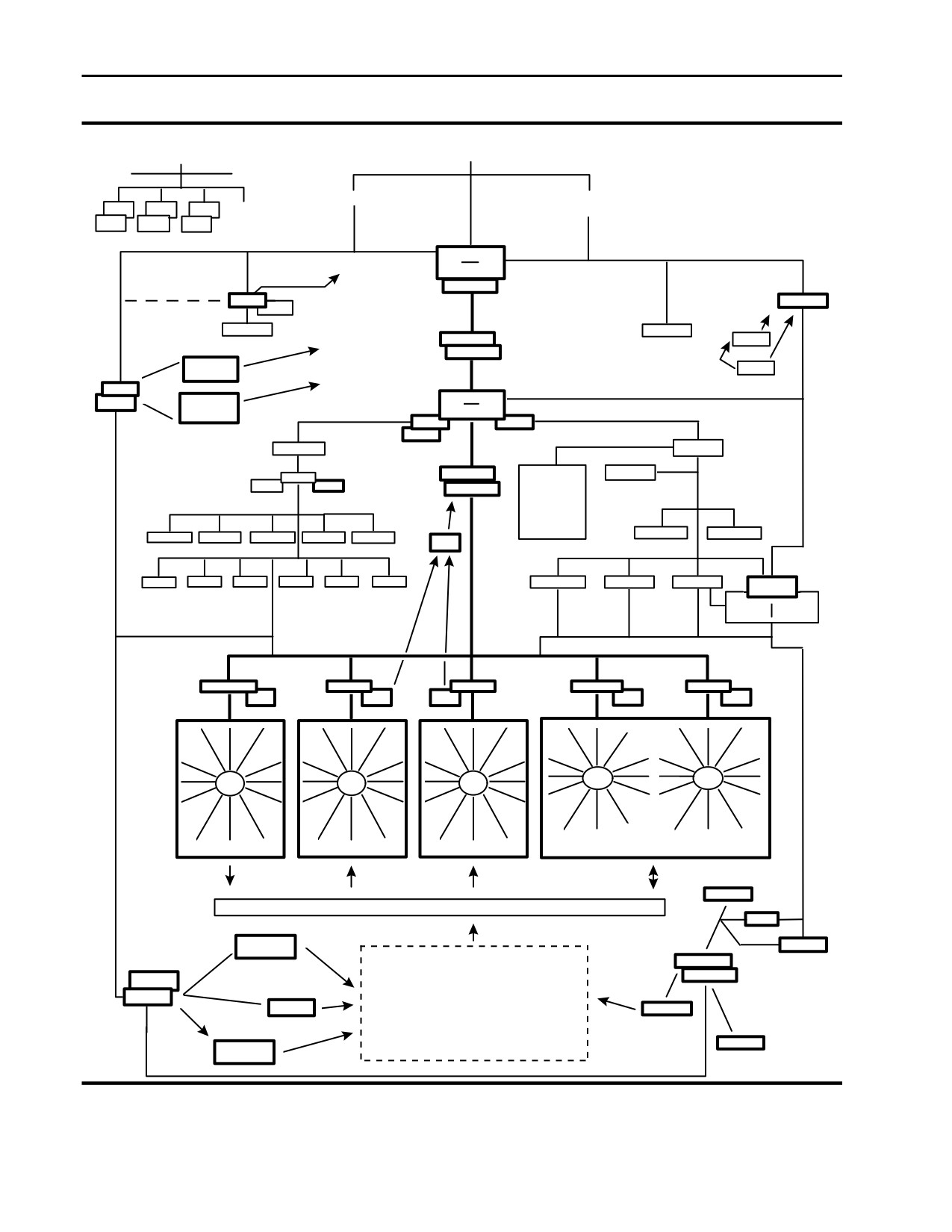
a. Figure 12-4 shows the organizational frame-
programming, and budgeting. The fourth, execution,
work within which the PPBES operates.
applies uniquely to the Army as a distinct system
phase. PPBES cycles overlap as do the four phases
within each cycle. The sections that follow explain
the phases.
12-11
FM 100-11, Force Integration
Congress
President
CBO
GAO
National Security Council
Office of Management
SBC
SASC
SAC
Other
and Budget
HBC
HNSC
HAC
SECDEF
National Command
DEPSECDEF
Military advice
Authorities
EXCOM
CJCS
USD(A&T)
Communications
JCS
Joint Staff
OSD
DRB
DAB
PRG
Views and
JROC
comments
CINCs
SA
ACCs
Integrated
priority lists
CSA
VCSA
USA
AVCSA
Army Staff
OSA
ARB
ASA(CW)
DAS
Gen Counsel
DM
DPAE
ARBSG
TIG
(Civil Works a non
Auditor Gen
FYDP program)
CLL
CPA
ASA(ILE)
ASA(M&RA)
DCSINT
DCSLOG
DCSOPS
DCSPER
ACSIM
PSG
COE
TSG
CNGB
CAR
TJAG
CC
ASA(FM&C)
AASA
DISC4
AAE/
ASA(RDA)
MILDEP MILDEP
Info Sys
Wpn Sys
ADCSOPS
DPAE
DAB
DPAE
DAB
SPC
PBC
PBC
PBC
PBC
COE DCSOPS
COE
DCSOPS
COE
DCSOPS
COE
DCSOPS
COE
DCSOPS
ASA
ASA
ASA
ASA
ASA
(RDA)
(RDA)
(RDA)
DCSPER
(RDA)
DCSPER
(RDA)
DCSPER
DCSPER
DCSPER
CNGB
DISC4
CNGB
DISC4
CNGB
DISC4
CNGB
DISC4
DISC4
CNGB
MDEP
Bdgt
TAP
POM
Bdgt
AASA
CAR
AASA
CAR
AASA
CAR
AASA
CAR
AASA
CAR
DCSINT
DCSINT
DCSINT
DCSINT
ASA
TSG
,
ASA
TSG
,
ASA
DCSINT
ASA
ASA
(FM&C)
(FM&C)
(FM&C)
TSG
,
(FM&C)
TSG
,
(FM&C)
TSG
,
,Other
,Other
,Other
,Other
,Other
ACSIM
DCSLOG
ACSIM
DCSLOG
ACSIM
DCSLOG
ACSIM
DCSLOG
ACSIM
DCSLOG
Programmatic
Financial
Planning
Programming
Budgeting
Execution
TRADOC
Program Evaluation Groups
AMC
MACOM &
PEO/PMs
PEO POMs
Army appropriations
WFLA-SISA
Operation & construction
RDA
RDP
PEOs
Operation and maintenance
MACOMs
RDTE
Military pay
CINC Pri
Procurement
RDAP
Military construction
Manpower
TRADOC
Force Struct
Military
Civilian
& Stationing
Figure 12-4. PPBES Framework
12-12
FM 100-11, Force Integration
needed, the JSR produces a long-range vision paper
Section V:
addressing plausible strategic settings 10 to 20 years
Planning Phase
in the future.
12-15. OSD and joint strategic planning
12-17. JSPS documents and plans
Drawing on guidance from the NSC, OSD planning
As mentioned, the JSPS generates five products.
and joint strategic planning combine to make up
a. National Military Strategy. The CJCS ap-
PPBS planning. The planning examines the military
proves and issues the NMS. This strategy advises
posture of the United States in comparison with na-
the SECDEF, and after SECDEF review, the Presi-
tional security objectives and resource limitations. It
dent and the NSC on the strategic direction of the
develops the national military strategy, and identifies
armed forces. A standing document, which is
force levels to achieve the strategy. Products of OSD
changed when needed, the NMS applies to the pro-
and joint strategic planning provide a framework of
gram years which are 2 to 8 years in the future.
requirements, priorities, and risk. The following
b. Joint Planning Document. The JPD derives
paragraphs restate portions of the planning discus-
from the NMS. Prepared by the Joint Staff with the
sions of Chapter 1 to provide context for this sec-
service chiefs and the CINCs, the document exists as
tion.
seven stand-alone volumes. Each volume advises the
a. NSC guidance. Two sets of NSC documents
SECDEF on requirements and programming priori-
bear importantly on the PPBS process. Presidential
ties in a specific functional area. Published in Sep-
Decision Directives (PDD) make up one set. A PDD
tember in the odd year, the JPD receives distribution
promulgates presidential decisions implementing
in time to influence the biennial DPG.
National security policy and objectives in all areas
involving National security. Presidential Review
c. Joint Strategic Capabilities Plan. The JSCP
Directives (PRD) make up the second set. A PRD
underlies the capabilities-based military advice the
CJCS gives the President and SECDEF. Another
directs studies involving National security policy and
standing document, the JSCP, undergoes revision as
directives.
needed, receiving formal review early each even
b. Joint strategic planning.
year. The JSCP covers the 2-year, near term plan-
(1) Joint strategic planning examines the
ning period. It gives strategic guidance to the
global security situation. It develops national mili-
CINCs, JCS members, and heads of Defense agen-
tary strategy to achieve national security objectives
cies. It tasks CINCs to develop major and lesser re-
and sets related force requirements. It also prepares
gional plans to employ the forces that are appor-
strategic and contingency plans, prepares supporting
tioned to them as a result of completed program and
joint logistic and mobility plans, and conducts capa-
budget actions.
bility assessments. Joint strategic planning underlies
d. Chairman’s Program Recommendation. The
the military advice the Chairman gives to help the
CPR provides recommendations for developing
President and SECDEF direct the armed forces and
Service and Defense agency POMs. It compares
formulate Defense policy, programs, and budgets.
planning guidance and objectives with current and
(2) Joint strategic planning takes place within
projected resource profiles from the most recent
the context of the JSPS. Featuring a continuous re-
President’s Budget and related FYDP. It recom-
view of the national military strategy, the JSPS
mends changes in programs to correct deficiencies in
yields five principal products described in the para-
capabilities and to align resources more closely with
graph on JSPS documents and plans, below. The
plans and requirements. Completed about the same
products help the joint community relate strategic
time as the DPG, the document helps the SECDEF
planning to both the JOPES and PPBS.
make strategic decisions to guide POM development.
12-16. Joint Strategy Review
e. Chairman’s Program Assessment. The CPA
checks the balance and capabilities of composite
The Joint Strategy Review (JSR) lies at the core of
force and support levels recommended by the Serv-
the JSPS. The review helps the Joint Staff integrate
ice POMs. It compares the recommended capabili-
strategy, operational planning and program assess-
ties and levels with priorities recommended by U.S.
ments. It covers the short-, mid-, and long-range pe-
strategic plans and requirements of the CINCs.
riods, 0-2, 2-10, and 10-20 years in the future. A
Completed about 45 days after the Services submit
continuous process, the JSR assesses the global
their POMs, the document helps the SECDEF make
strategic setting for issues affecting the national
program decisions ultimately recorded in PDMs that
military strategy. Key judgments appear in the JSR
approve Service POMs with specific changes.
annual report. Provided to the CJCS, Service Chiefs,
and CINCs, the report, when approved by the
Chairman, becomes guidance for maintaining or re-
vising the NMS and other JSPS products. As
12-13
FM 100-11, Force Integration
12-18. OSD planning products
hold over the 10-to-20 year period, the ALRPG lays
out long-range planning assumptions and objectives.
Two SECDEF documents influence products of the
JSPS. One is DPG, the other Contingency Planning
b. The ALRPG examines political, military,
Guidance (CPG).
economic, and technological events. The examina-
tion identifies trends and determines a range of pos-
a. Defense Planning Guidance. The SECDEF
sible results that bound the future operating envi-
places responsibility and authority for program exe-
ronment. It also draws implications for future mis-
cution with the services and other DOD components,
sions and for achieving required capabilities. The
but maintains central direction. Serving this central
biennial plan helps commands and agencies translate
purpose, the DPG presents the SECDEF’s strategic
leader vision into long-range plans. Command and
plan for developing and employing future forces.
agency long-range plans, in turn, help fashion the
Prepared by OSD and published normally in the odd
midterm vision by setting goals and strategies to get
year before POM preparation, the DPG is a princi-
the capabilities to meet future requirements. To-
pal product of OSD planning. It reflectsæ
gether, the ALRPG and command and agency long-
(1) Military advice and information recom-
range plans guide the TAP. In addition, the ALRPG
mended by the CJCS.
sets the course for requirements determination and
(2) Service long-range plans and positions on
force development for the next PPBES cycle.
policy and other matters advanced by service Secre-
taries.
12-22. Army requirements determination process
(3) CINC appraisals of major issues and
The U.S. Army Training and Doctrine Command
problems bearing on command missions.
(TRADOC) manages the Army’s requirements de-
termination process. Applying war-fighting concepts
b. Contingency Planning Guidance. The CPG
for the future and experimentation in TRADOC
provides the CJCS written policy guidance for pre-
Battle Labs, the process compares desired joint and
paring and reviewing contingency plans. Focusing
Army capabilities in relation to the anticipated threat
NMS and DPG guidance on contingency planning,
and known deficiencies. From this comparison the
the CPG bears directly on the JSCP. The SECDEF
process derives mutually dependent requirements
prepares the document annually in coordination with
stressing the overall need of the future Army across
the Joint Staff. Then, on approval by the President,
the spectrum of training, leader development, or-
the SECDEF provides guidance to the Chairman.
ganization, materiel, and soldiers (DTLOMS).
12-19. Army planning
12-23. Army Modernization Plan
Army planning responds to and complements OSD
The Army Modernization Plan (AMP) outlines the
and joint strategic planning. Army planning helps the
vision for modernizing the future force and a strat-
senior Army leadership determine force requirements
egy for near to midterm force development and long-
and objectives and set priorities. Army planning also
term evolution. The AMP provides a start point for
provides the basis for positions and comments sup-
developing the RDAP. Its modernization objectives
porting Army participation in OSD and joint proc-
guide program prioritization at HQDA.
esses, and it lays the planning basis for the Army
program.
12-24. Army research, development, and acquisi-
tion plan
12-20. Role of long-range planning
The RDAP is a 15-year plan for developing and
Army long-range planning looks 10 to 20 years
producing technologies and materiel to support
ahead. In the process, the senior Army leadership
Army modernization. The plan centers on integrating
creates a vision of the future Army. Fleshing out the
new doctrine, training, organization, and equipment
design, commands and agencies develop long-range
to develop and field war-fighting capabilities. It con-
plans in their respective mission and functional ar-
verts materiel requirements from an unconstrained
eas. Long-range planning guides the midterm vision
planning environment to a balanced RDA program
to develop the force and set program requirements.
that is both technically and fiscally achievable. Con-
12-21. Army Long Range Planning Guidance
forming to force structure guidelines, the plan seeks
to maximize war-fighting capabilities and supporting
a. Scheduled for distribution in the fall of even
infrastructure within resources expected to be avail-
years, the ALRPG records the vision of the senior
able.
Army leadership. It describes a framework for de-
fining future requirements. It then examines national
a. In December each year, TRADOC provides
security objectives against a range of potential re-
recommendations to HQDA on material require-
quirements. Listing underlying conditions likely to
ments for the RDAP and POM. To arrive at the rec-
ommendations, TRADOC applies a process known
12-14
FM 100-11, Force Integration
as Warfighting Lens Analysis (WFLA). The process
12-26. Force development and total Army analysis
takes into account such guidance as the National
PPBES planning develops an achievable force
Military Strategy, OSD DPG, CINC IPLs, the AMP
structure for America’s Army that supports the Na-
and the TAP. It compares future required capabili-
tional Military Strategy. The approach centers on
ties of the total force against the fiscally constrained
TAA, a computer-aided force developmental process
budgeted force. In doing so it determines force mod-
that gets under way about January of the even year.
ernization needs, which TRADOC prioritizes ac-
TAA results in a recommended fiscally constrained
cording to their contribution to mission accomplish-
force which, when approved by the Army leadership,
ment.
sets the force structure baseline for the POM. TAA
b. AMC performs an analogous function in de-
is discussed in detail in Chapter 6.
termining requirements for RDA science and infra-
structure
(S&I). Supporting warfighting, moderni-
12-27. Command planning and documentation
zation, and other HQDA high visibility programs,
As discussed in Chapter 6, detailed integration and
S&I requirements are defined, ordered in priority,
documentation of the programmed force centers on
and managed by materiel developers’ labs, RDE
the management of change (MOC) window. The
centers, and support activities. Each year during
Army uses this period to update and create MTOE
October through February, AMC reviews the re-
and TDA documents. These documents officially
quirements jointly with other materiel developers.
record decisions on missions, requirements for or-
These include the Corps of Engineers (COE), Medi-
ganizations, and authorizations for personnel and
cal Research and Materiel Command
(MRMC),
equipment. TOE and BOIPs are the source of per-
USASMDC, and Army Research Institute (ARI).
sonnel and equipment requirements for MTOE units.
The review integrates and sets priorities for require-
a. The process begins with the Command Plan
ments and reconciles funding allocations. AMC rec-
(CPLAN) guidance message, released by HQDA
ords the results in the Science and Infrastructure
(ODCSOPS) at the start of the MOC window.
RDA Plan (SIRDAP), which it forwards and briefs
CPLAN guidance sets the focus for the MOC win-
to HQDA each February.
dow, establishes documentation priorities and ac-
tions, and provides force structure allowances
12-25. The Army Plan
(FSA). MACOM CPLANs reflect the current and
Linking strategic policy, planning, and program-
projected force structure of each command.
ming, the TAP lies central to planning, program-
CPLANS normally contain only military manpower.
ming, and budgeting. Strategic policy considerations
After HQDA review, DCSOPS publishes an ad-
include the National Security Strategy, the National
justed Master Force (MFORCE) and an associated
Military Strategy, and policies set by the senior
civilian annex reflecting the approved plan. The ad-
DOD and Army leadership. Planning considerations
justed MFORCE provides the basis for resourcing
derive from the DPG and, as described below, total
personnel and equipment in the draft MTOEs and
Army analysis (TAA).
TDAs.
a. The TAP projects operational tasks and ca-
b. The Army uses the Army Authorization
pabilities at midrange, or sixth program year, and
Documents System-Redesigned (TAADS-R) system
for the long range 10 years beyond.
to record changes in MTOE and TDA authorizations
b. The TAP provides detailed programming
that result from changes in unit missions, require-
guidance derived from its planning guidance. The
ments for organizations, and equipment.
TAP gives Army programmers a hierarchical list of
c. The Structure and Manpower Allocation
programming goals, objectives, and tasks. By re-
System (SAMAS) serves as the force development
flecting relative resourcing priorities, it also reflects
database that records the authorized level of man-
senior leadership decisions. The format for the pro-
power and force structure for the Army program and
gramming portion of the TAP parallels the title 10
budget.
PEG structure covering manning, training, organiz-
d. At the close of the MOC window, the Auto-
ing, equipping, sustaining, and installations.
matic Update Transaction System (AUTS) is run.
c. The DCSOPS Resource Analysis and Inte-
AUTS compares the CPLAN and MFORCE against
gration Office prepares the TAP each odd year. In-
the TAADS-R documents. When discrepancies are
corporating input from field commands, the process
discovered, the TAADS-R documents are corrected
proceeds in concert with DPAE, the PEGs, and the
or the MFORCE is adjusted to match TAADS-R.
HQDA staff. DCSOPS then distributes the approved
e. The Structure and Composition System
TAP to Army Component Commanders (ACCs) and
(SACS), in conjunction with Force Builder (a man-
MACOMs in time for them to prepare their input to
agement database integration system), produces the
the Army POM.
Army’s time-phased demands for personnel and
12-15
FM 100-11, Force Integration
equipment over the current budget and program
manpower, operation and maintenance, housing, and
years.
construction.
b. The POM presents the Army’s proposal for a
12-28. Operational planning link
balanced allocation of its resources within specified
Operational planning addresses the 0-2 year short-
constraints. OSD reviews the POM and issues a
range planning period. It takes place under JOPES
PDM to reflect SECDEF program decisions. The
and the counterpart Army Mobilization and Opera-
program, as approved by the SECDEF, provides the
tions Planning and Execution System (AMOPES).
basis for preparing Army budget estimates. During
Through JOPES, the CINCs and their Service com-
execution, program reviews help HQDA, MA-
ponent commands develop concept plans
COMs, PEOs, and other operating agencies make
(CONPLAN) and operation plans (OPLANs). Ca-
sure that financial allocations support approved pro-
pabilities based, the plans employ the current force
gram objectives.
to carry out military tasks assigned in the JSCP.
Plan preparation and review return information
12-30. Army Program Guidance Memorandum
about shortfalls and limiting factors for considera-
The APGM augments programming guidance given
tion in current planning, programming, and budget-
in the TAP. It transmits programming changes and,
ing.
as required, clarifies and expands programming
a. Missions and Tasks. The JSCP carries out
guidance originally published in the TAP. HQDA
the NMS through unified combatant command
publishes the APGM at the beginning of preparation
OPLANs. Its accompanying intelligence estimate
of the HQDA POM.
assesses potential threats and their impact on avail-
able U.S. forces. Based on the assessment, the
12-31. Program development
document assigns missions and planning tasks to the
Army program development formally gets under way
CINCs. It also apportions the combat forces ex-
when HQDA publishes the TAP and its related
pected to be available. Annexes amplify guidance,
APGM in the fall of the odd year. Reflecting af-
capabilities, and tasks in specified functional areas.
fordability analyses from the FFR process, the TAP
b. OPLAN development and review. HQDA
locks the preliminary program force and stabilizes
provides ACCs, supporting MACOMs, and reserve
manpower and key equipment requirements for pro-
components additional guidance through AMOPES.
gram development. The provisions of the TAP apply
AMOPES provides planning assumptions, policy,
to HQDA, MACOMs, PEOs, and other operating
and procedures.
agencies.
(1) Time-phased Force Deployment Data
12-32. Program development process
(TPFDD) for ACCs specify arrival priorities for
Using the MDEP as a building block, program de-
force augmentation, resupply, and troop replace-
velopment refines and extends the program of the
ment. TPFDD review, and later, logistics and trans-
previous POM Cycle. Typically, under the biennial
portation assessments help refine the priorities to be
cycle, program development by MACOMs, PEOs,
consistent with CINC OPLANs.
and other operating agencies gets under way early in
(2) In July
(odd year), the CINCs submit
the odd year. The resource position reflected in the
their OPLANs for final JCS review and approval.
FYDP for the President’s Budget and related PBG
The OPLANs provide a basis for CINC IPLs, which
serve as the base for developing program require-
influence program development.
ments. Then, on a schedule set by HQDA, the MA-
COMs, PEOs, and other operating agencies prepare
Section VI:
and submit their POMs to HQDA.
Programming Phase
a. HQDA agencies, guided by the APGM, col-
12-29. Army programming
lect and review program information. They study the
a. Army programming helps the senior Army
existing program considering new requirements, de-
leadership distribute resources to support Army
termine program needs, and then begin preparing
roles and missions. Programming translates planning
their functional programs. Under DPAE lead, the
decisions, OSD programming guidance, and Con-
agencies incorporate program requirements into
gressional guidance into a comprehensive allocation
POM alternatives directed and constructed to
of forces, manpower, and funds. In the process, pro-
achieve programmatic balance. Key considerations
gramming integrates and balances centrally managed
includeæ
programs for manpower; operations; research, de-
(1) Resource assessments and new require-
velopment, and acquisition; and stationing and con-
ments submitted by MACOMs, PEOs, and other
struction. Concurrently, programming incorporates
operating agencies.
(Information for the program
requirements stated by MACOMs and PEOs for
12-16
FM 100-11, Force Integration
years in the RDAP provides RDA program input,
(2) An important aspect of the POM update
serving a function comparable to agency POMs.)
centers on program resource allocations for the up-
coming (or second) budget year. The aim is to make
(2) CINC IPLs and ACC-developed require-
the allocations as correct as possible in terms of
ments supporting them.
program balance and executability. By re-examining
(3) The DPG.
the POM, the task of making program resource
(4) Final Army fiscal guidance provided by
changes shifts from budget analysts to program
OSD toward the end of program development.
analysts.
b. Proponent agency PEGs, guided by DPAE,
12-35. OSD program review
build the Army program using a strategy approved
by the SA and CSA. The PEGs review MDEP re-
Also known as the summer issue cycle, OSD pro-
sources from a functional or program perspective.
gram review begins soon after POM submission and
The PEG also reviews command and agency zero-
continues normally until mid to late summer. The
sum realignments, which reallocate programmed
review features program review proposals that rec-
resources to meet existing shortfalls and changed
ommend alternatives to POM-submitted programs.
requirements. The purpose of the review is to make
a. Issues arise early in the process. They develop
sure that proposed reallocationsæ
from review by members of the DRB and nonmem-
(1) Conform to legal restrictions and Army
ber Assistant Secretaries of Defense who manage
policy and priorities.
specific programs.
(2) Avoid imprudently high risk, given recent
b. Issues divide into three tiers, which determine
Congressional action.
their treatment. Tier I topics concern such matters as
CINC issues, risk, modernization, and readiness.
(3) Do not cause a mandatory program or
The DRB deliberates these issues in a series of
subprogram to become unexecutable.
meetings from May through August. Tier II topics
12-33. Army program reviews
become individual issue papers that receive staffing
within OSD and with the Services and Defense
a. Beginning early in the process until its sub-
agencies. Tier III topics become items for later
mission to OSD, the maturing program undergoes
budget review sent to the DOD Comptroller with
periodic review by the senior Army leadership.
possible options.
Along the way, the PBC, which oversees the POM
build, reviews and adjusts program issues and sets
12-36. Program Decision Memorandum
preliminary positions. As appropriate, the PBC re-
Typically, in mid to late summer, after the DRB has
turns the results of its deliberations to the Army
debated all outstanding issues, the DEPSECDEF
Staff or Secretariat for action or passes the results to
signs the PDM. The PDM approves the POM with
the ARBSG or ARB for review or approval.
specific changes as the program basis for Army
b. The Army Commanders’ Conference sched-
budget estimates to be submitted to OSD.
uled at the start of HQDA’s program process pro-
vides field commanders an early chance to influence
Section VII:
program alternatives.
Budgeting Phase
12-34. POM preparation and submission
12-37. Budget formulation and justification
a. HQDA prepares the POM in the spring of
Army budgeting proceeds in three stagesæ formu-
each even year. The POM reflects program actions
lation, justification, and execution. The budgeting
fleshed out by the HQDA staff with DPAE. It also
phase addresses budget formulation and justifica-
documents the program decision of the SA and CSA.
tion.
Submitted to OSD, the POM presents the Army
12-38. Formulation
program for its review.
Budget formulation requires developing detailed
b. Congress requires the President to submit an-
fund estimates to support Army plans and programs.
nual budgets under the biennial cycle, however, has
The task produces Army budget estimates that are
led OSD to prepare a POM update in the off-cycle
ultimately incorporated in the President’s Budget.
year.
The process includes a joint analytical review of the
(1) Typically, the off-cycle update re-looks at
Army’s BES by OSD and the OMB. During the re-
the previous biennial POM, now minus one year. It
view, OSD issues PBDs signed by the SECDEF or
revises the program to keep its five remaining years
DEPSECDEF. Budget formulation concludes with
consistent with original decisions and strategy. It
the transmission to Congress of the approved DOD
also adjusts to program decisions reflected in the
budget as part of the President’s Budget.
PDM and budget decisions reflected in PBDs.
12-17
FM 100-11, Force Integration
12-39. Transition from the program
b. Operating costs include total costs of operat-
ing the support activity
(for example, personnel,
On receiving the PDM, the DPAE, with the Army
travel, transportation, supplies and materials) as
Staff and Secretariat, adjusts the program. The
well as depreciation on capital equipment. Capital
DPAE then forwards the result to the DAB. Led by
costs include investment items costing over
the DAB and using the POM as a baseline, HQDA
$100,000 and having a life expectancy greater than
formulates the BES, which covers the prior year, the
two years (for example, equipment; software; hard-
current year, and the two budget years. (For off-
ware; minor construction; reliability, maintainability
cycle updates, the BES covers the second year of the
and supportability modifications).
original budget submission.)
c. Revolving fund activities in the AWCF re-
12-40. Incorporating command and agency
cover their costs through stabilized prices charged to
budget data
customers. These rates remain constant throughout a
a. During MACOM and PEO POM develop-
fiscal year to protect customers from unforeseen
ment, HQDA solicits from commands and agencies
inflationary pressures and other cost uncertainties.
the data later needed to prepare budget estimates.
The fund has the ability to absorb those unforeseen
Used in support of the BES, MACOM budget data
costs within a fiscal year (that is, incur a loss) and
mainly affects the 2 budget years. This is because
then must recover any losses (or return any gains) in
changes here make a difference in the request that
the subsequent year’s rate structure.
will go to Congress as the President’s Budget.
12-42. Preparing the Budget Estimates Submission
b. Budget processes paralleling those for devel-
Budget formulation converts the first two years of
oping the BES apply to appropriate MACOMs for
the program approved by the PDM into Army
RDTE, procurement, and military construction re-
budget estimates. Work proceeds per administrative
sources. They apply also to resources required by
instructions issued by ASA(FM&C) that supplement
the ARNG and USAR. The results of another proc-
a DOD budget guidance manual and OSD budget-
ess affecting final estimates are those of acquisition
call memorandum.
reviews held in the spring and summer when materiel
development and procurement programs undergo
a. Through appropriation sponsors, the DABæ
evaluation. The reviews consider recent execution
(1) Develops Army budget estimates from
experience in pricing and projected program
POM dollar and manpower levels as adjusted by the
changes. Major issues failing to receive required
PDM.
resources at these levels go to the PBC and ARB for
(2) Revises the estimates to incorporate
review and to the SA and CSA for decision.
changes determined through review of MACOM
input and centralized programs for the RDTE, pro-
12-41. Funding designated support functions: the
curement, construction, and military personnel ap-
Army Working Capital Fund
propriations.
In relatively recent initiatives, OSD changed the way
DOD components program and budget for desig-
(3) Adjusts budget estimates to conform to
changes required by pending authorization and ap-
nated support functions. To increase cost visibility,
propriation legislation.
DOD adopted a financial management system based
on cost per output or unit cost. DOD then installed a
b. Beginning in May, for both the POM year
business operations fund to further improve tools
and off-cycle odd year, appropriation sponsors re-
available to managers of DOD support functions. Its
view and mark up estimates prepared for each ap-
successor, the Army Working Capital Fund
propriation. A major objective is to maintain con-
(AWCF) embraces both revolving funds (industrial
sistency with the program. Appropriation sponsors
and stock) and certain appropriated-fund activities
brief the results of staff decisions arising from the
(including finance and accounting services and
review to the PBC when presenting appropriation
commissary operations).
budgets for approval. PEG chairmen follow with a
programmatic assessment of the budget.
a. The AWCF provides a financial framework
within which designated support organizations oper-
c. During the process, the DAB chairs the PBC.
ate. It is a business-type system, accounting for total
The PBC reviews the appropriation sponsors’
costs and relating them to outputs produced. Full
“scrub” of their budget estimates to make sure the
cost visibility for both providers (AWCF businesses)
estimates reflect SA and CSA guidance. It resolves
and their customers gives managers information on
issues that arise during formulation and discusses
the cost implications of their decisions. As in any
the PEGs’ programmatic assessment as well as con-
business, the costs include both operating and capi-
sidering alternatives to appropriation sponsor pro-
tal (investment-type) items.
posals. At the end, the DAB aggregates the separate
12-18
FM 100-11, Force Integration
estimates, including those of the ARNG and USAR,
the final changes in the developing President’s
into a single Army budget.
Budget while the DPAE uses the information to ad-
just or revalidate the program.
12-43. Review and approval
e. The DAB supervises the PBD and MBI proc-
The PBC presents summary budget estimates to the
esses and throughout the reviewæ
ARB for review and final decision by the SA and
(1) Maintains coordination between the DOD
CSA. Once proposed estimates receive approval,
Comptroller and HQDA.
appropriation sponsors, aided by managers for pro-
(2) Makes sure that adjustments to fiscal
gram and performance, prepare detailed justification
controls are correct on all records for each PBD.
books and furnish DPAE update tapes reflecting the
(Verification of corresponding manpower controls is
approved BES. The DAB prepares the executive
an ASA(M&RA) responsibility.)
summary of the budget and a forwarding letter from
the SA to the SECDEF. Separately, the DAB sub-
(3) Gives special attention to any PBD under
mits the justification books by appropriation to
appeal since the DEPSECDEF may revise the
OSD, and the DPAE submits an update tape for the
pending adjustments on review.
FYDP. The combined events constitute the Army’s
BES to OSD.
12-45. President’s Budget
After implementing the final resource distribution at
12-44. OSD and OMB budget review
the budget activity and object class level, HQDA
Members of OSD and OMB jointly review the BES.
sends the information to OSD. OSD and OMB for-
Also called the fall review, this joint review focuses
ward the information as the Army’s portion of the
on proper pricing, reasonableness, and executability.
Defense budget, which OMB incorporates into the
President’s Budget.
a. Appropriation and program sponsors provide
appropriation and program overviews at OSD and
a. The President’s Budget covers prior year ob-
OMB hearings and respond to questions on the
ligations and updated resource estimates for the cur-
budget submission. Based on the hearings and dis-
rent year. It also covers TOA estimates for the
cussions with Army budget analysts, OSD analysts
budget year and budget year plus one.
draft PBDs for review and coordination.
b. Budget analysts translate decisions into pro-
b. PBDs usually present at least one alternative
gram changes, posting PEs, MDEPs, and MACOM
to the budget area addressed. An alternative poses
distributions, as required. Managers for program
dollar and manpower increases or decreases. They
and performance update their internal systems.
may issue from errors or from the strength of the
c. The DAB forwards data base update tapes to
justification. Sometimes they are motivated by cost
the DPAE, and the DPAE updates the database to
savings or the need to reflect changes in policy.
produce the President's Budget FYDP. (As men-
Sometimes they result from analytical disagreement.
tioned, a 1987 statutory change (10 USC 114a) re-
Whatever the reason, the Army analyzes each PBD
quires DOD to submit a President's Budget FYDP to
and responds to OSD, either agreeing or disagreeing
Congress each year.)
with the OSD position.
c. ASA(FM&C) meets with the DOD Comp-
12-46. Justification
troller at periodic Service financial manager meet-
Budget justification involves defending budget
ings. At these meetings, toward the end of the PBD
requests for the Army’s various programs and ap-
cycle, ASA(FM&C) discusses financial management
propriations before Congress. The SA and CSA tes-
(FM) direct appeals. The Joint Staff coordinates
tify in support of the Army’s budget request before
major budget issues (MBI) affecting a combatant
the Senate Armed Services Committee (SASC) and
command to get CINC comments and, if appropri-
the HNSC (the authorizations committees), and the
ate, CINC support. At the end of the PBD process,
HAC and SAC. After review, the Senate and House
the SA and CSA meet with the SECDEF and
vote on the bills of their respective committees. On
DEPSECDEF on MBIs. The SECDEF decides each
final passage, Congress forwards the approved
issue and, if necessary, meets with the President to
authorization and appropriations bills to the Presi-
request fund restoration or to recommend other ac-
dent, who signs each bill.
tion.
12-47. Budget hearings
d. In December, at the end of the PBD cycle,
OSD normally issues a final PBD or OSD memo-
As mentioned, the Army presents and defends its
randum incorporating any changes from MBI delib-
portion of the President’s program before Congress.
erations, thus completing the PBD process. OSD
The process proceeds formally and informally under
then issues each service its final TOA and man-
the staff supervision of the Chief of Legislative Liai-
power controls. For the Army, the DAB incorporates
son and ASA(FM&C).
12-19
FM 100-11, Force Integration
a. After the President formally submits the
ens financial accounting and management to make
budget, the Army provides detailed budget justifica-
sure financial reports accurately reflect the results of
tion to the authorizations and appropriations com-
budget execution. The Army, OSD and Congress
mittees. First, however, appropriation sponsors will
apply execution feedback to adjust resource re-
have prepared material in Army justification books
quirements.
to conform with decisions of the President and
SECDEF and congressional requirements for for-
12-51. Financial management
mats and supporting information. Justification books
a. Budget execution applies the funds appropri-
undergo internal Army review under ASA(FM&C)
ated by Congress to carry out authorized programs.
and are then sent to OSD for final review.
Applying Congressionally appropriated funds entails
b. The SASC and HNSC conduct authorization
apportioning, allocating, and allotting the funds; ob-
hearings for the various programs and appropria-
ligating and disbursing them; and associated report-
tions. Concurrently, the Army’s budget request goes
ing and review. The procedure also entails perform-
before the House and Senate Appropriation Com-
ing in process evaluations and making necessary
mittees
(HAC and SAC, respectively). In these
course corrections to reallocate resources to meet the
hearings, the SA and the CSA normally testify first.
changing requirements that develop during execu-
Then, helped by ASA(FM&C) and the Chief of
tion.
Legislative Liaison, appropriation sponsors present
b. The joint reconciliation program applies the
and defend the details of the budget.
skills of those responsible for various aspects of fi-
nancial management. The skills include those of ac-
12-48. Legislative approval and enactment
countants, budget and program analysts, contracting
When the Congressional sub-committees complete
professionals, logisticians, and internal review
their review, the Senate and House vote on the com-
auditors. The program applies the combined skills to
mittee bills. Differences between the Senate and
verify the validity of unliquidated obligations, con-
House versions get resolved via a joint conference.
tractor work in process, billing status, and the con-
Budget justification ends when the President signs
tinuing need for goods and services not yet delivered.
the authorization and appropriation bills for the
The program achieves dollar savings by identifying
coming fiscal year. Enacted into law, Army appro-
and canceling obligations for goods and services no
priations provide the legal authority to incur obliga-
longer needed or duplicative. The program also rec-
tions and make payments.
onciles current appropriations to verify the correct-
ness of amounts obligated. In addition, the program
12-49. Continuing resolution authority
assures the liquidation of appropriations to be can-
When Congress fails to pass an appropriation by the
celed by the end of the fiscal year.
end of September, it may pass a continuing resolu-
c. Budget execution includes financing unbudg-
tion. Continuing resolution authority (CRA) derives
eted requirements that result from changed condi-
from emergency legislation that authorizes the
tions unforeseen when submitting the budget and
funding of Government operations in the absence of
having higher priority than the requirements from
appropriations. A temporary measure, the CRA
which funds are diverted (reprogramming).
usually restricts funding to the prior year level and
prohibits new initiatives. HQDA separately pub-
12-52. Funds control
lishes specific policy on how the Army will operate
Several events occur before the Army can execute its
under the CRA. Failure to pass either an appropria-
programs for a new fiscal year under a new appro-
tion or CRA could result in a temporary close down
priations act. First, OMB apportions the appropria-
of Government operations. Normally, however, until
tions, which provides obligation/budget authority.
an appropriation or CRA is enacted, DOD continues
The Department of the Treasury then issues a
minimum essential operations based on the require-
Treasury Warrant providing cash or disbursing
ments of national defense.
authority. Finally, the DOD Comptroller releases
program authority.
Section IX:
a. Apportionment. An apportionment distributes
Execution Phase
funds by making specific amounts available for ob-
12-50. Execution
ligation.
During execution, the Army manages and accounts
b. Program release. The DOD Comptroller re-
for funds and manpower to carry out approved pro-
leases the program to the Army for execution. For
grams. It checks how well HQDA, MACOMs,
investment accounts, HQDA releases program and
PEOs, and other operating agencies use allocated
budget authority in equal amounts. The program
resources to carry out program objectives. Through
release for the operating accounts, OMA and
the Army Joint Reconciliation Program, it strength-
MILPERS, are contained in an obligation authority
12-20
FM 100-11, Force Integration
(OA) letter issued by the DOD Comptroller. A sepa-
12-56. Revised approved program for RDTE
rate OA letter is issued for Family Housing, Army
HQDA issues a Revised Approved Program (RAP)
(Operations) (AFHO).
for the RDTE appropriation, replacing a tentative
initial program used as a start point. The RAP
12-53. Allocation, obligation, and reconciliations
shows congressional changes at both PE and project
Guided by appropriation and fund sponsors at
level. In addition, the RAP spreads general reduc-
HQDA, ASA(FM&C) allocates apportioned funds
tions at the project level. It includes the amounts set
to operating agencies. Operating agencies, in turn,
aside for the Small Business Innovation Research
make funds available to subordinate commands and
Program (SBIR) and the Small Business Technology
installations by an allotment. Allotments authorize
Transfer Pilot Program (STTR) as specified in Pub-
users to place orders and award contracts for prod-
lic Law 102-564. The RAP also includes amounts
ucts and services to carry out approved programs.
withheld by the DOD Comptroller and DA and pro-
Installations obligate funds as orders are placed and
vides language on Congressional restrictions as well
contracts awarded. They make payments as materiel
as Congressional special interest items. Because of
is delivered or as services are performed. Finally,
the level of detail and the extensive information in-
installations, MACOMs, and appropriation sponsors
cluded, the RAP remains unavailable until several
conduct joint reconciliations. Reconciliations make
months after the appropriations act is enacted.
sure financial statements and reports accurately rep-
resent the results of the apportionment, allocation,
12-57. Financing unbudgeted requirements
and allotment program. Reconciliations also make
Congress recognizes the need for flexibility during
sure payments align properly with supporting obli-
budget execution to meet unforeseen requirements or
gations.
changes in operating conditions, including those to
address minor, fact-of-life financial changes. Con-
12-54. Changes from the President’s Budget
gress accepts that rigid adherence to program pur-
a. After appropriations are enacted, appropria-
poses and amounts originally budgeted and approved
tion sponsors and the Army Budget Office review
would jeopardize businesslike performance. Thus,
the legislation to determine changes. Changes in-
within stated restrictions and specified dollar thresh-
clude Congressional additions, denial of programs,
olds, Congress allows Federal agencies to reprogram
or changes to the funding level as submitted in the
existing funds within an appropriation to finance
budget. Changes also include identification of Con-
unfunded requirements. Typically, reprogramming
gressional special interest items, undistributed re-
diverts funds from undertakings whose requirements
ductions, and any language relating to execution of
have lower priority than the new requirements being
the programs.
financed.
b. Appropriation sponsors determine how to
a. Congressional language on reprogramming,
spread any undistributed reductions. In addition,
which varies by appropriation, controls the Army’s
they may also spread some unapplied reductions in
ability to move the program within appropriations
the appropriations act, which are distributed to the
(below threshold reprogramming). Moving the pro-
services during the PBD cycle. For those reasons,
gram in excess of specified limits requires congres-
actual funding levels may not be finally set until sev-
sional approval. Moving amounts between appro-
eral months into the new fiscal year. This is so even
priations always requires a formal reprogramming
if the appropriations act is passed before October 1.
request, citing transfer authority included in the ap-
The ultimate funding level for individual programs
propriation.
typically falls short of the level shown in joint con-
b. Providing that reprogramming authority is not
ference reports.
required, another way to finance unfunded require-
ments is to apply obligation authority harvested from
12-55. Funding letters for OMA and AFHO
joint reconciliations. This technique uses unexpired
HQDA issues funding letters to operating agencies
funds originally obligated against a contract or order
for both OMA and AFHO. ARNG and USAR issue
but identified as excess to the need and subsequently
funding letters for their operation and maintenance
deobligated. Reutilizing funds in this way gives al-
appropriations. The letters indicate funded programs
lotment holders greater leverage in executing the
and give guidance on how they should be executed.
budget and increases the buying power of the
They also provide an audit trail from the resource
Army’s financial resources.
position in the President’s Budget to the revised,
c. FY 91 marked the first year of Omnibus Re-
appropriated position. The OMA funding letter out-
programming, which, except for construction ac-
lines the funding posture and goals set by the senior
counts, consolidated all DOD reprogramming ac-
Army leadership for command execution. Preparing
tions into one very large reprogramming action that
and issuing the funding letter takes about 30 days
identified all DOD reprogramming requirements at
after the appropriation act is passed.
12-21
FM 100-11, Force Integration
one time. This allowed the Congress and DOD to set
c. Oversight of nonappropriated funds. Apply-
priorities for limited funding and make smarter deci-
ing various methods, the ASA(FM&C) also oversees
sions.
nonappropriated funds. One method is by partici-
pating on the Morale, Welfare, and Recreation
12-58. Program performance and review
(MWR) Board of Directors. The Deputy Assistant
MACOMs, PEOs, and other operating agencies
Secretary of the Army (FM&C) is a voting member
carry out the approved program within manpower
of the MWR Executive Committee. In addition, the
and funds provided. They review budget execution,
Deputy Assistant Secretary of the Army (FM&C)
account for and report on use of allocated funds by
chairs the Audit Committee, and the Deputy Assis-
appropriation and MDEP. They also account for use
tant Secretary of the Army for Resource Analysis
of allocated manpower by UIC. The manpower and
and Business Practices serves on the Investment
financial data obtained help MACOMs and agencies
Subcommittee. Through these positions the
develop future requirements.
ASA(FM&C) influences virtually all aspects of
MWR financial policy. As part of the responsibility
12-59. Checking program performance
of overseeing nonappropriated funds, the
a. Quarterly Army Performance Review. The
ASA(FM&C) presents nonappropriated funds issues
quarterly Army Performance Review (QAPR) helps
to the SA and CSA during the QAPR.
fulfill the need for review and analysis during the
Section X:
PPBES execution phase. It presents a corporate
Summary
view of performance as a mechanism and forum for
assessing mission accomplishment. The QAPR cen-
Resourcing the force and its support structure en-
ters on major programs, systems, projects, and is-
gages HQDA, with the full participation of the
sues of major interest to the senior Army leadership,
MACOMs, PEOs, and other operating agencies. The
OSD and Congress.
task requires the participants, through the PPBES, to
b. Review of selected Army systems. A means to
plan, program, and budget required manpower and
check system program performance which includes
dollars and then to manage the resources ultimately
milestone reviews of designated acquisition pro-
approved. The aim is to provide the CINCs of the
grams by the Army Systems Acquisition and Review
unified combatant commands the best mix of Army
Council conducted by ASA(RDA) and the VCSA.
forces, equipment, and support attainable within
Another means includes milestone and in process
available resources.
reviews (IPRs) of designated automated information
systems by the MAISRC conducted by DISC4 and
the ASA(RDA).
12-22
FM 100-11, Force Integration
Chapter 13
Force Readiness
(3) Incremental costs of readiness increase as
Section I:
higher levels of readiness are approached. At unit
Introduction
level, sustaining high readiness is cost-intensive due
13-1. Potential effects of change on readiness
to the increased demands for repair parts and sup-
plies and training costs (ammunition and fuel). Be-
Military capability is a statement of a type unit’s
cause of the incremental costs of readiness and the
ability to perform its doctrinal combat mission. Unit
requirements of contingency plans, the Army main-
capabilities are intended to increase as organizations
tains some units at a higher level of resources and
are modernized. However, as an organization transi-
readiness than others. This stratification of readiness
tions from a lower to a higher level of capability
permits the allocation of personnel, materiel, and
during the modernization and reorganization proc-
dollars to achieve the greatest return on investment
ess, readiness may be adversely affected during tran-
while incurring acceptable risk wherever possible.
sition. The transition period must be clearly defined,
effectively managed, and accurately reported.
c. Force readiness factors. Factors impacting
readiness are both objective and subjective. The
13-2. Minimizing adverse effects
status of personnel and equipment is objective. Mo-
One of the force integration goals is to maximize
rale, cohesion, or the quality of leadership are sub-
capabilities while minimizing adverse effects on
jective. The status of unit training is based on objec-
readiness. To achieve this goal, the focus of readi-
tive standards, but it requires a degree of subjectivity
ness management at all force levels should be on
because of possible constraints on an organization to
properly structured, equipped, manned, trained,
train for some mission-essential tasks in peacetime.
sustained, stationed, and funded organizations.
The following factors should be considered:
(1) Unit status
(of many units; aggregate
Section II:
judgment).
Readiness Management
(2) Weapon systems capability (both qualita-
13-3. Force readiness
tive and quantitative comparisons).
a. Purpose and Scope. Force readiness is one of
(3) Availability and quality of facilities
the components of military capability. It is a strate-
(judgmental).
gic management goal and a priority for force im-
(4) Availability of supplies (quantitative in-
provements. It requires that forces, organizations,
ventory; judgmental requirements).
units, weapon systems, and equipment have the abil-
(5) Relationships with allies (judgmental)
ity to operate within their operational design pa-
rameters. Force readiness requires the total force to
(6) Strategic intelligence capability (qualita-
man, equip, and train organizations in peacetime
tive and quantitative).
while concurrently preparing to mobilize, deploy,
(7) Unit cohesion, operational readiness, and
fight, sustain, redeploy and demobilize forces in war.
training (judgmental with some objective data).
b. Readiness costs and trade-offs.
(8) Civilian work force availability, experi-
(1) Force readiness is highly situational. It is
ence, and ability to sustain the force (judgmental).
composed of a complex group of interrelated factors
(9) Quality of soldier and family support
that cannot be accurately measured by any one
services (judgmental).
means. This makes the measuring of readiness a dif-
(10) Civilian and military airlift and sealift
ficult task because it is made up of many tangible
capability
(quantitative inventory; judgmental re-
and intangible factors, some objective (quantifiable)
quirements).
and some subjective (judgmental). In a peacetime
(11) Civilian and military ground transporta-
environment, the only measure of return on invest-
tion capability
(qualitative inventory; judgmental
ment that the services can show is some level of
requirements).
force readiness, as deduced from analytical tools and
other indicators.
(12) Line of communications preparation
(quantitative inventory; judgmental requirements and
(2) Current force readiness must compete
locations).
with other investment program needs such as R&D,
procurement, and construction programs. It must
(13) Availability of prestocked equipment
also satisfy current readiness needs such as training,
(quantitative inventory; judgmental requirements).
quality of life, repair parts, depot maintenance pro-
(14) Mobilization capability
(highly judg-
grams, and APS requirements.
mental until executed).
13-1
FM 100-11, Force Integration
(15) Availability of manpower for military
sion, but if the situation dictates, it may be directed
and industry (highly judgmental).
to undertake portions of its wartime mission with
resources on hand.
(16) Capability to receive, process, and
transport forces in theater (highly judgmental).
(e) C-5. The unit is undergoing a serv-
ice-directed resource action and is not prepared, at
(17) Quality of senior leadership, strategic
this time, to undertake wartime missions for which it
planning, and decision making (qualitative judgment).
is organized or designed.
(18) Capability of the threat (qualitative and
(2) Normally the overall unit category level
quantitative comparison; largely judgmental).
will be identical to the lowest level recorded in any
(19) Quality and morale of personnel
of the unit’s measured resource areas of personnel,
(judgmental).
equipment on hand, equipment serviceability, and
training. The overall unit category level may be up-
13-4. Unit readiness
graded or downgraded by the unit commander based
a. Readiness prioritization.
on his judgment and experience; however, the com-
(1) The Department of the Army Master Pri-
puted status of each measured resource area is re-
ority List
(DAMPL) prioritizes organizations ac-
ported as calculated.
cording to deployability dates to sequence distribu-
c. Unit equipment requirements and authoriza-
tion of equipment and personnel. This “first to fight;
tions. In a unit’s TOE and MTOE, equipment re-
first resourced” policy ensures that early deploying
quirements and authorizations are categorized by
units are resourced first at a higher level than later
equipment readiness codes (ERCs) that specify, by
deploying units. It allows shortages where minimum
line item number (LIN), the relation of a specific
risk and maximum flexibility exist.
item of equipment to the organization’s mission.
(2) Based upon the DAMPL, units are as-
(1) ERC “A” LINs are primary weapons or
signed an authorized level of organization (ALO)
equipment essential to mission accomplishment.
commensurate with their primary mission and re-
(2) ERC “B” LINs include auxiliary equip-
quired availability date, based on contingency plans.
ment that supports or replaces inoperative primary
The ALO of an organization determines allocation of
items.
manpower spaces and the distribution of personnel.
It is a statement of total resourcing. It correlates to
(3) ERC “C” LINs are administrative sup-
operating tempo
(OPTEMPO) and operation and
port equipment.
maintenance funding.
(4) Pacing items (ERC “P”) are those ERC
b. Unit status reporting.
“A” items that define the organization’s doctrinal
capability
(for examples, tanks, infantry fighting
(1) Every organization reports overall status
vehicles, and helicopters).
and the status of four measured resource areas . The
category level (C-1 through C-5) indicates the de-
Section III:
gree to which personnel and equipment require-
Measuring Unit Status
ments, maintenance, and training standards have
been achieved. Category levels do not project a
13-5. A combat readiness measurement
unit’s combat readiness once committed to action.
Unit status reflects the combat readiness condition of
Rather, this status is measured against the resources
a unit at a given point in time. As noted earlier, this
and training required to undertake the wartime mis-
status is reported in the areas of personnel, equip-
sion for which the unit is organized or designed. The
ment on hand, equipment serviceability, and training.
five calculated category levels are—
It is calculated by comparing the mission essential
(a) C-1. The unit possesses the required
wartime requirements specified in the unit authori-
resources and is trained to undertake the full war-
zation document (MTOE) for personnel and equip-
time mission for which it is organized or designed.
ment to assets on hand.
(b) C-2. The unit possesses the re-
13-6. Chairman’s Readiness System
sources and has accomplished the training necessary
to undertake the bulk of the wartime mission for
a. The Chairman’s Readiness System
(CRS)
which it is organized or designed.
was implemented in the fall of 1994. It was designed
to provide the CJCS the information necessary to
(c) C-3. The unit possesses the re-
fulfill his 10 USC responsibilities. The system ap-
sources and has accomplished the training necessary
plies to the Joint Staff, services, unified combatant
to undertake the major portions of the wartime mis-
commands, and the Department of Defense combat
sion for which it is organized or designed.
support agencies. The system is designed to assess
(d) C-4. The unit requires additional re-
both unit and joint readiness. Unit readiness focuses
sources and/or training to undertake its wartime mis-
13-2
FM 100-11, Force Integration
on people, training, and equipment. Joint readiness
Joint Monthly Readiness Review (JMRR), Joint War-
assesses against key functional areas that enable
fighting Capability Assessments (JWCA), established
the CINCs to integrate and synchronize forces.
programs, and frequent communications with the
The CRS is designed to provide a current assess-
INCs. It is designed to assess both current and fu-
ment of readiness and systematic analysis of future
ture readiness.
capabilities and requirements. Until recently, readi-
ness was defined as the capability of a unit to ac-
13-7. Army readiness system
complish the mission for which it was de-
a. Unit status reporting system. The unit status
signed. Readiness was Service oriented, with no
report (USR) provides the status of Army units to
consideration given to requirements to operate as a
the JCS and NCA as part of the Joint Chiefs of Staff
integral part of a joint or combined multinational
Status of Resources and Training System (SORTS).
force.
The USR is used internal to the Army as a manage-
b. The Chairman of the Joint Chiefs (CJCS) has
ment tool at all force levels to identify and assess
redefined readiness in terms of the three levels of
readiness conditions and trends affecting organiza-
war. The strategic level is the level at which the Na-
tions. These include factors that degrade unit status;
tion determines national security objectives. The op-
differences between mission essential wartime re-
erational level is the level at which campaigns and
quirements and assets on hand; and resource alloca-
major operations are planned, conducted, and sus-
tion requirements
tained. The tactical level is the level at which the
b. Use of the USR.
battles and engagements are planned and executed to
(1) The USR provides information to
accomplish military objectives assigned to tactical
MACOM commanders that identifies units not at-
units or task forces.
taining category levels equal to their ALO. The USR
c. The traditional way of looking at readiness by
gives the commander at any level a finite measure-
the services focused only on the tactical level of war.
ment of his unit’s status and evolution over time.
The CRS includes the definition and delineation
The commander’s comments are used to highlight
of responsibility for readiness at all three levels
situations where special attention, intensive man-
of war.
agement, or higher echelon command involvement is
d. The CJCS is responsible for strategic level of
needed. It also allows management-by-exception in
readiness of the Armed Forces to fight and meet the
correcting problems.
demands of the NMS. Readiness at this level is de-
(2) Commanders at all levels above the re-
fined as the synthesis of readiness at the operational
porting unit use unit status reporting as one of many
and tactical levels. It focuses on the broad functional
management tools to determine how effectively sub-
areas such as intelligence and mobility.
ordinate commanders are using available resources.
e. The operational level of readiness is the re-
Division, separate brigade, and regiment command-
sponsibility of the CINCs, and considers the joint
ers submit a composite unit status report that sum-
perspective. Joint readiness is defined as the
marizes the status of their unit based on the USR
CINC’s ability to integrate and synchronize ready
data submitted by subordinate commands. Com-
combat and support forces in order to execute his
manders submitting a report (regular or composite)
assigned mission.
may include narrative comments to highlight areas
of concern.
f. Readiness at the tactical level remains the
primary responsibility of the Services. Unit readi-
c. Mission Accomplishment Estimate. The Mis-
ness is defined as the ability to provide the capabili-
sion Accomplishment Estimate (MAE) is the com-
ties required by CINC’s to execute their assigned
mander’s subjective assessment of his unit’s ability
missions.
to execute that portion of his wartime mission that it
would be expected to perform if alerted/committed
g. These definitions are considered key because
within 72 hours of the “as of” date of the USR
they delineate the responsibilities of the CJCS, serv-
(generally the 15th of each month). This estimate is
ice chiefs, and CINCs in maintaining readiness.
expressed as a percentage and is based on evaluation
h. The CRS provides the Chairman and the
of the computed resource levels and other factors
other members of the JCS a current focus and
known to the commander (such as morale, mobility,
macro-level assessment of the military’s readiness to
current operations tempo) that could enhance or hin-
fight and meet the demands of the National Military
der the unit’s ability to respond to alert/commitment
Strategy as assessed by the CINCs, services and
notification.
combat support agencies. The CRS consists of the
13-3
FM 100-11, Force Integration
Section IV:
d. Other units authorized to report C-5 include
Planning and Executing Organizational
HQDA directed cadre units, units not manned or
Change
equipped during peacetime, units organized as
training units that could be tasked to perform a war-
13-8. Organizations in transition
time mission, and all reporting units organized at
As previously noted, organizations that are activat-
ALO 4 or below.
ing, converting, or reorganizing are undergoing a
e. Unless previously approved, organizations
series of disruptive and turbulent activities. The
should not execute reorganization, activation, or
process of structuring, equipping, manning, training,
conversion that is projected to result in a C-4 cate-
deploying, and stationing an organization or its sub-
gory level upon completion of the transition period.
ordinate units requires that leaders focus on the exe-
f. Organizational assessments evaluate projected
cution of change. The time allocated to accomplish
unit status under a new authorization document.
activation, conversion, or reorganization starts when
They identify and resolve problems in attaining at
organization capability and readiness are first af-
least a C-3 readiness status upon transition to a new
fected. It continues until the transition is complete
structure and/or new materiel systems. Issues that
and the unit is rated C-3 or higher in personnel,
cannot be resolved must be communicated to
equipment on hand, equipment readiness, and train-
MACOM and HQDA as soon as practical.
ing.
g. The process of assessing organizations that
13-9. Transition period activities
are activating, converting, reorganizing or resta-
a. Events that define the transition period are
tioning is designed to ensure that minimum readiness
those in which capability and readiness degradation
standards are met on the effective date (E-date) of
and enhancement are quantifiable. Turn-in of major
change. This process depends on MACOM-level
end items identifies the start of transition. This may
assessments of organizations undergoing change.
be incident to new equipment hand-off or inactiva-
HQDA may change the E-date for units that are not
tion of subordinate units as part of restructuring.
projected to meet minimum readiness standards on
Completion of a training evaluation allows mission-
the programmed E-date.
essential tasks to be assessed and terminates the
h. Failure to provide authorized resources to or-
transition period.
ganizations at the E-date results in degradation of
b. Readiness goals, in terms of minimum ac-
capability. “Instant unreadiness” is the condition that
ceptable category levels to be achieved at the end of
occurs when personnel and/or equipment are re-
the transition period, must be established in the
quired and authorized, but are not on hand at the
planning process. These goals should consider loss
unit level on E-date.
of trained personnel and key leaders subsequent to
Section V:
completion of the transition due to normal attrition,
Summary
release of personnel extended to accomplish transi-
tion, relief from excepted unit status, and return to
Readiness is a primary mission of military forces in
fair share manning. The impact of personnel loss
peacetime. Readiness is highly situational and
may be protracted over several months.
subjective. Nevertheless, readiness is a yardstick
c. During the transition period, the organization
for programming and budgeting, and the Army’s
is not prepared to undertake the wartime mission for
readiness strategy entails maximizing readiness
which it is organized or designed. If the situation
within available resources to meet the demands of
dictates, it may be directed to undertake portions of
war plans. The more accurately the Army captures
its wartime mission with resources on hand. Organi-
and quantifies readiness, the better the Army can
zations in transition report C-5 in affected commod-
articulate resource needs to Department of Defense
ity areas, and C-5 overall when—
and the Congress.
(1) Reorganizing or converting.
(2) Activating or inactivating.
13-4
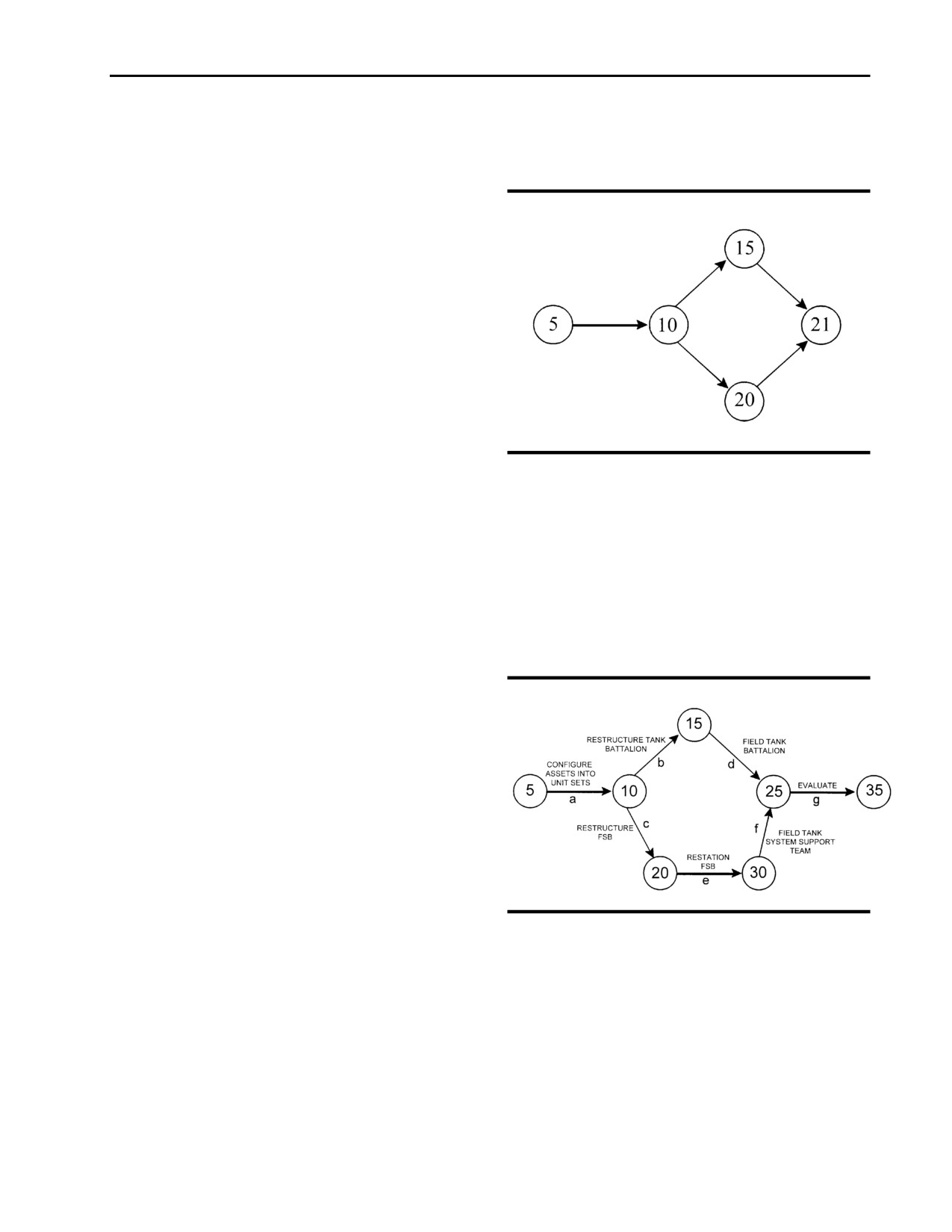
FM 100-11, Force Integration
Appendix A
Decision Support Analysis
Section I:
Introduction
A-1. Structuring the decision making process
Complex decisions associated with the execution of
the force integration mission can exploit decision
support analysis in the decision making process.
Dollars, time, equipment, and personnel must be
allocated to accomplish the mission to structure,
man, equip, train, sustain, deploy, station, and fund
organizations effectively. To assimilate the informa-
tion available efficiently, quantitative decision mak-
ing methods are used to structure the planning proc-
ess to introduce, incorporate, and sustain change in
organizations.
A-2. Quantitative methods and the decision proc-
Figure A-1. Network Diagram
ess
a. Nodes and activities. The first step in the
Decision making involves setting objectives; devel-
PERT application is to define and list all activities.
oping, evaluating, and selecting alternatives; and
Activities consume resources and time. Nodes do not
considering the consequences of that decision. Deci-
consume resources or time. The PERT network
sion analysis is the consideration of all quantitative
graphically portrays activities
(time-consuming
(objective) and qualitative (subjective) factors im-
tasks) that must be accomplished to achieve the
portant to a particular situation involving system
project goal along with their beginning and end
effectiveness, manpower planning, force structure
points (nodes). Nodes and activities are arranged in
development, and facilities. Modern quantitative
a logical sequence and assist in planning the project.
methods can greatly facilitate this decision process
Figure A-2, illustrates nodes and activities.
through objective analysis, the preparation and
analysis of cost estimates, and evaluating alternative
courses of action, thereby reducing uncertainties of
experience, judgment, and risk taking.
Section II:
Program Evaluation and Review
Technique
A-3. Network diagrams
The Program Evaluation and Review Technique
(PERT) is used to analyze projects and determine
duration and cost when completion times are uncer-
tain. PERT uses network diagrams that graphically
display all of the activities (tasks) in the project. The
network diagram assists the decision maker in ana-
lyzing all of the requirements and planning the se-
Figure A-2. Example of Network Diagram
quence of activities of the project. Figure A-1 is an
with Activities
example of a simple network diagram. Activities are
(1) Nodes are identified by assigning succes-
depicted as arrows. The beginnings and ends of ac-
sive numbers to them, typically from left to right.
tivities
(called nodes) are depicted as circles. The
The successive numbering system is commonly used
end node of one or more activities is normally the
with computer programs in solving PERT problems.
beginning node of one or more activities.
A-1
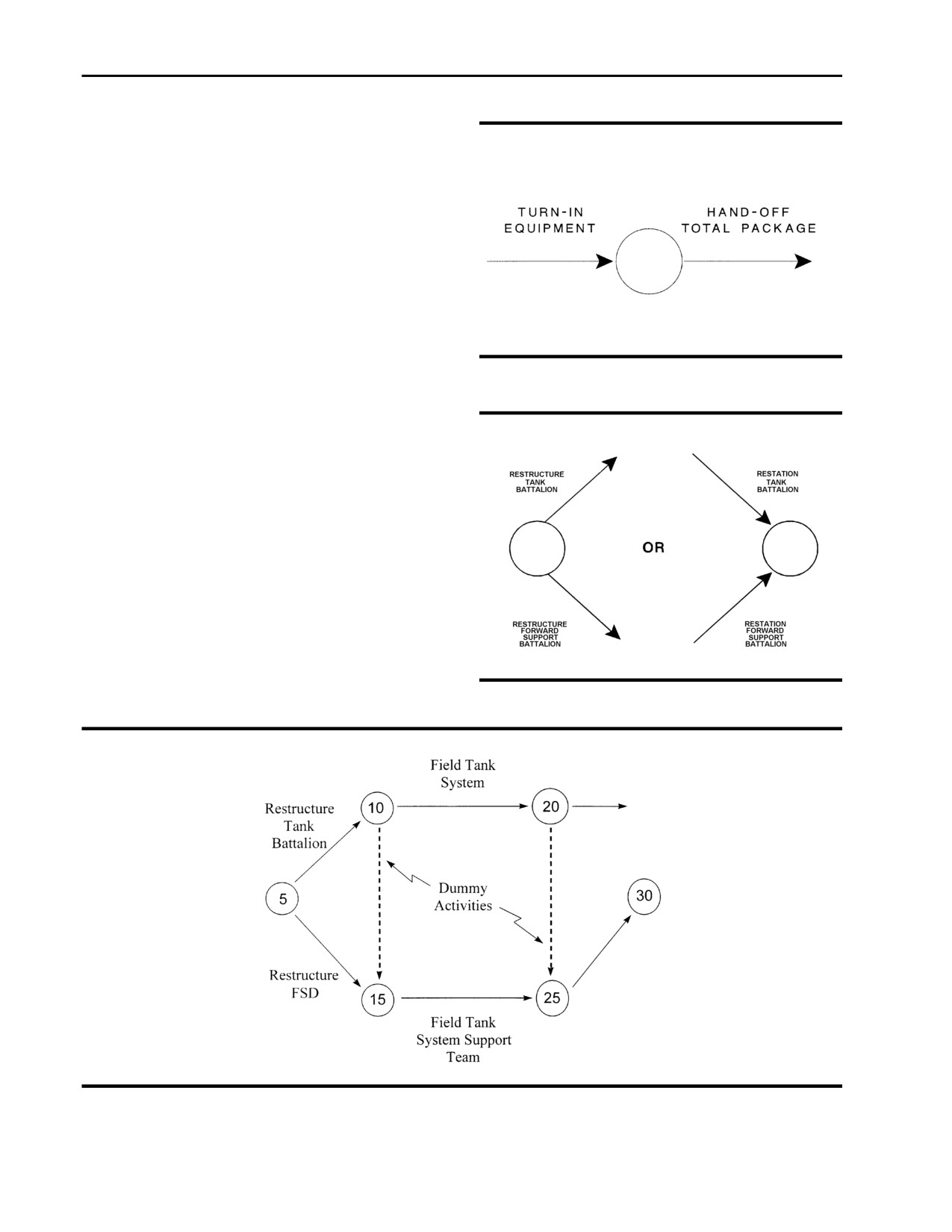
FM 100-11, Force Integration
(2) Activities can be referred to in either of
two ways:
(a) By their end points; for example,
activity 10-15.
(b) By a letter assigned to each arrow;
for example, activity b.
(3) When one activity precedes another, it is
expressed as illustrated in Figure A-3.
(4) When activities can be accomplished con-
currently, they are expressed as indicated in Figure
A-4.
(5) Nodes with multiple activities leading into
them indicate that all of those activities must be
completed before the next activity can begin. A
Figure A-3. Activity Precedes Activity
dummy activity is introduced to tie these nodes to-
gether or to establish a logical sequence of activities.
Dummy activities are the same as other activities
except that they take no time for completion and are
represented by dashed arrows. Figure A-5 illustrates
the technique. In this case, activity 5-10 and activity
5-15 must be completed before activity 5-25 can
start
(note the direction of dummy activity 10-15
arrowhead). However, activity 10-20 can start when
activity 5-10 is completed. Subsequently, the start of
activity
25-30 must await the completion of both
activity 10-20 and activity 15-25.
Figure A-4. Concurrent Activities
Figure A-5. Dummy Activities
A-2
FM 100-11, Force Integration
b. Activity time estimates.
realistic estimate of the time the activity might con-
sume. The most likely time is represented by the
(1) A network will identify the relationship of
symbol "m" in expected time computation.
the activities and the activities' time duration to en-
able the planner to determine project duration and
(c) Pessimistic time is an estimate of the
tasks that are critical. The expected project duration
longest time the activity would require under the
is based on the estimated time required to accom-
most adverse conditions. Pessimistic time is repre-
plish each activity in the longest path within the net-
sented by the symbol "b" in the expected time com-
work diagram. A path is a sequence of activities that
putation.
leads from the starting node to the finishing node. In
(3) To determine the activity's most probable
Figure A-2, the sequence 5-10-20-30-35 is a path as
or expected time
(te), use the following formula
is the sequence 5-10-15-25-35. The time estimate for
where te is computed as a weighted arithmetic mean
each activity is the expected time required to com-
of the time estimates:
plete the activity and is represented by the symbol te.
te
= a + 4m + b
(2) The PERT technique uses three time es-
6
timates for each activity to determine its expected
time (te) rather than basing it on a single time esti-
(4) The network diagram is used to graphi-
mate. PERT time estimates consider the chance
cally portray all activities that must be accomplished
variation that affects all project activities. The three
in a project in a logical sequence. Scheduling activi-
time estimates used are optimistic time, most likely
ties is not new; however, the more complex the proj-
time, and pessimistic time.
ect, the more difficult it becomes to estimate the total
(a) The optimistic time estimate is de-
time required for its accomplishment.
fined as the shortest time required to accomplish the
c. Determining project duration.
activity. There is little likelihood of completing the
activity in less than the optimistic time. Optimistic
(1) The network diagram is analyzed to de-
time is represented by the symbol "a" in the expected
termine the project duration based on the estimated
time computation.
time required to accomplish each activity in the
longest time path within the network diagram. This
(b) The most likely time estimate is the
is accomplished by examining each activity and de-
time that would occur most often if the activity were
termining its earliest expected start time (TE) as il-
repeated under exactly the same conditions many
lustrated in Figure A-6.
times. The most likely time is the most
Figure A-6. Earliest Expected Start Time
(2) The earliest expected start time (TE) of a
mined by adding the duration of the preceding activ-
particular activity is the time at which the activity
ity (te) to its earliest expected time start time (TE).
will begin if all the preceding activities start as early
(3) In Figure A-6, TE is shown above each
as possible. The first activity in a project is assigned
node in a square. TE for activity 10-15 is determined
an earliest expected start time(TE) of zero. The earli-
by adding te=6 of activity
5-10 to that
est expected start time (TE) of each activity is deter-
activity’s earliest expected start time, TE=0. The TE
A-3
FM 100-11, Force Integration
for the activity beginning at node 15 is computed in
(5) When more than one activity arrow ter-
the same manner.
minates at a node, each activity's expected duration
(te) is added to its earliest expected start time (TE).
(4) The decision trace starts at the node rep-
This is the activity's earliest expected completion
resenting the beginning of the first activity in the
time. The largest of these earliest expected comple-
network. The trace continues through the next activ-
tion times is assigned as the earliest expected start
ity to the next node, adding the activity's duration
time (TE) for the following activity. Figure A-7 is an
(te) to its earliest expected start time (TE).
example of computing the earliest expected start
time (TE) for an activity with more than one activity
terminating in its beginning node.
Figure A-7. Calculating TE with Multiple Activity Arrows at One Node
(6) The project duration is equal to the earli-
d. Determining latest allowable start times.
est expected start time computed at the last node (the
(1) After determining the project duration, the
end point of the last activity) in the network dia-
next step is to identify the latest allowable start time
gram. The trace through the diagram that provides
(TL) of each activity. TL is the latest time that an
this value is the critical path, which is also the long-
activity can begin without delaying the completion of
est path. Any activity on this path that begins later
the project. The determination of the latest allowable
than its earliest expected start time will affect the
start time (TL) for each activity is accomplished in
outcome of the project. Therefore, priority is placed
the reverse order (backwards through the network)
on the activities on this path. There may be more
of the project's nodes. Beginning at the last node, the
than one critical path. Each critical path will have
planner assigns a value (TL) equal to the TE that was
the same duration.
just calculated. Working backwards through the
network diagram, the latest allowable start time (TL)
A-4
FM 100-11, Force Integration
for each activity is determined by subtracting the
activity te from the latest allowable start time (TL) of
the following activity. An example is shown in Fig-
ure A-8.
(2) In Figure A-8, TL is shown below each node
in a triangle. TL for activity 15-20 is determined by
subtracting te of activity 15-20 (6) from the latest
allowable start time computed at node 20 (15). The
result, TL=9, is entered under node 15. The same is
done for activity 10-15, giving TL = 6.
(3) When the tail of more than one activity ar-
row begins at a node, the duration of each activity
(te) is subtracted from the latest allowable start time
(TL) of the activity following it. The least time ob-
tained is the latest allowable start time (TL) for the
activity under consideration. This is illustrated in
Figure A-9.
Figure A-8. Latest Allowable Start Time
18-7=11
21-11=10*
*CHOOSE SMALLER
Figure A-9. Calculating TL with More Than One Activity Arrow at a Node
(4) A TL=11 is determined for activity 20-25 by
subtracting te = 11 from TL = 21at node 30. The
subtracting te = 7 from TL = 18 at node 25. Simi-
smaller value, 10, becomes the TL for both activity
larly, a TL=10 is determined for activity 20-30 by
20-25 and activity 20-30.
A-5
FM 100-11, Force Integration
e. Determining Slack Time.
(3) The critical path for the project may also
be defined as the longest path through the network
(1) Slack time (TS) indicates how much delay can be
that connects all activities having zero slack time.
tolerated in completing an activity without delaying
project completion. This is determined by subtract-
(4) Activities not on the critical path have a
ing the earliest expected start time (TE) from the lat-
positive slack time. These activities can be delayed
est allowable start time (TL) for an activity (TS = TL
for a portion or all of the slack time without chang-
-TE).
ing the project duration. If an activity is delayed, the
diagram must be recomputed to determine the effect
(2) Figure A-10 illustrates these computa-
on subsequent activities or critical paths.
tions. For example, the slack time for activity 70-80
is one unit (23 - 22 = 1).
Figure A-10. Slack Time
A-4. Example of a completed PERT network
b. Once the network diagram is completed, the
a. Figure A-11 is a completed network of eight
information is tabulated into a schedule. Tables A-1
activities. Activities
2-4,
4-6,
6-12, and
12-14
and A-2 illustrate methods of tabulating PERT data
(shown by the double line arrows) are on the critical
into useable formats.
path and have zero slack. The remaining Activities
4-8, 8-10, 8-12, and 10-14 have slack time and can
A-5. Attributes of PERT
be delayed. For example, activity 4-8 can be delayed
PERT is a management tool that can accurately es-
by two days (new te = 6) without affecting the proj-
ect duration. This delay, however, affects the earliest
timate project duration, identify those activities that
and latest start times and slack times of subsequent
are most likely to be bottlenecks, and provide a
activities. A second critical path is also created.
means to evaluate effects of program changes. Con-
(1) Activities 8-10 and 8-12: TE=11, TL=11,
templated shifts of resources can be evaluated as
TS=0.
well as resource and performance tradeoffs and ef-
(2) Activity 10-14: TE = 19, TL = 21, TS = .
fects of deviation from actual to predicted time re-
(3) Critical Paths: 2-4-6-12-14 and 2-4-8-12-
14.
quirements.
A-6
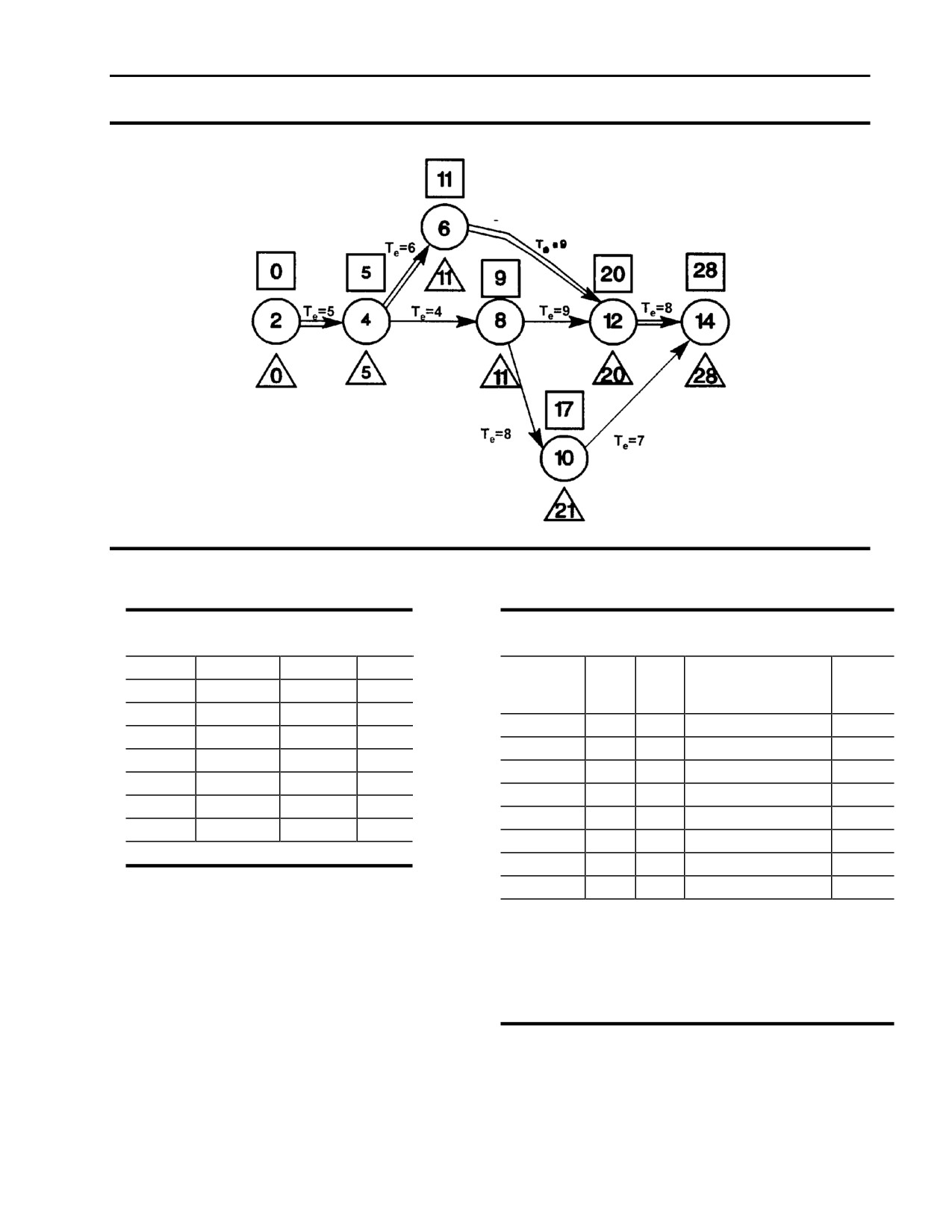
FM 100-11, Force Integration
Figure A-11. Complete Network Diagram
Table A-1
Table A-2
Node (Event) Table
Activity Table
NODE
TE
TL
TS
Earliest
expected
2
0
5
0
Activity
Te
Tl
completion time
Notes
4
5
5
0
2-4
5
0
5
6
11
11
0
4-6
6
5
11
8
9
11
2
4-8
4
5
9
1
10
17
21
4
6-12
9
11
20
2
12
20
20
0
8-10
8
11
17
14
28
28
0
8-12
9
11
20
3
Critical path is 2-4-6-12-14
10-14
7
21
28
4
12-14
8
20
28
1. Least value of TL for activities 8-10 and 8-12.
2. Greatest value of earliest expected completion
time for activities 6-12 and 8-12.
3. Greatest value of earliest expected completion
time for activities 10-14 and 12-14.
4. Critical path is 2-4-6-12-14.
A-7
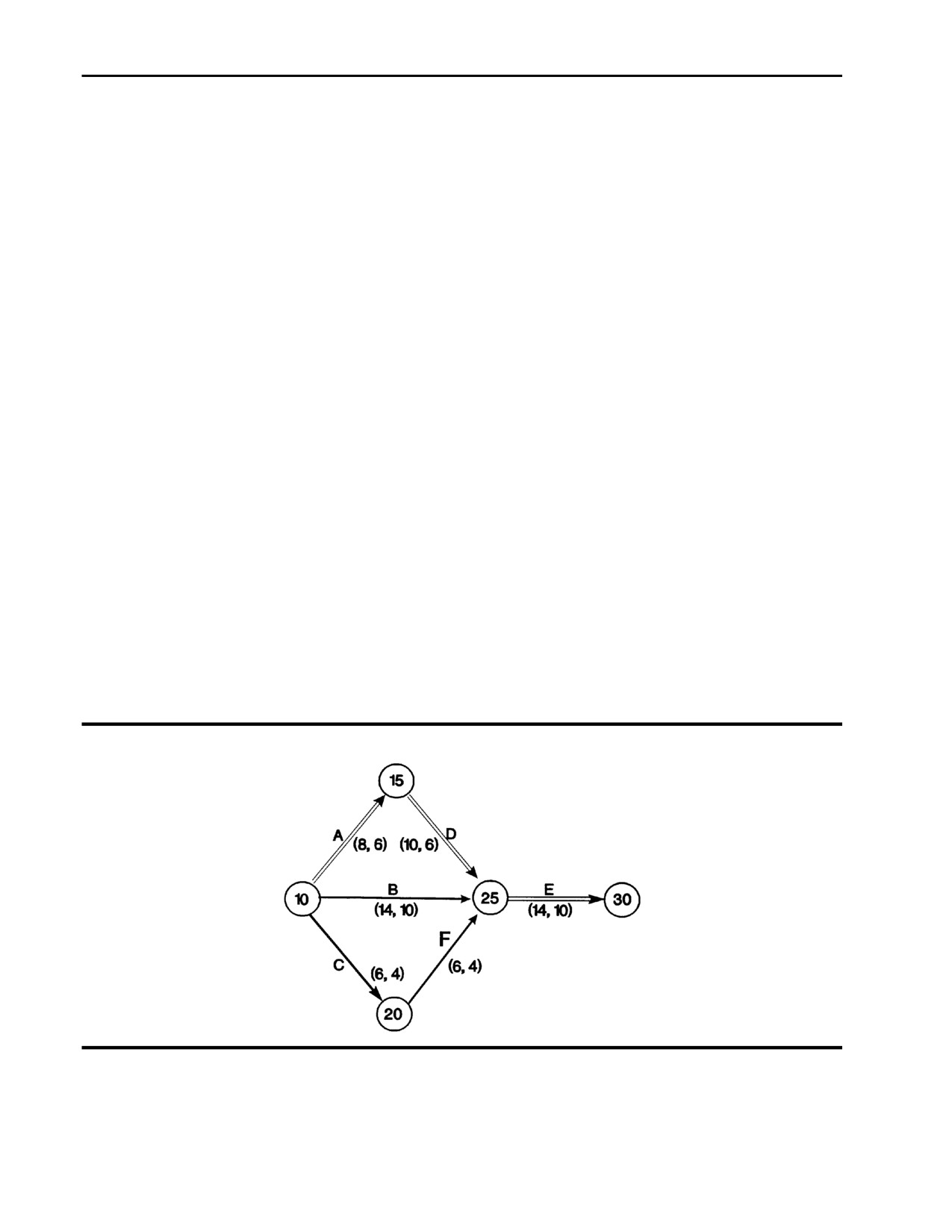
FM 100-11, Force Integration
Section III:
duration of the project using "normal" time. The first
Critical Path Method
number in the parenthesis is the "normal" time esti-
mate and the second number is the "crash" time of
A-6. Features of the critical path method
each activity.
a. The critical path method
(CPM) seeks to
c. The next step is to do a time versus cost
achieve the most efficient use of resources in the
trade-off analysis. First, the cost of decreasing each
minimum feasible time by using time versus cost
activity’s completion time by one day, called the cost
trade-off calculations to make an analysis that opti-
slope, is calculated using the following formula:
mizes the use of available resources.
Cost Slope
=
(Crash Cost - Normal Cost)
b. The CPM technique is used when the duration
(Normal Time - Crash Time)
of activities is known with a high degree of certainty.
CPM obtains a trade-off between cost and time by
d. Cost slope is expressed in dollars per day
emphasizing the relationship between applying more
($/day). Table A-3 shows the cost slopes for all of
resources to shorten the duration of given jobs ver-
the activities in Figure A-12 as well as other network
sus the increased cost of applying the additional per-
data.
sonnel or resources. CPM has been widely used in
environments where time factors and resources ver-
e. Using Table A-3, a time versus cost analysis
sus time relationships are known.
can be conducted and alternatives for accelerating
the project may be formulated by “crashing” activi-
A-7. CPM example
ties. The activity on the critical path with the lowest
cost slope (activity D in this example) is crashed
a. The first step in preparing the CPM model is
first. Using this information, alternative project du-
to conduct a detailed analysis of the project. Figure
rations can be determined as shown in Table A-4.
A-12 illustrates a hypothetical CPM model. As in
PERT, this is done by using a network diagram.
f. Table A-4 shows that a project potentially can
After constructing the network diagram, the planner
be accelerated at relatively minor cost ($540 for five
assigns the "crash" and "normal" time and cost esti-
days in this example). Decision makers must weigh
mates for each activity on the diagram. The "crash"
increased costs against the benefits of further project
time is the minimum possible completion time for an
acceleration.
activity that can be achieved by applying additional
g. Objective data in terms of time and cost are
personnel and resources at some estimated cost. The
used in determining whether projects should be ac-
"normal" time estimate and its associated cost are
celerated. Subjective factors, such as quality of life
usually based on previous experience.
or readiness, must be considered in making the final
b. In Figure A-12, the example CPM network
decision. Intangible factors such as these can poten-
has a critical path of A-D-E indicated by the double
tially drive up the final cost of the project when not
line arrows. This portrays the path of the longest
considered.
Figure A-12. CPM Network Diagram
A-8

FM 100-11, Force Integration
Table A-3
Cost Table
NORMAL
CRASH
ACTIVITY
DAYS
TOTAL COST ($)
DAYS
TOTAL COST ($)
COST SLOPE
($/DAY)
A
8
200
6
400
100
B
14
560
10
1040
120
C
6
100
4
200
50
D
10
400
6
720
80
E
14
400
10
960
140
F
6
200
4
400
100
TOTALS
1860
3720
Critical path is A-D-E
Table A-4
Time Versus Cost Alternatives
PROJECT
TOTAL
DURATION (DAYS)
COST ($)
REMARKS
NOTES
32
1860
Normal duration along critical path A-D-E.
31
1940
Crash activity D; decrease one day ($80).
1
30
2020
Crash activity D; decrease one day ($80).
29
2100
Crash activity D; decrease one day ($80).
28
2180
Crash activity D; decrease one day ($80).
2, 3
27
2400
Crash activity A; decrease one day ($100). Crash ac-
4, 5
tivity B; decrease one day ($120).
Notes:
1. Crash one day at a time starting with the activity with the lowest cost slope on the critical path.
2. Activities cannot be crashed beyond their normal time.
3. After each crash, check to see whether another critical path has been created (B-E in this example).
4. Each critical path must be crashed concurrently to keep the network in balance.
5. Management establishes the acceptable total cost of crashing and the process stops when that total cost will
have been exceeded.
Section IV:
c. Actual start and completion dates for
each
Gantt Charts
activity may also be included as project management
tool.
A-8. Features of Gantt charts
A-9. Gantt chart example
a. Gantt charts provide graphic representation in
the form of a bar chart to depict the time elements of
Figure A-13 shows a hypothetical Gantt chart using
activities within a project. These are represented by
the activities and start and completion times from
bars along a timeline.
Figure A-12. Gantt charts are constructed by placing
the list of activities or phases in a column with
b. The main elements of a Gantt chart are the
scheduled start and projected completion of the ac-
following:
tivity indicated by the beginning and end of each bar.
(1) The list of activities for a specific project.
The actual start and completion dates of each activ-
(2) The scheduled start time for each activity.
ity are indicated by Xs above each bar graph. The
(3) Projected completion time for each ac-
arrow below each bar provides the activity comple-
tivity.
tion status. "Today's Date" is used as a reference.
(4) Status.
A-9
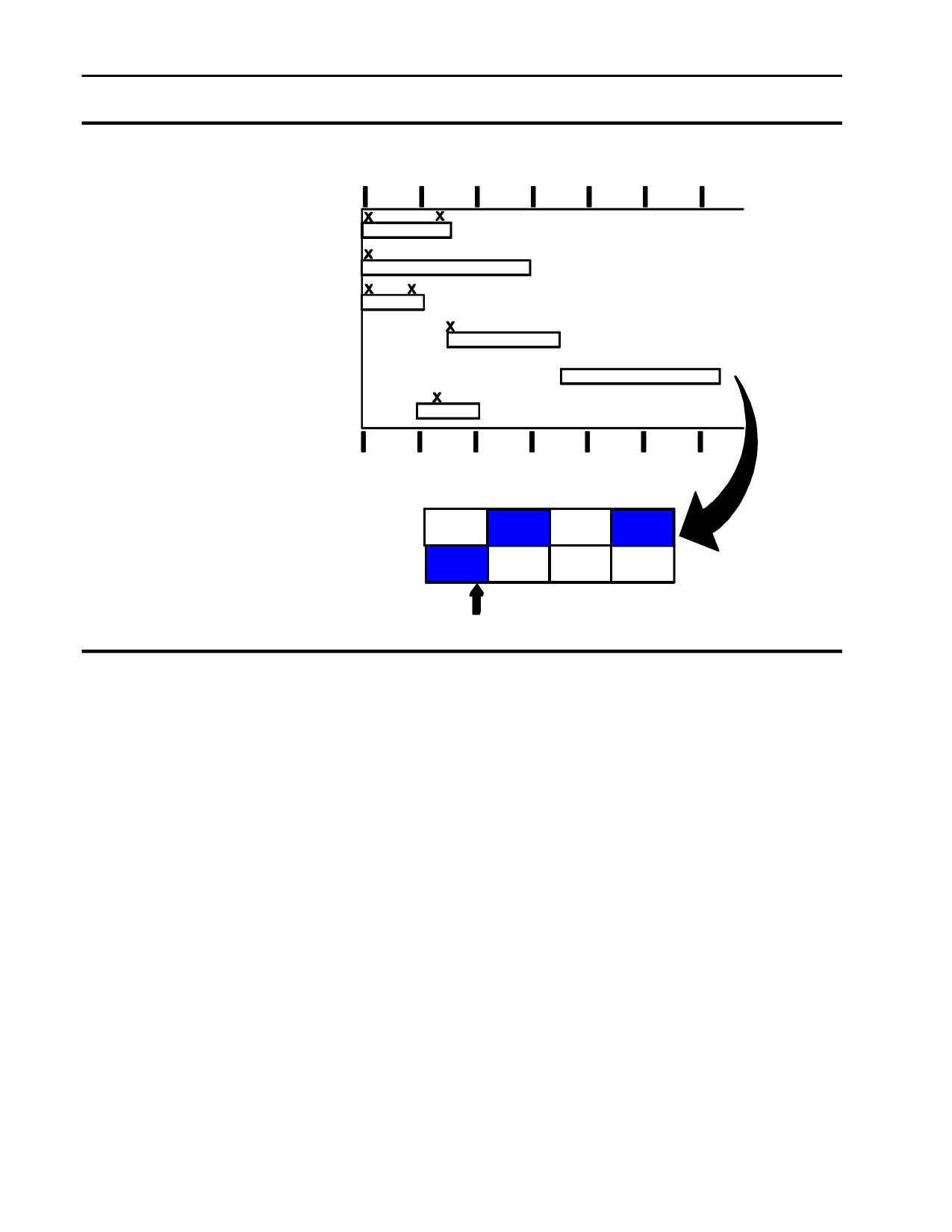
FM 100-11, Force Integration
TIME IN MONTHS
1
2
3
4
5
6
7
ACTIVITIES
PHASE OR UNIT A
A
PHASE OR UNIT B
A
PHASE OR UNIT C
PHASE OR UNIT D
A
PHASE OR UNIT E
PHASE OR UNIT F
A
1
2
3
4
5
6
7
PROJECT START DATE: _________ TODAYS DATE: ________
EQUIPMENT
TRAINING
TURN-IN
EQUIPMENT
ORGANIZATION
HAND-OFF
RESTRUCTURE
EVALUATION
AUTHORIZATION
DOCUMENT E-DATE
Figure A-13. Gantt Chart
Section V:
Bibliography
Summary
Books
The large volume of information that must be consid-
1. Wiest, Jerome D., and Levy, Ferdinand K.,
A
ered when making decisions requires that analysis be
Management Guide to PERT/CPM: With
applied in making the best possible decisions. PERT,
GERT/PDM/DCPM and other Networks; Pren-
tice-Hall, Inc., Englewood Cliffs, New Jersey 07632;
CPM, and Gantt are used when developing plans to
1977,
1969
(pages
1-2,
4,
26,
28,
62-71, and
incorporate new materiel, new doctrine, and new
141-142).
structure into the force structure. Constraints will
2. Whitehouse, Gary E., Systems Analysis and De-
force decisions that make the best use of the re-
sign Using Network Techniques; Prentice-Hall, Inc.,
sources available. The decision support analyses de-
Englewood Cliffs, New Jersey 07632; 1973 (pages
scribed in this appendix can assist in providing the
31 and 51-54).
efficiency and effectiveness needed in accomplishing
3. Moder, Joseph J., and Phillips, Cecil R., Project
the force integration mission.
Management with CPM and PERT, Second Edition;
Litton Educational Publishing, Inc., 1970. Published
by Van Nostrand Reinhold Company; 450 West 33rd
Street, New York, New York 10001. Certain portions
of this work copyright 1964 by Reinhold Publishing
Corporation (pages 5-8, 12-13, 20).
Magazine Article
Page, G. William, "Using Management Software in
Planning," APA Journal, Autumn 1989 (page 494)
A-10
FM 100-11, Force Integration
GLOSSARY
Section I
Acronyms, Brevity Codes, and Abbreviations
AA
ALO
Active Army
authorized level of organization
AAE
ALOC
Army Acquisition Executive
air lines of communication
AAMMP
ALRPG
Active Army Military Manpower Program
Army Long Range Planning Guidance
AAO
AMC
Army acquisition objective
United States Army Materiel Command
AASA
AMOPES
Administrative Assistant to the Secretary of the Army
Army Mobilization and Operations Planning and
Execution System
ACAT
acquisition category
AMP
Army Modernization Plan; Army Mobilization Plan
ACC
Army component commander
AMRD
Army Modernization Reference Data
ACSIM
Assistant Chief of Staff for Installation Management
AMSCO
Army Management Structure Code
ACTS
Army Criteria Tracking System
AMT
Army modernization training
ADCSOPS
Assistant DCSOPS
AOLCM
Army Organizational Life Cycle Model
ADM
Acquisition Decision Memorandum
AOP
Army order of precedence
ADT
active duty for training
APGM
Army Program Guidance Memorandum
AFH
Army Family Housing
APR
Army procurement requirement
AFHO
Family Housing, Army (Operations)
APS
Army Planning System; Army Prepositioned Stocks
AFPDA
Army force planning data and assumptions
APSES
Army Prepositioned Stocks Equipment Sets
AGR
Active Guard Reserve
APSOP
Army Prepositioned Stocks Operational Project
AIS
automated information system
APSS
Army Prepositioned Stocks Sustainment
AIT
advanced individual training
AR
Army regulation
Glossary-1
FM 100-11, Force Integration
ARB
ASA(RDA)
Army Resources Board
ASA (Research, Development, and Acquisition)
ARBSG
ASCC
Army Resources Board Support Group
Army service component commander
ARCOM
ASD
United States Army Reserve Command
Assistant Secretary of Defense
ARFPC
ASD(C3I)
Army Reserve Forces Policy Committee
ASD (Command, Control, Communications, and In-
telligence)
ARI
Army Research Institute
ASD(FMP)
ASD for Force Management Policy
ARL
Army Research Laboratory
ASD(HA)
ASD for Health Affairs
ARNG
Army National Guard
ASD(S&R)
ASD for Strategy and Requirements
ARNGUS
Army National Guard of the United States
ASD(RA)
ASD (Reserve Affairs)
ARNG-TSP
Army National Guard-troop structure program
ASI
additional skill identifier
ARPERCEN
Army Reserve Personnel Center
ASIOE
associated support items of equipment
ARSEC
Army Secretariat
ASIOEP
associated support items of equipment and personnel
ARSTAF
Army Staff
ASIP
Army Stationing and Installation Plan
ARSTRUC
Army structure message
ASL
authorized stockage list
ART
Army Reserve technician
AT
annual training
ARTEP
Army Training and Evaluation Program
ATC
Army training center
AS
acquisition strategy
ATRRS
Army Training Requirements and Resources System
ASA
Assistant Secretary of the Army
AUTS
Automatic Update Transaction System
ASA(CW)
ASA (Civil Works)
AVCSA
Assistant Vice Chief of Staff, United States Army
ASA(FM&C)
ASA (Financial Management & Comptroller)
AVIM
aviation intermediate maintenance
ASA(IL&E)
ASA (Installations, Logistics, and Environment)
AVUM
aviation unit maintenance
ASA(M&RA)
ASA (Manpower and Reserve Affairs)
Glossary-2
FM 100-11, Force Integration
AWCF
CAPCES
Army Working Capital Fund
Construction Appropriation, Programming, Control,
and Execution System
AWP
annual work plan
CAR
Chief, Army Reserve
AWR
Army War Reserve
CATS
Combined Arms Training Strategy
AWRSA
Army War Reserve Stocks for Allies
CBO
Congressional Budget Office
AWRSI
Army War Reserve Secondary Items
CBS-X
Continuing Balance System-Expanded
BCTP
battle command training program
CBTDEV
combat developer; combat development
BDE
brigade
CCH
Chief of Chaplains
BES
Budget Estimates Submission
CCSS
Commodity Command Standard System
BII
basic issue items
CDR
commander
BIT
built in test
CEPCSS
Centralized Equipment Procurement Conversion Ca-
BITE
pability System
built-in test equipment
CG
BOIP
commanding general, Chairman’s Guidance
basis-of-issue plan
CINC
BT
commander in chief
basic training
CIS
BTOE
Capital Investment Strategy
base TOE
CJCS
BY
Chairman of the Joint Chiefs of Staff
budget year
CJCSI
C3I
Chairman of the Joint Chiefs of Staff Instruction
command, control, communications, and intelligence
CLL
C4
Chief of Legislative Liaison
command, control, communications, and computers
CM
CA
Command Manager
Civil Affairs
CM(FS)
CAA
Command Manager (Force Structure)
Concepts Analysis Agency
CM(PBG)
CAD
Command Manager (Program Budget Guidance)
course administrative data
CNGB
CAE
Chief, NGB
Component Acquisition Executive
Glossary-3
FM 100-11, Force Integration
CO
CTA
company
common table of allowances
COC
CTU
Council of Colonels
Consolidated TOE Update
COE
CX
Corps of Engineers; Chief of Engineers
Categorical Exclusion
COMPO
CY
component
current year
COMPT
DA
comptroller
Department of the Army
CONPLAN
DAB
concept plan; contingency plan
Director of the Army Budget (used to refer to the
Deputy Assistant Secretary of the Army for Budget)
CONUS
Defense Acquisition Board
continental United States
DAE
CONUSA
Department (of Defense) Acquisition Executive
continental U.S. Army
DALSO
CPA
DA Logistics Systems Officer
Chairman’s Program Assessment; Chief
of
Public
Affairs
DAMPL
DA Master Priority List
CPG
Contingency Planning Guidance
DARNG
Director of the Army National Guard
CPLAN
command plan
DAS
Director of the Army Staff
CPM
critical path method
DCG
deputy commanding general
CPR
Chairman’s Program Recommendation
DCS
Deputy Chief of Staff
CPX
command post exercise
DCSCD
Deputy Chief of Staff for Combat
Developments,
CRA
TRADOC
continuing resolution authority
DCSINT
CRRC
Deputy Chief of Staff for Intelligence
Construction Requirements Review Committee
DCSLOG
CRS
DCS for Logistics
Chairman’s Readiness System
DCSOPS
CS
DCS for Operations and Plans
combat support
DCSPER
CSA
Deputy Chief of Staff for Personnel
Chief of Staff, U.S. Army
DEH
CSS
Directorate of Engineering and Housing (now known
combat service support
as DPW)
Glossary-4
FM 100-11, Force Integration
DEPSECDEF
DS
Deputy SECDEF
direct support
DET
DT&E
displaced equipment training
development test and evaluation
DETP
DTLOMS
Displaced Equipment Training Plan
doctrine, training, leader development, organizations,
materiel, and soldiers
DFAS
Defense Finance and Accounting Service
DTT
doctrine and tactics training
DI
Document Integrator
DY
design year
DISC4
Director of Information Systems for Command,
EA
Control, Communications, and Computers
Environmental Assessment
DISCOM
EAC
division support command
echelons above corps; Evaluation Analysis Center
DIV
EAD
division
echelons above division
DM
E-date
Director of Management
effective date
DOD
EDI
Department of Defense
Electronic Data Interchange
DODAAC
EDSS
Department of Defense activity address code
Equipment Distribution Sequence System
DODD
EIS
DOD directive
Environmental Impact Statement
DPAE
ELIM
Director of Program Analysis and Evaluation
Enlisted Loss Inventory Model
DPAMMH
ELIM-COMPLIP
direct productive annual maintenance man-hours
Enlisted Loss Inventory Model-Computation of
Manpower Using Linear Programming
DPAS
Defense Priorities and Allocation System
EPR
Environmental Program Requirement
DPG
Defense Planning Guidance
ERC
equipment readiness code
DPP
Dedicated Procurement Program
ERPS
Equipment Release Priority System
DPW
Director of Public Works
EXCOM
Executive Committee
DRB
Defense Resources Board
EXEVAL
external evaluation
DRMO
Defense Reutilization and Marketing Office
FAA
functional area assessment
Glossary-5