FM 100-11 Force Integration (January 1998) - page 2
FM 100-11, Force Integration
Chapter 4
The Force Integration Process
(1) Incorporate consideration of all input
Section I:
factors.
Introduction
(2) Develop alternatives.
4-1. Change as a factor
(3) Provide processes that support decision
Change is an inherent element of how the Army ac-
making.
complishes its statutory functions to structure, man,
(4) Assure integration of all solution elements.
equip, train, sustain, deploy, station and fund or-
(5) Provide output for execution and feedback.
ganizations to produce a measurable output. In
4-5. Force management processes
combat, that organizational output consists of op-
a. Force management is the capstone process
erational objectives achieved. In peacetime, the out-
which encompasses all processes associated with the
put is the attainment of readiness objectives.
progression from requirements determination
4-2. The force integration challenge
through execution of time-phased programs and
a. Force integration is the process that intro-
structures. It involves rank ordering of requirements
duces, incorporates, and sustains approved organ-
and the resources applied to these requirements. To
izational, doctrinal, and materiel change. It considers
accomplish Army missions and functions within re-
the implications of change on organizations as they
source constraints, force management allocates re-
progress to a higher level of capability.
sources and assesses their utilization.
b. The imperative for organizations to remain
b. Force management includes several develop-
viable in an environment of change is to understand
mental processes as shown in Figure 4-1.
and manage change. This is the challenge of force
(1) Combat development. This is the process
integration.
of determining requirements for doctrine, training (to
include leader development), organizations, and ma-
Section II:
teriel. It also includes the processes by which or-
Management of Change
ganizational requirements are translated into organ-
4-3. Organizational change
izational models.
a. Management of change is a fundamental ac-
(2) Doctrine development. This process
tivity among people, organizations, or nations since
translates requirements for doctrine into publications
relationships do not remain constant over time. The
that prescribe doctrine, tactics, techniques, and pro-
foundations of change that affect Army organiza-
cedures.
tions can be external or internal to the force.
(3) Training development. This process
b. History shows that organizations must change
translates requirements for training and leader de-
with their environment to function successfully and
velopment into programs, methods, or devices.
support their continued existence. This evolution will
(4) Materiel development. This process is the
vary with the external pace and magnitude of
conception, development, and execution of solutions
change, the functions affected, and the organizations
to materiel requirements identified and initiated
involved. Managing change effectively demands an
through the combat development process, translating
understanding of the environment, related processes,
equipment requirements into executable programs
and primary influences.
within acceptable performance, schedule, and cost
parameters.
4-4. Goals
(5) Organization development. This process
a. The Army manages and executes change
translates organization requirements into organiza-
through force integration to assure—
tional models.
(1) Enhanced effectiveness in war-fighting
c. The force development process is an amalga-
capability.
mation of materiel and organizational developments;
(2) Balanced capabilities to maintain all core
it translates materiel and organizational requirements
competencies.
into RDA programs and force structure.
(3) Flexible processes to evolve the force in
d. Force management processes ensure the plan-
any direction, consistent with guidance and available
ning, development, integration, introduction, incor-
resources.
poration, and sustainment necessary to field the op-
b. These goals require that the management and
timum force within imposed constraints.
execution of change be structured from a total sys-
tem perspective. This perspective willæ
4-1
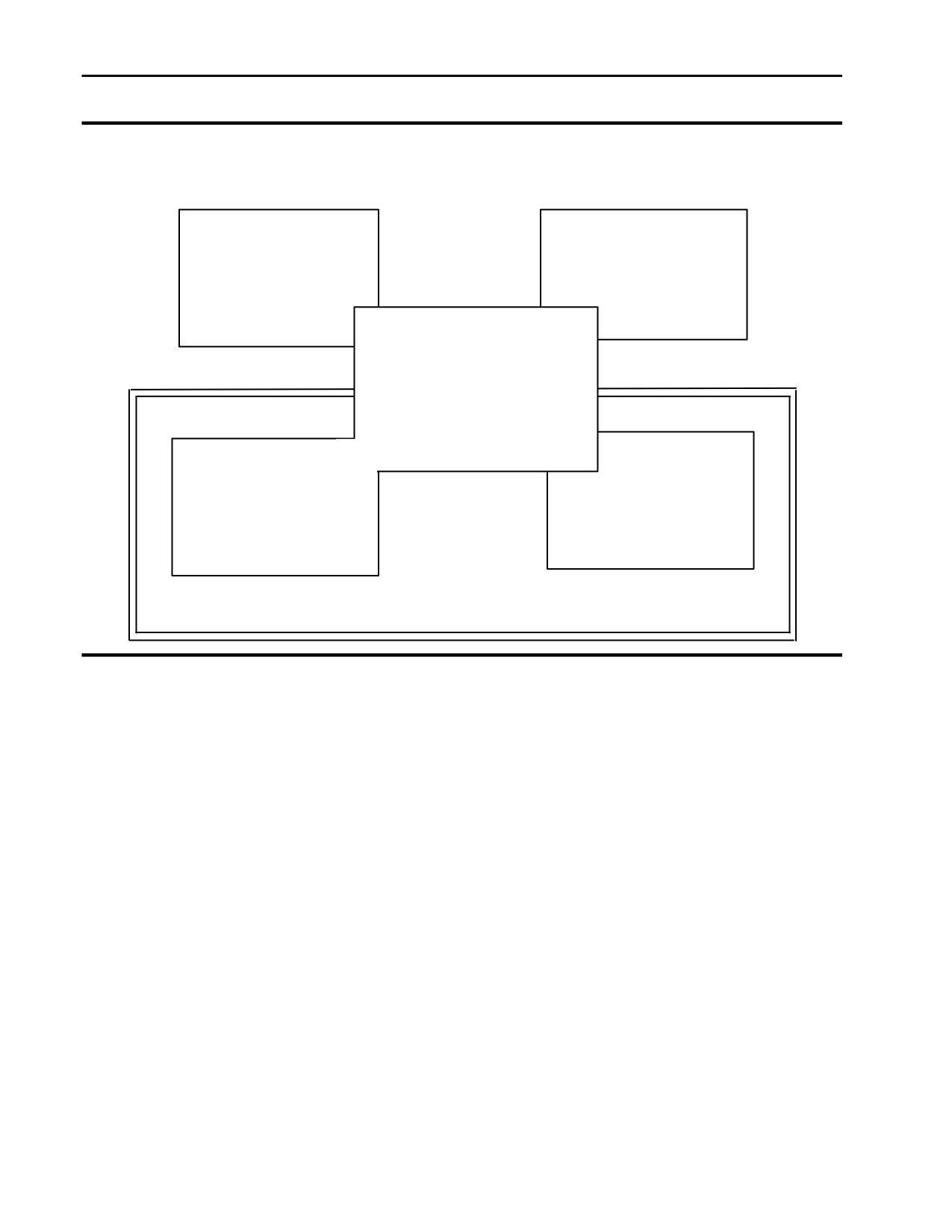
FM 100-11, Force Integration
FORCE MANAGEMENT
DOCTRINE
TRAINING
DEVELOPMENT
DEVELOPMENT
COMBAT DEVELOPMENT
• DOCTRINE REQUIREMENTS
• TRAINING REQUIREMENTS
• LEADER DEVELOPMENT REQUIREMENTS
• ORGANIZATION REQUIREMENTS
• MATERIEL REQUIREMENTS
ORGANIZATION
MATERIEL
DEVELOPMENT
DEVELOPMENT
FORCE DEVELOPMENT
Figure 4-1. Force Management Development Process
cluded are requirements for structure, personnel,
4-6. Force management tasks
materiel, facilities, and training.
Fundamental force management tasks include—
(2) Reviewing force planning and program-
a. Doctrine development. This task guides de-
ming documents to ensure consistency of missions,
velopment of operational concepts and doctrine
requirements, and system developments.
across the operational continuum. Activities associ-
(3) Reviewing and validating organizational
ated with this task includeæ
and materiel requirements documentation.
(1) Developing and preparing concept state-
c. Resource prioritization. These activities align
ments and doctrine in all battlefield dynamics.
mission requirements with projected resource con-
(2) Monitoring development of the research,
straints by establishing priorities for—
development, and acquisition plan
(RDAP) and
(1) Activating, converting, and reorganizing
POM to examine consistency among approved doc-
units.
trine, organization designs, and system development
(2) Allocation of personnel and equipment to
and acquisition.
Army organizations and activities.
(3) Aligning concept and doctrinal develop-
(3) Funding Army investment, operations,
ments with assessments of emerging technological
and maintenance accounts.
capabilities.
d. Authorization allocation. These activities
b. Requirements determination. This task is
distribute projected resources to meet requirements
designed to balance missions, required capabilities,
in Army organizations and activities according to
threats, and identified vulnerabilities. Associated
established priorities byæ
activities include-
(1) Executing application of resources to
(1) Determining detailed force requirements
Total Army requirements.
to achieve necessary operational capabilities. In-
4-2
FM 100-11, Force Integration
(2) Allocating personnel and equipment
(2) Analyzing RDA programs, initiatives,
authorizations based on established priorities.
and alternatives to assist in resource determinations.
(3) Allocating personnel and equipment re-
(3) Conducting the necessary planning and
sources to units in integrated packages of defined
analyses to ensure RDA programs support moderni-
capability increments.
zation and readiness objectives within resource con-
straints.
(4) Assessing the operational and organiza-
tional impact of resource options.
(4) Developing and executing policies and
procedures for analytical support. This support in-
(5) Maintaining planned, programmed,
cludes materiel programs, force development analy-
budgeted, current, and historical troop lists.
ses, and related affordability, executability and sup-
(6) Planning, programming, budgeting, di-
portability assessments.
recting, monitoring, and evaluating organizational
g. Operational testing and evaluations. These
capabilities.
activities ensure organizations and equipment meet
(7) Preparing, justifying, maintaining, and
approved operational capabilities when fielded. This
defending organizational and materiel systems man-
is achieved through the management and conduct of
agement decision packages (MDEP).
all testing and experimentation byæ
e. Functional management. Associated activi-
(1) Developing and executing policies and
ties, such as the Deputy Chiefs of Staff for Person-
procedures for user testing and evaluation.
nel and Logistics (DCSPER and DCSLOG), ensure
(2) Managing, scheduling, resourcing, coor-
availability and timeliness of the appropriate mix of
dinating, and executing user testing and evaluation
resources
(structure, personnel, equipment, funds
programs.
and facilities) byæ
(1) Managing resources to ensure capabili-
Section III:
ties, organization, personnel and equipment allow-
Force Integration
ances, and funds are sustained throughout the unit
life cycle.
4-7. Scope
(2) Managing actions which affect major
The scope of force integration includes the functions
units to ensure internal consistency of organization
of structuring, manning, equipping, training, sus-
integration actions and providing linkage between
taining, deploying, stationing, and funding the force
the resourcing and force programming systems.
during the introduction and incorporation of ap-
proved change. It also includes the function of
(3) Managing materiel systems from devel-
measuring force readiness during the sustainment of
opment through retirement from the force. Systems
change. Force integration synchronizes these func-
integration is directed at ensuring materiel viability
tional activities to produce combat-ready organiza-
and sustainability from the user’s perspective. This
tions. Force integration is an enabling process of
task ranges from defining operational requirements
force management.
and operational test and evaluation
(OT&E) to
equipment fielding and sustainment.
4-8. Mission
(4) Conducting affordability, executability,
a. The mission of force integration is to improve
and supportability assessments for structure, per-
war-fighting capabilities with minimum adverse ef-
sonnel, equipment, fiscal resources, facilities, train-
fect on readiness during the period of transition.
ing, sustainment, deployability and readiness.
Execution of the force integration mission in-
(5) Developing total resource packages for
cludes—
systems and organizations over time.
(1) Placing new or changed doctrine, organi-
(6) Developing and executing functional poli-
zations, and equipment into the Army.
cies and procedures in support of the force integra-
(2) Developing strategies for coordinating
tion and force management processes.
and integrating the functional and managerial sys-
(7) Monitoring all force integration activities
tems that exist in the Army.
to identify functional management requirements.
(3) Assessing the impact of decisions on or-
f. Program analysis. These activities support
ganizations.
Army planning and programming byæ
b. The force integration mission can also be seen
(1) Providing rationale, and justification.
from a functional, temporal, and organizational per-
spective (see Figure 4-2).
4-3
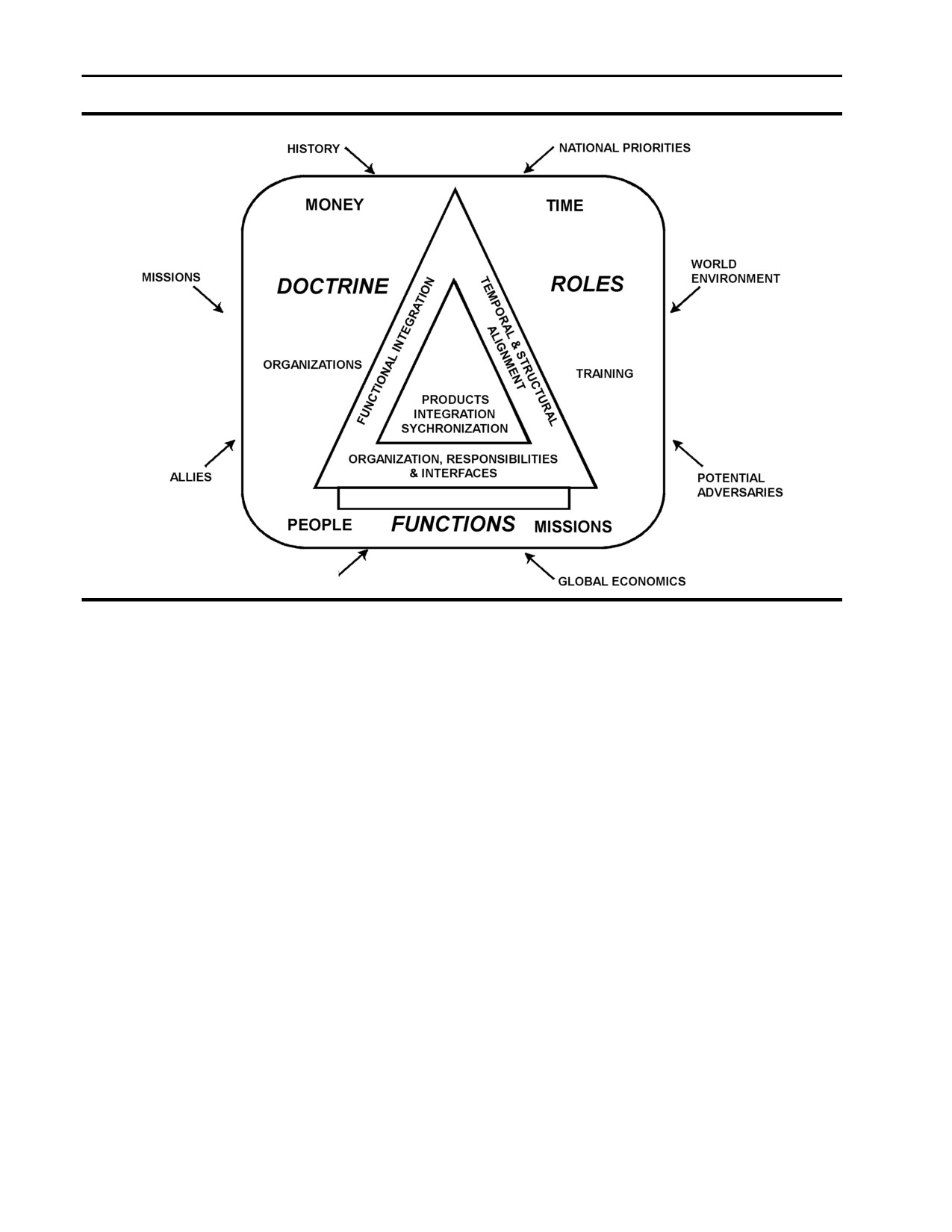
FM 100-11, Force Integration
TECHNOLOGY
Figure 4-2. Force Integration Environment
(1) Functional. Force integration, from a
plexity of functional execution and synchronization
functional perspective, incorporates each function
is apparent. Integration and synchronization of these
and describes processes for planning and execution
functions requiresæ
supportive of all the affected functions.
(1) Mutually supportive planning and execu-
tion mechanisms.
(2) Temporal. The force integration environ-
(2) Centralized planning and decentralized
ment can also be considered from the perspective of
execution.
time. This views force integration in the context of
the PPBES with activities occurring in the near-term
(3) Comprehensive and flexible decision sup-
(current year and budget years), the mid-term (the
port processes.
program years), and the far-term (the extended plan-
ning period). Each of the functional inputs and
4-9. Force integration components
products has timelines that must be aligned to ensure
Force integration encompasses processes, decision
success.
support mechanisms, and products to manage
(3) Organizational. From the organizational
change by—
perspective, synchronization of force integration
a. Assessing requirements for changes in
functions and processes is accomplished at all com-
capability.
mand and agency echelons. Planning and program-
b. Ensuring consideration of growth alternatives.
ming of activities are designed to ensure that execu-
c. Developing suitable, feasible, and acceptable
tion at the user organization can be accomplished in
concepts to execute programs.
minimum time with minimum readiness degradation
and will result in a maximum possible increase in
d. Determining and recommending solutions.
capability.
e. Obtaining approval for solutions.
c. These three force integration perspectives
f. Preparing and executing detailed plans of
provide a holistic view of the environment. The ac-
action.
tivities, processes, products, decision support
g. Assuring feedback that validates or modifies
mechanisms, and databases associated with force
actions and execution, as necessary.
integration occur within this environment. The com-
4-4
FM 100-11, Force Integration
4-10. The role of operational requirements in
command, leadership and management, and re-
force integration
sources.
Within the Army, operational requirements establish
b. To articulate the nature of change and to as-
the parameters for change management. They in-
sess the executability and supportability of change,
clude the following—
all factors affecting organizations must be consid-
ered. The definitions of the nine force integration
a. Direction and guidance. NCA, JCS, and de-
functional areas (FIFA) provide the standard to be
partmental guidance provide the basis for developing
achieved in transitioning organizations from one
Army plans and conducting operations.
level of capability to a higher level. They prescribe
b. Missions. Missions are based principally on
the correctly structured, equipped, trained, manned,
laws, customs, and directions from higher authority.
sustained, deployed, stationed, and funded end state
The Army’s statutory, specified, and implied mis-
to be achieved at the culmination of modernization
sions establish the framework within which the
as well as the required readiness level.
Army manages change.
(1) Structuring. An organization is properly
c. Doctrine. Army doctrine establishes the broad
structured when the organization, its direct sup-
principles for the conduct of military and other sup-
port/general support
(DS/GS) structure, and the
port operations. As missions, allies, history, and
support infra-structure have accurate requirements
technology evolve, the Army reexamines and revali-
documents, HQDA-approved authorization docu-
dates or changes its war-fighting doctrine.
ments on hand, and registered unit identification
d. Organizations. The Army designs its force
codes (UIC).
structure to conduct combat operations in conso-
(2) Manning. An organization is properly
nance with approved doctrine. At any point in time,
manned when the organization, its DS/GS structure,
current organizations in the force structure are the
and the support infra-structure have assigned, by
baseline from which the Army’s evolution must oc-
grade and skill, all authorized personnel.
cur.
(3) Equipping. An organization is properly
e. Training. The force is structured, equipped,
equipped when the organization and its DS/GS
and trained for a given set of missions. Training is a
structure have the most modern equipment author-
key element in the incorporation and sustainment of
ized, to include major end items; associated support
organizational change.
items of equipment (ASIOE); test, measurement, and
f. Current and programmed force programs.
diagnostic equipment (TMDE); special tools and test
Force structure changes approved in the defense
equipment
(STTE); maintenance floats; and all
budget and POM establish the parameters for future
authorized common table of allowances
(CTA)
activities.
items.
g. DOD, HQDA, and MACOM priorities. Pri-
(4) Training. An organization is properly
orities established by these elements can limit the
trained when the organization and its DS/GS struc-
flexibility available to the Army at large to manage
ture have completed all required Army moderniza-
change within specific timelines.
tion training
(AMT) to include NET, DTT and
h. Resources. A key determinant for managing
NOT, and have been evaluated and meet ARTEP
change is resource allocation, directly effecting
standards. All authorized organizational training
changes in program execution.
support material and training devices must be in unit
hands and all institutional training courses and
Section IV:
training systems, training ammunition, and training
Foundations of Force Integration
facilities must be available. All doctrinal publica-
4-11. The Army Organizational Life Cycle Model
tions must be on hand.
a. Force integration is a multidisciplinary, cap-
(5) Sustaining. An organization can be prop-
stone process that examines, validates, modifies, and
erly sustained when all authorized organization-level
monitors all aspects of change. It results from ac-
combat support and combat service support person-
tivities within functions or functional groupings de-
nel are assigned and all support equipment, facilities,
signed to increase operational capability at the or-
spares, and supplies are on hand. The DS/GS
ganization level. The AOLCM provides a construct
structure and any support infrastructure must be
for explanation and examination of the overall proc-
structured, equipped, trained, manned, sustained,
ess. No function of the model can be viewed as a
stationed, and funded to sustain the supported or-
discrete entity because no single function can be ac-
ganization. All support publications must be on hand
complished without reference to, or effect on other
and the organizations must have valid Department of
functions. The AOLCM is depicted in Figure 4-3,
Defense activity address codes (DODAAC).
with the eight functions supported and influenced by
4-5
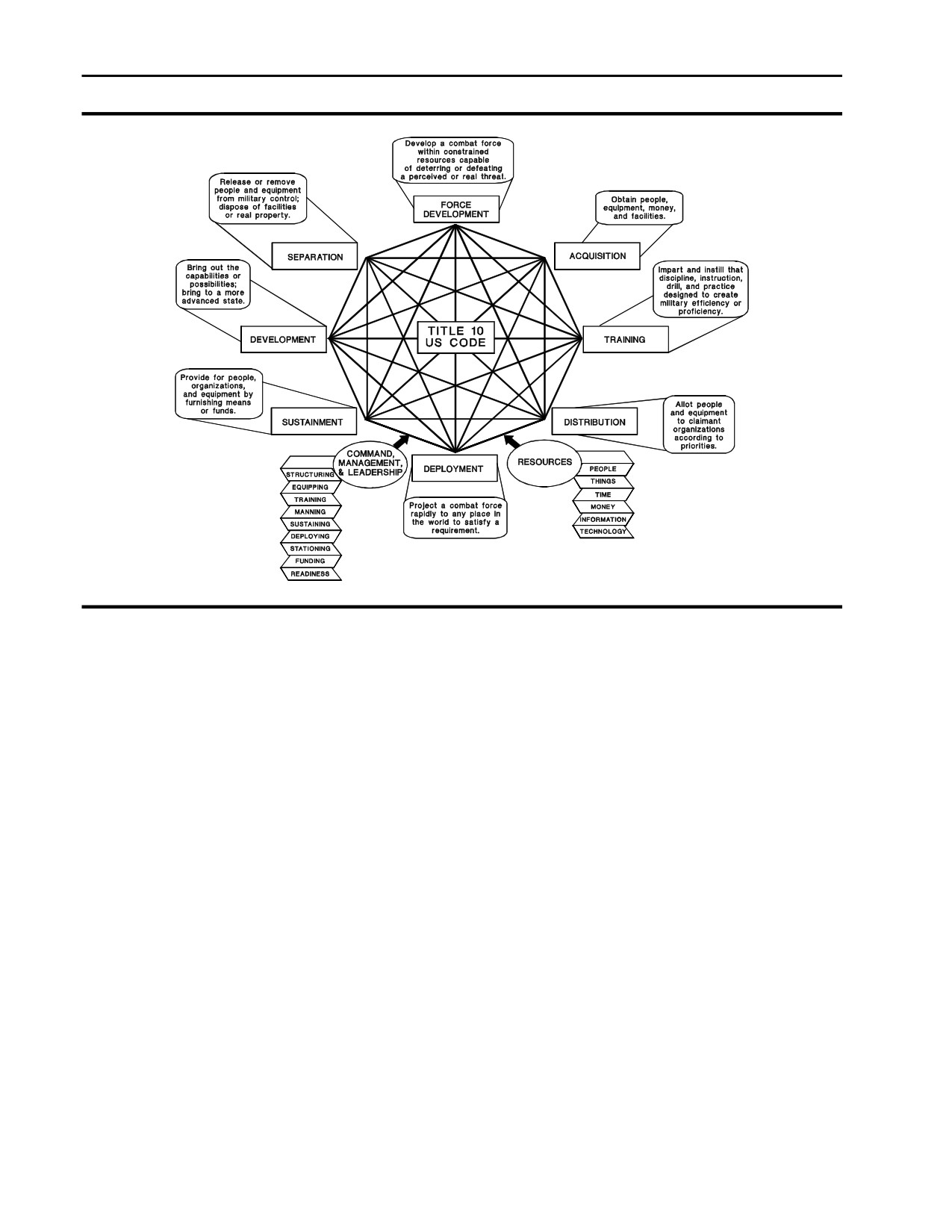
FM 100-11, Force Integration
Figure 4-3. Army Organizational Life Cycle Model
(6) Funding. An organization is properly
c. Horizontal synchronization of these vertical
funded when all costs associated with the organiza-
functions is focused on user organizations to achieve
tion and its DS/GS structure have been identified,
an enhanced operational capability after transition.
programmed, and resourced. Funds must be avail-
able to support activation, reorganization, conver-
Section V:
sion, stationing, property turn-in or transfer, trans-
Force Integration Planning
portation, facility construction or renovation, and
4-12. Planning requirements
operating tempo (OPTEMPO).
a. Requirements for force integration originate
(7) Deploying. An organization is deployable
with the NMS with further details found in the DPG.
(and/or employable) when the organization, its
Mid- and long-range planning is further refined by
DS/GS structure, and associated round-up/round-out
the joint strategic and Army long-range planning
units are structured, equipped, trained, manned,
systems. Systemic relationships are depicted in Fig-
sustained, stationed, and funded to operate as an
ure 4-4.
element of an Army component command. The or-
ganization must be compatible with associated re-
b. Planning to execute change involves the ef-
serve component and sister Service organizations.
forts of force integrators at all force levels down to
(8) Stationing. An organization is prop-
the lowest manageable level: regiment, separate bri-
erly stationed when the organization has an appro-
gade, or division. All actions and activities that can
priate mission and its DS/GS structure have all re-
be accomplished at these levels must be planned and
quired organizational facilities and support infra-
accomplished to reduce the complexity of executing
structure in place. No degradation of quality of life,
change for the ultimate executor: the organization
safety, or environmental standards can exist.
commander. Proponency for planning rests with the
(9) Readiness. An organization is operation-
staff force integrator, who must monitor execution to
ally ready when the organization and its DS/GS
ensure changes are introduced, incorporated, and
structure are at overall and commodity area category
sustained.
levels consistent with the organization’s authorized
level of organization (ALO).
4-6
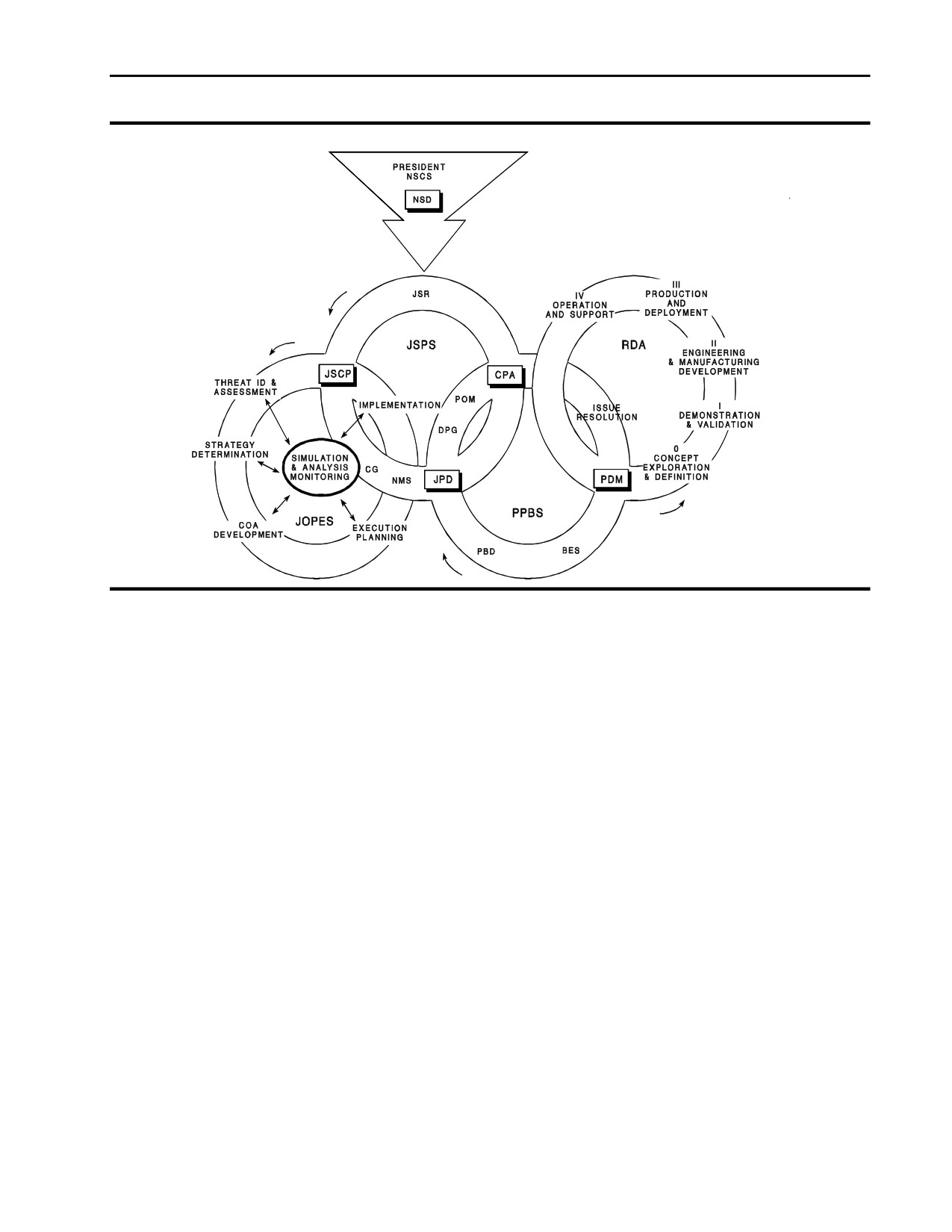
FM 100-11, Force Integration
Figure 4-4. Defense Planning System Interrelationships
c. Planning and execution of force integration
4-14. Planning factors
actions will occur in all environmentsæin peace-
a. Full consideration of selected planning factors
time, mobilization, wartime, and during demobiliza-
is critical for accomplishing the force integration
tion. Activations, conversions, and reorganizations
mission successfully. Force integration planning
are programmed and documented to ensure that
must—
long-range objectives are attained. This is significant
(1) Identify the nature of change, when it will
because unilateral decisions to activate, convert, or
occur, and what organizations it will affect.
reorganize units provisionally require diversion of
(2) Ensure that documentation supports the
programmed resources and may only achieve
change.
short-term success. The flexibility of a commander
(3) Develop suitable, feasible, and acceptable
to task organize forces does not give him the license
concepts to execute the change.
to effect unprogrammed and undocumented organ-
(4) Assess the executability and supportabiity
izational change.
of the change.
(5) Involve affected organizations in the
4-13. Impact assessments
planning process.
Assessments of force integration actions must quan-
(6) Identify facilities requirements.
tify their impact on organization and force readiness.
(7) Establish command and staff responsi-
Changes that are documented in the authorization
bilities and milestones.
database without adequate supporting resources
(8) Control turbulence in organizations.
may, if implemented, result in a degradation of unit
(9) Avoid “instant unreadiness.”
status in terms of personnel, equipment on hand,
(10) Maintain a war-fighting focus.
equipment serviceability, or training. If such action
b. Application of decision support methodolo-
could result in a lower unit status category rating,
gies in the planning process ensures that required
any associated changes must be subjected to inten-
tasks are structured in the sequence in which they
sive planning and management.
are to be accomplished. A synchronized plan re-
quires that critical and concurrent activities be iden-
tified and correlated in time and by organization.
4-7
FM 100-11, Force Integration
Section VI:
revolutionary trend directly affects requirements
International Considerations
for the timely exploration of technological op-
portunities and the need to manage change within
4-15. National priorities
the military.
As U.S. interests evolve, their relative importance
4-19. Missions
for achieving National interests will vary. For exam-
ple, the relative importance of geography, trade,
The above factors directly impact on missions as-
natural resources, or National debt may change.
signed to the military. Modifications in prospective
These elements may increase or decrease in signifi-
responsibilities, potential alliances, and threats have
cance as their impact on National goals and objec-
a profound effect. Furthermore, the evolution of na-
tives changes. Such change may, in turn, have corre-
tional interests and priorities significantly influence
sponding influences on the Army.
the conduct of warfare and OOTW.
4-16. History and world environment
4-20. Direction and guidance
A nation’s historical perceptions influence its rela-
The sum total of internal and external elements pro-
tionships with the family of nations. A nation’s se-
vides the foundation for direction and guidance from
lection of allies also evolves over time as national
the NCA to the JCS and the military departments.
interests change and significantly influence interna-
tional relations. Historical alliances have had signifi-
Section VII:
cant influence on the future goals of the nation and
Summary
its military and affect the planning and execution of
Management of change through the force integration
military operations.
process is vital to the Army. Change is affected by
complex external and internal factors. The process
4-17. Potential adversaries
of introducing, incorporating, and sustaining change
Much like alliances, potential adversaries shift over
is the force integration process. Functional process
time as national interests evolve. This results in a
synchronization integrates the activities associated
periodic reassessment of which nation constitutes a
with force integration. This introduction to the com-
significant threat to national and alliance interests.
plexity of the force integration mission will be ex-
panded in the remainder of this manual.
4-18. Technology
The accelerated pace of technological develop-
ments is a significant element of change. This
4-8
FM 100-11, Force Integration
Chapter 5
Organization Management
Staff is responsible for force management. The
Section I:
DCSOPS, HQDA is responsible for Army-wide
Introduction
execution of force management .
5-1. Organizational integration
c. Army MACOMs and component commands.
The Army manages organizations through organiza-
Force management staffs of MACOMs and Army
tional integration. Organizational integration focuses
component commands plan, program, and develop
on user organizations in the process of introducing,
their portion of the total force from the perspective
incorporating, and sustaining new structure, equip-
of their command’s specific operational require-
ment, and doctrine into the Army. Organizational
ments. They also develop the force structure options
integration manages the documentation, resourcing,
, guidance, and information necessary to ensure ef-
fielding and sustainment of assigned organizations
fective execution of the force integration process
as integrated packages, assuring doctrinally aligned
within subordinate organizations.
capabilities within resource constraints. Organiza-
d. Below MACOM level. Force management
tion integration focuses on increasing force capabil-
staffs at corps, division, and installation perform the
ity while managing the organizational changes
force integration mission at their level. Actual exe-
through prioritization of resources, management of
cution of organizational activations, conversions,
information, synchronization of activities and as-
and reorganizations is accomplished by the parent
sessment of capabilities.
organization of affected units.
5-2. Management structure, objectives and execu-
5-4. Implementation considerations
tion
Implementation may occur as a result of planned,
The management of functionally similar organiza-
programmed, and documented organizational change
tions and major units composed of functionally dis-
or in support of unit deployments into combat or
similar subordinate elements requires structure, ob-
OOTW. In either case, organizations activated, con-
jectives, and execution at HQDA, Army component
verted, or reorganized must be structured, manned,
command, MACOM, corps, division, and installa-
equipped, trained, sustained, deployed, stationed,
tion levels. This chapter discusses functional respon-
and funded to function as part of the Army compo-
sibilities at each of these levels. It also addresses
nent of a joint task force or unified command. Re-
organizational structure, integration, and assess-
serve Component organizations that round-up,
ments as management tools for cyclic reviews and
round-out, or enhance Active Component forces
decision support for changes in Army organizational
must also be capable of being sustained by the Ac-
structure, materiel, and doctrine.
tive Component’s parent organization.
Section II:
Section III:
Organization Management Structure
Organizational Integration
5-3. Levels of control
5-5. Objective and scope
a. The National level. The executive and legis-
Organizational integration is a tool of change man-
lative branches of government, to include the DOD,
agement that focuses Army management actions on
affect force management processes. These agencies
organizations to ensure orderly introduction, incor-
define and resource force structure and approve
poration, and sustainment of new structure, equip-
materiel acquisition programs. Such involvement
ment, and doctrine into the total Army.
frequently determines if individual Service planning
a. The objective of organizational integration is
and programming can be executed or must be
to manage the combined impact of Army functional
changed. Therefore, the Army must plan and pro-
systems on organizations to ensure the right mix of
gram the force in detail and retain sufficient flexibil-
resources (structure, people, equipment, dollars, fa-
ity for modifications and adjustments.
cilities) is available to support a planned activity for
b. Department of the Army level. HQDA is re-
an organization. Increasing capabilities within re-
sponsible for prioritizing assets, determining re-
source constraints.
quirements and establishing authorizations for peo-
b. Execution of organizational integration in the
ple and materiel. The Army Staff (ARSTAF) plans,
near-, mid-, and far-terms involves—
programs, and develops the force. It develops pro-
(1) Recommending priorities. Organizations
jections for required force capabilities to accomplish
must be considered in their totality when determining
Army missions and functions. The Vice Chief of
priorities for managing change while accounting for
5-1

FM 100-11, Force Integration
total force war-fighting requirements during the
(5) Assessing capability. Affordability, sup-
planning and execution phases.
portability, and executability must be assessed prior
to and incident to activations, conversions, reorgani-
(2) Managing information. Information that
zations, strength changes, or authorized level of or-
is routinely conveyed vertically through functional or
ganization (ALO) changes ensuring total organiza-
branch
“stovepipes” must be shared horizontally
tional integration.
across the force management spectrum. Force man-
agement staffs must ensure that echelon-specific
5-6. Organization integration team
information is integrated and analyzed. All available
information must be focused on an organizational
a. Organizational integration (OI) is the doctrine
perspective.
of change management that focuses actions on or-
ganizations to ensure the orderly introduction, incor-
(3) Synchronizing activities. Sequencing
poration and sustainment of new structure and new
events in time is involved in virtually all force man-
materiel systems to increase force capability. Force
agement activities. Change requires multifunctional
management, planning, and execution may be ac-
support from all organizational echelons down to the
complished by several management solutions.
specific, affected and supporting unit(s). Responsi-
bilities, milestones, and decision points must be es-
b. The OI team (Figure 5-1) is a task-organized
tablished to achieve operational requirements. The
group of organization managers, functional area
definitive critical path of an action allows command-
proponents and special interest proponents responsi-
ers to synchronize the total integration function.
ble for management of organizational change that
provides the proper staff synergism for the manage-
(4) Monitoring execution. Routine functional
ment of change.
staff supervision of force management activities en-
ables adjustments and deconfliction of actions, and
c. Execution of the force management process
provides necessary updates of schedules.
depends on the synchronized efforts of organiza-
tional and functional management and special inter-
ests. Special interests are represented by external
agencies whose activities affect or are affected by
the specific actions.
ORGANIZATION INTEGRATOR
·
FORCE INTEGRATOR ·
· SYSTEMS INTEGRATOR
ORGANIZATION
MANAGEMENT
COMMAND MANAGER ·
· DOCUMENT INTEGRATOR
REPRESENTATION
STRUCTURING ·
· STATIONING
EQUIPPING ·
· FUNDING
FUNCTIONAL
MANNING ·
· DEPLOYING
MANAGEMENT
TRAINING ·
·
READINESS
REPRESENTATION
SUSTAINING ·
TRADOC SYSTEM ·
· RESERVE COMPONENTS
MANAGER
SPECIAL
· DA SYSTEM COORDINATOR
INTEREST
PROGRAM/PROJECT/ ·
· INSTALLATIONS MANAGER
REPRESENTATION
PRODUCT MANAGERS
·
COMMAND
REPRESENTATIVE
Figure 5-1. Organization Integration Team
5-2
FM 100-11, Force Integration
d. Functional management is represented by
ment, doctrine, structure, and capability changes into
command or staff proponents of each force integra-
major organizations.
tion functional area. Functional area proponents
(f) Ensures validity of operating system
manage organizations and/or materiel systems based
databases.
on function or branch. The challenge is to incorpo-
(g) Reviews requirements and authori-
rate organization or system changes, normally ac-
zation documents.
complished within the vacuum of a stovepipe struc-
ture and therefore divorced from the force manage-
(h) Assesses the impact of new doctrine,
ment staff, into the total force management effort.
structure, manning, equipment, and facilities on
Functional representatives include, but are not lim-
major units. This includes strategic policy, training,
ited to, the following:
mobilization, deployment, sustainment, redeploy-
ment, demobilization, and resource strategies.
(1)
Personnel Systems Staff Officer
(PERSSO) for the manning function.
(2) Organization Integrator. The Organiza-
tion Integrator (OI) represents organization interests
(2) DA Logistics Systems Officer (DALSO)
of functionally similar organizations and integrates
for the equipping function.
management of all aspects of structuring, equipping,
(3) Assistant Chief of Staff for Installation
manning, training, sustaining, deploying, stationing,
Management (ACSIM) representative for the sta-
and funding. The OI represents all organizations in a
tioning function.
specific standard requirements code (SRC) or spe-
e. Staff points of contact
(POC) contribute
cific type organizations within a branch. The OI also
functional expertise to force management without
organizes and synchronizes OI team activities. The
assuming staff proponency.
OI—
f. Coordination of force integration actions is
(a) Assesses the ability of the functional
accomplished by the OI team. The team’s structure
systems to provide personnel, materiel, and facilities
depends on the task and organization(s) affected, to
for organizations.
include representation from organizational and func-
(b) Recommends priorities for allocation
tional management personnel. Special interests, to
of personnel, materiel, and facilities to organizations
include affected organizations, should be repre-
as integrated packages.
sented. The OI team uses information available in
(c) Assesses the impact on readiness as
existing Army information systems to assess af-
a result of personnel, training, equipment, facilities,
fordability, supportability and executability of
doctrine, or structure changes.
planned and programmed activities. If problems ap-
pear in information systems or the validity of plans,
(d) Reviews distribution plans and de-
the OI team identifies the issue and assesses the im-
termines impacts on organizations. Assesses impact
pact by functional area. Action is taken to correct
of new capabilities on organization structure, doc-
the problems at the lowest manageable level. The
trine, or resources.
functions of each member of the OI team are as fol-
(e) Reviews, coordinates ARSTAF re-
lows:
view, and recommends final ARSTAF position to
(1) Force Integrator. The Force Integrator
the Director, Force Programs, ODCSOPS, on all
(FI) represents organization interests of functionally
organization requirements documents (tables of or-
dissimilar organizations grouped into brigades,
ganization and equipment
(TOE), basis-of-issue
regiments, divisions, and corps. The FI—
plans (BOIP), and manpower requirements criteria
(MARC) studies).
(a) Assesses the ability of functional
systems to provide personnel, equipment, facilities,
(f) Coordinates authorization docu-
and fiscal resources for major units.
ments. Maintains the documentation audit trail on all
additions, deletions, and other changes to organiza-
(b) Develops, maintains, and defends
tion authorization documents.
organizational MDEPs for major organizations.
(g) Develops, maintains, and defends
(c) Develops, assesses, and makes rec-
organizational MDEPs for organizations.
ommendations for alternative use of resources for
establishing and maintaining major organizations to
(h) Ensures validity of operating system
support a war-fighting CINC and other MACOMs.
databases, such as the Structure and Manpower Al-
location System (SAMAS).
(d) Acts as the link between resource
allocators and OIs.
(3) Command Manager (Force Structure).
The Command Manager (Force Structure)
(CM
(e) Evaluates and analyzes the total im-
(FS)) represents the organizational interests of a
pact of incorporating personnel, facilities, equip-
MACOM, manages its tables of distribution and
allowance (TDA), and serves as the modification
5-3
FM 100-11, Force Integration
TOE (MTOE) OI and FI for that MACOM. The
(c) Produces manpower resource guid-
CM (FS)—
ance for MACOM Program Budget Guidance
(PBG).
(a) Acts as POC for command plans
and concept plans.
(d) Manages command force structure
allowances.
(b) Maintains the documentation audit
trail on all additions, deletions, and other changes to
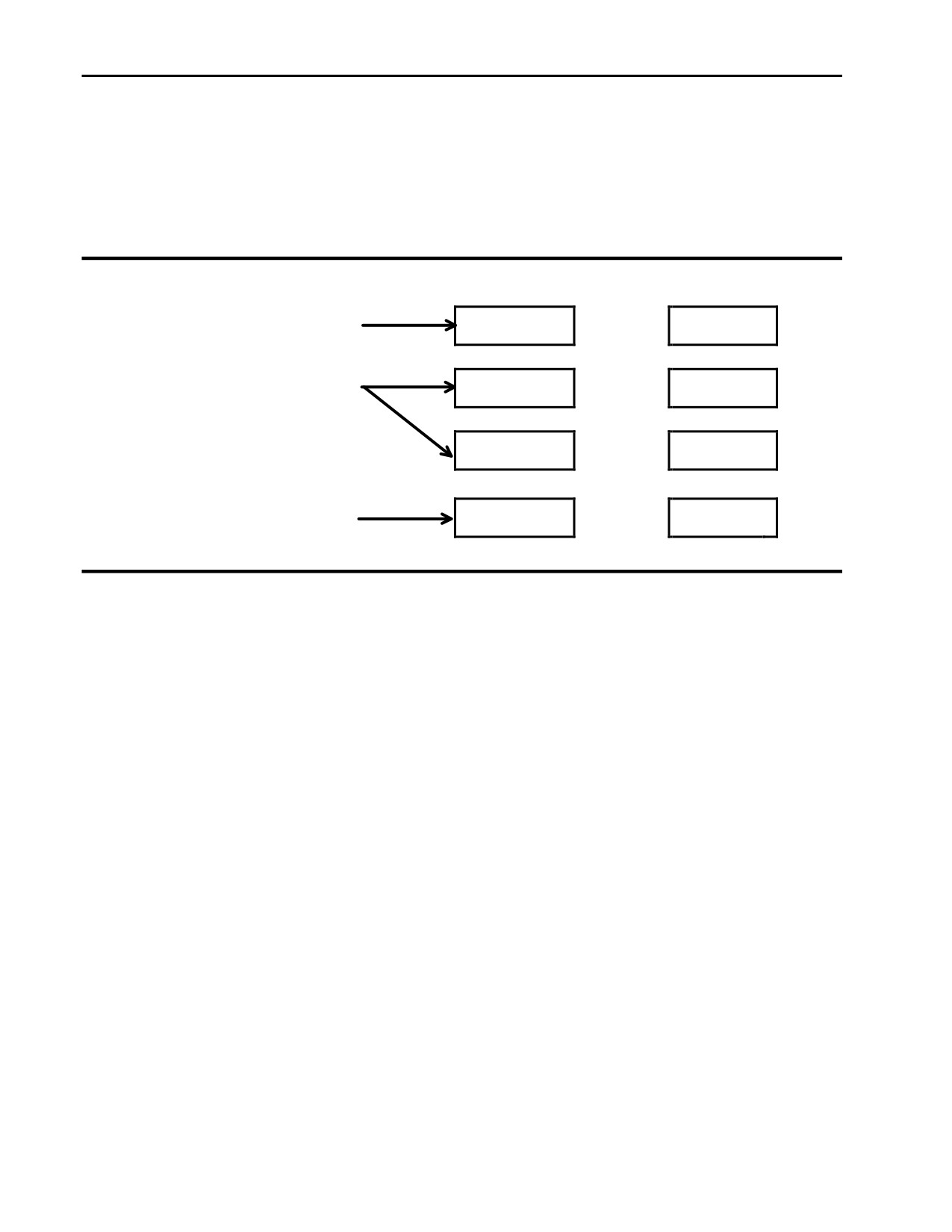
g. Figure 5-2 illustrates the different responsi-
unit MTOEs and TDAs.
bilities of the OI, FI, and CM (FS).
z z
z
ORGANIZATION INTEGRATOR (OI)
BATTALION
COMPANY
XXX
XX
FORCE INTEGRATORS (FI)
CORPS
DIVISION
X
z z z
SEP BDE
ACR
COMMAND MANAGER (CM)
MACOM
TDA
Figure 5-2. Force Integration Responsibilities
(4) Systems Integrator. The Systems Inte-
(j) Recommends disposition of displaced
grator (SI) represents user interests in all materiel
equipment.
system management aspects of force integration. The
(5) Document Integrator. Document Inte-
SI is involved in all aspects of equipping, from the
grators (DI) ensure that requirements and authoriza-
front-end requirement determination process through
tion documents meet approved Army force pro-
system fielding. The SI—
grams. Documentation integration is a function of
(a) Determines requirements for mate-
the U.S. Army Force Management Support Agency
riel fielding and other user-oriented functions related
(USAFMSA), a DA DCSOPS field operating activ-
to materiel acquisition.
ity (FOA). DIs include requirements document de-
velopers and authorization document developers.
(b) Develops the command position on
The DIs link requirements, planned or programmed
materiel requirements documents.
force structure actions, and the documentation proc-
(c) Assesses the affordability of the
esses. The DIs—
materiel requirements.
(a) Develop requirements documents
(d) Develops materiel acquisition or
(TOE, BOIP, and MARC).
fielding alternatives.
(b) Produce authorization documents
(e) Recommends materiel acquisition
(MTOE) based on HQDA guidance, organization
priorities for research, development, test, evaluation,
requirements documents, command plans, and input
procurement, and materiel change programs.
from the MACOMs.
(f) Recommends priorities for materiel
(c) Review proposed authorization
distribution.
documents to ensure compliance with manpower,
(g) Participates in system design reviews.
personnel, and equipment policies and directives.
(h) Ensures all aspects of rationaliza-
(6) Command Manager (Program Budget
tion, standardization, and interoperability (RSI) are
Guidance). The Command Manager
(Program
considered.
Budget Guidance) (CM (PBG)) ensures that the
(i) Reviews requirements and authori-
manpower allocation for each MACOM is accu-
zation documents for materiel user implications.
rately reflected in the SAMAS system, in confor-
mance with Army leadership decisions, and within
5-4
FM 100-11, Force Integration
the manpower controls as specified by OSD. The
(c) Organization integration, including
CM (PBG) represents the Army’s budget interests of
organizational assessments, force structure review
functionally dissimilar organizations grouped into
and analysis, and authorization document review
the various MACOMs. The CM (PBG)—
process.
(a) Manages the manpower database of
Section IV:
record by MACOM, at UIC, MDEP, and Army
Assessments
management structure code (AMSCO) level of de-
tail, by fiscal year, by category (military and civil-
5-7. Force Validation Committee
ian) for each budget cycle.
a. Organizational assessments are management
(b) Maintains the Army’s only detailed
forums for identifying and resolving issues that in-
audit trail for manpower.
hibit execution of short-term organizational change
(c) Interfaces with all ARSTAF agen-
(activations, conversions, strength changes, ALO
cies and MACOMs during each budget cycle.
changes, and reorganizations) occurring in the
budget year and the first year of the POM.
(d) Produces the manpower addendum
to the PBG at the conclusion of each PPBES event.
b. The Force Validation Committee (FVC) is a
HQDA forum that meets on a schedule directed by
(e) Manages and maintains the Army’s
the DCSOPS to review force management actions.
controlled accounts.
The FVC reviews the upcoming 24 months, for all
(7) Army component commands and MA-
components, for all SRCs and UICs undergoing or-
COMs. Force management staffs at these echelons
ganizational change. The FVC reviews all aspects of
manage the planning and execution of the force inte-
manning, equipping, funding, training, and station-
gration mission through—
ing to ensure that the organizations attain a readiness
(a) Document integration, including
category of level C-3 or better upon activation or
authorization document (MTOE) review, TDA de-
conversion.
(See Chapter
13 for a discussion of
velopment, and database management.
readiness categories.)
(b) Systems integration, including, re-
c. Organizational assessments support the force
quirements and authorization document review, the
management mission of increasing war-fighting ca-
materiel fielding plan (MFP) process, new equip-
pability by providing credible information in support
ment training plan
(NETP) review, and facilities
of decision making. This should occur with mini-
support annex review.
mum adverse effect on readiness as organizations
transition to new structure, materiel, and doctrine, or
(c) Organization integration, including
a combination of any of these. The assessment proc-
the organizational assessment process, review of
ess uses the force integration functional areas to fo-
requirements and authorization documents, and doc-
cus on total organizations; that is, the organization
trine review.
undergoing change and all other DS, GS,
(d) Force structure management, in-
round-up/round-out, and sister service organizations
cluding TDA document management, the Master
affected. The organizational assessment methodol-
Force (MFORCE), and end strength management.
ogy may be employed to support “call forward” de-
(e) Force planning, including the total
cisions or validation of programmed force structure
Army analysis
(TAA) process, command plan
actions.
(CPLAN) process, force reduction planning and
d. Comments from subordinate commands, as
monitoring, and concept plan
(CONPLAN)
well as studies and analyses (such as, system pro-
development.
gram reviews) peculiar to a specific functional area,
(f) Readiness management, including
may be used to develop issues to focus the assess-
Status of Resource and Training System (SORTS)
ment process. Issues are identified, coordinated, and,
input and the unit status reporting (USR) process.
if possible, resolved throughout the assessment proc-
(8) Corps, division, regiment, separate bri-
ess. Unresolved issues are briefed during the conduct
gade, and installation. Force management staffs at
of formal assessment presentations.
these levels manage force integration through—
5-8. Functional area assessments
(a) Force structure management, in-
a. Functional area assessments (FAA) are inten-
cluding authorization document
(MTOE) and
sive management forums that allow the Army lead-
MFORCE management, USR monitoring, and force
ership to identify and resolve issues that prevent or
structure review and analysis.
inhibit the execution of near- and mid-term plans and
(b) Systems integration, including action
programs. FAAs examine the impacts of moderniz-
plan development, distribution plan reviews, and
ing the Army, by functional area.
facilities review.
5-5
FM 100-11, Force Integration
b. FAAs investigate the horizontal and vertical
5-10. Supportability assessments
exchange of information focusing on the Army’s
ability to maintain readiness, force capability and
Supportability assessments are UIC-specific as-
force modernization in the POM years. The focus is
sessments conducted for change documented in the
on the Army’s ability to execute its modernization
current or budget year. Supportability assessments
plans and fully support all aspects of programmed
determine the ability of the functional systems
unit transitions improving the war-fighting capabil-
(personnel, materiel and sustainment) to support
ity of the total force with minimum adverse effect on
documented change by projecting the unit status
readiness.
category on completion of the organization transition
period. Failure to meet the readiness objective (C-3)
c. FAAs assist the Army leadership in shaping
may require action to modify the effective date (E-
the most cost-effective force, while emphasizing
date) of change or prioritization of personnel or
readiness, modernization and capability. The VCSA
equipment. They are assessments of whether there
may use the FAA process to consider special man-
are sufficient personnel and equipment resources in
agement areas, such as command and control or
the Army to fill to C-3 or better at MOS, grade, and
force management.
equipment quantity
(by line item number
(LIN))
d. The DCSOPS is the executive agent for the
level of detail.
FAA process. The proponent and coordinator of the
FAA process is the appropriate TRADOC service
5-11. Executability assessments
school commandant, MACOM commander, or
Executability assessments are SRC-specific assess-
ARSTAF proponent. FAA’s executability analyses
ments conducted to determine if there are sufficient
address the functional domains of doctrine, training,
personnel and equipment resources available to fill
leader development, organizations, materiel and sol-
units to C3 or better at the unit location by the ef-
diers (DTLOMS).
fective date (E-date).
5-9. Affordability assessments
Section V:
Affordability assessments review organizational
Summary
change through prioritization of resources, synchro-
The organization management framework for the
nization of activities, and availability of personnel,
force integration process focuses on organizations to
equipment, training resources, infrastructure, mobi-
ensure that change affecting organization at all
lization, deployment and sustainment
(PBG sup-
Army levels is coordinated, synchronized, and con-
port). Affordability assessments identify and resolve
tinually assessed. This coordination, synchroniza-
systemic discontinuities of PBG support prior to
tion, and assessment is conducted from HQDA
impacting force readiness and force capability. They
through Army component commands and MACOMs
are assessments of the ability of the Army to provide
to corps, division, and installation levels.
PBG support to force structure actions.
5-6
FM 100-11, Force Integration
Chapter 6
Structuring the Force
source requirements are prioritized through alloca-
Section I:
tion of resources in the PPBS.
Introduction
6-6. DOD Planning, Programming, and Budget-
6-1. Basis for force requirements
ing System
Force development is initiated by determining battle-
a. The DOD PPBS begins with the NMS, which
field requirements. Minimum mission-essential war-
starts the planning phase and serves as the basis for
time requirements for the conduct and sustainment
the DPG. PPBS, the DOD resource allocation sys-
of combat operations are the basis for Army organ-
tem, focuses on the acquisition of resources neces-
izational designs and force structure requirements.
sary to organize the forces required to execute the
strategy in the DPG.
6-2. Resourcing requirements
b. The POM force is developed based on re-
The development of force structure to accomplish
sources projected to be available. Using the major
Army missions and functions includes the active and
combat forces in the Army fiscally constrained
Reserve Components and aims at a balanced mix of
force, extensive analysis determines the comple-
organizations. Authorizations for required personnel
mentary combat, combat support, and combat serv-
and equipment are constrained by available re-
ice support force structure. In the force structuring
sources (manpower, equipment and dollars) provided
process, the major combat forces, referred to as
through the Army’s PPBES. Documentation of these
“above-the-line” forces
(divisions, brigades, regi-
authorizations culminates the process of structuring
ments and groups), are directed by the DPG.
the force.
“Below-the-line” forces, which are echelon above
6-3. Balancing resources and requirements
division/echelon above corps (EAD/EAC) combat,
combat support, and combat service support force
Force managers who structure the force through the
structure, are derived from TAA.
POM consider the best application of resources to
achieve desired results. They allocate available re-
sources to the Active and Reserve Components, the
Federal Civil Service work force and consider force
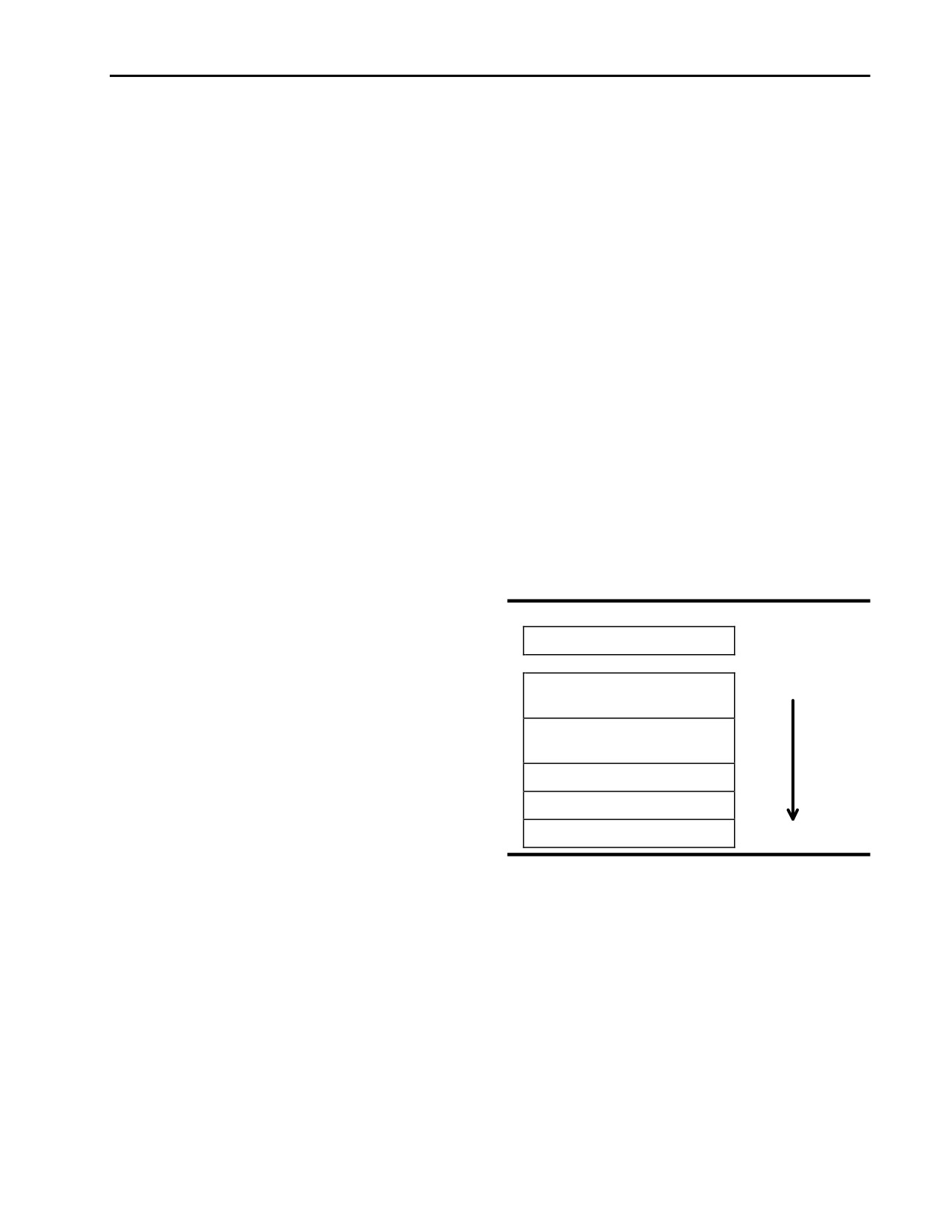
Force Sizing
structure offsets from sister services or other na-
tional assets.
CJCS FISCALLY
10 DIVS
Section II:
CONSTRAINED FORCE
Source Documentation
ARMY FISCALLY
6-4. Joint Strategic Planning System
CONSTRAINED FORCE
The Joint Strategic Planning System (JSPS) includes
POM FORCE
an identification and evaluation of the threat. It pro-
vides the basis for formulating strategy and resource
BUDGET FORCE
needs for forces and materiel. Three outputs of JSPS
are the National Military Strategy (NMS), CPR and
CURRENT FORCE
10 DIVS
the JSCP. The NMS announces the fiscally con-
strained force as determined by the JCS. The CPR
Figure 6-1. Force Sizing
establishes the priority for joint war-fighting capa-
bility. Force sizing (Figure 6-1) translates the NMS
c. The POM force is a balance between resource
into the JSCP and optimizes the use of resources to
availability reflected in the Army POM, the Army’s
meet the war-fighting CINCs’ operational require-
major programming input into the PPBS. Risks as-
sociated with the POM force are addressed in the
ments.
CPA.
6-5. Joint Strategic Capabilities Plan
6-7. Joint Operations Planning and Execution
The JSCP translates strategy into taskings and re-
System
quires that plans be completed to accomplish mis-
JOPES is the final element in the DOD management
sions within available resources. The JSCP is the
system and focuses on operational planning. JOPES
JSPS document that starts the deliberate planning
is oriented on the most effective use of the nation’s
process and is the only formal tie between JSPS and
current military capability against the near-term
the JOPES. As operational plans are developed, re-
threat.
6-1
FM 100-11, Force Integration
Section III:
training, leader development or materiel impacts
Organizational Design and
such as requirements for increased maintenance,
Requirements Documentation
supply, transportation, and medical force structure.
The design is then submitted to HQ TRADOC for
6-8. Organizational design process
design approval and for introduction into the force
The building blocks of the force structure that sup-
design update (FDU) process, if appropriate.
port operations planning are units, which are
c. Force design update.
grouped into organizations; for example, companies
(1) The FDU is a semi-annual process used
grouped into battalions. When a new or modified
to develop consensus within the Army on new or
Army organizational structure is required, new units
changed organizational designs and to obtain CSA
and organizations are designed.
implementation decisions for such designs when
a. Identification of organizational issues.
they—
(1) The organizational design process is initi-
(a) Require a policy change.
ated by the identification of issues that originate
(b) Affect the war-fighting capability of
from the combat development process, the CINCs,
a CINC.
the MACOM commanders, TRADOC school com-
(c) Require additional resources
mandants and center commanders, other Army
(d) Implement a new concept.
commanders, or the Department of the Army Staff.
(e) Have high visibility or sensitivity.
(2) Issues are concerned with enhancing unit
(2) The TRADOC Commander is the Army
or force capabilities and result from changes to doc-
approval authority for organizational requirements
trine, new or revised operational (branch/ functional)
and designs. The TRADOC Deputy Chief of Staff
concepts, acquisition of new equipment , or signifi-
for Combat Developments (DCSCD), in coordina-
cant restructuring of a MOS.
tion with the DA DCSOPS, determines which de-
(3) When it is determined that an organiza-
signs meet the FDU criteria for obtaining a CSA
tional solution to an issue is appropriate, new or re-
implementation decision. Designs that do not meet
vised operational concepts that address a unit’s mis-
the FDU criteria are not addressed further in the
sion, functions and required capabilities are devel-
process except, in selected cases, as informational
oped to provide the basis for organizational design.
items.
b. Unit reference sheets. An organizational so-
(3) The Force Design Directorate
(FDD),
lution requires the development of a unit reference
DCSCD, TRADOC, manages the FDU process.
sheet (URS). The URS is the first organizational
FDD is responsible for analyzing issues in the
document that leads to the development of a table of
TRADOC domains of doctrine, training, leader de-
organization and equipment
(TOE). It provides
velopment, organizations, materiel and soldiers
much of the information that will subsequently be
(DTLOMS) and assessing and detailing the resource
refined and documented in the TOE.
impacts (such as costs of personnel, materiel, facili-
ties) of adoption of the new or changed units or force
(1) Combat developers of TRADOC, the
designs.
Army Medical Department Center and School, U.S.
Army Special Operations Command and the U.S.
(4) FDD establishes a briefing schedule and
Army Intelligence and Security Command are re-
provides briefings on the results of the analyses to
sponsible for developing URS for their functional
the MACOM and Army component commanders
areas. As a minimum, a URS contains the following:
and to the CINCs for comment and to gain consen-
sus. Subsequent to TRADOC design approval, the
(a) Personnel requirements by job title,
ARSTAF and the VCSA and CSA are briefed for
grade, and quantity.
implementation decision.
(b) Major equipment requirements to in-
(5) CSA implementation decisions are not
clude nomenclature and quantity.
always approvals for immediate execution. Often
(c) A breakout of organizational ele-
they are approvals for documentation as new or re-
ments with related personnel and equipment re-
vised TOEs and for subsequent competition for re-
quirements.
sourcing through the TAA process. On the other
(d) A summary that includes other rele-
hand, issues and designs without resource require-
vant information such as unit title, design descrip-
ments that are approved at any level are approvals
tion, mission, assignment, assumptions, limitations,
for TOE documentation and implementation at the
dependencies, mobility requirements, and concept of
earliest possible date. They do not need to compete
operations.
in TAA.
(2) The combat developer coordinates the
(6) Approval of a URS and its associated
URS to identify other doctrinal, organizational,
concepts and the HQDA implementation decision
6-2
FM 100-11, Force Integration
ends the organizational design process. The design is
(4) MARC studies. Variable and standard
then handed off from TRADOC to the Requirements
MARC are established through the conduct of stud-
Documentation Directorate (RDD), USAFMSA, a
ies that provide a complete explanation of the func-
DA DCSOPS field operating agency, for documen-
tion, skills involved, and the methodology employed
tation as a new or revised TOE.
to establish the proposed criteria. RDD of
USAFMSA conducts these MARC studies in coor-
6-9. Documentation of requirements in TOE
dination with the MOS or functional proponents.
a. Tables of organization and equipment.
After they have been coordinated with the propo-
nents for all TOE that will be affected by the new or
(1) TOE are organizational models which
changed MARC, the studies are reviewed by HQDA
state the minimum mission essential wartime re-
staff agencies and approved or disapproved by the
quirements for personnel and equipment needed for
DA DCSOPS. Approved MARC are then dissemi-
accomplishment of a unit’s doctrinal wartime mis-
nated for use in documentation of TOE. MARC are
sion. Approved TOE are used in force planning and
reviewed and/or revised at least every three years.
subsequently in the development of MTOE which
are authorization documents against which person-
(5) Personnel requirements for new or im-
nel and equipment resources are programmed for
proved equipment. Determining personnel require-
allocation.
ments for the operation and support of new or im-
proved equipment is a special case. Personnel re-
(2) The TOE is the end product of the com-
quirements for TOE are developed as qualitative and
bat development process. It merges, into one docu-
quantitative personnel requirements information
ment, the results of the requirements determination
(QQPRI) and documented along with equipment
process. This includes—
requirements in the BOIP for the equipment.
(a) Operational
(functional/branch)
concepts.
c. Basis-of-issue plans.
(b) Manpower Requirements Criteria
(1) A BOIP for new or improved equipment
(MARC).
is an automated record that establishes the minimum
(c) Basis of issue plans.
mission essential wartime requirements (MMEWR)
(d) FDU decisions.
for the equipment and its associated support items of
(e) Other related documents and re-
equipment and personnel
(ASIOEP) in specific
quirements systems.
TOEs. It also identifies any equipment and personnel
requirements to be replaced, if appropriate. BOIPs
b. Manpower Requirements. Manpower re-
are developed on automated systems and are applied
quirements that are documented in TOE are based
to specific TOEs by automated means.
on Department of the Army approved criteria.
(2) Materiel developers use the BOIP as in-
(1) Variable
(workload driven) criteria.
put for concept studies, life-cycle cost estimates, and
Manpower requirements for combat support (CS)
trade-off analyses during the R&D process.
and combat service support
(CSS) positions are
(3) Force managers use the BOIP to plan and
based primarily on workload data for a function.
program the modernization of specific units through
(a) The number of mechanics required
the provisioning of the new or improved equipment
to support the tanks in a tank battalion is computed
and its ASIOEP.
on the basis of the annual man-hours of workload
(4) MACOMs use the BOIP to plan and pro-
generated by scheduled and unscheduled mainte-
gram for equipment, facilities, initial provisioning,
nance actions for the battalion’s tanks.
and personnel required to support the new or im-
(b) The required number of personnel
proved equipment.
specialists, finance specialists, or cooks is based on
(5) An integral part of the development proc-
the number of soldiers supported.
ess for a BOIP is the development and refinement of
(2) Standard criteria. These criteria include
the QQPRI. The QQPRI provides the following:
staff positions and senior enlisted supervisors such
(a) MOS for operators, crew size, and
as commanders, first sergeants, command sergeants
special personnel tasks.
major and operations NCOs.
(b) MOS for maintainers for the princi-
(3) Doctrinal criteria. Requirements for
pal item of equipment, its components with separate
combat positions, such as the number of soldiers in a
line item numbers
(LIN), and associated support
rifle squad, are based on doctrine. The number of
items of equipment (ASIOE). The QQPRI also pro-
crewmen required for a tank, though doctrinal, is a
vides an engineering estimate for the direct produc-
function of the tank’s crew positions. Some non-
tive annual maintenance man-hours
(DPAMMH)
combat positions, such as primary staff positions,
required for their support. The initial estimates for
may also be prescribed by doctrine (in this case, FM
DPAMMH and their subsequent refinements are
used to update the Army’s maintenance MARC data
101-5).
base.
6-3
FM 100-11, Force Integration
(c) The materiel developer coordinates
(1) The base TOE (BTOE). The BTOE is the
the QQPRI with combat developers, personnel pro-
least modernized version of the TOE. An example
ponents, and other materiel developers throughout
would be a tank battalion TOE equipped with M60
the development process. The final QQPRI data be-
tanks and VRC-12 series radios.
comes part of the approved BOIP.
(2) Incremental change packages
(ICP).
(6) Other types of BOIP are used in the TOE
ICPs are doctrinally sound groupings of one or more
development process as the means for making
BOIPs consisting of personnel and equipment
changes to TOE based on changes in doctrine, per-
changes that will be incrementally applied to a
sonnel (for example, restructuring of an enlisted ca-
BTOE to form a succession of intermediate TOEs
reer management field), or equipment (for example,
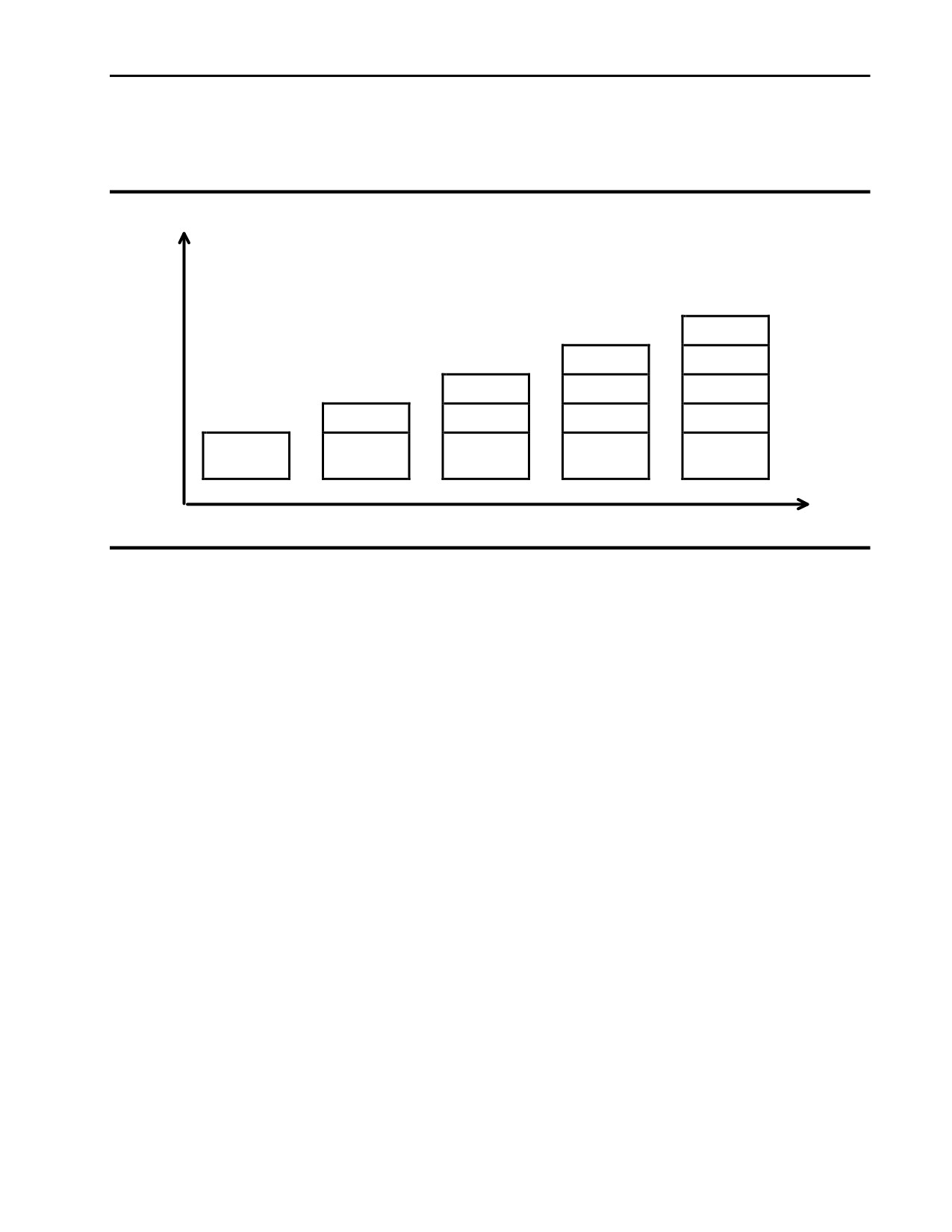
(ITOE) as a unit is modernized. Figure 6-2 illus-
changing quantities of rifles and bayonets in a TOE).
trates this concept. An example of an ICP would be
a grouping of the BOIPs for radios in the single-
(7) The final BOIP is required 30 months be-
channel ground and airborne radio system
fore the first unit equipped date (FUED) to allow for
(SINCGARS) along with the BOIPs for their re-
documentation of authorizations and development of
spective vehicle installation kits.
modernization and institutional training.
(3) ITOE. The ITOE reflects how an organi-
d. Requirements for command, control, com-
zation will look at a specific point in time based on
munications and computer (C4) equipment.
the aggregation of ICPs applied to that point.
(1) Prior to documentation in BOIPs and
(4) Objective TOE
(OTOE). The OTOE
TOEs, C4 equipment requirements are approved
portrays a fully modernized unit upon application of
through the operational facilities (OPFAC) require-
all applicable ICPs.
ments rules process.
(5) ICP header list. The ICP header lists all
(2) This is a combat developments process
of the BOIPs (grouped by ICP) applicable to a spe-
for identifying requirements and establishing rules to
cific TOE and sequenced in the order in which they
govern the allocation of C4 equipment for specific
are intended to be applied to the TOE. The ICP
functions in specific types of units and at specific
header list portrays the doctrinal modernization path
battlefield locations
(brigade, echelons above bri-
(MODPATH) of a unit over time from the least
gade, division, echelons above divisions, echelons
modernized configuration to the most modernized.
above corps, and so on).
The ICP header list identifies all ICPs that pertain to
(3) OPFAC rules are developed by the TOE
a specific TOE and the sequence in which they are to
proponents and validated by the OPFAC review
be applied as the unit is modernized.
board at the U.S. Army Signal Center. After valida-
g. TOE strength levels. TOEs are documented
tion, the rules are sent to HQ TRADOC for
with five strength levels. These levels provide force
approval.
managers with options in a constrained resource en-
(4) The U.S. Army Signal Center maintains
vironment.
an automated data base of approved OPFAC rules,
(1) Level 1 depicts the personnel and equip-
each of which is identified by a unique five position
ment needed for the unit to effectively accomplish its
alpha-numeric code. An approved OPFAC rule must
missions on a sustained basis.
exist in order to justify including a C4 equipment
(2) Levels 2 and 3 reduce the number of per-
requirement in a BOIP or TOE.
sonnel to approximately 90 percent and 80 percent,
e. Equipment readiness codes. All equipment in
respectively, of level 1. These levels represent bal-
a TOE is coded with an equipment readiness code
anced organizational structures with reduced capa-
(ERC) to indicate the relative essentiality of the
bilities in terms of sustaining combat capability or
equipment to the organization. ERCs are an asset
the ability to perform the TOE’s level 1 quantitative
distribution tool that, when combined with the De-
workloads
partment of the Army Master Priority List
(3) Level B provides a means for conserving
(DAMPL), allow DCSOPS to establish priorities for
U.S. military manpower by allowing the substitution
allocation of equipment that is in short supply.
of other categories of personnel (such as local na-
ERCs distinguish between primary mission and sup-
tionals and contractor personnel) in certain posi-
porting mission equipment within the same unit. The
tions. Level B shows the minimum numbers of U.S.
codes are explained in Chapter 13.
Army personnel required for command, supervision,
f. Incremental TOE system. The incremental
technical, maintenance and other key functions.
TOE system consists of base TOE records, groupings
Type B organizations are only used for selected
of related BOIP records, which are called incremental
combat support and combat service support units.
change packages (ICPs), and an ICP header list which
(A level A column appears in TOEs but it is not cur-
is generated by the automated system.
rently used.)
6-4
FM 100-11, Force Integration
(4) Level C specifies staffing that provides
(5) Equipment requirements remain at 100
the cadre for activation of a unit to one of the other
percent at all levels except for individual equipment
levels.
such as protective masks, tool kits and individual
weapons.
Incremental TOE System
c
a
Objective
TOE
p
a
ITOE #3
ICP 4
b
ITOE #2
ICP 3
ICP 3
i
ITOE #1
ICP 2
ICP 2
ICP 2
l
BTOE
ICP 1
ICP 1
ICP 1
ICP 1
i
t
BASE
BASE
BASE
BASE
BASE
TOE
TOE
TOE
TOE
TOE
y
Modernization Over Time
Figure 6-2. Incremental Table of Organization and Equipment System
h. Consolidated TOE update. TOEs and BOIPs
Section IV:
are developed and maintained in an interactive, real-
Force Structure Development
time, automated system called the Requirements
Documentation System (RDS). The automated rec-
6-10. The influence of constraints
ords for DA approved TOEs and BOIPs are re-
a. The mix of unit models that make up a bal-
corded (“frozen”) periodically in the automated sys-
anced and affordable force structure must support
tem in a process called the Consolidated TOE Up-
joint and Army planning, programming, and budg-
date (CTU). CTU records are then disseminated to
eting at the strategic, operational, and tactical levels.
the Army Staff, MACOMs, Army component com-
Force development is based on an understanding of
manders and other DOD activities for use in devel-
the objectives to be achieved, the threat, and con-
oping authorization documents, command plans,
straints (dollars, end strength, roles, and missions).
programs, budgets and many other purposes.
The primary differences among various force struc-
i. Use of TOEs in force planning. TOEs pre-
tures are the extent to which constraints are imposed
scribe a particular type unit organization, man-
and the time over which force structure requirements
power, and equipment and specify the unit doctrinal
are forecast.
capabilities and wartime missions. They are the ba-
b. The determination of the size and content of
sis for developing authorization documents and de-
force structure is an iterative, risk/benefit trade-off
termining future resource requirements. They are
analysis process. The CJCS fiscally constrained
used to record and project the force structure of the
force is capable of achieving the national objectives
Army through the POM years and extended planning
with some reasonable assurance of success. This
period. When used with the master force database,
force supports the joint strategic planning conducted
they provide a force structure projection that reflects
by the Joint Chiefs of Staff and the CINCs of the
force levels in the program. Requirements docu-
unified combatant commands.
ments are also used to depict the future force re-
quirements in the Structure and Composition System
(SACS).
6-5
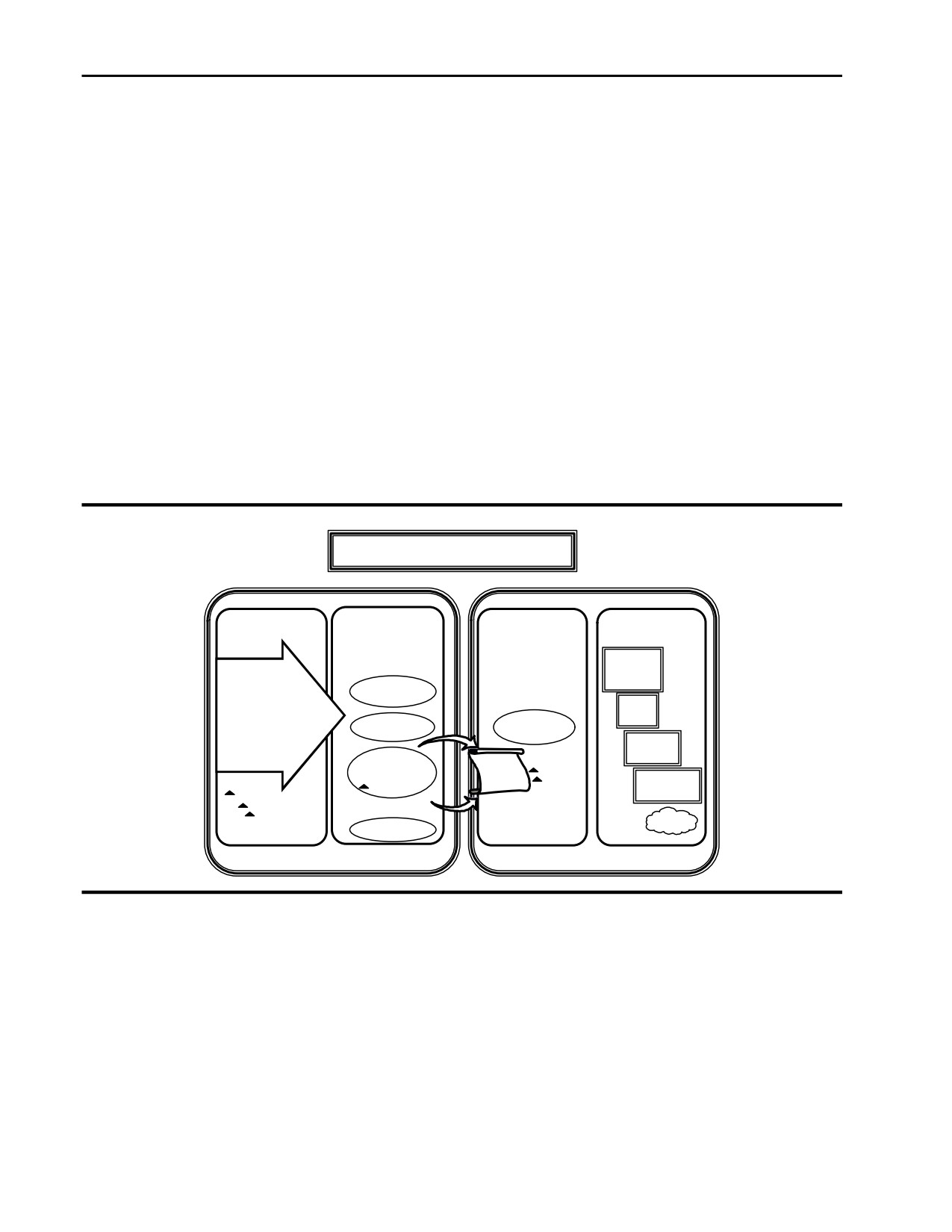
FM 100-11, Force Integration
The POM force is adjusted for affordability and ex-
6-11. Supporting analysis
ecutability to become the basis for POM develop-
a. Analyses are conducted to identify critical
ment. The initial POM force becomes the approved
near-term force structure deficiencies and readiness
POM force after determining which force structure
capabilities, resources needed to meet current and
initiatives will be included in the POM.
programmed requirements, and the distribution of
b. The TAA is a multiphased force structuring
these resources when translated into specific action
process consisting of qualitative and quantitative
programs.
analyses. It generates tactical support and general
b. The current force capability to mobilize, de-
purpose forces necessary to sustain the divisional
ploy, and sustain forces in combat is assessed by
and nondivisional combat forces designated in the
comparing its actual capabilities with its designed
Army fiscally constrained force. The DPG, The
capabilities.
Army Plan (TAP) and TAA form the basis for the
Army’s POM development and establishment of the
6-12. Total Army analysis
POM force.
a. The Army’s program force is developed dur-
c. The TAA consists of two phases, a require-
ing the TAA process. TAA analytically and subjec-
ments phase (force guidance and quantitative analy-
tively generates the below-the-line tactical support
sis) followed by a resourcing phase
(qualitative
forces and the general purpose forces necessary to
analysis and leadership review). The sequence of the
support the above-the-line divisional and nondivi-
TAA activities is depicted in Figure 6-3.
sional combat forces contained in the Army fiscally
constrained force (divisions, separate brigades, spe-
cial forces groups, and armored cavalry regiments).
Total Army Analysis
Force
Qualitative
Leadership
Quantitative
Guidance
Analysis
Review
Analysis
MTW
Analysis
Feasibility
Force
NMS
Review
Program
TAP
Strategic
Manning
Review
DPG (IPS)
Mobility
Equipping
Force Design
Analysis
Training
Updates
VCSA
TOE Review &
FPR
Campaign
Sustainability
Update
Analysis
Assessment
AFPDA
ALLOCATION
Resource
CSA
RULES
Support
Conference
Decision
Force
TOE
HNS
CoC
Requirements
FORCE
Analysis
RQMTS
GO
SEC ARMY
SAG IV
Review
SAG I
SAG II
SAG III
POM
Excursion
BUILD
Analysis
Phase I
Phase II
Figure 6-3. Total Army Analysis
reference for theater-level studies and modeling that
6-13. TAA phases
contains information concerning logistics and per-
a. Requirements phase.
sonnel planning, consumption and workload factors,
(1) Force Guidance.
host nation support offsets by theater, support to and
from other services, stockage levels, and other plan-
(a) Force guidance includes the DPG
ning factors crucial to force structure development.
and TAP, which provide the NMS, threat data, and
During the force guidance phase, allocation rules are
resource assumptions and priorities. DOD-directed
reviewed and updated for use by the Concepts
scenarios are specified in the illustrative planning
Analysis Agency
(CAA) during the quantitative
scenarios. The Army force planning data and as-
analysis phase.
sumptions (AFPDA) document is a single-source
6-6
FM 100-11, Force Integration
(b) Allocation rules consist of—
ing the affordability, supportability, executability
and sustainability of the force by answering such
· Existence rules that tie a requirement for
questions asæ
one unit to the existence of another unit.
· Can the force be equipped? Is equipment al-
· Workload rules that tie unit requirements to
ready in the budget? Are there programs to
a measure of workload.
support the equipment requirements for the
· Manual entry (direct input) rules that are
force by year?
theater-unique requirements not identified in
· Can the force be manned? Is the predicated
other allocation rules.
mix of personnel, by component, grade and
(c) The force guidance phase culminates
skill, available in the force?
with a senior advisory group (SAG) to address unre-
· Can the force be provided facilities? Do fa-
solved issues.
cilities in current and budget construction
(2) Quantitative Analysis.
programs meet the living, working and
(a) Quantitative analysis determines
training needs of the force? Are the required
tactical support requirements through a series of
facilities in the right locations?
simulations. The strategic deployment analysis pro-
· Can the force be trained? Do ammunition,
vides the strategic mobility forces and air/sealift data
procurement spares and stock-funded repair
contained in the AFPDA. The output is port-to-port
parts in the supply system support the de-
arrival times of combat and support units. This be-
sired unit training level each year? Do
comes input for the combat operations analysis, a
TRADOC and Reserve Component schools
war-fighting simulation that produces combat inten-
have the capability to support individual
sities and forward edge of battle area traces, casu-
training requirements?
alty and ammunition consumption rates, and loss
· Can the force be sustained? Are spare parts
rates for major items of equipment. This informa-
and depot maintenance output available to
tion, along with allocation rules and logistics data, is
support the desired OPTEMPO?
used in the logistical operations analysis to generate
support force requirements and a time-phased force
(2) Leadership Review.
deployment list.
(a) Leadership review begins after
(b) Using the forces generated by the lo-
qualitative analysis to resolve issues before briefing
gistical operations analysis, CAA produces a com-
the Army leadership in the fourth step in the process.
parison report (MATCH) of newly determined doc-
The VCSA chairs a force program review to review
trinal support requirements against current and pro-
and resolve any issues, which is then briefed to the
grammed units.
CSA for decision. The resulting TAA base force
represents the force structure for POM development
(c) These simulations are completed for
and includes all authorized structure for all compo-
each scenario and the product of the quantitative
nents through the POM years.
analysis phase. The TAA decision force is sent to
the MACOMs for review and issue formulation in
(b) The product of the TAA and POM
preparation for the qualitative analysis phase.
processes is the approved force structure for the
Total Army. It is divided into multiple components:
b. Resourcing Phase.
the Active Army (COMPO 1), the ARNG (COMPO
(1) Qualitative Analysis.
2), the USAR (COMPO 3), and required but unre-
(a) Qualitative analysis develops the
sourced units (COMPO 4).
initial POM force, within end-strength guidance, for
(c) Other components include—
use in the development of the POM. A series of
· Army prepositioned
(PREPO) sets of
analyses, reviews, and conferences, to include a
equipment (COMPO 6).
council of colonels
(COC) and a general officer
(GO) conference, validates the computer-generated
· Direct host nation support
(COMPO 7);
requirements. MACOM and HQDA inputs, pro-
guaranteed by host nation support agree-
posed changes, and force structure issues centering
ments.
on claimants versus billpayers are reviewed. The
· Indirect host nation support (COMPO 8);
review centers on the analysis of each discrete level
the CINC’s estimate of how much additional
and type of TOE unit in the decision force and the
indigenous labor would be available in war-
integration of TDA issues.
time
(b) A Force Feasibility Review (FFR)
· Logistics civil augmentation (COMPO 9);
precedes the final phase of TAA and examines the
contracts for additional support and services
proposed force structure’s capability to accomplish
to be provided by domestic and foreign
assigned and/or programmed missions by determin-
firms.
6-7
FM 100-11, Force Integration
(d) Direct and indirect host nation sup-
(USAREUR), and USARPAC, prepare a reserve
port and the logistical civilian augmentation program
component program that contains all organizational
(LOGCAP) comprise offsets for requirements for
actions planned for the USAR in the program years.
Army structure that are reasonably assured by ne-
The reserve component program is submitted to the
gotiated host nation support agreements, estimates,
OCAR for review in coordination with HQDA. The
or contracts.
NGB, in coordination with the state adjutants gen-
eral, produces the ARNG troop structure program
Section V:
(ARNG-TSP). The ARNG-TSP, which contains all
Authorization Documentation
organizational actions for three years, is submitted
to HQDA for review after acceptance by the states.
6-14 Purpose
Unit authorization documentation can be viewed as
6-16. Documentation process
the integration of unit model design and force struc-
The MTOE documentation process is illustrated in
ture development. Authorization documents provide
Figure 6-4.
each organization or activity with the structure, per-
a. The MFORCE.
sonnel, and equipment to accomplish its mission or
function. An authorization document constitutes
(1) The MFORCE contains the data neces-
authority to requisition personnel and equipment and
sary for force structuring, force planning, and ac-
is the basis for measuring unit status. The authori-
counting of all Army units. The MACOMs maintain
zation document system is used to manage all as-
a copy of the MFORCE with internal automated
pects of personnel and materiel procurement, force
force structuring data capability. The MACOM da-
planning, programming, budgeting, training, and
tabase interfaces with the HQDA MFORCE by
distribution.
means of distributed Structure and Manpower Allo-
cation System (SAMAS). The MFORCE is recon-
6-15. The command planning process
ciled semi-annually at HQDA with the authorization
a. Active Army.
database by the Automatic Update Transaction
System (AUTS). AUTS is a comparison of SAMAS
(1) The command planning process begins
force structure programming, PBG resources and
with the forces reflected in the master force
The Army Authorization Document System- Redes-
(MFORCE) (current and programmed).
ign (TAADS-R) documentation. AUTS is the proc-
(2) MACOM plans are developed based on
ess by which HQDA approves or disapproves
HQDA guidance and command initiatives. HQDA
authorization documents.
guidance as to which units to document, what CTU
(2) The MFORCE is designed to capture na-
to use and PBG constraints includes the Army
tional policies, mandates, and directives from OSD
structure message (ARSTRUC), which documents
and Congress. This force structure and documenta-
TAA decisions, and management of change (MOC)
tion guidance permits development of authorization
window guidance.
documents to account for personnel and materiel
(3) These inputs are used by the MACOM to
allocation. This guidance is obtained when the
develop subsequent guidance that directs subordinate
MFORCE (established by the DPG and TAA for
organizations to submit a plan recommending the
POM submission) and OSD/HQDA guidance (in the
allocation of manpower by specific units. Command
form of defense management reviews, program
plans are developed by integrating the plans submit-
budget decisions, and Army management reviews)
ted by the subordinate organizations, considering
directs specific force structure actions be carried out
earlier MACOM POM submissions, and incorpo-
within allocated resources over time. Troop lists for
rating the results of MACOM analysis and deci-
current, budget, and program years are provided in
sions. Command plans submitted to HQDA for re-
the master force database as the official force
view and approval contain troop lists representing
structure record. It accounts, by UIC, for COMPOs
the current and projected forces of the command,
1, 2, 3, 4 and 6, over time, with supporting informa-
results of executability assessments, and justification
tion to include missions, organizational data, pro-
for any deviation from HQDA guidance. Those
gram applications, and descriptions.
command plan initiatives that are approved are used
b. Command Plan Development.
to update the master force and are the basis for the
authorization documentation process.
(1) Distributed SAMAS is provided to the
MACOMs to initiate the development of command
b. Reserve Components. The ARNG and USAR
plans. Development of command plans begins before
prepare command plans and develop plans for force
the receipt of input, using advance (draft) informa-
structure actions. The Chief of Army Reserves pro-
tion provided by HQDA.
vides the troop action guidance to FORSCOM.
FORSCOM
(USARC), U.S. Army Europe
6-8
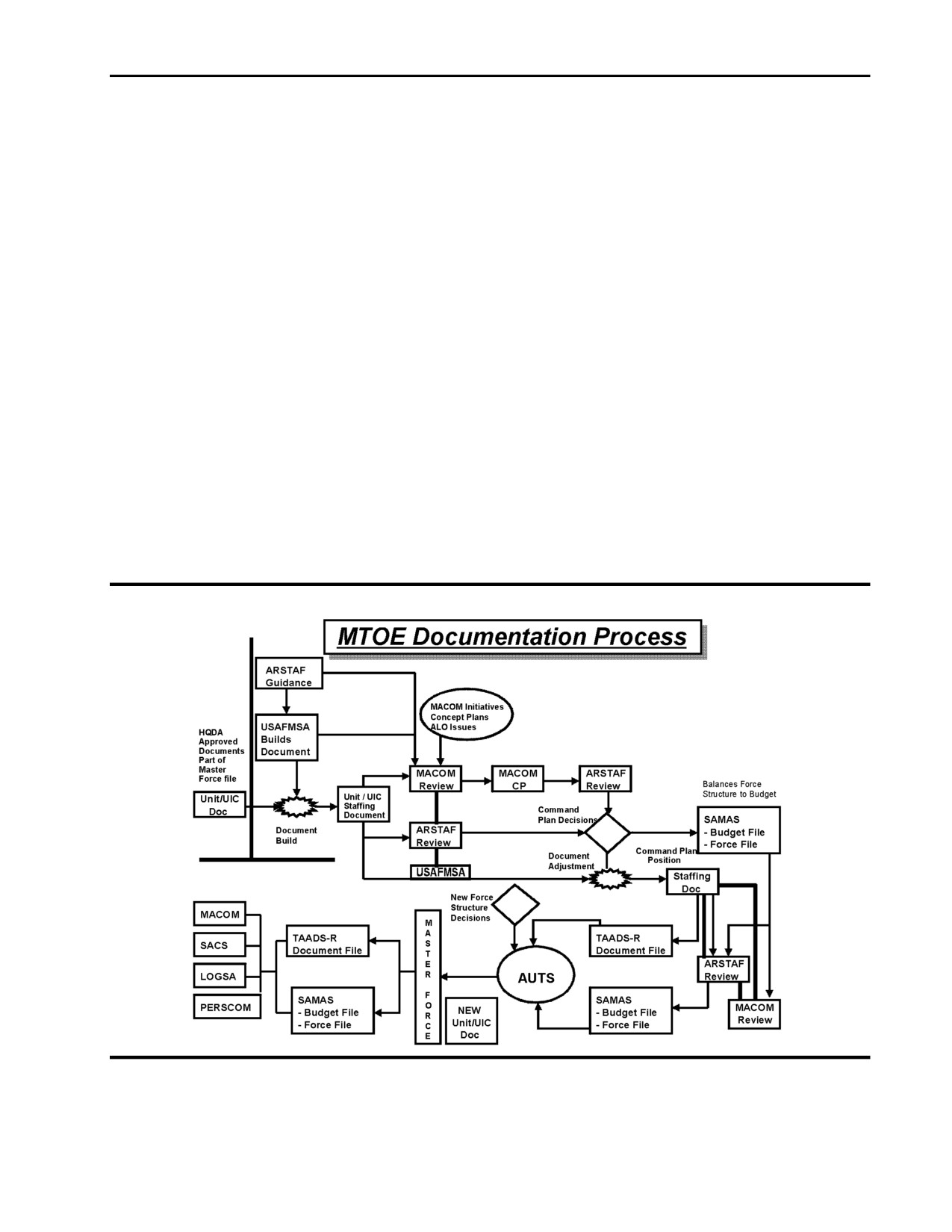
FM 100-11, Force Integration
(2) Command plans are compared with the
(2) PERSACS describes the required and
master force structure files, PBG, and draft
authorized manpower of the force; however, the of-
TAADS-R documents to determine MACOM
fice of the DCSPER (ODCSPER) and the U. S.
agreement with HQDA guidance and direction. Pro-
Total Army Personnel Command (PERSCOM) use
cedures for reviewing the different plans are the
the Personnel Management Authorization Document
same, although the mechanisms used depend on the
(PMAD) in lieu of PERSACS due to their ability to
format of the plan. The master force is updated
continually update PMAD. The PMAD data base is
based on command plan review and approved force
also reconciled with the SAMAS and TAADS-R
structure changes. The process is completed when
data bases. PERSACS is also used for troop support
changes from all plans are used to create a new
planning in the facilities process by the Army Sta-
MFORCE. This new MFORCE reflects all force
tioning and Installation Plan (ASIP). ASIP also uses
structure actions taken to comply with the PBG and
structure and manpower allocation system civilian
other management decisions.
manpower data as an input to its planning analysis.
c. The Structure and Composition System.
(3) Guidance for documenting equipment
authorizations is provided by the TOE/SRC and its
(1) The Structure and Composition System
modernization level (BOIPs and ICPs applied as the
(SACS) (Figure 6-5) is updated to reflect the latest
result of approved systems distribution plans).
BOIP, TOE, SAMAS, and TAADS-R positions and
known resource constraints (positive and negative
(4) LOGSACS describes the equipment of
“wedges” in the budget not yet reconciled at UIC
the force and is the principal input to the Army
level of detail), to produce the logistics (LOGSACS)
equipment distribution program (TAEDP). It pro-
and personnel
(PERSACS) component databases.
duces an equipment distribution program for the cur-
These products are comprehensive, multiyear list-
rent, budget, and program years and supports Army
ings of personnel or equipment authorizations and
modernization by supplementing new and displaced
requirements for the total force.
equipment planning information in the BOIP. It pro-
vides essential details such as quantities of equip-
ment and distribution dates by unit.
Figure 6-4. Documentation Process
6-9
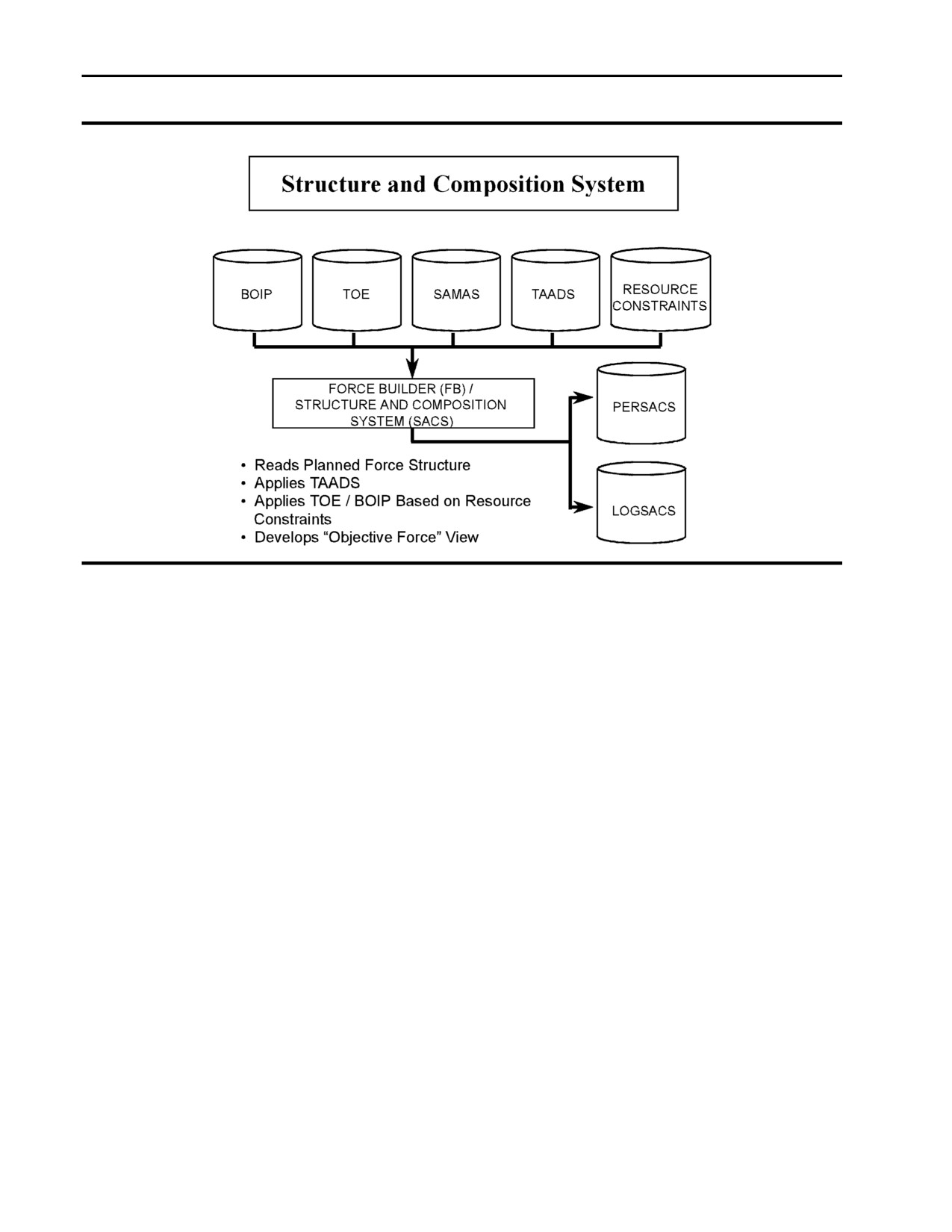
FM 100-11, Force Integration
Figure 6-5. Structure and Composition System
organizational structure and personnel and equip-
6-17. Authorization documentation
ment requirements and authorizations at the same
The authorization documentation schedule is shown
level of detail for both MTOE and TDA organiza-
in Figure 6-6.
tions.
a. Uses of authorization documentation. Every
c. Modification table of organization and
organization and activity must have an authorization
equipment. The MTOE prescribes the unit organi-
document to reflect an organizational structure that
zation, personnel, and equipment authorized to ac-
is supportable by the manning and equipping sys-
complish its doctrinal wartime mission at a specific
tems. Authorization documents state a unit’s ap-
point on its MODPATH. MTOEs are for war-
proved structure and resources and serve as a basis
fighting units. They reflect allocation of manpower
and authority for requisitioning. Changes to authori-
and equipment resources in order to accomplish
zation documents require synchronization to ensure
those doctrinal wartime missions. When a unit is
that direct and general support organizations (such
organized at ALO 1, it will normally be authorized
as supply, transportation, maintenance, fire support)
100 percent of all equipment and personnel required
effect necessary change prior to the organization(s)
in accordance with their level of modernization.
they support.
When a unit is organized at ALO 2, they will nor-
b. Automated documentation system. The de-
mally be authorized 100 percent of the major equip-
velopment of authorization documents is supported
ment items designated with equipment readiness
by an automated system that contains all unit
code (ERC) A (less individual items such as weap-
authorization documents. It maintains quantitative
ons, bayonets, protective masks) and between 88 and
and qualitative personnel and equipment data for
98 percent of their required personnel strength. Units
individual units and the entire Army force structure.
organized at ALO 3 (or less) may have authoriza-
It provides standardized authorization documents for
tions for major items of equipment reduced; how-
similar parent units and an interface with other
ever, ERC A items should be considered for reten-
automated systems. The authorization document
tion when possible. Units organized at ALO 3 will
data maintained in the database include
be authorized between 78 and 88 percent of their
required personnel strength.
6-10

FM 100-11, Force Integration
DOCUMENTATION TIMELINE
Winter 96
Summer 96
Winter 97
One
MOC Window
MOC Window
MOC Window
MOC Window
Nov. 95
May 96
Nov 96
May 97
May 98
Focus:
Focus:
Focus:
Focus:
· FY 97
· FY 98
· FY 99
· FY 00
· Below the line
· Above and Be-
· Above and Below
· Above and Be-
forces
low the line
the line forces
low the line
forces
forces
· Above the line
· NET EDATE
forces by ex-
· NET EDATE
981016
· NET EDATE
ception
971016
991016
· NET EDATE
961116
Figure 6-6. Authorization Documentation Schedule
d. Table of distribution and allowances.
quirements and are consistent with the mission and
the availability of manpower spaces as prescribed in
(1) The TDA prescribes the organizational
the approved command plan adjusted force struc-
structure for an organization or activity with a mis-
ture.
sion or function for which a TOE does not exist, and
may include civilian positions. TDAs are unique
e. Modification of authorization documenta-
authorization documents to attain the most efficient
tion.
use of personnel and the most effective operational
(1) Concept plan requirements. Concept
capability within the manpower spaces prescribed in
plans are required from the MACOM to obtain
the command force structure to accomplish specific
HQDA approval of unprogrammed requirements for
missions and functions. Activities with similar mis-
force structure, manpower, or materiel. The concept
sions may be similar in organization but have sub-
plan will state the purpose, objectives, advantages,
stantially different personnel and equipment authori-
and disadvantages of the proposed activation or re-
zations due to differences in workload and the
organization. Proposed authorization documents are
demographics of the population they support. A
submitted concurrently with the plan to accelerate
TDA is used for the same purposes as a MTOE ex-
the review process. Approved concept plans do not
cept for unit status reporting, which is not usually
serve as an authorization document but support the
required of TDA activities. Manpower determination
creation of one.
standards and standard installation organization
(2) HQDA review. HQDA reviews all
models establish personnel requirements and
authorization documents to ensure compliance with
authorizations. Equipment utilization data and BOIP
standardization of mission, capabilities, organiza-
will be used to develop TDA materiel authorizations.
tion, ALO, and the allocation of resources. Organi-
Types of TDA documents include—
zations will not substantially change authorization
· Mobilization TDA.
documents more than once a year. Substantial
· Augmentation TDA.
change is any personnel and/or equipment change
that creates a resource demand on the Army. De-
· Full-time support TDA.
partment of the Army policy provides that one
· Joint table of allowance/joint table of
authorization document (MTOE or TDA), one CTU,
distribution.
and one edit (POSC-edit {personnel occupational
(2) However, the basis for developing the two
specialty codeæedit file} for personnel and
documents differs. MTOEs are derived by applica-
LINEDIT {LIN edit} for equipment) per unit, per
tion of BOIPs/ICPs to Base TOEs to meet specific
year will be applied in order to reduce turbulence.
operational, environmental, or modernization re-
6-11
FM 100-11, Force Integration
(3) Demobilization requirements. The proc-
Section VI:
ess of activating new organizations and converting
Summary
and reorganizing existing organizations is evolution-
ary. It is based on capability increases in doctrine,
Structuring the Army is accomplished by execution
force design, and acquisition of materiel. However,
of DPG and TAP directed “above-the-line” force
the demobilization process requires that decreased
structure (divisions, brigades, regiments and groups)
levels of capability be determined and force structure
and TAA derived EAD/EAC “below-the-line” com-
be inactivated. The processes of increasing and de-
bat, combat support and combat service support
creasing force capability are identical in the incre-
force structure documented in the total force. Plan-
mental approach to total organizations. Like mod-
ning, programming and documentation of doctrinally
ernization, force reduction considers impacts on di-
correct requirements and budget supported authori-
rect and general support organizations. Force capa-
zations result in combat ready units.
bility is reduced by inactivations of organizations
followed by support structure and support infra-
structure.
6-12
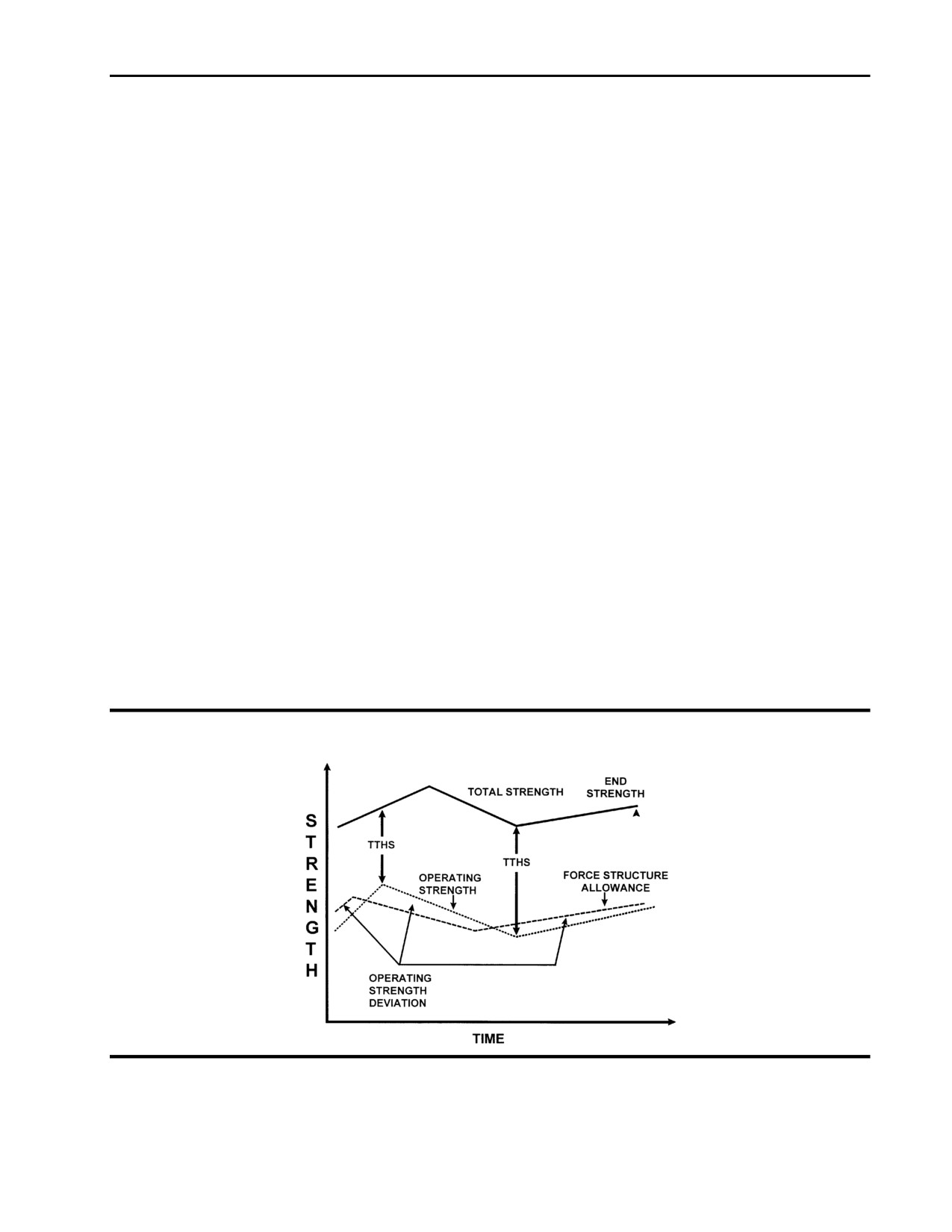
FM 100-11, Force Integration
Chapter 7
Manning the Force
Section I:
7-3. Role of manpower managers
Introduction
Manpower managers deal with the efficient and eco-
nomic use of human resources within the organiza-
7-1. Manpower constraints
tional structure. They focus on requirements de-
The Congress, Office of Management and Budget
manding specific grades and skills to perform spe-
(OMB), Office of Personnel Management (OPM),
cific tasks before determining which requirements to
Office of the Secretary of Defense (OSD), and Of-
support with authorizations
(spaces). Personnel
managers implement authorizations through the ac-
fice of the Secretary of the Army (OSA) establish
quisition, training, and assignment of personnel
annual manpower end-strengths. They develop poli-
(faces) to authorized positions.
cies that may restrict the availability of military and
civilian manpower or limit the latitude available to
Section II:
personnel managers. Policies may limit permanent
Army Manpower
changes of station (PCS), set tour lengths, set officer
7-4. Manpower spectrum
grade limitations, or place a ceiling on local national
a. Total military strength. The total military
hires.
strength of the Active Army is a dynamic measure of
personnel
“faces” consisting of the operating
7-2. Manpower management
strength
(personnel available for assignment to
Manpower management determines minimum essen-
authorized positions), and the individuals account
(personnel not available for assignment to authorized
tial requirements, alternative means of providing
positions). Figure 7-1 depicts these accounting cate-
resources, and the policies to be followed in utilizing
gories. The individuals account, is also called the
manpower. It involves the development and evalua-
transients, trainees, holdees (hospital), and students
tion of organizational structure and reviews the use
(TTHS) account. TTHS accounts for personnel
of active, National Guard, USAR, and civilian per-
moving between assignments or preparing for future
sonnel. It also includes contractors when contractual
assignments. The size and composition of TTHS
will vary throughout the year due to seasonal in-
services are appropriate to satisfy manpower re-
creases in transients during the summer and in train-
quirements.
ees during the fall and winter.
Figure 7-1. Military Manpower Spectrum
7-1
FM 100-11, Force Integration
b. Force structure allowance. Force structure
Section III:
allowance is a dynamic measurement of manpower
Personnel Documentation and
“spaces” authorized in organizations and activities.
Acquisitions
It changes daily as organizations activate, inactivate,
7-7. Personnel
management authorization
reorganize, and convert. The dynamic nature of
documentation
“faces” and
“spaces” creates an environment of
continuous fluctuation and variance.
a. Personnel Management Authorization
Document. ODCSPER builds the PMAD from the
c. Operating strength deviation. The difference
Army’s MFORCE and TAADS-R. PMAD is the
between the operating strength (faces) and the force
basis for decisions on accessions, training, force
structure allowance
(spaces) is the operating
alignment, promotions, and distribution of personnel.
strength deviation. This deviation may be positive
Periodic adjustments to PMAD are made using an
(personnel inventory exceeds authorizations), nega-
updated authorizations document (UAD) to capture
tive (personnel inventory is less than authorizations),
changes. PMAD and UAD focus on details for
or be negligible (balanced). Manpower and person-
near-term distribution. Therefore, the personnel
nel managers monitor the operating strength devia-
community uses PMAD and its most current UAD
tion and adjust personnel policies to create the best
as the sole source of Active Army authorizations by
match of personnel, by grade and skill, to authorized
UIC, MOS, grade, and additional skill identifier
positions. The goal is to meet the congressionally
(ASI) level of detail for the current and budget
authorized end strength on the last day of each fiscal
years.
year while maintaining a balanced fighting force.
b. Total Army Personnel Database (TAPDB).
7-5. Force alignment
The TAPDB is an automated, standardized inven-
tory database containing military personnel data. It
Force alignment manages the dynamics of personnel
supports the manning and sustaining functions dur-
and authorizations by grade and skill to ensure the
ing peacetime and under mobilization. TAPDB ac-
active component operating strength is qualified and
tive
officer/enlisted
(TAPDB-AO/TAPDB-AE)
available for distribution. Force alignment is the
contains personnel information on individual officer
synchronization of recruiting, accessions, training,
and enlisted personnel.
reenlistment, promotions, and reclassification. Spe-
cial and incentive pays are also available to provide
7-8. Personnel acquisition
professional career development consistent with
force manning levels for qualified soldiers. The goal
a. Enlisted Acquisitions.
is to achieve a grade and skill match between oper-
(1) The Military Occupational Specialty
ating strength and force structure authorizations for
Level System
(MOSLS) projects numbers and
the current year, budget year, and program years.
training requirements for all MOS based on PMAD
(authorizations by skill and grade), TAPDB-AE
7-6. Active Army Military Manpower Program
(skills and grades on hand), and AAMMP (projected
a. The Office of the Deputy Chief of Staff for
accessions in the aggregate). The enlisted procure-
Personnel (ODCSPER) produces the Active Army
ment process is shown in Figure 7-2.
Military Manpower Program (AAMMP) as monthly
(2) The U.S. Army Recruiting Command
updates and as decision programs for the POM,
(USAREC) recruits the quantity and quality of re-
OSD budget submission, and President’s budget.
cruits to meet Active Army and USAR requirements.
The AAMMP projects the strength of the Army;
USAREC uses the Recruit Quota System
losses and gains; training inputs; officer, cadet, and
(REQUEST) to translate the personnel needs of the
female programs; and TTHS account.
force into total recruiting objectives. REQUEST
b. The AAMMP consists of data from the En-
provides the means of allocating training seats or
listed Loss Inventory ModelæComputation of Man-
opportunities to accessions. Except during mobiliza-
power Using Linear Programming
(ELIM-
tion, enlistment options depend on Army MOS re-
COMPLIP), female ELIM, Officer Projection Ag-
quirements and mental and physical aptitude of the
gregate Level System (OPALS), and TTHS fore-
applicant. A matching algorithm aligns applicant
casting system. ELIM-COMPLIP uses six years of
qualifications and aptitudes to the Army’s needs.
historical loss behavior to project future loss behav-
ior. ELIM-COMPLIP uses linear programming to
operate within multitude constraints, such as end
strengths, man-years and recruit quality levels, to
minimize the projected operating strength deviation.
7-2
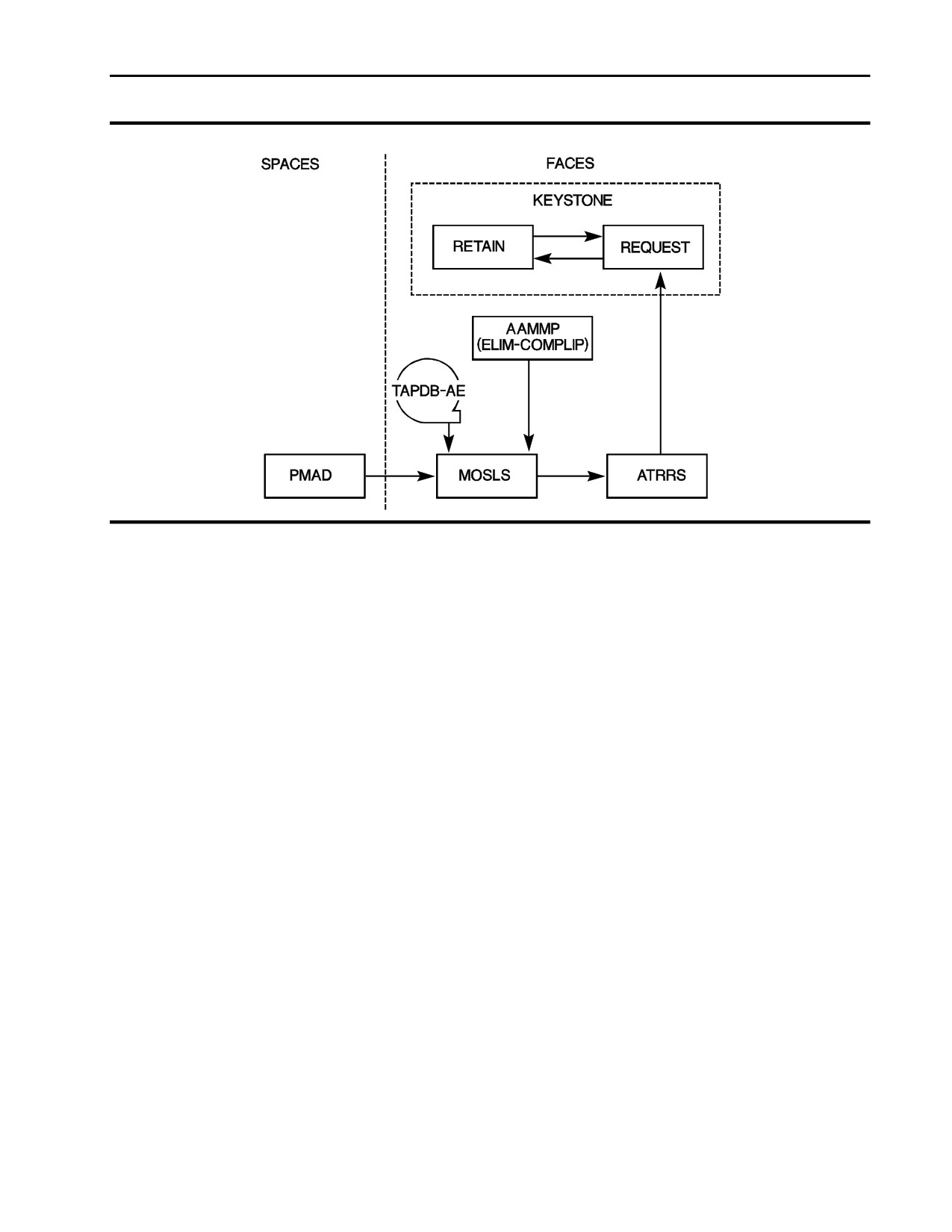
FM 100-11, Force Integration
Figure 7-2. Enlisted Procurement Process
b. Warrant officer acquisitions. Warrant offi-
in balance when the overseas-to-sustaining base ra-
cers are single-specialty, system-oriented officers
tio is supportable and there is a high density of per-
appointed to perform a single function throughout
sonnel in substitutable skills. When these conditions
their careers. USAREC recruits candidates for the
do not exist, shortages require sharing by all com-
active component. ODCSPER develops recruiting
mands in the distribution and assignment processes.
goals to fill shortages by fiscal year. Applicants
b. Organizations exempted from “fair share” due
come from Active Army enlisted ranks, enlisted per-
to operational priority or modernization increase the
sonnel from other Services, technically qualified ci-
depth of shortages in lower priority organizations.
vilians, commissioned officers, and members of the
The decision to exempt organizations from fair share
Reserve Components.
manning must consider the impact across the force
c. Officer acquisitions.
during the period of exemption. When the highest
force level, usually the MACOM, makes and man-
(1) Officer basic branches are procured
ages this decision, the impact will normally decrease
through the Officer Candidate School, Reserve Offi-
proportionally.
cers Training Corps
(ROTC), and United States
Military Academy. Special branches
(Medical,
c. The distribution and assignment systems sup-
Judge Advocate, and Chaplain) select officers
port a number of known scenarios (peace, limited
through individual branch programs. Service obliga-
mobilization, and full mobilization) and can evaluate
tions for officers vary with each program.
“what if” scenarios. Based on the scenario, assign-
ments of individual replacements and unit packages
(2) OSD-mandated officer strength ceilings
are altered and transmitted to the field.
constrain officer end-strength. Public law limits the
percentage of the officer corps in the grade of major
d. Personnel distribution varies based on assets
or higher. Annual accessions must ensure availabil-
on hand, authorizations, and priorities according to a
ity of officers by grade, branch, functional area, and
master distribution plan that ensures all commands,
skill over the life cycle of the year group.
agencies, and activities receive, in priority, an ap-
propriate share of the available inventory.
Section IV:
7-10. Enlisted distribution
Distribution and Assignment
a. Variables which affect enlisted personnel dis-
7-9. Management of personnel inventories
tribution include changes to force structure, recruit-
a. The distribution and assignment processes
ing, training attrition rates, retention rates, authori-
place the right soldier, in the right skill, at the right
zations, funding constraints, end strength, and the
place, at the right time. MOSs and grades are nearly
unpredictability of the individual soldier. Addition-
7-3
FM 100-11, Force Integration
ally, the accuracy and timeliness of data affects the
ganization. Similar personnel management of direct
analysis of distribution options. Unprogrammed
support organizations ensures availability and sta-
force structure changes make the distribution system
bility of low density skills in these organizations.
less responsive.
Personnel are a key link to modernization as part of
a total system approach.
b. Priorities for the distribution of enlisted per-
sonnel are the result of initial assignments, PCS re-
assignments, reassignments within commands, and
Section V:
unit moves. Distribution variables include approved
Personnel Sustainment
authorizations documented in PMAD/UAD, directed
7-12. Maintaining balance
military overstrengths, space imbalanced MOS
(SIMOS) overstrengths, overstrengths in specific
a. The goal of the manning system is to create a
high priority units, and personnel priority group
stable unit environment by managing personnel tur-
codes in the DAMPL. Special priorities consider
bulence so that organizations can achieve higher lev-
operational and training requirements for special
els of cohesion and collective proficiency. Planners
skills, such as Ranger and linguist, which do not
and executors of change must reduce organizational
necessarily correspond to DAMPL.
turbulence during the transition to a higher level of
capability.
c. Enlisted distribution management projects
personnel strength of major overseas commands,
b. Personnel sustainment depends on authoriza-
FORSCOM and TRADOC installations in CONUS,
tions being documented at least two years prior to
and special management and functional commands
the effective date (E-date) of change. The lead time
worldwide from the current month out to 11 months.
is necessary to ensure that the personnel acquisition
The current enlisted distribution policy establishes
system and the training system can support changes
the number of soldiers distributed to commands. Ag-
in the force structure.
gregate totals by rank bands (PVT-SPC, SGT-SSG,
c. To maintain balance and capability in the
SFC-SGM) are the basis for transitioning to indi-
force, the separation of officers, warrant officers,
vidual MOS requirements.
and enlisted personnel is a continuous process. In
each case, procedures are in place for qualitative
7-11. Distribution considerations
and, when required by Congress, quantitative reduc-
a. Forward deployed forces and early deploying
tion of the force. No person has an inherent right to
forces are structured at higher ALO and often
continued service.
manned at or above ALO. Later deploying organi-
zations are structured at lower ALO and filled to
7-13. Authorizations documentation
ALO 1 in the predeployment phase of operations.
Military and civilian personnel planning activities
Congressional mandates, OSD ceilings, PBG, and
use the output data of various supporting informa-
military manpower strength projections govern
tion systems. These include authorizations, acces-
OCONUS troop strength. PERSCOM manages the
sions, gains and losses, promotions, career area
aggregate enlisted strength against the PBG rather
management plans (career management field and
than the PMAD authorizations.
area of concentration for military), and many other
b. PERSCOM validates requisitions submitted
personnel actions.
by MACOMs based on projected requirements. Dis-
a. Military personnel.
crepancies between projections and requisitions oc-
cur when PERSACS does not contain authorization
(1) MACOM command plans contain aggre-
changes or when PERSCOM has more current
gate authorizations by UIC and the authorization
authorizations data through PMAD or more current
database shows grade and skill-specific detail. Ap-
gain or loss data. Assignment processing for vali-
proved command plans are the basis for master force
dated requisitions occurs after problem resolution.
revisions and proposed authorization document
changes are the basis for revision of the authoriza-
c. Organizations undergoing activation, reor-
tion database. The AUTS process compares and
ganization, or conversion are exempt from fair share
resolves differences between the two files.
manning during the transition period to accomplish
the force integration mission. Failure to man units at
(2) Standard Installation/Division Personnel
100 percent or higher of the minimum mis-
System (SIDPERS) transmits changes in military
sion-essential wartime requirement degrades the
personnel status to officer and enlisted databases.
processes necessary to incorporate and ultimately
These files are the source of current active force
sustain changes in doctrine, structure, or materiel.
military inventory data to include grade, skill, and
Key personnel by MOS and ASI, must be available
UIC, and portray these changes over time for per-
and stabilized through and beyond the transition pe-
sonnel analysts.
riod to ensure the viability of the changes to the or-
7-4
FM 100-11, Force Integration
(3) Enlisted personnel, warrant officers, and
authorizations, they send them to the MACOMs via
officers are subject to separation actions. These in-
the PBG and the manpower addendum to the PBG
clude release from active duty, discharge, nondis-
from the master force.
ability retirement, physical disability retirement, and
(3) The MACOM POM and command
separation and resignation.
budget estimates
(Schedule
8) document civilian
(4) The qualitative management program
manpower utilization and update appropriate
(QMP) consists of two subprograms used to im-
ARSTAF databases. Other inputs include out-of-
prove the enlisted career force. Qualitative retention
cycle requests from MACOM commanders and
establishes retention control points that are specific
Army leadership-directed actions.
time-in-service limits for each enlisted grade. Quali-
(4) Installation civilian personnel offices re-
tative screening is the bar-to-reenlistment aspect of
port actual strength and civilian manpower obliga-
the QMP. Soldiers receive a Bar to Reenlistment
tion data. MACOMs develop civilian employment
when not selected for retention.
level plans. The civilian payroll system reports
(5) Reserve force personnel inventory and
strengths, work-years, and obligations. These in-
projected inventory data files have the same detail as
clude execution year monthly strength projections
the active force. At mobilization, these files are in-
for the Congress. The civilian forecasting system
corporated with the Active Component file. Budget
projects civilian inventory.
modules, that reflect costs for all years within the
PPBES, calculate Military Personnel-Army costs
Section VI:
and Reserve Component personnel costs by pay
Summary
category.
A major objective of manning the force is to ensure
b. Civilian personnel.
the timely fill of a rapidly changing force structure
(1) The civilian personnel system is similar to
that includes changes in the geographic location of
the military system. It identifies the objective force
the force. The size and location of the force change
or force structure required to support the Army,
inside the PPBES cycle. This requires flexibility and
formulates personnel policies, and manages career
a thorough understanding of the changes throughout
progression.
the force. A major task of force management and a
force integration is to predict the impact of decisions
(2) The Assistant Secretary of the Army
on organizations and the force as a whole. The
(Manpower and Reserve Affairs) (ASA(M&RA)) is
Army’s competitive edge will depend, in part, on the
responsible for civilian manpower management. Ci-
application of technology. The manning system must
vilian manpower authorizations are documented in
ensure the timely placement of soldiers with the
the master force at the program element (PE) level
proper skills and experience to operate new and im-
for program manager controls and analytical pur-
proved systems coming into the force. Maintaining
poses. After the ARSTAF makes decisions on
force readiness at the prescribed levels despite sig-
nificant change will be a continuous challenge for
commanders and staffs throughout the Army.
7-5
FM 100-11, Force Integration
Chapter 8
Equipping the Force
b. Chairman of the Joint Chiefs of Staff Instruc-
Section I:
tion (CJCSI) 3170.01 MOP 77 mandates policy and
Introduction
procedural guidance for the requirements generation
8-1. Equipping goal
system to include guidance on key performance pa-
rameters (KPPs), measures of effectiveness (MOEs),
Successful integration of new or improved equip-
and the JROC.
ment into organizations increases force capability
and depends on the effective synchronization of the
c. AR 70-1 provides Army acquisition guidance
equipping, structuring, training, manning, sustain-
for materiel and information systems. AR
71-9
ing, stationing, and funding functions. Equipping
provides Army requirements determination
progresses through R&D, to production, and mate-
and documentation policies and responsibilities im-
riel fielding. The goal is to increase overall war-
plementing DODD
5000.1, DOD Regulation
fighting materiel capabilities with a minimum ex-
5000.2R and MOP 77 supporting all Army acquisi-
penditure of resources.
tion categories (ACAT).
Note. The terms materiel and materiel system in
8-2. Command and staff involvement
this chapter apply to materiel and informa-
Equipping the force involves operational command-
tion systems unless specifically identified
ers; materiel, training, and combat developers; lo-
otherwise.
gisticians; personnel managers; and design and fa-
d. These documents establish an integrated man-
cility engineers. They work within parameters that
agement framework for a single, standardized DOD-
balance overall affordability against competing op-
wide acquisition system that applies to all programs
erational and support requirements that acknowledge
including highly-sensitive classified programs.
the need to maintain the capabilities of the industrial
base. Synchronization and integration of related ac-
e. The essential features of the DOD materiel
tivities involves organizations and staffs at all levels,
acquisition system are—
to include the gaining units. Centralized planning,
(1) A clear acquisition strategy (AS).
management, and decision support processes should
(2) A thorough program plan.
also provide for the development of decentralized
(3) Risk management techniques.
supporting plans and their execution.
(4) Systematic program tracking against the
plan.
8-3. Total system approach
8-5. Scope
The process of equipping organizations considers the
Materiel acquisition includes—
introduction of materiel systems into the force, not
a. Activities from R&D through disposal. This
disparate pieces of equipment. Systems are the sum
includes three major decision making support sys-
of force structure, hardware, software, training, per-
tems:
sonnel, doctrine, facilities, support infrastructure,
(1) The requirements determination system.
and resources. Every materiel item introduced must
(2) The planning, programming, budgeting,
be viewed as a total system to reduce the negative
and execution system (PPBES).
impact on readiness. Materiel that is provided to
(3) Acquisition system management.
organizations as a fully operable package reduces
b. Decision reviews, concept development, sys-
the impact on the gaining unit by lessening the pe-
tem development, production, testing and evaluation
riod of time required to distribute, configure, and
(T&E), human system integration (HSI), integrated
hand the system off to the user.
logistics support (ILS), total package fielding (TPF),
Section II:
and training.
Materiel Development and Acquisition
8-6. Materiel acquisition life cycle system man-
8-4. Policy guidance
agement
a. DOD Directive 5000.1 and DOD Regulation
a. Functional and temporal interfaces for mate-
5000.2R provide mandatory DOD acquisition policy
riel acquisition include programmatic sequencing
and procedures including materiel requirements docu-
and decision points. Figure 8-1 provides a general
mentation and approval guidance for major defense
overview of program sequencing and decision points.
acquisition programs
(MDAPs) for both materiel
and automated information systems (AIS).
8-1
FM 100-11, Force Integration
Life-Cycle System Management Model (LCSMM)
Process
Materiel Acquisition Oversight and Review Process
MS O
MS I
MS II
MS III
Concept Studies
New Acquisition Program
EMD Approval
Production or Fielding/Deployment
Requirements Generation
Approval
Approval
ADM
Approval
Process
ADM
ADM
ADM
Required Capabilities /
Technological Opportunities
(Tech Base)
MNS
ORD
T&E
MANPRINT
ILS
DODD 5000.1
Phase 0
Phase I
Phase II
Phase III
Concept Eval
Program Definition /
EMD
Production, Fielding/Deployment,
AR 70-1
“Best Alternative” Risk Reduction
“Develop / Test
Operational Support
“Design Workable
System”
“Produce / Field/Support/
Solution”
Modify the System”
Acquisition
Strategy
“The Plan”ADM: Acquisition Decision Memorandum
CBRS: Concept Based Requirements System
MNS: Mission Need Statement
EMD: Engineering and Manufacturing Development
MS: Milestone
FUE: First Unit Equipped
ORD: Operational Requirements Document
ILS: Integrated Logistics Support
T&E: Test & Evaluation
Figure 8-1. Materiel Acquisition Life-Cycle System Management Process
b. The acquisition process is characterized by
laws, Congressional guidance and direction and Ex-
four phases and four milestones that track a DOD
ecutive Branch policies. The DAE serves as the
program’s progress throughout its development and
chairman of the Defense Acquisition Board (DAB)
program life.
“Tailoring” is encouraged in each
and, in this capacity, recommends resource matters
phase of the process to reflect specific program
and acquisition management matters to the
needs. In accordance with DODD 5000.1 “one size
SECDEF.
does not fit all.” Together with its constituent ac-
(2) The Assistant Secretary of Defense for
tivities, the process provides guidelines for combat,
Command, Control, Communications, and Intelli-
materiel, training, and force developers in all aspects
gence (ASD(C3I)) is the DAE for automated infor-
of materiel program planning and execution. These
mation systems (AIS). As such, the ASD(C3I) es-
range from determination of operational needs
tablishes policies and procedures unique to AISs and
through maturation of technology, prototyping,
chairs the Major Automated Systems Review Coun-
testing, and evaluation. Production, fielding, and life
cil (MAISRC).
cycle support are also included. Cyclic activities
(3) Distinct from the DAEs’ acquisition
provide for opportunities to prioritize and allocate
authority is budgetary authority. While the DAEs
resources for programs, prepare and review docu-
make recommendations on whether to proceed with
mentation, and review and approve programs.
acquisition programs, the Defense Resources Board
c. Integral to each acquisition program are the
(DRB), chaired by the Deputy Secretary of Defense
DOD and Component Acquisition Executives
(DEPSECDEF), makes budgetary recommendations
(CAE), Program Executive Officers
(PEO), and
on the same programs. Acquisition programs must
program, project, or product managers (PM) along
operate within the parameters established by the
with management staff and user representation.
DRB and the SECDEF through the PPBS.
(1) The Under Secretary of Defense for Ac-
(4) The Assistant Secretary of the Army
quisition and Technology (USD(A&T)) is the senior
(Research, Development, and Acquisition)
(ASA
procurement executive and the principal staff assis-
(RDA)) is the Army Acquisition Executive (AAE)
tant and advisor to the Secretary of Defense
and is designated by the Secretary of the Army (SA)
(SECDEF) for MDAPs and takes precedence in
as the CAE and the senior procurement executive
DOD for all matters relating to the materiel acquisi-
within DA. The Director of Information Systems for
tion system. The USD(A&T) serves as the Depart-
Command, Control, Communications, and Comput-
ment Acquisition Executive (DAE) with responsibil-
ers (DISC4) provides staff support to the AAE in
ity for supervising the performance of the entire
managing the research, development and acquisition
DOD acquisition system in accordance with the
of AIS and information technologies (IT). The AAE
8-2
FM 100-11, Force Integration
acts with the full authority of the SA and is respon-
Section III:
sible for administering acquisition programs ac-
Materiel Requirements Definition
cording to DOD policies and guidelines, and exer-
8-8. Mission needs
cises the powers and discharges the responsibilities
of CAEs as set forth in DODD 5000.1. The AAE
a. All acquisition programs are based on identi-
also appoints, supervises and evaluates PEOs and
fied future operational materiel needs. Determination
direct-reporting (to the AAE) PMs.
of these needs are a result of continuing assessments
of current and projected capabilities in the context of
(5) PEOs and direct-reporting PMs serve as
military threat and national military policy. A mis-
materiel developers
(MATDEV). The PEOs and
sion need may address—
PMs administer a number of major and non-major
programs as assigned by the AAE. They are respon-
(1) A new operational capability.
sible for accomplishing cost, schedule, and total
(2) Improvement of an existing capability.
system performance objectives. In addition, PEOs
(3) A desire to exploit promising technologies.
and PMs are responsible for assisting combat devel-
b. Mission needs can be identified by Unified
opers
(CBTDEV) and training developers
combatant commands, the military departments,
(TNGDEV) in developing operational requirements
OSD, or the Joint Staff. In theory, mission need
documents (ORD) by providing technical, availabil-
identification should first exhaust all nonmateriel
ity, performance, anticipated materiel development
solutions such as, doctrine, training, or organiza-
cost, and development schedule information.
tional changes. When a need is identified that could
d. Close coordination among combat and mate-
potentially result in the establishment of a new ac-
riel developers, supporting commands (for example,
quisition program, a mission needs statement (MNS)
Army Materiel Command) and staff elements, and
is prepared that is a nonsystem-specific statement of
MACOMs and their subordinate commands enables
operational capability. The MNS can be prepared by
operational and technical integration of new and im-
any DOD component that has identified a specific
proved equipment capabilities. Their effective inte-
mission area materiel requirement or need.
gration is necessary to ensure detailed and sound
planning and recommendations, and efficient execu-
8-9. TRADOC role
tion of all aspects of the fielding process.
TRADOC is the Army’s war-fighting requirements
“gatekeeper” and acts as the primary combat devel-
8-7. Force integration considerations
oper in the domains of doctrine, training, leader de-
a. Force integration considerations begin before
velopment, organizations, and materiel, focused on
formal program initiation and continue throughout a
the soldier (DTLOMS). In the mid-to-far term, the
system’s life cycle. Execution requires continuing
requirements determination process provides the
assessments of the impact of introducing equipment
analytical basis to determine future Army opera-
into the force at and beyond the time of fielding.
tional capabilities (FOC) and materiel war-fighting
These assessments address structuring, training,
requirements.
manning, sustaining, deploying, stationing, and
8-10. Requirements documentation
funding considerations, and weigh the readiness im-
pact for gaining organizations. Equipping the force
a. Planning, programming, and budgeting for
must also assure that supporting rationale and proc-
materiel capabilities is initiated by the AMP. It
esses are continually reviewed and updated.
identifies future requirements and provides the
structure within which multiple competing elements
b. Throughout the process, combat, training,
can be analyzed, balanced, and integrated into the
materiel, and doctrine developers, with input from
POM. The AMP reflects the constrained subset of
gaining organizations, ensure that decisions in-
systems and programs that the Army plans to re-
volve—
source and execute.
(1) Operational integration, characterized by
b. When the materiel requirement and manner of
the capability to function effectively in a combined
acquisition have been identified, the acquisition is
arms environment with current and developmental
designated as acquisition category
(ACAT) I
materiel.
through IV. This category determines the level of
(2) Technical integration, characterized by
review, and who will make the milestone decisions.
the physical capability to interface and operate cur-
The ACAT is determined by dollar criteria and visi-
rent and developmental systems to field combined
bility of the potential program. The four acquisition-
arms, joint, or combined force capabilities.
categories, principal decision review forums, mem-
(3) Integration of equipment capabilities with
bership, and decision authority are summarized in
manpower and personnel as well as logistics sup-
Figure 8-2.
portability.
8-3
FM 100-11, Force Integration
Program
Milestone
Milestone
Program
Category
Primary Criteria
Review Forum Decision Authority
Management
$FY 96 Constant
ACAT I
ACAT ID
PEO/PM
RDTE > $355M
DAB
USA(A&T)
PROC > $2.135B
ACAT IC
PEO/PM
RDTE > $355M
ASARC
AAE
PROC > $2.135B
ACAT IA
ACAT IAM
PEO/PM
Single Year > $30M or
DOD
ASD(C31)
Total Program > $120M or
MAISRC
Total Life-Cycle Costs >
$360M
ACAT IAC
PEO/PM
Single Year > $30M or
Army
AAE/CIO
Total Program > $120M or
MAISRC
Total Life-Cycle Costs >
$360M
ACAT II
ACAT II
PEO/MAT
RDTE > $140M
ASARC
AAE
CMD
PROC > $645M
CDR /PM
ACAT IIA
PEO/MAT
Single Year: $10-$30M or
Army
AAE/CIO
CMD
Total Program: $30-$120M or
MAISRC
CDR /PM
Total Life-Cycle Costs: $159-
$360M
ACAT III
ACAT lIl
PM
High Visibility;
IPR
PEO/MAT
Special Interest
CMD CDR
ACAT IIIA
PEO/PM
Single Year: $10-$30M or
IPR
PEO/MAT
Total Program: $30-$120M or
CMD CDR
Total Life-Cycle Costs: $159-
$360M
ACAT IV
ACAT IV
System
All Other Acquisition
IPR
MAT CMD CDR
Manager, or
Equivalent
Programs
(includes AIS)
Figure 8-2. Acquisition Categories
c. These decision forums provide for diverse and
d. Integrated priority lists (IPL) provide access
comprehensive membership by decision makers and
to the planning, programming, and budgeting sys-
staff elements from the organizational levels charged
tems by the CINCs of unified combatant commands.
with decisions on the program involved. They pro-
The CINC IPL can be provided to the Joint Chiefs
vide for participation by materiel and combat devel-
of Staff (JCS) or by the Army component command-
opers, OSD, and appropriate service representation.
ers to the ARSTAF. The Army’s requirements de-
8-4