FMI 3-07.22 Counterinsurgency Operations (2004-2006) - page 4
Civil-Military Operations Assessment Checklist
z
Organizations for recreation (community buildings, athletic clubs, soccer teams,
ball fields and courts).
z
Traditional forms of and local attitudes toward recreation needs.
HEALTH AND HEALTH CARE
A-17.Consider the following factors when assessing the health and health care situation:
z
Physicians, health workers, nurses.
z
Public and private health organizations, national and international (hospitals, dis-
pensaries, clinics, school health program).
z
Health status of the people.
z
Prevalence, incidence, and types of diseases.
POLITICAL SITUATION
A-18.Consider the following factors when assessing the political situation:
z
Political structure and government (solidarity or strife and causes).
z
Dominant personalities.
COMMUNITY ACTIVITIES, CUSTOMS, AND IDEALS
A-19.Consider the following factors when assessing the influence of community activities,
customs, and ideals:
z
Community events other than religious observances.
z
Community customs or traditions (taboos or social disapprovals)?
z
Activity characteristics and pastimes.
z
Community attitudes on all types of progress?
LEADERSHIP
A-20.Consider the following factors when assessing the leadership situation:
z
Dominant leaders. Family control.
z
Is leadership representative, democratic, or autocratic?
z
What is being done by whom to develop new leaders?
z
Attitude of people toward old and new leaders.
z
Motivation—politics, religion, economic power, prestige, or a combination of these?
COMMUNITY ORGANIZATION
A-21.Consider the following factors when assessing the community organization:
z
What is being done to integrate the community?
z
What are the needs for community organizations?
STATUS OF LAW AND ORDER
A-22.Consider the following factors when assessing the status of law and order:
z
Organization and capabilities of law enforcement agencies.
z
Police techniques.
z
Crime rate and trends.
A-3
Appendix B
Use of Interpreters
INTERPRETER SELECTION
B-1. Whenever possible, interpreters should be US military personnel, or at least US citi-
zens. In some operational or training settings abroad, Soldiers are not faced with the prob-
lem of selecting an interpreter; they are assigned one by the chain of command or HN gov-
ernment. In other cases, interpreters are chosen from a pool provided by the HN
government. Finally, in many operational situations, interpreters are hired from the general
HN population. Whatever the case, the following guidelines are critical to mission accom-
plishment.
B-2. Interpreters should be selected based on the following criteria:
z
Native speaker. Interpreters should be native speakers of the socially or geo-
graphically determined dialect. Their speech, background, and mannerisms should
be completely acceptable to the target audience (TA) so that no attention is given to
the way they talk, only to what they say.
z
Social status. In some situations and cultures, interpreters may be limited in
their effectiveness with a TA if their social standing is considerably lower than that
of the audience. Examples include significant differences in military rank or mem-
bership in an ethnic or religious group. Regardless of Soldiers’ personal feelings on
social status, they should remember the job is to accomplish the mission, not to act
as an agent for social reform. Soldiers must tolerate local prejudices as a fact of life.
z
English fluency. An often-overlooked consideration is how well the interpreter
speaks English. As a rule, if the interpreter understands the Soldier and the Sol-
dier understands the interpreter, then the interpreter’s command of English is sat-
isfactory. A Soldier can check that understanding by asking the interpreter to para-
phrase, in English, something the Soldier said. The Soldier then restates the
interpreter’s comments to ensure that both understand each other. In addition, in-
terpreting goes both ways. Interpreters must be able to convey information ex-
pressed by interviewees or the TA.
z
Intellectual intelligence. Interpreters should be quick, alert, and responsive to
changing conditions and situations. They should be able to grasp complex concepts
and discuss them without confusion in a reasonably logical sequence. Although
education does not equate to intelligence, generally speaking, the better educated
the interpreter, the better he or she will perform, due to increased exposure to di-
verse concepts.
z
Technical ability. In certain situations, Soldiers may need interpreters with tech-
nical training or experience in special subject areas. This type of interpreter is able
to translate the meaning as well as the words. For instance, if the subject is nuclear
physics, background knowledge is useful.
z
Reliability. Soldiers should beware of a potential interpreter who arrives late for
the interview. Throughout the world, the concept of time varies widely. In many
B-1
FMI 3-07.22
less-developed countries, time is relatively unimportant. Soldiers should make sure
that interpreters understand the importance of punctuality.
z
Loyalty. If interpreters are local nationals, it is safe to assume that their first loy-
alty is to the HN or ethnic group, not to the US military. The security implications
are clear. Soldiers must be very cautious in how they explain concepts. Addition-
ally, some interpreters, for political or personal reasons, may have ulterior motives
or a hidden agenda when they apply for an interpreting job. Soldiers who detect or
suspects such motives should tell the commander or security manager.
z
Gender, age, and race. Gender, age, and race can seriously affect mission accom-
plishment. One example is the status of females in Muslim society. In predomi-
nantly Muslim countries, cultural prohibitions may render a female interpreter in-
effective in certain circumstances. Another example is the Balkans, where ethnic
divisions may limit the effectiveness of an interpreter from outside the TA. Since
traditions, values, and biases vary from country to country, it is important to check
with the in-country assets or area studies for specific taboos or favorable character-
istics.
z
Compatibility. Soldiers and interpreters work as teams. For interpreters to be
most effective, they should become a psychic extension of Soldiers. The TA will be
quick to recognize personality conflicts between Soldiers and interpreters. Such
conflicts can undermine the effectiveness of the communication effort. If possible,
when selecting interpreters, Soldiers should look for compatible traits and strive for
a harmonious working relationship.
B-3. If several qualified interpreters are available, Soldiers should select at least two. This
practice is of particular importance if the interpreter will be used during long conferences or
courses of instruction. When two interpreters are available, they should work for one-half
hour periods. Due to the mental strain associated with this type job, four hours of active in-
terpreting is usually the approximate maximum for peak effectiveness. In the case of short
duration meetings and conversations, when two or more interpreters are available, one can
provide quality control and assistance to the active interpreter. Additionally, this technique
is useful when conducting coordination or negotiation meetings, as one interpreter is used in
an active role and the other pays attention to the body language and side conversations of
the others present. Many times, Soldiers can gain important auxiliary information that as-
sists in negotiations from listening to what others are saying among themselves outside of
the main discussion.
TARGET ANALYSIS
B-4. Implied throughout the preceding points is the need for a careful analysis of the TA.
This type of analysis goes beyond the scope of this appendix. Mature judgment, thoughtful
consideration of the TA as individuals, and a genuine concern for their receiving accurate in-
formation goes a long way toward accomplishing the mission. Soldiers must remember that
an individual from a farm or small village is going to have markedly different expectations
than a jet-setting polo player.
EVALUATION CRITERIA
B-5. As mentioned, it is safe to assume that if interpreters are not US military or US citi-
zens, their first loyalty is to their country or ethnic group, not the United States.
B-6. The security implications of using local nationals are clear. Soldiers must be cautious
about what information they give interpreters. Soldiers must always keep security in mind.
B-7. Certain tactical situations may require the use of uncleared indigenous personnel as
“field expedient” interpreters. Commanders should be aware of the increased security risk
B-2
Use of Interpreters
involved in using such personnel and carefully weigh the risk versus the potential gain. If
uncleared interpreters are used, any sensitive information should be kept to a minimum.
B-8. Interpreters must be honest and free from unfavorable notoriety among the local popu-
lace. Their reputation or standing in the community should be such that persons of higher
rank and standing will not intimidate them.
ESTABLISHING A RAPPORT
B-9. Interpreters are a vital link between Soldiers and the TA. Without cooperative, suppor-
tive interpreters, the mission could be in serious jeopardy. Mutual respect and understand-
ing is essential to effective teamwork. Soldiers must establish rapport early in the relation-
ship and maintain rapport throughout the operation. The difficulty of establishing rapport
stems most of the time from the lack of personal contact.
B-10. Soldiers begin the process of establishing rapport before they meet interpreters for
the first time by doing their homework in advance on the people, nations, and areas to be
discussed. Most foreigners are reasonably knowledgeable about the United States. Soldiers
should obtain some basic facts about the HN. Useful information may include population,
geography, ethnic groups, political system, prominent political figures, monetary system,
business, agriculture, and exports. A good general outline can be obtained from a recent al-
manac or encyclopedia. More detailed information is available in the area handbook for the
country, from the Internet, and from current newspapers and magazines.
B-11. Soldiers working with an interpreter should find out about the interpreter’s back-
ground. Soldiers should show a genuine concern for the interpreter’s family, aspirations, ca-
reer, education, and so on. Many cultures place a greater emphasis on family over career
than the United States, so Soldiers should start with understanding the interpreter’s home
life. Soldiers should also research cultural traditions to find out more about the interpreter
and the HN. Though Soldiers should gain as much information on culture as possible before
entering an HN, their interpreters can be valuable sources to fill gaps. Showing interest is a
good way to build rapport.
B-12. Soldiers should gain an interpreter’s trust and confidence before embarking on sensi-
tive issues, such as religion, likes, dislikes, and prejudices. Soldiers should approach these
areas carefully and tactfully. Although deeply personal beliefs may be very revealing and
useful in the professional relationship, Soldiers must gently and tactfully draw these out of
their interpreters.
ORIENTATION
B-13. Early in the relationship with interpreters, Soldiers should ensure that interpreters
are briefed on their duties and responsibilities. Soldiers should orient interpreters as to the
nature of the interpreters’ duties, standards of conduct expected, interview techniques to be
used, and any other requirements. The orientation may include the following:
z
Current tactical situation.
z
Background information obtained on the source, interviewee, or TA.
z
Specific objectives for the interview, meeting, or interrogation.
z
Method of interpretation to be used—simultaneous or consecutive:
Simultaneous—when the interpreter listens and translates at the same time.
Consecutive—when the interpreter listens to an entire phrase, sentence, or
paragraph, then translates during natural pauses.
z
Conduct of the interview, lesson, or interrogation.
z
Need for interpreters to avoid injecting their own personality, ideas, or questions
into the interview.
B-3
FMI 3-07.22
z
Need for interpreter to inform Soldier of inconsistencies in language used by inter-
viewee. An example would be someone who claims to be a college professor, yet
speaks like an uneducated person. During interrogations or interviews, this infor-
mation will be used as part of the assessment of the information obtained from the
individual.
z
Physical arrangements of site, if applicable.
z
Possible need for interpreter to assist in after-action reviews or assessments.
INTERPRETER TRAINING
B-14. As part of the initial training with interpreters, Soldiers should tactfully convey that
the instructor, interviewer, or interrogator always directs the interview or lesson. Soldiers
should put the interpreter’s role in proper perspective and stress the interpreter’s impor-
tance as a vital communication link between Soldiers and the TA. Soldiers should appeal to
interpreters’ professional pride by clearly describing how the quality and quantity of the in-
formation sent and received is directly dependent upon an interpreter’s skills. Also, Soldiers
should mention how interpreters functions solely as a conduit between Soldier and subjects.
B-15. Soldiers should be aware that some interpreters, because of cultural differences,
might attempt to save face by purposely concealing their lack of understanding. They may
attempt to translate what they think the Soldier or subject said or meant without asking for
a clarification. Because this situation can result in misinformation and confusion, and im-
pact on credibility, Soldiers should let interpreters know that, when in doubt, they should
always ask for clarification. Soldiers should create a safe environment for this situation as
early as possible.
B-16. Soldiers should cover these points while orienting and training the interpreter:
z
Importance of the training, interview, or interrogation.
z
Specific objectives of the training, interview, or interrogation, if any.
z
Outline of lesson or interview questions, if applicable.
z
Background information on the interviewee or TA.
z
Briefing, training, or interview schedules. The interviewer must remember that
conducting an interview through an interpreter may take double or triple the
amount of time needed when the interviewer is directly questioning the inter-
viewee. For that reason, the interpreter may be helpful in scheduling enough time.
z
Copy of the briefing, questions, or lesson plan, if applicable. Special attention
should be given to develop language proficiency in the technical fields in which the
interpreters are expected to be employed. In general, a copy of the material will
give the interpreter time to look up unfamiliar words or ask questions to clarify
anything confusing.
z
Copies of handout material, if applicable.
z
General background information on the subject.
z
Glossary of terms, if applicable.
INTERVIEW PREPARATION
B-17. Soldiers select an appropriate site for interviews. They position and arrange the
physical setup of the area. When conducting interviews with important people or individuals
from different cultures, this arrangement can be significant.
B-18. Soldiers instruct interpreters to mirror the Soldier’s tone and personality of speech.
Soldiers instruct interpreter not to interject their own questions or personality. They also in-
struct interpreters to inform them if they notice any inconsistencies or peculiarities from
sources.
B-4
Use of Interpreters
B-19. Whenever possible, Soldier should identify cultural restrictions before interviewing,
instructing, or conferring with particular foreign nationals. For instance, they should know
when is it proper to stand, sit, or cross one’s legs. Gestures, being learned behavior, vary
from culture to culture. Interpreters should be able to relate a number of these cultural re-
strictions, which, whenever possible, should be observed in working with particular groups
or individuals.
INTERVIEW CONDUCT
B-20. Whether conducting an interview or presenting a lesson, Soldiers should avoid simul-
taneous translations, that is, both the Soldier and the interpreter talking at the same time.
Soldiers should speak for a minute or less in a neutral, relaxed manner, directly to the indi-
vidual or audience. The interpreter should watch the Soldier carefully and, during the trans-
lation, mimic the Soldier’s body language as well as interpret his or her verbal meaning. Sol-
diers should observe interpreters closely to detect any inconsistencies between an
interpreter’s and a Soldier’s manners. Soldiers must be careful not to force an interpreter
into a literal translation by being too brief. Soldiers should present one major thought in its
entirety and allow the interpreter to reconstruct it in his or her language and culture.
B-21. Although interpreters perform some editing as a function of the interpreting process,
it is imperative that they transmit the exact meaning without additions or deletions. Sol-
diers should insist that interpreters always ask for clarification, prior to interpreting, when-
ever they not absolutely certain of the Soldier’s meaning. However, Soldiers should be aware
that a good interpreter, especially one who is local, can be invaluable in translating subtle-
ties and hidden meanings.
B-22. During an interview or lesson, if questions are asked, interpreters should immedi-
ately relay them for an answer. Interpreters should never attempt to answer questions, even
though they may know the correct answer. Additionally, neither Soldiers nor interpreters
should correct each other in front of an interviewee or class; all differences should be settled
away from the subject or audience.
B-23. Just as establishing rapport with the interpreter is vitally important, establishing
rapport with interview subjects or the TA is equally important. Soldiers and interpreters
should concentrate on rapport. To establish rapport, subjects or audiences should be treated
as mature, important human beings who are capable and worthy.
COMMUNICATION TECHNIQUES
B-24. An important first step for Soldiers in communicating in a foreign language is to pol-
ish their English language skills. These skills are important, even if no attempt is made to
learn the indigenous language. The clearer Soldiers speak in English, including using clear,
correct words, the easier it is for interpreters to translate. For instance, Soldiers may want to
add words usually left out in colloquial English, such as the “air” in airplane, to ensure that
they are not misinterpreted as referring to the Great Plains or a carpenter’s plane.
B-25. Soldiers should not use profanity at all and should avoid slang and colloquialisms. In
many cases, such expressions cannot be translated. Even those that can be translated do not
always retain the desired meaning. Military jargon and terms such as “gee whiz” or “golly”
are hard to translate.
B-26. Soldiers should avoid using acronyms. While these have become part of everyday
military language, in most cases interpreters and TAs will not be familiar with them, and it
will be necessary for the interpreter to interrupt the interview to get clarification regarding
the expanded form. This can disrupt the rhythm of the interview or lesson. Moreover, if in-
terpreters must constantly interrupt the interviewer for clarification, they could lose credi-
bility in the eyes of the TA, which could jeopardize the goals of the interview or lesson. In
B-5
FMI 3-07.22
addition, if a technical term or expression must be used, Soldiers must be sure interpreters
convey the proper meaning.
B-27. When speaking extemporaneously, Soldiers must think about what they want to say.
They should break their thoughts into logical bits and say them a piece at a time, using
short, simple words and sentences, which can be translated quickly and easily. As a rule of
thumb, Soldiers should never say more in one sentence than they can easily repeat word for
word immediately after saying it. Each sentence should contain a complete thought without
verbiage.
B-28. Soldiers should avoid “folk” and culture-specific references. TAs may have no idea
what is being talked about. Even if interpreters understand the reference, they may find it
extremely difficult to quickly identify an appropriate equivalent in the TA’s cultural frame of
reference.
B-29. Transitional phrases and qualifiers tend to confuse nonnative speakers and waste
valuable time. Examples are “for example,” “in most cases,” “maybe,” and “perhaps.”
B-30. Soldiers should be cautious of using American humor, since humor does not translate
well between cultures. Cultural and language differences can lead to misinterpretations by
foreigners. Soldiers should determine early on what their interpreters find easiest to under-
stand and translate meaningfully.
B-31. In summary, Soldiers should—
z
Keep presentations as simple as possible.
z
Use short sentences and simple words (low context).
z
Avoid idiomatic English.
z
Avoid flowery language.
z
Avoid slang and colloquial expressions.
z
Avoid “folk” and culture-specific references.
DOS AND DON’TS
B-32. The following are some dos and don’ts for Soldiers to consider when working with in-
terpreters.
DOS
B-33. Soldiers should—
z
Position the interpreter by their side (or even a step back). This will keep the sub-
ject or TA from shifting their attention or fixating on the interpreter and not on the
Soldier.
z
Always look at and talk directly to the subject or TA. Guard against the tendency to
talk to the interpreter.
z
Speak slowly and clearly. Repeat as often as necessary.
z
Speak to the individual or group as if they understand English. Be enthusiastic and
employ the gestures, movements, voice intonations, and inflections that would nor-
mally be used before an English-speaking group. Considerable nonverbal meaning
can be conveyed through voice and body movements. Encourage interpreters to
mimic the same delivery.
z
Periodically check an interpreter’s accuracy, consistency, and clarity. Have an
American fluent enough in the language sit in on a lesson or interview to ensure
that the translation is not distorted, intentionally or unintentionally. Another way
to be sure is to learn the target language so that an interpreter’s loyalty and hon-
esty can be personally checked.
B-6
Use of Interpreters
z
Check with the audience whenever misunderstandings are suspected and clarify
immediately. Using the interpreter, ask questions to elicit answers that will tell
whether the point is clear. If it is not, rephrase the instruction differently and illus-
trate the point again. Use repetition and examples whenever necessary to facilitate
learning. If the TA asks few questions, it may mean the instruction is not under-
stood or the message is not clear to them.
z
Make interpreters feel like valuable members of the team. Give them recognition
commensurate with the importance of their contributions.
DON’TS
B-34. Soldiers should not—
z
Address the subject or audience in the third person through the interpreter. Avoid
saying, for example, “Tell them I’m glad to be their instructor.” Instead say, “I’m
glad to be your instructor.” Address the subject or audience directly. Make contin-
ual eye contact with the audience. Watch them, not the interpreter.
z
Make side comments to interpreter that are not interpreted. This action tends to
create the wrong atmosphere for communication and is rude.
z
Be a distraction while the interpreter is translating and the subject or TA is listen-
ing. Soldiers should not pace, write on the blackboard, teeter on the lectern, drink
beverages, or carry on any other distracting activity while the interpreter is trans-
lating.
B-7
Appendix C
Population and Resources Control
PRINCIPLES
C-1. Population and resources control provides a broad base of security in which counterin-
surgency operations and national and community development programs, including civic ac-
tion, can be executed. Population and resources control is a mechanism to collect social and
economic intelligence. Principles that apply to a population and resources control operation
are—
z
Deny insurgents access to the population and resources. Deny the enemy the ability
to live. Cut them off from food, water, clothing—everything.
z
Identify and prioritize population sectors and resources to be secured and pro-
tected.
z
Unify and coordinate all civil and security forces and assets within the community
with special attention given to around-the-clock security, intelligence collection,
PSYOP and civil affairs.
z
Include HN forces in security-related plans and operations to the maximum extent
possible.
z
Mobilize, arm, and train the local population to provide their own local community
security.
z
Structure security force activity and actions to lead to the populace overtly picking
a side. However, these activities and actions must not be abusive.
z
Establish leverage. Use advice, equipment, and money to attempt to change peo-
ple’s attitudes and behavior positively.
z
US and multinational personnel are trainers for HN personnel, but not advisors.
OBJECTIVES
C-2. Typical objectives for a population and resources control operation include the follow-
ing:
z
Sever any relationship between the population and insurgents:
Identify and destroy insurgent support activities within the community.
Identify and destroy insurgent organizational infrastructure.
Identify and eliminate the insurgent political apparatus (communications).
z
Institute harsh penalties for those caught supporting the insurgents.
z
Create a secure physical and psychological environment for the population, one in
which people are free to go about their business and prosper without worrying
about insurgents taking their freedom and prosperity from them.
z
Counteract enemy propaganda. Conduct a national IO campaign strategy with in-
teragency planning and resources that distributes its message and is responsive to
current events to ensure relevancy. Execute it in the districts and locales.
C-1
FMI 3-07.22
z
Provide a discreet means for citizens to provide information about insurgents. Peo-
ple tend to submit reports based on rumors or grudge reports. However, some of
these are true. Be alert for them.
PHASES
C-3. A population and resources control operation has four phases:
z
Preparation.
z
Task and Organization.
z
Control.
z
Relinquishment.
PHASE I - PREPARATION
C-4. In coordination with the country team and other governmental agencies, the initial
conditions to create tactical success are established at the theater- and operational-levels.
Commanders establish AOs based on political geography and demographics. They take into
account the levels of concern, resistance, and violence. Staffs identify and recommend
higher-priority facilities, elements, and routes. Commanders assign program responsibilities
at the province, district, and local levels. Consider the following when planning and prepar-
ing a population and resources control operation:
z
Do not hurt the people, but kill the insurgents. Where US forces violate this dic-
tum, US policies may fail.
z
Obtain legal authority to train and arrest or attack insurgents where necessary. A
local judiciary representative or tribal leader/official’s support is crucial here. Re-
member, police arrest and bring criminals to trial; Soldiers kill and capture insur-
gents.
z
Establish unity of command and representation on the US side. Indigenous leader-
ship would optimally report to only one US person. Do not confuse HN forces with a
convoluted US chain of command.
z
Coordinate operations of the HN police, civil guard, and military through the US,
multinational, and HN command and control systems.
z
Strongly recommend the HN local security forces unify their leadership—the police,
civil guard, and military that secure and control the populace, where possible.
z
Secure the town, area, and then the district around the clock. Live among the peo-
ple to develop local relationships and gain walk-in intelligence. Patrolling should be
active and avoid static positions. Plan to establish hasty roadblocks and check-
points for no more than a few hours each to decrease the possibility of insurgent at-
tacks on them.
z
Study the local security force and police training plan. Develop a plan to augment
and enhance the training to enable the locals to secure and police their villages.
Plan for recruiting, vetting, training, and equipping the local security people to be-
gin as soon as possible.
z
Plan to request to integrate a HN local unit into an equivalent-sized US unit. Then,
integrate a US organization into a HN local unit as trainers and liaison personnel.
Stay alert.
z
Research and plan to gain the information from a recent census or conduct a census
of each village, community, district, and region. If you do not have access to a cur-
rent census or do not conduct a thorough census, you will not know who is supposed
to live in the area as compared to who is actually there. Recognizing any discrep-
ancy may help identify insurgents.
C-2
Population and Resources Control
Within each town draw a diagram (or use satellite imagery) and number the
buildings in each square block.
Within each building establish who and how many people are living in each
apartment or room.
Record the names, gender, age, and relationship to the other occupants. Take
pictures of each where possible (there may be cultural sensitivities in this
area). Then, build a card/digital file with this information categorized.
Use GPS devices to establish exact locations and to locate huts, houses, or
neighborhoods.
Two to three weeks later, cordon-and-search a block during the evening or
night to verify the data. Avoid establishing a target sequence/pattern.
z
Plan and contract for the upgrade and re-equipping of local security forces as re-
quired so these forces have a superior level of arms as compared to the insurgents,
for example, with weapons such as technicals. Technicals are field expedient vehi-
cles used as weapons platforms. Purchase pick-up trucks and equip them with
crew-served, pintle-mounted weapons, such as .50 caliber machine guns or MK19
automatic grenade launchers. Be prepared for increased interest in these weapons
by all sides.
z
Use IO planners to develop a PSYOP program designed to win the confidence and
support of the population and establish a base of political allegiance. Ensure the
US, multinational and HN forces are making the populace’s life better on a daily
basis. Ensure the townspeople all know what you are doing. Start with clean water,
sewage disposal, health care, dental checks, and schools.
z
Plan for and coordinate local intelligence development, gathering, and analysis op-
erations. Develop sources among the populace, while recognizing underlying pur-
poses. Children are nondescript collectors of information for you as well as about
you. They are very effective as lookouts and in surveillance. They will divulge in-
credible information as a reward for kindness. Verify and vet the information.
z
Plan for development and issue of an identification card to each resident. Use this
card to track personnel movement and as identification for elections. Checkpoints
should have mobile card reader technology that feeds movement data into a com-
puter chip/database to track and enable identification of personnel movements and
patterns.
z
Where no card reader exists, track movement by assigning a color and stamp to the
community or district (close group of villages or towns). Ensure all citizens have the
appropriate color. Anyone from outside the community/district will have a different
color, or no color. Record the five Ws (who, what, where, when, and why) at all
checkpoints. Pass this to intelligence personnel for analysis.
z
Plan to establish civil-military coordination committees. Find out the populace’s
priorities and fears. Find out what you and the security forces are doing that works,
and what does not work. Listen to your Soldiers, who are listening to the people.
Beware of local leaders who might be working for their own interests. Publicize and
inform the people of what you are doing for them.
z
Plan and coordinate civil programs.
PHASE II - TASK AND ORGANIZATION
C-5. Assign subordinates responsibility for each of the above and below-noted tasks. All
brief their initial concept and the commander deconflicts and prioritizes; then, rebrief.
z
The populace of each town (and officials such as the mayor, police and teachers)
must be secure around the clock. The security force families must be protected to
prevent indirect threats and intimidation.
C-3
FMI 3-07.22
z
Establish general surveillance measures and movement control on the roads lead-
ing into the town as well as those inside the town.
z
Organize, combine, and carry out training for the security forces. The graduation
exercise is an actual patrol against the insurgents, to include scheduled surveil-
lance.
z
The local village/community must be trained to secure and police their village.
Start recruiting, vetting, training, equipping the local security people as soon as
possible.
z
Establish covert surveillance of the marketplace and stores. Record discreetly who
buys what, how much and how often (frequency). Look for unusual amounts of food,
clothing, equipment, fertilizers such as urea, ammonium nitrate and phosphates
(not purchased by farmers), and abnormal frequency. Recruit/draft locals to do this
work, but crosscheck them to determine who can be trusted. Reward the trusted
ones.
z
Perform a daily comparison of the supplies purchase and movements information
against the census card file information. Answer questions such as: Why is someone
buying a 50-lb bag of rice and 8 pairs of boots and ten pairs of pants or rolls of cot-
ton cloth when they have only a wife and four children to feed and clothe? If they
are underemployed, where did they get the money to buy the food and clothes? Look
for breaks in patterns such as a farmer traveling to a nearby village at midday
when he is usually working in the fields.
z
Select and organize civil guards. Draft those with a stake who will benefit from the
security. Train and arm them. You must help the populace choose a side. If they are
in some type of civil defense force where they are exposed to insurgent attacks but
they have the weapons and training to defeat such attacks, they are far less likely
to help the insurgents.
z
Establish security coordination centers. All intelligence-related information comes
here, is recorded and analyzed, and goes out to the security forces. Establish sepa-
rate facilities for prisoner detention and interrogation. Use psychological profiling
to set the conditions for gaining information. If prisoners are mistreated or tor-
tured, the populace will find out and the flow of insurgents turning themselves in
will dry up. Mistreatment can seriously damage US, multinational, and HN objec-
tives and motives.
z
Establish, exercise, and refine security and alert systems.
z
Intensify intelligence collection and analysis to identify the insurgent political and
support apparatus.
z
Establish a system of block wardens with reporting procedures as well as incen-
tives. Hold the wardens accountable for knowing what is going on in their block
and environs. For example, do any residents go out surreptitiously in the evening
and return late (but are not regulars at a coffee house or bar)? Are there any visi-
tors in the block? Where are they from, and whom are they visiting? Are they sus-
picious, and in what way?
z
Establish systems of coordination with security and military forces in the area.
z
Intensify PSYOP to win the political allegiance of the people.
PHASE III - CONTROL
C-6. Need a sentence describing the point of the phase.
z
The decisive operation is preventing any population support for the insurgents.
z
Supporting operations focus on preventing any popular support for the insurgents.
z
Secure vital infrastructure using local personnel as the security force.
C-4
Population and Resources Control
z
Establish restrictions and controls
(curfews, pass systems, surveillance, road
blocks).
z
Transition to using HN local and civil security organizations in ambushes, area
sweeps, and raids.
z
Coordinate use of police and military units as backups.
z
Establish and develop amnesty and rehabilitation programs. Protect the families of
those who choose to cooperate with the HN.
z
Increase intelligence and PSYOP activities.
PHASE IV - RELINQUISHMENT
C-7. During phase IV, US forces hand responsibility for the population and resources control
operation to HN forces. Relinquishment has two stages.
Stage A
C-8. Do the following during stage A:
z
Reduce intensity of controls from Phase III level, although patrols, surveillance,
and periodic hasty checkpoints throughout the district area continue.
z
Reduce major operations (for example, ambushes and raids).
z
Gradually phase out military forces with primary responsibility for population and
resources control, passing to HN police and paramilitary units. Withdraw US forces
to bases that are removed from the population.
z
Continue intelligence activities at a high level and increase PSYOP programs to the
maximum level to prevent regeneration of a hard-core apparatus.
Stage B
C-9. Do the following during stage B:
z
Continue checks on the movement of personnel and goods.
z
Reduce controls and individual restrictions to a minimum and review block warden
system.
z
Reward the population for cooperation and progress. Assess success by regions and
areas in order to gradually ease population and resource control measures as dis-
tricts and provinces demonstrate cooperation and stability. Enable areas to earn
less restrictive measures. As districts, provinces, and regions gain a vested interest
in assisting the HN government, they can compete against each other to gain better
treatment and fewer restrictions.
z
Continue intelligence and PSYOP with an emphasis on programs designed to assist
in providing a solid base of political allegiance to the HN.
z
Reduce civil guard/local militia units to a stand-by basis (although organization
and training should continue).
MILITARY POLICE AND SECURITY ACTIVITIES
C-10. Military police support the commander and civil affairs personnel in conducting
population and resources control operations during counterinsurgency missions. These op-
erations may consist of—
z
Enforcing movement restrictions and curfews.
z
Resettling dislocated refugees.
z
MSR regulation and enforcement.
z
Amnesty programs.
C-5
FMI 3-07.22
z
Inspecting facilities.
z
Guarding humanitarian assistance distribution sites.
Military police also direct dislocated civilians and refugees to resettlement areas and work
closely with local and district HN government agencies during this process.
C-11. Military police training, firepower, and mobility, coupled with their interface with
and acceptability to the local populace, make them an asset in certain security-related popu-
lation and resources control tasks.
CHECKPOINTS AND ROADBLOCKS
C-12. Checkpoints and roadblocks are set up to check and control the movement of person-
nel, vehicles, and materiel, and prevent actions that aid the enemy. During counterinsur-
gency operations, checkpoints and roadblocks assist the commander in maintaining the ini-
tiative against the insurgents by disrupting, interfering with, and deterring insurgent
operations, and disrupting the insurgents’ decision making cycle. It is important to conduct
checkpoints and roadblocks with interpreters, HN police, or other HN security forces.
C-13. When conducting checkpoint operations, Soldiers need the following support:
z
Engineers to build obstacles and barriers to channel traffic.
z
Linguists that are familiar with the local language and understand your language.
z
HN police or a civil affairs officer.
z
Trained interrogators.
z
Barrier equipment.
z
Signs and lighting.
z
Communications equipment.
CHECKPOINTS AND SEARCHES
C-14. Attitude and mindset. Think of a checkpoint as an ambush position with a friendly
attitude. Trust no one outside of your checkpoint team members while on duty. To reduce
misunderstandings and confusion on the part of the local populace, recommend posting in-
structions in the indigenous languages on signs at the entrances to checkpoints.
C-15. Checkpoints site selection should be based on a leader reconnaissance. The site must
allow for a vehicle escape route and include plans to destroy a hostile element that uses such
a route. If the checkpoint is completely sealed off, insurgents may only penetrate it by at-
tempting to run over or bypass emplaced barricades.
C-16. Duration of the checkpoint may vary from 1 to 72 hours depending on the purpose of
the operation. Checkpoints that are established early, operate for several hours during peri-
ods of peak traffic flow, and then reposition to a different location may lessen the risk of in-
surgent attack and increase the probability of detecting and attacking or capturing insur-
gents. Lessons learned from Operation Iraqi Freedom indicate checkpoints lasting over 72
hours were less effective for reasons related to predictability and fatigue.
C-17. Checkpoints are deliberate and hasty, but always must consist of the following:
z
Obstacles or barriers emplaced in a serpentine design to slow or stop speeding ve-
hicles.
z
Search areas for personnel and vehicles.
z
Security overwatch and fighting positions.
z
Holding areas.
z
Lighting for night operations.
C-6
Population and Resources Control
z
Designated assault/reaction forces to attack or pursue individual, groups, or vehi-
cles that attempt to maneuver through, or turn around and attempt to avoid the
checkpoint.
Deliberate Checkpoint
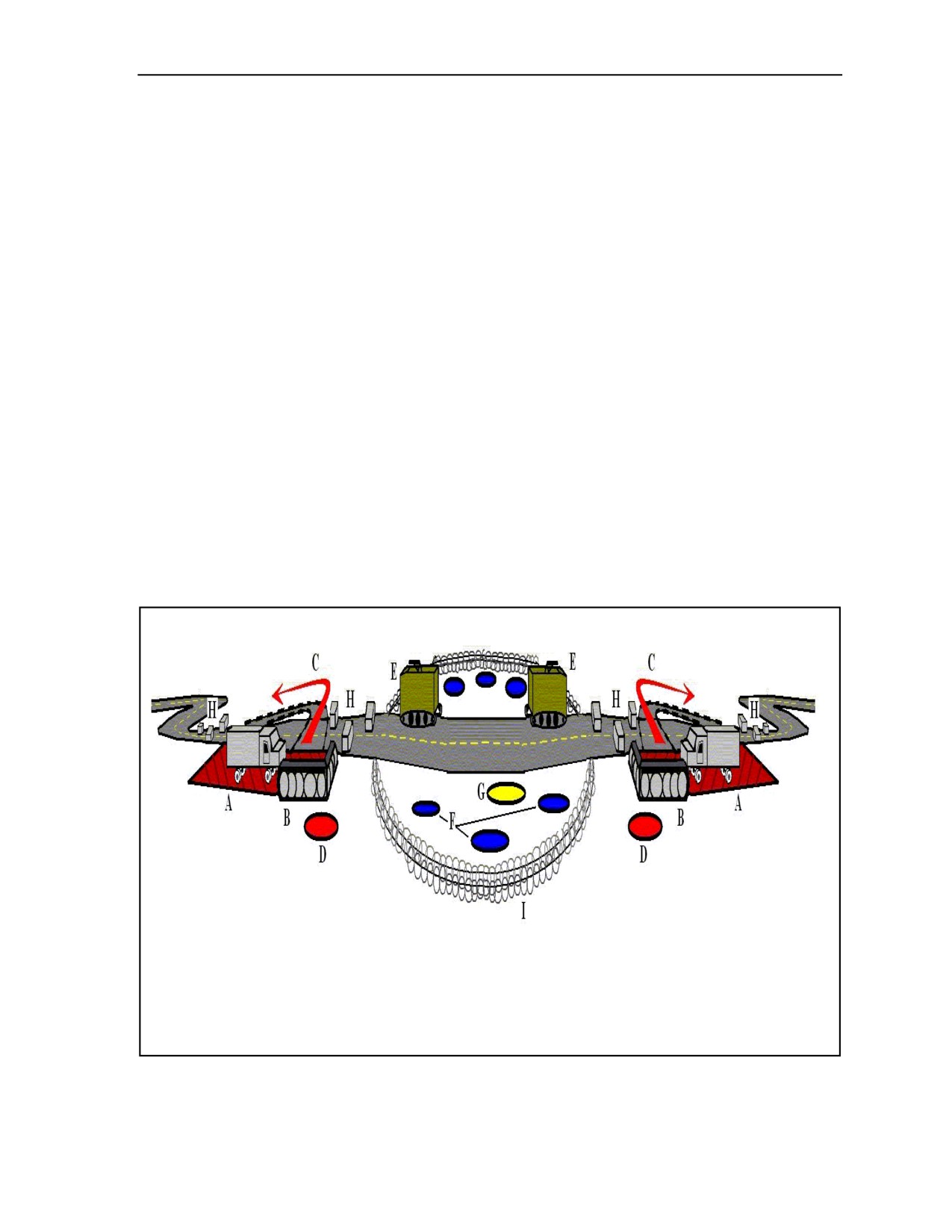
C-18. A fixed position set up on a main road in a rural or built-up area that can be classi-
fied as either a heavy or light traffic checkpoint. A heavy-traffic deliberate checkpoint nor-
mally requires a platoon for manning. Squads can only operate a light traffic checkpoint for a
short duration (12 hours or less). (See Figure C-1.)
C-19. To operate a heavy traffic checkpoint, task organize the platoon into—
z
Headquarters element responsible for C2 and maintaining communications.
z
Search element, normally a squad that—
Halts vehicles at the checkpoint.
Guides vehicles to the designated search point.
Performs personnel and vehicle searches.
Directs cleared vehicles through the checkpoint.
z
Security element that provides early warning to the search and assault element,
observes and reports suspicious activity, and monitors traffic flow up to and
through the checkpoint. It should have an antiarmor capability to protect the site
from an armored vehicle threat.
z
Assault element, an additional squad responsible for destroying any insurgent ele-
ment that forces its way past the search team. Soldiers are positioned beyond the
search point and emplaced obstacles/barriers.
Deliberate Checkpoint Legend
F - Fighting positions.
A - Search Area/Team: Includes at least
G - Central point.
one indigenous military or police officer
H - Counter mobility serpentine
for language capability.
barriers.
B - Berm/Obstacle/T-Wall to mitigate
blast effect.
I - Concertina wall barrier.
C - Vehicle turn-around.
D - Passenger holding area.
E - Crew-served weapons.
Figure C-1. Organization of a Deliberate Checkpoint
C-7
FMI 3-07.22
C-20. Due to possibility of a suicide bomber attack, place the search area outside the unit’s
perimeter.
C-21. Placing the search area to the side of the road permits two-way traffic. If a vehicle is
rejected, it is turned back. If vehicle is accepted for transit, it is permitted to travel through
the position. If the vehicle is enemy, the checkpoint leader determines whether to attack or
apprehend.
z
Everyone at the checkpoint must know the mission and commander’s intent. Be
methodical, detail-oriented, and focus on security.
z
Be friendly and professional to all. Nonetheless, don’t trust anyone! Young women
have been very effective suicide bombers. Children have unknowingly and know-
ingly carried bombs into and through checkpoints.
z
Soldiers prepare and occupy fortified fighting positions. Stop all vehicles for an ini-
tial search outside the obstacle areas. When confronted by a potentially threatening
vehicle—
The search element alerts the checkpoint leader, moves to a safe/fortified posi-
tion, and may engage or allow the vehicle to pass based on leader instructions
and ROE.
If the vehicle passes through the escape lane, the checkpoint leader may direct
the assault element to engage and attack the vehicle based on ROE.
If a vehicle turns around and attempts to avoid the checkpoint, a designated
element pursues and engages them. Shoot the tires first. Approach carefully,
and assume the worst. However, the occupants may simply be tired of waiting
in line.
z
Overall don’t hurt people unnecessarily. Some people simply don’t understand what
you are directing them to do.
Hasty Checkpoint
C-22. Hasty checkpoints should be set up to last from 5 minutes to up to 30 minutes in du-
ration. One technique is the maximum use of organic vehicles to serve as additional security
and to assist in funneling traffic through the checkpoint in addition to concertina wire and, if
available, tire spikes.
C-23. The short duration (5 to 30 minutes) reduces the risk of an insurgent organizing and
conducting a mortar or car bomb attack against the checkpoint. Additionally, this may dis-
rupt the timing of another planned insurgent action.
C-24. Characteristics of a hasty checkpoint are—
z
Located along likely avenues of approach.
z
Achieves surprise.
z
Temporary and moved often.
z
The platoon is able to carry the construction materials.
z
Uses vehicles as an obstacle between the vehicles and personnel, and reinforces
them with concertina wire.
z
Soldiers are positioned at each end of the checkpoint.
z
Soldiers are covered by mounted or dismounted automatic weapons.
z
Reaction force (at least one squad) is concealed nearby to attack or assault in case
the site is attacked.
C-25. Soldiers establish hasty checkpoints where they cannot be seen by approaching traf-
fic until it is too late for approaching traffic to unobtrusively withdraw. Effective locations on
which to set up hasty checkpoints include—
C-8
Population and Resources Control
z
Bridges (near either or both ends, but not in the middle).
z
Defiles (either end is better than in the middle).
z
Highway intersections. These must be well organized to reduce the inherent dan-
ger.
z
The reverse slope of a hill (hidden from the direction of the main flow of traffic).
z
Just beyond a sharp curve.
Vehicle Search
C-26.
The following is a vehicle search checklist:
z
Stop the vehicle at the search area.
z
Direct the occupants to exit the vehicle and escort them away to a nearby search
area.
z
Direct the male occupants to lift all clothing to ensure explosive devices are not at-
tached to their body (females must check female occupants). When female inspec-
tors are not present, an effective method is to search women by having them pull
their garments tight to their bodies so that any contour formed by an explosive de-
vice or material will stand out. Use explosive detection devices, if available.
z
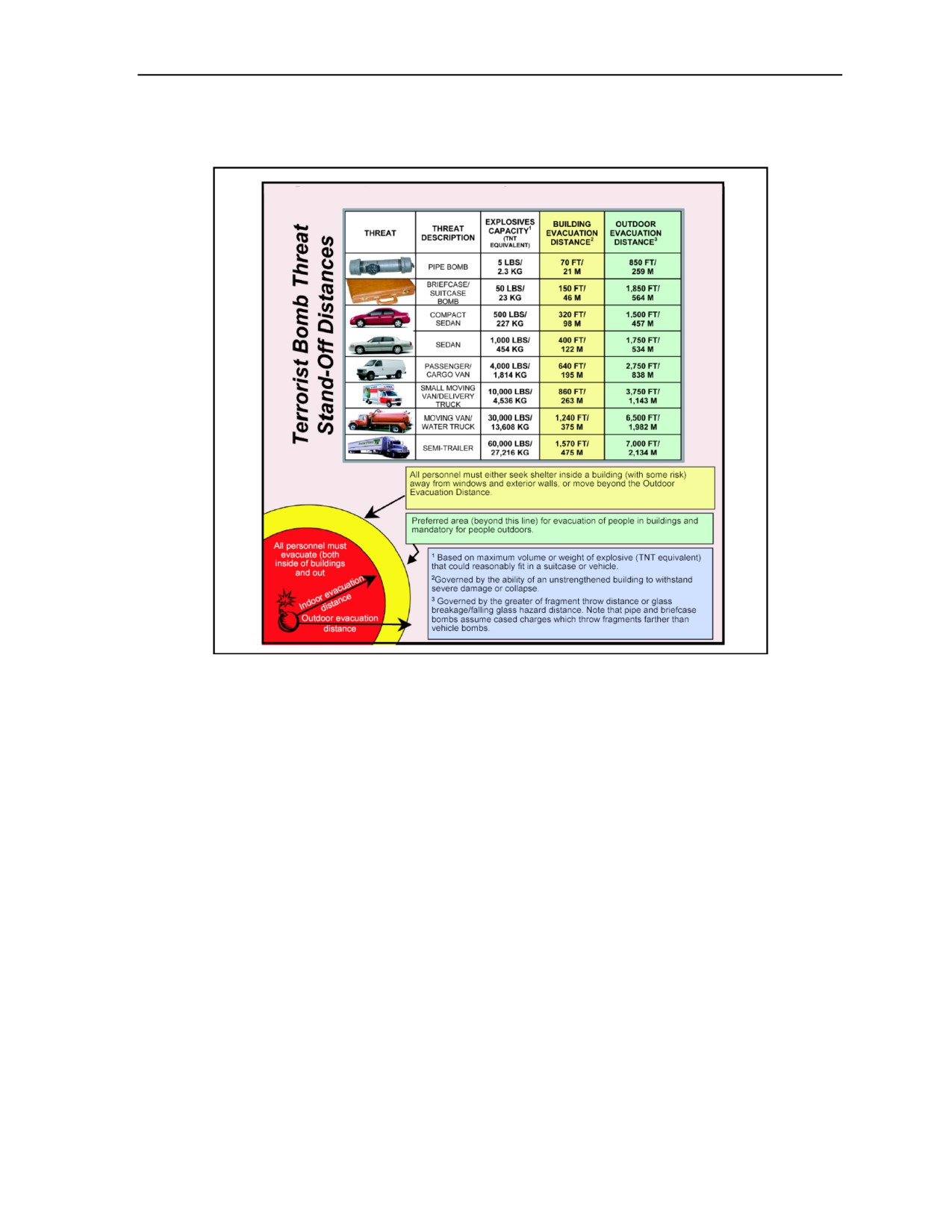
Soldiers remain behind a secure and fortified position while this process is being
conducted. (See Figure C-5, page C-13 for prescribed standoff distances against ex-
plosives).
z
Direct the occupants to open all doors, the trunk, the hood of the vehicles and the
gas cap (to include inside enclosures such as glove compartments).
z
Conduct a visual inspection while the occupants of the vehicles lift any and all ob-
structions from the Soldiers’ field of view while remaining behind the fortified posi-
tions. Such obstructions could include blankets or clothing on seats.
z
The driver removes any loose items that are not attached to the vehicle for inspec-
tion.
z
Once the leader determines it is safe to approach the vehicle, two members of the
search team position themselves at both rear flanks of the vehicle. These Soldiers
maintain eye contact with the occupants once they exit the vehicle.
z
Two Soldiers armed only with pistols conduct the search.
z
One Soldier conducts interior searches and the other performs exterior searches.
Use mirrors and metal detectors to thoroughly search each vehicle for weapons, ex-
plosives, ammunition, and other contraband. Depending on the threat level, the ve-
hicle search area should provide blast protection for the surrounding area.
C-27.
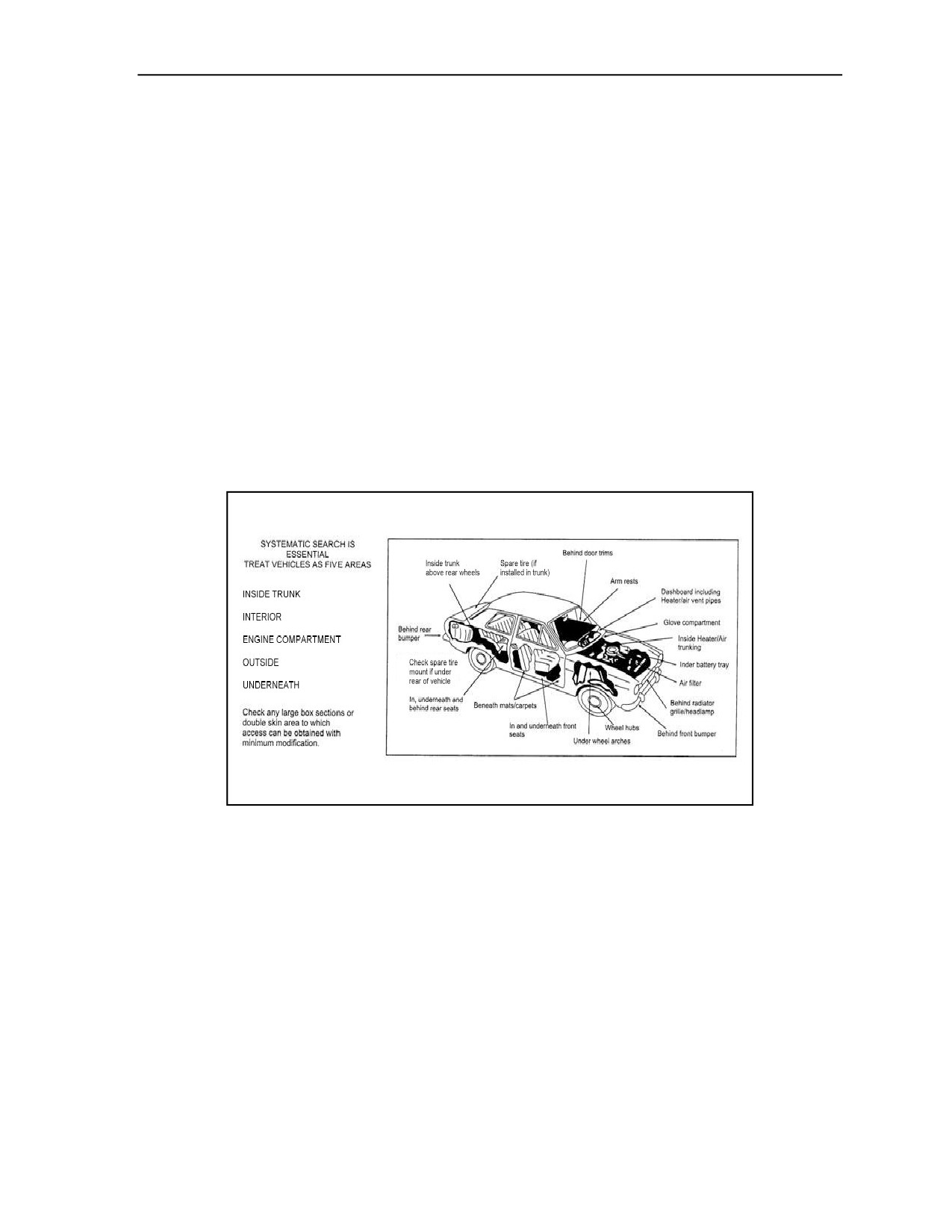
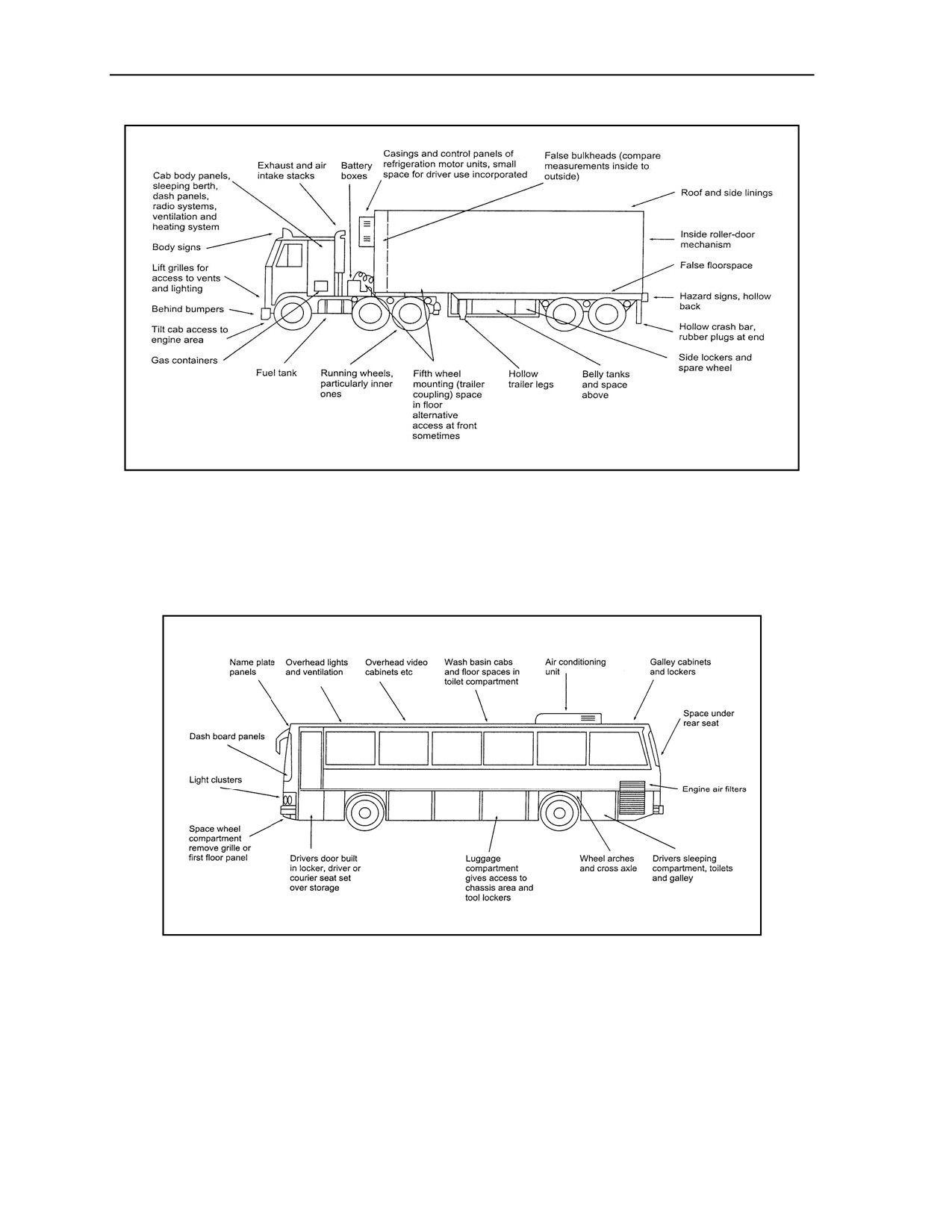
See Figures C-2, C-3, and C-4 (pages C-11 and C-12) for search areas for different ve-
hicle types.
Personnel Searches
C-28. Personnel searches are only conducted when proper authorization has been obtained
per the ROE, HN agreements, or status of forces agreement. Planning considerations are—
z
Plan for same-gender searches.
z
HN authorities, whenever possible, should conduct or at least observe searches of
local nationals.
z
Preserve the respect and dignity of the individual.
z
Consider local customs and national cultural differences. In many cultures it is of-
fensive for men to touch or even talk to women in public.
z
Be polite, considerate, patient, and tactful.
z
Make every effort not to unnecessarily offend the local population.
C-9
FMI 3-07.22
z
Search for weapons and ammunition, items of intelligence value, currency, drugs,
other inappropriate items, and anything that seems out of the ordinary.
C-29. Soldiers conduct individual searches in search teams that consist of the following:
z
Searcher. Actually conducts the search. This is the highest-risk position.
z
Security. Maintains eye contact with the individual being searched.
z
Observer. The observer is a leader who has supervisory control. He provides early
warning.
C-30. The two most common methods used to conduct individual searches are frisk and
wall searches.
z
Frisk search. Quick and adequate to detect weapons, evidence, or contraband. A
frisk search is more dangerous because the searcher has less control of the individ-
ual being searched.
z
Wall search. Affords more safety for the searcher. Any upright surface may be
used, such as a wall, vehicle, tree, or fence.
The search team places the subject in the kneeling or prone position if more control is needed
to search an uncooperative individual.
C-31. Strip searches should only be considered when the individual is suspected of carrying
documents or other contraband on his or her person. This extreme search method should be
conducted in an enclosed area and by qualified medical personnel when available.
Additional Checkpoint Considerations
C-32.
The following should be considered when operating a checkpoint:
z
Team duties and reactions must be well-defined, backbriefed by all, and rehearsed.
z
Standardize the following three mandatory minimum signals at every checkpoint:
Stop.
Get out of the car.
Lift your shirt.
z
Prepare and emplace signs in the local language instructing indigenous personnel
what to expect and do at the checkpoint.
z
Determine if it is necessary to apprehend or detain those who see the checkpoint
ahead and attempt to turn around.
z
Use HN police and military when available.
z
Position a response force close to the approach route to block or detain vehicles that
try to avoid the checkpoint.
z
Clear and maintain control of all buildings and terrain that dominate the check-
point.
z
Stay alert for any change of scenery around the checkpoint. Crowds gathering for
no apparent reason or media representatives waiting for an event are all indicators
that something may happen.
z
Use artificial illumination for night operations.
z
If HN personnel are used to assist, ensure they do not represent a national, ethnic,
or religious group or faction that is feared or hated by the majority of the local
population.
z
Move the checkpoint location and change the method of operation at random to
avoid setting patterns. The longer your position remains static, the greater the risk
you will be attacked.
C-10
Population and Resources Control
C-33. Record the following information:
z
The number and type of vehicles stopped. Report identifying markings, license
plate numbers, vehicle identification numbers (where present), and any signs dis-
played on the vehicle.
z
The point of origination and destination of the vehicle.
z
The number of passengers in the vehicle. Report the nationality, ages, and gender
of passengers.
z
The condition of passengers (general health, dress, attitude).
z
The stated reason for travel by passengers.
z
The type and quantity of cargo.
z
Possible or actual sightings of weapons.
z
Explosives or threatening action by the passengers.
z
A description of arms, ammunition, explosives, and sensitive items found and con-
fiscated from the vehicle.
z
Anything unusual reported by the passengers.
z
The illustrations shown below suggest areas for security personnel to search for ex-
plosives or prohibited items.
Figure C-2. Search Areas for Family Cars
C-11
FMI 3-07.22
Figure C-3. Search Areas for Commercial Vehicles
Figure C-4. Search Areas for Buses
C-12
Population and Resources Control
Figure C-5. Standoff Distance for Explosive Devices
ROADBLOCKS
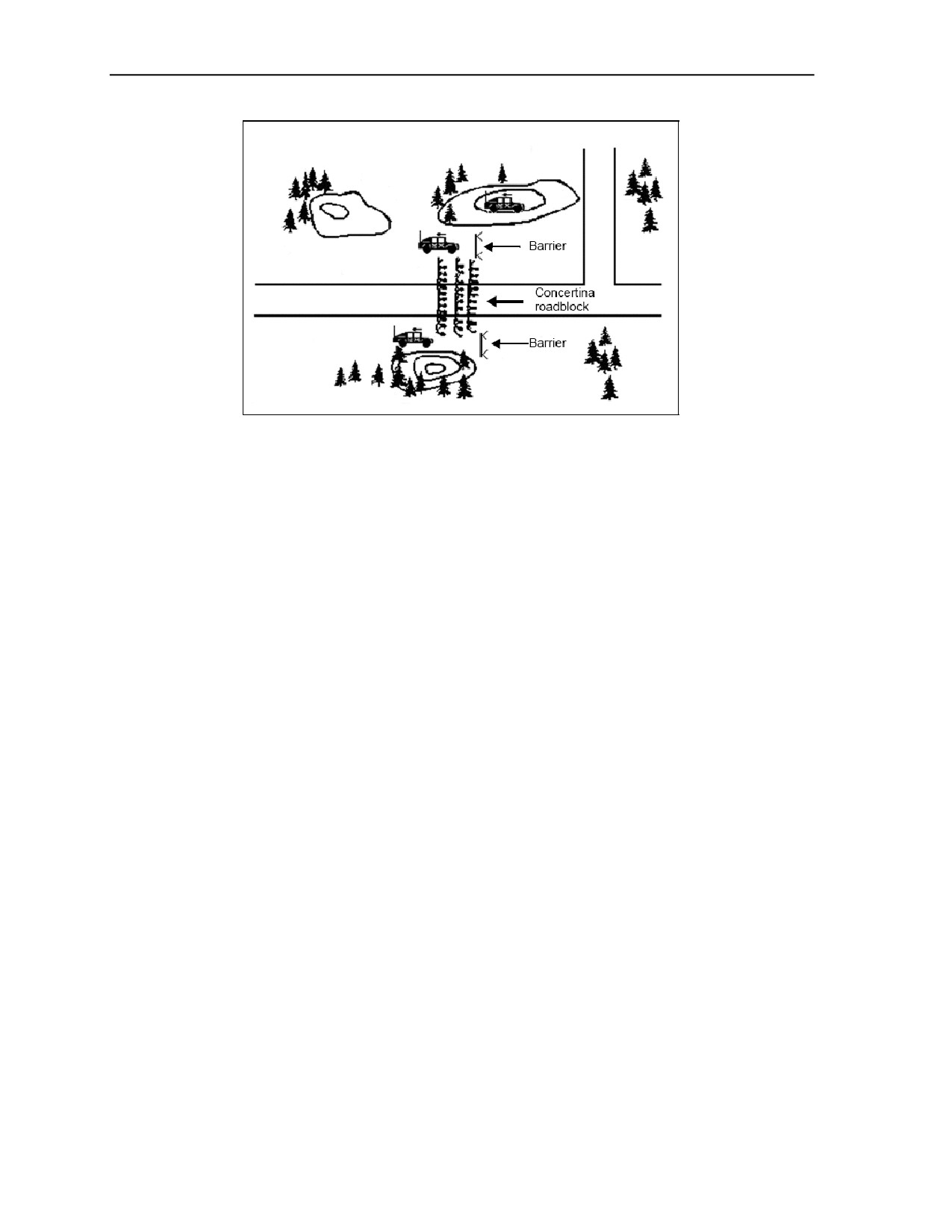
C-34. A roadblock is defined as a barrier or obstacle (usually covered by fire) used to block
or limit the movement of vehicles along a route. (See Figure C-6, page C-14.) Position the
roadblock so obstacles like cliffs, swamps, or rivers channel vehicles toward the roadblock.
Select a defendable site for the roadblock. Ensure that defensive positions—
z
Include a fighting position for crew-served weapons to provide overwatch and cov-
ering fire for the roadblock.
z
Establish fields of fire that cover avenues of approach that lead to the roadblock to
prevent breach.
C-13
FMI 3-07.22
Figure C-6. Roadblock
LESSONS OBSERVED DURING PAST OPERATIONS
C-35. Monitor local media (radio, newspaper) both for rumor control/counterpropaganda
purposes (essential in population control) as well as intelligence tip-offs (for both current in-
telligence and tactical indications and warning). You will notice a different slant from the
news at home (observed in Bosnia and Haiti).
C-36. Identify and listen to what influential local leaders say in public and compare it to
their actions in private. These people are leaders in political, government, criminal, ethnic,
religious, and family realms. It is important to live with the local people and listen to what
they are also saying.
C-37. Infrastructure protection and repair/rehabilitation (for example, electrical power and
water, electrical pole repair teams) are critical both for improving the populations’ physical
well-being as well as for the positive psychological effect it creates. The electrical grid is a
good confidence target (very visible), and there is no effect equivalent to the lights going out.
“Turning on the lights” in Port-au-Prince contributed to reducing criminal activity (as meas-
ured by the murder rate) by about 40 percent in a two-month period (observed in Haiti).
C-38. Intelligence screening and selected debriefing of migrants/refugees can yield tacti-
cally useful intelligence, especially when coupled with humanitarian relief/civic action activi-
ties. Asking the individuals who have turned themselves in to identify any of the people
working for you is a very effective way to catch planted agents. Expect them to be there.
C-39. Indicators of pending insurgent offensive actions are the theft of medical supplies, car
and money thefts, and International Red Cross representatives observed in the area when
they are not otherwise present (Bosnia and Haiti).
C-40. In urban areas, monitor electric power usage and telephone records. Deviations from
normal usage may indicate terrorist activity (United Kingdom Royal Marine observation in
Northern Ireland).
C-14
Appendix D
Order of Battle Factors
D-1. During counterinsurgency operations, the nature of the threat requires order of battle
intelligence be produced in greater detail than is found in conventional operations. All larger
organizations must be analyzed, mapped-out, and understood. Often the focus starts with
individuals or cells. However, order of battle development should not be linear. An insur-
gency’s “foot soldiers” are often easily identified and analyzed due to their more public expo-
sure. However, it is paramount to identify the leaders and their relationships at all levels to
accurately establish an initial order of battle. In counterinsurgency operations, the catego-
ries of personalities, culture, and internal organizational processes are added to the usual
list of order of battle factors that are studied from the same perspective as in conventional
warfare and include—
z
Composition.
z
Disposition.
z
Strength.
z
Tactics and operations.
z
Training.
z
Logistics support.
z
Combat effectiveness.
z
Electronic technical data.
z
Personalities.
z
Miscellaneous data.
COMPOSITION
D-2. Composition is the identification of units and political, religious, or ethnic organiza-
tions. Unit identification consists of the complete designation of a specific entity by name or
number, type, relative size or strength, and subordination. Composition includes—
z
Operational and support cells (similar to sections in a military unit).
z
Echelons.
z
Staff elements.
z
Political, religious, ideological, and military aims.
z
Internal and external C2.
z
Operational organizations.
z
Internal and external support structure.
z
External ties.
z
Assassination squads.
z
Bomb and demolition squads.
z
Attack or hit squads.
D-1
FMI 3-07.22
DISPOSITION
D-3. Disposition consists of the geographic location of insurgent elements and how they are
deployed, employed, or located. Additionally, disposition includes the recent, current, and
projected movements or locations of these elements:
z
Training camps.
z
Base camp.
z
Logistic camps (external and internal).
z
Headquarters (external and internal).
z
Safe houses.
z
Front organizations.
z
Areas of control.
STRENGTH
D-4. Strength conventionally is described in terms of personnel, weapons, and equipment. In
insurgency operations, strength as a factor is augmented with attack teams, political cadre
or cells, and most importantly, popular support. Popular support can range from sympathiz-
ers to assistance in conducting operations, storage or moving logistics, or just withholding in-
formation.
TACTICS AND OPERATIONS
D-5. Tactics and operations include strategy, methods of procedure, and doctrine. Each re-
fers to the insurgent’s accepted principles of organization and employment of forces. Tactics
also involve political, military, psychological, and economic considerations. Insurgent tactics
and operations vary in sophistication according to the level of training the individual or or-
ganization has received. Insurgents carefully plan and train for individual and small group
operations. Typical insurgent tactics and operations include, but are not limited to—
z
Assassination. A term generally applied to the killing of prominent persons and
symbolic personnel as well as “traitors” who defect from the group.
z
Arson. Less dramatic than most tactics, arson has the advantage of low risk to the
perpetrator and requires only a low level of technical knowledge.
z
Bombing. The IED is the insurgent’s or terrorist’s weapon of choice. IEDs can be
inexpensive to produce and, because of the various detonation techniques available,
may be a low risk to the perpetrator. However, suicidal bombing cannot be over-
looked as an employment method. Other IED advantages include their ability to
gain publicity, as well as the ability to control casualties through timed detonation
and careful placement of the device. It is also easily deniable, should the action pro-
duce undesirable results.
z
Hostage taking. This is an overt seizure of one or more individuals with the intent
of gaining publicity or other concessions in return for release of the hostage. While
dramatic, hostage and hostage barricade situations are risky for the perpetrator.
z
Kidnapping. While similar to hostage taking, kidnapping has significant differ-
ences. Kidnapping is usually a covert seizure of one or more specific persons in or-
der to extract specific demands. It is normally the most difficult task to execute.
The perpetrators of the action may or may not be known for a long time. Media at-
tention is initially intense, but decreases over time unless the kidnapping is accom-
panied by acts of barbarism that extend news coverage. Because of the time in-
volved, successful kidnapping requires elaborate planning and logistics. The risk to
the perpetrators may be less than in the hostage situation.
D-2
Order of Battle Factors
z
Intimidation/Blackmail. Insurgents may attempt to gain coerced political, fiscal,
or logistic support from local government officials, local businessmen, or other in-
fluential community leaders through intimidation or blackmail. This could be in the
form of threats on the individual’s life, kidnapping of people close to the individual,
or threats to disrupt or destroy (for example, bombing or arson) infrastructure that
is important to the individual.
z
Seizure. Seizure usually involves a building or object that has value in the eyes of
the audience. There is some risk to the perpetrator because security forces have
time to react and may opt to use force to resolve the incident, especially if few or no
innocent lives are involved.
z
Raids or attacks on facilities. Armed attacks on facilities are usually under-
taken for one of three purposes:
Gain access to radio or television broadcasts to make a statement.
Demonstrate the government’s inability to secure critical facilities or national
symbols.
Acquire resources (for example, robbery of a bank or armory).
z
Sabotage. The objective in most sabotage incidents is to demonstrate how vulner-
able a particular society or government is to insurgent actions. Industrialized areas
are more vulnerable to sabotage than less highly developed societies. Utilities,
communications, and transportation systems are so interdependent that a serious
disruption of any one affects all of them and gains immediate public attention.
Sabotage of industrial or commercial facilities is one means of identifying the tar-
get while making a statement of future intent. Military facilities and installations,
information systems, and information infrastructures may become targets of insur-
gent sabotage.
z
Hoaxes. Any insurgent group that has established credibility can employ a hoax
with considerable success. A threat against a person’s life causes that person and
those associated with that individual to devote time and efforts to security meas-
ures. A bomb threat can close a commercial building, empty a theater, or delay an
aircraft flight at no cost to the insurgent. False alarms dull the analytical and op-
erational efficiency of key security personnel, thus degrading readiness.
z
Use of technology. Technology has important implications for the insurgent
threat. Infrastructure technologies provide attractive targets for insurgents, who
can apply a range of rudimentary and advanced attack techniques to disrupt or un-
dermine confidence in a range of systems. Key elements of the national infrastruc-
ture—transportation, telecommunications, energy, banking, public health, and wa-
ter supply—are becoming increasingly dependent on computerized systems and
linkages.
z
Use of chemical, biological, radiological, or nuclear weapons. Some insur-
gent groups may possess chemical and biological weapons, and there is a potential
for use of both chemical and biological weapons in the future. These types of weap-
ons, relatively cheap and easy to make, may be used in place of conventional explo-
sives in many situations. The potential for mass destruction and the deep-seated
fear most people have for chemical and biological weapons could be attractive to a
group wishing to make the world take notice. Although an explosive nuclear device
is acknowledged to be beyond the financial and technical reach of most insurgent
groups, a chemical or biological weapon, or even a radiological dispersion device us-
ing nuclear contaminants, is not. The technology is simple and the payoff is poten-
tially higher than conventional or nuclear explosives.
z
Psychological Operations. Since insurgents want to win over the support of the
population—or at least separate the support of the population from the HN gov-
ernment, they will engage in many different types of PSYOP with this intent. They
D-3
FMI 3-07.22
can accomplish this through many different means. For example, insurgents may
stage and publicize real or fake atrocities, which they will blame on the HN gov-
ernment or US forces. They will also be quick to take advantage of any inadvertent
mistakes that the local national government forces or US forces may make when
dealing with the local population.
TRAINING
D-6. The type and depth of individual and group training that insurgents receive is tied to
their tactics and operations. Higher education also plays a role in insurgent training. Insur-
gent training may include, but is not limited to—
z
Indoctrination and strategy (political, ideological, or religious).
z
Operations.
z
Tactics.
z
Weapons (individual and crew served), including such specialties as demolition,
weapons, and assassinations.
z
Communications.
z
Logistics.
z
Transportation (covert movement).
z
ISR.
z
PSYOP.
z
Media manipulation.
LOGISTICS
D-7. The effectiveness of insurgent operations depends heavily on logistics. This dependency
fluctuates horizontally and vertically between the various groups and levels of operation.
The intensity of logistic activity is based on operations. Critical components of logistics in-
clude, but are not limited to—
z
Financing.
z
Food.
z
Water.
z
Weapons and ammunition.
z
Bomb-making components.
z
PSYOP materials (paper, ink, printing press).
z
Medical.
z
Transportation (on-hand and required).
COMBAT EFFECTIVENESS
D-8. Combat effectiveness for insurgent forces is not measured the same way as combat ef-
fectiveness for conventional forces. Combat effectiveness factors for insurgent forces include,
but are not limited to—
z
Outside support (financial, physical, moral).
z
Intimidation.
z
Fear.
z
Political change.
z
Motivation.
z
Popular support.
D-4
Order of Battle Factors
ELECTRONIC TECHNICAL DATA
D-9. In counterinsurgency operations, the lack of an obvious formal insurgent organiza-
tional structure or architecture impedes development of an extensive threat electronic order
of battle database and an electronic technical database. The insurgent has communications
equipment available ranging from the most modern to the most primitive. Insurgent forces
can use high frequency (HF), short-wave, and ham radio sets; cellular phones; the Internet;
the mail; and couriers. Citizen band-set is also used. While not playing a significant histori-
cal role, the insurgent’s potential use of radar cannot be ruled out.
PERSONALITIES
D-10. Personality is a critical factor when conducting counterinsurgency operations. Atten-
tion must be focused on individuals and leaders. Insurgent organizational diagrams can be
built through multidimensional link analysis (determining relationships between critical
personalities and then their group associations). This applies to virtually any threat repre-
sented in counterinsurgency operations. Once relationships and the level of contact or knowl-
edge the personalities have are known, many of their activities can be determined. Personal-
ity files include, but are not limited to—
z
Leaders (political, ideological, religious, military).
z
Staff members.
z
Organization’s spokesperson.
z
Family members (immediate and extended).
z
Previous experience and skill training in professional disciplines, trades, and spe-
cialties.
z
Media manipulation personnel and PSYOP campaign personnel.
z
Trainers.
z
Code names and nicknames.
D-11. Leaders on the ground must understand the political and physical strengths and
weaknesses of the insurgent leadership and how best to exploit those weaknesses. Consid-
erations include—
z
Who are the leaders? Is there a single, dominant, charismatic leader?
z
Is the leadership highly dedicated to an ideology?
z
Are the leaders committed to a specific organizational and operational pattern?
z
Are there differences of opinion among leaders as to purpose and methods? Will a
schism or other event occur as a result?
z
What is the relationship between the leadership and the operational and support
elements? Are decisions made centralized or decentralized?
z
What is the decision making process of the insurgent leadership? Are decisions
made centralized or decentralized?
CULTURE
D-12. Culture is the ideology of a people or region and defines a people’s way of life. A peo-
ple’s culture is reflected in their daily manners and customs. Culture outlines the existing
systems of practical ethics, defines what constitutes good and evil, articulates the structures
and disciplines that direct daily life, and provides direction to establish patterns of thinking
and behavior. Cultural issues include, but are not limited to religion, political and economic
beliefs, tribe, clan, ethnicity, and regional affiliation, military attitudes, and law and justice:
z
Religion—beliefs, customs, and protocols.
z
Ideology—political and economic beliefs, and work ethic.
D-5
FMI 3-07.22
z
Family—tribe, clan, and family; hierarchies, allegiances, and loyalties; family eco-
nomic interests; matriarchies versus patriarchies.
z
Ethnicity—race, nationality (for example, Arab, Bedouin, and Turkic; Kurd and
Armenian; Tibetan, and Chinese; Korean, Mongolian, and Chinese.
z
Regional affiliations—Internal to a nation and determine those that extend past
national borders.
z
Military attitudes—order, weapons, honor, and hunting.
z
Law and justice—one system of law or multiple systems; property rights; correction
versus punishment.
INTERNAL ORGANIZATIONAL PROCESSES
D-13. An organization’s flexibility or rigidity is a key determinant as to its strengths and
vulnerabilities. This flexibility or rigidity can be accurately estimated by answering several
questions. Determining organizational attitudes toward those who achieve is powerful.
z
Are achievers viewed as potential competitors, or as important organizational con-
tributors? Is the attitude consistent throughout the organization?
z
How do organizations replace leader and cadre casualties? What are the primary
factors that determine how these replacements are selected?
z
Rewards and punishments—what are they, and are they consistently applied?
z
Are internal rivalries Byzantine, or is does organizational discipline have primacy?
z
How are policies adjusted and adjudicated—gunfights or dialogue?
z
What are potential divisions and policy fractures? Which leaders support specific
positions, and why?
z
Leader motivations—organizational, family, personal.
MISCELLANEOUS DATA
D-14. Miscellaneous data includes supporting information needed but not covered by an or-
der of battle factor. This could include—
z
Family history.
z
False unit identification.
z
Names or designators
z
Political and military goals
z
PSYOP.
z
Demographics.
D-15. PSYOP activities may result in insurgent-sponsored, commercial, or clandestine ra-
dio broadcasts. Covert broadcasts normally originate outside the national boundaries or from
remote, inaccessible areas. Commercial radio broadcasts may use code words to control and
coordinate threat operations. Television broadcasts are used similarly.
D-16. PSYOP files contain—
z
Copies of leaflets, posters, and other printed material.
z
Video recordings of television broadcasts.
z
Audio recordings of radio broadcasts.
z
Copies of speeches.
z
Analysis of local grievances.
z
Background material.
D-17. Without an insurgent organizational or operational structure, intelligence analyses
during counterinsurgency operations primarily rely on pattern and trend analysis. This al-
D-6
Order of Battle Factors
lows the analysts to understand the relationships of key insurgency personnel and methods
of operation to predict likely insurgent operations and pinpoint critical nodes of insurgent
operations (personnel, intelligence, training, and logistics).
D-7
Appendix E
Intelligence Indicators
Table E-1. Enemy Activity Indicators—Indigenous Population
General Activities
•
Identification of agitators, insurgents, militias or criminal organizations, their supporters, and
sympathizers who suddenly appear, in, or move out of, an area.
•
Emergence of new leaders among the population.
•
New faces in a rural community.
•
Unusual gatherings among the population.
•
Disruption of normal social patterns.
•
Mass urban rural migration or vice versa.
•
Massing of combatants of competing power groups.
•
Increase in the size of embassy or consulate staffs from a country or countries that support
indigenous disaffected groups, particularly those hostile to the United States or the current
intervention.
•
Increase in neighboring countries of staff and activities at embassies or consulates of countries
associated with supporting indigenous disaffected groups.
•
Increased travel by suspected subversives or leaders of competing power bases to countries
hostile to the United States or opposed to the current intervention.
•
Influx of opposition resident and expatriate leaders into the AO.
•
Reports of opposition or disaffected indigenous population receiving military training in foreign
countries.
•
Increase of visitors (for example, tourists, technicians, businessmen, religious leaders, officials)
from groups or countries hostile to the United States or opposed to the current intervention.
•
Close connections between diplomatic personnel of hostile countries and local opposition
groups.
•
Communications between opposition groups and external supporters.
•
Increase of disaffected youth gatherings.
•
Establishment of organizations of unexplained origin and with unclear or nebulous aims.
•
Establishment of a new organization to replace an existing organizational structure with identical
aims.
•
Appearance of many new members in existing organizations such as labor unions.
•
Infiltration of student organizations by known agitators.
•
Appearance of new organizations stressing grievances or interests of repressed or minority
groups.
•
Reports of large donations to new or revamped organizations.
•
Reports of payment to locals for engaging in subversive or hostile activities.
•
Reports of formation of opposition paramilitary or militia organizations.
•
Reports of lists of targets for planned opposition attacks.
•
Appearance of “professional” agitators in gatherings or demonstrations that result in violence.
E-1
FMI 3-07.22
• Evidence of paid and armed demonstrators’ participation in riots.
• Significant increase in thefts, armed robberies, and violent crime in rural areas; increase in bank
robberies in urban areas.
Opposition-Directed Activities
• Refusal of population to pay or unusual difficulty to collect rent, taxes, or loan payments.
• Trends of demonstrated hostility toward government forces or mission force.
• Unexplained population disappearance from or avoidance of certain areas.
• Unexplained disappearance or dislocation of young people.
• Reported incidents of attempted recruitment to join new movements or underground
organizations.
• Criminals and disaffected youth who appear to be acting with and for the opposition.
• Reports of extortion and other coercion by opposition elements to obtain financial support from
the population.
• Use of fear tactics to coerce, control, or influence the local population.
• Reports of HN government or mission force facilities and personnel surveillance.
Activities Directed Against the Government/Mission Force
•
Failure of police and informer nets to report accurate information, which may indicate sources
are actively supporting opposition elements or are intimidated.
•
Decreasing success of government law enforcement or military infiltration of opposition or
disaffected organizations.
•
Assassination or disappearance of government sources.
•
Reports of attempts to bribe or blackmail government officials, law enforcement employees, or
mission personnel.
•
Reports of attempts to obtain classified information from government officials, government
offices, or mission personnel.
•
Classified information leaked to the media.
•
Sudden affluence of certain government and law enforcement personnel.
•
Recurring failure of government or mission force raids on suspected opposition organizations or
illegal activities apparently due to forewarning.
•
Increased hostile or illegal activity against the HN government, its law enforcement and military
organizations, foreigners, minority groups, or competing political, ethnic, linguistic, or religious
groups.
•
Demonstrations against government forces, minority groups, or foreigners designed to instigate
violent confrontations with government or mission forces.
•
Increased antigovernment or mission force rhetoric in local media.
•
Occurrence of strikes in critical areas intended to cast doubt on the HN government’s ability to
maintain order and provide for the people.
•
Unexplained loss, destruction, or forgery of government identification cards and passports.
•
Recurring unexplained disruption of public utilities.
•
Reports of terrorist acts or extortion attempts against local government leaders and
businessmen.
•
Murder of kidnapping of government, military, and law enforcement officials or mission force
personnel.
•
Closing of schools.
E-2
Intelligence Indicators
Table E-2. Propaganda Indicators
General Propaganda Activities
• Dissident propaganda from unidentified sources.
• Increase in the number of entertainers with a political message.
• Increase of political themes in religious services.
• Increase in appeals directed at intensifying general ethnic or religious unrest in countries where
ethnic or religious competition exists.
• Increase of agitation on issues for which there is no identified movement or organization.
• Renewed activity by dissident or opposition organizations thought to be defunct or dormant.
• Circulation of petitions advocating opposition or dissident demands.
• Appearance of opposition slogans and pronouncements by word-of-mouth, graffiti, posters,
leaflets, and other methods.
• Propaganda linking local ethnic groups with those in neighboring countries or regions.
• Clandestine radio broadcasts intended to appeal to those with special grievances or to
underprivileged ethnic groups.
• Use of bullhorns, truck-mounted loudspeakers, and other public address equipment in
“spontaneous” demonstrations.
• Presence of nonmedia photographers among demonstrators.
• Rallies to honor “martyred” opposition personnel. Mass demonstrations honoring local dissident
heroes or dates significant to the opposition.
• Nationwide strikes called to demonstrate the strength of the opposition movements.
Propaganda Activities Directed Against the Established Government
• Attempts to discredit or ridicule national or public officials.
• Attempts to discredit the judicial and law enforcement system.
• Characterization of government leaders as puppets and tools of foreign intervention forces.
• Agitation against government projects and plans.
• Radio propaganda from foreign countries that is aimed at the target country’s population and
accuses the target country’s government of failure to meet the people’s needs.
Propaganda Activities Directed Against the Mission Force and HN Military and Law Enforcement
• Spreading accusations that the HN military and police are corrupt and out of touch with the
people.
• Spreading accusations that mission force personnel will introduce customs or attitudes that are
in opposition to local cultural or religious beliefs.
• Character assassinations of mission, military, and law enforcement officials.
• Demands to remove strong anti-opposition or anticrime military and law enforcement leaders
from office.
• Calls for the population to cease cooperating with the mission force and/or HN military and law
enforcement.
• Deliberate incidents to provoke mission, military, or police reprisals during demonstrations or
strikes.
• Widespread hostile media coverage of even minor criminal violations or incidents involving
mission force personnel.
• Accusations of brutality or ineffectiveness or claims that mission or government forces initiated
violence following confrontations.
• Publication of photographs portraying repressive and violent acts by mission force or government
forces.
• Refusal of businessmen and shop owners to conduct business with mission force personnel.
E-3