FMI 3-07.22 Counterinsurgency Operations (2004-2006) - page 2
FMI 3-07.22
commander is never given the absolute authority to act without ultimate accountability.
Military action and the application of force are limited by a variety of political and practical
considerations, some of which may not seem sensible at the tactical level. Leaders and Sol-
diers at all levels need to understand the nature of such limitations and the rationale behind
them in order to make sound decisions regarding the application of or restraint in the use of
force.
2-68. Determining the appropriate level of military force is one of the most difficult issues
confronting leaders and Soldiers. Tactical decisions regarding the application of force can of-
ten have strategic implications. Typically, US forces look to the ROE as the primary method
to determine the appropriate application of force. Rules of engagement are directives issued
by competent military authority that delineate the circumstances and limitations under
which United States forces will initiate and/or continue combat engagement with other
forces encountered (JP 1-02).
2-69. ROE impose political, operational, practical, and legal restrictions on the otherwise
permissible use of military force. The nature and extent of restrictions contained in the ROE
vary dramatically based on the justification for the initial involvement of US forces, the tac-
tical situation, the presence of civilians, and the type of terrain in which forces are operating
(urban or rural). Leaders conducting counterinsurgency operations are likely to find them-
selves operating with a much more constrained set of ROE. Soldiers may find it difficult and
frustrating to conduct offensive operations because of the restrictive ROE. For example, de-
fense of designated non-US Forces or designated foreign persons and their property requires
approval from the President or Secretary of Defense.
2-70. Care must be taken to ensure that the mission drives the ROE and not vice-versa. The
ROE may exercise a significant influence on a unit’s ability to accomplish its mission. There-
fore, it is imperative for commanders and staffs to critically evaluate the ROE in light of
their mission. The impact of the ROE must be fully developed and addressed in staff esti-
mates. ROE should be used to assist in course of action development, analysis (war-gaming),
and selection. (See FM 5-0.) The commander should aggressively seek modifications to the
ROE if the ROE are inadequate in light of the mission and anticipated threat level. The de-
velopment, modification, distribution, and training of ROE must be timely and responsive to
changing threats. Changes must be distributed immediately.
2-71. Leaders remember that the ROE are applicable in all situations. While ROE govern the
use of force in all situations, they do not dictate a certain amount of force to be used in all
situations. ROE often identify specific circumstances where the use of force is required. How-
ever, ROE do not identify every possible situation Soldiers may encounter in a counterinsur-
gency environment. Instead, leaders and Soldiers rely on their knowledge and understand-
ing of ROE, and apply sound judgment, a thorough understanding of the mission,
commander’s intent, and operational environment, situational understanding, and sound
procedures and practices to determine the level of appropriate force permitted by the ROE.
Finally, leaders must balance the safety of their Soldiers with the safety of civilians.
2-72. Knowledge of the ROE itself is not sufficient to help Soldiers make informed decisions
regarding the appropriate application of force. Consistent and effective application of the
ROE requires extensive training and discipline to develop the judgment, depth of knowledge,
skills, and procedures necessary to apply force in a counterinsurgency environment. Leaders
stress basic troop leading procedures and situational-based training, comprehensive plan-
ning and rehearsals, effective precombat checks and mission-related patrol briefs, back-
briefs, and debriefs. Effective communication is equally essential. Leaders must ensure that
every Soldier completely understands the mission and commander’s intent, and has compre-
hensive situational understanding at all times. The appropriate level of situational under-
standing, realistic training, and disciplined adherence to basic troop leading procedures
equips Soldiers with the tools necessary to make informed decisions regarding the decision to
2-14
Command and Control in a Counterinsurgency Environment
use or refrain from the use of force. ROE are most effective when they are simple, clear, and
able to be condensed onto a small card.
SECTION VII - CIVIL-MILITARY OPERATIONS MISSION PLANNING AND
CRITERIA OF SUCCESS
2-73. Criteria of success help leaders plan the transfer of control of a counterinsurgency op-
eration to a nonmilitary organization. Planning for transition is an integral part of mission
planning for counterinsurgency because of the need to transfer control to the HN. Criteria of
success help all concerned assess the status of the CMO portion of counterinsurgency opera-
tions.
2-74. Criteria of success are information requirements developed during the operations proc-
ess that measure the degree of success in accomplishing the unit’s mission. They are nor-
mally expressed as either an explicit evaluation of the present situation or a forecast of the
degree of mission accomplishment (FM 6-0). Leaders may establish observable, usually
quantifiable, objective data as well as subjective indicators to assess a task’s progress com-
pared to expectations. Leaders use criteria of success to determine how well or poorly an op-
eration is achieving the goals of the operation per the mission statement and concept. They
use criteria of success to validate effective courses of action and tactics and to determine
points at which to shift resources, transition to different phases, and alter or terminate the
mission.
2-75. Criteria of success are a product of planning. They differ for every mission and for dif-
ferent phases of a single mission. As leaders and staffs identify specified, implied, and key
tasks, they define what constitutes successful completion of each task. The leader and staff
decide how the criteria of success will be identified, reported, and validated. They determine
what action will be taken when the criteria of success are met, as well as branch plans in
case criteria of success are not achieved according to the original plan. Criteria of success are
often adjusted as the situation changes and higher-level guidance develops.
2-76. Although planners begin the process of determining criteria of success when they de-
velop the lines of operation for counterinsurgency, the commander’s objectives must be a
strong, up-front consideration. CMO planners generally use logical lines of operations. (See
FM 3-0.) These lines of operation normally follow the six CA activities: foreign-nation sup-
port, population resource control, humanitarian assistance, military civic action, emergency
services, and support to civil administration. However, planners are not limited to these
lines. Along each line of operation, planners identify objectives, desired outcomes, and deci-
sive points. Then, they determine criteria of success to assess the effectiveness of those out-
comes.
2-77. Criteria of success for assessing counterinsurgency operations should be designed with
the same considerations in mind as for any other types of missions. Counterinsurgency plan-
ners should ensure that criteria of success are—
z
Appropriate. Criteria of success must correlate to the commander’s objectives and
should relate to the audience objectives. If the objective is to present information to
those outside the command, criteria should be general and few in number. If the ob-
jective is to assist on-site commanders, then criteria should be more specific and de-
tailed.
z
Mission related. Criteria of success must relate to the mission. If the mission is
relief, the criteria should help the commander evaluate improvements in living
standards, mortality rates, and other related areas. If the mission expands, so
should the criteria. Planners should tailor the criteria of success to address opera-
tional and tactical levels.
2-15
FMI 3-07.22
z
Measurable. Objective, quantitative criteria of success reflect reality more accu-
rately than qualitative or subjective criteria and are generally the measure of
choice when the situation permits their use. When using qualitative or subjective
criteria, guidance for determination of those criteria and specific measurement cri-
teria should be established and disseminated to more effectively focus judgment.
Where possible, try to measure a specific aspect condition of the insurgency.
z
Numerically reasonable. Criteria of success should be limited to the minimum
required to effectively portray the relief environment. Avoid establishing excessive
criteria. Criteria of success can become unmanageable or collection efforts can out-
weigh the value.
z
Sensitive. Sensitive criteria of success force performance and accurately reflect
changes related to joint force actions. Extraneous factors should not greatly affect
established criteria.
z
Useful. Criteria of success should detect situational changes quickly enough to en-
able the commander to respond immediately and effectively.
2-78. In multinational or interagency operations, counterinsurgency planners coordinate US
criteria of success with those of participating nations and agencies. In some cases, they may
also collaborate on how the criteria will be measured and reported. For example, emergency
indicators commonly used by the NGO community can be used as a baseline for developing
criteria.
2-79. In addition to deciding what the criteria of success are, counterinsurgency planners de-
cide certain aspects about each one, such as—
z
Who will observe the criteria? (For example, task a specific individual or team.)
z
When will the criteria be observed? (Are the criteria event driven or time driven?
How often will the criteria be tested?)
z
How will the criteria of success be observed? (What method will be used to detect
indicators? Is it direct observation or all-source analysis?)
SECTION VIII - OTHER PLANNING CONSIDERATIONS
PLANNING FOR PUBLIC AFFAIRS AND MEDIA TEAMS
2-80. Counterinsurgency is a war of ideas and is punctuated by moves and counters based on
flexible and agile thinking and calculation. Yet, if counterinsurgency is predicated on ideas
and thinking, then influence over the medium that most easily and effectively gains access to
and influences ideas, thinking, and those related processes would seem to be essential. This
medium is the information network, the media—print and broadcast. The media is a source
of a large portion of the information a population receives and can greatly influence their col-
lective thinking. The media have access to government leaders, decision makers, the public
in most nations, and our own Soldiers to influence and shape opinions. The media is neither
friend nor enemy. It is a tool to create effects and conditions in which counterinsurgency op-
erations are successful. However, adversaries may use it directly and indirectly against
those same operations. Planning for all exigencies must include the media.
2-81. The media, print and broadcast (radio, television and the Internet), play a vital role in
societies involved in a counterinsurgency. Members of the media have a significant influence
and shaping impact on political direction, national security objectives, and policy and na-
tional will. The media is a factor in military operations. It is their right and obligation to re-
port to their respective audiences on the use of military force. They demand logistic support
and access to military operations while refusing to be controlled. Their desire for immediate
footage and on-the-spot coverage of events, and the increasing contact with units and Sol-
diers (for example, with embedded reporters) require commanders and public affairs officers
2-16
Command and Control in a Counterinsurgency Environment
to provide guidance to leaders and Soldiers on media relations. However, military planners
must provide and enforce ground rules to the media to ensure operations security. Public af-
fairs offices plan for daily briefings and a special briefing after each significant event because
the media affect and influence each potential target audience external and internal to the
AO. Speaking with the media in a forward-deployed area is an opportunity to explain what
our organizations and efforts have accomplished.
USE OF INTERPRETERS
2-82. In conventional operations, Soldiers rarely have the need for interpreters. During coun-
terinsurgency, there are occasions when Soldiers lack the linguistic ability to communicate
personally and effectively with the local populace. The use of interpreters is often the best or
only option. The proper use and supervision of interpreters can play a decisive role in the
mission. Leaders plan for the use of interpreters and their integration into tactical units
when necessary. (See Appendix B.)
2-17
Chapter 3
Counterinsurgency Operations
SECTION I - CONCEPT OF OPERATIONS
GENERAL
3-1. Military operations in support of counterinsurgency fall into three broad categories:
CMO, combat operations, and IO. CMO are primarily oriented towards the indigenous popu-
lation in villages, cities, and regions. Combat operations are oriented against insurgent lead-
ers and cadre, smaller units, and insurgent main force organizations (battalion-, brigade-,
and division-sized units) depending on the phase of the insurgency. The operations should
deny the insurgents freedom of movement, access to the population, and access to safe ha-
vens. IO potentially assure a common operational picture appropriate to every level of an or-
ganization, down to the individual Soldier. Commanders also use IO to shape the informa-
tion environment to reinforce CMO and combat efforts. The overall mission of all military
operations in support of counterinsurgency is to provide a safe and secure environment
within which governmental institutions can address the concerns of the people.
3-2. Commanders consider the following when conducting (planning, preparing, executing,
and assessing) counterinsurgency operations:
z
Military operations for countering insurgency must all be completely integrated
with the US country team or established governing authority throughout planning,
preparation, execution, and assessment.
z
Counterinsurgency must be initiated as early as possible. An escalating insurgency
becomes increasingly difficult to defeat.
z
Intelligence, civil affairs, and PSYOP are vital parts of all programs.
z
Effective local government is vital to carrying counterinsurgency programs to the
local populations.
COMMAND AND CONTROL
3-3. Leaders should ascertain the level of organization for counterinsurgency within their
AOs, and where none exists should influence or induce their HN counterparts to establish
such an organization. At all levels, counterinsurgency planning and direction should be ac-
complished through area security coordination centers. These centers are composed of ele-
ments of—
z
HN forces and agencies.
z
Assigned US military and interagency representatives and multinational person-
nel.
3-4. The chief of a security coordination center should be a military or political leader. Each
center should include a civil-military advisory committee composed of representatives from
the area’s major economic and social groups and activities to facilitate communication with
3-1
FMI 3-07.22
and participation of the local populace, and serve as a sounding board for assessing the pro-
gress of the counterinsurgency effort.
RESOURCE ALLOCATION
3-5. Normally, NGOs, private foreign corporations, HN private enterprises, and US gov-
ernmental activities cooperate in local counterinsurgency programs. Nonmilitary personnel
supervising US government efforts may be assigned at major subordinate levels of govern-
ment, and often, visiting technical representatives will operate at lower levels. The adminis-
trative area advisor must coordinate military efforts and those of the US government non-
military representatives. In the absence of civilian advisors, the administrative area advisor
may be directed to monitor the execution of programs initiated but not supervised by other
US government agencies.
3-6. HN and USAID civil resources are devoted to executing economic, social, psychological,
and political programs. Military resources engaged in military civic action often augment
and sometimes substitute for civil resources in executing these programs.
SECTION II - CIVIL-MILITARY OPERATIONS
GENERAL
3-7. Local political authorities bridge the gap between the remote and sometimes imper-
sonal national government and the people. To the extent that these authorities are able to
satisfy the aspirations of the people and create the image of a responsive and capable gov-
ernment, the openings for subversion will diminish. The military works with the local civil
authorities, the populace, and NGOs through CMO. Military participation is accomplished
through military civic action and populace and resource control. The leader must be ready to
propose civic action projects based on the capabilities of the unit advised and must be pre-
pared to give guidance on the techniques of applying these capabilities in accordance with an
overall counterinsurgency plan. To perform these functions, the leader must be aware of the
objectives and principles of CMO in paragraph 3-9. Prior to implementation of military civic
action projects, military operations are coordinated with the US ambassador and country
team (see Figure 2-1, page 2-12.). This coordination is essential to ensure the accomplish-
ment of US national security interests. USAID is the US government agency responsible for
nation building. USAID activities are coordinated through the US embassy. At the tactical
level, direct coordination through the chain of command with USAID avoids duplication of
effort and ensures adequate resources and technical assistance are made available.
3-8. Objectives of CMO in counterinsurgency operations are to—
z
Make substantial contributions to national development.
z
Gain the support, loyalty, and respect of the people for their government.
3-9. Principles of CMO include—
z
Conserving resources and developing an integrated economy. As such, all projects
must proceed within the framework of a coordinated plan.
z
Conformance to guidance issued through command channels.
POPULATION AND RESOURCE CONTROL
3-10. The insurgent’s primary target is the people; therefore, counterinsurgency must sepa-
rate the insurgent from the people and their resources. Population and resource control is
implemented as required to support counterinsurgency operations. Leaders must be knowl-
edgeable regarding the principles, concepts, tasks, and techniques of population and resource
control in order to train and work with their counterparts on their implementation. The pri-
3-2
Counterinsurgency Operations
mary objectives of population and resource control are to separate the insurgents from the
populace and to identify and eliminate the insurgents, their organization, their activities,
and influence while doing so.
3-11. Civil control measures are very similar to police functions. Civil police should initiate
controls because—
z
They are best suited by cultural background, training, and experience.
z
Their area orientation results in a closer relationship with the local population.
z
They permit military forces to concentrate on offensive counterinsurgency opera-
tions.
3-12. Where local police require reinforcement or are ineffective, local paramilitary forces—
including home guards, village militia, and police auxiliaries—are mobilized or created, or-
ganized, and trained as reserves. Military forces are used only as expedients since extended
assignment to this duty detracts from their main mission of offensive operations.
3-13. Continuous PSYOP are mounted to—
z
Counter the effects of insurgent propaganda.
z
Relate controls to the security and well-being of the population.
z
Portray a favorable governmental image.
3-14. Control measures must—
z
Be authorized by national laws and regulations (counterparts should be trained not
to improvise unauthorized measures).
z
Be tailored to fit the situation (apply the minimum force required to achieve the de-
sired result).
z
Be supported by effective local intelligence.
z
Be instituted in as wide an area as possible to prevent bypass or evasion.
z
Be supported by good communications.
z
Be enforceable.
z
Be lifted as the need diminishes.
z
Be compatible, where possible, with local customs and traditions.
z
Establish and maintain credibility of local government.
CONTROL PROGRAM PHASES
3-15. A control program may be developed in five phases:
z
Securing and defending the area internally and externally.
z
Organizing for law enforcement.
z
Executing cordon and search operations.
z
Screening and documenting the population (performing a detailed census).
z
Performing public administration, to include resource control.
SECURING AND DEFENDING THE AREA OF OPERATIONS
3-16. Security and defense begin concurrently with, or immediately subsequent to, offensive
operations. Security of urban centers and defense of key infrastructure are pre-requisites to
beginning offensive operations. The entire political administrative unit (region, province, dis-
trict, village), as well as each individual community, must be secured all the time. In areas
under insurgent influence, it will be necessary to construct defenses around existing villages
and concentrate rural populations into defendable population units. Normally, this will be
accomplished concurrently with counterinsurgency operations, environmental improvement,
3-3
FMI 3-07.22
and population and resource control programs. Techniques for securing and defending the
AO include establishing defended urban areas and relocating populations.
Defended Urban Area
3-17. Defended urban areas may be established if—
z
Less restrictive measures have failed to eliminate population support of the insur-
gent.
z
Government forces have been unable to provide defense or internal security.
z
The population must provide their own defense to release military forces to conduct
counterinsurgent warfare. However, the populace must be armed and trained to be
effective.
z
They are required as bases from which to mount operations.
3-18. Leaders can assist in the development of the defended community by—
z
Coordinating requests for USAID support with appropriate USAID area represen-
tatives.
z
Planning urban defenses, to include provisions for support.
z
Organizing, equipping, and training, urban defense forces.
z
Ensuring military defense forces are provided until local defense forces are ade-
quate and supported by regional paramilitary and military forces.
z
Implementing control techniques (curfews, alert and warning systems, systems of
identifying both friendly and insurgent forces).
z
Military civic action projects based on self-help.
z
Establishing local government by organizing urban civil-military leader commit-
tees, electing community officials (where possible), and creating governmental in-
stitutions.
Relocating Populations
3-19. The most severe of the restrictive measures, is accomplished when—
z
Wide dispersion of the population prevents effective defense, internal security, and
control.
z
Requirements exist to evacuate or populate selected areas.
3-20. Leaders can contribute to the implementation of this technique by providing assistance
in the following areas:
z
PSYOP to prepare the population for relocation.
z
Defense during relocation. If relocation is combined with the defended urban area
technique, the leader can further assist, once relocation is completed.
z
Logistic requirements—such as subsistence, transportation, and medical assistance
—to facilitate movement and relocation of the population and their possessions.
ORGANIZING FOR LAW ENFORCEMENT
3-21. A successful counterinsurgency depends ultimately and initially on a legitimate and ef-
fective HN justice program integrating law enforcement, the judiciary, and a penal system.
The existing justice program may be limited by capability (leadership and training), re-
sources, or corruption, and require direct or indirect efforts to support or even reestablish po-
lice services, courts, and prisons. Such efforts must be coordinated with the country team
and closely synchronized with other civil-military actions. The responsibility for these efforts
may fall initially on US military assets during the initial stages of an operation or when the
security situation is untenable for civilian agencies and contract advisors. The division staff
3-4
Counterinsurgency Operations
judge advocate and provost marshal may require additional technical support from judge ad-
vocate and military police assets (for example, administrative and criminal law experts,
criminal investigators, and corrections specialists) to support local-, regional-, or national-
level justice programs, while setting the conditions for transfer of support to other US gov-
ernmental or international agencies.
3-22. Support to law enforcement may be limited to coordinated actions at local levels be-
tween US military police and the HN police (for example, joint patrols, co-location of military
and HN police at police stations) or require more comprehensive support to national and re-
gional police headquarters and technical departments. Other support may include support
of—
z
Administrative divisions, which may include the headquarters, personnel, and fi-
nance departments.
z
Police (training) academy.
z
Investigative division, to include a criminal laboratory facility.
z
Traffic division, to include highway patrol and traffic accident investigations.
z
Specialized police that may include special reaction teams, personnel security, and
customs and immigration police.
3-23. Support to the judiciary may be limited to providing security to the existing courts or
may lead to more comprehensive actions to build local, regional, and national courts and the
required support apparatus. To avoid overcrowding in police jails, the courts must have an
efficient and timely magistrate capability, ideally co-located with police stations and police
jails, to review cases for trial.
3-24. Support to the penal system may be limited to monitoring conditions and adherence to
basic humanitarian standards or require more comprehensive support to reestablish all lev-
els of incarceration and a rehabilitative programs. Points to remember:
z
Local jails are typically co-located with police stations and administered by the lo-
cal police to hold suspected criminals until a magistrate determines whether there
is sufficient evidence for trial.
z
Regional jails are typically run by prison officials to hold detainees referred to trial,
but not convicted. Pretrial detainees should not be incarcerated with convicted
criminals.
z
Prisons hold convicted criminals and are typically designed and divided to address
level of inmate risk (high, medium, and low), rehabilitative programs (e.g., violence,
drug addiction, sex crimes), and the separation of genders and juvenile offenders.
CORDON AND SEARCH
3-25. Cordon and search is a technique used by military and police forces in both urban and
rural environments. It is frequently used by counterinsurgency forces conducting a popula-
tion and resource control mission against small centers of population or subdivisions of a lar-
ger community. To be effective, cordon and search operations must have sufficient forces to
effectively cordon off and thoroughly search target areas, to include subsurface areas.
PSYOP, civil affairs, and specialist interrogation teams should augment cordon and search
forces to increase the effectiveness of operations. Consider the following when conducting
cordon and search operations:
z
Allocate ample time to conduct thorough search and interrogation of residents of af-
fected areas.
z
Operations should be rehearsed thoroughly, whenever possible.
z
Firm but fair treatment must be the rule. Every effort must be made to avoid any
incident that results in unnecessarily alienating the people.
3-5
FMI 3-07.22
3-26. Cordon and search operations may be conducted as follows:
z
Disposition of troops should—
Facilitate visual contact between posts within the cordon.
Provide for adequate patrolling and immediate deployment of an effective re-
serve force.
z
Priority should be given to—
Sealing the administrative center of the community.
Occupying all critical facilities.
Detaining personnel in place.
Preserving and securing all records, files, and other archives.
z
Key facilities include—
Administrative buildings.
Police stations.
News media facilities.
Post offices.
Communications centers.
Transportation offices and motor pools.
Prisons and other places of detention.
Schools.
Medical facilities.
z
Search Techniques include—
Search teams of squad size organized in assault, support, and security ele-
ments.
One target is assigned per team.
Room searches are conducted by two-person teams.
Room search teams are armed with pistols, assault weapons, and automatic
weapons.
Providing security for search teams screening operations and facilities.
z
Pre-search coordination includes—
Between control personnel and screening team leaders.
Study of layout plans.
Communications, that is, radio, whistle, and hand signals.
Disposition of suspects.
z
On-site security.
Guard entrances, exits (to include the roof), halls, corridors, and tunnels.
Assign contingency tasks for reserve.
z
Room searches conducted by two- or three-person teams.
Immobilize occupants with one team member.
Search room with other team member.
Search all occupants. When available, a third team member should be the re-
corder.
Place documents in a numbered envelope and tag the associated individual
with a corresponding number.
SCREENING AND DOCUMENTING THE POPULATION
3-27. Screening and documentation include following:
z
Systematic identification and registration.
3-6
Counterinsurgency Operations
z
Issuance of individual identification cards containing—
A unique number.
Picture of individual.
Personal identification data.
Fingerprints.
An official stamp (use different colors for each administration region).
Family group census cards, an official copy of which is retained at the local po-
lice agency. These must include a picture and appropriate personal data.
z
Frequent use of mobile and fixed checkpoints for inspection, identification, and reg-
istration of documents.
z
Preventing counterfeiting of identification and registration documents by laminat-
ing and embossing.
z
Programs to inform the population of the need for identification and registration.
PUBLIC ADMINISTRATION INCLUDING RESOURCE CONTROL
3-28. Public administration at local levels is normally performed by the mayor and police. It
is at this level that resources are managed and controlled. After screening has been com-
pleted, action must be taken for continuation of governmental functions, and the following
factors should be considered:
z
Combining internal security and defense activities under a public safety office.
z
Employing population surveillance (overt and covert) based on area coverage.
OVERT SURVEILLANCE
3-29. Overt surveillance is the responsibility of the police patrol division. It is conducted with
conventional police procedures, using the officer on the beat as the lowest official of govern-
ment in contact with the public.
3-30. Police patrols—
z
Vary routes and movement frequently to avoid establishing a predictable pattern.
z
Should not be limited to the confines of the community but should include adjacent
areas.
z
Must be coordinated with the activities of military and paramilitary forces to avoid
duplication of effort and confusion.
z
Use military dogs to contribute to overall effectiveness.
COVERT SURVEILLANCE
3-31. Covert surveillance is a collection effort with the responsibility fixed at the intelli-
gence/security division or detective division of the police department. Covert techniques,
ranging from application of sophisticated electronics systems to informants, should include—
z
Informant nets. Reliability of informants should be verified. Protection of identity
is a must.
z
Block control. Dividing a community or populated area into zones where a
trusted resident reports on the activities of the population. If the loyalty of block
leaders is questionable, an informant net can be established to verify questionable
areas.
3-32. For a detailed discussion and checklists, see Appendix C.
3-7
FMI 3-07.22
SECTION III - COUNTERINSURGENCY COMBAT OPERATIONS
OBJECTIVES
3-33. The primary objective of counterinsurgency operations is to neutralize the insurgents
and, together with population and resource control measures, establish a secure environ-
ment within which political, social, and economic progress is possible. Counterinsurgency
operations include US, HN, and multinational forces. Planning includes all three, and the
conduct of operations must include close coordination among the forces of the various nations
involved.
INTELLIGENCE
3-34. The key to success is effective and actionable intelligence at the local level. Many in-
surgents are “local boys” swept up in the excitement of the moment. Others are outsiders,
easily identified by the locals. In either case, when insurgents overplay their hand and place
the community at risk, it is likely local personnel will identify these insurgents to the au-
thorities. This information may lead to the development of sound intelligence, enabling com-
manders to focus operations toward specific objectives.
3-35. Planning, preparing, executing, and assessing counterinsurgency operations adhere to
several fundamentals. While many apply to conventional operations, others are counterin-
surgency-specific. Figure 3-1 (page 3-9) is a leader’s guide to support both offensive and de-
fensive operations and reflects the fundamentals of counterinsurgency.
HOST-NATION SECURITY FORCE OPERATIONS
3-36. The use of HN forces is essential to developing a stable society, one that looks to the
HN government for long-term security. Whenever practicable, HN security forces operate in
conjunction with US and multinational forces, and assume the major burden in operations
when capable of so doing. The security forces in counterinsurgency consist of the civil police,
paramilitary (also called the militia), and military. The elements of the security force work in
concert to—
z
Secure, protect, and separate the population from the insurgents.
z
Neutralize and defeat the insurgent forces.
3-37. The first line of defense for the government is its police forces, which may be organized
either locally or nationally. In either case, their action must be well coordinated with the
overall counterinsurgency operations. The first objective of the police is to identify and de-
stroy the illegal infrastructure of the insurgent organization. Police intelligence identifies
and locates leaders, penetration agents, intelligence and propaganda agents, terrorists, and
recruiters. The police arrest them using the minimum force necessary.
OFFENSIVE OPERATIONS
3-38. There are two types of offensive operations employed against insurgent forces. The first
is at the local level where US forces (SOF or trainers) work with local authorities to find, fix,
and destroy local insurgents who seek to exert control in the communities, cities, and re-
gions. These forces are normally small but well armed. Examples of this type insurgent force
include the Viet Cong in South Vietnam, the FMLN in El Salvador, and al Qaeda in Af-
ghanistan and Chechnya. They move freely within the population and use raids, ambushes,
and small hit-and-run attacks intended to drive out occupation forces or destabilize estab-
lished authorities. The second type of offensive operation is conducted by regular army for-
mations of the HN or multinational forces against main force insurgent units. An example of
this type of insurgent force is the NVA that infiltrated into South Vietnam.
3-8
Counterinsurgency Operations
•
Concentrate on elimination of the insurgents, not on terrain objectives.
•
Maintain the offensive in all kinds of weather (for example, do not bog down during the
rainy season—limited offensive operations are preferable to passive measures).
•
Provide guidelines for allocation of counterinsurgency forces.
•
Get counterinsurgency forces out of garrisons, cities, and towns; off the roads and trails
into the environment of the insurgents.
•
Plan for and use all resources (both regular and special units).
•
Avoid establishment of semipermanent patrol bases laden with artillery and supplies
that tend to tie down the force. (Pay special attention to prevent mobile units from
becoming fixed.)
•
Emphasize secrecy and surprise.
•
Plans should provide for—
▪
Effective and secure communications.
▪
Constant indoctrination of the individual Soldier.
▪
Variation of methods and the use of unorthodox tactics and techniques to avoid
establishing patterns.
•
Emphasize that command and staff action should include—
▪
Centralized planning of small-scale decentralized tactical operations.
▪
Emphasis on unity of command.
▪
Training programs that stress developing the offensive spirit, physical stamina, and
a desire to seek out the insurgents and destroy them.
▪
Extensive contingency planning for employment of reserve forces.
•
Detailed coordination of the intelligence collection effort accomplished by—
▪
Coordination with civil and paramilitary intelligence nets.
▪
Creating informer nets with the local population.
▪
Interrogation of prisoners and suspects.
▪
Detailed planning and coordination of activities with civilian officials in any AO
where the civilian population is concerned.
•
Incorporation and monitoring of military civic action into the operational plan by—
▪
Planning for and augmenting a plan of military civic action, propaganda, and
population control to recover population under insurgent influence.
▪
Requesting and distributing supplies for resettlement of population.
▪
Training paramilitary forces for security operations and ensuring continuous
support for these forces.
▪
Detailed integration of combat support and combat service support functions
(especially aerial supply) into all tactical planning.
▪
Judicious application of the minimum destruction concept in view of the overriding
requirements to minimize alienating the population. (For example, bringing artillery
or air power to bear on a village from which sniper fire was received may neutralize
insurgent action but will alienate the civilian population as a result of casualties
among noncombatants.)
▪
Consideration of the use of all means of mobility, to include aircraft, tracked and
wheeled vehicles, boats, animals, and porters.
•
Providing for the rapid collection and dissemination of all available information and
intelligence so that counterinsurgency forces can take immediate action to destroy fast
moving insurgents.
Figure 3-1. Leader’s Checklist for Counterinsurgency Operations
3-9
FMI 3-07.22
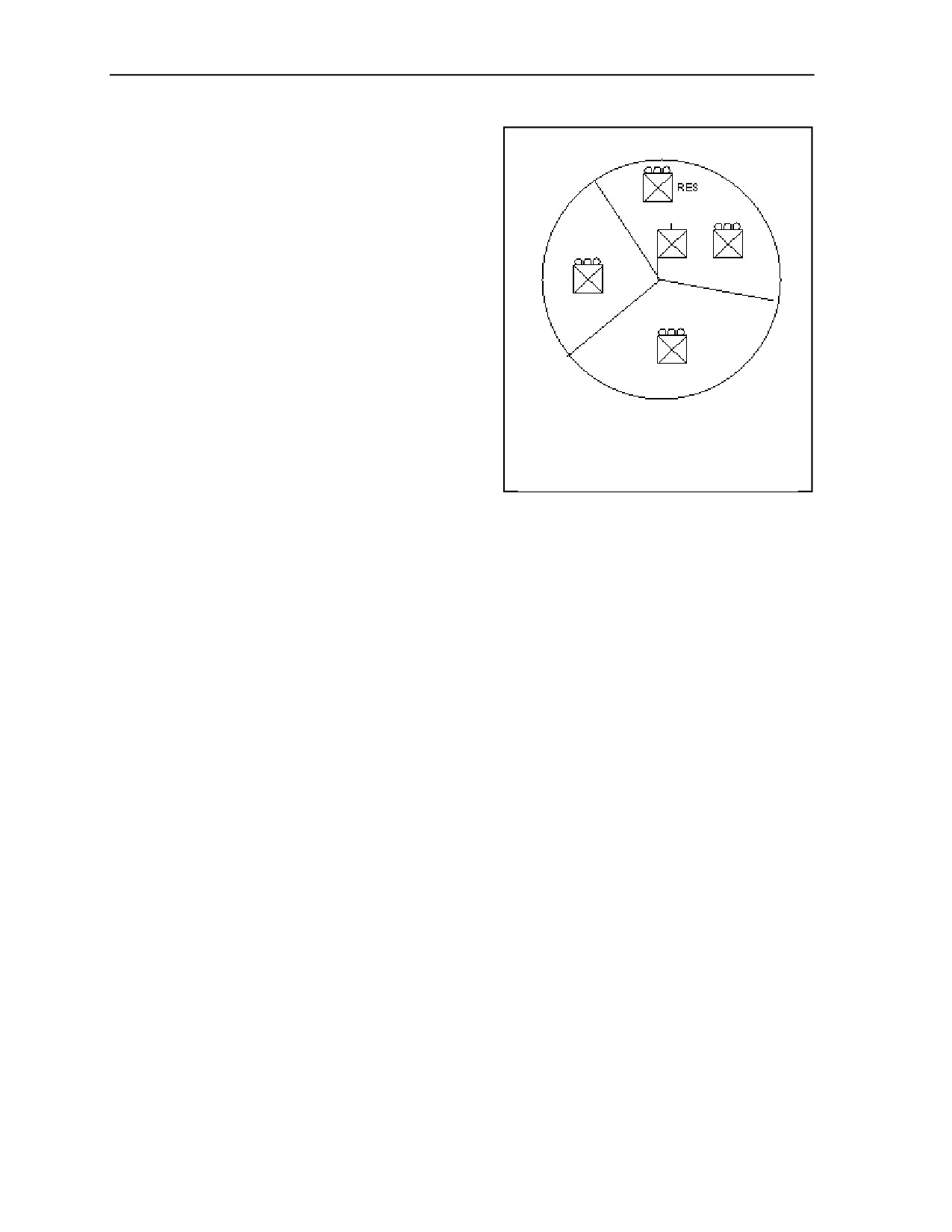
3-39. Small units handle local counterinsur-
gency operations most effectively. These small
units are usually company sized, operating
within a community or group of communities to
find, fix, and destroy the insurgents. When
these companies are habitually associated with
a particular community, they can develop the
intelligence necessary to identify and destroy
the insurgents. Harassment operations may as-
sist in locating and fixing insurgents. Opera-
tions of this type will prevent insurgents from
resting and reorganizing, will inflict casualties,
aid in gaining detailed knowledge of the AO,
and cause insurgents to expend their limited re-
sources. When an insurgent force has been lo-
cated, every attempt to encircle the force should
be made, even if piecemeal deployment is re-
Platoons are assigned AOs, with one platoon
quired. Normally, such operations require that
in reserve. Platoons teach locals how to pro-
tect their communities. Squads run training
the counterinsurgency force be much larger
programs.
than the insurgent force (see FM 90-8). Com-
pany commanders can call on support from their
next higher headquarters that also maintains a
Figure 3-2. Company AO
company reserve element. (See Figure 3-2.)
3-40. The American way of war has been to sub-
stitute firepower for manpower. As a result, US forces have frequently resorted to firepower
in the form of artillery or air any time they make contact. This creates two negatives in a
counterinsurgency. First, massive firepower causes collateral damage, thereby frequently
driving the locals into the arms of the insurgents. Second, it allows insurgents to break con-
tact after having inflicted casualties on friendly forces. A more effective method is to attack
with ground forces to gain and maintain contact, with the goal of completely destroying the
insurgent force. This tactic dictates that military forces become skilled in pursuits. The unit
that makes the initial contact with the insurgent force requires rapid augmentation to main-
tain pressure against the fleeing force, envelop it, and destroy it. These augmentation (reac-
tion) forces should be given the highest priority for use of available transport.
PURSUITS
3-41. The pursuit force is organized into two elements, the direct pressure force and the en-
circling forces (includes blocking forces). The direct pressure force pursues and maintains
constant offensive pressure on the enemy force as it withdraws. The encircling forces, em-
ploying superior mobility (preferably by using airmobile or airborne forces), conduct local en-
velopments (single or double) to cut off insurgent forces and destroy them (see FM 3-90).
AMBUSHES
3-42. Area ambush is an effective offensive counterinsurgency technique. The area ambush
consists of a primary ambush element that triggers the ambush and smaller supporting am-
bush groups that cover all likely routes of withdrawal. Once the ambush is triggered, the
smaller ambush groups open fire as the insurgent force attempts to withdraw (see FM 3-90).
DEFENSIVE OPERATIONS
3-43. Defense is oriented on the location of the community or installation rather than upon
the most favorable terrain. Since defense of the specific community or installation is para-
3-10
Counterinsurgency Operations
mount, plans for withdrawal to rearward positions are focused on retaining control of the
community or installation.
3-44. Security and surveillance measures are coordinated for 24-hour operations. The provi-
sions for perimeter defense are particularly applicable in defense of communities or installa-
tions against insurgent attack when regular counterinsurgency forces are conducting the de-
fense. When using local paramilitary forces, training must instill the necessary confidence
and ability to provide an effective defense for a community under attack until supporting
forces are delivered or until reinforcements arrive.
3-45. By prearranged SOPs—to include communications, forces, and fire support—larger
communities and the surrounding smaller ones mutually assist in the defense of one another
until other support or reinforcements arrive. In areas where offensive operations have been
conducted to eliminate insurgent control of the population, regular military forces are re-
quired to temporarily assume responsibility for security/defense of a liberated community
until adequate local defenders can be trained and equipped.
COLUMN MOVEMENTS
3-46. For planning for security of column movement, see Chapter 6.
FIRE SUPPORT
3-47. All air and ground fire support elements within range of the route of the mounted col-
umn take measures to ensure close and continuous fire support. Fire planning, to include
registration, must be as complete as time allows. Continuous communications are essential
to establish positive control in order to clear airspace and apply effects.
3-48. Individual and unit SOPs for maneuver as responsive action and counterambush reac-
tion include the following:
z
Pre-positioning of security elements along the route.
z
Possible use of airmobile hunter-killer teams.
z
Assistance available from friendly units occupying positions along or adjacent to
the route.
DISMOUNTED MOVEMENTS
3-49. Security for movement when dismounted presents several considerations that are dif-
ferent from security for mounted columns. These include the following:
z
Secrecy that may preclude air cover.
z
Restrictions on registration of artillery and the inability to plan targets when the
route cannot be determined in advance.
z
Flank security is easier for dismounted movement, particularly if ground or air
transportation can be used to position security elements.
z
Silent movement of dismounted columns, particularly at night, can allow security
elements to locate ambush forces.
z
Extended formations that allow part of the column to be in position to maneuver
against an ambush force that strikes a different part of the column.
CLEAR AND HOLD
3-50. The clear and hold operation focuses the three primary counterinsurgency programs
(CMO, combat operations, and IO), supported by intelligence and psychological operations on
a specific geographical or administrative area or portions thereof. The tactics and techniques
used to conduct clear and hold operations are discussed throughout this manual. The clear
3-11
FMI 3-07.22
and hold operation is executed in a specific high priority area experiencing overt insurgency
and has the following objectives:
z
Creation of a secure physical and psychological environment.
z
Establishing firm government control of the population and the area.
z
Gaining willing support of the population and their participation in the governmen-
tal programs for countering insurgency.
PLANNING CONSIDERATIONS
3-51. Clear and hold operations should expand outward from a secure base, such as an urban
industrial complex whose population supports the government effort and where military
forces are in firm control. No area or its population that has been subjected to the intensive
organizational efforts of a subversive insurgent organization can be won back until—
z
A commander responsible for the clear and hold operation is allocated military
forces clearly superior to the insurgent force known and suspected to be in the area
or immediately available in an adjacent area.
z
Sufficient nonmilitary resources are allocated to effectively carry out all necessary
environmental improvement and population and resources control operations
within the area.
z
The insurgent has been cleared from the area.
z
The insurgent hard-core organization and its support structure has been neutral-
ized or eliminated.
z
A governmental organization, to which the local population gives willing support,
has been established to replace that of the insurgents.
IMPLEMENTATION
3-52. The clear and hold operation is characterized by execution of four generally overlapping
stages: preparation, clearing, holding, and consolidation.
Preparatory Stage
3-53. Inventory, assessment, and planning are conducted during this stage, and are charac-
terized by the following major actions:
z
Selection and delineation of a specific area to undergo clear and hold operations
z
Designation of chain of command and formulation of a concept of operations.
z
Collection of data and information on the AO (area assessment).
z
Estimate of resource requirements, both military and nonmilitary.
z
Preparation of a clear and hold operation plan. During preparation of the plan, con-
sideration to many factors will be given, including the following:
Emergency legislation to provide a legal basis for population and resource con-
trol measures and the legal use of armed forces.
Key points that may require establishing static defense posts.
Police and paramilitary force requirements and organization.
Coordination, to include provisions for joint training and operations involving
military, police, paramilitary, intelligence, psychological, and civilian adminis-
trative agencies and forces.
z
Psychological preparation of the population of adjacent areas to explain the neces-
sity for these operations.
Deny the insurgent organization the capability to function in the area.
3-12
Counterinsurgency Operations
Establish the physical presence of government military and population and re-
sources control forces throughout the area.
Establish firm security in the area under the protective shield of government
forces.
Clearing Stage
3-54. The clearing stage can be initiated by a clear in zone or cordon and search operation to
either disperse or force reaction by major insurgent elements within the AO. Once this has
been accomplished, units employ a combination of offensive small unit operations, such as
area saturation patrolling, area ambushes, and other techniques.
3-55. Repressive actions and retribution against the general population in the area must not
be condoned. A characteristic of all counterinsurgency operations is firm and impartial
treatment whenever and wherever possible, since often it will be impossible to identify the
insurgent at the onset of operations.
3-56. Population and resource control forces introduce surveillance and restrictive control
measures as necessary.
Holding Stage
3-57. Operations during this phase are designed to—
z
Establish firm government control over the area and the population.
z
Develop a local capability for area security.
z
Establish a government political apparatus to replace the insurgent apparatus.
z
Develop a dependable network of informants.
3-58. Major actions occurring during this phase include—
z
Designating and allocating area-oriented, regular military forces to continue offen-
sive military operations in the area. Other regular military forces that participated
in clearing stage actions are now released or are assigned to carrying out other
parts of the counterinsurgency effort in the area.
z
Introduction of elements of other agencies of the government, as the area achieves
a more secure status, to begin carrying out environmental improvement programs.
Resources to support these agencies and their operations should be introduced, as
needed, at this time.
z
Thorough population screening to determine insurgent elements and to uncover lo-
cal leadership.
z
Area surveys, assisted by local leadership, to determine resources and precise and
current needs of the area and its people.
z
Motivation of population, by such actions as environmental improvements, de-
signed to psychologically condition the population and induce them to participate in
the reconstruction of the area and in the defense of their area.
z
Government support to those willing to participate in reconstruction, based upon
their needs and upon the principle of self-help, wherever possible, and willingness
to defend what they accomplish.
z
Training of local paramilitary forces, including arming and involving them in one
or more successful operations against insurgents.
z
Establishing a communications system tying the area into a larger secure commu-
nications system.
z
Progressive efforts—such as formation of youth clubs, participation of the popula-
tion in electing local leadership, participation in community-sponsored environ-
3-13
FMI 3-07.22
mental improvement and other projects—to develop national consciousness and
rapport between the population and its government.
Consolidation Stage
3-59. During this stage all activities of the clear and hold operation are expanded and accel-
erated with the objectives of—
z
Turning primary responsibility for local security and government over to the local
population as soon as they are capable of accepting such responsibility.
z
Maintaining complete security.
z
Continuing the reconstruction effort with support being provided, as necessary,
from local or government resources, or a combination thereof.
z
Continuing development of national consciousness and the local political base will-
ingly supported by and participated in by the local population.
z
The redeployment of the bulk of the area-oriented counterinsurgent force to carry
out operations in adjacent or other high priority areas occurs during this phase.
However, redeployment must not take place until local paramilitary forces are ca-
pable of providing local security. Further, a general reserve force is constituted to
respond swiftly to insurgent attacks that are beyond the capability of local or re-
gional forces. A national-level reserve force—such as airmobile, airborne, or marine
units—may be made available to provide assistance.
OTHER CONSIDERATIONS
3-60. The attainment of clear and hold operations objectives requires a considerable expendi-
ture of resources and time. Leader and their HN counterparts must be prepared for a long-
term effort. Based upon experiences in insurgency-stricken areas in which clear and hold or
similar type operations have been conducted, several years may be required to achieve com-
plete and enduring success.
SECTION IV - INFORMATION OPERATIONS
3-61. Commanders conduct information operations (IO) to mass the effects of the information
element of combat power. The Army defines information operations as the employment of the
core capabilities of electronic warfare, computer network operations, psychological opera-
tions, military deception, and operations security, in concert with specified supporting and
related capabilities, to affect or defend information and information systems, and to influ-
ence decision making (FM 3-13). The goal of IO is to gain and maintain information superior-
ity at decisive points. Information superiority is the operational advantage derived from the
ability to collect, process, and disseminate an uninterrupted flow of information while ex-
ploiting or denying an adversary’s ability to do the same (FM 3-0). It is a condition that al-
lows leaders to seize, retain, and exploit the initiative. (See JP 3-13; FM 3-13. See FM 6-0 for
a discussion of the commander’s C2 system.)
INFORMATION-ENVIRONMENT-BASED THREATS
3-62. Insurgents target commanders, leaders and other important decision makers, the com-
mander’s C2 system, and information systems (INFOSYS). Information-environment-based
threats vary in counterinsurgency operations, based on insurgents’ motivation and technical
capabilities. Commanders conduct defensive IO to counter insurgent IO. Defensive IO in-
cludes OPSEC measures.
3-63. Information fratricide is the result of employing information operations elements in a
way that causes effects in the information environment that impede the conduct of friendly
3-14
Counterinsurgency Operations
operations or adversely affect friendly forces (FM 3-13). A familiar example is friendly force
jamming degrading friendly radio communications. However, information fratricide covers
other IO aspects as well. Actions, perceptions, and information from friendly forces that cre-
ate improper impressions can adversely affect IO in sensitive situations.
INSURGENT IO-RELATED CAPABILITIES
3-64. Most threats to units engaged in offensive, defensive, and stability operations are
straightforward and familiar. During these types of operations, commanders expect an en-
emy to conduct some form of IO against them and their C2 system. They assume enemies
will use multiple means to disrupt their decision making process by denying them informa-
tion and casting doubts on information they have. During counterinsurgency operations
there are other multifaceted threats. These threats come from individuals, organizations,
and nation-states with varying capabilities. Commanders anticipate these threats, prepare
defenses, and—when appropriate—conduct IO against them.
3-65. Enemy sources at all capability levels are present during counterinsurgency. Insur-
gents use offensive IO as a weapon, using symbols and unconventional attacks against IO-
related targets. Expect insurgents to analyze friendly vulnerabilities and focus their IO
against them.
3-66. Some attacks may have immediate results while others may be designed with delayed
effects. Insurgents’ operating capabilities include—
z
Hacking to gain unauthorized access to INFOSYS.
z
Attempting to infiltrate organizations associated with counterinsurgency efforts.
They will attempt to recruit and develop individuals with legitimate access to C2
system elements. These personnel may also be self-motivated with no direct insur-
gent links.
z
Transnational insurgents and nonstate criminals using computer Internet message
and bulletin boards to pass intelligence and technical data.
z
Terrorist attacks to destroy INFOSYS.
FOREIGN INFORMATION OPERATIONS ACTIVITIES
3-67. Threats from adversaries other than insurgents include the following:
z
Espionage, data collection, network mapping or reconnaissance, and data theft.
These sophisticated capabilities may be provided by transnational or criminal
groups, drug cartels, or insurgents sponsored by another state.
z
State-sponsored offensive IO, especially computer network attacks, using state-of-
the-art tools and covert techniques conducted in coordination with military opera-
tions.
z
Attacking systems and satellites by jamming, broadcasting false signals, deceptive
transmissions, lasers, or electromagnetic pulses.
3-68. Commanders evaluate insurgents from several perspectives, using the following fac-
tors:
z
Insurgent C2 system. Does the enemy C2 system include computers, digital de-
vices, and networks? Or, do the insurgents use less technical means to exercise C2,
and what are they?
z
Sources of information. The sophistication and technical complexity of the in-
surgents’ C2 system determine the means required to exploit it. What is the most
effective way to collect information on the insurgents’ C2 system?
z
Insurgent goals and interests. What are the insurgents’ short- and long-range
goals? How can friendly forces affect both?
3-15
FMI 3-07.22
z
Decision makers, influential groups, and individuals. These people may be
leaders within the insurgents’ political movement, counterstate, or armed forces.
They may be outside interest groups not officially associated with the insurgency.
They may be located within or outside the AO. Decision makers may be political
leaders, commanders or trusted subordinates. Determine what individuals or
groups decide or influence insurgents or other group actions.
z
Insurgent IO resources and capabilities. An accurate understanding of current
insurgent capabilities is essential to success in a dynamic operational environment.
Determine what resources insurgents can use to protect their C2 system or inhibit
friendly mission success. Expect these to be dynamic rather than static over time.
Insurgents may gain, lose, or reconstitute IO resources and capabilities, based on
combat actions or outside support.
z
Insurgent information-based vulnerabilities. How and where are insurgents
vulnerable to friendly IO? How can we exploit those vulnerabilities? What coun-
termeasures are insurgents using to prevent exploitation?
z
Friendly vulnerabilities to insurgent IO efforts. How and where are we vul-
nerable? What can we do to prevent insurgents from exploiting those vulnerabili-
ties?
INFORMATION OPERATIONS IN SUPPORT OF
COUNTERINSURGENCY
3-69. Information operations consist of core and supporting elements as well as related ac-
tivities. (See Figure 3-3.)
3-70. Consider how in a counterinsurgency environment the application of these elements
and activities most effectively supports the counterinsurgency effort. IO are enabling opera-
tions that create opportunities for decisive operations. Commanders use offensive and defen-
sive IO simultaneously to counter insurgent actions and seize and maintain the initiative.
Core Elements
Supporting Elements
Related Activities
• Electronic warfare
• Physical destruction
• CMO
• Computer network
• Information assurance
• PA
operations
• Physical security
• Psychological
• Counterintelligence
operations
• Counter deception
• Operations security
• Counterpropaganda
• Military deception
Figure 3-3. Information Operations Core and Supporting Elements and Related Activities
3-71. The elements of IO are independent activities, not organizations. These activities are
most effective when employed together and synchronized. All elements may not be required
for each operation. Commanders decide which IO elements are appropriate to accomplish
specific counterinsurgency objectives. For example, computer network operations may be
used against a transnational and sophisticated, networked insurgency, such as al Qaeda.
These computer network operations may be synchronized with military deception to influ-
ence franchise organization decision makers to act or not act. Electronic warfare may target
cell phone chips and associated frequencies, disrupt electronic monetary transfers, and jam
frequencies. Create an information advantage by using the following effects to attack insur-
gents:
3-16
Counterinsurgency Operations
z
Destroy. Destroy is to damage a combat system so badly that it cannot perform any
function or be restored to a usable condition without being entirely rebuilt (FM 3-
90). In IO, it is most effective when timed to occur just before insurgents need to
execute a C2. Physical attack is the joint term.
z
Disrupt. Disrupt, in information operations, means breaking or interrupting the
flow of information between selected C2 nodes (FM 3-13).
z
Degrade. Degrade, in information operations, means using nonlethal or temporary
means to reduce the effectiveness or efficiency of adversary command and control
systems, and information collection efforts or means (FM 3-13).
z
Deny. Deny, in information operations, entails withholding information about
Army force capabilities and intentions that insurgents need for effective and timely
decision -making (FM 3-13). Effective denial leaves opponents vulnerable to offen-
sive capabilities. OPSEC is the primary nonlethal means of denial.
z
Deceive. Deceive is to cause a person to believe what is not true (FM 3-13). Mili-
tary deception seeks to mislead insurgent decision makers by manipulating their
understanding of reality. Successful deception causes them to believe what is not
true.
z
Exploit. Exploit, in information operations, is to gain access to adversary command
and control systems to collect information or to plant false or misleading informa-
tion (FM 3-13).
z
Influence. Influence is to cause adversaries or others to behave in a manner favor-
able to Army forces (FM 3-13). It results from applying perception management to
affect the target’s emotions, motives, and reasoning. Perception management also
seeks to influence the target’s perceptions, plans, actions, and will to oppose
friendly forces.
z
Protection. Protection is all actions taken to guard against espionage or capture of
sensitive equipment and information (FM 3-13). It denies the insurgents informa-
tion about friendly capabilities and intentions by controlling indicators.
z
Detection. Detection is to discover or discern the existence, presence, or fact of an
intrusion into information systems (FM 3-13). Detection is the identification of in-
surgent’s attempts to gain access to friendly information and INFOSYS.
z
Restoration. Restoration is to bring information systems back to their original
state (FM 3-13).
z
Response. Response, in information operations, is to react quickly to an adver-
sary’s information operations attack or intrusion (FM 3-13). Timely identification of
insurgents and their intent and capabilities is the cornerstone of effective response
to insurgent offensive IO.
3-72. Commanders use IO to shape the environment during counterinsurgency operations.
Commanders prepare databases for each IO element using contingency plans to focus their
efforts. These databases contain information on possible insurgents and other significant
participants. At the strategic, operational, and tactical levels, databases focus on one or more
of the following target sets:
z
Political leadership.
z
Information capabilities and vulnerabilities, including military and civilian com-
munication networks, and domestic and foreign media.
z
Military leadership, operations, and infrastructure, and their vulnerabilities at the
strategic, operational, and tactical levels.
z
Economic factors that affect an insurgent’s ability to mount and sustain military
operations, and those that affect the morale of the population and its leadership.
This set includes the infrastructure that supports economic activity.
3-17
FMI 3-07.22
z
Social effects of ethnic (clan and tribal), racial, and historical animosities/alliances.
APPLICATION OF IO ELEMENTS IN COUNTERINSURGENCY
SUPPORT
3-73. The overall objective during a counterinsurgency is to win the battle of ideas and the
politico-military struggle for power. IO can help the HN explain how the HN is addressing
the concerns of the people. Well-synchronized offensive IO can cripple not only insurgent
armed forces but also insurgent political decision making capabilities. IO is most effective
when coordinated with conventional and special operations, and fully integrated into plan-
ning and targeting.
3-74. Counterpropaganda reduces the ability of insurgent propaganda to influence the HN
populace. Counterpropaganda includes preventive actions, counteractions, and rumor con-
trol. It attacks insurgent propaganda. Propaganda awareness programs inform friendly
populations about the nature of hostile propaganda.
3-75. Counteractions are measures that PSYOP units take to reduce or neutralize the effects
of hostile propaganda. Sometimes the most effective countermeasure is not to respond or at-
tempt to counter the propaganda. Direct response to propaganda can lend credibility to it
and may be counterproductive. Rumors are a means of propaganda based on widely dissemi-
nated talk or opinion. They have no discernable source and no known authority. Rumor con-
trol seeks to counter rumors that are unfavorable to HN interests.
3-76. Failure to counter insurgent propaganda can produce significant negative effects.
These range from simple confusion to disrupting ongoing operations. Common effects of hos-
tile propaganda, misinformation, and disinformation, include—
z
Prompting neutral parties to resist or not support HN military operations.
z
Increasing insurgent will to resist by fanning hatreds, biases, and predispositions.
z
Inciting riots.
z
Leading multinational partners to question their roles.
z
Causing refugees to block lines of communication.
z
Fostering distrust for the police and HN forces. Are the police and HN forces cor-
rupt or puppets? Do they represent the HN society or some other nation?
z
Causing the HN populace not to cooperate with friendly forces.
z
Causing essential communicators to deny cooperation or resist.
z
Causing diversion of military assets to address problems that, while seemingly in-
significant, require significant resources.
z
Leading friendly governments to questions their own policies and support for coun-
terinsurgency operations.
SECTION V - THE MEDIA
3-77. The media—the printed medium, radio, television, and the Internet—have a vital role
in societies directly and indirectly involved in counterinsurgency. The news media and other
information networks’ increasing availability to societies’ leadership, bureaucracies, and
populace means members of this news and communication medium have a significant impact
on political direction, achieving national security objectives, policy formation, and national
will. Media scrutiny of military operations, journalists’ desire for immediate footage and on-
the-spot coverage of confrontational events, and the increasing contact with units and Sol-
diers (including embedded reporters) require that commanders and public affairs officers
provide guidance to leaders and Soldiers on media relations. The media affect and influence
each potential target audience and personnel external and internal to the AO. Speaking with
3-18
Counterinsurgency Operations
the media in a forward-deployed area is an opportunity to explain what our organizations
and efforts have accomplished, but be prepared to field questions regarding perceived nega-
tive impacts also. Figure 3-4 contains general public affairs guidelines.
3-78. In addition to these general guidelines, leaders should always consult the public affairs
office guidance related to the current operation. (See Appendix C.)
Points to Remember When Doing Media
What to Do When the Media Visits Your AO:
Interviews
•
Be relaxed, confident, and professional.
• Do not threaten the media representative.
•
Be concise: think about what you will say
• Politely move the media to an area out of
before you speak
harm’s way where they do not interfere
with the performance of the mission.
•
Avoid using colorful or profane language.
• Notify the senior person present so he/she
•
Stay in your lane. Confine your
can determine what the media wants.
discussions to areas in which you have
firsthand knowledge or where you have
• Cooperate with the reporter within the
personal experience
limits of OPSEC and safety.
•
Deal in facts--avoid speculation and
• If there are OPSEC or safety concerns
hypothetical questions
that make the interviewing or filming
impossible at this time, let the reporter
•
Label your opinions as opinions. Don’t get
know up front.
into political discussions.
•
At no time should a media
•
Stay on the record. If you say it, they’ll
representative’s equipment be
print it.
confiscated. If you feel a security violation
•
Don’t discuss classified information.
has occurred, notify your chain of
•
Don’t argue with the reporter. Be firm, and
command.
be polite.
• If you have problems with the media, don’t
•
Speak plainly. Don’t use military slang or
get emotional. Report the incident through
jargon.
the chain of command to the area public
affairs officer.
•
Protect the record. Correct the “facts" if
they are wrong.
Figure 3-4. Example of PAO Guidance Card
3-19
Chapter 4
Intelligence
GENERAL
4-1. The successful conduct of counterinsurgency operations relies on the willing support
and cooperation of the populations directly involved. Greater priority and awareness is
needed to understand the motivations of the parties involved in the conflict and the popula-
tion as a whole. The understanding of the background and development of the conflict into
which US forces are intervening is of particular significance. This requires a detailed under-
standing of the cultural environment and the human terrain in which the US forces will be
operating and thereby places a heavy reliance on the use of HUMINT.
4-2. The commander requires intelligence about the enemy and the AO prior to engaging in
operations. Intelligence assists commanders in visualizing their battlespace, knowing the
enemy, organizing their forces, and controlling operations to achieve the desired tactical ob-
jectives or end state. Intelligence supports force protection by alerting the commander to
emerging threats and assisting in security operations. Intelligence to support counterinsur-
gency operations focuses on three areas:
z
Factors motivating the insurgency.
z
Appeal the insurgency holds for insurgents.
z
Organization, leadership, and key functionaries of the insurgency.
4-3.
“Open-source intelligence” refers to the practice of drawing information from the news
media and processing it into intelligence. It is an increasingly common practice among world
intelligence organizations. The six categories of media and news sources providing open-
source intelligence are—
z
Newspapers.
z
Periodicals.
z
Military and other professional journals.
z
Internet web logs (commonly called “blogs.”
z
Visual media (primarily television).
z
Radio.
4-4. Units engaged in counterinsurgency operations may face multiple threats. The com-
mander must understand how enemies organize, equip, train, employ, and control their
forces. Intelligence provides an understanding of the enemy, which assists in planning, pre-
paring, and executing operations. Commanders must also understand their operational envi-
ronment and its effects on both their own and enemy operations. The commander receives
mission-oriented intelligence on enemy forces and the AO from the G-2/S-2. The G-2/S-2 de-
pends upon the intelligence, surveillance, and reconnaissance (ISR) effort to collect and pro-
vide information on the enemy and AO.
4-5. One of the most significant contributions that intelligence can accomplish is to accu-
rately predict future enemy events. Although a difficult task, predictive intelligence enables
the commander and staff to anticipate key enemy events or actions and develop correspond-
4-1
FMI 3-07.22
ing plans or counteractions. The most important purpose of intelligence is to enable decision
making. Commanders receive the intelligence, understand it (because it is tailored to the
commander’s requirements), and act on it. Through this doctrinal concept, intelligence drives
operations.
4-6. The AO during counterinsurgency operations includes three primary components:
physical terrain and weather, society (socio-cultural, often referred to as the human terrain),
and infrastructure. These components provide a structure for intelligence personnel to focus
and organize to provide support to counterinsurgency operations. These entities are interde-
pendent, not separate. These components enable the commanders to gain an in-depth under-
standing of their AO during counterinsurgency operations and provide a focus for the intelli-
gence analyst.
INTELLIGENCE PREPARATION OF THE BATTLEFIELD PLANNING
CONSIDERATIONS
4-7. IPB includes information about terrain and weather and civil considerations as well as
the enemy. (The six factors of METT-TC—mission, enemy, terrain and weather, troops and
support available, time available, and civil considerations—make up the major subject cate-
gories into which relevant information is grouped for military operations. (See FM 6-0.) Rele-
vant information is all information of importance to the commander and staff in the exercise
of command and control (FM 3-0). In counterinsurgency operations, civil considerations are
prominent in IPB analysis.
TERRAIN AND WEATHER
4-8. Expect terrain in counterinsurgency operations to be complex. Unit AOs may consist of
various types of terrain, ranging from jungles, mountains, and deserts to rural or urbanized
areas. In conventional operations, the primary factor is the natural landscape. In counterin-
surgency operations, man-made factors may be the primary terrain factors that a unit must
consider. Some of these factors that ought to be considered are the density of construction
and population within the AO, the street patterns within urban areas, and compartmentali-
zation of areas within the AO (such as areas separated by waterways or highways) and func-
tional zones for example, the functions different areas serve within the AO, such as residen-
tial, commercial, and government areas).
4-9. In addition to weather effects on friendly operations, counterinsurgency operations re-
quire the consideration of how weather effects the local population. For example, an ongoing
drought within the unit’s AO may mean that more outside aid is required. An insurgency
movement may take advantage of the population’s potential dissatisfaction to recruit sup-
port and may even be able to make food or other desirable aid available, thus making the in-
surgents look like the only competent/legitimate authorities in the region. If the government
does not provide necessary aid, the population could view those they believe to be in charge
in an increasingly hostile manner for failing to help prevent a disaster.
CIVIL CONSIDERATIONS
4-10. Civil considerations comprise the manmade infrastructure, civilian institutions, and at-
titudes and activities of the civilian leaders, populations, and organizations within an area of
operations influence the conduct of military operations (FM 6-0). They include the popula-
tion of an area and information about it. Factors of interest include the gender and mix of
the populace; the cultural, religious, and socio-economic beliefs and thinking; and the beliefs,
attitudes, and actions of groups and individuals.
4-2
Intelligence
Population and Culture
4-11. The center of gravity in counterinsurgency operations is the population. Therefore, un-
derstanding the local society and gaining its support is critical to success in. For US forces to
operate effectively among a local population and gain and maintain their support, it is im-
portant to develop a thorough understanding of the society and its culture, to include its his-
tory, tribal/family/social structure, values, religions, customs, and needs.
4-12. The history of a people can often help explain why the population behaves the way it
does. The roots of an insurgency may become clear through that knowledge. A given AO may
have several different regions, each with different sets of customs. US forces can anticipate
local reaction to friendly courses of action as well as avoid losing indigenous support for the
mission through understanding and supporting those local customs. That support, however,
must be consistent with US laws and the law of war.
4-13. Understanding and working within the social fabric of a local area is initially the most
influential factor in the conduct of counterinsurgency operations. Unfortunately, this is often
the factor most neglected by US forces. The density of civilians and the constant interaction
required between them and US forces greatly increases the importance of social considera-
tions. The fastest way to damage the credibility of US forces and the legitimacy of our in-
volvement with the local national government is to ignore or violate the social mores or pre-
cepts of a particular population.
4-14. The interaction of different cultures demands greater recognition during counterinsur-
gency operations than in other environments. This greater need for understanding comes
from the increased need for interaction with the civilian populace. Every culture has a set of
norms and values, and these could involve such diverse areas as protocol and social skills,
attitudes toward women, manners, food, sleep patterns, casual and close relationships, and
cleanliness. Understanding these differences is only the start of preparation for counterin-
surgency operations.
4-15. Religious beliefs and practices are among the most important, yet least understood, as-
pects of culture. The role religion plays in both culture and individual value systems varies
greatly from place to place. While it is never possible to disentangle religion completely from
politics, mores, and the other aspects of culture, religion plays an especially powerful and
dominant role in some societies. Many conflicts have a strong religious dimension, not only
in the origin of the dispute but also in the way the fight is conducted. Some religiously moti-
vated antagonists will operate with a significantly different view of what constitutes just
conduct in war than the western consensus that created the law of land warfare and the Ge-
neva Conventions.
4-16. When assessing events, intelligence professionals consider the norms of the local cul-
ture or society. Failure to recognize, respect, understand, and incorporate an understanding
of the cultural and religious aspects of the society in which US forces are interacting could
rapidly lead to an erosion of the legitimacy of the mission. For example, while bribery is not
an accepted norm in US society, it may be a totally acceptable practice in another society. If
US intelligence professionals assess an incident of this nature using our own societal norms
and values as a reference, it is probable the significance of the event will be misinterpreted.
Leaders and Institutions
4-17. US military planners should conduct interagency coordination to identify key govern-
ment officials early in the operation. US policy officials determine which key HN leaders are
supportive of the US military and which are not. These key personnel can provide valuable
information needed for successful completion of the operations, to include local infrastruc-
ture, a common picture of cultural norms, suspected enemy strengths, and probable means of
4-3
FMI 3-07.22
support and locations for enemy forces. In counterinsurgency missions, US forces are often
supporting a state. As such it is critical to understand the potential audience.
4-18. Many governments are rife with nepotism and trading favors, are indifferent to local
conditions, and support no security presence at the village level. The power of officials may
be based on family and personal connections, clan loyalty, and age, and only after that on
education, training, and competence. Corruption may be pervasive and institutionalized as a
practical way to manage excess demand for local services.
4-19. A local government's breakdown from a previous level of effectiveness will quickly ex-
acerbate problems of public health and mobility. Attempts to get the local-level bureaucracy
to function along US lines may produce further breakdown, passive indifference, or resent-
ment. Any unintentional or intentional threat to the privileges of ranking local officials or
tribal leaders or to members of their families will be stubbornly resisted. Avoiding such
threats and assessing the importance of particular officials requires knowledge of family ties.
4-20. US military planners must realize that the local populace will behave in their perceived
self-interest. They will be keenly aware of five sets of interests at work: those of the US
forces, the insurgent/hostile elements, the local opportunists, the legitimate government, and
the general population. All five elements assess these interests constantly in order to ascer-
tain their own stakes, risks, and advantages.
Refugees and Ethnic Groups
4-21. Another significant cultural challenge is the presence of refugees within a unit’s AO.
Rural immigrants displaced by conflict, combined with city residents, can create a significant
problem. Noncombatants and refugees without hostile intent can disrupt local missions. Ad-
ditionally, there may be insurgent troops, criminal gangs, vigilantes, paramilitary factions,
and factions within those factions hiding in the waves of the displaced.
4-22. The enemy knows it is nearly impossible for US forces to accurately identify friend
from foe from disinterested. Local combat situations can change with bewildering speed, as
the supposed innocent becomes an active aggressor within close quarters and an indefensible
position. In Chechnya, Chechen rebels and Hezbollah terrorists effectively used the cover of
refugees to attack occupying forces. The Chechens counted on the ferocious nature of the
Russian counterattack causing heavy civilian casualties to gain support from the indigenous
population for the Chechen separatist cause.
4-23. One goal of insurgent forces will be to place stress on the US and local national gov-
ernment soldiers in order to break down discipline and operational integrity. The constant
pressure of differentiating friend from foe taxed and sometimes undermined ROE from Bel-
fast to Lebanon, and in some cases, entire missions.
Social Structure and Customs
4-24. Defining the structure of the social hierarchy is often key to understanding the popula-
tion. Identifying those local personnel in positions of authority is important. These local offi-
cials, tribal leaders or village elders are often the critical nodes of the society and influence
the actions of the population at large. In many societies nominal titles do not equal power--
influence does. Many “leaders” are figureheads, and the true authority lies elsewhere.
4-25. Most areas around the world are not governed by the rule of law, but instead rely upon
tradition. Often tribal membership, ethnic loyalty, and religious affiliation provide societal
cohesion and the protocol of proper behavior and ethics in dealing with outsiders, such as the
US and multinational partners. It is important to understand the complicated inner work-
ings of a society where potential internal conflicts predominate. This is difficult and requires
a thorough examination of a society’s culture and history.
4-4
Intelligence
4-26. Identifying and understanding trends and patterns of activity provide important in-
formation for intelligence analysts and mission planners. Every local area has discrete and
discernible patterns of daily activity. The time of heaviest activity along a line of communi-
cation is one case in point. Trade and business transactions, market sales, religious prac-
tices, governmental functions, and criminal activity are other examples of daily behavior
than can be analyzed for consistencies. Disruptions or irregularities in these patterns serve
as a warning that something is amiss in the area.
4-27. It is important to remember that while certain general patterns do exist, most regional
areas are normally composed of a multitude of different peoples, each with its own standards
of conduct. Treating the local population as a homogenous entity can lead to false assump-
tions, cultural misunderstandings, and a poor operational picture. Individuals act independ-
ently and in their own best interest, and this will not always coincide with friendly courses of
action. Do not ignore the presence or actions of the different population components within
an AO when developing assessments.
Infrastructure
4-28. Understanding the infrastructure and the interrelationships of various elements within
a unit’s AO and the relationship with neighboring AOs is critical in counterinsurgency op-
erations. Infrastructure has physical, social, economic, and political elements.
Physical
4-29. Intelligence staffs identify critical physical infrastructure components (transportation
and communications systems, water treatment and waste disposal facilities) and the effects
they have on the local, regional, and national populations. Insurgents will use and exploit ex-
isting infrastructure. A common method insurgents use to display the weakness of the cur-
rent local national government is to disrupt or destroy critical components of infrastructure,
such as power stations and waterworks, that affect large portions of the local population.
They may also create additional infrastructure where gaps in government-provided services
exist in order gain the good will of the local population. If successful, this demonstrates the
government’s inability to protect critical infrastructure components and their inability to
provide basic services such as security for the population.
Social, Economic, and Political
4-30. The social infrastructure includes communication, religious, and education centers; and
the roles of tribes, families, casts, and clans. Economic infrastructure includes banks, stock
markets, and the monetary control system. Political infrastructure includes political parties,
party headquarters and offices, government offices, and state institutions.
INTELLIGENCE PREPARATION OF THE BATTLEFIELD
ASSESSMENT
4-31. During the military decision making process, intelligence personnel provide command-
ers with a battlefield assessment based upon a systematic approach known as IPB. IPB con-
sists of four steps:
z
Define the battlefield environment.
z
Describe the battlefield’s effects.
z
Evaluate the threat.
z
Determine threat courses of action.
4-5
FMI 3-07.22
DEFINE THE BATTLEFIELD ENVIRONMENT
4-32. In defining a counterinsurgency environment, intelligence professionals do the follow-
ing:
z
Consider the nature and strategy of the insurgency.
Are there internal factors, external factor, or both that form a basis for the in-
surgency?
Is there an identifiable pattern of insurgent activities?
Does the insurgent organization function primarily within the established po-
litical system or in open competition with it?
z
Determine international and national support to the insurgents. Include sources of
moral, physical, and financial support.
z
Consider the neighboring countries, boundaries and frontiers, and coastal water-
ways.
z
Consider third-country support for the insurgency.
z
Analyze the HN population, government, military, demographics, and threat.
Who are the vulnerable elements in the population?
Are they subject to insurgent exploitation?
z
Evaluate HN political structure, economy, foreign policy and relations, and policies
on military use.
z
Consider if US presence, or potential presence, by itself could be a catalyst for in-
surgent activity.
DESCRIBE THE BATTLEFIELD’S EFFECTS (TERRAIN AND HUMAN)
4-33. In defining the battlefield’s effects in a counterinsurgency environment, intelligence
professionals do the following:
z
Determine points of entry, infiltration and exfiltration routes, C2 structures for op-
erations, and agricultural areas.
z
Evaluate weather’s effects on the mobility of insurgents and their logistic efforts,
for example, the availability of food supply due to weather extremes.
z
Consider migration and settlement patterns to identify which areas are pro-
government or proinsurgent. Identify the locations of groups that create territorial
boundaries the insurgents may try to make autonomous to gain political advantage.
z
Determine how political and religious affiliation and practices influence the peo-
ple’s attitudes towards both enemy and friendly operations.
z
Examine efforts to create or increase unrest and dissension among the population.
Are the insurgents conducting IO against existing or proposed HN policies and pro-
grams?
z
Evaluate how economics and money affect the insurgents’ ability to conduct offen-
sive operations. They will influence the populace’s active support for or against the
insurgency.
EVALUATE THE THREAT
4-34. In evaluating the threat in a counterinsurgency environment, intelligence professionals
do the following:
z
Identify which insurgent groups are present, thought to be present, or have access
to your AO.
Is the insurgency linked to a racial, religious, ethnic, or regional base?
4-6
Intelligence
Does the insurgent organization function through predominately legal means or
clandestine operations?
What and who constitute the organizational elements of the movement?
z
Identify leaders, trainers, recruiters, staff members, and logistics personnel.
Is the leadership clearly defined or do competing actions exist?
Is the insurgency affiliated with any political, labor, student, or social organiza-
tion?
What is the philosophy of the leadership?
z
Develop doctrinal templates based on observed operating procedures.
z
Assess and analyze the number of functional specialties within the insurgency. For
example, the number of trainers for a specific weapon might indicate the type of
tactics, level of readiness, and the number of personnel trained.
z
Determine the types of weapons that the insurgents have at their disposal. Sophis-
ticated weaponry may be an indicator of external support as well as the insurgents’
capability to attack important and possibly well-defended targets.
z
Consider the insurgent organization.
Does it have a high degree of command and control?
What is the level of planning and training within the organization?
z
Analyze movement patterns. Movements may coincide with operational or logistic
activities.
DETERMINE ENEMY COURSES OF ACTION
4-35. Enemy courses of action might include the following:
z
Attacks and raids on police stations, security forces, military installations, or other
HN government and security-related facilities.
z
Attacks on public utility installations (power, water, telephone) or other forms of
economic sabotage (pipelines, transmission towers, ports, marketplaces).
z
Kidnapping, murder, or intimidation of public officials (and their families or family
members) supporting US or HN forces.
z
Propaganda directed against the populace or local economic leaders (such as shop-
keepers and business owners).
z
Ambushes of HN or friendly convoys; kidnapping of drivers and insurgent de-
mands.
z
Attacks on the population.
4-36. Evaluate the most vulnerable locations and facilities that can quickly affect the great-
est number of the populace—such as power plants; transmission lines; road, rail and water
networks; and local open-air markets—to determine the most likely locations for potential
insurgent attacks, sabotage, raids, and roadblocks—most likely insurgent course of action.
Insurgent targets and attacks will not be based on a US-style of thinking and application of
ethics.
4-37. Use trend and pattern analysis to template, predict, and prioritize insurgent activity to
include--
z
Movement around potential objectives, such as infiltration or exfiltration routes.
z
Assembly points, rally points, and staging areas.
z
Surveillance positions.
z
Centers of proinsurgent populations. Include an evaluation of individual villages
and large political divisions, such as states and provinces.
4-7
FMI 3-07.22
z
Areas of antigovernment influence and residences of insurgent leadership or key
sympathizers.
z
Location of known and suspected base camps.
z
Location of known and suspected training camps.
z
Logistic routes and transshipment hubs.
z
Cache sites, water sources, agricultural areas, and fuel storage and production ar-
eas.
z
Locations of communications equipment. Include commercial establishments and
government installations where such equipment may be purchased or stolen.
z
Potential ambush sites.
THE THREAT
4-38. Insurgents require the support of the local population. That support can be either ac-
tive or passive. In order to succeed, they must increase the support of the local population in
their favor. To defeat the insurgency, US forces assist the local authorities in separating the
insurgents from the population and ultimately in gaining the population’s active support. If
a substantial portion of the population does not actively oppose the insurgency, the insur-
gents may determine to attack soft targets and purposely inflict civilian casualties to both
intimidate the local populace and undermine the legitimacy of HN local authorities.
4-39. Rarely are only two sides involved in modern conflicts. More often, one ethnonational
group opposes other groups with conflicting interests. This poses a significantly more com-
plex set of enemy or potential adversaries—entities that leaders must understand. Insur-
gents try to create conditions to defeat US and HN forces and to slow the support for friendly
forces. Increasingly, insurgent groups have no regard for the law of war. They have used
human shields, targeted innocent civilians, and occupied religious and health facilities as
sanctuaries. These actions and techniques offset US advantages and make it more difficult to
locate and defeat the enemy. US reaction to these tactics can also have tremendous propa-
ganda appeal.
4-40. Insurgents develop organizational structures that are functional for their particular
operational environment. Because insurgents usually operate in a hostile environment, secu-
rity is a primary consideration. Therefore, insurgent organizations may be organized both
conventionally and unconventionally.
4-41. An unconventional or cellular structure protects members of the organization and al-
lows for better security. Individual elements or cells can operate relatively isolated from
other elements or cells, thereby creating increased security. In the event of defection or cap-
ture, no one member can identify more than a few others. Some elements within the organi-
zation may have multifunction cells that combine several skills into one operational entity,
while others create cells of specialists that come together for an operation on an ad hoc basis.
4-42. Due to its unconventional nature, the insurgent threat is difficult to determine and
identify. When determining and identifying the insurgent threat, consider the following:
z
Threat staging area. A threat staging area is a geographic area from which in-
surgent organizations and elements coordinate operations, logistics, finance, and
recruiting, as well as stage and plan missions. These areas can be thought of as ei-
ther the operational or strategic areas in which the group conducts the majority of
its “behind-the-scenes” activity, as well as defining the area in which the group has
the largest sympathetic base to support its goals.
z
Threat area of operations. Threat AOs are those areas in which an insurgent or-
ganization conducts operations against its enemy.
4-8
Intelligence
z
Threat objectives. These are long- and short-term insurgent goals that may in-
clude but are not limited to
Attracting publicity to the group’s cause.
Demonstrating the group’s power.
Demonstrating government and US weakness.
Exacting revenge.
Obtaining logistic support.
Causing a government or US forces to overreact.
4-43. See Annex D for order of battle factors.
THREAT ANALYSIS
4-44. In counterinsurgency operations, threat analysis is a continual process of compiling
and examining all available information concerning potential insurgent activities that target
elements of the population, local security forces, and facilities or bases. A comprehensive
threat analysis reviews the factors of an insurgent’s existence, capability, intentions, history,
and targeting, as well as the security environment within which friendly forces operate.
Threat analysis is an essential step in identifying the probability of insurgent attacks and
results in a threat assessment.
4-45. When conducting an insurgency, the threat will normally conform to the five low-
intensity imperatives (political dominance, unity of effort, adaptability, legitimacy, and per-
severance) (see FM 7-98). Under the conditions of insurgency, the analyst places more em-
phasis on
z
Developing population status overlays showing potential hostile areas.
z
Developing an understanding of how each insurgent organization operates and is
organized.
z
Determining primary operating or staging areas.
z
Determining mobility corridors and escape routes.
z
Determining the most likely targets.
z
Determining where the threat’s logistic facilities are located and how their support
organizations operate.
z
Determining the level of popular support (active and passive).
z
Determining the recruiting techniques and methods of each insurgent organization.
z
Locating neutrals and those actively opposing these organizations.
z
Using pattern analysis and other tools to establish links between each insurgent
organization and other organizations.
z
Determining the underlying social, political, ideological, and economic issues that
caused the insurgency and that are continuing to cause the members of the organi-
zation as well as elements of the population to support it.
4-46. As discussed earlier, evaluation of the threat in counterinsurgency operations begins
early and covers a wide range of factors in building an accurate threat organizational dia-
gram. In addition to the factors discussed, consider the following:
z
Group collection and intelligence capabilities.
z
Does the actual desired end state differ from that which is publicly advocated? If so,
how does that impact operations?
z
Do the insurgents desire a different social or political organization than that which
exists under current conditions; if so, what are the differences? How will they con-
duct operations to achieve that goal?
4-9
FMI 3-07.22
4-47. Motivation (ideological, religious, monetary). Depending on the echelon, there may be
an opportunity to use PSYOP against the group or its support network.
INSURGENT MEANS AND METHODS OF COMMAND AND CONTROL
4-48. While identifying the specific structure, leadership, and membership of insurgent or-
ganizations is important, it may also be extremely difficult to obtain this information. In the
absence of specific information, identifying generalities about the insurgent groups will be of
value to the intelligence analyst.
Leader Capabilities
4-49. An insurgent organization capable of exercising C2 over long distances has greater
flexibility and reach than an organization that can only operate within the limitations of the
leader’s interpersonal capabilities.
International and National Support
4-50. Insurgents may receive support from the following sources:
z
Moral. A significant leadership or cultural figure may make pronouncements in
support of an organization, activity, or action. This may have the effect of influenc-
ing international policy or increasing the success of recruitment efforts.
z
Physical. Physical support includes safe passage, safe houses, documentation,
weapons, and training at sites inside the country.
z
Financial. Charities, banks, informal transfer of currency by traveler or courier.
z
Transportation.
z
Religious, political, and ethnic affiliations. Commonalities and differences are
significant in terms of estimating potential support or opposition an insurgent or-
ganization may receive in a given area. However, in some cultures, such as the
Muslim culture, the philosophy that “the enemy of my enemy is my friend” may
cause strange and unprecedented relationships to form.
RECRUITING METHODS, LOCATIONS, AND TARGET AUDIENCE
4-51. An insurgent organization that recruits from an idealistic and naïve upper and middle
class will differ significantly from one that recruits from prisons. Some insurgent organiza-
tions recruit university students, either to join the movement as operatives and support per-
sonnel, or to prepare for future leadership roles. Insurgents recruit lower-level personnel
with little or no education because they are more susceptible to insurgent propaganda, al-
though many insurgents come from an upper-middle class background. The impact of target
audiences bears directly upon the willingness of the insurgent recruit to fully commit to the
cause and to sacrifice self if deemed necessary.
CIVIL CONSIDERATIONS
4-52. A thorough analysis of the population within the AO is critical to the execution of suc-
cessful counterinsurgency operations. Consider the impact the local populace may have on
the threat and friendly forces, as well as their location in the AO and area of interest. When
analyzing the population, the following are areas to consider:
z
Identify active and passive supporters and why they are supporting.
z
Determine what segment of the general population supports or assists the threat
and how.
z
Determine the extent to which the population will support or impede friendly op-
erations.
4-10
Intelligence
z
Identify and depict those segments of the population that are friendly or unfriendly
toward US/multinational forces.
z
Identify and depict those segments of the population that are pro-government or
anti-government.
z
Identify terrorist and/or criminal elements and their relationship to the insurgents
and the general population.
z
Determine the availability of weapons to the general population.
4-53. Insurgents move among the local population the way conventional forces move over ter-
rain. The military aspects of terrain (OAKOC; see FM 6-0) may be used to analyze how in-
surgents might use this “human terrain” to accomplish their objectives.
Observation and Fields of Fire
4-54. Individuals or groups in the population can be co-opted by one side or another to per-
form a surveillance or reconnaissance function, performing as moving outposts to gather in-
formation.
4-55. Local residents have intimate knowledge of the local area. Their observations can pro-
vide information and insights about what might otherwise remain a mystery. For instance,
residents often know about shortcuts through town. They might also be able to observe and
report on a demonstration or meeting that occurs in their area.
4-56. Unarmed combatants might provide targeting intelligence to armed combatants en-
gaged in a confrontation. This was readily apparent in Mogadishu, where unarmed combat-
ants with the ability to observe friendly force activities without the threat of being engaged
instructed hidden threat forces on where to fire.
4-57. Deception and adversarial propaganda threats may hinder a clear view of the threat’s
tactics or intentions.
4-58. Fields of fire can be extremely limited by the presence of noncombatants in a combat
zone because restrictive ROE may prohibit firing into a crowd.
4-59. Figuratively, the population or regions within a local area can be identified as
nonlethal targets for IO.
Avenues of Approach
4-60. Populations present during operations physically restrict movement and maneuver by
limiting or changing the width of avenues of approach.
4-61. People may assist movement if a group can be used as human barriers between one
combatant group and another. Refugee flows, for example, can provide a concealed avenue of
approach for members of an enemy force.
4-62. A certain individual can provide an avenue of approach to a specific target audience
when acting as a “mouthpiece” for an IO mission.
Key Terrain
4-63. The population in counterinsurgency operations is key terrain. This is based on the
idea that public opinion and their support or lack thereof can change the course or the aims
of a mission. The United States’ withdrawal from Somalia following the outcry after seeing a
dead Soldier being dragged through the streets of Mogadishu is often used in urban opera-
tions literature as an example of the power of an audience. Determining which population or
portions of it are key to a mission should not be limited to broad-brush characterizations of
large populations, however. Certain sectors or individuals within a population can be as piv-
4-11
FMI 3-07.22
otal in modern engagements as a piece of high ground was in past eras, or as the entire US
population was in regard to Mogadishu.
4-64. Captured combatants or a well-informed noncombatant can provide valuable informa-
tion about the enemy. These individuals can be key terrain in terms of the information they
can provide.
4-65. A group of people that US forces are deployed to protect might be considered key ter-
rain because loss of that group’s respect could jeopardize the entire operation.
4-66. Congregated people can be considered key terrain. Whether moving or stationary, a
large gathering might be a ripe target for attack, closer observation, or attempts at manipu-
lation.
Obstacles
4-67. One of the largest obstacles to friendly operations is the portion of the population that
actively supports the insurgent.
4-68. People conducting their daily activities will often “get in the way” of any type of opera-
tion. For instance, curiosity-driven crowds in Haiti often affected patrols by inadvertently
forcing units into the middle of the street and pushing them into a single file. No harm was
inflicted, but the unit was made move vulnerable to sniper and grenade attacks.
4-69. Strategically, the world audience, as well as its local contingent, can create political,
cultural, and ideological obstacles to a mission. The US audience watching events unfold in
Vietnam can be understood as an obstacle to the government’s strategy of pursuing its stra-
tegic objectives. The cultural differences apparent when US forces were deployed for Opera-
tion Desert Storm could have been an obstacle if not adequately addressed. For instance, a
PSYOP flier produced to encourage a sense of unity among the Arab populations included a
picture of two men holding handsa sight not common in Western cultures. A flier designed
in accordance with Western standards might not have been as effective.
Cover and Concealment
4-70. Civilian populations provide ubiquitous concealment for nonuniformed forces. Threat
forces operating in any part of a local urban area can instantly blend into any type of crowd
or activity.
4-71. Threat forces often find cover by operating within a neutral group. For instance, al
Qaeda operatives and fighters are able to often move freely among and mix with the rural
populace living near Afghanistan-Pakistan border. However, these same people have diffi-
culty remaining nondescript and moving freely among urban populations due to regional dif-
ferences in their accent, mode of dress, hair and beard styles, and skin pigment. Reportedly,
insurgents attempted to move in the company of women and children (acting as family mem-
bers) and mixed among the populace exiting and entering Fallujah during operations there
in spring 2004.
TYPES OF INTELLIGENCE SUPPORT
HUMAN INTELLIGENCE
4-72. Human intelligence is the collection by a trained HUMINT collector of foreign informa-
tion from people and multimedia to identify elements, intentions, composition, strength, dis-
positions, tactics, equipment, personnel, and capabilities. It uses human sources and a vari-
ety of collection methods, both passively and actively, to gather information to satisfy the
commander’s intelligence requirements and cross-cue other intelligence disciplines (FM 2-0).
4-12