FMI 3-07.22 Counterinsurgency Operations (2004-2006) - page 1
FMI 3-07.22
Counterinsurgency
Operations
OCTOBER 2004
EXPIRES OCTOBER 2006
HEADQUARTERS, DEPARTMENT OF THE ARMY
Distribution Restriction: Distribution authorized to the DOD and DOD contractors only to maintain operations
security. This determination was made on 1 April 2004. Other requests for this document must be referred to
Commander, US Army Combined Arms Center and Fort Leavenworth, ATTN: ATZL-CD (FMI 3-07.22), 1 Reynolds
Avenue (Building 111), Fort Leavenworth, KS 66027-1352.
Destruction Notice: Destroy by any method that will prevent disclosure of contents or reconstruction of the
document.
*FMI 3-07.22
Field Manual-Interim
Headquarters
No. 3-07.22
Department of the Army
Washington, DC, 1 October 2004
Expires 1 October 2006
Counterinsurgency Operations
Contents
Page
PREFACE
iv
INTRODUCTION
vi
Chapter 1
OVERVIEW
1-1
Definition of Insurgency
1-1
Elements of the Insurgency
1-1
Origins and Causes
1-3
Insurgent Doctrine
1-5
Dynamics of Insurgency
1-7
State Approach to Insurgency
1-9
Chapter 2
COMMAND AND CONTROL IN A COUNTERINSURGENCY ENVIRONMENT2-1
Section I - Introduction
2-1
General
2-1
Fundamental Conditions
2-2
Section II - Role of the Army in Counterinsurgency
2-3
Section III - Planning Consideration for Counterinsurgency
2-4
Mission Analysis
2-4
Intelligence Estimate
2-4
Civil-Military Operations Estimate
2-5
Section IV - Command and Control
2-6
Command and Control of Counterinsurgency Forces
2-6
Army Special Operations Forces
2-7
Multinational Forces
2-9
Section V - Coordination
2-10
Interagency Coordination
2-10
Coordination with Host-Nation Civil Authorities
2-11
Coordinating Structures
2-12
Civil-Military Operations Center
2-13
Distribution Restriction: Distribution authorized to the DOD and DOD contractors only to maintain operations
security. This determination was made on 1 April 2004. Other requests for this document must be referred to
Commander, US Army Combined Arms Center and Fort Leavenworth, ATTN: ATZL-CD (FMI 3-07.22), 1 Rey-
nolds Avenue (Building 111), Fort Leavenworth, KS 66027-1352.
Destruction Notice: Destroy by any method that will prevent disclosure of contents or reconstruction of the
document.
i
FMI 3-07.22
Section VI - Rules of Engagement
2-13
Section VII - Civil-Military Operations Mission Planning and Criteria of
Success
2-15
Section VIII - Other Planning Considerations
2-16
Planning for Public Affairs and Media Teams
2-16
Use of Interpreters
2-17
Chapter 3
COUNTERINSURGENCY OPERATIONS
3-1
Section I - Concept of Operations
3-1
General
3-1
Command and Control
3-1
Resource Allocation
3-2
Section II - Civil-Military Operations
3-2
General
3-2
Population and Resource Control
3-2
Control Program Phases
3-3
Section III - Counterinsurgency Combat Operations
3-8
Objectives
3-8
Intelligence
3-8
Host-Nation Security Force Operations
3-8
Offensive Operations
3-8
Defensive Operations
3-10
Clear and Hold
3-11
Section IV - Information Operations
3-14
Information-Environment-Based Threats
3-14
Information Operations in Support of Counterinsurgency
3-16
Application of IO Elements In Counterinsurgency Support
3-18
Section V - The Media
3-18
Chapter 4
INTELLIGENCE
4-1
General
4-1
Intelligence Preparation of the Battlefield Planning Considerations
4-2
Intelligence Preparation of the Battlefield Assessment
4-5
The Threat
4-8
Types of Intelligence Support
4-12
ISR Planning in Counterinsurgency Operations
4-16
Chapter 5
PSYCHOLOGICAL OPERATIONS AND MILITARY POLICE SUPPORT
5-1
General
5-1
Section I - Psychological Operations
5-1
Mission Of Psycohological Operations
5-1
Tactical Psychological Operations
5-2
Tactical Psychological Operations Team
5-2
Advising the Supported Commander
5-3
Loudspeaker Operations
5-3
Printed Products
5-3
Face-To-Face Communications
5-4
Pretesting and Posttesting
5-4
Town and Area Assessments
5-4
Radio and Television Station Assessments
5-4
Civil Disturbance
5-4
Propaganda Assessments and Counterpropaganda
5-4
Psycohological Operations Considerations
5-5
ii
Contents
Section II - Military Police
5-5
Maneuver and Mobility Support Operations
5-5
Area Security
5-6
Police Intelligence Operations
5-6
Law and Order Operations
5-6
Internment and Resettlement Operations
5-7
Detainee Operations
5-7
USA Criminal Investigation Division Command
5-7
Military Working Dogs
5-7
Chapter 6
HEALTH CONSIDERATIONS, MOVEMENT SECURITY, AND CIVIL
DISTURBANCES
6-1
General
6-1
Section I - Health Service Support Considerations
6-1
Section II - Security During Movements
6-2
Convoy Operations
6-2
Vehicle Hardening Procedures
6-5
Vehicle Weapon Improvements
6-6
Section III - Civil Disturbance Measures
6-9
Threat Analysis
6-10
Crowd Characteristics
6-10
Types of Resisters
6-12
Tactical PSYOP Teams
6-12
Elements of a Control Force Formation
6-13
Control Force Formations
6-15
Vehicles and Formations
6-18
Crowd Control
6-18
Section IV - NonLethal Equipment and Weapons
6-20
Appendix A
CIVIL-MILITARY OPERATIONS ASSESSMENT CHECKLIST
A-1
Appendix B
USE OF INTERPRETERS
B-1
Appendix C
POPULATION AND RESOURCES CONTROL
C-1
Appendix D
ORDER OF BATTLE FACTORS
D-1
Appendix E
INTELLIGENCE INDICATORS
E-1
Appendix F
INTELLIGENCE ANALYSIS TOOLS AND INDICATORS
F-1
Appendix G
LEADER CHECKLIST FOR HEALTH SERVICE SUPPORT AND PREVENTIVE
MEDICINE
G-1
Appendix H
MEDICAL EVACUATION
H-1
Appendix I
PLANNING FOR DETAINEE OPERATIONS AND FIELD PROCESSING OF
DETAINEES
I-1
Appendix J
LEGAL CONSIDERATIONS IN COUNTERINSURGENCY
J-1
GLOSSARY
Glossary-1
BIBLIOGRAPHY
Bibliography-1
iii
Preface
PURPOSE
This FMI establishes doctrine (fundamental principles and TTP) for military operations in a
counterinsurgency environment. It is based on existing doctrine and lessons learned from recent
combat operations. Additional counterinsurgency doctrine is being developed. It will be combined
with the doctrine in this FMI and published as an FM prior to October 2006. Send any comments
to the Combined Arms Center at Fort Leavenworth per instructions in the proponent statement
below.
SCOPE
To make this text useful to leaders involved in counterinsurgency operations regardless of where
these operations may occur, the doctrine contained herein is broad in scope and involves princi-
ples applicable to various AOs. This FMI is not focused on any region or country. Insurgencies
have some common characteristics, but their ideological basis may vary widely. Fundamental to
all counterinsurgencies is the need to help local authorities establish safety, security, and stabil-
ity, because insurgents thrive on chaos and instability.
APPLICABILITY
The primary audience for this manual is conventional-force leaders at division-level and below.
It supports Army Education System instruction on the theory and conduct of counterinsurgency
operations.
DESCRIPTION OF FIELD MANUALS-INTERIM
An FMI is a DA publication that provides expedited delivery of urgently needed doctrine the pro-
ponent has approved for use without placing it through the standard development process.
Unless an FMI is rescinded, information it disseminates is incorporated into a new or revised
FM. FMIs expire after two years, unless superseded or rescinded.
ADMINISTRATIVE INSTRUCTIONS
This publication uses the term insurgent to describe those taking part in any activity designed to
undermine or to overthrow the established authorities.
In the text, terms that have joint or Army definitions are italicized and the number of the propo-
nent manual follows the definition. FMI 3-07.22 is not the proponent manual for any terms.
President refers to the President and the Secretary of Defense, or their duly deputized alternates
and successors.
Headquarters, US Army Training and Doctrine Command is the proponent for this publication.
The preparing agency is the Combined Arms Doctrine Directorate, US Army Combined Arms
Center. Send written comments and recommendations on DA Form 2028 (Recommended
Changes to Publications and Blank Forms) directly to: Commander, US Army Combined Arms
Center and Fort Leavenworth, ATTN: ATZL-CD (FMI 3-07.22), 1 Reynolds Avenue (Building
iv
Preface
111), Fort Leavenworth, KS 66027-1352. Send comments and recommendations by e-mail to
web-cadd@leavenworth.army.mil. Follow the DA Form 2028 format or submit an electronic DA
Form 2028.
v
Introduction
BACKGROUND
The American way of war includes mass, power, and the use of sophisticated smart weapons.
However, large main force engagements that characterized conflict in World War II, Korea, and
Operations Desert Storm and Iraqi Freedom in the Middle East have become the exceptions in
American warfare. Since the American Revolution, the Army has conducted stability operations,
which have included counterinsurgency operations. Over the past half-century alone, the Army
gained considerable experience in fighting insurgents in Southeast Asia (Vietnam, Laos, Philip-
pines), Latin America (Colombia, Peru, El Salvador, Guatemala, Nicaragua), Africa (Somalia),
Southwest Asia (Afghanistan), and now the Middle East (Iraq). Dealing with counterinsurgency
since the Vietnam War has fallen largely on SOF; however, conventional forces have frequently
come into contact with insurgent forces that seek to neutralize the inherent advantages of size,
weaponry, and conventional force TTP. Insurgents use a combination of actions that include ter-
ror, assassination, kidnapping, murder, guerrilla tactics such as ambushes, booby traps, and im-
provised explosive devices aimed at US and multinational forces, the host country’s leaders, and
ordinary citizens.
The stunning victory over Saddam Hussein’s army in 2003 validated US conventional force TTP,
but the ensuing aftermath of instability has caused review of lessons from the Army’s historical
experience and those of the other services and multinational partners. One of the key recurring
lessons is that the United States cannot win other countries’ wars for them, but can certainly
help legitimate foreign governments overcome attempts to overthrow them. US forces can assist
a country confronted by an insurgency by providing a safe and secure environment at the local
level and continuously building on the incremental success.
The impetus for this FMI came from the Iraq insurgency and the realization that engagements
in the Global War on Terrorism (GWOT) would likely use counterinsurgency TTPs. Conse-
quently this FMI reviews what we know about counterinsurgency and explains the fundamen-
tals of military operations in a counterinsurgency environment.
COUNTERINSURGENCY DESCRIPTION
Counterinsurgency is those military, paramilitary, political, economic, psychological, and civic
actions taken by a government to defeat insurgency (JP 1-02). It is an offensive approach involv-
ing all elements of national power; it can take place across the range of operations and spectrum
of conflict. It supports and influences an HN’s IDAD program. It includes strategic and opera-
tional planning; intelligence development and analysis; training; materiel, technical, and organ-
izational assistance; advice; infrastructure development; tactical-level operations; and many ele-
ments of PSYOP. Generally, the preferred methods of support are through assistance and
development programs. Leaders must consider the roles of military, intelligence, diplomatic, law
enforcement, information, finance, and economic elements (MIDLIFE) in counterinsurgency.
vi
Introduction
TYPES OF SUPPORT
Indirect support emphasizes the principles of HN self-sufficiency and builds strong national in-
frastructures through economic and military capabilities. It includes security assistance, joint
and multinational exercises, and exchange programs.
Direct support (not involving combat operations) involves the use of US forces providing direct
assistance to the HN civilian populace or military. These are joint-or service-funded, do not usu-
ally involve the transfer of arms and equipment, and do not usually include training local mili-
tary forces. Direct support (not involving combat operations) includes civil-military operations,
intelligence and communications sharing, and logistics.
Direct support (involving combat operations) introduces the use of US combat forces into coun-
terinsurgency operations. The use of combat forces is a presidential decision and serves only as a
temporary or provisional solution until HN forces are able to stabilize the situation and provide
security for the populace.
COUNTERINSURGENCY RESPONSIBILITIES
Regional combatant commanders are responsible for conducting (planning, preparing, executing,
and assessing) military operations in their areas of responsibility in support of counterinsur-
gency. Close coordination with the US ambassador or diplomatic representative and country
team within supported HNs is essential in order to build an effective regional counterinsurgency
program.
PLANNING IMPERATIVES
Commanders consider longer-term strategic and operational effects of all US assistance efforts
before executing counterinsurgency operations. They tailor military support of counterinsur-
gency operations to the environment and the specific needs of the supported HN and understand
that a basic premise of counterinsurgency is that the ultimate responsibility rests with the HN.
Regional combatant commanders may develop theater strategies or campaign plans that support
the CJCS taskings. Regardless of how commanders may tailor the planning process, military
activities in support of counterinsurgency requirements are integrated into concepts and plans
at the operational and tactical levels.
COUNTERINSURGENCY PLANNING PROCEDURES AND
CONSIDERATIONS
Counterinsurgency operations are often conducted in a joint environment. Army commanders
and leaders should be familiar with joint planning procedures.
The five phases of joint deliberate planning procedures and considerations are initiation, concept
development and review, plan development, plan review, and supporting plans. The initiation
phase begins with the combatant commander’s receipt of planning guidance from CJCS. Concept
development and review includes a mission analysis that looks at threats to HN stability; the
HN social, economic, and political environment; analysis of assigned tasks; and development of a
mission statement. Plan development includes coordination with the US ambassador and coun-
try team as well as understanding legal authorizations, and restrictions. Planning considera-
tions include HN sovereignty and legitimacy, third-country interests, use of force, long-term
planning, maximizing intelligence capability, unity of effort, tailoring counterinsurgency opera-
tions to the needs and environment of the HN, ROE, economy of force measures, and criteria of
success. Plan review entails coordination with senior, subordinate, and adjacent commands, and
supporting agencies (USAID, CIA, and others). Supporting plans are then developed by the
agencies and organizations mentioned in the plan. These supporting plans include a greater
level of detail and focus on how and when the support is provided. Several areas deserve special
vii
FMI 3-07.22
attention when discussing employment of forces in counterinsurgency operations: cultural exper-
tise, intelligence support; psychological impact; SOF; public information programs; logistic sup-
port; operations security, and, lessons learned.
DIRECT OPERATIONS
The primary mission for combatant commanders and other joint force commanders is to prepare
for war and, if engaged in war, to terminate it on terms favorable to the United States. Com-
manders consider the use of SOF when employing combat forces in support of counterinsur-
gency. Other considerations are maintaining close coordination with the HN IDAD organization;
establishing transition points; maintaining a joint, interagency and multinational focus; identi-
fying and integrating intelligence, logistics, and other combat support means in US combat op-
erations; conducting offensive operations when necessary to protect personnel and resources, or
to restore or establish order; reviewing human rights considerations; following the ROE; pre-
venting indiscriminate use of force; maintaining the US interagency intelligence network; and
integrating with other counterinsurgency programs. The command and control relationships es-
tablished for the combat operation will be modified based on the political, social, and military
environment of the area. Sustainment of US forces is essential to success. Political sensitivities
and concerns for HN legitimacy and minimum US presence change the complexion of sustaining
operations in the counterinsurgency environment.
There are three direct operations critical to supporting counterinsurgency: CMO, combat opera-
tions, and IO. CMO span a very broad area in counterinsurgency and include activities such as
civil affairs, PSYOP, humanitarian assistance, support to civil administration, and military civic
action across the range of military operations. Using CMO to support military activities in a
counterinsurgency program enhances preventive measures, reconstruction efforts, and combat
operations in support of efforts to stabilize and rebuild a HN. Combat operations are developed
to neutralize the insurgent and, together with population and resources control measures, estab-
lish an environment within which political, social, and economic progress is possible. IO inte-
grate all aspects of information to support and enhance the elements of combat power, with the
goal of dominating the battlespace at the right time, at the right place, and with the right weap-
ons or resources.
TRAINING
Training of HN forces must be consistent with national goals. Leaders ensure that individuals
and units training HN forces receive instruction in the following: area and cultural orientation;
language training; standards of conduct; integration of intelligence development, collection, and
analysis to support counterinsurgency programs; coordinating relationships and actions with
other US government agencies; legal guidelines; ROE; and tactical-level force protection train-
ing. Training must prepare HN forces for military operations, to include institutional and unit
training. The training must also be designed to support a mix of personnel ranging from lan-
guage-trained and culturally focused SOF to those totally untrained in the specific area where
the counterinsurgency program is executed.
END STATE AND CRITERIA OF SUCCESS
Counterinsurgency missions must achieve the end state established by the President. All leaders
keep in mind the purpose of their operations and the criteria of success used to assess them.
Achieving success in counterinsurgency operations involves accomplishing the following tasks:
• Protect the population.
• Establish local political institutions.
• Reinforce local governments.
• Eliminate insurgent capabilities.
• Exploit information from local sources.
viii
Chapter 1
Overview
DEFINITION OF INSURGENCY
1-1. An insurgency is organized movement aimed at the overthrow of a constituted govern-
ment through use of subversion and armed conflict (JP 1-02). It is a protracted politico-
military struggle designed to weaken government control and legitimacy while increasing
insurgent control. Political power is the central issue in an insurgency.
1-2. Each insurgency has its own unique characteristics based on its strategic objectives, its
operational environment, available resources, operational method, and tactics (For example,
an insurgency may be based on mass mobilization through political action or the FOCO the-
ory. Insurgencies frequently seek to overthrow the existing social order and reallocate power
within the country.
1-3. The goal of an insurgency is to mobilize human and material resources in order to form
an alternative to the state. This alternative is called the counterstate. The counterstate may
have much of the infrastructure possessed by the state itself, but this must normally be hid-
den, since it is illegal. Thus the counterstate is often referred to by the term “clandestine in-
frastructure.” As the insurgents gain confidence and power, the clandestine infrastructure
may become more open, as observed historically in communist regions during the Chinese
Revolution, in South Vietnam after the North Vietnamese 1972 Easter Offensive, and in Co-
lombia in the summer of 1998.
1-4. Successful mobilization provides active and passive support for the insurgency’s pro-
grams, operations, and goals. At the national level, mobilization grows out of dissatisfaction
by some elite members with existing political, economic, or social conditions. At the regional
level, members of an elite have become marginalized (that is, they have become psychologi-
cally alienated from the system), and have established links with followers by bringing them
into the counterstate. At the local, district and province-levels, local movement representa-
tives called the cadre address local grievances and do recruiting. The cadre gives credit to
the insurgent movement for all local solutions. Loyalty to the insurgent movement is nor-
mally won through deeds but may occur through appeal to abstract principles. Promises to
end hunger or eliminate poverty may appeal to a segment of the population, while appeals to
eliminate a foreign presence or establish a government based on religious or political ideol-
ogy may appeal to others. Nonetheless, these promises and appeals are associated with tan-
gible solutions and deeds.
ELEMENTS OF THE INSURGENCY
1-5. An insurgent organization normally consists of four elements:
z
Leadership.
z
Combatants (main forces, regional forces, local forces).
z
Cadre (local political leaders that are also called the militants).
z
Mass base (the bulk of the membership).
1-1
FMI 3-07.22
The proportions relative to the larger movement depend upon the strategic approach
adopted by the insurgency. To the extent state presence has been eliminated in particular
areas, the four elements can exist openly. To the extent the state remains a continuous or oc-
casional presence, the elements must maintain a clandestine existence.
LEADERSHIP
1-6. Leadership figures engage in command and control of the insurgent movement. They
are the idea people and planners. They see solutions to the grievances of society in structural
terms. They believe that only altering the way the institutions and practices of society fit to-
gether will result in real change. Reforms and changes in personalities are deemed insuffi-
cient to “liberate” or “redeem” society. Historically, insurgencies have coalesced around a
unifying leader, ideology, and organization. However, this precedent can no longer be as-
sumed. It is possible that many leaders at the head of several organizations with different
ideologies but united by a single goal of overthrowing the government or ridding the country
of a foreign presence will emerge.
COMBATANTS
1-7. The combatants do the actual fighting and are often mistaken for the movement itself.
This they are not. They exist only to carry out the same functions as the police and armed
forces of the state. They only constitute part of the movement, along with the planners and
idea people. In many insurgencies the combatants maintain local control, as well as protect
and expand the counterstate. Combatants who secure local areas are the local forces. The lo-
cal forces use terror initially to intimidate and establish local control and later to enforce the
will of the leadership. They conduct limited ambushes of government forces and police, also.
Combatants who link local areas and provide regional security are the regional forces. Both
of these elements normally are tied to specific AO. Main forces, in contrast, are the “heavy”
units of the insurgent movement and may be deployed in any AO. Rather than employing
terror (local forces) and guerrilla warfare (the main activity of regional forces), they engage
in mobile warfare and positional warfare, both subsumed under the “conventional warfare”
rubric but different in emphasis when used by insurgents. Due to the growing possibility of
separate leaders in different regions with various goals, this force-role linkage may not be
present. Instead, independent insurgent leaders may carry on military operations, to include
terror, independent of other insurgent forces. Conventional warfare may be minimized. Ul-
timately, time is on the side of the insurgent. Fear, intimidation and violence—coupled with
the television and internet—may achieve the social upheaval the insurgent seeks and force
foreign powers to abandon the HN because of pressures from their own people at home.
CADRE
1-8. The cadre is the political activists and local political leaders of the insurgency. They are
referred to as militants since they are actively engaged in struggling to accomplish insurgent
goals. The insurgent movement provides guidance and procedures to the cadre, and the
cadre use these to assess the grievances in local areas and carry out activities that satisfy
those grievances. They then attribute the solutions they have provided to the insurgent
movement itself. Deeds are the key to making insurgent slogans meaningful to the popula-
tion. Larger societal issues, such as foreign presence, facilitate such action, because these
larger issues may be blamed for life’s smaller problems. Insurgents, however, may have no
regard for popular dissent or local grievances. The insurgents play by no rules, and they will
use fear as a means to intimidate the populace and thereby prevent cooperation with the
HN.
1-2
Overview
MASS BASE
1-9. The mass base consists of the followers of the insurgent movement that are the popula-
tion of the counterstate. Mass base members are recruited and indoctrinated by the cadre,
who implement instructions and procedures provided by the insurgent leadership. Though
they do not actively fight for the insurgency, mass base members provide intelligence and
supplies. Mass base members may continue in their normal positions in society, but many
will either lead second, clandestine lives for the insurgent movement, or even pursue new,
full-time positions within the insurgency. Combatants normally begin as members of the
mass base before becoming armed manpower.
1-10. The insurgent leadership thus provides organizational and managerial skills to trans-
form regions into an effective base for armed political action, while the cadre accomplishes
this same transformation at the community and mobilized individual level. What results, as
in any armed conflict, is a contest of resource mobilization and force deployment. A state is
challenged by a counterstate. No objective force level guarantees victory for either side. It is
frequently stated that a 10 to 1 or 20 to 1 ratio of counterinsurgents to insurgents is neces-
sary for counterinsurgency victory. In reality, research has demonstrated time and again
there are no valid ratios that, when met, guarantee victory. As in conventional war, correla-
tion of forces in an insurgency depends upon the situation. Though objective and valid force-
correlation ratios do not exist, counterinsurgency has been historically manpower intensive.
Time, which often works on the side of the insurgent, just as often places serious constraints
upon counterinsurgent courses of action.
ORIGINS AND CAUSES
1-11. Rising up against constituted authority has been present throughout history. The
causes for such uprisings have been as numerous as human conditions. Uprisings against
indigenous regimes have normally been termed “rebellions.” Uprisings against an external
occupying power have normally been termed “resistance movements.” Historical particulars
can at times combine the two.
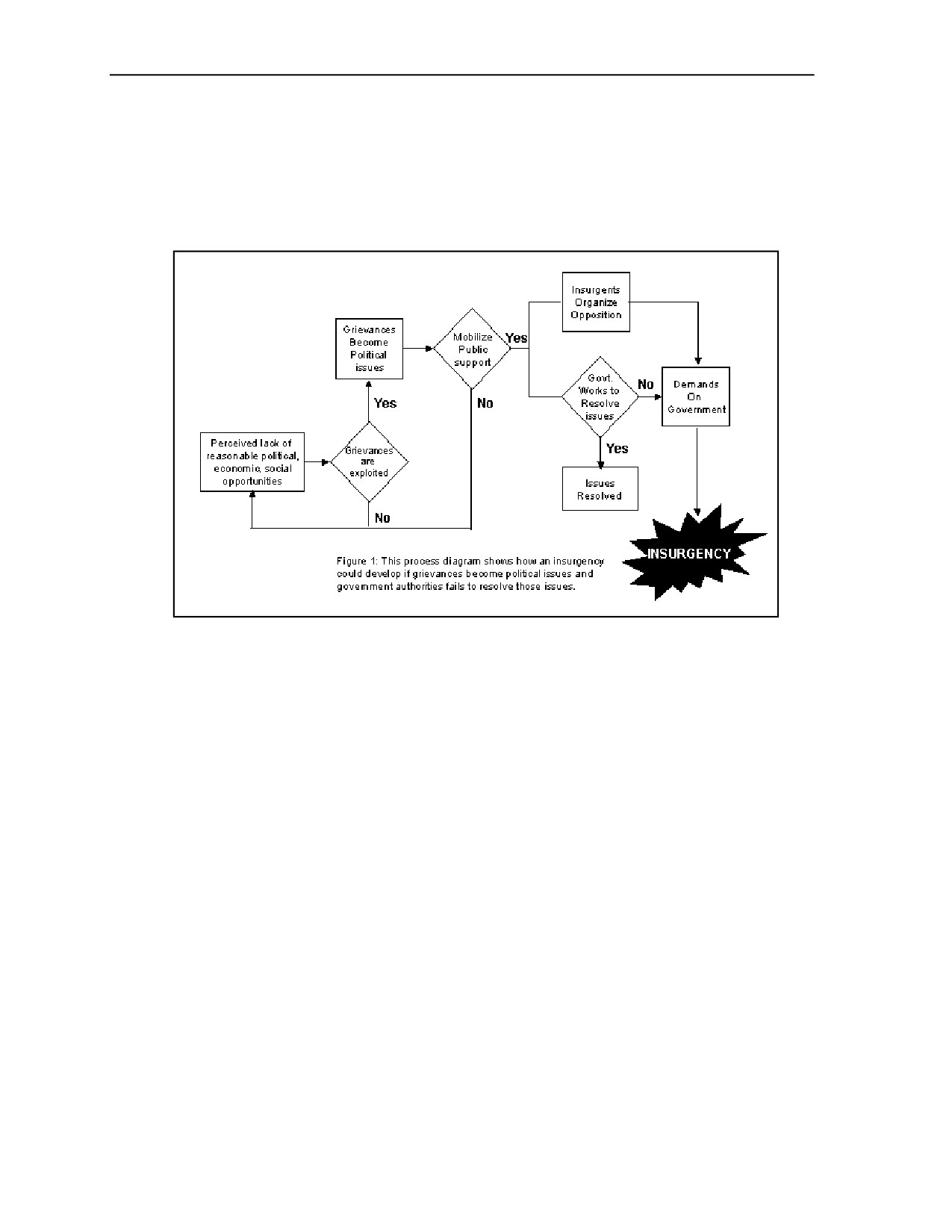
1-12. Rebellions and resistance movements are transformed into an insurgency by their in-
corporation into an armed political campaign. (See Figure 1-1, page 1-4.) A popular desire to
resist is used by an insurgent movement to accomplish the insurgents’ political goal. The in-
surgency thus mounts a political challenge to the state through the formation of, or desire to,
create a counterstate.
1-13. The desire to form a counterstate grows from the same causes that galvanize any po-
litical campaign. These causes can range from the desire for greater equity in the distribu-
tion of resources (poverty alone is rarely, if ever, sufficient to sustain an insurgency) to a
demand that foreign occupation end. Increasingly, religious ideology has become a catalyst
for insurgent movements. The support of the people, then, is the center of gravity. It must be
gained in whatever proportion is necessary to sustain the insurgent movement (or, contrari-
wise, to defeat it). As in any political campaign, all levels of support are relative. The goal is
mobilization such that the enemy may be defeated. This necessarily will depend as much
upon the campaign approach (that is, operational art) and tactics adopted as upon more stra-
tegic concerns of “support.” Operational and tactical use of violence as an insurgent strategy
has become increasingly commonplace. Objects of violence can be anything the insurgents
deem to be obstructions to their cause. This can be HN forces, foreign forces, aid workers, ci-
vilians who do not accept the insurgents’ claims, and infrastructure.
1-14. Violence is the most potent weapon available to insurgents. Nonetheless, violence can
alienate when not linked to a vision of a better life. Violence is often accompanied by a vari-
ety of nonviolent means that act as a potent weapon in an external propaganda war and as-
sist recruiting. Historically, astute movements have recognized the efficacy of both means to
1-3
FMI 3-07.22
the extent they have fielded discrete units charged with nonviolent action (for example,
strikes in the transportation sector) to supplement violent action. The insurgents in Algeria
rarely defeated French forces in the field; they employed indiscriminate violence, success-
fully initiated nonviolent strikes, developed associated propaganda for external use, and
thereby handily won their war. “People’s war” in its Chinese and Vietnamese variants did
this also.
Figure 1-1. Insurgency Development
1-15. Insurgent movements begin as “fire in the minds of men.” Insurgent leaders commit
themselves to building a new world. They construct the organization to carry through this
desire. Generally, popular grievances become insurgent causes when interpreted and shaped
by the insurgent leadership. The insurgency grows if the cadre that is local insurgent leaders
and representatives can establish a link between the insurgent movement and the desire for
solutions to grievances sought by the local population. This link does not always exist. Self-
serving insurgent leaders with no regard for local conditions may launch an insurgency, even
if the population supports the HN and has few grievances. This can occur when the HN gov-
ernment is weak or even nonexistent because of other factors. If the cadre is able to indoctri-
nate and control the mobilized local manpower, often by creating a climate of fear, and the
cadre respond to higher commands with independent tactical action, the insurgency will be
operationally and strategically unified. If the opposite is true, the insurgency will remain
uncoordinated and decentralized.
1-16. Insurgent leaders will exploit opportunities created by government security force ac-
tions. The behavior of security forces is critical. Lack of security force discipline leads to
alienation, and security force abuse of the populace is a very effective insurgent recruiting
tool. Consequently, specific insurgent tactical actions are often planned to frequently elicit
overreaction from security force individuals and units. Overreaction can result from poorly
drawn ROE and even strategic and operational planning that abets brutalizing a recalcitrant
population. Increasingly, the use of religious shrines for offensive insurgent actions can be
seen as attempts to achieve such an overreaction. Such actions can create a perception of HN
and foreign military forces as oppressors rather than as liberators.
1-4
Overview
INSURGENT DOCTRINE
1-17. Insurgent doctrine determines how insurgents actually implement the two types of in-
surgency. A defensive insurgency has much in common with a resistance movement, since
the counterstate already exists and will normally adopt overt techniques necessary for self-
defense. An offensive insurgency, on the other hand, is faced with the task of creating the
counterstate from scratch. To do this, there are two basic approaches.
z
Mass mobilization. A first approach is to emphasize mobilization of the masses.
This course places a premium upon political action by the cadre in local areas, with
strategic and operational directives coming from above. Emphasizing mass mobili-
zation results in a hierarchical, tightly controlled, coordinated movement. The in-
surgent movement that results will resemble a pyramid in its manpower distribu-
tion, with the combatants the smallest part of the movement (the apex of the
pyramid).
z
Armed action. A second approach emphasizes armed action. This course favors
violence rather than mass mobilization and normally results in an inverted pyra-
mid, with the combatants themselves the bulk of the movement. This was the ap-
proach taken by Castro in Cuba during the 1950s and may be an approach some in-
surgents in Iraq have taken against the post-Saddam government, although some
efforts to mobilize have been reported.
MASS MOBILIZATION
1-18. A mass base sustains the first approach. The second approach has a much smaller sup-
port base. The support base will not have the numbers of the mass base generated by the
mobilization approach.
1-19. If emphasis is upon mass mobilization, the combatants exist to facilitate the accom-
plishment of the political goals of the insurgent movement. In local areas, terror and guer-
rilla action are used to eliminate resistance, either from individuals who are opposed to the
movement or from the local armed representatives of the state, initially the police and mili-
tia, but later the military. Main force units, which are guerrilla units that have been “regu-
larized” or turned into rough copies of government units but are usually more mobile and
lightly armed, are used to deal with the state’s inevitable deployment of the military. The
purpose of main forces is to engage in mobile (or maneuver) warfare. The intent is force-on-
force action to destroy government main force units. Tactics may include major battles as
well as ambushes and small-scale engagements. These battles and engagements result in the
securing and expansion of the counterstate (which may be clandestine in all or part), but are
not designed to seize and hold positions as in conventional warfare. This occurs only in posi-
tional warfare. Though the terminology is drawn especially from Soviet usage, the North
Vietnamese Army (NVA) and the Viet Cong (VC) used both mobile and positional warfare
throughout the war in Vietnam. Examples of insurgencies that used the mass mobilization
approach follow:
z
The NVA and VC frequently deployed battalions and regiments using classic mo-
bile warfare, even as terror and guerrilla action continued against US forces from
1965 until the US withdrawal from Vietnam in 1973.
z
Classic positional warfare was seen three times in the Vietnam War: the Tet Offen-
sive in January-February 1968; the Spring 1972 “Easter Offensive,” which resulted
in the permanent seizure and loss of portions of South Vietnamese territory; and
the Spring 1975 offensive, which saw the fall of South Vietnam and its absorption
into a unified Vietnam. In the latter two of these campaigns, enemy divisions and
corps were used, with terror and guerrilla action assuming the role of special opera-
tions in support of conventional operations. During Tet, the NVA employed all 52
1-5
FMI 3-07.22
VC battalions exclusively, and multiple battalions attacked objectives simultane-
ously, though these battalions were under individual command and control.
z
More recently, in El Salvador, where the United States successfully supported a
counterinsurgency, government forces twice, in 1981 and 1989, had to beat back
“positional warfare” offensives designed to seize widespread areas, including por-
tions of the nation’s capital.
z
In Colombia, where the US is similarly involved in support of the counterinsur-
gency, the insurgents of FARC (Fuerzas Armadas Revolucionarias de Colombia)
initiated their mobile warfare phase in 1996. There followed a string of Colombian
Army defeats that culminated in a FARC positional warfare attack that seized a
department capital, Mitu, in mid-1998. The relief of Mitu galvanized a military re-
form effort that led to government success in a half dozen major mobile war battles
fought between 1998 and 2001. The largest of these involved a FARC force of eight
battalion-equivalents engaged by an equal number of Colombian Army coun-
terguerrilla battalions. FARC consequently returned to an emphasis upon terror
and guerrilla action.
z
In Nepal, where US assistance has played an important role in government coun-
terinsurgency, the ’mass mobilization approach adopted by the Communist Party of
Nepal (Maoist), or CPN (M), has progressed in classic fashion. Widespread use of
terror and guerrilla action has been complemented by mobile warfare to overrun
government positions of up to company size. Mobile warfare targets have been cho-
sen operationally (that is, as part of campaign planning) to position the CPN (M)
for anticipated positional war offensives, notably against major population centers.
ARMED ACTION
1-20. If emphasis is on the second approach, armed action, the political goal is to be accom-
plished primarily by violence rather than mass mobilization. The insurgents attempt to in-
flict such a level of casualties and destruction the state is incapable or unwilling to continue
counterinsurgency actions. Both approaches emphasize inflicting casualties. The distinction
is whether mobilization or armed insurrection is the initial emphasis. Insurgents may also
employ terrorist tactics if they lack a mass base, do not have the time needed to create such
a base, or have objectives that do not require such a base. In this approach, the combatant
force rarely moves beyond terrorist and guerrilla actions. Units are small and specialized,
frequently no more than squad or platoon sized. Sympathizers provide recruits for the sup-
port base, but these sympathizers are actively involved only occasionally, though they are of-
ten central to the information warfare component of the insurgent campaign.
z
An illustration of the armed action approach is “The Troubles” of 1968-98 in
Northern Ireland (Ulster). An initial mass mobilization approach followed by the
Provisional Irish Republican Army was penetrated by the state; hence it was aban-
doned in favor of a cellular “active service unit” methodology. Normally composed of
no more than 300 people, the active service unit network engaged almost exclu-
sively in terror actions and was sustained by a support base that numbered only in
the thousands out of a total 1.5 million population in an area the size of Connecti-
cut. Sympathizers came overwhelmingly from a minority within the Catholic com-
munity, thus forming a minority within a minority. At its peak, however, this sym-
pathetic base proved capable of mustering 17 percent of the votes in democratic
elections and served to keep open to question the legitimacy of British rule, which
was actually favored by a substantial majority.
z
More recently, the insurgents in Iraq and Afghanistan have used the armed action
approach. Terror and low-level guerrilla action have been focused on the indigenous
supporters and infrastructure of the new regimes in Baghdad and Kabul. Simulta-
neously, attacks on US forces have sought to inflict casualties to break the will of
1-6
Overview
the US public to continue. The insurgents have recognized that the indigenous re-
gimes cannot continue in the short-term without US backing and assistance. Nei-
ther will the new regimes be able to continue if their populations can be suitably
terrorized into sullen neutrality as the US begins to withdraw.
DYNAMICS OF INSURGENCY
1-21. There are seven dynamics that are common to most insurgencies. These dynamics pro-
vide a framework for analysis that can reveal the insurgency’s strengths and weaknesses.
Although analysts can examine the following dynamics separately, they must study their in-
teraction to fully understand the insurgency. These seven dynamics are—
z
Leadership.
z
Ideology.
z
Objectives.
z
Environment and geography.
z
External support.
z
Phasing and timing.
LEADERSHIP
1-22. Leadership is critical to any insurgency. Insurgency is not simply random political vio-
lence. It is directed and focused political violence. It requires leadership to provide vision, di-
rection to establish and set the long-term way ahead, short-term guidance, coordination, and
organizational coherence. Insurgent leaders must make their cause known to the people and
gain popular support. Although, theoretically, the insurgent leader desires to gain popular
support for the cause, that desire is often accompanied by a terror campaign against those
who do not support the insurgents’ goals. Their key tasks are to break and supplant the ties
between the people and the government, and to establish legitimacy for their movement.
Their education, family, social and religious connections, and positions may contribute to
their ability to think clearly, communicate, organize, and lead a an insurgency; or their lack
of education and connections may delay or impair their access to positions where they are
able to exercise leadership.
1-23. Insurgencies are dynamic political movements, resulting from real or perceived griev-
ance or neglect that leads to alienation from an established government. Alienated elite
members advance alternatives to existing conditions. (Culture defines elites. For example, in
most of the world educators and teachers are members of the elite; in Islamic and many
Catholic nations, religious leaders are elite members.) As their movement grows, leaders de-
cide which body of “doctrine” to adopt. In the mass mobilization approach, leaders recruit,
indoctrinate, and deploy the cadre necessary to carry out the actions of the movement. In the
armed action approach, there is often a much more decentralized mode of operations, but
this is usually guided by a central organization. Extreme decentralization results in a
movement that rarely functions as a coherent body but is nevertheless capable of inflicting
substantial casualties and damage.
1-24. The power base of some insurgencies is collective and does not depend on specific lead-
ers or personalities to be effective. Such insurgencies are easier to penetrate but recover rap-
idly when they lose key personnel. Other organizations depend on a charismatic personality
to provide cohesion, motivation, and a focal point for the movement. Organizations led in this
way can make decisions and initiate new actions rapidly, but they are vulnerable to disrup-
tions if key personalities are removed or co-opted.
1-7
FMI 3-07.22
OBJECTIVES
1-25. Effective analysis of an insurgency requires interpreting strategic, operational, and tac-
tical objectives. Understanding the root causes of the insurgency is essential to analyzing the
insurgents’ objectives. The strategic objective is the insurgents’ desired end state: the seizure
of political power and the overthrow of an existing government. Operational objectives are
the decisive points (military, political, and ideological) along lines of operation toward the
strategic objective, and they are the means to link tactical goals with strategic end states.
One of the political decisive points is the total destruction of government legitimacy. Tactical
objectives are the immediate aims of insurgent acts. Tactical objectives can be psychological
and physical in nature. Some examples include the dissemination of PSYOP products, in-
timidation (a psychological objective), and the attack and seizure of a key facility (a physical
objective).
IDEOLOGY
1-26. In its ideology an insurgency sets forth a political alternative to the existing state. Both
theoretically and actually, it offers a vision of a counterstate. The most powerful ideologies
tap latent, emotive concerns of the populace, such as the desire for justice, the creation of an
idealized religious state, or liberation from foreign occupation. Ideology influences the insur-
gents’ perception of the environment by providing the prism, to include vocabulary and ana-
lytical categories, through which the situation is assessed. The result is that ideology shapes
the movement’s organization and operational methods.
ENVIRONMENT AND GEOGRAPHY
1-27. Environment and geography, including cultural and demographic factors, affect all par-
ticipants in a conflict. The manner in which insurgents and counterinsurgents adapt to these
realities creates advantages and disadvantages for each. The effects of these factors are im-
mediately visible at the tactical level, where they are perhaps the predominant influence on
decisions regarding force structure, and doctrine (including TTP). Insurgency in an urban
environment often presents a different set of planning considerations than in rural environ-
ments. These planning considerations affect structure, and TTP directly.
EXTERNAL SUPPORT
1-28. The need for access to external resources and sanctuaries has been a constant through-
out the history of insurgencies. Rarely, if ever, has an insurgent force been able to obtain the
arms and equipment (particularly ammunition) necessary for decisive action from within the
battle area. External support can provide political, psychological, and material resources
that might otherwise be limited or totally unavailable.
1-29. A recent phenomenon has been the advent of internal sanctuaries. These may be in the
form of religious structures. They may be large cities where neither HN nor external military
forces are sufficiently strong to counter the insurgents.
PHASING AND TIMING
1-30. Insurgencies often pass through common phases of development. The conceptualization
generally followed by insurgents is drawn from that postulated by Mao Zedong. Regardless
of its provenance, movements as diverse as communist or Islamic insurgencies have used the
Maoist conceptualization because it is logical and based upon the mass mobilization empha-
sis. It states that insurgents are first on the strategic defensive (Phase I), move to stalemate
(Phase II), and finally go over to the offensive (Phase III). Strategic movement from one
phase to another incorporates the operational and tactical activity typical of earlier phases.
It does not end them. The North Vietnamese explicitly recognized this reality in their “war of
1-8
Overview
interlocking” doctrine, which held that all “forms of warfare” occur simultaneously, even as a
particular form is paramount.
1-31. Not all insurgencies experience every phase, and progression through all phases is not
a requirement for success. The same insurgent movement may be in different phases in dif-
ferent regions of a country. Successful insurgencies can also revert to an earlier phase when
under pressure, resuming development when favorable conditions return.
1-32. Political organization occurs throughout all phases. While on the defensive, however, in
Phase I per Mao, a movement will necessarily fight the “war of the weak,” emphasizing ter-
ror and guerrilla action. These will be used to eliminate resistance from individuals and local
government presence, especially the police. Invariably, the government must commit its
main force units (normally the army) to reclaim what it has lost. Knowing this, insurgents
form their own main force units. These are used to defeat government forces in detail as the
latter disperse to engage in area domination. It is through such action that stalemate, Phase
II, is achieved. The government’s forces in the contest of armed power are systematically
neutralized through mobile (or maneuver), force-on-force warfare. Only in Phase III does a
transition to the holding of position occur (hence the term, “positional warfare”).
1-33. If the insurgents adopt the armed action approach, these phases do not necessarily ap-
ply. Inflicting an unsustainable level of pain on HN or external military forces may eliminate
the need to form main force units. Pressure from within the HN or country providing the
forces may lead to capitulation or withdrawal. In attacking democratic societies, insurgents
using this approach attempt to tap the purported aversion of democratic societies to pro-
tracted, costly conflicts that appear endless. They seek to break the will of the state to con-
tinue the struggle.
STATE APPROACH TO INSURGENCY
1-34. A successful counterinsurgency results in the neutralization by the state of the insur-
gency and its effort to form a counterstate. While many abortive insurgencies are defeated by
military and police actions alone, if an insurgency has tapped into serious grievances and
has mobilized a significant portion of the population, simply returning to the status quo may
not be an option. Reform may be necessary, but reform is a matter for the state, using all of
its human and material resources. Security forces are only one such resource. The response
must be multifaceted and coordinated, yet states typically charge their security forces with
“waging counterinsurgency.” This the security forces cannot do alone.
1-35. The state first decides upon its goal (restoration of legitimate government writ), then,
produces a plan to accomplish that end. All elements of national power are assigned their
roles in carrying out the plan. The government establishes the legal framework and com-
mand and control (C2) mechanisms to enable the plan to be implemented.
z
The legal framework normally includes a series of extraordinary measures that are
associated with emergency situations, or even martial law. It will frequently ex-
pand military powers into areas delegated solely to the police in “normal times.”
z
Historically, effective C2 architecture has involved setting up local coordinating
bodies with representation from all key parties. This local body directs the counter-
insurgency campaign in the AO concerned, though one individual will have the
lead. Minimally, such a coordinating body includes appropriate representatives
from the civil authority, the military, the police, the intelligence services, and
(though not always) the civil population. The most effective use of coordinating bod-
ies has given permanent-party individuals (for example, district officers) responsi-
bility for counterinsurgency C2 in their AOs and control over civil or military assets
sent into their AOs. Reinforced intelligence bodies, in particular, have been as-
1-9
FMI 3-07.22
signed as permanent party. Involvement of local officials and civilians can defeat
the insurgents’ attempt to undermine the political system.
1-36. HN military and police forces must be the most visible force to the people. Security
forces sent into an area to engage in counterinsurgency perform as follows:
z
Strategically, they serve as the shield for carrying out reform. It is imperative that
HN military and police forces protect the populace and defend their own bases
while simultaneously fighting an insurgency.
z
Operationally, they systematically restore government control.
z
Tactically, security forces eliminate insurgent leadership, cadre, and combatants,
through death and capture, by co-opting individual members, or by forcing insur-
gents to leave the area. This is analogous to separating the fish from the sea. The
local populations (that also provide the insurgent mass base) are then secure and
able to engage in normal activities. The forces also assist with civic action projects.
These actions convey to the people a sense of progress and concern by the govern-
ment.
1-37. The counterinsurgency plan analyzes the basis of the insurgency in order to determine
its form, centers of gravity, and insurgent vulnerabilities. These dictate the most effective
type force to employ (either police, militia, and military; or primarily military and police).
The counterinsurgency plan details the scheme to reclaim what has been lost and establish
priority of effort and timelines. Concurrently, it outlines how the government intends to se-
cure the critical infrastructure of the state and the government’s centers of power.
1-38. Counterinsurgency operations must balance elimination of grievances (that is, reform,
to include elimination of human rights abuses) and security force action that eliminates the
insurgents. The security forces provide the populace the protection necessary for the restora-
tion of government presence, basic services, and control.
1-39. Counterinsurgency plans and operations exploit shifts in the internal or external situa-
tion that work against the insurgent and favor the state. This normally involves an extended
period of time, a “protracted war.” This makes it difficult for representative governments to
sustain counterinsurgency campaigns, particularly in the present world environment where
there appears to be a lack of overt, sustained agreement regarding strategic interests, ends
and means, and operational and tactical concerns.
1-40. When supporting a counterinsurgency, the US and its multinational partners assist the
HN in implementing a sustainable approach. To the extent the HN has its basic institutions
and security forces intact, the burden upon US and multinational forces and resources is
lessened. To the extent the HN is lacking basic institutions and functions, the burden upon
the US and multinational forces is increased. In the extreme, rather than building upon
what is, the US and other nations will find themselves creating elements (such as local
forces and government institutions) of the society they have been sent to assist. Military
forces thus become involved in nation building while simultaneously attempting to defeat an
insurgency. US forces often lead because the US military) can quickly project and sustain a
force. This involves them in a host of current activities regarded as nonstandard, from su-
pervising elections to restoring power and facilitating and conducting schooling.
1-41. Leaders and planning staff need to be aware that there will always be constraints upon
the prosecution of counterinsurgency. Constraints must be identified and analyzed system-
atically, because they impact upon the conduct of operations at all levels. They ought to be
reevaluated regularly. The bottom line is that forces have to operate in the environment as it
is, not as they might wish it to be. Some constraints may include—
z
Time. Strategic or political factors may dictate the time frame during which condi-
tions for success must be achieved. (See Chapter 2).
1-10
Overview
z
Means. The means (for example, weapons, equipment, mature concepts, and TTP)
available are likely to be limited. (See Chapter 3 and Appendix C).
z
Legal. The international, US, and HN legal frameworks place constraints on the
conduct of operations (for example, ROE, powers of arrest, ability to prosecute and
rules of evidence, powers of detention). (See Chapter 2, and Appendix J.)
z
Geography. In addition to terrain factors, there may be areas where, for reasons of
political, cultural, religious, or environmental sensitivity, the ability to conduct op-
erations is constrained, moderated, limited, or prohibited (for example, cross-border
operations, hot pursuit, and bombing sanctuaries.) (See Chapters 2 and 4, and the
six associated appendixes).
z
Domestic and international considerations. Events in the theater of opera-
tions are likely to be subject to media scrutiny and reporting (both accurate and in-
accurate). It is a reality that US domestic and international considerations must be
weighed, and these may limit how operations are conducted. (See Chapters 2 and 3,
and Appendix C.)
z
Multinational partners. Multinational partners may have differing political and
legal imperatives. The need to maintain cohesiveness among members of a coalition
may affect US force behavior. (See Chapter 2.)
z
Host nation. The HN’s leadership, culture, and politics (among many possible fac-
tors) generate a wide range of pressures, some conflicting, upon the military that
must be considered carefully. These create a further source of constraints or limita-
tions. (See Chapter 2, Appendix A, and Appendix B.)
1-11
Chapter 2
Command and Control in a Counterinsurgency
Environment
SECTION I - INTRODUCTION
GENERAL
2-1. Counterinsurgency has certain imperatives that make planning for it different from
other missions. Planners consider these imperatives when developing counterinsurgency
plans. These imperatives are—
z
Facilitate establishment or reestablishment of a legitimate HN government.
z
Counterinsurgency requires perseverance.
z
Foster popular support for the HN and US governments.
z
Prepare to perform functions and conduct operations that are outside normal scope
of training.
z
Coordinate with US governmental departments and agencies, and with HN, non-
governmental, and foreign agencies.
2-2. Insurgencies are protracted politico-military struggles with political power as the cen-
tral issue. Therefore, military planners ensure a closer, more effective coordination of mili-
tary operations between the country team, interagency personnel, the HN, and military or-
ganizations than would exist during conventional operations. This coordination is normally
at the strategic and operational levels. US government policy towards the HN and the insur-
gents is the overriding determinant for military action.
2-3. Planners consider long-term effects of all US assistance efforts before executing coun-
terinsurgency operations. This long-term consideration is especially important in building
HN development and defense self-sufficiency, both of which may require large investments
of time and materiel. Counterinsurgency operations also require extensive logistic planning
because of the probability of having to provide food and shelter for displaced persons and
construction or repair of services such as water. Planners also recognize the ultimate objec-
tive is to assist the HN in establishing a government that is legitimate, responsive to the
people and capable of meeting their needs, and worthy of their loyalty.
2-4. Planners tailor military support to other elements of counterinsurgency operations
while considering the environment and the specific needs of the HN. They consider the
threat, as well as local political, tribal, religious, social, and economic factors when develop-
ing counterinsurgency plans. Overcoming the tendency to use a US frame of reference is im-
portant because this potentially damaging tendency can result in equipment, training, and
infrastructure not at all suitable for the HN.
2-5. Planners understand that a basic premise of the counterinsurgency approach is the ul-
timate responsibility for IDAD rests with the HN. US planners assess all counterinsurgency
plans against this precept.
2-1
FMI 3-07.22
2-6. Political and military leaders realistically evaluate troop requirements in a counterin-
surgency environment. In addition to those tasks inherent in any military situation—such as
base security and offensive operations—some tasks occur with greater frequency in counter-
insurgency and deserve special attention. Among these are—
z
Urban operations.
z
Protection of government facilities.
z
Protection of infrastructure.
z
Protection of commercial enterprises vital to the HN economy.
z
Protection of cultural facilities.
z
Prevention of looting.
z
Military police functions.
z
Close interaction with civilians.
z
Assistance with reconstruction projects.
z
Securing the HN borders.
z
Training or retraining HN military forces.
z
Establishing and maintaining local government credibility.
2-7. Faced with these additional tasks, the joint force may be required to provide more
units, and a different mix of units, than would be required for operations against a conven-
tional force the same approximate size as the insurgent force. The preponderance of many of
these units may only be available in the Reserve Components. All planning considers the
long-term implications and second- and-third order effects of counterinsurgency missions.
Counterinsurgency is a long-term approach and effort requiring support from political and
military leaders. Additionally, leaders must recognize counterinsurgency operations may in-
volve nation building. Counterinsurgency often involves nation building, but not all nation
building involves counterinsurgency.
2-8. At all levels, the conduct (planning, preparing, execution, and assessment) of counter-
insurgency operations involves coordination among HN forces and agencies, US organiza-
tions, multinational partners, and NGOs that may influence the mission.
FUNDAMENTAL CONDITIONS
2-9. Planning for a counterinsurgency focuses on the following conditions that the force
must establish to be successful.
A SECURE POPULACE
2-10. Security of the populace is an imperative. This is security from the influence of the in-
surgents initially. The population is then mobilized, armed, and trained to protect itself. Ef-
fective security allows local political and administrative institutions to operate freely and
commerce to flourish.
ESTABLISHED LOCAL POLITICAL INSTITUTIONS
2-11. Establishing conditions favorable for the development of HN governmental institutions
consistent with US objectives. These conditions include the establishment of law enforce-
ment and freely elected political leaders where possible, public information, health care,
schools, public works, and fire fighting capabilities.
CONTRIBUTING LOCAL GOVERNMENT
2-12. Contributing local government is both tangible and psychological. Local security forces
must reinforce and be integrated into the plan at every stage. This local integration is con-
2-2
Command and Control in a Counterinsurgency Environment
stantly emphasized with the local and HN police, and civil and military leaders through
deeds to ensure these forces have great visibility with the populace. Psychologically, the
populace must be assured continuously and effectively that conditions are becoming better to
counter insurgent propaganda. Counterinsurgency operations must establish conditions that
contribute to HN and local government effectiveness.
NEUTRALIZE INSURGENT CAPABILITIES
2-13. Neutralize insurgent capabilities to exploit grievances. Work with local authorities and
leaders to resolve the issues creating concern in order to legitimize governmental institu-
tions.
INFORMATION FLOW FROM LOCAL SOURCES
2-14. Facilitate and use information and intelligence obtained from local sources to gain ac-
cess to the insurgent’s economic and social base of support, order of battle, tactics, tech-
niques, and procedures.
SECTION II - ROLE OF THE ARMY IN COUNTERINSURGENCY
2-15. The role of the Army in counterinsurgency operations is to administer, train for, and
successfully conduct full spectrum operations, with great emphasis on stability operations.
Counterinsurgency is a type of stability operation. (See FM 3-07, chapter 3.) Each regional
combatant commander advises the Department of State in developing peacetime military
engagement packages appropriate for the situation. Each combatant command provides mili-
tary forces under the program as well as military advice, tactical and technical training, and
intelligence and logistic support. Army forces help HN police, paramilitary, and military
forces perform counterinsurgency, area security, or local security operations. They advise
and assist in finding, dispersing, capturing, and destroying the insurgent force. Army forces
emphasize the training of HN national, state, and local forces to perform essential defense
functions. They aim to provide a secure environment in which developmental programs can
take effect while respecting the rights and dignity of the people.
2-16. US policymakers determine the scope of military participation based on US interests
and the desires of the HN. The US military aims to improve the effectiveness of the HN se-
curity forces and to assist in preventing support for the insurgents. To prevent the overthrow
of a government friendly to the US or to provide security while a new government is estab-
lished, US forces may be required to engage in combat, either unilaterally or with multina-
tional or HN forces. As quickly as possible, though, HN military and police must assume the
primary combat role. A long-term US combat role may undermine the legitimacy of the HN
government and risks converting the conflict into a US-only war. That combat role can also
further alienate cultures that are hostile to the US. On the occasion when the threat to US
interests is great and indirect means have proven insufficient, preemptive US combat opera-
tions may be required. Direct use of US combat forces in counterinsurgency operations re-
mains a policy option for the President, and Army forces provide it when required. HN forces
should conduct stability operations when necessary, employing concepts such as population
and resource control (see Appendix C). When US forces are involved, the HN must provide
representatives to assist US forces in their contacts with local populations.
2-17. US forces may conduct offensive operations to disrupt and destroy insurgent combat
formations. These operations prevent the insurgents from attacking government-controlled
areas. They also disrupt insurgent efforts to consolidate and expand areas already under
their control. US combat forces may conduct stability operations in support of HN stability
operations or to assist the HN to expand its mobilization base. US forces may also be re-
quired to secure HN borders to prevent third-nation elements from supporting or joining the
2-3
FMI 3-07.22
insurgency. Success in stability operations enables the HN to resume the military aspects of
its counterinsurgency campaign and creates conditions in which US combat forces may with-
draw.
SECTION III - PLANNING CONSIDERATION FOR COUNTERINSURGENCY
2-18. Insurgencies are armed political movements, protracted politico-military struggles us-
ing guerrilla tactics and terrorist activities. Planners analyze the mission and develop coun-
terinsurgency concepts to defeat each element of an insurgency. This is done in close coop-
eration with other governmental agencies to ensure all plans are fully integrated. Army
planners use the military decision making process (see FM 5-0) during counterinsurgency
planning. (See JP 5-0 for joint planning procedures).
MISSION ANALYSIS
2-19. Before beginning counterinsurgency planning, the staff conducts a thorough mission
analysis of the operational environment and threat. This mission analysis establishes the
operational framework for counterinsurgency planning. Give special consideration to the fol-
lowing areas.
VIABILITY OF THE HOST NATION GOVERNMENT
2-20. Determine this in conjunction with other governmental agencies and the HN. If there is
an existing government, the legitimacy and viability of the existing government may deter-
mine the level of military and civilian agency support required.
THREATS TO HOST NATION INTERNAL DEFENSE AND DEVELOPMENT (IDAD)
2-21. Threats may be specific, such as insurgents or illicit drugs, or they may be more gen-
eral as in instability and social unrest. This requires civil and military leaders to also target
long-term causes rather than short-term symptoms. In the event of an insurgency, planners
must identify the basis of an insurgency in order to determine its form, centers of gravity,
and the root cause. This is key because the form and centers of gravity dictate the most effec-
tive type force to employ (police, militia, and military or primarily military and police) and
identify insurgent vulnerabilities. A counterinsurgency plan describes a concept of opera-
tions to reclaim any cities and towns that have been lost and establish priority of effort and
timelines. Concurrently, the critical infrastructure of the state and the government’s centers
of power are identified and secured.
HOST NATION SOCIAL, ECONOMIC, AND POLITICAL ENVIRONMENT
2-22. Counterinsurgency supports IDAD operations in a manner acceptable to the HN’s po-
litical and cultural realities. (IDAD is a type of stability operation. See FM 3-07.) Planners
consider factors such as the effectiveness of the HN leadership and government as well as
existing treaties and the social and economic infrastructure. This assessment may lead to
the conclusion the best solution from a US perspective may not be the best solution for the
supported HN. This issue is resolved through diplomatic channels. Political authorities may
determine that stability operations other than counterinsurgency or foreign humanitarian
assistance (a support operation) are the most effective solution for the US and the HN gov-
ernments.
INTELLIGENCE ESTIMATE
2-23. An accurate intelligence estimate is essential to identify the threat upon which to base
counterinsurgency efforts. The intelligence estimate supporting counterinsurgency opera-
2-4
Command and Control in a Counterinsurgency Environment
tions has an orientation quite different from that of a conventional estimate. A comprehen-
sive and intimate knowledge of the environment is essential in building this estimate.
2-24. The conventional J-2 intelligence estimate concentrates on enemy situation, enemy ca-
pabilities, an analysis of those capabilities, and conclusions drawn from that analysis. In
counterinsurgency, however, planners expand this concept beyond conventional enemy
analysis to focus more on the local population and its probable reactions to potential US or
insurgent actions. This emphasis requires knowledge of the ethnic, tribal, racial, economic,
scientific, technical, religious, and linguistic groups in the HN, as well as their locations and
an understanding of how they may perceive future operations. Understanding the operating
environment and the HN’s social, economic, and political order are essential to conducting
counterinsurgency operations that support the local IDAD program. The counterinsurgency
intelligence planner views the battle space very differently from that of the conventional
planner.
CIVIL-MILITARY OPERATIONS ESTIMATE
2-25. The CMO estimate examines each military course of action for CMO requirements and
CA assistance and reviews potential operations for any civil administration implications.
CMO will also complete area studies where operations are likely. For military operations to
support counterinsurgency, these assessments focus on social, economic, and political factors
that relate to existing or potential lawlessness, subversion, or insurgency. These assess-
ments may include overlays that show local demographics, civil supply support, public utili-
ties, and population displacement. CMO planning must be incorporated into all counterin-
surgency planning and operations. (See Appendix A.)
2-26. Planning at the tactical level in counterinsurgency operations requires a far greater
analysis of civil considerations than in conventional operations. Civil considerations com-
prise six characteristics, expressed in the memory aid, ASCOPE. (See FM 6-0, Appendix B.)
Consider the following when analyzing civil considerations for a counterinsurgency mission.
AREAS
2-27. This characteristic addresses terrain analysis from a civilian perspective. Analyze how
key civilian areas affect the missions of respective forces and how military operations affect
these areas. Factors to consider include political boundaries, locations of government cen-
ters, by-type enclaves, special regions (for example, mining or agricultural), trade routes,
and possible settlement sites.
STRUCTURES
2-28. Structures include traditional high-payoff targets, protected cultural sites, and facili-
ties with practical applications. The analysis is a comparison how a structure’s location,
functions, and capabilities can support operations as compared to costs and consequences of
such use.
CAPABILITIES
2-29. Assess capabilities in terms of those required to save, sustain, or enhance life, in that
order. Capabilities can refer to the ability of local authorities to provide key functions and
services. These can include areas needed after combat operations and contracted resources
and services.
2-5
FMI 3-07.22
ORGANIZATIONS
2-30. Consider all nonmilitary groups or institutions in the AO. These may be indigenous,
come from a third country or US agencies. They influence and interact with the populace,
force, and each other. Current activities, capabilities, and limitations are some of the infor-
mation necessary to build situational understanding. This becomes often a union of re-
sources and specialized capabilities.
PEOPLE
2-31. People is a general term describing all nonmilitary personnel that military forces en-
counter in the AO. This includes those personnel outside the AO whose actions, opinions, or
political influence can affect the mission. Identify the key communicators and the formal and
informal processes used to influence people. In addition, consider how historical, cultural,
and social factors that shape public perceptions beliefs, goals, and expectations.
EVENTS
2-32. Events are routine, cyclical, planned, or spontaneous activities that significantly affect
organizations, people, and military operations, such as seasons, festivals, holidays, funerals,
political rallies, and agricultural crop/livestock and market cycles and paydays. Other
events, such as disasters and those precipitated by military forces, stress and affect the atti-
tudes and activities of the populace and include a moral responsibility to protect displaced
civilians. Template events and analyze them for their political, economic, psychological, en-
vironmental, and legal implications.
SECTION IV - COMMAND AND CONTROL
2-33. Command and control is the exercise of authority and direction by a properly desig-
nated commander over assigned and attached forces in the accomplishment of a mission.
Commanders perform command and control functions through a command and control sys-
tem (FM 6-0). Commanders exercise C2 for counterinsurgency using the same C2 system as
in other military operations.
2-34. C2 during counterinsurgency requires greater decentralization to small unit leaders.
Normal operating methods focused around a single commander’s approval often prove ineffi-
cient, untimely, and ineffective for the situation. Commanders must develop a level of trust
and communication with subordinates and foster their initiative well before arriving into the
theater of operations. Commanders must empower their subordinates with clear authority
for specific operations. The subordinate leaders must clearly understand orders, missions,
and the commander’s intent down to the squad and fire team level. ROE must be clear
enough for subordinates to act appropriately. If C2 and decision making become slow proc-
esses, the insurgents can exploit this. Additionally, commanders often coordinate with other
agencies that will not be present on a conventional battlefield.
COMMAND AND CONTROL OF COUNTERINSURGENCY FORCES
2-35. Planning C2 in a counterinsurgency environment is extremely complex. Based on mis-
sion requirements, commanders plan to conduct full spectrum operations anywhere within
their AO and within adjacent AOs after conducting necessary coordination. Therefore, task
organizations must have flexibility built into them to support a rapid change of focus during
operations.
2-36. In addition to other agencies, US contractors may be heavily involved in counterinsur-
gency operations. Contractors’ management and control differs from that of Soldiers and
Army civilians. Commanders make provisions for contractor management during planning,
2-6
Command and Control in a Counterinsurgency Environment
to include using the contracting process to define required conditions. The terms and condi-
tions of the contract establish the relationship between the military and the contractor, to
include command relationships, authority, or responsibilities. Commanders then exercise
management control through supervisors employed by the contractor because only a contrac-
tor can directly supervise contract personnel. (See FM 6-0; FM 3-100.21.)
2-37. During multinational operations, command and support relationships may not be well
defined and therefore more open to interpretation. In some international organizations, such
as the North Atlantic Treaty Organization (NATO), command and support relationship
terms may have different meanings from those in Army doctrine. For example, the NATO
definitions of operational control (OPCON) and tactical control (TACON) are different from
US Army definitions. In addition, other terms for command and support relationships may
exist. In such cases, commanders seek clarification from their higher commander, from or-
ders, or from the agreements that established the force (for example, NATO standardization
agreements [STANAGs]). Commanders use agreed-upon multinational command and sup-
port relationships when controlling multinational forces.
ARMY SPECIAL OPERATIONS FORCES
2-38. Within a joint force, ARSOF assets (less PSYOP and CA units) are ordinarily attached
to and under OPCON of a designated joint special operations task force (JSOTF) com-
mander. The special operations command and control element (SOCCE) assists the JSOTF
commander in fulfilling the supporting or supported commander responsibilities. A SOCCE
is based on a special forces operational detachment-B and is augmented with a special com-
munications package and personnel as required. It may include a ranger liaison officer,
PSYOP and CA representatives, and special operations aviation personnel. The SOCCE is
normally collocated at corps level and above, with smaller liaison teams operating at division
level and below. The supported unit provides the SOCCE administrative and logistic sup-
port. The SOCCE is the focal point for ARSOF coordination and synchronization with con-
ventional forces. At corps level, the SOCCE coordinates with the corps operations center, fire
support element, deep operations coordination cell, and battlefield coordination detachment
to deconflict targets and operations. It provides ARSOF locations through personal coordina-
tion and provides overlays and other friendly order of battle data to the fire support element
and battlefield coordination detachment. The SOCCE can exercise C2 of designated ARSOF
units when the JSOTF commander determines the need.
SPECIAL FORCES LIAISON ELEMENT
2-39. A special forces liaison element is a special forces or joint special operations element
that conducts liaison between US conventional forces, division-level headquarters, and sub-
ordinate HN or multinational forces brigades and battalions.
PSYCHOLOGICAL OPERATIONS
2-40. Commanders employ PSYOP (as an element of IO) to influence target audience behav-
iors that support US national policy objectives. Planning includes personnel with expertise
in the region’s culture. PSYOP missions roles include—
z
Influencing the attitudes and behaviors of foreign populations.
z
Advising commanders of target restrictions during the targeting process (planning
for application of effects) to minimize reactions that may adversely affect PSYOP
objectives.
z
Providing public information (in coordination with the public affairs office) to for-
eign populations to support humanitarian assistance and to restore or maintain
civil order.
2-7
FMI 3-07.22
z
Countering enemy propaganda and disinformation.
2-41. To execute the PSYOP mission, the JFC may create a psychological operations task
force, a joint psychological operations task force, or a PSYOP support element. Mission re-
quirements dictate the composition of the task force.
2-42. The regional combatant commander’s staff performs initial PSYOP planning with as-
sistance from a PSYOP assessment team. The PSYOP assessment team deploys to a theater
at the request of the combatant commander to assess the situation, develop PSYOP objec-
tives, and recommend the appropriate level of support to accomplish the mission. Both the
psychological operations group and regional PSYOP battalion are capable of forming the nu-
cleus of or establishing a PSYOP assessment team or joint psychological operations task
force. Tactical PSYOP battalions provide tactical support to corps-, division-, and lower-level
units and below. Tactical PSYOP companies provide tactical support to division-, and bri-
gade-level units and below. Tactical PSYOP teams detachments support brigade-sized ele-
ments. Tactical PSYOP teams are attached to battalions companies to provide loudspeaker
support and to disseminate leaflets and posters.
2-43. The combatant commander or JFC level usually retains PSYOP C2 and product ap-
proval. National objectives, however, may dictate that product approval be retained at na-
tional level. PSYOP approval authority can be sub-delegated below regional combatant com-
mander and JFC with approval from the Secretary of Defense.
SPECIAL OPERATIONS COORDINATION ELEMENT
2-44. The special operations coordination element acts as the primary special operations staff
officer and advisor to an Army corps or Marine expeditionary force commander and staff on
SOF integration, capabilities, and limitations.
CIVIL-MILITARY OPERATIONS
2-45. CMO include activities that establish, maintain, influence, or exploit relations between
military forces, governmental and nongovernmental civilian organizations and authorities,
and the civilian populace in a friendly, neutral, or hostile area of operations. (See glossary
for complete definition.) The purpose of CMO is to facilitate military operations and consoli-
date and achieve US objectives. Designated CA units as well as other military forces may
perform CMO, or a combination of CA units and other forces may also do so. CMO include—
z
Coordinating foreign nation support.
z
Managing dislocated civilians.
z
Conducting humanitarian assistance and military civic action in support of military
operations and US national objectives.
2-46. The regional combatant commander or JFC may create a joint civil-military operations
task force to conduct CMO. CA Soldiers assigned to this task force provide specialized exper-
tise in the areas of support to civil administration, foreign humanitarian assistance, popu-
lace and resources control, and military civic action. CMO personnel coordinate with HN
civil authorities to increase the credibility of the HN government with the people.
2-47. Four civil affairs commands exist within the US Army. The command designated to
support counterinsurgency provides the combatant commander with teams that have gov-
ernment administration expertise, planning teams to augment staffs or subordinate head-
quarters, and teams to provide staff augmentation, planning, and assessment support at the
tactical level.
2-8
Command and Control in a Counterinsurgency Environment
ARSOF AND INTEGRATION OF CONVENTIONAL FORCES
2-48. As described earlier, ARSOF and conventional ground forces may operate in close prox-
imity to each other during counterinsurgency operations. While JFCs may place ARSOF un-
der a conventional ground force, they normally maintain a centralized, responsive, and un-
ambiguous SOF C2 structure under the JSOTF. Through assignment of missions and
supported or supporting command relationships, the JFC provides the JSOTF commander
freedom to organize and employ forces to satisfy both JFC requirements and those of sup-
ported commanders. The tactical commander considers SOF capabilities and limitations,
particularly in the areas of tactical C2, sustainment and overall counterinsurgency mission
accomplishment.
2-49. Historically, commanders have employed SOF before conventional force follow-on op-
erations to ensure the timing and tempo of the overall campaign are maintained. During ex-
tended operations involving both SOF and conventional forces, combined control and decon-
fliction measures take on added significance. Because situations change rapidly,
conventional unit commanders may find themselves under SOF units, or SOF units under a
conventional unit. Thus, during counterinsurgency operations, it is essential to integrate and
synchronize SOF with other joint and conventional forces through a joint command opera-
tions and intelligence fusion cell.
2-50. Special operations often involve air operations that transit theater airspace control ar-
eas, air defense areas, and artillery firing patterns. Therefore, coordination of ARSOF opera-
tions is extremely important to prevent duplicate targeting and fratricide. The JSOTF and
conventional force headquarters coordinate closely to prevent these actions.
2-51. Integration of ARSOF with conventional forces is always a major concern for ARSOF
commanders. Factors they consider typically include, but are not limited to—
z
Target deconfliction.
z
Command and control.
z
Political concerns.
z
Civil populace.
z
Possible linkup of ARSOF with conventional forces.
z
Intelligence collection efforts.
z
Airspace deconfliction.
z
Fire support coordination.
z
Graphic control measures.
z
Coordination of logistics and theater support.
z
Combat search and rescue.
2-52. The exchange of liaison elements between the staffs of appropriate conventional forces
and SOF further enhances integration of all forces concerned. This normally is accomplished
through a special operations liaison element. This element typically works with the Army
special operations task force commander to accomplish this integration, but works for the
joint force special operations component commander. These liaison elements aid mission exe-
cution, preclude fratricide, and eliminate duplication of effort, disruption of ongoing opera-
tions, and loss of intelligence sources. These efforts are crucial to maintaining the com-
mander’s overall unity of effort, coordination of limited resources, and campaign tempo.
MULTINATIONAL FORCES
2-53. C2 relationships must remain flexible within and among multinational forces. Inherent
in these relationships is the possibility of competing objectives and conflicting laws of other
countries. US commanders remain aware of and sensitive to such conflicts. Depending on the
2-9
FMI 3-07.22
operational and tactical environment, command relationships may change over time. In gen-
eral, US forces remain under the command of US commanders. It is important to note, how-
ever, that conditions determine C2 relationships. When a foreign nation’s forces are avail-
able, they may be operating either alongside or under control of US forces. (See JP 3-16; FM
100-8.)
SECTION V - COORDINATION
2-54. Information sharing across US government and national boundaries is important in
counterinsurgency. There are likely to be several governmental agencies operating in a HN,
and all are exposed daily to information valuable to counterinsurgency operations. This
situation requires a strong focus on lateral coordination and the development of an effective
program of interagency information exchange. In addition, the very nature of counterinsur-
gency denotes the sharing of information between the HN and the US joint force headquar-
ters controlling counterinsurgency operations. This information exchange may be further
complicated by a friendly third nation participating in counterinsurgency operations. The US
government can complicate information exchange by restricting third nations access to in-
formation.
INTERAGENCY COORDINATION
GOVERNMENTAL AGENCIES
2-55. There are many organizations and extensive resources available to aid developing na-
tions. Commanders should not overlook the aid these organizations may provide. All forces
assigned an AO or function should determine which departments and agencies are assisting
in that AO and coordinate actions so that there is no duplication of effort. Such departments,
councils and agencies include—
z
National Security Council.
z
Department of Defense.
z
Department of State.
z
Department of Justice.
z
Department of the Treasury.
z
Department of Homeland Security.
z
Department of Agriculture.
z
Department of Commerce.
z
Central Intelligence Agency.
z
Department of Transportation.
2-56. Various governmental departments directly administer or support other governmental
agencies. Examples of these US agencies are—
z
US Agency for International Development.
z
The US Coast Guard (under Department of Homeland Security).
z
The Federal Bureau of Investigation (under Department of Justice).
z
Immigration Customs Enforcement (under Department of Homeland Security).
z
Federal Communications Commission.
z
Peace Corps.
NONGOVERNMENTAL ORGANIZATIONS
2-57. Nongovernmental organizations are transnational organizations of private citizens
that maintain a consultative status with the Economic and Social Council of the UN. Non-
2-10
Command and Control in a Counterinsurgency Environment
governmental organizations may be professional associations, foundations, multinational
businesses, or simply groups with a common interest in humanitarian assistance activities
(development and relief). “Nongovernmental organizations” is a term normally used by non-
United States organizations (JP 1-02). There are several thousand NGOs. Many of these or-
ganizations focus on relief or short-term support and development, on long-term support, or
a combination of the two. Some NGOs do not want to be seen as cooperating or associating
with US military forces. Gaining their support and coordinating operations can be a difficult
and frustrating task. Some examples of NGOs are—
z
World Vision.
z
Medecin Sans Frontieres (Doctors Without Borders).
z
Catholic Relief Society.
z
CARE (Cooperative for American Relief Everywhere).
z
OXFAM (Oxford Committee for Famine Relief).
z
International Committee for the Red Cross and Red Crescent.
INTERNATIONAL ORGANIZATIONS
2-58. The most notable of international organization is the UN. Regional organizations, such
as the Organization of American States, may also be involved. Depending on the level of re-
lief or development needed in the country involved, any one of several of their organizations
may be present such as—
z
World Food Program.
z
UN Refugee Agency (known by the acronym for its director, the UN High Commis-
sioner for Refugees (UNHCR).
z
UN High Commissioner for Human Rights.
z
UN Development Program.
z
Regional programs, such as Alliance for Progress (oriented on Latin America).
MULTINATIONAL CORPORATIONS
2-59. US and other multinational businesses—such as petroleum companies, manufacturing
corporations, and import-export companies—often engage in reconstruction and development
activities through community relations programs. At a minimum, commanders must know
which companies are present in the AO and where those companies are conducting business.
Such information can prevent fratricide or destruction of private property.
COORDINATION WITH HOST-NATION CIVIL AUTHORITIES
2-60. Sovereignty issues are among the most difficult for commanders conducting counterin-
surgency operations, both in regard to forces contributed by nations and by the HN. Often,
commanders are required to accomplish the mission through coordination, communication,
and consensus, in addition to traditional command practices. Political sensitivities must be
acknowledged, and often commanders and subordinates act as diplomats as well as warriors.
Commanders address all sovereignty issues in advance through the chain of command to the
US ambassador and the country team to ensure that operations are not adversely affected.
Examples include the following:
z
Collecting and sharing information.
z
Basing.
z
Overflight rights.
z
Aerial ports of debarkation.
z
Seaports of debarkation.
z
Location and access.
2-11
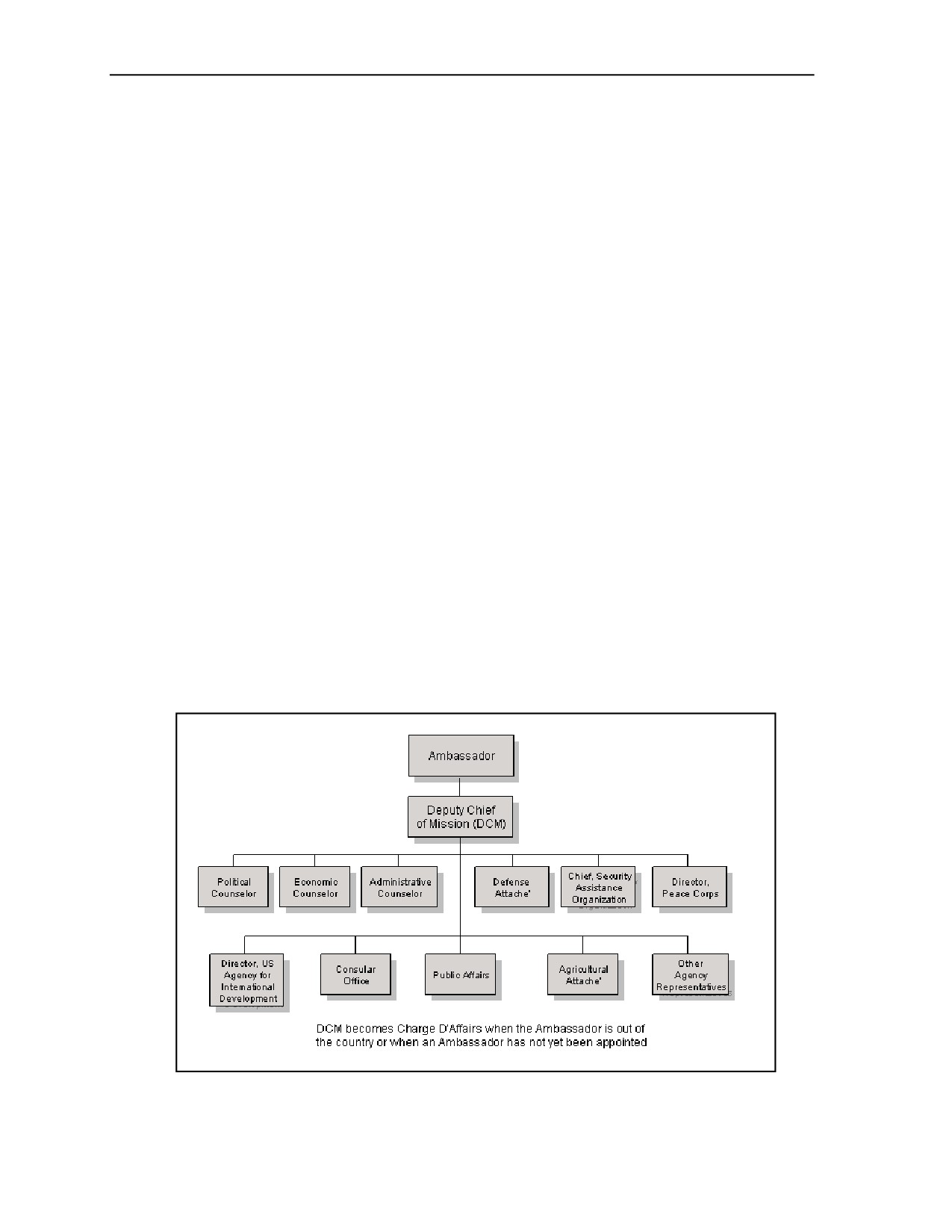
FMI 3-07.22
z
Railheads.
z
Border crossings.
z
Force protection.
z
Jurisdiction over members of the US and multinational forces.
z
Operations in the territorial sea and internal waters.
2-61. Commanders may create structures, such as committees, to address sovereignty issues.
To facilitate cooperation and build trust, military or nonmilitary representatives of the HN
may co-chair these committees. These organizations facilitate operations by reducing sensi-
tivities and misunderstandings and removing impediments. However, such issues are for-
mally resolved with HNs through the development of appropriate technical agreements to
augment existing or recently developed status of forces agreements. In many cases, security
assistance organizations, NGOs, and international organizations resident in the HN, having
detailed knowledge and the potential to establish good will in these areas, may be called
upon to assist in the conduct of operations or the establishment of a positive and constructive
relationship in the HN.
2-62. This coordination and support can exist all the way down to the community and village
levels. Soldiers should be aware of both the political and societal structures in the AOs they
are assigned. Political structures usually have designated leaders within the community who
are responsible to the government and people. However, the societal structure may have
other leaders who operate outside of the political structure. These leaders may be economic
(such as businessmen), theological (such as clerics and lay leaders), informational (such as
newspaper publishers or journalists), or family-based (such as elders or patriarchs). Some
societal leaders may emerge due to charisma or other intangible influences. Commanders
and the country team determine the key leaders, assess their level of support for US objec-
tives, and influence and co-opt them as appropriate.
COORDINATING STRUCTURES
2-63. At the HN national level, the US country team is the primary coordinating structure
for counterinsurgency. (See Figure 2-1.) Where multinational partners join the US, a na-
Figure 2-1. The Country Team Concept
2-12
Command and Control in a Counterinsurgency Environment
tional-level coordinating structure is formed, where the US country team participates in or
leads the multinational effort. At each subordinate political level of the HN government, a
coordinating structure, the civil military coordination center, is established, including repre-
sentative of the HN and HN forces, and US and multinational forces. This coordination cen-
ter facilitates the integration of all military and political actions. Below the lowest political
level, additional structures may be established, comparable to Neighborhood Watch, where
lower-level commanders and leaders can meet directly with local populace leaders to discuss
issues. Where possible, international organizations and NGOs should also take part in coor-
dination meetings to ensure their actions are integrated and deconflicted with military and
HN plans. The essential US goal is a single, controlling agency to direct all efforts with one
person in charge of all military and US agency operations. The purpose of this agency is to
produce a unified goal and direction.
CIVIL-MILITARY OPERATIONS CENTER
2-64. One mechanism for bringing all of the above elements together for coordination is the
CMOC. CMOCs can be established at all levels of command. The CMOC coordinates the in-
teraction of US and multinational forces with governmental organizations, international or-
ganizations, NGOs, and third-nation agencies and authorities. The CMOC is not designed as,
nor should it be used as, a C2 element. It is a coordination cell between nonmilitary agencies
and military forces. It is an extension of the commander’s guidance.
2-65. Overall management of a CMOC may be assigned to a multinational force commander,
shared by a US and a multinational commander, or shared by a US commander and a civil-
ian agency head. The CMOC provides both access and CMO-related data and information
from and to nonmilitary agencies operating away from the military headquarters. The
CMOC has no set composition. It is mission-oriented and staffed appropriately. In an
Army-managed CMOC, the plans officer or civil affairs coordinator is normally responsible
for management of, or participation in, the CMOC. It may be composed of, or augmented by,
military and civilian representatives from many different agencies. However, it normally
consists of a director, deputy director, and representatives from the operations, logistic, and
medical sections of the supported headquarters. It may include other elements, the person-
nel of which may come from the military, NGOs, international organizations, and third na-
tions, based on the situation. Senior CA officers normally serve as the director and deputy
director of the CMOC.
SECTION VI - RULES OF ENGAGEMENT
2-66. The proper application of force is a critical component to any successful counterinsur-
gency operation. In a counterinsurgency, the center of gravity is public support. In order to
defeat an insurgent force, US forces must be able to separate insurgents from the population.
At the same time, US forces must conduct themselves in a manner that enables them to
maintain popular domestic support. Excessive or indiscriminant use of force is likely to
alienate the local populace, thereby increasing support for insurgent forces. Insufficient use
of force results in increased risks to US and multinational forces and perceived weaknesses
that can jeopardize the mission by emboldening insurgents and undermining domestic popu-
lar support. Achieving the appropriate balance requires a thorough understanding of the na-
ture and causes of the insurgency, the end state, and the military’s role in a counterinsur-
gency operation. Nevertheless, US forces always retain the right to use necessary and
proportional force for individual and unit self-defense in response to a hostile act or demon-
strated hostile intent.
2-67. In planning counterinsurgency operations, it is imperative that leaders and Soldiers
understand that military force is not an end in itself, but is just one of the instruments of na-
tional power employed by the political leadership to achieve its broader objectives. A military
2-13
///////////////////////////////////////