FMI 3-07.22 Counterinsurgency Operations (2004-2006) - page 3
Intelligence
4-73. During counterinsurgency operations, the most important information and intelligence
will come from the population and those in direct contact with them—HUMINT. The quan-
tity and quality of this information and intelligence will depend on the credibility of the US
forces, the continuous security they provide the local population, and their ability to interact
with the local population (communicate and establish relationships with members of the lo-
cal population). Every member of the US force, whether on or off duty, is an informal
HUMINT collector and must be aware of the overall intelligence requirements and how their
interactions and observations may assist in the intelligence collection plan. This awareness
can and should be developed by regular briefings and debriefings.
4-74. Trained HUMINT collectors obtain information from people and multimedia to identify
elements, intentions, composition, strength, dispositions, tactics, equipment, personnel, and
capabilities within and affecting the local area. HUMINT can assist to establish and more
accurately understand the sociocultural characteristics of the local area.
4-75. HUMINT sources can provide early warning of deep-rooted problems awaiting US
forces during counterinsurgency operations. HUMINT collectors can conduct debriefings,
screenings, liaison, HUMINT contact operations, document exploitation, interrogations, and
tactical questioning in support of the commander’s intelligence requirements.
4-76. Information provided by HUMINT can greatly assist the intelligence staff in deducing
critical patterns, trends, and networks within the local area. HUMINT collection team per-
sonnel provide these types of capabilities in support of tactical forces. The S-2/G-2/J-2X coor-
dinates these capabilities between the tactical, operational, and strategic levels, and can pro-
vide their units with access to pertinent national level HUMINT.
4-77. Intelligence planning staffs must be aware that battlespace cannot generally be defined
in geographical terms for purposes of intelligence collection. This is especially important
when determining the allocation of HUMINT assets. Concentrations of humans on the bat-
tlefield do not necessarily denote a need to concentrate HUMINT assets in those locations.
Threat actions outside a unit’s AO may be a source of significant events inside a unit’s AO.
Additionally, information from sources in one AO may impact operations in a distant AO.
Creating arbitrary intelligence boundaries can result in a lack of timely fusion of all critical
elements of information that may be available.
IMAGERY INTELLIGENCE
4-78. Imagery intelligence is intelligence derived from the exploitation of imagery collected by
visual photography, infrared, lasers, multispectral sensors, and radar. These sensors produce
images of objects optically, electronically, or digitally on film, electronic display devices, or
other media (JP 1-02).
4-79. IMINT has some severe limitations during counterinsurgency operations. Imaging sys-
tems cannot distinguish between insurgents masquerading as civilians and the general
population. Additionally, imaging systems cannot see through buildings in built-up areas, so
low-flying aerial imagery collection platforms often have restricted fields of vision. Likewise
they cannot see threats that may be located inside buildings. Additionally, aerial platforms
that do not have standoff capabilities may be at risk of being destroyed by local enemy air
defense fire.
4-80. There are several key advantages that imagery can provide to the commander. UAV
imagery may be one of the fastest, least risky methods by which to conduct reconnaissance of
specific areas and to update and verify current maps of that area, showing clear routes, ob-
stacles such as damaged and destroyed buildings, and intact and destroyed bridges. The to-
pographical team can use this imagery to create updated mapping products for planning and
operational uses.
4-13
FMI 3-07.22
4-81. Cameras co-located with MASINT systems, such as REMBASS, and activated when
those systems are triggered can give the commander additional “eyes on” named areas of in-
terest without wasting manpower by continuously staffing an observation post in those loca-
tions.
4-82. Providing patrols with a digital camera or video camera can greatly assist in the de-
briefing process and allow the intelligence staff personnel to make their own judgments
about items of interest that the patrol reports. Videotaping of events, such as a demonstra-
tion, can allow analysts who were not on the scene to identify key elements, leaders, and po-
tential indicators to help preclude future incidents. Gun-camera images from aircraft that
can provide a stand-off reconnaissance platform may give valuable insight into enemy TTPs.
Thermal sights on a vehicle patrolling an urban street late at night may note the hot engine
of a vehicle on the side of the road, possibly indicating suspicious activity.
4-83. The Joint Surveillance Target Attack Radar System (JSTARS) can provide such infor-
mation as the amount of vehicular traffic entering and leaving an area via multiple avenues,
which can be useful when trying to determine if the enemy is shifting forces into or out of a
specific region, or if there is a covert attempt to exfiltrate or infiltrate the region via lesser-
used avenues. This could include monitoring traffic crossing international borders.
4-84. The National Geospatial Agency can provide a wide range of imagery products for use
prior to and during operations in the urban environment. These products are usually easier
to obtain prior to deployment and are often critical to the initial planning stages of an opera-
tion.
SIGNALS INTELLIGENCE
4-85. Signals intelligence is a category of intelligence comprising either individually or in
combination all communications intelligence, electronic intelligence, and foreign instrumen-
tation signals intelligence, however transmitted; intelligence is derived from communica-
tions, electronics, and foreign instrumentation signals (JP 1-02). SIGINT has three subcate-
gories:
z
Communications intelligence. The intelligence derived from foreign communi-
cations by other than the intended recipients (JP 1-02).
z
Electronic intelligence. Technical and geolocation intelligence derived from for-
eign non-communications electromagnetic radiations emanating from other than
nuclear detonations or radioactive sources (JP 1-02).
z
Foreign instrumentation signals intelligence. Technical information and intel-
ligence derived from the intercept of foreign electromagnetic emissions associated
with the testing and operational deployment of non-US aerospace, surface, and sub-
surface systems. Foreign instrumentation signals intelligence is a subcategory of
signals intelligence. Foreign instrumentation signals include but are not limited to
telemetry, beaconry, electronic interrogators, and video data links (JP 1-02).
4-86. SIGINT is of value whenever there is any form of electronic emission, whether from
communications (such as hand-held or citizen’s band radios and mobile phones), combat net
radio transmissions, or for other purposes such as the radio control of explosive devices or
use of radar for surface-to-air missile guidance. The easy availability of high-tech communi-
cations and monitoring equipment now allows most nations to have a relatively sophisticated
SIGINT capability.
4-87. Insurgent groups may use unencrypted, low-power, communications systems to conduct
local operations. Ground-based SIGINT collection assets must be properly positioned in ad-
vance to be certain that they can obtain the best possible intelligence from these sources.
4-14
Intelligence
4-88. Collection of unencrypted threat signals can provide key indicators for threat courses of
action. Patterns in the amount of known enemy encrypted signals provide indications of spe-
cific threat courses of action. Because of signal bounce within urban areas, direction-finding
capabilities for all SIGINT collection systems are significantly impaired. During counterin-
surgency operations, it may be possible for the local authorities to monitor local telephone
lines and provide relevant information they collect to US forces. Likewise, it may be possible
for US forces to tip off local national authorities as to what telephone numbers may yield
valuable intelligence.
MEASUREMENT AND SIGNATURE INTELLIGENCE
4-89. MASINT is technically derived intelligence that detects, locates, tracks, identifies, or
describes the specific characteristics of fixed and dynamic target objects and sources. It also
includes the additional advanced processing and exploitation of data derived from IMINT
and SIGINT collection.
4-90. MASINT provides important intelligence at the tactical level. Systems such as ground
surveillance radars have limited uses in the urban environments because of the lack of wide-
open spaces in which they most effectively operate. For that same reason, they can cover
large, open areas that are possible avenues of approach or infiltration/exfiltration routes
within a unit’s AO. Systems such as REMBASS and the Platoon Early Warning Device can
play a primary role in monitoring many of the numerous avenues of approach that cannot be
covered by human observers due to manpower constraints. REMBASS can monitor avenues
such as subterranean passageways (or entrances and exits to such passageways), entrances
and exits on buildings, fire escapes on buildings, base camp perimeters, and traffic flow
along routes (especially foot trails that may be used to infiltrate and exfiltrate personnel and
equipment between urban and rural areas).
COUNTERINTELLIGENCE
4-91. CI is focused on countering adversary intelligence collection activities against US
forces. During counterinsurgency operations, CI personnel primarily investigate adversary
intelligence collection threats and provide force protection assistance. In conjunction with
HUMINT collections, CI agents conduct screening operations to identify personnel that may
be of CI interest or have CI leads. CI screening is also conducted during the process of hiring
HN citizens (such as linguists). CI investigations and operations may cross-cue the other in-
telligence disciplines and may in term be cross-cued by the other disciplines. CI personnel
work in conjunction with military police, engineers, and medical service personnel to create
threat vulnerability assessments that provide commanders and leaders with a comprehen-
sive force protection assessment.
4-92. CI personnel provide analysis of the adversary’s HUMINT, IMINT, SIGINT, and
MASINT capabilities in support of intelligence collection, terrorism, and sabotage in order to
develop countermeasures against them. CI analytical products are important tools in course
of action development in the military decision making process.
4-93. CI technical services that may be available and of use during counterinsurgency opera-
tions include surveillance, computer network operations (assisting in protecting US informa-
tion and information systems while exploiting and/or attacking adversary information and
information systems), technical surveillance countermeasures (identifying technical collec-
tion activities being carried out by adversary intelligence entities), IO, and counter-signals
intelligence. As with scouts and reconnaissance patrols, CI teams are most effective when
linguist support is provided.
4-15
FMI 3-07.22
ISR PLANNING IN COUNTERINSURGENCY OPERATIONS
4-94. ISR tasks are the actions of the intelligence collection effort. ISR tasks consist of three
categories:
z
Intelligence.
z
Surveillance.
z
Reconnaissance.
4-95. Developing the counterinsurgency operational ISR plan is different from developing the
plan supporting conventional operations. Due to the unconventional nature of the counterin-
surgency environment, the ISR effort will be significantly more complex in combining and in-
tegrating HUMINT collectors and surveillance assets with the capabilities and tasks of lim-
ited ISR-assigned assets as well as integrating with interagency resources. Techniques must
be modified for every operation to accomplish ISR requirements—each operation is unique.
Additionally, local, national, and multinational ISR assets must be integrated into the over-
all ISR plan at both the local, district, and regional levels.
4-96. The key to successful ISR efforts is the integration of all ISR-capable units, local and
HN government and interagency organizations throughout the entire operations process
(plan, prepare, execute, and assess). The coordinated actions of the entire staff to develop the
threat and environment portion of the common operational picture are key to providing suc-
cessful ISR support to the commander. (For information on reconnaissance and surveillance
tasks, see FM 7-15.)
4-16
Chapter 5
Psychological Operations and Military Police Support
GENERAL
5-1. As discussed in Chapter 2, leaders must incorporate PSYOP and military police sup-
port into planning for counterinsurgency operations. PSYOP has an integral role in influenc-
ing behaviors and attitudes of friendly, neutral, and hostile target audiences. Tactical
PSYOP teams often will accompany combat units that have close contact with indigenous
personnel. Leaders must know how to use the PSYOP units effectively to enhance success of
the mission. Military police assist commanders with area security, criminal investigations,
maintaining law and order, and detaining prisoners or other personnel. Military police can
also provide support to establish or enhance integrated police and penal systems, consistent
with US law. This chapter is an overview of the roles these two support units play in a coun-
terinsurgency environment.
SECTION I - PSYCHOLOGICAL OPERATIONS
5-2. The purpose of PSYOP is to influence target audience behaviors so that they support
US national policy objectives and the combatant commander’s intentions at the strategic, op-
erational, and tactical levels of war. PSYOP provide a commander the means to employ a
nonlethal capability across the range of military operations (offense, defense, stability, and
support) and spectrum of conflict, from peace through conflict to war and during postconflict
operations. (See FM 3-13 for a discussion of PSYOP as an IO element.)
MISSION OF PSYCOHOLOGICAL OPERATIONS
5-3. The mission of PSYOP is to influence the behavior of foreign target audiences to sup-
port US national objectives. PSYOP accomplishes this by conveying selected information and
advising on actions that influence the emotions, motives, objective reasoning, and ultimately
the behavior of foreign audiences. Behavioral change is at the root of the PSYOP mission. Al-
though concerned with the mental processes of the target audience, it is the observable modi-
fication of target audience behavior that determines the mission success of PSYOP. Leaders
and Soldiers must recognize that everything they do or choose not to do has a psychological
impact.
5-4. PSYOP is an integral part of all counterinsurgency activities. They meet the specific
requirements for each area and operation. Mission planning for PSYOP in counterinsur-
gency must be consistent with US and multinational objectives—military, economic, and po-
litical. PSYOP planners must be thoroughly familiar with all aspects of the HN environment
in which PSYOP is employed. This includes the history, culture, economics, politics, regional
influence, and other elements that affect the people in the HN.
5-5. Commanders must consider the psychological impact of military and nonmilitary
courses of action. PSYOP emphasize assessing the potential threat to the HN and the United
States. PSYOP support the achievement of national goals by specific target audiences. In
counterinsurgency, specific PSYOP goals exist for the following target groups:
5-1
FMI 3-07.22
z
Insurgents. To create dissension, disorganization, low morale, subversion, and de-
fection within insurgent forces. No single way exists to influence foreign targets de-
liberately. Planning stems from the viewpoint of those affected by a conflict. The
HN’s government needs national programs designed to influence and win insur-
gents over to its side.
z
Civilian populace. To gain, preserve, and strengthen civilian support for the HN’s
government and its counterinsurgency programs.
z
Military forces. To strengthen military support, with emphasis on building and
maintaining the morale of these forces. The loyalty, discipline, and motivation of
the forces are critical factors in combating an insurgency.
z
Neutral elements. To gain the support of uncommitted foreign groups inside and
outside the HN. Effective ways of gaining support are to reveal the subversive ac-
tivities and to bring international pressure to bear on any external hostile power
sponsoring the insurgency.
z
External hostile powers. To convince them the insurgency will fail.
z
Local government. To establish and maintain credibility.
5-6.
PSYOP can assist counterinsurgency by reaching the following goals:
z
Countering hostile propaganda.
z
Improving popular support for the HN government.
z
Discrediting the insurgent forces to neutral groups and the insurgents themselves.
z
Projecting a favorable image of the HN government and the United States.
z
Supporting defector programs.
z
Providing close and continuous PSYOP support to CMO.
z
Establishing HN command support of positive populace control and protection from
insurgent activities.
z
Informing the international community of HN and US intent and goodwill.
z
Passing instructions to the HN populace.
z
Developing HN PSYOP capabilities.
TACTICAL PSYCHOLOGICAL OPERATIONS
5-7. At the tactical level, PSYOP are the supported commander’s most readily available as-
set to communicate with foreign target audiences. Tactical PSYOP forces provide a powerful
capability to the supported commander whether providing information during humanitarian
assistance operations or broadcasting surrender instructions while supporting combat opera-
tions. PSYOP disseminate products at the tactical level at the most personal level: through
face-to-face communication, dissemination of visual products, or from the close proximity of a
loudspeaker. Tactical PSYOP Soldiers can often obtain immediate feedback from the target
audience they are trying to influence. When attached to a maneuver battalion or company,
the tactical PSYOP team disseminates PSYOP products using visual, audio, or audiovisual
means. The tactical loudspeakers employed by the teams can achieve immediate and direct
contact with a target audience and are used heavily during counterinsurgency operations.
5-8. Tactical PSYOP teams can perform other tasks. In addition to disseminating printed
materials, they perform face-to-face communication, gather and assess the effectiveness of
friendly PSYOP and propaganda, and acquire PSYOP-relevant information from the local
populace.
TACTICAL PSYCHOLOGICAL OPERATIONS TEAM
5-9. TPTs provide PSYOP dissemination in support of operations conducted by conventional
and SOF units. The TPT is a three-person team commanded by a staff sergeant. The TPT’s
5-2
Psychological Operations and Military Police Support
primary purpose is to integrate and execute tactical PSYOP into the supported commander’s
operation. The TPT also advises the commander and staff on the psychological effects of their
operations on the target audience in their AO, as well as the effects of propaganda, and an-
swer all PSYOP-related questions. The TPT can conduct face-to-face, communication, loud-
speaker operations, and dissemination of approved audio, audiovisual, and printed products.
They are instrumental in the gathering of PSYOP-relevant information, conducting town or
area assessments, observing impact indicators, and gathering pretesting and posttesting
data. TPTs also conduct interviews with the target audience. They take pictures and docu-
ment cultural behavior for later use in products. TPTs often play a role in establishing rap-
port with foreign audiences and identifying key communicators that can be used to achieve
US national objectives. Tactical PSYOP can increase the supported unit commander’s ability
to operate on the battlefield by reducing or minimizing civilian interference.
5-10. Tactical PSYOP can potentially reduce the number of casualties suffered by the sup-
ported unit by reducing the effectiveness of insurgent forces through surrender appeals and
cease resistance messages.
5-11. Tactical PSYOP can assist the supported unit commander in gaining the tactical ad-
vantage on the battlefield through the use of deception measures, allowing the commander
to have the element of surprise.
5-12. In high intensity conflict, a TPT is normally assigned to each maneuver battalion. In
stability operations in general and in counter insurgency in particular, the TPT should sup-
port each company or Special Forces ODA. The TPT must interact with the local population
continuously to be effective. Most operations that interact with the population regularly are
planned and executed at the company/ODA level. Given current force protection doctrine the
TPT will not be effective if employed above the company/ODA level in supporting counter in-
surgency.
ADVISING THE SUPPORTED COMMANDER
5-13. The TPT leader plays a key role as advisor to the supported commander. The leader
analyzes proposed actions by the supported unit and how they may affect the target audi-
ences within the AO. PSYOP planners are involved in the targeting process. For example, if
the supported commander wants to destroy a bridge that is used by local civilians to trans-
port goods to and from market, the TPT leader should advise him on the possible adverse ef-
fect this may have on the civilians. The TPT leader may also advise the commander on spe-
cific insurgent forces to target with PSYOP in order to reduce their effectiveness.
LOUDSPEAKER OPERATIONS
5-14. Loudspeaker operations are an extension of face-to-face communications. During opera-
tions in which violence is an element, the loudspeaker is the most effective PSYOP medium.
Loudspeakers achieve immediate and direct contact with the enemy. When a loudspeaker
broadcasts, the enemy becomes a captive audience that cannot escape the message. The loud-
speaker can move rapidly to wherever an exploitable PSYOP opportunity is found and can
follow the target audience when the target audience moves. The loudspeaker achieves, in ef-
fect, face-to-face communication with the adversary. Loudspeakers transmit speeches, music,
news, warnings, or sound effects.
PRINTED PRODUCTS
5-15. The dissemination of printed products by TPTs and other Soldiers is a very effective
way of disseminating PSYOP to target audiences. TPTs usually disseminate printed prod-
ucts by hand, in a face-to-face manner, which lends credibility to the product. Following is a
5-3
FMI 3-07.22
list of some of the types of printed products a TPT might disseminate: posters, novelty items,
leaflets, handbills, newspapers, pamphlets, and magazines.
FACE-TO-FACE COMMUNICATIONS
5-16. Face-to-face communication is the foundation of tactical PSYOP and the most common
and effective capability that TPTs bring to the supported unit. Increasing rapport, trust, and
credibility with the target audience is accomplished through effective face-to-face communi-
cation. This method also allows PSYOP Soldiers the best way of engaging with a target audi-
ence about complex issues. The give and take of personal communication is the most effec-
tive form of PSYOP over the long term because it builds rapport and establishes a personal
connection with the target audience.
PRETESTING AND POSTTESTING
5-17. PSYOP personnel use pretesting and posttesting to predict and assess the effectiveness
of products on a target audience. An important function of TPTs is that of testing.
TOWN AND AREA ASSESSMENTS
5-18. This assessment collects detailed information that is useful for the development of
PSYOP. TPTs must ensure these town and area assessments are as complete as possible and
forward them up the chain of command so they can be incorporated into higher planning and
shared with intelligence sections benefiting all levels of command.
RADIO AND TELEVISION STATION ASSESSMENTS
5-19. TPTs assess radio and television stations on almost every mission. Once the TPT
makes contact with a station manager, it is important that they maintain that relationship.
Establishing a good, habitual working relationship can be an effective way to help ensure the
ability to exploit the indigenous broadcast capability, such as a radio station.
CIVIL DISTURBANCE
5-20. TPTs will often find themselves assisting in the control of crowds and defusing a poten-
tially hostile situation. This may occur as a member of a planned quick reaction force or on
the spur of the moment.
PROPAGANDA ASSESSMENTS AND COUNTERPROPAGANDA
5-21. Propaganda is any form of communication in support of national objectives designed to
influence the opinions, emotions, attitudes, or behavior of any group in order to benefit the
sponsor, either directly or indirectly (JP 1-02). Propaganda can be directed against an enemy
or potential adversary to disrupt or influence any instrument of national power—diplomatic
information, military, or economic. This information is normally directed at the United
States, multinational partners, and key audiences in the AO. PSYOP personnel advise the
commander and staff of the current situation regarding the use or anticipated use of adver-
sary propaganda in the AO. PSYOP personnel advise commanders on recommended coun-
terpropaganda measures to defeat or diminish the impact of propaganda. Executing success-
ful counterpropaganda involves all of the commander’s assets to collect the wide variety of
information and propaganda existing in an area. Due to the sheer volume of information and
potential sources, PSYOP forces do not have the organic ability to collect all available infor-
mation.
5-4
Psychological Operations and Military Police Support
PSYCOHOLOGICAL OPERATIONS CONSIDERATIONS
5-22. The following highlights several considerations for countering hard-line insurgencies
from a PSYOP perspective:
z
Do not approach the insurgency as only a series of criminal acts. View the situation
through the microscope of root causes of insurgencies. The actions may be the be-
ginnings of a highly organized and deeply rooted insurrection.
z
Maintain the respect of the HN government officials, security forces, and civilian
population. Reward repentant insurgent sympathizers. Build the infrastructure of
cooperative areas and publicize those accomplishments to the less-than-supportive
groups. Seeing neighbors being compensated for their help will positively influence
others to join in and secure them and their family from insurgent retribution.
z
Emphasize the Soldier’s primary role is to both serve as an ambassador of goodwill
to the populace and to destroy the insurgents.
z
Include the HN government and security forces in the detailed planning, message
content, and operational execution of the counterinsurgency operation.
z
Realize that the practice of judgment, persistency, patience, tact, justice, humanity,
and sympathy are necessary on the part of the HN government and supporting
multinational forces. These traits are essential to the achievement of moral and
psychological superiority over the insurgents. Legitimate forces must fully recog-
nize that they represent the better state of things that are being offered to the local
populace.
z
Follow the two guiding principles on the conduct of operations in counterinsur-
gency:
The objective is to achieve decisive gains with the least use of combat force and
resultant loss of lives.
The relationship with the local populace must be based on security, truth, help-
fulness, and kindness.
SECTION II - MILITARY POLICE
5-23. Military police forces provide a robust and dynamic combat capability during a counter-
insurgency. Military police Soldiers possess the diverse mobility capabilities, lethality in
weapons mix, and trained communications skills to operate in any environment. The actions
of the 18th Military Police Brigade supporting Operation Iraqi Freedom demonstrate the di-
versity and flexibility of military police functions. These Soldiers conducted over 24,000 com-
bat patrols; processed over 3,600 enemy prisoners of war, detainees, and insurgents; confis-
cated over 7,500 weapons; and trained over 10,000 Iraqi police officers. Military police
patrols came under direct or indirect attack over 300 times throughout the operation.
5-24. The five military police functions—maneuver and mobility support operations, area se-
curity, police intelligence operations, law and order, and internment/resettlement opera-
tions—all apply to counterinsurgency operations.
MANEUVER AND MOBILITY SUPPORT OPERATIONS
5-25. Military police support counterinsurgency operations through maneuver and mobility
support operations in a variety of ways, to include—
z
Supporting straggler and displaced person operations.
z
Conducting route reconnaissance and surveillance missions.
z
Conducting main supply route regulation and enforcement operations (to include
checkpoints and roadblocks).
5-5
FMI 3-07.22
AREA SECURITY
5-26. Military police operations within the area security function to support counterinsur-
gency may include—
z
Reconnaissance operations.
z
Conducting critical site, asset, and high-risk personnel security operations, to in-
clude security of high-value convoys (Class III or V).
z
Conducting combat patrols throughout the AO (to include cordon and search opera-
tions).
z
The military police firepower, mobility and communications ability provide critical
reconnaissance, information-collection, and response-force capabilities to the com-
mand.
Police Intelligence Operations in Kosovo
TF 504 Military Police established the police intelligence collection and analy-
sis council (PICAC) in support of TF Falcon 3B’s peacekeeping operations in
Multinational Brigade (East), Kosovo. PICAC was a joint law enforcement fo-
rum with an exclusive membership of key leaders and decision makers that
spanned across national and international law enforcement, security, and intel-
ligence agencies, to include the UN Civilian Police, UN Border Police and UN
Security; TF Falcon ACE chief, analyst, and targeter; CID commander and in-
vestigators; military police S-3 and S-2; and joint law enforcement intelligence
and operations officers. The PICAC came together weekly for a fusion and tar-
geting forum. The PICAC was responsible for the detention of over a dozen
wanted felons, to include subjects of war crimes investigations. In fact, during
one PICAC meeting, a civilian police investigator from the Kacanik municipality
mentioned a criminal’s name in association with a known gang. The criminal
had been convicted for attempted murder, had not served his term, and re-
mained at large with no means to identify him. The TF Falcon ACE chief imme-
diately phoned his office to crosscheck the criminal’s name in the ACE data-
bases. TF Falcon ACE was able to provide a picture of the criminal during that
same forum, enabling UN Civilian Police to identify and arrest the man the next
day.
POLICE INTELLIGENCE OPERATIONS
5-27. Police intelligence operations are a military police function that supports, enhances,
and contributes to the commander’s force protection program, common operational picture,
and situational understanding. The police intelligence operations function ensures that in-
formation collected during the conduct of other military police functions is provided as input
to the intelligence collection effort and turned into action or reports (FM 7-15). Military po-
lice gather information regarding threat, insurgent, and criminal groups for evaluation, as-
sessment, targeting, and interdiction. Working closely with military intelligence personnel
and turning the information into actionable intelligence products, military police conduct po-
lice intelligence operations through integrated patrols (both mounted and dismounted) and
coordination with joint, interagency, and multinational assets. Military police patrols greatly
assist in confirming or denying the commander’s critical information requirements.
LAW AND ORDER OPERATIONS
5-28. Military police perform a variety of functions in support of counterinsurgency:
5-6
Psychological Operations and Military Police Support
z
Law enforcement patrols throughout the AO, maintaining and assisting in stability
and security operations.
z
The conduct of criminal investigations through coordination and synchronization of
Criminal Investigation Division assets.
z
Military police are the ideal force for conducting crowd and riot control operations,
including the extraction of leaders. Military police control antagonistic crowds en-
gaged in rioting, looting, and demonstrating.
z
Military police are trained and equipped to assist in the training and mentoring of
local police forces.
INTERNMENT AND RESETTLEMENT OPERATIONS
5-29. Military police conduct internment and resettlement operations to maintain stability
and security throughout the AO. Critical assets to the proper conduct and success of intern-
ment and resettlement operations in a counterinsurgency environment are—
z
Staff judge advocate representatives.
z
Civil affairs.
z
Engineers.
z
Military intelligence.
z
Medical and dental.
z
Liaison with International Committee of the Red Cross.
z
Public affairs.
z
Religious representation.
DETAINEE OPERATIONS
5-30. Because of their contact with the local populace in counterinsurgency, military police
must be aware of how they are perceived by the local culture. Military police must be trained
to be cognizant of cultural differences that can have a negative impact on the PSYOP cam-
paign. There also must be clear lines of authority and responsibility established for military
police guarding prisoners or detainees. Negative propaganda from mistreatment of prisoners
or detainees can undermine US and HN credibility. (See Appendix I.)
USA CRIMINAL INVESTIGATION DIVISION COMMAND
5-31. The Criminal Investigation Division Command investigates offenses committed against
US forces or property, offenses committed by military personnel or civilians serving with US
forces, or where there is a military interest. Its agents investigate violations of international
agreements and the law of war. The command’s missions include—
z
Investigating and deterring serious crimes.
z
Conducting sensitive/serious investigations.
z
Collecting, analyzing, processing, and disseminating criminal intelligence.
z
Conducting protective-service operations for designated personnel.
z
Providing forensic-laboratory support.
z
Maintaining Army criminal records.
z
Enhancing the commander’s crime-prevention and force-protection programs.
z
Performing logistic security operations.
MILITARY WORKING DOGS
5-32. Military working dogs are a largely untapped resource. Dogs are trained in many skills,
some of which can make a difference between success and failure of many combat missions.
5-7
FMI 3-07.22
Dogs are trained for patrolling, searching buildings, scouting, or explosive detection. All of
these skills compliment performing the five military police functions. The ability of dogs to
detect an ambush and to find an explosive device planted by insurgents can be critical to the
overall success of the mission. The use of military working dog teams to increase combat po-
tential and enhance response shortages is limited only by a lack of training on how to employ
dogs. Dogs cannot be used as a security measure against detainees. They can be used to rein-
force security measures against penetration and attack by enemy forces. Some examples of
employment techniques are—
z
Perimeter patrolling.
z
Main supply route patrolling.
z
Security of designated personnel, units, or facilities.
z
Use during checkpoints and roadblocks.
z
Enemy prisoner of war, detainee, and insurgent control.
z
Mine and tunnel detection.
z
Area reconnaissance operations.
5-8
Chapter 6
Health Considerations, Movement Security, and Civil
Disturbances
GENERAL
6-1. Although many of the considerations applicable to counterinsurgency operations are
also applicable to conventional operations, some require special emphasis. This is primarily
because counterinsurgency operations often take place closer to civilians than conventional
operations. This close proximity requires leaders to place greater emphasis on health consid-
erations, movement security, and reactions to civil disturbances. This chapter addresses
those considerations.
SECTION I - HEALTH SERVICE SUPPORT CONSIDERATIONS
6-2. During counterinsurgency operations, Soldiers have a greater probability of close con-
tact with the civilian population than during many conventional operations. For that reason,
leaders and Soldiers work with Army Medical Department personnel and policies to conserve
the fighting strength. Disease and nonbattle injury historically cause the most casualties
during operations. Proper training, appropriate risk management, and the application and
enforcement of effective preventive medicine measures can prevent many injuries and ill-
nesses. Enforcement and application of health and preventive medicine standards are a
leader’s responsibility. (See Appendix G.)
6-3. Appropriate and limited medical attention may be applied to indigenous populations at
the discretion of the commander and proper military medical authority. This care may be
appropriate where the level of local civilian medical care is limited or nonexistent. Limited
medical assistance may enhance the acceptance of multinational personnel within the local
population. If possible, HN medical personnel should be included when treating indigenous
people. This can enhance the stature of the HN government. Media coverage of medical as-
sistance can create a positive effect on people’s views of the HN. Nonetheless, the media
should be unobtrusive to avoid creating a perception that medical attention is being provided
primarily to gain favorable press attention.
6-4. Be aware of and sensitive to local culture, customs, and taboos relative to medical care
and the interactions of multinational personnel with the local population. Be tactful and cul-
turally appropriate when giving medical or humanitarian assistance.
6-5. Take care not to overextend or take on a mission greater than policy or capability dic-
tates. Medical care must not interfere with operations from a logistic or personnel stand-
point, nor constitute or imply an overall policy, absent the proper approval from appropriate
authority.
6-6. Be prepared to train indigenous forces, in first aid or other health-preventive medicine
subject areas. Coordination with higher preventive medicine or veterinary service personnel
may be appropriate in the indigenous population area.
6-7. All interactions between Soldiers and indigenous populations are opportunities to make
positive impressions and have the potential to change attitudes for the better with the local
population. Every effort should be made for Soldiers to be viewed as friends of the local popu-
6-1
FMI 3-07.22
lation; indeed, this may pave the way for willing acceptance of multinational personnel and
activities.
6-8. Force protection and the timely collection of potential intelligence are always primary
planning and implementation factors regardless of the mission—medical or humanitarian.
Force protection is always an imperative, and intelligence gathering throughout the AO is
always a top priority.
SECTION II - SECURITY DURING MOVEMENTS
6-9. This section addresses convoy operations in a counterinsurgency environment. Convoys
are planned and organized to control and protect vehicle movements. They are used for the
tactical movement (personnel, supplies, and equipment) of combat forces and logistic units.
Movements made during a counterinsurgency operation face a variety of potential threats,
including local individuals, IEDs, and insurgents. Leaders continually assess the insurgents’
tactics and implement measures to counter them. Soldiers conducting movement security
operations remain vigilant at all times. (See FM 3-90 and FM 55-30 for troop movement doc-
trine.)
CONVOY OPERATIONS
6-10. Key to the success of convoy operations is ensuring all personnel and equipment are
properly prepared. All Soldiers in the convoy must have a task and purpose, and know what
to do on contact during execution of convoy operations.
6-11. An important leader check is to review all actions, including their timing, to avoid set-
ting patterns. Enemies use such patterns to predict friendly actions and plan attacks. Inte-
grate this review throughout all operations, including after-action reviews.
CONVOY PLANNING CONSIDERATIONS
6-12. Consider the following when planning and preparing for convoys:
z
En route recovery.
z
Ambulance/medical coverage. (Most ambulances have radio communications, to in-
clude casualty evacuation procedures.)
z
Disperse combat lifesavers throughout convoy.
z
Designate responsibilities such as aid and litter teams.
z
Prepare a rest plan for drivers.
z
Use window screens to deflect grenades.
z
Implement security measures to prevent pilferage from the convoy.
z
Arrange for escorts— military policy, infantry, or other.
z
Disperse key personnel throughout the convoy. Cross-load equipment.
z
Identify and verify convoy signals.
z
Identify en route reference points and available fire support.
z
Coordinate for air cover (rotary-wing security, close air support, mobile interdiction
and radio frequencies and call signs).
z
Prepare an air guard plan.
z
Prepare a deception plan.
z
Submit a closure report at destination and upon return.
z
Perform a reconnaissance of the route if possible (air reconnaissance is the pre-
ferred method).
6-2
Health Considerations, Movement Security, and Civil Disturbances
z
Determine threat capabilities and potential courses of action (to include a mine
overlay from higher, regional or local headquarters, if available).
z
Civilian considerations along the route.
z
Establish phase lines/checkpoints along the route to monitor progress of the convoy.
z
Determine choke points along the route—bridges, open-air markets, over-, and un-
derpasses?
z
Know whether vegetation grows next to and away from the road and thereby pro-
vides concealment.
z
Determine insurgent convoy attack patterns. Base this assessment on S-2 input
and pattern analysis.
z
Vary supply convoy SP times (by no more than 1 hour sooner or later) to keep in-
surgents off balance.
z
Describe and verify the vehicle abandonment plan. Include how long to wait before
stripping and leaving a disabled vehicle or trailer. Prepare a transfer-loading plan
for the cargo.
z
Establish the condition criteria to abandon a vehicle. Establish when to destroy it,
burn it, or leave it.
z
Arrange seats in the back of trucks to allow Soldiers riding to face out.
z
Increased convoy speeds (such as 50 miles per hour) limit movement up and down
the convoy line.
z
When the roads are only one or two lanes wide, civilian traffic will impede any ad-
jacent movement.
MISSION BRIEFING
6-13. Execute a mission briefing two hours before the SP time. Include—
z
Tactical brief—enemy and friendly situation update from S-2.
z
Convoy execution matrix (all drivers get strip maps).
z
Safety brief—use risk management and risk reduction (mitigating measures).
z
Vehicle dispersion and distance intervals during operations and specific battle
drills.
BATTLE DRILLS
6-14. Battle drills associated with convoy operations may include—
z
React to civil disturbance (not blocking the route).
z
React to potential opposing force (blocking the route).
z
Air attack.
z
Artillery/indirect fire.
z
Sniper fire.
z
Ambush.
z
Mines, booby traps, and IEDs.
z
Mechanical breakdowns.
z
Procedures for towing and being towed.
z
React to traffic jams—partially and fully blocked roads.
z
React to debris on the road—garbage, dead animals, other objects/trash that can be
used to conceal IEDs.
z
MEDEVAC procedures (see Appendix H).
6-3
FMI 3-07.22
REHEARSALS
6-15. Rehearsals include—
z
Battle drills. Describe expectations for everyone. Describe who does what in each
situation.
z
Routes. Paint routes and terrain features on a large piece of canvas to allow driv-
ers to “walk” the route prior to departure.
z
Casualty evacuation. Establish what happens to casualties. Ensure aid and litter
teams are designated and know what to do. Ensure security teams are designated,
assigned cardinal directions, and rehearsed.
z
Communications. Includes audio, visual, and radio. Ensure all know the back-up
plan if primary communication fails. Can cellular phones be used effectively in an
emergency? Ensure redundant means of communication are available and all know
how to use them.
z
Primary and secondary frequencies. Ensure all know the call signs and fre-
quencies for close air and fire support.
z
Security forces. Ensure roles and responsibilities are understood and rehearsed.
z
Response/reaction forces. Ensure leaders know the location of response/reaction
forces. Ensure all know the call signs and frequencies for them.
CONVOY ORGANIZATION
6-16. Leaders must know how to position vehicles within the elements. Regardless of size, all
columns, serials, and march units (see FM 3-90) have four parts: scout, head, main body, and
trail. Each of these parts has a specific function.
Scout
6-17. Two scout vehicles proceed three to five minutes in front of the main body. The scout’s
task is to ascertain road conditions and identify obstacles that may pose a threat to the con-
voy. When scout vehicles are employed, leaders plan to react quickly to an attack on those
vehicles. However, conditions may not allow for the use of scout vehicles. If so, consider ear-
lier convoys acting as scouts. Consider requesting the deployment and use of UAVs to recon-
noiter the route.
Head
6-18. The head is the first vehicle of each column, serial, and march unit. Each head vehicle
has its own pacesetter. The pacesetter rides in this vehicle and sets the pace needed to meet
the scheduled itinerary along the route. The leader at the head ensures that the column fol-
lows the proper route. He may also be required to report arrival at certain checkpoints/phase
lines along the route. The head vehicle also looks for possible IEDs. When passing bridges,
gunners first observe the approach and then the opposite side of the bridge. With the head
vehicle performing these duties, the convoy commander has the flexibility to travel the col-
umn to enforce march discipline when the convoy speed is low. Use a heavy, well-protected
vehicle as the head vehicle if mines or IEDs are expected.
Main Body
6-19. The main body follows the head vehicle and consists of the majority of vehicles moving
with the convoy. The main body may be divided into serials and march units for ease of con-
trol. Vehicles in the main body are armed with crew-served weapons.
6-4
Health Considerations, Movement Security, and Civil Disturbances
Trail
6-20. The trail is the last element of each march column, serial, and march unit. The trail
leader is responsible for recovery, maintenance, and medical support. The recovery vehicle,
maintenance vehicles, and medical support vehicles/teams are located in the trail. The trail
leader assists the convoy commander in maintaining march discipline. He or she may also be
required to report clear time at checkpoints or phase lines along the route. In convoys con-
sisting of multiple march units and serials, the convoy commander may direct minimum sup-
port in the trail of each serial or march unit and a larger trail party at the rear of the col-
umn.
6-21. The convoy commander provides trail security and communications in case the trail
party is left behind to make repairs or recovery. An additional technique is to establish a
heavily armed and fast security detachment trailing the convoy by no more than five min-
utes. This time interval enables the security detachment to react and maneuver to an insur-
gent’s flank to counterattack in the event the convoy is fixed or otherwise unable to maneu-
ver against attackers.
SECURITY TECHNIQUES
6-22. The enemy may place IEDs at intersections where vehicles tend to slow down and
bunch up. Ensure proper spacing at all times between vehicles, especially at intersections
and turns.
6-23. When making turns, move the vehicle as far away from the curb as possible due to
most IEDs being located on the inside turn.
6-24. Soldiers must maintain 360-degree security at all times.
6-25. Leaders must adapt quickly to the insurgents changing tactics to counter threats.
Note: Convoys must maintain 360-degree security and visibility of the surrounding
areas. Attacks may occur after convoys pass a given location. Therefore, gunners
must ensure rear security is maintained.
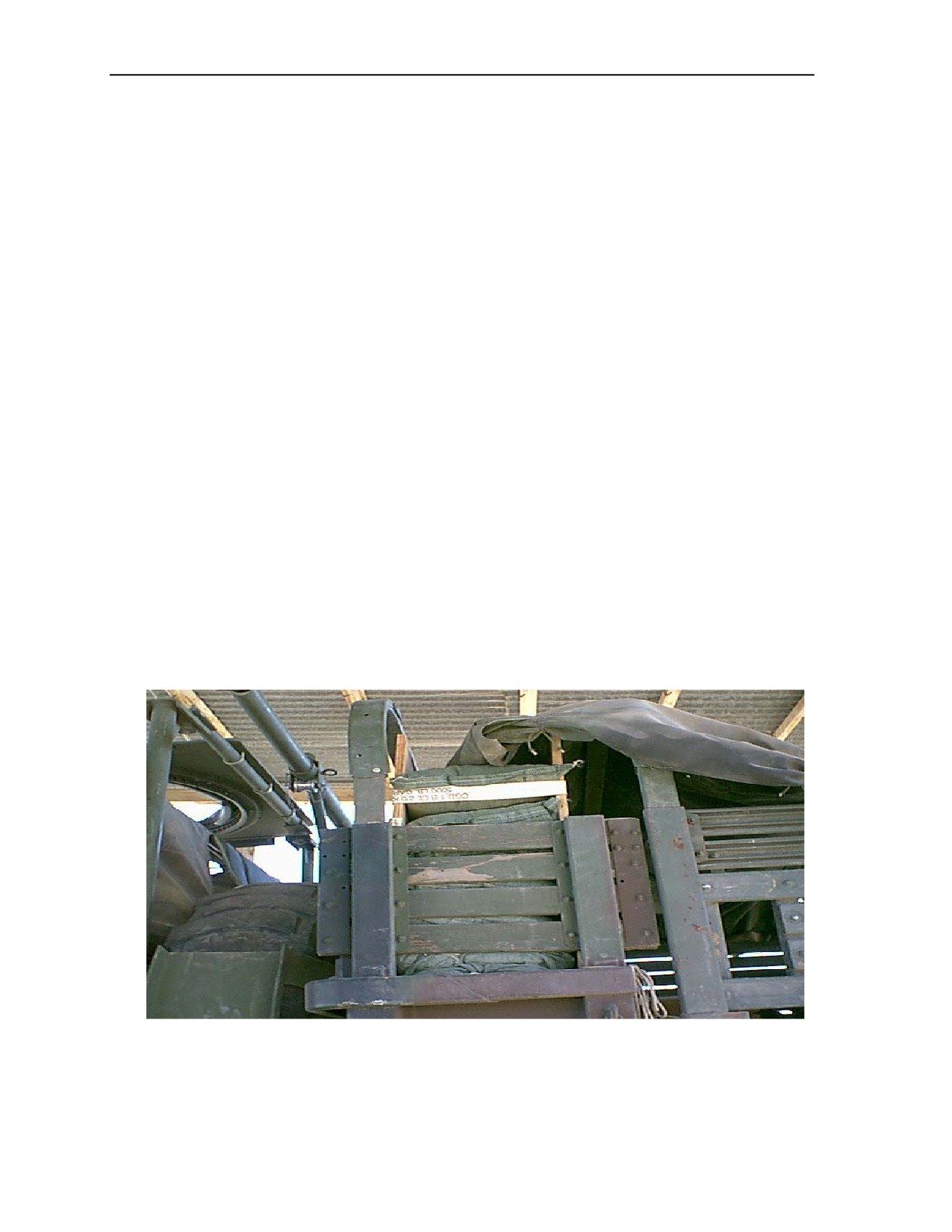
VEHICLE HARDENING PROCEDURES
6-26. When threat conditions warrant, commanders harden vehicles before convoy opera-
tions.
6-27. Adding sandbags, armor plating, ballistic glass, and other protective devices reduces
the vulnerability of a hardened vehicle to the effects of explosives and small arms fire. The
primary purpose of hardening is to protect the vehicle’s occupants from injury, although it
may make certain vehicle components and cargo less vulnerable.
6-28. Consider the following factors in determining the method and extent of vehicle harden-
ing when a threat to friendly forces exists:
z
Flexibility. Harden vehicles to provide the degree of protection required while
maintaining maximum flexibility in its use. Harden the cargo beds of vehicles with
sandbags to protect troops.
z
Weight. All vehicle hardening adds weight to the vehicle. This requires command-
ers to reduce the amount of cargo carried.
z
Availability. Consider the availability of suitable materials and the time needed
to complete the project.
6-5
FMI 3-07.22
z
Types of Roads. Roads traveled may determine the amount of hardening protec-
tion needed. For example, hardtop roads generally present fewer hazards from
mines than dirt roads.
z
Maintenance.
Vehicle hardening normally increases the amount of vehicle maintenance
needed. If an excessive amount of weight is added, it may impact on the vehi-
cle’s mobility and operational capabilities.
Kevlar blankets are effective and minimize extra weight. Unfortunately, the
excess weight destroys the tires and the drive train quickly. Operating with
hardened vehicles requires leaders to emphasize preventive maintenance
checks and services.
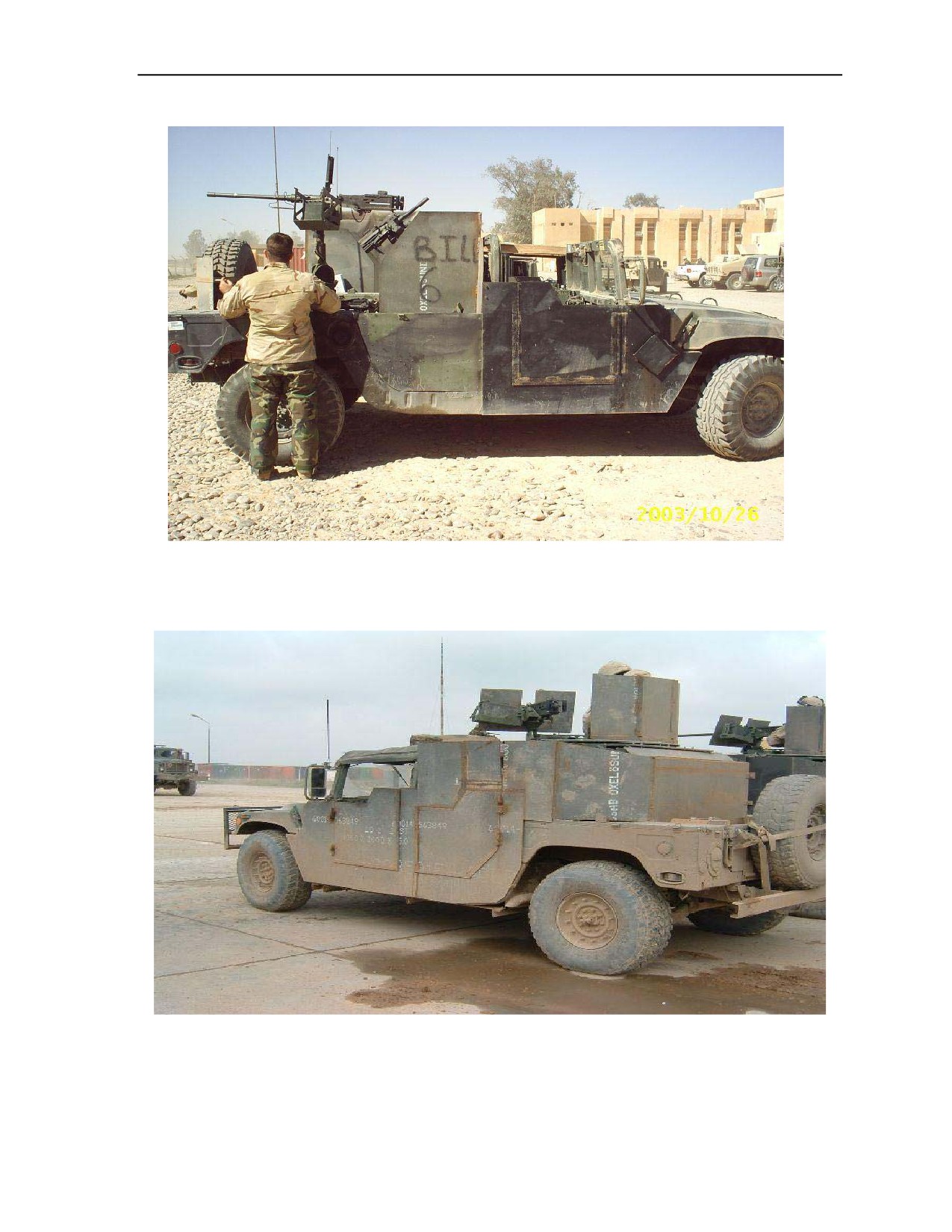
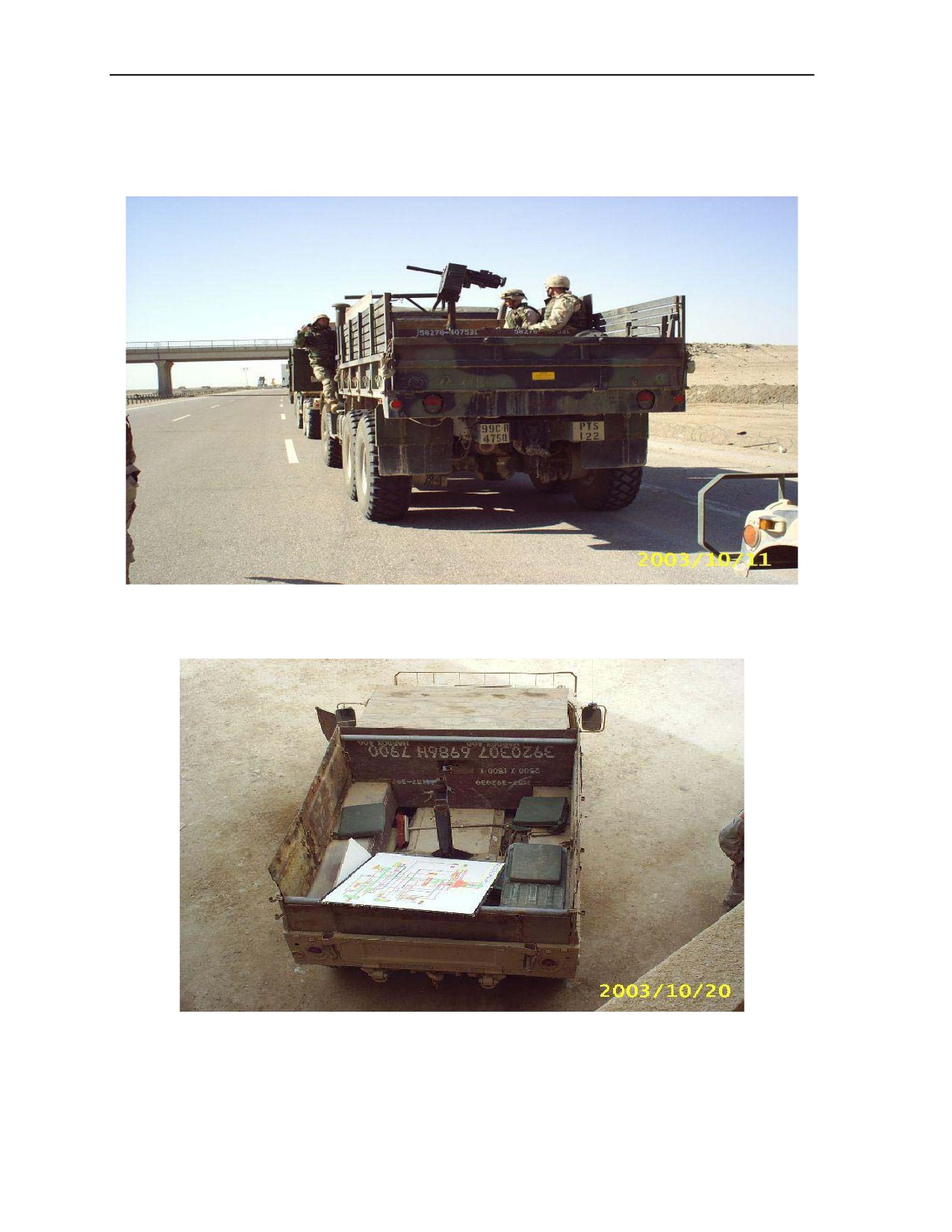
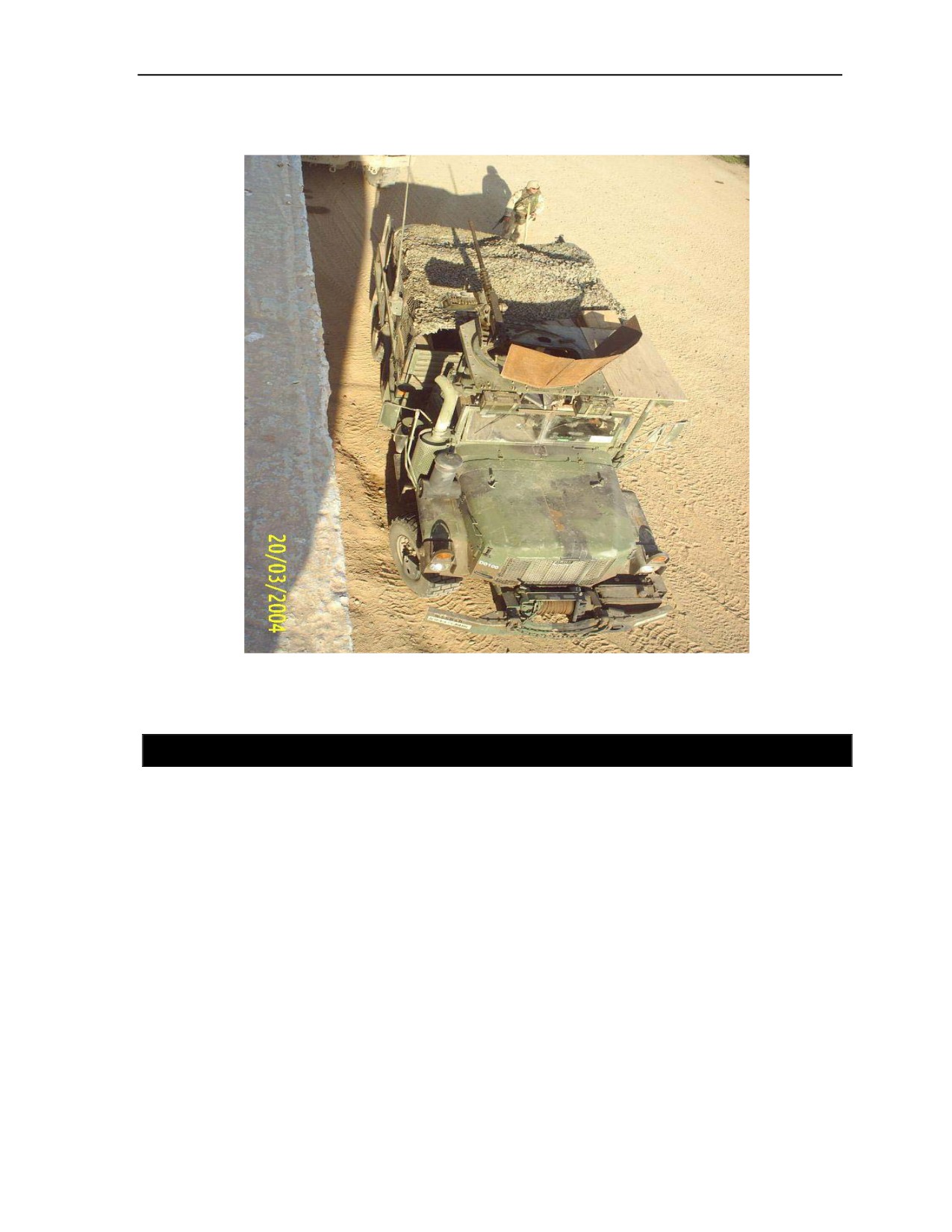
VEHICLE WEAPON IMPROVEMENTS
6-29. Strengthening the vehicle weapons platforms is an additional countermeasure against
insurgent attacks. When convoys come under attack, the key to defeating and destroying the
attackers is well-aimed, overwhelming fire. By adding to an already existing weapons
mix/platform for a particular vehicle, Soldiers have the capacity to exponentially enhance
their own force protection while destroying attackers. Modifications used during the Viet-
nam War may be seen at <www.landscaper.net/theguns.htm>. Figures 6-1 through 6-6
(pages 6-6 through 6-9) show examples used during Operation Iraqi Freedom.
6-30. Where the situation allows, military police and other forces may be able to establish a
security corridor along a supply route. This requires extensive patrolling along the route to
identify potential ambush and IED sites. It has an additional requirement to search struc-
tures along the route and confiscate any weapons found. Active patrolling is a visible pres-
ence that becomes a deterrent to enemy action. In Operation Iraqi Freedom this technique
was found to provide a measure of security for convoys that was not obtained simply by arm-
ing the vehicles.
Figure 6-1. Vehicle Hardening (Notice Sandbags)
6-6
Health Considerations, Movement Security, and Civil Disturbances
Figure 6-2. Vehicle Hardening and Pedestal Mount
Figure 6-3. Gunner Shields to the Rear and Front
6-7
FMI 3-07.22
Figure 6-4. Armor Plating Surrounding the Gun Platform
Figure 6-5. Armor Plating Surrounding the Gun Platform (Also on Bed of
the Truck)
6-8
Health Considerations, Movement Security, and Civil Disturbances
Figure 6-6. Gunner’s Shield and Camouflage for the Bed of the
Truck
SECTION III - CIVIL DISTURBANCE MEASURES
6-31. Active patrolling and interaction with the local populace can alert US, HN, and multi-
national forces to the possibility of civil disturbances. Patrols can detect changes in daily pat-
terns that may indicate the possibility of violence, observe new people who are not residents
of the area, or receive information about upcoming disturbances from those whom they have
befriended.
6-32. To combat civil disturbances, leaders apply the minimum force necessary to help HN
authorities restore law and order. Leaders and Soldiers remain aware that the media often
covers civil disturbances. Even when not covered, these disturbances are opportunities to
shape the information environment positively toward the US and the HN forces and gov-
ernment. Combatting these disturbances may involve the following:
z
Maintain the essential distribution, transportation, and communications systems.
z
Set up roadblocks.
z
Cordon off areas.
z
Make a show of force.
z
Disperse or contain crowds.
6-9
FMI 3-07.22
z
Release riot control agents only when directed to do so. (Only the President can au-
thorize US forces to use riot control agents.)
z
Serve as security forces or reserves.
z
Initiate needed relief measures, such as distributing food or clothing, or establish-
ing emergency shelters.
z
Employ nonlethal munitions and equipment.
6-33. Leaders plan and prepare their units for encountering civil disturbances during coun-
terinsurgency operations. Plans include not only how Soldiers and units react, but also the
use of tactical PSYOP teams. Leaders coordinate with local civil police to establish lines of
authority and responsibility when dealing with civilian disturbances. US military leaders
ensure operations involving US forces and HN police conform to US law and policy.
6-34. When planning and preparing for civil disturbance operations, commanders emphasize
prevention rather than confrontation. Once a confrontation occurs, military forces also deal
with noncombatants that have internationally recognized rights. These rights must be re-
spected while maintaining public order.
6-35. Military forces display fair and impartial treatment and adhere to the principle of
minimum force.
6-36. Civil police apprehend, process, and detain civil law violators. Military forces perform
these functions only when necessity dictates and to the minimum extent required. Return
these functions to civil authorities as soon as possible.
THREAT ANALYSIS
6-37. Proportional and appropriate responses to civil disturbances are based on an analysis
of the threat the disturbance poses. Factors to be considered are—
z
Crowd size. How many people are actually present? Of those, how many are com-
bative (armed or unarmed), and what type people comprise the crowd (grown men,
women, juveniles, children, or a mix)?
z
Motivator. Is this an individual leading the crowd or the crowd feeding on itself?
z
Driving force. What is the reason for the gathering/riot?
z
Emotions and intentions. Listen to what the crowd is saying. You may be able to
de-escalate the situation (treat the crowd like an individual person, but remain ob-
servant for changes).
z
Crowd evaluation. Will the size of the force affect the crowd?
z
Movement or motion. Where is the crowd trying to go?
z
Type of crowd clothing. Light or full due to heat or heavy coats to protect due to
cold. Clothing affects the type of munitions used and the aiming point.
z
Area and environment of the situation. This affects the types of munitions
used.
z
Availability of gravel or rocks. These can be thrown at the control force.
z
Escape routes for the crowd. There should be at least two avenues of escape
that the crowd can use.
z
Avenues of withdrawal for the control force. There must also be at least two
avenues of withdrawal for the formation.
CROWD CHARACTERISTICS
6-38. Control force leaders consider the following characteristics when assessing situations
involving crowds:
z
Crowd type.
6-10
Health Considerations, Movement Security, and Civil Disturbances
z
Crowd leadership.
z
Tactics the crowd is using.
TYPES OF CROWDS
6-39. There are four types of crowds:
z
Casual crowd. Required elements of the casual crowd are space and people.
z
Sighting crowd. Includes casual crowd elements and an event. The event provides
the group’s common bond.
z
Agitated crowd. Possesses the three elements of the sighting crowd plus the ele-
ment of emotion.
z
Mob. Characterized by hostility and aggression. A mob is an agitated crowd in-
volved in a physical activity.
6-40. To control the mob requires simultaneous actions. The primary goal is to reduce the
emotional levels of the individuals within the mob. This action will de-escalate the aggres-
siveness and potential violence of the crowd. Physical force of some type may be necessary to
quell the disturbance.
CROWD LEADERSHIP
6-41. Leadership affects greatly the intensity and direction of crowd behavior. A skillful agi-
tator can convert a group of resentful people into an angry mob and direct their aggression
and anger toward the control group. The first person to start giving clear orders authorita-
tively is likely to be followed. Radical leaders can easily take charge, exploit the crowd’s
mood, and direct it toward a convenient target.
6-42. It is important to note that the leader of the crowd or group does not necessarily fit into
one category. The leader may be combative, vocal, or seemingly low-key and may change
roles as needed. Properly identifying the leader of an angry or potentially violent group and
skillfully removing the leader without causing additional violence is key to defusing a poten-
tially dangerous situation.
CROWD TACTICS
6-43. Crowd tactics can be unplanned or planned, violent or not. The more organized and
purposeful a crowd becomes, the more likely the tactics used will have been planned. Organ-
ized mobs will try to defeat the control force by employing several different types of tactics.
These tactics include—
z
Constructing barricades.
z
Using Molotov cocktails, rocks, slingshots, and smoke grenades.
z
Feinting and flanking actions.
6-44. Crowd behavior during a civil disturbance is essentially emotional and without reason.
The feelings and the momentum generated have a tendency to cause the whole group to fol-
low the example displayed by its worst members. Skillful agitators or subversive elements
exploit these psychological factors during disorders. Regardless of the reason for violence,
the results may consist of indiscriminate burning and looting, or open and violent attacks on
officials, buildings, and innocent passersby. Rioters may set fire to buildings and vehicles
to—
z
Block the advance of troops.
z
Create confusion and diversion.
z
Achieve goals of property destruction, looting, and sniping.
6-11
FMI 3-07.22
6-45. Mobs will often use various types of weapons against authorities. These include but are
not limited to—
z
Verbal abuse.
z
Use of perceived innocents or weak persons (such as the elderly, women and chil-
dren) as human shields.
z
Thrown and blunt impact objects (such as rocks, bricks, and clubs).
z
Vehicles and other large movable objects.
z
Firearms, explosives, and other pyrotechnic devices.
TYPES OF RESISTERS
6-46. Individuals can be categorized according to what level of force they can use or what
threat they present:
z
Complacent resisters. Complacent resisters are nonverbal. They look at you
when you talk to them but do not reply in any way. They become limp when
touched or forced to move their body. They can very quickly become violent and
physically combative. Don’t underestimate them.
z
Vocal resisters. Vocal resisters offer a verbal reply and, when touched, highlight
themselves in an effort to gain the attention of the media.
z
Combative resisters. Combative resisters pose the greatest danger to the control
force. They are not passive once they are touched. Place the individual in a prone
position, cuff them, and remove them from the area. (See Appendix I.)
TACTICAL PSYOP TEAMS
6-47. TPTs using loudspeakers can help control crowds and defuse potentially hostile situa-
tions. TPT members may be assigned as members of a planned quick reaction force or take
part on the spur of the moment. In any case, proper planning, and a clear situational under-
standing are important to properly using TPTs.
6-48. The TPT leader assesses the situation by gathering as much information about the
situation as quickly as possible. The clearer the leader’s situational understanding, the more
effectively the plan can be developed, prepared for, and executed. Use the supported unit and
intelligence assets to find out what friendly units are in the area and use them to gather spe-
cific information. These assets may be ODAs, or military police. The following are examples
of the type of information that should be gathered during planning:
z
Location of the crowd.
z
Size of crowd.
z
Known potential key communicators.
z
Agitators.
z
Are weapons present? If so, what types?
z
Apparent grievance.
z
Stated goals of the crowd.
6-49. During the initial stages of the disturbance the team monitors and attempts to identify
facts and validate assumptions about the crowd. The TPT uses the following questions as a
guide to gain as complete an understanding as possible of the disturbance:
z
Identify the key communicators or lead agitator. What is his or her message?
z
What is the general attitude or behavior of the group?
z
How many people are present in the group?
z
What are the demographics of the group (age and gender)?
z
What is the cultural composition of the group?
6-12
Health Considerations, Movement Security, and Civil Disturbances
z
What language are they speaking?
z
How are they moving (mounted or dismounted)?
z
Are signs or banners present and, if so, what is the message?
z
Is there any media on site? If so, whom do they represent?
z
Are there any weapons present?
z
Who else is present at the location (police, elected public officials, nongovernmental
organizations, civil affairs elements, or other organizations)? Do you have the offi-
cials’ cell phone numbers?
z
Is the crowd from that community or have they come from another locale? If from
another locale, where, why and how?
z
How did the people know or hear about the gathering, rally, or demonstration?
z
What are their stated objectives or underlying grievances for the event?
6-50. When the commander directs the TPT to broadcast in this environment, the team ad-
heres to the following guidelines:
z
Give simple directions that are clear and concise.
z
Always maintain composure.
z
When constructing messages, avoid using the word “please” so the team does not
display a passive appearance.
z
Do not issue ultimatums that are not approved by the commander.
z
If the commander does approve an ultimatum, ensure that the crowd has time to
conform to its conditions.
z
Ensure the supported commander is prepared to act upon the ultimatum, should
the crowd fail to respond favorably.
z
Use approved lines of persuasion when possible. Conduct impromptu broadcasting
only as a last resort.
z
Always rehearse with the translator prior to going “live” unless the situation makes
this absolutely impossible.
z
Ensure the gender and other social aspects of the translator are credible in the eyes
of the crowd.
z
Always attempt to pick a broadcast position that communicates effectively with the
crowd and does not compromise the security of the team.
z
Direct the broadcast toward the primary agitators.
z
Limit the volume of the broadcast so as not to be overbearing, and do not harass
the crowd as this may only exacerbate the situation.
6-51. The team maintains communication with the supported commander or his or her rep-
resentative on the ground throughout the situation. The team leader also ensures PSYOP-
relevant, HUMINT, and priority intelligence requirement information are forwarded
through appropriate channels.
ELEMENTS OF A CONTROL FORCE FORMATION
6-52. Four elements make up the basic crowd control formation:
z
Base element. This is the front line of the formation. This element is made up of
two ranks. The first rank is shield holders while the second rank contains the
nonlethal weapons.
z
Support element. The support element forms in a column formation behind the
base element. It may be used to replace the base element members as needed or
provide lateral or direct support. It performs extraction team operations.
6-13

FMI 3-07.22
z
Command element. A general configuration for the command element is the pla-
toon leader, platoon sergeant, radio operator, and when required, the interpreter,
riot control agent dispenser operator, and video recorder operator.
z
Lethal overwatch element. The lethal overwatch element is a team task formed
from reserve security forces.
Commands
Command
Given By
Purpose
For
Formations
Platoon on Line
Platoon leader
To form a line formation
Platoon Wedge
Platoon leader
To form a wedge formation
Platoon Echelon
Platoon leader
To form an echelon formation
Platoon Diamond
Platoon leader
To form a diamond formation
Platoon Circle
Platoon leader
To form a circle formation
Platoon leader
Note: The platoon leader
identifies the proposed location for
Move
As a command of execution
the formation by pointing his or
her arm toward the next desired
location for the formation.
Support
To place specified unit in rear of
General Support
Platoon leader
base element
To place support elements on left
Lateral Support
Platoon leader
or right flank of base element
Moves support elements forward
Direct Support
Platoon leader
to strengthen the base element
Extraction team leader or
Opens a space in the formation
Open
squad/team leader
Informs the extraction team to
Up
Extraction team leader
start moving back to the main
formation
Fire
Weapon system
Readies nonlethal weapons
gunners, Number
gunners to fire weapons
of Rounds, Type
Platoon leader
For example, “203 gunners, 3
of Round,
rounds, area target, prepare to
Prepare to Fire
fire.”
Directs nonlethal weapons
Fire
Platoon leader
gunners to fire weapons
Shield holders kneel and lower the
Shield Down
Nonlethal weapons gunners
shield to the ground
Shield holders stand and raise the
Shield Up
Nonlethal weapons gunners
shields
Weapon
Used in formation when not in
Port Arms
Platoon leader
contact with crowd
Used by nonlethal weapons
gunners while the formation is in
High Port
Platoon leader
physical contact with the crowd,
rapid targeting and firing of
nonlethal weapons munitions
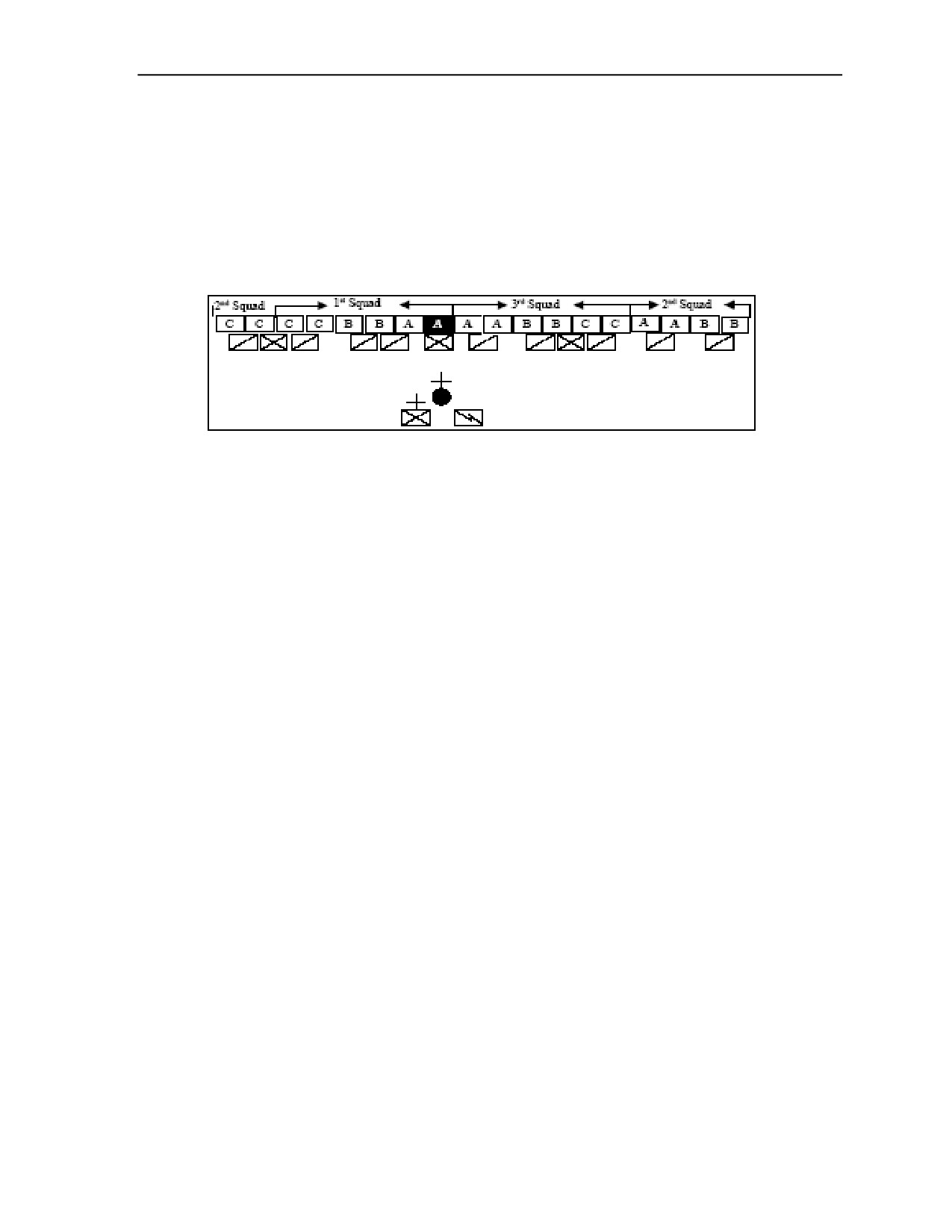
Figure 6-7. Common Control Force Formations and Commands.
6-14
Health Considerations, Movement Security, and Civil Disturbances
CONTROL FORCE FORMATIONS
6-53. The most frequently used control force formations are the line, echelon, and wedge.
Two formations used infrequently are the diamond and circle.
LINE
6-54. Use a line formation to move a crowd without dividing it or move it away from an object
or place. (See Figure 6-8).
Figure 6-8. Platoon Line
6-15
FMI 3-07.22
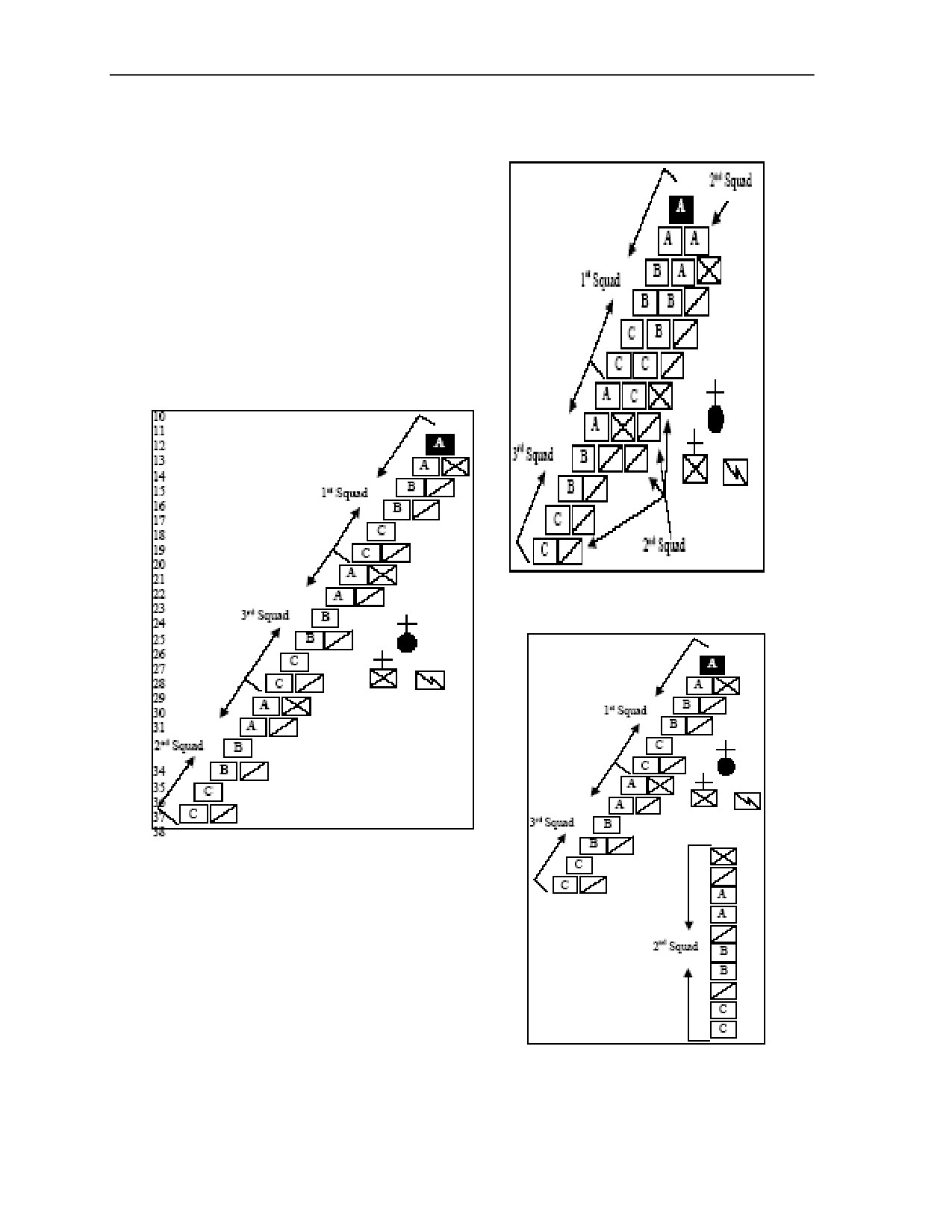
ECHELON
6-55. The echelon is an offensive formation used
to turn or divert groups in either open or built-
up areas and to move crowds away from
buildings, fences, and walls. (See Figures 6-9, 6-
10, and 6-11.)
Figure 6-10. Platoon echelon left
with 2nd Squad in direct support.
Figure 6-9. Platoon Echelon Left
Figure 6-11. Platoon Echelon Left with 2nd Squad in Lateral Support
6-16
Health Considerations, Movement Security, and Civil Disturbances
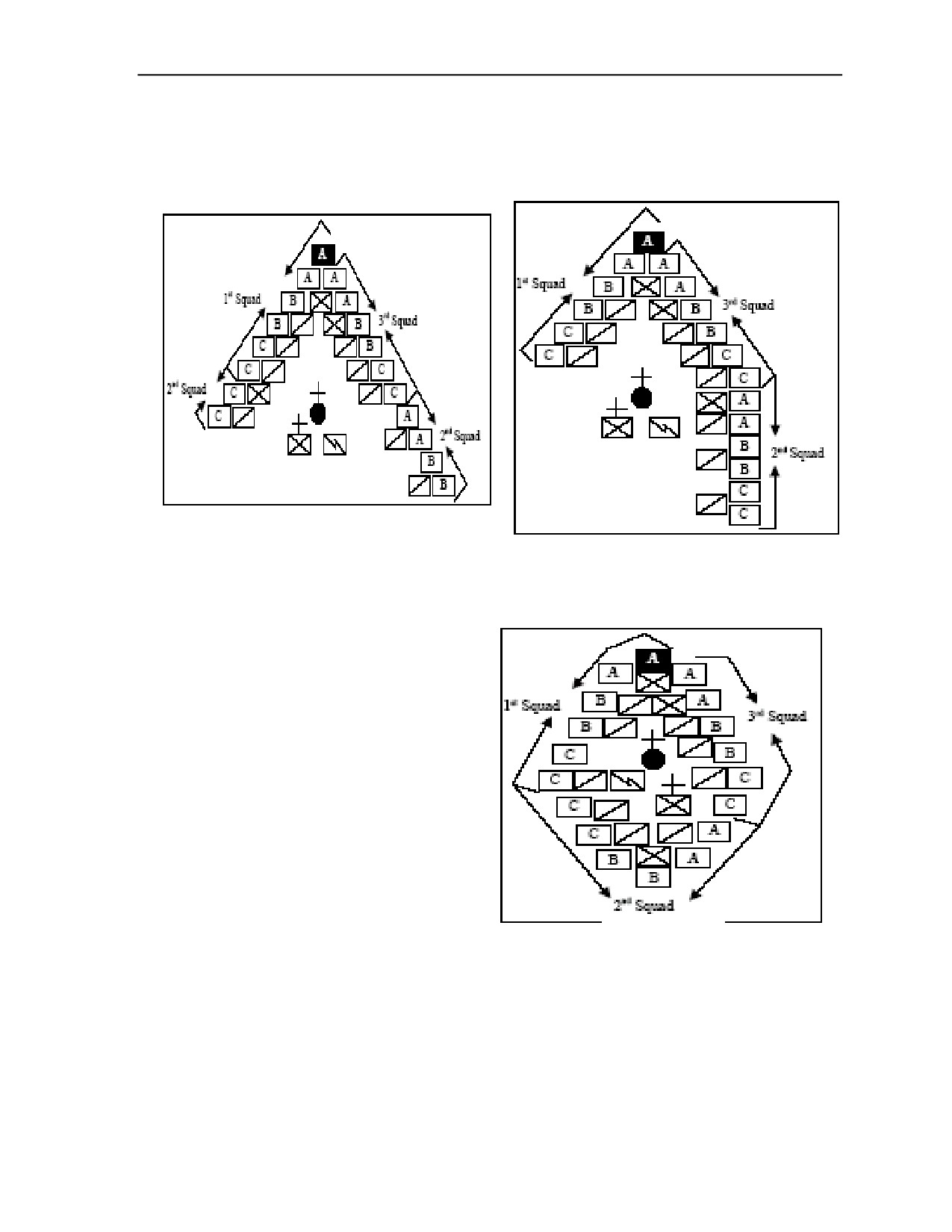
WEDGE
6-56. The wedge is an offensive formation that is used to penetrate and split crowds into
smaller groups. (See Figures 6-12 and 6-13.)
Figure 6-12. Platoon Wedge
Figure 6-13. Platoon Wedge with Right
Lateral Support
DIAMOND
6-57. A diamond formation is used to enter
a crowd. It is the formation of choice for ex-
traction teams. As a defensive formation,
the diamond is used when all-around secu-
rity is required, such as in open areas. (See
Figure 6-14.)
Figure 6-14. Platoon Diamond Formation
6-17
FMI 3-07.22
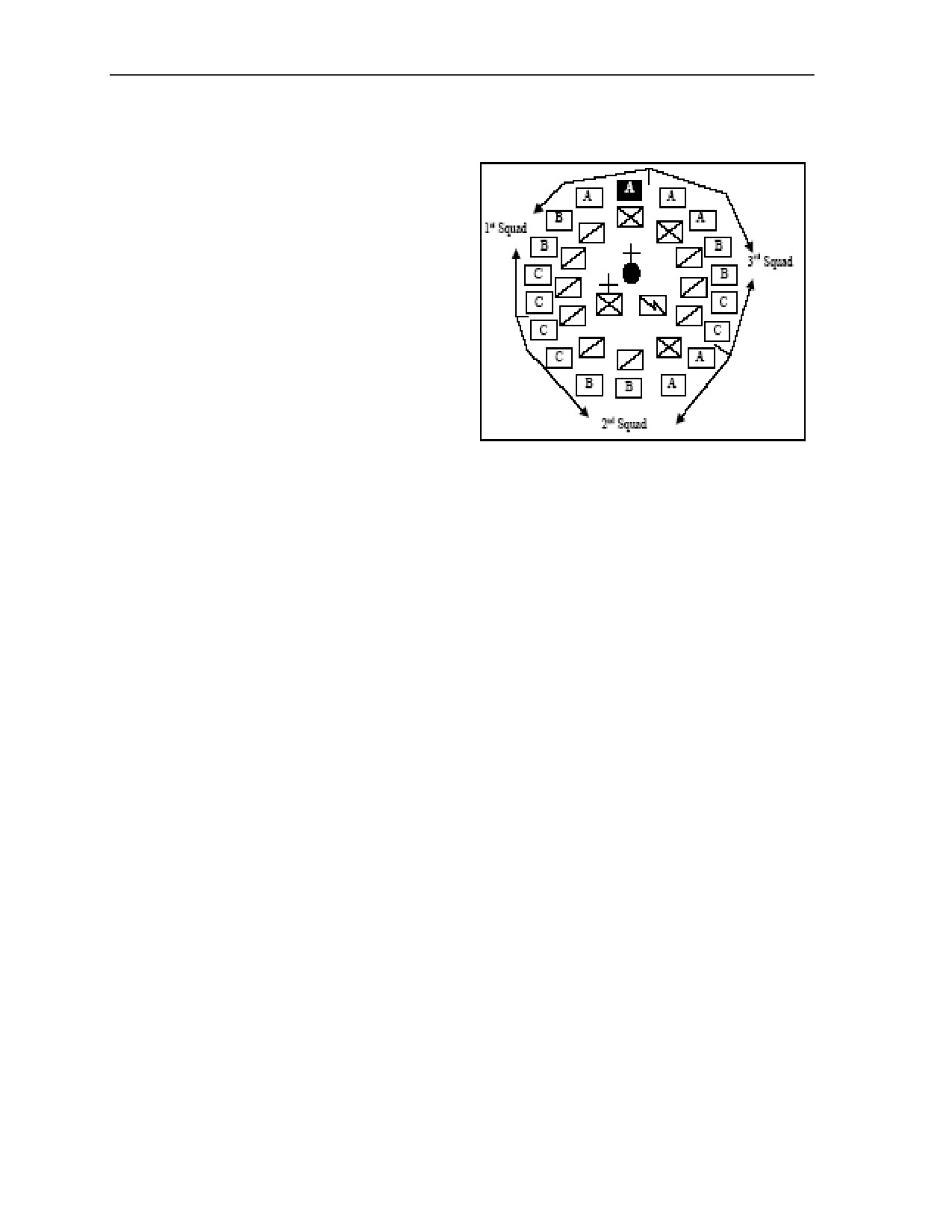
CIRCLE
6-58. The circle formation is used for the
same purposes as the diamond formation.
The decision to use either the diamond or
circle formation is based on the conforma-
tion of the crowd. (See Figure 6-15.)
VEHICLES AND FORMATIONS
6-59. Vehicles may be employed with troops
in control force formation especially when a
large rioting crowd is on hand. When using
vehicles, cover the windshield with sturdy,
close mesh fencing and the standard safety
glass. Create a buffer space between the two
surfaces.
6-60. Shields and or mobile barriers may be
Figure 6-15. Platoon Circle
built by mounting a wooden or metal frame
strung with barbed wire across the front of a
vehicle.
6-61. Members of the formation should walk as near to the front corners of each vehicle as
possible to keep rioters from attacking the sides and rear of the vehicles.
6-62. When up-armored HMMWVs or other armored vehicles are used in crowd control for-
mations, leaders ensure that they are able to see and control the formation.
CROWD CONTROL
6-63. Leaders choose their options based on an assessment of the crowd. Leaders select the
combination of control techniques and force options they believe will influence the particular
situation most effectively (based on METT-TC). Leaders choose the response they expect to
reduce the intensity of the situation. Options to consider for crowd control are—
z
Monitor the crowd to gather intelligence and observe to determine whether leaders
have emerged, volatility has increased, and movement.
z
Block the crowd’s advance upon a facility or area.
z
Disperse the crowd in order to prevent injury or prevent the destruction of prop-
erty.
z
Contain the crowd to limit it to the area it is occupying. This prevents it from
spreading to surrounding areas and communities.
CONTAINMENT VERSUS DISPERSAL
6-64. Dispersal may result in a crowd breaking into multiple groups, causing greater prob-
lems and continued threat to the control forces. A contained crowd has a limited duration;
their numbers are likely to diminish as individual needs take precedence over those of the
crowd.
6-65. Issue a proclamation to assist with dispersing a crowd. (See examples at Figure 6-16,
page 6-20.) A proclamation officially establishes the illegal nature of a crowd’s actions, and it
puts the populace on official notice regarding the status of their actions. If a proclamation is
issued, ensure action is taken to enforce it. Nonaction will be seen as a sign of weakness.
When issuing a proclamation, remember the following:
6-18
Health Considerations, Movement Security, and Civil Disturbances
z
Intent cannot exceed response capability.
z
Do not disclose the type of force/munitions to be used.
CROWD CONTROL TECHNIQUES
6-66. Use the following techniques to control crowds:
z
Ensure that ROE, levels of force and uses, and the commander’s intent (to include
non lethal weapon and lethal options, if necessary) are clearly understood by all.
z
Determine in advance the recent psychological characteristics of demonstrations
and mobs.
z
Identify local HN, community, and tribal officials in advance. Know their office and
cell phone numbers.
z
Establish command relationships and the authority to fire nonlethal weapons mu-
nitions.
z
Make an extraction plan and have flexible withdrawal drills.
z
Always maintain a lethal overwatch of a control force. When marksmen are de-
ployed, keep them covered and out-of-sight. Designated marksman teams build con-
fidence in the members of the control force.
z
Always maintain a reserve force to reinforce the control force. Hold reserves out-of-
sight.
z
Know who the media representatives are and where they are located. Ask them in
advance the theme of any story and information they are developing.
z
Be reasonable and balanced. However, a mob’s perceived lack of risk encourages ri-
oters.
z
Move the crowd, but don’t smash them. They will fight if smashed.
z
Maximize distance and barriers between crowd and control formations. Use
nonlethal weapons munitions to create a standoff distance.
z
If the use of force level escalates to a deadly force, adjusted aim points (head shots)
with nonlethal weapons munitions can produce lethal effects.
z
Create nonlethal weapons range cards for static positions.
z
Consider environmental conditions and their effect on the performance of less-than-
lethal munitions.
z
Keep in mind the potential for a lethal outcome is possible in all types of missions.
APPLICATION OF RULES OF ENGAGEMENT
6-67. The force applied will continually change dependent on the threat levels and ROE.
6-68. As the threat increases or decreases, the level of force increases or decreases based on
ROE.
INDIVIDUAL WEAPONS
6-69. The M9 pistol is the weapon of choice for extraction/apprehension teams.
6-70. Use of the M203 grenade launcher and 12-gauge shotgun are recommended with
nonlethal weapons munitions capability, especially for overwatch of frontline personnel.
6-71. Add nonstandard weapons, such as shotguns, for a greater nonlethal weapons capabil-
ity. Example: the shotgunner is used to protect the M203 gunner as he reloads.
6-72. Balance weapons mix and munitions according to METT-TC.
6-19
FMI 3-07.22
6-73. Soldiers in the front line of the formation should be armed with their standard weapon
carried across the back, butt up and muzzle down. The weapon is cleared and the magazine
is in the appropriate ammo pouch.
UNLAWFUL GATHERING
EMPLOYMENT
“Attention! Attention! This area must be cleared at
“Attention! Attention! Soldiers are present in this
once! Further unlawful behavior will not be
area. They are preparing to advance. Order must
tolerated. Clear this area at once or the necessary
and will be maintained. Disperse peaceably and
force to do so will be used.” *
leave this area. To avoid possible injury, leave at
once.
DEMONSTRATION
Disperse now and avoid possible injury! Disperse
“Disperse and retire peaceably! Disperse and retire
now and avoid possible injury!” *
peaceably! Attention all demonstrators!
(Repeat until Soldiers are committed.)
“The demonstration in which you are participating
ends at _____. The permit that was agreed to by
WHEN SOLDIERS ARE COMMITTED
the leaders of the demonstration expires at that
“Soldiers are advancing now. They will not stop
time. All demonstrators must depart from the _____
until this crowd is dispersed and order is restored.
NLT _____. All persons who wish to leave
To avoid injuries, leave the area at once. Return to
voluntarily may board the buses. These buses will
your homes as peaceful citizens. Soldiers have
go to the ______. Those who wish to take buses
their orders, and they will not stop until the crowd
should move to ______. Those demonstrators who
is dispersed. Avoid injury. Leave this area.” *
do not leave voluntarily NLT ________ will be
arrested and taken to a detention center. All
PRESENCE OF CHILDREN
demonstrators are urged to abide by the permit.” *
(Used in conjunction with other announcements.)
WARNING OF LOOTING
“Attention! Attention! Do not attempt to cause
“Return to your homes! Someone may be looting
further disorder. Disperse now in an orderly
them at this moment! During a disturbance, criminal
manner and avoid possible injury to children.
Return at once to your homes.” *
activity is at its peak. Your family and/or your
property may be in danger.” *
* Indicates the method, the streets, and direction that the crowd should use when dispersing.
Figure 6-16. Examples of Proclamations
SECTION IV - NONLETHAL EQUIPMENT AND WEAPONS
6-74. There are advantages and disadvantages in using nonlethal weapons.
z
Nonlethal weapons can be used alone, when they are backed up with the ability to
use lethal force, or in conjunction with lethal force. Leaders apply ROE to deter-
mine when and where nonlethal weapons may be used. ROE should not jeopardize
the right of Soldiers to protect life where necessary with lethal force.
z
Employ nonlethal weapons consistent with extant treaties, conventions, and inter-
national and national laws. Their use should be morally and ethically justifiable.
z
Use nonlethal weapons proportionately (the least destructive way to defeat insur-
gents) and discriminately (protect noncombatants from direct intentional attack).
z
In planning the employment of nonlethal weapons, fully rehearse the operational
response to all possible reactions.
z
Anticipate, coordinate, and prepare for responses from the civil, public affairs,
medical, and legal authorities as a consequence of unintended results and side ef-
fects caused by the use of nonlethal weapons.
z
Nonlethal weapons should be fully integrated with lethal weapons in order to pro-
vide a graduated response to a situation based upon the perception of the threat
and use of minimum force.
6-20
Health Considerations, Movement Security, and Civil Disturbances
z
Nonlethal weapons should not be deployed without considering countermeasures to
possible crowd reactions to their use.
z
Nonlethal weapons should not be deployed without political-military consideration
for instructions that may be given.
z
Nonlethal weapons should be employed so as to minimize friendly casualties troops.
6-21
Appendix A
Civil-Military Operations Assessment Checklist
COMMUNITY MAP
A-1. Obtain a map of the area or the community. If no map is available, draw one to scale.
A-2. Indicate road networks (include main and secondary roads).
A-3. Show location of such important places as religious institutions, schools, community
halls, and marketplaces.
A-4. Indicate distances to adjacent communities.
A-5. Describe what determines the center of the community and what factors are most im-
portant in giving the community its identification.
A-6. Describe the relation of the community as to the political, trade, school, and religious
areas with that of the adjoining communities.
A-7. Describe the weather and terrain features directly affecting the location or life of the
community.
HISTORY (AS IT AFFECTS THE PRESENT SITUATION)
A-8. Identify important people and events in the community’s history. Consider the follow-
ing:
z
Natural crises in the history of the community.
z
First settlement.
z
Incidents giving rise to conflicts or cooperation in the community.
z
Immigration and emigration.
z
Outstanding leaders and famous citizens in the community.
z
Prior interaction with foreign militaries.
POPULATION
A-9. Obtain the following information:
z
Census.
z
Common occupations of inhabitants.
z
Ethnic groups present, if applicable.
COMMUNICATION
A-10.Determine how inhabitants, groups, organizations, and governmental entities commu-
nicate within the community and with other communities. Consider the following:
z
Transportation (roads, water, rail, air).
z
Electronic (telephones, television, radio, internet, telegraph).
z
Printed material (newspaper, posters, magazines).
z
Mail facilities.
z
Connections with other communities.
A-1
FMI 3-07.22
z
Degree of self-sufficiency or isolation.
COMMUNITY INTEGRATION
A-11.Determine the groups or individuals that are independent of the local government; for
example, groups or individuals directly responsible to an outside or higher government. De-
termine the effects they have on the community. Determine the attitude of the local citizens
toward these individuals.
ECONOMIC SITUATION
A-12.Consider the following factors when assessing the economic situation:
z
Natural resources.
z
Industries.
z
Agriculture.
Crops and products, markets, ownership, and tenancy.
Who are the landlords?
Are they in the community or absentees?
z
Are there any local merchants? What is their influence on the community?
z
Professional (teachers, doctors, ministers).
z
Credit associations and their relations to the community.
z
Relative economic status of the people (debt, savings, taxes).
RELIGIOUS SITUATION
A-13.Consider the following factors when assessing the economic situation:
z
Number, make-up, attitude, and membership of each religion/sect.
z
Buildings and equipment.
z
Schools run by religious institutions.
z
Relationship of each religion/sect with the others. Do they clash or cooperate?
z
Holy sites.
EDUCATIONAL ORGANIZATIONS
A-14.Consider the following factors when assessing the influence of educational organiza-
tions:
z
Schools (number, size, territory served, buildings, equipment, libraries, and admin-
istrative structure).
z
History (how and by whom were the schools constructed?)
z
School activities and relation to the community.
VOLUNTARY ORGANIZATIONS
A-15.Consider the following factors when assessing the influence of voluntary organizations:
z
Number, types, composition of membership, equipment, activities, and relation to
other phases of community life.
z
Farmers’ co-ops (4-H-type organizations, home economic organizations).
z
Other occupational groups.
RECREATIONAL FACILITIES
A-16.Consider the following factors when assessing the influence of recreational facilities:
A-2