FMI 3-07.22 Counterinsurgency Operations (2004-2006) - page 5
FMI 3-07.22
Propaganda Activities Directed Against the Education System
• Appearance of questionable doctrine and teachings in the educational system.
• Creation of ethnic, tribal, religious, or other interest group schools outside the government
educational system, which propagate opposition themes and teachings.
• Charges that the educational system is only training youth to do the government’s bidding.
• Student unrest manifested by new organizations, proclamations, demonstrations, and strikes
against authority.
Table E-3. Commodities Indicators
Food-Related Activities
• Diversion of crops or meat from markets.
• Unexplained shortages of food supplies when there are no reports of natural causes.
• Increased reports of pilfering of foodstuffs.
• Sudden increase in food prices, possibly indicating an opposition-levied tax.
• Unwillingness of farmers to transport food to population centers, indicating a fear of traveling
highways.
• Spot shortages of foodstuffs in regions or neighborhoods associated with a minority group or
weaker competing interest groups, while food supplies are generally plentiful in other areas.
Conversely, sudden local shortages of foodstuffs in rural areas may indicate the existence of an
armed opposition group operating in that region.
• Sudden increase of meat in markets, possibly indicating slaughtered livestock because of a lack
of fodder to sustain them.
• Appearance of emergency relief supplies for sale in black markets, possibly indicating diversion
from starving populations.
• Appearance of relief supplies for sale in normal markets in a country or region recently suffering
from large-scale hunger, which may indicate the severity of the food crisis, is diminishing.
Arms and Ammunition-Related Activities
• Increased loss or theft of weapons from police and military forces.
• Discovery of arms, ammunition, and explosives being clandestinely manufactured, transported,
or cached.
• Attacks on patrols resulting in the loss of weapons and ammunition.
• Increased purchase of surplus military goods.
• Sudden increase in prices for arms and ammunition to the open market.
• Reports of large arms shipments destined for neighboring countries, but not intended for that
government.
• Reports of known arms traffickers establishing contacts with opposition elements.
• Increase in armed robberies.
• Reports of thefts or sudden shortages of chemicals that could be used in the clandestine
manufacture of explosives.
• Reports of large open-market purchases of explosive-related chemicals without an identifiable
industrial user.
• Appearance of manufactured or smuggled arms from noncontiguous foreign countries.
Clothing-Related Activities
• Unusual, systematic purchase or theft of clothing materials that could be used for the
manufacture of uniforms or footwear.
• Unusual scarcity of clothing or material used in the manufacture of clothing or footwear.
• Distribution of clothing to underprivileged or minority classes by organizations of recent or
suspect origin.
E-4
Intelligence Indicators
• Discovery of caches of uniforms and footwear or the materials that could be used to manufacture
uniforms and footwear.
• Increase of males in the streets wearing military style clothing or distinctive markings.
Medicine-Related Activities
• Large-scale purchasing or theft of drugs and medicines or the herbs used to manufacture local
remedies.
• Scarcity of drugs and medical supplies on the open or black markets.
• Diversion of medical aid donations.
• Discovery of caches of medical supplies.
Communications-Related Activities
• Increase in the purchase and use of radios.
• Discovery of caches of communications equipment.
• Unusual increase in amateur radio or cellular telephone communications traffic.
Table E-4. Environment-Related Indicators
Rural Activities
• Evidence of increased foot traffic in the area.
• Increased travel within and into remote or isolated areas.
• Unexplained trails and cold campsites.
• Establishment of new, unexplained agricultural areas, or recently cleared fields.
• Unusual smoke, possibly indicating the presence of a campsite or a form of communication.
• Concentration of dead foliage in an area, possibly indicating use of camouflage.
• Presence of foot traps, spikes, booby traps, or improved mines along routes and trails.
Urban Activities
• Apartments, houses, or buildings being rented, but not lived in as homes.
• Slogans written on walls, bridges, and streets.
• Defacement of government or mission force information signs.
• Sabotage of electrical power network; pollution of urban areas’ water supply.
• Terrorist acts against physical targets, such as bridges, dams, airfields, or buildings.
• Change of residence of suspected agitators or opposition leaders.
• Discovery of message dead-drops.
• Increased smuggling of currency, gold, gems, narcotics, medical supplies, and arms into urban
centers.
• Appearance of abnormal amounts of counterfeit currency.
• Increase in bank robberies.
• Work stoppages or slowdowns in essential industries.
• Marked decline in product quality in essential industries.
• Marked increase in equipment failures in essential industries.
• Unexplained explosions in essential utilities and industries.
• Establishment of roadblocks or barricades around neighborhoods associated with opposition
elements.
• Attempts to disrupt public transport through sabotage.
• Malicious damage of industrial products or factory machinery.
E-5
Appendix F
Intelligence Analysis Tools and Indicators
F-1. Analytical tools assist in the processing of relevant information that the G-2/S-2 uses to
develop products that can enhance the probability of successful operations. Tools assist in
deriving a logical and correct solution to complex situations. Tools themselves are not prod-
ucts of intelligence and are not intended to be used to brief the commander.
F-2. There are four basic tools that may be used in analyzing relevant information in a
counterinsurgency environment: time-event chart, association matrix, activities matrix, and
link diagram. These tools assist in processing events, personnel, and relationships between
individuals and activities. Used together these tools will transform diverse, seemingly unre-
lated, and incomplete data or information within a complex situation into understandable
analytical products that answer leader essential elements of information and CCIR.
TIME-EVENT CHART
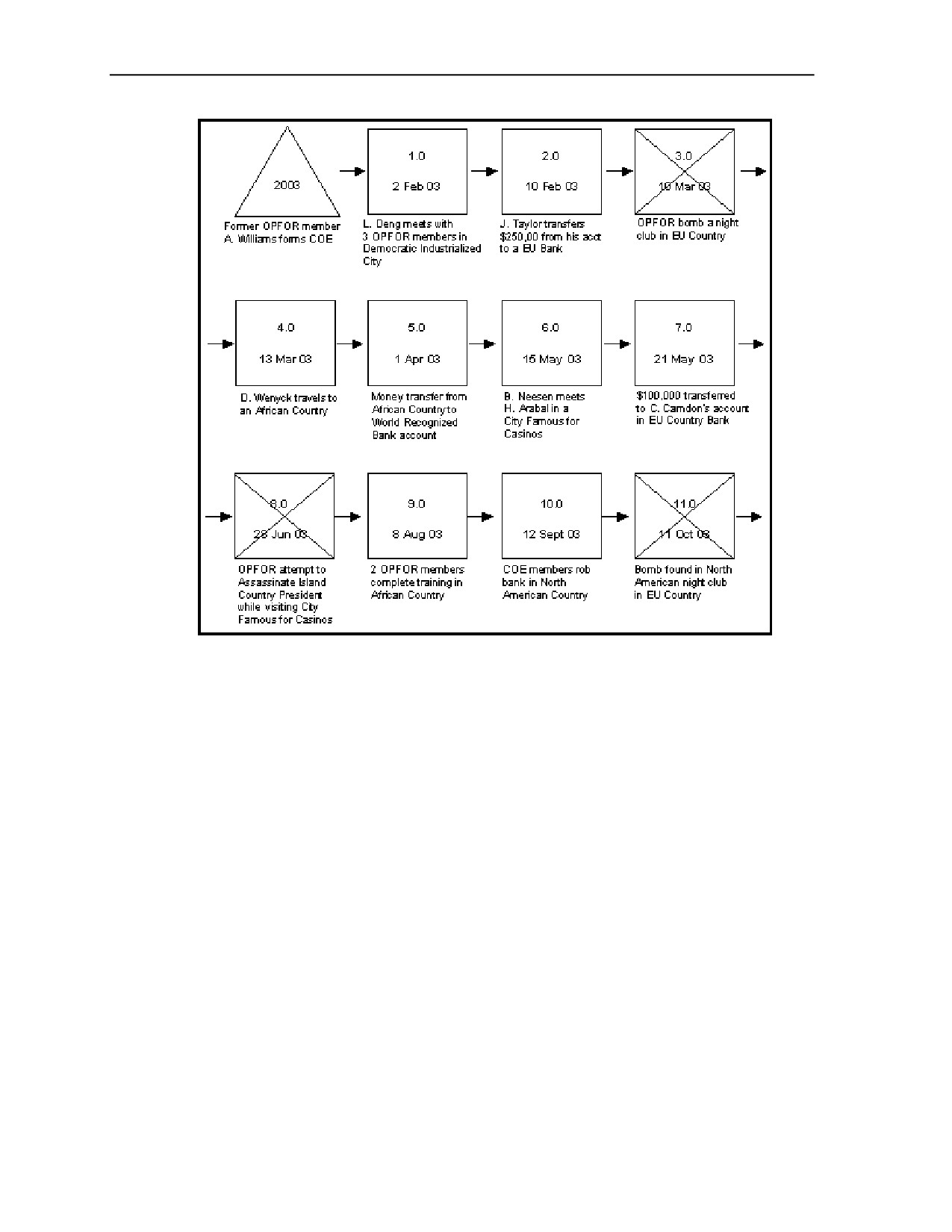
F-3. The time-event chart is a chronological record of individual or group activities. It is de-
signed to store and display large amounts of information in as little space as possible. (See
Figure F-1, page F-2.)
F-4. Analysts use triangles to show the beginning and end of the chart. Triangles are also
used to show shifts in method of operation or change in ideology. Rectangles or diamonds are
used to indicate significant events or activities.
F-5. Analysts highlight noteworthy or important events by drawing an X through the event
symbol. Each symbol contains a chronological number and date (day, month, and year), and
may contain a file reference number. The incident description is a very brief explanation of
the incident. It may include size, type of incident or activity, place and method of operation,
and duration of incident. Arrows indicate time flow.
F-1
FMI 3-07.22
Figure F-1. Time-Event Chart
ASSOCIATION MATRIX
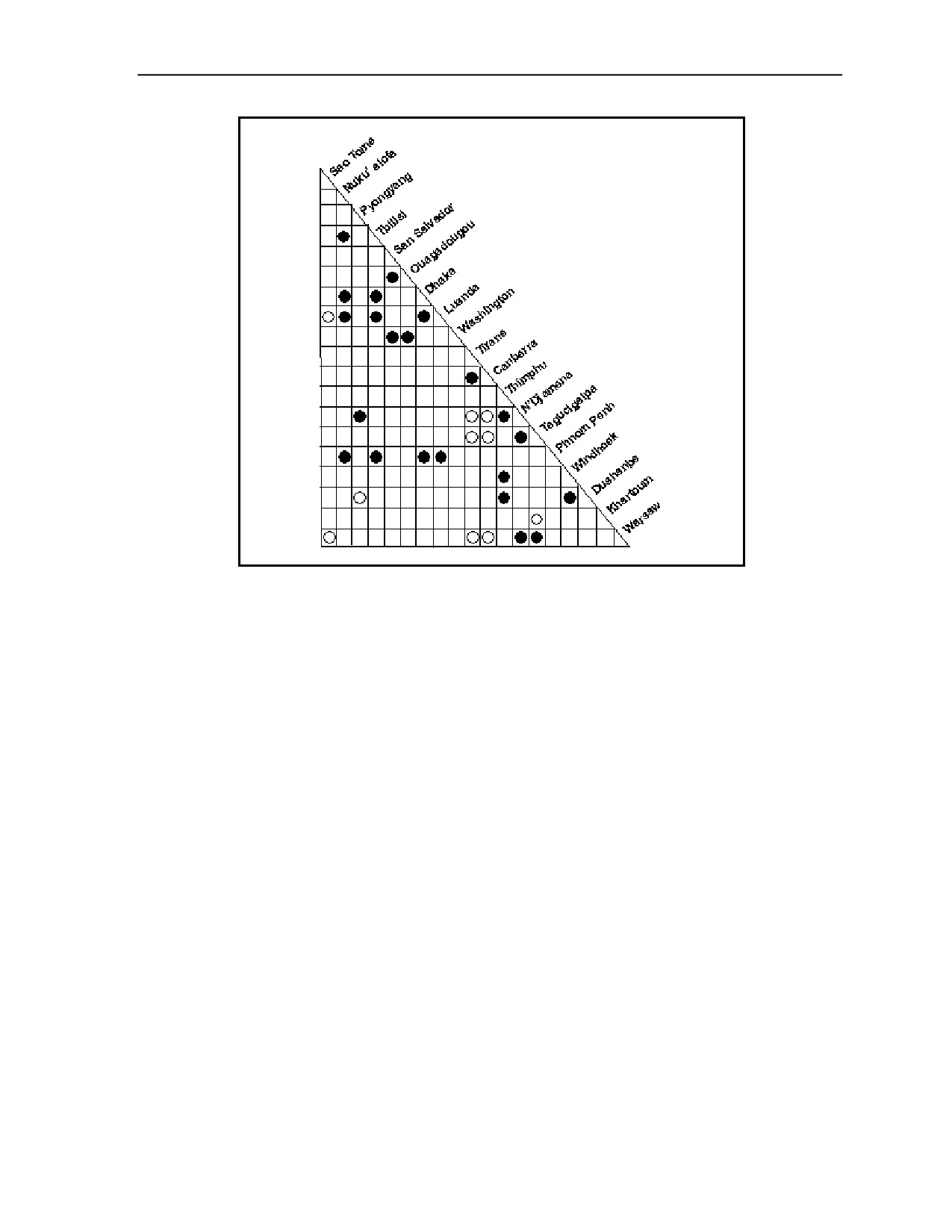
F-6. The association matrix displays a relationship between individuals. It reflects associa-
tions within a group or similar activity, and is based on the assumption that people involved
in a collective activity know one another. The format of an association matrix is a right tri-
angle; each name requires a row and column. (See Figure F-2.)
F-7. The association matrix shows known and suspected associations. Analysts determine a
known association by “direct contact” between individuals. Direct contact is defined as face-
to-face meetings or confirmed telephonic conversation between known parties and all mem-
bers of a particular organization (proponent FM TBD). This is depicted as a filled circle and
placed in the square where the two names meet within the matrix. An unfilled circle indi-
cates suspected or weak associations. When an individual dies, a diamond is added at the
end of his or her name.
F-2
Intelligence Analysis Tools and Indicators
Figure F-2. Association Matrix
ACTIVITIES MATRIX
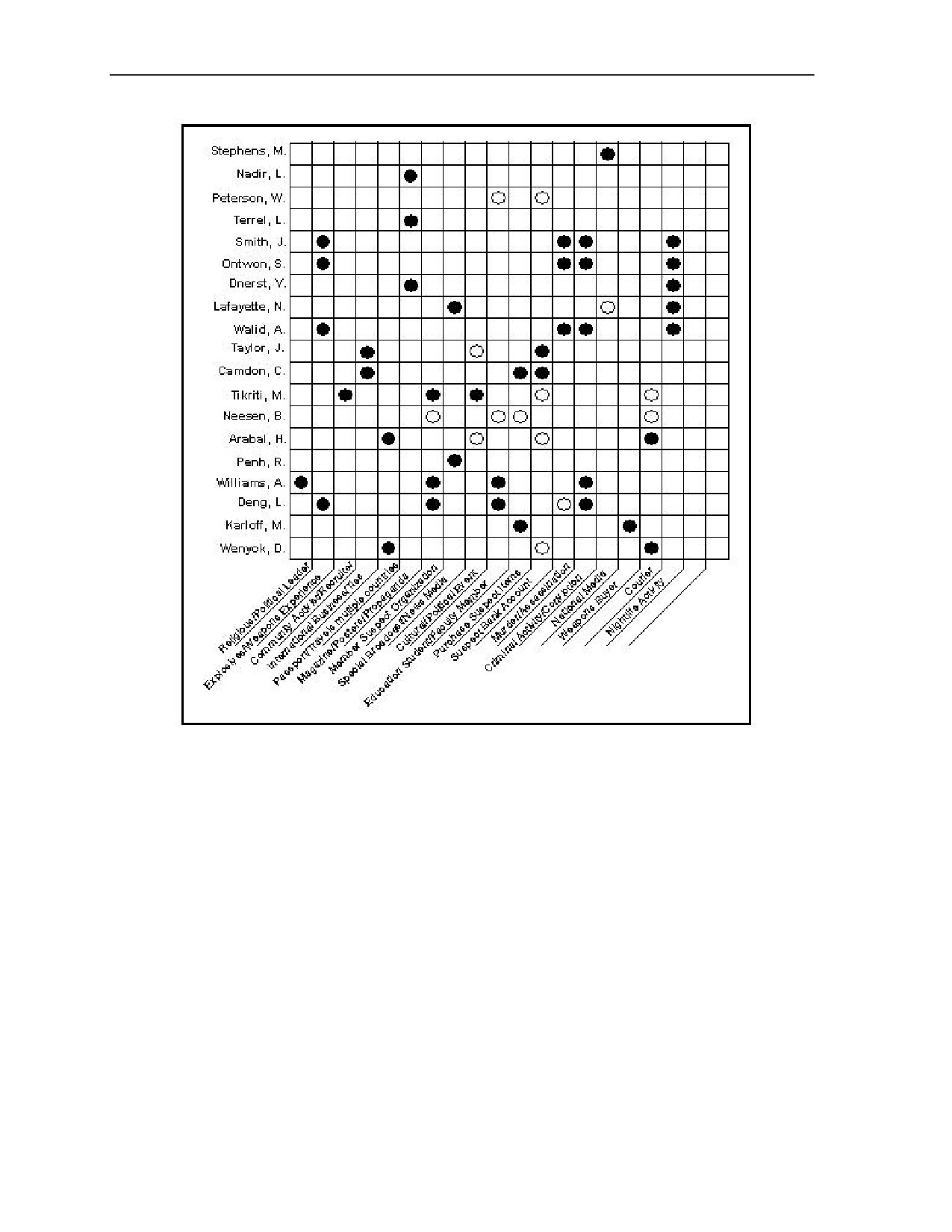
F-8. The activities matrix determines connectivity between individuals and anything other
than persons (interest/entity). (See Figure F-3, page F-4.) Analysts develop a tab to the ma-
trix listing the short titles of each interest/entity. Each short title explains its significance as
an interest or entity.
F-9. The activities matrix reveals an organization’s membership, organizational structure,
cell structure and size, communications network, support structure, linkages with other or-
ganizations and entities, group activities and operations, and, national or international ties.
The activities matrix format uses a rectangle base. Rows are determined by the names from
the association matrix, and columns are determined by the interest or entity short titles.
F-10. The activities matrix shows known and suspected connections. Analysts develop the
criteria for known connectivity. Criteria may be determined and defined by CCIR, com-
mander’s intent or directive, insurgent doctrine, or the staff judge advocate. Known connec-
tivity is depicted as a filled circle and placed in the square where the individual and interest
or entity meet within the matrix. An unfilled circle indicates suspected or weak associations.
F-3
FMI 3-07.22
Figure F-3. Activities Matrix
LINK DIAGRAM
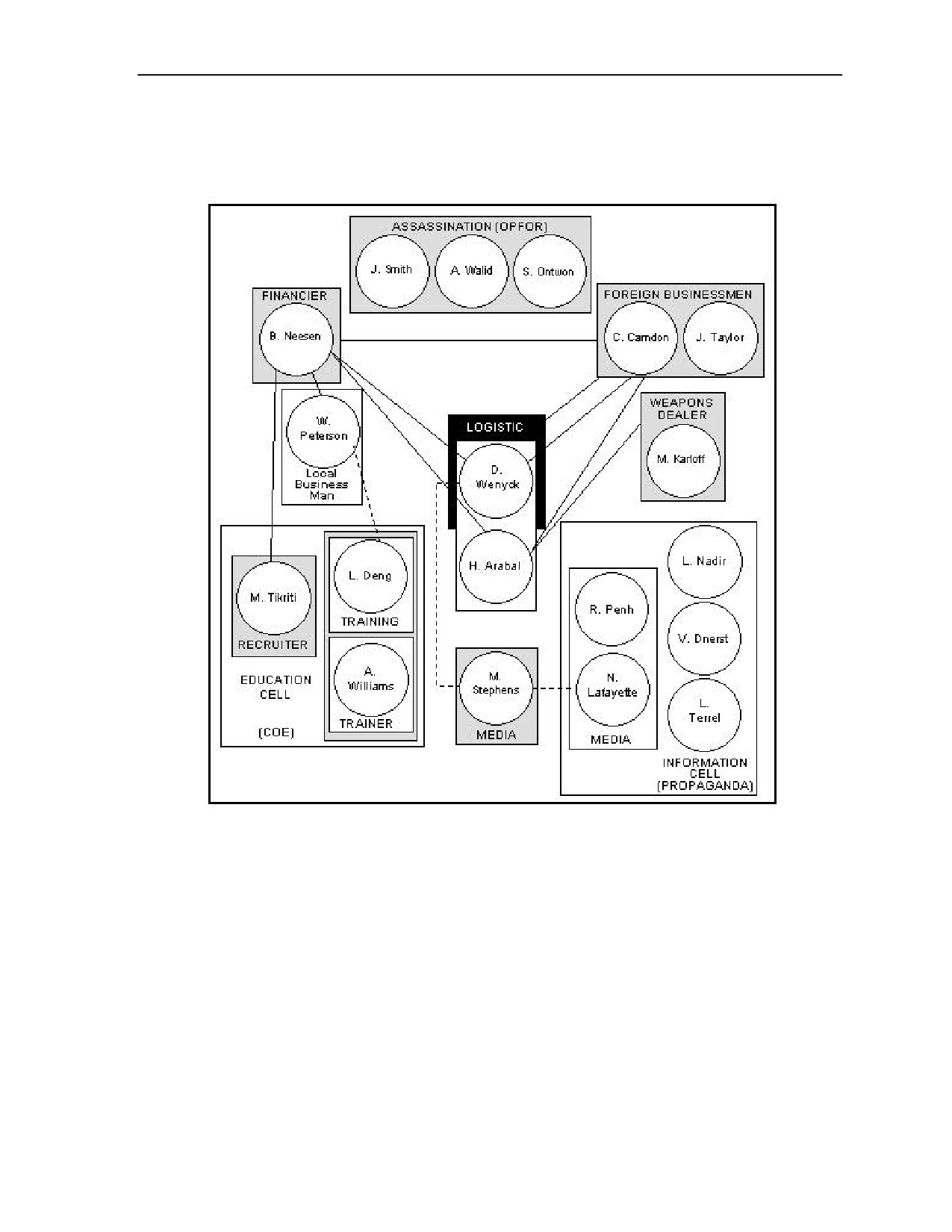
F-11. The link diagram depicts the linkages between interests or entities, individuals, events,
organizations, or other interests or entities. (See Figure F-4.) Analysts use the link diagram
to support investigative efforts in terrorism, counterintelligence, and criminal activity, and
to graphically portray pertinent information from the association matrix and activities ma-
trix, independently or synthesized. The link diagram format is the organization of symbols
(circles, rectangles, and lines) and follows rules in FM 34-60.
F-12. The link diagram displays known and suspected linkages. A solid figure represents
known linkages. Suspected or weak linkages are dashed figures. Each individual and inter-
est or entity is shown only once in a link diagram.
F-13. Circles represent individuals. The name is written inside the circle. “Also known as”
(AKA) is depicted as an overlapping circle. A diamond is placed next to the circle for a de-
ceased person.
F-14. Rectangles represent anything other than persons and may overlap to show a circle in-
cluded in multiple interests or entities. The short title is written inside the rectangle. Lines
F-4
Intelligence Analysis Tools and Indicators
are not required for circles of common association inside the same rectangle; connection is
implied.
F-15. Lines represent linkages, associations, and connectivity. Lines do not cross.
Figure F-4. Link Diagram
F-5
Appendix G
Leader Checklist for Health Service Support and
Preventive Medicine
HEALTH AND MEDICAL CONSIDERATIONS - PREDEPLOYMENT
G-1. The following are predeployment medical considerations:
z
Provide vaccinations as required.
z
Ensure standards of fitness (PULHES) prior to deployment. This will decrease is-
sues once deployed and may reduce individual redeployments.
z
Take malaria prophylaxis (if required), and other prophylaxis measures directed by
military medical authority, before, during, and after deployment.
z
Know your Soldiers. Be aware of their health issues, for example, prior heat injury.
z
Continuously maintain Soldier dental and medical fitness of Soldiers.
TRAINING AND PREPARATION - PREDEPLOYMENT
G-2.
The following are predeployment training and preparation considerations:
z
Train and maintain high levels of physical fitness. High levels of fitness aid in mis-
sion accomplishment while reducing the potential of injury.
z
Train all Soldiers in first aid, self-aid, and buddy-aid.
z
Train all Soldiers in immediate treatment, use of tourniquet, casualty evacuation,
and calling in MEDEVAC while maintaining focus on the primary mission.
z
Select and train combat lifesavers; then, ensure their assignment into all teams-
squads. Prepare to cross-level combat lifesavers once deployed, ensuring they are
maintained in every team/squad.
z
Make training using realistic scenarios and drills for assigned combat medics a top
priority. Once deployed, use them in health and preventive medicine duties. They
will be very busy maintaining the health of the unit and in preventing the unneces-
sary loss of duty time by unit personnel.
z
Train all Soldiers in heat and cold injury prevention, identification, and treatment.
z
Train all personnel in proper field expedient personal hygiene.
z
Ensure training is conducted in unit field sanitation and proper waste manage-
ment. Form and train field sanitation teams. Every Soldier has a role in field sani-
tation. Field sanitation teams cannot function effectively without command empha-
sis and Soldier participation.
z
Review FM 21-10 in areas such as field expedient waste management, field sanita-
tion, water purification, control of vectors and mess sanitation prior to deploying
into an area with minimal civilian or military infrastructure.
z
Conduct briefings for all Soldiers regarding sexually transmitted diseases.
z
Brief Soldiers on the effects and consequences of the abuse of drugs and alcohol.
z
Train Soldiers in stress management techniques and how to identify stressed Sol-
diers.
G-1
FMI 3-07.22
z
Conduct stress management training for leaders.
z
Train leaders and Soldiers in the specific environmental considerations for the an-
ticipated deployment area, such as high altitude considerations, desert terrain,
tropical areas, and cold weather conditions. Ensure personnel are properly
equipped and prepared.
z
Use the DOD insect repellent system as a personal protective measure depending
on the mission profile. Treat uniforms with the standard military clothing repellent
(permethrin) prior to deployment.
z
Brief deploying personnel on indigenous wild and domestic animals, plants, and
specific local precautions for the deployment area. Maintain command focus and
medical management of injury, poison, and illness avoidance.
z
Ensure medical personnel are prepared to continually train the unit in appropriate
medical, health, and first aid subjects at home station, during pre-deployment and
while deployed.
z
Ensure medical personnel continue training when not performing assigned duties.
Continual refresher training of medical personnel is a priority for the medical unit.
This is a priority at home station, during predeployment, and during deployment,
when the mission profile allows.
DEPLOYMENT - ENSURE, OBSERVE, AND CONTROL
G-3.
The following are deployment medical considerations:
z
Make frequent and timely field sanitation inspections by qualified personnel.
z
Once deployed, Soldiers apply 33 percent time-release DEET (insect repellant) as
appropriate, as ordered.
z
Take precautions are taken reference climatic conditions, heat or cold injury pre-
vention, high-altitude exposure, cold weather, and other environmental conditions,
for example, intake of fluids, consumption of meals, application of sun screen, wear-
ing of proper clothing, layering of clothing, utilizing eye protection, adequate rest,
and other techniques as suitable.
z
Ensure personal preventive medicine practices are properly employed. Leaders and
authorized personnel should ensure the use of proper techniques regarding potable
water (only from approved sources, both unit or field expedient), safe food, and per-
sonal hygiene.
z
Maintain appropriate prophylaxis, for example, malaria prophylaxis and any other
preventive measures directed by command and medical authority.
z
Medical personnel conduct random health checks of personnel and keep leaders in-
formed concerning the unit health status.
z
Medical personnel and unit field sanitation teams perform frequent and timely in-
spections on a periodic basis of the unit’s food-water acquisition, preparation, and
distribution system, the unit and personnel waste and trash disposal methods, and
any other areas deemed necessary and appropriate regarding field sanitation is-
sues.
z
Medical care and facilities are accessible and properly employed in the current and
anticipated AOs.
z
Coordinate, plan, and train for MEDEVAC and casualty evacuation. Reinforce
throughout the unit that all personnel must know and understand MEDEVAC re-
quest procedures. Coordinate with the higher command to ensure the prompt avail-
ability of evacuation resources.
z
Plan and coordinate for Class VIII resupply.
z
Monitor stress management and use the buddy system.
G-2
Leader Checklist for Health Service Support and Preventive Medicine
ADDITIONAL INFORMATION
G-4. For more information concerning preventive health measures, see the US Army Center
for Health Promotion and Preventive Medicine website at <chppm-www.aprea.army.mil/>.
G-3
Appendix H
Medical Evacuation
REQUEST MEDICAL EVACUATION
H-1. Medical evacuation is the timely and efficient movement of the wounded, injured, or ill
while providing en route medical care to and between medical treatment facilities (FM 4-02).
MEDEVAC may utilize various ground transport methods or employ MEDEVAC or casualty
evacuation assets.
H-2. The senior military person present makes the determination to request MEDEVAC and
assigns precedence. This decision is based on the advice of the senior medical person at the
scene, the patient’s condition, and the tactical situation.
H-3. It is necessary to be aware of security considerations in the area for rendezvous for the
MEDEVAC vehicle and casualty. Aggressive security measures should be planned, prepared
for, and executed.
PROCEDURES FOR REQUESTING A MEDICAL EVACUATION
H-4. Use the following message format to request MEDEVAC:
Line 1
Location of pickup site by grid coordinates with grid zone letters.
Line 2
Requesting unit radio frequency, call sign, and suffix.
Line 3
Number of patients by precedence. Note the brevity codes used.
A—Urgent Complete (evacuate as soon as possible or within 2 hours)
B—Urgent Surgical (evacuate within 2 hours to the nearest surgical unit)
C—Priority (evacuate promptly or within 4 hours)
D—Routine (evacuate within 24 hours)
E—Convenience (medical convenience rather than necessity)
Line 4
Special equipment required.
A—None
B—Hoist
C—Extraction equipment
D—Ventilator
Line 5
Number of patients by type.
L—Litter plus the number of patients
A—Ambulatory plus the number of patients
Line 6 (War)
Security of pickup site.
N—No enemy personnel in the area.
P—Possible enemy personnel in the area (approach with caution)
E—Enemy personnel in the area (approach with caution)
X—Enemy personnel in the area (armed escort required)
Line 6 (Peace) Number and type of wounds.
H-1
FMI 3-07.22
Line 7
Method of marking at pickup site.
A—Panels
B—Pyrotechnic signal
C—Smoke signal
D—None
E—Other
Line 8
Patient Nationality and Status.
A—US military
B—US civilian
C—Non-US military
D—Non-US civilian
E—EPW
Line 9 (War)
NBC Contamination.
N—Nuclear
B—Biological
C—Chemical
Line 9 (Peace) Terrain description.
MEDICAL EVACUATION GUIDELINES
H-5. Follow these guidelines during MEDEVAC operations:
z
Clear debris. Mark obstacles.
z
VS-17 panels—secure beanbag light properly.
z
Cleared diameter for UH-60 = 50 meters.
z
Cleared diameter for CH-47 = 80 meters.
z
Land heading into the wind.
z
Avoid landing on a down-slope.
z
Do not land on slope >16 degrees.
z
Prevent overclassification (the tendency to classify a wound as more severe than it
actually is).
z
Do not violate radio silence.
z
Use the order of precedence accurately.
z
Keep transmissions 25 seconds or less in length.
H-2
Appendix I
Planning for Detainee Operations and Field Processing of
Detainees
PURPOSE
I-1. The purpose of this appendix is to provide some planning considerations for conducting
detainee operations and to provide information to assist the capturing unit in the field proc-
essing of detainees.
GENERAL
I-2. While local government officials will detain certain individuals because of suspected
criminal activity or for security purposes, there will be times, when U.S, forces will capture
and detain individuals who may pose a threat to US personnel and interests. The act of cap-
turing a detainee is only the first step in a lengthy and highly sensitive process.
I-3. Detainee is a term used to refer to any person captured or otherwise detained by an
armed force (JP 1-02). AR 190-8, FM 3-19.40, and, international law (including the law of
war and the Geneva Conventions) address policy, procedures, and responsibilities for the
administration, treatment, protection, security, and transfer of custody of detainees. These
publications provide other planning factors and the regulatory and legal requirements con-
cerning detainees.
I-4. Detaining personnel carries with it the responsibility to guard, protect, and account for
them. All persons captured, detained, interned, or otherwise held in US armed forces custody
are given humane care and treatment from the moment they fall into the hands of US forces
until final release or repatriation. The inhumane treatment of detainees is prohibited and is
not justified by the stress of combat or by deep provocation. Inhumane treatment is a serious
and punishable violation under the Uniform Code of Military Justice and international law.
I-5. The two Geneva Conventions most likely to be employed in detainee operations are the
Geneva Convention Relative to the Treatment of Prisoner of War, 12 August 1949 (GPW),
and Geneva Convention Relative to the Protection of Civilian Person in Time of War, 12 Au-
gust 1949 (GC). Most detainees will usually be civilians, and a very few will qualify as EPW.
PLANNING FOR DETAINEE OPERATIONS
I-6. Detainee operations are resource intensive and highly sensitive. Holding detainees
longer than a few hours requires detailed planning to address the extensive requirements of
the Geneva Conventions for proper administration, treatment, protection, security, and
transfer of custody of detainees. If commanders anticipate holding detainees at the division
level or lower (as opposed to expeditiously evacuating them to a detention facility), they
should consider—
z
Including internment/resettlement military police units in their task organization.
Internment/resettlement units are specifically trained and resourced to conduct de-
tainee operations for extended periods.
I-1
FMI 3-07.22
z
Ensuring clear delineation of the interdependent and independent roles of those
Soldiers responsible for custody of the detainees and those responsible for any in-
terrogation mission.
z
Additional resources necessary to provide detainees the extensive logistic and
medical support required by regulation and law.
FIELD PROCESSING DETAINEES
I-7. Processing begins when US forces capture or detain an individual. Field processing is
accomplished in the combat zone and aids in security, control, initial information collection,
and in providing for the welfare of detainees.
I-8. The unit detaining an individual is responsible for guarding and safeguarding a de-
tainee until relieved. Capturing units field process detainees using the STRESS method out-
lined in Table I-1.
Table I-1. STRESS Method of Detainee Field Processing
Action
Description
Search
Search each captive for weapons and ammunition, items of intelligence value, and other
inappropriate items that would make escape easier or compromise US security interests.
Confiscate these items. Prepare a receipt when taking property from a detainee. Ensure
that both the detainee and the receiving Soldier sign the receipt (such as DA Form 4137).
Consider bundling a detainee’s property or placing it in bags to keep each detainee’s
property intact and separate. Maintain a strict chain of custody for all items taken from the
detainee. Ensure that a receipt is obtained for any items you release to anyone.
Note: When possible, conduct same gender searches; however, this may not always be
possible due to speed and security considerations. Therefore, perform mixed gender
searches in a respectful manner using all possible measures to prevent any action that
could be interpreted as sexual molestation or assault. The on-site supervisor must carefully
control Soldiers doing mixed gender searches to prevent allegations of sexual misconduct.
Captives may keep the following items found in a search:
• Protective clothing and equipment (such as helmets, protective masks and
clothing) for use during evacuation from the combat zone.
• Retained property, such as identification cards or tags, personal property having
no intelligence value, clothing, mess equipment (except knives and forks), badges
of rank and nationality, decorations, religious literature, jewelry, and articles that
have sentimental value.
• Private rations of the detainee.
Personal items, such as diaries, letters from home, and family pictures may be taken by MI
teams for review, but are later returned to the proper owner.
Confiscate currency only on the order of a commissioned officer (AR 190-8) and this must
be receipted using DA Form 4137.
Tag
Use DD Form 2745 or a field expedient alternative and include at a minimum the following
information:
• Date and time of the capture.
• Location of the capture (grid coordinates).
• Capturing unit.
• Special circumstances of capture (for example, how the detainee was captured,
did he resist, was he armed, and so forth).
• List all documents and items of significance found on the detainee at time of
capture.
DD Form 2745 is a perforated, three-part form containing an individual serial number. It is
constructed of durable, waterproof, tear-resistant material with reinforced eyeholes at the
top of Parts A and C. Attach Part A to the captive with wire, string, or another type of
I-2
Planning for Detainee Operations and Field Processing of Detainees
durable material. Instruct the captive not to remove or alter the tag. Maintain Part B and
attach Part C to the confiscated property so the owner may be identified later.
Report
Report number and category of detainees (see AR 190-8) to higher headquarters and
initiate coordination for transportation of detainees to a collection point.
Evacuate
Evacuate captives from the battlefield as quickly as possible. Evacuate detainees normally
to a collection point where military police take custody of the detainees. Deliver to the
collection point all documents and other property captured with the detainees. Seriously
wounded or ill detainees must be taken to the nearest medical-aid station for treatment and
evacuation through medical channels.
Segregate
Segregate detainees based on perceived status and positions of authority. Segregate
leaders from the remainder of the population. For their protection, normally segregate
minor and female detainees from adult male detainees.
Safeguard
Safeguard the captives according to the Geneva Conventions and US policy. Ensure
detainees are provided adequate food, potable water, clothing, shelter, and medical
attention. Ensure detainees are not exposed to unnecessary danger and are protected
(afforded the same protective measures as the capturing force) while awaiting evacuation.
Do not use coercion to obtain information from the captives. Report acts or allegations of
abuse through command channels and to the supporting judge advocate and to the US
Army Criminal Investigation Command. Detainees should be afforded the same measure of
protection as the detaining power. The Geneva Conventions, international law, and US
policy expressly prohibit acts of violence or intimidation, including physical or mental
torture, threats, insults, or exposure to inhumane treatment. Physical or mental torture and
coercion revolve around eliminating the source’s free will and are expressly prohibited.
Torture is defined as the infliction of intense pain to body or mind to extract a confession or
information, or for sadistic pleasure, and is prohibited Coercion is defined as actions
designed to unlawfully induce another to compel an act against one’s will.
I-9. HUMINT collectors may arrange with the military police leadership or leadership of
other Soldiers maintaining custody of the detainees to debrief these Soldiers, since they are
in regular contact with the detainees. The Soldiers should be debriefed so as not to interfere
with the interrogation process. These Soldiers are there only to maintain security. Military
police or other Soldiers responsible for custody of detainees will not in any circumstances
prepare detainees for interrogation by any physical or mental means (such as beatings or
humiliating techniques). If military police or other Soldiers are approached by any military,
civilian, or contract personnel to assist in preparing detainees for interrogation they will in-
form their chain of command immediately.
I-10. Units should also consider that embedded media, combat camera, public affairs, CA,
and PSYOP personnel might accompany them on a mission. Leaders must strictly enforce
policies on photography of detainees, public release of information, and international law.
Photographing, filming, and videotaping of detainees for purposes other than internal in-
ternment facility administration or intelligence/counterintelligence are strictly prohibited.
RESOURCES FOR FIELD PROCESSING OF DETAINEES
I-11. Clearly documenting the details surrounding the initial detention and preserving evi-
dence are critical and aid in determining if further detention is warranted, in classifying the
detainee, in developing intelligence, and in prosecuting detainees suspected of committing
criminal acts. Documentation should be detailed and answer the six Ws—who, what, when,
where, why, and witnesses. Record these details on the DD Form 2745, DA Form 2823, DA
Form 4137, and locally developed forms if necessary. As a minimum document the following
information—
z
Full name, rank, and unit of the Soldier or other person who affected the detention.
z
Location and circumstances surrounding the initial detention. Include 8- to 10-digit
grid coordinates and any further descriptive information, such as a road intersec-
tion or street address. Explain why the person was detained. In describing circum-
I-3
FMI 3-07.22
stances include any possible criminal violations or a description of hostile acts.
State what force was required to detain the person.
z
Provide a thorough description of the detainee. Include name and full description
(height, weight, eye color, hair color, race or ethnicity, gender, date of birth, phone
number, residence address, identification type and number, and any identifying
marks, such as scars or tattoos). Indicate and describe injuries. Explain how inju-
ries occurred. Indicate how the person being detained was traveling.
z
Provide a thorough description of victims and witnesses. Record the same descrip-
tive information as recorded for the detainee for anyone who witnessed the deten-
tion or the reason for detention. Indicate if the individuals are witnesses or victims.
Take statements from these individuals to document their observations and knowl-
edge of the incident. Indicate if any of these individuals were traveling with or in
any way associated with the detainee.
z
Record descriptive information for all vehicles or other equipment related to the de-
tention. For motor vehicles, include make, model, year, color, type, license plate
number, owner, and the number and thorough description of occupants. Indicate if
contraband was found in the vehicle.
z
Thorough description of any contraband, including weapons. Include serial num-
bers, brand names, types, calibers, quantity, color, size, where found, and owners
name and complete description. Record where the contraband was located (for ex-
ample, rocket propelled grenade optical sight found in a plastic bag under the
driver’s seat of vehicle #1). Ensure all seized items are recorded on a DA Form 4137
and that a chain of custody is maintained as property is transferred. Note the dis-
position of contraband (for example, IED was destroyed on location by explosive
ordnance detachment Soldiers; or rocket propelled grenade optical sight was re-
leased to SGT John Smith, 123d Military Intelligence Detachment).
z
Full name, rank, unit or organization, phone number, and any other contact infor-
mation for any interpreter or other person, such as civil authority, present during
the detention.
z
Any information the detainee volunteers.
PERSONNEL
I-12. Army military police Soldiers train on all aspects of detainee operations. Soldiers hold-
ing MOS 31E, Internment/Resettlement Specialist, specialize in detainee operations. Con-
sider including 31E Soldiers in the task organization for a mission likely to result in detain-
ing personnel.
I-13. Commanders should consider including interpreters or linguists to support the opera-
tion.
SUPPLIES AND EQUIPMENT
I-14. The following items may be helpful in searching and securing detainees, safeguarding
their property, and ensuring the safety of Soldiers:
z
Plastic bags of various sizes may be used to segregate, store, and protect a de-
tainee’s property, including property of potential evidentiary or intelligence value.
z
Permanent markers may be used to annotate identifying information on containers
of detainee property.
z
Sandbags may be used to segregate, store, and protect a detainee’s property, includ-
ing property of potential intelligence value.
z
Duct tape or 550 cord may be used to restrain detainees and to secure bags contain-
ing property.
I-4
Planning for Detainee Operations and Field Processing of Detainees
z
Socks may be used to segregate, store, and protect a detainee’s property, including
property of potential intelligence value.
z
Latex or rubber gloves should be provided to Soldiers to protect them while search-
ing and processing detainees and their property.
z
Flexi-cuffs may be used to restrain detainees.
z
Flexi-cuff cutters should be used to cut flexi-cuffs. Do not use knives, scissors, or
other cutting devices. Flexi-cuff cutters are specifically designed to prevent injury
to the detainee and the Soldier removing the flexi-cuffs.
z
Bandanas, bandages, or other cloth may be used to blindfold or gag detainees when
necessary. Uncooperative captives may require a gag in certain situations; how-
ever, gags should be used for only as long as needed and should not harm the indi-
vidual.
z
Goggles with lenses blackened are the preferred means of blindfolding a detainee.
REFERENCES AND FORMS
I-15. A few basic references and forms are necessary in ensuring maintenance of required in-
formation about the detainees, accountability of their property, and compliance with re-
quirements for proper treatment of detainees. The most important of these items are DD
Form 2745, DA Form 4137, and AR 190-8.
FIELD EXPEDIENT RESTRAINTS
I-16. Field expedient restraints include flexi-cuffs, duct tape, parachute cord, and other
items necessary to temporarily restrain detainees for force protection, custody and control,
and movement. When possible, place detainees into restraints prior to searching or moving
them. The following considerations are provided:
I-17. Employ field expedient restraints on detainees in a manner that is safe, secure, hu-
mane, and professional. With all restraint types, use the following guidance:
z
Exercise caution in cases where detainees are gagged and/or hooded. Field expedi-
ent measures, when required, may impair a detainee’s ability to breathe. Sandbags
used as hoods restrict airflow, use them only as a last resort. In some areas of the
world, using the detainees’ own headgear as a hood device is ideal, for example,
turbans or burqas. A hooded detainee may experience difficulty in maintaining bal-
ance while walking.
z
Ensure blood flow is not restricted by restraints. Monitor detainees after restraints
are applied. Check for discoloration of skin, which is one indication that the re-
straints are too tight.
z
Employment of restraints.
Flexi-cuffs (national stock number 8465-0007-2673) are a plastic band with a
self-locking mechanism. When threaded, the restraint band extends around the
wrists or ankles to secure the individual. Use two flexi-cuffs to secure the arms
of each detainee, if enough are available. If supply is limited, one flexi-cuff may
be used.
Wrap 550 cord around the wrists or ankles several times and then wrap the
cord between the wrists or ankles to help prevent loosening. Tie the ends of the
cord using a knot such as the square knot. Ensure blood flow is not restricted.
Use duct tape in a manner similar to the flexi-cuffs or 550 cord. Exercise cau-
tion not to restrict blood flow. Use good judgment as to the number of times to
wrap the tape based on the detainee’s strength and size and the width of the
tape.
I-5
FMI 3-07.22
I-18. The preferred method of restraint is arms behind the back with palms facing away
from each other. If injury prevents this technique, bind the detainee’s wrists in the front
with palms together. Injuries such as upper body wounds or broken arms may make this the
best option.
I-19. Do not use restraints to inflict punishment, injury, or unnecessary physical discomfort.
I-20. When detainees must be secured to a fixed object, do so only for the minimum time nec-
essary and in a manner that does not risk injuring the detainee.
I-6
Appendix J
Legal Considerations in Counterinsurgency
GENERAL
J-1. Leaders should remember counterinsurgency operations must conform to the law and
the application of the law varies depending on the overall counterinsurgency mission. Lead-
ers maintain constant awareness of their ability to lawfully use certain tactics, weapons, or
procedures, and understand that there are various agreement or treaty obligations that have
counterinsurgency operational implications. Judge advocates assist leaders in tackling the
complexities of the law and in integrating legal considerations into the overall pattern of
counterinsurgency operations.
LEGAL BASIS
J-2. Leaders should know and understand the legal basis of their operations. By doing so,
leaders promote the legitimacy of their operations and are able to better plan their missions,
structure public statements, and conform their conduct to policy. Further, since the very goal
of counterinsurgency operations is to help maintain law and order, those conducting counter-
insurgency operations must know and respect the legal parameters within which they oper-
ate. Those who conduct counterinsurgency operations while intentionally or negligently
breaking the law defeat their own purpose and lose the confidence and respect of the com-
munity in which they operate.
J-3. The legal basis of counterinsurgency operations derives from many international, US,
and local/HN legal sources. These sources may be UN Security Council resolutions, regional
and international agreements, and decisions, regulations, and orders from US, multina-
tional, or local/HN authorities. While legal sources differ depending on the specific mission
(counterinsurgency in an international or internal armed conflict) and military role in mind
(lead or in support), counterinsurgency mission statements drafted with these sources in
mind demonstrate and encourage adherence to law and order.
LAW OF WAR PRINCIPLES
J-4. All counterinsurgency operations comply with law of war principles to the extent prac-
ticable and feasible. Some of the basic law of war principles to which counterinsurgency op-
erations must conform include the following.
PROVIDE HUMANE TREATMENT
J-5. Regardless of the legal status of those persons captured, detained, or otherwise held in
custody by US Soldiers, they receive humane treatment until properly released. They are
provided with the minimum protections delineated in the Geneva Conventions.
J-1
FMI 3-07.22
AVOID CAUSING UNNECESSARY SUFFERING
J-6. Weapons, munitions, and techniques calculated to cause unnecessary pain and suffer-
ing are forbidden.
NO TOLERATION OF VIOLATIONS OF LAW OF WAR AND HUMAN RIGHTS
J-7. Orders to commit law of war and human rights violations are illegal. Soldiers must dis-
obey them and report all known or suspected law of war and human rights violations. Those
who violate law of war and human rights will be held responsible for their actions.
STATUS OF FORCES
J-8. The nature of the conflict (internal or international armed conflict, stability operations,
support operations, peace operations) dictate the legal status of forces. When US forces con-
duct counterinsurgency operations in another nation without that nation’s prior consent, the
US law applies. However, if US forces conduct counterinsurgency operations in another na-
tion’s territory with that nation’s prior consent or invitation, in the absence of some type of
grant of immunity Soldiers must comply with that nation’s law. As a result, leaders conduct-
ing counterinsurgency operations in this environment should understand in detail the extent
and effect of any relevant HN criminal, civil, and administrative jurisdiction. A status of
forces agreement or similar understanding between the United States and the HN may re-
solve many of these matters and prevent them from adversely affecting counterinsurgency
operations.
CLAIMS
J-9. Injuries, death, and property damage are an unavoidable reality of military operations.
The leader’s ability to promptly and thoroughly redress meritorious claims against the
United States will pay considerable dividends in maintaining a community’s confidence and
respect. Several statutes and agreements determine whether and how claims against the
United States may be adjudicated. In some situations, claims against the United States may
not be adjudicated, but payments in sympathy or in recognition of a loss (solatia) may be
made. Multinational partners may be able to adjudicate claims that US law does not recog-
nize. In all circumstances, leaders planning counterinsurgency operations should consider
that the prompt and effective handling of resultant claims fosters good will and positive civil-
military relations.
FISCAL LAW
J-10. US legal principles on the proper expenditure of public funds apply to US forces, even
when they are part of a multinational force or supporting multinational operations. Fiscal
law affects training, humanitarian and civic assistance, construction, medical care, transpor-
tation, maintenance, the logistics civilian augmentation program, and other activities. Re-
quests for support may come from the HN, US agencies, multinational partners, local civil-
ians, international military headquarters, higher headquarters, and other sources. Leaders
in counterinsurgency operations must be prepared to find the correct funding authority and
appropriation for the mission and specified tasks to be performed, articulate the rationale for
proposed expenditures, and seek approval from higher headquarters when necessary.
CONTRACTING AND ACQUISITION
J-11. Leaders may have to acquire goods and services and carry out construction projects
while conducting counterinsurgency operations. The significant legal issues involved in bat-
tlefield acquisition, contingency contracting, or acquisition and cross-servicing agreements
present challenges that demand creative analysis. Lawfully conducted, confiscation, seizure,
J-2
Legal Considerations in Counterinsurgency
and requisition of property, and use of the local populace as a source of services may be valu-
able means to support the needs implicit in counterinsurgency operations. However, even
when lawfully done, there are practical considerations in acquiring supplies and services
from the local populace that may negatively affect counterinsurgency operations. The key to
successful contracting and acquisition is the proper training and appointment of personnel
who are authorized to carry out pertinent actions and know the legal and practical limita-
tions on their authority.
FOREIGN GIFTS
J-12. Besides the practical and political considerations involved in receiving and accepting
foreign gifts, leaders should remember the legal implications. As a general rule, Soldiers are
prohibited from soliciting gifts from foreign governments. Depending on the circumstances,
Soldiers may be prevented from accepting gifts from foreign governments altogether. There
are several statutory limitations on the type of gift and the gift’s value that leaders should
consider prior to accepting any foreign gift.
INTELLIGENCE LAW
J-13. Leaders conducting counterinsurgency operations probably consider their ability to
conduct intelligence gathering as critical to their success. Counterinsurgency intelligence col-
lection, information gathering, and counterintelligence operations involve substantial con-
tact with sources from nongovernmental organizations, the local populace, and multinational
partners. There are many legal implications in collecting intelligence or gathering informa-
tion from these sources. There are also legal restrictions on intelligence collection against US
persons, on disseminating intelligence to other agencies and in using special collection tech-
niques, such as electronic surveillance. The complexities of intelligence law require leaders
to obtain legal review of all proposed intelligence activities.
LAW AND ORDER
J-14. Maintaining law and order throughout the HN is part of the desired end state of coun-
terinsurgency operations. The following contain essential enforcement and detention opera-
tions information:
z
Policy on treatment of detained persons.
z
UCMJ.
z
Military tribunals/commissions.
z
MEJA (jurisdiction over contractors and private security firms).
z
HN authorities (Article 98 agreements).
z
Evidence collection and war crimes.
WAR CRIME DISCLOSURES AND THE HANDLING OF EVIDENCE
J-15. In recent years it has become necessary for Soldiers to be aware of the possibility of in-
cidents that could constitute war crimes. The development of international judicial agencies
to deal with allegations of war crimes makes the issue of providing evidence an increasingly
difficult and complicated process. Expert policing, pathological, and forensic skills are essen-
tial in gaining evidence that could lead to successful prosecution.
J-16. Military police forces are the most appropriate Army agents for dealing with such inci-
dents that could have important international significance. Military police resources should
be called upon immediately when such incidents or disclosures are discovered. Where a Sol-
dier or civilian working with Army forces is suspected of committing a war crime (and indeed
any crime) military police carry out the formal investigation. Where a HN national is sus-
J-3
FMI 3-07.22
pected, the procedure to be adopted depends upon the theater involved. Usually it will be for
the local HN civilian police organization to investigate, albeit with assistance from the mili-
tary police or multinational police mission. Theater-specific procedures should be clearly un-
derstood prior to deployment, with advice being sought from Army legal services if need be.
The guidance below provides a few basic procedures likely to be common good practice in cir-
cumstances where involvement by non-military-police Soldiers is necessary.
GUIDELINES ON HOW TO DEAL WITH CRIME SCENES
J-17. In general, two kinds of suspected crime scenes occur. There are sites where bodies are
present, and there are sites where destruction of property has occurred. Certain basic com-
mon procedures are recommended for both categories of sites. More specific actions with re-
gard to each kind of site can be recommended after these have been dealt with.
AIM
J-18. At whatever kind of site actions are taken for recording or preserving evidence, the ul-
timate goal is to collect evidence admissible in a court of law. To a large extent, the basic
principle is that whatever actions are taken should be clearly documented. The precise con-
duct of the investigative actions should be noted and recorded. If the history of the investiga-
tion is not clear, it opens the way for challenging the reliability of evidence.
J-19. In dealing with physical pieces of evidence, it is imperative to create an evidentiary
chain that starts at the site of the investigation and will ultimately end in court upon pro-
duction of the evidence. The chain consists of clearly documenting the collection, handling,
processing, and storage of potential evidence at all stages. Upon submission of a piece of evi-
dence in court, the precise trail of that evidence must be traceable directly back to the site of
the investigation. Any break in that chain may result in that piece of evidence being ruled
inadmissible at trial.
BASIC PROCEDURES
J-20. The following actions are recommended for the recording and preservation of evidence
at all categories of sites:
z
Make a photographic/video record of the site.
z
Make a detailed report of all observations at the site.
z
Make sketches and diagrams if possible.
z
Record measurements and distances where appropriate.
z
Record the details of any witnesses to the events before they disappear.
z
Record details of any surviving victims.
z
Record any details or information on the identity of the alleged perpetrators
(names, descriptions, and insignia or uniforms worn).
J-21. Be prepared to make your own witness statement describing in detail your involve-
ment, be it as a witness to an incident or upon attending the aftermath.
J-22. The particulars of those persons undertaking the above activities should be clearly
documented. It should be clear who these persons are, in what capacity they were acting,
and where they can be traced.
J-23. It is important to safely preserve all evidence and material collected until the arrival of
an investigative or prosecuting authority. This entails keeping the evidence and material in
such a manner that it cannot be tampered with or contaminated. The evidence and material
should be essentially kept under seal until it can be handed over to the appropriate investi-
gative or prosecuting authority.
J-4
Legal Considerations in Counterinsurgency
SITES INVOLVING BODIES
J-24. It is important to establish the cause of death and to identify the deceased if possible
for the investigation of a scene where dead bodies are present. Undertake the basic common
procedures described in the previous paragraph with this in mind. Important, therefore, are
matters such as:
z
The number and position of bodies.
z
Are the bodies manacled or blindfolded? Are there bruises or swelling around the
wrists or ankles indicating a person might have been bound prior to their death?
z
Are there any indications of a battle? For example: are the bodies uniformed? Are
they armed? Is there battlefield debris—such as equipment, munitions, boxes, or
binoculars—in the area near the body? Are there any blunt objects or tools with
blood debris on them?
z
Can any injuries be identified? Was the person shot, stabbed, strangled, or
crushed? Is blunt trauma evident anywhere on the body?
z
The clothing on the bodies (often identification can be done on the basis of the
clothing). Civilian casual, work, business, or formal wear? Necktie, dress, or scarf
present?
z
Documentation found on bodies (or at the site). Identification tags?
z
Jewelry or other items found on the body (or at the site). Earrings?
z
Is any physical evidence present that could indicate the cause of death? Bullet cas-
ings or weapons?
z
Are there any bloodstains or splattering visible on furniture/walls? Any stains
should be protected because they provide information to forensic experts.
J-25. If possible, a pathologist should conduct a postmortem, with a view to determining the
cause of death and the identity of the deceased.
J-26. In some instances, the next of kin of persons killed in the conflict may want to retrieve
the bodies of their loved ones for burial or cremation. Once a site has been found, it is likely
that very little time will be available to record evidence at that site. Especially where a for-
mal investigation has not yet been sanctioned, it may be very difficult to delay handing over
the bodies to next of kin. As it may not be possible to seal off a site with a view to proper ex-
amination at a later stage, it is important that as much information and evidence as possible
be collected at such sites. Frequently, however, it will be appropriate for the troops first on
the scene to set up a cordon so that potential evidence is not interfered with prior to the arri-
val of the investigative authorities.
SITES INVOLVING DESTRUCTION OF PROPERTY
J-27. The main object of investigating sites of destruction is to determine the cause of the de-
struction and identify the perpetrators. The cause of destruction is often a matter of observa-
tion. (For example, was the cause burning, artillery fire, or bombing?) The data the observa-
tion is based on must be thoroughly documented, along with any additional evidence that
may be found that could substantiate the observation.
SCREENING AND INTERVIEWING WITNESSES
J-28. During the process of identifying and recording potentially valuable evidence for use
later in a criminal prosecution, a two-phase approach can be adopted.
z
Undertake a wide screening of potential witnesses initially. The purpose of this is
to identify persons who can give direct, first-hand, evidence with regard to events
that may fall within the jurisdiction of the tribunal.
J-5
FMI 3-07.22
z
Investigators should take detailed statements from those witnesses who have been
identified during the first phase as being able to give direct and relevant evidence
pertaining to events relating to the investigations.
PHASE I - INITIAL SCREENING
J-29. This phase is undertaken at the outset of the investigation. It serves to provide the in-
vestigators with some idea of the amount of information potentially available, and its quality
and consistency. It helps the investigators focus their attention on the events they are inves-
tigating, and identify direct witnesses to relevant events. Apart from identifying witnesses
who can give direct evidence, detailed biographical information concerning those being in-
terviewed (with a view to tracing persons in the future) must be collected during this phase
as well. It should be borne in mind that it might not always be immediately apparent during
this phase whether information being provided will be relevant to investigations of subse-
quent trial proceedings. Good biographical information will therefore facilitate the locating
of persons who are immediately identified as eyewitnesses, as well as those who are only
identified as relevant witnesses at a later stage.
Biographical Information
J-30. Obtain as much biographical information as possible from the witness. This includes
the following:
z
Comprehensive personal details.
z
Full details of relatives.
z
Full details regarding where the person lived during the conflict.
z
Full details of where the witness intends to go in the future.
z
Any other contact details such as phone numbers or email addresses.
Identifying Witnesses
J-31. During this first phase it is worth the effort to establish whether the individual to be
interviewed is able to relate events that fall within his or her own direct knowledge or is
simply relaying events that he or she has been told about by others (hearsay).
J-32. It should be borne in mind that persons being interviewed are likely to be traumatized
by recent events that they have personally experienced, but which may not necessarily be
relevant to investigations. In the desire to speak out about what has been experienced or
vent outrage and frustrations, interviewees are prone to rely heavily on information obtained
second- or third-hand. Such information is generally not reliable with a view to ultimate
prosecution of criminal cases before a court. Such people may still be of use, however, as they
may be able to provide the details of a previously unknown persons who are able to provide
direct evidence. The time spent on clearly establishing whether a person is indeed a direct
witness to relevant events (or potentially relevant events) is, therefore, an investment in the
future of the investigation and may ultimately save considerable time and resources at a
later stage.
PHASE II - TAKING STATEMENTS
J-33. Once a potential witness who possesses direct information has been identified, a com-
prehensive statement should be obtained from that person. The statement should include
the following information in as much detail as possible:
z
Full particulars of the incident or event (in terms of what the witness saw, felt,
heard, or experienced).
z
Full particulars of the time and place of the event.
J-6
Legal Considerations in Counterinsurgency
z
Particulars of the weather and lighting conditions, and distances or measurements
if relevant. (Diagrams or drawings by witnesses may prove useful.)
z
Details of other witnesses.
z
Details with a view to identification of alleged perpetrators: name, uniform, unit,
and description.
z
Details about which a witness is likely to be questioned in court, such as whether
he or she had been drinking alcohol prior to the incident or whether he or she has
any loyalties to, or grudges against, any of those about whom he or she is giving
evidence.
Formats for Statements
J-34. The format of the statement depends to a large extent on the evidentiary requirements
of the tribunal ultimately responsible for trying any cases emerging from any investigation.
Where the tribunal has not been determined, the format is at the discretion of the head of
the investigation.
J-35. Whichever situation pertains, careful consideration should be given as to whether it is
necessary to require witnesses to sign or attest their statements. While the immediate ad-
vantage is the perception that the witness personally agrees with what is contained in the
statement, there is also a disadvantage. The problem is that, should the witness make later
statements that appear to contradict or conflict with that earlier statement, this could com-
promise his or her credibility. An alternative approach would be to not require the witness to
sign the statement, but simply to rely on the investigator’s notes of the interview. The draw-
back with such a procedure is that it is less likely to be admissible as evidence of the wit-
ness’s version of events if he or she dies or cannot be located.
Continuity of Evidence
J-36. One of the primary roles of overt surveillance is to provide detailed information, in the
form of sightings, for local police and other agencies to use in their attempts to cause attri-
tion to the insurgent organizations. This information could potentially be used as evidence in
a court of law to secure convictions. Soldiers on surveillance duty must therefore be evi-
dence-aware to ensure that opportunities from which convictions could arise are not missed
because of errors in evidence continuity or information handling by the observation post (OP)
team.
Types of Evidence
J-37. Information gathered by OPs can be recorded in a variety of formats, such as—
z
Written.
z
Photographic.
z
Video.
Written Evidence
J-38. There is a number of types of written evidence that could be produced by an OP, the
main ones being:
z
Log sheet.
z
Patrol notebook.
Photographic Evidence
J-39. It is important that the film number and frames used be correlated with the sightings
entered in the log if it is believed photographic evidence has been captured of an event or in-
J-7
FMI 3-07.22
cident. The film should be left complete inside the camera body and the whole package han-
dled as evidence.
Video Evidence
J-40. Video evidence can be extremely useful, provided that the tape has been correctly ac-
counted for. There are a number of considerations that should be taken into account.
J-41. The date-time group display on the camera must be correctly set and visible on any
tape recording. The time on the video monitor is the time to be used on all log entries. The
VCR tape position counter should be zeroed at this time and also used as a reference in the
log. These procedures ensure that any video evidence is coordinated with written evidence.
J-42. For full continuity of evidence, any sequence of video footage should be supported by
complete coverage of that day, up to and including the event. This is possible to achieve us-
ing 24-hour time lapse VCRs, so that a complete 24-hour period is recorded onto one tape.
This then provides continuity. OPs should ensure the VCR is switched to 3-hour mode to im-
prove the quality of the recording when recording an event of interest.
J-43. These continuity tapes should be continuously recording while the OP is operational.
They should be changed over at midnight, logged, and stored. The formation headquarters
directs the time period of storage and method of handling.
J-44. If an OP captures some vital evidence on film or video, then it must deal with it in the
correct manner in order for it to have any value in a court of law. This involves the use of an
evidence-handling kit and procedures.
Evidence Handling Kit
J-45. A suggested evidence handling kit to be kept in OPs is—
z
DA Form 4002.
z
A sturdy, opaque bag or envelope.
z
Self-adhesive labels.
z
Cellophane tape.
Handling Procedure
J-46. Record all markings on the film/tape, whether operational serial numbers or the manu-
facturer’s. These should be written on the DA Form 4002. Place the tape or film into a bag or
envelope and seal all edges with tape. Tape the DA Form 4002 onto the evidence package
and only sign the statement section on the form when the evidence is handed over to the po-
lice or other agencies as authorized by the formation headquarters.
J-8
Glossary
SECTION I - ACRONYMS AND ABBREVIATIONS
ACE
analysis and control element
AO
area of operations
AR
army regulation
ARSOF
Army special operations forces
C2
command and control
CA
civil affairs
CI
counterintelligence
CIA
Central Intelligence Agency
CJCS
Chairman of the Joint Chiefs of Staff
CMAC
civil-military advisory committee
CMO
civil-military operations
CMOC
civil-military operations center
DEET
N, N-Diethyl-meta-Toluamide (an insect repellent)
DOD
Department of Defense
FOCO
see FOCO theory (under terms)
GPS
global positioning system
GWOT
Global War on Terrorism
FARC
Fuerzas Armadas Revolucionarias de Colombia (a Nicaraguan insurgent group)
FMLN
Farabundo Marti National Liberation Front (an insurgent group in El Salvador)
HMMWV
high-mobility, multipurpose, wheeled vehicle
HN
host nation
HUMINT
human intelligence
IDAD
internal defense and development
IED
improvised explosive device
INFOSYS
information systems
IO
information operations
IPB
intelligence preparation of the battlefield
ISR
intelligence, surveillance, and reconnaissance
JFC
joint force commander
JSOTF
joint special operations task force
MASINT
measurement and signature intelligence
Glossary-1
FMI 3-07.22
MEDEVAC
medical evacuation
MEJA
Military Extraterritorial Jurisdiction Act
METT-TC
memory aid used in two contexts: (1) in the context of information management,
the major subject categories into which relevant information is grouped for mili-
tary operations: mission, enemy, terrain and weather, troops and support avail-
able, time available, civil considerations (see FM 6-0); (2) in the context of tactics,
the major factors considered during mission analysis (see FM 3-90)
MIDLIFE
memory aid for military, intelligence, diplomatic, law enforcement, information,
finance, and economic
MOS
military occupational specialty
NGO
nongovernmental organization
NVA
North Vietnamese Army
ODA
operational detachment-Alpha
OP
observation post
PICAC
police intelligence collection and analysis council
PSYOP
psychological operations
PULHES
physical profile serial code (numerical)
REMBASS
remotely monitored battlefield sensor system
ROE
rules of engagement
S-2
intelligence staff officer
S-3
operations staff officer
SA
security assistance
SGT
sergeant
SOCCE
special operations command and control element
SOF
special operations forces
SOP
standing operating procedure
SP
start point
STRESS
memory aid for the Army method of detainee field processing: search, tag, report,
evacuate, segregate, safeguard
TA
target audience
TBD
to be determined
TF
task force
TPT
tactical psychological operations team
TTP
tactics, techniques, and procedures
UAV
unmanned aerial vehicle
UCMJ
Uniform Code of Military Justice
UN
United Nations
US
United States
USAID
United States Agency for International Development
VC
Viet Cong
VCR
videocassette recorder
Glossary-2
Glossary
SECTION II - TERMS
civil considerations - The manmade infrastructure, civilian institutions, and attitudes and
activities of the civilian leaders, populations, and organizations within an area of operations
influence the conduct of military operations. (FM 6-0)
civil-military operations - (joint) The activities of a commander that establish, maintain, in-
fluence, or exploit relations between military forces, governmental and nongovernmental ci-
vilian organizations and authorities, and the civilian populace in a friendly, neutral, or hos-
tile operational area in order to facilitate military operations, to consolidate and achieve US
objectives. Civil-military operations may include performance by military forces of activities
and functions normally the responsibility of the local, regional, or national government.
These activities may occur prior to, during, or subsequent to other military actions. They
may also occur, if directed, in the absence of other military operations. Civil-military opera-
tions may be performed by designated civil affairs, by other military forces, or by a combina-
tion of civil affairs and other forces. (JP 1-02)
class VIII - (joint) Medical supplies [One of ten categories (classes of supply) into which sup-
plies are grouped to facilitate supply management and planning.] (JP 1-02)
command and control - (Army) The exercise of authority and direction by a properly desig-
nated commander over assigned and attached forces in the accomplishment of a mission.
Commanders perform command and control functions through a command and control sys-
tem. (FM 6-0)
communications intelligence - (joint) The intelligence derived from foreign communications
by other than the intended recipients. (JP 1-02)
counterinsurgency - (joint) Those military, paramilitary, political, economic, psychological,
and civic actions taken by a government to defeat insurgency (JP 1-02)
criteria of success - Information requirements developed during the operations process that
measure the degree of success in accomplishing the unit’s mission. They are normally ex-
pressed as either an explicit evaluation of the present situation or a forecast of the degree of
mission accomplishment. (FM 6-0)
detainee - (joint) A term used to refer to any person captured or otherwise detained by an
armed force. (JP 1-02)
direct contact - Face-to-face meetings or confirmed telephonic conversation between known
parties and all members of a particular organization (proponent FM TBD).
electronic intelligence - (joint) Technical and geolocation intelligence derived from foreign
non-communications electromagnetic radiations emanating from other than nuclear detona-
tions or radioactive sources (JP 1-02).
FOCO theory - A theory of revolutionary war common in Latin America that revolution can be
effected by mobilization from above. This often takes the form of violence propagated by
cadre from outside the area.
foreign instrumentation signals intelligence - (joint) Technical information and intelli-
gence derived from the intercept of foreign electromagnetic emissions associated with the
testing and operational deployment of non-US aerospace, surface, and subsurface systems.
Foreign instrumentation signals intelligence is a subcategory of signals intelligence. Foreign
instrumentation signals include but are not limited to telemetry, beaconry, electronic inter-
rogators, and video data links. (JP 1-02)
human intelligence - (Army) The collection by a trained HUMINT collector of foreign informa-
tion from people and multimedia to identify elements, intentions, composition, strength, dis-
positions, tactics, equipment, personnel, and capabilities. It uses human sources and a vari-
Glossary-3
FMI 3-07.22
ety of collection methods, both passively and actively, to gather information to satisfy the
commander’s intelligence requirements and cross-cue other intelligence disciplines. (FM 2-0)
imagery intelligence - (joint) Intelligence derived from the exploitation of collection by visual
photography, infrared sensors, lasers, electro-optics, and radar sensors such as synthetic ap-
erture radar wherein images of objects are reproduced optically or electronically on film,
electronic display devices, or other media. (JP 1-02)
information operations - The employment of the core capabilities of electronic warfare, com-
puter network operations, psychological operations, military deception, and operations secu-
rity, in concert with specified supporting and related capabilities, to affect or defend infor-
mation and information systems, and to influence decision making. [This definition in FM 3-
13 supersedes the definition of IO in FM 3-0. It is consistent with joint initiatives.] (FM 3-13)
information superiority - The operational advantage derived from the ability to collect, proc-
ess, and disseminate an uninterrupted flow of information while exploiting or denying an
adversary’s ability to do the same. (FM 3-0)
information system - (Army) The equipment and facilities that collect, process, store, display,
and disseminate information. This includes computers—hardware and software—and com-
munications, as well as policies and procedures for their use. (FM 3-0)
insurgency - (joint/NATO) An organized movement aimed at the overthrow of a constituted
government through use of subversion and armed conflict. (JP 1-02)
insurgent - (joint) Member of a political party who rebels against established leadership.
(JP 1-02)
medical evacuation - (Army/Marine Corps) The timely and efficient movement of the
wounded, injured, or ill while providing en route medical care to and between medical treat-
ment facilities. (FM 4-02)
military civic action - (joint) The use of preponderantly indigenous military forces on projects
useful to the local population at all levels in such fields as education, training, public works,
agriculture, transportation, communications, health, sanitation, and others contributing to
economic and social development, which would also serve to improve the standing of the
military forces with the population. (US forces may at times advise or engage in military
civic actions in overseas areas.) (JP 1-02)
nongovernmental organizations - (joint) Transnational organizations of private citizens that
maintain a consultative status with the Economic and Social Council of the United Nations.
Nongovernmental organizations may be professional associations, foundations, multina-
tional businesses, or simply groups with a common interest in humanitarian assistance ac-
tivities (development and relief). “Nongovernmental organizations” is a term normally used
by non-United States organizations. (JP 1-02)
peacetime military engagement - All military activities that involve other nations and are
intended to shape the security environment in peacetime. It includes programs and exer-
cises that the US military conducts with other nations to shape the international envi-
ronment, improve mutual understanding with other countries, and improve interopera-
bility with treaty partners or potential coalition partners. Peacetime military
engagement activities are designed to support a combatant commander’s objectives as
articulated in the theater engagement plan. (FM 3-0)
police intelligence operations - A military police function that supports, enhances, and con-
tributes to the commander’s force protection program, common operational picture, and situ-
ational understanding. The police intelligence operations function ensures that information
collected during the conduct of other military police functions is provided as input to the in-
telligence collection effort and turned into action or reports. (FM 7-15)
Glossary-4
Glossary
propaganda - (joint) Any form of communication in support of national objectives designed to
influence the opinions, emotions, attitudes, or behavior of any group in order to benefit the
sponsor, either directly or indirectly. (JP 1-02)
relevant information - All information of importance to commanders and staffs in the exercise
of command and control. (FM 3-0)
rules of engagement - (joint) Directives issued by competent military authority that delineate
the circumstances and limitations under which United States forces will initiate and/or con-
tinue combat engagement with other forces encountered. (JP 1-02)
short title - (joint) A short, identifying combination of letters, and/or numbers assigned to a
document or device for purposes of brevity and/or security. (JP 1-02)
Glossary-5
Bibliography
JOINT PUBLICATIONS
JP 3-13. Joint Doctrine for Information Operations. 9 October 1998.
JP 3-16. Joint Doctrine for Multinational Operations. 5 April 2000.
JP 5-0. Doctrine for Planning Joint Operations. 13 April 1995.
ARMY PUBLICATIONS
AR 190-8. Enemy Prisoners of War, Retained Personnel, Civilian Internees and Other
Detainees. 1 October 1997.
FM 3-07 (100-20). Stability Operations and Support Operations. 20 February 2003.
FM 3-13 (100-6). Information Operations: Doctrine, Tactics, Techniques, and Procedures.
28 November 2003.
FM 3-19.4 (19-40). Military Police Leaders’ Handbook. 4 March 2002.
FM 3-19.40 (19-40). Military Police Internment/Resettlement Operations. 1 August 2001.
FM 3-90. Tactics. 4 July 2001.
FM 3-100.21 (100-21). Contractors on the Battlefield. 3 January 2003.
FM 4-02 (8-10). Force Health Protection in a Global Environment. 13 February 2003.
FM 5-0. (101-5). Army Planning and Orders Production. TBP. FM 5-0 had been approved
and will be published in the fall of 2004.
FM 6-0. Mission Command: Command and Control of Army Forces. 11 August 2003.
FM 7-15. The Army Universal Task List. 31 August 2003.
FM 7-98. Operations in a Low-Intensity Conflict. 19 October 1992.
FM 21-10. Field Hygiene and Sanitation. 21 June 2000.
FM 34-60. Counterintelligence. 3 October 1995.
FM 55-30. Army Motor Transport Units and Operations. 27 June 1997. Chapter 5
addresses convoy control, organization, and planning. Chapter 6 addresses
convoy defense.
FM 90-8. Counterguerilla Operations. 29 August 1986.
FM 100-8. The Army in Multinational Operations. 24 November 1997. Under revision. To
be republished as FM 3-16.
FORMS
DA Form 2823. Sworn Statement. 1 December 1998.
DA Form 4002. Evidence/Property Tag. 1 July 1992.
DA Form 4137. Evidence/Property Custody Document. 1 July 1976.
DD Form 2745. Enemy Prisoner of War (EPW) Capture Tag. 1 May 1996.
RECOMMENDED READINGS
Aussaresses, Paul. The Battle of the Casbah, Terrorism and Counter-Terrorism in Algeria
1955-1957. New York: Enigma Books, 2002.
Baldy, Tom F. Battle for Ulster. Washington, DC: National Defense Univesity Press,
1987.
Bibliography-1
FMI 3-07.22
Benedict, Ruth. The Chrysanthemum and the Sword, Patterns of Japanese Culture.
Boston: Houghton Mifflin Company, 1946.
Birtle, Andrew J. U.S. Army Counterinsurgency and Contingency Operations Doctrine
1860-1941. Washington, DC: Center of Military History, 2001.
Blaufarb, Douglas S. The Counterinsurgency Era, U.S. Doctrine and Performance 1950 to
Present. New York, New York: The Free Press, 1977.
Cable, Larry E. Conflict of Myths. New York: New York University Press, 1986.
Corum, James S. and Wray R. Johnson. Airpower in Small Wars, Fighting Insurgents
and Terrorists. Lawrence, Kansas: University Press of Kansas, 2003.
DeForest, Orrin. Slow Burn. New York: Simon and Schuster, 1990.
Grossman, Dave. On Killing, The Psychological Cost of Learning to Kill in War and
Society. New York: Back Bay Books/Little, Brown and Company, 1995.
Haas, Michael E. In the Devil's Shadow, U.N. Special Operations During the Korean
War. Annapolis, Maryland: Naval Institute Press, 2000.
Johnson, Wray R. Vietnam and American Doctrine for Small Wars. Bangkok, Thailand:
White Lotus Co., Ltd., 2001.
Manwaring, Max G. and Courtney Prisk. El Salvador at War, An Oral History.
Washington, DC: National Defense University Press, 1988.
Marks, Thomas A. Maoist Insurgency Since Vietnam. Portland, Oregon: Frank Cass,
1996.
McCuen, John J. The Art of Counter-Revolutionary War. Harrisburg, Pennsylvania:
Stackpole Books, 1966.
Medby, Jamison Jo and Russell W. Glenn. Street Smart, Intelligence Preparation of the
Battlefield for Urban Operations. Santa Monica, California: RAND, 2002.
Race, Jeffrey. War Comes to Long An. Berkeley, California: University of California
Press, 1972.
Stubbs, Richard. Hearts and Minds in Guerrilla Warfare, The Malayan Emergency 1948-
1960. Singapore: Eastern Universities Press, 2004.
Tin, Bui. Following Ho Chi Minh, The Memoirs of a North Vietnamese Colonel. Honolulu,
Hawaii: University of Hawaii Press, 1995.
West, F.J. Jr. The Village. Madison, Wisconsin, University of Wisconsin Press, 1985.
OTHER REFERENCES
US Army Center for Health and Promotion Preventive Medicine <chppm-
Web site of the 15th Field Artillery Regiment <www.landscaper.net/theguns.htm>.
Bibliography-2